Category: Associates, In-House Counsels and Advocates

  • Enatoli Sema, on being the first from Nagaland to crack the AOR exam and work experience with Mr. Neeraj Kishan Kaul

    Enatoli Sema, on being the first from Nagaland to crack the AOR exam and work experience with Mr. Neeraj Kishan Kaul

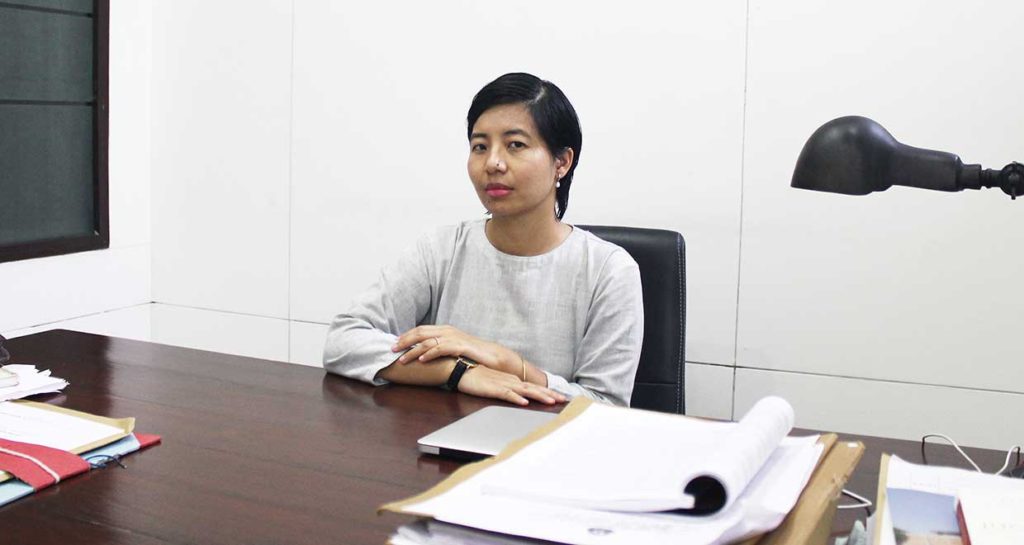
    Enatoli Sema graduated from Campus Law Centre, Delhi University in 2005 after completing a Bachelor of Arts degree from St. Stephen’s College. In the pursuit of her determination to do litigation, she joined the chambers of Mr. Neeraj Kishan Kaul, Senior Advocate before starting her independent practice in the Supreme Court. Being the first from Nagaland to have passed the AOR examination of the Supreme Court, she talks in this interview about:

    • Her decision to pursue law
    • Experience at Campus Law Centre
    • Professional and personal challenges after graduation
    • Working at the chambers of a Senior Advocate
    • Cracking the Advocates-on-Record examination
    • Following her passion for litigation


    Please introduce yourself to our readers. Where did you grow up and attend school? What was your initial career plan?

    My name is K. Enatoli Sema, I come from the State of Nagaland. I grew up in Kohima and that is where I did part of my schooling and then shifted to the Convent of Jesus & Mary, a boarding school in Shimla.


    You completed your Bachelor’s degree from St. Stephen’s College in Delhi University, which is a very prestigious and difficult college to get admission into. How was your college experience? Did you decide from the beginning to study law after graduation?

    I feel privileged and blessed to have attended this prestigious college during the most crucial years of one’s life. It is during this period that I was constantly faced with situations and circumstances that questioned my roots, faith, identity, foundation and my core values. At first, I did not know how to respond to them but as a result I was forced to grow up and decide who I am and who I want to be rather than being defined by others.

    Studying law was also an option for me because of my family background but I was not too sure if I really wanted to do it immediately after graducation. In fact, after graduating from St. Stephen’s and after a year in CLC, I took a gap year just to be sure that I really wanted to study law.


    How was your law school experience? Looking back, do you wish you had done anything differently?

    (Enatoli graduated from Campus Law Centre, Delhi University in 2005)

    CLC was a very different experience altogether, something I wasn’t prepared for. I realised how sheltered and protected I was in St. Stephen’s. At first it was overwhelming, the sheer number of students in the class was enough to make you feel small and insignificant. There were some classes I enjoyed more as compared to others. We had execellent faculty members because of whom my love, interest and curiousity for law started. The one thing I wish I could have changed about law school was probably being more active in campus. I would usually try and find a quiet place in a corner and read and did not interact much.


    How was your first year after graduation? What were your thoughts and in hindsight how did they work out?

    The first few months after graduation was difficult for me. Nothing prepares you for what you are going to face especially if you choose to do litigation. There is no similarity between the theory and practice and it takes time to get used to it. As time passed, I grew more intrigued with the drama and process of how law evolved in court room proceedings. My first year went just fine, there is nothing I would like to change about it. But yes, I wish someone would have told me that it is OK to feel lost and clueless in the first few months of practise and that everyone goes through it.


    enatoli-sema-2

    You worked as an associate in the chambers of Senior Advocate Neeraj Kishan Kaul from 2007 to 2009. What did your work consist of? Were you free to take up your own cases, independent of the ones your senior allotted you?

    Joining the chambers of Mr. Neeraj Kishan Kaul, Senior Advocate, was the one of the wisest steps I took as a young lawyer who was interested in doing purely litigation. Being in the chamber of a Senior Advocate, the work of the junior associates mostly revolved around legal research, analysis and assisting him with our notes and preparations. Working in his chambers trained and exposed me to the basics of law in a variety of subjects within a short span of time. In his chambers, I was not only taught law but I also learned professional ethics and discipline which is crucial for any Advocate who views this profession seriously.

    Mr. Kaul’s chamber was very demanding as working in any top notch Senior Advocate’s chamber would be so there was really no time to take up any independent cases and since I was just freshly out of law school, I don’t think I had the experience to take up cases on my own.


    You became the first from Nagaland to pass the AOR exam of the Supreme Court. How did you prepare for it? What do you think are the reasons that no person from your state has ever passed it?

    As I started my independent practise in Supreme Court, I realised that it was very important for me to take the AOR exam. I was encouraged and guided by AOR’s who had taken and passed the exam. I was blessed to get sound advice and guidance by fellow colleagues who were already AOR’s.

    There are very few lawyers from Nagaland practising in Supreme Court and partly that is the reason why there were no AOR’s from Nagaland. I hope that in the coming years there will be many more AOR’s from Nagaland.


    Please tell us more about the AOR exam. When do you think one should start preparing for it and attempt it?

    It is important to familiarize yourself with the syllabus and the study material that is available for taking the exam. I started preparing for it around the month of February-March since our exam was in June. It is always better to start preparing earlier because you have to juggle your work and studies at the same time. Sitting for an examination after years of gap did not help but the idea is to remain focused and hydrated in the Delhi heat! For me attending the lectures given by the examiners helped a lot while studying because they give you an insight of what to expect.


    Currently, you are Standing Counsel for the state of Nagaland in the Supreme Court of India. What do the duties and responsibilities include?

    Being a Standing Counsel for any State is a matter of great honour and a privilege. Since I have been away from Nagaland for so many years, personally I see it as a chance to stay connected to my people. I also see it as an opportunity to contribute towards my society as a legal professional. The duty and responsibility is to ensure that your State is effectively represented and that the Government is given sound legal advice and guidance at all times.


    What are your plans for the future?

    As of now, the only plan is to be a lawyer whose work is respected.


    Lastly, what advice would you give to law students wishing to make a career in litigation?

    Litigation has its share of fun and adventure but it is also taxing. Choosing to do litigation while your other friends from law school may be joining fancy law firms is certainly tough. But if your heart is in litigation and that is what you want to do, then don’t let go of your dream and be prepared to slog and work hard towards it.

    When I expressed my desire to do only litigation after a year into practise, I was advised and warned by a wise man to be prepared to put in a lot of hard work for at least 10 years. As a naive young lawyer, I thought that that his ‘old school’ philosophy talking. I now understand what he meant. This profession, specially litigation will also remain ‘old school’ and I hope that it continues to do so. There is no short cut if you want to be someone who truly works for justice.  So, take your time to decide if litigation is really what you want.

  • Jaimin Dave, Graduate from Institute of Law, Nirma University, on beginning his practice at Gujarat High Court

    Jaimin Dave, Graduate from Institute of Law, Nirma University, on beginning his practice at Gujarat High Court

    Jaimin Dave, a 2012 graduate of Institute of Law, Nirma University, Ahmedabad is currently working as an Independent Counsel, at the High Court of Gujarat. He litigates in all types of civil cases, his areas of interest being Corporate and Commercial Laws. In this interview he tells us about:

    • The importance of knowledge, as compared to CGP;
    • The passion of indulging in mooting and Legal Aid;
    • The way to prepare for the All India Bar Examination;
    • The experience of representing institutions like Reliance, Asian Paints, Ford, Huntsman, and various others;
    • The work as a Retainer Advocate;
    • The choice of Corporate Law as a career.

    How would you like to introduce yourself to our readers?

    A simple easy going man who happens to be lawyer by vocation.  I am based at the High Court of Gujarat and mostly deal in all kind of Civil Cases. Amongst Civil Cases, I would say, I have special liking for Corporate/Commercial and Taxation matters.

    What has your experience been like, studying in Institute of Law, Nirma University? What other co-curricular and extra-curricular activities were you involved in?

    Journey at ILNU shall always remain special. According to me it is one of the top ranked Private Law Schools in India and I consider myself to be fortunate enough to have graduated from ILNU. 

    If I look back at my journey at ILNU, I was part of a pioneer batch and most of them in my batch were extremely competitive. There were 10 to 15 batch mates who were outstanding and it is from there, that I derived motivation to do well at ILNU. Of course, all of them are supremely able and I think I am still catching up with them. But, yes, in their company I learnt that there is no substitute of excellence. Academic brilliance was encouraged at ILNU but at the same time it was ensured that we got practical exposure to different arenas through adequate internships, workshops and co-curricular activities. At ILNU we were always pushed harder to walk an extra mile in whatever we did; be it academics, co-curricular activities or internships. And that habit of pushing hard and walking an extra mile, which was inculcated at ILNU, is helping big time in professional life.

    I was involved in host of co-curricular activities. But, mooting and Legal Aid were two of the activities in which I was keenly interested out of all the other co-curricular activities. I believe mooting has multi-dimensional advantages attached to it and to me it was highly beneficial. It helped me develop much required confidence for litigation. The legal aptitude and knack of identifying clinching points in a given scenario developed due to mooting. Besides this it enhanced my research and analytical skill. Legal aid was done out of sheer interest and even today I am part of High Court Legal Aid Services Committee since I am firm believer in repaying back to the society.

    You had honors in Corporate Law. Tell us about the Honors Program at ILNU?

    Again interest for Corporate Law developed on account of few Moot Courts that I did on this subject. This is the reason behind choosing Corporate Law as honors course.

    ILNU offers a well strategized Corporate Honors program. As a part of my honors program, I got an opportunity to carry out extensive research and read texts on topics like Mergers & Amalgamation, Securities Law, Contract and Tenders, Corporate Insolvency, Corporate restructuring etc. I believe things done at the time of corporate honors program helps me today when I sit down to vet SPA’s/SHA’s, draft a winding up petition or let’s say draft a scheme for De-mergers/Amalgamation. To sum up, corporate honors at ILNU was very insightful.

    You’ve been awarded with the Best Student of Law for Batch 2007-2012, and have also bagged two gold medals for the highest CGP, and the highest CGP in Corporate Honors. How relevant would you say, have these grades been, since you started litigation?

    As a student of law school, I believe, my focus was more on acquiring skills, intellect and knowledge. The awards and medals just happened while I was honing my skills at law school. Yes, they give you a sense of satisfaction and it shall stay as a pleasant memory with you. But, at the same time I acknowledged and realized that these medals only indicate that I did a fair job as a student during law school. It does not carry my case any further.

    Yes, it motivated me to do well as a professional. The day I graduated and received them, I sat down and told myself that this is not the end and it is just beginning. I made it clear in my head that awards and medals have to be left behind and I need to put in the same amount of hard work and dedication, as I did for the past five years, so as to establish myself as a good professional. Grades, awards and medals became completely insignificant the day I stepped into practical field since there are a lot of others factors and skills that makes you a good litigating lawyer like time management, Court craft, awareness about mindset of a Judge, skills of opponents etc.

    In fact, to be very blunt, if you opt for litigation as career, grades, awards and medals are either a piece of paper in your drawer or a show piece at your office. Speaking for myself, nobody ever approached me and handed over a brief to argue because of my grades or medals. Only skills, intellect and knowledge, that have been acquired during law school life have helped me so far. Therefore, in my opinion, focus should be more on quality of knowledge and skills that you acquire rather than grades or medals you obtain at law school. Of course medals give you some morale boost but one needs to back that up with other intellect to survive in litigation.

    How did you prepare for the All India Bar Examination?

    AIBE is one of the easiest exams that I have ever appeared for as a Law Student.

    Of course, before taking the examination, I was a little nervous, considering the longish curriculum that AIBE has. As a fresh pass out, it is perplexing to know that all those laws, for which you took five long years to study, are now required to be read over for a single exam. Having said this, I approached AIBE with incisive planning and gave myself sufficient time to prepare for the exam. The idea was to run through Bare Acts related to all the laws mentioned in AIBE curriculum. Thereafter, I read commentaries on CPC, Contract Act, Specific Relief, Law of Torts, CrPC, IPC and Evidence Act since these subjects carried maximum weightage and refreshing memory on these subjects would have helped me in litigation as well. Once I did this, I was fairly confident of appearing in AIBE.   

    Everyone who has appeared for AIBE will endorse that if your fundamentals as Law Student are clear, it should be a cake walk to clear it. It simply tests your basic knowledge on several statutes that form fulcrum of Indian Legal System.

    However, I personally believe that AIBE can be made more challenging and stiffer, if BCI really wants to achieve the purpose behind introducing it.

    What made you gravitate towards litigation, immediately after graduation? What other options were you considering?

    As a kid, robes and neck bands fascinated me and that’s how I have ended up in this black and white world.

    On a serious note, I think I thrive on challenges and I was gravitated to litigation because of challenges attached to it. I am a first generation lawyer and decided to choose litigation as a career despite strong NO from near and dear ones only because I am passionate about practicing law. I was clear about choosing litigation as a career from day one of my law school because of the following reasons:

    • In litigation you get firsthand experience of interpreting law and testing your legal acumen. As a lawyer you can evolve a new law point and test it before the Court. As a law-firm associate or in house counsel you can never become master of a brief. Obviously they can bring up a point and most of them come up with excellent points. But ultimately it is left upon wisdom and good judgment of litigating lawyers to decide as to whether it should be argued or not depending upon opponent, Bench and other factors. I prefer being master of brief and hence this career over other options. Yes it brings lot of responsibility and risk along with it but then I have always enjoyed this till now. 
    • Secondly, it is a career which throws up new challenge almost every day. As a lawyer I deal with matter involving different subject matters such as Winding-up, Tax and Stamp Laws, Mergers & Amalgamation, Land Acquisition Law, Electricity Laws, Land Laws, Civil Procedure Code etc. When you deal with such wide range of subject, your job is never monotonous. Each case, each opponent, each Bench and each law throws up a different challenge and you have to don different hats to do justice to brief. 
    • Lastly, I would say is the job satisfaction associated with litigation, tilted my interest towards it. For me it is always satisfying to argue a law point well and convince a judge. If you have prepared and argued the brief well the clients will also acknowledge your efforts and their satisfaction with your work is always a morale booster. Yes the picture is not always rosy and there are days when matters get adjourned or you cannot convince a judge even after toiling through earlier night to prepare a brief. But, as far as I put in my best efforts I am a satisfied man.

    As I said, I never considered other options as a Career. Even today I do not have plan B, if I fail I am gone. But at least for now, I believe I have made a right choice. This I say so because I am also involved in non-lit work like drafting and vetting of SHA’s, SPA’s and other contracts. That work to me is not as interesting as litigation because practicing law is much like playing sport to me.

    Was there anyone, in particular, who influenced you while deciding on litigation?

    Not really, but I think it is my internships that sealed my decision to join litigation. I did a running internship with Senior Advocate S. N. Soparkar during last two semesters of law school and then at Supreme Court with Hon’ble Justice A. R. Dave. These internships were enriching. After getting an exposure to different matters and work culture at High Court and Supreme Court, I thought it was the right decision to join litigation. There was nothing in particular that influenced my decision significantly; I went with my heart and followed something I was passionate about.

    What are your core areas of practice? How did you find your domain?

    During the initial phase of your career there is nothing like a core area of practice. It is like you have to accept every cuisine that is served into your platter when you are famished.

    Likewise, I am a litigating lawyer who takes up every kind of civil litigation that comes up to me and also criminal matters if they are related to white collar crimes, commercial transactions or land disputes. I admit that I have that special liking for Commercial and Taxation matter and criminal doesn’t interest me much. But that liking towards corporate and taxation matters is because of the fact that I am conversant with those two subjects and also because I have experience of appearing in Court for such matters. Ordinarily I would grasp matters related to taxation and corporate/commercial laws much faster as compared to other matters. But that does not mean that I cannot prepare myself on other subject. If I get few hours to prepare myself with any civil brief I am ready and willing to argue it. It is others who have labeled me as a lawyer for corporate or taxation subjects. According to me I am lawyer who accept all civil briefs and whose comfort zone might be Corporate and Tax Laws.

    What is the present scenario of Corporate Law as a career option in India?

    An opportunistic career.

    They have established National Company Law Tribunal an Commercial Courts are coming up. We already have DRT, ITAT, CESTAT and few other tribunals. Insolvency legislation is coming up and there is this Real Estate Regulation and Development Act. All these laws and institutions collectively indicate that there is lot of litigation in store. So if you are planning to become a litigating corporate lawyer the future seems to be bright. Even on non-lit side, SPA and SHA are on rise in India and with enhancement of FDI cap in several sectors it will only rise further.

    What are the challenges of being an advocate in the Gujarat High Court?

    High Court of Gujarat is one of the better Courts to start practice. The Bar members are receptive to junior lawyers. Most of the seniors are approachable and ready to help when you seek their advice. The Hon’ble Judges are willing to hear you patiently provided you argue appropriate points with the brief in hand. There are a lot of people in similar age group as that of me so obviously you make lot of friends at the bar. Also you can have intellectual discussions with them and their perspective adds value to your preparation for a brief and understanding of law at large. All in all, I would say environment is good at Court and despite being first generation lawyer I never found any problem at the Court.

    Have the law schools in India been able to produce socially relevant lawyers, given that many choose to take up firm jobs?

    Taking jobs in law firm does not mean that you are socially insensitive. Lot of my friends who have joined law firms do social work in their free time. I agree that as lawyers you can become directly relevant to society through Pro Bono litigation and Public Interest Litigations. But that does not mean that law schools have failed in producing socially relevant lawyers because more people take up firm jobs.

    I feel every law school emphasizes upon its student to inculcate ethics, values and good conscience. It is the individual’s choice thereafter to decide the impact that he wants to have on society.

    Has there been any case that changed your perspective about the Indian judicial system?

    Every case that I have argued till now has changed my perspective about the Indian Judicial System. I have a habit of analyzing my performance before the Court irrespective of the outcome of the matter. When you analyze your performances it is bound to leave an impact on you and change your perspective about the system.

    Ultimately I have realized that the system remains the same, it is more about changing your perspective as a lawyer and molding yourself to fit in the system. You get effective results out of the existing system, the faster and better you mold yourself to fit and then excel in the system.

    Please tell us about your experience of representing some of the most reputed institutions, and being a Retainer Advocate at various other institutions.

    Obviously it is good to represent institutions like Reliance, Asian Paints, Ford, Huntsman etc. before different forums very early in one’s career. But my preparation for each brief has remained the same depending on the merits involved in the matter.  I have never gone by the name of the client over the docket while putting in efforts into a brief. However, when you sit down to prepare for briefs of these reputed institutions all the relevant information is on the table and it becomes easier and less time consuming as compared to other clients. Their approach to litigation is much more methodical and strategic as compared to other clients.

    Coming to retainer- ship, honestly, it is a tedious job. They approach you for legal assistance in each and every small notice and petty issues. And sometimes with lack of time you lose the plot. But then advantages outrun the disadvantages. It helps me in learning about the problems that such institutions face in day to day functioning. I get an opportunity to solve those problems and keep myself abreast with development in various laws such as Arbitration, Negotiable Instruments, Labor Laws, Registration of documents, Stamping etc. Hence, as far as I am learning out of it, I will continue accepting retainer-ships.

    The Bar Council of India is contemplating on the formation of a new rule which will require lawyers to practice in lower courts, before arguing before the High Courts and the Supreme Court. If this rule is made concrete, do you think it will help?

    I think it should be left to the conscious decision of an individual lawyer rather than imposing something like that by way of rules.

    Before starting to practice at High Court of Gujarat, even I was confused and contemplated whether to join sub-ordinate courts for initial one to two years. But then I consulted two very good seniors at High Court of Gujarat and both were of unanimous opinion that lower courts practice does not have significant impact on practice at High Court if you are aware about the procedural aspects of sub-ordinate courts and basic statutes. Considering this I started my practice straight away from High Court and obtained good understanding on procedural aspects of sub-ordinate courts and re-read basic statutes such as CPC, Evidence, Specific Relief, Contract, Court Fees Act and Limitation. Once you do this I don’t think there can be any problem.

    Today, I also take up selected matters before sub-ordinate courts and not practicing there before joining High Court hasn’t impacted my performance anywhere so far. However, this is my personal belief. BCI is a wise body and there must be some thought behind proposed rules. As and when it is rolled out one can have better understanding about the intention behind such rules.

    Finally, what parting message would you like to give to our readers?

    I would say learn as much as you can while in law school. Learning does not mean only bookish knowledge because grades and awards are secondary; your intellect and knowledge comes above all. By learning, I mean educate yourselves with every possible trick related to the profession you wish to join after graduation. It can be done through running internships, workshops, seminars, moots, debates etc. This will make you a complete product by the end of five years.   When you join a profession, not all days are going to be the same. Trust me it will be a roller coaster ride from day one. Sometimes you unexpectedly win a matter and sometimes you lose a good matter. However, you are bound to make progress, as long as you keep working hard, stay honest to your work ethics, believe in yourself and grab opportunities that come your way. I acknowledge that the track is difficult and you need to have your foot on the pedal all the time, but then smooth tracks don’t create skilled operators. 

    In the entire process make sure you make a lot of friends, take vacations and do adventures, travel and explore the globe, drive a machine you love. Stay gracious to everyone who has helped to be what you are. Most importantly make sure you take out enough time for friends and family, although I have been accused of not following this part of my advice. But, I am trying to make amends by taking out time for people who matter.

    With this, I wish every reader best of luck with their future endeavors!

  • Zaryab Rizvi, Partner, LCZF, on starting up with independent litigation and building clientele

    Zaryab Rizvi, Partner, LCZF, on starting up with independent litigation and building clientele

    Zaryab Rizvi graduated from Symbiosis Law School, Pune in 2005. He started practicing law in Delhi right after graduation and has been independent from the very beginning, Zaryab is one of those who started out with their first few matters of legal career without a mentor or guide.

    He is the Founding Partner of LCZF (Law Chambers of Zaryab and Firdouse) where they provide varied legal solutions to their clientele across the country and provide solutions in litigation, corporate jobs, compliances, IPR, ADR etc. Their clientele is diverse and includes MNCs, banks, shipping companies, government entities, private individuals etc.

    In this interview he talks to us about:

    • His experience at SLS, Pune.
    • Importance of internships in shaping his career.
    • His experience of first time court appearance.
    • How he overcame the initial hurdles.

    How would you like to introduce yourself to our readers?

    I will prefer to call myself a learner who is in search of excellence and for which purpose I have put in my best efforts. I have done my schooling from the great city Lucknow, after which I joined Symbiosis Law School, Pune. After successful completion of law degree, I decided to work independently and ever since have pursued my passion. Being a first generation lawyer, the decision to work independently in an unfamiliar city of Delhi had its share of challenges, but my strong determination and focus never made any kind of pressure to halt and change my decision. My position or you can say mindset can be described aptly in the following words: “I just hate losing and that gives you an extra determination to work harder”- Wayne Rooney. I am the founding partner of LCZF (Law Chambers of Zaryab and Firdouse), which is a full service law firm. Our Head Office is located in Delhi, but we are operational all across the country through our wide number of associate offices. The firm is a one-point destination for all legal requirements of a client, where we ensure that tailor made solutions are provided to client’s each requirement in the legal domain.

    What prompted you to think of law as a career? If not law, what other options would you have considered for your career?

    Choosing a career is one of the most important decisions of an individual’s life, as it determines ones entire future life. Although there are several occasions, when a person may have to take up a call on the future profession, but the first of such a significant instance is at the time of selection of subjects/stream after the high school results. Fortunately, the power to take such decision, like all other important decisions of my life was given to me by my parents, after providing the insights and guidance about various options. I acknowledge the importance of all other professions, but I would say that many people make such an important decision of life just on the basis that, many others are deciding in favor of a particular stream of education and they should follow the same. The profession of law has been a noble profession, but the problem with the profession has been the deteriorating standard of lawyers between the periods of 1980’s and 1990’s. The said concern has been raised and discussed by multiple Courts, Judges, Bar Council of India and in this regard various measures have been taken for improving the standards. I believe that a person should consciously choose a profession and the same shall not be by default, but the irony with the legal profession for years has been that many people end up in profession by default and not by choice.

    There are several reasons responsible for my inclination towards the legal profession, some of the prominent reasons are:

    A) Desire to be able to provide assistance to many persons who are caught on the wrong side of the law and who do not have sufficient resources to defend themselves.

    B) Recognition of the fact that a good lawyer is a person who possesses attributes like sharp mind, eloquent speech, command over the law, credibility in society, honesty and a rich taste in life, placing such lawyers in the elitist and distinguished class of the society. C) Apart from the above positive aspects, I also had certain bad experiences, with some unprofessional lawyers, while assisting my family in some of the civil disputes. Such instances also made my resolve stronger to be a part of the legal profession and make endeavor to raise the standards of profession by lifting my own personal standards.To answer to your second part of the question regarding options, which I had or considered apart from law, I will only say that although there were all the fields available to me, but I do not believe in options.

    Describe your experience at Symbiosis, Pune as an undergraduate law student. Any highlights and incidents you would like to share.

    I believe that all the educational institutions are respectable and knowledge imparted to students there is also good. However, having said that, I want to further add that, an educational institution is not only about imparting knowledge from the books, but such institutions are also responsible for giving a vision to the students. A student during the process of learning evolves his choices about his future course of action in the professional life. I believe that an educational institution should have conducive environment for the learners and shall provide all resources to the students, which eventually develops their skills and vision. For me, Symbiosis Law College is not just a college, I share a nostalgic relationship with the institute and all its members, be it the academic staff, administrative staff, support staff, fellow students as also senior and junior students. Moto or the central ideology of our alma mater is “Vasudhaiva Kutumbakam” which means the ‘whole world being one family’. I was 18 years old, when I joined the Law College in Pune, about 1500 kilometers from my home.

    There never arose a situation where my parents had to worry about me in the then alien city. The college truly lived up to its Moto and I never felt that, I was in a city where I have no roots. I clearly remember that several times some of the political outfits created ruckus in the city, about the people (students) from outside the State. But on every such instance the college management and Local Teachers/Students stood in firm support of all the students from other states, which action was not just in conformity with the Constitution of India but also was inline with the core ideas of the institution “Vasudhaiva Kutumbakam”.

    Our college was headed by Prof. Mrinal S. Raste, who was the principal of the College during the period of my academic journey in the College. Prof Raste went on to become the Vice Chancellor of the Symbiosis University (Deemed University) and along with the Management of the College, was responsible for enhancement of the Brand of the College. We were privileged to have academic faculty, which not just possessed immense knowledge of the Law subjects, but were very friendly and easily accessible to all the students. Although, all teachers were great but amongst them, my favorite guide and mentor was our torts professor, Prof C. J. Rawandale. He holds a respectable position in eyes of every student, as he is a knowledgeable and friendly person with a pleasing personality and is a “go to” person in every crisis situation, be it academic or otherwise. My connect and association with Prof Rawandale, did not end with the conclusion of my academic period in Symbiosis, Pune, but even thereafter it became stronger year after year. At present Prof CJ Rawandale, heads the Noida campus of Symbiosis, as its Director and because of him the doors of the Noida campus are always open for the Alumni of the college, which is quite helpful for all of us. Prof. Rawandale is putting immense efforts in bringing alumni closer to each other as also to the current students of the college, by organizing several events, paving way for colossal work opportunities to each and every one who has been and is part of my alma mater. Such a thoughtful faculty makes my alma mater, one of its kind. Symbiosis is a part of my life, which I cherish the most and I am thankful to the Almighty for granting me such an opportunity, which completely impacted and changed my life for good.

    Where did you do your internships while at law school? How important were these internships in shaping your career?

    During the breaks in the academic session, I used to join Law Offices situated in Delhi for internships. I interned at several places. All Internships I took up, were very helpful as I not just got opportunity of learning and understanding about the practical aspects of the functioning of Justice delivery System, but such internships also helped me to make informed decision about my future. It became relatively easy to choose between various avenues like job in a company/ law firm/ corporate work/ litigation etc. Amongst other internships, I also interned twice with Mr. Atul Sharma, (Founder, ASA Law Firm). I will say that my decision to choose litigation as my career was influenced to a great extent from my first hand experience with high profile litigation in his office. My first internship was in my second year of law and on the very first day, I attended proceedings in Hon’ble Delhi High Court, where we were seeking anticipatory bail for one celebrated singer accused of illegal immigration scandal. After being granted the relief, the moment we moved out of court, media surrounded our team and standing in a corner, even my face was telecasted across the globe. My parents were relieved that their son has actually joined work. Such small moments always remain special, although I have made numerous television appearances since I joined profession, but that appearance of few minutes will remain my best and most cherished one. I will say that the present generation is even better and are taking profession in a much more serious manner. I believe that such approach by young students is not only helping skill enhancement of the students, but at the same time is also having a positive impact on the larger scenario, as the quality of lawyers is improving with each day.

    How did you overcome the initial jitters in a courtroom full of experienced lawyers and judges, as you started out independently?
    zaryab-rizvi-1It is indeed a very pertinent question, why and how I started working as an independent practitioner in an unconventional way at the initial stage of my professional life. In the lighter vein I will say, that I still wonder and look for answers even today for the above question. But probably had I not taken such decision I may not have got to answer such an eccentric and rare question. On a serious note, it is true that I decided to work independently from the day one in an unconventional manner against the usual trend. I was fully aware that I will have my own share of challenges in pursuing the said decision and it would not be an easy sailing for at least a few years.

    Trust me I was not wrong and there were ample challenges throughout the journey. I was not born in the profession with the silver spoon in my mouth, as I am a first generation lawyer, who decided to work in an alien city where I had no roots as such.Every aspect of the professional life and work, be it the simplest of jobs was a challenge and gargantuan, as there was no one whom I could have asked solution for my queries. I will say that my feeling on finding solution to a simple thing used to be same as of “Early man” who discovered fire accidently by striking stones together. It is true that the challenges were huge but my desire to pursue my aspiration, gave me inspiration to face all these challenges and I believe once you decide that “YOU CAN” surely “YOU CAN”. As I said earlier that, I don’t believe in options, for that reason I had no other option but to perform.I never had any fear of any senior advocate, judge, or advocate having more experience than me. As I always believe that if I had done justice to my work I will get justice in return. The only pressure I felt has been of miscarriage of justice for my client because of my adventurism (as some people used to term it in my early days). But in the past 10 to 11 years I have a success rate of over 99% in the cases, which I have handled. I always ensured that my decision to start independently should never be an obstacle in putting my best foot forward, when my client’s interest is involved.

    Describe your experience when you appeared in the court for the first time?

    My first appearance in the professional life was before the Hon’ble Supreme Court of India. I could not have expected a better first appearance. Although my role in the said case was very limited as there were many other parties in the said case, but for a first generation lawyer who decided to practice independently and who practically had no experience, this opportunity to commence professional life before the highest court of the country was in itself a privilege. I think it is not very difficult to imagine my situation at such time. However, after appearing before Hon’ble Supreme Court in the very first instance, appearances before all other courts appeared to be relatively easy. Many years have passed since then but the memories of that first appearance are still fresh in my mind.

    Did you ever have any other plans other than litigation? What are your views on LL.M.? Do you think Indian Legal Education needs to improve?

    Litigation has always been the first love but apart from litigation I have been involved in a lot of Corporate work, which includes drafting/vetting Commercial Agreements, Contracts, MOUs, advisory compliances, incorporations/mergers/acquisitions etc. I have also imparted training on Sexual Harassment of Women at Workplace (Prevention, Prohibition and Redressal) Act, 2013 to various representatives of the corporate world in Delhi, Bangalore, Hyderabad, Noida, Gurgaon and Lucknow. Apart from the above, my several articles on different subjects have been published in some leading Magazines. The evaluation of the education system can only be done by examining the developed products of that system and in the present case the product is a lawyer. If I say that the education system is bad, the same would be absolutely wrong as the products of the same system have made not just the fraternity proud by their knowledge but have also got recognition to the country’s legal acumen at the international stage. However, I agree that there is scope for improvement. In the present system, brilliant students of the top law schools are somehow more inclined towards non-litigation assignments. I believe that the exposure to litigation should be encouraged during the academic course, so that these students are better equipped to take up litigation assignments and jobs.

    Tell us something about LCZF (Law Firm).

    LCZF came to be formed by me along with Ms. Firdouse Qutb Wani (“AOR” SCI), with a thought that a client looks at it as a trusted resource. The name LCZF stands for Law Chambers of Zaryab and Firdouse. We wanted to be a one-point destination for all the legal requirements of a client and ensure that a tailor made solution is provided to the best of their interests. Today with the support and efforts of our able team of lawyers and Para-Legals, we have achieved this goal successfully. LCZF provides legal support to various private Corporates, Government Establishments as also to individuals. We provide legal solutions even in the remotest parts of the country and it has become possible through our wide network of capable associates across the Country. Further details can be checked by the readers on our website, www.lczf.in. We also take up Pro bono assignments, because I always feel that one should never live with regret that due to lack of financial resources, he/she could not seek justice. Furthermore LCZF, believes in giving opportunity to young law students, to taste the life of lawyers and learn the tactics of the legal practice, while they are still in cocoon, hence we have created an independent department in our Firm, which completely deals with the Law interns and round the year several students get benefited by the same.

    Please tell us about your current occupation. What do your main tasks and assignment include?

    During the course of my professional life I have handled assignments of diverse nature, as I have never restricted my professional abilities in small compartments. Presently, I will say that I am undertaking multiple litigation assignments which includes corporate crimes, service matters including writs, commercial arbitrations, matters emanating from Arbitration and Conciliation Act, matters under Companies Act including winding up, civil and criminal writs, petitions under Section 482 Cr.P.C, Bails, matters under SARFAESI Act, cyber-crimes, matters under labour laws, matters under Negotiable Instruments Act, matters pertaining to marriage, sexual harassment cases to name a few. I am also involved in advisory functions to start ups, factories, MNCs and Banks. My corporate assignments include drafting/ vetting Commercial Agreements, Policy Formulation, Contracts, MOUs, compliances, incorporations/ mergers/ acquisitions etc. I also give sessions/training on Sexual Harassment of Women at Workplace (Prevention, Prohibition and Redressal) Act, 2013 to various representatives of the corporate world in Delhi, Bangalore, Hyderabad, Noida, Gurgaon and Lucknow. Apart from the above, my several articles on different subjects have been published in some leading Magazines.For catering to the above assignments, I have responsibilities at LCZF. I aim for perfection in every assignment that LCZF takes up and for that purpose every document that is prepared by our team which of consists hardworking and capable professionals, has to come to my desk for settling before it goes to the Client for approval or is filed in the concerned court or Tribunal, as I want to ensure that no error is on part of LCZF. We believe that we as Lawyers have great responsibility on our shoulders to safeguard the interests of our clients and our small error or oversight can change the course of future of our client. My main work includes arguing matters in court, advising clients as per the requirement, supervising all the heads of the concerned departments, meeting clients and forging alliances with other Law firms.

    Many law students aspire to secure a job. What do you think most are doing wrong, from your observation?

    Most of the times life gives us multiple options and the choices that may determine our future. Similarly a law student has multiple options at the time of graduating, broadly we can categorize the same as: –

    1. Option in the corporate side as legal manager.
    2. Options with law firms handling corporate assignments.
    3. Options with law firms handling litigation.
    4. Options with small law firms/ Lawyers.
    5. Other non-traditional avenues.

    In my view all options are good and a person who joins any of the above has a good future. I’ll say a person shall make the choice after considering the benefits and the challenges that one may face in the stream of his choice. I believe that the focus of an individual should always be towards satisfaction in the work that the person is undertaking as if a person is satisfied with the work he is undertaking his/her quality of work will always be good and for that reason he/she need not worry to secure a job as his/her work may have taken care of securing a job. I think many of the professionals take up assignments which they don’t want to take but they land up in such domain due to choices driven by glamour, monetary benefits, family pressure, peer pressure, false evaluation, under estimating the challenges. In my view if we make a choice for reasons other than passion to do such things we are bound to be dissatisfied after a short span of time, as when we are passionate about a decision, we take every difficulty, which we face as a challenge and not as a dead-end. To conclude I’ll say that aspiration to secure a job is not wrong, but the legal profession requires patience, determination, dedication, hard work, sincerity and perseverance which maybe difficult if we have made our choice for any other reason or consideration other than our passion.

    What helped you shape your current profile within the field?

    As they say, “Rome was not built in day” similarly I cannot single out one factor which is responsible for shaping my current profile. There have been several factors over the years, which have played important role at relevant time.As a first generation lawyer, I started to work in an alien city since the very beginning. I had no one to guide me, I learnt a lot from observing the masters of the profession in courts and at every opportunity. I’ll not say that a Dronacharya had closed his doors upon me as I never knocked such doors, but yes, its true I learnt a lot while adopting Eklavya’s way of learning.  Over the years I have had many people from whom I’ve learnt a lot, one such name is of Mr. C. Mukund (Advocate). I have had numerous opportunities to interact with him and every interaction has been of immense learning. I’ve not only benefitted from his knowledge of law but I am also influenced with his humility, humbleness, down to earth attitude and generosity.

    Where do you see yourself by the end of coming five years? What are your long-term objectives?

    Every individual must have goals in his life, as without destination we do not have a path, which we have to follow. I since the very beginning have set goals for myself, both short term goals and long term goals. The short-term goals are usually milestones in our journey to achieve long-term goals. I have set timeline to achieve such goals, as without timeline goals are rendered meaningless. In the coming 5 years I wish to work on assignments which test my abilities to enhance my legal acumen. As I said, I am learner, I would like that in the coming 5 years, I use such time to gather as much knowledge as I can, while putting such knowledge to good use and obtain good results for my clients. Although I have many goals in the long term, but if I look at the ultimate goal of my professional life, I would say that I want to be some one, fondly remembered in the legal fraternity.

    What would be your parting message to our readers?

    To the law students, I would say that, make a choice of your profession wisely and put your best efforts to continue chasing your goals. Do not quit the pursuit, due to any reason as the momentary troubles and roadblocks will vanish if you confront them, but if you quit, you will always regret taking such a decision and there will be no respite available to you, throughout your life. To all other readers, belonging to the legal fraternity, I would say, we all should make our best efforts to serve the Justice Delivery System, in a manner in which we ensure that speedy Justice is delivered and for which purpose we all should continue our best efforts, to further raise the standards. To conclude, I’ll say that every professional associated with the domain of Law, be it an academician, Judicial officer, Legal Manager in a Company, a practicing Lawyer, Journalist involved in Legal assignments, organisations dealing with legal search tools, all are important and without any of them, the Justice Delivery System may come to a standstill. We all owe a responsibility towards the profession and we all should do our best to keep the Noble Profession, Noble”.

    Md. Zaryab Jamal Rizvi

    Founding Partner – LCZF (Advocates and Solicitors)

    Correspondence Address: LGF, E-102, Kalkaji, New Delhi – 110019

    Website: www.lczf.in  E-mail: zaryab@lczf.in  , advocatezaryab@gmail.com

    Landline Numbers:  +91-11-46078301 – 02  FAX:  +91-11- 46078303

  • Zubin Pratap, New Business Development Manager, Telstra, Melbourne on varied work experience in Corporate firms and MNCs

    Zubin Pratap, New Business Development Manager, Telstra, Melbourne on varied work experience in Corporate firms and MNCs

    Zubin Pratap graduated from NLSIU, Bangalore in 2003. After working at Amarchand & Mangaldas & Suresh A Shroff & Co for one and a half years, he moved to Luthra and worked there for a short period. Thereafter Zubin moved to Melbourne and in 2007 he found a role at Baker & McKenzie where he went on to join General Motors in a secondment, Zubin continued at Baker & McKenzie till October 2010.

    Soon Zubin joined Telstra and is currently a New Business Development Manager there, he has been in the organisation for the last six years.  He has served as a Board Member at Communication Rights Australia. He founded NobleGenie which seeks to change the way we seek and obtain specialised information from qualified experts by being the first step in a search for quality advice and information from an ecosystem of professionally qualified advisors, and recently Zubin also created an app called Remynd which works as a mind mapping software.

    In this interview he talked to us about:

    • Interning at the United Nations office of Drugs and Crime in Vienna
    • Balancing his passions and his interest in music and stand-up comedy along with work
    • His journey from working at a corporate law firm to moving to Telstra
    • His experience as an Indian lawyer working in Australia


    Could you tell us a little about yourself please? Just by way of introduction to our readers.

    Well, my name is Zubin Pratap. I was born in Bangalore, raised in both Bangalore and Delhi and went to NLS to study law. I love music, still play the guitar and sing and I read a lot – mainly in science, philosophy and psychology. I am a nerd, and proud of it! I love dogs. I had a relatively privileged childhood – good education, stable and doting family, great friends and no real hardships to speak of. I moved to Australia nine years ago, and am now settled in Melbourne.


    You were an international moot participant and debater while at NLSIU and took part in many extra-curricular activities. How did you ensure you maintained a balance with academics?

    Balance? Ha! I’m sure some of my classmates would question my “balance”! I did what I enjoyed and felt passionate about, be it academics or otherwise. But I always had high energy and drive.I believe that having fun makes work more playful. That pretty much became my guiding principle – if I am not having fun, why am I doingit? And if I am having fun then long hours melt away and the efforts you put in are hardly tedious.


    At present you are pursuing an Exec MBA from IE Business School in Madrid. What was the thought process behind choosing that course and that business school?

    After 11 years in corporate law I was at a crossroads – I had to choose between continued success and “seniority” in law and putting myself in the way of new opportunities. By then I had also come to question what it was that truly motivated me. The pursuit of excellence drove me to NLS, but at 17 you’re far too young to intelligently realise what you mean to do with your life. I wanted to push myself in new directions because I have a strong curiosity and am relatively fearless about failure. I’ve discovered that I’m most happy when I’m slightly out of my comfort zone and learning something very new.

    When I was offered an opportunity to move into the business side at Telstra, I felt it was an opportunity to re-invent myself. I was curious – what would happen? What would success look like? What would disaster look like? Would it be as risky as people said? Would it be as scary as everyone promised? Will I love or hate it? But to optimise my ability to switch careers after a decade, I chose a program that let me study and work at the same time. It was an accelerated program that I had no choice but to complete in a short, 15 month sprint. It literally is sink-or-swim at the IE Global Executive MBA program. Its top 6 ratings, the calibre of the cohort, and the fact that it emphasises a more holistic view of management and growth (as opposed to only rapacious profiteering) appealed to me immensely. Once again, I feel privileged to be a student with some incredible achievers. It is, however, the hardest test of discipline and intellectual stamina I’ve ever undertaken. But if you’re not slightly daunted by your choices, you’re too comfortable. Right?


    You recently created an app, Remynd! What inspired that and what does the app do?

    Two things impelled me to do it: First, when I finished school in ’98, the internet wasn’t really a huge thing yet. Google was still a box mounted on a Lego frame. The world really was different. I’ve always regretted that I never learned to code. So I did. Well, a little bit.

    The second factor was that I had noticed that the busy-ness of life imposes a giant burden on our short term memories, which are notoriously short term. This is a feature of “cognitive load”. We are literally loading our brain with all kinds of working memory tasks that are tiring. I really believe that technology requires us to remember less but process a great deal more – and for that you need to free up brain power (like CPU power). Our minds should be augmented by the tools we use. I decided to do something about it. So ReMynd was born. I was working in Jakarta on a JV at the time and kept forgetting all the things I wanted to say to my boss, back in Melbourne, each time we spoke! There was just so much going on! And emails added to inbox clutter. I realised that there is nothing out there that brings up a specific mental note when a specific person calls or texts. ReMynd solves the problem of forgetting “notes to self” where you need to say something to someone when you next communicate with them. Its on Android for now and I’m working on newer features. But it is more of a way for me to learn and do something new – not really a startup.


    When did the interest for music and stand-up comedy grow? Were they areas you were able to sustain while studying?

    I’ve loved music since I was a baby. I was literally named after Zubin Mehta for that reason! I learned the guitar in my teens (but I regret never having learned to read music). I love performing and public speaking. And in the 90s, and early noughties, stand up wasn’t a feature in the Indian pub and bar scene. I’d always been very curious – litigation felt easy compared to stand up. A stand up gig and a courtroom have very different kinds of judging going on! Melbourne has an active scene and it was a really fun way for me to meet people, sharpen my performance skills, be creative, and say things on stage that I cannot usually say at the dinner table. It was a license to speak plainly – how could I resist? As for sustaining these things – taking time off study is as important as studying. Very few things soothe the soul like friends, music or laughter. Nothing dissipates stress like a good chuckle or a great tune.


    We see that you rehabilitate racing grey hounds once their careers end. Would you urge every student to take up and promote a cause?

    Yes I used to be a rescue and foster carer for greyhounds. I no longer have the right circumstances to foster but I do remain active in promoting awareness.  I think every human being should believe in making a change somewhere. But what they choose to make a change in is entirely up to them. I don’t like people who treat causes as though they’re a badge of honour or a way to distinguish themselves. Believing in something and trying to make a difference is a deeply personal thing and ultimately it’s got to align with whatever you value. I would urge people who feel that they have something to contribute, to contribute – no matter what it is. Don’t judge yourself and give yourself permission to believe in what you do. Just remember J.S. Mill’s words: “Your liberty to swing your fists ends just where my nose begins”.


    Tell us a little about your stint at the UN.

    It was an internship at the UN Office of Drugs and Crime, in Vienna. The UN Convention Against Corruption was in its final stages of negotiation at the time, and it was a fantastic experience to witness world leaders negotiate delicate matters that had cultural, economic, political and linguistic nuances. It was also my first time working overseas for a longer length of period and I had a fantastic time. Most importantly I realised just how necessary a good, strong education is for one’s confidence and that how Indians are really quite impressive even with structural and infrastructural disadvantages – somehow we manage to win with less and that creates confidence.


    When did you decide on corporate law and why? Were there any particular measures you began to take to prepare yourself for success in the field?

    I found myself slightly disillusioned with litigation in India after about 2 years of practice. I also developed an urge to see how others lived and worked in other countries. I was deeply ambivalent about corporate law. I had mistakenly bought into the disdain that was popular in the 90s that corporate lawyers weren’t “real” lawyers. But I absolutely loved it. It appealed to my need for quick, conclusive results and a sense of impact. I also loved that negotiations required finesse, EQ and persuasive logic. It was a big change from the primacy of precedent – and I found that I could be creative in my advice to clients. I then got an opportunity with Baker & McKenzie in Melbourne and that was my “big break”. It brought me closer to business and prepared me for the tech revolution that followed.

    Had I remained in litigation, I don’t believe I would have had quite the ring-side view of the revolution that was taking place in the mid 2000s. I guess, in hindsight, I didn’t really have measures to prepare myself for success. I just stayed true to myself – I did what I really wanted to do, even if it was unorthodox, and enjoyed myself thoroughly and that brought modest successes, new opportunities, learnings and skills.  I think that is something we could do better – be true to ourselves. Too often we make choices that others will approve of and follow convention because we assume that people older than us know a great deal more about what makes us happy. But while we choose to please others in our acts, we are alone in managing the consequences. Ultimately, it is our life. If we take ownership over our life, then we make choices true to ourselves, even if others disagree.


    zubin-pratap-2

    As a highly commended team leader, would you please share a few pointers on how to do the same effectively?

    This is old wine in a new bottle – but it is 100% true. You can’t lead well unless you’ve followed well. To follow well you must be self-aware –know what drives you, what upsets you or impairs you, what you love and what you merely tolerate. Knowing these things help you to understand just how hard it is to lead people – because ALL people feel these things, but in different ways. Therefore, to lead well you need to have an excellent memory of how YOU felt when you were poorly led or poorly motivated. That will give you empathy to perceive the consequences of your words and actions on those that follow you and remind you that people have feelings and feelings are powerful motivators or impediments.  If you lead people with emotion backed by reason, people will outdo themselves. And that is the goal of every leader – to help others outdo themselves.  The best feeling is when you see the surprise in their eyes – when they’ve literally surprised themselves with their ability and achievement. There is no greater professional joy.


    What areas do you focus your reading on? How, in your opinion, should law students approach the task of selecting their reading material?

    I read whatever is of interest. I don’t follow politics very closely. I am partial to science, philosophy, psychology and tech. I think it’s harder than ever to decide what to follow. But everyone needs to realise that it’s like drinking from a firehose now. So you must accept that a choice is inevitable. Prioritise what matters to you (its personal and always valid  – don’t let people con you into thinking there is superior reading and inferior reading). Ultimately YOU must get value out of it. That’s the only test of your choices – do you get satisfaction out of it.


    What work do you currently do for Telstra?

    I’ve actually just taken on a new role. I now do New Business Development – my mandate is to help identify, partner, prototype, validate and commercialise new business opportunities that will drive new revenue growth for Telstra. It is, quite literally, the most exciting thing I could do right now with my life and energy. Every day I will get to work with brilliant people, building and testing ideas, gunning for excellence and doing some new, innovative and game changing businesses. I left the law about 18 months ago. In the interim, I was in channel and commercial management – running deals with our distribution and channel partners.


    In 2014, you founded NobleGenie. Will you elaborate a little on that please?

    It was a brief experiment. I had started teaching myself about tech, startups, entrepreneurship, design thinking, innovation and problem-solving. I had also just bought a house. I realised that in Australia property is a big part of the “story” of a person’s life – up there with graduation, turning 21, finding love, etc. I also noticed that you need an ecosystem of professionals – an advice marketplace – of lawyers, conveyancers, accountants, financial advisers, mortgage brokers etc. NobleGenie was going to be a platform that brought together these professionals to respond to client queries as a way to win the confidence of clients.  Professional services is a “credence good” – we can never really know the quality of the service (advice) and we are totally dependent on trust when handing over our money. It is not like a car that you can test drive. By having peer reviewed interactions to discrete queries, I felt a system could be designed whereby clients can “test” their professional advisers-to-be. It also helps professionals to build their profile and for the legions of practitioners who want to freelance or work flexible hours, to build their practices. Sadly, i couldn’t spend the time that was required of me on it due to my work commitments (in Jakarta for 2014!) and after completing the coding for the site, I elected to move on to other projects.


    What was it like as a Board Member of Communication Rights Australia and how were you placed on the Board?

    I wanted to volunteer my skills for an organisation that could do a lot more with it than I could on my own. I applied, interviewed for the position and joined the board. What amazes me about the NFP sector is that people are so passionate and motivated about causes  and they aren’t even paid for most of it. Its volunteer based. As a leader, it presented me with a fantastic way to observe how people are motivated without financial gain. There are many studies that show that monetary incentives actually impair the quality of work done. Intrinsic motivation is dramatically more effective – and I can empirically confirm this! I also learned that it doesn’t matter how “senior” or “accomplished” a person is – they are very human, with frailties, foibles, weaknesses, blindspots and flaws just like any of us. That gave me confidence that there is no “secret sauce” or mysterious ability – we are all perfectly capable of excellence and our beliefs limit us more than our abilities.


    Now you live in Melbourne. What is your experience as an Indian lawyer in Australia?

    I have had a great experience here. Most of all I’ve learned about competing globally, and not being parochial. Things have changed a lot since 2007 when I moved here. Globally, it’s become harder to move as a lawyer. It’s actually harder for all jobs really, but law has the added challenge of requiring re-qualification in each new jurisdiction.


    What would be your message to our readers who plan on launching a career abroad?

    For those who want to try and work overseas, I would say think very carefully whether you want to stay in the law or not. Living overseas and experiencing the cultures the world has to offer is (for some) more valuable than a given profession. It’s very hard to move as a lawyer – there are only 2-3 places you could go to realistically. And it’s a lot of effort. If you decide to leave the law do it early – it gets exponentially harder after 5 years. If you’re staying in the law, then start by moving to a place that recruits foreign lawyers actively – but recognise that it is a long hard slog and presents much more uncertainty.

    If you want to launch a life or career or project abroad, the best advice I can give is that the world and the people are not what you think they are – some are better, some are worse – but it’s always different. So don’t take your plans and yourself too seriously. And be adventurous. Your rewards are rarely what you aimed for, but that makes them more interesting.


  • Shabbeer Ahmed, Principal Associate, Kochhar & Co, on Corporate Law experience at top law firms

    Shabbeer Ahmed, Principal Associate, Kochhar & Co, on Corporate Law experience at top law firms

    Shabbeer Ahmed graduated from National Law Institute University (NLIU), Bhopal in 2008. After this, he was working in leading corporate law firms such as Amarchand Mangaldas Suresh A. Shroff & Co. (AMSS), Mumbai and Fox Mandal & Associates, Hyderabad. He is currently a Principal Associate at Kochhar & Co.

    In this interview, he talks about:

    • His time at National Law Institute University, and how to prioritise your commitments there. The importance of keeping yourself motivated and also keeping company of similarly motivated individuals.
    • How to go about getting publications, and how to pick topics and issues appropriate for you.
    • His work experience at the firms he has been employed at as well as his internships, and what to expect from such professional environments.


    How would you like to introduce yourself to our readers?

    I am currently working as a Principal Associate in the Litigation team of Kochhar & Co., Hyderabad. I have graduated from National Law Institute University (NLIU), Bhopal in the year 2008 and previously worked with prestigious firms such as Amarchand Mangaldas Suresh A. Shroff & Co. (AMSS), Mumbai and Fox Mandal & Associates, Hyderabad in the positions of Associate and Senior Associate respectively.

    Was it a childhood dream to take up law? What motivated you to pick this field?

    I have always dreamt of becoming a civil servant like my father. Law happened to me by accident. I was never interested in pursuing a career in law.However, my father has a great fascination for law. It was only in deference to my father’s wish that I  chose law. However, I have no regrets about it now. I owe my success to my father as he has been a great inspiration for me. My interest in law has picked up gradually. Law began to interest me more when I started excelling in co-curricular activities such as moot courts and publications.


    As it is popularly said, “All is well that ends well”. I am currently at this position – enjoying every bit of it – rendering legal services to a variety of clients on a wide range of areas of law.

    Tell us about your time at NLIU. You were involved in a number of co-curricular and extra-curricular activities. How did you divide your time amongst them while also maintaining a stellar academic record?

    Law school days were the most memorable days of my life till date and whenever one takes the name of my college, I become nostalgic and I can go on speaking for hours,reminiscing the wonderful time spent there. It’s very important to have a good circle of friends who are all focussed in college. I have seen many students with brilliant academic records till 12th standards, who managed to crack some of the toughest entrance examinations in the country and joined reputed colleges, only to get distracted. They would also become involved in many other avocations, all because of the circleof friends they fell in with. I was fortunate to have a good bunch of friends who are quite academic and career oriented since the very first year of the law school and we used to exchange each others’ notes and involve in combined study during our examinations. We all have been fortunate to pass out from law school with placements in top tier law firms of the country, and we owe this to our parents and also the wonderful faculty we had in our college those days. Your focus on studies and the activities you take up in law school largely dependson your own motivation as well as the company you keep. One should never forget that these are the most important and constructive days of your life which would pave a path for your glorious career ahead. Needless to say that apart from being engaged in academic and extra-curricular activities, I had a gala time hanging out with my group of friends on and off the campus. The location of NLIU campus amidst greenery with thick forest cover offers a wonderful scenic view from the windows of your class rooms and also hostel rooms and you feel like you haven’t had enough of it even after 5 years.

    Coming to managing both academics and co-curricular activities, it’s definitely a difficult task – especially if you follow the trimester system in law school – however, it’s not impossible to manage. One should give equal importance to both academics and extra-curricular activities such as participating in moots courts, seminars, conferences and organising activities on behalf of internal committees.However, if there is a conflict at any point of time, academics should take precedence over the extra-curricular activities. It all depends on how one manages their priorities. I used to plan ahead and opt for those moot courts which would take place just after winter or summer vacations so that they did notclash with either my examinations or internships. Generally, when college reopens, there would not be too much pressure inthe initial few days on the academic front. I also used to allot some of my timeduring my internship on carrying out research on the moot problem. Further, I often converted the project assignments which I undertook and presented during the course of my internships in the law firms into a research paper and tried to get them published in reputed journals. In most law schools, there is a system of submission of project report on a topic in each of the subjects you study in a particular trimester or semester. In case a student works on atleast 5 projects in a semester or trimester, he can work seriously on atleast one out of the five projects by choosing a topic having contemporary relevance and carry out an in-depth research on the issue. Such project reports(being a piece of original work) can later be modified into a well drafted research paper with proper footnoting of sources and bibliography and send them to legal journals and magazines for publication. Participation in moot courts and involvement in article writing / research papers would hone your research and drafting skills, which is very crucial for the legal profession. Therefore, one can manage activities such as moot courts and publications by planning things in advance like choosing of moot court based on its schedule and conversion of project assignments in college and internships into research papers so that such activities would not eat out the time meant for preparation of academic exams.

    Further, I was also part of many internal committees such as Moot Court Committee, Cell for IPR and Cell for Research in International Law at different periods of my law school. I was also one of the editors in a student-run legal magazine called ‘The Edict’ for a brief period. By being part of such internal committees and groups, one would learn the art of organising college level and national level conferences and competitions and it further broadens your exposure and outlook as you would get to interact with students and faculties from various colleges and also some legendary guests participating in such events which would mould you into a highly motivated team player at the end of the day.

    What sort of activities must a student take up in law school to not only enhance one’s CV, but to also become a well-rounded graduate?

    One should have a balanced approach towards the academics and co-curricular activities in the law school which would result in maintaining a balanced CV. A candidate with wholesome CV with equal proportion of everything (curricular, co-curricular and extra-circular) is always the desired choice for both campus recruitment and also for getting admission into LLM in foreign universities. The top tier firms which come for campus recruitment would look for a candidate having a CV which reflects his overall development and not just the academics. Though I was never the topper of my batch, I had maintained a consistent academic record and managed to be among top 10 percentile in the batch and complimented that with my achievements in co-curricular activities such as moot courts, seminars and publications and this really mattered a lot during my campus interview with AMSS.

    For achieving a balanced CV and becoming a well rounded graduate, consistency in performance is very important. One should never neglect academics and try to manage to be among top 10 or 15 rankers of the batch. Further, participation in moot courts, seminars and paper publications would hone your oratory, research and drafting skills. As I stated above, the experience of being part of internal committees in the university and organising various events would motivate you to be a good team player, which becomes crucial once you join a law firm or corporate house. Last but not the least, having good internships from reputed law firms would definitely have an edge in securing a good campus placement or bagging a pre-placement offer. Candidates should chose internships especially from fourth year onwards based on the career path they chose. A candidate interested in working in corporate firms should aim to work at best possible law firms while the one who wants to pursue litigation practice is advised to intern with trial court or high court advocates. And there is no harm if a candidate who is seriously interested in pursuing civil services does not do any internship provided he utilises the vacation period in building his basics strong in terms of general knowledge, law and also reading NCERT text books and magazines related to competitive exams.

    You have completed an LL.M program in Constitutional Law. When did you develop an interest in this field and what drove you to pursue an LL.M in the same? You did your LL.M program in an Indian institution, which is not usually considered by most NLU students. Can you explain your rationale behind doing an LL.M in India as opposed to going abroad?

    I have done my LL.M through distance education from Acharya Nagarjuna University while I was preparing for civil services after quitting AMSS. Constitutional & Administrative Law has always been my favourite area of law since college. In fact, all my moot court competitions were on the subject of Constitutional Law. The primary reason for pursuing LL.M is that if I would ever retire from this profession, I might end up being a faculty in some law school and I would then love to teach Constitutional & Administrative Law. As per UGC norms, one is required to have qualified NET (National Eligibility Test) conducted by UGC every year to be eligible to become a faculty (Assistant Professor) in UGC recognised universities. The eligibility for appearing in NET exam is to have a post graduation degree from a university recognised by UGC. Therefore, I had chosen to do LL.M (post graduation) from an Indian University (recognised by UGC) and also subsequently qualified the NET exam in Law. I am now eligible to apply as a faculty in any university for teaching law. I am not against an LL.M degree from a foreign university, however, the law firms in India would mostly prefer a candidate having good work experience in a specialised area of law to a candidate who has just returned with an LL.M degree from a foreign university. Moreover, a candidate who wants to pursue LL.M in a subject like Constitutional Law and further intends to practice in either a High Court or the Supreme Court, or teach in an Indian University is advised to pursue it from an Indian universityas different countries have different constitutions. Besides, as we all know, India has the longest written constitution in the world.Where else one can learn better about constitution if not in India?

    shabbeer-ahmed-1

    You have to your credit publications on a wide variety of topics. Do you feel it is better to play to one’s strengths and only publish on a particular subject, or to diversify and explore various aspects of law?

    Writing and drafting skills is one of the most prominent aspects in legal profession and especially in corporate law firms. What to write and what to avoid is another essential element in drafting of pleadings to be filed before the Court and preparing legal opinions for the clients. It is better to have one’s drafting and research skills honed during law school days by writing articles or research papers. It depends upon one’s choice as to whether the candidate wants to have publications only on a particular subject or diversify and explore various areas of law. For example, for a candidate who intends to pursue his career in IPR, it is preferred to concentrate in having publications only on IPR related issues, which would fetch him good opportunities in the career path he has chosen. I write mostly on contemporary issues which interest me. I am an ardent reader and follower of daily newspapers and news channels and try to be uptodate with the current affairs. My way of reacting to the happenings in the society or to a latest legal development is by writing short articles. Coming to publication of research papers, most of those are the modified versions of project reports which I have prepared as part of my curriculum in college or during the course of my internships, as stated above.  I have always been interested in Litigation, due to which I have publications on a wide range of topics such as law & sociology, criminal law, partnership, Arbitration etc. It’s easy to get publications in legal magazines if one chooses topics having contemporary relevance or a burning issue during a given point of time or an issue in which the law is still unsettled.

    You have won many awards at various Moot Court competitions. What should students focus on to achieve success at such competitions, especially if it is the first time they are participating in such an event?

    Mooting was my passion in law school. Even now, I visit NALSAR and other local colleges to judge state and national level moot court competitions. I never won a moot court competition; however, I was finalist in all the moots I have participated in. I won best speaker in KLA Constitutional Law moot court competition and won best memorials in all the moots that I have participated in. I was fortunate to have wonderful team members (Abhijeet Swaroop, Amar Pratap Singh, Smarika Singh & Gaurav Gopal),and team work really matters in moot court preparation. The first and foremost element in preparation for a moot court competition is to read the moot problem as many times as possible, understand it thoroughly and identify the issues involved in it. One should inculcate the habit of reading between the lines in the moot court problem and try to find tricky points. Once the issues are identified, one needs to carry out thorough research on the said issues and compile all the research material relevant to the issues consisting of both primary and secondary sources of law. Thereafter, based on the accumulated research material, one needs to prepare the line of argument to reach a particular conclusion on the identified issues. Such arguments supported by research have to be captured well in a language that is easy to understand in the Memorial. Citations and footnotes have to be incorporated in accordance with Bluebook. If you are thorough/well versed with your research and what you have written in the Memorial, you can advance oral arguments with ease. One needs to rehearse oral submissions as many times as possible and try to anticipate questions from the judges and prepare answers accordingly. The Oral submissions have to be precise and to the point and one should aim to cover all the submissions within the prescribed time limit. I personally feel that you need to be as humble as you can and be clear in your presentation while addressing the bench. Without having regard to the result, participation in moot competitions and arguing the cases before judges (who are at times sitting or retired Judges of High Court and Supreme Court) would enhance one’s confidence levels and you would easily get rid ofany stage fear, or even develop an interest in public speaking.


    You are currently a Principal Associate at Kochhar & Co. Can you tell our readers about your responsibilities there? Does it vary majorly from the responsibilities you had at Fox Mandal & Associates or at AMSS?

    I am currently taking care of the litigation vertical of Kochhar & Co., Hyderabad which is overseen / supervised by the resident partner, Ms. P.V. Aruna Kumari. My team consists of one Senior Associate and three Associates. I primarily take care of the execution of work in litigation. I am fortunate to have a partner who gives me enough independence to handle the matters from start till end. I involve myself in all the litigation related work, from holding initial discussions with the client to strategising the case, suggesting way forwards, drafting pleadings, briefing of counsels, and representation before courts. I also delegate the work among my teammates with respect to drafting of pleadings and representation before courts. At Kochhar, I have got the opportunity of independently conducting the case from start till end including arguing and winning few cases without the engagement of senior counsels.


    At Fox Mandal, I joined as an associate with just one year of post qualification experience and most of my practical learning has happened at this place. I rose from a junior level to senior position at this place, winning the confidence of my seniors and partners from time to time. I had also interned at this place during the third year of my law school. At Fox Mandal, I used to be a major support to my litigation partner in the form of drafting pleadings and legal opinions. My senior used to appreciate my drafting & research skills, pro-active approach in taking up assignments and out of the box thinking quality on the issue at hand which has developed confidence in my abilities. I have grown as a professional during the span of my 5 year tenure at Fox Mandal.


    Coming to AMSS, I was recruited for its Mumbai office through my campus placement and worked there for about a year. AMSS has offered me a great learning curve and exposure at the very nascent stage of my career. Working with the best law firm of the country at the initial stages of your career and trying to cope up with the demands and pressure of such top tier firms would make you strong enough to take up challenges with ease going forward. I used to mostly be involved in drafting and research work and also used to accompany my seniors and partner for briefing sessions with the senior counsels.


    You have worked with some of the best firms in the country. Could you tell us about the atmosphere in each of the places and what one should keep in mind before joining?

    It depends upon whether you are joining as a fresher or a lateral with good amount of post qualification experience. Work atmosphere in almost all the leading firms is similar, and it largely depends upon the team you are placed in and the kind of senior you would be attached to. I was fortunate to have wonderful seniors who guided and motivated me well at all the places I have worked at so far. As a fresher, it’s important to get into a job though it is in a mediocre firm with less pay. One or two years of practical experience at mediocre firms may fetch you good opportunities at tier one firms. So, at the initial stage, one should concentrate more on learning rather than earning. Money comes in with experience. It is always advisable to join a firm where you have work life balance.


    Any parting words for our budding lawyers?

    Love your work. Only dedication, consistency and perseverance can take you to reach greater heights in your profession. If you win the confidence of your senior / partner by taking up initiative at work and possess good analytical skills in strategising the cases more so in litigation, then rest assured that the sky is the limit for you. Needless to emphasise that you must have a work life balance and give sufficient time to your family. Having said that, I must thank my wife for being quite patient, supportive and understanding since I give a miss to work life balance on several occasions J

  • Bhagavath Krishnan, Associate, HSB Partners, on work experience in litigation at HSB Partners

    Bhagavath Krishnan, Associate, HSB Partners, on work experience in litigation at HSB Partners

    Bhagavath Krishnan is a 2013 graduate of KIIT Law School. During the course of his education, he interned with several reputed firms including Wadia Ghandy & Co., AZB Partners, Kocchar and Co., Vichar Partners, Iyer and Thomas, Blue Cross and APSHRC. Immediately after graduation he joined the litigation team at HSB Partners as an associate.

    In this Interview Mr. Bhagavath talks to us about:

    • His time at law school
    • How he chose his various internships
    • How to climb the ranks in a litigation firm
    • Working as an associate of a litigation team


    How would you like to introduce yourself to the legal fraternity?

    A small time, happy-go-lucky Vakil with big dreams.


    Why did you decide to choose law as a career? Is there anyone in your family who motivated you to opt law?

    My father was a lawyer. He doesn’t practice now, though.

    So, when I was a kid, I would hang out at his office after school and would act as if I am the senior there. My morning chore was to check the cause list for him and underline wherever his name appeared. I would take his books and mark as if I am correcting an exam paper and sometimes I would just sleep on his lap when he is in the middle of a meeting.

    Naturally, when I had the option to choose a career, I wanted to do what my dad did for a living. He didn’t like my choice of profession though. But I want to be better than my father in his own game. That is why I chose law.


    How was your life at KIIT School of Law? Did you find that your law school education prepared you for your current life?

    Oh yes! Life at KIIT was the best I could ask for. I was part of a very lucky batch which was privy to some fantastic professors. I still remember how Prof. Ajjappa taught us how to write a citation! Constitution classes by Mr. Mustafa with his Urdu couplets (with translations from my friends) are unforgettable. I believe when you are in classes where such stalwarts are teaching, your tool-kit is in place.

    But I think more than the classes, the people I met changed the way I think. There were students from all over the country. From the interactions [academic – 10% or otherwise – 120% (brilliant math!)] with them, I understood that a lawyer’s best tool is to gauge what the other person wants.


    How did you choose your internships? Are there any such specific things that one should keep in mind while applying?

    bhagavath-krishnan-2My boss has always told me that one should always have an end-game. My idea was very simple. I always knew I would be practicing in Chennai. I had to muscle all the contacts I could. So I made sure I did most of my internships in Chennai.

    I was very lucky to meet so many lawyers (including my current boss) who guided me. I am grateful to all those who gave me work when I stood near their cabin/cubicle asking “Sir/ Madam, is there anything I may work on?”.


    How would you advice a law student if one has to start on to preparing for a career while in college?

    To be frank, I am not the best person to advice someone. I think everyone has their own way of working their career out. There is no straight jacket formula. The fun part in this profession is that you can chart your own path. So, one heads-up (not advice!) I would like to give to law students is to be sincere at work. I still churn out wrong drafts, but I am sincere at correcting it and getting it right the second time.


    Could you tell us a bit about your internship experiences?

    I think I enjoyed my Internships more than the actual classes. All my internships were very interesting. I think I was very lucky that I interned with lawyers who were very patient with me. They taught me how to research, how to draft. Most importantly, I learnt how Madras High Court works.

    Like I said earlier, internships are very important and I made the most of all of them.


    You had interned in HSB Partners, Chennai in second year of law school. From an intern to associate at HSB Partners, how did it happen? What are the important attributes for a fresher to work on?

    I manage to do most of the litigation work because I love doing it. I just happen to work alongside a great team of lawyers who are good colleagues.

    My HSB experience cannot be explained in words. My boss, Mr. Srinath Sridevan is someone I admire and look up to. Although there have been many instances where I have wandered off, he has helped me focus. The opportunities that he gave me changed my life.

    HSB is a place where you can learn a lot. So as a fresher, you can make the most of it. My colleague advised me in my first year not to restrict myself to one field. He told me that as a fresher, one can work on anything one wants to. Luckily, HSB provided me with all the opportunities I asked for.


    Being head of the litigation team, how do you manage the Court schedules and office work? What all methods do you adopt to deal with the clients?

    I don’t think it is difficult to manage court schedules and office work. I agree that at first, you will be overwhelmed by the situation and the days’ work. But one will get used to it after sometime.

    With respect to clients, I understand that most of them are anxious and nervous when they come with the brief. So, I found that they appreciate it if you tell them the plan of action and how it is going to be carried out. There is no point fighting with them – after all they came to you because they have a problem. I try not to add myself as a problem.


    With these hectic schedule at work, coming to office at the earliest and leaving the office last, how do you balance your work and life?

    I appreciate that you have gone through the office register.

    Also, the work I am doing now is just half as much as my seniors (at HSB and others) did in their initial years. I just hope I get to do more work. Everything else will fall in place. So, I just give my best.


    Are you planning to pursue your higher studies sooner or later?

    No. I don’t think I can take a break from going to Court. I am used to the Ten-Thirty Tension. So, that’s not my cup of tea for now.


    What would be your parting advice to our readers?

    Heads up. Life as a lawyer is fun. It is best experienced when you are not scared of failure. So go ahead and give it your best.

  • Shriya Jain, Associate, Wadia Ghandy & Co., Ahmedabad on work experience in real estate at a top tier law firm

    Shriya Jain, Associate, Wadia Ghandy & Co., Ahmedabad on work experience in real estate at a top tier law firm

    Shriya Jain, a 2013 graduate of Institute of Law, Nirma University, Ahmedabad is currently working as an Associate at Wadia Ghandy & Co. She works in their Property Team, in the real estate department and handles the drafting of transactional documents relating to real estate and also makes title certificates. In this interview she tells us about:

    • The passion for indulging in extra/co-curricular activities;
    • The importance of drafting as a skill;
    • The interesting path of choosing to do different things;
    • The importance of breaking barriers.


    How would you like to introduce yourself to our readers?

    I am a part of the 2013 graduating batch of Institute of Law, Nirma University, Ahmedabad. I started my practice with Wadia Ghandy & Co., Ahmedabad in their Property Team and have recently completed three years with the Firm. Coming from a non-legal background, my journey till here has been very interesting and surely a roller coaster ride.


    What would you like to share with our readers about your experience at ILNU, Ahmedabad?

    In one word – Enlightening! We were the second batch of the Institute; hence, we as an Institute were exploring and learning a lot of new arenas of a Law School, like moot courts, debates, seminars, MUNs and such. These were very raw and new for us. Particularly, because of this reason, the initial batches had an added advantage. Further, the best thing about ILNU is that it focuses on various modes of teaching law, starting from classroom lectures to seminars, guest lectures from practicing lawyers, innumerable extra-curricular and co-curricular activities, mandatory internship for 9 semesters, setting up a legal aid clinic and giving students firsthand experience at an early stage to gain these experiences. I have tried my level best to absorb something from each of the above activities.


    What were your areas of interest in the law?

    This question has been rightly put up as what ‘were’ my areas of interests in law, as my interest has taken a drastic turn… by chance. During my days in law school, I was really interested in Corporate Law and wanted to pursue it further. At the time of campus placements, I was offered a position in the property team of Wadia Ghandy & Co. and I thought I should give it a shot! It would have been something new for me and I would have learnt about a field I had not much heard of. And to be honest, I have never looked back since then.


    During your time at ILNU, what, if any, extra-curricular or co-curricular activities did you take up? How did the same affect your learning experience and prepare you for the legal sector?

    ILNU has given me various opportunities to explore and enhance my potential. I am someone who cannot rely only on academics. My focus has always been on overall development. Since my school days, I was clear on one aspect – I would participate in extra-curricular activities. It builds your personality, enhances your creative side, gives you an opportunity to meet several people and learn from them, develops a competitive spirit and gives you an edge. I carried this pattern of my life to college as well, ensuring from the first semester itself that I am involved in the extra-curricular and co-curricular activities of college, and I did this till my tenth semester there. I was very inclined towards debating during my school days and, in college, I was introduced to Parliamentary Debates and the concept of adjudication.

    shriya-jain-2In my first semester I was given an opportunity to represent the Institute as an adjudicator at the NLS Debate hosted by NLSIU, Bengaluru. After this experience, I don’t remember any year of my college where I didn’t participate in a debate competition and have since adjudicated Semi Finals and Final Rounds of various National Level Parliamentary Debate Competitions. In my final year, I was made the Chairperson of the Debating Committee of ILNU and along with my wonderful team, we organized the 1st ILNU National Parliamentary Debate Competition. Oh what an experience that was!


    Apart from this I was a part of the team which qualified for the Asian Regional Rounds of the Manfred Lachs Space Law Moot Court Competition, 2012; presented a paper on the topic of “Emergence of Refugees in Non-International Armed Conflict : Its Implications on the Host State and the Role of UN” at the International Law Students Association Annual Summer Conference, 2010 at Istanbul, Turkey, a topic which is co-incidentally very relevant today. Participating in these activities (you may choose whichever activity holds your interest, but make sure you are doing something apart from sitting in classrooms) gave me an opportunity to interact with law students from all over the world and it has been a wonderful experience throughout.

    I was also involved in cultural activities like fashion shows organized by ILNU, where I was spotted by a creative agency and starred in videos pertaining to ‘Awakening of Youth’ by the Government of Gujarat and in another video for ‘Save the Girl Child’ campaign.


    Having been working with one of the best law firms in India, what can you tell our readers about what law firms look for in potential candidates?

    Your basics of law should be clear. As a firm or any recruiter for that matter, we understand that a fresher may not have an advanced knowledge of law and may not be able to respond correctly to every question. Therefore, we would want to see how clear your basics are. Further, being curious and having the zeal to learn at every step, good drafting skills etc. are looked forward to.


    What led you to gravitate towards Real Estate practice?

    My earlier response to areas of interests covers how I started with real estate practice. The scope of work in this field is not known to many, including how the laws are different in each State. It is not taught in law schools and is very different from other areas of practice. Also, there are few women lawyers in this field. In my 3 years of practice, apart from the lawyers in my team, I would have interacted with not more than 3 female lawyers who are practicing in real estate. And because of this fact, clients (from real estate) are not used to having female lawyers. In our field, our clients are mostly builders, farmers etc. where female presence is generally very less. Therefore – and I don’t blame them – they are a little shocked to see a female lawyer involved in the matter. My initial 10 minutes of every client interaction is invested in building confidence of the clients. It is good to break barriers!


    How important do you consider drafting as a skill, especially for those who are interested in transactional practice?

    Your document is the end product of your knowledge. Hence, it is extremely important to have good drafting skills to portray the understanding of clients and your knowledge in the best possible way. As a transactional lawyer, 75% of your time is invested in drafting agreements. I would say, if you want to be a transactional lawyer, focus on enhancing your drafting skills. It is all about how you bring out the understanding on paper. Do not confuse it with using fancy language and Latin terms. Be simple, precise and coherent.


    What would you like to share with our readers about the general rigorous and demanding nature of a corporate sector job?

    If you enjoy what you are doing, you will not find it to be rigorous or time consuming. Yes, you have to put in hard work and lot of hours, but that is an investment at the end of the day.


    Finally, what parting message would you like to give to our readers?

    I shall put this in a precise manner:

    1. Read a lot. From course books to articles, essays, fiction, non-fiction, history etc. As a lawyer, you should not restrict yourself to course books or specific laws. Enhance your knowledge, there is no limit. Like my Father says, “College is there to only provide you guidance, it is your responsibility to learn and shape your career”. Another advice which I have taken from ILNU is from one of our lecturers, Mr. Divya Tyagi, “You speak what you read”. Hence, read quality books;
    2. Participate in Co-curricular/Extra-Curricular activities;
    3. Work with a lawyer after college hours. This will give you an experience as to how the law is applied in reality;
    4. Socialize with your peers from other law schools, lawyers and lecturers. The knowledge and exposure that you will get from interacting with them is invaluable and shall be with you for life; and
    5. Enjoy your time at law school. It is a wonderful experience!


  • Shayak Chakraborty, Advocate on Record, Calcutta High Court on starting up with an independent litigation practice right after graduation

    Shayak Chakraborty, Advocate on Record, Calcutta High Court on starting up with an independent litigation practice right after graduation

    Shayak Chakraborty is an alumnus of Gujarat National Law University who graduated in 2013. During his school and college days he was very active in debating and started the Debating League at GNLU. He worked at the Calcutta Sessions Court under the aegis of the Chief Public Prosecutor before assuming a practice at the Calcutta High Court as an Advocate-on-Record. He is a certified mediator and focuses his litigation practice on civil, commercial and corporate, criminal and constitutional law. At present he has an independent practice. In this interview he talks to us about:

    • The required skills and the importance of mentors in litigation
    • The scope of ADR in the Indian judicial system
    • His experience working in the Calcutta Sessions and Calcutta High Court.


    What would be a brief introduction of yourself?

    I graduated from Gujarat National Law University in the year 2013, and I am currently practicing law in the High Court of Judicature at Calcutta. I used to practice criminal law in the lower courts here in Kolkata before making the shift to the High Court last year.


    Were there any activities you participated in that honed your skills as a litigator? How are they relevant now?

    I’d say the activity that helped me the most in litigation was debating. I used to be an active debater during my school days in La Martiniere for Boys, and continued that during my college days, where I founded the GNLU Debating Society in my 2nd year. Debating was a passion for me, although I wasn’t the best debater in my school (which had a fiercely competitive intra-school debating league), I was always an ace in extempore debates, where the skill of thinking on your feet and out of the box is all-important. Looking back, this is what honed my skills the most, because while every lawyer should be able research the law and frame the argument well, how one responds to arguments in Court with little preparation and dodges tough questions from the judge is what separates a good lawyer from the rest. So definitely debating was the most important activity which helped me in becoming a litigator, as it not only improved my speaking skills immensely (I was a very shy kid, and would find it difficult to talk to people before I started debating) but also prepared me to frame convincing arguments quickly.


    Was there anyone who particularly influenced you while deciding on litigation?

    Growing up, two of my father’s close friends encouraged me to take up law –  the late Justice Barin Ghosh, who retired as Chief Justice of Uttarakhand High Court before passing away last year, and senior solicitor Debasis Law. Right from a young age, they told me I had what it takes to be a good lawyer, and thus, right from my school days I always wanted to be a litigating lawyer, having never even heard of transactional practice before I started preparing for law entrance exams. I was very sure that Court practice is what I wanted to do, and so I never wavered in my decision to enter litigation despite being a first generation lawyer.


    Being a certified mediator and an active litigator, what do you feel is the scope of ADR in the judicial system?

    shayak-chakraborty-1As I have been trained in mediation, I am hopeful about its prospects in India. With the tremendous backlog of cases in our courts and the lack of adequate number of judges for a population like ours, more and more people are unwilling to resort to litigation to resolve their disputes. The ever-growing number of arbitrations in our country bear witness to this effect, as today a standard commercial contract will inevitably contain an arbitration clause. However, the real problem comes from land disputes, succession disputes and family matters since those aren’t usually covered by an arbitration agreement. In such cases, mediation can be a very effective way to bring about a resolution without resorting to the court process, and it is increasingly being recognized as such.


    How did you prepare for the bar in a span of a few months?

    The Bar Exam is easy enough to pass, provided you have actually done a reasonable job of studying for your LL.B. degree. It is kind of a refresher exam for your law syllabus, and if you have indeed studied decently for your law exams in college, the Bar Exam won’t give you much trouble.


    What was it like assisting the Chief Public Prosecutor in the Sessions Court?

    Mr. Tamal Kanti Mukherjee, Chief Public Prosecutor of City Sessions Court Kolkata, is a tremendously successful lawyer and a gem of a human being. When I started working in his office, I had no idea about Court practice and had no clue as to how to go about things. While I had done internships during college days, the month or so that one spends on an internship barely gives you even a glimpse as to what Court practice is all about.

    Tamal sir encouraged me a great deal, and helped me gain confidence in my abilities as a lawyer. He would encourage me to read every brief and prep every case for him, and had blind faith in my abilities even when I had no faith in them! With his encouragement and guidance, I learned a great deal about how trial works, and how criminal cases progress. Working for the Chief PP also meant that I interacted with police officers a great deal, and I learned a lot from my interactions with them too. However, I am tremendously grateful to Tamal sir for the constant encouragement he gave me when I was a nervous rookie lawyer. Such was the confidence he gave me that I was appearing on my own merely four months after enrollment!

    shayak-chakraborty-2I was briefed to argue for a de-facto complainant in a massive fraud case, where the value of the fraud was more than Rs 20 crore, and I was to argue against bail of two persons arrested on the very day I was briefed! I was tremendously nervous and excited at the same time, and when I walked into the Magistrate’s courtroom, I saw six lawyers appearing for the two accused! The lawyers argued strongly for bail, the Police Prosecutor opposed the bail in the normal fashion, when I asked for permission to make submissions for the de-facto complainant,  the defence lawyers started shouting that I had no right to make submissions when the Prosecutor was there. Now, Tamal sir never liked to raise his voice, but would never be afraid of shouting down an opponent who was being too aggressive. I shouted back at the defence that I was seeking permission of the Court and I didn’t need their permission. Possibly impressed by my confidence, the Magistrate gave me two minutes to make my argument. I summed up our position on the matter, to which the Magistrate nodded, and sent the accused to police custody for 14 days (the maximum possible time), something completely unexpected for me, as some other juniors had told me not to expect more than 7-8 days of police custody! It was at that moment I knew I could make it as a litigating lawyer if I continued to work hard and persisted with Court practice.


    What was the transition like, moving from work in a Session Court to the High Court? Did you prepare yourself for this change in any way?

    I always wanted to practice at Calcutta High Court, but I could not manage to find a senior’s chamber to join when I returned from GNLU. Now,  my father knew Tamal sir quite well, and when he mentioned to him that I was very confused as to where to start my career and thus had been doing nothing since returning from Gujarat, Tamal sir suggested that I join him for a few days to start with, to get an idea of the lower courts before joining a senior in the High Court.

    After working in the Chief Public Prosecutor’s office for a while, I wasn’t any closer to figuring out a chamber to join in the High Court, so I decided to carry on working in the City Sessions Court, where I was already used to the surroundings and already knew most of the people.

    However, my dream of going to the High Court never changed, and on several occasions I found myself wishing I could do more than just practice criminal law in the lower courts. I was granted a sudden opportunity when a corporate client of mine had a case dismissed in the trial court. They called me in to advise them about their options, and I recommended that they file a revision petition in the High Court. They asked me whether I would take care of the matter in the High Court for them, and I readily agreed! Mind you, I had absolutely zero experience in the High Court at the time, but I was confident enough that I’d be able to figure it out. I managed to find a clerk in the High Court who files matters in the Appellate Side, and took his help in filing that matter. When the case finally appeared in the cause list, I got a major thrill seeing my name alongside it as Advocate for the petitioner. I argued the matter, and it was admitted, and since then I’ve been going to the High Court!


    What are the challenges of being an advocate in the Calcutta High Court? Why did you choose an independent practice as a litigator and not work in a law firm?

    It wasn’t much of a choice, it simply worked out that way! If my client hadn’t entrusted me with the matter, I would probably still be in the Sessions Court looking out for another opportunity to make the shift. I didn’t consider working in a law firm because that entails having absolutely no freedom when it comes to the kind of matters you take up and the manner in which you go about a case, both of which are very important to me. However, it is tremendously tough to work on your own, especially when it comes to getting your own cases. I’ve been blessed by the fact that there are lawyers who have supported me and encouraged me a great deal…I definitely wouldn’t have made it so far without them.


    What are the main types of cases you focus on? How did you choose an area of specialty?

    I actually do all kinds of cases nowadays. While I started out as a criminal lawyer, I was never satisfied doing only criminal cases, although they are very interesting. I started working on civil and commercial matters, including suits, arbitrations and company matters as I went on in the High Court. Soon enough, there were some writ matters that came my way and I loved handling those cases as Constitutional Law has always been my favourite subject. So, I don’t really have a speciality as I have been doing extremely varied matters. I have even done transactional work such as drafting contracts. While there are many lawyers who specialize in their areas of practice, there are several others who do all sorts of matters.


    What is the most challenging case you have ever faced? Is there any case that changed your perspective on the judicial system?

    The most challenging case I have ever worked on is a suit matter currently pending in the High Court, in which I’m the juniormost counsel and I’m assisting reputed Senior Advocates of Calcutta High Court. It’s a Testamentary Suit involving immovable property worth several crores, and even though my role has been negligible in this matter, the sheer complexity of the facts and the stakes involved make me thank my stars that I’ve had the opportunity of working on it. It is also challenging because of the way system works. To even ensure the numerous old and dusty Court records of this suit (filed in 1994!) are available for reference during the trial is a massive task in itself!

    As for a case that changed my perspective on the judicial system, it is an arbitration matter (challenging the award of an arbitrator and a related petition seeking interim measures) long-pending in the Court. Here,  again, I am assisting heavyweight Senior Advocates, and this matter has been kept long pending purely because the State Government, which was the losing side in the arbitration, had adopted delaying tactics in order to avoid paying the massive award passed in the arbitration. I learned through this case how slow the wheels of justice can turn in our system, and how frustrating it can be for a litigant. Even though the arbitration had been resorted to in order to avoid the extremely slow progress of Court, the way our justice system works has ensured that the matter continues to drag on without any sight of coming to an end!


    You are an Advocate-on-Record for matters on the original side at the Calcutta High Court. How did that come about?

    As per the Original Side Rules of the Calcutta High Court, you have to register yourself as an Advocate-on-record with the Registrar of the Original Side in order to file matters and accept vakalatnama from clients in matters on the Original Side. There are certain conditions you have to fulfill in order to register yourself, including having an office within the boundaries set out in Chapter One of the Rules. I never knew about this till I started working at the High Court. A couple of years ago, I had met a senior solicitor, Mr Sarajit Mitra, who had encouraged me a great deal and had taken my advice on criminal matters on a few occasions. I drop in to his office whenever I’m free, as he is filled with excellent stories about the practice of law, and I have learned a great deal about the profession from him. Sarajit sir has also placed great confidence in me and the biggest cases I’ve worked on in the High Court have been the ones in which he has briefed me as junior counsel. When I found out about the fact that not every lawyer can file matters on the Original Side, I asked Mr Mitra about it. Sarajit sir took out an old leather bound volume of the Original Side Rules, and told me to read them. I found that I fulfilled the criteria for registering, and asked what should I do to register myself. Sarajit sir again pointed me to the Rules, and told me to apply in the manner given in the Rules. I did so, and since then, I’ve learned a great deal about the functions and responsibilities of an Advocate-on-record from Mr. Sarajit Mitra, which has helped me to work as an effective Advocate-on-record.


    Are there any suggestions you would like to give our readers especially aspiring litigators?

    Always observe your seniors carefully and learn whatever you can from them. Conduct yourself well, and people will help you out wherever they can. It can be very depressing and frustrating to be a junior lawyer, but you have to faith in yourself and your abilities, and you must have the patience to persist with the profession. Focus on the work, and always seek to learn as much as you can.

  • Ankita Ray, Senior Associate, Cyril Amarchand Mangaldas, on building a career in Corporate Law

    Ankita Ray, Senior Associate, Cyril Amarchand Mangaldas, on building a career in Corporate Law

    Ankita Ray graduated from Symbiosis Law School in 2010. With excellent legal and soft skills, a profound love for the written word and a series of successful internships, after graduating she pursued a corporate law practice for a few years with J. Sagar Associates. She is now a Senior Associate in Cyril Amarchand Mangaldas.

    In this interview, she shares her insights on:

    • Interests and gravitating towards law and university life.
    • Decisions in college – extra-curricular activities and maintaining a good academic record.
    • Interning – how she chose her internships and the differential internship experiences in India and in Singapore.
    • Working at Cyril Amarchand Mangaldas and the changes that being a senior associate brings.


    How would you like to introduce yourself to our readers?

    I am a senior associate with Cyril Amarchand Mangaldas, working out of their Mumbai office. I was in the Bangalore offices of Amarchand Mangaldas Suresh A. Shroff & Co. for a period of 2 years, before relocating to Mumbai. I started my professional life with JSA, Bangalore, after graduating from Symbiosis Law School in 2010.


    Tell us about your life before you joined college. Where did your interests lie as school student?

    My father’s transferable job took me across various cities and towns in India, and through 8 schools! This meant recreating a new social circle and inculcating aspects of new cultures every few years, if not months. I have always been interested in the written word and would probably have studied literature, if law had not happened. While in school, debating and mock parliaments were my favourite extra-curricular activities and I bagged a few laurels representing my school in various competitions. It is a plus that both these interests come in handy as a professional lawyer.


    What made you gravitate towards law?

    What made me gravitate towards law – this is an interesting one! I had the opportunity to be a part of the Indian contingent to the International Schools Olympiad held in Karachi, Pakistan, in 2004. Organised by The Telegraph in Schools, our journey to Karachi was much more than a competition, and was dubbed a peace mission: ‘Bonding Beyond Borders’. While I cannot say enough about the exhilarating experience that it was at various levels, this was the first time I had exposure to interesting discussions on various legal issues across borders, especially on international law. This piqued my interest in the legal field. Later that year, while deciding on which field to select for my graduate studies, I knew that I wanted to study law.


    What extra-curricular activities did you participate in while in university? What do you think is the importance of moot competitions, mediation competitions and debates in aiding the overall development of a law student?

    ankita-ray-4My approach towards engaging in any form of extra/co-curricular activity is geared towards expanding my limits and gaining new experiences. Given that, personally, I do not think one kind of activity can be more important than the other. However, it is best to take a shot at every possible opportunity before deciding what you would like to be regular at. Moots etc. are definitely helpful in getting your research and speaking skills in place or to evaluate yourself in those areas. While it is important to move out of your comfort zone, it is also important to try to understand what you identify with.

    The first couple of years in college, I was into debating (and won the best team in debating in Mood Indigo and a Rotary Club debate). Thereafter, having interned in law firms by then, I realised the importance of having adequate drafting skills. Further, I realised I enjoyed the entire process of researching and putting it down on paper in the form of an article. I won the national first prize for an essay on cyber crimes, in a competition organised by Competition Success Review, in 2013 and a couple of articles also got published in Manupatra.


    How important is a CGPA for recruiters to assess students? How did you maintain a balance between a good academic record at university and your extracurricular activities?

    Let’s put it this way: for the purposes of campus recruitment, CGPA is one way for recruiters to shortlist from a large number of students. Also, if one intends to pursue a Masters degree, academic scores will be relevant. Any which way, it never hurts to keep your academic records in good shape.

    It was not very difficult to maintain a balance between a good academic record and extracurricular activities! During our time at Symbiosis Law School, we did not have the concept of weekly assignments and exams (which have been introduced now), which made it a bit easier. However, like in everything, time management is essential – usually keeping a fixed time (even if it is half an hour a day) to devote to your extracurricular activities works well.


    ankita-ray-1

    Tell us about your internship experiences. How did you choose your internships? How early did you apply? Are there any things that an applicant must keep in mind?

    Initially, I wanted to test out as many avenues of the legal profession as possible, in order to make an informed decision on which one I would want to follow. Therefore, I interned with an NGO, a senior counsel in the Kolkata High Court, in the legal departments of Vodafone India and ICICI Bank and law firms, in that order. Post my first internship in a law firm (Khaitan & Co., Kolkata) I realised that I would like to work in a law firm environment. Hence, all my internships thereafter were in law firms.

    I applied anywhere between 6 – 9 months in advance. Very often, during an internship, my reporting/mentoring lawyers were kind enough to either get me a follow on internship or refer me to other firms for internships, when requested. Similarly, seniors from college were a great help when it came to getting internships.

    A couple of things that an applicant for internships must be careful about, even before actually joining an internship, is their application email (which should be without any grammatical or spelling errors and customised) and their resume (which should not be very long). Following up after sending an email requesting for an internship opportunity is another important matter.


    You interned at reputed firms in India as well as a firm in Singapore. How was the internship experience different? What did you gain from the experience?

    I was lucky to get an opportunity to experience the workings of a foreign law firm during my stint at Drew & Napier in Singapore, which added another dimension to the entire internship experience. The chance to examine the laws and experience the workings of the judicial process of a different jurisdiction was a fruitful experience. Meeting lawyers and co-interns from Singapore and other countries like Australia, France etc., having discussions on comparative aspects of laws from our respective countries was truly enriching.


    You joined JSA after graduation. Tell us about your experience at the firm and the work profile you were entrusted with.

    Like all firsts, my tenure at the Bangalore offices of JSA (where I began my career from), is memorable in many ways. I got an interesting mix of work there, ranging from technology law (this was in 2011, when the privacy rules were enforced) to transactional matters.

    Since I hear a lot of complaints from juniors about doing due diligences, one thing I would specifically like to mention here is that in my first year of work, I also did a lot of due diligence exercises. Contrary to popular belief, due diligence exercises were a great learning experience since they exposed me to the entire gamut of laws that may be applicable and a range of different sectors.


    You have now been made senior associate. How different is the work from being an associate and what challenges have you had to deal with since?

    ankita-ray-2At the Senior Associate level, you need to be thorough with your field of law. You are expected to have ready answers which are legally sound and which can be implemented in practice. It is also essential to develop skills (both, legal and soft skills) to handle clients on your own and maintain an ongoing relationship with them.

    In terms of work, there is a shift from taking the first crack at a document to reviewing a first draft worked upon by a junior. In this regard, there is also a role of mentorship that you play in your own small way.

    Additionally, you are increasingly aware of the business side of law practice – invoicing and revenue generation, networking to generate more work etc.


    Apart from corporate/commercial matters, you now handle a lot of labour and employment matters. Could you give our readers a glimpse into what the area deals with for those interested and the type of matters one may expect to deal with?

    Previously, employment and labour laws were pertinent more from the perspective of protection of blue-collared workers. However, with increasing interest in India as a destination for foreign investment, finer issues in this field of law have arisen. Hence, employment law practice has now assumed greater significance, with many law firms recognising it as a separate, albeit upcoming practice area.

    In terms of work, there are primarily four buckets one may consider: The first being employment advisory which covers complex issues of trade union strategy, high profile terminations, large scale downsizing and retrenchments in all sectors, sexual harassment complaints, as well as routine matters such as employee handbooks, appointment letters etc.

    The second bucket of work is transactional – conducting human resources due diligence, employee movement, transfer of employee benefits, recognising employment related risks in different types of transactions, whether business transfer or share acquisitions.

    The third bucket of work is contentious matters such as wrongful terminations, internal investigations, disciplinary procedures, sexual harassment complaints and includes representations before the labour commissioner.

    The fourth bucket is compliance – where we conduct employment health checks for companies and assist in identifying risks and advice on best practices.

    The practice of employment laws is interesting and challenging given the human element involved in every situation – no two people react in the same way and often each situation we advise on throws up different issues, which are often time sensitive and have to be dealt with. Therefore, it involves thinking on your feet, where you have to complement your legal knowledge with a practical approach towards the issue at hand. With regard to the kind of work one can expect, there are no two days which are similar! And that is what makes this practice area invigorating!


    Finally, what advice would you have for our readers, most of whom are college going students?

    While at law school, try to participate in as many activities as you can, be it moots, debates, mock parliaments. Also, I would emphasise doing as many internships as possible, because there is no alternative to gaining practical experience. However, do enjoy the college days!


  • Suhail Mathur, NLUD graduate, on writing a bestselling book and becoming a cricket commentator

    Suhail Mathur, NLUD graduate, on writing a bestselling book and becoming a cricket commentator

    Suhail Mathur graduated in law from National Law University, Delhi,  batch of 2014. He is currently engaged with a reputable international law firm. He is also the author of the bestselling book The Bhairav Putras, and has been ranked as one of the top 50 Indian authors to follow.

    In this interview, he talks to us about:

    • His experience at NLU, Delhi and his decision to pursue law.
    • His view on internships.
    • His decision to write a book and the challenges he faced as a first time writer.
    • His experience as a cricket commentator.


    What prompted you to consider law as a viable career choice? If not law, what other options would you have considered for your career?

    I wanted to become a film director. But film direction and other related courses all happen to be postgraduate degrees. So I was wondering what other avenues I could explore. During my school days, I was a member of the debating forum, and was extremely passionate about it. So I eventually realized that pursuing law would be the best course of action, as is provides adequate intellectual stimulation, keeps you on your toes and pushes you to keep thinking out of the box. Moreover, the fact that your victories or your losses were not yours alone but were also shared by your client was greater motivation to work harder.


    Describe your experience at NLU, Delhi as an undergraduate law student. Any memorable incidents you would like to share?

    My experience at NLU, Delhi was quite pleasant. We shared a fantastic rapport with our professors and seniors. I’m still in touch with most of them and we keep meeting from time to time. There were only two batches, and everyone knew each other by name. It was a closely knit community. There is a lot of activism now, which wasn’t the case during our time. The campus also possesses a greater degree of gender sensitivity now. The college atmosphere was better during our time.


    What activities were you a part of in college?

    I was heavily into debating. I participated in the Oxford format of debate, which was a rarity since most of the students participated in Parliamentary debates.  I was perhaps the only one who debated in the Oxford style. I participated in 6-7 debating competitions, and I won all of them. Other than that, I would make short films and student films during my tenure whenever we had a session break. I wrote my bestselling book The Bhairav Putras during my time at law school. Since we had fewer classes in the 4th and 5th years, I could actively indulge in creative pursuits. In my 5th year, I also ventured into cricket commentary for Star Sports and Airtel’s mobile application.


    How did you decide to write your first book The Bhairav Putras? What were the challenges you faced as a first-time writer?

    On a lighter note, I always saw authors from IIMs and IITs writing books, and thought that it was high time that an NLU student also did the same. But to be really honest, you need to have the passion to write. Merely wanting to write doesn’t suffice; you need to be skilled as well. I had been in my school’s editorial board and I used to write and direct a lot of plays. There was a point when I was making short films and they were being circulated among friends and family. I realized that all that I was trying to do was tell a good story and if that story were told in the form of a book, it would reach a larger audience.

    History and mythology are two things I am passionate about, and I was very clear that when I write a book, it should be a culmination of both. My book is predominantly a historical thriller with loads of adventure and a dash of mythology.

    As far as challenges are concerned, the challenges are not in writing a book;  they lie in finding a good publisher. When I wrote my book, I got eighteen contracts from publishing houses. Some of the publishing offices were asking me to pay to get published, and I was very clear that I wouldn’t do that. I would rather not have my work published at all than pay. Eventually, Red Ink Publishers came on board, they brought out the book with a huge print run, and the book did exceedingly well. The book is currently in its fourth edition, and it’s been the number one best seller on Amazon eight times and for sixty consecutive weeks it was on Amazon’s bestseller list.


    suhail-mathur-2

    How does one get their book published?

    If you actually want to write a book, you should first go to a literary agent. When my book did very well I was invited to a lot of literary festivals, and I came to know that young authors weren’t being given their due by literary agents. Being an author myself, I wanted to change that. So I started the company, “The Book Bakers”, where we help authors get published and undertake editing, cover designing and marketing work for books. We currently deal with 45-50 publishing houses pan India which includes all the major publishing houses.

    Recently, The Great Khali, the WWE wrestler, collaborated with us on his autobiography, which we placed on Penguin India. I love to work with first-time authors and have helped many of them.

    Many times it happens that if you send out a book directly to a publisher, they may not read it with as much interest because they get thousands of scripts on a daily basis. But a script sent by an agent is better received since as they think it has passed a preliminary test of quality.

    Also, we guys don’t send it to the editorial and submission IDs but to the personal IDs of the individuals looking at different genres of publishing, whether it’s literary fiction, commercial fiction or non-fiction. It becomes much more streamlined and straightforward, and also helps the aspiring authors. I am very accessible on Facebook, as well as on our e-mail ID which is thebookbakers@gmail.com. People are free to write to us and we are always willing to help them.


    How did you manage the time to write a book?

    The thing is that if you have the passion, zeal and dedication to pursue your interest, you will manage to do that. At no point did I write the book in class or in my hostel. I wrote the book only on weekends at home. I finished writing The Bhairav Putras within the 50-60 days that stretched over a year. You have to see how to find time for both the things because you don’t want your law school’s studies to suffer in this. You need to keep your passion and profession side by side, and that’s how you make a perfect mix.

    One of the things I am quite saddened about is that in the legal sphere, the people at the top of the ladder are quite narrow-minded in their conceptualization of a lawyer. On various occasions, they ask me why I wish to continue with  law now that I am a successful author. But what these guys fail to understand is that they are undermining themselves in the process. They are undermining the ability of a lawyer to engage in multitasking. You could be a top corporate lawyer, a good writer, and also a successful literary agent. When people in other occupations and professions can be writers in their concerned fields successfully, I don’t see why lawyers can’t, and that mentality needs to change.


    suhail-mathur-1

    How was your experience when you were interviewed by various news channels? Do you have a PR agent? How did you ensure good publicity for your book?

    In India it was a great thing that a law student was debuting with mythological and historical fiction. So the response that I got was splendid. The very famous legal magazine Lex Witness partnered with us as our official legal magazine partners, for which we thanked them in the trailer and the book. They covered me in three of their issues, including a preview, interview, and a review. The prominent online portal Infibeam was my official online partner, and we had a very successful outing with them too. People showed a lot of encouragement in that aspect.

    I received endorsement blurbs from several known personalities as well. Ajit Agarkar has been my favourite cricketer and I got in touch with his wife, Mrs. Fatema Agarkar and she was very sweet. She got me in touch with Ajit and he wrote an endorsement blurb for my book. My college Vice Chancellor, Professor Ranbir Singh, Professor Sucheta Mahajan, Mr. Amrit Mathur, Mr. Mayank Austen Soofi, and many more wrote endorsement blurbs for my book, which meant a lot to me as a first time writer.

    To ensure good publicity for your book you must, foremost, have a good product with you. Then you need to sell that product. If you are making a good product and not selling it well in the market, then nobody is going to know about it. It was important for the people in the legal field to know what a student of law was capable of doing, because not only did that promote me, but also my college. The first batch had not yet graduated from my college at the time and therefore garnering positive publicity for my alma mater was important to me. It reflects well on my college’s credentials as well as mine.

    The Book Bakers has actually revolutionized the entire system of marketing and PR these days. Most of the PR was earlier confined to social media. Now we have tied up with television channels and radio stations, cinemas, metros, newspapers and magazines, and that’s the kind of PR we are willing to give to our authors and other authors who may want to market their book. Seeing a book trailer on a TV channel is unprecedented, and if people want to do that, we are giving them that opportunity. It’s very important to stand at the place where you are, and have a vision for the future. One must set targets for oneself; think about where they want to see themselves five-ten years down the line and work towards that goal.


    How did you become a cricket commentator for Star Sports and Airtel’s mobile application? Being a lawyer why did you decide to become a cricket commentator?

    Cricket has always been a passion and I always loved watching the game. When I was in the 4th standard I was invited by Indian coach, Mr. Anshuman Gaekwad, to meet the entire team because he was very impressed with my knowledge of the sport. Back then I wanted to write a book on cricketers, describing their personal likes, and get an insider’s view of their lives. I actually met the Indian team on the first day of the Delhi Test match in which Anil Kumble took ten wickets. Mr. Gaekwad sent Mr. VVS Laxman along with me to meet every cricketer and gave me an India cap for my cricket knowledge. I went on a cricket show called “Stumped” and was later invited by Mr. Harsha Bhogle for an hour long chat. And all of this happened when I was just nine years old! Mr. Sunil Gavaskar, who also shares the same date of birth as mine, 10th July, sent a hand written birthday wish to me. People really encouraged me at that point in time, and so the interest was always there. I always used to do commentary at home for fun whenever a match was on, and finally, Mr. Raman Bhanot and his organization, which ties up with the Star Sports and Airtel, provided me with an apt opportunity. Whenever there was a match, I used to do cricket commentary and covered the Ashes, India’s tours to South Africa, New Zealand, the Asia Cup and IPL. It was a great experience and I cherish that a lot and had it not been for my law firm job, I would have continued with this for a longer period of time.


    Is it crucial to participate in various competitive activities in a law school? What was your experience in this regard?

    It’s good to take part in moot courts, debates, and other co-curricular activities as it helps in building self-confidence. The ground reality at law firms  is that they do concentrate on a person’s marks more than anything else. It’s disappointing because it’s necessary for lawyers to have a well-rounded personality. The change needs to start from the law firms’ end, in the way they recruit and filter candidates, rather than the students’ end, because law students are doing wonderfully well in their student life.


    You chose to work at a top law firm. Why not litigation? How did you prepare for your interviews?

    I have always wanted to work for a law firm. Litigation never interested me much. All my internships with law firms have been challenging and rewarding in equal measure. They were great learning curves. I knew that I wanted to eventually work at a law firm and my time interning with some of them just bolstered my conviction further.

    When you are going for an interview you need to know the basics. But what do the basics encompass? Do you consider contract law, criminal law and CPC? There is no definition of what the basics comprise. It is not possible to remember everything about the law and asking the candidates vague questions is unfair. Students are taught the rudiments in their first year but it is impossible to assimilate and retain that information throughout your graduation. There need to be better defined parameters when law firms are testing potential candidates.

    I am generally high on my confidence and possess the ability to convince people. I really worked hard at my internships as well. I had certain achievements under my belt, and I had also worked at the firm and done well as an intern, so there was no reason why I can’t do the same once I actually joined the firm. These are the things you really need to play on. You need to play on your strengths and these were my strengths. Some people sit down and go through each and every book of law and make themselves perfect so that they face no issue while answering questions at interviews.

    The law firms need to select based on the person’s personality and their ability to interpret the law effectively. I hadn’t done any extensive reading right before my interviews, but just played on my strengths with confidence.


    How was your experience as a junior lawyer in a law firm? Did you acquire any important skills while working there?

    I had a great time working there. It is a challenging role to work in a law firm. The idea is to work as much as you can. If there is no work, you begin to stagnate and that’s not a very good thing. If you are getting an opportunity to work, you should take it up, and that’s how you learn more. Also, you will create a good impression in the firm. There is a world of difference between when you are interning and when you are working as a lawyer. As an intern, you are supposed to give out information to the lawyer, but as a lawyer, you are supposed to interpret that information given. So what I learnt was how to interact with the clients when we went for discussions, and how we must convince them.


    What are your views on the desirability of foreign law firms entering the Indian market?

    There are so many law firms abroad and they have been waiting for so many years to enter the Indian market. I just want to tell Indian law firms that if you believe in yourself, let foreign competition come in. You already have a head start in terms of your presence in the country and knowing its laws. The international firms would of course be hiring Indian lawyers but they are the ones who are at a disadvantage because they are entering a new field while the Indian law firms are the established players. So why not help many more law aspirants secure good jobs. I always feel a little saddened when I see a law student not getting placed. There were some very talented people in my batch who couldn’t make the cut, and I felt very bad. When you have made it to a National Law University or a reputed law school, then that should be reason enough for people to trust you and your ability. It’s actually a wrong mindset to continuously prevent foreign law firms from entering the market. If there is globalisation happening all over the world, then why not let foreign players come over here as well!


    Do you think having family members or mentors with a legal background helps in this profession?

    I don’t have anyone in my immediate family who is in the legal industry. I don’t see my lineage as a shortcoming. If there are no lawyers before me, why not be the first one in the family! I don’t consider it to be a disadvantage or a disadvantage. From college, we gave our interviews and came through the hard way. But the process is probably simpler for students with lawyers in their families because they have contacts. I see a lot of lawyers get ahead in their jobs because their parents are partners at the firm.


    What would be your message to our readers?

    You must have set goals and have the ability to complete them but everything isn’t as rosy as it seems. At law school, everyone will tell you to do great internships in order to secure a job. But this isn’t a foolproof plan. One needs to be realistic and only then can one tackle the challenges in this profession better. Also continue with your creative pursuits and don’t limit yourself as a lawyer. There is certainly more to a lawyer than what law firms would tend to make out of them. I balanced my legal work, agency work and my writing and if you divide the time you can achieve success. I have recently signed a three book deal with Om Books International, a noted Indian book store chain which operates abroad as well . If you are passionate about something then the legal work can co-exist with other creative pursuits. Never give up hope, but be realistic too. People will tell you a lot of things and at the end of the day, I believe it is your luck that is going to take you places more than merit. If it was based on merit alone, then a lot of people who are deserving would have got the opportunities they didn’t get. I feel that I was deserving as well as lucky, and am thankful to God for the same.