What was your motivation behind choosing law as a career?
Growing up, I spent my formative years in the company of my grandfather, who remained deeply embedded in social and political life for as long as he lived. I used to accompany him to many of his social gatherings full of lawyers, local politicians and judges which gave me an opportunity to plunge in the stirring political discussions. Every time I listened to them, I realized there was so much more to it, than what was being said. During one such event, my grandfather once said, “Look around…if you also pursue law, it will help you be whoever you want to be” and that is when I finally decided to turn his words into actions.
What were the challenges that you faced in the beginning of your career?
To get a job was probably the easy part but real game is to survive and thrive in it. There is a significant difference between knowing the law and its application to any legal role held by you. To put it simply, knowledge is theoretical, and skills are practical. You may be well versed with the rules of the game, its history and the statistics. But this only makes you well informed and knowledgeable, it does not make you skilled in it. To be good at a game, you must consistently practice your skills and techniques.
Similarly, in a job knowledge is not everything. Skimming through multiple case laws, absorbing wide range of legal knowledge, being able to itemize relevant legislations does form an integral part of law school curriculum. But this is only the first step. Once you enter the real world, the project or case you are handling might require advanced research and that is where you have to showcase your skills.
To be able to undertake that research, articulate thoughts and express ideas effectively using verbal and written communication skills to multiple audiences, as well as to listen for meaning and understanding forms a crucial part of your career.
With LLM in Intellectual Property Laws, what drew you to this field of legal researcher and content manager, eventually as a commissioning editor?
I studied Intellectual Property Laws from Gujarat National Law University. Ostensibly, it doesn’t sound relevant to any of my jobs but my education is coming strangely handy as my course helped me develop research and writing skills, the ability to present and argue persuasively and to develop an eye for detail.
In particular, I chose to be in research and academic publishing because I have always enjoyed interacting with the professors and other scholars as they are the people really cutting edge with their subject area and sometimes many subjects at the same time. So, I thought it would be terrific to work with these people and be paid for it.
What are the essential skills, abilities and personal attributes required to make it to the field of Legal Research, Writing and Publication?
Publishing is a creative industry so commercial awareness and strong verbal and written communication skills will get one far in publishing. Focusing on research skills is also equally important. It is crucial to understand how to perform legal research, including where to start and the steps to follow. Perseverance is the key when it comes down to research.
Can you recommend trade journals, magazines or professional associations which would be helpful for our readers?
The World Trade Organisation produces a wide range of publications on various trade-related issues. Most of these publications may be downloaded from the WTO website. Also, WorldTradeLaw.net offers a free library of trade news and resources, as well as a subscription service, which provides summary and analysis of all WTO reports and arbitrations; a keyword index; a database of dispute settlement tables and statistics; and a user-friendly search tool for WTO cases, legal texts, and other documents.
How does your work affect your general lifestyle?
The working culture of publishing industry is exciting, and the working hours can be long sometimes but not insane. The industry does offers you a good work life balance. It’s a busy-buzzy environment to work in so one must be highly organized and really good at juggling between multiple tasks.
What kind of problems and challenges do you deal in the publishing process?
The biggest challenge is to procure manuscripts from authors within the scheduled time frame. Editors have to ensure that they do not miss the publishing deadline and authors don’t miss their writing deadline. For this, the editors are required to establish a tremendous working relationship with the authors which involves detailed correspondence and having a lot of empathy for the authors to be able to put yourself in their shoes.
Throughout the publication process the role of editor never ceases. At any stage between signing a contract till the product hits the market, editor is the point of contact for all concerns and queries authors might have. Suppose if you are giving the authors really tight deadlines you have to explain why that is and do what you can to help them through to avoid potential slippages. Any delays at early stages can have dramatic effects on publication schedules especially when the publishers have already been advertising a book’s release and the due date needs to be changed.
Therefore, to avoid any delays, editors spend a large part of their working week speaking with their authors. All of this is in addition to a whole myriad of administrative tasks that always need to be done.
If you could do it all over again, would you choose the same path for yourself? If not, what would you change?
Big YES! By the end of graduation, I was certain that litigation or working at a law firm never inspired me and during my post-graduation I realized that I am more inclined towards research and writing. Needless to say, the decision to follow my passion came with its own adjustments, particularly in terms of compensation. But the flexibility and work life balance my job offers always keeps me afloat.
What advice would you give someone who is considering being in this field?
The key to achieving anything and everything you desire is Action.
So, “Wish for it, Hope for it, Dream of it, but by all means do it.” – Leslie Levine
Was pursuing law planned for you or it all happened in a flow? Kindly share with our readers.
Well to start with, I am a first-generation lawyer, and to be very honest law was never a career option for me until the 10th Grade, I had planned to either join my father’s business or start something of my own. However, it all changed in the year 2012, when my father was involved in a car accident, in which one bike hit his car and the pillion rider died on the spot.
After this, it was the first time that I ever visited the Local District Court of my city. During court visits, I was highly influenced by the impact the lawyers could have over their clients. Soon after, I developed interest in Criminal Law and the same grew over me and made my belief indeed stronger. So today, I can proudly say that being in the legal fraternity was a well thought decision and didn’t happen by chance.
What do you think, which specific advice has helped you come thus far in law? What is that one motivation that keeps you going in life?
The advice that has helped me come this far is that if you roll up your sleeves and decide to do something, nothing in this world is impossible. Everything is doable, you just need to have the courage.
Frankly speaking, I never participated in any public speaking event in high school and had stage fear. Now came the time in Law School, when I realized the importance of Moot Courts but the continuous insecurity of never being a good public speaker or having no prior experience kept acting as a barrier.
It was only in the third year when I got the opportunity to participate in the Intra Mock Trial, where although in my opinion, my public speaking was not up to the mark, however, this opportunity gave me a sense of understanding that it was these mental barriers which were stopping me to do something. Since then, I have worked upon my oratory skills, and have never said no to such an event, which has helped me tremendously in becoming a better orator and Advocate.
Speaking about Motivation, after winning the National Mock Trial Competition in 2017, me and Prateek Lakra made a goal to start our own law firm after completing 3 years at the Bar. In 2021, we started Clergy & Wisemen, and since then there has been no looking back, and taking our Law Firm to the level of top law firms in India is the motivation that keeps me going.
Could you brief a case you were led on that substantially broadened your knowledge of the legal field?
From what I have learned while practicing law is that law is nothing but common sense, one should just have the vision to see the answers. It is an art that is learned through experience and wisdom. During the initial years of practice, the most crucial part is to understand the implementation of what we study in the Law School.
It was in 2019, when a Fraud had been committed by a person, which was worth crores. In the same case, my client was duped for a handsome amount. Initially, we filed a Suit for Specific Performance against one of the properties of the Accused before the Delhi High Court, however, it came to our knowledge that the Accused had created multiple third-party rights over the property, therefore, we also had to move before DRT, since the bank had started proceedings against the accused. Also, there were claims from various entities, due to which there were multiple suits and cross impleadments.
Parallelly, proceedings under the 156(3) Cr.P.C. were also instituted against the accused, wherein we got favourable order and an F.I.R. was also registered with the Economic Offences Wing (EOW), Delhi Police.
These proceedings helped me understood various remedies that a person has under both the Civil & Criminal Laws in India and how the Courts and Tribunals function.
Among all the specialisation, i.e., Administration law, RERA, Taxation, Corporate law and Arbitration, which area of law is the most interesting to you and why?
I would say that Corporate Law, since Corporate Law can itself be classified into various other sub-specializations, and due to the recent increase of Startups in India, Corporate Law has opened up various opportunities for Young Lawyers.
Now, with Startups the issue that usually comes up is that they cannot afford Big Law Firms, and it is where young lawyers can step in.
Further, in Corporate Law, a Lawyer has to get into the shoes of the Founders so as to protect their interests while making agreements such as the Shareholders and Founders Agreement, so that in case the Company goes for funding or dilutes its equity, the founders don’t lose the control over their own company. Moreover, issues like dispute resolution between founders also has to be carefully drafted. With contracts, it is necessary that the Liabilities are limited, indemnification clauses are watertight, and in the case of Intellectual Property, the rights are carefully defined. I can go on with such examples, such is the nature of Corporate Law.
What would you do if you had taken on a case that went against your values? Any prior experience you could relate with?
I take cases as per my conscience; however, I am a firm believer in the fact that a person is innocent until proven guilty.
Yes, there have been certain cases where I had to self-introspect whether I was doing the right thing, however, I tend to keep my personal opinions and professional life apart. As the great Mr. Ram Jethmalanai once said: “A lawyer who refuses to defend a person on the grounds that people believe him to be guilty is himself guilty of professional misconduct.”
How do you maintain the work-life balance Avi?
As a Lawyer, I feel that law is that field where once you are at the initial stage you need to spend more hours, drafting, researching, and navigating through documents, but as you practice more and more it gets easier to locate the crux of the case and you exactly know where to hit the nail, so spend in your initial years, it will reap well. Also, law is just like investing, the more you invest in your legal skills right now, the more returns in the later years.
Personally, for me, what has helped me maintain my sanity with this schedule is waking up early in the day, and having some time to myself before the whole show at the law firm begins. I believe that one must do something that is good for his/her soul once a week. It’s okay to take a break, but you should know when the break ends. The work should not suffer, make yourself that efficient.
What strategies do you use to ensure that your clients receive the best possible?
There is no secret sauce to ensure the best possible results. Each case has to be seen in its own strategic manner.
In my previous experience be it working at chambers of a lawyer or law firms, one thing I saw was that although the Clients were getting reliefs in their cases, however, they were not satisfied by the management. For example, the client would not know what is going around in the case, sometimes they won’t know what is next date, no regular updates, so on and so forth.
After starting Clergy & Wisemen, we not only ensured that our clients get the best legal services but also focused on the management of the Law Firm, be it the regular updates of their cases, addressing their doubts, having dynamic meeting slots, taking regular follow ups about our services, etc.
Now with Corporate Clients, we have come out with certain services such as Contract Lifecycle Management (CLM), Legal Manager, which have substantially increased the effectiveness and efficiency of the services provided by us. Recently, we have tied up with certain AI companies, which help us in the drafting of contracts, although each contract is reviewed by either an Associate or Partner at the Law firm, but it has helped us in reducing the TAT and Cost.
What challenges have you faced as in bank matters with DRT, DRAT, NCLT & NCLAT?
DRT and NCLT, alongwith their appellate tribunals, were made so that the burden over the courts is reduced and the cases can be fast tracked. Although, the burden over the courts have been substantially decreased, but I would not agree with the fact that the matters have been fast tracked.
Since, due to a smaller number of benches, the matters usually take a substantial time to be adjudicated, wherein the sitting benches are not able even finish half of the cause list, and requests such as to list the matter at the top of cause list have to be mentioned.
Moreover, these tribunals are not on par with the High Courts, be it the adjudication process, or the working of the registry.
Therefore, I believe that the number of Benches in the Tribunals should be increased and only in the rare cases the timeline mentioned under the Code shall be extended.
Lastly Avi, any advice for our young legal professionals?
My advise to the young legal professionals would be that they should always be updated with what is going around in the Legal Sector, this would not only help them in increasing their knowledge, but also to strike out a conversation at a relevant place and time, and trust me this helps significantly.
The other would be that they should understand that whatever service you are giving should be a valuable addition to the client and it must solve their problem, taking care of these would definitely help a professional building up his name, since the person would not only happily pay his/her fees to you, but also would recommend you to others.
Lastly, in case someone is planning to start his own practise, then rather than just possessing the legal skills, one must also have the skills of a sales person, it might sound a little different, but Law is a Business until you get a client, one might be a very good lawyer and possess good skills, but till the time he has got no client, those skills would be worth nothing. Therefore, it is advisable that you must know to sell whatever skills and knowledge you possess.
What motivated you to choose law and how do you see the competition since the time you started pursuing your career?
I remember back in high school, my dad asked me to pick a career path. I didn’t know what it’d be at that time but I wanted something that’d combine both my passions, strategy & public speaking. When I did pick law, it wasn’t so much for altruistic reasons as wanting to do something intellectually stimulating, that I’d really enjoy.
I don’t believe you truly discover an industry until you’re neck deep in it. Popular media would have you believe law’s all sunshine & rainbows but there’s just as much trudging through the trenches before you get to the meadows.
To that end, it’s highly competitive. Wanting out of the rat race means deeply honing your craft, developing highly effective & transferable
skills & often, specialising in a single niche. If you’re able to do that & enjoy it, the competition becomes healthy & the profession rewarding!
There was a time Ananya when we had no advancements in terms of tech tools for legal projects, now it has changed, what are your views on the same?
I have to be honest, I was blessed enough to enter the profession when indexing apps & research softwares were a thing & I’m all the more thankful for it.
There’s a lot to be said about legal tech. In a number of ways, it’s revolutionised the way we get things done, more so in this era of remote work. The automation & efficiency has led to increased client satisfaction which lends itself to greater profitability & wider market reach.
However, we’re talking about tools at the end of the day. A sword is only as good as the man who wields it. It’s how lawyers leverage the tech available to them that ultimately determines their true utility.
Ananya, our audience wants to know what are the advantages and disadvantages for a Non-Nlu Student?
Ah the self-limiting titles we impose upon ourselves! I always had my sights set on the NLUs. Everyone I spoke to, everything I read, had led me to believe that was the only way to go. So when due to a rough period in my life, I couldn’t go to one, despite qualifying for one of the best NLUs in the country, I felt lost.
For a huge chunk of time, I struggled with a strange sort of handicapping disappointment. The thought of graduating from a lesser known university can undermine your confidence. But knowing what I do now, I wouldn’t get too hung up on the stigma.
The only merit NLUs have over non-NLUs is the launchpad they provide to your career in terms of perceived value & the opportunity to network with other budding lawyers & professors who perhaps share the same amount of passion as you. Beyond that it’s really each man to his own.
The advantage of being a non-NLU graduate is it forces you out of your comfort zone. You’re not spoon-fed the best resources. You empower yourself, through observation & error. You go beyond the bare minimum, adding more job-ready skills & achievements to your repertoire. It teaches you to become more enterprising. It’s a long winded journey but the hard work pays off multifold eventually.
Do you think Ananya that these new aspects such as NFT’s, Blockchain etc violate the standards of privacy and secrecy?
Privacy legislations, from their inception, weren’t drafted keeping blockchains & NFTs in mind. For that reason, while I don’t believe they’re averse to privacy per se, I do believe there’s a strong need to rethink our regulations to keep up.
As things currently stand, NFTs & blockchain technology may provide a strong illusion of anonymity, but the inherent risks to privacy can’t be overlooked. Data protection guarantees like the right to be forgotten don’t extend themselves to blockchain autonomously, the standard of cybersecurity currently deployed to protect NFTs is dubious at best & identity theft in this space is a legitimate concern.
Striking a balance between steadily growing technology & the delicate boundaries of privacy might just be the solution.
Any specific roadmap you followed for the IAPP certification programme?
IAPP provides comprehensive, albeit sometimes confusing, guidelines on how to prepare for their certifications exams. Where most people get stuck is understanding the practical application of things. You see, IAPP tests you, not on how much you can memorise & learn but what you can apply & help operationalise. And the textbook only goes so far with that.
The roadmap I followed was learning with a mentor. Your journey becomes so much easier when you have someone to show you the ropes. It really comes down to doing things the right way. Do you just want to pass an exam for the sake of it? Or do you want to learn how things are done so you can do your job properly? One gets you a piece of paper that can only get your foot in the door & the other gets you the role, the promotion, the pay hike & the credibility.
AI will take the job of Lawyers, how far do you think this will happen? Or Maybe you think that has already started happening?
Law, at its very core, is innately human. AI is an aid, not a solution. While indispensable in its utility, I don’t believe it’ll ever replace lawyers.
That said, the tech we use today does cut into a huge chunk of the market that was traditionally sourced by entry-level workforce. However, I like to look at it as an inevitable but temporary impediment to demand, that will ultimately create more opportunities for lawyers to step away from menial tasks & come into more skillset rich roles.
AI can help you draft, monitor, recommend & even predict, but it’s ultimately dependent on human judgment to bring it to fruition & I don’t see that changing anytime soon.
If not a lawyer, what Ananya Patil would have been in life?
I’d love to be an author! There’s something about putting pen to paper that’s so gratifying. I’d love to play with words, weave emotions into them & tell stories.
Some advice for our young law professionals?
Look at yourself as a business. You are after all, a brand in & of yourself. Like every business, you need to invest in yourself to grow. It’s a skillset based market.
What skills can you pick up to cater to the demand? If no one’s buying your product, you’re not targeting their needs effectively.
What tweaks can you make to your CV? Good customer service often births resounding word of mouth. Is your client happy with your work?
Most people don’t realise they can create opportunities for themselves. That’s where you can gain an edge. Network & observe.
What problems can you solve? Being a great lawyer is seldom only about the law. Yet, that’s where the majority gets hung up. Look beyond the conventional & brainstorm ways to differentiate yourself.
What motivated you to take law as a career and how has been the decision so far?
This has a fairly clichéd answer. My mother was keen that I study law, so I started preparing for the various law school exams. However, right from then I’ve loved the subject and am glad for having taken up law. I enjoy how logical the subject is, and helping families and enabling businesses feels deeply rewarding.
What are your views on AI or legal tech adoption, what restrictions will it have in the coming years?
Adopting tech is extremely important. We should all adopt it as early as possible. Tech helps you do the same things more efficiently, saving time, effort and resources. This frees up the professionals to spend more time thinking of more innovative solutions. India still is a developing democracy with many fields of laws at a nascent stage. Lawyers should be able to spend more time in assisting the legal sector mature and bring it at par with international standards. I don’t see tech being able to replace that yet.
Ma’am, do you think any road-maps help in a career like law, or like many you trust that things can happen by the flow itself?
Man proposes, God disposes. Although roadmaps have their limitations, one should definitely have one. However, be flexible enough to change the roadmap as and when required, especially in a dynamic market like ours. However, advising on a roadmap is difficult, as each individual has their own story and the roadmap would be different for all.
According to you Shruti, as a law student, where should the focus be on, the hard work on academics or smart work on networking and building a great skill-set?
Both, but I feel more on academics. Networking is also important but if you want to be a good lawyer, you have to pay attention to the reading and academics. Smart work and building a great skill-set is a given and not contrary to putting in hard work on academics. They go hand in hand.
“Unconventional careers in law will spoil your degree”, why has this misconception led many people far away from the legal industry revolution and how to excel oneself to reach heights?
I don’t know of this misconception to exist really. I see more and more people taking up ‘unconventional’ careers in law. We now have lawyers getting into the business of law firm management, law firm branding, specialised HR for law firms, and the like. In fact, this is quite an underdeveloped space in India still.
We hardly have any specialized firms that lend support to law firms in industry research in complex litigation’s, financial fraud research, and the like, which is much more developed in the west. I think we need many more professionals taking up “unconventional careers in law”.
When we talk about disputes, most of the time obviously both the parties commit the same number of mistakes, and both suffer as well, before even going for conflict resolution, don’t you think there is some way out before that?
I don’t think it’s obvious that both parties make the same number of mistakes, though you are right, that there will often be a grey area. I do feel that most parties try to settle a matter out of Court prior to coming to lawyers and opting for the legal route. However, this is not because they opt for institutional mediation or ADR, but because they want to avoid the long delays and heavy expenses involved in coming to Court. Most people come to lawyers as a last resort, unless it’s a matter of ego.
We already have pre-litigation mediation as a mandatory requirement for commercial litigation, which has quite honestly, been a farce.
In fact I feel it should be quite the opposite. Our legal system should inspire confidence in the citizens that they will get timely relief and do not feel compelled to settle because of lack of confidence in the legal system.
We read that you are a graphologist, what is it all about, is it something related to astrology?
Graphology is the study of handwriting analysis. Astrology, at the cost of oversimplification, is the study of the impact the position of the planets at the time of our birth have on our lives. Graphology and Astrology are not directly related. I have always been interested in the occult sciences and have recently started studying Vedic Astrology also. I want to understand on what basis astrologers, who have gained quite a reputation for themselves as being charlatans, make the predictions that they do.
Talking about work-life balance, there has been ample amount of discussion on health issues as a lawyer, what do you believe are the best practices to maintain the equilibrium?
I feel it is fairly difficult to maintain work-life balance at a fresher level. That is a stage when you really do need to burn the midnight oil. However, after a few years, it is not difficult to maintain work-life balance. I feel the elements you need incorporate in your life to maintain the equilibrium are
(1) Exercise,
(2) Spending time on a hobby,
(3) Meeting friends, and
(4) practicing some form of spirituality, perhaps meditation. I have maintained that practicing grounding activities of some sort are important and goes a long way in improving mental health. Meditation, journaling, light exercises, sound sleep (even if for lesser hours) help tremendously in mental health, and can be practiced even when you don’t really have work life balance.
Few advice for our young law professionals?
It is important for you to enjoy what you do. The profession is a marathon, not a sprint. I cannot over-emphasize the importance of reading. Whenever you are studying a branch or aspect of law, make your own notes. It will help you in future. Try to maintain your own database of caselaws from the start. Most importantly, don’t burn out.
What was the main reason you chose law as a career?
Law was always an inspiring and challenging field for me. Given that I’m not coming from a family with legal background, hence I had no perception of the legal world and profession, my desire to study law derived from my pure curiosity to comprehend the world I belong to.
From a very early age, I was enchanted by the fact that societies and modern civilization are an artefact of law. Dictums that give concrete form to the greatest achievement of the mankind, civilization. A higher power that dictates, yet connects the word, rooted on common consensus.
What intrigued me more was that law is interwoven in our daily lives, molds our characters, perspectives, mentality and ultimately our being in a very subtle manner, without us even realizing it.
With two of my favourite books being “The Social Contract” (Rousseau) and “The Prince” (Machiavelli), I decided that I wanted to dive in what was the “connective tissue” of our social fabric, law. To explore how this dynamic arrangement moves, interacts and shapes.
Which are the forces affecting it, on which forces has an impact, its pulse during times of crisis. To my eye, law was a living, man-made algorithm, catching social needs, movements, shifts and being formed accordingly, to serve society. Sometimes successfully, sometimes not.
How has been the journey so far for you, what are the challenges and also that one breakthrough you’ll always remember?
Being a lawyer nowadays is a challenging yet intriguing task. From the very competitive and demanding legal environment that requires continuous efforts to the crisis that humanity goes through during the last years, be it the healthcare crisis, energy crisis, political and cross-border turmoil, lawyering feels like juggling.
Juggling among demanding clients, competitive colleagues, ongoing legislative reforms and amendments, of which you have to keep abreast, tight work schedules, long hours and a work-life balance that is difficult to maintain.
Nonetheless, in my opinion the major challenge is that the lawyer must act as a pivotal node. The pivotal node between the client’s needs and the legislative framework, assigned with the difficult task of harmonizing and bringing client’s demands in alignment with the law.
The crucial pitfall lurking in this venture is that a lawyer may be swept along by his/her plain legal background and come with rigid, obsolete positions, that don’t serve neither the client nor the scope of the law.
A lawyer shall implement a holistic, multidisciplinary approach. We all hear about the importance of expertise as a key-element to the provision of top-notch legal services, but what we don’t hear, is the “mutilating” effect that expertise may have to a lawyer’s mind and methods.
Apart from the in-depth knowledge of the relevant practice area, a lawyer shall have a strong business acumen and a genuine understanding of the other aspects of the case, with the economic one being the most prominent.
This is the most challenging part of our job. To study and be aware of every single molecule of the tree, without losing sight of the forest.
The truth is that I don’t have a cliché breakthrough to provide, like a victorious win on a very thorny court case or a client’s moving words that thrilled me and made me reconsider an issue. The breakthrough for me that marks a turning point in my career was a resounding realization I had, some years after joining the industry.
As a matter of fact, many lawyers are struggling with “imposter syndrome”, feeling inadequate and being overwhelmed by the hallucination that their colleagues/partners/clients know more and know better. Obviously, this is a very restraining belief.
Changing my viewpoint on that, made me redefine the way I was practicing law, unlocked me and freed me from limiting behavioral patterns. I like to put it as the Greek philosopher Socrates put it on his trial “I know that I know nothing”.
I would dare to say that this saying could not describe better the very tenor of the legal profession. Law is an indefinite piece of information, and it is impossible to be acquired. At the same time, practicing law requires a set of various skills, extending from expertise and in-depth knowledge to negotiation and soft skills, which are not feasible to be mastered at once. Lawyering is a perpetual journey towards personal growth.
By the time I reconciled with this fact, I gained the confidence and assurance that through hard work, study and perseverance, everything could be achieved. I started experiencing, once stressful situations with joy, vivid curiosity, and a feeling of certainty that I could successfully deliver the tasks assigned. I began facing adversities with chutzpah!
This new mentality was reflected in the quality of services I provided and helped me evolve and improve as a professional. By incorporating Socrates’ motto into my daily life, I took the extra leap and performed relieved by such burdens. It was liberating.
Katia, how do you see this E-Lawyering the legal industry, what particular steps you’ll suggest to people?
Covid-19 pandemic and its dire repercussions on a global scale revealed the need for modernization and digitalization on the legal sector. Markedly, law firms are obsolete entities, still stuck on outdated procedures and not being equipped with the appropriate mechanisms to keep track with the demands of an ever-changing global environment. The pandemic served as a wake-up call to the legal industry and summoned professionals of the sector to adjust to the new reality by adopting new methods and technologies.
E-Lawyering is futureproof. While the notion is encountered in the global literature for years now, it is the last couple of years during which we notice the word trending in articles and over the internet.
The greatest challenge – inherent in all pioneering ventures – is that people are not familiarized and they need time to learn and trust the new type of services. And the difficulty is even higher given that we talk about the lawyer – client relationship. A relationship fundamentally rooted in trust and reliability. Distancing from the old-fashioned “brick-and-mortar” law firm and the face-to-face appointments, the lawyer has to intensively work to eliminate the client’s reasonable fear of being scammed.
The good news is that information technology, when used wisely, can wipe out distrust, suspicion and distance. Nowadays, a lawyer possesses significant digital means in his/her toolkit. A toolkit that is underpinned by the fact that technological illiteracy has been almost eradicated. The modern clients seeking legal services are familiar with the use of technology, while a big bunch of them are tech-savvy people.
Moreover, there are advantages inextricably intertwined with e-Lawyering and the virtual legal practice in general. A virtual law firm has low overheads, thus being able to decrease the cost for the end – client, who can enjoy professional legal services at a lower expense. Furthermore, one of the key elements of e-Lawyering is decentralization. By embodying a decentralized business structure, a virtual law firm can cover greater territories, without having to be confined in one city or area.
The steps that I would suggest to professionals in the legal sector that wish to pursue e-Lawyering are:
Build a user-friendly and highly accessible platform / portal to help prospective clients reach you;
Showcase your expertise and practice areas with preciseness. Communicate the scope of your services with clarity. The notion of e-Lawyering and virtual law firm is already something fresh and new. You don’t want your prospective clients to be further frustrated;
Use a reliable law firm management software that will help your team sync and keep track of the cases’ progress. Communication among team members is pivotal;
In case you wish to go the extra mile, incorporate cloud-based legal technologies that will enhance the quality of your legal services;
Establish communication methods that can create a closer relationship with the client. You don’t want your client to consider your services impersonal. Human interaction is very important, in particular when we have to do with important legal cases;
Remember: It takes time for your work to strike a chord with the clients.
For the client who wavers whether he/she should proceed with e-Lawyering services or services provided by an old-school law firm, I suggest that he/she should go for the option that better fits his/her legal needs and personality. While virtual legal services do not fall short of the traditional ones, the client shall take all the precautions and implement due diligence to verify the reliability and trustworthiness of his/her e-Lawyers.
As someone experienced in Banking laws, what are the improvements that you suggest?
Well, the scope of banking law is very broad, from capital requirements and buffers as stipulated under the Basel regime to securitization, crypto-assets and fintech companies. There are multiple aspects where improvements may be suggested, but what presents particular interest is FinTech regulatory framework.
FinTech is, in and of itself, a thorny area, like every subject matter involving tech regulations. The exponential growth of FinTech companies during the last years has been a real challenge for EU regulators, who lag behind the evolutionary technologies. The difficulty increases further due to the multi-pronged legal aspects surrounding FinTech: data protection, cybersecurity, consumer protection, competition and financial requirements are only an indicative example. For the time being, FinTech firms are small. Although, they can rapidly scale up expanding their businesses in riskier clients or niches.
The fragmentation of the EU regulatory framework makes the landscape even more labyrinthine, while the current legislation lacks special provisions. A single legal framework designed to tackle the perils and hedge the risks entrenched in the FinTech industry would solve the ambiguity and uncertainty prevailing in the area.
Of course, such work requires the in-depth knowledge and understanding of FinTech entities by the regulators. An EU Regulatory Sandbox, albeit far-fetched, would provide enough wiggle room for controlled regulatory experimentation. The usefulness and benefits of a regulatory sandbox have been already reported by EU member states that have established and operate sandboxes. What’s more, EU regulatory bodies may introduce an ex ante regulatory system, where applicable, in order to prevent the risks embedded in the operation of FinTech firms.
What are the negative effects of tech-startups that you’ve come across lately, and how far have you been successful in tackling them?
Tech start-ups are a hot topic during the last years and regularly adorn article’s headlines. Their negative effects have been extensively reported ranging from data leak, hacking, lock-in effects and other vulnerabilities.
Nonetheless, I would like to focus on the challenges that a start-up lawyer encounters. One of the core problems with start-ups is that, while the idea or the product/service may worth, they lack structure and often present administrative problems.
A lawyer’s challenge is to sense the very nuances of their work and help the company build from scratch, methodically and step-by-step their identity and strategy, adopt internal policies which conform with the legislation in force, while at the same time, portray the firm’s core beliefs. Tackling these problems requires ongoing legal support, steadfast guidance and bespoke solutions that fit the company’s needs.
Moreover, tech start-ups demonstrate a higher degree of difficulty entailing from the specific nature of the service or the product they offer. The lawyer has to deeply comprehend the scope and the functionality of the services/product, so as to suggest the appropriate technical and organizational measures that shall be taken by the company to ensure full compliance.
Furthermore, data breaches and cyberattacks plague tech startups, which are confronted with the possibility to found themselves in the crosshairs of regulatory bodies, due to vulnerable or insufficient technical and organizational measures. The start-up ecosystem is prone to data leak and cyberattacks for several reasons, with the lack of the necessary resources and a constrained budget being one of them. In particular, tech start-ups either have to compromise cyber-security in the shrine of financial budgeting or demonstrate a negligible stance towards security measures, as a corollary of the growth mentality that characterizes them. In any case, it is the lawyer’s job to punctuate and clarify the importance of security measures to thwart data breaches and hacking incidents.
Do you think smart work takes over people who are engaged in doing only hard work in this industry?
During the last years, we hear more and more about how smart work outweighs hard work. Markedly, there is a shift from the old-school “hard work mentality” that had been deified throughout the years, being ascribed the role of the quintessence of success, towards a “smart work” one. And to a large extent, this shift may be attributed to the overnight success stories circulating on the media.
From my point of view, smart work and hard work are the two sides of the same coin. It is only through hard work that a person can identify and adopt a motus operandi incorporating efficiency and effectiveness. Smart work requires in-depth knowledge and a holistic approach that can only be acquired through long hours, devotion and unwavering focus. There is not a shortcut.
Besides, may the seed of analytical reasoning skills and a strong acumen exist in a person, but it shall be watered in order to bloom and exercised in order for the person to deliver tangible results. Smart work goes hand in hand with hard work.
Startups are leading like never before and so as LegalTech, how do you think LegalTech can create opportunities for lawyers?
We are navigating an era of digitalization and information technology that demands speed, resilience and flexibility. Sectors that cannot pace with this evolution are foredoomed to fail. Legal Tech emerges from the imperative need the legal sector to be revitalized. Admittedly, the vast majority of law firms around the world follow rigid and conservative methods and are usually reluctant or hesitant to adopt a new modus operandi.
Legal Tech is not just a vehicle or a supplementary tool, that helps lawyers to trace new opportunities. Legal Tech is a necessity. We are going through a shift in the tectonic plates of the legal environment, a shift that dictates the radical modernization of the legal profession. The old certitudes of the legal world will crumble sooner or later, and lawyers will have to adapt to the new conditions.
Some innovative law firms have already embraced Legal Tech and made it a part of their practice. It’s a matter of time Legal Tech to gain universal momentum and, as the theory of diffusion of the innovation suggests, lawyers will espouse the new practice and integrate it in their professional life.
Some of the perks that come with Legal Tech are automations. Lawyers will reap the fruits of automating administrative work, that can be proved tiresome and time-consuming, funneling their bandwidth into more productive and creative tasks.
In addition, data analysis softwares offer to lawyers the opportunity to map out their marketing strategy with precision, target specific group of clients and boost profitability.
Speaking of profitability, Legal Tech increases economies of scale, letting lawyers provide legal services more efficiently. This way, costs can be decreased, and earnings increased.
In closing, to make the advantages of Legal Tech more concrete, just picture documents piling on a desk. Now envisage a clean desk, empty of documents, tidy, with a computer or laptop on it. How stress relieving is that?
Lastly, some few advices for our young lawyers!
Stop sabotaging yourself and start taking risks!
You are not perfect, you will never be. Accept that and start working on improving yourself. Improve yourself not only by studying law and performing exquisitely in legal cases. Yes, your profession is a very important part of your life. But it is not the only one. The aspects of our life are like communicating vessels. Practice your skills in one aspect and you’ll see the gains sprawling over the others.
And by gains, I mean the traits, the mentality, the perceptions, the way of thinking you earn by devoting your time and focus on a particular thing.
By diversifying the aspects on which you are working, you are growing a more diversified skillset. And a multifaceted skillset means a multidimensional approach on legal matters.
Do not settle. Believe in something wholeheartedly and focus on accomplishing it. Set goals and look at them with an unwavering gaze. As Nelson Mandela said “It always seems impossible, until it is done”. Believe in you!
Why did you study law, was it planned or all of a sudden you decided to study law?
Well, I was always passionate about Law as a subject as from my childhood I was argumentative by nature be it with my parents or friends on any issue. I have always been putting myself in the shoes of others and think as to how I would handle the situation. It was crazy though, but I had lots of “If’s” and “But’s” in my responses.
Sometimes people didn’t have responses to the questions I posed and that kind of triggered me to study Law. My well-wishers also pushed me to consider the legal profession going by my nature of asking questions for almost every question.
Little did I know at that time that one also needs to have a solid mentor in the field to get that on ground experience and understand the practicality involved.
How did you divert from taking Law as a profession to get on to the corporate world. What were the challenges that you faced in the beginning of your career.
After my graduation I was at a juncture where I was to choose between Business Management and Law. I chose Law to fulfil my dream of being a lawyer though eventually I did my Business Management as well.
I wanted to practice Law but since I was going to be the 1st generation lawyer in my family, I did not have a great mentor in that field, and we were in Hyderabad then. With not very active social media at that time, it was difficult for me to access Law firms in Mumbai and Delhi where you know big Law Firms were present. That was a big disappointment. But I was happy that I possessed the legal knowledge that I desired. I then decided to move towards corporate world to get experience and eventually be an entrepreneur.
Since business also needs a practical exposure, I joined a Market Research co. so I can get the much-needed market exposure. What started as real world training, I went on doing extremely well and started climbing the corporate ladder swiftly. My very first job landed me in an MNC and climbing a corporate ladder at a faster pace made me to continue in that line. I quickly became the youngest Regional Manager handling South India in a span of 11 years getting promotions at an average of once every 2 years and that carried on till my last stint where I was heading Content Operations for Asia with offices in over 8 countries in yet another MNC.
Lack of Experience was a huge challenge in my first job I got into a company with no experience while my batch mates were all experienced. So, there was a huge difference in my understanding and behaviour versus my peers who were already exposed to corporate world. It took 2 years for me to understand the nuances of corporate culture and understand how it all works and then there was no looking back.
Though, I did have mentors in my corporate journey which really helped during this phase of my career.
Arun, do you think that for a first-generation lawyer, the journey becomes a little difficult? Please explain the same wrt to your own experience.
Ans: Yes, to a great extent. At least during my time when I completed my Law in 1998, one needed to have that solid mentor or a senior who could train you. Law being a profession where the clients would come to an accomplished lawyer having a very good reputation of winning cases as the issues are usually dealing with one’s life and death. Be it civil cases where you are fighting for hard earned properties versus a family law case or a criminal case where lives are involved. So, no one would like to try out a lawyer who has just completed Law with no major cases to boast of.
With almost no presence of social media at that time a lawyer’s profession was more physical in nature and one’s presence on the ground mattered a lot.
The other challenge was the profession where the junior is expected to learn on his/her own. The senior lawyer may not have that time to train you unless you are kin of the senior. So, for a first timer to establish in the legal profession poses a big challenge but I am glad to say that things are changing now with a lot of Law Firms sprouting and opportunities are thriving for the deserved.
It is also fascinating to see the newer generation of lawyers are well informed, tech savvy and deep rooted in their thoughts which matters a lot to be a good lawyer.
How would you describe your previous experiences in the legal content and editing process, there has been a lot going around since post-covid in this sector, how do you see it creating new opportunities for individuals?
Ans: India has been developing at an exponential pace with technology taking the lead. Thanks to the Central Government for pushing the Make in India and other tech initiatives. Though the legal content and editorial space is not untouched with this development but in my experience Covid has really given that boost in this area.
Law has always been a traditional profession with Printed material taking the top rack. Gone are the days where one use to do manual editing of legal content, this has transformed into people including authors doing online editing/content updates. This is a huge change. Imagine bills/legislations passed by parliament getting signed by the President and the same being available online in a matter of 24 hrs. This has taken out obsolescence of content which hitherto was being circulated in the form of print in the market.
The legal fraternity up till pre-covid was transforming at a rather slower pace. Covid has made this industry to re-think and adapt to technology which has changed the industry dynamics in a big way. From Legal Research to Content Sourcing to Content Enhancement to Online First, new strategies have sprung up in no time. AI based Analytical Solutions which are now available has played a huge role.
This has also opened opportunities for youngsters from being a Legal Researcher to play a role in digitization. Of course, the western markets in this area are far too advanced compared to India. There is still a lot which needs to be done in India and there is a huge potential for technology in this space.
Unfortunately, Indian Legal content is still quite unorganised and unstructured which poses a challenge to the tech cos to play in this area. Thanks to the recent and the upcoming Chief Justices of India who are well versed with technology and have been pushing hard to make courts paperless and make life simpler for the citizens.
I am glad to state here that the digital transformation has now caught up pace in the legal industry and we are running against time as people have seen the need and are getting metamorphosed.
The role of CEO/COO of any firm is challenging and full of hurdles, how do you manage your time and responsibilities for the same?
While the responsibilities of a CEO/COO in any organization is similar but what matters is in what kind of a business ecosystem are you in. A start-up COO has different challenges compared to a COO of a larger well-funded and established Organization where processes are time tested and you already have a history of trials and errors.
Again, the challenges varies when you are managing a multi country teams versus just single country/location teams. I am stating this with my experience where I have worked in MNC’s with multi nation presence to promoter driven companies. Handling Operations at the helm of these Organizations gave me very different learnings and experience.
Irrespective of the size, I think one of the biggest hurdles is managing people. People are like the fingers of your hand. Everyone is different. So, you need to nurture everyone to be at a particular level. With people coming from different back grounds and having different IQ levels, its not easy. One needs to be organized and take care of your employees which is the key. Organizations are made of employees.
I believe that everyone has the same 24 hrs, and one needs to accomplish all his/her duties, personal to professional in the same time so respecting time and utilizing it to the best is the key. I use my calendar quite effectively which ensures I do not carry a lot in my mind. Everything is jotted in my calendar from Private to Professional engagements.
On the responsibilities, I don’t think everyone is cut to do everything in life. We all have our strengths and weaknesses, so ensure the job is done by the person who is best in that area rather than trying to do something which you don’t have that kind of expertise – Effective delegation and setting a strong process is my mantra.
Trust and delegate and do what you are supposed to do. If everyone starts doing their own job that they are meant to do, you are bound to be successful. E.g., If a Sales guy gets into Operations, then who’s going to sell the product.
I go with a philosophy that if I do someone else’s job then who’s going to do my job? While helping, supporting, collaboration are different which goes without saying in any organization whether it’s a small start-up or a large organization.
How do you see digital transformation changing the way we deal with the legal industry?
There is a huge role for Digital Transformation to play in the Legal Industry. We are far too behind in this area compared to our western counterparts. Undoubtedly, we have come a long way in transforming ourselves from a paper-based economy to a digital.
A classic example being the currency transactions in India today stand at 40% digital mode. So, going digital is the buzz word and I think one good thing which happened due to Covid is that we have seen an electronic revolution in almost all areas and Legal is not untouched.
We have seen Legal tech companies investing a lot in making Content more digital, analytical and tech enabled through AI driven technologies. I won’t go longer than a decade where I see a huge foray of digitization in the Legal industry with courts going completely digital and we trying to cut down on time and efforts taken today in submitting those bunch of papers and getting them verified at several stages.
The current back log of cases which is hurting the basic rights of the citizens of getting justice on time can see a huge leap in the coming years.
How do you see the Primary Law in India shaping up in the coming years.
India is a large country and the biggest democracy in the world. We have by far the longest constitution in the world, so the laws are accordingly quite vast. We have close to 1300 Central Legislations which are referred from time to time.
Similarly, there are host of Cases pertaining to Supreme Court and High Courts. Both these are referred regularly in the current set of cases and used immensely in the courts and by the lawyers. Be it Cases or Legislations they all have precedence values hence its essential that we have all these Cases and Legislations handy.
All this can happen only through digitization and having effective analytical tools which can help a Lawyer quote relevant cases in the court and the corresponding Legislations and Provisions. Therefore, having an effective Primary Law content online is a need of the hour and I can see a lot of players today in the market competing to be no 1 in this space. Definitely, there is a huge potential in this area.
I foresee a lawyer walking into the court with a simple Tab and referring to relevant Legislations/Cases and the Judge verifying the same through his online terminal linked to the Master Registry. No more attachments of papers/cases/book portions etc. It’s going to make the system faster, accurate and efficient.
Being able to achieve so much at a young age, what motivates you in life and how do you manage stress in the legal industry?
I did have a very good run in the corporate world. I became the youngest Branch Head in the country and later became the youngest Regional Manager managing Operations for 4 southern states of India and then went on to manage 2 facilities with over 1000 FTEs with P&L responsibility and then managed Operations for Asian sub-continent in the Legal Content side.
Its been 27 years of corporate life which gave a completely different perspective to life and now I have ventured into my own Legal Services Co. which I am so happy to pursue where I am finally exploring my passion.
The motivation has been to always keep going ahead without looking back into the past. I believe whatever was to happen in the past is done, there is nothing much we can do about it, be it good or bad memories, just move on with the learnings.
I am also a staunch believer of destiny as I have come across stages in my life where I never wanted to do something, but the circumstances made me to take that decision which worked out very well for me. So, whatever happens it happens for our good and try moulding your plans accordingly rather than sulking about certain things which happened and was not designed by you.
Stress in today’s world has become a commoner in almost every profession. So, it all boils down to how do you take things the way they are coming to you. You want to keep thinking and worrying about the situation or move and work on those situations. I believe on the later one and apart from that I take help of my hobbies here.
I am a vivacious traveller both by road and going across the continents. Take frequent breaks and keep my mind off. Ensure the weekends are relaxed and am off work as I have experienced personally in my work life that it’s very important for a human to completely switch off your brain for some time, relax and energize it to be more productive. Else, the stress will exhaust you out and that’s not worth it.
Is AI and legal tech the future of the legal industry and do you think it is high time to adapt this transformation?
100%, if we don’t transform, we will become obsolete. Look at the developed nations in the same area AI, NLP, Bots, Automation and unless the content is Technology enabled, we will not be able to make use of the volumes of historical data we have in this industry, and this is an industry where precedence has so much of value.
Imagine a Judge passing on a judgement by looking at the past data, legislations and see which case and law are good law and which was an overruled case etc with a click of a button against referring to heaps of case papers. Analytics in the Legal space is the next in thing, and we need to quickly adapt to that else the law will keep getting complicated and due to the shear dynamism in the subject unless we have means to interpret tons of info. in split seconds, justice can’t be delivered on time.
Remember we are dealing with humans here, so we need to be accurate and faster in this area and that can be achieved only through embracing technology
Tell us something about your venture SARN Legal. What motivated you to start this and how does it work.
Well, SARN Legal is a Legal Services Company with a unique offering to our clients. Let me give a quick background before talking about our USP. I have known founders of start-ups across the industries from health care to IT, Construction, Publishing, Edu. Tech, Hospitality and even Law Firms.
During my discussions it came up that there is a need of Legal support while establishing an organization right from getting a co-founder’s agreement to drafting employee rules, appointment letters, contracts etc and after establishing the company, vetting client contracts, interpreting notices, legalities etc. and advising the founders on various legal matters. So, it had a long prone demand and the firms were depending on Law Firms and individual Lawyers to get these services. Since there is no fixed rate card for any of these services, I saw some of these start-ups have ended up paying huge sums to get these services.
This was a pain point where a recently established company would ideally like to spend their funds more diligently on improvising their products, innovation, and technology. Almost everyone felt they had to pay an exorbitant fee for these services and each one had paid different rates for similar services.
So, we came up with a unique value proposition of introducing a subscription modal for Legal Advisory services at a very affordable rate where one gets a 20 hrs of dedicated legal counsel’s time every month at a nominal cost who would help them in all legal advisory matters. Basically, handle all non-litigation work for an organization. Be available for the companies all through the month. This is the USP which was liked by many firms.
Apart from this there are host of other services (Automatic Contract Tracking, Content enhancement, Web scraping and Data mining, Legal Research, Provide dedicated Legal Resources on Contract, Publishing support to Authors etc) which can be handled by SARN Legal team who are well experienced and have worked in MNC’s in the past, so the teams understand and respect the clients time and one gets a swift response and an immediate attention.
Another huge area which got addressed was the non-responsiveness of Lawyers especially during the day when the client wants them the most. We promise of a quick response time of 2 hrs so someone in SARN Legal team is always working for the client.
With recession setting in, everyone is looking at cutting costs. With SARN’s highly skilled and experienced work force we also extend our support to existing Law Firms, Corporate legal teams to work for them as their extended teams, taking care of all their desk work. We also cater for Local and International Law Firms besides Corporates of all sizes where we provide all Para Legal Services at a rate which is at least 25% cheaper than their existing costs. We are getting a very good traction from these segments of the industry.
At the end, I am glad I was able to make use of my corporate experience together with my entrepreneurial thought process and am able to support MSME segment and Law Firms both at a domestic as well as international level.
What would be your advice for young people in this profession?
My advice to the youngsters in the Legal profession would be to firstly be passionate about what you are doing and stay updated with latest laws, cases, be informative about what’s happening not just around you but, in the country, and possibly across the Globe.
Very important, be tech savvy and transform your thought process to be more analytical and think differently as the industry we are all in is quite vibrant and there is no right or wrong answer for any situation.
Be prepared to face situations which you probably have not envisaged about and voice out your thoughts. Do not fear of people on what they may think about you. Lastly believe in yourself and do what you think is right as at the end of the day when you look back you need to answer yourself as to what you have done in the past.
You are measured by your success and not by what others perceive about you. Go out there and give your best, you will be successful.
Let’s start from the beginning – What prompted you to choose law? Was choosing law came naturally or it felt easy to adapt?
I was fascinated by the unique oratory prowess of lawyers and prestige and nobility they enjoy in the society.
What was your Law School journey like? Was Law School where you first tried a hand at writing?
Nigerian Law School is one of the most difficult law schools in the world. There are lot of materials to cover within a very short period of time. I started writing after my law school
Kindly brief us about your initial struggles in the beginning of your professional career.
It was difficult adapting to the practice aspect of the profession. I noticed a big gap in what we were taught and what is obtainable in practice. It was more like unlearning and re-learning. For instance, Faculties of law in Nigeria do not have any tech law related courses on the curricula, including law school. Anyone aspiring a career in Tech Law would either travel oversee or leverage online course platform to learn about it. I started off by taking courses on Coursera, Udemy, Future learn and the likes..
Tell us about your current role and how do you plan your day?
I practice as a Barrister and Solicitor. In my firm, I am a member of the litigation as well as commercial law team. In the transaction team, I advise on Capital Market, Mergers and Acquisitions, Data Protection, Financial Technology/ Blockchain, Intellectual Property and Start-ups Generally. I also do the litigation aspect of these areas. However, I am very intentional about building my career around Technology Law.
Why do you choose Technology Law over other sectors? What made you interested in that domain?
There is a paradigm shift towards digital economy. I once read a report that stated that 20% of the world economy is digital whereas the remaining 80% runs on digital platform. What this tells is that tech law is the present and the future and this is what prompted my interest in the area.
Do you think Technology sector and the opportunities in its legal side will continue to grow in the coming years? If yes, please explain it to us.
Yes, there is because there is a paradigm shift towards digital economy. I once read a report that stated that 20% of the world economy is digital whereas the remaining 80% runs on digital platform. Thus, many opportunities are expected to be created. Lawyers will have to advice on the Mergers and Acquisitions of Startups, Data protection issues, Digital taxation, Intellectual property, financial technology amongst others.
According to your experience, what specific observations one has to make while reviewing the commercial agreements and contracts that too according to the GDPR compliance?
It depends on the nature of the transaction and agreement. If it the transaction involves the procurement of the services of a data processor, then one should look out for clauses contained in Article 28(3) of GDPR that should guide the relationship between data controller and data processor.
What is “Data Colonisation”, please elaborate for our audience!
It is the appropriation users or customers data by either organisations, institutions or government bodies.
Any 6 best tips for our readers that worked well for you in legal?
Let’s start from the beginning – What prompted you to choose law? Was choosing law came naturally or it felt easy to adapt?
Actually, law was in my blood as my father was also from a legal background. When I opened my eyes, I started realizing the rules of justifying the difference between right and wrong and perhaps with the passing of time I started using it to justify my stand during childhood discussions. However, I was never willing to adopt legal practice as my profession because at point of time the legal profession was in very bad shape, especially in small cities. Since I was from science and mathematics background in my study, I always believed to identify and focus on the root cause and key points of any situation.
This was the time when new computer courses were being designed and attracting science graduates to search for their carrier in computer line which also attracted me. Thereafter when my father was about to retire from legal practice, he advised me to adopt the family profession and keeping in mind my interest in science, mathematics and computer he suggested me to add the skill of my interest in the legal field which will stand me at a different level of legal practice.
I think even my father has realized that the legal domain is about to knock on the doors of a new era, which will be very fascinating for me. Finally, I started working on legal procedures of hardcore legal practice during my law graduation and also started to do specialization courses in corporate and cyber laws.
How has been your experience dealing with International Clients on corporate matters, on what grounds do you differentiate between national and international clients? Are there any particular parameters? Also which one’s are easy to get?
My experience dealing with International Clients is really good and satisfactory. The expectations of international clients are always higher side which makes the work more challenging and interesting. It is always fascinating for me to work in a no-scope-of-error environment. Sometimes your International Clients are not much aware of Indian Laws, especially procedural law and explaining to them the step-by-step strategy and plan of action was really a new experience. The basic difference between a national and international client is their expectations, their thoughts towards existing laws, level of accuracy and perfection in work.
A national client understands the timeline of each step of litigation and on-ground difficulties whereas an international client does not have any idea about it and only expects a quick resolution. I personally believe that a strong strategy, through practical knowledge and preparation is necessary for handling the work of either a national or international client.
Do you think that participating in National MUN, National Parliamentary Debate or National Moot Court Competition helps in the legal field?
Yes, It is correct that participation in Moot Courts, legal debates Competition for law students is very important. I would suggest Law Students not run behind their senior advocates and feel satisfied by only marking their appearance in the Court’s order sheets. Young law graduates should not keep themselves limited to only getting adjournments and Passovers in Court proceedings. They should first try to understand and focus on procedural law.
Since most of the Law Firms and big offices of Advocates are handling a good number of cases and these law firms and advocates have their own mechanisms for such a big volume cases therefore the Fresher candidates should also understand such mechanisms.
The actual difficulty is such Law Firms and advocate offices are paying a handsome salary even to the freshers, therefore, all such law firms and advocates expect from a fresher law candidate to start working for them from day one which is not possible. Therefore, it is always advisable for Law Students to actively participate in Moot Court Competitions as much as they can.
Any special preparations that you suggest for lawyers looking to grow in the Banking & Finance sector as well as for corporate recoveries?
As we know the Banking and Finance sector is the backbone of any developing country and plays a remarkable role in the growth of the economy. The banking and finance sector has also grown remarkably in the last 20-25 years and supporting Indian Industries. There is a variety of work for advocates from the Banking and Finance industry like, Due to Diligence Report for issuing loans to individuals, Corporate Houses, Hotels, automobiles etc. Similarly, there is a variety of litigation for the recoveries, commercial disputes, interpretation of legal contracts, dishonour of cheques, litigation before DRTs & DRAT for recovery of loans etc.
I would suggest the young generation of legal professionals to have a good command over the new laws and regulations which are being introduced and good practical knowledge. There is a requirement of focusing on the Banking & Finance laws which are slightly different from other streams of Laws.
Similarly, if a law graduate wishes to be a specialized legal professional for corporate & commercial recoveries of Companies, firms etc then he/she must start focusing on the latest laws, Codes, regulations, case laws, interpretation of laws and procedures law of such recovery proceedings i.e. Insolvency Petitions, Domestic & International Arbitrations, recoveries under Commercial Court Act.
We assume that such expanded work requires smart people in the room. So are you a team player or is it a “one-man show”?
I strongly believe that this is a time of specialized professionals all over and there is a high demand for specialized legal professionals too. Since we regularly meet the General Counsels, Legal Heads and other legal professionals representing big corporate houses, multinational companies, PSUs etc and sometimes they have no hesitation to express their views that they are in contact with many legal professionals, partners of the law firms and renowned advocates offices and they are good to handle the routine work being assigned to them.
But when we have any legal issue which is either critical or high stack involve these legal professionals having a good communications skills and impressive way of discussion.
I personally feel that most of the legal professionals are investing their time & energy only in showing off, scheduling meetings and they are moving away from the very basic knowledge of the law which should ideally be their primary concern and because of this kind of approach clients are suffering even when they are ready to pay a handsome professional fee.
I personally believe and also follow that I must be updated with the latest laws, and trends which are being changed almost every next day. The old traditional laws are not capable to resolve the issues which are coming in the way of this third-largest economy of the world and these all laws are being replaced with the latest laws and regulations. Similarly, legal professionals must be enough smart, quick learners, well-updated, well-equipped with the latest tools & technology and specialized in corporate and commercial laws.
I remember there was a time when an MBBS doctor treated all kinds of patients but now the time has changed and now there is a specialized doctor for every kind of medical complication. In the same manner, there is a high demand for specialized legal professionals.
However, nobody can ignore the strength and importance of teamwork. I personally believe that with the help of teamwork we complete the work in a systematic and time bound manner as well as we provide an opportunity for our junior colleagues to learn under the supervision of specialized legal professionals. The pattern of teamwork also provides a high level of accuracy and perfection in the work as it is being checked at multilevel and finally by specialized legal professionals.
We all know you have dealt with a plethora of cases in your career, is there any special case that has affected you deeply as a person or which has changed your mindset towards the Corporate world?
Although there are many cases which are in my mind because of something special associated with them but still I remember in one of the cases our foreign client was facing two civil cases for directing them to supply the goods to their dealer where the dealership agreement had already expired and our client was being harassed to keep supply the goods even when there was no such agreement existed between them.
On top of it, a huge amount of money was due to the dealer and they were not ready to clear the long pending invoices of our client. Finally, on the one end, we vehemently contested the civil cases filed against our client and for the recovery of the amount we decided to approach the NCLT under The Insolvency & Bankruptcy Code. Finally, after great effort and with a quick and result-oriented approach, we got a favorable order from NCLT and Hon’ble Tribunal allowed our Insolvency Petition filed under section 9 of the Code.
Thereafter, we recovered the entire amount of pending invoices, withdrawal of false civil cases and 50% of the litigation expenses as settlement. From these cases, I understand that it is quite necessary for a Company to have a strong back of legal resources for doing business in a better environment.
Appearing before various law tribunals and forums needs extra effort, how do you plan your work to be super-efficient?
Since we also have a high volume of corporate & commercial litigation including, consumer litigation, civil recoveries, Domestic & International Arbitration, Recoveries under the Insolvency & Bankruptcy and the Commercial Court Act, Labour disputes and litigation across India therefore we have developed an automation system for performing the responsibility as per the seniority of the advocates of the firm.
Whenever a new advocate joins the firm first we identify his capability and level of experience and thereafter fit him in the system at the right place accordingly and give clear visibility about his/her current responsibilities as well as his future plan of action and goal so that the advocate keep performing his current responsibilities with keeping in mind in future goal and achievement in the firm.
We have a clear automation system of work therefore by investing less effort and time we all give our best and maximum output. Our work environment is unique which encourages each associate, senior associate, partner etc to work with a team spirit. Any matter is not being handled by a single either associate or partner of the Firm and a mutual team works on each matter.
There is clear demarcation on the roles of the firm members that’s why I myself look after a number of the high stack, profile and higher judicial form matters. As I discussed earlier, we have a very strong and automated system of communication which keep the concerned advocate updated and also reminds the right person for his actionable which turns ultimately into a maximum output even from my end.
Any advice for young legal professionals?
Actually, there was a time when advocates had very limited resources and society was not much developed and hardly there were two basic streams for legal practice: Civil and Criminal. But in the last 20-25 years India has opened its doors to foreign investors, traders & companies and there is a remarkable improvement in the Indian corporate society therefore a variety of new legal streams have been opened for lawyers. The new generation of advocates can not keep themselves limited to either one or two streams.
But at the same time, advocates can not achieve the specialisation in a day or two and the same will take its own time. Therefore every time when a new client comes with an issue of a new stream the advocate can not seek time for the examination of the issue and its related laws etc.
In order to counter such a situation, the young generation of advocates needs to develop legal reasoning and analytical skills according to the existing legal mechanism and framework.
The new generation of advocates also needs to start thinking like lawmakers so that they can understand and predict the redressal of the challenges which are arising in every new and developing sector of India. At the same time, I would also suggest that the young generation of advocates to have a specialisation in the field of their choice and do not hesitate to equip themselves with the latest technologies and tools [hardware/software] supported with artificial intelligence.
Where do you find the Indian Legal industry in the next 10 years?
The growth rate of Indian legal Industry is remarkable and the same is going towards a more consolidated format in the next 10 years. Many established industries like E-commerce, Banking & Finance, automobiles, Telecommunications & Internet etc and some new and developing industries like Electric Vehicles, renewable sources of energy, Energy storage devices and Virtual platform for the exchange of money is attracting foreign and internal investment which increases the chances of work for the legal industry.
Similarly, the enactment of new consumer laws, Data Protection Bills, and Capital regulatory Rules are going to widen the scope of legal support for the Companies and also create work for legal professionals.
The enactment of new laws is speeding up the disposal of corporate & commercial litigation which earlier used to be pending for a long and the same is encouraging foreign and internal investment in India. I believe in the coming decade specialized legal professionals will help to create an environment for the Companies, Banking & Financial Sector, MNC to work in an environment which is the basic requirement of any developing and under-developing industry and economy of the Country.
I am sure there will be a requirement of such legal professionals, law firms and legal offices which are well-equipped with the latest technology, Artificial intelligence, and Strong communications storage platforms. I would suggest to the young generation to keep themselves ready to work in a virtual environment and decrease their dependency on paper and physical meetings, seminars, workshops and court appearances.
I am sure we are going into an era when every associate of a Law Firm or big advocate office must have their own cloud-based mobile application for case management and these applications will reduce the role and assistance of clerks and artificial Intelligence shall perform said responsibilities in a very accurate and effective manner.
Advocate Maximus is a global platform for law eaglets to learn and compete at the biggest stage of Arbitration and Mediation. This legal cocktail (Arb-Med) has been spoken of as an exotic product for decades, but all the academics hasn’t really led to business. With exposure to some of the leading practitioners, a stage to test skills and recognition from the world’s best, we are confident #ArbMed will be the real fad.
Advocate Maximus refers to a skilled and knowledgeable lawyer, who is as good a negotiator as she or he is a mooter. This competition is named after Advocate Ratan K Singh to recognise and honour his continuous contribution to the field of ADR. The logo is an eagle soaring in all its glory. Before the big flight, every law eaglet will have to first take the leap of faith as #ResolutionaryLawyers In this interview, we talk to Jonathan Rodrigues, Nisshant Laroia and Adv. Ratan K Singh who take us through the details of Arb-Med test, ‘Advocate Maximus’.
WHAT IS ADVOCATE MAXIMUS?
JONATHAN: Advocate Maximus is an Arb-Med test for law students across the globe, who fancy a career in non-conventional platforms of legal practice. It is scheduled from December 19-23, at New Delhi, the competition features Arbitration mooting sessions followed by the same competing lawyers attempting to negotiate the same dispute in a Mediation setting. The competition logo resembles a eaglet taking flight before soaring in the sky. The competition is dedicated to Advocate Ratan K Singh in recognition of his contribution and unconditional support to ADR in India.
The PACT is collaborating with some of the biggest names in the field of dispute resolution, either as partners or supporters to Advocate Maximus. Some of these include (not limited to) SIAC, JAMS, AIAC, SIMI, CEDR, MBBI, HKIAC, MIARB, SCMA, YMI, AMATI, IIAM, etc. These collaborators have defined their roles, with the partners providing cash vouchers, discounts, books and internships as incentives for those who fare well at the competition. The final rounds of the competition will be broadcast on LawSikho.com for learning purpose and the winners will be featured on SuperLawyer.
The inaugural and valedictory sessions of the competition will be held at India International Centre, New Delhi. The venues for the preliminary rounds, the social nights and the networking parties will be announced by the first week of October on the official website: www.thepact.in/advocate-maximus.
IT’S A HUGE RISK ORGANISING SOMETHING INDEPENDENT OF LAW SCHOOL / UNIVERSITY REPRESENTATION. WHAT INSPIRED YOU AND WHY DO YOU THINK ITS NECESSARY?
NISSHANT: I believe that every university should provide its students maximum exposure and opportunities for their personal learning, development and growth. Many students don’t have access to opportunities due to rigid university policies, politics in law school committees and inevitable red tapism.
We have heard of instances where universities have had a moot court committee and an ADR cell but it is the moot court committee that had the jurisdiction of allocating the ADR competitions to students. To pick any Mediation or Negotiation competition, one has to go through the university intra moot court rounds. Moot court competitions and Mediation & Negotiation competitions are poles apart. The skills needed in both are completely different. Inspite of that, students who want to go for the big mediation competitions, couldn’t do so due to not having strong mooting skills.
I am aware that one can’t go around every country pushing for change and that we must respect structures that are in place. But I am also a strong believer that if you feel strongly about something, try and initiate the change personally and hopefully, it will inspire others to join along. It’s time to skip the red tape and challenge yourself. The simple eligibility criterion for Advocate Maximus is – the participant has to be a law student and must have an exceptional mooting and negotiation profile.
WHAT IS THE DRIVING FORCE BEHIND THE COMPETITION?
JONATHAN: Created and conceptualised to highlight the role of the lawyer in the practice and promotion of out-of-court dispute resolution, Advocate Maximus aims to officially invite the lawyer community to shed their “suits” and “courts” and embrace dispute resolution. The role of the lawyer if often misunderstood and underrated in arbitration and mediation, when in reality, it’s the lawyers who determine and influence the approach of disputing parties. Whether commercial, community, personal or professional, disputes can be consensually resolved even if the parties initially chose an adversarial approach.
The legal profession is experiencing huge tectonic shifts, where young lawyers are expected to be equipped with all round – adversarial and conciliatory – skills. There is no room for “I am a hardcore litigator, ADR is not my cup of tea”. Aware and empowered, clients today are more demanding and impatient in getting what they want. In a profession where, until now, the client has always come second, times are changing. A revolution is on the horizon and its looking for ‘Resolutionary’ Lawyers.
WHAT IS THE VISION OF PACT?
NISSHANT: Before being formally registered as The PACT, the idea of creating a collective of young professionals grew out of a courtroom horror where a 70-year-old old man was fighting a battle in court over a 30ft wall for 28 years. He sat on the last bench, while his lawyer walked in to court, got an adjournment, and walked out, without even glancing at him. That day, somewhere in the hearts of the cofounders, The PACT was conceived.
The vision has remained the same – to support and encourage people from all walks of life to become effective users and ambassadors of dispute resolution; And to loop together a network of professionals in the field of consensual dispute resolution, and unite them to contribute to research, awareness and literature.
WHAT DO ABBREVIATIONS FOR ADR & CDR STAND FOR IN SIMPLE WORDS?
NISSHANT: ADR is an abbreviation often used to define a broad range of platforms and mechanisms that users may engage in to resolve disputes without going to court. We can go on about this, but for us at The PACT, ADR simply means Arbitration, as it is a process that is still adversarial, but is much more flexible and informal compared to a court room proceeding.
We have been promoting mediation, negotiation and conciliation as ‘CDR’ – Consensual Dispute Resolution – mechanisms, as these platforms empower disputing parties to resolve the dispute by determining for themselves the ideal settlement. CDR mechanisms put the decision-making power in the hands of the parties. They promote direct dialogue between parties and thereby encourage them to try and understand the interests of the opposite party i.e. understanding not just what they are wanting but why they are wanting what they are wanting.
WHAT IS THE IDEA OF ADR IN YOUNG LAWYERS?
Adv. RATAN K SINGH: This generation has no patience to wait for justice, neither does it want to spend on court fees nor does it want to risk the loss of reputation or status. This generation wants a quick and effective fix to its problem and it wants it done discretely. This generation is fixated on being positive and it doesn’t mind giving in a little to get a little. The client is changing and the counsel needs a upgraded ammunition of knowledge and skills to deal with these trends.
Advocate Maximus is a global platform for law eaglets to learn and compete at the biggest stage of arbitration and mediation. This legal cocktail has been spoken of as an exotic product for decades, but all the academics hasn’t really led to business. With exposure to some of the leading practitioners, a stage to test skills and recognition from the world’s best, we are confident Are-Med will finally be a reality.
HOW CAN ONE APPLY FOR ADVOCATE MAXIMUS?
JONATHAN: All details with regards to registration for the competition are up on the website – www.thepact.in/advocate-maximus This link has all information on team structure, competition rules, awards and the google form that needs to be filled to register. Interested teams may send in their team profile (combined or individual CVs) to advocatemaximus@thepact.in
It is a team event. You can create your own team, putting together friends and peers from different law schools, based in different cities, countries, cultures. There is even an award for the most diverse team at the competition – The Dream Team Award.
For the inaugural edition this December, being a law student (LLB / LLM) is a must. We plan to evolve into more wider and diverse competition in the following editions, inviting students from the business and political science background as well.
HOW SHOULD STUDENTS PREPARE FOR ADVOCATE MAXIMUS COMPETITION?
Adv RATAN K SINGH: Participants must firstly divide team roles according to their strengths. The Legal Associate must begin preparing the arbitration memo and assist the mooters in rehearsing their arguments. For those who don’t have specialised mooters and negotiators in the team, the counsels must begin practicing back-to-back arbitration and mediation sessions to get used to changing styles and approaches as counsels. Some teams may need to have different sets of coaches preparing them for the competition as they might seek advice from both arbitration and mediation lawyers. Shifting between the two diverse skill sets will be key to be declared winners at Advocate Maximus.
Never Miss Out on Important Updates!
Subscribe to notifications and get instant alerts for everything that matters to you. Stay ahead with real-time updates!
Allow notifications
Enable notifications to get the latest updates, tips, and insights delivered straight to your device.
Click "Allow" on the browser popup to subscribe.
If the modal does not open automatically, then follow these steps.

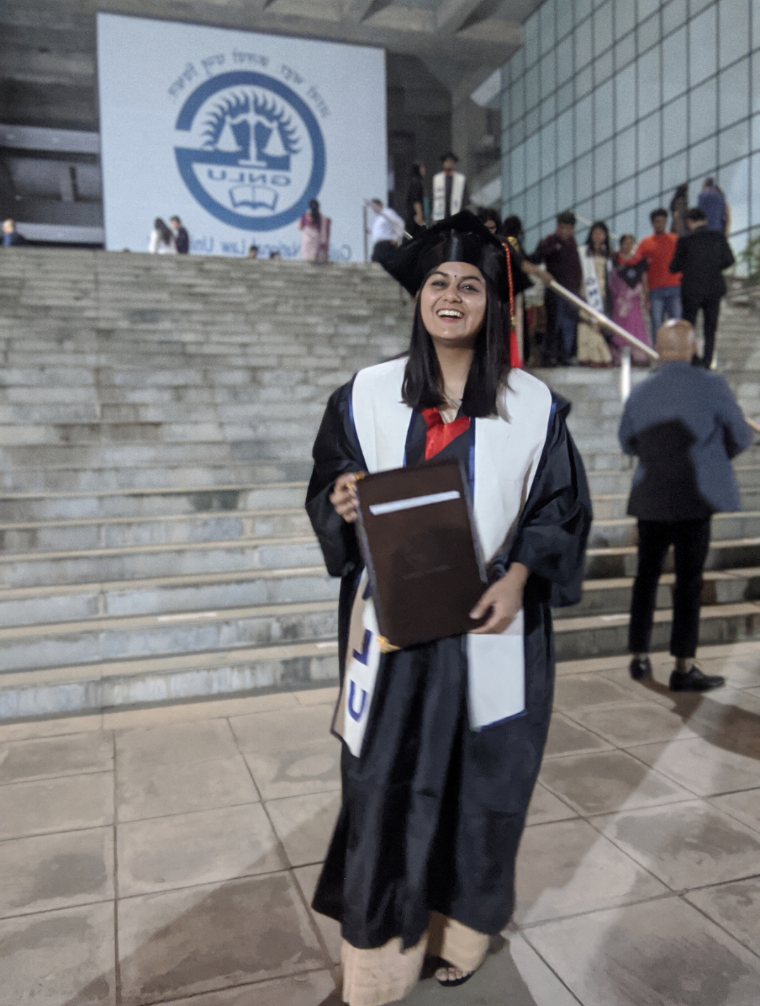





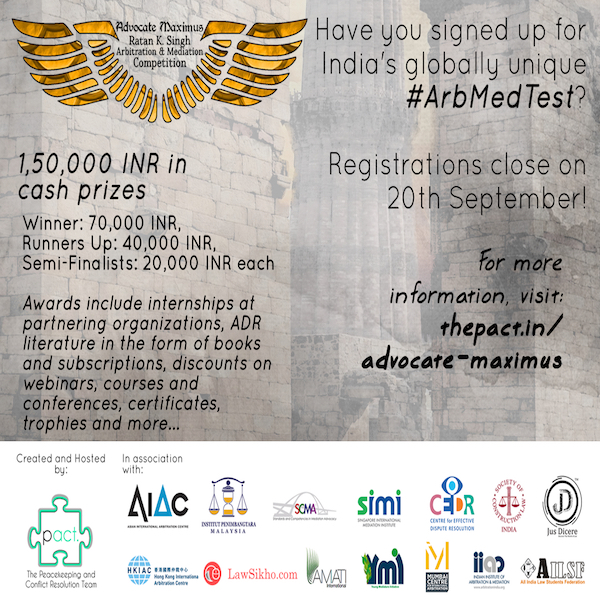


 Allow notifications