Tag: ALS

  • Manushree Kaushik, Consultant, In-House Practice, Vahura shares her insight on the field of legal recruitment

    Manushree Kaushik, Consultant, In-House Practice, Vahura shares her insight on the field of legal recruitment

    Manushree Kaushik graduated in Law from Amity Law School, New Delhi in 2012. She had never thought of being a lawyer or a recruiter but being successful was her ultimate motto. Gaining diverse experience by interning at varied firms, soon after graduation she started working for Dua Associates, premier full-service law firm for a period of almost three years.

    Wanting to utilize her legal education and experience and at the same time to do something different, Manushree stumbled upon the field of legal recruitment. Since 2016, she has been associated with Vahura as a Consultant with the In-House practice group. She primarily focuses on hiring for corporates across sectors from junior level hires through to mid-level management on a pan India level. She firmly believes “Recruitment is not just about hiring talent; it is about finding and hiring the best qualified candidate in a timely and cost-effective manner.”


    In this interview, she talks to us about:

    • Her decision to switch from corporate law to legal recruitment.
    • Her intensive internships with some great dignitaries.
    • The difference she’s found difference between NLU and Non-NLU students?
    • And the skills she looks out for during the recruitment process.

    How would you like to introduce yourself to the readers?

    I am a lawyer by qualification and a recruiter by profession. I am a part of Vahura’s In-House Practice group. Currently, I am in a recruiting role wherein I focus on junior to mid-level hiring across sectors.

    I did not grow up thinking or dreaming of being a lawyer or a recruiter, I just dreamt of being successful. I had no lawyer in my family or even in my extended circle of friends but Law as a profession sounded fancy to a seventeen year old and so I was intrigued. I did a bit of research, got through law school and here I am. The journey has been wonderful and I am glad I chose this as a career. It’s only now that I realize that this education and all these experiences have made me a better person, the study of Law changes the perspective of how you look at people and situations around you.


    What is your take on internships?

    Internships are the best part of the entire experience. Law school will teach us theory and maybe to some extent practical (via Moot Courts) but the real world of practice is very different and you can only experience it when you are in that atmosphere. Watching a Senior Advocate being briefed inside his chambers, the relentless chatter at a law firm, happy lawyers, stressed lawyers, lawyers arguing in a court room while the judge is trying to keep calm, all these things cannot be witnessed at a law school.

    I think the primary motive of an intern should be to observe and learn as this will give you a platform to base your expectations on. Enjoy your internship and you will be able to make the most of it.

    I wanted to gain varied experiences,  I have interned with independent practitioners, law firms and public bodies and each internship was different than the other. Although I thoroughly enjoyed all my internships, the most enriching one was the first one. It was the first time that I was seeing and hearing the royalties of the Indian legal fraternity, it was informative but also thrilling and exciting to witness these dignitaries live in action.


    Describe your experience of interning in the office of Mr. Parag Tripathi, Additional Solicitor General, Supreme Court of India and also with Mr. Gopal Subramaniam, Solicitor General, Supreme Court of India.

    I have had the opportunity to intern in the office of dignitaries like Mr. Parag Tripathi and Mr. Gopal Subramaniam.

    I had just cleared my first year exams and in the vacations that followed, I was interning with Mr. Subramaniam. We were two first years in that batch of interns and needless to say, both of us were extremely overwhelmed. I was told by another senior that I was at the right place but my timing was wrong. I was too young to learn something from the office of a Senior Advocate, and I might not have learnt a lot about the Law but I definitely learnt something about being a good lawyer.

    Similar was the experience at Mr. Tripathi’s office. I was three internships old when I interned with him and his office consisted of a very friendly team and that stems from the fact that Mr. Tripathi himself is a very friendly person. He devoted individual time to all the interns and would make us feel important and involved.


    How were the first few years after your graduation?

    I joined the Gurgaon office of Dua Associates right after graduating from college. I spent almost 3 years at the firm and that is when I truly realized what being a lawyer is all about. I was an excited fresher, who was willing to take on any responsibility and my focus has always been on delivering results. For the initial few months, I was doing a lot of research work. I was surrounded by a lot of people who wanted nothing but the best for me and this included my team members at Dua. The partners and the managers were all very supportive; they invested their time and energy into my training. It built a strong foundation for me and that experience has helped me a lot in shaping up my career.

    The law school experience was limited in the sense that we did learn a lot about the Law but not so much about the real world practice of law. The internships did help to some extent but they are not even close to the real thing. I was only able to make the most of my education and training, after I started working full time as a lawyer.


    What made you switch from corporate law to the field of legal recruitment?

    (Manushree worked as a corporate lawyer with Dua Associates for three years.)

    It was in 2016 that I decided to take a sabbatical for a few months. I wanted to explore the possible options available to a law graduate.  Moving to another law firm was an obvious choice but somehow I was not fully convinced to do so. I also made attempts at a few in-house opportunities and during this entire process I was being approached by multiple recruiters. I enjoyed my interactions with them so much that I befriended a few. I started to learn about the recruitment industry and I was really intrigued by the profile of a recruiter. It was fascinating and risky at the same time. I wanted to utilize my legal education and experience and at the same time wanted to do something different. And recruiting lawyers gives me the perfect balance of both.


    As a consultant with the In-House practice group at Vahura, tell us your work profile.

    At present, I focus on junior to mid- level hiring across companies. Our client base is spread across the country and hence we get to work with clients on a pan-India basis.

    Unlike most search firms, we have a unique network within the legal and governance fraternity which allows us to access the best passive talent not visible to most.

    My role includes analysing the requirements of a job, attracting professionals to that job, screening and selecting candidates and helping them integrate to the organization. Coming from a legal background, it is easier to comprehend the needs of the clients in this industry and this enables me to provide them with the right kind of talented professionals. Recruitment is not just about hiring talent, it is about finding and hiring the best qualified candidate in a timely and cost-effective manner.


    Being in the legal recruitment domain, have you found any difference between NLU and non-NLU students?

    The NLUs have a very different way of imparting education and training to its students. They have very strict qualifying criteria, and the environment is highly competitive. Also, the infrastructure and other facilities provided to the students are better than other law schools. And the most important factor are the placements, NLUs are the preferred choice when it comes to placement with premier law firms and corporates.

    However, a student’s future as a lawyer cannot solely be decided by the law school. Stay focused on becoming a good lawyer and success will follow.


    What are the skills that you look for while filtering during the recruitment process?

    Usually, it is the resume that creates the first impression. A well drafted and concise resume is the first sign of a promising candidate. And you must know your profile by heart. Everything that you have claimed to do, you should have done it. No lying on the resume.

    Another key factor is the confidence. It is very important to be confident in your interviews. Only if you have faith in yourself, will the interviewer have faith in you. Also, make sure that you are able to communicate your expectations clearly. Do not sell yourself short and do not over commit.

    Students should work on building these skills and with the right amount of dedication and hard work; they will be successful in securing a position in the industry.


    What would be your parting message to the budding lawyers?

    Be true to yourself. Do not leave any stone unturned in the journey to achieving your goals. Set a target for yourself and keep going till you hit it.

  • Pratiksh Rai, Chief Counselor and Vice President, myLaw on career counselling for law students and building a sustainable brand

    Pratiksh Rai, Chief Counselor and Vice President, myLaw on career counselling for law students and building a sustainable brand

    Pratiksh Rai graduated from Amity Law School, Delhi, in 2009. In his final year at law school, he earned a PPO from the Capital Markets Partner at Desai & Diwanji and started his legal career as an Associate in the firm. He worked there for about 3 years and gained hands-on experience on a number of large-size transactions and later into high-stake commercial arbitration and litigation matters. The inspiration to search for one’s true vocation or life’s calling made him quit Big Law and look to other areas of work. He explored different practice segments ranging from brief stints at litigating in the courts and tribunals in Delhi to advising start-up entrepreneurs on equity funding to several consulting and business development assignments. This led him to companies focused on the legal ecosystem like Rainmaker which culminated into his current career role at myLaw where he now advises law students and young lawyers on key internships and early stage career opportunities.


    WHERE DID YOU GROW UP? HOW DID YOU DECIDE TO TAKE UP LAW?

    At school, I had never imagined I would finally turn out to be a lawyer. I was born and raised in Delhi and took up science in the senior years at school. Both my parents were from a science background. My father wanted me to do engineering and my mom wanted me to sit for the medical entrance exams so I had to study science – Physics, Chemistry, Math’s and Biology. Though I managed to clear a few entrance examinations, I told my parents that I didn’t see myself studying science any further. What I really wanted to do was to study commerce and start a business of my own some day. I took admission in B.Com at Delhi University but, later, upon my parents’ strong insistence also wrote the law entrance tests and eventually went to Amity Law School.

    WHY DID YOU CHOOSE AMITY LAW SCHOOL?

    I had to choose between Amity Law School and NLU Jodhpur. I chose Amity because it was the nearest to my home in Delhi and I consider myself fortunate because aside from getting a good legal education and making some lifelong friends, I also found my life partner there.

    IS YOUR WIFE ALSO PRACTISING LAW?

    She is now a judge in the Delhi Judicial Services and is currently posted at Tis Hazari Courts.

    HOW DID YOU GET A PPO AT DESAI AND DIWANJI?

    When I was in my final year, I was lucky enough to get two opportunities to intern at D&D. I decided that I was going to work really hard and impress them so that they would recruit me. They recognized my efforts and offered to hire me as soon as I graduated.

    TELL US MORE ABOUT YOUR EXPERIENCE WITH DESAI AND DIWANJI?

    From the start, I was very fortunate to be directly trained and mentored by the recruiting partner himself. He was quite fond of me and took a special interest in ensuring that not only was I burning the midnight oil with legal work but also rapidly developing commercial awareness, a deeper and more pragmatic understanding of the objectives of our clients on each transaction and simultaneously seeking to be more efficient as well as effective in our business. In the first year of practice, I was rigorously groomed so that I could become client facing and then gradually all supervision was tapered off. That led to a very steep learning curve from a practical perspective and eventually loaded me with enormous self-confidence to work independently.

    HOW WAS THE WORK CULTURE AT DESAI AND DIWANJI?

    Unlike other big law firms, the unique advantage here was you could get a wider base of working opportunities across many practice groups. The firm didn’t restrict any younger lawyers from exploring other practice groups within the same office. That inevitably allowed fresh lawyers to become well-rounded early on and ultimately move into the team and practice area where they were most effective. Plus, the usual good elements like good monthly remuneration, fat annual bonuses, foreign off-sites and company-paid drinks, parties and cabs were other attractive aspects of the deal.

    WHAT MOTIVATED YOU TO QUIT BIG LAW?

    While primarily practicing law, I had seen a fair bit of the law firm end of the legal universe. At a personal level, I was already married and we had comfortably settled in at our parents’ house in South Delhi. I was beginning to believe that I should search for my true vocation or calling in life. It was the zeal to go on this journey to reveal my own self that drove me to look beyond the closed spaces of a law firm. I had read that people who found and followed their true calling were the happiest in their lives and work. Frankly, I did not want to miss out. I was also worried that if I waited any longer I might become too comfortable with the way things were to take the plunge later on in my career. Though I was doing fairly well and learning fast, I was often saying to myself that there’s got to be more to the practice of law and living a good life than merely what I had seen. I was already a decent generalist lawyer and was not too excited at the prospect of narrowing down and becoming a super specialist in corporate transactional law plus there was a longing to see what else was out there to experience.

    IMG_9567

    HOW DID YOU START EXPLORING?

    I didn’t want to move away from the world of law and therefore decided to start with a wider patch within the legal industry. I had always been keenly interested in the career trajectory of other lawyers around me and I sought answers and insights into questions way ahead of my stage in the profession. As I was sincere in my work and very respectful of seniors, I was lucky to receive a lot of guidance and mentorship very early in my career. I never missed an opportunity to talk to a lawyer or her/his client to find out how exactly the former was helping the latter achieve her/his objectives – what value the lawyer was adding to the client’s business. What I wanted to do now was get more of first-hand, on-ground experience in newer and unknown areas.  Everything kept adding up and I started enjoying meeting and working along-side newer lawyers.

    HOW DID YOU COME TO MYLAW?

    A lot of people I met started praising my abilities to think strategically and build a business. So I started looking out for business building roles with fast growing companies in the legal sector. That brought me to Rainmaker in early 2014. At the time of my hiring, I was interested in strategy but my sales and marketing skills got me the position. As time elapsed, we all knew the real influence or the big wins were coming through a maturing vision on counseling, coaching and mentoring students, which translated into real and deep value in a student’s life. Today at myLaw, I am able to offer a broader view of law firm work and the key competencies or the essential skills and knowledge required because I have worked on this first-hand and interacted extensively within the profession which also enhances the credibility attached with the brand in the eyes of a student.

    WHAT IS MYLAW’s FOCUS AREA?

    myLaw has a threefold vision to boost the legal ecosystem. The focus is on building high-end legal learning courses, generating interesting legal content and boosting legal careers. The courses and certifications carry a fee but the access to content, the platform and career guidance is free of charge. As experienced professionals, the myLaw team is equipped to understand the demands of the legal industry.As you know, there is a gap between legal education and the skill-set needed for the practice of law as a professional. myLaw is able to bridge the skill gap effectively and that goes a long way in making law students employable by the legal industry.

    WHAT MAKES YOU AN EFFECTIVE COUNSELOR AND COACH?

    Apart from the data, there is a growing self-belief and realization that I was destined to do this. The work I do now feels meaningful and is extremely fulfilling. Given the ecosystems I come from, I am familiar with the initial struggles that law students and young lawyers face at every level. I can completely relate to them because of my own struggles– how, when I was about to graduate, I knew next to nothing about the industry and how I had to learn everything from scratch. Law Students find it difficult to navigate the internship space and feel anxious about making the cut. Each student has her/his own unique set of confusions, doubts and struggles and I usually love helping them around this crucial period by counseling, and providing support and much needed guidance.

    CAN YOU TELL OUR READERS, HOW IS WORKING AT MYLAW DIFFERENT FROM WORKING ANYWHERE ELSE?

    The contours or shape we gradually acquire in our professional roles is a reflection of who we are in our lives. It all adds up. You are the sum and substance of all you have done and been through. It is one thing to work for work’s sake and quite another to do it because you feel nourished by creating absolute value. I had invaluable learning’s and creative ideas to share with law students and therefore don’t necessarily have to focus on run of the mill ideas on promoting enrolments. At myLaw, I could see that I was making a real difference to a student’s career and life. You can feel real gratitude coming your way when your work results in students achieving their goals.

    HOW DOES COUNSELING WORK?

    My counseling work begins by helping a law student appreciate an employer’s perspective which enables her/him to stand out from the pack during internships. Today, law students need to know exactly what law firms value before they walk in the door. That is often the first critical step in building an impression that ultimately helps them land their dream job in a professional world that is getting increasingly competitive. Having been on the inside, I understand the concerns that law firms and senior lawyers have and how they work. I use that exposure to provide career-focused training, grooming, counseling and mentoring and see my role as a catalyst in nurturing and developing legal talent. I help law students think ahead like legal professionals and accelerate their evolution towards becoming better lawyers.

    WHAT ARE THE TOUGH CHALLENGES ASSOCIATED WITH COUNSELING?

    Each student is unique and has a very different mental make-up and situation in life. At times, some students need time to work through their performance issues. The journey at times is not smooth and can turn out to be bumpy. Despite easy access to learning resources, often a student needs time to come to terms with her/his own destructive habits as the process involves letting go of preconceived notions and actually trying to absorb and learn what one has to do to become an ethical, happy and employable legal professional. It takes strength, resolve and a bit of a leap of faith in the process to let go. Mentorship, Support and Hand-holding is effective but a lot of effort and hard work is still required from the student’s end to yield the positive change and experience the desired growth. When that finally happens for a student, it is most rewarding.

    IMG_9568WHY DID YOU PREFER WORKING WITH MYLAW OVER A LAW SCHOOL?

    myLaw provided me with a greater ability to reach out to a lot more students than the limited strength of any law school. The people behind myLaw are very ambitious and temperamentally I am better suited here. I like to dream big and then roll up my sleeves and get the idea executed on my own. This is an ideal space to do this and plus I get to engage and interact with almost all top law schools in the country.

    WHAT ELSE DO YOU DO APART FROM COUNSELING?

    As the Vice President for myLaw, I contribute towards the strategy and planning for building the business and positioning the brand. My role requires me to discover and nurture many strategic relationships for laying a stronger foundation for the company.  As a manager, I am expected to ensure we are using effective channels for marketing and promoting our message. As an executive, in addition to counseling students, I create and deliver presentations and workshops in law schools across the country. I double-up on leading the learning effectiveness measures and overseeing student support for enrolled students. I’m an ardent believer in practical skilling for law students and my work is focused in that direction. Students today realize that merely a high CGPA or earning a law degree is not enough to make them employable. Then, there are everyday miscellaneous communication and decision items to ensure the organisation is running efficiently and teams are coordinating well.

    HOW GOOD IS YOUR REMUNERATION, IF WE ASK?

    Well, I manage to make ends meet. One can’t expect a non-traditional role focused on law students to pay as much as law firm standards. My wife and I have come to see living modestly as a good thing. We don’t have any kids right now and enjoy our relatively simple lifestyle. The job satisfaction is much higher and the position offers new challenges every day. Also, I am hopeful that more money will come in as the company grows larger in the future and the good work permeates the space.

    WHAT ADVICE DO YOU HAVE FOR LAW STUDENTS?

    For Internships

    – Start as early as possible, ideally from your first year in law school. To build a strong foundation as a lawyer, you will need to move outside your comfort zone and pro-actively ask for work on new unknown things. The skills you will build enable you to approach more sophisticated and challenging work by the time you are in the fourth year. Don’t keep waiting for opportunities to fall in your lap rather display enthusiasm, shun all procrastination , take initiative and try to reach out and do more than merely managing to get by law school.

    For better exposure

    – Go exploring and realize that your first few set of internships may not linearly lead to your dream job. They can, however, give you the skills, knowledge, etiquette, discipline and network that you will need to advance towards your ultimate career goals, don’t discount it just because it isn’t something you have decided yet as your final destination. Don’t let uncertainty or doubt hold you back from trying something new.

    For Young Professionals

    – Practicing law is tough. Be realistic. Choose career paths and offices that are in sync with your personality and area of interest. Your work habits, work ethic and reputation go farther than what you might believe. Unless you take personal responsibility for your work and your education, you might not flourish in any profession.

    WHAT ARE YOUR PLANS FOR THE FUTURE?

    I want to continue developing and executing plans that are good for business and simultaneously genuinely good for the legal education ecosystem overall. I strongly believe that a good learning business can only be built by doing real good for your students.


  • Priyan Garg, Associate- Business Development & Knowledge Management, Karanjawala & Co., shares his insight on moving beyond barriers and alternative career opportunities

    Priyan Garg, Associate- Business Development & Knowledge Management, Karanjawala & Co., shares his insight on moving beyond barriers and alternative career opportunities

    Priyan Garg graduated from Amity Law School, Noida in 2015. Having a versatile law school experience has helped Priyan build a wholesome view of the legal world. He has, during his law school years, edited the Amity Journal, coordinated seminars, participated and brought laurels in moot court competitions and helped the society by drafting wills for senior citizens. Right after graduating from law school, he joined as a Marketing Executive at LexisNexis India.

    Currently, he is Associate in Charge – Knowledge Resource handling Business Development and Knowledge Management at Karanjawala & Co.

    In this interview, he talks to SuperLawyer about:

    • His choice of law school and the benefits of going to a law school in Delhi NCR.
    • His life at law school and experience with editing for a journal.
    • His take on opting the unconventional path for law graduates.
    • His unique work profile as  Associate in Charge- Knowledge Resource at Karanjawala & Co.
    • His revelation of the importance of making yourself a brand.

    Please tell our readers a bit about yourself. Why did you choose to do law? Did you have any other interests before deciding to pursue law?

    I’m a lawyer by qualification, currently working as Associate in Charge – Knowledge Resource handling Business Development and Knowledge Management at Karanjawala & Co. While in college, I have interned at a number of places such as PSHRC (Punjab State Human Rights Commission), ASG Pinky Anand, Geeta Luthra, JSA, Luthra & Luthra, Karanjawala & Co., LexisNexis etc. But, right after graduating it was the marketing side of legal world which grabbed my attention. While a lot of fresh law graduates aim to join legal practice as a litigator or in corporate practice, it was the marketing side of legal world which has not received much importance and has a lot of potential.

    I started my career with LexisNexis handling Marketing, Business Development & Strategy portfolios and I am presently with Karanjawala & Co.

    I chose law over sciences because I found one massive advantage in the field. Science in India is a domain that is extremely hard to enter, with difficult competitive examinations and few seats at State-run institutions. After one graduates with a degree in engineering or medicine, however, the task of building a career is less daunting. Law on the other hand, is quite the opposite. It is comparatively easy to study law and become an advocate, and far harder to establish oneself once enrolled. Aged seventeen, I felt it would be easier for me to challenge myself at a later stage, when I was more mature and had the backing of increased knowledge and a professional degree.


    Which law schools did you apply to? How did you zero in on Amity Law School, Noida and why B.B.A. LL.B.?

    To be honest, Amity was not my first choice as a law school. While I had heard good things about the institution, I was fearful of joining a privately run school. After CLAT, I had the option of joining a lesser-known National Law School. Nonetheless, I chose to undertake a program in law at Amity. There were three reasons behind this decision. First, being in Delhi allowed me to be closer to home (Chandigarh was only a few hours’ drive away). Second, in the NCR, I found myself at the heart of the Indian Legal System. Not only did this ensure that many successful personalities would be available in college for guest lectures and seminars, but also it increased my chances of gaining adequate work experience. With the best counsel, law firms and all levels of Courts present in the city, the opportunities for a keen intern were many. Third, I was fascinated by the courses Amity had on offer. The B.B.A., LL.B (Hons.) programme offered the unique opportunity of studying economics and management with law. I find now that this combination has given both, a rounded character to my personality (having now studied science, commerce and arts), as well as prepared me to better understand the needs of corporate clients I may have in the future.


    How would you describe five years of your college life? Please share your experience as an Editor of the Amity Law School Journal. Any tips for law students who aspire to get published?

    I would like to believe that I made the most of my five years at law school. I studied when I was required to, and ensured I had time for my friends and myself too. Law does require lots of studying, yes, but a law school experience is incomplete without participation in volunteer programmes, co-curricular activities and sports. Looking back, I am glad I made the most of the resources I had available.

    As far as Amity’s journal is concerned, I was fortunate to be involved in the publication’s nascent stage. This encompassed work that ranged from receiving an ISBN number to creating an editorial board and calling for academic writing. Needless to say, it was an exhilarating experience.

    My experience in academics is limited to the years I have spent as a student. I do, however, hold very strong views when it comes to the state of academic writing in India today. There is a great void in the legal space when it comes to original academic writing. It is the Indian education system that is largely at fault for this; students are taught to learn another’s views, not taught to think for themselves or to form their own opinions. The legal space is full of unoriginal work. To illustrate, an article titled “The Law of Arbitration in India” is not an original academic work. Such an article, like most one reads nowadays, merely summarizes the law on a subject. At best, a paragraph is saved at the end for the author’s own opinion. It is incredibly rare to find new approaches to law, new solutions to legal problems, or strong criticisms of existing legislation and precedent. My advice to anyone wanting to be published – be original and show something new through your writing.


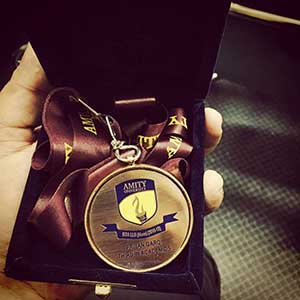
    You have received a number of Corporate Awards at your college such as “Best Business Acumen and Awareness” citation and Shri Raian Karanjawala Trophy at ALS, please tell our readers about them.

    Apart from classroom studies, internships and mooting activities I always made it a point to be involved in various committees managing events happening in the University which gave me an overall exposure to what goes behind organising and hosting an event. During the five years of my law college I actively organized the Amity International Moot Court Competition, Amity Quiz on Competition Law, Amity Competition on Law Reforms, Debates etc. According to me, there is no substitute for accuracy in knowledge. Know yourself, know your business, know your men, is the mantra of today’s success. Successful business persons understand the thin line of difference between obstacle and opportunity and are able to turn both to their benefits.
    priyan-garg-2

    I received the citation of “Best in Business Acumen and Awareness” for displaying a charismatic persona, administrative acumen and managerial skills of a high order and the ability to combine compassion with steely resolve.

    I received the Shri Raian Karanjawala Trophy on my convocation which has been constituted in the name of “Shri Raian Karanjawala”, an iconic legal luminary and a distinguished senior lawyer of India. His untiring efforts & contribution towards the development and maturing of legal systems have enhanced the image of India globally. Shri Raian Karanjawala Trophy is bestowed upon the student who has displayed extraordinary zeal and dedication towards learning and imbibing the tenets and spirit of law. Also, the student who has shown praiseworthy performance in corporate courses, interned in law offices/firms and attended conferences and seminars based on corporate laws.


    How important is mooting for a law student? Which moot did you enjoy the most, in terms of the organisation and the subject matter? Was there any “dream moot” which you wanted to participate in?

    Aside from academics, mooting is perhaps the most essential activity in a law student’s career. I participated in six moot court competitions focussing primarily on Constitutional Law. One may contest that the arguing system in a moot differs greatly from what one may experience in Court; however, I am of the firm belief that mooting gives one the right level of confidence in arguing etiquette and manner to be able to present cases before a real judge. Further, research being an essential component of any lawyer’s job, mooters will always find themselves at a significant advantage when faced with challenging research propositions at work.

    My favourite moot was the Justice Bodh Raj Sawhny Memorial Moot Court Competition held at NALSAR University. While the moot itself may not compare to others on offer in India, the subject matter – constitutional law – gave participants the opportunity to present unique arguments and step in the shoes of some of our nation’s most eminent senior counsels.

    The Philip C. Jessup moot is perhaps the only competition that comes to mind when I think of a “dream moot”. What is most attractive about this competition is the enormity of the challenge that is qualifying for the international round, the experience of participating alongside the best law schools in the world, and the exceptionally high calibre of judges and mooters alike.


    You have done a variety of internships, while focussing on litigation. Were you always inclined towards litigation? What according to you was instrumental towards gaining so many internships?

    I often compare law to medicine. To a layman, the job of a pathologist, while indispensable, doesn’t seem as exciting as that of a surgeon. To someone not yet initiated into the legal fraternity, the distinction between transactional law and litigation can appear similar. There is an indubitable excitement about litigation, about forming strategies and arguing before judges, that makes litigation attractive. It is for this reason that I found myself lured by the field.

    Having said that, interest in a field is not essential to get an internship in that field. Unfortunately, most internships in India are awarded through the applicant’s contacts or network. Where firms or practitioners accept applications, emphasis is usually laid on the candidate’s academic record and university, with secondary regard being given to non-academic achievements. I was very fortunate to have a good academic record, thereby ensuring that many applications were accepted. I also made a conscious effort to apply early and to continue to follow up with the organisation until they sent me a response. I’ve found that applications are not always replied to; “getting after” a firm to view your application is essential.

    Coming from a non-legal background, there was always a hunger in me to learn and explore different fields of law, owing to which I made it a point to intern and apply at a variety of organisations. I was fortunate to intern at a number of premier institutions such as Punjab State Human Rights Commission (PSHRC), Additional Solicitor General of India (ASG) Pinky Anand, Geeta Luthra, Hon’ble Justice Ravindra Bhat, Luthra & Luthra Law Offices, Jyoti Sagar Associates, PepsiCo India Holdings Pvt. Ltd., Karanjawala & Co., LexisNexis India etc.


    You were the Convenor of Legal Entrepreneurship Clinic at ALS. Please share with us in detail, about the activities of the LEC.

    The Legal Entrepreneurship Clinic is a cell run by the students of Amity Law School, Noida. It is the first ever entrepreneurship cell to be formed in any law school across India. The E-Clinic caters to the intellectual and innovative minds that aspire to become legal entrepreneurs and it aims to foster and promote entrepreneurial spirit amongst such students.

    We at LEC organised workshops, panel discussions, seminars and competitions for aspiring entrepreneurs as an initiative to train and encourage their diverse and dormant talents. The Clinic endeavours to act as an incubator to the thoughts and ideas of aspiring lawyers, so as to make them prepared to be able to develop their ideas and concepts into practical business dimensions thereby helping them set up their own start-up. The Clinic works on the same objective as Centre for Innovation Incubation and Entrepreneurship, IIM Ahmedabad, whose main aim is to foster innovation-driven entrepreneurship.

    As a Convenor of LEC, I organised various Wills Camps for the elderly residing in the jurisdiction of Noida, U.P.; panel discussions on the new Company Law Act, 2013 and the latest being a seminar on financial literacy called FLAP – Financial Literacy Awareness Program.


    One of your last internships as a student was at LexisNexis India as a Marketing Trainee.  What made you shift from law to management?

    Post my stint as a Campus Ambassador at Lawctopus, I applied to be a Student Ambassador at LexisNexis India in my fourth year of law school. Having been associated with LexisNexis India for an entire year, which is a leading legal, taxation and academic publisher, my inclination towards the organisation increased and I was interested in understanding how a publishing house really operates. During the final semester internship I applied for an internship with the LexisNexis India and joined the Marketing Team as a trainee.

    The primary reason for this shift was my desire to explore the second half of my degree, “Business Administration”. LexisNexis India gave me the opportunity to work in the management domain, though within the legal sphere. Legal and managerial knowledge was essential to the job, and I was lucky to have a degree in both. As the final year was almost ending, I realized that I really did not have much enthusiasm in me for a litigation practice. I found litigation to be very procedural and mundane. Pursuing Corporate Law was another option for me, but I felt that it would restrict me to a very niche field. So I gradually drifted towards going for the Management field and challenge myself beyond my comfort zone.

    Secondly, I have never supported the conventional view of necessarily practicing law after studying law. There are a plethora of avenues out there, waiting to be exploited. I always wanted to use my acquired legal skills in a business environment, my long term aim being to become an entrepreneur. I think law gives you the edge of knowing the regulatory framework well enough, understanding the compliances and understanding the statutory and other measures required and applying them to run a business. I believe people working in organizations in the top positions ought to have a decent understanding of the law, in order to manage business in their top capacities. Discovering a new avenue was my primary motivation in this journey.


    As unique as it sounds, tell us about your work as Associate in Charge- Knowledge Resource at Karanjawala & Co., New Delhi. What is your job profile?

    As an Associate in Charge – Knowledge Resource, I look after Business Development & Knowledge Management of the firm. I’m involved in the indirect marketing of the firm by looking after the visibility of the firm. 

    Having worked for 3 years now in the legal marketing profession, I have a sharp view on the marketing of the law firms whilst taking the legal view into account. At Karanjawala & Co. I work with Senior Management and Partners at all levels looking after their Knowledge Management and Business Development – converting potential clients into permanent clients and engaging with even the most sceptical of clients.

    The Job Profile includes:-

    1. Working very closely with The Managing Partner and the Partners on the Marketing Strategies and Business Development of the different practice areas of the firm.
    2. Brand Development
    3. Publications on Legal Media Platforms & Research involved.
    4. Visibility of Firm over different platforms both domestic & international.
    5. Strategic Consulting – Including Business Plans & Marketing Strategy Development.
    6. Preparing Whitepapers for Conferences.
    7. Liaising Strategic Collaborations with Legal Events in the Country and representing the firm in them.
    8. Preparing submissions for legal awards in Indian market & International.
    9. Preparing Write ups and submissions for firm rankings in prominent legal directories such as Asialaw, Chamber & Partners, Indian Business Law Journal, Legal 500 etc.

    What according to you are the skills required to handle Business Development at tier one firms? How does one develop this prowess?

    I have been asked this question a number of times during Guest Lectures and Webinars. According to me for any kind of marketing you need basic understanding of the market, networking with the key people, common sense and passion to take risks and go beyond your comfort zone.

    No Law School or MBA school can really teach you marketing until and unless you practically take it up and convince the people in front why they should listen to you. The most important thing in any role is the willingness to learn and willingness to take a risk of doing something different beyond your set KRA (Key Responsibility Areas). With so much competition in the market and a number of eligible candidates in the pipeline you can only sustain and grow in an organisation if you go beyond what the organisation is expecting out of you. I was lucky to realise this during my final year itself and mould myself accordingly – I studied the Bar Council of India Act extensively and laid down a plan of how legal industry can involve indirect marketing whilst not violating the Act.

    Be it LexisNexis or Karanjawala & Co., for Business Development/ Marketing activities one needs to carry out extensive research to understand the market segment your organisation is serving to and ways in which your law firm can impart knowledge whilst not violating the Bar Council of India Act.

    One of the most important thing for carrying out Business Development is that you need to be a people’s person and have good networking skills, along with a good hold on the language and convincing skills.


    Not following the conventional path, lately a lot of graduates are going for the uncharted waters. You being one; tell us the alternative career options for a law graduate.

     One of the most common mistake which the law graduates make these days is by not finding out their true calling and doing something which their peers are doing. Not only does it leave them demotivated after a period of time, it also hampers their CV.

    It is very important for all the law graduates to go beyond the conventional path of litigation and corporate and look for other untapped areas in the legal field. With foreign law firms entering the Indian market in coming years, a number of new career avenues have come up, such as:-

    1. Legal Journalism- A number of legal media websites such as Bar & Bench, Live Law and Legally India recruit law graduates as Publishing Editors, Editors and Reporters. In addition, all the leading newspapers and news channels of the country have a dedicated legal journalism team to cover all the major legal developments in the country.
    2. Legal Editors- All the newspapers and news agencies hire law graduates to work on their legal stories. In addition, legal editors can also work for blogs or write legal content for publishing houses such as LexisNexis & SCC Online.
    3. Business Development- It’s a very desirable combination if an individual knows both law and marketing. Such law graduates are hired by law firms or engaged by litigants to carry out their marketing activities and increase the visibility of firm on different platforms.
    4. Knowledge Management- Knowledge Management at law firms is all about creating, sharing, using and managing the knowledge and information. A number of law firms regularly submit articles for publishing and it is the duty of Knowledge Management Associates to vet these submissions or prepare Whitepapers for conferences.
    5. Head Hunting for Legal Industry- In the present times the process of legal recruitment and transactional shift has become more systematic due to organisations like Vahura and other independent Consultants. Such organisations engage law graduates who have an idea about the market and can find right talent for an organisation.
    6. Corporate Communication- The role of a Corporate Communication Executive is to act like a bridge between the lawyers and clients. It has been a seen a number of times that there’s a gap in communication between the lawyers and clients due to heavy work load. Corporate Communication Team not only keeps the clients updated about their matter but also roll out important developments taking place in the firm to media. Certain law firms also have a process of periodical Newsletters highlighting their monthly achievements and updates which is again taken care by Corporate Communication Team.


    Even after getting the most sought after opportunity, why did you choose Knowledge Management & Business Development over Litigation at Karanjawala?

    Firstly, I have never supported the conventional view of necessarily practicing law after studying law. There are a plethora of avenues out there, waiting to be exploited. I always wanted to use my acquired legal skills in a business environment, my long term aim being to become an entrepreneur. I think law gives you the edge of knowing the regulatory framework well enough, understanding compliances and understanding the statutory and other measures required to run a business. I believe people working in organizations in the top positions ought to have a decent understanding of the law, in order to manage business in their top capacities. Discovering a new avenue was my primary motivation in this journey.

    Secondly, the reason for my shift was my desire to explore the second half of my degree, “Business Administration”. First LexisNexis gave me the opportunity to work in the management domain, though within the legal sphere and Second, Knowledge Management and Business Development at Karanjawala & Co. not only challenged me to acquire new skill sets but provided an excellent exposure to work with Senior Management, Partners and GCs of leading Corporates.

    Also, I have come to the realization you can make a name for yourself at a very young age if you can undertake responsibilities not being performed by other.

    Is marketing as equally important for lawyers? 

    With the number of CLAT aspirants increasing every year exponentially, the competition in the legal industry has become top notch and the only way to excel is by doing something what others are not doing. Other than good knowledge of law, it’s very important for lawyers to look after their marketing and networking.

    The marketing activities for lawyers can be as basic as managing an active LinkedIn account to writing blog posts on contemporary issues. LinkedIn in present times, not only helps one to showcase their expertise but also helps you to get in touch with professionals 

    from legal field PAN India. Next, I have seen a number of aggrieved individuals reaching out to Lawyers if they are publishing articles on contemporary issues or issues which are most common in the legal field such as Family Law, Criminal Law or CPC.

    Finally, it all comes down to personal connections and networking. Today, all major cities have organisations & establishments organizing Book Launches and other Panel Discussions. Attending such events not only helps the Lawyers to get updated with law but also enables them to meet and network with a number of people at one place.

    If a lawyer is active on social media and networking events. It’s not surprising if they get an offer to author a book by leading publishing houses or also receive invitations from Institutions either as a judge for Moot Court Competitions or as a Guest Speaker.

    It’s all about showcasing you expertise and being omnipresent in the Legal Industry!!


     As a visionary and opportunist, what are your future plans? Where do you see/want to see yourself in the next 5-6 years?

    As a visionary and opportunist I have always followed a motto in life,

    “There is no fun in living a life that you don’t feel proud of. A life where you have just passed your time. Build a list of accomplishments behind you. The learning you will get in the process will transform you and your thinking process completely. That’s what will make you a leader ultimately. There are no short cuts to success. The more grind you undergo- the stronger you become.”

    My future plans involve making my name in Business Development domain and strengthening it with a MBA degree. Also, with the present government being in favour of foreign law firms establishing in India, the domain of Business Development & Knowledge Management has a lot of potential to grow manifolds. With a number of consultation organisations coming up in Indian legal market, this area is going to expand only.




  • Simar Singh, LAMP Fellow, on all about the LAMP Fellowship

    Simar Singh, LAMP Fellow, on all about the LAMP Fellowship

    Simar Singh studied law from Amity Law School, Centre-II, Noida and has graduated recently. During his years of law school he has interned under Adv. Guru Dutt Sharma who was the Additional Standing Counsel for Government of India in the Dwarka District Court and also Adv. V. K Aggarwal who was also the former Law Secretary. Simar also won the Achiever Award for displaying leadership qualities by the University’s Founder President. He is also a fellow of LAMP (Legislative Assistants to Members of Parliament).

    In this exclusive conversation with Simar, we talk about –

    • His journey through Amity Law School, Noida and the internship experiences.
    • Achieving the Achiever Award for displaying leadership qualities by his University.
    • Receiving a letter of appreciation for efforts and conduct in International Seminar on Global Environment and Disaster Management from Hon’ble Justice U Tha Htay, Judge Supreme court of Myanmar.
    • Being chosen as a LAMP fellow (Legislative Assistants to Members of Parliament).
    • The work performed by a LAMP fellow and the learning acquired from it.


    How would you like introduce yourself to our readers who are mostly law aspirants, law students and young lawyers?

    I am Simar Pal Singh. I am a recent Law graduate from Amity Law School, Centre-II, Noida. I am a very passionate reader, especially biographies and autobiographies of different lawyers and eminent jurists. I also like to participate in debates and discussions. I am a LAMP Fellow for year 2015-16.


    Tell our readers a bit about your childhood and pre-college life as well as educational background. Do you have lawyers in your family who motivated you to pursue a career in legal field?

    I was born into a family of Government Servants. Both my parents were in the paramilitary force C.R.P.F and therefore my childhood was all about seeing one or the other parent going to a different State away from the family and serving the country. I did my schooling from CRPF Public School, New Delhi. I had always been an average student in academics but was always interested in sports activities. I was in the football team of my school and won many inter school tournaments. I was also a National Level Athlete and represented my school and my State in various sports meets and won many medals in 100 m and 400 m races.

    There were no lawyers in my family but my father did his LLB while working and used to tell us about his subjects. He never pursued law as a career but his talks on law as a subject and its importance in our society did intrigue me. I think this was the trigger which got embedded deep inside me and eventually got activated after my 12th  and that’s why when I decided to pursue a career in law, my parents were very supportive.


    What inclined you towards the field of legal education? Can you recall any specific incident that made you choose law as a career?

    After scoring well in my X boards, I took science stream on the advice of my family and teachers who according to the set convention told me to go for engineering. During my 11th and 12th I took coaching for getting into a good engineering college but It is a fact that it was all about just going with the flow and not accessing that whether I was actually interested in becoming an engineer or not.

    After 12th, most of my classmates took admission in engineering, B.Sc., hotel management, etc. I also joined the segment and, after clearing the entrance for Hotel Management got myself admitted in hotel management course in IHM Chandigarh and I think this was my life changing incident. It was my second day in IHM and it suddenly dawned on me that this is not the place where I belong. My parents have served this country all throughout their life and therefore I too have to be in a profession where I can serve the system and the country. This is when I thought of pursuing LLB.


    You graduated from Amity Law School, Centre-II, Noida in the year 2015. How would you describe your experience as a student aspiring to be a professional there?

    With no prior family background in law and practice, I would say the initial journey in the law school was little strenuous. When your batch mates know where they will intern and work during their course work and you on the other hand have absolutely no pointer as to how to cover up with them. And since I was from science background, I also had trouble in adapting the writing pattern for my law exams.

    But as it is said, with plethora of problems comes the opportunity to overcome them. One simply has to keep trying. After I realised this, things became much better. I studied hard and not just the prescribed course books but various books by foreign authors to gain insight on a particular subject, various biographies of those famous in our field to acquaint myself with working of the greats and current legal judgments to keep myself updated on the contemporary issues in our field. With sustained hard work and support of college, I was able to grasp on my subjects and do justice to them. It was a long and challenging journey where I started as a complete stranger and ended up discerning the calling for my life.


    simar-singh-4

    How instrumental was Amity Law School, centre-II in shaping up your legal career. Did you grow an interest in policy making in law school itself.

    Since ALS-II was the very first platform of my legal career, I’d say that it had a key role in moulding me and my career. I had very encouraging teachers who were always there to guide me and support me in my choices. I constantly, used to take advice from them which turned out to be invaluable in making career selection. I had commendable batch mates some of whom turned out to be my very good friends and healthy competitors who always strived me to do better. I wouldn’t say that I had an interest in the policy making per say in the college itself because I was completely focussed on law but I always did make an effort to be continuously in touch with the happenings in our country through newspapers and to keep a track on all the news bills that were being introduced as the process was part of our law itself.


    Tell us about your experience as a law student at ALS.

    Till my first year, I was also like the others a mere observer, watching activities happening but too nervous to come forward. But from second year I guess I grew into my fears and decided to take a leap towards them. I started participating in various moots and debates, representing my college all over India and before I knew it, I was assigned the responsibility of looking over these activities as the head of various societies. Participating in the various moots was always fun. It used to be like a trip with friends, exploring new colleges and meeting some of the best legal minds from all over the country. I think, public speaking and debating are very important for a student today especially a law student to gain confidence and come out of his shell but it is not the only important thing. I personally know a lot of brilliant law students who never did any mooting but are still very good in their arguments so it depends on the person.


    simar-singh-1

    Tell us a little bit about your internships and work experiences in the law field.

    My first internship was with Advocate Guru Dutt Sharma who was the Additional Standing Counsel for Government of India in the Dwarka District Court. Initially I simply used to observe the court proceedings and eventually I started reading out cases, preparing their briefs and following them up in the hearings. It turned out to be an illuminating experience as I saw the practical side of legal profession for the first time and realized that this was what I meant to do all along. The pleadings, the arguments and the decorum of a court, all of it captivated me and I did my internship with such dedication and enthusiasm that I was offered a part time employment by the Counsel to assist him with the cases which continued for three years of my law college where I saw myself being transformed into an Advocate much before my graduation.

    I also interned with Advocate Dr. V. K Aggarwal who was also the former Law Secretary and had drafted the Arbitration and Conciliation Act, 1996 where I got the first-hand knowledge on arbitration proceedings and their conduct. I observed the proceedings of various arbitrations, prepared briefs on various cases and performed extensive legal research on SEBI Regulations, Telecom Laws and Company Laws. But most importantly, I got the opportunity to gain prodigious knowledge about Arbitration as a subject from V K sir.


    Tell us about being awarded the Achiever Award, and your experience with Justice U Tha Htay.

    (Simar has two major achievements namely Achiever Award for displaying leadership qualities by the University’s Founder President in the presence of Hon’ble Chancellor and Vice Chancellor of University and a letter of appreciation for efforts and conduct in International Seminar on Global Environment and Disaster Management from Hon’ble Justice U Tha Htay, Judge Supreme Court of Myanmar.)

    I was deeply obliged with the fact that I was bestowed with that award and that my University thought I was worthy of it. After all the great learning, valuable mentors in the form of teachers, wonderful friends and many good memories, I owe Amity Law School II a lot and this award is simply an acknowledgement of the fact that my efforts and achievements have been supported and honoured by my college. Experience of college is one of the paramount experiences that one goes through life and for me my college journey has been simply astounding.

    My experience with Hon’ble Justice U Tha Htay was extremely enriching and enlightening. I was chosen to represent my University in this seminar and after a personal interaction with all of us, fortunately, the organizers found me competent to assist Hon’ble Justice U Tha Htay during his stay in the conference. I assisted him with his seminar briefs and meeting schedules throughout the seminar after which I was given a souvenir from Myanmar and a Letter of Appreciation for my work from the Hon’ble Justice himself which was a rare and privileged honour for me.


    Being a LAMP (Legislative Assistants to Members of Parliament) fellow is a great achievement indeed. What all did you have to do in order to get selected?

    Before answering this I like to share my gratitude to my previous faculty Dr. Sam Abraham. He was the person who pushed me to fill LAMP application and made me believe that I can get through this.

    In order to get selected, I had filled in my form with due diligence and made sure that I stick to the word limit that I was asked for. Once my application was accepted I was called for the personal interview before the panel three experts. For this I made sure that I speak only what I know and remained calm and confident throughout the whole interview even when I did not know the answer to any question.


    Tell us about the SoP you submitted for the LAMP fellowship?

    I did not prepare any SoP in advance and had filled my form spontaneously so I don’t have my SoP exactly but in that I had broadly mentioned that as a lawyer we generally see how Courts makes use of our existing laws to deliver justice. Till now I had seen law getting declared, but this fellowship would get me the experience as to how law and legislation is actually born and how the legislature of largest democracy in the world works. Further from this fellowship I intend to get insight the working government mechanism since it is directly responsible to our parliament.


    simar-singh-2

    How does one apply for the LAMP fellowship? Tell our readers about the process, requirements and finally your suggestions to our readers who aspire to become a LAMP fellow?

    To apply for LAMP, one has to be very vigilant. The online application for this fellowship opens around the starting of year and it is open for around 20 -25 days. One can find the link of application on LAMP website. Any person who is of age below 25 years can apply for this fellowship provided he is a graduate. My suggestion to anyone who wants to become a LAMP fellow is that keep your article on policy issue ready in advance. Also keep asking yourself that why you actually want to pursue this fellowship because in the SoP you should write what you actually intend and not what will constitute a right or good answer (There is no good or right answer). For interview I would suggest that the aspirant should know what they have written in their application form, few basic knowledge on the structure of parliament and current affairs.


    LAMP fellowship provides an excellent opportunity to interact with Legislators at a personal level, and to understand the policy process. What have you learned in your stint as an LAMP fellow?

    Well LAMP fellowship has just started and I feel each day is new opportunity to learn and this is the ultimate objective of this fellowship. You learn and experience things which you don’t know and which you can never experience in your normal routine work. I have learned to be more responsible and now I know that unlike the judgmental view, Hon’ble Member of Parliament actually works a lot.


    Tell us about working with your MP. What is the experience like? Please tell us about the kind of work a LAMP Fellow is required to do in a typical workday.

    I won’t be able to tell you the name. However the experience has been extremely delightful and knowledgeable. The work of LAMP fellow is nowhere strictly defined or codified. He is there to assist his Hon’ble Member for the work related to parliamentary affairs. In a typical day when Parliament is in session, he has to go through around 6-7 newspapers for getting updates on current affairs of country. He has to read each of the documents tabled in parliament and then prepare briefs about them. Further he draft’s starred, unstarred and supplementary questions for his allotted Hon’ble member which could be asked to the government. Preparation of Private Member bill and researching on topics on which the Hon’ble member has to speak in parliament is also the part of the job.

    The work is slightly different when parliament is not in session. Here the work is mostly related to research for the policy issues which your member is interested in, attending various conferences, seminar, committee meetings etc.


    Do you have any plans to pursue higher education in the future?

    Yes I am planning to pursue my higher education from a foreign university after the completion of this fellowship, most likely in the public policy.


    Is there any message you would like to share with our readers?

    My only message to all would that do whatever you like with utmost sincerity. There is not just one path that is right as prescribed and you don’t have to follow what others are doing. In fact, most of the times, the path that is less travelled often leads to the most fulfilling and fruitful journey.


    Finally tell us in which specific role you would like to see yourself the role of a lawyer, policymaker or a reformist of the society we live in.

    Well why not in all three. I would love to keep my roots as a lawyer first and then I wish to contribute my experience in policy making. I believe if I can discharge my previous mentioned roles honestly then surely the third role of reformist will get fulfilled itself.


  • Varun Kalsi, Manager, Dua Associates, on LL.M in corporate law from NYU and work experience in General Corporate

    Varun Kalsi, Manager, Dua Associates, on LL.M in corporate law from NYU and work experience in General Corporate

    Varun Kalsi graduated in law from Amity Law School in 2007. After which he went on to pursue an LL.M. in Corporate Laws from New York University. At present Varun works as a Manager at Dua Associates.

    In this interview we talk about:

    • His journey as a law student from Amity Law School
    • Studying LL.M from New York University and how it influenced his career
    • Working at Dua Associates.
    • How to gain expertise in corporate law


    What brought you into studying law as your profession?

    I’d say both but more of planning. Like most lawyers though I am good with my numbers, Mathematics was not my favourite subject. Back in 2002, the options were, therefore, pretty much limited to hotel management, media or law. Personally, I chose law since it seemed to me to be a more empowering medium that turned you into a professional, and is one where people hold you in great esteem, either out of admiration or fear or both!


    How did you fare in academics at Amity? Would you say a great CGPA is a necessity to kickstart a good career in the legal profession?

    I’d say I was amongst the bright ones in my batch with nice and healthy grades throughout my 5 years at law school and would also, like to add that, in my opinion, my batch was probably the best our law school had seen, in so far as academics and extra-curricular activities were concerned. There was immense competition even amongst friends but all in good spirit, which, in fact, led us to achieve much more than we would have done otherwise.

    Considering that a fresh law graduate will not have great work experience (other than legal internships/clerkship), a potential recruiter’s primary focus would be on the candidate’s academic performance (grades and other achievements) whilst at law school. However, even if one’s CGPA is not the best, he/she may be hired by a recruiter on the basis of the candidate’s overall personality, the recruiter’s immediate requirements and the way he/she conduct himself/herself in an interview.


    What skills did you get to hone as the Executive Member, Amity Law School Moot Court Society?

    Acquiring organisational skills, inter-alia, was a great advantage of being an integral part of the Moot Court Society and we were nicely tested every time our college hosted the annual Moot Court Competition. Also, the exposure to other teams in terms of their manner of preparation and the way they prepared for the competition was always something one could learn and imbibe.


    What is your advice to budding mooters?

    (Varun has participated in various moot court competitions like Stetson International Environmental Law Moot Court Competition, Surana & Surana Corporate Law Moot Court Competition and Amity National Arbitration Moot Court competition.)

    The first time you think about it, it might be difficult and you may put it on the backburner but my suggestion would be to push yourself to participate in a Moot Court competition, just for the sake of the experience. If I was never “pushed/encouraged” by my friend/batchmate- Apar Gupta, I am certain I would not even done half of what I eventually achieved. The idea is to get in there and get a feel of things as you’d never know whether you like it or not until you try it. By the aforesaid, I don’t mean that it is mandatory but I’d highly recommend that you at least give it a try, once. Perhaps, it is instrumental in your decision as to the path you’d eventually choose in your legal career, i.e. being a litigator or a corporate lawyer.


    What kind of internships did you do in your law school? Did you have institutional support for procurement of internships?

    I actually did a variety of internships right from with a High Court lawyer, an Advocate-on-record, few law firms (Corporate and IPR) and so on. For me, internships were always an avenue that could help me make that difficult decision- what kind of practice would I relish as a lawyer?

    There was minimal institutional support available for procurement of internships.


    varun-kalsi-2

    Do you think being from a non-NLU has ever proved to be a hindrance for you? What has been your experience?

    I think it depends on the organisation as to what it values more- the individual student’s calibre or his/her institution itself. To be fair to the students there are indeed organisations that openly practice such “discrimination” but then that’s not the case with the others. Also, one has to bear in mind that the institution will always play a key role for any fresh law graduate as a recruiter may view his/her abilities from the fact that the student is a product of that particular institution. I am sure such issues are also faced by MBAs who are not from ISB or IIMs but then there are always other options.


    Many lawyers say that the first year after graduation is the most difficult year for young lawyers. How did you learn the ropes and what were the biggest challenges you faced?

    Well, isn’t that true for all professionals? I firmly believe that all professionals are valued in terms of their experience and expertise, which can only be learnt the hard way, i.e. one has to go through the whole process or loosely speaking, the grind. My first year was challenging too especially since my senior was an experienced and seasoned lawyer who would not accept anything less than perfect but was always available to answer my questions and discuss legal issues with me. I would ensure (and still do) that I do not repeat any of my mistakes and strive to improve my drafts/opinions basis the hands-on knowledge and on-the-job experience that I’ve acquired while at work.


    Right after graduating, you went on to pursue LL.M from New York University School of Law. Why did you decide to go for higher studies?

    After doing different kinds of internships I was inclined towards being a corporate lawyer and therefore, felt that it would be great if I could improve upon my knowledge of Corporation laws with an international perspective to it. I’d say that I was extremely fortunate to get through NYU as its faculty, especially for courses like Corporation law and M&A, is par excellence and added a new dimension to the way I perceived the corporate law practice.


    Tell us something about your LL.M year at New York University School of Law. How did this influence your career?

    Not only did this year add to my legal acumen it also brought me in touch with a bunch of talented individuals who had come there from all across the globe. Also, it helped me evolve as an individual and in the process I even learnt few new things about myself. The NYU stint brought more clarity to my thought process in so far as concerns the sub-practice areas within the corporate law practice and helped me forge certain lifetime relationships, which influenced my career greatly.


    Do you think it makes sense to students to go overseas to study law when they want to work/practice in India?

    It’s a personal choice. For instance, for me it was a better and sounder understanding of Corporation laws with an international twist and then the thought of working abroad for a few years. I was able to achieve only the former. Therefore, it totally depends on the individual’s goal. Studying overseas is no guarantee that you will get a chance to work there too, therefore, if the ultimate goal is to work abroad it may not be the best route. It is pertinent to note that there are individuals who had been practicing in India and now are with law firms abroad and vice-versa. Thus, there is no direct co-relation between studying abroad and practicing in India.


    Tell us about the nature of work you are entrusted with and what’s a typical day like?

    There is no typical day for a lawyer like me as my practice areas are wide in nature being general corporate/commercial advisory and Real Estate. There are days when you are swamped with work and do not know when night falls and then there are some when you have some breathing space. Having said that, I am always on something all the time whether it is execution of work for clients or business development activity as ultimately I have to justify my cost to my firm.


    How do you say one can gain expertise in corporate law? What does it take to be a good corporate lawyer?

    (Varun’s key practice areas are General Corporate laws including Defence and Foreign Exchange Regulations and  he is also engaged in major Real Estate Transactions.)

    My recommendation would be to firstly, get the basics right. The fundamentals of the Company’s Act (as amended) and the Contract Act should be clear as these, inter-alia, are the main statutes that govern corporate transactions and are followed by other laws and regulations depending upon the nature of a transaction. Also, it would be a good idea to follow deals such as acquisitions and mergers through news items and trying to understand the drivers and mechanics to these deals as much as possible.


    How do you keep yourself abreast with latest industry news and trends?

    Nowadays, there are several options available such as news items, legal websites and other resources that provide me with the latest legal developments and happenings in India and around the world. Another prominent resource is keeping in touch with your colleagues working with you and otherwise.


    How do you maintain a work-life balance? Are there any specific time management tips you would like to share?

    The best tip is always to finish your work as soon as possible and not sit on it till the penultimate moment. This way, one may have an opportunity to have some free time to indulge in other activities. Having said that, it totally depends on the volume of work and how you manage it that eventually determines your work-life balance.


    When you lawyers are hired, what kind of skills and profile are looked for?

    The legal fraternity hires on need basis, i.e. in proportion to their requirements and intended revenue and other projections. For freshers, while recruiting things that matter are the institution, candidate’s academic performance and the overall personality of a candidate in order to determine his/her suitability to the job and the possibility of his/her adaptability to the work environment and the team, which he/she shall join. For working lawyers, it’s their grip of their practice areas, legal acumen, business development skills, work ethics and his/her suitability to the job and the possibility of his/her adaptability to the work environment and the team, which he/she shall join.


    You must have guided several interns. How would you say that an intern can generate a positive feedback in the limited time they have?

    There is only one way- ‘do as much work as you possibly can’ as only this will give you the necessary exposure. There can be times when you are not called upon for a few days to do an assignment but that should not deter you from going to different lawyers within the firm and politely asking if they could do with some assistance. Also, the other key is to carefully listen and note down the instructions given for an assignment. This will ensure that your research work is on track and if the lawyer is pleased with your work, he/she will give you more work or you may even stand a chance of an offer from the organisation in some cases.


    You recently got promoted from an Associate to Manager. Which skills would you say contributed towards this promotion?

    The Manager designation is one step away from becoming a Partner and in that context, it is a crucial career milestone. It brings with itself lot more responsibility and commitment both in terms of work and business development activities, which need to be met.

    It’s been a while since I have been with Dua Associates, right from being an Associate to a Senior Associate and now, a Manager. I think a nice mix of some hard work, sincerity, interpersonal relationships with colleagues and good fortune are the reasons. I firmly believe that if one is consistently putting in the efforts he/she will get the necessary recognition, which may be sooner for some and perhaps, a little later for the others but it will come.


    What would be your parting message to our readers?

    It is important to enjoy whatever you are doing so choose your path accordingly. If you enjoy your work, you will deliver and succeed in your endeavours. Do not fret about success as it will follow your hard work with a mix of some good fortune, of course!


  • Bharat Kumar, Senior Associate, Saikrishna & Associates, on work in litigation and pro bono commitments

    Bharat Kumar, Senior Associate, Saikrishna & Associates, on work in litigation and pro bono commitments

    Bharat Kumar graduated from Amity Law School, Delhi with a B.A.LL.B degree in 2009. He started working as an Associate in the litigation team of Saikrishna & Associates right after graduation and currently works as a Senior Associate there. He is also an empanelled counsel and counsellor for the Delhi State Legal Services Authority. In this interview he talks about:

    • Law school experience at Amity Law School, Delhi
    • Internship and recruitment at Saikrishna and Associates
    • The importance of pro bono work


    How would you introduce yourself? Could you please share a little bit of what motivated you to pursue law as a career?

    I was born and raised in Delhi and did my schooling from Ahlcon Public School. Essentially, I was a science student. Being from a typical ‘tam-bram’ family (and to be very honest with you!), I was rather fine-tuned since my childhood by my family members to someday become an engineer. Law, although, always fascinated me. I guess it was finally a couple of court excursions, which I did in the final days of my schooling that compelled me to pursue legal studies and become a (successful) advocate someday.


    bharat-kumar-3

    How would you describe your time at Amity Law School, Delhi? Did you take part in extracurricular activities? How important do you think that extra-curricular activities are to a law student?

    Time spend during college days was fun, yet informative. **Laughingly** Our college had a fairly strict attendance regime, which compelled us all to compulsorily amass knowledge! Internships were a regular during holidays. Guess that gave us all an insight into the area of law we desired to get into.

    Yes, I did take part in moot court competitions and played my hand at ‘Table-Tennis’, as a sport. Extra-curricular activities are quintessential to a law student as I believe they help not only in interpersonal skills, but also aid in nurturing the art of team management.


    A lot of law students promise to take up pro-bono work and do some socially relevant work. Have these ideas ever crossed your mind?

    Absolutely! Paying back to society should be if not our primary, but our next best ulterior motive. I did do an internship in the National Commission for Women (NCW) during my 3rd year in college, wherein I got an opportunity to be involved in a lot of cases concerning social issues. I am also currently an empanelled counsel and a counsellor for the Delhi State Legal Services Authority, whereby I help people belonging to the weaker sections of society by my legal services. My best advice to my younger brethren would be to help out as many needy people as possible, through your expertise or otherwise.


    How was your first year after graduation? What would you suggest a fresh law graduate should do to hold spirit and utilise the opportunities available?

    My first year was rather spent on learning (it continues to be so!). The emphasis was on a number of issues, more like, how to apply the law, be it procedural or substantive, onto a matter; how your senior argues a particular matter or even how interpersonal relations are to be developed in a workplace.

    Totally! I believe it takes a fair bit of time to settle in, in any workplace! I feel one should hold fort and not hold grudges against any fellow worker. Believe in your superior and he shall give you opportunities.


    Right after graduation, you started working in the litigation team of Saikrishna & Associates(S&A) as an Associate. How did your appointment take place? How would you describe your working experience there?

    During my final semester, I started applying in law firms. I was fairly sure that I wanted to pursue litigation only. I did receive interview calls from a few law firms, S&A being one of them. Fortunately for me and pursuant to a couple of interviews, I finally got a call to be a part of the firm.

    Working in S&A has been a delight! One is encouraged to handle matters on your own right from the start! Seniors are helpful with frequent discussions on legal issues. The emphasis is more on learning. I guess its fairly significant for any lawyer to have a good boss. I feel we have that in S&A.


    bharat-kumar-2

    How difficult were the first few months of Saikrishna & Associates(S&A) given that it focuses mainly on a specific field of law?

    Litigation offers one rather a protracted period of learning. Initial days in any organization can be challenging as practise may be reasonably different from what one has read. The first few months of my work was rather spent on learning drafting skills and getting deeper into the subject.


    What is the procedure to apply for an internship and recruitment at Saikrishna & Associates? If I say that I have never interned at Saikrishna & Associates, what should I do to apply for a job there?

    We have a fairly streamlined process of applying for an internship or for recruitment. Interns can mail their CV at interns@saikrishnaassociates.com. Pursuant to a screening of their credentials, they are allotted internships during various months of the year. A potential candidate seeking a place within the firm can apply on hr@saikrishnaassociates.com. This of course is subject to vacancies being present.


    What would you suggest to someone who is preparing to work with an IPR law firm? What are the basic subjects (IP and non-IP subjects) which one should read and have understanding of before sitting for an interview?

    It completely depends on whether one would want to get into prosecution or litigation or even work relating to policy. Considering the fact that one wants to get into litigation, one must have a reasonably good knowledge of the CPC. During college days, I presume we all tend to ignore the subject. Also, looking into the diversifications that have come forth in IP law, one has to be prepared even in the area of law he/she wishes to be in. Say for example, the requirements for a lawyer practicing copyright or trademark law is fairly different from a lawyer practicing patent law. The latter would surely require some expertise in science at a university level, in addition to legal studies. Nonetheless, the person going in for an interview should be updated with the latest developments in law. The recitation of a landmark case, together with your answer, during an interview would surely make an impact.


    Please give our readers a few tips in order to land a job in an IPR firm.

    One needs to make sure that their internship is promising and fulfilling. Working with outmost diligence and hard work will surely help in bagging one with a job.


    You have specialized in IPR. What made you interested in the same?

    IPR is an emerging field with a plethora of opportunities. Moreover, the same is also non-conventional, with an emphasis over the protection of rights concerning modern day issues. I believe IP issues, which I read rather habitually on a few popular blogs, elevated my interest levels and made me interested in the same.


    After four year of work as an Associate, you were promoted to Senior Associate. How did you go about achieving this?

    **Smilingly** Guess the question should rather be put to my supervisor(s)! I just did my bit. One needs to make sure that work’s done efficiently and well within the permitted period of time. Be thorough with your matter and with the subject. That’s what is required.


    Have you ever considered starting up on your own? Would you say the opportunity a firm provides for a young lawyer is worth the trade off in building a reputation?

    No. S&A provides us with the independence of arguing and handling matters all by ourselves. Our managing partner provides us with adequate liberty to handle and/or supervise even big ticket matters with minimal supervision.

    Absolutely yes! Firms currently provide a very good platform to help and make your mark. One gets adequate client interaction even during their initial days. It definitely helps in gaining a lot of exposure.


    What is a normal workday like at Saikrishna & Associates?

    A normal workday usually begins with matters in court. The same is followed by working on client issues together with preparation on matters coming up on subsequent day(s).


    What would be your parting message to our readers?

    College days are the best days of your life. Enjoy them to the hilt! Just make sure that you have above average credentials and good internship experiences. Once you’ve finalized where you would want to work, spend most of your time interning with that office. Give your best to it and believe me, your future’s secure!


  • Tulika Srivastava, Senior Manager – Legal, at L’Oréal, on law school and building a career after graduation

    Tulika Srivastava, Senior Manager – Legal, at L’Oréal, on law school and building a career after graduation

    Tulika Srivastava graduated from Amity Law School in 2005 and had thereafter worked with Crawford Bayley & Co., DSK Legal and Nicholas Piramal India Ltd. She currently works as Senior Manager – Legal at L’Oreal India Private Limited.

    In this interview, she talks about:

    • Law school experience at Amity Law School
    • Work at Crawford Bayley, DSK Legal and Nicholas Piramal
    • Current work profile of Senior Manager – Legal at L’Oréal


    What inspired you to study Law? How did you get through to Amity Law School?

    Back in 2000, when I passed out of school, I was at that juncture of my life (which every confused and aspiring teenager goes through) where I didn’t know where to head. However, luckily for me, I got the much needed guidance from my school and parents who helped me realise where my true interest lay. I took a conscious decision based on the subjects of my interest back then and, therefore, it only made sense for me to pursue a career in the field of law.

    I had to take an entrance test to get into Amity. This was 15 years ago and a lot has changed since then, including the admission process.


    Tell us about your law school journey from the 1st year till your final year. As a law student which extra activities did you participate in? How important are these co-curricular activities?

    We were the second batch of Amity Law School, and that allowed us to gain exposure in an array of fields. There were no precedents to follow and that only worked in our favour – as we were learning through experimentation and from our own mistakes. We had a sound internal faculty and considering our location and the proximity to the Apex Court of India, we also had a host of legal luminaries as visiting faculty.

    While I was a part of the Internal Moot Court Committee, I also led the Dramatics Society at the same time and won many accolades for my College. Co-Curricular and other activities help you develop an all-round personality, improve your interpersonal skills and also boost your self-confidence. Moreover, law school journey is not an easy one – activities apart from your regular curriculum, therefore, help you refresh the burdened mind as well.


    How should one go about the internships? How important it is for a law student to plan out the course of his internships to successfully gain from the internship experience?

    Internship ‘planning’ can be very unique to each individual depending largely on his/her aspirations. It could be a straight jacketed single stream internship pattern or you could chose to get flavours of various fields. There are pros and cons of both. Whichever method you chose, make sure your internships help you design your career path eventually – whether it’s in corporate, litigation or academia.

    The importance of Internships lies in a simple known fact that Law cannot be taught or learnt merely from textbooks. You have to know the applicability and the consequence of each and every act, rules, sections you learn. This is where internships play a vital role, which gives you a real life practice experience while you are in law school. In fact, at times, internships may also give students an opportunity to learn subjects which may not be a part of their curriculum at law school.

    Primarily, as a law student, you will find yourself spending a lot of time in the library (which also includes legal web portals now) doing researches on diverse subjects. So do not expect much more than that in your first few internships. Subsequently, in finalyears of law college, you may be given opportunities to assist the associates in legal writing as well. Do not fret if you do not master the flair of drafting during your short internship periods, because “drafting” is one skill which requires constant polishing and honing. Make the most of your internships, grab as much as you can, do not be afraid to ask questions, because once you are a law graduate you will be expected to have answers to all those questions.


    Would you say the ‘NLU’ branding helps its students?

    Yes it is true to a certain extent in my opinion. NLU is a fantastic brand to have on your profile, which will definitely ensure you get the best break in this profession. But at the end of the day, your merits and hard work do play a significant role which take you places.


    After graduating you joined Crawford Bayley & Co. as an Associate Trainee. How did the appointment take place? What did your work profile consist of as an Associate Trainee?

    I landed in Mumbai right after I passed out of the Law College, without any leads or contacts, and without any exposure in the Mumbai legal circle. The primary task for me was to chalk out my first Five Year Plan. From the past experiences gathered during my varied internships, I had a fair clue where I was headed. I knew it was imperative for me to start with litigation so as to understand the basics, thereafter broaden my horizon by acquiring knowledge in different streams of law and eventually settle down as an in-house counsel. I, hence, sent my application to a few leading firms specialized in litigation. I got a call back from Crawford Bayley & Co. and an interview meeting was set up with a Senior Partner, pursuant to which I was recruited as an Advocate Trainee in the field of civil and corporate litigation. This was the best start I could hope for because this experience not only helped me create a very strong foundation but also gave me an in-depth knowledge about the City Civil Court and Bombay High Court functioning, its procedures, departments, etc.


    Thereafter you left Crawford Bayley& Co. and had joined DSK Legal. What led to this shift? How was your experience working there?

    I was working towards my set target. The second step now was to acquire exposure and knowledge in diverse fields of law. DSK Legal offered exactly that and was, hence, a natural progression for me.

    While I had joined DSK as an Associate in the Litigation Team of the Firm, I was fortunate enough to be able to undertake a wide variety of tasks ranging from Capital Markets, Equity as well as Debt. I found myself exposed to multiple streams, so it was a little intellectually challenging but at the same time extremely gratifying and rewarding. Each transaction and each matter was full of new experiences and opportunities. All in all, I can say that DSK Legal provided me a well-rounded experience.


    You thereafter left DSK Legal to start working at Nicholas Piramal India Ltd. as Legal Manager. What did this shift happen? What does Nicholas Piramal do and what was the nature of your work there?

    A move like this was scheduled for a little later in my scheme of timelines. However, I didn’t mind when then this opportunity came my way, as it was a part of the bigger game plan in any case. “Sooner the better” I thought and jumped right in when I got an offer to work for the Indian Pharmaceutical giant Piramal Healthcare Limited (erstwhile Nicholas Piramal India Ltd.).

    My work there was a mixed bouquet, which comprised of everything I had learnt till then and much more. I was responsible for end to end legal requirements of the business divisions I was handling, right from litigation, to business and brand acquisition, to intellectual property protection and of course, contract negotiation, drafting and management. The whole transition of switching from a practicing lawyer to an in-house counsel was not as easy as it seemed back then. It was not just a change of job, it was a change in the whole outlook, accountability and orientation as a legal practitioner.


    You are currently working at L’Oréal India Private Limited as Senior Manager – Legal. How did the switch from Nicholas take place?

    Learning is constant – that’s the basic premise for a successful lawyer. After 4 years at Piramal, it only made sense to change my industry in order to maintain my learning graph. L’Oréal gave me an opportunity to use my existing skills and apply the same in a different environment. More importantly it offered acquiring new skill sets essential for a corporate lawyer. I was contacted for a preliminary interview which was followed by several discussions with and within the senior management at L’Oréal and which ultimately got me on board.


    How is a typical workday like?

    L’Oréal is an atypical workplace. It has elements of erraticism due to its young and dynamic yet very structured nature. There is not a single day which is same as any previous day, and that is what maintains the freshness and keeps me going. However, broadly, a regular workday at L’Oréal for me includes co-ordinating with my Business Divisions in order to close their open issues and contracts, advising them on general legal queries from time to time, ensuring compliance and risk mitigation.


    What is your take on the debate of Corporate Practice v. Litigation?

    It has always been a big debate amongst young lawyers – Corporate practice vs. Litigation practice? I am from the school of thought which believes that Litigation is where all the groundwork lies. That’s the reason I started my career with a stint at Crawford Bayley, which gave me a sound experience in the field of civil litigation in Mumbai. I reiterate that this route is an effective way of ensuring a very robust foundation and is an important facet of a career in law. Litigation gives you a huge breadth of areas to work on and learn from. You get to research and innovate strategies in varied fields of law.

    That being said, Corporate definitely increases your in-house marketability. In most companies, there’s more need for corporate activities such as securities filings, corporate governance, contract negotiation and management, etc. Moreover, with the growing number of skilled and expert lawyers, companies are more likely to keep their work “in-house” on the corporate side. If you are irresolute about which area you enjoy more, corporate will definitely provide you more careers options but comes with a bit more risk.

    It is always sensible to choose an area of practice that you are passionate about, where “passionate” is the key word.


    Lastly, what would be your parting message for our readers?

    I am a decade old lawyer today, and my appetite for learning the novelty and unknown is only increasing. Abide by “Stay Hungry, Stay Foolish” – it will take you a long way.

  • Animesh Sinha, Partner, Animesh Sinha and Partners, on independent practice, mooting, and his experience

    Animesh Sinha, Partner, Animesh Sinha and Partners, on independent practice, mooting, and his experience

    Animesh Sinha graduated from Amity Law School, Delhi, in 2008. He started practicing right after graduating from law school. Currently he has his own team at Animesh Sinha and Partners for the last two and a half years. In this interview, we asked him about:

    • His mooting experiences in his law school days
    • His experiences as a founder of a law firm
    • Internship experiences and their value in a law student’s career.


    Tell us a little bit about your childhood and your background.

    I have been practising law since 2008 after graduating from Amity Law School, Delhi. I started my career with Karanjawala & Co.. After that I went independent and founded Accendo Law Partners. In 2011 I joined Advani & Co as an equity partner. Presently I have my own team at Animesh Sinha & Partners for the last two and a half years.

    My father is in a transferable job and I finished my schooling over many schools. I was a good student throughout. Thanks to the efforts of my family consistent good grades allowed me to jump a batch ahead of my batchmates. I was heavily inclined towards extracurricular activities and actively participated in several international and national level debate competitions, science fests and sports events. I was also the president of many clubs and my house contingent in school. I am also very proudly a Rashtrapati Scout. I come from a normal middle-class family and my childhood included the ordinary activities of cricket, vacations, parental push for excellence and other such activities.


    What prompted you to take up law as a career?

    I am a first-generation lawyer. It is difficult to identify what prompted me to choose law as a career. I was headed towards engineering but was not too excited about it. I believe my father gauged that and considering my background in debating he decided that I write for some law schools. By the time this decision was taken it was too late and I could only apply for GGSIPU (to which Amity Law School is affiliated) and NLS, Bangalore. Even then my primary attention and preparation was for the engineering entrance exams. When the results were out my father suggested I take up law instead. I guess it was my destiny.


    As a student were you only focused on academics?

    I was good at academics. But academics did not constitute more than a quarter of my time at law school. While I continued to get good scores I grew disillusioned with the system of evaluation at the University. I would like to thank my classmates Ankit Khushu and Bikram Chaudhury for ensuring that I did not let my grades slip.

    I spent a lot of time at law school mooting and debating. But what I enjoyed the most was the opportunity to read law without any deadlines and purpose. I spent a lot of time in law school reading law without any immediate objective. This allowed me to read more and develop a good grasp of first principles. I did not realise the benefit then but I deeply cherish it today.


    What extra-curricular activities did you take part in that helped you shape up your career?

    My grounding in extracurricular activities from school automatically prompted me to continue with extracurricular activities in law school as well. I was an active debater and participated in debates through most of law school. A major chunk of my time at law school was consumed with moot court related activities. I participated in several moot court competitions including Philip C. Jessup, Manfred Lachs, Commonwealth and Heanry Dunant. The experiences and the recognition that moots brought played an important role in developing the lawyer that I am today. These experiences are not limited to legal skills alone but it taught me life lessons on teamwork and human behaviour. Even today I stay in touch with moot courts judging competitions across the country, drafting moot court problems and generally interacting with moot court teams.

    I do not believe excellent CGPA is the key to ALL success but I believe it is important to respect any evaluation system as it ensures you do not slacken.


    What is your mantra for success in academics?

    (Animesh has received the best student award at Amity Law School, Delhi for two consecutive years.)

    I do not think it is possible to cast any mantra in a mould. It may sound cliched but then the key components for success in academics according to me are passion for the subject, hard work, diligence and particularly in these times of digital distractions good time management skills.


    What were your areas of interest during your graduation?

    In law school I just fell in love with some subjects. Contract law was the first legal paper I studied. I was so excited that I coaxed my father to purchase the practitioner’s commentary by Mulla. Till today it is one of the most prized possessions in my library. Almost all the moot courts that I participated in were on public international law. Naturally it became my favourite subject. I even chose international law on outer space as the topic for my dissertation. I still crave to study public international law. However it has become difficult with court practise. Now I look forward to invitations to judge moot court competitions on public international law. It is a great stress buster.

    To develop expertise and knowledge in any area one must read voraciously and take some time out to analyse the law and visualise how it applies to practical situations. It is important to provide a context to what you read.


    How did you manage to excel in both studies and mooting which seem to eat into each other’s time?

    (Animesh has received several prizes and accolades in international moot court competitions including Manfred Lachs, Commonwealth and Philip C. Jessup.)

    I do not think they eat into each other’s time. If you plan well there is enough time for both and other activities. I think what helped me most was prior preparation. The memorial submissions for the Commonwealth Moot Court Competition coincided with examinations. We could foresee this and we studied for the examinations in advance. I would also have to credit my friends in law school for helping us out in such times of conflict. But what is most important is that there must be a push to excel. I believe if you have the will to do it you will make things work.


    What do you look for in a good mooter?

    (Animesh recently drafted as well as judged a recently held National Moot Court Competition.)

    Lots of things. It will be difficult to exhaustively enlist all of them here. What I like most are well prepared mooters. I believe the difference between a good mooter and a mooter who wins is prior preparation. A winning mooter will always imagine and rehearse for different situations from beforehand. This prior preparation alone can help a mooter present accurate answers, maintain calm, be aware of material at hand and be better equipped to deal with different kind of judges; amongst dealing with other trials and tribulations faced by mooters.

    I have recently written a chapter for a book on moot court which is due to be published by end of this year. It may be helpful if mooters are looking for an exhaustive answer to this question.


    How did you muster the courage of starting independent practice at 24?

    I confronted myself and reconciled with the fact that it is good to have jitters. I do not think they completely go away. And I believe the jitters keep lawyers on their toes. So it is a good thing and does not require to be fought.

    I must concede that my background in mooting and debating helped me a great deal. Mooting taught me the importance of prior and in-depth preparation. It is also important for me to acknowledge what I learnt at Karanjawala & Co. While at Karanjawala & Co I got invaluable experience of observing some of the finest senior advocates at the bar. There was just so much to learn.


    Tell us about your experiences of starting your own firm.

    My first endeavour to start a law firm was at Accendo Law Partners. We eventually merged Accendo Law Partners with Advani & Co. I started Animesh Sinha and Partners in 2012.

    It is an exhilarating experience setting up your own firm. It brings with it several challenges. Infrastructure of the office needs to be developed; you need to be able to hire, retain and pay for lawyers and staff; manage the administration; build and maintain clientele; and above all deliver good quality work. For those wanting to set up their own firm I would like to share some key points. First of all, be sure why you have decided to set up your own firm. The commitment of having your own firm has to survive through tough times and temptations. Secondly, be patient for things to develop. Infrastructure, resources, lawyers, clientele and ability to run your own firm comes over time and with experience. Thirdly, be sure of what kind of services your firm would deliver. This is particularly difficult for young lawyers who are still finding their grounding. For law firms with young teams the burden to work hard is very high and it is very important to have preset goals and a vision for the firm. I would like to encourage students to think ambitiously and develop and sustain the energy and ability to realise their ambitions.


    What does a day at work look like for you?

    ASP (Animesh Sinha & Partners) is a multidisciplinary law firm. We have considerable experience in dispute resolution, contract preparation and corporate advisory. We particularly specialise in insurance and construction. Our network of clients includes several public sector undertakings, corporate houses, small and medium enterprises and individual litigants. We are a young team of lawyers who are enjoying the process of finding a place in the profession.

    A day at work entails attending court and arbitration proceedings and working on different assignments once in office. Running an office demands time for business development and administrative work – sometimes it is drudgery, sometimes exciting.  We are very passionate about law and often engage ourselves in academic activities at conferences, law school events and executive training programs.

    I would say being a founding partner of a law firm is quite interesting. It can be challenging and stressful at times and different factors may contribute towards it. To identify some- its challenging to sustain work quality; take care of the aspirations of your team; and maintain probity and clear communication with clients. It provides immense opportunity for learning varied things. There is so much more to law than the law itself.

    I would like to believe I am maintaining a good work-life balance. Having said that I often have family and friends complain that I am stuck at work. Law as a profession consumes a lot of time. It is important to enjoy it. It is also crucially important to periodically reward oneself with family time, hobbies and fun. I always advise lawyers younger than me to maintain timesheets. It is a good tool to assess work input and it also helps maintain a good work-life balance.


    How is the work culture at ASP?

    It is natural to commit mistakes. We all do. Fresh graduates often find themselves at the wrong end of the stick for mistakes which seem downright silly and obvious. A lot of this happens because of poor instructions from seniors or because it is the first time a fresh graduate works on a particular kind of assignment. We believe in careful review and revision before we send out any work to the client. It becomes particularly challenging when the time deadlines are stiff. It is important to be patient and mutually complement each other’s strengths and weaknesses. It certainly does not help to browbeat or yell at anyone.


    How is internship helpful for a law student?

    Internships do help tremendously. My belief is more in favour of interns seeking long-term assignments with fewer offices rather than seeking many short-term assignments with different law offices. This is because long-term assignments allow an intern to learn more, leave a deeper impact and increase one’s chances of being absorbed.

    Internships provide invaluable experience regarding several aspects of working in an office including working on real legal assignments, office mannerisms, time discipline et cetera. With every year of added legal knowledge internships provide a scale to judge oneself on one’s ability to analyse and apply the learnt legal knowledge on real-life assignments.


    Does ASP take interns?

    At the moment we are not taking interns. However we strongly believe in internship programs. I have personally been in charge of internship programs at all the offices I have worked previously. We hope to continue our engagement with interns by resuming the internship program shortly.


    What would be your message to law students who dream of having their own law firm one day?

    It is very important to continue to dream. Meet your dreams with hard work and dedication. This may sound clichéd but then there are no shortcuts. What is important is to deliver credible and qualitative legal services and not just start an office. Today not every graduate is getting absorbed at law offices of their choice. Consequently, a lot of them claim to be independent. I believe to be able to have a firm of your own it is important to first learn how to work on assignments and deliver credible and qualitative output. Building an office of your own is not about independence of time and independence from command – on the contrary you may find yourself crunched for time trying to bring in work as well as delivering it. It is therefore very important to have a good grounding in the profession first. My message would be to work hard, follow your dreams and continue to work hard and learn for the sake of your dreams.

  • Pallavi Saluja, Bar & Bench, and Prachi Shrivastava, Legally India, on their foray into legal journalism and the Indian legal journalism market

    Pallavi Saluja, Bar & Bench, and Prachi Shrivastava, Legally India, on their foray into legal journalism and the Indian legal journalism market

    legal journalist
    Pallavi Saluja
    prachi shrivastava
    prachi shrivastava

    Most law students in today’s world believe that practicing law in a court or working for a law firm are the only viable career options that they have. However, there is a slow but steady stream of law students and lawyers opting for alternative career paths.

    For instance, legal journalism is fast gaining popularity. I have plenty of students and interns expressing interest in this field, and I often connect them with well-known legal journalists from whom they can get career related advice.

    The versatility of a law degree brings with it a whole host of marketable skills. Law students can opt for many unconventional career paths which are generally not available to students who do not come from a legal background – legal journalism is a typical example. If you are a law graduate, you can become a journalist without having to study journalism beforehand, unlike the rest of the world.


    What is legal journalism?

    Legal journalism, as the name suggests, refers to specialized reporting about all matters pertaining to the field of law. The primary reason why the number of students opting for legal journalism is on the rise is because a legal education already equips you with many skills that legal journalists, or journalists in general, are expected to possess.

    In law school, you learn comprehensive research and writing skills and effective strategies to thoroughly and expeditiously examine facts and figures, synthesize ideas and communicate clearly and concisely. Moreover, you also learn to quickly get to the heart of an issue which is a quality that every journalist must possess. Also, journalists without a knowledge of the law often do a bad job at legal reporting. It has been a problem in the past, and for reporting legal news, court decisions etc.the news publishers have begun to favour law graduates with a flair for journalism. The advent of online media platforms that specialize in news for lawyers has not hurt this trend either.

    Another development which has greatly increased employment prospects for law graduates in the field of journalism pertains to the recent notice issued by the Supreme Court of India following the erroneous reporting of Harish Salve’s statement in the Vodafone case, that makes it mandatory for court reporters to possess a legal degree.


    Global reaction to increasing importance of legal reporting

    The growing importance of legal journalism is epitomized by the fact that many universities across the world have started providing comprehensive courses that caters to the needs of legal reporting.

    For example, Columbia University, which is a leading university in the U.S., conducts a joint program between the Journalism School and the School of Law which allows students to earn both the Juris Doctor and the Master of Science degree in Journalism over seven semesters.

    Similarly, New York Law School, University of New South Wales and a large array of other universities offer similar courses. Indian Universities, however, are yet to come up with similar programs.


    Let’s talk to the top legal journalists in India

    We caught up with Pallavi Saluja, who is working with Bar & Bench, and Prachi Shrivastava, who works for Legally India, and asked them to share their thoughts about, inter alia, what motivated them as law graduates to enterthe field of legal journalism and how law students should prepare for the transition from law school into the field of journalism.


    Why did you choose to opt for legal journalism instead of opting for more conventional fields such as litigation or corporate law?

    Pallavi Saluja: I did not opt for legal journalism right after graduation. I initially did litigation for little over than a year and then worked with a law firm for about five years before changing my career path. Having said that, my past experience has definitely helped me in my current profile.

    After working with a law firm for a while, I was looking for something different and exciting. I came across Bar & Bench and found the idea of being a legal journalist quite fascinating. I think a dedicated legal news portal is a brilliant idea as it brings in a lot of transparency in the legal profession, which is otherwise quire opaque.

    To be honest, while I was in college, I simply had no idea about the wide array of opportunities available in the profession because there wasn’t that much information available. I think it is a very exciting field. The fact that you have to be updated all the time on various legal issues and as to what is going around in the legal fraternity, be it from the litigation circles, the law firm life or law school news– it really keeps you on your toes and it just makes you feel alive.

    Prachi Shrivastava: I have had a lot of fun being on various magazine editorial boards throughout school and law school, and so once out of law school I began to look for an avenue where I could combine my love for writing with my professional training in law. When the opportunity to learn and do legal journalism presented itself to me, the prospect of telling a story about this whole profession appealed to me more than working on one or more areas of it, and so I ended up at Legally India.


    Have the skills that you learnt in law school helped you in your career as a legal journalist?

    Pallavi Saluja: Definitely. In my case, I would say apart from the skills that I learnt at law school (research, writing, drafting, analysis), my experience while litigating and working at a law firm has helped me a lot in my current profile.

    Prachi Shrivastava: Journalism, legal or otherwise, and ‘lawyering’ have the same core – asking the right questions to uncover the most accurate and holistic picture of an issue, and presenting it. So at a more visceral level, my legal training continues to help me gain a more comprehensive understanding of the core of many stories.

    Specifically in legal journalism, being from the industry (even though I hardly worked as a lawyer) helps me understand its dynamics much faster than I would have if I had not spent those five years reading, interning, talking and having lunch in the company of law.


    Can you give 3 tips to law students who wish to opt for this profession that would help them make a smooth transition from law school into the field of journalism?

    Pallavi Saluja: 

    • Intern with legal news portal or media house to get a general sense of how things work.
    •  Read everything concerning legal news. Write regularly, be it for a blogs, newspapers or magazines.
    • Networking is very important according to me,  especially given the speed at which information spreads. Attend conferences, seminars, workshops and other interactive sessions with lawyers and law students.

    Prachi Shrivastava:

    • Develop a news sense – the sense of what is news and what is “fluff” in the vast pieces of information that are so easily making their way to you. This comes through reading a lot, and then some more, of all news religiously. I wish I had done that from earlier in life.
    • Journalism is not something that starts with a job, it is a lifestyle – be a news hound. Even if you are not a reporter yet, there is nothing stopping you from digging deeper into an issue that interests you, thinking laterally, and asking questions that help reveal a more real-time understanding of  an issue.
    • Drop the legalese, drop the jargon, drop passive voice, drop saying “beneficial construction” and say “this rule favours them” and please get rid of random capitalisations – the rules of grammar don’t change to reflect our lawyerly deference!


    What kind of job opportunities are currently available in India for legal journalists?

    Pallavi Saluja: You can work with legal news portals, legal publications and media houses as a legal correspondent/reporter. I would say that in the initial stages at least, you could have an edge over other reporters with your law background.

    Legal journalism, specifically with reference to websites, in India is still in a nascent stage. I think the business of running a legal news portal is going to grow significantly as the market becomes more sophisticated. In fact, I think legal journalism is one of the tools for the market to become more sophisticated. Further, with the liberalisation of the Indian legal market, this will only grow bigger creating huge opportunities in this field.

    Prachi Shrivastava: Legal journalists in India can work as part of a trade journal such as Legally India, reporting on the dynamics of everyday business in the profession and in law schools. Of these, it is common knowledge, that there are less than a handful of opportunities.

    They can also report for mainstream media on mostly the biggest ongoing cases, and sometimes on developments in the profession if they are big enough to be of interest to the papers’ non-lawyer readers.

    Other than that there is interesting analytical work to be done in the form og reporting on corporate law, for instance for Bloomberg’s The Firm, or for websites such as Money Control.


    Would you advise law graduates who want to work as legal journalists to work for legal websites/magazines or for other news agencies?

    Pallavi Saluja: Definitely yes, if this is something that interests you and you have the passion for it. At the end of the day, legal journalism is a sub set of journalism itself. If you want to get a broader idea of how media works, then work with a news agency or a publication before branching out into pure legal journalism. I really think that depends on individual choice.

    Now, a word of caution to law students who are planning to take up legal journalism as a profession – you will not earn the same as a law firm lawyer or a litigating lawyer. Sure, the pay scales will go up over the years but I really don’t see it ever being comparable to what a successful legal professional will earn. Of course, it all depends on the media house or organisation you work with, but this is my general opinion.

    Also, if you are not looking to completely detach yourself from law, this is definitely an interesting career choice. You are up to date on legislations, cases, deals and whatever else is happening in the legal sphere without actually practicing law. And I think this is a good option because it provides you with a more objective perspective of things.

    Prachi Shrivastava: I would advise you to choose based on the publication that is giving you the chance to work on what you have the most natural understanding of and can spontaneously ask the right questions for. With time, you must also develop an understanding of related areas and dabble in other kinds of legal journalistic writing.

    Money, obviously, won’t be the driving factor in taking decisions for your legal journalism career, because there simply isn’t any (if compared to the lawyer yardstick).