Tag: Assistant Professor

  • Subhrajit Chanda, Faculty of Law at Jindal Global Law School and Founder of Global Sports Policy, Review on Different Careers in Law

    Subhrajit Chanda, Faculty of Law at Jindal Global Law School and Founder of Global Sports Policy, Review on Different Careers in Law

    This interview has been published by Prabhjot Singh, Priyanka Karwa and The SuperLawyer Team

    What prompted you to choose legal studies, post your Class 12 Boards, when you had the option to study architecture in a reputed government college?

    Long story short, from the beginning itself I had been looking forward to doing something different in the governing system. I had also wanted to break the family’s custom of pursuing engineering studies, if you are being born as a boy. If one wants to work in the managing system, there are only two domains where you can start working from – while the first is Management, the other one is being law. And law is a kind of subject, which starts where management ends. Further, since inception of the universe, it has been governed by law. So, I chose law in order to fulfil my aspiration of doing things differently from the usual course. As I say, once you are a lawyer, you are not jack of all trade, but master of all trade.

    Having studied your undergraduate legal studies from Amity Law School, Jaipur, Rajasthan, what were the challenges faced by you?

    I think you need to first ask me why Amity Law School Jaipur. During my time, from the group of faculties, four of them were stalwarts in their subjects who happened to teach me during my course of five years of law school, helped and backed me a lot. Those were the faculties who knew their subject inside out and used to deliver lectures at global conferences on a daily basis. The faculties of the college made me interested about Amity Law School Jaipur.

    Being from a traditional Bengali family with humble sports background, who has got more knowledge about engineering and medical colleges, they had no knowledge about what 5-year professional law course or law school entails. For my family, every lawyer sits below a banyan tree with a typewriter, as are shown in the typical Bollywood movies. The circa was 2012, when internet penetration was very low, and information was not very easily accessible. Therefore, having no knowledge of CLAT, I relied on two things to choose my college.
    As I mentioned above, faculty was one of the reasons, the other being a little funny – it was the Indian Premier League. Amity was one of the sponsors of Mahendra Singh Dhoni and the use of the logo Amity University in his bat and the Rajasthan Royals team, intrigued me into joining the law school, to pursue my five years of legal studies. Additionally, myself being an avid sportsperson, the seemingly world class sporting facilities at Amity Jaipur made me more interested to join.

    After getting inside, there were lots of challenges. The timing of the library was one major concern. We used to have two libraries – one law school library and the other one was the central library.

    Central library used to operate from 9 AM to 8 PM. And the law school library timing was from 9 AM to 5 PM, which means resource was not easily accessible. If, one compares that to the libraries of one of the most reputed global law schools of the country with Institution of Eminence tag, where faculties have connections with many reputed organizations in backing their students, to pursue research and internship, Amity Law School Jaipur was nothing at that point of time.

    I still remember when I got my internship at IIFT (WTO Studies) and Indian Oil, it was the walk of a lonely road for me, with my shadow being the only companion. So, one may easily comprehend how tough my journey was.

    What prompted you to opt for pursuing Masters of Law in Energy Law from UPES, Dehradun?

    Well, while planning for doing my masters in India, I was not looking for Masters in Energy Law, it was International Trade Law which I was looking forward to specialize in. Being a sports-person, I always had a keen interest from the beginning in the domain of Sports Law and wanted to make it a strong base along with International Law.

    Unlike the European Universities, which offers much flexibility to its admitted students to study and research in only in the subjects chosen for the specialisation, most Indian Universities are very inflexible.


    In Indian LL.M.’s you start with some basic subjects like Legal Research Methodology and so on, and then later on towards the second half of your course, i.e., the second semester, you get your subject in which you want to pursue your masters. But this is where there was a tweak in the story.

    When I was about to start my final semester at UPES Dehradun, I was informed by the University authority abruptly, that since I am the only student who had opted for the subject, they cannot provide me the same, and I have got to choose between the Corporate Law, Cyber Law and Energy Law specialisation. Hearing this I had initially decided to leave the college.

    However in these testing times, my parents and two elderly professor were the ones who had supported and motivated me by suggesting that since you have spent six month, leaving the college without taking the degree, would lead to wasting of your time only. Per their advice, I continued my LL.M. in Energy Laws from UPES, with the aim of specialising in the niche domain of Energy law and that is how I got my masters in Energy Law, as there is a saying “Knowledge never goes in vain.”

    When I compare my experience as a student in Indian Universities, with that of where I am employed, I can realize how stark the difference is in between them, and this is the difference which makes all the difference in the students studying in them.

    Were you always bent on pursuing an academic career post completion of legal studies? How did you prepare yourself for the same?

    I had not always harboured in my mind for an academic career post completion of legal studies but yes at certain corner of my mind, I had wished myself to see as an instructor. We, Indians are always complaining toward the law society that Sports Law is a niche area and that we need to work on it to make it more mainstream.

    Many people also say that we need the future of the country in the Sports Law in India; but how if you asked, people will be saying it is tough to answer. Now if you look at the countries like United Kingdom, you will see how sports law is an important and developed subject, also even smaller countries like New Zealand, Croatia, Ghana etc. have a proper developed knowledge of sports and education related to it, with young lawyers supporting it.

    While doing this research, it made me realize that young and future lawyers are created, only if one can share the knowledge with the future of the country i.e. the “students”.

    The only way you can inspire the future and make the world a better place if you reach out to the students, and the only way a person may do so is by joining the academics.  Therefore, I joined the academic side, so we can have large number of budding lawyers. Further if you say that you want to join the academics, I will suggest one should love one particular subject and gives his full dedication to it by research and publishing.

    If someone is interested in an academic career in law, how would you advise the concerned professional to work towards that goal?

    Well, there is only one thing I will advise them – you need to dedicate yourself toward one particular subject as your major, then try to master it by researching and publishing as much as you can.

    You had been an avid sportsperson right from your school days, what prompted you to choose a career in sports law over and above a career as a sportsperson?

    To answer this in depth I will provide a little introduction to my family from which I belong. See, sports run in my veins.  My mom used to be a state-level cricket player and my father used to be a football referee. So one can say that I have seen sports as an activity very closely, and it has made me also attracted to sporting activity. I still remember that I used to practise cricket every weekend and football every weekday back in my childhood days.

    But later part of my life, I have concentrated on football only, in which I played for Sports Authority of India Eastern Region. But later on, an injury lead me to stop the practice, but as you know, once you dedicate your love towards sports, you cannot neglect it.

    So, I thought if you cannot practise the game on the field, why don’t you practise it differently, as a discipline. I still remember back in 2017/2018 Indian people were unaware about the subject of Sports Law.

    There were only very few people who knew about it. Even its in developing phase today, people still get confused with management and law. But sports law has always been active in India. Looking back as far as 4th Century BC, there was a script which has mentioned about the law of games, which in most likely a board game. I researched this topic within my own studies and became aware of how most people were not aware of the existence of sports law, even in today’s society.

    Nowadays, as sports law is undergoing its development phase, many new upcoming lawyers want to know about the subject. They complain about the lack of knowledge available as we don’t have that much faculty who have specialisation within the subject. So, I thought, why not take in charge without complaining like most others and start to develop future Sports Lawyers. As soon as I thought this, from that time onwards itself I tried to change my passion into an education degree, so I can create the structure and teach the same to my students.

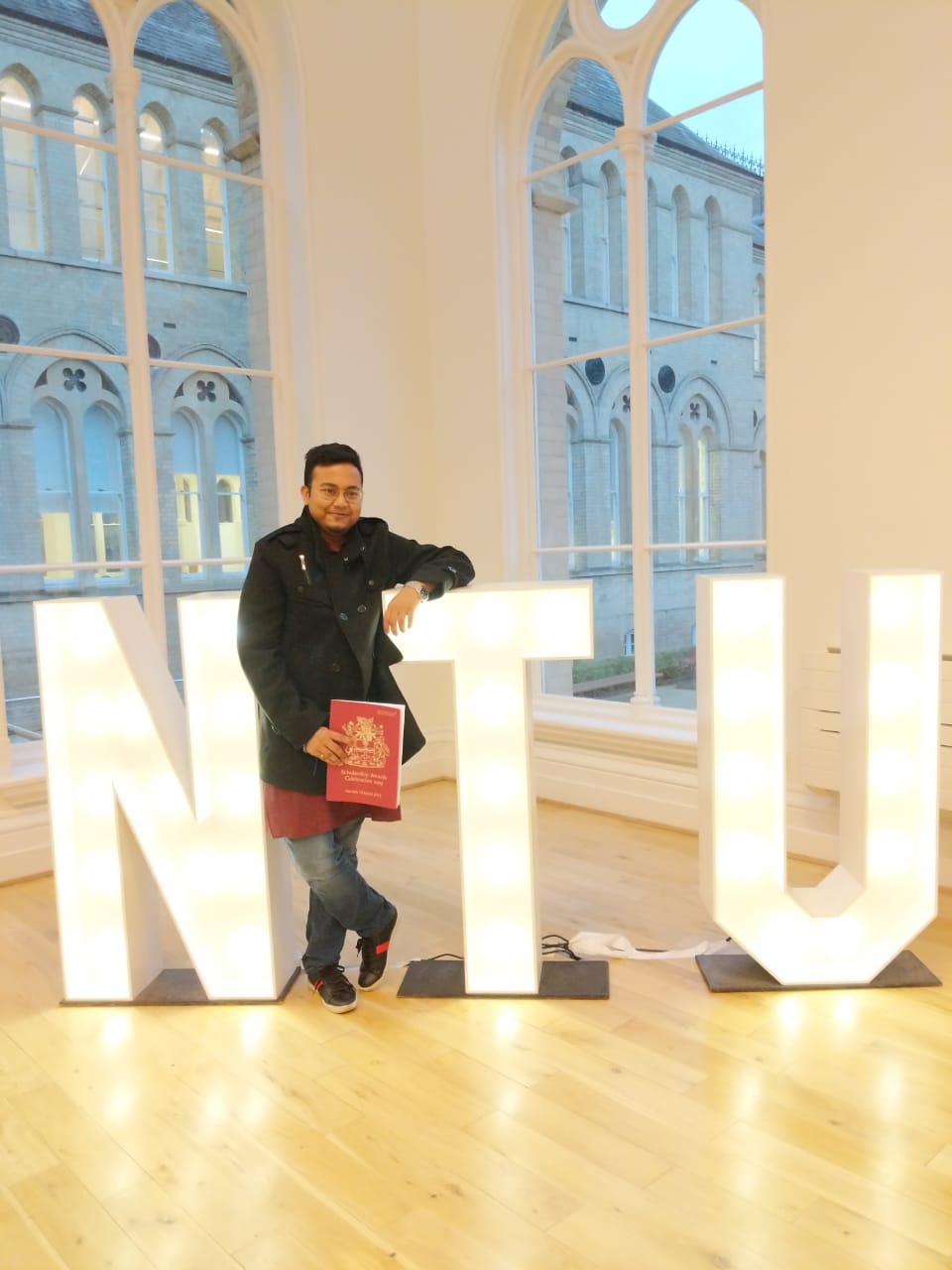
    After this, everything falls in place, and I got an admission call from Nottingham Trent University with an International Scholarship. This in itself came after sacrifice of many nights’ sleep. However, I did the same for the sake of my country and other underprivileged students from around the world, who want to study this subject and can’t be due to family or monetary reason. 

    Furthermore, there is more to be done for Athletes in India. These individuals suffer a lot due to lack of proper legislation / regulations of sports of any kind. Not only that, the legal system in India still now needs more research as even the Supreme Court sometimes get confused about whether some organisation representing the country will be considered as State or not. There is also a question of whether National Olympic Community will be considered as a supreme governing body or not. So, I just want to dedicate myself as a bridge to fulfil the gaps in my legal and educational systems. This has led to my love of sports developing into a passion for Sports Law

    You had completed your Second Master in law (LL.M.) from the prestigious Nottingham Trent University, United Kingdom, with an International Scholarship. Please share your experience starting from application stage for the LL.M., to the scholarship application up to your experience of studying at Nottingham Trent University?

    Well, from the beginning it is a smooth running operation compared to many Indian traditional universities, and the university authority will always be in touch with you, for every point of your application to fill the scholarship form.

    Now moving toward education system, not only Nottingham Trent University, even all the British Universities has the open and flexible education system, where we can take any subject as elective subject with our law subject, and secondly in Nottingham Trent University particularly, you have one of the famous Sports Law Professor Simon Boyes, who is considered as one of the chief architect for the development of sports law in the world.

    Post your LL.M. from Nottingham, you had also briefly worked at one of the prominent Football Clubs in the English Premier League Circuit. Kindly share your experience of working in the same including the work you used to do in the same organisation.

    Well see life there is pretty fast and timely, so it was good experience with some commercial experience, but yes if you have habit of hard work and smart work mixer you will enjoy their work culture.

    You have undertaken multiple diplomas and certificate courses, more importantly, from the International Olympic Association (IOC Young Leader), FIFA, UEFA. How do you choose courses for the purpose of skill-development? 

    So there is a saying knowledge is like ocean, even if you try to conquer all, still you can’t, and if you say you have learned everything it means you are only dooming yourself. For me I chose the courses at first for the thirst of the knowledge and secondly according to my student’s need because at the end of the day you are the captain of your crew which are your students.

    Despite being someone involved in the development of sports law in India, you have handled assignments of teaching other law subjects at ease and is quite popular amongst your students. What is your secret in being a popular teacher amongst the students?

    Thank you for saying so, but I think every student have someone who is favourite to that individual, but if you ask me I will say I always motivate them, try to listen them, collaborate with them; sometime try to empathise with them and treat them with utmost respect as upcoming future buddy lawyers.

    Apart from being an Assistant Professor at Jindal Global Law School Sonipat, you are also the Assistant Director at Centre for Sports Law Business and Governance of the law school. Kindly share your experience of working in the same, so far.

    It’s a dream for me to work with one of my role model and one of mentor and guru Professor Shaun Star, and really like to work under his leadership as he has taught me many things, and once it was also my dream to learn under him but that is fulfilling in another way under his leadership.

    Apart from your role as a Professor, you seem to be a multi-tasker, as you handle multiple roles as an Editor, Author, Guest Lecturer, Editorial & Review Board Member. Kindly share your experience of working in multiple roles at the same point of time.

    All I want to say in one sentence I enjoy to work and love to dedicate my time to the subject and development of future generation which is students

    What is the recipe of your success in successful multi-tasking, which you believe law students of today should develop?

    My tips to all the budding sports lawyer are to first change your passion for sport into love and interest towards the subject as like, you do same with your girlfriend or boyfriend, because subjects are like girlfriend or boyfriend only. How can you be happy if you don’t have interest in her or him? It will lead to break up, but more you are interested in a girl or boy and give him or her time she or he deserves, will give you more love in return, so same is with the subject. You have to have a passion and drive for sports to engage within the study of sports law.

    The second and more important tips will be to be curious about every rule and the judgement you come across and think why it has been decided like this or it has been not done in the other way, the more you think more capable you become.

    From having been appointed as a visiting faculty of SLS Hyderabad, you have gone a long way on becoming the Indian to be appointed the Ambassador of ISDE Law Business School Spain, a visiting faculty at IIM Rohtak , Research Analyst at Nehginpao Kipgen Centre for Southeast Asian Studies and an Assistant Professor at the Jindal Global Law School.

    How do you find this journey in such a short span of time of a little over two years?

    Well, Actually in my mind there is a thinking that when I am in this field there are lots of senior faculties who are at first senior to you and secondly they have more experience than you. So, for making it there and to sit on the chair of this assembly, one needs to be humble and spend more of their time in practising as well as sleeping less, because firstly you need to fill the gaps. Additionally, you always need to be one step ahead of them.

    Amongst so many achievements in your life, what is that one failure that redefined who you are today?

    Well, there is nothing as such. Even if there is, I think I have forgot the same by this time. I always like myself happy and I don’t look at the past or think about the future as you know I live each day and each moment of present as the last day, as you know present is gift to us by time.

    Being avid sports personnel and being involved in the development of sports law in India, how effective do you think AI and Legal Tech can be in the meaningful development of the sports law in India?

    In the world of IoT and constant change, its always helpful, as it helps to get access to more research document and case list around the world so one does not have any more barrier in the education world.

    Lastly, before we end our interview, what piece of advice would you like to give to the law students of today?


    I will suggest them, before if you want to win this subject,  it’s advisable to first change your passion for subject into love and interest towards the subject, then try to be always humble never let it enter our head.

    Secondly always keep in mind law that it is a professional subject, so don’t mug it up without understanding the subject as you know mugging it up means you will be theoretically sounded and top for many, but in court it is always not the same thing, which is mentioned in the book, you need to be practically smart.


    Never think about the marks, try to think about grasping more and more into practical view.

    And at last I will say them all that, it is your life, try to decorate it on way and try to be honest and listen to heart always. You all are young and will be having competitor whom you treat as enemy, then feel yourself lucky for having enemy as you know that a clever person learn more from his enemy then a fool from his friend.

    If any problem comes, always keep in mind that problem is not the problem but problem is your attitude about the problem.


    Get in touch with Prof. Subhrajit Chanda-
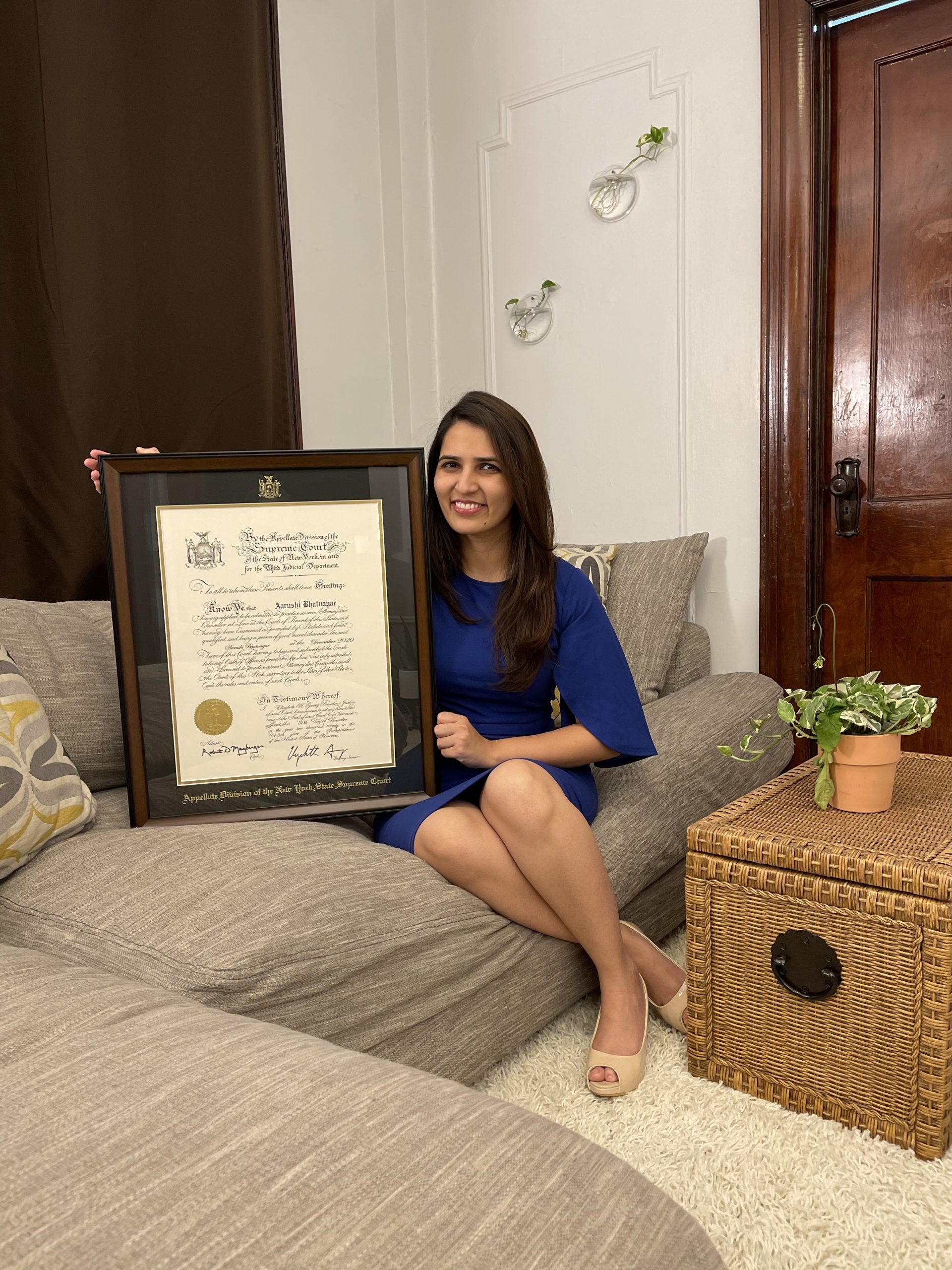


  • Ms. Aarushi Bhatnagar, Managing Attorney at PUNHANI LLC on LLM from NLU Jodhpur and NYU, cracking the NY state bar exam and practising immigration law in the United States

    Ms. Aarushi Bhatnagar, Managing Attorney at PUNHANI LLC on LLM from NLU Jodhpur and NYU, cracking the NY state bar exam and practising immigration law in the United States

    This interview has been published by Sonali Parashar and the SuperLawyer Team


    If we start from the beginning, were you always academically diligent? Did you always want to pursue law? What other career would you have chosen if not law?

    I have always considered myself a sincere but average student. I was not excessively academically inclined during my school years. Instead, my interests were directed toward art-related extra-curricular activities. Accordingly, my slam-book career goal was to be a fashion designer. At the same time, I had a strong family background in law, with multiple family members being in judiciary and litigation. Being amidst frequent family discussions involving topical legal issues, I gained valuable insight into the legal world and its opportunities. Ultimately, my interest in engaging with current affairs and doing my part to help the people around me pushed me to pursue law as a career.

    You have completed your master’s from NLU Jodhpur. Would you like to share a few tips with the students who are preparing for CLAT? How different is the preparation of CLAT PG from that of UG?

    The best advice that I can give to students preparing for the CLAT is to do as many practice tests as possible. In my experience, that is the key to cracking any competitive exam. Of course, studying and knowing the basic material that will be tested in the exam is also essential.

    I found the CLAT PG preparation to be easier than the UG preparation. The subjects tested in the CLAT PG exam are part of the law school curriculum. If one has studied and built a strong foundation in the relevant law subjects during their undergraduate years, the CLAT PG exam preparation becomes a revision exercise. On the other hand, students preparing for the CLAT UG exam are right out of high school with no formal exposure to legal academia. In such a situation, enrolling in a good entrance prep course is worth considering.

    Despite having an LL.M. Degree from NLU Jodhpur, you decided to pursue another LL.M. degree from NYU and had the flexibility of designing your course structure (subjects) there. What major considerations should one take into account while designing their course? What extra efforts have you made being a foreigner?

    Many LL.M. programs provide the students with an opportunity to design their coursework. However, one must consider several factors while making this decision. First, the coursework should align with the candidate’s short-term and long-term career aspirations. A career in law is often path-dependent, and the first job often charts the path for future professional endeavours. Second, it is essential to choose an area that complements the candidate’s prior experience. Choosing a field that builds upon the existing credentials ensures that one can make the most out of a short and rigorous LL.M. program. On the other hand, LL.M. also provides a unique opportunity to diversify into new areas. It is essential to consider one’s areas of interest and the corresponding job opportunities while striking that balance.

    As a foreigner, one should put extra effort when making space in a completely alien environment. I actively participated in networking events (both within and outside the university) and pro-bono activities, which gave me the familiarity and visibility required to succeed in the US job market. At the same time, being flexible and open-minded facilitated my venture into immigration law, a field that I have since fallen in love with.

    Can you share in brief about your current role and responsibilities as a Managing Attorney at a boutique law firm in the NJ/NY area? How do you manage to maintain a work-life balance?

    As the Managing Attorney of a boutique law firm, I have a diverse and dynamic set of responsibilities. I am responsible for onboarding clients, managing the cases from inception to completion, and handling the firm’s day-to-day operations. I advise multinational corporations, business units, and individuals on employment-based and family-based immigrant and non-immigrant visa petitions and applications. My role also entails hiring and training junior staff, including attorneys, law clerks, and paralegals.

    Compartmentalizing my work and non-work activities helps me maintain a good work-life balance. While at work, I dedicate myself to planning and executing my tasks efficiently. Breaking complex cases and procedures into simple daily tasks helps me leave the office with a sense of completion and accomplishment. It also ensures that work anxiety and stress do not spill over to my personal life. During weekends, I like to travel and engage in cooking, arts, and crafts. Having an active lifestyle rejuvenates me and prepares me for the upcoming work week. However, there are certain times when maintaining a work-life balance is challenging. In those times, having a good support system at home helped me keep my spirits up.

    You used to work as an Assistant Professor at Banasthali University, Rajasthan and now you are working in a law firm. What all struggles did you face adjusting in Banasthali and then in a Law Firm? What all things and skills did you learn as an Assistant Professor which are now assisting you in your current role as a Managing Attorney in your Law Firm?

    Teaching at a university and working in a law firm is different in certain aspects. As a teacher, I followed a well-structured curriculum and spent all my efforts ensuring that my students remained interested in the topic and benefited from the course. On the other hand, managing a law firm requires me to handle unanticipated challenges daily. However, I have enjoyed both these roles and did not face any issues in transitioning from the former to the latter. Instead, I found that the teaching skills I developed in Banasthali come in handy when I train new hires at the law firm.

    Would you like to share a bit about the field of immigration law? What is the future scope and struggles involved in the same?

    Immigration is a very dynamic field of law. It involves securing and defending the rights of immigrants from various countries and backgrounds. The legal landscape is constantly evolving, and the changes substantially impact many companies and individuals. The ongoing pandemic has amplified immigration-related issues by forcing many firms to downsize and leaving many immigrants jobless and without a livelihood. Given the ever-increasing importance of the field, it is (arguably) one of the most attractive and rewarding career paths for law students.

    You also cleared the NY state bar exam. How strenuous was the preparation? What are the eligibility criteria for the exam?

    Preparing for the NY State Bar Exam is like a full-time job. It was one of the most challenging tasks I have undertaken. Enrolling in a good bar prep course is extremely helpful.

    There are various qualifying methods to sit for the NY state bar exam. The most common criteria include graduating with a first law degree (J.D.) from an American Bar Association-approved law school. However, in the case of international students/foreign-educated lawyers, the eligibility criteria are pretty cumbersome. All foreign-educated lawyers must submit an online credential evaluation request along with the required documentation to the Board of Law Examiners. One should submit these documents even before the start of the LL.M. program because the evaluation process is time-consuming. LL.M. students must also fulfil the specified credits requirements via classroom courses in substantive and procedural law and professional skills. The official website of the New York State Board of Law Examiners provides the detailed eligibility criteria and application process.

    What will be your parting words for our readers? 

    Focus on having both career goals and life goals. Be ambitious and entrepreneurial but remember that professional success depends heavily on working smart (in addition to working hard). Reach out to people and take their guidance, rather than spending time reinventing the wheel. Be patient and diligent, and success will eventually come. Lastly, prioritize creating a wholesome life experience as it is the journey that counts.


    Get in touch with Aarushi Bhatnagar –

  • In conversation with Srishti Chaturvedi – the choice between JAG and academics, and the road so far

    In conversation with Srishti Chaturvedi – the choice between JAG and academics, and the road so far


    This interview has been published by Sonali Parashar. The Interview was taken by The SuperLawyer Team.


    What prompted you to choose Law? Did you always want to take Law as a career? 

    Law was not my first career choice. While in school, I maintained a persistent good grade and was expected to prepare for engineering entrance examinations while pursuing my 10+2. I had never really been only into academics from the early start and was therefore also pursuing vocal music, kathak and karate competitively during the time. A major reason why I started looking for options other than engineering has been NCC though. I had been in the Army wing of NCC in my VIII and IX std. when I participated in the Republic Day Parade in Delhi; after which, I participated in the Senior Wing of Air Wing in my XI and XII std. and received a ‘C’ certificate and was also chosen as the Main Flier for the MP&CG contingent in Vayu Sena Camp. All of this led me to consider Flying as an alternate career option. My parents were not particularly keen on this and as a result, this was deferred till my graduation. I had started exploring other options though. Some of my friends who were preparing for CLAT suggested that my aptitude is better suited for law and so I prepared for the CLAT entrance intensively for a month and got through NLIU, Bhopal.

    While pursuing LLM, you appeared for the JAG exam for the Navy and cleared all the stages. What special effort does the JAG exam require? How did you manage to make out time for both? Would you like to suggest a few tips for its preparation?

    The entrance examination for JAG was during the first month of the LL.M. course and GNLU was accommodating enough to give me academic leave for the 11 days that I stayed at the SSB centre. Since it was the start of the course, I did not have to juggle two things simultaneously. 

    I was recommended for JAG and cleared the medical tests in my first attempt. I liked the experience of the 5 day SSB exam process because, in my opinion, it is one of the few entrance tests that does not promote rote learning and tests the aptitude of the candidates. Some people prepare for it through coaching centres etc. but I don’t think it is necessary. It is adequate to have a thorough knowledge of the various tests and activities that are conducted in the 5 days. The preparation for written tests can be done through any basic book of preparation for SSB (I read Arihant) and the aspirant must have a minimum level of physical fitness to go through the physical tasks of the examination. Having a basic knowledge of the composition and working of the Defence forces is usually very helpful, and having certificates in NCC and sports competitions is an added advantage. Over-preparedness does not help as the tests are structured in a manner to test the aptitude of the aspirants. 

    Do you think TA-ship is important in the LLM programme? How was your TA-ship experience? What was that one learning experience in your TA-ship that you’d credit to have shaped your career and your current role? 

    Yes, I think TA-ship is extremely important in the LL.M. programme, especially for students who want to take up academics as a career. I did my TA-ship under Dr Jagadeesh Chandra, for Law of Evidence classes in GNLU and had a wonderful experience learning about various teaching pedagogies in theory and then seeing him use them in his lectures later. It was his style of interacting with students in an open, relaxed atmosphere and actively engaging in discussions with them, that made me understand the importance of having a mentor and not just a subject-teacher in the life of a student. I have tried adapting a similar role when I am assigned a class to teach or a group of students to interact with, in any other official capacity. 

    PhD is all about extensively researching in the chosen field and gaining an insight into the subject. What new things and skills did you develop while pursuing your PhD? How strenuous was clearing the PhD entrance exam of NLIU? 

    I slightly differ on the view that a PhD is all about researching and gaining insight into a particular topic. Of course, extensive research has to be done even before a topic can be finalized and by the time a thesis is submitted, you have considerable insight into the topic of your research. But there are a lot of other skills learnt. During the course work, we learn a lot about quantitative methods of research which is not covered adequately even during masters. We learn about various statistical, citation and referencing and content-correcter tools. Since every draft is revised and corrected several times before it is finalized, it results in not just better research skills but also far better legal writing and articulation skills than we started with. Most importantly, you learn to be patient with yourself and the people around you since everything cannot be controlled directly, and you learn to work with long-term goals. For a lot of us who had already started teaching for some time before starting our PhD, the coursework period especially presents an excellent opportunity to refresh what is it like being a student and knowing their expectations, learning obstacles and preferences, from a first person’s perspective.

    The exam is honestly not very difficult if you are in touch with the basics of law. When I gave the entrance exam for NLIU in 2018, there were 3 subjective papers for Research Methodology, Constitutional Law and Jurisprudence. Since I was also preparing for UGC-NET at the time, it was not very difficult to prepare for. This was followed by a small interview session where the panel asks questions to know the proposed area of research and how the applicant plans to go about it.  

    Srishti Chaturvedi

    You have observed students very closely and from different perspectives by the virtue of being in different roles. How would you describe the modern era student’s mindset? What improvements do they need in their day-to-day activities to help them succeed?

    I think students today are extremely smart and informed, they know a lot more than we did in our graduation days. However, I also think the competition of getting successful, more and faster, than their peers is making a huge dent in their emotional well being. To study law and build a career in the middle of a pandemic, only adds substantially to this pressure. I have worked with Jagran Lakecity University, NLIU Bhopal, DNLU Jabalpur and now at RNTU in 4 years and I have found one thing which is common in all the students irrespective of all the other differences, that they are under a lot of pressure and most of them are not coping well with it. I cannot emphasize enough how important mental and emotional well being is, to succeed not just in life generally, but also in one’s profession specifically; everyone should make this an utmost priority if they want any kind of success in life.

    I don’t think that the students require a lot of tips about succeeding academically, except that they should be open to all kinds of experiences that the course offers. They should take up extra courses, write research papers, moot, participate in MUNs, present papers, become part of various committees and clubs, and intern in different places till their third year at least. This will help them discover what they like and what they want to do after graduation. The efforts of the next 2-2.5 years can be streamlined accordingly.

    You also started working as one of the founding members of CAN Foundation’s blog ‘Vedanam’ and later, as an Executive committee member of the Foundation itself. Can you tell us a bit about your role at CAN? What all responsibilities did you have? 

    My role as an Executive Committee member is primarily to focus on the execution of the 2 flagship scholarship programs of CAN- ‘Eklavya’ and ‘Dhananjay’. I work with the student committee of CAN from the inception of the project. We set the minimum eligibility criteria to apply, invite applications from meritorious students, go through hundreds of applications and sort them meticulously while also verifying their documentation. Thereafter, we have multiple rounds of meetings with the scrutiny committee and selection committee to finalize the names of the scholarship awardees. The whole process takes a lot of time and organization and cannot be done without the hard work and consistent efforts of the student committee members of the Foundation and the able guidance of Mr Siddharth R. Gupta,(CEO, CAN Foundation). Going through various applications of students who are extremely meritorious even while facing all kinds of financial hardships, since the last 2 years, has further encouraged me to realize my privilege and set long-term goals through which I can contribute back to the community in any form.

    Can you tell us a bit about your current work and role? What do you plan to achieve next in your career trajectory?

    I am currently in the final stages of completing my PhD thesis, and will probably be submitting it this year. However, I kept thinking I wanted an opportunity to do something different and most importantly, I wanted to be back in a classroom. So, I have recently joined as an Assistant Professor of Law in RNTU, Bhopal. My job profile includes teaching UG and PG classes, working on administrative rebuilding and cohesion and working with the local community as the Legal Aid Cell in charge through various projects of the University. 

    My sole aim for my career this year is the successful submission of my PhD thesis. I have been wanting to be an ‘Author’ of a book for some time, but the plan keeps being postponed due to some reasons. So after my PhD, I plan to write a book sometime soon. Working at DNLU made me realize I like taking up administrative responsibilities as much as I like teaching since I was also the Warden, the Faculty in-charge of the Legal Aid Cell and some other committees as well; so I would like to take up roles where I can work more in administrative capacity along with working on my classroom teaching skills.

    What would be your parting message to our young readers?

    My message to the readers, especially students, is to not be too hard on yourself. Read as much as you can, and not just about law, watch good movies, participate in competitions, create a lot of good memories with your friends and take utmost advantage of the facilities and opportunities offered by the University. The time, resources and opportunities that are offered during the 5 years of law school will not come again and they should be experienced accordingly. Everyone succeeds at their own pace, and as redundant as it sounds, every person should only compete with themselves. Someone might get a PPO in 4th year while you may still be giving interviews post-graduation, but that is okay. Someone might select the field they want to work in the first go, while you may have switched 2 fields already and are still not sure about what you want to do, and that is okay. Keep learning, keep exploring, keep working and take adequate breaks to breathe between all of this. Things will start falling in place one after the other.


    Get in touch with Srishti Chaturvedi:

  • Raghav Pandey, Assistant Professor, Maharashtra National Law University, on experience in academia and legal education system of India

    Raghav Pandey, Assistant Professor, Maharashtra National Law University, on experience in academia and legal education system of India

    Raghav Pandey is currently an assistant professor of Law at Maharastra National Law University, Mumbai. He graduated from Dr. RML National Law University, Lucknow in the year 2012 and then went to pursue a Masters in Arts from Tata Institute of Social Sciences, Mumbai. Later on, he pursued his Masters in Law from Indian Law Institute, New Delhi and presently pursuing his Ph.D. from Indian Institute of Technology, Mumbai.

    In this interview we speak to him about:

    • His law school days at Dr. RML National Law University, Lucknow;
    • Being a prolific writer and authoring several papers in reputed journals;
    • His interest in academia and his teaching methods;
    • His interest for pursuing his higher studies;
    • His opinion on the Indian legal education system; and
    • His experience as Assistant Professor at Maharastra National Law University, Mumbai.


    TELL US A BIT ABOUT YOUR WORK LIFE, YOUR DREAMS AND ASPIRATIONS.

    Well, currently I am an Assistant Professor of Law at Maharashtra National Law University, Mumbai and a Senior Research Fellow at the Department of Humanities and Social Sciences, IIT Bombay.

    Coming from a family of academicians, I have always been environmentally inspired to be a teacher. This has recently been formalised, after I have entered an institution to streamline myself into an academic life and career. I had always wanted a proper work life balance in life, which the academic ecosystem certainly promises to give. It was precisely because of this reason I never wanted to enter the corporate world or even litigation.


    DO YOU RECKON ANY INCIDENT THAT MOTIVATED YOU TO CHOOSE LAW AS A CAREER?

    There is no particular incident as such, however my father played a very important role in making this choice. As opposed to the contemporary wisdom of choosing a career option whatever you want yourself, I think that at the age of 17, one is always not in the best position to decide for themselves. In class 12th I was very interested to pursue sciences and scored really well in the board examinations in both Mathematics and Sciences. However, Law also appealed to me as a very lucrative career option. Being born and brought up in Allahabad, where every second person is a lawyer (quite literally), motivation to take up law as a career, was everywhere around town. I would say thankfully my father intervened, and we jointly decided that I should go to a law school. I say ‘thankfully’ because I really enjoy reading law more than anything else now.


    TELL US ABOUT YOUR TIME AT DR. RML NATIONAL LAW UNIVERSITY, LUCKNOW.

    Life at Dr. RML National Law University, Lucknow was very simple. I studied there at the time when attendance was not taken very seriously, I hear that has changed now. Hence, we had a lot of time to do whatever we choose to. The campus was fantastic, with all the modern amenities (except for seamless internet connectivity in the hostels!) and I was in the second graduating batch of the University. Hence, it also involved a fair bit of compromise from our end. For instance, there was no alumni to support the University. It was at RML though, that I started reading books at a serious level, precisely because of ample availability of time. It was because of this routine that I also read a lot of non-law books like books on history, politics and religion. These would shape my career choices in future.


    TELL US HOW HAS BEING ASSOCIATED WITH COMMITTEES WHILE YOU WERE AT DR. RML NATIONAL LAW UNIVERSITY, LUCKNOW HELPED IN BUILDING YOUR PERSONALITY AND SHAPING YOUR CAREER?

    I was the student in-charge of the Organising Committee of the University fest, twice. I was also part of the Vice-Chancellor’s committee for a fair period of time. All of this contributed to the development of my personality and interpersonal skills. I was not very good at public speaking and now I am a teacher, this has to do a lot with me being part of these committees at law school.


    WHAT WERE YOUR AREAS OF INTEREST IN LAW SCHOOL?

    My favourite area of law has always been Constitutional Law, followed by Public International Law, Jurisprudence and Criminal Law. I was very fortunate to be taught by Prof Jariwala. His lectures on Constitutional Law are still afresh in my memory and perhaps remains as the best part of the classroom life at law school.


    WHAT PROMPTED YOU TO PURSUE A MASTERS IN ARTS FROM TATA INSTITUTE OF SOCIAL SCIENCES, MUMBAI?

    I had interned at TISS in the second year of my law school at the Centre for Criminology. This internship along with a lot of reading on social sciences, had convinced me that a systematised study of social sciences is something which I must do. I was fortunate enough to secure an admission to the course which I wanted to pursue.

    PLEASE TELL US ABOUT YOUR EXPERIENCE WITH INDIAN LAW INSTITUTE, DELHI. HOW WAS IT DIFFERENT ON COMPARING WITH THE NATIONAL LAW SCHOOLS ACROSS THE COUNTRY?

    I.L.I as opposed to National Law School is an exclusively research institute, which makes it more relevant for academicians than practitioners. I.L.I offers no bachelor’s course like an LL.B. For the longest period of time it offered no curriculum-based courses but only worked as the research institute to aid the Supreme Court of India. ILI is possibly the best institute in India, if one plans to enter legal academia. It’s LL.M. course forms a benchmark of sorts, unlike the National Law Schools where usually the LL.M. and Ph.D. courses are not given their due importance and the focus is mostly on the undergraduate course.


    WHEN DID YOU DEVELOP YOUR INTEREST TOWARDS LAW AND SOCIETY?

    This happened in the concluding years of the law school itself, however after joining TISS it formalised more clearly. I began to be enamoured by the idea that what is the meaning of all the legal edifice of constitutional rights and liberties, if they are not translated into something tangibly visible in the society. Naturally law has no meaning if it does not positively impact a person’s life who is standing last in the que of development.


    AT PRESENT, YOU ARE A DOCTORAL CANDIDATE AT IIT, BOMBAY. WHAT MOTIVATED YOU TO PURSUE A PH.D., IN HUMANITIES AND SOCIAL SCIENCE?

    During my time at TISS as well as ILI, I secured an award of Fellowship from the UGC to do a PhD. Since then, I researched on the best institutes to do a PhD in India. I was thoroughly convinced after my time at TISS that a purely legal and a doctrinal research is something which I would not want to pursue, simply because the lack of tangible benefits it would accrue to the society. I had also developed a very deep fondness for the city of Mumbai and somehow wanted to stay here, if staying at my hometown was not an option. IIT Bombay fitted into all my filters. In addition to it being in Mumbai, it is also one of the finest or perhaps, the finest research institute in the country. In sciences, IIT-B produces the greatest number of published research papers, annually. The Humanities and Social Sciences Department is no different, when it comes to inculcating and practicing the best research practices. I had been aware of the research culture of the institute, which is primarily based upon the model adopted in the American Universities. As soon as I secured the admission in the Ph.D. program directly, usually they admit after completing an M. Phil., there was hardly an option to not take admission.


    WHAT PROMPTED YOU TO CHOOSE TEACHING AS A CAREER?

    As I said this was primarily due to the influence of my family. My grandfather, who has a profound impact on the early years of my life, was a Physics teacher. His father was also a teacher. My father, paternal aunt and uncle, are all teachers. Even while studying, especially at TISS, I was teaching my classmates a day before exams. This is something which I enjoy more than anything else and this I realised even more, when I started teaching professionally. Hence, the decision to select a teaching career was after all, not so difficult.


    TELL US ABOUT YOUR TEACHING METHODOLOGY.

    I principally use discussion and Socratic Method of teaching, especially for undergraduate classes. At the undergraduate level, the development of legal concepts is critical, which is best achieved through these two methods. They are also relatively less boring for the students. These can be combined with case method, in a law class room. In my experience till now, if the teacher gives out the facts of a case and the relevant law and subsequently initiates a discussion on the question of law, it is most widely received by the students, instead of the regular lecture method of teaching. I think the widespread use of lecture method in legal curriculum, should be discouraged, even though it has its own set of advantages, but it certainly proves to be detrimental in the longer run because lawyers require advocacy and argumentative skills to excel in the profession and not volumes of memorised information.


    COULD YOU GIVE OUR YOUNG READERS CERTAIN TIPS ON EXCELLING IN ACADEMICS AND RESEARCH WRITING?

    The first tip, which anyone who wishes to indulge in academic writing, should take is to not plagiarise. Academic writing, especially in India, is plagued with plagiarism. Forget research papers, there are very popular books in law school curriculum, which are entirely plagiarised. In fact, the curriculum at law schools in India, inbreeds plagiarism. A student at any National Law School is often required to submit five to six projects in a semester. These projects are supposed to be drafted like research papers. No legal academic on this planet can do this successfully, without plagiarising i.e. coming out with six research papers in a semester, which is mostly less than six full months. This becomes even more problematic when teachers start prescribing insane word limits of say 8000 words. In such a situation, the student will only plagiarise and will then find ways to conceal such plagiarism. Secondly, to draft a decent research paper, it is necessary that a proper referencing method, as required, is followed. I have been telling this to my students, that this is more than half the job done for them. Of course, the substantial part of any research paper, revolves around finding a good legally researchable problem area and a theorised or philosophised solution (hypothesis), to that problem. This should be followed by a fair bit of analysis of the problem through case laws or empirical data and one will have a result.


    YOU HAVE PUBLICATIONS IN VARIOUS RENOWNED JOURNALS. HOW SHOULD ONE GO ABOUT WRITING PAPERS AND GETTING THE SAME PUBLISHED? PLEASE SHARE SOME HIGHLIGHTS OF YOUR BEST WORK

    As I said above, if a research paper does not suffer from plagiarism, has followed the proper referencing, has a good researchable problem, hypothesis and analysis, it is unlikely that it will not be published. My publications have been in varied areas, in addition to my doctoral research area, which is Insolvency Law, I have published on current affairs, commenting upon politics, history, legal developments primarily emanating from contemporary judicial pronouncements and religion. As far as academic writing is concerned, I have published on Constitutional Law and Jurisprudence and Criminal Law. In my experience, trying to research and publish in different areas, actually improves one’s analytical and research abilities. This contributes in the positive development of the research aptitude in all areas which one seeks to research on. One of my favourite papers is on Public Interest Litigation and Child Labour, which has been published by the ILI Law review. It focusses on the 2016 amendment and the MC Mehta case. A research problem can be easily found out by critically examining a judicial pronouncement or a legislation. This can serve as a starting point for anyone who is looking to get themselves published.


    WHAT IS YOUR OPINION ON THE INDIAN LEGAL EDUCATION SYSTEM?

    Indian Legal Education system, especially in National Law Schools, in my opinion, suffers from the vice of overregulation. The IITs and IIMs rose to excellence, precisely because they were spared of the regulation, even from the UGC. IITs and IIMs directly report to the Ministry of Human Resource Development (MHRD). In contrast, the National Law Schools, in addition to being regulated by the UGC, are also subjected to strict regulatory norms of the Bar Council of India. Despite being Universities in their own right, there is very little any NLU can do in its discretion to be innovative and creative. The system of assignments, reading material (in some NLUs) is largely futile in its current format and needs massive improvements. Moreover, the most critical area in which the Indian Legal System suffers, is the shortage of faculties. In any NLU, hardly any student graduating from the undergraduate course decides to take up teaching as a full-time career option. If one contrasts this situation with the IITs, most of the Professors at IITs are products of IITs themselves. Of course, this has also to do with limited incentives which an academic receives while being at an NLU, as compared to a corporate job or even litigation.


    WHAT WOULD BE YOUR MESSAGE TO OUR READERS?

    I would just like to encourage the students at law schools to consider teaching as a viable career option. Even if it is not financially competitive with a job at a Tier I law firm, it still is increasingly much more so with most other career options. Moreover, there is a very good work life balance and above everything else there is hardly anything in this world which offers as much contentment as receiving complements for being a good teacher and seeing your student’s excel.