Tag: Basketball

  • Vishnu Ravi Shankar, Partner, Ekalavyas on quitting big law to start up, sports management and Basketball

    Vishnu Ravi Shankar, Partner, Ekalavyas on quitting big law to start up, sports management and Basketball

    Vishnu Ravi Shankar graduated from National Law University, Jodhpur in 2011. He worked at corporate law firms, beginning with Tempus Law Associates in Hyderabad for a year and a half, post which he worked in the Hyderabad and Delhi offices of Trilegal till 2014. Thereafter, he quit to join as a Partner at Ekalavyas, a sports media and talent management enterprise that manages and runs ekalavyas.com.

    In this interview, he talks to us about:

    • His background, inspiration and passion leading him to pursue law
    • His experience working at corporate law firms and the decision to leave
    • His decision to work as a Partner at Ekalavayas and the nature of work
    • His views on the scope of sports and entrepreneurship in India and advice to aspirants in this field.


    How would you like to introduce yourself to our readers who are mostly law aspirants, law students and young lawyers?

    Well, essentially, I am a corporate lawyer turned entrepreneur who is truly passionate about sports and the business of sport, and the sport of basketball in particular. I used to be a full time corporate lawyer until last year and now, I undertake the dual role of managing my independent corporate law practice along with being a member of the core team at Ekalavyas, a sports media and talent management enterprise that manages and runs www.ekalavyas.com, India’s first and only basketball news website.


    Tell our readers a bit about your childhood and pre-college life as well as your educational background. Do you have any lawyers in your family who motivated you to pursue a career in the legal field?

    I grew up in a middle-class Telugu family which instilled middle-class values in me. I was born in Chennai, where most of my family is from. The unique aspect of my childhood was that my family lived in a number of places all across the country. I studied in 13 different schools! The good part about all the shifting and moving around was that it  familiarized me with the diversity that India had to offer right from a very young age. I experienced the various different cultures of India and this holds me in good stead even today.

    I was always into sports. I played basketball, football and cricket at an amateur level, but I was really into swimming and achieved some success at the same at the school level. I was a decent, but not an exceptional student. My parents never  pressurized me into choosing any particular career. But the fact that both my father and my grandfather are corporate lawyers did influence me.

    In fact, my grandfather was a lawyer as well as a company secretary. My father has been working as an in-house legal counsel for over thirty years, which has included stints in some of India’s biggest companies. So, the profession of law was not something that was alien to me. I had grown up watching my dad go about his business and law was, sort of, a natural choice for me. I was also keen on the practical aspects of companies and businesses and as a result, I pursued Commerce in Classes 11 and 12.


    Can you recall any specific incident that made you choose law as a career?

    No specific incident as such. As I mentioned earlier, I was inspired by the lawyers in my family. In addition to that, I was quite curious to learn  how the legal system of the country works and I had a general spirit of enquiry towards the laws of the land.


    How would you describe your experience as a student aspiring to be a professional at NLU Jodhpur?

    It was definitely a rewarding experience, but not in the traditional way that you might expect. Obviously, those five years of law school come during a very formative period in your life. From the age of 17 to 22, you  live on a residential campus in a hostel environment. It’s a period that does shape your personality to an extent. What I am most thankful for is the friendships I made during those years. Those bonds will remain with me for the rest of my life.

    The feeling of playing sports and training with a team was another major aspect of my law school life. That’s the beauty of sport, isn’t it? It teaches you so many life lessons. How to be a leader, how to work in a team, the competition, how to accept defeat and learn from it, the spirit of sportsmanship – it’s just so beautiful. Most of all, you learn from the purity of sport – there are no shortcuts. You just have to put your head down and work HARD.

    As regards my legal career, well, having studied in a national law school definitely gave weight to my resume. But academically, the entire law school experience was not ideally what it should have been. Although National Law University, Jodhpur is ranked among the top 5 law schools in India, the reality is that this ranking has very little to do with the quality of teaching there. That ranking and recognition, in my opinion, was mostly built by the students and their own determination to make something of themselves. This was the case with me as well.

    I graduated with average grades. But that did not stop me from reaching a good place in my law firm career. So, obviously, there is no set formula for success or for bagging that coveted job placement. But what is essential, in my opinion, is that you continue to gain knowledge and experience. During your initial college years, instead of pre-deciding the field of law you wish to  specialize in, I would suggest gaining internship experience working in several different fields. This not only helps you decide what your area of interest is, but also helps you develop a holistic way of thinking, when you are working on any matter.  The other factor is to believe in yourself and your ability. Be confident and cut the faff.


    What were your areas of interest during your graduation? Did you engage yourself into some extracurricular activities and how was the campus life?

    To be honest, for the first two years of my law school life, there was very little that interested me on the academic front. There was too much focus on theory and very little focus on the practical aspects of the legal profession. NLU-J offers an honours system in which you can choose a  specialization that ideally would be your calling after you graduate. I chose the field of Business Laws and this is when my interest piqued. Studying the laws that govern businesses, mergers, acquisitions and other corporate transactions was one of the few areas of interest that I had in law school.

    Along with the knowledge gained in law school in this area, I also interned in the corporate teams of some of the best law firms in the country and was fortunate to find work pertaining to some fundamental areas of company law. Then, the real knowledge, of course, was gained during my time spent working in law firms.

    With regards to extracurricular activities in college, I was mostly into sports – I played on the college basketball team in a few tournaments and the college football team in a couple of tournaments. During my last two years of college, basketball took up most of my extracurricular activity space. We had quite a picturesque basketball court on campus and a bunch of fun guys to play with too. Apart from sports, life on campus was great. There was a lot of freedom given to students during my time, which ensured that kids enjoyed college life the way they should.


    Right after graduation, you joined as an Associate at Tempus Law Associates and thereafter Trilegal which  is one of the Top law firms in India. What did an average day of work look like?

    My first job after graduation was as an Associate with Tempus Law Associates, a mid-size law firm in Hyderabad. My parents were living in Hyderabad at that time, which was convenient as I got a chance to stay at home. As the law firm was still a young and growing one, I got a lot of exposure and first-hand experience advising on matters of corporate law and working on corporate transactions. There was a lot of PE activity in the Hyderabad market at that time in the IT/ ITES sector, mostly with domestic mid-size to established companies. I gained precious experience working on these transactions from end-to-end. As a small and understaffed firm, I got to work on transactions right from the term sheet stage to the due diligence up until the definitive agreements and closing. With this experience under my belt in my first one and half years, I was able to land a job in the Hyderabad office of Trilegal.

    When I joined Trilegal, I  realized the vast difference in the quality of legal services and the output expected from you. It took me a couple of months to adjust to the expected pace of delivery and quality of work. But once I gained the confidence of my partner and senior associate there, I worked on a number of good transactions. The most important thing that I learned there was the ability to handle matters independently, no matter what the matter was. At the end of the day, as lawyers, no one knows everything there is to know. What is important is that you learn where to look for information, pay attention to detail, approach matters in a logical and structured manner and also take into consideration the practical aspects.


    Now the most important question, what made you leave one of the leading law firms, Trilegal, and join as a partner in Ekalavyas? What was the thought process behind taking that decision?

    Yes, it was a crucial decision and it did come after a LOT of brainstorming. I was in a good place in my law firm career and the financial incentives were more than adequate. But there is a certain lifestyle that you want to lead and each person has his or her own preferred way of functioning. Although I was happy working on corporate transactions and business laws, the long hours and the way of going about any matter was not to my liking. Besides, sports was my true passion and I realized that I might as well work on something that I was truly passionate about and I had more ownership over. I waited till I had enough savings to last me for a while, and I took the decision to quit and work for Ekalavyas full-time.

     

    ekalavyas

    What is the motto behind creating Ekalavyas and who are in the core team? What exactly does Ekalavyas do and what is your job role, who are your clients and what are the services offered?

    I think for each of the co-founders, the reason behind starting Ekalavyas would be different. The basic idea was to bring attention to non-mainstream sports and sportspersons in India, who are constantly in the shadow of cricket and therefore, immensely suffer.

    In any field, a monopoly is never good. There should be always be a healthy balance and fair competition. Unfortunately, when it comes to sports in India, cricket is the dominant sport in the minds and hearts of the majority of the public. A lot has to do with media  exposure to a sport. If you really put it in perspective, cricket is played only by a handful of nations and its origins lie in the colonial era. Not that I have anything against cricket. I watch and follow cricket just as much as any other Indian and still continue to do so. But what about people who are passionate about other sports? Do they have to give up their dreams and aspirations of becoming professionals in the sport just because your nation does not pay attention to it? That would be highly unfair and a let down to your fellow countrymen.

    Although anti-competitive practices and monopoly is restricted in other sectors in India by law, in the field of sport, there was no restriction to the growth of cricket. Nor should there be, but at the same time, other sports should be given equal attention. Let’s take a fellow commonwealth nation like Australia for example. They are world-beaters in cricket. But at the same time, they manage to qualify for the football world cup, the basketball world cup, are one of the best  at rugby and so on and so forth. They even have five-six players currently playing in the top professional basketball league in the world, the NBA.

    So the motto behind Ekalavyas is to create an equal and balanced world of sports in India. We aim to bring respect to all sportspersons, irrespective of the sport they choose to excel in. Ekalavyas can be described as a sports media and talent management enterprise. We have started with our focus on Indian basketball, but the plan is to eventually implement this model for other sports as well. On the media front, we are looking to cover as many Indian basketball events and tournaments as possible, as well as major events on the international front. We also provide PR and content creation services for tournament organisers, basketball academies, state basketball associations and other entities.

    On the talent management side, we are currently building a database of players and coaches with the aim of finding the right opportunities for them in India and abroad. We have already been involved with sending a couple of India’s best players to play professionally in Japan. We are also focused on building better infrastructure and facilities for basketball around the country. We have a tie-up with sports infrastructure companies for refurbishment of basketball courts. We have a few other ideas and divisions that we intend to begin in due course of time. As a member of the core team, I do have my hands in almost all aspects of the business at some level or the other. But I’m majorly focused on international content for Ekalavyas and the talent management division.

    In our short period of existence, we have worked with a variety of clients, both in India and abroad. Some of our major clients include the Basketball Federation of India, NBA team Sacramento Kings and the UBA (Universal Basketball Alliance, the company that organized India’s first professional basketball league). We recently provided location scouting services for basketball courts for an advertisement campaign by Nike. So, with our database of information on players, coaches, referees, basketball courts, etc., we continue to get a range of work from different clients. For more information, visit www.ekalavyas.com.
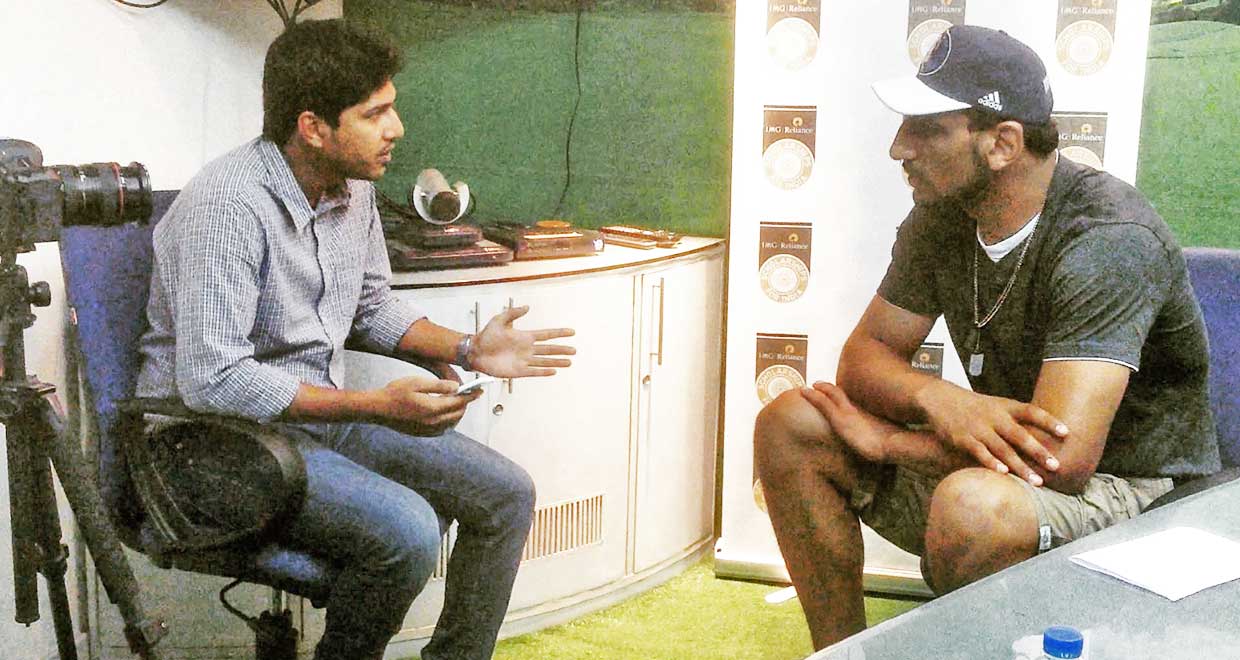
     

    Vishnu interviewing Satnam Singh (India's 1st NBA Player)
    Vishnu interviewing Satnam Singh (India’s 1st NBA Player)

    Tell our readers whether you had a passion for the game of basketball. Did you actively participate in any basketball tournament? How is the work life at Ekalavyas and how do you maintain the work and family life balance?

    Yes, of course. I am deeply passionate about basketball. I’ve played the sport at an amateur level throughout my life. In fact, I had the classic ‘hoop in my driveway’ as a kid. But I started taking the sport seriously with regular practice and training only during my college years. I made it to the college basketball team and did participate in a few tournaments. I was a part of the winning team at the sports fest held in RMLNLU, Lucknow. I was the captain of the winning team at the same sports fest the next year. Plus, basketball was a way of life for me in college. We used to play pickup games almost everyday – it was probably the most fun part of college life.

    To answer the second part regarding life working at Ekalavyas, it’s obviously good to be your own boss. But this also requires a lot of self-discipline – something that I constantly have to work on! Thing is, I don’t consider this as work. Instead, it’s a way of life. Ekalavyas goes in the direction its founders take it and we only work on those things that interest us. As a business that is still in its initial years, it obviously requires a lot of time and effort. But at the end of day, it’s worth it because we are building something we truly believe in and are passionate about.

    Having said that, of course, I still am servicing clients as an independent corporate lawyer and this is necessary for financial sustenance. But since these are also on my own terms, i.e., according to the processes I think best and my own timelines, work-life balance has not really been an issue.


    You have been a part of Ekalavyas for a period of more than one year. Tell our readers how the journey has been and the challenges / difficulties encountered by you.

    Any startup business faces a number of challenges in its nascent stages. On the personal front, initially, I had to adjust to not receiving a fixed amount of money per month and I had to be careful with the way I spent my money. But as time went on, and money started coming from my legal practice and from Ekalavyas, I gained  a certain level of financial comfort.

    So far, we have run the business without any external financial aid. We work on a self-sustaining model, where we slowly grow through the revenue earned from providing our services. Without major funding, growth has obviously been slow, but the important point is that we do not have any external pressure or influence in the way we function (which is of paramount importance to us). But now, we’ve reached a stage, where are ready to take things to the next level and will be considering investment offers.

    Overall, the journey has been great. I’ve met so many people from literally every state of the country, travelled to so many new places, which I otherwise would have never been able to travel to and I’ve been closely associated with the sport I love. So despite the challenges, I wouldn’t have it any other way.
     

    vishnu-ravi-shankar-2

    How did your relatives react to the decision of your quitting Trilegal and joining Ekalavyas? Did your family support you and what was their advice to you?

    They were hesitant at first. Understandably, my parents were surprised at my decision to quit Trilegal. They were worried about the financial security I had created for myself. But soon, they realised that I was happy with what I was doing and were very supportive, which was reassuring to me. My parents have always told me to be realistic about anything in life. Their simple advice was that your passion is one thing and it’s great to do something that you’re passionate about. But you have to approach it in a structured manner with long-term vision that yields success. Further, you need to be able to sustain yourself and your lifestyle. I have always kept this advice in mind.


    Do you have any plans to pursue higher education in the future, especially in sports laws?

    No plans right now. I’m not sure whether any higher education course would be as useful to me compared to the practical experience of running a business. Many of the things that you learn in the real world are rarely taught in any educational institution. As of now, I plan to continue to focus on the growth of Ekalavyas and my independent legal practice. But who knows what the future holds.


    Tell our readers what is the growth potential of sports law in India and what suitable measures are needed to promote sports in this country.

    Sports law in India is already sort of established. Thing is, sports law is basically an amalgation of various other areas of practice. It involves contract law, labour and employment laws and other commercial laws. Of course, sports law also entails familiarity with international and domestic sporting guidelines (anti-doping, laws governing sporting bodies, professional league rules, etc.). When I was working in the Hyderabad office of Trilegal, I came across my first brush with the field of sports law. I directly worked on drafting of commercial contracts for two prominent cricketers.

    With the advent of professional leagues in sports other than cricket and the growing interest in other sports in India, the need for lawyers who specialize in sports law will definitely increase. So, that way, it’s another avenue open for law students today. Unfortunately, sports law is not a course offered in many law schools. NLSIU, Bengaluru, recently held a conference on sports law. So, things are moving in the right direction.

    As regards what measures are required to promote sports in the country, well, there is a lot that can be done. Without getting into all that detail, I would simply say that people just need to go out and play! It all starts at home and if people are more sporty and physically active, automatically the respect for various sports and sportspersons will increase. Current facilities and infrastructure should not be used as excuses.


    Lastly, what are your plans for the future? What advice would you give law students wishing to work in the niche sector as you?

    We have some big plans for the future. We are looking to build a sports conglomerate with focus on various divisions that include media and PR, talent management, coaching and training, sports infrastructure and a lot more.

    Look, the advice that I would offer to any student is to focus on living their lives. In college, try and experience as much as you can – don’t hold back, because that time is not going to come back. Apply your own judgment to every situation. Do not just blindly follow people who are senior or higher in command to you. Lastly, try and do something that gives you satisfaction and not something merely for the sake of your bank account.


    Finally tell us in which specific role would you like to see yourself-the role of a lawyer, entrepreneur, a founder or a sports enthusiast?

    All of them, actually- I am a lawyer, who is also an entrepreneur and founder as well as a major sports enthusiast.




  • Gopalakrishnan R, Co-founder, Ekalavyas, on basketball, sports journalism, and founding his startup

    Gopalakrishnan R, Co-founder, Ekalavyas, on basketball, sports journalism, and founding his startup

    Gopalakrishnan R. graduated from NLU, Jodhpur in 2011. He was always keen on journalism, and worked as an Associate Commissioner Editor at LexisNexis for close to two years from May 2011 to February 2013. He later quit it in March 2013 to pursue freelance journalism on a full time basis.

    Gopal’s interest in Basketball led him to work on positive media presence for basketball. That is when he started up with Ekalavyas.com, India’s only website for Basketball news. Ekalavyas’ idea is to use their legal acumen to represent the interests of Indian players, to aid in assisting Indian children in getting athletic scholarships in foreign universities and to work on many other avenues where sports, law and journalism meet. They also plan to work on finding out apathetic government policies in sports and curing them through litigation.

    In this interview we speak to him about:

    • His interest in sports journalism
    • Ekalavyas’ vision and goals
    • His plans for the future

    Tell us about your years in high school.

    I did my high schooling from the Little Rock Indian School which is situated within the district of Udipi, the popular temple town in coastal Karnataka. The decision to study law was made after the 10th standard. Right upto 12th I was a hardcore science student (Physics, Chemistry, Maths and Biology) because even though my school was under the CBSE syllabus, we didn’t have the option of studying humanities after 10th. Anyway, my dad was of the firm view that at least till 12th standard science is a must.

    Even though I liked science, I never seriously considered pursuing the standard options of Engineering or Medicine. I did give the state Common Entrance Test and All India Pre-medical tests, but by then my mind had already been made up that I would study law.

    The decision to study law came about because I had enjoyed taking part in debates in my final few years of school. Also, like most others, I wanted to do meaningful work that can contribute to society as a whole. [Obviously, once you join law school, all these charitable fundas usually get thrown out the window.]

    Plus, being equally interested in multiple areas of knowledge, I felt law was the perfect multi-disciplinary course that demands a fundamentally sound understanding of various streams of knowledge. But even while I was keen on studying law, at the back of my mind I knew that I would eventually club journalism and law. The reason I did law was simple curiosity in the sense that law is something that affects each one of us and which we should all have a basic understanding of. Also, I knew that an integrated BA.LLB incorporates many of the arts courses that a journalism course has. So legal journalism was the intent I had when I started applying to law schools. Also, I am a first generation lawyer.


    Tell us about your time in NLUJ.

    To be honest, this is something I’m still figuring out. I kind of have mixed feelings about it.

    Positives:

    NLUJ degree & internships

    On the positive side, a degree in law was a basic prerequisite for a job as an editor at the legal publishing house LexisNexis Wadhwa. So I wouldn’t have got a job at a leading legal publishing house had I not studied law. Also, what really helped are the internships that one must do in between college semesters. Each internship made me realise what I liked or disliked and helped me eliminate options. From my second year onwards, after interning at litigation and desk type law firms, I realised that my initial hunch that I was meant to be more into journalism was correct and I began doing multiple internships at Bar&Bench, and in an effort to move more from reportage into substantive legal journalism, I interned at LexisNexis during my final year and was offered a job there. I really tried to make every internship count and preferred a quality over quantity approach. Many of my batchmates preferred a quantity over quality approach where they did as many as fifteen to sixteen internships some of which were only two to three weeks long. I found that such a hectic schedule did not work for me as I needed more of a work- non-work balance.

    The residential college experience

    Also, any residential college experience is something you will always cherish. It really exposes you and opens you up to different kinds of people each with their own quirks. You realise soon enough that all those little personality traits back in school which you considered really important don’t really matter. Just to cite an example: when I joined an NLU at the age of sixteen, I thought that people who smoke were bad people. By the time I graduated at the age of 21, I was vociferously arguing that marijuana should be legalised! So that’s quite a maturity leap, all thanks to the wholly unfamiliar college environment (i.e. moving to a different city, different people, cuisine and different academic courses).

    The travel bug

    Also, one unique advantage of studying in a historic city like Jodhpur, Rajasthan was that my friends and I traveled constantly every other weekend to places like Mt Abu, Pushkar, Osian or Jaipur. So my travel bug is all thanks to college. All this travelling is coming very handy now that I’m into sports tournament coverage at different locations. It has taught me the value of packing light and to go with the flow.

    Dealing with failure

    Also, NLU most importantly taught me to deal with failure. I mean this in the most literal sense. Many of us used to easily average above 80 to 85% in school and had never failed at anything before. But in college I had my first experience of flunking two subjects in my third semester. So that way, studying at an elite college in India, where most of your peers are of top quality, naturally helps you deal with repeated failure, grow and adapt.


    Negatives

    Not a multi-disciplinary environment

    On the negative side I found that when I joined NLUJ, it didn’t possess the multi-disciplinary environment that I hoped an elite university in India would have, like most universities in the west do. What I mean by multi-disciplinary is having systems in place where students can also pursue parallel extra-curricular interests outside law. Of course, in due course I realised that when I joined NLUJ, it was still only five years old, unlike western universities that have hundreds of years of heritage behind them. I painfully appreciated that for every institution, it takes time to create diverse extra-curricular environments, which in any case have to be largely student run initiatives. So once I got over all the self-pity and whining and understood that the buck stops with us students, then I took the initiative to bring about a cultural change in the field I was most attached to i.e. sports.

    Not fully equipped to handle first generation learners

    I felt that the current system of legal education presupposes previous legal knowledge. It isn’t fully equipped to handle first generation law students, who approach law not as “lawyers” but mostly as science students who need things to be black and white. For people like us 2+2=4, but in law school, a lawyer is told beforehand that 2+2 can equal four, five, or six, depending on which client you are representing! In other words, there is no right or wrong answer when it comes to law and that really threw me off initially.

    Coming from a non-lawyer, science background family, and especially being from a small town, I naively went into law school fully dependent on the faculty. But I immediately realised that college professors aren’t the same as school teachers. I was very dissatisfied with the classroom atmosphere and the way majority of the faculty handled student queries during their lectures. I firmly believe that learning can only happen in an environment where teachers and students alike are invested in getting to the root of the issue at hand. Unfortunately, I found that many of the questions that were put forward by me or some of my friends in the initial few months were either laughed at, ignored or considered “unrelated to the syllabus”.

    With faculty not really helping, the next option obviously is to turn to books, but I found that even existing Indian legal literature is meant more for practitioners than first or second year law students. So by the end of second year, some of us stopped contributing to classrooms debates altogether and just did the minimum required to get a degree.

    Questionable academic policies (mandatory minimum attendance, marks for attendance and too many project submissions) 

    Apart from the classroom atmosphere, certain academic policies absolutely irritated me, and still do:

    • the minimum attendance requirement;
    • marks for attendance;
    • the mandatory need to submit as many as six projects every semester, for a total of 60 projects over five years!

    I think attendance requirements need to be done away with completely. I’m fully aware that the Bar Council of India Rules mandate a minimum 60% attendance. But if you look at many other elite universities, there is no such requirement to attend classes. If you do away with this rule barely 10% of the students will turn up to class on a regular basis. I think that is a real indicator of the quality of the faculty in some of our law schools. Some of my friends barely scraped past minimum attendance requirements but are happily working in leading law firms. So that obviously shows that students don’t really consider their classroom education to be of any great value. A very close friend of mine even carried a pillow to class and happily snored away and he is now working in a tier I law firm! Secondly, the marks for attendance rule is a clear case of trying to coerce a student into attending class. If the faculty really were qualified then such underhand tactics don’t ever need to be used. Simply giving tests and assignments without any attendance requirements should be more than enough.

    Another practice that I abhorred was how padding was encouraged for all projects, tests and assignments. It was generally accepted that the longer your answers/projects were, the more marks you would get. So what usually happened was that tons of paper were wasted just rewriting the same points over and over again, and written exams became a race on who can fill up more supplementary sheets. Specifically when it came to projects, instead of six lengthy projects every semester (which leads to rampant plagiarism), it makes better sense to just have two projects each semester (one law and one non-law in the first three years), and also have page length and footnoting limits (not more than six pages and not more than two footnotes per page). This will help in cutting down copying, facilitate original research, make writing concise and improve the overall quality of Indian legal research papers.

    Teaches the “what” but not the “why”

    I guess my fundamental issue with my college education is that it did a great job with the “what” but did nothing to explain the more important “why”. They tried to teach too many things shoddily rather than a few things well. All of this is a result of learning to be too compartmentalised and the administration trying to pack a six year programme into a five year ‘integrated’ course. While on paper, the 60 odd courses that are taught across five years are great as they all directly or indirectly relate to the field of law, our faculty and legal literature needs to become more mature in becoming cross-disciplinary within each course.

    For example, in many tests or classroom lectures the teacher would go through the entire semester starting from section 1 of Indian Penal Code, narrate the section in class, follow it up with a bunch of case laws under that point and then repeat the same exercise for two and a half months with the remaining sections/other related legislation. Ideally in a course on Indian Penal Code, a part of the time needs to be spent on understanding criminal psychology/deviant behaviour, forensic tools (on how evidence is gathered) and then the select oft cited sections and caselaw should be incorporated. This will make for much more engaged learning.

    Another example is the course on Company Law, where the first few weeks ideally should be spent on understanding how entrepreneurial or disruptive business ideas develop in the first place. Only with such an understanding (where law students put themselves into the shoes of businessmen) will lawyers be able to advise their corporate clients in a simple, effective and cost saving manner.

    I think all the above issues I have with my legal education stem from a major difference in orientation towards how I viewed law and how it was viewed by some of my peers and most of my faculty. For those who taught me law, they did so as if law is a standalone subject. For me law is usually an ancillary ‘effect’ and never a root ‘cause’; it is ‘procedure’ to the ‘substance’ that is life. Simply put, law is usually always the ‘sidekick’ and never the lead hero (except maybe when it comes to fundamental rights issues).


    Tell us about your relationship with basketball.

    I wasn’t remotely great. In fact, if guys from my team in college read this they will laugh their ass off! But considering that lawyers aren’t really known for their ball handling skills, it was very easy to get onto the university team. So it was definitely a case of being a big fish in a very small pond.

    In fact in my second year, I remember how most other seniors backed out from the team before the NLS sports fest and I happily appointed myself as the captain and took a bunch of guys, many of whom were new to the game, simply because I wanted to play!

    But yes, more than my limited playing abilities, I definitely pride myself on being able to convince many of my batchmates to drop everything else and travel days on end to tournaments across India to places like Bangalore, Kolkata and Lucknow. I felt that if I could convince my fellow lawyers with my arguments to play basketball than it is an incredible achievement! Some of the guys on the team still curse me even today for either being too hard or else too talkative.

    But despite all our problems (low attendance, cash crunch and not enough practise), we did manage to win a few tournaments and shared great camaraderie. My favourite memory will be captaining our NLU team to its first ever basketball tournament win at the RMNLU, Lucknow sports fest in 2010.

    In one particular two to three month phase, I got so much into creating a “basketball culture” at my university, that I used to spend an unhealthy amount of time on the basketball court- as many as ten hours: three hours in the morning coaching the girls team, then seven hours in the evening and night with the boys team and watching countless YouTube training videos! I think I’ve learnt more from Kobe Bryant than I have from Hofeld!


    ekalavyas

    Tell us about Ekalavyas’ unique blend of journalism, law and basketball.

    You are correct, Ekalavyas stands at the intersection of diverse streams of knowledge- not just journalism, law and sports (i.e. basketball), but in fact even management (considering that we provide media management and PR services to tournament organisors).

    The broad notion of Ekalavyas came about because as a student of law, basketball and journalism (and to a much lesser extent music), I found that there is a huge gap between what students really need to know to succeed in a professional environment and what they are currently being taught in the classrooms, or during training sessions. This leads to a lot of confusion and self-doubt, not to mention a tremendous loss of time as students have to unlearn the wrong lessons and relearn the right techniques.

    So with this in mind, my co-founder Aravind came up with the Ekalavyas motto “Know Your Game” which is at the core of our attempt to ensure that learning should happen at the right time, in the right way, to the right people and from the right instructors. In the larger sense, just like the mythological Ekalavya figure, we firmly believe that those individuals who learn for the pure joy of learning become successful icons in their chosen field, for others to follow in their footsteps. We want to create a society full of such Ekalavyas, where free thinking individuals rationally choose to live amongst one another for individual and community gain.


    How did you find your co-founder?

    It wasn’t really difficult to find my co-founder considering that he stayed in the room diagonally opposite mine in the same hostel! Ekalavyas was co-founded by my college batchmate Aravind Mokkapati. Both of us immediately became friends because of our shared craze for sports. While I was in-charge of the basketball team, he was part of the university football team. We used to talk for countless hours almost every night to discuss strategies on team building for our respective sports. We would then go and apply these strategies to our respective teams with varying degrees of success. In doing so, we naturally began thinking about the larger picture of sports in India and realised that we would like to apply our tiny NLUJ sports management model to a larger pan-India scale if given the opportunity.

    Regarding long term partnership, in our case, we make it very clear that all partners need to be in this for a long haul. Most importantly, all partners need to truly believe in our credo to free up information from the clutches of select elite institutions or organisations for the equal benefit of all. We insist that all Ekalavyas partners should have parallel jobs that take care of their basic financial needs, so that when we do Ekalavyas related work, we do so not with the stress of having to make money, but because we enjoy it. Of course profitability is important, but simply as an indicator of efficiency and because it allows us to reinvest that back into our venture.


    gopalakrishnan-1

    What would you say keeps the majority from starting up?

    I actually think the contrary is true. More lawyers today are willing to take calculated risks much sooner in their career. That being said, of course there will always be a sizeable majority from each law school who will choose to join another law firm or company. There is nothing wrong with taking up a job elsewhere. In fact in many of these cases, law students do so to pay off their students loans and to save up enough to quit later on. Also, work experience under other individuals or institutions immediately after college is crucial as it helps you understand a professional work environment. Such experience is also valued when applying for higher studies.


    Are you hiring associates?

    Just to be clear, Ekalavyas is not a law firm, we are primarily a sports media/management enterprise, so we don’t hire “associates” as is understood in law firm culture. But considering that we have grown from three people last year to thirteen as of today, we are definitely constantly on the lookout for more associates.

    We are very picky when it comes to getting more people on board. Ekalavyas is quite a unique business model, because we don’t have any full time “employees” as such, but are wholly reliant on freelance reporters, photographers and artists. But once we activate our player representation arm, then we will definitely be keen on getting on board law students or young lawyers who are interested in a career in sports law. For now, among lawyers/law students, we are on the lookout for people who can contribute articles on sports law. Those interested can shoot us a mail on info@ekalavyas.com.


    Where do you want to see Ekalavyas five years from now?

    Five years from now, we want Ekalavyas to be the ultimate destination for all Indian basketball related news. We want to percolate our coverage into all school, college and senior basketball events. Simply put we want to be in a position to document each and every time a basketball is bounced anywhere in the country.

    If things go as per plan, we definitely hope to diversify by duplicating our basketball model to other alternate sports in India starting from football; and eventually to other creative professions (like music and arts). We feel that the problems faced by creative persons are common across all fields whether it be sports, music or arts. With our legal background, we would like to be the external support system for talented individuals to freely follow whatever their line of passion is.


    How did you approach your clients in the beginning?

    As of today, all our clients are sports tournament organisors. Our major coup is that we are the official media partner for many of the major national and international events organised by the Basketball Federation of India. We either directly place cold calls to potential clients, or else clients themselves reach out to us via our website (http://ekalavyas.com/) or through our Facebook page (https://www.facebook.com/EkalavyaPosts).


    Does Ekalavyas have scope of internships as well?

    As of now, we are fully relying on freelance contributors. So we definitely welcome those who wish to try their hand at sports writing, action photography, live text commentary, player interviews, sports based comic strips, or else contributing articles on sports law. Interested persons can send in samples to info@ekalavyas.com.


    You also worked as an Associate Commissioning Editor at LexisNexis, Gurgaon for close to two years. Tell us about your experience.

    Experience in legal publishing worked out great especially for someone like me. The decision to join LexisNexis came about by pure chance. In my penultimate semester, during the course on jurisprudence, I first tried reading Salmon and Pound. Obviously, I found that this was very dry reading. A close friend of mine happened to have a book called Lectures on Jurisprudence by NK Jayakumar, where concepts were explained simply and poignantly from an Indian context. In the typical behaviour of most book lovers, I quickly went to the inside front flap for the publication year and details of the publisher. I found out that the LexisNexis office was in Gurgaon and I applied for an internship that very winter semester break. My internship went great and I was offered the job on their commissioning team.

    A commissioning editor’s job is to study and analyse all the new and revised book projects and then make recommendations to the publishing board comprising the heads of other departments like sales, marketing & editorial. During these meetings, we give the other departments the heads up on the key features of the book that concerns them. For the editorial team, we point out how the content is structured and the various elements of the book (chapter break up, common editorial & grammatical idiosyncrasies to watch out for, possible copyright red flags and content additions needed). For the sales & marketing team we intimate them on the readership segments they need to target, as well as how the book should be packaged (i.e. whether hardback or paperback) and priced. Once the board gives its approval then we co-ordinate with the authors (either by personal visits, email or phone calls) to ensure that they send in their revised scripts on time.

    At LexisNexis, I got the chance to work on a whole gamut of legal literature that was in their publication cycle from mid 2011 to early 2013:  from the latest edition of DD Basu’s multi-volume Constitutional hardback tome to the popular Nani Palkhivala’s Courtroom Genius paperback, or even Q&A based textbooks to help students crack the CLAT or judiciary entrance exams. My time at LexisNexis really helped me understand the different contours and branches of law, not to mention a fairly in-depth awareness of the publication industry and the workings of a typical nine to five company.

    One major plus point was that I was incredibly fortunate to get to interact with many of India’s most distinguished judges, senior advocates and academic scholars. In particular I will always cherish my meetings with Justices AP Shah and Muralidhar (who were on the Delhi HC two judge bench that passed the landmark decriminalising homosexuality verdict), Senior Advocates TR Andhyarujina (of Keshavananda Bharti fame) and Mr. Arvind Datar, and retired judge CK Thakker (the famous Takwani behind the Civil Procedure books we all went through during law school).


    Many students after completing law are in the pursuit of entrepreneurship. What is your advice to them?

    It might be premature for us to advise others as we have only just started out. However, that being said, I can only advise that make sure you have a concrete and long term viable plan (at least on paper) before taking the plunge. Do it for the right reasons. Don’t do it to “prove a point to someone” or because it “sounds cool”. Also, I’d advise them to do a lot of varied internships and first try and fit into the existing system. If that “fit” is not possible then go ahead and start something on your own. Entrepreneurship, at least for me and my colleagues, was the last option and not the first.


    You have been shuttling between India and Nepal to document all important basketball tournaments. Are there any episodes you would like to share?

    Well, there are a couple of episodes which are standout memories. Some pleasant and others not so much. One huge incidental benefit is that I get to travel on the job.

    At my first tournament in Mumbai in mid 2013, I remember I was doing a post game interview, when suddenly a 6ft 5 inch international player stormed up to me as he was unhappy with the way I had quoted him the previous day. I definitely felt that this dude could kill me for sure. Thankfully, things settled down pretty quickly.

    The second, and perhaps best memory I have is from earlier this year at an international tournament in Nepal. Considering the financial crunch that most new enterprises have, I didn’t have the funds to fly into Kathmandu. So I decided to travel to Nepal from Bengaluru by the traditional route, which is a complicated three day journey by rail, road, bus and car.  While crossing the border from Gorakhpur into Nepal, unfortunately that was the same day that Gorakhpur went into the national polls. So the whole border was blocked for close to fifteen hours and I was stuck in the 40° heat and dust from 6am to 9pm! But once I got to Kathmandu and covered the tournament, the entire Indian men’s team and their Coaches personally came up, shook my hands and thanked me for documenting the event. That is a memory I will take to my grave. It felt like all that back breaking travel was totally worth it in the end.


    What is your message for your readers who want to start up on their own?

    Anybody wishing to start on their own will face opposition. But however difficult this may sound, it is important to try not to worry about what the other person is doing. Each one of us has a distinct set of interests and we should stick with it rather than falling prey to the perception of what should or shouldn’t be done. So if you wish to start up on your own don’t expect others around you to truly understand and support you. There will come a point when the only person who sees sense in your idea is yourself. So you need to have the courage to back yourself up when no one else around you does. Luckily, in my case, my immediate family and close friends have been insanely supportive.


    Photo credits: Cathy Scholl

