Tag: BCL

  • Instead of locking yourself into a specific specialization early on, give yourself room to explore different areas of law- Abhishek Khare, Counsel, High Court of Bombay

    Instead of locking yourself into a specific specialization early on, give yourself room to explore different areas of law- Abhishek Khare, Counsel, High Court of Bombay

    This interview has been published by Priyanka Karwa and The SuperLawyer Team

    Please tell us about your journey and how you ended up pursuing a career in law?

    I am a classic example of the profession finding a person rather than a person actively seeking it out. In 1996, I found myself enrolling at ILS Law College in Pune, not because I had a deep understanding of the legal field or a predetermined plan, but simply because my elder sister was studying law. Little did I know that this seemingly serendipitous decision would set the stage for a remarkable journey.

    It was on the first day of my professional life, while working at Hindustan Lever (now Hindustan Unilever), that I experienced a moment of clarity. A senior colleague posed a legal question to me, and as I drew upon my foundational knowledge and connected the dots to provide a meaningful answer, I felt a surge of excitement. It was in that moment that I discovered the exhilaration of applying legal theory to real-world situations.

    Since that interesting moment, my journey as a lawyer has been a whirlwind of excitement and fulfilment. Each day presents new challenges, intriguing legal matters, and the opportunity to make a positive impact on the lives of others. Guiding individuals through complex legal cases and providing advisory services has allowed me to contribute to their well-being and shape their future.

    Not only that, but I’ve also had the opportunity to shape corporate decision-making, influence individual choices, and even participate in national-level policymaking. Being able to play a role in these important spheres has been truly rewarding.

    Reflecting on my journey, I carry a unique perspective as someone who ventured into this field without familial connections or a predetermined path. This perspective, shaped by my experiences, adds a fresh and diverse outlook to my approach as a lawyer.

    You have an impressive educational background, including a Bachelor of Civil Law from the University of Oxford. How did this experience shape your career and expertise in the field of law?

    My experience studying at Oxford was a transformative journey that taught me important life lessons. When it comes to pursuing education at premier institutions like Oxford, discipline becomes a cornerstone. You’ll find yourself balancing coursework, social activities, extracurriculars, and taking care of your well-being all at once. It may seem overwhelming, but remember, these aspects are interconnected. Embrace the challenge and learn to manage your time effectively. Pay attention to every detail, develop a keen eye, and engage actively in class discussions. This discipline will serve you well beyond your academic pursuits.

    Another crucial quality to cultivate is perseverance. The courses, especially the rigorous BCL program, demand unwavering commitment. It’s easy to feel overwhelmed but keep pushing forward. Develop a resilient attitude and maintain a strong sense of determination. Remember, progress requires persistence. The ability to persevere through difficult times will not only benefit your academic journey but also prove invaluable in your future endeavours.

    Studying at esteemed institutions like Oxford goes beyond academic knowledge. It fosters adaptability, a skill that will serve you in any profession or sphere of life. You’ll gain a broader understanding of the world and its inner workings, expanding your perspectives and enhancing your problem-solving abilities.

    While some may be enticed by tangible benefits such as placements at prestigious law firms, it’s essential to stay true to your  aspirations. If your goal, like mine, is to litigate at a specific court, prioritize your path accordingly. Focus on developing the discipline to handle complex cases, irrespective of their scale, and pay meticulous attention to detail. This dedication will build the foundation for a successful and impactful career.

    Finally, cherish the opportunities to learn from renowned experts. I was fortunate enough to study competition law under a world-renowned master. The knowledge I gained at Oxford empowered me to apply my skills to real-world cases in the field of competition law. Embrace such opportunities, as they can truly shape your professional trajectory.

    Remember, the journey of studying at a premier institution like Oxford offers far more than academic excellence. It imparts essential qualities such as discipline, perseverance, adaptability, and a global perspective. Embrace these qualities, remain true to your aspirations, and seize every opportunity for growth and impact.

    As an Advocate on Record at the Supreme Court of India, could you share some insights into the nature of your work and the responsibilities that come with this position?

    When assuming the role of an Advocate on Record (AOR) at the Supreme Court, it is crucial to understand the immense responsibility that accompanies it. As an AOR, one must develop strong shoulders to bear this weight of responsibility. Simultaneously, this role helps in advancing one’s legal practice and opens up various opportunities for professional growth and recognition. By shouldering this weight of responsibility, AORs can expand their horizons, gain access to challenging cases, and establish themselves as reputable advocates in the legal fraternity.

    One of the primary responsibilities is drafting meticulous pleadings to be filed before the Supreme Court. It is essential to ensure fairness in practice, both towards opposing AORs and counsel, as well as towards the Court and the Registry. Care must be taken not to sign any Special Leave Petition (SLP) or other proceedings in a careless manner. Thorough research of the law is necessary, along with the duty to assist the Court in shaping and developing legal principles. It is important to distil the facts from lower courts and present them clearly and concisely in the pleadings. Remember, written advocacy is just as crucial as oral arguments.

    Being an AOR requires long hours of dedicated work. One must have a deep understanding of the facts and present them before the court in a concise manner. It’s important to note that courts usually rely on what is presented before them, whether it is spoken or in writing. Losing the confidence of the court is something every professional wants to avoid.

    In simple terms, an AOR is the master of their clients’ cases before the Supreme Court. In situations where the engaged counsel may face difficulties, the AOR must be fully prepared to continue with the matter. Being an AOR is not solely about signing and filing the Vakalatnama, but instead taking full ownership and responsibility for the cases at hand.

    With over 22 years of experience in corporate and commercial laws, energy law, infrastructure, and more, what are some of the most interesting cases or projects you have worked on throughout your career?

    Over the years I’ve learned that every case is interesting and carries significant importance for the client, regardless of its size or the client’s profile. However, here are some of the many immemorable cases I fought.

    Imagine being entrusted with a case early in your career where a client was accused of stealing highly confidential information from their employer. The stakes were sky-high, with damages claimed at a staggering Rs. 1,200 Crores. It was like diving into an intense legal thriller, crafting a compelling defence strategy, and manoeuvring through the twists and turns of the legal battlefield. Witnessing our strategy unfold successfully and delivering a resounding victory was an exhilarating experience.

    In another captivating case, I found myself challenging the dominance of a corporate giant, Coal India. The case involved allegations of abuse of power, and the monetary implications were substantial. It was like stepping into the shoes of a legal protagonist, meticulously preparing our arguments, and presenting our case before the Competition Commission of India. I am happy to say that we secured a favourable order.

    But it’s not just about the big cases with large financial stakes. Some of the most fascinating moments in my career have emerged from seemingly modest matters. I vividly recall representing a co-generation power producer, fighting to establish fair tariffs, and navigating the complex regulatory landscape. This journey opened my eyes to the intricate technicalities of the power industry and led to a landmark decision that not only shaped policy but also brought about a tangible positive change.

    There have been heart-touching encounters in the courtroom where I’ve stood up for ship crews abandoned by their owners. These were stories of resilience and compassion, as we fought to secure their rights and bring them back home. The feeling of making a difference in their lives was immeasurable, and it reminded me of the power of the law to protect the vulnerable.

    These anecdotes provide a glimpse into the exciting world of the legal profession, where every case is a story waiting to unfold. I believe in combining my legal expertise with a deep sense of empathy and determination to seek justice.

    You have extensive experience in international Arbitrations. Can you provide some examples of the types of arbitration cases you have been involved in, particularly in the areas of EPC projects, energy projects, and shipping?

    Here are some examples of the types of arbitration cases I have been involved in, particularly in the areas of EPC projects, energy projects, and shipping:

    I have represented clients in an arbitration case before the Singapore International Arbitration Centre (SIAC) involving a claim related to the design of an engineering product. The dispute centred around issues of design defects, performance, and contractual obligations.

    In a domestic arbitration matter, I handled a case concerning a power plant construction project. The dispute revolved around delays in the project, resulting in significant damages. My role involved analysing project management issues, contract interpretation, and assessing damages for the delayed completion.

    I have been involved in several domestic commercial recovery arbitrations. These cases typically involved disputes between commercial entities seeking to recover financial losses or damages due to breaches of contract, non-payment, or other contractual disputes.

    One of the cases I worked on involved the construction of a crane, where issues of alleged design flaws and delays were at the forefront. I focused on establishing liability for the delay damages and quantifying the losses suffered by the client.

    In another arbitration case, I handled delays and damages in an HVAC (Heating, Ventilation, and Air Conditioning) project. This dispute required a thorough analysis of project scheduling, performance issues, and assessing damages resulting from the delays.

    I also handled an arbitration case related to an EPC project involving the design and construction of a road tunnel and highway. The dispute centred around design issues and delays, and my role involved establishing liability for the delays and quantifying the resulting damages.

    In the shipping industry, I represented clients in arbitration matters, including a case involving a dispute regarding the rescue of a crew at sea. This case required an understanding of maritime law, contractual obligations, and assessing damages for the rescue operation.

    I have been involved in multiple tariff and regulatory issues concerning power projects, including those involving different sources and capacities. These cases have encompassed a range of issues, such as contract disputes, performance evaluation, and assessing damages in relation to power generation and distribution.

    Additionally, I have handled arbitration matters involving disputes related to confidential information. These cases involved protecting sensitive information, analysing confidentiality agreements, and resolving disputes arising from the unauthorized disclosure or misuse of confidential data.

    In addition to your legal practice, you have also served as a former Standing Counsel for the State of Uttar Pradesh to the Supreme Court of India and a Law Officer at Hindustan Unilever Limited. How have these roles contributed to your overall professional growth and expertise?

    Throughout my professional journey, I have had the privilege of serving in two distinct roles that have significantly contributed to my overall growth and expertise. Firstly, as a Law Officer at Hindustan Unilever Limited (HUL), I had the unique opportunity to learn how to balance the legal requirements of the business with its commercial needs. In this role, I got the opportunity to be involved in conducting legal research, supporting compliance efforts, being in the field with business functions to understand how the company’s business is conducted, being involved in court cases, and assisting in contract review and drafting.

    Working with the government and representing it before the Supreme Court of India was another invaluable experience. This role provided me with the platform to present the government’s perspective in court and advocate for its policies. It gave me the chance to dispel misconceptions and demonstrate that the government is not solely focused on wrongdoing but rather strives for the welfare of its citizens. In this role, I was involved in a diverse range of cases, covering a wide spectrum of legal areas. From matters related to irrigation policy, bail applications, and shareholding issues of government enterprises, to constitutional validity challenges against regulations and policies, I gained exposure to a myriad of legal scenarios.

    These experiences have instilled in me an important attitude that one cannot afford to be overly technical while advising clients. As lawyers, we must always consider the practical aspects and implications of our legal counsel. Both my roles taught me the significance of understanding the business and governmental context in which legal advice is sought. By bridging the gap between theoretical legal knowledge and real-world applications, I was able to provide comprehensive and practical guidance to my clients.

    These roles have allowed me to develop a well-rounded skill set, encompassing a balance between legal considerations and commercial realities, as well as a deep understanding of governmental policies and their implications. I am confident that the diverse range of cases and the holistic approach I have cultivated will continue to contribute significantly to my future endeavours in the legal profession.

    Considering your diverse areas of expertise, what advice would you give to aspiring lawyers who are interested in specializing in areas such as arbitration, energy law, or competition law?

    If you’re a budding lawyer with a keen interest in specializing in areas like arbitration, energy law, or competition law, here’s some valuable advice for you. Instead of locking yourself into a specific specialization early on, give yourself room to explore different areas of law. Take up diverse opportunities and get a taste of various practice areas. This will give you a broader understanding of the legal world and help you figure out what truly grabs your attention. Keeping an open mind during this exploration phase will allow you to make a well-informed decision when the time comes to choose your specialization.

    While theoretical knowledge is important, lack of practical experience is the real deal-breaker. It’s not just about what you learn in textbooks or lectures; it’s about getting your hands dirty in the real world of law. Seek out internships, clerkships, or part-time positions that allow you to roll up your sleeves and immerse yourself in the practical aspects of arbitration, energy law, or competition law. By diving into real-world cases and projects, you’ll gain first-hand experience and discover whether these specialized areas truly resonate with you.

    When it comes to choosing your specialization, trust your gut and follow your passion. Think about the areas of law that excite you the most. Consider the kind of impact you want to make and the issues that genuinely ignite your curiosity. Whether it’s fighting for fair resolutions through arbitration, delving into the complexities of energy law, or ensuring a level playing field in the marketplace, pick a specialization that aligns with your authentic interests and values.

    Remember, every field of law has its own unique opportunities and challenges. By exploring different practice areas, gaining practical experience, and staying true to your passions, you’ll be well-prepared to make an informed decision about specializing in any field.

    In your opinion, what are some of the key challenges that the legal profession faces today, and how can young lawyers navigate these challenges effectively?

    One of the significant challenges that young lawyers and  even experienced lawyers often face is the collection of fees for their legal services. This issue can have a profound impact on their professional and personal lives. However, they are generally discussed behind closed doors due to the attached stigma.  Fee collection can be a complex and time-consuming process, leading to financial strain and affecting their mental well-being.

    Many lawyers find themselves grappling with the task of chasing down payments from clients. This can involve spending valuable time and resources in follow-ups and negotiations, which can be frustrating and demanding. Furthermore, some clients may be reluctant or unable to pay, resulting in additional complications and financial instability for the lawyer.

    In fact, understanding the importance of addressing this challenge, I have taken the initiative to create awareness and find solutions for effective fee collection. I have started a campaign or movement that aims to shed light on the significance of timely and transparent fee collection in the legal profession. By fostering open discussions and providing a platform for fellow professionals to share their experiences and concerns, we strive to create a supportive environment within the legal community.

    Another significant challenge is the misconception that a deep understanding of the law alone is sufficient for being a successful lawyer. While legal knowledge is essential, practical advocacy skills require a blend of psychological intelligence, creativity, and real-world experience. Many young lawyers are initially shocked by the harsh practical reality, which may lead to feelings of dejection. However, it is crucial for them to embrace these challenges as opportunities for growth, understanding that trial and error is a valuable part of the learning process. Letting go of the mentality of striving for perfection or the typical topper syndrome is essential. Young lawyers should focus on continuous improvement and be willing to learn from their experiences.

    With the constantly evolving legal landscape, particularly in areas such as data protection laws and competition law, how do you stay updated with the latest developments and ensure that your expertise remains relevant?

    When it comes to staying updated with the constantly evolving legal landscape, in any field I believe the following helps:

    Stay informed through extensive reading: Develop a habit of reading extensively, including legal journals, blogs, and other relevant resources. The more you read, the better equipped you’ll be to understand the latest developments and gain valuable insights.

    Engage in discussions: Seek opportunities to engage with like-minded individuals. Participate in discussions with such people. Never shy away from clearing doubts and seeking clarification from experienced professionals in the field. Engaging in discussions and networking with like-minded individuals will further enhance your understanding and broaden your perspective.

    Embrace continuous learning: Treat learning as an ongoing process. Attend conferences, seminars, and workshops to learn from industry leaders and gain insights into emerging trends, case studies, and practical applications.

    Harness online resources: Take advantage of the digital world. Explore online legal databases, research portals, and reputable websites that provide real-time updates and relevant insights. These resources are easily accessible and can provide you with a wealth of information to stay current.

    Finally, looking back at your successful career, what are some of the personal values or principles that have guided you along the way, and how have they influenced your approach to practicing law?

    When reflecting on my fulfilling career, I attribute much of it to the personal values and principles that have guided me along the way. These principles have shaped my approach to practicing law, and I believe they can be beneficial to aspiring lawyers as well.

    First and foremost, I have always embraced the power of grit and a strong work ethic. These qualities have been the driving force behind my actions, allowing me to overcome challenges and persevere in the face of adversity. As a first-generation lawyer, I learned early on the importance of hard work and determination in carving my own path.

    Integrity is another principle that has been central to my practice. I firmly believe in keeping my integrity on track, as it serves as the foundation for trust and credibility. Integrity; like salt, may not always be noticed when it is present, but its absence will undoubtedly be discussed. By upholding the highest ethical standards, I have built lasting relationships with clients and colleagues based on trust and respect.

    Persistence and self-belief have also played a significant role in my journey. There have been moments when the results of my efforts were not immediately evident. But by maintaining persistence and a thirst for self-improvement, we can achieve remarkable growth and reach new heights.

    Believing in oneself and having confidence is key to thriving in the legal profession. While external validation may offer a temporary boost, true success comes from within. Treating each matter with due diligence, regardless of its size, and keeping the clients’ best interests in mind have been guiding principles for me. Recognizing the impact of a case on the lives of those involved allows me to approach each situation with the necessary care and dedication.

    As a first-generation lawyer, I have learned to view competition as an opportunity for growth rather than a threat. I have studied the positive attributes of talented individuals in my field and used them as inspiration to enhance my skills. I firmly believe that there is always room at the top of the pyramid for those who dare to dream big. Breaking through glass ceilings and challenging perceived limitations is not only possible but necessary for personal and professional advancement.

    As you embark on your own journey in the legal profession, particularly as a first-generation lawyer, my advice to you is to embrace these principles. Let grit, integrity, persistence, self-belief, and a healthy approach to competition guide your path. And remember, as a first-generation lawyer, you possess a unique perspective and strength that can drive you to excel. By incorporating these values into your practice, you will not only achieve success, but you will also make a lasting impact in the lives of your clients and contribute to the advancement of the legal field.


  • Aditya Swarup, Assistant Professor, Jindal Global Law School on being a Rhodes Scholar, and pursuing BCL & M.Phil from Oxford

    Aditya Swarup, Assistant Professor, Jindal Global Law School on being a Rhodes Scholar, and pursuing BCL & M.Phil from Oxford

    Aditya Swarup graduated in law from the  National Academy of Legal Studies and Research University in 2010. He was also awarded the Rhodes’ Scholarship the same year, after which, he obtained his Bachelor of Civil Laws degree from the University of Oxford in 2011. He then went on to do his Masters’ degree in Philosophy from University of Oxford in 2012. During his time at Oxford, he focused on various courses such as Restitution, Civil Procedure and Comparative Public Law.

    After practicing law for a few years, he took a break to focus on his research and teaching. He is currently working as an Assistant Professor at the prestigious Jindal Global Law School and is serving as the Assistant Director of the International Institute of Higher Education and Capacity Building.

    In this interview, Aditya talks about: –

    • What made him pursue a legal career;
    • His interests and areas of focus;
    • His journey towards becoming a Rhodes’ Scholar;
    • His views on the Indian Judicial System; and
    • What a student must have, aside from academics in order to have a successful legal career.


    How would you like to introduce yourself to our readers?

    I am Aditya Swarup, currently an Associate Professor at Jindal Global Law School. Before joining academia, I used to work as an associate at a solicitor’s firm in Mumbai, practising primarily in the Bombay High Court and the Supreme Court.

    What led you to enter the legal profession?

    During my 12th standard, I cleared the UPSC-NDA exam and SSB interview and was slated to join National Defence Academy, Khadakvasla with the prospect of joining the Indian Airforce thereafter. However, after a lot of thinking, I decided not to join the Airforce. At the same time, given that I had secured only 59.8% in my class 12 exams, I was denied admission by most of the good colleges. Law happened to be one of the disciplines where your 12th standard marks didn’t matter and all one had to do was to clear an entrance exam. Accordingly, I took a year off and prepared for the law entrance exams for various law colleges (we didn’t have CLAT then) and got through NALSAR.


    Would you like to share with the readers any particular instances during your time spent at NALSAR, which helped shape your views about the law?

    aditya-swarup-3In or around November, 2008, I had the good fortune of interning with Mr. Tehmtan Andhyarujina, former Solicitor General of India. At the time, he was arguing Selvi v. State, a case concerning the constitutionality of narco analysis before the Supreme Court of India. He had only one junior and involved me extensively in the case. I think preparing for the final arguments in that matter, that went on for two whole weeks, has been one of the best experiences in my life. At the end of my internship, Mr. Andhyarujina gave me the most inspirational talk about litigation and Jamshedji Kanga’s chamber and presented me with a copy of Prashant Bhushan’s book “The case that shook India”, a factual account of Indira Gandhi v. Raj Narain. The book also had a transcript of the Keshavananda Bharti review. It is then that I decided to pursue a career in litigation and Mr. Andhyarujina has helped me ever since.


    What are your primary interests in the legal profession? Why?

    During my formative years at law school and immediately after, I used to be quite interested in human rights advocacy. To this end, I used to pursue a lot of work in Chattisgarh and other conflicted regions. After my B.C.L, I took a keen interest in commercial law. I was intrigued by common law decisions on contracts, restitution and civil procedure and the manner in which each statement by a Judge in his judgment impacts the law. I have pursued an interest in commercial law ever since.


    During your time at NALSAR, what extra–curricular and co–curricular activities, if any, did you participate in? How do you think these activities affected your take away from law school?

    Unlike most students during their time at law school, I did not participate in many moots while at NALSAR. In fact, I participated in just one moot, i.e. the Raj Anand Intellectual Property Moot and incidentally, won the best speaker award there. I also debated just once, that too in my final year. However, I spent most of my time writing papers and in research. I feel this interest allowed me to attempt to critique the law beyond what is given in the text book. In fact, the publications have also immensely helped me with my scholarship and post graduate courses.


    You wrote your M.Phil dissertation on “Interim Injunctions and Judicial Delays in India”, discussing injunction hearings taking the role of mini – trials in India. Can you tell us something about it?

    aditya-swarup-1One of the most significant and engaging aspects of a civil suit is the granting of an interlocutory injunction pending the final decision in the matter. The grant of such an injunction is, in theory, purely provisional in nature, with the objective of maintaining status quo, and in the hope that a party doesn’t suffer from irreparable harm. However, in most circumstances, such injunctions are maintained for the entire length of the suit, the length of the suit then itself being a critical issue. A final determination of a civil suit in India can take anyway upwards of 7 years. This poses a peculiar predicament to the Indian legal system in the sense that though an interim measure is merely meant to be provisional, since it lasts the length of the suit, it achieves a sort of finality- an unintended and inevitable consequence. Considering the predicament that currently plagues the Indian judicial system, i.e., an insurmountable backlog of over 300,000 cases, interim injunctions, instead of serving its purpose now merely serve as a clog in the judicial system.

    In light of the above, I studied the relationship between judicial backlog and interim injunctions, culminating in a phenomenon that has acquired the term ‘mini-trials’- where the court conducts a thorough examination of the merits of the case at the interim stage so as to dispose the matter. A similar situation existed in England in the 1960’s and 70s, and I sought to examine the lessons learnt from that experience and  the viability and desirability of mini trials in tackling judicial backlog in India. As part of my research, I studied every reported case on interim injunctions in India.  


    What is your opinion of the current proposals to reduce judicial backlog? From which country/countries should India draw inspiration to solve this issue? Why?

    I believe that the solution to reducing case pendency is not to merely increase the number of judges but to bring about structural changes in the system. Unfortunately, most authorities, including the Law Commission, and lawyers stress on increasing the number of courts and judges to reduce case pendency.

    We should be mindful and borrow from the American experience. A series of suggestions were made in 1959 in the United States to address the increasing case load. The reforms that made their way out of these suggestions were primarily aimed at increasing the number of courts and judicial officers. The result however, was contrary to what was expected. The records showed that the caseload actually increased subsequent to the implementation of the reforms. This consequence has been explained by the renowned American Judge Richard Posner who rightly argued in a landmark paper that “reforms” increasing the number of judges and courts would only have an ad hoc effect. While being initially effective, in the long run, realising the efficacy of the legal system, it would merely result in more litigation. To buttress his argument – he drew upon a rather unusual analogy – while initially a new highway would serve the purpose of easing out traffic, road conditions would in fact induce people who had previously used other modes of transportation, to switch to driving. This would only result in leading to greater congestion. In this light, merely increasing the number of judges or courts is not going to be enough to tackle the predicament plaguing India’s judicial system – one must also address institutional changes and the culture of litigation prevalent in the country.

    The measures to reduce judicial backlog should also include the introduction of information and communication technology (ICT) support systems, developing online procedures for the filing of documents, notification of court dates, periodic reminders for submission of documents, service of documents via email and the like with an aim to have time bound litigation. A judge ought to decide cases and not allot dates. It is also important that we implement the procedure of costs following the event as provided in the CPC.


    In the year 2010, you were awarded the “Rhodes Scholarship”. How much does one have to achieve in order to be awarded such an esteemed scholarship? How did the scholarship benefit your professional career?

    The Rhodes Scholarship, unlike other scholarships, looks at the all round achievements of the individual based on criteria of academics, co-curriculars, leadership, social services and sports. In this sense, I believe that the Rhodes Scholarship is not just a scholarship to study in Oxford but a process and an experience. A process, in the sense that the very process of applying for the scholarship and meeting the various criteria helps one reflect on their life and achievements. An experience, because once you join Oxford, you are amidst a community of highly qualified achievers and even interacting with them is inspirational. I made some great friends amongst the other scholars. As regards my professional career, very few people in India and more particularly, the Bombay High Court were aware that I got the Rhodes so it didn’t matter.


    What is the primary purpose of the site, Something About the Law?

    (Aditya is currently the owner and author of the website, Something About the Law)

    Something About the Law was a blog that was started by my classmate Arun Mohan and myself while at law school. We used to write on various public policy and social issues from time to time. The idea of the blog was not merely to spread awareness about certain legal issues but also to individually hone our respective writing skills. To this end, I think the blog greatly helped me critically analyse various legal issues. During our penultimate year at law school, we started the Socio-Legal debates – the idea being that we would get distinguished speakers to fly down to NALSAR and debate with each other on issues with the entire debate being streamed online. We secured sponsors for the events and enjoyed packed audiences.


    Many a people in the legal practice are awestruck when they look at your long list of publications. Do you have any advice for any of our readers who might be interested in having their research papers and articles published?

    Haha. I am quite perturbed by the fact that students rarely read full cases or books now a days. If any research needs to be done, one instantly looks at online databases rather than open an authority on the subject and read the entire chapter. In fact, I myself used to do this while at law school till I was told by senior lawyers and well-wishers to read full cases (not just paragraphs or head notes). The utility of opening a book and reading all that is written about an issue, including its theoretical underpinnings also acts as a revision and strengthens the foundations of the reader. On the other hand, merely searching for a point of law online lacks these aspects.

    I believe this practice continues to help me in my research and understanding of the law and I would advise the readers to develop this habit, irrespective of whether they are interested in research and publications.


    You have recently taken a break from practicing law to teach and pursue research. What made you take this break? What are you currently focusing your research on? What are your views on the topic?

    I’ve taken a break primarily to strengthen my own foundations in commercial law, primarily contracts and commercial remedies. I am currently researching on the area of commercial remedies, i.e. injunctions, damages for breach of contracts, specific performance and trust based remedies (a largely ignored subject in India). One of the projects I’ve undertaken is to chart out a theory of damages in India. I’ve also taken a “break” to see if academia is my calling.


    Would you like to share any views on the state of legal education in India?

    There are a few disturbing aspects about the state of legal education and the profession in the country. Each of these stem from the fact that the legal profession in India is largely unorganised.

    First, it is quite tragic that even though we have only about 15 National Law Schools and about 5 other good legal institutions (20 in total), we cannot get adequate faculty to teach in these law schools. I was quite disturbed to read online that students at HNLU Raipur and NLU Assam were constrained to protest because they didn’t have adequate faculty or facilities. What was even more disturbing is the report that students at NLU Ranchi were asked to write their end-semester exams without being taught the subject. This points to an alarming trend in legal education.

    Second, and on a related note, not much is being done to attract talent into academia. A lot of students from national law schools are now pursuing LLMs, M.Phils and Ph.Ds. In fact, as of today, about 35 people from my batch of NALSAR itself have completed their Masters from reputable institutions. However, there is hardly any incentive, monetary or otherwise, for many of these students/alumni to get into academia. If one spends lakhs on their Masters, it is likely that they would need a job that can help pay off the loan. It should not then be expected that such person will join an institution that pays little.

    Third, despite graduating from most of these law schools, it is hard for the students to get jobs. This stems from the fact that the legal sector in India is largely unorganised and it is still hard to make it within the system if you don’t have any support/backing. Any organisation only exists in the law firms where one can be said (though some believe it exists here too) to be recruited on the basis of their competence. However, the supply of graduates from the national law schools and other reputable institutions largely overshadows the demand at the law firms.

    I believe that one of the advantages of a law degree is that there are many career options available to a lawyer after graduation. One may consider a career in litigation, law firms, corporates, human rights, the NGO sector, public policy, UPSC, the UN, journalism and the like. Legal institutions must capitalise on these advantages and help students diversify their career options after law school. At the same time, institutions like the Bar Council of India must strive to organise the profession in such a way that one isn’t disadvantaged because he or she doesn’t have a mentor or any backing in the profession.


    Finally, what is your message for our readers, most of whom are college students?

    The law school curriculum is structured in a way that exposes the student to many facets of the law. However, one notices that the moment a student joins law school, he or she is focused on joining a corporate firm, UPSC or the like. While it is good to be ambitious and have a plan, the student must not shut out his or her options. It is beneficial to be exposed to different areas of the law and then make a decision on what line to pursue. Students must also pursue research.

  • Tarunabh Khaitan, Associate Professor, Oxford  Univ, on pursuing BCL, M.Phil and D.Phil from Oxford, being a visiting scholar at NYU

    Tarunabh Khaitan, Associate Professor, Oxford Univ, on pursuing BCL, M.Phil and D.Phil from Oxford, being a visiting scholar at NYU

    Dr. Tarunabh Khaitan is an alumnus of the 2004 batch of NLSIU, Bangalore and a recipient of the prestigious Rhodes Scholarship. After completing his masters (BCL) from Oxford University, Tarunabh decided to pursue higher studies, he completed his M.Phil and D.Phil from Oxford in 2007 and 2010 respectively. Tarunabh is an Associate Professor at Oxford currently, he teaches Constitutional Law and Jurisprudence to undergraduates, Discrimination Law to graduates, and supervises research in his areas of interest.

    In this interview he talks about:

    • Studying at NLSIU and at Oxford.
    • Building a profile and SOP for pursuing further studies at the best universities.
    • A bit about the
    • His experience working as an Associate Professor at Oxford and as a visiting scholar at New York University.


    How would you like to introduce yourself to them?

    I am an academic working on law and legal theory.


    Did you have lawyers in your family or in close proximity? How did you come to touch with law?

    I don’t have any lawyers in my family. Where I grew up law wasn’t something one aspired to. A more urbane cousin passed on the law school prospectus and I gave it a go—entirely serendipitous. This chanced encounter with the law motivated my discussions with Shamnad Basheer on the need for diversity in law schools. I am very pleased to see his dynamism and energy in taking the IDIA (Increasing Diversity by Increasing Access) project from strength to strength.


    How was your law school experience at NLSIU? Do you recall your first day at the Halls of Residence? Would you like to share any observation/memory from those days?

    I loved my time in law school, largely because of the friends I made, and because that is where my political education happened. My politics and history classes and my internship with Aruna Roy’s Mazdoor Kisan Shakti Sangathan (MKSS) early in my law school career were particularly instructive. These early influences have continued to shape my thinking and career ever since.

    I don’t recall my first day at law school, but I was probably very nervous and convinced they made a mistake in letting me in. Everyone else seemed cleverer. In hindsight, despite many positives, I don’t think law school challenged me enough academically. With some honourable exceptions, most courses required minimal effort, and reading cases or articles was entirely optional. I got a lot out of those five years and wouldn’t change that for anything else, but Indian law school needs to do a lot more to deliver on their primary mission of teaching law to young minds, and to help them think independently about the law.


    What were your areas of interest during your graduation? How did you go about developing expertise and knowledge in these areas?

    I was interested in public law and human rights law. My interest in these fields has continued, although I engage with them through a theoretical lens mostly.


    How do you think a law student can build up his profile to get through to top-notch universities like Oxford? What should one do differently in college if he wants to pursue higher studies after graduation?

    Most people in law school are very clever. Effort and motivation is the main thing that makes a difference. Most postgrad universities care about academic excellence alone. If you want to join the academy, more important than strategically designing your profile is to have a genuine love for scholarship—if you have that craving, you are likely to do the right things. So it is useful to ask yourself why you want to join the academy, what you think the role and purpose of a university is, and whether and how your personal goals interact with the point of scholarship.

    That said, investing in learning how to write well can help. Indian law schools typically require you to do a lot of writing, but good feedback on improving your style, structure, argument and content is rare. I learnt the importance of clear, simply-communicated scholarship during my time at MKSS rather than at law school. To paraphrase a conversation over a dinner with Aruna Roy some 15 years ago, I remember her telling me that a polity needs good scholarship, but one that is readily intelligible. It was an important lesson.


    What was your area of study during your masters at Oxford? What was the academic pressure like and did you find time to engage yourself in other activities?

    I focussed on jurisprudence, human rights, constitutional theory and the penal system for my BCL. My doctoral research was on discrimination law theory, which was eventually published by OUP last year.


    How did you take the decision to pursue higher studies? How did you go about choosing the programme and the university?

    Like Edward Said, I believe that the role of an intellectual is to speak truth to power. It is the truth-seeking purpose of scholarship that underscores the importance of academic freedom. As for choosing Oxford, I got a scholarship to go there: that mostly did it.


    What was your first reaction on learning that you are being awarded the Rhodes scholarship? Do you recall the first few days and the interview?

    I was very happy, as one would expect. It has been a while (more than a decade), but I think most questions were character-oriented.


    How did you go about writing your résumé and most importantly, your Statement of Purpose?

    Not sure what résumé I submitted then, but I have come to realise the importance of short résumé, no more than one and a half sides. Selection panels include busy people, who have little more than a few minutes to make an initial judgment. Be kind to them, give a clean, professional résumé with your most important achievements. For the SOP, get as much feedback as you can on early drafts—from friends, family, professors, anyone whose opinion you care for. Make every sentence mean something. Keep it direct, personal, and honest. Don’t do platitudes.


    What would be your advice to our young readers who would like to apply for Rhodes scholarship in future? What all does it take to have a brilliant profile good enough for the Rhodes?

    I don’t think there is a formula. Rhodes scholars are a very diverse bunch, and there are many different ways to succeed. It is also important to remember that while the Rhodes Scholarship is valuable, it is not the only available door. While the role of luck cannot be discounted, if you have worked hard, something worthwhile should turn up. Being at an elite law school is already a position of immense privilege, one that secures opportunities not available to many others.


    How was your experience at Oxford? What are the classes and professors like? Are the classes more interactive?

    Oxford undergraduates are taught mainly in tutorials where 2 students meet a tutor for an hour once a week to have a pre-submitted essay dissected in detail. The contact hours are few—an undergraduate student typically gets 12 hours of tutorial in total in an 8 week term. But the intensity of exposure is staggering: there is no place to hide, not for the student, nor for the tutor. Lectures are mostly optional and students choose to go if they like the lecturer. Graduate students are mainly taught in larger seminars of 10-15 students, although they also get a limited number of tutorial exposure. The mainstay of the student experience here is the astonishing amount of self-study expected from students. A typical undergraduate student will normally read about 6-10 cases and 4-8 journal articles every week—graduate students read even more.


    tarunabh-khaitan-2

    How rigorous was the academic schedule? Would you say a doctorate from Oxford can help make a good grounding for a career in academics?

    Research students don’t have any schedule, it is really important to be self-disciplined and be passionate about your research to keep going. Research can be a lonely and daunting process, and your relationship with your supervisor is the key. I was lucky to have a great supervisor in Nick Bamforth, I also know people who were less fortunate. A good doctorate is increasingly becoming absolutely essential to a career in legal academia. I would recommend prospective research students to make early informal contact with potential supervisors. Doctorates in the UK tend to take a lot less time than they do in the US.


    How is your experience of teaching at Oxford? Which subjects do you teach? How are the current batches of students whom you teach?

    I currently teach constitutional law and jurisprudence to undergraduates, discrimination law to graduates, and supervise research in my area of interest. I find that teaching feeds into my research in interesting ways, and with the best students, I frequently learn as I teach.


    Do tell us more about the Global Research Fellowship Scheme, 2016 and your experience at NYU.

    I am on sabbatical for the rest of this calendar year. I am currently visiting the law school at the University of Melbourne, and plan to spend a few months later in the year at New York University. It is just a time to get out of Oxford, learn a bit about how things are done at other universities, and get some research time without the pressures of teaching.


  • Shaun Star, Founder, Australia India Advisory and Australia-India Youth Dialogue on differential experiences of working in Indian and Australian law firms

    Shaun Star, Founder, Australia India Advisory and Australia-India Youth Dialogue on differential experiences of working in Indian and Australian law firms

    Shaun Star graduated in B.Com and qualified in Law from Macquarie University in 2011, he further went on to pursue BCL from Oxford the same year. His dalliance with the Indian legal system started off with his exchange programme from the NLSIU, Bangalore as a part of his curriculum at Macquarie. Shaun is the Co-founder and Chairperson of the Australia-India Youth Dialogue, Co-founder of Crosshack and the founder of an advisory practice – the Australia India Advisory. In this interview, he expounds on:

    • His experience as an exchange student at NLSIU, Bangalore and as a BCL student in Oxford
    • His time at Clayton Utz in Australia and Amarchand Mangaldas and the Law Offices of Nandan Kamath in India.
    • The importance of LL.M degrees, differential experiences of working in Indian and Australian law firms as well as the importance of cross border ties
    • His advice for undergraduate students interested in corporate law and lawyers hoping to pursue transnational careers.


    shaun-star-1

    Your book titled, “Australia and India: Comparative Law and Legal Practice” was recently released in New Delhi? Tell us more about it.

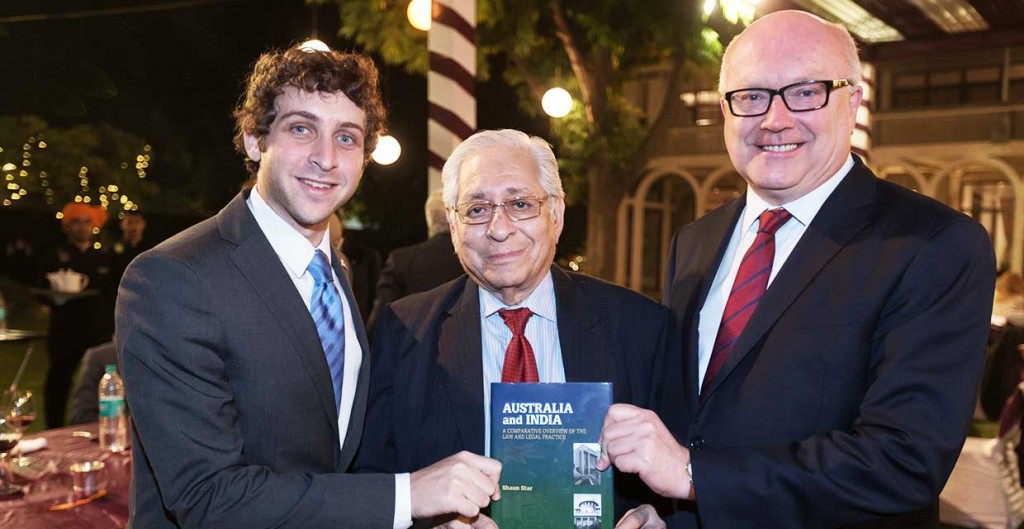
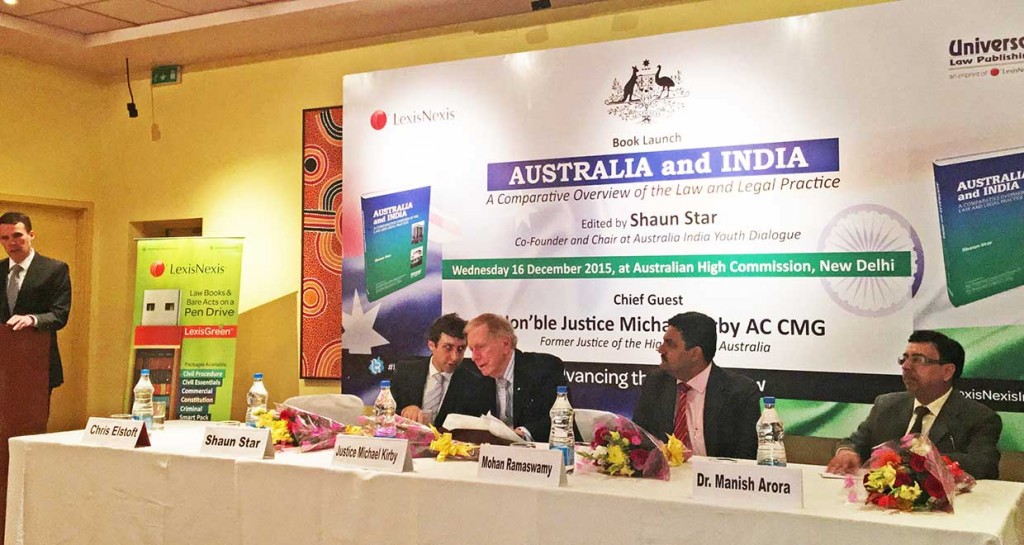
    I edited a book, entitled “Australia and India: A Comparative Overview of the Law and Legal Practice”, which compares the Indian and Australian legal systems. With forewords from the chief justices of India and Australia, the book comprises contributions written by eminent judges, barristers, lawyers and academics from both nations. The book was launched by the Attorney-Generals of Australia and India at the Australian High Commissioner’s residence in New Delhi and subsequently by The Honourable Michael Kirby AC CMG, former Justice of the High Court of Australia. It has been published by Universal Law Publishers, an imprint of Lexis Nexis.

    Each chapter of this volume has been co-authored by some of Australia’s and India’s top legal luminaries including the likes of Gopal Subramanium, Anand Grover, Haigreve Khaitan, Cyril Shroff, Pallavi Shroff, Shardul Shroff, Sumanto Basu, Madhurima Mukherjee, Nisha Kaur Uberoi and V Umakanth.

    This book is important not only because it provides a resource for those interested to learn about how these different regulatory regimes work but also because it promotes collaboration. Through this publication, I have been able to introduce many of the authors to each other for the first time – many of whom have started working on other projects together.

    More information about the book is available here.


    What do you think are the things India can learn from the Australian Legal system?

    Given the common heritage of our legal systems and the many similarities in the form and structure of our federal systems of Government, there are many more opportunities for people in both countries to learn from each other, establishing partnerships of mutual benefit and shared understanding. For example, Australia has undergone a cultural shift with respect to litigation procedures in recent decades, with a focus on efficient and cost-effective litigation. While the Indian judicial system has its own unique challenges – with the sheer size of India’s population – some of these procedures of case management which have been successfully implemented in Australia may be useful in the Indian context. Conversely, Australia can learn from India’s use of public interest litigation which has been a driving force of reform in certain areas of the law, such as in human rights, public health and the environment.


     Tell us about your experience at NLSIU.

    (Shaun’s first introduction to Indian law was as an exchange student at the National Law School of India University, Bangalore (NLSIU).)

    I was selected by the Australian Government to receive an Endeavour Award Scholarship (which is essentially Australia’s equivalent of the Fullbright Scholarship),which entitled me to study and work in India. I thoroughly enjoyed my time studying at NLSIU, where I had the opportunity to learn different aspects of Indian law.I also had the chance to meet some fantastic new friends, many of whom I have remained in contact with eversince.

    While studying at NLSIU, I chose a number of subjects which allowed me to gain an understanding of different elements of the Indian legal system. Two of those subjects were taught by NLSIU alumni who  had extensive experience as legal practitioners – I found these subjects (mergers &acquisitions and commercial arbitration) in particular worthwhile because of the nexus between academia and legal practice.


    shaun-star-3

    As an undergraduate student you worked at Clayton Utz, one of Australia’s top corporate law firms based in Sydney. How did you come across this opportunity? How was your experience at the firm?

    In Australia, many students work alongside their studies – this allows students to gain experience in law firms or other businesses (as a paralegal for instance) while still at university. Working whilst studying is often common for two reasons:

    • our degrees are more flexible, allowing students to shape their timetables around work schedules (or vice versa); and
    • living expenses as a student can be expensive and many students work alongside their studies in order to pay their way through university.

    I worked as a research assistant and paralegal in the international commercial arbitration group at Clayton Utz. In addition, I participated in the summer clerkship program at Clayton Utz which gave me experience in other practice groups (litigation, pro bono and on secondment to one of Australia’s major banks). Throughout my last two years of university, I worked two-three days per week at the firm.


    Tell us about your stint at the Law Offices of Nandan Kamath.

    During my time at the Law Offices of Nandan Kamath, I worked as a foreign qualified lawyer in the areas of sports, entertainment and intellectual property law. I had a fantastic time working with Nandan and his team. I was fortunate enough to be working there during the ICC Cricket World Cup 2011 – this was impeccable timing, given that the firm was engaged by the ICC to provide legal advisory services in connection with the event.

    During my time at the firm, I also worked with Copyright Integrity International, a firm which was engaged to establish and implement a rights protection programme for the World Cup. Through this combined experience, I therefore had great exposure to sports law during such a big international event.


    shaun-star-4

    You previously worked as a Consultant at Amarchand Mangaldas in New Delhi. How did you come across this opportunity? What were the key areas that you worked on at Amarchand?

    As a foreign qualified legal consultant for Amarchand Mangaldas, I worked on a number of domestic and international matters from across a variety of industries in the firm’s corporate advisory, mergers and acquisitions and private equity practice.

    I came across this opportunity quite fortuitously – I remember attending a lecture on Corporate Law in India by Shardul Shroff at Oxford University. After the lecture (during Q & A), I recall asking Mr Shroff about his perspective on whether he thought there was a place for foreign law firms in India. Following our short exchange at Oxford, I remained in contact with the firm and was offered a position as a consultant in the M&A practice. I thoroughly enjoyed the experience as it gave me great exposure to the corporate culture in India, working on a number of significant transactions over the 2.5 years that I worked there.


    How is it different from work at an Australian Law firm?

    The skill-sets acquired in working as a transactional lawyer are transferrable across different common law jurisdictions. Of course there are different nuances in the legal systems, which I had to learn when moving to India. Interestingly, I started working at Amarchand at a time when the new Companies Act was coming into force – so I was not the only one who had to learn how the new machinery of India’s corporate law regime functioned.

    It was also interesting adjusting to daily life in the context of an Indian law firm. In Australia, lawyers arrive at work by 8:30am and aim to leave the office at a reasonable time (although that is often not possible in the context of some transactions). In India, I was not expected to arrive at work until much later – although I would often find myself having dinner at the office with my colleagues.

    This was also due to the fact that the deal-flow in India is consistent and I have had the opportunity to work on numerous large and interesting transactions – there seems to never be a dull moment practicing corporate law in India in recent times. That being said, I always found time to catch-up with my colleagues at the local chai-wallah, a practice that I was not accustomed to in Australia.


    You pursued a BCL from Oxford. Is it true that an LL.M would help you only if you want to pursue a career in teaching rather than a career in the Industry? What is your take on the same?

    I disagree with the argument that an LL.M will only be beneficial for those pursuing a career in academia. Many successful lawyers and businesspeople in India and across the world have graduated with an LL.M. The opportunity cost of studying abroad for a year is that a young lawyer can spend that time working an extra year in a corporate law firm or as a litigator – but in my opinion, lawyers and advocates will be able to gain that practical experience in a firm throughout the rest of their lives. The experiences, networks and different perspectives that one can gain from pursuing an LL.M abroad is invaluable and serve you in good stead in your career as a professional.


    shaun-star-2

    Tell us about your involvement with the Australia-India Youth Dialogue of which you are Co-founder, and what it hopes to achieve in terms of Indo-Australian relations? Is law as a subject on the radar when it comes to AIYD?

    As Co-founder and Chair of the Australia India Youth Dialogue (AIYD), I lead a  team which organises an annual dialogue for a group of Australia’s and India’s most accomplished young leaders. The AIYD is the pre-eminent track-two young leaders’ dialogue between Australia and India. It aims to provide a sustainable platform for the youth of Australia and India to come together and foster an enduring partnership between our two great countries.

    Each year the AIYD brings together young Australian and Indian leaders, CEOs, Members of Parliament, journalists, policy-makers and athletes to discuss opportunities and challenges significant to the Australia-India relationship.

    Of the 150 young leaders who have participated in the AIYD to date, a number of delegates have been qualified lawyers. Many of these delegates have worked in corporate law practices and have had experience working with Australian and Indian clients in cross-border transactions. In addition, a number of these lawyers have policy interests in the Australia-India bilateral relationship.


    You have recently co-founded an organisation which aims to promote collaboration between young entrepreneurs in Australia and India. Can you please tell us a bit more about this?

    In collaboration with two former AIYD delegates, I am building a platform that will encourage young Australian and Indian entrepreneurs to collaborate on projects. The organisation, “Crosshack”, is still in its planning phase and we hope to roll it out in 2016.

    Essentially, Crosshack will bring together groups of entrepreneurs, designers and other young professionals from Australia and India who will meet in Australia or India and collaborate on innovative ideas to build next generation products and services. These ideas will be pitched at an annual conference and it is our hope that Crosshack will lead to collaboration between young entrepreneurs from both countries.


    Since leaving Amarchand, you have founded an advisory practice called Australia India Advisory, can you please tell us more about this.

    Running an advisory practice, I assist Australians to better understand business opportunities in Asia, particularly in India. I currently advise numerous Australian organisations (from start-ups to listed companies), assisting them with their entry and expansion into India. I have represented Australian companies across a variety of sectors, including education, energy and resources, professional services and technology.


    What advice would you give a law student or a fresh law graduate in order to succeed as a corporate lawyer?

    I think the key to success as a corporate lawyer are similar to that of any young professional in the professional services industry. While technical legal skills are important, nowadays the ability to clearly grasp difficult legal concepts and explain them in a concise way is only the first step. As a young lawyer, one has to be hungry to learn (both in terms of legal knowledge and other “soft-skills”). While it is important to work hard, it is equally important to “work smart” and learn the tricks of the trade from those more senior to you. The fantastic thing about starting out your career as a corporate lawyer is that you can see how many businesses operate across various industries – how they succeed and how (and why) they fail. I think it is important for a young lawyer to always try and see the bigger picture and constantly ask questions – by doing so, a seemingly mundane task like reviewing hundreds of documents in a due diligence process may be more rewarding in the long run.


    What advice would you give to Indian Law Grads who want to make a career as a Lawyer practicing across borders?

    My overarching advice would be to go for it! There is an increasing amount of opportunities for lawyers to gain international experience, even from within India. International transactions often involve either international clients or foreign counsel (or both) and you can learn a lot from the manner, professionalism and processes followed by these international lawyers.

    If you have an opportunity to practice abroad during your career, you should take advantage of the experience. The Indian corporate law industry is really competitive and international experience can set you apart from your peers. Applying for positions abroad can be difficult and the standards of applications and interviews are very high – invest enough time in your applications and résumés and seek advice from others who have worked abroad. If successful, work hard and learn as much as you can while working across borders.

  • Rimali Batra, Associate, Regulatory and Policy team, Trilegal, on pursuing BCL from Oxford, life at law school and varied work experience

    Rimali Batra, Associate, Regulatory and Policy team, Trilegal, on pursuing BCL from Oxford, life at law school and varied work experience

    Rimali Batra graduated from ILS Law College, Pune in 2010. After graduation, she worked at ICICI Bank’s Corporate Banking and Litigation team in New Delhi for a year. Thereafter, she pursued a BCL degree at the University of Oxford. After completing BCL, she joined Jindal Global Law School as a Research Associate. She subsequently accepted a job offer from J Sagar Associate’s Regulatory and Policy team and after continuing there for a while she went on to join her present office at the Regulatory team of Trilegal.

    In this interview she talks about:

    • Reading BCL at Oxford and tips on scholarships
    • Being a Research Associate at JGLS
    • Working at JSA and moving over to Trilegal


    Most of readers are budding and enthusiastic lawyers, how would you like to introduce yourself to them?

    I was born and raised in Delhi. I did my schooling from Montfort Senior Secondary School located in Ashok Vihar, New Delhi. Thereafter I went to ILS Law College, Pune to do my graduation in Law. After ILS Law College, I worked with ICICI Bank’s Corporate Banking and Litigation team in New Delhi. A year and three months later, I went to University of Oxford to read law. After BCL, I joined Jindal Law School, Sonipat as a research associate and worked there for three semesters. During the second half of 2014, I joined J Sagar Associate’s Regulatory and Policy team and worked on matters concerning power (Electricity Act, 2003). I was with Mr. Amit Kapur’s team in JSA for a year and have now moved to Mr. Sitesh Mukherjee’s Regulatory team in Trilegal. I have been at Trilegal for five months now. That’s been my journey thus far.


    You have had many interesting career switches from starting out as a banking lawyer then being a Research Associate at JGLS to your current profile at Trilegal. What all do you consider before taking these decisions?

    One is of course bound to be surprised at the changing courses of my career paths but then it was all a part of the plan, which I hope the readers will see as this interview answers unfold. All decisions that I have made till date connect, and connect wonderfully.

    rimali-batra-2I am a curious individual and don’t shy from taking risks. I have always been experimental in nature and challenges attract me and hold me. Call it my weakness, call it my strength. I believe that I perform well when I multi-task (It’s like enjoying the main course with some side dishes). That is how it has been since school days. For instance, in school I did not just study hard and well, but also trained myself to be a good basketball player (played national and international tournaments), a praiseworthy debater (both at the inter-school level and state level), a leader (school head girl) and a decent quizzer (inter-school level). Similarly in College, I did not settle for just being among the top 10 rank holder for all five years in the Pune University (ILS was one among the 20 odd colleges affiliated to the Pune University), but also represented ILS at various national and international level moot competitions, elocutions and paper presentations. At Oxford too, I read the BCL alongside playing basketball for the University of Oxford. And now whenever I have time and I am not working, I am doing either of the following – pro-bono advisory on energy laws and medical law and ethics, reading books, stock trading / following the market, writing and publishing stories or on issues of law that interest me, teaching English to underprivileged kids at home on weekends, part-time teaching at law schools or travelling.


    Did you have lawyers in your family or in close proximity?

    A little about my family: There are no lawyers in my family (or in extended family for that matter). My father hailed from Sonipat and my mother came to India in my Nani’s womb from Pakistan. My father was a businessmen and my mother assisted him in his business. He was and is my role model. He had no basic formal education and left school in class VI to pursue his dream of setting up a business. My mother was a national level table-tennis player and a B.Com graduate from University of Delhi.

    My elder sister, who is a gold medallist, is a Human Resources manager with a renowned company in New Delhi and my younger brother, who is also a gold medallist in B.Com (H) from University of Delhi is running his own business and takes care of dad’s business. I think I inherited my mother’s sports skills and reading habits and my father’s experimental, risk bearing and helping nature. I believed that a little confusion and nervousness is always good but fear is destructive, and therefore I aim at balancing my fears and my weaknesses with my confidence and strengths, as I move forward. I also leave achievements behind and look at them as a thing of the past and aspire to achieve a little more as days go by. So, in a nut-shell, law and basketball are my passion and I am a learner and observer at heart.


    Why did you decide to be a lawyer? How was your law school experience at ILS, Pune?

    As far as my memory goes, I sealed the decision of being a lawyer in Class Xth – even before I decided whether to take commerce or science. My decision was based on an aptitude test that was conducted in school moral science class. Thereafter I started adding biographies of famous lawyers to my reading rack alongside the already placed biographies of basketball players. I also read a lot of John Grisham. That marked the beginning. In class XII, I joined LST for preparation. I did not fill any other forms (B.Com, Eco (H) etc) but gave entrance tests for N-Schools. At one point in time, when I did not get through Symbiosis, I almost lost hope for making it to any other N-School, but then when I made it NALSAR, I regained my strength. I also made it to ILS on merit and on sports quota. Now, the decision there was simple, but I got swayed by the India Today ranking and picked ILS over NALSAR, as the ranking placed ILS at number 1 in 2005.

    rimali-batra-3

    ILS for me was a place of opportunities. Located in the heart of the city and walking distance from Symbiosis, ASCL, Ferguson College, FTII and Gokhale Institute of Political Science and Economics, it offered a vibrant student crowd and a bundle of opportunities. My learning was not limited to the classrooms of ILS. I participated in moots that enlarged my frame of learning, pursued diplomas in subjects that were not taught as a part of the academic curriculum and interned with NGO’s/human rights organisations in Pune. During college, I successfully completed diplomas in International Arbitration, Cyber Laws, International Business Laws, Securities Laws and Medical Law and Criminology. I was one of the speakers in the team that represented University of Pune at University of Oxford in the quarter-final rounds of the Oxford IPR Moot Competition, 2009. My first publication was on ‘domestic violence’ in the college journal (in 2007), followed by a piece on ‘separation of powers’ in the Ambedkar Law School journal (2009). During college, I also participated in cultural events like poetry writing and recitation, signing and painting. And of course I continued to play Basketball at the Deccan Gymkhana, since our college did not have a functional basketball court. I made some great friends at ILS. Overall, I believe I was able to paint my canvas with so many colours because I was in a college that gave me so much time and space to explore and go looking for opportunities, if they refuse to come to you.


    When people say “Law school”, they look no further than the National Law Universities. As a graduate of ILS, Pune have you faced any such bias? What would be your advice to students in ILS?

    I think the trends are changing a bit. Especially because of so many law colleges mushrooming across the country. ILS has a legacy of being one of the oldest institutions imparting legal knowledge. What ILS lacks is professional training. Meeting my counterparts from N-Schools, always encouraged me to imbibe in me the skills required to think, talk and approach life like a professional. Bias does exit but not all of us have to face it. ILS has a reputation for producing some good litigators however has not earned the same reputation in the corporate world, thereby making it difficult for kids in ILS to crack competitive corporate jobs. I recall an incident during my first job where a senior of my team, while praising my work, introduced me to be from NLS. On my prompting, he corrected himself and toned up his praises even more (considering he was surprised!). I would advise students from ILS to do additional courses and good internships because only studying law at ILS and getting a degree is not going to be enough.

    My advice to students of ILS would be two-fold

    (a) focus on academics in order to score well. Do not consider classroom teaching the end all of academics, that’s just the starting point; and

    (b) Make the most of the time at hand. Involve yourself in activities/course or additional degree’s that interest you. ILS makes space and time for you to incorporate that in your schedule. Most importantly, do both with the sole objective of learning.

    Students can consider requesting administration to take notice of events, moots and competitions that interest them and be rest assured the college will do its part. Student may also invite luminaries in the legal fraternity for lectures and seminars. Basically, what a student in ILS needs is the ‘instinct to initiate’ and ‘go towards opportunities’.


    Please describe the internships that you did in college.

    For internships, I always chose New Delhi, because this is where home was and logistics were easy to manage. My first internship was in the District Courts of Delhi where I read and researched on matters of criminal law and property related disputes. Thereafter, I did my second internship in Delhi High Court where I worked on matters on the original as well as the appellate side on various subjects. In my third year I did internships with Senior Advocates of Supreme Court. I then did an internship with litigation teams of two law firms and my final internship was with the Law Commission of India where I wrote a thesis (which retired into a book) on Constitutional validity of Medical Termination in India. I planned my internships and explored possible avenues for a lawyer in order to better understand my calling. By the end of five years, I was sure of being a litigator (at the least) not sure of the subject area that interests me.


    You worked as a Legal Manager at ICICI Bank. How does a typical day at ICICI work out? What were your main tasks and what responsibility did you undertake?

    ICICI Bank was my first employer. I was placed through college. I was based out of the Delhi office (I asked for Delhi as my location during my interview). I worked in no specific vertical, but was primarily doing litigation for/against the Bank. Anything and everything was a part of my profile. On a day I would be doing ECB lending, security creations and on another I would be researching and preparing written submissions for matters pending in the consumer forum or the Supreme Court and on yet another day I would be doing retail banking advisory. Having such a profile made it interesting to work in ICICI. I worked there for a year and a half, before I decided to do a masters.


    How did your appointment take place at ICICI Bank? What kinds of questions were asked at your interview for ICICI bank?

    ICICI follows a three step procedure, shortlisting on the basis of CV’s, followed by a Group Discussion and finally a personal interview. The Group Discussion revolves around a hypothetical problem relating to law of contracts and consumer protection. The personal interview is primarily based on the resume and a few HR based questions.


    Please tell us about your decision to do an LL.M and how you went about choosing the program and university.

    I decided to pursue my masters from Oxford ever since I visited the University in 2009 for an IPR Moot Competition. On my return, I pursued it like a dream. The advantages of doing a BCL are:

    (a) it offers the students to choose a suitable combination of subjects, based on their preferences as opposed to a custom-made LLM course. So, even though I read only four subjects as part of the BCL but at the same time the rigorous workload and timelines gave me the advantage of specialising in four subjects at one time,

    (b) Oxford targets on strengthening reading, breaking down complex material and articulating the same in form of legal writings/answers/tutorials. They say, don’t study BCL, you read for BCL.


    What do you think clicked in your favour during the selection process for Oxford? What are the scholarships you had applied for?

    I can’t answer this question with certainty. It has to be a combination of my academic performance in ILS, my statement of purpose and the write-up. Also, the fact that I assured my willingness to attend the course and pay for it, in case I did not get scholarships from Oxford, could have boosted my application. However, I did say that I will not attend if I had no scholarships at all. Other than that, achievements mentioned on my CV (like basketball, moots, diplomas etc.), my statement of purpose and my write-up may have added a little value.


    How do you think a law student can build up his profile to get through to top-notch universities like Oxford?

    It’s important to have a strong academic score. A rank in the law school adds value to the application. Apart from that, a student should be able to demonstrate inclination for engaging in theoretical and policy aspects of law. It is also advisable for students to have publications on their side. I remember interacting with the Dean of the University and inter alia, discussing the approach adopted by the University in considering applications from Indian law students. He talked about the law college’s ranking also being a relevant factor, apart from the academic achievements of the student.


    What was your area of study during your masters at Oxford? How was the academic pressure like and did you find time to engage yourself in other activities?

    I read Principles of Financial Regulations, Corporate Laws, Medical Law and Ethics and Philosophical Foundations of Common Law. The courses were rigorous and the readings ranged from being easy to intense and complex. However, I made time to be a part of the Oxford University Girl Basketball team after being shortlisted at the trials conducted at the beginning of the course. I played 4 or 5 inter-university matches and also participated in the legendry ‘Varsity Tournament’ played between Oxford and Cambridge every year.


    Please tell us about the scholarships you applied to and the procedure for each.

    I applied for all possible scholarships I stumbled upon during my research. I started looking for scholarships before making my application. I followed this website -governmentofindiascholarship.com. I specifically applied for Rhodes, Common Wealth Scholarship, KC Mahindra Trust, Jain Trust, Ox-Cam among others. I was awarded the KC Mahindra Trust Scholarship and the Ox-Cam Scholarships. The application procedure is a little detailed as the students need to prepare independent SOP for each and demonstrate availability of the balance funds (in case where the scholarship does not cover for everything).

    The interview rounds for KC Mahindra and Ox-Cam is fairly simple and questions are primarily targeted at (a) ‘Why oxford?’ and (b) ‘What after masters?’

    Additionally, I would suggest students to ask their employers or seniors they have worked with for financial assistance as some firms, seniors or employers are willing to offer funds with or without a promise from the student to come back and work with the said employer or senior.


    Please describe your experience at Oxford. What were the classes and professors like?

    Oxford was a scintillating experience for me. Especially, reading philosophy at Oxford gave me a deeper understanding of law, legal principles and concepts. Oxford has seminars (classroom teaching) which requires students to read before walking in. For my corporate law class I joined a group that was made by students themselves to discuss seminar questions before the seminar and help prepare better for exams.

    At Oxford I was exposed to a system that takes its readings very seriously. As a Masters student, we were required to not just read hundreds of pages every week, but, to also reflect on them during our seminars. I enjoyed this practice very much and it has allowed me to hone my writing skills in the process. A typical reading list will have at least 8-10 important readings (combination of articles, case laws and policy paper series from different jurisdictions, but primarily UK and US). Professors, at best, assist as students deliberate and discuss a topic. One more thing which I found particularly interesting was the presence of an economics, finance and corporate law professor at the same time during seminars for one of my courses, namely, principles of financial regulation.

    The tutorial system is quite unique. There are 4 tutorials for each subject and are spread over three semesters followed by a three hours written exam at the end of the course. I found the tutorials challenging but refreshing as they helped me assess my performance and understanding of the subject alongside attending seminars. They also helped me hone my skills of articulating my thoughts and understanding of the subject.


    You switched to a pure research based career after coming from Oxford. How did this change take place? How did you get to associate yourself with Jindal Global Law School?

    Academics is very close to my heart and still is. For as long as I can remember, teaching and educating has always fascinated me. When at Oxford, I heard about Jindal Law School and its dean, Dr. (Mr.) C. Raj Kumar who happens to be an alumnus of Oxford. I was given an opportunity to work as a Research Associate and lecture two courses ‘Property Laws’ and ‘Corporate Laws’. Honestly, one may see it as a switch in careers, but for me, academics fits in very well for an aspiring lawyer, especially after a masters. I also felt a dire need to re-apply and re-read my subjects, from the Indian law perspective – after I finished my masters.

    Though I chose to be a litigator, I haven’t lost touch with teaching and academics (and hopefully never will). I have conducted seminars and lectured at various law schools in India, ever since I left Jindal. I am a visiting faculty with Symbiosis Law School, Noida and often visit ILS Law College for conducting week long courses, as and when time permits.


    You had worked with Jyoti Sagar Associates and you are now working with Trilegal. Why this switch?

    After two very fruitful and enriching years at Jindal Law School, I decide to do join regulatory litigation. I was with JSA for a year and have been with Trilegal for 5 months now and having been working on laws in the energy sector, especially the power sector. With not much precedent in the sector, the practice is demanding and engaging.


    How is being a research associate or a legal manager at bank different from working at a top – notch law firm? Does the work load increase, how have you managed this transformation?

    When I was in ICICI, I assisted in consumer dispute litigations for/against the bank on subjects involving ‘corporate laws’, ‘banking laws and regulations’. When at Oxford I read ‘corporate law’ and ‘financial regulations’. When at Jindal, I taught ‘corporate laws and financial regulations’. When at JSA, I put together the knowledge and experience acquired from ‘corporate laws’, ‘regulations’ and ‘litigation’; and worked hard in acquiring sector specific knowledge. Electricity/Power sector is a super-niche sector and I find it thrilling and challenging. My work at JSA was very extensive and intense. At Trilegal, I continue working on matters in the power sector with the same intensity and I enjoy it immensely.


    How has the journey been so far? What are your long term goals?

    For me my journey that has been the best part. The people I met, places I visited, life experiences I picked on the way, all add to me being who I am today. For today and tomorrow, I am a litigator, learner and an observer and I aspire to be perfect at what I do.


    Lastly, what would be your message to a law student who wants to excel in the legal profession?

    Let me quote Abraham Lincoln’s message “If you are resolutely determined to make a lawyer of yourself, the thing is more than half done already.” I echo.

    When in law school, plan a little about your future. Immerse yourself in travel, cultural exchange, sports, parties and meaningful conversations, as much as possible. Don’t let your degree define your career limits. Don’t forget to explore and experiment. Take risks sometime, it adds a bitter-sweet flavour to your becoming a lawyer. If you do, then accept your failures as much as your cherish your victories.

    And most importantly, keep your imagination alive.

  • Shriya Maini on choosing Oxford over Cambridge, Scholarships and the role of higher studies in Litigation

    Shriya Maini on choosing Oxford over Cambridge, Scholarships and the role of higher studies in Litigation

    Shriya Maini graduated first in class from Gujarat National Law University, Gandhinagar in 2013 with four gold medals, including that of Best Student. Thereafter, she joined the Litigation department of Amarchand Mangaldas & Suresh A. Shroff, New Delhi as an Associate in their Dispute Resolution Team. After working there for a few months, she paid heed to her calling and is pursuing the Bachelor of Civil Law Programme from Oxford on a full scholarship. In this interview, she talks about the difference in pedagogy between Indian and Foreign institutes and the relevancy of a traditional BCL degree for litigation practice.

    We took this opportunity to ask her about:

    • Experience working in the litigation department of Amarchand & Mangaldas
    • Importance of Internships
    • Choosing BCL from Oxford over LL.M from Cambridge
    • Writing a proper SOP for an LL.M
    • Applying for different types of Scholarships for high studies


    Tell us a bit about yourself. What motivated you to choose law for a career?

    If I were to answer this question absolutely honestly, I never really wanted to study law. Though, in retrospect, my family lineage reveals a close legal association (my grandfather retired from the Indian Home Ministry and my father is a practising lawyer), I don’t think I was ever motivated to make a career out of law as such. I was busy exploring the scientific world and was rather intrigued by it. I faired well in my A Levels and decided to follow my mother’s footsteps and pursue a career in medicine. Little did I know that future had something else in store for me! Over one of the many dinner table conversations, my grandfather casually mentioned how a centralized national level entrance examination called CLAT was being organized for the very first time for direct admissions to law school. I did not even know of the existence of National Law Universities until then and was reading their names for the first time on the examination brochure. To me this seemed very alluring, as a back up option, in the event that I failed my pre-medical tests. Besides, the examination (fortunately) had no negative marking. A week later, I was walked out of the hall, immensely proud of the fact that I had attempted every question on board, correct or not. Once the results came out, GNLU fell into my lap. I suppose I got lucky with my guesswork! Being a devoted daddy’s girl, I decided not to walk out on him, packed my bags and took the plunge. Hence, law happened purely by chance and not choice.


    How did you plan your internships? Were they all meticulously planned or did they just happen to you as you went through law school? Any tips you would like to share with people who want to intern at top-notch firms?

    As my vita indicates, I didn’t have a strict ‘to-be followed’ normative pattern of internships. However, I consistently endeavoured to intern at each and every place that I possibly could, be it chambers or law firms. I was sure that wherever I interned, I would substantially gain technical proficiency for my knowledge and experience, both were limited. In effect, I knew I had nothing to lose. Hence, on one hand, I thoroughly explored the corridors of the Supreme Court and Delhi High Court and on the other, I vacationed every year with commercial law firms, such as Amarchand Mangaldas & Suresh A. Shroff, Dua Associates and Jyoti Sagar Associates. Such a wide-range of internship opportunities helped me understand the everyday working and nuances of laws, be it civil, criminal or commercial.

    In the penultimate year of law school, I realized that my calling was only in Court. I was drawn towards litigation and the internships most definitely, opened me to a whole new world. I interned twice in the litigation team of Amarchand Mangaldas & Suresh A. Shroff, New Delhi under the guidance and supervision of Mr. V.P.Singh, one of the most dynamic partners of the firm. I had a fantastic experience interning with him. He had a galaxy of juniors assisting him who made the experience even more worthwhile.

    Likewise, by the end of third year, I advise all law students to have a fair idea of what they want to do. I believe the last two years are very crucial when it comes to painting career silhouettes, the so called deal makers or breakers. Hence, I strongly advise that if you haven’t already had some form of internship exposure, now is the time to get that on your CV. It would be a good idea to split the law school tenure of five years into a 3+2 structure and avidly apply for varied internship openings until the third year. Explore what you enjoy, much like the hit and trial method. I would also advise all law students to acquaint themselves with the backgrounds of firms, judges, lawyers and wherever they are making Internship applications, so that they can make an informed choice about joining them. The importance of a tailored CV cannot and must not be underestimated at any cost. I would also caution that the fourth and fifth year, being most important could be channelized towards improving one’s CGPA as much as possible. I can now affirm that though top-notch firms do not solely and specifically look for a high GPA, but it makes for a fine impression if your CGPA is more than respectable. It gives you that ‘added-edge’.


    Right after graduation you got to join the Litigation team of AMSS. How did the appointment take place?

    I secured a job with AMSS all thanks to GNLU’s Committee on Recruitment Affairs (CRA). As a core college body, CRA annually facilitates students and recruiters, on a rolling basis for on as well as off campus recruitments. I was one of the few lucky ones to grab an internship with the Litigation Team of AMSS, in my penultimate year of graduation. The selection was purely based on class rank. I vacationed once again during the winters and six months later, on the College’s zero day, I was offered a job in their Dispute Resolution Team (Litigation and Arbitration).


    What all came under your responsibility at AMSS? How was your first visit to court?

    I was rather lucky to work with some of the most hardworking people in the litigation practice at AMSS. My area of work encompassed commercial litigation and arbitration. Within the team, our supervising partner had allotted a couple of matters to each one of us. I was given an opportunity to work on an international commercial arbitration at a very early stage in my career. I worked under the leadership of some of the best people in the fraternity and handled these matters from scuff. I also drafted the first cuts of Rejoinders for a matter. On a lighter note, if I could pick one responsibility that truly came my way at AMSS, it was drafting e-mails. I learnt the significant skill of ‘written communication’, its necessity and nuances. Though challenging and interesting, these months made me actively re-think my options and pursuits. While I spent hours drafting legal documents and e-mails before a bare computer screen, some part of me began to miss the ambience and actual working of a Courtroom.


    Is it true that it is not possible to get a job in a top tier law firm without top grades and being in the top of the class?

    I am often asked this question. Being brutally honest, top tier law firms often filter students on the basis of class ranks and/or scores. Good grades most definitely matter, at least while securing internships. Unless you are offered a PPO based on your performance during an internship, even during recruitment, most top law firms are bound to take grades most seriously. This is purely due to the fact that a high CGPA depicts an academically consistent upward moving graph. However, I believe that moots and publications could also be an equally essential pointer when it comes to specialized interests. By this I mean that for a law student specifically interested in International Taxation, a paper publication or mooting experience at Nani Palkhiwala could silently speak volumes during a recruitment interview.


    What prompted you to decide to leave the largest law firm and venture out at as a sole practitioner?

    It was the same year, infact within a span of five months that I decided to leave AMSS and venture into entrepreneurial practice. Amidst sleepless nights and long office hours, I was at crossroads with my passion for ‘learning and living the law’. I would often feel academically stagnated while making document summaries, indexing compilations or drafting e-mails. One of those mundane Monday mornings when I had to report to the office at 8, I turned the wheel to reach Court instead. Yes, I admit that it was rather drastic and bold a call to take at such an early point of my age and career. Friends and family tried convincing me otherwise cautioning how hard-hitting litigation practice could be.

    Had it not been for the latter half of the year when I practised at the Supreme Court and Delhi High Court, I would not have been able to secure a scholarship for the BCL at Oxford. Hence, I firmly believe if you are true to your work, you shall most definitely reap its results, if not today then tomorrow.


    Would you say being from a family of lawyers helped you in forming your practice? How did you find your mentor? How important is a mentor in the field of litigation?

    After a brief stint at AMSS, I devoted the next 7 months to independent legal practice. It would be wrong for me to shy away from admitting that my father was the sole reason I could pivot my practice from the position at which I had left AMSS. I was fortunate to land a few cases, which were handed over to me by my father. They were a mixed bag of both, civil and criminal. He gave me a tiny working chair in the chamber apart from full freedom to not only strategize, draft and file matters but also argue them. Before I knew it, I was running a mini-office with 4-5 odd matters.

    So, I didn’t have to find a mentor! He was right there, my father. I think it is very important to have a mentor who would guide you through the myriad experiences of life, especially when we make the strategic shift from law school to the real world of practice, which can be very demanding. The two stages are immensely different and challenging in more ways than one. Law school demands academic mentoring where a guide’s role may be limited to ensuring his student performs well and steers on the right path of intelligible growth. However, at the professional level, especially in the field of litigation which is plagued with cut throat competition, it is rather difficult to perform without a mentor. My father would discuss each and every line of a case with me and always shadow me in Court, even if I was the one arguing. To him, the sole rules of survival in litigation practice were to consistently work hard, be true to your profession and never turn a client back. I hope the same would benefit some of you law students as well.


    Which universities did you apply for LL.M? How did you go about choosing which college to go to for your LL.M.? Did you ever consider Indian colleges for LL.M. now that they are also offering one-year course?

    When I began to practice, I realized that to deal with the complexity of legal and social issues, a mere Bachelors degree would not suffice. For law to evolve, it had to be understood and reasoned, not imitated and blindly followed. I decided to pursue my intellectual drive and made applications to three U.K. law Universities, including Oxford and Cambridge. I specifically did not apply to any of the U.S. law colleges for I was determined to stick to a common law background. It is ironical that now I read a lot of American case-laws, in particular contrasting the civil law approaches as opposed to the common law ones. Within the U.K., my most obvious choice was the Ox-bridge duo.

    Though I didn’t personally consider an Indian LL.M, I am sure it has much to offer. However, from my limited experience of studying my undergraduate degree at an Indian law school, I firmly believe that in terms of teaching methodology and content, we still have a long way to go. I understand that cost could be a pinching factor, but an international exposure with the most intelligent minds of the world is totally worth it.


    How did you plan your SoP? Please share your SoP with us. Please share some tips for a successful application.

    I’d like to first answer the second limb of the question. There is no set recipe of making a successful LL.M Application. A good idea could be to first zero down on a country and then pick colleges accordingly, depending upon your subject interest and of course, University reputation. You could easily find U.K. University ratings on weblinks such as http://www.topuniversities.com/university-rankings/university-subject-rankings/2014/law-legal-studies.

    These could be indeed helpful to begin with. Another piece of advice would be to filter about 5 Universities and make Applications to only those. On a personal note, I spoke to a lot of people, discussing and debating at length how the BCL was different from a conventional LL.M. Hence, I believe interacting with seniors could most definitely be an enlightening experience to help you choose a college.

    Coming to first part of the question now, an SoP should exactly be structured on the lines of the questions you have put forth in this interview. To elucidate, an SoP must explain why you’re applying to a particular University and not any other on the list. Akin matrimonial ads, SoPs in effect are intended to sell oneself in more ways than one, preferably subtle. A good head start could be to divide the SoP into three paragraphs, the first being a general introduction about who you are, where you’re coming from and what you do. The second could be about what you want to do in the future, perhaps stating a subject focus. I also suggest you add a personal touch to an SoP and include a life story or specific incident reasoning how the same prompted you to take up higher studies. For instance, there are a couple of people I know who wanted to specialize in Medical Law and Ethics and they applied to Oxford, describing at length in their SoP a heart wrenching medical story of losing a loved one.

    Another important thing to keep in mind is tailoring the SoP to suit each college. For instance, Oxford SoP must not run beyond two pages. So, an SoP for LSE or Cambridge could be fairly descriptive and detailed, but an Oxford SoP must be very crisp and coherent. You could end your SoP with a paragraph about how you could contribute as an Asian lawyer in the room.

    And yes, I would be more than willing to share my SoP with you all.

    Click here to download the Statement of Purpose


    You had decided to pursue BCL from Oxford University over Cambridge. Any specific reasons for that? How relevant would be a traditional BCL degree for your litigation practice?

    Yes, I was fortunate to have been admitted to both, the BCL (Bachelor of Civil Law) at Oxford and LL.M (Masters in Law) at Cambridge. After thorough deliberation and critical evaluation, I decided to pick the BCL over the Cambridge LL.M. Knowing that it is one of the most rigorous taught Masters in the world, I decided to challenge myself yet again. While the Cambridge LL.M is often picked by those interested in International Law or specifically Corporate Law, the Oxford BCL is definitely more litigation oriented. Hence, I naturally picked the BCL. There is another slightly less known course called the MLF (Masters in Law and Finance) which is jointly taught by the School of Business and Law at Oxford and those of you who are keen in a commerce background could definitely have a look at that.

    Another reason why I chose the BCL was the unique teaching method of Tutorials. Every term (we have trimesters at Oxford), our tutor discusses the erstwhile seminars and lectures with each and every student, in person, in effect clarifying and revising the course content. Students are given a list of questions prior to every tutorial, of which they must attempt one in writing and submit to their tutor a day before the personal session. Such an exercise is immensely helpful for students are well prepared to answer questions well in advance of the examinations. The tutorial system of teaching is unique to Oxford and hence, I would advertise the BCL even more strongly.

    I would be better equipped to answer the second question a year later. However, from hearsay sources and personal interaction with ex-BCL graduates, I can assure you all that the degree most definitely gives you a cutting edge, in terms of legal knowledge and presentation. It pushes you to think out of the box and to some extent challenge the existing laws, aimed at the formulation of ground-breaking legal arguments. Hence, the precedent based litigation practice in India could benefit multi-folds from a holistic and global degree, such as the BCL.


    shriya-maini-2

    What should one do differently in college if he wants to pursue higher studies after graduation? Would you suggest having a brief work experience before applying for LL.M?

    There is nothing particularly different that one must do as a prospective Masters student. However, in order to get a Scholarship/funding, it is essential that students keep the following in mind. Apart from consistently studying hard and smart for five years, maintaining high CGPAs and participating in a few moots or ensuring a couple of publications, one should apply well in advance if he or she intends to pursue higher studies. Applications open a year prior to admissions and in the U.K. Universities List, Cambridge is the first deadline to be met. Next is Oxford and then the others.

    Each Application has a scholarship column which all Applicants must tick in the affirmative. These ensure that wherever possible, University/college funding would automatically consider the Applicant’s request for scholarship or fees waiver. I was fortunate to have received the Dr Mrs Ambriti Salve Scholarship 2014-15 and the Bodh Raj Sawhny Memorial Trust Scholarship 2014-15 from the University of Oxford, Exeter College and hence, my studies are fully funded. In a nutshell, I would advice all law students to try and procure scholarships, researching well in advance the criteria for each, be it Inlaks, Aga Khan or the Commonwealth and accordingly, tailor your CV during law school.

    I personally believe a year’s work experience was the sole reason for me having made the cut for the Salve Scholarship. I definitely feel more confident, relaxed and sure of myself than I was when I stepped fresh out of law school. The whole Oxford experience could rather be very overwhelming and emotionally take a toll on someone who, fresh out of law school has not ventured into the real world so to say.


    Please tell us about how you applied to these abovementioned scholarships and ultimately got selected for them. What according to you is a good profile for scholarships like these?

    I was fortunate to have received the Dr. Mrs. Ambriti Salve Scholarship and Bodh Raj Sawhny Memorial Trust scholarship for the academic year 2014-15. Following a generous gift made by Mr Harish Salve, a Friend of Exeter College, University of Oxford, the scholarship is awarded each year on the basis of academic excellence to an Indian student reading for the BCL. The Salve Scholarship fully funds my tuition fees, besides granting me a cover for my living expenses.

    No, I did not make any separate Applications for the abovementioned scholarships. In fact, both of them are College linked, i.e. awarded by the Exeter College, University of Oxford. For such scholarships, you just have to tick the relevant box (affirming you want any and all type of funding available at Oxford) within the main Application that you make for the BCL. However, it would be a good idea to browse through the College websites and have a look at specific scholarships, course wise. These could require a separate application or additional documents. For instance, a useful link where you all could start from would be the official webpage of Oxford enumerating the funding options available –

    http://www.law.ox.ac.uk/postgraduate/scholarships.php.

    There is also a similar provision on the Cambridge GRADSAF for Commonwealth and Gates Scholarships, which you must apply for. No separate Application (only another SoP) is required for the same.

    The other kinds of scholarships are the ones offered by Indian organizations and donor trusts, such as Aga Khan, Narotam Sekhsaria etc. These are also worth applying for but require separate Applications to be made once you have received your offer of admission. Hence, call for such scholarships are usually doled out after March end.

    I guess I was lucky and blessed to have received such a mammoth funding award. I cannot pin point and say how the selection process exactly works but I could share with you some indicators, which could be of help.

    Firstly, it is necessary to have good grades and by this I mean, try and maintain a class rank within the first three of your batch. Secondly, it would be a good idea to pursue extra-circulars such as moots and publications in college. These look very attractive on a scholarship profile. I would also suggest that if the scholarship Application requires a write-up, play up your ‘need’ for funds factor.

    Lastly, you must be able to demonstrate why you wish to undertake studies in a particular subject specific to a College/University. I think preparing answers to these questions would be more than sufficient to organically create a decent scholarship profile.


    Given a chance to turn back the clock would you have done anything differently from what you’ve done?

    No doubt, I have taken some rather risky decisions to pursue what I truly believed in and felt was right for me then. However, I am very satisfied with each of those and stand by them even today. Having tasted the flavours of the commercial world, I am now actively involved in academia, living the law much closer than I could ever imagine. I am thoroughly enjoying and doing what I best like to – ‘studying’. Hence, even if I was given a hundred chances to turn the clock back and do things differently, I’d never do so.


    Lastly, what would be your message to a law student who is yet to decide his/her career?

    My only message to a law student who is at the brink of deciding his/her career would be to have the courage to follow your heart and grit to pull off your plan once you decide to do something different. Just because one of the paths at the crossroad appears financially alluring, it could prove to be rather professionally unpleasant. With age on your side, give yourself a complete gamut of experiences that a lawyer could have without regretting a single decision whatsoever.


    Photo Credits: Pratibimb

  • Sneha Nainwal, on BCL from Oxford, work at LKS and moving to the UK

    Sneha Nainwal, on BCL from Oxford, work at LKS and moving to the UK

    Sneha Nainwal graduated from Symbiosis Law School in 2010. Soon after graduation, she went on to pursue BCL at University of Oxford. She has a very rich experience of working in India and United Kingdom. She then worked at LakshmiKumaran and Sridharan for about two years.

    Being a tax specialist she also has a keen interest in opportunities involving commercial litigation and arbitration.

    In this interview, she talks about:

    • Law school experience at Symbiosis and University of Oxford
    • Work experiences at LKS, SGH Martineau LLP,
    • Experience as a Contract Attorney at Bird & Bird, Hausfeld and Pinsent Masons
    • Work culture in India and the UK


    How would you like to introduce yourself? Please tell us about your pre-college experience.

    I am a dreamer by faith and lawyer by profession.

    My brother and I had a fairly modern upbringing that offered a unique blend of traditional values and liberal outlook. My father is a judge and my mother is a home-maker. We were always encouraged to find our own inspiration in life and so we did. While I followed my father’s footsteps and joined the legal field, my brother is now a user interface designer with Facebook in California.

    As part of our family tradition, I was sent to a boarding school in Nainital at a very young age. The 7 years spent at St. Mary’s Convent, one of India’s finest residential public schools, have had the greatest influence on my life. With its focus on an all-round education, character building and the belief that one’s competition is only with oneself, the years spent at Ramnee gave me the courage and integrity to be myself. My stay at Symbiosis Law School, on the other hand, gave me the opportunity to interact with fellow aspiring legal professionals and an inspiration to succeed. I made some great memories, and even better friends!

    I read for the BCL at the University in Oxford in 2010-2011. I then worked at Lakshmikumaran & Sridharan, Attorneys in New Delhi for about 2 years. Pursuant to my appointment at SGH Martineau LLP, an international law firm in London, I moved to the UK in 2014 and am currently qualifying as a Solicitor in England & Wales. I reside in London with my husband, who works in investment banking.


    When and how did you decide to study law? How did you settle for Symbiosis Law School?

    With most of my family being reputed members of the legal fraternity, law has always had an impact on my life. My father has served the Indian Judiciary for over 25 years. The sight of those red and black books with their slightly musty smell in his library, his typewriter and his black gown always held a strange charm for me. I was an inquisitive child, easily dissatisfied with popular reason and superficial explanations.

    At school, this nascent curiosity developed into a lively quest for academic research and love for debates. Being naturally good with numbers, I enjoyed subjects like maths and accountancy and took up the commerce stream for my ISC Levels. I came to realise that my skills were best suited for a career which demanded potential for research, logical aptitude and commercial acumen.

    The choice was between business school and law school. It was then that my father told me about the dual program in business and law (B.B.A.LL.B), being one of a kind at the time, offered at Symbiosis. It was an ideal opportunity to pursue my interest in business and law simultaneously. I took the entrance exam and there has been no turning back.


    When people say “Law school”, they look no further than the National Law Universities. As a graduate of Symbiosis, have you faced any such bias? What would you say to the future graduates of Symbiosis regarding this?

    It depends on who your audience is. The university league tables and rankings have created a very competitive educational environment and it’s hard to avoid its impact on one’s academic experience. An element of prestige is definitely associated with leading institutions, be it the Ivy League, Red Brick Universities or some of our very own NLUs but it isn’t a prophecy of professional success. The two things that truly matter are – what your university has to offer and what you make of that.

    Symbiosis offered me a rich gamut of opportunities, both academic and personal, and I plunged headlong into making the most of it. It was an intellectual adventure that I thoroughly enjoyed (and that’s not something you’ll hear a law graduate say often!). Those five years so moulded me that there was little room for any bias or prejudice and my career trajectory bears testimony to this fact. In addition to securing top internships and winning national moot competitions, I was offered a place at two of the most competitive law programs, BCL and MLF, at the University of Oxford and have since worked at leading national and international law firms. Similarly, my peers went on to do their LL.M at Harvard, Cambridge, NYU et al and are now working with leading law firms. The point I am trying to drive home is that meritocracy should not be underrated by us.

    To the future graduates of Symbiosis – pride and prejudice are volatile social forces and often over-rated. Your biggest competition is yourself and it is only when you don’t realize your true potential that you fail. These five years could define you – make sure you choose the definition wisely.


    Many lawyers say that the first year after graduation is the most difficult year for young lawyers. What was your experience? What were the biggest challenges you faced?

    It was a very different experience for me as I went on to do my LL.M after graduation. For me, that one year was truly inspiring. The biggest challenge was of course the BCL! It was like an intellectual roller coaster, marked with alternating phases of ingenuity and despair, but nevertheless, exhilarating. I was thrilled to interact with some of the finest minds from across the globe, in a setting that presented a confluence of cultural diversity, and was thus, a privilege in its own right. That year taught me a lot about self-discipline, time management and social networking – skills that have greatly helped me on the professional front. The year was also very enriching in terms of my social experience – I was the International Student Representative for my college, I performed at the Oxford Playhouse in a student production by ‘Chutney and Chips’ and I also shared the screen with Akshay Kumar in a scene from the Bollywood movie ‘Desi Boys’ (it was shot at Oxford)! On the personal front, too, it was an exciting year as I met my husband, Simon, in Oxford. He is the Feinstein Scholar from the Department of Economic History and we studied together at St. Catz.


    What prompted you to opt for BCL from University of Oxford soon after graduation? How difficult would you say it was gaining admission? What advice would you like to give about the application process?

    My reasons for pursuing the LL.M were purely intellectual, which is why I started working on my applications in the penultimate year of law school. As my focus was more on common law centric courses, I was keen on pursuing my LL.M in the UK. I only applied to Oxford and Cambridge, as they were my dream institutions, and was offered a place on two graduate law programs at Oxford – BCL and MLF. My keener interest in the subjects of Restitution and Jurisprudence, which the Oxford Law Faculty enjoys an unrivalled reputation for, led me to choose the BCL over MLF.

    The competition for any world class university is naturally fierce. The selection panels are keen to identify well rounded individuals demonstrating a balanced set of academic and extra-curricular accomplishments. While strong academic credentials are vital, a sustained participation in other co-curricular activities significantly enhances the merit your application. Personally, I see my admission into Oxford as a culmination of all past achievements throughout my academic career. Over the years, I had actively participated in internship programs, moots, sports, debates, dramatics, and pro-bono activities and every single stint was a building block in shaping my application. Having said that, I must also stress the importance of a compelling SOP. Yes, SOPs are read and taken very seriously (while being offered a place on the MLF at Oxford, I was personally told that the admissions committee was specifically impressed with my SOP). It had taken me over a month to finalise that SOP, which was proofread by all my friends and edited with painstaking attention to detail by my elder brother (in whose literary skills I have immense faith!). My recommendation letters, two academic and one professional, came from professors and a senior judge who knew me well to give a detailed and personalised account of my skills, accomplishments and personality. I must add here that the faculty at Symbiosis, particularly our then Vice Principal – Dr C.J. Rawandale, was extremely helpful throughout the process. I also submitted a written piece of work. The entire application process is quite time consuming so it is advisable to start well in advance and follow a methodical approach.


    sneha-nainwal

    Did you apply for any scholarships? How was the academic culture at Oxford?

    I was shortlisted for the Rhodes Scholarship but did not win it. The BCL at Oxford is popularly known as the academic Everest and rightly so, for it is by far, one of the most gruelling law programs in the world. The rigour of the course may vary, to some extent, with the combination of subjects. For instance, subjects like Jurisprudence, Restitution, Conflicts, Corporate Insolvency and Evidence, amongst others, are considered to be more voluminous and exacting, but if they float your boat, then Oxford is the best place to study them. I studied restitution and loved it! What is unique about the academic environment at Oxford is that it celebrates independent thought and intellectual freedom – it makes you think! You start to look beyond the letter of the law to conceptualize ideas, challenge legal philosophy and interpret case laws in ways that you would otherwise think were not even possible. The traditional Oxford tutorials, which are not common to other graduate law programs, are an excellent opportunity to have one on one academic interaction with the faculty. Needless to say, the library resources and facilities are world class. Oxford is the city of modest geniuses and a great place to be inspired!


    After finishing your BCL you started work at LakshmiKumaran and Sridharan. What prompted you to join LKS? Please tell us about your days at LKS.

    I completed an internship program with LKS in the final year of law school and was offered a pre-placement offer, which I had to defer to take my place on the BCL. On my return from Oxford, I joined LKS as an Associate at their Delhi office. My reasons for joining LKS were twofold – its unrivalled reputation in tax and the work environment. In my opinion, tax is the most dynamic, multi-faceted and exciting field of law. Personally, it offers a unique opportunity to combine my core strengths in the fields of maths and accountancy with my aptitude for legal analysis in a commercial setting. I was keen on tax specialisation and LKS, with its proven expertise, was the best place to do it. LKS also has an impressive work environment, where it offers every advantage of a big firm, yet retains an originality and personal touch that is often lost in the rigid corporate culture of its other competitors. I found that very refreshing.

    My stay at LKS was personally enriching and professionally gratifying. I started out in the Indirect Tax Litigation team where I mainly dealt with excise duty matters. There was ample opportunity to take true ownership over my work under the guidance of experienced seniors. I drafted replies to show cause notices, filed appeals before higher forums and argued matters before the commissioners and tax tribunals (CESTAT). I also advised clients on tax benefits and exemption issues. I was very fortunate to work directly with the partners on some very high profile matters, particularly the excise duty demand against Cadbury India. In my second year, I was promoted to the position of Senior Associate and was also appointed as the Officer on Special Duty reporting directly to the Senior Partner. The new position offered exposure to a wider range of matters including VAT, Service Tax, Sales Tax and Income Tax. LKS will always be a very significant chapter in my career history, where I met some inspiring lawyers and made great friends.


    What led to your decision to leave LKS and move to the UK to join SGH Martineau LLP? How was the selection process? Please tell us about the conversion course and funding options.

    My decision to move abroad was inspired by my desire to work in an international environment and my growing interest in the field of international taxation. My love for England, however, can be traced to the influential works of Jane Austen, and my husband, Simon Holmes.

    I was looking for an international law firm that could offer early responsibility, good exposure and accelerated career development. SGH Martineau LLP was then in its post-merger phase and looking to recruit two trainees for its London office. It was a good time to join in and participate in the high-paced growth and strategic expansion of the Firm. There is something inherently rewarding about working at a firm that is in such an exciting phase of its growth. As there were only two positions available, the level of competition was very high. I made an online application and was invited to attend an assessment day, followed by a partner interview, in London. After being offered and signing the training contract, I then secured a partial exemption from SRA (Solicitors Regulation Authority) in respect of the GDL/LPC (the conversion course). I was required to submit elaborate documentation in support of my undergraduate studies but once again, the faculty at Symbiosis was extremely supportive. I am currently enrolled at University of Law where I am completing the remaining modules on the conversion course. As for the funding, most training contract offers include sponsorship for GDL and LPC.

    The training providers, too, offer scholarships and bursaries of their own. I won the Law First Scholarship in 2014, which is a merit based funding for postgraduate students at University of Law. I also have a sponsorship from SGH Martineau.


    You have recently worked with Bird & Bird LLP, Hausfeld and Co. and Pinsent Masons LLP as Contract Attorney – how was that experience? How this stint proved to be helpful here? What were the events that led to your induction? Were there any interviews or selection processes?

    As I hold a partial exemption from the conversion course, I have been working as a Contract Attorney alongside my studies. I have completed projects at Bird & Bird LLP, Hausfeld & Co. and Pinsent Masons LLP. The work portfolio has been pretty diverse, ranging from cartel pricing cases to financial fraud investigations. It has been a good opportunity to work alongside foreign lawyers and experience the work culture at different law firms. These projects are lucrative, flexible and a great platform for professional networking. Applications can be made either directly or through placement agencies. The selection process varies with the firm in question and may include an assessment day or interview. All of my placements were finalised by my agents and did not involve any interview. I was selected on the basis of my CV and previous work experience.


    Tell us a bit about work culture at law firms in the United Kingdom. How is it different from the Indian LLPs?

    The work culture would vary depending on where you are working. However, there are some general points of difference. There is a clearer distinction and finer balance between professional and personal lives. Punctuality is taken more seriously and workdays usually start early and end early. Working on weekends, if at all, is a rare exception. The interaction with seniors is less formal. The relationship with colleagues is less personal. There is greater global diversity.


    How difficult was it for you, as a lawyer who had theretofore been used to the Indian legal system, to adjust to the environment of a foreign work place?

    It has been a very refreshing change for me. The conversion course has been an excellent opportunity to solidify my theoretical knowledge of English Laws, which has translated well to practice and made the transition rather smooth. The short term projects have provided a real insight into the work culture and practice areas at different law firms. As for my Indian experience, it offers a natural advantage in terms of domestic expertise while working on cross-jurisdictional matters that involve Indian laws. I am still getting used to the differences in procedural laws, legal jargon and even the general work culture but so far, it has been rather exciting than overwhelming.


    Can you give us advice on applications and interviews, especially with foreign law firm?

    “Give me six hours to chop down a tree, and I will spend the first four sharpening the axe” – Abraham Lincoln

    The key to success is preparation. It is always a good idea to do a fair bit of research on the Firm that you are applying to – its background, operational structure, work ethos, practice areas and recent deals. This will make your application less generic and highlight your interest in the Firm. Know your resume inside out and be prepared to explain/defend it. The recruitment process typically involves preliminary stages such as online psychometric tests, assessment centre and written tasks. A lot of information, useful tips and sample exercises are available online so use that to your advantage. Research your interviewer well, where possible, and ask intelligent questions. Competency based interviews are extremely popular in the UK so identify the core competencies for the role that concerns you and practice answering behavioural questions. I cannot stress enough how important this is! And now for every recruiter’s favourite buzzword – ‘commercial awareness’! Most law firms will test you for this competency at one stage or another – make sure that you are prepared to deal with it.


    Lastly, what would be your parting message for our readers?

    Follow your heart, not the conventions.


  • Aman on pursuing BCL from Oxford, working with International Organisations and getting higher grades

    Aman on pursuing BCL from Oxford, working with International Organisations and getting higher grades

    aman-cb-4Aman, a graduate of National Law University, Jodhpur, of the 2012 batch, talks about his spectacularly awe-inspiring journey as a Law student. Not one to be charmed by the glamour of law firms, as most University-toppers admit to be guilty of, Aman chose to pursue his academic instincts further, by completing his BCL degree from Oxford University, with a focus on International Law, and then moving onto complete a prestigious internship at the International Criminal Courts, The Hague. All set to join Palestinian Center for Human Rights in Gaza, he shares with all Law Students, the following :

    • What went into winning the Trilok Chand Mangilal Sancheti Gold Medal.
    • The importance of balancing academics, moot courts and extra-curricular activities
    • The significance of choosing the appropriate internships
    • Why one should choose to pursue higher education
    • The experience of studying at Oxford, and of interning at the ICC.


    Most of our readers are law students and young lawyers. How will you introduce yourself to them?

    I am yet to figure out a good response to this question! Anyway – going the conventional way – I finished my undergraduate studies in law and policy sciences from the National Law University, Jodhpur in 2012. Pursuant to that, I proceeded to Oxford where I completed my BCL with a focus on Public International Law, Equality Law, Jurisprudence and Political Theory. Post Oxford, I had been interning at the Trial Chambers at the International Criminal Court, The Hague till March this year. I am preparing to join an organization called the Palestinian Center for Human Rights in Gaza this month.


    How did you gravitate towards law? What interested you most about the subject at the time? Is that interest still intact?

    I have grown up in an environment – both at home and school – where I have been exposed to and sensitised about various social issues. I wanted an education that helped me do something about such issues. Law was one such option (along with Medicine and Journalism)! However when I decided on pursuing Law, I did not have a very clear understanding of how the study of law would be directly instrumental in working towards the issues that motivated me. It was perhaps the interest in gaining more familiarity with social policies and laws; the attraction of the inter-disciplinary approach to legal education that the five year law schools promised; and discussions with a few people who studied/were studying law that convinced me to pursue it.

    The motivation is intact today (though the focus is on fewer issues!). In fact, the interest is much stronger since I have grown to know how the study and the practice of law, through litigation, policy and academia, help in dealing with a variety of problems plaguing the society.


    You have won the Trilok Chand Mangilal Sancheti Gold Medal. Surely a lot of effort must have gone into coming first in BA.LL.B (Hons.). Please provide us with some actionable tips on how to get good grades.

    To be honest, to top the class was never a primary motivation and the effort was never directed towards that. I really enjoyed what I did and, possibly, that was the reason I put in effort in making projects, working on court room exercises, and making assignments/presentations. There were also moments where I did not sit for tests, missed classes (and consequently lost marks that used to be allocated for classroom attendance in the first few semesters at law school) to work on things/participate in events that I enjoyed! Though it did cost me a few grades, I don’t regret it. I just feel it’s best to put in effort and explore the things that we enjoy – the results will automatically follow!


    How did you keep your law school life exciting? Share some memories with us.

    Luckily, I was involved with a lot of things in law school and never really sensed the monotony some of us complained about. Besides dealing with regular tests and assessments, extra-curricular activities like mooting (both as a participant and as an advisor), debating kept me busy. From my first year, I was involved with college committees and editorial boards which also kept me occupied. With time, the responsibilities in these committees also increased! I also found myself actively involved in the organisation of intra university sports fest, literary fest, and cultural fest and moot court competitions at the University. There were also a couple of initiatives by some of us – some of which I had to discontinue my association with because of the time crunch! Basketball was an excellent source of recreation – especially in my fifth year! I also enjoyed taking part in the regular cultural, literary, sports events organised in college.


    You have participated in moot competitions as a participant, advisor and even as a judge. How do you feel a student should go about a moot in order to reap the maximum benefit from it?

    From the time I had been introduced to moot courts, I found it to be an excellent learning experience. Not only does it help one in getting a good grasp over the area of law on which the moot proposition focuses but it also helps one develop researching, drafting and advocacy skills. It won’t be incorrect to say that being a participant at moot court competitions was probably the most rewarding experience! It is perhaps the things that I picked on the way as the participant – through my experience or the wisdom of others – that helped me serve as an advisor or judge moots now! Even as an advisor or a judge I continue to feel the same about moot court competitions and still find it to be a learning experience for me!

    As to how students should go about moots – I am not sure if I am in a position to suggest anything but I always felt that one should take up a competition if they are really keen on mooting. It is definitely not something that has to be mandatorily done in law school. However, if one picks it up – it is essential that one takes it up with all sincerity and gives the proposition the due time it demands – for research, drafting and oral practise. By my experience, I also feel that having someone to guide you in the area of law, drafting and for the oral rounds also helps a lot.

    I also did a bit of debating and played a bit of basketball.


    As an undergraduate student, you have done a variety of internships. Did these happen by chance or did you consciously choose to pursue such internships?

    No, all of the places were consciously chosen. However the guidelines of the placement cell (i.e. to work with X institution at the end of Y semester) was kept in mind. HRLN was an obvious choice when I was looking for NGO options to work around home at the end of the first semester. The internship here introduced me to the MGNREGA. The legislation sparked a lot of interest in me and was the reason that I participated in the said survey under the supervision of Professor Jean Drèze and Dr. Reetika Khera.

    At the end of my third semester, I was keen on working with an advocate practising in appellate courts and ended up working with Mr. Prashanto Sen in New Delhi. The choice of a relatively small office was again a conscious one – it helped me get exposed to a variety of matters and be directly involved at every step. Despite my age back then, the internship helped me gain a great familiarity with the work of a practising lawyer.

    I was also keen on working with a judge at an appellate court and hence the clerkship. Since I stay in Allahabad, the working of the Allahabad High Court was also something I wanted to see.


    You had worked as a Student Teaching Assistant and later with Professor Jean Drèze. These were definitely a bit unconventional. How did your experiences at these places help with your skill development and shaping you as a person?

    I was always very keen about teaching and have given it very serious thought as a long term career option. In fact, the revival of the Student Teaching Assistant Programme in college was with the efforts of some of us. I really enjoyed the experience of teaching public international law to my juniors. This also helped me realise some of the challenges one can face as a teacher in a law school like mine!

    Working with Professor Jean Drèze again was very rewarding. Post my internship with HRLN, I had developed an interest in the Right to Food Movement. After law school when I got the chance to work on a study related to Pubic Distribution System (of food grains), I readily took it up. This involved a field study on the drawing up and the management of BPL lists used for distribution and also focused on the problem of the leakage of grains. This greatly helped me understand some of the problems at the ground level; and the reach, working and the shortcomings of PDS in dealing with hunger. This is one area that I really wish to continue working on!


    When and how did you decide to pursue higher studies?

    I was very keen about pursuing higher studies right from the beginning of law school. I had heard that it opens more avenues – which I later found to be true. Like most people, I was also attracted to the prospects of studying in some of the dream institutions! However, it was only by the end of my third year that I gave it a very serious thought. By then, I had a discovered my inclination for public international law and some areas of public law; I also had some sense of what I wanted to do in life (academics, policy, diplomacy, politics and developmental work). These factors necessarily led me to consider higher studies. By this time, I also had an idea about which institutions were reputed for the courses I was eyeing.


    aman-cb-2

    What was your motivation behind pursuing BCL? Would you say the purpose was well served?

    As I pointed earlier, I was very keen on developing stronger foundations in the areas of law that interested me. Oxford was definitely one of the places high on my list considering the extensive focus BCL offers in the four courses one chooses to study through the year. This was a great motivation and I was very happy to have studied courses like equality law, international law and armed conflict in such detail. Also, as I mentioned earlier, I was looking at postgraduate course with the hope that it would openavenues that were not open or visible to me otherwise. This purpose was also duly served as I do not think it was possible to know of/get internships at the ICC or the PCHR without Oxford. In fact, grants/awards by Oxford Law Faculty also helped/are helping in funding these internships.


    Many law students would want to pursue higher studies from abroad. What would be your suggestions to them?

    If one is interested, I feel it’s good to start considering the LL.M. option at the start of the penultimate year of law school and also take a call if one wishes to apply in the final year (or subsequently). A good way is to talk to seniors who are pursuing/have pursued higher studies abroad and read about the Universities one wishes to apply to. This gives a good understanding about i) the law school – renowned faculty and courses, prospects pursuant to an LL.M from a particular University; ii) what the selection entails and how should one go about the specific application for a particular University; iii) any specific requirements like TOEFEL etc.;  iv) and even scholarship opportunities.

    As for what it takes to get in – it’s difficult to give suggestions! Every LL.M. candidate I met had different experiences and approach towards the application. Perhaps the connecting factor would be a good academic background! Speaking for myself – besides maintaining decent grades, I put in effort in doing all the things I enjoyed all through law school.  I tried to reflect the same through my application. I guess, broadly, every person tries to do the same.


    Does Oxford provide students with scholarships? Are there any other institutions which provide scholarships?

    Oxford offers a couple of scholarships – some are offered by the University, some by the Law Faculty and some by the Colleges at Oxford. A list of such scholarships is available on the website of the law faculty (click here).

    Besides the ones by Oxford there are a few other funding avenues. The popular ones like Rhodes, Felix, Inlaks and Commonwealth are known to all. There are a few less known options which give partial scholarships/ soft loans which one should also explore. These include – KC Mahindra Scholarships for Postgraduate Studies Abroad, Aga Khan Foundation Scholarship, Narotam Sekhsaria Scholarship, Oxford and Cambridge Society of India Scholarship. One must research more on these funding avenues – especially the smaller ones!


    Did you undergo a rigorous academic schedule? How was that different from your under-graduate course?

    Yes, BCL was very demanding. Unlike most classes during my under-graduate course, one had to necessarily prepare for the classes which involved completing a reading list assigned for the said class/seminar. It is difficult to appreciate, and at times follow the discussions in the class hours if one does not complete one’s readings (thus making the limited amount of class hours futile). Besides the regular preparation for the seminars, we also had tutorials spread through the three terms. These were sessions beyond the regular class hours where students discussed their essays/ specific topics with their tutors and a small group of students who had also taken the course. Though it was difficult to work on these tutorials along with the regular readings for class, these tutorials were academically rewarding. Also, unlike law schools back home, Oxford grades depend solely on an end-of-the-year, closed-book examination which makes the preparation for it quite rigorous. In fact, I never felt that there was a concept of a break – as one is busy with reading during both term breaks!


    Oxford is well renowned for its brilliant faculty. How was your experience with the faculty?

    One of the primary motivations to study at an institution like Oxford was to get the chance to interact, and even brainstorm with some of the most renowned scholars in the areas you are studying. Besides the interaction in classes, I greatly benefitted from the one-on-one interactions during tutorials, or the feedback received on my work from my teachers like Dr Dapo Akande, Prof. Sandra Fredman, Prof. John Gardner, Dr. Nicos Stavropoulos, Dr. Tarunabh Khaitan and Dr. Antonios Tzanakopoulos. It was also great to see how they received my ideas and encouraged me. Some of the faculty members had also helped me take some career decisions!


    How difficult was studying abroad in terms of finding accommodation, finances and settling in?

    Not to sound intimidating, but all three were indeed a bit difficult for me.

    I had not got College accommodation and was slightly apprehensive about finding a place in the beginning. Eventually, I did manage to find a great place offered by the University Accommodation Offices (the next best alternative to on-site college accommodation) before the start of the term, but it was slightly far off from the Law Faculty.

    Finances were another issue. Since I could not manage a full scholarship, I had to rely on a student loan.

    Settling in was not that big a problem as compared to the other two. However, it took me some time to adjust with the academic pressure, weather, lifestyle, and also to get used to cooking etc.


    What difference did you find in the pedagogy of Oxford relative to an NLU?

    There is a huge difference! As mentioned earlier, one was expected to read extensively for the seminars – which were more discussion oriented. At NLU the focus was more on class room lectures as opposed to discussions. However, I find the comparison a bit unfair. Though I have my reservations about the way legal education is administered in many Indian law schools, I feel the focus of undergraduate education is to develop an interest in law and should involve more lecturing and it’s not very wise to expect all students to read as much for classes as we were expected to at Oxford. A postgraduate course like BCL is designed on the premise that the candidates have an interest in the study of that area of law and aims towards developing an advanced understanding of the chosen area. That said, it would be nice if the reading component is given some focus which is largely absent in many law schools today.


    How do you think the BCL programme will help you in your career?

    It is difficult to predict how it will help me in my career! I can just say that I feel that I have developed a stronger foundation in some of the areas that interest me and will definitely help me if I am to pursue a career that involves an understanding and application of these areas. BCL has also helped in developing my analytical and writing skills – something that will be useful in whatever I choose to pursue. Besides academic foundations, I also feel that Oxford has made visible, and, in situations, accessible, options that were not visible/accessible otherwise – be it international firms or international courts and originations. For example, it would not have been possible to get an internship at the Trial Chambers ICC without BCL, where I had taken up specific courses on dispute settlement and armed conflict.


    There has been a recent trend amongst Indian law graduates to pursue higher education abroad. Why do you think this is happening?

    Another tough one! There could be multiple motivations. However, I feel that to some extent it’s a result of the exposure that students get these days. A few years back, pursuing LL.M was not really a well-known/advertised option. With more people opting for it, a lot many get exposed to the prospects of an LL.M, and now think of it as another feasible option after their undergraduate studies. Also, the breaking of the myth that an LL.M. is necessarily for those who wish to pursue academics has led many to aim towards specialisation in their practise areas. Many of my friends intend to take up higher studies for this very reason. Some are also interested in exploring opportunities abroad.


    You have recently completed a clerkship at the International Criminal Court, Hague. How did you get it and what prompted you towards it? How was the experience?

    I had applied for this clerkship while I was at Oxford. Desirous of building a career in international dispute resolution, I was looking at some international courts/tribunals back then. Besides the ICC, I had also applied for the ‘ICJ Traineeship Programme’ that is offered to graduates from of a select few universities around the globe (Oxford being one). However, I was unable to get the final offer despite making it to the final shortlist from Oxford. The other option was the ICC. Having taken up a course on International Law and Armed Conflict at Oxford, I was especially keen on working there.

    For the same, I had to make an application which involved completing the application form available on their website. I was also required to send a sample of my written work, a statement of purpose, a copy of my resumé and arrange for two referees who had to send their recommendation letters. This was followed by an interview by the Judge who I eventually worked with.

    I really enjoyed my stay at the ICC. I worked with Judge Eboe-Osuji (Trial Chambers) and the set of legal officers assisting him. While I was at the Court, I assisted the Judge in drafting a number of decisions and separate opinions; prepared memorandums; assisted in the preparation of witness summaries; and helped the judges and the legal officers in other trial procedures. Besides the feedback on my work, I greatly benefitted from the discussions with my judge and the legal officers.


    You have recently taken a series of lectures at NLU, Jodhpur in the subjects of Jurisprudence and Constitutional Law. Can we say you may gravitate towards an academic career in the future?

    I am quite keen! As I mentioned earlier, I was always very keen about teaching and have given it very serious thought as one of the options I wish to pursue in future.


    You are joining the Palestinian Centre for Human Rights in Gaza. Tell us something about this.

    The Centre is a non-profit company, dedicated to protecting human rights, promoting the rule of law and upholding democratic principles in the Occupied Palestinian Territory. It also supports all the efforts aimed at enabling the Palestinian people to exercise its right of self-determination.

    I am expected to be assigned to the International Unit at PCHR which has experts on international law, fundraising and advocacy. The Unit supports other Units of the PCHR in carrying out their work as well as producing reports, position papers and press releases.  Staff in the Unit are often involved in conducting field-visits as part of their advocacy programme or field-research as part of the research programme, and are involved in building relationships between Palestinian, Israeli and international NGOs who work on human rights issues.  The International Unit also produces interventions to international bodies – including the UN. Interns are involved in all these tasks. Considering the small size of the organisation and my background, I am informed that I might also be involved with the work of the Legal Unit (composed of a team of lawyers who give free legal aid and counsel to individuals and groups, especially Palestinian prisoners in Israeli or PNA custody), Democratic Development Unit, Economic and Social Rights Unit and Women’s Unit.

    However, things are still in the pipeline. Though I have been offered the position, I am still waiting for all the clearances that are needed to enter Gaza. I hope things work out soon!


    What are your long term objectives? Where do you see yourself in 5 years’ time?

    It is very difficult to say whereI see myself in 5 year’s time! I am quite keen about pursuing a career in a number of areas and am not blocking any option at this stage. However, if I am to broadly categorise – there is a good chance that in the long run I will be associated with academics, policy making, diplomacy, politics, developmental work, international/domestic dispute settlement or even a combination of a few of these. A lot depends on the opportunities that come my way!


    What would be your message to law students who want to pursue a BCL from Oxford?

    There is not much that I can say to people who wish to go to Oxford! They probably know about the place and all that it has to offer. I suppose it is best for this motivation to stay alive (right till the application stage which can be pretty daunting!) while one continues doing whatever they enjoy doing, with all sincerity!