Tag: BILS

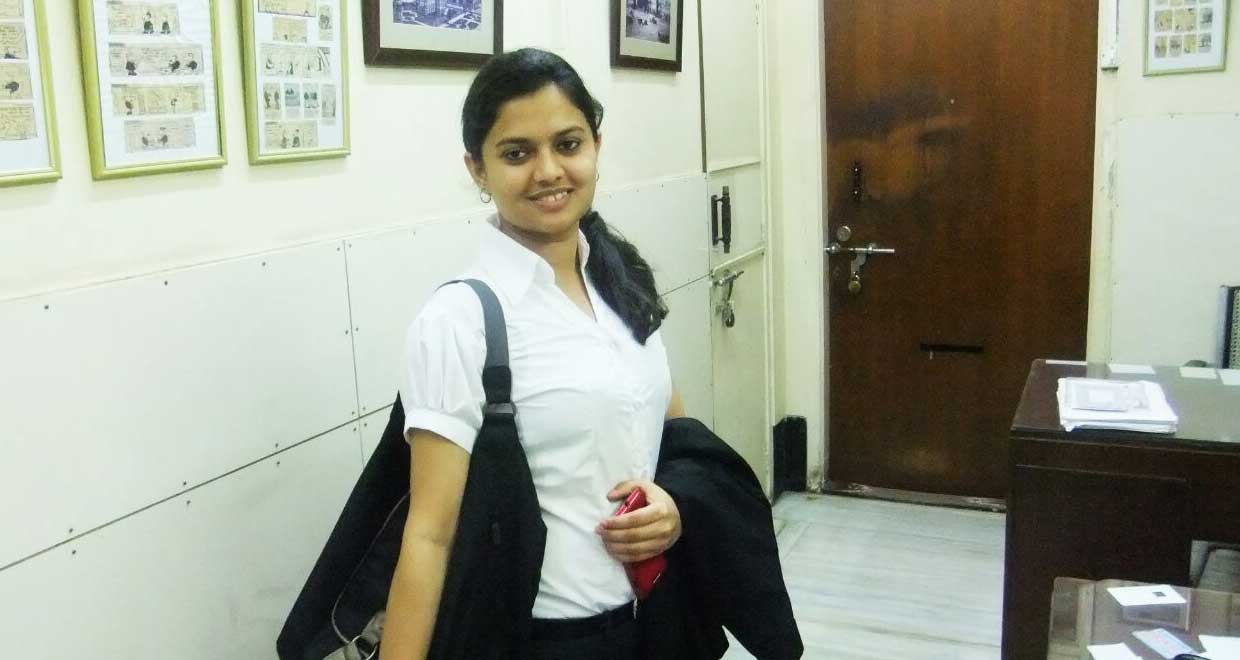
  • Swati Dalmia, Senior Associate, Fox Mandal, on being a Company Secretary, and her diverse experience

    Swati Dalmia, Senior Associate, Fox Mandal, on being a Company Secretary, and her diverse experience

    Swati Dalmia graduated in law from Bangalore Institute of Legal Studies, in 2009. She then went on to pursue her Masters from NLSIU, Bangalore, with a specialisation in Business Law. She is also a certified Company Secretary. Swati has been working with Fox & Mandal, Kolkata, since November 2009.

    In this interview we speak to her about:

    • Being a Company Secretary
    • Her role at Fox & Mandal
    • Her experience thus far

    How would you like to introduce yourself to our readers?

    I believe in the dignity of labour. There is dignity in every job. And if anyone disagrees with me, I don’t even understand it. I do my job with a lot of effort, with all the right means. I am passionate and totally committed to my work. It’s been almost seven years in this profession and the journey has been quite fascinating, enriching and fun-filled; while working at Fox Mandal along with my seniors and colleagues.


    What motivated you to pursue law?

    If I would be allowed to say so, then with all modesty, I would admit more than me having to choose law, it chose me. Law enthralled me, embraced me, and gave me a vision. Studying law and practising law is not the same. Various people study many subjects but practise what they love doing most. When I ventured into this world of law I was mesmerised with its vastness. Post my board exams I wanted to move out of my hometown and started exploring opportunities, looking for courses and colleges, and then settled for studying law. Today, I’m happy about choosing this subject.

    How important are grades, in your opinion?

    Success is peripheral to hard work. If we work hard with the right attitude, seek knowledge at any and every given point of our lives, we shall surely be successful. There are no set standards to succeed, to each is his own. In our academic life we seek success by getting more marks but that does not ensure the making of a good lawyer. Yes, it does make you a good student; grades are very important since it is the most focused tool to measure one’s success rate. The hard work academically bears fruits when it is time to be selected among the lot, good grades give you accessibility to a better platform. It is more important to be a consistent performer and thrive to attain more with an undying quest for learning. There is a huge difference in being a good scholar and a real player in the industry.

    Tell us a little about your days in law school.

    My law school days were just fantastic, the best days of my life. It was an ocean engulfing me; there was so much activity all around me. I wanted to do it all. I maximized my time in a productive way, was very active as a student, and I loved being that way. I tried to excel in academics, participated in several moot court competitions, debates, seminars, client counselling sessions, research papers, etc. I pursued the company secretary course along with law and finished it even before graduating as a lawyer. I still remember the most stressful part of my law school days was writing my ninth semesters and then just after a gap of three days sitting for my CS Final exams. It was then that I realized how friends and family help you achieve your goals.

    I think I was quite enthusiastic and wanted to do everything possible which also included not missing a single party happening around me! Yes, I enjoyed myself and made friends for life.    

    What are the subjects that you took particular interest in during your law school days?

    Every student is exposed to all subjects in law. The curriculum is almost the same everywhere. Torts and contracts are the basic foundation and the most interesting subjects possible. But since I took up the company secretary course and later pursued Masters in Business Law, I think, as a fresher, I was at considerable ease (in comparison to other statutes) while working on the companies act and its allied statutes.

    But I strongly feel that law school days are the time to explore academically and not to decide upon your career option. One has to make a choice and may go with the flow and his instincts but the ultimate decision comes when one joins the industry and starts practising.

     

    In your opinion, what are the law school-centric activities that you would recommend as necessary experiences for every law student? 

    Read, read, and then read some more. Law school activities provide students an energetic and competitive platform to increase their knowledge and work on their oratory skills. Also, unconsciously, one develops the skill of working in a team.

    Any and all activities which we undertake make us a better human being, since we learn to rejoice our success and also handle failures with grace. It may not be an indication to whether one shall become a successful advocate or not, but it is surely important in shaping one’s law school days. Otherwise, as a student, life gets boring and mundane. I think as a student I wanted to do everything apart from writing an exam (which was compulsory). My most memorable days were winning and being appreciated for my mooting skills, and the cherry on the cake was when we won a debate competition related to child rights organized by Legal Assistance Forum.     


    Tell us about your experiences as intern at S. Jalan & Company, Kolkata as well as Fox & Mandal, Bangalore.

    I was fortunate enough to get these opportunities both at S. Jalan and Fox Mandal. My internship at these places certainly played a role because it helped prospective employers to know about me as a worker and also as a person. I personally feel, as an intern (also as a fresher), my seniors never expected me to do everything correctly but what was more important is my attitude towards my assignments. There has to be a balanced enthusiasm to take up work and try to finish it within timelines.

    My advice would be never to seek an internship only for the purpose of holding a certificate. It would do more damage than by choosing simply not to do it. It you are interning at a firm, then reach out to the associates and seniors and ask for work and get back to them after completing it. One should try to research well and push information in the simplest way possible (without relying on Wikipedia).


    What are the challenges that one needs to prepare himself/herself for when they step out of the comfort of a law school and into the real working world?

    The first and foremost challenge is to be in working mode for ten continuous hours every day. There are no official breaks in between and the offices do not stop working at 4 PM. The next thing I feel is acclimatizing to a new place and getting yourself familiar with your colleagues and seniors. It is a transition process from a caterpillar to a butterfly. It is a new beginning when you leave an impression on others (who may be colleagues, seniors, partners or clients); so be focused, dedicated and disciplined.    


    What are your areas of specialisation in law? 

    I feel my senior Orijit Chatterjee at Fox Mandal (my mentor) has been very kind to me when it comes to my understanding of specialisation. When I was a complete novice and had no understanding of work which generally takes place in a full-service law firm, he just held my hand and very patiently brought out the best in me. I strongly feel my mentor has played a very important role in shaping my career.

    Initially, I tried developing my skills in general corporate, advisory and transactional work because those were the kinds of work which were assigned to me. But he never stopped there. He introduced me to a plethora of work and made me work on diverse matters under strict deadlines. Honestly, I quite enjoyed it. It was challenging and satisfying. He strongly believes in a theory and told me one day “you are hardly an advocate if you don’t practise in courts because that is the place where the real interpretation takes place”. These words still resonate in my ears and I feel it so true. He introduced me to litigation and since the last three years I have been actively involved in dispute resolution practice and today I am experienced with a 360 degree overview of a corporate transaction which takes place, from a non-binding term sheet to the enforcement of exit clause.


    Tell us about your current work profile with Fox & Mandal. 

    A regular day at work is buzzing, overflowing with work, and I certainly enjoy it. It is combination of discussions with seniors, attending courts/tribunals, meetings with clients, drafting, researching, attending conferences with counsels, and without even realizing the day comes to an end. Our profession is extremely demanding and one has to be fine with long working hours on a daily basis. But under the tutelage of Mr. Shourya Mandal (Partner, Fox Mandal) and Mr. Orijit Chatterjee, work is enriching and fun-filled and their deep sense of humility and legal acumen encourages me all the time to strive hard and reach for the next level.


    Where do you see yourself ten years from now? 

    The stalwarts in this industry make me seek more and more, when I see their quantum of success I feel like taking a deeper plunge. As I always say, law seeks me more than I seek it . It ensures I’m glued to it, that I love nothing more than being a lawyer. I’m sure in years to come I shall find a place in the legal history of the country, my own place.


    What is your message to our readers?

    Make most of your law school days. Go ahead, reach out and do whatever you desire. Get into action, then give your hundred percent and never look back. Enjoy, have fun, take trips and most importantly, make memories.


  • Reema Das, Legal Manager, Flipkart, on work of an in-house counsel

    Reema Das, Legal Manager, Flipkart, on work of an in-house counsel

    Reema Das graduated from the Bangalore Institute of Legal Studies in 2009. She started working with CK Nandkumar & Associates, but feeling the need for advisory and transactional work, she switched to Majmudar & Co. After working at Majmudar, she switched to Flipkart and currently works as Legal Manager.

    In this interview, she talks about:

    • Getting good grades in law school
    • Working in the corporate department of a law firm
    • The recruitment policy and her work profile at Flipkart


    How did you gravitate towards law? Tell us about your college life at Bangalore Institute of Legal Studies. What all activities did you partake in?

    I’d be lying if I said I always wanted to become a lawyer. Growing up, I wanted to pursue many a vocation but law was never one of them. It was only in the 12th standard, after multiple career counselling sessions, that I found merit in choosing law as a career. With a little apprehension, I decided to take that giant leap. However, my first year in Law College convinced me that I made the right choice. And since then there’s been no looking back.

    Based on my ISC (XII standard) results, I got admission in Bangalore Institute of Legal Studies. The college offered good faculty and a robust curriculum. As a student, I always focused on academics (honestly, that was my comfort zone). That apart, moot courts, cultural and literary activities, and towards the latter years, organizing seminars and working for the placement co-ordination committee, etc. kept me engaged during college.


    What were your areas of interest during your graduation? How did you go about developing expertise and knowledge in these areas?

    Company law and foreign exchange management laws have always interested me – right from the first time I was introduced to these subjects- till date.

    Internships at corporate law firms gave me hands-on working knowledge. Research and reading outside of text books and study material also helped me gain a fair amount of insight into these laws.


    You were one of the most exceptional students at Bangalore University. You bagged 4th rank among your batch mates in the B.A.LL.B course. Please give us a few actionable tips on managing higher grades.

    Apart from the cliché of understanding your subject well, I’d say the difference lies in stepping into the shoes of the examiner and delivering what he/she is looking for. Well-structured and precise responses are what examiners generally look for.


    You had started working at C.K. Nandakumar & Associates right after graduation, and thereafter you joined Majmudar & Co. International Lawyers. What led to this shift?

    At C.K. Nandakumar & Associates, I was offered a mixed profile of litigation and corporate advisory work. This gave me the much needed exposure to courtrooms. I appeared before various forums and handled arbitration suits, money recovery suits, merger applications, winding up petitions, etc. and at the same time vetted commercial contracts, technology contracts, and provided business advisory.

    I soon realized that my aptitude and inclination was more towards the business advisory and corporate law side. After weighing the choices I took a well-informed decision to focus on corporate advisory work. This led to my shift to Majmudar & Co. At Majmudar, I did corporate advisory and transactional work. It was a great learning experience; giving me first hand exposure to the subjects I loved the most.


    Thereafter, you left Majmudar & Co. to join Indus law. What motivated this shift? How did your appointment take place?

    I wanted to do more work in the PE/VC investment space and IndusLaw was the right place for this. I applied to one of the partners at IndusLaw. Thereafter, I went through a round of technical interview followed by an HR interview. During the technical round, my basic knowledge and understanding of transactions and the applicable law was tested. I was also required to submit a write up on a legal topic. I remember submitting an article on the twin Bombay HC judgments and transferability of shares in a public limited company.

    I would like to believe that my clarity on why I wanted to make the shift, my interest in the PE/VC space and knowledge of the why’s and how’s of the transactions that I had worked on, got me the job. At IndusLaw, my work profile consisted mostly of PE/VC deals and acquisitions. A fairly large amount of the clients were in the e-commerce space.


    Many lawyers would say that the actual learning takes place in the years of practice. How far would you say it is true? What was the case in your situation?

    Well, no amount of academic knowledge can replace real experience. So yes, I agree with this statement to a large extent. Having said this, I feel the seeds of understanding of law and legal concepts are sown during the law school days.


    What qualities do you think helped you for promotion to Manager-Legal at Flipkart?

    Flipkart has a structured appraisal policy in place. If an employee exceeds expectations in his/her key result areas, he/she is considered for a promotion. So I would say it is the overall performance that counts.

    I would like to believe that it is my passion for the work I do and timely delivery of advice/assistance that led to the results.


    Please tell us about the recruitment process at Flipkart.

    I will speak for myself. After the initial screening of the CV, I underwent three rounds of technical interviews before the HR round. The first round was with the Director-Legal, followed by the General Counsel of Flipkart and the last round was with the M&A Business Head. Post the interviews, there is usually a calibration done and the decision of hiring v/s not hiring is a collective one based on inputs from the various interviewers.


    reema-das-2

    Tell us about the nature of work you’re entrusted with therein? Tell us a bit about the company, your typical workday and the overall work/life balance.

    I provide legal support (i.e., advice on structure/strategy/documentation) with respect to financial investments and the acquisitions made by Flipkart.

    Flipkart is a high energy, young company, buzzing with activities. The company is constantly looking for new ideas to explore the unexplored. So on a typical workday, I juggle between 3-4 ongoing acquisitions or investments. Each would be a different stage of completion, requiring my 100% attention. I enjoy the excitement and rush of being a part of such a passionate team. All this keeps me busy.

    As for work/life balance, it is entirely up to the individual. In this day and age, it is in your hands to prioritize and make time for all important and essential activities.


    What were the biggest hurdles and challenges in the first few months? What do you think makes a good in-house counsel?

    Domain-wise it is a familiar space, so I did not have many challenges. However, I was new to the corporate world, its internal systems and protocols. It took me some time to understand them.

    A good in-house counsel is one who is in sync/aligned with the relevant business teams and enables business activities and calls out the rights things.


    What are the primary essentials of a corporate lawyer? How do you say a fresh graduate can work on building these skills?

    Good understanding of business commercials and knowledge of applicable laws are an absolute must.

    Read and keep yourself updated on the business news and legal developments. Read research papers and analyses available on various critical points in the legal areas that interest you.


    Does Flipkart take interns? What is the process for same? What do they look for in their prospective employees?

    I am told there is a policy in place and interns are taken on a need basis. Interested candidates can get in touch with the HR. From what I understand, the qualities they look for are domain knowledge, eagerness, ability to learn and a positive attitude.


    Where do you see yourself ten years down the line? Do you aspire to be like somebody from this field?

    I love the investment/M&A space and see myself involved in the same space.

    I’d wish to imbibe the best from all my mentors and eminent people I work with/have worked with.


    What would be your parting message to law students who want to be successful in corporate law?

    There is only one rule – do what you enjoy doing!


  • Sapna Sainath on being the Principal of Bangalore Institute of Legal Studies and experience as a teacher

    Sapna Sainath on being the Principal of Bangalore Institute of Legal Studies and experience as a teacher

    sapna-s-1Dr. Sapna Sainath is an Associate Professor & the Principal of Bangalore Institute of Legal Studies. In this interview we ask her about her story from being a law student to the Principal. She shares her experience as a researcher, a public speaker and a teacher. She also tells us about what is expected out of a student to make the most out of his/her law school life.


    Please tell us a bit about your pre-college years, you as a student, your ambitions as a child. Did you have lawyers in your family or among close relatives?

    I was born in Bangalore and have always lived in the old, traditional and conservative part of the city-Basavanagudi. After completing my schooling at Sri Kumarans Children’s Home (SKCH), one of the most well known schools in the south of Bangalore, with a merit scholarship, I did my Pre-University with Science in Vijaya College, again a landmark in South Bangalore. Coincidentally, I am now the Principal of BILS, which is under the management of Vijaya College.

    After II PUC, came the cross roads of professional courses where I had to choose between BE and Dental, as I had secured seats in both. But, I made my choice easily and very fast with Law. The reason being that, my father, Shri. Sainath, is an Advocate who specializes in Tax and Company Law Matters and, on and off, has been to the US to brief cases. It was easy sailing through seven years of LLB and LLM and I secured a First Class First Rank in both, all credits to the utterly law school environment at home. Because, by then, my brother had also joined Law, my mother was no less than an experienced lawyer’s office assistant and there always used to be a big crowd of people, the clients and juniors, with the top floor of our house being converted into another branch of the office.


    What were your objectives when you thought about law while still in the preliminary years of Law College? What were your goals after graduating? What were the options available to you? Did you want to practice as an Advocate just like your father?

    My foray into the academic line was simple obedience of my father’s instructions. I joined Bangalore Institute of Legal Studies (BILS) in 1999, an LLM in hand and fresh out of college. I was lucky to have had the initial mentorship of Prof. S.S. Alur, then Principal of BILS and teaching experience with an enthusiastic student community, which has only grown better over the years.


    You have pursued PhD from NLSIU. What was your motivation behind pursuing PhD? When did you finally decide that you need to do it? What was your topic of research for PhD? Why did you choose that subject for research?

    The year 2010 proved to be a milestone in my teaching career because that year, I registered for my PhD at NLSIU under the guide-ship of Dr. Sarasu Esther Thomas. Dr.Sarasu, has not just been my guide for my doctorate but a Guru in the real sense who changed my thought process and gave a new direction to my academic career. I worked under her for research papers in Human Rights under the Ford Foundation Project.

    My PhD dissertation topic is titled, “Employment and Related Laws in the Information Technology Enabled Services Sector (ITES) in Bangalore- A Gender Perspective”. My research has adopted a Feminist Methodology and the investigation is on women-centric issues like sexual harassment at work place, gender discrimination etc., I was conferred with a PhD in August 2014. Since then, gender issues have become my core research area and I have also published many articles in this area in Indian Bar Review, International Journal of Law and Policy Review, to name a few, in the course of these three years.

    I have realized one thing; constant, serious research is oxygen if you need to be in the academic field. It’s my passion for research which got me the enrolment in LLD at the NLSIU, even before I was conferred with the PhD degree. My research area will alternate between Institutional Child Abuse or Cyber Crime and Security Issues- only time will tell.


    You have taught a number of both traditional legal subjects and the trending ones from Criminal Law to Human Rights to International Law. Which of these you enjoy teaching the most? Also, which other subject would you like to teach?

    Though as a law student, I studied the subjects more from the examination point of view, my real studying and understanding the concepts came only after I started teaching. I have thoroughly enjoined interacting with students on law of Torts (it still remains my favourite subject) and Jurisprudence.


    Tell us about your teaching methodology. Do you encourage students to take notes or do you engage your students in active class participation? What advice do you share with your students on scoring higher grades?

    I have adopted a teaching methodology of my own without being overtly formal about the so-called ‘pedagogy’.  I just enjoy communicating and sharing with the students. The different perspectives that pour in from the students have been a great learning experience. Case law discussion figures prominently in my classes.


    Please share your journey as an Associate Professor at BILS.

    When I look back at my journey from being little more than a college girl when I joined BILS to being promoted as Senior Lecturer, then Assistant Professor of Law, then Associate Professor of Law and finally the Principal, I only want to thank God for putting me in a place which helped me grow as a person and gave me professional freedom to pursue my career.

    In October 2013, when I took over as the Principal of BILS, the institution where I grew as a person as well as a professional in the last fifteen years, it was my second milestone. BILS had become a second home to me and therefore, on one hand, as its Principal, it was an advantage being on home turf and on the other, it was a huge responsibility to be put at the helm because the aim to do the best and to perfection so, nothing should go wrong for BILS, was a bit of pressure.


    You have been a Chairperson of Board of Examination for MG University, Kerala. What was your scope of responsibility?

    I have held various University positions from which, I have had varied experiences in the course of these fifteen years. As an examiner, I have been in a position to tell students the importance of presentation in answering a University Examination. Having evaluated hundreds of answer scripts, I know what makes a scoring paper and what does not. Being on the University Board of Studies many times, has improved my editing skills.


    You have been invited to address several seminars and public lectures. Having been a delegate at the Seminar on “IP Management  And IP As A Profession” conducted by United Nations Industrial Development Organization in collaboration with Brain League. How has the experience been?

    Seminars and Presentations in the initial stages used to be on voluntary basis, but now it is on invitational basis as a resource person. Public speaking which addresses a target audience has always given me immense satisfaction and I have always come back richer with experience and contentment. Most of my Seminars are gender thematic which has helped me develop and recognize my own inner voice and strength.


    How do you say a student can manage to stay ahead of the ‘rat race’? What are your long term goals as the Principal of BILS?

    The most important milestone has been the establishment of research centre at BILS called- B-CARL BILS CENTRE FOR APPLIED RESEARCH IN LAW. As a first project, the Centre will undertake the research into an important area – sexual harassment of women at work place. The objective will be to review the working of the 2013 anti-sexual harassment law. It has already garnered much interest from the Women and Child Development Ministry (WCD), India and we are confident that it will go a long way. As a Director of B-CARL, I will be directly reporting to the Dean of BILS, who will be Chairman of the Centre. His rare mix of an IPS Officer, hard core Advocate and efficient administrator as Vice-President of our Management will add a new dimension because I will, for the first time, be foraying into research on the applied side as against the doctrinaire research which is a dangerous streak for academicians.

    From whatever  little experience I was fortunate to gain over the years, one thing about whichI am now certain- anything done with dedication, diligence and determination will bear fruit. I have been fortunate to find two gurus in my professional life, though a little later in the day- one in the form of my PhD guide and the other in the form of the Dean, BILS from whom I have learnt certain very important lessons and they are-

    • Total Focus & Dedication in whatever you do.
    • Perseverance- never give up anything that you undertake.
    • Most importantly, keep your word once you have given it.

    These are lessons not just for one’s profession but one’s life. They were not difficult for me to follow as I have been brought up with the same values. What it definitely did, was to reaffirm my faith in them that no modern work place or technology can be a substitute for values.

    At BILS we have always stood by these values as the first teaching with academics following next. Today’s students have no doubt more exposure than we did fifteen years back and that again means the competition will be equally high. Let each student remember first to enjoy the college life- it will never come back. Take joy in winning a moot, participating in a debate, presenting a seminar or gaining experience as an internee. Just as a busy man has time for everything, a good law student will have to do everything from internship, to debate, to seminar, to moot court, paper publication et al.


    Lastly, what would be your message to our readers?

    My message to students is- it’s all about time management. If you want what you want, you have to do what you have to do.

  • Arpita Majumdar, Law Graduate, on preparing for CS and being AIR 13

    Arpita Majumdar, Law Graduate, on preparing for CS and being AIR 13

    arpita-majumdar-3Arpita Majumdar is currently a student of Bangalore Institute of Legal Studies (BILS) and shall graduate in 2015. She has secured All India Executive Rank 13 in Company Secretary Course and has interned at top notch firms.

    She tells us about:

    • Preparation for CS exam and bagging AIR 13
    • Coaching Institutes and CS
    • Importance of Internships


    How would you like to introduce yourself to our readers?

    I am a fifth year law student from Bangalore Institute of Legal Studies and a potential Company Secretary. I was born and brought up in the vibrant city of Indore in Madhya Pradesh and completed my schooling from St. Raphael’s Girls School, Indore. Having been nurtured in a Convent School, I was inducted into public speaking quite early in my school life. Fortunately, it has continued to remain a passion ever since.


    What motivated you to choose law as a career?

    Although I hail from a family that has seen a generation of Engineers, fortunately I was encouraged to pursue a career of my choice. However, given the lack of awareness about varied avenues available to a law graduate, my peers were skeptical of my decision. Also, I believe that there is a peculiar dogma and a certain amount of disrespect associated with the legal profession in the smaller towns.

    My first encounter with the legal regime was as a National Service Scheme (NSS) volunteer whereby, we undertook a project for the education of female inmates in Jails. This tryst with the justice mechanism motivated me to pursue a profession that infused a feeling of empowerment in an individual. Although, I must admit that initially I was perplexed between journalism and law; eventually the decision to opt for the latter came quite later in time.


    As a law student which activities did you participate in?

    Well, I believe everybody should invest considerable time and effort in exploring diverse opportunities that law school has to offer. It provides the requisite perspective to make an informed decision regarding your preferred area of practice.

    I have always tried to maintain an effective balance between academics and other activities. Along with, a consistent endeavour to maintain good scores throughout law school (as clichéd as it may be); I also, play Chess and have represented my College at “Spiritus” –the Sport’s Fest organised by NLSIU, Bangalore. I have also been a member of an Expert Panel Study on Access to Healthcare in India by IIM-Bangalore and University of St. Gallen, Sweden.

    Mooting has been another formidable part of my law school life. In fact, in my very first year I represented my institution in the Amity University Constitutional Law Moot; in which we were the semi-finalists. I have also, participated in NLIU Juris Corp, NLS Arbitration Moot and Surana&Surana Corporate Moot. However, it was eventually, the Nani Palkhivala Tax Moot Court Competition that had the effect of framing the course of my future endeavours and hence, the greater emphasis on CS Course.

    I was privileged to have few very proficient seniors who guided me through every effort of mine at law school, ranging from academics to moot courts, internships, etc. In all fairness, although, institutional guidance was very limited; I am particularly grateful to our Moot Court, Faculty-in-Charge for providing the desired opportunities.


    arpita-majumdar-2

    What kind of work did you have to do during your internship at AZB Partners and Nishith Desai Associates?

    The nature of work varies according to the place and the team allotted. At Nishith Desai Associates, I was assigned a Mentor and highlight of that internship was the fact that interns could work with all the offices and were not confined to the location office. At AZB there are no watertight compartments so I was not assigned to a particular team, as such. Also the work environment is extremely interactive and you tend to get feedbacks which help you to improve. Through the course of my law firm internships, I was allotted research works, reviewing contracts and drafting opinions.


    How was your experience interning with Senior Advocates?

    My litigation internships have been under Senior Advocates, Mr. Soli E. Dastur and Mr. Arvind P. Datar, both eminent Supreme Court counsels and renowned tax jurists. Both the internships were very rewarding in terms of, the quality of interaction with Mr. Dastur and Mr. Datar and the quality of work that I was assigned. In fact, during Mr. Datar’s internship I worked as a Student Editor on his upcoming revised edition of the Constitution of India. Also, having observed them argue in Court, it gave me an intricate understanding of the critical nuances of law practice and the art of Court craft.

    While at a law firm the work is primarily based on research for client advisory or proposed transactions; a litigation internship offers more diverse research experiences. At the same time, it offers you great insights into the judicial mind based on the Judges response to a well-researched argument to which you may have contributed substantially. I personally, enjoyed the respective challenges offered at a law firm and under a lawyer; although, with an inclination for the former.


    Did you pursue your internships throughout law school as part of a deliberate plan or did it all just happen by chance?

    In my opinion, internships are an outcome of the initiatives you are willing to take in furtherance of your career. So when I say initiatives, it would be fair to state that it was well planned; although, the execution required considerable effort. Given that I had identified my area of interest fairly early at law school I was determined to intern with the best law firms / lawyers in the area. Being from a non-NLU, internships are not as forthcoming as one would expect. Therefore, one has to pursue it relentlessly and with a great deal of vigour. In most cases, a well-structured application with a comprehensive CV and thereafter, periodic follow ups fructified into a positive response.

    Personally, I believe in any profession academic scores do not validate one’s practical knowledge. The University curriculum fails to invigorate any innovation or analytical reasoning – attributes that I found to be quintessential during my internships. Therefore, an active engagement in Moot Courts, internships, research papers, conferences, etc. are indispensable to acquire practical knowledge of the discipline. Thus, there needs to be personal interest to research deeper into the subject and not merely cater to the requirements of routine examinations by reading a few prescribed books.


    What does your CS score card read?

    (Arpita has secured All India Executive Rank 13 and South Zone Rank 1 in the Company Secretary (CS) examination.)

    To be honest, I was expecting good scores but not a Rank as such. So when I checked my results I was fairly satisfied with my scores and frankly, I did not even glance at the merit list. It was only later in the evening that I was informed by a friend that I had secured the 13th Rank. I was pretty thrilled actually although, it took quite some time to sink in.


    When and what inspired you to pursue CS course?

    Pursuing CS was largely driven by my proclivity for Corporate and Taxation Law. Moreover, since Taxation is taught in the last semester, I wanted to learn the subject in advance.

    I have been very impressed with the course curriculum particularly, because of the way it is structured. The practical insights that the course offers and the examination pattern that seeks to test the same are largely, based on one’s knowledge of the subject and not merely memory. I would personally, recommend it for students with an inclination towards Corporate, Securities and Taxation Laws, especially, those belonging to State Universities where such areas are not adequately dealt with. I believe in such cases, it serves to give you an edge over your peers.


    How did you remember the sections of the Acts in your syllabus and leading case laws on varied areas of law?

    Though CS is an extremely concept based course, this particular aspect is not very different from preparing for law papers in LL.B. curriculum. However, it demands more detailed attention to the fundamentals of a concept. I particularly, do not think one is expected to remember every case law and sections that you come across during the course of your preparations. Having said that, certain significant judgments involving intriguing questions of law and relevant sections that test one’s reasoning ability ought to be remembered. This may not require much of an effort if you have done a thorough reading of the subject coupled with an interest in the same.


    How did you prepare for the exams?

    My semester examinations were scheduled around the same time as the CS Examinations, so I was particularly constrained for time. But I am personally of the opinion that with satisfactory time management it is fairly easy for a law student to crack CS Examinations. Securing a rank may require a little more effort. I had put in about a months’ preparation; however, it was only possible because most of the subjects were covered earlier in the LL.B. Curriculum.

    CS Course material is more than sufficient for preparations for examination purposes; the only exception being Taxation and Accountancy. Additional materials are available in the form of Guides (usually referred as “Scanners” in CS parlance) – which is basically a Question-Answer Summary Guide of past years Question Papers. It is advisable to refer Taxmann Student’s Guide and V.K. Singhania’s book for practical problems pertaining to Taxation laws and Shukla & Grawal – considered the ‘Bible of Accountancy’. I have been fortunate to have some CA friends who have helped me greatly in this aspect.


    How would you say a student can go about studying and having distinction in CS subjects?

    I strongly opine that each individual has their own study methods. In some cases, it may be studying for long hours while, others may have a preference for short study hours. My study method was modulated around the latter. I base my study on thorough reading and preparation of short points on every topic. On the eve of the examinations, I studied from these notes because there are no breaks between CS papers and it is quite impossible to revise the entire syllabus within such a short span of time. Also, unlike the Law examinations administered at my University, one cannot afford to engage in selective study; in that case, the idea of merely passing the examination may also, appear far-fetched. As such, time management is undoubtedly a pre-requisite.


    Did you take any guidance for preparation?

    Initially, when I started my preparations for Executive Examinations I attended a Coaching Institute which proclaims to be the best in South India. Unfortunately, it took little time to comprehend the falsity of such proclamations.

    Personally, I do not advocate Coaching Institutes. They not only hamper self-study but at times derail your preparation by misguiding you. Moreover, pursuing Law and CS at the same time, sufficiently eases the burden of Law subjects and nullifies the requirement of a CS Coaching Institute per se. Practical subjects like Accountancy and Taxation may pose a handicap, for which a decent Coaching Class which satisfactorily addresses the concepts involved in these subjects shall suffice.


    Any dos and don’ts you would like to share with the future CS aspirants?

    It is fairly simple the way I perceive it. I have been advised against CS on the pretext that there is sufficient overlap between the two courses. I strongly beg to differ on this. At the cost of repetition, I say it once again, it gives you a wider practical perspective; and in any case, knowledge never harms, does it!

    Frankly, if you are not dedicated enough to pursue it all the way thorough kindly do not take it up in the first place. It is tiresome and entails considerable financial and time investment.


    Do you think that being from a non-NLU made any difference?

    Actually, it is not the opportunities per se that are limited; but the awareness about such opportunities that is found to be deficient. In any law school, your peers have a cardinal influence in generating such awareness which shapes your career decisions. This particular aspect is woefully scarce in certain non-NLU institutions. As such, being amidst the right kind of peer group largely determines one’s success in law school. However, the relaxed institutional framework provided me the time to pursue CS, in particular. And as a matter of fact, every coin has two sides!


    What are your plans after graduating?

    To be honest, I am not too inclined towards pursuing a career as a full time Company Secretary. I am studying to be a Lawyer, and that is what I would like to be. As of now, I plan to join a law firm where my credentials as a Lawyer and a CS would be adequately employed, preferably one having taxation as its core competence.


    Lastly, what would be your message to our readers and to the future CS aspirants?

    Stay focused, fight for what you believe in and pursue your goals with a great deal of determination.


  • Ashok GV, Managing Partner, CorLit Legal, on pro-bono work and striving for success

    Ashok GV, Managing Partner, CorLit Legal, on pro-bono work and striving for success

    ashok-gv-1Ashok G.V., a graduate from Bangalore Institute of Legal Studies in 2011. He is currently a Managing Partner at Corlit Legal. He is involved in a lot of social work being the Co-Founder at Crisis Prevention and Survivor Support Centre. He has coordinated cross border trade mark litigation in the United State of America. He has also dedicated himself as a Member of the Ethics Committee, Apollo Hospitals, Bangalore.

    In this interview we speak to him about:

    • His time as an undergraduate
    • His pro-bono and humanitarian work
    • His diverse experience


    How did you gravitate towards law?

    I always held a keen interest in writing and debating. During my high school days, I spent a large amount of time debating on the UNICEF Voices of Youth Forum on the internet. All that time spent debating issues of socio-economic interest, made me realise that I enjoyed making an argument. Plus, my father, Mr. G.K.V. Murthy, is a very accomplished Advocate practising in the High Court of Karnataka for more than two decades. I had some confusion as to whether I should pursue journalism or law, but seeing the kind of impact my father had in the lives of his clients convinced me that law is where I wanted to be.


    Being from BILS, do you think that a non-NLU made any difference to your career?

    I was always particular about my subject, never about the university. Be it BILS or National Law Universities, they all come with their own strengths and opportunities and one has to try and make the best of what one has.

    At BILS, my faculty members were always very encouraging and supportive of all my initiatives. I found a fantastic business partner with whom I could start CorLit Legal in BILS. Plus, it was only because of BILS that I was able to find the latitude to garner practical work experience of close to five years.  If I had to instead spend five years in a NLU, I would have been confined for the most part to campus life, leading to loss of exposure to the real world of law. That five years of work experience, gave me the skills, experience, platform and network necessary to start CorLit Legal along with my partner Sourabh.

    Of course, some of my friends from various National Law Schools managed to go abroad for prestigious moot court competitions and international internships. I might have lost out on those opportunities. So it does not matter. BILS or NLU, you can still do just fine as long as you are willing to define your priorities properly and make decisions you can live with.


    How important is mooting and what effect does it have on one’s CV?

    (Ashok has participated in various moot court competitions like the Raj Anand Intellectual Property Moot and the Philip C. Jessup International Law Moot Court.)

    I have always loved litigation. Moot Courts were the only respite in a course that largely emphasises on theory. Participating in Raj Anand Intellectual Property Moot and the Philip C. Jessup International Law Moot Court gave me exposure to IPR and International Law and helped me understand what problems in these fields look like. I learnt how to research well from these competitions, a skill that comes in handy for my career now. However, litigation in real life is far more challenging and stimulating than moot court competitions. I would urge law students to look at moot court competitions as purely a learning exercise.


    Tell us about your earlier association with Global Law Inc. and Meta Yage IP Strategy Consulting.

    I have found virtually every field of law interesting. Intellectual Property Rights holds a special place, because my first internship was with an IP Consulting Firm, Meta Yage IP Strategy Consulting. One of my assignments there involved drafting portions of a Patent Application and my work received very encouraging feedback. It was the first time I felt confident that I could make a career for myself in the field of law. I continue to remain very good friends with the folks from Meta Yage.

    After I completed my internship at Meta Yage, I went on to work as a Junior Associate at Global Law Inc. My senior there, Mr. M.S. Srinivasa, is arguably one of the sharpest Indirect Tax Attorneys in the country today. I spent a good eighteen months working under him in the field of Indirect Tax Litigation where I picked up critical skills such as drafting and goal oriented research. But the most prized skill from that experience was learning the extent of clerical work that goes into each case and the amount of diligence required to execute it.

    The diploma course was very insightful as it gave us considerable insights into the practice of Intellectual Property Law. The course was designed beautifully and did not waste any time dwelling into irrelevant things. The legal fraternity would be wise to learn from such courses, to make their own syllabus more useful and relevant to a Law Student’s career.


    Tell us about the kind of work you do as the Consulting Partner at Startup Amigo.

    Startup Amigo is a platform designed to advise and assist businesses, from the stage of ideation to the launch of the product or service portfolio. It is the brain child of my good friend, Abhishek Raju who has been one of my biggest sources of support and encouragement since the time I entered law school. In the short span of time since its inception, it has forged impressive partnerships with some of Asia and Europe’s leading management institutions and trade bodies. Its sector specialisation includes Space Technology, Water Resource Management, Health care and Defence Consulting, just to name a few.

    My role as a consulting partner, is to help Startup Amigo’s clients understand the sociological context and regulatory framework which exists in India and to help them evolve customised business strategies for the Indian Market. My engagement includes one on one consulting assignments and delivering lectures on relevant areas of law, during seminars and workshops organised by Startup Amigo and its partner organisations.


    What does your role as Managing Partner of Corlit Legal entail?

    CorLit Legal is a full practice law firm with practice areas encompassing Intellectual Property Rights, Taxation, Company Law and Food and Beverage Legislations. Besides Sourabh and I, who are its Founding and Managing Partners, we have six other Advocates with over twenty years of experience who came on board as Domain Partners. Clients are usually referred to us by someone we know. There is no secret to be honest. We have tried to get to know people, for the sake of knowing them and we never spoke to anyone with the intention of seeking any business. If the relationship translates into an Attorney-Client relationship, great! If not, we have managed to make new friends who can teach us something about their field of experience. CorLit Legal was never about the money. It has always been a personal journey to become more relevant and useful to the world we are part of.


    You are a part of the Ethics Committee, Apollo Hospitals, Bangalore. What are your primary responsibilities as such?

    The Ethics Committee is a body which reviews proposals for clinical research involving new medicines and therapeutic processes. Its primary duty is to ensure that the subjects who have volunteered for clinical research are adequately protected and ethical considerations surrounding the same are fully addressed. I was appointed primarily on account of my experience in the field of human rights and my responsibility is to inject that perspective into the deliberations of the Committee.


    Our readers will also be curious to know about your publications and your love for writing.

    (Ashok is the author of Harmonizing Internal Policy and Trade Mark Law and Losing Focus-An analysis of the Justice Verma Committee Report. You also have your own blog.

    Writing has been a very helpful companion. I don’t even consider it a hobby, because like how I need to breathe, I feel compelled to write. As an amateur writer, I published mainly in a women’s magazine called Eve’s Times, which provided a platform to unknown writers like myself. Writing has been an introspective process for me and largely responsible for all the progress I have made as an individual. No matter how tiring the profession gets or how demanding of my time it is, I will perhaps never give up writing.


    How does it feel to be recognized for the social initiatives taken by you?

    First of all, the ethical obligations for a lawyer make it incumbent upon us to devote some time to pro bono activities. Therefore, I wish to clarify that we are doing what we are duty bound to do as Advocates. Sourabh and I always knew that CorLit Legal was going to be a body that would leverage its business law practice, for the purpose of creating a sustainable pro bono program. We were lucky to find Enfold Proactive Health Trust, with whom we have collaborated to work in the field of helping survivors of sexual violence.

    Having said that, the activists that we have worked with, be it at Enfold or Dr. Ravindranath Shanbhag or Sinu Joseph or Ramesh at the Forward Foundation, they are the heroes who deserve recognition because they have gone above and beyond their professions and duties. Many of them in fact are well known and Sinu was even featured on “Chai with Lakshmi” and Ted for her work in the field of Menstrual Hygiene. Our associations with our clients and these activists are the highlight of our work at CorLit Legal. We are happy to support them however we can, although our contribution, when compared to theirs, fares poorly in comparison. As regards the recognition, Sourabh and I could care less whether CorLit is recognised or not. It’s always about the client and the work, and never about us.


    How did you get the thought of forming Crisis Prevention and Survivor Support Centre?

    Sexual violence is violence with a lot of power and control dynamics associated with it. After reading the works of John Douglas and Roy Hazelwood, I knew I wanted to do some work in that field and wrote extensively for internet based publications on the same subject. In 2011, we were approached by someone I knew, stating that she was assaulted and being stalked. By that time, I had a friend, Sahu who is a fantastic counsellor. We both worked together in helping the client and she eventually managed to stand up to her perpetrator and successfully warned him off. We later got in touch with Dr. Shaibya Saldanha at Enfold with the idea of creating a platform where survivors of sexual violence can find legal, counselling and medical intervention in one place free of cost. We have been working together since then.

    It is important to temper down our idealism though. India has a fantastic legislative framework, but lacks the infrastructure, manpower and attitude to implement it. The law can always become better; no doubt, but it’s also quite up to the job even now. On the other hand, the attitudes of the people on the ground are more difficult to deal with.  I don’t have any dreams or illusions about being a change maker. For us, it’s just about doing what we can do to make the life of that one survivor a little less anxious and difficult.


    Do you take interns for your firm?

    Well given I myself come from a humble academic background, I would go less by a person’s resume and more by the person. I usually have a chat with students who wish to intern and if I think they will be a good fit at CorLit Legal, I would be more than happy to provide a “call back”. The difficulty for us is how we make the intern’s time worthwhile for him or her. When we are dealing with an intern, we are very conscious of our responsibility to ensure they go back feeling less ignorant and more enlightened about the profession. But with so much of time spent at Court, it becomes a difficult process. So if a candidate shows initiative and respect for his or her own time, it would earn him or her, a brownie point for sure.


    Where do you see yourself in the long-run?

    I want to teach. Not just law, but perhaps even the humanities. Therefore, higher studies are definitely part of my plan. I joined the profession, only because I felt this experience would make me a better faculty for my students. 10 years from now, I hope to spend more time on research, writing and teaching.


    What all do you consider in making strategic career moves?

    I never planned any of my moves nor did I ever strategise. I have a supportive family and I managed to find the right people at the right time by sheer luck, thanks mostly to being at BILS where I found my collaborators at both CorLit Legal and Startup Amigo. Building relationships based on sincerity and mutual respect is the most important goal for any professional, including a lawyer.


    What would be your message to our readers who are faced with decisive choices?

    If I have to dish out advice, then do not follow the herd. Make decisions based on your own introspection and not because of someone else’s advice. Have an open mind. Most importantly, don’t succumb to the fear psychosis that tells you to freak out or get left behind the competition. As my good friend Abhishek at Startup Amigo told me, “Collaborate and don’t compete”. Be nice to everyone, for the sake of civility and you will be just fine. Lastly, remember that Law Practice is a humbling experience. It requires endurance and demands resilience. It’s a 24/7 engagement and the situations you encounter can make you feel profoundly ignorant all the time. Therefore, it’s always important to be open to learning and never assume that one is the best at what he or she does.

  • Pranjit Bhattacharya, Law Graduate, Bangalore Institute of Legal Studies, on mooting, securing top-notch internships and a PPO from Trilegal

    Pranjit Bhattacharya, Law Graduate, Bangalore Institute of Legal Studies, on mooting, securing top-notch internships and a PPO from Trilegal

    Pranjit Bhattacharya graduated from Bangalore Institute of Legal Studies in 2015. He also holds a diploma in Entrepreneurship Administration and Business Laws from NUJS, Kolkata. Pranjit received a PPO from Trilegal in his fourth year of law school.

    In this interview we speak to him about:

    • Mooting and its benefits for a law student
    • Preparing a C.V. and insides of personal interview with tier-1 law firm; and
    • Securing top-notch law firm internships


    Tell us a bit about your life before college?

    I have been lucky to grow up in the beautiful picturesque city of Shillong. I did my 12th from St. Anthony’s Hr. Sec. School, Shillong. I have a twin brother who is also, doing law from the Faculty of Law, Delhi University. That is as far as law runs in my family. A better part of our schooling was devoted to debating at various inter-school events. Studying at a school where great emphasis was given to extra-curricular activities helped me immensely.


    Why did you decide to study law?

    I think it was a de facto choice really. I opted for Commerce during my 12th so chances of pursuing Engineering and Medicine were negated pretty early (much to the dismay of my family). I wanted to pursue something that would give me a rush, a discipline that challenged one’s ability to reason – what better than ‘law’ in that case. I am really passionate about law actually.


    How practical do you think are the shows like The Practice, J.A.G., Boston Legal, Suits, etc. and movies like 12 Angry Men, Philadelphia, etc.?

    To be honest, if soap operas were to show the life at a law firm as it transpires on a daily basis –most people would shrug at the very thought of watching it. There is a reason why such shows are meant for entertainment and so, they should be. It would be really naive to be goaded to believe that this is how the legal profession works on the basis of such shows.

    Although, I think there are quite a few good English movies which manage to captivate the essence of law practice quite beautifully. A Few Good Men, To Kill a Mockingbird and 12 Angry Men are my personal favourites.


    How did you secure internships with top tier firms?

    It is important to plan your internships well. At the beginning of each semester I prepared a list of firms that I wanted to intern with. Applying well in advance and setting out the period of internship clearly are recommended. Given that most firms have their own internship application procedure; it is advisable to confirm the same with the HR at the firm prior to sending an application.


    pranjit-bhattacharya-1

    Did you pursue your internships throughout law school as part of a deliberate plan or did it all just happen by chance?

    I think I had planned it out fairly well. Almost every semester I knew precisely the kind of internships I was looking at. So in my first and second year I interned at The Hindu Newspaper Publications and under an Advocate at Calcutta High Court (who is presently, a Judge in that Court). Thereafter, I moved to a mid-sized law firm, CorLit Legal for three months during my third year. This was a very enriching experience actually. The kind of exposure I was given at this firm formed the bedrock for my future internships.

    Since, the end of third year my internships were part of a well-thought out plan. So at the end of my third year, I interned at Nishith Desai Associates. Then in fourth year I interned at Trilegal (twice) and at the Law Chambers of International Tax jurist Mr. Soli Dastur, Senior Advocate, Supreme Court of India.

    Unfortunately, there exists a wide gulf between law school education and the work at a law firm. It entails a sound knowledge of different business models; latest regulations / notifications, etc. in different fields of law; market precedents on certain transaction that the firm proposes to undertake in the future; business risks inherent in a particular transaction and the like. In this regard, law school education is woefully deficient in investing the students with the knowledge to deal with such practical aspects of law.


    What kind of work did you have to do during your internships?

    It varied according to the place. Drafting client opinions, due diligence, research on multifarious aspects of law, comparative analysis of certain laws in India and other countries, etc. were the major tasks that I was assigned.

    A couple of them actually. On the last day of my first internship with Trilegal, a Senior Associate offered me a second internship at the firm and then said with a smile, “Remember always that there are plenty of good lawyers, but not many good lawyers who are good guys. So do not forget to be a good guy”. This is something I have tried to hold onto ever since.

    Then, on one occasion during my internship with Mr. Dastur, me and my co-intern were working past midnight, so while leaving he quoted Henry Longfellow’s famous words with a beaming smile, “The heights by great men reached and kept were not attained by sudden flight, but they, while their companions slept were toiling upward in the night”. This continues to remain the fondest and most cherished memory of all my internships.


    What do you have to say about students interning at law firms  all through their undergrad years?

    Law School life is all about exploring different avenues, particularly, in the first couple of years. Choices to intern exclusively at a law firm right from the start of law school defeats this very purpose. It necessarily means that you shut your mind to other avenues that may be more suited to your acumen and ability. It also, undermines the significance of good litigation internships which unravel the possibility of engaging with some of the best minds in the legal profession and leaves an indelible influence in your career.

    It is quintessential for your wholesome development as a lawyer to understand a particular fact situation from different perspectives. Diverse internship experiences help you acquire this. Thus, even though you may be pre-meditated that you want to work at a law firm in the future, it is advisable to pursue at least a couple of non-legal or socio-legal internships prior to law firm internships.


    Tell us about being a member at  multiple committees while in college.

    I have been a member of the Moot Court Committee at college since, the first year of law school. And for some time I was also, involved with the Literary and Placement Committees. I think they enhance your networking and communication skills and organizational ability. In my college though, these Committees are limited both in terms of, activities and impact.

    I was also, a member of an Expert Panel Study on Access to Healthcare in India by IIM-Bangalore and University of St. Gallen, Sweden. The forum involved participants from diverse disciplines of different age and influence. The entire process was immensely rewarding in terms of, quality of interaction, sharing of ideas, discussion on business strategies, etc.


    Have you felt strongly about social causes?

    I would be lying if I said no. So I tried to strike a balance between my objectives of working with a law firm and pitching in with some pro-bono work as well.

    During my fourth year, I worked as a Research Assistant for Mrs. Nina Nayak, eminent social activist and former Chairperson, KSCPCR and Member, NCPCR on her book on the National Commission for Protection of Child Rights Act, 2005.And I have already mentioned earlier, about my stint with the Expert Panel at IIM-Bangalore.

    Both these opportunities gave me a deeper understanding of the policy paralysis and administrative complacence that pervades our system and the critical role that society needs to play in eliminating the same.


    Tell us how important is mooting and what effect does it have on one’s CV?

    (Pranjit has participated in various moot court competitions like Nani Palkhivala Tax Moot, Surana Corporate Moot, NLS Arbitration.)

    At the outset, if you are doing a moot court competition for CV value only then, according to me it is a futile exercise. Mooting is a passion and that is what should drive an individual’s decision to moot or not to moot. This is one experience at law school that I encourage everybody to undertake.

    I started mooting since the very first year of law school. My first moot was on Constitutional Law, organised by Amity University, Rajasthan in which we were the semi-finalists and eventually, adjudged as the ‘Third Best Team’. This moot was my first tryst with law and the romance has continued ever since. My best experience was at Nani Palkhivala Moot Court Competition where incidentally, I was also, the Second Best Speaker.  It ignited in me a passion for Taxation Law that I have pursued keenly ever since.

    Whether it adds value to your CV or not, I cannot opine on it definitively. However, this is the best way to harness your reasoning ability, research skills and ability to make arguments. In fact, most reputed Moots are based on emerging or grey areas of a subject, or sometimes even transactions that are making the news. So the influence of good Moots is all pervasive. I think this may be a reason why law firms may view participation at various Moot Court Competitions quite favourably.


    Tell us about the significance of pursuing courses such as Introduction to M & A and NUJS Online Diploma in Entrepreneurship Administration and Business Laws.

    My internships drove me towards this decision to pursue such courses. They made me realise that there are certain practical aspects of law that the academic curriculum fails to address. The problem is accentuated in case of Universities where little or no emphasis is given to acquiring practical skills pertinent for excelling at law practice.

    It is important to know the academic aspect of law, true; but it is also, essential to be skilled at applying it. This is precisely the purpose such courses serve; they equip you with the right kind of skills that help you deal with practical nuances critical for a lawyer.


    How was your internship experience with Trilegal?

    I interned only once at Trilegal before I secured a PPO. Post my PPO I again interned there. Trilegal has a pro-active mentorship program, whereby, every intern at the firm is placed under a mentor who assesses an intern’s development through the internship. This is definitely, one thing which in my view sets Trilegal apart. And then, the Associate like experience at the firm and the quality of work allotted to interns. In my second internship, I was made to work on two live transactions. These experiences make it worthwhile to intern at such a place.


    What are the things you consider sine qua non for positive feedback from an internship?

    I do not believe that there is a hard and fast rule to get a ‘callback’ or a ‘PPO’ for that matter.  Certain things that I believe can trigger a positive feedback is the level of enthusiasm and initiative one shows towards the work assigned like explaining clearly your research to the person concerned and then engaging in a discussion on the same. Also, never hesitate to ask questions even if they appear to be a little stupid. You can prove otherwise, with the quality of your work based on the insights you gain by asking the right questions. These things help you inspire confidence in the members of the firm.


    Did you have to undergo an interview before securing your PPO?

    Yes I was interviewed for a PPO. It is an interesting story actually. After my internship at Trilegal, I had gone down to Mumbai for an internship at the Law Chambers of International Tax jurist Soli E. Dastur, Senior Advocate. One evening I received a call from Trilegal, Mumbai that a PPO interview has been scheduled for the next day and candidates would be interviewed over Skype. As I was in Mumbai, I suggested that I would like to come down to their office which they were glad to accept.  I had to request Mr. Dastur for a leave for the next day. My last thought while going off to sleep that night was, “I need to wake up early, be presentable and just show up on time. Rest is up to providence.”

    An initial predicament was to introduce myself to the interviewers because they had never heard of my college. And frankly since, I had never undergone any formal training to tackle interviews, I am personally of the opinion that it is all about presence of mind. Interviews are an opportunity to test your ability to think on your feet. It is also, absolutely vital for you to know your CV inside out. Moreover, a sound grasp of interesting developments in the field of politics, law, economics and general knowledge is essential to ace a law firm interview / or any interview for that matter.

    There are certain pre-requisites of preparing a good CV and any departure from it is unacceptable. The importance of a structured and properly formatted CV without any spelling or grammatical errors can hardly be over-emphasized. What is important is to communicate about four-five years of your activities at law school in two-three pages. The skill sets that you have acquired during your time at law school should be adequately reflected in your CV. Moreover, it is essential to have a tailor-made CV based on the firm /company / any other organisation in which you are seeking a position.


    How important according to you is CGPAs in securing a job?

    Let me answer your question in two segments. There is a significant difference between the law school curriculum administered at some of the top NLUs and certain other top ranked law colleges and those administered at colleges affiliated to State Universities.

    The curriculum designed for the NLUs and some other top ranked college reflect a significant thought process to ensure that the academic aspect of law is not divorced from its practice – whether at a law firm / litigation, etc. Despite this concerted effort, there has been a brewing discontent among the legal fraternity that there still remains a wide cleavage between the two aspects. Hence, judging the ability of a student exclusively on the basis of his CGPA is inherently flawed. On the other hand, the curriculum of most of the State Universities is archaic and reflects absolute non-application of mind on the part of the authorities responsible for formulation and evaluation of the entire course.

    So while some credibility can still be attached to the system of evaluating the student in the former case; the latter is a mockery of the ability of students. In all fairness, I have been an average scorer throughout law school and that has in no way hindered my prospects. Having said that the value of a decent CGPA can hardly be discounted because all said and done, every interviewer needs a benchmark against which your ability has to be judged.


    What should one law student aspiring for a job at top law firms do?

    The process starts right from your first year. I devoted the first three years of my law school in developing diverse skill sets acquired through academic knowledge, various internships, Moot Court competitions and such other activities at law school. The last two years have so far, reaped me the dividends of my investments in the first three years. So the last two years should be spent interning at the right kind of places keeping two things in mind; first, identifying the practice areas that interests you and second, a place that has a reasonable likelihood of absorbing you into the organisation post your internship through a ‘PPO’ or Campus Placement.


    Where do you see yourself five years from now? Would you consider going for an LL.M. abroad?

    I think my goals are more short-term in terms of where I would like to see myself at some point in the future. I still have about a year to go at Law School so as of now I am quite enjoying my time under the sun. But yes, I would definitely want to author a book on any aspect of law; may be in five years’ time that is one thing I would be glad to have accomplished.

    I am quite keen on an LLM from abroad, more for the profound experience that it proffers than anything else.


    You being from BILS, do you think that being from a non-NLU made any difference?

    Well, to say that it did not make a difference would be both unwise and inaccurate at the same time. In certain ways, opportunities were in fact, fewer and far between. But then, again may be that was something that motivated me to make the most of limited opportunities. Since, I did not undergo the rigours of a National Law University; the endeavour always was to put myself through a process that ensured I was on par with the products of NLUs. And yes, I had the added advantage of customizing the entire process according to my requirements unlike an NLU where there is already a pre-designed system to which you need to adapt.


    Lastly, what would be your message to our readers?

    “The future belongs to those who believe in the beauty of their dreams”. -Eleanor Roosevelt

    So, keep calm and read SuperLawyer!