Tag: entrepreneur

  • “If you want to build a successful career in IP, there are only two ways to go about it. First is to find your WHY and continue to enrich the answer, and Second is to read as much as you can and as wide as you can.” – Rahul Bagga, Founder of Aumirah.

    “If you want to build a successful career in IP, there are only two ways to go about it. First is to find your WHY and continue to enrich the answer, and Second is to read as much as you can and as wide as you can.” – Rahul Bagga, Founder of Aumirah.

    This interview has been published by Anshi Mudgal and The SuperLawyer Team

    You have a diverse background, both in Patent law and in Chemical Engineering. Can you share what inspired you to transition from a technical field like chemical engineering to a career in Intellectual Property Law? 

    I started with Patent Law, and to practise patent law – one needs to have a science/technology background. So, transition from an engineer to patent attorney was rather smooth and felt natural. However, transitioning to intellectual property law – covering trademarks, copyright, design, geographical indications, plant varieties, contracts etc. has been quite a journey. It was mostly inspired by my own hunger to expand my skills and offerings. The learnings in these areas too felt natural as they seemed like a natural extension of patent law – for the bedrock on which IP laws are framed and promulgated share common or similar pith, substance and motivations. If I am reaching out to a client, I have to then go with an entire set of solutions and deep knowledge on all fronts of IPRs.

    What are some important lessons from the early stages of your career that have stayed with you, and how have they influenced the trajectory of your professional journey?

    First and foremost, lesson that I have taken and retained and continue to expand is about finding my Why. Initially, I wasn’t sure why I am in patent law. Just because it is interesting – I get to work on frontiers of technology and law – wasn’t a good enough answer to Why. It was a self-centered answer. In business and particularly in client facing professions like law – your reasons to pursue those professions cannot be self-centred. You may start with such motivations but you cannot continue and grow with this motivation. Let’s face it – all learning becomes boring after you have spent enough time on it – this is true for me. I learn quickly. I read a lot. I get bored of a subject after having understood its basics/founding principles or first principles and move onto something new.  I continued to expand my Why – which in turn helped me expand my skillset, and which in turn allowed me to offer more and more services – high quality services – to my clients, and this skill or this aspect has shaped my professional journey deeply.  

    Given your extensive experience working with various corporations and legal entities, what inspired you to transition into starting your own practice with Aumirah and what were the initial challenges that you had to overcome?

    Frankly, if you are good at what you do – you won’t face any challenges. High quality clients or Impactful clients will find high quality professionals or Impactful professionals. Also, I have always worked like an entrepreneur. So, when I started Aumirah, for me it was being employed by Aumirah. It is not about entrepreneurship – it is about entrepreneurial mindset – that you can carry  in any form – as an employee or employer.

    Sure, I did face usual problems of cash flow etc. but I didn’t face any problems with respect to the work or getting work itself. For this, I am also obliged to my very dear colleagues who have worked closely with me and understood my “Why”. We have always found friends at the right juncture who took us along on path to growth. I have been blessed with some of the best clients one can get across the domain and they have spread our work far and wide.

    In your role as a mentor to startups, you’ve worked with several incubators like Nexus by the US Embassy and IIITD Incubator. What are the most common IP challenges you see startups facing, and how do you help them overcome these?

    The most common challenges faced by startups is lack of proper advice on IP rights at an early stage. I have seen many established companies with extremely poor IP frameworks and portfolio. Unfortunately, I do not see that improving anytime soon since IP advice right now is being doled out in the market is for sake of making money and not for sake of making the client and especially startups – sail through the initial phase of their journey. We definitely help startups overcome challenges by coming up with advisory on how to defer and when to prioritise what kind of IP. Not all IP is urgent. Not all IP can be deferred. Between these two paradigms – startups can find their right IP framework.

    With your background in chemical engineering, how do you assess the patentability of inventions in the tech or life sciences sectors? What common mistakes do inventors make when filing patents in these industries?

    The assessment of patentability – be it chemical engineering, semiconductors, biotechnology, robotics or automation – is highly similar. Sure, there can be differences in assessment of inventive step – for the context of ontology in each of the mentioned domains – but the first principles are similar. The common mistakes inventors do is to confuse their product as their invention.

    Having extensive experience in Patent Law, can you share a recent case where you helped a client with patent opposition or litigation, and what was the outcome?

    Sure. Recently, we strategized, prepared and litigated in the matter of Falcon Autotech vs Kengic China. We not only got the patent granted but also litigated it against Kengic and got an ex parte injunction in the first hearing itself before Delhi High Court. The matter pertained to sorters used in logistics and warehousing.

    As the leader of Aumirah, how do you foster a culture of innovation and excellence among your team, especially when dealing with high-stakes IP and corporate matters?

    At Aumirah, from very early on, everyone is exposed to clients or clients are exposed to even the junior most associate. This exposure and discussions with clients expose our team to the high stakes and wide range of work that we do, are capable of and can be capable of. The innovation and excellence cannot happen in silos. It is like you cannot be a good boxer if you training only with boxing bags – you have to do technical sparrings, power sparrings and sometimes even a club-level fight routinely to be able to enter the bigger arena eventually. So far, my team has made me proud of the fact that they have very judiciously handled clients. They are miles deep with our clients and also mile wider in law and its applications in handling their matters because of this exposure.

    What advice would you give to aspiring IP professionals who are looking to build a successful career in the field?

    If you want to build a successful career in IP or in fact any field of law – there are only two ways to go about it. First is to find your WHY – and continue to enrich the answer as you go along in your journey. Second is to read as much as you can and as wide as you can and if you cannot read – then keep company of people who read and make sure your choice of reading materials be not restricted to just law or science or business – make it wider – fiction, poetry, news, history, religion, vastu, architecture, biographies – become a sponge – absorb knowledge and become a powerhouse.

    Get in touch with Rahul Bagga –

  • “Business helps social empowerment firstly by breaking down barriers, secondly by generating income for livelihood and thirdly by providing mental-emotional support.” – Niharika Gaonkar Naikar, Independent Legal Practitioner & Founder of “KriNi”

    “Business helps social empowerment firstly by breaking down barriers, secondly by generating income for livelihood and thirdly by providing mental-emotional support.” – Niharika Gaonkar Naikar, Independent Legal Practitioner & Founder of “KriNi”

    This interview has been published by Namrata Singh and The SuperLawyer Team

    Could you walk us through your journey from college to becoming an established professional in the Media & Entertainment law sector? What inspired you to pursue a career in law, particularly within this niche industry?

    Absolutely! My journey as a legal professional wasn’t something that I had preplanned like any other child. Anyone who knows me will tell you how creative and artistic I am as an individual. Craft and arts, including performing arts, have been my favourite subjects. So, the childhood dream was always to be a designer. However, my mom was too fascinated by her brother (my mama) who is a first generation lawyer practising in a different field of law and has always been outperforming. He set the bar so high that my parents somewhere deeply wished for me to be a lawyer like him. So, as they say the universe always has better plans, I started my journey with Government Law College, Mumbai and graduated in 2014. Until my last year I was very sure that I would make a career in criminal litigation, however when I studied Intellectual Property Rights in my last year, I was so fascinated by the subject that I decided to build my career in the same. I had the opportunity to intern with a media distribution company in my last year which further made the decision concrete.  

    Your journey has been quite remarkable, transitioning from esteemed organizations to establishing your independent practice. Could you share with us how your experiences in those organizations have shaped your approach to legal practice in the Media & Entertainment industry?

    The choice between being an in-house lawyer vs a law firm lawyer is a tough one. The remuneration of law firms is high but the work-life balance is off. Similarly, there is good work-life balance in an in-house role but there might not be as much diversity in work as compared to a law firm. I started my career with a leading media distribution company where I also did my last internship. I was given an offer to join immediately after I finished my exams. I was honestly more than elated as I loved the work culture there along with the international level exposure I was going to have. Many times I get asked in interviews as to why I have switched places, well I kept transitioning from one Media and Entertainment sector to another like from distribution company to a production house to studios etc. because each such transition allowed me to learn and master the different verticals in the M&E sector. I strongly believe that in-house roles offer you a better understanding of business as well as commercials. Later on moving out from these in-house roles to getting into a law firm was solely because I lost both my parents in the second wave of Covid in a week and I knew that work is the only thing that will keep me going ahead positively and this challenging role will allow me to have a strong change of environment. I consider myself fortunate to have worked at different organisations because it not only helped me grow as a professional but also allowed me to grow into a better person. Be it handling clients to handling tough situations to standing for/ with your team to extensive learnings to working under great mentors (legal as well as non-legal) it all has been a wonderful journey. Starting up my own practice was something that happened a bit earlier in life than what I had planned for but I am deeply grateful for the amount of trust and respect showered by my clients in me. The aim is to build an organisation where fairness is the key.

    Having worked extensively with clients from the Media & Entertainment industry, what would you say are the key challenges they face regarding Intellectual Property rights, especially in the digital age?

    Primarily, it’s the protection of their IP’s that the Clients face challenges in this digital age. However, when I started in 2014 there were 3-4 major categories of rights for generating revenues. Whereas if you see now, there is a plethora of rights with sub-categories. With due respect not all at present be it lawyers or clients understand the possibilities that they have when it comes to rights. So, the key challenge I feel they face is to understand the various options they have to monetise the IP and generate as much revenue as they can. 

    You’ve had the opportunity to work extensively in both Bollywood and the South Indian film industry. How do you adapt your legal strategies and approaches to suit the different dynamics of these industries? Could you please share some insights of emerging trends or challenges faced by these industries?

    The aim of moving down south in 2020 was to understand the industry better. I strongly believe that with just legal knowledge we cannot emerge as great lawyers until we actually understand the practicalities and functioning of the business side of any industry. The M&E industry in the Southern states of India functions very differently from the Bollywood. It was my privilege to help set up a branch office for one of my ex-law firms in Chennai. The challenges that are faced there are very different compared to those in Bollywood. The value system, the modes of working, agreements drafting to negotiations, and remuneration received vary in South and in Bollywood. The legal approach is of course the same as the same set of laws apply, however the functioning is not the same. In my honest opinion, entering the market as a leading law firm or as an eminent lawyer will not get you any place there unless you have the patience to wait until being accepted. 

    Apart from your legal career, you’re also the founder of “KriNi”, aiming to create job opportunities for women. How do you balance your professional life with such philanthropic endeavors, and what role do you think businesses can play in social empowerment?

    Crochet is a hobby turned into side business. My mom and my aunts were crocheters in their young days. One day during the first lockdown while I was cleaning a chest of drawers, I came across a crochet needle and a tiny ball of yarn. I picked up a very basic video on YouTube and started learning and it came out so well that I decided to continue. 6 months down the line I was so addicted that I started picking up random projects and tried to better my craft and then started posting it on my Insta page. Crochet is my therapy! I started getting crazy orders so much so that in January 2023 I got KriNi registered. I was falling short of hands and then I decided that I can take help from family or from people outside. I get messages from women in their 40’s-50’s and kids in colleges wanting to tie up because they are studying/ retired/ bored at home and are looking for some sort of extra income. The goal of KriNi is bigger and I hope I achieve it someday soon. I honestly can’t dedicate as much time as I want to but I make sure that I treat it respectfully and do as much justice as I can. Business help’s social empowerment firstly by breaking down barriers, secondly by generating income for livelihood and thirdly by providing mental-emotional support.

    Your expertise includes talent management in addition to Intellectual Property rights. How do you navigate the legal aspects of talent management while ensuring the best interests of both the talent and the production houses?

    Well, this is one of my favourite aspects of being a M&E lawyer. Having represented multiple artists/ talents in Bollywood as well as South including influencers, when I am on this side of the table the aim is to protect my talents to the maximum possible. That doesn’t mean that I come out with one sided clause. I choose to be a business friendly lawyer who is fair and understands the practicality faced by these production houses but someone who also ensures that the talent is protected as well. I believe closing transactions is an art, we all can very well stretch and argue for hours as lawyers however, it’s important to understand what to fight for and what to let go! 

    As a recipient of the LEX FALCON GLOBAL AWARDS, what advice would you give to aspiring lawyers looking to excel in the field of Intellectual Property, Media, and Entertainment law?

    Firstly, I am honoured to be a recipient of this prestigious award. Today’s aspiring lawyers function contrarily compared to our days. We believed in grilling and not focusing on work-life balance, where money was secondary and grabbing opportunity was primary. Well, the debate on this can go on however my one sincere advice to all aspiring lawyers would be to be honest to your profession. There are plenty of lawyers in the market who might be way more knowledgeable than what you are. But what will make you stand out in the crowd is your honesty and dedication towards your profession. Don’t just stick to the legal side of things, also try to understand the business/ commercial functioning.

    Your dedication to educating students and professionals about the legal and business aspects of the industry is commendable. What motivated you to start these private sessions, and what do you hope participants take away from them?

    I had just finished my 10th boards when my neighbour asked me to help her kid with studies as she had some personal emergencies. The journey started there! It was purely through word of mouth and was unplanned! I was surprised with the kind of response I received. Until my very last year of law college, I took private classes. While my friends were enjoying their college lives, I was busy teaching school kids post my college hours. Abdul Kalam once said that “Teaching is a very noble profession that shapes the character, caliber, and future of an individual. If people remember me as a good teacher, that will be the biggest honor for me.” I am extremely happy to see all my students well settled today. I personally do not like glamourising this side of mine and love to maintain the nobility of the teaching profession. Over the weekends I take online legal classes. The aim is for my students to not just acquire knowledge about the M&E industry but have a mentor whom they can reach out to for any sort of career guidance.

    With such a demanding and dynamic career, how do you unwind and recharge outside of work? Could you share some of your favorite hobbies or activities that help you find balance in your life?

    Travel! With the kind of multi-tasking that I do, travel is the only way I unwind and recharge myself. I work hard so that I can earn more and travel more! Travel adds more colour and adventure to your life. Every New Year’s I have a list of places I manifest to explore and ensure I tick them year after year! My work philosophy is “don’t overexert yourself if you don’t have to”. Hence, it’s very important to maintain a work life balance.

    Get in touch with Niharika Gaonkar Naikar-

  • In conversation with Manasi Chaudhari, founder and CEO of Pink Legal

    In conversation with Manasi Chaudhari, founder and CEO of Pink Legal

    This interview has been published by Sonali Parashar. The Interview was taken by The SuperLawyer Team.


    Let us start from the beginning, what prompted you to pursue law? Is it true that you are a first-generation lawyer, or did someone from your family inspire you?

    I knew I wanted to be a lawyer since Class 8…don’t ask me why! It was just a gut feeling! Actually, I think it is in my genes. My grandfather was a judge in the Bombay High Court. I remember going to court with him once, when I was five, just to visit. But apart from that, I grew up in Hyderabad. Both my parents are from different professional fields, and I didn’t have any direct contact with the law. So, in a sense, you could say that I am a first-generation lawyer although I come from a family of law. 

    From practising commercial and real estate litigation for three years in the Hyderabad High Court to interning at the Supreme Court of India with Hon’ble Justice Chandrachud. Is there any particular incident that pushed you in the direction that you are in today?

    I had always admired Justice Chandrachud but I never imagined that I would get an opportunity to work under him. It had felt like a distant dream until it really happened. I was feeling saturated with the litigation practice and didn’t see myself deriving joy from my work. Therefore, I decided to try a new path and do something I have never tried earlier. I was passionate about women empowerment and gender equality even in law school. I knew that Justice Chandrachud was on the bench for the Section 377 and Sabarimala temple cases and it seemed like the perfect opportunity to explore my passion, under his tutelage. That’s how I took off for Delhi and found myself in the holy grail of law. 

    Manasi Chaudhari

    You are committed to improving women’s access to legal services and that is reflected in your initiative, Pink Legal. Can you tell us how things turned out when you decided to begin your own initiative? 

    I launched my initiative Pink Legal (an award-winning and India’s only platform to empower women legally) in March 2020. Nyay’ri is an extension of Pink Legal. When I started Pink Legal, I had no idea that it would grow the way it has. I just wanted to create a platform where women can understand their legal rights in an easy manner, and I hoped that at least some women would know that this platform exists! But I guess destiny had other plans and Pink Legal catapulted from a basic platform to an entire organisation for creating legal awareness and providing access to legal services for women. I was suddenly being called a ‘legal entrepreneur’ and had to learn the basics of running an organisation, while on the job, with no pre-requisite MBA! This journey has helped me grow, build a team of fabulous young people (called the Student Squad), and take one step closer to my dream of seeing a gender-equal world. 

    From litigation to establishing your law firm to launching Pink Legal and collaborating with Project Naveli, this has been your journey thus far  Was the goal of forming a team to empower women always in mind, or did it come as a surprise?

    The goal has always been to create a gender-equal world. The path to this dream, through Pink Legal and Nyay’ri, is something that I discovered along the way! I certainly believe that if we all join hands we can accelerate our goals much faster, through collaborations with like-minded people and organisations. Pink Legal already has a growing team of thirty spread all across the country. I would love to expand this further, even across the globe, and make it a movement!

    Would you like to tell us more about your law firm’s practice and what your firm’s main focus is now? 

    I started my law firm (Manasi Chaudhari & Associates) in 2020, the same year as Pink Legal. My firm focuses on business and transactional law work cutting across various sectors such as media and entertainment, intellectual property, information technology, and anything to do with transactions. We have had the good fortune of attracting clients like top movie-production houses in South India, leading national FMCG companies, upcoming start-ups, and business groups. I enjoy my professional practice of advising my clients, negotiating deals, and ensuring that their rights are secured. 

    Is it difficult to balance the demands of running your own law firm and the duties and responsibilities of the CEO of Pink Legal?

    It sure is challenging, but I wouldn’t have it any other way! One is my profession and the other is my passion, but both are equally demanding! There are days when I ace the balance and have a lot of free time on my hands. There are other days when work stretches into the night and my mind refuses to shut off. Sometimes, I feel like I am getting pulled in too many directions. However, I learned a very important lesson on time management from Justice Chandrachud. Despite being one of the most important people in the country, he would always make time for everything, including checking up on us if we weren’t feeling well. So anytime I start losing track, I always think “If Justice Chandrachud can make the time, then I most certainly can!” 

    You are going down in history! From being named as the ‘Legal Entrepreneur of the Year 2020’ by Business World to receiving the ‘Digital Women 2020 Award’ by SheThePeople and Google. Where do you see yourself in the next 10 years, given your affiliation with global players like Puma, Instagram, and Tinder? Are you planning on something big or staying low at the moment? 

    Thank you for your generous words! I am not much of a planner. I believe in the saying that ‘life happens to you when you are busy planning.’ Therefore, if you ask me even about the upcoming 1 year, I will not be able to tell you anything! I have goals and ambitions, but I don’t plan for them. I can probably visualise where I want to be, but how I’m going to get there is a puzzle that even I am looking forward to solving! Sometimes, we get carried away with our dreams and professional goals and mistake them for life. Life is much more than that, and I want to truly live each and every day of it!

    Do you have any advice for our readers who dream of bringing a change?

    Yes, I have a lot of preaching to do! (Just kidding) I would give two pieces of advice: First, identify your passion and work towards it. It doesn’t have to be big. Every step counts and every drop makes the ocean. Most people ‘feel’ they are passionate, but when it comes to actually doing something, they don’t want to put in any effort. They’d rather just reshare an Instagram post. It’s up to you to decide if you want to be a real warrior or a mere keyboard warrior!

    Second, never underestimate financial independence. It is easy to get swayed by clickbait articles claiming ‘XYZ left his corporate job to pursue his passion.’ Great for XYZ, but how will you focus on your passion if you have to worry about paying your bills or you don’t have the independence to decide how to spend your money? Follow your passion by all means but secure yourself first!


    Get in touch with Manasi Chaudhari:

  • Debanshu Khettry, Principal Associate, Leslie & Khettry, on LLM from UCL and challenges of starting new ventures

    Debanshu Khettry, Principal Associate, Leslie & Khettry, on LLM from UCL and challenges of starting new ventures

    Debanshu Khettry is a fourth-generation lawyer at Leslie & Khettry. He focusses on corporate law, commercial contracts, corporate finance and banking law, securities law, property law, and legal due diligence.

    Debanshu has catered to international clients looking to do business or having business in India through his association with a reputed and one of the best law firms in New Delhi. He has assisted in negotiation and documentation of various inbound investments in India. He has experience in legal due diligence of businesses in various sectors including infrastructure, e-commerce, FMCG, biotechnology, and education. In addition, he regularly advises corporates, sporting bodies, and individuals on issues relating to commercial law and property law.

    He attained LLM with distinction from University College London and graduated from National University of Juridical Sciences, Kolkata (gold medallist).

    He gained wide experience through over a dozen internships in some of the biggest law firms in India; judges of Hon’ble Supreme Court of India and Hon’ble Delhi High Court; eminent lawyers and Members of Parliament; office of additional solicitor general and NGOs. His contribution in all these places was highly appreciated.

    Debanshu co-founded P-PIL, with Dr. (Prof.) Shamnad Basheer, to promote practical advocacy among law students. His extensive empirical research on the constitutionality of a statutory tribunal in India was endorsed by a former High Court Judge. He is a founding member of IDIA (established to promote diversity in law schools by training the deprived) where his co-authored policy paper was accepted by the CLAT Committee. His other initiatives include being the founding executive editor of Journal of Telecommunication and Broadcasting Law (first of its kind refereed journal); co-founder of SILC (India’s first standard legal citation system); and co-founder of Lawctopus (a leading website for law students).

    His articles have been published in refereed international journals and his research has been cited in various books and articles. He also takes a keen interest in developments in the financial markets.

    In this interview, we speak to him about:

    • Importance of LLM
    • Tips on writing SOPs and advice on application requirements
    • Challenges faced in starting his own venture
    • Roles and responsibilities as principal associate at Leslie & Khettry.


    GIVEN THAT MOST OF OUR READERS ARE LAW STUDENTS AND YOUNG LAWYERS, HOW WILL YOU INTRODUCE YOURSELF TO THEM?

    I am a fourth-generation lawyer at my family’s legacy firm, Leslie & Khettry. I graduated from National University of Juridical Sciences (NUJS) in 2013 and then pursued LLM from University College London (UCL).


    TELL US ABOUT YOUR OPTIONS AFTER GRADUATING FROM SCHOOL. DIDN’T YOU THINK OF THE CONVENTIONAL DEGREES IN ENGINEERING AND MEDICINE?

    Any other field of study was never in my mind. Since my forefathers have been lawyers, the legal profession has always been in my blood. I took CLAT tuitions from the eleventh grade and managed to get an all India rank of about 100. My backup plan was to pursue BCom (Hons) from St. Xavier’s College, Kolkata where I gained admission and then do a three year law course in case I did not get into any of the top law schools in India which have a five year integrated law program.


    WHAT CO-CURRICULAR ACTIVITIES DID YOU PARTAKE IN NUJS?

    I was not much into the traditional co-curricular activities in law school such as debate or mooting (except for the compulsory ones). Instead, I was involved in entrepreneurship and practical lawyering.

    Under the aegis of Prof. (Dr.) Shamnad Basheer, I got an excellent opportunity to work for P-PIL (Promoting Public Interest Lawyering) where we provided law students an opportunity to get hands-on experience of practical lawyering. We worked on issues ranging from human rights, education to regulatory lapses.

    Under the able guidance of Prof. (Dr.) Basheer, I also got the opportunity to work in the policy arm of IDIA (Increasing Diversity by Increasing Access) that aims to empower underprivileged children by providing them access to legal education. Pursuant to the policy paper that we submitted to the CLAT Committee, various changes were made in relation to the conduct of the CLAT exam.

    I also started the first of its kind international peer-reviewed Journal of Telecommunication and Broadcasting Law (JTBL) for NUJS. Whilst in college, I ran the journal for two years and we were able to get Lexis Nexis as the publisher.

    Along with another friend, we also conceptualised India’s first legal citation system, the Standard Indian Legal Citation (SILC). Unfortunately, most law schools and journals in India follow legal citation systems that are not indigenously developed and are not comprehensive guides for citing Indian legal sources. The freely available SILC solves that problem.

    Then of course, I also spent time in planning and developing Lawctopus (an online portal dedicated to law students) along with the other co-founders. I feel proud that five students from NUJS were able to produce a website that has helped a large number of students in myriad ways.

    In addition, I worked as a researcher for a global LPO during my spare time. I also tried making NUJS a more prominent institution in the legal industry. For instance, a friend and I were able to convince the Vice-Chancellor in our second year to change the academic calendar of the University to allow for students to do 3 internships in a year which required in-depth study and galvanising great amount of support from the student body and faculty.


    AS A LAW STUDENT, YOU CONSISTENTLY EXCELLED IN ACADEMICS AND BAGGED GOLD MEDAL IN YOUR BA LLB (HONS) COURSE FROM NUJS. WHAT IS THE MOST IMPORTANT TIP THAT YOU WOULD LIKE TO SHARE WITH LAW STUDENTS FOR CONSISTENTLY EXCELLING IN ACADEMICS?

    Discipline, focus and determination are some of the keys to excel in academics. Achieving good grades or being a rank-holder is an important byproduct that helps in numerous ways such as opening several avenues in your career. However, it is not the only means and what matters most is the knowledge that you gain and how you use it.


    YOU SUCCESSFULLY COMPLETED ABOUT TWELVE INTERNSHIPS IN YOUR 5 YEARS OF LAW SCHOOL. PLEASE TELL US HOW FAR DID YOUR INTERNSHIPS HELP YOU IN YOUR CAREER AFTER YOUR GRADUATION? HOW WOULD YOU RECOMMEND THE PRESENT LAW STUDENTS PLAN THEIR INTERNSHIPS?

    I tried to gain wide experience through internships and accordingly interned at a mix of places such as some of the biggest corporate law firms in India, judges of Hon’ble Supreme Court of India and Hon’ble Delhi High Court, eminent lawyers such as Ram Jethmalani, the office of additional solicitor general of India and NGOs amongst others. The variety of places meant doing different kinds of work which helped me get a flavour of the innumerable areas of law and the kind of work that I enjoyed doing. This immensely aided in shaping my career path.

    To law students, I would suggest to try and do as many internships as possible. It will not only help in gaining practical experience but also an understanding of their likes and dislikes. Since the capacity in many places is limited, I would recommend that they plan the internship at the place of their choice well in advance.


    PLEASE TELL US ABOUT YOUR DECISION TO PURSUE AN LLM AT UCL. PLEASE SHARE SOME ADVICE ON ACING THE APPLICATION REQUIREMENTS AND PROCEDURE FOR UCL? DID YOU RECEIVE ANY SCHOLARSHIP OR WHETHER UCL PROVIDE STUDENTS WITH SCHOLARSHIPS?

    Much to my surprise, the partners at various law firms that I interned at, did not agree with the concept of LLM or higher education. According to them, it is a waste of time, money and does not yield any benefit in relation to practice in India where the environment and laws are different. However, my cousin who lives in the UK convinced me of the benefits of a post-graduation degree from the UK such as an opportunity to be part of a global network, acquiring a deeper understanding of the law, better educational qualification, etc.

    As far as the application process goes, I received enormous help from my friends, family, well-wishers and professors. UCL does provide scholarships to students, however, I did not apply for it.

    To fellow applicants, I would advise that they seek guidance from someone who has been through the process with success rather than taking half-baked ideas of those who have never been through the application process. I would also recommend that they spend a great amount of time in preparing their applications meticulously and not work on them in haste.


    YOU HAVE BEEN THE FOUNDER/COFOUNDER OF VARIOUS VENTURES INCLUDING THE LAWCTOPUS, P-PIL, JTBL AND SILC. WHAT INSPIRES YOU TO TAKE UP THESE NEW VENTURES?

    Each venture is the result of efforts of several others and a gap in the industry that needed to be filled. When we started Lawctopus, there was no website that offered information on the various opportunities available to students or an insight into how their internship experiences at various places have been. The portal helps law students and aspirants make informed choices.

    Similarly, for P-PIL, we wanted to create a platform from where students can get an experience of practical advocacy which unfortunately is not fully achieved with the current system of mooting in law schools.

    JTBL was the result of lack of any journals devoted to the ever-growing, vital and complex field of telecommunication and broadcasting laws. SILC was also conceptualised due to the absence of any indigenous citation methodology designed to cater to the reference of Indian legal sources.

    One of the major inspirations behind these ventures was Mahatma Gandhi’s oft-quoted phrase ‘Be the change you want to see in the world’. It is easy to remark that there is a problem or there is a lack of a better solution, nevertheless, each problem or the lack of a better solution is an opportunity that can be seized.


    WHICH SUBJECTS DID YOU TAKE IN YOUR LLM AND WHY?

    I have an enormous interest in finance and the financial markets. This led me to take subjects related to this field (such as regulation of financial markets, corporate finance and corporate governance) during my LLM. I also undertook a thought-provoking subject that focussed (amongst others) on the extraneous factors that influence a judge’s decision-making. Even during my law practice, I give a great deal of emphasis on the psychology of judges and analysing their orders and judgments before advising clients.


    PLEASE TELL US THE CHALLENGES YOU FACED IN STARTING YOUR OWN VENTURES?

    One of the biggest challenges has been to manage the teams and making sure they are performing their responsibilities in a timely manner. In addition, achieving consensus amongst other co-founders becomes challenging at times since they have their own ideas and vision about the venture.


    YOU WORK AS A PRINCIPAL ASSOCIATE AT LESLIE & KHETTRY. WHAT ARE YOUR MAIN TASKS AND WHAT ARE YOUR ROLES AND RESPONSIBILITY?

    Historically, Leslie & Khettry has been based out of Kolkata even though we regularly came to New Delhi for practice. Recently, though, we opened our office in New Delhi also which I am currently managing. My main responsibility is to grow our practice in New Delhi and cater to the needs of those requiring legal assistance in New Delhi.


    WHAT OTHER ACTIVITIES ARE YOU INVOLVED IN BESIDE PRACTICING LAW?

    I devote some amount of time in doing angel investments and meeting entrepreneurs and understanding their needs. I also enjoy engaging in new activities, be it learning a new language or an instrument or taking up a sport.


    WHAT WOULD BE YOUR PARTING MESSAGE TO OUR READERS?

    Always be humble, logical and open to new ideas. Law changes its shape on a regular basis and therefore one must be flexible to adapt to the ever-growing field. I have noticed that professionals often casually call themselves an expert on a subject but there is a reason why lawyers are called practitioners. Also remember, the client is king and therefore their requirements and service to them should take top priority. One must also be ready to toil no what part of the career they are at in order to survive and excel. It is therefore imperative that you enjoy the journey. In spite of best efforts, mistakes may happen but what is important is how you overcome and handle them. There is always scope for improvement in whatever one does.


  • Sachin Malhan, Co-founder and CEO, HumLab on being a good entrepreneur, the challenges of starting your own venture, and his involvement with the Agami Prize

    Sachin Malhan, Co-founder and CEO, HumLab on being a good entrepreneur, the challenges of starting your own venture, and his involvement with the Agami Prize

    Sachin Malhan is the co-founder and CEO of HumLab. Before that he was the Executive Director of the Changemakers global program of Ashoka, the world’s leading social innovation network.

    Before his work at Ashoka, Sachin co-founded three ventures in India – Law School Tutorials, the leading law test-prep outfit, currently present in 60 cities and training over 30,000 students annually; Rainmaker, a learning and talent platform for the legal industry that ultimately spun off Vahura, the leading talent search firm for the legal industry and mylaw.net, the pioneer in online learning for legal and adjacent industries; and Inclusive Planet, a venture focused on greater literary access for the visually impaired, which succeeded in effecting national policy change but failed to sustain the digital platform required to enable that access. For his work in technology, media, social impact and education, Sachin became an INK Fellow in 2010.

    Sachin is a graduate of the National Law School of India University in Bengaluru and began his career with Amarchand Mangaldas in their Mumbai offices.

    In this interview he talks to us about:

    • Studying at NLSIU
    • Converting internships to PPOs
    • Challenges faced as an entrepreneur
    • Ashoka Changemakers, network of social entreprenuers
    • His latest venture HumLab, and their first initiative the Agami Prize


    HOW WOULD YOU LIKE TO INTRODUCE YOURSELF TO OUR READERS?

    In the 21 years since I joined law school I’ve played many different roles, some better than others! I’ve been a law student, a lawyer, a teacher, a business entrepreneur, a social entrepreneur and the CEO of a few different organisations. This is not counting the many more roles I’ve played in my life outside of ‘work’. If I had to pick one way to introduce myself to your readers I’d say I’m someone trying to do work that’s creatively fulfilling, meaningfully impacts other people’s lives and helps me live a life beyond the fears, insecurities and compulsions that otherwise govern our lives.


    WHAT FACTORS INFLUENCED YOU TO CHOOSE LAW AS A CAREER?

    I chose to go to law school in the most bizarre of circumstances. I took the NLSIU entrance exam as a secondary choice in case my admission to medical school didn’t come through. I wouldn’t even had made the examination if a school friend hadn’t taken me to the venue on his scooter at breakneck speed through Calcutta by-lanes. When the results came I was 57th i.e. the last of the selected 57. My medical admission results were pretty poor and I ended up staying in law school. I am so thankful for this series of most fortunate events because I loved the law school experience and the college-mates who shared that experience with me. Law school helped me broaden my understanding of society, develop new skills, and, most of all, put me in touch with a set of peers who helped me develop as a human being.


    YOU HAVE STUDIED IN ONE OF THE PREMIER INSTITUTES IN INDIA. PLEASE TELL US ABOUT YOUR TIME AT NLSIU. WHAT DO YOU THINK MAKES NLSIU STANDS OUT AS COMPARED TO OTHER LAW SCHOOLS IN INDIA.

    I cannot compare NLSIU to other colleges today because I don’t have the facts But I can speak about NLSIU during my time there. I think the single biggest driver of value was the quality of students. The process pulled together students from different streams, skill sets and interests, parts of the country and social backgrounds. What most of us shared was a general uncertainty about who we wanted to become in life. Some of us were very certain about ‘the law’ but most were on a journey of discovery. That explains why the batch produced entrepreneurs, restauranteurs, journalists, a policeman, and a professional poker player, besides many accomplished lawyers themselves. When you put such a group of people together and you give them a pleasant campus on the outskirts a city in big transition (Bangalore), access to curricular and extra-curricular opportunities, and a decent academic experience you usually get good things as a result. Note that I refer to my academic experience as ‘decent’ – which I think it largely was, but there were also islands of excellence, teachers who not just helped us understand a subject in a new way but helped us think better and empathise. Their contribution can never be quantified or compensated. They balanced out other academic experiences that were sub-par. I believe NLSIU still offers the above combination of things.


    PLEASE TELL US ABOUT YOUR RECRUITMENT AT AMARCHAND MANGALDAS. HOW DO YOU SUGGEST SHOULD YOUNG LAW STUDENTS APPROACH LAW FIRMS FOR SECURING A JOB AS ENTRY LEVEL ASSOCIATES?

    I was recruited as a result of an internship in my final year. I was very lucky in that I got to work closely with the senior partner – Mr MP Bharucha – who ultimately recruited me. He was a demanding boss, especially for an intern, but it was quickly clear to me that he was an incredible lawyer and personality who would help me learn and grow. I don’t know if interns today get to work closely with partners but it definitely helped to get him to see that I had the attitude to do well. The market is so competitive now and I know that its hard to get into good law firms. There are many others who are probably much better informed about what it takes for law students to crack good law firms eg. my dear friend Ritvik Lukose who heads Vahura. What I can say is that unless you have the benefit of being the graduate of a top law school and have a great resume you’ll have to use the combination of relationships and differentiators. From early in your law school life you need to start building and nurturing relationships with seniors and others in the field. Being a part of a large community, that you care for and cares for you, is an incredible asset. Skills, knowledge and achievements that differentiate you powerfully are the other key tool. Getting that good job, if that’s what you want, requires you to start early.


    WHAT LED YOU TO LEAVE AMARCHAND MANGALDAS AND START YOUR OWN VENTURE?

    I had already co-founded Law School Tutorials, popularly known as LST, when I was in my third year (1999) at NLSIU. I had tasted the incredible highs and lows of entrepreneurship and had something to compare to my experience as a corporate lawyer. After a year at Amarchand, despite having an incredible mentor in Mr Bharucha, and enjoying a very positive experience at the law firm, I knew that I was an entrepreneur and had to be true to that. I’d come home late from work and despite being pretty wiped out still find the energy to do my LST work – replying to student emails, revising materials, scoring tests etc. I knew that this is what I wanted to do. I could also see that the audience for law schools was growing and that LST could really become something. So when I left I was terrified about what the future would hold, but I was also ecstatic about the creative possibilities.


    YOU HAVE BEEN THE CO-FOUNDER OF VARIOUS VENTURES INCLUDING THE LST AND RAINMAKER. WHAT INSPIRES YOU TO TAKE UP THESE NEW VENTURES?

    To me there are few things more satisfying than helping an idea come to life. Those early steps of imagining something, building a team, creating the first experiences etc are very rewarding. In some ways entrepreneurship is my compulsion. Yes, social impact and market opportunity are drivers of these initiatives but in many ways I’m attracted by the process of creating something lasting with other people who share that passion. The experiences, successes and failures of my ventures have taught me more than a dozen college degrees could ever do. I remember one conversation with a young class 12 student in Allahabad where he spoke so lucidly about what it was like for him to break free from what his father wanted him to study and find his own way. When I asked him why he was willing to fight with his father when so many others just went along, he said ‘because life is more, sir, I can feel it.’ Each venture that I am a part of takes me on a new journey, to meet amazing new people and, hopefully, leave a lasting impact.


    PLEASE TELL US WHAT ASHOKA CHANGEMAKERS IS ABOUT? WHAT WERE YOUR ROLES AND RESPONSIBILTIES IN THE SAME?

    Ashoka is the world’s largest network of social entrepreneurs. It doesn’t market itself very much but it is ranked amongst the five most influential non-profits in the world. In the social impact field it is highly respected. Many Nobel laureates and Magsaysay awardees are Ashoka Fellows – Mohd Yunus, Kailash Satyarthi, Jerry White, Anshu Gupta and Bezwada Wilson, to name a few. More recently it is confused with the excellent Ashoka University but Ashoka is a global organisation in 80 countries that’s been around for 40 years. Out of its headquarters in Washington DC I was the Executive Director of a large international program of Ashoka, Ashoka Changemakers, which was focused on building networks of social innovators around challenging social issues. I had the chance to work with amazing international colleagues and entrepreneurs on how complex social issues can be solved by creating ecosystems that nurture social innovation around those issues. I moved back to India last year to start HumLab, a longtime dream of mine.


    WHAT ACCORDING TO YOU DOES IT TAKE TO BE A GOOD ENTREPRENEUR?

    That’s a tough one, and I answer it with the awareness that I may not be equipped to do so! Here’s what I’ve observed –

    • persistence (trying and trying again);
    • resilience (getting up when you fall down, taking criticism and doubt);
    • working in community, which requires you to trust and to believe in the capability of others;
    • an ability to see possibilities, connect the dots and be comfortable with a certain level of uncertainty;
    • a practical side that helps that problem-solve and mitigate existential risks (no money to live, pay salaries etc.);
    • I’d also add what I think great (as opposed to good) entrepreneurs have –
    • they can empower a lot of other people to discover their full potential;
    • conviction around a certain imagined reality and ability to pass that on to others. Even if that exact vision doesn’t come to pass they still come upon something great by virtue of having sensed the pathways of the future.
    • a healthy disregard for the opinion of ‘experts’, overly convergent or linear thinkers;
    • a connect with younger people who have all the energy.


    PLEASE TELL US ABOUT YOUR LATEST VENTURE HUMLAB INDIA. WHAT IS IT ABOUT AND WHAT SERVICES DOES HUMLAB OFFER?

    HumLab doesn’t have one product or service. It is trying to build an ecosystem to catalyse innovation and entrepreneurship in legal industry, law and justice. An ecosystem is not one thing but possibly a combination of different enabling initiatives, ideally with a strong community layer. So we’re slowly starting to develop these different things in collaboration with different organizations. The Agami Prize, which we are co-creating with justice innovation catalyser Vayam led by former Ashoka co-leader and NALSAR alum Supriya Sankaran, and in partnership with some other amazing organisations including Ashoka and Trilegal, is the first such initiative. A national prize that can showcase innovation and entrepreneurship in the field would have the effect of driving interest in the bigger vision itself. We are hoping that once we establish the Agami Prize we can also look at driving more funding and expertise to new startups and promising ventures in the space.


    HOW CAN A LAW STUDENT APPLY FOR INTERNSHIP AT HUMLAB?

    Just email me at sachin@humlab.in and tell me why you think yourself to be an entrepreneur. Focus on what you’ve built or significant problem you’ve solved – however small – in your life.


    PLEASE TELL US THE CHALLENGES YOU FACED IN STARTING YOUR OWN VENTURES?

    Every kind of problem! Still, the ones that were most persistent were inter-personal. I worked a lot with co-founders, some fantastic entrepreneurs themselves, and we did all sorts of things wrong – didn’t define roles, didn’t clearly align on what the vision was, didn’t talk about about the hard stuff, and so on. I strongly feel that if you’re in a team and you’ve done that bit right i.e. built trusted relationships through strong communication, then everything else is easy. Even then, despite the challenges, my former co-founders remain my closest friends. The adversity brought us closer and our friendship forced us to confront our demons. Because we’ve shared so much we know the challenges that each of us have faced, or our still facing, in growing our ventures.


    WHAT ARE YOUR PLANS FOR THE FUTURE?

    I’ve got my hands full with HumLab. I want to first focus on establishing Agami Prize as a powerful platform for innovators and entrepreneurs, and slowly but surely build a community of people committed to transforming the field. It sounds a bit crazy because law and justice has always been done in a certain way but I think that the big trends of the world – tech, individual empowerment, and the growth of cross-border business and trade – will change things in ways we could’t imagine. I’d like to build HumLab on the learnings I’ve had in the last 20 years of entrepreneurship – develop trust, work with amazing people and organizations, think bold, and have great fun.


    WHAT WOULD BE YOUR WORD OF ADVICE TO YOUNG LAWYERS AND LAW STUDENTS LOOKING TO DO SOMETHING DIFFERENT?

    I have a question for every young law student or lawyer – do you really believe that the jobs we covet will stay the same 10-15 years down the line? In a world where everything is changing so fast we must make change our friend. We must be comfortable with constant learning and initiative-taking. I know its scary but once you embrace the mindset it gives you strength. Trust me on this part. I guess the way I’m trying to answer the question is to say that those who want to do something different are at least half-way into the future versus those who think everything will stay the same. The latter run the greater risk – of not being in control of their destiny.

    To those who want to do something different, I would also say – don’t do it just because its different but because you want to do something fantastically and create value – for yourself and for society. Once you’re convinced of that put all your energy and something good will come out of that.

    I’ll be writing more on this soon!


  • Syed Asif Iqbal, Co-founder and Legal head, Advok8, on challenges of being an entrepreneur

    Syed Asif Iqbal, Co-founder and Legal head, Advok8, on challenges of being an entrepreneur

    Syed Asif Iqbal graduated from Lloyd Law College in 2015. He then began his career under Ratan K Singh, and subsequently moved on to Rachana Joshi Issar & Associates. He is the co-founder of advok8.in. He is also the legal head of advok8.in . He deals in Consumer matters, Arbitration, Civil law, Service law and also criminal law matters.

    In this interview he talks about:

    • The options for a lawyer to become an entrepreneur;
    • About his startup advok8.in;
    • His journey as an entrepreneur.


    HOW WOULD YOU LIKE TO INTRODUCE YOURSELF TO OUR READERS? PLEASE TELL US SOMETHING ABOUT YOUR PRE-COLLEGE LIFE?

    I am a lawyer, and I also believe that I am an entrepreneur, an optimist, opportunist and an innovator. I am an average guy who strives for bigger dreams and someone with whom you can easily relate. I am a guy like you who have studied hard, who was sincere and enjoyed life and had good friend circle. I am a guy like you who desire to change every bad thing in the world and want to achieve something big which can make people around me feel proud. I love cricket and enjoy educating and get educated. For me, achievements and applause big or small are the reasons for existence.

    Pre-college Life is something I would just love to talk about. I am a student of New Horizon School, Delhi. In my school, I was a star, a smart student, an outstanding sportsperson and an honour board holder . I was national softball player and represented Delhi as captain I also played cricket, badminton, handball at interstate and state level. I was one of the finalists in the National Gandhi quiz. In Hindu College, I was part famous street play society “ ibtida” and did many plays all over the country.


    HOW DID YOU DECIDE TO PURSUE LAW AFTER BA HISTORY? MANY PEOPLE HAVE THE OPINION THAT THE THREE YEAR LLB IS NOT ADEQUATE FOR THE STUDY OF LAW. WHAT IS YOUR TAKE ON THIS?

    I believe it is important to be aware with the existing, upcoming laws and evolving legal system but what is equally important is the understanding that how this judiciary and legal systems were developed, why it’s a sine qua non for the system of governance and why the laws are the way they are?

    Laws are always framed as per the requirements of the society. A few days ago the Hon’ble Supreme Court directed center to frame new laws to sternly deal with mob lynching and cow vigilantism. Indisputably, the direction came to deal out the existing law and order chaos in 2018.

    Now It is interesting to share with everyone, have we ever thought the Penal laws, the contract laws, and many enactments were enacted around the 1860s and 1870s and are still being followed. what were the conditions under which these laws were framed and how they are still in existence? You can’t find these answer in present but you definitely find the books of modern History.

    For me, law was not compulsion but it was purely a sentient move. I was a bright history student who enjoyed history thoroughly. History did not only gave me the passion to understand the existence of the socio-eco and cultural systems ( which include origin and evolution of legal systems) but also illuminated me with the sense of broader understanding of the world we live in and the systems we are surrounded with. I believe the better you know the world the better you understand it. Therefore, history I always believe it is the best option to go for before you want to pursue law.

    I disagree with the opinion that the Three year LLB is not adequate for the study of law. I feel both three years and five years are equally a good courses and have their own advantages. I feel one is better prepared to pursue law after graduation because the curriculum for five years law is more than a student can bear in five years. More importantly in India where you don’t get career counselling in school. Three years course is a valuable option for those who want to pursue Law at the later stage.


    WHAT FACTORS INFLUENCED YOUR DECISION TO LEAVE LITIGATION AND START YOUR OWN VENTURE?

    The existing system of old styled law firms, fewer opportunities for a first-generation lawyer, being a Non-NLU, inherently slow personal growth and no space new ideas were the major factors that influenced me to switch for a new venture. I believe it was about doing what you enjoy and what excites you more. When I heard the idea of Legal-tech startup from Kundan ( who is the founder of advok8.in) I could strongly relate to the idea. It was about bringing the change in slow and steady legal domain.

    To be honest it was never planned. As a fresher, I was full of enthusiasm and had in my head that one can learn and grow if one has the skill set but the moment you enter into legal field particularly the old style law firms it becomes imperative for you to be slow. You are made to think that you can be successful only if you have the least five plus years of experience. The worst part of it is that many of us start believing that and by the end of five years you lose the enthusiasm and the courage to start your thing. When I faced this dilemma I decided to take all risk of my life in these five years only.

    Even though by God grace I was doing well in the field of litigation and it was exciting but the fact that you must have white hairs to get good clients and till the time you are a junior you must follow what you have been instructed in Stricto senso cannot be changed.


    PLEASE TELL US ABOUT YOUR TIME AT LLOYD LAW COLLEGE?

    Undoubtedly, the law college days were amazing be it academics, dramatics, moot courts or other competitions. I exhaustively enjoyed my college with my best friends of life and I think college is meant for that. Beyond that college played a great role in my life specially preparing my skill set for the legal domain and I learned the best lessons of my life in my law college. I was one of the best mooter and was an active participant in almost everything. It was in the college I was made to realise that to be a successful legal professional you need to have at least four skills writing, research, debating and negotiations, these skills will be desperately required and it is only their degree would change over a period of time and not their requirements.

    With whatever I knew I was often found nurturing my juniors and guiding them. I was often overwhelmed with the respect and appreciation I used to get from my juniors and this was the best part of the college life.

    YOU STARTED YOUR OWN VENTURE AFTER WORKING FOR THREE YEARS. WHAT WERE THE CHALLENGES IN YOUR INITIAL YEARS? HOW DID YOU OVERCOME THEM?

    In these three years of litigation, the best part was my training under Mrs. Rachana Joshi Issar (AOR, Supreme Court of India) who taught me the Art of advocacy and understanding the legal netiquettes. It was because of her I could pursue things as freely as I should. She made me believe that life is a one-time opportunity and we should not wait for doing anything we love to do.

    Frankly speaking, I don’t own this venture individually but the venture is an output of four co-founders each of them is an expert in his own field. I was onboarded as a co-founder for my legal expertise. I was enrolled as an advocate in 2015 and had no plan for starting a venture but I always looked for a better opportunity and I believe we all strive for that. I am a great fan of Mcdowell’s advertisement urging people to “make is large ( life)”. In advok8.in I found my opportunity to make it large and I decided to shift my focus to this venture.

    For any startup, the biggest ordeal is having a “PRODUCT” which is acceptable in the market and customers are ready to pay for it. Apart from financial strains, it was the right ‘PRODUCT-CUSTOMER’ combo that made us sweat. The journey was full of highs and lows but it was the belief of the team on each other and on the idea that helped us to fix up everything in our way.


    PLEASE TELL US ABOUT YOUR VENTURE ADVOK8?

    advok8.in is one of the legal tech startup among the few in the less explored legal Indian market. It is a technology partner of lawyer and artificial intelligence driven company making legal profession easier and ensuring access to justice for all. Advok8.in is a linkedIn for lawyers. Lawyers and law students can connect with other law professionals on this platform, share opinions, judgments and all legal developments.

    advok8.in is the prime mover of ‘THIRD PARTY ARBITRATION’, ‘LITIGATION FUNDING’ and ‘CROWDFUNDING’ (legal domain) in India and it is making an attempt to break the existing taboos in these sectors. There is no law in India which expressly bar third-party funding but people get confused between the concept of funding by an advocate ( which is barred under BCI laws) and third-party funding by a third Party (which not a barred but has been suggested as a method of dealing high cost by Sri Krishna committee report on arbitration). These products will not only resolve the issue of high cost litigation but and will provide stability to young litigating lawyers.

    advok8.in has also developed a software for corporate, litigants, and lawyers for case management which we call it “case tracking”. It is fully automated case tracking system wherein you just have to add your case details once and you get automatic updates on your case, cause list, order sheet and display board of all courts and forum. Moreover, you don’t have to carry you court diaries once you have this in your pocket.

    To know more about advok8 one can visit at www.advok8.in


    WHAT DOES IT TAKE TO BE A GOOD ENTREPRENEUR?

    I think entrepreneurship is all about being visionary. It about identifying a problem and solving it for en masse who had started believing that the problem is inherent and they are bound to live with that.

    Another aspect I want to reiterate is that a good entrepreneur is always abreast with the market demands and the customer response. Customer service I believe is gradually diminishing from the small and mediums enterprises. The incident of Indigo where indigo attendant assaulted a passenger is alarming. One must understand that the consumer is the king and that is what we are learning every day.


    PLEASE TELL US THE CHALLENGES YOU FACED IN STARTING YOUR OWN VENTURE?

    Most of the challenges I believe were two-faced. On was to say “ Yes” and other was to say “No”. I had to believe my self that we will do and had to question myself that whether I was ready to take the risk I answered “Yes” to myself. The people who suggested me not to go for it I said with due respect a  “No” to them. Likewise, whatever the problem we faced during this period it was between a tough yes and a harsh “No” but believe me, it takes a hell lot of courage and effort to pick these yes or no.


    WHAT ARE YOUR PLANS FOR THE FUTURE?

    Our vision is embedded with the desire to simplify the road to justice. There are many obstructions to access to justice the fundamental issues are litigation cost and legal illiteracy. A recent survey by Daksh point outs that civil litigant incur a loss of ` 844 per day due to loss of pay and criminal litigant incur a cost of ` 902 per day due to loss of pay. What is astonishing was that Rs50,387 crore is the estimated business loss incurred by the litigants which are shockingly 0.48% of the Indian GDP.

    We want that the services of  ‘Third Party Funding’ is freely exercised by the corporate and people can crowd fund their cases so that they are not deprived of justice just because of financial difficulties.

    Further, we look forward to starting legal insurance in India covering the before the event and after the event coverages. Of course, it’s a long way to go but the response we have got is encouraging and it keeps our spirit high.


    WHAT WOULD BE YOUR WORD OF ADVICE TO YOUNG LAWYERS AND LAW STUDENTS ?

    The first thing which comes to my mind to share with my friends is the fact that when we were young we had bigger dreams and with every year we are growing we are compromising with our dreams. We all wanted to be doctors, scientist, an engineer but we are now ready to settle for anything. I request you to don’t get settled.

    It’s a myth that you can plan your career and execute it in that manner because there are many external factors which come in your way. So what is important is to give your best and develop a skill set which would give you an edge over others.

    It’s very important to do a self-assessment and realise what excites you the most. We must have heard this many a times but believe me that’s really important. Another thing I have realised in my short career is that the more you are aware with yourself, your surrounding, your nation (and whats going around it) the longer you can survive the competition and out stand the competitor.

    When in law college ask yourself every week am I doing something worth or what I would do after completing college? Am i ready for it ?

    If the answer is No prepare till you get the answer in affirmative.

    Legal sector requires a change particularly the technological advancements it is an area which has most outdated mechanism and is still being continued . One can easily identify the problems in the existing system and 9 Billion dollar legal market gives you enough opportunity to explore new ideas and set up your successful venture.

    It’s never too late to have a dream and it’s never too late to pursue it. Never stop believing yourself because your achievement, your targets and your destination starts with you.


  • Varchasvi Gagal, CEO, LegalSpell, on starting up in legaltech and creating a drafting tool

    Varchasvi Gagal, CEO, LegalSpell, on starting up in legaltech and creating a drafting tool

    Varchasvi Gagal graduated from Jindal Global Law School recently in 2016. After witnessing a wide array of legal cultures through global legal education in college and on exchange at Baltimore School of Law, University of Baltimore, he has been researching the use of legaltech to transform Indian Legal drafting methods, for the past 2 years. He worked at the Legal Clinic of his college to understand the need for documentation among people at the grass roots level.

    Varchasvi has recently launched India’s first DIY document drafting platform for all called LegalSpell. He has been working on his start-up for more than a year ago. His vision is to revolutionize the way document drafting is done in India.

    In this interview he talks to us about:

    • What is LegalSpell and how it is one of its kind.
    • His motivations and inspirations in life and in creating LegalSpell.
    • His journey from a simple law student to the CEO of LegalSpell.
    • His vision to do something path breaking with LegalSpell.
    • Future plans and taking Document Drafting towards a much needed evolution.


    Tell us a bit about yourself. What drives you? What is one achievement you would be most proud of today?

    I come from a background, which involved my upbringing in a small town (Alwar) in a joint family. I have been molded in such a way that commitments are considered to be of the utmost importance.  Being from a business family, I have always admired my father. Watching him work inspired me in so many ways. He struggled hard and created an industry all by himself.

    He drives me towards becoming a better man.

    I like to be honest. I am a straightforward person and in a lot of ways, direct and practical. And maybe that is why I never back out from my commitments. I like to keep things clear, and law taught me that in order to do that, it’s better to do everything legally. And maybe that is why I never back out from my commitments. That was my motivation towards LegalSpell.

    When you are working towards something that you believe in, you just don’t want to stop. And that has made me a workaholic. I just love to work and I can’t sleep until I am satisfied with the inputs I am giving in to achieve my goals.

    Although it took me more than a year to analyze the needs of people, one thing I am proud of today is that, I have finally created something that I once imagined. We created a user interface, which would not only revolutionize drafting, but will cater to anyone and everyone. The tool was specifically designed to adapt to the user, keeping in mind a professional as well as a layman. I am proud that LegalSpell will work directly and indirectly towards legal awareness and safety.


    Tell us a bit about your law school days, and your internship experiences?

    Law School for me was a joyride. It has transformed me in so many ways and yet it was a home away from home. Spending half a decade in a place is not a piece of cake. But Jindal was an experience of a lifetime. The 5 years have taught me so much, made me aware about the world, and has witnessed my transformation in many ways. I was taught by few of the most renowned faculty in India and on the other hand I made friendships to last for a lifetime. The semester exchange program opportunity gave me so much of an insight into the legal cultures of the world.

    Also, I thank my college for giving me some wonderful friends and seniors. Samridh, Ojasvi and Harsh Aggarwal have been my constant support throughout. My seniors, Advocate Jayant Malik and Arjan Sharma have guided me in shaping LegalSpell as a product. In fact, my friends and an integral part of team LegalSpell, Namon, Karan and Hrideja are also from the same college.

    As far as my internships go, I thoroughly cherished interning at Impact law venture. That was the time when Mr. Pankaj (the owner) gave me some brilliant insights into start-ups.


    When was the moment you decided to not pursue the mainstream legal career and dive into entrepreneurship?

    My exchange semester along with the internships played a huge role in my decision in choosing a non-conventional career. I gained a lot of experience at my internships, and a lot of knowledge in my college, however there was always something that was missing. There was always the will to do something path breaking.  Something that not only creates an impact in the legal sphere, but transforms it forever. And when it clicked, nothing was the same ever again. The drive that it brought has borne its fruits in the form of LEGALSPELL.


    What is LegalSpell?

    LegalSpell is an online drafting platform for lawyers, corporates, entrepreneurs, start-ups, freelancers, designers, chartered accountants and laymen alike, a tool facilitating an instinctively easy drafting. LegalSpell ensures a time-efficient and cost effective user experience. Having been designed to automatically customize and personalize the document drafts for the user, this novel drafting platform has convenience imbibed in its core. A user can prepare their customized draft simply by answering a few questions and thereafter, use the drafting platform to personalize their draft to better suit their needs. While using this platform, the user has the flexibility of hand-picking clauses from LegalSpell’s automated draft prepared on the platform or add pre-drafted clauses specifically tailored to suit their draft from the Referrals tool. To add to the user’s experience, the drafting tool also incorporates features like an onscreen Google search and drafting notes, amongst others. The orientation of the drafting platform has been kept well aligned with that of the conventional drafting tools to instill adaptability and for enhancing the user’s ease of use.

    For instance, if a lawyer needs to draft an application under Section 34 of the Arbitration Act (filed for setting aside an arbitral award), all he needs to do is answer a few specific questions and LegalSpell will automatically prepare the draft by creating the Index, Memo of parties, List Of dates, Affidavits and Vakalatnama in just one go.


    What is legaltech? How does LegalSpell use legaltech?

    Legaltech is nothing but a step forward towards a future where the legal fraternity goes hand in hand with technology to attain more efficiency and productivity in legal work. The idea is to revolutionize the legal sphere with advancements of technology to foster the legal needs of people with utmost convenience.

    LegalSpell is driven by the application of technology to redesign the conventional document drafting practices into a neoteric and more sophisticated system of drafting. Our vision is to strive towards efficient and hassle free document drafting through the use of legaltech. Our goal is to innovate and develop technology to make the legal system much smarter, faster and efficient. We believe that while all other spheres of our life have been transformed through the means of technology, the legal system has remained deprived of such transformation. By introducing LegalSpell, we are reshaping those conservative and conventional methods by the use of technology.


    Who all does LegalSpell cater to?

    LegalSpell not only caters to Lawyers, CA’s, Corporates, Start Ups, Freelancers but to layman as well. It is so easy to use that through an easy 5-step process, a highly intricate and complex document can be drafted within minutes. With our initial offerings, LegalSpell provides a platform to draft more than 120 documents, which are divided among Court Related documents, Agreements, business related documents and personal documents. In fact, with the course of time, we are aiming towards a repository of 250+ documents by the end of October. With all that in the cards, we are just getting started. Our goal is to provide our customers with a choice of each and every single document possibly required under the Indian legal system.


    How is LegalSpell of aid to the legal fraternity?

    Being a company started by lawyers, we realized that due to increased cost and time pressure in a highly competitive industry, it had become imperative to invent a cutting-edge solution to the highly cumbersome document drafting methods. LegalSpell serves as the perfect tool to solve these issues.

    The amount of time it takes to create an ironclad document is far beyond imagination for a layman. Be it a lawyer or a paralegal, drafting is and has always been a cumbersome process. But not anymore; LegalSpell caters to the needs of legal fraternity, where it not only saves time, but is also cost effective. No more drafting hassles, instead after a mere work of answering few questions, the user will be served with an automated draft of the selected document in one go.

    Moreover, LegalSpell not only provides the lawyers with a means to increase efficiency and work productivity, but also helps them to expand their horizons into different aspects of law with the diversity of documents that it offers.


    How did LegalSpell come about?

    After spending a whole semester in Baltimore School of Law, studying the functionalities of law in the global sphere and experiencing the digitized legal culture there, I realized how India lagged behind from global standards of fast and efficient document drafting. Being a legal student at that time, it perturbed me that there was no dedicated document-drafting platform in India to cater to the documentation needs of people.

    I realized that the nuances of the legal world have been changing at a pace faster than ever and range into multiple shades of an otherwise black and white regime. The idea behind LegalSpell was to empower everyone to keep up with this change. While technology has transformed the way professional needs and demands are met, the realm of documentation lacks a smart and efficient use of technology to fulfil its demands. By creating a tool for document automation and customization, we are reinventing a smarter and more productive way of generating high quality documents with utmost ease and convenience.

    As a result, I, along with two brilliant lawyers set upon to create LegalSpell, to foster the documentation needs of people.
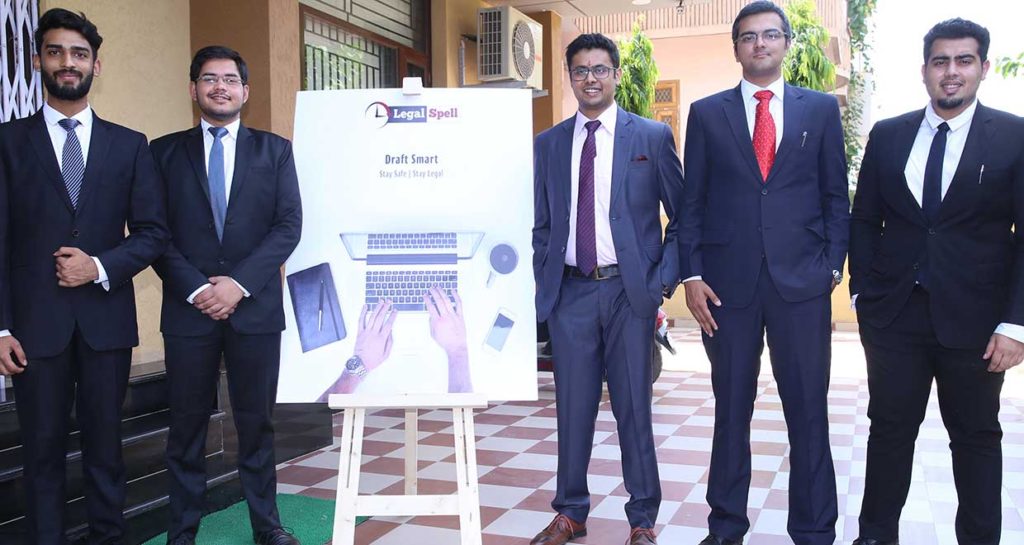
     

    varchasvi-gagal-1

    Who are behind LegalSpell?

    Driven by the pursuit of spreading awareness amongst people, LegalSpell was conceptualized by myself with the support of Mrinal Gagal (Entrepreneur) and was, thereafter, pragmatically augmented and developed by two lawyers, Jayant Malik and Arjan Sharma. Our Team Consists of Ojasvi Singh (Advocate), Meghanjali Routh (Economic Strategist), Karan Dhingra (Law Student), Namon Deep Jain (Law Student) and Hrideja Shah (Law Student).


    What were the problems faced while bringing about LegalSpell?

    Everyone believes that a good idea is all that is needed to establish a successful start-up, but take my word, that is merely the beginning. Maybe that is why there’s no copyright on the idea but on its expression.

    The number of hurdles faced over the course of time in the creation of LegalSpell are innumerable, however one of the biggest challenge was to develop an instinctive platform that could respond to all the needs and necessities of the user. The research and development invested in the creation of LegalSpell, is one of the most significant reasons why LegalSpell is one of its kind. It took us a whole year, just to research and analyze the needs and demands of the consumers.

    Also, our I.T. team along with our Legal team faced countless problems while trying to incorporate technology in creating flawless drafts. However, they did a commendable job by working day and night to create a dedicated DIY document-drafting platform.


    Why a start-up over a conventional job or an independent legal practice?

    I am and have always been passionate about law, and at the same time I have always been taught by my father that progress is the key to everything. The idea behind LegalSpell was to create something in the field of law that proves to be a definitive step towards a progressive legal culture.

    Don’t think of LegalSpell as just another product in the market. It is much more than that, it stands tall on the foundations that are built on much higher principles. As a law student, my inspiration has always been backed by the habit of need for quality and excellence, that was instilled in me in my early years of law school. As Aristotle has said “we are what we repeatedly do, and excellence, then, is not an act but a habit.”

    By creating LegalSpell, we are not only progressively catering to the needs of fellow lawyers, but are creating a legal environment where anyone and everyone has access to quality documents which helps them stay legally sound in their respective professions.

    Why serve only yourself by doing a conventional job, when you can serve the whole fraternity by making their work more productive and efficient.


    What can we expect from LegalSpell in the near future?

    This may sound a little over-confident, but we are just getting started. Not only are we planning to come up with three new services by the end of this year, but we are already working on adding a wide array of documents related to every profession, so as to cater to the legal documentation needs of as many people as possible.

    We already have a document offering of 110+ document drafts, and our goal for 2016 is to take it to 500+ documents by late December. On the top of that, our R&D team is constantly working on making LegalSpell’s drafting platform more instinctive, more responsive and even more user friendly, based on the feedbacks from our existing customers.

    If all goes as planned, LegalSpell will transform the way documents are created in India.


    Is LegalSpell intended for the Indian Markets only?

    The answer to the question whether it is “intended” only for the Indian markets won’t do justice to what the future holds for LegalSpell.

    As of now, LegalSpell is specifically focused on catering to the needs of Indian users. It is designed to respond to each and every need of the user while drafting their intended document. The documents are fashioned according to the Indian Legal System to provide utmost precision.

    However, as I mentioned earlier, that we believe in progress and we are not denying the fact that somewhere down the road, LegalSpell might include international documents under its ambit.


    Where do you see LegalSpell in the coming years?

    We believe that with the inception of LegalSpell, we have created something truly incredible. It holds the potential for an endless number of possibilities. We have and still are striving towards revolutionizing the Indian Legal System, and we won’t stop until a truly remarkable revolution is witnessed by our legal system. We take pride in the fact that we are instrumental in doing so.

    We already have plans for the coming years, however they are still in their initial phase, and right now we are working on our plans for the near future, moving forward one step at a time.

    As they say, “the sky is the limit”, but for us, we don’t believe in limits, and that is why “the sky is where we start from.”


    What would be your message to readers?

    Believe in what you do. I believe law, as a career is just not limited to litigation or corporate life. In today’s world especially when India is moving at such a fast pace towards digitization, a law student has multiple avenues to choose from. I believe that in order to sustain or to be successful in such a competitive and fast moving environment that we live in today, one needs to be innovative. We are just at the inception of innovation in the legal field and there is a long way ahead. Courses we study in our law school shape our reasoning abilities. Once we graduate only then do we realize that there has been a significant change in how our reasoning and logical abilities have been boosted. At the end of the day, the only thing that matters is one question, “Are you living your profession” and my answer to that question is YES I Am.



  • Pranit Saxena, Founder, lawyerouno.com, on being a Manager at Tata Consultancy Services

    Pranit Saxena, Founder, lawyerouno.com, on being a Manager at Tata Consultancy Services

    Pranit Saxena graduated from Symbiosis Law School in 2011. He currently works with TCS as a Manager in the BFSI-LPS sphere. He is part of the core team setting up GRC expert augmentation for an EU based clearing bank. The task involves the staffed GRC experts assisting the chief compliance officer with BFSI specific compliance across EU, APAC and Americas.

    Pranit is also the founder of lawyerouno.com. Lawyerouno is a social venture that helps clients contact and make appointments with any lawyer for free. It searches the most appropriate lawyer per the client’s needs.

     In this interview he talks to us about:

    • His experience at Symbiosis Law School.
    • Importance of higher studies for a lawyer.
    • com- where clients contact and make appointments with any lawyer for free.
    • His views on international financial situation owing to upcoming regulations and situations.

    Please introduce yourself to our readers, where did you grow up and complete your initial education? How did you decide to take up law?

    Hi, I am Pranit. I am currently working with TCS setting up their international compliance practice. My initial education was across six cities including Bathinda, Nagpur, Pithoragarh, Noida, Pune etc. in Army Public schools and Kendriya Vidhayalas owing to my dad being in the forces. After a lot shunting, I finally passed my 12th from Noida. I decided to take up law based on my discussions with my teachers in school and my penchant for getting in trouble with the system (school system i.e. repeatedly getting in trouble with the school administration) and I guess it had worked out fine till now.

    You have graduated with BBA LLB Degree from Symbiosis Law School in 2011. Tell us about your law school experience. Share some highlights from your college days that shaped you as a lawyer.

    So Symbiosis back in 2006 was unlike any other law school that you would see right now. We had a limited campus, amazing faculty and even a better ecosystem of students from various fields (symbiosis law school was in the arts and commerce campus). This heterogeneity of students gave us a very early exposure to variety of disciplines and opportunities. It was rightly called the Oxford of the East, as the student community in Pune was very strong. They were perineal college festivals, competitions that used to go on and provided me ample opportunities to explore. Symbiosis Pune had no hostel in the campus and we used to live independently in the city, which was a huge learning in itself. The teachers came from a varied background and were very supportive and encouraging. Apart from the obvious knowledge, what Symbiosis uniquely provides every student, is the independent attitude and a corporate ready culture, which most of us would learn post our law school.

    Did you do any internship? What was the work allotted to you like?

    I completed 24 weeks of internship across law firms like Barucha, fox mandal, companies like Larson & Tubro and Supreme Court attorneys like P.P. Rao. The spectrum covered was intentionally larger to experience a variety of fields within the legal industry. The work allocated was usually around the research projects in law firms, case file summarization in Supreme Court and high courts and occasional arbitration work for L&T. The work also included being a part of the client/vendor meetings with the seniors and keeping a note of issues.

    How did you manage internship with studies? How did the practical exposure compliment the theoretical knowledge imparted to you in college?

    Back then in Symbiosis, internships were only allowed during breaks, which made sure there was never and conflict and balancing the internships with the mandatory attendance requirement was never a challenge.

    The court internships really helped in enhancing the nuances of the procedural laws which helped appreciate the theoretical knowledge.

    There is a huge gap between what we study and what we implement as lawyers in practice. With that being said, all the knowledge and experience in college forms a very robust base for what we lawyers are expected to do at work.

    Do you consider pursuing higher studies after graduation? How important is it for a lawyer to go for higher studies? Were you inclined at any time, towards the civil services?

    Not really till now. Although I feel certifications in specialized fields can add a lot of value to the entire candidature for future opportunities. Higher studies in my view, is helpful if you are looking for a career shift like teaching, MBA, etc. Higher studies can also buy you time in case you are inclined towards exams like civil services, judiciary etc.

    A civil services exam is a different ball game and students must start preparation while in law school as the time period of five years is a huge opportunity in itself. No doubt it is a brilliant career choice.

    Tell us something about lawyerouno.com.

    Lawyerouno is my love-child that I started three years back, just to give something back to the community. It is a platform which connects people looking for lawyers to lawyers for free. We have lawyers from over 60 cities on the portal. We started the venture with a social outlook and we are still trying to be true to it. The basic thought, behind the idea was to provide young lawyers who want to set up their practice, an opportunity to connect with clients. We are also planning a few products on the portal to provide competitive pricing advantage to the clients.

    How difficult was it for you to connect and convince different lawyers to register on lawyerouno.com?

    As the registration for lawyers on the portal was free and the intention was to provide them with an opportunity to connect with the clients, I actually did not face any resistance from them, although the technology for some senior lawyers was a challenge, which we circumvented by assisting them with a unique live chat support feature.

    What is the international financial situation owing to upcoming regulations and situations?

    My current role in TCS involves setting up of compliance support practice for financial sector clients. The financial world ever since the 2008 crisis is in a state of flux. The regulatory authorities are driving regulatory dynamism as an instrument of change. The more they want to be in control the tougher it is getting for the companies. The Brexit will spur a marked shift for financial companies trading or headquartered in the UK. The companies are vying for the regulatory advantage and gearing up their compliance departments for various new regulations like Mifid II, EMIR, Basel 3 etc. More the regulations better it is for us! All in all it is looking good for the lawyers in the compliance sphere.

    Would you say that the work environment at an LPO is completely different from a law firm?

    Although my current profile is consulting, my initial experience with Thomson Reuters in the LPO sphere convinced me that whatever notion we as law students have about LPOs is completely unfounded. In fact if you are looking for a career in corporate as opposed to litigation, LPO is a very good option as it provides you with the right learning opportunities, international exposure and a good work life balance. Several of my colleagues are now well-placed in the field of contracts and forensics with various fortune 500 companies and start-ups. Right after my stint with TR in the Compliance department, I was involved with a start-up Mind Merchants for setting up their global compliance practice, which started with 3 people and is now already 45+, hence my experience within LPO spurred my growth as a legal professional. The stark difference between the work cultures that I see between these industries is the autonomy and independence that any year 1-3 associate gets at an early stage in their career.

    What were your objectives and plans in the preliminary years of the law school?

    As any other student in the initial years the motive was to have fun and explore the college life to the Tee. It is the only in the penultimate and the final year, that I decided to chalk out a plan for myself. The plan was to identify what I enjoyed more, hence most of my firm internships were in those years which made me sure that I did not see it as my life choice.

    Lastly, what message would you leave for our budding lawyers?

    I urge students to explore themselves as much as possible instead of following treaded path blindly and choose what is best for them as a life choice rather than a career choice. Try not to be bound by what you hear, but channelize your choices around what you experience. Five years of law school is an opportunity, so use it well. All the best!

  • Sandhya Gorthi, Founder, Sanctum, on being an entrepreneur and pursuing diverse careers

    Sandhya Gorthi, Founder, Sanctum, on being an entrepreneur and pursuing diverse careers

    Sandhya Gorthi is an alumna of NLSIU, Bangalore. She graduated in 1998 and over the course of her career has worked as a radio jockey, a freelance writer,  a soft skills trainer, a Manager of Operations, had a stint with India’s first online art auction website and at present runs Sanctum, a start-up she founded. In addition to her creative arts proclivities, she is a rescue diver, a dancer and has studied Vedanta philosophy for thirteen years now.

    In this interview she talks to us about:

    • Sanctum – the inspiration behind it and its driving principles.
    • The various roles she played in different organizations and with different kinds of work.
    • Career versatility, work ethic and travelling extensively on the job.


    What was the inspiration behind Sanctum? What work do you primarily focus on now?

    I had retail and operations experience and found I was very interested in furniture. I found a gap in the market for well priced natural wood furniture and home accessories with a vintage and international feel, and I started Sanctum. It’s my full time job and I oversee all aspects of the business although I do have a talented and empowered team.


    sandhya-gorthi-2

    What are the driving principles you believe anyone should have to start their own company?

    I’d have to say Number 1 is boundless passion. I don’t feel the need to take a ‘break’ from SANCTUM ever. That doesn’t mean it isn’t important for me to spend time away from the daily routine. It’s vital to get inspired, to keep learning, to meet new people, share ideas…

    Next would be access to some resources – entrepreneurship is risky and all companies have
    ups and downs, so planning for resources and income flow is important. Having said that, I feel having access to endless resources works negatively – then there is no hunger. Often, the most creative ideas are born of necessity and frugal resources. Contacts in the industry, industry knowledge, a mentor, are also valuable resources.


    Where do you see Sanctum headed?

    My vision has always been to create a model that is scalable to create a national and international footprint. We are country with a rich heritage of design, natural resources and talented craftsmen, surely we can produce a unique and international brand with this mix!


    What plans do you envision for yourself career-wise?

    Career wise I think I’ve come full circle. The skills I’ve picked up in law school and in my various professions have all come together for me in entrepreneurship. I hope to carry these skills forward in this line and eventually in public service as well. I owe a lot.


    What was your role in The Shop?

    I partnered with the family that owned the brand and was responsible for bringing the brand to Mumbai – from location search, refreshing the old branding, to curation and entire set up – interiors, compliances, staffing.


    Tell us how you got into soft skills training and your time as the trainer at Prana Worldwide. What would you consider most important in your lessons on soft skills?

    I found, in many of my jobs where I lead teams, that I would spend time training them on professional conduct, email etiquette, customer service and other aspects of corporate culture. That, plus my background in theatre, really helped shape the modules that I developed at Prana. I also worked with modules that had been already created and it was fun working across different professions – pharma, investment banking, hospitality…

    Prana happened right after I had my two kids (now aged 13 and 11) – so it was part time work – but I did find it a little hard to clock a full day or three full days in a row while my two highly accident prone boys unleashed themselves onto the world!

    sandhya-gorthi-3Soft skills are invaluable in creating the right impression, presenting a professional front and help in being diplomatic yet firm in multiple scenarios, whether we’re dealing with customers, vendors, government officials, industry peers or investors.

    I think the most important aspect for me has been customer feedback on how amazing the team at SANCTUM is, and how warm and welcome they feel in the store. That sets us apart for sure and has done more for the brand than any other brand building exercise we have undertaken.


    How did you get engaged as a freelance writer for the Hindustan Times? How do you choose what issues to write on?

    Actually I wrote for several publications. I’ve always loved writing in school and college and learning how to research issues in NLS made it so much easier to present well rounded articles. I’ve done a writing course, been an editor for LexSite.com, Easybuymusic.com and Planetsaffron.com/Saffronart.com. As a freelancer I’ve written on subjects that are important or of interest to me – health, spirituality (I’ve been studying Vedanta philosophy for 13 years) parenting, pets (I contributed regularly to Delhi based pet magazine), art, child sexual abuse and its legal framework, travel…

    Once I got into retail there was so much writing to do…newsletters, blog posts, product descriptions,, website, design stories, press releases, business plans…I also regularly give content relating to home decoration and home care to journalists that they use in their articles. Now, even with a larger team, I always chip in with the writing whenever I can.


    What prompted your stint as a radio jockey? What is the greatest experience you take away from your time as an RJ on Radio Mirchi?

    Like most people I love music, but also music trivia and performing. I first became a professional radio jockey on AIR FM which was the only FM station in the city. I moonlighted as the evening host while I was working at LexSite.com – it was wonderful to connect to so many people, to play music I loved, and to access AIR’s treasure trove of old rock and pop LPs.

    My second stint came with the entry of private FM into the city in 1999. I auditioned with thousands and got selected as evening drive time host of Radio Mirchi, a hectic job that I enjoyed thoroughly even through a tiring pregnancy and after the channel switched to an all Hindi format.

    I also produced other shows, trained tech and talent, and did short stints on other time slots in addition to my 4-5 hours of drive time.

    For me, the greatest lesson was how we can connect with people of different backgrounds despite cultural and language barriers. I didn’t grow up in a typical Indian home nor did I speak very good Hindi at the time, but homemakers, taxi drivers even some Bollywood celebrities would call in and chat with me because they felt I was a friend. This sounds trite but it was really humbling and a valuable life lesson for me that I practice to date.


     You also worked as a Manager of Operations with Planetsaffron. What work did you focus on?

    Planetsaffron was a wonderful experience too. At the time there were three sites – Saffronart, of course, Saffronsoul – which was about holistic healing and Saffronstyle – which was high end fashion. I came on board as head of content and technology – at Saffronart we worked on creating the first online art auction module, for Saffronsoul I was helping two Ayurvedic doctors write a book, and for Saffronstyle we had Mehr Jessia and Tina Tahiliani curating style shoots. It was a lot of work but fun!

    Soon however, I moved more into operations – overseeing the teams, heading the team that took exhibitions of Indian contemporary art all over the world. It was challenging but there was so much learning, so much that we were doing new, so stimulating!


    You were able to travel extensively for the work you did with Planetsaffron. What do you think are the perks and drawbacks of having a job that requires a lot of travelling and how should one deal with it?

    I did. We had exhibitions in New York, LA (9/11 happened during that trip), Hong Kong, London was to follow…the perks are many – you get to see places you might otherwise not have had the opportunity to visit, you get to work with people from different cultures, handle international clients, learn the ins and outs of the logistics, customs, negotiating cross border contracts and generally see how business is done internationally.

    The flip side was that I was just never home. I often worked late into the night or all night, I’d rush home with an hour to spare before my flight and the travel itself was tiring because you’d just hit the ground running when you got back. I don’t think I balanced my work and personal life very well those days. If I had to do it over I would probably have prioritised the latter more. I’ve learnt that no one is indispensible in an organization.

    I travel a lot for work now too, but I do it more sensibly…most of the time (old habits).


    How did you get a job with India’s first online art auction website? How transformative was that experience in your life.

    I was introduced to Dinesh and Minal Vazirani and my profile matched what they were looking for at the time. My legal background helped me research and create the broad framework for the auction – in terms of rules and functionality. My background in writing, and editing meant that I could work with art school graduates to write artist profiles and artwork descriptions. And my technology background meant that I could explain concepts and functionality to the tech team and understand what the technology of the time could or could not do. My theatre and radio background helped me interact with art patrons I suppose (wink)!

    It was a huge learning, I made a lot of mistakes, but it also showed me what a good team leader ought to be and how organizations should be run.


    What was your first job? How has that experience impacted you work ethic thereafter?

    My first job was actually in the theatre and media. I did plays, voice overs for ads in 6 languages, hosted a few shows on TV and sang in the musical Evita. Not just in the media, but from changing jobs so many times, I began to realize the things I valued above all else…integrity, a strong vision that everyone was aligned towards, respect for all team members, a culture of learning and growing, and the importance of a space that allowed the sharing of ideas and for lots of laughter. When I started my own venture I was determined, and I think have been quite successful in, implementing these values.


    How did your tryst with creative arts begin?

    I was a born performer! I used to rally the kids in the neighbourhood to perform plays, dances, songs, dress up…no matter how unwilling they were. I wrote, danced, elocuted, sang, acted and even painted in school. Even today I make sure I’m learning something creative always and my kids and I sing, dance and have these weird (and scary) dress up sessions together.


    What would you say is your greatest strength and how would you say that has served you in terms of career versatility.

    I think the ability to keep an open mind – I believe that ageing is only rigidity of the mind – I have friends who are in their 80s and in their teens and of different ethnicities and backgrounds. I feel I learn from all of them and we share ideas and laughter freely. I tell myself the minute I start wanting things MY way or a particular way and no other, that’s growing old, that’s the beginning of a slow death.

    There are also some values you know are universal and you have to stand up for them and fight for them for yourself and for others who are not able to speak up for themselves. I have made myself quite unpopular on several occasions because of this but I’ve never had a moment’s regret.


    Did you always plan on trying out so many creative outlets or was each change a spontaneous change?

    Good God no! I’m a middle class south Indian girl! But I think you have to be true to yourself. Find your calling. Some of us have more than one…in the end it all comes together. The changes weren’t impulsive. I’ve responded to a strong calling, and have had compelling reasons to change. Maybe things come your way if you’re sending out the correct signals.


    As for trying new things, what would be your suggestions for our readers?

    JUST DO IT! There’s no point telling yourself you’ll try it when the time is right, or once you’ve reached a particular place. If you have a goal or passion, do the research, and jump right in. You have to be prepared to put in the sweat and it won’t always be fun. But keep your goal in sight always and work towards it.

    But I would add a rider that it’s important to first analyse your personality carefully. See if this is really a calling or if it just seems attractive because it’s different from what you’re currently doing. Know if you have the nerves and acumen for the dream you want to fulfil. Some things can always be fun dreams or hobbies too… but you’ll never know for sure if you never even get your feet wet.

  • Kanishk Agarwal, Founder, CriTaxCorp on starting out a criminal law practice and legal entrepreneurship

    Kanishk Agarwal, Founder, CriTaxCorp on starting out a criminal law practice and legal entrepreneurship

    Kanishk Agarwal studied at Vivekananda Institute of Professional Studies (VIPS), New Delhi and graduated in the year 2009. He then began his career under Mr. Ashok Batra, and subsequently moved on to PricewaterhouseCoopers India. However, his interest in Criminal Law drove him to establish his own firm, CriTaxCorp. Kanishk is also the creator of the Indian Bare Acts Pack app.

    In this interview, he discusses

    • His career trajectory and the reasons for starting his own firm
    • The development story of the Indian Bare Acts Pack app
    • How to enter a practice of one’s choice for students
    • How to maintain a work-life balance and why it is imperative


    How would you like to introduce yourself to our readers?

    I think the term ‘legapreneur‘ best describes me, which basically is ‘legal entrepreneur’, because I like exploring entrepreneurial qualities in the legal industry. Post my graduation I wanted to work in Criminal law, but instead started working with Service Tax law expert Mr. Ashok Batra who is a Chartered Accountant and the author of books on the subject. What drove me into this field was a practical family decision as my father is a Chartered Accountant and he wanted me to follow his lead in taxation laws. I worked with one of the ‘Big 4’ consulting firms in the world, Pricewaterhouse Coopers for about 18 months, but my love for Criminal law never faded and so and after gaining substantial experience in Taxation law, I started working under the flagship of Senior Advocate Mr. Ramesh Gupta (Delhi High Court) and thereafter I worked in the chamber of Mr. Subhash Gulati. Finally I started my own practice in 2013 by the name of CriTaxCorp after I believed that I had gained enough experience to set up my own law firm. The name of the law firm was put up very strategically to cover the three fields of law I gained my exposure in i.e. Criminal, Taxation and Corporate.


    What would you like to share with our readers about your time spent at VIPS both within and beyond the classroom? How did the city itself play a part in your legal education?

    Looking back, college times seems so distant yet I can remember it vividly. I have learned a lot from my college life, as I was a very shy boy in my school days, and so got a lot of exposure in my college life. I had always been an average student but was an active volunteer in organizing moots, debates, college events and the best was, organizing the college trip for three consecutive years where I had the nightmare of handling 300 law students. However, the exposure was surely a blessing in disguise. Being a Delhiite was always an advantage, but I never got a change from the city to face different cultures. However Delhi has given me great exposure from internships to working under great members of the senior legal fraternity.


    How did your interactions with your peers influence your growth as a law student and a general individual? Did networking and peer mentorship play a big part in defining your student identity?

    I had a good relationship with a few of my seniors and we were a combination of notorious and sincere pupils.  I still remember asking for help with books or notes late at night, or for any other help regarding sorting out a tiff with any student or taking suggestions for my internship plans, and they were always very helpful and I definitely got great help. Once they graduated from college, I got to know about their experiences in independent practices or in law firms and they helped me reach where I am today, owning a firm myself. I always feel pleasure in helping juniors from my college who are worthy by providing them with internships under my tutelage and exposure to a variety of laws.


    During your time spent there, what, if any, extra-curricular or co-curricular activities did you take up? How did the same affect your learning experience and prepare you for the legal sector?

    It is true, college life is a golden period in one’s life. I was always very interactive with teachers and was an active participant in college activities like dancing, organising fests, college trips etc. Being involved in extra-curricular activities really helped me at large because I learned the tricks of management, organising, diplomacy and living up to my responsibilities. It really sharpened my skills to understand human behaviour and their reactions to different things, which a good lawyer must know, as reading a client or witness is half of the lawyer’s work.


    What would you describe your first experience as an associate at A.K. Batra as, and how did the same affect your career trajectory?

    I opted for Service Tax mainly on account of my father being a Chartered Accountant. It was a practical decision made by me to work with Mr. A.K Batra, and it was a great learning process as he provides a lot of exposure to the lawyers and CA’s working with him. He is still a great mentor and I know I can reach out to him whenever I hit the wall in Service Tax query.


    What prompted your shift to PwC India in 2010?

    Anyone and everyone who works in the field of Taxation law has this desire to work with a ‘Big 4’ firm, be it a lawyer or a CA. I am glad I took the step to join PwC as it exposed to me how the real big corporates work, their billing structure, their culture etc. I left PwC because of my love for Criminal law and since I wanted to make an identity of my own. I met some great people who are partners in the firm and still encourage me towards my achievements. It was a good learning experience.


    As the founder of CriTaxCorp, what were the initial challenges you faced as a legal start up in India? What was your competing strategy for taking on larger firms?

    CriTaxCorp started with a rough patch, as we worked towards targeting different sectors where nobody had worked. The “Aha!” moment was when I got a client form the Bitcoin (the digital currency) industry and I got a chance to understand the block chain of digital industry. Thereafter I did some exciting work in online poker regulations, logistic companies, start-up ecosystem etc., and getting into these fields really triggered me to go forward.


    What would you define as your firm’s unique selling proposition?

    While dealing with a matter in Criminal, Taxation or Corporate laws, we combine the knowledge from all major verticals of law. Providing exactly what the client requires is one of our mottos, and we believe in understanding the business of our client more than the client does so that we can deliver our best. This also sharpen our skills to dig deep and helps us understand the core issues of any industry. CriTaxCorp believe in one principle that a professional grows when his client grows.


    kanishk-agarwal-2

    Among your other accolades, what inspired the creation of Indian Bare Acts Pack? What were the challenges faced in creating and establishing the same?

    When I got to know about certain Bare Act Apps available for lawyers I was really amused and amazed at how technology is easing the pain of people at large. However, when I downloaded certain existing legal Bare Acts Apps on one of my senior’s tablet, I got a good thrashing from him as they were not updated since 2008 and reading outdated law is the last thing a lawyer wants to do. So, it got me thinking and I wanted to do something for the legal fraternity, as it has taught me so much. So I decided to put my money where my thought was and I ideated ‘Indian Bare Acts Pack’ mobile application so as to help lawyers. The app has 4 major Acts which are like the bible for any lawyer. CrPC, IPC, Evidence Act and CPC and I also included Service Tax law as I used to work in that field. Making the app was not an easy task, as I had to review the designs, see the working of the app, and pay for doing work. I created around 2800 word files which were formatted, indented and checked word by word by me. I was really overwhelmed when I was informed that the Delhi High Court Bar Association would like to unveil this app in a function which was organised for judges of the Supreme Court and High Courts.

    What just started as a gesture to give back to the legal fraternity has turned out to be the best app in the Bare Acts category reaching to nearly 1,00,000 lawyers. On the request and review of many lawyers, judges, CA’s and law students we are taking it forward and will come up with an updated version with some great features which will be of use to everyone, from law students to respected judges.

    The readers may also like our Facebook page “Indian Bare Acts Pack” to be updated about new features and updates on the app.

    Lastly, yes there were many sleepless nights spent in making this app. I remember that when I got the news that my App was going to be launched, by DHCBA in a function organised to facilitate High Court and Supreme Court Judges, in a matter of 2 days, in those two nights I made nearly 2000+ word files and coordinated with the developer to complete the App on time. It was devastating but it was all worth it!


    What are your views on the current generation of law students and would you say the approach to education has changed since your college days?

    I feel that this generation is full of talent and they are impulsive as well. (Laughingly)As I belong to this generation as well, I will say that this generation is not scared of hard work but they expect prompt success. They must understand that the first five years after graduation could be difficult and full of struggle but once when they get polished they will eventually grow and succeed. One should understand that it is not required to run behind alluring packages. Once they gain all practical knowledge and have a command over the law, money will chase them automatically. I also believe that year by year the concept of a teacher and pupil is also fading, which is something I really hold dear to my heart.


    To our younger audience looking to get into Corporate or Taxation oriented fields, what advice would you give them for breaking into the field?

    The best thing to do is opt for as many internships as they can to get a better understanding and gain practical knowledge, Firstly, they should understand the whole concept of a subject matter, for eg. Taxation is a subject which is either really liked or totally disliked by lawyers, so one needs to understand and explore to see if they have interest in it or not. Also, one should pick one taxation subject at a time because trying to understand all of them in internship period will only confuse them. Secondly, as for Corporate, it is very wide field which ranges from drafting of agreements to regulatory compliances to transaction advisory. It is a field which requires round-the-clock–work, with alluring packages, so one need to understand exactly what they want with respect to work-life balance or money. Corporate law firms have a deadline bomb which is always ticking and the stakes being high, one cannot afford to miss any deadline. I would like to end this question by saying that legal practices are like delicacies you need to get the taste of each of them until you know which one suits your taste buds.


    In the midst of founding a law firm and creating apps for the legal community, how much of your personal life have you had to compromise on, if at all?

    Earlier it was hectic and as I am a workaholic, I have worked round–the-clock on my application. Whenever I get time I read articles for better understanding of technology, but I have adapted all this as a hobby and so it is not a burden. I believe that if things are planned and one knows how to manage time, they can easily coordinate their personal and professional life. I always go out with my family and friends once in two weeks, otherwise what is the fun of being the founder of your own firm and earning well if you can’t have your own time out and spend what you earn. However, one needs to prioritize their practice of law, interest and goal with their time in order to follow a focussed path to their success. I am still experimenting to know the ultimate path, but that is the fun, provided you balance the fun with focus, risk and passion.


    Finally, do you have any other advice for our readers, most of whom are college students?

    I would suggest that they do as many internships as they can in various fields and they must always grind and hustle to get more and more work from their seniors. The exposure they get in internships will help them see the career path they want to choose. Also, I would suggest that since everyone is so engrossed in social media and their mobiles these days, every student should like some of the law news Facebook pages and read some of the important news or judgments that they post. I am trying to do something to solve this for our fellow law students though my app, so let’s see. I would suggest that every lawyer must watch American television series such as Suits, Boston Legal or any other series that relates to law, as I myself have learned a lot from these and imbibed some of the things I have learnt from these shows into my practice.

    They must strengthen their core subjects such as CPC, CrPC, IPC, Evidence Act etc. as these will be used at all times in your practice. Lastly, it is the best time of their life so they should have fun, rough it out and learn from their mistakes.


    In your opinion, what is the role of technology in law and how can students best utilise technology without looking at it as a substitute for hard work?

    Being a technology enthusiast and founder of a technology based start-up I believe that everyone is embracing technology in one form or another. Technology companies such as manupatra or indiankanoon.com has eased the life of lawyers when it comes to browsing through judgments relevant to a case. I have received numerous mails from law students and court staff saying that my application has really helped them many times. Recently, one of the biggest law firms in the US named Baker & Hostetler licensed a software from IBM which is an artificial intelligence software to help law firms in bankruptcy and due diligence, so you can imagine how technology is playing a role in law firms. Also, being a legapreneur I get intrigued by mushrooming legal start-ups these days. To sum it up, technology is playing a significant role in our life and increasingly being adapted in our profession, so one should start embracing it.


    What is your view on these legal start-ups and will it create a new area of law for law students to look into?

    Yes, the start-up ecosystem is witnessing various new law related start-ups and some of them have got funding upto an amount of USD $500,000. However, the start-up eco system in general is witnessing a downtrend with investment/funding transaction dropping nearly 30-50% from last year. I hope all these new legal start-ups pave their way into the start-up ecosystem and a new unicorn is born in law start-ups. (Laughingly) I hope IBAP makes its name too!!

    As for start-ups creating a new line for law students, it purely depends on the interests of the law student and whether he/she gets intrigued by the vision of that start-up or not, because one setback is that start-ups mushrooms rapidly but most of them close rapidly as well, but yes it’s a new era of legal development and opportunities for upcoming law students.