Tag: INTERNATIONAL LAWYER

  • “I’ve always believed that being a lawyer is nothing less than a superpower- it gives us the tools to understand, question, and change things that most people simply have to accept.” – Shreya Chaudhary, Associate Attorney at Maune Raichle Hartley French & Mudd, LLC.

    “I’ve always believed that being a lawyer is nothing less than a superpower- it gives us the tools to understand, question, and change things that most people simply have to accept.” – Shreya Chaudhary, Associate Attorney at Maune Raichle Hartley French & Mudd, LLC.

    This interview has been published by Anshi Mudgal and The SuperLawyer Team

    As a dual-qualified attorney in California and India, what first sparked your interest in the legal profession, and how did you chart your path in this field?

    I come from a family of lawyers, so this profession was all I knew growing up. I didn’t realize the impact of my dad’s work at the time but saw how his efforts positively affected his clients. I remember that on many occasions, they wouldn’t have enough money for his full fees but would bring him part of their seasonal harvest. Other than that, it came to me more naturally than most people—it never felt like work, and I was so excited to go to law school and later into litigation. Isn’t it a privilege to be in a position to make a difference in people’s lives and also get paid for it?

    For California, I never had plans to move, but I absolutely fell in love with the state and decided to get licensed in the one thing I knew—law!

    You recently passed the California Bar Exam on your first attempt. What preparation strategies proved most effective for you, and what advice would you offer to others aspiring to clear it? How has this qualification expanded your professional scope?

    As for preparation, I took an online bar prep course called Themis. Going to Berkeley Law for my LLM definitely helped, as it put me among the smartest people who have a reputation for passing this difficult exam on their first attempt. Also, it’s crucial to know one’s learning style. I really appreciate learning from my own handwriting, so I wrote everything down even though my bar prep tool didn’t ask me to. I also know that I panic toward the end, so I developed my own timeline, which was different from what the bar prep suggested. I took a study leave from work and had just one goal for those 12 weeks. I ate, slept, meditated, everything centered around my bar prep. Honestly, I loved the drive of taking on something so challenging and had fun with it. There’s no one-size-fits-all way to go about this, and I’m happy to answer specific questions for whoever wants to take this exam.

    As my interest is in litigation-related work, I wouldn’t say it expanded my scope; rather, it created any scope that exists, because one cannot take even a tiny step in litigation without a license to practice.

    Moving from legal practice in India to building a career in the United States must have involved navigating many differences. What were the key hurdles you faced in adapting to the U.S. legal system, and how did you overcome them?

    Oh, so many! I did not have anyone from my family or extended family who was a U.S. lawyer. From choosing law school to taking the bar, applying for internships, jobs, and visas—every step presented hurdles, or should I say, kept life interesting, as my friends like to put it. The biggest one for me is the visa, with, dare I say, the state of affairs right now. Also, finding a job in the U.S. is so different from India. In India, we don’t network enough, which I had to teach myself after moving here. I want to give credit to Berkeley, as they had a whole program to train international lawyers to get acquainted not just with the U.S. legal system but also with its unique job market. I didn’t expect it, but my Indian work experience was valued by U.S. employers as I think the two things, we have in common with them is that they value the “grind,” which they could supposedly see in my resume, and our common law system—and that’s probably why I was a preferred candidate for many jobs I applied to before joining the Office of the District Attorney, Alameda County.

    Work environments in both countries are completely different as well. There are different work ethics, professional relationships, sense of humor, and protocols. However, one funny realization is that lawyers everywhere are more or less the same kind of people so it was still a familiar territory. 

    You have served as an editorial board member for leading legal publications and also worked as a law clerk. How did these roles deepen your understanding of the U.S. legal system and prepare you for your current role?

    U.S. law school journals, and also Indian ones- stimulate a legal mind well. It’s so good to become aware of different ideas, methodologies, and international legal issues, and I think my favorite part of being in a journal was building community with like-minded people. I was in the Ecology Law Quarterly with other environmental law nerds and had some great academic and fun discussions in the process.

    My clerkship with the District Attorney’s Office was my first U.S. job, which makes it special to me. I feel fortunate to have worked for a highly reputed government office in the Consumer, Environment, and Special Litigations Department. It was a fast-paced environment, and there couldn’t have been a better way to learn U.S. law and see it in action than that. I worked on civil procedure assignments, evidence code, and criminal code—all at once. One of my first assignments at the DA’s Office involved prosecuting a corporation after a factory fire that significantly affected air quality for people in that vicinity, given California’s high ambient air quality standards. These assignments strengthened my understanding of environmental enforcement and also informed my approach to research, brief-writing, and attention to detail in my current role.

    During your LL.M. at UC Berkeley, you specialized in Energy Law and Clean Technology while contributing to journals like the Berkeley Technology Law Journal and Ecology Law Quarterly. How did these academic and editorial experiences influence your perspective on the intersection of law, technology, and environmental sustainability?

    A topic that’s very close to my heart is climate change. We treat it as “important” but not “urgent,” which troubles both my personal and legal mind. At Berkeley Law, I enrolled in courses such as Environment and Energy Law, subscribed to technology- and environment-related journals, and participated in clean energy student groups to engage with these issues and understand the work of scholars in the field. Being surrounded by like-minded people strengthened my commitment and deepened my understanding of how cleaner technologies are urgently needed on a global scale. The intersection of use of environmental resources and law is particularly interesting to contrast between the US, Europe and Indian laws. We have many vulnerable communities who get affected first by the impacts of degrading environment and climate crisis, and there is a lot of work that remains to be done to protect them. 

    In your current role, you work to support mesothelioma victims and their families. What drew you to this area of law, and how do you balance the legal complexities with the human and emotional dimensions of these cases?

    I honestly don’t know how to answer this question. From my practice in the Allahabad High court, Lucknow, to here in California, I have struggled with getting too attached to the outcome and client’s problems. I don’t know if that makes me a better or a worse lawyer. But I try to overcome that by something my senior told me early on during my India days that “you play a very small role in the grand scheme of things.” I owe my client to do my best work for their entrustment in me as their lawyer but I sure cannot change their destiny. Very recently, a client of mine passed away from mesothelioma (cancer) before the case went to trial which happens more often than not in this field. I witnessed his struggle through the deposition and eventually he just couldn’t make it to the end of the case. It breaks my heart but if I have done my role well, then it becomes easier to strike that balance. This also keeps me on my toes to put in the hard-work. 

    What advice would you give to students aiming for an international legal career, and how can they stay ahead of global legal developments?

    Just a few simple things. First, one needs to figure out if they want to study here, do an LLM or a JD, or directly take the California Bar (the only U.S. bar open to foreign attorneys without coursework). My advice would be to study here first, as it helps one get acquainted with the culture and decide whether it’s the right fit. Moreover, getting a job is nearly impossible without a strong network, which a renowned university greatly helps with. A warning—it is very expensive. I chose Berkeley over other good colleges that offered me scholarships because it was one of my dream schools, but one should always rank priorities according to their circumstances. Advance research on scholarships and on-campus jobs could help. I had an on-campus job that helped me a lot financially during school. It’s important to work smart—so if the plan is to immigrate to a new country, students should also consider Canada, Singapore, or the UK (the more welcoming ones in today’s environment). 

    One thing I would have done differently is to have a better long-term plan at least a year in advance of actually applying. I didn’t understand at the time that this decision would completely reshape my life as I know it. But I would love to help anyone who has doubts about the process or wants to learn from my experiences—feel free to reach out to me on LinkedIn.

    With the demands of your profession, how do you maintain balance in your personal pursuits, and what is your vision for the future of your practice?

    The litigation work culture in the US is similar to India as the work never stops from the inception of the case till the verdict. One can easily preoccupy themselves as there is always so much to do. However, in my experience, that sometimes leads to isolation, and when you are thousands of miles away from family, building a community becomes equally important. When I’m not working, I spend time with my friends, which is my number one priority as rejuvenated weekends significantly boost my motivation through the week. We often travel and hike in nature, as California is truly blessed with pleasant weather throughout the year. Of course, there are weekends that turn into working ones when the need arises like meeting a court deadline on Monday but I don’t mind that because I genuinely love what I do and take pride in showing up for my clients who are unfortunately struggling to live.

    I’ve always believed that being a lawyer is nothing less than a superpower- it gives us the tools to understand, question, and change things that most people simply have to accept. Right now, my focus is on mastering California law and becoming as confident in this system as I was in India. The process of adapting to a new legal culture has been challenging but also deeply rewarding—it’s pushed me to grow, think differently, and refine my craft. Whatever I’ve gained intellectually, I’d definitely want to leverage it to contribute to the Indian legal landscape in different ways, for eg.  I am working on a research paper on a social legal challenge that India faces; Grow as a multi-jurisdictional professional, and have fun along the way.

    Get in touch with Shreya Chaudhary –

  • What an Engineering Mind Brings to the Legal World: Navigating Law in the U.S., EU & Beyond – Punit Gaur, Corporate Legal Advisor.

    What an Engineering Mind Brings to the Legal World: Navigating Law in the U.S., EU & Beyond – Punit Gaur, Corporate Legal Advisor.

    This interview has been published by Anshi Mudgal and The SuperLawyer Team

    What inspired your shift from an engineering background to a career in law? How has your technical foundation influenced your legal practice, particularly in areas like technology contracts or regulatory compliance?

    Since my B.tech college days I always believed in learning new things whenever possible.  So, I never considered it as a shift but saw it as upskilling myself through the field of law and with time utilizing my learning from both professional degrees to provide good quality services to my clients. Because of my tech foundation I built strong problem-solving skills, learned to look at something from multiple perspectives. Also, it helps me to bridge the legal and tech communication in a better manner. I am able to ask the right questions from clients to understand their requirements. This helps me to incorporate applicable clauses according to their situation.

    For example, while working with an Australia based software company on a data privacy policy, I noticed they struggled to explain their backend structure in legal terms. Because of my engineering background, I could quickly grasp what their system actually did—how they stored, transferred, and processed user data. I translated that into GDPR-compliant language for their policy. It made the process smoother, faster, and more accurate.

    In the early stages of your legal career, you worked with a range of national and international law firms. What were some formative experiences during this time that helped deepen your understanding of the law and shape your current practice?

    Since my internship days, I got to work in so many different areas of law and I always excitedly said yes! On the litigation side I have worked on a range of cases like cheque dishonour, land acquisition, land compensation cases, high stake arbitrations, industrial disputes, commercial suits, easement cases against Highway authorities, criminal matters, etc. on the Indian side. Also, I worked on employment law cases, probate cases, and personal injury cases in the USA.

    On the corporate law side I have worked on international M&A projects, due diligence work, real estate compliance in USA and India, SaaS contracts, etc.

    The immense experience and learnings that I have received from everyone I have interacted with regarding my work is exceptional. Some taught me how to formulate arguments before district court and how to do it differently before high court, from international clients/firms I understood how legal expectations differ globally, building habit of listening more of what clients want to say to gain clarity and build structure of our thought before we I start working on any legal project. This becomes very important if you have to deliver something that aligns with the client’s purpose.

    A good example that I can think of is about my recent project with a Florida based law firm for drafting employment handbooks. One key learning I took from that experience—and now apply in my own legal practice—is the importance of proactive legal layering. I began building handbooks with layered clauses—clearly identifying what applies universally, what’s state-specific, and where updates may be required as laws evolve. Now, whether I am drafting policies, contracts, or compliance documents, I adopt this layered structure. It not only ensures accuracy but helps clients easily understand and comply with their obligations based on where they operate. This approach also makes future updates more efficient and audit-readiness much stronger. 

    You currently advise businesses across diverse jurisdictions, including the USA, EU, Singapore, and Australia. What are some of the key legal and regulatory differences you encounter, and how do you effectively manage the complexities of cross-border compliance?

    Each jurisdiction has unique laws, cultural considerations, and enforcement mechanisms, requiring tailored strategies. Like in the US, employment is largely at-will but takes all kinds of discrimination very seriously and we have to add a detailed clause for it to cover all kinds of discrimination. 

    In the EU, GDPR is one of the strictest data protection regimes and requires through check in client’s operations to decide whether GDPR applies or not and then draft data protection policy accordingly.

    Singapore is known for its business-friendly environment but has strict anti-money laundering regulations.

    It’s always something new that comes up so you have to stay updated with the laws of the country your client is operating in. For this, I stay connected with local legal experts so I get timely updates and advice if needed for a case. For cross-border legal compliance work, it is better to perform risk assessments to prioritize high risk areas like data privacy in EU, anti-corruption in USA, anti-money laundering law in Singapore etc.

    What are some of the most common pitfalls legal professionals face when negotiating and drafting high-stakes agreements such as SaaS contracts, NDAs, and Master Service Agreements? What strategies do you use to mitigate these risks?

    SaaS, NDA, MSA, are critical to business operations governing IP, service delivery, confidentiality, liability, etc. Errors can lead to financial losses, legal disputes, operations disruptions.

    Pitfall 1: ambiguous terms. For example, not defining scope of services in MSA or not clarifying termination procedure. This can allow a party to avoid its obligations using the cover of ambiguous terms of contract.

    Pitfall 2: neglecting jurisdiction specific regulations such as GDPR in SaaS contracts, minimum wages as per region to be considered before drafting employment contract, which may lead to hefty fines and an invalid contract in some jurisdictions.

    Pitfall 3: not clarifying end goals/purpose of client for drafting this agreement. Client’s intention was to have an easy exit strategy but got stuck for years in litigation due to detailed and inflexible termination clauses. It is very important to understand a client’s business goals before you start drafting any legal document be it a petition or a MSA or any other contract.

    Pitfall 4: inadequate risk allocation- liability for data breaches in SaaS contract, indemnification clauses in MSA, if not specified can expose parties to unforeseen liabilities and long running litigation cases.

    Strategies to mitigate risks:

    1.    Clarity in drafting- using clear, simple and concise language, define the key terms explicitly. I also use schedules and appendices for technical details for SaaS contracts and MSAs.

    2.    Due diligence for regulatory compliance- a thorough due diligence before drafting any contract would be helpful in anticipating risks of non-compliance. Go through laws, rules, regulations, standing orders, or whatever is applicable for your scenario to avoid such risks.

    3.    Draft practical terms: understand the client’s goals and incorporate clauses according to it. For example, in some situations it requires detailed procedure for termination and in some a brief clause would work, you have to use your experience and instincts combined with client’s goals.

    4.    Balance risk allocation: use scenario planning to reduce probability of default by a party and anticipate risk like service failures and data breaches. Definitely have clear indemnification clauses applicable to the scenario. This can only be achieved when you get clarity on what are business goals and purpose to enter such agreements by client. 

    Having incorporated over 10 businesses in the U.S., how do you ensure compliance with federal, state, and local regulations throughout the entity formation process?

    Incorporating so many businesses in the USA has taught me that compliance with all 3 levels of regulations is critical. After I incorporated my first few companies, I prepared a checklist which I follow regularly.

    First and foremost is to understand why the client wants to incorporate in a specific state. Whether it is easy taxation, simple compliance, less fees, quick turnaround, etc.

    Second is to figure out which entity would be the best for the client. Whether an LLC or C-Corp or S-Corp. In some situations, clients are fixed on setting up a C-Corp when clearly it would be better for their business to be an LLC. Have a good discussion with the client so that you convey all relevant points and the client can make an informed decision.

    Do your due diligence once you have answers to 1 and 2nd question. This is important to figure out all compliance documents you might require before incorporating a company. Sometimes business purposes require additional permits or zoning approvals which become relevant to get before you start operating your business.

    Once we have answers to the above 3 questions then I get ready to focus on drafting documents required for the state of incorporation like Articles of incorporation, certificate of incorporation, BOIR (Beneficial ownership information report), EIN SS-4 form, etc.

    Once these documents are ready, we file them before the state either online or by sending them physically through mail or fax.

    Having dealt with various arbitration matters over the years, what do you believe are the advantages or disadvantages of arbitration to traditional court litigation and could you share one of the most interesting arbitrations matters you’ve dealt with?

    In my experience, arbitration offers significant advantages over traditional litigation, especially in commercial disputes. It is faster, more private and allows parties to choose arbitrators with subject matter expertise, this is invaluable in technical or high value matters.

    However, it has its own challenges. Cost can escalate with institutional arbitration; limited appeal rights mean poor awards can’t be easily challenged even if flawed. Another issue is cross border disputes, for example enforcement of a foreign award does become a legal battle of its own, which takes years to decide.

    One of the interesting cases I have dealt with was an arbitration worth 9 cr between a govt institution and a company. The main issue raised by the company was that the govt contracts having unilateral arbitration clauses are invalid. However, after we submitted our evidence and read the arbitration clause along with

    What advice would you give to young professionals aspiring to build a career in international law? Are there specific skills, habits, or resources you believe are crucial for staying current in such a dynamic field?

    For someone like me who has been interested in international legal work since college days, I would recommend giving 2-3 hours daily to build a strong foundation of law and legal work for a jurisdiction you are interested to work in by focusing on research, reading civil/criminal codes, legal templates, etc. There are numerous opportunities in this field, once you start researching and reading more about different areas of law, try finding areas which intrigues you the most like employment law, data privacy, patent law, etc. and then figure out what kind of work is to be done there.

    A lawyer interested in this field must build legal research skills, negotiation skills, strong hold on your focus law, have an open mind, problem solving nature, commercial awareness, be humble and adaptable to fast changing laws.

    If someone is interested to work in this field then certain critical habits are also required like being globally minded i.e., having cultural sensitivity and adaptability to diverse perspective, ready for life long learnings, be comfortable to working odd hours since countries like US, Europe are like 9-12 hours behind so having a quick turnaround time in such odd hours do give you the edge of connecting with right people at right time specially to build trust across geographies, have high ethical standards and respect professional codes of conduct, learn to respect time because it is highly valued in international community. Just an addition though not necessary is to learn French or Spanish if you are interested, it does help if you plan for Europe.

    Regarding resources, join international legal associations like IBA, ICC, YIAG, SIAC, etc. attend various virtual webinars for your topic of interest. You can also follow certain organizations WIPO, UNICTRAL, ILO, etc. because they have provided drafts of laws which most countries follow so there is uniformity and helps build your legal foundation which can be used globally.

    Understand the role of AI but don’t rely on it completely to spoon feed you everything. It will reduce your credibility in the market. It is a friend if you use it right and might become your biggest competitor in the coming future.

    All I can say is persevere and you will reach your goals to work with international clients and law firms.

     Working in a high-stakes, fast-paced legal environment can be demanding. How do you maintain your personal well-being, and what practices help you unwind and recharge outside of work?

    What I can say is having mental clarity about working long hours regularly on odd times and being prepared for it. Consider it as your one-person company, you are working for yourself so define how many hours you are willing to work in a week for your company and be disciplined with it. Though there are days you feel low, drained or lost. So, it is important to have 1-2 persons with positive vibes around you. I meditate regularly (try Silva Method) and try to do at least 3-4 workouts with 1 day focusing on lower back and upper body posture, because you will be sitting for long hours and it definitely helps. Sit with your family, have at least 1 meal together with everyone. Once a week I go to a temple for my spiritual peace and support.

    Other than that I like going on tour to different monuments in Delhi to learn its history and romanticize more with the city I belong to.

    Get in touch with Punit Gaur –

  • “What particularly appeals to me about IP law is that it is a field where creativity and innovation are protected. It’s fulfilling to contribute to the growth of creative endeavors and ensure that these efforts are legally protected.” – Surabhi Pathak, Intellectual Property Manager at Cat and Pillar, Singapore.

    “What particularly appeals to me about IP law is that it is a field where creativity and innovation are protected. It’s fulfilling to contribute to the growth of creative endeavors and ensure that these efforts are legally protected.” – Surabhi Pathak, Intellectual Property Manager at Cat and Pillar, Singapore.

    This interview has been published by Anshi Mudgal and The SuperLawyer Team

    After completing your law degree, you pursued an LLM in Intellectual Property & Technology Law from the National University of Singapore. What motivated you to specialize in this field, and what aspects of IP law drew you to it specifically?

    During my undergraduate studies, I had the opportunity to intern in various areas of law. It was in my fourth year that I opted for Intellectual Property (IP) law as a specialization and completed my first IP internship at Remfry & Sagar. I thoroughly enjoyed the experience and realized that IP law was where my passion lay, leading me to specialize in it for my career.

    What particularly appeals to me about IP law is that it is a field where creativity and innovation are protected. I find it rewarding to be part of the process that helps individuals and businesses build and safeguard their brands. It’s fulfilling to contribute to the growth of creative endeavors and ensure that these efforts are legally protected, allowing them to thrive in a competitive market.

    Could you share your experience pursuing your specialization in Intellectual Property & Technology Law at the National University of Singapore? What advice would you give to students wishing to pursue a master’s degree? Additionally, what was the process like for you in applying and gaining admission to the university?

    I had a highly rewarding experience specializing in Intellectual Property & Technology Law at the National University of Singapore (NUS). The program provided me with invaluable opportunities to develop key skills, particularly in research paper writing, where I saw significant improvement.

    NUS also offered intensive courses taught by visiting faculty from prestigious institutions. I was fortunate to learn not only from the esteemed NUS professors but also from one professor from Harvard Law School and another from an esteemed Italian university, which was a truly enriching experience. One module that particularly stood out to me was The Fulfilled Life and the Life of the Law, which offered profound insights.

    The coursework was rigorous, with a significant amount of reading material, which required great discipline to stay focused. My advice to students considering a master’s degree at a foreign university is to form study groups early. Dividing assignments and teaching each other different sections is an effective way to manage the workload and stay on track.

    For the application process, I submitted a resume, personal statement, degree transcripts, official TOEFL score report (you can also take IELTS and a waiver can also be requested), and two letters of recommendation. I am deeply grateful to my professors for providing me with glowing recommendation letters.

    With the unwavering support of my parents and family, I was able to turn my dream of pursuing a career abroad into a reality. I was also fortunate to have a dear friend, who was pursuing her PhD at NUS, guide me through the entire application process and my journey at the university.

    Please note that the application process may have changed over time, so I recommend checking the latest details on NUS’s official website: https://law1a.nus.edu.sg/admissions/app_periods_forms.html.

    You started your career at a leading firm like Remfry & Sagar. What were some of the most important lessons you learned in the early stages of your practice, and what inspired you to develop an international career?

    One of the most important lessons I learned in my early career days was the critical nature of managing deadlines, as IP law is particularly deadline-driven. I had to adapt to prioritizing tasks and staying organized under pressure. This process involved considering various factors, such as critical deadlines, client-set timelines, time zones, and the estimated time required for each task. Ultimately, there is no one-size-fits-all approach; it requires navigating different permutations and combinations to ensure that everything is completed efficiently and on time.

    I also realized that working smart is just as important as working hard. It’s essential to optimize your approach, streamline processes, and focus on efficiency without compromising quality.

    Additionally, I learned the importance of maintaining a mindset of continuous learning. The legal landscape, especially in IP, is constantly evolving, and being open to new ideas and approaches has been crucial to staying relevant and delivering the best outcomes for clients.

    Another key lesson was the importance of delegating effectively. As a professional, it’s essential to recognize when tasks can be shared with others to maximize efficiency. Delegating responsibilities not only helps manage workload but also fosters teamwork and collaboration, which are crucial for success in any profession.

    My decision to work in an international setup was driven by my interest in how global legal frameworks intersect with diverse industries and cultures. From the outset of my legal career, I realized that the challenges and opportunities in today’s interconnected world often span multiple jurisdictions. This realization sparked my desire to expand my expertise beyond national boundaries.

    Additionally, working with international clients and understanding the complexities of cross-border legal issues was something I found both intellectually stimulating and professionally rewarding.

    As the head of a department at Mirandah Asia (Singapore) Pte. Ltd., managing trademark portfolios across six continents, how did you navigate the complexities of different legal systems?

    Navigating the complexities of different legal systems requires a solid understanding of each country’s IP laws, procedures, and practices. For example, while Letters of Consent are not accepted in Thailand, they are typically acceptable in Singapore. Therefore, it is essential to be aware of these regional differences before developing a strategy to overcome potential objections and ensure compliance with local requirements. Over time, I became familiar with the IP laws of different jurisdictions, but it helped to consult local experts from time to time to clarify any nuances.

    With experience in both the Indian and Singapore IP Regulations, what do you see as the key differences between the two? How do these differences impact your practice when managing international trademark portfolios?

    The Singapore IP regime is relatively faster compared to the India one. With respect to trademarks, in Singapore, a trademark application with no objections can proceed to registration in 6-9 months while in India it can take about 18-24 months.

    When it comes to the inherent registrability of marks, the approach in Singapore and India differs regarding the stylization of marks. In Singapore, stylizing a mark can often help avoid absolute objections, even when the mark includes descriptive terms. In contrast, India tends to be more rigid in its approach. Even if a mark is stylized, it might still face objections if it contains descriptive terms.

    Another important difference is the approach to citing earlier marks. In Singapore, it is rare for earlier marks to be cited as obstacles unless they are highly similar or identical. However, in India, the Registry has been known to cite even far-removed marks as potential conflicts, making the process more complex.

    These differences impact the management of international trademark portfolios, as brands operating in both regions must prepare for longer timelines and more complex objection handling in India, whereas Singapore offers a relatively smoother and faster registration process.

    Vis-à-vis copyright, while for both countries copyright is automatic upon creation, there is no formal system of registration of copyright in Singapore while there is one in India.

    As an Intellectual Property Manager, what challenges do clients face in global markets when it comes to trademark registration, and brand protection? Could you share a specific example of a case you’ve handled in this regard?

    One of the main challenges clients face in global markets when it comes to trademark registration and brand protection is that many countries have different trademark registration practices.

    Southeast Asian countries, in particular, can present significant hurdles.

    For example, Indonesia operates under a first-to-file system, meaning the first person to file a trademark application gains exclusive rights to it over the person who uses it first. As a result, trademark squatters often register well-known brands’ trademarks before the rightful owners do. Since trademark rights are territorial, these squatters demand compensation to withdraw or transfer the trademark to the legitimate brand owner.

    I have dealt with numerous such cases, often filing oppositions on behalf of clients. Fortunately, Indonesia accepts bad faith as a ground for opposition, which is helpful in cases involving well-known brands. However, for lesser-known brands, proving bad faith can be more challenging.

    Given your international practice across various global markets, how do you stay up to date with the latest trends in IP law and how do you incorporate these trends into your own practice?

    I keep myself informed by staying in touch with industry experts through conferences, networking on platforms like LinkedIn, and being an active member of IP organizations such as the International Trademark Association and the Institute of Singapore Trademark Agents.

    These resources provide valuable insights into the latest trends and developments, which I then incorporate into my work to ensure that clients receive the most current and effective advice. This is achieved by reviewing and adjusting my strategies to align with emerging developments.

    For example, if new regulations or rulings affect trademark protection, I make sure that clients are aware of these changes and adjust the strategies accordingly.

    As a mentor in the Law Alumni Mentor Program, what advice would you offer to younger legal professionals who aspire to build a successful career in Intellectual Property law?

    My advice to younger legal professionals aspiring to build a successful career in IP law is to first and foremost enjoy the subject, which will keep one motivated in the long run.

    Additionally, I recommend pursuing additional certifications or graduate programs to deepen one’s expertise, which can help specialize and stand out in the IP landscape.

    Finally, it’s important to balance work with enjoyment. IP law can be demanding, so finding time for hobbies or social activities is essential for maintaining a healthy work-life balance, which will ultimately support long-term success and satisfaction in career.

    Given the high demands of your legal career, how do you balance your professional responsibilities with personal obligations? What strategies do you use to recharge and stay motivated in your work?

    Balancing professional responsibilities in a high demand legal career with personal obligations requires effective time management. I make sure to prioritize my tasks and set realistic goals for both work and personal life.

    One of the key factors that helps me is having a strong support system, including family, friends, and colleagues—and I consider myself fortunate to have all of these. Having people to rely on for emotional support and a sense of community is crucial.

    Additionally, engaging in some physical activity helps to stay recharged. My personal favorite is playing badminton or cycling which help clear my mind, helping me during demanding times.

    Lastly, sometimes, a little getaway is all you need to recharge.

    Get in touch with Surabhi Pathak-

  • “The ability to adapt, learn, and deliver tailored solutions will set you apart in the dynamic world of International Legal Practice.” – Somya Priyadarshini,  Senior Associate at NHB Legal, Dubai.

    “The ability to adapt, learn, and deliver tailored solutions will set you apart in the dynamic world of International Legal Practice.” – Somya Priyadarshini, Senior Associate at NHB Legal, Dubai.

    This interview has been published by Anshi Mudgal and The SuperLawyer Team

    With almost a decade of experience in various areas of the law, looking back, was law a planned career path for you? And, what inspired you to specialise in International Commercial Arbitration from University of Miami?

    Coming from a family with a strong academic tradition and a father who practiced law, pursuing a career in law felt like a natural progression. However, my true passion for the field developed during law school, particularly through my involvement in the Legal Aid Clinic, where I worked on resolving real-world disputes for underprivileged communities. This experience sparked my interest in dispute resolution, especially arbitration, as a means of achieving efficient and fair outcomes.

    Specializing in International Commercial Arbitration at the University of Miami was driven by my aspiration to gain a global perspective. Miami’s reputation as a hub for international arbitration and its proximity to Latin America offered the ideal setting to study cross-border disputes. The program’s focus on both theoretical and practical aspects of arbitration, coupled with mentorship from globally renowned faculty, solidified my decision to specialize in this dynamic area of law.

    From your early days at Siegfried Rivera to your current role at NHB Legal, what are the key experiences that have shaped your approach to arbitration and dispute resolution?

    My journey began at Siegfried Rivera, where I gained exposure to construction law and arbitration under AAA rules, particularly involving complex commercial and construction disputes. Working in a U.S. legal framework sharpened my understanding of structured case preparation, meticulous research, and the strategic use of evidence.

    At NHB Legal, I have been involved in high-stakes multi-jurisdictional disputes under various institutional frameworks IVF, DIAC and ICC. I have also represented clients in industries as diverse as construction to precious metals trading; this has further refined my ability to temper technical legal analysis with an appreciation of the client’s commercial interests. All of these experiences have uniquely influenced my approach to arbitration, with a focus on ensuring adaptable, client-based solutions that are sensitive to the various cultural differences between them.

    Having spent your early years working alongside a Senior Advocate, what were the most valuable lessons you learned during that time, and what motivated you to transition into international arbitration and cross-border legal practice?

    In India, I was fortunate to work with a Senior Advocate who specializes in high-value disputes for government undertakings and private parties — litigations and arbitrations, developing my skills accordingly. That gave me a good sense of how to prepare, be precise in drafting and advocate your case orally. During these formative years, I also learned how to negotiate and navigate procedural intricacies, ensuring that every case was approached strategically.

    The motivation to transition into international arbitration stemmed from my desire to expand my horizons and engage with diverse legal frameworks. Cross-border disputes present unique challenges that require a blend of legal acumen, cultural awareness, and commercial pragmatism. This transition allowed me to bridge the gap between different legal systems, making my practice truly global.

    Can you walk us through your professional journey as a lawyer, highlighting key milestones in both India and the U.S. being a dual qualified lawyer? How have your cross-border experiences influenced your legal philosophy and approach to advising clients in complex transactions?

    My journey began in India, where I worked on domestic arbitration and litigation matters, often involving government undertakings and large corporate clients. A key milestone was securing significant arbitral awards in cases involving infrastructure and construction disputes. These experiences laid a strong foundation in arbitration and procedural law.

    Transitioning to the U.S., I gained exposure to construction law and commercial arbitration, particularly under AAA and UNCITRAL rules. Drafting motions, advising on contracts, and assisting in arbitrations for high-value disputes were integral to my role. As a dual-qualified lawyer, my cross-border experiences have profoundly influenced my legal philosophy. They taught me the importance of adaptability, cultural awareness, and precision when dealing with complex, multi-jurisdictional matters. When advising clients, I ensure that my strategies are aligned not only with the legal framework but also with the client’s business objectives and cultural context.

    How have your previous roles in both the US and India influenced your approach to handling disputes in the Middle East, particularly when dealing with regional legal frameworks like DIFC and DIAC?

    In India, I developed a strong foundation in procedural rigor and arbitration law, while my U.S. experience introduced me to sophisticated commercial arbitration practices. These roles equipped me with a unique perspective, allowing me to adapt to the hybrid legal systems of the Middle East, such as DIFC and DIAC.

    When handling disputes in this region, I leverage my ability to synthesize principles from common law and civil law systems, tailoring my approach to suit the jurisdictional and cultural nuances. This adaptability ensures effective representation in a complex and evolving legal environment.

    Handling ad-hoc arbitrations and working with clients across the globe, how do you keep up with emerging trends and changes in international arbitration law, and how do you incorporate this into your practice?

    Staying current with trends in international arbitration requires constant learning and engagement. I actively participate in forums like the International Council for Commercial Arbitration (ICCA) and attend global conferences to stay updated on developments such as third-party funding, technology integration, and procedural efficiency in arbitration.

    In practice, I incorporate these insights by adapting strategies to reflect emerging trends. For instance, I ensure clients are aware of cost-effective procedural options, the implications of technological advancements in evidence presentation, and jurisdiction-specific updates. This proactive approach allows me to deliver solutions that are innovative and aligned with global standards.

    How do you balance the demands of a high-pressure, multi-jurisdictional practice with maintaining work-life balance?

    Balancing a demanding practice requires a structured approach to time management and delegation. I prioritize tasks based on urgency and impact while ensuring clear communication with my team. Personal well-being is equally important, and I make it a point to disconnect from work during family time and engage in mindfulness practices.

    This balance not only sustains my productivity but also ensures I approach each case with clarity and focus. It’s about maintaining harmony between professional excellence and personal fulfilment.

    Having handled several high-stakes arbitrations, what do you consider your biggest professional challenge to date, and how did you overcome it?

    One of the most challenging cases I’ve handled involved a high-stakes international arbitration concerning a large-scale construction project. The dispute centered on technical claims involving structural defects, delays, and significant financial losses. The arbitration was seated in London, governed by a mix of common and civil law principles, and involved parties, witnesses, and experts from multiple jurisdictions. What stood out in this case and is common to most international arbitrations was the added complexity of navigating diverse perspectives among the parties involved. The counsel teams, witnesses, and tribunal members came from various legal traditions, cultural backgrounds, and generations, each bringing their unique approach to the case. These differences impacted everything, from procedural expectations to how evidence was perceived, and arguments were evaluated.

    To overcome these challenges, I focused on collaboration and adaptability. I worked closely with technical experts to present the evidence in a way that was both legally sound and easily understood by the tribunal. I also ensured our legal strategy was flexible, adjusting arguments and advocacy styles to resonate with the tribunal’s preferences while maintaining consistency in the case’s overall narrative. Recognizing the importance of bridging cultural and generational gaps, I approached the proceedings with openness and respect for differing viewpoints, fostering an environment where constructive dialogue could thrive.

    These kinds of issues are not unique to this case but are a hallmark of international arbitration. Each arbitration comes with its own set of unique challenges, shaped by the diversity of the individuals and systems involved. Successfully navigating these challenges has reinforced my belief that international arbitration requires not only legal and technical acumen but also an ability to adapt to the human elements of the process. This balance is essential to delivering results in complex, multi-jurisdictional disputes.

    In your experience, what common pitfalls do contractors and developers often face in construction contracts, and how do you mitigate these issues during the contract negotiation phase?

    Contractors and developers often face several pitfalls in construction contracts, primarily due to lack of clear documentation. Ambiguities around the scope of work, variations, and payment terms can lead to disputes. Unclear dispute resolution clauses are also common, making it difficult to address conflicts efficiently. Additionally, inadequate risk allocation and unclear deadlines or penalties can cause misunderstandings, especially in projects with complex timelines or unforeseen risks.

    To mitigate these issues, I focus on ensuring precise documentation of all terms, including scope, timelines, and payment schedules. I also stress the importance of clear dispute resolution mechanisms, typically favouring arbitration for its efficiency. Additionally, I ensure proper risk allocation and emphasize the need for consistent documentation of any changes throughout the project. By addressing these issues upfront, we reduce the risk of future disputes and ensure smoother project delivery.

    Given your broad experience across different legal domains, what advice would you give to young legal professionals who aspire to have international practice as you?

    Aspiring international lawyers should build a strong foundation in core legal principles while seeking exposure to diverse legal systems. Developing cultural awareness and language skills is equally important. Networking through global platforms and engaging with mentors in the field can open doors to international opportunities.

    Most importantly, approach every case with diligence, empathy, curiosity and a global perspective, understanding the unique needs of clients in cross-border contexts. The ability to adapt, learn, and deliver tailored solutions will set you apart in the dynamic world of international legal practice.

    Get in touch with Somya Priyadarshini-

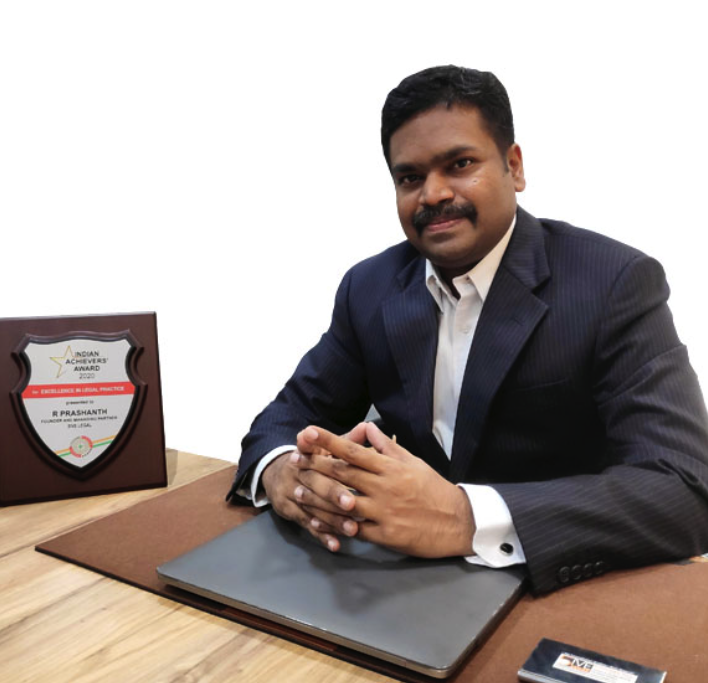
  • “Find you drive in what you love to practice as a lawyer. Pave new paths, create detours, or merge with other knowledge banks, as long as you steer yourself to your destination.” – Prashanth Ram, Managing Partner at 5ive Legal LLP.

    “Find you drive in what you love to practice as a lawyer. Pave new paths, create detours, or merge with other knowledge banks, as long as you steer yourself to your destination.” – Prashanth Ram, Managing Partner at 5ive Legal LLP.

    This interview has been published by Anshi Mudgal and The SuperLawyer Team

    After receiving your B. Com Degree, what motivated you to pursue a Law Degree at Tamil Nadu Dr. Ambedkar Law University in Chennai?

    I am a second generation lawyer, with my father Mr. Ramachandrudu (Retd IOB Legal Advisor and Deputy Secy. to Banking Ombudsman) hailing from Chennai and an ardent steward from Adv. K.K. Venugopal Offices in Chennai where other stalwarts like Hon. Former Minister Mr. Chidambaram, Late Mr. R. Mohan (Former Addl. Solicitor General of India), so it was inevitable that I was subconsciously tuned from the very beginning to what was expected from a logical, pragmatic solution provider and as a crisis handler. Business Studies culminated interest to further Commercial and Corporate laws in India.

    You went on to pursue your LLM from University of Manchester, United Kingdom where you specialised in International Business Law. Can you share with us your experiences and your motivation to pursue this specialisation?

    To have a global business acumen, one has to extensively study how different legal environments can impose on businesses. My agenda was to study business law with a mindset of how justice can be delivered for cross border work apart from what is practiced domestically. When laws encompass boundaries, certain denominators are preset – It is important to ascertain them while traversing the dynamism that circumstances create when businesses are perceived and run globally.

    You briefly worked with a law firm before moving to the Corporates and then back to founding a law firm. What motivated your transition and could you share your experience working in both cultures?

    Honestly, that is what the external world will see, when you see a profile like mine. I started with a law firm, to choose what kind of company or sector that I wished to see myself for the future, after spending some time, I realised I was interested in Cross border contracts, IT contracts and FEMA. When I realised that when money was coming into India, majority had to be invested in real estate as there was a boom around 2008. By end of 2010, I had equipped myself to handle various subjects in International law, along with FEMA and Real Estate. From manning a 10-member team to a team of 100 and also leading legal departments for 15 years across India, I realised with the connect and bandwidth, the natural progression was to lead a team with my own firm, in my case it was more of a rebranding from my father’s sole practitioner firm.

    You have headed various legal departments of different big companies before starting your independent practice in 2015. What were the initial challenges that you faced while running your practice and how has your experience in the corporate world shaped your practice?

    Advocates largely come from a sole practioner/ promoter/ senior practitioner driven set ups, which means they come unorganised yet they are effective in their own ways to perform a desired task. Corporate experience comes in handy, when we quantify the quality work that is executed, meaning, – adhering to process, setting policies, having TAT’s, Setting the flow of reporting structure, Ensuring Good communication and also to a large extent find time to work as a team and progress to a collective growth and vision. Heading Legal departments gives you an expertise to handle different stakeholders in ahigh paced setup by meeting their already high expectations. Being Agile and flexible at the same time can accommodate one’s decision-making power in a dynamic environment.

    As the Managing Director and Principal Attorney of M/s. 5IVE LEGAL, you have experience representing clients in various intellectual property matters, including domain name disputes. What are the key challenges that international entities encounter when dealing with domain disputes in India?

    Half the Work is done at the application stage itself. By having a robust application with best precedence and details will ensure your applications are successful. Secondly, when we appear for a dispute, the weightage given more to the research and that sort of research that does not necessarily extend to legal books or precedence alone but reaching and dipping into practical real-world implications. To be honest, common sense alone can half your battles in any court room. We should remember we are not creating anything but delivering what is already created, so we should not lose focus on issues that are primarily important. One main challenge for entities globally is the hesitation to challenge as they are unaware of the cost or timely outcome. They are also blindsided by the procedures involved. Domain disputes and cybersquatting to a large extent has had their disputes resolved by various forums by treating them largely to a Trade Mark that has been existing.

    You have extensive experience in Private Equity Financing and advising clients on investment-related matters. How do you stay updated with the evolving trends in private equity, investment law, and regulations?

    These PE or Debt Transactions revolve around various stakeholders in a transaction such as a Banker, Loan Provider, Investment Banker, TPA, Tax advisors, Authorities such as RBI/SEBI etc, and clients who are either mortgagors, debenture issuers or purchasers. I might have missed some, these entities ensure we are up to date with what’s happening, so is our language while dealing with such transactions. We treat every deal individually and hence generalisation is a misconception when dealing with such transactions.

    We understand that your firm has merged with another large full-service law firm, what does this mean for the future?

    The recent merger with AKM and Associates LLP, (A Six-decade old long firm) – “AKM 5ive Legal” stands as a testament to my vision for the firm—a vision that blends deep legal expertise with forward-thinking solutions. By leveraging the combined resources and expertise of both firms, this merger aims to consolidate its position as one of the top tier corporate law firms in Chennai by addressing a broad spectrum of corporate legal needs while upholding a strong commitment to ethics, excellence, and strategic vision. We have embraced technology as a means of improving service delivery, ensuring that our clients receive innovative, future-ready legal support. This transformation is a reflection of my broader belief in the power of adaptability and continuous learning.

    With your expertise and experience, what advice would you give to the younger generation who wish to excel in the field of law?

    My advice to young lawyers is to find you drive in what you love to practice as a lawyer in this very road that many have travelled. Now your journey may not be like others, so you can pave new paths, create detours, or merge with other knowledge banks, as long as you steer yourself to your destination.

    Get in touch with Prashanth Ram-

  • “Justice must be done for atrocity crimes, and it’s the responsibility of international law to ensure it.” — Dr. Matthew Gillett, Senior Lecturer at University of Essex School of Law

    “Justice must be done for atrocity crimes, and it’s the responsibility of international law to ensure it.” — Dr. Matthew Gillett, Senior Lecturer at University of Essex School of Law

    This interview has been published by Namrata Singh and The SuperLawyer Team

    Your career has spanned almost 15 years before the international courts, with significant cases including the destruction of cultural heritage. Can you share what initially inspired you to pursue a career in international law and what has kept you motivated throughout? 

    Living in New Zealand as a teenager in the 1990s, I saw the tragedies in Bosnia and Rwanda and wanted to do something about it. As I learned about the international criminal courts, I realised that was a means of taking action against the perpetrators of the worst crimes, including in those countries. Eventually I secured a position prosecuting international cases before those courts. My motivation was fueled by a sense of injustice and then later from meetings with victims who explained the impact these crimes had on their lives. Working with people from all over the world was also an inspiration. From Italy to India and everywhere in-between, you end up on teams with a huge range of backgrounds and legal traditions, which generates creative ideas as well as the odd procedural dispute. The international criminal courts face many challenges and the work can be frustrating. But ultimately there is no question that justice needs to be done for these atrocity crimes and that’s a major motivation.  

    As the Chair Rapporteur of the United Nations Working Group on Arbitrary Detention, what new dimensions or insights have you gained in the field of human rights and international law that were perhaps less visible in your earlier career? 

    As the Chair-Rapporteur, I see the organisational aspects of improving human rights practices. One of the key insights has been the importance of clear and open communication. A lot of problems can be avoided with regular and frank exchanges of information and communication helps to focus on the most serious issues which are directly affecting the victims. Closely linked to this is the need for inter-personal skills and empathy. When you are dealing with cases of persons arbitrarily detained for months and sometimes years, often in countries where they have no family, you have to picture the world from their perspective in order to understand the gravity of the threats and uncertainty they are facing. 

    Your work has involved prosecuting cases related to environmental harm at the International Criminal Court. How do you see the relationship between international criminal law and environmental protection evolving, and what key lessons have you learned from these cases?

    When I started writing about the International Criminal Court prosecuting environmental harm, it was just a theoretical idea. However, in 2024, prosecuting environmental harm under international law is becoming a reality. Significantly, three small island States (Vanuatu, Samoa, Fiji) have officially tabled the crime of genocide for inclusion at the ICC as the fifth crime along with war crimes, crimes against humanity, genocide, and aggression. This year has also seen the Office of the Prosecutor initiate a policy on the prosecution of environmental harm. International law is useful to combat threats to the environment, as it typically focuses on large-scale crimes committed by groups of people. However, there are many challenges in transposing international criminal law to the environmental context. The courts are not ecological research centers, and so there will be a lot of lessons to learn. My main observation is that experts from sciences should be brought in to avoid the law being applied on incorrect foundations. I also propose that the definition of ecocide needs to be carefully formulated to ensure that it is clear as to what is covered (and what is not) and that it provides fair notice to people and organisations as to what conduct is included. 

    In your opinion, how can international law be better utilized to combat rising global challenges such as climate change, digital privacy violations, and arbitrary detention, while ensuring justice for marginalized communities? 

    International law requires enforcement. For that to occur, international courts must be strengthened. In particular, States such as the USA, Russia, China and India should join the International Criminal Court. Bodies such as the United Nations Human Rights Special Procedures should be strongly reinforced, with sufficient resources and binding powers to improve human rights adherence. 

    As someone who has published widely and won prestigious academic awards, what advice would you give to young legal scholars who want to balance research, writing, and a practical legal career?

    For young lawyers and legal scholars, I highly recommend taking the time to research and write about legal issues that interest you. It’s one thing to work on a legal case but another to write about the broader context and the meaning of the laws and principles involved. If there are issues which strike your sense of justice or injustice, then there is likely to a scholarly question to examine. Balancing professional work and scholarship can be difficult, but the two facets reinforce each other. And it’s important to pass on what you learn to future generations of lawyers and human rights advocates. 

    For young professionals and students in international law, what would you say are the most crucial skills and knowledge they should develop, considering the evolving landscape of global justice, human rights, and environmental protection? 

    Young lawyers and students need to learn the fundamentals, such as the essential fair trial rights, while also developing an awareness of the emerging digital tools which can help them in their work. In terms of skills, good writing is critical. Take the time to follow a course on writing proficiency, as it is such a central skill in most roles. More importantly, clear writing reflects clear thinking, which is required more than ever at this time of crisis around many parts of the World. 

    You have contributed extensively to scholarly literature, what are the key gaps in international law research that you believe need to be addressed by future legal scholars? 

    Gaps in the literature on international law and human rights exist in relation to the procedures that ensure accurate fact-finding and in relation to measuring the impact of human rights work. All too often, it’s presumed that well-expressed and benignly motivated human rights conclusions will flow into enhanced human rights adherence by governments. However, that is a contestable claim, and more attention needs to be paid to measuring the impact of human rights work.

    As a Senior Lecturer at the University of Essex, how do you integrate your extensive practical experience in international law into your teaching, and what key lessons do you hope to impart to your students about the future of global justice? 

    My teaching at the University of Essex is highly interactive. I encourage my students to extemporize and to be prepared to support their claims with arguments and evidence. I also encourage them to develop the ability to entertain a contrary position in order to fully explore its strengths and weaknesses. Getting on the feet to present an argument animates the students and engages their uptake of the information that I’m trying to convey. Finally, I try to remind students that there are real people at the ends of the procedures, often languishing in detention, and so working efficiently and expeditiously is critical. 

    Looking ahead, how do you foresee the role of international law in addressing global challenges like artificial intelligence and cyber warfare, both of which have the potential to drastically alter traditional notions of conflict and justice? 

    We don’t need to look too far ahead to realise that cyber warfare and AI can revolutionalise major areas of human activity. Already, we have seen cyber strikes used in various conflicts, and increasingly it is being integrated into conventional warfare. AI can add digital steroids to human online activity. The potential benefits and efficiency gains are immense. But the risks of misuse, whether advertent or inadvertent, are real and pressing. Efforts are being made to have international law address AI. But a lot of work will be required to create any form of international law that can enforce restrictions on the misuse of AI – and the axiomatic importance of protecting free expression and liberty must always be borne in mind.

    With such a demanding career in international law and human rights, how do you find time to unwind, and what hobbies or activities help you maintain balance in your personal and professional life? 

    Keeping a balance between work and home life is important, especially when working on grave matters like atrocity crimes. My family keeps me grounded, and I enjoy sitting down with them to hear about their school and work days. Whereas I used to play a variety of sports, most of my activities now revolve around the family. But I still make time to watch the New Zealand All Blacks rugby team play whenever I can.  

    Get in touch with Dr Matthew Gillett-

  • “The profession of law was love at first sight, and the bond between me and the legal profession has only grown stronger over time. There has been no looking back, not even a moment of doubt. I have thoroughly enjoyed it.” – K G Raghavan, Senior Advocate at High Court of Karnataka.

    “The profession of law was love at first sight, and the bond between me and the legal profession has only grown stronger over time. There has been no looking back, not even a moment of doubt. I have thoroughly enjoyed it.” – K G Raghavan, Senior Advocate at High Court of Karnataka.

    This interview has been published by Namrata Singh and The SuperLawyer Team

    Coming from a family with a strong legal background , did you ever consider pursuing a career outside of law?  How did you eventually decide to follow in our family’s footsteps, and what challenges did you face in your initial days as a lawyer?

    I believe each person must carve out a profession for themselves based on their capabilities and interests. However, it is a reality of life that, when making a career decision, individuals are consciously or unconsciously influenced by the career choices their parents have pursued. I was no exception. My father was a leading and well-known lawyer during his time. I saw him put in long hours of hard work and be sought after by many. But what influenced me significantly in my career decision-making was the great respect and influence he commanded across a cross-section of society. I believed this was because of his position as a lawyer. In later years of my practice, I realized this was true. My father conveyed through his career that the legal profession was unique in various ways. It was intellectually elevating and honorable in its practice; lawyers were highly respected and commanded a following. I closely watched my father’s analytical skills, which he applied to matters of public importance, domestic issues, philosophical and religious thoughts, and more. I admired his approach to men and matters, which I attributed to his being a lawyer. My father did not actively promote the idea that I should pursue the legal profession; it was my decision, which he supported. Considering my father’s quality of life, I must frankly admit that I did not even consider a profession outside of law. The profession of law was love at first sight, and the bond between me and the legal profession has only grown stronger over time. There has been no looking back, not even a moment of doubt. I have thoroughly enjoyed it.

    Being a lawyer’s (later a High Court Judge’s) son had both benefits and challenges. The benefit I derived at the operational level was not very significant because there was a large gap between the time my father stopped practicing and when I started. Nonetheless, the benefits were obvious—infrastructure and the reputation of being so-and-so’s son. However, the challenges were quite intimidating. First, every action of mine and every expectation from me would be compared to my father’s. Any slight deviation would be met with skepticism. Second, I faced the overwhelming challenge of proving myself worthy of being my father’s son. I realized fairly early in my career that no one can ride on the reputation of another, no matter who the other may be; you have to prove your worth. Clients will not stay unless they develop confidence in you. A father’s reputation can take one up to a point and no further. In this profession, everyone has to carve out a niche for themselves.

    How did your father’s career as a judge influence your approach to law and justice?

    As a judge, I have noticed my father being equally concerned with the problems of a small person and a matter involving high stakes. He would tell me how, in reality, that small person had more at stake in the litigation than the so-called big one. For the former, it was a case of livelihood, while for the latter, it was generally not. Sympathy for the less fortunate was his guiding factor. This has had a significant impact on my approach to my career. This perspective has always remained in the background, even while being deeply involved in commercial law practice.

    For example, as a legal advisor for a large public sector corporation, I would receive numerous files for opinions regarding the title for granting house loans to Class IV employees. If I had strictly applied all the rules of title due diligence, none would have qualified for the loan. That would have shattered the dreams of these families to buy or construct a small home. My heart did not permit that approach. I relaxed the rules and cleared the titles on a “by and large basis.” This approach was largely influenced by my father, balancing law and humaneness. I am thankful for that.  

    During your tenure as partner at Dua Associates, you managed a large team and handled litigation practice nationwide.  What were the key lessons you learned from that period which you still apply today, and what led to your decision to leave the firm and become Senior Advocate?  What were the main factors that influenced this career move?

    During my tenure as a partner at Dua Associates, I interacted with numerous lawyers across the country and beyond. I also dealt with several in-house counsels of multinational corporations. This experience broadened my horizons. I realized that everyone has their unique way of approaching and solving problems, and no one was 100% right or wrong. Incorporating thoughts from all quarters, from senior to junior, enabled us to find the best possible solution to a problem. This was especially true because the lawyers came from different backgrounds and jurisdictions. Some adopted a legalistic approach, others a commercial approach, and a few a practical approach. Each one had their domain expertise. This opened my eyes to the fact that team effort is always more beneficial than when a problem is handled by a single lawyer. No one can have knowledge in all branches of law, and invariably, legal issues have different angles. This exposure humbled me to realize that no one can claim to be superior to another, and each has their role to play, which is as important as the others. This experience has stood me in good stead even today as a Senior Advocate, as I have continued to respect the approach and views of lawyers and in-house legal counsels.

    Counsel practice is an art in itself. I realized that my strength lies in that field. I wanted to spend more time sharpening my skills rather than spending time in the actual preparation of briefs through direct client interaction. This is what influenced me to change the course of my practice, even though I have always enjoyed client interaction and strategizing. My stint at Dua Associates has been the most enjoyable phase of my career. Designation as a Senior Advocate during my time was by invitation and not by application as it is today. Generally, when one is invited to take the silk, it is considered an honor and recognition and therefore not refused. Once conferred with the designation, in my view, continuing as a partner of a law firm was not an option.

    Since being designated as a Senior Advocate in 2008, how has your approach to handling cases evolved? What are the unique challenges and responsibilities that come with this title?

    The first challenge of being a Senior Advocate is to sift the grain from the chaff. That is what I have consistently applied in my role as a Senior Advocate. The briefing counsel will, of course, tell me all the facts and issues involved in the case as they should. It is up to me to pick the best points and highlight them to the court. The second challenge is the manner of presenting a point. It is essential to present it in the most persuasive manner. This requires quiet and deep deliberation even before entering the courtroom. I have rehearsed the opening sentence of a case in my mind several times before uttering it in court. If you engage the judge in your case within the first few minutes, a large part of the case is won.

    Duty towards the court and the client is common for all advocates, whether designated or not. The unique challenge and responsibility of a Senior Advocate is towards the briefing counsel. It may be that the briefing counsel is not yet experienced or is lacking in preparation. I would not highlight this in a conference where the client is present, as it would damage the interests of the instructing counsel and/or demotivate them. The art is to gently suggest a corrective course without injuring anyone’s interests. In many instances where I found a fundamental error in the approach or advice of the counsel on record, I have separately called the lawyer and pointed out the error, suggesting corrective action. I believe this to be the duty of a Senior Advocate towards the briefing counsel, in addition to the duty and responsibility towards the court.

    As the Chairman of the Bhavan’s BBMP school, you are deeply involved in educational initiatives for underprivileged children.   Can you tell us more about this role and its impact on the community?

    Our school has over 850 children, most of whom come from the neighboring slum areas. Facilities like electricity, water, and internet connection, which we tend to take for granted, are a luxury for them. The parents come from economically and socially disadvantaged sections of the community. A school-age child is considered another working hand and a potential earning member. In this atmosphere, it was initially a challenge when the school was started to promote the concept of education among that community. After 15 years, we have come a long way. Today, the parents and children are very enthusiastic about the school. Promptly at 8 am, the children arrive at the school, neatly dressed in their uniforms and well-groomed. Seeing these enthusiastic children at school, who might otherwise have been directionless, is a divine experience. The school is an English-medium institution with a CBSE curriculum. The school and the children always remind me that if given the opportunity, children will grow up to be responsible and civil citizens. The biggest mistake and crime is in not providing opportunity, and this thought has always haunted me. In fact, before our school was established, the area was noted for its high crime rate. Now, the police authorities tell us that the crime rate has significantly decreased because the children are the best change-makers.

    You regularly contribute to Deccan Herald and other publications on legal and philosophical topics. How do you find time for writing, and what motivates you to share your insights through these platforms?

    If one has the interest in doing something, finding time is the least of the impediments. What motivates someone to do something is a genuine interest in that activity. That is the simple answer to the question: how do you find time to write? The sheer desire to write and engage with a reader of average intelligence is what truly motivates me. My target is not the learned or the wise but those who have the interest but don’t know how or where to begin. My desire is to kindle their interest in both the subject and the art of communication. In other words, to provide food for thought.

    Looking ahead, what are the areas of law that you believe will be most critical in the coming years, and how should the legal profession prepare for these changes? What advice would you give to the young law students and budding lawyers who aspire to make a successful career in law? What skills and qualities should they focus on developing?

    Roscoe Pound famously said, “Law is social engineering.” This has always been true, and it is even more relevant today and in the future as times change. The aspirations of people and social norms are evolving rapidly. Gender equality, same-sex marriages, live-in relationships, LGBTQ rights, privacy obligations, and other issues now occupy center stage in public debate. Notions of morality that were once accepted and taken for granted are changing, and the law must keep pace with these changes.

    In my view, these issues will be critical in the coming years, and lawyers and law students must think outside the box to find legal solutions to complex social problems. Additionally, the changing demands of growing technology and transborder relationships—whether personal, business, or professional—must be addressed. The world is becoming increasingly interconnected, and relationships are becoming more seamless. Lawyers and legal researchers can facilitate this change and make the world a better and more peaceful place.

    Focusing on these and other emerging branches of law will enable a budding lawyer to succeed in their career. To achieve this, one must develop a thirst for knowledge from all over the world. A successful lawyer should excel not only in the legal field but also cultivate an interest in subjects unrelated to law. It is essential to remember that one is a human being first and a lawyer second. Developing the quality of being a good human being is fundamental.

    Furthermore, a lawyer should develop effective communication skills. Learning languages without any mental blocks is crucial, with English being a must. Knowledge and communication skills should go hand in hand with analytical skills. Analytical skill is an art that one can develop only through conscious practice. This can happen if you commit to understanding an issue fully before proceeding further. Finding a solution is the next step.

    With the rapid advancement of technology, how do you see the role of technology influencing the practice of law? Are there any particular tools or technologies that you find indispensable in your work?

    Technology today has permeated all aspects of our lives and activities, and the practice of law is no exception. In fact, the practice of law should embrace technology more and more so that we lawyers become more efficient in providing services to our clients and assist the court in dispensing quicker justice. I have personally benefited from technology. I am able to present arguments in court without physical papers as I have fully adapted to technological tools like Liquid Text. I find myself faster and more efficient in locating a particular document or fact in a large brief using this technology. The adage “Change or Perish” is truer today than ever before. However, a warning: Technology should supplement our intelligence, not supplant it. Innate intelligence, not artificial intelligence, is the core strength of a lawyer.

    Over 45 years of practice, you have represented numerous high profile clients.  Can you share a particularly memorable case that had a significant impact on you personally or professionally?

    “It is difficult to pinpoint a particular case among the many I have handled in my career. I am who I am today, both as a human being and as a lawyer, because of the amalgamation of lessons learned from various cases. It has been a profound study of human traits and behavior. No case is too big or too small; each has its own lessons and morals to impart, aiding in personal evolution. This defines my approach and personality.”

    With such a demanding career, how do you unwind and relax after a long day in court?  Do you have any hobbies or routines that help you maintain a work life balance?

    The legal profession is a demanding endeavor. Therefore, one must be vigilant not to become so absorbed as to lose the joys of life. I am fortunate to have largely mastered the skill of drawing boundaries, although my family might disagree. Early in one’s career, one should enjoy what they do; as one progresses, they should do what they love. This is a nuanced art, and I am fortunate to have made significant strides in that direction. Whether one likes or loves their work, nothing becomes a source of stress. This is the key to unlocking relaxation and alleviating stress. Writing, reading, religious, and social activities are my ways of unwinding. I particularly enjoy traveling and sightseeing. As I mentioned before, when you are passionate, time never feels like a constraint. 

    neigneighbour

    Get in touch with K G Raghavan –

  • “Success of a case or project isn’t the result of individual brilliance but rather the outcome of a meticulously orchestrated collaboration”- Mitsu Parikh, Senior Partner at World of Legal Research

    “Success of a case or project isn’t the result of individual brilliance but rather the outcome of a meticulously orchestrated collaboration”- Mitsu Parikh, Senior Partner at World of Legal Research

    This Interview has been published by Pragya Chandni and and The SuperLawyer Team

    Can you share a bit about your educational journey and how you pursue law as a career? 

    I originate from a quaint town in Gujarat where, a decade ago, career choices such as law, journalism, creative writing, and hotel management were not common for females. When I expressed my aspiration to pursue a career in law to my parents, their reaction was beyond surprise. They recommended that I gain firsthand experience by shadowing a seasoned lawyer before making a definitive decision. Consequently, I immersed myself in the legal field, accompanying and observing an accomplished lawyer in various cases spanning banking, constitutional, employment, and family laws. The diverse and intricate nature of the legal profession left a profound impression on me, ultimately solidifying my determination to pursue law as a career. This experience broadened my understanding of the legal landscape and instilled in me a deep appreciation for the multifaceted challenges and responsibilities inherent in the field.

    You’ve pursued advanced degrees in International Law and Legal research. What drew you to specialize in these areas? 

    During my undergraduate studies, I actively participated in moot court competitions, assuming roles as a speaker and researcher. While I thoroughly enjoyed the entire moot court experience, I found a particular passion for research. Delving into legal research became more than necessary; it became a profound interest. This inclination led me to explore opportunities to publish papers and interact with esteemed academicians at conferences and symposiums. Recognizing the significance of contributing substantively to the legal discourse through research and publishing papers, I pursued a master’s degree. Someone once told me that just raising questions doesn’t make you people worthwhile; finding solutions does. 

    You’ve had diverse roles, from Legal Assistant in law firms to your current position as a Senior Researcher and Coordinator. How did these experiences contribute to your growth and specialization in international law? 

    My stint in the corporate sector and various law firms served as a journey of self-discovery, compelling me to confront the realization that these roles may not be my lifelong passion. However, I wholeheartedly acknowledge that each experience played a crucial role in shaping my personal and professional growth. During my internship, a pivotal lesson resonated deeply – the significance of every task, regardless of its scale. It became evident that the success of a case or project isn’t the result of individual brilliance but rather the outcome of a meticulously orchestrated collaboration. Whether assuming the role of a clerk, lawyer, or researcher, every individual in the chain contributes uniquely, and the collective effort propels success. This realization has ingrained in me a commitment to execute my responsibilities to the best of my abilities, regardless of my role in the process. 

    Could you tell us more about your role as a Senior Researcher and Coordinator at the international consultancy World of Legal Research? What kind of research-based consultancy do you provide to the government, law schools, and academicians? 

    We provide a variety of services. Some of the services involve a project where we have to study impact assessment, create analytical research reports, and assist with reviewing the research papers. Additionally, we are more inclined towards assisting our legal fraternity with our efficient legal research team, specializing in diverse fields of law.

    As a Visiting Faculty to many universities in India and abroad, you teach Public International Law and Legal Research Methodology. What inspired you to take up a teaching role alongside your research work? 

    When I was a student, the thought often crossed my mind – what if certain topics were approached differently? Would they become more intriguing? It wasn’t until I visited conferences in the southern part of India that I stumbled upon a fascinating realization. Among the accomplished individuals, be it a thriving businessman, a seasoned lawyer, or a distinguished doctor, there was a common thread – academic involvement. It brought to my mind Chanakya’s words about teachers never being ordinary; they hold the power of construction and destruction. This insight fueled my aspiration to contribute meaningfully to the academic realm. As I transitioned into the role of a researcher, my desire crystallized into a passion for teaching law students the art and science of research. It’s not just about acquiring knowledge but understanding the intricacies and methodologies that make research a captivating and essential facet of the legal profession. 

    Your experience includes working in law firms in Australia and India. How did these experiences shape your understanding of legal practice on an international scale? 

    Lawfirms became my school of perfection, teaching me the invaluable skills of meticulousness and the art of thriving under deadlines. But beyond the technicalities, it was a vibrant classroom where I learned to navigate the intricate tapestry of human diversity. Working with people from different cultures was a daily lesson in understanding, patience, and respect. There were instances where a case forced me to reconcile my personal beliefs with my client’s position. The legal profession throws a unique challenge at you – dealing with ethical dilemmas that demand a delicate balance. The realization that every client, boss, or judge is a distinct chapter in your professional story. Each encounter is an opportunity to embrace diversity, not just in your home country but in foreign lands. It taught me the importance of respecting diverse cultures and opinions, a lesson that goes beyond the legal arena and shapes how I approach life.

    You’ve presented papers on various topics, from health inequalities during COVID-19 to discrimination in legal education. Can you highlight a paper that you found particularly impactful or that received significant attention? 

    In 2023, I had the privilege of presenting a paper at the Center for Criminal Law, University of Oxford (UK), addressing the alarming issue of ancestral rapes in the state of Haryana during the COVID-19 pandemic. This paper garnered recognition and was honored with an award for being the most passionate presentation. Subsequently, I received emails from faculty members and fellow paper presenters at the conference, affirming that this problem extends beyond India to encompass every country and culture. The correspondence highlighted a shared sentiment that societies tend to suppress or disregard such issues, choosing to deny their existence. The suggestions and solutions proposed in my paper resonated with the international audience, earning appreciation from diverse perspectives. It was a powerful acknowledgment of the universality of the problem and the importance of proactive and compassionate approaches to address it on a global scale.

    Your involvement in founding an NGO called ‘Madad’ during the COVID-19 pandemic is commendable. Could you share more about the initiatives and impact of this organization?

    I wouldn’t like to talk much about my NGO as our ancestors say that if you help someone with your right hand, your left hand shouldn’t even know about it. I would just say that at whatever stage you are in life, try to help others, not for the betterment of society, but for yourself, so that you can face yourself in the mirror at the end of the day. 

    You’ve received several awards and honors for your contributions, including the Youngest Leader Award from Rotary International. Which of these achievements holds a special place in your heart, and why? 

    In the third year of my undergrad studies, I received an award for the best position paper at Harvard University. That paper made me realize that regardless of being from a small town or being from the vernacular medium of studies, you can if you really want to achieve something in life.

    You’ve held various editorial roles and served as chairman in some committees while studying at the University of Sydney. How have these positions enriched your professional journey? 

    These positions equipped me with essential skills such as time management and strategic planning. Additionally, they provided valuable lessons on effective teamwork. Each extracurricular engagement in Law School imparts qualities beyond the teachings of books or academic activities.

    Finally, based on your journey so far, what advice would you give law graduates just starting their careers in the legal field? 

    Well, I’m not experienced enough to give any advice. I’d reframe it as learning that I can share from the mistakes I made in my journey. 

    1. Take your internships seriously. You will gain something from every task you do during your internship, even if it is just carrying your senior’s briefcase and/or documents. For example, you’ll be able to be a part of his conversations with clients and people around in court, how one carries his business in the legal field, etc.; this will teach you much more about the practicalities that even a subject in law school wouldn’t. 

    2. Whether you want to join corporate or litigation, publish papers and take part in conferences. Publish or perish is a thumb rule. If someone googles you on the internet, and you have something published, you will get brownie points. 

    3. There is no shortcut to success. It might sound like the cheesiest line. However, life is not 2 minutes noodles. Instant gratification. Instant Fame. All these are not to be focused upon. Do smart work, but don’t get scared away from hard work. Thus, creating a strong base first is very important, because if you sow well, you’ll reap the fruits throughout your life. Choice is always yours.

    Get in touch with Mitsu Parikh-

  • “I would rather believe that we can be energized by our daily routine, by the challenge of difficult cases, or by victories of small wins or overturning of a case on appeal”- Philip Teoh, International Lawyer and Arbitrator

    “I would rather believe that we can be energized by our daily routine, by the challenge of difficult cases, or by victories of small wins or overturning of a case on appeal”- Philip Teoh, International Lawyer and Arbitrator

    This interview has been published by Priyanka Karwa and The SuperLawyer Team

    Can you share your journey and what inspired you to pursue a career in law, specifically specializing in Maritime & Admiralty, International Law, and other related fields?

    When I started my law studies, I was interested in exploring the role of law as a foundation of business dealings, especially international business. 

    I was intrigued to discover the area of shipping was the connecting factor in these areas. Unlike some perceptions, the area of shipping was not small in scope. It encompassed international trade as traders used ships to transport their goods, international finance as banks financed these transactions, and insurers insure these shipments. I later found out there was Wet and Dry Shipping, Corporate or Transactional Shipping and Maritime Arbitration as well.

    That was the launch pad for my interest in shipping. With that interest, I took shipping and shipping-related subjects in law school. I was fortunate to be able to study at the National University of Singapore where I was taught and inspired by great teachers.

    Professor EP Ellinger was a powerhouse in Banking and International Finance, Professor FMB Reynolds who hailed from Oxford taught Agency and Shipping subjects and the most brilliant teacher was the late Professor Tan Yock Lin who taught Conflicts of law, he was a brilliant legal mind who made difficult concepts in Conflicts easily understandable. I did well in school and constantly called upon what I studied in my cases. I do encourage law students to concentrate well on their studies because these are invaluable foundations for practice.

    With over 33 years of experience, you have vast expertise in both contentious and non-contentious areas of law. How did you navigate and develop such a diverse skill set throughout your legal career?

    I saw law as a technical field, that cases and principles are building blocks to craft agreements, transactions and eventually. In litigation, I soon discovered that strategy and effective advocacy win cases, the more cases we handle we develop muscle memories which we can call upon in advocacy.

    Soon I was able to see that each witness can present a treasure trove of evidence to cross-examine. I also learnt to adapt; as much as we can prepare for a case, the circumstances of a trial or a judge’s questions and directions may force us to abandon our prepared script to adopt a better and different strategy.

    I started in litigation. After a few years into practice, I wanted to have both a transactional as well as a disputes practice and I am happy to say I handle both contentious and non-contentious areas.

    Some of the notable transactional work in which I was involved was various ship sale and purchase as well as ship financing cases. When MISC the Malaysian Carrier wanted to go into the energy business, it bought Newbuildings from Japanese Yards, these were the Puteri Vessels that kickstarted the business and MISC is not a major LNG carrier. I was the Syndicated Lenders’ local lawyer.

    I was also involved in several due diligence of Shipping Companies, Joint Ventures and reorganization of the Shipping Companies Malaysian assets and companies. When the Genting Group sold its luxury yacht Tranquility to a US buyer I acted for the buyer.

    Being recognized by Chambers and Legal 500, among others, for your expertise in Maritime Law, what do you believe sets you apart in this field, and how do you approach resolving matters to the satisfaction of your clients?

    In legal practice, it is not an effort if we enjoy our work and I do. Every case presents a challenge and a new learning opportunity. I do not believe that I possess any qualities different from other lawyers, apart from that I enjoy what I do.

    Some talk of finding one’s purpose in what we do, I don’t agree. I think purpose can change. I would rather believe that we can be energized by our daily routine, by the challenge of difficult cases, or by victories of small wins or overturning of a case on appeal. We need these to sustain us because law is a very involved and demanding profession.

    In addition to your legal practice, you’re also a Practising Arbitrator empanelled with various international panels. How does your role as an arbitrator complement your work as a lawyer, and what unique perspectives do you bring to dispute resolution?

    Arbitration and litigation are contentious legal practices. The skills of a litigator are important skills for arbitration too, whether one sits as an Arbitrator or as Counsel in Arbitration.

    You’ve been involved in notable cases, including arguing the inaugural reported decision of the Malaysian Admiralty Court. Could you share insights into the challenges and rewards of handling such significant cases in the maritime industry?

    Difficult cases challenge me. That forces me to figure out how to best strategize the handling of the case, the conduct of the litigation. There will always be an approach we can adopt which can make complex cases managable or make them simple. We need to develop muscle memory for this. Along the way the bonus is when the cases we argue establish law, a principle not established before. I have had a few of these.

    Your extensive contribution to legal literature, including authoring key practitioner texts, speaks to your commitment to legal scholarship. How has academic writing and research influenced your understanding of the law and your approach to legal practice?

    Some 2 decades ago I found a dearth of Shipping Texts in Malaysia. I convinced LexisNexis (then Malayan Law Journal) to introduce these in Malaysia and eventually, I wrote the original editions of Halsbury’s Malaysian titles in Shipping and related subjects. I was particularly happy to write the Volume on Conflict of Laws; Conflict of Laws issues often crop up in Shipping and International Arbitration.

    I also authored the Annotated Merchant Shipping Laws, Forms and Precedents on Shipping which contain transactional agreements. I was later invited by Sweet and Maxwell to write the Chapter on Carriage of Goods by Sea which contains precedent pleadings used in litigation and arbitration.

    The writing ensures that I have a good grasp of the law, and this is invaluable when I handle cases. Funnily I have faced opponents in Court citing my writing unknowingly.

    Having practiced in both Singapore and Malaysia, what are the unique challenges and opportunities you’ve encountered in each jurisdiction, especially in the context of maritime law?

    I started my practice in Singapore before returning to Malaysia. I was very happy when Malaysia established the Admiralty Court in 2010 and I was able to argue the inaugural reported case of the Court in the case of The Istana VI. Since then, I regularly handle cases in the Court amongst others prosecuting ship arrests or challenging them. 

    The laws applied by the Singapore Courts are not much different and I believe that both the Singapore and Malaysian Shipping Bar have good lawyers. The Singapore ecosystem however is more varied with a healthy variety of international firms including many specializing in maritime law.

    As an Adjunct Lecturer in BAC Malaysia’s law school, what advice do you give to law students looking to specialize in maritime law or pursue a career similar to yours?

    Be interested in what is taught. Not many universities have maritime law as a subject at the LLB level. Curiosity, Initiative and Hard Work are most important.

    It is good to have a specialization in mind, but maritime law can be acquired after graduation. It is important that the young lawyer enters a firm that handles the area. The on-the-job training is much more important.

    I have trained many young lawyers in this field, and they picked up the areas well. Tan Sri Nallini Malaysia’s first Admiralty Judge never did Shipping cases when she was a practitioner and Her Ladyship had done much to establish jurisprudence in the area. She is easily amongst Malaysia’s top judges.

    In your experience, how important is it for legal professionals to stay updated on evolving legal landscapes, especially in areas like maritime law, and what strategies do you employ to stay abreast of industry developments?

    Keeping up to date is crucial. I find that LinkedIn is a great tool to do that because the lawyers do post and share useful content. I do post from time to time too. Reading outside of the law widely is also important. 

    Lastly, considering your wealth of experience, what advice would you like to share with recent law graduates who are entering the field today, particularly those interested in maritime and admiralty law?

    Be curious about learning. Read widely. Seize opportunities when they appear, do not neglect the training experience, it is an invaluable time, not to be squandered. Get onto complex cases early even if the role is a minor one. Your friends and family will be your invaluable support through challenging times.

    Get in touch with Philip Teoh-

  • Good lawyers in this field will be versatile in their strategy, looking at how best to play the cards their clients have been dealt-Viren Mascarenhas, Partner at Milbank

    Good lawyers in this field will be versatile in their strategy, looking at how best to play the cards their clients have been dealt-Viren Mascarenhas, Partner at Milbank

    This interview has been published by  Priyanka Karwa and The SuperLawyer Team

    Please tell us about your journey in the field of law and how you ultimately specialized in alternate dispute resolution, international commercial and investor arbitration, and public international law?

    I grew up mostly in Mumbai, India, but I received a full scholarship to do my undergraduate studies in the United States.  While my first degree in Economics gave me a solid basis for understanding how the world works, I subsequently pursued a law degree with the idealistic, energetic goal of trying to change how the world worked, in particular, addressing inequities between the Global South and the Global North.  

    While in law school, I took all of the core and foundational classes, but chose my electives to be different international law classes, such as trade law, law of the sea, human rights.  Those classes set the stage for my subsequent career in international dispute resolution.

    You’ve worked with various prestigious law firms and organizations throughout your career. How did each of these experiences contribute to your growth and expertise in the field of international law and arbitration?

    Receiving an offer to serve as a law clerk to H.E. President Rosalyn Higgins at the International Court of Justice during the 2005 to 2006 judicial term felt like being at the pinnacle of my career at its very start!  The ICJ is colloquially known as the “UN Court” or the “World Court.”  The Court’s docket was full during my term.  I worked on armed conflict between the DRC and Rwanda, transboundary environmental issues between Argentina and Uruguay, and the massive Genocide Convention case between Bosnia and Serbia.  The clerkship confirmed for me that I wanted to focus on international law disputes in some fashion.

    Accordingly, I submitted applications into the UN system online for all open vacancies in international law.  Those applications—painstakingly prepared—would vanish into the ether.  I usually never heard back or would hear back over a year later that the vacancy had been filled!

    However, I had success with one application (and all it takes is one!).  In 2007, I relocated to Freetown, Sierra Leone, to work as a Legal Officer at the Special Court for Sierra Leone.  The tribunal had been established to adjudicate responsibility for the war crimes committed in the country during its conflict.  The experience was eye-opening. Substantively, I learned about the application of international criminal law and working at an international organization.  Personally, observing the plight of the survivors and victims of the atrocities instilled in me that we should always try our best to achieve the greater good. 

    Still, I was not sure I was ready for a long-term career as an international civil servant.  I wanted to explore the rigors of private practice with the goal of becoming a better-trained lawyer.  I chose from various offers to join the International Arbitration Group at Freshfields Bruckhaus Deringer, one of the best arbitration practices in the world, just before the Great Financial Recession hit in September 2008.  While at Freshfields, I got to work on some of the most complex investment and commercial arbitrations, particularly in the energy and extractives sector, such as Libananco v. Turkey, Burlington Resources v. Ecuador, and ConocoPhillips v. Venezuela.  Additionally, I did a ton of pro bono at the firm, representing individuals in asylum proceedings and providing legal advice on international human rights to prominent NGOs.  And, in my spare time (I did not sleep much, admittedly, when younger!), I was teaching at Columbia Law School.

    I felt that I had the best of all worlds—I was stimulated by complex commercial work; my matters had purpose; and I was able to interact with the best arbitrators in the world (Jan Paulsson!  Lucy Reed!) and the best young minds as well at Columbia Law School.  

    As a Partner at Milbank, you’ve been involved in a wide range of commercial arbitrations under various arbitral institution rules. Could you share with us a particularly challenging case you’ve worked on and how you navigated its complexities?

    To date, I have represented the government of Türkiye in five investment arbitrations over the course of my career.  Two cases stand out for me:  Cascade v. Republic of Turkey, ICSID Case No. ARB/18/4, and Ipek v. Republic of Turkey, ICSID Case No. ARB/18/18.  Of course, I cannot discuss anything that is legally privileged and/or confidential from those two matters.  But just a quick search in the public domain will reveal that these two disputes were profoundly important to Türkiye.  At a high level, the matters concerned the failed coup d’état of July 15, 2016, and pitted the Erdoğan administration against the followers of Fetullah Gulen.  So, issues of national security, terrorism, politics, and free speech were directly relevant to the two arbitrations.  Turkish outlets reported on these arbitrations as a fight for the heart and soul of Türkiye!

    After several years of intensely fought arbitration proceedings, Türkiye prevailed in both matters on jurisdictional grounds.  The tribunals found that the investors had committed an abuse of process by restructuring their investments to avail of bilateral investment treaty protection at times when their disputes with the government were underway or reasonably foreseeable.  

    These were immense victories that required me and my team to identify the legal elements of Türkiye’s defenses, and then marshal the evidence to demonstrate to the tribunals why those elements had been satisfied with the requisite burden of proof.  With regard to evidence, no stone was left unturned.  We reviewed publicly available sources extensively; interviewed government officials and witnesses from different ministries and agencies; and identified true experts who could opine on key issues related to the underlying matters.  But being technical about evidence is insufficient.  You have to present the facts and evidence in a narrative that is compelling, persuasive, and convinces the tribunal why to rule in your client’s favor.

    Your involvement in investor-state arbitration is quite notable, representing energy majors against several countries. Could you elaborate on the unique challenges and strategic considerations involved in these cases?

    Yes, I have represented investors in high-profile energy and mining disputes against governments all over the world, including Argentina, Azerbaijan, Bosnia-Herzegovina, Bolivia, Ecuador, Italy, Mexico, Nigeria, Peru, the Philippines, the Russian Federation, Timor-Leste, Uruguay, and Venezuela.  I have also been instructed by several governments in their investment arbitration disputes.  These cases can be very complex because of the multiplicity of government actors involved (for example, the Ministry of Energy may be the focal point, but acts by the President’s Office, the Ministry of the Environment, the Ministry of Foreign Affairs, and the Ministry of the Economy may also be relevant).  Government actors change over time, bringing in another layer of complexity.  Additionally, the heart of the dispute may not just be about politics (for example, reclaiming sovereignty over natural resources as the public policy goal of a government) but also economics (for example, high oil prices prompting implementation of windfall profit taxes or increased royalty rates).

    Good lawyers in this field will be versatile in their strategy, looking at how best to play the cards their clients have been dealt.  You likely will have to be technical (for example, reviewing administrative agency decisions to understand how environmental regulations relating to energy projects are implemented by local actors), creative (working with experts to construct a model of how the project would have been implemented but for the government’s alleged wrongful act), and comprehensive (seeing the story not just from the perspective of the government and the investor, but also impacted local communities and future generations). Ultimately, you have to understand the big picture yourself, and then figure out how to present that big picture to the tribunal clearly and compellingly.

    Besides your legal practice, you’re also an Adjunct Professor at Columbia University School of Law. How does teaching influence your own legal work, and what insights do you gain from engaging with students?

    I have been teaching as an Adjunct Professor at Columbia Law School for 14 years now, and I absolutely love it.  First, I went to CLS to obtain my JD, so being back on campus reminds me of how much I enjoyed my legal studies (and takes me back to my early 20s!).  Second, preparing for sharp, probing questions from my students keeps me on my toes.  I have to make sure I am fully up to date on the latest in international arbitration and am not just teaching from an outdated playbook.  Finally, listening to their views and perspectives makes me a better lawyer.  They may suggest novel ways of addressing a problem because they do not have preconceived notions.

    You’re actively involved in various organizations focusing on international justice, business and human rights, and more. How do these extracurricular roles complement your legal career and contribute to your personal mission?

     I went to law school with the idealistic goal of helping to make the world a better place!  Therefore, it has always been very important to me to be active in pro bono matters to help serve those who cannot afford access to justice.  I still remember the full panoply of emotions I felt as a second-year lawyer when I was able to secure asylum for my then-teenage client in the United States when he fled persecution in Colombia.  (He subsequently obtained his undergraduate degree from New York University and is now a successful teacher!).

    Given that I spend my time practicing public international law and international arbitration, I focus my pro bono and philanthropic efforts on those two areas where I have a comparative advantage.  That translates into work on international human rights and international justice.  I am proud to serve on the Board of Directors of The Global Justice Center, which focuses on gender-equality in post-conflict societies that is achieved through legal advocacy.  I am also a Director of International Independent Legal Advocates, which helps to level the playing field for developing and small countries who are negotiating complex multilateral treaties and lack the resources and time needed to be effective negotiators.

    By the way, all this work reinforces my own billable legal practice.  I am often approached by corporations or governments to work on commercial disputes that might implicate human rights issues.  For example, many of my extractives and energy matters concern not just economic issues of supply, demand, prices, force majeure, taxes, etc., but also environmental issues and consideration of impacted stakeholders such as indigenous communities in the relevant areas.  Some of the relevant experience I have gathered to take on these matters comes from my pro bono practice.

    You’ve been recognized with numerous accolades and awards for your contributions to the field. How does this recognition affect your approach to your work and your commitment to advancing international law and arbitration?

     You are kind to mention that I have received accolades for my work in international arbitration and as a lawyer generally.  I am always grateful for recognition from my peers, clients, and others for the work that I am doing.  And, at an earlier stage in your career when you are still establishing your bona fides, external accolades and awards can help convince clients that you have the wherewithal to lead their complex matters.  

    Ultimately, though, it is the work that matters.  Recognition usually comes from doing good work.  Doing good work usually requires hard work, dedication, and, frankly, plodding.  I spent many late nights focused on the task at hand—preparing for hearings, finalizing briefs—instead of dreaming about awards!  But I enjoy the “doing,” and the rest that might follow—recognition, accolades, whatnot—is (very enjoyable!) icing on the cake.  

    Lastly, with your extensive experience and success in the legal field, what advice would you offer to fresh law graduates who are just starting their careers, particularly those interested in pursuing a path similar to yours in international law and arbitration?

    Here is what I can suggest based on my experience.  

    First, be flexible.  I spent the summer between my first and second years of law school doing project finance at Milbank.  This seemed like a sensible practice area given that I was interested in development work and thought I would return to India/Asia to work.  However, I realized that I was more inclined to be a disputes lawyer, which led to the career I have described.  But now, two decades into my career, I am back at Milbank leading the international arbitration group.  Unsurprisingly, I spend a lot of time working with my project finance partners—but am not part of the project finance group!  After all, some of the mega projects that Milbank’s project finance team work on could run into disputes, either with the government (giving rise to investment arbitration), or between project company and contractors/subcontractors (giving rise to construction arbitration), or between the project company and offtakers (giving rise to commercial arbitrations). You never know how the story might unfold.

    Second, always, but especially when you are in the early stages of your career, be open to possibilities.  Within five years of graduating from law school, I had clerked at the International Court of Justice, served as a Legal Officer at the Special Court for Sierra Leone, and been a mid-level associate at a top law firm doing international arbitration. While I always had an eye to the future, I focused primarily on what I could learn from each of those amazing opportunities, which were all different from each other.  The result was a broad training in international law, on which I have built my private practice. 

    Third, try to get the most out of what is immediately in front of you, avoiding a “what next” way of thinking.  I was – and am! –ambitious, which sometimes translates into wondering what lies around the corner.  But the most enjoyable moments of my career are when I lose myself in my work—editing a complex section of the brief, preparing for and then undertaking a cross-examination at a hearing, reading the material and then engaging my students on the latest developments in international arbitration.  

    Relatedly, choose to do things because you enjoy them and not always because they could translate into career success.  For example, I studied conversational Spanish with a Venezuelan refugee in The Hague when I was clerking at the International Court of Justice out of a love for the language (based on reading English translations of books by Isabel Allende and Gabriel García Márquez in college) and a desire to work with refugees in the United States when I completed my clerkship.  Little did I know that my Spanish would come in handy later on when I embarked on several major investment arbitrations involving South American governments!  

    Fourth, do not be too hard on yourself.  A successful career is one that is built over time.  There will be ups but inevitably there will also be downs.  Some of those downs will be the consequence of things you cannot not control, at least in part.  Do your best based on the circumstances you find yourself in to change what you can and let go of the rest. 

    Get in touch with Viren Mascarenhas-