Tag: JCCCL

  • Roumita Dey, Associate, Agama Law Associates, on how to represent clients on behalf of the firm

    Roumita Dey, Associate, Agama Law Associates, on how to represent clients on behalf of the firm

    Roumita Dey graduated from Jogesh Chandra Chodhuri Law College (under the aegis of Calcutta University), Kolkata in 2015. At present, she is practicing corporate law at Agama Law Associates and represents clients on behalf of the firm on a daily basis.

    She drafts legal notices, legal responses, the case for opinion, Service Provider Agreement, Leave and License Agreement, IT contracts, Response/Counter-claim, etc. and is doing research work in all areas of law using Manupatra, SCC Online, Think Legal, Indian Kanoon, etc. research engines.

    She also writes articles on various areas of corporate law on a monthly basis for the firm’s blog and contributes legal updates/day-to-day legal developments in the industry in the update session

    In this interview she talks to us about:

    • Her experiences during the internships.
    • Primary essentials of a good corporate lawyer.
    • The kind of interest one needs to pursue law.
    • Current scenario of studying corporate law as a career option in India.

    What brought you into studying law as your profession?   

    I am a first generation lawyer in my family. I have chosen Humanities in my Class XII board exams and successfully passed with higher grades. Law was never in my mind that time. I was more inclined to do a simple graduation course and decided to pursue MBA later in my future. My father is a business person, and we have a family lawyer cum family friend who advises my father with regards to property related matters and also his business. My parents visited the district court in Kolkata for the purpose of property registration a couple of times and gradually influenced by seeing the lawyers advising their clients and arguing inside the courtroom. As a result, they encouraged me to take up law seriously, and I believe that my parents have seen that spark in my eyes that I was born to become a lawyer. However, I sat for the LL. B joint entrance examination of Calcutta University and have secured good rank and enrolled at Jogesh Chandra Choudhuri Law College, under the aegis of Calcutta University. To be very frank, I chose law pretty accidentally. It was more like law have chosen me and brought me into this profession. However, after enrolling myself in the B.A.LL.B course, I have started achieving good marks in the subjects and interned in big firms one after another and today I am a qualified lawyer practicing corporate law.

    Any remarkable experiences during your internships that shaped your career choices later?

    Yes, indeed the experience of working with different law firms helped me to take the proper decision of which law to specialize to flourish in my profession or I may say internship experiences shaped my career choices later on. I have done two litigation internships, where I was mostly allotted work relating to assisting senior advocate to draft affidavits, rejoinder, legal notices and to accompany senior associates to the court. Apart from these two litigation internships, I have also interned under a senior advocate of the district and sessions court (Kolkata) to gain knowledge of how the district court works, or I may say to witness the life of a litigant. However, frankly, I have not explored much during my internship days. However, after doing litigation internships, I have applied for internships in Tier – I firms in India like Trilegal, Amarchand & Mangaldas, a mid-sized law firm like Argus Partners, where I may get the flavor of corporate law. In light thereof, I have successfully interned in the aforementioned law firms and was mostly allotted research work relating to company law, securities and banking law, property law, electricity law and basic drafting work. I was also involved in the due diligence of QIP (‘’Qualified Institutional Placement’’)/due diligence of the private placement of a public company being undertaken under the supervision of the capital markets team of Amarchand & Mangaldas (Delhi Office). It was an excellent opportunity to learn and to get the chance to work with the seniors of one of the elite law firm in India. Trilegal also was another enriching experience to learn how to take the advantage of research engines and how to conduct research on case laws. These internships made me realize that corporate law is the field to explore, and there is a lot for me to learn in this field. Hence, I wanted to join a corporate law firm after graduation to be able to realize my potentiality in this field.

    What do you think is the kind of interest or aptitude one needs to pursue law?

    I am giving a quick snapshot of the abilities and skills/values; one should possess to become a lawyer or those who needs to pursue law in future. I believe the following list of core skills and values would suffice for every budding lawyer:

    1. Inquisitive: A good law student or an aspiring lawyer shall possess an inquisitive nature. Curiosity drives a person to probe and ask revealing questions. The inquisitive attorney will peel back the layers of a case, going deeper, asking for more information. This skill is necessary because it is often the small, unnoticed details that can make or break a case.  A good lawyer asks questions because they are not satisfied with accepting surface information. They know there may be more facts underneath the evidence presented.  Their inquisitive nature will push them to uncover that information.                                                                        
    2. Problem Solving Abilities: Being a problem solver is one of the root skills of any attorney. People hire lawyers because they either have a problem or are trying to avoid one. Possessing excellent problem-solving skills allow the lawyer to find solutions even when none are immediately apparent.
    3. Symptomatic Reading: Attorneys will have to read a great deal of material when they take on a client. It may be court documents, witness testimony, contracts, case law, or a myriad of other text. It is easy for anyone to skim over the information and take it at face value. Unfortunately, this can prove detrimental to a client. Moreover, law students or whoever would like to pursue law have to make a habit of reading much stuff.                                                                                                   
    4. Writing Skill: Having the ability to write well lays a solid foundation for all the documents a lawyer must write such as arguments, contracts, and legal letters.                                                                                             Written communication is a primary way that information is distributed and recorded.
    5. Conversation/ Articulation Abilities– Just as writing skills are essential, so too are verbal skills. An attorney will find it necessary to shift gears in their verbal communication style. One day they may need to speak in an authoritative manner with persuasive speech during an important trial. The next day a lawyer may need to meet with a grieving widow requiring sympathetic conversation in reassuring tones. Conversation skills are more than just the ability to say the right words. The words also need to be expressed in a proper manner.                              
    6. General Investigation/Research Skills: Law students and attorneys have to spend hours investigating and researching information for clients. Attorneys must be able to know how to perform research with speed and accuracy, and confidence in the authority of the source. If they do not know where to look for the right kind of information; their research may be flawed and inaccurate. If an attorney cannot investigate quickly, they may get bogged down and unnecessarily waste much time.    
    7. Organization / Management Skills: The attorney will also need to possess excellent time management skills. They will need to stay aware of deadlines, meeting schedules, court dates, and travel itinerary. Even simple cases will require some level of calendared items. Most attorneys will have to balance several of cases at once. This requires a high degree of time management and organizational skills

    What are the primary essentials of a good corporate lawyer? How do you say a fresh graduate can work on building these skills?

    In a nutshell, the primary essentials of a good corporate lawyer are as follows:

    1. Collaboration skills
    2.    Emotional intelligence
    3.    Financial literacy
    4.    Project management
    5.    Self-driven
    6.    Technological affinity
    7.    Time management, and,
    8. Hard working.

    A fresh law graduate should work rough day to earn these skills mentioned above along with lots of patience and effort.

    How can one learn to draft a legal notice?

    To draft a legal notice one should be aware of the relevant provisions of the Companies Act, 2013. If the notice is regarding asking information from the Company as a shareholder, i.e., ‘’Requisition Notice’’, then one should refer the provisions of Companies Act concerning inspection of books of accounts, register of members, financial statements, etc. If the notice is regarding mismanagement of the company, one should refer the relevant provisions of the Companies Act concerning oppression and mismanagement and should be aware of the Term Sheet of such company. If the notice is regarding employee dispute, one should be aware of the clauses of the employment agreement. Additionally, to draft a legal notice related to company disputes one should refer AOA & MOA of the Company along with the correspondences shared between the persons concerned.

    How can one legally update himself?

    One should spend time every day at least for half an hour to go through the websites like PRS Legislative, SEBI, RBI, MCA, CCI, IIPRD, etc. to update himself legally.

    Corporate Law sometimes comes with a humongous workload. What made you gravitate towards this field? How do you manage the workload and your personal life?

    To be very frank, for a fresher like me, personal life became a secondary or the least thing to bother at the moment. My priority is work and to learn stuff as much as I can to grow in this field. I work beyond my job hours and even in weekdays to finish my stuff. I never regret not attending my cousin’s wedding or other family events because of my engagement with my work. Corporate law is indeed very stressful for a fresher to pick up the work and learn from the senior associate or a partner in any organization. Frankly, I do not know how to balance work life and personal life together. I am not the perfect person to give advice on how to manage the workload and your personal life. However, one should take a break and refresh himself/herself whenever he/she can.

    What should a student do so that he gets placed in a reputed firm?

    1. A law student should have good CV with a handful of good internships, paper publications, and other extra-curricular activities to get selected for the interview at any reputed law firm.
    2. After getting selected for an interview, a law student, whoever apply to reputed law firms, should crack the interview at first go.
    3. I think, after cracking the interview in one go, half of the battle is won by him/her to get placed in a prominent law firm.

    Did you find that your law school education had prepared you sufficiently for the many tasks you were required to execute during your internships and later at your job?

    To be very frank and honest, I have studied in a traditional law school and hence, it did not prepare me for the tasks which I am required to do in the course of my employment with a law firm. Internships have given me the overview of how the law firm works and what kind of work an associate should do while working with a law firm after the graduation. I have simply learned from the scratch with respect to drafting and how to do an exhaustive research, from my partner of the law firm, where I presently work as an Associate. My partner teaches me every day from writing an email to the client to draft any document and what the exact format should be for drafting. She also taught me how to keep track of the clients’ mandates and how to keep myself legally updated to survive in this rat race of lawyers, and that is how I grow as a lawyer.  I think most of the fresher like me, whoever studied in any traditional law school learn everything from the scratch in the workplace where they join after their graduation.


  • Sirsanya Bandopadhyay, Advocate, Calcutta High Court, on building a career in litigation and experience in Politics

    Sirsanya Bandopadhyay, Advocate, Calcutta High Court, on building a career in litigation and experience in Politics

    Sirsanya Bandopadhyay is a practising Advocate at the Calcutta High Court. He graduated from Jogesh Chandra Choudhuri College of Law (Calcutta University) in 2010.While in college, he was an active participant in the student political body of the University and gradually grew along with it. He became the General Secretary and subsequently President of the Students’ Union. He is also the youngest member to have been inducted into the Trinamul Congress’ Party Core Committee. Currently he practices at the Calcutta High Court.

    In this interview he talks about:

    • Studying law at JCCCL, Kolkata
    • Students’ union and joining politics
    • Building a career in litigation


    How would you say your parents or close family members inspired you in taking up law?

    Though my father is an Advocate by profession and several others, from his maternal side, are in the same profession, the decision to pursue law was entirely my own. The same was taken while I was in the 3rd Standard. When I was in my third standard, one fine morning, the first thing that caught my attention was a huge picture of my father in his robes on the front page of the Bengal daily, Ananda Bazar Patrika. And I suppose that impression lived with me throughout my life and each day thereafter I imagined myself in those robes and in that corridor of the High Court at Calcutta. In fact, there have also been times when I wore his robes at home, when he wasn’t around as that gave me profound happiness.


    Please tell us a bit about your father, Mr. Kalyan Bandopadhyay’s practice. As a mentor, how did he influence your career? Did you get to hear a lot of legal discussions right from your childhood?

    My father was into business before various events led him to his senior, Late Mahitosh Mazumdar, J., under whom he practised till his senior’s elevation on 17th February 1986. As I have heard from my father, his life as a young advocate was not very easy but he worked really hard to climb up the ladder, gathering and embracing every bit of work that came his way. In his initial days he stayed in a mess with others and after his marriage he and my mother started a family in a one-room rented shelter on the terrace of a house in Dhakuria. From there his hard work has taken him to where he is today. His dedication, diligence and love towards his work has fetched him respect and repute in legal and political fields as well.

    Such stories of hard work are an inspiration in itself and surely they have inspired me to work hard and remain dedicated and grounded always. But my father never dictated what I should do in life, apart from regular reminders that I need to study hard. I must also mention that while nurturing the thought of becoming an Advocate, the stories and works of Late Siddhartha Shankar Ray had influenced me all the more.

    Legal discussions were mostly restricted to his chamber. My sister and I did eavesdrop on his telephonic conversations at home, talking about some matter or some interesting point of law, but they cannot be termed as hearing proper legal discussions.


    sirsanya-bandopadhyay-2

    Your father is also a  Lok Sabha MP and  a member of  All India Trinamul Congress Party. Did you ever think of joining politics after him?

    I joined politics even before I could realise that I had done the same. When I was fourteen years old, my father contested his first Assembly Elections from Asansol in 2001. I took a month off from school and stayed back in Asansol with him to manage his office work. Whenever I used to feel bored I used to go out with him and be a part of the campaigning. After he won in 2001, I made regular visits to Asansol from time to time and in the process got acquainted with many party workers from that area. While joining JCCLC in 2005 the only advice that came from my father was not to join the Students’ Union. But situations in college had led to factions and I happened to become a voice in the anti-incumbent faction. The students’ election in 2005 was shady and that gave fuel to the anti-incumbent motives. But I tried to abide by my father’s advice by not contesting the elections and not going to political meetings till the year 2006. But gradually the state of affairs worsened in college and it somehow demanded my active participation. I was too scared to tell my father that I was not being able to act upon his advice and contested the 2006 college elections without his consent. However, the same was brought to his knowledge by a so-called leader of the other faction during one of his morning walks. But surprisingly he didn’t tell me anything, probably because he also heard that I too had voluntarily associated myself with Trinamul Congress’s Students’ Wing.

    Stories of our anti-incumbent movement started spreading like forest fire and other colleges started inviting us for public meetings and rallies against SFI, which back then had a strong hold in most of the colleges in Bengal so much so that at one point of time, I had covered almost all the colleges in South Bengal in order to speak against SFI. The factions in rightist wings in college led to the growth of SFI/AISB in my college as well and hence the fight became a full-time job both inside and outside college. After handling matters in college till 12 noon or 1 pm, sometimes I along with my friends or at times I alone used to travel to remote locations and distant colleges in order to carry on our fight against the communist parties. In 2007, during the Singur agitation I was asked by Ms. Mamata Banerjee to speak in a public meeting at Singur to be held on 28th August 2007. The previous night I was at the southern tip of South 24 Parganas but the offer was too lucrative to be turned down and hence there I was, at my first public gathering at Singur in front of lakhs and lakhs of workers and general people who had gathered on the National Highway during Ms. Banerjee’s historic fast. After a string of such meetings I was inducted as a member of the Party’s Core Committee and I was the youngest among all the members. In the meantime, my friends and juniors in my college elected me as the General Secretary and thereafter President of the Students’ Union. The period between the year 2008 and May 2011 was spent in a state of madness. Family, friends and social life took a back seat while I and my friends/associates strived together towards the sole goal of toppling the Communist Government.


    Tell us about your years in Jogesh Chandra Choudhuri Law College (Calcutta University). What made your journey at JCCLC worth it?

    My studentship in JCCLC had started off like any other student freshly out of school. The 1st year of college was mostly consumed by fun & frolic. But the shady elections of 2005 planted the seeds of anti-incumbency in me and my friends. From then onwards, a lot of time used to be spent behind political activities. Such political activities continued till my final year in college in the year 2010. When my father came to learn about my active participation in Students’ Union, he didn’t tell me anything probably because a latent rider of good results at the end of each session played in my favour. Thus, studying hard became a ticket to an unlimited time in Students’ politics. But I was never a believer of year-round studies in law courses. Instead I spent some 20-30 days studying before exams and luckily that saw me through with palatable marks. While many of my batch-mates relied upon private tuitions during the five year course, never did I think of any such tuition for myself. What our teachers taught in class and my sister’s notes from Hazra Law College was enough for me. In fact, our Companies Law & Tax teacher Dr. N. Bhattacharya lent his free time and cleared out our doubts in Taxation Laws after college hours in the college library. In the same breath, I would like to say that our Constitution Teacher Mrs. A. Kundu is probably the best in Kolkata. Whatever I have learnt in her Constitution classes still remains a reference point from time to time. The others whom I didn’t specifically name have an equal contribution to the little knowledge I have.

    There is something in the air of JCCLC which is unmatched as compared to any other college. The closed doors between 7-11am breed a feeling of family and camaraderie. The fact that we had nowhere to go once inside the college premises made us dependant on and habituated with each other. I not only give credit to JCCLC, it’s teachers, staffs and students for my legal acumen but also for my much important social knowledge and administrative vis-a-vis leadership skills.


    sirsanya-bandopadhyay-3

    What were your plans after graduation? Did you consider joining the Civil Services ever? Which career options were available to you as a fresh graduate?

    As I said, my plan since childhood was to practise law. I never wavered on that until I actually joined practice in December 2010. In the meantime I did consider every other job/profession/business but honestly the legal profession stood out every single time. In fact, in my Higher Secondary I had opted for Science so that my options post school remain open for every other field, in case I decide not to study law. As far as Civil Service is concerned I never thought I will be able to crack those UPSC or WBCS examinations.

    As a fresh graduate several career options were available like MBA and LL.M as far as higher education is concerned. Management with law is still considered to be a lethal combination. Other job oriented options included Law Firm, LPO, BPO or private practice. While I chose the latter one, several other friends and juniors opted for the other three and are doing well.


    As a fresher just out of college, how did you manage to get a mentor for yourself? How important do you think a mentor still is in the arena of litigation?

    Coming from a legal background, I knew several other Advocates whom I could join. Since I used to go to Court sometimes, during my college days, I had my own favourites as well. But choosing a mentor wasn’t quite planned. In the latter part of Part V, I used to attend my father’s chamber but sometime in July 2010, I was badly reprimanded by my father for some reason and my rage made me decide that I wouldn’t go to his chamber anymore. But since I wanted to practise, attending someone’s chamber was important and necessary. While I was fuming with anger, my current senior’s name came to my mind and I rushed to Mr. Kishore Datta’s chamber at Dhakuria. He used to be my father’s junior since 1991/92 till around 2000. His long standing association with our family makes him a part of my family too. Thus, on 16th July 2010 I landed up in his chamber and said “ কাল থেকে আমি এখানেই আসব ” (I shall join here tomorrow).  In his usual unperturbed way he said, “Why from tomorrow? Take the D. D. Basu (on Constitution) and start today.”

    In our generation, many choose to work without a mentor or without joining someone’s chamber because they must be comfortable that way. But as far as I am concerned I will not be able to manage. Though at times when the matter or situation so demands, I appear before the Courts alone, I am extremely dependant on my senior and will like to continue under him as long as I can. In the past four and a half years of my practice under him I have never been able to satisfy my senior with my work, but I believe my perseverance & endeavour to satisfy him with my work is my path to knowledge and success.


    What were your areas of interest during your graduation? How did you go about developing expertise and knowledge in these areas?

    During graduation there were several favourites. Some because of the teachers who taught the subject while some because of the slim books. Arbitration, Constitution, C.P.C. and Environmental Laws are some favourites I remember from my graduation days. But interest brings with it disinterest. And one subject which totally repelled me was Intellectual Properties. As a matter of fact in one Academic Session I did not attend a single IP class. When my attendance in other six subjects was 80%, I had 0% in IP Classes. But such absenteeism was calculated so that I was not debarred to sit for the final examinations.


    After your graduation in 2010, you started practising at Calcutta High Court. What influenced your decision to work in litigation?

    Since the inception I wanted to be in litigation and not in some legal/government job. I always found a desk-job too monotonous and clerical. This is strictly my personal opinion and not meant to hurt or demean anyone. In an advocate’s career no two cases can be similar, just like finger-prints or human ears. The possibility of waking up to a new challenge or going to sleep with a new thought, a new understanding of law, drives me to work day in and day out. Such possibilities are remote in desk jobs. Law firms may provide such an opportunity if one lands up in a litigation oriented law firm, but being dictated by someone is not my cup of tea. And I have always been a bad employee, since the days of part-time-jobs at an event management company. The day I had quit, was probably the happiest day in the life of my boss, Mr. S. Kamal.


    A lot of law students prefer corporate jobs over a career in litigation. What is your take on this?

    The corporate sector has no relation to litigation as such. Experience in the corporate sector will not lead anyone anywhere in litigation. Litigation is a different ball game altogether. Corporate skills don’t help when the Judges ask you a question of law out of nowhere. Learning to deal with the Seniors and Judges in court needs a different expertise which takes years. Like all roads lead to Rome, all legal matters lead to Courts. I prefer to be at the juncture of certainty than at the point of probability.


    How is the work atmosphere at the Calcutta High Court presently? What have you faced as a fresh graduate?

    Calcutta High Court is like my second home; advocates there my family. No matter how bad the work atmosphere is, I shall always find it rosy. Rather, I believe if 7000-8000 Advocates can come and make a living there, the work atmosphere cannot be that bad. But then again, there is no standard to measure the same. It is as good as your perception and as bad as your negativity. True, that there is room for improvement. Advocates here areunder paid as compared to Mumbai, Delhi, Chennai or Bangalore. There is also a chord of gender-bias. The ratio of male to female advocates is still appalling and the ratio of male to female Judges is not encouraging as well.

    Life as a fresher is still as tough as it was two or four decades back. But back then, a fresh graduate had no option whatsoever to advertise and/or market himself which is readily available these days; courtesy: the social media. The concept of Public Relations was less important back then as compared to this day. Though I myself am quite fresh in litigation, the only advice to the even fresher graduates venturing into the field of litigation will be to be honest and dedicated. It is not about pedigree or clientele. It’s about discipline, dedication and delivery. If one chooses to work in the field of Litigation, one must come to court regularly, whether he/she has work or not. Coming to Court regularly fetches work by itself. Secondly, one must observe. In the field of litigation no one has the time to teach anyone else hands on. One has to learn by himself and for that one has to observe; not only big or high profile matters or Counsels, but everything under the sun. One has to observe the presentation of facts, the law, the other Court-crafts, how one deals with the clients, how one delivers. The domain is so huge that even after five years, I sometimes feel that my learning is worth only of a day. I sometimes feel it was only yesterday that I joined and that leads me to the third most important thing, patience. One has to be patient; patient at every juncture. One has to be patient when there is no work, one has to be patient when there is ample amount of work. One has to be patient in victory as well as in defeat. Lack of patience has driven several fresh graduates out of Court and I do not want the readers of this blog to face the same. Thus, the conclusion I would like to draw is that litigation is not difficult but very time consuming.


    What should be the way forward for legal education in India? Doesn’t legal education need a restructuring?

    I do not agree with such a notion. As per my understanding, two industries shall never face the bear, one is religion and the other is legal. To quote my senior Mr. Datta, “This is one place (to be read as legal industry) which has maximum revenue but zero production”.

    The process of legal education is two-folds. One, which is being imparted to law students and the other, which should be imparted to other citizens, lay men, as we may call them. The first, needs to be fortified by current affairs and up-to-date case laws. Not only the Advocates but also the teachers must be well versed with the recent judgements of the Hon’ble Supreme Court and concerned Hon’ble High Courts. A habit must be inculcated amongst the students to be philosophical about law and not just mechanically memorise the statutes. New understanding, new thoughts, out-of-the-box ideas must be given a channel towards public and/or expert gaze. The second, process must be simplified and made accessible. Spreading legal awareness is of utmost importance and the same must be done, with honesty and sincerity and not for the sake of doing it. It is sad that even today, across the world, people have family physicians but not family-lawyers. Law must be made affordable and accessible to everyone.

    The above is irrespective of my dissent in calling legal profession an industry. The lack of processing raw materials and manufacture of goods disallows the legal profession to be termed as an industry.


    Do you think having a legal background is a great advantage to flourish in this profession?

    It is a myth according to me. Having a legal background is more of a disadvantage than an advantage.

    First of all, when one joins the profession one doesn’t only inherit friends but also foes. For no reason a fresher is thrown into work politics by some seniors who are double the fresher’s age. In our social structure, an Abhishekh is expected to give the same performance like a Amitabh Bachchan in his very first movie and an Arjun is expected to make the Indian Team and score a century in his very first match like a Sachin Tendulkar. The constant comparison, the loads of expectation and the unending attempts to be pulled down is very unnerving. But as I said, patience & hard work is the only cure all these not so pleasant situations.

    At the same time, having access to my father’s library at wee hours of the night or early hours in the morning as per requirement is definitely an advantage. In a place where everyone is for himself, having someone your own whom you can trust and/or rely upon blindly is definitely a psychological advantage if not anything else. It gives one an internal strength to push through the odds.

    Since I have not flourished in the profession yet, I do not know what it takes to flourish, but what I have learned is that being honest and dedicated fetches you work. It is a continual cycle where you have to be honest and dedicated to receive work and to do the work to the best of your ability for the next and thus the cycle goes on.


    What is your workday like? Are there new challenges every day or did work fall into a predictable pattern?

    My workday generally starts at 7.30 in the morning and ends according to the work pressure but definitely not before 12 at night. The hours in between are dotted with little naps, rest and ‘adda’. But in my five years of practice in Court I have not considered my work as “work”. It is more of a hobby than a profession. Even during holidays or days off when I have nothing else to do I go to my chamber and sit down with a journal. My legal profession is my favourite pastime. Everything else seems like work to me. To me, nothing can be more interesting than talking to my clients, drafting new matters, preparing for matters on the day prior to every working day or just reading journals in the vacuum. I reiterate that every matter is different from the other. Every matter requires some other research. Even if two matters are same, the experience gathered from the first makes me research and go to the depth in the second.


    What are the difficulties one may face starting out? How difficult would you say it is to build a reputed practice?

    Since I love every bit of my profession I do not think there have been many difficulties apart from those stated above. I have enjoyed work, as well as the phases without work. I am a learner. When I have work, I learn through the work, when I do not have much work, I learn randomly. When I started, I neither had any expectations of income nor did I have any expectation of work. Everything fell into place with time. But to build a reputation, it takes a lot of hard work. One needs to decide how he wants to be known. Since I could not fathom how much knowledge I would be able to gather, I decided to be known as being honest. And I have built on it each day. I have tried to remain dedicated and deliver work as and when asked for. I do not know for sure how many exact years it takes to build a clientele. It may take 10 years to have one returning client or it may take 1 second to lose 100 clients. All these variables of income, expenditure, clients, etc are actually immaterial at the end of the day. Working with honesty and integrity is of primary importance. I repeat, building a profession, a reputation is not difficult, it’s just time consuming.


    Lastly, what would be your parting message for our readers?

    I do not think I am someone important enough to be interested in. But I have taken this process of interview to remember who I am. Amid a lot of work pressure and various events in life, we often forget who we are. This interview turned out to be a good deal of introspection and was a good way to remember what I knew about myself and learn what I didn’t.

  • Avik Ghatak, Advocate, Criminal Law, on Litigation and LL.M in Human Rights Law from Univ of Exeter

    Avik Ghatak, Advocate, Criminal Law, on Litigation and LL.M in Human Rights Law from Univ of Exeter

    Avik Ghatak graduated from Jogesh Chandra Chaudhuri Law College, Kolkata in 2011. He started his legal career as an Advocate in the Sub-Divisional Court of Asansol and District Court of Burdwan. Thereafter he pursued Masters from University of Exetor, Devon in International Human Rights Law. He also attended the Certificate Course on International Humanitarian Law organized by the Instituto Internazionale di Diritto Umanitario in San Remo, Italy and Geneva. He has also published numerous papers and currently practises at the High Court at Calcutta.

    In this interview he talks about:

    • Law college experience at JCC Law College, Kolkata
    • Masters at University of Exeter, Devon
    • Publishing various papers
    • Building a career in criminal law litigation at the Trial Courts


    Please introduce yourself to our readers. Tell us a little bit about your childhood and your background?

    A warm hello to all the readers of SuperLawyer. I am Avik Ghatak and I am an Advocate at the Hon’ble High Court at Calcutta. It gives me immense pleasure to be able to reach out to all the readers of this forum and share my views and experiences with them.

    I was born and brought up in Asansol in the state of West Bengal. I studied at St. Patrick’s Higher Secondary School till class X and completed my higher secondary from Burnpur Riverside School.

    After that, I had gotten through to Symbiosis Law School, Pune for my LL.B., but decided to pursue my graduation from Jogesh Chandra Chaudhuri Law College, under the aegis of the University of Calcutta..

    I started my career as a junior advocate at the chamber of Mr. Somenath Chattaraj at the Sub-divisional Court at Asansol.

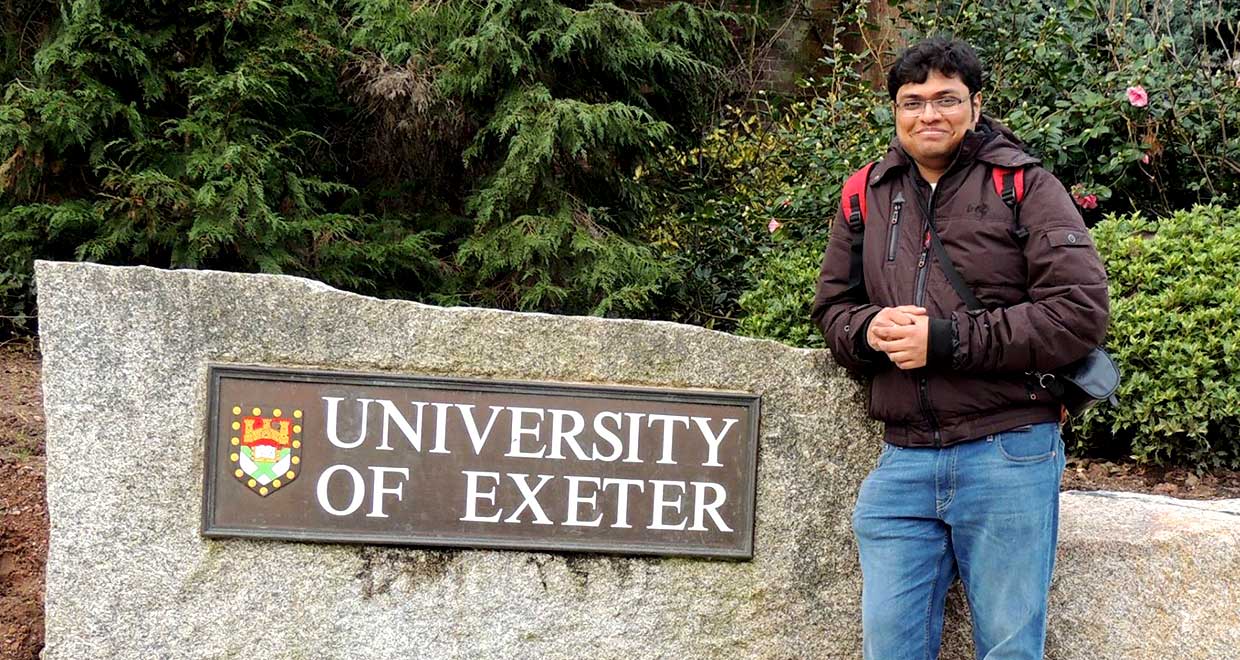
    Occasionally, I also had the opportunity to appear before the District Court at Burdwan, West Bengal. After a year of practicing as a litigator, I got through to the University of Exeter in the U.K., from where I completed my LL.M. in International Human Rights Law. After completion of the same, I re-joined the profession and started practicing at the Hon’ble High Court at Calcutta.

    While being able to give relief to clients gives me an immense satisfaction as a litigator, academics too, continues to interest me to no end. After having completed a Diploma in Cyber Laws through the distance mode, I was fortunate enough to be able to get the opportunity to attend a short certificate course in International Humanitarian Law last year.


    Do you have lawyers in your family? Would you say your parents were instrumental in your decision to pursue law?

    I am the 4th generation in a line of advocates. There is no dearth of advocates on my mother’s side too. My mother is also an advocate while her elder brother is an Ex-Judge of the High Court at Calcutta and his elder daughter, i.e. my cousin and her husband are advocates too.

    As interesting as it may sound, neither of my parents wanted me to pursue law as a career. In fact, I had decided on leaving Symbiosis Law School after getting through to the same, and joining the University of Calcutta, since I thought that Kolkata would be a better place to prepare for the engineering entrance exams that are held in the state. However, fate had other plans in store for me. By the end of the 1st year of LL.B., I was so interested in the subject of law, that changing my stream was no longer an option for me.


    Your father, Mr. Moloy Ghatak is a prominent lawyer & former Law Minister of West Bengal. How did he influence your career as a mentor? Did you get to hear legal discussions right from your childhood days?

    Considering the fact that almost my whole family is comprised of advocates, including both my parents, there is no denying that I did in fact, come across legal discussions and terminology from a very young age.

    Ever since joining practice, my father has been a source of constant support for me, whether as a senior to consult or a mentor to guide me through the times when I have come under duress. He has always been my idol as a human being. Now, his success as a counsel is also something that I look up to and would like to replicate in the days to come.


    Your father is also an MLA and a member of All India Trinamul Congress party (TMC). Did you ever think of joining politics?

    Like in advocacy, my father is not the first politician of our family. Politics in our family, to the best of my knowledge, goes back even further than advocacy. Inspired, as most young minds are during their college days, by such a background and charged with thoughts of revolutionising the prevalent scenario, I did dabble in college politics for a couple of years before realization dawned on me that politics is most certainly not my cup of tea.


    How would you describe your time at Jogesh Chandra Choudhuri Law College (affiliated to Calcutta University)? Please share some memorable experiences of your college life.

    In two words, it was life changing. I went to J.C.C. Law College as someone who was more interested in preparing for the engineering entrance exams next year. At the end of the 5 years there I was convinced that I would have had committed the greatest blunder of my life had I not decided to pursue a subject as interesting as law. The credit of making someone pretty disinterested in the subject to actually start loving the same goes completely to our professors and lecturers.

    There are probably too many memorable experiences to write home about. Among them, the experience of organising an art and craft competition for the students, re-launching our College’s law journal after a gap of a few years and winning the Moot Court Competition at Hazra Law College, would probably take the cake. Also, our very first class at college, where we were given a lecture by the then Principal of J.C.C. Law College, Dr. Manik Bhattacharya, remains a memorable experience for me. His statement that those coming from families having legal backgrounds ought not take success for granted since expectations from them would be sky high and almost impossible to meet and his quip that ‘A successful advocate barely ever enjoys his life and it is rather his children who do so’, shall remain etched in my memory for a long time to come.


    In Calcutta, universities are always charged up with a political atmosphere. How was your experience in such an atmosphere?

    Yes, I was indeed engulfed by such a political atmosphere and activism till I called quits sometime later. It is perhaps better to enter politics when we have something to give to politics rather than the other way round. The best example that comes to my mind is my father, who established himself professionally before taking the plunge. Another person from our very own High Court would be Mr. Kalyan Banerjee, who rose to the pinnacle of success as an advocate before deciding that it was time enough for him to become a legislator from a litigator.

    My experience in the midst of such an enlightened community of people, as I stated earlier, was very enriching, not only academically but also through the lessons of life that I had the opportunity to learn during my years at the University of Calcutta.


    You have nine publications in various renowned journals. How should one go about writing papers and getting the same published?

    The first and foremost thing that one should keep in mind when one intends to write a paper is whether the question that he/she seeks to answer through his/her research work or the topic he/she wishes to deal with is feasible or not. Being over-ambitious is of little help since choosing a vague or a wide ranging topic would pose significant problems for the author of the paper in collecting primary data. More importantly, to be able to collect and collate such a huge amount of information within the restricted number of words, as most journals tend to have a word limit for the submissions that one makes to them, would become that much tougher if the topic is not precise and focussed. A research paper also needs to be structured in the sense that one needs to be able to clearly define what one wants to say through the paper. The cardinal rule while writing a paper is to always remember that each line and each paragraph in the paper must be related to the question one is trying to answer in the paper.

    Also, last but not the least, there is no use in giving a long winding introduction or in merely compiling existing information vis-a-vis the topic you have chosen. What is rather of more importance is to be able to do some analysis of your own and preferably coming up with some suggestions on how to improve the law and/or the policy dealt with in your paper so that the law/policy is better adapted to the needs of an ever changing world/ society.


    After your graduation in graduating in 2011, you have started your criminal law practice at the Sub-Divisional Court of Asansol and also practised at the District Court of  Burdwan. What did you gather from your experience at the trial courts?

    On seeing most of my friends joining the High Court directly, I had been a bit averse to joining the lower court before making the switch to our state’s only constitutional court. It was on my father’s insistence that I went back to my hometown to start practicing as an advocate at the sub-divisional court situated there. And now I realise that it was a very good decision since when practicing at an appellate court, like the High Court, it is very necessary for you to be having a clear idea about the procedures of the trial court. And that is exactly what you gain if you practice at the lower courts, at least for some time, before making the switch to the higher courts, whether at the state or at the federal level.


    What influenced your decision to start your criminal practice just after graduation?

    Criminal law has always fascinated me. Not surprisingly, it had been my forte at college as well. Also, both my parents were criminal law practitioners. It is perhaps a combination of the above stated factors that influenced me to take up criminal law practice immediately after graduation. I would, however, also like to state that I consider these divisions in legal practice to be very artificial. This is especially true in the backdrop of the fact that at the graduation level we study all the major laws and as advocates, we are supposed to have a basic understanding of all or at least, most of them, even if we cannot claim to hold sway over all of them.
     

    avik-ghatak-2

    At what point did you decide to pursue your Masters at the University of Exeter? What was your motivation?

    It was after spending some time in legal practice that I had a lingering feeling that I still had some academics left in me. A few publications, especially a couple of them in a law journal published by the reputed and respected Common Law House publishers in Kolkata, further fuelled my thoughts in this regard. Aniket Mukherjee, one of our family friends and also a senior at J.C.C. Law College, who had himself completed his masters from the U.K., inspired me to go for an LL.M. One thing led to another and I landed up at the University of Exeter pursuing my Legum Magister.


    How was your experience at Exeter University?

    The experience at Exeter was vastly different from anything that I had come across in India during my graduation days. To begin with, there were no written exams for the subjects (referred to as modules therein) and hence no concept of buying the last ten years question papers and memorizing the answers . However, the absence of written exams did not mean unlimited free time since we were required to submit research essays in all the subjects we had chosen. Legal education over there depends much more on research work and analysis than over here. So, in a way, there weren’t too many shortcuts or last night studies. The path to success lay in the library, if I may say so.

    The library was absolutely fantastic with law journals from all major legal jurisdictions and systems, including those from India. Students over there are also given access to the best online journals available over the internet. I literally had almost the whole legal world at my fingertips while studying as a student at the University.

    A multi-national teaching staff, including among their ranks, a Special Rapporteur of the United Nations Secretary General and also a Refugee Status Determination Officer of the United Nations High Commissioner for Refugees, and a similarly diverse student group, further enhanced the knowledge exchange process. That is something that is available at only very few law universities in India.


    Why have you chosen International Human Rights as your specialization for LL.M?

    Most of whom I know to have done their LL.M., have pursued International Business Laws or International Commercial Laws. Perhaps it is more lucrative in terms of job prospects. But somehow, interest in this particular branch of law continues to elude me till date. International Human Rights Law was thus, pretty much an obvious choice since international law and human rights had been as close to my heart as criminal law.


    How difficult was studying abroad in terms of finding accommodation, finances and settling in?

    I shall begin with the last issue put forth in this question. Settling in was never a problem in the U.K. since they have a multi-cultural society with people from various countries and cultures residing therein for a long period of time. Racism is down to a near zero. All my concerns regarding whether I would be able to integrate into the society over there or not, were laid to rest pretty soon after my arrival at the University.

    Finding an accommodation hadn’t been a problem since I had put up at accommodation provided by the University.. However, when I decided to move out, it proved to be a tough task since as per the agreement with the University, one has to get someone who, at that point of time wasn’t staying at any of the University provided accommodation, to take your place or to continue to pay the entire fees for the University accommodation for the whole year. Fortunately, I did not have to wait for long to get such a replacement. However, my suggestion to anyone reading this and contemplating to pursue his/her LL.M. abroad, would be to decide beforehand as to whether one would like to stay at University provided accommodation or at an independent accommodation because once you ink the accommodation agreement with the University, the way out of the same could be very tough and not everyone could get as lucky as I did in getting a replacement who matches the terms of the agreement.

    Lastly, it is a known fact that studying in the western countries is a much costlier proposition than studying anywhere in India. Hence, prospective students would be better advised to look for scholarships, if the same is on offer. Over and above the same, perhaps putting up at a shared accommodation and not spending too much on travelling, a natural attraction for anyone going abroad for studies, should do the trick as far as the finances are concerned.
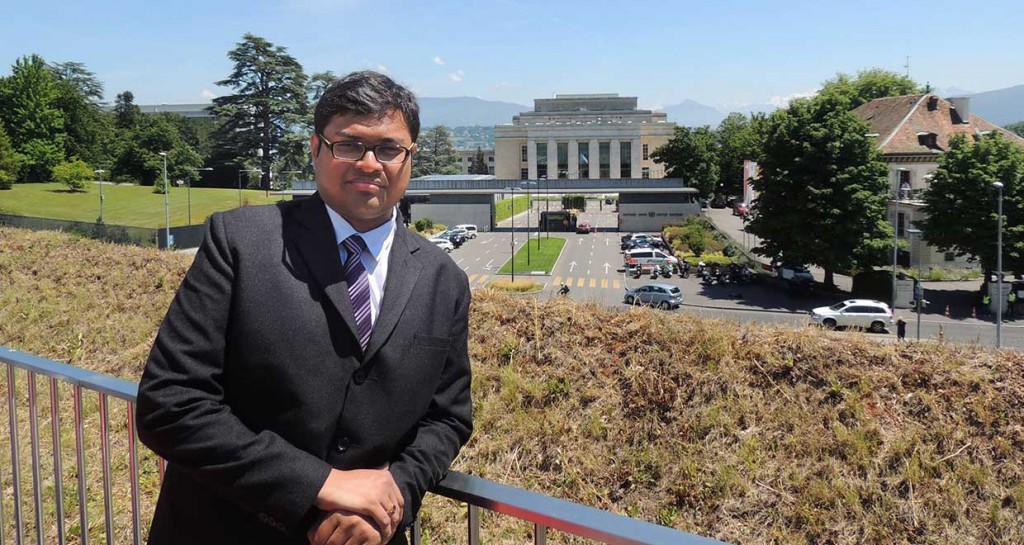
     

    avik-ghatak-3

    You were as one of the 50 professionals from around the world to attend a Certificate Course on International Humanitarian Law organised by the Istituto Internazionale di Diritto Umanitario in San Remo, Italy and also in Geneva. How was the overall experience? What was this course all about?

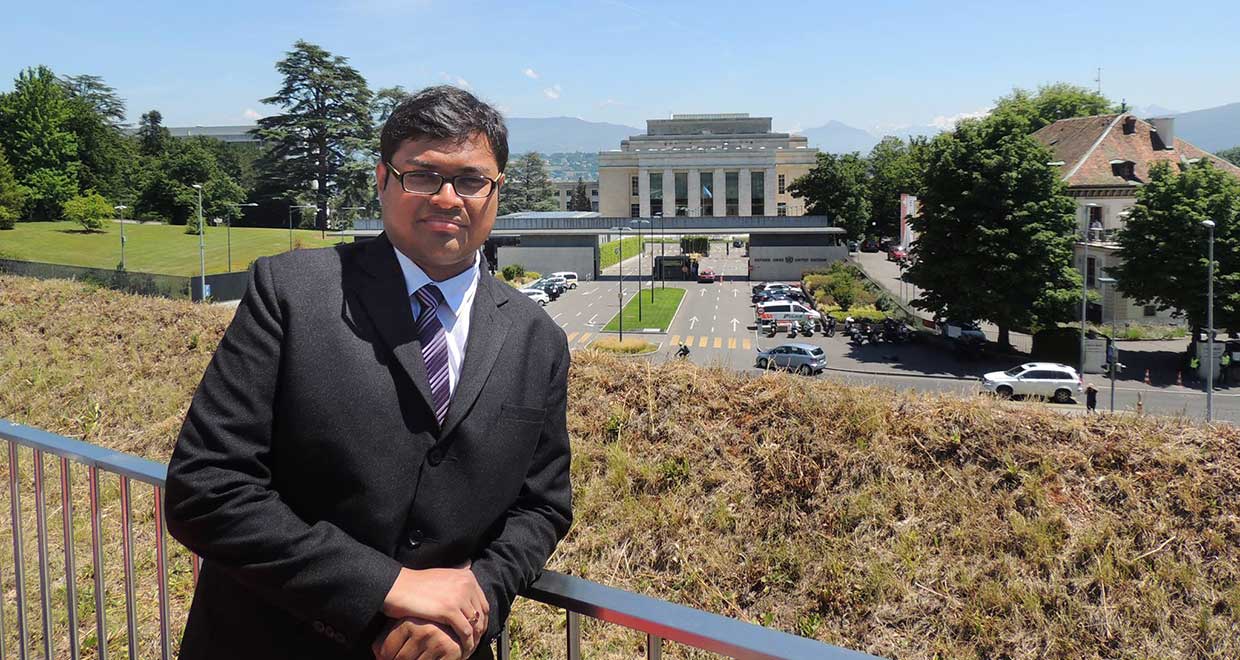
     I had been fortunate enough to be sent, along with 15 others from my University to attend the 82nd session of the United Nations Committee on the Elimination of Racial Discrimination and the 54th session of the United Nations Committee on the Elimination of Discrimination Against Women at the United Nations Office at Geneva in February, 2013. It is over there that I came to know about the Istituto Internazionale di Diritto Umanitario in San Remo, Italy. The Institute primarily deals with the military personnel from around the world, training them in the rules of engagement in accordance with International Humanitarian Law. In order to achieve their aims in this regard, they work in close collaboration with the likes of the International Committee of the Red Cross and has operational relations with the likes of the European Union and the N.A.T.O. They also organise a handful of courses for civilian personnel and I was fortunate enough to be selected to one such certificate course on International Humanitarian Law.

    The experience of being able to come into contact and converse with military personnel, diplomats, professors, personnel from the UN and other international organisations such as the International Committee of the Red Cross, Amnesty International, Caritas etc. and lawyers drawn from a pool of countries spanning over all the continents on earth is something that perhaps cannot be expressed in words. Understandably, it was a very enriching experience.
    The course was on Humanitarian Law wherein the functioning of the same was explained to us by various military personnel and jurists, including Special Rapporteurs of the United Nations Secretary General and Judges of international courts, at times, through exercises resembling real life decision making inside the battle command centres. Also, the relation that Humanitarian Law shares with Human Rights Law, International Criminal Law and as well as International Refugee Law was explained at length, over the course of two weeks.


    You currently practice at the Appellate side of Calcutta High Court. How is the work atmosphere at the High Court presently?

    As time progresses, our society is faced with newer challenges that are to be overcome. And in an attempt to do that, new laws are enacted by our legislatures or amendments are made to the existing ones. More the number of laws more would be the number of litigations though there may be certain exceptions. Hence the scope for private practice at the High Court is better than ever before and I am of the firm belief that the best days are yet to come. So, under no circumstances would I say that it has become more difficult for a fresher to be successful.
    As far as the atmosphere is concerned, having practiced at other lower courts in the past, I have found the High Court at Calcutta to be much friendlier to new comers than most other places. Most seniors are more than willing to help out the juniors when the juniors find themselves on a sticky wicket. And it is not as if they do so with an expectation of getting briefed by the junior concerned. I, for example, have been fortunate to have had worked with a senior who not only allowed me to brief other senior advocates, if the clients so wished, but also to appear against him in matters where, by a stroke of fate, we ended up representing opposite parties in the same case.

    It would be advisable for a fresh graduate to not expect a huge amount of money in his bank account at the end of every month, at least for the first few years of his practice career. Advocacy surely isn’t the place where one can rake in the money right from the word go. One would do better to do away with any vanity or air of superiority and get his head down into becoming a good clerk to begin with. In the words of my senior at the Asansol Court, ‘One has to first become a good clerk if one is to become a successful advocate later on.’ Basically, one would have to know the procedure of the Court inside out before concentrating on the laws since knowing the procedures himself/herself would make him/her less dependent on others in basic matters such as those relating to the filing of a case, for example. Next comes the knowledge of law and the finesse of arguing a matter in the court, both of which one learns over a span of a life time. There are barely any last minute quick fixes or short cuts to success in this profession.


    Many law students prefer corporate jobs over a career in litigation. What is your take on this? Is it better to work in the corporate sector for a few years before starting litigation?

    A High Court Justice had once famously quipped that he is proud that his college produces eminent lawyers and jurists instead of producing ‘corporate slaves’. An ex-Supreme Court Justice, while in conversation with a representative team from our college had stated that he felt that the corporate lawyers contribute nothing to the legal field in terms of legal jurisprudence and interpretation of the laws.

    Such views, though, are generally restricted to our previous generations. Being someone from a generation, a good chunk of whose members have gone into the corporate sector or into law firms, I don’t possess such a traditional view in this regard. In fact, I do understand that in the initial days, a corporate job does seem to be much more lucrative. We are also in an age when most of our friends who go into other streams, especially engineering, get corporate jobs immediately after graduation and their lifestyle and economic stability does appeal to students of the legal field too.

    Also, some students may actually need the economic support in the form of salary that one would get on joining a corporate job or a firm after passing LL.B. That is something that advocacy, by and large, would fail to provide you with during the initial days. Also, some may not want the daily hassles and the schedule less life that comes along with a career in litigation. Hence, corporate jobs for those in the legal field is also a necessity in today’s age, as it provides an additional career option, and a pretty good one at that, to the law graduates.

    I do not have any previous experience of either interning or working in the corporate sector and hence I may not be the best person to be speaking to in this regard. However, to the best of my belief, I do not think that working for a few years in the corporate sector before starting a career in litigation would make much of a difference, especially since the nature of the work that one does at the corporate sector is vastly different from the work that one would be required to do in litigation. One’s experience in the corporate sector is useful for a career in litigation or not, would perhaps depend on how much exposure one gets to the proceedings of the courts during one’s work as a corporate lawyer. However, the experience relating to the drafting of legal documents that one would be required to undertake in the corporate sector is surely going to come in handy even in litigation.


    How did you get to connect with your clients? How many years of practice do you think would be required to build a firm clientele?

    I believe that working at the lower courts at Asansol, Durgapur and Burdwan went a long way in increasing contacts among the advocates practicing over there. And once I shifted to the High Court, advocates from these places found someone they knew and had worked with, to send their cases to, if and when they needed to send some matter up to the High Court. I also make it a point to visit the lower courts in and around Kolkata on a periodic basis, if and when an opportunity to do so presents itself before me. Such visits however, are never at the cost of my work at the High Court since that is my primary place of work.

    As far as direct interaction with the clients is concerned, one has to remember that most of them come to us only when they are in distress and hence, they may seem to be a bit repetitive with their questions at times and at other times, they may seem not to be able to understand your point of view due to a multitude of reasons including their general lack of legal knowledge. One would do better to keep one’s calm under such circumstances. Ultimately, no matter what one says, even the clients understand that you may lose a matter after all. What matters is that they should be able to see in you the intent to give it your best. Good behaviour with clients is a must because our very profession, after all, is in existence to help them out with their legal problems.

    As far as the number of years it would take someone to build a firm clientele is something that would vary from advocate to advocate and there is no straitjacket answer in this regard.


    How is your experience so far? What is your workday like? Are there new challenges every day or did work fall into a predictable pattern?

    My experience at the High Court has been exciting, complete with its share of ups and downs.
    I tend to reach court a little early, i.e. within 9:30 to 10:00, a habit that was inculcated in me by my senior, Mr. Debasish Roy, when I had joined the High Court. After completing Court in the evening I tend to be able to come back home if there are no conferences and dive headlong into studying for the cases scheduled to come up for hearing on the next day or draft documents that are to be filed in the days to come. If however, I am required to meet some senior for any conference then the time by which I am able to return home completely depends on the timing of such a conference.

    Once in this profession, one has to be ready to attend conferences that are held at the convenience of the seniors, whether they are held at midnight or before sunrise in the morning. Life, effectively becomes schedule less. But then, that is part and parcel of advocacy.

    My grandfather used to say that every day is a battle for an advocate. Quite obviously, when you are engaged in a battle on a daily basis, things would not tend to be predictable at all. Two cases may be similar but no two cases are ever the same and hence predictability is not something that one can come across in this profession since each case requires individual care due to its uniqueness, thereby throwing a new challenge at the advocate handling the same. The only thing predictable about a day in an advocate’s life is perhaps that it would be unpredictable.


    What would be your parting message to law students who want to litigate just after graduation?

    Hard, though intelligent work, an indomitable appetite for legal and as well as other related knowledge, loads of patience and humility can and is bound to lead to a success story after a certain point of time. Those coming into litigation must keep in mind that it is not for nothing that we are referred to as ‘Learned’ advocates from day one. We have to behave and act as learned people if we are to do justice to our profession.

    Having said that, I would like to wish all the best to all the law students wishing to become legal practitioners after graduation.

    Last, but not the least, I would also like to say, in the words of my mentor Mr. Protik Prokash Banerjee, ‘Welcome to the Glorious Uncertainty’.