Tag: JGLS

  • In conversation with Manasi Chaudhari, founder and CEO of Pink Legal

    In conversation with Manasi Chaudhari, founder and CEO of Pink Legal

    This interview has been published by Sonali Parashar. The Interview was taken by The SuperLawyer Team.


    Let us start from the beginning, what prompted you to pursue law? Is it true that you are a first-generation lawyer, or did someone from your family inspire you?

    I knew I wanted to be a lawyer since Class 8…don’t ask me why! It was just a gut feeling! Actually, I think it is in my genes. My grandfather was a judge in the Bombay High Court. I remember going to court with him once, when I was five, just to visit. But apart from that, I grew up in Hyderabad. Both my parents are from different professional fields, and I didn’t have any direct contact with the law. So, in a sense, you could say that I am a first-generation lawyer although I come from a family of law. 

    From practising commercial and real estate litigation for three years in the Hyderabad High Court to interning at the Supreme Court of India with Hon’ble Justice Chandrachud. Is there any particular incident that pushed you in the direction that you are in today?

    I had always admired Justice Chandrachud but I never imagined that I would get an opportunity to work under him. It had felt like a distant dream until it really happened. I was feeling saturated with the litigation practice and didn’t see myself deriving joy from my work. Therefore, I decided to try a new path and do something I have never tried earlier. I was passionate about women empowerment and gender equality even in law school. I knew that Justice Chandrachud was on the bench for the Section 377 and Sabarimala temple cases and it seemed like the perfect opportunity to explore my passion, under his tutelage. That’s how I took off for Delhi and found myself in the holy grail of law. 

    Manasi Chaudhari

    You are committed to improving women’s access to legal services and that is reflected in your initiative, Pink Legal. Can you tell us how things turned out when you decided to begin your own initiative? 

    I launched my initiative Pink Legal (an award-winning and India’s only platform to empower women legally) in March 2020. Nyay’ri is an extension of Pink Legal. When I started Pink Legal, I had no idea that it would grow the way it has. I just wanted to create a platform where women can understand their legal rights in an easy manner, and I hoped that at least some women would know that this platform exists! But I guess destiny had other plans and Pink Legal catapulted from a basic platform to an entire organisation for creating legal awareness and providing access to legal services for women. I was suddenly being called a ‘legal entrepreneur’ and had to learn the basics of running an organisation, while on the job, with no pre-requisite MBA! This journey has helped me grow, build a team of fabulous young people (called the Student Squad), and take one step closer to my dream of seeing a gender-equal world. 

    From litigation to establishing your law firm to launching Pink Legal and collaborating with Project Naveli, this has been your journey thus far  Was the goal of forming a team to empower women always in mind, or did it come as a surprise?

    The goal has always been to create a gender-equal world. The path to this dream, through Pink Legal and Nyay’ri, is something that I discovered along the way! I certainly believe that if we all join hands we can accelerate our goals much faster, through collaborations with like-minded people and organisations. Pink Legal already has a growing team of thirty spread all across the country. I would love to expand this further, even across the globe, and make it a movement!

    Would you like to tell us more about your law firm’s practice and what your firm’s main focus is now? 

    I started my law firm (Manasi Chaudhari & Associates) in 2020, the same year as Pink Legal. My firm focuses on business and transactional law work cutting across various sectors such as media and entertainment, intellectual property, information technology, and anything to do with transactions. We have had the good fortune of attracting clients like top movie-production houses in South India, leading national FMCG companies, upcoming start-ups, and business groups. I enjoy my professional practice of advising my clients, negotiating deals, and ensuring that their rights are secured. 

    Is it difficult to balance the demands of running your own law firm and the duties and responsibilities of the CEO of Pink Legal?

    It sure is challenging, but I wouldn’t have it any other way! One is my profession and the other is my passion, but both are equally demanding! There are days when I ace the balance and have a lot of free time on my hands. There are other days when work stretches into the night and my mind refuses to shut off. Sometimes, I feel like I am getting pulled in too many directions. However, I learned a very important lesson on time management from Justice Chandrachud. Despite being one of the most important people in the country, he would always make time for everything, including checking up on us if we weren’t feeling well. So anytime I start losing track, I always think “If Justice Chandrachud can make the time, then I most certainly can!” 

    You are going down in history! From being named as the ‘Legal Entrepreneur of the Year 2020’ by Business World to receiving the ‘Digital Women 2020 Award’ by SheThePeople and Google. Where do you see yourself in the next 10 years, given your affiliation with global players like Puma, Instagram, and Tinder? Are you planning on something big or staying low at the moment? 

    Thank you for your generous words! I am not much of a planner. I believe in the saying that ‘life happens to you when you are busy planning.’ Therefore, if you ask me even about the upcoming 1 year, I will not be able to tell you anything! I have goals and ambitions, but I don’t plan for them. I can probably visualise where I want to be, but how I’m going to get there is a puzzle that even I am looking forward to solving! Sometimes, we get carried away with our dreams and professional goals and mistake them for life. Life is much more than that, and I want to truly live each and every day of it!

    Do you have any advice for our readers who dream of bringing a change?

    Yes, I have a lot of preaching to do! (Just kidding) I would give two pieces of advice: First, identify your passion and work towards it. It doesn’t have to be big. Every step counts and every drop makes the ocean. Most people ‘feel’ they are passionate, but when it comes to actually doing something, they don’t want to put in any effort. They’d rather just reshare an Instagram post. It’s up to you to decide if you want to be a real warrior or a mere keyboard warrior!

    Second, never underestimate financial independence. It is easy to get swayed by clickbait articles claiming ‘XYZ left his corporate job to pursue his passion.’ Great for XYZ, but how will you focus on your passion if you have to worry about paying your bills or you don’t have the independence to decide how to spend your money? Follow your passion by all means but secure yourself first!


    Get in touch with Manasi Chaudhari:

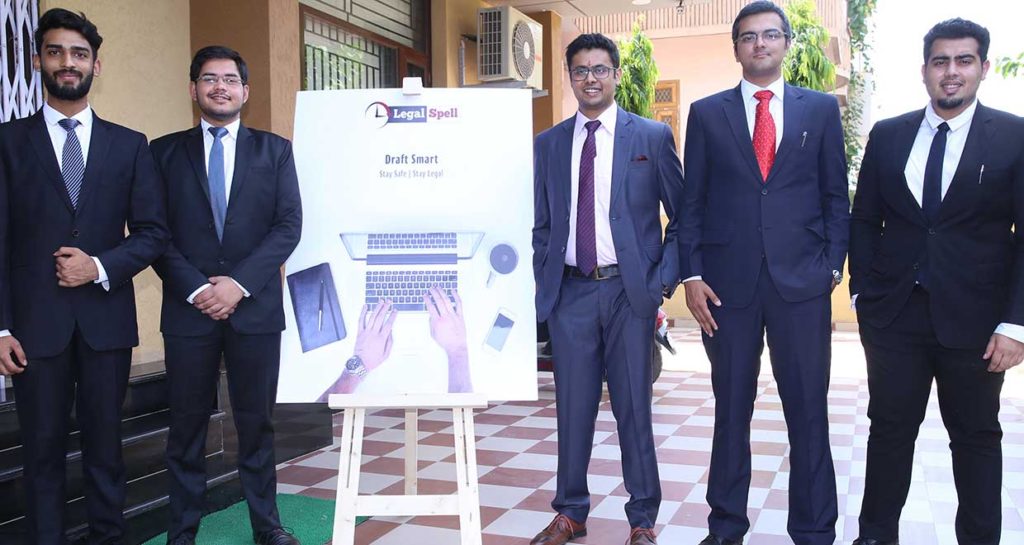
  • Varchasvi Gagal, CEO, LegalSpell, on starting up in legaltech and creating a drafting tool

    Varchasvi Gagal, CEO, LegalSpell, on starting up in legaltech and creating a drafting tool

    Varchasvi Gagal graduated from Jindal Global Law School recently in 2016. After witnessing a wide array of legal cultures through global legal education in college and on exchange at Baltimore School of Law, University of Baltimore, he has been researching the use of legaltech to transform Indian Legal drafting methods, for the past 2 years. He worked at the Legal Clinic of his college to understand the need for documentation among people at the grass roots level.

    Varchasvi has recently launched India’s first DIY document drafting platform for all called LegalSpell. He has been working on his start-up for more than a year ago. His vision is to revolutionize the way document drafting is done in India.

    In this interview he talks to us about:

    • What is LegalSpell and how it is one of its kind.
    • His motivations and inspirations in life and in creating LegalSpell.
    • His journey from a simple law student to the CEO of LegalSpell.
    • His vision to do something path breaking with LegalSpell.
    • Future plans and taking Document Drafting towards a much needed evolution.


    Tell us a bit about yourself. What drives you? What is one achievement you would be most proud of today?

    I come from a background, which involved my upbringing in a small town (Alwar) in a joint family. I have been molded in such a way that commitments are considered to be of the utmost importance.  Being from a business family, I have always admired my father. Watching him work inspired me in so many ways. He struggled hard and created an industry all by himself.

    He drives me towards becoming a better man.

    I like to be honest. I am a straightforward person and in a lot of ways, direct and practical. And maybe that is why I never back out from my commitments. I like to keep things clear, and law taught me that in order to do that, it’s better to do everything legally. And maybe that is why I never back out from my commitments. That was my motivation towards LegalSpell.

    When you are working towards something that you believe in, you just don’t want to stop. And that has made me a workaholic. I just love to work and I can’t sleep until I am satisfied with the inputs I am giving in to achieve my goals.

    Although it took me more than a year to analyze the needs of people, one thing I am proud of today is that, I have finally created something that I once imagined. We created a user interface, which would not only revolutionize drafting, but will cater to anyone and everyone. The tool was specifically designed to adapt to the user, keeping in mind a professional as well as a layman. I am proud that LegalSpell will work directly and indirectly towards legal awareness and safety.


    Tell us a bit about your law school days, and your internship experiences?

    Law School for me was a joyride. It has transformed me in so many ways and yet it was a home away from home. Spending half a decade in a place is not a piece of cake. But Jindal was an experience of a lifetime. The 5 years have taught me so much, made me aware about the world, and has witnessed my transformation in many ways. I was taught by few of the most renowned faculty in India and on the other hand I made friendships to last for a lifetime. The semester exchange program opportunity gave me so much of an insight into the legal cultures of the world.

    Also, I thank my college for giving me some wonderful friends and seniors. Samridh, Ojasvi and Harsh Aggarwal have been my constant support throughout. My seniors, Advocate Jayant Malik and Arjan Sharma have guided me in shaping LegalSpell as a product. In fact, my friends and an integral part of team LegalSpell, Namon, Karan and Hrideja are also from the same college.

    As far as my internships go, I thoroughly cherished interning at Impact law venture. That was the time when Mr. Pankaj (the owner) gave me some brilliant insights into start-ups.


    When was the moment you decided to not pursue the mainstream legal career and dive into entrepreneurship?

    My exchange semester along with the internships played a huge role in my decision in choosing a non-conventional career. I gained a lot of experience at my internships, and a lot of knowledge in my college, however there was always something that was missing. There was always the will to do something path breaking.  Something that not only creates an impact in the legal sphere, but transforms it forever. And when it clicked, nothing was the same ever again. The drive that it brought has borne its fruits in the form of LEGALSPELL.


    What is LegalSpell?

    LegalSpell is an online drafting platform for lawyers, corporates, entrepreneurs, start-ups, freelancers, designers, chartered accountants and laymen alike, a tool facilitating an instinctively easy drafting. LegalSpell ensures a time-efficient and cost effective user experience. Having been designed to automatically customize and personalize the document drafts for the user, this novel drafting platform has convenience imbibed in its core. A user can prepare their customized draft simply by answering a few questions and thereafter, use the drafting platform to personalize their draft to better suit their needs. While using this platform, the user has the flexibility of hand-picking clauses from LegalSpell’s automated draft prepared on the platform or add pre-drafted clauses specifically tailored to suit their draft from the Referrals tool. To add to the user’s experience, the drafting tool also incorporates features like an onscreen Google search and drafting notes, amongst others. The orientation of the drafting platform has been kept well aligned with that of the conventional drafting tools to instill adaptability and for enhancing the user’s ease of use.

    For instance, if a lawyer needs to draft an application under Section 34 of the Arbitration Act (filed for setting aside an arbitral award), all he needs to do is answer a few specific questions and LegalSpell will automatically prepare the draft by creating the Index, Memo of parties, List Of dates, Affidavits and Vakalatnama in just one go.


    What is legaltech? How does LegalSpell use legaltech?

    Legaltech is nothing but a step forward towards a future where the legal fraternity goes hand in hand with technology to attain more efficiency and productivity in legal work. The idea is to revolutionize the legal sphere with advancements of technology to foster the legal needs of people with utmost convenience.

    LegalSpell is driven by the application of technology to redesign the conventional document drafting practices into a neoteric and more sophisticated system of drafting. Our vision is to strive towards efficient and hassle free document drafting through the use of legaltech. Our goal is to innovate and develop technology to make the legal system much smarter, faster and efficient. We believe that while all other spheres of our life have been transformed through the means of technology, the legal system has remained deprived of such transformation. By introducing LegalSpell, we are reshaping those conservative and conventional methods by the use of technology.


    Who all does LegalSpell cater to?

    LegalSpell not only caters to Lawyers, CA’s, Corporates, Start Ups, Freelancers but to layman as well. It is so easy to use that through an easy 5-step process, a highly intricate and complex document can be drafted within minutes. With our initial offerings, LegalSpell provides a platform to draft more than 120 documents, which are divided among Court Related documents, Agreements, business related documents and personal documents. In fact, with the course of time, we are aiming towards a repository of 250+ documents by the end of October. With all that in the cards, we are just getting started. Our goal is to provide our customers with a choice of each and every single document possibly required under the Indian legal system.


    How is LegalSpell of aid to the legal fraternity?

    Being a company started by lawyers, we realized that due to increased cost and time pressure in a highly competitive industry, it had become imperative to invent a cutting-edge solution to the highly cumbersome document drafting methods. LegalSpell serves as the perfect tool to solve these issues.

    The amount of time it takes to create an ironclad document is far beyond imagination for a layman. Be it a lawyer or a paralegal, drafting is and has always been a cumbersome process. But not anymore; LegalSpell caters to the needs of legal fraternity, where it not only saves time, but is also cost effective. No more drafting hassles, instead after a mere work of answering few questions, the user will be served with an automated draft of the selected document in one go.

    Moreover, LegalSpell not only provides the lawyers with a means to increase efficiency and work productivity, but also helps them to expand their horizons into different aspects of law with the diversity of documents that it offers.


    How did LegalSpell come about?

    After spending a whole semester in Baltimore School of Law, studying the functionalities of law in the global sphere and experiencing the digitized legal culture there, I realized how India lagged behind from global standards of fast and efficient document drafting. Being a legal student at that time, it perturbed me that there was no dedicated document-drafting platform in India to cater to the documentation needs of people.

    I realized that the nuances of the legal world have been changing at a pace faster than ever and range into multiple shades of an otherwise black and white regime. The idea behind LegalSpell was to empower everyone to keep up with this change. While technology has transformed the way professional needs and demands are met, the realm of documentation lacks a smart and efficient use of technology to fulfil its demands. By creating a tool for document automation and customization, we are reinventing a smarter and more productive way of generating high quality documents with utmost ease and convenience.

    As a result, I, along with two brilliant lawyers set upon to create LegalSpell, to foster the documentation needs of people.


    varchasvi-gagal-1

    Who are behind LegalSpell?

    Driven by the pursuit of spreading awareness amongst people, LegalSpell was conceptualized by myself with the support of Mrinal Gagal (Entrepreneur) and was, thereafter, pragmatically augmented and developed by two lawyers, Jayant Malik and Arjan Sharma. Our Team Consists of Ojasvi Singh (Advocate), Meghanjali Routh (Economic Strategist), Karan Dhingra (Law Student), Namon Deep Jain (Law Student) and Hrideja Shah (Law Student).


    What were the problems faced while bringing about LegalSpell?

    Everyone believes that a good idea is all that is needed to establish a successful start-up, but take my word, that is merely the beginning. Maybe that is why there’s no copyright on the idea but on its expression.

    The number of hurdles faced over the course of time in the creation of LegalSpell are innumerable, however one of the biggest challenge was to develop an instinctive platform that could respond to all the needs and necessities of the user. The research and development invested in the creation of LegalSpell, is one of the most significant reasons why LegalSpell is one of its kind. It took us a whole year, just to research and analyze the needs and demands of the consumers.

    Also, our I.T. team along with our Legal team faced countless problems while trying to incorporate technology in creating flawless drafts. However, they did a commendable job by working day and night to create a dedicated DIY document-drafting platform.


    Why a start-up over a conventional job or an independent legal practice?

    I am and have always been passionate about law, and at the same time I have always been taught by my father that progress is the key to everything. The idea behind LegalSpell was to create something in the field of law that proves to be a definitive step towards a progressive legal culture.

    Don’t think of LegalSpell as just another product in the market. It is much more than that, it stands tall on the foundations that are built on much higher principles. As a law student, my inspiration has always been backed by the habit of need for quality and excellence, that was instilled in me in my early years of law school. As Aristotle has said “we are what we repeatedly do, and excellence, then, is not an act but a habit.”

    By creating LegalSpell, we are not only progressively catering to the needs of fellow lawyers, but are creating a legal environment where anyone and everyone has access to quality documents which helps them stay legally sound in their respective professions.

    Why serve only yourself by doing a conventional job, when you can serve the whole fraternity by making their work more productive and efficient.


    What can we expect from LegalSpell in the near future?

    This may sound a little over-confident, but we are just getting started. Not only are we planning to come up with three new services by the end of this year, but we are already working on adding a wide array of documents related to every profession, so as to cater to the legal documentation needs of as many people as possible.

    We already have a document offering of 110+ document drafts, and our goal for 2016 is to take it to 500+ documents by late December. On the top of that, our R&D team is constantly working on making LegalSpell’s drafting platform more instinctive, more responsive and even more user friendly, based on the feedbacks from our existing customers.

    If all goes as planned, LegalSpell will transform the way documents are created in India.


    Is LegalSpell intended for the Indian Markets only?

    The answer to the question whether it is “intended” only for the Indian markets won’t do justice to what the future holds for LegalSpell.

    As of now, LegalSpell is specifically focused on catering to the needs of Indian users. It is designed to respond to each and every need of the user while drafting their intended document. The documents are fashioned according to the Indian Legal System to provide utmost precision.

    However, as I mentioned earlier, that we believe in progress and we are not denying the fact that somewhere down the road, LegalSpell might include international documents under its ambit.


    Where do you see LegalSpell in the coming years?

    We believe that with the inception of LegalSpell, we have created something truly incredible. It holds the potential for an endless number of possibilities. We have and still are striving towards revolutionizing the Indian Legal System, and we won’t stop until a truly remarkable revolution is witnessed by our legal system. We take pride in the fact that we are instrumental in doing so.

    We already have plans for the coming years, however they are still in their initial phase, and right now we are working on our plans for the near future, moving forward one step at a time.

    As they say, “the sky is the limit”, but for us, we don’t believe in limits, and that is why “the sky is where we start from.”


    What would be your message to readers?

    Believe in what you do. I believe law, as a career is just not limited to litigation or corporate life. In today’s world especially when India is moving at such a fast pace towards digitization, a law student has multiple avenues to choose from. I believe that in order to sustain or to be successful in such a competitive and fast moving environment that we live in today, one needs to be innovative. We are just at the inception of innovation in the legal field and there is a long way ahead. Courses we study in our law school shape our reasoning abilities. Once we graduate only then do we realize that there has been a significant change in how our reasoning and logical abilities have been boosted. At the end of the day, the only thing that matters is one question, “Are you living your profession” and my answer to that question is YES I Am.


  • Pooja Terwad, Founder, Nivaran Online on LL.M from Jindal Global Law School and practicing law

    Pooja Terwad, Founder, Nivaran Online on LL.M from Jindal Global Law School and practicing law

    Pooja Terwad graduated in B.L.S.LL.B from Mumbai University in 2012. Thereafter, she went for LL.M from Jindal Global Law School. She got an excellent opportunity to visit Maurer School of Law and work there as a Research Associate for a semester as a part of a fully paid scholarship programme from JGLS.

    She is a legal practitioner with expertise in Consumer Law, recently she founded Nivaran Online, a platform which proposes to end all consumer disputes. Let’s talk with her today on National Consumers Rights Day find what drives her to such social initiatives.


    Tell us a bit about yourself.

    I am a Mumbai girl, from an exceptionally well-educated family. Law is something I did not choose, but it happened by chance. It was only after working for a few years that I realised Law is my true calling. I have been associated with NGOs like Cheshire Home, Indian Development Foundation, and others since I joined Law. Working with the under-privileged made me stronger and determined as an Individual. The consistency I have seen amongst differently abled population has given me the courage to walk a little far and choose a way that is less travelled.


    How do you recall your graduation and LL.B days?

    I have been an average student throughout my schooling and LL.B days. It was only the desire to achieve something above average and to do something different than most of the law graduates, which got me into Nivaran. The experience of volunteering with Asia’s largest consumer organization, Mumbai Grahak Panchayat, and exposure to intern at Consumer International, Malaysia was a boon. All this experiences further resulted in Nivaran.


    Tell us about your professional qualifications.

    I completed my B.L.S.LL.B from Mumbai University in 2012. After that, I went for my LL.M from O.P. Jindal Global University, New Delhi. I have been awarded a gold medal for my academic performance and another gold medal as an award for the Law Leadership programme.

    I was fortunate to have got an opportunity to go to the United States of America on full scholarship, for pursuing my semester. After, I came back I worked with the Additional Solicitor General of India, Mr. Anil Singh at Bombay High Court. I also had the opportunity to work on serious matters like Adarsh Scam, Campa Cola, etc. under his guidance.

    It was in January 2015 that I started my law firm and at the same time began volunteering for Mumbai Grahak Panchayat under the mentorship of renowned consumer activist and Lawyer, Mr. Shirish Deshpande. I am thankful to him for the opportunity to attend a 14-day internship programme at Consumers International, Kuala Lumpur, Malaysia. The guidance of Ms. Indrani Thuraisingham, Head of CI, South Asian Region, has also been very helpful to me while setting up the process at Nivaran Online.


    pooja-terwad-2

    Please tell us about how you got the USA scholarship, and what all did it cover? What did you get to do in the States?

    I should thank Jindal Global Law School for my USA scholarship. I was enrolled in the two years’ LL.M course and had a keen interest in Intellectual Property Laws. I was the topper of the first year LL.M at JGLS, and hence, our Director chose to send me to the US for a semester at Maurer School of Law, Indiana University, Indianapolis. Although not an Ivy League college, this is one of the best public universities in the States with the most renowned IPR professors teaching there.

    There I got an opportunity to study Patent Law from Prof. Mark Janis, who is an immensely learned and globally renowned IPR attorney. My scholarship covered my entire tuition fees and a Monetary Scholarship of USD 4000. Apart from that, I also received a paid Research Associate position at the University.

    Also, I always wanted to work while studying and experience the high of being financially independent. I got the chance to do so while in the States. I did end up doing small jobs in the US and also worked as a Research Associate to professors. It was quite exciting.


    Did you think of pursuing your profession at the United States?

    More than professional reasons, I had personal reasons to come back. I am the only child, and I was not very keen to leave my parents alone in India in their aging years. And, I am strongly of the belief that, Indians have an incredible potential to transform the country with their innovation. It’s just that we need to overlook the Dollars, and have a strong sense of belief in our potential.


    What inspired you to start something like NIVARAN?

    While working for Asia’s largest NGO for consumer issues, Mumbai Grahak Panchayat, and working for their Consumer Guidance cell, I realised that NGOs in India work on a micro-economic platform. They do not have the expert resource to work for a single consumer, and get the dispute resolved as a matter of responsibility. Indian consumers needed an organization, where expert legal advice could be provided by lawyers. However, the same should be given at an affordable price. I wanted to establish an institution, where every “justifiably cheated consumer” gets a resolution without going to the courts.


    pooja-terwad-3

    Why do you think Society needs a platform like NIVARAN?

    Most of the times, an Indian consumer is left with two choices. Either “GO TO THE COURT” or “GIVE UP ON HIS RIGHT”. I feel both of them are neither viable nor justified. When the loss is of Rs. 25,000 to 50,000, a consumer doesn’t want to go to the court, as he will end up spending much more than the loss amount on lawyers and the judicial system. And ultimately, he gives up on his rights silently. I wish to change this scenario. Every consumer should get a resolution under every circumstance.


    What is your role in Nivaran Online?

    I am a founder at Nivaran Online, and I look into the Operation and Legal Area.


    What is Nivaran’s operational model? Where do you see Nivaran in five years down the line?

    With the kind of pendency and delay in Consumer courts, I wish to make Nivaran Online, a centralised platform for resolution of disputes, where brands, as well as consumers, operate on amicable grounds. We have associated with several Consumer NGOs in India, especially the ones founded by people who believe in swift resolution and are open to trying something new, rather than going the monotonous way. They divert consumer complaints from their areas, and we in return, help them with Honorary Funds so that they can further consumer welfare. I wish to tie-up with Organizations, Governmental and Non-Governmental, and ultimately provide the best aid to consumers.


    How difficult has it been as a litigator, have you ever faced any gender bias in the legal profession?

    Fortunately, I have never suffered any such bias till date. I have been lucky to have met people who judged me by my credentials, rather than my gender. I believe women have proved themselves beyond all doubts. It is true that we do not have many women entrepreneurs in the start-up world. But, male-dominated professions have never discouraged a woman from establishing her identity. So I am highly optimistic, that my gender will never be a hurdle in moving ahead.


    Don’t you think starting up with Nivaran can affect your mainstream profession?

    I have been in litigation for quite some time. I have my full-service law firm, in the name of Pooja Terwad & Associates. We were fortunate to have established ourselves pretty well without any previous legal background. However, I was always dissatisfied when I appeared in Consumer Courts.

    Even in my individual capacity, I ensured that before we go to the court, we try to settle the matter. I also encouraged consumers to argue on their own, if they could not afford lawyers’ fees. But, the highly technical procedures were often discouraging. So, I thought of moving apart from the monotonous and commercialized structure of Courts, help consumers resolve their disputes and charge them nominal fees, which did not exceed 10 percent of the loss value at any cost. So, I chose to do what courts do, however, without going to the court.


    What would be your message to our readers?

    I feel Indian lawyers are bogged down by competition, all they care is about “packages”. Very few of them wish to experiment, innovate and come up with something exciting which will help the society as a whole.

    Our youth I notice is pressurized to such an extent, with stereotypical opinions that he fears to try his hand at something new, something challenging. We are scared to get out of our comfort zone; we are afraid to struggle. We are afraid of failure, not because it would affect us, but because the society might not accept us with a failure tag. I feel we have taken the Society way too seriously. It’s time we do what we feel is going to make us happy and moreover do what we are meant to do.

    I would only urge to all of my friends that we have the potential; we just need to be creative and an out-of-the-box thinker.

  • Aviral Sahai on winning moots (NLS Arbitration), receiving Naveen Jindal scholarship, appointment, work at AMSS

    Aviral Sahai on winning moots (NLS Arbitration), receiving Naveen Jindal scholarship, appointment, work at AMSS

    Aviral Sahai is a graduate from Jindal Global Law School (Batch of 2014). He has an enviable academic record and an excellent series of internships at top law firms. He has been the Recipient of the Naveen Jindal Young Scholarship. He underwent an academic exchange program with Maurer School of Law, Indiana University, Bloomingtion, Indiana, USA during his law school days. His diligence paid off when he received a job offer from AMSS in 5th year of law school.

    In this interview, he talks about:

    • Winning moot court competitions including NLS International Arbitration Moot
    • Experience as a part of an International Student Exchange Program
    • Appointment at AMSS


    Our readers consist of law aspirants, law students and young lawyers. How will you introduce yourself to them?

    I’m a corporate lawyer, who aspired to become a litigator, got into law school wanting to pursue international law and took up science in plus two. On hindsight I might seem like a confused soul, but I tend to take the best out of what is on offer. So, as an introduction, today, I am a corporate lawyer who is trying not to plan too ahead and enjoying his tryst with a side of law he never thought he would practice.


    Tell us about your pre-college life? When did you decide to take up law as a career? Did you have lawyers in family?

    No. There have been no lawyers in even my extended family for 3 generations. I think that was the prime reason for doing law, “even if I’m a bad lawyer, I’ll be the best in the family”.

    I am an alumnus of La Martiniere for Boys, Kolkata, and, as whoever is familiar with the vibe of the city will understand, I was quite laidback in life. I was a science student and did considerably less than my fair bit of tuitions. Plain and simple, I did not want to be an engineer or doctor and just wanted to do something different.

    On a serious note however, I am a lawyer because of my father. He is an ex-army officer who runs his own business now and has always had an aptitude for lateral thinking. Sometime during my class 11 he asked me what I wanted to do in life, which, quite honestly I had not considered up until that point in time. Even while I was a good student, I think I always hoped that life would turn out to be 6 hours of school and doing whatever I want the rest of the day.

    I think my father already knew that I hadn’t given much thought to the question so he himself suggested the idea of law. It had always been his passion to pursue the subject, and he just wanted me to explore the idea. After that, I was hooked. I read up a little, recalled a few episodes of Boston Legal and made up my mind.

    Also, Lawyers are really smart.


    In India there is quite a lot of resistance towards legal education even now. What motivated you to choose law as a career? How did you get through to JGLS?

    The resistance, I think, has dramatically lessened. A mix of factors are involved in this,  liberalisation of the economy, institution of national law schools and the base realisation that law permeates every single activity an individual carries out (and perhaps people have come to realise the absurdity of the amount one can get paid in this profession). I think the outlook towards a child becoming a lawyer in future is changing radically. Becoming a lawyer is, at least where I come from, no longer a fall back option for someone who failed to make the cut-off for IITs. It takes an immense amount of dedication and focus to have even the slightest chance of doing well as a lawyer.

    I understand however, that my views may be restricted by my background, but I always got a lot of support at home and from friends with respect to my career choice. Also, it was fun to befuddle people when they ask why I would take up science in school and pursue law thereafter.

    JGLS was a big gamble for me. Just before sitting for my Class 12 boards, I took a one month crash course with LST, just to familiarize myself with the entrance examinations I was supposed to take. The vice-chancellor of JGU, Mr. C. Raj Kumar, had come to one of the sessions at LST and given us brochures JGU. His vision of the university pushed me to apply for the LSAT. I sat for the exam and got a 91 percentile which was good enough I suppose. I got through a few national law schools as well, including GNLU and NLU, Delhi.

    While the fees discrepancy was a major concern, I finally made my decision based purely on the academic infrastructure that could have been given. At that point, JGLS seemed like the best bet academically, and it sure didn’t disappoint. Academically speaking, I firmly believe that we have the best professors and curriculum. It’s available for those who want to make something out of it.


    You have been the Recipient of the Naveen Jindal Young Scholarship. How did it happen? What is the criterion to apply? How did you go about your application process?

    The Naveen Jindal Young Global Scholarship is awarded to one student per batch and is based entirely on merit. The application process consists of writing an essay on why you think you deserve the award, obtaining a recommendation from a teacher and an interview follows thereafter.

    JGLS offers a fair number of scholarships and this was one of the few you could apply for beforehand. I filled out the application not knowing anything about such processes. I checked a few samples online and just wrote out an essay which, in retrospect, wouldn’t be one of the best exhibits to take credit of. Nevertheless, I was shortlisted and had a telephonic interview which was just a discussion on what I want to do in life with the then Vice-Dean of the law school.

    One thing I would add to anyone attempting to write a Statement of Purpose or one of these obscure “why do you think you deserve …” essays, please try and be honest. There is no harm in paying your cards straight. These essays are not looking for someone who underplays their achievements. If you have achieved something, state it with the utmost pride, and even if you haven’t, tell them why. It’s just supposed to be simple. The same goes for any interview or application you make. Simple and straightforward. Regrettably, not many people have the time and patience to go through the flourish of one’s language or self-doubt.


    You have worked for AMSS, Khaitan and Co. and Karanjawala & Co. as an intern. What kind of work did you have to do there? Our readers would be quite curious to know how you went about securing these internships.

    My college has quite a vibrant career development cell (CDPD). I must confess, I have never applied for any internship by myself. We had a set process whereby a peer review system had been created to draft and review CVs. Once this was done, the CDPD would forwards our CVs to institutions/individuals based on our preferences. I understand that most students go about securing internships by themselves but it is quite difficult for those of us who do not come from a legal background and have to start making contacts at an early stage. Having an institutionalized process really helps traverse this gap of not knowing people in the legal community beforehand.

    My work varied a lot at all the places I interned. The main factor for determining the nature of work that I did was not my educational progress but actually my willingness to work. I have worked late nights as a 3rd year student at Khaitan assisting in a Due Diligence. Seeing that I was willing to work, I was given drafting work as well. Obviously, as one progresses as a student, the nature of work given becomes more challenging and expectation rise. The difference, however, that I noticed as an intern in a corporate law firm and a litigation law firm was the hands on involvement. At Khaitan or AMSS I was involved more in documentation, research and diligence; whereas, at Karanjawala, I was expected to sit and help formulate arguments for a writ petition. There is no hierarchy of quality of work between fields of law, either as an intern or as an associate. My effort always has been to ensure that whatever work I am given, I can satisfactorily say that I put in my best efforts.


    How relevant did you find your law school education with the kind of work you were required to do at law firms?

    Frankly, while many of my peers from national law schools attribute most of their progress as a lawyer primarily to the internships that they had, I think the education I received at JGLS gave me an immense edge at my internships. We have been well trained in legal writing, drafting and researching added to which, we have, in my five years of education, been offered over 100 electives in varying fields. Every student in my batch has ended up taking at least 15-16 electives in subjects we liked.

    For instance, in my third year I was conversant with the repercussions of having a put option in a loan document which not many of peers had the chance to explore. Law school education, while pedantic at times and obsessed with completing the syllabus, at JGLS has honestly helped a great deal in preparing me for practical experiences as a lawyer.


    You were a part of the team which won the 4th edition of the NLS International Arbitration Moot Court Competition. You have been awarded the Best Counsel award at 1st CDR-NLUD Pakistan India Moot Competition. Tell us about your experience.

    Winning the NLS moot is perhaps one of the most exhilarating and proud moments of my tenure at law school. It was the first national moot competition that JGLS had won. We did not have any seniors to guide us or any experienced peers to help us out. The three of us worked on the moot from scratch and built ourselves tremendously through the competition itself. We actually sat and learnt on the spot while participating in the moot. Also, our professors did invest a lot in helping us create a grasp over our basics, not legally, but simple things such as how to sit, maintaining voice modulation and even when to nod and make eye contact with the judges.

    The same was the case for CDR, after a point of time, the mood of the court did not depend on what authorities I had to back my arguments, but how I made them and whether I understood what the court demanded at the time. Any moot is a two stage process. First, is your research which gives you the confidence to say whatever you want to say; then, comes the part when you actually display this confidence in the right manner. I can say, with utmost pride, that we had read every single page of every single authority that we had cited in our memorial for NLS (nearly 150 cases, articles and commentaries).

    There is honestly no difference in the skill set required to excel at moot courts. It just takes sheer commitment. The knowledge that you are not perfect and that you will mould yourself to deliver the best possible form of your argument in the simplest and most comprehensible manner possible is what is required. I was quite surely not the best mooter in my college at any point, but it takes an immensely balanced team, which I had the fortune of being part of, and clarity on the fact that jargon and/or spewing research will only take you that far. The additional push comes from the connection that you are willing to forge with both, the judges and your opponents. Make them see the sanity and logic in your argument and follow it up with undeniable facts. That, I think, is what it takes to excel at moot court competitions.

    It is no different for oral rounds. Understandably, some are nervous or not confident in their speaking abilities and others have a natural flair, but the confidence comes from preparation and practice. You have to be sure of what you know and that there is no more to know about it. Also, this will stand true for any career path that is followed after law school, be it while briefing your seniors for court or in a law firm or speaking to a client. Everyone understands and admires smart and concise delivery of opinions, even if you are sometimes wrong in the formulation of that opinion.

    There is one thing that I have told every junior that I have helped with respect to mooting, it is something that what one of the judges told us in the first round at NLS, “a judge is like a child, you have to hold his finger and walk him through everything.”


    A lot of students tend to ignore their academics while preparing for a moot. How did you manage the academic pressure?

    I simply coped with it.

    I have prepared for big moots and made the same commitment to my academics. If it is difficult for one to balance the two, then you need to take a call on what is more important. For me, I stayed up nights working on my memo and went to class with a few hours of sleep. While the same is not healthy if subsisting for a long while, it is just something that I made a call on and decided to stick to.


    You have been a member of multiple committees while in law school. Do you think these enhanced your skill-sets? Please share a few of your memorable experience.

    Being part of a new law school without the umbrella protection of being a national law school is quite tough. There is a lot of trial and error and a number of new experiences for both the students as well as the college administration. A few batch mates and made a decision to become part of the policy framing process. Being part of committees such as the placement committee and the student academic committee has really enhanced the manner in which I work.

    I have learnt to be part of a functioning team and have learnt to manage and lead projects and efforts, which includes taking the responsibility of getting the job done, taking the blame for any drawbacks and even facing the backlash from my peers as well as the administration. But, I have definitely come out of it for the better. I am much more comfortable being a part of a team which requires me to fulfil my role efficiently as well as managing myself at the helm of responsibility.

    Apart from learning how to function within a team, being a part of all these committees taught me a number of human relations skills that just can’t be taught. I learnt how to talk to strangers and make a conversation, ask for something, promise performance in return, communicate issues and manage crisis situations. Even while at a very small scale, these experiences really aid in one’s development in a professional working environment.


    You underwent an academic exchange programme with Maurer School of Law, Indiana University, Bloomingtion, Indiana, USA. What did you benefit from the student exchange programme? In terms of academics how will you distinguish Maurer School of Law with JGLS?

    My SoP for Indiana University was based on a simple request, that I be exposed to a system of education that is different from the one I have been bred in. I wanted to get out of our traditional education system in India where we grab a book, mug it up, give the exam and forget about it in a few months’ time.

    Indiana University, in that regard, was a welcome change. The academic process was very student centric. Classes are small and the emphasis on knowledge building was higher. The exposure that I received was my biggest take away from the exchange program. I was exposed to students who took the law very seriously and analysed it not just from the perspective of practice, but of academia.

    JGLS has incorporated a number of the values of the American legal education system. The concept of weekly tutorials, reading intensive seminar format of classes and extensive professor-student communication is highly promoted at JGLS and I saw the same being mirrored at Indiana University. However, JGLS, just as any other university in India, is, at the end, marred by the professors teaching in it and the students receiving the education. It is quite difficult to get students, who are used to a textbook based approach to education, to embrace a more liberal form of understanding a subject as immensely immersive as the law.


    What was your experience while interacting with law students from different universities? What is the difference in their approach, as compared to Indian law students?

    There is one major difference between Indian law students and American law students, as I saw them in Indiana University, that being they are graduate students. In India, the 5 year integrated program is much more popular and students fresh from school enter law school without an iota of the effort it takes. I was one of them.

    As a graduate student, law students are much more adept at handling the pressures of a college education, they can cope with the mental and physical stress and not much time is wasted in acclimatisation. More often than not, if a system is alien to us, we shut it out and the acceptance comes too late to learn more. Many of us, today, feel that a few subjects that we did in our first few years at law school would have been so much more interesting had we been accustomed to the work culture such subjects demanded. Students in law schools abroad are already trained in such aspects and consequently can adjust faster.


    Currently, you are working at AMSS. How did your appointment take place? What worked for you in securing the job?

    I was offered a placement in my fourth year with Amarchand & Mangaldas at our day zero placements. The process was pretty standard, we had a group discussion round after which students were shortlisted for personal interviews. I think what worked most in my favour was, as I said before, keeping it simple and straightforward.

    Technical strength is a given of course. I was asked about the nature of the work that I had completed in my past internships and my favourite subjects in law school, on which I was even asked hypothetical questions. The group discussion as well as the interview demands just one thing, certainty. I realised that I had to be certain and clear on what I said in both these rounds. That is one of the things that works at interviews, I guess.


    Many law students strongly believe that getting a job at one of the top 3 law firms is mostly about securing a high GPA. Would you agree?

    Not entirely. A good GPA, in my opinion, serves just purpose in securing a job at one of the top law firms. The only function of a good CGPA is that it gives you time. At an interview, the first thing that the employer looks at is your CGPA, not to gauge whether you know anything about the law, but to know whether you have the commitment towards your academics to make sure you excel. As it fortunately happened with me, if the employer sees that you have a good CGPA, he/she will not waste time in asking you about why your CGPA is low/why you faltered in certain subjects and will automatically assume your commitment towards getting the job done.

    This frees up so much time for everyone involved to have a much more direct conversation about the job itself and they spend more time gauging whether you know your law and whether you can work in a law firm, they already know you are focussed and committed. All said and done, however, CGPAs would rarely improve or negate your chances if you are certain about yourself.


    If you could re-live your five years in Law school, is there something you would do differently?

    Nothing at all. I cherish each and every moment. Perhaps I could have done a little bit more theatre, but then again, it wouldn’t be law school if I had the time to do it.


    Lastly, what would be your parting message for our readers?

    Please don’t take anything I say too seriously. At the end of the day, I am still just another corporate lawyer who aspires to be a litigator. I’m still planning things out myself.

    Do try and enjoy the law though, it is quite possibly the most stimulating academic experience you might go through. I still love it.


  • Arman Sood on starting up E-Shack from Jindal Global Law School and being an entrepreneur

    Arman Sood on starting up E-Shack from Jindal Global Law School and being an entrepreneur

    Arman shares his inspirations for creating a startup that sells bar and party accessories. He tells us about funding for the startup and the supportive college environment which made this endeavour possible. Being an entrepreneur he also tells us how he managed highs and lows.


    Most of our readers are law students and young lawyers. How will you introduce yourself to them?

    My partner and I are both 4th Year Law Students at Jindal Global Law School. We are from Kolkata and Jalandhar respectively and met at Jindal itself. From then on we have been best friends, roommates and now even business partners. We love the work we’re doing, we love law school and are keen sports enthusiasts and like all of you out there we love watching Suits and Game of Thrones and are heavily into TV Shows and Movies.


    Why did you decide to study law?

    Both of us had very different reasons to study the law, Ashwajeet felt it would be great to know the law from a business perspective and always had the entrepreneurial passion in him, I on the other hand love public speaking and if I were to do law it would surely be litigation.


    Tell us about your college life? What do you guys do for fun?

    Haha, that’s a controversial question, lots of things, most of them not allowed on our residential campus. On campus we spend time with friends, play a lot of sports and right next to Jindal there are two theka’s called “Chowki” and “Beeswameel” which we frequent even if it is in the middle of the day to grab a beer and brainstorm.


    How do you think Jindal Global Law School is different than other law schools? Do you think that being there sort of helped in conceiving E- Shack?

    I think Jindal Global Law School is awesome much to the contrary opinion many of my peers from the National Law Schools might have. We are bunch of young hardworking kids who really want to make it big and the institution guarantees that exposure. I don’t know if the institution necessarily helped us in coming up with the idea but it has been both an advantage and disadvantage. The attendance requirement has been a problem for us because we keep travelling out to Delhi and Jalandhar for work and of course the odd days when we just don’t wake up for class. Our friends and professors have been great so that has been an advantage.


    arman-soodComing to E- Shack, how did that happen?

    I don’t remember exactly because we were hammered and in Bangkok, just kidding we used Beer Bongs and played Beer Pong at my father’s 50th Birthday and realized that there was a void in India as far this segment was concerned. We came back skipped our internships and launched eShack after 4 months of hard work.


    Why the name “E- Shack”?

    It was a rather difficult decision. We asked people for help and suggestions and wanted to make it interactive. Finally we chose eShack even though it was Bar and Party Accessories it because it was broad enough to expand to other verticals which we have done now. We have launched a line of T-Shirts and want to expand to other verticals, which we can under this name.


    A roller coaster ride or a pleasant journey in woods, what describes your journey so far in a better way?

    A fine line between the two, there are days where we on a roller coaster and there are days we just sit back and relax enjoying the fruit of our labour.


    Managing classes, projects etc. etc. and running a business. How do you guys manage that without having a clone?

    As I said earlier our friends and professors have been extremely kind and supportive. We make plans, schedules and execute them well in advance. As partners we have an understanding of who does what, when and how and that makes it easy to balance everything. Since we say on campus most of the time we have two trusted employees who run the warehouse and extremely supportive courier agency that makes sure things are in flow while we aren’t around.


    How is a typical day like for you guys?

    A typical workday would be extremely hectic. We have to attend our classes and maintain a 75% attendance as well as do projects, take surprise tests and examinations and manage our law school studies, which are getting tougher by the year. In between classes we make calls, dispatch products, handle the warehouse. Post classes we handle invoices, marketing, PR and taxes and late in the evening we satisfy customer queries and plan the strategies for the next day and week. Since we divide our work well and meet timelines we are able to stay afloat. We usually brain storm late into the night so the only thing we really lose out on is sleep.


    Initial investment is a big issue for any start- up, how did you guys manage that? Are you guys bootstrapping?

    We weren’t born with a silver spoon in our mouths but we had it a little easier than most entrepreneurs. Our start up funding came from our parents. It’s not like we asked them and they said here you go, it was a fun process. We pitched our ideas to them, heard their criticisms, revised our plans and went back with projections and made them believe in the idea and us more than we even did before taking the funding. After that we have been bootstrapping and haven’t taken a penny more.


    Every business has a target market, how would you define the ambit of E- Shack’s market? Do you think students form a major market segment for E- Shack?

    With our product range we have been able to cater to varied preferences and tastes. Even though we showcase only 14 products we have manage to have a little something for beer lovers as well as tequila and vodka aficionados.  Also some of our products such as beer bongs and beer helmets cater to the younger generation and crowd whereas whiskey stones and alcohol dispensers have found a slightly older clientele thus covering a wide audience.


    How has been the profit/loss ratio of E- Shack so far?

    I won’t answer that because I don’t think a figure can define either the work we’ve put in or the results till now or what we can achieve. We’re happy where we are and have a long way to go.


    Not intending to make it sound like a 5 year government plan, but yet, where do you guys see yourself five years down the line?

    Retired!


    Last but not the least, what would be your advice to your fellow students and dreamers?

    There is no right time to start up. It’s a gut feeling an instinct that tells you to take the plunge and when you feel that its best to jump right in. Even if things don’t go your way remember that as an entrepreneur one needs to adapt and innovate and things do always fall into place. Do things the right way, always and it will get you farthest. There are no short cuts in life.