Tag: Ministry

  • Jyoti Singh, Legal Consultant, Ministry of External Affairs, on working for the GoI, and her teaching experience

    Jyoti Singh, Legal Consultant, Ministry of External Affairs, on working for the GoI, and her teaching experience

    Jyoti graduated in law from University of Delhi in 2009. She subsequently went on to earn her LL.M in 2011. She has been working with the Legal & Treaties Division of the Ministry of External Affairs as a Consultant. She is also visiting faculty in University of Delhi and Indian Society of International Law, apart from other Law Schools. In her capacity, she handles the drafting and up-loading of the Treaties on MEA website. She vets the Agreements/Treaties /MoUs signed between the Govt. of India with other countries as well as advice on the court cases coming to the division. Apart from attending Inter ministerial meetings, she also goes to courts to brief the government counsels.

    In this interview we speak to her about:

    • Her internship experience
    • Working for the Ministry of External Affairs
    • Her passion for academia

    What motivated you to pursue a career in law?

    Honestly, I was not particularly keen on pursuing law, as I hail from a family of bureaucrats and doctors. Having said that, I would like to add that once I chose law, I started enjoying the subject thoroughly, as no other field is as dynamic or has such an impetus to excel. In today’s globalized world, the knowledge of law has become more of a requirement than a career choice, and I personally feel that it truly empowers and enriches every individual to deal with any travesty.


    Did you pursue extracurricular activities such as moots and debates in law school? 

    Yes, I was part of debates and extracurricular activities during my budding years. I was also a part of the core committee which organized international conferences in my college. It is necessary as well as interesting for students to excel either in research or debate or any other extracurricular activity apart from studies, if you are in the initial phase of your law school. Law is all about how confident one is to present oneself and make a niche.


    Tell us about your internships. 

    I did my internship at the National Commission for Women along with a few prominent law firms. Internships are very important in assessing your interest in the relevant area. When you intern, you get to know about the practical aspects of your subject, whereas classrooms cover only the the theoretical aspects. Therefore, the right kind of internship makes each student distinctive among their peer group.  Internships provide first-hand experience in the legal profession and a close look at the day-to-day responsibilities that come with being a lawyer.

    Simultaneously the students will gain an insight into what type of law they would want to—or not want to—pursue after graduation from law school. Someone might think about becoming a criminal lawyer, but then intern for a corporate law firm and realize that is what they would prefer to practice instead.

    Interest in the subject, exposure, kind of work given to interns, etc. should be kept in mind while applying for internships. I feel that students should get as much exposure as they can while doing their LL.B. course.


    Have you ever felt the NLU and non- NLU divide? Do you think it is a consideration for employers?

    Absolutely not. When you are capable of proving your worth, I don’t think the NLU, non-NLU divide can prove to be a hindrance. In the end, what the employers want is the maximum output from their employees and not a prominent law school name in their credentials. It therefore is a myth and not a reality.


    What are your areas of interest? How did you discover and pursue them?

    My area of interest primarily has been International Law and Constitutional Law along with Commercial Laws. I have been very focused since my childhood on the latest developments at the national as well as at international level. Reading newspapers and magazines and co-relating them to the contemporary development gave me an unparalleled insight and I traced my interest in International Law during those years of my life.  It was kind of fascinating to read about how the legal system works globally. My interest in Constitution was always there which got a boost in my second year of law. DU Law Faculty stresses on case study mechanism and reading all the historical and land mark cases of Constitution somehow cleared my understanding and developed my fascination towards Constitution of India and Constitutional Law.


    What was the motivation behind pursuing an LLM? 

    LL.M. gives an altogether different perspective to law students. You tend to be specific and more research oriented when you do your Masters. You also get to have many more career options when you do your Masters including academics. This world is becoming increasingly competitive and complex and it is always better to have a specialization along with a better understanding and doing LL.M. gives you that platform.


    How did you secure a position with the Ministry of External Affairs?

    I joined the MEA because of my specialization in International Law. If students wish to join the MEA they should sharpen up their International Law skills and should do more and more internships in International Organizations along with attending summer courses in international law.


    What is your work profile in the capacity as a consultant for the MEA?

    We work on International Law related issues. It involves vigorous research on Treaties and Agreements and its negotiation. Apart from that few domestic law related issues also see the thrust of Legal Division of MEA and overall the experience is great.


    What are the skills one needs to develop in order to work with the MEA?

    One should be energetic, have a far sighted insight into all the aspects of International Law, and be outspoken. Having said that, one should be ready to slog as there is no short cut to success in any field.


    What inspired you to pursue academia?

    Teaching is intellectually stimulating. You read and study in order to make others read. Isn’t it interesting enough? Also when I teach I get to interact with younger lot of students who are always inquisitive and keep throwing a volley of questions, enriching their teachers in turn. I have taught at Delhi University Law Faculty, my Alma matter, apart from the Indian Society of International Law as a visiting faculty.


    How can our readers stay updated about India’s diplomatic ties and relations with other countries? 

    India and its international relations are in the limelight of late. The Ministry of External Affairs is the Government agency responsible for update of the foreign relation between India and other foreign countries. Anyone who has interest in diplomacy should keep themselves abreast by regularly visiting the website of MEA. Also, there are many magazines and newspapers which cover the diplomatic relationships widely.


    What challenges have you faced in building up your career as it stands today?

    Like every other student grappling in the final stage of his studies, I was also very apprehensive of the uncertainties of the field I chose for myself. However, law is a field which never disappoints. There is ample scope for every individual to shine. There are always teething troubles but they can be overcome with sheer determination and will.


    What advice do you have for our readers who are primarily college students?

    My advice to all the burgeoning lawyers is that give your best at the college level as this is where you get a foundation for your upcoming years. Stay positive, work hard, and never mislay your passion while making a career in law. All the best.


  • Smriti Agrawal, Ex-Associate Clifford Chance and Ex-Consultant Ministry of Finance on LL.M from LSE and Harvard

    Smriti Agrawal graduated from New Law College, Bharti Vidyapeeth University, Pune in 2010. Later she pursued her Masters in Banking and Financial Regulation from London School of Economics. During her time at LSE she served as a Research Assistant. After graduating from LSE, she had the opportunity to work as an Associate at Clifford Chance in their Project Finance and Private Equity Team.

    After almost two years at Clifford Chance, she came back to India and joined as a Consultant Regulator at Ministry of Finance, where she has been working on policy development of Private Equity. Smriti has recently, i.e. last month decided to pursue further studies. Smriti is selected for an LL.M from Harvard Law School, wherein she would have the opportunity to study at the three of the best institutions of the world: Harvard Business School, Harvard Economics Department and Harvard Kennedy School.

    She was recently awarded the Golden Alumni Award, 2015 at her graduating university, BVU, by Shri Pranab Mukherjee.

    In this interview she talks about:

    • Her experience at London School of Economics;
    • Her work profile and experience at Clifford Chance and Ministry of Finance; and
    • Her reasons to pursue higher studies from Harvard Law School


    How would you like to introduce yourself to our readers who are mostly law aspirants, law students and young lawyers.

    I am a transactional lawyer, working in the field of Corporate, Banking and Finance. Off late, I have delved in to the field of Policy making in Finance. Presently, I am an LL.M. candidate at Harvard Law School.


    Were any of your close relatives lawyers? What motivated you to choose law as a career?

    I come from family of lawyers, most of them are into litigation, practising in Chhattisgarh High Court and Madhya Pradesh High Court. I grew up being surrounded and fascinated by law libraries, but never really thought about getting into the profession. It was only when I put my foot down that I no longer wanted to pursue medical and I decided to go for my calling to work in the area of finance and knew about Corporate Law. So I decided to explore the avenues within law to combine Corporate Laws and Finance. It was a lot of research and speaking to some senior people in the legal profession including my grandfather, Ravish Chandra Agarwal, Senior Advocate.

    It was difficult also in the sense I come from a small town and back in the year 2005 when law was still considered to be an offbeat profession, a lot of my father’s friends tried to persuade him not to allow me a legal career mainly because it was not a profession for females. But thankfully, my father became the biggest champion of my decision to foray into the legal profession.

    As I mentioned, I was preparing for PMT exams without being interested in it. During one of my discussions with my grandfather we spoke about how beautifully advocates marshall the law, to deliver justice to the common person. I wanted to do something as important, that is when I started looking for avenues within law that would allow me to combine Finance with it. Financial Regulation and Policy making essentially encourage to steer policies in the direction which could benefit large sections of people.


    smriti-agarwal-1

    You did your graduation at New Law College, Bharati Vidyapeeth University. Any specific reason for choosing this institution?

    Picking up legal profession was intended but I was late for law school applications and had limited option. I heard about Bharati Vidyapeeth and I knew it was a reputed institution. The environment was competitive so you always needed to be proactive, with many students participating in extra-curricular, particularly in moot courts and debates.


    Tell us what factors contributed to your decision to pursue Masters in Banking, and Financial Regulation from London School of Economics and Political Science.

    The fact that at law school corporate law was taught was very basic. I was introduced to a variety of areas like private equity, project finance and M&A only after working for a law firm. That is when I decided that I would want to pursue my masters. Choosing LSE as an institution was attractive for its location, its faculty and course structure. All of my professors were pioneers in the area of Finance, it allowed me to take a very good blend of regulatory laws together with transactional courses.


    When did you decide to pursue masters? Was it a personal endeavour or a professional requirement?

    I decided to pursue Masters during my final year of undergraduate degree but I thought of waiting for a year before I applied to foreign universities. It’s good to wait for a year in my opinion, after law school — I think graduates have a romantic notion about further studies.A professional experience gives that extra edge to make concrete plan about course concentration you want to work. I think it was personal endeavour for me delve into the kind of courses that I did.


    How important are grades for an illustrious LL.M degree? What is more important for a successful candidature: grades or work experience?

    I think universities focus on all-round candidate. If the potential candidate can show passionate interest in an area backed by outstanding achievements– it makes him/her attractive for the universities. Grades allow the universities to see if a potential candidate will be able to emulate his success even further after the LL.M. degree.


    Can you tell our readers about how you shortlisted universities for your masters? Why did you choose London School of Economics and Political Science?

    I applied to UK universities because I wanted to focus on Common Law jurisdiction and eventually wanted to return to India. Masters programs at Oxford and Cambridge were known to be best in Civil Laws, Constitutional Law, though they had excellent professors in Corporate Laws too. But my course preference was very varied. I wanted to study Financial Regulation and Banking courses, and combination of courses offered at LSE were very attractive for me.


    Tell us about your time at LSE. How was the academic pressure?

    LL.M comes with a heavy load, one has to squeeze in a lot of course structure in nine months, one might need to put in long hours to get through the course readings. It varies. I think it is fairly easy to cope up. LSE has semester system and students take exams at the end of the year in June.


    smriti-agarwal-3

    How did your appointment as Associate at Clifford Chance, NY take place?

    LSE organises Job Fair during the final semester with the participating law firms explaining the application process, the opportunities ahead and the work environment. I applied to the law firms individually based on my interest. Clifford Chance is fairly open about allowing its associates to choose jurisdiction they want to work in – I chose New York for diversity in deal structures.


    Tell us about your work profile and work experience at Clifford Chance.

    I was in Project Finance and Private Equity Team at Clifford Chance. The work was diverse and pretty hectic as the work involved two or more legal jurisdiction. Some of the deals that I worked involved structured contracts which required putting in long hours at work but it was fun.


    Please share your experiences and any incident which you found most cherished and memorable.

    (Smriti has been one of the rarest and meritorious students who had the privilege of being awarded the Golden Alumni Award, 2015 presented for excellent professional performance of alumni. This award was felicitated by Shri Pranab Mukherjee, President of India.)

    My institution was kind enough to consider me for this prestigious honour. I was informed by my parents that I was being considered for the award. I was finally selected by my university registrar. Receiving an award from the President of India recognising my efforts makes my achievements worthwhile. I am elated.


    Tell us about your current job responsibilities and assignments.

    (Currently, Smriti is a Consultant Regulator at Indian Ministry of Finance)

    I am a member of internal team set up to streamline policies in Private Equity. As this is ongoing work, I would not want to go into the details of my assignment.


    How did this appointment take place? Were you looking forward to opportunities in India?

    I always intended to return eventually to India and work in policy making after I have had sufficient professional experience to back my credentials. India, as a rapidly developing country, needs to have robust laws and regulation in place that supplements it growth aspirations in the global market, not just in finance but in every sector. This gives policy makers interesting opportunities to work on the diverse field of legal policy.


    Your job profile at MoF must be quite different than that of Clifford Chance. How do you reconcile the job requirements?

    Among other things, I am mainly working with the internal team set up by the Ministry of Finance to streamline Real Estate Private Equity Private Investment Trust. My background in Private Equity helps me to understand the Indian market well and to deliver regulatory changes which will steer the Private Equity industry in the right direction and also help regulators streamline the anomalies.


    How did you go about the application procedure at Harvard? Do you have any scholarships?

    (Smriti is set to pursue another Master’s Degree, from one of the premier law schools of the world, i.e. Harvard Law School (2015-16).)

    Harvard has its own online application procedure which starts in Early September. And, the results are out by second week of March or early in April. Harvard requires in-depth understanding of applicant’s career goals and clarity of thought of how he/she wants to achieve that goal. Harvard also wants to understand how the institution itself will help in furthering individual’s goal.

    As for the scholarship, Harvard awards scholarship and loans on the need basis. The application can be submitted along with the admission application.


    How did you decide to quit your position at MoF and pursue Masters from HLS?

    Fianncial policy making in India is very strongly influenced by US and UK market in India. I wanted to understand the core of policymaking by understanding the undercurrents that come into play. I am concentrating very strongly on interconnecting Economics and International Financial with Regulation. Harvard allows me to cross-register courses from Harvard Business School, Harvard Economics Department and Harvard Kennedy School, which is very attractive for me and adequately suits to my future plans.


    You are a perfect role model for our readers who are mostly young and vibrant legal aspirants so what would be your parting message for them?

    I think it is most important to have a good sense of understanding about your area of interest. Do your homework by gathering information on the avenues in your field of interest, doing this makes it relatively easier for a law student to crack open many career opportunities. And this can be most easily done if you keep visiting SuperLawyer!

    Most importantly, do not be afraid of venturing out in untrodden career opportunities, there are essentially many ways to achieve your career goals. Find a way which works best for you, and be prepared to work very hard and commit to it.

  • George Pothan, Legal Consultant, Ministry of External Affairs, on work experience, LL.M from King’s College and studying law at JSS, Mysore

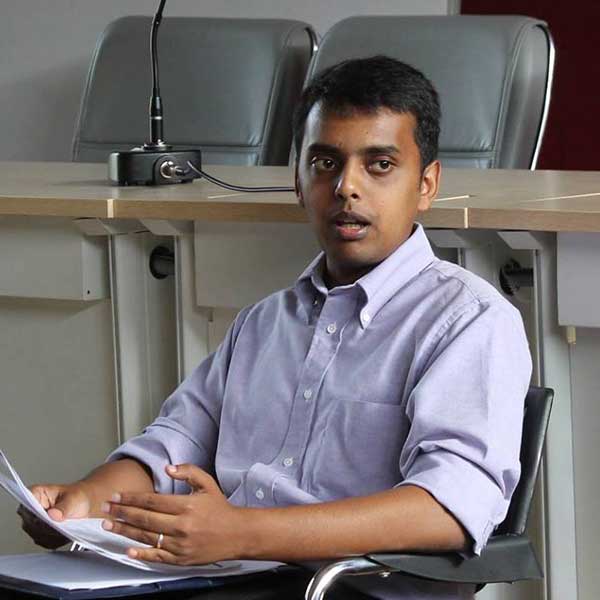
    George Pothan Poothicote graduated from Christ College, Bangalore with a B.Com degree before going on to complete his LL.B from JSS Law College, Mysore by 2010. While in law school he interned at several places including Ernst & Young and High Court of Kerala. He pursued an LL.M from King’s College, London and finished his masters by 2012. Immediately after completing his LL.M he came back to India and was appointed as Legal Consultant to Legal and Treaties Division, Ministry of External Affairs, Govt. of India, New Delhi and he is currently working there.

    In this interview he talks about:

    • Law school experience at Mysore University.
    • LL.M from King’s College, London.
    • Internships, recruitment and work at Ministry of External Affairs


    How would you introduce yourself? Tell us a bit about your pre law-college years. What motivated you to study law?

    Born in Mysore, I spent my early childhood dividing time between Mysore and Wayanad, and thereafter left to board at Montfort School, situated in Yercaud, a hill station in Tamil Nadu. I went on to do my B.Com at Christ College, Bangalore, LL.B at JSS Law College, Mysore and LL.M at King’s College, London.

    Hailing from a family of lawyers, I grew up imbibing into my very system the lawyers’ lingo and vernacular, and naturally felt drawn to the profession. Therefore, it was a firm and solid choice to become a lawyer myself.


    How would you describe your time at Mysore University? Tell us about the academic environment and faculty at the law department of the University.

    The experience was intense and extremely enriching. The student body was intellectually dynamic, with representatives from around the country and even abroad. The faculty included both full time academics and professional practitioners. They were very approachable, and inspired hope, ignited imagination and instilled a love of learning in their students.
     

    george-p-p-2

    Did you take part in activities apart from your regular curriculum? What all did you do as a law student?

    I participated in practical applications of what I learned, and textbooks gradually came to be of secondary importance to me. In conference settings, at moot courts and in practical classes, I had the opportunity to observe stellar lawyers and law students and noted how effective they were as participants, not only because they possessed superior knowledge, but also because they seemed to instinctively know how to handle a variety of difficult scenarios. Every evening of my final year, I visited the chambers of a senior advocate in Mysore. Also, every Saturday that year, I travelled to a village 35 kilometers from the city to provide free legal aid services and out-of-court settlements, as well as to spread legal awareness.

    My participation in National and International moot court competitions ignited my passion for the field of international law and also enabled me to interact with students and faculty from around the world. I assisted in research work for the scion of the Mysore royal family in the dispute over assets of the royal family and the abolition of the Privy Purse. Later, I helped to draft an anti-ragging bill which was presented to the then Governor of Karnataka. I also represented the college in various seminars and conferences.

    While being good in academics was the most important function during my days at law school, engaging in extracurricular pursuits was a close second. I did indulge in sports and had the privilege of representing my class and college teams in cricket and volleyball.

    My objective during my LLB days was to do my best whilst maintaining a healthy balance and letting other things beyond my control take care of themselves.


    Do you believe that excellent CGPA is absolutely necessary for success?

    An excellent CGPA, or any other measure of academic record, can assist in furthering academic pursuits and optimizing the initial recruiting process. That said, the microcosm of university and the world at large are as different as chalk and cheese. In universities one learns the theoretical aspects of law, but for success in the practical applications of the work environment, top grades are not a prerequisite.


    What were your areas of interest during your graduation (LL.M)? How did you go about developing expertise and knowledge in these areas?

    Constitution, Criminal Law, Arbitration and International Law were some of the subjects that interested me during my LL.B days. The experience I gained through moot courts, assignments and conferences, as well as my interactions with a number of inspiring people, led me to develop a particular fascination for International Law, both private and public.

    I had long been keen on pursuing an LL.M in International Law, but participated in a variety of modules before finalizing my subjects. My subjects were a combination of Public and Private International Law and International Commercial and Business Law, which may appear to be quite a broad spectrum for the course level. However, the subjects were not as disparate they seem. They included Terrorism and State Violence, World Trade Law, Use of Force, Commercial and Investment Arbitration, and Negotiation. What is especially interesting is the intimate relationship between International Law and Diplomacy. My curriculum combined both.


    Please tell us about your internships during your graduation.

    Internships and building work experience had been a consistent part of my academic pursuits during my years as a law student. At the end of my first year in law school, I was able to reinforce my tax related knowledge through an internship with Ernst & Young in their Global Tax Analysis service department in Bangalore. At the end of my second year of law school, I gained invaluable court experience with Honourable Justice R. Basant, a Senior Judge at the High Court of Kerala. I shadowed him closely and was privy to the procedures of the chambers of a High Court Judge, which gave me access to the judge’s files, notes and discussions. I felt particularly privileged as this was a rare opportunity for a student.

    During my final year, I visited the chamber of Advocate KL Sugandhi, a senior advocate in Mysore, which involved interacting with clients, learning procedures and even contributing to work on the cases.


    Do you believe branding of college is something that’s very relevant/ important at any stage in a law student’s career?

    Branding seems to have become as inevitable in the field of education as in business. That said, it should be taken with a bucket of salt. Power on the professional battlefield is determined by hard work and dedication above all.


    When and how did you decide to pursue Masters? Was it a professional requirement or an endeavour out of academic interests?

    From the beginning of my law education, I had entertained the idea of pursuing an LL.M degree. That said, I never viewed it as a professional requirement, as I had initially been keen on a career in litigation, for which an LL.B would suffice. Over the course of my LLB, I pondered over the subjects I would like to pursue, and shortlisted the Universities that seemed best suited to my interests.  The LL.M was a great adventure that enabled me to set sail to shores more magnificent than I had ever imagined.


    You have done your LL.M. from Kings College London. Please share your experience. Any other university which offers a similar combination of modules?

    It was simply amazing. I was taught and inspired by some of the best professionals in their respective fields: Professors. Martin Hunter, Salim Moollan, Samuel Wordsworth, Dr. Federico Ortino and Dr. Piet Eechout, to name a few. I still am in touch with most of them both at personal and professional levels. Whenever I felt the need for an expert opinion or guidance, these professors were most helpful. The course combined theory with practical applications. The whole system was different from what I was familiar with at the LL.B level. In addition to textbook learning, there were group discussions, debates and lots of interactive sessions, with an emphasis on research. We were encouraged to write papers and discuss them.

    I still have fond memories of a workshop conducted by Prof. Martin Hunter, visits to his chambers at Essex Court Chambers and a Friday clinic he used to organise. Another unforgettable experience is the time I spent at the WTO, where I was able to interact with key people of the WTO Secretariat and Country representatives, and gain valuable insight into the incredible operations of such a hallowed institution.

    There are other Universities that offer such modules, but I am not in a position to recommend them.


    How will you compare the pedagogy at Mysore University with that of King’s College, London?

    Comparing the pedagogy at Mysore University and King’s College is tricky because I attended them at two completely different levels. The LL.B is a basic degree in law, structured primarily to meet the general requirements of practitioners in the field. An LL.M is an additional qualification that involves specialization, and as such the structure of the LL.M diverges from that of the LL.B.  During my LLB, most of my professors were full time faculty, whereas during my LL.M, the majority of lecturers were practitioners in their respective fields, and their experience and expertise did make a difference.  A good teacher always brings out the best in his/her students. I consider myself lucky to have been mentored by the right kind of teachers.

    Diversity was perhaps the most significant difference between the two programs. At King’s College, the faculty and the University at large catered to a crowd from across the globe. The student community at Mysore University was primarily Indian.


    Looking back, how significant do you think that your legal education was? When did you happen to experience the learning curve?

    I believe that my education in its entirety has made me who I am today. My legal education in particular has been significant in shaping my career, and my analytical view of the world.

    As I see it, the learning curve starts from the earliest stages of life. Every single day has presented learning opportunities. I think, therefore I am; I live, therefore I learn. The slope of my learning curve in the legal field took a surge towards the latter part of my LL.M program, and continued to steepen when I entered the Ministry of External Affairs, where I have interacted with some of the best legal minds in the country and around the world. The Senior Official Meetings, Ministerial Meetings and Summits of which I have been a part were incredible experiences. One particular case that gave impetus to my learning curve was a brief I received from Mr. Gourab Banerji, the then Additional Solicitor General of India, during my early days at the Ministry. It was my first significant case, and it was an exciting challenge. More recently, I have had the privilege of being involved with the Law Commission of India in its work on investment treaties, which has been quite insightful.

    I look forward to the continuing intellectual stimulation of my work. Learning is an integral part of the profession, as it shifts like the sands of time.
     

    george-p-p-3

    You joined Ministry of External Affairs as a Legal Consultant; what worked for you in getting appointed?

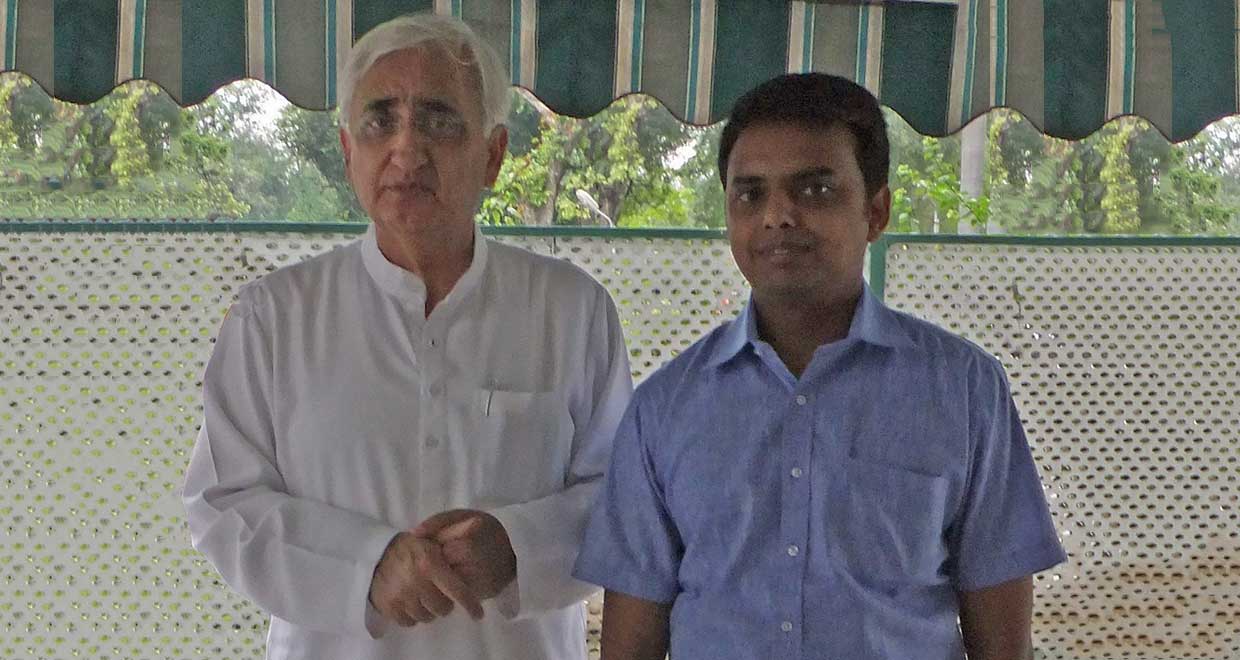
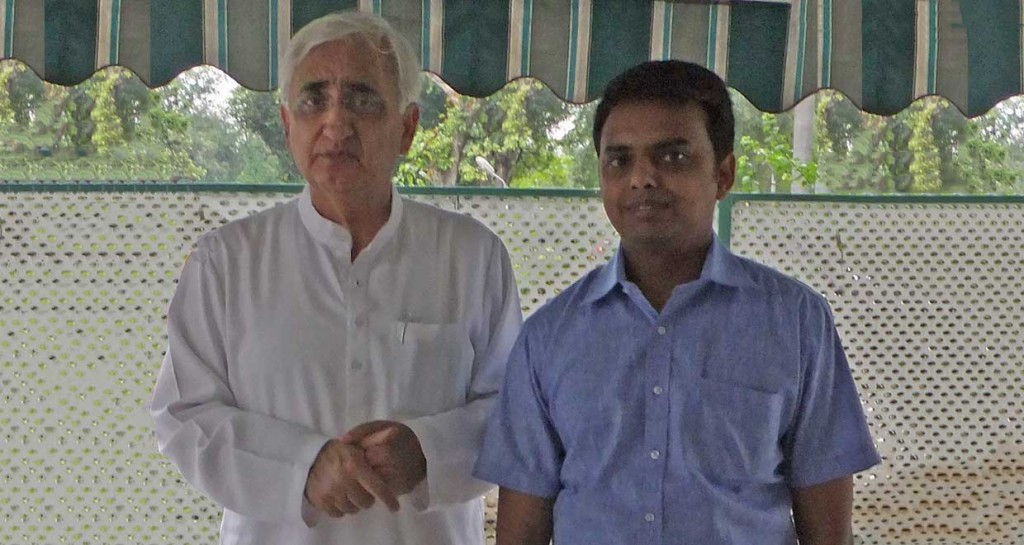
    I assume that my academic pursuits and passion for the profession, in addition to the support I received from the then External Affairs Minister, Mr. Salman Khurshid, who had faith in my ability and trusted me with such great responsibility, led to my appointment.


    What are the career opportunities at MEA like?

    The MEA provides excellent opportunities for those interested in the international dimensions of law. We deal with treaty negotiations and international law disputes. Diplomacy is integral to the mix. That said, our work is not exclusively on an international level, as we do examine domestic law issues on occasion.


    Are Legal Consultants allowed foreign postings? How does their work interact with that of the Indian Foreign Service?

    Foreign postings are certainly available to those belonging to the Legal Cadre of the MEA. The Hague headquarters the International Court of Justice and the Permanent Court of Arbitration. Geneva and New York City are bases for numerous international organisations.

    The responsibilities of international law and diplomacy require a great amount of interaction with foreign service officers and other government representatives.
     

    george-p-p-4

    Would you say that there exists a difference in the working environment of a law firm and legal department of the govt. offices?

    Most certainly, although I am not in a position to comment in depth on private law firms, as I have never worked in one. In the Government, everyone works for the Government of the day, and the work is not limited to legal issues. The tasks at hand are quite complex: they involve participating in drafting legislation, policy making, negotiating treaties and a variety of other roles. Most importantly, working for the Government means representing the Country and promoting collective rather than individual interests.


    What is the procedure to apply for an internship and recruitment at MEA? What are the qualities which they look for in their prospective employees?

    It starts with sending the completed form in the requisite format, along with references, to the Ministry to the Administrative Division (or any other Division that interests a prospective intern). From there, the applications are considered on merit. It is generally difficult to accommodate all applicants considering the huge volume of applications usually received. Details on applying for an internship at the MEA are enumerated on the website of the MEA.


    Have you ever considered starting up on your own?

    Starting my own practice has always been at the back of my mind. If I start my private chamber practice, I would focus on litigation before the Supreme Court, High Courts and Tribunals.  Considering my LL.M specialization and current work, I would be keen to pursue an active practice in investment arbitration, as well as international and domestic commercial arbitration.

    I firmly believe that there is potential everywhere, and it is about looking out through the window of opportunity. Talent finds its happiness in execution. Simply follow your heart, make the right choices and be dedicated.


    Please tell us about the requisite soft skills which are essential for a young lawyer to build a successful career?

    Communication skills, which are essential in any profession, are particularly valuable for a young lawyer. An open line of communication with colleagues assists in efficiency and securing solid relationships. Clarity, charisma and discretion must be kept in mind when dealing with clients.

    Commitment is important, given the heavy workload of young lawyers, and the established standards of excellence.

    Creativity is an immense asset, as innovation and thinking outside the box aid in problem solving and negotiation.


    What are your views on the future of Indian legal education? How would you suggest that a law student manages to stay ahead?

    I would like our institutions to compete with the best in the world. There is no dearth of resources in India, but we have to make optimal use of them. I hope to live to see the day our institutions are ranked among the best in the world, and pray that it is not far away. We need to support academicians in their pursuit. I personally am of the view that institutions should create a platform to bring in greater interaction between practitioners and students. The greatest asset of any educational institution is the character of its teachers. We need to encourage research and avoid spoon feeding. Classrooms should be about imparting knowledge and not forcing one’s views on the others. Students should be prepared to face the world outside beyond the realms of the microcosm of universities. I would suggest encouraging research and more practical classes and workshops. They are the need of the hour. The legal fraternity has to come together and support our institutions with a clear roadmap for the way ahead.


    What are the three things you consider law students should do in their careers?

    To me, goals should be set individually, and not based on what someone else has achieved. Be yourself, as they say. The markers of success vary, but generally, I would say that it can be achieved by staying focused, working smart and being organized. Professional mileage can be optimized with perseverance, perspiration and a stroke of luck.


    What would be your parting message to young lawyers?

    Here I would like to borrow from Mr. Fali Nariman, who lists the following in his autobiography “Before Memory Fades”:

    • A lawyer’s opinion should be honest and responsible,
    • A good lawyer should acquaint oneself with relevant law, including case law on the subject at hand,
    • One should be clear and precise, not confused,
    • One should keep oneself informed and up to date with all the reported judgments and decisions of the Supreme Court and High Courts,
    • A lawyer should be well prepared for his case.

    A lawyer must never stop learning, for intellect demands clarity and certainty. That said, circumstances render uncertainty inevitable and fascinating. In an ever changing world, progress is proportional to the capacity to endure uncertainty.

    One’s name is a prized possession in this mortal world, which through our acts, deeds and achievements can be immortalized and etched in the minds of generations to come.