Tag: NGO

  • “Figure out your purpose in life, have a larger vision and chase that, you are more than your job, your accomplishments and your possessions”- Kudrat Dutta Chaudhary,  Commissioner, Immigrant Rights Commission, San Francisco, California, United States

    “Figure out your purpose in life, have a larger vision and chase that, you are more than your job, your accomplishments and your possessions”- Kudrat Dutta Chaudhary, Commissioner, Immigrant Rights Commission, San Francisco, California, United States

    This Interview has been published by Pragya Chandni  and The SuperLawyer Team

    Ma’am, can you please share the pivotal moments or experiences that led you to pursue a career in law, especially focusing on your journey from studying at the Army Institute of Law to earning an LL.M. at The Fletcher School of Law and Diplomacy?

    I always had a justice oriented personality and the choice was either between Law or Journalism for me when I was growing up. I also was very clear since very early on that I wanted to work in the field of women’s rights and gender based violence and with that I decided that Law would be a path best suited for me. At 22,   I published a novel on the human trafficking of women in Nepal to India after the Nepal earthquake and after completing Law from the Army Institute of Law I went on to study at the Fletcher School where I focussed specifically on gender based violence and International Law. I wouldn’t say that there was one moment that defined my trajectory but I’d say that just the conviction that  my aim in life is to use my education, privilege, knowledge and expertise to help women led me from Law School to graduate school to the positions I’ve held thereafter. 

    Your LL.M. focused on International Laws, and you received the Honos Civicus Award for Civic Engagement. How did these experiences shape your perspective on the intersection of law and civic engagement, and how do you see it influencing your current work?

    I feel both Law and civic engagement have a symbiotic relationship for example it was Raja Ram Mohan Roy’s advocacy against ’Sati’ to legally put an end to it in the 1800’s and today we see the role of civic engagement in creation and abolishing of laws over matters important to the current times. For me, being active and participating in the community, advocating for one’s community and influencing positive change is my mantra and I live these beliefs by being involved in groups and advocacy over issues that I am most passionate about like women’s rights and immigrant rights. 

    As a law clerk specializing in asylum law and gender rights at the Law Office of Robert B. Jobe, can you elaborate on how your work has involved strategizing refugee and asylum claims based on gender-based persecution? What challenges and successes have you encountered in this role?

    In my previous role, I worked with battered women who were fleeing persecution that they suffered in their home countries and it involved documenting their persecution, highlighting issues that were in tandem with the theory of their case. My journey with a client often started from building rapport with them which sometimes can be hard when they have suffered immense trauma in their lives, to creating a safe space where they can feel comfortable in expressing themselves and sharing their stories. One challenge with this work is that sometimes the other person is not open to seeking therapy or doesn’t live in a community that would help them work through their trauma; I learnt how to tackle this bump over the years and I feel the more you grow as a professional and person, there are different approaches you can use to understand their resistance to therapy while also giving them other suggestions to seek support from a place of empathy. 

    You’ve engaged with governmental organizations like USCIS and the Executive Office of Immigration Review. Could you share how these partnerships have contributed to your work in supporting vulnerable populations, and what impact your stakeholder engagement strategy has had on your cases?

    My engagement with EOIR and USCIS as a Law Clerk was limited to the work I was doing but given my position as the Vice Chair of the San Francisco Immigrant Rights Commission, I have more freedom to persuasively raise and inquire about immigrant issues with USCIS that impact immigrant population of San Francisco. That said both EOIR and USCIS are Federal bodies and stakeholder engagement with them happens at the Federal level that hopefully I am a part of at some point in my life.  

    Serving as a Commissioner for the San Francisco Immigrant Rights Commission, you’re involved in developing strategies for human rights and labor rights for immigrants. How do you balance your advocacy work with the practical aspects of implementing policies and programs to address these issues?

    San Francisco Immigrant Rights Commission works on conducting special hearings to make recommendations to the Mayor and Board of Supervisors on Immigrant rights issues which span from creation of employment for asylum seekers to housing for immigrants to taking a stance on H1B layoffs to standing in solidarity with DACA recipients whenever the country fails them. Once we have a special hearing, we review the recommendations, debate them and then forward them. This debate is often rich and detailed with every commissioner bringing practical questions to the mix and we also have the San Francisco Attorney’s office and Office of Civic Engagement and Immigrant Affairs to help us through the procedure. At the end of the day, the aim is to be an accurate representation of the issues of the immigrant community and should there be a gap between the recommendations and the practical implementation of policy, the Mayor and the Board of Supervisors may reject it. 

    Your role as the Chair of Women’s March San Francisco involves designing and implementing human rights programs. Can you provide insights into the specific programs you’ve developed, and how collaboration with government and grassroots organizations has played a role in advancing these initiatives?

    The Women’s March San Francisco is an inactive group right now but in the past I have worked on organizing First Amendment Marches in San Francisco on reproductive rights and have collaborated with different initiatives like we have co-hosted panels on equal pay for women followed by a movie screening (on the discrepancy of pay between the men and women’s football teams in the US) and we led a workshop on how to be active beyond the marches. The beauty about a group like WMSF is that it is an all volunteer group founded by women who are epitomes of  ’stand up fight back’ and has been around since 2016. WMSF has also amplified the work of other grassroots organizations for years and has provided support (whenever possible) if needed.

    As a Research Assistant for Prof. Dyan Mazurana on the topic of child brides in humanitarian settings, how did your work contribute to addressing evidence gaps in child marriage during crises, and what lessons did you draw from this experience?

    My work as a Research Assistant was to assist with a literature review on the topic and then identify key stakeholders who possess experience and practical knowledge in the field of child brides in humanitarian settings so that they could be interviewed and their insights could be recorded by Prof. Mazurana. As my first assignment as a graduate student, a lot of my work revolved around planning logistics for interviews and communicating with the interviewees from INGO’s and governments around the world and I definitely learnt a lot in this process. 

    Lastly, what advice would you give to fresh graduates aspiring to make a positive impact in the legal and humanitarian spheres based on your journey?

    Figure out your purpose in life, have a larger vision and chase that, you are more than your job, your accomplishments and your possessions. AND give back to your community!

    Get in touch with Kudrat Dutta Chaudhary-

  • In Conversation with:- Mohini Priya, Advocate on Record, Trained Mediator, Policy analyst, Member of International Legal Alliance and Member of India Child Protection Forum

    In Conversation with:- Mohini Priya, Advocate on Record, Trained Mediator, Policy analyst, Member of International Legal Alliance and Member of India Child Protection Forum

    This interview has been published by Prabhjot Singh, Priyanka Karwa and The SuperLawyer Team

    What motivated you to pursue law? How was your under-graduate experience in law school? If not law, which subject would you have opted for?

    I completed my five years law course from Government Law College, Mumbai in the year 2009. Honestly speaking, being from the science stream, pursuing law was not the obvious career option for me.

    I wanted to pursue medicine in the first place but like any other confused student wanted to explore other options as well. Interestingly, around the same time, with the emergence of national law schools and many corporate law firms, law as a career option was becoming lucrative, as it offered a stable career which was financially rewarding.

    Many new offshoots of law had come up, like the IPR, Cyber Laws, Environmental laws, so there was no dearth of opportunities. All these factors were creating an inclination towards law. However, I was not very vocal and outspoken in my school days which made my family sceptical about my suitability for the legal profession, as it is the popular perception that lawyers are supposed to be loud and aggressive.

    In the midst of all the confusion raking up  in my head, I intuitively decided to take up law. In those times there was no CLAT and admission in GLC, Mumbai  was solely on the basis of 10+2 score and interview. The cut off was high but I luckily managed to make it through the final list.

    And that is how this journey began. So in my case it was more a matter of destiny than choice. Hailing from a small town, there were initial hiccups in adjusting to the fast pace life of Mumbai but I believe it is far more easier to adapt to change at a younger age, and so I soon became a part of it.

    Being in the heart of the town, GLC had locational advantage, apart from having some very good professors and an extremely distinguished alumni.

    A few months into college I realized that extra curriculars were as important as academics. I was a part of the Moot Court Association, The Legal Aid Committee and the Student’s Council, which gave me abundant exposure to lawyers and law offices, allowed to acquire some important life skills like organization and team work and also helped me get visibility.

    I did some national and state level moot courts, which gave me a good practical experience of law. I focused on getting a few good internships in Bombay High court and the Supreme Court of India and also did a couple of corporate internships.

    I think it was the last corporate internship which made me realize that litigation was my true calling. So yes, I did take five years at law college to understand what I really wanted to do, but once that happened I held on to my decision and persevered.  

    Do you believe that law students must be taught the ground reality of Court procedures along with the theoretical part?

    Most law schools these days have moot court competitions, negotiation competitions, which give a law student some opportunity of legal research and arguments as well as a preliminary understanding of court manners. However, in actuality, the working of a court is very different and there is no set pattern.

    For a litigating lawyer, every day is a new day. “Legal acumen” is not something that can be taught but is only acquired after years of experience  and learning from one’s mistakes. Sometimes things may not go as planned.

    A lawyer may be fully prepared to argue a case in a particular manner but the Bench may throw a completely different issue at them. Thus real court craft involves creative thinking,  quick decision making  and learning to read the mind of the judge, which can only come after some years of real court experience.

    A good approach to be adopted by law colleges would be compulsory court visits for law students, so that they get adequate exposure to actual functioning of courts. Now with the live streaming of Constitutional Bench of Supreme Court, as well as some other High Courts law students will have online access to courtrooms and can well prepare themselves for the times to come.

    How do different approaches of adjudicators help in critical thinking? Do you believe that it helps in understanding cross-cultural overlaps in legal systems?

    India is known for its cultural and religious diversity. Sometimes reading a book or doing a course may not help a law student understand the socio-cultural implications of the problem at hand. Real life references are needed to relate to a particular issue and understand it at a grassroot level. Socio-cultural and religious ethos run deep into an individual’s psyche and that reflects in many of the judgments delivered by Courts. A judgment is not merely an interpretation of a law, but is a reflection of  judge’s cultural background and mindset. A study of court judgments does encourage critical thinking. Take for  example, the recent split verdict of the Supreme Court in the Hijab case. The moot question there was whether there is a right to wear hijab in educational institutions in Karnataka – with one judge affirming that the state government is authorised to enforce uniform in schools as wearing of hijab is not mandatory in Islam, and the other calling hijab a matter of choice that cannot be stifled by the state.

    While both the reasoning are correct, the question we need to ask ourselves is how do we want to grow as a society. Whether we should follow the strict letter of the law or give way to a progressive interpretation in light of the changing times and in the interest of social justice.

    Some of the judgments delivered by Courts may not be in tune with the societal changes and that is where a role of a lawyer comes in- to sensitize and be sensitive.

    Even as a mediator, I come across individuals from different backgrounds and cultures, which helps me better understand human psyche better, which in turn gives me an additional advantage in deriving a solution when faced with a similar situation in courts.

    The Courts in recent times have been moving towards a progressive regime, like decriminalizing homosexuality, declaring abortion as a reproductive choice of women, and including ‘marital rape’ within the ambit of rape for the purpose of MTP Act, to mention a few. In some ways we are ahead of western countries when it comes to fundamental rights.

    However, a change in laws cannot change mindsets overnight, as social and cultural norms play an important role in resisting change. Analysis of court judgments helps in understanding cross cultural diversities and  narrowing this gap.

    You filed a PIL before the Hon’ble Supreme Court, on behalf of a leading IVF Specialist based out of Chennai, challenging the constitutionality of several provisions of the Surrogacy (Regulation) Act, 2021 and the Assisted Reproductive Technology Act, 2021. Please tell us about the matter in detail.

    Surrogacy is a rather complex issue as it has several socio-cultural and economic implications. Bringing about a legislation in this field would require extensive study and research as well as opinions of experts in the field. However, the present legislations on Surrogacy and Assisted Reproductive Technique seem to be fundamentally flawed in many aspects.

    Firstly, the Surrogacy(Regulation) Act, 2021 recognizes only heteronormative married couples and fails to take into account other alternative family arrangements like same-sex couples and live-in couples which have been given legal recognition.

    The Surrogacy Act creates artificial distinction amongst women inter se by excluding single women (except widows and divorcees within a certain age bracket) to avail of surrogacy. Single men have been altogether excluded. Moreover, surrogacy is now allowed only in altruistic form from a close relative which is an infringement on a couple’s fundamental right to privacy.

    Unfortunately, infertility is still a taboo in our country and most couples wouldn’t want to disclose such a fact even to their family in order to find  a close relative who is willing to be  a  surrogate mother.

    Thus imposing a blanket ban on commercial surrogacy may prove to be counterproductive and lead to illegal and unregulated markets. Apart from that many provisions under the Assisted Reproductive Techniques Act, 2021(ART Act) are medically not viable and impossible to implement.

    The ART Act apart from restricting the number of times an egg donor can donate in her lifetime, creates no provision for compensation to an egg donor. Moreover, several procedures which were completely legal earlier have been suddenly rendered illegal or in an impasse by the passing of the Acts.

    All these factors have brought donor cycles in our country to a standstill. During the hearing of the petition. the Hon’ble Supreme Court observed that these issues need consideration and has asked the Central Government to file a response. I sincerely hope and pray that the Apex Court gives a progressive interpretation to both the statutes and if that happens, this case could prove to be a breakthrough in the field of reproductive rights.

    How important do you consider legal professionals to work with NGOs and support social initiatives? Do you think it adds value in the long run?

    Law is called a “Noble Profession” and rightly so. We, as legal professionals have a positive obligation to contribute to the society. Lawyers are agents of social change. However, in order to bring about a substantial change, it is important to understand the  problems and complexities associated with an issue at grass root levels and NGO’s provide a very good platform for that. NGO’s work in close association with vulnerable and marginalized sections of the society.

    Working with an NGO may not provide one with an immense amount of money, but it gives great networking opportunities, as well as help a lawyer to contribute towards creating a social impact. Apart from that, NGO’s have extensive research material and experience in the field they cater to, which could be effectively used by a lawyer to become the voice of the voiceless. 

    Lawyers have an additional advantage of knowledge of court procedures and direct access to courts, and can help direct future litigation on important social issues in accordance with an NGO’s aims and objectives.

    I have had the opportunity to work with some leading NGOs like Prayas, which extensively works for rehabilitation of street children and juvenile justice,  and I can certainly say that it has opened a whole new dimension for me which has immensely helped me in my professional and personal growth.

    Apart from that, the satisfaction one gets from rendering service to the community is unmatched. So, I would highly recommend every litigating lawyer to have some exposure of working with an NGO.

    What are the roles and responsibilities for a policy advisor? And will it create more opportunities for legal professionals in coming times?

    Policy analysis includes identifying current or impending problems with a government policy, determining its causes and proposing solutions. A lawyer broadly does the same for his clients and therefore lawyers make for great policy analysts, although not all policy analysts are lawyers.

    There are special courses offered by universities on policy analysis. However, lawyers and law students have a unique advantage when it comes to deciphering legal jargon and forecasting how a legislation would develop. Another advantage is their ability to recognize how a small change in a rule or regulation could have a huge public impact.

    Legal professionals can work in policy space as research fellows in government agencies, think tanks, research organizations and corporations examining complex issues that affect the government and the daily lives of citizens.

    I have personally worked at analyzing some provisions introduced by the Child Marriage Amendment Bill, 2021 and the Juvenile Justice Amendment Act, 2021 as a representative of the NGO Prayas and India Child Protection Forum headed by noble laureate Kailash Satyarthi and I have to admit that it was one of the most enriching experiences of my legal career.   

    What, in your opinion, could be a social security safety net for lawyers after experiencing various pandemic waves?

    It is indisputable that two years of the pandemic has hit lawyers very hard. There has been loss of work, loss of income, many lawyers had to downsize their team and even close down their offices as there was not enough revenue generation even to pay for rents. Virtual hearings have resulted in concentration of work leading to disguised unemployment.  

    Although some of the Bar Councils have done their part in providing financial assistance to lawyers during the pandemic, it needs to be accessible to a larger community of lawyers and specially young lawyers.

    A welcome step in this direction has been the recent observation by the Hon’ble Supreme Court that young lawyers should be adequately compensated by their seniors.

    The pandemic has not just hit lawyers financially but the uncertainty and trimmed income apart from social isolation has had a severe impact on their mental health. There should be some initiative by the Bar Council to conduct counselling sessions for lawyers and seminars on mental health awareness.

    Young lawyers should be encouraged to argue in order to help fast track their career trajectory.  

    The post pandemic era has seen increasing use of technology and a gradual transition towards paperless courts. Although green courts are a welcome step, however some lawyers who are already facing financial difficulties may find it rather difficult to invest expensive gadgets in order to switch to paperless mode, and hence some financial assistance should also be offered to such lawyers.

    What career advice do you have for our readers? 

    There is no “One size fits all” approach when it comes to the litigation. Things may not always go as planned, so be patient but relentless in your efforts. Identify opportunities and take the first step.

    Sometimes what may on the face of it seem to be insignificant might turn out to be a determining factor in your career, so don’t be afraid to take chances. Create short term goals and focus on them. Failure is inevitable but also necessary in order to stay motivated and grounded.

    As a young litigator, there may be many brief-less days. Instead of getting hopeless and frustrated, use that free time to learn new skills, take up some courses and create litigation opportunities.

    Time management is very crucial. Hard work has no substitute but smart work gives you a cut above the rest. Intelligence is a blessing but knowing how to channelize it in the right direction is what differentiates an average legal professional from a successful one. Today, digitally-savvy lawyers are in high demand as technology continues to evolve and progress.

    And as the Indian Judiciary System gradually acquaints itself with cutting-edge technologies, emerging lawyers must do the same.

    Lastly, going by my personal experience, I would like to tell my readers that career confusion is completely natural and pushes individuals to explore different opportunities in order to reach a well thought out decision, so keep your minds open and always remember that growth is more important than success.


    Get in touch with Mohini Priya-

  • Biplab Lenin, Consultant, Cyril Amarchand Mangaldas, on building up expertise in Intellectual Property Rights

    Biplab Lenin, Consultant, Cyril Amarchand Mangaldas, on building up expertise in Intellectual Property Rights

    Biplab Lenin graduated from Rajiv Gandhi School of Intellectual property law (2009-2012). He is a qualified attorney with more than 4 years of both law firm and in-house experience in dealing with general corporate and intellectual property matters. He is registered to practice before Indian patent office and currently working with Cyril Amarchand Mangaldas at its Delhi office. His core areas of work include wide range of transactions, general advisory and intellectual property matters. He has acted on some of the significant and complex transactions that the intellectual property team has been involved with.

    In this interview he talks to us about:

    • How he build up expertise in IPR.
    • Primary essentials of a corporate lawyer.
    • Professional ethics one should follow while at work.
    • Basic subjects one should understand before sitting for an interview.

    How would you introduce yourself, given that most of our readers are law students, law aspirants or professionals in the legal arena?

    I am currently working as a Consultant with Cyril Amarchand Mangaldas in New Delhi. My practice areas include intellectual property laws and corporate laws. I am a registered patent agent at Indian patent office. I completed my LL.B. from Rajiv Gandhi School of Intellectual Property Law (RGSOIPL) in IIT Kharagpur Campus and also hold a graduate degree in Biotechnology Engineering.

    Were you always as fascinated by the field of IP Law or was it an acquired passion that set in through your college years?

    Since my father is also a lawyer, I was never a stranger to legal discussions which my father often used to do with his friends over evening tea after a long day in Court. Nevertheless, after 12th standard I followed the crowd of students doing engineering. In the last semester of my engineering, there was a subject called ” Intellectual property Rights”. Somehow, it attracted me quite a lot mainly because it involved both technology and law. That led me to apply for the course at RGSOIPL at IIT Kharagpur. I guess I was lucky to have studied under tutelage of good teachers and in a diverse peer group that IIT offers. Though I had an inclination towards IP subjects, at the same time, I wanted to do my internships on other subjects as well. Hence, I did internships with law firms as well as corporate in the domain of general corporate law, taxation, disputes, technology transfer and intellectual property law.

    How did you build up your expertise in IPR? Tell us about your work experience.

    My first hands on training on practical aspects of law happened in my internship at Monsanto. After finishing law school, I joined Mahyco as an in-house Counsel where I worked on different IP laws like patents, trademarks, plant variety, biological diversity and technology transfer. More importantly, interactions with several eminent scientists and stalwarts in the agri-biotech domain helped me realize the importance of understanding the technical nuances of the technology involved in any IP law. My engineering education helped me a lot in this area.

    After completing three and half  years of satisfying work at Mahyco, I joined Cyril Amarchand Mangaldas at Delhi where I am working on matters related to patents, plant variety, biodiversity, transfer & assignment of Intellectual property and general corporate transactions. On litigation front, I am a part of the team which is handling patent infringement and drugs ban litigation before the Delhi high Court

    Tell us about your schooling and early life. What do you think are the habits that you cultivated which help you today?

    I did my schooling from Sainik School in Bhubaneswar from Class 6th till Class 12. I think the values of integrity, camaraderie which are a hallmark of the army, are ingrained in me now. Also, Sainik School gave us a lot of endurance training, which helps me when I have to work for long hours in the Firm! I feel that my school experience was also quite instrumental in putting me at ease in any group with diverse cultural backgrounds, which is helpful for an attorney whose work involves people interaction.

    How are internships helpful for a law student? What are the other options available for someone interested in IP?

    Internships have a role to play in one’s professional career as a lawyer. They help us in learning how the law is practically applied. Also, business aspects of transactions are also better appreciated in internship. Skills like corporate communication are sharpened during internship. For those who are interested in making a career in IP, I suggest doing first internship under a practicing lawyer to get a feel of our justice delivery system. It is also important to look for quality work rather than brand name. There is no point in securing an internship in a big organization where there is little work for an intern. Students can join an IP specialized law firm or corporate for doing internships.

    Having Said that, I also feel that one should not be obsessed with stuffing one’s CV with internships. It is important to remember that in college one is a “professional student”and one’s primary duty as a professional student is to study the law books and the basic concepts. What can be learnt in 10 internships over 5 years in a no-pressure situation can be learnt in 6 months in a pressure situation when one starts actually working after college. Many times these days, interns, who have finished more than 10-12 internships in their first 3-4 years of college, but unclear about fundamental legal concepts, which I believe is injustice to one’s profession as a student.

    How do you maintain your work-life balance?

    I have always had a problem with this concept which pre-supposes that work and life are different and need to be balanced. I believe the first step in achieving work-life balance is to love yourself and love your work. Luckily I do both! Presently my focus is on honing my skills. I believe I’m being paid to learn now so I’m not complaining at all! I also believe that even at a senior level people do get time for themselves while managing work and I feel this should not be a concern for us at least at the beginning of our career.

    Any extra-curricular or co-curricular activities did you take up during your time at RGSOIPL and engineering? How did the same affect your learning experience and prepare you for the legal sector?

    I participated in a few moot court competitions during my college. However, I enjoyed parliamentary debate competitions more and also participated in several case study competitions conducted at IIT Kharagpur. During my engineering days as well, I have participated in several paper and poster presentations.

    However, apart from legal skills, I used extra-curricular activities to build my communication skills and inter-personal skills. I was one of the founding members of moot court society and conducted the first parliamentary debate competition at RGSOIPL.

    During my law school days, I worked as a volunteer in an NGO named “Independent Thought” based in Delhi. The NGO works for the Eradication of Social Disparity and Injustice by promotion of Fundamental and Socioeconomic Rights. I used to assist team in doing research and preparing reports with regard to remedies on issues relating to child labour. This experience showed me the humane side of the law and it still keeps my sensitivity intact and reminds me that beyond all the paper work and legal arguments there are real people who are affected by what I do.

    Generally the first year after graduation is the most defining time of a fresh law graduate. What would you suggest a fresh law graduate should do to hold spirit and utilize the opportunities available?

    I would suggest a two-pronged approach:

    1. Many students are thinking about doing an LL.M, immediately after LLB. I feel that an LL.M. without any work experience is just an LLB with some more semesters and a thesis.
      I strongly encourage fresh graduates to take up some professional assignment of their liking instead of academics, be it with a law firm or corporate or even NGO. You’re bound to be confused, so make sure someone’s paying you in the meantime!
    2. In college, we first pay fees and then we learn. In a job, we get paid to learn. Therefore, as a paid student, learn as much as you can about different areas of law and practice. It is important to remember that most books mention “law” and “practice” separately, for example Banking Law and Practice, meaning thereby that practice is something different from mere legal provisions. This will help you in choosing a particular field or subject for your career.

    What are the primary essentials of a corporate lawyer? How do you say a fresh graduate can work on building these skills?

    I think honesty towards the client and one’s colleagues is of utmost importance. One may be low on information about a legal concept, which can be gained, but honesty must come from inside. This of course is a basic human requirement in any profession, so all law graduates must also try to imbibe these values.

    Patience is also a vital asset. One must not get affected by looking at how others are doing in the profession.

    What are the primary professional ethics you follow while at work? How do you deal with mistakes or errors?

    I believe that honesty is the best policy. If there is a mistake, one should admit immediately. Mistakes are bound to happen especially in areas where human effort is involved. In face of mistakes, first requirement is to maintain a cool head, accept a mistake has been made and then immediately start working on a solution. When I’m the team lead, I own the mistakes of my team. I think clients too appreciate such candidness.

    What are the basic subjects which one should read and have understanding of before sitting for an interview?

    From point of view of legal concepts, basic understanding of the following 5 subjects is a must for any civil lawyer regardless of any interview:-
    1. Contracts (including sale of goods and specific relief)
    2. Transfer of property
    3. Evidence
    4. Registration and stamp duty (basic concepts not details)
    5. Constitution (basic concepts)

    Thereafter, one may try to gauge the requirements of any specific interview and prepare accordingly.

    Where do you see yourself ten years down the line?

    Hopefully still on the line!! Jokes apart, my first aim is to build my expertise in my domain, which is more of an internal process. I haven’t really given a thought to any particular designation as such. But I would like to be a lawyer who has earned atleast two things – complete trust of  clients which  allows them to sleep peacefully as far as their legal worries are concerned; and respect from seniors and peers in the profession regarding my professional ethics and competence. Apart from this, designations are trivia!

    Please compare RGSOIPL with other law schools.

    RGSOIPL is a unique law school because admission itself requires a degree in technology or medicine. Being a part of IIT Kharagpur campus, it has an IIT-style admission process with entrance test, group discussion and interviews, which is a great learning in itself. It attracts students from all over the country, which helps in enriching one’s culture and view of life. Also, studying law in the IIT Kharagpur campus in the midst of the crème-de-la-crème of India’s technical brains, gave me 2 important lessons –

    • Law is an instrument to facilitate business and technology;
    • Law cannot be learnt or applied in isolation without an eagerness to learn the technical dynamics of any business.

    RGSOIPL also benefits from the infrastructure of IIT. We had access to major online legal resources like Westlaw, Manupatra and Hein online apart from books.  There are various co-curricular activities which one can pursue to unwind from demanding course schedule.

    How is your experience in working as In house and then shifting to law firm?

    Being an In-house counsel helps to learn the significance of law as a toll for business. However, I would advise to have law firm and court experience at the initial stages of the career and learn court proceedings and allied matters and then shifting to in-house.

    Shifting from In-house to a law firm is tough from a work pressure point of view. Also, subject experts are readily available when you are working in-house, which may not be the case in a law firm full of mostly lawyers. Anyone who wishes to develop a very particular specialization should work in in-house IP department. Law firm gives you a more diversified work. Needless to say, law firm working hours are more strenuous. However, learning as well as growth is much speedier in a law firm.

    What would be your parting message to our readers?

    An excellent CGPA is always good. However, it is important to co-curricular and extracurricular activities as well. Read as much as you can. Take risks when it is required. It is not necessary that every risk you take will result in success. There will be failures too.

    It is important to not think too seriously about oneself and one’s so-called reputation etc. while taking professional decisions. I think the most vital part is that one should feel good both as a human being and a lawyer.


  • Lawrence Liang, Human Rights Activist, on academic legal research and co-founding Alternative Law Forum

    Lawrence Liang, Human Rights Activist, on academic legal research and co-founding Alternative Law Forum

    Lawrence Liang graduated from National Law School of India University, Bangalore in 1998 and has been the co-founder of Alternative Law Forum. He is based out of Bangalore, and is widely known across the legal fraternity for his campaigns on issues of public concern, especially on conflicts of Intellectual Property and medical accessibility.

    Soon after his graduation he received the Chevening Scholarship and did a Masters in Law and Development from the University of Warwick. He holds a Ph.D in Film Studies  from Jawaharlal Nehru University and a Post-graduate Diploma in Cultural Theory from Centre for Study of Culture and Society, Bangalore. Over the course of his career he has immersed himself in human right issues, media law and legal writing. He is currently a visiting faculty fellow at Yale.
    In this interview he talks to us about:

    • His time at NLSIU and Warwick and his educational qualifications
    • His various experiences as a Fullbright Scholar, Henry Hart Visiting Faculty Fellow, and the Hughes Visiting Scholar.
    • Alternative Law Forum
    • His work with iCommons, the Sarai Institute and Public Access Digital Media Archive (Pad.ma) and Indiancine.ma.
    • How he combined media and law
    • His experience as a member of the Drafting Committee of the Colombo Declaration on Free Speech and Media in 2008
    • His views on human rights advocacy


    What could be a short introduction of yourself?

    Hi, my name is Lawrence Liang and I am a legal researcher and writer based in Bangalore. I was one of the co-founders of the Alternative Law Forum, a collective of lawyers working on public interest issues and I have been involved with ALF for around 15 years. I left ALF in 2015 and I am currently a visiting faculty fellow  at Yale.


    You received an English Honours in English Literature from St. Joseph’s College, Bangalore before graduating with a law degree from NLSIU. What prompted the choice to study law?

    An early fascination with law – possibly prompted by popular culture – drew me towards law, but more than a clear idea of wanting to do law, I was clear that I had no inclination towards the sciences and at that point of time pursuing my first love – literature – didn’t seem like a feasible career option. Also it was the time that the National law school had just been set up and we started encountering a number of the NLS students in the quizzing and debating circuit and they seemed like some of the brightest people we had met. On inquiring further we figured that the law school was an an incredible experiment to revamp legal education and appeared to be the most exciting place that one could be in. My English Honours was actually alongside my time at law school. This was at St. Josephs’ where the department used to offer English Honors programs open to all, and in many ways doing this alongside the law shaped many of my subsequent interests in inter disciplinary studies, and in law and literature. While we we were studying subjects like copyright in law school, we were also being exposed to critical theory at Josephs, and one could start seeing the connections between ideas of authorship which were so central to copyright but being differently interrogated by thinkers like Michel Foucault and Roland Barthes. It convinced me of the need to have a wider approach to the law than just legal formalism.


    What work did your masters in Law and Development involve in Warwick?

    The Law in development program was attractive to those of us interested in a critical perspective mainly because Prof. Upendra Baxi taught there, and his scholarship had been very important to us. Warwick has a wonderful history of a engagement with law from a global south perspective and while there, my main learning was to develop a sharp ideological understanding of law and political economy especially in the way that it impacted questions of justice.


    As a recipient of the British Chevening Scholarship, what opportunities did that open up for you? Was there a process for application for the scholarship?

    The Chevening scholarship was literally the only way I could have afforded doing a Masters in the UK and we were lucky at that time that they had two scholarships for people interested in law and development. There was an application and interview process and the interview was a bit of a disaster, so I was rather lucky that I actually managed to get the scholarship. My time at Warwick helped shape an interest in activist lawyering and I started thinking about the need to set up a space after returning. I also took the opportunity to do courses that allowed me to dive into the continental philosophical tradition which significantly shaped my intellectual and political outlook.


    You were the Best Outgoing Student at Warwick! What activities did you engage in there besides academics?

    It is amazing that I got any work done there actually considering it was also a year of being passionately in love. But since cross border romances are best conducted under the shadows of culture I managed to watch many art house films and plays which I did not get to see in India, and the summer was one long cricket match rudely interrupted with thesis and course work breaks.


    You have a Ph.D from the Jawaharlal Nehru University Film Studies Dept. and a PG Diploma in Cultural Theory from Centre for study of Culture and Society as well. How did you come to cultural studies? Did it have an impact on your approach to law?

    Strangely enough while I turned to cultural studies and film studies from a boredom with law, they also enabled me to return to the law with renewed interest, but with a slightly modified perspective. My interest in cultural theory allowed me to read the law not merely from within its internal logic of rules and norms, but through a symbolic register where one could read law as culture. In recent times it is the discipline of anthropology which has been most exciting for me and the work of legal anthropologists like Pratiksha Baxi, Annelise Riles, Perveez Mody in domains as varied as rape law, international finance and the Special Marriages Act have been very exciting and inspiring for anyone interested in the workings of the law both in theory and practice.


    As a Fullbright Visiting Scholar in Columbia University at the Anthropology Department, what did your work entail?

    My time at Columebia offered me a chance to finish work on my doctoral thesis, and being at the anthropology department was to be a part of a fantastic intellectual community which allowed me to interact with many people whose work I have admired over the years. Brian Larkin who has worked on an ethnography of media piracy is a kindred spirit and he was my host while I was there. In some ways anthropology has emerged as the intellectual refuge for many disciplines and the number of law graduates who have becomes anthropologists is a good indication of what a fertile field it is especially in a country with as complex a legal system as India where numerous legal traditions and temporalities coexist and collide with each other.


    Now you are the Henry Hart Visiting Faculty Fellow, at Yale Univ. for the academic year 2016-17. What do you focus your teaching on?

    I am teaching two courses, one is a cinema course where I look at the social life of cinema in India moving beyond the cinematic text to focus on spatial and technological histories, fan clubs, labour histories etc. The second course I am teaching is on the Trial and its public effects in India where I look at key trials that captured the public imagination in India in the colonial and postcolonial context. I move between cases like the Tilak trial, the INA trials to the Nanavati case and the Arushi trial as a way of looking at the public life of law in India, and the way that trial becomes a critical event that recalibrates ideas of politics and public morality. It also becomes a story about the intersection between law and media since these very public trials become a theatre of justice constantly mediated by different technologies of mass media and legal trials become an effective site for the staging of dramaturgies of justice.


    As the Hughes Visiting Scholar, Centre for South Asian Studies, University of Michigan University in 2014, were there any interesting conclusions to your work then, that you could share?

    Michigan was a brief stint in which I got to test out some of the ideas that I had been working on at the time especially on ideas of forensic imagination and the rise of forensics in legal process. I was interested at that time in the idea of the doctored image, narco analysis etc and my friend Joyojeet Pal who teaches at Michigan is also interested in information politics so there was a superb synergy. I was there just after the Polar Vortex which meant that the extreme cold ensured that you just lock yourself up and do your work without any distraction. Ann Arbor represents the best and worst that a life in ideas could represent- the Ivory tower you are confined in because it is just too snowy to step outside but where you keep warm in good intellectual company.


    You were a Co-founder of ALF. How did the idea develop to start that?

    lawrence-liang-2ALF was both the result of many years of conversations with friends as well as strangers who were as excited about the possibility of the experiment. Most of us had done some time with human rights lawyers or organizations, and while we were inspired by the legacy of critical lawyering India, we also felt the lack of a space that brought together litigation, activism and academic research. ALF was born out of a belief that there was a need to bring together these in a way that broke the barrier between theory and practice, and to a certain extent we were successful even if this was not without its attendant difficulties. The temporal nature of litigation and activism is always about the immediate and the urgent while research has a longer durée, and sometimes these can be in conflict with each other. But at ALF I was lucky to be in the company of extremely passionate and committed people, and I learnt that one’s political stances are not just learnt from the outside world but equally in these small experiments at collective living and working. To believe in an abstract idea of the right to equality is one thing, to actualize it in your practice is much more difficult, but in trying to do so you learn more about the abstract value as well.


    What work does ALF focus on? Is there a unique work culture that volunteers or employees are expected to adhere to or anything in particular that is expected from them?

    ALF works in a variety of areas from access to the criminal justice system, the politics of intellectual property, sexuality, labour etc. From the start we were committed to the idea of a non hierarchical workspace which was organized on the basis of collective responsibility- again much easier in principle than in practice- but I think an informal ethos and a respect for each other’s work is what attracted people towards ALF. Given the relatively modest salaries that we were offering, what made ALF attractive for many people was that it offered a vibrant intellectual and political environment, a collegial space underwritten by friendship and the chance to do work which you could see had some impact at least  on the lives of people.


    What impact has working at ALF had on your life outlook?

    This one will probably need more space than I have, but one simple one is a recognition that while the law is often a leaky umbrella, often it is the only one we have. And the real challenge of an ideological critique of the law is not to disavow it, but to deploy as effectively as possible using its own logic to work for those whom it normally works against. Apart from the professional side, it has shown me via the words of Neil Gaiman that inside everyone are strange and surprising universes and to work together is to be invited to universes that one would not normally be a part of.


    Tell us a bit about the Public Access Digital Media Archive (Pad.ma) and Indiancine.ma.

    Pad.ma is an online archive of video and documentary footage. It seeks to create a visual archive of densely annotated clips and Indiancine.ma tries to do the same for Indian films. These are collaborations with a fantastic group in Berlin, Pirate Cinema and Camp in Mumbai. They arise from a simultaneous interest in visual culture as well as in the radical potential of open access.


    You have shown remarkable commitment to a variety of causes over the years. What are the major causes you espouse? Did you always know what issues you wanted to work on or did that happen with time?

    While one always has a vague sense of values that one is committed to, the commitment to specific issues often arises from a particular context. For instance while I was generally interested in media laws, it was through the process of working with Vikalp (A group of documentary film makers who came together to fight censorship) that you are then forced to dive into and in some sense try and master a particular field. Similarly with issues of access to knowledge, the specific context of the DU photocopy case both confirms the importance of a politics of knowledge even as it refines the political stance you had through the technical prism of law. To be simultaneously committed to things you believe in even as you remain open to contingent forces that change or alter your politics is both exhilarating and inspiring. There is a lovely saying that revolutions should be born out of joy not sorrow, and I think we often derive out vitality from the energy of those we see around us, who in the face of extreme injustice are still defiantly hopeful for a better world.


    Tell us how you have managed to combine media and law?

    We live in a mediatized world where it is difficult to imagine any aspect of our lives which are not touched by media. From cinema to the internet, media occupies and shapes our consciousness, so it no coincidence that the world of law becomes crucially enmeshed with that of media. In a narrow sense that would mean the regulation of media, but in a broader sense it also means the transformation of law itself where law also becomes mediatized. The emergence of sting operations, the prevalence of trial by media are crucially media effects even as they are legal events, and to think of the contemporary is to think of media. Ravi Sundaram whose work has been very influential for me has a book which theorizes India ‘after media’ and in a sense he posits that everything changes after media and as a legal scholar you are bound to account for what that means in the legal world.


    What is you role in iCommons? What do you strive to achieve there?

    The Creative commons movement was a very important moment that showed us the possibility of what an alternative imaginary to the closed world of copyright could be. It expressed a philosophy of sharing and the creative potential of it contrasted with the diminishing of the public domain by strong IP regimes. It was also beset by its own limitations being enshrined within the idea of liberal legality, and for someone coming from India, where you could see the democratizing potential of illicit practices such as piracy, my own role was to contextualize what something like the CC movement meant in the global south, but also to nuance the debate with an understanding of the social and cultural worlds of knowledge sharing beyond the law.


    What work have you done in collaboration with Sarai?

    Sarai was one of the most exciting and important media and cultural spaces that emerged in early 2000’s which opened up all kinds of possibilities in the public discourse around art, media and urban space. It was set up jointly by the Raqs media collective and faculty members of CSDS and they supported the most cutting edge work in theory and practice for many years. The range of fellowships they offered, the legacy of the work they supported (from artists to graphic novelists) has been phenomenal. I started collaborating with Sarai in 2002, and it was a combination of boldness and generosity on their part which also helped ALF in its formative years. They saw a bunch of passionate and smart lawyers who wanted to try something new and supported us (intellectually and financially) helping us set our foundations. In 2005 we organized a global conference on intellectual property called Contested Commons and Trespassing Publics which I think made a significant impact on the global discourse on IP. We also co organized an event called World Information City that brought together artists and theorists thinking about idea and politics knowledge era as they played out in the lives of cities. My conversations with Jeebesh Bagchi, Ravi Sundaram, Ravi Vasudevan, Shuddhabrata Sengupta and others opened up ways of thinking from the diverse worlds of art, cinema and technology. Sarai, I think, allowed for us to see the various expressive forms that thought can take, and the traditional academic form of scholarship was both something they showed the limits of even by pushing the boundaries of how scholarship could be creatively and energetically expanded.


    You have several publications to your credit! How do you choose when to write about what? Do you think research and publishing is very important for a law student?

    Sometimes you choose to write because you are following an intuition, a curiosity and an intellectual itch. Other times a specific areas chooses you by virtue of its immediacy. At any rate for academics to write is to think and even though the act of writing is often a painful process every once in a while in the midst of writing you realize you are expressing thoughts you didn’t even know you had. So yes writing is crucial for law students, and I am grateful for the endless projects that we had to do as law school. I don’t think law school really teaches you law, what it does teach you is how to think about the law, how to forage for research material and how to put together an argument. What I do think is important is to fight the very real possibilities of writing becoming a painful drudgery (often the case with academic writing) and to experiment with different forms which retain the joyfulness of writing. For me writing in a range of forums from art journals, newspapers and academic spaces has been the key to maintaining my sanity since the joy of writing can easily be assassinated by footnotes. But more than a writer I think of myself as a reader, and writing for me is often is an excuse to make sense of what I am reading and to have imaginary conversations.


    Please tell us about your experience as a Member of the Drafting Committee of the Colombo Declaration on Free Speech and Media in 2008?

    This was a considerably difficult period in Sri Lanka, the civil war was at its peak and one of the immediate casualties was free speech. Journalists and editors were being targeted – often killed by the state as well as the LTTE. It was humbling to learn of the incredibly difficult circumstances under which journalists were doing their work and as members of the drafting committee we were privy to a remarkable set of testimonies. It reminded me of Foucault’s idea of parhessia- an idea that preceded the idea of free speech and referred to fearless speech- reminding us of the high stakes involved in speaking truth to power, and the small role that lawyers can play in nurturing a safe home of fearless speech. The experience really shaped my understanding of free speech laws in India and to appreciate the relatively good jurisprudence that exists on free speech in India. All the more crucial in these days when sedition charges are thrown about like cheap change and when shrill blood hungry media anchors become the greatest dangers to free speech.


    What changes do you hope to see in human rights advocacy in India over the next decade?

    With the mushrooming of law schools all over India, I hope that we in addition to producing lawyers for law firms, we also produce a generation of lawyers who continue a critical tradition. The law students I meet today are remarkably bright- certainly smarter than we were- they are born digital and command an enviable ease with all kinds of online research skills, and what would be fantastic is to have more lawyers who are able to engage with human rights issues not just in a generic sense of political empathy, but to deploy their legal skills in understanding and critiquing mainstream areas of law. What the human rights movement needs are more lawyers who know corporate law, insurance, taxation etc. In other words we need lawyers who understand the belly of the beast but also understand that the beast preys upon those who are most vulnerable and to be an effective human rights lawyer means internalizing Part 3 of the constitution, but also understanding how corporate governance can affect the same Part 3.


  • Pratyush Nath Upreti, Advanced Masters, (LL.M) Intellectual Property Law & Knowledge Management at Maastricht University, on pro-bono work and the KIIT Law School experience

    Pratyush Nath Upreti, Advanced Masters, (LL.M) Intellectual Property Law & Knowledge Management at Maastricht University, on pro-bono work and the KIIT Law School experience

    Pratyush studied law from KIIT Law School, Bhuvaneshwar, he graduated in 2013. Being a citizen of Nepal, he chose India to pursue B.Sc. LLB. After the successful completion of his bachelors, he is pursuing Advance Masters (LLM) in Intellectual Property Law & Knowledge Management from Maastricht University, Netherlands on a scholarship. He had interned extensively through the years of law school and published nearly 30 articles in The Kathmandu Post. In this exclusive conversation with Pratyush, we talk about:

    • Education and experience at KIIT Law School.
    • Selecting the appropriate publishing companies for his journals.
    • Interning at Asian Network for Free Elections (ANFREL), Bangkok,
    • Being a Member of New IP Lawyer’s, a wing of School of Law and its research centre called SCule (Science,Culture and the Law) under the University of Exeter, United Kingdom.
    • Undergoing exchange programmes at The Office for Harmonization in the Internal Market of European Union (OHIM), Spain
    • Pursuing LLM in Intellectual Property Law and Knowledge Managment from Maastricht University, Netherlands.


    Tell us a bit about your pre-college life. How did you choose to study law that too in India? Did you have lawyers in your family?

    I come from the Biratnagar, city of influential leaders in Nepalese politics. Being the youngest child of my parents, I began the journey of my student life by following my elder sister’s footsteps to one of the most prestigious schools of the city. In school, my inquisitive mind as a young student ran into almost all nooks and corners of the colorful life. I was not a great student but lived my life into the realm of education.

    When I finished my intermediary, civil war in the form of a Maoist insurgency ended with the signing of the comprehensive peace agreement and formation of a Constituent Assembly. Nepal was in transitional phase(still in transitional phase), we were taking the first step towards building a constitutional democracy. During the phase, many friends opted to go abroad for higher studies which were never an option for me.

    When I decided to peruse law there were very limited option in Nepal. Moreover, India is also not far away from Nepal, it was a convenient option. I was also attracted by the unique integration of law and science. So, I decided to join the B.Sc.LLB(Hons) stream in KIIT Law school, a newly born law school with a colourful dream, like that of mine of marking a mark of its own in the highly competitive legal arena.

    Yes, I belong from a legal background, my father is a senior advocate practicing in Nepal and my grandfather served as a Judge of Nepal. I think I represent the third generation of lawyers in my family.


    While in KIIT Law School you selected B.Sc. LL.B as your stream. What would be your advice to law aspirants about choosing a stream? Did it give you an edge over B.A. LL.B graduates? Does it have a long lasting effect?

    In recent years, legal education has rapidly changed. The unique integration of law and science is an attractive career option. The law and science offer plenty of opportunity in the sector of forensic science and Intellectual property law. During my short working experience, I have felt that there are high demands for lawyers with scientific/technological backgrounds. Anyone interested in B.Sc.LL.B should keep in mind the course structure of the college offering the course. Make sure they have good science faculty and if you are interested in taking biotechnology as a major then well-equipped laboratory is important. I was the first batch of B.Sc.LL.B(Hons) course in my college, but I had some laboratory works. Fortunately, My university had separate well-equipped Biotechnology faculty which was an additional advantage for me. Since, there is not much of crowd of lawyers with knowledge of both the field, a B.Sc.LL.B(Hons) graduates do have an advantage from a job perspective.
     

    pratyush-upreti-1

    If I were a young law student who never wrote an article, how would you advise me to get started given that you yourself wrote a lot?

    To be honest, I never pre-planned to write an article. Most of my articles are the outcome of my project which I did during law school or internship. Choosing a topic which is contemporary is important for publishing an article. I suggest law student to identify contemporary legal issues and continue as a project for the course. If you do your research honestly, then certainly you will end up publishing.


    How would you select a specific journal and approach them for publication? What are the things you look for in a journal before sending them your article for publication? Can you tell us the steps involved in researching and structuring an academic paper?

    Selecting a Journal is not easy, there are two important things, which I look before sending an article. Firstly, the journal timeline for a review process. When you research honestly, you get ambitious about the project and really want to publish in good Journal. But sometimes, a long review process of the journal is really frustrating. There were few Journals who replied me after a 15 months. It was really painful! But as a student you should never be discouraged by rejection or late replies. Before sending your article, it is important to know about the Journal well( just email and ask about timeline for review). Secondly, I see the focus area of a journalif your topic matches those area’s or related contemporary issues than your acceptance chances are really high.

    There are generally accepted ways of researching and structuring the paper. For me research is important, I try to gather as much of information from various sources like books, Journal, reports, internet etc. Once I gathered information, I tried to find contemporary issues/problem involved and put my thoughts in a logical way and roughly draft a research outline which will help not to divert from focus area. For any writing may be a newspaper or academic journal structuring is important. Your writing must reflect you thoughts and every section need to clearly link. Mostly importantly for academic writing reference/bibliography/footnote is very important. Generally, accepted standard structure includes Abstract, Introduction, research question, discussion (arguments advanced), conclusion/recommendation and bibliography.


    How did you plan your internships and how did you go about applying for these internships?

    (Pratyush has interned quite extensively through his 5 years at law school. Some noteworthy mentions are Anand and Anand; Asian Network for Free Elections (ANFREL), Bangkok, Thailand; Singh & Associates, Advocates and Solicitors; Sycip Salazar Hernandez & Gatmaitan Attorney At-Law, Philippines; The Ministry of Home Affairs, Parliamentary Affairs, Constituent Assembly and Culture, New Delhi, India; Enviro Legal Defense Firm, New Delhi, India and other places as well.)

    Early planning is very important to secure a good internship. Mostly, I planned my internship at least a 6-8 months before. This is important because, you can never depend on one organization or law firm. You need to file a several application. The application process depends completely on the institute which you intend to apply. Most of the organizations where I interned had similar recruitment pattern, I just applied online with a short cover letter and resume.


    What kind of work did you typically find yourself doing as an intern? Did your experiences vary significantly with the internships?

    I had a diverse internship experience. My task and workload as intern completely depend upon where I was interning. In law firms, I had long working hours and mostly I ended up doing a lot of draftings, research on several issues and assisted litigation team. Some of the research which I did in the law firm was published in law firms in-house Journals. On the other hand, in an organization you mostly do research work, they will make you involved in the ongoing project. During my school, I was fortunate to do two international internships. First, at Sycip Salazar Hernandez & Gatmaitan Attorney-At-Law, one of the biggest law firms in Philippines where I was involved in commercial and Intellectual property division. I mostly assisted the team with the prosecution of trademark, patent registration, review of technology transfer arrangement, franchise and distributorship agreement etc. Second, at ANFREL, I researched on several electoral issues and assisted drafting team of ‘Bangkok Declaration of Free & Fair Elections’. During my stay, I also got an opportunity to observe the election. It was a great learning experience.


    What comprised your work profile as a Legal Researcher at the “Forum for Protection of Public Interest (Pro-Public)”? Please share with our readers.

    Forum for Protection of Public Interest (Pro-Public) is one of the reputed organization in Nepal. It has a long history of contribution to socio-legal development in Nepal. Pro-public gives an opportunity a law student to voluntarily associate with the organization in different capacities. I was fortunate enough to associate myself with the organization during law school.

    During my undergraduate, I had an experience of research work. At law school, I worked as research assistant in University Grant Commission (UGC) main project titled “ Use of Forensic Science in Criminal Justice System: A futuristic Project”. Similarly, I did some research work for Cobalt Business Counsel Professional Corporation, Ontario, Canada for few months. Furthermore, my research internship with Enviro Legal Defense Foundation, Nepal Law Commission, and The Ministry of Home Affairs, Parliamentary Affairs, Constituent Assembly and Culture, was largely based on legal issued related to Nepal. Maybe this gave me an edge than other candidates during the recruitment process.


    Thereafter, you have joined Asian Network for Free & Fair Elections (ANFREL) as their Legal /Liaison Officer. Do you think, it became easier to get appointed because you have interned earlier at ANFREL?

    I don’t think so, internship experience helped me to get the position at ANFREL. ANFREL is a professional organization, they have transparent and heavy recruitment process. I came to know about the vacancy through a Newspaper. I did go through a screening process and had a very long interview by ANFREL Secretariat. Luckily, I got through the interview.
     

    pratyush-upreti-3

    What kind of work does ANFREL do? Please brief us about the nature of work and responsibilities you were entrusted at ANFREL.

    The Asian Network for Free Elections (ANFREL) was established in 1997, as Asia’s first regional network of civil society organizations focused on elections and election monitoring. It strives to promote and support democratization at national and regional levels in Asia. Since it was founded, it has served towards strengthening the democratization of countries such as Sri Lanka, Nepal, Thailand, Malaysia, Cambodia, Pakistan, Bangladesh, East Timor and Indonesia.It is one of the most trusted and reliable International Election Observation Group globally. They mostly focus on three area: (i) Election observation (ii) capacity building (iii) campaigns and advocacy.As Legal/Liaison Officer, I was involved in providing legal assistance to the ANFREL Election Management/Observer team. During my tenure, I reviewed national electoral law and assisted the ANFREL team in making Observation manual and reports. In addition, I was also involved in organizing and co-ordinating meeting with several stakeholder, civil societies, and politicians and also observed Constituent Assembly Election. I must say, I had a wonderful experience working with ANFREL. They have great working culture and ethics.


    Right after ANFREL, you went for LL.M. Why did you decide to go for higher studies?

    Initially, I wanted go right after my graduation but later decided to take a break of a year. There is no reason as such, I always wanted to continue my studies and then focus in practice.

    How did you go about choosing which college to go to for your LL.M. and did you ever consider Indian colleges? Was it the course or the university which mattered for you?

    I was very clear that I want to do LLM in Intellectual Property Law from abroad. Since, I have spent five years at law school in India so I didn’t want to have similar quality of education. So, never considered Indian colleges. The First thing I did was listing of colleges which offer LLM in intellectual property Law. I applied to three universities; School of Law University of New Hampshire (formerly known as the Franklin Pierce Centre of Intellectual Property) USA, Queen Mary University of London, UK and Maastricht University. I was accepted in all three. I got the scholarship from Franklin Pierce and Maastricht University and opted later.


    Tell us about your LL.M year at The Maastricht University, The Netherlands which you are currently pursuing.

    I am doing Advanced Master in Intellectual Property Law and Knowledge Management. It is a unique master program for lawyers, non-lawyers, and those with a degree in science of technology. It is popularly known as IPKM. The Advanced Masters IPKM are fully accredited by the Accreditation Organization of the Netherlands and Flanders (NVAO). The IPKM MSc is furthermore accredited by the European Patent office (EPO) for EQE remission. In addition, IPKM is a member of the European Intellectual Property Institutes Network (EIPIN) and a founding member of the Pan-European Seal Professional Traineeship Programme.

    Maastricht University is known for the problem-based learning environment where students are personally responsible for their academic education. The IPKM is taught in a very closed group, where the student analyzes the problems through discussions, exchange knowledge. The programme is taught in socratic teaching, often using real-life cases, mock trials and assignment (mind it, it’s not a piece of cake, it will dig you into the subject matter which we need to submit before class). The tasks are further discussed and analyzed along with lectures during class. Basically, it was fun working within a diverse class, amazing study visit. To conclude, IPKM provides a lot of opportunity for learning and networking. If you want to excel in Intellectual property, IPKM is the right choice! Go for it!!


    How difficult was studying abroad in terms of finding accommodation, finances and settling in? Are there any scholarships for studying at the Maastricht University?

    Not at all! Particularly, at Maastricht we have a very friendly student service center (SCC) which helps the international student in finding accommodation if needed. I didn’t have a problem as such, I found accommodation through online. There are facebook pages which provide information on accommodation, and most of them are very reliable. Maastricht University do provide Scholarships for International Students which are available on University Official website. I was lucky enough to get a UM High Potential Student Scholarship, which really made my life easy.


    How is the faculty & academic schedule (your typical day) at Maastricht? Given your experiences how would you pit Indian students with their foreign contemporaries?

    The faculty staff in the IPKM are very diverse and immensely supportive. It includes professor and practitioner from different jurisdictions, most notably Europe, Asia, and the United States of America. We had a very intense module on US Copyright Law taught by Professor Edward Lee, Director of the Program in Intellectual Property Law, Chicago-Kent College of Law, United States. Similarly, some of module was taught by Professor of Queen mary University, the University of Nottingham, and few class were taken by European Patent attorney etc. In addition, we have series of IPKM expert lectures by practitioner’s which enlighten us on contemporary IP issues. My day starts with waking up, and riding to the library, preparing for classes and assignments. There is always a number of readings for class, which are expected to be discussed in class. Generally, I return very late from the library in fact library is my sanctuary) and then I have to try and cook which I really hate.


    Was there time enough for non academic pursuits at Maastricht? How did you find the study-life balance to be?

    Not really! IPKM is very hectic!! (That’s what you expect from competitive course) we get few days off in Christmas. But Maastricht is a beautiful place, there are several things to do besides academic. On balancing study-life, I am the right person to answer that, I always struggle.

    Tell us about the course structure of an Advanced Master (LLM) Intellectual Property Law & Knowledge Management at Maastricht University.

    The Advanced Masters in Intellectual Property Law and Knowledge Management (IPKM ) offered at Maastricht University Faculty of Law are designed to train graduates to work as legal practitioners or management in knowledge-intensive industries and research institutes. The IPKM offers two distinct degrees:

    (1) A LLM degree focusing on comparative IP litigation and/or entrepreneurship, valorization and IP management

    (2) A MSc degree for graduates of science and technology aspiring to become IP specialists, knowledge managers, or patent attorneys.

    The IPKM course is designed in three main pillars

    (1) the common course for both LLM and MSc student are taught together

    (2) mandatory course for both LLM

    (3) mandatory MSc track.

    Some of the intensive modules offered is Intellectual Property in USA and Asia, patent drafting, IP enforcement, Intellectual Property & Life science among others.

    For more information, you can visit

    (http://www.maastrichtuniversity.nl/web/Faculties/FL/AdvancedMasterInIntellectualPropertyLaw).


    How did you benefit from the different programmes you took up after admission to IPKM?

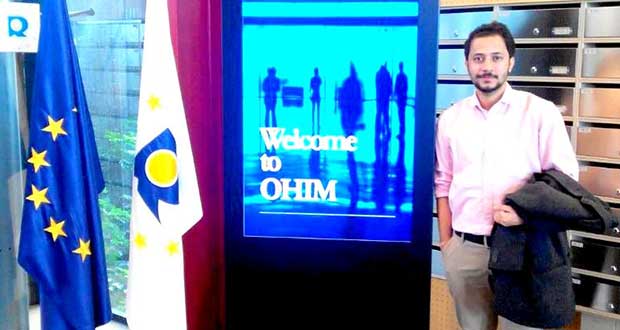
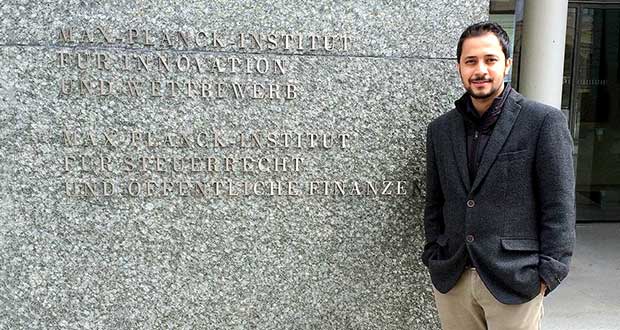
    (Pratyush underwent a couple of training and exchange programmes after he had secured admission at Maastricht University, some of which are Module on Community Trademark at The Office for Harmonization in the Internal Market of European Union (OHIM), Spain; Study visit at European Patent Office, Hague, Netherlands; Attending Congress of European Intellectual Property Institute Network (EIPIN) organized at Maastricht University and Max Planck Institute for Innovation and Competition.)

    IPKM as well designed course which aims to provide plenty of learning opportunities for the student. I had one module in University of Alicante in The Office for Harmonization in the Internal Market of European Union (OHIM), Spain, it was a great experience. The modules were taught by European trademark/design examiner and practitioners. Similarly, Congress of European Intellectual Property Institute Network (EIPIN) held at Maastricht and Max Planck Institute for Innovation and Competition/European Patent Office were two days intense discussion on contemporary Issues of Intellectual property Laws. In both, the event sessions were addressed by scholars from Europe and The United States. Personally, I really enjoyed these events, you get to know emerging issues in IP Law and also an opportunity for networking.


    Please share a few words about you being Member of New IP Lawyer’s, a wing of School of Law and its research centre called SCule (Science,Culture and the Law) under the University of Exeter, United Kingdom.

    New IP Lawyer’s is a network of young academic and practitioner in IPR. It is the initiative of Ph.D. student at the University of Exeter and have network representative at the University of Oxford. The network aims to encourage and facilitate discussion of the issues related to IP law both by lawyers and non-lawyers. Recently, the network successfully held the first annual conference: who owns the Arts and Sciences? At the University of Exeter where renowned academic like Professor Lionel Bently(University of Cambridge), Professor Charlotte Waelde among others were key speakers. The Newtork is relatively new, in a very less time it has received overwhelming support. New IP Lawyer’s is also aiming to organise seminar series and several academic event. Stayed tuned at http://newiplawyers.wix.com/newiplawyers


    Is writing is your hobby? How do you manage to write for newspaper on various issues beside your LL.M studies and other engagements?

    (Pratyush has published approximately 30 newspaper articles till date at The Kathmandu Post& among others, on various issues.)

    I enjoy writing it connects me with readers. I never took writing as a hobby, I started writing during my undergraduate. When I was studying in India, I always wanted to involve in socio-legal issues and give my opinion on such matters. The newspaper was the perfect forum to share my thoughts and involved in several issues happening in Nepal. After law school, I continued writing and still I regularly contribute on socio-legal/political issues in Nepal. It makes me happy when readers send feedback or point of disagreement on issues and it also helps to improve writing. I never take writing as a burden, whenever we come across interesting issues we always have an opinion, just that I gather my thoughts and write. Most important, writing gives me a lot of pleasure; I feel a sense of freedom.


    What is your responsibility as a student member of Maastricht University for European Intellectual Property Institutes Network (EIPIN).

    IPKM is a member of the European Intellectual Property Institutes Network (EIPIN). Every year few students are selected to represent as a student member of EIPIN where we get the opportunity to attend EIPIN congress and participate in the group projects. I was assigned with team project which consists of five student from Queen Mary Intellectual Property Research Institute(University of London), Munich Intellectual Property Law Center (MIPLC), Centre for International Intellectual Property (CEIPI) University of Strasbourg, Magister Lvcentinvs (University of Alicante). My team has already submitted our research project titled “Permitting Transformative Use and Copyright Law: The Case of Parody as Innovation” to EIPIN committee. It had a great time working together with fellow students.


    What are your future plans? How do you plan to use the experience and the knowledge gathered at Maastricht?

    I successfully defended my thesis, just winding up my course at Maastricht. Most probably I will be returning home in August, and practice litigation. Although, Intellectual Property regime is not very well developed back home which makes it more challenging to take IP as a career but again it give an opportunity to participate in the process to develop the field. The experience and knowledge gathered at Maastricht surely have given me in-depth knowledge about global IP practice which will surely help in instituting policy reform in Nepal.


    And any word of advice for all the young law students out there?

    Learn, question and make the most out of the law school. Make sure you enjoy your student life as well. Good luck!


     

  • Kriti Sharma, Research Fellow, Council for Social Development, on all about a work profile in Human Rights Law

    Kriti Sharma, Research Fellow, Council for Social Development, on all about a work profile in Human Rights Law

    Kriti Sharma is an alumnus of NALSAR, Hyderabad (2012). In 2011, she underwent an exchange programme with Redzyner School of Law, Interdisciplinary Center Herzliya, Israel. Thereafter she worked as a research assistant to Justice Dalveer Bhandari and as a judicial clerk to Justice Khanna.

    In this interview, we focus specially on her experience at Council for Social Development, and how she chose this career path in Human Rights. We also try to trace back her journey to NALSAR, her experience at IDC, and her job of a law clerk. At present, she is working as a research fellow at Council for Social Development.


    Please introduce yourself to our readers. Please tell us a little bit about your childhood and your background?

    Fairly simple background, artsy atmosphere as my father dabbled successfully with Hindi poetry, writing and theatre direction. I formed a companionship with books early on since my mother managed the Ramjas Foundation’s library. I grew up mostly in Delhi, except for a few years in London due to my father’s posting.


    How did you gravitate towards law? Did you have someone who inspired you to study law?

    It seemed a good option after studying humanities along with civil services and journalism. Having arrived from England I was not aware of competitive exams but a classmate prodded me on. I grew up sensitive to social conditions and always voiced my opinion against gender discrimination that I saw in practice. In hindsight, law provides a perfect platform to engage with such issues.


    How was your experience at NALSAR, Hyderabad?

    NALSAR undeniably opens a spectrum of opportunities for individuals and is arguably, the best law school in the country. I wasn’t so excited though, as overall the faculty and course options back then were not as impressive and diverse as they are increasingly becoming now. Discussions on raging issues were fodder to my mind, yet at the same time its location denied me the opportunity to pursue extra-curricular activities as much as I wanted to.


    You underwent an academic exchange programme with Redzyner School of Law, IDC, Herzliya, Israel. What did you benefit from the student exchange programme?

    Going on an exchange involves a considerable cost. Therefore I was only willing to take it up if I got my first choice- Israel. I was made aware by a visiting professor from Berkeley that IDC invites distinguished faculty from U.S.A and Europe for lectures, providing me an insight into graduate academic life abroad. I was also personally interested in understanding geo-political and historical situation of the region, for which I extensively travelled through Israeli-Palestine and Jordanian territories and engaged with the local people, apart from taking up academic courses on Arab-Israeli conflict and peace process.


    Also tell us about your experience working as a Research Assistant of Dean Ron Harris, Law Faculty of Tel Aviv University during your Law school days.

    I have had an interest in legal history and wanted to discover what kind of work really happens in this field. I happened to mention my interest to a professor who forwarded my CV to Professor Harris. Professor Harris had been writing a book for publication by Princeton on the ‘Organisation of Early modern Eurasian trade’ for which a Chapter on ‘Early 15th-17th Century Laws of Maritime Trade in India’ required primary and secondary research in Indian archives, museums and libraries. Upon return from the exchange, I researched on this topic- looking closely at the impact of society, family, women and slaves on indigenous trade which was thriving at the turn of 16th century, before the arrival of foreign powers.


    You have interned under Justice Dalveer Bhandari of Supreme Court of India twice when you were at Law school. How did you obtain this golden opportunity to intern twice under him? What kind of work you came across?

    Justice Dalveer Bhandari, who is presently a member of the International Court of Justice, took active interest in training and educating young lawyers. His office was very welcoming and encouraging to interns but also demanded high quality work, without exception. He gave us an opportunity to work on important cases such as Novartis, Bar Council exam case etc. and since I was interested in gender rights, I also worked on an international sexual trafficking case. Apart from this we were expected to brief him on fresh matters every evening, which really was a test because his legal acumen and experience were unmatchable. For internship, one had to simply send a CV to his office secretary and selected candidates were informed for each internship session. Drafting a good request letter is the key, I highlighted his judgments on right to education and caste violence and why I was keen to work with him.


    Almost all your internships were focussed on non-profit and research work involving primarily matters of Human Rights Law. Were these all planned internships or did you just take them up as they came along?

    I followed what interested me. The classroom teaching was mostly academic but field internships in slum areas of Delhi (with Parivartan) and southern tribal belt of Rajasthan (with Mazdor Kisan Shakti Sangathan) made me understand how the law actually affects daily lives of people. In my third and fourth year I carefully explored all options available to a law student – viz. interning at a law firm, a lawyer’s office, Law Commission of India and the Supreme Court, for me to make an informed choice after graduation.


    How do you think the experience of being a clerk is now helping you in your career path?

    (Kriti was engaged as a Law clerk-cum-Research Assistant in Delhi High Court under Justice Sanjiv Khanna specializing in Criminal and Writ Petitions Roster after her graduation.)

    I wanted a right mix of advocacy and research for my career. I was inspired by Flavia Agnes’s work in the courts on gender rights and was interested in working in a Habeas Corpus roster, which in India mostly deals with family matters and elopement cases. Justice Khanna handled these cases with required sensitivity and often the mediation wing of the High Court was also involved. The criminal appellate roster also dealt with terrorism, juvenile justice and other life imprisonment cases which required regular case preparation and drafting. Evidence in each and every criminal case has to be very carefully evaluated as it is a question of an individual’s life and liberty. I also utilised the court exposure to compile an ethnographic report on hostile witnesses. The centuries old criminal system would do well with reforms and I have certain observations regarding this which can be discussed at length some other time. I also learnt that while working with litigants in gender cases, one cannot take an extremely idealised approach, as in practice things work out differently.


    Is it difficult to get a judicial clerkship with a Delhi High Court Judge? What sort of people would you advise to do a judicial clerkship?

    The Supreme Court follows an organised process of recruitment for which one has to apply through the university in the final year of studies. For High Courts, a few of them have a centralised process but individual efforts need to be made. Previous internship with the judge, networking with college seniors, lawyers and court staff and active pursuit helps and if one has good credentials, ways open out on their own. Students who desire to join litigation can gain from experiencing the other side of the courtroom. The academically oriented students of course find it opportune to engage with real time legal questions and gain practical exposure.


    How did you start working as a Legal Researcher in Council for Social Development (CSD), Hyderabad?

    At the end of the clerkship tenure, I decided I wanted to plunge into active advocacy and research on gender rights issues. I was aware of Professor Kannabiran’s work in this area alongside probes into colonial, constitutional and criminal questions relating to subalterns. This perfectly matched my interests and the Organisation also promised me a platform for interdisciplinary studies. I applied by sending an email detailing my motivations, works and aspirations and how I hoped to contribute to the objectives of CSD. I was called for an interview and thereafter received a confirmation.


    What motivated you to write a book on Tribal Advocacy? Can you illustrate us on your book to our readers.

    (Kriti has co-ordinated the “Training and Fellowship Programme for Tribal Advocates” which focuses on advocacy amongst Koya and Chenchun tribal people, training them in law and writing a book on Tribal Advocacy. Her forthcoming book on tribal advocacy is yet to publish.)

    Council for Social Development has a long track record of working closely with adivasis of Koya, Chenchun and other PVTG communities. In 2012 CSD launched a yearlong training programme for tribal advocates from this community. Through this, I learnt about the ground realities in the tribal villages and their struggles in the face of an apathetic administration. Apart from seeking solutions to our local problems, we tried to relate to tribal situation at national and international level and expand our horizons. I particularly tried to sensitize them on other struggles e.g. situation of tribal women within these communities by teaching gender related laws, policies and cases. I even poked them on homosexuality and we had a refreshing debate. In the whole process, an important realization was that there was hardly any legal literature available to deal with tribal cases. Thus, the idea of writing on tribal advocacy based on street law concept for litigators and social activists. The tribal advocates, of course are now successfully fighting human rights cases and bringing awareness to their communities through para-legal courses.


    What kind of response did you get after presenting a report on pending disability bills to the Parliament of India?

    (Kriti has also drafted and presented a report addressing the Standing Committee, Parliament of India on pending disability bills, reflecting deliberations held during the ‘National Consultation on Disability Rights’.)

    Parliament’s conduct rules prohibit discussion of the meeting outside but the Standing Committee has now forwarded its report to the Parliament and it is heartening to see that many of our suggestions have been included. We hope the Parliament will look at these suggestions closely and pass an effective Act. We had months of deliberation with various organisations before we submitted our findings. One key area of my concern was education. For instance, during my empirical study on minority schools I had observed that disabled children are not being admitted to schools in the first place and, therefore, I had recommended that surveys to identify disabled children should not be conducted only within schools but at community level. It was heartening to see that suggestions like these from civil society have been accepted and forwarded to the Parliament. Overall it was a good learning experience and I am grateful to CSD for giving me this opportunity at such a young age.


    You have also conducted field study on impact of “Right to Education law on India’s backward minorities”. What inspired you to take this initiative?

    I had been thinking of conducting this study since college but only the senior academic staff at CSD could provide me the guidance and support to go ahead with it. I am very inspired to work on education in India and it concerns me that certain sections are evidently lagging behind but not enough efforts are being made to bridge this gap. The study area is Kishabagh- an urban slum and a riot prone area at the outskirts of Hyderabad where Sikh-Muslim riots happened last year. I did not face any hindrance during the month that I spent in the field. The informers- school/madrasa staff, students and parents were very welcoming and involved with the whole interview process. The heart wrenching parts were when for e.g. girls revealed that due to impending marriage or economic situation they would not be able to continue education. Once we went to a junior class room and asked how many students worked after school and nearly the whole class put their hands up.

    The most sensitive interview I conducted was with a girl whose young brother was a victim of the quarrel which started the riot. Suffering from fresh wounds, she narrated her family’s perspective on the situation. Overall, I feel students have aspirations but societal pressures and situations quell them and the right kind of guidance is unavailable as even schools/madrasas operate with particular economic/religious motives. It was discomforting to see sub-standard education being meted out to such bright and promising students. My paper is a work in progress but I hope to deal with various aspects and I am going as far as to argue for recognition of madrasas under the right to education legal movement, keeping in perspective each child’s right to education. I hope it will be well received.


    Please share your experience working with CSD for 2 years till now. What is your workday like? Are there new challenges every day?

    Council for Social Development is a unique place to explore interdisciplinary studies. It is an academic institution which houses international and national academicians from varied social science fields and this makes for interesting coffee conversations and discussion programs. We have a well disposed library on South Asian studies and I have tried to make a good use of it. The work day technically is 9.30- 5.30 P.M., five days a week but it is open till 8.00 P.M. I am most grateful for the freedom the institution provides to its writing staff to explore their creative ideas. The opportunity to work with Prof. Kannabiran has been exciting and insightful at many levels. We have interesting projects happening all around the year and in fact I constantly feel there are so many opportunities and such little time.


    How can one apply to CSD for internships?

    It depends on our project requirements. Please do check by writing to us at secretariat@csdhyd.org. You can check out our website www.csdhyd.org for more information and opportunities.


    It is a common belief that working in the areas of human rights and policy research doesn’t pay well. How much of a hindrance is it for people joining this area of work?

    I wouldn’t tell you otherwise. One has to be mentally prepared for that sort of struggle and plunge into this only if there is genuine interest otherwise it is difficult to sustain. The plus side is there are many people to mentor and guide you through. I have had terrific bosses and encouraging seniors from NALSAR throughout. I cannot juxtapose this against law firms, as both jobs serve different purpose and carry different rewards.


    What would be your message to law students who are research enthusiasts?

    It doesn’t help to follow any ‘rules’ that one should do x,y and z things as a law student. I see many law students writing articles for enlarging their CV. Quality matters more than quantity, so no point cluttering space. People should engage in issues that really interest them and feel they will be able to bring out an interesting analysis. There is no set way to write but passion for your subject matters.

  • Nivedita Guha, Consultant, UNICEF, on human rights law, child protection services, and her experience

    Nivedita Guha, Consultant, UNICEF, on human rights law, child protection services, and her experience

    Nivedita Guha graduated in law from CLC, Delhi University, in 2009. Thereafter she pursued her LL.M. from NLU, Jodhpur. She has been involved in a lot of socio-legal work in multiple non-profit organisations. She has worked at HelpAge, Kalyan Ashram, MARG, HRLN and currently she is working at UNICEF.

    In this interview we speak to her about:

    • Pursuing LL.M from NLU, Jodhpur in furtherance to a career in social work
    • Work at different domestic NPOs and at UNICEF
    • Advice to students who want to pursue a career in Human Rights

    How will you introduce yourself to our readers?

    I am a human rights lawyer presently working as a Consultant with the UNICEF office, West Bengal. My area of interest is child protection and women’s rights. Work is my favourite pastime and I believe it is very important to do what you love and not fall prey to the conventional way of life, satisfying societal standards.


    How did you gravitate towards law?

    My grandfather was an Income tax lawyer practicing in the Calcutta High Court. I was in awe of him. I was brought up in Chandigarh and as a kid when I used to visit him in Kolkata during my summer vacations, I used to minutely notice the way he talked. His command over language was impeccable. I used to spend hours flipping through the legal journals stocked in his big law library. His personality had a deep impact in my formative years which I think later instilled the desire to pursue the legal profession in me.


    Do you think that being from a non-NLU made any difference to your career?

    It did not make any difference to me as I was always inclined to work on humanitarian issues and since human rights law is a very unconventional area of law, I always knew that I will have to carve my own way. There are ample job opportunities for corporate lawyers with companies and firms offering good pay packages to them but human rights law is a less sought after area and it was a struggle to choose the right career path. I do not think my struggle would have lessened if I was an NLU graduate.


    How was your experience at HRLN, Kolkata?

    After I left my job in MARG, Delhi, I was looking for jobs in Delhi and Kolkata. A cousin of mine informed me about the vacancy at Human Rights Law Network, Kolkata and I immediately applied for the position. I was called for an interview, I appeared and was selected.

    My work at HRLN involved defending the rights of the victims of domestic violence by filing cases under the Protection of Women from the Domestic Violence Act, 2005, defending the Juveniles-in-conflict-with-law in the legal cases in the Juvenile Justice Boards, I have been in-charge of the Prison Project in HRLN where providing legal aid to the inmates in the prison, parallel to the state machinery, maintaining effective collaboration with the relevant government departments like the Department of Correctional administration has been an integral part of my work. Issues like no physical production of prisoners before the courts, illegal detention of the inmates in Section 107 and 109 of the Criminal Procedure Code 1973 cases in the prisons, inhuman prison infrastructure, improvement of the condition of women and their children in the prisons are some of the issues which have been addressed through fact finding, research and litigation during my tenure in HRLN. I have also trained police officials on the Juvenile Justice (Care & Protection of Children) Act, 2000 and the Protection of Children from Sexual offences Act, 2012.

    Working in HRLN for three years was very enriching. Though one has to put up with lot of difficulties while working in an organisation solely run by lawyers as administration is not their forte but HRLN surely knows how to extract the best from you and the experience one gains is worth all the struggles.


    What was your motivation behind pursuing LL.M.?

    Once I was sure that criminal justice system is my area of work, I immediately started looking for courses on this area of law. I was looking for distance learning courses as I did not want to leave my job and LL.M. in Criminal law, Criminology & Forensic Science at NLU Jodhpur seemed like a very good option. LL.M. from foreign university is there in my mind but only after few more years of work experience.


    What brought you into Human Rights?

    Not any incident but the character of Atticus Finch in the book, To Kill a Mockingbird by Harper Lee inspired me greatly. Atticus Finch is a white American lawyer who defended a black man who was falsely accused of raping a white woman. He fought for racial inequality during the times of apartheid in America. His character, integrity and principles inspired me greatly.


    What inspired you to work with MARG and how did you go about applying to them?

    MARG was my first job after completing LL.B. and I was working there as a legal trainer. I did an internship with MARG as a law student and after I completed LL.B., they approached me for this role which I gladly accepted.

    My work primarily involved training grass root level NGO workers on various important laws in the States of Bihar, UP and Jharkhand.


    What has been your most memorable incident working for these Non-Profit Organizations?

    While I was working in MARG in Delhi, I was on a field trip at a village in Haryana. It was a legal empowerment program and I was assisting my senior in sensitising the women of the area to get trained as paralegal volunteers. During the visit, I noticed that in almost every household I went, I met a woman wearing the traditional red and white bangles which is a sign of a married woman in Bengal. They all spoke fluent Bengali and I was told that their parents live in West Bengal and most of them were from the Sundarban area. They were all married to the families in that village of Haryana. I was perplexed as I did not understand the reason why women from the interiors of Bengal will be married to Jats of Haryana. Soon these women cleared my doubts and very explicitly told me that their families in Bengal were poverty stricken and their in-laws in Haryana are providing for their families in Bengal. So basically, by marrying, they are helping their family back home in getting food to eat and also to live a comfortable life. There is a dearth of girls in Haryana so the families in Haryana go searching for brides in Bengal alluring the families of brides with money.

    I was shell shocked to witness the vicious cycle of atrocity occurring so flagrantly. It was my first stint with reality and concept of cross cutting issues. It was an eye opener.


    What is it like working for an International Organization like UNICEF?

    It has been absolutely amazing to work in UNICEF as working with organisations like UNICEF widens your horizon as you are no longer look at resolving individual cases but you are thinking about the larger picture. I feel more responsible as I know that my work will now impact the masses and not just two or three people. It is also the first time that I am working with the government as UNICEF is a partner of the Ministry of Women and Child Development and I have to work very closely with the Department of Child Development, Women Development and Social Welfare in West Bengal. It is a very different experience from working with NGOs.

    It has only been four months that I am working in UNICEF, I can handle the stress till now.


    Do you think remuneration is a serious impediment to such work?

    Anyone who needs a “higher pay package”, should not even think of getting into the development sector because when you decide to get into this sector, it is not money which drives you but a desire and passion to connect to the masses and serve the people. Yes, initially money is a serious impediment in this field.


    Where do you suggest one can intern or apply for an opportunity if she is interested in working for Human Rights issues?

    For lawyers or law students, Human Rights Law Network and Lawyer’s Collective are great organisations to work and learn. The summer and winter internship program in National Human Rights Commission is also very good. Amnesty International India is also a good place to learn and grow.


    What is the best possible course of action for a law student who aspires to work for international non- profit organizations?

    I would advise students to involve themselves in various humanitarian causes like by volunteering or interning with NGOs and groups working on human rights issues. This way one understands if working on humanitarian issues is their true calling or not. Thereafter, they should focus on understanding issues and think how as a lawyer they can contribute for that particular issue.

    If one is specifically eyeing for international organisations than a foreign degree might help and one has to keep an eye on international vacancies and opportunities but what I have learnt from experience is that the most important thing is your ability to understand issues and build skills to intervene as a lawyer and activist, which is possible only by working extensively in the field.


    Where do you see yourself by the end of the coming five years?

    For the next three years I am solely focusing on my work at UNICEF. I want to complete the work assigned to me successfully. Thereafter, I would want to pursue higher studies abroad.


    Lastly, what would be your message to people who want to have a career in human rights?

    Please do not opt for a career in human rights because you feel it is glamorous to be working in a NGO or United Nations or any other international organisation. There is much much more to it. One has to survive the initial grill with lot of patience and perseverance but if you are driven by the right reason primarily the desire to serve, it will be worth it. Reiterating, the need for a passion to serve does not necessarily means to work without money but when you are passionate to serve you will understand the importance of what you are doing and the great impact it makes.