Tag: PPO

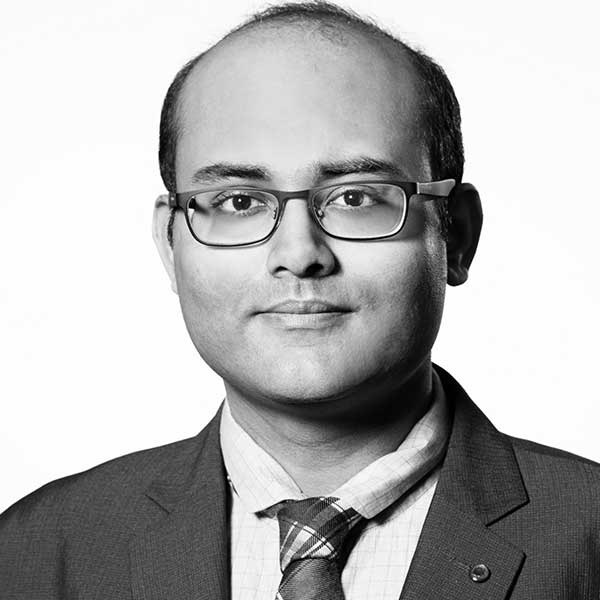
  • Subhayu Chakraborty, Strategy and M&A Investment, Naspers Ltd on transactional law and pursuing Masters from Frankfurt School of Finance and Management

    Subhayu Chakraborty, Strategy and M&A Investment, Naspers Ltd on transactional law and pursuing Masters from Frankfurt School of Finance and Management

    Subhayu Chakraborty, graduated in Law from WBNUJS in the year 2012. Subjects like IPR, Economics, Economics and Law, Corporate Law, Taxation and Corporate Finance/Governance and Law interested him and he has penned down a few articles – one published by the prestigious International Astronautical Federation (IAF) in 2010. Subhayu went on to pursue his Master’s degree in Finance, Frankfurt School of Finance & Management, Germany.

    He landed his first job at Sand Hill Counsel through LinkedIn which was initially an internship turned into a PPO. According to Subhayu, “Internships should be taken as a learning ground and for building lasting connections.” Currently, as an investment banking analyst he is responsible for deal origination and industry wide/company research.

    In this interview, he talks to us about:

    • Converting internships to PPO
    • Importance of higher education
    • Masters in Finance from Frankfurt School of Finance & Management, Germany
    • Roles and responsibilities of an investment banking analyst


    HOW WOULD YOU INTRODUCE YOURSELF TO OUR READERS? DO YOU COME FROM A FAMILY OF LAWYERS? CAN YOU TELL US ABOUT YOUR CHILDHOOD?

    • I am an investment banker, having had a prior experience in VC transactions. I am an avid reader, love to travel, am passionate about city photography, abstract art, F1 and I play chess. Post law, I worked a couple of years; before pursuing MoF (Master of Finance), and thereafter I joined a mid-market investment bank – 7i Advisors LLP. I now look forward to Joining Naspers in a FinTech Strategy and M&A Investments role.
    • My father is a taxation consultant, and that’s where the first nudge came from. At high school, the choice was between computer science or law. Ultimately, at close of 12th I decided to write the law entrance exams. The choice was amongst NLSIU, NUJS and NALSAR. Once admission to NUJS was confirmed, it was convenient to drop the rest.
    • I come from Kolkata and spent my childhood there. I did travel considerably – something I wish I could get time, today; that apart, I owe a lot to my schooling, which afforded an all-round development.


    WHAT MOTIVATED YOU TO PURSUE LAW? CAN YOU TELL OUR READERS HOW LEGAL EDUCATION HAS BEEN BENEFICIAL FOR YOU IN YOUR CAREER?

    • Though most people post 10th took up Science and prepared for engineering or medicals; they were never really an option, given my love of chemistry! Yes, sarcasm intended. In 2005, NUJS had its first batch of graduates. I remember discussing with my mathematics teacher and mentor, about the options a legal education would open. My dad played a big role, too. A couple more mentoring sessions later, law was a clear winner.
    • I believe, the biggest take-away from a legal education has been developing analytical and reasoning faculties; which does help one in roles like advisory/consulting. Having a deep knowledge of corporate law, FDI policies, and being able to structure investments/funds and being adept at soft skills like negotiation does help in Investment Banking.


    CAN YOU DESCRIBE YOUR TIME AT NUJS? DID YOU PARTICIPATE IN MOOTS, DEBATES ETC. OR UNDERTAKE ANY MEMORABLE INTERNSHIPS? HOW DID THESE EXPERIENCES CONTRIBUTE TO YOUR HOLISTIC DEVELOPMENT?

    • Law school, without a doubt were great years. I didn’t have a taste for the liberal arts curriculum; but, mid-way through law school I enjoyed most of my courses. I always enjoyed writing and penned down a few articles – one published by the prestigious International Astronautical Federation (IAF) in 2010. Studying with a cohort of talented and driven students, leaves its mark – and coming from a national law school, your extended alumni connect is the best takeaway.
    • I didn’t have a penchant for moots. I, in fact, never considered anything remotely linked to litigation as an option.
    • Internships should be taken as a learning ground and for building lasting connections. You got to believe the dots would form a line at the end. Few months back – I got off the phone with the India CEO of a real estate investment concern on a possible JV with a Japanese investor. I met him while he headed another concern, with whom I had completed an internship.


    WHAT WERE YOUR AREAS OF INTEREST IN LAW SCHOOL? WHAT PIQUED YOUR INTEREST IN TRANSACTIONS? HOW DID YOU CULTIVATE AND PURSUE SUCH INTERESTS?

    • Business and Law are two sides of the same coin. Legal acumen will stand you in good stead and so will transferable skills like negotiating and reasoning, while making business decisions. Subjects like IPR, Economics, Economics and Law, Corporate Law, Taxation and Corporate Finance/Governance and Law interested me.
    • Measuring value is an inexact science and markets are irrational. The value creation – be through an M&A, or PE/VC transaction; be either in the strategic sense or pure financial, wherein real worth may develop over the considerably longer term always excited me. I found myself reading the FT and HT Mint more often than law journals.
    • I was fortunate to be amongst the students to take part in the Allen & Overy International Finance and Corporate Law course. I took quite seriously the words of a partner, that “you could learn more about Private Equity and LBOs, if you read ‘Den of Thieves’ and ‘Barbarians at the Gates’…” That piqued my interest and some knowledge about the US M&A/LBO boom of that period, does hold one in good stead. Thereafter, it became easier – following up on business pages, HBR and being an avid reader, reading on finance books.
    WHAT MOTIVATED YOU TO OBTAIN A MASTER’S DEGREE IN FINANCE? CAN YOU DESCRIBE YOUR EXPERIENCE STUDYING ABROAD?

    • I found, in my first job, as a transaction lawyer – that, I would inherently spend more time trying to get a better hang of the deal metrics, than documentation and structuring. Somewhere down the line, it struck I could be in deal origination. In India, apart from a lateral move into IB by a lawyer, which is very rare – it made sense to get a master’s Degree in Finance. I had to get a pre-experience one (although the average age of the graduating class was 26), as a post experience programme demanded verifiable quantitative skills. I chose Frankfurt School of Finance & Management, in Germany over a noted Spanish school, to be in close proximation to the continental capital of Finance. Further, an increasing number of German corporates are setting up base in India. I graduated in the FS cohort of 2016, specialising in the Corporate Finance track.
    • Studying abroad is about a journey that ends back at home. Life at FS was a roller-coaster. I had my fair shares of ups and down. Had the good fortune of studying amongst a diverse international student body. Studies were intense, but there were also a lot of free time during weekends. Camping and trails in the German countryside; wine fests, jazz and a dynamic international music scene; are some of the finer things, I do miss. The best part, as always making friends and growing your professional network; and, you know maybe someday I am going to work on a deal alongside a classmate. FS also had a lot of initiatives. FS Buddy for instance, aimed at foreign and exchange students would organize a lot of day trips and cultural activities. They were fun, whilst getting acquainted with the German way of life. There were a lot of focus on student activities and FS Invest and FS Chess were another couple of student run endeavours. At FS we were encouraged to think out of the box, and a lot of students took part in business games and valuation Olympiads. I had the good fortune of being selected to go to Zurich to take part in the India Symposium, attend the 69th CFA Annual Conference in Frankfurt and also take part in the 49th Annual Meet of the ADB.


    WHAT ARE YOUR VIEWS ON THE IMPORTANCE OF HIGHER EDUCATION? WHAT WOULD BE YOUR ADVICE TO READERS WHO ARE ON THE FENCE ABOUT PURSUING FURTHER STUDIES?

    • Well, when speaking about legal education – the value adds of doing a masters, is about your specialization. I am not sure of the graduate job market in London, post Brexit; but English law will continue to be the very basis of our commerce. Of course, there are many students who prefer to do an LL.M or a J.D and then come back to India.
    • A rule of the thumb would be to know what your core interests are and choose a university depending on its specialization. Rankings of course matter, but you must differentiate among universities to choose the best one for you.


    HOW DID YOU LAND YOUR FIRST JOB? WHAT WAS THE NATURE OF YOUR WORK THERE?

    • Here you got a tale! Phew… I had good grades in IPR and was recommended by a noted faculty member to join as a patent attorney in a pharmaceutical concern. Before joining in, I contacted a partner at Sand Hill Counsel on LinkedIn and set up a one-month internship in Mumbai. I left for Hyderabad, post my internship at Sand Hill. When working on IPR, while that was certainly of utmost interest; I got a call back from Sand Hill Counsel and was offered a PPO. I quit my training and returned to Mumbai for another stint – before joining Sand Hill next June. I remember getting an e-mail from the concerned professor expressing disappointment at me having not been able to make a decision earlier – and, this was also the time when I had a pending submission for the Novartis Bio-camp (in Hyderabad, India) – I had to swallow some pills and take a conscientious decision of letting the Vice Chancellor office know of my decision to withdraw from the Bio-camp. Things do have a way of working out, at the end – and, I was thankful for having made that decision.
    • At Sand Hill Counsel, like any other law firm associate, I was responsible for research, drafting legal opinions, firm write-ups, drafting agreements, and the usual ‘on-deal’ responsibilities and closing formalities, with a view to managing expectations and delivering a mature product.


    CAN YOU DESCRIBE THE NATURE OF WORK UNDERTAKEN BY AN INVESTMENT BANKING ANALYST FOR OUR READERS?

    • In IB, one should be prepared for long hours and turning around deliverables in quick time. No two days are the same. I primarily was responsible for analysing business opportunities, develop pitch books for getting mandates, develop target lists, build investment decks, build business models and conduct valuation analysis across sell-side companies. On a live transaction, one has to proactively manage the due-diligence (business, financial and legal) process; and work towards a successful closing. At closing tempers break often and there are long hours, and you do see here, a continuum from my transaction law days.
    • What you do need to be a good investment banker, is better than average modelling skills – having a good understanding of key financial drivers, some hands-on strategy, and being able to work independently and efficiently in a high-pressure environment. It’s also very important to be a thought leader in the space of your calling.

    WHAT ADVICE DO YOU HAVE FOR OUR READERS WHO ARE PRIMARILY COLLEGE STUDENTS?

    • Take risks and believe in your dreams.

    There are no ideal jobs and don’t fall into a peer trap. While some jobs may be paying well, others do come with a long call. Think of the pay-off from that long call, and if that’s a role you do like – take the plunge. Most people I have known, do regret not taking chances; than failing. And, if you do fail, rise; but at the same time be sure to not attempt something, because of your ego – prepare well instead, to truly deserve!!

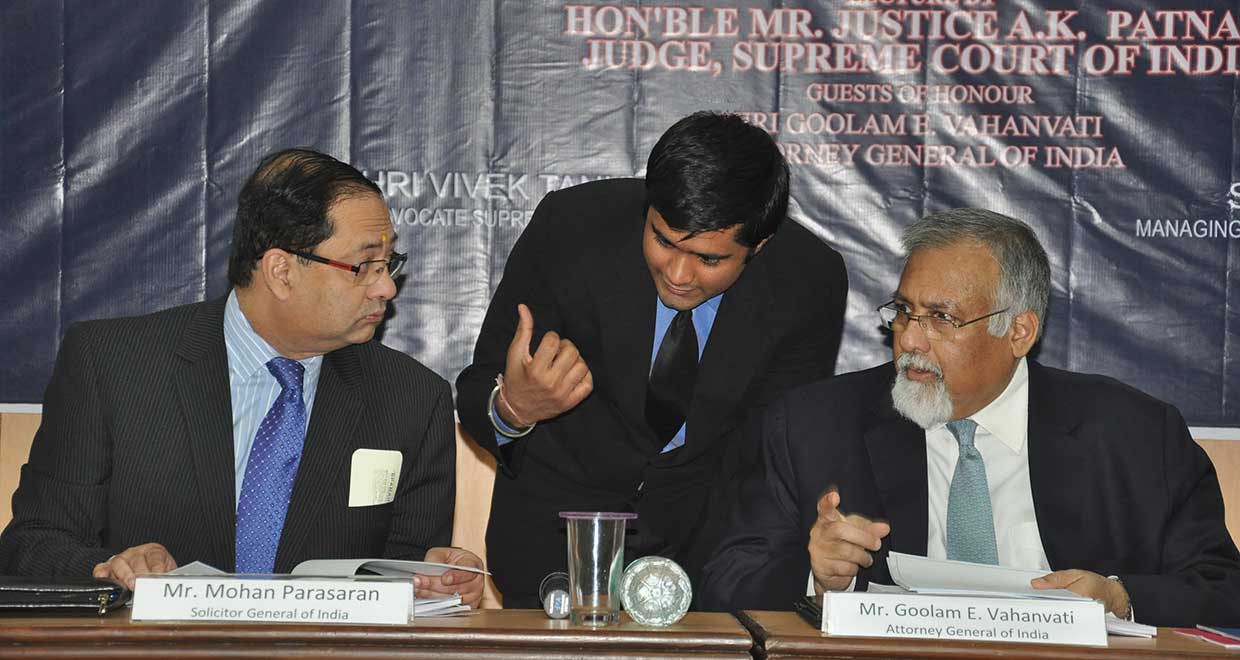


  • Kapil Duggal on declining AMSS PPO for an Indian LL.M, driving NLIU MCC to zenith and being a batch topper

    Kapil Duggal on declining AMSS PPO for an Indian LL.M, driving NLIU MCC to zenith and being a batch topper

    Kapil Duggal is the topper of NLIU Batch of 2014 (set to receive the Gold Medal on 15 November), who bagged a PPO at Amarchand & Mangaldas & Suresh A. Shroff & Company, an accomplished mooter, a successful Convenor of Moot Court Association (Took NLIU from #23 to #1 on the MPL and retained the numero uno position for 4 months), a debater and sportsman among others.

    In this interview, he talks about:

    • His experience in taking NLIU from Rank 23 to Rank 1 in MPL
    • Choosing Masters at NLIU over PPO from AMSS
    • Few tips on framing C.V.


    How would you like to introduce yourself to our readers? What motivated you to choose law as a career?

    I am a 2014 batch graduate from National Law Institute University, Bhopal. I would like to take this interview as an opportunity to share my views and insights on life in a law school and career decisions that a law student has to take.

    Law was not my first choice. I was pursuing engineering when at the end of the first Semester, I realized that I was not cut out to be an engineer. A couple of friends suggested me that I should look at law as a career option. I browsed through their preparation material for CLAT, it caught my eye, and a few months later, I ended up at NLIU, Bhopal.


    You’ve done your graduation from NLIU and currently pursuing Masters there. How would you describe your experience?

    Well my experience has been nothing short of fantastic! I’ve got the opportunity to explore many dimensions of my personality. For instance, I had never participated in any public speaking event/competition when I was in school. And one year into law school, I was representing my University at the United Asians Debating Championship in Bangkok, followed by another National Debating Championship at NLU, Delhi.

    National Law Universities provide you with plethora of opportunities in every field. I led the University basketball team at various National Sports Fests like Spiritus, Virudhaka, Yuvardha and Sportomania.

    I also organized the first round table conference on Need for Legal Regulation of Coaching Institutions, wherein after debating and discussing the nitty-gritty of the subject with all the stakeholders, we drafted a paper and forwarded the recommendations to Ministry of Consumer Affairs, Food & Public Distribution, Government of India.

    NLIU also gave me the opportunity to interact with many legal luminaries and have discussions with them over a vast range of subjects. I will never forget my discussion with (Retd.) Justice VS Sirpurkar regarding the challenges faced by the judiciary and the criminal justice system, when he visited our campus for delivering a Guest Lecture and was kind enough to spare some time from his schedule to interact with the students. I also organized a guest lecture by Senior Advocate Ms. Geeta Luthra on Trial by Media, which is cherished by students of NLIU till date.

    So it has been an incredible experience at NLIU, which was one of the reasons I opted to pursue the Master’s degree at the same institution.


    You have been among the top rankers during your college days. What are the tips and strategies you would like to share with our readers who are currently law students?

    Sincerity and dedication are one of the most essential factors to be considered. One need not entirely focus on reading the course material. It might even be tedious at times. A rather interesting approach, which worked well for me, is to read latest judgments on the subject. Actual cases in a courtroom are not quite simple and straightforward, and involve interplay of multiple provisions and in many cases, of multiple statutes. And a Supreme Court judgment would usually trace the first case which dealt with the subject and eventually come to the contemporary interpretation before finally arriving at a conclusion. So by reading one judgment, a law student can understand multiple provisions while getting acquainted with landmark cases.


    kapil-duggal-1

    You were the Convenor of the Moot Court Association at NLIU and during your tenure, NLIU gave its one of the best ever performance in mooting circles. How did you achieve such a feat and what skills do you get to hone while managing such a responsibility?

    NLIU had ended up at #23 on the MPL in 2013 and that’s when I assumed the office of Convenor, MCA. I straightaway took up the challenge of taking NLIU to the zenith. I reviewed the existing policies, inspired the mooters to put it in their 100%, and created a moot pool specially for our First Years students, so that we could groom them and send them for national competitions in their freshman year itself. Our alumni were very supportive and gave us their valuable inputs whenever necessary. Consequently, we were able to achieve #1 on the MPL and retain that position for 4 months i.e. for about one-third of my tenure. Even our mooters from the First Year brought home 4 awards in the moots they participated in.


    You have also judged the 5th NLIU-Juris Corp Moot this year. What is your advice to budding mooters? What factors do you think contributed to your success?

    The first step to success in a moot court is doing good research. And once you are standing before a judge, you should be in a position to argue your case without even glancing at your memorial. You ought to know the facts and the law on your fingertips.

    Having argued before a total of 10 Supreme Court and High Court judges in different moot courts, I’ve experienced that the situation in final round(s) of a moot court is generally a bit different from all other rounds because sitting/retired SC/HC judges would be on the bench, and they generally don’t appreciate inferences drawn from the factsheet, for want of evidence. So you must modify your strategy and strictly argue on points of law.


    How helpful do you think is mooting for a law student? Does it serve to build any practical skill?

    Absolutely. First of all, mooting helps improve your researching skills, which prove to be a great asset during one’s internships. Secondly, since you have to argue on behalf of both the petitioner/appellant and the respondent, you get to train yourself in applying the same law to opposite situations and thereby get to learn interpretation of statutes, which is one skill you hardly get to develop in academics. Thirdly, you get to keep yourself updated of legal aspects of contemporary issues as mostly, moot problems are drafted on contemporary issues.


    What would you say differentiates between the best speakers and the rest? What are the top three things you consider sine qua non for being a great speaker?

    Knowing the law- both for and against a proposition, ability to put your best points forward effectively in the given time frame and, and ability to take the bench with you on every point are the things that differentiate a good mooter from other participants. Equally important is knowing when to concede a point and taking the decision of moving to the next argument. This comes only by experience.


    You secured a PPO from AMSS during fourth year of your graduation. Still, you wrote CLAT and joined NLIU for Masters. What prompted you to leave a lucrative career opportunity and pursue LL.M from an Indian University? Was it a part of your long term plan?

    Interning with AMSS was a great experience, it’s a terrific place to work. I liked the work there, and would have loved to join AMSS. Senior Advocate Ms. Geeta Luthra had a profound effect on my decision-making. She along with Professor (Dr.) S.S. Singh and Prof. (Dr.) Kumar Kartikeya guided me to the nuances of a career in litigation and inspired me to take it up. I intend to practice in the field of Constitutional and Administrative Law (after completing my LL.M degree). It made more sense to me to undertake an in-depth study and analysis of laws that I would be dealing with on a day-to-day basis, as against pursuing LLM from a foreign university, where I wouldn’t have got an opportunity to do so. NLIU, Bhopal being one of the top universities in the country and the only top institution offering a course on Constitutional & Administrative Law, made my decision easier.


    What kind of work did you come across during your internship at AMSS? What are the things you consider sine qua non for positive feedback from an internship?

    I worked with Project Finance and Litigation teams of AMSS, Mumbai. The nature of work included drafting, preparing research notes including for some very interesting topics like law regarding spot-fixing in cricket, etc.

    Sticking to deadlines, formidable research work, making sure that your work is updated with latest case laws are sine qua non for a positive feedback. You must be thorough in the work you are submitting for you can be called at any time and asked to give details regarding the cases you have cited, if the associate finds them of great use.


    Did you have to undergo an interview before securing your PPO? Any tips on how one should go about framing a C.V. and prepare for an interview?

    While drafting your C.V., you must precisely state the topics which you have worked upon during your internships. You must also keep yourself updated of any new developments regarding them. Customize your CV according to the firm/company/lawyer you are applying for, and stress on those parts of your work experience which hold value for them. If your CV is heavily loaded with co-curricular activities, you can cut down on the section of extra-curricular activities in your CV.

    I was interviewed by AMSS as well as by Khaitan & Co. for a PPO. I received an offer from AMSS first and hence I requested Khaitan & Co. to allow me to opt out from the PPO process and they were kind enough to oblige. You must read up on the topics that you have worked on during your internship, including the latest developments. Having knowledge of the market situation and practical aspects is definitely a plus point. You should not miss out on reading up even a single topic which you have mentioned in your CV. You should also be able to readily answer any question regarding the field of law you would like to specialize in, which should be supported by your CV (you should have written papers/articles or participated in moot courts/conference relating to that field of law). These would significantly help you in preparing for an interview.


    Lastly, what would be your message for our readers?

    You must make the most out of your vacations. Intern with a lawyer/firm whenever you get an opportunity to do so, for you will learn the practical aspects of what you read in law school, which will give you an edge over others. Also, manage your time wisely and do take out time for your hobbies/sports, so that you enjoy your time while in law school.

  • Chetna Shrivastava on securing top-notch internships, bagging a PPO and managing academics

    Chetna Shrivastava on securing top-notch internships, bagging a PPO and managing academics

    chetna-shrivastava-2Chetna Shrivastava is one of the most diligent and illustrious scholars of the 2015 batch of NLIU, Bhopal. She has a noteworthy academic, mooting and debating record. She is a part of the Editorial Board of the NLIU Law Review and co-founder a student run newsletter in NLIU. Her diligence and mettle at work was recognized when she received a job offer from Khaitan & Co.  during campus placements. We asked her to share her experiences and strategies she used over the years.

    In this interview, she tells us about:

    • Securing top-notch law firm internships
    • Her journey from an intern to getting job offer from Khaitan & Co.
    • Importance of academics, internships, debates and moots


    Most of our readers are law students and young lawyers. How will you introduce yourself to them?

    To begin with I would like to applaud this venture of Superlawyer of creating a database for law students and young lawyers to make informed choices after coming across experiences of the old souls (no offence!).

    For this interview I will make a sincere effort to be as serious as the interview demands. While my grades so far portray me as a nerd, my friends will have a different story.

    Caution: Those reading this interview for a chalked out strategy at bagging a job might be disappointed to know that the interviewee is a clueless person who has solely focused on gaining varied experiences to finally make the most suitable choice.


    Tell us a bit about your childhood and pre-college life as well as educational background. Do you have lawyers in your family?

    I finished my schooling from Christ Church Girls’ School, Jabalpur, a reputed school with a rich cultural and educational heritage owing to its establishment dating back to 1870. My parenting and schooling ensured my proactive participation in extracurricular activities along with securing the top ranks in academics throughout school. To diversify my options I took up Mathematics and Biology (with Physics and Chemistry) after Class 10th.

    I am a first generation lawyer.


    In India there is still a bit of resistance towards legal education. What motivated you to choose law as a career?

    Yes, the resistance towards legal education persists however it is weakening with increasing awareness of the diversity of career choices offered by legal education. The instances have reduced where I face quizzical aunties on how I could possibly take “CAT” right after school.

    The two years that followed after Class 10th made me realise that performing well and having an inclination for the subject are not synonymous. Though I performed equally well in all the subjects, arts and humanities fascinated me more as compared to deciphering the molarity of salt solutions or calculating the net forces in a rope and pulley system. I had come across several school alumni who were already pursuing a successful career in the field of law. Hence it did not take me long to decide on law as a career. Though my parents are doctors and had the same career intended for me, they were very supportive when I expressed my wish to take CLAT.


    You have participated in various moot court competitions, tell us how important is mooting and what effect does it have on one’s CV?

    Being a lawyer involves the practical application of the concepts that we are taught in the law school. Moot court competitions provide an opportunity to hone the argumentative skills along with understanding the practical nuances of the law concerned. It definitely adds a positive aspect to the CV because it evidences one’s thorough understanding of the principles with a practical experience.


    Apart from mooting and academics what other co-curricular activities did you engage yourself in?

    As a first year student I had a brief stint as an adjudicator, representing my college in various debates. A major part of my co-curricular activities has been attributed to being a part of the Editorial Board of the NLIU Law Review, CSIPR Journal and the Literary Society. In my third year I co-founded a student run newsletter.


    All your internships have been at top notch law firms. Tell us what all places you interned and how did you procure your internships?

    Apart from NGOs and Chambers of Senior Advocates, I have interned in DSK Legal, Bombay, Khaitan and Co., Bombay and AMSS, Bombay. The latter two internships were procured with the help of the PCC in my third and fourth year respectively. While the earlier ones were procured by numerous individual applications sent well in time before the intended internship duration.


    Did you plan your internships throughout law school deliberately or did it all just happen by chance? How relevant did you find your law school education with the kind of work you were required to do at law firms?

    Honestly, the four years in the law school so far have been a journey of trying to accumulate varied experiences. Therefore my internships were an attempt to assess the pros and cons of the various options available to me after law school. Apart from merit “chance” was definitely an assisting factor as being a first generation lawyer it is not easy to secure the intended internship in the earlier years of law school.

    The law school curriculum made me adept in understanding the assignments in the internships. However in the process of working on those assignments I gained a deeper understanding of the specific concepts which form a part of the subject taught in the law school. The internship was perfectly complementary to the curriculum in aiding a holistic understanding of the subjects of the curriculum.


    These days there are many law students rushing forth to intern at law firms from their first year itself throughout till their fifth year. What do you have to say about the advisability of law students pursuing such a course of action?

    Like I already mentioned, my internships were aimed at accumulating varied experiences of the options available after law school. I began with NGOs and Chambers of Senior Advocates and interned at a law firm for the first time by the end of the second year. In hindsight this helped in developing a legal aptitude to execute the assignments with a better understanding of my work. I would advise students to intern in law firms around the time when corporate laws are introduced in the curriculum as the internship and academics mutually benefit the understanding of the subject.


    Recently, you bagged a job offer at Khaitan & CO. How did you go about achieving this?

    At the end of my third year I secured an internship with Khaitan & Co. after being screened by an interview process arranged by the PCC. I was diligent in the internship which was facilitated by the inclusive atmosphere offered by the firm to its interns. By the end of my fourth years I was shortlisted for a PPO interview by the firm which was kind enough to consider me a worthy candidate for the job.


    There is a phenomenal obsession amongst law students with maintaining a very high CGPA. How important according to you is this in securing a job?

    As being one with the “obsession” and being decently successful at it, I believe that it plays a determining factor in securing a job. A consistent, more crucially than high, CGPA projects one as a diligent and sincere student to the recruiters. Most of the screening process by the recruiters has short listing of the candidates on the basis of their ranks in the first phase. However grades are not the sole reflection of one’s knowledge. Averagely good grades complemented by co-curricular activities make the student come across as one who can balance both in a rigorous academic routine and hence a better candidate for a job which involves simultaneous assignments.


    What should one law student aspiring for a job at top law firms do? How would you recommend they prepare in their last 2 years at law school?

    In the last two years the students should strategically apply for internships in the firms they aspire to work in. The internship is a perfect opportunity for making a mark as a prospective candidate for the job. A thorough knowledge of the corporate laws and efficient application in the internship contributes majorly towards securing the job complemented by a good performance in the recruitment procedure.


    Where do you see yourself five years from now? Would you consider going for an LL.M. abroad?

    As a person who goes with the flow, this is a difficult question to answer. Currently I’m looking forward to working in Khaitan & Co. and gaining the most out of my experience. LL.M. is not an option I am considering.


    What message would you like to give to our readers?

    Being a student of a field with such diverse career options you should explore and make the most of your experiences to make an informed choice. Remember the closing scene of Kung Fu Panda where Mr. Ping discloses to Po that there is no secret ingredient? That realisation helps in working towards achieving your goal knowing that the only indispensable ingredient is well directed hard work and sincerity.

  • Pranjit Bhattacharya, Law Graduate, Bangalore Institute of Legal Studies, on mooting, securing top-notch internships and a PPO from Trilegal

    Pranjit Bhattacharya, Law Graduate, Bangalore Institute of Legal Studies, on mooting, securing top-notch internships and a PPO from Trilegal

    Pranjit Bhattacharya graduated from Bangalore Institute of Legal Studies in 2015. He also holds a diploma in Entrepreneurship Administration and Business Laws from NUJS, Kolkata. Pranjit received a PPO from Trilegal in his fourth year of law school.

    In this interview we speak to him about:

    • Mooting and its benefits for a law student
    • Preparing a C.V. and insides of personal interview with tier-1 law firm; and
    • Securing top-notch law firm internships


    Tell us a bit about your life before college?

    I have been lucky to grow up in the beautiful picturesque city of Shillong. I did my 12th from St. Anthony’s Hr. Sec. School, Shillong. I have a twin brother who is also, doing law from the Faculty of Law, Delhi University. That is as far as law runs in my family. A better part of our schooling was devoted to debating at various inter-school events. Studying at a school where great emphasis was given to extra-curricular activities helped me immensely.


    Why did you decide to study law?

    I think it was a de facto choice really. I opted for Commerce during my 12th so chances of pursuing Engineering and Medicine were negated pretty early (much to the dismay of my family). I wanted to pursue something that would give me a rush, a discipline that challenged one’s ability to reason – what better than ‘law’ in that case. I am really passionate about law actually.


    How practical do you think are the shows like The Practice, J.A.G., Boston Legal, Suits, etc. and movies like 12 Angry Men, Philadelphia, etc.?

    To be honest, if soap operas were to show the life at a law firm as it transpires on a daily basis –most people would shrug at the very thought of watching it. There is a reason why such shows are meant for entertainment and so, they should be. It would be really naive to be goaded to believe that this is how the legal profession works on the basis of such shows.

    Although, I think there are quite a few good English movies which manage to captivate the essence of law practice quite beautifully. A Few Good Men, To Kill a Mockingbird and 12 Angry Men are my personal favourites.


    How did you secure internships with top tier firms?

    It is important to plan your internships well. At the beginning of each semester I prepared a list of firms that I wanted to intern with. Applying well in advance and setting out the period of internship clearly are recommended. Given that most firms have their own internship application procedure; it is advisable to confirm the same with the HR at the firm prior to sending an application.


    pranjit-bhattacharya-1

    Did you pursue your internships throughout law school as part of a deliberate plan or did it all just happen by chance?

    I think I had planned it out fairly well. Almost every semester I knew precisely the kind of internships I was looking at. So in my first and second year I interned at The Hindu Newspaper Publications and under an Advocate at Calcutta High Court (who is presently, a Judge in that Court). Thereafter, I moved to a mid-sized law firm, CorLit Legal for three months during my third year. This was a very enriching experience actually. The kind of exposure I was given at this firm formed the bedrock for my future internships.

    Since, the end of third year my internships were part of a well-thought out plan. So at the end of my third year, I interned at Nishith Desai Associates. Then in fourth year I interned at Trilegal (twice) and at the Law Chambers of International Tax jurist Mr. Soli Dastur, Senior Advocate, Supreme Court of India.

    Unfortunately, there exists a wide gulf between law school education and the work at a law firm. It entails a sound knowledge of different business models; latest regulations / notifications, etc. in different fields of law; market precedents on certain transaction that the firm proposes to undertake in the future; business risks inherent in a particular transaction and the like. In this regard, law school education is woefully deficient in investing the students with the knowledge to deal with such practical aspects of law.


    What kind of work did you have to do during your internships?

    It varied according to the place. Drafting client opinions, due diligence, research on multifarious aspects of law, comparative analysis of certain laws in India and other countries, etc. were the major tasks that I was assigned.

    A couple of them actually. On the last day of my first internship with Trilegal, a Senior Associate offered me a second internship at the firm and then said with a smile, “Remember always that there are plenty of good lawyers, but not many good lawyers who are good guys. So do not forget to be a good guy”. This is something I have tried to hold onto ever since.

    Then, on one occasion during my internship with Mr. Dastur, me and my co-intern were working past midnight, so while leaving he quoted Henry Longfellow’s famous words with a beaming smile, “The heights by great men reached and kept were not attained by sudden flight, but they, while their companions slept were toiling upward in the night”. This continues to remain the fondest and most cherished memory of all my internships.


    What do you have to say about students interning at law firms  all through their undergrad years?

    Law School life is all about exploring different avenues, particularly, in the first couple of years. Choices to intern exclusively at a law firm right from the start of law school defeats this very purpose. It necessarily means that you shut your mind to other avenues that may be more suited to your acumen and ability. It also, undermines the significance of good litigation internships which unravel the possibility of engaging with some of the best minds in the legal profession and leaves an indelible influence in your career.

    It is quintessential for your wholesome development as a lawyer to understand a particular fact situation from different perspectives. Diverse internship experiences help you acquire this. Thus, even though you may be pre-meditated that you want to work at a law firm in the future, it is advisable to pursue at least a couple of non-legal or socio-legal internships prior to law firm internships.


    Tell us about being a member at  multiple committees while in college.

    I have been a member of the Moot Court Committee at college since, the first year of law school. And for some time I was also, involved with the Literary and Placement Committees. I think they enhance your networking and communication skills and organizational ability. In my college though, these Committees are limited both in terms of, activities and impact.

    I was also, a member of an Expert Panel Study on Access to Healthcare in India by IIM-Bangalore and University of St. Gallen, Sweden. The forum involved participants from diverse disciplines of different age and influence. The entire process was immensely rewarding in terms of, quality of interaction, sharing of ideas, discussion on business strategies, etc.


    Have you felt strongly about social causes?

    I would be lying if I said no. So I tried to strike a balance between my objectives of working with a law firm and pitching in with some pro-bono work as well.

    During my fourth year, I worked as a Research Assistant for Mrs. Nina Nayak, eminent social activist and former Chairperson, KSCPCR and Member, NCPCR on her book on the National Commission for Protection of Child Rights Act, 2005.And I have already mentioned earlier, about my stint with the Expert Panel at IIM-Bangalore.

    Both these opportunities gave me a deeper understanding of the policy paralysis and administrative complacence that pervades our system and the critical role that society needs to play in eliminating the same.


    Tell us how important is mooting and what effect does it have on one’s CV?

    (Pranjit has participated in various moot court competitions like Nani Palkhivala Tax Moot, Surana Corporate Moot, NLS Arbitration.)

    At the outset, if you are doing a moot court competition for CV value only then, according to me it is a futile exercise. Mooting is a passion and that is what should drive an individual’s decision to moot or not to moot. This is one experience at law school that I encourage everybody to undertake.

    I started mooting since the very first year of law school. My first moot was on Constitutional Law, organised by Amity University, Rajasthan in which we were the semi-finalists and eventually, adjudged as the ‘Third Best Team’. This moot was my first tryst with law and the romance has continued ever since. My best experience was at Nani Palkhivala Moot Court Competition where incidentally, I was also, the Second Best Speaker.  It ignited in me a passion for Taxation Law that I have pursued keenly ever since.

    Whether it adds value to your CV or not, I cannot opine on it definitively. However, this is the best way to harness your reasoning ability, research skills and ability to make arguments. In fact, most reputed Moots are based on emerging or grey areas of a subject, or sometimes even transactions that are making the news. So the influence of good Moots is all pervasive. I think this may be a reason why law firms may view participation at various Moot Court Competitions quite favourably.


    Tell us about the significance of pursuing courses such as Introduction to M & A and NUJS Online Diploma in Entrepreneurship Administration and Business Laws.

    My internships drove me towards this decision to pursue such courses. They made me realise that there are certain practical aspects of law that the academic curriculum fails to address. The problem is accentuated in case of Universities where little or no emphasis is given to acquiring practical skills pertinent for excelling at law practice.

    It is important to know the academic aspect of law, true; but it is also, essential to be skilled at applying it. This is precisely the purpose such courses serve; they equip you with the right kind of skills that help you deal with practical nuances critical for a lawyer.


    How was your internship experience with Trilegal?

    I interned only once at Trilegal before I secured a PPO. Post my PPO I again interned there. Trilegal has a pro-active mentorship program, whereby, every intern at the firm is placed under a mentor who assesses an intern’s development through the internship. This is definitely, one thing which in my view sets Trilegal apart. And then, the Associate like experience at the firm and the quality of work allotted to interns. In my second internship, I was made to work on two live transactions. These experiences make it worthwhile to intern at such a place.


    What are the things you consider sine qua non for positive feedback from an internship?

    I do not believe that there is a hard and fast rule to get a ‘callback’ or a ‘PPO’ for that matter.  Certain things that I believe can trigger a positive feedback is the level of enthusiasm and initiative one shows towards the work assigned like explaining clearly your research to the person concerned and then engaging in a discussion on the same. Also, never hesitate to ask questions even if they appear to be a little stupid. You can prove otherwise, with the quality of your work based on the insights you gain by asking the right questions. These things help you inspire confidence in the members of the firm.


    Did you have to undergo an interview before securing your PPO?

    Yes I was interviewed for a PPO. It is an interesting story actually. After my internship at Trilegal, I had gone down to Mumbai for an internship at the Law Chambers of International Tax jurist Soli E. Dastur, Senior Advocate. One evening I received a call from Trilegal, Mumbai that a PPO interview has been scheduled for the next day and candidates would be interviewed over Skype. As I was in Mumbai, I suggested that I would like to come down to their office which they were glad to accept.  I had to request Mr. Dastur for a leave for the next day. My last thought while going off to sleep that night was, “I need to wake up early, be presentable and just show up on time. Rest is up to providence.”

    An initial predicament was to introduce myself to the interviewers because they had never heard of my college. And frankly since, I had never undergone any formal training to tackle interviews, I am personally of the opinion that it is all about presence of mind. Interviews are an opportunity to test your ability to think on your feet. It is also, absolutely vital for you to know your CV inside out. Moreover, a sound grasp of interesting developments in the field of politics, law, economics and general knowledge is essential to ace a law firm interview / or any interview for that matter.

    There are certain pre-requisites of preparing a good CV and any departure from it is unacceptable. The importance of a structured and properly formatted CV without any spelling or grammatical errors can hardly be over-emphasized. What is important is to communicate about four-five years of your activities at law school in two-three pages. The skill sets that you have acquired during your time at law school should be adequately reflected in your CV. Moreover, it is essential to have a tailor-made CV based on the firm /company / any other organisation in which you are seeking a position.


    How important according to you is CGPAs in securing a job?

    Let me answer your question in two segments. There is a significant difference between the law school curriculum administered at some of the top NLUs and certain other top ranked law colleges and those administered at colleges affiliated to State Universities.

    The curriculum designed for the NLUs and some other top ranked college reflect a significant thought process to ensure that the academic aspect of law is not divorced from its practice – whether at a law firm / litigation, etc. Despite this concerted effort, there has been a brewing discontent among the legal fraternity that there still remains a wide cleavage between the two aspects. Hence, judging the ability of a student exclusively on the basis of his CGPA is inherently flawed. On the other hand, the curriculum of most of the State Universities is archaic and reflects absolute non-application of mind on the part of the authorities responsible for formulation and evaluation of the entire course.

    So while some credibility can still be attached to the system of evaluating the student in the former case; the latter is a mockery of the ability of students. In all fairness, I have been an average scorer throughout law school and that has in no way hindered my prospects. Having said that the value of a decent CGPA can hardly be discounted because all said and done, every interviewer needs a benchmark against which your ability has to be judged.


    What should one law student aspiring for a job at top law firms do?

    The process starts right from your first year. I devoted the first three years of my law school in developing diverse skill sets acquired through academic knowledge, various internships, Moot Court competitions and such other activities at law school. The last two years have so far, reaped me the dividends of my investments in the first three years. So the last two years should be spent interning at the right kind of places keeping two things in mind; first, identifying the practice areas that interests you and second, a place that has a reasonable likelihood of absorbing you into the organisation post your internship through a ‘PPO’ or Campus Placement.


    Where do you see yourself five years from now? Would you consider going for an LL.M. abroad?

    I think my goals are more short-term in terms of where I would like to see myself at some point in the future. I still have about a year to go at Law School so as of now I am quite enjoying my time under the sun. But yes, I would definitely want to author a book on any aspect of law; may be in five years’ time that is one thing I would be glad to have accomplished.

    I am quite keen on an LLM from abroad, more for the profound experience that it proffers than anything else.


    You being from BILS, do you think that being from a non-NLU made any difference?

    Well, to say that it did not make a difference would be both unwise and inaccurate at the same time. In certain ways, opportunities were in fact, fewer and far between. But then, again may be that was something that motivated me to make the most of limited opportunities. Since, I did not undergo the rigours of a National Law University; the endeavour always was to put myself through a process that ensured I was on par with the products of NLUs. And yes, I had the added advantage of customizing the entire process according to my requirements unlike an NLU where there is already a pre-designed system to which you need to adapt.


    Lastly, what would be your message to our readers?

    “The future belongs to those who believe in the beauty of their dreams”. -Eleanor Roosevelt

    So, keep calm and read SuperLawyer!

  • Srirang Sapre, Law Graduate, GNLU, on maintaining CGPA and getting a PPO from AMSS

    Srirang Sapre, Law Graduate, GNLU, on maintaining CGPA and getting a PPO from AMSS

    Srirang Sapre is a student of GNLU, batch of 2015. During his time as an undergraduate, he has interned with the likes of AMSS, Wadia Ghandy & Co., Jani & Co., Y J Trivedi & Co., among others . He has received a pre-placement offer from AMSS.

    In this interview we talk to him about:

    • Maintaining a good CGPA and building a CV
    • Working diligently and receiving a callback
    • Sailing through the interview and getting a PPO from AMSS


    Tell us about your pre-college life. Did you have lawyers in your family?

    I was lucky to be born and brought in the beautiful city of Ahmedabad. I did my schooling from Best Higher Secondary School, Maninagar, Ahmedabad. I being from a school which had always pressed on academics and extra-curricular activities equally made it easier in later years for me because I was competent to handle both academics and extra-curricular activities together. As far as having a law background goes I have none. I am the only one in my family to have chosen a career in law.


    Should scores of SSC and HSC affect your decision to take up law course?

    Personally, I do not think percentage scored in SSC and HSC should have any bearing on decision of getting into a law course. Getting into law only requires you to have a brain that can think logically and rationally. Apart from that you need to have the dedication and should be willing to work really hard to achieve your goals, that is I think what you should look for when you think about pursuing a career in law. I don’t think there is much of an edge for students having Commerce background or Science or Humanities. But every once in a while I have found myself to getting hang of few topics taught in law school better and faster because the basic concepts of Commerce grasped in my 10+2 education were strong. Further if you are interested in Corporate Law or taking up Company Secretary Course I think having Commerce background will help a lot.

    How should a fresher go about his initial journey in a law school?

    When you step into National Law University as a fresher it’s a start of a whole new chapter in your life. It is a bittersweet moment because you are happy that you cracked the CLAT and terrified that others around you have done the same too and that to may be with better scores. But you soon get used to this new world and its rules. Also be very cautious while choosing your peer group as in a Law School getting carried away or swayed is easy. Friends are very important during your journey here. Some of those friends will be for life.


    How should one prepare for continuous evaluations and end semester examinations?

    Doing smart work is more important and not hard work. One should always bear in mind that there is no straight-jacket formula to go about all subjects offered in a particular semester. You need to think on your feet and assess as to what all is required by the subject and what all points does the faculty expect from students to be covered in the answer. I also recommend group study since it is beneficial in a few law subjects which have vast syllabus and it is not always possible to complete every bit of it single-handedly. Scoring consistently well is extremely important. It should not be a one-semester-show but that also does not mean you need to top every semester, you just have to maintain your average and strive to make it better and better as you make your progress in the law school.


    How important is it to get published in order to build a CV?

    I think to having an all round CV is very important. A couple of articles published in reputed journals/newsletter/websites will take you a long way. All articles can have something to do with any of the various law subjects that you study. However if you want you can also try to streamline your C.V. in a particular direction by writing on similar areas of law. I for one have written on very diverse topics ranging from entrepreneurship to anti-piracy. So to sum it up I feel that getting “articles” published and not just “legal articles” will help in the long run. This shall also help you to achieve command over English language which is like inevitably important in legal profession.


    You have been a member of multiple committees while in law school. Do you think these enhanced your skill-sets?

    It is important to lay strong foundation to aid your progress in crucial final years. According to me being a member is various committees is equally important along with constant focus on academics. There are many on-field experiences and instances which makes every committee I have joined a memorable experience for me. Instead of giving specific occasions as to where it helped me I would rather state that it has immensely helped me to develop my overall personality especially on social front. Also the level of exposure that you get while working in each of these committees is superb. Lastly, it is again a matter of choice you may stick to certain committee(s) or join no committee at all but personally I think positions of responsibility adds considerable credit and weightage to the C.V. which recruiters do look at as well.


    Can you tell us about your internship experience?

    (Srirang has interned with top tier firms such as Udwadia Udeshi, Amarchand, Wadia Gandhy.)

    Frankly speaking, coming from non-legal background it was quite a herculean task for me to secure such internships. Going to any of these firms before III year is not that productive both for the firm and the student since you are still learning commercial laws and are not aware of its intricate topics and hence once I was done with my sixth Semester I started applying personally via emails and following up on status of the application via calls. However it becomes simpler to secure internship in your IV and V year since Internship and Placement Division (IPSD) at GNLU takes up the task of placing students at various firms and I am extremely thankful to IPSD for facilitating me in securing internship at these top-tier firms that eventually culminated into a PPO from AMSS, Mumbai.


    Did your law school education find relevance with the kind of work you were required to do at law firms?

    I was lucky to have seniors to help me plan my internships and other things from time to time. But, I was clear on one thing that I will not just sit idle in any of the breaks and hence made all efforts to secure some or other internship. One should be ready to intern at middle and local firms too, trust me your get to learn a lot. Law school education did help me to start off my work in the law firms but I certainly think many practical aspects can be brought in the syllabus or the teaching methodology across all the NLUs. By that I mean to say for an instance while teaching the transfer of property act some aspects of stamp duty calculation etc can be also made known to the students. However the notes that I used to take down in the class came very handy when I was given a completely new topic to research on. So yes law school education is the first step to the research accomplishment ladder and then it depends on person to person to dig deeper.


    What kind of work did you have to do during your internships?

    Since I started off with an NGO internship, a property law firm and then went onto intern at top tier firms of India that itself reflects that I had excellent opportunities’ coming my way to work on diverse topics such as alternative dispute resolution laws, property law, admiralty law, state specific statutes and of course corporate law to name a few. Well, as far as memorable moments goes highlighting a couple of moments would render others as less memorable and cause injustice too hence every internship that I undertook had memorable moments as each day I got to learn something new of which I was absolutely clueless until just the  night before.


    Have you ever seriously considered engaging in pro-bono humanitarian work?

    Yes. When you get into this one of the most glamorous, challenging and powerful profession and dream of yourself getting close to most prominent lawyers, honorable judges and social activists who fight for making India a better place to live  such a thought  would naturally cross your mind/ and I am  no different. I got this very good opportunity to work on something unique and i.e. framing guidelines for food waste management which is currently very serious issues at global and national level as well. I think if this problem is curbed then social evils like poverty, starvation, malnutrition can be reduced greatly and that shall eventually raise India’s HDI. I do wish to continue giving back to the society in whatever way I can contribute in future also.


    Did you ever plan as a young law student to pursue any socially relevant legal work?

    Certainly I had thought about it and I did take a step by joining Legal Services Committee at GNLU which has been established to render legal assistance to the section of society which is uninformed about legal system or rights as the case may be. I did see ground-reality at villages around my hometown and such low levels of legal awareness existing there moved me. I did try and assist in the process as much as I could. Further, in future as well I look forward to making myself available for social work opportunities that come my way.


    What do you think an intern should accomplish in the course of their internship to get a “callback” or “PPO”?

    I was directly shortlisted for a PPO after my first internship itself at AMSS but I had received a call back at other firm where I interned in my third year hence the dynamics are pretty much the same but the difficulty level gets tougher and tougher as you intern in tier-one firms. For bagging a ‘call back’ or ‘PPO’ there is no simple formula since every single firm look out for different set of qualities in the interns that they select. Plus nowadays every firm has started conducting telephonic or VC interview in intern selection process hence it is very important for each of the applicant to be well-prepared and impress at the internship interview itself. Though I personally do not believe in the saying- “First impression is last impression” but yes first impression do have a lasting impression and hence it is  important and sometimes if you are not lucky enough circumstances might just not give you second chance, moreover an impressive first shot can do wonders for you. Nevertheless the qualities like punctuality, sincerity, humility, thinking on the feet attitude and last but not the least – being genuine (yes genuine not genius) will give you the upward thrust on your ladder to success.


    How important according to you are grades in securing a job?

    Who doesn’t love to score good marks? I guess each student prays to God when exams are around to bless him with good marks in the examination. I must confess I was obsessed to score better marks in every examination and I honestly think controlled obsession for good things always works in your favour and is sometimes necessary to promote healthy competition but you should never let it turn into jealously in case you don’t score well. I was fortunate enough that my efforts were suitably rewarded and I pulled up my average higher. CGPA is not the only parameter for securing the job but I won’t be wrong or unjustified to state it is a very important parameter. On the other side not being able to top is also not a lost affair there are ample of firms that look at consistency and not the always high going CGPA graph.


    Did you have to undergo an interview before securing your PPO?

    You have to undergo interview process and not just that, there might be other layers of shortlisting before one reaches the personal interview level. Tailoring your CV is an extremely important task for any candidate sitting for a firm interview. For interview you need to be thorough with every word printed on your CV and if you can answer any question from and on the basis of CV I think the game is pretty much on your side. Asking someone to take mock interviews also helps to get over nervousness. CV is a tool that will help you market yourself better just think of it as a brochure that describes/explains/markets you in the best manner possible .One small mistake or bluff on your CV can make you pay heavy cost and ruin four to five years of hard work in the interview room. Drafting CV is also an art as you need to make sure as to what firm is looking for and highlight those points in your CV.


    Lastly, what would be your message to our readers?

    My message would be that first learn the rules of the game. Remember that nothing is too BIG or too SMALL to be accomplished and ensure that whatever you do, you do it with all your heart or else all efforts would count for nothing. To conclude trust your guts. Maintain a good CGPA. Strive to be “Jack of all and master of one or more laws”.  There is no harm/shame in taking help of  your elders, seniors, batchmates and the faculty of course for any  turbulence. Be determined towards the goal and keep putting in cent percent efforts and success will certainly knock your door.

  • Varun Chauhan, Law Graduate, GNU, on being the batch topper, a sports enthusiast and receiving a PPO from AMSS

    Varun Chauhan, Law Graduate, GNU, on being the batch topper, a sports enthusiast and receiving a PPO from AMSS

    Varun Chauhan is a student of GNLU, Gandhinagar, batch of 2015. During this time has has interned with Singhi & Co., Unmesh D. Shukla, Gujarat State Petroleum Corporation Ltd., Vaish Associates, AMSS, Khaitan & Co., and Shardul Amarchand Mangaldas. He helps organise ‘Justice League’, the university’s sports fest, and he is also a mentor in the Sports Committee of the university.

    Varun was most recently offered a pre-placement offer from Amarchand & Mangaldas & Suresh A. Shroff & Co.

    In this interview we speak to him about:

    • Topping his batch in GNLU
    • Being a sports enthusiast and his involvement in the Sports Committee
    • Getting a ‘callback’ and a PPO from AMSS


    As a child what were your ambitions?

    As a child I wanted to be many things but when I really started exploring my career options, I decided to become a lawyer. I found law to be very interesting and challenging. It was something that was logical, yet it demanded critical and analytical reasoning. I am going to be a first generational lawyer.


    Tell us about your pre-college life as well as educational background.

    I did most of my schooling at St. Xavier’s Loyola Hall, Ahmedabad. There I was introduced to sports. I became a member of the school football team and represented Ahmedabad District-Urban in the U-14 level. Apart from football I used to represent my class in cricket and basketball. Another part of the school was the leadership camps that were organized by Fr. Charlie. These camps were held every year and it is here that I developed my first lessons in leadership, responsibility and oration.


    How did you plan your academics and other activities as a freshman?

    I consider myself to be extremely lucky to have an amazing set of seniors who were always ready to offer their advice and help. It is their advice and help which allowed me to plan my first year of law school. Since on the first day, they told me to lay most of my focus on academics and then to build an all-round CV. It is under their advice that I have planned all my semesters in GNLU. I still recall that at the end of my first semester, one of my senior’s, told me of how when he was finally preparing his CV to submit to the Committee on Recruitment Affairs-he and his friends had a difficult time in chopping down their five-six page long CVs’ to the three pages. I decided to make this my goal and it really helped me in developing different skills and laws.


    How do you organise events at your university?

    (Varun is an active member of the GNLU Sports Committee and have been majorly associated in organizing Justice League, the first inter college sports fests at GNLU.)

    I remember the day like it was yesterday when Mr. Surya a senior then in his fourth your saw me playing football and asked me to join the Sports Committee. Since, then I have never regretted that decision nor have I ever looked back. I have spent most of my time outside of academics working for the Sports Committee. I rose from a member in the first year to a Secretary in second to a Co-convenor in third and finally, last year I took the role of a Mentor. I believe that working in the Sports Committee has helped me immensely in becoming a person more well acquainted with the real world. My duties since joining, has been to balance the budget, to get permissions and authorizations for Sports Infrastructure, to organize Intra and Inter-University tournaments. I have spent many nights finding ways to balance budgets and to cut costs to get the best Sports Infrastructure. These challenges have helped me grow immensely and they have given me an exposure to the harsh practical realities of life.


    How do you manage to eke out time for sporting activities?

    If you love something, you will always find time for it. I planned my semesters according to the sports calendar. And planning over here means that, I had to decide on what to do and what not to. Which activities could be sacrificed and which couldn’t. There are many things that I had to miss out on but in the end it was all worth it.


    GNLU runs an academic support programme in which you work in the capacity of a teaching assistant. Tell us about the programme.

    I have been a founding member of the Academic Support Programme (ASP) since the idea for it was conceived and executed by Mr. Prashanth Ramdas. The ASP is a program where students from senior classes take sessions for juniors on their request for such sessions. These sessions are mostly requested by students who require more understanding of any particular concept or face a language barrier. I remember that I took a session where everything I said, had to be repeated by me in Hindi so that a student facing difficulties in English could understand.


    Tell us how you managed to excel in academics and also give time to your sporting activities.

    As I said, I was lucky to have seniors who gave me the right advice. So, since Day 1, I knew that I had to be the batch topper. The only way to manage time is to put value to it. If you are studying then put 100% to it, if you are playing or relaxing, then put 100% to it. If you are in conversation or an activity where you are not putting your 100% or where you are not enjoying, walk away from it. You need to learn to prioritize. The beauty or should I say the tough side of learning to prioritize is that the only way you can learn to prioritize is if you take on two to three things at a time. In my first year apart from being in the Sports Committee and ASP, I did not undertake any extra-activity except for a brief Vibrant Gujarat Discussion Core Committee. However, in my second year apart from Sports Committee and ASP, I presented a paper in two conferences and was part of the Maritime Conference Core Committee and did much more extra-work. The third year I did the iPleaders Entrepreneurship Administration and Business Laws course, Bridge Mediation course, a moot and of course Sports Committee and ASP. So you basically get the idea. As I got better at prioritizing, I took on more work and that in itself helped me to get better.


    What is your view on taking notes in class?

    Honestly, it depends on one’s personal choice. Initially I used to take notes in all classes. But, now I am very selective about it. It depends on the subject being taught and my ability to take notes in that subject. Sometimes when you take notes, you stop understanding the concept being taught, so it’s more of a personal choice of what suits you.


    Did you also study from books other than the prescribed ones?

    Yes and no. Again it depended on the subject and more importantly the concept. If I would find a concept to be tough, then I would even go to the extent of reading the commentary on that particularly concept. But, again this is your personal choice. You need to be smart with this.


    Has there been a change in your study schedule after joining law school?

    Yes. I used to spend almost every weekday of my first semester in the library for at least two to three hours. I used to read on jurisprudence and other legal issues which were relevant at the time. On Sundays’ I used to go through my notes of the week. I used to do this as I felt I was new to law and that concepts were at first hard to understand. However, since my second year the time that I spent in the library kept on decreasing and so did my Sunday’s reading. This in no way affected my ability to understand and learn the subjects being taught. The point I am trying to make is that if in your initial years you spend a lot of time in trying to understand law, then later learning different laws becomes really easy.

    It’s like the Latin motto that my school had: A Teneris Impende Laborem– Apply yourself to hard work from an early age.


    What is your take on peer pressure?

    Peer Pressure can make or break you in law school. Its very important to be friends with the right people. Any wrong step and it has a butterfly effect. I was lucky to have a set of friends who always helped me with my concepts, with notes, with having fun, so on and so forth. Its very important that you don’t fall prey to “peer pressure”. Something that maybe right for someone else may not be right thing for you. You are in law-school and its the time to grow up-stay young and innocent while learning but when it comes to making choices and taking tough decisions, make sure you do that with all of your own mind.


    varun-chauhan-2

    How practical do you think are the shows like The Practice, J.A.G., Boston Legal, Suits, etc. and movies like 12 Angry Men, Philadelphia, etc.?

    I would recommend watching them only after you are sure about doing law. You don’t want to be attracted to the glamour as shown in these shows. There is a difference between reality and what really happens. Nevertheless, there are a few benefits if you watch them:

    • It’s good for a conversation because most lawyers watch these shows
    • You get somewhat of a basic idea of the US legal system
    • You learn about different cases and creative lawyering
    • There is some law that you can always learn from these shows if you look closely. I learnt the Crown Jewel takeover defence from Suits.


    What brought you towards Corporate Law?

    My internships at Amarchand & Mangaldas & Suresh A. Shroff & Co., New Delhi brought me towards Corporate Law. I interned here twice before getting my Pre-Placement Offer. The work that I did in Corporate Law here challenged me to analyze problems practically and critically. It intellectually stimulated me to think harder to find solutions to the issues that a transaction could face.


    Please tell us about the Corporate Governance course you undertook under Prof. Umakanth Varottil.

    The Corporate Governance course was organised by my university. Prof. Umakanth Varottil was invited to deliver the lectures. It is one of the best courses that I have attended. Prof. Varottil used the Socratic method of teaching which meant that we had to read and come for class. This allowed for more fruitful discussion and discourse in class.

    The questions posed by Prof. Varottil in itself challenged you to think critically and to analyze solutions to the Corporate Governance problem. This course was really helpful and it gave me a deeper understanding of Corporate Law.


    What are the things you consider sine qua non for positive feedback from an internship?

    An intern needs to be ready to do all kinds of work. Take all work given seriously. Don’t underestimate the importance of a single comma or full stop. Proof reading and due-diligences teach you a lot about the different types of contracts that exist and the way they are drafted. They teach a lot of how businesses run, grow and die. The best place to learn contract drafting is at an internship. It is really important to have a good all round personality. But, the most important of all is the way you speak and have a conversation in English. It is extremely important that you focus on this skill and be fluent in English. Another important virtue that you need to posses is the quality of being humble at all times. While these help you make a good first impression, the next two skills are the ones that make the entire difference when your evaluation is being filled:

    • Research Skills and
    • Eye for detail.

    Most of the work that anyone will receive at any internship is research. To work on your research skills, one should moot, write papers, intern in places where you will primarily be given more research work. To develop an eye for detail is much harder. To develop it, I recommend that you be part of committee organizing a conference or an internship committee or journal review board. One of the tasks in these committee is proof reading and editing. Initially you will be slow but with time, you will get strong at this skill.


    Any tips on how one should go about framing a C.V. and prepare for an interview?

    If a person is applying on their own then they should draft their CV in such a way that it stands out in a professional manner. Put your academics first and then put any moot win or huge publication or award or scholarship you received. Then comes internships. Be as specific and as to the point as you can on the work done in your internships. The top two internships should have at least four to five specific points of the work you did in those internships.


    Keeping academics a priority, what are the things you would say that a student should try other than academics?

    Strive to have an all round CV. Intern with different courts, companies, law firms and do it early so that when you make a final decision, you are sure about it. Represent your University in at least one moot, be part of at least one committee for two years, present at least one paper at a conference and  have at least one publication. No doubt, this will give you an allround CV, but more importantly you will have had different experiences and perspectives of working and thinking about law. These experiences are very valuable in learning and discovering strengths that you never thought you had or you could develop.

  • Mayank Mishra, Founder, TeamResearch, on working in Private Equity and starting up with TeamResearch

    Mayank Mishra, Founder, TeamResearch, on working in Private Equity and starting up with TeamResearch

    Mayank Mishra graduated from HNLU, Raipur in 2009. Long before graduation he had received a PPO from Paras Kuhad & Associates. Later he moved on to Pathak & Associates and at present he is an attorney at Caspian Advisors. Mayank has also started TeamResearch.in, a platform for lawyers and law students to convene and exchange ideas.

    We take this opportunity to ask him about:

    • Studying law and managing internships from HNLU.
    • Working at two major law firms and then moving to Caspian Advisors; and
    • Starting up with and building TeamResearch.in


    How would you like to introduce yourself to our readers?

    With honours in corporate and intellectual property laws, I graduated from Hidayatullah National Law University, Raipur (HNLU) in 2009 and was awarded the Chancellor’s Gold Medal for overall achievement in my law school.

    After graduation, I joined Paras Kuhad & Associates, New Delhi (PKA) and worked for two years with litigation and corporate teams. I shifted to P&A Law Offices, New Delhi (P&A) as a corporate law counsel where I advised domestic and offshore clients for structuring their investments in India. For the last one year I am associated with Caspian Impact Investment Adviser Private Limited, a Private Equity (PE) fund in Hyderabad and handle all its legal matters. Also, I have co-founded www.TeamResearch.in – an online legal research portal meant for lawyers, professionals and law students.

    I have also secured the Post Graduate Certificate in Management (PGCM) in Finance from All Indian Management Association (AIMA), New Delhi and planning to pursue MBA soon.


    How did you gravitate towards law?

    I remember those days when almost every other friend of mine was either preparing for JEE or C-PMT. Being a mathematics student, by default I was a part of the rat race and was getting trained to somehow manage a seat in one of the IITs. The journey to IIT was difficult and I always wanted to opt out of it, but without an alternate career it was difficult to convince my parents. What came to my rescue was an article I read in Hindustan Times by Ms. Pervin Malhotra, a career counsellor who then predicted law as a rewarding career and compared it with IITs. I was quite impressed by the article and was happy to discover a career which was as good as an IIT. After a thorough research on National Law Schools, course curriculum and job potential, I opted for law over engineering and got admitted to HNLU.


    Tell us about your internships.

    Internships are important part of law school life. All together I have interned for more than 300 days in NGOs, District Courts, High Courts, Supreme Court and leading law firms. Despite begin a member of my batch internship committee, all my internships were secured on my own. Unfortunately, I never had those uncles or bhaiyas who could fetch me an internship over a phone call. For many of my other batch mates, HNLU internship committee played a vital role in getting the internships with NGOs, senior counsels and law firms.


    Do you think law schools prepare students adequately for on the job experience?

    During my internship days I always thought that my law school training was sufficient enough to take all possible assignments during my internships. Thanks to that belief and the so called self confidence, I could take various internships and perform to the best of my caliber. However, on hindsight I believe that it’s not about delivering an assignment but the manner in which an assignment is performed matters most in an internship. Hard work which is the bare necessity will be appreciated only if it is coupled with a correct and smart approach. Soft skills including small things like how to write an email or a memo to clients are never made part of a law school curriculum. The projects which we use to submit or the research we did for moots were far away from the real world assignments. After being five years in the profession, I believe that there is a serious disconnect between a law school teachings and what profession actually demands. TeamResearch.in which is my venture is devised to bridge this gap and equip 3rd to 5th year students get a sense of real world experience in their law school. It is my firm belief that one day TeamResearch.in will play a key role in helping students to be better professionals.


    Tell us about the life at HNLU.

    In HNLU I participated in various moot court competitions, debates, extempore, Mock-UN and other customary co-curricular activities. Thanks to the well devised academic calendar, I could get more than twenty articles published in national and international journals and simultaneously have sufficient time to be a part of cricket and football teams of my batch. The idea of TeamResearch.in, which is now a reality, has taken its roots in HNLU. On personal front, HNLU got me more than a few good friends and the life partner. Taken all together, life at HNLU was anything but hectic and monotonous.


    Do you subscribe to the belief that certain NLUs are more elite than the others?

    With the number of law colleges mushrooming every year, lack of experienced faculty members and the poor education quality I believe students of certain ‘elite’ and established NLU’s have a much easier time in kick-starting their career as compared to law students from other colleges. The best example is to compare a final year student of any one of the new NLUs with a NLSIU student. On an average top 5% of NLSIU grads will either have a scholarship from a foreign university or a trainee contract with magic circle firms. However, even after years of inception, toppers of new NLUs struggle hard to secure a job with tier one law firm. However I have always believed the famous saying “It isn’t where you came from; it’s where you’re going that counts.”


    After graduating from HNLU you directly joined Paras Kuhad Associates. How did the appointment take place?

    In the final year of my law school when recession was at its peak I interned at PKA, when I received a pre placement offer. I accepted the offer and opted out of my college recruitment drive. After graduation, I joined the firm and actively worked in both litigation and corporate teams. I was fortunate to personally work with Mr. Kuhad, who is now designated as the Additional Solicitor General of India and learn intricacies of law from him.


    mayank-mishra2What prompted the switchover from PKA to Pathak & Associates Law Offices?

    After working for two years at PKA, I wanted to broaden my learning curve and consensually decided to work with a corporate law firm. One of my senior from HNLU who was then working with P&A helped me to get an interview with Mr. Pathak. The interview went well and I joined P&A.

    In terms of clients and work environment, the two firms were quite different. At PKA we had majority of Indian clients, whereas at P&A we use to serve foreign clients. Likewise while working at PKA, I use to make plans for dinner with my friends, but at P&A I could only manage to get last movie show of the day once in a fortnight. In terms of work quality both these firms were fantastic and helped me to grow as a professional and a person I’m today.


    You thereafter left P&A to start working at Caspian Adviser. What led to this shift?

    Working for P&A was certainly my first choice but starting a venture of my own was something which I always wanted to do. In the midst of love and quest for passion, I decided to shift to Caspian Adviser – a Hyderabad based private equity fund and took a break from demanding law firm’s life. At Caspian, I’m responsible for management of all legal matters. The scope of work includes liasioning with law firms and key managerial personnel of our investee companies, attending board and committee meetings, making periodical presentations to the board of directors, drafting and negotiations of transaction documents and advising the senior management on structuring of domestic and cross border debt and equity transactions.


    mayank-mishra3

    Please tell us about your venture TeamResearch.in.

    TeamResearch.in is India’s 1st professionally managed and most reliable online legal research assistant. With an extensive market analysis and experience gathered, the venture has been designed to effectively assist the lawyers, hard pressed associates in law firms, in-house counsels, professionals and entrepreneurs, in performing the complex legal research on varied areas of law. If I have to summarize in one sentence, TeamResearch.in is designed to redefine the way legal research is being conducted. I endeavour to provide my clients a tailored and most reliable and authentic legal research assistance which they can rely upon.


    What is the overall model of TeamResearch.in?

    I personally ensure simplicity and credibility remains the virtue for TeamResearch.in. The mode of TeamResearch.in is as simple as one can comprehend. The entire venture is divided in following 3 steps:

    One – Lawyers, associates in law firms, in-house counsels, professionals or entrepreneurs (Client/ Query Seeker) who wish to avail services of TeamResearch.in are required to visit our website and post their query online. Once a query is received, we send an email to the Client/Query Seeker confirming the delivery schedule and our bank account details for processing the payment.

    Two – The query is sent to at least two meritorious researchers who are registered with TeamResearch.in and one qualified lawyer of TeamResearch.in.

    Three – All responses are then compiled, reviewed, crosschecked and authenticated by an independent experienced lawyer. Thereafter, a final research note is prepared and delivered to the Client/Query Seeker in a time bound manner. For clarifications and questions, we also arrange on call support services.

    For further details, please refer to http://teamresearch.in/How-it-Works.htm


    How will you ensure the quality of research by students?

    To maintain quality of research note, all queries are independently researched upon by at least one qualified and experienced lawyer of TeamResearch.in. Additionally, TeamResearch.in closely monitors and reviews every research note which it sends out to the Client/ Query Seeker.


    Who do you think will take services of TeamResearch.in?

    The services of TeamResearch.in will be availed by all those individual lawyers who wish to follow their passion, enjoy weekend getaways, spend ‘that’ extra hour with family and friends and more importantly have dearth of capable juniors and resources to conduct exhaustive research on their own. Additionally, small to mid-sized law firms and in house counsels who look forward for reducing their operational cost, will take the services of TeamResearch.in. We also expect budding entrepreneurs and start-ups with financial constrain to take services of TeamResearch.in.


    Apart from your clients, how do you think student fraternity will be benefited by TeamResearch.in?

    Students who are and will be associated with TeamResearch.in are trained to handle work pressure and equip themselves with research skills. Further, TeamResearch.in gives a flavour of gaining real world work experience which a student just can’t get in his/her classroom. Furthermore, TeamResearch.in financially rewards its researchers and pays them for every successful research assignment.


    Where did you get the inspiration for this venture?

    The idea of TeamResearch.in developed its roots during my law school life, where I discussed the idea with my roommate and the co-founder of TeamResearch.in Mr. M. Srinivas. As a student, I have got various opportunities to intern with a broad range of organizations and leading law firms. During my internships I was expected to extract information, research for relevant case laws and process them into a fine deliverable, which formed the basis for answering queries to structuring transactions and arguments in court rooms. I realised the necessity of having a capable and well groomed intern throughout the year and not just during the semester breaks of law schools. As the academic curriculum of most law schools demand high classroom attendance, I visualized making an intern available all round the year on a virtual platform.


    Why will you succeed where so many others have not made the cut?

    (It seems that other competitors have tried this business model earlier and have not been much successful in evolving a revenue stream. Grayscale and Lexbiosis come to our mind.)

    It would not be wise to comment on success or failure of Grayscale and Lexbiosis but certainly the substratum of TeamResearch.in is completely different than its predecessors. Unlike a typical undergrad initiative, TeamResearch.in is an organization which is lead by professionals and meant for professionals. Our core team comprises of qualified lawyers who are well versed with the requirements of legal fraternity. The reason for our success is the effective pricing of our services and credibility of the research assistance.


    How are you financing the business?

    The initial funding came from my personal savings and a portion from Srinivas. With the fantastic pace TeamResearch.in is growing, I believe it should reach its break-even point very soon. After reaching the break-even point, we will be looking for an angel investment to take our start-up to a whole new level. Meanwhile, I wish to recruit a few lawyers in order to cope up with the growing spree of TeamResearch.in.


    You are a corporate professional and also have started-up at the same time. How do you manage these two different involvements?

    I firmly believe that if one deploys his time wisely, managing a venture along with routine professional life is not difficult. Yes, at times I feel pushed but my team is always available for rescue.


    If I want to start up on my own someday, what would be an ideal time in my career to take such a risk?

    As Walt Disney said “The way to get started is to quit talking and start doing.” If the idea is good and one can financially sustain the venture for at least 24 months, any time is a good time. Do remember it’s always good to try than to cry.


    Who all are associated with TeamResearch?

    Apart from Srinivas and my wife Ruchi who is also a lawyer and a member of TeamResearch, we have retained a part-time IT engineer for managing the TeamResearch.in web portal. Presently, we have a database of approximately one-hundred researchers from almost all NLUs and law colleges, an advisory group comprising of fifteen associates/senior associates from leading law firms and one practicing company secretary to handle secretarial compliance. In past, we have also taken services of several experienced lawyers for drafting of petitions and corporate agreements.


    What qualities or factors should one look at while selecting a co-founder?

    I believe that there is no definite mantra. It’s not you but the idea which identifies a co-founder on its own. Compatibility and trust are the two important factors which one must look while selecting a co-founder. I am fortunate to have Srinivas as a co-founder of TeamResearch.in.


    Tell us about the biggest challenge you faced while starting up and how you solved them.

    The biggest challenge which I faced was to come out of my comfort zone and start TeamResearch.in. To overcome the myth that one cannot start a venture while working as a legal professional was difficult to crack. It took me 4 years to make TeamResearch.in a reality. Thanks to Srinivas and Ruchi for the constant support which has helped me to get TeamResearch.in where it stands today.


    Where do you see yourself five years down the line?

    Five years is a very long period. I see TeamResearch.in as a consultancy firm in a few years which will not only help lawyers across the country to identify correct legal position or a case law but also assist fresh graduates from law schools to understand the profession better. I want TeamResearch.in to groom students in their law school life and make them marketable for the real legal world. Just like, moots, publications and courses, I want TeamResearch.in to be a de facto part of every law student’s life.

    Also, we are going to add new services which include drafting of agreements, petitions, preparation of study materials for workshops and conferences and providing research assistance to students who are pursuing higher studies.


  • Anish Jaipuriar, Law Graduate, NLUO, on being offered a PPO from Khaitan & Co., summer school from LSE and on mooting

    Anish Jaipuriar, Law Graduate, NLUO, on being offered a PPO from Khaitan & Co., summer school from LSE and on mooting

    Anish Jaipuriar graduated from NLUO, Cuttack, in 2014, as part of their inaugural batch. During this time he has interned with the Food Corporation of India, Khaitan & Co., Indus Legal, Zeus Law Associate, and AMSS. He has also managed the moot court committee, represented NLUO at various moots, and has also attended one of the best summer school programmes at the London School of Economics.

    Anish has received a pre-placement offer from Khaitan & Co.

    In this interview we speak to him about :

    • His mooting experience
    • Attending London School of Economics
    • Receiving a PPO from Khaitan


    How would you like to introduce yourself to our readers?

    Apart from law, I love watching movies, visiting new places. I am also very passionate about mooting.

    My childhood was mostly spent in Bokaro Steel City, Jharkhand. I completed my schooling from Delhi Public School. After having completed my Xth from there, my family shifted to New Delhi where I completed my XI and XII and finally appeared for the law entrance tests and got selected at NLUO. My parents were my inspirational sources which became the driving factor to get to where I am today and to where I want to go. I am a first generation lawyer, my father is a Chartered Accountant and has his private practice so, choosing law was something new for the entire family.


    What motivated you to choose law as a career?

    My ending up in law was more an accident than a well thought plan. I was all set to join Manchester University to pursue Economics (Hons.) and International Business, but due to various personal reasons I decided to pursue Economics (Hons.) from Delhi University, but the course did not suit me at all, so I decided to appear for law entrances and finally ended up in NLUO. Fortunately it turned out to be a life changer and I am happy it turned out the way it did.


    What co-curricular activities did you engage yourself in?

    Well, I was also a member of various student committees such Literary and Debating and for a brief period I was also associated with the Mess and Hostel committee. I spearheaded the 1st Intra-University Debating Competition for selection of a pool of debaters who would represent NLUO in different debating competition held nationally and internationally. I was also the member of editorial board of the 1st NLUO Law Review.


    You were the convener of The Moot Society. What skills do you get to hone while managing such a responsibility?

    In the five years of my law school life, I have regularly been associated with The Moot Society (TMS) in several capacities: as a member for one academic session, a convener for three academic sessions and as an expert advisor in my final year. Mooting is one of the most important activities that take place in a law school apart from academics. Given that my University was in its early years of establishment, as a convener you have the biggest responsibility of developing mooting culture in a law school, and with our current Mooting Premier League (MPL) ranking I feel very happy.

    These years of my association with TMS has helped me improve on my inter-personal skills, organizational skills and has made me more responsible. It helped me develop and polish my multi-tasking skills.


    How important is mooting?

    (Anish has participated in various moot court competitions like ELSA, Price Law Media, NLUD Corp, and GH Raisoni.)

    In the first few weeks of law school I decided to do four moots: two as speaker and two as researcher. When I took this decision I had no clue how it would help my CV, but sure as anything I wanted to add good content to my CV and make it long. It was only in time that I learnt it is not the number of pages in CVs that help you but the quality that you carry in it. In the four moots that I have done, one got me a Best Memorandum award and in the other one I was adjudged the Best Mooter and my team qualified into the semi-finals.

    Mooting helps you identify and improve your legal skills, the answer to the question whether it helps your CV is an absolute YES!!


    anish-jaipuriar1

    Can you tell us about your experience at LSE?

    (Anish attended a summer school course at the prestigious London School of Economics and Political Science on Introduction to International Financial Law and Regulation.)

    LSE is one of the top schools in the world and to have its name in my CV was a big for me. The experience of being part of LSE history and to study there and walk around the campus is just something you can’t compare. No matter how great you think it is going to be, the LSE feel is just beyond imagination. Though it was a short course of three weeks, you have so many things to be done; if you intend to pass the exams and submit the essays for evaluation in time you will soon realize that this trip is not a holiday. Right from the welcome party to boat party to weekends’ trip to Oxford and Cambridge, the entire course is filled with events like opera, drama and sightseeing, LSE leaves you wanting for more.

    LSE summer school takes place in two sessions, you can select a course from each session and attend both session or you can attend just one session. The application process is online, fill in the application within deadline submit the same along with supporting documents with the application fee (request for waiver may be made), and wait for them to reply. You can check the status of your application online. For more info you can visit this webpage.


    Tell us what all places you interned at and how did you procure your internships?

    When it comes to internship, I find myself quite lucky, because I am sure even with the right merits and grades one may not land up a good internship. I started my first Corporate Law internship at Hemant Sahai Associates, thereafter I interned with Khaitan & Co in its Delhi, Mumbai and Bangalore offices. I also had the opportunity to intern with Zeus Law Associates with its corporate team. I have also done an internship with Amarchand & Mangaldas & Suresh A Shroff & Co, Mumbai office.

    I got through HSA, KCo. and AMS internships trough e-mail and interview process and Zeus and litigation internship through Internship committee in place at NLUO.


    What kind of work did you come across during your internships?

    At KCo. I was associated with the corporate team, I was also asked to accompany a team to another city for a due-diligence work. At AMSS, I was interning in the tax team and was given mostly research work.


    Give us some tips on framing a CV?

    Preparing your CV is more like a balancing act; you must balance both the curriculum side, extra-curricular and co-curricular side. But again there is no straight rule for preparing your CV. To a certain extent it depends for which place the CV is meant for.


    You secured a PPO from Khaitan & Co. Did you have an interview before you were offered the PPO? Tell us about the interview process and how did you prepare for it?

    Yes, after completing my third and last internship at KCO, I applied for a position and was shortlisted for interview. After clearing the first round of interview, I was shortlisted for second round and after clearing the same I was then offered a PPO.

    I mostly read the basics of Company Law, and prepared my CV; one needs to know everything that has been mentioned in the CV. Companies Act 2013 was another important area of questioning.


    What do you think an intern should do to get the “call-back”?

    The first week of any internship is the most crucial, because they start to entrust you with work and the quicker you get the associates to give you meaningful work, the faster you can rely on them to give you good feedback which plays a crucial role for a call-back. Also, you need to give your best; seriousness and punctuality goes a long way in making an impression. No matter how small the work is, do it well and you will be noticed.


    Where do you see yourself five years from now?

    In five years I see myself as a senior associate. LL.M is definitely a plan, but for now I want to concentrate on what I have right now.


    You being from the first batch of NLUO, do you think that being from a relatively new law college made any difference?

    Being the first batch of a law school we did not have any alumni to look up to for help and support, so we had to do everything from the start. This really helped us as it made us more independent and allowed us to witness and build a law school from the scratch.

    Yes, as a new law school we didn’t have a well functioning internship or placement committee in place, so we did face a lot of trouble getting the attention of the law firms and lawyers. Even when it comes to mooting it took us a lot of time to make our mark, we learnt from our mistakes and improved upon them. As a first batch we did realise our geographical disadvantage but we have worked really hard to reduce the affect of the same, right from hosting Stetson, to organising international and national seminar and conferences.


    What message would you like to give to our readers?

    I will convey it in the famous words of Walt Disney: “If you can DREAM it, you can DO it.” Obstacles will come in life; no matter where and what you are just work hard, just keep in mind that every time you have to make a choice about anything, always ask yourself whether this goes toward or away from what you want? Always choose what goes towards what you want.


  • Aarushi Mishra, Associate, Wadia Ghandy, on being a first generation lawyer, her mooting experience, and plans for the future

    Aarushi Mishra, Associate, Wadia Ghandy, on being a first generation lawyer, her mooting experience, and plans for the future

    Aarushi Mishra is a graduate from RMLNLU, Lucknow, batch of 2014. She is currently working as an Associate at Wadia Ghandy & Co.

    In this interview, we speak to her about:

    • Interning with Wadia Ghady and getting a call back
    • Being a first generation lawyer
    • Her mooting experience

    Why did you decide to study Law?

    Honestly speaking, the first time I decided of becoming a lawyer was when in my eighth standard I read The Merchant of Venice by William Shakespeare and got inspired by the character of Portia in it and wished to be a lawyer like her.

    I believe that a good lawyer can truly bring about a change in the society and this belief has always motivated me to learn the subject.


    Do you have any lawyers in your family?

    No, I am a first generation lawyer. However, I do believe that if one has a family member with a legal background, it is quite helpful in terms of making the right choices because guidance can make a huge difference.

    I think being a first generation lawyer, I had to struggle slightly more than a few of my peers with a legal background. But I was very fortunate to be guided by seniors in my law school and even from other law schools who helped me take decisions about my career.


    What are the extracurricular activities you took part at RMLNLU?

    Well, I made sure I was a part of every academic or non academic activity in my college because I feel that it is very important for a law student to expose himself to every challenge that comes his way.


    You have taken part in a lot of Moot Court Competitions in college, can you share a few mooting experiences?

    Moot Courts are extremely important in a law student’s life, not only because it adds those extra brownie points to your CV but more importantly because it gives you that experience of working on a case as an advocate and use your intellect to the best of your abilities. Moot Courts are a great way to learn the subject inside out.

    I have participated in the Nani Palkhiwala Moot Court Competition, which is based on the law of taxation and the Leiden Sarin International Air Law Moot Court Competition which as the name suggests, is based on international air law. I got the opportunity of being a speaker in both the competitions and thoroughly enjoyed the experience.


    Do you think mooting is beneficial for Law students or is it just to make your CV look fancy?

    I don’t think mooting should be taken as an exercise to make your CV look fancy because then one can never enjoy the experience of mooting. It is not about winning a gold in the moot court competition but it is about what you learn from that moot and how that will help you understand the subject better. I did not always win my moot court competitions but every moot court that I have been a part of has enriched my knowledge about that subject to a great extent. Moreover, I believe mooting is one of the best ways to build your confidence and sharpen your articulation skills which is very important for a lawyer. Hence, every law student must participate in moot court competitions without the fear of losing!


    What are the law firms at which you interned?

    I have interned at Saikrishna & Associates, Noida; Oasis Advisory, Mumbai; Amarchand Mangaldas, Mumbai and Wadia Ghandy & Co., Mumbai.

    I think each of these internships has been very enriching in terms of experience. My internship at Wadia Ghandy & Co. was the most fulfilling. The Associates and even the Partners at Wadia Ghandy & Co. were very encouraging and approachable which helped me understand the work better and enjoy it.


    What was the procedure you followed to apply to these law firms?

    I mostly sent e-mails on my own. The Placement Committee of my college helped me secure a few internships.


    What was the kind of work was allotted to you during your internships?

    During the first three years of my law school I was usually given research work pertaining to matters. However, eventually in my fourth and fifth year internships, I also got an opportunity to draft letters of intent, opinions on issues, writ petitions etc.


    How many times did you intern with Wadia Ghandy to get a PPO?

    I have interned at Wadia Ghandy & Co. twice, in my fourth and fifth year respectively under two different teams.

    As I had mentioned before, my internship at Wadia Ghandy was very successful in terms of experience and work. It was quite different from my other internships because I found great mentors in the Associates and Partners of Wadia Ghandy with whom I worked. Since the work environment there was very encouraging it was easier for me to interact with the seniors and seek their guidance which improved the quality of work I did.


    What do you think an intern should accomplish during an internship in order to get a call back?

    I think it is very important for an intern to show his enthusiasm and inclination towards the subject because unless you really show your interest in the subject, nobody would take you or your work seriously. Obviously only showing interest is not sufficient but the work assigned should be done with utmost sincerity.


    Did you learn any skills while interning?

    I certainly acquired skills significant for my professional life during my internships, like multitasking, communicating with the clients, and most importantly use of all possible applications of MS Word which I was completely unaware of otherwise!


    How do you think one should go about writing a CV when one is applying for a job?

    I would suggest the clichéd old rule –keep it short and simple!


    How did you go about preparing for your interview?

    I focused on the work I had done during my previous internships which I had mentioned in my CV.  Apart from that revising the basics in all core law subjects helped.


    Do the law firms usually provide the candidates with an option to work with the teams of their choice while recruiting?

    Yes, most of them do.


    How important are grades in order to secure internships?

    Not really! It is more about the kind of work you show during your internships. However, of course a high GPA is a strong catalyst in securing that job once you’ve proved your mettle to your team while interning.


    Your advice to the law students, who aspire to secure a job at top law firms?

    My advice to all those aspiring to get a job at a top tier firm would be: make sure you know your subjects. I think it is very important for an intern who is a job aspirant to put across his intentions very clearly to his team because unless they know what you’re there for, they would never automatically make an offer or even notice your hard work. So, just work hard and never hesitate to approach your seniors for help and guidance!

  • Roli Sharma, Associate, Shardul Amarchand Mangaldas, on getting a PPO, her internship experience, and the importance of mooting

    Roli Sharma, Associate, Shardul Amarchand Mangaldas, on getting a PPO, her internship experience, and the importance of mooting

    Roli Sharma is a graduate from RMLNLU, Lucknow, batch of 2014. She is currently working as an associate at Amarchand, Mangaldas & Suresh Shroff & Co.

    In this interview she talks about:

    • The importance of mooting
    • Her internship experience
    • Getting a PPO from AMSS


    Why did you decide to study Law?

    To be completely honest I was a science student and did not know what to pursue after the 12th std. In my state of utter confusion I resorted to career counseling where law was presented to me as a viable option. However, when I started preparing for the various law school entrance exams, the sheer logical analysis that was an essential part of the study of law had me hooked. I realized that there was nothing else I’d much rather study.


    Do you have any lawyers in your family?

    No, I am a first generation lawyer. However, I do agree that being guided by people in your own family always gives one an upper hand in terms of taking the right decisions with respect to internships and other career decisions post law school. But having said that, this is not something that cannot be overcome with the right guidance from seniors and other mentors, it essentially just boils down to putting in a little more effort on your own to ask other people for help when required. For example, I will always be thankful to seniors from my own college and also other colleges who guided me and helped me throughout law school.


    What are the extracurricular activities you took part at RMLNLU?

    While I was at law school I participated in moots, debates and various other literary events and even though I wasn’t exactly a classic example of a perfect athlete, I was also a part of the college basketball team.


    Can you tell us something about your mooting experience?

    I think the most exciting thing about the moots that I have done was the opportunity to argue issues of pressing international importance before people who are experts in that field, whether it be Price Media Law, Man Lachs, Stetson or Jessup, the common thread linking them all is that the problem generally concerns a certain issue of pressing international importance and to have industry experts question you on those issues and then finally convincing them on your point of view and having them appreciate the effort you have put in is a feeling that cannot be explained in words.


    roli-sharma1Do you think mooting is beneficial for Law students or is it just to make your CV look impressive?

    I won’t disagree with the fact that mooting does make one’s CV look fancy and it is also beneficial for law students in more ways than one but doing a moot simply because one thinks it will help them secure a job is complete foolishness. Most recruiters don’t really care much about the moots you have done, in fact what matters more are one’s grades, so moots coupled with decent grades is reflective of how well one can handle extra-curricular activities along with academics. However, putting aside the ‘CV value’ of moots I want to add that mooting teaches one several skills that come in handy throughout one’s legal career.

    Through the course of the various moots that I participated in, I realized that mooting teaches you certain invaluable lessons in team work, research, streamlining the research by picking out the best arguments and then drafting a good argument, it teaches one how to think out of the box to come up with novel arguments, as also to present complex concepts in a simple manner and all of these are skills that any good lawyer needs in the longer run. Another great thing about mooting is that you get to travel and meet so many interesting people, whether it be students from other law schools or judges, there is always something new to learn from almost all of them.


    What are the law firms at which you interned?

    I mostly interned with the general corporate teams of various full practice law firms and out of all my internships I believe my most enriching experiences would be those at AMSS, DSK, and Luthra because of the work environment and the amount I learnt at these internships.


    What was the procedure you followed to apply to these law firms?

    Apart from applying through the college RCC, I mostly sent out e-mails on my own to apply for internships. These e-mails were usually followed up by some more emails and phone calls. Some firms like Phoenix Legal, ELP and Bharucha also have online forms that need to be filled to apply to them. However, I must admit that getting an internship at a law firm on your own till third year is almost practically impossible, it is only towards the end of third year or fourth year that most firms start taking your internship applications seriously.


    What was the kind of work allotted was to you during your internships?

    The kind of work that one gets allotted depends largely on the team that a person is working with and the kind of matters that the firm is dealing with at the time of your internship. Through the course of my various internships I was allotted all kinds of work involving drafting of legal opinions, notes and agreements, and also the standard research and due diligence work.


    Tell us about securing a PPO at AMSS.

    I got the PPO shortly after my first internship with AMSS. However, this internship after various extensions was almost two months long.

    My internship with AMSS is my best internship so far, mostly because of the people I worked with and the quality of work I got during the internship. What made this internship different from the others I guess was the fact that I was trusted with good assignments and encouraged to think out of the box. Further, where the matter concerned a subject area that I had scarce knowledge on, I was guided by my team on how to proceed with the research, this allowed me to learn immensely and made the experience an enriching one.


    What do you think an intern should accomplish during an internship in order to get a call back?

    I don’t think there exists a rule book with a set number of things that an intern should accomplish to get a call back because a lot also depends on being at the right place, at the right time. However, I believe that the single most important thing that one must always remember is to work smart, never shy away from asking questions about an assignment because that helps you find out what exactly you need to deliver and saves time by preventing unnecessary research.


    Did you learn any skills while interning?

    I think the most important thing I learnt while interning is to juggle between various assignments and complete all of them within a given time frame.


    How do you think one should go about writing a CV when one is applying for a job?

    I think the simplest way to look at a CV would be to compare it to a pitch presentation, so it should focus on the work areas of the firm that you’re applying to and it should highlight all the work that one has done in that area. Apart from this, I think the other more important thing to keep in mind is that no one likes clutter, so everything on one’s CV should be short, precise and to the point.


    How did you go about preparing for your interview?

    Apart from basics of subjects like corporate law, contracts, property, IPR etc., I don’t think even the best of firms expect us to know everything. What matters the most I think is, knowing what you claim to know, i.e., knowing everything on your CV inside out and staying updated with the latest developments in the legal world.


    Do the law firms usually provide the candidates with an option to work with the teams of their choice while recruiting?

    This is something that differs from firm to firm depending on the internal firm policy but yes, most firms do provide that option.


    Many law students strongly believes that getting a job at one of the top three law firms is mostly about securing a high GPA. Do you agree?

    A high GPA certainly makes getting shortlisted for recruitment easier, but it is not the sole determining factor, especially in cases of PPOs where the quality of work done by an individual coupled with a decent grade is usually what counts.


    How should a law student prepare in the last three years of law school?

    I believe there is no substitute to hard work, so maintain your grades, work hard at all your internships, give it your best shot and get noticed. And, of course, staying abreast with all the latest legal developments is always a plus.