Tag: QMUL

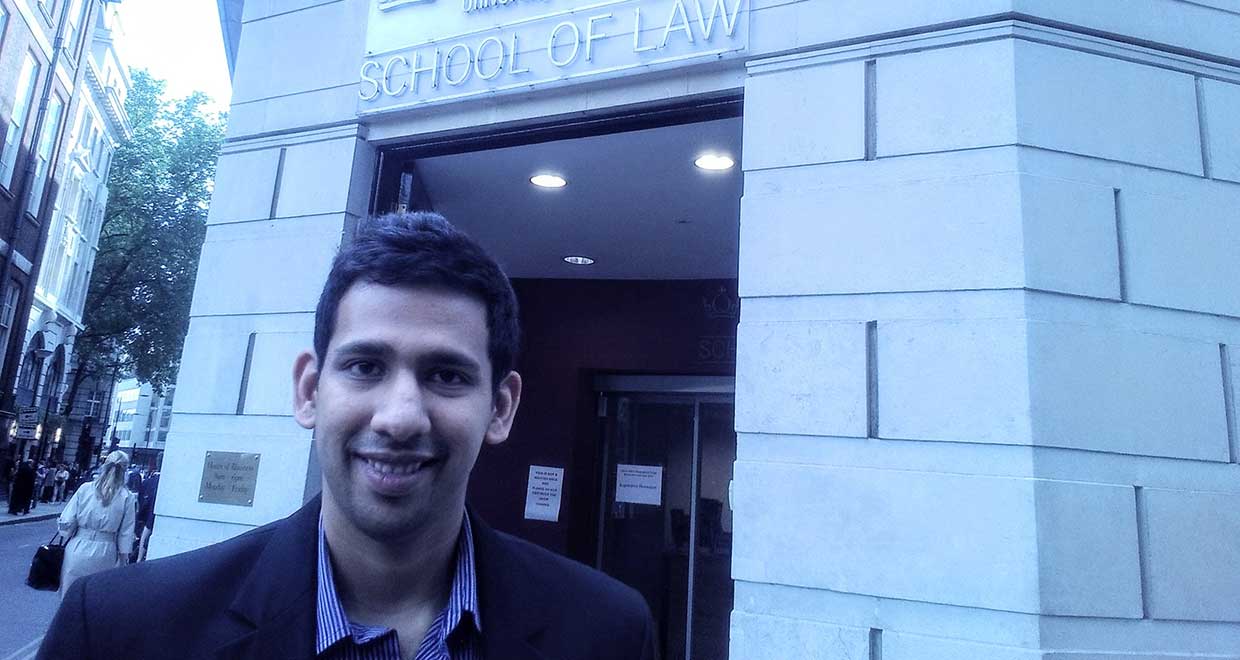
  • Arvind Gopal, Attorney, Digital Crimes Unit, Microsoft on studying from QMUL and his diverse international exposure

    Arvind Gopal, Attorney, Digital Crimes Unit, Microsoft on studying from QMUL and his diverse international exposure

    Arvind Gopal graduated from University Law College, Bangalore in the year 2007 after which he pursued LLM in IP from QMUL. He has a diverse international experience having worked in England as well as India. His achievements include negotiating with the Tanzanian Government, speaking in the Parliament of India, advising Google, starting his own firm and being recruited by Microsoft.

    In this interview we speak to him about:

    • His Master’s degree from QMUL, London
    • His international exposure and experience.
    • His role as Attorney, Digital Crimes Unit at Microsoft
    • Assisting in petitions concerning smoking ban in public, patent linkage, Section 377 IPC and HIV/AIDS Bill


    HOW WOULD YOU INTRODUCE YOURSELF TO OUR READERS?

    I am a lawyer with ten years of experience (have explored everything from Wildlife to Real Estate Laws) however, the legal profession continues to make me feel as if I began practicing yesterday as there is something completely new to learn every day or a new perspective to ponder over.

    I fell in love with the subject of ‘Law’ 15 years ago and continue to remain starry-eyed about it.. Otherwise, I am a misguided musician who wishes to question everything and put my own spin on an argument. The love and curiosity for the law has taken me from negotiating with the Tanzanian Government to speaking in the Parliament of India, to advising Google, starting my own firm and most recently, being recruited by Microsoft.  It has been an enriching experience and continues to be amazing.


    WHY DIDN’T YOU OPT FOR THE CONVENTIONAL DEGREES IN ENGINEERING OR MEDICINE?

    Till my 11th Grade in School, I wanted to be an Archaeologist; regimented forms of learning or conventional vocations did not appeal to me.  I preferred playing sports as well as harassing my classmates, educators and parents alike with my antics.  I also had a constant tune in my head that I was either humming or singing; I was also a voracious reader and read everything there was to read (an excellent habit that my parents inculcated and it has served me brilliantly). In essence I was an “outstanding student” as I saw more of the sky than the inside of a classroom.

    My parents wanted me to get on with ‘A Plan’ but I wanted a bike and ride away into the sunset. Well the bike was the turning point.  I was told by everyone that I would never make it out of school or into another educational institution. I was never one to believe that anything was impossible. My first task was to analyse whether Archaeology was a viable option. The answer was a ‘negative’ because very few institutions offered courses and it was not really a recognised profession with a clear cut path in India.

    I stumbled upon law when I picked up an entrance test preparation book. What intrigued me most was that I could take a proposition which had been codified, break it down and give my own spin to it. The main challenge was to convince a third person that my perspective was correct. The art of convincing a third person (a judge) that a third person’s perspective (one’s client’s perspective) and/or stance is correct is an art and creativity at its best. I continue to remain baffled by some of the genius arguments that lawyers come up with and this continues to fascinate and intrigue me.

    Getting into law school was eventful. I gave all the entrance exams possible and only got through National Law School, Bhopal and Amity Law School. I did not make the cut with respect to Bhopal as my rank did not feature within the top 100 and my rank after the Amity exam was 748.  The bike was slowly fading away and I was extremely nervous. Amity Law School was my only bet as I was selected for the group discussion round. There were forty people in my group, and the topic was ‘India and Pakistan’s Relationship’; the sparkle was back in my eyes. I waited for 39 people to finish and then spoke on the topic for the next 45 minutes as I systematically did a SWOT analysis of the subject. I was back in the game as my rank jumped up to 23 from 748, due to that ‘group discussion’ round. I was offered a seat without any Scholarship and I knew I could not afford the fees. Hence, I said no to Amity and went to JSS Law College in Mysore. The rest as they say is history. I left home for law school with the bike of my choice, a song on my lips, coupled with the curiosity and excitement of a child in a candy shop with a hundred pounds to spend.


    ARE THERE ANY MEMORABLE MOMENTS OF LAW SCHOOL WHICH YOU WOULD LIKE TO SHARE?

    I was in JSS Law College (JSS) for the first six months and then transferred to University Law College, Bangalore University (ULC). I managed distinctions in JSS Law College as my central focus remained on achieving decent grades. At JSS, I was vice captain of the cricket team; I also won a rock competition held by Mysore University. Further, I was also selected to represent the Mysore City Club as a member of their basketball team and participated in a tournament in Bangalore. Though I spent six months at JSS, I cherish the time as it set the course for my love story with the law and in the process also managed to make great friends who continue to offer support to this day.

    I had incredible fun at ULC. Initially, I faced adversity from classmates who could not relate to me but I not only managed to dispel the adverse attitude but made some great friends.

    The one thing I did differently than others was to do internships from the second year onwards. In my quest for practical training I was helped by Yang Yen Thaw, Anil Sachidanand, Anil Kumar who mentored me and are people I still turn to when I am in need of advice.

    During my time at ULC, I captained the cricket and basketball teams, lead the efforts in establishing the girls basketball team (I also coached them in the first year) and the college band for which I was the vocalist. The most satisfying moment for me was when this awesome girls’ team were declared runners-up in the first two tournaments which they participated in. I was also an active member of the Moot Organising Committee and took part in several moots that received commendations and further helped in the formation of the film society.

    Law school in all was a fantastic experience because it made me aware of my strengths, limitations and further aware of how gruelling our profession can be. Surprisingly, it made me more compassionate especially seeing how people were unaware and intimidated when it came to lawyers and the law. This negative outlook was something that I have desperately endeavoured to change by continuing to help as many people as possible.


    HOW WAS YOUR FIRST YEAR AFTER GRADUATION AND WHAT WERE THE CHALLENGES THAT YOU FACED AS A YOUNG ASSOCIATE?

    The first year was challenging as I had no clue as to what was happening around me but it was a massive learning experience. I felt there was a huge gap between the National Law Schools and students from other law schools. The National Law Schools were geared to prepare students for the gruelling experience ahead. But the one advantage I had was having done many internship which allowed me to have some experience of how the profession functioned. Additionally, people like Neel Mason, Anand Grover, Indira Jaising, to name a few lawyers, ensured that I was challenged every day to keep putting in a hundred percent and keep striving to acquire the right knowledge and skills.

    This drive and curiosity to learn, kept me afloat even in the most challenging times. I also got to brief Mr Sudhir Chandra, on my own, as my senior was unavailable and Mr Gopal Subramaniam, which in itself were enriching experiences. Further, a couple of hearings in which I was to get an adjournment and a pass-over turned into a situation wherein I had to argue issues in order to be granted my pleas. These experiences proved to be invaluable and were exhilarating to say the least. I was lucky because people reposed faith in me and situations also presented themselves which I grabbed with both hands.


    WHAT MADE YOU GO FOR FURTHER STUDIES?

    [After three years of work experience, Arvind went on to pursue his Master’s degree from Queen Mary, University of London (QMUL)]

    The day I decided to do law was also the day I decided I would do my Master’s Degree in England.

    In my mind the English system was the pinnacle and produced these eloquent individuals, remnants of which can still be seen when some of our polished seniors argue matters. Additionally, anyone who has heard the proper English accent would note that even total rubbish sounds exceptional, and there was also James Bond. I later came to realise that my favourite Bond, Sir Sean Connery, was actually Scottish! In reality the Scots are far more loveable than the English. Disclaimer to my English friends: You know I am kidding!

    On a more serious note, I knew that if I had to master IP then I would have to do a Master’s Degree from a renowned institution and in an evolved system. England and QMUL were perfect in those respects.


    SHARE SOME ADVICE ON ACING THE APPLICATION REQUIREMENTS AND PROCEDURE FOR QMUL?

    It took me three years of arguing with my parents and other well-wishers who all thought leaving a job and going to study was a bad idea. Also, the perception at the time was that in a profession like law, practical experience is what mattered.

    QMUL was an easy choice because by the end of three years, I had already fallen head over heels for Intellectual Property Law and QMUL being the best in England for IP was an easy choice. I did not take up offers from Cardiff, Kings, UCL, Leeds and the University of Edinburgh because QMUL offered me the opportunity of being taught by, argue with and learn from Professors J.A.L Sterling, David Llewyn, Ian Walden, Chris Reed, Noam Shemtov, who happen to be legends in the profession!

    The admission process was fun. The challenges were varied but eventually, being bull headed and with the help of a senior from law school, I managed to get an interview with the head of admissions of QMUL who was visiting Delhi. The funny part was that I called her right after writing to her, explained that I was in Court during the day and therefore would only be able to meet her in the evenings, in case she was able to make time. After some intense negotiations I managed to get a meeting with her for the very next evening where she agreed to make time for me. At the end of that meeting and after she had reviewed my CV, I walked out with an assurance that a seat was reserved for me and all I had to do was apply on time.

    The next step was convincing my parents, tough gig, as it was an expensive proposition. My parents finally relented and were kind enough to fund my LL.M. They have always stood by me and this time too, was no exception. They continue to be my pillars. In the midst of this task of convincing my parents and getting funds organised I had missed the window to be eligible for scholarships. But eventually with sustained efforts made the cut and got to England despite various challenges. One has to apply months in advance to be considered for scholarships and the ingredients for increasing one’s chances are a great CV, great recommendations and a worthy statement of purpose.

    Most importantly with the help of some stalwarts in the profession, professors in law school, parents and friends, I managed to get a great set of recommendations, a worthy statement of purpose and some solid practical experience which helped QMUL overlook the abysmal grades that I had obtained in high school.


     TELL US ABOUT YOUR INTERNATIONAL EXPOSURE AND EXPERIENCE.

    It was really tough to get jobs soon after the downturn in 2008. I spent a little over a year doing odd jobs in England such as from working at small chip shops to volunteering at the local Buddhist Centre. One such job, whilst I was volunteering at the centre, lead to a job as a receptionist at the Kingston Probation Centre. This was a significant turnaround for me because till then I had applied for close to 3,500 jobs and had given three interviews at large law firms, and was shortlisted for all three positions, but failed to make the cut because I had no UK experience.

    I gave my all at the job in the Kingston Probation Centre and this was recognised by the Director and the Lead Counsel for the Centre. He took pains in giving me advice and even took me to the Crown Court to get acquainted with the system. Eventually, through a lot of perseverance, daimoku coupled with the support of my family and friends, I managed to land a job as a Litigation Consultant for one of the biggest personal injury law firms in the West Midlands. Six months into the job I was heading one of their litigation teams and it was a fantastic experience. This was great exposure as I was drafting, negotiating, strategizing and briefing senior barristers; in the process picked up knowledge on a completely new area of the Law despite having no idea about the way it worked when I interviewed at the firm.


    HOW DID YOU THEREAFTER DECIDE TO QUIT WORK THERE AND COME BACK TO INDIA?

    The fact that England was making it mighty difficult to obtain extensions to the work permit made me re-think my plans. I was not willing to live in uncertainty of whether I would get an extension or not. On hindsight, that was a good decision as I would never have realised some long standing dreams such as starting my own practice or working on matters for brands such as Novak Djokovic, Google, BCCL, BCCI, Tupperware, Louis Vuitton, Christian Dior, to name a few, and lastly, I would have never realised my dream of being at Microsoft!

    More importantly, I would have lost out on the opportunities of working with and learning from stalwarts such as Hemant Singh, Mamta Jha, Bharat Dube, Sujatha Chaudhri and now the CELA team (Corporate, External and Legal Affairs) at Microsoft India from whom I have learnt and continue to learn immensely.

    My current team is unique because it works as one cohesive unit and we are lead by some exceptional leaders. Additionally, being the youngest lawyer in the group has its advantages. I would not trade this opportunity for all the chocolate in the world (another weakness of mine).


    WHAT DOES AN ATTORNEY, DIGITAL CRIMES UNIT AT MICROSOFT DO?

    Our team is generally consulted on matters pertaining to cyber security/space, intellectual property and information technology amongst other issues. Also, with the advent of Global Data Protection Rights (GDPR) and Artificial Intelligence (AI) things are getting more interesting.

    I divide my work into four equal portions that consists of litigation, enforcement, formulating legal strategy, and advising the different arms of the business on various issues including advising on policy related issues. Additionally, I conduct trainings for the legal community and law enforcement personnel.



    HOW WOULD YOU SAY THAT AN INTERN CAN GENERATE A POSITIVE FEEDBACK IN THE LIMITED TIME THEY HAVE?

    (Arvind has guided several interns.)

    Enthusiasm, willingness to learn, the art of listening, being driven, positivity, ability to work hard under trying circumstances and more importantly free-wheeling thought process coupled with honesty are qualities that are essential. One needs to bring their ‘A’ Game each time they step onto the park. These are evident in most of the interns, some more than others. I have enjoyed working with them all because I have also ended up learning a lot from them.  I am hoping it was equally fun for them because I have impediments such as a bad temper and am a hard task master!


    BEING A PART OF THE CORE TEAMS ASSISTING IN THE PETITIONS CONCERNING BANNING OF SMOKING IN PUBLIC, PATENT LINKAGE, SECTION 377 IPC AND THE HIV/AIDS BILL, SOUNDS EXCITING! GIVE US AN INSIGHT.

    Extremely important and career charting for me.

    Health is a fundamental right and ought to be enjoyed by everyone; smoking banned in ‘public spaces’ is great and much needed! Very progressive! I really enjoyed learning from a stalwart, Ms Indira Jaising, a true legend! Notable qualities were the meticulous preparation, the well-reasoned arguments, how to structure arguments and the art of maintaining clarity of thought.

    The Patent Linkage matter was one where I wasn’t deeply involved in as the case was being argued when I joined Lawyers Collective. But while assisting Mr Grover, I ended up learning a lot about the patent regime, particularly, concepts such as ‘spurious drug’ and its ambit, marketing rights, and the manner in which these concepts are applied in different jurisdictions.

    The most exhilarating experience so far was being a part of the petition concerning Section 377 of the IPC, a matter that we won in the Delhi High Court. It was also one of the best judgements that I have read in a long time. Recently, the Supreme Court commented on the issue as a part of the Privacy Judgement, another brilliant judgement. This is much required in trying times that we live in, as denying people their fundamental rights is just plain unfair!

    Re-drafting, negotiating and presenting portions of the HIV/AIDS Bill to various policy makers in the Ministry and to the Parliament was possibly one of the highlights of my career, due to the commendations I received from policy makers and the health ministry, a real confidence booster.. Mr Anand Grover gave me the opportunity.  My leader and friend, Mr Raman Chawla, helped me realise it and be effective in the process.


    ENLIGHTEN US ABOUT SANGUINE – ATTORNEYS AT LAW.

    It was a dream come true, my second foray into independent practice. It was tough as nails, as matters were tough to come by, but I did some good work. A truly satisfying experience because some of my clients still call me to thank me for pulling them out of a tough spot. This is exactly what one lives for, as no amount of money can match up to the feeling of contributing to the happiness of others.


    TELL US ABOUT SOME OF THE INTERESTING BRANDS THAT YOU HAVE HANDLED.

    (He has handled brands such as LVMH, Christian Dior, Christian Louboutin, Ferragamo, Liu.Jo, Alexander Wang, DVF, Speck and Novak Djokovich, etc.)

    Until the time I began working with Mr Bharat Dube, I really had no idea as to how big these brands were; I had not even heard of some of these giants. I had no clue that bags, shoes, clothes, accessories etc., could cost an arm and a leg, albeit, sometimes, they also tend to have legs but continue to burn a hole in your savings!

    The best part was that having been an avid fan of Djoker, I nearly fell off my chair in disbelief on getting an email from his team, asking us to protect his IP.  That was a really cool moment.

    Overall, this was a unique experience as I got to explore counterfeiting from an online perspective and how to tackle it. Some fantastic learning which I tend to use till date. One of which, ‘internet jurisdiction’, a concept that the world is still grappling with. In the process I was also exposed to drafting matters with respect to domains under the UDRP process and matters to be filed in the Circuit Court, New York.

    Very long hours, tight deadlines but overall, great fun!


    WHAT WOULD BE YOUR PARTING MESSAGE TO OUR READERS?

    If any of you are planning to do law then just close your eyes and go for it. It is a profession that will never die and will continue to evolve (especially IP) and will forever remain challenging both mentally and physically. But the beauty of achieving the best and most satisfactory result is when it is done through honest and straight forward means. Plus one needs to be resilient and determined. So, crack on with it folks, chop, chop!!

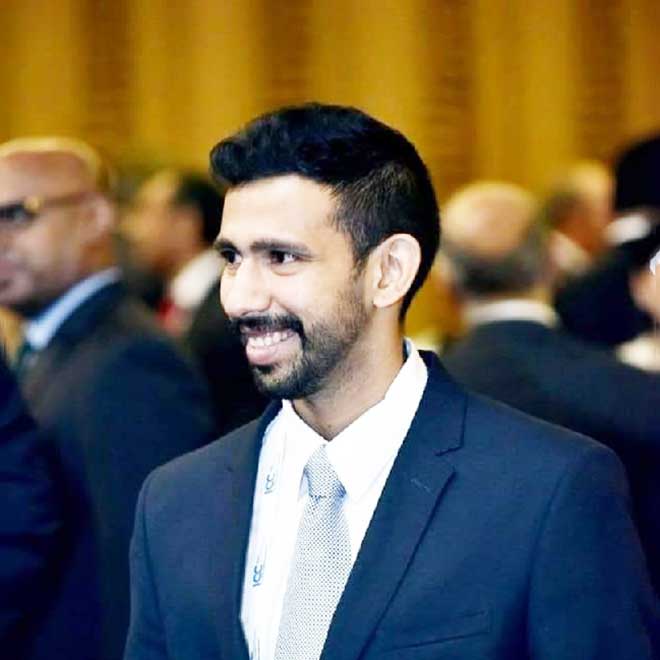
     

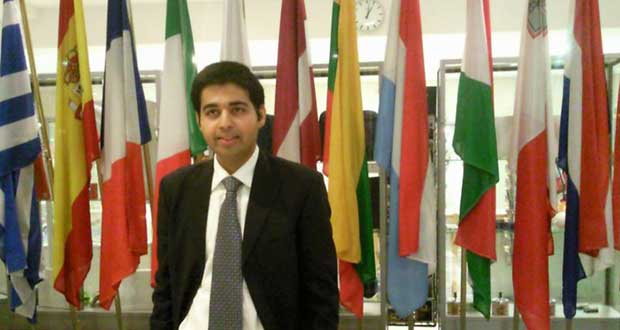
  • Deepak Narayanan, LL.M. from Queen Mary University, member at Chartered Institute of Arbitrators, UK and on his journey as a legal practitioner

    Deepak Narayanan, LL.M. from Queen Mary University, member at Chartered Institute of Arbitrators, UK and on his journey as a legal practitioner

    Deepak Narayanan graduated in Law from Ambedkar Law College (well known in the past century as Madras Law College) in 2012. Throughout his college life he was an avid participant of extra co-curricular as he firmly believes that it plays a great role in shaping you as a professional. He went to on to pursue his LL.M. in Commercial and Corporate Law from Queen Mary University of London. Deepak regularly appears at the High Court of Madras, District Courts and several Tribunals in Chennai and his practice areas primarily include commercial, corporate, banking/finance and property Law.

    He also specialises in arbitration and represents clients as Counsel before arbitral tribunals and arbitration related court matters and holds the membership to the Chartered Institute of Arbitrators, UK

    In this interview, he talks to us about:

    • The culture at a Law college vs. non-Law college.
    • His experience of interning at various international arbitration centres.
    • The challenges faced by a legal practitioner.
    • How can students overcome the handicap of practical knowledge?


    How would you like to introduce yourself to our readers?

    I am a qualified lawyer from India and have experience in wide range of work with a particular focus on litigation and arbitration. I have a general service independent practice with a few lawyers in my team and I cater many major clients including individuals, firms and companies across India. I graduated from Ambedkar Law College, Chennai and hold an LL.M. from Queen Mary University of London.


    Tell us a bit about your practice areas and the challenges a legal practitioner faces?

    I regularly appear at the High Court of Madras, District Courts and several Tribunals in Chennai and my practice areas primarily include commercial, corporate, banking/finance and property law. I also specialise in arbitration and represent clients as Counsel before arbitral tribunals and arbitration related court matters. I am in the Panel of Advocates for Bank of India and appear for the Bank at Debt Recovery Tribunals on a regular basis.

    My non-contentious work involves drafting and vetting of commercial contracts for individuals and companies, catering builders and promoters in their real estate work, negotiations and providing legal opinions.

    Every legal practitioner faces unique and different challenges. The practice and procedure being widely diverse in different courts and tribunals, the main challenge is to quickly learn the intricacies to provide an effective solution to your client. Also allocating sufficient time in an already busy schedule to constantly update with new laws and judgements is another main challenge that I am sure any law practitioner faces.


    How did your interest gravitate towards Law?

    (Deepak completed his B.A. in Economics from Loyola College, Chennai before pursuing Law and is a State Level Badminton champion.)

    To be honest, I was predisposed to pursue Law since childhood and was inclined to have a go at a few premier National Law Schools in India by taking up the entrance exams. But being a State Level Badminton player, I was offered an admission at Loyola College through sports quota, a premiere institution in both academics and sports. I accordingly decided to finish my undergraduate degree in Economics first.

    I hail from a family of lawyers including my father and a desire to pursue Law never wavered during my three years at Loyola. An aspect of Law that has always been of interest to me is that, Law influences almost every facet of our life, and is constantly evolving to keep up with the dynamic changes to which we constantly try to adapt. In particular, I am always drawn towards Dispute Resolution mainly because it consists of constructive legal argument and an analogy of legal reasoning more often than in many other careers. I strongly believe in following one’s passion and a career in Law has always been my calling.


    What was life at Law college? How different was it from a non-Law college?

    Life at Law school was tangentially different from my under graduation in Economics. While my Bachelors in Economics equipped me with the foundation and basics in Economics (which I think is a great specialisation to have as a commercial lawyer), Law college gave me a real insight into the Law profession. It is extremely crucial to keep yourself academically inclined and garner as many experiences as possible out of your institution, which I was able to achieve through participating in moot courts coupled with the immense support of my faculty members.


    Did you partake in any extracurricular activities and how important were they in shaping you as a student?

    I was an avid moot court participant and was fortunate to have an excellent team, which I think is fundamental to perform in moots. In my second year, I won the Amity National Law School Moot Court Competition in Delhi on Public International Law. I received a special accolade from the former Hon’ble Chief Justice of Madras High Court, as it was a win for my college after many years. I also captained the badminton team and victorious at sports fests held at NLSIU, Bangalore and NLIU Bhopal.

    I am a strong believer that co-curricular are fundamental in shaping any student. While actual litigation is quite different from moot courts, the experiences I gained from moots have greatly benefited me in my practice.


    How was your experience participating in the Willem C. Vis International Commercial Arbitration Moot Court Competition in Vienna?

    (Deepak represented his college twice in the Vis Moot Court Competition.)

    Vis Moot ran through almost my entire academic year and it made me feel like it was part of my academic curriculum. Long work hours and sleepless nights are part of your routine preparation schedule. With arduous oral rounds on the one hand and networking with international students on the other, the entire week at Vienna was enriching and irreplaceable.

    I am also thankful to the Tamil Nadu government to have funded all our expenses on both the occasions that I participated at Vis Moot.


    What made you go for higher studies and what procedure did you follow for selecting your college?

    (Deepak completed his masters in Commercial and Corporate Law from Queen Mary, University of London.)

    I pursued my higher studies mainly to specialise in some of the finer areas of Law in which I had more of an inclination than the others. Since, I was greatly interested in arbitration; I applied to universities in the UK after thoroughly researching the facilities and opportunities that the universities provided. I was accepted by these universities and was even offered scholarship at the Southampton University, UK which is famous for Maritime Arbitration Law. In the end, I chose Queen Mary as it had the world renowned School of International Arbitration and luminaries in the field as professors such as Professor Loukas Mistelis and Professor Julian Lew.

    The year at Queen Mary was not ‘rigid in the Indian sense. While there were fewer modules when compared to an LL.M. in India and the classes were spaced out, and the amount of self-learning that had to be done on a day to day basis made the course intense and interesting.


    How was the exposure of interning at a lot of international arbitration centres?

    Internship experiences that readily come to my mind are Clyde & Co LLP (London) and at Singapore International Arbitration Centre (Singapore).

    After several rounds of rigorous interviews, I got selected to work in the international arbitration team of Clyde & Co, London office. Being one of the leading global law firms, I had a chance to work in some of their high stake matters including a dispute raised by Microsoft regarding breach of exclusivity clause and also a Middle East investment arbitration dispute. I got a practical insight into live the life of a solicitor at the firm and it was a treasurable experience.

    SIAC on the other hand was a completely different experience. I had an opportunity to witness what happens in an institutional arbitration from other side of the table, i.e., an institution. My work mainly resembled that of a Case Counsel of the Centre and I involved extensive research on international arbitration. I was also briefly involved in making recommendations to the SIAC Rules which were being amended at that point of time


    You are a member of the Chartered Institute of Arbitrators, UK. Please give us an insight into this.

    Chartered Institute of Arbitrators is a world renowned organisation which recognises expertise in ADR. Having specialised in commercial arbitration at Queen Mary and through the practical experience that I already possess in the field of arbitration, I was directly inducted at the Member grade (MCIArb) instead of the usual route of passing the necessary modules. As a practitioner, the qualification immensely helps me to showcase my expertise to my clients.


    Are you finding a change in your balance between work and life after starting practice at Madras High Court?

    Life as a practitioner always implies more of work and less of personal life and I diligently followed this tradition during my early years of practice. But after commencing my own practice, I have managed to cope up with the work load albeit the work pressure. I still put in long hours but producing immaculate work has become the key rather than putting mundane face time at office for hours together without getting much work done. This enables me to squeeze in a few games of badminton, marathons and triathlons, which help me maintain a balance.


    A lot of practice deals with procedural aspects of Law – something that is not emphasized on in Law schools. How can a student overcome this handicap?

    Yes this is completely true and moreover procedural aspects of Law does not just mean learning CPC and CrPC but also having an astute knowledge of working your way through ever so complicated registry and sections of Courts and Tribunals.

    Students can definitely overcome the difficulty by going an extra mile in their internships to learn the various procedural aspects. Instead of just doing research and taking down dictations, students can play more of an active role by shadowing office clerk in section and registry.


     As a concluding message, what would be your word of advice to our readers?

    It is essential to pursue a career/field that you like. Whatever is your chosen line, be it litigation or non-contentious work, do you see yourself doing your job day in and day out? If yes, you are in the right field and if no, you need to explore more interesting things.

    Also working extraordinary long hours is the new fashion in almost any career in Law. So make sure you do not burn out and try to have a healthy work-life balance

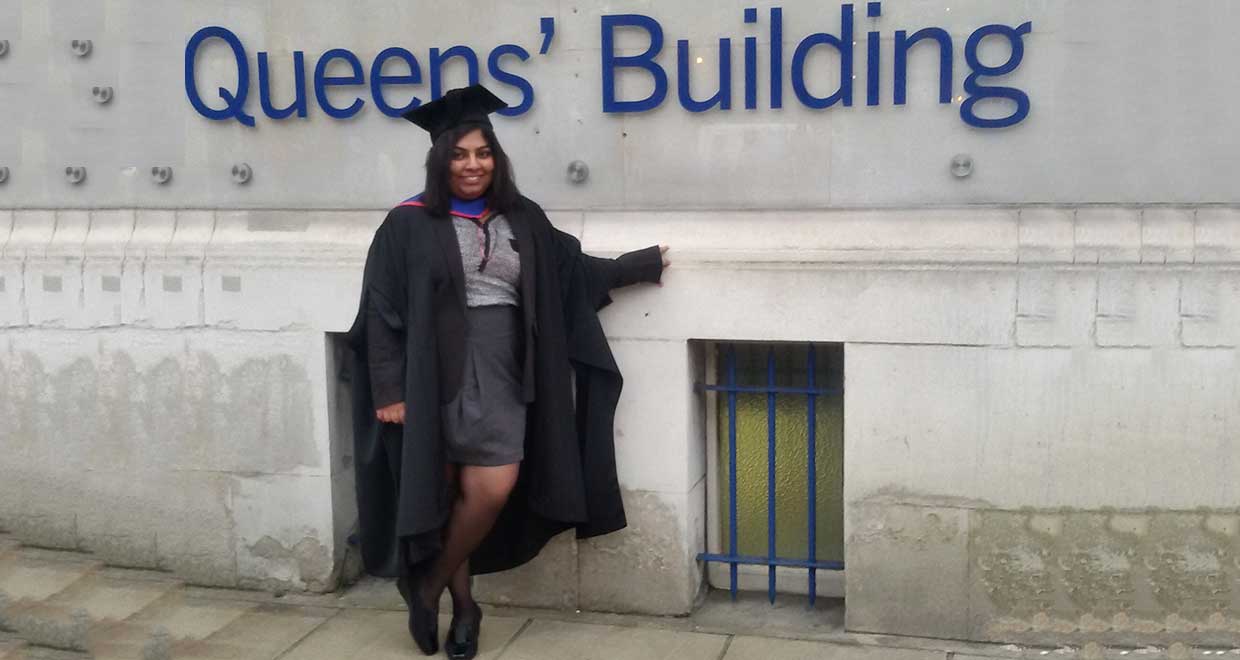
  • Ojasvita Srivastava, Senior Manager – Legal, Reliance Communications, on LL.M from QMUL, writing journals, and Project Abhimanyu

    Ojasvita Srivastava, Senior Manager – Legal, Reliance Communications, on LL.M from QMUL, writing journals, and Project Abhimanyu

    Ojasvita Srivastava graduated from V. M. Salgaocar College of Law, Goa University (2005-2010). She is a qualified lawyer and an experienced in-house counsel with experience in litigation, arbitration and corporate compliance. She is presently a Senior Manager in the Legal department at Reliance Communications where she deals with Telecom Litigation.

    She pursued an LL.M in Commercial and Corporate Law at the Centre for Commercial Law Studies, Queen Mary University of London, where she served as the Communication and Media Coordinator of her specialisation- Commercial and Corporate Law.

    Ojasvita was also the Co-Founder and Chief Editor of the ‘The Sophists’, Queen Mary Law and Business Journal, which publishes articles on Law, Business and Politics. She contributes articles on Indian economy and legal developments to this journal. She also edits and contributes articles to the monthly Postgraduate Newsletter of the Centre for Commercial Law Studies, London.

    In this interview she talks to us about:

    • Challenges associated with being an in-house counsel.
    • Project Abhimanyu – providing free guidance to law students who do not come from a law background.
    • Services provided under the project “Abhimanyu”.
    • Skills and qualities that helped her achieving the current position.


    How would you like to introduce yourself to our readers?

    I work as a Senior Manager in the Legal and Regulatory Department at Reliance Communications in New Delhi. I handle cases related to telecom, broadcasting and infrastructure disputes before the Supreme Court, various High Courts, the Telecom Tribunal (TDSAT) and various arbitrators, while occasionally getting involved in M&A work and contract vetting. I have a keen interest in litigation and have previously practiced before the Supreme Court, the Delhi High Court, and various District courts in Delhi.


    What made you choose the legal profession as your career option?

    Pursuing law as a career was a last minute decision. I was a student of the Science stream till class XII. Like the rest of my class, I too wrote the AIEEE and did well. I had a state ranking of 37 in Engineering and 7 in Architecture. However, I disliked Chemistry and didn’t want to read a word of it ever again in my life. As I was trying to figure out what to do with my career, I met my mentor, Adv. Vilas P. Thali. He is the former Additional Advocate General of Goa and is a specialist in election laws. After meeting him I was inspired to pursue law. I wrote the entrance exam for V. M. Salgaocar College of Law on 14th June, 2005 and joined his office as an intern on 15th June, 2005. I interned there for more than 3 years spending close to 6 hours a day in his office and visiting courts, meeting clients as well as attending sessions of briefing senior counsels (even though I was just a 12th pass student). I topped the entrance exam at my college and continued to perform well. As a result, I was awarded the merit scholarship throughout my LLB course and paid nothing in tuition fee! Although the joy of saving money was more than offset; thanks to my LLM at Queen Mary, University at London.

    As I am a first generation lawyer, my family was not in favour of me pursuing law as a career. However, I convinced them otherwise and became the only girl in my entire batch at school to join law.


    What were your objectives and plans in the preliminary years of law school?

    Right from the first year, I had a deep interest in litigation and I had a clear mind that I wanted to make a career in this field. Therefore, in my initial years at law school, I aimed at participating in as many moot courts as possible and gave every moot court my best. I won the best lady advocate at a national level moot court competition and the best memorial award at an international moot court, while doing fairly well in all moot courts that I participated in. My mooting experience not only helped me hone my research and oratory skills but more importantly helped me develop a keen attention to detail, which is absolutely essential to win any case.

    Besides this, I interned throughout the first three years of the course; part time when the college was in session and full time during vacations. As my college timings were from noon to half past five in the evening, I could easily dedicate three hours in the morning and in the evening. During the morning sessions, I usually attended proceedings at the Panaji bench of the Bombay High Court or the District Court, where I gained practical experience in court skills and procedure. Evenings were usually dedicated to practising legal research, drafting and attending client meetings. Often students learn these essential skills only after passing out of law school. So I am very grateful to my mentor for hand holding me and making sure that I learnt these skills while still at college.


    What are the challenges associated with being an in-house counsel? How do you handle them?

    There are in-house counsels specialising in various areas of legal practice. I will only talk about the challenges faced by in-house counsels working in the dispute resolution field.

    As an in-house counsel specialising in dispute resolution, the volume of work is more though the in-depth involvement in legal research is limited. Also, one is involved right from the pre-litigation stage of litigation-avoidance correspondence till the execution of the decree, including serving notices, drafting, vetting and settling petitions, briefing senior counsels, attending arguments and then following up for the execution of decrees. During this process, one also needs to keep the management of the company informed about the on-going proceedings almost like the eyes and ears of the management in the court (AKA Sanjay from the Mahabharata).

    The challenge revolves around balancing the volume of work. As an in-house counsel, I have been assigned more than 65 cases. My colleagues, who are senior to me, handle even more cases than me. Thus the responsibility is to keep a tab of all your cases in all the courts across the country and to make sure that the interests of the company are effectively secured. Further, as an in-house counsel, one also needs to understand the technicalities of a case well enough to be able to explain them as her own case. Thus I, for example, have to understand complex science revolving around telecom engineering to be able to explain it to the external counsels on behalf of the company.


    Tell us something about “Project Abhimanyu”.

    ‘Project Abhimanyu’ is a pro bono and voluntary initiative that I recently started. It aims at increasing access to career opportunities in the legal industry by providing free guidance and career counselling to law students who do not come from a law background.

    It endeavours to increase awareness about career options available in the legal profession to students. It works assiduously with students from colleges that do not have a fully functional placement cell and also assists and contributes to the existing services available at academic and professional institutions that are working towards guiding students. It does so by sharing knowledge and seeking guidance from highly trained and experienced professionals in the legal industry who are willing to voluntarily mentor students in their free time. In the long run, Project Abhimanyu will work towards enriching the talent pool available to the legal profession.


    Why have you named it Project ‘Abhimanyu’?

    Abhimanyu was Arjun’s son from the Mahabharata. On the 13th day of the Mahabharata war, he successfully intercepted the Chakravyuh formation created by the Kaurava army, and saved the Pandavas from imminent defeat. What is particularly interesting about this episode though is that Abhimanyu obtained this knowledge of penetrating a Charavyuh formation as a foetus in his mother’s womb. Thus Abhimanyu was born with the knowledge of how to penetrate a Chakravyuh.

    The legal industry is like a Chakravyuh, complex and vast. It would be Project Abhimanyu’s endeavour that, just like Abhimanyu, law students graduating from various colleges must learn to successfully navigate the legal industry. They should be able to make informed career decisions and achieve success proportionate to their calibre and hard work; and they should never get left behind because of a lack of guidance.


    Why inspired you to start this initiative?

    To answer this question, I would first like to give a little context. I graduated in law from V. M. Salgaocar College of Law, Goa in 2010 and later acquired an LLM in Commercial and Corporate Law from Queen Mary, University of London in 2014. In the intermittent period, I worked at a multinational French Pharma company in Mumbai and later practised at the Supreme Court, Delhi High Court and District courts in Delhi, while simultaneously writing the civil services examination. In 2013, I appeared for the interview round of the civil services examination; however, I missed by a narrow margin and thereafter decided to continue my career in law.

    All along this journey, I had little guidance in terms of how to go about making my career in law. As a result, my career grew more in a trial and error fashion. Thankfully, I have reached a comfortable place now, and therefore I want to help other students who are in a similar position.

    Law is a difficult profession not only because it is a complex industry but also because it requires one to really slog to climb up. That said, it becomes all the more difficult when you are a first generation lawyer. The idea behind Project Abhimanyu is to guide first generation law students so that they get a better shot at making a smooth transition from being a law student to becoming a lawyer. Over the past few years, I have been guiding students studying in various colleges in Delhi, Noida, Lucknow, Pune, Bhubaneswar, Cuttack, Patna, Mumbai and Goa. But there are still a lot of students who need guidance and this is what got me motivated to start this platform to reach out to more students across the country.


    How difficult was it for you to connect and convince different lawyers to register on this project?

    It wasn’t difficult at all. Everyone I approached has been very receptive and appreciative of Project Abhimanyu. We have the GCs of MNCs, law firm partners and highly successful litigators on board as Mentors at Project Abhimanyu. In fact, most Mentors at Project Abhimanyu had already been guiding and mentoring students. Project Abhimanyu is only providing them a platform to reach out to more students from across the country. I am very grateful to everyone who has joined this initiative and is sparing time from their busy schedules to help the future generation of lawyers.


    What kind of services do you provide under this project?

    Students can write in to ask any query related to the legal career. These could be about improving their CV, internship applications, job applications, career guidance, civil services examination, higher education abroad, CA/CS courses, working in-house or any other information related to law. They simply need to drop an email to project.abhimanyu@gmail.com and they would be assigned to a mentor who would answer their queries.


    Where do you see this project five years from now?

    In five years, I want Project Abhimanyu to be a self–sustained, fully automated system. We are working towards building a network of lawyers specialising in different areas of law who are voluntarily willing to guide students. Eventually I want Project Abhimanyu to develop into a platform where any law student from any corner of the country could just go to our website, choose a Mentor in a particular field of law from an entire range of specialists and write a message that would directly be received by the Mentor and answered by her/ him. We are also working towards compiling and publishing the advice given by the Mentors for the benefit of other students. I want the advice to be free and fair and therefore, Project Abhimanyu shall always remain a pro bono, voluntary and a not-for-profit organisation.


    What skills and qualities do you think have helped you achieve your current position?

    I think hard work, attention to detail and a passion for reading are essential qualities for anyone aspiring to make a career in litigation. Besides that, the training I received from my mentor and the guidance of my teachers has helped me tremendously. I will be failing in my duty if I forget to mention the complete liberty and unflinching support given to me by mother in shaping my career.


    What would be your advice to our readers?

    An ex-President at Reliance, whom I respect like a father, once passed a remark that struck the very core of my conscience. He told me that ‘your profession (the legal profession) is rather feudal’. What he was inferring was that it is easier for people from a law background to excel in this industry.

    Project Abhimanyu is trying to break free from this notion about the legal industry in India. I would advise every student reading this article to take full benefit of Project Abhimanyu. It is an opportunity for everyone to get a fair shot at law and to make informed career decisions. I would also request every legal professional reading this article to join Project Abhimanyu and help the future generation of lawyers in our country become more productive and efficient.


  • Bijetri Roy, Associate, Banking and Finance, Orbit Law Services, on LL.M from Queen Mary and studying law at Calcutta University

    Bijetri Roy, Associate, Banking and Finance, Orbit Law Services, on LL.M from Queen Mary and studying law at Calcutta University

    Bijetri Roy graduated from Department of Law, Calcutta University with B.A. LL.B (Hons.) in 2013. During her law school days, she wrote more than eight research papers. After graduation, she pursued an LL.M from Queen Mary, University of London, where she was also a member of the Editorial Board of the Queen Mary Law Journal. She currently specializes in banking and finance laws among others at Orbit Law Services, Mumbai. In this interview he talks about:

    • Studying at Department of Law, Calcutta University with B.A. LL.B (Hons.).
    • Application, SOP and Recommendation Letter for Queen Mary, University of London.
    • Recruitment and work at Orbit Law Services, Mumbai.


    Given that most of our readers are law students and young lawyers, how will you introduce yourself to them? What motivated you to choose law as a career?

    I am Bijetri Roy, a Bengali by birth, brought up in the royal Awadh city of Nawabs, Lucknow. My father has a transferable job and I have had the opportunity of staying at many beautiful places (most of them being famous for their food and culture!). London became my home away from home in just a year. I currently live with my parents in Mumbai and I am working as a Banking and Finance Lawyer at Orbit Law Services.

    I am the first lawyer in my family, belonging to a household of a banker and economist father and an English teacher mother. I started reading Perry Mason at the age of 12 and the sleuth-attorney influenced my young mind to take up law. Law became my first choice and my parents encouraged me to take it up seriously. I completed my ISC in 2008 and took the Calcutta University entrance examination in May 2008, secured a good rank and enrolled at the Department of Law.


    Tell us about your law school experience at Calcutta University. Share some highlights from your college days that shaped you as a lawyer.

    Though a lot of people warned me against studying law at a traditional university instead of an “elite NLU”, I decided to take my call on the matter, and it was the best decision of my life to enrol at a simple law school. I agree we didn’t have the “right” infrastructure, no placement cell and too many people cramped in each batch (we were 200 people in the 2008-13 batch), but despite these issues, the five years at the law school gave me the some of the best days of my life. Classes were irregular at times, but interesting and regular lectures by Prof. S.S. Chatterji (IPC, Contracts) and Dr. J.K. Das (Constitutional Law, Human Rights Law) made me forget the drawbacks of the college. The high point of my law school days was getting selected for Honours after 2nd year (my average of 3rd to 5th year shot up to a good first class). The selection was purely on merit basis and there were only 50 seats for honours in a batch of 200. Getting to study a wide variety of subjects ranging from Law and Child, Criminology and Gender Justice to Law and Public Servants and Legislative Drafting was an enriching experience for me.


    What do you feel about the perception that students of certain ‘elite’ NLU’s have a much easier time in kick-starting their career as compared to law students from other colleges? Is this true at all?

    I would not like to comment much on this because it is quite a subjective perception. Though a certain “class” of students easily get internships and jobs at the top firms and organisations (as per hearsay – I don’t know many people from the NLUs so I am not sure about it), it is ultimately merit, basic foundation and most importantly, interest in that area of practice that matters. But yes, if one goes by the current market trends, top tier firms and big companies prefer to hire the “elite” ones! But then again, trends are never constant, right?


    Are you still involved in research and writing papers? Which are the latest ones you have submitted and where?

    Till now, the count is over 12. Last month I submitted a research paper titled “Financial Inclusion in India: Policy Framework for Inclusive Growth” for a forthcoming conference at IIM-Bangalore. This month I submitted an abstract for my research paper titled “Corporate Governance and Investor Protection – Importance of Legal Audit” for the India Finance Conference to be held at IIM-Calcutta.

    I have presented more than 8 papers during my BA-LLB days including at conferences at the top NLUs like NLIU Bhopal and NALSAR Hyderabad. Recently, I presented 2 papers, one at ILS Pune at the National Conference on Revisiting Freedom of Religion and Personal Laws from Liberty and Equality Perspectives and the other one at the International Conference of Jurists and Writers which was held in Mumbai.


    bijetri-roy-1

    What was your motivation behind pursuing LL.M. right after your under-grad? How did you finally decide that you need to do masters?

    During my 3rd year, I decided I wanted to do my masters in law immediately after my undergrad. I took this decision because I did not want to have any gap in my academics and once you take up a job, it is very tough to take a break and pursue higher studies.


    How did you choose Queen Mary, University of London over others? How did you go about choosing a university?

    I applied to Queen Mary, University of London based on its rank in UK for law (when I went there in 2013, it was among the top 10, currently it is ranked number 3 in UK right after Cambridge and Oxford, and number 1 in London – The Guardian 2014-15, 2015-16 rankings for law). I had decided from day 1 that if I study in UK, it has to be in London University. By the time my 4th year results were out, I had offers from Queen Mary, Westminster University, Birkbeck School of Law under London University and Brunel University (these were the only places I had applied to – I was lucky enough to bag offers, including an unconditional offer from Westminster University even before getting my final BA-LLB result!). I had my dream come true moment when I got an unconditional offer from the place of my choice – Queen Mary.


    How did you go about writing your SOP? Are there any key factors which one should keep in mind before writing the SOP?

    SOP (Statement of Purpose) is nothing but an essay about yourself. I used the first paragraph to talk about myself in general, then moved on to my academic achievements and extra-curricular activities. Next I laid emphasis on why I wished to study LLM, why UK, why London and why Queen Mary. I used the last paragraph to talk about my career goals (try to be as honest as possible; do not inflate your goals while writing the SOP).


    Please tell us about your recommendation letters.

    While most colleges ask for 2 recommendation letters, Queen Mary is flexible with it. I was able to manage only 1 letter during my application process and that did not hinder my offer from Queen Mary in any way. A professor wrote my recommendation letter.


    Tell us about your LL.M year at Queen Mary, London. How did this influence your career?

    My experience at QMUL was the best I could have ever dreamt of. Professors are very approachable because they do not follow the age old notion of differentiating teacher from students.  During my study, I had the opportunity of regular interaction with world class professors like Dr. Rafael Leal Arcas,  Dr. Alexandros Ntovas, Dr. Gomula (a visiting professor from Cambridge), Prof.Spyros,  Prof. Anne Flanagan to name a few.

    My specialisation was public international law. Queen Mary offers a wide range of modules to choose from. I took up modules which mainly belonged to other specialisations. I studied International Economic Law, International Law of the Sea and Climate Change Law and Policy. Apart from academics, a lot of emphasis was laid on overall development; I was suddenly all over the place, working as a Media and Communications Coordinator for the QMUL School of Law, attending meetings and sharing ideas (and pizzas!) with the academic and non-academic staff as a member of the Student-Staff Liaison Committee, as a postgrad member of the QM Law Journal to name a few.

    Classes were 2 hours thrice a week, so I got the opportunity of exploring the beautiful city of London and places around London. When I wasn’t exploring places (and trying out different cuisines!), I spent my time at the Institute of Advanced Legal Studies (IALS) Library and the QMUL Mile End campus.


    What was your topic of research for LL.M? Why did you choose that subject for research?

    I did my dissertation on the topic “Trade Liberalization and the Poor – a policy framework with special emphasis on India”. I chose this topic because it gave me the chance of researching beyond the syllabus of WTO in the Economic Law module. I had the opportunity of doing my dissertation under Professor (QC) Geraldine Van Bueren. . I scored pretty well in it too!


    bijetri-roy-3

    How difficult was studying abroad in terms of finding accommodation, finances and settling in?

    I was lucky enough to get a food inclusive accommodation at the London University intercollegiate halls (Hughes Parry) just a few blocks away from Kings Cross station. I am not very fond of shopping so I saved almost all the money I had taken with me (the only things I spent on were text books, boots, eating out and for my trips to places within and outside London).


    How was your experience as a member of the Editorial Board of the Queen Mary Law Journal?

    As a member of the Editorial Board of the Queen Mary Law Journal, I was able to get a clear idea of how papers are peer reviewed and selected. I had the opportunity of reading some of the best research papers and articles by masters and PhD level students from different countries and various universities.


    After returning to India, you started working at Orbit Law Services as an Associate. How did you go about bagging this job?

    I was looking for boutique law firms specialising in banking and finance and came across the website of Orbit Law Services. I applied by sending a cover email and my CV, and I got a call from the partner within 3 days (this was like an indication from Lord Ganesha that I was almost in there!). I was called for an interview which was conducted by 4 partners, and after a day I was informed about my selection. The selection process is very transparent. The firm prefers to give opportunity to graduates from traditional universities over NLUs.


    Tell us about your current work profile and why did you choose to work with Orbit Law Services?

    I am an Associate at Orbit Law Services, Mumbai. I always wanted to join a boutique law firm which specialises in Banking and Finance laws, and for me this is the best place to start and grow professionally.


    What are your main practice areas?

    My main practice areas are Banking laws, Project Finance, Infrastructure,Power projects, Energy projects, Corporate and legal due diligence (I recently conducted a 3-days legal audit at an asset reconstruction company in Mumbai on behalf of my law firm).


    bijetri-roy-4

    How is your experience so far? What is your workday like? Are there new challenges every day or did work fall into a predictable pattern?

    The best thing about Orbit is the fact that Partners personally guide me. All 5 partners have decades of experience and have been associated with well-known banks and big corporate houses.

    Apart from the usual “lawyer” work, I am involved in business development and knowledge enhancement work as well. So along with learning the core work areas, I am also learning overall entrepreneurial management. Due to the encouragement of the partners, I have been able to whet my research and writing skills further (I regularly write articles for our firm’s internal news circulation and discussions with everyone during lunch time).

    Every day is a new day in terms of work; I get the opportunity of learning new things on a daily basis, whether through core legal matters and assignments which come my way from clients (mostly big banks, NBFCs and authorities etc.) or through research suggestions by partners for my personal development.


    What are your future plans? Where do you see your career in the next 5 years?

    I plan to continue here at Orbit for the next 4-5 years. I see myself as an expert (and maybe a Senior Associate by then!) in Banking and Finance laws by the time I am 30!


    Lastly, any suggestions for aspiring first generation lawyers like yourself?

    Take up law only if you want to, not because your peers or seniors have taken up law! Law is a vast ocean, and whatever is taught during undergrads is merely a few drops! Choose your law school wisely. During your undergrads, attend at least 2 to 3 conferences and present papers, the claps that you get from the audience comprising professors and stalwarts will be like a boost for your confidence. Even for your postgrads, choose the course, institution and country (in case you wish to study abroad) wisely, don’t hurry with your selection.

    All the best to all the readers, and thank you Super Lawyer!

  • Paramita Dasgupta, Policy Analyst and Academician on LL.M in IPR from QMUL and experience in research

    Paramita Dasgupta, Policy Analyst and Academician on LL.M in IPR from QMUL and experience in research

    Paramita Dasgupta graduated from WBNUJS, Kolkata in 2007 and started working in the litigation department of Amarchand & Mangaldas & Suresh A. Shroff, Mumbai. After working there for two years, she felt the need to change her field and completed an LL.M in Intellectual Property Laws from Queen Mary University London. After working abroad for a few years, she came back to India. Currently, she works as a policy analyst at a government think tank and is a faculty member at NUJS.

    In this interview, she talks about:

    • Her work at AMSS and the skills she took away from there
    • How to nail the foreign universities’ admission process
    • Her love for teaching and academia


    Could you please introduce yourself, professionally and academically, to our readers, who are mostly law students and young lawyers?

    A graduate of NUJS Kolkata (Batch of 2007) and an alumna of the University of London (Batch of 2010), – I started off in the profession as a litigator, to very gradually veer into academics, after what can only be called multiple epiphanies. The most truthful description however, would be: a student of law with particular interest in the interface between international human rights and intellectual property laws – an incredibly dynamic area of study, defined and shaped by the continuously evolving political and economic determinants in society.


    What motivated you to gravitate towards law, as a discipline and a career?

    Even though I happen to come from a family where almost everyone has been associated with the legal profession, either as a judge, a barrister or an academic, – pursuing Law, while neither an obvious nor a foregone conclusion for me, – was nevertheless one of the various options to be considered. What served as the proverbial clincher however, was the fact that the West Bengal NUJS was assigned the stewardship of none other than the legend that is Professor N.R. Madhava Menon; ergo, from being a nebulous ‘back-up plan’ at best, it immediately assumed pride of place among my career options. Little did I know then, what a complete U-turn life, as I knew it, was poised to take!


    Please tell us about your time at NUJS. What experiences during these five years would you consider key?

    While it is indeed true that nostalgia tends to lend that added element of sepia-tinted romance to otherwise prosaic facts and details, looking back, those five years do hark back to a whole different time, and certainly, a very different life.

    Academics aside, there were always multiple initiatives / events (ranging from music, dance, dramatics, art, literary oeuvres, debates, moots – all the way to regional and national seminars, workshops and an exhaustive gamut of pro-bono activities) that used to be afoot at NUJS, at any given point in time, – and all were welcome to participate to the extent their existing work-load would allow. Ergo, pitching in and immersing oneself therein served to help discover one’s key aptitudes and strengths, while immeasurably adding to the quality of the overall ‘undergraduate experience’, – and if nothing else, made for priceless memories to take away for keeps.


    Do you feel co-curricular activities played a role in shaping your personality and in forming your subsequent career choices?

    Most certainly.

    One of the biggest contributions of NUJS in the shaping of our academic aptitudes, social conscience, and thus eventual career choices – was the fact that it provided each one of us with a plethora of platforms and avenues to try out for size, as it were. What fit me most snugly, incidentally, were fora with a direct and palpable social connect, if one may call it that, such as the Society for Human Rights & Citizenship Studies, the Society for Gender Justice, the Environmental Law Society, and most prominently, the Legal Aid Society – each of which, in their own way, served to nudge and shape my personal, hence, professional priorities.


    You graduated with a B.Sc.-LL.B. degree. Would you say this confers any sort of an added edge on one?

    One wouldn’t wish to generalise, but I can speak for myself and perhaps also for those who are desirous of embarking on a course which demands a sound grasp over the interface between Science, Technology and the Law, when I say that, I do feel that going forth – be it applying for niche higher education courses, or introducing oneself as a litigator specialising in Intellectual Property Law – it does help in terms of asserting one’s credibility professionally.

    That said though, I would never go so far as to say, that one stands to be in any way handicapped in any of these arenas, should he/she be armed with a BA-LLB degree instead. I am personally acquainted with several extremely promising and successful practitioners who bear testimony to this.

    How did you plan your internships? Were they all meticulously planned or did they just happen to you as you went through law school?

    A bit of both, really. While it is wise to keep oneself as open to various instructive experiences and opportunities as possible, at least during the early years, it would also make sense, particularly as one moves up through law school,- to try and sample as many internships at organisations / firms / chambers as possible, which correspond with one’s core area(s) of interest.


    Right after graduation you got to join the Litigation team of AMSS. How did the appointment take place?

    Along with several of my batch-mates, I too was recruited by way of a PPO based on my performance during previous internships there. But, the one thing that I was always very clear about was what I did not wish to end up as – and that, with all due respect – was the quintessential corporate lawyer. It was this rather dogged adamance on my part, I believe, more than any other reason, – which resulted in the management acquiescing to my demand, and my being assigned to the Litigation & Dispute Resolution team.


    Is it true that it is difficult to make it to the top-tier law firms without being a topper and an all-rounder? Any tips you would like to share with people who want to intern at top-notch firms?

    Well, I would say, it is largely a myth, but with a grain of substance. Allow me to elaborate:

    From the perspective of a large multi-service national-level/high-street law-firm, a student’s CV serves as the only comprehensive ‘snapshot’ of his/her overall candidature. While this may be far from ideal, – it is by far, the most practical and time-effective approach given their peculiar logistical constraints. However, that is not to say that this is a completely opaque mechanism, by any means.

    My suggestion to students therefore, would be, – identify the individual practice areas within these large premier law-firms, that correspond with your personal long-term aspirations, and work to ensure that, if not your overall GPA, – your performance in at least those specific subjects, reflects your preference for the same; try to bolster this wherever possible, with relevant internships or other appropriate scholastic exercises (e.g., taking a course/boosting your qualifications, writing a paper, participating in/presenting at a seminar, etc.). It hardly begs elucidating that, when you present yourself thus, in the ‘best light’, as it were, – making a strong case as to how you would clearly be the best person to be invested in, for the purposes of a particular practice area, – people with such specifically honed profiles would in no way lose out to these aforementioned toppers and/or all-rounders.


    Please share some of your experiences as an Associate in the Litigation & Dispute Resolution team of AMSS.

    I would say that I was hugely fortunate to have been assigned to Mr. Marezban Bharucha, under whose inimitable guidance I cut my teeth in litigation, albeit in the capacity of a lawyer associated with a firm. While it was indeed a rather steep learning curve, as is only to be expected in the early stages – the process was considerably eased by the able mentoring of Mr. Justin Bharucha and Mr. Manvendra Kane – and what’s more, I had the rare privilege of observing a legend at work and to learn from his example, the best I could.

    Further, the firm’s ethos of stringent quality-consciousness and professional integrity, were lessons which, I am happy to say – continue to stand me in firm stead to this day.

    In sum, while my roughly two-year-long tenure at Amarchand & Mangaldas may not have been the longest of stints, it nevertheless, helped ensure crucial professional growth and the inculcation of a core work ethic that I shall always be grateful for.


    What prompted you to leave India’s largest law firm and consider venturing into practice/academia?

    As stated above, while Amarchand & Mangaldas’ contribution to the first few years of my career can never be overrated, it is equally true, that after the first year or so, it became increasingly evident that this was certainly not what I could see myself doing for the rest of my days. I was hungry for a lot more than my capacity as a lawfirm associate would ever allow: I was keenly desirous of functioning as a free agent and hopefully, some day, of contributing in however small a way, at a policy-level where the law is conceived, fashioned and moulded. This, I realised, would be impossible to ever realistically aspire to, with my then-existing level of academic qualifications, and so I decided to remedy that without further ado, which resulted in my leaving the firm for higher studies.


    In your pursuit of higher studies, which universities did you apply to for LL.M? Any pointers for our readers as to how should one go about choosing a university?

    I was quite sure that I wished to earn my Master’s Degree in Intellectual Property Laws from within a Common Law jurisdiction, which automatically put American universities out of the reckoning. The next step was to zero-in on those schools/faculties under individual universities, whose graduate and post-graduate departments boasted of a truly avant garde and demonstrably consistent track record in my specific area of preference. I shortlisted three universities, viz: Edinburgh, London and Cambridge, and ended up accepting the more than generous offer made to me by the Centre for Commercial Law Studies at Queen Mary, University of London.

    When choosing a university, while there can be no blanket formula and my advice would be to first consider the concerned university’s strength in the precise area/department that you wish to enrol yourself in. This can be gauged by looking at just how detailed and niche a curriculum they can afford to offer one, the stature of the scholars who feature among the faculty, the nature of relevant research projects that the university has been engaged in, the impact of such research, etc. Thus, while popular surveys and league tables may provide one with a broad idea, in my considered opinion it would be rather myopic to limit oneself to the overarching ‘brand value’ without scratching the surface in order to ascertain just how compatible the programme(s) may be with one’s personal goals.

    What should one do differently in college if he wants to pursue higher studies after graduation? Would you suggest having a brief work experience before applying for LL.M.?

    That depends entirely on the individual, and the demands of a particular course/programme. For some, like myself it made more sense to work for a while, before heading off for an LL.M, because it allowed me to buy a little more time to be absolutely sure about what I did / did not wish to do, and hence make a perfectly informed decision. It allowed me valuable insight into, and a very real perspective on all the avenues that were open to me on graduation, and this made it that much easier for me to opt for one of those.

    Further, since the subject that I had set my heart on, was something that was as steeped in classical jurisprudence as it was ruthlessly political and dynamic, – a uni-dimensional approach, I feel, would have severely limited my appreciation of the course components and its myriad applications.


    What was the decisive factor that prompted you to choose Queen Mary from the plethora of options available?

    Like I mentioned above, I had gone about short listing and eventually selecting my school in what many would consider a rather roundabout fashion. I had very clear ideas as to what I expected from my course, and set about looking for institutes of repute which could best cater to those. While each of the shortlisted faculties were, in broad strokes, easily a cut above the rest, I was principally concerned about the university’s strength in the precise department that I wished to enrol myself; and this is where Queen Mary College under the University of London (hereinafter ‘QMUL’) stole a march over the others. The sheer depth, detail, extent and variety of specialisations that its curriculum in the International & Comparative Intellectual Property Law LL.M programme offered were nothing short of breathtaking. To gild the lily, the stature of the professors who were slated to teach us, the level of research and allied scholastic initiatives that they had been engaged in was stellar by any standard. That I was additionally offered a complete tuition waiver was, of course, the cherry on the cake.


    You secured a full tuition waiver for your entire course at QMUL. How did you structure your SoP? What according to you is a good profile for securing scholarships & funding?

    A ‘Statement of Purpose’ (hereinafter, ‘SoP’) is one of the key (if not the single most important) document(s) that can, quite literally, make or break one’s application. There have been instances galore, where slightly ropey grades, or a lop-sided résumé, have been more than brilliantly compensated by spectacular SoP.

    While there aren’t any particular dos and don’ts to it, the one thumb-rule that I would nevertheless advise is: to please be as honest as you could possibly be. A generic approach towards all applications would be most counter-productive. Set aside a good chunk of time just for this exercise. Research, not just the university, but the individual school (and if required, key members of the faculty, as well, who are involved in your area of interest), programme curricula, research (and/or relevant pro-bono) initiatives in minute detail, have a good think about just how it is, that this particular programme uniquely responds to your particular academic/professional/personal goals, – and then put it down in writing as sincerely and lucidly as possible.


    Please tell us about your time at QMUL. Please share with our readers, the details about the academic pressure, faculty and campus life.

    I have, and shall always maintain unqualifiedly, that my year as a graduate student at QMUL was easily one of the very best years of my life. It gave me a lot more than just a degree: I had arrived to join a year-long course and to earn myself an added qualification, – but left after almost five years, with an incredible experience, priceless professional growth, lifelong friends and some great memories.

    Academically, it was nothing short of an eye-opener in that it introduced me to a whole new approach to, and take on legal education, than what I had been accustomed to back home. Intellectually, it ceaselessly challenged, pushed, goaded, tantalised, stimulated, forced me to simultaneously learn and unlearn, and stretched my horizons to help birth perspectives and concepts I wouldn’t hitherto have considered myself capable of. Professionally it offered me a glimpse into utterly unknown and uncharted vistas, and provided me with a launch-pad into an entire world of opportunities, which again, I had never believed to be within my reach.

    Now, to answer your question, adjusting to the British system wasn’t really ever an issue. In fact, it happened so organically and seamlessly, that one realised just how well one had fit in to the scheme of things only much later. The credit for this, in my opinion, would be squarely attributable to the superlative teaching and selfless mentoring we received from our professors.

    So, while I would certainly call the experience amazingly intensive, I wouldn’t quite stretch it to “pressure”. Jadedly clichéd as it may sound, rarely before, had learning been such fun! And while I was no stranger to a boarder’s life on campus, this was truly an unrivalled experience and being based in the heart of London, as one can well imagine, only added to it.


    Please share your experience of being a student delegate at WIPO with our readers.

    (During the course of Paramita’s LL.M, she was selected as a student delegate to attend the prestigious Inter-Governmental Conference on Intellectual Property Rights, Traditional Knowledge & Genetic Resources at the WIPO Headquarters in Geneva, Switzerland.)

    That was without question an incredible opportunity and a singularly educative platform.

    I happened to be selected as part of the UK student delegation that year (2009) to the IGC at the WIPO headquarters in Geneva. To the star-struck student that I was then, this was nothing short of a wonderfully surreal experience. It allowed me a peep into international policy-drafting exercises, and brought home in a way that nothing had before – exactly how inextricably inter-dependent we were as a ‘global community’. It also provided an exciting ringside view into the subtle yet razor-sharp machinations of political negotiations, executed with a level of finesse, and at a scale that served to instantly bring to life the years and years of theories and doctrines that one used to be taught in class- and underscored the essential nature, constitution and multi-disciplinary ambit of law.


    Please share with our readers, your experiences of being associated with policy-framing and multi-jurisdictional research exercises at a cutting-edge international level.

    The limited research experience that my LL.M dissertation requirement afforded me with, only served to whet my appetite for more of such experiences. It was merely a well-timed stroke of luck, which placed me in the right place at the right time, I suppose, when I came across an advertisement on the University notice-board inviting young scholars to apply for freelance researcher/policy analyst positions. I put in an application as did many of my peers, and I guess I just got lucky. One thing led to another, and before I realised, I was being summoned for project associations by not just UK-based bodies, but also those further afield, with assignments coming in from various EU nations as well. As expected, this aided invaluably in broadening, layering and enriching my perspective, and allowing me a marvellous opportunity to apply some of the ideas and concepts I had developed in class, in the course of my LL.M lectures.


    You are now back in India, working as an Advocate specialising in IPR. What prompted this decision?

    While it may not sound like a very long stretch of time, the Indian IP law scene has changed palpably during my five-year long absence. While I had not been able to monitor it nearly as closely as I would have wanted to, I had nevertheless, tried to keep abreast of key developments back home. Accordingly, around 2013, the environment seemed optimally receptive to the contributions of people such as myself, in terms of the bulk as well as the variety of IP-related legal services that had begun to be provided. Ergo, I surmised that time was indeed ripe to head back and take that plunge.

    IP Law is a discipline which, like all such niche ‘specialised’ fields, demands just as much in terms of core skills and expertise, as it requires a genuine interest for the same. Thus, having an innate aptitude is a very important attribute for someone looking to make a lifelong career in this sphere. An analytical bent of mind, with a sound grasp over basic scientific and technological concepts also come in handy. The rest, i.e., diligence, sincerity, industriousness, an eye for detail, quick comprehension skills, and an uncompromising personal work ethic, etc are, I would imagine, are common pre-requisites for any practice area.


    You continue to be involved with national-level policy-framing exercises. Could you share some of your experience in this area? How different is this from your prior experiences in the UK and the EU?

    I can only say that this is as much of a singular privilege, as it is an incredibly learning experience, to be even the tiniest of cogs selected to assist this élite  think tank constituted under the aegis of the Department of Industrial Policy & Promotion, Government of India – in their endeavour to conceive and draft a comprehensive National Intellectual Property Law Policy.

    This is a multi-disciplinary exercise, unique unto itself in its scope, ambition and inclusiveness, the very first of its kind for India (at least in this field of law), – and has witnessed the coming together of some of the best minds and the most experienced hands that our nation could boast of.

    While the rigour and the involvement required by all, regardless of hierarchy – is the identical to any similar exercise abroad, – I would say, it is our peculiar domestic reality and consequentially, the stakes and imperatives that drive and underpin the same, – which lend this experience its very own complexion and flavour.


    paramita-dasgupta-2

    You are also currently associated with NUJS Kolkata as a Faculty. How does it feel to be back at your alma mater, but as a teacher?

    It is an indescribably wonderful feeling of homecoming, of revisiting one’s roots, as it were, and what makes it extra-special, is the opportunity to be able to give back a little to the institution that shaped our formative years.

    While teaching is a completely new experience for me, – I must admit that it really is incredibly addictive, rivalled only (and that too, in just some aspects) by practising in court. The feeling of having even the most meagre of roles to play in helping shape some of the brightest and most promising young minds in the country, is tremendously humbling, gratifying, and frankly irreplaceable.


    What prompted you to take the plunge into academics? What are the main essential qualities of an academician? What do you think differentiates between lawyers who chose academics from those of other professions?

    While I had always had what can be called a ‘research bent of mind’, it really was a decision informed by my varied work experience which helped me identify what my basic temperament and ‘core competencies’ really were. This received a further shot in the arm, thanks to the LL.M experience and the years that followed, when it was finally clear, that it was indeed academics where my heart, and my future, lay.

    That is not to say, however, that, the prospect of trying my hand at teaching was anything short of a truly daunting proposition. But here again, my professors, both, at NUJS and abroad, were a lot more confident than I was, and fortunately for me I decided to trust their expertise and took this enormous leap of faith. What followed is something I can only describe as a very happy accident, and one that I am truly grateful to have happened to me.

    In terms of key defining traits, having dabbled in various other capacities before joining academics, I would say that the basic requisites for excelling are the same everywhere. One needs to be deeply in love with what they do, bring with themselves a basic degree of sincerity, responsibility, personal involvement, and an element of curiosity – and these, I would say, suffice to act as the basic fuels that help to keep one striving to grow, to better oneself, and to continue to give the very best of oneself to one’s discipline and of course, one’s students.


    What do you like best about teaching at NUJS? Which subject(s) do you teach? Which one interests you the most? Why?

    My students.

    If principles are what make the soul of an academic institution, students are its very heart; it is they, their keenness and their often very touching response which makes every effort worthwhile.

    Regardless of how uphill or cumbersome it may be to get proposals or initiatives off the ground  once a course is live, the sheer energy of a class can compensate for it all. The quality, enthusiasm and sheer promise that I see, is enough to keep one going ad infinitum, and inspires me to keep improving myself with every passing day, to ensure that I continue to do justice to this responsibility that I have been so fortunate to have been entrusted with.

    Thus far, I have offered papers on Biotechnology Law, Medicine & Public Health Law, and most recently, on IPRs, International Trade & International Human Rights. My area of specialisation, as mentioned earlier, being roughly the sphere of global IP governance, involves the interface of various subjects, which allows me to try out fresh vantage points into often familiar territory, – and the enthusiastic responses I have received thus far have only served to encourage me to come up with more such courses, topics and discussions that live up to the students’ expectations.


    What do you feel about the Indian legal education system? Do you think that the Indian law universities need a change to match up to the standards of foreign universities?

    We are second to none when it comes to human capital and sheer intellectual prowess. The only thing that has held us back in some respects, I believe, is our basic approach to education. Therefore, a fundamental shift in attitude, in my humble opinion, is the only catalyst we require to match up to the established international universities.

    But that said, I am very pleased to report that, since my return to India in 2013, I have noted some very positive changes already taking root in the system. With more and more young scholars taking up teaching, such trends (which, hitherto used to be practised only by a tiny handful of our professors), can and shall, only be more and more reinforced, and it would only be a matter of time before the entire environment will begin to reflect these cumulative changes, and the results too, will be there for all to see.


    What would be your advice for law students who want to take up teaching as a profession?

    I can only speak for myself when I say that it would be a fallacy to treat teaching as a ‘profession’ in the sense most of us law-school products are trained to think, or even as a stereotypical career. It is all of that surely, but a lot, lot more; I would even go so far as to call it a vocation. Ergo, anyone who may be considering moving into academics, would be well advised to make sure it is an utterly informed choice, and should therefore choose to opt for it consciously and for the right reasons; I can personally vouch for the fact that, there exist very few professions indeed, which can prove to be nearly as addictive and as rewarding at every level as this.


    Your parting message for our readers?

    Follow your heart, dream big, do what really makes you come alive. Above all else, – be true to yourself… and the world’s your oyster.

  • Ankit Sinha, Associate, Juris Corp, on LL.M from QMUL, and work experience in Banking and Finance Laws

    Ankit Sinha, Associate, Juris Corp, on LL.M from QMUL, and work experience in Banking and Finance Laws

    Ankit Sinha is one of the most diligent and illustrious scholars of the 2012 batch of School of Law, Christ University. He has a noteworthy academic record as he ranked in the top 5% of his batch during his college years. He had always planned to pursue Masters since his days in law school and therefore soon after graduation, he went on to pursue Masters in Banking and Finance Law from Queen Mary, University of London. After coming back to India, he started working at Juris Corp and is currently working as an Associate there.

    In this interview, he talks about:

    • Law school experience at School of Law, Christ University
    • LL.M experience at Queen Mary
    • Induction and work at Juris Corp


    How will you introduce yourself to our readers?

    The first question and I find myself lost for words. As human beings, it’s always so much more difficult to talk about yourself. Nonetheless, I’ll try. I come from a family of lawyers, tracing back to my great grandfather. I have lawyers on both my paternal and maternal side. Safe to say it didn’t take me long to fit into the scheme of things and the offerings of this profession. Outside the field of law, I’m like any other mid twenty year old- I love playing sports. I am a diehard Manchester United fan. In my spare time I love listening to music and am also an amateur photographer. I also sing and play the bass guitar.


    How did you gravitate towards law? Why law and not engineering or medical studies?

    Law wasn’t my first choice. Surprisingly, neither was engineering or medical. I loved Economics as a subject whilst I was in school. Unfortunately, as much as I loved Economics, I had an aversion towards Mathematics. Post my 12th board examinations, and once my results were announced, given that my result in Mathematics wasn’t good enough to secure a place in any Delhi University College, I decided to pursue law for a year. My father wasn’t okay with me dropping a year. My sister was pursuing law at the time, and hence I decided to follow suit.

    I appeared for a few entrance examinations, and landed up at Christ College. Within the first few years at law school, I had, during various internships, worked briefly in the field of Banking and Finance. I saw glimpses of Economics in banking and that’s where I developed my love for the subject. So much so that I went on to do my Masters in it as well. Was quite a journey from not wanting to do law, to ending up with a Masters in it.


    Tell us about your law school experience. Share some highlights from your college days that shaped you as a lawyer.

    Five years is a long time. I made some of the best friends and have some of the best memories of my life attached to law school. Like most teenagers, going to law school away from home meant freedom for the first time. Living alone and fending for yourself. In this profession, somewhere down the long winding path, you’ll find yourself stranded and alone. My five year stint at Bangalore made me independent. It made think on my feet. It made me realise that knowing that a problem exists isn’t good enough. Finding solutions was the key. Even today, the fact that I spent those years away from home, away from my parents, made me stand up on my feet. It made me see the world from a different viewpoint. I honestly believe one cannot learn the law, one can only prove to be prudent enough to find it. I developed my research abilities throughout my five years at law school and during my internships.


    How did you fare in your academics at Christ University? Would you say a great CGPA is a necessity to kickstart a good career in the legal profession?

    I ranked in the top 5% of my batch during my years at Christ College and subsequently ended up with a merit during my Masters. So safe to say I was good at studies. If it matters to kick-start your legal career, well, it does to some extent. Most law firms prefer students who excel in studies as it depicts sincerity. It’s not the only criteria, but it may help you land at interview with a prominent law firm. Once there, if you’re good enough, consider the battle won.


    Which subjects did you enjoy during your qualifying degree? What about co-curricular activities?

    Economics and Banking law! I didn’t so much so as have an iota of doubt in my mind that I wanted to pursue a career in Banking. I wasn’t interested in mooting to be honest. I spent a lot of my time playing cricket and football for the College team. In my 4th year I was appointed the convenor of the sports committee and I’m proud to say that under my stewardship, Christ College won its first ever law school sports fest when we visited NUJS, Kolkata that year. I was also an avid counter-strike fan and had the opportunity of being a part of the gaming team at Christ College as well.


    What was your motivation behind pursuing LL.M. right after your under-grad? How did you finally decide that you need to do masters?

    In my 2nd year itself I had made up my mind that I wanted to pursue my Masters in Banking and Finance. I had done my homework on the best Universities in UK for an LL.M. in Banking and Finance and had already sent across my applications by mid 4th year. Throughout law school I worked towards the requirements that each of the 5 colleges I had narrowed down on, stipulated, for an entry into their Banking and Finance programme.


    How did you choose Queen Mary, University of London over others? How did you go about choosing a university?

    I applied to five Colleges. Four of them were Colleges affiliated to the University of London. Queen Mary seemed to have the most concrete Banking and Finance programme and it fit my needs perfectly, making the final decision relatively easy.

    As a heads up to those who wish to pursue higher studies, make sure you do your homework. Rankings are attractive, but there’s a lot more to a Master’s abroad than just that. Don’t blindly follow the herd. Some colleges have better programmes than others. It’s important to narrow down the best Colleges as per your specific needs, the programme you wish to pursue and the professors conducting the relevant modules you intend to take up.


    How did you go about writing your SOP? Are there any key factors which one should keep in mind before writing the SOP?

    A statement of purpose is the driving force behind why you wish to undertake a specific programme at a specific College. It’s not meant to be a glorified version of your curriculum vitae. Keep it short and simple. Avoid flowery language. No one is judging your creative ability. Most College websites abroad specify the length of an ideal statement of purpose. Stick to the word limit. Also, and most importantly, if you intend to apply to more than one College, avoid writing a common statement of purpose. Each statement has to be specific to the College it is intended to be addressed to, keeping in mind the programme they are offering.


    How about recommendation letters? Who all recommended you to pursue LL.M?

    Two professors that I always admired at law school were more than willing to write a letter recommending me. Needless to say, one of them had taught me Banking law. If you’re planning to do a Masters, make sure at least two of your professors admire you.


    Tell us something about your LLM year at Queen Mary, London? How did this influence your career?

    It’s a different ball game altogether. In India the education system mandates that one learns the law instead of learning how to find and apply it. At Queen Mary you’re not expected to know the law, you’re expected to find answers to queries and apply the law as per the given situation at hand. This helped me immensely when I joined Juris Corp. I may not always know the law, but I know where to find it on most occasions and how to apply it appropriately.


    ankit-sinha-2

    What was your topic of research for LL.M? Why did you choose that subject for research?

    My dissertation was titled “Electronic Banking: Boon or Bane?”. During my stay at the United Kingdom I noticed how everyone would just book products online. No one really took the pain to go to a Sainsbury’s or a Tesco’s. Not during the winters at least! That’s how I ended up with a dissertation on electronic banking. My topic was a comparative analysis of the usage of electronic modes of banking by people in India and in the United Kingdom.


    After returning to India, you started working at Juris Corp as an Associate. How did you go about bagging this job?

    Juris Corp, as most know, has a very prominent banking practice. So the decision wasn’t very difficult. I sent in my resume and within a few weeks got a call from the HR department. That was followed by a series of interviews, some telephonic, some personal. The questions were primarily based on my LL.M. modules and my past internship experiences. Within two weeks I had landed myself a job at the firm, well before completing my LL.M.


    How was the job interview? Do you remember any of the questions asked to you? Please give our readers some tips to nail a law firm interview.

    I don’t remember exactly what was asked, but I do remember that a lot was asked from what I had mentioned in my curriculum vitae. Knowing your curriculum vitae inside out is of utmost importance! I was also asked specific questions on my LL.M. modules and my dissertation. The interviewer, who now happens to be the Partner I work under, kept taking lead from my answers while asking her next line of questions.


    How tough were the first six months at your workplace?

    Not at all! I am very lucky in that sense. I had a very welcoming and warm team. My Partner, who heads the Banking and Finance practice at the firm, is one of the most understanding and calmest people to work under. She has, from the inception ensured that I am at par with my peers. She along with a lot of others helped me during the initial few months. Within the first 3 months I was already in the thick of things. Tough is not a situation I experienced. It was challenging, but definitely not tough!


    What are your day-to-day responsibilities? What is the most challenging aspect of your job? How is the experience so far?

    There’s no set day-to-day responsibility. The only responsibility entrusted upon all of us is to ensure that we keep learning every day, widening our scope in the field of Banking and Finance and delivering to our client’s expectations.


    Your main practice area covers Banking and Finance Law. What prompted you to choose these practice areas? Please share with our readers.

    As monotonous as it may sound, I knew I wanted to pursue a career in Banking and Finance as early as 2008. Since then it’s been my dream and today I’m living that dream.


    How do you manage the workload and your personal life?

    That’s not always easy. Some days the workload is a lot more than on others. When you’re still new in the profession, the aim is to strive to be better and work hard. Having said that, once in a while your mind needs to take a break. We get Sundays and alternative Saturdays off. On those days I meet friends or go on road trips. That helps. Week days are all about work! On those few days when I leave office early, I prefer going home and watching television or listening to music.


    How do you keep yourself abreast with latest industry news and trends?

    We have internal FYI’s and bulletins circulated by all teams to help us keep at pace with the industry news and trends. In addition, on a weekly basis one or two associates make an internal presentation on the latest developments in their respective fields. All this helps keep at pace with the latest developments. I also track the Reserve Bank of India website on a daily basis. This further helps augment my knowledge in the field of Banking and Finance.


    What are the primary professional ethics you follow while at work? What has been your strategy to deal with errors and mistakes?

    There’s no replacement to sincerity. I make sure that I’m putting my 100% in every assignment entrusted upon me. I ensure I take up every task and perform it to the best of my ability. Errors and mistakes are inevitable. It makes us learn. It improves the way we think. Unless you really make a blunder, you’ll never end up really learning. Once I make a mistake, the next time round, while drafting that particular clause or opining on that particular aspect of law, I pay that much more attention to the finer details.


    Do you feel that higher education helps a person to have a successful legal career? What would be your word of advice to students who wish to go for higher studies?

    To each his own! There’s no sure shot formula to a successful career. Every individual has his or her own strengths, weaknesses and limitations. It’s best to abide by those because you know yourself best. As for me, yes the 18 month stint abroad did help me. Not just as a lawyer, but also as an individual. It made me a stronger person. More humble to my own shortcomings and towards life in general. So my advice would be, do what you think is best for you. Don’t follow the crowd. Be different, be unique, be yourself.


    What do you feel makes an intern stand out and is very important for him to do to have a chance of getting a call back or even a PPO?

    If I assign work to an intern, on most occasions I don’t expect him or her to find me the answer to my query. It’s not always a simple straightforward answer. For me what counts is the effort. If I’m convinced that a particular intern has the ability to learn and improve if nurtured, I always give him or her a positive feedback.


    The question that whether one should specialise in a particular area of law or be more of a general lawyer often comes up before law students. What is your opinion on the same?

    You must have heard the saying- jack of all trades, master of none! In this field and in my honest opinion, specialism is of vital importance. 10 years into the profession one will recognize you for the area of law you have a strong hold in. Having a forte is essential. The earlier you start, the better off you will be.


    What do you cherish most about the experience you’ve had over the past two years?

    I wouldn’t be able to pick one specific experience or moment. Every day has had its share of glimpses that are etched in my memory.


    Last but not least, what’s next for you?

    I’ve just started. It’s a long winding road ahead. Every day is a challenge. Every day is an opportunity to better yourself. The past is the past and the future is too far. I hope my present and every single day of it I have a new memory to cherish. I intend to take each day as it comes and strive to be the best at what I do. As once said by Steve Jobs- Stay hungry stay foolish!

  • Janaki Bhide, Associate, W S Kane & Co., on LL.M in IPR from QMUL and work experience in Intellectual Property

    Janaki Bhide, Associate, W S Kane & Co., on LL.M in IPR from QMUL and work experience in Intellectual Property

    Janaki Bhide graduated from ILS Law College, Pune in 2012. Her interest in Intellectual Property law led her to move to London right after graduation and pursue Masters in Intellectual Property law from Queen Mary University London. She also holds a Diploma in Corporate Commercial Law and Mergers and Acquisition Laws. Thereafter, she came back to India and started working as an Associate at W.S. Kane & Co., one of the prestigious IP law firms in India.

    In this interview, she talks about:

    • Her time at ILS amongst co-curricular activities
    • Deciding to pursue Masters in IPR after graduation
    • Law School experience at Queen Mary University of London
    • Induction and work at a top IPR Law firm: W S Kane & Co.


    Most of our readers are law students and young lawyers. How will you introduce yourself to them?

    Hi all! I am a lawyer working with W. S. Kane & Co. as an associate for the past one year. I graduated from ILS Law College, Pune in year 2012. Shortly after my graduation I moved to London to pursue my Masters specializing in Intellectual Property Law from Queen Mary University of London. Presently I am working in Mumbai. My career as a lawyer has only just begun!


    How did you gravitate towards law? Why law and not engineering or medical studies?

    I belong to a family of lawyers. My grandfather and my father are in the same profession. Since my childhood I have had affinity towards law. In school, I particularly enjoyed political science, English literature and science. I was also actively involved in theatre activities, debates and elocutions and cultural activities. I gravitated towards law as it is a very challenging profession. As a lawyer one has to constantly learn and adapt.


    Please tell us about your time at ILS.

    ILS is a great college. It has a great legacy. So personally I believed it was the right choice for me. It was a big step since it was my first time outside my hometown. It took me some time to adjust, but after that I ended up having a great time in Pune! I made some amazing friends.

    Apart from the subjects which were part of my curriculum, I also took up short specialized diploma courses in International Human Rights, Mergers and Acquisition Law and Corporate & Commercial Laws.

    I was greatly involved in college activities, the cultural team and the theatre group in particular. I participated in many inter-collegiate drama competitions. As a part of cultural team I was responsible for organizing a lot of activities in college. Five years spent at ILS were very instrumental in shaping my personality and making me the person I am today.


    Right after graduating, you went for LL.M. When did you finally decide that you need to do masters? What were the considerations you had in mind while looking at various universities?

    Yes, I went for my masters right after my graduation. I think it is a personal decision. I made the decision after a lot of counselling from home and other senior students. It was general opinion of everyone that it gets very difficult to go back to the learning phase after you start working and making money. I started looking out for good universities in my final year of graduation. I was searching for law schools that offered strong courses in Intellectual Property Law.


    janaki-bhide-3

    How did you choose Queen Mary over other colleges? What was the decisive factor? How should one go about choosing a university?

    I think it is very important while choosing a University to carefully go through the courses offered, the faculty teaching the courses and its reputation. You must keep in mind that the highest ranking university might not have the best academicians for the course you are interested in.

    I was really impressed by the courses offered at QMUL. Intellectual Property courses at Queen Mary are some of the best in the world and students get opportunities to learn from the best IP practitioners and luminaries in the profession

    I would also advise students to also get in touch with the Alumni or current students from the University you are interested in and find out more about the academic as well as the cultural atmosphere surrounding it. I contacted a couple of seniors from ILS who were then studying in QMUL and through them I got a lot of information about the culture in the University.

    .

    Would you tell our readers about the application procedure and other requirements?

    The procedure for application in a foreign Law School is quite standard. Every university has specific conditions/factors that they consider while accepting students. Be sure not to overlook them and apply accordingly. Since India is not an English speaking country, clearing International English Language tests such as IELTS or TOEFL is an important criterion. Another important thing would be getting recommendation letters from your professors, lawyers you have worked with in the order of relevance to your planned course of study. Next up is getting your Statement of Purpose (SOP) right. Your SOP needs to be properly written. Apart from these things every university would obviously be looking into your academic background, extracurricular/ co-curricular activities etc.


    What were your areas of interest while you were an undergraduate student and how have they helped in choosing your subjects/courses for the LL.M programme?

    Your graduation curriculum involves a plethora of subjects that you are required to study during your five years. It is only towards the final two years that you are allowed to choose one subject of your interest in a year. I found Intellectual Property very interesting and entertaining when I attended the first orientation class and I took that up as an optional subject. But of course, studying IP for one semester was way too short a time to understand it completely. It was after that semester I decided that this is the subject I would like to explore more and build my career in.


    janaki-bhide-1

    Tell us about your time during LL.M. What kind of activities were you involved in over there?

    Time spent in QMUL was very enriching and enlightening. I was exposed to new experiences, new cultures and a new lifestyle! Education system there quite suited my expectations. Universities in the UK have a more wholesome approach towards studies. There is less classroom teaching compared to Indian Universities. Students are given study material for pre-class reading so that all students enter the lecture with a basic awareness of the subject. All the students are encouraged by professors to share their viewpoints. As a student of QMUL I had access to two libraries which included access to IALS, one of the greatest libraries in the world. I was quite relieved to have only 4 classes per week, which ensured that I had plenty of time to read up, participate in extra-curricular activities and take up a part time job.

    I got a chance to participate in the “Oxford Price Media Law Moot Court”. It was an altogether different experience for me to be part of an International moot team and compete with the chosen teams from the best law schools and be judged by experts from all over the world. Participating in the moot made this otherwise impossible dream come true!

    I also wrote a runner up prize winning essay for Prieskel Prize Essay Competiton 2012-13 on “Open Source Free Software: Current Issues in IP”.


    Soon after Masters, you joined W S Kane & Co. as an Associate. Tell us about your induction into the firm. What does a normal workday entail?

    Yes, soon after I returned from my masters I joined W. S. Kane & Co. I was keen on working here as it is one of the best firms for IP Law in India. Managing partner of the firm, Mr. Himanshu Kane is one of the most knowledgeable people in the IP circle. Working with someone of Mr. Kane’s standing & expertise is providing me with a strong foundation with regards to IP.

    WSK has a good work culture. People are very friendly and there is a lot of encouragement to new entrants to the profession like me from the seniors. One thing I appreciate the most is their open door policy. Anyone can approach any person from the senior management including Himanshu Sir. People are always willing to help out.

    I am passionate about my work and truly enjoy working in the field of IP. I just finished one year at WSK. My career has only just begun!


    Does W S Kane & Co. take interns? What do they look for in their prospective interns/employees?

    Yes, WSK does take interns. I would say sincerity and a genuine liking for the subject is an important criterion apart from a good academic background.


    Many lawyers would say that the actual learning takes place in the years of practice. How far would you say it is true? What was the case in your situation?

    I absolutely agree with that notion. I finished my graduation and went straight to LLM, but I would say that my real education begun last year when I started working. All the subjects you studied at Law School, everything you know is put to test every day. You also get to learn and develop valuable skills such as drafting, communicating with clients so on and so forth. Since the field of IP is so dynamic and ever changing, there is always a lot to keep up with. It is also very important to keep reading and updating yourself.


    What would be your advice to students interested in Intellectual Property Rights?

    Intellectual Property Law in India is growing at an exponential rate. There is tremendous scope for growth. I would advise students who are interested in making a career in IP to keep up with the latest developments and judgements. They should also try and secure internships with good law firms practising IP. It would also help to take up diploma courses in Intellectual Property. All the best!

    In closing, I would like to thank you and congratulate you for this wonderful initiative that is SuperLawyer. I am sure a lot of young students will benefit from this forum.

  • Rishabh Jogani on LL.M from Queen Mary, mooting and work in litigation

    Rishabh Jogani on LL.M from Queen Mary, mooting and work in litigation

    Rishabh Jogani graduated with a B.L.S.LL.B. degree from GLC, Mumbai in 2012. Soon after Graduation he worked at the Chambers of Senior Advocate Pradeep Sancheti, Bombay High Court for one year and then went on to pursue a Masters in Comparative and International Dispute Resolution from Queen Mary, University of London. Thereafter he returned back to India and again joined the Chambers of Senior Advocate Pradeep Sancheti, Bombay High Court.

    In this interview, he talks about:

    • Moot Court Competitions and acing them
    • Pursuing further studies and LL.M from Queen Mary
    • Choosing litigation over other opportunities


    Given that most of our readers are law students and lawyers, how would you introduce yourself to them?

    I would introduce myself as a young junior counsel practising before the High Court of Bombay with a keen interest in Intellectual Property Law & Arbitration. I am working with Senior Advocate Mr. Pradeep Sancheti as his junior.


    Though it’s one of the most asked questions but yet, why law?

    The answer to that is with another question, why not? Despite being from a business family I realised that business was not my calling in life. I preferred something more on the professional lines and law was certainly my best plausible choice.


    Tell us about your years in law school. What made your journey with Mumbai University worth it? What are the co-curricular activities you took part at Mumbai University?

    I studied at Government Law College, Mumbai (GLC) the oldest law school in the country. Being at GLC itself made my entire time at University worth it considering the opportunities made available to GLC students. I was greatly involved with college activities, the Rotaract Club in particular. I was President of the Club and responsible for numerous events and activites. The College in appreciation of my involvement also awarded me with the Jotimal Chuganee Trophy for leadership.


    rishabh-jogani-2What were your areas of interest during your graduation? How did you go about developing expertise and knowledge in these areas?

    My areas of interest were Intellectual Property and Arbitration.

    With regard to Intellectual Property, I did some courses from the World Intellectual Property Organisation and a Masters in Intellectual Property Law from IGNOU, New Delhi. However, the strongest addition to my knowledge in the field was an internship with Mr. Himanshu Kane of W.S.Kane & Co. who is probably one of the most knowledgable lawyers in the IP circles. Working with someone of Mr. Kane’s standing and expertise gave me great exposure to IP issues and provided me with a strong grounding with regard to IP law.

    As far as Arbitration is concerned, working with Mr. Sancheti had me learn about the various intricacies of arbitral law. I was involved with numerous arbitrations and matters arising out of them. Thereafter, I pursued an LL.M in Comparative  and International Dispute Resolution from the Queen Mary, University of London where I studied International Commercial Arbitration and Arbitration in relation to Energy Disputes. My LL.M thesis was also based on arbitration.


    Tell us a little about your internship at the Supreme Court of India.

    I interned with Mr. Justice KS Radhakrishnan of the Supreme Court during one of my summer vacations at GLC. The experience was extremely enriching, I would read cases and appeals coming to the Court and then attend the proceedings in Court. In the evenings, along with the other intern, we would have some discussions with the judge about what transpired in Court and what we understood from the cases.


    After your graduation, you started working at the Chambers of Pradeep Sancheti. What influenced your decision of working with him?

    My interest in arbitration drew me to Mr. Sancheti’s practice and the learning experience was extremely wonderful. Working with a Senior Advocate like Mr. Sancheti makes one realise that there is always scope to learn more. He is a great senior who besides being extremely nice to his juniors is always willing to answer all queries that come up in our minds.


    What influenced your decision to work in litigation?

    As a student I had interned at the High Court of Bombay and the Supreme Court of India as well as a few law firms and eventually joined Mr. Sancheti’s Chamber as an intern. I realised that I was never interested in working in a corporate structured firm and hence chose the litigation sector.


    Thereafter, you joined Queen Mary, University of London for an LL.M. At what point did you decide to pursue your Masters? What was your motivation?

    I always wanted some exposure to law on a comparative level and an LL.M was probably the best way to get that experience. After a year into practice at the Bar I decided to go for my LL.M. The zest for learning has probably been my strongest motivator and probably what drove me to the LL.M.


    In addition to academics, what did you do during your LL.M year at Queen Mary?

    Whilst at Queen Mary I was involved with ‘qLegal’ a project of the Legal Advice Centre of the School of Law. The work I did was quite interesting, in the sense that I was involved in drafting toolkits on legal issues. I was put in a team which had to draft notes on ‘Company Structure in the UK’ and ‘Trademarks in the UK’ meant for a non-legal audience. It was quite a task to simplify and explain legal terms and concepts but in the end was a rewarding experience.

    I also wrote the Runner Up Prize winning paper of the Preiskel Prize Essay Competition 2013-2014 for an essay titled, “Big data and Marketing – has the law caught up with the new digital reality.”

    Shortly after my exams, I worked with Zaiwalla & Co. a law firm in London. I did some very interesting work at the firm which involved research on English law and drafting litigation proceedings.


    How did you choose Queen Mary over other colleges? What was the decisive factor?

    The School of International Arbitration at Queen Mary is one of the best in the world and lets students study and work with famous international arbitration experts like Profs. Loukas Mistelis, Dr. Julian Lew QC, Stavros Brekoulakis and Dr. Maxi Scherer. Coupled with the fact that I wanted to live in London, Queen Mary seemed a natural choice.

    While choosing a University one should look at the specific courses offered, the courses of interest, the faculty and its reputation. One should not choose a University wholly based on rankings because not all courses offered by the top universities would have the same kind of academicians.

    The Universities in the UK employed a more wholesome approach to studying. There was certainly less classroom teaching than India but however not less learning. There was always voluminous pre-class reading that made sure that students came to lecture sessions well aware of the basics of the subject of discussion. There was a free exchange of opinion in classes and students were encouraged to express their viewpoints.


    What is your view on the latest trend among law students to pursue Masters abroad? How much of a brain drain do you think this is?

    Having done an LL.M myself I would certainly encourage anyone who can do one to seize the opportunity. No amount of learning is ever wasted and knowledge is something that stays with you for life. Some however, believe that a Masters abroad is easy and nothing but an expensive vacation. I would strongly disagree with that opinion for the simple reason that a Master’s degree from a reputed college is certainly not an easy task. There is a large amount of studying involved to pass the exams and extensive research that one must undertake to be able to write a thesis. If a student spends his time well then the LL.M is certainly an added advantage to his career.


    A lot of law students prefer corporate jobs over a career in litigation. What is your take on this? Is it better to work in the corporate sector for a few years before starting litigation?

    Corporate jobs certainly offer more money than litigation in the start and the allure of money is most understandable. Litigation in its early stages certainly is difficult, especially where finances are concerned but one reaps the reward soon after. I think that those students, who choose corporate work over litigation or vice versa, should always make an informed and practical choice, take into consideration their long term career goals and then decide what side they wish to pick. Working at a firm before joining the litigation sector is certainly advisable as it helps you deal with all facets of the profession.


    How has your mooting experience been? How helpful has been mooting in litigation?

    I had a tremendous amount of experience mooting for Government Law College. I represented GLC at numerous national and international moots. Mooting gets a law student as close as possible to a real Court room. There is a great deal of research and drafting involved in preparing for a moot which certainly helps one in the future at the Bar. Arguing before a moot Court also helps instil confidence in a student who eventually gets called to the Bar.

    I also had the opportunity to be part of the Queen Mary team at the Oxford Price Media Law Moot Court Competition and successfully managed to reach all the way upto the semi finals. As part of our training for the Oxford Moot, our coach was kind enough to arrange for a practice round before a sitting judge of the Queen’s Bench Divison of the High Court of Justice. Having always seen the buildings of the Royal Courts of Justice as a tourist and read a catena of English decisions the lawyer inside me harboured a wish to be able to address that Court one day. Participating in the moot fulfilled an otherwise impossible wish.


    Do you think the law school curriculum at the University of Mumbai requires an overhaul?

    The curriculum certainly needs an overhaul at the University of Mumbai. Students are forced to study some redundant subjects to the extent of even studying some repealed statutes. There is a lot of room for improvement at the University of Mumbai. Also, internships or some sort of work experience should also be made part of the law curriculum.

  • Sneha Thakur, Law Graduate, on winning Best Researcher at Henry Dunant, writing for journals and LL.M from QMUL

    Sneha Thakur, Law Graduate, on winning Best Researcher at Henry Dunant, writing for journals and LL.M from QMUL

    sneha-thakur-2Sneha Thakur graduated from the first batch of RMLNLU, Lucknow in 2006. While at Law School her team won the Henry Dunant Best Researcher spot. As a law student she has been quite active and participated in many debates, MUNs and conferences. Soon after graduating from RMLNLU she was awarded the “Centre of Commercial Law Scholarship” from CCLS at Queen Mary University, London and thus she pursued an LL.M in Corporate Governance and International Comparative Commercial Arbitration from there.

    She is currently preparing for one of the toughest Bar Exams in the world: The California State Bar Exam.

    We asked her about:

    • Importance of mooting and collaborating for Best Researcher at Henry Dunant
    • Writing for journals and publications
    • LL.M experience, faculty and facilities at QMUL


    Given that most of our readers are law students and young lawyers, how will you introduce yourself to them?

    Firstly, I would like to congratulate you and your team for this endeavor. Launching such a website is indeed an innovative and creative step. It is certainly a breath of fresh air. Your website provides a complete ladder to a law student to understand their career path in law. Reading the interviews of top notch people in the legal field would certainly be an intellectually stimulating experience for a young lawyer who would gain first hand insight into the legal profession.

    Law happened to me by choice, it’s one field that has always fascinated me. I completed my law degree from RMLNLU Lucknow. After completing my degree I had an opportunity to work as a corporate lawyer in one of the biggest life insurance (Max Life Insurance) companies in India for a year. Then I was fortunate to be awarded the Centre of Commercial Law Scholarship from CCLS at Queen Mary London and completed my LL.M in Commercial and Corporate Laws with a focus on Arbitration.


    How did you gravitate towards law?

    Being a lawyer was my first occupational choice after careful consideration. Law for me is like a passion that runs in the veins of my family. My dad has always acted as my role model. Being a Senior Advocate, he had influenced me to a great extent to choose the profession. He has been my guiding beacon of light, always encouraging me and also gave me the freedom to take up the profession that interests me the most.

    Five years in RMLNLU has played a very important role in grooming me as I stand today. They were the most fun filled years of my life. It was like a family where you grow and develop yourself. The lesson that a law school teaches is that the end is not nearly as important as the means. I believe law school is a platform where a student is groomed to practice law rather than learn it. For being a successful lawyer always remember to be confident but not arrogant.


    What does it take to be a great researcher?

    (Sneha had won the Best Researcher Award and her team was also one of the quarter finalists at Henry Dunant Moot Court Competition.)

    Being the pioneer batch of RMLNLU we had faced some grave problems as we had no seniors or experienced mooters to guide us through the journey. The whole process of preparation and reaching the quarter finals among 65 teams when we were just in our second years and then bagging the Best Researcher award has been a momentous experience for me. We had put our body and soul for this moot and had spent the whole vacation in ISIL and ILI libraries. We even went to NLSIU and ILS Pune for the research work.

    The key to be a great researcher is to dissect the whole case, a researcher needs to be like a encyclopedia of the case at hand. A good researcher should also have excellent writing skills and should have clear knowledge of citing cases and references in preparation of memorials.

    The real problem faced in law school is to balance your academics with mooting as preparation takes almost as good as six months. In this regard our professors were helpful who provided us some project exemptions. Mooting is like a nerve cracking passion, as much honestly you put in, so shall be the result.


    Share some of your memorable mooting experiences.

    Mooting has been my passion ever since I joined college. The whole feel to argue your case in front of real judges, the period of preparation, research, long hours in library and team work prepare us for those few days in which we get practical insight to the real life of the law profession. The most memorable mooting experience was the one I gained during Willem.C.Vis International Arbitration Competition in Vienna. Arbitration is different form of mooting and competing against 260 teams around the world is indeed a nail biting experience. I have realized that few universities have libraries which have complete set research books for arbitration. In this regard I must say that now RMLNLU, NLSIU, NALSAR and ILS pune libraries are well equipped for arbitration research.

    The second experience I’ll always cherish is the team management skills which I developed when I organized several Moot Court Competitions in my college. Being the Convenor of the MCC one needs to delicately balance the work on hand bracketed with your ability to hold on to your position as a leader. It groomed me to work under timelines and develop the organizational skills which are very important for personal and professional development.

    The mooting tips I would like to share firstly is for the stage of preparation which tends to be the most time consuming part of mooting. You will need to ensure you know what you are expected to argue and read the fact pattern thoroughly and begin assimilating your relevant authorities for discussion. Make sure you know all the cases or authorities you are citing inside out, along with the general area of law on which the moot is based. For mooters always be prepared with your skeleton arguments and question yourself on it no matter how small and irrelevant the fact it may be on. This will prepare you for the final day.

    Secondly, as for the day of the moot, I know your stomach is full of butterflies. But don’t panic! Rehearse your speech in advance and familiarize yourself with the layout of the court room in advance. Secondly don’t write your full speech on paper, indeed write the bullet points on a small number of cue cards. Another thing to remember is to have soft speaking skills and pause while speaking so as to give time to judges to deliberate. Also remember that don’t be very anxious to finish your submissions and do so in a rush. There’s nothing worse you can do when it comes to finishing your moot. Make sure that you end it appropriately; by finishing with a conclusion and by telling the court what you want it to do.


    How helpful do you think is mooting for a law student?

    Mooting is the closest experience that you can get as to appear in a real court.  It a process of learning the Law differentlyand provides a holistic approach of learning by developing research skills, advocacy skills or even just plain old teamwork skills. Mooting boosts up the confidence level of the student and also serves as bolster addition to your C.V. and make oneself more attractive to potential employers. If one harbours any desire to become a practicing advocate then it is safe to say that employers can only look favourably on those who have mooting on their C.Vs, as this is a sure-fire sign that you possess these important attributes needed.


    How important is it to publish articles being in a law school?

    Writing papers serves several important purposes. First, it develops one’s research skills. Second, it provides us with an intensive writing experience in preparing one or more papers of an analytical nature. Third, it provides us with an opportunity to deliberate on the subject and provide our thoughts on the same.

    Publishing articles also serves an attractive point in your CV. As a good internship strikes a gold point this one serves as an additional star. It attracts recruiters as it showcases one’s drafting skills and the ability to research.

    It is rightly remarked that the written word is one of the most important tools of the legal profession. Words are used to advocate, inform, persuade and instruct. Although mastering legal writing skills takes time and practice and are essential to success. But all this depends on you interest and writing skills. One should always aim to analyse the law and add something from their own thought process rather than dissecting the analysis and history written by other authors.


    Do you think participating in extracurricular activities like MUNs, Debates, Seminars and Conferences proves to be of help to law students?

    Participating in such international conferences, seminars and paper presentations provides a firm base to law students to go beyond the books and help students to analyse topics and realms of international and national law which are not taught in law schools. It helps to develop and hone their research skills and provide a platform wherein they can present their own thoughts and insight to the critical legal issues. The ISIL and ILI libraries in Delhi have a huge collection of legal writing and articles which help for the preparation. Also the whole presentation provided me with a confidence to speak freely in public and I am sure these experiences help in professional practical career afterwards.


    How did you go about securing internships at various law firms?

    To secure good internship please be cautious to apply well in advance and keep a track of your application with frequent reminders. These days several national essay competitions are also providing internships as a prizes. Be sure to keep a track of it. Also some of your seniors might help you to get through some good internships.

    It is important to plan out your internship. Start from interning with Counsels and then opt for law firms. You should also mix governmental corporate internship. You don’t need to be specific in law school; try out different platforms so that you are sure at a later stage. While interning everyone has to go through the phase of trivial work. Even researching some basic points or finding case laws should be taken as an opportunity to learn. If you take interest and work diligently and quickly brief your seniors about your work, I am sure you would attract the firm’s attention for a PPO.


    What do you feel about the importance of a good CGPA and contacts when attempting to secure an internship?

    I think your CGPA does play a role in securing an internship and later college placements. As a member of placement committee I had observed most of the top tier law firms has one of the requirement to interview candidates who are among top twenty in their batch. For students who have no contacts in the law firm, it is necessary to secure good CGPA. College is fascinating and it a fun life but my only advice is that they shouldn’t ignore their studies. Even if you are not a topper but it is important to stay focused. Be aware of the happening in the legal world and try to gain more practical experiences.


    What was your motivation behind pursuing an LL.M.?

    I always wanted to pursue LL.M. Initially I was confused from where I should do it. It’s important to know the area one wants to cover in their LL.M program. LL.M provides a path to develop one’s skill and knowledge in a particular field of law. Once I was sure about the course I wanted to take, I decided to pursue an LL.M.


    How did LL.M. from Queen Mary, University of London happen?

    I always had an inclination for studying arbitration in depth, as in recent times the commercial world is taking a path towards dispute resolution mechanisms such as arbitration and mediation. Through my extensive research I found out that Queen Mary is one of the few universities which has also a well-known School of International Arbitration and is a well-respected member of the Arbitration community. The courses are designed in such a manner that they would provide an excellent foundation to the professional career in arbitration, focusing on both practice and procedure.

    I was fortunate enough to get through UCL, LSE, Kings College London, Newcastle University, Leeds University, Edinburg University and Glasgow University. In USA I got through NYU and Georgetown University. I was about take up the arbitration course in combination with commercial law from UCL but was awarded “Centre of Commercial Law Scholarship” from Centre of Commercial Law Study at Queen Mary which covered the entire waiver of tution fees and then Queen Mary happened.


    Please tell our readers about the application procedure and other requirements?

    The application procedure of Queen Mary requires high academic result combined with at least 105/120 TOEFL score. This year as per the Guardian’s Ranking Queen Mary School of Law is at third position after Oxford and Cambridge.

    Queen Mary offers two School of Law Scholarships (full tuition fee waiver) and two Centres of Commercial Law Scholarship (full tuition fee waiver). Queen Mary offers 2 partial scholarships each worth 50% of the tuition fee for the new LLM s –LLM in Energy and Natural Resources Law and LLM in International Shipping Law. Among other scholarships are Commonwealth Scholarships, Chevening Scholarships, Queen Mary Drapers Scholarships, Jean Monnet, CCLS/FGV Rio, Brazil, CCLS/University of Lagos, Nigeria, CCLS/School of Economics and Finance joint M.Sc Law and Finance and LLM in Law and Economics bursaries.


    Please tell our readers a bit about the course of Corporate Governance and International Comparative Commercial Arbitration from QMUL.

    The most attractive part of my academic module was studying International Comparative Commercial Arbitration from the likes of Professors Loukas Mistelis (Winner of Global Arbitration Review Award), Julian Lew and Dr. Stavros Brekoulakis. Studying from the stewards in the fields who are pioneer and leading authors of International arbitration books and leading contributor to the science of international arbitration and litigation. They have close links with major arbitration institutions and international organizations working in the area of arbitration and also conduct frequent research projects in this field. The classes are very interactive and one needs to be prepared to participate in the discussions. This module is designed in a manner to provide a deep understanding of the special characteristics and needs of international arbitration.

    The Module Corporate Governance is especially designed to provide an depth knowledge of financial regulations, impact of globalizations, various corporate governance systems in the world and corporate accountability. Prof Alan Dignam is a renowned writer in commercial law books and is also an advisor to Amnesty International’s Business Group on their corporate accountability.

    The tutorial classes in each module have been fruitful as it gives an insight and one to one chance to interact with the Professors and to know the correct methodology in solving the problem. It has provided me with a chance to study legal issues in classes composed of graduate students from numerous countries, who would resolve these issues differently and provide me with a completely different angle to look at.  Frequent seminars organized by the School of Law regarding the emerging and controversial issues are also very beneficial and useful. There is an abundance of e-resources to research upon and the libraries are well equipped with almost all the possible journals, reports and books.

    Studying in an international environment at Queen Mary, with students of various ethnic and cultural backgrounds has provided me a chance to know and understand different people and cultures which in itself is a wonderful and enriching experience and to add London as a location is perfect as a seat of Arbitration for all the global exposure and experience that one needs as it is the most inspiring and culturally rich city.


    How was the academic schedule?

    You need to study hard before the class. That is it. Every class is not confined to books and preparatory materials. The academic schedule is such that you need to prepare the basics before you enter the class. The classes are interactive and discuss the practical aspects of every subject and how it is dealt in different jurisdictions. Regular reading materials are provided along with reference to different books which the library is well equipped with. Frequent tutorials help in solving the question paper. For dissertation support each mentor guides you through the entire journey from selecting your topic to the division of titles, recommending books for references, guiding you through the current trend, insights to the major cases. One to one interaction with the mentors generally helps one to a clear idea about how to write the perfect dissertation


    How difficult was studying abroad in terms of finding accommodation, finances and settling in?

    Unfortunately, by the time I decided to go for Queen Mary, there was no hostel accommodation available. I stayed in London in a house shared by some of my friends. It must be acknowledged that rental prices are the highest in the capital, and students should be prepared for this even with the extra loan on offer, though you have range of options such as student houses which includes Nido, Mansion Tower and Urbanest as the best options. One also has an option of renting a house, wherein students are exempted from the local tax. And if you feel like earning a bit of extra money, generally part-time work is pretty easy to come by.  The major lifestyle benefits of living and studying in London, ranging from nightlife to food markets and culture, all are located in the centre. London is a student friendly city and there are a lot of activities to do and to enjoy your life in London. Ultimately everyone falls in love with this dynamic city.


    How’s the Indian fraternity over there?

    London is known to be the hub of cultures from students from all over the world. Queen Mary has a vibrant student community. The Indian Student community at Queens frequently organizes parties and get togethers for the celebration of festivals. Everyone is very interactive and helpful in each aspect. The Student Union at Queens also help the new students in settling down and also develop their skills and interests.


    Where do you see your career in the next five years?

    Right now I am living in San Francisco and preparing for California Bar Exam. In next five years I see myself as a commercial lawyer and develop my skills in the field of arbitration, I have been working with a firm based in Dubai which is establishing itself in USA and provides legal help to the companies who have their work base in UAE and Asia.


    Lastly, what would be your message to law students interested in going for higher studies from India?

    My message would be that you should do complete research on the law schools from where you want to pursue their LL.M. Every University has its specialisations in particular legal fields. Make sure you shortlist your choices. Also there are many scholarships given to support your post-graduation from Commonwealth, Chevening Scholarship, Tata Memorial scholarship and individual scholarship of every University.


  • Jeet Bhatt, Advocate, High Court, Gujarat, on an LL.M from QMUL, and leaving a lucrative career in corporate law for litigation

    Jeet Bhatt, Advocate, High Court, Gujarat, on an LL.M from QMUL, and leaving a lucrative career in corporate law for litigation

    Jeet Bhatt graduated from the first batch of GNLU, Gandhinagar, in 2009. After working for almost a year, he went on to pursue an LL.M in  Corporate and Commercial Law from Queen Mary University of London. After finishing his Masters he had the opportunity to work at Mark & Co. in property matters.

    He later quit Mark & Co. and came back to Gujarat and joined full-fledged litigation practice.

    In this interview we speak to him about:

    • Requirements and selection procedure for an LL.M program at QMUL
    • Work experience at Mark & Co., London
    • Starting up with litigation practice at Gujarat High Court.


    How would you introduce yourself to our readers?

    I am a lawyer practicing in the High Court of Gujarat. I graduated from Gujarat National Law University in 2009 and got enrolled in the Bar. I practiced Law for a year and then went to London in 2010 to pursue my Masters in Corporate and Commercial Law from Queen Mary University of London. I completed my Masters in 2011 and came back to join litigation. It has been five years since I began my journey as a Lawyer and ten years since I joined Gujarat National Law University and I am going to share with you my vivid and some not so vivid experiences in the Legal Profession. I do belong to the Family of Lawyers for it runs in my blood since three generations.


    How were the formative years of your schooling?

    Formative years of my schooling were similar to that of an average guy less interested in studies and more interested in everything else than studies. I was always interested in sports and used to play cricket for my school. I had opted for Science in Higher Secondary and it turned out to be the greatest challenge of my life. Though I could not pass out with flying colours, with the marks that I got in my 12th Standard, my life surely started looking Black and White with Graduation in Arts the only formidable option.


    Why did you choose law as a career?

    I believe it was more by chance then by choice that I got into the Legal Profession. While I was still considering the few options that I had, I decided to go to Courts and spent a day observing what my father did for a living. He took me to the Court. Without understanding anything about law I was certainly lost in this Fort like High Court of Gujarat. I saw my father presenting a matter before the Judge and that point I thought to myself that it is the easiest thing to do in this world (I did not knew then how wrong I would be proved later). So that was it by the stroke of that midnight hour I did have the tryst with destiny and I started considering myself to be a lawyer. Fortunately GNLU started in 2004 and as it was at its nascent stage somehow by god’s grace I cleared the entrance examination got myself admitted and then there was no looking back.


    Tell us about your years in law school.

    Being the first batch of GNLU everything about it was exciting. Being the first batch there were no seniors and therefore no one to help if you end up at the wrong place doing the wrong things. But we managed and we learnt from our own mistakes. Fortunately for us we had some great faculties and teachers who really inspired us to learn law and made our academic life interesting. Learning the Law is not just about sitting in class and attending lectures, it is not just reading the provisions and rules it is much more than that. It requires an interdisciplinary approach and a constant aptitude for learning. It requires asking questions and finding answers. GNLU provided us that platform where we could build a strong foundation. Law School is all about acquiring the correct skills required for the Legal Profession. It is about investing your valuable time in the right direction. GNLU focussed on research and that immensely helped us in improving our research skills. With internships ranging from NGO’s to Law Firms to Courts and International Organisations being part of the curriculum it truly helped in gaining the first hand experience of the Legal Profession. Internships should be done very seriously as it can open up lot of avenues for the students.

    Time at law school should not just be restricted to academics and studies. One has to find time for extracurricular and cultural/other activities for it helps in developing the overall personality which is very important in today’s competitive market.


    When did you decide to pursue Masters?

    I decided in my last year at GNLU that I would still like to pursue higher studies before getting into full time litigation. When I graduated in 2009 I did start asking lawyers in the High Court that whether an LL.M from Foreign University would be helpful in Litigation. Majority of them said it would be a waste of time and money and you would lose a valuable year in Litigation. I then asked few lawyers who had been to foreign Universities for higher studies and they motivated me to go and pursue masters from Foreign University. Despite of all adversities I was firm of pursuing my academic interests.

    My reason for studying abroad was both personal and professional requirement plus LL.M in UK is a one year program whereas in India it was two years at that point in time. Arbitration was one subject which I was really keen on studying and therefore considering that London being the hub of Arbitration I decided on doing my Masters in a University located in London.


    How important are grades for an illustrious LL.M degree? What is more important for a successful candidature: grades or work experience?

    Grades are most important for getting admission in a reputed University abroad. You need to have a distinguished academic career to be placed in the top Universities abroad. They require you to have a good academic record but good internships and recommendation letters do help. Work experience is not a requirement for Universities but I would certainly recommend students to work for few years, gain considerable knowledge of the subject in which they want to pursue masters and then apply to universities for further studies. Experience helps a lot and it makes more sense to go abroad after having a few years work experience. LL.M programs in Universities abroad are basically structured to cater the needs of foreign students and therefore experience of few years really helps a lot as most of the students coming from other countries have around three to four years working experience. Therefore having work experience prior to going abroad would be certainly beneficial.


    Can you tell our readers about how you shortlisted universities for your masters?

    The first and foremost thing to do is to know in which subject you want to pursue your masters. The Universities abroad give a wide range of subjects which one can choose and therefore depending on which area of law one needs to specialise accordingly you must decide the University. I was very keen on specialising in Arbitration laws and therefore I chose Queen Mary University of London as it has the best faculties in UK for Arbitration. School of Arbitration in QMUL has an excellent program for LLM which is considered better than KCL, UCL as well as LSE and therefore I chose QMUL over other Universities. One has to do a preliminary research and be sure where he wants to study and in which subjects depending on that they must apply to Universities. Application procedure is simple and that the Universities websites provides all the necessary details regarding the same. But one must start this entire exercise one year in advance.


    Tell us about your time at Queen Mary.

    What happens in Queen Mary stays in Queen Mary (jokes apart) but yes I will surely share my academic experience. My time at QMUL was truly enriching and enlightening. I was exposed to 500 other students who had come to pursue LL.M from more than 100 countries. It took one week to get introduced to each other. From graduates to people having more than 10 years experience in top law firms to some having their own firms in different countries were my batch mates. With one year experience in Litigation I tried my best to match to them and to adjust to such an intellectual environment surely took a toll but after meeting fellow Indians I knew I was not alone (no offence meant). The first few weeks are popularly known as shopping weeks where we are allowed to attend all the classes ranging more than 100 subjects of law starting from Arbitration to Banking to Copyright to Design, Finance and you name it. Out of all the varied modules that were offered we had to choose 4 modules which was again a hell of a task. Having worked for more than a year, again attending classes and going to college did seem a task but by the end of the first month it all sinked in and I found the new educational system quite suited to my expectations and I got a lot of time for myself where I had the luxury to read and study the subjects I was interested in. Honestly I did not want academic pressure as I wanted to have the freedom to choose what interested me and I got the perfect academic environment. Being in QMUL you get the access to the Institute of Advanced Legal Studies (IALS) which has the best library in the World.

    Having 4 classes to attend in a week it didn’t seem much of a pressure initially and having just moved in to a city like London you need free time to know the city (it is very important). I really enjoyed the tutorial system where for a batch of 10 students there is one tutor with whom you do lot of case studies. It was unique in the sense that you get so many different perspectives from students coming from different jurisdiction and it was truly enriching in every possible manner. It was a different reality and one must surely experience it. If today someone asks me for my advice on studying abroad I would definitely recommend that, provided you make the most of it.

    QMUL Campus is like a lively city within the University. Students Union is one of the most powerful Unions in UK and is bustling with so many activities. From volunteering to learning different languages to teaching to sightseeing everything you need you get it. It is so well connected to all the Universities and colleges and you get the chance to interact with people from so many nationalities. Living in the University accommodation has many advantages though it might be bit expensive but it is definitely worth it. Socialising and communication is a very important aspect of the program it helps tremendously in our profession.


    jeet-bhatt-1

    While pursuing LL.M could you intern at any firm in London?

    Yes I did get a chance to participate in many other activities happening in London and around the campus. I did attend a study tour to Brussels to visit the European Union and its parliament and to visit the International Court of Justice in Hague as well as the International Criminal Court and did get to see the proceedings going at the court. There are opportunities to intern during the course but one has to choose the timings wisely as it should not end up affecting your classes and tutorials.


    How did your appointment at Mark and Co. Solicitors take place?

    I would say I got lucky to get an appointment at Mark & Co. Solicitors. I happened to meet the partner of the firm at the airport through a common friend. We stuck a good chord and that was it. I had the opportunity to work in a Law Firm in London. I worked there for a few months before I decided that I want to get back to litigation in India. Mark & Co. had a lot of NRI clients, it dealt with a lot of property issues. One important aspect of firms in UK and lawyers in particular is that they certainly want to avoid litigation and going to courts would be the last option. It certainly is very different from our approach as we want every possible dispute or no dispute to go to courts for adjudication. I could not resist the charm of being in Litigation in India and I decided I wanted to get back in Gujarat High Court.


    What influenced your decision to work in the litigation sector?

    Though I did work in a Leading Law firm in Gujarat for a year and I am still associated with it but I purely deal with Litigation. I tried to do both but Non-lit corporate work is not my cup of tea. I like to be a part of all the action that is going on in the Courts. Being in litigation should not be treated like being in a job. It is surely not an employment it is much more than that. One requires a lot of perseverance and patience along with passion to do well in litigation.


     Is it better to work in the corporate sector for a few years before starting litigation?

    Certainly corporate jobs are much more lucrative and why shouldn’t a student prefer it over litigation? Being in litigation is a very tough decision to make and to survive in litigation is even tougher. One has to devote himself completely to do well in litigation knowing that it does not pay well in the initial years. My first salary was Rs. 2500/-pm. I do not want to discourage students from entering litigation but it has to be a very conscious and well thought decision. One needs to be absolutely sure to be in litigation. Litigation is something that you need to learn from scratch. Learning the law and practicing law are at different ends of the spectrum. It requires completely different set of skills and temperament which comes only through experience. Real court room is completely different from moot court rooms. Being a good mooter to becoming a good litigating lawyer is a different ball game altogether.


    What can the law schools do to encourage more people into litigation?

    Law Schools have made their purpose to encourage students to get into Corporate Sector. The purpose of Law Schools should be to make students good litigating lawyers. It does require a paradigm shift in its approach. Students are taught to run after big packages and plush offices and it certainly takes away the cream into non-lit sector. Students need to be taught how to survive in Litigation and how to do well in it. If they are encouraged to be in litigation they can surely do well.


    What were the difficulties you faced in the early days of your practice?

    Even after five years I still feel I am in the early days of my practice. Every day is a new learning day. Coming from a family of lawyers surely helps at the entry point. You do get guidance and work but then you have to build it on your own. I did face lot of challenges in understanding the procedures and functioning of the courts and the registry. From extracting the relevant information from clients to filing of the petition is a long drawn process, presenting the matter comes last. One has to know this nitty gritty of filing a case and availing the right remedy in law before hand. Getting the eye for details and getting to the crux of the matter is very important and it comes gradually. Sitting in Court and observing the proceedings is a must in the initial years. Presenting the matter before the court is also an art which requires a lot of training and experience. Many times after arguing I felt that I should have said this or said that or I missed to show the important facts or law on that matter. Litigation is full of challenges and I have faced some very tough times in court. Fortunately I have had good mentors and the seniors in the Gujarat High Courts are very supportive and helpful. To sum it up my five years experience in the High Court has been very satisfying. Though small but I have had some significant moments in my career, Senior Judge of the High Court was so impressed with my arguments in one matter that he went on to record it in the order although I lost the case but that went a long way to build some reputation. Few judgments where I appeared got reported in law journals and in few, law was settled.


    What would be your message to law students who wish to start their own litigation practice?

    There is no short-cut to hard work, no over-night success stories in this profession. You have to build your career slowly and steadily. Choose a good senior and prove your mettle to him. Figure out your strengths and start working on your weaknesses. Acquire the correct set of skills required and keep on improving them. Read and be up-to-date with judgments. Prepare thoroughly. Be humble and never forget you are in a noble profession. Work ethically and wait for the right opportunities. Remember what my senior always told me “Don’t just strive to become a successful lawyer strive to become an eminent lawyer”.