Sir, can you tell us about your background and what motivated you to pursue a career in Law?
My grandfather Prof. Krishan Datt did his law from Cambridge University, England. He was a barrister at Inner Temple (for more info, https://en.wikipedia.org/wiki/Inner_Temple) but after partition didn’t pursue a career in law and had a career as Professor in Economics in Punjab University, Jalandhar.
My father who was 1956 batch IAS officer, was posted in Churu district of Rajasthan, where I was born. I grew up watching my father deal with revenue cases as District Collector, hence interest for the subject of law naturally came up in me.
After my initial schooling from Mayo college, Ajmer and high school from St. Xavier’s School, Jaipur, I graduated in science and thereafter enrolled myself in Three Year Law Program at University of Rajasthan, Jaipur.
After completing your LLB and LLM, you briefly worked as a journalist before returning to the practice of law. What made you decide to make that switch?
After doing my LLB and before completing my LLM I cleared an examination conducted by the Times of India, New Delhi for the post of ‘Legal English Sub-Editor’. After pursuing this field for a few months, I decided to complete my Masters in Law and join advocacy. Thereafter I started working as an associate at a law firm in Jaipur and practiced law at High Court of Judicature of Rajasthan at Jaipur bench for four years (1991-1995).
Both legal journalism and advocacy require similar skill set, for e.g., command over law, articulation, critical thinking and reasoning, patience and perseverance. I found myself foraying into advocacy and hence came back to Jaipur.
You have worked as a judicial officer in various capacities. Can you tell us about some of the highlights of your career in this field?
People generally think that role of a judicial officer is confined to courtroom. But a judge wears many hats. The role of a judicial officer is quite diverse ranging from adjudication, to policy making and even administrative work. Apart from serving in judicial forums, I have worked at policy formulation level as Secretary (Law), Ministry of Law, Government of Rajasthan. Now as Director, RSLSA, Rajasthan High Court, I am involved in implementing schemes to provide legal aid across the State of Rajasthan. Hence, a career in judicial services is enriching one and now with good pay scales, it is becoming increasingly popular among law students.
I don’t think there are any highlights in the service tenure of a judicial officer because he is bound to deliver justice in whatever capacity he is sitting. There may be sensitive cases in which a specialised agency may have filed a chargesheet or media-focussed cases, whatever may be the case, he has to oversee the trial in an impartial and fair manner.
As the Director of the Rajasthan State Legal Services Authority, you are involved in executing the Legal Aid Program of Rajasthan High Court to provide free legal aid to destitute people throughout the State of Rajasthan. Can you tell us about this program and how it is making a difference in people’s lives?
The Chief Justice of the High Court of Rajasthan is Patron – in – chief as well as executive chairman of RSLSA. The State government in consultation with Hon’ble C.J.H.C. appoint Member Secretary and Director RSLSA for implementing the legal aid programs through funds allocated by the Central Government under NALSA Schemes. Any person having net income of less than 3 lakh per annum is entitled for legal aid in the State of Rajasthan apart from women, members of SC/ST community and children etc. I have personally seen cases in which a woman who is the recipient of legal aid by RSLSA, had got cost imposed on her by order of a court. The moot question is can a Court impose cost on recipient of legal aid and who will pay the cost imposed. This matter is pending at the policy level and soon it is hoped that recipients of legal aid will not have cost imposed upon them by courts.
Under the Lok Adalat schemes, we endeavour to ensure that speedy, legal justice is bestowed to the recipients especially under Bank recovery cases and cases of NI Act. In Rajasthan, in the last national Lok Adalat, the Hon’ble Chief Justice of High Court via e-conference interacted one to one with the local population of various districts and provided valuable input regarding disposal of cases including asking the courts to follow ratio propounded by Hon’ble Supreme court in Pranay Sethi Case and Pappu Devi Case.
You were instrumental in drafting and vetting the Rajasthan Protection from Lynching Bill, 2019, and the Bill on Honour Killing which was later passed by the Rajasthan Assembly. Can you tell us about your role in drafting these bills and how they are helping to tackle these issues in the state?
The drafting and vetting of these bills took place while I was posted as Secretary (Law) and later as Special Secretary in Ministry of Law, Government of Rajasthan. The drafting of the bill was undertaken by me as well as other members of Law Department on receiving the proposals from Home Department. Before any Bill Making process begins, the proposal would come from relevant department and then it goes for scrutiny to the home department. Afterwards it is sent for legal vetting to the Law department and finally financial vetting with the Finance department.
In Rajasthan there have been many untoward incidents of mob lynching such as the Pehlu Khan case and the Rakbar Khan case because of which need was felt to enact a separate legislation for mob lynching for providing not only stricter punishment to offenders but also relief and rehabilitation to victims.
Similarly, there were several cases of illegal diktats reported from Khap Panchayats leading to Honour killings in the State because of which the State Legislature passed “Rajasthan Prohibition of Interference with the Freedom of Matrimonial Alliances in the Name of Honour and Tradition Bill”.
The process of legal vetting of Bill involves examining the Bill on constitutional parameters, encouraging easy to understand drafting and preparing English and Hindi texts. As Secretary (Law & Parliamentary Affairs), I also used to attend Vidhan Sabha sessions whenever a Bill of critical importance was tabled.
You have also served as a member of the Board of Revenue for Rajasthan, where you heard land revenue cases and appeals against the orders of various authorities. Can you tell us about your experience in this role?
As Member, Board of Revenue for Rajasthan, I heard land revenue cases in single and division bench and heard appeals against the orders of Sub Divisional officer, District Collectors, Revenue Appellate authority and Divisional commissioners.
One interesting incident in the Revenue Board was that reference cases were filed by the government against persons who were allotted land prohibited under the Rajasthan Tenancy Act. Instead of acting directly against the Khaatedar, I ordered action to be taken against the revenue officials responsible for allotting such land. I also ordered inquiry and trial against persons poaching in Sariska Wildlife reserve resulting in protection of wildlife in Sariska Forest in Alwar district of Rajasthan.
On the administrative side, I was the inspecting officer for all the Tahsildar Courts and SDO Courts of the various district of Rajasthan. In the revenue board, our endeavour was digitalisation and computerisation of Land Revenue records thereby resulting in easy accessibility of such records to the general public.
Lastly, what advice would you give to young lawyers who are just starting their careers?
The avenues which have opened up in the field of Law today are immense. Today a fresh law graduate has many options. He can join judicial service or start litigation or join law firm depending on the area of his/her interest, or join PSU’s as manager (legal), become a prosecutor, join in-house or even go for vacation schemes in Magic Circles Law Firms. Whatever stream they venture into, they must have patience and perseverance. In the rural areas, the concept of toutism in the legal profession is gradually getting over as better and quality legal education is percolating down at the Taluka Level with the general public having more awareness regarding their rights. Create short term and long-term goals for yourself and keep. Don’t try to rush into things. Julius Stone talks about lawyer’s extraversion which means a good lawyer should not only know law but also other subjects like humanities, science, technology, anthropology, psychology etc., hence keep on reading things apart from law as well.
What inspired you to pursue law as a career option? Can you share your experience of studying at NLU Jodhpur?
Hello everyone, I hope everyone is well and safe. To answer this question, we need to look into my academic history. Basically, I am a student who belongs from a Humanities background. After the 12th, I was unsure whether to go for a normal BA or pursue some professional course. At that time, my father told me about the CLAT exam that is conducted by the National Law Universities every year. I took a year drop to prepare for the CLAT examination. Fortunately, I got NLU Jodhpur in the very first list. So there is no one in my family belonging to a legal background. In the year 2014, I started my legal journey when I stepped into NLU Jodhpur. It took me around six months to get accustomed to the Cosmopolitan environment in NLU Jodhpur. But as time passed, my seniors helped me a lot to familiarize myself with the nuances of the law and how to balance life so that I can manage sports and fitness along with Academics. I am very grateful to my seniors who helped me accomplish whatever I wanted and equally grateful to my juniors who motivated me to give my best. My journey at NLU Jodhpur is a very wonderful one, and I cherish my memories a lot. The initial days at the college were very difficult, but I got accustomed to that environment and made a lot of friends as time passed. A good institution teaches you to develop a wholesome personality and maintain a work-life balance. Every day you need to cope up with the pressure; you need to complete the assignment within the given deadline. This is the beauty of a good college which not only imparts knowledge but also imparts essential qualities that are very necessary for your professional career, especially as you grow on the professional ladder. I have always been a person who is heavily oriented towards sports and fitness. During my time at NLU Jodhpur, around 50-60% of my time was consumed by sports and fitness-related activities. Sports has a very unique tendency to develop a strong will and patience, which is very much required in the long course of life. I believe that sports and fitness are part of my lifestyle, and I cannot live without them, so every time I make my schedule, I try to ensure that these activities get enough amount of time. My typical schedule at NLU Jodhpur involved waking up right at 6 in the morning and stretching till 2 in the night. In this duration, I did my fitness-related activities. I then managed to go to classes, studying there and then again coming back to the hostel room and going to the sports complex to prepare for the game (badminton and cricket). After all this, I tried to ensure that I should read whatever was being taught in today’s class. So, in short, I am a person who is Law, Sports and fitness enthusiast.
Has judiciary always been your plan, or did you consider practicing in the court as well after your LLM in Criminal and Security Law?
Before deciding for myself whether I wanted to go into the judiciary, I explored each and every area which Law has to offer. I started interning with an NGO in my first year and then in subsequent years in the District and Sessions Court, and after that, I also worked as a researcher under advocates of Hon’ble Rajasthan High Court. I did some internships at tier I Law Firms as well. After exploring each and every area, I made an informed choice that I wanted to make a career in judicial services as a judge. I started my dedicated preparation at the end of the 4th year. Judicial Services Exam test you on the subjects that you have already covered in your Law School journey. So if you, as a diligent student, have paid enough attention in your classes, it will be very easy for you to crack this exam. After I completed my graduation in May 2019, I took admission in LLM to ensure that in case if I am not able to make it to the judiciary, I may have some good backup options in the academic field. So academics was never my first choice. I always kept it as a backup option, but I always say that it is a very noble profession and if you are interested in this field, you should pursue it. We require a lot of good teachers who can explain the finer nuances of the Law.
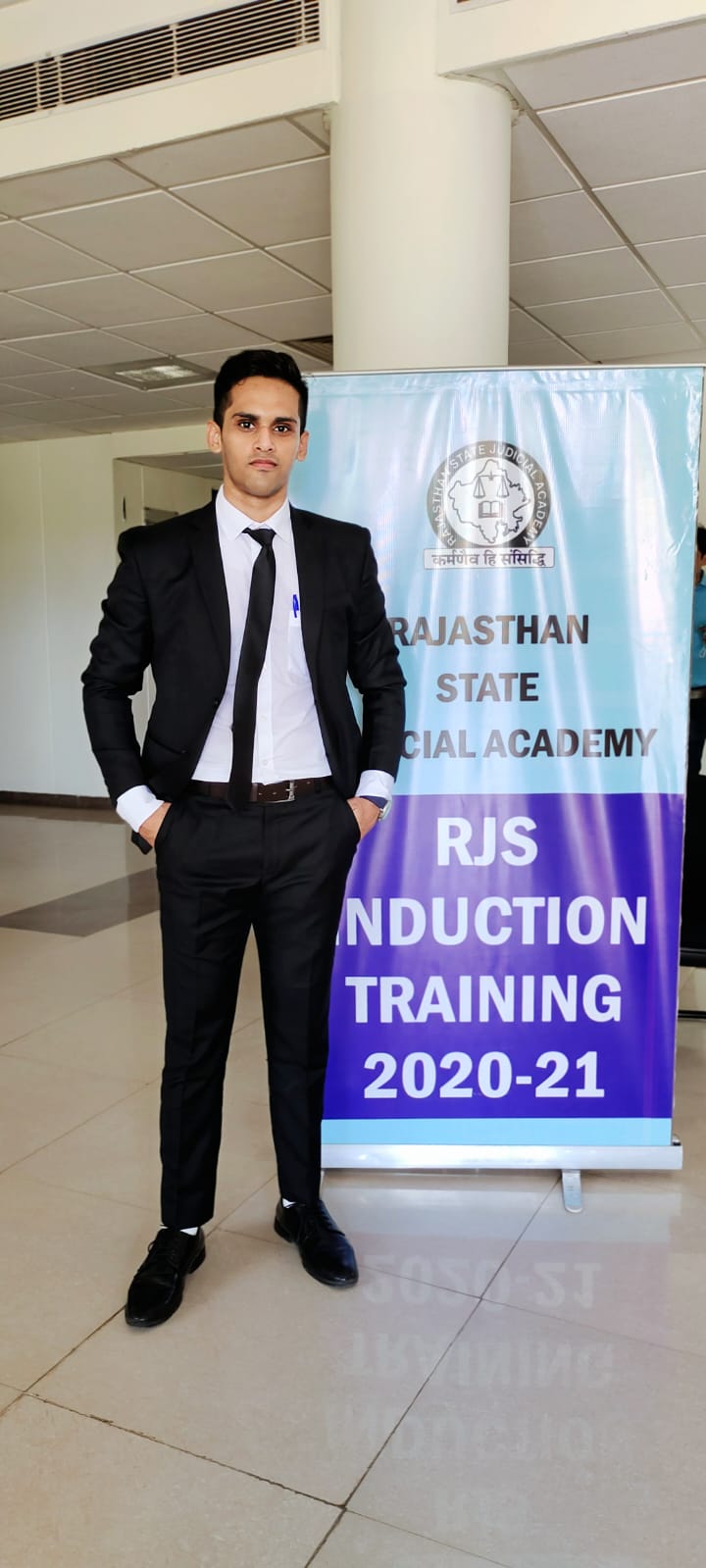
I wrote the Rajasthan Judicial Services Exam Prelims in March 2019, and I completed my graduation in May 2019. Immediately after my graduation, I gave the CLAT PG exam, where I secured an All India Rank 15. After this, my main focus was to clear the Mains of Rajasthan Judicial Services. RJS Mains was conducted in September 2019. Immediately after the Rajasthan Judicial Services mains, I shifted my focus towards Delhi Judicial Services Exam. The Prelims of DJS was conducted in the last week of September 2019 and Mains in the second week of October. In November 2019, I gave the Rajasthan Judicial Services Exam interview and simultaneously appeared for the NET exam. In December, I got this news that I have cleared the NET exam, and I am eligible for the post of Assistant Professor. Meanwhile, I was continuing with my LLM. Because of Covid-19, the interview of the Delhi Judicial Services Exam happened in December 2020. Meanwhile, I was also expecting the waiting list result of the Rajasthan Judicial Services Exam, which also got delayed due to Covid-19. In the Delhi Judicial Services Exam, I secured an All India Rank 68. Immediately after this, I got the news that I got selected in the waiting list of the Rajasthan Judicial Services Exam-2019. Right now, I am undergoing my Judicial training under the able supervision of the Honorable Rajasthan High Court and State Judicial Academy, Jodhpur.
Congratulations on clearing the first phase of your induction training and beginning your field training. How has the experience been so far? It feels to have three significant feats, clearing CLAT [UG-PG], NET [Law] and the Judicial Services Examination?
Thank you very much. The wishes mean a lot to me. During this training phase, I am learning a lot every day. It is an opportunity to learn practical concepts of the law. The law that we read in books and the law that we actually apply is very different. In order to give an experience of the practical world, State Judicial Academy time to time in different phases attaches us to different Judgeships throughout Rajasthan. During this field attachment, we get to learn about the Court functioning and how Judges manage the Dias. The experience till now is a very amazing one.
When I started to prepare for competitive exams, I always had this thing in mind: I want to complete the treble, and these treble stands were completed with my selection in Judiciary. So, it feels very amazing when you achieve what you have always wanted. I believe that this is a very rare feat, but I am not proud of it, and I want to keep this hard work going even in the subsequent stages of life because if you stop putting effort, you stop your own growth. This zeal to grow and learn is something that differentiates a human from an animal. I want to continue with this spirit throughout my life.
How did you prepare for the judicial services examination, and what factors did you take into consideration? Ideally, when should students start their preparation for the exam?
I am a person who always prefers self-study over coaching. Although self-study takes a good amount of time to understand the concepts compared to getting spoon-fed in the coaching institutions, I think it helps you in the long run because when you try to solve everything by yourself, your mind develops a habit to work a lot. But it differs from person to person whether he/she wants to prepare by doing self-study or want to join some coaching institution.
I started with reading Bare Acts of major laws and simultaneously reading standard commentaries on the subject. Multiple revisions are the key to understanding and remembering this vast course. Once you have covered all the major subjects, you can shift your attention towards the minor subjects and local laws. For Prelims, you should try to solve as many multiple-choice questions as possible and once you clear prelims, you can make a specific strategy for mains. The strategy involves going through the past year papers, understanding the exam pattern, and trying to develop the answer writing habit. You will realize the value of good content and standard commentaries at this stage because if you have good content in your mind, you will not encounter many problems while taking down that content on paper. After covering the course thoroughly, you can join some mock test series and give as many mocks as possible. This will develop your answer writing habit, and your mentor can focus on your stronger as well as weaker areas where you need to work. Every person has his own rules for success, and I hope during this journey you will also be able to find your own ways, which you can tell people later on.
If you want to succeed in competitive exams, then you need to be very disciplined, regular and patient in your approach. These are the qualities that are required from a judge and which will help you to clear any exam which you target. Also, there is a need to refrain from using any kind of social media during the preparation phase. I deliberately kept with myself a very normal keypad phone so that I could devote most of the productive hours to my studies and simultaneously focus on my fitness and sports-related activities. The major problem is our generation is wasting a lot of time using social media. I advise you as an elder brother that stops yourself from using social media for a year or two; believe me, when you come back, you will have a lot more followers than you expect.
While conducting interviews, interviewers find qualities like patience, sincerity, maturity and a skillful leader who can effectively manage the courtroom while imparting justice. Could you tell our readers about your experiences while appearing for the Rajasthan and the Delhi Judicial Services Interviews?
Interview is the third stage of this prestigious exam. The interview panel consists of Hon’ble High Court Judges. They already know that since we have cleared the mains exam, we are sound enough in law, so they want to test is whether you have those qualities required out of a judge. Patience, impartiality, ability to listen to the other side, acting on the spot, rational thinking, a reasonable mind, a commonsensical approach, and empathy are qualities that they look for. Apart from this, they will be testing you on the other aspects of life. The interview will not be restricted to the Law portion, but it will revolve around what you did in your college days, what are your interests and what you do in your free time. They will also be presenting to you some actual situations that how you will deal with those situations as a judge. My advice to all the aspirants is to be genuine before the panel, don’t try to give false answers or try to manipulate the panel because they already know whether you are speaking truth or lie. At least be true to yourself. If you don’t know about any questions, just say that I apologize; I don’t know. There is no need to get nervous before the interview; the panel ensures that you feel comfortable before them so that you can answer the questions in the best possible manner.
You are conducting and have been a part of several sessions highlighting the nuances of cracking judicial examinations. What would be your advice to people as a speaker on developing speaking and persuasive skills?
The profession of Law requires good oratory skills. Whenever you get a chance to participate in the events like Debates, Moot Courts, Court Room Exercises, do participate in them. As a judge or a lawyer, you will be heavily reliant on your oratory skills. Even if you are not good at speaking, don’t worry but try to work on your weakness each and every day because there is no such thing that cannot be accomplished. If you are dedicated, you can also develop good speaking skills, and good speaking skills come only when you have good content in your mind.
Along with this, the focus should also be on acquiring good content. Try to read the leading legal websites every day so that you can be aware of the recent developments. This habit will help you in other aspects as well like it will be helpful from the Mains Exam and the Interview Point of view. My advice to the students is always to develop a routine and strictly follow it every day.
Congratulations on your first authorship and its immense success. Have you ever considered taking up writing as a full-time career?
In April 2020, I released my first book in association with LawSikho on contemporary legal topics to help law aspirants clear different exams. I am very happy that this book turned out to be a big success. A lot of students regularly message me on Instagram and LinkedIn that, sir, your book really helped us. Such messages motivate me to help my community as much as possible continuously. I always have this thing in mind that once I achieve my goal, I will help the rest of the community to achieve their goals. During my preparation phase, I gathered a lot of material and then on some random day, I thought of compiling them in a Book Form. So, becoming an author was never a plan. It was totally out of my desire to help my fellow students to clear exams. I am happy that this book is still helping a lot of students.
With AIR-15 & AIR- 23 in CLAT PG 2019 and 2020, respectively, how did you manage to score so well, especially in your first attempt? What were the differences observed in the exam level while appearing for CLAT PG 2020 compared to your previous attempt?
More than the knowledge, I think that intrinsic motivation helps you achieve your desired goals. Motivation is something that helped me a lot to clear each and every exam in which I appeared. I started my journey with the CLAT PG exam, where I secured an All India Rank of 15 and in 2020, I gave that exam again to test myself on the new pattern and secured an All India Rank of 23. Since I was already in preparation mode, I did not encounter a major problem while preparing for the Judiciary as well as the CLAT PG, although you need to have a very different kind of approach and need to cover altogether different kinds of subjects. But as I already told you, if you are in rhythm, continuously studying, and in touch with academics, then there is no stopping you, and the same happened with me. As a result, I was able to clear the CLAT PG as well as the judiciary exams.
The major difference that I found in the 2019 and 2020 CLAT PG examinations was the kind of questions asked and their uncertainty. Until 2019 they had a very predictable pattern in which they focused on the major areas of the laws, and the paper had two essay type questions as well. According to me the paper pattern till 2019 was much easier. But in 2020, they made large scale changes in the pattern and started asking questions based on contemporary legal events. As of today, if you want to score a good rank in the CLAT PG examination, you need to be very much aware of the contemporary legal events, and that means not only what is going in the current scenario, but you should also be aware of the past of that particular topic as well as the chain of events that is related to the topic. If possible, try to find out the major case laws related to that particular topic. Now the strategy is to do a holistic study. For that, first, you need to cover the static part (that is, you need to be aware of the basic static concept), and then you need to make a building that consists of the contemporary developments surrounding that particular topic. For example, if we take the right to privacy, we need to start our study right from the 1950s when the first case related to privacy came before the Hon’ble Supreme Court and the subsequent cases till present. By studying in such a way, you will be able to learn everything related to a particular topic, what was the stand of the court earlier, and the current position.
You are currently pursuing PhD in Criminal law from NLU Jodhpur. What factors did you take into account while pursuing your PhD? Was there a convenience factor, or was it based on the competence of the University?
I never thought that I would be pursuing PhD someday. But you never know what the future holds for you. The Covid era gave me time to write research papers and blogs. Writing a research paper on various topics gave me an understanding of many topics and developed my interest in pursuing higher education. I was already doing my LLM, and the results of the Judiciary exam was getting delayed. So looking at the opportune time, I filled the PhD form of NLU Jodhpur and started preparing myself for the PhD interview round. I was exempted from writing a written examination since I had already cleared NET. Before the board, I explained my topic and ensured that I would be giving the maximum possible time to research-related requirements. Research papers and blogs helped me to prove that I am interested in academics. Based on this board selected me, and I started my PhD in January 2021.
You have always been enthusiastic about getting through the judiciary. You have interned under several advocates and also cleared the AIBE. How has your experience been in the field of litigation?
During my UG, I interned under several advocates at the District Court as well as High Court level. After exploring every field that Law has to offer, I decided to go for the judicial services examination. Litigation was never the first choice in my mind. I was always passionate about becoming a judge because I saw various Hon’ble High Court and Supreme Court Judges coming to the college for some seminars and conferences during my time at college. I was amazed by their charismatic personality and the kind of power and respect that society commands. Right from that day, I decided that I also wanted to be a judge, and I also wanted to give back to society in the best possible manner. But I advise each and every law student that before you choose any field, you should explore because until you explore, you cannot make an informed decision. It is very necessary that you take some litigation experience during your internship as well as you should also do judicial clerkship because this will help you decide whether you want to do litigation or whether you want to come on the other side of the dais.
You have been playing District and State Level Badminton Championships, as well as representing your club in cricket. Do extra-curricular activities help in maintaining one’s mental health? How do you make sure your mental health and work-life balance is maintained, considering your busy schedule?
For me, fitness and sports are always the first priority. I always try to develop my lifestyle so that I should be able to give around 50-60% of my time for sports and fitness-related activity, which is something I am doing right from my school days. So balancing academics and sports life was not a big task for me, but it becomes very hectic to manage both these things on some days. To cope with such situations is something I learnt at the college level. The main thing that sports and fitness teach you is having a strong will and patience to navigate difficult times. I think these are some intrinsic qualities that are required to clear any competitive exams. Although sports and fitness don’t directly impact success in competitive exams, they do play an indirect role.
What advice would you have for law students & young lawyers who want to step into the world of academia and judiciary?
Young students and aspirants, I want to say that you enjoy your college because these are the days where you will make memories and learn a lot of new things every day. Everything has a set time. Don’t try to rush things. Before choosing any field you should explore, you should intern under different organizations and different advocates. Then only you will be able to make an informed choice. Refrain yourself from using social media and use this time to develop some new hobby or if you already have some hobby, try to pursue it regularly. Clearing competitive exams takes a lot of time and effort. It is a long cycle, and you need to have a mental balance, and mental balance comes only when you are physically healthy. In the end, I want to say that by making your own path, don’t try to copy others. You’ll also be having your own rules for success. Have faith and confidence in your abilities.




 Allow notifications