Tag: RGNUL

  • Yashasvi Nain, Hans Wilsdorf Scholar at Geneva Academy, on working in International Humanitarian Law and Human Rights

    Yashasvi Nain, Hans Wilsdorf Scholar at Geneva Academy, on working in International Humanitarian Law and Human Rights

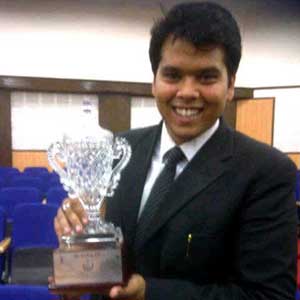
    Yashasvi Nain graduated from the Rajiv Gandhi National University of Law, Punjab in 2013 and went on to do an LL.M from the Geneva Academy of International Humanitarian Law & Human Rights. He is also a recipient of the Hans Wilsdorf scholarship and has worked extensively with the UN on various projects and in different capacities. Currently he is working on a UNHCR project to do with statelessness and a few other projects still in their developing stages. In this interview he talks to us about:

    • Choosing Human Rights as an area of specialization
    • His various internships and experiences ranging from working at the Supreme Court to AALCO to the UN
    • His time at the Geneva Academy and how he received the Hans Wilsdorf scholarship
    • Working at the Universal Centre of Human Rights (London), the UNHCR and the UNHRC
    • Advice for readers contemplating commencing a career in the UN


    Please introduce yourself to our readers. Which factors do you believe shaped your decision to pursue law?

    I belong to Jaipur, Rajasthan. I am a lawyer, specializing in the field of public international law.

    Like any other city in India, in Jaipur, one can start early on their chosen field, which is mostly medicine or engineering. So, I started preparing for medico entrance examinations. I agree I was doing that half-heartedly, but then, my father who is an advocate told me about CLAT and related avenues. Out of all of them, I found that Human Rights requires much work to be done by a lawyer. I have always wanted to spread awareness about these basic rights in society and this was the prime reason why I chose law.

    Eventually, I did my B.A., LL. B (Hons.) from Rajiv Gandhi National University of Law, Punjab. That was followed by LL.M from the Geneva Academy of International Humanitarian Law & Human Rights which is a joint center of the Graduate Institute and University of Geneva.

    Currently I am working on a UNHCR project which deals with the issue of statelessness.


    You have had some very unconventional internships through your law school years with prestigious organizations. Could you share your experiences there?

    Well, after doing internship with law firms in the first two years of law school, I realized that this is not the kind of work I would like to do in long run. In fact, I enjoyed working in my dad’s office during vacations, more. It is about what you find challenging as a budding lawyer and pursuing that when you intern. That’s why I opted for options other than a law firm.

    I worked as a law trainee to a Supreme Court judge. I got this traineeship though my university. It was the first time I got to learn from the other side of the bar i.e. from the bench. The work was good – mostly attending court proceedings, preparing the briefs for the Hon’ble Judge. It was nice sometimes to have discussions with the Judge and to get to know his point of view.

    I also worked with ICRC and it was a great experience. This was the place where I actually got the first taste of working in an international organization. Especially with a multinational and a multi-cultural team. It was really fun, and I learned a lot, and it influenced my career. I was given independence to do my assigned work and was even appreciated by the supervisor at every good task. The feedback at such organizations is prompt and you learn so much. As an intern, I realized how positive you feel when you get appreciated and acknowledged for your work. It encourages you at the right stage of your life and you get the confidence to take on bigger tasks.

    I also interned with AALCO, which was also an International organization. Here, I got the chance to attend various international seminars and conferences organized by AALCO. It was very useful from the knowledge point of view and I actually got to know various national and international law issues in depth. After that I researched with various scholars, Embassies and International organizations.

    All these internships and work experiences helped me stay comfortable while working with OHCHR at Geneva. Though I was impressed by the work culture there. From juniors, to the most senior person there, all work like a team if they are working on a project. It has a very wide variety of work like declaration drafting, followed by negotiations and being a part of the working groups.


    When did you decide to create for yourself a career in Human Rights law?

    As I said, my father was the first person to counsel me about the role law can play in realizing the most basic rights in society.  And during college as well, I was always fascinated by Public International Law and not just Human Rights specifically. My friends Rishab and Arnab shared this view. I remember we asked the authorities so much to start an international law specialization group in my University, because we didn’t get a sufficient number of students to start the specialization.

    During my 4th year of law school I chose to intern with ICRC. I loved the work and that motivated me more, to work in International Humanitarian Law. After that I got chances to work on International Criminal Law, Peacekeeping Operations, International Refugee Law, Internally Displaced Persons, migration in International Humanitarian Law and Human Rights Law, in various capacities.

    My future internships were directed towards specializing in international law thereon. During my final year of law I got an offer letter for an LLM course from Geneva Academy (known for its LLM in IHL & Human Rights) and MIDS (known for its LLM in dispute settlement). It was a tough call but I ended up accepting Geneva Academy’s offer. All my experiences during my internships, whether they were related to work culture or the kind of work, helped me make up my mind to pursue international law.

    At this stage as well as earlier, I do what I like doing the most and am not swayed by any other factors whether economic returns or what others are doing. This is the sole motto that gives me work satisfaction.


    Can you tell us about Human Dignity International?

    I give the entire credit to Late Prof. (Dr.) S.R.S. Bedi. Under his guidance RGNUL started a specialization in international law. Unfortunately he passed away some time before my graduation, but in order to continue his vision and idea of human dignity, I started this organization. It mainly focuses on research in the field of international law and on letting students know about the importance of international law. This is done by giving them opportunities through various research projects. I also got good inputs on this one, by many professors and international law experts around the world, who agreed to be part of it in various capacities.


    What shaped your decision to create a career in Human Rights? How did you go about the application process?

    (Yashasvi went on to pursue an LL.M in International Humanitarian Law and Human Rights from the prestigious Geneva Academy of International Humanitarian Law & Human Rights, Geneva.)

    As I mentioned earlier, I interned in various capacities in order to find out where my actual interest lay.  I was not quite attracted to the work in law firms. I wanted a multi- faceted work front which dealt with international law.

    I started working on my application almost a year before graduation. It is very crucial that you write a good application and get recommendations from persons who know you and your work potential. I appreciate my friends who reviewed my SOPs and helped me replicate what I actually felt. Both these factors go into any good application. In general the application process for Geneva Academy is not very technical. There is no application fee. You have to do everything online. You need your transcripts, recommendation letters, SOP and a motivation letter. Another thing which, makes the application process strict is that you need to choose if you want to apply with a scholarship or without a scholarship. If you chose the former then you will not be eligible for the latter. So you really have to make up your mind.


    Please enlighten us on how to get a full scholarship like you did from the Hans- Wilsdorf foundation.

    Well that was something I never expected in my life. I got the offer letter on the night of my farewell when I returned to the hostel. When I saw the email, I couldn’t believe it. I asked my friends who were standing next to me to confirm so that I could actually believe it was true. For the Hans-Wilsdorf scholarship, applications are considered in their entirety, including transcripts, extracurricular and voluntary activities, work experience, personal background, letters of recommendation, the personal statement and language skills. Through individual considerations, the Admission Committee seeks not only to identify individual characteristics that are important to academic success in the programme, but also other qualities that promote diversity and excellence in the student body.

    I personally think there are three things which play an important role in getting a scholarship offer. First, academics and your efforts (through internships, publications) to pursue your interest, that is in the area where you are planning to apply for your LL.M. Second, your statement of purpose (SOP) that shows what is the real motivation behind your application. Third, extracurricular activities, that is you have to show that you are not just good in academics but do have an overall personality, you can highlight your leadership qualities, sports achievements, or if you have achieved something while pursuing your hobbies.


    What are the ways your year at the Geneva Academy has helped you?

    I would say Geneva Academy as well as the city of Geneva itself helped me a lot in developing professionalism. Let me first tell you about the Academy. The first year at the Academy was extremely stressful though it helped me to understand the basics of various international law subjects not just in theory but also in practice. The Academy prepares you to work in all international organizations, and international courts and tribunals …etc. (for instance, in exams they give you a role of prosecutor or defense lawyer and ask you to give legal arguments). Practical and professionalizing activities in leading international agencies make the course more intense. The faculty at the Academy is the best in their field. It was a good experience to be taught by  professors whose books I used to refer to during moot courts.

    On the other hand Geneva also helped me a lot to improve my interpersonal skills. It’s an amazing city with the UN and international organizations, with easy access to them. Year round there are seminars, talks and conferences organized by various UN Missions or Organizations. This also helped me to stay up to date with contemporary issues.


    yashasvi-nain-2

    You are also a Fellow at the Universal Centre of Human Rights (London). Please describe your role there and how the experience is for you.

    It’s more academic but I like it because it helps me to stay connected to the contemporary issues of international law around the world. Fellows are supposed to be reviewing existing literature and prepare a monograph discussing the major problems and possible solutions to the problem.


    You worked at the Office of the UN High Commissioner for Human Rights, Geneva. Please describe to us your role there. How did you get placed?

    I would say Geneva Academy played a major role by equipping me with a strong master and by providing a platform to meet people. I was guided by my professor to work with OHCHR. OHCHR gave me so many opportunities to learn and work on various issues ranging from migrant smuggling and health and Human Rights to early warning indicators. It also gave me an opportunity to work as a member of the Secretariat responsible for organizing open-ended intergovernmental working group (OEIGWG) transnational corporations, business and Human Rights. Also members of the Secretariat organized the2nd OEWG on the draft declaration on the rights of peasants. Other tasks ranged from preparing the final note of the panel on the rights of persons with disabilities in the Human Rights Council 28thSession; preparing background papers for various initiatives and mandates of OHCHR and preparing the report to be submitted to the General Assembly on cultural diversity.


    It is considered extremely difficult to get into the UN. What are the ways to ensure one stands out and gets noticed?

    Definitely! It is crazy competition out there. Especially for us Indians in the sense that I have observed that Indian students have a great CV but it’s very difficult to break the ice because of the lack of approach.

    I think the easier way is to get close to the system, usually by way of doing an LLM or PhD or by doing an internship with them. Once you get in touch with some employees there, then at least you might get exact advice on where to search for openings and gather requisite skills for those. They are very forthcoming in guiding their internees.

    I would like to highlight that since Geneva or New York are expensive cities and most of the UN internships are unpaid, students are not motivated to apply for those internships. But I am telling you there are many positions which are paid, just need to do little bit of research on what suits you best.

    Another hurdle for us is the language barrier. If I talk about Geneva they prefer French along with the English language. So I suggest learning French or Spanish – you need not be proficient, but it will be a deciding factor in cracking the entry to the UN.


    How was your experience with the field research on UNHCR’s project? How is it different than the work at headquarters?

    I was always told by my mentors as well supervisors at the UN that you should never work at headquarters at the beginning stage, it’s always better to get field experience which will actually help in the future and with growth in your career.

    I personally felt the difference during UN conferences and discussions, where opinions or points raised by officers present in the field are so much more practical. So when I got a chance to work on field work, I was quite excited about it.

    It’s a totally different experience, where you go and do ground work and talk to grass root level organizations and with the stateless refugees themselves. It gives you a feeling that you are actually doing something meaningful. It was a great learning experience of how day to day bureaucracy and government works. At the same time it’s challenging also because many a times people don’t want to share their views and information.


    What do you have planned in the future?

    International law is a vast field with infinite opportunities but at the same time you can’t plan it. However, research projects are my constant engagement. I have some enterprises that are in the pipeline, on which we have been working for quite a time now. I can only talk about them once they are floated.


    How has Human Rights law evolved over the past few decades? Where do you see its significance in the future?

    Human rights were always the most basic rights. But in terms of decadal growth, there has been progress on giving them a legal form and building up mechanisms for better enforcement. We have witnessed in the last few years that the judiciary world over has widened the scope and ambit of Human Rights protection. LGBT rights, right to privacy, limitation to the use of force against civilians, right to land, housing, education etc. are now a reality.

    Unlike old times Human Rights are no more just soft laws. Human rights treaties and customary law are as ‘hard’ as any other law.  Though there is an evolution of challenges at the same time in societies going through transition phases. We see, the right to life being viciously violated in Syria. And even now, the right to food, education, health care and adequate housing are yet to be safeguarded.


    What would you say to some of our readers who contemplate making a career in the field of Human Rights?

    I would say that it is an adventure in itself. You know where you start but you don’t know where you will end. You meet a lot of interesting people, and get opportunities to travel around the world. But you need to have a deep conviction that what you are doing is the right thing. On my journey till now I have met some amazing people who work for humanity and are passionate about their work.

    The downside is, you might not get a high salary in the beginning (you might end up doing an unpaid internship while your mates are getting paid internships in law firms. I am sure that will demotivate you at times!!) You also might get short missions, so if you want to settle down in a place you like, it is a bit difficult.

    I would say just write to people who are in the field. Write a random email – you have nothing to lose. Ask them for guidance. Clear your doubts and march forward.  I believe in the inspiring words of one of my mentors who is in the foreign services – “Just dream, the rest will come at its own pace; you are a movie observer and your job is to enjoy the show”.


  • Arnab Ghosh, Counsel, Beam Suntory, on in-house experience, practicing at Calcutta HC and teaching CLAT aspirants

    Arnab Ghosh, Counsel, Beam Suntory, on in-house experience, practicing at Calcutta HC and teaching CLAT aspirants

    Arnab Ghosh graduated from RGNUL, Punjab in the year 2013. An all-rounder, he has several accolades to his name in the field of mooting, editing, writing and sports. After working under a Supreme Court judge, Arnab took a detour and started teaching CLAT aspirants, inspiring them along the way and helping them find out whether they would be able to embrace the legal profession in the future.

    He has donned the hat of not just a teacher, but also a practicing advocate in the Calcutta High Court, and now, a legal in-house counsel for a company, Beam Suntory, Inc.

    In this interview, Arnab shares his experience about:

    • Teaching as a senior faculty member of a CLAT coaching center
    • Working under a Supreme Court judge and as practising advocateat the Calcutta High Court
    • Being the in-house counsel for a company


    What was your motivation to study law? Do you have any lawyers in your family?

    Law was actually an afterthought for me. I always had an inclination towards the social sciences and made up my mind about studying liberal arts abroad. However, coming from a stereotypical Bengali family, it seemed blasphemous to take up any other subjects apart from PCMB (Physics, Chemistry, Mathematics and Biology) for 12th standard board exams and I seemed destined for a degree in engineering.

    A friend told me about CLAT, which I managed to clear. It was only after landing up in National Law School did I realise that studying law was probably one of the best decisions I had taken. For this, I have to thank my parents who understood my aptitude better than the teenager I was at the time. My father is a lawyer himself. He decided to start practicing rather late in his life but his determination and tenacity to make up for lost time is remarkable.

    My first cousin is also a lawyer who is currently working with the WTO. We may not be a family with a “legal legacy” but I am hoping that will change in the coming generations.


    How did you prepare for CLAT? Did you take any coaching? How was your experience taking the exam the first time it was ever held?

    I never felt that there was an overwhelming need to take separate coaching for CLAT. The ISC curriculum and a general academic approach equipped me to tackle the GK, English and Math sections. I was obsessed with logic and had a thorough grounding in Logical Reasoning, especially in the realm of mathematics, for which I have to thank Sanjit, my math and physics tutor (he’ll hate the fact that I called him that) in classes 11 & 12. This moulded my intellect and approach and I realized that it helped me with CLAT as well. Given a set structure and pattern, I could draw logical conclusions. In order to prepare for the Legal Aptitude section, I solved model question papers and started using the tools of logic and reasoning to answer the questions. Initially, it wasn’t easy but having crafted the method myself, with time I became comfortable with the pattern and structure of the various entrance exams which were specific to the National Law Schools prior to the inception of CLAT.

    After the exam, I felt that CLAT was the most refreshing entrance exam that I had given, especially because it was sandwiched between the IIT-JEE, AIEEE and others of the same league. The first thing that struck me about CLAT is that first and foremost, one has to be diligent towards building their general knowledge, there are no short cuts to it, it can only be built over a period through sustained efforts. It’s ludicrous to even imagine that it’s possible to mug up all the yearbooks that are available in the market. The rest of the paper is actually based on aptitude (more often than not) and while people may improve over a period of time, the logical and “legal” bent of mind can only be honed and not created.


    arnab-ghosh-2

    You have interned with a few of the top law firms in India. How did you go about securing internships at these firms? How was your experience with them?

    Persistence. As a law student, I realized something quickly, my need was greater than the firms. Law firms, by and large, can do without interns. The onus was upon me to secure these internships. Initially, I was heavily dependent on the college and over the years, I made efforts to build a CV which would, at the very least, be looked at by the firms. However, one of my best internships was when I landed up at the firm, requested a partner to meet me and then convinced him to give me an internship. The trick is to be proactive and take out time to not only apply but also keep following up.


    How did you get an internship with a sitting Supreme Court Judge? How was the experience?

    I have to thank the Internship and Placement Committee of RGNUL for securing this internship. The setup of these internships is such that you get to work from the Judge’s house itself. Every evening, His Lordship took time out to talk to us and discuss certain aspects of litigation and court practice. He candidly shared his experiences for our benefit. As far as being able to list the things I learnt, first and foremost, it gives you a clear perspective on things from the other side of the Bench. Secondly, we had to brief His Lordship which entailed reading hundreds of files and various matters. Thirdly, His Lordship would discuss certain matters with us. As a student, that is the ultimate practical guide to litigation which no other internship can provide. You get to know the types of cases that are likely to get a favourable decision and the ones which don’t and the way judges think. Going forward, if litigation is the career path one wishes to adopt, an internship with a sitting SC Judge is invaluable.


    Are there any extra-curricular activities you participated in during your 5 years at RGNUL?

    I was an avid mooter and debater. In fact, mooting was a very big part of my college life. It started with the Willem C. Vis Moot, Vienna and ended with our team being runners up at the Juris Corp Corporate Law Moot, NLIU Bhopal. Even after graduating, I’ve been associated with the mooting activities in RGNUL, who had invited me to judge the Stetson Environmental Law Moot last year and the RGNUL Moot this year.

    Apart from these activities, I was an editor of the RGNUL’s monthly newspaper, “Carpe Diem”. I was also a part of the Internship and Placement Cell and took keen interest in organizing various events and activities for RGNUL.

    Apart from academic co-curricular activities, I was very interested in sporting activities, taking part in all the events held in college, especially cricket and football and was part of RGNUL’s football team.


    How was your experience teaching law school aspirants? What were the challenges you faced? What do you think legal aspirants need to be aware about before they become professionals?

    (Arnab taught as Senior Faculty at Career Launcher)

    In all honesty, I had applied to Career Launcher for a part time position. After the interviews, they were keen on me joining on a whole time basis and the job profile attracted me so I agreed to join them. By far, it was the most enriching and exciting engagement I’ve had. Dealing with students in classes 11 & 12, I took it upon myself to foster a sense of passion in them for studying law. A lot of people join the coaching with the incentive and hope to land top paying jobs and not many are well versed with the other aspects that the study of law has to offer. My focus was to make them understand that law, unlike other disciplines is not mechanical and can only be successfully pursued with a certain degree of fervor and passion, in other words, to get them to study law ‘for the right reasons’ and assuring them that if they do the basics right, money and its corollaries will follow.

    One of the most challenging parts was teaching the aspirants the basics of subjects like contracts, constitution and criminal law. I had to dig deep and find analogies from movies like The Dark Knight to get the attention of the students so that they could understand the nuances and basic principles. This, in turn, revived my love for law and also helped me sharpen my own understanding.

    However, one cause of mild alarm is that more and more students want to pursue law because it is a lucrative career option. This may be true but not many are ready for the challenges that come in the way. Not many understand the subjects or have an aptitude for it. There is a need to sensitize the students and make them aware of all the realities, especially the difficulties of the legal profession and also to provide counselling to ascertain their aptitude and find whether they are suited for law.


    arnab-ghosh-4

    What factors made you switch from teaching to practicing as a lawyer? How was your experience?

    (Arnab switched to practicing as a Solicitor in the Calcutta High Court after his stint at Career Launcher)

    After working with CL for 6 months, I realized that it wasn’t a long term career option and that I had more or less learned everything that the position had to offer. I enjoyed teaching thoroughly but I wanted to start teaching in colleges and universities. Thanks to a dear friend, RishabRaturi, I was able to work with the Center of International Trade and Economic Laws at Jindal Global Law School on a few projects. It made me realise that although a Masters degree is not essential, it is recommended and I decided that Career Launcher will not provide me the requisite work experience to pursue the same.

    Moreover, I had been advised to start working in my hometown in order to pursue a successful career in litigation. Coupled with other personal factors, it seemed like the right move at the time and it was a rewarding experience from which I learned a lot, not only about law but also about the things I can and can’t do in the profession.


    How is your present experience of working in a legal department of a corporate firm? What is your role in the firm?

    (Arnab is presently working as Legal and Secretarial Consultant at Beam Suntory, Inc. at their Gurgaon office)

    I am working in the legal department at Beam Suntory. 70-80% of my job involves drafting contracts and agreements, getting licenses and other requirements for running a liquor business in India and other compliance functions. All our day to day work is done in-house hence that widens the scope of this job immensely. We have to interact with various excise and other departments across the country, each being distinctly different from the other.

    The alcohol industry is heavily regulated with strict laws governing business and promotion activities. Almost all marketing and other promotions have to be approved by the legal department before being implemented by the company. One of our recent ventures has been to tie up with VH1 Supersonic through Jim Beam Music CDs (one of our brands), which is one of the biggest music festivals in India and which also happens to be a project I’m personally associated with. From the courts of Calcutta to the beaches of Goa, this indeed has been a fairytale transition.

    Hence, my role in Beam Suntory is primarily legal but it has a lot of scope for cross functional projects. Currently, I have been entrusted with taking a leading role in 3 such projects for the company which amalgamates legal and other functions. While working in a company, it is your skill set and talents that play a huge role along with the degree you hold.


    What are the challenges you face as an in-house counsel? How are they different from those you faced in court during your stint in Calcutta?

    One of the generic challenges, that one faces while working as an in-house counsel is the emphasis on coming up with solutions. It is imperative to understand that the biggest responsibility is enhancement and maintenance of the business. It is not enough to say that the law does or does not allow a certain activity. We have to find ways around in order that the business does not suffer. As an in-house counsel, my clients are the various departments within the company, such as IT, Operations, Sales & Marketing, HR, Finance, etc. It is important to understand these departments in order to render effective service.

    The alcohol industry adds its own set of challenges. Every state has its own set of laws and requirements since alcohol is an entry in the state list. Some states have a corporation market wherein we do business directly with government entities, some have a private market where we deal with retailers and some have mixed markets which means that we have to deal with multiple excise laws and policies. Alcohol is also regulated by the FSSAI, Legal Metrology, IPR, Companies Act and many other laws, all of which have to be complied with.

    Another challenge, probably the biggest that we face is that we are associated with an American company. Hence, we have to adhere to strict anti-corruption laws. Any lapse on our part can lead to irreparable consequences. No matter how pressing or urgent a matter is, we cannot take any short cuts or obtain favours (monetary or otherwise) from any private or public entities. We take pride in being a company with complete transparency. As an in-house counsel, it is my prime responsibility to ensure the same.

    The main difference between working in a Court and working as an in-house counsel is the sheer variety of laws that you have to deal with. In litigation, there is a certain degree of familiarity with the laws and procedures and exposure is limited to the courts. In a company, you have to deal with other companies, entities, business partners, associate companies (in case of group companies of an MNC), various government authorities, banks, law firms, lawyers, consultants, etc. We also have to coordinate and provide support to various departments within the company. There are more deliverables every day while working as an in-house counsel as compared to working in a Court.


    arnab-ghosh-3

    What are the skills that companies value the most in their in-house counsel? How does one go about the application process?

    Adaptability, business acumen, consistency, quick interpretation of laws, swift and effective problem solving skills, teamwork, and willingness to accept roles and duties beyond your job description, these are the most important qualities that an in-house counsel needs to have. First and foremost, you have to be very good as a lawyer. However, you should also possess the skills and willingness to discharge functions beyond your job description.

    A lot of companies advertise vacancies on various internet portals. One has to keep a track and be updated with that. In addition to that, one should try and intern with various companies. It helps if the college placement cell coordinates with major companies for securing placements and internships. The application process is not very different from any other job. Networking also plays a major role in securing positions as an in-house counsel.

    Taking up additional courses and getting additional qualifications such as being a Company Secretary is invaluable and I would sincerely advise every student desirous of working as an in-house counsel to get a CS degree at the very least.


    Is the work of an in-house counsel easier than that in a firm or in litigation? Is work-life balance an issue?

    At the risk of sounding like a boring diplomat, I would have to say that both the jobs have their own challenges and difficulties. The real question one needs to ask is whether they want to work in firms/litigation or in a company. One of the biggest peeves I had about litigation is that you had to stay in the Courts till about 4 in the evening and work only began at about 5. Sometimes, the days would get wasted without any cases coming up for hearing. Conversely, the work as an in-house counsel is more organized and structured. Also, the sheer variety of work ensures that it is not monotonous. Having said that, the thrill of arguing in a Court has its charm and appeal. As I said at the outset, there is nothing easy or difficult about law or anything for that matter, one has to put in a lot of effort into whatever they do.

    One of the best things about this job is the work-life balance. I get weekends off and the latest I’ve had to stay back in office was 8 p.m. We put our heads down and work hard from 9-6 but after that we are free birds. I get to take a swim morning and evening, party and cook on the weekends and even foster a dog. I don’t think any other job could have given me this much time and freedom.


    Would you have any parting words of encouragement for our readers who would like to follow your footsteps?

    Conventional wisdom says that you have to work hard and stick to whatever job or profession you take up. Hard work is absolutely essential. However, working hard for something that does not satisfy you is very counterproductive. At times it is essential to recognize that a certain job or role might not be suitable for you and at that juncture, one has to be bold and courageous enough to quit and move on. I was very lucky that I had the support of my family and friends, especially my parents. They stood by every decision I took.

    At times, I was rash and impulsive, but I was always true to myself. It is very important to be honest with yourself and do justice to your skills, interests and passions. Also, in the early stages of your career, the importance of a good senior/boss is incalculable. I have been very lucky to have Vandana Ma’am as my boss at Beam Suntory. Not only is she an excellent lawyer and boss but a great human being as well. It is imperative to not only find the right job but also the right mentor in the early stages of your career.

    To summarize, I’d say that it is very important to work hard and work towards a long term goal. However, it is also equally important to find a job which satisfies you, which makes you want to improve and give your 120% rather than constantly harbour thoughts of finding an opportunity to quit and switch jobs. Working with a lawyer, as a Senior Faculty, as a Solicitor, and now as an in-house counsel, I have been able to sample the various flavours the legal profession has to offer and in turn understand my skills and limitations better.

    Take as many risks as possible at the initial stages of your career and let your skills and interests, rather than degrees, specializations and marks, decide what is your perfect (or at least near perfect) job.

  • Mrudul Dadhich on pursing masters, applying to different universities and recruitment at a top law firm

    Mrudul Dadhich on pursing masters, applying to different universities and recruitment at a top law firm

    mrudul-dadhich-2Mrudul Dadhich is a graduate of the batch of 2014 of  RGNUL, Patiala. He is currently pursuing Masters in European and European Legal Studies from the Europa-Kolleg, University of Hamburg and was awarded the prestigious Dr. Angela Merkel Scholarship Award.

    We spoke to him, among other things, about:

    • Tips on pursuing masters
    • Process of application to foreign universities for masters
    • His recruitment at J. Sagar Associates
    • Scope of career opportunities after graduating from a Tier II/III law school


    How would you introduce yourself to our readers which are mostly young students of law and lawyers?

    Hello everyone, I am Mrudul Dadhich, pursuing Masters in European and European Legal Studies from the Europa-Kolleg, University of Hamburg. I was fortunate to have been awarded the prestigious Dr. Angela Merkel Scholarship Award for pursuing my Masters. I have completed my B.A. LL.B. (Hons.) from Rajiv Gandhi National University of Law, Patiala.


    Please tell us a little about yourself, your hobbies, passions, interests and ultimate goal in life.

    I am young lawyer with a lot of aspirations to find my feet in the legal fraternity. My hobbies include watching sports (especially cricket, football and tennis). I am passionate about cricket in particular and have a special affinity for numbers (which partly explains my love for statistics in sports). As for the ultimate goal, I tend to take things one at a time and prefer to set short term goals, achieve them and then set another set of goals. So it will be difficult to tell you an ‘ultimate’ goal in life at this point.


    How did you decide to study law? Did you have lawyers in your family? Why law and not engineering or medical studies?

    I am a first generation lawyer in my family. During my school days, I was totally inclined towards Engineering and had never thought of taking up law. I didn’t know what I was getting into when I came here and in my first 4 or 5 months I was filled with awe. And over the years I have realized that it was the best decision I ever took. All professions have lot to offer, however, personally for me law has offered more dynamism and it has opened up a lot of opportunities and avenues.


    You have not only interned at some of the best law firms in India but also secured a job at JSA, Advocates and Solicitors. How did you go about achieving this?

    When I was in the 3rd year of my Law School, I realized my inclination towards corporate and business laws and luckily, I got the opportunity in my 3rd year itself to intern with a top-tier firm. Then with the feedback from seniors I soon realized that J. Sagar Associates is a dream place to work at. When I first got the internship I was ecstatic and frankly, was in awe with the work culture and environment at JSA. That internship was a great experience and after that I kept on repeating internships with the firm. And things took their own course afterwards.


    Please tell us the recruitment process at JSA?

    The recruitment process at JSA is quite transparent and well structured. In my case, we had a campus recruitment activity wherein 6 candidates were shortlisted for the final interview. Based on the interview, the final selection was made.


    We note that you have applied for top notch universities for masters. While making applications, what was your strategy – choose a university first and then a course or vice-versa?

    I just applied for 2 programmes. I applied for the BCL course at the University of Oxford and the other one was for the DAAD Scholarship (the Angela Merkel Scholarship). My approach was to first select the course and then the University.


    There is also a great amount of debate when it comes to allocating your time and energy between research papers and moots as a law student. What is your opinion regarding this?

    There is no straight jacket formula for defining which requires greater allocation of time and energy. It works differently for every individual. In my case, I participated in Moots only till my 3rd year. However, I believe that a well balanced CV is more important than excellence in any one field alone. It is very difficult to choose one over the other and one must have fair share of both. Personally, I feel once you have done both then you may decide to pursue the one which interests you more. I had always favoured writing research papers over mooting.


    Being a topper, one may safely assume that you chose to devote a substantial amount of your time to academics. However, a lot of people claim that the role of academics (and more specifically, the “CGPA”) is limited and often over-stated and hyped. What’s your take?

    I think academics do play a significant role. However, having said that, it also depends on what your future goal is. I think that, for securing a place in a prestigious institution for higher education, role of a sound academic record is highlighted. I reiterate that it is important to strike a balance between academics and the extra-curricular activities. I also believe that internships are also very important and are a great platform to gain valuable, practical experience. Finally, to answer your question, I would say that academics are not the only thing but it never hurts to have sound academic record. It always helps!!


    There’s a lot of hue and cry about how the lower-ranked colleges are discriminated against when it comes to opportunities being offered despite at times being equally meritorious as the students from the higher-ranked ones. Do you find any substance in this argument?

    I would not say there is any discrimination in the legal fraternity based on the colleges. Generally the recently established colleges (I prefer to use this phrase rather than ‘lower ranked colleges’ as in absence of a centralised transparent ranking system, it is unfair to call any college higher ranked or vice-versa) have a smaller alumni network which plays a very important role in getting more opportunities. But I don’t think there is any discrimination.


    Did being a student of a Tier II Law School act as a roadblock during your law school days?

    Again I have not come across the categorization of law schools in different Tiers. In my case, I think studying in RGNUL was a boon and since it (RGNUL) was in the nascent stages when I started law school, I got a lot more opportunities to explore and to learn.


    If you could list out 3 activities which on a scale of priority, should be at the top in any law student’s school-life (given that he wants to secure the same set of achievements as you), what would those be?

    I reiterate that maintaining a balance is the most important thing, being perseverant and keeping yourself motivated is the Mantra that worked for me. As for the priority list, I would place Academics (good grades really help you for being accepted for Masters), Internships (this not only gives a practical insight about the different challenges one may face after law school) and Research Papers.


    If you could re-do your 5 years in Law school, is there something you would do differently?

    No, I am happy with the way things have turned out. The greatest fun is in unpredictability and to respond to the situations as and how they come, it will be too boring if everything goes just as we plan them!!!


    Lastly, what would be your message for the readers who want to pursue masters?

    First of all decide if you really want to pursue Masters. Once you are clear about that, select the discipline in which you want to pursue it (based on your area of interest and the opportunities which it may present in future). Look for appropriate scholarships. There are many scholarships so research on that and most importantly, start with your applications well in advance. I wish all the readers the very best in their future endeavours.

  • Pratika Shankar on bagging a PPO from WadiaGhandy, winning Best Student Advocate at Stetsons and importance of academics

    Pratika Shankar on bagging a PPO from WadiaGhandy, winning Best Student Advocate at Stetsons and importance of academics

    pratika-shankar-2Pratika (pronounced “Prateek”, as he puts it) is a graduate of the 2013 batch of RGNUL, Patiala. He is a working as an associate at Wadia Ghandy & Co., Bombay. He has a noteworthy academic, mooting and debating record and has gone about achieving things on the sole basis of his merit.

    In this brash, honest and gripping interview, he sheds light on, inter alia:

    • His journey from an intern to an associate
    • Getting recruited at Wadia Ghandy & Co.
    • Importance of academics, moots and debates


    Tell us a bit about your pre-university life. Did you have lawyers in your family? Why did you decide to study law? What inspired you to do so?

    I was born to a teacher-mother and an advocate-father- a genetic profile looking at which, one might completely dismiss my childhood to have been immersed in the deep sea of books and knowledge. But thankfully my parents knew better and let me make the most of my childhood, which was filled with all the quintessential colours of masti, shararat, mohobbat and cricket. From gully cricket tournaments to getting thrashed by school teachers arguably every single day (and mostly in front of my mother, being a teacher in the same school), to writing my first love letter in the sixth standard (and being thrashed again, by my father this time), I have been there, done that.

    Ironically, all ingredients forming the recipe of a good lawyer were missing in me all through my childhood, i.e., love for the books, clarity in thought and focus, etc. I was an avid debater, actor-director in plays, tabla player and a poet who dreamt of getting into the National School of Drama (“NSD”) one day. But then, childhood is like a honeymoon- a short but wonderful, memorable phase of life, which is immediately followed by the shock of reality and responsibility. And that how NSD gave way for the entry of law in my life- suggested to my mother by a colleague and passed on to me as a lucrative career opportunity in the 21st century India. At first I was dismissive as I had grown up watching my father stare at piles of papers containing gibberish every single day and knew for sure that this was not my cup of tea. But then, I saw Damini. Sunny Deol (the actor) shouting “tareekh pe tareekh” (the dialogues) in a full- house courtroom (the theatre) and winning the case (applause of the audience) – the decision was almost instantaneous.


    How would you describe your time at RGNUL Patiala? Also, please tell us one thing about your university days you regret the most, and one that gives you immense joy.

    My time at RGNUL, in one word, was an ‘experience’. It expanded the horizon of my world from one of the most backward states of the country to one of the most prosperous ones. I met people from different parts of the country, lived in a hostel, shared a room with a stranger, made new friends, got to understand the different (read drunk and bhand) states of human behaviour, engaged in petty batch politics, ego clashes with batch mates (and thus cold wars)- all of this and much more, all by myself. There were innumerable experiences, and each one of them had a lesson. I sincerely believe the transition from a child to a man is incomplete without spending some time in a hostel.

    Time spent in university was an altogether different set of experiences. There was stiff competition in the academics as well as co-curricular activities which I learnt to cope with. At the macro level, there were several institutional challenges. We got over some of them through our efforts, learnt to live with some in a matter-of-fact-way. My most enriching experience on the campus came from a third kind of institutional challenge we faced- which could be overcome with some effort by the authorities, but what I saw instead was tremendous lack of will. I was quite often reprimanded by the authorities for asking the right (read wrong) questions, and that also brought me face-to-face with certain harsher realities of the world we live in.

    One Regret- I did not channelize my time and energies at the right places and spent too much time regretting the choices I had made in life. This complex led me to create a superiority bubble for myself in the mediocre world that I lived in on which I kept floating it on the shallow waters for as long as I could. Had I come of out my bubble and dived into the deep ocean of knowledge and learning, I would have been a better person today.

    Biggest source of joy- I could write a book on this one, but let’s just say that amidst all the ups and downs of my stay at Patiala for five years, there was one perennial source of joy- not in Patiala but 67 kilometres away, in the city of Chandigarh. No matter what, I shall always rejoice my stay at RGNUL for as they say there is always a blessing in disguise- she is mine!


    You were the “Best Student Advocate” in Stetsons 2010 and a part of the 3rd-best team. Also, you were a part of one of the top 5 teams at Henry Dunant. Please share with us the relevance of moot courts and what you’ve learnt from it.

    I feel mooting is one of the most important events in the journey of a law student en route to becoming a successful lawyer. Most of my fellow colleagues would say that mooting is important only if one wants to pursue litigation, or to make the CV look fancy as you also pointed out. Here, I beg to differ with my learned friends. If you noticed in the first sentence, I have used the word ‘lawyer’ and not ‘advocate’ for a reason- I personally believe that success in moot courts are not only about your oratory skills, or a neatly formatted memorial. Rather, moot courts are a test of how much life you can pump into hypothetical facts and events and how many different vantage points you can create to interpret what is otherwise written in black and white. To accomplish this, one needs to (i) have thorough knowledge about the legal position; (ii) develop an out-of-the-box approach; and finally (iii) put it across to the other person (the judge) confidently, better than anyone else. I feel that these three qualities can be very effective armoury, be it in a courtroom, a negotiating table or a structuring meeting of a corporate transaction. Having given you all of this gyaan, let me also admit that my prime motivation behind mooting, and mooting well (remember my bubble?) was that it does look fancy in the CV!


    You were also an avid parliamentary debater. What about it made it one of your passions in university? Do you believe good speaking skills are beneficial for a lawyer even if he’s not going to litigate in the court?

    Well, debating was not a passion I developed in my university days. I was an avid debater during school as well, and thanks to the constant encouragement by my parents, I had already participated in around a couple of dozen inter-school competitions before being admitted to RGNUL. However, I was introduced to the world of parliamentary debating only at RGNUL and frankly, it was an altogether different level of experience and joy (credits due here to my teammates Nitin Sharma and Sourabh Rath).

    What drove me to debating since childhood? My love for speech, my desire to make myself heard and the sense of accomplishment I felt when my point of view prevailed over all others that were presented. I feel very sad that debating is always treated inferior to mooting and other co-curricular activities; it always plays second fiddle to the star ‘mooting achievements’ column on one’s CV. As per me, a good debater needs to possess the same qualities I mentioned earlier in case of mooting- knowledge over a wide range of issues and events; an out-of-the-box thinking; and confidence to present your point of view better than your opponent. Additionally, one thing which differentiates debates (and probably makes it even more difficult) from moots is lack of time. In a parliamentary debate, you get a total preparation time of 20 minutes to prepare 3 sets of speeches on a topic you may not know jack about. It might sound scary, but what is does is that it teaches you to think on your toes. You have to keep evolving and re-inventing your arguments, and mostly during your speech. And needless to say- you better possess these skills before entering a negotiation room rather than your opponent possessing them and putting it to good use to counter everything you say.


    Throughout university you managed to maintain an excellent GPA. How did you do it and how did it help you in your career?

    Firstly, I don’t think that being able to maintain a respectable GPA is any achievement to boast about; rather it should be the primary focus of every student. I mean, isn’t that why we went to the law school in the first place?! Honestly, in my own eyes, all the extra-curricular achievements would have counted for nothing, had they come at the cost of academics. Having said that, to be very frank, I was never one of those nerdy types you would find mugging books in the library every evening. But the desire to do well in academics was always there, because I was clear that if there would ever be one thing which would always speak for itself throughout my professional career, it would be the first heading on my CV, i.e., ‘Academic Credentials’.


    On a much more serious note, for my academic success, I would like to duly credit my effeminate handwriting and the constant support of Gautam Bhargav (Roll No. 320) and Aditya Ranjan (Roll No. 322) during every single paper, every single semester, which motivated me and ensured that I attempted each and every question asked in the paper!


    To my knowledge, you’ve never used ‘jugaad’ to secure your internships. What was your method of networking as a law student? What was the procedure you followed to apply for internships with leading law firms?

    In my view, when you apply for an internship riding on your CV without any jugaad, the kind of response you get is highly driven by two factors- the name of your institution and your luck (your CV must reach the right inbox at the right time). While nothing much can be said or done about the luck element here, I certainly hope and believe that with the students of the so-called lower grade law schools doing tremendously well in whatever limited internship opportunities that they get, in the coming years, the internship selection procedure will become institution neutral. This would serve two purposes- one, it will ensure that the best of the candidates are chosen to get trained at the best of the places, irrespective of how they had performed in an entrance examination three / four years ago; and two, it will eliminate the infamous jugaad element to a large extent, which has led to many students (including me) feeling highly demoralised and demotivated during their college life.

    As for how I could manage some of the good internships on my own, well, at first there was luck which created an opportunity for me, and then it was my hard work during a particular internship which led to better ones. You will appreciate the fact that the world we live in (especially law firms) is a very small place and networking is not that difficult if you actually give it some appreciation. Having said that, I also firmly believe that the only sustainable networking methodology is the one built on the foundation of your efficiency, and topped up by your confident, yet humbled and polite approach (never read that as a sycophancy- that is arguably the single most detested thing ever) while interacting with your seniors.


    You interned at Wadia Ghandy & Co. (“WG”) and then bagged a job offer. Please tell us about this journey from being an intern to becoming an associate. Any tips on how to crack a law firm interview?

    I interned at WG only once and for a period of three weeks with the banking and finance team. Honestly, this internship was a real eye opener for me in terms of how little I knew about the law and how hard I still needed to work in order to find a place for myself as an associate at a good law firm. So, I never really expected to be called for a job interview or for that matter even a second internship.

    However, towards the end of my ninth semester, I applied to WG and requested for an interview slot, which to my surprise, I was instantaneously granted. For me, it looked like the battle half won. However, with that frame of mind, I was in for a bumpy road ahead (a tip here is to always remember that that the real test is not procuring a slot for the interview, but the interview itself). Accordingly, the first round of interview was full of rigorous questions and answers (read questions and very few short answers). While I did somehow manage to advance to the next round of interview, a word of caution was thrown at me that my performance in the first round was not at all satisfactory and I needed to pull up my socks. In the second round there were lesser questions and lengthier answers and the interviewers were happy with my performance. Before I could jump up in joy for having procured a job offer, I was told that there would be a third round of interview, and this time with the big boss- Mr. Ashish Ahuja, the Managing Partner of WG. I was in serious doubt- given that I have already cleared the technical interview, would this be a personality evaluation round, or would there be more questions, difficult questions. Sensibly though, I prepared for the latter. Actually, it was not an interview at all. Rather, it was Dale Steyn charging at you on a WACA pitch with a swinging new ball and continuously bowling for five full overs with you having no idea after each ball as to what the next ball would be! The questions were not difficult, but absolutely unpredictable. I mean who could expect a question on Muslim succession laws straight after having terribly negotiated a question on renvoi?! But after getting hit on the body for quite a few times, I finally decided to do it the Rahul Dravid way- (i) Don’t flash at every ball and know your limits; (ii) Confidently play the balls within the hitting zone; (ii) Even more confidently leave alone the ones outside the off stump of your mind. You might score slowly, but you will also have fewer edges, and therefore the risk to get dismissed.

    Apart from a tactful approach during an interview, you also need an approach for the interview.  There are three suggestions that I would offer here:

    (i) rather than delving too much into understanding the fancy sounding jargons like hedge funds / private equity / project finance, focus on three core areas around which most of the questions are built- Transfer of Property Act, 1882, Indian Contract Act, 1872 and the Companies Act, 2013;

    (ii) keep yourself abreast with the day to day happenings in the legal world, including any latest statutory enactments and judgments; and

    (iii) always remember that no interviewer expects you to know all answers, simply because you cannot. But it is important that every word written in your CV (from your assignments during your internships to your hobbies) and all related questions along with their best possible answers should be dancing in front of your eyes for all times during the interview.

    One last thing- do not lie during an interview; trust me, you will get caught!


    How has your experience been so far with Wadia Ghandy? Please talk to us about the work culture in Wadia Ghandy and Mumbai in particular.

    My experience at WG has been very enriching. I have been working in the general corporate laws team led by Mr. Ashish Ahuja and it has been my good fortune to have worked directly with him on several matters. Particularly, I feel lucky to be working with seniors who not only give me good matters to work on, but provide a congenial work environment with a good work-life balance, which are things, as I have often heard, generally missing in a law firm setup, largely attributed to the tremendous work pressure and cut throat competition. I firmly believe that while the kind of work we get is very important for career building, the right work environment is equally important to ensure maximum efficiency. After all, if you ask an ISRO scientist to monitor the Mangalyaan while sitting in a fish market, I am not sure how that well would turn out to be.


    Please share with us a few things you’ve learned after spending a year as a corporate lawyer, which you believe the young aspirants out there ought to know before they step into the real world.

    More often than not, I hear the present interns and future lawyers say- ‘one automatically gets to learn most of the associates’ work while interning at multiple law firms for multiple times’. Please allow me to bust this myth for you. Whoever feels this way is living in a fool’s paradise because honestly, you can never learn to work like an associate unless you have actually worked as an associate. And the reason is expectation, or in fact the lack of it. As an intern, you might be over enthusiastic about an assignment you have gotten from a partner (and you should be, too) but when you look at the same assignment from the eyes of the partner who gave you the assignment, you will be amazed to see where it stands on the weight of expectations. The quality of your work will always be judged as a student of law, and not as a lawyer. And going a step further, if you think that “wo associate gadha hai. Partner to uska kaam bhi mujhe de raha hai” it shows nothing but your naiveté. I have taken assignments as an intern, and now I give assignments to interns. And after being on both the sides, I can tell you- the qualities which will make you stand out as an intern at a law firm are dedication, diligence, humility and politeness (again, never read politeness as sycophancy- you will get the most-creepy-intern award at the end of your internship). Lastly, always try and be as professional as you can. I don’t think I need to give any gyaan on the ‘real world’ after college- you will know it when you get there. Till then, no need to stress too much.


    Thank you for giving me this wonderful opportunity to share my experiences. I am truly humbled. And allow me to end the interview in the words of our own rock star Prime Minister- “May the force be with you!” “Namoste!”

  • Sanchit Aggarwal, Masters Candidate, ISB, on marrying law with management

    Sanchit Aggarwal, Masters Candidate, ISB, on marrying law with management

    sanchit-aggarwal-1Sanchit Aggarwal is a graduate of Rajiv Gandhi National University of Law, Patiala, batch of 2014. He has recently qualified for the MBA Programme at the Indian School of Business which is one of the most prestigious institutions for pursuing MBA. Currently he’s an Associate at APJ-SLJ Law Offices and will soon be joining ISB.

    We spoke to him about:

    • Selection process at ISB
    • Balancing studies in law school and MBA prep
    • Prospects of BALLB + MBA


    When did you decide to pursue an MBA?

    Even before I joined Law School, I dreamt of doing an MBA post Law. I have always been fascinated by Business and the art of minting money.

    I have always been of the school of thought that being a student of a National Law University, the major take away after five years should not merely be the knowledge of law, but the legal skills that one acquires in the process of the study and interpretation of law, mooting, interning, debating, writing research papers and other activities that a law student takes up. I have never supported the conventional view of practising law after studying law. There are a plethora of avenues out there, awaiting to be exploited. I always wanted to use my acquired legal skills in a business environment, my long term aim being to become an entrepreneur. I think law gives you the edge of knowing the regulatory framework well enough, understanding the compliances and understanding the statutory and other measures required and applying them to run a business. I believe people working in organizations in the top positions ought to have a decent understanding of the law, in order to manage business in their top capacity. Discovering a new avenue was my primary motivation in this journey.


    Why did you choose ISB over IIMs?

    I preferred ISB over IIM’s and hence aspired for ISB only. The major reason behind this decision was the ideology of ISB compared to that of IIMs. If you compare the level of diversity in both these colleges, you are bound to see a remarkable difference. While more than 90% of the students at any of the IIMs are engineers and mostly boys, the case at ISB is drastically dissimilar. ISB promotes and supports diversity in its students’ backgrounds, similar to the top B-schools in the world. The Class of ISB is a mix of engineers, doctors, CA’s, Army Officers, Government Servants, Social Workers, Economists, Architects, Sportsmen and several other professionals from diverse background. Without denying the fact that majority of students are engineers, the fact that every student regardless of his background is at par and carries with himself the power to do equally good is also true. The curriculum, the activities and other co-curricular activities at ISB are designed to cater to the needs of all individuals and not just one category of students. Thus being a lawyer, I thought it to be a saner decision to join ISB as I would get a more nurturing environment where I could develop myself to my potential, exploit my strengths and not merely follow a fixed path. Many might disagree with my opinion.


    Please tell us about the admission process.

    ISB accepts only GMAT scores. Getting into ISB is a three stage admission process.

    First Stage: You are required to submit a video essay (ISB gives you a topic to speak on, in limited time) and list all your achievements and activities till date.

    Second Stage: You have to submit your GMAT score. Further three essays, generally on topics describing your goals, achievements, moments that have changed you etc. Then two online evaluations (recommendations) by your employer or professor or any person under whom you have worked. I submitted one from the VC of my University and second one from Senior General Manager, ICICI Bank.

    Third Stage: In the Final Stage you are given a complex case study to solve, generally based on market study and business. Then is the interview by a panel of three consisting of one from the faculty, one alumni of ISB and one from the admissions committee.

    These stages are elimination stages.


    What was your score for GMAT? Did you take any other MBA entrance exams?

    I managed to secure 700/800 on GMAT. Since I primarily aimed at ISB, I did not give any other MBA entrance exams.


    What was your preparation strategy for GMAT and how did it change over the time?

    I prepared for GMAT for just two months in my semester break. I made it a point to be consistent with my preparation as I had limited time at my disposal. My strategy was fairly simple, i.e. to be consistent, in spite of all the lows and try to commit the least fundamental errors as I couldn’t afford them, due to paucity of time. I also decided to cancel my confirmed internships, to avoid falling flat on my face in my quest for a B-School entry pass. So I dedicated all my time preparing for the second stage of ISB, of which GMAT was an essential element. I focused most on essays and evaluations, rather than blindly focusing on the GMAT. This in my opinion is the biggest mistake that many students make, i.e. by channelizing all their time and energy on GMAT, ignoring other important aspects of the application. B-Schools view a candidate’s application holistically and never pick a candidate for just one star in his application. An Application with good academics, good essays, good profile and a good GMAT score has a higher probability of selection compared to an application with excellent academics and excellent GMAT, but average essays and an average profile.

    My suggestion to all B-School aspirants as far as an Admission Application is concerned is that you must try and focus on all aspects of your application, especially on your weakest areas, as your weaknesses would be highlighted before your strengths.


    What was your preparation strategy for the Quantitative Ability & Data Interpretation and Verbal Ability & Logical Reasoning?

    As I mentioned earlier, I faced scarcity of time. There was a lot to be done and time was limited. Thus time management was the key. I tried spending at least some time on every part of my Application on a daily basis. Being a lawyer I had become a little distant from quant, but I always loved mathematics in school. It took a little time to get adjusted to solving math problems, contrasting to searching for case laws, but ultimately it was fun. I found the Verbal section in the GMAT a little tough. It is very important to have good basics in grammar, fast reading and interpretation skills (a breeze for lawyers) and most importantly good time management to master this section. I started giving mock tests at an early stage in my preparation, just to fast track my preparation and focus primarily on my weak areas.


    What kinds of questions were asked by the interview board?

    The interview board comprised of an ISB Faculty, an ISB Alumni and a person from the admissions committee. Each wanted to test me on a different ground. My job was to get a unanimous nod from all three.

    The ISB Faculty primarily asked me basic questions like ‘Why MBA after Law?’, ‘Where do you see yourself after ISB?’, ‘How will your Legal Background help you with MBA?’ ‘How will you cope up with Accounts and Economics?’

    The person from the admissions committee was more concerned in screening my Application. He asked me even minute details from my essays and evaluations. He grilled me on my essays to primarily see whether I had actually written them and how well I could actually explain them.

    The most interesting questions were posed by the ISB alumni. I was even asked to do a spontaneous market analysis for law firms in India. Further he primarily wanted to know my aspirations and how I could meet them by studying at ISB. He tested my Business and Management skills to a certain extent.

    The interview lasted for around 45 minutes and had me sweating. It was very different from what I had expected, but at the end of it, I actually felt good about myself. My advice to all aspirants would be to keep it as real as possible and not try to fake. Being a lawyer helped a lot, as they definitely see the candidate’s confidence and composure.


    What advantages does the combination of Law + MBA entail in the current as well as future market?

    The majority of the sectors like Telecom, Banking, Real Estate, Infrastructure, Pharmacy, Trading, Aviation and several other sectors are highly regulated. A person managing these businesses and at a decision making position needs to understand the law, in order to take saner decisions and understand the advice given by the Legal Department. It is important to understand the reasons of the regulations and compliances as well as the consequences of non-adherence. I believe a businessman/ top management individual would greatly benefit from knowing the law and similarly a Law firm Partner level individual would benefit from a formal background in management. Law + MBA combination is gaining popularity in the USA and European Union. JD + MBA is one of the most sought after courses on offer by Harvard. I feel that the future market holds a lot of water for individuals with a Law + MBA background and the demand for them will accrue in the time to come.


    Please tell us about the difficulties you faced.

    Coming from background where doing an MBA is not even considered as an option, it was never easy to explain my decision to people around me (“ye law ke baad MBA kaun karta hai” being the question I answered more than 10 times daily). Moreover I did not know anybody who could actually help me with my GMAT, essays and other related aspects. I took no coaching as well, thus my biggest source of information were articles and opinions written by people who had cleared MBA entrances. Taking the decision of not doing an internship after the end of my Fourth Year, was very tough and seemed very risky to me at that point of time. But apart from this, I really did not face any other major difficulties.


    Do you plan on returning to the legal industry?

    I have specialized in Business Laws from law college and plan to pursue the same for the next couple of years. I want to understand the legal aspect of Business transactions and practice relevant Business Laws. Further I also want to gauge the functioning of a corporate law firm in India from a management perspective. I believe being a lawyer I have the privilege of working at a law firm and understanding the operations of the same. So I see no point of directly taking up a marketing or finance job at this stage, without exploring the legal industry.

    Answering your second question, I am absolutely open to returning to the corporate legal industry if I feel I can contribute my bit in improving the management and functioning of law firms in India. I believe my experience in the legal industry coupled with my management education from ISB shall put me in a position to improve the operations and management of Law firms in India. But alas I am too young to actually comment on that.


    Do you think an MBA has rendered your five years of law education redundant?

    Not at all. In fact I feel that MBA will immensely enhance the value of my legal education and enable me to utilize my legal background in a rather non-conventional manner.

    As of now I plan to get into strategy consulting post ISB and in the further future, I want to become an entrepreneur.


    What would be your advice to the current lot of law students wanting to go to a business school later on?

    It is never easy to swim against the tide. But if your dream is different, you ought to think differently. I advise all law students who aspire to go to B-School, to pursue their aspirations to the extent they possibly can and not half heartedly. I say this because it is very difficult to think beyond getting a job when you see your batch mates getting them. It is up to you whether you choose to pursue MBA in India or abroad, or give CAT or GMAT, just be consistent. There might not be many successful examples in front of you, as many lawyers haven’t pursued an MBA, but let this not deter you from doing it, if you believe that it would benefit you.

  • Shreya Sood, Law Graduate, RGNUL, on cracking the SSB and joining the Armed Forces

    Shreya Sood, Law Graduate, RGNUL, on cracking the SSB and joining the Armed Forces

    shreya-sood-2Shreya Sood graduated from RGNUL, Patiala. She has cracked the Services Selection Board exam and is all set to join the Indian Army.

    In this interview we speak to her about:

    • Her time at RGNUL
    • Her preparation procedure
    • Plans for the future


    What motivated you to join the army?

    To answer your query, I must say that I have always been a big fan of the Indian Armed Forces from a very young age. I always admired what they did. The tales of raw courage and valour, courtesy the media, on war anniversaries or books, struck a chord within me from an early age itself. The Olive Green became a dream. A long time back, I used to say to myself that wouldn’t it be great if I could be an Army officer? Then I realized that there was no reason that I couldn’t be one! And moving ahead from admiration, I decided that I would opt for the Army as a career when it was time for me to make a choice. A big chunk of my life is related to this. I was an athlete throughout school, but got distant from it while doing law though I did stick to a bit of volleyball. I love travelling, writing, and aviation. My ultimate goal in life is to be of some use to my country, because I am one of the privileged who had access to the best education and resources possible. I am not guided by jingoism, but simply by a sense of responsibility towards India.


    What was your law-school life and routine like?

    Doing law had more to do with practicality than a direct interest in spite of having a grandfather who was a judge, an uncle who is a lawyer and a brother who is the Founder/CEO of the Be More America movement. I wanted to have a professional degree as back-up in case my plan of joining the forces didn’t work out. However, from my very first week in law school, I got hooked to law. I enjoyed every semester thoroughly. Apart from academics, I devoted my time to writing papers, extra reading, volunteering for college events and even a couple of moots. I was always amongst the top ten of my batch. Its necessary for me to dispel the flawed logic of only those joining the army who are weak academically/unaccomplished.  All in all, it was an enriching and wholesome experience. I am glad I am a lawyer!


    Please tell us about your interview?

    The SSB interview was the trickiest and the most difficult interview I have ever faced, simply because it is designed to test your reactions under pressure, to poke you, provoke you and delve deeply into your psyche. The interview was on my birthday, and I don’t think I have ever had a scarier birthday! And yet, it was also fun. I mean, how often do you get to talk about yourself endlessly? The interviewing officer asks fifteen to twenty questions in one go, and once he is done, you start answering, depending upon the questions you manage to remember. This cycle is repeated three to four times. My interview lasted for around 40 minutes, and I was dazed by the end of it. (Going into more detail here doesn’t make sense because then it’s going to be a never-ending post.)

    I cleared CDSE four times. The first three times, I appeared for the exam simply for the heck of it, knowing very well I wasn’t eligible for SSB. Around this time, I discovered my ineligibility for the flying branch of the Indian Air Force due to crossing the age limit by a mere one day, and this caused an immediate dip in my enthusiasm as I had always wanted to be a pilot. I applied for LL.M to a number of foreign universities, and got accepted at almost all of them- Berkeley, UCL, SOAS, Essex, etc.

    I thought I was headed to Europe by September for sure! Then the results of my fourth CDSE exam came out, and I received the letter informing me of my SSB in Allahabad in May. I couldn’t attend it due to final exams in college, and was unsure about the absentee batch in June as I was sure I wouldn’t have my law degree by then. Call it divine intervention or whatever you may, but somehow, exactly a week before the SSB was scheduled to begin, I received my mark sheet, degree and all other important documents from college!

    This put me in a frenzy, because a week was simply too less to prepare for something as challenging as the Service Selection Board! I relied solely on the advice of two of my closest friends, who themselves had cleared their respective SSBs with flying colours (one of them will be an officer by this time next year). Coaching was out of question primarily due to lack of time, but I did download some sample psychological tests and tried working on those. I was a nervous wreck and was sure I would be coming home after the Screening test on Day 1 itself. I even made the train reservations accordingly! Knowing that other candidates must have been preparing for months automatically placed more pressure upon me, which in hindsight was completely unnecessary. We have control over our preparation, and should focus entirely on that.


    What efforts to you make to stay physically fit and train for SSB medical test?

    Physical fitness is as important as mental toughness is one’s physical fitness. In my case, I was exposed to sports at a very young age so running, swimming and cycling were a part of life. Upon moving to Delhi, I started training four times a week in the Israeli martial art of Krav Maga, which was a fantastic workout in every way. Sadly, I couldn’t continue with any of this in law school due to the pressure of its own commitments. I did manage to play a little, and I also completed a gruelling mountaineering course which made me a certified mountaineer. Even if you are not headed into a career where physical fitness is important, you must develop it for your own sake. The old cliché of a healthy mind in a healthy body is actually true, especially in the highly competitive and stressful times of today.

    Regarding the fitness for SSB, I made no special effort as I wasn’t even sure about going, but now that I was free from college, I returned to my running and krav and that helped me. Here, I must add that reporting for SSB at the given time might have been doubtful initially, but once I made up my mind, there was no turning back. I approached it more seriously and strategically than I have ever handled anything else, and that alone is the reason why I not only cleared it but got AIR 3 in the final merit list. Good things in life do not come easy, and every major goal needs commitment, dedication and preparation. Coaching or not is only a tiny part of any prep.


    How difficult is it for a woman to get into the Armed Forces?

    Well, in a society like ours, gender-related realizations come at a dizzying pace. For women to get selected for the army is not much different than it is for men, except that the seats are lesser. The real test lies in proving your mettle to those who believe that the army must stay a man’s bastion, simply because women are not ‘good enough’. And I am prepared to prove that point, beyond any reasonable doubt. I would like to be judged on how I handle the responsibilities entrusted to me, rather than my gender. And yes, people tend to react a little differently once they get to know I am going to be an army officer. It is still not a common career-choice for women to make, I guess. I have been met with respect, admiration, glee, shock and horror. I have heard everything from ‘wow!’ to ‘you are ruining your life’. I met a very senior judicial official of Indian Judiciary on the train back from Allahabad, and he was appalled at my career choice. The whole gamut of reactions the sentence ‘I am joining the Indian Army’ evokes is very amusing!


    Tell us about your travelling experiences.

    Travelling is in my blood. I used to take a number of road trips with my parents, and as I got older, I started travelling solo or with oddly assembled travel companions. I have traveled the length and breadth of India, along with a few foreign trips. Some of the most memorable experiences include riding from Khardung La to Leh on a bike; getting chased by the police for setting up a tent on what turned out to be forest land in Uttarakhand; and a marriage-proposal from a drunken tourist in Bhutan!


    Given a chance to turn back the clock would you have done anything differently from what you’ve done in life?

    By nature, I have been headstrong and stubborn. I have often gone and done exactly what I wanted to. Consequently, I have learnt a lot of tough life lessons, just as I don’t have too many regrets at this stage. Therefore, I really wouldn’t want to turn the clock back.  But yes, I wish I had taken TOPA a little more seriously.


    What’s the next goal on your list?

    My one and only goal as of now is to do justice to my military training that starts next month in OTA, Chennai. I am not thinking of anything beyond that, because how I handle my training will reveal a lot to me about myself, based upon which I shall look ahead.


    Given the license to be preachy, what would you like to tell our readers?

    Ahaan! Given the licence to be preachy, I want to give a holler to all the ladies out there who have dreams and ambition, but are in doubt. Make your own path. From being a partner in top-notch law firm to a volunteer with an animal shelter, from being a Supreme Court judge to a primary teacher, from being an Army Officer to a nun- IT’S YOUR CALL! You alone must choose your future, and not allow society, peers, friends or foes to dictate the course of your destiny. This isn’t about subscribing to feminism or some other sociological phenomenon. It is about standing up for your own self, and never allowing someone to tell you that you are not good enough for this or that. Only you can truly understand your talent, dedication and drive, so make sure you put all of it towards achieving what you want to achieve, and not pandering to what is expected of you.

  • Supritha Prodaturi, Research Associate, Jindal Global Law School, on studying at Oxford, and interest in academia

    Supritha Prodaturi, Research Associate, Jindal Global Law School, on studying at Oxford, and interest in academia

    supritha-prodaturi-1Supritha Prodaturi graduated from Rajiv Gandhi National University of Law, Patiala, batch of 2013. She then went on to pursue Bachelor of Civil Law from Oxford University. Currently, she is a Research Associate at Jindal Global Law School.

    We asked her about:

    • Experience at Oxford
    • Joining JGLS as a research associate
    • Prospects as a student belonging to a new law school


    How would you introduce yourself to our readers?

    I am a law graduate from Rajiv Gandhi National University of Law, Punjab (2008-13) and post graduate from University of Oxford. I was always clear since my initial days at law school that I wanted to explore all the legal facets as a law student but not at the cost of academics which helped me eventually in getting an admission to Oxford. After five years of law school, I had in my hand not just good grades but also decent success and experience in co-curricular activities. Before making up my mind for higher studies, I did various corporate law firm internships too in order to have a fair idea of what all this world has to offer. At present, I am working as a Research Associate at Jindal Global Law School.


    How did you decide to apply at Oxford?

    In my first year I had come across the profiles of Oxford Alumni and was very inspired. It is then that I decided that I should aim to study there one day. I wrote to a lot of alumni asking for guidance and all had graciously replied. With the help of their guidance and my determination I started working towards my goal. I realised that academic excellence is of prime importance for my application and hence started concentrating more on it. Alongside I also worked in developing a well balanced CV.


    Please take us through the application process for Oxford.

    The Applications for Oxford open in the month of September. Oxford, like any other good law school, needs a good Statement of Purpose and three reference letters. The SOP is of paramount importance and has to be written with due care. Oxford also requires you to submit an article written by you in the recent past. Once you submit your application, you will hear from them by March.

    Attention should be given to the scholarship applications. There are various scholarships available by the Law Faculty and also by different colleges in Oxford such as Exeter College. Moreover, there are also various external scholarships such as Felix, Commonwealth, Inlaks and Mahindra.


    Please describe your year-long experience there.

    The city of dreaming spires was an inspiration and will always remain to be. The academic vigour at Oxford is very different. It has a uniquely cosmopolitan academic angle which helped me foster an unparalleled international and interdisciplinary outlook in teaching and research. Oxford does not only teach the subjects but redefines the boundaries of the subjects. Being able to grow under the guidance of world’s leading legal scholars and legal luminaries helped me to develop my personality as a whole. I am confident that the skills and expertise which I gained from Oxford will help in nurturing me into a skillful professional. That one year experience also provided me with a platform where my efforts were appreciated, recognized and my mistakes were corrected.


    What inspired you to choose teaching as a profession?

    I have always aspired to become a professor and disseminate the light of knowledge around me. One would agree that there is no end to learning and as a teacher, I would yearn and yield at the same time. I wish to make paramount contribution to the legal fraternity through my research and learning. I want to put the skills endowed upon me, by the luminaries who taught me and mentored me, to good use.


    Could you please describe your job profile as Research Assistant?

    My job profile includes teaching and as well contributing to the research of the institution. JGLS being an institution which promotes global and interdisciplinary outlook is a wonderful place to teach at. The institution also gives the much needed intellectual freedom, which helps to teach and research better. Teaching though very challenging has a thrill of its own. Every class is a new learning experience for you. But if you enjoy doing it, it will be more of a treat than a challenge.


    What should one accomplish in order to become a Professor in one of the premier national law schools?

    I personally believe that to be a good academic you need to be an all-rounder. Academic excellence would of course give you the much needed edge.


    Being class topper, how did you manage to juggle academics with extracurricualr engagements?

    Balancing my academics with co-curricular activities had always been my priority. Being a law student you have so many co-curricular activities and opportunities in front of you, and you should choose wisely. Small things may create the finest balances. I for example, would try converting my academic projects into journal publications, so that I would fare well in both the arenas. Moreover, I would opt for moots in alternate semesters so that my academic performance doesn’t get disturbed.


    What according to you should be the top-most things in the to-do list of someone aspiring to follow your footsteps?

    Firstly, you need to have definite goals in life and sort out the means to achieve those goals. Secondly, hard work and persistence are very important for achieving anything in life. Thirdly, I feel you should never let the passion for the subject die in you.


    Not being from an ‘elite’ law school a lot of people believe that it acts as a hindrance. Has that been a point in your case?

    Being from one of the new law schools is not that big a hindrance. I feel I had more opportunities to prove myself in RGNUL, than I would have got if I had gone to any other law school. I have seen people from my batch doing very well for themselves in which ever field they ventured into. All you need to do is to ward off the negative attitude and work hard. Of course, being from a new law school will need an extra amount of effort from your side but at the end of the day it will all pay off. And what is the joy of getting something so easily?