Tag: Rhodes

  • Mary Kavita Dominic, Rhodes Scholar, on receiving the coveted honour and writing the perfect Statement of Purpose

    Mary Kavita Dominic, Rhodes Scholar, on receiving the coveted honour and writing the perfect Statement of Purpose

    Mary Dominic is a graduate from NUALS, Kochi, batch of 2017. She is the first student from her university to secure the prestigious Rhodes Scholarship. Mary has always been a passionate advocate for human rights. She has volunteered at a legal aid camp in the Attapady district of Kerala, which sought to enable the indigenous tribal community of the region. She has also interned with HelpAge India and participated in a National Human Rights Commission Survey, in order to fight for the rights of the elderly. She has pursued an online course on International Human Rights by Professor Olivier De Schutter of the Université catholique de Louvai. At Oxford, Mary will read for the Bachelor of Civil Law, focusing on international criminal law and comparative human rights.

    In this interview we speak to her about:

    • Writing the perfect SoP and getting letters of recommendation
    • Striking a balance between academic merit and extracurricular interests
    • Her programme in Oxford and her plans thereafter


    First of all, congratulations for bagging the prestigious Rhodes Scholarship. How and when did you decide to apply?

    I was always in awe of Rhodes scholars, even prior to taking up law. But somehow, I always felt that such a prestigious scholarship was beyond my reach. It was my mother who suggested that I apply for it when she read about it in the newspapers.

     

    The Rhodes Scholarship is celebrated for its tedious application procedure. Could you take us through it?

    Firstly, you’re required to send in your CV, personal statement and six references (at least three of which should be academic) along with other personal details to the given mail ID. You can also send it by post. Based on this, some applicants are shortlisted for the preliminary interview. I had mine in Delhi. But I hear there were other centres too.

    The preliminary interview is a technical one where the panellists are most likely to be experts in your field. Since I’m a law student, I was interviewed by a legal panel. Likewise, there are panels for science, economics, political science, etc. Based on your performance in the preliminary interview, around eighteen applicants are shortlisted for the final interview. Here, the panel will comprise experts from varied fields. They’ll mostly question you on your area of interest. I think they try to gauge your passion for your proposed area of research.


    When is the appropriate time to apply for the Rhodes Scholarship?

    If you are currently pursuing a degree, you should ideally apply when you are in the final year of your course. Applications generally open in June for Indian students.


    What is the significance of the Statement of Purpose and how long did it take to write yours? Do you have any tips for prospective lawyers out there currently working on their own?

    Personal statements are crucial since they help communicate your passion and why you are a suitable candidate for the scholarship. It also helps them evaluate whether or not you possess any of the qualities that are expected of Rhodes Scholars.

    I must have spent a week contemplating what exactly to include in my personal statement. But the actual writing should have taken two days. I made a couple of drafts before sending out the final one.

    Before writing the personal statement, I watched videos of previous Rhodes scholars that are available online. One thing that all of them agreed on was that there is no straightjacket formula for writing a good personal statement. They do, however, advise you to be honest and explore your own creative self. That would be my suggestion as well.


    How do you go about writing a good Statement of Purpose?

    Like I said, there is no formula. Everyone has different interests and the Statement of Purpose should reflect those individual interests. Your personal statement should convey your passion for your subject and your research. You can talk about a personal incident that inspired you to pursue a particular field of study, or a specific sport that you draw motivation from. It is completely subjective.


    Moving to referrals – how much of a role did they play in your selection? Can you take us through the procedure involved?

    You will need to have 6 referees in mind. At least three of them should be academic referees i.e. professors who are teaching you in your current course or have taught you in your last completed course. There is an online application portal where the referees will have to register personally and upload their references.


    How important are good grades in order to bag the Rhodes Scholarship?

    Academic consistency and reasonably good grades are extremely important, as far as I understand. Since you will be sending in your CV along with other documents, your academic grades will be given sufficient weightage.
     

    How would you describe a well-balanced CV, one that has the potential to make the cut?

    It is important to have a good mix of both academic as well as extracurricular interests. I mostly had debates and moot court achievements to show for extracurricular achievements. I used to play the electronic keyboard, which was another non-academic activity that I had included in my CV. Before the final interview, I met other applicants, some of whom were national level dancers or sportspersons.

    But most importantly, I believe that the social work you do is extremely relevant because it demonstrates how you propose to give back to society. Internships with NGOs, participating in legal aid camps and volunteering for charitable organisations could have possibly enhanced my application.


    Are moots, or any other activity in particular, given significant weightage?

    Moot Court experience is definitely adds to your application and equips you to handle questions with confidence and clarity. It supplements your research credentials as well. But not having any significant achievement, will not, by itself, be considered a major deficiency in your application. Most importantly, it is the experience that counts.


    How did you prepare for your technical interviews? Describe your most memorable one.

    I had indicated in my personal statement that international criminal law was my specific area of interest. So, I focussed primarily on that area. I had already done a few moot courts dealing with the subject, so I revised the basics of what I had learnt. I had also brushed up on recent developments in that area.

    During the interview, while I was asked certain questions about international law, I was also asked general questions about current issues. One of the questions was about the alcohol prohibition in Kerala and my views on the same. I remember our discussion not being purely legal in nature, but also slightly political, which I rather enjoyed.

    Another question that I distinctly remember and which made me think quite hard was regarding the formation of Telangana and the legal issues surrounding the same. The interview, though challenging, was more like a discussion with the panellists, which was rather enjoyable.


    What are the qualities that are being sought in candidates, and do you have tips on how to hone them best?

    I am not exactly sure what they look for in the interview. Personally, I tried to answer the questions with confidence and clarity. I essentially thought through the entire discussion and tried to make my arguments logically coherent.


    The final round of interviews are notorious for being the most gruelling. What were some of the broad topics touched upon?

    You know, the final interview is not strictly a technical one. However, I found it equally nerve-wracking. Our final interview was chaired by Mr Kumara Mangalam Birla, along with nine other eminent panellists. It was a daunting task to hold your own and not be intimidated in the presence of such distinguished personalities.

    They asked me a wide range of questions from “Where do you think human rights come from?” to “Would you support the sterilisation of women who are likely to give birth to crack babies?” I also remember being asked about the protection of intangible cultural heritage.


    Are the questions random in nature or was there a general broad base where they stemmed from?

    Your CV and personal statement form a broad base for them to question you from.


    Do they prefer someone whose proposed area of research is interdisciplinary in nature or are they looking for someone who is remarkably accomplished in a more specific field of study?

    That is a difficult question to answer. Either way, it is your passion for the subject that really matters.


    Did not having any past Rhodes Scholars in your college pose a challenge while applying for this scholarship?

    To some extent, yes. I was not sure as to whom to approach for advice regarding the personal statement. But I had plenty of support from the faculty who were always honest about the areas that I could improve on and this proved to be extremely helpful. I was assisted by my friends as well as my seniors who had passed out. Some of them even offered to put me in touch with previous Rhodes scholars they were acquainted with.


    What do you wish to do post Oxford University?

    I hope to work at the Office of the Prosecutor at the International Criminal Court in Hague. But ultimately, I want to come to India and be a part of the Legal and Treaties Division under the Ministry of External Affairs.


    Any final tips that you have for juniors who may have already started the application procedure?

    A reasonably good academic performance, participation in extracurricular activities and sparing time for social work is important. For law students in particular, moot court experience and one or two publications might be helpful. However, this does not mean that this is the only way in which you can secure the scholarship. These are merely one or two options that you could consider. Most importantly, try to work on what you think you are passionate about and be honest in your application.


     

  • Aditya Swarup, Assistant Professor, Jindal Global Law School on being a Rhodes Scholar, and pursuing BCL & M.Phil from Oxford

    Aditya Swarup, Assistant Professor, Jindal Global Law School on being a Rhodes Scholar, and pursuing BCL & M.Phil from Oxford

    Aditya Swarup graduated in law from the  National Academy of Legal Studies and Research University in 2010. He was also awarded the Rhodes’ Scholarship the same year, after which, he obtained his Bachelor of Civil Laws degree from the University of Oxford in 2011. He then went on to do his Masters’ degree in Philosophy from University of Oxford in 2012. During his time at Oxford, he focused on various courses such as Restitution, Civil Procedure and Comparative Public Law.

    After practicing law for a few years, he took a break to focus on his research and teaching. He is currently working as an Assistant Professor at the prestigious Jindal Global Law School and is serving as the Assistant Director of the International Institute of Higher Education and Capacity Building.

    In this interview, Aditya talks about: –

    • What made him pursue a legal career;
    • His interests and areas of focus;
    • His journey towards becoming a Rhodes’ Scholar;
    • His views on the Indian Judicial System; and
    • What a student must have, aside from academics in order to have a successful legal career.


    How would you like to introduce yourself to our readers?

    I am Aditya Swarup, currently an Associate Professor at Jindal Global Law School. Before joining academia, I used to work as an associate at a solicitor’s firm in Mumbai, practising primarily in the Bombay High Court and the Supreme Court.

    What led you to enter the legal profession?

    During my 12th standard, I cleared the UPSC-NDA exam and SSB interview and was slated to join National Defence Academy, Khadakvasla with the prospect of joining the Indian Airforce thereafter. However, after a lot of thinking, I decided not to join the Airforce. At the same time, given that I had secured only 59.8% in my class 12 exams, I was denied admission by most of the good colleges. Law happened to be one of the disciplines where your 12th standard marks didn’t matter and all one had to do was to clear an entrance exam. Accordingly, I took a year off and prepared for the law entrance exams for various law colleges (we didn’t have CLAT then) and got through NALSAR.


    Would you like to share with the readers any particular instances during your time spent at NALSAR, which helped shape your views about the law?

    aditya-swarup-3In or around November, 2008, I had the good fortune of interning with Mr. Tehmtan Andhyarujina, former Solicitor General of India. At the time, he was arguing Selvi v. State, a case concerning the constitutionality of narco analysis before the Supreme Court of India. He had only one junior and involved me extensively in the case. I think preparing for the final arguments in that matter, that went on for two whole weeks, has been one of the best experiences in my life. At the end of my internship, Mr. Andhyarujina gave me the most inspirational talk about litigation and Jamshedji Kanga’s chamber and presented me with a copy of Prashant Bhushan’s book “The case that shook India”, a factual account of Indira Gandhi v. Raj Narain. The book also had a transcript of the Keshavananda Bharti review. It is then that I decided to pursue a career in litigation and Mr. Andhyarujina has helped me ever since.


    What are your primary interests in the legal profession? Why?

    During my formative years at law school and immediately after, I used to be quite interested in human rights advocacy. To this end, I used to pursue a lot of work in Chattisgarh and other conflicted regions. After my B.C.L, I took a keen interest in commercial law. I was intrigued by common law decisions on contracts, restitution and civil procedure and the manner in which each statement by a Judge in his judgment impacts the law. I have pursued an interest in commercial law ever since.


    During your time at NALSAR, what extra–curricular and co–curricular activities, if any, did you participate in? How do you think these activities affected your take away from law school?

    Unlike most students during their time at law school, I did not participate in many moots while at NALSAR. In fact, I participated in just one moot, i.e. the Raj Anand Intellectual Property Moot and incidentally, won the best speaker award there. I also debated just once, that too in my final year. However, I spent most of my time writing papers and in research. I feel this interest allowed me to attempt to critique the law beyond what is given in the text book. In fact, the publications have also immensely helped me with my scholarship and post graduate courses.


    You wrote your M.Phil dissertation on “Interim Injunctions and Judicial Delays in India”, discussing injunction hearings taking the role of mini – trials in India. Can you tell us something about it?

    aditya-swarup-1One of the most significant and engaging aspects of a civil suit is the granting of an interlocutory injunction pending the final decision in the matter. The grant of such an injunction is, in theory, purely provisional in nature, with the objective of maintaining status quo, and in the hope that a party doesn’t suffer from irreparable harm. However, in most circumstances, such injunctions are maintained for the entire length of the suit, the length of the suit then itself being a critical issue. A final determination of a civil suit in India can take anyway upwards of 7 years. This poses a peculiar predicament to the Indian legal system in the sense that though an interim measure is merely meant to be provisional, since it lasts the length of the suit, it achieves a sort of finality- an unintended and inevitable consequence. Considering the predicament that currently plagues the Indian judicial system, i.e., an insurmountable backlog of over 300,000 cases, interim injunctions, instead of serving its purpose now merely serve as a clog in the judicial system.

    In light of the above, I studied the relationship between judicial backlog and interim injunctions, culminating in a phenomenon that has acquired the term ‘mini-trials’- where the court conducts a thorough examination of the merits of the case at the interim stage so as to dispose the matter. A similar situation existed in England in the 1960’s and 70s, and I sought to examine the lessons learnt from that experience and  the viability and desirability of mini trials in tackling judicial backlog in India. As part of my research, I studied every reported case on interim injunctions in India.  


    What is your opinion of the current proposals to reduce judicial backlog? From which country/countries should India draw inspiration to solve this issue? Why?

    I believe that the solution to reducing case pendency is not to merely increase the number of judges but to bring about structural changes in the system. Unfortunately, most authorities, including the Law Commission, and lawyers stress on increasing the number of courts and judges to reduce case pendency.

    We should be mindful and borrow from the American experience. A series of suggestions were made in 1959 in the United States to address the increasing case load. The reforms that made their way out of these suggestions were primarily aimed at increasing the number of courts and judicial officers. The result however, was contrary to what was expected. The records showed that the caseload actually increased subsequent to the implementation of the reforms. This consequence has been explained by the renowned American Judge Richard Posner who rightly argued in a landmark paper that “reforms” increasing the number of judges and courts would only have an ad hoc effect. While being initially effective, in the long run, realising the efficacy of the legal system, it would merely result in more litigation. To buttress his argument – he drew upon a rather unusual analogy – while initially a new highway would serve the purpose of easing out traffic, road conditions would in fact induce people who had previously used other modes of transportation, to switch to driving. This would only result in leading to greater congestion. In this light, merely increasing the number of judges or courts is not going to be enough to tackle the predicament plaguing India’s judicial system – one must also address institutional changes and the culture of litigation prevalent in the country.

    The measures to reduce judicial backlog should also include the introduction of information and communication technology (ICT) support systems, developing online procedures for the filing of documents, notification of court dates, periodic reminders for submission of documents, service of documents via email and the like with an aim to have time bound litigation. A judge ought to decide cases and not allot dates. It is also important that we implement the procedure of costs following the event as provided in the CPC.


    In the year 2010, you were awarded the “Rhodes Scholarship”. How much does one have to achieve in order to be awarded such an esteemed scholarship? How did the scholarship benefit your professional career?

    The Rhodes Scholarship, unlike other scholarships, looks at the all round achievements of the individual based on criteria of academics, co-curriculars, leadership, social services and sports. In this sense, I believe that the Rhodes Scholarship is not just a scholarship to study in Oxford but a process and an experience. A process, in the sense that the very process of applying for the scholarship and meeting the various criteria helps one reflect on their life and achievements. An experience, because once you join Oxford, you are amidst a community of highly qualified achievers and even interacting with them is inspirational. I made some great friends amongst the other scholars. As regards my professional career, very few people in India and more particularly, the Bombay High Court were aware that I got the Rhodes so it didn’t matter.


    What is the primary purpose of the site, Something About the Law?

    (Aditya is currently the owner and author of the website, Something About the Law)

    Something About the Law was a blog that was started by my classmate Arun Mohan and myself while at law school. We used to write on various public policy and social issues from time to time. The idea of the blog was not merely to spread awareness about certain legal issues but also to individually hone our respective writing skills. To this end, I think the blog greatly helped me critically analyse various legal issues. During our penultimate year at law school, we started the Socio-Legal debates – the idea being that we would get distinguished speakers to fly down to NALSAR and debate with each other on issues with the entire debate being streamed online. We secured sponsors for the events and enjoyed packed audiences.


    Many a people in the legal practice are awestruck when they look at your long list of publications. Do you have any advice for any of our readers who might be interested in having their research papers and articles published?

    Haha. I am quite perturbed by the fact that students rarely read full cases or books now a days. If any research needs to be done, one instantly looks at online databases rather than open an authority on the subject and read the entire chapter. In fact, I myself used to do this while at law school till I was told by senior lawyers and well-wishers to read full cases (not just paragraphs or head notes). The utility of opening a book and reading all that is written about an issue, including its theoretical underpinnings also acts as a revision and strengthens the foundations of the reader. On the other hand, merely searching for a point of law online lacks these aspects.

    I believe this practice continues to help me in my research and understanding of the law and I would advise the readers to develop this habit, irrespective of whether they are interested in research and publications.


    You have recently taken a break from practicing law to teach and pursue research. What made you take this break? What are you currently focusing your research on? What are your views on the topic?

    I’ve taken a break primarily to strengthen my own foundations in commercial law, primarily contracts and commercial remedies. I am currently researching on the area of commercial remedies, i.e. injunctions, damages for breach of contracts, specific performance and trust based remedies (a largely ignored subject in India). One of the projects I’ve undertaken is to chart out a theory of damages in India. I’ve also taken a “break” to see if academia is my calling.


    Would you like to share any views on the state of legal education in India?

    There are a few disturbing aspects about the state of legal education and the profession in the country. Each of these stem from the fact that the legal profession in India is largely unorganised.

    First, it is quite tragic that even though we have only about 15 National Law Schools and about 5 other good legal institutions (20 in total), we cannot get adequate faculty to teach in these law schools. I was quite disturbed to read online that students at HNLU Raipur and NLU Assam were constrained to protest because they didn’t have adequate faculty or facilities. What was even more disturbing is the report that students at NLU Ranchi were asked to write their end-semester exams without being taught the subject. This points to an alarming trend in legal education.

    Second, and on a related note, not much is being done to attract talent into academia. A lot of students from national law schools are now pursuing LLMs, M.Phils and Ph.Ds. In fact, as of today, about 35 people from my batch of NALSAR itself have completed their Masters from reputable institutions. However, there is hardly any incentive, monetary or otherwise, for many of these students/alumni to get into academia. If one spends lakhs on their Masters, it is likely that they would need a job that can help pay off the loan. It should not then be expected that such person will join an institution that pays little.

    Third, despite graduating from most of these law schools, it is hard for the students to get jobs. This stems from the fact that the legal sector in India is largely unorganised and it is still hard to make it within the system if you don’t have any support/backing. Any organisation only exists in the law firms where one can be said (though some believe it exists here too) to be recruited on the basis of their competence. However, the supply of graduates from the national law schools and other reputable institutions largely overshadows the demand at the law firms.

    I believe that one of the advantages of a law degree is that there are many career options available to a lawyer after graduation. One may consider a career in litigation, law firms, corporates, human rights, the NGO sector, public policy, UPSC, the UN, journalism and the like. Legal institutions must capitalise on these advantages and help students diversify their career options after law school. At the same time, institutions like the Bar Council of India must strive to organise the profession in such a way that one isn’t disadvantaged because he or she doesn’t have a mentor or any backing in the profession.


    Finally, what is your message for our readers, most of whom are college students?

    The law school curriculum is structured in a way that exposes the student to many facets of the law. However, one notices that the moment a student joins law school, he or she is focused on joining a corporate firm, UPSC or the like. While it is good to be ambitious and have a plan, the student must not shut out his or her options. It is beneficial to be exposed to different areas of the law and then make a decision on what line to pursue. Students must also pursue research.

  • Tarunabh Khaitan, Associate Professor, Oxford  Univ, on pursuing BCL, M.Phil and D.Phil from Oxford, being a visiting scholar at NYU

    Tarunabh Khaitan, Associate Professor, Oxford Univ, on pursuing BCL, M.Phil and D.Phil from Oxford, being a visiting scholar at NYU

    Dr. Tarunabh Khaitan is an alumnus of the 2004 batch of NLSIU, Bangalore and a recipient of the prestigious Rhodes Scholarship. After completing his masters (BCL) from Oxford University, Tarunabh decided to pursue higher studies, he completed his M.Phil and D.Phil from Oxford in 2007 and 2010 respectively. Tarunabh is an Associate Professor at Oxford currently, he teaches Constitutional Law and Jurisprudence to undergraduates, Discrimination Law to graduates, and supervises research in his areas of interest.

    In this interview he talks about:

    • Studying at NLSIU and at Oxford.
    • Building a profile and SOP for pursuing further studies at the best universities.
    • A bit about the
    • His experience working as an Associate Professor at Oxford and as a visiting scholar at New York University.


    How would you like to introduce yourself to them?

    I am an academic working on law and legal theory.


    Did you have lawyers in your family or in close proximity? How did you come to touch with law?

    I don’t have any lawyers in my family. Where I grew up law wasn’t something one aspired to. A more urbane cousin passed on the law school prospectus and I gave it a go—entirely serendipitous. This chanced encounter with the law motivated my discussions with Shamnad Basheer on the need for diversity in law schools. I am very pleased to see his dynamism and energy in taking the IDIA (Increasing Diversity by Increasing Access) project from strength to strength.


    How was your law school experience at NLSIU? Do you recall your first day at the Halls of Residence? Would you like to share any observation/memory from those days?

    I loved my time in law school, largely because of the friends I made, and because that is where my political education happened. My politics and history classes and my internship with Aruna Roy’s Mazdoor Kisan Shakti Sangathan (MKSS) early in my law school career were particularly instructive. These early influences have continued to shape my thinking and career ever since.

    I don’t recall my first day at law school, but I was probably very nervous and convinced they made a mistake in letting me in. Everyone else seemed cleverer. In hindsight, despite many positives, I don’t think law school challenged me enough academically. With some honourable exceptions, most courses required minimal effort, and reading cases or articles was entirely optional. I got a lot out of those five years and wouldn’t change that for anything else, but Indian law school needs to do a lot more to deliver on their primary mission of teaching law to young minds, and to help them think independently about the law.


    What were your areas of interest during your graduation? How did you go about developing expertise and knowledge in these areas?

    I was interested in public law and human rights law. My interest in these fields has continued, although I engage with them through a theoretical lens mostly.


    How do you think a law student can build up his profile to get through to top-notch universities like Oxford? What should one do differently in college if he wants to pursue higher studies after graduation?

    Most people in law school are very clever. Effort and motivation is the main thing that makes a difference. Most postgrad universities care about academic excellence alone. If you want to join the academy, more important than strategically designing your profile is to have a genuine love for scholarship—if you have that craving, you are likely to do the right things. So it is useful to ask yourself why you want to join the academy, what you think the role and purpose of a university is, and whether and how your personal goals interact with the point of scholarship.

    That said, investing in learning how to write well can help. Indian law schools typically require you to do a lot of writing, but good feedback on improving your style, structure, argument and content is rare. I learnt the importance of clear, simply-communicated scholarship during my time at MKSS rather than at law school. To paraphrase a conversation over a dinner with Aruna Roy some 15 years ago, I remember her telling me that a polity needs good scholarship, but one that is readily intelligible. It was an important lesson.


    What was your area of study during your masters at Oxford? What was the academic pressure like and did you find time to engage yourself in other activities?

    I focussed on jurisprudence, human rights, constitutional theory and the penal system for my BCL. My doctoral research was on discrimination law theory, which was eventually published by OUP last year.


    How did you take the decision to pursue higher studies? How did you go about choosing the programme and the university?

    Like Edward Said, I believe that the role of an intellectual is to speak truth to power. It is the truth-seeking purpose of scholarship that underscores the importance of academic freedom. As for choosing Oxford, I got a scholarship to go there: that mostly did it.


    What was your first reaction on learning that you are being awarded the Rhodes scholarship? Do you recall the first few days and the interview?

    I was very happy, as one would expect. It has been a while (more than a decade), but I think most questions were character-oriented.


    How did you go about writing your résumé and most importantly, your Statement of Purpose?

    Not sure what résumé I submitted then, but I have come to realise the importance of short résumé, no more than one and a half sides. Selection panels include busy people, who have little more than a few minutes to make an initial judgment. Be kind to them, give a clean, professional résumé with your most important achievements. For the SOP, get as much feedback as you can on early drafts—from friends, family, professors, anyone whose opinion you care for. Make every sentence mean something. Keep it direct, personal, and honest. Don’t do platitudes.


    What would be your advice to our young readers who would like to apply for Rhodes scholarship in future? What all does it take to have a brilliant profile good enough for the Rhodes?

    I don’t think there is a formula. Rhodes scholars are a very diverse bunch, and there are many different ways to succeed. It is also important to remember that while the Rhodes Scholarship is valuable, it is not the only available door. While the role of luck cannot be discounted, if you have worked hard, something worthwhile should turn up. Being at an elite law school is already a position of immense privilege, one that secures opportunities not available to many others.


    How was your experience at Oxford? What are the classes and professors like? Are the classes more interactive?

    Oxford undergraduates are taught mainly in tutorials where 2 students meet a tutor for an hour once a week to have a pre-submitted essay dissected in detail. The contact hours are few—an undergraduate student typically gets 12 hours of tutorial in total in an 8 week term. But the intensity of exposure is staggering: there is no place to hide, not for the student, nor for the tutor. Lectures are mostly optional and students choose to go if they like the lecturer. Graduate students are mainly taught in larger seminars of 10-15 students, although they also get a limited number of tutorial exposure. The mainstay of the student experience here is the astonishing amount of self-study expected from students. A typical undergraduate student will normally read about 6-10 cases and 4-8 journal articles every week—graduate students read even more.


    tarunabh-khaitan-2

    How rigorous was the academic schedule? Would you say a doctorate from Oxford can help make a good grounding for a career in academics?

    Research students don’t have any schedule, it is really important to be self-disciplined and be passionate about your research to keep going. Research can be a lonely and daunting process, and your relationship with your supervisor is the key. I was lucky to have a great supervisor in Nick Bamforth, I also know people who were less fortunate. A good doctorate is increasingly becoming absolutely essential to a career in legal academia. I would recommend prospective research students to make early informal contact with potential supervisors. Doctorates in the UK tend to take a lot less time than they do in the US.


    How is your experience of teaching at Oxford? Which subjects do you teach? How are the current batches of students whom you teach?

    I currently teach constitutional law and jurisprudence to undergraduates, discrimination law to graduates, and supervise research in my area of interest. I find that teaching feeds into my research in interesting ways, and with the best students, I frequently learn as I teach.


    Do tell us more about the Global Research Fellowship Scheme, 2016 and your experience at NYU.

    I am on sabbatical for the rest of this calendar year. I am currently visiting the law school at the University of Melbourne, and plan to spend a few months later in the year at New York University. It is just a time to get out of Oxford, learn a bit about how things are done at other universities, and get some research time without the pressures of teaching.


  • Nandan Kamath, Founder, LawNK, on building an illustrious career in Sports Law and IPR and being a Rhodes Scholar

    Nandan Kamath, Founder, LawNK, on building an illustrious career in Sports Law and IPR and being a Rhodes Scholar

    Nandan Kamath traded his dream of being a professional cricketer for a life in law, and since then, there has been no looking back for him. A graduate of National Law School of India University (NLSIU) in the year 2000, Nandan has been a recipient of the Rhodes Scholarship. After completing his BCL in Law and M.Sc. in Economic & Social History from Balliol College, University of Oxford in 2002, he went on to pursue his Masters in Harvard Law School.Soon after graduating in 2003, he joined as an Associate with Davis Polk & Wardwell, where he worked for three years. On returning to India, he founded his own law firm, The Law Offices of Nandan Kamath (Law NK), which is one of the leading law firms in the country in the field of Sports, Media, Technology and IPR Laws.

    With this interview, he opens up to students about:

    • The importance of hard work, dedication and discipline in the field of law;
    • His dual Masters in law from Oxford University and Harvard University;
    • His experience of working at an international law firm;
    • Working in close connection to a field close to his heart – Sports


    You are a law graduate from NLSIU, what motivated you to pursue Law, especially from NLSIU?

    I was a law student by chance, rather than by design.  In my teenage years, I was a sportsman first, and a student next.  I had my eyes set on a professional career in cricket, and chose my pre-university college purely on the strength of its cricket team.  The first time I heard of NLSIU was when they sent a volleyball team to participate in our college sports festival, and I remember seeing the players’ jerseys and only thinking, at the time,that N-L-S-I-U was quite an odd jumble of letters put together. The next introduction to the law school was when the college cricket team I was on, ended up playing against (and beating) the NLSIU team. As thoughts of needing a proper college degree began to loom, I heard from a classmate about the NLSIU entrance test. Being interested in word games, puzzles and logic, I thought it would be an interesting experience for its own sake. I looked over a couple of past test papers the night before the exam, took it, and surprised myself by making it through. Although things were certainly not as competitive then as they are now, getting through the entrance exam convinced me that I might have some aptitude for the law. At least the examiners thought so!


    Tell us about your time at NLSIU, what were your career plans after graduation?

    Life at NLSIU didn’t get off to a particularly auspicious start. Dr. Menon made it very clear at my entrance interview that I had to choose to either pursue cricket or law studies (but not both), as the institution only had space for full-time students with strict attendance requirements.  In the pre-IPL days, the odds were stacked against making a career out of cricket, so it wasn’t really much of a choice. Having made that trade-off, I put my head down and took my academics quite seriously for the first time in my life. It seemed like the right thing to do – to make full use of the opportunity if, in order to pursue it, I had given up something I was good at and enjoyed.  I found that the institution was an excellent place to become aware of various national and international issues.The regularity of project work and exams enforced a level of discipline which I was quite happy to adopt. At the same time, it was quite challenging, in various ways, to be at an institution with students from all over the country, each asserting and debating different identities, perspectives and ways of thinking. It gave me a broad and useful platform in the study of law and people in general.  I also met some of the smartest people I know during my five years there. In terms of career plans, I was fortunate to be selected for the Rhodes Scholarship at the beginning of my final year, so my immediate plans were made for me.


    nandan-kamath-5

    After Graduation you went on to pursue BCL from Oxford as a Rhodes Scholar. Please tell us about the course and your time at Oxford.

    The BCL was a very rigorous, jurisprudence oriented course, and the academic standards were very high. I did courses on intellectual property and transnational commercial laws.  The perspective was very different, with the focus being on why laws are the way they are and how they have come to be, rather than the descriptive study of the law I had been used to. It needed a fair bit of adjustment to think more analytically and to have an opinion and a view on the law, rather than being required to know what it was. In my second year at Oxford, I did my Masters in economic and social history with a focus on the history of networks and technologies, and found it very interesting. Overall, my time at Oxford was idyllic with a great mix of sports, social and academic activities.  I met an internationally diverse group of people during my time there, each person with multiple interests and skills.  My time at Oxford broadened my perspective and my horizons, both socially and academically.


    You did not end your academic streak at Oxford, but went further and pursued LL.M from Harvard. What was it like to get into, and study at Harvard Law School?

    I applied to Harvard Law School after having completed my BCL, so that probably strengthened my application. Being at Harvard Law School after two years at Oxford involved moving from a multi-disciplinary social setting, to the company of hundreds of highly-charged law graduates,most of whom had never stood second at anything they had done. It was a very competitive environment and not particularly easy going. Nonetheless, I found the LL.M. was very helpful as preparation for law practice.The weekly reading load was huge, and overall, the courses were intense and challenging (befitting the atmosphere). I found the analytical frameworks used by the teachers quite fascinating and very practically relevant, whether it was the economic analysis of law, legal realism, or anything else. It gave me a new lens to look at the law with, and added nuance and process to my thought process.


    How do your dual Masters in Law help you in your current work profile? Do you plan to go for any further studies?

    I believe that one’s law studies and degrees are only as valuable as the lawyer they produce. My studies have certainly given me a lot in terms of perspective, ways of thinking and analysis, and that is very valuable.Other than that, I don’t think the tags of being from a particular university help me that much in the work I do, other than perhaps leading to a (rebuttable!) presumption that I am not completely inept.  As for further studies, I think the phase of my life involving formal academic study is probably behind me –I can’t really see myself going back to the classroom, exams and dissertations. But I’ll never say never – I may just surprise myself if something really excites me.


    nandan-kamath-4

    Given your academic record, were you ever interested in pursuing an academic career?

    I do enjoy teaching a few classes here and there, alongside my law practice. However, pursuing an academic career was never on my agenda.  I didn’t feel I had either the intellectual firepower, or the patience required to master an area of law sufficiently to teach it repeatedly, consistently and engagingly.


    After your LL.M from Harvard you joined Davis Polk, a global law firm.How did you get recruited there?

    I had met one of the senior partners of the firm during an internship in Mumbai at ICICI Bank,while still in law school, and had managed to stay in touch. A few years later, when I finished at Harvard Law School, I got back in touch, was called for an interview and made it through the process. It wasn’t a very hot job market at the time and I consider myself very lucky to have got the opportunity.


    What is it like to work in a big and global law firm?Please tell us something about the kind of work you did there.

    I worked for three years at the California office of Davis Polk in the intellectual property and global technology group.  The work involved intellectual property and corporate advisory, especially in relation to mergers and acquisitions, and capital markets transactions.  It was the perfect first job for me.  It was challenging both substantively and in terms of work hours and it forced me to up my game, and push my limits. I found a number of mentors among the partners there.  The importance of attention to detail, personal responsibility for (and pride in) work product and client orientation were my main takeaways. I also saw that it is possible to create an open, friendly and informal work environment without compromise on work product and quality standards.


    You left Davis Polk after three years, what were your reasons to do so?

    When I started my studies abroad, I had set myself a target of being back in India in 5-6 years.  The end of this period also coincided with some plateauing in my learning and it was becoming clear that the big law firm trajectory was not the best one for me. I left Davis Polk after a brief stint in Hong Kong and Mumbai,and moved back to my hometown Bangalore, where I wanted to live and work.  I didn’t have a specific work plan but was happy to put down roots and figure things out.


    nandan-kamath-2

    You set up LawNK – The Law Offices of Nandan Kamath after you left Davis Polk, what was the motivation behind going independent?

    My father is a Chartered Accountant who started his own practice from scratch, worked hard, and succeeded off his own steam.  Watching him from close quarters helped me recognise the many advantages of independence.  It also inspired me to chart my own course, without too much fear or doubt coming into the picture.  Having the opportunity to choose what I was going to work on was a big luxury, and I was determined to work in an area I loved – sport.  With a view of working on sports law, I went about meeting a number of athletes, coaches and others working in the nascent sports industry.

    Every one of them made it quite clear that there was little value a lawyer could add at that point, given the lack of structure and professionalism in the field.  That feedback temporarily set back my plans to establish a sports law practice. I involved myself in other ventures in sport and athlete representation, which gave me a ground level view of issues Indian athletes were facing and the state of play overall.  Over time, I started getting requests for legal assistance from others who were making their way in sport business and I began advising them as a sole practitioner.  The game changer came in 2008 with the IPL. The professionalization of sports through the league brought sports contracts into the mainstream in India.  This is when things took flight, and the firm has grown organically since then.


    LawNK – The Law Offices of Nandan Kamath specialises in Sports, Media, Technology and IPR Laws.How did you build your client base, especially since you spent your formative years outside the country?

    Over the years, our clients have found us rather than the other way around. A well-defined focus in terms of practice areas, and a team that is knowledgeable and passionate about the work, are our greatest strengths.The client base has built through word of mouth, and it is not something I have ever actively worried about. We focus on our work, and know that interesting work will find us when the time is ripe and the opportunity is right.


    You are also a Trustee at GoSports Foundation.Tell us a bit about it and your role therein?

    GoSports Foundation (www.gosports.in) is a non-profit that I co-founded in 2008. The organisation’s vision is to empower young athletes and enable them to achieve their Olympic and Paralympic dreams. Being quite aware of the state of Indian sports, we started GoSports Foundation to contribute our bit to the growth of an athlete-centric sports ecosystem in non-cricket sports. Our quest is to bring professionalism and positivity into athletes’ journeys and to ride with them through ups and downs, providing financial support, mentorship, access to expertise and career advice. As Managing Trustee, I play an active role in the administration of the organisation, and support the executive team wherever needed in the programmes. It also provides me the opportunity to work with our Board of Advisors, which comprises of Abhinav Bindra, Rahul Dravid and P. Gopichand, in thinking about Indian sport and making meaningful interventions.  It is work that I love and an organisation I am proud being a part of.  I have met fascinating people along the way, and my work with GoSports Foundation has opened doors to a wide variety of experiences – from hosting a TV sports show, to designing national talent support schemes, working with childhood heroes, being on selection panels and drafting state sports policies. While it is often challenging work and requires lots of self-belief, I have received far more from it than I have given.


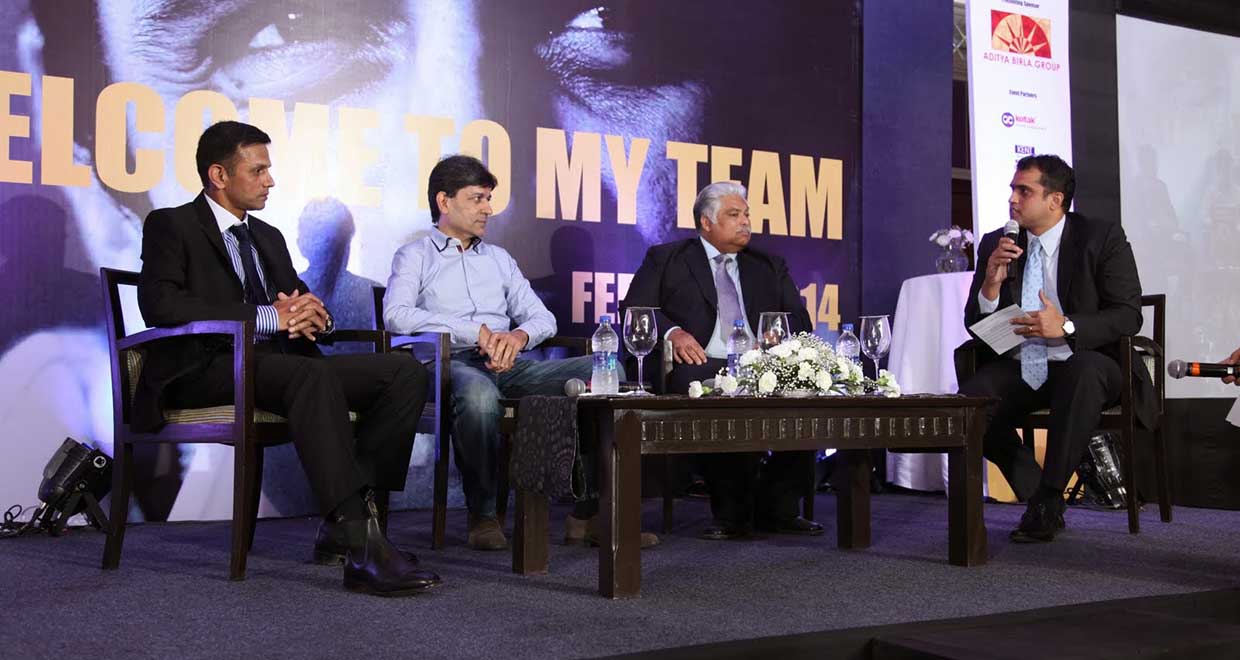
    Rahul Dravid on extreme left and Nandan Kamath on extreme right.
    Rahul Dravid on extreme left and Nandan Kamath on extreme right.

    Who form your clientele? Could you please share with us any representation you are particularly proud of having worked on?

    Our sports practice advises a wide range of governing bodies, franchises, players and sports brands.  Cricket and football have been the primary disciplines but we are now seeing more in tennis, badminton and golf, and the new professional leagues are also mushrooming. Other areas of our special focus have been advertising and marketing laws, e-commerce, privacy, food and beverages law, and medical law. I am particularly proud of our team for being empanelled by the ICC as the official law firm for the Cricket World Cup hosted in India, Sri Lanka and Bangladesh in 2011. It was a great honour and privilege, and watching India win the finals was the icing on the cake!


    Do you think playing sports has helped you as a lawyer?

    I have always believed that playing serious sport is excellent preparation for professional life. With the benefit of many years of experience now, I think this is even more so for the law.  Competitive sport provides early exposure to the adversarial process.  It also requires one to make real-time decisions based on dynamic, unstructured data –which is only possible to do competently if you have prepared thoroughly, and practised hard.  All this is not too different from law practice! Also, sport teaches you that although it is primarily your own individual pursuit, you are almost always playing in a context – representing someone or something else (a team, institution or even a country). Similarly, it is a client and/or a cause that makes one an advocate, and that is always good perspective to carry. Finally, you learn from sport that you are only as good as your last innings, but I’m going to ignore that for now because my last one was a duck.


    Many of our readers would be interested in having a career in sports law and representing celebrity sport stars. What would be your advice to them?

    If it is truly a substantive area that you are interested in, it is a field worth investing time and energy into.  The glory and glamour fade away quite quickly, so it is important to have the right motivations – that will help you stick it out through the early days and mature and stay passionate about and interested in the work.  Other than that, the best advice I got as a young lawyer was to become a good lawyer first before attempting to add any prefixes (such as ‘sports’ lawyer), and to focus first on learning the tools of the profession – in transactional law, that includes things like client communication, drafting, time management, multi-tasking,organisation, attention to detail, and finding one’s own methods and practices.  If you have built a strong practice toolkit, adding new substantive areas to the repertoire is actually not that difficult.  Sports law is not rocket science and it is an interest that can be pursued at any point by a skilled lawyer.


    What do you look for when you hire lawyers to work with you?

    We look for self-motivated young lawyers who have also demonstrated their interest in our practice areas.  Our firm has graduates from NLSIU, NALSAR, Symbiosis, ILS, GNLU and NUJS, so it is quite a diverse set.  A few have come through our internship process, which is a good outcome for all concerned.  I am very proud of the lawyers in our firm, and have enjoyed seeing them grow steadily as professionals.  From what I see, today’s young law graduates are better trained and prepared than I was when I finished law school.


    Do you provide for internship opportunities? Where should a law student apply if he/she wants exposure in sports law?

    Yes, we do have an internship programme.  We accept only one or two interns at a time to make the experience meaningful, so spots are limited.  It is a chance to give law students exposure to the types of work we do, and our work environment. There is an online form (http://www.lawnk.com/home/) that interested applicants can complete for more information on the process.


    It is a dream to work in the subject we love for most of us. What do you have to say to those who didn’t end up doing what they love the most?

    As one steadily moves up Maslow’s hierarchy of needs (I told you that NLSIU left a lasting impact!), beyond security and the need for external recognition and validation, I feel that the journey ends up becoming about two things – the pursuit of mastery and the pursuit of engagement.  Mastery brings the joy of excellence; engagement brings the joy of working on things one cares about.  It is only the lucky few whose pursuit of both mastery and engagement unify in their daily work, or even converge on a regular basis for that matter. I feel the rest of us must remain open to tapping different and diverse outlets and sources if we are to simultaneously experience both of these pursuits.  For whatever reason, not everyone might get engagement with things one loves at the workplace. But it is still possible to find an outlet for this, maybe through hobbies, volunteer work or even by innovating within the limitations of the workplace.  Life is too short and you are already very fortunate if you know what you truly love!


    What would be your parting message for our readers?

    Have a clear career plan in mind, but leave enough room for chance to play its part. Also, stay open to being inspired.

  • Chinmay Bhosale, Advocate, Bombay High Court, on working with reputed Senior Advocates, Criminal Law practice and choosing litigation

    Chinmay Bhosale, Advocate, Bombay High Court, on working with reputed Senior Advocates, Criminal Law practice and choosing litigation

    Chinmay Bhosale is a graduate from ILS, Pune 2010 batch. He has been a consistent topper of his batch at University of Pune, he had also been selected in the final list of Rhodes Scholarship 2010.

    It has been five years since he joined the Bar and he has worked on high profile cases with intense legal issues like the 2G case, Hawala Scam Case, Maval Police Firing Enquiry Commission, Adarsh Commission, etc. Currently, he is pursuing his Ph.D and the topic for his thesis is ‘Malicious Prosecution’.

    Chinmay talks about :

    • His experience interning under Ashok Mundargi, Senior Counsel and Adv. Shreekant Kanetkar, Ex-Chairman, Bar Council of Maharashtra and Goa.
    • Choosing to litigate as against pursuing post graduate studies.
    • Criminal law practice in India.
    • Working on high profile cases.


    Given that most of our readers belong to legal fraternity, how would you introduce yourself to them?

    Chinmay Bhosale, to be brief J. A confident lawyer with an eidetic memory, who eventually wants to contribute to the legal profession, education and jurisprudence in my own maverick way.


    Legal studies are still only a backup option for quite a lot of students. What motivated you to choose law as a career?

    Choosing law as a career came very naturally to me. I come from a family which has acclaimed legal luminaries who have achieved success in varied fields and capacities; be that of a Senior Advocate, Chief Justice, Vice Chancellor or even a Law Minister. So, I have always felt very humbled by my surname and have had a natural awe towards law.


    What were your areas of interest during your graduation? How did you go about developing expertise and knowledge in these areas?

    I had fleeting interest in International Law at once, which led me to pursue and win a National Moot Court relating to the subject. However, my major and “only true love” has been criminal law. Apart from having immense interest in subjects like IPC, Cr.P.C. and Evidence Act, as a student I even tried to cover peripheral sub-areas like human rights, medical jurisprudence and forensic science by way of diploma courses. Also, three out of five years of my law school life I interned with Senior Advocate Ashok Mundargi, one of the giants of the criminal bar at Bombay. The internship gave me great insights into the ‘practicality’ of criminal law and the profession.


    Tell us about your law school journey from the 1st year till your final year at ILS Law College, Pune.

    My 5 year journey at ILS Law College, Pune was quite eventful. I had my share of highs and lows. I entered as an low-on-confidence novice, and emerged as a confident and ‘borderline arrogant’(as some would say J ) advocate. In this transition I tried to do a bit of everything from topping the University thrice in my five years, winning a national moot court, being the Student Representative of my batch for three years, being a part of the Student Council of ILS Law College, Pune, completing four diplomas, interning with Senior Advocates and even being amongst the final 15 students for Rhodes Scholarship, India. However, the most humbling and learning experiences were my failures, which were quite a few J


    Tell us, what kind of work did you do in your internships with Senior Counsels?

    (During his law school Chinmay has interned under Adv. Ashok Mundargi, Senior Counsel and Adv. Shreekant Kanetkar, Ex-Chairman, Bar Council of Maharashtra and Goa.)

    I was almost like a permanent intern with Senior Adv. Ashok Mundargi, as every vacation I used to be working in his chamber. Most of my time at his chamber was spent observing his arguments and interactions at client conferences; and partly trying to contribute to his arguments. My experience with Adv. Shreekant Kanetkar was quite enlightening, more because I understood that I had little or no liking towards civil laws. However, at his chamber I learnt the art of productive and crisp research, as most of my time was spent trying to learn the concepts of civil law.


    What is your advice to budding mooters?

    (Chinmay has participated in various National and Intra-College Moot Court Competitions and he was a part of the winning team of the Technology Law Moot Court Competition, IIT Kharagpur (Rajiv Gandhi School of Intellectual Property Rights), 2008.)

    Well, I never was a great mooter, so it wouldn’t be appropriate for me to give any advice on that. However, I would definitely like to say to all the budding mooters out there that please do not consider moots as the whole and sole of your life at law school. Moot courts are bereft of reality, and there is a lot more to your life at law school than mooting.


    How important do you think are co-curricular activities in shaping the legal career of a law student?

    I think co-curricular activities play a major role in shaping the legal career of any student, especially of those who wish to be a part of the action in the Courts. Quite often, it’s the persona of the Lawyer which stands out than his knowledge of law. Co-curricular activities play a major part in honing that persona. For me, I was an avid trekker, a national level sportsman and had varied interests like playing tabla, learning graphology etc. All these activities have definitely helped me in succeeding at the bar.


    chinmay-s-bhosale-1

    How was your first year after graduation?

    It was quite an internal struggle. As a law student I had an inkling towards pursing my post graduate studies from U.K. and I had admission letters from majority of the elite universities like London School of Economics, University College of London etc. However, I chose to enter the Bar straight away, as that is what I always wanted to do. So I started out in Mumbai, a city which has taught me a lot. I continued as a junior advocate at the chamber of Adv. Ashok Mundargi, where I had already interned for three years. Thereafter, I joined the chamber of Adv. Satish L. Maneshinde.


    What comprised your work at the chambers of Adv. Ashok Mundargi and Adv. Satish L. Maneshinde?

    Working as a junior advocate at the chamber of Adv. Ashok Mundargi came as a natural continuation, as I had worked previously with him. However, at some point I felt the need to learn the nuances of criminal trials. Adv. Satish L. Maneshinde is the biggest personality in Bombay when it comes to criminal trials. I always had a desire to work with him. It was at his chamber that I learnt that a legendary advocate is also a legendary persona. My experience with both of them was quite antithetical, however equally enriching.


    Please give us some highlights of the high profile cases you worked on for the benefit of our readers.

    (Chinmay has worked on high profile cases with intense legal issues like 2G case, Hawala Scam Case, Maval Police Firing Enquiry Commission, Adarsh Commission, etc.)

    I have been very fortunate to have had the pleasure of working with three Senior Advocates viz. Adv. Ashok Mundargi, Adv. Satish L. Maneshinde and my father Adv.Dr. Sureshchandra Bhosale. I got to work on endless high profile and intense cases. In cases like 2G scam and Adarsh Commission I played an assisting role, gaining a world of knowledge. On the other hand, in cases like Maval Police Firing Commission I had a very active role in recording of evidence of numerous witnesses and arguing the matter, where I defended the Maharashtra Police successfully. Apart from the love of law, one also needs to have a healthy affection towards tireless reading in order to succeed in such intense cases.


    You have started your criminal litigation practice. What influenced your decision to start criminal practice after graduation? Why not civil litigation or corporate law practice?

    As I have stated earlier, I have always had a great liking towards criminal law. It is, as they say, in my blood. My father is one of the topmost and famed criminal lawyers of Maharashtra, and that worked as a catalyst for my decision. Also, having interned with a Senior on the civil side had given me a clear idea that I did not have any inkling towards civil or corporate law.


    Please tell us about your experience with regard to your first few years in Court. Has it become more difficult for a fresher to achieve success?

    Your first few years at the bar are majorly spent observing the proceedings, and it wasn’t very different for me either. Almost all the freshers undermine the necessity of this period, and pretend to be observing. However, this is the period which will define the trajectory of the life at the bar. As rewarding and fulfilling your life can be at the bar once you are successful and a known figure, it can be equally tiring and frustrating in the earlier stage. I would advice all the freshers to patiently outlive this difficult phase, without compromising the “observing”.


    Your main area of practice consists of criminal litigation. Please elaborate on the cases you normally deal with.

    My 75% work consists of criminal litigation, rest 25% is criminal consultation what they call “white collar crimes”. Thanks to the repute of my chamber, I have the good fortune of dealing with intense criminal cases day in day out in the Courts. They range from cases of murder, attempt to murder, marital cruelty, cheating and forgery, cases under the TADA, MCOCA, Anti- Corruption etc. Apart from that, there is a heavy inflow of corporate or white collar crime cases which are majorly economic in nature.


    chinmay-s-bhosale-3

    You are also pursuing Ph.D. Your Ph.D. thesis is on ‘’Malicious Prosecution’’. Why did you choose this particular topic in particular?

    Even though there is a plethora of cases that I myself defend every day, the truth is that accusations in 90% of the cases are baseless. In my 5 years at the Bar I had to face a conviction only once as a defence counsel; and that led me to choose my Ph.D. thesis topic. In India criminal prosecutions are handled very irresponsibly, as making allegations is free in our country. At the end of the trial, the accused is only handed over a judgment of acquittal. However, the loss of reputation, business, peace of mind, time, etc. are never accounted for. It is my endeavour to make extensive study of the concept of “Malicious Prosecution” and put forth suggestions for effectively preventing the same in India.


    Indian criminal law is, to a large extent, influenced by its British counterpart. Do you think if Indians would have framed our Penal Code, it would have been better?

    It is not largely influenced, it is entirely prepared and influenced by the British. However, it would be very harsh to say that Indians would have done a better job. I feel the law commissions of 1833 and 1853 have done an exceptional job, which eventually materialised into the Indian Penal Code. Since 1860, it has required far lesser amendments than what our very own Constitution of India has needed since 1950.


    If you were asked to suggest some changes to the present Indian Criminal law, what would they be?

    It would definitely be adding a chapter relating to ‘Malicious Prosecution’ in order to curb the vexatious litigations. Also, to have an effective change in the lives of common people, the fine component of all the crimes should be substantially hiked in order to have a deterrent effect as was intended.


    Tell us about a case that you are particularly proud of. What steps do you take to prepare for a difficult case?

    I am proud of all the cases that I have handled, as I would like to believe that I put in equal amount of hardwork in each and every one of it. In order to succeed at the criminal bar, it is absolutely essential to know each and every nuance of the criminal law, majority of which is now defined by plethora of judgments. Minutest of the aspects can lead to an acquittal or conviction. Hence, I start my preparation the other way round. After reading the chargesheet, I first get well versed with the possible intricacies of criminal law involved and the settled case laws on every such point. Thereafter, accordingly I prepare for my cross examinations. If you successfully follow this approach, arguments remain as a mere formality.


    How is your experience so far? What is your workday like? Are there new challenges every day or did work fall into a predictable pattern?

    It has been a fulfilling journey so far. Eventually, how is your experience at the bar, is totally dependent on your mindset. Even our planet has to go through various seasons, it’s not too different for the lawyers J .


    Beside your professional achievement, you are also active in many other activities. Please tell us about them.

    (Chinmay has been a national level player of Netball and state level player of Basketball. Chinmay is also trained in Graphology (Hand writing analysis) by world renowned graphology expert Mr. Milind Rajore and a certified student of his institute.)

    I always had a penchant for sports, and was very good at it too. This led me to participate at a competitive level both at State and National Level. As far as Graphology is concerned, I am a very curious person. So it was simply out of the curiosity to know more about hand writing analysis that I started learning it from a renowned graphologist. It did help me in quite a few cases involving forgery too.


    You are also engaged in social service activities. Could you enlighten us, in brief, about your role.

    I was briefly involved with MAD(Make a Difference) Organisation wherein I taught English to under privileged and slum children. Also, I am associated with an organisation named CFC (Contribute for Change) where we economically aid people for varied things like medical treatments, education, sanitation, tree plantations etc. I strictly believe that I should be living my life in a way that I can reach a vantage point, from where I could bring about some change in lives of as many people as possible.


    What do you look for in the profiles of the people you collaborate with?

    Confidence is utmost important for me, as the members of my team have to interact in the Court on a daily level. Moreover, the thirst for knowledge should be apparent alongwith the confidence. Either of the two, single handedly, are not of much use.


    What would be your parting message to law students who want to litigate just after graduation?

    Well, choose litigation only if you have tonnes of patience and an unshakeable will power. However, for one who possess both these qualities, life at the Bar will be very rewarding.


  • Mansi Sood, Rhodes Scholar, on application, SoP and LL.M from Oxford

    Mansi Sood, Rhodes Scholar, on application, SoP and LL.M from Oxford

    Extremely capable and skilful, Mansi Sood from NLSIU Bangalore is a student from the batch of 2015. She has been recently awarded the Rhodes scholarship for pursuing higher studies at Oxford University. Interestingly, it has been offered only to a few students in India, Mansi being one of them. This is an interview about her success, outstanding academic records and highly polished CV. She has also provided insights on the application process for Rhodes for the benefit of readers. Needless to say, her accomplishment in the field is incredible, and she goes on to tell us  about her drive and future plans. There is evidently so much to learn from her.

    In this interview she talks about:

    • Rhodes Scholarship
    • Law school experience at NLSIU, Bangalore
    • Mooting and Internships


    How would you like to introduce yourself to our readers? Tell us a bit about your background and school life.

    Well, I was born and brought up in Delhi and did my entire schooling at D.P.S. R.K. Puram. I was always involved in a wide range of co-curricular and extra-curricular activities but my passion has been dance. I started learning Kathak from my guru, Smt. Vaswati Misra at the age of 5 and learnt for 13 years till I went to college in Bangalore.


    mansi-sood-3

    What was the driving force behind taking up a career in law?

    My parents have always encouraged me to follow my heart and do what gives me joy. One of my cousins went to law school and I used to hear a lot about it from her. So somewhere along the way, her stories inspired me and it seemed like I would enjoy the law. The law is very logical and structured and it’s also a great equalising force. Both of these things appealed to me and I decided to take the chance. I’m just glad it worked out!


    How has been your law school experience at NLSIU, Bangalore? What are the best memories of your student life there?

    It’s very difficult to compress almost 5 years into one answer! But frankly, NLS, Bangalore has been a wonderful, wonderful experience. There’s so much to learn, so many opportunities and so many people to inspire you, it’s quite amazing. It is hard work but it’s definitely worth it. The memories I’m taking from here will last me a lifetime, I think.


    How do you give credits to your institution for being awarded the scholarship?

    I think the institution, its people and most importantly, its environment, have had a huge role to play in shaping me as a person. Whether it’s professors, friends or peers, they are always so encouraging. And the diversity of interaction makes you broaden your perspectives a great deal. So yes, I would definitely like to thank my institution and all the people associated with it for their support.


    mansi-sood-1

    You were adjudged the third best advocate at the South India Rounds of 55th Jessup and there are winning titles for your team in many other moots. You also have many publications to your name. How did you manage and what kind of skills did you acquire?

    I have been involved in a variety of co-curricular activities but as you mentioned, mooting has been the one most dear to me. When I think what all of these activities have taught me, especially mooting, is that there are always two sides to every coin, multiple ways to look at anything. And I think that’s a very important skill for a lawyer. Other than that, they also obviously sharpened my research, legal writing and advocacy skills.


    What was your first reaction on learning that you are being awarded the Rhodes scholarship? How was the application process?

    My first reaction was a mixture of joy and relief. I couldn’t believe it for a while, in fact there are still moments of doubt! But to be honest, it’s a great honour and I’m very grateful to have been given the scholarship.

    The application process involves two stages – the written application and the interviews. Once you submit your written application, there is a preliminary interview and then a final one. At each stage, the pool keeps getting smaller.

    I wasn’t always sure that I wanted to study further but once that decision got made, Oxford was the dream.


    mansi-sood-2

    How did you go about writing your CV and most importantly, your personal statement/essay/ SOP?

    Writing the CV isn’t tough, you just have to write two pages about the things you have already done. It’s the SoP that takes effort because you have to express your dreams in words and make it sound convincing at the same time. It involves a lot of thinking and introspection, more than anything else. Once you’re clear about your goals, it’s just a matter of putting it down on paper.


    Do you need to have recommendations as well? What kind of profile is needed while applying for the scholarship?

    Yes, the Rhodes scholarship requires 6 recommendations – 3 academic and 3 personal. There isn’t a fixed profile that you need or a checklist that you need to have completed but broadly, they look for a well-rounded personality who has been able to demonstrate more than just an interest in the field he/she wants to pursue.


    Was there any interview round? If yes, how were you prepared to face the panellists? What kind of questions did they ask?

    Yes, there are two interview rounds. The first one is more ‘technical’, in the sense that it’s usually taken by people from your field who are interested in having a discussion. The final interview is more about you – who you are, what you want to do etc. I was a little nervous both times, more so the second time not just because there were a lot of luminaries on the panel but also because it was my final shot at the scholarship; but both the interviews were a lot of fun and I thoroughly enjoyed myself. They asked a variety of questions, ranging from India’s labour laws to my dance to Kashmir.


    What kind of internships have you done? Did you ever plan out your internships?

    I have mostly done litigation internships, aside from the Summer Vacation Scheme at Herbert Smith Freehills. I did plan my internships to a certain extent, but that was mostly in line with what the college prescribes. We have institutional support in the form of an Internship Cell that helps out with contact details etc. But more importantly, seniors and alumni have always been a huge support.


    You are keenly interested in research as well. Tell us about it.

    I think research and policy work is an important aspect of legal work in general because often, the changes that we seek to bring about in our laws, come about through that route. I have been involved in research on a variety of subjects, from arbitration to constitutional issues.


    What are your plans after your post-graduation? What kind of career do you envisage after graduating from Oxford?

    My interest lies in commercial law, with a primary focus on arbitration and intellectual property laws and that’s what I want to pursue. I haven’t thought about exactly what I want to do but it would be a mix of practice and academia/policy work.


    What would be your advice to our young readers who would like to apply for Rhodes scholarship in future? What does it take to have a brilliant CV?

    I am not sure I’m qualified enough to give advice but I’ll say this – Just be honest. Of course, there is work involved in the whole process but the most important thing is to be yourself and talk about the things that matter to you the most. The rest will fall into place.