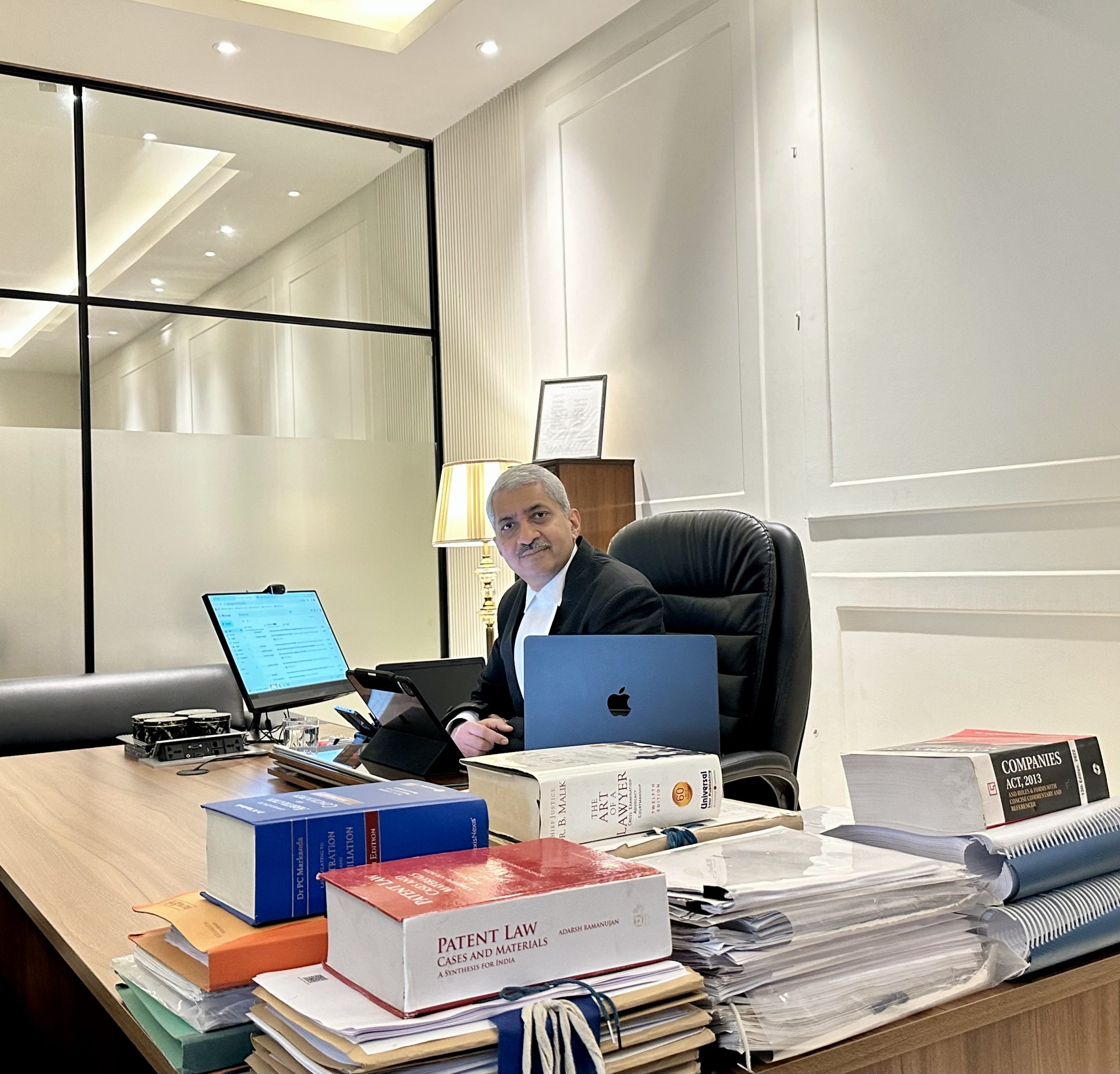
Tag: Senior Advocate at Supreme Court of India

  • “The profession of law was love at first sight, and the bond between me and the legal profession has only grown stronger over time. There has been no looking back, not even a moment of doubt. I have thoroughly enjoyed it.” – K G Raghavan, Senior Advocate at High Court of Karnataka.

    “The profession of law was love at first sight, and the bond between me and the legal profession has only grown stronger over time. There has been no looking back, not even a moment of doubt. I have thoroughly enjoyed it.” – K G Raghavan, Senior Advocate at High Court of Karnataka.

    This interview has been published by Namrata Singh and The SuperLawyer Team

    Coming from a family with a strong legal background , did you ever consider pursuing a career outside of law?  How did you eventually decide to follow in our family’s footsteps, and what challenges did you face in your initial days as a lawyer?

    I believe each person must carve out a profession for themselves based on their capabilities and interests. However, it is a reality of life that, when making a career decision, individuals are consciously or unconsciously influenced by the career choices their parents have pursued. I was no exception. My father was a leading and well-known lawyer during his time. I saw him put in long hours of hard work and be sought after by many. But what influenced me significantly in my career decision-making was the great respect and influence he commanded across a cross-section of society. I believed this was because of his position as a lawyer. In later years of my practice, I realized this was true. My father conveyed through his career that the legal profession was unique in various ways. It was intellectually elevating and honorable in its practice; lawyers were highly respected and commanded a following. I closely watched my father’s analytical skills, which he applied to matters of public importance, domestic issues, philosophical and religious thoughts, and more. I admired his approach to men and matters, which I attributed to his being a lawyer. My father did not actively promote the idea that I should pursue the legal profession; it was my decision, which he supported. Considering my father’s quality of life, I must frankly admit that I did not even consider a profession outside of law. The profession of law was love at first sight, and the bond between me and the legal profession has only grown stronger over time. There has been no looking back, not even a moment of doubt. I have thoroughly enjoyed it.

    Being a lawyer’s (later a High Court Judge’s) son had both benefits and challenges. The benefit I derived at the operational level was not very significant because there was a large gap between the time my father stopped practicing and when I started. Nonetheless, the benefits were obvious—infrastructure and the reputation of being so-and-so’s son. However, the challenges were quite intimidating. First, every action of mine and every expectation from me would be compared to my father’s. Any slight deviation would be met with skepticism. Second, I faced the overwhelming challenge of proving myself worthy of being my father’s son. I realized fairly early in my career that no one can ride on the reputation of another, no matter who the other may be; you have to prove your worth. Clients will not stay unless they develop confidence in you. A father’s reputation can take one up to a point and no further. In this profession, everyone has to carve out a niche for themselves.

    How did your father’s career as a judge influence your approach to law and justice?

    As a judge, I have noticed my father being equally concerned with the problems of a small person and a matter involving high stakes. He would tell me how, in reality, that small person had more at stake in the litigation than the so-called big one. For the former, it was a case of livelihood, while for the latter, it was generally not. Sympathy for the less fortunate was his guiding factor. This has had a significant impact on my approach to my career. This perspective has always remained in the background, even while being deeply involved in commercial law practice.

    For example, as a legal advisor for a large public sector corporation, I would receive numerous files for opinions regarding the title for granting house loans to Class IV employees. If I had strictly applied all the rules of title due diligence, none would have qualified for the loan. That would have shattered the dreams of these families to buy or construct a small home. My heart did not permit that approach. I relaxed the rules and cleared the titles on a “by and large basis.” This approach was largely influenced by my father, balancing law and humaneness. I am thankful for that.  

    During your tenure as partner at Dua Associates, you managed a large team and handled litigation practice nationwide.  What were the key lessons you learned from that period which you still apply today, and what led to your decision to leave the firm and become Senior Advocate?  What were the main factors that influenced this career move?

    During my tenure as a partner at Dua Associates, I interacted with numerous lawyers across the country and beyond. I also dealt with several in-house counsels of multinational corporations. This experience broadened my horizons. I realized that everyone has their unique way of approaching and solving problems, and no one was 100% right or wrong. Incorporating thoughts from all quarters, from senior to junior, enabled us to find the best possible solution to a problem. This was especially true because the lawyers came from different backgrounds and jurisdictions. Some adopted a legalistic approach, others a commercial approach, and a few a practical approach. Each one had their domain expertise. This opened my eyes to the fact that team effort is always more beneficial than when a problem is handled by a single lawyer. No one can have knowledge in all branches of law, and invariably, legal issues have different angles. This exposure humbled me to realize that no one can claim to be superior to another, and each has their role to play, which is as important as the others. This experience has stood me in good stead even today as a Senior Advocate, as I have continued to respect the approach and views of lawyers and in-house legal counsels.

    Counsel practice is an art in itself. I realized that my strength lies in that field. I wanted to spend more time sharpening my skills rather than spending time in the actual preparation of briefs through direct client interaction. This is what influenced me to change the course of my practice, even though I have always enjoyed client interaction and strategizing. My stint at Dua Associates has been the most enjoyable phase of my career. Designation as a Senior Advocate during my time was by invitation and not by application as it is today. Generally, when one is invited to take the silk, it is considered an honor and recognition and therefore not refused. Once conferred with the designation, in my view, continuing as a partner of a law firm was not an option.

    Since being designated as a Senior Advocate in 2008, how has your approach to handling cases evolved? What are the unique challenges and responsibilities that come with this title?

    The first challenge of being a Senior Advocate is to sift the grain from the chaff. That is what I have consistently applied in my role as a Senior Advocate. The briefing counsel will, of course, tell me all the facts and issues involved in the case as they should. It is up to me to pick the best points and highlight them to the court. The second challenge is the manner of presenting a point. It is essential to present it in the most persuasive manner. This requires quiet and deep deliberation even before entering the courtroom. I have rehearsed the opening sentence of a case in my mind several times before uttering it in court. If you engage the judge in your case within the first few minutes, a large part of the case is won.

    Duty towards the court and the client is common for all advocates, whether designated or not. The unique challenge and responsibility of a Senior Advocate is towards the briefing counsel. It may be that the briefing counsel is not yet experienced or is lacking in preparation. I would not highlight this in a conference where the client is present, as it would damage the interests of the instructing counsel and/or demotivate them. The art is to gently suggest a corrective course without injuring anyone’s interests. In many instances where I found a fundamental error in the approach or advice of the counsel on record, I have separately called the lawyer and pointed out the error, suggesting corrective action. I believe this to be the duty of a Senior Advocate towards the briefing counsel, in addition to the duty and responsibility towards the court.

    As the Chairman of the Bhavan’s BBMP school, you are deeply involved in educational initiatives for underprivileged children.   Can you tell us more about this role and its impact on the community?

    Our school has over 850 children, most of whom come from the neighboring slum areas. Facilities like electricity, water, and internet connection, which we tend to take for granted, are a luxury for them. The parents come from economically and socially disadvantaged sections of the community. A school-age child is considered another working hand and a potential earning member. In this atmosphere, it was initially a challenge when the school was started to promote the concept of education among that community. After 15 years, we have come a long way. Today, the parents and children are very enthusiastic about the school. Promptly at 8 am, the children arrive at the school, neatly dressed in their uniforms and well-groomed. Seeing these enthusiastic children at school, who might otherwise have been directionless, is a divine experience. The school is an English-medium institution with a CBSE curriculum. The school and the children always remind me that if given the opportunity, children will grow up to be responsible and civil citizens. The biggest mistake and crime is in not providing opportunity, and this thought has always haunted me. In fact, before our school was established, the area was noted for its high crime rate. Now, the police authorities tell us that the crime rate has significantly decreased because the children are the best change-makers.

    You regularly contribute to Deccan Herald and other publications on legal and philosophical topics. How do you find time for writing, and what motivates you to share your insights through these platforms?

    If one has the interest in doing something, finding time is the least of the impediments. What motivates someone to do something is a genuine interest in that activity. That is the simple answer to the question: how do you find time to write? The sheer desire to write and engage with a reader of average intelligence is what truly motivates me. My target is not the learned or the wise but those who have the interest but don’t know how or where to begin. My desire is to kindle their interest in both the subject and the art of communication. In other words, to provide food for thought.

    Looking ahead, what are the areas of law that you believe will be most critical in the coming years, and how should the legal profession prepare for these changes? What advice would you give to the young law students and budding lawyers who aspire to make a successful career in law? What skills and qualities should they focus on developing?

    Roscoe Pound famously said, “Law is social engineering.” This has always been true, and it is even more relevant today and in the future as times change. The aspirations of people and social norms are evolving rapidly. Gender equality, same-sex marriages, live-in relationships, LGBTQ rights, privacy obligations, and other issues now occupy center stage in public debate. Notions of morality that were once accepted and taken for granted are changing, and the law must keep pace with these changes.

    In my view, these issues will be critical in the coming years, and lawyers and law students must think outside the box to find legal solutions to complex social problems. Additionally, the changing demands of growing technology and transborder relationships—whether personal, business, or professional—must be addressed. The world is becoming increasingly interconnected, and relationships are becoming more seamless. Lawyers and legal researchers can facilitate this change and make the world a better and more peaceful place.

    Focusing on these and other emerging branches of law will enable a budding lawyer to succeed in their career. To achieve this, one must develop a thirst for knowledge from all over the world. A successful lawyer should excel not only in the legal field but also cultivate an interest in subjects unrelated to law. It is essential to remember that one is a human being first and a lawyer second. Developing the quality of being a good human being is fundamental.

    Furthermore, a lawyer should develop effective communication skills. Learning languages without any mental blocks is crucial, with English being a must. Knowledge and communication skills should go hand in hand with analytical skills. Analytical skill is an art that one can develop only through conscious practice. This can happen if you commit to understanding an issue fully before proceeding further. Finding a solution is the next step.

    With the rapid advancement of technology, how do you see the role of technology influencing the practice of law? Are there any particular tools or technologies that you find indispensable in your work?

    Technology today has permeated all aspects of our lives and activities, and the practice of law is no exception. In fact, the practice of law should embrace technology more and more so that we lawyers become more efficient in providing services to our clients and assist the court in dispensing quicker justice. I have personally benefited from technology. I am able to present arguments in court without physical papers as I have fully adapted to technological tools like Liquid Text. I find myself faster and more efficient in locating a particular document or fact in a large brief using this technology. The adage “Change or Perish” is truer today than ever before. However, a warning: Technology should supplement our intelligence, not supplant it. Innate intelligence, not artificial intelligence, is the core strength of a lawyer.

    Over 45 years of practice, you have represented numerous high profile clients.  Can you share a particularly memorable case that had a significant impact on you personally or professionally?

    “It is difficult to pinpoint a particular case among the many I have handled in my career. I am who I am today, both as a human being and as a lawyer, because of the amalgamation of lessons learned from various cases. It has been a profound study of human traits and behavior. No case is too big or too small; each has its own lessons and morals to impart, aiding in personal evolution. This defines my approach and personality.”

    With such a demanding career, how do you unwind and relax after a long day in court?  Do you have any hobbies or routines that help you maintain a work life balance?

    The legal profession is a demanding endeavor. Therefore, one must be vigilant not to become so absorbed as to lose the joys of life. I am fortunate to have largely mastered the skill of drawing boundaries, although my family might disagree. Early in one’s career, one should enjoy what they do; as one progresses, they should do what they love. This is a nuanced art, and I am fortunate to have made significant strides in that direction. Whether one likes or loves their work, nothing becomes a source of stress. This is the key to unlocking relaxation and alleviating stress. Writing, reading, religious, and social activities are my ways of unwinding. I particularly enjoy traveling and sightseeing. As I mentioned before, when you are passionate, time never feels like a constraint. 

    neigneighbour

    Get in touch with K G Raghavan –
  • “I always request everyone in my family, as well as in my office, to learn to say no. The moment you learn to say no, ethical problems and other issues will never come your way.” – Ashok Kumar Singh, Senior Advocate, Supreme Court of India

    “I always request everyone in my family, as well as in my office, to learn to say no. The moment you learn to say no, ethical problems and other issues will never come your way.” – Ashok Kumar Singh, Senior Advocate, Supreme Court of India

    This interview has been published by Namrata Singh and The SuperLawyer Team

    Hello and welcome, today we have with us the esteemed Ashok Kumar Singh sir, who is a senior advocate. And we would like to start the interview by asking the most important and most pertinent question Sir, what inspired you to pursue law and how has been your journey from the beginning till the time when you are doing arbitration and dispute resolution with so much ease?

    My father was a government servant. I have seen bad days in my life. He was a small, hardworking government servant and an honest man. To survive with honesty at that time, when I studied professionally back in 1977 and 1978, was a difficult job. So, I thought of not joining any service and doing something different. Business was not an option because I had no money. Ultimately, I decided to adopt a profession that required little or no money. I thought of joining law and, in 1975, I joined the law faculty at Delhi University. I graduated in 1978.

    Before I graduated in 1978, I started going to the courts. At that time, there was no concept of internships. My senior would take me to court, and it was usually assumed that I was a new clerk. Sometimes, it was very humiliating and insulting when someone asked if I was a new clerk, and I couldn’t say yes or no. I started the profession because I wanted to do something different and had no money to invest in a business.

    Why did I come into arbitration and dispute resolution? Initially, I started as a criminal lawyer. To this day, I love doing criminal work; it is in my blood. In 1986 or 1987, a gentleman who was an additional general manager in the Delhi Transport Corporation gave me a challenge in arbitration. It was against NPCC, and his CMD told me, “Mr. Singh, even if you get it compromised at 20 lakh rupees, I will be the happiest person.” Twenty lakh rupees in 1985-1987 was a big amount. By the grace of God, it was the first case in my life, and I did it.

    A NIL award was passed, but no award was granted to NPCC. This brought a major change in my life. I realized that besides criminal clients, dealing with civilized, highly-placed clients allowed you to invite them to your place, your office, or chit-chat with them.

    You can have a cup of coffee, but with a criminal client, you can’t have all this liberty. Secondly, I realized that good money was transferred to me even at that time. I charged per hour and per hearing. I was the only counsel in Delhi Transport Corporation who was paid this much.

    Thereafter, some other government departments tried me. I worked in Delhi, outside Delhi, and gave good results in arbitration as well. People started liking me for arbitration work too. It was a matter of chance that I started working in arbitration. Slowly, around 2010, somebody from the US approached me. He wanted an Indian counsel to represent them in an international arbitration in different jurisdictions like London, Singapore, Mauritius, the Cayman Islands, and the Isle of Man. I thought he would pay me a certain amount as a fee, but he asked for my fee schedule in hours. He indicated that he didn’t want a petty lawyer, suggesting that I could charge a good amount. This gave a twist to my life. I started working for them as an Indian counsel because Indian laws and properties were involved. They needed someone knowledgeable about civil law, criminal law, and income tax.

    English counsels were very costly for them, so they wanted someone to assist the English counsels. Within six months, they made me the second leading counsel in the matter. In a year, I became the leading counsel, overseeing all litigation in the USA, Singapore, London, Mauritius, and other countries. All the counsels were working under me, and they found that I was much cheaper compared to English counsels who charged heavily.

    The best part, which I must share with you, is that a claim of about 1700-1800 crore rupees was filed against our client. When we entered the case, we reviewed the entire file, made a claim, and issued a notice for the counterclaim. Within a few months, the chairman of the claimant approached us for a compromise. Without contesting the case too much, they gave our client 192 crore rupees in Indian currency. The claimant didn’t get even a single penny. The respondent, whom we were defending, got 192 crore rupees. Obviously, we also received a good fee and gained confidence that we could handle international resolutions and deliver good results to clients globally. This confidence was earned by our hard work. It wasn’t just me; my team also contributed significantly. Other lawyers working with me helped a lot. That was another turning point in my life. I decided to focus more on arbitration rather than criminal cases because in criminal law, people initially look for a laborious, good lawyer.

    I was getting plenty of work. I must say I got plenty of work. I’m not boasting, but I consider myself one of the busiest counsels in District Court and later in High Court on the criminal side. But suddenly, things changed over time. Clients started approaching me with the idea, “Sir, you know such and such person, you know the government counsel.” This was not my cup of tea.

    So I slowly started moving away from that. It was a bit disturbing, and when you say, “No, I don’t know,” or “I don’t believe in this sort of practice,” they wouldn’t want to continue with you. They would go to others. But in arbitration and civil practice, I realized that people appreciated your expertise.

    They appreciated your knowledge, and over time, even till date, I’m getting good work from domestic as well as international clients. I have no problem. This is how I entered into arbitration, all with the grace of God and a little effort—a little effort, a little zeal to work, and a little enthusiasm to work. That is required too.

    Since you picked up such a new field of arbitration and, the field was absolutely new in 1986, as you said. During this course of time, what kind of changes have you seen in commercial dispute resolution as well as the kind of arbitration which we are seeing nowadays? There must be some difference because we suddenly opened up for the world, India, especially in 1991. So you must have seen a lot of change as you had shifted from criminal to arbitration and commercial dispute resolution. We would love to hear that, sir.

    There have been a lot of changes as far as arbitration is concerned. You know, it’s a very difficult question you’ve asked. I know a lot of people would get annoyed with my answer. Now it is dominated by a particular class. India wants to become the hub of arbitration. It is said so. But what I feel is, it is something, a slogan which we have been given, that it should be the hub of arbitration. If it is so, then why are about 36 percent of the arbitrations in Singapore conducted by Indians? Why are about 30 percent of arbitrations in Hong Kong or about 30 to 33 percent in Kuala Lumpur conducted by Indians? Why are they not coming back to India? Why are they not engaging Indian arbitrators? Why are they not relying upon Indian counsels? Why are they not relying upon the system which we have, even though it has improved a lot?

    The system doesn’t carry that much weight. The people who have to somehow work in the system are very important. How the arbitrators are appointed, who they are, how they behave, how much they charge, and whether it is feasible for international clients to engage them are all important. What is their tone and temperament? That is very important because an international client would not like to be dictated to, as we normally are. Secondly, internationally, when we go out to conduct a matter, we know that early in the morning at 9 o’clock, we have to report, or at 9:30, and by 10 o’clock we will start.

    It will continue up to 5 o’clock, and we are paid for that. Hourly basis, arbitrators are also paid hourly. The amount is also very reasonable, 500 pounds or 600 pounds, which is 55,000 or 60,000 rupees in Indian currency per hour. Even the arbitrators charge that much amount. But here it is a little costly affair, as you would appreciate. Normally arbitrators, though Schedule 4 is there for domestic cases, that is something different. But in international arbitration, there is no schedule. Arbitrators are charging fees according to their own choice. Normally charges are 2.50 lakhs per hearing of two hours or more.

    A good amount of time is wasted in looking into diaries to find out the actual dates. Then, two hours sometimes are completed or not completed. It is something, you know, which pinches the international clients. If you ask me, 2.50 lakhs means 1.25 lakhs rupees per hour, which is a little higher in comparison to international market rates. They give you a good amount. It doesn’t mean that they don’t make the payment. Their payment is much more than ours, but they give it in different forms, such as hourly preparation of the case. After preparation, when you prepare for the drafting of the awards, they pay you a good amount. For consultation and meetings in between, they give you a good amount. But hearings always go on in one go, from 10 to 5, 10 to 3, or 10 to 4, whatever the time given. And in a very disciplined manner. That is lacking somewhere here because we don’t have many institutional applications, if you ask me.

    There are only a few institutions here. And those institutions are also somewhere state-wise, somewhere region-wise. So international clients are unable to choose whom they should go to. Whether it’s the Mumbai International Arbitration Center, Delhi International Arbitration Center, Chennai International Arbitration Center, or Chandigarh International Arbitration Center, there’s no certainty.

    So you have to develop a particular city, find a particular city, and then develop it. Like in Singapore, they have a center in Singapore. It doesn’t mean the entire Singapore, it’s a particular place. There are also many other international arbitration centers working there.

    I am also an advisor to them, but you have to develop a particular center. You have to choose this, and that center should be completely free from judicial interference. Completely. It should be in the hands of only independent persons. Alright? Highly placed arbitrators, highly placed persons who have good knowledge in arbitration, only they should run it.

    Then, probably, we can make a difference. Previously, arbitrations were uncommon in this country, so the system was a little different. I still recollect when I would go to any arbitrator, he would welcome us warmly, invite us for a cup of tea, and teach us as if we were his children. Things are changing. Those days are gone. Now, we have become more commercialized. That is the difference I am noticing.

    Secondly, regarding labor, I don’t blame the arbitrators. Nowadays, we are getting 100-page judgments, 200-page judgments. By the time you rely on one judgment, another judgment comes in, contradicting the previous one. Sometimes in a month, we get two or three judgments that are not in line with each other. Nobody is following what was decided earlier.

    This creates a lot of difficulty for the clients. Their position is also very bad. Now the provisions are made very stringent. Normally, it should be in line with international practice, but we have to consider our country’s practice as well. In Section 34, there is no chance to get any relief unless the issue is something different. It’s the same with Section 37.

    I’m not accusing anyone, but the possibility and probability of a few arbitrators out of 100 becoming dishonest cannot be ruled out. Just imagine the plight of those clients and the impression they would carry if they had not been able to prove their case, despite knowing that an injustice has been done to them.

    There should be some judgment for clients facing such great difficulty and injustice. My experience is that most of the arbitrators I work with are very honest and dedicated.

    India is a very big place. We have the maximum number of arbitration cases in the world. Most of them are not institutional. When they are not institutional, arbitrations are happening in small places as well, where even the area in charge or market pradhan conducts arbitration. Those arbitrations are also covered by Section 30.

    I feel that while we are making the laws very stringent, we should also consider those who are losing good cases because of the arbitrator’s decision. The court says it is not sitting in appeal and that whatever is decided is final. This aspect needs to be looked at differently. The changes have both good and bad sides. It is very difficult to explain all these things.

    There are many things you can’t or don’t want to explain openly, but yes, a lot of changes are required. It’s time we make arbitration reach the roots of society. We should include people from society as arbitrators, like lawyers, senior lawyers, engineers, architects, academicians, chartered accountants, and company secretaries.

    Whenever I go to institutions to teach law or other aspects, the question they usually ask is, “Sir, will we be appointed as arbitrators sometime in our life?” I can’t say anything to them because appointments are done by someone who is not under my control. We all know how it should be, but I don’t want to open that discussion again.

    Alongside your legal career, you’re also a Professor at Sanskriti University. How do you balance your roles in academia and legal practice, and what do you enjoy most about teaching?

    When I was in London conducting the matter, I realized that most of the judges worked as part-time lecturers. My son also studied there, and my daughter studied in the US. So, I always got the impression that the judges would come in the late evening, sometimes at 10:30 or 11 o’clock. The message would be floated that they were coming to discuss a legal proposition, and they would come and teach the students.

    During the pandemic, I was in touch with my juniors, and we were discussing various aspects of law: arbitration, the IBC code, and other criminal laws. Online, I shared whatever knowledge I had with them. At this point, one or two universities approached me to speak to their students online. One of the universities made me an honorary professor. I don’t go very regularly to teach, but whenever they require my attendance for a particular subject or practical experience for the students, I love to go and share my experiences.

    I have realized, and I personally feel, that we should help because universities find it difficult to call us since their curriculum is different from what we have in mind. When we go and discuss practical problems, the students find it challenging. They say, “Sir, we have been taught this much, but you are saying it is to be done like this.” Particularly, there are so many problems in life. You know it very well.

    A student who has learned criminal law, when he comes to court, has an idea just like Shatrughna Sinha would come from the back and say, “My Lord, how can you do it?” And the matter would be decided in five minutes. At the time of a bail application, a hearing will take place, or evidence will take place. This sort of idea always remains because they are fascinated by movies and films.

    To make them understand that it is very difficult, I always tell my interns that this is not something to teach you. This is something to teach you only discipline in the office: come on time, sit over there, learn the legal propositions, and leave at the appropriate time. If you don’t learn discipline, you won’t be able to be a good lawyer.

    We can’t make them lawyers in three months, four months, two months, or six months. No, we can’t. We have to just make them understand what the law is so that tomorrow they should not get frustrated and run away from the profession. You won’t believe that 85% of young lawyers who join the profession leave within two to five years. They don’t continue, especially those who are not in corporate but in trial cases. They get frustrated much earlier because what they have in mind is not there.

    Getting clients is a difficult job, getting money from the clients is a very difficult job, and getting relief from the court is the next most difficult job. Unless they get relief, the clients will not come back to them. They won’t get new clients, so they soon get frustrated because they need to settle in life. They come in at the age of 23 or 24, and by 28, 29, or 30, if they are not able to earn even 50,000 rupees per month, they get frustrated. So, besides the legal education we give in universities and colleges, we have to make them aware of the practical aspects as well.

    I thought of doing something different besides what is written in the books, to inform them about the practical aspects of the legal profession. Getting this done is not difficult. I recollect one of my seniors, who greatly influenced me. He is no longer in this world, but he always said, “Vyast woh hain jo ast vyast hain.” If I have to take out the time, I will take out the time. If I don’t have to take out the time, I will not take out the time. I just manage. I don’t take up too much work that I can’t do. It is an injustice to the client, to myself, and to my family.

    Take only as much work as is required. In the initial stage, yes, I did a lot of work. I was working from 7 in the morning to 12 o’clock at night, conducting 20 to 25 cases in a day. Now, I don’t do that much work. I feel that whatever is required for me, God is giving me. I’m happy with that.

    Taking out time is not difficult. You have to manage your schedule. You don’t have to do too much work. You have to give proper time to your family, work, staff, hobbies, and yourself.

    I would like to ask you the next question related to the new entrance to the legal field and all the kind of stress that you were talking about that after five to seven years, usually they get frustrated because they have that filmy thought that this is how trial court will work. What would you suggest to those entrants and such kind of thought process, how to build this inherently that later when they enter the profession, they do not feel frustrated. There must be something because as you said, in your early days, you used to take a 25 cases a day. That’s a huge thing, but you must have managed that in some manner. So if you could impart some thought about that, because that will be very helpful to the new generation as well.

    For the newcomers, we can give much advice, but before giving any advice, it is better that we change ourselves. I’m still finding it very difficult to persuade my friends to give at least some amount to the interns or junior lawyers. If you go to district courts, you will find the position is also very tough for them.

    If we have to ensure that good lawyers join the profession, we have to support them for three years, maybe two, three, four, or even five years. It becomes the duty of every senior who is keeping a junior to cover at least the minimum possible expenses. This support is a great help to them in the initial stage. Even if they are asking for money from their parents, they are happy to receive 20,000, 15,000, 25,000, or 30,000. For a trial lawyer, when you join a law firm, the situation will be different.

    Learning in a law firm is a little slow, which I am not against. I have all respect for them, but it is slow. A person working in the district court, starting from zero, and learning from the beginning becomes a very good lawyer. He knows when the accused will be produced, what to do when the bail application is moved, how the bail bond is to be moved, how charges are to be framed, how sensible suit issues are to be framed, and the meanings of rejoinder, application, and written statement.

    He learns a lot of things in the process. So, before giving a suggestion to newcomers, I request all my colleagues who are well-placed in the system to extend their hands to help newcomers. That will be much better. The moment you do it, many will stay in the profession and prove to be good lawyers.

    The second aspect is that none of the newcomers want to go to the lower courts. Out of 100, you will find hardly 5 or 10 who go to the lower court. Everybody is interested in coming to the High Court or the Supreme Court in their father’s car, enjoying a cup of coffee, some snacks, or smoking with friends, and then going back in the evening with a new white shirt and coat, with a smiling face.

    They don’t appreciate that spending two, three, five, or even ten hours per day at the High Court is not going to help them in any case. The High Court has its own limitations, and the Supreme Court has its own limitations. Basic law is to be learned in the lower courts, which nobody wants to learn.

    They also have to change their temperament. They have to decide what they want to do. People come to me and say, “Sir, we want to work in the High Court only.” That’s fine, but you will get a chance to work in the High Court after working for five years in the lower court. Then you will be in a position to understand the basic concepts of law, the basic concepts of practice, and the basic difficulties of practice.

    So, we should also make them understand that it is better to work for two, three, four, or five years in the lower court, and then come to the High Court or the Supreme Court.

    Ninety percent of those who start in the High Court and Supreme Court, 85 to 90%, leave the profession midway because there is nothing. You can work in a law firm for two, three, four, or five years, but eventually, you have to show your worth. They are not going to pay you throughout your life without you showing your worth.

    You will show your worth when you learn something. The learning process is a difficult job. So, my humble advice to all newcomers is that they should spend some time in a law firm. Learn from the beginning, whether on the criminal side or the civil side. Learn from the beginning what civil law is, what criminal law is, the basics of the civil procedure court, the Limitation Act, the Specific Relief Act, the Stamp Duty Act, and other important provisions of law. On the criminal side, learn the CrPC, IPC, and Evidence Act. They should understand these and then come to the High Court to try their luck. They might be more successful in comparison to what they are today.

    Sir, as you have interacted with so many international and national clients parallelly, kind of ethical complexities, I would say, have you encountered any while representing such clients? And how did you upheld that kind of principle of justice and fairness that we always talk about as lawyers? How has it worked for you? How have you gone through the whole process?

    It depends on the person. Simply put, if I am honest, I am honest. If I’m not, I’m not. If I have to do something, I will do it. If I don’t have to do it, I won’t.

    I always request everyone in my family, as well as in my office, to learn to say no. The moment you learn to say no, ethical problems and other issues will never come your way. If you are concerned about something, just say no. What is the problem with that? That is the best way out. If you don’t say no and continue with something despite difficulties, it becomes problematic.

    It happens, right? Secondly, most people say the profession is degrading. Yes, in some aspects, I do agree, but in my 45 years of practice, I have never been abused for any work. No High Court judge, Supreme Court judge, or minister has ever approached me to manipulate a case. They know me well and are close friends. No member of parliament has ever asked me to ruin a session.

    You have to build up your image. Once your image is good, you won’t face such problems, whether domestic or international. No one has ever dared to approach me to say, “Sir, we have to do it in this fashion.” It’s my prerogative, my decision. You have given the problem to me. I will discuss it with you and suggest solutions. If you are happy, that’s fine. If not, give me a counter solution, and I will examine it. No illegal business, no hanky-panky in my office. If I’m sure of my integrity, I won’t face any difficulties.

    Problems arise when one doesn’t maintain their character. Otherwise, they don’t. At least, I haven’t faced such problems in the last 45 years. Not a single person has approached me inappropriately. I have handled the second largest arbitration case in the country, worth about 15,000 crore rupees. It’s not a small amount. I’ve also handled other cases worth 500, 1,000, and 2,000 crore rupees. I have been a senior legal advisor to many government departments.

    But nobody has ever approached me to do something against my principles. I don’t boast, but even for one of the biggest business houses in the country, when I was a legal advisor for a particular department, a substantial work assignment was based entirely on merit.

    So, it depends on the person. I have not found any difficulty, and I don’t think anyone should if they are a person of character. However, a person of character might face difficulties. People might consider you egotistical or form different opinions about you. They might say you don’t visit their chambers or listen to anyone.

    But in my heart, I’m happy that I have never compromised my principles in my life.

    Sir, that being said, when you mentioned the second-largest case of 15, 000 CR, if you are comfortable sharing some details and how it made a course for you, a difference in your life on your professional front, as well as personal, because this is the biggest thing which one can hear because you were handling such a huge case. How did it bring change in your life?

    Look, as far as the case particulars are concerned, they are always confidential.

    But I will say again that two things count a lot in all these matters: your reputation and your ability to plan effectively. If one knows how to prepare a case and how to achieve the ultimate relief, this planning must be done in the initial stage. Good work must be done before starting a case.

    Someone who was very highly placed in the Government of India, after retirement, became an advisor to that company. He had seen me working for about eight or ten years, dealing with matters worth millions of rupees and achieving positive results. So, he recommended my name, and that matter was assigned to us. We worked for about six months to make a strategy and prepare the case.

    I must say, it was a very well-prepared case. I’m happy that I worked on it, even though it presented different challenges. One of my friends, whom I must call a friend because of our long-standing relationship, came to me while I was handling the matter for the Delhi Transport Corporation. He got to know about me, and later, when he became the CMG of a department, he assigned me a case.

    He said, “Despite our best efforts, we are unable to recover the money from this gentleman who is politically very highly placed.” With the help of the concerned officers, who were also very nice and dedicated, and my staff, we worked day and night. It was very difficult, like trying to catch a snake that would run here and there. We got an order in the department, and I proposed filing an appeal.

    It was a very interesting issue. I proposed filing an appeal, which nobody wanted to do. Luckily, the chairman agreed, and we got the order modified. In the appeal, about 94 crore rupees were additionally paid to the government department. I’m happy that more than 400 crore rupees were recovered from that client for the government department.

    All this happens sometimes because of luck, sometimes because of hard work, sometimes because of your reputation, and sometimes because of your relationships. But somewhere, someone is deciding our destiny and making these things happen. I don’t attribute anything special to myself; it’s all the work of the Almighty.

    Sir, on that note, I cannot stop myself, but ask you all of this going around, definitely there must be some stress. I know not that much with your kind of thought process, but still, how do you come out of that kind of stressful situation? How do you take care of yourself? Your mental health and what kind of hobbies do you look forward to when you want to de stress yourself?

    The very simple process that I am doing, I don’t know. For so many years, early in the morning, I get up and, after getting fresh, my routine is that I do my pranayama.

    If I get time, then I go for meditation. For the last three or four years, I’ve been doing Sudarshan Kriya, Guru Shri Ravi Shankar’s. Whenever I get time, I also do my yoga asanas and take my bath. In the evening, if I get time, I like to spend quality time with my wife. My children are well settled with their families, so I have only my wife to help me. I had a good time with her. We are more friends than husband and wife and enjoy life beautifully.

    Before Corona, we travelled at least four or five times a year abroad and within the country. After Corona, we started travelling again. We were in Thailand and Cambodia just two weeks ago. Now we are planning to go to the US and Canada next month. You have to make time and choose the right company.

    God has already chosen the company for me, so my wife is there to give me company.

    As far as hobbies are concerned, I love reading. Sometimes, late at night, I read books of my choice. Previously, it was good literature and history; nowadays, I read spiritual books.

    Get in touch with Ashok Kumar Singh

  • “Education knows no bounds – Specialization has its strengths, but exploring diverse branches enriches one’s legal knowledge” – Neeraj Malhotra, Senior Advocate at Supreme Court of India

    “Education knows no bounds – Specialization has its strengths, but exploring diverse branches enriches one’s legal knowledge” – Neeraj Malhotra, Senior Advocate at Supreme Court of India

    This interview has been published by Namrata Singh and The SuperLawyer Team

    Reflecting on your college days, what prompted you to pursue a career in law, and could you share some fond memories or experiences from your time as a law student? Also Can you share with us some pivotal moments or experiences that shaped your career, especially during your early years of practice? 

    My decision to pursue Law and become a lawyer was not planned. Upon completion of my matriculation from Delhi Public School, R.K. Puram, New Delhi, I opted for the Commerce stream as I had intended to pursue Chartered Accountancy and become a Chartered Accountant. In furtherance of the same, I took up the B.Com (Hons.) course in Delhi University in 1986 and persuaded the same till 1989. During the said period, I came in contact with another student in my college, whose father was a practicing advocate in the District Courts and the Delhi High Court. During my frequent visits to my friend’s residence in that period, I also had the occasion to communicate and interact with my friend’s father and he encouraged me to pursue a career in law and become a lawyer. That shaped the trajectory of my career and I  decided to travel the path towards becoming an advocate. 

    Talking about my time as a Law Student in the Campus Law Centre, Delhi University makes me feel all nostalgic. The three year period was filled with excitement, hard-work and also the apprehension about the future which the legal profession would hold for me. I was anxious and happy at the same time. However the entire period of my graduation in law was very informative, enriching and satisfying wherein I was taught by best legal brains and scholars in multifarious subjects of law, which included Professor Upendra Baxi, Professor Mata Din, Professor Tahir Mahmood and Professor M.P. Singh. As a student, I was always zealous to learn and gain knowledge. I remember an instance when Professor Upendra Baxi did not come to the college on a particular day. Determined, not to miss a class and the passion to learn , I attended another class which was being taught by Professor Mool Chand Sharma, despite the fact that I was not a student of Professor Sharma’s class. I am also reminded of the fact that during that period we had wooden benches and tables in our classroom and had a small canteen, unlike a café today, where I used to have my tea during the Class breaks, along with some of my batchmates. We hardly had any moot courts at that point of time. My travel used to be in a DTC Bus on a monthly pass of Rs. 12.50 and the journey to and fro my residence and my college is still fresh in my mind. 

    During my initial and formative years as a Lawyer, I learned invaluable lessons from my seniors. I had the benefit of being mentored and guided by two seniors viz Mr. Justice Sanjay Karol, an incumbent Supreme Court Judge, who was a practicing advocate at that point of time and Mr. Sanjay Jain, Senior Advocate and ex-Additional Solicitor General of India. They taught me to be work centric and being meticulous in my work. I was asked to prepare my cases at least a week in advance of their hearing dates. I was also briefed about the manner in which case notes were to be prepared and how to undertake and execute quick and effective legal research qua any particular subject of law and dig out the most appropriate legal precedents . I also learnt the invaluable lessons of being “all ears to one’s clients”, to read the relevant statute(s) before venturing out to draft any pleadings, to be respectful towards the judges and practice ethically in the profession. 

    One instance which I would like to share with my readers relates to a judgment which had been passed by the Delhi High Court against one of our Clients. My Senior asked me to assail the same but without specifying whether the same should be done by means of a Review Petition or an Appeal. I drafted and filed an Appeal and when the same was listed for hearing , I apprised my Senior that I had drafted and filed an Appeal before the Division Bench of the High Court. After reading the judgment under Appeal , my Senior pointed out that the appropriate remedy was a Review Petition and not an Appeal. Though I attempted to convince him legally that an Appeal was the appropriate remedy instead of a Review, he was apprehensive that the Appeal would not be entertained and asked me to appear before the Appellate court. I appeared reluctantly and argued the Appeal for Admission . The Division Bench on the first hearing itself allowed the Appeal in our favour and disposed of the matter . The reward was prompt and my Senior took me out for lunch the very same day.  

    ​​Your expertise spans across various branches of law including Arbitration, Capital Market, Electricity, Environment, Insolvency, Insurance, Intellectual Property (specially Patents) and Telecom. What inspired you to diversify your practice, and how do you manage to stay updated with the ever-evolving legal landscape in multiple domains?

    I had the advantage of undertaking myriad and multitudinous cases for drafting, research and arguments in different Courts and Forums including the Supreme Court, High Court, MRTPC, NCDRC, Press Council of India, CAT, DRAT, DRT, CLB , during my initial years of practice , as my Seniors practice spanned over multifarious courts and Tribunals.  I owe my knowledge and expertise in the niche subjects of law to the work which  was entrusted to me during my period as a Junior Advocate / Associate and also to my decision to be acquainted with varied branches of law, instead of specializing in one branch which would have curtailed my legal knowledge. Specialization in a particular branch of law comes with its strengths but also has its disadvantages. It ultimately depends on the personal choice of a lawyer as to whether he wishes to attain specialization in a particular branch of law or specific branches of law or explore all branches of law. I chose to specialize in some upcoming and niche branches of law and to delve in other branches of law also. 

    After the grooming in my formative seven (7) years as a Junior Lawyer / Associate , I decided to venture out on my own and resultantly I joined hands with another lawyer and expanded my practice in diversified branches of law which included Arbitration Law, Banking Laws, Commercial Laws, Capital Market Law, Competition Law, Corporate Law, Criminal Laws, Electricity Law, Environmental Laws, Indirect Taxes, Insolvency Law, Insurance Law, Intellectual Property Rights related laws, Mining Law and Telecom Law, whereafter I was designated as a Senior Advocate in 2017. 

    It is very important to keep oneself abreast of the latest developments in all branches of laws including the amendments in various statute(s) and the latest judicial pronouncements on various branches of laws . Since I am an avid reader, I have subscribed to various online legal softwares besides different legal journals , which keeps me updated about the latest developments in law. Besides the above , I also read books and commentaries on various subjects of law in which I specialize . Legal Conferences also give me an insight to the latest developments as well as the changing trends around the globe and I actively participate in Indian and International Conferences. Additionally, I also run through articles on different subjects of law and articles which critically examine the interpretation of various judgments. 

    Your contribution to the development of competition law in India, especially through challenging the levy of pre-payment penalties by banks, is noteworthy. Could you share some insights into the challenges you faced during such landmark cases and how they have influenced your approach to similar matters?

    Answer: In the year 2009, I filed a Complaint in my name under Section 19(1) of The Competition Act, 2002 against various Banks and the Indian Banks Association. My Complaint alleged that various banks were indulging in the practice of imposing prepayment penalty charges for the premature closure of housing loans which was ranging from 1 – 4 % , either on the entire principal amount of the loan or on the outstanding balance of the loan and this practice was creating a deterrent to a borrower from switching over and migrating to another Bank offering a lower rate of interest which could enable a borrower to avail of a reduced rate of interest and thereby a cheaper loan (also called refinancing the loan) from the other Bank . This practice was thus anti competitive and anti consumer as the same indirectly determined and controlled the price of the services and also created a barrier for new entrants in the market. Thus as per my Complaint, the Banks were contravening the provisions of Sec 3(1), 3(2), 3(3) (a) and 3(3) (b) and Sec 4(1), 4(2) (a) (i) of The Competition Act, 2002. My complaint was numbered as Case No. 5/2009 and was titled as Neeraj Malhotra, Advocate V/s Deutsche Post Bank Home Finance Ltd. & Ors.

    The Commission after hearing me as the informant and considering the information and the documents filed by me arrived at a prima facie finding that a case of appreciable adverse effect on Competition existed against the Banks as mentioned in my Complaint and ordered investigation by the Director-General, CCI (DG) vide its order dated 10.09.2009​.

    The DG in his report recorded the finding that the allegations pertaining to the Banks imposing prepayment penalty/charges were found to be correct . Further, concerning my allegations of violation of Section 3(3) (a) & Section 3(3)(b) of the Act, the DG recorded his finding that Section 3(3) (b) of the Act was violated. The DG investigation further revealed that in the context of Section 19(3) of the Act, levying of prepayment penalty created a barrier to a new entrant in the market in a way that if the new entrant was providing competitive/lower interest rates, better services etc, the borrower of  the existing banks could only avail the services of the new entrant by incurring an additional cost in the form of prepayment charges. The levy of prepayment penalty by banks made the exit expensive and thus acted as a deterrent to the borrower. It was further stated by the DG in his report that the group of banks (under the IBA) had come together and taken a collective decision to limit market competition and to generate fee-based income. The said collective decision of the bank was beneficial to the banks but on the contrary, was anti-consumer and anti-competitive. Given above, the DG came to a finding that levy of prepayment charges by the banks violated the provision of Section 19(3) (a) (c) and (d) also.

    However, by a majority judgment of 4:2 pronounced on 02.12.2010, the Commission held that there was no contravention of Sections 3 and 4 of the Competition Act. The minority decision however dissented from the majority judgment and held that the Banks could not enter into any agreement for charging the above prepayment penalty. 

    I think the major takeaway from the above case was that after the passing of the above judgment, the Reserve Bank of India took up the said issue and clarified that the Banks and NBFCs could not impose prepayment penalties on loans sanctioned to individual borrowers.,  After the same, a substantial number of Banks waived off the prepayment penalty. 

    The biggest challenge faced by me while researching and drafting the above case was the collection of data pertaining to the banks which were levying the prepayment penalties, the rates of the penalties, the extent of loans  availed of by the borrowers who intended to switch over to other banks ,the percentage of such borrowers etc. In addition to the same the law which was prevalent in other jurisdictions across the Globe pertaining to levy of prepayment loan penalty had also to be unearthed . During the stage of arguments , the tough queries put to me by the 6 member bench of the Commission , which consisted of experts on the subject , were also very challenging.         

    Being an avid writer and reader, how do you think literature and the habit of reading have enriched your legal practice? Are there any particular books or authors that have had a profound impact on your professional journey?

    I have always been a very avid and a keen reader and devote a substantial part of my time on reading books relating to law. I believe that all of us, irrespective of being lawyers or not, must inculcate a habit of reading in any form whatsoever. Literature, viz. Written works are a form of human expression and have a high and lasting value on a human mind, be it Classical Literature, Modern Literature or Legal Literature. The benefit of reading enables a reader to understand the form of expressing an idea and also to improve one’s vocabulary and his manner of speech. Speaking about myself, I can say that the habit of reading has immensely contributed to my development as a lawyer. I attribute a significant part of my proficient drafting and oratory skills to my habit of reading . Literature has also contributed to my learning the art of cross-examination and I take pride in the fact that I am one of the few lawyers who have and are being engaged specially to cross-examine witnesses , including expert witnesses in highly complicated and high value disputes , before courts and in Arbitrations.  

    I have in the past two decades focused on books primarily pertaining to conducting cross examination, law lexicon with maxims, conducting civil and criminal trials besides books discussing aspects of articulating arguments, the thinking of judges, the idea of justice and the due process of law. In addition to the above, the autobiographies and biographies of various Legal Eagles including Nani Palkhivala, Fali S. Nariman, Moti Lal Setalvad, Justice Rajinder Sachhar have also been my favourite reads. 

    My favourite authors have been Lord Alfred Denning, Fali S. Nariman, Bhawani Lal, Moti Lal Setalvad, M.K. Gandhi, Richard A. Posner and Micheal S. Lief. Some of the books, which have contributed to my successful legal journey, include –  My Life – Law & Other Things, How Judges Think, The Articulate Advocate, The Idea of Justice, You Must Know Your Constitution, The Due Process of Law, Courtroom Genius, The Devil’s Advocate and Extraordinary Trials. 

    You’ve authored a handbook on the Capital Market Laws. What motivated you to undertake this initiative, and what insights have you covered in this book?

    Answering: My association with the Capital Market Regulator viz. Securities & Exchange Board of India (SEBI) relates back to the year 1997 when I got empaneled with SEBI and started conducting cases for SEBI in the Delhi High Court. Due to my proficient handling of their cases, I was assigned further matters by SEBI in other courts and Tribunals in the following years and my scope of work increased. I was one of the few lawyers who was handling important and sensitive matters of the Capital Market Regulator before the High Court of Delhi , Special Criminal Court, Central Information Commission , Company Law Board etc. 

    Due to my long and continuous association with SEBI, my expertise in the said Branch of Law and on account of my frequent appearances before the Delhi High Court, I was asked by one of the sitting judges of the Delhi High Court in early 2016 to author a  handbook on SEBI for a better and holistic understanding of the law pertaining to the Securities Market, as the same was a Specialized branch of law. Taking a cue from the same and also considering the fact that knowledge was meant to be disseminated for the benefit of the Institution ,  I ventured on the job of penning down a basic hand-book on SEBI which I titled as “Securities & Exchange Board of India – A Broad Overview – 2016”. 

    The said hand-book  gave a broad overview of the Securities Market Regulator wherein I traced the origin of the Securities Market in India, dealt with the history of the regulator of the securities market prior to the birth of SEBI viz, the Controller of Capital Issues, elucidated SEBI’s objectives, duties and powers, cited the key Regulations governing the securities market, touched upon other statutes which are interconnected with the SEBI Act, referred to the  significant developments in the securities market, adverted to some important legal precedents and finally culled out the notable achievements of SEBI since its inception. 

    After printing the said hand-book , I presented a copy of the same to all the sitting judges of the Delhi High Court.

    With the legal profession undergoing rapid changes, especially in the digital era, what advice would you give to aspiring lawyers looking to build a successful career in today’s dynamic legal landscape?

    The legal profession is very challenging and equally competitive. In the past two decades, the legal profession has witnessed a large number of aspiring as well as practicing lawyers going abroad for studies to hone their knowledge in the legal field. The aspiring lawyers should realise that the legal profession has benefited immensely from the advancement in technology in the last two decades and the accessibility to the legal software on the mobiles and laptops has enabled them to be more aware and informed about the latest developments in law while being on the move and they should take advantage of the same . Aspiring lawyers  should participate in moot courts and take up regular internships so as to build up their confidence and also get more exposure to real time practice in Courts and Tribunals. They should also make the optimum use of legal softwares and develop a strong aptitude for legal research. They should also endeavor to host webinars on different legal subjects by calling reputed lawyers from diversified fields of law. They should   participate in legal conferences and widen their legal spectrum. They should be mindful of their objective and interests while  choosing a Seniors chamber and should endeavour to associate themselves with a Chamber which aligns with the areas and branches of law of their interest and the courts/ forums where they intend to practice in the future. They must watch and observe the manner in which their Senior addresses arguments in the courts. They should remember that there is no substitute to hard work. They must be strong, be determined , be focused and be ethical. 

    Balancing a successful legal career with personal interests and hobbies can be challenging. How do you manage to maintain this balance, and are there any activities or hobbies that you find particularly rejuvenating outside the courtroom?

    It is very important but equally difficult to balance one’s professional career, his hobbies and family commitments at the same time. The balance attains importance in view of the facts that a lawyer cannot put his professional guard down and has to be dedicated to his professional career. At the same time, he has to devote ample time towards his family and also has to cull out time for himself to pursue his hobbies in   his areas of interest. 

    I balance my work, my hobbies and my family time to the best of my abilities. I ensure that I wind up my work by 9.00 PM and thereafter I spend quality time with my family till 11.00 PM. Hereafter again I read my briefs till around 1.00 AM. I manage to rise by 7.00 AM and thereafter go out for my walk / jog or play badminton. What I find very rejuvenating is to go out on a small vacation for 3-4 days and spent a relaxing time during the said sojourn by going out for walks or simply by reading my favourite books. 

    Your involvement in addressing sitting Judges from various High Courts on different aspects of law is commendable. Can you share some insights from these experiences and how they have influenced your perspective on legal education and awareness?

    Answer: I have had the occasion to address sitting judges from various High Courts in the National Judicial Academy, Bhopal on more than one occasion. The first address by me was on the law pertaining to the Capital Markets and the said address was co-chaired by me along with Mr. U.K. Sinha, the then Chairman of SEBI. The second address was on the law pertaining to the Partnership Act, which I co-chaired along with Justice (Retd.) Sanjay Kishan Kaul, an erstwhile judge of the Supreme Court of India. 

    The experience of addressing sitting High Court Judges was very unique and interesting. The fact of a lawyer being on the dias and speaking on a branch of law in front of sitting High Court Judges actually reverses the role of a judge and  lawyer , as otherwise the judges usually address lawyers on legal issues in legal conferences and seminars. The experience in the Academy was very meaningful inasmuch as the sitting judges actively participated in the session and put various queries to the Speakers. This was a manifestation of the fact that  law is ever evolving and one is always a student of law, be it a lawyer or a judge . It should be understood that there are always areas to be explored in different branches of law and one can never be a jurist unless he reads, listens , queries and explores. The informal interaction by the sitting judges after the session was over was very encouraging and equally heartening as the judges praised the speakers for their in depth knowledge of the particular branch of law . This further evidenced the simplicity of the judges and their openness to become aware of the specialized branches of law. As the saying goes – Education is not subject to the law of diminishing returns. 

    As someone who has mentored and guided numerous aspiring lawyers, could you share your perspective on the importance of internships for law students? What advice would you give to students seeking meaningful internships to enhance their legal education and practical skills?


    There is no substitute for hard-work, dedication and commitment in the legal profession. If you are focused on your work, you will succeed. An aspiring lawyer must have the zeal and enthusiasm to train oneself and emerge as a formidable lawyer. The stream of practice and the chamber which a lawyer joins, determines the trajectory of the career of lawyer. 

    Internships are a very important facet in the career of a lawyer. Internships give an aspiring lawyer a real feel of being on the job. Aspiring lawyers should prefer undertaking online internships instead of offline and should juxtapose legal research along with  attending courts and observing court proceedings during their internships. During this period, they should also emphasis on writing legal articles on different aspects of law, which would enable them to improve their thinking, writing and research skills. They should be part of the conferences which takes place between their Seniors and Clients so as to learn the art of dealing with and handling of, the clients. They must have a full overview of the case before they go to the Court and should observe how their seniors argue in the Court. During their entire college tenure, they should endeavor to undertake internships in different chambers viz; with an individual lawyer, a designated senior lawyer, a law firm and also with Arbitrators,  so as to have a myriad experience of different chambers of law . 

    Get in touch with Neeraj Malhotra–

  • Ramakrishnan Viraraghavan (RKV). Senior Advocate, Supreme Court and bestselling author on GST Laws shares his learning on legal writing, lecturing at National Judicial Academy and pursuing LLM after three decades of practice

    Ramakrishnan Viraraghavan (RKV). Senior Advocate, Supreme Court and bestselling author on GST Laws shares his learning on legal writing, lecturing at National Judicial Academy and pursuing LLM after three decades of practice

    This Interview has been published by Pragya Chandni and and The SuperLawyer Team

    Congratulations on the success of your book The Law of Goods and Services Tax: A Comprehensive Internet Age Commentary. Tax is primarily an auditor’s topic and a territory of Chartered Accountants. Why did you choose to write a book on GST Laws?


    I started my practice in the 1980’s in an age of information scarcity. I had a degree in commerce and then a law degree. I worked under my maternal uncle who was a tax lawyer. I enjoyed the complexity of tax practice and specialized in tax litigation, appearing before various tribunals. My exposure to accounting and accounting principles in my commerce degree was a huge advantage in commercial and tax litigation. In my experience, judges and lawyers without an accounting background feel challenged by accounts and accounting entries. Understanding these is essential for tax litigation . Much of my advocacy in the High Courts and the Supreme Court is to simplify accounting principles and concepts and explain them in a legal language acceptable to the legal mind.  . 

    After GST laws were enacted in 2017, I saw tax lawyers and practitioners instructing me struggle with the complexities of GST legislation. Unlike the Income Tax Act, GST Laws did not have any standard commentary. I decided to do something about it and began writing. My book is  a focused and penetrative commentary, an original writing on GST laws . It took me four years to complete my book. 

    I wrote a commentary in simple language avoiding legal jargon and overflow of citations. Considering the daily information overload on tax practitioners, I wanted to write a book which tax lawyers and practitioners could read on the way to the court or the tribunal and succeed in their arguments.

    It is an internet age commentary which avoids copious extracts from judgments, circulars, and GST notifications to the greatest extent possible. The book refers to a large number of decisions of the courts and rulings of the advanced ruling authorities. However, these references are given only as footnotes to the commentary. The relevant page and para number is given in the footnote. This will make it easier for the reader to locate the relevant para and cite the decision. The book also points out defects and deficiencies in judgments of the courts and advance rulings. It gives possible answers to legal issues (such as betting, racing and online gaming)  which have not been decided by the courts so far. My book is gender neutral. I avoided using ‘he’ or ‘she’ unless absolutely necessary. 

    Your involvement at the National Judicial Academy, conducting sessions for newly elevated High Court Judges and Judges from other jurisdictions is unique and commendable. How has this experience influenced your own perspective on the legal profession? 

    These experiences have made me deeply sympathetic and understanding of the plight of an average judge. Judges face enormous pressure disposing of matters, sitting in committees and simultaneously handling tons of administrative work. I am no longer irritated when a judge does not read the papers fully or adjourns a matter for want of time. Lawyers must understand that judges are also human beings. Judges also feel hunger, body pain and tiredness. Mental fatigue and irritability set in any judge, any human being after hearing arguments day after day, week after week without time to recover or recoup energy. 

    My advocacy has become judge-centric. I now see myself as a senior advocate assisting the court rather than arguing before the court. The best of arguments should be made in a manner helpful for the judge to write the judgment in the client’s favour. Good advocacy should give the judge a quick and easy solution to the dispute. No judge anywhere is interested in long arguments showcasing the lawyers’ erudition.

     You’ve authored publications, conducted sessions on law for judges, and played a role in drafting rules. Could you share the motivations behind your contributions to legal literature, legal education, and rule-making, and how do you believe these efforts contribute to the legal community?

    I did not have any specific motivation to do all of these. The legal profession rewards good work with more work. My first book was on the Madras High Court Letters Patent, Appellate and Original Side Rules. The book was successful and resulted in the Chief Justice appointing me on the Court Fees Rationalisation Committee. The committee’s well drafted report was accepted by the government and by the High Court without modifications. 

    This led to my appointment on the Madras High Court Arbitration Committee and on the Madras High Court Rule Committee. My contributions here were kindly appreciated and I continue to be on the Rule Committee although I have shifted to the Supreme Court. Similarly, the success of my first book led to publishers inviting me to more books.

     There are two lessons from all of these. Firstly, one must grab every opportunity that presents itself. Secondly, most opportunities lie outside the comfort zone. Therefore, having grabbed the opportunity, one must struggle, overcome discomfort and grow to the level of the opportunity.

    How have you seen yourself evolving as a Senior Advocate from a raw young law graduate? What role do you believe mentorship plays in your development as a legal professional?

    As a young lawyer, I thought precedents were all important and tried to support every argument with some case law. Now, I realise persuasion is all-important. Arguments with too much case law are like over spicy food. They turn away judges. Arguments must be garnished with minimum case law, just enough to make it attractive and presentable but not beyond. As a young lawyer, I thought I could succeed in my arguments without too much hard work once I became a senior. Now, I realise hard work is a part of the process even as a senior advocate. I had appeared in common-law jurisdictions across three continents. I found hard work was an essential requirement for success at the Bar throughout the world.

    Mentorship is essential for improving the quality of the justice delivery system. I have seen retired judges mentoring sitting judges at the National Judicial Academy. Similarly, advocates must mentor junior advocates. Mentoring must be professional and must meet the needs of the mentee. Mentoring does not mean placating the mentor’s ego by listening to the mentor’s war stories. Real-life examples from the mentor’s past offer valuable guidance but must be fine-tuned towards the mentee’s requirements.

    Sir, could you please share a bit about your background and journey that led you to become a Barrister at Law, practicing in both India and London? What inspired you to pursue a career in law?

    I completed my bachelor’s degree in commerce. Then, I had the option of pursuing management, accounting or law. I applied for an MBA and was offered admission by two prestigious colleges in Mumbai. My father felt I was temperamentally suited for a profession rather than a corporate job. He suggested I could become a chartered accountant or a lawyer. My paternal great-grandfather, my maternal and paternal grandfathers and my uncle were lawyers. Law seemed to be a more attractive choice. I felt I would be bored with accounting. I studied law and became a lawyer. 

    I became a barrister at law by accident. An English barrister met me for legal advice on Indian law. She was impressed by my legal skills and suggested I should become an English barrister. By then, I had put in 25 years as a lawyer in India. I felt becoming a barrister did not add any value to my practice in India. 

    A couple of years later, she convinced me to sign the application papers. Amidst hectic professional life, I studied English law like a maniac and passed the difficult test. I was called to the Bar by the Honourable Society of Inner Temple where Mahatma Gandhi was also called to the Bar. I wanted to return to India after becoming a barrister. However, the Sub-Treasurer of Inner Temple insisted that I should complete my pupillage in England and obtain rights of audience before the English courts. I stayed on, pupilled in barristers’ chambers in London and obtained my practising certificate as well.

    Your educational background is quite diverse, including degrees from the University of Edinburgh, NALSAR University, and the University of Bangalore. How did these experiences shape your approach to law, especially in the areas of international arbitration and commercial litigation?

    LLM from the University of Edinburgh was a game changer for three reasons. Firstly, since I joined LLM after 25 years as a lawyer, I could understand and implement in my practice many legal concepts taught in the course. This would not be possible had I joined LLM immediately after my LLB. 

    Secondly, my writing skills improved enormously. I needed to write concisely and with precision. I could not simply fill up the pages and expect to pass. Almost everything I wrote in my dissertation needed to be supported by citations. The high quality of writing I learnt from LLM helped me write three books on law. 

    Thirdly, a degree from one of the top universities in the world gave me entry to many places. 

    One of the courses in LLM was on international commercial arbitration. The course was taught by a reputed international arbitrator. Learning the nuances of international commercial arbitration helped me become a Fellow of the Chartered Institute of Arbitrators, teach arbitration as an accredited tutor, argue international arbitration matters in Indian courts and finally sit as an international commercial arbitrator abroad.

    Exposure to foreign legal systems such as English law, Scottish law and continental jurisprudence in Europe helped me to think out-of-the-box in identifying new lines of arguments in Indian commercial and tax litigation.

    You’ve been involved in significant matters under the Insolvency and Bankruptcy Code and commercial litigation. Could you share some insights into the challenges and complexities you’ve faced in these areas, especially when dealing with issues such as avoidance applications, corporate liquidation, and company petitions for oppression and mismanagement?

    I have only one insight. The task of an advocate in any complex litigation is to break the complexity into simplicity. Judges hate complexity and love simplicity. Justice Oliver Wendell Holmes said “For the simplicity on this side of complexity, I wouldn’t give you a fig. But for the simplicity on the other side of complexity, for that I would give you anything I have.” It requires enormous hard-work to reach this simplicity.

    As a Fellow of the Chartered Institute of Arbitrators, you’ve been involved in numerous domestic and international arbitrations. Can you discuss some of the key aspects of your experience in arbitration, including any notable cases or challenges you’ve encountered?

    The glaring contrast between domestic and international arbitration is the professionalism in international arbitration. Timelines for pleadings, witness examination and arguments are scrupulously followed by the lawyers in international arbitration. The arbitral tribunal is also well prepared, having studied the pleadings and the evidence well ahead of the hearing. International arbitrators do not have a sense of loyalty to the party appointing them. Domestic arbitration has to travel a long way to catch up with international arbitration. Sitting as an international arbitrator, I see Indian lawyers and Indian law firms rise up to international standards. However, this is absent in domestic arbitrations.

    Lastly, considering your wealth of experience, what advice would you offer to law graduates who are just entering the profession? Are there any key lessons or principles that you wish someone had shared with you at the beginning of your career?

    First, take care of your health. Eat correctly and exercise regularly. Aim to live active and to ripe old age. 

    Secondly, set one small goal, reach the goal. Then set another small goal and so on. Do this consistently. Small goals always trump large goals. 

    Thirdly, remember the journey never ends. Thirty-eight years at the Bar, I am still learning law and improving my skills, daily.

    Fourthly, be kind to yourself (but not indulgent).

    Get in touch with Ramakrishnan Viraraghavan-

  • “From Campus to Courtroom: A Journey to Senior Advocacy – An Exclusive Interview with a Distinguished Legal Luminary”- Ravi Prakash Mehrotra, Senior Advocate at Supreme Court of India

    “From Campus to Courtroom: A Journey to Senior Advocacy – An Exclusive Interview with a Distinguished Legal Luminary”- Ravi Prakash Mehrotra, Senior Advocate at Supreme Court of India

    This interview has been published by  Priyanka Karwa and The SuperLawyer Team

    Sir, please tell us about your journey and how you ended up becoming a Senior Advocate designated by the Hon’ble Supreme Court of India?

    This question takes me down memory lane. I recall it was the year 1985 that I enrolled myself in the Campus Law Centre of Delhi University’s Law faculty for a three year course in law. After a very fulfilling time on the Campus with academics and co-curricular activities like moot courts, I graduated in 1988 and thereafter started my legal practice as an associate with a leading law firm in Delhi. My quest for further studies continued and after working for one year, I was fortunate to get a scholarship which enabled a Master’s Programme in Law from Cambridge University. After completion of LL.M. in 1990, I got an invaluable opportunity of being associated with a Barrister in Lincoln’s Inn for a month and with a leading English Law firm for another month until October 1990, as part of the Pegasus Scholarship programme administered by the Inner Temple, London.

    After returning from England in 1990, I resumed practice with the same law firm in Delhi. My heart was fascinated by litigation and I was desirous of having my own independent practice. I relocated to Lucknow in 1991 and started practice in the High Court, which helped me set up an individual legal practice. Thereafter in the year 2000, I decided to return to Delhi and start my independent practice in the Supreme Court. In the year 2001, I qualified as an Advocate-on-Record, which helped me greatly in setting up my practice in the Supreme Court, not only as an arguing counsel but also as one who would draft and file petitions, thus giving me a very valuable insight and experience into two vital areas of Supreme Court practice, namely drafting and presentation in court. After a few years of practice, the Hon’ble Supreme Court of India designated me as a Senior Advocate, which was a matter of great satisfaction and privilege.

    With over 35 years of experience in Civil, Revenue, Constitutional, and Criminal Laws, can you share some memorable cases or highlights from your career that have had a significant impact on you?

    There have been various cases I was privileged to have been a part of. I recall my association as Special Counsel of the Government of India and the Archaeological Survey of India in the Ram Janam Bhumi-Babri Masjid (Ayodhya) dispute before a Special Bench of the Allahabad High Court (Lucknow Bench). During the case, I successfully assisted the Court to resist impleadment of the Government of India as well as the ASI, which would have made the case more protracted and contentious. I was also involved with the case that eventually led to banning of the long standing usage of red lights and sirens on vehicles by VIPs, as also the Muzaffarnagar Riots case to do with relief and rehabilitation of the victims. In this case, in consultation with the Chief Secretary and Home Secretary of the State, I filed uncountable affidavits which were later affirmed and lauded by the Supreme Court as conscionable and affirmative action by the State. I can also recall instances wherein I have successfully argued and got stay of contempt proceedings initiated against various bureaucrats. There was yet another case, which was in relation to the Chief Minister necessarily signing each and every document and order of appointment on the file. The High Court affirmed this and acting on behalf of the State, I successfully challenged it before the Supreme Court, which till date serves as an important precedent in regard to the functioning of the Government and its departments. 

    As Senior Counsel to the Union Government and various States in the Supreme Court of India, you have represented Public Sector Undertakings, Corporations, Indian companies, and Multinational Corporations. How do you approach representing such diverse clients and navigating their legal challenges?

    I think the most challenging part of the legal profession, which in fact also nurtures and sustains this profession, is the constant need to study, introspect and apply legal principles and precepts, as the law is not only a dynamic and ever changing concept, it applies in a myriad ways to manifold situations. That is the challenge as also the inspiration. Aside from my private practice, I have represented the State of Uttar Pradesh in the Supreme Court for 17 years as also other States such as the States of Odisha, Madhya Pradesh, Rajasthan and Jammu & Kashmir.

    I have also represented the Government of India in the Supreme Court as well as Delhi High Court as their Panel Counsel. These experiences have been memorable, given the wide variety of cases and legal challenges. As always and till date, I enter the courtroom to argue a case as an optimist and walk out as a realist! When I receive the brief and study it, my mindset is one of an eternal optimist; however, the philosophy that I attribute to myself is to remain unattached to the result while putting in my best effort. Similarly for the briefing lawyer and the client who’s case I am espousing, they have to believe that the best possible effort was put in preparing and handling the case. My experience tells me that more often than not the result is good, and even when it’s not, it leaves the lawyer and litigant with the satisfaction that the best step forward was taken in the given circumstances.

    You have argued various PILs (Public Interest Litigations) and are Senior Panel Counsel for the Supreme Court Legal Services Committee (SCLSC) and serve as Amicus Curiae in the Supreme Court of India. How does this role contribute to the administration of justice? Can you shed light on the work you have done in these areas and the impact it has had on society?

    I believe that representing a voiceless cause or marginalized sections of society, or raising issues through PILs which have a bearing on society at large, or of those who are incarcerated in jails without any meaningful representation to secure their bail or release, is the most worthwhile and visible face of pro-bono and public oriented litigation. Over the years, I have sought to represent public causes in areas of disaster management and relief in ecologically sensitive areas, wasteful expenditure of public money with respect to government advertisements and parliamentary logjams in its functioning and holistic management of temples across India with respect to gender equality and management of funds. As regards the protracted imprisonment of under trials and the underprivileged sections of society, I have meaningfully and successfully represented their causes as Amicus Curiae and Counsel for the Supreme Court Legal Services Committee. I greatly cherish some of the notes of appreciation from convicted prisoners in jail upon their release. 

    Considering your vast experience and accomplishments, what advice would you give to fresh law graduates who are just starting their legal careers? What key lessons have you learned throughout your journey that you believe would be valuable for them to know?

    I believe that both the written and spoken word are of infinite importance for any successful lawyer in the field of law, particularly in the highest and final forum being the Supreme Court of India. I have traversed the legal path with this philosophy and today I am fully convinced that these attributes would provide the cutting edge and success to every budding and even seasoned lawyer. In the Supreme Court, each day brings forth new challenges of success and failure, and I believe a lawyer can never be complacent in as much as success cannot elate you or failure ought not to demoralize your zeal, but helps to keep a successful and seasoned lawyer on his feet, based on the principle that a lawyer’s last case done is his reputation and while he cannot sit back on his laurels, he cannot be disheartened with defeat.

    Get in touch with Ravi Prakash Mehrotra –