Tag: SLS Pune

  • Tanushree Nandan, Partner, Red Ant Realty on work at DLF and Genpact and starting Layman’s Lawyer

    Tanushree Nandan, Partner, Red Ant Realty on work at DLF and Genpact and starting Layman’s Lawyer

    Tanushree Nandan graduated from Symbiosis Law School, Pune in 2007. She went on to join DLF Ltd. On of one her trips she realised that there is a need to fill in this massive gap between a layman and a lawyer and she started the “the layman’s lawyer”. Currently, she is a designated partner at Layman’s Lawyer LLP an online legal service provider, and she is also a Partner at Red Ant Realty.


    We asked her about:

    • Experience at Symbiosis
    • Her subsequent jobs at DLF and Genpact
    • Her dream project The Layman Lawyer


    How would you like to introduce yourself?

    I am a lawyer by education, an entrepreneur by profession and a traveller by choice!


    What inspired you to take up law? Did you have to deal with any resistance from family or friends while making that decision?

    (Taking up legal education has not been a popular choice in India with the prime focus on STEM disciplines.)

    Why did I decide to be a lawyer? Boy, that’s quite a story! It was a tiny little thing. My father told me I ought to be an engineer just like the rest of my family because then I would have the support of my family to launch my career. That my father thought me incapable of making a career for myself, even though I was a confident and self-sufficient girl (thanks to him, in fact!), a reasonably good student, excellent at co-curricular & extracurricular, etc. jarred my ego!

    Most of my school friends also thought that I should be an engineer (because of varied reasons: engineering runs in the family; the medical profession is too daunting) although it never bothered me that much, the peer pressure was against legal studies too! In fact, only one of my close friends took up law – for the rest, it wasn’t even an option.

    So, I knew the expectations of my family & friends. After my 10th boards but before beginning with the 11th standard classes, I had to decide whether I would at all take up science for my 12th which I did not want to, due to several reasons. One, I wanted to rebel and prove my worth by making a career all on my own. For another, I found the science subjects fascinating, but they did not seem irresistible to me.

    Commerce, on the other hand, really excited me. I started spending hours in the school library and the computer lab, trying to read up on career choices after 12th for a commerce student. The obvious choices, of course, were CA, CFA, CS, so on and so forth, however, it was legal studies that caught my eye.

    The more I read about the legal profession, the more I became convinced that lawyer was what I was meant to be!

    To say that I faced resistance at home would be an understatement! When I told my parents of my decision, they went through a range of emotions, utter shock, disbelief, rage, and then resignation. Kind of like, well, if she wants to spoil her own life, what can we do?

    I wanted to prove them wrong and show them I was making the right decision with all my being!

    I started by qualifying in two of India’s best law schools – Symbiosis Law School (under SIU) Pune & NALSAR Hyderabad!

    It just so happened that Symbiosis informed me first – so I went to Pune. Never regretted it and never looked back! And neither did my parents. From the time I got through to Symbiosis, they became quite proud of my achievements.


    Did you take part in co-curricular activities while in college? Can you please share with us your experience and opinion on the importance of them in a law student’s life?

    Yes, of course. I participated in national inter-college moots (Raj Anand, BACL Nagpur’s annual moot, etc.).

    They were super enriching – the thrill of the competition mingled with the satisfaction of making new friends. It also taught us a lot of things that aren’t discussed in classrooms – teamwork, balancing grade-work and co-curricular, optimum utilisation of resources, and how to handle sleep-deprivation. These all come in quite handy in a lawyer’s professional life. Especially the sleep-deprivation part!


    How did you develop an inclination towards corporate laws? What were your other areas of interest during your legal education?

    It was when I was reading up on the legal profession after 10th, and I decided to take up law… to be a corporate lawyer was a very early decision for me.

    As I advanced through the course, I also became interested in IPR and international business laws. I had those subjects as my specialisation as well. But luckily for me, I never a found reason to waver from corporate laws.


    Internships provide students with their first exposure to the practical aspects of the legal profession. Could you tell us about the internships you took up, and what you learnt from those experiences?

    I had very exciting internships! I interned with Senior Advocate Mohan Parasaran when he was the Additional Solicitor General of India. This internship gave me a direct insight into a practising lawyer’s life and the proceedings of high profile cases in the Supreme Court of India.

    I interned with the Mumbai office of Kochhar & Co. twice, during which I worked mainly with corporate issues, consumer cases, and also attended an international commercial arbitration. I was taken under the wing by Kamni Ahuja and Sony George.

    I also interned with Luthra Anand & Associates in New Delhi twice. These mostly taught me that marriage is dangerous! J

    I learned a lot there from Sanjeev Sahay and Geeta Luthra. Although, I did not get a chance to work with Pinky Anand, I think she’s totally awesome! I also worked with K. R. Chawla in New Delhi once – it was mostly corporate matters, legal opinions and the like; and with S. Jalan & Co. in Kolkata once too, mainly on land matters.


    Tell us about your early professional experiences at DLF Limited. What have been the main takeaways you have had from your time there?

    I got through to DLF through campus placement. I worked with some superb seniors there – Ms Suneeta Kar, the Eastern Regional Legal Head, was my immediate supervisor. She taught me everything I needed to know about land laws in West Bengal. Mr Surajit Roy & Mr Subha Chakrabarti, who were leading Business Development and Projects in East India, taught me how to balance legalities with business interests. Suneeta left for a better job within a year of my joining, so I kind of by default had to take up the mantle of the Eastern Regional Legal Head. Less than a year of PQE and heading the legal side with such senior and experienced professionals like Surajit & Subha was terrifying in the beginning! That was when Harish Sehgal (then Executive Director – Legal) & Poonam Madan (my immediate supervisor) really helped me grow, giving me the confidence to speak my mind without being intimidated by such senior people. As I let go of the fear, I realised Surajit & Subha were fun, nice people that my fear was only in my mind!
     

    In deciding between Corporate and Litigation practice, what are the parameters that you considered?

    I never wanted to be in litigation. In my opinion, the ratio of exciting cases versus dull, repetitive cases is quite sad! My internships also reinforced that – except with Mr Parasaran, most cases I handled were pretty routine and required no innovation.


    How have you diversified your work profile during your tenure at Genpact? What did you enjoy most about working here?

    Oh, a lot! While DLF was only about land matters, Genpact was a whole lot more. I worked with national and international contracts, both as a service provider and a service recipient. I was the Eastern Regional Legal Lead there too – I was responsible for all things legal in East India. So I also worked very closely and extensively with the HR team, handling employee issues, disputes and complaints.

    Compliance management & litigation management were part of my profile too.


    What prompted you to start The Layman’s Lawyer?

    Another funny story. I love travelling. Once, I was in this über cool resort, The Misty Mountains, in Uttarakhand. It was literally in the middle of nowhere, some 10 km away from the nearest village, nestled amidst the Himalayas. I was so in love with that place I wanted to stay there forever! And I thought to myself, how can I be a lawyer and stay here at the same time? That’s when it struck me – hey, there was nothing but nature around, but there was internet! And we have very few online legal service providers in India, and the ones that are there are more a marketplace for lawyers and potential customers.

    I discussed this idea when I got back with my co-founder Shankha, who by the way is also a Symbiosis grad from my batch, and we got going to make remote legal services a reality.

    That’s how The Layman’s Lawyer was born!


    Can you please share with our readers your work profile so far at The Layman’s Lawyer?

    The Layman’s Lawyer is trying to make legal services available to the common man (aka “layman”) in his pocket! You need legal services? A phone and internet – that’s all you need to get it! We are concentrating on the non-litigating sector of legal services – drafting, vetting, opinions, compliances, para-legal services. Anyone, individual or business organisation, can use our services. Right now, we operate out of a website – www.thelaymanslawyer.com –and we’re planning to introduce an app soon.

    What does a typical working day look like for you as the Designated Partner? How do you cope with the pressures associated with your position?

    Shankha and I are managing pretty much everything on our own now. So we have our hands full with not only client deliverables but also networking, PR, marketing (whatever little the law allows us!) we often end up working for 18 hours a day! But it’s all good and satisfying – The Layman’s Lawyer has been very well received in the market.


    Given the dynamic nature of the field you practice in, how do you keep yourself updated about the latest developments in the law?

    We read! Magazines, journals, articles, opinions, newspapers, etc. Whatever we can find! I don’t think that there is any other way.


    What books, judgements that you have read would you say have played an integral role in shaping your legal philosophy?

    I am a voracious reader. I read hundreds of books each year.

    It is not one book or judgment that has influenced me – there are many! If I start, I won’t be able to stop naming them.


    What are the causes you feel strongly about?

    I feel strongly about pretty much everything! But I guess the thing that motivates me the most is liberty – we have fought long and hard to be free, and yet we don’t seem to be using our freedom very well. Bans and slurs on what we say, what we eat, what we see, what we wear, who we sleep with when we sleep with them they all depress me. I mean, is this the best way to “cleanse” or “purify” society or whatever? Are we free?


    How do you manage your time between your professional and personal interests? What are your interests outside law?

    Personal life? What’s that??! J

    I love travelling and driving. In April this year, I was part of a team of Indian men and women (and a super cool British woman) who drove from India to London, United Kingdom. We crossed 18 countries including India, it took 50+ days to get there. It was awesome.

    During this time Shankha managed the entire operations of The Layman’s Lawyer by himself. I chipped in from time to time as best as I could.

    I do the same when he requires some personal time.


    Where would you like your career to take you five years down the line?

    We hope to take The Layman’s Lawyer global by then. Wish me luck!


  • Rahul Miranda, Masters candidate, Swansea University, on pursuing Maritime Law, niche legal fields and plans for the future

    Rahul Miranda, Masters candidate, Swansea University, on pursuing Maritime Law, niche legal fields and plans for the future

    Rahul Miranda is a graduate in law from SLS, Pune, batch of 2014. Since then he has worked with Senior Advocate V.J. Mathew in Cochin for a year before securing a judicial clerkship at the High Court of Delhi. He is currently a masters candidate at Swansea University with a focus on maritime law, marine insurance and energy laws

    In this interview, we speak to Raul about:

    • Pursuing a legal avenue as niche as maritime law
    • His curriculum at Swansea and his decision to go there
    • Being a judicial clerk at the High Court of Delhi


    You were excellent at academics while simultaneously being an avid and successful mooter during your time at SLS, Pune.  How did you manage your time and prioritize effectively?

    Learning to manage time and prioritize your tasks is an essential skill for any lawyer. My absolute favourite thing about SLS, Pune is how well they prepare you for the real world in this regard. Numerous opportunities are made available but never pressed upon you. It was completely up to you to decide on the load you wanted to take on. You could either easily breeze through with minimal effort or be so heavily yoked that you’d kill for Hermione’s time-turner.

    I managed to find a balance fairly quickly during my time there and thoroughly enjoyed being able to switch between my academic commitments and co-curricular interests.


    You spent a semester on exchange at Queens University in Kingston. What was your experience like? What were the challenges and opportunities that you faced in making the transition between the two academic environments?

    My Semester at Queen’s was the best! Under the auspices of the Ontario-India Exchange Program, I got to take a full course load of upper year JD courses at Queen’s University and was even required to sit through the exams and compete with the home students for a GPA. The quantum of reading and research that was expected was immense and the professors demanded a comprehensive understanding of the course material. As an exchange student who just wanted to travel and take in the new experiences, this was an extremely daunting prospect. I did manage to get through relatively unscathed though and I even managed to squeeze in quite a bit of travel.

    An exchange program is something I highly recommend to anyone who has an opportunity to be in one. Apart from the obvious opportunity for professional and personal growth, it gives you a fresh perspective and teaches you to look at an issue from several angles – an essential skill for any successful lawyer.


    Given that maritime law is a niche area of practice, we would like to know how you developed an interest in the subject and have come to choose it as your core area of practice.

    Shipping is the lynchpin of international trade and brings together the eternal triangle of producers, manufacturers and markets. As the most cost-effective way to move goods and raw materials around the world, shipping accounts for over 90% of the world’s trade. Considering its obvious importance to a developing country like India, I believe the field has a lot of potential for growth and wanted to contribute to this. The government recognizes this potential and is promoting investment in this sector through initiatives such as the Maritime India Summit which was held in Mumbai last April.

    As a law student I was intrigued by the several unique challenges and opportunities that this field offered. I took up an internship at Bose & Mitra & Co. and my time there under, the able guidance of the managing partner, Mr. Majumdar, and the rest of his fantastic team truly fanned the flames and got me hooked to this area of practice.

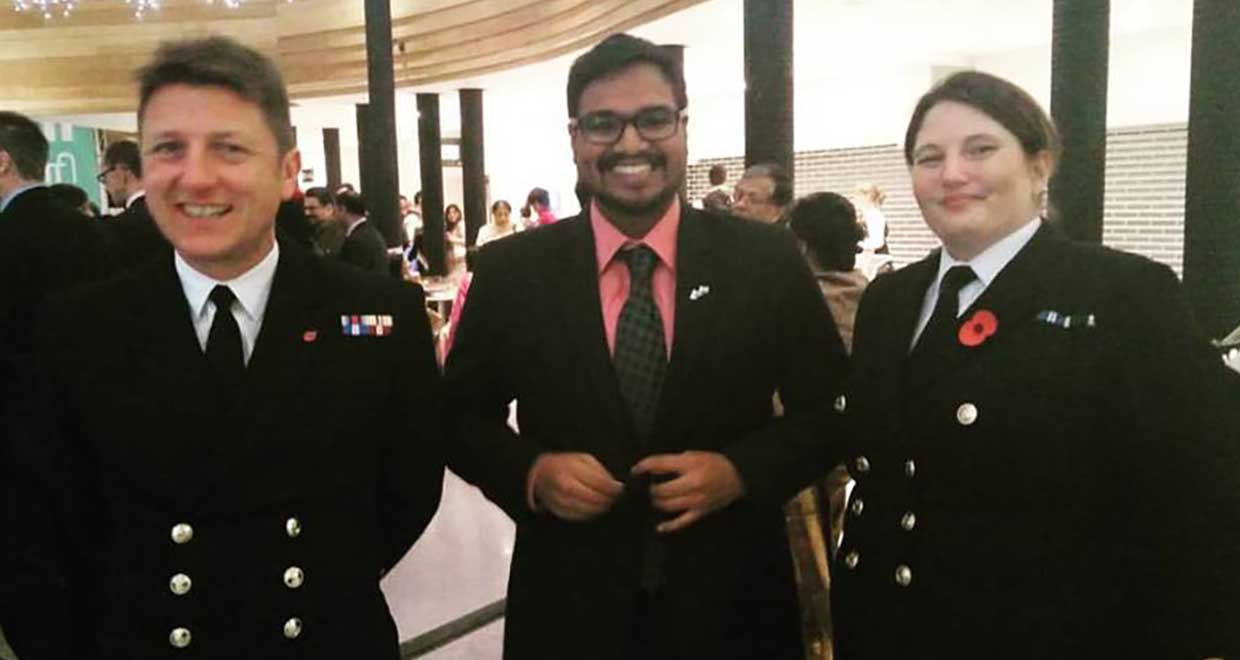
    With the crew of the Royal Navy


    How did you secure your first job as an Associate at V. J. Mathew & Co.? What was your experience working there like?

    I applied for an internship there and was assigned with some very interesting assignments. I was impressed by the quantum of maritime law work that the firm handled and the professional manner in which they functioned. At the end of the internship, I was offered a position and grabbed the opportunity with both hands.

    My time at the firm was a period of immense learning and it was a baptism of fire of sorts. Being a boutique firm, I had the opportunity to work closely with the partners on most cases and was made to feel like a valuable part of the team. I am very grateful to Senior Advocate V. J. Mathew for playing the role of a mentor and for trusting me to argue important cases before the Kerala High Court so early in my career. He is also a strong advocate for positive reform in the maritime industry and often got me involved in his research preparation for a big conference or an important paper.

    Being a judicial clerk at the High Court of Delhi, what have been your tasks and key learning experiences?

    I had always wanted to do a judicial clerkship and so when I got the opportunity to work with Hon’ble Mr. Justice Najmi Waziri I was overjoyed. For those of you not familiar with the concept, a clerkship involves working closely with a judge and attempting to ease their workload by helping with case briefs or research propositions.

    In my case, this basically meant trying to learn as much as I could while being as little of a nuisance as possible. And I say this only half jokingly as it’s truly incredible how adept Justice Waziri was at identifying crucial points in the case and I was often out of my depth when trying to brief Sir on a case or while sharing a point of research with him. What the experience did give me was an opportunity to observe from close quarters what it takes to be successful in this field and the level of commitment, hard-work and professionalism that it requires. Justice Waziri is truly a role-model for me and I’m immensely grateful for the opportunity to have been able to learn from him.

    Rahul Miranda with Hon’ble Mr. Justice Najmi Waziri


    You are currently pursuing a master’s degree in International Maritime Law from Swansea University. How did you decide on the university and why were you keen on getting a masters degree?

    The peculiar nature of ships and the shipping industry means that the law governing it also has several peculiarities. In order to fully understand these intricacies in the law I felt that it was necessary to study the subject in depth. Furthermore, a Masters in Law is obviously a lot more than just the degree and offers the opportunity to meet like-minded people from around the world and to participate in conferences and networking events which bring with it a plethora of opportunities.

    For this reason, picking the right university to pursue your course from is vital. I was accepted into several programs but finally decided on Swansea University based on the almost singular focus of their program on commercial maritime law, the reputation of their professors within maritime circles and its very strong alumni network. It’s probably also wise to factor in fees, scholarship opportunities and cost of living while picking a course.


    What are your career plans after this?

    To be honest, I haven’t really thought too much about this yet. I’m looking for an assignment which will challenge me and give me a chance to apply all that I have learnt during my course. I’m going to have to work very closely with the career services office at the university over the next semester to explore my options and find the perfect fit.


    Do you feel that adequate exposure is given to students in niche areas of law such as maritime law? What would be your advice to students who are inclined towards a career in the field?

    While I was at law school there wasn’t really any exposure to this field of law. Over the last couple of years, however, I have noticed that several law schools are conducting symposiums, conferences and even moot court competitions dedicated to issues involving maritime regulations. I have been invited to speak at these conferences and judge these competitions a few times and remember being impressed by the quality and quantity of participation. If students are interested in this field they should definitely check for these events and participate in them as they offer a good opportunity to get a feel for this area of law and also to network within the field. Applying for internships with firms that deal with maritime matters is obviously another way forward.  I wish them the best of luck and will be happy to help them with any further queries they might have.


  • Somnath De, Advocate, Delhi High Court and Supreme Court, on practice in IPR and Cyber Law

    Somnath De, Advocate, Delhi High Court and Supreme Court, on practice in IPR and Cyber Law

    Somnath De graduated from Kalyani University in 2011 he went on to pursue his higher studies from Symbiosis Law School, Pune and completed his post-graduation in Intellectual Property Rights in the year 2014. During his college days, he actively took part in conferences and has completed several certificate courses in Cyber Laws. Post graduation, he started working under the guidance of Adv. Pavan Duggal in his renowned firm Pavan Duggal Associates. During his stint at Pavan Duggal Associates he handled a number of cases pertaining to his specialization of Cyber Law and IPR. Currently he is working at an IPR law firm, Vohra and Vohra. He is a senior consultant of Astrea Legal in Delhi Region in the IP and Cyber Law matters. Based out of Delhi, Somnath practises in both the Supreme Court and Delhi High Court.

    In this interview Somnath talks about –

    • His college days
    • Importance of mooting in college
    • His reason behind the decision of practising in IPR and Cyber law
    • National IPR Policy
    • His work-experience


    Hello Somnath, how would you like to introduce yourself to the readers of Superlawyer?

    I am an Intellectual Property and Cyber Law attorney. My work is to help people protect their ideas, inventions, and identity, and I deal with counterfeiting and online rights and responsibilities towards clients. I help them, protect them from competitors and establish them in the market place.


    Kindly tell us something about your childhood, school and college days.

    I was born and brought up in Bengal. I come from a business family, and therefore, I have no legal pedigree. I completed my primary and secondary school education in Bengal. Subsequent to completing school education, I completed my B.A.LL.B (Hons.) from Kalyani University, W.B. I pursued my LL.M. from Symbiosis Law School, Pune with specialization in Intellectual Property Law. My almae matres , both for LL.B and LL.M, laid great emphasis on extra-curricular activities. I was an active debater and presenter, and loved playing sports. I was very lucky to find good friends with whom I have the warmest of memories.


    Did you ever take part in any co-curricular activities while being in college? Can you please share with us your experience and opinion on the importance of them in a law student’s life?

    I participated in a few moot court competitions as well as numerous national and international conferences during my college tenure. I have also penned a number of legal articles which were published in various national and international journals. However, apart from improving my legal skills, I love to play cricket and badminton, and to even engage in dramatics sometimes.


    How beneficial do you think mooting is for litigation?

    Practicing in court as a litigation counsel is a different ball game altogether. However, participating in moot court competitions can provide you with a very good idea as to what kind of lawyer you think you want to be. Writing skills and speaking skills are invaluable not only as a student but also when you enter the work force. Having to face a panel of well prepared and demanding judges in a courtroom setting can become an addictive experience. Therefore, participating in moot court competitions lays the roots to become a successful lawyer. A law student must make the most of these opportunities and should participate in as many competitions as possible.


    What exactly prompted you to take up law as a profession?

    Actually, there was no affirmed decision to take law on my part. It happened by accident and not by design. However, previously, i.e. during the time of my school days, I had already been introduced to subjects such as Philosophy, Reasoning, Logic, and Political Science, and this drew my fascination towards Law. Apart from that, I was fond of debating and reasoning. I felt that this would come in handy when I had to stand in court and argue on point.


    You have been practising in the cyber law and ipr law domain for quite some time. What made you choose these fields as the relevant areas of your practice?

    (Somnath has done his LL.M in IPR and is a certified cyber crime investigator and digital forensic investigator)

    I chose these particular fields because I am a strong believer in the digital format crucially shaping the future of the world. We are in an information age. We all are living in the digital world. The impetus came when I was in the 2nd year of finishing my LL.B. I used to read journals and numerous technological blogs and it was the complicated technicalities gradually surfacing including that of legal challenges faced by companies that motivated me to get into this nascent legal ecosystem.  In contrast to other disciplines of law, Cyber Law and Intellectual Property law was constantly evolving. I was fascinated by it and decided to concentrate my efforts in that direction. Then, I perused my Diploma in Cyber Law and after one year I became a Certified Cyber Crime Investigator and Digital Forensic Investigator.

    However, the advent of cyber space has brought newer parameters. The digital ecosystem that exists today has seen a dramatic increase in the scope of Intellectual Property Rights and Cyber Laws. Technology has become an integral part of our day-to-day lives and, consequently, the legalities pertaining to the Internet assume extra significance. The legal ramifications pertaining to Intellectual Property and Cyber security are being rediscovered regularly. Therefore, Cyber Law and Intellectual Property are emerging disciplines, as its contours are yet to be defined. The quantum of Cyber security breaches keeps on increasing with each passing day. That is what, even more than other factors, makes it such an exciting time to be specialising in Cyber Law and Intellectual Property Law as a new discipline of law.


    Apart from Cyber laws and IPR, what are the other areas of law that you are interested in?

    Apart from the Cyber Law and Intellectual Property, I am interested and am currently practicing in the fields of Media Law, Corporate Law, Completion Law and Constitutional Law.


    Can you please share with the readers your work profile so far? What is your average daily worktime like?

    After passing my LL.M, I got the opportunity to work with Mr. Pavan Duggal who had specialised in Cyber Law and Intellectual Property Law. After that, I joined Vohra and Vohra, which is a full service law firm, in the field of Intellectual Property and Cyber Law. Apart from this, I am an IPR and Cyber Law consultant to numerous organisations across India. As a legal professional, I have never declined any case or client however small and was least bothered about fees and other attending monetary issues. I think that such a mindset is instrumental for excelling in this field. As a lawyer, I feel, you should give sixteen to eighteen hours per day. As for me, after court matters, I come back to office. After completing my meetings, I prepare for matters which are listed to be heard the very next day. I believe you should plan out your day in such a way that you have about, say, four to five hours of unperturbed time when you can completely apply your mind to the case. I give two to three hours for my independent research works every day and staying up to date with current legal trends and international developments in my field.

    Law students seemed to remain confused on which particular field of law they should choose for his/ her career. What according to you should be the way of coming out from this maze of conflict?

    One of the key challenges is to match the pace of development in law. During your college days, you should do regular reading and be aware of legal developments, amendments to the law in India and elsewhere, cases, precedents and other development in the industry. I must say that you should absolutely listen to your heart in respect of which field you should choose to practice in. It must be something obviously which you are passionate about and have an ardent interest in; that is the key to build up one’s potential in this field and achieve your motive. Every arena of law has its own beauty. While it is true that should you opt for litigation you should possess a great level of patience, but the scope for litigation practice is widening day by day. Be focused, never lose hope and always keep trying. I also advise that you should choose carefully who you work for. Find someone who will teach you, groom you, pay you decently and mentor your practice after you leave.


    From a law student to a lawyer, how will you describe the transition?

    The beauty of this filed is that you will always remain a ‘student of law’. For me this is just the start of my journey, and there is still a long way to go. Things are harder than when I was in college. However, I enjoy my work and the challenges that I face every single day. Nevertheless, I definitely missing the life I once had with my friends.


    Your experience with the Bar Exam

    Well, the Bar exam, formally AIBE, was fun and totally relaxing for me. Apart from the actual examination and its concomitant experiences, it was also a kind of reunion with my friends. I was really pumped; questions were simple and only just needed a little application of mind. It was not a difficult encounter very much at all.


    Red letter day, so far

    I cannot discuss any specific case in detail due to confidentially. However, the classically antique day for me was when I dealt with a very high-profile case in mid-February, 2015, when we had to take an order at midnight from the Delhi High Court. I remember how there was no single restaurant open at the time to serve us any food. At last, we had food at a Gurudwara near Red Fort, Delhi. I had not slept that night and the next day I had to report early to the office to prepare for the subsequent hearing. Another one was when I started my practicing career. I had gotten the opportunity to deal with a matter independently. It was about setting aside an order and the matter was placed before the Division Bench of the Delhi High Court. The first item listed on the day of the showdown was my case. The case was really challenging. I was thoroughly prepared, and argued for twenty to twenty five minutes, faced numerous questions and clarifications as put forward to me by the Honourable Judges. During my argument, the Court Room was completely silent except the reverberation of my own voice and at the end of the arguments I had bagged an order in my favour.


    Any unpleasant or difficult case/ situation in the courtroom or outside

    There are ups and downs, which is part of this profession. Sometimes, really closely listed matters can become nightmares. To read voluminous documents and then complete the draft within time is a difficult situation. Therefore, it’s very important to manage time smartly and to be well versed with all the intricacies pertaining to the concerned matter.


    somnath-de-2

    Your take on National IPR policy

    I applaud the Government for effectively bringing this far reaching document which kindles creativity and innovation across sectors and also facilitates a stable, transparent and service-oriented intellectual property rights administration in the country. The said policy is enormously relevant for a country like India, being a repository of indigenous creativity and traditional knowledge. Further, by this policy, the Government is attempting to resolve the adjudicatory delays in the newly designated commercial courts. The policy further advocates generation of IPR, which will encourage start-ups and safe guard their Intellectual Property, which is the need of the hour given India’s massive strides towards a digital society. However, the said policy should not remain as a paper tiger; the Government should implement the goals envisaged in the practical world in full phase and plan out for proper mechanism, as the same policy is in a comparative context a directive that needs a fresh look.


    Your opinion on the challenges before IPR regime in India

    At the very outset, there is lack of awareness about Intellectual Property protection among many stakeholders. I must stress that a detailed annual plan ought to be there on spreading awareness about Intellectual Property Rights and the involved legalities alongside interactions with all possible stakeholders. There should be a quicker approach to reduce delays in clearing Intellectual Property applications to encourage innovation and entrepreneurship, which are also one of the seven pillars of the National IPR Policy. Furthermore, India faces challenges to its IPR regime as developed countries try to put in place an even stronger framework through mega regional trade agreements such as the Trans-Pacific Partnership. India needs to create its own culture of innovation for its people and grow at a rapid rate. Apart from that, India is facing challenges of online piracy, data protection, vulnerability of trade secrets etc.

    Where do you want to see yourself five to ten years from today?

    My first aim is to build my expertise in my domain. I would like to be an attorney who will make sure every client who comes to me is satisfied with the quality of services and gains trust. I would also like to earn the respect of my seniors, peers and colleagues. Since I love to interact with people, I would additionally like to become an academician in my field of expertise alongside practicing as an attorney.

    Any piece of advice you would like to pass on to the readers?

    You should have the right kind of attitude towards the legal profession. It’s always advisable to think out of the box and be innovative in order to develop the culture and personality of a true legal professional. One should be determined, patient and remember that there is no alternative to hard work. You should always have faith in yourself and should never be disappointed, as failure is an integral key to success. It’s always advisable to stay up-to-date with both the national and international developments of your chosen field of law.