Tag: Start-up

  • In Conversation with: Ryan Mendonca – A startup legal counsel who left his job at a tech startup to start an innovative concept of being Your Virtual Legal Counsel, under his Virtual Law Firm

    In Conversation with: Ryan Mendonca – A startup legal counsel who left his job at a tech startup to start an innovative concept of being Your Virtual Legal Counsel, under his Virtual Law Firm

    This interview has been published by Prabhjot Singh, Priyanka Karwa and The SuperLawyer Team

    Tell us about yourself-what motivated you to choose law as a career path?

    I was interested in law early on in my childhood as would watch legal dramas like “Boston Legal”, “Law & Order” and ofcourse my all-time favourite legal show “Suits”. What interested me was how the lawyers helped their clients, fought for them in & out of court and delivered justice in some way shape or form.

    Its ironic how back then I saw these lawyers as superheroes and fast-forward a decade or so, and I am being interviewed as a Super Lawyer, its funny how life comes full-circle.

    However, besides the legal dramas, I also realised, very early on, that there were laws for everything and at every milestone in one’s life, right from birth certificates, to school rules, to employment law once you start a job, to corporate law if and when you start a business, to when you get married and buy a house, until you’re “dead and gone” or “6 feet under”.

    The Law is interwoven into the fabric of life and I felt that learning the law and my knowledge in the legal domain would give me that edge in life and would always be advantageous.

    Ryan, you worked as a remote lawyer during covid, how was that experience and what type of difficulties did you faced?

    Yes, I did work remotely in Dubai, as an in-house counsel for a high-powered, VC-backed Indian based startup, it was an eye-opening experience to say the least, whilst it was one of the most testing and unsure time for me, career-wise, mentally and physically. It was not easy doing and getting what I needed to get done.

    I do feel that it was an absolute privilege and once-in-a-lifetime experience to be the Sole Legal Counsel, setting up the legal operations, running it for a good 6 months, and then shutting it all down post-lock-down.

    On the bright side it did give me the confidence to open my own shop and accelerated my career into the natural progression of being a lawyer and starting my own virtual law firm, in this new-remote-friendly world we live in.

    What was and is the main USP behind your firm “YVLC”, and how do you manage your work since you have clients with different time zones? Do you believe the remote work model is going to stay in the future?

    Offering the service of an experienced in-house legal counsel on a fractional basis for multiple startups allowed startups to operate with the mental freedom that their legal is being taken care off, this was YVLC’s USP starting out.

    Now that we are on-boarding multiple Virtual Legal Counsels who are subject matter experts in their respective tech niche, such as E-commerce, Food-tech, Blockchain, Ed-tech and Prop-tech, we are creating a “Justice League” (pun intended) of Super Lawyers that will advise clients in their field of tech with relative ease and offer a more specialized legal advisory.

    All while being fully-remote, fully-autonomous and with the necessary tech infrastructure in place to do what we legal counsels do best. Provide legal solutions that are commercially viable.

    What is the biggest hurdle most attorneys face in bringing in new business at present times?

    This is a tough question for me to answer as I dont feel there’s just one main challenge, it is a mix of the following in no particular order and may not apply to all attorneys: Building a strong online presence, having a healthy pipeline of new client meetings, being very personable and impressive to new clients such that they close with you, pricing their services or hourly rates and lastly doing all of this successfully through a screen or on audio only meetings or at times without even speaking to the client at all.

    What’s the biggest threat to a solo or small law firm’s survival over the next 10 years? What should they be doing now to prepare?

    Investing in Tech, Building a Brand, Not getting caught up in the day to day wins and losses and instead having a long term goal, vision and plan to make it a reality. Most solo lawyers or small law firms start for the sake of starting and making something for their own selfish intentions of having a bigger slice of the pie or more like having their cake and eating it too.

    What are your future plans with YVLC academy and how can professionals be benefited with this initiative?

    We are planning to provide legal professionals the tools and teach them the tricks of the trade of how to be a solo digital lawyer. We want to help them reach their potential and achieve their goals no matter how small or gargantuan they may be.

    We want to empower lawyers and give them the tech infrastructure, a starting platform and the motivation and inspiration to have a successful legal career.

    Law students often get confused between these big tech platforms such as Fintech, agritech and other startups, what advice would you give to them for having a better sense of clarity wrt same?

    Read about them from credible sources, watch interesting you tube videos, listen to popular niche tech startup podcasts and last but not least work in those tech spaces that interest them and that they want to learn more about. There is no better way to learn something than by doing it.


    Get in touch with Ryan Mendonca

  • Jonathan Rodrigues, Co-Founder, PACT, on challenges of a start up, online mediation, and a career in ADR

    Jonathan Rodrigues, Co-Founder, PACT, on challenges of a start up, online mediation, and a career in ADR

    Jonathan Rodrigues graduated from VM Salgaoncar College of Law in 2016. He is the co-founder of the Peacekeeping and Conflict Resolution Team (PACT) which is focussed on training users of dispute resolution in Negotiation, Mediation and Conciliation skills.

    In this interview we talk to him about:

    • Career in ADR
    • Challenges faced in starting PACT
    • Online Mediation in India
    • Mediation as means of dispute resolution


    HOW WOULD YOU LIKE TO INTRODUCE YOURSELF TO OUR READERS?


    Not all Super Lawyers wear a cape!

    Some choose to take off their courts and suits,

    Facilitating dialogue and resolution.

     An ‘Ideator’ by heart, a nurtured writer, a wanderer by my restless nature, I am, today, a Mediator, by profession. I know I sound ridiculously ambitious, I know the profession is associated with obscurity, but it is my mission in life to create the scope for consensual dispute resolution, that someday, kids may not sound foolish and insane when they say, “When I grow up, I want to be a mediator”.


    WHAT MOTIVATED YOU TO PURSUE LAW AFTER PURSUING B.A. IN PSYCHOLOGY?

    After graduating in Psychology, I went on to pursue criminology and forensic science as a post-graduation interest. I hopped two different universities but failed to find scope in the subject I was attracted to. I discontinued my studies and headed back home to pursue my passion for writing as a journalist. While working with the Times of India, I thought I should give legal studies a chance – this was a consequence of many people telling me I need to find a forum for my argumentative nature. Being a lawyer happened as a result of boredom and experimentation, but I’m glad I took the step. I found my true passion in the midst of all those confusing case laws and endless bare acts. I have always wanted to work to bring people together, work with differences and complications, and I found I could do that in mediation.


    PLEASE TELL US ABOUT YOUR TIME AT VM SALGAOCAR COLLEGE OF LAW?

    My time in law college was a period of a major identity crisis. I am shamelessly proud to have cleared every exam, having worked the night shift as a journalist all through my law college days. I never wished to go to court so I kept asking myself why am I even pursuing my studies in this field? I didn’t like the courtroom jargon, formalities and the ridiculous amount of procedures that are needed to find “justice”. Litigation didn’t attract me then, and that hasn’t changed to date. I couldn’t fathom the idea of the adversarial system, where is no scope to bridge the communication gap or repair relationships. This disturbed me – no matter how much a lawyer prepares and argues a case, the verdict lies in the hands of a judge, and the disputing parties have no say in the outcome.

    Of course, not every case can be referred and resolved through mediation. Similarly, not every case needs to be referred and judged in court.

    Being respectful of the over 1 million advocates and judges who are part of the profession, I believe that “justice” is temporary and not guaranteed, whereas “peace” is permanent and secured. Justice is subjective, whereas peace is objective. I chose peace over justice, and that’s where I am right now. I discovered mediation in my final year of law studies and I am grateful to my principal, who supported me to explore mediation.

    Having successfully competed as a mediator and negotiator at the CDRC Vienna 2015 and ICC Paris 2016, respectively, I co-created Lex Infinitum at V M Salgaocar College of Law – which was a huge turning point with regards to my career choice. For me, Lex Infinitum wasn’t a one-time assignment for my CV, I took it rather personally. This effort had a wider picture – it was the beginning of an endeavour to make mediation a stable profession, not a closeted charitable exercise, run on the lines of arbitration, literally and figuratively. Until I discovered mediation, I read the bare acts for the sake of marks. For instance, I remember studying for my final semester IPR paper. Glancing through my notes, it dawned on me that mediation has tremendous scope in this field. Mediation gave me direction as a law student.


    PLEASE TELL US IN DETAIL WHAT IS PACT FOCUSSED ON? WHAT MOTIVATED YOU TO START THIS?

    The Peacekeeping and Conflict Resolution Team (The PACT) is a collective of trained and certified dispute resolution practitioners who are committed to nurturing this millennial generation with tact and skills in dealing with conflicting situations. The PACT was initially conceptualized by Gracious Timothy and I, in June 2016. As passionate ADR/CDR enthusiasts, who had explored dispute resolution as law students, we were itching to create a platform for dispute resolution to take root in this country. Honestly, we didn’t know what we wanted to achieve then, or how we were going to achieve our goals; but, we knew that as long as we were dreaming and waking up every morning with a zeal to chase those dreams, we would get there.

    Nisshant Laroia is now an integral part of The PACT and as a core team of three, we work closely with national and international ADR and CDR professionals to create awareness and train users and lawyers in the field of dispute resolution. Over the last 18-20 months, The PACT has so far reached out to over 3,000 students, across two dozen law and business schools, spread over 13 states, hosting Negotiation and Mediation Boot Camps. Be it the University of Kashmir in Srinagar, or NALSAR in Hyderabad, GNLU Ahmedabad or NLU Jodhpur, ILS Pune or GLC Mumbai, the response and feedback has been positively overwhelming, encouraging us to go beyond just coaching and mentoring, and set up ADR/CDR cells and clubs in some of these institutions we have reached out to. Besides being majorly involved in Lex Infinitum during its initial years, we have already co-created a new competition (‘Intercessionis’, at ILS Pune), that exclusively deals with community conflict mediation. More such events are in the pipeline for the new academic year.

    We are in the process of creating a unique event in Jammu and Kashmir, in association with University of Kashmir’s law department. The youth of Kashmir are eager and excited to be working with us on this initiative, which will premier in October/November 2018. Similarly, The PACT is brainstorming on something special for the North-eastern states of India for early 2019.

    PACT has also conceptualized the Global Academy for Advocacy in Dispute Resolution, which premiers in Goa from June 11-16, 2018. It is an initiative to endorse skilled mediation and arbitration lawyers, with separate coursework and trainers for both, mediation and arbitration. For more details on the curriculum, trainers, accreditation, venue, fees, etc.

    Please check click on the link below: (https://www.facebook.com/pg/thepactindia/photos/?tab=album&album_id=812635982261471)

    The PACT is focused on building these platforms that empower every woman and man to proudly call themselves followers and users of consensual forms of dispute resolution. Be it conferences, competitions, literature projects, mass media assignments, we are looking to reach out to every potential user across the globe and connect with like-minded individuals who can help us create spaces of dialogue in their regions.

    The PACT was conceptualized by the peaceful beaches in Goa, grew up in colourful parts of India and is now ready to take to the world.


    WHAT WERE THE CHALLENGES YOU FACED INITIALLY ON STARTING PACT AND WHAT IS YET TO BE ACHIEVED?

     I believe our toughest challenge to date has been to find the right mentors and guidance. We have been fortunate to have met many polished and experienced professionals in the field, who have generously shared their time and friendship. We owe them our deepest gratitude for helping us grow and develop as individuals and as a team. They stay connected with us as “Friends of PACT”.

    However, not every follower is a fan, right? We have encountered many senior persons from the legal fraternity scorn and mock our ideas and dreams, but this has only made us stronger and determined. We have heard people say to us, “Burst the bubble, mediation is never going to work in India” or “Stop fooling yourself, this can never be a profession”. For every pessimist, we have met 100 optimists and we choose to work with these positive vibes.

    Yes, we have made mistakes and we have fallen short on many occasions. We don’t regret it because we have taken the approach of “burning our fingers while we learn”. Every time we discover a new limitation, a failing, we accept it and work towards fixing it, immediately. Personally, this has been my favourite part of the journey.


    DO YOU THINK THAT MEDIATION AS A MEANS OF DISPUTE RESOLUTION CAN BE SUCCESSFUL IN INDIA CONSIDERING MOST CASES FINALLY END UP IN COURTS?

    Yes, it can be successful, and it will be, soon. We need to ring in a few changes…

    Firstly, REBRAND ‘Mediation’ or for that matter, ‘Conciliation’ as a unique and different tool to dispute resolution. Stop, I repeat, stop clubbing it with arbitration or coin terms such as “other forms of ADR”. The iPhone grew as a brand, because it had its own identity, and it wasn’t marketed as “another phone in the store”. Arbitration is different, mediation is different. Both are unique and need to be treated differently. I am asking for (and we at PACT believe in this) a change in branding terminology, separate events and conferences, specific course/module/ curriculum for law students, the introduction of the concept in other study areas – arts, commerce, science, technology, sports, business, etc. Mediation cannot be looked to as a charitable option to “settle” and “compromise”. It has to be a commercially viable tool that encourages collaboration while maintaining a fine balance between interests and emotions.

    Secondly, LEGAL remedies with regards to a private Mediation settlement agreement need a revamp. The biggest fear that users have is “what happens if the other party dishonours the agreement?” The anxiety of running back to court to enforce “breach of contract” is more frustrating than going to court in the first place. Let’s keep it simple – A private mediation settlement agreement must have the same value as a conciliation settlement agreement – which is an award, treated as a decree of the court. Thus, someone who has been backbitten out of settlement agreement arising out of a private mediation has to simply seek enforcement of the “Mediation Settlement Award”.

    Before, I thought that the above could be achieved with a minor amendment to the Arbitration and Conciliation Act, but I am increasing of the belief that conciliation needs to be extracted from the Arbitration and Conciliation Act, and redrafted as a separate legislation, which also involves Mediation.

    Thirdly, INFRASTRUCTURE annexed to court premises is not something I subscribe to. State governments in India must invest in specially designed premises to create a separate setting for mediation. It may continue to remain court-referred mediation, but it must be away from the clutter and buzzing of the courtroom premises. A perfect example of this is the mediation centres started by Delhi Dispute Resolution Society. This will encourage full-time mediators and not professionals who dedicate their “after hours” time to the profession.


     WHAT WOULD BE YOUR ADVICE TO LAW STUDENTS LOOKING FOR A CAREER IN ADR?

    To those exploring a career in Mediation, I suggest getting yourself trained to be a skilled negotiator or mediator, or a skilled mediation advocate.

    Keep reading – There is a lot of literature online or you can check the Facebook group: PACT FAM – (https://www.facebook.com/groups/153574115135548/). This forum is managed by our student CDR ambassadors, Sandeep Bhalothia (JGLS) and Pallavi Gauri (NALSAR)

    Keep writing – If you want to write a simple article about mediation or dispute resolution, you may do so and send it to thepactindia@gmail.com. We will find you a platform and readers.

    Participate in competitions and conferences taking place in India and abroad. PACT is coming up with at least 3 new competitions in 2018-19, watch out for these announcements on the PACT page (https://www.facebook.com/thepactindia/)


    WHAT IS THE SKILL SET REQUIRED TO SUCCESSFULLY MEDIATE A DISPUTE?

    • Patience! – It’s not a skill as such, but it is the key that puts to test all your skills.
    • You need to have listening ear – go beyond being an active listener and be an empathic listener.
    • Don’t be afraid to compliment what you like, apologize when wrong, acknowledge what seems interesting, accept differences, competitively disagree, creatively brainstorm for mutually-satisfying solutions.


    WHAT IS YOUR ROLE AS MEDIATION CONSULTANT AT PRESOLV360?

    As an empanelled consultant, I assist Presolv360 – India’s first dispute management platform – in connecting with professionals and organisations in the field of dispute resolution and provide support for implementing established mediation practices.


    DO YOU THINK ONLINE MEDIATION CAN BE SUCCESSFULLY IMPLEMENTED IN INDIA?

    I was extremely sceptical of online dispute resolution and I still have my doubts, but this is the tech generation, so why not! This generation demands quick, accessible and tech-ridden supply of solutions to all its needs – be it food, clothing, gadgets, travel, etc. A little delay in delivery of any of these basics needs and you will have the youth shamming the service provider on every possible public forum on the internet. How, then, this generation remains indifferent and accommodating of the time-consuming court system?

    Cost effective, time efficient, comfortably casual, confidential settings, a process devoid of endless documentation, voluntary appointments, neutral facilitators and consensual settlements – it can’t get better for those who live digital lives.


    WHAT WOULD BE YOUR PARTING MESSAGE TO OUR READERS?

     I’m just an ordinary Goan boy who dared to dream beyond the familiar shores of comfort and challenged himself to explore a strange and currently non-existent career.

    Don’t be afraid to look at a career in law from a fresh perspective. If you like law as a subject and you have always wanted to be a lawyer helping people resolve disputes, and you don’t like the idea of arguing in court, there is no need to worry – you now have Mediation.

    Not all Super Lawyers wear a cape; some choose to take off their courts and suits, facilitating dialogue and resolution. As a lawyer, it has always been about your client’s interests; help them discover their true interests. You don’t have to be an adversarial lawyer; you can be a collaborative one. Don’t be afraid to be different. At the end of the day, advocate for your client’s interests, not yours!


  • Kanisshka Tyagi, Partner, Legum Amicuss and practice in Private Equity and Cross Border Transactions

    Kanisshka Tyagi, Partner, Legum Amicuss and practice in Private Equity and Cross Border Transactions

    Kanisshka Tyagi graduated from Campus Law Center, Delhi University in 2007 and joined a Delhi based corporate and commercial law firm, where she got extensive exposure in real estate sector and other general corporate and commercial work. She subsequently worked with leading corporate and commercial law firms in New Delhi (NCR Region) and got the opportunity to expand her practice base to include insolvency, private equity and regularly advised on cross border investment transactions amongst other practice areas.

    She is currently heading commercial practice at Legum Amicuss, a young dynamic law firm having offices at New Delhi and Dubai, UAE. Her personal interest lies in structuring of new businesses/start-ups with a holistic approach.


    In this interview, we speak to her about:

    • Her specialisation in private equity transactions and corporate/commercial litigation.
    • Her role at Legum Amicuss.
    • The importance of gaining practical exposure in maximum areas.
    • Her experience in legal writing and publications.
    • Co-founding the startup WorkPlace.


    How would you like to introduce yourself to our readers?

    I’m a lawyer with an experience of ten years and am still trying to learn law and the tricks of the trade.


    Tell us about your days in law school.

    I did my graduation in law from Delhi University, which is a three years law program. As a law student while my grades were decent but I was not a very serious student. Law college taught me a lot about law and life. I still remember how Prof (Dr.) B B Pandey used to teach us law in a very different way. His classes were really popular and students actually wanted to attend his lectures. He would weave law with some common life situation so that it would become comprehendible to students of every calibre. I still remember the way he taught us Section 25 of the Evidence Act. He narrated a Shahrukh Khan dialogue from the movie Pardes which was something like “Those who want to know the truth do not come with pistol and hatred in their hearts”( Joh sach sunna chahte hai … woh apni jeb mein pistol aur dil mein nafrat lekar nahi aate). He told this movie dialogue to us to bring home the point that any confession to a police officer by an accused cannot be proved against the accused because police officers carry weapons and whatever an accused may state before him may be out of fear. In such a simple way he not only taught us Section 25 but also that law can be learned not just by reading text books but by applying it to practical situations.


    What were the activities that you undertook in your law school days which have shaped you and your career?

    In our college, there was a lot of emphasis on understanding the legal concepts through leading judicial precedents and that is something which is very important for a lawyer. You not only need to be well conversant with the legislative provision but also need to understand it’s judicial interpretation. Also a habit of reading is certainly an essential tool for lawyers.


    What are your areas of specialisation in law?

    I specialise in private equity transactions and corporate/commercial litigation. During my law school days I certainly had an inclination towards corporate laws and I always wanted to be a corporate lawyer. However, it is important in this age of super specialisation to know what are the areas where you see yourself eventually working but at the same it is very important to explore all the areas because many a time you just think that you would not enjoy a particular area of law but you may end up having great time while working on a problem under that area of law. So the aim should be to make full use of college time and read, write and gain practical exposure in maximum areas.


    How were the first few years after your graduation? Would you say law school prepared you for the real world practice of law?

    (Please feel free to discuss where you had started off your career and your journey up to this point.)

    Well, your student life differs from your professional life by leaps and bounds and no college can make you hundred per cent job ready, irrespective of the practical exposure the college offers. The hands on training that you receive while working is critical and college is like your ticket to entry to the real world. Law school is like a mentor who shows you the way but it’s you who has to tread that way. Throughout my professional life I have learned a lot from all my seniors specially Mr. Hemant Batra, Founder, Kaden Boriss. I’m lucky that he mentored me. I owe a lot to my mentors.


    Give us a brief capsule of your role at Legum Amicuss.

    I was a partner at Kaden Boriss when Legum Amicuss was founded by my friends who asked me to join Legum Amicuss. However, I was a newly inducted partner and I didn’t want to lose the opportunity of honing my skills at partner level at a well-established global firm. Few years later when I thought the time is right to be on my own, I joined Legum Amicuss. We are a small firm which is growing every day. So our responsibility is to work, gain knowledge, stay current, network, bring clients and lots more. We face lot of challenges as a firm in this competitive environment, however we are happy with whatever we have achieved.


    Tell us a bit about WorkPlace, which you had co-founded last year.

    Start-up is the trendy word these days. We as a firm wanted to get into the start-up sector and with that aim we decided to venture into this space. WorkPlace is a serviced co-working office space and it did help us to get introduced to a lot of start-ups but this sector is very difficult, they are very different from your usual corporate clients, be it in terms of expectations or willingness to pay. WorkPlace is moving gradually and doing well.


    Do you believe that the Indian legal education system is conducive to actual learning?

    Grades are important but your successful career does not depend on grades. I remember speaking on exactly the same subject at one of the conferences. I would repeat what I discussed there; These days educational institutes are doing a great job in giving maximum practical exposure to students. However, what I feel is that this system is very unfair to students, they intern for a month or sometimes for fewer days and by the time they get to understand the systems at their workplace their internship period gets over. Somehow we need to have longer periods of internship probably after every semester. Also, if we can have a system where they are allowed to assist judges and judicial staff during their college days that will help them a lot in learning the practical aspects of practice. That will give them an opportunity to observe a wider variety of matters.


    Being an avid writer and having publications to your name how do you choose your topics and subjects?

    If you want to be noticed then you have to choose topics and subjects which are relevant in present time and legal world moves at a fast pace so what was relevant a month back may not be relevant now. This basically means you have to read a lot and then choose the topics which are relevant in today’s time.


    If given an opportunity, what would you do differently in your career journey up to this point?

    Nothing. I worked hard at every stage of my professional life and more importantly I worked with lot of integrity and honesty. The one thing that youngsters need to change is their attitude towards work. Don’t just be in a rush to complete your work, give your heart and soul and treat it as if the client depends only on you and not the firm. By putting in your hundred per cent you are helping your own cause. This way you will learn faster and will be able to move up the career ladder faster.


    Is there any other suggestion you would have for budding lawyers?

    Well everybody’s journey is different and throws unique challenges. However, what I can tell budding lawyers is that try and explore all the options during your college days so that by end of it you know what interests you the most. Don’t have pre-conceived prejudices while exploring, just go all out with a clean slate.


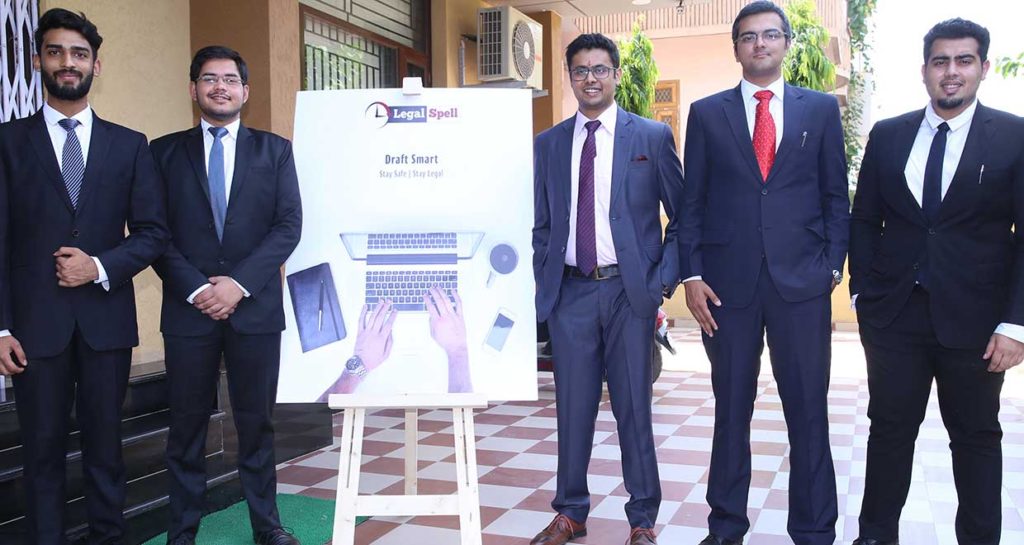
  • Varchasvi Gagal, CEO, LegalSpell, on starting up in legaltech and creating a drafting tool

    Varchasvi Gagal, CEO, LegalSpell, on starting up in legaltech and creating a drafting tool

    Varchasvi Gagal graduated from Jindal Global Law School recently in 2016. After witnessing a wide array of legal cultures through global legal education in college and on exchange at Baltimore School of Law, University of Baltimore, he has been researching the use of legaltech to transform Indian Legal drafting methods, for the past 2 years. He worked at the Legal Clinic of his college to understand the need for documentation among people at the grass roots level.

    Varchasvi has recently launched India’s first DIY document drafting platform for all called LegalSpell. He has been working on his start-up for more than a year ago. His vision is to revolutionize the way document drafting is done in India.

    In this interview he talks to us about:

    • What is LegalSpell and how it is one of its kind.
    • His motivations and inspirations in life and in creating LegalSpell.
    • His journey from a simple law student to the CEO of LegalSpell.
    • His vision to do something path breaking with LegalSpell.
    • Future plans and taking Document Drafting towards a much needed evolution.


    Tell us a bit about yourself. What drives you? What is one achievement you would be most proud of today?

    I come from a background, which involved my upbringing in a small town (Alwar) in a joint family. I have been molded in such a way that commitments are considered to be of the utmost importance.  Being from a business family, I have always admired my father. Watching him work inspired me in so many ways. He struggled hard and created an industry all by himself.

    He drives me towards becoming a better man.

    I like to be honest. I am a straightforward person and in a lot of ways, direct and practical. And maybe that is why I never back out from my commitments. I like to keep things clear, and law taught me that in order to do that, it’s better to do everything legally. And maybe that is why I never back out from my commitments. That was my motivation towards LegalSpell.

    When you are working towards something that you believe in, you just don’t want to stop. And that has made me a workaholic. I just love to work and I can’t sleep until I am satisfied with the inputs I am giving in to achieve my goals.

    Although it took me more than a year to analyze the needs of people, one thing I am proud of today is that, I have finally created something that I once imagined. We created a user interface, which would not only revolutionize drafting, but will cater to anyone and everyone. The tool was specifically designed to adapt to the user, keeping in mind a professional as well as a layman. I am proud that LegalSpell will work directly and indirectly towards legal awareness and safety.


    Tell us a bit about your law school days, and your internship experiences?

    Law School for me was a joyride. It has transformed me in so many ways and yet it was a home away from home. Spending half a decade in a place is not a piece of cake. But Jindal was an experience of a lifetime. The 5 years have taught me so much, made me aware about the world, and has witnessed my transformation in many ways. I was taught by few of the most renowned faculty in India and on the other hand I made friendships to last for a lifetime. The semester exchange program opportunity gave me so much of an insight into the legal cultures of the world.

    Also, I thank my college for giving me some wonderful friends and seniors. Samridh, Ojasvi and Harsh Aggarwal have been my constant support throughout. My seniors, Advocate Jayant Malik and Arjan Sharma have guided me in shaping LegalSpell as a product. In fact, my friends and an integral part of team LegalSpell, Namon, Karan and Hrideja are also from the same college.

    As far as my internships go, I thoroughly cherished interning at Impact law venture. That was the time when Mr. Pankaj (the owner) gave me some brilliant insights into start-ups.


    When was the moment you decided to not pursue the mainstream legal career and dive into entrepreneurship?

    My exchange semester along with the internships played a huge role in my decision in choosing a non-conventional career. I gained a lot of experience at my internships, and a lot of knowledge in my college, however there was always something that was missing. There was always the will to do something path breaking.  Something that not only creates an impact in the legal sphere, but transforms it forever. And when it clicked, nothing was the same ever again. The drive that it brought has borne its fruits in the form of LEGALSPELL.


    What is LegalSpell?

    LegalSpell is an online drafting platform for lawyers, corporates, entrepreneurs, start-ups, freelancers, designers, chartered accountants and laymen alike, a tool facilitating an instinctively easy drafting. LegalSpell ensures a time-efficient and cost effective user experience. Having been designed to automatically customize and personalize the document drafts for the user, this novel drafting platform has convenience imbibed in its core. A user can prepare their customized draft simply by answering a few questions and thereafter, use the drafting platform to personalize their draft to better suit their needs. While using this platform, the user has the flexibility of hand-picking clauses from LegalSpell’s automated draft prepared on the platform or add pre-drafted clauses specifically tailored to suit their draft from the Referrals tool. To add to the user’s experience, the drafting tool also incorporates features like an onscreen Google search and drafting notes, amongst others. The orientation of the drafting platform has been kept well aligned with that of the conventional drafting tools to instill adaptability and for enhancing the user’s ease of use.

    For instance, if a lawyer needs to draft an application under Section 34 of the Arbitration Act (filed for setting aside an arbitral award), all he needs to do is answer a few specific questions and LegalSpell will automatically prepare the draft by creating the Index, Memo of parties, List Of dates, Affidavits and Vakalatnama in just one go.


    What is legaltech? How does LegalSpell use legaltech?

    Legaltech is nothing but a step forward towards a future where the legal fraternity goes hand in hand with technology to attain more efficiency and productivity in legal work. The idea is to revolutionize the legal sphere with advancements of technology to foster the legal needs of people with utmost convenience.

    LegalSpell is driven by the application of technology to redesign the conventional document drafting practices into a neoteric and more sophisticated system of drafting. Our vision is to strive towards efficient and hassle free document drafting through the use of legaltech. Our goal is to innovate and develop technology to make the legal system much smarter, faster and efficient. We believe that while all other spheres of our life have been transformed through the means of technology, the legal system has remained deprived of such transformation. By introducing LegalSpell, we are reshaping those conservative and conventional methods by the use of technology.


    Who all does LegalSpell cater to?

    LegalSpell not only caters to Lawyers, CA’s, Corporates, Start Ups, Freelancers but to layman as well. It is so easy to use that through an easy 5-step process, a highly intricate and complex document can be drafted within minutes. With our initial offerings, LegalSpell provides a platform to draft more than 120 documents, which are divided among Court Related documents, Agreements, business related documents and personal documents. In fact, with the course of time, we are aiming towards a repository of 250+ documents by the end of October. With all that in the cards, we are just getting started. Our goal is to provide our customers with a choice of each and every single document possibly required under the Indian legal system.


    How is LegalSpell of aid to the legal fraternity?

    Being a company started by lawyers, we realized that due to increased cost and time pressure in a highly competitive industry, it had become imperative to invent a cutting-edge solution to the highly cumbersome document drafting methods. LegalSpell serves as the perfect tool to solve these issues.

    The amount of time it takes to create an ironclad document is far beyond imagination for a layman. Be it a lawyer or a paralegal, drafting is and has always been a cumbersome process. But not anymore; LegalSpell caters to the needs of legal fraternity, where it not only saves time, but is also cost effective. No more drafting hassles, instead after a mere work of answering few questions, the user will be served with an automated draft of the selected document in one go.

    Moreover, LegalSpell not only provides the lawyers with a means to increase efficiency and work productivity, but also helps them to expand their horizons into different aspects of law with the diversity of documents that it offers.


    How did LegalSpell come about?

    After spending a whole semester in Baltimore School of Law, studying the functionalities of law in the global sphere and experiencing the digitized legal culture there, I realized how India lagged behind from global standards of fast and efficient document drafting. Being a legal student at that time, it perturbed me that there was no dedicated document-drafting platform in India to cater to the documentation needs of people.

    I realized that the nuances of the legal world have been changing at a pace faster than ever and range into multiple shades of an otherwise black and white regime. The idea behind LegalSpell was to empower everyone to keep up with this change. While technology has transformed the way professional needs and demands are met, the realm of documentation lacks a smart and efficient use of technology to fulfil its demands. By creating a tool for document automation and customization, we are reinventing a smarter and more productive way of generating high quality documents with utmost ease and convenience.

    As a result, I, along with two brilliant lawyers set upon to create LegalSpell, to foster the documentation needs of people.


    varchasvi-gagal-1

    Who are behind LegalSpell?

    Driven by the pursuit of spreading awareness amongst people, LegalSpell was conceptualized by myself with the support of Mrinal Gagal (Entrepreneur) and was, thereafter, pragmatically augmented and developed by two lawyers, Jayant Malik and Arjan Sharma. Our Team Consists of Ojasvi Singh (Advocate), Meghanjali Routh (Economic Strategist), Karan Dhingra (Law Student), Namon Deep Jain (Law Student) and Hrideja Shah (Law Student).


    What were the problems faced while bringing about LegalSpell?

    Everyone believes that a good idea is all that is needed to establish a successful start-up, but take my word, that is merely the beginning. Maybe that is why there’s no copyright on the idea but on its expression.

    The number of hurdles faced over the course of time in the creation of LegalSpell are innumerable, however one of the biggest challenge was to develop an instinctive platform that could respond to all the needs and necessities of the user. The research and development invested in the creation of LegalSpell, is one of the most significant reasons why LegalSpell is one of its kind. It took us a whole year, just to research and analyze the needs and demands of the consumers.

    Also, our I.T. team along with our Legal team faced countless problems while trying to incorporate technology in creating flawless drafts. However, they did a commendable job by working day and night to create a dedicated DIY document-drafting platform.


    Why a start-up over a conventional job or an independent legal practice?

    I am and have always been passionate about law, and at the same time I have always been taught by my father that progress is the key to everything. The idea behind LegalSpell was to create something in the field of law that proves to be a definitive step towards a progressive legal culture.

    Don’t think of LegalSpell as just another product in the market. It is much more than that, it stands tall on the foundations that are built on much higher principles. As a law student, my inspiration has always been backed by the habit of need for quality and excellence, that was instilled in me in my early years of law school. As Aristotle has said “we are what we repeatedly do, and excellence, then, is not an act but a habit.”

    By creating LegalSpell, we are not only progressively catering to the needs of fellow lawyers, but are creating a legal environment where anyone and everyone has access to quality documents which helps them stay legally sound in their respective professions.

    Why serve only yourself by doing a conventional job, when you can serve the whole fraternity by making their work more productive and efficient.


    What can we expect from LegalSpell in the near future?

    This may sound a little over-confident, but we are just getting started. Not only are we planning to come up with three new services by the end of this year, but we are already working on adding a wide array of documents related to every profession, so as to cater to the legal documentation needs of as many people as possible.

    We already have a document offering of 110+ document drafts, and our goal for 2016 is to take it to 500+ documents by late December. On the top of that, our R&D team is constantly working on making LegalSpell’s drafting platform more instinctive, more responsive and even more user friendly, based on the feedbacks from our existing customers.

    If all goes as planned, LegalSpell will transform the way documents are created in India.


    Is LegalSpell intended for the Indian Markets only?

    The answer to the question whether it is “intended” only for the Indian markets won’t do justice to what the future holds for LegalSpell.

    As of now, LegalSpell is specifically focused on catering to the needs of Indian users. It is designed to respond to each and every need of the user while drafting their intended document. The documents are fashioned according to the Indian Legal System to provide utmost precision.

    However, as I mentioned earlier, that we believe in progress and we are not denying the fact that somewhere down the road, LegalSpell might include international documents under its ambit.


    Where do you see LegalSpell in the coming years?

    We believe that with the inception of LegalSpell, we have created something truly incredible. It holds the potential for an endless number of possibilities. We have and still are striving towards revolutionizing the Indian Legal System, and we won’t stop until a truly remarkable revolution is witnessed by our legal system. We take pride in the fact that we are instrumental in doing so.

    We already have plans for the coming years, however they are still in their initial phase, and right now we are working on our plans for the near future, moving forward one step at a time.

    As they say, “the sky is the limit”, but for us, we don’t believe in limits, and that is why “the sky is where we start from.”


    What would be your message to readers?

    Believe in what you do. I believe law, as a career is just not limited to litigation or corporate life. In today’s world especially when India is moving at such a fast pace towards digitization, a law student has multiple avenues to choose from. I believe that in order to sustain or to be successful in such a competitive and fast moving environment that we live in today, one needs to be innovative. We are just at the inception of innovation in the legal field and there is a long way ahead. Courses we study in our law school shape our reasoning abilities. Once we graduate only then do we realize that there has been a significant change in how our reasoning and logical abilities have been boosted. At the end of the day, the only thing that matters is one question, “Are you living your profession” and my answer to that question is YES I Am.


  • Sidhartha Peddinti, Startup Lawyer & Business Consultant at GlobalQuest Ventures LLC, on being a business lawyer and strategy adviser

    Sidhartha Peddinti, Startup Lawyer & Business Consultant at GlobalQuest Ventures LLC, on being a business lawyer and strategy adviser

    Sidhartha Peddinti graduated in Law from University of London through an unique programme through London School of Economics, in 2011. A graduate of Business & Economics from University of Toronto, he is currently a Startup Lawyer & Business Consultant at GlobalQuest Ventures LLC.

    He started working in the Immigration Law Offices of RAK at USA. Thereafter he went on to become partner at California Law Services where he handled immigration and bankruptcy work. He describes himself to be a lawyer with an entrepreneurial mindset.

    In this interview he talks about:

    • His choice to become a lawyer even after specialising in economics;
    • The options for a lawyer to become an entrepreneur;
    • How he joined LSE and his experience at the institution; and
    • His journey as an entrepreneur.


    Tell us about yourself. Since when are you living in US? Where did you get your primary education from?

    I am a real international citizen, in that I was born in Dubai, raised all over the Middle East, then spent three years during middle school at an international boarding school called Rishi Valley in India, moved to Toronto with my family in high school, obtained a bachelors degree from Toronto, a law degree from London, and then another advanced law degree from Los Angeles. So, my varied experiences and vastly different background has shaped my mentality, my attitudes, and my interests to be a hybrid of an Indo-Canadian-Middle Eastern, rounded up with an outdoor Californian lifestyle. I have been in the US since 2011, and have been an attorney since the past year and a half, i.e. January 2014.


    You did your bachelors in Business & Economics from the prestigious University of Toronto, tell us something about the course, the school and why you choose business & Economics?

    A pivotal moment shaped the way I thought about business and my career was in high school. I read a book called ‘Rich Dad – Poor Dad’ which I bought at a garage sale for $5. It explained the difference between (what the author referred to as the 4 quadrants) employees and self employed persons who fall in quadrants one and two, business owners and investors fell into 3 and 4. 1 & 2 work for their money – they don’t show up to work – they don’t get paid (even most lawyers fall in here – no client, no money). 3 and 4 found a way to be involved in multiple avenues and still accumulate wealth, while they are busy doing other things with their time or managing multiple assets they own.

    I wanted to understand more about how I could end up in the sectors 3 and 4 – where I can get my money to work for me, a state where, through my acquired and vested interests in companies, homes, stocks, and other assets, I could receive multiple sources of income. This was the start of my interest into economics, and business – I simply had to understand the way different business models worked, how the market worked, and how to operate a business. After getting accepted into the best University of Toronto – the number 1 University in Canada, it was a real no-brainer that I had to pick this school. It was over 175 years old, and in the top 25 best universities in the world. The courses were very challenging, but it was rewarding to complete the degree and understand how market cycles worked, and how each industry was affected by these cycles.


    A degree in Business and Economics is often enough to land anyone lucrative job at a big company. Why did you choose to do Restructuring through CAIRP, and then choose law after that, rather than accounting, finance, investments – the natural course for business majors?

    Good question. Following from the previous question, after I understood the way the different models worked, I knew that there was a recession that was going to affect North America, atleast thats what our Economics Professors were predicting around 2005/2006. I researched this theory and found the bubble was about to burst since everyone had their credit over-extended. Virtually all my friends ended up choosing a big firm for either accounting, audit, strategy, or some for an MBA. I wanted to prove my theory of the recession and be involved in that game of using the market to my advantage I hunted for a boutique law firm that specialized in Bankruptcy law and restructuring law, and choose to join their practice as an Estate Administrator – a job that gave me a brief overview of the process involved. The pay was less than half of what my friends were accepting immediately after graduating, but almost immediately after joining the firm, I started a course, sponsored by the lawyer, in Bankruptcy & Restructuring law & consulting, through the association that monitored Restructuring Professionals in Canada called CAIRP – Canadian Association of Insolvency & Restructuring Professionals. I received my certification to consult in a very short time since I was lucky to finish all my courses and pass the state exam in one sitting. As soon I completed all my practical training, within 6 months of initially joining this industry, I started a firm called Clear Debt Solutions. From 2007 – 2012, I had over 1000 cases that I personally handled, close to 500 being business bankruptcies. The firm still exists and is controlled by partners who I hired when I joined law school in 2009.

     

    sidhartha-peddinti-3

    You did your law from London Scool of Economics, through the International Law Program from University of London from 2009-2011. Tell us about your time there, and why you choose that program over Canadian or US schools?

    After being exposed to many lawyers in my restructuring practice, I wanted to add law school to complete my quest to understand more about business and the legality of doing business. I started law school from the UK, rather than in North America, because I wanted to have a unique edge to my portfolio, that separates me from the normal law applicant. I choose the International Law Program specifically, because it was flexible in its timings, its lectures delivery methods, and its study methodology. During these years, my consulting firm was booming, as the recession got worse, my revenue got better, and by mid-2010, I operated 5 locations throughout Toronto. I had a partner, few employees and hundreds of clients every year. I could not leave all this to complete a full time law program, which most Canadian law schools offered (Only 8 in Canada by the way), and which was also required by Immigration for me to attend law school in the US.

    By choosing to study in an International Program, based out of London, yet not being required to physically be present one hundred percent of the time, allowed me to work and study simultaneously – something that enhanced my understanding of the subject matter, while being able to practically utilize and gain ‘lawyerly skills’ through my practice in Toronto. Sure, it was hectic, since I flew back and forth, balancing school and work in two continents. I simply could not let either of them go. Of course, the fact that it was University of London, one of the best schools in world had a lot to do with it, and when they offered me an entire law degree in under $20,000 (plus still able to work) compared to $150,000 in the US – I could not pass up that offer, and in the end did not rack up a single dollar of student debt as compared to an average law student who has over $150k debt in the US.


    Did you interact with Indian students there, given that UK law schools are a popular choice among Indian law students?

    I met some incredible students who were also part of the international program. In fact, it allowed me to network with students from almost 50 countries directly through a portal system, something I checked out before I started the program, and many of those people are still my close friends to this day, in Canada, India, Pakistan, and even from Brasil and other countries. The pass rate at the International Law Program was roughly 25% after the 3rd year, so unfortunately many of the Indian students I met did not manage to complete the program, or moved on from law into other areas.


    With your LLM from Southwestern University, USA, you have received legal training from three countries. In what ways has this versatile academic environment helped you?

    To remain true to my original quest of being in quadrant 3 and 4 – business owner and an investor, I knew that the opportunity for this dream truly existed in the US, compared to Canada or the UK (from a global standpoint). So, while finishing law school from London in 2010, I applied to LLM programs all over Canada and the US for the 2011 Fall start session. I knew that the market was slowly starting to pick up now, and in a few years the market would be in the re-building stages again. I wanted to be in the center of this movement, and by being in California – the world’s hub for innovation and technology, I could not go wrong being a lawyer and entrepreneur in California. I was lucky enough to be accepted into all the schools I applied to, and they even allowed me to start the LLM program before my final grades were released from University of London. It was a miracle, since the administrators office at Southwestern made this exception for the first time for a foreign student in over 100 years. In two weeks of starting, I received my grades, and another miracle happened where I was in the 15% of students who passed all the courses that year, thus getting my degree after I had already started working towards a LLM degree.

    I picked Southwestern in Los Angeles because it was a school that had a flexible course options, and one that allowed me to complete the courses that I wanted to take. My eventual strategy was to attempt the dreadful California bar exam with 15% pass rate for foreign lawyers, and I knew I had to be prepared for it, since I am competing with local students with 3 years or legal training, compared to only 1 year for me.

     

    sidhartha-peddinti-1

    You never took a job at BIGLAW while you do have an impressive lawyerly profile. Why so?

    My interests, skills, and passion lies in entrepreneurship. I choose to do law to become a lawyer, but more importantly to become a good businessman. I believe that it has allowed me to think in a manner that is different from the lay person. I did not take up any positions at large firms because I believed that I have a unique skill set that would be wasted at a large firm, doing routine work, albeit they pay a lot for it. Many of my friends work a large firms, and making large paychecks, but the very thought of a desk job never appealed to me, and I have rejected some very lucrative offers in the last year, since I prefer to be out and about, running around making things happen. I am a very high energy individual who needs to constantly be in motion, and although for some of my friends BIGLAW has worked out great, it was never my cup of tea.


    The California Bar is said to be the hardest law exam in North America with less than 15% pass rates for foreign trained lawyers over the past 30 years. Explain why you choose to do this crazy step, given these statistics?

    I knew the statistics and I knew the high chances of failure. No one thought I could make this happen, since there are horror stories all over the web of people failing the California Bar 5 or 6 times. I thoroughly researched about every course I was expected to take, and by carefully selecting only Bar Courses, and some international law (my interest) courses in my LL.M, I was able to complete all core courses required by Californian law students that were going to be tested on the Bar. This allowed me to get the local training I needed for those courses, plus having international exposure. I nevertheless decided to take the bar and give it a shot, and luckily I was among the 22% of LL.M students that passed the Bar in my round of the California Bar Exam for July 2013.


    Before we go into your entrepreneurship ventures, tell us about your legal consultancy work. How did you establish such a vibrant consultancy practice?

    In my quest to be in quadrant 3 and 4, I engraved in my personal charter that I would understand different business models, so that I would eventually have various companies in my own portfolio. This is still my mission, and every time I meet an entrepreneur in a different industry, one unknown to me, I gladly take on the case to understand the industry better.

    I had this mentality since I started my first business, and I have enjoyed every business I have consulted with. Thus, my present consulting practice is one that can cater to clients from many industries, and clients from all stages of the business cycle. I now understand how these different models work, and am easily able to put myself in the shoes of my client, the entrepreneur, and advice, strategize, and legalize – all in one chain of thought. It is a lot of work, since I spend the time to research about different industries, but I suppose I am hooked to it. This has left me at the crossroads of law and entrepreneur.


    How is Canada or US as a career choice for Indian law students?

    Canada is a great place for Indian lawyers – especially those in the midst of their careers. The process of qualification and the exams are easier, with almost a 80% pass rate. In my opinion, it is great for an entrepreneurial lawyer, especially one who wants to serve the Indian community – especially in Criminal, Real Estate, or Divorces. Litigation is primarily taken up by local law students – Indian or otherwise, and largely dominated by those who received local training.

    US is a different beast altogether. The laws are also similar to British, but the legal ecosystem is very different. The bar is tougher, longer, and more intense. There are a lot of restrictions and qualifications the applicant has to go through. That said, a US lawyer is valued globally, and opens far more international doors than I would had as a Canadian lawyer in the international and startup up space. There are a lot of jobs in the US, especially for litigators, since the laws are geared towards solving grievances in court. There is also a lot more work for lawyers in the US, in terms of the types of law, the types of cases, and the truly unique legal system they have created here (I find a vast contrast from the Canadian and British legal culture). So, be ready to get comfortable knowing about the local culture, if you want to be a successful American lawyer in the US.


    Why did you make the shift from Canada to the US?

    My move was primarily because of two reasons: (i) large opportunity to be involved in the upswing of the economy in terms of products, startups, and opportunities; (ii) great weather compared to the bitter Canadian winters.

    I have always wanted to be involved in the globalization of economies, and being in California was more suited to my needs than to accomplish that from Toronto. However, since I have a consulting practice in Toronto, I still fly there often and work there.


    In the US you started working at Immigration Law Offices of the RAK. How is the work culture there and did the local reference help you understand the culture better?

    In my attempt to find out the local work culture and integrate into local legal scene, I decided to work for a solo lawyer, plus he knew immigration laws, so I did not really have to pay a hefty price for an immigration lawyer to figure out my visa. To understand immigration laws in the US is very important, it is the most complex system in the world, and a simple violation can be disastrous. I figured by working for an Immigration lawyer, I could hit three birds with one stone – (a) local work experience, training, and integration; (b) learning about immigration laws; and (c) did not have to pay for an immigration lawyer since he mentored me to fill my own paperwork which I wanted to get a grip on anyway.


    You were a partner California Law Services and worked there for a year. Where are you currently working, what kind of work do you do there?

    I worked as an Immigration and Bankruptcy lawyer with my previous employer, RAK, turned partner at the new firm. We mainly handled immigration and bankruptcy work, both which were areas I had some comfort with. I found both areas to be very competitive, and faced fierce competition. Meanwhile, my personal interests in entrepreneurship were not being fulfilled, so post my return from India last December to explore the startup scene, I joined as a partner at a boutique firm which was focused on law, entrepreneurship and startups.

    I currently work as a partner at GlobeQuest Ventures, LLC – as the name indicates, we travel the world looking for startups and companies to help them in their entrepreneurial journeys – legally, strategically, and practically. I absolutely love it – and finally have been able to combine my passion of law and entrepreneurship in one.


    Please tell our readers something about your entrepreneurship journey, and how you lived your 20’s working and studying?

    As I mentioned earlier, reading that book changed my career path. I was getting the education and theory side of it, but I also wanted to work on the practical side of it. I started my first business as soon as I finished the book in high school, aged around 18 or so. I have never looked back, and have been fortunate enough to have made that step at such an early age. I had some sacrifices along the way, but I see those as opportunity costs, and have not regretted any missed vacations, or parties (missed many of them). I made sure to have a very vibrant social when I could and led an active lifestyle to compensate from the stress from my business and school. Sports was my way of balancing myself, and I enjoyed playing 5 different competitive sports in my 20’s.


    How many companies in total have you founded?

    I have been fortunate to be part of 8 different companies to date. I have recently acquired equity portions in 3 new companies, and hope to be part of another 100 companies in the next 20 years or so.

     

    sidhartha-peddinti-4

    How do you define yourself, as a Lawyer or as an entrepreneur?

    A lawyer with an entrepreneurial mindset. My dream of combining both my passions has led to work in a dual capacity – working as a lawyer when needed, or as a founder, partner, strategic advisor, or in-house lawyer. I value flexibility and adaptability greatly, and my past experiences that allowed me to transition into role with relative ease.


    Tell us something about your latest startup venture.

    Through GlobalQuest Ventures, LLC, my recent clients have primarily been disruptive technologies that are in the mobile app space. One is a disruptive journalism app, another is a Uber for private planes, and another is a revolutionary dating site for a selected and elite customer.

    Another venture I started is called LLMbartutoring.com, a tutoring school that is dedicated to helping foreign trained lawyers integrate into the California system by assisting in local cultural transition, job training, course assistance, Application help and California Bar Exam training. This information can also be found in my personal ventures section on my webpage.

    On the other side, I started working on some revolutionary product lines with some very famous scientists, who specialize in holistic medical formulations. I have approached some celebrities and famous television personalities to team up with us, and can possibly secure a very large deal in the next 2 months that can help us potentially move millions of units every year. That would satisfy my itch to be a co-founder in a truly non-legal business – a turmeric infused skin care line, scientifically backed and tested by the foremost expert in turmeric infusions.


    Your website sidharthapeddinti.com seems to be offering a complete ecosystem of service for startups. How did you manage to that?

    By finding a way to incorporate all my interests in one way through GlobalQuest Ventures, LLC, I decided to put all my thoughts on one site, that describes me as a person, as a lawyer, an entrepreneur and eventually as an investor (with my portfolio). Thank you for mentioning my page, since I built that page myself in less than a day. I have no previous computer training, programming or coding or any other backend experience, but I knew that by watching the right videos and reading the right articles, I could do it myself. I have since created 5 webpages, and even got some people asking me for a referral for the company who created my site. In short, I want to prove and inspire people to understand that anything can be done, with the right mindset, and if a non-tech person like myself can make wesites in a day, others can live their dreams and make it happen over night as well. That was the real motivation for the site – inspiring people to live their dreams by quitting their boring jobs as a first step.


    Are you also working with any Indian companies who are looking to expand internationally?

    I have started to form many strategic partnerships with corporate lawyers, startups consultants, and other individuals who are involved in the Indian startup scene. I am eager to enter the Indian startup space and help take those companies international – US, Canada or other countries. We look to form strategic alliances, joint ventures, mergers, acquisitions, and even where lucky, take it public.

    I am looking to team up with key individuals in India who can help me in this quest. That is the reason my company is called GlobalQuest Ventures, LLC – where law meets entreprenrurship and strategy.


    What advise will you give to young lawyers who want to become an entrepreneur?

    I find the practice of law requires a different set of entrepreneurial skills than a mobile app company or a revolutionary product. Being part of an elite subset of society, one that is highly regulated and controlled (worldwide), lawyers have to follow certain protocols that other entrepreneurs may not necessarily face, especially relating to contacting potential clients, or advertising standards, or types of deals that one can take one.

    Thus, solo lawyers who want to hang their own shingles should think like a lawyer first, and only after taking all the protective measures, one should engage in their targeted marketing campaigns. So, it’s a unique type of an entrepreneur who should expect 3-5 years, at a minimum, to start realizing the resulting they imagine. I know a lot of lawyers, and virtually every single highly successful lawyer that I know, has been practicing for at least 5 years. So, there is no way to get around patience.
  • Pranay Agrawala, Ex-Law-firmite on starting up with Lex Adista and experience in litigation

    Pranay Agrawala, Ex-Law-firmite on starting up with Lex Adista and experience in litigation

    Pranay Agrawala is a Symbiosis graduate who had interned at Dua Associates and Ernst & Young among others. Upon graduating, he joined Khaitan, Jayakar, Sud & Vohra as an Associate after which he joined Trilegal and worked there for three more years. Thereafter he started a private litigation practice. He subsequently joined the Chambers of Senior Advocate, Mr. Siddharth Luthra (former ASG) before starting his own law firm, Lex Adista. In this interview he talks about:

    • Interning at the Supreme Court, Dua Associates and E&Y
    • Working at KJSV, Trilegal and Chambers of Mr. Luthra
    • Experience and challenges at a startup law firm


    Tell us a bit about your childhood and pre-college life as well as educational background. Did you have lawyers in your family?

    During my childhood my family moved around quite a lot and I had the benefit of experiencing different cultures and becoming comfortable with varied thought processes and customs. This has been one of the biggest parts of my school education and has proved to be invaluable in my growth. I never had any lawyers in my family and throughout my childhood, I didn’t have any interactions with lawyers either. The profession was a mystery to me until I joined Symbiosis and did my first internship, with Mr. Dushyant Dave no less.


    Tell us something about your college life? What activities did you participate in?

    During college like most teenagers I concentrated on enjoying my life. I travelled, played sports all day etc., but now I feel that I missed out in participating in law school centric events. Having never been guided properly as to what would help me grow as a lawyer, I never benefitted from all the things a good law school has to offer. It was only towards my later years in college, especially after some serious internships, when I realised the value of extra-curricular activities, like mooting and client counselling, writing research papers etc.


    What were your areas of interest during your graduation? How did you go about developing acumen in these areas?

    Law school, is not geared towards exposing a student to the ‘practice’ of law; Theory and understanding statutes, philosophy etc. were given a significant focus. I still feel that the course design and structure lacked the foresight that is conducive to learning Law. Thinking back, subjects like jurisprudence, history of courts, administrative law seemed mundane and uninteresting because of a lack of perspective, but the knowledge of such subjects is greatly beneficial to practising law. Interests for me were mostly found through internships where exposure to the various practice areas made me realise the beauty of the English language; the immense application of intellect required in drafting statutes, contracts or any legal document; the sheer application of intelligence that can make the difference between a good lawyer and spectacular lawyering; and most importantly the power of knowledge. Practice areas in law became secondary to me, just the thrill of the practice of law was paramount.


    What kind of internships did you do in your law school? Which internships will you consider to be right at the top and why?

    Having had little or no exposure to the profession prior to going to law school, I realised the value of internships only by the third year. Despite having interned in every break, I really started absorbing the nuances of being a lawyer towards the end of the second year. Thereafter, I tried to intern at as many different organizations as possible. I interned at the Supreme Court, Dua Associates, Ernst & Young and many other firms. The reason for this was so I could find my practice area and an environment that I would feel drawn to. Although this approach had its downsides with respect to securing a job right after law school, I needed to know I was doing what I liked. An internship where I really felt like I was a lawyer was at E&Y. I feel it was a combination of maturity as a student and the good opportunities and structure at E&Y. From that point on I knew that I can be a good lawyer.


    pranay-agrawala-1

    Did you learn any skills while interning? What are these skills and how did you acquire them?

    Like I have mentioned above, I learned everything that I knew about being a lawyer from internships and not only from law school. During internships, notably at Dua Associates, I realised that if you desire to learn, you have to have a combination of enthusiasm (not to a point of being nauseating to associates) and hard work. The better you assist your bosses the more they want to work with you. Observe, take extensive notes, ask the right questions and don’t be afraid to be called stupid (as long as you don’t ask the same question twice); these cannons were what helped me learn at internships and I also maintain these till date. One can learn much by just paying attention.

    Needless to say, I benefitted a lot from lawyers who were happy to explain concepts and teach a young aspiring lawyer. I have many to thank for my legal education, beyond college and till today.


    What do you have to say about mooting at law school and legal writing for journals? Do they have any ‘bonus’ value when seeking jobs?

    Like I said before, mooting, legal writing, etc. are very important. Participating in these extra-curriculars helps build confidence and skills, which are basic skills every lawyer needs to master, and like any other thing – sooner is definitely better. I gained most of this, under extreme pressure, while working and regretted not having honed these skills in college. Although, it’s a trade off for students, whether to be entirely entrenched in college or to go out and explore the world and experience life during college. Considering the nature of our profession, college is often the last opportunity to expand your horizons.

    While seeking a job, it can make the difference between getting hired and passed over. It also makes a difference in the initial upward growth as someone with a certain degree of skill may be at an advantage.


    Upon graduating, you started working at Khaitan, Jayakar, Sud & Vohra (“KJSV”) as an Associate. How did you secure your appointment? Please describe the interview and induction procedure for a fresher?

    By the time I interned at KJSV, I had gained a lot of focus in what is expected from a lawyer. My natural attitude and approach to matters was noticed and I was able to convert that into a job opportunity. Also, the fact that my focus was on learning and gaining exposure meant that a smaller law firm was a great place to start, and was consequently easier to break into. In my personal view, in the beginning of the career a smaller law firm generally places more trust in you and consequently, bestows larger responsibility, helping you learn faster.


    pranay-agrawala-3

    After having worked at Khaitan & Jayakar  for a year, how did the shift to Trilegal take place? Please tell us a little about your work experience and life at Trilegal.

    Given the fact that I wanted to have an all round experience in Law, after one year of practice on the civil side of litigation, I started to seek opportunities in law firms with a corporate profile. My search began a few months before the shift and I was willing to forego pay and position within the organization for a chance to gain exposure. Trilegal gave me an opportunity and I leaped at it, making the change to corporate and M&A. The shift was not easy and the expectations were often overwhelming. Trilegal is of course a great place to work and has a highly motivated team of lawyers, who never cease to set the bar of performance higher. The most important learning I took away from Trilegal was the attention to detail and research that needs to go behind any advice or action of a legal professional. As a lawyer, one is only as good as the knowledge he brings to the table, whether it be the negotiating table or the bar. This fact was driven home daily at Trilegal. I still put the same amount of attention to detail and set the bar of research very high in my own practice and with my associates.


    You left one of the finest law firms in India and started your own independent private practice. What were your reasons for moving from a corporate setting to litigation?

    I had not left Trilegal to start a litigation practice, but soon realised that to start a corporate practice I would have to create some credibility in the market as also become a brand on my own, so to speak. Having left the firm with a few clients (my own and not from Trilegal) already available to me, I had a steady stream of work which unfortunately lasted for only short while, and was ultimately not sustainable. Litigation is a practice more geared towards individual lawyers seeking clients and creating a presence in the profession, I simply had to shift practice areas to survive.


    After a few months of  your independent practice, you  have  joined  the Chambers of  Senior Advocate, Mr. Siddharth Luthra, where you have  worked for almost one year. Please tell us about your experience working under the  supervision of  Mr. Luthra.

    Like I have explained above, I needed to expand my practice to stay afloat independently. Mr. Luthra was extremely kind to me and gave me an opportunity to join his chamber while he was ASG. This proved to be a baptism by fire, as the office of the ASG was extremely busy and the intensity was only exacerbated by Mr. Luthra’s insatiable appetite for work. I did feel that I was at a slight advantage, having come from Trilegal and being adjusted to intense timelines and high expectations. Bringing my law firm approach to Mr. Luthra’s chamber helped me transition easily with respect to what was expected of me.

    I likened my stint with Mr. Luthra as a sort of LL.M, where I learned the finer nuances of the practice from a seasoned and highly successful Senior Advocate. I tried to grab as much work as possible to maximize my learning and also to increase my exposure to Mr. Luthra. Court craft, legal drafting, framing arguments and managing clients’ expectations as an individual lawyer were some of areas where I focused my attention. Exposure to the Supreme Court and representing the Union of India were an icing on the cake.


    Please tell us about your experience with regard to your first few sessions in court. Has it become more difficult for a fresher to achieve success?

    After completing roughly an LL.M’s worth of time learning from Mr. Luthra, I once again took the tough decision to go independent and start a practice. This time, however, I was better prepared and more mature. I did not limit myself to litigation or corporate law as I felt that I was capable of providing clients with both facets of professional services. Appearing in court is a nerve racking experience at first, no matter how well prepared you are, stage fright does kick in. Keeping a calm demeanour and retaining your presence of mind, while having the eyes of all your peers on you is not an easy task. Being extremely well prepared and keeping easily understandable, well structured notes was of great help and still is.

    Success is never easy. Those who say they got it easy are either being modest, or will have to struggle at some point to retain the success. The harder you work, the more opportunities for ‘success’ will become available to you. In the end though, success is relative.


    Your main area of practice consists of  corporate/civil advisory and litigation. Please elaborate on the cases you normally deal with and how has been your experience so far.

    Coming from the varied background that I do, I afford my clients a unique perspective to legal issues and advisory. At a given time, I feel comfortable taking care of regulatory compliances and commercial work, while at the same time I can advise on dispute resolution and litigation. I feel that this gives my clients a great deal of comfort, especially when it come to handling contractual disputes which require the ability to assess and understand complex SHAs or EPC contracts and to be able to build an effective strategy.

    Presently, I have a bouquet of technology and engineering companies as my clients. This is a sector of industry which has always been of interest to me and being a product of the internet age, clients find it easier to interact with me with respect to the technological aspects of commercial contracts. Of course, having a working knowledge of the internet, computer systems and engineering goes a long way in impressing a client, who then does not have to waste precious man hours in briefing their lawyers on how technology works. Relying on this unique blend which I feel I bring to the profession, I have today managed to start my own law firm, we are called Lex Adista and are a full service law firm. I represent the firm in corporate and commercial matters while my partners handle civil and criminal litigation/disputes.


    What were the difficulties you faced in the early days of your practice? How difficult would you say it is to build a reputed practice? How many years of hard work does it require to build a firm clientele?

    The difficulties are not far from what one would imagine. Finding clients in an industry which is teeming with talented and hard working professionals is not an easy task. To be able to sustain a steady stream of work, turning it around and finding more work to keep you going is a daily struggle. The quality of work is what ultimately decides whether your practice will be successful or not, and maintaining that quality is essential. I will give you the exact number of years it takes to build a successful law firm when I feel Lex Adista is a success.


    Did you build everlasting relation with your clients? Please share some of your secret tips on how to boost fiduciary relations with the people we serve?

    Having great interpersonal skills and managing client expectations are the basics for building everlasting relationships with clients. However, to maintain an everlasting professional relationship you have to provide top notch, intelligent legal advice. At the end of the day, the quality of your services and professionalism is what makes clients stick with you.


    What is your workday like? Are there new challenges every day or did work fall into a predictable pattern?

    My workday is quite varied. As a partner in a small start up law firm, each day I have to give equal importance to internal management, business development, client interaction and at the same time produce deliverables for clients. While it may be tiring, it’s never tiresome.

    We are constantly trying to pick up new work and are not confined to any particular sector. We even advise musicians, artists, startups, designers and other creative professionals who help keep the work exciting. Sometimes, as a bonus we even get passes to upcoming events for the associates!


    If someone does not go to a top law school, would you say he still has a shot at a great career in law?

    Of course! A lawyer never stops learning. One is always learning on the job and what a lawyer makes of his opportunities is what creates the opportunity of having a great career. Never stop working and focus on learning, this is the advice I would give to anyone who wants to grow. I too will never stop following this.


    When you hire interns and associates under you, what kind of qualities do you look for? What should an intern or aspiring lawyer do to get noticed in a positive way?

    At Lex Adista, and particularly under me, we focus on an appetite for learning. I love to share knowledge and find that a heated discussion based on research is a great way to find solutions for legal issues. Attention to detail and being able to present a legal argument with proper justification is the basics of any lawyering. For an intern to get noticed or for that matter for an associate to get hired, I look for individuals with a thorough approach. Any point of law can be explained on the basis of solid research and reasoning, reliance on judicial pronouncements, commentaries and the application these to the facts of the matter at hand. Creativity and a willingness to learn are essential in my book.


    Where do you see yourself and your firm in five to ten years?

    We are presently trying to build a successful law firm. Currently, we are looking at expanding, both, our lawyer base and our client base and hope to do each aggressively. At the same time, we are conscious of the fact that our quality and focus should not get diluted in the process. Perhaps, it is too soon for me to predict where Lex Adista will be in five to ten years, but where I would want it to be is quite clear in my head.


    What would be your parting message to law students who want to litigate just after graduation?

    For any aspiring litigator, the most important advice I can give is to focus on gathering a variety of experience and to look for opportunities to learn. For a successful litigation practice having exposure to every field of law is very valuable, and can be gained in the earlier years of practice easier than later. I too pushed myself to constantly be involved in different practice areas of Law to build an all round understanding of the practice. Getting attached to big names and going after CV value can sometimes backfire, when you realise after some years of practice you may have learned very little. A lawyer is a sum total of his experience, while frequent changes can be detrimental to getting hired, knowledge and experience will always shine through.


  • Mayank Mishra, Founder, TeamResearch, on working in Private Equity and starting up with TeamResearch

    Mayank Mishra, Founder, TeamResearch, on working in Private Equity and starting up with TeamResearch

    Mayank Mishra graduated from HNLU, Raipur in 2009. Long before graduation he had received a PPO from Paras Kuhad & Associates. Later he moved on to Pathak & Associates and at present he is an attorney at Caspian Advisors. Mayank has also started TeamResearch.in, a platform for lawyers and law students to convene and exchange ideas.

    We take this opportunity to ask him about:

    • Studying law and managing internships from HNLU.
    • Working at two major law firms and then moving to Caspian Advisors; and
    • Starting up with and building TeamResearch.in


    How would you like to introduce yourself to our readers?

    With honours in corporate and intellectual property laws, I graduated from Hidayatullah National Law University, Raipur (HNLU) in 2009 and was awarded the Chancellor’s Gold Medal for overall achievement in my law school.

    After graduation, I joined Paras Kuhad & Associates, New Delhi (PKA) and worked for two years with litigation and corporate teams. I shifted to P&A Law Offices, New Delhi (P&A) as a corporate law counsel where I advised domestic and offshore clients for structuring their investments in India. For the last one year I am associated with Caspian Impact Investment Adviser Private Limited, a Private Equity (PE) fund in Hyderabad and handle all its legal matters. Also, I have co-founded www.TeamResearch.in – an online legal research portal meant for lawyers, professionals and law students.

    I have also secured the Post Graduate Certificate in Management (PGCM) in Finance from All Indian Management Association (AIMA), New Delhi and planning to pursue MBA soon.


    How did you gravitate towards law?

    I remember those days when almost every other friend of mine was either preparing for JEE or C-PMT. Being a mathematics student, by default I was a part of the rat race and was getting trained to somehow manage a seat in one of the IITs. The journey to IIT was difficult and I always wanted to opt out of it, but without an alternate career it was difficult to convince my parents. What came to my rescue was an article I read in Hindustan Times by Ms. Pervin Malhotra, a career counsellor who then predicted law as a rewarding career and compared it with IITs. I was quite impressed by the article and was happy to discover a career which was as good as an IIT. After a thorough research on National Law Schools, course curriculum and job potential, I opted for law over engineering and got admitted to HNLU.


    Tell us about your internships.

    Internships are important part of law school life. All together I have interned for more than 300 days in NGOs, District Courts, High Courts, Supreme Court and leading law firms. Despite begin a member of my batch internship committee, all my internships were secured on my own. Unfortunately, I never had those uncles or bhaiyas who could fetch me an internship over a phone call. For many of my other batch mates, HNLU internship committee played a vital role in getting the internships with NGOs, senior counsels and law firms.


    Do you think law schools prepare students adequately for on the job experience?

    During my internship days I always thought that my law school training was sufficient enough to take all possible assignments during my internships. Thanks to that belief and the so called self confidence, I could take various internships and perform to the best of my caliber. However, on hindsight I believe that it’s not about delivering an assignment but the manner in which an assignment is performed matters most in an internship. Hard work which is the bare necessity will be appreciated only if it is coupled with a correct and smart approach. Soft skills including small things like how to write an email or a memo to clients are never made part of a law school curriculum. The projects which we use to submit or the research we did for moots were far away from the real world assignments. After being five years in the profession, I believe that there is a serious disconnect between a law school teachings and what profession actually demands. TeamResearch.in which is my venture is devised to bridge this gap and equip 3rd to 5th year students get a sense of real world experience in their law school. It is my firm belief that one day TeamResearch.in will play a key role in helping students to be better professionals.


    Tell us about the life at HNLU.

    In HNLU I participated in various moot court competitions, debates, extempore, Mock-UN and other customary co-curricular activities. Thanks to the well devised academic calendar, I could get more than twenty articles published in national and international journals and simultaneously have sufficient time to be a part of cricket and football teams of my batch. The idea of TeamResearch.in, which is now a reality, has taken its roots in HNLU. On personal front, HNLU got me more than a few good friends and the life partner. Taken all together, life at HNLU was anything but hectic and monotonous.


    Do you subscribe to the belief that certain NLUs are more elite than the others?

    With the number of law colleges mushrooming every year, lack of experienced faculty members and the poor education quality I believe students of certain ‘elite’ and established NLU’s have a much easier time in kick-starting their career as compared to law students from other colleges. The best example is to compare a final year student of any one of the new NLUs with a NLSIU student. On an average top 5% of NLSIU grads will either have a scholarship from a foreign university or a trainee contract with magic circle firms. However, even after years of inception, toppers of new NLUs struggle hard to secure a job with tier one law firm. However I have always believed the famous saying “It isn’t where you came from; it’s where you’re going that counts.”


    After graduating from HNLU you directly joined Paras Kuhad Associates. How did the appointment take place?

    In the final year of my law school when recession was at its peak I interned at PKA, when I received a pre placement offer. I accepted the offer and opted out of my college recruitment drive. After graduation, I joined the firm and actively worked in both litigation and corporate teams. I was fortunate to personally work with Mr. Kuhad, who is now designated as the Additional Solicitor General of India and learn intricacies of law from him.


    mayank-mishra2What prompted the switchover from PKA to Pathak & Associates Law Offices?

    After working for two years at PKA, I wanted to broaden my learning curve and consensually decided to work with a corporate law firm. One of my senior from HNLU who was then working with P&A helped me to get an interview with Mr. Pathak. The interview went well and I joined P&A.

    In terms of clients and work environment, the two firms were quite different. At PKA we had majority of Indian clients, whereas at P&A we use to serve foreign clients. Likewise while working at PKA, I use to make plans for dinner with my friends, but at P&A I could only manage to get last movie show of the day once in a fortnight. In terms of work quality both these firms were fantastic and helped me to grow as a professional and a person I’m today.


    You thereafter left P&A to start working at Caspian Adviser. What led to this shift?

    Working for P&A was certainly my first choice but starting a venture of my own was something which I always wanted to do. In the midst of love and quest for passion, I decided to shift to Caspian Adviser – a Hyderabad based private equity fund and took a break from demanding law firm’s life. At Caspian, I’m responsible for management of all legal matters. The scope of work includes liasioning with law firms and key managerial personnel of our investee companies, attending board and committee meetings, making periodical presentations to the board of directors, drafting and negotiations of transaction documents and advising the senior management on structuring of domestic and cross border debt and equity transactions.


    mayank-mishra3

    Please tell us about your venture TeamResearch.in.

    TeamResearch.in is India’s 1st professionally managed and most reliable online legal research assistant. With an extensive market analysis and experience gathered, the venture has been designed to effectively assist the lawyers, hard pressed associates in law firms, in-house counsels, professionals and entrepreneurs, in performing the complex legal research on varied areas of law. If I have to summarize in one sentence, TeamResearch.in is designed to redefine the way legal research is being conducted. I endeavour to provide my clients a tailored and most reliable and authentic legal research assistance which they can rely upon.


    What is the overall model of TeamResearch.in?

    I personally ensure simplicity and credibility remains the virtue for TeamResearch.in. The mode of TeamResearch.in is as simple as one can comprehend. The entire venture is divided in following 3 steps:

    One – Lawyers, associates in law firms, in-house counsels, professionals or entrepreneurs (Client/ Query Seeker) who wish to avail services of TeamResearch.in are required to visit our website and post their query online. Once a query is received, we send an email to the Client/Query Seeker confirming the delivery schedule and our bank account details for processing the payment.

    Two – The query is sent to at least two meritorious researchers who are registered with TeamResearch.in and one qualified lawyer of TeamResearch.in.

    Three – All responses are then compiled, reviewed, crosschecked and authenticated by an independent experienced lawyer. Thereafter, a final research note is prepared and delivered to the Client/Query Seeker in a time bound manner. For clarifications and questions, we also arrange on call support services.

    For further details, please refer to http://teamresearch.in/How-it-Works.htm


    How will you ensure the quality of research by students?

    To maintain quality of research note, all queries are independently researched upon by at least one qualified and experienced lawyer of TeamResearch.in. Additionally, TeamResearch.in closely monitors and reviews every research note which it sends out to the Client/ Query Seeker.


    Who do you think will take services of TeamResearch.in?

    The services of TeamResearch.in will be availed by all those individual lawyers who wish to follow their passion, enjoy weekend getaways, spend ‘that’ extra hour with family and friends and more importantly have dearth of capable juniors and resources to conduct exhaustive research on their own. Additionally, small to mid-sized law firms and in house counsels who look forward for reducing their operational cost, will take the services of TeamResearch.in. We also expect budding entrepreneurs and start-ups with financial constrain to take services of TeamResearch.in.


    Apart from your clients, how do you think student fraternity will be benefited by TeamResearch.in?

    Students who are and will be associated with TeamResearch.in are trained to handle work pressure and equip themselves with research skills. Further, TeamResearch.in gives a flavour of gaining real world work experience which a student just can’t get in his/her classroom. Furthermore, TeamResearch.in financially rewards its researchers and pays them for every successful research assignment.


    Where did you get the inspiration for this venture?

    The idea of TeamResearch.in developed its roots during my law school life, where I discussed the idea with my roommate and the co-founder of TeamResearch.in Mr. M. Srinivas. As a student, I have got various opportunities to intern with a broad range of organizations and leading law firms. During my internships I was expected to extract information, research for relevant case laws and process them into a fine deliverable, which formed the basis for answering queries to structuring transactions and arguments in court rooms. I realised the necessity of having a capable and well groomed intern throughout the year and not just during the semester breaks of law schools. As the academic curriculum of most law schools demand high classroom attendance, I visualized making an intern available all round the year on a virtual platform.


    Why will you succeed where so many others have not made the cut?

    (It seems that other competitors have tried this business model earlier and have not been much successful in evolving a revenue stream. Grayscale and Lexbiosis come to our mind.)

    It would not be wise to comment on success or failure of Grayscale and Lexbiosis but certainly the substratum of TeamResearch.in is completely different than its predecessors. Unlike a typical undergrad initiative, TeamResearch.in is an organization which is lead by professionals and meant for professionals. Our core team comprises of qualified lawyers who are well versed with the requirements of legal fraternity. The reason for our success is the effective pricing of our services and credibility of the research assistance.


    How are you financing the business?

    The initial funding came from my personal savings and a portion from Srinivas. With the fantastic pace TeamResearch.in is growing, I believe it should reach its break-even point very soon. After reaching the break-even point, we will be looking for an angel investment to take our start-up to a whole new level. Meanwhile, I wish to recruit a few lawyers in order to cope up with the growing spree of TeamResearch.in.


    You are a corporate professional and also have started-up at the same time. How do you manage these two different involvements?

    I firmly believe that if one deploys his time wisely, managing a venture along with routine professional life is not difficult. Yes, at times I feel pushed but my team is always available for rescue.


    If I want to start up on my own someday, what would be an ideal time in my career to take such a risk?

    As Walt Disney said “The way to get started is to quit talking and start doing.” If the idea is good and one can financially sustain the venture for at least 24 months, any time is a good time. Do remember it’s always good to try than to cry.


    Who all are associated with TeamResearch?

    Apart from Srinivas and my wife Ruchi who is also a lawyer and a member of TeamResearch, we have retained a part-time IT engineer for managing the TeamResearch.in web portal. Presently, we have a database of approximately one-hundred researchers from almost all NLUs and law colleges, an advisory group comprising of fifteen associates/senior associates from leading law firms and one practicing company secretary to handle secretarial compliance. In past, we have also taken services of several experienced lawyers for drafting of petitions and corporate agreements.


    What qualities or factors should one look at while selecting a co-founder?

    I believe that there is no definite mantra. It’s not you but the idea which identifies a co-founder on its own. Compatibility and trust are the two important factors which one must look while selecting a co-founder. I am fortunate to have Srinivas as a co-founder of TeamResearch.in.


    Tell us about the biggest challenge you faced while starting up and how you solved them.

    The biggest challenge which I faced was to come out of my comfort zone and start TeamResearch.in. To overcome the myth that one cannot start a venture while working as a legal professional was difficult to crack. It took me 4 years to make TeamResearch.in a reality. Thanks to Srinivas and Ruchi for the constant support which has helped me to get TeamResearch.in where it stands today.


    Where do you see yourself five years down the line?

    Five years is a very long period. I see TeamResearch.in as a consultancy firm in a few years which will not only help lawyers across the country to identify correct legal position or a case law but also assist fresh graduates from law schools to understand the profession better. I want TeamResearch.in to groom students in their law school life and make them marketable for the real legal world. Just like, moots, publications and courses, I want TeamResearch.in to be a de facto part of every law student’s life.

    Also, we are going to add new services which include drafting of agreements, petitions, preparation of study materials for workshops and conferences and providing research assistance to students who are pursuing higher studies.


  • Tanuj Kalia, Founder, Lawctopus, on his passion for entrepreneurship, blogging, and plans for the future

    Tanuj Kalia, Founder, Lawctopus, on his passion for entrepreneurship, blogging, and plans for the future

    Tanuj KAlia graduated from NUJS, batch of 2013. He is founder, CEO, and publishing editor of Lawctopus, an online portal designed to help law students. The website has been featured in leading dailies such as the Economic Times, The Telegraph, among others. His other achievements include being student mentor for law students at IMS Learning Resources; research intern at A.K. Bansal and Advocates,  Fidus Law Chambers, Research Foundation for Governance in India, among others.

    In this interview we speak to him about:

    • Combining law with his passion for entrepreneurship
    • Working as Vice President of vakilsearch
    • The future of Lawctopus


    How would you like to introduce yourself to our readers?

    I am Tanuj Kalia, born and brought-up in a small town in Himachal called Sundernagar. I started writing poems when I was 9, ended up doing law from NUJS, Kolkata, and started Lawctopus.com thanks to a heady mix of serendipity and chicken pox.


    Tell us something about your life before law school.

    My childhood was spent in a small town in Himachal Pradesh, Sundernagar, and it was an awesome idyllic place with lots of piddu ball cricket. For my Class 11 and 12 and LST I was in Chandigarh, where I did nothing but study well and hard.


    What motivated you to pursue law?

    I was pretty weak in Maths. I could actually feel my brain cells’ synapses give way when I tried to do any mathematical sums. Also, I was quite good in English. My parents never forced me to do Engineering etc., and it was my dad who brought home the 2008 NLSIU paper. After seeing the questions I was like “This requires writing, yippy!”. And so I was in. Also my dad is a civil servant and had studied law, so he knew a bit about the profession.


    How did you get into blogging?

    (Tanuj was awarded ‘Best Legal Blogger in India’ by LegallyIndia.com.)

    I started writing and blogging for Legally India accidentally. When Legally India had just started, I had e-mailed Kian (the founder editor) that I wanted to intern under a good family law lawyer and could not find any information on it. Kian, the fantastic person that he is, put up my query on LI forums where I did get some good replies.

    We got introduced this way and I told him that I loved writing and wanted to write for his website. The freelance rates for Legally India are top-notch and Kian is an excellent mentor. My first write-up for Legally India was on ‘Internships’.

    I was a reluctant blogger, too. But Kian sort of goaded me into writing. And Legal Poet took off.


    How does one become an excellent writer?

    Innate talent is required. But it is just the starting point. If you are not talented, but work hard at this craft, you can get good, but maybe not great at it. Similarly, if you are super talented but do not work hard, you will remain just average.

    I do not think I am up there to offer advice yet. But still, write from the gut, use simple words, short sentences, have shorter paragraphs. And then, edit ruthlessly.


    Tell us about your life at NUJS.

    It did get monotonous for me in the first year, when I was like, “Hey, what should I do?”

    I played quite a bit of cricket then and made it into the University team. So yes, cricket took a bit of time then. Also, I was convinced that ‘internships’ were the be all and end all of a successful career in law and I researched like crazy on internships too.

    In my second year, I took to blogging. In third year it was IDIA and Lawctopus. In the fourth year, love made me crazy! ” And hey! Is there even a fifth year in law school?


    What kind of internships did you do while you were a student?

    I stopped interning after my third year, because Lawctopus was doing well and in my view working on it was as useful as any internship. I interned at a lot of small places doing excellent work.

    My internships sort of convinced me that I can do something similar what these people (the founders of the places I was interning at) are doing and that I should do ‘something of my own’.

    I interned at Malhotra and Malhotra Associates in Chandigarh, which is a nice family and immigration law firm; RFGI, a think tank based in Ahmedabad; Fidus Law Chambers, an IP and Sports Law firm in Noida. I also worked under Ashwinie Kumar Bansal, an author/WIPO mediator.


    What are the skills you have learnt at internships and you could not have learnt otherwise?

    Not skills as such, but internships gave me a perspective.

    Fidus Law Chambers taught me that sometimes you can suck, and it’s ok.

    RFGI taught me how a small group of young people was making good changes, both big and small.

    Malhotra and Malhotra taught me, that, well, there’s loads of money to be made in law.


    How adept are you in Search Engine Marketing and Search Engine Optimization?

    I really do not have proficiency in these areas. But yes, I did a one month course in SEO/SEM so that when I talk to a tech guy I can understand what he says and he can understand what I want.


    How did you fare in your academics at NUJS?

    I did well in my first year. From my third year onwards I took exams just to pass them. So, I used to curse myself if I scored anything above 45 marks (40 is the passing mark, so getting a 50 did not make sense; why work that hard for something you do not want). I ended up in the middle of my batch.

    There was academic pressure, but I did not take it. My parents were again okay with it. They told me, “Complete law in five years, and do whatever you want.”


    What did you do after your graduation?

    I did not sit for campus placements in my fifth year. I was not looking for placements really, but I was sort of ‘open’.

    Now vakilSearch is a very exciting company and I knew about it since my third year and had track its (and Akosha’s) growth since then. Both the companies were an amalgamation of law, entrepreneurship and big change which appealed to me.

    The job and vakilSearch happened accidentally. I was on phone with Hrishikesh Datar (the CEO of vakilsearch) regarding some tie-up with Lawctopus. At the end of the phone call he was like “Why don’t you join vakilSearch?” I told him that if the offer ‘excited’ me, I would be up for it. And well, it indeed was a super exciting offer!

    Frankly speaking, vakilSearch, Akosha, Rainmaker etc. had been on my hit list since the third year and I’d have loved to work for such companies.


    What did you have to do as a VP of Marketing for VakilSearch?

    I worked for six months. Basically I had to oversee lots of things: SEO, site design, social media, tie-ups, affiliates etc.


    Tell us something about getting recognised by iversity as an ambassador.

    I won a competition where you had to get the maximum number of people to join their courses. I did that through the Lawctopus network. And of course, then I had to blog, too, which was more exciting.


    tanuj-kalia1

    How did you manage your academics and Lawctopus together?

    Well, I did NOT manage my academics. I used to study the night before the exam for over six hours straight. I used to be on two red bulls and I speed read well (1000 words+ an hour). So yes, that’s how I mismanaged my academics!


    Did you visit entrepreneur meetings during the formative years of Lawctopus?

    Yes, our common friend, Ramanuj introduced me to Start-up Saturdays and I found the events good, though not great. I’d say start-ups in India are going to rise. (Am patriotic, so anything I say about India is going to be positive).


    How difficult would you say the first two years were of Lawctopus?

    Starting a website requires very little money. So, the five of us just pooled in our pocket money. It was not difficult because we were then just doing it for fun. But yes, there were lots of ups and downs in the initial years. Lawctopus is a self-sustaining, profit-earning entity now. So, if I need to invest in a new related project, the money that Lawctopus generates by itself, does it for me.


    There were news once that Lawctopus had lost all its database and files due to a server crash. Is it true?

    Yes, quite true! Stupidity and carelessness lead to this. Yes, it was devastating. But well, I had come afresh from a gruelling ten day Vipassana meditation retreat (which is by far the best experience I  have had in my life). The crux of the learning is that everything is impermanent and so I took it in my stride. The Lawctopus’ co-founders Prateek and Dhruv worked like maniacs to restore whatever they could via Google cache. It helped, but only a bit. Unfortunately, we could not manage to get all the lost data.


    What were the most difficult times for you regarding Lawctopus?

    The most difficult time was when we had to decide the ‘equity’ for five of us. We had just started as friends without a care for all this. But the fight turned ugly and one of co-founders left the team. We had a great shouting match and I don’t think either of us (both pretty calm souls) has ever been that angry. Luckily, we (the friend who left the team and me) are still best friends and are planning something together.


    What do you have to say about so many people blindly copying the Lawctopus model?

    The egoist in me says: ‘Imitation is the best form of flattery.’ But yes, this mindless copycatting confuses me. There are so many things to be done. Have a look at Legal Sutra. It was such a nice concept. Someone could have done that. They did not. Now, we are trying to do a Legal Sutra!

    I do not think the present lot will sustain themselves for even two or three years. A couple of the clones are already dead. I thought Project Cloud was great and had invested in better technology but they too are not doing much nowadays. But then again Lawctopus is also far from perfect or even excellent. There is so much to be done and I am sure we will soon have a worthy competitor.


    Were there any occupational hazards running Lawctopus?

    The occupational hazard is that you have to be on it daily. You have to be regular or else the readers will lose trust in you. Yes, I do get hate mails. They help us and keep us on our toes. But I do get love mails too. So it sort of balances out. Meditation helps in dealing with all this


    Do you provide any work opportunities for law students?

    We do not take interns. But we have a college manager program, which has been improving in its form and effectiveness.


    What are your thoughts about raising capital for Lawctopus from investors?

    I have had three/four investor talks. But money does not excite me too much. So, I have never taken it seriously.


    What are your plans regarding Lawctopus for the upcoming years?

    We’ll be launching a massive open online law journal (inspired by Legal Sutra), a law school listing and review section (inspired by Zomato), a social networking functionaliy and an app.

    There are two types of growth in my mind: one is slow and steady, but works like magic (just like compound interest does magic to your money) and is achievable with good old hard work. The other type of growth is the massive, black swan types. It takes innovation and hard-work and a bit of luck. The first type of growth should always occur (or else you are dead). One should also strive towards achieving the second by making bold moves and taking big risks; but I don’t think you should be dependent on these.

    So, I don’t think of growth in terms of being ‘ready’ or it being in ‘phases’. You should always be growing.


    What does it take to be an entrepreneur?

    One can be entrepreneurial by default and we can even be inspired and encouraged to be entrepreneurial.

    Three skills required for an entrepreneur:

    • Good at ideating: If you struggle to come up with ideas, maybe this is not your cup of tea. Again, if you fear experimenting and failing at things, drop the plans!
    • Convincing: You need to convince the world at large about your idea. It includes your co-founders and investors and clients. To convince you will need truckloads of passion and be great at talking or writing.
    • Determined: Do your thing relentlessly. Take feedback and work on improvements. But do not get bogged down by what others say.


    Lastly, what would be your message to law students and young lawyers who want to pursue alternative legal careers or entrepreneurship?

    Just go ahead and do it. Start with small achievable goals. Do not lose too much sleep or money on your plan. Bring improvements to your plans and include consistency in your modus operandi. Learn learn learn. Learn from books. Learn from other people. You do not need to reinvent the wheel.

  • Raghul Sudheesh on starting up with LegallyYours, career in legal journalism & being an RTI activist

    Raghul Sudheesh on starting up with LegallyYours, career in legal journalism & being an RTI activist

    Raghul Sudheesh needs no introduction. He is popular among the legal fraternity as someone who used to work at Bar & Bench and later started up with the only Legal newspaper in India: LegallyYours.

    We talk with Raghul about his:

    • Starting up with LegallyYours
    • A career in legal journalism
    • Experience as an RTI activist and importance of RTI


    Tell us about yourself. What were you doing before Legally Yours?

    I graduated from NUALS, Cochin in 2011. While at Law School, I was never interested in a corporate or a law firm career. From my second year till the end of Law School, I interned with Advocate M A Rashid who founded the web portal Answeringlaw. Answeringlaw was a new experiment and was started even before Indian Kanoon; and was providing daily Supreme Court judgment updates along with other relevant legal news updates. It was the turning point in my law school life as it sparked my interest in blogging and my blog Stripped Law<www.strippedlaw.blogspot.com> was my first step into legal writing.

    I was planning to pursue Masters from abroad till my final year; but then things changed suddenly. I decided to work for few years and then pursue Masters. It was Prof. Shamnad Basheer who suggested that I should try my luck with legal journalism; probably he might have felt so after seeing my blog posts. I applied to Bar & Bench and got through because of Prof. Basheer’s reference. From then, there was no looking back. I stayed with Bar & Bench for almost two years covering courts, judiciary and law schools. It was a very fulfilling and heart warming experience!


    legally-yours

    What is Legally Yours and how is it different from working at the other places?

    Legally Yours is focussed on print and is not an online publication. We will have a website soon but the focus is on hard copies as of now. We are a monthly and my challenge is to make it a fortnightly. Also the circulation has to be improved from 10,000 copies to a six digit number. I take this as an exciting opportunity and the Managing Editor, Siby Sudhakaran is an entrepreneurial person. Siby comes up with lot of exciting ideas. Recently, we launched India Law Schools Index [ILSI]. ILSI aims to facilitate and help law aspirants in making an informed decision about a college. ILSI lists all law schools in the country with relevant information. I feel fortunate to work with this young and dynamic team. You don’t get to do that always!


    What is your advice to legal entrepreneurs?

    I would advise them to start small and grow big, rather than going for investors in the initial stages. If you have an investor in the initial stages, it can lead to a situation, where the investor takes the company from you. You will need to have total control over your business and that is very essential. However, in certain cases investors become inevitable. There you need to be very clear on your terms and conditions. Arrange your finance wells in advance. I know start ups where investors went back on their promises and never gave funding as promised. So please don’t wait till funds become so urgent.


    Do we need mentors to be successful in a legal career?

    I do not believe mentors are inevitable for success in law school but guidance is however good. If you see my career, I have had good people to advice me like, Prof. Shamnad Basheer, M A Rashid, Richa Kachhwaha and many others.  I used to reach out to people in the industry and maintain good rapport with everyone. That has always helped me a lot. I would advise my juniors to do the same. Keep networking and speak out to people. Ask them about all the queries you have and they can turn really helpful at times. Also, maintain good relations with peers from other law schools, which can also help a lot!


    What do you have to tell those who want a career in legal journalism?

    My simple advice would be to keep reading and keep writing. Your reading has a direct influence on your writings. This is the best thing you can do to improve your writing skills. This can help a lot, at least that is what my experience has taught me. Writing scholarly articles on law and doing legal journalism are entirely different things. Some people tend to mix up the two. I would suggest following Indian legal news portals, the international ones and prominent newspapers regularly. You need to start writing / freelancing from law school days, so by the time you pass out, you are a familiar face in the legal journalism circle. Legal Journalism – on print and web is growing at a fast rate. I am sure there will not be any dearth of openings. Five minutes before this interview started, I got a call from a Senior Journalist, asking if I can recommend any good legal journalist for their news portal!


    Are you hiring? What kind of people do you need?

    We do not have any major openings as of now but I am looking for a pro active law student as my Research Associate at Legally Yours. The person will have to assist me in all my works and in addition to that the person will be assigned other tasks. If anyone is interested, please mail me: raghul@legallyyours.in


    What role do you believe legal journalism will play in the coming five years?

    As of today, our profession is very rotten. CLAT is full of goof ups, AIBE has been a mess, corruption is even creeping into Judiciary, litigation is much expensive and what not! These are issues which affect law aspirants, law students, advocates and judges. Anything that affects the legal fraternity is likely to impact the society and the country directly or indirectly. Hence, we would be focusing on such issues. Our aim is to bring in more transparency and there by cleaning up the whole system as all the democratic institutions, particularly the judiciary, need to be strengthened.


    How indispensable is RTI for an investigative journalist? What are your thoughts on the proposed RTI Amendment? How has been your experience being an RTI activist?

    RTI Act is an indispensable tool for a legal journalist. We pick many stories from RTI replies and the Act is a must for transparency in this country. The process as of now is simple but there are attempts to make amendments and weaken the Act. Especially, there is an attempt to put a limit on number of words you can ask in your query. All these will make the Act ineffective. I think the Act should continue in its present form and protection for RTI activists must be provided.

    Once I filed an RTI application at a top law school asking details about the expenses of the law school, particularly the Vice-Chancellor’s expenses. One day, when I reached my office at morning, I saw a policeman standing outside and the receptionist conveyed that he was waiting for me. The policeman came to check who I was and what I was doing. They also delivered the RTI reply from the law school in person to me. The Sub-Inspector (over phone) conveyed that the Vice-Chancellor (through the Commissioner’s office) asked to deliver this to me as they could not find my address. I receive more than 10 letters at my office on a daily basis, so I don’t believe their version that they could not trace my address. I found this to be very awkward and an attempt to intimidate me. Had I not been a journalist and the place my office, the situation would have been different. If this is what a law school does to an RTI activist, you can imagine the situation of activists seeking information from government offices! And as of now there is no protection for RTI activists.


    What would be your message to law students?

    My humble advice would be to pursue what your heart says. Do not do something that’s just mechanical and do not just follow what others do. Please stay away from the herd mentality at law school. Just because someone is doing something, you do not have to follow it. Believe in your talents! All the best!

  • Om Agarwal, Founder, EazyCoach, on being an entrepreneur, the startup climate in India, and juggling law with business

    Om Agarwal, Founder, EazyCoach, on being an entrepreneur, the startup climate in India, and juggling law with business

    Om Agarwal is a student of WBNUJS, Kolkata, batch of 2016. He embarked upon his entrepreneurial venture, AimCLAT along with a few of his batchmates in the beginning of law school. He later developed EazyCoach, an online mentorship portal that helps students discover colleges globally, get admission help from college seniors and alumni, enabling them to pursue their dream. They are a portfolio company of NASSCOM and have been sponsored by tech heavyweights like Google, Microsoft, Amazon, and IBM. He is currently travelling to the US on an all expenses paid trip.

    In this interview we speak to him about:

    • Taking the entrepreneurial plunge
    • Managing law with business
    • Travelling to the US on an all expenses paid trip

    How will you introduce yourself to them?

    Crudely stated, I am an entrepreneur studying law. I love to discuss and experiment with new ideas, no matter how crazy it seems.


    Given your love for tech startups, why law? Why not engineering?

    From Google to Facebook to Snapchat, our lives have been deeply influenced by tech startups. I love using them and am working on creating new ones.  However, you do not have to write lines and lines of code to pursue your love for them. All you need is a great team, determined to work towards a problem worth solving. I love interacting with people and prefer to spend my time knowing what excites them. I know how to build a great team and keep them motivated.

    Law, centered around people and research skills, has helped me with all aspects of my startups: searching for a co-founder, doing market research for my idea, attracting good talent and preparing business plans, which make sense.


    You have been a part of many initiatives. Would you please give us some insight on them?

    Right from AimCLAT, an online portal for law aspirants, to DesignTurks, an organization helping college students create their own digital impression, I have always wanted to solve the problems, faced by students like myself. Aspiring to take this to the next level, I am working round-the-clock on my upcoming startup, EazyCoach.


    So, what is Eazy Coach?

    Simply put, Eazy Coach is a P2P guidance platform for college entrances. It would help students aspiring to get into the top colleges in the world, by getting them personally coached from students already studying the same.


    And what has been the progress till date?

    We have been included in the Microsoft BizSpark programme, entitling us to receive lots of free perks. We even went up to the finals of the business plan competition of IIM Ahmedabad. Right now, a prospective investor of Eazy Coach has sponsored my way to USA to learn the startup ecosystem and network with like-minded entrepreneurs in the West.


    Getting an all expenses paid trip to USA is just awesome! How do you feel about it?

    Well. I am presently in the States and I am loving it. Interacting with people much better than you, is a great experience in itself. Plus, the trips to places like Niagara Falls and Times Square provides the ‘fun’ element. Today (18/05/14), I am going on a weeklong trip to Wharton, Harvard and MIT. Thrilled, is the word.


    So what do you expect to learn from this trip? How would it be beneficial for the EazyCoach project?

    I am taking numerous courses on growth hacking, hiring talent, building revenue models, raising funds, etc. These would definitely help me towards my current and future startups. Apart from this, I am trying to attend as many networking events as possible. New York is turning into one of the most startup friendly state in the world and entrepreneurs are swarming in from all around the world to showcase their awesomeness. It is great to network with such people.


    When are you expecting it to launch?

    Right now, we are on our way to complete the web version of the platform and are busy fixing bugs. We are expecting it to be online in a few weeks. However, you can sign up to get early access by logging on to Eazy Coach.


    How did you find the time to do so many things? What motivates you to keep going?

    Law school is hectic, but we always find time for the things we love. Building a product from scratch, getting it to the market and improvising it every now and then, is an amazing experience. Customer appreciation provides those added cookies.


    How has your entrepreneurial experiences changed your life? Are there any anecdotes on this?

    The one major thing I learnt was to never take yourself lightly. I always felt that being a student, I am somehow at a lower position compared to those people, with years of experience. One thing I learned from Eazy Coach is that age and past experiences do not matter in the startup world. All that matters is your passion and your hard work.

    After a business plan competition last year, I got the first investment offer for Eazy Coach. However, the investor primarily seemed to discount my startup’s valuation due to the fact that I was a student. One side of me wanted the money (which student doesn’t). However, I decided to go with my guts and I rejected the offer. It paid off well and Eazy Coach is currently valued double the offer, even before launch!


    Does law school in any way facilitate or impede your ventures?

    A law school, with its tight deadlines isn’t very supportive of start-ups. There were times, when project submissions were a day away, and I had to complete my pitch deck for a competition. However, it is the love and passion for startups which has kept me afloat till now (and I hope it does for the next two years).


    Will you ever do an MBA?

    Yes. I surely plan to pursue an MBA after law school, provided I can sponsor the same with own initiatives. The entrepreneurship environment of B-Schools interest me more than the classroom teaching. The thought of studying at a place where people are as motivated to bring about a change, as you are, gets me excited. Wish me luck for that.


    What would be your message for wannabe entrepreneurs and law students?

    I can just say one thing from experience. Start-ups always have a J-curve. It is easy to get discouraged if one does not get a viral opening like Facebook; and couple it with the demanding law school life, we decide to quit. But only if we stick through the initial slump of the “J”, can we be eligible for the sharp growth coming our way.