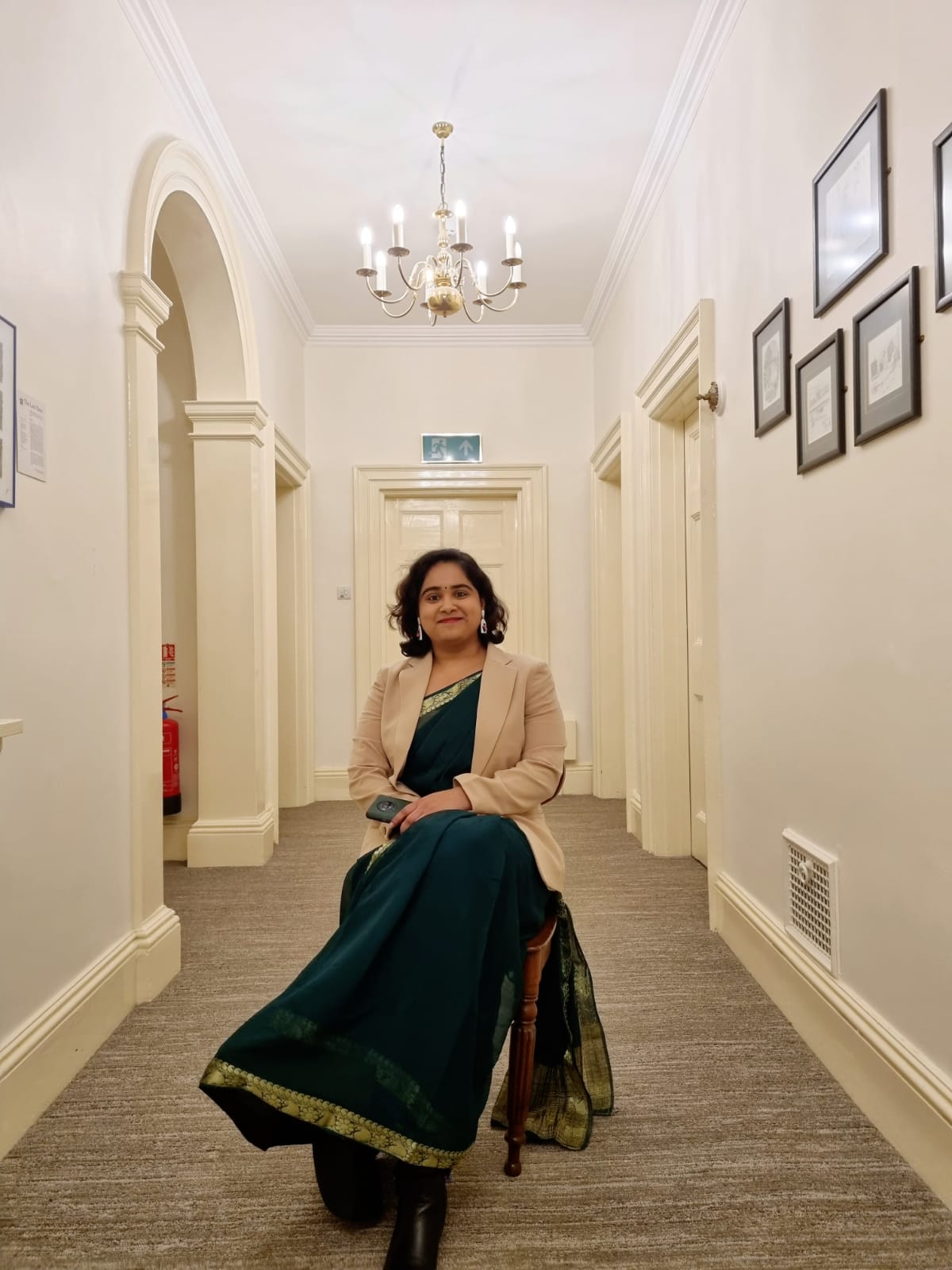
Tag: University of Cambridge

  • “Keep saying yes. Even when it is daunting, even when you feel unprepared, put your hand up. Some of the most defining parts of my journey came from saying yes to opportunities I wasn’t sure I was ready for.” – Ishmeet Kaur, Associate at A&O Shearman, UK.

    “Keep saying yes. Even when it is daunting, even when you feel unprepared, put your hand up. Some of the most defining parts of my journey came from saying yes to opportunities I wasn’t sure I was ready for.” – Ishmeet Kaur, Associate at A&O Shearman, UK.

    This interview has been published by The SuperLawyer Team.

    From Head Girl at Modern School Vasant Vihar to an Associate at A&O Shearman in London how do you reflect on your journey?

    Looking back, it hasn’t exactly been a straight line, but I don’t think I’d change anything. Being Head Girl at my high school was probably my first experience juggling twenty things at once – academics, debates, sports, painting, dancing, leadership (and occasionally trying to stop people, including my notorious best friend, from bunking classes). I loved being involved in everything, which has sort of stayed with me.

    In my final year, apart from juggling the many responsibilities that came with being the Head Girl, I was also a national-level runner and represented the state in competitions across the country. At the time, I remember wanting to take it up professionally and hoped to be the next PT Usha, so I dedicated most of my time to training. I also won a sports scholarship.

    When the board results came, I didn’t hit the 95% mark that’s so often treated as the golden ticket. At the time, I thought that meant I’d missed out. But because of all of my achievements, I got admission to Lady Shri Ram College to study Philosophy which turned out to be exactly what I needed. I didn’t know it then, but Philosophy shaped the way I think: it made me comfortable with ambiguity, taught me how to structure arguments, and to ask “why” until something actually made sense. I loved it a lot, and ended up being among the top scorers in the University. It also turned out to be very good prep for a future degree and career in law.

    After law school at Delhi University, I clerked for Justice A.K. Sikri at the Supreme Court. I then went on to Cambridge for my LLM, and from there joined Cyril Amarchand Mangaldas, where I worked in hardcore litigation and both international and domestic arbitration. Later, I moved to London first at a U.S. firm focusing on international arbitration, and now with A&O Shearman, where I’ve been part of the Litigation and Investigations team. I’m currently on secondment with the firm’s Regulation & Conduct team, which has given me a very different (but equally valuable) perspective on how institutions think about risk, regulation, and conduct.

    It’s been a mix of the unexpected and the intentional but somehow, it’s all added up.

    You took on a fairly serious internship while still a student. What made you do that, and what did you take away from it?

    During my first year of college, I interned with Justice Anup Bhambhani, who was then a senior advocate practicing at the Delhi High Court and Supreme Court. It was a long-term internship that I somehow balanced alongside lectures and college life but I really wanted to get stuck in early.

    It was an eye-opener. I was exposed to serious matters criminal, commercial, and constitutional that eventually reached the highest courts in the country. I did a lot of research and drafting work and got to see legal strategy taking shape in real time. He was the best first mentor anyone could ask for, generous with his time, exacting in the best way, and genuinely invested. They say if your first boss is a good boss, you’re lucky I definitely was.

    That experience grounded me early. It helped me see law not just as a subject but as something real, dynamic, and impactful. I think it also gave me the confidence to keep pushing for more, even when things felt intimidating.

    And then a clerkship at the Supreme Court with Justice Sikri right after law school, which was your first step into the full time professional legal world. What was that like?

    The transition from law school to the Supreme Court was like being dropped straight into the deep end – but in the best way. As a clerk to Justice Sikri, I had a front-row seat to some of the most important legal debates in the country. What struck me most was the sheer discipline and clarity with which he approached even the most complex matters. Every footnote, every comma, had to have a reason.

    He was also incredibly open to ideas. I was fresh out of law school, but he always made space for me to question things, to offer my own perspective, and to learn by doing. It taught me the value of precision, yes but also how to look beyond the black letter of the law to the human impact of legal reasoning. That lesson has stuck with me far beyond the court, and I’ll always be grateful to him for cementing my love for the law.

    You pursued an LLM at Cambridge right after. What drove that decision, and what was it like?

    After the intensity of the clerkship, I wanted to step back and immerse myself in deeper academic thinking. Cambridge had always been something of a dream. I applied, not expecting much, and was genuinely shocked when I got in and that too with scholarships from the Cambridge Trust and the Pratibha M. Singh Foundation.

    My time there was everything I hoped for – demanding, inspiring, and also very grounding. I studied international law, information law, advanced private law alongside peers from all over the world. We’d debate the ICC’s latest decisions in the morning, spend afternoons trying (and failing) to punt without falling into the Cam, and evenings at formal dinners where I’d shamelessly sneak in a bottle of Tabasco. It was serious learning with a light touch, and it pushed me to see law in a much more global and comparative way.

    After Cambridge, you returned to India and joined Cyril Amarchand Mangaldas (CAM). What was that experience like?

    CAM was where I properly learned how to be a litigator. I joined the disputes team and was in court or before a tribunal pretty much constantly arguing, drafting, thinking on my feet. It was full throttle, but I loved it. There’s something about being in the thick of it – scrambling to prepare for a hearing at midnight, getting cross-examination notes ready under pressure – that really forces you to trust your instincts.

    I had incredible mentors during that time. Raunak, the partner in the team, was great and generous with his time, and my brother-in-law Aditya – also a lawyer, and at the firm then – was (and still is) someone I lean on for ideas, prep, and perspective. The exposure to substantive matters early on really gave me the confidence to speak up, take ownership, and grow quickly.

    You then moved into international arbitration at a U.S. firm in London. What was the shift like?

    It was a big transition – procedurally, stylistically, culturally. The focus there was on large-scale international arbitration, so the pace was still fast, but the rhythm was different. Less shouting in courtrooms, more strategic planning in very long Zoom calls.

    What I really appreciated was the collaborative nature of cross-border work. You’re often balancing legal regimes, time zones, and business interests at once. I worked closely on issues tied to enforcement risk, and it gave me a clearer sense of how legal exposure often begins long before any formal dispute arises. That experience planted the seed for what’s now a strong interest in how businesses are regulated, the many risks involved, how to mitigate those risks, and when things go south – how best to serve your clients. It also showed me how lawyers can play a proactive role in every stage of that process.

    What have you worked on at A&O Shearman, and what are you doing now in your secondment?

    At A&O Shearman, I joined the Litigation and Investigations team, where I’ve worked on a range of matters: commercial litigation, internal investigations, and regulatory enforcement issues. Several of those matters touched directly on financial crime, fraud, and misconduct, and I found myself increasingly drawn to the investigative and regulatory angles of our work.

    That interest is what led me to take up a secondment with the firm’s Regulation & Conduct team which is part of the risk and compliance function. The role is very strategy-focused – I help assess how emerging regulatory developments might impact the business and its clients, contribute to internal compliance frameworks, and think through conduct from both a legal and cultural lens.

    It’s been fascinating to sit at the intersection of law, risk, and policy, and to understand how large institutions manage internal controls, reporting obligations, and reputational exposure. The secondment has also deepened my interest in working with legal systems that are evolving to meet increasingly complex financial, financial crime, regulatory and technological risks. Its given me a much clearer sense of how clients experience and navigate legal risk internally and I am looking forward to bringing that perspective into my disputes, investigations and regulatory practice, where I can apply it with sharper insight and impact.  

    Outside law, when you were in India you co-founded a teaching academy. Can you tell us about that?

    Yes – this is something very close to my heart. My grandmother is a retired schoolteacher who wanted to keep teaching. So, we started small: just a borrowed desk in a neighbourhood temple, a few local kids, and a lot of chalk dust.

    It grew faster than we expected. Over the years, we’ve taught more than 1,000 students, all from families who couldn’t otherwise afford extra help. We now have a proper space, a volunteer teaching team, and a small but thriving community.

    Even now, from London, I stay involved however I can, mentoring, supporting the team, and helping raise funds. It’s a constant reminder that education doesn’t need to be fancy to be powerful. It just needs to be consistent, kind, and rooted in belief.

    Your journey cuts across court work and litigation, arbitration, investigations, and regulatory compliance. What connects it all?

    The through-line, I think, is clarity. Whether I’m helping a client frame a case, analysing documents related to an investigation, or advising on conduct risks – it’s about unpacking complexity and making it manageable.

    I’ve always been drawn to roles where law intersects with regulation and reputation, especially in high-stakes or high-impact contexts. The kind of work where one wrong move has real consequences, whether it’s a financial crime allegation or a governance failure. That’s what excites me where investigations, compliance, and tech-driven legal thinking all meet. It’s an area I’d love to keep building in.

    And finally, what advice would you give to someone starting out, especially if they feel they’re not on the “perfect” path?

    I’d say – forget perfect. It doesn’t exist. When I didn’t get the course I thought I wanted in undergrad, I felt like I’d already fallen behind. But that so-called “detour” changed everything. So be open. Your path doesn’t have to look like anyone else’s.

    Ask for help. I’ve learned so much just by reaching out to people who were one or two steps ahead of me. And when you’re in a position to, pay that forward.

    Also: keep perspective. Law can be intense, and it will stretch you – but it’s also a long game. Take the work seriously, but don’t let it swallow the rest of your life. Keep reading, travelling, painting, running, resting – whatever makes you feel like a person. That part of you will make you a better lawyer, and a much better colleague!

    And finally, keep saying yes. Even when it is daunting, even when you feel unprepared, put your hand up. Some of the most defining parts of my journey came from saying yes to opportunities I wasn’t sure I was ready for. That’s how I stumbled into Philosophy first and later into areas of law I never expected to love, commercial disputes, regulatory work, investigations, financial crime and the influence of technology in law, these have shaped the way I think today. So take the chance. Sometimes the things you grow to love and the strengths you didn’t know you had are waiting just on the other side of that first ‘yes’.

    Get in touch with Ishmeet Kaur –

  • “No matter what happens in your professional career it is important that you soldier on without giving up. Be positive and look ahead with vigour.” – Ashwin Mathew, Independent Law Practice Professional.

    “No matter what happens in your professional career it is important that you soldier on without giving up. Be positive and look ahead with vigour.” – Ashwin Mathew, Independent Law Practice Professional.

    This interview has been published by Anshi Mudgal and The SuperLawyer Team

    You completed your law degree from National Law School of India University, Bangalore and received various awards and accolades, what were the instances that made you pursue a career in law?

    I think my decision to pursue law as a career was influenced by two distinct phases in my life. The first phase was before I joined NLSIU, Bangalore. I was an avid reader and enjoyed the works of Erle Stanley Gardener and Henry Denker. The former created Perry Mason who was an excellent criminal defense attorney and the latter combined law and medicine in his books which appealed to my background as a science student. The second phase was after I joined NLSIU, Bangalore. NLSIU, Bangalore was a nascent institution at that time but the structure that had been put in place ensured that I truly appreciated the intricacies of law. NLSIU, Bangalore had a superb Director in the late Dr. N. R. Madhava Menon, who all of us students admired, a dedicated group of teachers, an excellent student pool and extremely supportive staff. The curriculum of NLSIU, Bangalore was rigorous. It was based on the trimester system. Each trimester had 4 subjects. For each subject a project had to be submitted. There were also two sets of exams and a viva voce for each project. Attendance was also marked and anyone with less than 75% attendance could not sit for the final exam. This challenging curriculum made me appreciate the various laws and the intricacies involved. Initially my performance was average but in the 3rd year when the subjects were all legal, I flourished and my cumulative grade point average rose. I fully appreciated that law was about problem solving with regard to which my science background helped immensely. This convinced me that law was a sound career option.

    You have completed your master’s degree from the University of Cambridge, United Kingdom where you specialised in subjects such as International Banking and Financial Law, Corporate Finance, International Commercial Litigation and Jurisprudence. What piqued your interest in Corporate and Commercial Laws as a specialisation?

    My interest in corporate and commercial laws was piqued during my first job at Amarchand & Mangaldas. I was recruited from campus by the erstwhile Amarchand & Mangaldas to work in Mumbai. I was assigned to the team of Mr. M. P. Bharucha and Mrs. Alka Bharucha. At that time, I was completely green on the practice of corporate and commercial law and made some embarrassing mistakes at the start. Mr. and Mrs. Bharucha were excellent seniors and mentors who provided superlative advice and guidance which helped me appreciate the nuances of corporate and commercial law. Also, their practice was not specialised so I was exposed to different kinds of matters. As time went by, I got to work on more and more complex matters. Amarchand was the premier law firm of the time and as a result there was no dearth of such transactions. I worked for 6 years at Amarchand and in the end I had an abiding interest in corporate and commercial law. Therefore, it was natural to choose corporate and commercial law as a specialisation at University of Cambridge, UK (“Cambridge”). At this point I must mention what my experience at Cambridge was like. Cambridge is one of the premier institutes of learning in the world. I did my Masters in Law or LL.M at Cambridge. Students from different nationalities come to Cambridge each year making it a melting pot of cultures and backgrounds. Cambridge also exudes a sense of learning by fostering the growth of knowledge. A Masters at Cambridge focusses on self-study. Classes are few although taken by giants in their field. A Masters student is expected to spend the rest of his or her time studying on their own. At the end of the course period examinations are held which are difficult. If you want to broaden your mind by being exposed to a different approach to education than institutes like Cambridge are for you. The only factors you need to keep in mind are the challenges in getting admission and the costs.

    You have worked with various law firms and advised domestic as well as international clients with issues relating to corporate and commercial laws. What has been the most interesting issue you have faced and how did you resolve that issue?

    This is a difficult question to answer. In my experience, every matter you work on throws up interesting issues. Of the many issues I have had to grapple with, a few come to mind. The enforceability of pre-emption rights and put and call options in a shareholders agreement or joint venture agreement, the enforceability of notice periods in employment contracts given the legal restrictions on restraint of trade, whether the indemnity provisions in the Indian Contract Act, 1872 are a complete code, the relationship between indemnity and damages, the distinction between representations and warranties, the effect of imperfections in the procedure followed under SARFAESI on the ultimate sale of the secured asset and finally, stamp duty on documents executed outside a state when brought into a state and effect of non-payment of stamp duty. These issues aside, I think my most memorable experience with a prickly issue happened when I was at Lakshmikumaran & Sridharan (“L&S”). The question was whether a subsidiary company would include a limited liability partnership (“LLP”) for the purposes of the Companies Act, 2013. The definition of a subsidiary company provides that the expression “company” in the definition includes any body corporate. The definition of “body corporate” is an inclusive definition and includes a company incorporated outside India. These two definitions did not provide any clarity on the issue before us. I then sat down with a person I consider to be one of the finest lawyers in India, Mr. V. Sridharan, Senior Counsel and one of the founders of L&S to examine the issue. At Mr. Sridharan’s behest we examined all the background material pertaining to this issue. This included the Companies Act, 1956, the Companies Act, 1913, the Statement of Objects and Reasons and Notes on Clauses contained in the various Companies Bills that preceded the Acts and various Committee reports. At the end of this comprehensive analysis, we concluded that an LLP was a body corporate for the purposes of the definition of a subsidiary company under the Companies Act, 2013. This experience with Mr. Sridharan was an eye-opener for me on the importance of thorough research where every aspect is examined before a conclusion is reached. It also emphasized one of the cardinal rules of statutory interpretation which postulates that when a statute is ambiguous you must look to the objects of the clause in the statute to determine its meaning. I am eternally grateful to Mr. Sridharan for the lessons he taught me during our interaction.

    You have immense knowledge and practice in areas relating to corporate and commercial laws, private equity investments, mergers-acquisitions and joint ventures, financing, insolvency and bankruptcy matters and other allied areas. Which of these areas is the most interesting to you and how do you keep up with the changing trends in law pertaining to these areas?

    I think that the areas that I enjoyed the most were private equity investments, joint ventures, insolvency and bankruptcy and general corporate advisory. There is no fixed way to keep current in a field of law. Some professionals read law journals and others follow the latest news. My methodology was a little different. When an issue came before me in any of these practice areas, I researched every aspect of the law related to that issue so that I was current. Another thing I do is regularly read newsletters of top law firms on latest developments.

    Your expertise in the Commercial and Corporate law area is commendable, would you like to share with us how your journey has been so far?

    My journey so far has been exhilarating even though it has had some extreme lows. The only things I wish could have been different is if I had been re-instated as partner in Khaitan & Co and if I had continued at Lakshmikumaran & Sridharan where I am confident, I could have made a difference. That said I am ever grateful that I got to work with, and learn from, some of the finest legal and business minds in India and abroad. I have also had excellent juniors who were quick to learn, helped me learn and made my job so much easier. I have advised on significant, complex and cutting-edge transactions all thanks to the faith reposed in me by the various organisations I worked for. All this has helped me grow as a professional and as a person.

    Would you like to share with us one key learning that you have always followed throughout your career which has helped you navigate the rough patches?

    There are a few things that I follow that give me strength and courage. The first is the motto of my school – Never Give In. No matter what happens in your professional career it is important that you soldier on without giving up. After all there is always light at the end of a dark tunnel. So be positive and look ahead with vigour. The second is a quote of Abraham Lincoln which my father swears by, “If I had eight hours to chop down a tree, I’d spend the first six hours sharpening my axe.” This quote emphasizes the importance of preparation and how working smart is sometimes better than working for long periods of time. The third is a coffee mug quote which resonated with me “Quality only happens when you care enough to do your best. Always care about what you do to ensure that the outcome is of a high standard. I have tried to stay true to these sayings to my benefit.

    You have advised many national and international clients in investments that involve a huge amount of money, what is your experience in dealing with such responsibility and pressures?

    I have never had a problem handling the responsibility and pressures of my work. This is because I loved what I was doing and always had very good professionals working with me to lessen the burden. I handled these big matters when I was part of top firms with several bright professionals and I never did it alone. There was always a team working with me to ensure that the load was not concentrated in any person.

    What advice would you give to the young lawyers just starting out, aiming to pursue a career in the field of Commercial Laws and Private Equity Investments?

    My primary advice to young lawyers is that every practice area is unique and it is important to understand the basic and key elements of the practice area you are working in and the main drivers of such practice area. Also, a young lawyer must not be afraid to speak up and raise doubts because only then will he or she learn. If a young lawyer is given a piece of research, he or she must examine the issue threadbare by looking at the statute book, commentary, case law and articles by prominent authors. Finally, a young lawyer must pick his or her senior’s brain when he or she hits a roadblock because many a time experience trumps book learning.

    As regards private equity investments, a young lawyer must understand the various kinds of investment and the various kinds of companies that receive such investment. A start-up company receives seed funding and venture capital funding which could be spread over a number of rounds. Private equity investment on the other hand is risk free capital (for the investee company) invested in a mature company for a minority stake. From the investor’s perspective the investment is high risk but the potential returns can be substantial. The investment has a certain horizon and the investor must be given an exit at the end of this period, either through an initial public offering (“IPO”) by the investee company or a buyback by the promoters / investee company at a certain internalised rate of return. Most private equity investors prefer to exit through an IPO since the return can be very high but that may not always be feasible given market conditions. The other thing to bear in mind for private equity investments is that the investor only holds a minority stake. The Companies Act, 2013 has various thresholds of shareholding each of which give a certain set of rights to the shareholder who holds that percentage or more. Depending on the extent of a private equity investor’s holding and considering the thresholds under the Companies Act, 2013, a basket of rights must be granted to the investor.

    The reason I have discussed some aspects of private equity investments is to give young lawyers a flavour of the issues that they need to grapple with and provide some insight on how these issues need to be addressed. A prominent private equity investor once told me that the most important consideration while negotiating a deal is fairness. If a demand made by the other side is fair, there must be very strong reasons to reject it. If this mantra is followed not just in private equity deals getting a deal done would be expedited.

    You must have a fast-paced work schedule, how do you manage a work life balance with a demanding career?

    I strongly believe that a legal professional must ensure that he has a life outside the workplace. To do this he or she must not spend long hours at the workplace unless warranted by the demands of the job. In my case, I made it a point not to waste the normal working hours at the office. If you use the 9-10 hours at the office wisely, there is no need to sit late. This would ensure that after you got home you could pursue your other interests allowing you to maintain a healthy work-life balance. Another point in this regard is the importance of cultivating your interest in a myriad areas of life so that there is never a point when you feel bored.

    What have been some of the most important cases you have dealt with and is it possible for you to share details of any of your cases and your modus operandi to approach and prepare for that case?

    There are three matters that I would like to share but unfortunately due to confidentiality constraints I can only give you the broad contours. I cannot go into details or my modus operandi to approach and prepare for the matters. The first matter is the failed consolidation of the erstwhile Birla, Tata and AT&T with BPL Communications. As part of the Amarchand & Mangaldas team we helped draft the consolidation agreement. After the consolidation failed, BPL approached the Bombay High Court. The matter was argued before Justice A. P. Shah by Mr. M. C. Chagla, Senior Counsel and Mr. P. Chidambaram, Senior Counsel. This was the first time I witnessed an agreement drafted by us being tested in court.

    The other two matters involve Blackstone’s investments in Gateway Rail Freight Limited and Jagran Prakashan Limited.

    If the question pertains to litigation, I must admit I have not appeared in many cases before the courts. For the cases where I have appeared, I have found that strong preparation is very important. Knowing the dates and events is paramount. Also, it is very important to know the pleadings and the exhibits. You also must know all relevant case law. You must weave a story for the judge while also anticipating the arguments of the other side and pre-empting such arguments.

    Get in touch with Ashwin Mathew-

  • “Each step has been instrumental in defining my approach to legal challenges and contributing to the growth and success of the organizations I’ve been a part of”- Mehak Gupta, Senior Legal Counsel & Insurance Counsel at Infosys

    “Each step has been instrumental in defining my approach to legal challenges and contributing to the growth and success of the organizations I’ve been a part of”- Mehak Gupta, Senior Legal Counsel & Insurance Counsel at Infosys

    This Interview has been published by Pragya Chandni and The SuperLawyer Team

    Can you tell us about your journey into the field of law, from your early education to your current role as Senior Legal Counsel at Infosys Limited?

    My journey into the field of law has been both deliberate and transformative. Initially, I embarked on a path in Chartered Accountancy alongside pursuing Bachelor of Commerce (Honours) program at Delhi University. However, it was during this time that I realized my passion lay more in the realm of company and business law rather than accountancy.

    This revelation prompted me to take the entrance exam for law, and I was fortunate to secure a place at Campus Law Centre, Delhi University. This educational shift allowed me to delve deeper into my newfound interest, laying the foundation for my legal career.

    The academic rigor I experienced at law school made me realize that I enjoyed legal research and the discipline that comes with academic writing. I therefore decided to pursue a master’s degree in law and was fortunate enough to get accepted into one of the world’s best LL.M. programs at the University of Cambridge, United Kingdom. 

    At Cambridge, I had the opportunity to delve into a diverse range of subjects, from International Taxation to IP rights and Corporate Financing. This international exposure broadened my horizons and equipped me with a comprehensive understanding of global legal frameworks and practices.

    Upon completing my education, I joined Vaish Associates, where I honed my practical legal skills. Working on complex matters related to the Income Tax Act, 1961, I had the privilege to collaborate with renowned legal professionals such as Mr. Harish Salve, Mr. P. Chidambaram, and Mr. Kapil Sibal. These experiences not only enriched my legal expertise but also instilled in me the importance of diligence, teamwork, and taking ownership of tasks.

    Transitioning to Panasonic as the legal counsel for their Innovation Center was another significant milestone in my career. Here, I was responsible for providing end-to-end legal advisory for cutting-edge technology platforms. My role was multifaceted, encompassing everything from conducting compliance seminars to drafting policies on vendor procurement, social media, anti-bribery, and privacy law.

    Now, as a Senior Legal Counsel at Infosys, I continue to navigate the dynamic intersection of law and technology. My journey from studying Commerce to choosing law has been a continuous learning experience, shaping me into the lawyer I am today. Each step has been instrumental in defining my approach to legal challenges and contributing to the growth and success of the organizations I’ve been a part of.

    With such a diverse educational background, including law and commerce, what drew you specifically to pursue a career in law?

    During my studies in commerce at Delhi University and chartered accountancy at ICAI, I found myself increasingly intrigued by the intricate legal frameworks that govern business transactions, corporate structures, and regulatory compliance. This curiosity led me to explore law as a potential career path.

    Further, the dynamic nature of the legal profession, coupled with its potential to influence business strategies, drive innovation, and promote ethical practices, resonated with my aspirations and values. I was particularly attracted to the interdisciplinary nature of law, which allows me to integrate my background in commerce with legal expertise to provide holistic solutions to complex business and regulatory issues.

    With my diverse educational background in both law and commerce, it has undoubtedly shaped my perspective and enriched my skill set. While commerce provided me with a strong foundation in financial and business principles, it was my growing interest in the legal aspects of business operations and corporate governance that ultimately drew me towards a career in law.

    Your work experience spans across different sectors, from legal counsel at Panasonic to your current role at Infosys. How has this variety of experiences shaped your approach to legal practice?

    At Vaish Associates, I had the invaluable opportunity to gain field-level exposure as a lawyer, focusing on tax litigation and arbitration. This experience was instrumental in enhancing my understanding of the functioning of the court, the mindset and interpretation of judges, and the intricacies of commercial and tax laws /regulations. I learned to navigate complex legal issues, anticipate potential challenges, and develop effective strategies to advocate for clients and protect their interests.

    Transitioning to Panasonic’s in-house legal team and subsequently to Infosys, I applied the insights and skills gained from my litigation experience to navigate the complex regulatory landscapes and provide strategic legal counsel across different sectors. My ability to analyse complex legal issues, identify creative solutions, and communicate effectively with diverse stakeholders has been greatly enhanced by my deep understanding of litigation.

    Further, at Panasonic, I had the opportunity to work as a legal counsel with its Innovation Center. This provided me with a unique opportunity to immerse myself in the world of technology and innovation. As the lead counsel of the Panasonic Innovation Centre, I was responsible for providing end-to-end legal advisory for cutting-edge technology platforms, conducting compliance seminars, and drafting comprehensive policies. This experience taught me the importance of staying abreast of technological advancements, understanding industry-specific regulations, and effectively communicating complex legal concepts to non-legal stakeholders.

    Transitioning to Infosys, has further broadened my horizons and refined my approach to legal practice.

    As a lawyer with a mix of litigation and in-house experience, it equipped me with a multifaceted skill set, enabling me to become a more rounded lawyer and cultivate a proactive, solution oriented, and forward-thinking mindset.

    Could you share some insights into the challenges you’ve faced while navigating the legal landscape in both corporate and commercial settings?

    One of the primary challenges I’ve faced is staying abreast of the ever-evolving regulatory frameworks and industry-specific regulations across different sectors. The legal landscape is dynamic, with laws, regulations, and compliance requirements frequently changing in response to technological advancements, global trends, and socio-economic developments. Keeping up with these changes requires continuous learning, proactive research, and a deep understanding of the nuances and complexities of each sector.

    Another challenge I’ve encountered is balancing legal rigor with practical considerations and business objectives. In corporate settings, legal counsel often plays a strategic role in guiding decision-making, managing risks, and facilitating business transactions. It’s crucial to align legal advice with organizational goals, foster cross-functional collaboration, and develop tailored legal solutions that support innovation, growth, and compliance while mitigating risks and protecting the interests of the organization and its stakeholders.

    Your expertise includes areas like corporate finance, intellectual property, and international taxation. How do you stay updated in such dynamic fields, and how do you apply this knowledge in your day-to-day work?

    One of my key strategies for staying updated is to cultivate a diverse and extensive professional network, comprising colleagues, peers, and mentors across different sectors, industries, and jurisdictions. It’s essential to actively participate in industry conferences, seminars, and engage in professional associations, and collaborate with external advisors and experts to exchange insights and share best practices.

    Additionally, I leverage a variety of resources and platforms, including legal publications, journals, newsletters, and online databases, to access up-to-date information, case studies, and regulatory updates. I also engage in continuous self-directed learning, professional development, and skill enhancement through online courses, certifications, and training programs- the most recent courses completed by me are Anti-bribery and Corruption, M&A Regulation and Compliance, and Concept of Privacy by Design. 

    Applying this knowledge in my day-to-day work involves analytical skills, and practical experience to address complex legal issues and develop tailored legal advice for stakeholders, and cross-functional teams. I strongly believe that one of the essential elements of being an in-house counsel is to collaborate closely with colleagues and stakeholders to understand their needs, and objectives, and accordingly develop innovative, pragmatic, and ethical solutions that align with business goals. 

    Furthermore, I have always taken every opportunity I’ve had to share the information, knowledge, and experience that I have gained during my years navigating the multifaceted and complex work undertaken by me as the in-house legal counsel for two separate Fortune 500 companies, to other members of the legal community either through presenting my learnings in conferences or conducting trainings for various departments within my organization. I actively mentor and train the Infosys’ Legal Process Management (LPM) Team which comprises young lawyers and routinely help them understand the deeper nuances of technology, IPR and Data Privacy Law, along with advising and guiding them on honing their drafting and negotiation skills.

    In essence, staying updated in dynamic fields requires a proactive, multidimensional, and holistic approach to learning and professional development.

    As someone deeply involved in contract negotiation and management, what are some key strategies you’ve developed for ensuring successful outcomes in complex agreements?

    During my 10-plus years in the legal profession, navigating complex contract negotiation and management has been a critical aspect of my role. I’ve had the opportunity to participate in and lead several ‘first of their kind’ transactions in the IT Services sector. These transactions inter alia involved, advising on innovative structures to provide IT services, negotiating complex high-value software development and licensing agreements, as well as advising on and representing my organization in private and public tendering processes.

    One of the key strategies according to me is to conduct comprehensive due diligence, identifying potential risks, challenges, and identifying creative and innovative, solutions to complex legal, commercial, and regulatory issues, and develop flexible, and adaptive, contract structures, terms, and conditions that align with business goals, support innovation, mitigate risks, and provide clarity, certainty, and predictability for all parties involved.

    A crucial aspect of this approach is the importance of understanding the business and project well to be able to negotiate effectively. By gaining a thorough understanding of the business objectives, market dynamics, competitive landscape, regulatory environment, and the specific requirements, goals, and constraints of the project, I am able to align legal advice and contractual terms with business goals, support innovation, mitigate risks, and provide clarity, certainty, and predictability for all parties involved.

    Additionally, effective collaboration with various internal and external stakeholders to successfully close the time-sensitive transactions is an essential part of being a commercial contracts counsel.

    Your achievements include awards for legal excellence and contributions to data governance programs. In your opinion, how significant do you believe receiving awards and recognition is for legal professionals, and how have such accolades influenced your career trajectory and professional development? 

    While awards and recognition in the legal profession may not always translate directly into monetary gains, their importance, in my opinion, should not be understated. 

    These accolades serve as invaluable markers of expertise, dedication, and contributions to the legal field, bolstering credibility and enhancing reputation among peers, clients, and potential employers. 

    Such awards have been instrumental in shaping my career trajectory and professional development in ways that go beyond financial incentives. They have opened doors to new opportunities, such as networking events and speaking engagements, which have enriched my professional network and professional growth. 

    Moreover, awards and recognition act as motivational milestones, driving me to continually strive for excellence, innovation, and they instill a sense of pride, accomplishment, and responsibility, inspiring me to uphold the highest standards of professionalism and ethics in my legal practice.

    Lastly, considering your journey and accomplishments, what advice would you offer to fresh graduates aspiring to pursue a career in law?

    Reflecting on my journey in the legal profession, I have several pieces of advice for fresh graduates aspiring to pursue a career in law.

    Firstly, prioritize continuous learning and professional development. The legal landscape is constantly evolving, so staying updated by attending workshops, seminars, and training sessions is essential.

    Secondly, focus on building a strong professional network. Networking with peers, mentors, and industry professionals can open doors to new opportunities, provide valuable insights, and offer support and guidance as you navigate your career path. Remember, relationships built early in your career can serve as valuable resources throughout your professional journey.

    Thirdly, seek out diverse experiences and opportunities to gain hands-on experience across different areas of law. This will not only help you discover your passion and areas of interest but also make you a more well-rounded and versatile legal professional, capable of adapting to different challenges and opportunities.

    Additionally, maintain a strong work ethic, integrity, and commitment to excellence in all aspects of your work. Building a reputation for reliability, professionalism, and ethical practice is crucial for long-term success and credibility in the legal profession.

    Lastly, and perhaps most importantly, don’t be too hard on yourself. Achieving your goals and building a successful career takes time, persistence, and patience. Set realistic expectations, celebrate small victories along the way, and remember that setbacks and challenges are opportunities for growth and learning.

    Get in touch with Mehak Gupta-

  • “As an Advocate on Record practicing before the Supreme Court of India, one has to be open to learning diverse and complex laws in a limited amount of time”- Arnav Narain, Advocate-on-Record, Supreme Court of India

    “As an Advocate on Record practicing before the Supreme Court of India, one has to be open to learning diverse and complex laws in a limited amount of time”- Arnav Narain, Advocate-on-Record, Supreme Court of India

    This Interview has been published by Pragya Chandni and and The SuperLawyer Team

    Can you share with our listeners the journey that led you to pursue a career in law, especially considering your impressive academic achievements at Amity Law School?

    The journey that led me to law began in 11th standard when I chose Science with Computers only to realize that I have an interest in neither. Like many others, I was merely following the herd. Fortunately, my computer science teacher at Modern School sat me down and encouraged me to start law school training while pursuing science at school. The days I spent in law school training were most interesting and made me realize that I may have a genuine liking for legal subjects and reasoning. By the end of my final year at school, my entire section and my teachers knew that I was a science student preparing to become a lawyer.

    I joined Amity Law School, Delhi (IP University) which at that time was in the top 10 law schools in India. I would prepare for my classes, ask way too many questions (sometimes even got punished for it), and worked hard for my exams. I would take time out to represent the law school in a few national and international moots and MUNs every year. After the first semester, I had topped the University, which was extremely encouraging and subsequently I received the Raja Rai Best Student of the Year award for all 5 years at law school. It was the first time I understood the meaning of the word aptitude. I was excited to move forward on this path.

    How did your experience as a Law Clerk to Hon’ble Mr. Justice Sanjay Kishan Kaul and as an intern with HMJ (retired) S Muralidhar shape your perspective on the legal profession?

    Working as an intern with Justice Muralidhar and as a clerk with Justice Sanjay Kishan Kaul allowed me to gain insight into the life and cycle of arbitration cases at the Delhi High Court. While Justice Muralidhar handled the original side arbitration cases amongst others, Justice Kaul was handling the arbitration appeals. I had a front row seat in the Delhi High Court that enabled me to witness some of the best orators/Senior Advocates presenting their cases before some of the brightest legal minds. 

    In my internship with HMJ Muralidhar, I was responsible for preparing a Compilation of summaries of judgments delivered by the Hon’ble Delhi High Court in that calendar year that contributed to the development of law. This proved to be an excellent exercise for a newly graduated law student as it provided me with further training in reading lengthy judgments in a short period of time and extracting its essence in a few short paragraphs. This, I believe, is a skill to be honed in every lawyer. 

    As a clerk to Justice Sanjay Kishan Kaul, my roster of responsibilities was a bit wider as I was responsible for checking the daily orders, sat in Court to hear arguments while noting important cases quoted, conducted extensive legal research in order to assist the Judge in dictating judgments and prepared the odd speech to be delivered by the Judge.

    My experience at the Delhi High Court, working with two brilliant Judges allowed me to carefully observe court craft and court etiquette. It gave me a unique opportunity to understand the considerations that weigh with judges while deciding cases and also allowed me to stay updated with the latest caselaw on various legal issues, as they would be regularly quoted in the Court. It was helpful to maintain a diary of daily case proceedings and important notes during the course of my clerkship.

    Your Master’s in Law at the University of Cambridge focused on International Law & EU Competition Law. How did this international exposure contribute to your understanding of the legal landscape?

    To be a Masters student at one of the oldest most prestigious Universities in the world – (with arguably the most beautiful campus) – was a matter of great privilege as well as pride for me. It has contributed significantly to my growth, not just as a professional but also as a person. I was fortunate to be in a multicultural environment and to be taught by highly respected professors such as (late) Prof. James Crawford whose small groups sessions at the Lauterpacht Centre for International Law would be riveting to say the least.

    It was a remarkable opportunity to understand the various facets of EU Competition law from experts such as William Allen, a former competition law partner at Linklaters, which I have consistently relied on in competition law cases in India. The masters not only contributed to my understanding of the legal landscape, but it broadened my horizons allowing me to be more confident and self-assured as a litigator in India. 

    At Cambridge, I was elected as the Student Council Representative at Darwin College which enabled me to voice the concerns of the students at Darwin and stand up for issues that mattered. After coming back from Cambridge, I have also been closely associated with the Oxford and Cambridge Society of India (having been elected on three successive Committees) organizing academic, social, cultural and sporting activities with Oxbridge alumni in Delhi. 

    How do you stay updated on the latest legal developments, especially in the dynamic field of competition law?

    In order to stay updated with legal developments in competition law, I read some important competition law journals (Indian and foreign) as well as judgments from India, EU and US. I spent 2 months in Brussels in 2023 attending multiple conferences pertaining to the developments in EU competition law and competition law globally. 

    You transitioned from working in the Chambers of Aditya Narain to establishing your independent practice. What were the pivotal moments that led to this decision, and how has the experience been for you?

    After completing my masters, I worked with Mr. Aditya Narain, Advocate (as he had a very strong background in antitrust) for 5 years and I was primarily involved in cases pertaining to competition law and consumer disputes. In fact, during the very first week back in India, I was assigned the Ericsson vs Intex/Micromax (Standard Essential Patents) case where Mr. Narain was appointed the Amicus Curiea by the Hon’ble Delhi High Court. It was the first case of such a nature dealing with the conflict between competition law and IP law.

    Thereafter, I sat for the AOR exam in 2019, as I had always aspired to practice at the Supreme Court of India, even as a young law student. Once I cleared the prestigious AOR exam, I started my journey as an independent counsel and an Advocate on Record. To be an Advocate on Record, in my honest opinion, is one of the most fulfilling experiences for a lawyer as it presents you with opportunities to develop and present high stakes cases in the highest Court, pertaining to all subjects whether civil, criminal, constitutional etc. Often, the AOR dons different hats i.e. of a lawyer, clerk, typist, translator and that can be a bit exhausting. I have been fortunate to have been involved in some extremely interesting cases before the Supreme Court that have contributed to the development of law. This was always my dream.

    Your current practice involves handling a variety of cases, including competition law, consumer disputes, constitutional law, insolvency & bankruptcy, and more. How do you manage to navigate such diverse legal areas effectively?

    As an Advocate on Record practicing before the Supreme Court of India, one has to be open to learning diverse and complex laws in a limited amount of time. Not just learn, but with the right doses of legal research, one has to often master those laws in order to argue the case at the highest Court or even brief Senior Advocates on the matter. One needs to retain a sense of being a generalist. But as a law graduate, there cannot be a better avenue to learn and practice across such a diverse variety of legal subjects. 

    With the aid of some brilliant and hard-working colleagues, support from mentors as well as effective time management skills, it is possible to practice across such a wide array of legal subjects. It would be apposite to mention that with the evolution of technology and e-filing software’s/virtual courts, it has become much more convenient to practice as a litigator.

    You recently represented a leading tire company in a significant challenge to a Competition Commission of India decision, resulting in one of the largest fines imposed by CCI. Can you share the key challenges you faced and lessons learned from this case?

    It is indeed an honour to be a part of the tyre cartel case as I have had the opportunity to brief the brightest most well respected seniors such as Mr. Fali S Nariman and Mr. G Masilamani in the matter and work alongside some of the best competition law firms in the country. The matter is pending before the Supreme Court and therefore I would not be able to comment in detail about the case. However, I can say that the Competition Commission of India is one of India’s most robust and active regulators responsible for maintaining fairness in both the retail and online marketplace in India regulating matters pertaining to abuse of dominance and anti-competitive agreements. It is equipped with an investigative arm i.e. the Director General’s office that comprehensively and meticulously investigates matters pertaining to abuse of dominance and anticompetitive agreements.

    In the tyre cartel case, unfortunately, the investigation report of the DG found evidence of existence of a cartel and the CCI passed a penalty order of around Rs. 1788 Crores against 5 tyre companies in the market for Truck and Bus bias tyres. This was one of the largest fines imposed by the CCI. The biggest challenge was to impress upon the Hon’ble National Company Law Appellate Tribunal, that this is one case where the DG and the CCI, both, have made some serious errors in calculating and comparing prices. Ordinarily, the decision of an expert body such as CCI is hard to challenge before the NCLAT, and even harder to have annulled by the Appellate Tribunal. However, in the tyre matters, we were above to demonstrate that the case set up by the DG and accepted by the CCI of price parallelism and cartel was ill-founded and factually incorrect. The DG and CCI had overlooked certain crucial details and numbers and those errors clearly demonstrated that no price parallelism existed and therefore no cartel existed in the market. It was one of the rare cases when the CCI admitted to making those errors (which seldom happens, as regulatory bodies such as the CCI are meticulous and comprehensive in their investigations). However, the NCLAT, while setting aside the CCI penalty decision, remanded the case back to the CCI for deciding the matter afresh in light of the errors made in the CCI decision. In my view, the NCLAT may have considered finally disposing of the matter instead of remanding it and therefore we have filed a limited challenge to the remand of the matter back to CCI. The CCI, of course, has challenged the entire decision of the NCLAT and both cross appeals are pending before the Hon’ble Supreme Court.

    To sum up, the biggest challenge we faced in the matter was to show that the decision of the CCI was contrary to the facts as well as the settled law. We had briefed two of the leading seniors to argue on our behalf i.e. Mr. Mukul Roahatgi and Mr. Krishnan Venugopal who successfully represented our case before the NCLAT. What I learnt in the process was that in order to challenge any decision of any expert regulatory body, one must have tremendous research and preparation skills. The briefing for both the Senior Advocates was rather different and our team had to be attuned to their queries and styles prior to the briefing.  

    Having worked with notable judges, senior advocates, and in various legal capacities, how has mentorship played a role in shaping your career, and what advice would you give to aspiring lawyers on finding the right mentors?

    Mentorship is a vital aspect of our profession, especially in litigation. I have had the good fortune of working with some of the best legal minds in the country, and I have most certainly learnt something from each one of them. There have been lessons on patience, legal ethics, hard work, humility, legal research, oration etc which have helped shape me, not just as an Advocate but also as a person. 

    I draw inspiration from Mr. Fali S Nariman, Sr. Adv (as do most lawyers) who I have had the opportunity to brief multiple times. Briefing Mr Nariman, as many would know, is never about fancy conference rooms and coffee machines. It is about hard facts, in-depth research into the law, reading your brief, re-reading your brief, re-re-reading your brief and culling out the crux of it. Until, every word of every sentence of every paragraph is not crystal clear, no pleading or note ought to be presented to the Court in his name. A clarity of thought, I learnt, is a crucial aspect for a lawyer, as only then can the pleading reflect such a clear thought and move a Judge to rule in one’s favour.

    I learnt another very valuable lesson while briefing Mr. Nariman, something that he also writes in his book. It is that we must take the time out to think about our cases. What that means is that our level of commitment and passion should be such that whenever we have any spare time, we must think about our cases, discuss with colleagues and try and figure out whether there was a better way to present it or even develop it, whether there was an argument that we missed or an argument we took that may not work, how to respond to an argument the other side may make etc. This self-analysis forms the foundation of growth in the profession, in my view. 

    If an aspiring lawyer gets the luxury to choose a mentor, he/she should choose one who not merely knows the law well, but also encourages junior lawyers, gives them opportunities to argue and research, who is transparent and ethical in his/her conduct, discusses cases with his/her juniors, shares anecdotes and occasionally gives notes on how to improve.   

    For those who do not get the luxury of choice, just begin! Take any opportunity and start working. Regardless of how your mentor or senior is, there will be a lot to learn provided you are receptive, observant and inquisitive. Learn what you can and move on.  

    Considering your achievements and diverse experiences, what advice would you like to offer to fresh law graduates who are embarking on their legal careers today?

    I remember briefing an extremely well respected Senior Advocate in Chennai High Court in a cartel case and I was convinced that a particular argument ought to be made by him. The Senior sensed my conviction and excitement but felt that the argument could be detrimental to our case. Only, I failed to understand his point and kept arguing to the contrary. 

    Young lawyers are often full of energy and confidence, ready to fight the fights  and in that endeavor often become less receptive and flexible to other (often opposing) arguments. Sometimes we don’t know when to stop. Being too rigid may have some adverse effects in a Court of law, especially when a Judge strongly disagrees with your viewpoint. It is then that you must acknowledge the opposing argument and redirect yourself in order to meet that argument. Such versatility to maneuver ensures longevity as an orator and a litigator.

    I would also add that in order to be a successful lawyer, one must read the latest judgments, and foreign Court decisions in an attempt to stay abreast. Maintaining a diary of relevant cases is something I have learnt from my seniors and it has saved me on a number of occasions. We must be polite and assertive in Court and never go to Court without reading the brief, even if it is to take a postponement on behalf of another lawyer because if experience has taught me that, on the day that you don’t prepare and go to Court, it is exactly on that day that the Judge will want to hear you argue. Last but not least, one of the most relevant pieces of advice I learnt from seniors and mentors, was not to lose hope in this profession, especially litigation. Litigation will test you, there will be days when you learn nothing (and more days when you will earn nothing) but the litigator must remain passionate, inquisitive and steadfast in his/her pursuit. ‘Just keep swimming’

    Get in touch with Arnav Narain-

  • “Figure out your “why” of continuing with litigation. The practice of law brings me peace and satisfaction”- Anu Shrivastava, Advocate on Record, Supreme Court of India

    “Figure out your “why” of continuing with litigation. The practice of law brings me peace and satisfaction”- Anu Shrivastava, Advocate on Record, Supreme Court of India

    This interview has been published by Priyanka Karwa and The SuperLawyer Team

    Please tell us a bit about your upbringing and what motivated you to study law?

    I was born to a doctor couple in Ranchi. I have an elder brother who is also a doctor. I finished pre-school from St. Mary’s Nursery School and enrolled at DPS Ranchi where I studied until I finished 12th grade. Ranchi used to be a small quiet town. We didn’t have much exposure and the career options were limited to medical or engineering.

    I had seen my parents at their workplaces but was somehow not attracted to their profession. I wanted to understand how the society and our legal system functions. There was a natural inclination to move from the study of sciences to social sciences (This is not to say that I didn’t enjoy science, I did quite well in my 12th board as a Biology student and I miss organic chemistry a lot!). I remember chancing upon the question paper for the first CLAT and finding the questions very interesting. I thought that this was something that would be fun to study. My parents were not keen with the decision at first. But I owe it to my school teachers who played a very important role in convincing them. They eventually came around. 

    How was your law school journey? We see that you’ve done a fair bit of extra-curricular activities as a member and head of the Music Club at GNLU. You’ve also been part of the organising committee for the GNLU International Moot Court Competition (“GIMC”) and the GNLU Moot on Securities and Investment Law (“GMSIL”). Tell us a bit about these. Are co-curricular and extra-curricular roles important for a law student?

    I think 5 year is a really long time if you have to just study law, so it is very important that you keep your interest going with other things. I have always loved playing music. I have even trained in Hindustani Classical. GNLU had a bunch of extremely talented musicians who formed the music club (a tradition that I’m glad to know has continued). Something very special and beautiful happens when a bunch of strangers with very varied backgrounds and interests in music come together to create music. I forged some excellent friendships through the music club, and I did it mostly for myself. It helped survive the grey walls.

    The Organising Committee roles started because I wanted to be among the “cool kids” on campus during GIMC. But over a period of time, it taught me responsibility and very strong organisational skills. The Organising Committee itself is divided into sub-teams for logistics, sponsorship, PR and hospitality, which have their respective team heads or coordinators. Organising a moot which witnesses such wide participation from teams and judges is a crash course in event management. By our 5th year, some of us who were part of the GIMC-OC founded GMSIL because to bridge the need for a moot exclusively for securities and investment law. Our moot court coordinator, Dr. Girish R. liked the proposal and took the idea forward. The University administration was extremely cooperative and helpful, and we had another moot to organise!

    Co-curriculars are definitely important for an all-round development, and somewhat even necessary given today’s competitive environment. I am not sure if extracurriculars help directly. Being involved with the organising committee of a moot court competition may not help you with job applications. But they do form good conversation starters. As an OC member, whether you like it or not, you will know something or the other about the moot problem, and learn a lot simply by hearing the oral arguments. Some of the younger judges who come might also help in mentoring and guiding.   

    Winning the Best Speaker at the 3rd All India Corporate Law Moot Court Competition and receiving an Honourable Mention at the 23rd Willem C. Vis International Commercial Arbitration Moot in Vienna are impressive achievements. Could you share some insights into these experiences and their impact on your career?

    It is incorrect to equate good speaking skills in a moot with a good career in litigation or even law, generally. Moot problems help you think. They come closest to making a student apply the law, think on your feet, and experiment with legal arguments. I picked up a lot on coherent, crisp, and succinct drafting when I was doing Vis (all credits to my team – Muskan, Shweta and Catherine, and to our team coach – Zehaan). Drafting is a very underrated skill. It is extremely important to be able to convey legal arguments in simple words and in a structured manner to have maximum impact on the reader. 

    As far as oral argumentation goes, the preparation for Vis was very different compared to AICLM. With AICLM our focus was very much on the law and clarity of thought and expression. Since it was a national moot we expected the judges to ask questions and preparation was done accordingly. Vis was trickier. We had prepare for arguments before judges from different jurisdictions who were used to hearing very different accents and dialects. I remember hitting rock bottom at one point in my preparation for the oral rounds, because I felt that I wasn’t getting better. Things got better once I identified that I cannot go by a scripted speech. In that sense, moot court competitions helped me discover an individual style of argumentation. 

    Most moot court competitions are based on a new and upcoming legal issue. They’re a great way to keep on your toes about legal developments and interesting areas of law. My main reason for participating moots was because they were a great learning experience. 

    You secured a pre-placement offer with Cyril Amarchand Mangaldas in your 3rd year at GNLU. What would be your placement advice to students?

    Honestly, I had not given much thought to placements back then. Our University had an excellent placement and internship committee which worked towards ensuring that students had internships and placements. I can’t speak of the standard procedures today but back then, a PPO was the culmination of repeat internships at any office. I had performed fairly well at my internships with the erstwhile AMSS. I was amongst the top rankers in my batch and had a well-rounded CV. Those factors did play a very large role in securing the PPO. 

    A strong resume is imperative for higher chances at a placement with any top-tier firm. But that does not necessarily mean an “academically good” resume. I can’t generalise but I think when firms come for placements, they are looking not just for talent, but also for a candidate that fits well with the larger work culture and ethos of the firm. Not everyone is a good fit for every firm.

    How was your experience of working at CAM, Delhi. Did it seem daunting at first? What tips would you give to fresh joinees at a law firm? 

    It was quite daunting in the beginning. It was the first time that I was living in Delhi by myself. But I shared a home with some of my college seniors who took out the time and energy to guide me. There was a fair bit of inhibition and self-doubt. What helped was to have seniors around who could guide, and I was quite fortunate that way. It is important for everyone to understand that there is a bit of a jump from being an intern to being an Associate at a law firm. Nobody is inherently good at law. Good lawyers are a by-product of good training. 

    I don’t have many tips for fresh joinees. Each team and each firm has a different style of working and requires a different skill set. Diligence, honesty, sincerity, humility, patience and a willingness to learn are just the starting points. It’s essential to look after one’s health – we often ignore that when we’re starting out. 

    What were your reasons for leaving a Tier-1 law firm and joining litigation? What advice would you give to students who want to join litigation?

    I wanted to be in and out of court more regularly and practice a wider range of law. I had great exposure at CAM, but the learning curve had started to plateau. I didn’t want to get too comfortable with the money and decided to move out young after finishing 2 years at CAM. That decision worked out really well for me because I had learnt my basics and was able to get up to speed on matters very easily. 

    The usual advice on patience and perseverance in litigation is quite common so I won’t repeat that. I have two pieces of advice for students. First, the horse is as good as the stable (as said by Fali Nariman in his autobiography). Find an office or a chamber which will really help you blossom into the best version of you.

    Second, figure out your “why” of continuing with litigation. Law in general is a demanding and challenging profession, if you want to go about it the right way. It looks very different from the outside than it is on the inside. So, you really need to have a pretty strong reason to be a litigating lawyer – it can be anything, whatever keeps you going. For me, it was not the money, or the adrenaline rush of being in court, or the glamour of being a senior advocate. At the risk of sounding nerdy and naïve, I have continued with this purely because I like reading briefs, I love reading law, I like applying my mind to the case and to the law, and I like drafting. The practice of law brings me peace and satisfaction. 

    Please tell us more about working at a Chamber in Delhi. How is it different from working in the litigation team at a law firm? 

    I joined the chambers of senior advocates after my stint at CAM. With a senior’s office you don’t draft so much but you are handling a larger number of matters on a given day. The drafting is already done by the firms and advocates who come to brief the senior. The input expected from a junior is to be thorough with the briefs they’re marked on, prepare notes for arguments and be quick on the uptake and legal research. All this happens post 3-4 PM when you are back in office from court. In court, a big part of your job is to keep tabs on what matters are reaching, avoid a clash to the extent possible and ensure that your senior appears in them. This last part is very important because all preparation goes to waste if your senior does not appear and the matter gets adjourned.

    Why did you decide to qualify as an Advocate on Record? Can you share some insights into the process of qualifying as an Advocate on Record and its impact on your career?

    The decision to qualify as an AOR was influenced due to the chambers that I had worked or interned at. I had interned with HMJ (Retd.) Indu Malhotra (before her elevation), who had been an AOR before being designated as a senior advocate, another internship with ADP Chambers where Mr. Debesh Panda is an AOR. I was already enamoured by the prospect of being an AOR because I witnessed first-hand the kind of responsibility it came with and the skills that it required. Post CAM, I joined the chambers of Mr. Dhruv Mehta, Senior Advocate who used to be an AOR too. I then joined Mr. Jayant Mehta who was an AOR when I joined him but got designated as a senior during my tenure at his chamber. Both my seniors are not only great lawyers but have been excellent draftspersons. I wanted to emulate that and hence, taking the AOR exam was another step in that direction. I also enjoy Supreme Court practice a lot and hope to build my practice as an AOR office.

    The impact of becoming an AOR is yet to be seen as I have only recently started my independent office. The process of qualifying is pretty straightforward and the details are available on the Supreme Court website itself. The exam comprises 4 papers – Practice and Procedure, Drafting, Advocacy and Professional Ethics, and Leading Cases.

    Your publication record is quite extensive, covering topics from arbitration to competition law. How has academic research and writing contributed to your growth as a legal professional, and do you see a synergy between your academic pursuits and your practical work? Please tell us a bit about your research papers such as, the one on the overlap of insolvency and arbitration laws in India and its implications? How do you decide to write on a particular topic?

    Despite several earnest attempts, I have not been able to keep up with a regular habit of writing. It is not mandatory to be engaged with academics and scholarly writing once you are a professional. Whatever little that I have published was purely because I have academic leanings and I enjoy writing on legal topics. I want to be a lawyer who is very actively involved in academia, and I have unrealistic ambitions of being able to author a commentary (someday, who knows?). 

    The more you read and keep updated, the easier it is to zero in on a topic. Being legally aware and updated automatically leads to a churning and overflow of ideas which often seek release in the form of an article. I also took my research projects in University seriously and chose topics which either piqued my interest or left room for creative scholarly work.

    Why did you decide to read for a masters at the University of Cambridge after working for a couple of years. Is post-qualification experience important to secure an admission? What advice would you give to students who want to pursue an LL.M. abroad?

    A masters’ degree wasn’t on my agenda when I finished my undergraduate. It was only during practice that I got the opportunity to dabble with very different areas of law. I’m truly grateful to my seniors’ chambers for that opportunity and for planting in me a genuine and deep interest in certain areas of law. I wanted to study these civil and commercial laws in depth and spend time in not just understanding how these laws work, but how they should work, and why.

    The importance of work experience depends on the University and the programme that you choose. There is really no one-size-fits-all approach. As far as Cambridge goes, they have a very inclusive selection process and work experience is not a pre-requisite to secure an admission. 

    Like litigation, figure out your reasons for doing your masters, and tailor your CV accordingly. A masters from a reputed University does increase your chances of getting hired with an international law firm but it is not a ticket to that job. There are people who have moved to international law firms without a masters too! It is best to do a masters right after law school if you know that you want to get into academia. But it is certainly not a necessity if you want to continue practicing law.

    How has the LL.M. helped in your career? How did you decide on your LL.M. subjects (International Commercial Litigation, Intellectual Property, Information Law and Advanced Private Law)? 

    As mentioned earlier, I chose these subjects because I was already familiar and interested in them through my work experience. I didn’t pursue my masters for any immediate or direct advantages to my career as far as employability is concerned. It did tremendously expand my knowledge, understanding and overall ability to think about the legal issues relating to my masters subjects. Since I continue to deal with these practice areas, they do contribute towards my outlook to briefs and my engagement with these laws on a regular basis. 

    Tell us a bit about your time at Cambridge – curricular and extra-curricular activities, both. What would a typical day look like for you? How challenging was it to deal with the reading lists and the academic work?

    Cambridge is a very peaceful and engaging place, almost a respite from the busy hustle bustle of my life in litigation. The whole city is full of students and the culture is such that it fosters academic growth. Every attempt is made by the colleges to help focus by taking care of all other pastoral needs. This is done, perhaps, to ensure that students are able to cope up with the humongous amounts of readings. In the LL.M. course it is not enough to know the law. The professors’ expect that you have thought deeply about your subjects and have reasoned with it well. They are more interested in hearing your original ideas.

    During term time, apart from attending class, I used to spend most of my time at my college library or at the reading room trying to cover up just the basic readings for my classes. It was impossible to finish the reading lists during term, so a majority of the break between terms was also spent in finishing the pending readings. For someone who has a genuine interest in their subjects and wants to be thorough, the entirety of the course duration can get used up in just finishing the readings. But the readings were divided into essential and optional to make things easier for students.

    It wasn’t all work though. I helped organise the Cambridge Arbitration Days – 2022 at the Faculty of Law. This was one of the first arbitration events that was being held in person post COVID. We had some of the best barrister chambers and solicitor firms come down for the sessions. I met some of the best legal minds here.

    I was a member of Darwin College at Cambridge which is right by the Cam River. Matter of fact, the backyard of my house opened into the college gardens which were adjacent to the river. Darwin has a special place in my heart – I made friends from all over the world and across disciplines. You could just be sitting and having a cup of coffee in the café and strike a very thoughtful and enriching conversation with a complete stranger who will most certainly have a thing or two to teach you. 

    I founded the Law Society at Darwin. I was very active with the swimming club. I would almost never miss our Saturday swims followed by brunch at the college. I did a fair bit of punting and kayaking. I signed up to become a punt captain at my college and by the end of my course I had become an expert at giving people punt rides along the river. I even did a night punting trip! Darwin has the best (and the most affordable) bar in Cambridge and is run entirely by students. I used to bartend once a week and earn some side money. I played a lot of cricket and football. I think I made the most of my time there, but that is how the environment is like at Cambridge. It ensures that you maximize your involvement with everything. This can also lead one astray. So it is important to not lose track of your priorities.

    In addition to your litigation work, you have advised on various aspects of data protection laws and have drafted privacy policies. How do you stay updated on evolving legal landscapes, especially in areas like data protection, and what advice would you give to legal professionals on staying current in today’s dynamic legal environment?

    I think it is easier to stay updated in today’s legal environment because important cases and developments get reported immediately. I think LiveLaw and Bar&Bench do a pretty good coverage of domestic legal developments. I have also been in the habit of reading international developments by customising my Feedly since I was in law school. There must be newer ways of staying updated now, would appreciate receiving tips on that myself. 

    A question that is often repeated- How difficult is it to be a first generation lawyer in the litigation circle? 

    It is difficult for sure, especially if you are not from Delhi, like me. But then again, it is not impossible either. The starting point differs if you are from a family of lawyers and you certainly have an edge over others. Even if you discount legacy, lineage makes things easier purely in terms of rent, expenses, office space, library and resources. But, I’m hopeful that in the longer run everyone does end up finding their ground. I can’t say for other cities but the Bar in Delhi is relatively more welcoming to outsiders. One of my law professors used to say in GNLU – Everyone will end up reaching the same place. If someone has an airplane, let them use that. You take the bus if that’s what you can afford.

    I must also count my blessings and check my privilege. I managed to work with some of the best chambers even though I didn’t have any connections to secure an entry for me. Hard work does get recognition across the board. My seniors, and the people I have worked and interned with have always been exceptionally kind to me. I have been able to keep litigation because my parents are not dependent on me and I have no liabilities. I have a spouse and in-laws who have been exceptionally supportive. It wouldn’t have been possible for me to transition to independent practice without their backing. I can imagine the trajectory being far more difficult for someone else.

    It is also important to understand that setting up an independent practice is not the only way that one can be a litigating lawyer. People are doing exceptional work at chambers and in law firms, be it small, mid-tier or big law firms. Being part of a team is less stressful than running your own establishment. It also gives more flexibility, allows room for experimenting with varied work, and ability to handle heavy briefs.

    As a woman at the Bar, do you face any particular challenges and how do you deal with them? What changes would you suggest for a more inclusive and diverse Bar? What future opportunities and challenges do you foresee?

    Women face more challenges in every field (personal or professional) and litigation is no different. A comparison of the number of men and women senior advocates and judges is self-explanatory. But I must point out that a career in litigation has a lot of longevity. There is always scope for coming back after a break, albeit, with initial struggles and difficulties. Since there is no linear career progression, it leaves room to carve a distinct path which may be very different from one’s contemporaries. 

    There are definitely a larger number of women at the bar today. With passage of time, courts have become more inclusive and accommodative spaces. There are also a large number of women who are re-joining the field once their children have grown up and they don’t need to be caregivers. I’m grateful for the Bar here which has an amazing set of women who have always been very encouraging and supportive. We have a long way to go but I’m hopeful about the future. We are the products of the hard work of all women who came before us and made our lives easier, and I hope that we’ll continue making things better for the future.

    Lastly, if you were to provide advice to recent law graduates entering the field today, what key pieces of wisdom or lessons learned would you share with them as they embark on their own legal journeys?

    “Own legal journeys” is the operative part here. The legal profession is very wide, diverse and rich. Each person has their fair share of struggles, blessings and rewards. There really isn’t a template to follow. Feel free to experiment, but do a good job with whatever you choose to experiment with. Another piece of advice is to have hobbies outside of law.  The profession (and life in general) is far too long to live without poetry, music, sports, food, art and culture.

    Get in touch with Anu Shrivastava-

  • My first piece of advice to aspiring arbitration specialists would be to gain experience in trial courts where cross-examination is critical- Hiroo Advani, Founder & Chairman, Advani Law

    My first piece of advice to aspiring arbitration specialists would be to gain experience in trial courts where cross-examination is critical- Hiroo Advani, Founder & Chairman, Advani Law

    This interview has been published by  Priyanka Karwa and The SuperLawyer Team

    Can you tell us about your journey and how you ended up pursuing a career in law? What inspired you to specialize in arbitration law?

    My father was a renowned Senior Counsel and at some point in my early years, I was intrigued to choose law as a career. However, I was still going back and forth in making a final decision. I, then met some people from America in Mumbai who had major on-going arbitrations with ONGC. Frankly, the fees that was offered to me as a Junior Counsel was so lucrative that I was immediately attracted to handle arbitrations for them. Yielding successful results for my clients, they recommended my name to a large number of international companies that had their base in India. So, I started getting a lot of international arbitration matters as a Junior Counsel in India.

    Graduating with a Gold Medal from Bombay University is a remarkable achievement. How did your academic background influence your career path in law?

    Receiving a Gold Medal from the Bombay University dissipated all the uncertainties I previously had, as it gave me the confidence that I obviously had the necessary skills for the legal profession and got even more determined to pursue law as a career.

    You completed your degree in Law from the University of Cambridge, UK. How did studying abroad shape your perspectives on law and arbitration?

    While studying in Cambridge, I learned how to carry out an in-depth analysis of legal cases. In those days, we did not have NLUs (National Law Universities) and only had very few law colleges, where they opted for a rather standard approach to legal studies. Cambridge taught me how to go about the subjects and understand the very core and nexus of the subjects with a certain amount of depth.   

    As the Founder and Managing Partner of Advani Law, you’ve become a highly regarded authority on arbitration law. Could you share some key moments or experiences that helped you reach this position?

    I had desired to become a Counsel in the Bombay High Court, however, by sheer coincidence, my clients from America, with whom I had developed a long term association, suggested that I establish a law firm as large corporations usually preferred to engage law firms instead of lawyers in their individual capacity.  With this understanding, I decided to start my law firm, Advani & Co. It was a very exciting journey, as all international companies I worked with made me travel around the world for many complex arbitrations. I found the work so exhilarating that I decided to focus on international arbitration instead of confining myself to courts in India. 

    You’ve been actively involved with various arbitral institutions, including SIAC, KLRCA, LCIA, and others. How did you become a member of the SIAC Court, and how has this involvement impacted your career?

    I appeared in an arbitration before Michael Pryles, who later became the Chairman of Singapore International Arbitration Centre (SIAC) Court. He found that I would be a suitable candidate for spearheading arbitration work in India. It did not seriously impact my career until the SIAC Board started appointing me as an arbitrator alongside retired Hon’ble Chief Justices and Supreme Court Judges of India, with me being the presiding arbitrator in most cases. Therefore, my career grew as an arbitrator alongside my role as a lawyer.

    Serving as the first President of the Indian Arbitration Forum is a significant accomplishment. Could you share some of the challenges and rewards you experienced during your tenure?

    There were some conferences in Singapore that I was unable to attend, however, several of colleagues had attended the same and suggested my name as the first President of the Indian Arbitration Forum (IAF). When I arrived from abroad, I was informed that I was the first President of the IAF. I attempted to create an Arbitration Bar, but I was not very successful as more lawyers were not treating arbitration as a specialty at that time. So after several years, I deem its best to be left for the younger lawyers to create an Arbitration Bar for international cases.      

    Your expertise lies in both Commercial Domestic and International Arbitration. What sparked your interest in working with global players in the oil and gas, infrastructure, construction, and renewable energy sectors?

    During the early 2005’s,  I was handling the cream of international arbitration work in India. However, from 2005 onwards, all major arbitrations were going to international law firms. Consequently, I started taking on domestic cases where the stakes were higher, and Indian companies began paying more than before.

    Enforcement of Awards and Foreign Decrees can be challenging, especially in India. How have you and your firm successfully navigated and enforced international awards in the country’s legal landscape?

    Many international law firms are familiar with us and approach us for the enforcement of international arbitration awards and decrees from their courts. As for enforcement overseas, we engage law firms we have known in that territory for a long period of time, as we don’t have an active role in enforcing awards outside India.

    You’ve been invited to speak at various organizations, both locally and internationally, on arbitration-related topics. How do you approach these speaking engagements, and what key messages do you aim to deliver to the audience?

    Currently, for the last two years, there has been opposition and dissenting views with regards to whether non-signatories can be made party to arbitration proceedings. I strongly believe that Indian courts have taken a proper view that non-signatories can be made a party. Although this view is unpopular in England and Singapore, both of which are common law countries, I believe India has taken a lead in this regard. I have actively promoted this perspective in all the arbitration conferences where I have been a speaker in recent years.

    With your wealth of experience in the legal profession, what advice would you give to fresh law graduates who are aspiring to pursue a career in arbitration or dispute resolution?

    My first piece of advice to aspiring arbitration specialists would be to gain experience in trial courts where cross-examination is critical. Most high courts do not provide such experience. After gaining experience in trial courts across the nation, you should focus on gaining experience in the High Courts, particularly regarding Section 34 for setting aside awards, as nearly every arbitration in India is challenged in the courts. With experience in both of these areas, you will be well-prepared to establish yourself as an arbitration specialist, handling both international and domestic cases. It’s important to understand that in international arbitrations, you need to collaborate with a lawyer experienced in international arbitration, as they operate quite differently from domestic arbitrations. Armed with this experience, you can confidently handle arbitrations worldwide.

    Get in touch with Hiroo Advani-

  • This time, technology change will be more rapid and disruptive. AI is a powerful dragon, it’s important to learn to control it-Mahnaz Malik, Arbitrator & Barrister at Twenty Essex

    This time, technology change will be more rapid and disruptive. AI is a powerful dragon, it’s important to learn to control it-Mahnaz Malik, Arbitrator & Barrister at Twenty Essex

    This interview has been published by  Priyanka Karwa and The SuperLawyer Team

    Madam, could you please introduce yourself and provide some background information about your career in law?

    I am an arbitrator and barrister at Twenty Essex Chambers in London, specialising in commercial and investment arbitration. I am also a Fellow, Trustee, and Council Member at Hughes Hall College at the University of Cambridge. I started by studying law as an undergraduate at Cambridge in 1995, so my legal journey spans 28 years. I am qualified to practise law in three jurisdictions.

    How important are mentors in the junior lawyer’s journey?

    As junior lawyers, we learn from people and not just books. I have tried to learn from other lawyers, both senior and junior to me, in terms of what they got right and what they didn’t. When you are a junior lawyer, you have a different perspective and role in a large case. It is important to remember that vantage point when dealing with junior lawyers. This cannot be too difficult because we all start as junior lawyers. I was fortunate to learn from some of the best in my field.  I have benefitted from the kindness and patience of many colleagues over the years, but two in particular come to mind. Arthur Marriott KC and Cherie Blair KC not only taught me by their example, but they also gave me the great gift of believing in my abilities as a lawyer even before I did so myself.

    Did you face any challenges or obstacles while pursuing your legal education or during your early career in law? How did you overcome them?

    I needed to find my place in the legal profession. This is an ongoing journey as I move from counsel to more of an arbitrator role. I did not come from a family of lawyers. The profession was all the more novel because the women in my family were not career professionals. So, I did not know what being a (female) lawyer was about. I did not know where I would fit in, especially when I started in 2000; arbitration in London did not appear diverse. I also elected to practise at the English Bar, which has a legacy from 1420, so half a millennium, but women and those from racially diverse backgrounds are comparatively recent entrants.

    I think it’s important to understand the context in which a situation arises. As I was not born into the English legal profession I approached it with a convert’s zeal. So, I attempted to learn as much as possible about the Bar, its history, and its workings. I would say the same applies to my practice area – commercial and investment arbitration. Disputes do not arise in a vacuum; in addition to knowing the legal dimension, it is also important to understand their context. I also try to understand the project, its technical, cultural, geographical, and, of course, its commercial dynamics.

    Could you share some of the most memorable cases, experiences, and milestones you’ve worked on during your career and how they have shaped your perspective on the legal profession?

    I was fortunate to come by early successes in cases as counsel. In the public domain, Sky Petroleum v Albania is one such case in which a $1 billion claim was dismissed in its entirety with costs in my client’s favour. It was one of the first cases I did on my own. It was literally two of us – my instructing solicitor and me in the hearing room opposite this large team of City lawyers. It gave me great courage and belief. I am not phased now by working in small teams because I believe that sometimes a lean team can achieve great things. It also gave me great faith in the arbitration system. An intelligent and hardworking tribunal will be able to see the dispute for what it is and come to a fair decision.

    As I started working more on treaty disputes, I was keen to learn more about treaties, so I spent a few years drafting and negotiating investment treaties, which took me to many interesting places in the world and gave me a rare insight into how treaties are made. For example, I assisted with the negotiations of the COMESA Investment Agreement in the 2000s.

    Regarding milestones, my first appointment to an ICSID Annulment Committee was a great privilege and honour for me since I started my professional journey with ICSID arbitration 23 years ago.

    As you progressed in your legal career, did your initial reasons for entering the field evolve or change? If so, how?

    When I first started out in the law, I wanted to win cases for my clients. That still remains true when I wear my counsel’s hat. As an arbitrator, the role is different. When  I serve as an arbitrator, I try to understand the dispute from all its perspectives and focus on making the right decision. It is, therefore, incredibly important that arbitrators can understand the dispute, its commercial, technical, and cultural dynamics, as well as the law.

    How do you manage your work and well-being?

    As lawyers, we trade our time – which is a non-renewable resource, for money, which is a renewable one. In theory, you can make more money after losing it, but you can never get back more time. I have learned to appreciate the value of time as I get older, so I am trying to be careful about how I spend it. I am also becoming increasingly conscious of taking better care of my mind and body. I am a work in progress when it comes to seeking the balance between work and well-being. There are numerous routines and productivity tools out there. The basics remain the same – good sleep, decent nutrition, meditation, spending time with loved ones, keeping positive, and exercising. If there is one hack I could share, it is to “go for a walk”. If you run or jog, so much the better, but going for a walk helps clear the mind. Charles Darwin used a “thinking path” of about half a mile around his house to reflect on ideas. Finding space to move does wonders for the mind and body.

    I also train in boxing. It keeps my physical (and mental) reflexes sharp. It’s important to be quick on your feet as a barrister, and the physical sparring reminds me of that.

    How do you see AI’s impact on the legal profession?

    I believe the impact of AI will be massive in our profession as the technology grows more sophisticated. It is important for us to understand its implications and harness it, especially for junior lawyers who will need to adapt their skills to compete. I remember when mobile phones first came about over thirty years ago and where they are now. This time, technology change will be more rapid and disruptive. AI is a powerful dragon, it’s important to learn to control it.

    How important is networking and building professional relationships in the legal industry? Do you have any tips on how to network as a young lawyer effectively?

    This has two steps. You need to first know yourself before knowing others. It is important to find your identity, understand your unique selling points as a lawyer, be conscious of your strengths and weaknesses, and then find networks to leverage them. At least, that is what logic would dictate. I do not practise what I preach. I have never found a linear correlation between my professional networking and my work. I meet colleagues because I enjoy meeting people to learn about new ideas and their experiences. Recently, I have started interacting on LinkedIn, which offers a similar connection opportunity for me. I do much of my learning from people, so I see meeting people as an educational experience rather than networking. So, perhaps, I am not best placed to advise on this issue.

    Finally, if you could offer one piece of advice or wisdom to fresh law graduates as they start their legal journey, what would it be?

    It might sound trite, but it would be the phrase “This too shall pass.” It is often used to help people take heart in troubled times, but there is more to it. Its origins lie in a fable, which many attribute to 13th-century Persian poet Attar of Nishapur, in which a king asked wise men in his realm to find a sentence that would remain true in good and bad times. The king was presented with a ring with the Persian text, “This too shall pass,” on it. The bad thing about good times is that they shall pass, and the good thing about difficult times is that they shall pass too. The same story is also found in Jewish folklore. The essence of the message is universal – human existence is ephemeral, and time is fleeting. As I get older, I realize that good and bad times come and go, but life is extremely precious, and it is important to keep that perspective in mind.

    Get in touch with Mahnaz Malik-

  • Young women arbitration practitioners need to know that there are others like them, and that everyone is in the same boat, dealing with similar challenges- Manini Brar, Independent Practitioner at Arbridge Chambers

    Young women arbitration practitioners need to know that there are others like them, and that everyone is in the same boat, dealing with similar challenges- Manini Brar, Independent Practitioner at Arbridge Chambers

    This interview has been published by  Priyanka Karwa and The SuperLawyer Team

    Ma’am, please tell us about your journey and how you ended up pursuing a career in law, particularly in the field of international law and arbitration?

    In school, I was head of the debating society and also part of the dramatics club. Obviously, I was fond of being the front and centre of anything to do with expressing and discussing ideas. I wanted to take that forward in my life. For a very long time, I was torn between journalism and law. But then I got to law school, and I just knew from the get go that this is where I wanted to be. Never looked back. 

    I don’t think it makes sense to jump right into international law or arbitration at the start of one’s career. You have to ground yourself in the practice of law in your home jurisdiction first, get your hands dirty, figure out what area of law you want to practice in, and how you want to practice. Are you into commercial disputes, or criminal law, or corporate transactions, or intellectual property? Do you want to work for a small firm, big firm, senior counsel? This is what I did. I worked with a law firm, then with a practicing advocate in the Delhi High Court. It took me a few years to identify with certainty that I was interested in commercial disputes, and I wanted to be where the hearing was, inside or outside of court. That’s when I went to Cambridge and studied public international law with a focus on international dispute settlement. After that, I worked at the Hong Kong office of the International Chamber of Commerce- Court of Arbitration, and later as a Tribunal Secretary in international commercial arbitrations / SIAC. I spent more than a decade slowly evolving into my chosen area of practice, which was international law and arbitration. In 2021, I felt I had the wherewithal to strike out on my own and set up my own practice. So I did. 

    You have an impressive academic background, including an LL.M. from the University of Cambridge. How did your time at Cambridge shape your career and interests in public international law?

    More than anything, Cambridge taught me that intelligence is inter-personal. If you are truly intelligent, you will have the humility to accept that what you know is not everything, and knowledge comes from everywhere. From your classmates on a Sunday-morning-punting escapade on the Queens’ river, from discussions over coffee, from sport, from music. You must have the versatility to absorb knowledge from any source, and engage in discussions with anyone. That learning gave me immense perspective, and allowed me to look at the practice of law from an objective distance. I began to enjoy the discussion and study of public international law and dispute settlement without the trappings of competition and survival which are so ingrained in traditional systems of education. It helped me become a well-balanced professional, engaged in practice but also entertained by it, and gave me the tenacity to walk away from a bad day in court but keep coming back. More and more, I think the trick to succeeding as a professional is just being patient and consistent, which you can’t be if you don’t enjoy what you’re doing. 

    You have experience as both an advocate in India and a solicitor in England & Wales. How has this dual qualification benefited your practice, and what unique perspectives do you bring to the table?

    Commercial disputes are becoming more and more trans-national, cross-border as the world is becoming more and more economically integrated. Being qualified to practice in more than one jurisdiction brings with it a comparative understanding of fundamental legal principles, for example, of contract, property law, constitutional law, etc. That enables a lawyer to provide more holistic advice in a dispute involving cross-border transactions. I think for a young lawyer looking to get into international commercial arbitration, a dual qualification is increasingly indispensable. 

    As the Founder & Head of Arbridge Chambers, could you share some of the highlights and challenges of establishing and managing your independent chamber practice?

    I think the challenges are two fold, first, to find the conviction in what you know and what you can do despite what other people may think or say, and, second, to back up that conviction with all your resources. Your time, savings, energy. You have to put the cart before the horse and invest in research tools, human resources, networking etc. even before you can see the next big matter coming. If you are going to be scampering for these when the matter actually comes, it is already too late. 

    You have been involved in several international arbitrations as both an arbitrator and counsel. What drew you to specialize in this area, and what do you find most fulfilling about your work in arbitration?

    In essence arbitration is just another method of resolving disputes. If one is interested in litigation and dispute resolution in general, then interest in arbitration follows as a natural corollary. What I enjoy the most is that arbitration has a clear structure, with enough time and flexibility to really get into details of the claims, evidence, matters of procedure. The outcome can genuinely be influenced by the manner in which claims are drafted, presented and argued. I find that very satisfying as a professional. 

    You have been involved in investor-state disputes on behalf of the Government of India. Can you share some insights into the complexities and nuances of handling such cases on a national level?

    This is really the most enriching and glamorous part of my practice. Every piece of advice or representation for the GOI comes with the immense satisfaction of knowing that you are doing something which has an impact on a larger scale. But it also comes with immense responsibility. You have to be aware of the practicalities in the conduct of business and the sensitivities involved in government work when you present positions in an international context, and you have to be damn sure of what you are doing. I think being thorough and measured is very important when acting on behalf of a government entity in general. 

    One of your areas of expertise is infrastructure disputes. What unique legal considerations and challenges are involved in resolving disputes related to infrastructure projects?

    It would be safe to say that infrastructure disputes are often bread and butter for an arbitration practice. They are big, complex disputes running into pages and pages of documents, and the trick is always to simplify. I usually start with a pen and paper and spend time chalking out the life of the project. Once that is done, the rest of the effort is to fit pieces of information in the overall story / flow of the transaction. 

    Over the years, you’ve been actively involved in various international arbitration organizations and committees. Can you tell us about the significance of such engagements and how they contribute to the development of the field?

    Like I said, knowledge is inter-personal. It is important to engage with like-minded practitioners in the field, to learn from their experiences and strengthen networks. I don’t believe in being involved in everything all at once. It has always worked for me to find an organisation or committee that genuinely reflects my interests and my professional profile, and then figure out ways of being more involved in it. 

    As a member of the Global Steering Committee for Young Arbitral Women Practitioners and an Advisory Board Member of Indian Women in International Arbitration, what efforts do you think are crucial to promoting gender parity and diversity in the field of international arbitration?

    The most important thing to do right now is to develop the network. Particularly in India, the community of arbitration practitioners itself is very nascent and upcoming, and the women practitioners are an even smaller grouping. Young women arbitration practitioners need to know that there are others like them, and that everyone is in the same boat, dealing with similar challenges. That in itself is likely to be a big source of strength and support for everybody involved. If we can also enhance visibility and work opportunities for members as we go along, that is a bonus.  YAWP Steering Committee and the IWIA Advisory Board both have an amazing team of very dedicated and trail-blazing practitioners heavily committed to creating better networks and opportunities for women in arbitration. We are bound to succeed. 

    You’ve been a guest faculty at National Law University, Delhi, and have conducted courses on investment treaty arbitration. How important is it to impart specialized knowledge to young law students in this field?

    I see teaching as a two-way street, having always walked away from a lecture with a question I never thought of, or a perspective I didn’t see. Plus, you have to stay abreast of new ideas. You can’t do that if you are only interacting with people at your level professionally. You see, I learn so much from students, it is hard to say I am the one imparting knowledge to them! 

    Lastly, what advice would you give to fresh graduates or young professionals aspiring to succeed in the legal industry, particularly in the field of international law and arbitration?

    My advice to those looking to pursue arbitration is to start somewhere, anywhere, in a practice focussed on disputes, whether or not it is focussed on arbitration. You need to acquire the skills to be a disputes practitioner. You will get to arbitration eventually, even if you are not there today. Just keep at it. And while you are at it, value your colleagues, even people junior to you. These are the people who will be with you for the ride, and who are likely to help you when you really need it.