Author: Donnie Ashok

  • Yashasvi Nain, Hans Wilsdorf Scholar at Geneva Academy, on working in International Humanitarian Law and Human Rights

    Yashasvi Nain, Hans Wilsdorf Scholar at Geneva Academy, on working in International Humanitarian Law and Human Rights

    Yashasvi Nain graduated from the Rajiv Gandhi National University of Law, Punjab in 2013 and went on to do an LL.M from the Geneva Academy of International Humanitarian Law & Human Rights. He is also a recipient of the Hans Wilsdorf scholarship and has worked extensively with the UN on various projects and in different capacities. Currently he is working on a UNHCR project to do with statelessness and a few other projects still in their developing stages. In this interview he talks to us about:

    • Choosing Human Rights as an area of specialization
    • His various internships and experiences ranging from working at the Supreme Court to AALCO to the UN
    • His time at the Geneva Academy and how he received the Hans Wilsdorf scholarship
    • Working at the Universal Centre of Human Rights (London), the UNHCR and the UNHRC
    • Advice for readers contemplating commencing a career in the UN


    Please introduce yourself to our readers. Which factors do you believe shaped your decision to pursue law?

    I belong to Jaipur, Rajasthan. I am a lawyer, specializing in the field of public international law.

    Like any other city in India, in Jaipur, one can start early on their chosen field, which is mostly medicine or engineering. So, I started preparing for medico entrance examinations. I agree I was doing that half-heartedly, but then, my father who is an advocate told me about CLAT and related avenues. Out of all of them, I found that Human Rights requires much work to be done by a lawyer. I have always wanted to spread awareness about these basic rights in society and this was the prime reason why I chose law.

    Eventually, I did my B.A., LL. B (Hons.) from Rajiv Gandhi National University of Law, Punjab. That was followed by LL.M from the Geneva Academy of International Humanitarian Law & Human Rights which is a joint center of the Graduate Institute and University of Geneva.

    Currently I am working on a UNHCR project which deals with the issue of statelessness.


    You have had some very unconventional internships through your law school years with prestigious organizations. Could you share your experiences there?

    Well, after doing internship with law firms in the first two years of law school, I realized that this is not the kind of work I would like to do in long run. In fact, I enjoyed working in my dad’s office during vacations, more. It is about what you find challenging as a budding lawyer and pursuing that when you intern. That’s why I opted for options other than a law firm.

    I worked as a law trainee to a Supreme Court judge. I got this traineeship though my university. It was the first time I got to learn from the other side of the bar i.e. from the bench. The work was good – mostly attending court proceedings, preparing the briefs for the Hon’ble Judge. It was nice sometimes to have discussions with the Judge and to get to know his point of view.

    I also worked with ICRC and it was a great experience. This was the place where I actually got the first taste of working in an international organization. Especially with a multinational and a multi-cultural team. It was really fun, and I learned a lot, and it influenced my career. I was given independence to do my assigned work and was even appreciated by the supervisor at every good task. The feedback at such organizations is prompt and you learn so much. As an intern, I realized how positive you feel when you get appreciated and acknowledged for your work. It encourages you at the right stage of your life and you get the confidence to take on bigger tasks.

    I also interned with AALCO, which was also an International organization. Here, I got the chance to attend various international seminars and conferences organized by AALCO. It was very useful from the knowledge point of view and I actually got to know various national and international law issues in depth. After that I researched with various scholars, Embassies and International organizations.

    All these internships and work experiences helped me stay comfortable while working with OHCHR at Geneva. Though I was impressed by the work culture there. From juniors, to the most senior person there, all work like a team if they are working on a project. It has a very wide variety of work like declaration drafting, followed by negotiations and being a part of the working groups.


    When did you decide to create for yourself a career in Human Rights law?

    As I said, my father was the first person to counsel me about the role law can play in realizing the most basic rights in society.  And during college as well, I was always fascinated by Public International Law and not just Human Rights specifically. My friends Rishab and Arnab shared this view. I remember we asked the authorities so much to start an international law specialization group in my University, because we didn’t get a sufficient number of students to start the specialization.

    During my 4th year of law school I chose to intern with ICRC. I loved the work and that motivated me more, to work in International Humanitarian Law. After that I got chances to work on International Criminal Law, Peacekeeping Operations, International Refugee Law, Internally Displaced Persons, migration in International Humanitarian Law and Human Rights Law, in various capacities.

    My future internships were directed towards specializing in international law thereon. During my final year of law I got an offer letter for an LLM course from Geneva Academy (known for its LLM in IHL & Human Rights) and MIDS (known for its LLM in dispute settlement). It was a tough call but I ended up accepting Geneva Academy’s offer. All my experiences during my internships, whether they were related to work culture or the kind of work, helped me make up my mind to pursue international law.

    At this stage as well as earlier, I do what I like doing the most and am not swayed by any other factors whether economic returns or what others are doing. This is the sole motto that gives me work satisfaction.


    Can you tell us about Human Dignity International?

    I give the entire credit to Late Prof. (Dr.) S.R.S. Bedi. Under his guidance RGNUL started a specialization in international law. Unfortunately he passed away some time before my graduation, but in order to continue his vision and idea of human dignity, I started this organization. It mainly focuses on research in the field of international law and on letting students know about the importance of international law. This is done by giving them opportunities through various research projects. I also got good inputs on this one, by many professors and international law experts around the world, who agreed to be part of it in various capacities.


    What shaped your decision to create a career in Human Rights? How did you go about the application process?

    (Yashasvi went on to pursue an LL.M in International Humanitarian Law and Human Rights from the prestigious Geneva Academy of International Humanitarian Law & Human Rights, Geneva.)

    As I mentioned earlier, I interned in various capacities in order to find out where my actual interest lay.  I was not quite attracted to the work in law firms. I wanted a multi- faceted work front which dealt with international law.

    I started working on my application almost a year before graduation. It is very crucial that you write a good application and get recommendations from persons who know you and your work potential. I appreciate my friends who reviewed my SOPs and helped me replicate what I actually felt. Both these factors go into any good application. In general the application process for Geneva Academy is not very technical. There is no application fee. You have to do everything online. You need your transcripts, recommendation letters, SOP and a motivation letter. Another thing which, makes the application process strict is that you need to choose if you want to apply with a scholarship or without a scholarship. If you chose the former then you will not be eligible for the latter. So you really have to make up your mind.


    Please enlighten us on how to get a full scholarship like you did from the Hans- Wilsdorf foundation.

    Well that was something I never expected in my life. I got the offer letter on the night of my farewell when I returned to the hostel. When I saw the email, I couldn’t believe it. I asked my friends who were standing next to me to confirm so that I could actually believe it was true. For the Hans-Wilsdorf scholarship, applications are considered in their entirety, including transcripts, extracurricular and voluntary activities, work experience, personal background, letters of recommendation, the personal statement and language skills. Through individual considerations, the Admission Committee seeks not only to identify individual characteristics that are important to academic success in the programme, but also other qualities that promote diversity and excellence in the student body.

    I personally think there are three things which play an important role in getting a scholarship offer. First, academics and your efforts (through internships, publications) to pursue your interest, that is in the area where you are planning to apply for your LL.M. Second, your statement of purpose (SOP) that shows what is the real motivation behind your application. Third, extracurricular activities, that is you have to show that you are not just good in academics but do have an overall personality, you can highlight your leadership qualities, sports achievements, or if you have achieved something while pursuing your hobbies.


    What are the ways your year at the Geneva Academy has helped you?

    I would say Geneva Academy as well as the city of Geneva itself helped me a lot in developing professionalism. Let me first tell you about the Academy. The first year at the Academy was extremely stressful though it helped me to understand the basics of various international law subjects not just in theory but also in practice. The Academy prepares you to work in all international organizations, and international courts and tribunals …etc. (for instance, in exams they give you a role of prosecutor or defense lawyer and ask you to give legal arguments). Practical and professionalizing activities in leading international agencies make the course more intense. The faculty at the Academy is the best in their field. It was a good experience to be taught by  professors whose books I used to refer to during moot courts.

    On the other hand Geneva also helped me a lot to improve my interpersonal skills. It’s an amazing city with the UN and international organizations, with easy access to them. Year round there are seminars, talks and conferences organized by various UN Missions or Organizations. This also helped me to stay up to date with contemporary issues.


    yashasvi-nain-2

    You are also a Fellow at the Universal Centre of Human Rights (London). Please describe your role there and how the experience is for you.

    It’s more academic but I like it because it helps me to stay connected to the contemporary issues of international law around the world. Fellows are supposed to be reviewing existing literature and prepare a monograph discussing the major problems and possible solutions to the problem.


    You worked at the Office of the UN High Commissioner for Human Rights, Geneva. Please describe to us your role there. How did you get placed?

    I would say Geneva Academy played a major role by equipping me with a strong master and by providing a platform to meet people. I was guided by my professor to work with OHCHR. OHCHR gave me so many opportunities to learn and work on various issues ranging from migrant smuggling and health and Human Rights to early warning indicators. It also gave me an opportunity to work as a member of the Secretariat responsible for organizing open-ended intergovernmental working group (OEIGWG) transnational corporations, business and Human Rights. Also members of the Secretariat organized the2nd OEWG on the draft declaration on the rights of peasants. Other tasks ranged from preparing the final note of the panel on the rights of persons with disabilities in the Human Rights Council 28thSession; preparing background papers for various initiatives and mandates of OHCHR and preparing the report to be submitted to the General Assembly on cultural diversity.


    It is considered extremely difficult to get into the UN. What are the ways to ensure one stands out and gets noticed?

    Definitely! It is crazy competition out there. Especially for us Indians in the sense that I have observed that Indian students have a great CV but it’s very difficult to break the ice because of the lack of approach.

    I think the easier way is to get close to the system, usually by way of doing an LLM or PhD or by doing an internship with them. Once you get in touch with some employees there, then at least you might get exact advice on where to search for openings and gather requisite skills for those. They are very forthcoming in guiding their internees.

    I would like to highlight that since Geneva or New York are expensive cities and most of the UN internships are unpaid, students are not motivated to apply for those internships. But I am telling you there are many positions which are paid, just need to do little bit of research on what suits you best.

    Another hurdle for us is the language barrier. If I talk about Geneva they prefer French along with the English language. So I suggest learning French or Spanish – you need not be proficient, but it will be a deciding factor in cracking the entry to the UN.


    How was your experience with the field research on UNHCR’s project? How is it different than the work at headquarters?

    I was always told by my mentors as well supervisors at the UN that you should never work at headquarters at the beginning stage, it’s always better to get field experience which will actually help in the future and with growth in your career.

    I personally felt the difference during UN conferences and discussions, where opinions or points raised by officers present in the field are so much more practical. So when I got a chance to work on field work, I was quite excited about it.

    It’s a totally different experience, where you go and do ground work and talk to grass root level organizations and with the stateless refugees themselves. It gives you a feeling that you are actually doing something meaningful. It was a great learning experience of how day to day bureaucracy and government works. At the same time it’s challenging also because many a times people don’t want to share their views and information.


    What do you have planned in the future?

    International law is a vast field with infinite opportunities but at the same time you can’t plan it. However, research projects are my constant engagement. I have some enterprises that are in the pipeline, on which we have been working for quite a time now. I can only talk about them once they are floated.


    How has Human Rights law evolved over the past few decades? Where do you see its significance in the future?

    Human rights were always the most basic rights. But in terms of decadal growth, there has been progress on giving them a legal form and building up mechanisms for better enforcement. We have witnessed in the last few years that the judiciary world over has widened the scope and ambit of Human Rights protection. LGBT rights, right to privacy, limitation to the use of force against civilians, right to land, housing, education etc. are now a reality.

    Unlike old times Human Rights are no more just soft laws. Human rights treaties and customary law are as ‘hard’ as any other law.  Though there is an evolution of challenges at the same time in societies going through transition phases. We see, the right to life being viciously violated in Syria. And even now, the right to food, education, health care and adequate housing are yet to be safeguarded.


    What would you say to some of our readers who contemplate making a career in the field of Human Rights?

    I would say that it is an adventure in itself. You know where you start but you don’t know where you will end. You meet a lot of interesting people, and get opportunities to travel around the world. But you need to have a deep conviction that what you are doing is the right thing. On my journey till now I have met some amazing people who work for humanity and are passionate about their work.

    The downside is, you might not get a high salary in the beginning (you might end up doing an unpaid internship while your mates are getting paid internships in law firms. I am sure that will demotivate you at times!!) You also might get short missions, so if you want to settle down in a place you like, it is a bit difficult.

    I would say just write to people who are in the field. Write a random email – you have nothing to lose. Ask them for guidance. Clear your doubts and march forward.  I believe in the inspiring words of one of my mentors who is in the foreign services – “Just dream, the rest will come at its own pace; you are a movie observer and your job is to enjoy the show”.


  • Aahna Mehrotra, Head, Sports Law, TMT Law Practice, on LL.M in sports law from UCLA & ISDE and experience as a sports lawyer

    Aahna Mehrotra, Head, Sports Law, TMT Law Practice, on LL.M in sports law from UCLA & ISDE and experience as a sports lawyer

    Aahna Mehrotra, the head of Sports Law at TMT Law Practice, is a member of the Delhi High Court Bar Association, International Association of Sports Law, and the ASSOCHAM Sports Council.

    After graduating from ILS, Pune in 2011, she has attended various prestigious institutions for varying academic laurels from an LL.M in Entertainment, Intellectual Property and Sports Law from UCLA School of Law to a Master’s Degree in Sports Law from ISDE (Instituto Superior de Derecho y Economia), where she received the Economist & Jurist Scholarship for her practical experience and academic qualifications.

    Her many distinguished achievements include having been chosen / selected to represent the country as a part of the National Women’s Under 19 Cricket team and her involvement in multiple sports at the state level.

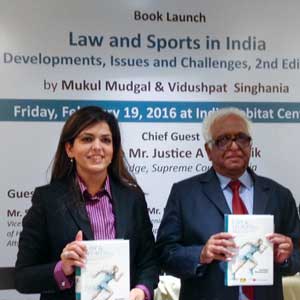
    Academically, she has also co-authored “Law and Sports in India”, the second edition. A work dealing with the position of sports within the constitutional framework and recent events such as the IPL probe report, doping controversies, etc.

    In this interview, Aahna talks about;

    • What influences led her to pursue law as a career
    • Her interests beyond the legal sphere and the impact they had
    • The value addition of higher studies in niche areas of the Law
    • The charm of quotes and simple expression


    How would you like to introduce yourself to our readers?

    Lawyer by choice…Writer by chance… Sports enthusiast… Stricken by wanderlust.


    Tell us about your life before you joined law school. What made you gravitate towards law?

    When I was young, my grandfather quoted John Lennon to me: “When I was five years old, my mother always told me that happiness was the key to life. When I went to school, they asked me what I wanted to be when I grew up. I wrote down ‘happy’. They told me I didn’t understand the assignment, and I told them they didn’t understand life.”

    Seeking happiness and fulfilment in every moment I live is amongst the greatest lessons I learnt from my grandfather. He held a law degree but started his career as a sports journalist, going on to become the director of the National Herald. He then moved into the arena of politics and social causes. Wearing the mantle of a trade union leader, he sought happiness in devoting himself to the cause of improving worker benefits. I particularly remember watching him return home on the shoulders of a jubilant crowd after his success in obtaining a favourable judgment in a case involving illegal termination of employment of 300 men. Young as I was, I realised how empowering it is to know the law.

    Perhaps that’s what drew me, at school, to his dual interests: sports and journalism. I was the editor of the School Annual Magazine – resurrecting it from a two-year oblivion and also pioneered the first School Newsletter, that then became a regular feature. I was appointed Captain of the School Cricket team at a time when the school coach had gone on leave. Coaching taught me patience. I learnt that people grow with praise, that critique works only in an environment of trust and emotional security, and that the joy of seeing others grow and score through the training I had given them was a victory sweeter than my own achievements at the wicket. Not only did I lead my school team to victory, but I was also appointed as the captain of the first ever All India Girls’ School Cricket Team and went on to being selected to play for the India Under-19 Cricket Team. My time at school culminated in a very special moment when I was awarded the trophy for ‘Selfless Service and Helpfulness’.

    Having completed high school, while cricket and writing seemed worthy allies, I made a choice to pursue my dream of becoming a lawyer.


    How was your ILS Law College, Pune experience?

    Having lived in a boarding school for 6 years, I was tired of living the hostel life. Therefore it was a personal choice to go to ILS over a National Law School and I have no regrets over my decision to date.

    At ILS, unlike national law schools, there wasn’t a routine time table that lasted from 9 to 5 or a road map to the kind of internships one must pursue. We were done at school by 11 a.m. on most days and had the choice to then plan our day in whatever manner we pleased, also our holidays which were fairly longer compared to national law schools. Several chose to do internships both during college days and in holidays, others spent time perfecting their skills at Moot Court competitions, I on the other hand spent my time learning about Sports Law, pursuing summer school programs and doing internships both in India and abroad.

    At ILS, no two students at the end of their 5 years, turn out to be exactly the same, which I feel is the case with National Law Schools, where most students do the same kind of internships, and therefore the competition on day zero is much harder. Studying at a National Law School has its own brand value and pros, while studying at ILS makes you more independent and responsible in terms of your choices.


    What were your areas of interest in the law? Did you engage in extra-curricular activities while in college?

    My areas of interest had always been intellectual property, entertainment, media and sports laws which sprung from the kind of activities I was involved in back in school.

    In the first year of law school, I remember walking up to my college university representative responsible for organizing the ‘Legalease’, the annual ILS Festival, and requesting for a spot in our ‘class’ (section rather) cricket team. “I hope you know they would be playing with a leather ball!”, he exclaimed. My immediate response “I was chosen to play on the India under-19 cricket team” amused him a little further. He didn’t give me a chance to play on the boys’ team but he did, in all fairness, organize a cricket match for the girls as a part of Legalease, 2006. I also played a little bit of throw ball and volley ball as and when the opportunity arose.

    Apart from playing sport, I participated in the Harvard Model United Nations and pursued a couple of diploma courses.


    What internships and voluntary practical training did you take while in law school and during your LL.M years? What value addition did they provide?

    Like all other law school students, I experimented with a whole bunch of internships. I worked at an NGO, at the Hon’ble Delhi High Court, with Mr. Mukul Rohatgi at the Hon’ble Supreme Court of India, with a barrister specializing in criminal law in London and also at a law firm in Delhi during my first 3 years of law school.

    I learnt a lot during my law firm internship, as I was given the opportunity to interact with some clients, prepare my first cease and desist notice for a trademark infringement, work on matters involving sports persons, and realised that it was what I enjoyed most and not litigation. It also helped to further develop my interest in intellectual property and related areas. I then just stuck with law firm internships and interned at TMT Law Practice twice, after which they made me a pre-placement offer. It always helps to get a job offer, if you go back to an office for a second time to intern, as they are able to gauge your ability and progress better. Also, I chose to intern at a boutique law firm so that I could make a more marked and personal contribution during my internships, instead of being lost at a large law firm.


    You pursued an LL.M from UCLA in entertainment, IP and Sports Law. Tell us about the LL.M course you took, how did you apply for it and what was life at UCLA like?

    An LL.M application is all about your Statement of Purpose (SOP) and they give little weightage to your grades or C.V., is what I learnt from personal experience.

    I applied for an LL.M while in law school to about 8 law schools in the States. It was a decision taken overnight and I did not think the SOPs through. Having been a creative writer in school, I took it all for granted and drafted my SOPs in one night and sent in my applications in December 2010. I was rejected by all 8 law schools.

    I pondered over the rejection, re-read my SOPs, and realised that they made no sense as they were a bunch of disconnected paras put together to comply with the word limit. I took the same drafts, and re-worked the structuring and choice of words and then re-applied in October, 2011. By the summer of 2012, I was spoilt for choice with an admission to all 8 law schools, some even willing to offer me scholarships.

    I had an admission to Duke University, a T-14 law school, and had even paid up the advance to block a seat and done my visa formalities when I heard from UCLA. It was the toughest decision to make, a ‘T-14 Law School’ versus the top school for entertainment law. I tried to choose the best of both worlds. While I chose to disregard the overall rankings and went with the rankings for subjects of my interest and gave importance to professors like Nimmer in picking UCLA for an LL.M., I pursued a summer school course with Duke Law School, a program run by them at the University of Geneva which gives you the opportunity to do up to 6 credits of course work. I studied sports law at the summer school offered by Duke, and then joined UCLA for my LL.M.

    UCLA gives you the opportunity to do 4 credits worth of practical training as a part of their LL.M. This, in my opinion, is what sets UCLA apart from other law schools and gives its students an edge over the others. Once made aware of this opportunity, I sat for campus placements and secured an internship at Warner Bros. Intellectual Property Dept. If there was the slightest doubt in my head about having left Duke for UCLA, I knew at that point for sure, that UCLA had been the best decision I made.

    As far as leisure activities go, all law schools in the States have a concept called the ‘Bar Review’. It has nothing to do with the American Bar Association, it is a concept wherein on every Thursday night you go review / check out a bar / club in town for drinks. Los Angeles being famous for its night life, I don’t remember ever having to repeat a bar.


    How did your interest in these fields develop?

    I constantly missed playing regular cricket through my years at law school. There weren’t too many opportunities available in Pune for women. In fact, I momentarily contemplated moving to GLC as Mumbai had a lot more to offer in terms of women’s cricket. In fact, women’s cricket only came under the auspices of BCCI in 2006, the year I had left playing cricket and started law school. My juniors from school often called and narrated stories of their experiences at Ranji, from a time when we would fund our own travel to them finally being paid Rs. 5000/- for a match. I felt really happy for them and I knew then that true happiness for me lay in uniting both my vocation (law) and passion (sports and writing). While I had lost my touch on the field due to lack of practice, I made a conscious decision to specialize in Intellectual Property and related fields like Entertainment, Media and Sports Law and in some way remain connected to Sport.

    As a writer, of course, you must always be well-versed with copyright law. I always enjoyed music, it was my only other stress buster apart from sport, so I studied Music Laws at UCLA, apart from entertainment, intellectual property and sports laws. I learnt about the dying music industry and the effects of piracy. In fact, the Intellectual Property heads at Warner Bros. even gave me the opportunity to work at the Anti-Piracy dept. for a few days, which has led to me not downloading a single song or movie illegally in the last 3 years.

    So my interest in the kind of law I practice has pretty much sprung from my hobbies and that’s why I love what I do for a living.


    Could you explain to our readers the interrelation between entertainment, IP and Sports Law?

    What is sports law? It, apart from sports specific laws like anti-doping laws and sport specific regulations, involves all laws that effect a sports person or sports league – be it contract law, labour law or intellectual property for that matter. You cannot take away from sports leagues and sports persons trademark rights, brand value, broadcasting rights and other rights like that of privacy and publicity. For any sports league to be a success, you must get into a broadcasting rights deal with the right network provider, have some good sponsorships on board, have the player assign their image rights to the league and team owners and prevent any form of trademark infringement to protect the brand from getting diluted. Players today are filing for trademarks like the ‘eleven of hearts’ by Gareth Bale or the ‘Lightning Bolt’ pose by Usain Bolt. So sports, intellectual property and entertainment are entwined fields and there exists a constant overlap.


    aahna-mehrotra-3

    What is an executive LL.M and what motivated the decision to pursue one on Sports Law Instituto Superior de Derecho y Economia? Tell us about the experience and what you learnt from it.

    An executive LL.M. is a Master’s program which is pursued as a distance learning course by professionals and does not require you to be present in the same city through the year.

    While I gained a fair amount in areas related to intellectual property from my year at UCLA, unfortunately I did not learn as much about Sports that are relevant to the Indian market. Therefore, I decided to pursue a second LL.M from a school in Europe.

    ISDE gave me the opportunity to interact with some of the best sports lawyers in the world in the form of professors as well as network with sports lawyers from all over the globe in the form of classmates. Sports being an international activity and with the advent of so many leagues in India, more often than not, one lands up with matters that involve athletes from other countries, so it is always advantageous to have a rapport with attorneys in other countries.


    You have taken your interest in the field to the next level by assisting Justice Mukul Mudgal in jointly writing the second edition of the book ‘Law and Sports in India’. Tell us about your experience of working with him on the book.

    Justice Mudgal is by far one of the kindest human beings I have come in contact with in the legal profession. He is forever happy to see those working under him grow and provides constant support in any endeavour you choose to pursue.

    aahna-mehrotra-2Since I did not work on the first edition, it wasn’t easy to immediately start drafting or adopt someone else’s style of writing but Justice Mudgal was patient through the process. At the same time, as most of the developments in Sports law in India have only taken place in the last 5 years, it was as good as writing a new book.

    I worked with him on drafting 8 chapters of the book. These were (i) an overview of the sports scenario today, (ii) gender discrimination, (iii) anti-doping, (iv) sports as a business, (v) labour laws, (vi) violence in sports, (vii) sports dispute resolution and (viii) grey areas. I had a huge support system in the interns who researched untiringly on some of the most unheard of issues related to the sporting scenario in India. I learnt so much from them as well, like I didn’t know there was a concept called flip-throw that existed or that a suggestion to bring an orange card into play was being made in the football arena. I learnt so much about the intricacies of sports law as we drafted chapter after chapter.

    With an LL.M in progress, pressure from the publisher to adhere to the timeline and sometimes technology betraying me with an entire chapter getting wiped out just when I was done drafting it, I often did 5 a.m. mornings and eagerly looked forward to the day we would be done drafting. The end result was worth it all. It has been a privilege to work with Justice Mudgal, who feels so strongly about eradicating the malpractices in the sports industry in India, and a great honour to have worked on what has been termed as a ‘monumental work’ and an ‘encyclopaedia’ by Mr. Soli Sorabjee.


    Which new areas can one expect to explore in Sports Law, apart from player contracts, anti-doping or sponsorship related work? Why is this an area of law more people can choose to specialize in?

    With the advent of several leagues, many international athletes are now looking at the Indian market as an avenue so there is a lot of player transfer related work, especially in football. Apart from that, with image rights becoming a popular concept world-wide, a lot of Indian players are looking to protect their rights relating to both privacy and publicity. Scandals like match-fixing give you the opportunity to work on matters that may fall under criminal law. Things like gender-discrimination and the increase in punishment under the new anti-doping code have given rise to human rights and constitutional issues in sports. A lot of broadcasters are looking to either terminate existing contracts due to the leagues not doing well or vice versa – league owners that feel that they have not made the right choice in terms of broadcasters are looking to terminate their contracts and sign new agreements. Taxation issues and labour laws too are areas that have growing issues related to sports. More and more sports management companies seem to want to hire specialists in sports law to form an integral part of their team. As the sports industry in India continues to grow, so do the issues relating to the field, and so does the legal work.


    A lot of sports leagues are mushrooming in India at the moment. What legal challenges do they face and how viable are these leagues in the long run?

    (Aahna was involved in the Player Transfer Transactions of the Indian Super League and have also been involved at various levels with the Indian Badminton League and the Indian Table Tennis League.)

    Along with Mr. Kaushik Moitra, (Partner, TMT Law Practice) the Indian Badminton League in 2013, was the first sports league I worked on. The league failed due to several reasons like mismanagement at venues, lack of staff, the appointed media agency not being proactive, VIPs demanding free tickets and special treatment, state associations not cooperating with the national associations, travel and accommodation being impractical, no itemised budget and being unprofessionalism on the whole. These are some of the most common challenges that are faced at the time of running a league, especially the first season, so all league owners must learn from the IBL 2013 and not make similar mistakes.

    As for viability, it is something that can only be determined in due course of time. The Masters Champions League held in Dubai recently failed to pick up numbers in its first season even though the concept looks very promising. The MCL organizers are hoping that the current cricketers will look at it as an avenue post retirement, so when a Dhoni joins the league on retirement, automatically the numbers will go up, however this again is mere speculation and the question is whether or not they can sustain the league until a Dhoni joins. The Kabaddi League on the other hand did unexpectedly well in the very first season, the ISL picked up a lot of momentum in the second season, so there is no fixed formula for the success of a league.


    You were an integral part of Ludus Legal, one half of which has now been absorbed by TMT Law Practice. What does the shift mean for you and how does such a shift impact the clients?

    It has always been a very enriching experience to be working under Mr. Abhishek Malhotra (Managing Partner, TMT Law Practice). He is someone who has constantly encouraged me to pursue my academic interests apart from doing just legal work for my clients. In fact I remember when I started out with TMT Law Practice, immediately after law school, we had a concept of internal presentation of papers. Every alternate Saturday, an associate would present a paper on a new topic and we would then sit and discuss the issue. It always helped in learning something, increasing our industry knowledge and growing as a lawyer and that is why I was more than willing to join them back, when the opportunity arose.

    Like I said above, it is very hard for sports to survive without intellectual property and related areas. TMT Law Practice is a boutique Technology, Media and Telecommunication law firm which can better cater to the needs of a client. The clients only benefit from this shift, as they now have a full service law firm that caters not only to their sports law needs but also offers to them specialists in the intellectual property and media industry. At Ludus, we would often use the services of TMT Law Practice, to file Trademarks for our clients and use Mr. Anish Dayal and Mr. Nitin Mishra as counsels to argue our litigation matters. Now it can all be done hassle free under one roof.


    Tell us about the kind of work profile you handle every day. What are the challenges you face and what do you like most about the job.

    On a daily basis, I handle a whole lot of agreements covering different aspects of sports law. I often participate in negotiations between league owners and sports bodies or players and league owners.

    However, what is really challenging is when an athlete comes to me for help in a doping case. On most occasions, the consumption of the banned substance is inadvertent, as the athletes come from humble backgrounds and have not been educated about how a banned substance may enter their body. They start training at an extremely young age hoping to make it to the commonwealth games or Olympics one day and maybe win that one medal, which will not only make the entire country proud but also give them a source of livelihood but just when they are about to make it, they get caught for a doping charge against them. With the new code having increased the punishment to four years, which is as good as resulting in the end of an athlete’s career, there is a lot of pressure to have the punishment of an athlete reduced. You sometimes succeed and you feel on top of the world but there are occasions you fail to get a reduction in the punishment which then tends to take a toll on you as you feel responsible for a sports person’s career coming to an end.


    Finally, what would be your parting advice to our readers?

    “Twenty years from now you will be more disappointed by the things you didn’t do than by the ones you did do. So throw off the bowlines. Sail away from the safe harbor. Catch the trade winds in your sails. Explore. Dream. Discover.”- Mark Twain

    Trust your gut, don’t be a part of the rat-race and its okay to sometimes not go by the book.

  • Rajesh Sharma, Founder Director of LetsComply.com, on why legal knowledge is necessary for a CFO

    Rajesh Sharma, Founder Director of LetsComply.com, on why legal knowledge is necessary for a CFO

    Rajesh Sharma passed out as a Bachelor of Commerce from Shaheed Bhagat Singh College, the University of Delhi in 1990. After that, he pursued LLB from the University of Delhi and graduated by 1993. Besides LLB, he also pursued Company Secretary from Institute of Company Secretary of India (ICSI) and Cost & Management Accountants from Institute of Cost and Works Accountants of India (ICWAI) and finished these professional courses in 1993.

    With his qualifications in the realm of law, finance and accounting, he started his versatile work life full of enviable achievements. He started his professional career as Manager – Merchant Banking with Category-1 Merchant Banker, collaborated with the manufacturing company and IT companies before joined as the Founder Members of Singhania and Partners LLP. Afterwards, he was the Head of Finance, Accounts & Legal Department of Global Healthline Private Limited – 98.4, one of the best retail pharmacy chains in North India. He played major role at Barista Coffee Company Limited during his long tenure from 2006 to 2012 as a Chief Finance Officer, wherein he was instrumental not only in setting up all systems and processes for nationwide coffee chain, implemented SAP for retail but he was also key member to get Barista acquired by LAVAZZA, Italian Coffee player. Later, he served as a Group CFO at Carnation Auto India Private Limited; wherein he was instrumental for equity and debt fund raising for setting up multi-brand automobile workshops and used car business. He was Partner with Rajani Singhania & Partners, an international Law Firm. Presently he is Director, Fashion TV Hospitality. He founded Juris NextGen LLP and Affari Consulting, Inc. in 2010 and 2011, respectively.

    Finally, being an emerging entrepreneur, he founded LetsComply.com, which is a technology driven platform in India to provide world-class, affordable and convenient professional services relating to legal, finance & taxation at one click under the guidance of an experienced team of professionals, whose knowledge & credentials are proven.

    An independent entrepreneur with a string of achievements at a very young age, Rajesh Sharma talks about his thoughts, ideas, experiences and advice to young entrepreneurs and students of law and CA.

    In this interview, we cover his academic and professional journey, while focusing on:

    • The combination of his qualification in B.Com, LL.B, C.S. and CMA.
    • Varied work experience as a CFO, Founder Members and Director of various companies.
    • Part of Startups, provided Legal, Finance & Taxation support to create systems and processes and helped them to raise funds and now providing mentorship to various startups directly as well as through various incubation centres.

    How would you introduce yourself to our readers? Please tell us about your pre-college days.

    I belong to a very middle class & humble family. In spite of not been able to get the education from Big B-Schools, it is the learning by experience and connectivity with grass-roots for work with qualitative education; I could able to achieve this position.

    What plans did you have for your future? What inspired you to embark on this entrepreneurial journey?

    I feel blessed and fortunate that in spite of limited resources, I find myself at the pinnacle of my career by achieving and delivering good as a Legal & Finance professional. Now, I think this is the time to give back what I have achieved throughout my entire life and career. I got myself associated with a couple of incubation centres, NGOs and other bodies wherein I provide my services as Mentor to the new entrepreneur for their entrepreneurship journey. India is providing an excellent environment for startups, enormous options and opportunities available to the young entrepreneurs, and hence, I am also contributing to my best.

    How important is it for a law firm partner to be good at business development, or are great lawyering skills enough to become a partner? What skills or qualities distinguish the people who become partner from those who don’t?

    Being an entrepreneur, it is not necessary to be a good worker, he/she has to be a good leader at the same point in time. While he/she should be able to understand and manage with expertise, but should be able to manage a good team as well.

    Having done B.Com, what motivated you to choose law along with CS and CMA as a career?

    Though it is obvious, if you want any professional degree beyond graduation. Since I had interest both in Legal & Finance domain, therefore I opted for both courses (also since not having proper guidance, I chose two courses to have backup, if I could not make one)

    What challenges did you face while serving as a CFO at several companies? How did you overcome those challenges?

    Challenges are of multiple kinds, being cost controller and always pushing for implementation of system & process; CFO faces challenges from external as well as internal members of your own organization. No one like to listen no for the money and everybody realizes in the last working hour, therefore, to push your own team members to go to the system and processes, you actually develop negative relationship with your peer group but once you explain and help them to implement these methods, they like and start implementing these processes.

    You’re the Founder Director of LetsComply.com. Please tell us about LetsComply.com.

    LetsComply is the only technology driven platform in India to provide world-class, convenient and affordable professional services relating to legal, finance & taxation at one click.  LetsComply provides services under the guidance of an experienced team of professionals, whose unimpeachable expertise, backed by proven credentials, needs no emphasis.

    In pursuance of our humble resolve to serve, we have always looked for the ways and means to make it easier for the entrepreneurs and corporate establishments to function better, and we realized that since the world is progressing and taking online route to grow and expand, it would go a long way if we could provide Legal, Financial & Taxation services in a structured fashion with the assistance of a team of experts without making it too expensive or inconvenient. That’s how the idea of LetsComply germinated.

    We, at LetsComply, are committed to help entrepreneurs and business owners to start, manage and grow their businesses by taking care of the legal, financial & taxation side of the business so as to allow them to focus on innovation and expansion without having to fret over compliance issues, which certainly matter a great deal and can’t be left unattended.

    We aim to be a partner in the entire business lifecycle at all stages of the entrepreneurship — Startup, Growth, Acceleration & Progression Stage — to make sure that the businesses do not fall back on compliances and grow manifold. In today’s Digital world, we bring you the concept of Virtual Intelligence by way of Virtual CFO (vCFO) and Virtual General Counsel services to enable accelerated growth to your business. We are a team of experienced Chartered Accountants, Company Secretaries, Cost Accountants, Corporate Lawyers, Management Graduates, IP Attorneys and Technologists ready to assist you at all times.

    I believe that today when the world is moving towards a higher technological and economic order, allowing oneself to be bogged down by various mandatory compliances is a waste of precious time and energy. It cannot be ignored that the statutory compliances have a very significant role to play in sustaining the business environment conducive to fair competition and commercial growth. Therefore, it is essential to be cautious about the compliance of various statutes at the initial stage itself to not only avoid later complications and harassment but also to contribute to the sustenance of a healthy business ecosystem. And to keep you comfortable with all the compliances, the professionals at LetsComply are always ready to extend any and every assistance that you might require in this regard.

    How do you plan to expand LetsComply.com regarding operations, infrastructure, as well as attracting more investments? Can we expect a mobile app in forthcoming time?

    We have just started and thrilled with the response we are getting from our users. Therefore, we have preponed our plans for expansion. Operationally, our offerings are quite wide, but we need to create the infrastructure to execute and deliver that. We are working not only to create and set up additional office space but also developing technology team as well. Though for operations, we may not need investments but to expand rapidly and to bring technology and marketing we would need investments. We are not aggressively losing for funding unless we get right partner. Yes, you can certainly expect mobile app.   

    You have a vital role in several companies by providing them a tremendous boost in their business. What are the key areas a Startup needs to focus on?

    The major need for any startup is to focus on execution and have the right partner in place. They should focus on their core activities without losing any attention.

    As you have recently addressed a conference on ESOP in Amity Innovation Incubator, please tell us how does ESOP work as a good tool for startups?

    ESOP is genuinely a very tool to attract & retain the right talent. You can attract talent with entrepreneurship mindset to grow fast.

    How important would you say are business development skills at such higher roles in a corporate law firm?

    Growth is never ending. One should always be hungry for growth so as Business Development skills are. The leader has to lead by examples, and he should always be upfront about facing challenges. Unless the Leader fights from the front, he cannot ask his army to step forward on the battle ground.

    Lastly, what would be your advice to students and young entrepreneurs reading this interview?

    Life moves forward like a “Business Cycle”, wherein phases such as ‘Peak’ and ‘Trough’ are ubiquitous. One needs to establish one’s stand at those stages. If he/she is tangled in the Trough Phase, there is nothing to blame upon. Be focused, there is no shortcut to success. Efforts never go waste. If everything seems to be on his/her side during the Peak Phase, there is nothing to claim upon. Keep your thirst for growth alive and continue to move forward with the same.


  • Pallavi Sharma, Judicial Magistrate, Rewa, Madhya Pradesh on preparing for the Judiciary and work at National Insurance

    Pallavi Sharma, Judicial Magistrate, Rewa, Madhya Pradesh on preparing for the Judiciary and work at National Insurance

    Pallavi Sharma graduated from National Law University, Jodhpur in 2012. Soon thereafter, she started studying and working hard for the Judicial Services exam for various Hindi speaking states. Even while preparing, she decided to utilise the most of her time and worked as a legal officer in a PSU for a brief period. Currently posted as a Judicial Magistrate at Rewa, MP, Pallavi shares the following in this interview with SuperLawyer:

    • Reasons for joining the judiciary and her ever strong desire to make a difference in the society
    • Rational behind attempting PSU exams and experience as a legal officer in a PSU
    • Strategy followed and material used for the judicial exams
    • Experience of giving the interview for the judiciary
    • Advice to budding lawyers looking at attempting the judiciary exams


    Tell us a bit about yourself.

    I am Pallavi, a 2012 graduate from National Law University, Jodhpur. I worked as a legal officer with National Insurance Company Limited for around six months and have just left the organisation to join Madhya Pradesh Judicial Services. Currently, I’m posted as a Civil Judge/Judicial Magistrate at Rewa, Madhya Pradesh. I’m a sports fanatic. I love every sport and I would do almost anything to meet Rahul Dravid.


    Are you a first generation lawyer in your family? What were your ambitions before joining law? What led to your inclination towards law?

    Yes I’m a first generation lawyer in my family. To be honest, law was never my first choice. I had taken up science in XI and XII standard and was actually preparing for engineering. In fact, I wasn’t even very sure about engineering so I took both Mathematics and Biology in XI, XII hoping to soon figure out which way to go. In a few months I realized these subjects don’t interest me at all. Hence, I decided to pursue law. By fortune I got into NLU, Jodhpur and now I’m very glad I pursued law.


    How was your time at NLU Jodhpur?

    It was a lifetime experience. It took me a while to settle down but I soon got used to the place and loved every moment thereafter. NLU, Jodhpur provides a variety of opportunities to its students. I wasn’t much into mooting or debates but I found cultural and sports activities there really interesting. The cultural and sports week were my favourite two weeks of college every year.


    Prior to entering law school, did you ever wish to be a Judge? What motivated you to apply for judicial exams?

    No, judicial exams were not something I decided to write before entering law school. It was only during law school I decided to appear for this exam. Initially I only planned to appear for Delhi Judicial Services Exam but I soon realized the high level of uncertainty with these exams and hence decided to appear for a couple of other states as well. I wanted to make a difference and I thought judiciary will not only give me a perfect opportunity for that but would also allow me to remain associated with the field of law.


    How did you decide to take a plunge and prepare for judicial exams straight after graduation? Was it a difficult decision?

    It wasn’t a difficult decision for me. By the end of college I was quite sure that I wanted to prepare for judicial exams and I thought it’s always better to start right after college when one is in the habit of studying. Soon after college I joined a coaching institute in Delhi and started my preparation.


    pallavi-sharma-2

    You also worked at National Insurance Company Limited as a Legal Officer for a while, please tell us about your time there.

    While preparing for judicial exams I also appeared for a few PSU exams. I got selected for the post of Administrative Officer (legal) in National Insurance Company Limited and joined its Divisional Office in Allahabad. Though I worked there only for around six months, I enjoyed every bit of it. There is not much variety in work and it is mostly related to motor accident claims and consumer cases but it’s nonetheless interesting work. And as a young officer in the company I got immense support from higher authorities which made it easier for me to work there.


    You also appeared for a few of the PSU exams, please tell us about your experience preparing for them.

    Most of the PSU exams have the same pattern. To be honest, I did not especially prepare for any of the PSU exams. I decided to appear for these exams while preparing for judicial exams. As I was good at mathematics and reasoning since school, mathematics, aptitude and reasoning parts of the written paper were not very difficult for me. I used to brush up general knowledge and current affairs a couple of days before the exam. But what is most important in these PSU exams is time management. One should make sure they attempt enough questions in every section to secure sectional cut-off marks for every section. Also I would recommend people preparing for judiciary to give such exams even if PSU is not where they want to work because by giving such exams you learn how to manage your time, handle the pressure, etc.


    What all do you think is required to be able to crack a PSU exam and get hired by them?

    PSU exams are not very difficult and most of the exams have the same pattern so one doesn’t need to separately prepare for each. Time management, good understanding of basic concepts and practising a few past year papers is all you need to crack a PSU exam.


    What motivated you the most to be part of MP State judiciary?

    For me the biggest motivation was to become a judge. The State was always a secondary consideration. I gave exams for almost all Hindi speaking states because in the end all you want to do is help the people irrespective of the State you are in. But having said that, I am very glad I got through MP Judiciary. I have been here multiple times and I find that the people are honest, welcoming and sweet.


    When did you start preparing for the exams? When should a person ideally start preparing for the judicial services exam?

    I started preparing for judicial exams right after college and I feel if one is very serious about it then they should start preparing around the same time, if not during college.


    How did you prepare for the exam? Which books/materials did you use for preparation?

    My main focus was to first be very clear with the basics of every law paper in the syllabus. I got immense help from the coaching classes that I took. Apart from the class notes that I took during the classes, the case materials, general knowledge and current affairs notes and regular mock tests helped me in my preparation. I did not refer to any book as such for these exams apart from bare acts and class notes but I did refer to a few books in case of a doubt in any topic. And of course reading the newspaper regularly is a must.


    How did you remember the sections of the Acts in your syllabus and leading case laws on varied areas of law?

    One should know the important sections and landmark cases of every subject but at the same time it is not necessary to mug up each and every section and case law. What is important is a sound understanding of the concept and the purpose of the law. For the case laws also it is more important to know the ratio of the case instead of remembering the name of the case. It is also important to go through the latest case laws of not only the Supreme Court but also the High Court of the respective State for which one is writing the judicial exam. What also helped me was talking about the law with my friends. I think discussing random sections with your friends will make you remember them for a longer period of time.


    Tell us about your interview. How did you prepare yourself for it and what qualities do you think helped you crack the judicial exam? What kind of questions were asked by the panel?

    The interview was conducted by a panel of two High Court judges. For the interview I made sure I properly revise the local laws of MP. Apart from that my main focus was the procedural law. I hardly got around 15 days to prepare for my interview so I could only manage to go through the important sections of all the subjects. The questions asked to me were very basic ones, mostly from CPC and CrPC like summary procedure under CPC and trial procedure under CrPC. One needs to be very calm and confident during the interview and I feel even if you don’t know any answer it’s perfectly fine to just tell the panel that you don’t know the answer instead of making up an answer.


    How valuable do you think coaching institutions can be for preparation for judicial exams?

    I took coaching classes at Rahul’s IAS and it helped me a lot in my preparation. It helps in properly focusing on the important parts of the syllabus. It also helps in preparing notes and the regular tests conducted there help in preparing for these exams.


    What advice would you give to judicial aspirants? Any message you would like to be passed on to the law students reading this?

    Study hard. Stay focused and don’t stop trying because perseverance pays. Don’t get distracted or feel bad about yourself when you see your friends working, earning and having fun. Your true friends will understand that you are focused and busy. Once you succeed, all the time that you studied while others were having fun will seem worth it. And even if you don’t succeed it’s okay because it’s better to have tried and failed than never to have tried at all.


  • Paramvir Singh, IAS, AIR 29, on all about preparing for the UPSC

    Paramvir Singh, IAS, AIR 29, on all about preparing for the UPSC

    Paramvir Singh graduated from National Law University, Delhi in 2013. After graduation, he appeared for the Union Public Service Commission Examination and secured an All India Rank of 619. He decided to appear again for this exam and in the year 2014, he was successfully ranked AIR 29 and he is currently undergoing his training period at the Lal Bahadur Shastri National Academy of Administration, Mussoorie. He will be soon joining the Punjab Cadre after the completion of the training.

    In this interview, he talks about: –

    • His experiences as a law student at the National Law University, Delhi.
    • His strategy for the Preparation of this exam
    • Advice to Prospective candidates of Civil Service Examination.


    How would you like to introduce yourself to the readers? Please tell us a bit about your childhood and background.

    I belong to a typical middle class family from Haryana which moved to city from a village only some 20 years back. My father and uncles are first generation graduates and lawyers who all moved to city breaking away from the traditional occupation of farming. Being unfamiliar with the city I received my primary and secondary education at very modest schools in the city, even though academically I performed decently throughout. At senior secondary level I opted for science with a view to get into one of the engineering institutions, blindly imitating others around me. However, the turn of events diverted my plans to take me where I am now stationed.


    Why did you opt for the study of law? Did you find any legal professional in your family and friends?

    I was least career conscious till my senior secondary level; neither had I understood the importance of choosing a career path nor did I put serious efforts to get into top engineering institutions, so at the end of my board exams I was directionless as to the path forward. My father, a lawyer, prodded me to write for law entrance exams which I found required much less time and sustained effort than the sitting for engineering entrance and took up the idea readily. Even though initially it was an accidental choice, as I went through the law school I really enjoyed the kind of environment and exposure it could provide for me.


    What were your objectives and plans in the preliminary years of the law school?

    I really had no elaborate plans or any particular expectations from the law school apart from a degree in law. I did not focus on any particular aspect like aiming for a brilliant CGPA or building a great CV, because I was not much aware of their value in the first place. This lack of focus towards my career path gave me the freedom to explore areas of my interest, and did not weigh me down with making career oriented choices such as choosing a particular kind of internship etc. My singular target was to focus on areas of learning where I lacked behind my peers due to differential and inadequate nature of my education in school. The maximum learning happened not because of the teachers or lectures but from influence of peers who represented diverse backgrounds and carried with them a diverse kind of learning, a little of which I was able to partake over the years in law school.


    Did you focus only on the Academics in the college life? How did you excel in the Academics? How’s the Academic Pressure in NLU Delhi?

    No, as I said there was no particular clarity in my mind on what I wanted to get out of law school, I tried to participate in as many things as possible like mooting, debating and even some research projects. In academics my performance was to my satisfaction and I was generally ranked in the top order. Academic pressure wasn’t all that much except with some courses where the professors sincerely put in effort and expected a good amount of self study from us; the others did not really demand much hard work and were engaged in only a formality of teaching.


    What extra-curricular activities did you take part in that helped you in overall development?

    I took part in many extra-curricular activities which presented to us in the law school such as mooting, some debating, legal courses in other universities, one research project for drafting a law, and a UNDP project. I did not have many publications to show for it, but I was able to learn a lot in terms of my legal acumen and drafting skills to be a successful lawyer if I chose to be.


    What were your areas of interest while you were in Law School? And how did you go about developing expertise and knowledge in these areas?

    As law is a very diverse field comprising of totally disparate kind of subjects, my focus was on gathering as much familiarity with these as the college could offer. The kind of subjects in which I developed more interest were dependent upon the ability of the teachers to make them more interesting and effort worthy. Some of the subjects I had more inclination to study because I found them more fundamental than others were Jurisprudence and Constitution.


    Please tell us about the places you have interned at and if these were all planned. How is an internship helpful for a law student?

    As for internships I was not able to do many and only worked for Delhi Legal Services Authority once. It was because of lack of focus as to what I wanted to do after graduation as also my liking to spend the limited time of vacations at my home. However, I think that internships are a great way for the students to see different work environments for themselves and also for many prospective employers to see their working firsthand.


    Did you not get tempted by fancy corporate jobs?

    My focus during law school was mainly on absorbing whatever learning I could, and had relegated career choices to the very end of law school. I actually was not much attracted by corporate jobs which I thought would not suit my temperament requiring similar kind of work being done over and over, however, to be fair to them I have actually not even interned in a corporate firm. But it was this impression which kept me away from them, as also my inclination not to run after money when I did not much for the kind of life I wanted.


    paramvir-singh-3

    When did you start preparing for the civil services? Did you start preparing for it when you were in college?

    I had heard a lot of good things about civil services from my colleagues and the kind of opportunities it offered in terms of career. However, neither did I have any family member in the services nor any definite guidance, so I did not consider it seriously until the final year of the law school. With very haphazard information at my disposal, but other career paths seeming very tumultuous and long I decided to join a coaching, which was not difficult being in Delhi. The initial preparation was quite unplanned and a probe in the dark. However, after the notification of the exam, which had suddenly slashed the number of optional subjects to be taken to one, I became excited and prepared sincerely for the prelims with another friend to offer me company.


    How did you start preparing for the Civil Services Exam? Do you think coaching is a prerequisite to crack this exam?

    It was a very unplanned and unfocused preparation in the beginning where I was trying to read everything I could get my hands on and remotely related to the exam. In hindsight I think that only served me in good stead as I did not narrow down my focus too much on the syllabus and did not get bogged down by reading only what was being taught at the coaching institutions. I joined a coaching institute only after writing my prelims, and used it as a option to use for guidance whenever I needed any and for some writing practice. With the kind of pattern which is being followed recently Coaching has lost a good deal of relevance in cracking the exam, with focus required on understanding and being able to analyse the current events happening around us. It can be as well got from newspapers and internet and coaching institutes do not have monopoly over the reading material or expertise anymore.

    Most coaching centres do not cater to the specific weaknesses or strengths of the individual student, which can only be understood and worked upon by the individual themselves


    What was the routine you followed everyday throughout the course of your preparation?

    My effort was towards being able to put minimum 6 hours of study everyday which changed from random readings initially to syllabus specific readings just before the exam. Not only reading, but being able to make adequate notes for remembrance and writing skills to reproduce it is equally important for the exam, so I focused on these 3 things.


    What were your optional subjects?

    There was but obvious choice of taking law as the optional subject when there was only one optional to be taken.


    Do you think law students might have an edge while preparing for the UPSC exam?

    Yes, especially because they are well adept through their study in law of filtering out and understanding the real issues involved in any question or problem. As also a student of law is generally familiar with lot of areas which overlap with the exam such as polity as also some familiarity with basic philosophical schools etc which help in the ‘Ethics’ paper. ‘law’ as a optional has performed better than most, with around 6 people being with law optional in top 50 this year. I would definitely recommend it as a much accessible career option for the law students.


    What was your study pattern, the mode of study (online, offline etc). Please mention some of the books you referred to and how did you go about preparing for each stage of the exam?

    My main focus was to free myself of general distractions and to be able to devote at least 6 hours every day to study for the exam. The primary mode of study was through books and newspapers for which I made notes in my laptop. I also referred to some magazines such as Frontline etc which I read online or after printing. For the preliminaries and general studies it is difficult to give a book list as there is a choice of books on every topic, but NCERTs are a good starting point for almost all topics. As for the Law, I referred to Starke for International Law, Bangia for Contracts and Torts, Gaur for IPC, MP Singh for Contracts which were the major topics in Law optional.


    What did you do to keep yourself motivated all the time during the course of preparation?

    Even though my focus on the exam, but I kept on doing a lot of other things to keep myself occupied as well as physically and mentally fit for the exam. I used to go cycling in the hills around my home everyday, would go for music classes and spend a lot of time in learning some new hobby or other everyday which allowed me to be focused on preparation without getting bored or distracted.


    Could you please give some tips to those aspirants who are preparing for this exam? How should they go about preparing different subjects like general awareness, Optional paper of law?

    While preparing a candidate should first have a detailed look at the past year question papers, to understand the mind of the UPSC examiners which can provide a direction in separation of chaff from grain while reading for it. Even though the questions are different every year but they point to a trend which can be helpful in deciding how to prepare. For Law as a optional subject the kind of questions are more or less similar every year which therefore should definitely be looked at.


    Every year lakhs of people attempt this exam and only a thousand people get selected? Could you tell us in brief what are the skills required to crack prelims and mains exams?

    According to me, there are basically three skills required for cracking the exam, reading skills—being able to sit continuously for extended period to read, analytical skills—ability to understand the crux of an issue from what you read and writing skills—being able to express yourself lucidly through your answer writing, which in combination with adequate hard work and dedication can make the person stand out from the hordes of people sitting for the exam every year.


    Mussoorie
    Mussoorie

    How should a law student approach the interview for the Civil Services Exam?

    For interview, there is no special approach or preparation which is desired. The interviewers are generally only looking for the confidence level and communication skills of the candidate which most of the law students are good at and thus interview is mostly the easiest part of the process for a law student.


    What is your experience with the preparation that is required for the civil services? Undisputedly, it requires a huge mental strength and hard work.

    More than anything else it requires a confidence in your ability and the dedication to put in the level of hard work required to achieve it, that is prerequisite for being successful in the exam. To plunge into preparation without adequate mental temperament can inturn be counterproductive.


    You secured Rank 619 in the year 2013 and got through in your first attempt. Why did you decide to take drop of a year? What was your preference of services and why?

    I was working in High Court as a litigation lawyer after taking my first attempt and work was very pleasing to my nature. When I did not get the choice of my service and being confident enough that I will make it to IAS the next year, I decided to not go through the unnecessary hassle of joining one service and leaving it when not inclined to continue in it.


    What would be you message to the law students who want to pursue their carrier in the field of Civil Services?

    The best advice I can give to the aspirants is that there is no set formula or strategy or a list of books/materials which can guarantee you success in the exam. There is a diverse set of very important factors such as your initial level of learning, your reading habits, your writing skills, your retention power, which should guide you in your strategy for preparing for the exam. Most coaching centres do not cater to the specific weaknesses or strengths of the individual student, which can only be understood and worked upon by the individual themselves. The differentiating element between successful and non-successful students is not the kind of coaching they took but their individual effort and their ability to understand their own weaknesses and strengths. I would also advice not to start the preparation too early, as in right after 12th standard. A candidate should use the initial years of graduation to build a solid base, so that the process of specific studies for the UPSC exam can be much smoother. I would also strongly recommend that preparation be done in a group of aspirants who can act as strong motivators to each other. It would relieve the stress of looking for best reading materials to a large extent as the discussion with other companions would sort out the best materials.

    As a career option, civil services, from my limited experience of the field, has a lot to offer and especially IAS offers the diverse exposure which probably no other job can offer to fresher graduates right out of graduation. It offers a lot of autonomy and creativity in the working environment which much more than compensates for the lesser salaries on offer. The service calls for the best minds of the country to the deal with the complex issues facing it today and law students are particularly suited for it.


    This interview was taken by: Shubham Gupta, III year, NLU Delhi

  • Priyan Garg, Associate- Business Development & Knowledge Management, Karanjawala & Co., shares his insight on moving beyond barriers and alternative career opportunities

    Priyan Garg, Associate- Business Development & Knowledge Management, Karanjawala & Co., shares his insight on moving beyond barriers and alternative career opportunities

    Priyan Garg graduated from Amity Law School, Noida in 2015. Having a versatile law school experience has helped Priyan build a wholesome view of the legal world. He has, during his law school years, edited the Amity Journal, coordinated seminars, participated and brought laurels in moot court competitions and helped the society by drafting wills for senior citizens. Right after graduating from law school, he joined as a Marketing Executive at LexisNexis India.

    Currently, he is Associate in Charge – Knowledge Resource handling Business Development and Knowledge Management at Karanjawala & Co.

    In this interview, he talks to SuperLawyer about:

    • His choice of law school and the benefits of going to a law school in Delhi NCR.
    • His life at law school and experience with editing for a journal.
    • His take on opting the unconventional path for law graduates.
    • His unique work profile as  Associate in Charge- Knowledge Resource at Karanjawala & Co.
    • His revelation of the importance of making yourself a brand.

    Please tell our readers a bit about yourself. Why did you choose to do law? Did you have any other interests before deciding to pursue law?

    I’m a lawyer by qualification, currently working as Associate in Charge – Knowledge Resource handling Business Development and Knowledge Management at Karanjawala & Co. While in college, I have interned at a number of places such as PSHRC (Punjab State Human Rights Commission), ASG Pinky Anand, Geeta Luthra, JSA, Luthra & Luthra, Karanjawala & Co., LexisNexis etc. But, right after graduating it was the marketing side of legal world which grabbed my attention. While a lot of fresh law graduates aim to join legal practice as a litigator or in corporate practice, it was the marketing side of legal world which has not received much importance and has a lot of potential.

    I started my career with LexisNexis handling Marketing, Business Development & Strategy portfolios and I am presently with Karanjawala & Co.

    I chose law over sciences because I found one massive advantage in the field. Science in India is a domain that is extremely hard to enter, with difficult competitive examinations and few seats at State-run institutions. After one graduates with a degree in engineering or medicine, however, the task of building a career is less daunting. Law on the other hand, is quite the opposite. It is comparatively easy to study law and become an advocate, and far harder to establish oneself once enrolled. Aged seventeen, I felt it would be easier for me to challenge myself at a later stage, when I was more mature and had the backing of increased knowledge and a professional degree.


    Which law schools did you apply to? How did you zero in on Amity Law School, Noida and why B.B.A. LL.B.?

    To be honest, Amity was not my first choice as a law school. While I had heard good things about the institution, I was fearful of joining a privately run school. After CLAT, I had the option of joining a lesser-known National Law School. Nonetheless, I chose to undertake a program in law at Amity. There were three reasons behind this decision. First, being in Delhi allowed me to be closer to home (Chandigarh was only a few hours’ drive away). Second, in the NCR, I found myself at the heart of the Indian Legal System. Not only did this ensure that many successful personalities would be available in college for guest lectures and seminars, but also it increased my chances of gaining adequate work experience. With the best counsel, law firms and all levels of Courts present in the city, the opportunities for a keen intern were many. Third, I was fascinated by the courses Amity had on offer. The B.B.A., LL.B (Hons.) programme offered the unique opportunity of studying economics and management with law. I find now that this combination has given both, a rounded character to my personality (having now studied science, commerce and arts), as well as prepared me to better understand the needs of corporate clients I may have in the future.


    How would you describe five years of your college life? Please share your experience as an Editor of the Amity Law School Journal. Any tips for law students who aspire to get published?

    I would like to believe that I made the most of my five years at law school. I studied when I was required to, and ensured I had time for my friends and myself too. Law does require lots of studying, yes, but a law school experience is incomplete without participation in volunteer programmes, co-curricular activities and sports. Looking back, I am glad I made the most of the resources I had available.

    As far as Amity’s journal is concerned, I was fortunate to be involved in the publication’s nascent stage. This encompassed work that ranged from receiving an ISBN number to creating an editorial board and calling for academic writing. Needless to say, it was an exhilarating experience.

    My experience in academics is limited to the years I have spent as a student. I do, however, hold very strong views when it comes to the state of academic writing in India today. There is a great void in the legal space when it comes to original academic writing. It is the Indian education system that is largely at fault for this; students are taught to learn another’s views, not taught to think for themselves or to form their own opinions. The legal space is full of unoriginal work. To illustrate, an article titled “The Law of Arbitration in India” is not an original academic work. Such an article, like most one reads nowadays, merely summarizes the law on a subject. At best, a paragraph is saved at the end for the author’s own opinion. It is incredibly rare to find new approaches to law, new solutions to legal problems, or strong criticisms of existing legislation and precedent. My advice to anyone wanting to be published – be original and show something new through your writing.


    You have received a number of Corporate Awards at your college such as “Best Business Acumen and Awareness” citation and Shri Raian Karanjawala Trophy at ALS, please tell our readers about them.

    Apart from classroom studies, internships and mooting activities I always made it a point to be involved in various committees managing events happening in the University which gave me an overall exposure to what goes behind organising and hosting an event. During the five years of my law college I actively organized the Amity International Moot Court Competition, Amity Quiz on Competition Law, Amity Competition on Law Reforms, Debates etc. According to me, there is no substitute for accuracy in knowledge. Know yourself, know your business, know your men, is the mantra of today’s success. Successful business persons understand the thin line of difference between obstacle and opportunity and are able to turn both to their benefits.

    priyan-garg-2

    I received the citation of “Best in Business Acumen and Awareness” for displaying a charismatic persona, administrative acumen and managerial skills of a high order and the ability to combine compassion with steely resolve.

    I received the Shri Raian Karanjawala Trophy on my convocation which has been constituted in the name of “Shri Raian Karanjawala”, an iconic legal luminary and a distinguished senior lawyer of India. His untiring efforts & contribution towards the development and maturing of legal systems have enhanced the image of India globally. Shri Raian Karanjawala Trophy is bestowed upon the student who has displayed extraordinary zeal and dedication towards learning and imbibing the tenets and spirit of law. Also, the student who has shown praiseworthy performance in corporate courses, interned in law offices/firms and attended conferences and seminars based on corporate laws.


    How important is mooting for a law student? Which moot did you enjoy the most, in terms of the organisation and the subject matter? Was there any “dream moot” which you wanted to participate in?

    Aside from academics, mooting is perhaps the most essential activity in a law student’s career. I participated in six moot court competitions focussing primarily on Constitutional Law. One may contest that the arguing system in a moot differs greatly from what one may experience in Court; however, I am of the firm belief that mooting gives one the right level of confidence in arguing etiquette and manner to be able to present cases before a real judge. Further, research being an essential component of any lawyer’s job, mooters will always find themselves at a significant advantage when faced with challenging research propositions at work.

    My favourite moot was the Justice Bodh Raj Sawhny Memorial Moot Court Competition held at NALSAR University. While the moot itself may not compare to others on offer in India, the subject matter – constitutional law – gave participants the opportunity to present unique arguments and step in the shoes of some of our nation’s most eminent senior counsels.

    The Philip C. Jessup moot is perhaps the only competition that comes to mind when I think of a “dream moot”. What is most attractive about this competition is the enormity of the challenge that is qualifying for the international round, the experience of participating alongside the best law schools in the world, and the exceptionally high calibre of judges and mooters alike.


    You have done a variety of internships, while focussing on litigation. Were you always inclined towards litigation? What according to you was instrumental towards gaining so many internships?

    I often compare law to medicine. To a layman, the job of a pathologist, while indispensable, doesn’t seem as exciting as that of a surgeon. To someone not yet initiated into the legal fraternity, the distinction between transactional law and litigation can appear similar. There is an indubitable excitement about litigation, about forming strategies and arguing before judges, that makes litigation attractive. It is for this reason that I found myself lured by the field.

    Having said that, interest in a field is not essential to get an internship in that field. Unfortunately, most internships in India are awarded through the applicant’s contacts or network. Where firms or practitioners accept applications, emphasis is usually laid on the candidate’s academic record and university, with secondary regard being given to non-academic achievements. I was very fortunate to have a good academic record, thereby ensuring that many applications were accepted. I also made a conscious effort to apply early and to continue to follow up with the organisation until they sent me a response. I’ve found that applications are not always replied to; “getting after” a firm to view your application is essential.

    Coming from a non-legal background, there was always a hunger in me to learn and explore different fields of law, owing to which I made it a point to intern and apply at a variety of organisations. I was fortunate to intern at a number of premier institutions such as Punjab State Human Rights Commission (PSHRC), Additional Solicitor General of India (ASG) Pinky Anand, Geeta Luthra, Hon’ble Justice Ravindra Bhat, Luthra & Luthra Law Offices, Jyoti Sagar Associates, PepsiCo India Holdings Pvt. Ltd., Karanjawala & Co., LexisNexis India etc.


    You were the Convenor of Legal Entrepreneurship Clinic at ALS. Please share with us in detail, about the activities of the LEC.

    The Legal Entrepreneurship Clinic is a cell run by the students of Amity Law School, Noida. It is the first ever entrepreneurship cell to be formed in any law school across India. The E-Clinic caters to the intellectual and innovative minds that aspire to become legal entrepreneurs and it aims to foster and promote entrepreneurial spirit amongst such students.

    We at LEC organised workshops, panel discussions, seminars and competitions for aspiring entrepreneurs as an initiative to train and encourage their diverse and dormant talents. The Clinic endeavours to act as an incubator to the thoughts and ideas of aspiring lawyers, so as to make them prepared to be able to develop their ideas and concepts into practical business dimensions thereby helping them set up their own start-up. The Clinic works on the same objective as Centre for Innovation Incubation and Entrepreneurship, IIM Ahmedabad, whose main aim is to foster innovation-driven entrepreneurship.

    As a Convenor of LEC, I organised various Wills Camps for the elderly residing in the jurisdiction of Noida, U.P.; panel discussions on the new Company Law Act, 2013 and the latest being a seminar on financial literacy called FLAP – Financial Literacy Awareness Program.


    One of your last internships as a student was at LexisNexis India as a Marketing Trainee.  What made you shift from law to management?

    Post my stint as a Campus Ambassador at Lawctopus, I applied to be a Student Ambassador at LexisNexis India in my fourth year of law school. Having been associated with LexisNexis India for an entire year, which is a leading legal, taxation and academic publisher, my inclination towards the organisation increased and I was interested in understanding how a publishing house really operates. During the final semester internship I applied for an internship with the LexisNexis India and joined the Marketing Team as a trainee.

    The primary reason for this shift was my desire to explore the second half of my degree, “Business Administration”. LexisNexis India gave me the opportunity to work in the management domain, though within the legal sphere. Legal and managerial knowledge was essential to the job, and I was lucky to have a degree in both. As the final year was almost ending, I realized that I really did not have much enthusiasm in me for a litigation practice. I found litigation to be very procedural and mundane. Pursuing Corporate Law was another option for me, but I felt that it would restrict me to a very niche field. So I gradually drifted towards going for the Management field and challenge myself beyond my comfort zone.

    Secondly, I have never supported the conventional view of necessarily practicing law after studying law. There are a plethora of avenues out there, waiting to be exploited. I always wanted to use my acquired legal skills in a business environment, my long term aim being to become an entrepreneur. I think law gives you the edge of knowing the regulatory framework well enough, understanding the compliances and understanding the statutory and other measures required and applying them to run a business. I believe people working in organizations in the top positions ought to have a decent understanding of the law, in order to manage business in their top capacities. Discovering a new avenue was my primary motivation in this journey.


    As unique as it sounds, tell us about your work as Associate in Charge- Knowledge Resource at Karanjawala & Co., New Delhi. What is your job profile?

    As an Associate in Charge – Knowledge Resource, I look after Business Development & Knowledge Management of the firm. I’m involved in the indirect marketing of the firm by looking after the visibility of the firm. 

    Having worked for 3 years now in the legal marketing profession, I have a sharp view on the marketing of the law firms whilst taking the legal view into account. At Karanjawala & Co. I work with Senior Management and Partners at all levels looking after their Knowledge Management and Business Development – converting potential clients into permanent clients and engaging with even the most sceptical of clients.

    The Job Profile includes:-

    1. Working very closely with The Managing Partner and the Partners on the Marketing Strategies and Business Development of the different practice areas of the firm.
    2. Brand Development
    3. Publications on Legal Media Platforms & Research involved.
    4. Visibility of Firm over different platforms both domestic & international.
    5. Strategic Consulting – Including Business Plans & Marketing Strategy Development.
    6. Preparing Whitepapers for Conferences.
    7. Liaising Strategic Collaborations with Legal Events in the Country and representing the firm in them.
    8. Preparing submissions for legal awards in Indian market & International.
    9. Preparing Write ups and submissions for firm rankings in prominent legal directories such as Asialaw, Chamber & Partners, Indian Business Law Journal, Legal 500 etc.

    What according to you are the skills required to handle Business Development at tier one firms? How does one develop this prowess?

    I have been asked this question a number of times during Guest Lectures and Webinars. According to me for any kind of marketing you need basic understanding of the market, networking with the key people, common sense and passion to take risks and go beyond your comfort zone.

    No Law School or MBA school can really teach you marketing until and unless you practically take it up and convince the people in front why they should listen to you. The most important thing in any role is the willingness to learn and willingness to take a risk of doing something different beyond your set KRA (Key Responsibility Areas). With so much competition in the market and a number of eligible candidates in the pipeline you can only sustain and grow in an organisation if you go beyond what the organisation is expecting out of you. I was lucky to realise this during my final year itself and mould myself accordingly – I studied the Bar Council of India Act extensively and laid down a plan of how legal industry can involve indirect marketing whilst not violating the Act.

    Be it LexisNexis or Karanjawala & Co., for Business Development/ Marketing activities one needs to carry out extensive research to understand the market segment your organisation is serving to and ways in which your law firm can impart knowledge whilst not violating the Bar Council of India Act.

    One of the most important thing for carrying out Business Development is that you need to be a people’s person and have good networking skills, along with a good hold on the language and convincing skills.


    Not following the conventional path, lately a lot of graduates are going for the uncharted waters. You being one; tell us the alternative career options for a law graduate.

     One of the most common mistake which the law graduates make these days is by not finding out their true calling and doing something which their peers are doing. Not only does it leave them demotivated after a period of time, it also hampers their CV.

    It is very important for all the law graduates to go beyond the conventional path of litigation and corporate and look for other untapped areas in the legal field. With foreign law firms entering the Indian market in coming years, a number of new career avenues have come up, such as:-

    1. Legal Journalism- A number of legal media websites such as Bar & Bench, Live Law and Legally India recruit law graduates as Publishing Editors, Editors and Reporters. In addition, all the leading newspapers and news channels of the country have a dedicated legal journalism team to cover all the major legal developments in the country.
    2. Legal Editors- All the newspapers and news agencies hire law graduates to work on their legal stories. In addition, legal editors can also work for blogs or write legal content for publishing houses such as LexisNexis & SCC Online.
    3. Business Development- It’s a very desirable combination if an individual knows both law and marketing. Such law graduates are hired by law firms or engaged by litigants to carry out their marketing activities and increase the visibility of firm on different platforms.
    4. Knowledge Management- Knowledge Management at law firms is all about creating, sharing, using and managing the knowledge and information. A number of law firms regularly submit articles for publishing and it is the duty of Knowledge Management Associates to vet these submissions or prepare Whitepapers for conferences.
    5. Head Hunting for Legal Industry- In the present times the process of legal recruitment and transactional shift has become more systematic due to organisations like Vahura and other independent Consultants. Such organisations engage law graduates who have an idea about the market and can find right talent for an organisation.
    6. Corporate Communication- The role of a Corporate Communication Executive is to act like a bridge between the lawyers and clients. It has been a seen a number of times that there’s a gap in communication between the lawyers and clients due to heavy work load. Corporate Communication Team not only keeps the clients updated about their matter but also roll out important developments taking place in the firm to media. Certain law firms also have a process of periodical Newsletters highlighting their monthly achievements and updates which is again taken care by Corporate Communication Team.


    Even after getting the most sought after opportunity, why did you choose Knowledge Management & Business Development over Litigation at Karanjawala?

    Firstly, I have never supported the conventional view of necessarily practicing law after studying law. There are a plethora of avenues out there, waiting to be exploited. I always wanted to use my acquired legal skills in a business environment, my long term aim being to become an entrepreneur. I think law gives you the edge of knowing the regulatory framework well enough, understanding compliances and understanding the statutory and other measures required to run a business. I believe people working in organizations in the top positions ought to have a decent understanding of the law, in order to manage business in their top capacities. Discovering a new avenue was my primary motivation in this journey.

    Secondly, the reason for my shift was my desire to explore the second half of my degree, “Business Administration”. First LexisNexis gave me the opportunity to work in the management domain, though within the legal sphere and Second, Knowledge Management and Business Development at Karanjawala & Co. not only challenged me to acquire new skill sets but provided an excellent exposure to work with Senior Management, Partners and GCs of leading Corporates.

    Also, I have come to the realization you can make a name for yourself at a very young age if you can undertake responsibilities not being performed by other.

    Is marketing as equally important for lawyers? 

    With the number of CLAT aspirants increasing every year exponentially, the competition in the legal industry has become top notch and the only way to excel is by doing something what others are not doing. Other than good knowledge of law, it’s very important for lawyers to look after their marketing and networking.

    The marketing activities for lawyers can be as basic as managing an active LinkedIn account to writing blog posts on contemporary issues. LinkedIn in present times, not only helps one to showcase their expertise but also helps you to get in touch with professionals 

    from legal field PAN India. Next, I have seen a number of aggrieved individuals reaching out to Lawyers if they are publishing articles on contemporary issues or issues which are most common in the legal field such as Family Law, Criminal Law or CPC.

    Finally, it all comes down to personal connections and networking. Today, all major cities have organisations & establishments organizing Book Launches and other Panel Discussions. Attending such events not only helps the Lawyers to get updated with law but also enables them to meet and network with a number of people at one place.

    If a lawyer is active on social media and networking events. It’s not surprising if they get an offer to author a book by leading publishing houses or also receive invitations from Institutions either as a judge for Moot Court Competitions or as a Guest Speaker.

    It’s all about showcasing you expertise and being omnipresent in the Legal Industry!!


     As a visionary and opportunist, what are your future plans? Where do you see/want to see yourself in the next 5-6 years?

    As a visionary and opportunist I have always followed a motto in life,

    “There is no fun in living a life that you don’t feel proud of. A life where you have just passed your time. Build a list of accomplishments behind you. The learning you will get in the process will transform you and your thinking process completely. That’s what will make you a leader ultimately. There are no short cuts to success. The more grind you undergo- the stronger you become.”

    My future plans involve making my name in Business Development domain and strengthening it with a MBA degree. Also, with the present government being in favour of foreign law firms establishing in India, the domain of Business Development & Knowledge Management has a lot of potential to grow manifolds. With a number of consultation organisations coming up in Indian legal market, this area is going to expand only.


  • Aparajita Kapoor, A Lawyer, on working on Multi-Jurisdictional matters and importance of building relationships as a legal professional

    Aparajita Kapoor, A Lawyer, on working on Multi-Jurisdictional matters and importance of building relationships as a legal professional

    Aprajita-3-min

    Aparajita is a corporate lawyer with varied international work experience gained in India and UK.
    She graduated from Hidayatullah National Law University (HNLU) in India in 2010. She commenced her law practice with D. H. Law Associates, Mumbai where she was involved in advising multinational and domestic blue-chip clients on mergers, acquisitions, joint ventures and technical collaborations.

    In 2012, Aparajita moved to England to pursue Masters in Banking and Finance Laws from Queen Mary University of London. In London, she worked for a large international firm in their corporate team where she was involved in advising the clients on transactional and regulatory issues relating to establishing a business presence in London.

    Aparajita is a member of Bar Council of Delhi, India. Her articles feature in national and international journals, and she is a regular speaker at international forums. Her recent publication includes the book titled “Investing in Dubai- made easy”.

    Aparajita is currently involved in Merritz M&A and corporate and commercial practice across the UAE, Central Asia, and India. Her practice also focuses on developing relationships between UAE and Indian businesses and advising them about the legal and regulatory environment in each other’s countries.

    Aparajita is also the Marketing and Operations Co-founder of a SAAS based portal focusing solely on answering questions related to UAE laws at www.lexxplain.com.In this Interview, Aparajita talks about

    In this Interview, Aparajita talks about

    • What made her stand out as a lawyer and see early growth
    • Her experience of working on multi-jurisdictional matters
    • Importance of presentation and networking in the career of a lawyer
    • Why it is important to be simple and friendly


    Tell us about your childhood. How were your growing up years?


    The majority of my life I studied in villages with 5 people on an average in my class, and I was always in the top 2 ;). As a child, very obviously I was developing the feeling of “I am so cool” “I am doing what it takes to be a good student” “Dad got me a bicycle last year- I am surely his hero” and many similar thoughts. As years passed, this attitude inflated even further, and one day I sat down with myself and something hit me. I do not recall the trigger, but I actually realized- “I think too highly of myself” “this village is not the world” “there is a bigger platform, greater competition and a lot of video games in the city- I must move and aspire to see what I have not”, (and, of course, the video games I played were the biggest motivation). I moved to the city, and it all started from there with this permanent shift of challenging the status quo.

    What made you want to study law? What would you say is your source of motivation as a lawyer?

    Lawyering began with the chase for money and recognition. Very natural and fairly acceptable viewpoint. I have woken up to calls from clients saying “we need to conclude this arbitration- my doctor said this stress has increased my chances of cardiac arrest.” Another call – “Aparajita- if we do not settle these high-value disputes, our head office will shut the operations, and thousands of employees will lose their jobs as we are underwriting way beyond limits”. When these words echo, you no more work for the cheques, you work for a purpose, a calling, and a meaningful cause. Now I wake up with the thought of “I cannot let the lady suffer a heart disease” and “I cannot let those people lose their jobs”.  Try to find that purpose – it is in you already deeply embedded. You merely need to expose yourself to as many situations and experiences as possible and allow that purpose to come to the fore. You will realize that as high-end professionals, even photocopying will become enjoyable should you realize YOUR purpose. Find your end. Find out why you are in it and how you can increase the quality of people’s life. Don’t think about how I get successful fast. Think about how I can create something super meaningful and super important.

    How does a foreign LLM help Indian lawyers? Can one expect to start an international legal career following an LLM abroad?

    In my experience, LLM does not seem to be a tool to land a new job in a magic circle firm. Alongside my curriculum, I used the opportunity of studying in London to work in a law firm, learn fashion from my European batch mates, play football, walk around the city, explore international cuisine and spend time with people who are culturally, socially, physically, economically, politically and in several other ways so different from me.  If your idea of LLM is to merely read books, write exams, score a distinction and come back, an online tutorial would do nearly a similar job.

    The legal profession is extremely competitive. As a lawyer, how should one deal with the ugly side of competition?

    I have been noticing a disturbing trend from the day I joined the legal fraternity- we end up considering a lawyer as just another competition.

    Let me paint a picture for you. Your colleague is a phenomenal lawyer, and you know it and accept it. Scenario one-treat him as a competitor and use every single opportunity to beat him down and enjoy your victory. You must also understand this is always not possible if you have limitations. Scenario two- Ask him for a coffee and try to bond. Tell him he is a great asset to his firm and share ideas with him.  I guarantee you the next time you face a legal bottleneck, you can always call him and ask “hey have you handled a similar issue before? May I have your insight as the subject is gray and your experience will do a world of good.”   I bet you will have his guidance and guess what, you will find a friend for life, a much stronger bond than a competitor. It is also critical to develop that “information sphere” around you to support you with soft knowledge which has not been documented in any primary or secondary sources of law.

    What should young lawyers do today in order to develop themselves as extraordinary lawyers of the future?

    Try to identify the most powerful trait in you and work on it regularly. Find ways to sharpen that skill every day. Keep noticing the gradual growth of that trait and eventually, you will realize you have mastered that quality and it is time for you to make it YOUR Unique Selling Proposition!! (it could be your dazzling sense of humor and networking skills or your stunning cricket stardom.)


    You have achieved a lot at a very young age. How does networking help lawyers? Is it necessary to be successful?

    Someone told me- if you cannot say what you do in a sentence, you have already lost the audience. The most amazing relationships are made in the most unexpected places where you are least prepared; therefore, work on your 30-second elevator pitch and that one line which describes “what you do”. With one sentence, I did not mean “Hi- I am a lawyer.” This is considered too broad and is known to include everything. Everything means nothing. For example- “I want a car” vs. “I want a Moroccan Blue 7-series beamer”- go as specific as possible to create that memory hook and allow people to refer you relationships- qualified relationships.

    Take networking seriously. We are very used to doing things which are familiar and comfortable and network with people who are similar to us. Here is the thing- try to build relationships with people who are very different from you. The diverse network is a source of pattern identification and also of wide-ranging solutions because you have people who are thinking differently than you are and their advice will come handy to have multiple perspectives on a situation.


    Most lawyers come across as intellectual, argumentative and distant people who are difficult to talk to. Your personal brand is very different from that. You are very simple, approachable and friendly. How does this impact your career?

    Lawyering has been unfortunately associated with the terms “too intense” “I do not get what lawyers talk” “serious professionals” etc. People wish to see our lighter sides to break the ice and feel comfortable. What I learned along the way is- you need to sound sincere and not serious to win trust. Have that humor alive in you (of course in moderation) and use simple sentences. Industry jargons are for legal drafts and successful lawyers have this unique quality of explaining the most complicated transactions in most simple words.  I connected with my first client on an Italian brand and we spoke on how and why we love those bags or shoes. Today she is one of my biggest and most loyal clients. The connection is a funny thing- happens very unexpectedly.

    Any thoughts on fashion for lawyers? What works and what doesn’t work?Aprajita-11

    Always dress to kill no matter where you are. How we look and how we dress affects how we are perceived and it is so important to project the right image through your fashion. You might be a human rights activist or a general counsel, do not miss out on a single opportunity to dress, impress and inspire.


    What really differentiates ordinary lawyers from the best ones?

    One of those days I heard someone talking about an incident. Two people sitting at NASA reception called the floor cleaner and asked- “don’t you feel terrible about yourself when you are surrounded by the best brains in the world and all you do is clean the floor all day and all life? The guy answered with a smile- I am helping men reach the moon”. Imagine what a delight it would be to learn this life lesson from a floor cleaner that could change your perspective about life in seconds.

    Stay very receptive to the world around and try striking a conversation with everyone to broaden your understanding of fine things in life.


    We hear the term Rainmaker frequently about law firm partners. How can one become a rainmaker in a law firm?

    Over the years I realized that all networking leaders have one thing in common- no matter which profession they represent, whenever they meet someone, their radar automatically switches on and they immediately begin to think “who can I introduce this person to.” Carefully listen to people and connect them to that one person in your contact sphere who you believe will be a valuable relationship. Be a part of their individual journeys and you will leave a remarkable impression behind that would last longer than you survive in this world.

    Lawyers often struggle to catch up with new technology. What’s your thought on this?

    Be it timesheets, billing software, scanning apps, contact management tools, quick links to create designs- always be ahead of technology and look for new tools. It will increase your efficiency manifold (of course besides making you look like a rockstar).  I recently learned Chicago may soon be announcing computer science to be a compulsory core subject for all high school graduation- gets me to think how next 10 years will look.


    How important is it to find a mentor as a lawyer?

    Find yourself mentors and require that they hold you accountable. A mentor can provide a fresh perspective — a new way of looking at a problem. Look for a relationship in which the mentor facilitates your decision-making process by suggesting alternatives rather than telling you what to do.


    How can a lawyer be innovative? Is it even possible?

    Take a mini diary and write 5 ideas every day. These could be ideas around the daily chores you do for example- how to print documents in a go green way, how to wear a tie in 30 seconds, how to create a portal in your firm connecting all the photography lovers and millions of limitless ideas. Do this for six months and you will be surprised how many ideas you have and how remarkably you have trained your brain to get ideas in any given situation. When you get those ideas, don’t hold on and don’t keep it in a closet. Share it with people and assemble the right brains that can help the idea to get better with their own experience.

    How does one build credibility as a lawyer?

    We belong to a profession where trust forms the basis of any relationship, be it client-attorney or associate-partner.  In desperation of meeting revenue targets or cracking a tier 1 firm job, we often start selling ourselves. Do not sell, rather facilitate the sale. Start with making people feel safe around you, give them ideas and tips which may help them in any way- a health tip to a legal tip- it all works. Win the trust and you will never have to look back in your career.

    What does it look like for a lawyer to be a leader in the practice of law?

    I always believe that leaders are never head down and deep neck into daily engagements, they look around corners to shape their future and not just react to it. It is time for you to stand out and prepare yourself not for the predictability of yesterday, but also for the reality of today and those unknown countless possibilities of tomorrow.

    Law firms of late have been complaining about the recession and global downturn. How did it affect you?

    Recession – I am so consumed with this term which has been used as a defense to say “no” to opportunities. A coach perfectly put it – recessions are a part of a normal business cycle. Frequency, intensity and duration may change. Whichever situation you are in, create opportunities and look for a way around it. When I say “create opportunities,” I did not mean to have a pushy and tricky attitude of selling sand to Arabs. I mean, identify the need, find the perfect solutions and there will surely be some opportunity in some form in the most devastating scenario- explore it further.  Never give in to a “no”. Never. Never.


    Is it important for a lawyer to have online profiles?

    Online reviews, your interactions with others and the frequency and quality of your posts help to form a positive impression in the potential clients’ mind, making a future possibility of working together more likely.  If done right, the online experience will always leave a good memorable experience. The quality of content and how it is disseminated relying on social channels such as the blogs and social media pages to spread awareness increases your search engine rankings. A possible tip could be publishing topics of interest and pain points that are relevant to clients and prospects, which will help you stay ahead of trends and build credibility which is the cornerstone of legal practice.

    What are your future plans with respect to your career?

    Taking lawyering as a profession was not enough, I began taking it as a calling, a passion a religion. Alongside the usual revenue targets and deliverable deadlines, I passionately involved myself in co-developing a SAAS based start up Lexxplain www.lexxplain.com, which is a portal of registered UAE lawyers focused solely on answering questions on UAE laws without any fee. Tap the trend and bring a revolution, find a wrong and make it right.

    How can lawyers give back to the society?

    I pledge 5 hours every month for community service. Why is this important to our practice?  Because I simply find it a way to reach out and relate to the pain of an individual and it helps me in building my legal practice around a sound and sensitive approach towards the clients and the community.

    How can busy lawyers have a work life balance?

    Millions of dollars will not compensate the lost smile of your mother- always make an approach to get the priorities right. Take control of work by proactively and efficiently delivering, which will allow you time for the loved ones who can lift your mood in the most distressed and challenging situations and keep you moving and outperforming other lawyers.


    How is it to be a lawyer dealing with multi-jurisdictional issues? Can you share some anecdotes?

    We were representing a company (“Claimants”) in an arbitration against another company (“Respondents”) having offices across 6 countries (as shown on their website). Claimants approached us with great confidence presuming the Respondents have sufficient funds to pay off the claim amount to the Claimants. Rule 1 is to never settle for what clients tell you- look beyond and facilitate their understanding of the chances of success in any matter, which may also require you to communicate that it might appear the Respondents are cash and/or asset rich but it might just be a very superficial thought. Alongside reviewing the documents to find validly existing arbitration clause and exhausting all remedies set out in the contract before invoking the said arbitration clause, we approached the Registrar of Companies (and/or their equivalent) in every jurisdiction where it appeared that the Respondents may have offices. We realized that in some countries the Respondents only had associate partners and in some countries they merely had representative offices. With limited facts, we undertook a SWOT and identified that the ultimate purpose of this matter was to recover the claim amount for our clients (sometimes it is more than just the recovery of claim amount should you do the risk assessment of a dispute right). At the outset, we understood that the Respondents did not have assets as they projected on media and through information available on public domain, which meant the purpose of arbitration will stay frustrated if the Respondents were dissolved or liquidated. Highly demotivating this may sound, no one in my team gave up. We sat down and decided to push the clients to dig down every single document and correspondence they have had with respect to the transaction with any party whatsoever. After days of fact finding, we found a tiny signature on a small letter which turned out to be a guarantee letter signed by another company (“Guarantor”) confirming to fulfill the obligations in the event the Respondents failed to do so. That was a victory. This led us to start chasing the Guarantor and their assets globally. This also required us to travel urgently to places which didn’t have great connectivity, but the lawyers were determined to find a solution no matter what. Spanning from approaching all our relationship in airlines to book us into the first flight available, to carrying a mini dictionary to use the local language as far as possible, we did it all.


    We approached local lawyers in these countries and requested opinions on the precautionary attachment of assets of the Respondents and Guarantor in their respective countries of incorporation. We may not be aware of procedures in their country, but we questioned every step, and it took us to be more than just the lawyers in UAE.


    On the basis of guarantee letter, we filed the arbitration proceedings; however, the Guarantors had also reorganized their company structure and privity of contract became one of the biggest points of discussion.  The arbitration institution was unable to serve the notice of arbitration to the Guarantor and instructed us that in the event we are unable to furnish them the address of the Guarantor, this will result in termination of arbitration proceedings since the party to whom the arbitration notice has not been served, may challenge the award and it may lead to setting aside of the award eventually.  Also, for us to initiate the precautionary attachment in several countries, the courts required proof that the arbitration proceedings have commenced. This led us to find “out of the box” ideas to procure the physical addresses of the Guarantor. We began to contact individually any and all directors, employees, members, officers and employees of the Guarantor on linked in to procure any information- we found heads up, we got some leads, and we worked on it further.


    This matter entailed us to not only sit behind our computers and churn out thousands of pages of written statement or correspondence with the arbitration institution. It took us to step out of our offices, talk, seek help, look around and to not give in to any limitation.

    What would be your advice to law students who want to become extraordinary lawyers going forward?

    The majority of us find the best-paying jobs and believe that’s the end of our chase. A powerful business card, a swanky office, and a pay cheque better than others- is all the consideration we put into while we decide our careers. The intellect, exposure, and strength you have, calls for bigger risks in a wider scheme of things. I personally also applied to big firms and would get demotivated if I was rejected. But I took a moment of solitude for a few days and challenged the way my peer would force me to be. I questioned- why should I restrict my capacity and give in to the trend created by everyone? I joined a small firm and I grew with it. It gave me opportunities to travel around and find my strong traits.  I pursued higher studies, strengthened my core competence, travelled beyond I could imagine, gained exposure, moved to UAE and joined a fast growing firm as a Partner- a firm where we think outside the routine, follow the market movements, expand intelligently and believe in bringing legal revolution. Today we refer legal assignments to those big firms where I once craved to be a small part for the want of the pressure created by others. This is just the beginning and years to come will see a remarkable difference in the way the legal profession has been perceived. Do not settle for the normal, do not believe what has been set as a trend is the end. Question beyond, answer more relevant questions and fight against the routine that has been decided by others for you. Come out of the closet and be the first mover. The trend is changing. I hear lawyers heading business and sales verticals of fortune 500 companies. I hear lawyers being the entrepreneurs and creating new and outstanding technologies to support legal profession.  I hear lawyers running online tutorials and reaching every corner of the world to provide access to legal education for the people who desire to learn but do not have resources to move to the cities and universities. I hear lawyers running successful training companies to teach innovation. Imagine if they settled for the “trend” and the best-paying jobs in their careers? We would never see the world growing into something so inspirational (having said that these risk takers earn a fortune).

  • Arun Gupta, Founder, Factum Legal, on a profile in Corporate Commercial work and the Corporate Secretarial

    Arun Gupta, Founder, Factum Legal, on a profile in Corporate Commercial work and the Corporate Secretarial

    Arun Gupta is a Fellow member of ICSI and a member of the Bar Council of Delhi. He graduated with a B.Com(H) degree in 1995 followed by CS degree in 1999 and later qualified in law.  Arun is a lawyer with more than 15 years experience in Corporate and Commercial matters.

    Arun acted as a key contributor to the book authored by Corporate Professionals titled “Insight into Companies Bill 2012” and he is also an author of a book titled “Companies Act 2013- Impact on foreign companies in India” published by CCH, Wolters Kluwer in 2014.

    He started his own firm – Factum Legal, Advocates and Solicitors in 2013.

    In this interview he tells us about:

    • Life, law and the choices he’s made while pursuing it.
    • The benefits of having a commerce background while practicing corporate law and the value of additional degrees.
    • Factum Legal – its establishment and his plans for expansion.
    • His publication and the role of academic pursuits in a lawyer’s career.


    How would you like to introduce yourself to our readers, most of whom are students studying law?

    This is Arun Gupta, a Law Graduate and also a Fellow Member of ICSI, presently practicing as a lawyer in Corporate & Commercial Laws. I love to learn a lot and I’m always keen to upgrade my knowledge of changes in law and the impact of the same on industries.


    Tell us about your life before you joined college. Where did your interests lie as a student and what made you gravitate towards law?

    I was from a business family so as usual, I did not plan anything in my childhood. So I tried my luck in the family business also along with my studies, but after just a few months I realised that this is not my cup of tea and God had planned something else for me. I was always good in terms of scoring marks in school exams and enjoyed the law subjects, while doing regular B.com (h), so I think that was the beginning of an inclination to enter the field of corporate law.


    You specialize in corporate matters, Mergers & Acquisitions, tax law, among others. How did your interests develop in this field?

    Yes I specialise in corporate matters, Mergers & Acquisitions, Due Diligence, Compliances & Governance etc. Actually being a qualified company secretary and practitioner of Corporate Law what I enjoyed the most, from the beginning of my professional career, was to find solutions in all type of transactional issues in restructuring and also assessing and finding the potential risk in any acquisition or joint venture apart from governance and compliances issues. Being part of some fund raising activities including Initial Public Offer (IPO) & Preferential Allotment etc by corporates in India, the interest towards such areas developed and sharpened.


    How helpful was your background in commerce in aiding you with a better understanding of corporate law? Would you recommend professional degrees like the Company Secretary degree or any other such degree?

    This is very interesting, I strongly believe that a commerce background really helped me a lot in understanding commercial law, Economic and accounting issues. I initially registered myself for the science stream after passing class X, but after 5-7 days I shifted to the Commerce stream and I am extremely happy for that decision and thankful to one of my teachers for such wonderful advice. Well, I believe that an LLB degree itself gives a wider horizon in commercial, corporate, and Personal laws, but if somebody wants to explore Corporate law then a Company Secretary course would definitely add value to that person. My CS degree really helps me a lot in all kinds of Corporate Transactions and General Corporate Advisory, however one must not forget that the most important part in practical life is not really additional degrees but the approach in handling complex situations.


    Tell us about your initial years in practise – from starting out independently to the time you founded your own firm. What challenges did you face initially?

    Well, the initial years of practice were very tough, I started practicing from the beginning of my professional career and no one in my family was either an advocate/ Chartered accountant or company secretary, so to setup an independent practice was really a daunting task. But I did not bother about monetary earnings, what I concentrated on was whether I was earning knowledge or not and that really helped me in setting up own firm in 2013 again. So I think you need to maintain your patience also to be in the practice of law.


    arun-gupta-1

    Your firm, Factum Legal, has been featured as one of the Promising Legal consultants of India, 2015 by SiliconIndia. Tell us about the firm in general and the kind of work you deal with on a daily basis.

    Yes, we have been recognised as one of the Promising Legal consultants of India 2015 by a business magazine Silicon India and the credit goes to the hard work of our team factum legal and the trust of our clients. We are a boutique law firm providing a comprehensive range of legal services and solutions for domestic and international clients. Our practice area embraces advisory, execution and representation services and dispute resolution.  We are involved in all kinds of M& A transactions, Legal Due Diligence, Commercial Agreements, Corporate Compliance, Governance & Secretarial Practice, Private Equity help desk, Litigation & Alternate Dispute Resolution, Inbound & Outbound Investment Transactions, Registration and Licensing Services, Renewable Power Projects.


    What would you advise young lawyers who are starting out working in the corporate sector. What areas might they find interesting?

    My advice is don’t jump into corporate law because it is a lucrative career, but do what you enjoy most. We are lucky that we are born and practicing the profession in India as there are ample opportunities in every sphere of Legal services, so you should choose the subject based upon your knowledge and interest. My advice to all young lawyers and students is that there is no shortcut to gain knowledge, you have to work hard to become an expert in your area of interest.


    You have authored a book on the Companies Act 2013 and have quite a few publications to your name. How helpful is an academic pursuit in the life of a practising lawyer and how can one find time out for the same considering the hectic schedule one inevitably finds himself in?

    Authoring a book or writing articles and publications needs a huge time investment, and you cannot do such things just for the sake of doing them. You can write articles on a particular topic when you have command over the subject. The practice of law is based upon knowledge and expertise and an academically strong lawyer can really achieve a lot in a short period of time. If you ask about finding time, then I am of the view that time is essential, time is precious but if you enjoy something you always have time to pursue those things. Just to inform you, now also, I am working on a book relating to Companies Act 2013.


    In the present environment of cross border transaction among corporates, what is your strategy to expend internationally?

    We as a firm, believe in collaboration and mutual cooperation, so in that direction, we have joined an international legal network, which will surely help us in gaining knowledge and executing cross border transaction with local and cultural expertise. Further we have also entered into a strategic relationship with a European Full service Law firm ‘Adamas’ to serve our clients in their cross border transactions in the best and most effective manner. We will continue to expend internationally with such mutual cooperation for another few years.


    Finally, what would be your parting advice to our readers?

    I would like to suggest everyone ‘Have a zeal to learn, work hard, and discover your interest area as early as possible’ and the rest will follow on its own.

  • Gulika Reddy, Advocate, Madras High Court, and IBJ fellow, on work in the social sector

    Gulika Reddy, Advocate, Madras High Court, and IBJ fellow, on work in the social sector

    Gulika Reddy is a lawyer in the High Court of Madras, a consultant at the Centre for Child and Law at National Law School of India University, an International Bridges to Justice Fellow and the founder of Schools of Equality. She graduated from ILS Law College in 2011 and since then has worked extensively in the field of human rights, crusading for the rights of women, children, climate refugees and various other victims of discrimination and injustice.

    In this interview, she tells us about:

    • Human rights law – the areas she works in and why.
    • The International Bridges to Justice Fellowship
    • Schools of Equality
    • Advice for law students wishing to pursue Human Rights Law.


    Which areas of human rights interest you most and which human rights abuses are you most interested in working to address in your career, and why?

    Social groups have been divided on the basis of various facets of identity including race, gender, sexuality, class, caste and religion, resulting in violations of individual or group rights merely due to one or more aspect of one’s identity. Growing up in India, I felt anger at the normalization of this form of social injustice. Since my life experience is closely tied to my gender, related issues were those that resonated most strongly with me. Compounding this was the social acceptance and general sense of apathy towards gender-based violence in India. My untested belief that knowledge of law was empowering and a powerful instrument for social change motivated me to go to law school.

    After I graduated, I began practicing in the High Court of Madras and soon realized that in India legal responses have neither reduced its occurrence nor have they improved access to justice for victims. In spite of protective legislations, millions are unaware of their rights, conviction rates are abysmal and attitudes within the judiciary prevent rather than promote justice. Examples of judges telling victims of abuse to “adjust” to their circumstances and suggesting rape victims mediate with or marry their rapist as a form of compromise expose inadequacies in the current system and make evident the need for a change. I have been working towards facilitating this change through interventions in the legal and education system.


    gulika-reddy-1

    You are the recipient of two fellowships the International Bridges to Justice fellowship. Describe the kind of work you’ve done as a part of the fellowship.

    While practicing in the High Court of Madras, it became apparent that several other challenges exist which lie outside the ambit of litigation.These relate to lack of rights awareness, inadequate access to affordable and sensitized counsel and ineffective implementation of the law. To address these issues, I began to advise non-profits that work in the field of human rights alongside my litigation practice. In recognition of my work, I was awarded a Fellowship by International Bridges to Justice, which allowed me to scale up my efforts.

    Using the fellowship, I set up a collaborative program that brought together non-governmental organizations (NGOs) andacademic institutions and to organize periodic rights awareness programs and dispense free legal aid forindigent and marginalized women. I also set up a pro bono network of lawyers to provide free legal aid for these women in prison, most of whom were sex workers who had been coerced into the sex trade and then abandoned by their families due to the “shame” associated with the trade.


    gulika-reddy-2

    What motivated you to start Schools of Equality? How would you describe the work that it does?

    Despite receiving free legal assistance, women at the awareness workshops expressed reluctance to approach the legal system, as they felt further victimized by the judicial process and functionaries under the law. To encourage functionaries to act with sensitivity and a sense of urgency, I conducted training and sensitization programs with human rights lawyer, Ms. Geeta Ramaseshan.In spite of our efforts I observed that attendees were unable to shift deeply entrenched attitudes towards women. It became apparent that the insensitivity present within the Court system was symptomatic of widely held beliefs about women and gender roles in society.

    Recognizing that gender socialization begins early and is reinforced by societal institutions, culture and media, I started Schools of Equality, an organization that runs activity-based programs which aim to shift social attitudes that perpetuate gender-based violence. The program encourages students to question notions of power related to gender and its intersectionalities like caste, class, religion and sexuality; to understand the right of choice; and to respect each other’s rights.As a part of the curriculum, they learn about their rights; interact with social justice movements, lawyers, artists, writers, photographers, musicians, performance artists, and therapists; frame their own opinions; learn creative modes of self-expression; and take action to build communities of respect.


    What is the format of the program?

    Our year-long programme has been incorporated within the mainstream school curriculum. We organize one session a week conducted by a trained facilitator, who exposes the students to a variety of approaches to equality, allowing them to frame their own opinions. Our team of facilitators come from a variety of backgrounds including law, film, journalism, art, education, psychology and theatre. This year, the sessions in the first term focussed on examining issues of identity and stereotypes. Sessions in the second term will focus on creating rights awareness and discussing the impact of media and popular culture on equality and social justice and the final term will see students draft their school constitution, plan campaigns and organise events within their local community.


    gulika-reddy-3

    How have schools responded to the programme? Can you include quotes or testimonials from schools?

    Although it was challenging to introduce this curriculum within the existing conservative school system, transformation amongst the students and action taken by them within their communities captured the attention of other schools, the national media and the local government. The local government in Chennai and Kadapa district in Andhra Pradesh appreciated this approach to addressing social justice issues and have now introduced the program in government schools at the city and village level.

    We have received extremely positive feedback from teachers, parents and students we work with. Here are some of the responses:

    Teachers: “Schools of Equality provides a safe and empathetic platform for students to talk about the most essential yet sensitive, so-called forbidden topics in society…helping students become resilient and global citizens, aware of their rights”

    “It’s so nice to see the space you have created for them (the students) where they feel comfortable to speak. They’ve opened up and seemed more confident in their own skin. For some of them, the transformation has been so positive that it’s difficult to even recognize them anymore.”

    Parent: “I have been hearing about Schools of Equality from my son. I feel you have made him feel empowered and I see him empathize as well.”

    Students:

    “I liked all of us interacting and talking about each other’s problems and also realising what empathy is and how much it matters.”

    “The questions asked in this class were thought-provoking and intriguing. This class was very useful to us.”

    “Schools of Equality has changed the way I view everything.”


    gulika-reddy-4

    What is your vision for the role human rights law and lawyers should play in promoting social justice?

    My vision is a human rights framework that provides a robust mechanism to bring national government responses closer to their international commitments. While it is important to carefully assess and arrive at a human rights framework that sufficiently represents all stakeholders, what is even more critical is ensuring states’ compliance with the same.

    We have multiple actors and agencies, working on the global issue of social injustice in different locations, at different paces, and none free from partisan politics. Rights on paper are insufficient in the absence of genuine participation in what needs to be a collective effort to deal with issues of social justice internationally. Therefore, while framing law, equal emphasis must be laid on creating fundamental enabling conditions that will aid effective implementation. This will involve building collaborative networks, facilitating coordination between state and non-state actors and conducting training and capacity building to prevent and respond to social justice violations.

    Also, lawyers must look beyond formal legal structures and be innovative and creative in developing interventions along with experts in other disciplines. These interventions must appreciate the embededdness of social injustice issues within the larger socio-cultural context, and must involve community engagement to address it at the interface of law and society. Only a multi-pronged approach that is designed with a clear understanding of this systemic problem, the factors that have contributed to it and the societal and institutional roadblocks that contribute to its perpetuation will help address issues of social injustice.


    What advice would you give law students wishing to pursue a career in Human Rights Law?

    A lot of the advice I have for a law student interested in a career in Human Rights Law is captured in the “Letter to a law student interested in social justice” by William P. Quigley: https://law.duke.edu/curriculum/pdf/interested_social_justice.pdf


  • Matthew Sadler, Academic, Business and Commercial laws, Staffordshire University on career opportunities and higher studies

    Matthew Sadler, Academic, Business and Commercial laws, Staffordshire University on career opportunities and higher studies

    Matthew Sadler is an academic from the UK-based Staffordshire University’s Law School and a specialist in Business and Commercial Law with a focus on the Law of Obligations, namely Contract Law & Problem Solving and Tort Law & Civil Liabilities. After having garnered experience in commercial roles early in the domain of domestic ceramics manufacturing, import and export; industrial recruitment and head hunting he chose to pursue an LL.B from Staffordshire University itself and qualified in 2013. He is currently pursuing a PhD from the university.

    In this interview he talks about:

    • The course curriculum and other information about Staffordshire University
    • What led him to study law after experiencing practical business and commercial issues
    • Academics and pursuing higher studies
    • Career opportunities in business and commercial laws.


    How would you introduce yourself to our readers?

    I am Matthew Sadler, Lecturer in Business and Commercial Law at Staffordshire University.


    What incidents, influences or interests prompted you to think of law as a career? If not law, what other options would you have considered for a career?

    Having worked in a variety of commercial roles in my early career including domestic ceramics manufacturing, import and export; industrial recruitment and head hunting; business start up including a commercial aviation company in the Caribbean as well as general Management Consultancy for the hospitality sector I realised how influential on every day practices the law is and how little regard to its importance is often given by business professionals. I wanted to create knowledge for myself so that I could be a more effective businessman.


    To what incident, experience, or influence would you attribute love for Business and Commercial Law?

    After 18 years of experience in a variety of fields, I found law to be a unique impactor on business. I decided to return to education to increase my knowledge, understanding and awareness and pursue a career within academia so I could impart my experiential learning to future business innovators.


     What helped you shape your current professional profile within the field?

    My previous commercial experience shaped my legal knowledge and allowed me to focus on certain commercial law specialisms including Employment (Labour) Law.


    What would you like to tell us about your experience in competitive commercial environments after leaving school?

    Commercial activity is not dissimilar to the law in that it is dynamic and constantly changing and adapting to societal trends. My legal research focuses on the relationship interactions within commercial activity from a legal perspective. This includes power dynamics and socio-legal theory relating to communication within commercial enterprise. This is a reflection of my previous business experience which has heavily influenced my legal research and study. Therefore with a reflective analysis I can look back and see that intra-communication activity is the key to successful business and it is when this breaks down that legal consequences often arise.


    How did the same impact your career path?

    My previous business experience has heavily influenced my legal research and study.


    What perception of the law and the legal system did you have before going in for an LLB and how did the same change through and after your graduation?

    I thought of the law as a twin system in that there were legal professionals that focused on large corporate cases and then smaller firms specialising in individual family or land disputes. This was a huge misconception as I have come to realise that the law infiltrates all aspects of daily life and the legal profession are not merely catalysts to allow conflict to flourish in the courts but are facilitators to allow for dispute resolution for the benefit of all parties.


    What drove you to pursue masters after completing an LLB? Why the higher education over joining a law firm or a legal practise?

    I wanted to increase my knowledge and awareness of the interaction of the law with sociological factors. Does the law influence and guide societal change or is the reverse the case? I had realised I had a passion for research and decided to alter my career plans and remain in academia.


    What made you decide to teach law rather than practise it?

    Teaching law allows me to indulge in my passion for research. Whilst learning new themes and concepts for myself I am able to share this knowledge with my students. Research informed teaching is of paramount importance for academics as we seek to shape the minds of the next generation of legal practitioners.


    Given the chance to re-do the same, would you still choose to teach rather than practise?

    I think if I had the chance to relive my life I might have decided to study law at an earlier age and would most likely have entered professional practice. That being said I also think it is highly likely I would have wanted to share my professional experience with students and would have also entered academia at some stage.


    Further, what prompted the PhD in Employment and Equality law?

    Doctoral studies allow an individual to pursue a niche and specific area of research that ignites a passion in them. Whilst I was working within the professional employment field as a recruiter and head hunter I realised how defective certain practices were and that in some fields there is persistent discrimination and breaches of equality ethos. I wanted to investigate the power relations between employer and employee with respect to pro-activity in relation to anti-discrimination legislation and practice.


    What are your views on the relationship between progressively higher education and their correlating impacts on placements within and beyond the legal sector?

    In the United Kingdom there is huge competition for students who are planning to enter the profession. A reflection of this is that Universities need to prepare students for the world of work with practical skills as well as legal knowledge. We encourage our students to find placements early in the academic career to allow them to foster relationships with potential employers and training providers. This is a central ethos of our legal education at Staffordshire University.


    staffordshire-law

    What has your teaching experience been like so far and how would you sell the idea of academia over practise to your students?

    Academic is not for everyone. You need to possess administrative skills, sales skills, empathy characteristics, patience, determination, flexibility and above all a thirst for knowledge. However it is an extremely rewarding career that allows people to progress their knowledge through research whilst educating bright minds.


    How would you advise law students today to approach a career in academia?

    Study hard and remember that nothing worth having comes without some hard work. Aim to be the best informed in your area of interest. Do not study a course or subject because you think you should. You need to follow your passion for a subject area as you are more likely to succeed. Also it is a marathon and not a sprint. It takes time and patience but with perseverance you will succeed.


    What are the advantages of studying law at the Staffordshire University?

    Staffordshire University has a dedicated team of academic professionals that possess excellent teaching skills coupled with real word practitioner experience. We encourage reflective learning techniques coupled with practical and problem based learning in order that students can apply their legal knowledge to real life scenarios. We have a purpose built Law School that is fully integrated into campus life and we boast an impressive Law Library, Moot Court and Legal Advice Clinic. The Legal Advice Clinic, which students can become involved with from their second year of study, allows students to develop work-ready skills which are valued by employers.


    What measures are you taking to ensure that Indian students opting to take up a law course at Staffordshire University can utilise their knowledge in India?

    At Staffordshire University we integrate practical skills with technical and factual legal education throughout our programs of study. All our law courses provide students with the capabilities to apply their legal knowledge and understanding to real world scenarios with practical problem solving skills required by the legal profession. These skills and attributes are relevant in any jurisdiction and will enhance a graduate’s employability in order to attain their career goals.


    Tell us something about School’s new LLM programmes in Human Resource Management and Employment as well as Family Law and Society. Also is there any option of distance learning?

    Both our new programs incorporate business and commercial awareness, socio-legal application, critical analysis of current professional practice alongside intra-disciplinary approaches to legal study. At Staffordshire University we are aware of the importance of Global Citizenship and have tailored our study programs to reflect our desire to encourage student diversity. Consequently we have study options that incorporate attended sessions in the UK alongside electronic engagement that can be conducted from anywhere in the world. We offer Distance Learning options in LLM International Sports Law as well as in International Business Law.


    How do you compare the academic curriculum of law schools in India with that of the United Kingdom’s? Would you suggest any change which is needed to be brought to reform the legal education in India?

    The academic curriculum in India and the United Kingdom is not dissimilar. We have legal systems based upon comparative principles and so the teaching of subject matter is very much aligned. Both countries teach the foundational principles of law such as constitutional law, law of contract, law of torts etc. but will inevitably have niche areas of law that are reflected in their nation’s activities. One such example is a prevalence of opportunity to study Space Law in India which is not a common subject in the UK.


    Tell us something about Staffordshire University Legal Advice Clinic (SULAC).

    Our Legal Advice Clinic allows students to apply their legal skills and attributes within an actual legal practice. We offer pro bono services within the field of civil litigation to the general public as well as students and University staff. The clinic allows students opportunities to help the public with legal issues, such as contract disputes, housing issues and contested wills and probate. Though the work is supervised by a qualified solicitor, it’s the Law School students who prepare the letters of advice. So, students gain authentic learning experiences whilst at University. Students can also utilise their practical experience as part of the Legal Advice Centre module and earn academic credit.


    The career opportunities in Business and Commercial Law

    Students who have studied for a Bachelor’s Degree in Law where exposure to the legal regulations of Business and Commercial activity have a unique opportunity for their career development. They will have gained valuable insight into the commercial world and be able to apply their skills and attributes to the real world. In short, students have the option of progressing on to a career within the legal profession or to pursue a career, for example, within the corporate business or finance sector.

    Many of our alumni are highly successful individuals within entrepreneurial business enterprises. Others work within a variety of law related jobs including the Courts Service, Human Resource Management, Customs and Excise, Accounting and Insolvency Practice, Company Managers, Law Enforcement and the Civil Service.


    What would your parting advice be to our readers?

    Never think of the law as a dormant discipline sitting in dusty textbooks on a shelf in an unvisited library. Law is dynamic, exciting and ever changing and exposure to its multifaceted characteristics provides exciting opportunities for study and career development.