Category: Associates, In-House Counsels and Advocates

  • Mohit Singh, Advocate, Supreme Court of India, on being an entrepreneur, his internship experience, and his mooting achievements

    Mohit Singh, Advocate, Supreme Court of India, on being an entrepreneur, his internship experience, and his mooting achievements

    Mohit Singh is a graduate from HNLU, Raipur, in 2013. During his time as an undergraduate, he has interned with Ravindra Shrivastava, Senior Advocate, Supreme Court Of India, Justice Manindra Shrivastava, Chhattisgarh High Court, Justice A. K. Patnaik, Supreme Court of India, and at firms such as India Vision Foundation, Haresh Jagtiani & Associates, Phoenix Legal, Scrioboard, Wadia Ghandy & Co., and Amarchand & Mangaldas & Suresh A. Shroff & Co. 

    He is currently an Advocate at the Supreme Court of India, and his past experience includes working in the chambers of Advocates-on-Record, Arjun Garg and Rahul Narayan.

    In this interview we speak to him about:

    • A very detailed guidance on how to start preparing for moots and drafting memos
    • His entrepreneurial bent of mind and starting ventures such as ‘Lexcetera’, ‘Law School Tips’ and ‘1, Law street’
    • His diverse internship experience


    How would you like to introduce yourself to our readers?

    I have graduated in BA., L.L.B. (Hons.) from Hidayatullah National Law University, New Raipur with Corporate Law and Intellectual Property Right being my Honours subjects. I had finished my schooling from Delhi Public School, Bhilai, where I was a science student. At present, I am practicing law in Delhi, working with an Advocate on Record. I am the first lawyer in my family.


    Why did you decide to study law?

    I was actually a science student at school and always had aspired to be a web-designer. I was busy preparing for engineering entrance exams for two years, but ended up doing law after clearing the first ever CLAT. A reason for choosing law was my love for political science since childhood. My parents had left the final decision of choosing my career on me, and I chose law.
     

    mohit-singh3

    Tell us about your mooting experience.

    (Mohit has been a runner up in national rounds of Jessup and even participated in international rounds.)

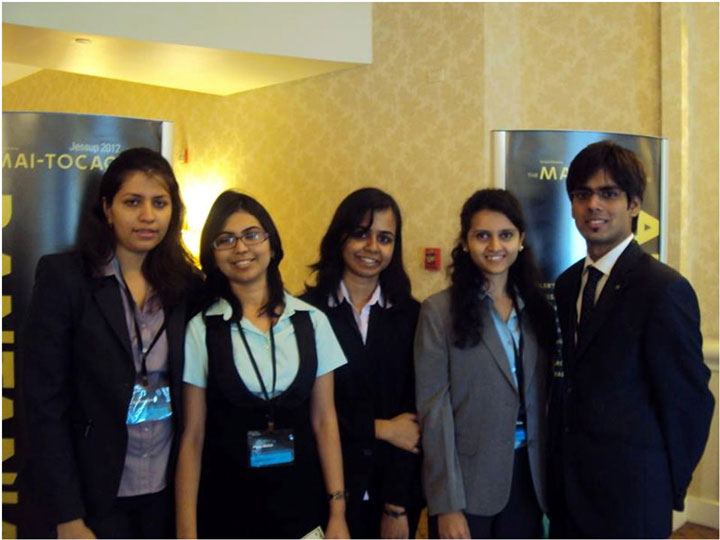
    All my moots had been pre-planned with the exception of Jessup. After the release of Compromis (It is a compilation of agreed upon facts about the dispute that is submitted for adjudication to the International Court of Justice (ICJ), the primary judicial organ of the United Nations), my friend along with whom I was a speaker, discussed about doing Jessup and I affirmed the proposal. In the next one week we chose rest of the members of our five-member team and started the work. First challenge was to face a strong University team in the internal rounds. We succeeded there and started preparing for National Rounds. We had a little difficulty in finding research material on some legal issues for which secured resources from ISIL library. At the National Rounds in January, 2012, we finished as Runner Up. Thereupon we had to participate in the World rounds for which our visas etc had to be prepared in a short time. But thankfully we passed all the hurdles smoothly.

    If I may point out the biggest challenge, it was to face Mr. Rishab Sancheti as a Judge in the quarterfinal rounds. He was probably most prepared for the moot than any other participant.


    When you faced the moot problem, what are the first three things you did?

    The first thing to do would be to go through the problem at least three-four times. I would then chalk out the issues (if not already given) and then do a general research and jot down the possible arguments which can be used to support the contentions in each issue. The issues and works are generally divided amongst the team members, however I always feel that if time permits, each member should work a little on each issue because everyone has a different perspective of looking at legal issues and it might help the team with additional points on the already dealt issues.

     

    mohit-singh2Describe the entire process of memo writing for beginners.

    The mode of research and drafting vary considerably from person to person. Personally, I do some research and if I find some content which is worth being incorporated in the memorandum, I write these down and then continue with the research. Once I am done with some good research and have enough data to begin, I  start giving shape to the memorandum. This is followed by re-phrasing and re-shaping of the content. Dividing contentions into
    sub-contentions makes it easier to research and drafting and also helps the speakers to deal with issues in a better and clearer manner. But again, everyone can have a different approach.

    The research should not end with the end of the drafting. One should keep reading, as for a moot, one should be ready for the worse. Some judges won’t even let you finish a quarter of your contention and use rest of your time to just grill you with their questions. One thing we specifically did for Jessup was to keep handy, the answers for a lot of basic questions. To cite an example, compilation of definitions of legal principles and the cases where International Court of Justice had relied on or had observed them. This really helped. This can be done by the researchers of the team after memorandums have been submitted and while speakers are preparing for the oral rounds. I have always gone to moots with compilations of documents and case laws (Compendium). Some judges like them while some completely have an aversion to them.

    It’s very necessary to have a good team. Lack of understanding and co-ordination may bring in lots of issues. For Jessup, I am really grateful to the team members who were really very supportive.


    What is the importance of mooting?

    There can be two very different answers. Yes and No. Mooting is quite different from lawyering. One may often come across people saying that one gains nothing from mooting. However, I feel that the best research works that I have done in my college life were for drafting my memorandums. Mooting definitely sharpens one’s research skills. So, I would say that mooting does contribute a lot. Mooting helps to build confidence and the skills of putting forth your arguments, being selective  and convincing others on those issues.


    mohit-singh1How did you balance mooting with other important stuff like college assignments?

    Compromis/Moot Problem was out in mid-September and we had our University internal rounds in first week of November, a couple of days before our
    end-semester were to begin. Internal rounds were a little challenging, but probably that compelled us to work harder which finally paid in the national rounds. One can manage mooting with studies. One can often use the moot research work for writing articles and getting them published (though I always planned so, I personally remained too lazy to do this). But there are times when deadlines clash, but then few days of less sleep can help. Our deadline for submission in Jessup was first week of January and I and my teammates were interning during entire December. We were running out of time and I was forced not to sleep for continuous 40 hours before personally handing over the memorandums at Amity University where moot was going to be hosted. But then as there are lots of things to do in a Law School, one needs to be selective.


    According to you, what should law students expect from mooting as an activity?

    As I said, mooting definitely helps to sharpen one’s research skills. But it’s not a case that without mooting one cannot get that. My college juniors often ask if the law firms where I had interned value moots or not. I personally feel and have seen that it depends on the person evaluating one’s curriculum vitae. But if a person is planning for LL.M from abroad, moots especially the ones like Jessup, Oxford moots and Stetson carry a lot of weight. Moreover, one gets to visit universities across India and also abroad.


    If I have never mooted in my life, but I want to – how should I get started?

    Pick up any moot, preferably a national moot; make your team and just start and first year is not too early to do it. You may fail, but it’s not something that doesn’t happen to even the best of them. Research on your own and never put the blame on your teammates that they are not working.  Rather take it for granted that you are going to face this situation. Divide the issues amongst team members. Do not mind being a researcher initially or even later. But if you are confident that you can speak better than the rest, stand up for being a speaker.


    What was it like to attend an international student event? You must have met many international law students. Any interesting stories to share?

    In my personal opinion, international rounds of Jessup is probably one of the best things that can happen to a law student. The event takes place at Capitol Hilton which is at a walking distance from the White House. One gets to meet the best teams selected from over 600 teams from over 90 countries (as of 2013). The parties, especially the National-go-Ball, where teams come in their traditional dresses, are just awesome! Meeting people from across the world at the same place is very exciting. We also interviewed the winning teams of the World Rounds for Lexcetera. We are still in touch with the friends we made there.

    Judging is very different there as compared to India. To cite one  example, they are generally not involved in just grilling you unlike few who just love doing so.

    We also met one of our college senior, who was doing his LL.M at Harvard. He was invited as a Judge.


    According to you what are the qualities that make a good lawyer?

    As I am very new at the Bar, I probably would not be very suitable to answer this question. But however in my opinion, the most basic quality is to maintain a rationale and logical reasoning for everything you think and do. This helps not just a lawyer but also a lay man. Choose the best argument and give it your best.


    What were your areas of interest during your graduation?

    My Honours subjects in the University were Corporate Law and Intellectual Property Rights. Cyber Law was my favourite optional subject. As I was into web designing and also otherwise, I was always interested in computers, I  developed a liking for Information Technology. I took Corporate Law from the market need point of view and I took Intellectual Property Right as I liked the subject. Love for political science has also kept me close to Constitutional Law.

    International Law led me to do International Moots. I have worked a lot on this subject and like it a lot.


    What are “Lexcetera” and “1, Law Street”? How did you get the idea in the first place?

    Things began with ‘Lexcetera’. When I started to moot, there was no database of moots or even a calendar or a list which would tell me that which moots I should participate in and which suited my academic calendar. I and a friend of mine, Hansa Sinha (who was also my co-speaker at Jessup) decided to compile information in this regard. Later on ‘Legally India’ launched its ‘Mooting Premier League’ where I voluntarily worked for their wiki database – ‘Legallypedia’. Subsequently in August 2011, I and Hansa, with help of three other juniors launched Lexcetera which had a sort of exhaustive repository of the details of the Indian Moots and of International Moots, where Indians teams are eligible to participate. We maintained it for two good years and are deeply grateful to law students for their response to the website. But after we entered our last phase of law school, priorities changed and it became quite difficult to save ample time for it.


    How did Law School Tips start?

    Facebook has been playing a very important part in lives of most of us. Law school was something which connected law students to the law school life at Facebook. The founding of page was very random. ‘Lexcetera’ had already started in 2010. A year and half later, I was watching the Republic Day Parade on TV when randomly it struck me that the whole essence of celebrating this day was that we got our Constitution on that day. So this day is technically a landmark day for lawyers. I do not know what led me to think more on this on very different angles but, one thing led to another. I needed something to vent it all out. So, I gathered few ideas and at the midnight of 31st January 2012, and I launched the page.

    The posts were a series of things which happen in law school. From mooting to love and from teachers to end semesters, there were posts which students could relate themselves with. The Tips are less now and posts these days are not specific to law students but generally to those involved in law.


    How did you go about finding good content for the page?

    For ‘Lexcetera’, along with co-founder Hansa Sinha, we had four other college juniors to whom I shall always be grateful. Law School Tips, I manage on my own.

    I feel finding content is sometimes very easy and at times very difficult. The page has got weekly reach as high as five lakhs to as low as six thousand. Sometimes I love things which interest even lay men a lot and sometimes doesn’t even interest to lawyers. I try to be active on social medias and regularly keep a tab on other legal websites. I try to keep original ideas as being different it what attracts a larger crowd.


    How did Lexcetera become so popular on Facebook?

    After its launch at midnight of 31st January, 2012, with the help of night owls like me, page was followed by around 100 people by 7 AM. By night it had over thousand followers and within a week follower mark crossed 3000. Slowly it had crossed twenty thousand followers mark. I did not promote it through Facebook ads or kinds but thanks to the kind followers, when they like or share the contents, it shows up on their profile and the page gets promoted. I really had no idea that the page would get so popular and also, thank you for calling it ‘popular’.


    What are your future plans with 1, Law Street and Law School Tips?

    As of now I have to earn my bread and butter, I get less time, but I plan to involve my college juniors and work again for this. As I have plans to re-launch ‘Lexcetera’ together with ‘Law School Tips’ as ‘1, Law Street’. I also plan to do something which lawyers are generally interested into. Let’s see, how it happens. Fingers crossed!

    ‘Law School Tips’ has definitely not been very active as before, but I hope in future, it engages with legal people to get an even larger share of their love.


    What are you currently doing? Why did you choose this career?

    I am currently working with an Advocate-on-Record at Supreme Court, who has been kind enough to teach basic nuances of drafting and litigation. He even lets me argue some matters. I was about to work in Corporate Sector but, thankfully I chose litigation as my career path and I plan to continue in this field.


    How important do you think is to have a mentor to guide you in the formative years of a practice at the SC?

    It is very necessary to have a good mentor in the initial years of practice because the concepts of law studied at law school give you only an insight of the vast field of law and then again the actual practice of courts is quite a different world in itself. While being in litigation, other than learning the nuances of law, one also needs to know and understand the process of filing and essentials of drafting. Several times at an appellate level, we come across cases where due to minor mistakes made in the fillings at lower level, a case may be lost even though it may be strong on merits. Therefore to have a good mentor who teaches the details and intricacies of the entire process is very necessary.


    How is it like to start one’s litigation practice at Supreme Court?

    Being in law school, it appears very fancy to hear about working at Supreme Court though practically speaking it is not the case. Many people do not recommend starting up the practice directly at Supreme Court. I would always recommend a person joining litigation to start at a place where he or she can get to work at a variety of forums. Narrowing one’s work at Supreme Court, one shall miss learning the process of drafting and filing process at lowers courts which shall cause a little trouble when one tries to get independent. Starting practice directly at Supreme Court is not wrong but knowledge of the litigation process at lower forums is very necessary.


    How difficult would you say it is to set up a practice at the apex court?

    Normally when a lawyer start getting independent, he may not choose to fix the forum where he may decide to continue the law practice. After five to six years of getting a law degree, one becomes eligible for appearing in an Advocate-on-Record examination. Being an AoR is necessary for filing a vakalatnama on behalf of a client but this does not mean that a non-AoR one cannot argue a matter before the Supreme Court. An AoR may do the filing but any other person who is legally authorised by him can argue it. On this note, this judgment is worth referring to Re Rameshwar Prasad Goyal AoR.

    It is a dream of every litigating lawyer to start his own practice. However it is difficult to give a straight answer to the question asked as it may depend on various factors, a family background in law, years of practice in law, forum of practice being few of them. Chambers and firms where one has worked and the level of contacts one has built also matter because building contacts are helpful in bringing clients to you. There are firms which put a restriction on their lawyers to entertain individual clients. Hence, more the time is spent at such firms, the more time it would take for that person to establish his own practice. Even if one has good experience and has good knowledge and understanding of law, yet it would not be possible for him to start his own practice if he is not able to draw clients to himself.

    Setting up one’s own practice is of course difficult, and it takes time and efforts, but there is no other option. I am perhaps a too junior member of bar to answer this.


    Where do you see yourself five years down the line?

    I would be very happy if I myself had an answer to this question. Till last year, I had no plans of joining litigation but now that I am into it, I do not plan to leave it. A foreign LL.M. has always been on my bucket list but now that I am into litigation, I am having second thoughts about it, though I am still not crossing it off from there. To be frank I am not certain of the answer though a possible happy situation five years down the line would be that either I have already started my own practice or perhaps be close to it.


    What message would you like to share with our readers?

    For the law students, I will say that law school life is often a roller-coaster but stay focussed and work hard. Try not to miss any part of the law school life. Friends you make there, generally remain with you throughout your profession and hence life. Most of the law schools in India have some or the other short-comings but a lot can be managed without depending on them for that. But definitely do not MISS the fun part of law school!

    And as I am involved in litigation, I would say that if you are interested in litigation but do not plan to practice just for the fear of initial hiccups, please do not let the money and family factor let you decide what you have to do for rest of your life. There are initial money issues but slowly you can fair better than others.

    Keep communicating with others as this profession is all about that.

  • Debosmita Nandy, Associate Legal Manager, ITC, on being an author, her litigation experience, and plans for the future

    Debosmita Nandy, Associate Legal Manager, ITC, on being an author, her litigation experience, and plans for the future

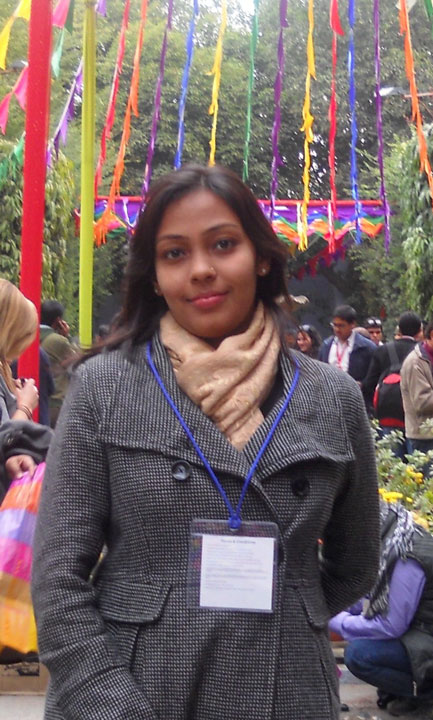
    debosmita-nandy4Debosmita Nandy graduated from WBNUJS, Kolkata, in 2009. During this time she interned with the likes of Luthra & Luthra Law Offices, Trilegal, and Amarchand Mangaldas. She is an in-house counsel with seven years of PQE in diverse commercial and civil disputes, alternate dispute resolution, negotiation and agreement drafting and corporate mergers and amalgamations. She specialises in Mergers and Amalgamations, International Commercial Arbitration, Legal drafting, Advising clients and appearing in court, Contract Negotiation.

    She is currently Associate Legal Manager at ITC Limited.

    In this interview we speak to her about:

    • Her experience with writing and publishing
    • Being a litigating lawyer
    • Her internship experience


    Tell us a bit about your life before law school.

    I was born and brought up in Kolkata. Throughout my school life, I was miss goody two-shoes and the only things which interested me apart from studies were reading and creative writing.


    How did you gravitate towards the field of law?

    I was very clear from the beginning that I would not go down the traditional career path. I was trying to decide between the armed forces (yes, I wanted to join the Air Force!) and research in the field of Genetics (Biology was a favourite subject then) till I read To Kill a Mockingbird by Harper Lee and was blown over by Atticus Finch and his profession. I also came to know of national law schools at the same time, which helped me in finally deciding on taking up law as a career.

    However, convincing my parents was a tough task! I took up Science with Biology in plus two to keep my options open but mainly to appease them. Towards the end of class XII, I chucked my parents’ dream of being a doctor and set myself on the path of preparing for law entrance tests (every law school had its own entrance tests then). I took a chance and wrote only the entrance test of NUJS, whose results were declared during my ISC examinations.


    Tell us about your writing experience and how it has helped you as a lawyer.

    Getting associated with Writer’s Block, the NUJS in-house magazine stemmed from my love of creative writing.However, being associated with NUJS Law Review helped me develop a very important skill – that of teamwork. I wrote two articles jointly with two juniors and was also responsible for mentoring them. Both of them brought fresh insights to the table and it was a good learning experience for me. Moreover, it helped fine-tune my legal research and writing skills.

    Writing a well-researched and publication-worthy legal article hones one’s logical reasoning, analytical mind and research skills. While writing an article, one has to be very careful about grammar, formatting requirements of the publication house and spelling. These things, however minor they may appear, are very important for good drafting. You have no idea how many junior lawyers get a rap on their knuckles due to bad grammar or wrong spelling or because they did not put a comma in the right place!


    Tell us about your internship experience.

    In terms of law, one does not really learn much of it during internships. I worked on formatting and cross-referencing 30-page long agreements, read through voluminous documents in the name of due diligence, copy-pasted information in the standard template in the name of drafting reports, researched judgments on points of law on which none existed and read litigation files but failed to understand the difference between a plaint and a petition! Personally, I think that it is difficult to develop an understanding of how the law works in the real world in a span of just four to six weeks.

    However, these internships gave me the chance me to visit different cities, taught me how to live on my own, introduced me to the ‘law firm culture’, gave me a taste of how long the working hours and how competitive the professional life would be and brought me in touch with all kinds of people! It was a very good life lesson, something I would not have learnt otherwise. I also picked up skills like good communication, multi-tasking, working on tight deadlines and effective networking, which are important for any profession.


    What role did the placement committee play in securing internships?

    I just went with the flow. I interned in all possible places – NGOs, trial court, High Court and Supreme Court lawyers and three top law firms. All my internships were arranged through the placement committee except the one at Luthra where I applied on my own.


    Any advice for the young law students as to how they should choose and plan their internships?

    When it comes to internships, I believe that one should try all before deciding on the one they want to pursue. Despite my misgivings about how much law one learns during internships, I believe that internships give a flavour of the place, which helps decide one’s career path. However, one might still end up in a completely different place of which s/he has no idea, like I did – first at a litigating law firm and then in a company!


    What do you think an intern should do (or should not do) to get noticed at work?

    Be sincere and diligent in the assignments that you get, show your eagerness to learn and go the extra mile. Maintain punctuality in reaching office, finish the tasks within the time permitted and if not, then take permission for extension of the deadline. If you have more than one assignment at a time, then ask the associates about the order in which they want them rather than you deciding which one you would finish first.

    Ask work from as many associates or managers and their bosses as possible so that most people know you, admit mistakes and do not repeat them, but hold your ground if you think you are right. Do not fib about anything since you will be easily caught.

    Avoid logging into social network sites from office computer, do not engage in idle chit-chat with fellow interns but be generally sociable. Avoid going on dates with any associate so that you are not accused of using improper means of getting a PRO! Above all, behave as if you are already a part of the organisation.


    How relevant did you find your law school education with the kind of work you were required to do at law firms?

    Legal education is definitely far removed from the way law is required to be applied in the profession. An apt example would be the procedural laws. The way CPC and CrPC are taught in law schools will be of  little help when one has to apply his/her knowledge at the workplace. I learnt CPC fully only when I began working in Khaitan & Co.

    In my opinion, law is a subject which is learnt only on the job. One can begin working at a lawyer’s chamber or a law firm along with regular classes to get a head-start. However, I believe that the law school days will never come back, so why waste precious time stuck away in a cubicle? Everybody will learn the practical application of law once they start working, so make the most of the five years that you have!


    debosmita-nandy3What kind of work did you do at Khaitan?

    Khaitan & Co. was instrumental in introducing me to the various facets of the profession, especially teaching me the procedural aspects of law. I mainly worked on a wide range of litigations, including arbitration and got trained in the aspects of client handling, research, identifying relevant documents, research, drafting, briefing counsel, appearing in court, organising papers (trust me, litigation generates piles of papers!), knowing how the court machinery works and everything in between. Early on, I was given independent charge, which was scary, intensely pressurizing but highly beneficial and satisfying.


    How different would you say is working as a disputes lawyer as opposed to working as a corporate lawyer in a big law firm?

    Disputes lawyers spend the half of their days running around in court, getting the much-needed exercise, while corporate lawyers sit in their chairs for the whole day!

    On a more serious note, it would be unfair on my part to comment on this since I only have internship experience in corporate law firms to go by.


    What were the top three challenges you faced right at the beginning as you began practice as a litigating lawyer at Khaitan?

    1. Lack of understanding of  how the court works – I trailed my court clerk, asked questions to whoever listened and witnessed all ground level work right from paying stamp duty on a plaint and having it notarized till going to the Registry for certified copy of an order.

    2. No family legal background – I did not know the top lawyers, their clerks or their chamber addresses. It was difficult to get the lawyers to listen to me since they considered me a rookie. I managed to gain their attention only with sincere and hard work. I strongly believe that it does not matter who your father is as long as you can show them who you are and what you can do.

    3. Being a woman – The profession, especially in the litigating field, is still quite patriarchal, although I believe times are changing. As long as you maintain a no-nonsense and a professional attitude towards your work and surroundings, you should not face any problem.


    After Khaitan, you shifted to ITC Ltd. What prompted the switchover?

    At the end of three years at Khaitan & Co, I was looking for a different challenge and so joined ITC Limited as an in-house counsel.


    What is the role of an in-house counsel in a multi-business Indian conglomerate like ITC?

    A typical work day for me begins at 9 AM with checking the mailbox and making a list of things to do for the day. Shortly thereafter, I get calls from other departments of the company, asking for my inputs on day-to-day operational issues. Between 1 and 2 PM, I enjoy the lunch arranged by the company and chat with my colleagues. Post lunch, I try and schedule all meetings so that I do not end up snoozing at my desk from the heavy lunch! Apart from internal cross-departmental meetings, I also attend various meetings with outside parties as a member of the company’s negotiating team. I offer my legal inputs on agreements, negotiate with the lawyer from the other side and help the company in closing the deal. Towards the end of the day, I meet my reporting bosses and discuss my areas of work for their inputs and advice.

    On some days, I research on the legal points in a proposed dispute and draft suitable applications.If a case involving the company is going on in the court, then I go for briefing conferences with the counsel and attend the hearing in court. However, this is a very general version of my routine here, since no two days are same – each day brings new challenges and exciting opportunities to my desk.

    Simply put, the role of an in-house counsel is to assist the company in all its legal issues.


    Many people believe that working as an in-house counsel affords more work-life balance and is less demanding. What has been your experience?

    Law, as a profession is very demanding no matter where you are. You will be required to work all night or over the weekend if need be. You may have to cancel holiday plans for a last minute urgent case (like I did). So I would request all to dispel any misconception they may have about an in-house counsel having it easier than their law firm counterparts.

    However, the best part about working in a company is its HR practices e.g., leave policy. ITC, for example, encourages you to take a minimum of fifteen leaves a year, and also accommodates health and personal exigencies. This invariably contributes towards a better work-life balance.


    How can one apply for an internship at ITC?

    One can apply through his college placement committee. I am not in a position to comment on the second question, but I can say this much from personal experience that an academically sound resume opens all doors. If that is not the case, then one has to build an all-round CV to justify the lack of CGPA.


    debosmita-nandy1You have co-authored a book on forest laws and policies in India, and another on environment and wildlife laws in India. Tell us how did the idea of writing a book germinate and what prompted you to choose these specific topics?

    When I was in my fourth year, Dr. A. K. Poddar (our professor of Environment Laws) asked me if I was interested in contributing to a book that he was working on. I readily agreed and the result was publication of the book, Forest Laws and Policies in India by Regal Publications after almost 3 years!

    While I was working on this book, I gathered a lot of material on related topics. My co-author and I then tied up with a senior from college – Arjya B. Majumdar to compile another book, Environment and Wildlife Laws in India, which was published last year by LexisNexis. The first book happened by chance and thereafter, led to the second book.


    debosmita-nandy2Can you tell our readers about your short stories?

    I have continued to pursue my most favourite hobby i.e., creative writing through my blog as I am very passionate about it. My first short story appeared as part of Chicken Soup for Indian Soul On Friendship, published by Westland in 2011. Recently, I participated in a nationwide short-story writing contest organised by Rupa Publications where my entry won the second prize from the best-selling author, Anuja Chauhan. They also published it as part of an anthology An Atlas of Love, and it has received some good reviews.


    Given a chance to turn back the clock is there anything you would have done differently?

    Looking back, I believe that I am where I am only because of all the choices I made and the opportunities I got in the past. I have no regrets and so would not change a single thing.

  • Puneet Bhasin, Cyber Law Expert, Cyberjure Legal Consulting, on mooting, pursuing cyber law, and plans for the future

    Puneet Bhasin, Cyber Law Expert, Cyberjure Legal Consulting, on mooting, pursuing cyber law, and plans for the future

    Puneet Bhasin, graduated from  GLC, Mumbai in 2011. During her time as an undergraduate, she has interned with the likes of Fox Mandal Little and Advani & Co. In 2012 she went on to pursue a postgraduate diploma in Cyber Laws. She is currently a master candidate in the University of Mumbai, specializing in business laws with a focus in e-commerce laws and compliance.

    In this interview we speak to her about:

    • Winning the Surana & Surana Int’l Technology Law Moot
    • Choosing to pursue Cyber Law
    • Her internship experience


    How would you like to introduce yourself to our readers?

    I am an advocate practising in the area of Cyber Laws. It is a new and growing field. I started practice three years back after I graduated from Government Law College (Mumbai) with the B.L.S.LL.B. degree.  I was interested in this field from my first year in law college, and I did the Diploma in Cyber Laws from Asian School of Cyber Laws. This basic course made me realize that I wanted to pursue a career in this field and that is when in my second year in law college I became a Certified Cyber Crime Investigator. Subsequently, I did my Post Graduate Diploma in Cyber Laws in the fourth year of law college. Additionally in my final year, I did short courses in Intellectual Property Laws, Hacking & Cyber Security and E-Commerce Laws. I passed out from college in 2011 and started practicing on my own.


    Why did you decide to study law?

    While in school, I never thought of pursuing law, though many of my family members are lawyers and in judicial services. However, after the 12th Board exams, I came across the prospectus of Government Law College, and the subjects appealed to me. I read up more about them, and decided I wanted to pursue law; and within the first week of law college, I realized that this was probably the best decision I made in my life.


    What does it take to be a great mooter?

    (Puneet has won the Best Student Advocate Award at Surana and Surana International Technology Law Moot Court Competition.)

    It was God’s grace that I got many opportunities to participate in moots in college. Surana and Surana International Technology Law Moot Court Competition was one of the most memorable one for me. I was selected to represent GLC in this moot in my second year, and it gave me an opportunity to research on main law subjects, as till the second year we had only pre-law subjects. The moot problem surrounded a very interesting premise of “legal liability in cases of Augmented Reality”, which means that who is liable if a computer with artificial intelligence does something wrong.

    It is very important to be open to learning in order to excel in moots. Good research skills are a must along with excellent oratory skills. However, the more you participate in moots, the better you become.

    Moots give you practical experience to some extent. More than anything else, they teach you how to handle success and then deal with defeat also. When you win many moots and then you lose in a moot, it is a big set-back for your self-confidence, but it is very important for you to experience this as this is what real world litigation practice is all about. Winning and losing cannot affect you much at all as it is a part of practicing law. You learn to dissociate feelings of self-worth from practice.


    puneet-bhasin2Share some of your memorable mooting experiences.

    Surana and Surana International Technology Law Moot was a very memorable experience, and I was judged by the Director of Asian School of Cyber Laws in one of the rounds in that moot in 2008. Surprisingly, she remembered me even in 2011 and got in touch with me to teach Post Graduate Diploma in Cyber Laws in their institute. Moots definitely give you recognition and help build contacts.

    I participated in the Kanga Moot Court Competition in 2010 and we won the Best Team award along with Best Memorial. The moot problem was based on arbitration, and that is where I got interested in Arbitration and interned in this area of law also. One thing about mooting is that it gives you a chance to read up extensively on different subjects of law, and this helps you to know where your interest for practice lies.

    The Bar Council of Maharashtra and Goa moot was my first moot and it was in Ahmednagar. That was the first time I had gone to stay in the interiors of Maharashtra, and the simplicity of the students there was very impressive. I loved the experience of interacting with the law students there.


    What kind of internships did you do while you were a student?

    I interned in Fox Mandal Little and Co.  under Senior Partner Mr. Pal. He specializes in Shipping laws and I assisted him in matters. However, this experience made me realize that shipping laws was not my cup of tea. Then I interned under Managing Partner Mr. Khatlawala in Corporate Law arena,, and I did like it. I got to learn a lot. Under Junior Partner Ms. Rajni Divkar, I got the opportunity to assist in the drafting of Rules under a State Act.

    But soon Arbitration caught my fancy, and I landed up with an internship under Mr. Hiroo Advani, who is an expert in Arbitrations. I really liked working on arbitration matters and attending arbitration proceedings. In Advani and Co. I even worked on couple of Due Diligences, but soon realized that typical corporate law work like due diligence is probably not made for me.

    The internships gave me a clear insight on what I love doing and what I would prefer to avoid as a career choice with respect to legal practice. They made me more confident along with helping me build good networks in the legal fraternity.


    Do you think participating in extracurricular activities like MUNs is essential?

    (Puneet has been awarded Honorable Mention in Human Rights Council of GLC Model United Nations.)

    Any extra-curricular activity teaches a lot and mere participation makes us a better person and equips us with skills we did not have before. I used to actively participate in Debates, Moots and MUNs in college, and I felt that they made me more confident and improved my analytical and logical thinking skills.

    Students must participate in extra-curricular activities, not just to win, but to gain meaningful experience.


    How did you become interested in a career in cyber law?

    I realized that I had a profound interest in Cyber laws in my first year in law college, and I pursued this interest by doing further courses so that I could equip myself well to be able to practice in this area of law.

    Academic skills of cyber laws you can learn by doing courses on this subject, and practical skills you will learn only on the job.


    What were the difficulties you faced in shaping up your career as it stands today?

    Cyber law was a very new field at that time, with very few people practicing it. This had many advantages, as unlike many fields of law where seniority, experience and age matters, in cyber laws there was less competition three years back, and there was no question of seniority as it was a very nascent and new field.

    However, the major difficulty faced by me is that there are victims of cyber crimes everywhere, but they are ignorant of the law and don’t know that they can seek legal recourse.  I started blogging on cyber laws on http://indiancyberlawyer.wordpress.com and http://blog.ipleaders.in to create awareness about cyber crimes.

    In the initial stages of your career, patience is the key.


    A lot of people don’t understand the specialization of cyber law. Why do you think is this the case?

    Cyber laws are a very specialized field. A cyber lawyer is a techno-legal lawyer who is well-versed with technical aspects of computers, computer networks, communication devices and has complete legal knowledge including the special laws and rules applicable in techno-legal matters. Most evidence in criminal cases is obtained from cell phones or computers, and a cyber lawyer is the only one who can help in proper appreciation of such evidence or to find loop-holes to make such evidence inadmissible. Also, with the advent of E-Commerce, the concept of e-contracts and digital signatures has emerged, and only a cyber attorney would be able to advice with respect to the same. Intellectual Property Rights in cyber space is also a growing arena which requires lawyers proficient in technical aspects.  Cyber security standards are also governed by laws in India, and a cyber attorney is the only person who would be able to give sound advice on the same.


    Tell us something about being an Associate Member of Chartered Institute of Arbitrators (CIARB), UK.

    Affiliation to CIARB (UK) requires you to attend the course conducted by them and then submit your research on the topic given by them. The research paper is graded and if you get above B grade then you are qualified to pay the requisite fees and become an Associate Member of CIARB. This is the first step to become a Chartered Arbitrator.

    Lawyers who are interested in this should visit the CIARB website and enrol for their course in India.


    How do you go about teaching?

    (Puneet is also a faculty for Post Graduate Diploma in Cyber Laws at Asian School of Cyber Laws.)

    I love to teach cyber laws, and being a faculty gives me that opportunity. It keeps you in touch with the subject and also helps you to contribute to the growth of this field in India, by training lawyers and IT professionals in this field. Practicing law is very satisfying and lucrative, however, life as a professor is not as lucrative but it has a very feel good factor to it, as your students look upto you and you get a chance to shape their careers. Teaching is a very humbling experience.


    How important is social media engagement?

    Lawyers cannot advertise, and in specialized fields like cyber laws, it is impossible for people to know about the services you offer. Social media and blogging play the role of the bridge between a legal professional and potential clients.


    Where do you see yourself after five years from now?

    I would like to believe that with the growth of Cyber laws in India even my career will reach new heights in the next five years. Hopefully with God’s grace I would be able to make a lasting mark in the legal fraternity in the area of cyber laws.


    Do you accept interns with you? How does one apply?

    I do accept interns. I even take interns on a distance mode basis for research work. Anyone interested can apply with their resume to contact.cyberjure@gmail.com.


    Last but not the least, what would be your message for aspiring law practitioners?

    Law is an amazing field, and if you aspire to enter this field then you are definitely going to love it. Law involves a lot of human interaction, which is the best part of it. You get to learn new stuff about human nature each day, and in the process you change for the better each day. Good luck for your wonderful journey of becoming a lawyer!


  • Chintan Chinnappa, Senior Associate, Dua Associates, on law, litigation, and taking time out for his music

    Chintan Chinnappa, Senior Associate, Dua Associates, on law, litigation, and taking time out for his music

    Chintan Chinnappa graduated from M S Ramaiah College of Law, Bangalore in 2009. He is currently a Senior Associate at Dua Associates. While being a Senior Associate at a top tier litigation firm, Chintan also plays cricket for a club in Bangalore, manages a booking agency for artists, and never gave up on his passion for music. He is currently the lead guitarist at Inner Sanctum which is a Death/Thrash metal band from Bangalore, India.

    Chintan talks about:

    • Law school experience and Internships
    • Work at Dua as a Senior Associate
    • Taking time out for Inner Sanctum and other passions


    What brought you into studying law?

    I was born to a family of lawyers. My dad was a Judge in the High Court of Karnataka, my brother and sister-in-law (who incidentally also belongs to a family of lawyers) are practicing lawyers and my mom studied law, but never practiced. Surprisingly though, there wasn’t too much law at home while I was growing up. I am not really sure if that was intentional or whether my family just didn’t like bringing work home but I hardly heard them discuss matters or legal issues. To a large extent that gave me sufficient headroom to decide what I wanted to do with my life and take an independent decision. Cutting the long story short, I grew up, unlike most other kids, with immense respect for the profession and with a belief that lawyers saved lives. I was quite oblivious to the fact that this belief of mine was more or less solitary, in the sense that the rest of society didn’t seem to share the same feeling. This was thrust upon me once I had made my decision to study law but that didn’t really prompt to rethink my decision.


    Did you ever take part in moots when at college or indulge in academic legal writing?

    As a student I was quite focused about becoming a litigation attorney. I didn’t have any qualms about possibly having to work with/in less than ideal clients or work environments. So it was quite natural for me to moot in college and I loved it! I mooted for several years and was extremely passionate about it, and at times the passion bordered on insanity.
    I was quite fortunate to have a constant team through college and we skipped classes to work on a moot which was months away and have heated discussions in the library which would more often than not result in a few of us getting reported for causing a riot. Mooting left me with no time to indulge in academic legal writing. Honestly, that didn’t interest me as much. I preferred moots and internships and no matter how much value an article would have added to my CV I couldn’t convince myself to do something I wasn’t passionate about. That should probably answer the second half of your question as well. Students should be given the discretion to decide the activity that they would like to participate in. I would have resented giving up precious moot preparation time for an article that I didn’t wish to write. Compulsion causes more harm than good.


    Tell us something about your internship experience.

    Like I said, litigation was my calling and therefore all my internships were litigation centric. I didn’t feel the need to do a corporate internship. I interned with all the top litigation law firms/ offices in Bangalore such as Dua Associates, Poovayya & Co., Indus Law etc. I also interned with Mr. Aditya Sondhi and a few senior advocates, Mr. Udaya Holla and Mr. Naganand. In my final year, I did a clerkship with Justice Raveendran just after he was elevated to the Supreme Court.


    How different is getting hands-on experience at an internship, from learning legal theory in the university?

    There was a clear disparity between what I was made to learn in college and what I needed to learn to survive an internship. I personally believe that most universities haven’t figured out the purport of legal education. In fact, the only way to sort this out is for the universities to include in their training course (if there exists one) a compulsory three to six month internship for all professors in law firms and law offices. That’s the only way to bridge the gap.


    What kind of work did you typically find yourself doing as an intern?

    Primarily research work and drafting, not to mention the court visits and the complimentary illicit appearances before tribunals and lower courts.

    There was a huge disparity between internships in so far as the quality and quantity of work assigned to interns. A few offices understood the value of an extra hand and a few were just eager to hand over the ready to print certificate. It’s a mixed bag! But what was fascinating to me was that each office seemed to handle and structure their work differently. This was enormous learning for me and I spent most of my internships figuring out how I could finish the most amount of work in the least amount of time. The internships in effect gave me a peek into the functioning of a law office and helped me enormously in deciding which office to apply to after graduation, none of which I could have figured out just sitting in college.


    What do you feel about certain law colleges being supposedly more ‘elite’ than the others?

    I don’t really see the point of an ‘elite’ tag. All universities have the good and the bad graduating every year and this is more often than not the result of each student’s efforts in personal development. I have worked with students who have graduated from different universities, elite or otherwise and I don’t really see a sufficient difference to warrant the use of an elite tag.


    chintan-chinnappa1How do you take time out for your music?

    In addition to being a lawyer, I play cricket for a club in Bangalore, manage a booking agency for artists and also play guitars for a metal band called Inner Sanctum. It’s a Jekyll and Hyde situation on steroids! I have no idea how I manage all of this but I just love everything I do and I squeeze in as much as I can everyday to ensure I do enough justice to each of my passions.


    How do you feel the work life balance is working at law firms?

    I worked for a year, right out of college at Poovayya & Co. in Bangalore. Though it was and continues to be an excellent law firm, I didn’t see myself fitting into the overall scheme of things there and I decided to leave them in Aug, 2010. I immediately applied to Dua as I was extremely serious about litigation in Bangalore and Dua Associates is renowned for quality litigation work and a great working environment.  I joined them in Oct 2010 and it has been a good four years! The team is excellent and the firm accommodates and encourages the associates to pursue their passions and maintain a healthy work-life balance. That’s how I manage to keep my band alive!


    What does a usual day at Dua look like for you?

    Like I said, I am part of the litigation team in Dua and therefore all the work associated to litigation I am required to do which includes appearing in courts, drafting, briefing senior counsel etc. As a Senior Associate, the firm expects me to perform certain additional functions in relation to team building and team leading. Honestly, that isn’t too hard because we are fortunate to have an excellent team.


    What do you feel makes an intern stand out and is very important for him to do to have a chance of getting a call back or even a PPO?

    Confidence and the ability and desire to learn. If an intern has this, it most often than not results in a PPO.


    Picture Credits: Prateek Biswas

  • Jaya Godhwani, LL.M. candidate, Maastricht University,on pursuing forensic science, and her internship experience

    Jaya Godhwani, LL.M. candidate, Maastricht University,on pursuing forensic science, and her internship experience

    Jaya Godhwani pursued a science and law combination degree from KIIT, Bhubaneshwar, batch of 2013. She is currently pursuing a masters in law from Maastricht University, specialising in forensics, criminology, and law.

    In this interview, we speak to her about:

    • Interning with Senior Advocate Ram Jethmalani
    • Critical details for a career in Forensic Science
    • Her LL.M. experience from the Maastricht University.


    Tell us about your life before college. Did you have lawyers in your family?

    Ah! I feel nostalgic. Well, when I was a child the world seemed to be a place of joy and happiness to me. There was nothing to worry about. I am the youngest child in my family. Since my childhood years I have been very active. My mom and my school teachers say that since my schooldays I have leadership qualities in me. I was determined and very hard working during those days as I am now. I was always keen to participate in the debates, recitations, and other extracurricular activities. I represented my school in many inter school debate competitions and brought laurels to my school by winning few of the competitions.

    My whole family is into business. I was the first child to step out of my hometown to do something different. Subsequently, I inspired my other young family members towards this profession. My younger cousin is pursuing BB.A. LL.B. from KIIT University.


    Why did you decide to study Law?

    I still remember this one instance in my life very clearly when I made up my mind to study and pursue my career in law.  In 2006, when I just cleared my 10th Standard, I had to fill a form in which I had to choose my subjects for class XI. I never wanted to choose Science/Biology because I saw my elder sister working day in and out on those bulky botany and zoology files, and the dissections which she used to do. On the 7th of May 2006, my dad made me read an interview of a girl who did her BSc. LL.B. from NLU Jodhpur and Prof. NL Mitra’s view on B.Sc. LL.B. and its booming career in India. Second page of the newspaper had some information about Forensic Science and its relation with law, how it’s used in courtrooms, and the dilemma faced by judges with respect to its admissibility in the cases. Those newspaper articles sparked my interest, as it was really challenging to work and gain in depth knowledge in those dimensions of legal sphere which were untouched, unheard and fascinating. In those fractions of a second I just opted for Science/Biology as a subject for my Class XI. It was then, in 2006, I decided to pursue B.Sc. LL.B.


    What have your internship experience been like?

    When a student enters a law school he/she is not much aware about different sectors related to law. He/she learns from their seniors and teachers how to play the cards and learn the rules of the game slowly. Same thing happened to me. When I entered the law school I had no idea about internships and how to get them. My college formed a placement and internship cell in 2008 when I entered the law school. I was chosen as a member of that placement and internship cell. It was then I learned from my mentors about internships in law firms and in the litigation sectors. I wanted to explore both areas so as to decide for myself where I wish to head.  Therefore, all the decisions with respect to internships were taken very rationally and cautiously because I was warned since day one that these things play a vital role in framing Resume. So after talking to many people around, and most importantly not forgetting my area of interest, I decided my internships majorly in litigation sector.


    jaya-godhwani2How did you get the opportunity to intern at the Chamber of Senior Advocate Mr. Ram Jethmalani?

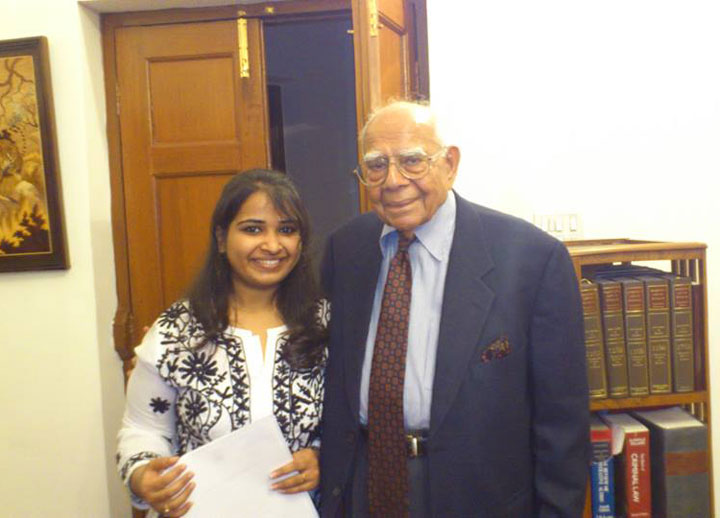
    Grabbing an internship under eminent criminal lawyer Mr Ram Jethmalani was my dream since 2006, when I decided to pursue my career in B.Sc. LL.B. You can say it was like a miracle for me to get internship under him. He used to come to our college to deliver lectures during the International Law Weeks. During one of his visit to my college, I approached him personally and spoke to him about my interest in Forensic Law and expressed my desire to intern under him. He asked me a few questions related to Forensic Law, and personally offered me an internship. My happiness knew no boundaries; I wasn’t able to believe that I actually laid my hands on my dream internship in the third year of my law school.


    Our readers would be keen to know how you went about securing your internships.

    The first rule taught to me by my dad and teachers was never narrow down your scope. A lawyer should know everything. So I worked in that direction. My faculty and seniors helped me build my blocks. I chose to explore NGOs, Law Firms, and Sole Practitioners to observe closely their working patterns. Apart from Forensics, I gradually developed an interest in Intellectual Property Rights due to Professor. Dr Tabrez Ahmed, one of the most intellectual teachers in the IPR Field.  Therefore, under his guidance I started targeting all the top firms which worked in those sectors, because I knew, I would willingly give my best in those internships. After securing enough of good internships, my other teacher Mr. Kumar Kartikeya and Mrs. Parimita Dash pushed me to explore the world of mooting, because according to them, a law student should also know how it feels to plead before the Honourable judges.

    The most important thing according to me, which I kept in mind while framing my CV, was maintaining an adequate balance in all the areas, i.e. internships, moot courts, publications and extra-curricular activities.


    How did you develop an interest in Forensic Sciences?

    Since my early years in school, I loved to take up challenges. After reading an article in the newspaper which talked about forensic science and related issues confronted by Indian Judiciary System, which inspired me to opt forensic law. DNA test, Fingerprints, Saliva test and other areas of forensics, sounded fascinating and interesting. The decision to pursue my career in this particular field, strengthened when I interned in the Directorate of Forensic Science.

    Forensic Law is at a very nascent stage in India.  Therefore, according to me, many lawyers are not much aware about this particular field of law. As far as my knowledge goes, I don’t think so many people pursue this course.


    Tell us your experience interning at the Directorate of Forensic Sciences.

    Indeed, it was amazing experience. I worked in the Ballistic department, where I examined the firearms so as to determine the nature and type of weapons used in the crime, linked fired bullets/ cartridges with the suspect weapons.

    I also worked in the Chemistry department, where I was assisting an expert in a dowry death case, in which I examined the burnt clothe samples. Different questions, like whether kerosene or something else was used to burn the lady, and I also learnt about  chemical  analysis of exhibits such as the viscera, biological fluids, trap cases, dowry death cases, acids and various others exhibits referred by the Investigating Agencies. Viscera including biological fluids are examined for poison detection in cases of homicides and suicides.

    Finally, I along with my other co interns made a report on the status of forensic laboratories in India.

    Overall, my experience at forensic laboratory was eye opening, as I learnt how it gave new dimensions to criminal justice system, by unfolding the truth.


    What is the procedure for an internship application with the Directorate of Forensic Sciences?

    I raise my serious doubt if one can get an internship directly under Directorate of Forensic Science. There are no specific guidelines regarding framing of application for this internship. In my case, University Grants Commission (UGC) was looking for motivated students, in 2009, to work and prepare a report on the current status of Forensic Science Laboratories in India. So, some of the students from my course applied and we were fortunate enough to get an opportunity to work for that research project. As a result, I was offered an internship in the Directorate of Forensic Sciences.


    Are there any opportunities to study the subjects you chose to specialize in your LL.M. in India?

    Well, NLU, Jodhpur offers an LL.M. in Forensics, Criminology and Law in India and some of the Government Institutes also offer the same course. After working in the Directorate of Forensic Science and after learning that, Scandinavian countries are the world’s best when it comes to forensic law, which motivated me to study abroad.

    Additionally, the lack of knowledge about the subject in Indian legal sphere intrigued me more towards foreign university. I really wanted to explore how they are different from us and what we have to do to come to their level. Moreover, I wanted to know the reason, why serious crime rate is so less in these countries. I found out that the Netherlands is one of the countries in the world which has the lowest crime rate because of their stringent forensic law and use of advanced technology to curb the crime. This urge of knowing and learning things brought me to the Netherlands to study Forensics, Criminology and Law.


    How did you go about choosing which college to go to for your LL.M. and did you ever consider Indian colleges?

    It is one of the most important decisions in one’s life to choose the right college and program for your higher studies. If you don’t do that properly, then you don’t enjoy it and you end up in no men’s land.

    As the trend goes, I spoke to my seniors who already got themselves enrolled in Master’s Programs. I think they are the best persons to guide you about these things because they have a pretty fair idea what went wrong with their applications or what better they could have done. So, I started hunting for colleges on www.LLMguide.com which suited my area of interest and shortlisted few of them. I made few friends from abroad when I represented my college in International Youth Forum 2011 in Russia; I spoke to them about those universities which were there in their hometown. Furthermore, I also looked at the faculties, the structure, the library and the guest lecturers of the universities. I got in touch with the alumni of those universities through social network sites, and inquired about relevant information and then shortlisted universities. Frankly speaking, I never wanted to pursue LL.M. from India so I never considered any Indian college as an option for my post graduate studies.

    For me, Maastricht University was the best as it met all my desired criteria. Of course, like for every student, the university and course both matter, same goes for me. After learning that Maastricht University is ranked 6th among the top 100 best young universities worldwide, my decision became more firm to pursue my master from Maastricht. The course offered by them was the best when compared to the other universities in which I applied. It was exactly what I wanted to do. So, the course coupled with University ranking were the factors which played major role in deciding the college.


    Are there any scholarships for studying at the Maastricht University?

    I was lucky enough to get a UM High Potential Student Scholarship at Maastricht University. So I didn’t face any difficulties in terms of finances and other things. Regarding accommodation, Maastricht University has their own website where you can easily find accommodation if you have a subscription.

    There are scholarships available for Non-European students at Maastricht University. For further details on the scholarship you can visit the scholarship page at the Maastricht University official website.


    How is the faculty & academic schedule at Maastricht?

    I am really impressed by the faculty of the Maastricht University. All the staff members are engaged in highly qualified scientific research programmes and incorporate the findings of their research activities in the different courses.  The connection with real life cases is also enhanced by means of apprenticeships and guest lectures. They are just not into purely academics; some are Directors of Forensic Laboratory, Attorneys, Public Prosecutors, Young Lawyers, and Honourable Judges of the Supreme Court. Therefore, they teach us the applicability of law in practical world. So apart from theoretical insights they emphasise on real world practice.

    The Maastricht University has an innovative problem-based learning approach. It is a student centred instructional method widely used at the University. In all courses we have a tutorial group where we prepare, discuss and formulate learning goals for next session. The student reads and discusses all the literature in the tutorial and the tutor (instructor) acts as a catalyst, rendering help when and where it is required. This allows us to develop an independent approach and enhances our research skills. Moreover, it helps us to think in a new dimension.

    So my typical day starts like any other student in Maastricht. I grab a Bun and head towards university, for my tutorial or lecture. When it is a tutorial session, the whole week I have to study more than 3000-5000 pages to prepare myself for class discussions. Sometimes, I have to submit assignments every week, which make my routine more hectic. Lectures sessions are always pretty relaxed as compared to tutorials as I have fewer pages to read.

    Frankly speaking, personally in India, I didn’t at all prepare anything before the classes, I used to sit and listen what the teacher said. But here things are the other way round, I have to understand the literature first, on my own, and then in tutorials I have to share and express my views and thoughts about the same. If at all my way of thinking is wrong or different than my fellow students, they share his or her view and the tutor at the end use to address in general about the things. So according to me, in India things were pretty relaxed and flexible.


    What more do you believe Indian Universities should provide to the students?

    I am really impressed by the teaching method adopted by the Maastricht University. Especially the tutorial sessions, where though we don’t have any background or knowledge about those new subjects, but still we are asked to prepare for tutorial sessions. We then discuss the texts we have read and then it ends as a productive and interactive session. Here, we learn from other fellow students as well as from the teacher. So the learning process which takes place here is unparalleled. I think Indian Universities should also adopt these kind of approaches, which will help students to read, learn and think independently and in a different dimensions altogether.


    Was there time enough for non academic pursuits at Maastricht?

    I think one should always learn to balance things in life. In legal profession, you need to have contacts and socialization/networking is the best method. So, yes I do take out time from my busy schedule to hangout with my classmates. In fact, I also organised two Indian Events at Maastricht with the help of the Dutch Municipality. One of the events which I organised was Holi Festival for my foreign classmates. I think it is always good to showcase your culture to your international friends; this is how they will learn about your culture and vice versa.

    So after hectic weekdays we do organise some or the other class events on the weekends, just to relax and know a bit more about each other.


    Do you think higher studies are a necessity for a successful legal professional?

    According to me, the more knowledge you gain the better it is for you. I was always determined to go for higher studies. So well, in my case I do agree that it was necessary for me as I wanted to gain in-depth knowledge in such complex areas of law. I do wish to pursue my career in criminal law therefore, I thought a Master Degree would be more helpful as I wished to know how to read and interpret forensic reports in criminal cases.

    My suggestion to law students would be – if you think your area of interest demands more research in that field, then definitely you should go for higher studies. Exploring new dimensions and expanding the horizons is always beneficial. Afterwards, one can always get into good law firms first as a trainee and then as an employee. If not that, then a PhD in law is also good option, as it would be wonderful to have young and bright intellectuals in the academic sphere.


    What are your future plans? How do you plan to use the experience and the knowledge gathered at Maastricht?

    I would love to work in a Forensic Science Laboratory in the Netherlands but it is not so easy to get through because of the confidentiality and national security clauses of the country. Meanwhile, I am working on a project related to forensic science, which I hope gets approved by the European Union and the Indian Government, in near future. So by the end of August things will be clearer to me.

    In the future, I would love to come back to my country and practice in the criminal law field.


    And any word of advice for all the young law students out there?

    I don’t think so it is possible to do something without dreams. So, dream high and work hard to achieve your goals. Dreams do come true. Make as many contacts as possible during your life journey, you never know when and how somebody can help you to turn your dreams into reality.

  • Faisal Sherwani, Senior Associate, Parekh & Co., on breaking the NLU myth, studying in the US, and his work experience

    Faisal Sherwani, Senior Associate, Parekh & Co., on breaking the NLU myth, studying in the US, and his work experience

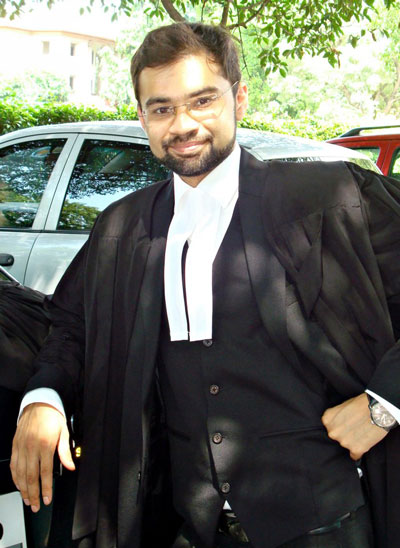
    Faisal Sherwani graduated from the Faculty of Law, Aligarh Muslim University, in 2009. Thereafter he received the prestigious Thomas Buergenthal scholarship and completed his LL.M. from George Washington University Law School, USA. Since then, he has served as Counsel in the chambers of Mr. Rakesh Dwivedi, Senior Advocate. He is currently working as a Senior Associate at Parekh & Co.

    In this interview we speak to him about:

    • Graduating from a non-NLU
    • Studying in America
    • His experience at Parekh & Co.


    What motivated you to pursue law?

    Part of my early schooling was in Blackburn, England, where my father worked as a doctor. Thereafter, my family moved back to my hometown in Aligarh and I completed my schooling there. After my basic schooling, I developed an instant fascination  for Political Thought, History, and Economics. I was drawn towards writings which advocated freedom of speech, religion, thought and life of the individual. Before I knew it, I was drawn towards law. Though not my immediate family, but a large part of my extended family was in the legal profession. Many of such family members mentored me into going to law school and taking up law as a career.


    Tell us something about your life at Aligarh Muslim University.

    I have fond memories of my university. It was an extremely lively place to study law in and it helped me and grow up into a young man. I remember it to be one of the most multicultural and diverse places. We had students from troubled parts of the country as well as those who were from abroad. Such students, often did not necessarily agree with your point of view, your beliefs or the policies of our Governments. It is here that I became an ardent advocate of freedom of speech and of the individual (this often landed me up in trouble with more popular and conventional groups). Probably the best thing that I learnt there apart from law, is that even as friends, we can disagree. During my time as a law student at AMU, I interned at the National Minorities Commission, at Fox Mandal & Little, Advocates & Solicitors, and at the Chambers of Mr. Rakesh Dwivedi, Senior Advocate.


    Would studying in a National Law University have helped you in any way?

    Not at all. In fact, if asked, I would do it all over again. My strongest inclination was always to practice law and the Faculty of Law, at Aligarh, provided the perfect platform. We had the opportunity of meeting judges from the Allahabad and Lucknow Benches of the High Court, law officers serving in the Government and young aspirants of the Judicial Services. The University, gave me an opportunity of addressing and speaking to large groups of students (who I remember would give you a hard time, for reasons of divergent views, different ideals or just out of plain boredom) this removed any stage fright which I might have ever had. I also participated in various moot court competitions and would often meet students from the National Law Schools at such events. They were bright and often better organised than us, but that apart I realised we were all the same lot of law students.


    What was your motivation behind doing an LL.M.?

    In the final years of my studies at the Faculty of Law at Aligarh, I realised that I was not done with my academic pursuits. By this time, I had developed an interest in foreign legal systems and a taste for Property and Corporate Law. I had the opportunity of meeting the Dean and Associate Dean from the George Washington University Law School, Washington DC, who were travelling to India at the time. I invited them to visit the Faculty of Law at Aligarh. They instantly showed an interest in me. I had applied to several other foreign Universities by this time but then, I applied to GWU too. I remember receiving an acceptance letter from my Dean with a personal note, which I cherish to this day and before I knew it, I was packing my bags for Washington, D.C.


    How should one go about choosing a university for their masters?

    I had applied to various other law schools throughout the USA and UK. The idea really should be to ask yourself what you want to study rather than pick a college which has a great name for itself, but does not necessarily match your requirements in terms of modules you would like to study or credits you would want to earn from them. It is common knowledge that some law schools are just better for some specific subjects while that might not be the case for subjects that one might want to concentrate on.


    faisal-sherwani1Tell us about your experience in George Washington University.

    The experience at GWU was a once in a lifetime kind. The faculty was warm and just as interested in the diverse experiences of its foreign LL.M students as we were in what the law school and its faculty had to offer. The best thing about studying at GWU is the fact that it sits in the Nation’s Capital and all important Government establishments are just around the bend. One can attend hearings at the Federal Circuit and speak to Ambassadors from different countries, lawyers and important functionaries who visited the law school for talks with the students. The faculty was great at what it did, courses were taught by professors who were noted academicians in their field, one by a sitting judge and another by the former Register of copyrights for the United States.

    I lived just ten minutes walking off-campus at Massachusetts Avenue in a rented apartment. It provided for a healthy walk every morning, walking past the White House, IMF Building and World Bank.


    Anything memorable that is stuck in your mind?

    The most memorable moment has to be a few days before I was scheduled to leave DC and be back in India. I got a call from my Dean asking me jokingly, “When would you get the hell out of his country and go do some good in the courts in India?” I then met him, shook hands and promised to stay in touch. It was an emotional moment.


    How was the academic schedule?

    It was a rigorous course schedule and I remember we were required to complete 28 credits in order to graduate. Course sessions were interactive, loaded with food for thought and always challenging. Though there was a lot of course work, organisation and belief in yourself ensures that one sails through.


    What did you study?

    As stated earlier, by the time I had decided to go abroad for further studies, I had developed an interest in Property Law and Corporations. Though I had studied a lot of the conventional property law back home in India, including the statutory and codified aspects of the same, I wanted to study Intellectual Property. This interest had been garnered by earlier internships where I had had the opportunity to work on such subjects. I also studied Corporations and Legislation, which amounted to extra credits for me. Apart from these courses, which I officially studied, I would often attend course sessions such as Government Contracts, International Business Law etc.


    How’s the Indian fraternity over there?

    My batch of LL.M students had quite a few Indians. They are the same old lively lot, we celebrated festivals like Diwali together and talked about the affairs back in the home country.


    Are there any scholarships available specifically for Indian Students?

    I had applied for and was awarded the Thomas Buergenthal Scholarship. This covered my tuition fees. There are various scholarships available for foreign LL.M aspirants at the law school, though not specifically for Indian students.


    What would be your advice to law students who plan to go for higher studies?

    Pin point your interests and ask yourself why you want to study a particular specialisation and then go about short listing your desired Law School.


    How do you expect this experience to influence your career?

    I have always believed that any experience is better than none. GWU was a rich experience and the interactive sessions which I was exposed to there have helped me till date to better analyse, understand and help real life clients which I entertain today as a lawyer.


    faisal-sherwani2 What does a regular workday at Parekh & Co. entail?

    Parekh & Co. has been the perfect platform to practice hardcore law. We handle complex and high stake litigation for major business houses, consortia and even for Government Institutions. I had been working in the Supreme Court for about couple of years and I would often meet the Partners at the firm in Court. They have been generous enough to make a place for me here. A normal day starts with a drive to the Bengali Market Office, which is just ten minutes from the Supreme Court. We have a 9:30 AM meeting in order to ensure who is handling what and who is going to attend early morning court hearings. This is rather essential, I believe, as a litigation office can often prove to be a frantic place, with court room items swiftly passing by and often boards collapsing. Thereafter, depending upon schedules, I usually find myself entertaining clients during the early part of the afternoon. The late evenings are reserved for conferences with Senior Advocates and briefings for matters scheduled for the coming morning.


    Do you accept interns at Parekh & Co?

    We most certainly do accept interns. It wouldn’t be the same without them! I am sure I speak for all the Associates at Parekh & Co. that working with interns is the most refreshing part of a hectic day and it takes us back to our early days. All applications can be sent to parekhco@parekhco.com. We are interested in interns who have an urge for learning and who can bring their own experiences to the firm.


    Based on your interaction with the law students, what do you think they should do in order to excel in their internships?

    The greatest favour that a young law student can do for oneself is to have an urge to learn from the experiences of others who are on the job. One should always feel free to ask questions. We appreciate it when interns concentrate their thoughts and take the initiative. After all, that is how we all started.


    What would be your parting message for our readers?

    Believe in yourself and your capabilities. Work hard and everything else will follow.

  • Shreyas Tirunagari, Legal Consultant, Sriram Associates, on interning at the United Nations, being a judicial clerk, and plans for the future

    Shreyas Tirunagari, Legal Consultant, Sriram Associates, on interning at the United Nations, being a judicial clerk, and plans for the future

    Shreyas Tirunagari is a graduate from NUJS, batch of 2011. During his undergraduate years, he interned with the United NAtions, Since then, he has worked under Ministry of Finance, Government of India, as Associate and later as Consultant. He was also a judicial clerk to Justice Dipak Mishra, Supreme Court of India. Following his stint at the Supreme Court, he joined the National Institute of Public Finance and Policy (NIPFP) on the Black Money Report commissioned by the Ministry of Finance in 2011.
    He is currently Legal Consultant at Sriram Associates, where he provides legal advice on various sectors including infrastructure, finance, real-estate and energy.

    In this interview we speak to him about:

    • His time at NUJS
    • Being a judicial clerk, the process of application and the responsibilities it entails
    • Plans for the future


    Why did you decide to study law?

    I did not really decide to study law as a career choice. Barring a few options such as Liberal Arts, in the Indian educational set-up students are required to make a choice of professional career at a rather young age. Most colleges are professionally exclusionary and do not permit students to transit from engineering to life sciences and then to law. Well, that being said, I was inclined to understand what bound a society together and so, law was a natural choice. As for how it came to be NUJS, it was a choice of city – Calcutta being steeped in history, culture and as a symbol of liberal development was quite an attraction. If you ask me about it now, I’d say I was mistaken – attending NUJS can and should be a compelling choice. It is a top-3 law school, it has a culture that embodies innovation and enterprise, and it provides a great platform from which to build a career.


    shreyas-t3Tell us about life in NUJS.

    One’s time in college is perhaps the most receptive phase of life—after early childhood—to the process of habit-formation in the human life. As such, the habits I formed at NUJS continue to occupy a sweet spot in my everyday life. For one, the library was the only room with an air-conditioning facility and it became habitual to spend time reading there. Since then, reading has become a habit and I continue to devote some time to reading despite moving across very different environments.

    That apart, NUJS has a very collegiate atmosphere that provides many opportunities to explore avenues within and outside of the law. During my time, I was also fortunate to have a very inspiring set of faculty members who drove students to understand, introspect and challenge the norm.

    Recently, we had a batch Reunion in Delhi where I caught up with some old friends and it led me to reflect on one critical aspect of the growth process–diversity. We had a very diverse student body with students from Punjab, Bengal, Tamil Nadu, Kerala, Shillong, Gujarat, Bihar, M.P. – pretty much all states were covered as were all income, social and cultural classes. This diversity set up a great recipe for embracing new cultures, taking up new initiatives and learning a lot in the process.

    Moreover, Calcutta is a city soaked in culture and arts. There are film festivals, book festivals, football games, quaint neighborhoods, some amazing culinary options and a relatively safe and indigenous nightlife. In comparison with the other NLUs, I feel that NUJS is a first among equals in the ‘uniqueness’ of the experience.


    Which one has been your most memorable internship?

    My most memorable internship was at a United Nations Agency, the World Intellectual Property Organization in New York during the summer before final year. I interned alongside 350 other people from over 50 different countries. In a nutshell, that is why it ranks as the best internship I’ve done during college.
    The wide variety of perspectives that were available provided an opportunity to learn from different cultures and critically evaluate the role of one nation vis-à-vis 192 others. Moreover, this was in the summer of 2010 – at a time when the Football World Cup was in full swing. For the first time, I had witnessed the enormity of a platform that was divisive and unifying while being friendly ! Watching a Nigerian Finance Minister and a Belgian Trade Representative let their hair down at the Vienna Cafe, the UN Lounge where all games were being screened, was a sight to behold, indeed!

    Beyond the global dimension to this internship, working at the UN was quite professionally challenging. I was assigned the task of covering ongoing negotiations and meetings at different segments of the UN ecosystem – in the morning I would be at the ECOSOC only to be told to rush to the Sixth Committee meeting by the afternoon, following which I would prepare reports, participate in meetings and draft memos to be sent to other UN offices. The nuances of diplomacy are deeply entrenched in cultural, social and professional engagements. As such, observing and participating in diplomatic interactions on the plank of intellectual property led me to see the ‘bigger’ picture within which economics works alongside politics which works alongside law which works alongside business and so on.

    Before this internship, I had worked in the securities division of Crawford Bayley, the office of Senior Counsel P.P. Rao, and the legal department of TCS. All of them were strictly legal internships that focused on handling legal transactions – both, corporate and litigation, and so in comparison, this was a truly unique experience. So while I cannot say that this was the best internship, it was the most interesting.


    How do internships help in the evolution of a legal profession?

    As I mentioned right above, internships are great avenues to evaluate what you read in the classroom in the real world. For example, most of the assigned case-readings for class are primarily Supreme Court judgments. And for a diligent student, it is likely that they will have a reasonable grasp over the case-law of the subject. However, if one were to go practice in the lower courts, it is more often than not other aspects of the law such as legislative instruments and local regulations that will assist one’s arguments. Internships help in understanding how theory fits into the dynamics of the world. It is also an eye-opener.

    To analogize in cricketing terms, internships are T20s – fun, short and exciting. Your career is the Test Match – strategically engaging, long and detailed.


    You were engaged as a judicial clerk in Supreme Court after your graduation. Why did you make this choice?

    Firstly, it is the Supreme Court of India and a place that, especially in these politically and economically volatile times, wields enormous influence in shaping the direction of the country. Even now, the Supreme Court’s recent judgments on 2G, Subrato Roy, the Novartis case and Section 377 have led the charge on financial propriety, global intellectual property and the individual-societal conflict of identity.

    In my fourth year of law school, I undertook a policy research project on the pharmaceutical industry, and found that the idea of government policy and processes fascinated me. The fact that millions of people can be impacted by a change in the script of one or two documents is something I that I found incredible. One government order here, one new court decision there, and all of a sudden interest rates are changing, investments are soaring/crashing, crores of rupees are released in pension schemes.

    The Supreme Court is one of those places that makes decisions on subjects that affect us daily in our lives – it’s like one of the control rooms in a big ship, and so when I got a chance to be in that room, I just did.
    Moreover, let’s not forget that as law students, most of our readings and studying had to do with Supreme Court judgments – it was but a natural progression to understand the judicial process and explore career options thereafter.


    Is it difficult to get a judicial clerkship with a Supreme Court judge?

    The difficulty of a clerkship I think is two-fold; the first rung of screening is perhaps a preliminary screening for eligibility. Most of the judicial clerks are selected from a handful of law schools such as the NLUs and a couple of others such as ILS and Symbiosis with the rest of the law schools out of the running. This makes the process numerically difficult. If one were to attend a lower-ranked state school, it is probably harder to get a clerkship. That being said, the NLU graduates compete internally with the graduates of similar schools for the clerkship positions. This makes up the second rung of competition.

    Within the application process, the first stage is to send in a completed application form along with a CV. After the court receives all applications, the Court conducts a preliminary screening. Following this process, the Court invites applicants for an interview conducted by a panel of three Supreme Court judges. A few weeks after the interview, the Court makes decisions and informs applicants.

    While I can’t definitively point out what contributed to my selection, I can only presume it is a combination of one’s academic performance, work experience, as well as the interview. At the time that we interviewed for the clerkship, a few of my classmates with higher grades didn’t make the cut while some with lower grades than me were selected. I think the Court seeks out candidates who they can find a workable fit with – it is very important that the clerk understand the Judge’s methods of working and adapt quickly to fill that role.


    What kind of tasks were you given as a judicial clerk?

    My day-to-day duties would be flexible depending on the cases, the work for that day, conferences/seminars etc.

    There are of course, some tasks that almost all judicial clerks will do, and one of them is handling SLPs.
    The way Special Leave Petitions work is that the Supreme Court allows SLPs to be introduced on Mondays and Fridays, and invariably 30-40 such petitions always show up in every Judge’s office. As a clerk, you’re required to review these briefs, and prepare short summaries of facts, arguments and point of issue.

    This is a cyclical process – the Friday filings come into office by Tuesday, and the Monday filings come in by Thursday. That gives you two to three days to go through each set, and this cycle is essentially the first pillar of work schedule for most law clerks.

    In addition to SLP briefings, there are cases that are being argued at the court and when they move into stages of final arguments, there is a heavy focus on case-briefing, research and preparation for that case. This is the second pillar of work.

    Another pointer here is that unlike a law firm/lawyer who is free to hire many juniors, a judge is assisted primarily by his law clerks. And judges usually hire just two clerks. This limitation creates a situation where the clerks have to be flexible in their duties, and the workload keeps fluctuating depending on how many cases are being argued in court. Just as lawyers prepare briefs for filing in Court, judges must prepare judgments and pronounce them. This brings us to the third significant task and perhaps the most exciting one–helping the Judges in researching, editing and drafting judgments. In my case, I did get a chance to work on one constitutional case, and to me, that’s the holy grail – to be a part of cases that will later go into law textbooks.


    How do you think the experience of being a clerk is now helping your career?

    As I mentioned earlier, the Supreme Court more often than not adjudicates issues that have national significance. Given the nature of the work at the Court, a clerkship is one of the pathways to exploring the depth of an idea, broadening one’s perspective and learning to see ‘the bigger picture’. Other than that, let us remind ourselves that the Judges of the Supreme Court possess a staggering intellectual and strategic strength that is built over years of adjudicating complex issues. I believe in the idea that the people are shaped and influenced to some degree by their surroundings–in this regard, a clerkship is an amazing surrounding to be influenced and shaped by.

    Anyone with these goals in mind should pursue a clerkship. This is not to say that a clerkship is useful only for an open-ended exploratory mind; even a fixed and defined career path can benefit immensely from the process of understanding judicial process, understanding a broader context and building an essential skill set. Specifically, as a judicial clerk, you end up constantly reading briefs and so, finding the main point and evaluating it’s strength slowly becomes habitual. And that, I believe is a skill that can be useful both within and outside the courtroom.


    You also worked with the Government on financial policy and black money. What was the nature of your work and what is a day’s work like?

    It was a unique experience and one that I cherish. For most lawyers, including me, working in a corporate or litigation practice means that the work is focused, defined and there are clear pathways to get to solutions. This project was the exact opposite.

    Understanding illicit finance and the black money market means that you have to navigate a lot of uncertainty and dense materials. Let me give you an example – we all know that there’s a lot of corruption, that money gets distributed during elections, that money laundering happens, and so on. Now how do you find out how much money travels to the wrong pockets, and how does it get there? That was my job and my favorite part of my work there was in digging things out from layers and layers of dust.

    My team also made my work memorable because it was very flavorful – senior bureaucrats, policymakers, economists, lawyers and statisticians. I had never worked with such a diverse and multidisciplinary team before! All in all, that sort of work led to developing new skill sets, understanding and integrating multiple perspectives. In a nutshell, a day’s work involved lots of researching policies and briefs, discussions, meetings, and a lot of ‘figuring things out’.


    Do they take interns? How can one apply?

    Yes, they do take interns but a lot of it depends on the requirements of the current projects. If I had to guess, it would be that interns with backgrounds in economics, law and politics are preferred. When they are on the lookout for lawyers though, I am sure the national law schools are on their radar.


    What career goals have you set for yourself?

    I plan to work on developing an entity that integrates business with policy and thus, participate in the rapid global changes that are taking place. For now, that’s the most I have; as for the achievement bit, I believe in keeping my eyes and ears open, work hard and build opportunity where it arises. I picked up the habit after reading this book. Who moved my cheese? It’s a compact book with lots of wisdom.

    Sniff and scurry all the time, and things will figure out a way of falling into place! It is a formula that has worked in the past for me, and I am confident it will work in the future.


    What would be your parting message to our readers?

    The world is changing and the future will bring exciting developments at a pace and in ways that were previously unimaginable. For example, we have recently developed the ability to understand, modify and change genetic structures. Such developments will fundamentally alter our world. Let’s be a part of the story.

  • Roshni Manuel, Associate, Veritae Legal, on studying in Nottingham, maritime law, and plans for the future

    Roshni Manuel, Associate, Veritae Legal, on studying in Nottingham, maritime law, and plans for the future

    Roshni Manuel graduated in law from ILS Law College, Pune, in 2010. She then went on to pursue her Master’s degree from the University of Nottingham, specializing in Maritime Law. She is currently Retainer Associate-Corporate, at Veritae Legal, where her role and responsibilities include General Corporate Practice, Trademark Registrations, and Corporate Agreements.

    In this interview, we speak to her about:

    • Maritime Law as a career and its scope.
    • Life at ILS and University of Nottingham.
    • Important requirements for application to a university in UK.


    Given that most of our readers are law students and lawyers, how would you introduce yourself to them?

    I am only a beginner in this big arena with just a year’s experience. I am thankful to the whole team for choosing to take my interview. And I’d like to introduce myself as an aspirant of law.


    What motivated you to pursue law?

    I was always interested in the humanities and hence, law. Another explanation would be, I wanted to be on the other side of the crowd who knows exactly how policies in this country are drafted and what its legal implications are. I must say I have not reached that level of analysing law and policy but I do keep a track of it whenever I get time.


    roshni-manuelHow about your college life at ILS—do you miss it?

    Life at ILS, Pune was very colourful and competitive like any top 10 law schools. My college has got a very heritage look and it is a very peaceful place with acres of timbre and wild birds. So, whenever I think of my college all I think of is the peaceful Campus, my friends and dear professors and of course, the famous library. Something about grad school is you wont miss it until you pass out; it could be because at some point you may think five years is a little too much to tolerate;  I never thought I will miss it so much until I joined LL.M. at Notts.


    What kind of internships did you do while in law school that helped you in shaping your career choices later?

    In my case it was my first internship which helped me choose my stream of interest. It was in a Maritime Law Firm at my hometown. I have tried my hands in different areas of law but I find Maritime a very interesting and a suitable field for my caliber.
    I guess rather than going for the popular one or the one with better scope, one should always choose the field which matches their caliber and interest.


    What made you go for higher studies so early in your career?

    I planned for LL.M. when I was in 4th year law. I don’t have a specific explanation for taking it up early but at some point during ILS days i thought i should be more focused on my field of interest and that could be one reason for opting LL.M soon after graduation.


    How did you develop an interest in a field as niche as maritime law?

    I hail from a port city, Cochin, and my parents are also in the shipping industry but not lawyers. Them being in the same industry surely opened the gates but I think it was my first internship which planted the interest for the subject in me.


    Why University of Nottingham? What other universities did you apply to?

    As you know I was keen on Maritime law since my time as an undergraduate and hence applied only to universities which had maritime law as a specialized field. Other universities I applied to include University of Southampton, Swansea, and UCL. I chose Nottingham for its ranking and for the faculty, especially Prof. Bennett (Marine Insurance maestro).


    Would you tell our readers about the application procedure and other requirements?

    Firstly you should be sure about the subject to specialize; you must make your own list of universities and should never take advice from any education abroad consultancy in this matter. Every university has different criteria for selection. I have applied to only UK universities so the procedure below is just for UK

    1. IELTS score above 7
    2. Aggregate marks should be 60% or more
    3. 2 references
    4. Statement of Purpose

    Visa requirements keep changing so please check the UK consulate website for details.


    Tell us something about your LL.M. years.

    I would say LL.M. abroad widened my perspective. It is totally different when it comes to studies there. I found their method of teaching very interesting. It is basically seminars; the student is expected to prepare for every seminar and participate in the discussion. I was part of the LL.M society and Indian Society. I got the opportunity to organize events and interact with well established lawyers. Apart from the regular activities, if you are lucky, by using the university contacts you could snatch a summer internship in Europe as well.


    Currently, you are member of Maritime Law Association of India. Tell us something about your role over there.

    The partners of the firm United Maritime Law Chambers are part of the governing council. And me as their associate got the opportunity to interact with aspirants in maritime field, judges and International Lawyers. And I did get an opportunity to publish one of my articles.


    You work as an Associate with United Maritime Law Chambers. What kind of work are you involved in over there?

    I am entrusted with maritime case research, case follow-ups, drafting, contract review, marine insurance matters, etc. and occasional corporate work for shipping companies.


    How is Maritime law different from other areas of law?

    Maritime law includes norms of national law, referring to various branches (civil, administrative, criminal, etc.) and norms of international public and private law. Commercial maritime law which includes carriage contracts is basically law of contracts and the maritime aspect in it makes it different.


    What would be your advice to students interested in Maritime law?

    You should be studying subjects like Maritime law, Carriage of goods by sea, law of the sea, International sale of goods, Marine insurance and should have a very strong base in law of Contracts. It is a very interesting and popular field. The opportunities are many if you are really keen; like shipping companies, law firms, P & I clubs, etc.


    Last but not the least, your advice to future lawyers and current law students?

    Dream high and make as many contacts as you can. Make merry with your classmates as those connections will help you in future and would be something you can trust and rely on.

  • Esha Shekhar on being a legal correspondent for Bloomberg TV & moving back to the world of corporate law

    Esha Shekhar on being a legal correspondent for Bloomberg TV & moving back to the world of corporate law


    Esha graduated from WBNUJS, Kolkata in 2012, instead of applying for mainstream corporate jobs, or pursuing a career in litigation, she applied for jobs in the legal journalism. She worked at Bloomberg as an anchor for quite a span of time, and is currently an associate at Dua Associates. Let’s talk with her about her experience in the legal journalism sector.


    Most of our readers are law students and lawyers. How will you introduce yourself to them?

    An apt introduction would be law student turned journalist turned advocate.


    Please tell us something about your college life. Why did you want to study law?

    I was preparing for medical entrances, but a lack of interest in science made me give that up. I saw the law school entrance question papers and an aptitude based test seemed like an interesting option 🙂 Law is very logical, and that was the first thing which drew me towards it.

    I graduated from National University of Juridical Sciences, Kolkata. The five years spent in NUJS and Kolkata was truly an experience. Apart from academics, which of course is the staple of any college life, a good circle of friends, and gaining the independence to do what I wanted to do is what I give the college credit for.


    When you were in college, what were your thoughts on career? What kind of internships did you do?

    When I first came to college, becoming a corporate lawyer was the thing everyone aspired for, and naturally, I believed in the same. Gradually, I started questioning whethercorporate law was what I wanted to do. The bad thing was I had very little idea about the other options I had. The good thing was lot of seniors from NUJS, even current students had started exploring new career options, which took off some pressure from me.

    My internships were varied. It was a conscious decision to work with as many diverse organizations as I could manage, to gain perspective on my career options. I interned with Down to Earth magazine (the flagship bi monthly magazine by Centre of Science and Environment) where I wrote for them for two months, litigating lawyers, a multinational company, Jharkhand State Electricity Board (to gain some experience with a government body), a boutique IP firm and of course the customary top corporate law firms.


    You worked with Bloomberg TV India after graduation. Don’t you think this is an unusual career choice for a law graduate?

    I would say it is not the usual career choice for a graduate from a five year law school. Legal journalism is an option many students from 3 year law colleges, especially CLC opt for. A major chunk of journalists who report from Supreme Court and High Courts are law graduates since they are supposed to be equipped to understand the legal jargons and give a clear understanding of what the Court said in a particular matter. Also, a court accredited journalist needs to have a law degree. So it is not an unusual choice per se. I was interested in journalism from the beginning because of my interest in writing. I worked with and ran the in house NUJS magazine, Writer’s Block for some time. Working with Down to Earth magazine gave me an understanding of print media. But yes, working with a TV channel was entirely a different ball game altogether.


    esha-shekharWhat motivated or encouraged you to join Bloomberg? Was this a campus placement? Did you consider other media companies at that time?

    Bloomberg was a classic case of being at the right place at the right time. When I didn’t get through the top law firms’ interviews, I was very dejected initially, but a bit of thinking made me realize that it was more because of peer pressure rather than the actual loss of a coveted job. I stopped applying for such jobs, started applying to print media houses and I was getting favourable replies from some of them. However, I didn’t know that TV channels were an option.

    Bloomberg was not a campus placement. I happened to be in Delhi at the time when a college professor sent a batch mail saying his friend was working with a business news channel, who were looking for law graduates to work for a new legal show. I applied, got a call for interview and was really skeptical about it. But it was the first interview where I actually meant whatever I said, vastly in contrast with my other numerous ‘lost attention in 5 minutes’ law firm interviews. That was something which encouraged me to join Bloomberg.


    What were your primary responsibilities in Bloomberg?

    My responsibilities were two fold – daily news reporting and working for the weekly legal show. As a legal correspondent of a business news channel, my responsibility was to report all the corporate related legal news from the courts. Since I was the only person assigned to the legal beat, I ended up covering corporate legal news coming from all courts in Delhi. This includes Supreme Court, Delhi High Court, District Courts, Company Law Board, Appellate Tribunal for Electricity, Competition Commission of India, National Green Tribunal, Income Tax Appellate Tribunal among others. So a major part of my job was to be in Courts from 10 to 4, report the news, talk to various lawyers and figure out their next step of action in all such high profile matters.


    You worked on their show The Courtroom. What did you do for the show?

    The Courtroom was launched last June, when I joined. The entire idea behind it was to make a half hour news show of important corporate legal news of the week. We at Bloomberg discussed how there were so many important legal stories/judgments coming from the courts, specially High Courts which either didn’t get noticed, or were given a ‘five line space’ in newspapers. The judgments had a much bigger impact if analysed properly.

    My job was to identify such judgments/ stories which had a bigger impact, and provide an analysis of the same explaining the larger picture. This involved writing the script for the segments, talking to lawyers and taking their opinion and putting up a segment together for the show.


    You were involved with content analysis and editing of the show, The Courtroom. What does that exactly mean?

    The format of the half hour show was top legal news headlines followed by three short segments on analysis of the top judgments of the week. Content analysis involved brainstorming about the headlines, and the content of the three short segments. Identification of the story/judgment is just the first step. Writing the script was the toughest bit. The script was for a layman’s understanding, so I had to forget being a lawyer, and focus on explaining legal jargons in the simplest way possible, without losing the essence of the story. It was initially very difficult, but my boss, who is the Associate Editor in Bloomberg was a good teacher who taught me how to do the scripting.

    So the script for one segment was ready on paper. Two or three lawyers’ opinion was taken on record to give an expert insight. To make it a seamless story for TV viewership, editing came in. I worked along with the editing team. I would record some part of my script (Voice over),figure out the videos which  would come along with voice over, edit/shorten the comments of the lawyers (bytes), put it in place, record a small bit where I would conclude the analysis (reporter’s link) and place it all together to make one segment of the show.


    How is the place to work at? Were there other lawyers?

    It is a great place to work at. I really enjoyed my work experience there. The USP of the place was that being a young news channel, it gave a lot of space to its reporters to identify their beat (the area which they would cover), build their contacts and identify a story. There is intense pressure on the reporters in other news channels, specially other business news channels to break one news story every day. That was not there in Bloomberg, and they pay a lot of attention on the news content. One thing which I learnt was that breaking the news was not priority, breaking the correct news was. So if I heard something in court which I knew was important but was not sure of, even though every other reporter was rushing to report the same, I was taught to get a confirmation before I reported on the story.

    No there were no other lawyers. I was the only lawyer reporting legal news among the business news channels.


    What was the work environment like?

    The Delhi Bureau of Bloomberg TV India has around 8- 9 reporters. The news content is policy based because of Delhi being the centre of power. I learnt a lot about policy because the news reported from Delhi were mainly from Finance, Aviation, Telecom, Commerce, Coal Ministries among others. Being a part of the newsroom is interesting, as it is not only about a reporter’s knowledge but how he/she handles the pressure of getting confirmation about an important news from a source, verifying it, putting on make up to appear presentable onscreen and then reporting the news live as calmly as possible. It’s about knowing your topic well, in case the teleprompter stops working. Bloomberg’s work environment is good. There is constant pressure to report news, but the bosses didn’t make life hell for losing out on a story, and that’s saying a lot for a news channel.


    Young professionals almost inevitably hit rough patches in the career. How do you think they should handle such situations?

    I think it’s all about understanding what would work for you. A lot of us end up looking at a situation from another person’s view point, rather than looking it from one’s own. What would work for your friend may not work for you. It may sound straight from a self help book but it helped when I was going through a lot of stress with my law firm interview rejections – keep faith in yourself.

    Also, I think one should not postpone something they want to do for later. In college, my plan was to work with a law firm for a year and then try my hand at journalism. Exactly the opposite happened, and in retrospect it was better that way, andnowI am much more confident about my decisions.


    You recently shifted and started working for Dua Associates. What made you change jobs?

    Yes, I shifted recently to the litigation team in Dua Associates. After college, I knew I didn’t want to quit law altogether, but I also knew that I did not want to be on the corporate side. In law school, litigation is seen to be pursued by someone who has a lawyer in the family, or as a poor cousin of the corporate side. But in reality, it’s a much more satisfying experience for a lawyer. When I started reporting for Bloomberg, I was in courts from 10- 4 everyday, and it was fascinating. I interacted with many lawyers, including senior advocates across all courts because of my work and that made me learn a lot how litigation works- in both good and bad ways. I covered many high profile court proceedings, including SEBI- Sahara dispute, Presidential Reference (of 2G spectrum issue), Uninor dispute, Bellary mining, Novartis patent dispute in Supreme Court. Hearing the senior advocates argue the matters was quite exciting. One prominent lawyer told me that even if there are hundreds of adjournments you face, one chance to argue a matter in court is worth the hassle.


    How does working at Dua Associates compare with Bloomberg TV India?

    They are different in a lot of ways. There was a constant pressure in Bloomberg to report news/break news or constantly be in touch with lawyers to get information. Plus there was the additional pressure of brainstorming for each episode of the show every week. Dua is more relaxed that way. I don’t get to see all the high profile litigation matters in court. But now the pressure and priority is about either researching or reading for drafting petitions, applications, and written submissions for the matters you are handling or preparing for filing the same in court. It seems like I am back in college, except that I am studying much more than I did there 🙂


    The working environment of a legal firm must be different than working with network television. What does it take to make a shift like that?

    For me, it was not much about the shift, as it was about figuring out what would work for me. I trained to become a lawyer, and I knew I wanted to be one. Litigation is what I have realised would work for me for now. The experience with network television made me get out of my comfort zone, and experience something which was very new. I have become more confident in my interactions with people, and once you start doing live news, everything seems easy in comparison. Bloomberg experience helped me get familiarized with courts, court jargons, proceedings etc. I could make a more informed decision about my current job. So if you are working somewhere, and get a new opportunity, you need to make weigh the pros/cons and understand what kind of learning curve you’ll get.


    Lastly, where do you see yourself in the future, in say another 5 years? Any chance that you may get back to journalism?

    I will be litigating hopefully. I don’t see myself getting back into journalism per se, but I plan to start writing for newspapers or magazines soon. As much fun as my TV stint was, with the thrill of appearing on TV and talking to the camera, I don’t see myself returning to news channels as a journalist.

  • Anumita Sarkar on litigation in income tax and being an associate at Lexplosion

    Anumita Sarkar on litigation in income tax and being an associate at Lexplosion


    Anumita is currently Legal Associate – Tax compliance, Regulatory Research & Risk Management at Lexplosion. Let’s talk to her about being fluent in tax and her career trajectory.


    Hello Anumita! First of all, we’d like to thank you for agreeing to talk to us. Most of our subscribers hail from law schools in India and abroad. How will you introduce yourself to them?

    I am a lawyer, expertise in the area of Income Tax Litigation.


    You graduated from Miranda House, University of Delhi with B.A. (Hons) in Sociology and then went on to get a post-graduate diploma in Mass Communication from Bhartiya Vidya Bhawan, New Delhi simultaneously managing to completean LL.B. from Campus Law Centre, University of Delhi. That’s like a lot of studying! Tell us about your experiences at each of these places.

    Studying in Miranda House was a dream-come-true. Those 3 years were simply unforgettable, more so because I was a resident of Miranda House Hostel. After completing my grads, I successfully cracked two entrances (M.A. Sociology at JNU and Delhi University Law Faculty). Although, it was a tough call, but my ambition was always to join the league of legal professionals. Hence, CLC, DU.

    I have always been very energetic and firmly believe in multi-tasking. My very good friend in college inspired me to pursue Mass Communication from BVB, New Delhi. She is an Assistant producer now with CNN-IBN. Pursuing law and journalism required lot of studying, but it was worth it! I successfully completed my LL.B. and journalism and felt confident with both the degrees. I was into dual profession (practicing as a lawyer as well as a content/ copy writer with a travel agency). I was never afraid to venture out new career opportunities.


    anumita-sarkarOkay, coming to the very clichéd question- Why Law?

    The subject Law always fascinated me extensively. As I grew up, I realized that law is something which intrigued me deeply. The constitutional changes, legal developments in law brought in the society, etc. It was all over the newspaper daily. I was a voracious reader of various types of magazines and editorials in newspaper (The Hindu). I realized that, I am at my best when I’m challenged and nothing could convince me, until it satisfied me with logic and reasons. Law is something where I relish the opportunity of lateral thinking. There’s nothing better than learning from the supreme master, as in the case of Eklavya!


    You took up a course on Intellectual Property from World Intellectual Property Organization. How was the experience?

    It was a fairly good experience. The course covers all the general IP concepts. One can study and read the modules at one’s own pace and time.


    I’m sure you were a brilliant student – it won’t be out of place to mention that you have numerous publications and internships! How was the practical aspect of law?

    Internship as a law student and an experience as an Advocate are completely different. My main area of practice was Income Tax Law. I practiced for 3 years before various statutory authorities and income tax appellate tribunal in Kolkata. I have handled independently several types of income tax appeal cases and I feel good to share that I have successfully disposed off many cases (reported judgments). My publications are about my experience in tax litigation. My publications are my in-depth legal research in the study of income tax law and practice.


    In India, despite all the hue and cry about female equality, there are numerous families that don’t support female education. How supportive has your family been?

    My parents have been extremely encouraging and ambitious with me and my sisters. My elder sister is a Doctorate from J.N.U and an Assistant professor in Miranda House, Delhi University and my younger sister is a fresh law graduate from N.U.J.S., now pursuing her Judicial Clerkship under a Supreme Court Judge. We have been raised with the best of education and I am proud that my parents are encouraging and extremely supportive. They are liberal and forward looking. They feel proud in our every little success.


    You’ve worked as a content writer for a holiday tour company, as a practicing lawyer, and are currently working as a legal associate at Lexplosion Solutions Private Limited. How has the whole journey been like? What were the major hurdles that you faced in your journey so far?

    The legal profession is very challenging and full of struggle, especially when one does not have a god father to support. My interest for litigation put me into professional struggle after passing out from law school. But I was confident that I would succeed in anything that I loved to do. At this time my dad, once being the officer in the Revenue Department, supported and encouraged me to specialize in one of the areas of law. It was not a very difficult decision; Tax was in my blood and it was one of my subject interests of study. I joined a Chartered Accountant firm and I started tax litigation in full swing. Here my competition/ colleagues were mostly Chartered Accountants. Hailing from a non-accountancy background, I initially suffered a low confidence and found it extremely difficult in understanding the jugglery of accounts in income tax practice, especially at the times of scrutiny assessments. But with the help of my boss (F.C.A.) and supportive colleagues/ accountants, tax practice gradually turned out to be smooth. I researched more and more and with the help of itatonline.org and taxmann, I always kept myself updated with the latest changes in income tax law/ litigation. The only thing I did continuously for 3 years was tax litigation and I loved it and I was good at it.

    Lexplosion happened by chance. I felt it was the time for me to explore something more challenging and diversified. I grasped the opportunity to work for Lexplosion, the moment I got selected. Lexplosion Solutions Pvt. Ltd. is a statutory compliance management firm providing compliance solutions to various corporate sectors. My areas of work comprises of providing tax/fiscal compliance solutions to the corporate clients.


    You don’t only have a lot of degrees and work hard- in addition, you blog and also volunteer for causes like teaching under privileged children, helping needy children, raising funds for a cancer research institute! You truly are an inspiration to many of us. Tell us something about your volunteering experiences.

    I have been volunteering since I was in school. I was very active when it came to support a social cause, hence I volunteered as a fund raiser for Help Care Society and Cancer Center Welfare home and research institute. While pursuing graduation from Miranda House, I was an active member of MH NSS society. I volunteered as a teacher and taught the under-privileged students.


    In addition, you have completed a 4 year course in Art from Sarbabharatiya Sangeet, recognized by the West Bengal State Academy of Dance Drama, Music and Fine Art. Do you still pursue your hobbies and interests? How do you manage your time?

    No, I don’t pursue Art anymore. I regret that I couldn’t complete my diploma in Art. Study took away most of the time. Now, my interest is to blog and providing solutions to the readers as and when I receive any query in my mailbox.


    Finally, what would you like to say to our law school students and graduates? Your words will surely inspire to be not just a good lawyer, but a good human being as well.

    Best motivation is self-motivation. Always follow your head and never give up the struggle in the profession. You never know what’s knocking at your door.