Why does corporate law attract so much attention? What makes it so unique?
The corporate sector in India is at a developing stage. The majority of the mid-size businesses in India are still not structured formally and are gradually moving towards formalization. Considering the aforesaid, there is a huge potential in corporate law practice. Further, there is a dearth of corporate lawyers in Tier II and Tier III cities including small towns. I think this is one of the key reasons that corporate law attracts more attention.
The other aspect which makes corporate law unique is the financial aspect. Starting one’s legal journey in courts in India is still not financially viable, whereas, a career in corporate law with a law firm usually leads to a decent pay package even at the early stages of the career.
If we start from the beginning, were you ever dicey while choosing law as a career option?
I was never dicey while choosing law as a career option. As my father is a tax lawyer, I always had an inclination to be a lawyer from my school days despite being aware that it requires a lot of hard work and determination. I used to accompany him to tax tribunals at times during my school vacation. The courtrooms always intrigued me to be a lawyer.
However, I took time in choosing my practice area. I joined law school with a thought process that I will become a tax lawyer and join my father, however, later I realized my inclination towards corporate-commercial law.
You completed your LLB in 2008 from Panjab University and LLM (Commercial Law) in 2009 from Cardiff University, Cardiff (UK). How strenuous was it to get into Cardiff, a top ten university in the UK? Would you like to share your internship experience with a Kuala Lumpur-based law firm?
I would say that completing Masters in Law at Cardiff University was more strenuous than getting into the university. As the Indian legal education system (when I completed law) was more subjective, getting a hang of the English education system (which focuses more on the practical side) took some time and effort in the initial days. Education at Cardiff University helped me to enhance my analytical and problem-solving skills which are much necessitated for a lawyer.
I had a delightful experience with Azmi & Associates, a Kuala Lumpur-based law firm. It was my first experience with a foreign law firm. I worked on corporate transactions and did advisory work during my internship. Perhaps, some of the assignments involved Indian parties so I also used to refer to Indian law. Further, the Contract Act and Companies Act applicable at that point of time in Malaysia were similar to what was applicable in India, hence adapting with work was not difficult. The Firm and its members were very supportive. I am still in touch with the Managing Partner and Corporate Partner of the firm.
You assisted many renowned authors like Late Dr. Avtar Singh and were engaged in legal research while employed in LexisNexis. Immediately after that, you moved to CLG and dedicated almost 5 years. How has research work helped you in establishing your legal understanding at CLG?
I think one of the important requirements for legal practice is that you should be aware of where the law is and what it says. Implementation of the law is a subsequent step. The research work done at LexisNexis helped me to gain an in-depth understanding of what the law says. Considering my interest in corporate-commercial law, I was always given the opportunity at Lexis Nexis to work on books relating to corporate-commercial law.
I would say that the research work gave me a foundation to practice law. At CLG, I worked in different areas of law including advice on corporate matters, regulatory aspects (in sectors like food processing and pharma) and disputes resolution. While I was not very keen to work on the disputes side, the Managing Partner at CLG persuaded me to have some experience of commercial litigation/ arbitration to have a holistic experience of legal practice.
You advise in assorted sectors like aviation, automobile, chemicals and fertilizers, food processing, manufacturing, IT, infrastructure, hospitality, and shipping. Which industry interests you the most? How does one handle advising all such evolving industries together?
I find the transport industry (specifically aviation and shipping) more interesting in comparison to other sectors. I still remember my first assignment concerning aviation finance advice at Clasis Law. I found it challenging initially but, the aspects involved while advising on the assignment were fascinating. Subsequently, my secondment at Clyde & Co, Dubai in 2018 brought me closer to the aviation sector where I worked with the aviation team and got an opportunity to work on various aspects of aviation. I am currently advising on shipbuilding contracts and contracts relating to the procurement of equipment for shipbuilding.
With regards to handling evolving sectors together, I think it is imperative to stay abreast with the legal developments in these sectors. As these are evolving sectors, the law keeps on developing from time to time and it is important to keep yourself updated to advise on such evolving sectors.
What responsibilities do you carry out as a Managing Associate with Chandhiok & Mahajan (C&M)?
At C&M, I handle transactional and advisory work. I have been working on assignments relating to aviation, automobile, chemicals and fertilizers, manufacturing, IT, and shipping. In addition, I am also gaining exposure to other areas of law such as insolvency and restructuring.
We often hear that a lawyer has a never-ending learning process. What is your next move to accelerate your career?
Yes, learning is a never-ending process for lawyers and I believe it is important to upgrade your skills from time to time.
Going forward, I intend to focus on business development and further enhance my advocacy skills. I am currently exploring suitable study programs which can be taken up simultaneously with work to enhance my aforesaid skills.
Other than work, you are a fitness enthusiast and are involved in reading insightful books. How would you inspire a young mind to follow a healthy routine?
I think a healthy routine is not just for physical fitness, it also has an impact on your professional life.
For instance, following a regular fitness regime requires persistent determination and it keeps you more disciplined and focussed. Achieving fitness goals also boosts a person’s confidence. In my view, discipline, perseverance, a focussed approach, setting goals, and learning something new each day are a few of the key essentials for a successful professional life. I believe the advantages of a healthy routine and prerequisites for a successful career are interlinked.
This connection can probably be a source of inspiration for young minds as everyone aims for a successful career. Further, reading insightful books keeps me motivated to keep going. I remember a quote from my recent read – Robin Sharma’s ‘5 AM Club’ which says “When you feel like surrendering, continue. Triumph loves the relentless.”
You were born into a family of Lawyers. Was it the guiding factor that made you pursue law as a career? If not the legal profession, what would be your go-to career plan?
What marks my struggle as unexceptionally remarkable and inspirational is the fact of having a start-up law firm being a First Generation Lawyer. So first things first, my father is associated with a law firm but not as an advocate. I have paved my way to the Law and Legal industry all by my hard work and zeal to be a smart gen commercial lawyer. Curiosity is the best teacher. I was curious to gain and learn about the law and legal framework and thereby, interpreting and relating it in the commercial perspective. If not a lawyer, I would have loved to become a Trading Tycoon and deal with shares.
You happen to be a member of the International Council for Commercial Arbitration and Singapore International Arbitration Centre. Can you tell us a bit about your work there and what according to you are the ways in which India can shift and evolve in the arena of Arbitration?
Arbitration is an evolving mechanism in the Indian Legal perspective that gained substantial attention and demand in the COVID-19 and POST-PANDEMIC ERA. The International Arbitration and Mediation Centre, Hyderabad is the first step towards recognition of International Arbitration in a global perspective in India. The Indian Legal framework has marked the recognition of the very scope and potential of Arbitration. Being a member and having an affiliation with such a prestigious and enlightening Organization, I have witnessed several events relating to Arbitration and its scope and adoption in different countries.
You have worked as an Associate at SNG & Partners and then as a Partner at KJS Partners Legal LLP before setting up your own firm Kamti & Singh. What according to you was that one learning experience that you’d credit to have shaped your role as a Managing Partner?
While every new opportunity in this industry brings with itself a myriad of life-altering experiences, the one learning experience that I can with absolute confidence credited to my current role and position is the Art of management and the beauty of networking. It’s a smart world and you need to pace yourself. Keep learning and keep growing is my life motto.
KJS Partners was also my start-up idea which I tried to execute with 4 of my friends from the same industry but due to ideology mismatch, it couldn’t reach the heights I wanted it to. But that experience didn’t stop me from having an ace in the field and flourishing in the industry.
You are Managing Partner of Kamti & Singh Associates. Does growth in one’s career trajectory relieves one from stressful work or is it the other way around?
Being sheer honest, I’d say both because being a managing partner gives me the power to delegate work and build a reliable and responsible team of efficient and excellent advocates, interns and clerks. But it’s the work that can be delegated and not the responsibility. So being a managing partner, I have the responsibility of keeping my entrepreneurial streak always active which can lead to sleepless nights.
You pursued your Bachelors with specialisation in Banking, Corporate, Finance, and Securities Law. What piqued your interest in such subjects and was it something that you decided since the beginning of your law school journey?
Everyone at this stage is quite indecisive/lost and naturally so. However, I have always been quite clear with my vision to become a corporate lawyer. I have always been keen to explore the relationship between entrepreneurship and the legal sphere and how it can contribute to a healthy business scenario and an efficient yet speedy legal redressal. Being aware of the know-how of the business world can give you an edge in comprehending various commercial aspects of law like due diligence and auditing.
What were the activities, curricular and extra-curricular, that you undertook during your law school days which helped to shape your career? / What kind of internships did you undertake during your law school?
I was always focused on my aim to drench and explore the commercial side of the law. We all have our aims and vision but the ones who take steps in pursuance of their goals are the ones who emerge victoriously. I took small steps towards my ultimate aim and pursued all my internships in commercial law starting from Linklegal, NBCC, Indlegal, Shardul Amarchand Mangaldas, SNG & Partners to later on being an associate at SNG & Partners followed by being a partner of KJS Partners and finally proceeding as a Managing Partner of Kamti & Singh. It has been an utmost hardship yet an inspiring journey for me. Apart from this, I had participated in several Moot Court Competitions and Debate Competitions during my college life to enhance my pool of knowledge and shape my skills.
Do you think it is crucial to have a career plan beforehand or one should move with the flow?
One needs to have a vision, but versatility is the key. Be clear as to what you want to do. But be open to exploring the ways and means. Be ready to learn and seek insights into every stream of law and make an informed decision. Ultimately, the goal is to strike a perfect balance between both.
What would be your parting message to our readers and the young budding lawyers?
Age is just a number and Curiosity is the best teacher. Be you and stay focused. Enjoy what you do and do what you enjoy.
You’ve graduated with a Bachelor in Engineering and then went on to pursue Law from the University of Delhi. What motivated you to switch your stream and pursue law?
It was demotivation that actually motivated me to do law. I was tired of the monotonous routine offered by my previous job and to break that I enrolled in an evening college offered by Delhi University at that time and thereby I entered into law and for some time I was pursuing Job as well as law side by side. But then I quit my job and entered into law and restarted my career as an Intern. Believe me, it is the most difficult task to abandon a good career and restart as an intern in a totally unrelated field and that was the actual motivation to take the law very seriously. Motivation is overrated as I was not that motivated but I had no choice other than to pursue law seriously and improve. It is a consistent effort to become better which actually worked.
You have been actively taking up Pro-Bono cases and have done a lot of free service in your career trajectory? How important is it for Law Students and professionals to take up Pro-Bono cases and help the needy?
At the initial stage, maybe for 2-3 years, you should not think about the fee as the experience you will gain will work wonders in years to come. That will compensate for free or pro bono work. I recommend enrolling with legal service authority in the initial years and helping the society and when you become established in your field then also devote some time to Pro Bono activities.
Not all students manage to get into good law colleges let alone NLUs. How did you, as an engineering student, become fortunate?
It is not about college or fortune. It is about how desperate are you? How needy are you? How much hunger do you have? When something is not working, we blame our college, the circumstances and our background. Instead of improving ourselves, putting hours in grooming our skills, we blame them. Your college or background has nothing to do with it. It is your hunger to achieve more.
Can you walk us through your day in life? What is the life of a Founder of a reputed law firm and a renowned lawyer?
I have to reach 10 AM to court if it is an argument, then have to spend a few hours preparing that too in the morning, so you can say, I have to start at 6 AM or 7 AM in the morning.
Between 10 AM to 4 PM I have to be in court and come to the office at 4 PM or 5 PM then have to start preparing for conferences scheduled for that day. Drafting work and preparation work for the upcoming day is delegated to associates who briefs me by EOD.
At 7 PM when I finish with conferences, I get briefs from associates and plan for the next day.
At 8 PM-9 PM, you-tubing and blogging are scheduled.
On weekends, I focus mainly on Judgement reading and conferences.
How has social media impacted your career?
As a first-generation lawyer, I started blogging in 2014, started youtube 2018 and LinkedIn in 2021 so the impact is huge as 90% of clients come through these platforms.
It is now close to a decade that you have been a Practising Advocate at the Hon’ble Supreme Court of India and also are the Founder of LexSpeak Legal. What kept you motivated all the way long?
Again, I would say motivation is overrated. Someday you will feel motivated and someday you may not. It is consistent efforts and working on different cases, handling challenges that have worked.
Can you share with us what it is like to build a clientele from scratch? What tips would you like to share with the aspiring lawyers?
I was blogging for almost 7 years so it was my source but there are many sources for beginners like offering free legal advice on various online/offline platforms, joining legal aid, acting as proxy counsel for various seniors which in future may refer your matters. Socializing/Networking. Taking lead in legally solving social issues.
What key tips do you suggest to the lawyers representing in the Courts?
Well, I am still learning things so I am not at that level to give advice or tips. But I would like to emphasize that apart from legal skills lawyers should develop allied skills like marketing, accounting, finance, blogging, business management.
Tell us about yourself – Why did you choose law? If not law, what other career options would you have considered?
A Law of Torts book had accidentally fallen in my hands when I was in class 11th. The fact that this field required application and interpretation of existing legal principles appealed to me. Since then, I wanted to pursue my higher studies and profession as a lawyer. If not law, then I would have been a journalist or an author. I love to write and would have enjoyed merging my passion with my profession.
You were amongst the first batch of students that took the AILET Examinations and you stood at 16th in the All India Ranking. Could you tell us a bit about how you managed to secure such a good ranking and about your experience studying at the prestigious National Law University of Delhi?
I think the key to securing a good rank in any competitive examination lies in solving as many mock tests as possible. No matter how well you are prepared, what matters, in the end, is how well you did in the limited time that was given to you on the particular day of the exam. To bridge the gap between well-prepared and best-prepared, one should try simulated test-taking. It not only increases the confidence but also assesses the level of your preparedness.
National Law University, Delhi laid the foundation for my professional career. The academic pedagogy and the vibrant culture led to holistic development. Located in Delhi, it played a major role in being able to intern even during college days. It is the bedrock of not only my development as a lawyer but also who I am as a person today.
You have been Course Content Curator, Legal Editor, and Research Consultants to many firms and Organisations. You were also the Research Lead at WHO Legal Development Program in India. It would not be wrong to denote you as a Scholar. Can you tell us what about Research kept you going?
I am extremely passionate about both writing and law. There was nothing better than merging both my passions together and hence, I commenced my journey as legal research professional. During the initial years of my legal consultancy career, I exclusively worked on legal content creation and knowledge management assignments. I served as an external Knowledge Management Consultant to AZB and Partners and was also the Research Lead for the WHO Legal Development Programme for Road Safety in India.
The way research is conceptualized commonly tends to be more theoretical than practical. However, it was the latter aspect of the same that caught my fancy. For instance, while everyone knows what a force majeure clause is, it is its application that is rarely been written about. It was the application of legal concepts that I wanted to discuss rather than the theoretical underpinnings. A reflection of this fascination with the practical perspective of legal research can still be seen on the blog of my firm, Remote Lawyer.
You have studied at National Law University, Delhi, and completed your Masters at the National University of Singapore in Corporate and Financial Services Law. What difference did you find in the Pedagogy in Indian Schools and abroad?
One key difference is that schools abroad focus more on understanding than rote learning. For instance, there were many occasions at the National University of Singapore, wherein we had open-book exams, take-home exams, etc. which tested a person’s ability to understand and apply the legal concept rather than reproduce the theory around the same. Another important difference I found was the focus on in-depth legal research. The research papers were thoroughly vetted and the faculty was always looking for an element of originality.
What was that one learning experience in your entire career trajectory that you’d credit to have shaped your career and your role as the Founder of “Remote Lawyer”?
I left a plum middle management job at a multi-national company to start my career as an independent legal consultant in 2018 and the rest is history. My stint as an independent legal consultant taught me more about the legal profession and the field of law than any organized institution would ever have. Experience is the best teacher. When you do not have anyone to correct your mistakes, you start becoming more careful. When you have to solicit clients on your own, you automatically shed the shell of an introvert and learn how to network. It was my 2.5 years as an independent legal consultant that gave me the confidence that I can set up an organization all on my own. It taught me how one can create value in oneself.
Can you walk us through a day in your life? What is the life of a Founder of an Online Legal Consultancy Firm like?
Managing a virtual legal consultancy, such as Remote Lawyer, with a diverse clientele from varied sectors and different time zones, requires meticulous planning ahead of each day. Before I end work for the day, I create a To-Do list for the next day. Every morning, I review this To-Do list along with the corresponding deadlines and plan accordingly. A typical workday consists of reviewing and drafting agreements, drafting notices and opinions, attending negotiations and client calls. I also run a YouTube channel by the name Remote Lawyer and make it a point to create content for the same, at least once every two weeks. It is a part of my commitment to give back what I have learned to the legal fraternity. Along with client assignments, I also make it a point to take out time to curate content for the blog of my website, at least once a week.
It is now close to a decade that you’ve been a part of the legal fraternity. What do you think is the difference between the law profession right now and the profession a decade back? And, what all changes would you like to see in our Indian Law Profession?
A decade back, the very concept of a virtual legal consultancy would have been unheard of. The fact that legal services can be delivered right in your inbox, without the need for you to meet your lawyer, would have been an unthinkable idea back then. The legal profession today demands change and transition from the traditional to the modern. The fact that legal tech is booming and growing and there are so many software technologies that assist us lawyers in our day-to-day life shows that we need to adopt new technological advances. The subject matter we deal with every day is also fluid. Fintech and Information Technology laws, cryptocurrencies, NFTs, etc. are novel concepts and lawyers need to keep pace with the changing legal landscape.
Lastly, is there any suggestion or advice that you’d like to give to our readers?
I have always felt that creating value in oneself is extremely important. From a young age itself, try to become that resource that every company and firm wants to hire. Be meticulous in what you do. Question everything and accept nothing without supporting evidence. And most importantly, focus on application rather than rote learning. Knowing what the law is will help you to a certain extent, but understanding and applying that law in a way that helps your client is what will enable you to leave your mark as a successful lawyer.
You participated in a few National Rowing Championships and secured a great position. What made you choose law over sports?
Rowing till date is very close to my heart and I will never forget the days where it was rain or shine we would go down to the jetty and race against others. My passion kept me in the sport and I won the gold medal at the National Championships more than once. I loved my journey as a rower but at the same time, I was not keen on making it my full-time profession. In the penultimate years of school, I decided to pursue law. The prospect of being a lawyer and having a voice in a society wherein I could defend myself lured me to choose law as a career.
Do you think that participating in National MUN, National Parliamentary Debate, or National Moot Court Competition helps in real litigation or legal fields?
Any form of extra-curricular, be it MUN, parliamentary debates or Moots plays an important part in one’s journey in law school. A MUN gives you exposure to a pre-prepared competition in international diplomacy whereas a Parliamentary Debate teaches you to be quick on your feet and cull out the most interesting arguments in a short span. While the former is a well-rehearsed and researched competition the latter is dependent on your knowledge. Both these competitions are extremely fun, but I would prefer a Parliamentary Debate, because of the adrenaline rush. They help hone your public speaking skills.
Moot Court Competitions for sure help you in real-life litigation because they are the closest experience to a courtroom during law school. You learn how to draft issues, present arguments, learn court demeanor, and understand the courtroom. You may participate as a researcher or a speaker, but in either role, you understand the basics of real-life litigation, which you can then build upon once you’re a professional. For instance, when I took part in Mediation at the Symbiosis ADR Competition, I found one of my interest areas in law and when I won the third best memorial at the Philip C. Jessup, I learned how to deal with multi-dimensional issues, court craft, and drafting. I cherish all my participation and accolades in Moot Court Competitions because they have helped me grow as a student of law.
Should one always intern under the same Advocate/firm or explore new places with time? What will be best for a law student to establish his/her career in law?
Internships are without a doubt a vital part of law school which helps you find your passion and interest areas. Having said that, it is implied that one should explore through in their nascent years, say up to your 3rd year by working at different places. By interning at different places, one is exposed to different laws, working environments, projects. For example, in my first three years, I worked with NGOs, State Commission, a boutique family law firm in Bangalore, a Calcutta High Court Advocate specializing in company law matters, Sr. Advocate Siddharth Luthra specializing in criminal law. In those years I learned how different Courts operate and got a macro understanding of various laws and practices. On the way, through my internship with the Disputes team at Khaitan & Co., I found my interest in arbitration.
Then in my last two years, I streamlined my internship opportunities at the Disputes team of various law firms, like Nishith Desai Associates, Dua Associates. In my final year, I was looking to intern with a law firm for the long run or do repeat internships to secure a job. Since I already knew by then that I wanted to practice arbitrations I applied for an internship at Kachwaha and Partners. Once I completed that, I received my assessment internship at the firm for two months and then I was offered a PPO in my last semester.
My only reason to lay down my journey so far is to depict that one should not lay their eggs in the same basket. If you are trying to find your interest then explore your options, after a while streamline your internships and then choose what fits you the best.
You are dealing with national and international arbitration matters. How do you feel about it?
I am fortunate that Kachwaha & Partners has allowed me to work on multiple high stake arbitrations. The experience has been exhilarating so far! I have for a year working on both ad hoc and institutional arbitrations on an array of topics. I feel humbled that I have worked so early in my profession, worked on such big-ticket matters, and attained knowledge about the intricacies of the profession. All in all, I would say that I have had a great kick start to my journey in the field of arbitration and undoubtedly it will go a long way in the profession.
Could you please tell us about your role in the CAN Foundation? How has your experience with the Foundation been until now?
Before I get into the specific role, I’d like to tell you a little about our work. At the Foundation, we support law students at various National Law Universities to complete their academic courses and freshers as well. I work there in the capacity of Additional Director of Philanthropy. My main role is to secure as much financial support we can to help out our applicants. Over the past few months, I have worked closely with Siddharth Sir (the CEO of the Foundation) and spearheaded the fundraising campaign for our flagship program Eklayva (wherein we provide scholarships to financially distressed law students). One would expect it to be a fairly simple task, but over almost three months, my team had approached approximately 400 potential donors daily to raise funds.
Being involved in fundraising at such a big scale has made me more humble and conscious of my privilege. While perusing through the applications, the obstacles which students have faced, the backgrounds they hail from, their stories, can shake a person to their core. It is honestly a fulfilling task to see that our hard work over the past few months has led to awarding of scholarships to so many students in need.
We have an audience that is interested in legal writing. Could you tell them how to utilize their interest in shaping their career?
Legal writing is undoubtedly a very important part of our profession, and it is a skill best developed if started early. The beauty of legal writing is that firstly, it provides you with a holistic understanding of the topic one is writing on, and secondly, it improves your drafting skills. I would advise interested students to try and pen one article each semester. This would not even put a lot of pressure on the student or hamper their extracurriculars. It is important to mention that, it is not necessary to write your articles on the same law, but rather you can choose to diversify depending on the current topic of relevance and interest. For example, I have written on niche topics in arbitration, and alongside have written pieces on environmental law, human rights law, etc. The tricky bit while writing is not penning down the article but rather choosing a good platform to publish it. One should choose a forum of repute while sending in their manuscript for publication; only then will the publication be of relevance in the long run.
You are a young established legal professional. What is your success mantra?
Thank you for your kind words, but I think I am too young in the profession to be called established. However, the only mantra I abide by is to learn something new every day, however inconsequential it may seem. It may so happen that the task you are allotted might be small but only if your basics are coherent can one build a strong empire. I would also like to say that it is important to not rush in the journey because it is a marathon, not a sprint. You need to perform every day and be a better version of yourself as compared to yesterday.
What career tips do you want to give to our readers?
The only career tip I would like to give everyone who is reading this is to do their tasks diligently. There is no shortcut to hard work. So if you put in your hours and apply yourself to the task you are working on and be patient, there is absolutely nothing stopping you from attaining success in the field of your choice.
“Man with a silver spoon in his mouth” is what they say to a law student having a family with a law background. How hard was it for you to climb the ladder of success you achieved to your name?
Not just the legal profession, in various professions, next-generation taking up the profession similar to their parents does get the benefit of the best education and are the beneficiaries of the family contacts and networks. Your parents’ experience and knowledge are great resources to learn from in your career. Having a family with a law background does provide you with a foundation. However, you alone have to build a robust structure upon the same with your knowledge, skills, and accomplishments.
The common perception about the term “silver spoon kids” usually is, that they lead an easy and cushy life, are well provided, which ensures that they lead a life of entitlement and privileges. This perception is not correct. There is a huge pressure instilled, where you are constantly compared to the members of the family.
There is a beautiful quote I read somewhere which says – “Focus on doing, creating, and participating in your career in ways that tell the world you have credentials that are yours and not just an extension of your parents.” I truly believe in this. In my view, second or third-generation lawyers have immense pressure, and constant gaze, which leads them to be more deserving of respect, as there are fighting battles that the others may not be even aware of.
I also faced challenges as a young lawyer. I have worked very hard to maintain and expand my client base, set up a law firm, to retain an effective workforce. There are issues to be dealt with on an everyday basis. However, this is a part and parcel of the satisfaction you yield from this profession. These challenges, in fact, now interest me, motivate me and I enjoy dealing with them. Therefore, even if you have a law background, your hard work, life skills, and virtues are what decide your growth.
Let’s start from the beginning – What prompted you to choose law? Was choosing law came naturally or it felt easy to adapt?
Family undeniably influences the level and kind of education or training that their children achieve; the knowledge they have about work; the beliefs and attitudes they have to work, and the motivation they have to succeed. Most of this is learned unconsciously. Dinner table conversations did shape my belief about the meaning that my parents derive from the work they do. Fairly speaking, the decision to pursue law came naturally to me because of my family background but it never felt easy to adapt simply because of my background. I remember the first case I ever argued, my notes for the matter started from ‘my lord’ and ended at ‘obliged your lordship’. I wrote it down like a script, the pressure was real. You learn new skills, concepts, and ideas every single day. Remember your career is a marathon, not a sprint. In an attempt to achieve too much too early, you should not lose your flexibility to adapt to situations and ability to embrace the lessons learned.
It has almost been two decades since you have started your independent practice. What do you think is the difference between the law profession right now and the profession a decade back? And, what all changes would you like to see in our Indian Law Profession?
There is a lot of change in the legal profession over time. The use of technological advances has brought a paradigm shift. We have witnessed a movement towards unlimited use of legal research platforms. Technology has offered many practical solutions to automate work. A keyword search can sort documents in 1/10th of the time it took us physically a decade back. The immense use of technology has also brought new or wider areas of practice such as cyber laws, intellectual property laws, etc. A well-working system of virtual courts that we all experienced during the COVID-19 crisis is another revolution in our profession. This also brings to us immense time saving and creates a potential to execute more work much efficiently. All this has brought an advantage to the young lawyers who are a step ahead in using the technology. Sadly, this is not realized by any of us. As against an age-old perception where the confidence of the client only rested with a senior and experienced lawyer, I see various clients who are satisfied and are more drawn to these young meritorious lawyers.
Technology and globalization have also brought a radical change in the expectations of the client who expects not only legal delivery but a combination of legal, technological, and process expertise. Nowadays, most of our work is done online. It has its benefits. It allows us to work across borders, travel, and have an office on wheels, etc. Legal delivery is not just about lawyers anymore, it is about delivering legal services with strategies, innovation, collaboration, transparency, responsiveness, and accessibility. This is the reason that the law firms have gained popularity over the solo practitioners with the passage of time. Law firms these days provide a one-stop solution where you may find not only lawyers but also MBA’s and Technical Experts who offer a wholesome legal delivery to the clients.
There are still many unexplored areas of technology that can upgrade our judicial system further. Change is inevitable. In our profession, the pace of change has been accelerated by the economic downturn and a surge in new technologies. These changes are significant and permanent. The need of the hour is that we maintain a growth mindset and exhibit a willingness to experiment. Lawyers, who adapt and are proactive, using a growth mindset, can turn changing market drivers into opportunities.
Have you encountered any young rebellious mind yet who positively challenges your litigation tricks?
Yes, a lot of times, I have come across young professionals who are way vocal and expressive about what seems wrong, unacceptable, or unreasonable to them. It is good to be expressive and opinionated. However, young lawyers need to understand the balance between expression and disrespect. In our profession, there are no written rules which tell you how to conduct yourself in the courts. However, there are plenty of unwritten rules which can be understood well only by observing experienced professionals. A lawyer’s patience, presence of mind, and ability to maintain his/her cool is what makes the transition for the lawyer.
I remember an associate who told me that there should be fixed hours of working in a day which should not be more than 8 hours a day and 5 days a week. He termed anything more than this as ‘inhumane’. I expressed my agreement to his proposal but I told him that such agreement will be subject to you leaving aside expectations you had from working with me. This profession requires a person to be switched “on” all the time. One mistake of yours may result in a client’s loss. Young lawyers need to manage their day properly but the one thing that young lawyers have to keep in their mind is that they have to work very, very hard. The initial years for young lawyers are the hardest but over time they get used to it and get better with time. Law is not an abstract practice. Irrelevant of how well someone does academically, at the end of the day lawyers work with people, on behalf of people, and the decisions that are made affect people’s lives. Life skills and people virtues are, therefore, indispensable for becoming a good lawyer. No law schools teach you that. It is the experienced professionals and real-time practice that can make a young lawyer learn all this. Young lawyers have the potential to generate new ideas, but they need to be directed properly by someone who has a lot of experience in the legal world.
You have a team that often burns the candles at both ends, how do you find the perfect balance in being their boss and friend at the same time?
“No matter how brilliant your mind or strategy, if you are playing a solo game, you will always lose out to a team.” This is a very powerful saying. A good team is built by individuals that passionately embrace the vision, believe their contribution is meaningful, and are motivated to give their best effort. I value and admire my team and we trust, respect, and support each other. Making out a time to regularly recognize, reward, and celebrate the team is as much a priority as work for me. I ensure that we sit together weekly for review meetings, be there for as many birthday celebrations as possible, and to give individual time to everyone. It is up to you to find the balance between being friendly with your employees and being a leader to them. For me, it works to spend some good time with them without any ‘work discussion’, to listen and understand their problems, to help them, and to joke around with them.
You have two decades of strong and comprehensive legal experience in almost all sectors, which area, according to you, interests you the most and why?
All the fields of Law have their charm. There are a growing number of legal specialities and subspecialties that cater to almost every legal interest. My predominant area of practice is Infrastructure commercial disputes including resolution of such disputes through Arbitration. I won’t be able to say if I chose it deliberately or I got into it by default. Nevertheless, I thoroughly enjoy practicing it. The foremost reason for the same is that you learn not just law but also various business processes dealing with such disputes. For instance, while handling disputes about the building of national highways, you learn various engineering concepts and terminology and understand how large-scale highways are built and what impact it brings to the development of our economy. This is what I call a fulfilling experience of working which makes you wiser in a manner that no school or coaching class can do.
You are alumni of the Dickinson Law School, Pennsylvania State University, U.S.A. What core life-long values were inculcated in you during that period? And, what difference did you find in the Pedagogy in Indian Schools and abroad?
I am grateful for my experience at Dickinson Law School, Pennsylvania State University, the U.S.A not because it made me a better lawyer but because it exposed me to different types of people that helped me develop people skills. It was the ultimate test in self-reliance, made me more organized, independent, and appreciative of every small thing I have. In so far as education abroad is concerned, you get a chance to become immersed in a different environment which enables you to see and do things you wouldn’t expect, and meet people who have grown up in a different culture. American law school experience is all about analysis and less about memorizing rules and statutes. The system focuses that the lawyers become problem-solvers through analysis of cases and defending with the correct reasoning. It cares less about the section numbers, the statute, or even the case name. However, it is not to say that the American approach works better than the Indian. Both pedagogy systems have produced excellent lawyers.
It would not be wrong to say that you are well-established in the legal profession. Do you want to share your success mantra with our readers?
My foremost advice, which also concerns me a lot, is that young lawyers should make it a habit at a very early age to care for their health. To be a good lawyer, one has to be a healthy lawyer. Sadly, our profession is falling short when it comes to well-being. Exercise every day by cutting down the time you spent watching movies or web series, treat food as fuel, and meditate. This will not only improve physical health but also will make you strong to deal with the pressures and stress that our profession brings along.
Lawyers must be personable, persuasive, and able to read others. Learn people skills, be attentive, and be a good observer. Read a lot. It is an exercise for our mind and a healthy mind has a major role in leading you towards success. Also, a very important virtue of a successful lawyer is to inculcate Perseverance. Perseverance is not a long race; it is many short races one after the other. Be consistent in your efforts. Failure will come and make you stronger if you remain consistent in overcoming them.
How tough was pursuing C.A. with additional professional degrees like B. Com & LL.B.?
There are two parts to any academic journey, especially when it involves an extremely practical/on the ground kind of qualification such as pursuing CA – first is the academic or theoretical knowledge itself, which is not as tough as one would perceive since many concepts would overlap with B.Com and LLB. If the fundamentals of various topics are clear (at Foundation/Intermediate level), then the theoretical knowledge is relatively comfortable to maneuver.
However, the second one, which is more important and will result in long-lasting benefits is the “Articleship”. I started working when I was 17 and worked effectively, in three shifts – from 9 am to 11 am, in M&A/Corporate Tax Litigation, thereafter from 11 am to 6 pm in Audit and again from 6 pm to 9 pm in M&A/Corporate Tax Litigation. Of course, given the time commitment, one has to prioritize a lot and that does create additional pressure while pursuing other degrees. However, to manage the time and overall pressure, one does have to commit to a particular mission, and while on that the time management associated with it.
Many students feel that tax litigation is hard to follow, but the same amused you. How can corporate tax be learned in a fun way?
My stint with corporate tax litigation was during my Articleship/Internship period – in this context, I was new to the field and found the concept of litigation fascinating since it tests the technical prowess of corporates (and their advisors) on one hand, and the might of the Income-tax authorities on the other. Further, complex issues involving corporate restructuring, interpretation of a particular exemption/deduction, etc. would have required in-depth planning and analysis before taking such a position in the return of income, and therefore, the fascination lies in the fact that one would have to defend such a position during litigation, which would have been analysed thoroughly in the past. To me, the learning and the associated fascination comes from the fact that each position or stand is not taken on a stand alone basis, but after considering the previous stands, impact on the future financials of the company involved, interaction and interconnectedness with other regulatory laws (such as corporate law, securities law, FEMA, IndAS, etc.) and therefore, to understand a particular issue under litigation is to again understand that entire gamut of analysis undertaken in hindsight, and what could have been done at that time so that the litigation scenario could have been obviated.
Would you like to share your experience of any M&A transaction that shaped your career?
Initially, I had started my career with KPMG Mumbai in their M&A Team at the age of 20. Then when a part of the team transitioned to PwC Mumbai, I got an opportunity to directly work with the India M&A Head of PwC at the age of 22. And it was at that time, I was handed the responsibility of conceptualising and executing the merger of Cairn India with Vedanta in a $2.9 Bn all-share swap deal. The concept itself dealt with a gamut of laws and regulations owing to a complex ownership structure – tax, corporate law, FEMA, securities law, stamp duty, etc. At that time, IndAS was just taking shape, and we had to figure out the overall impact of IndAS on standalone as well as consolidated financial statements of Vedanta, and without any specific guidance, it was a challenge to apply IndAS 103 and IndAS 110, dealing with business combinations and consolidation/control assessment. Dovetailing and interconnecting all the laws was a task in itself at a conceptual level.
In addition to that, corporate India was transitioning from a High Court based jurisdiction to a National Company Law Tribunal based jurisdiction. So, from an execution perspective, we had to unlearn the old procedures, re-learn the new ones, and then present to the NCLT the merits of our case, which was one of the first few to be sanctioned by the NCLT post its formation.
I think the key takeaway from this is that the tax and regulatory landscape in India are ever-evolving and one cannot work in a static environment. And I have learnt to rely on my fundamentals while applying the fundamentals to the constantly changing dynamics in the M&A landscape.
You are a part of “Katalyst Advisors” (Mumbai), a boutique firm focusing on Mergers & Acquisitions. How has the journey been so far?
The journey has been fantastic so far, to answer in one line.
To elaborate – when I joined Katalyst Advisors since its inception, our vision has always been to be a boutique firm, focussing only on M&A and related aspects, and with a limited team so that we can do justice to the matters at hand, especially when it involves complex commercial, regulatory and tax matters.
Today, in the era of “accumulation”, quality has been overwhelmed by the quantity, and therefore, our vision, since its inception 4-5 years back, has been to focus only on the quality of our advice, rather than the quantity or volume of clients. This has worked well for us as we have worked on some major deals in the last couple of years – major family separation of the TVS Group, divestment of Eureka Forbes by Advent International, acquisition of Thyrocare by PharmEasy, private InvIT structure between Singapore based GIC and IRB Infra, major fundraising-related structure for the Shapoorji Pallonji Group, etc. This has added a lot of value to our learning in addition to us providing value addition to the client.
Apart from the client work, the notion of building a firm right from the beginning – designing the website, newsletter, etc. has excited me a lot and has given me immense satisfaction as compared to my previous endeavours.
How challenging has it been maintaining a work-life balance in this era of Work from Home?
Well, we have been partially working from the office since June 2020 after the first complete lockdown – however, I must say that, as an M&A professional, the focus of clients on consummating any deal has increased, and in the last 1 year, as I mentioned, we managed to close three major deals – the TVS Family restructuring (a $7 Bn family separation), acquisition of Thyrocare by PharmEasy and acquisition of Eureka Forbes by Advent International, and therefore, the work pressure has certainly increased. Of course, with high stakes involved, the concept of 9 am to 6 pm workday, or Monday to Friday working week is not obliterated, but at the same time, I have consciously managed to take some time out to maintain my physical and mental health (through regular meditation and cardio), and the hobbies that I love (for example, playing the Tabla), given that in the times of such uncertainties and limited social interaction if one focuses on being mentally and physically fit, one has won half the battle.
I look forward to taking some mask-less vacations soon, but till then, the personal health regime that I have managed to maintain has helped me a lot over the last 15-20 months to cope up, and, be more effective at my work.
What is your current role? Could you walk us through how a normal day looks like in your life?
I am into Mergers & Acquisitions at Katalyst Advisors presently. I handle promoter-related issues, such as family settlements, succession planning, pre-IPO planning, etc. corporate restructuring and deal/ transaction advisory related issues, certain specific regulatory-related and corporate/ international tax-related issues and deal with a whole host of laws such as income-tax, FEMA (outbound/ inbound/ debt investment advisory), securities’ law (LODR, ICDR, Takeover Code, AIF/ InVITs/ REITs/ etc.), corporate law, stamp duty, IndAS, competition law, etc.
In this context, given that we deal with very interesting issues, involving interaction with a lot of tax and regulatory laws, a “normal” day differs from day to day, but largely, it involves conceptualisation of deals, which involves various laws mentioned above, and coming up with innovative ideas to achieve the commercial objective of the client, while keeping in mind the tax and regulatory fetters. Conceptualization becomes all the more challenging and interesting, if it involves listed entities or non-resident parties, etc.
From an execution perspective, given that any M&A deal would most likely have in place a Share Purchase/Subscription Agreement, Shareholders’ Agreement, Non-competes, etc. and if it involves a merger/ demerger, then the entire NCLT approval process in place for approval of a Scheme of Arrangement, it requires a thorough understanding of the commercial objectives of the client, and ensuring that the same is reflected in various transaction documents, as well as ensure that the regulatory approvals (NCLT/ RD/ RoC/ OL, etc.) come through based on the definitive agreement.
As a result, a “normal” day would involve interacting through meetings and calls with the clients, lawyers, valuers, regulators, etc., preparing decks, notes and emails capturing our advice, following through with the above to get our idea to the client, and finally negotiating and closing the deal with the other parties/ regulators to see the deal seeing the light of day!
You have authored several articles in relation to the M&A field, rendered several seminars, and co-authored “Impact of GAAR on Holding Structures” published in Compendium of GAAR published by the Bombay Chartered Accountants Society. How important is it to publish legal articles for law students fundraising-related in their career?
One needs to write articles. There are several reasons for this – firstly, providing an output in a limited number of words requires a combination of thorough research, understanding the issue at hand in-depth, and then paring out the “noise” to articulate in the best possible manner so that your readers understand the core issues. Therefore, writing articles not only help in the technical knowledge getting sharpened (through research) but also the articulation skills getting honed depending on the platform where one is publishing – for example, on a technical platform, one may want to discuss more intricate technical issues, while on a general platform (such as financial dailies), one may want to translate the technical issues into more commercial ones for a wider reach.
As you are an expert on Mergers and Acquisitions transactions, would you like to advise anything specific to the like-minded aspirants?
If one likes the M&A/deals space, then one needs to understand, in detail and thoroughly, the entire gamut of tax and regulatory laws, as mentioned previously. Once the fundamentals are cleared, one can easily traverse through the constantly changing tax and regulatory environment – however, if fundamentals are not clear, then one would be lost in a cyclone of the dynamic environment. In addition, and equally important, is for one to research the commercial aspects of a deal – what was the rationale of a particular deal, what were the valuation parameters, are there similar deals taking place in the same space, was it a distressed or a voluntary deal, what would be the impact on the overall group business as a result of the deal, what would be the impact on the promoters, etc. As I mentioned earlier, any deal is different from any other deal, a deal evolves constantly before its consummation, and therefore, each deal requires a “tailored fit”, which, in turn, requires one to understand the commercial, regulatory and tax matters in-depth and apply one’s knowledge to facilitate deal consummation.
Is it hard for a non-national-law school graduate to find his/her “first job”? What are your thoughts?
Unfortunately, yes – a challenge faced by non-national-law school graduates is for finding his/her first job. Several law schools have not developed/grown to the extent that national law schools have, which tends to impact the exposure that students may have. Additionally, the lack of placement opportunities leaves students with the sole choice to apply for jobs on their own – which ultimately leads them to apply to multiple places without a positive response. The pleasant change we are getting to see in the recent past however is that several lawyers/graduates are beginning to work with smaller businesses and corporate houses (as in-house counsels) and with young firms, which perhaps wasn’t so much the trend ten years back. Given the startup boom, many young lawyers are exhibiting an entrepreneurial streak, with the setting up of new firms even fresh out of law school.
How did you manage to get your first break at Amarchand Mangaldas?
This is a question I get quite often. Through my time in law school, I focused on moots, seminars, and the likes. I spent ample time on improving my resume, which I think has helped me quite a bit over the years. It isn’t that I got my first break on the first attempt – I did indeed apply to several firms and did see rejection. A simple word of advice is to not give up and to keep trying to find a role that works for you. I would also take the opportunity for law school students to use the course duration to intern at different organizations/firms, to understand the options of practice areas, etc that are available for them to work towards. Through this process, a student can identify the role they specifically want to apply for and therefore work towards putting together a sharp resume for their job applications.
Among civil and corporate litigation, which interests you most and why?
My pick would be corporate litigation as it is the closest to my practice areas. I feel that I am the most productive and have added most of the value in areas that I’m passionate about and understand well. Civil litigation tends to get quite tedious with the procedure and other things that I prefer not to dabble in.
What can be the real challenges while establishing a career in the field of law?
The primary challenge is to find a way to set yourself apart from everyone else that you compete with. The law is the same for everyone, but finding the simplest solution that saves time, effort and money is perhaps something incredibly valuable to clients. Through the years of practice thus far, I’ve understood that keeping my knowledge up to date is only the tip of the iceberg. It’s important to understand the practical side of things alongside theory. That being said, one of the bigger challenges when it comes to setting up your law practice, is the test of patience. Given that by regulations in India a lawyer cannot solicit work, a large question always remains on how the practice may grow organically. A word of advice I have always received consistently from each of my mentors and seniors is to remain sincere and hardworking while giving each client your absolute best.
Funding deal and acquisition sounds like interesting areas to work in. What do you like most in these areas?
It most definitely is an incredibly interesting area to work in. What I personally like about the areas of work is how one can tangibly secure the interests of the relevant stakeholder while seeing the deal through. The ability to structure deals to enable the growth of businesses that ultimately become larger brands – is a very satisfying process that for me is incomparable to anything else. This becomes all the more exciting when you start to represent businesses that you have been a customer/fan of.
How does the Indian and Overseas outlook change with respect to litigation? Do overseas companies prefer litigation over ADR?
I don’t particularly see much of a difference in terms of the outlook domestically and overseas. Conservative approaches are always to remain litigation averse and look to be as compliant as possible. Though, from my experience, it seems to be that parties globally favour ADR over traditional litigation simply because of the swift nature of redressal of disputes. Some legal systems globally are known to resolve disputes rather quickly – but the general tone seems to be leaning more in favour of ADR.
Can an Advocate be soft-spoken yet established; what do you think about how the legal profession takes this quality?
Most definitely. I’ve come across many litigation lawyers (including established younger lawyers as well as senior counsels) that are soft-spoken but have made a mark in the profession. Earlier, the stigma attached to a loud booming voice commanding more respect and the same improving the ‘presence’ of a lawyer seems to have vanished over the years. Be it in courtrooms or in board rooms while negotiating deals, it’s a positive change to see people looking at content over form. The ability to put across a point effectively in my opinion is the most important quality than anything else.
Would you like to give any career/life tips to the readers?
The simplest tip that I would give to anyone is to always keep things as simple as possible. Sticking to basics and doing that well, can often go a very long way and would help achieve more than trying to do something fancy and over the top. Consistency, hard work, and the thirst to acquire knowledge alongside finding answers are some of the key qualities to develop. As cliched as it may sound, trusting in a well-developed process and following through with the process achieves a lot more than working backwards by focusing solely on the goal. Oftentimes focusing on the goal might only add to the already existing pressure.
Did you always want to become a Lawyer or was it something that you decided in the later part of your school life? What other career options would you have considered, if not law?
Law was never my first choice. In fact, I was oblivious to the law as a profession and wanted to be an engineer like most of my peers. In my 10th standard, I was inevitably put to choose a career path like any other 14-year-old kid. Though I didn’t have any preference in my mind, I was introduced to the law as a profession by my father. After talking to my friends, neighbours, teachers etc. about the same, I was convinced that law would be the perfect field for me as it could help me fulfil my dream of doing a corporate job while learning something new every day. I believe that had I not been a lawyer, I would probably have been a CA or an MBA executive or maybe even an engineer.
You are quite active on LinkedIn. How important do you think LinkedIn is for professionals? Does that also discourage young struggling minds?
I believe that after COVD, Linkedin has become the foremost place for networking amongst the legal fraternity. According to me, if used properly, anybody can immensely benefit from this platform. At the same time, it cannot be denied that students may feel discouraged after seeing the achievements of their peers or lack of response. However, this cannot be treated as a hurdle and rather this is the necessary motivation required to reap the full benefits of this platform. According to me, continued usage of Linkedin along with posting valuable content can easily boost someone’s career. Networking has never been so simple and accessible in the legal profession before Linkedin.
You also took part in various competitions and have published numerous papers and Articles. How important do you think these are in shaping your understanding of law?
Writing is one of the most rudimentary skills of a lawyer. As a law firm associate or as a junior lawyer, much of a young lawyer’s time is spent drafting briefs, research notes and petitions. Therefore, through writing a lawyer can improve his understanding of the law and how to communicate his thoughts properly. Another underrated advantage of writing is a novelty. Lawyers are required to generate out of the box solutions every day to tackle everyday problems. Writing papers compels a lawyer to think and to bring novelty in his arguments. I believe that all my writing achievements and endeavours have played a major part in shaping my career and helped me reach where I am today.
You have been working on Arbitration cases since the beginning of your career and are now working as an Associate at KN Legal. Why did you choose Arbitration and what scope do you think it has in the future?
I have always considered myself to be a libertarian. Therefore, the consensual basis of arbitration resonated with the libertarian in me. Moreover, as I started exploring arbitration, I just couldn’t think of anything else apart from arbitration as my career path. This is because virtually every commercial contract contains an arbitration clause today. Disputes may be big or small, but today every commercial dispute is adjudicated through arbitration. Moreover, I believe that arbitration is the future of commercial arbitration. Anyone desiring to work in a corporate setup or the commercial litigation sector necessarily needs to know about arbitration. Furthermore, in the context of India, we may see more and more instances of mandatory statutory arbitration. Therefore, the scope of arbitration is limitless.
You also happen to be a member of various International Arbitration Centres. Besides ADR, you are a mediator and ODR Consultant at Sama. Do you think it is time for India to adopt ODR on a larger scale?
ODR has been a subject matter of debate in India for quite some time now. However, it was because of COVID that litigants were compelled to explore ODR as an option. Moreover, in my experience, such litigants have now started to recognize the benefits of ODR. Another factor is that India’s digital infrastructure has considerably improved and therefore, repeat players should consider adopting ODR for at least less complex and repetitive disputes.
Can you walk us through a day in your life? What is the life of an Associate of a boutique law firm like?
To say that a law firm associate’s life is busy would be an understatement. Moreover, with the advent of COVID and the work from home option, the lines between professional and personal life have considerably blurred. However, this comes with a silver lining as it allows me to develop my specialisation at a quicker pace. Moreover, I am involved in every step of arbitration and litigation including pre-litigation strategy, client meetings, drafting and appearing during the hearings etc. Furthermore, the small size of the team helps to ensure effective communication.
You completed your Masters’ dissertation on the topic ‘Promoting Efficiency of Arbitration in India by Using Technology’. Can you tell us a bit about it and how you see promoting Arbitration using Technology in India?
In spite of being a practising lawyer who has seen virtual arbitrations every day, I was surprised to see that there was no information regarding the use of technology in Indian arbitration. There is no awareness regarding the use of technology in arbitration in India. Therefore, I took up this topic to discover the viability of the use of technology in the Indian arbitration landscape. After my interactions with various industry experts (whom I cannot thank enough), I believe that there is a huge scope for use of technology in Indian arbitration especially in small value disputes because of its cost-effectiveness. Moreover, this market seems to be niche and only a handful number of players and users exist which is largely due to COVID. However, through proper endeavours, technology can have long term benefits for India seated arbitrations.
Lastly, is there any suggestion or advice that you’d like to give to our readers?
I always say that ‘it is good to dream big but it is not bad to start small’. Students and young professionals like me should see every opportunity as a learning opportunity. With the advent of COVID, knowledge and opportunities have never been easier to grasp. Contrary to popular beliefs, quality internships can be done right from the comfort of home. Furthermore, as already stated above, writing is the most important skill for a young lawyer. Lastly, reading and engaging in meaningful conversations pertaining to any area of law can be a sure shot way to be a successful lawyer.
How smooth is it to be an in-house counsel? Or is it the other way round?
In my view, neither the in-house counsel role nor the law firm role is completely devoid of challenges and hurdles. Having been a part of both legal worlds I can safely state that each role comes with its own set of challenges and privileges.
However, it is extremely incorrect to assume that in-house counsels are just “glorified paper-pushers”. There is a lot of responsibility that comes attached to an in-house role. When you hire an external law firm, its role and liability are limited to the ‘scope of work’ and ‘exclusion’ clauses elucidated in its engagement letter. My employment contract as an in-house counsel is devoid of any such sections. The legal liability of the organisation/transaction rests on your shoulders; even simple human errors can sometimes cause you sleepless nights due to the potential repercussions they may have. Even if you hire an external counsel, they have limitations either on bandwidth or the complete know-how regarding the commercial dynamics of the deal. There are many matters which are done/resolved without any external help.
So many assumptions have been made over the years regarding my move to an in-house role; that I left the law firm life “to retire”. With quality legal work coming my way at Eight Roads, I feel anything but retired. I can say that the work of an in-house counsel is exciting as well as challenging. Unfortunately, in-house roles are not always given due recognition or respect.
People may have come across some in-house lawyers who may take their role lightly but people equally come across some law-firm counsels who may shirk responsibility. I believe that the generalization of any work role — legal or otherwise, is unfair; it’s honestly up to each individual on how they want to make the best use of the opportunity they have been presented with. I truly hope I am!
You worked in the most renowned law firms like Cyril Amarchand Mangaldas & Khaitan & Co for about 5 years and now working as a Senior Legal Counsel with Eight Roads Ventures (an international VC/PE firm). What major changes have you found in the working approach between the three?
It was an absolute honour to start my career with the likes of Cyril Amarchand Mangaldas and Khaitan. Both the firms are filled with some of the most reputed lawyers, and I had the chance to train under some of the very best.
As a junior, I had the opportunity to work on some complex, high-stake transactions; and even if I wasn’t lead counsel, I got to do the groundwork, research on obscure legal points, and observe and learn from all parties involved.
As the years progressed, so did my responsibilities, direct exposure to clients, and the learning curve was steep. However, as a part of a law firm, my daily work interactions were primarily with other lawyers. While it is the best way to garner more legal knowledge and stay abreast with the constant change in-laws, it also limited my views on how the corporate world truly applied our legal advice to their business.
Within the Eight Roads ecosystem, I am interacting with persons from different spheres globally — investment, finance, HR, communications, founders, company CFOs and so forth daily.
Listening to their various conversations has given me a better understanding of how businesses operate and how best to curate my legal advice. As an in-house counsel, you don’t work “for” the client but “with” the client. You are part of the same team and are equally responsible alongside the investment members for the success or failure of any investment/project. Knowing the law is important but it is meaningless if not practically applied in any given situation. More often than not, I am aware of the commercial nuances of each deal and this helps me negotiate the key legal points, take commercial calls, and reach a mid-way understanding on other issues. There is a more holistic approach to my legal review which goes beyond just the transaction at hand. While the work of an external counsel ends once we close a deal, my work continues well beyond. I must help maintain ongoing collaborations.
Now we know that you work as a Senior Legal Counsel with Eight Roads Ventures, could you highlight your role in the firm?
The role at Eight Roads is a multi-faceted one. I deal with a range of legal issues right from investment agreements, exit documents, tax matters, confidentiality concerns, debt financing, vendor documents, legal notices, insurance, corporate governance to employment contracts.
As part of the Eight Roads’ Ventures India team (ERVI), I help strategize, negotiate and close investments in the early/growth stages of companies operating in fields of healthcare, technology, consumer, and financial services.
I also play an important role in negotiating and implementing fund exits. The legal work at Eight Roads is not merely transactional but also relates to internal fund compliances and portfolio management. Given that Eight Roads is a part of a global platform, my work goes beyond Indian law issues. I regularly encounter matters concerning international jurisdictions and it is very interesting to compare how people commercially and legally view and assess risks associated with VC/PE deals in different jurisdictions.
ERVI also endorses CSR activities and I am honoured to have been given a chance to spearhead these.
A very important aspect of my role is balancing commercial considerations and relationships with founders/partner companies while ensuring I negotiate in the best legal interests of Eight Roads. Many times, I am also required to chase law firms (sometimes even my ex-peers). There may be some commercial implications, which are highly confidential if a deal does not close within certain timelines.
I often joke with my colleagues that the founders and law firms must equally dislike me! Unfortunately, that is the nature of my job and I can only hope that the industry can know me beyond my in-house counsel role — I am not that bad a person (at least that is my view!). I strive to the best of my ability to be practical under the given circumstances and help cultivate lasting partnerships.
Not many young female lawyers reach the height you achieved, what was the story behind your success? Were you the privileged child or had to dig in deep to quench the thirst?
I was extremely privileged to have loving parents who were supportive of my education and career decisions. Having said that, I am a first-generation practising lawyer in my family and had to find my own feet in the legal profession.
I have no godfather in the legal industry. Before joining the three-year law course in Government Law College, Mumbai (GLC), I had completed my graduation in Mass Media from Jai Hind College. It was an altogether different field.
While many of my media classmates had already secured jobs and earned their first salaries, I was studying hard, with no promise of a job and limited financial means.
During my law school days, it was difficult to secure internships with law firms if you weren’t from an N-law school or had influence with a law firm partner. Having been rejected by several internship programs, I remember wanting to give up on my legal profession dreams. I nevertheless studied hard and made the most of the few internship opportunities I did manage to secure.
My real break came on 22 September 2011 (yes, the date is imprinted in my mind) when I secured a job with the Mumbai office of the then Amarchand Mangaldas through the GLC campus placement program. After all the rejections I had faced till then, I was absolutely over the moon to have been selected by one of the best names in the industry based purely on merit. My years of hard work and my family’s faith in me had finally paid off. I couldn’t wait to treat my family to a lavish dinner with my first salary (it was Konkan Café at the President Hotel — my mother’s favourite). The rest, as they say, is history.
In India, working females still have a responsibility to maintain their household. You are on the next level of achievement, how do you balance your professional and personal life?
A lot is written about working mothers and their struggles (rightfully so!). However, there is an unspoken challenge being faced by many working women in India — balancing professional lives while also being the caregiver of aged parents. With age come many illnesses, and unfortunately, India’s professional caregiver services are very expensive and unreliable. Further, not every Indian woman is a part of a large joint family with several helping hands at home. After everything our parents do for us, we would be unjust in abandoning them in their hours of need. Invariably, the caregiving duties fall on the women of the house.
My mother was extremely ill and constantly in and out of hospitals for about a decade which spanned through my law school and the formative years of my career. At that time, we were not working from home, but I feigned sickness and worked from home, hospital, and everywhere else.
I will not lie that it was a struggle to balance my stressful work hours, caregiving responsibilities, and just finding time to unwind; I came close to having a nervous breakdown. However, with the support of my immediate family members, I dragged myself through the hard times and found normalcy in mundane tasks.
Today work from home has helped me find a better balance between my professional and personal life.
During my mother’s caregiver journey, I rarely asked for help and kept my situation under the wraps at the office to continue with the image of normalcy. I have now learned that it is important to be open about any difficulties you are personally facing and not fear being judged or professionally reprimanded — especially women. Even if people return to their office full time, they should be more than encouraged to seek any assistance if needed. After all, each office colleague also has her/his own family and we can make it a safe working space by supporting each other.
Apart from being suit up, what interests you in your leisure time?
The two things I love the most and help with my stress management — spending time with animals and exercising.
For several years, I have fostered and helped with the adoption of stray animals. In the coronavirus-induced lockdown, stray animals in my locality (and all over India) were cut off from their daily food source and were going hungry. With work from home, I was able to feed and take care of the strays in my area every day. This has now become a part of my routine and I feel incomplete without greeting my furry friends. Lately, I have also been researching animal protection laws (or lack thereof) in India. All life forms need to be equally respected and protected by law. My work and views about speciesism, animal rights, and preserving the natural environment would make for a whole separate interview!
Exercise and the endorphins released as a result have helped me emotionally cope with some of the toughest phases in my life. I would especially recommend it to lawyers; our work can be extremely overwhelming. Physical fitness does not necessarily mean an hour of HIIT session or pumping heavyweights at the gym; it may be a brisk walk for 30 minutes around your colony. If you do not exercise, please do not wait for the New Year or a Monday! Please start slowly and you will notice positive differences — physical and mental.
We found that you are an active social worker. Would you like to mention your beliefs about the same?
Many years ago, I had read a quote by American actor Lily Tomlin which stuck with me — “I always wondered why somebody doesn’t do something about that. Then I realized I was somebody.” It dawned upon me that I had the power to help those in need myself and did not have to wait for NGOs to do the work; NGOs are already inundated with the work pressure.
A small act of compassion can go a long way in improving someone’s life. The act can be as simple as buying Diwali lights and giveaways every year from NGOs instead of an established brand.
As lawyers, we do hold a certain position of power in society and legal aid is one of the most useful services we can offer to non-profits. I have had the privilege of helping a few with their legal affairs; the work is challenging and only improves my legal acumen. There are several causes out there, be it children’s education, women empowerment, poverty, terminal illnesses, environment, and so forth. If each of us picked one cause that we felt passionate about and donated our money and time towards it, our future generations will experience a kinder world.
The covid-19 pandemic was tough for all of us and we can still find its traces now and then. Do you want to suggest anything specific to the readers concerning the same?
Covid-19 has been surreal and its effects devastating globally. Many people have lost livelihoods and many more loved ones. In this light, the pandemic has brought about discussions on an extremely pertinent and unspoken topic in India — grief. The Oxford Learners Dictionary defines grief as “a very sad feeling, especially when somebody dies.” I never felt the need to research the meaning of grief until my mother passed away pre-pandemic pursuant to her illness. To me grief is undefinable.
Fully being aware of my mother’s oncoming death and having mentally prepared for the same, grief took me by surprise after a month of her passing and punched me hard in my gut. I was on my way to the airport for a work trip abroad when it hit me that I will never again receive the hundred “annoying” calls/messages from my mother asking me if I had gone through security, landed safely, had eaten well, and have enough jackets to brace the cold. It was the most damning feeling in the world.
Since then grief continues to hit me in waves, even at some of the most inappropriate occasions with varying intensities. The reason I was so surprised at feeling grief is that none of my close friends or relatives who had lost loved ones ever warned me or confided in me how hard it is to lose someone. Every single person experiences their own, highly curated version of grief, and each version is hard.
While the circumstances are extremely unfortunate, it has been encouraging to see more people come forward and speak about their encounters with grief. Reading other people’s experiences with grief had helped me feel less alone, and I hope to spread more awareness on this issue. In India, Bhavana Issar’s organisation, Caregiver Saathi has created a safe space for family caregivers to exchange stories on caregiving and grief, and I am extremely happy to be associated with it. Mental well-being is necessary to be able to perform well at your job. There is no shame in asking for help. If anything, you will be doing your job and yourself a disservice if you don’t.
Where can we see you in the next 10 years? Are you planning for something big or staying low at the moment?
Hopefully still be alive, healthy and happy — a decade is a long time away! Experience over the years has taught me to take one day at a time. Too many of my plans have been foiled due to unseen circumstances. Then there were plans I never made, and still, life fell into place. I do hope to continue making a positive difference — whether in the lives of animals or human beings (several or even one).
Any career tips to the young minds in the investment sector?
Foremost, I would like to give a general but a very important tip to every young professional out there —please do not compare your career trajectory to others and ever feel less worthy. Yes, it is important to draw inspiration from success stories, but success again is a relative term. Each of us comes from varying backgrounds, societies, support systems (or lack thereof) and we can only try our best.
For young lawyers looking to start/move in-house and particularly enter the investment sector — it is a very exciting space to be in and there is ample opportunity to do good challenging legal work.
Even the pandemic could not dampen the ever-buzzing VC/PE activity in India. India is filled with talented founders and ambitious teams, and it gives great joy to be a small part of this thriving ecosystem. However, move in-house for the right reasons — there is also hard work involved and timelines to meet. Instead of verbose paragraphs, please learn to put legal advice in simpler words. Even I am learning to better my skills every day; learning is a continuous process without an expiration date. Enter the field with an open mind. As stated earlier, in-house is less about interacting with other lawyers and more with persons from different career backgrounds. It is a great opportunity to learn different topics from them while sharing your legal expertise. In the end, find joy in the work you do, and the rest will follow (and if it doesn’t, do not be disheartened, your time will come!).















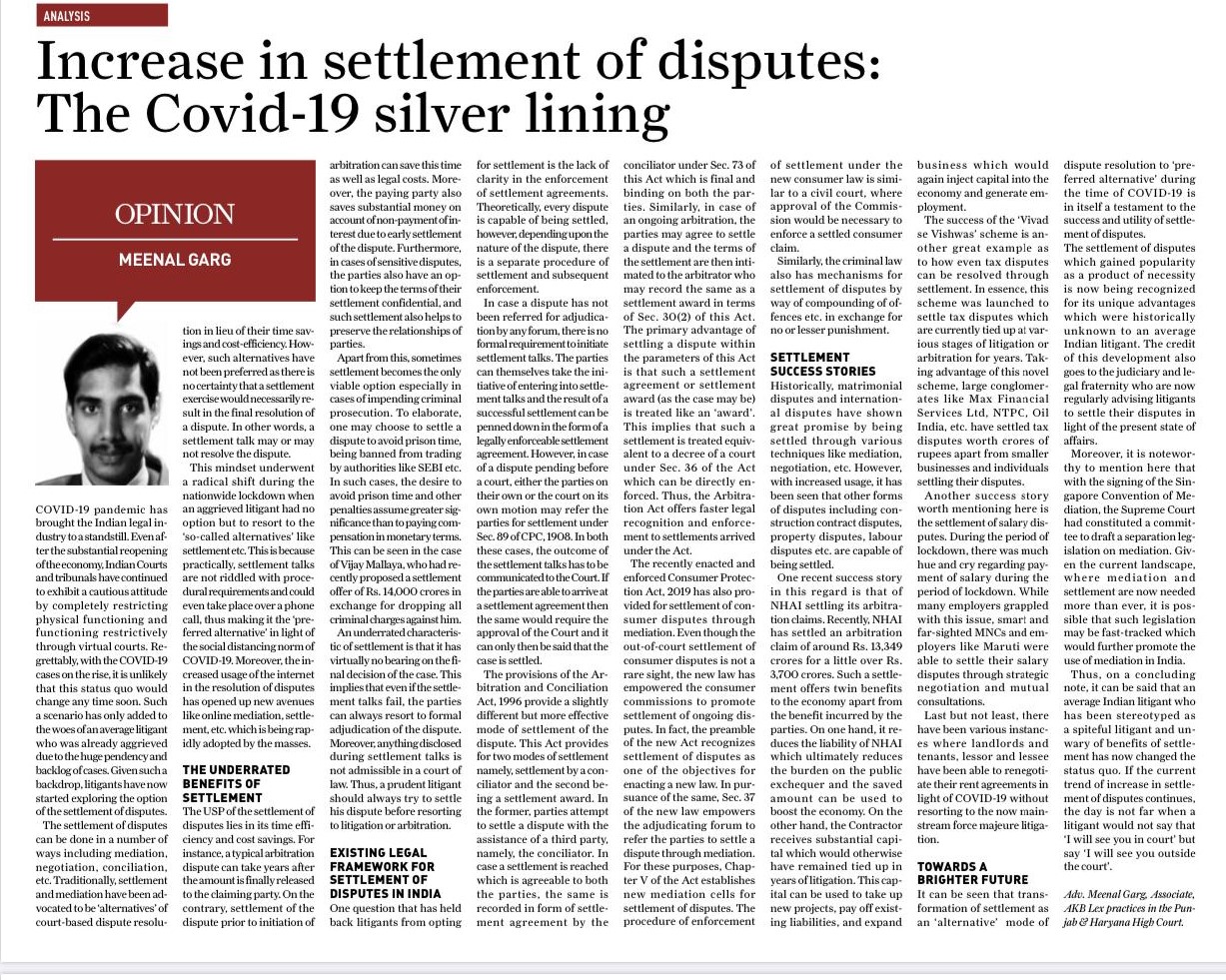




 Allow notifications