Tag: AMSS

  • Tanvi Dubey, Associate, SAM & Co., on her internship experience with legends like Ram Jethmalani, J. Dipak Mishra and Mohan Parasaran and on bagging a job

    Tanvi Dubey, Associate, SAM & Co., on her internship experience with legends like Ram Jethmalani, J. Dipak Mishra and Mohan Parasaran and on bagging a job

    Tanvi Dubey is a recent graduate (2015) from Department of Legal Studies and Research, Barkatullah University. She has secured a job at Shardul Amarchand Mangaldas & Co. During her time in law school, she focused on co-curricular activities, and had consistently been a great performer. She has spent considerable time in writing and presenting research papers and in securing good and diverse internships, etc.

    She has interned with legends such as Ram Jethmalani, Justice Dipak Mishra and Mohan Parasaran. She had also interned twice at AMSS and worked on issues of Corporate Fraud and Buy back of shares.

    This interview shall serve as an anecdote of tenacity and diligence and the fact that no matter where you study law, there will be opportunities always and you have to make the best of them to succeed.

    In this interview she talks about:

    • Her experience from the internships with Ram Jethmalani, Justice Dipak Mishra and Mohan Parasaran;
    • Certificate courses that she did in her law school on Consumer Rights, Human Rights, Course on Law and the Entrepreneur, etc;
    • Importance of enhancing your CV for jobs in law firms and tips regarding the same; and
    • Things one must do at law school.


    Tell us a bit about yourself. How would you like to introduce yourself?

    The Story of my life – I was born and brought up in Bhopal (M.P.). I did my schooling from St. Joseph Sr. Secondary School, Bhopal. I belong from a family of lawyers. My Grandfather is a retired D.S.P. Officer and a renowned layer in Bhopal. My mother is Post Graduate in Home Science. She has always inspired me never to stop and move forward towards my goal. Finally and perhaps most crucially the person who inspires me the most is my father. He is a Legal Practitioner and Legal Advisor to various companies. Pursuing Law looked like a destined path. From the first impression of my grandfather’s library to desperately wanting to be my father’s daughter, I grew up romanticizing the legal profession.

    Five years ago, when I entered the law school challenges were many. But my genuine fondness for law made me excel in this beautiful law school journey. I have been keen to use my legal ability for the unempowered and the youth. I am associated with many Youth Foundations, like the Esteem Youth Foundation to help young minds to be the Changemakers for the future generations. My association with Indian Classical Music has contributed immensely towards my self-discipline, presence of mind and concentration. I have performed nearly 50 Vocal Concerts. Despite these commitments, I have been maintaining my academic standards and I have mostly been a high scorer. I should mention that I learned to prioritise, manage time and work under pressure from these exercises. I also got the opportunity to record two music album covers with Radio Mirchi and My FM which are uploaded on Youtube.


    Legal studies are still only a backup option for quite a lot of students. What motivated you to choose law as a career?

    I have always been inclined towards the purpose the law serves, i.e. justice and hence was forced by myself to study law. Not denying the requirement of an observant and analytical approach which the profession mandates for a person to have, I strongly believe myself possessing the same to fair extent and hence most suitable for the profession. Also, since the profession requires hard work and I have no hesitation in so, I thought it to be the profession made for me.

     

    tanvi-dubey-4

    As a law student which activities did you participate in? Did you have any guidance on how to go about your academics, co-curricular activities and internships?

    Every moment spent in law school was a long chapter added to the personal history of happiness, joy, anguish and secret sorrows. I loved each day of this journey. I loved the place and the people for what they made of me. I fought my insecurities and struggled for my identity. Law school was not about academic record hopping from grades to grades. Although it took a while to realise that the little revolutionaries in our heart were always restless. We too were restless till we put across our ideas, created some noise and drew attention to what matters the most. There were zillion lectures that I deliberately lived through.  Each mile in this journey transformed me beyond what anyone could have ever imagined. That was the Law School for me.

    To be specific about what I did –

    • Got my Paper published in the national and International Law Journal.
    • Got the brilliant opportunity to intern with the legends like the revered Mr. Ram Jethmalani, Hon’ble Justice Dipak Mishra, Judge Supreme Court of India, Mohan Parasaran, Revered Solicitor General of India. I also tried my internships with the trial court and the District Consumer Forum, which gave a much experience about drafting in the lower courts. I also got the opportunity to intern twice with the litigation Department of AMSS.
    • I am associated with Esteem Youth Foundation, which is involved in organising regular programmes to encourage youth like the Yuvashaktikaran programme, The Changemakers Confluence and many other symposiums.
    • I did many Certification Courses to boost up my CV. These were on various areas of law covering Human Rights, IPR, Consumer Rights and also Business Laws.

     

    tanvi-dubey-6

    What do you feel about the perception that students of certain ‘elite’ NLU’s have a much easier time in kick-starting their career as compared to law students from other colleges? Is this true at all?

    Well, I think that at the end of the day, it is one’s determined effort that matters. Make your effort count for something. Keep going and don’t slow down until you’re well past the goal. If a student is determined from the very first year of law school to do something great and he/she moves forward towards his goal then I don’t think there is a huge difference between a student graduating from a traditional University or an NLU.

    My advice to the students from traditional universities is:-

    • To focus on good internships and to do additional course as only studying law and getting a degree is not going to be enough.
    • Make the most out of time. Try and do whatever you can by the end of fourth year to be well placed.


    What were your reasons for taking up so many certificate courses?

    (Tanvi did a couple of Certification Courses on Consumer Rights, Human Rights, Course on Law and the Entrepreneur and also attended a Summer Course organized by The Indian Society for International Law.)

    These courses help a student to develop valuable personal and professional skills. The Certification Courses are designed to give junior law students an understanding of the major areas in law, so that they can get a head start in their future careers in corporate law by excelling at their internships and interviews and gaining an understanding of real-world legal practice. I did most the courses to boost up my CV and to get detailed knowledge about the subject matter.


    You have published legal articles in multiple journals when in law school. Do you feel this activity just contributes to building a polished CV or has relevance beyond that?

    There is nothing more important in the practice of law than your ability to put together quality written work. It is important not only for boosting up your CV but also increasing your knowledge in a particular area. Researching skills are incredibly important throughout one’s legal career.

    Firstly, researching skills prove to be a great asset during one’s internships and plays a pivotal role in getting a call back.

    Secondly, you get to keep yourself updated of legal aspects of contemporary issues as most of the research papers are on the contemporary issues.

    Thirdly, publication plays the most important role if one desires to go abroad for his LLM. Most applications for the masters are successful on the basis of the quality of research work he/she did.

    Editing, writing and presenting papers instilled a great amount of confidence in me and improved my research and speaking skills which are very important for any and every law student. I still remember the joy I had when I presented my first paper at the auspicious occasion of completion of 25 Years of Consumer Protection Act at National Law School, Bangalore.


    Our readers would be quite curious to know how you went about securing your law school internships.

    (Tanvi’s internships at law school have all been at different places like AMSS, Chamber of Ram Jethmalani, two Judicial Internships, M.P. State Consumer Dispute Redressal Forum, Directorate of Women and Child Development of Madhya Pradesh and JurisConsultus, a Law firm in Bhopal.)

    I have always applied for my internships well in advance and followed up regularly. It’s also important to keep your CV updated. If a student from the very beginning is interested in Corporate then he must try and intern with the top notch firms. One must also try for an extension and a call back internship. For a call back one must be particular about finer details like formatting, good presentation etc. These are things which can set you apart from the other interns. Diligence as well as intelligence plays the most important role in getting a call back internship. Deliver work on time and once you’re done you should be able to go and brief the person who allocated the work to you in the best manner. My heart was set at Amarchand from the very beginning. I realised that rather than get more ‘names’ on my CV, I intern at the same place again, because that allowed me to get better work, and learn a lot more, as then they trust your capabilities.
     

    tanvi-dubey-1

    How did you go about securing your internship at the Chamber of Shri Ram Jethmalani? What was the nature of your work at Jethmalani’s chamber?

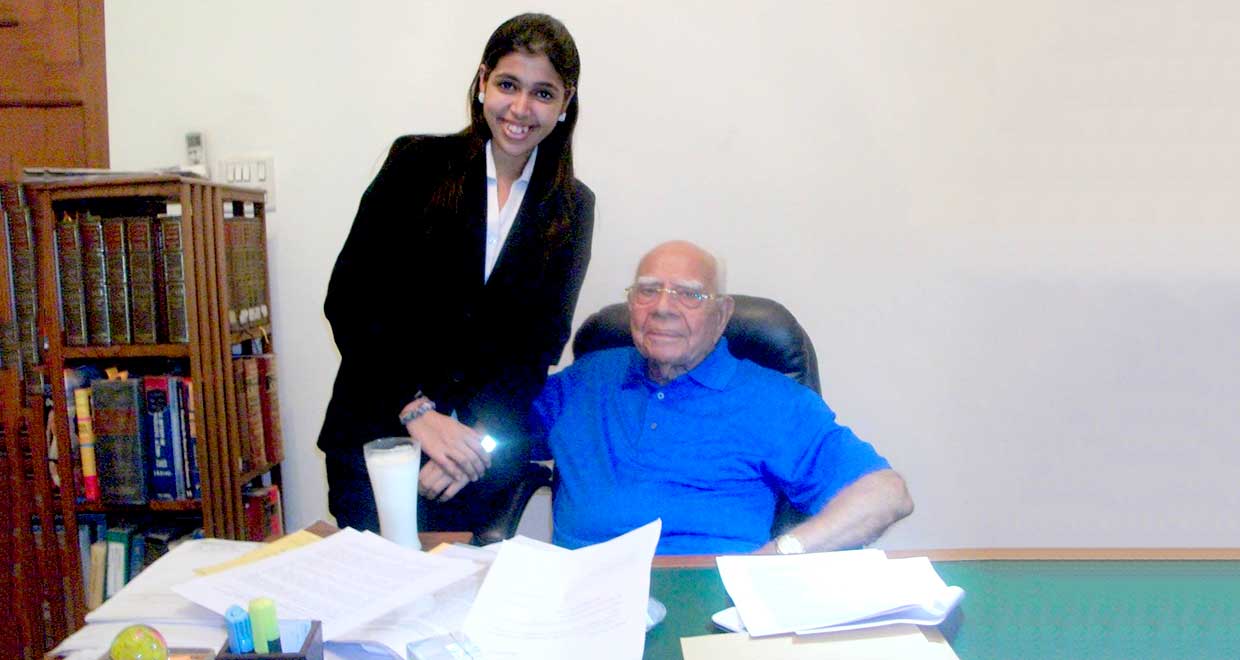
    I applied at the Chambers of Mr. Ram Jethmalani well in advance by the regular process by sending my Resume as well as my covering letter to his email address. I found myself introduced to a new world of law – better than one I romanticized and more dominant than what I read about in college – when I got the brilliant opportunity to intern under the Legend of Indian Bar, Mr. Ram Jethmalani. His words are constant source of inspiration to me. He always praise that “success comes with lots of hard work and knowledge” that inspires me to work hard and achieve my goal. Ram sir’s way of reading each case, questions asked by him in the conferences amazed me every time. At the age of 92 he is more active than anyone else in his office. Hearing Ram sir taking cross-examination was an enriching experience. I can still not forget the fear on the face of the witness being cross-examined by the undoubted champion of cross-examination.


    Share your experience working with Justice Dipak Mishra, and also with the ‘Solicitor General of India Mr. Mohan Parasaran. What kind of work did they assign you during your internship?

    When you work under a judge of apex court, you feel distinguished from others. Sitting with His Lordship was quite an experience. You have to go through cases and make a detailed analysis on each law interpreting it with your assumptions and comparing with the present law. The work culture was too strict as it was the decorum of the court which was to be maintained. His Lordship is very friendly and down to earth. As he is a well-wisher and also a regular visitor to our University, we had a lot of time talking over many different issues. Office staffs were also very cooperative. Task was allotted to us by His Lordship himself or by his personal secretary or by the permanent JCs working at the office. It basically included creating briefs about all the cases happening in Judge’s court, ranging from civil, criminal, corporate, bail matters, WPs, etc.

    The best part was the keen interest of His Lordship in teaching the interns about the intricacies of court procedure, court manners, judgment writing and delivering, and clarifying the question of law, whenever and wherever we were stuck.

     

    tanvi-dubey-2

    What do you have to say about the law students pursuing only law firms?

    Well, one must start out with a Trial Court internship in my opinion. If you intern at a firm in the early years, it won’t really be a mutually beneficial experience, that is to say that the firm might not really gain from your contribution, but it is indisputable that you will. If one is determined for corporate than he must to get an internship in the top notch firms and try for a call back. To get a call back, I’d say there is nothing like a good dose of curiosity! Don’t shy away from asking the lawyer the background that they want the research in, it’ll give you a deeper understanding of the way things work. If one is inclined towards judiciary then firm internships do not really matter. He can rather intern under the National Judicial Academy or try for Judicial Clerkship.

     

    tanvi-dubey-7

    You have interned twice with the Litigation Team of Shardul Amarchand Mangaldas & Co. What do you think contributed towards your appointment for the 2nd time as an intern?

    I had the finest internship experience at AMSS mostly because of the people I worked with and the quality of work I got during internship. I was constantly guided by my team, which allowed me to learn immensely.  I have interned twice in AMSS. During both of these internships, I did my assignments sincerely. I sticked to the deadlines and never hesitated to ask my team members any doubts that I had while doing the research work. Soft skills are very important. In my second internship, I prepared a corporate law PowerPoint presentation. In AMSS, the presentation holds a lot of weightage when it comes to recruitment. Therefore, it’s important to prepare it with diligently. I primarily worked on Corporate Frauds and Buy back of Shares. I also had to submit a detailed report on the various corporate law scandals. For the interview stage, I brushed up my CV and basic concepts of corporate law, contracts etc.


    Did you plan your internships throughout law school did it happen just by chance? How relevant did you find your law school education with the kind of work you were required to do at law firms?

    I was initially inclined towards judiciary. I have been preparing for the Judicial Services from the very first year. The pattern of teaching followed by my college is truly made for judiciary. But, destiny played its role at this place. During my first Supreme Court internship with the Revered Solicitor General of India, I was introduced to a new world of law. Internship under Ram Sir was again an unforgettable experience. Finally and most crucially my internship experience at AMSS changed my mindset and I was very much influenced to work with the brilliant legal minds around. I was looking for varied and challenging work and AMSS provides the best platform to experience the cream of legal work in the country.

    In this journey, I would especially thank SuperLawyer for sharing the profiles of brilliant law students, who have always encouraged me to work hard and instilled the much required confidence in me that I am no less than an NLU student. This had immensely helped me to secure some brilliant internships and prepare for interview.


    Did you learn any skills while interning? What are these skills and how did you acquire them?

    I learned to be focused. I always submitted my work before deadline and this helped me to manage and priorities, time and work. I can assure myself at this moment that joining the firm will grant me contentment in every sense meaning thereby, work culture and experience, exposure, as well as financial security.


    You have also secured a job offer from SAM & Co. Tell us how did your recruitment happen?

    It was a long recruitment process. It started with the questionnaire that I was required to fill up followed by a Legal problem on Arbitration on which I had to give my Legal opinion. After few days I was called for Interview Rounds which started with a Group Discussion, followed by Technical Interview. And the guys who were shortlisted in the technical rounds had to give a final interview that is HR Interview. For the interview, you should not miss out on reading up even a single topic which you have mentioned in your CV. You should also be able to readily answer any question regarding the field of law you would like to specialize in, which should be supported by your CV (you should have written papers/articles or participated in moot courts/conference relating to that field of law). These would significantly help you in preparing for an interview.


    Did you have to undergo an interview before securing your recruitment at SAM & Co.? Any tips on how one should go about framing a C.V. and prepare for an interview?

    Honestly, one mustn’t frame their opinion about interviews based on what others tell them. The reason is that every interview is unique. However, be thorough with your CV, and basics of corporate law, contracts, property law, banking etc. Customize your CV according to the firm/company/lawyer you are applying for, and stress on those parts of your work experience which hold value for them. If your CV is heavily loaded with co-curricular activities, you can cut down on the section of extra-curricular activities in your CV. I was asked questions based on my CV, general corporate law and a couple of HR questions as well. My advice to all reading this is that there’s one thing you constantly need to question- “Why me”. Why should they pick you out of the hordes of applicants?


    How did you manage to keep up your grades?

    Sincerity and dedication are one of the most essential factors to be considered. One need not entirely focus on reading the course material. It might even be tedious at times. A rather interesting approach, which worked well for me, is to read latest judgments on the subject. I tried to make every subject interesting by adopting some different approach towards it like for example I read the comparative analysis in a tabular form of the Companies Act 1956 and Companies Act 2013, which helped me to learn and remember things in a better way. I think regular studies play a very important role in maintaining grades in college.


    There is a phenomenal obsession amongst law students with maintaining a very high CGPA. How important according to you is this in securing a job?

    Grades are extremely important in getting good placements. However, a number of other factors like internships, Certification Courses, Moot Experience co-curricular and extra-curricular activities also add up. Therefore, one must try to be an all-rounder rather than just focusing on grades.

     

    tanvi-dubey-5

    What should one law student aspiring for a job at top law firms do? How would you recommend they prepare in their last 2 years at law school?

    From the very beginning a student must be very well focused. He must to the additional Courses, do some brilliant internships and MAKE THE BEST OUT OF TIME. He must have an excellent CV by the end of fourth year in order to get a job at a top Law Firm. There is no substitute to hard work. A student must know the right websites to keep him updated and I think everyone will have the right concoction. Try everything that you possibly can, in these five years – participate in competitions, write research papers, volunteer for events, go for fests, and try bring out the real you at the end of this law school journey.


    Lastly, what would be your message to our readers?

    To be able to work with devotion at something one likes can be the greatest and most enduring source of human happiness.”, said Justice M.C. Chagla,

    You must make the most out of your vacations. Intern with a lawyer/firm whenever you get an opportunity to do so, for you will learn the practical aspects of what you read in law school, which will give you an edge over others.

    Strive to have an all round CV. Intern with different courts, companies, law firms and do it early so that when you make a final decision, you are sure about it. Represent your university in at least one moot, be part of at least one committee for 2 years, present at least one paper at a conference and have at least one publication. Also, manage your time wisely and do take out time for your hobbies/sports, so that you enjoy your time while in law school.

  • Rishabh Chopra, Senior Consultant, Vahura on requirements of the industry and work in Legal recruitments

    Rishabh Chopra, Senior Consultant, Vahura on requirements of the industry and work in Legal recruitments

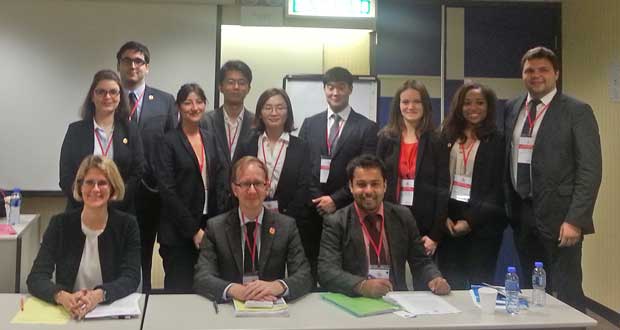
    Rishabh Chopra graduated in BBA.LL.B (Hons.) from National Law University, Jodhpur in 2010. Thereafter, he worked at Amarchand Mangaldas (Delhi office) for a year and then switched over to Vahura, a legal talent recruitment and management company as Senior Consultant in Private Practice & Funds. During his college days, he had participated in several national and international moots, and has been a judge at prestigious moots such as Oxford Price (South Asia), BCI moots and Willem C. Vis (East) moot in Hong Kong.

    In this interview, we cover his journey as a lawyer till date, while focusing on:

    • His experience in law school.
    • Importance of moot court activities.
    • His work experience at Amarchand and Vahura.
    • Industry requirements for Vahura placements


    Please introduce yourself to our readers. Where did you grow up and attend school? How did you decide to take up law?

    I grew up in Ambala and finished my schooling from Army Public School, Ambala Cantt. At APS, I always kept myself engaged in various co and extra-curricular activities such as Debates, Declamations, Quizzes, Music etc and topped the commerce stream in Class XII because of my interest towards accountancy and economics. This helped me gain admission into one of the top 5 colleges in University of Delhi where I pursued B.A. (Honors in Economics) for a year before taking the law school entrance exams. Although I come from a family of lawyers, law as a career option was not very fascinating (because of this entire notion of doing something different!) until I witnessed the finals of the Raj Anand Moot in 2004. That experience helped me get in touch with Sachin Malhan (founder of LST) who in turn encouraged me to take the law school entrance exams.


    You graduated from NLU Jodhpur in 2010 with a B.B.A. LL.B (Hons) in Business Law and Management. Please tell us about the Honours program and your general law school experience?

    One of the key reasons for taking up a course at NLU, Jodhpur (or NLU-J, as people like to call it now J) over another premier law school was a dual degree in law and management. Given that I always had a bent of mind towards management, a degree with this combination was exactly what I was looking at. I definitely enjoyed the managements subjects like accountancy, managerial economics, human resource management and marketing to name a few. As far as my honours program is concerned, I am glad I took up the business law subjects in my penultimate and final years of study as I was able to study the fundamentals of investment laws, mergers and acquisitions, banking and finance. I will be honest- it would have been better if these subjects were taught in a more practice-oriented manner but nevertheless the course helped me understand the basics of corporate law which were quite useful when I joined Amarchand.


    rishabh-chopra-2

    You have had considerable mooting experience in law school. Tell us about your achievements. What, according to you, are the essential skills of a good mooter?

    As you may have noticed, it was the Raj Anand moot’s experience as an audience member that convinced me to go to law school and thus, I took up mooting quite seriously. Mooting was extremely competitive at NLU, Jodhpur- which always meant that we all had to work hard in most of our court room exercises (intra section moots) to reach the intra university competition. In total I did 5 moots- ranging from public international to competition law, from CISG and international commercial arbitration to IPR and then international humanitarian law. I have really fond memories of all these moots not only because of the amount of knowledge I gained by participating in them but also because of the fantastic team members in each of these competitions.

    Going for the Vis East moot (Hong Kong) in my second year of law school was quite an achievement back then and so was being adjudged runner’s up at a competition law moot (which in turn helped me secure an internship at a prominent law firm in my 3rd year of study). Then came the Jean Pictet competition, where our team was the only Indian team to qualify for the international rounds that took place in Evian, France- this competition was definitely a very interesting one- very different from a regular moot and I would strongly recommend it to all law students (for the kind of practical experience and exposure it provides in the field of IHL).

    During my final year of study, I still wanted to be connected to mooting and hence, took up a national moot in Delhi (since the top 10 international moot we were supposed to participate in got postponed for the next year)- where we were adjudged winners. Apart from one moot, I was quite fortunate to receive a citation (individual and/or team) in every competition.

    As far as I am concerned, I could only moot well, if the research was thorough and I knew the loopholes from both sides of the problem. This strategy helped me in preparing for any kind of question that could have been posed during the various rounds of the competition and the same was also helpful from ‘thinking on one’s own feet’ perspective. In addition, one of the biggest takeaways for me from mooting was team-work and organisational skills- I consider these two as the foremost essentials to be a successful mooter apart from presenting your case in a confident and persuasive manner. Using a little bit of wit in arguments and rebuttals is also not a bad idea as long as it doesn’t embarrass the bench or the opposing counsel in any way whatsoever!

    To be fair, mooting is still close to my heart- it’s just that I have moved to the other side now. I have been a regular judge at the Oxford Price (South Asia) and BCI moots and this year also went on to judge/arbitrate at the Willem C. Vis (East) moot in Hong Kong. I personally feel whosoever has enjoyed mooting in law school, should done the hat of a moot court judge- it’s just like giving back to the legal community.


    rishabh-chopra-3

    What was your work profile at Amarchand Mangaldas? What did an average day of work look like?

    At the Delhi offices of Amarchand Mangaldas, I worked as an Associate in the General Corporate, M&A and Insurance team. I was quite fortunate to work in this team as I really learned a lot from my partner (Shailaja Lall) and colleagues (Deepa Mookherjee and Ashish Teni) and those learnings have helped me to a great extent so far. Just like any other corporate lawyer, I worked on various corporate transactions (M&A, JV transactions), incorporation, entry and exit strategies apart from providing clients with general corporate advisory in relation to foreign investment laws, corporate and commercial laws, stamp duty regulations and insurance laws. The reason I say I was quite fortunate to work in this team was because the team gave me tremendous scope to grow as a corporate attorney- I was client facing, was able to speak with clients with minimal supervision from the partners on corporate and insurance matters and because of this trust had a good learning curve from a practice perspective,. In short, I really enjoyed my team and the matters I worked on during my stint at Amarchand even if it meant working for really long hours (thanks to technology)!


    After a year at Amarchand Delhi, you joined Vahura, a legal talent recruitment and management company as Senior Consultant in Private Practice & Funds. What does your work at Vahura mainly consist of?

    As I mentioned earlier, I really enjoyed my experience at Amarchand Delhi but I really wanted to be on the business side of the law ever since I met Sachin Malhan (who used to run Law School Tutorials (LST) back then). When he moved and co-founded Rainmaker, I was really intrigued and followed the team’s entire journey from MyLaw.net to Mootopia (similar to what we call Mooting Premier League now). One day, when I noticed Vahura spinning off from Rainmaker only to focus on the legal talent space in India- I knew I wanted to be a part of this journey!

    At Vahura, I lead the search practice for law firms in the northern region. I typically focus on partner and pre-partner level recruitments for our law firm clients and so far have helped law firms grow organically and inorganically. I am also a key member of the law firm recruitment group that focuses on recruiting mid and senior level legal, IP and tax professionals for law firms and funds in the APAC and MEA regions. We now have various top international and regional law firms looking to recruit Indian legal talent as our clients in Dubai, Bahrain, Singapore and Hong Kong. On the research and consulting side, I closely work with top law firms and In-House legal teams on consulting reports on strategy, practice structuring, business development, remuneration structure and partnership restructuring.


    What do law firms in Asia-Pacfic,Middle-East & Africa look for in potential candidates? What must an Indian law student do to get hired in these regions?

    In the law few months, we have seen various foreign law firms show keen interest in the Indian legal talent again (thanks to the Modi wave internationally, probably!). On a serious note, this interest has been on the capital markets side as well as on the M&A side. Laterally, most requirements need a US/UK LL.M and a top law firm experience in the past.

    As far as a training contract is concerned, a law student by the end of his/her penultimate year of study, should definitely have good (and consistent) grades apart from being involved in various law school committees/centres. Publications in journals of repute along with laurels in international and domestic moots definitely add to the credentials of an applicant as they showcase his/her good research and oratory skills. Hence, importance of a well rounded and drafted CV cannot be emphasized much. Moreover, what is also critical is the clarity of thought apart from good written communication skills- these two skills can be easily judged from the applicant’s application material (generally in form of a questionnaire) and a well drafted application material therefore is a battle half won (another small tip- be consistent with your answers/responses, when you respond to the questionnaire as well as during your interview). Additionally, students should not only be aware of what is happening around the globe but also understand the implications those changes can have on the business and regulatory environment domestically as well as internationally- this awareness can help them in fetching some brownie points during group discussions and interviews. As far as internships are concerned, it is not important to have 10 or 12 internships on the CV- a few (say 5 or 6 in number) quality internships (ranging between 4 to 8 months) are more beneficial than a lot of 2 week internships.


    What essential skills are required to work as a legal talent and management specialist at Vahura? Does an MBA after law help in this regard?

    If someone is considering this role/profile, it becomes imperative for that person to have a consultative mindset towards approaching a situation (it probably comes naturally after having spent five years in a law school with so many negotiations/ consultations/ dialogues/ debates/ discussions with faculty, administration and peers). Also, it would be disastrous to make a move from the industry to the talent management industry by considering the profile of a recruiter as cushy- you not only have to be aware of the changes in the legal talent market and be great at mapping but also need to have that “hunter’s mentality” enabling you to work 24×7- yes, I tend to clock in more hours at work (not necessarily in office) than I used to at my previous organisation. The main reason for this is that you need not be just social but also be able to cultivate, build and leverage relationships (which is easier said than done and takes considerable time especially from a trust building perspective). Another key thing to remember is that apart from having great marketing skills (to market your own organisation in front of prospective clients, to create a marketing pitch for your candidates in front of your clients, and to also promote yourself/your organisation in various social events/social media- you got to do it all!), you need to be a great listener (as a recruiter you should not just listen but “hear” your clients and candidates extremely well).

    As far as an MBA degree is concerned, I don’t consider it a must but it definitely assists you in honing your strategic and managerial skills. But remember, it’s favourable to do an MBA only after gaining some experience in the industry- this is exactly what I did this year when I successfully completed an executive program in management from a leading Indian B-school with a specialisation in HR.


    Lastly, what are your plans for the future? What advice would you give law students wishing to work in the same sector as you?

    My definite aim has been to create a positive difference in the Indian legal talent management market and this was a key reason to join the young and dynamic team of Vahura after gaining some experience at Amarchand. As a team, we have been able to successfully achieve this objective in India and hence, are now also concentrating on the APAC and MEA regions. My plans are so far in sync with the vision we all share at Vahura- to make it the sought after ‘Indian legal and governance talent management and consulting firm’ not only in India but internationally as well. So that is exactly what I am working towards- to be the go-to source for Indian legal talent requirements- domestically as well as internationally (which is going to be challenging and exciting at the same time).

    In case anyone is inclined to work in the same sector as mine, I would advise them to take it up only if they are passionate about it and that too after gaining some experience in the legal industry- this industry’s experience definitely helps a lot during as well as after the transition- from being aware about the legal ecosystem in a holistic manner to understanding client’s requirements in an excellent manner for leveraging the network one creates while working! My good wishes to all those who aspire to work in this field and I am happy to connect over LinkedIn for any queries that you may have towards the opportunities in this sector.

  • Munish Mehra, Partner, Saikrishna and Associates, on specialising in IPR, changes in career, tips to associates and interns

    Munish Mehra, Partner, Saikrishna and Associates, on specialising in IPR, changes in career, tips to associates and interns

    Munish Mehra belongs to the first batch of NLIU, Bhopal (Batch of 2003). After graduation he joined AMSS as an Associate for 9 months before switching to Anand and Anand where he subsequently became a Managing Associate. Thereafter, he joined Luthra & Luthra Law Offices as a Managing Associate. In January 2014, he joined Saikrishna and Associates and within 11 months, he was promoted to Partner. In this interview he talks about:

    • Academics and specializing in IPR Laws
    • Working at full service law firms and boutique law firms
    • Tips on converting internships to a PPO


    What brought you into studying law? Was it fate or plan?

    My foray into studying law was totally unplanned as I do not come from a legal background and am a first generation lawyer. I heard of the National Law School at Bangalore for the first time in 1998 through a friend who happened to be studying there. As luck would have it, the National Law Institute University was set up at Bhopal in the same year that I graduated from school i.e. 1998. I gave the entrance exam for the university, got through and things moved ahead from there.


    Please tell us a little about your law school days at the National Law Institute University, Bhopal? How were you at academics?

    As a part of the first batch of NLIU, Bhopal, I think all of us were a little sceptical about how the university would develop in the future. I still remember the first day of the academic session in September 1998 when we started from a premises which had been rented by the Government for the University and we set up the tables and chairs ourselves in a little classroom and got down to studying law. What helped in the initial trimesters was the inclusion of various BA subjects such as sociology, history etc which helped us to get into the groove so to speak before moving onto hardcore legal subjects. I was a relatively good student through my years at the University and finished in the top five of my class when we graduated.


    How important do you say is a good CGPA for an illustrious legal career?

    The importance of a good CGPA has increased over the years with the advent of numerous law schools coming up in various other states. However, I firmly believe that to have a good career in the legal profession, a good CGPA is just one element which plays a part in the making of a good lawyer.


    You have specialized in IPR law. What made you interested in the same? How do you say one can gain expertise in IPR Law? What does it take to be a good IPR lawyer?

    In the first couple of years at the University, a few seminars and moot courts were organized focusing on IPR law which played a major part in me developing an interest in IPR law. We had not yet studied IPR law till then as they were a part of the 4th year subjects. I then did two internships with Anand & Anand at the end of my 2nd and 3rd years which give me an insight into how IPR law actually works in the real world. The process of gaining expertise in IPR law or becoming a good IPR lawyer is no different from any other branch of law and requires one to be able to grasp the issues involved in the case at hand which forms the basis of your claim or defence, as the case may be, and presenting a well drafted and argued brief before a Court.


    You started your career at AMSS as an Associate. How did you secure your appointment? How would you describe your experience working there?

    I was recruited by AMSS pursuant to the first campus placement which happened at the University at the time the first batch was about to pass out. In fact, AMSS was the only law firm which came for the placement of our first batch and two people were recruited by the Firm. Working at AMSS was an interesting experience as even at that time it was considered to be the best full service law firm in India. My area of work involved general corporate commercial advisory and transactions. I think the biggest takeaway from my tenure at AMSS was that it made one realise that there is a sizable difference between studying subjects theoretically in law school and their application in real world deals and transactions as there are so many practical facets and situations which one is not exposed to while studying subjects in law school.


    After 9 months of work at AMSS, you switched to Anand and Anand as an Associate and later worked as a Managing Associate there. You also had the oppurtunity to work at Luthra & Luthra Law Offices as a Managing Associate. Please share your experience at both these place.

    It was a conscious decision to make the shift from AMSS to Anand & Anand as after a while I realised that my real interest lay in practising IPR law even though the initiation into the real legal world through AMSS held me in good stead in the coming years. I worked at Anand & Anand for nearly six years during the course of which I led the anti-piracy and anti-counterfeiting practice at the firm and had a wonderful time doing so. Luthra & Luthra posed a new challenge in terms of setting a new practice area from the ground up and it was an interesting experience to go back to a full service set from a boutique firm.


    Also, was there any difference in the work environment of these two law firms, considering the fact that Anand and Anand mainly deals with IPR law whereas Luthra & Luthra is a full service law firm?

    The work environment of a full service and boutique firm does vary to a large extent. The environment in a boutique firm tends to be more informal and due to a lesser number of individuals, helps in developing interpersonal relationships faster. A full service firm environment on the other hand is much more regimented and necessarily so because of the sheer number of people working there. Therefore, it does take some time to get used to it if you have joined from a smaller setup.


    What qualities do you think helped you for promotion to Managing Associate at Anand and Anand & Luthra and Luthra Law Offices?

    It was a combination of factors such as developing an expertise in my practice area and being able to handle matters competently and independently relatively early in my tenure at Anand & Anand. Most importantly, it helped that I was able to develop a rapport with the clients I worked with regularly so that when the time came for elevation to Managing Associate, clients were more than happy with me leading their matters on a regular basis without requiring a supervising partner. Consequently, my team reported directly to the Managing Partner of the firm.


    You were made a partner at Saikrishna and Associates in just Eleven months of work. What would you say helped you to join the ranks of a Partner?

    In January, 2014, I joined Saikrishna and Assciates as an Of-Counsel and within 11 months, I was promoted to the ranks of a Partner. So to say, yes, I was made a partner in Eleven months.

    Well I was a lateral hire from Luthra & Luthra having spent three years independently handling my own team and servicing the clients which had given me work when I shifted from Anand & Anand. I guess the ability to service clients professionally, train a team from the ground up, manage them and independently run successful campaigns on behalf of various clients were factors which led to me being elevated at a Partner at Saikrishna & Associates.


    munish-mehra-3

    What kind of effort should a young Associate put in to work to get it appreciated? What distinguishes an Associate with a Partner when it comes to work?

    At an associate level, the requirements are relatively simple in terms of being totally aware of the factual matrix of the matter, doing diligent and through research, being reasonably acceptable at drafting and being disciplined at the work place. If an associate is able to display the abovementioned qualities, any firm would be more than happy as nothing more is expected. The deliverables as expected from a Partner are totally different as he or she is expected to provide strategic advice and guidance to a client on a particular matter or campaign, monitor and supervise the work done by associates, and also ensure that billing targets as given by the Firm are met by his team and recoveries happen in a timely manner.


    What does a Partner at a Law Firm like Saikrishna and Associates do? What falls within the scope of your responsibility? Tell us about a typical work day.

    A Partner at Saikrishna & Associates is responsible for supervision of matters handled by his or her team, appearances before various Courts, providing strategic advice in relation to matters, reviewing opinions and memos as required by clients from time to time on various legal aspects, ensuring that billing targets are met by the team and also developing and bringing new work into the Firm. A typical day involves either going to Court for matters as listed, or coming into the office and handling various miscellaneous work such as reviewing opinions, legal pleadings, client meetings and telecons. The Firm does a lot of outstation matters which usually involves travelling to various courts across states and either a Partner or Senior Associate/Associate does that depending upon the importance of the hearing and the complexity of the matter.


    How important is it for a Partner of a law firm to be good at business development, or are great lawyering skills enough to become a partner? What separates the people who become Partner from those who don’t?

    Different people have different skill sets and not every Partner in a law firm is a rainmaker. It is of course beneficial for a Partner to be good at business development as that helps in the overall growth of a Firm but at the same time it is important to have senior people in the Firm who are able to handle the day to day supervision and functioning of their respective departments thereby contributing to the overall efficiency and quality of work done by a Firm. I think the ability to handle and supervise complex matters, manage teams independently, provide strategic but practical advice to clients and having the ability to develop long standing relationships with clients which generate revenues for the Firm is what separates people who become Partners from those who don’t. That is not to say that other individuals are not equally important as human talent and expertise is the most valuable resource of a law firm and that is what gives a firm its “reputation”.


    munish-mehra-1

    How is the work culture at Saikrishna and Associates? If an Associate commits a mistake or an error what course of action do you follow?

    Saikrishna & Associates has a great and innovative work culture which is quite different from the regimented schedules which some firms insist upon. The focus of the Firm is on “client delivery” and empowering individuals to be responsible for their work product. The result is that you find Associates as well as Partners being happily available to clients 24/7 which is much appreciated. I think the way a Firm deals with a mistake by an Associate is reflected by how its senior people deal with such a situation and in that sense the Firm has preferred to explain the error rather than “shout” at an Associate for committing a mistake.


    What are the other areas of study which you think that a law student wanting to excel as a professional in the field of IPR should be proficient in?

    I think it’s important for a lawyer to keep abreast of as many developments in law as possible as you never know on which facet a client may need urgent advice. An IPR matter may involve a taxation or royalty aspect one day or a criminal law aspect another day. Therefore, it’s very difficult to pinpoint any other branch of law which a lawyer must focus on to be proficient in the field of IPR.


    What changes has being a Partner brought into your life, do you ever feel that there is excess of work load on you? How do you manage to strike a balance between your personal and professional life?

    Being a Partner does bring added responsibility as you are ultimately responsible to the client for the work product turned out by your team. A Partner, as mentioned earlier does have to make efforts to bring in new clients into the Firm for its overall growth and development. The culture of the workplace makes a huge difference in being able to maintain a balance between work and personal life while a lot of firms may say that they place a great emphasis on the work life balance of their lawyers, our Firm does actually walk the talk so to speak.


    The trend is now on gathering various internship experiences at different places. Was the scenario same while you were pursuing law? How is internship helpful for a law student?

    The number of internships as done by students now, are a lot more as compared to when I was in law school. It’s not uncommon to find ten to twelve internships on a CV these days while we used to do one internship a year. An internship is very useful for a law student as you are exposed to so many practical facets of actual legal practice which is impossible to experience in law school. However, it is important to focus on the type of internships which a law student does during his law school years as the quality of internships are more important than the quantity on a CV.


    What is the procedure to apply for an internship or recruitment at Saikrishna and Associates? What are the qualities which they look for in their prospective employees?

    We have a Partner who is in charge of internships at the Firm. Prospective internees send their resumes to our HR department pursuant to which the Partner decides the internships to be granted for a particular period. We take special care not to overstuff the firm with a lot of interns at any given time to ensure that all interns get quality exposure to the work being done at the firm.


    What do you feel makes an intern stand out and is very important for him to do to have a chance of getting a call back or even a PPO? How do you think interns can get noticed in a positive way in the limited time they have?

    It’s important for an intern to be diligent and disciplined at his or her work. Reasonable oral and written skills, a decent knowledge of first principles and the ability to research properly is what makes an intern stand out from the crowd so to speak. It’s also important for internees to do at least a one month internship to enable the Firm to assess their capabilities as a 10 or 15 day internship, which some students do today to increase their tally of internships doesn’t really help in them either learning anything about the Firm or increasing their chances of getting a PPO.


    What would you suggest to someone who is preparing to work with an IPR law firm? What are the basic subjects which one should read and have understanding of before sitting for an interview?

    If an individual is interested in working for an IPR boutique firm then it’s advisable to be aware of the “first principles” and basics of IPR law in relation to Copyrights, Trademarks, Patents etc. An awareness of recent developments in the field of IPR is also very helpful and there are various online blogs and commentaries which regularly report such developments and recent case law.


    The question that whether one should specialise in a particular area of law or be more of a general lawyer often comes up before law students. What is your opinion on the same?

    It depends on the type of practice an individual wants to do. As an independent practitioner, it’s necessary to be conversant with various areas of law be it civil, criminal or even company/corporate law litigation and advisory. A lawyer in a law firm will typically specialize in a few areas and will be known in the profession for his expertise in those areas. I have come across very few lawyers working in law firms who can claim to be masters in all fields.


    Is there anything you would like to have done differently?

    I think every experience and decision teaches you something new which makes you a better person and professional. So to sum it up, I really would not have done things differently. There is still a long way to go and lawyers never retire anyways!!


    Where do you see yourself ten years down the line? Do you aspire to be like somebody from this field?

    Ideally sitting on a beach and relaxing!! On a more serious note, one would like to be someone known in the profession as an individual who is dependable, experienced and sought after. Every lawyer likes to be well known and let them not tell you otherwise. I really don’t aspire to be like someone. I would rather be known as myself ten years down the line.


  • Neha Mahyavanshi, Senior Legal Counsel, SAP, on work experience as in-house counsel and in law firms

    Neha Mahyavanshi, Senior Legal Counsel, SAP, on work experience as in-house counsel and in law firms

    Neha Mahyavanshi graduated from National Academy of Legal Studies and Research University, Hyderabad in 2006. She received a pre-placement offer from Amarchand & Mangaldas & Suresh A Shroff & Co. and joined it after graduation. Thereafter, she worked at Wipro Ltd. as Assistant Legal Manager before joining SAP as Senior Legal Counsel-India Subcontinent. In this interview she talks about:

    • Law school experience at NALSAR
    • Working at AMSS and Wipro
    • Being an in-house counsel at SAP


    How would you introduce yourself? Tell us a bit about your pre-college years. What motivated you to study law?

    I am primarily a technology lawyer with in-house experience of about 8 years. I grew up in Bangalore and then went on to study law in Hyderabad.  In school, I often took part in debate contests and won a couple of inter school contests. So, I thought that a career in law was apt for me. Also, around the time that I was in 12th standard, there was a lot of talk about law schools, and so I got hooked to the idea of joining a law school.


    How would you describe your time at National Academy of Legal Studies and Research University, Hyderabad? How important do you think that extra-curricular activities are to a law student?

    My time at NALSAR was fun, but more importantly, a great training ground for young lawyers to learn to cope in a competitive environment that was to continue and get more intense after college. Yes, I did take part in many extra-curricular activities. I was one of the trio that organized the first ever ‘Carpe Diem’ (NALSAR’s Intra-college fest) and was always a part of the organising committee for ‘Summons’ (NALSAR’s inter-college fest). In my final year, I was elected the Convenor of the Cultural Committee. That’s the year we organized the first ever music concert at NALSAR, with Indian Ocean performing at ‘Summons, 2005’


    Tell us about your objectives while in the preliminary years of Law College. What were your plans after graduation?

    I always planned to be an in-house lawyer. I had the chance to intern twice at Wipro during my years at NALSAR. I was totally drawn to the work environment, the balance and professionalism that a corporate environment offered.


    Looking back, how significant do you think that your legal education was? When did you happen to experience the learning curve?

    The education that I received at NALSAR must surely have been one of the best. I say this because I often encounter lawyers who don’t seem to have the basic principles of law sorted out. I can say for myself that our professors did a great job. The legal education that I received in NALSAR was a great foundation for my career.


    neha-mahyavanshi-2

    Please tell us about your experience with regard to your first year of work at AMSS.

    I was taken into AMSS by way of a pre-placement offer. I was taken in as a part of the private equity team and did what all A1s do- due diligences and helping out with the drafting of SHAs and SSAs. While at the firm, I also worked in other practice areas, specifically in the general corporate practice, gaining experience in incorporation of companies and drafting resolutions.

    My biggest take away from AMSS are the drafting skills. All documents, including emails, were drafted with a great deal of care. You don’t often see people paying attention to fonts, justifying or spell checking documents in a corporate set up.


    Please tell us about the requisite soft skills which are essential for a young lawyer to build a successful career?

    I was often told by my managers that I am easy to get along with. I guess, being generally congenial has always worked for me.


    How was your experience of being an Assistant Legal Manager at Wipro Ltd.? How was the work pressure?

    My years at Wipro were simply great. Wipro Legal in Bangalore is the global headquarters and there is always a lot going on. I see my experience at Wipro as a very solid foundation for my future career aspirations. Wipro is a great training ground for someone who is looking for an in-house career. Wipro allowed for a perfect balance between personal and professional time. I was always excited to go to work every morning (I guess, that says a lot). The biggest positive point in an in-house role is that one enjoys the flexibility of managing one’s own work.


    Do you feel that there are differences between students of ‘elite’ law schools and students from other law colleges and traditional universities?

    From my limited experience, I must say that to some degree there is a difference between students of ‘elite’ law schools and other traditional universities in the beginning. I see this difference, not in the passion or dedication that the student brings in, but in the understanding of law and working methodology- which evidently is due to the difference in the quality of legal education. However, a few years into their careers, the difference between the ‘elite’ law school student versus the traditional law university student no longer exists. It’s the passion that one brings to work that makes the difference in the long run.


    How did you get to work at SAP as Senior Legal Counsel – India subcontinent? Please share with us your journey from your induction into the company till date?

    SAP was looking to add to their then four-member legal Team in India and I guess I fit the bill. SAP is an enterprise software product company headquartered in Germany. The legal work and work methodology at SAP is different from Wipro. So, initially I had a lot of learning to do. But once you get a hang of how things work here and understand what the commonly used abbreviations and acronyms mean, you are good to go. SAP promotes a great work culture. People are very approachable and the organization is very flat, making the work environment very pleasant. But we have our crunch time during quarter-ends and year ends when most of our business comes in.

    My experience at SAP has been great so far, and I look forward to many more years here. SAP pays attention to each individual’s personal growth, which makes it a great place to stick around.


    neha-mahyavanshi-3

    Please tell us a bit about your work profile at SAP. What is a normal workday like at SAP?

    I am a part of the four member legal team in India. The SAP India legal team provides an overall support to the organization including sales, operations, purchasing office and admin. The SAP field lawyers in India (like myself) spend a lot of time bridging the gap between local Indian legal practices and SAP’s standard terms of operation. Every day is a new day at work, we have plenty of challenges that keep things interesting.

    There is a lot of work and exposure in SAP, on a typical day I might be on a call negotiating contract with a customer or vendor, drafting order forms, providing opinions to the business, discussing deal structures with finance and pricing teams, drafting notices or responses to customers, discussing litigation strategy for a case in court or just helping an account executive draft a communication to his client. We are very well connected to all aspects of the business and get involved with all the internal departments.


    What kind of legal work is there? Are you allowed to interact with clients?

    Ninety nine percent of the legal work of the company is handled by the in-house legal team. There is tons of legal work (like I described above). SAP India legal team interacts with SAP’s customers all the time. We never outsource any customer facing work to law firms.


    How much of work is outsourced to law firms? How a law firm is selected for the same?

    Very little work is outsourced, which is primarily litigation. Other than that, we sometimes require external opinions on some matters where we do not have expertise, such as telecom or real estate. In such matters alone we approach external law firms.

    The law firm is selected based on their expertise. We only choose from the top law firms, depending on the practice area.


    Would you say that there exists a difference in the working environment of a law firm and legal department of a company?

    Yes, there does. My experiences of working in a law firm (though for a short while) and an in-house department has been very different from each other.


    Have you ever considered litigation or starting up on your own?

    I never considered litigation because I always wanted to be an in-house lawyer.

    Though I have not considered it myself, I know many in-house counsels who have started their own firms.


    What are the primary essentials of a corporate lawyer? How do you say a fresh graduate can work on building these skills?

    I don’t have a list of essentials for a corporate lawyer. A degree in law and the right attitude is all one needs. Also, I think doing the right internships while at college is important. Internships allow for two way assessment. The student gets a feel of the work place and also gets a chance to create an impression with the organizations that she/he is interning at.


    If you could list out 3 activities which on a scale of priority, should be at the top in any law student’s life (given that he wants to secure the same set of achievements as you), what would those be?

    Ensuring decent grades;

    Corporate Internships (including in-house and law firm); and

    Taking on leadership roles in student organizations and participating in extra-curricular activities.


    What would be your advice to young law students? How do you think that they should approach their career?

    Passion for your work is the one most important ingredient for success, I think I said this a couple of times through the interview. The other, of course, is hard work. Everything flows and falls into place if one is passionate and willing to slog it out. So, to young law students, I would say- out of the fifty odd courses that you study and the various internships that you take up, try to spot what you are passionate about and start working on it from the time you are in college. Whatever the field of interest, stay true to it and build on it by way of internships and writing articles etc. If you choose a clear path, it may be easier to get a headstart to a great career.

  • Somdutta Bhattacharyya, Advocate, Calcutta High Court, on quitting law firm to start up with litigation

    Somdutta Bhattacharyya, Advocate, Calcutta High Court, on quitting law firm to start up with litigation

    Somdutta Bhattacharyya graduated from West Bengal National University of Juridical Sciences, Kolkata in 2012. After graduation, he worked at AMSS for two years before joining Fox & Mandal, Kolkata. He was a part of the Litigation & Dispute Resolution Team at both places. He’s currently an independent practitioner practising litigation at the Calcutta High Court. In this interview he talks about:

    • Law school experience at WBNUJS
    • Working at AMSS and Fox & Mandal
    • Choosing to pursue litigation over a career in corporate law


    Please tell us a little bit about your childhood and your background?

    I am a through and through Kolkatan, born, brought up and working here. I spent a considerably large part of my life in residential school, at Ramakrishna Mission Vidyalaya, Narendrapur, from 5th standard right upto my plus two boards. I am not sure that spending so many years in a residential school and from such a young age has made me very self-sufficient though!


    How did you gravitate towards law? Why law and not engineering or medical studies?

    I did choose science as my study stream for my plus two boards, but that was because my parents initially wanted me to become a doctor. Engineering was never an option anyway, considering my fantastic mathematical skills. To be honest with you, I still have nightmares about my maths exams! I chose law pretty accidentally actually. It was more like law chose me. My uncle, who is a lawyer at the Calcutta High Court, told me at that time of the emergence of the national law schools across the country and the bright, young graduates these institutions were producing and suggested I should try taking the exams for these law schools. I only took the exam for WBNUJS, Kolkata (ours was the last batch who took individual law school exams instead of the CLAT) after preparing for about a month. The results came out about two weeks before the boards and I was very happy to find that I had gotten through. I decided that this was what I was going to pursue and make a career out of. And that is how it happened.


    Tell us about your years in law school. What made your journey with WBNUJS exciting? 

    Law school, I have no qualms in saying, were the five best years of my life. I must admit I was a bit confused at first since I did not come from a legal or even an arts background and there were a lot of subjects like Sociology, History, Economics, Political Science etc. to which I had no or very little previous exposure. But after the first semester or two went by and the strictly law oriented subjects came into the curriculum, I found out that I enjoyed most of these subjects. I enjoyed the process of understanding how and why a particular piece of legislation is framed and how it is implemented in reality. I had the fortune of being taught by some very good professors, who have shaped my life both inside and outside the classroom. There were a lot of extracurricular activities I involved myself in. Being a part of the Legal Aid Society was something I enjoyed thoroughly and it also helped me give a little something back to the society. And lastly, I must say that what made WBNUJS a really exciting place was that I found that most of my fellow students were very bright and very socially, politically and culturally aware people. No wonder I made some of my best friends there.


    How did you fare in your academics at WBNUJS? Would you say a great CGPA is a necessity to kickstart a good career in the legal profession?

    Well, I must say my academic performance at WBNUJS was not among the very best but it was pretty consistent. I was never among the top 10 but I was never outside the top 20. And in a batch of about a hundred students, I guess that isn’t too bad.

    The second part of this question is not very easy to answer. I guess it depends on how one wants to start his or her career, I guess. If he or she wants to get into a good law firm, a decent, if not good, CGPA is required to be taken somewhat seriously as a candidate by the recruiters. But of course, an average CGPA in such cases can be complemented by really noteworthy achievements in extracurricular activities or good recommendations from internships. However, once one starts working in any field of the legal professions, one finds out that the CGPA counts for very little in terms of professional growth. But I must conclude by saying that a good CGPA can never hurt and can only help, so why not aspire for it?


    somdutta-bhattacharyya-2

    What were your areas of interest during your graduation? How did you go about developing expertise and knowledge in these areas?

    My areas of interest in law school were diverse. Some of the subjects that I enjoyed studying the most were Contracts, Constitutional Law, International Law and Alternative Dispute Resolution. If I took a real interest in a subject, I would read the more authoritative textbooks (and not just the ones students mug from right before the exams) on the same, which was helped by the fact that WBNUJS has a really good library. I would also try to keep myself abreast of the developments, from the newspapers and the Internet, of the latest developments in the areas of law that are evolving with every landmark Supreme Court judgment, like Constitutional Law or Arbitration.


    After graduating from WBNUJS, you had worked at AMSS for 2 years and then joined Fox and Mandal before starting litigation. Please tell us a little about your work profile at these firms and the responsibilities you have been entrusted with.

    I would just like to clarify here that I had worked at AMSS for about 2 years and for F&M for about 8 months. In both firms, I was in the Litigation & Dispute Resolution Team, which means I was mostly working on the litigation side of the profession as part of solicitor firms. I was involved in quite a few interesting and high stake litigation matters, mostly at the Calcutta High Court but also sometimes at lower courts. I would have to get thoroughly prepared on the factual and legal issues in such matters so that I could brief the pleading Counsel effectively on the same and assist him ably. I even got to appear in Court once or twice and it felt really great! During my time at AMSS, I was also involved in an international (SIAC) arbitration and got to travel to Singapore and participate in the same. It remains one of the most thrilling experiences of my professional career till date, especially since I had worked very hard on the matter and been very involved in every stage of it.


    When did you decide to quit Fox and Mandal and start litigation? Was it pre-planned?Why did you prefer Litigation over your corporate job?

    I decided to quit F&M and start my career as an independent practitioner in or about December of last year, i.e., 2014.

    It was not pre-planned. I gradually came to realize, after having spent about 3 years in litigation as a solicitor, that I would like to be on the other side of the profession, i.e., as a counsel. I realized I would like to appear and plead in a court of law. And hence I took my decision.

    I would be lying if I said it was a very easy decision to make. I knew it would take me quite a bit of time to establish myself as an independent practitioner, especially coming from a family where no one is in the practice. I knew I would be giving up the financial security of a fixed sum of money, and not a very small one either, in my bank account at the end of every month. But, at the end of the day, the heart wants what it wants and I felt strongly that this is what I wanted to do, so I took the plunge anyway.

    As I said earlier, after being on the solicitor side for about three years, I thought I would like to remain in litigation but I would like to draft and plead my client’s case in the Court, which I would not have got enough opportunities to if I remained in a law firm. But I am immensely grateful to all my colleagues and mentors at the firms that I have worked at, and especially Mr. Debanjan Mandal, Partner at Fox and Mandal, for providing me the exposure to good, interesting and high-stake court litigation that not only increased my experience but also increased my interest in a career in litigation.


    What are you main practice areas? How has been your experience so far? Is it more comfortable be your own boss or is the pressure of work almost similar?

    At this stage of my career as a counsel, after I have just started out on my own practice, I’d prefer not to be choosy and say I will accept any matter. But if I must choose, then I would have to say that my main practice area would be civil and commercial law.

    It is still far too early to answer this question properly (it has only been a month and three weeks), but till now I have really enjoyed being an independent practitioner. I have been briefed in a few matters, both by solicitors as well as from personal sources, and I enjoy the challenge of understanding the problem faced by the client and trying to provide an effective solution to it. I am immensely grateful to my senior, Mr. Abhrajit Mitra, Senior Advocate, who has always provided me any guidance that I may have requested of him in this regard.

    I will say that it is definitely more comfortable to be your own boss but not because there is less work pressure. If anything, the hours I have to put in now are more compared to what I did in a firm. I attend court in the morning, then come back to my residence and leave for my senior’s chamber in the evening. Since my senior works till pretty late in the night, I try to stay in the chamber till he calls it a day and try to assist him in any way that he might require.


    How is your experience so far?  What is your workday like? Are there new challenges every day or did work fall into a predictable pattern?

    My experience so far has been pretty good. I enjoy the independence that comes with being in your own practice and I also relish the added dependence that my clients seem to have on me!

    I get to court by 10.30 am and I am in court till 4.30 pm on a typical workday, attending whatever matters I might have in court on that particular day. Then I come back to my residence, freshen up a bit and leave for my senior’s chamber, where I get to by 7.30 pm. I leave chamber when my senior is finished with his briefings/ work for the day, which on a typical day would be around midnight.

    I must say there are new challenges everyday in litigation. Everyday you are arguing on a different kind of matter, every client has his or her own unique set of problems that they are facing and you must be innovative in your approach to provide an effective solution.


    How necessary is it to have a mentor to guide a young lawyer while still in the formative years of the profession? Do you have one?

    It is absolutely vital to have a mentor in one’s formative years in the profession. He or she is the person from whom a young lawyer will learn the various facets of the profession, how to approach every legal problem differently, how to strategise a litigation, how to plead in a court of law so as to hold the attention of the Judge and the more one assimilates these lessons from one’s senior, I believe the more likely he is to succeed.

    Yes, my mentor/guide in the practice is my senior Mr. Abhrajit Mitra, Senior Advocate at the Calcutta High Court.


    What can the law schools do to encourage more people to pursue litigation? Do you think the law school curriculum requires an overhaul?

    I must not be pretentious here because I really have very little idea as to what law schools can do to encourage more people into litigation. Most young graduates, at the law schools, are hearing about the big bucks their seniors are making at corporate jobs and law firms and get encouraged to just go with the flow. But many of them, after some time, realise they might want to choose a different path, including litigation, for some of them. It is a realization one must have oneself and I doubt law schools can do much in that regard.

    I would not say that the curriculum requires an overhaul. But yes, I would suggest that students be not only constrained to the theoretical knowledge of certain subjects that they will never have to apply in their lives and teachers can provide them with more practical, real-life legal scenarios so the students can understand how to apply the law and find a solution to the same. It would hold them in good stead, no matter which facet of the profession they are involved in their careers.


    How far is theoretical knowledge in law schools consistent with the practical arena?

    A basic good grasp of the theoretical knowledge imparted in law schools is of course necessary in the practical arena also. But that can only help to a certain extent and one can only learn about how to excel in the profession through experience and by being involved in actual legal scenarios. In that regard, I would say the seniors, be it in law firms or in the practice are more important teachers for a young lawyer than their teachers in law school.


    How difficult would you say it is to build a reputed practice in litigation?

    I would say the main difficulties faced by a young practitioner is to get solicitors and possible clientele to know that he or she even exists, let alone being efficient and dependable! In that regard, one must have patience and execute whatever matters one is briefed on with utmost diligence and care. Sooner or later, a reputation, or at least a foundation, would start being built for the practitioner.

    I would certainly say it is not very easy to build a reputed practice. It needs a lot of hard work and probably some luck as well. It is especially difficult in a place like Calcutta, where there are a lot of good, young lawyers but probably not so much good, high stakes litigation. One can only work hard and start building a reputation, as I said in the first part of this question.

    It is difficult to say exactly how many years of hard work it takes to build a firm clientele. It depends a lot on each individual practitioner. From what I hear, it takes at least 3 to 4 years before one can say that the initial period of struggle has somewhat given way to calmer waters.


    The Bar Council of India has recently come out with new Certificate of Practice and Renewal Rules, 2014 that prohibit an Advocate from starting to practise in the Supreme Court unless they have practiced for at least two years in a Trial Court and three years in a High Court in India. What is your take on this?

    The Bar Council feels that one can only have a strong enough foundation in litigation practice to be practising at the Supreme Court if he or she has spent enough time at the lower courts, and I cannot say I entirely disagree. Most of the people in the practice will tell you that young lawyers get the most amount of exposure and experience in the lower courts, while in the Supreme Court they will in all likelihood be assisting an established senior lawyer. So I do not think it is a bad or unreasonable measure by the BCI.


    Indian criminal law is, to a large extent, influenced by its British counterpart. Do you think if Indians would have framed our Penal Code, it would have been better?

    I would not say that when the IPC was drafted, the Indians would have done a better job than the British. Lord Macaulay was an extremely knowledgeable and experienced draftsman and I doubt such an exhaustive Penal Code could have been drafted at that point of time by anyone else. But times have changed, and now the IPC, in my opinion, needs quite a few amendments. Archaic provisions like the criminalisation of homosexuality or the extremely narrow definition of obscenity need to be changed, while stricter measures to counter rape and sexual harassment of women in the current scenario need to be introduced. And that can only be done by our very Indian legislators, isn’t it? No point blaming the British for something that they had drafted so long ago, when social perceptions and scenarios were completely different.


    If you could re-live your five years in Law school, is there something you would do differently?

    I would have definitely studied my Civil Procedure Code course better and with more interest. I should have known more of the basic provisions of the CPC that I need to apply everyday by the time I graduated. Apart from that, I really don’t think there is anything else.


    How to make a conscious career choice – corporate vs. litigation?

    You have to ask yourself what you really want. Does the thought of drafting pleadings and navigating through piles of case law and legal books to present a successful argument in court for your client (I must mention it is a different feeling altogether when one does manage to get a really good order in the favour of his client) excite you? If the answer to that is yes, then you must ask yourself whether you are prepared to be patient and endure a bit of financial struggle in the early days in the sight of a greater goal, i.e., to become a successful practitioner? If the answer is still yes, then litigation is definitely for you.


    Lastly, what would be your parting message for our readers?

    To young people still at law schools, I would ask you to concentrate on your studies and focus on doing well. Indulge yourself in a lot of extracurriculars and also have a lot of fun, because trust me, these are some of the best years of your life and they will not come back. Also, do not give in to peer pressure or what everyone says. Look into your heart and ask yourself what you actually want to do. There are a lot of excellent career paths and options out there, and do not choose something you do not think you will like being stuck in because of extraneous reasons. I am sure you will be able to figure it all out and I wish you the very best of luck!

  • Zaid Zain, Associate, General Corporate Practice, AMSS, on law school, pursuing certificate and diploma courses and work

    Zaid Zain, Associate, General Corporate Practice, AMSS, on law school, pursuing certificate and diploma courses and work

    Zaid Zain is an Associate at Amarchand Mangaldas, Chennai. He is a corporate lawyer in their General Corporate Practice Group with a specialized focus on Technology and Media. Zaid graduated from ILS Law College, Pune in 2012.

    Zaid has also done several Diploma Courses including Diploma in Securities and Investment Law, Corporate Finance, Mergers and Acquisitions and Intellectual Property Law. In this interview he talks about:

    • Studying at ILS Law College, Pune
    • The relevance of additional courses
    • Interning and working at Amarchand Mangaldas


    How would you introduce yourself? Could you please share a little bit of what motivated you to pursue law as a career?

    My name is Zaid Zain, I am a corporate lawyer in the General Corporate Practice Group of Amarchand and Mangaldas, with a specialized focus on Technology and Media. I have been involved with some M&A deals and have also worked on a few capital market transactions. However, as stated above, my primary focus is on Technology Law, which comprises of drafting software-licensing agreements, ‘software as a service’ agreements (SAAS) and hardware procurement agreements amongst others. I thoroughly enjoy working in the technology space, as I feel it is a thought provoking and trend setting practice area to be in.

    As regards my motivation to do law, throughout my life I have always been interested in the idea of being an advisor / trusted confidant. I always felt that it was both incredibly powerful and highly fulfilling to strategize and find ways to help people / corporations solve problems. I was a regular at debating competitions in school and this experience further helped steering me towards a career in law.


    How did you make the initial shift from a science background to law? Would you say it was difficult settling in?

    To be honest, I did not find it difficult at all. I was always sure that I did not want to be an engineer. I didn’t particularly hate science, just that I wanted a career that was more socially oriented. As a lawyer, I love the fact that I get to constantly interact with people from various countries, companies and backgrounds.

    Besides, I feel that my science background gives me better intelligibility while working in the technology arena. I feel that terms, concepts and methodologies related to technology come more intuitively to me because of my science background.  The reality is that we are moving towards an ever more technology centric world. It already touches every aspect of an entity, and going forward I feel that technology law will become a formidable practice area.


    zaid-zain-3

    Tell us about your college life at ILS Law College, Pune. Which activities did you partake in? Please tell us about the manner in which you approached academics while in college.

    In all honesty, college was the defining period in my life. It was in college that I truly underwent a transformation from being a dreamer to a go-getter. I had the privilege of being taught contracts by the legendary Mrs. Nilima Bhadbade. I would give her and my other teacher most of the credit for where I am today in my career.

    As for activities, I took part in various moot competitions and excelled in them. It was quite a rewarding experience too. It gave me valuable insight on how to analyze and apply a particular law as opposed to just reading it.

    I was also fortunate to be amongst friends who were intellectually stimulating. We would spend hours debating various legal, political and policy related subjects. This helped me develop the ability to think beyond the realm of normalcy while approaching and analyzing a topic. I also feel group-studies help law students immensely as we could bounce ideas off each other and face our tests/exams with much greater ease.


    What were your areas of interest during your graduation? How did you go about developing expertise and knowledge in these areas?

    At ILS, my areas of interest were corporate and securities law. I developed proficiency in these subjects by reading articles and scouring the web for information. I am an information junkie, I spend hours on the internet just researching. Whenever I found any topic difficult to comprehend, I would watch documentaries / videos on those topics and this would help me get a holistic and real world idea on the factors surrounding those topics. I also pursued a few diploma courses that helped me get vital insights into how corporations function and deal with each other.


    Did you find that your law school education had prepared you sufficiently for the many tasks you were required to execute during your internships and later at your job?

    Well, my law school education did give me a strong foundation on which I could build the skill sets required to work in a law firm. But as is the case with most professions – you learn as you go. While the subjects taught in college helps one get a grasp of the nature of the work, the real world application can only be understood while dealing with live situations on the job. For example, we all studied about board meeting and shareholders meeting in college, but it’s only when you work on the content of such meetings and its real world repercussion that you truly appreciate the value and criticality of such meetings.


    Currently, you work as an Associate at AMSS, Chennai. How did your appointment take place? What worked for you in securing the job?

    I had previously interned with Amarchand at their Chennai office. During my internship, I got the opportunity to get to know and work with the partner and associates in the office. I worked for them tirelessly and displayed the dedication and commitment required to meet their expectations. I spent long hours in the office and diligently executed whatever responsibilities I was tasked with. I also got along very well with the partner and associates in the office. By the end of my internship, I felt like I was part of their team. While I did not get the job immediately, I was promised a position as soon as a vacancy opened up and in less than a year or so, I got the break that I wanted.


    How was your first year after graduation? What do you think were the biggest hurdles and challenges in the early days of your career? How did you deal with them?

    The first year I would say was the toughest. That is the time when one makes the transformation from passively just studying law to actively practicing it. The biggest hurdle I would say is understanding various legal concepts and the manner and methodology involved in applying such concepts to a given situation. I found it difficult to go through volumes of documents and analytically process them within those stringent deadlines.

    However, the more I worked the simpler it became. I figured out shortcuts and methods to execute the work given to me quickly and resourcefully. I understood time is a big factor in this business, and how critical it is to prioritize matters that involved more risk and forego ones that drag down efficiency.


    What are the primary professional ethics you follow while at work? How do you deal with mistakes or errors?

    Contrary to popular belief, I feel that law and ethics go hand in hand. One must take responsibility for the work undertaken by them and never push someone else under the bus. This according to me is the most imperative ethical value for a lawyer to have. Also, one must always try to do their best for the client no matter what the situation. At no point should the client suffer due to any problems or issues that are personal to the lawyers working on a matter.

    Mistakes and errors are part and parcel of being a corporate lawyer. No lawyer is above mistakes regardless of his social standing. The key is to remember those mistakes and not repeat them in the future. There are days when a draft sent out is cleared instantly while on others there would be errors on the simplest of tasks. To sum up, one should not linger too much on mistakes and should be able to quickly adapt and move on.


    While in law school, you have also pursued many courses. Was it a professional requirement to enhance more in your career?

    While in college I had pursued various Diploma Courses including Diploma in Securities and Investment Law, Corporate Finance, Mergers and Acquisitions and Intellectual Property Law.

    To a certain extent I did undertake those diplomas to enhance my CV and add value to my profile. At the same time, I also wanted to know and understand these areas of law, as I found them to be fundamental to the functioning of corporations.


    Please comment on the quality and structure of these courses. How much practical knowledge did you gain from it?

    I would say the quality of the courses was very good. Every lecture was very focused on the practical aspects of the topics. Most concepts were taught using case studies and I found this to be especially helpful. Also, the classes were very interactive and the Professors were keen on getting the students point of view on. This sort of interactive platform was very enriching and helped me get a deeper understanding whilst clearing a lot of doubts that I had.


    There is a considerable attrition rate at the top law firms, what do you think contributes to this? What has been your personal experience?

    I feel the attrition rate could be due to many reasons. Most people quit for personal reasons such as marriage, migration, sabbaticals etc. Others leave because they feel they want to jump in-house, change practice areas and sometimes even get into other career paths. In my experience, I have seen more of the former than the latter.


    Tell us about a case that you are particularly proud of. What steps do you take to prepare for a difficult case?

    There was this one capital market deal we did. It was one of the first QIPs after the New Companies Act kicked in. It was an exhilarating month where my colleagues and I spent countless days (and nights) working on the matter together. We were all quite exhausted by the end of it. However, once the deal launched we could not have been more thrilled and content.


    What is the current scenario of studying corporate law as a career option in India? What are the key qualities one should posses for becoming a corporate lawyer?

    I would say that the current scenario is ideal for a student to pursue corporate law. If there was one thing I could change it would be to include in the study of corporate law, lessons on the practical application of corporate and commercial hypotheses.

    I would say the key qualities one should possess for becoming a corporate lawyer are: (a) an analytical mind; (b) diligence at tasks; and (c) social skills. Sometimes, the greatest of solutions would be hidden in inconspicuous nuances. Therefore, a strong focus and attention to detail are also essential qualities for a corporate lawyer. Most importantly, one must also remain humble throughout their profession – keeps your eyes on the stars but your feet on the ground.


    What are the other related fields where a corporate lawyer can try hand apart from joining law firms and corporate houses?

    I would say public relations, management consultancy, policy and journalism are all fields that a corporate lawyer could excel in. It could also be a solid gateway to politics.


    Life for lawfirmites can be very hectic at times. What is your take on work-life balance? How do you unwind?

    Yes, it is a fairly accurate assessment that life can get very hectic for a corporate lawyer. While I do enjoy the thrill of having a fast paced life and a busy schedule; it can also be taxing at times. It is therefore imperative, that you make time to do the things you love and also make time for your loved ones. True to any profession, having a good work life balance is pivotal to feeling satisfied as a corporate lawyer.

    I unwind by watching movies and documentaries that engage me. I am also a big foodie and love going for a good meal, so I try to do that as often as possible. Occasionally, I attend social gatherings and find myself enjoying meeting and networking with people from diverse backgrounds.


    What would be your parting message to law students who want to be successful in corporate law?

    My advice to law students would be -Develop the quality of truly understanding the stuff taught to you and visualize ways in which it can be applied to real-life situations. Cultivate a ‘never give up’ attitude and have the courage to persevere against all odds.


  • Shriya Maini on choosing Oxford over Cambridge, Scholarships and the role of higher studies in Litigation

    Shriya Maini on choosing Oxford over Cambridge, Scholarships and the role of higher studies in Litigation

    Shriya Maini graduated first in class from Gujarat National Law University, Gandhinagar in 2013 with four gold medals, including that of Best Student. Thereafter, she joined the Litigation department of Amarchand Mangaldas & Suresh A. Shroff, New Delhi as an Associate in their Dispute Resolution Team. After working there for a few months, she paid heed to her calling and is pursuing the Bachelor of Civil Law Programme from Oxford on a full scholarship. In this interview, she talks about the difference in pedagogy between Indian and Foreign institutes and the relevancy of a traditional BCL degree for litigation practice.

    We took this opportunity to ask her about:

    • Experience working in the litigation department of Amarchand & Mangaldas
    • Importance of Internships
    • Choosing BCL from Oxford over LL.M from Cambridge
    • Writing a proper SOP for an LL.M
    • Applying for different types of Scholarships for high studies


    Tell us a bit about yourself. What motivated you to choose law for a career?

    If I were to answer this question absolutely honestly, I never really wanted to study law. Though, in retrospect, my family lineage reveals a close legal association (my grandfather retired from the Indian Home Ministry and my father is a practising lawyer), I don’t think I was ever motivated to make a career out of law as such. I was busy exploring the scientific world and was rather intrigued by it. I faired well in my A Levels and decided to follow my mother’s footsteps and pursue a career in medicine. Little did I know that future had something else in store for me! Over one of the many dinner table conversations, my grandfather casually mentioned how a centralized national level entrance examination called CLAT was being organized for the very first time for direct admissions to law school. I did not even know of the existence of National Law Universities until then and was reading their names for the first time on the examination brochure. To me this seemed very alluring, as a back up option, in the event that I failed my pre-medical tests. Besides, the examination (fortunately) had no negative marking. A week later, I was walked out of the hall, immensely proud of the fact that I had attempted every question on board, correct or not. Once the results came out, GNLU fell into my lap. I suppose I got lucky with my guesswork! Being a devoted daddy’s girl, I decided not to walk out on him, packed my bags and took the plunge. Hence, law happened purely by chance and not choice.


    How did you plan your internships? Were they all meticulously planned or did they just happen to you as you went through law school? Any tips you would like to share with people who want to intern at top-notch firms?

    As my vita indicates, I didn’t have a strict ‘to-be followed’ normative pattern of internships. However, I consistently endeavoured to intern at each and every place that I possibly could, be it chambers or law firms. I was sure that wherever I interned, I would substantially gain technical proficiency for my knowledge and experience, both were limited. In effect, I knew I had nothing to lose. Hence, on one hand, I thoroughly explored the corridors of the Supreme Court and Delhi High Court and on the other, I vacationed every year with commercial law firms, such as Amarchand Mangaldas & Suresh A. Shroff, Dua Associates and Jyoti Sagar Associates. Such a wide-range of internship opportunities helped me understand the everyday working and nuances of laws, be it civil, criminal or commercial.

    In the penultimate year of law school, I realized that my calling was only in Court. I was drawn towards litigation and the internships most definitely, opened me to a whole new world. I interned twice in the litigation team of Amarchand Mangaldas & Suresh A. Shroff, New Delhi under the guidance and supervision of Mr. V.P.Singh, one of the most dynamic partners of the firm. I had a fantastic experience interning with him. He had a galaxy of juniors assisting him who made the experience even more worthwhile.

    Likewise, by the end of third year, I advise all law students to have a fair idea of what they want to do. I believe the last two years are very crucial when it comes to painting career silhouettes, the so called deal makers or breakers. Hence, I strongly advise that if you haven’t already had some form of internship exposure, now is the time to get that on your CV. It would be a good idea to split the law school tenure of five years into a 3+2 structure and avidly apply for varied internship openings until the third year. Explore what you enjoy, much like the hit and trial method. I would also advise all law students to acquaint themselves with the backgrounds of firms, judges, lawyers and wherever they are making Internship applications, so that they can make an informed choice about joining them. The importance of a tailored CV cannot and must not be underestimated at any cost. I would also caution that the fourth and fifth year, being most important could be channelized towards improving one’s CGPA as much as possible. I can now affirm that though top-notch firms do not solely and specifically look for a high GPA, but it makes for a fine impression if your CGPA is more than respectable. It gives you that ‘added-edge’.


    Right after graduation you got to join the Litigation team of AMSS. How did the appointment take place?

    I secured a job with AMSS all thanks to GNLU’s Committee on Recruitment Affairs (CRA). As a core college body, CRA annually facilitates students and recruiters, on a rolling basis for on as well as off campus recruitments. I was one of the few lucky ones to grab an internship with the Litigation Team of AMSS, in my penultimate year of graduation. The selection was purely based on class rank. I vacationed once again during the winters and six months later, on the College’s zero day, I was offered a job in their Dispute Resolution Team (Litigation and Arbitration).


    What all came under your responsibility at AMSS? How was your first visit to court?

    I was rather lucky to work with some of the most hardworking people in the litigation practice at AMSS. My area of work encompassed commercial litigation and arbitration. Within the team, our supervising partner had allotted a couple of matters to each one of us. I was given an opportunity to work on an international commercial arbitration at a very early stage in my career. I worked under the leadership of some of the best people in the fraternity and handled these matters from scuff. I also drafted the first cuts of Rejoinders for a matter. On a lighter note, if I could pick one responsibility that truly came my way at AMSS, it was drafting e-mails. I learnt the significant skill of ‘written communication’, its necessity and nuances. Though challenging and interesting, these months made me actively re-think my options and pursuits. While I spent hours drafting legal documents and e-mails before a bare computer screen, some part of me began to miss the ambience and actual working of a Courtroom.


    Is it true that it is not possible to get a job in a top tier law firm without top grades and being in the top of the class?

    I am often asked this question. Being brutally honest, top tier law firms often filter students on the basis of class ranks and/or scores. Good grades most definitely matter, at least while securing internships. Unless you are offered a PPO based on your performance during an internship, even during recruitment, most top law firms are bound to take grades most seriously. This is purely due to the fact that a high CGPA depicts an academically consistent upward moving graph. However, I believe that moots and publications could also be an equally essential pointer when it comes to specialized interests. By this I mean that for a law student specifically interested in International Taxation, a paper publication or mooting experience at Nani Palkhiwala could silently speak volumes during a recruitment interview.


    What prompted you to decide to leave the largest law firm and venture out at as a sole practitioner?

    It was the same year, infact within a span of five months that I decided to leave AMSS and venture into entrepreneurial practice. Amidst sleepless nights and long office hours, I was at crossroads with my passion for ‘learning and living the law’. I would often feel academically stagnated while making document summaries, indexing compilations or drafting e-mails. One of those mundane Monday mornings when I had to report to the office at 8, I turned the wheel to reach Court instead. Yes, I admit that it was rather drastic and bold a call to take at such an early point of my age and career. Friends and family tried convincing me otherwise cautioning how hard-hitting litigation practice could be.

    Had it not been for the latter half of the year when I practised at the Supreme Court and Delhi High Court, I would not have been able to secure a scholarship for the BCL at Oxford. Hence, I firmly believe if you are true to your work, you shall most definitely reap its results, if not today then tomorrow.


    Would you say being from a family of lawyers helped you in forming your practice? How did you find your mentor? How important is a mentor in the field of litigation?

    After a brief stint at AMSS, I devoted the next 7 months to independent legal practice. It would be wrong for me to shy away from admitting that my father was the sole reason I could pivot my practice from the position at which I had left AMSS. I was fortunate to land a few cases, which were handed over to me by my father. They were a mixed bag of both, civil and criminal. He gave me a tiny working chair in the chamber apart from full freedom to not only strategize, draft and file matters but also argue them. Before I knew it, I was running a mini-office with 4-5 odd matters.

    So, I didn’t have to find a mentor! He was right there, my father. I think it is very important to have a mentor who would guide you through the myriad experiences of life, especially when we make the strategic shift from law school to the real world of practice, which can be very demanding. The two stages are immensely different and challenging in more ways than one. Law school demands academic mentoring where a guide’s role may be limited to ensuring his student performs well and steers on the right path of intelligible growth. However, at the professional level, especially in the field of litigation which is plagued with cut throat competition, it is rather difficult to perform without a mentor. My father would discuss each and every line of a case with me and always shadow me in Court, even if I was the one arguing. To him, the sole rules of survival in litigation practice were to consistently work hard, be true to your profession and never turn a client back. I hope the same would benefit some of you law students as well.


    Which universities did you apply for LL.M? How did you go about choosing which college to go to for your LL.M.? Did you ever consider Indian colleges for LL.M. now that they are also offering one-year course?

    When I began to practice, I realized that to deal with the complexity of legal and social issues, a mere Bachelors degree would not suffice. For law to evolve, it had to be understood and reasoned, not imitated and blindly followed. I decided to pursue my intellectual drive and made applications to three U.K. law Universities, including Oxford and Cambridge. I specifically did not apply to any of the U.S. law colleges for I was determined to stick to a common law background. It is ironical that now I read a lot of American case-laws, in particular contrasting the civil law approaches as opposed to the common law ones. Within the U.K., my most obvious choice was the Ox-bridge duo.

    Though I didn’t personally consider an Indian LL.M, I am sure it has much to offer. However, from my limited experience of studying my undergraduate degree at an Indian law school, I firmly believe that in terms of teaching methodology and content, we still have a long way to go. I understand that cost could be a pinching factor, but an international exposure with the most intelligent minds of the world is totally worth it.


    How did you plan your SoP? Please share your SoP with us. Please share some tips for a successful application.

    I’d like to first answer the second limb of the question. There is no set recipe of making a successful LL.M Application. A good idea could be to first zero down on a country and then pick colleges accordingly, depending upon your subject interest and of course, University reputation. You could easily find U.K. University ratings on weblinks such as http://www.topuniversities.com/university-rankings/university-subject-rankings/2014/law-legal-studies.

    These could be indeed helpful to begin with. Another piece of advice would be to filter about 5 Universities and make Applications to only those. On a personal note, I spoke to a lot of people, discussing and debating at length how the BCL was different from a conventional LL.M. Hence, I believe interacting with seniors could most definitely be an enlightening experience to help you choose a college.

    Coming to first part of the question now, an SoP should exactly be structured on the lines of the questions you have put forth in this interview. To elucidate, an SoP must explain why you’re applying to a particular University and not any other on the list. Akin matrimonial ads, SoPs in effect are intended to sell oneself in more ways than one, preferably subtle. A good head start could be to divide the SoP into three paragraphs, the first being a general introduction about who you are, where you’re coming from and what you do. The second could be about what you want to do in the future, perhaps stating a subject focus. I also suggest you add a personal touch to an SoP and include a life story or specific incident reasoning how the same prompted you to take up higher studies. For instance, there are a couple of people I know who wanted to specialize in Medical Law and Ethics and they applied to Oxford, describing at length in their SoP a heart wrenching medical story of losing a loved one.

    Another important thing to keep in mind is tailoring the SoP to suit each college. For instance, Oxford SoP must not run beyond two pages. So, an SoP for LSE or Cambridge could be fairly descriptive and detailed, but an Oxford SoP must be very crisp and coherent. You could end your SoP with a paragraph about how you could contribute as an Asian lawyer in the room.

    And yes, I would be more than willing to share my SoP with you all.

    Click here to download the Statement of Purpose


    You had decided to pursue BCL from Oxford University over Cambridge. Any specific reasons for that? How relevant would be a traditional BCL degree for your litigation practice?

    Yes, I was fortunate to have been admitted to both, the BCL (Bachelor of Civil Law) at Oxford and LL.M (Masters in Law) at Cambridge. After thorough deliberation and critical evaluation, I decided to pick the BCL over the Cambridge LL.M. Knowing that it is one of the most rigorous taught Masters in the world, I decided to challenge myself yet again. While the Cambridge LL.M is often picked by those interested in International Law or specifically Corporate Law, the Oxford BCL is definitely more litigation oriented. Hence, I naturally picked the BCL. There is another slightly less known course called the MLF (Masters in Law and Finance) which is jointly taught by the School of Business and Law at Oxford and those of you who are keen in a commerce background could definitely have a look at that.

    Another reason why I chose the BCL was the unique teaching method of Tutorials. Every term (we have trimesters at Oxford), our tutor discusses the erstwhile seminars and lectures with each and every student, in person, in effect clarifying and revising the course content. Students are given a list of questions prior to every tutorial, of which they must attempt one in writing and submit to their tutor a day before the personal session. Such an exercise is immensely helpful for students are well prepared to answer questions well in advance of the examinations. The tutorial system of teaching is unique to Oxford and hence, I would advertise the BCL even more strongly.

    I would be better equipped to answer the second question a year later. However, from hearsay sources and personal interaction with ex-BCL graduates, I can assure you all that the degree most definitely gives you a cutting edge, in terms of legal knowledge and presentation. It pushes you to think out of the box and to some extent challenge the existing laws, aimed at the formulation of ground-breaking legal arguments. Hence, the precedent based litigation practice in India could benefit multi-folds from a holistic and global degree, such as the BCL.


    shriya-maini-2

    What should one do differently in college if he wants to pursue higher studies after graduation? Would you suggest having a brief work experience before applying for LL.M?

    There is nothing particularly different that one must do as a prospective Masters student. However, in order to get a Scholarship/funding, it is essential that students keep the following in mind. Apart from consistently studying hard and smart for five years, maintaining high CGPAs and participating in a few moots or ensuring a couple of publications, one should apply well in advance if he or she intends to pursue higher studies. Applications open a year prior to admissions and in the U.K. Universities List, Cambridge is the first deadline to be met. Next is Oxford and then the others.

    Each Application has a scholarship column which all Applicants must tick in the affirmative. These ensure that wherever possible, University/college funding would automatically consider the Applicant’s request for scholarship or fees waiver. I was fortunate to have received the Dr Mrs Ambriti Salve Scholarship 2014-15 and the Bodh Raj Sawhny Memorial Trust Scholarship 2014-15 from the University of Oxford, Exeter College and hence, my studies are fully funded. In a nutshell, I would advice all law students to try and procure scholarships, researching well in advance the criteria for each, be it Inlaks, Aga Khan or the Commonwealth and accordingly, tailor your CV during law school.

    I personally believe a year’s work experience was the sole reason for me having made the cut for the Salve Scholarship. I definitely feel more confident, relaxed and sure of myself than I was when I stepped fresh out of law school. The whole Oxford experience could rather be very overwhelming and emotionally take a toll on someone who, fresh out of law school has not ventured into the real world so to say.


    Please tell us about how you applied to these abovementioned scholarships and ultimately got selected for them. What according to you is a good profile for scholarships like these?

    I was fortunate to have received the Dr. Mrs. Ambriti Salve Scholarship and Bodh Raj Sawhny Memorial Trust scholarship for the academic year 2014-15. Following a generous gift made by Mr Harish Salve, a Friend of Exeter College, University of Oxford, the scholarship is awarded each year on the basis of academic excellence to an Indian student reading for the BCL. The Salve Scholarship fully funds my tuition fees, besides granting me a cover for my living expenses.

    No, I did not make any separate Applications for the abovementioned scholarships. In fact, both of them are College linked, i.e. awarded by the Exeter College, University of Oxford. For such scholarships, you just have to tick the relevant box (affirming you want any and all type of funding available at Oxford) within the main Application that you make for the BCL. However, it would be a good idea to browse through the College websites and have a look at specific scholarships, course wise. These could require a separate application or additional documents. For instance, a useful link where you all could start from would be the official webpage of Oxford enumerating the funding options available –

    http://www.law.ox.ac.uk/postgraduate/scholarships.php.

    There is also a similar provision on the Cambridge GRADSAF for Commonwealth and Gates Scholarships, which you must apply for. No separate Application (only another SoP) is required for the same.

    The other kinds of scholarships are the ones offered by Indian organizations and donor trusts, such as Aga Khan, Narotam Sekhsaria etc. These are also worth applying for but require separate Applications to be made once you have received your offer of admission. Hence, call for such scholarships are usually doled out after March end.

    I guess I was lucky and blessed to have received such a mammoth funding award. I cannot pin point and say how the selection process exactly works but I could share with you some indicators, which could be of help.

    Firstly, it is necessary to have good grades and by this I mean, try and maintain a class rank within the first three of your batch. Secondly, it would be a good idea to pursue extra-circulars such as moots and publications in college. These look very attractive on a scholarship profile. I would also suggest that if the scholarship Application requires a write-up, play up your ‘need’ for funds factor.

    Lastly, you must be able to demonstrate why you wish to undertake studies in a particular subject specific to a College/University. I think preparing answers to these questions would be more than sufficient to organically create a decent scholarship profile.


    Given a chance to turn back the clock would you have done anything differently from what you’ve done?

    No doubt, I have taken some rather risky decisions to pursue what I truly believed in and felt was right for me then. However, I am very satisfied with each of those and stand by them even today. Having tasted the flavours of the commercial world, I am now actively involved in academia, living the law much closer than I could ever imagine. I am thoroughly enjoying and doing what I best like to – ‘studying’. Hence, even if I was given a hundred chances to turn the clock back and do things differently, I’d never do so.


    Lastly, what would be your message to a law student who is yet to decide his/her career?

    My only message to a law student who is at the brink of deciding his/her career would be to have the courage to follow your heart and grit to pull off your plan once you decide to do something different. Just because one of the paths at the crossroad appears financially alluring, it could prove to be rather professionally unpleasant. With age on your side, give yourself a complete gamut of experiences that a lawyer could have without regretting a single decision whatsoever.


    Photo Credits: Pratibimb

  • Tanmay Patnaik, Associate, Private Client Practice, AMSS, on an LL.M from Fordham and experience in Modelling

    Tanmay Patnaik, Associate, Private Client Practice, AMSS, on an LL.M from Fordham and experience in Modelling

    Tanmay Patnaik graduated from Government Law College, Mumbai. He received the USC Gould School of Law LL.M Scholarship in 2010 and pursued an LL.M in Banking, Corporate and Finance Law from Fordham Law School, New York. He is currently an associate of the General Corporate Practice Team at Amarchand & Mangaldas & Suresh A. Shroff & Co.

    Most amazingly he also partook in modelling assignments for many big brands such as Cadburys, Samsung, Vodafone, etc. and most prominently as the poster boy of Limca. He also had the opportunity to act in the movie ‘Wake Up Sid!’.

    In this interview he talks about:

    • Taking time out for modelling
    • LL.M from Fordham Law School, New York
    • Scholarship from USC Gould School of Law
    • Private Client Practice at AMSS


    Given that most of our readers belong to the legal fraternity, how would you introduce yourself to them?

    I would introduce myself as a ‘trust’ed legal advisor. I am presently a member of the Private Client Practice Team at Amarchand & Mangaldas. The team consists of estate and trust law specialists who have years of experience in advising high net-worth families on a host of matters including succession, estate planning and family governance related matters. I am also a member of the Amarchand Japan desk which is assigned to work on general corporate transactional and advisory matters catering specifically to our Japanese clients.

    I am also an expert in the field of Art and antiquities law. An extrovert by nature, I’ve never believed in defining the boundaries of what a lawyer can or cannot do.


    How did you gravitate towards law? Why law and not engineering or medical studies?

    The formative years of my life were spent in the company of the sons and daughters of bureaucrats and judges. The topic of law was ingrained into every dinner table conversation. I was fascinated and truly taken in by the subject. Since math and sciences were never my cup of tea, narrowing down my career choices was that much easier. I’m honestly glad there’s a pen in my hand rather than a scalpel!


    Do you think being from a non-NLU has ever proved to be a hindrance for you? What has been your experience?

    Personally, it has never been a hindrance to me as I joined Amarchand immediately after completing my LL.M. from Fordham.


    How was your law school experience?  Were you engaged in any co-curricular activities?

    My law school journey has been an interesting one. In the first year of law school, I was honestly a bit lost. I soon found my feet and became very active in the Students Council and the Moot Court Association. I was to become a post holder in both committees for the next 4 years. I was also an active participant in moot court competitions throughout my law school tenure, securing two golds and a silver at the national level.

    However, all this while, I had already decided to break out of the mould of the typical law student and do something different. I had chosen to dabble in the world of acting. Every lawyer has theatrical tendencies brewing in them and I just decided to stir mine. By the end of the fourth year of law school I had managed a fairly decent acting portfolio of print ads, television commercials, music videos and even a role in a Bollywood movie. I soon reached a point where I had to choose to follow through with law or dive into acting full time. It wasn’t easy to drop something that I had invested a fair amount of time in, but I understood that an acting career was fraught with uncertainty. The night I decided to give it up, I decided to work on my LL.M. applications. There was no looking back then.


    tanmay-patnaik-3

    You have been featured as the poster boy of Limca! Please tell us more about your career in modelling, how did it start out, and your present involvement.

    I got my first modelling assignment by chance. A close friend of Mr. Piyush Pandey, who is the Executive Chairman of Ogilvy & Mather India had met me over a family dinner and recommended my name for a print ad which required a fresh teenage face. The people at O&M got in touch with me, I auditioned and 4 weeks later my face was plastered on billboards across the city! I was only 17 at the time and and the feeling was overwhelming. I was soon getting alot of casting calls for print ads and television commercials. By the fourth year of law school I had shot for over 30 top end brands including Limca, Colgate, Cadbury, Samsung, Vodafone, 7Up, Bajaj and Nike.

    tanmay-patnaik-6


    I also got the opportunity to travel to Dubai, Mauritius and Kuala Lumpur for music videos and commercial shoots. It was a good breakaway from the humdrum of regular student life. However, it wasn’t always bright lights and easy money. My biggest take away from the world of acting and modelling was learning how to deal with rejection. For every acting assignment I bagged, I was probably rejected for 5 others. This really helped me grow as a person. My last project was a character role in Wake Up Sid which was exciting because I got to be a part of fairly successful Bollywood movie.

    tanmay-patnaikI haven’t disconnected myself from the world of media altogether though. Last year I was featured and interviewed for the fashion magazine ‘GQ’ . The feature was on style conscious professionals in India donning the sharpest suits. I was later informed that I was the first Indian lawyer to get featured in GQ!

    It was interesting because in my own little way I had stayed in touch with the field of media and fashion. Just driving home the point that no matter how hectic life in a top law firm can get, you can still dive into other things.


    You went to pursue LL.M from Fordham Law School, New York. How did the whole experience turn out to be?

    New York was a game changer. It is truly the city where dreams are made and broken. It is a city which tests your mettle. I had visited New York before and was familiar with what the city had to offer. My time at Fordham taught me to be disciplined, patient and sincere in my efforts. The law school campus is located in the heart of the city and is always bustling with that unique New York City vibe. People often say that an LL.M. has no value for Indian students looking for a job in India. I beg to differ because in my opinion the learning does not start and stop in the classroom. It goes well beyond. Leaving networking aside, it is the softer aspects of the entire LL.M. journey which really equips you for what lies ahead. With your family thousands of miles away from you, you tend to push your boundaries of what you are capable of and this is where your levels of maturity (personally and professionally) start to peak.

    tanmay-patnaik-4The city of New York is like no other. It pushes you to the extreme in every sense. New Yorkers truly value their time and they also respect yours. Located in the heart of the city, being at Fordham afforded you the opportunity to socialize with your peers and other professionals on a regular basis.

    As an LL.M student, it was important that I made the most of the networking opportunities that the city had to offer. This wasn’t restricted solely to lawyers but individuals in the field of media, advertising, corporate finance, investment banking and private equity. There was always something to do, something to explore and people to meet. Being in the city that never sleeps, there was plenty to do once our classes were done and over with.


    Please tell our readers about the application procedure and other requirements like CGPA, internships and recommendation letters.

    First and foremost, it is vital that you identify why you want to apply to a particular school (faculty, program, location, etc.). This will help you think through a host of other questions which follow. Your statement of purpose must be an honest representation of yourself. Marketing yourself is well and truly acceptable, but misrepresentation most certainly isn’t. Maintaining a good grade is a must but restricting your achievements to the classroom isn’t the best way forward. Whilst long term internships and strong recommendation letters are an added bonus to your application, it is important that you try to stand out from the crowd.


    You have received the USC Gould School of Law LL.M Scholarship in 2010. Did your scholarship provide full funding for your LL.M course?

    The USC Gould Scholarship for LL.Ms is a merit based scholarship which does not require a separate formal application. Awards are typically offered in the amount of 10% to 50% of the cost of tuition and the student is notified upon receiving admission. Accordingly, when my admission letter arrived, I was pleasantly surprised to learn that I had also received a 50% scholarship award.


    How did you decide on a specialization in Banking, Corporate and Finance Law? What motivated you?

    I was drawn towards the practice of corporate law ever since I interned with AMSS. The internship was for a period of six months. During this time I was fortunate enough to work under some of the finest corporate lawyers in the country. I had also interned with senior counsels and public prosecutors in the past but I felt that the corporate law environment suited me best.

    I chose Fordham Law over Cornell, Georgetown, George Washington and USC because it not only had an excellent corporate law faculty but it also offered me a chance to study corporate law in one of the financial capitals of the world. Having Professor Richard Squire (who previously taught at Harvard) and Professor Sean Griffith (a former editor of the Harvard Law Review), both celebrated educationists in the field of corporate law, was the icing on the cake. So it was never a spontaneous decision. I had done my homework. The one year I spent at Fordham was invaluable. When I finally graduated, it wasn’t just a degree I was taking home, it was an experience.


    How did your recruitment at Amarchand & Mangaldas take place? How far would you say your LL.M experience was instrumental in this opportunity?

    I applied directly to Amarchand & Mangaldas when I returned to India and I was fortunate enough to hear back from them. An interview was set up with Mrs. Vandana Shroff and it went off quite well. I had graduated from Fordham with Latin Honors and this may helped me build my case. The LL.M most certainly gave me the confidence to hold my own.


    You are presently working in the Private Client Practice (PCP) team and have been associated with Amarchand for the past 3 years. Please tell us about your areas of practice.

    Our Private Client Practice is based on decades of experience in advising promoter families, high-net-worth individuals and entrepreneurs in relation to structuring and holding their wealth and family businesses, especially in a taxation and succession friendly manner. The team has been handpicked by Mr. Shroff himself and confidentiality lies at the core of everything that we do.

    The services we offer are bespoke to each client’s needs and include amongst other things:

    • Estate and succession planning, including preparation of Wills and Codicils; providing probate and executorship services;
    • Establishment of private family trusts (which may include private trustee companies, professional trustees and/or protectors, as desired); on-going advisory services for established domestic and offshore trusts;
    • Restructuring of existing promoter / family holdings in a tax efficient and succession-friendly manner;
    • Creation, implementation and monitoring of family governance structures, including drafting of family constitutions and vision statements;
    • advice on corporate governance and business structuring from the perspective of family governance, and incidental advice on all corporate matters;
    • Advice on family settlements and partitions;
    • Family dispute resolution either through arbitration, mediation, and/or litigation; and
    • Risk management and regulatory advice, including compliance with securities laws, takeover regulations, exchange control laws, liaising and dealing with regulators (especially R.B.I. and S.E.B.I.), as required.


    tanmay-patnaik-7

    People often complain about the highly skewed work-life balance at the top law firms. How do you maintain your work-life balance?

    In any top corporate law firm there are going to be patches of heavy workload. It’s a natural phenomenon and that’s how markets work. The earlier you come to terms with that, the more at ease you will be. However, if you’re perpetually stuck to your desk, you’re doing something wrong. I think at the end of the day it’s upto the individual to make the most of his/her day and the environment he/she is in. I try to start my day early and hit the gym as often as I can. Weightlifting has been a stressbuster since I was in law school. At the end of the day, I try to disconnect with work and connect with my loved ones, being my parents, my beautiful wife and my pet cocker spaniel.


    tanmay-patnaik-8

    What would be your message to our young readers who want to join a corporate law firm in the future?

    Joining a corporate law firm is an excellent choice but I would recommend keeping your expectations in check. Harvey Specter and Mike Ross are works of fiction! That’s not how law firms function. As a first year associate in any top law firm, you can expect long working hours and a heavy workload. Therein lies the challenge you must overcome. There will also be moments when you will feel disillusioned but the key is to remain patient and see it through.

  • Leoni Mahanta, Trademark Attorney, AMSS on work experience and LL.M from NUS in IPR

    Leoni Mahanta, Trademark Attorney, AMSS on work experience and LL.M from NUS in IPR

    Leoni Mahanta is currently working as a Trademarks Attorney with Amarchand & Mangaldas & Suresh A. Shroff & Co. (AMSS), Gurgaon. She graduated with a B.A.LL.B. (Hons) degree from National Law Institute University, Bhopal in 2009. She then went on to pursue Masters in Intellectual Property Rights and Technology law from National University of Singapore and has thereafter worked with two boutique IP law firms, initially at ZeusIP and then at Lall, Lahiri & Salhotra.

    In this interview she talks about:

    • Law school experience at NLIU and NUS
    • Work experience at ZeusIP and Lall, Lahiri & Salhotra
    • Work as Trademark Attorney with AMSS


    How would you introduce yourself? Please tell us a bit about how you gravitated towards law.

    Hi, I am Leoni Mahanta and I am currently working as a Trade Marks Attorney with Amarchand & Mangaldas & Suresh A.Shroff & Co. (AMSS), Gurgaon.

    My maternal grandfather was a very big name in the legal fraternity of Assam. As a child, I would hear his great courtroom stories, the stature he enjoyed in the society, and that inspired me to become a lawyer so that I could carry forward his legacy.


    Please tell us a little about your law school days at NLIU? How were you at academics?

    The 5 years I have spent in National Law Institute University (NLIU), Bhopal, are indeed very close to my heart and the whole experience has a major impact on who I am today. Studying at a National Law School gave me the opportunity to interact with the cream crowd of the country. Being a part of the competitive environment at NLIU, I became a goal oriented person at a young age. I was an above average student with a decent CGPA and I actively took part in extra-curricular activities as a core member of Gender Justice Cell and Access to Justice Cell and was involved in UNDP funded projects. My reading was not limited to class-room notes and course materials, and I would read from books which helped me to understand the basics. The purpose was not to cram up the course material to score high grades but to understand and enjoy what I was studying.

    Most importantly, one of the key highlights of my law-school years was travelling all over Madhya Pradesh and beyond, getting to know the culture and enjoying the hostel life with my friends. There was always so much to do – exams, projects, presentations, extra-curricular activities – and coping up with the trimester system taught me mechanisms to multi-task, all of which are now helping me being an associate at AMSS and still maintaining work life balance.


    How important do you say is a good CGPA for an illustrious career in law?

    Good CGPA is definitely very important to be noticed by a potential employer and in securing admission for higher studies at top law or business schools. However, for an illustrious legal career, the marks you have scored in law school exams have no role to play. I believe we should choose to work in the field which interests us, be sincere and honest in our attitude towards all the assignments we are involved in, be it big or small. In short, if we love our work we will naturally put all our efforts and would want to be updated with latest legal developments which in turn will reflect in the quality of our work.


    leoni-mahanta-1

    How do you think internships are beneficial to law students?

    Internships give students the opportunity to experience the practical aspects of law and provide exposure to a professional environment that a law school may not otherwise be able to provide. I would advise law students to intern with Non-Governmental Organizations, National Commissions, Litigators, Corporate Law Firms and as Judicial Clerks so that they can have a fair idea of different practice areas and can gain clarity of what they would want to pursue as a career. Internships also provide great platform to refine legal skills, learn your strengths and weaknesses and to network with legal professionals who may prove to be mentors in finding jobs in the future.


    After your graduation, you went to pursue Masters in Intellectual Property Rights and Technology law from National University of Singapore. How would you describe your experience as?

    Yes, pursuing higher studies was always the plan! I was not mentally prepared to start working right after law school. I felt it was too soon. I wanted to go out in the world, experience different cultures, meet new people and become more independent. Though I was offered Scholarship by Kings College London, I chose National University of Singapore (NUS)because of its global approach to education and research, with a focus on Asian perspectives and expertise. Also, the University is considered to be one of the best in Asia offering diverse course modules which are taught by the professors from the top most universities of the world.

    Studying in Singapore was a life changing experience. Living in a different culture, interacting with people from all over the world helped me discover myself, break down my stereotypes about many things and see the world in new ways. The LL.M. gave me the opportunity to make great friend, meet new professionals and build invaluable relationships with peers from around the world. Also, NUS organises regular professional networking gatherings which helped me to develop networking skills. I also had the opportunity to intern at Drew & Napier LLC which is one of Singapore’s leading and largest law firms.  This experience taught mecross cultural skills and provided an international professional exposure.

    Pursuing an LL.M. abroad may not be a good idea if you are expecting it to be a means to getting a job abroad or top law firm in India. But personally, I believe that studying and living abroad contributes to overall development of one’s personality, preparing to adapt to unfamiliar environments and improve interpersonal skills as a result of interacting with people from diverse backgrounds and cultures.


    After completing your LL.M, you came back to India and started your career at a boutique Intellectual Property Firm. How would you describe your experience working at boutique firms?

    I worked in two boutique IP law firms, initially at ZeusIP and then at Lall, Lahiri&Salhotra.Working at these firms proved to be beneficial as from the very start of my career I got the opportunity to work directly under the supervision of the Partners, work on wide variety of matters due to less compartmentalisation of work, take more responsibilities and directly communicate with clients. Working in boutique set-ups helped me to gain more control on the practise, become responsive and develop management skills.


    Currently, you work as an Associate at AMSS. What prompted you to make this choice and how is your experience so far?

    Working at AMSS was a natural choice as I was looking for varied and challenging work and it is the best platform to experience the cream legal work in the country since it has diverse range of clients comprising world’s top business houses.

    Working at AMSS is a very fulfilling experience. The people that I work with are some of the brightest and most insightful people that I have ever met. AMSS has a very women friendly environment and the firm takes various initiatives for the well-being of the employees.


    What kind of work and responsibilities does an associate at AMSS deals with? What should a student do so that he gets placed in a prestigious firm like AMSS?

    Work and responsibilities of Associates at AMSS differ from team to team. Personally speaking, I believe that if one is sincere, good at work and takes initiatives then opportunities aregiven to work in wide range of matters and take more responsibilities.

    The general notion is that one should be amongst the top 10% of the class for campus recruitment in AMSS. I joined AMSS as a lateral joinee and can only comment on the basis of my personal experience. I believe that a good CGPA is important but AMSS also considers if the candidate has a good grip of the work he / she is doing and the general attitude towards work. AMSS appreciates candidates with well rounded personality and good inter-personal skills. My advice to the prospective job seekers is to develop strong base in their practice area, be honest with the interviewer and develop the spirit to be nothing lesser than the best. Recruiters can read your mind 🙂


    Last but not least, what’s next for you?

    Every day I go to office as if it’s my first day at work with the determination to prove myself and be better than yesterday. I believe the doors of great opportunities will open up if I continue to be true to myself and my work.

  • Surabhi Singh, Associate at AMSS, on internship, mooting and work

    Surabhi Singh, Associate at AMSS, on internship, mooting and work

    Surabhi Singh is a graduate from National Law Institute University, Bhopal (Batch of 2014).She has an enviable academic record and has an excellent series of internships at top law firms. She has a noteworthy mooting and debating record.

    With such a dynamic profile and her dedication to work, she bagged a job from AMSS in her 5th year of law school. Currently, she is working as an Associate there. We asked her to share her experiences and strategies she used over the years.

    In this interview, Surabhi talks about:

    • Importance of co-curricular activities
    • Securing internships with top-notch law firms
    • Appointment and work at AMSS


    Tell us a bit about yourself. How would you like to introduce yourself ?

    I graduated in April from NLIU Bhopal and am currently working at a law firm. To say more, honestly I spent the most time on this question. Not because I went into an introspection crisis as such questions put you in but I am generally a confused person constantly seeking this or that and mostly rejecting it. Without lauding myself for my confusion, I think aspiring lawyers/ smart individuals would and should identify with this.


    What motivated you to choose law as a career?

    When I was done with my Class X Board examination I wanted to be a doctor and today if I think about it I cannot point at why was that and why did I not think of law immediately? Mostly I think it was because I was a teen only focusing on doing well in my school exams and spending rest of my time wondering if I would ever look less ugly. So I am thankful to my father for adding some context to my chaos or lack of it and suggesting I study law. Fortunately I listened to him, read about it, liked it and sat for the entrance two years later.

    I think Law is not as much about a taboo on the field itself but the lack of awareness on the options one can pursue after it. If that is repaired, by some way or the other, this should not be an issue.


    surabhi-singh-1Tell us about your time at NLIU. Tell us about the highlights of your college life and your achievements?

    Life at NLIU throughout the five years was about learning, in the classroom, living on your own, participating in a group, the dos and donts of what to do before an exam night, like watching Breaking Bad before a jurisprudence exam will give you some wild ideas but maybe you should have slept instead. In short, NLIU gave me a certain kind of flexibility to live and read what I want and the privacy to do it.

    I tried to do everything while I was in college, badly or otherwise, studying, mooting, debating, writing. In my first year I came across International Law and loved it and discovered its nuances, mooted and researched and realized the trials of those sleepless submissions. Later I went on to intern at different places, PSU, Courts, Corporate firms, attending competitions. I coudn’t pick a favourite to label it an achievement but I have in the last five years seen a lot and read a lot.


    You have participated and won various moot court competitions. You have also won Best Speaker awards in few of these competitions. What is your advice to budding mooters?

    I think there is this joy in arguing on something you have read a lot and reasoned it within the scope of the argument you must make. So an important prerequisite is that you read enough and everything that follows your line of argument. Factors such as access to resources, institutional support, luck also matter but mooting requires a strong dedication more than anything, and good coffee, from what I fondly remember.

    If I had to advice in some words, I would say read and discuss, with everyone and anyone who might offer some perspective and make sure you know what you ultimately argue or write in a memo.


    How does one make a winning memo? According to you, what is the difference between a great and an average memo?

    A good memo is well drafted and well argued. It is lucid but well researched without sounding pedantic. Also much anguish goes into making it.


    What are your thoughts on these activities like mooting, debating and publications in journals? How important do you think are these activities in shaping the legal career of a law student?

    I have always felt that no amount of only doing one thing will make you wise enough to be sure of what you want to do at the end of law school or if that job at the top law firm is what you will want to do the rest of your life. Mooting, debating and other frolics might not be necessarily important for your CV for a job application but they will help you decide better and that is the smarter way to make any decision.


    What are the tips and strategies you would like to share with our readers who are currently law students?

    If I say I did okay in academics because I actually like studying and not because I intended to as much, I risk sounding ‘hippie’ but I will take that one. It helped that academics are not very rigorous and demanding unless you are aiming for medals, which is something I never had. I mean medals would have put a huge watt smile on my parents’ face and looked pretty on the wall but I never attached too much weightage to them. As far as strategy is concerned, it is definitely smarter to not fail, not get debarred, not let the average grade drop so you cant apply for that internship you always wanted to because it would be inconvenient to sit for the repeat and hunt for an internship. It might sound cliched but having a strategy helps a lot; fixing time to study for exams and then somehow managing to stick to it.


    What skills have you acquired from your internships and how helpful have they been in your legal career?

    What I learn from my internships was both in terms of working methods, knowledge and also how one manages to finish tasks in a social set up especially with large law firms, where there are hierarchies and work delegator and delegatee are often not in very close contact. What working and interning in a professional environment also teaches you is the importance of time and efficiency especially certain places that are so demanding that after working with them you would never send out an assignment before performing n number of checks proofing it. These things later on if you end up working with such a place help you adapt to it better.


    You have been a member of multiple committees while in law school. Do you think these enhanced your skill-sets? Please share a few of your memorable experience.

    Certainly! To begin with, in the initial years I would never have imagined asking someone to get something done, planning it and structuring it and executing it. Once as  a part of a competition organized in college I was a part of the committee handling media and writing alive blog and I had some great fun updating it, following up with a set of people. And the perks of these things are that you may start speaking to people in college and appreciating skills you never thought they had.


    You secured a job offer from AMSS in 5th year of law school. How did you go about this?

    While I interned with AMSS for the first time I realized how large things are outside the class room and how law pans out differently in so many situations. So that made me sit for the placement rounds that happened in college. To ensure they would consider me for an interview I made sure I had enough work experience on my CV relevant to them, and their firm’s portfolio. So my internships were planned and applied for accordingly.

    Tell us about the interview process and how did you prepare for it?

    I had read everything thoroughly on my CV; made sure I knew the basic law behind it and understood the concepts. I also made sure I was prepared with contract law, procedure and some aspects of corporate law. I scanned the important legal and commercial developments thoroughly. The interview was quite smooth and I was not asked a lot of technical questions but I was fairly confident before it because somehow I knew i wouldn’t draw a blank at anything.


    Many law students strongly believe that getting a job at one of the top law firms is mostly about securing a high GPA. Would you agree?

    To the contrary, I think law firms look for well rounded students. I know friends and classmates who have made to some top tier firms because they were smart people who might not have the highest GPA but their grasp on concepts and their ideas helped them through. While there is a great chance that you will work for a good law firm ,sooner or later, you might not get to do that moot or organize that competition ever again, so its better to choose the latter.


    If you could re-live your 5 years in Law school, is there something you would do differently?

    No, not a thing.


    Lastly, what would be your message for our readers?

    Spend your time doing everything, and don’t regret it.