Tag: GGSIPU

  • Varun Pathak, Manager, DSK Legal, on Law School experience at GGSIU & LSE, and varied work experience at Law firms and Litigation

    Varun Pathak, Manager, DSK Legal, on Law School experience at GGSIU & LSE, and varied work experience at Law firms and Litigation

    Varun Pathak graduated from Guru Gobind Singh Indraprastha University in 2007. Thereafter he went to pursue Masters in Corporate Commercial Laws from London School of Economics and Political Science. Soon after returning to India, he joined Krishnamurthy & Co. as an Associate and later switched to the office of Amarjit Singh Chandhiok. He has also worked at Paras Kuhad and Associates as an Associate before joining DSK Legal as a Senior Associate in March 2011. Currently he works as a Manager there.

    In this interview he talks about

    • Law school experience at GGSIU and LSE
    • Work experience in litigation and law firm
    • Journey from Senior Associate to Manager at DSK


    Could you please introduce yourself, professionally and academically, to our readers, who are mostly law students and young lawyers?

    I am a Litigator and am happy to be one. I started off being a corporate lawyer but soon realised that my heart lay elsewhere. I loved the hustle and bustle of litigation which I had experienced during my internships. The thrill of arguing in courts regularly is what drives me every day and I love what I am doing. I am presently retained by DSK Legal, Delhi. The majority of work that I am presently handling deals with regulatory and court matters in the infrastructure sector, commercial contractual disputes, arbitration and some constitutional matters.

    I read law at Amity Law School, GGSIPU and thereafter completed my Master of Laws from London School of Economics and Political Science. Academically I have been a merit student and had a 2:1 grade both in my undergrad and graduate degree. I have participated in my share of moot courts, sports and other extra-curricular activities in my student career. They are all important but the most important aspect, which I realised after starting practice, was the importance of reading law regularly. There is no replacement for hard work. Other than legal reading one should also read material from other areas, whatever stimulates one’s brain. A good reading portfolio is an advantage to any aspiring lawyer. Developing reading skills is one of the most (if not the most) important attribute for a Litigator.


    What motivated you to gravitate towards law, as a discipline and a career? Tell us about your induction in GGSIU?

    My foray into the legal field was actually a combination of some serendipitous circumstances and some deductive reasoning. I was very clear in my mind what I did not want to do. So I eliminated what I did not want to do and then narrowed down my choices to a few fields which I thought I would enjoy. So law was one of the options that I foresaw along with a few other career options and as destiny would have it, the cogs feel in place and I joined Amity Law School, GGSIPU. I wanted to be in Delhi so GGSIPU was an obvious choice and arguably Amity Law School was the better institute amongst the constituents and therefore, I chose Amity Law School.


    How was your experience during your five years at GGSIU?

    My time at Amity Law School was a learning experience. Most of my class mates were very competent and there was a sense of positive competition which was very inspiring. Actually we were the fourth batch and had good seniors who used to guide and mentor us regularly. Most of my seniors and batch mates are doing well for themselves and are making a name in the profession. One of the most important experiences in my five years was the sense of camaraderie with my colleagues and batch mates which we all have carried into our professional careers.


    Soon after completing graduation, you went to pursue Masters in Corporate Commercial Laws from London School of Economics and Political Science. How did you decide to go for higher studies?

    Many of our seniors had pursued masters abroad, so their experiences were definitely a factor. I decided to pursue my masters because I wanted global academic exposure and wanted to interact and learn new approaches to dealing with complex issues. My participation in the Stetson International Moot Court at Florida had given me a flavour of the western approach so I decided to enhance my skills by pursuing masters at LSE.


    What should one do differently in college if he wants to pursue higher studies after graduation? Would you suggest having a brief work experience before applying for LL.M?

    In hindsight I would say that there are many things which can be done to improve your chances of pursuing masters at a premier institute. Firstly, one should start preparing for the application from the first year itself by building a varied repertoire of skills. Mooting and internships definitely help however, it is important to be focussed in your approach and it is better to apply to a handful of institutes after narrowing down your areas of interest than making frantic mass applications at the end of the fourth year. Further, please choose the professors of your intended course and do some research before you make that final application.

    With respect to prior work experience it is actually a personal decision for the individual concerned. Some institutes prefer work experience and definitely some work experience will provide you with some good perspective. However, I wanted to be done with my studies before I started practice so went for my masters immediately after my LLB.


    Please tell us about your time at LSE. Please share with our readers, the details about the academic pressure, faculty and campus life.

    LSE was a very good experience. The approach to academics was very different than what we are brought up on. The focus is on analysis and individual application of mind and reasoning. The faculty was some of the best in the world and professors were international authorities in their respective fields. My course in corporate commercial law was one of the best in the world. It was a very intense course with a lot of reading material. Being from a common law country it was not very difficult to adapt to the UK education system however, there were many things that I had to unlearn which I had picked up in our education system.

    My time at LSE was fun and I was part of the students’ body for our LL.M class. I also represented LSE in Willem C. Vis Arbitration Moot at Vienna. In fact, I also used to write for one of the students’ newspaper at LSE.

    All in all LSE was a great experience and taught me many things about myself.It helped me grow both as an individual and also as lawyer.


    What kind of responsibilities you were entrusted with at your workplaces after coming to India? How did you prefer litigation over law firm?

    (After coming back to India, Varun joined Krishnamurthy & Co as an Associate and later switched to Offices of Amarjit Singh Chandhiok as a Junior Associate.)

    I joined Klaw’s Mumbai office and started my practice under the watchful guidance of Naina Krishnamurthy and Shwetambari Rao. Both of them were great leaders in their own light and taught me a lot. However, my true love was litigation and therefore, I moved back to Delhi and started with Mr. Amarjit Singh Chandhiok. Mr. Chandhiok is an institution in himself and at his office I learnt my basics which haveheld me in good stead till date.

    At Klaw, I was reporting to Naina directly. Naina was the Managing Partner. The Mumbai office had just been started so I was responsible for dealing with clients and execution of work under Naina’s and Shweta’s guidance.

    At Mr. Chandhiok’s office I was responsible for assisting him in arguing briefs, preparation of notes, research, et cetera.

    Both the roles were completely different. At Klaw I was a corporate attorney whereas with Mr. Chandhiok I was a Junior Counsel. Since Mr. Chandhiok was a designated Senior Counsel and subsequently Additional Solicitor General of India my job was to assist him in arguing matters in the Court.


    Later you switched to Paras Kuhad & Associates, Advocates and worked there as an Associate for one year. What led to this shift?

    Paras Kuhad & Associates was where I started working as an Associate in a litigation team. I was reporting to Mr. Ravi Prakash there. I moved to DSK Legal along with Mr. Ravi Prakash in 2011.

    The overall experience was good and under Mr. Prakash’s guidance I started handling matters independently and started arguing regularly in various forums.


    Thereafter you joined DSK Legal as a Senior Associate and currently work as a Manager there? How did your appointment take place? How did the promotion happen?

    I had moved with Mr. Prakash in 2011 to DSK Legal. I have been with DSK Legal for more than four years and with Mr. Prakash for more than five years. I have grown as a lawyer and am happy where I am at currently. The designation of Manager was more a consequence than anything else. It was recognition of the fact that I was handling matters independently.


    What does a Manager at a Law Firm like DSK Legal do? What falls within the scope of your responsibility? Tell us about a typical work day.

    The role and responsibility of a Manager is to handle matters independently and assist the Partner whenever required. The role also involves some amount of mentoring and supervising the work of senior associates and associates.

    My typical work day involves going to Court and arguing a matter, meeting clients, drafting, reviewing the work of my juniors and sometimes briefing senior counsels.


    What is the most challenging or stressful part of being a Manager at one of the most successful law firms in the country?

    The stressful part is management part where administratively things have to be taken care off. However, in a firm structure certain things are necessary and have to be followed.

    As a Litigator one has to work very hard because the gestation period is longer. I enjoy what I do and am able to make time for the things that are necessary and important.

     

    varun-pathak-2

    What kind of effort should a young associate put in to work to get it appreciated?

    For me the willingness to work hard is very important.


    How important would you say are business development skills at such higher roles in a corporate law firm?

    Business development skills are obviously important. We are a service industry and therefore, client satisfaction is of paramount importance. Business development is a necessary evil, one which must be nurtured and developed for continued existence.


    What do you feel makes an intern stand out and is very important for him to do to have a chance of getting a call back or even a PPO?

    Interns should try and shoulder more responsibility and try and execute assignments in the same manner like an Associate. Hard work and perseverance definitely get noticed.


    Do you feel that higher education helps a person to have a successful legal career?

    Higher studies provide you with a good perspective. It may or may not result in a successful career. That depends on your drive and motivation. My advice would be that study only if you want to and not because everyone else if doing it. The same is applicable with anything else.


    What would be your message to our readers who are budding lawyers and law students?

    Work hard and remember that genius is 1% inspiration and 99% perspiration. There is no substitute for hard work. Tiredness is only a state of mind.

    Also please read the bare provisions of the relevant law every single time you work on a matter. Please apply yourself independently and do not follow people blindly, even if that person is your superior. After all the right to make a mistake and be stupid is everyone’s prerogative and Article 14 applies there as well.

  • Prachi Gupta, Legal Adviser, Competition Commission of India, on work experience and building expertise in Competition Law

    Prachi Gupta, Legal Adviser, Competition Commission of India, on work experience and building expertise in Competition Law

    Prachi Gupta graduated from Guru Gobind Singh Indraprastha University, Delhi in 2006. Soon after Graduation she started working as a Law Researcher at Delhi High Court. She has also worked as Secretary (Legal) Review Committee at Ministry Of Home Affairs. She is currently working as a Lawyer at competition commission of India. She has expertise in dealing with standard essential patents, real estate, e-commerce, mergers, wholesale and retail distribution of  drugs and medicines, transportation, mining of coal and minerals and matters related to intellectual property etc.

    In this interview, she talks about:

    • Building a career in competition law litigation
    • Working at competition commission of India
    • Importance of academics, internships and moots


    How would you introduce yourself? Tell us a bit about your pre-college years. When and how did you decide to study law?

    I am a second generation lawyer in my family. My motivation to be a lawyer is of course, my father who has been actively practicing for the last 40 years. As a child, his black coat and gown always fascinated me. When I was in my 12th standard, Guru Gobind Singh Indraprastha University started the LL.B (H) degree, which was the first 5 year law degree program in Delhi at that time. I guess I was destined to be a lawyer.


    What activities were you involved in at Law school? Looking back, is there anything you wish you had done differently?

    Law school at Guru Gobind Singh Indraprastha University was a young institution at that time and apart from academics, students were encouraged to participate in different activities. I was part of teams involved in organising external moot court competitions, Lok Adalats, debates etc. to name just a few. I was also on the editorial board for the law school journal. Law school was one of the most fun yet fulfilling experiences of my life. I don’t think I could have asked for anything more.


    Tell us about your internships which you undertook during your graduation?

    In the legal profession, law schools teach only the theoretical part of law, everything about the procedural aspects has to be learnt on the job. So, it’s always better for a law student to start young. Internships are probably one of the most enriching experiences that a law student goes through. Besides honing researching and drafting skills, internships teach soft skills like time management and prioritising, which, I believe, hold a lot of value in our profession. I did my internships with litigating lawyers since I wanted to get acquainted with the basics and technicalities of the profession.


    How was your experience working as a Law Researcher at Delhi High Court?

    Working as Law Researcher at Delhi High Court was one of the biggest learning experiences for me. I was fresh out of law school then and initially the whole experience of assisting a High Court judge was a bit overwhelming. Within a few days, after I became accustomed to the way things work, I started enjoying the work assigned to me.


    Please tell us about the requisite soft skills which are essential for a young lawyer to build a successful career?

    I think one of the most essential personality traits for a good lawyer is ability to communicate well with everyone. For a litigation lawyer, it helps to effectively communicate with his clients and successfully present his case before the court. For an in-house counsel, getting along well with colleagues and superiors is equally necessary. Apart from excellent communication, every young lawyer should also focus on their drafting and research skills.


    prachi-gupta-2

    Please tell us a bit about your work profile at Competition Commission of India.

    My work profile at the Commission involves a number of things like assisting the Commission on the informations filed, which primarily involves research and analysis of relevant markets, market trends, different players in different sectors, analysing allegations of anti-competitive conduct, studying different sectors for any probable violations, looking into litigation matters of the Commission etc. Work at the Commission is never predictable. One day, I am assigned a case with anti-trust issues in real estate and the next day, there can be a case about allegations of cartels in another sector. The fact that competition law jurisprudence is still evolving in India makes my work more challenging.


    What are the primary essentials of a competition lawyer? How do you say a fresh graduate can work on building these skills?

    The primary essentials of a good competition lawyer are no different than that of a good lawyer i.e. good communication skills – written and spoken. Competition Law is a relatively new law in India and the jurisprudence is still evolving. Indian competition law has adopted certain concepts from other jurisdictions. A law student who wants to pursue a career in competition law should keep himself/herself updated about the decisions of the Competition Commission of India and COMPAT. All the orders are easily available on the official website of the Commission. Developments in anti-trust law in other jurisdictions especially EU and USA will also help young lawyers to gain an in-depth understanding of the competition law.


    When the Indian Competition Law regime is compared to that of the UK / USA Competition Law regime, do you think that there is a lot of headspace for progress in India?

    As I already said above, competition law is a relatively new law in India and the jurisprudence is still evolving, compared to EU and USA where anti-trust laws have been in place for many decades. In USA, anti-trust law came into being in the last decade of 1800. Indian competition law is still evolving but we have the advantage of learning from other jurisdictions. Commission by its recent decisions in several strategic areas like real estate, cement, tyre, coal etc. has made it apparent it will come down heavily on disruptive trade practices. Several trade associations and industry giants already adopted elaborate competition compliance measures to ensure that their activities are in compliance of the Competition Act, 2002


    Do you believe branding of college is something that’s very relevant/ important at any stage in a law student’s career?

    There has been a rise of few elite law schools that focus and prepare students only for a career in top notch law firms. Every law school should focus on a robust curriculum comprising of major substantive and procedural laws. Every law student and young lawyer should have a fair idea about the laws that govern the country, especially the common man. The elite tag may help students secure placements in top law firms and MNCs but few years down the line, the kind of professional exposure and experience one has gained really matters. Law schools should not be about good placements but wholesome legal education. Besides, there is no dearth of good legal education and professors with a passion for academics are there at every law school. I was taught by some of the best teachers at law school.

  • Amit Sachdeva, Associate E&Y, USA, on double-LL.M from LSE and NYU and being a noted tax practitioner

    Amit Sachdeva, Associate E&Y, USA, on double-LL.M from LSE and NYU and being a noted tax practitioner

    Amit Sachdeva completed his BA.LLB from GGSIPU after which he went on to pursue an LL.M in Corporate and Commercial Laws. On the successful completion of his degree he worked with Vaish Associates. Thereafter, he pursued his second LL.M from NYU. At present he works an associate at Ernst & Young, US.

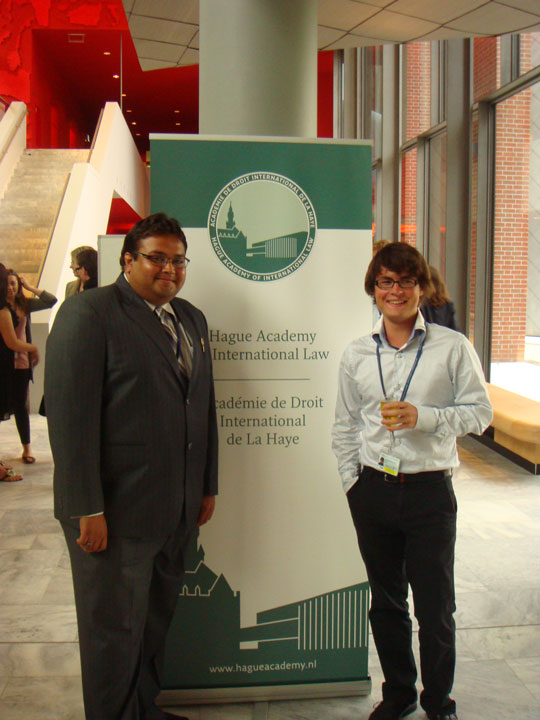
    His two most cherished achievements are: successfully taking the Diploma in Private international Law from the Hague Academy of International Law – one of the youngest to do so since 1950 and one of the four in India to have it; and getting recognised in Legal500.com and in Tax Directors’ Handbook as an “up-and-coming lawyer who specializes in tax litigation”.

    In this interview with Amit, he talks about:

    • Completing his bachelors in law from GGSIPU.
    • Being a part of the LSE curriculum as an LL.M student.
    • His working days at Vaish Associates.
    • His Diploma in Private international Law from the Hague Academy of International Law – one of the youngest to do so since 1950 and one of the four in India to have it.
    • His experience of studying at NYU, from where he did his second LL.M.
    • Working at Ernst & Young Associates, USA at present.


    Say Hi! to our readers!

    Hello! I am Amit Sachdeva. I was born and brought up in Faridabad, a suburb of New Delhi. Currently, I work as an M&A Tax attorney at Ernst & Young US. I am an alumnus of GGSIPU, LSE and NYU.


    What motivated you to gravitate towards law, as a discipline and a career? Why did you decide to study law at GGSIPU?

    Law for me was a natural career choice. My father, Mr. Madan Lal Sachdeva, was an advocate. I idealize him. I was always inspired by the respect he commanded in the society, by his ability to reason everything and by his natural passion—which was professionally crafted—to defy “aisahi hotahai” (this is how it works) attitude. These early childhood impressions took full shape when I began to realize the difference a lawyer can make to the society.

    While in Class XII all my friends were aspiring to be doctors, engineers and chartered accountants, I wanted to something that was intellectually stimulating, financially rewarding and socially empowering; something that was constant and dynamic at the same time, something that needed patience and excitement simultaneously. Law was like a perfect blend!

    GGSIPU, in 2002, was the only law school in New Delhi that offered a law course straight after high school. I didn’t want to move out of New Delhi—that’s the place we have the Parliament, the Supreme Court and the Ministries. I thought there couldn’t be a better place to study law than in New Delhi. And, as I reflect on it; I don’t disagree.


    Please tell us about your time at GGSIPU. What experiences during these five years would you think particularly helped you shape as a law professional?

    GGSIPU School of Law and Legal Studies was a treat. My experience was very fulfilling. The fact that ours was the second batch had its own challenges and fun. The challenge was that we had to steer our own way. And the fun was exactly that. There is no better way of learning than pioneering. Each day was an experience. Classroom discussions, moot court competitions, summer internships, cricket matches, canteen time, all of them had a part to play in how I got shaped. I think GGSIPU was an experience in itself.


    You have been an outstanding student throughout your school and college years. It’s not every day that someone achieves an academic laurel in each year of school! Please give us a few actionable tips on managing good grades.

    Well, I think there is no mantra to good grades. Quite honestly, I think while grades aesthetically matter, it is the passion for your work that matters more. If you ask me for a tip, it will be this: try to understand a rule for a lifetime, not commit it to memory for an exam. There is a reason behind why a rule is what it is. If you try following the reason, law school exams are not hard to score on.


    Soon after graduation, you went on a full tuition scholarship to London School of Economics and Political Science for an LL.M in Corporate and Commercial Laws. What was the decisive factor that prompted you to choose LSE from amongst the options available?

    As I grew up at law school, I realized the relevance of a fuller education and an international experience to our profession. It was in the early part of the fourth year of law school that I decided to apply for an LL.M. degree. Of the various options, the ones that I was seriously considering were Oxford University and LSE. Although Oxford has an impeccable legal tradition, I decided to join LSE primarily for the very reason I got drawn to GGSIPU five years ago: what better place to study law than the capital city. LSE is in London. Besides, LSE also has, I think, a better reputation for corporate, commercial, and international business laws than Oxford does. Of course, there is an element of subjectivity around it. But that is what I thought. The other reason was that Oxford offered me a partial-scholarship; LSE, a full. I didn’t apply to any law school in the US.


    What should one do differently in college if he/she wants to pursue higher studies after graduation? What according to you is a good profile for securing scholarships and funding?

    Following an LL.M straight after school, or spending a little time at work and then pursuing a master’s degree, is really a matter of personal choice. A lot of factors play in, such as availability of finances, family commitments, etc. Having pursued an LL.M directly after school and then another one after some work ex, I would second that work experience does put a lot of things in perspective.

    As far as admissions are concerned, I think finding an admission in a top LL.M program is hard. And, finding a scholarship is harder. I think the trick is to demonstrate two things. First, an all-round personality and, second, a commitment to the field you want to pursue. Participating in moot court competitions, debates, mock parliaments, summer internships, besides good grades and writing articles should go a long way. Publications are often viewed as synonymous with academic excellence and commitment. A handful of international publications and I think you jump the queue of applicants for a place at a top LL.M program. I must however hasten to emphasize that a reviewer spends a few minutes reviewing a case for a scholarship. So, if you get one, thank your stars; if you don’t, there is no reason to be disheartened… the decision may not be a reflection of your potential. There is just no exact science out there.


    amit-sachdeva-3

    Please tell us about your time at LSE. Tell us about the academic pressure, faculty and campus life. What differences did you find between the education systems of India and the U.K.?

    The UK system is as close to the Indian as it can be. An overwhelming majority of our statutes and court decisions are based on or drawn from those of the UK. So, adjustment was not much of an issue. What was however a surprise—a pleasant one of course—was to first-hand experience the level of legal scholarship. I had the opportunity to be a student of some of the most respected scholarsacross the globe. Prof. Paul Davies (author of Gower and Davies, Principles of Company Law), Prof. Trevor Hartley (Private International Law) or Prof. Christopher Greenwood (since appointed as Judge, ICJ), the list is endless; they are scholarship-personified. I think the Indian education system needs two things—sincerity and funding.


    Meanwhile, you were also awarded a Diploma in Private International Law from The Hague Academy of International Law. How did you go about achieving this? Please tell us about the procedure to apply and the course.

    Yes, and I was also one of the youngest persons in the world to achieve this feat since the Diploma was incepted in 1950 and one of the only four Indians to hold this Diploma.

    Every year The Hague Academy of International Law organizes a summer school. The school has two sessions: one in Public International Law and the other in Private International Law. The sessions are taught by some of best professors and practitioners in the world. Each session attracts about 300 students. The applications are announced on their official website. Based on the performance of the students, some of the students sit for the Diploma exam. Although there is no cap, roughly about 10 students take the exam each session. There is a written test and then take an extempore oral test on a topic of international law. This is followed by the panel interviewing the student with questions, some related and some unrelated to the assigned topic. At the end, one or sometimes two students are awarded the Diploma.


    After coming back to India, you started your career at Vaish Associates. How did your appointment take place? Please walk us through your work profile.

    I joined the Direct Taxes team of Vaish Associates in September 2008. I had emailed the HR there. Vaish was one of the most welcoming law firms I came across. They acknowledged my email—something we don’t see too often. I had two rounds of interviews. After the interview with partner I was extended an offer to join their tax litigation team. I grabbed the opportunity.

    As a member of the tax litigation team, I attended client meetings, drafted petitions and appeals, appeared before tax officers and represented matters before the courts. I had the opportunity to handle work for many of the Fortune500 companies. In my first year, my work was more domestic tax focussed, but as I spent more time with the practice, international tax occupied my plate more and more. My partners often engaged me on assignments that involved intensive research into dense regulations, engagements that required knowledge and understanding of laws other than tax law, and matters that challenged constitutional validity of tax statutes. I handled a large number of writ petitions challenging the validity of reassessment proceedings. In addition, I would write tax opinions for our clients and render other advisory services.


    Tell us what did you like the most about your days at Vaish Associates.

    I had some of the best time of my life at Vaish. I worked long hours, made great friends, learnt tax law and partied. Besides, I helped the firm organize conferences, published papers, conducted team trainings, etc. It was a wholesome experience. What I liked the most about the place was the open-door policy. This meant that professionals at all levels, starting from associates and all the way up, had full access to all the partners at all times. Mr. Ajay Vohra, Mr. Rupesh Jain and Mr. Neeraj Jain personally ensured that this work ethic percolated all the way down. Mr. Rupesh Jain continues to be my mentor. I do reach out to him even today for discussions—both at personal and professional levels.


    amit-sachdeva-2

    In 2013, you were noted in Legal500.com and in Tax Directors’ Handbook as an “up-and-coming lawyer who specializes in tax litigation”. How did you feel about it?

    “It must be a misprint!” were the first words that I uttered when a colleague of mine at Vaish Associates came to my desk and broke the news to me. I had no idea about it. There was no application process … no submission … no request from my side. I understand that Legal500 and TDHB undertake an independent survey of the market and clients, and report their findings impartially. Once it sank in that my name was noted, I was overwhelmed. On the lighter side, I continue to believe that it was a misprint! By far, this and The Hague Academy Diploma are two achievements that are closest to my heart.


    You were briefly a Visiting Faculty at NLU, Delhi where you taught a semester-long Certificate Course on Direct Taxation. How did you manage to eke out time?

    I have a passion for teaching. I have always wanted to be an adjunct professor. NLU Delhi offers semester long certificate courses. I think these students were some of the most self-motivated ones I have come across. In order to accommodate my professional commitments, my students sometimes sat in classes starting 9 in the evening and going well past midnight. One weekend they travelled all the way from Dwarka to the Vaish office in central Delhi. I think they managed, I did not. All I did was: talk! If any of my former students is reading this interview, I want to say: thank you!


    You left your job to pursue a second LL.M. degree., this time at NYU. Considering that you had already earned an LL.M degree, what prompted you for this?

    My first LL.M was in Corporate and Commercial Laws. But, as it turned out I began practicing tax law. So, the primary motivation was to understand the theoretical underpinnings of the rules I invoked so often in practice. I always believed that there is much to learn from the US and the UK systems, and knowing their laws would boost my practice. Besides, I also wanted to develop an international network of professionals working in the same field as I was. So, that led me to apply for another LL.M. I already had an LL.M. from the UK, I decided to cross the Atlantic and try my luck at some US universities. With God’s grace, I was offered an admission with a scholarship I couldn’t turn down. My mother and my elder brother supported my decision to go.


    Currently you work as an Associate at Ernst & Young, Houston, USA. Which events led to your induction into EY, USA?

    NYU School of Law makes a significant investment in its careers office. There are a couple of job fairs that NYU organizes. The careers office also invites employers from across the country to the law school to interview NYU students. I applied for a number of job interviews, had call back interviews with a few. EY Houston office had also participated in one such interview program. I had a telephonic interview followed by an on-campus interview, and a round of four interviews during office visit. Shortly after the office visit, I was offered a position. The entire recruitment process spanned over three/four weeks.


    What does your current work profile at EY consists of? Share with us a few of the most challenging problems you have faced thus far?

    I work with the M&A Tax team at EY. My practice entails conducting tax due diligence, writing tax memoranda and tax structuring. Typically, a tax DD is like a health check-up from a tax perspective. Tax memoranda are a narrative of what the legal position on an issue is. Tax structuring, which is my favourite, involves informing clients of the different structuring options in which a transaction may be done.

    The complexity of the US tax law is the most challenging part of my work. But, that is also the part I enjoy the most about my practice.


    Tell us a bit about work culture in USA. How is EY, USA different from an Indian company/firm in terms of their working?

    I think as we brisk walk more into this millennium, our practices, behaviours, languages, cultures, ethics are converging. I don’t see too much of a difference between the work culture in the US and India. My friends and colleagues who work EY India endorse this. My personal experience at Vaish was no different.


    Lastly, what would be your parting message for our readers?

    Law School is perhaps the best time one can have in a lifetime. Enjoy it to the fullest. At the same time, be mindful of your goals, and of what you want. Also remember that lawyers are never out of work. If the economy is doing well, there is more corporate activity like M&A, IPOs, project finance, etc.; if it slows down we get involved in a different type of legal work like distressed debts, reconstructions, hedging, asset management, etc. The problem is that our education system focuses so heavily on traditional legal courses, and so little on these more modern ones. My suggestion would be that students should focus on these areas too.

  • Shine Joy, Deputy Manager-Legal, Snapdeal, on work as in-house counsel

    Shine Joy, Deputy Manager-Legal, Snapdeal, on work as in-house counsel

    Shine Joy graduated from Guru Gobind Singh Indraprastha University in 2008 and had thereafter worked with various law firms including MV Kini & Co., Akash Chittranshi & Associates and Ranjan Narula Associates (Part of Rouse & Co. International). He also holds an experience of an Assistant Manager- Legal at DLF Utilities Ltd. He currently works as a Deputy Manager – Legal at Snapdeal.

    Over here, he talks about:

    • The appropriate time in law school to undertake internships
    • Making the switch from a law firm to a company
    • Why it is okay and even desirable to change multiple jobs
    • Working at e-commerce giant Snapdeal


    What got you into legal studies? Was it all planned or something that just happened by chance?

    It was pure chance! I come from a typical south Indian family who would have loved an engineer son; so pursuing law as a career option was never on the table as such. However, a chance interaction with a friend made me think about law as an option.


    How was your experience at GGSIPU? What activities were you involved in apart from the regular academic curriculum?

    College days can never be anything but good; especially when you are in a law college which is located close to CP, GK and other hot spots for youngsters in Delhi

    (GGSIPU and my college – ‘University School of Law and Legal Studies were located in Kashmere Gate Campus when I was pursuing law; it has since been shifted to Dwarka Sec 14.)

    Apart from regular academic curriculum I was involved with the college Moot Court Society because of which I had the privilege of representing my college in four moots court competitions. I was also a member of the editorial board of the University magazine – ‘Adamya’.


    What were your major interests as a student of law? Any suggestions for the law students on how to deal with the Pandora box of laws?

    I was very much interested in Intellectual Property Laws during my college days. Fortunately during those days the law relating to trademarks & copyrights were being constantly debated in the courts across our country. This only fuelled my passion for the same subject.

    I wouldn’t call law a Pandora’s box. It is more of Santa’s sack of toys! What I mean to say is law is such a diverse field with so many subject areas that you have the option of experimenting and zeroing on the one you may fall in love with.


    How should one go about the internships? How important it is for a law student to plan out the course of his internships to successfully gain from the internship experience?

    Internships are important as what we learn in college does not completely prepare us for what happens on the ground. Internships do give us a glimpse into the life an actual lawyer lives on a day-to-day basis. However, I would suggest undertaking internships from the 3rd year (of the 5-year course) onwards only since by then one would have studied both the substantive and procedural law. This gives you a better understanding of what is happening in the practice of law.  The idea is to enjoy the fun side of college and academics for the first two years of college while you are also acquainted to law as a subject, then go on to intern and eventually work as a lawyer.


    After graduation you worked with various firms including MV Kini & Co., Akash Chittranshi & Associates and Ranjan Narula Associates. How was your experience working at these places?

    MV Kini & Co. gave me the opportunity to intern with them and be involved in an Associate’s work profile even before enrolling as a lawyer, so to continue there as an associate after enrolling was an obvious choice. Also, the firm gave me immense exposure to litigation practice, infrastructure and corporate work. However, I had a keen interest in being an IPR lawyer and was motivated me to join Akash Chittranshi & Co. which was a leading firm in copyright laws.

    The time spent at Akash Chittranshi & Co. equipped me and developed my skills as an IPR lawyer. It is then that I got an offer to join Ranjan Narula Associates (which is an associate office of Rouse & Co. International – an international IP law firm). Letting go of an opportunity to work with the best in industry and amazing international clientele was not something I would even dream of doing. My work experience  at each of these firms have enhanced my skills immensely as lawyer and gave me a chance to work under the guidance and with some of the best lawyers in the business.


    Thereafter you joined DLF Utilities Ltd. as an Assistant Manager- Legal. What led to the shift from law firms to a real estate company? How was your experience working there?

    While working as an attorney with Ranjan Narula Associates, I had the privilege of interacting with some of the best in-house counsels in the world. These interactions made me realize that often while advising their clients, lawyers have a myopic view of how businesses look at legal issues faced by them. It is imperative that lawyers should understand the business implications of their advice. So when an opportunity came to work as an in-house lawyer for a leader in real estate business and with seniors who are widely respected for their work, it was difficult to say no.


    Currently you work as a Deputy Manager-Legal at Snapdeal. How did the switch from DLF take place?

    Currently I work as Deputy Manager – Legal (got promoted in Oct 2014). I live by the mantra ‘what next? I believe that one should always strive to learn more and more and gain as much experience one can get so that one is moulded into a better professional who can give the best possible advice to his client. Therefore, when I got an opportunity work with Snapdeal – which was a pioneer in the e-commerce sector, I thought that it would be an immensely enriching experience for me as a professional. I would also get to deal with issues in a sector which was both new and fascinating.

    As Snapdeal had chalked out plans of expansion when I was offered the job, the offer was more like a door to hands-on work in a plethora of legal issues that a growing entity would be involved in.


    How did your appointment take place? Please tell us about the recruitment process at Snapdeal. What do they look for in their prospective employees?

    I was contacted by the HR department of Snapdeal. The company conducts three rounds of interview before extending an offer to a prospective employee.


    What does your current work profile at Snapdeal consist of? How is a typical workday like?

    At Snapdeal I am involved mainly in high stake litigation matters, IPR issues and M&A activities. I also advise on issues pertaining to commercial contracts, advertising and real estate.


    Are there new challenges everyday or has work settled into a predictable pattern? Can you tell us about a few of the most challenging problems you have faced so far?

    To my understanding and experience a lawyer’s day at work can never be predicted, each day the nature of issues dealt with and work undertaken are different. As to challenges, every day is welcomed with a new one.


    What amount of legal work is there? What have been your failures and successes?

    Almost 95% of my work is legal. Recently, we were successful in defending the company against allegation of anti-competition activities before the Competition Appellate Tribunal.


    How do you keep yourself abreast with latest industry news and trends?

    I do so by perusing through standard industry journals, following blogs, attending national and international conferences etc.


    Lastly, what would be your parting message for our readers?

    Work is important but having a ‘life’ outside of work is more important.

  • Dhruv Suri, Principal Associate, PSA Legal, on leading a student organisation, LL.M from Columbia University and work at Law Firms

    Dhruv Suri, Principal Associate, PSA Legal, on leading a student organisation, LL.M from Columbia University and work at Law Firms

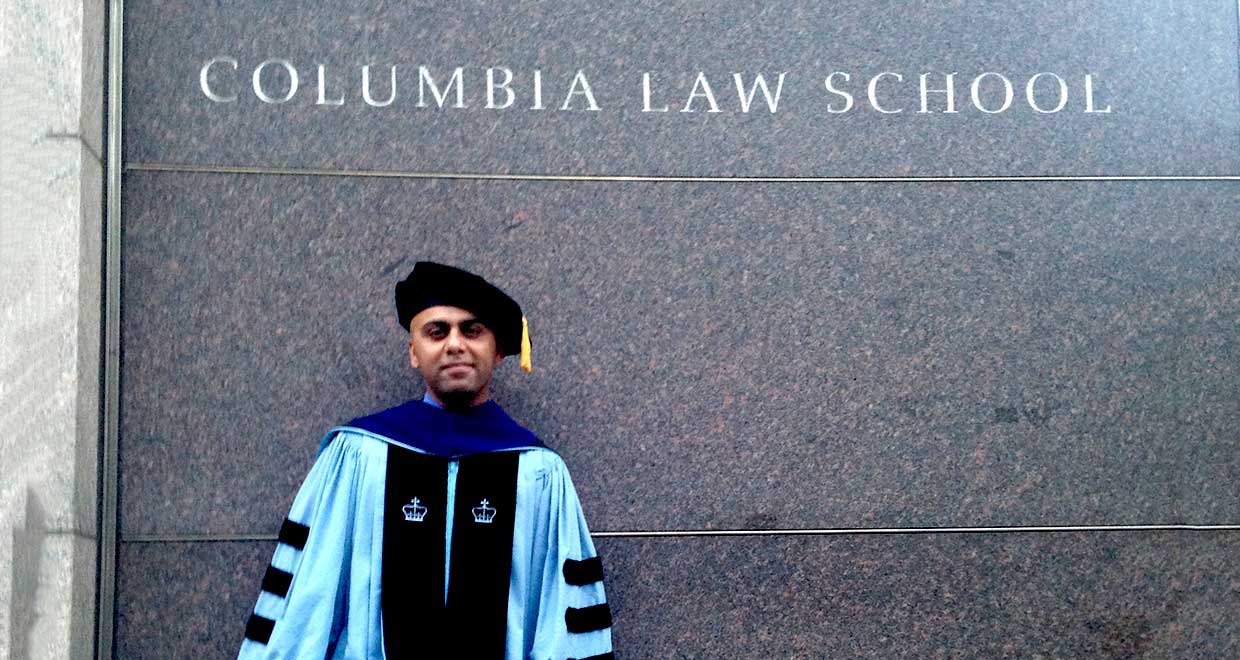
    Dhruv Suri graduated from Guru Gobind Singh Indraprastha University, New Delhi in 2009. While in college he co-founded a student organization called United Students which initiated the Jessica Lall and Priyadarshini Mattoo campaigns. He was invited by the then President, A.P.J. Abdul Kalam to discuss problems of OBC reservations after receiving his memorandum on the same. He has interned with AZB & Partners and Valeo, Paris. He received a PPO while interning at PSA Legal Counsellors where he was an Associate for four years before opting for an LL.M from Columbia University, New York. He has joined PSA after coming back from Columbia. He is currently a Principal Associate at PSA Legal Counsellors. In this interview he talks about:

    • Studying law at GGSIPU, New Delhi
    • Recruitment and work experience at PSA Legal Counsellors
    • Masters from Columbia University, New York


    As an introduction, please tell us about your schooling and how you decided to pursue law.

    I was born and brought up in Delhi and did my schooling from Delhi Public School, Vasant Kunj. I graduated from school in 2003 and was unsure of what I wanted to do. So much so that my family registered me for one of the law entrance exams and I ran away to Mumbai with a friend for a holiday. Of course, that did not go down too well with my family after I came back. When I came back, I took admission in Delhi University where I studied English Hons. for one year. However, for that entire year, all I did was theatre and learn dance. My attendance at college was abysmal! In 2004, I was emotionally blackmailed by my mother to register for the law entrance exams once again on the pretext that I would be given a Maruti 800 to travel to law school and an increment in my pocket money. I fell for it and got an option to study at Amity Law School. Back then, Amity Law School was a building in south Delhi and did not have the atmosphere of a “campus” that I grown accustomed to in my one year at DU. So, I opted for the main Guru Gobind Singh Indraprastha University law school which seemed like a better option. Rest assured, I got no car and travelled 40kms a day in local Delhi buses. So, this is how my journey with law started- as a “victim” of emotional blackmail from my mother! J


    You completed your law degree from Guru Gobind Singh Indraprastha University, New Delhi in 2009. What activities were you involved in there? Looking back, is there anything you wish you had done differently?

    The first few years just went by in trying to understand what law is really about. I loved courses like Legal Reasoning, Jurisprudence, History, and Contract law. I also loved mooting and showed up at any and every audition, whether I was prepared or not. I was also very active in the debating society and ensured that I participated in as many competitions as possible. Since our campus was fairly big and had lots of engineering and management colleges as well, there was always some event or the other taking place. By the time I was in my 4th year, debating became a source of extra pocket money.  However, amidst all this, I was also focussed on getting good internships and a job. In fact, if there is any regret that I have, it is that all through my final year I worked after college hours, whereas all my friends were enjoying themselves, going for lunches, movies and ensuring that their last year as a “student” was memorable. When I look back, I could have probably worried less about my career and instead made the most of my final year at law school. Eventually we all had to work but I do feel that I missed out on some fun times with my friends.


    You started a student organization called United Students. You contested the Delhi University elections and initiated the Jessica Lall and Priyadarshani Mattoo campaigns. Please tell us more about it.

    United Students happened by pure accident. I was in the latter part of my 2nd year at law school when I met the other founder members of United Students at a coffee shop in central Delhi. I had always been someone who liked to initiate and take the lead in everything I did. The trial court verdict in the Jessica Lall case was out and I was having discussions and debates with people from all quarters about the merits of case, legal arguments advanced, etc. Some common friends connected me to like Aditya Raj Kaul, a young 17 year old (now a popular Times Now reporter), who had started an online campaign in connection with the Priyadarshani Mattoo case. Aditya and I realised how similar we both were and he introduced me to the other founder members. We were all passionate about bringing about a change and decided to collaborate. I think that really was the key reason for launching United Students. We wanted the organization to encourage young Indians, particularly students, to think and debate in a cohesive manner and take up issues of governance. The idea was to engage in discussions and debates, take an informed stand and then take steps on ground to the best of our abilities. I think the legal profession is somewhat similar. Discussions and debates are synonymous with research, which is very important to take a stand and advise the client. As I got busier with law and internships and all other members got more absorbed in their lives, the organization had a natural death. However, the entire experience played a big role in how I evolved as a person and it is something that I will always cherish.


    Why didn’t you pursue a career in politics? Do you think you will enter the field again in the future?

    I remember I was doing a shoot for a big news channel during the Delhi University elections and the spokesperson of one of the bigger political parties came to me and asked me to formally join them. I wonder how different life would have been had I actually done that! But on a serious note, I did consider pursuing politics more seriously but was equally eager to graduate and practice law. Who knows, one day I may actually be able to balance a legal and political career!


    dhruv-suri-3

    During your time at law school, you interned at AZB & Partners, New Delhi and Valeo, Paris. Please describe your experiences.

    All my internship experiences were very rich. At AZB I did my first all-nighter and got a real sense of how corporate law firms work. The lawyers were extremely kind and I am still in touch with some of them. Valeo was great because I got to work in-house and attend lots of business meetings. I realised how a “business lawyer” (whether in-house or external) cannot give pragmatic advice if he/she does not have a sound understanding of the business. This was the biggest take-away from this internship and till date, I try and adopt the same approach while advising clients at PSA. Of course, I got to spend a little less than 3 months in Paris which was fantastic and the first time I stayed by myself. I made sure I saw every bridge, every museum and (almost) ever cafe and bar there.


    You also interned at PSA Legal Counsellors and then received a PPO from them. What do the recruiters at PSA look for in potential candidates? How did you secure a PPO?

    One of the most preferred modes of recruiting at PSA is to give offers to final year law students interning at the firm and then training them internally as they grow. The firm encourages building in-house talent.

    In terms of how PSA approaches recruitments of potential candidates, I think it is more or less assumed that a first year associate will not know much about the law. However, she/he should be eager to learn and work hard, and also interact and work well in a team. PSA also believes that before becoming a specialist, it is important to be a good generalist. So, if there is a student who only wishes to work in the area of, say, capital markets or intellectual property or competition, PSA would not be the best place to work. Whereas if someone is keen to do everything and gradually pick areas of interest and focus on them, PSA would be an ideal place for them.

    In my specific instance, I interned with PSA all through my final year at law school. While I was still an intern, I got actively involved in a big PE transaction. The deal was still ongoing when I graduated so I just continued working on it and did not stop. Slowly I got drawn in on a lot of other matters and before I realised, I had spent almost 5 years at the firm!


    dhruv-suri-4

    Upon graduating, you started working at PSA as an Associate. What was your work profile like?

    Like I mentioned, at PSA, you do everything in your first year. So, my work profile was nothing different. I was actively working on a PE deal, but also assisting the senior lawyers in day-to-day corporate advisory, researching for litigation matters, working on intellectual property queries and even drafting board minutes and incorporating companies. Gradually the work becomes more sophisticated and challenging but the basic training I got in my first year continues to be invaluable and (I’d like to believe) set a strong foundation. Before I left for my LL.M in 2013, I was working on sophisticated M&A transactions, advising large conglomerates on complex legal queries pertaining to contracts, IP, tax, employment etc. and arguing matters before the Competition Commission of India.


    dhruv-suri-2

    After four years at PSA, you opted for an LL.M from Columbia University, New York. How did you secure your admission at Columbia? What was your specialisation?

    So, Columbia and Harvard are two schools that I know do not offer a specialised LL.M. In fact, even as a matter of personal preference, I did not want to do a super specialised LL.M. The application process was exhausting and almost impossible to manage with long work hours. I took 10 days off in October 2012 to work on my applications and finalized as many as I could. Even the 10 days were not enough and I spent a lot of weekends on my personal statement and other school-specific essays that were required. Now when I look back, I am so glad I put in that effort because Columbia really is one of the best things that ever happened to me! Plus I got to live in New York which just takes the LL.M experience to a whole new level.

    With respect to courses, there was a fair bit of flexibility so I made sure I had a variety on my plate. Some of my courses were “Strategic International Commercial Transactions,” “Financial Statement Analysis,” “Intellectual Property Drafting,” “Negotiations,” “Corporations,” etc. All of them were taught by top-notch professors who made studying such a pleasure, an area where, in my opinion, Indian law schools have a lot of catching up to do.


    You also worked as a Research Assistant for Professor Anu Bradford in the field of antitrust laws. On what basis were you chosen for the project? How was the experience?

    I have always been very interested in competition/antitrust law. During my first month at Columbia, we received an e-mail that Professor Anu Bradford was looking for LL.M research assistants to work in the field of antitrust law. I think I drafted a short cover e-mail and sent my CV within 5 minutes of receiving the e-mail. Professor Bradford called me for an interview and soon I started working for her. The experience was so enriching because the work she asked me to do involved coding antitrust laws of multiple countries (including India) and understanding key differences in how statutes are drafted across those jurisdictions with respect to restrictive agreements, cartels, abuse of dominance, etc.. The work gave me a deep and detailed understanding of antitrust laws. Plus, she is one of the most wonderful people I know and mentored me throughout the time I was at Columbia. I am just glad I got to work with her.


    Is it better to pursue an LL.M right after college or after working for a few years?

    This is a question that a lot of people aspiring to do an LL.M ask. Honestly, I don’t think it has a right answer. A lot of my friends went for their LL.M immediately after completing law school but I chose to go after gathering some work experience. Specifically for Columbia, which has an extremely competitive curriculum, it is rare for them to admit anybody with less than 2 years of work experience. Of course, there are exceptions. Based on my experience, I do think that work experience comes in very handy, especially when you are learning about a different legal system. You are definitely wiser and more mature to gauge concepts by linking them to your practical experience. Plus, you also tend to make a lot more of your degree by networking professionally, which, I think, can be challenging if you have never worked before.


    Do you think the LL.M has improved your career prospects? Do you have larger responsibilities at PSA now?

    The LL.M has definitely helped me a lot. If I had to point out one thing, it has made me surer of my work and more confident in my interactions with clients, both Indians and foreigners. In terms of my profile, I am now a Principal Associate at the firm and manage PSA’s start-up/PE/VC practice which is extremely exciting because I interact and work with dynamic start-ups and very passionate entrepreneurs.  While I continue to do legal work, a lot of my time and energy is also spent on business development, which I thoroughly enjoy. So clearly, the responsibilities have increased and the concept of weekends has dissolved. I have to be on top of whatever I am working on all 7 days a week and I actually prefer it like that.


    Lastly, what advice would you give to law students wishing to pursue a career in corporate law and considering doing an LL.M?

    I would say that, make sure you do internships in law firms in your 4th and 5th year and be proactive when working. I enjoy working with interns who are eager to learn, proactively follow-up with me and don’t hesitate to take responsibility of their work. It is a good opportunity for you to demonstrate your attitude towards work. Also, be prepared to do any and all kinds of work. You will realise much later how the most minuscule things you worked on as an intern or first year associate come in handy during negotiations or drafting contracts. So, approach work with an open mind. Finally, if you plan to do a LL.M, my advice usually is to work for 2-3 years. It will really change your perspective and you will be able to make the most out of your academic courses and the overall LL.M experience.

    In the end, I would just say that work hard but make sure you enjoy your student life as well. That time (unless you do your LL.M) will not return. Good luck!


  • Megha Suri, Senior Associate, Indirect Tax, Vaish Associates on a career in Taxation Law

    Megha Suri, Senior Associate, Indirect Tax, Vaish Associates on a career in Taxation Law

    Megha Suri graduated from Guru Gobind Singh Indraprastha University, Delhi in 2008. She is a qualified Company Secretary and also holds a Diploma in French Language. She has an enviable academic, debating record and an excellent series of internships at top law firms. Soon after Graduation she started working as an Associate at Mahajan Law Offices. Later, she joined Vaish Associates as an Indirect Tax Associate and after three years of work, she was promoted to Senior Associate.

    In this interview, she talks about:

    • Expertise in Indirect Tax Associate
    • Work at Vaish Associates
    • Growing from an Associate to Senior Associate at Vaish


    How would you like to introduce yourself to our readers who are mainly law students and lawyers?

    I am an indirect tax consultant working with Vaish Associates Advocates for over 6 years now. I practise my work passionately not because Indirect Taxes is my passion, but because Law is. After having associated with the field of law, I realise that it was way easier to complete 5 year law course and absorb the pressure of exams happening each fortnight, than taking dip in the ocean of law with each passing day and getting more drenched, with each deciding case!!


    What brought you into studying law? Was it fate or plan?

    Ever since I was class IX, I was quite focused on becoming a lawyer. Though not getting impressed with any eminent lawyer or the procedures of law, I got inclined towards legal practise by following a popular American TV series ‘The Practise’. Funny as it may so sound, but this is exactly what drove me to pursue law.


    Did you take part in moots when at Guru Gobind Singh Indraprastha University, Delhi or indulge in academic legal writing? What are your thoughts on these activities?

    I was an active Debater at school and the passion for debating continued in college as well. Consequently, I participated in many inter-college debate competitions. However, I didn’t take part in many moot court competitions. In fact, in totality I must have participated in just 3 or 4 moot court competitions in entire 5 year law course.

    However, for becoming a good lawyer, I think it’s extremely important for each student to take off the court fear and present himself as a good orator. In my view, for grooming budding lawyers, participation by each student in minimum of one moot and one debate competition per semester, should be made mandatory.


    Do you think being from a non-NLU has ever proved to be a hindrance for you? Many non-NLU students complain that they feel being discriminated against during career opportunities. What has been your experience?

    Well, I was lucky enough not to have faced such discrimination at the law firms where I had interned. However, I remember few friends of mine sharing bitter experiences, who, fortunately or unfortunately, did happen to intern at other Tier I law firms and were cornered for not belonging to the ‘NLU Lobby’, as it was called. The discrimination was to such an extent that students from National Law Schools were paid stipend as against non-national law school students, who weren’t even paid conveyance charges.


    Right after graduating, you worked for a very short period of three months at Mahajan Law Offices as an Associate and then joined Vaish Associates as an Indirect Tax Associate. How did your appointment take place?

    Prior to joining Mahajan Law Offices, I had interned with Vaish Associates Advocates for a period of 6 months (with the Corporate Law Department), as required under our curriculum at GGSIPU. I was willing to join the Corporate Law Department of Vaish Associates Advocates right after completing my internship. Unfortunately, as there was no vacancy then, my candidature was not considered. Subsequently, I got an opportunity to work with Mahajan Law Offices, where I was handling litigation as well as issues pertaining to corporate laws. However, three months later, I got a call from Vaish Associates regarding an opportunity with their Indirect Tax Department. I had never studied Indirect Taxes ever before, not even in my law college. Nonetheless, I wanted to join Vaish and give it a try.


    After three years of work as an Associate at Vaish Associates, you were promoted to Senior Associate. What qualities do you think helped you to achieve this status?

    Initial phase of your career is the most decisive and crucial for framing your path ahead. First three to five years require lot of hard work, self-motivation and persistence to make good knowledge base and grow. Being driven by these factors and my passion to learn Indirect Taxes, which was absolutely new to me, helped me to achieve the expectation of my seniors, which helped me to get promoted to being a Senior Associate. This certainly proved to be cherry on the cake and motivated me to work even harder!!


    You had also managed to pursue the company secretary course. Tell us why did you chose to do it and how did you manage it with work?

    While I was interning at Vaish with the Corporate Law Department, I got an opportunity to work with many Company Secretaries and many lawyers who had dual degree (one of law and other of company secretary). The amount of knowledge these people possessed about Companies Act and various issues related to Companies Act was absolutely tremendous. It encouraged me to join the course of Company Secretary (‘CS’). After I started working with Indirect Tax Division, the zeal to learn about Companies Act did not really fade away. I was still quite enthusiastic to complete the course. Additionally, my love for studies always encouraged me to pursue and finish the course.

    I was fortunate enough to have completed Law before as few subjects in the course of Company Secretary were covered by my curriculum of Law, making it simpler for me to appear in those papers. However, it was a challenge to study Cost Accounts and Financial Management, for which subjects, I used to taken tuitions before starting work in the morning. I had great support from my seniors and Partner, who gave me leaves during my exams. Moreover, by working for various clients, it gave me a practical edge to the theoretical studies that I did during the CS course. This made it easier for me to complete the course.


    Tell us about the nature of work you’re entrusted with therein and what’s a typical day like? How do you say one can gain expertise in Indirect tax? What does it take to be a good Indirect tax lawyer?

    I am majorly looking after various issues pertaining to Value Added Tax (VAT), Central Sales Tax (CST Act), Works Contract Tax (WCT) on pan India basis, along with issues under Service Tax, Customs and Central Excise. I am involved in rendering advisory services on various issues under Indirect Taxes, along with handling litigation services for various clients. We have matters under various forums like Commissioner, Tribunal, High Court and Supreme Court.

    Gaining expertise in any field of law entails persistent reading and creating a strong knowledge base. Clarity of concepts and its understanding and applicability is another important way of gaining expertise in any subject. Apart from this, being abreast with latest case laws is extremely essential. A lawyer can become a good indirect tax lawyer once he is determined to become so and works towards the same by following aforementioned path.


    Is the work significantly different from other transactional lawyers? How much of your work does involve litigation, if at all?

    A transactional lawyer would be involved in everything right from understanding the intention of the parties, to getting requisite approvals, to drafting and freezing the Agreement. My work involves this all from a specific angle of indirect taxation. Resolves issues like whether the transaction would have any bearing under prevalent indirect laws in India, how can we mitigate the cost from indirect tax perspective etc. is where we get involved into.

    We have lot of litigation matters, especially before Commissioner and Tribunal level. That is the route where all litigation arises for various companies. Visits to courts and presenting our case is a regular feature.


    What changes has being a Senior Associate brought into your life, do you ever feel that there is excess of work load on you? How do you manage to strike a balance between your personal and professional life?

    Becoming a senior associate is certainly an added responsibility. You become more accountable not just to your senior, but also to the client. Work load is there but it is manageable as I have colleagues at Associate level to help me.

    I am in office for almost 9-10 hours. I make it a point to finish all work in office rather than taking it back home and working. However, there are certain times, when I have to either sit back late or take work home and finish. But fortunately that’s nota regular feature. It is important for everyone to strike work life balance.


    You must have guided several interns. How would you say that an intern can generate a positive feedback in the limited time they have?

    It is very important for law students to explore as much as they can during their law course. This not only helps them giving a broader perspective of available career options to choose from, but also provides an insight into various legal issues. It is upon each individual how they want to make best use of available resources. Interns should focus on the work assigned to them and try finishing them after doing in-depth research as required. That will automatically generate positive feedback about them.


    What has been your strategy to deal with errors and mistakes? How would you suggest a young associate to deal with them?

    To err is human. I had literally done blunders when I had just started working. I still do mistakes, but the frequency and gravity has certainly gone down. I guess that’s what experience is.

    The best way to learn from mistakes is to make a note of them at a place which is easily accessible. If the note comes in front of you on daily basis, the chances of occurrence of mistakes would surely come down. It’s not possible to work sans committing errors. It is always good to realise mistakes and better to mend them.


    People often complain about the highly skewed work-life balance at the top law firms. What is your workday like? How do you maintain your work-life balance?

    As I said before, it is extremely important to maintain a healthy personal life along with a wealthy professional life. I start my day around 10 and work till 8. There are days when I have to do late sitting when I have a matter in Court the next day. There are exceptional circumstances when late sitting can’t be avoided. Since I handle VAT related issues on pan India basis, my work does involve travelling to lot of places.

    But in regular days, leaving office in time is quite possible. The only way to maintain work life balance is to finish office work in office hours. Quite a number of law firms have the culture where Associates dilly-dally during major part of the day and start their actual work only around evening time. In such cases, there is no chance that people can strike the chord between their professional and personal life, which is truly quite detrimental to their future.


    What would be your message to our readers who are budding lawyers and law students?

    Law is not as simple as it looks. Law isn’t either as fancy as it looks. Law is such a discipline of study, which requires great amount of commitment and focus to prosper. My senior always says “Law is like a deep ocean. The deeper you take a dip, the more drenched you get with knowledge.” Maintaining strong knowledge base is the essence of roaring success in this discipline of study.

    It entails great amount of hard work and zeal to become a successful lawyer. It is quite important to love whatever study you choose. Whatever be your core practise area, it should be the one which you love to do. Only then will success come to you as easily and naturally as if it was always meant to.

  • Saurabh Kumar on Litigation at Trial and Supreme Courts and an MBA from IIM Calcutta

    Saurabh Kumar on Litigation at Trial and Supreme Courts and an MBA from IIM Calcutta

    Saurabh Kumar is a graduate of the 2004 batch of Amity Law School, GGSIPU. Right after graduation he joined Scriboards and thereafter he took to independent practice at Trial Courts. Later in 2007, he had the opportunity to work for Senior Advocate, H. S. Phoolka as a Senior Associate, and he worked there till 2009.

    In 2009, he started up his own litigation practice with a team of four lawyers mainly practising in Economic Offences and IP matters. In 2013, he secured himself admission in IIM Calcutta for an MBA and on graduation from there he was appointed as a Senior Manager of the Legal Team at Marvel Realtors in 2014 He has since then been given additional responsibility of all Marketing activities, heading a team of 10 and is also responsible for sales performance audit as part of the CEO’s office..

    He is currently a professional with a dual profile, one of that of an MBA and another of a lawyer, with a keen interest in technology, and in-depth understanding of various business and legal processes.

    In this interview you will get to read what he has to say about:

    • Choosing law as a career option
    • Litigation experience at High Court and Supreme court
    • Pursuing an MBA from IIM Calcutta
    • Important skills of a Lawyer


    What impressed upon you the idea to study law? How was your law school experience?

    I had a pretty circuitous route to law school. I had joined the National Defence Academy right after my school. After about 2 years, I had to leave the course on medical grounds probably making me one of country’s youngest pensioners at the age of 19!

    My father then encouraged me to prepare for law school. At that time, Amity was starting their first five year law program in Delhi. I did well at the entrance exam and secured admission. At that time, my parents were a bit reluctant to send me to another city to read law. So studying law as a day scholar was the option for me. I really enjoyed my tenure at the law school. I had the privilege to be the first ever representative of the law school at National level moots. I absolutely loved moot courts. If I can single out one memory/ one method of learning law, it would be moot courts. Apart from Moots, I was also into quizzing and I won a few competitions there at the law school and later even at IIM Calcutta.


    A lot of law students promise to take up pro-bono work and do some socially relevant work. Have these ideas ever crossed your mind?

    I think at one level it is fashionable to say that as a lawyer, one is doing pro-bono work. But just because there are no financials involved between a lawyer and client, the level of legal effort involved does not reduce. I had the privilege to work with Mr. H.S. Phoolka senior advocate, who does a lot of social work with his heart and soul. To be honest, that was one of the points that attracted me to him and his practice and a chance to be part of it. I was also part of the Delhi High Court legal aid committee. I did some matters there. It was a mixed bag. While some clients were indeed grateful, some others were probably the most demanding clients I have ever dealt with. At present, I assist some smart entrepreneurs, but mostly those who are at present operating out of the incubation centre set up at IIM Calcutta and at IIT Madras. It is more out of friendship though. One must, as much as one can, do some pro-bono work. But how much would depend on one’s personal bandwidth.


    Soon after graduation you joined Preconcept, (Now called Scriboard) as an Associate. How did your appointment take place?

    I had interned a large part of my college days with Lex Orbis. Prof. Balachandran was kind enough to introduce me to Manoj Pillai (Partner, Lex Orbis). I absolutely loved the place. Whatever little I know about IPR, are from my learnings there. It made me extremely confident of what I can achieve as a lawyer (maybe overconfident J ).

    Rodney was starting off own his own. At that time, I felt, it would be a good idea to join a start-up. We did not really have structured placements at that time at Amity, Delhi. It was more as to who knows who. Rodney was a visiting faculty at law school. That is how I knew him.


    Generally the first year after graduation is the most defining time of a fresh law graduate. What would you suggest a fresh law graduate should do to hold spirit and utilise the opportunities available?

    One word: Learn. While law school gives you the depth. Practicing law gives you a totally different approach to law. Suddenly you see law affecting real people, real situations and you, as a young lawyer are in the middle of it. Personally, it took time for me to grasp this difference. (between court room law and class room law). If I could go back in time, I would perhaps try to reduce the awe I had of the interaction between law and real life and focus more on the learnings.

    Another thing: while at law school, we majorly study substantive law. In the real world, practice has a lot to do with people management and legal procedures. It takes time to learn both.


    After working at Preconcept for a year you left it to start practice at Trial Courts of Delhi and started working with Mr. Prashant Mendiratta. How did that go?

    I was always keen on trial court practice. At that time Prashant Mendiratta, from the first batch NLS, Bangalore was looking for a junior. I had worked earlier with Prashant as an intern (from Prof M.K. Balachandran’s reference, a former professor of NLS Bangalore and now the director of Amity Law School) Since I was keen on trial court practice, it was a no-brainer to start work with Prashant.


    What did you gather from your experience at the trial courts?

    Trial court practice opens up your mind to the real aspects of law. What are pleadings and why are the way they are , the value of evidence, the way documents/events are proved, What and the whys of proof, dealing with varied personnel, be it the court staff, police, opposing counsels and of course the Judge. The way the various applications are filed and arguments conducted. In short, how a court actually functions. I learned a lot, about law and procedures working with Prashant.


    Later you had the opportunity to work with Sr. Advocate H.S. Phoolka. How did the appointment take place? How did your stint at trial court prove to be helpful here?

    I got in touch with Mr. Phoolka through his nephew who was undergoing a Pilot training course with my father. Since I was keen on learning High Court practice and procedure, I was looking to work with a senior advocate in the High Court and Supreme Court. I met Mr. Phoolka, introduced myself, shared my resume and that’s it. After a few weeks, if I remember correctly, Mr. Phoolka’s immediate junior was going independent and that is when he called me to join his chamber. That’s where I learned most of High court and Supreme Court practice and procedure.


    Thereafter you prepared for and joined IIM Calcutta. How difficult would you say it was?

    Actually, I had my eyes on Indian School of Business and not the IIMs. I felt that I would not even be selected for the IIMs. IIMs being too Maths oriented. Nonetheless, I applied.

    To be honest, it is not a difficult paper to crack. All you need is practice and consistency. And a clarity as to why MBA when the faculty grills you in the interview. I had thought of working at a big law firm.  And I felt that the management education would be an added advantage for my candidature.

    (Saurabh has since been made part of the CEO’s office. He is now looking after legal, Sales performance audit and has been given the overall charge of the Marketing division at Marvel Realtors.)


    What are the tips and strategies you which you would like to share with other law students which you followed and developed in order to achieve success in the exam?

    The most important question / clarity that one must have is why. Once that clarity comes in, motivation follows and rest all becomes secondary.

    Strategies for cracking the exam?

    Well, hard work. And better get used to that. Because the quality that is there inside such campuses is quite intimidating. If you are not the kind of person, who does not like to put an all-nighter on the law subject you hate most, or have a mortal fear of deadlines, chances are, you will not be able to do justice to yourself with relatively alien management subjects.


    So for you, why did you feel MBA is a good option for a lawyer and why now?

    Well, for me personally, I had reached a point where I felt that working in chamber has its own benefits, it would be better to work in a firm with multiple lawyer setup. Approaching firms without any value add would not make me stand out from the multiple applications that firms receive on a daily basis

    One option was to study Masters from US/UK, but the reason I preferred management education was that primarily I could showcase myself as a candidate who brings on the table, knowledge and skill set that would be a different point of view on the table. At the end of the day, even firms need management. Secondly, I believe that as a lawyer grows in profession, while he keeps getting better and better at his technical legal skills, managing the legal practice become important. Ergo, a management education.


    How was your experience of IIM-C? Please comment on the faculty and facilities.

    Our very first class was taken by Prof Sougoto Ray, perhaps one of the finest strategy teachers in India, today. It was an absolute privilege to be taught by some of the finest academics in the country, if not the world. If I would have to zero in on the finest learnings in my life, I would perhaps rate the education at IIM and the Army discipline at N.D.A. at the very top of the list.

    Needless to say, the faculty is absolutely top class. They expect you to challenge the theories in class and corner them. One professor – Prof. Rohit Varman, taught us consumer behaviour. He is perhaps the most theoretically immaculate professors out there. On the very first day he said, “Look, I don’t have all the answers”. The guy had all the answers! He even has a fan club on Facebook!

    Another professor, Prashant Mishra, who taught us Marketing and some electives, would summarise the entire Indian economy from the days when Bajaj Scooters were available only in US dollars to the present day E-tail economy succinctly in 15 minutes flat.

    The finance professors. One word: wow! People speak languages. Those guys spoke numbers!

    You go to the famed IIM Calcutta library, pick up a book on economics, chances are, if its’ an Indian author, he is a professor who would be teaching you the subject tomorrow. Rule of the class: “Ask me a question on economics, I cannot answer.” “You can read the book, ask me something on economics not covered in the book.”

    Professor Balram Avitathur, who was one of the faculty who taught us operations, actually gave us articles from Economist to read and understand SCM (supply chain management) So what’s so the big deal? Major portion of the end term paper was based on those articles! Not on textbooks. Not on some journals. Not on case studies. But on articles in a news weekly! I would never look as Zara as only a fashion store now! I could go on and on regarding the professors and the subjects. Every single one of them be it in People Management to Finance to Marketing to Statistics, were masters of their own field. Not to mention the brilliance of the class I was part of. To be part of a select gathering that consists of the finest brains from fields as varied as Automobiles to Chemicals to IT to Construction and know that they are in as much awe of you as you are of them. It is an absolutely wonderful feeling. Not to mention friends for life. In fact, in our first class itself, the professor stated- learnings aside, the friendship and the bond that people make here at IIM, – you would keep that for life.

    When did you realise the importance of an MBA in your professional profile? How do you think an MBA can prove to be useful in a lawyer’s career?

    I honestly feel that one can learn business practicing. The world’s biggest businessmen are not MBA from Tier 1 institutes, rather they have learned on the job.

    In my opinion, business education teaches, amongst other things two major elements. One: how to learn from others experiences so that you don’t make mistakes and learn from others. And two: how to remove personal biases, via proper usage of statistics, data tools, and subject specific knowledge.

    The main motivation for me to do an MBA was to in addition to the reasons stated above, was to showcase my academic rigour and to use the network built at the Business school and the alumni network professionally.


    In retrospect how do you think an MBA from one of the most reputed B-schools has strengthened your career opportunities?

    The quality of young lawyers graduating from the top law schools is and will only go up from here. My batch was the first of the five year law school graduates (in Delhi) and the quality is for all to see. But what happens a decade of legal practice down the line. We will have some fantastic and quality lawyers, arguably the best in the world. But these very same immensely skilled professionals would have to learn managing the “business of law”. Some will excel, others will prefer to stick to their technical expertise, which is all good, but as one progresses up in career, management becomes imperative. For any recruiter looking at my profile, management education would only make my candidature stand out. At mid-level at least, People & business management and business development starts to become all important. In my opinion, therefore, the rigours of an MBA education from IIM, will only add to the legal skills I have developed.


    How did your appointment as a Senior Manager of the Legal Team at Marvel Realtors take place?

    This position at Marvel was via the campus placements at IIM.

    Your current work profile is quite different from that of the profile of a trial advocate. How did you decide to adapt into this requirement of completely new set of skills?

    It is not actually in terms of the technicalities. Yes, I don’t prepare evidences or go to court on a daily basis. In trial courts, to be honest there were far too many independent variables, acting totally independent of each other (sometimes, unpredictably so). In my present profile, apart from handling legal, I also look after Sales audit, and am responsible for almost all marketing initiatives as part of the CEO’s office here at Marvel.

    At the end of the day, there is a team, a competent team that does more of the jobs well and successfully. It becomes more of a team handling role than out and out sales and marketing or legal. The end goal is that the team achieves its targets and performs competently. Be it in Legal, Sales or Marketing. A large part of the role also involves co-ordinating activities with vendors.

    Does your current work profile include any scope of litigation? Do you plan to return to mainstream litigation in the long term?

    There is litigation at the present role. There is also a lot of drafting, conveyancing and real estate due diligence that is involved. I do plan to work in legal field, albeit with a focus on managing legal practice.


    In between all these commitments, you have managed to teach as a visiting Faculty of Law in Amity University. What has your experience in teaching been like? Do you look forward to such opportunity in future?

    I love teaching. But in all honesty, teaching requires full time commitment. In law, no question is wrong or out of scope of any discussion. It is refreshing to interact with budding lawyers and some of them can challenge you on what is law. I do look forward to such opportunities where I can balance teaching and my professional life.


    You have made several decisive career moves in the last ten years. What all should one consider while making such decisions? What are the primary goals which you want to achieve?

    Decisive? The only decisive career move that I felt I had to make was to do this MBA from IIM Calcutta. What was my goal? – To be a kind of a lawyer who brings added value to any discussions & argument and the follow-up action, than what only a lawyer would bring/do. It is but obvious that as one grows professionally, management become extremely important. My goal was to be of value both in law as well as in management.


    What would be your message to our readers who are law students and lawyers?

    I think law is one of the most versatile professions out there. However, it’s also a profession where it is relatively easy to fall behind unless one puts in an effort to be updated with the latest regulations and judgments. Perseverance pays. Keep learning!


  • Aditya Parolia on being a partner at PSP Legal, LL.M. from NUS and transition from associate to partner

    Aditya Parolia on being a partner at PSP Legal, LL.M. from NUS and transition from associate to partner

    Aditya Parolia graduated from Guru Gobind Singh Indraprastha University, Delhi in 2011. Thereafter he pursued an LL.M. in Corporate and Financial Services from National University of Singapore. Later, he had worked as an associate at Advani & Co., and at present he is a partner at PSP Legal.

    In this interview we asked him about:

    • Faculty and academics at NUS
    • Transition from an Associate to Partner
    • Requisite skills for a successful legal career


    Tell us a bit about your childhood and pre-college life as well as educational background. Did you have lawyers in your family?

    I did my schooling from St. Peters College, Agra in Science & Computers, where I was more inclined to pursue my career as a Bio-tech Engineer. During my school days I was an average student, however, I tried my best to pay equal heed to academics, sports, debates, quizzes and other extra-curricular activities. I always had that inquisitiveness to learn something new, which turned out be a major reason for me to pursue law.

    Sports and extra-curricular, were really helpful for me when I chose to pursue law, because as a lawyer and a law-student I was not only required to have a mugged up knowledge of law but be spontaneous, a team-player, social, curious to learn and many other things which you can only grab if you have been active in other spheres as a student.

    I am a first generation lawyer and I am thankful for that, if there were lawyers in my family knowing myself I can say I could have been complacent and would have restrained my ability to think out of the box.


    What motivated you to choose law for a career?

    Always being more inclined towards science and computers, law as a career option never crossed my mind. Also, Agra not being a metro city did not show much promise for law as a profession and more importantly there was hardly anyone to guide students to various options that are available to them post matriculation. The trend was more towards engineering or medicine.  A lawyer for me, as a child was so stereotyped that it only meant a person wearing a black coat, sitting under an umbrella with a type writer. Law schools were revamping them self and Nationals Law Schools have just entered the academic regime and not many knew about five year law courses.

    Luckily my father had to shift to Delhi for few months, when I was just done with my 12th board exams; there I got to meet a few lawyers who gave me an insight towards law as a profession and five year law course. I always had interest in Political & Social Sciences and the close nexus between law and these subjects made me interested and everything else just fell into place.


    Tell us about your internships experiences. Were they all meticulously planned or did they just happen to you as you went through law school?

    Well, being in a law school in Delhi turned out to be very advantageous for me. I got an opportunity to work with many law offices/firms during my LL.B., which included tier one law firms in the capital, Solicitor General of India, two Additional Solicitor Generals, Senior Advocates, and a Judge of Supreme Court of India. This gave me a good insight about various areas of practice in legal industry and most importantly it introduced me to some practicalities of the profession. Additionally, as an intern you get to share and learn from other interns a lot, this I must say is very important part of internship, which is mostly ignored by students. I am thankful to many of my co-interns of introducing me to possible internship opportunities, law journals, online-courses, higher studies and many other such things. Internship is very important and must for law students, if not for being introduced to laws but at-least for being introduced to the profession.

    My plan all along was not to give any particular practice area priority but to gain as much experience as I could from these internships and then reach any conclusion, if possible. As for planning internships I always tried to apply at least 8-9 months in advance so that I have options to choose from as per my convenience.


    Did you have an opportunity to study the subjects you chose to specialize in your LL.M. when at college in India? What influenced you to study abroad?

    You never know what will make you change your decision in life, you can have all planned but then you may be introduced to something in absolutely different direction that will make more sense. I found myself in a similar situation, I chose all those subjects which I had studied before so that it would be comparatively easier for me and I could easily grasp their global perspective.

    But I thank my Dean Prof. Simon Chesterman for giving wonderful introductory speech and explaining us why not to choose subjects we have already studied, I ended up taking subjects like Aviation Law, Construction Law, Negotiation and Drafting of Commercial Contracts and Mergers &Acquisitions  which were absolutely new to me.

    I was out of my comfort zone I had to work hard and be prepared before every seminar/lecture. This required daily hours in the library reading some of the best authors on these subjects, which brought the best out of me. Also, after reading these subjects I can claim to have gained a new area of practice.

    Well I cannot say I had lack of influence to go for higher studies abroad, I always wanted to do so. But yes I have few of my seniors from law schools to thank for guiding me to my way there, especially Mr. Shashank Garg.

    However, we cannot ignore the lack of guidance in India for a law student who wants to pursue his/her higher studies abroad. People misrelate higher education abroad as an opportunity to find a good job there or in India, it is a misconceived notion. LL.M.s are purely academic in nature, they enhance your knowledge of law and give you different perspective to practice law.


    aditya-parolia1

    How did you go about choosing which college to go to for your LL.M.? Did you ever consider Indian colleges for LL.M.?

    Initially I chose colleges and jurisdictions where I wanted to pursue law followed by expense that was to be incurred for pursuing them. For example, I did not apply to any college in US, for sole reason that it was not in my budget. You need to know where you stand and then weigh pros and cons. As I said, LL.Ms are not something you do to get a better job, you do it to do better in your job.

    When I got an offer letter from NUS, I decided to accept it immediately and reject others, for many reasons.

    The major reasons were:-

    If you want you can read Indian laws; NUS has options like Indian Business Laws, Indian Penal Code, and Contemporary Indian Laws to name a few.

    It is commercially viable as compared to UK and States.

    The legal industry is open and promising for Indian Lawyers. Nearly half of our batch, including me, had offer letters in their hand before the final results were out.

    Also, since NYU was also offering LL.M. course in collaboration with NUS we got to read many modules provided by NYU and learn from many renowned NYU professors.

    I wanted to learn arbitration and Singapore being a major centre for Indian parties showed lot of promise. Further, studies in arbitration at NUS give huge importance to Indian practice & case laws etc. And not to forget that they have Professors like Mr. Gary Born, Mr. Lawrence Boo and Mr. M. Sohanrajha to teach the subject.

    No no doubt it is one of the top most universities in the world and has an excellent dedication towards the students. I can write pages to explain this dedication of NUS.

    No, I did not consider Indian Colleges for LL.M., no disrespect to them but it time that we revamp our higher education system. Indian Colleges rather than focusing on specialized/ super-specialized areas are still majorly focusing on subjects being taught in LL.B. The approach has to be changed, it’s not like we do not have good teachers or law schools. We have alumni who are not reputed lawyers of the country and will be more than happy to contribute.

    For instance, I was taught Mergers & Acquisitions by Prof. Umakanth Varottil at NUS, he is an NLSIU alumnus, former partner of AMSS, ranked as a leading corporate/mergers & acquisitions lawyer in India by the Chambers Global Guide and no doubt an authority on the subject.  I have seen students, in a three hour seminar, willing to stand throughout and learn from him. I had no inclination for M&A and today it’s only because of him that I am advising companies on the subject. It is simply the method and atmosphere that International Universities create that grows that willingness in a student to learn something new.


    How difficult was studying abroad in terms of finding accommodation, finances and settling in? Are there any scholarships for studying at NUS available to Indian students?

    I was working for a while before leaving for NUS and since studies at NUS was not that expensive finances was not much of a trouble though I had seek some help from my parents for the second semester.

    NUS has recently come up with a state of the art residential campus, UTown, for international students, which is fully equipped with all the required amenities, including shopping centres, food courts, restaurants, sports complex and not to miss excellent education resource centre. Also since Singapore has huge population of people of Indian origin you do not feel away from India, every food court mandatorily has an Indian food stall and shops are full of Indian food supplies. If one is applying to NUS I will advice that one should apply for hostels provided by NUS they are comparatively affordable and has transport facilities linked to them.

    Every student selected for NUS gets automatically eligible for the university scholarship. To my knowledge NUS awards three from each batch and same it communicated at-least a month before the session starts. I am not aware if there is any scholarship specifically available to Indian students.


    How was the faculty & academic schedule at NUS? Was there time enough for non-academic pursuits at NUS? How did you find the work-life balance to be?

    You can find authorities on the subjects teaching at NUS, like Gary Born, M. Sonarajha, Simon Chesterman, Umakanth Varottil, Stephen Girvin, Alan Tan, Franco Ferrari, to name a few. It will be wrong for me to even explain their credentials. The manner in which the faculty communicate and reach the students is unheard of. Then within the especially dedicated campus of NUS Law School you have LKY School of Public Policy, where you find lectures delivered by eminent world leaders every other day. We had opportunities to hear lectures and interact with renowned personalities like Mr. Pascal Lamy, Mr. SashiTaroor, Mr. Henry Kissinger, Mr. Kofi Annan and many others.

    The methodology adapted by NUS in their academic schedule is quite innovative. You generally have 5 subjects a semester, having a three-hour seminar for each subject a week. You are given academic calendar and class-schedule prior to your selection of subjects. So if one wants he can have just 2 or 3 days a week of classes, based on his selections, and rest of the week can be used by the student as he wants. In my batch that we traveled throughout Southeast Asia during our studies and it was hardly a burden on our academic schedule.

    However, since for each subject you have to write an article you will have to put hours in library from these non-class days and manage accordingly. Yes if you ask me that if you can pursue a part time job that is not possible. The modules are very demanding you need to be prepared before sitting for each lecture. The classes are also very interactive you cannot simply go unprepared. NUS had developed special software IVLE to provide students all the required readings for a lecture at-least a week in advance. The Integrated Virtual Learning Environment (IVLE) is a NUS’ custom designed and built course management system for the NUS community. It is designed to facilitate and supplement teaching at the NUS.


    Do you think higher studies help shape a successful legal professional? What would be your advice to law students who plan to go for higher studies?

    Yes I believe they do to a huge extent. I cannot say all that I learnt during my LL.M. has been put to test in practice, but surely it enhances you as a person and a lawyer. The way you see or study a subject and write on it changes to a great extent. Further, since you have to settle quickly in an alien land you become more independent and responsible.

    For me, it was a correct decision. Had I not been there I would have never shifted from my orthodox approach of law and have stayed just a litigation lawyer. Thanks to LL.M. that I now advice companies in FDI, Aviation and M&A apart from appearing in courts.

    Well I can just advice that if you are going for higher studies don’t think that you will land up getting a big job there or here in India, one might get it but that is not the purpose of higher studies. One should go for LL.M. to learn new possible approach towards law, how other legal system implement their laws, what can be possible changes that we can bring in legal system. The purpose of doing LL.M. should purely be academic and self-growth.

    Since today we have major multi-nationals coming in our country, they are very demanding and require you to work as per international standards. Until we have that experience it will be difficult for us to meet their expectations.

    Also, if I may suggest please choose few subjects which you have never studied before, it will be worth it. I should also warn that if you are thinking that LL.M. will be cake walk please be aware that you are absolutely wrong, rather it is very demanding and have high expectations.

    Plan well in advance. To start with, prepare your documents and references at least during April/May and make sure to choose your colleges wisely. Seek advice only from people who have gone for higher studies as I don’t believe it will be proper for someone to be a critic of something without experiencing it first.  If possible, work for couple of years and then go for higher studies, you will be on a better footing.


    aditya-parolia2What kind of effort should a young associate put into work to get it appreciated? What are the major differences between a young associate with a partner?

    A young associate is required to be sincere and hard working, nothing much. It will be wrong to say that he should have deep knowledge of laws and procedure, this is not possible; you get to learn them eventually, books and practice rarely co-relate in fact. But, yes you need to be aware of things and development in laws, ignorance cannot be an excuse.

    Being a partner you will have to be more responsible and a team leader at all times. Your juniors’ mistake is your mistake you cannot at any time use your juniors as a shield. As a partner you have additional responsibilities which might affect the speed of your delivery but these are essential for the job, like socialising, management, delivering lectures et.al.

    I believe responsibilities make you grow as a person, the earlier you have them the better.


    When you hire lawyers, what kind of skills and profile do you look for? Are the attributes different for working lawyers and fresh graduates?

    We just require few things in a candidate, sincerity, willingness to learn and ability to think out of the box. Candidate’s marks or which college he graduated form does not matter to us.

    Of course experienced professionals have to be scaled separately; you cannot have a set formula. If one is adding value to the firm he/she is always welcome.


    Do you offer internships at PSP Legal? What is the application process and what do you look for in a cover letter and CV?

    No currently we are not offering internships. Recently our work has grown well and our lawyers are keeping busy meeting the deadlines.  It’s not that we do not offer internships, it’s just that we have closed it for this summer.

    We believe if we have interns it is our responsibility to provide them enough exposure and give adequate time to their queries and explain them the work process. We make it a point to deliver a lecture for them, at-least once a week, explain to them about the profession.

    However, we might soon put up notification on our website for internship opportunities.


    Given a chance to turn back the clock would you have done anything differently from what you’ve done?

    You learn from your mistakes and then they become experiences in life. Experiences are said to be the most valuable things, why would you take a chance to lose it.

    And as for me, I do not really know what and how things have worked for me till now, the pieces just seemed to have fallen in right places.

    So, I am not sure that I would like to change something from past.


    Lastly, what would be your message to a student pursuing a law degree?

    Whether you are are from a NLU or not doesn’t have any bearing in your long term legal career. All that matters is your hard-work and sincerity. You have to build your own path, just keep your eyes and ears open and keep learning. Every time you put yourself out of that comfort zone you gain/learn more and emerge as a winner.

    Lastly, try to be as active as possible in extra-curricular activities it’s not about winning a moot or debate, you learn a lot in the process. This displays your ability to try things.