Tag: International Law

  • As India moves towards more open market, and many businesses also move outwards for opportunities exploring other markets in the world, the work for commercial disputes is bound to increase- Srikanth Hariharan, Advocate (India) and Solicitor (England and Wales)

    As India moves towards more open market, and many businesses also move outwards for opportunities exploring other markets in the world, the work for commercial disputes is bound to increase- Srikanth Hariharan, Advocate (India) and Solicitor (England and Wales)

    This interview has been published by Priyanka Karwa and The SuperLawyer Team

    With your wide range of practice areas, could you share with us how you developed such a diverse expertise in the field of law?

    I have been practicing as a litigating lawyer for just over 10 years now before the High court and National Company Law Tribunal and also International and Domestic Arbitration. I also do general corporate practice, as my firm is an authorized partner with Ras Al Khaimah Economic Zone Authority (RAKEZ) assisting companies to set up businesses in Emirate of Ras Al Khaimah.  When you are in litigation, it is very difficult to build an exclusive specialized practice from the start and it is equally very important, initially, to accept briefs or assignments in all areas of law, as it would also increase one’s horizon of knowledge and experience, which is a valuable asset. The practice at the High Court, generally involves knowledge of multiple enactments. One day you are advising and drafting a petition for interim measure in an international commercial arbitration for a client in Singapore and the next day you are representing a farmer from a remote village to obtain his just compensation in a land acquisition process from the government and the day after that you are representing a government employee in a service matter before the High Court or assisting a company to set up their business in Ras Al Khaimah. I had also advised Insurance Regulatory Development Authority on the draft of their health insurance regulations, which gave me an insight into manner of drafting of subordinate legislation and policy. I believe as  a lawyer, one should be able to any do any kind of work that the client has a requirement with initially and it is only in the later years, the market will decide one’s area of specialization. When you accept a variety of briefs, the word of mouth spreads about your competence. With the result and partly due to COVID and use of technology, I have business houses calling from remote parts of Maharashtra, Chattisgarh and West Bengal for advise on their commercial transactions and potential disputes.

    You have specialized in domestic and international commercial arbitration and insolvency and bankruptcy law. What drew you to these particular areas of law, and what experiences or cases have had the greatest impact on your career in these fields?

    My specialization in LLM program at Cambridge was in the field of International Dispute Settlement and International Commercial Litigation. Legal certainty and predictability is very important in commercial disputes, which enables businesses to make sound and informed decisions. Time is money for any business. The object of any commercial litigation is not to be to litigate and spend valuable resources on litigation but to find a way to amicably settle the dispute. It saves great amount of time and money for small and medium businesses. It is always exciting to strategize in commercial disputes as there can never be a one-stop solution for all commercial disputes. Each case is different. That is one of the exciting aspects of commercial disputes.

    Initially in my career, it was very heartening to see some small scale business owner trying to enforce his contractual rights against large corporations, as it would be a make or break situation for the small scale business and the survival depends on payments which are yet forthcoming from large businesses. Such cases give confidence and purpose to what I do. Over the years, as one’s visibility and ability to perform increases, the larger corporations also engage you in one of their disputes, perhaps keeping in mind your representations and arguments in a previous matter for small scale business owner.

    Could you tell us more about your time at Cambridge and how it shaped your career path?

    My time at Cambridge was one of the most memorable time of my life, which was enriching academically and was also a stepping stone for further opportunities. My specialization was in the field of International Dispute Settlement and International Commercial Litigation and Law of World Trade Organization. The academic environment created in Cambridge automatically propels one to perform. I was fortunate to complete my thesis in Investment Arbitration under the supervision of late Professor James Crawford, Former Judge of the International Court of Justice and secure first class in the thesis. The interactions and discussions I had with him are now part of my cherished memories. Thereafter, I also had an opportunity to assist Prof Peter Van Dan Bossche, Former Member, Appellate Body Secretariat, WTO in the drafting and research of the TRIPS Chapter of his book ‘Law and Policy of the World Trade Organization: Texts, Cases and Materials’. These little opportunities propelled my career path towards international arbitration or secure an internship with the WTO Appellate Body Secretariat.

    From your advocacy and advisory work to your internships at the World Trade Organization and Debevoise and Plimpton LLP in London, could you share some notable experiences or cases that have helped shape your approach to law?

    During my internship experience at the Appellate Body Secretariat, WTO, Geneva, I got first hand experience of how laws applied at an international level and how a member’s view or perspective has the effect on a ruling and how geo-politics also has an effect on how cases are viewed by members.  The AB Secretariat is assisted by several dispute settlement lawyers who assist the AB in preparation and research of the AB reports in the cases brought to it by member states. In one such issue, the issue was whose appeal is to be numbered first, if the appeals are filed on the same day. The nations at issue were two large economies of the world, one democratic and the other non-democratic. The representatives of both nations were at logger heads as to their appeal to be numbered first. Then it was decided by the AB that there will be a draw of lots and the first chit out of the box will have their appeal numbered first. A meeting was called for of the representatives and all the lawyers and staff were directed to be present. The next issue was who has to pick the lot. And lo behold, I was the person summoned to draw the lot as I was the junior most person in the room. I picked one. It gave me insight into how international rules are applied to see that disputes, howsoever trivial, are resolved. It gave me an insight into a realistic approact to application of the law to resolve disputes. Apart from that, I had also a chance to attend and witness meetings of the Dispute Settlement Body which are held on a regular basis and understand each member’s view point on a dispute pending before it.

    During my time at Debevoise, London, I was mostly assisting the arbitration team in investor state arbitration and international commercial arbitration. The firm was representing a nation state in a commercial arbitration dispute which was primarily with respect to construction of oil and gas pipeline in the Middle East. The case involved issues of law of nation state as well as applicability of public international law in respect of state responsibility. I had also a chance to work on a research paper as to the advantages and disadvantages of use of artificial intelligence in international arbitration. It was an open ended topic so I had a chance to be creative with thought provoking ideas.  I also had an opportunity to assist the team, which was advising a client on business integrity issues in respect of performance of contract with a contractor in a least developed country.

    As someone qualified to practice law in both India and the United Kingdom, how do you navigate the different legal systems and regulations in these jurisdictions? What challenges and opportunities do you encounter in your international legal practice?

    There are quite a few similarities between the English law and Indian law in field of commercial contracts and commercial disputes. Most of the aspects of law such as interpretation of contracts, law of damages and assessment of quantum of damages, which we see in India, have their basis in English law.

    Culturally, India is not a litigious society. As India moves towards more open market, and many businesses also move outwards for opportunities exploring other markets in the world, the work for commercial disputes is bound to increase. I see that lawyers in India are equally competent and competitive and foresee opportunities for them also increase. However, for over a century now, London continues to hold the preferred seat for arbitration and commercial litigation for cross border disputes and English law as the choice of law for such disputes, though the companies may have no physical presence in England. Possibly it is because of certainty, predictability and stability in the legal system that London has to offer. If an Indian Company has the option of engaging an English qualified Indian Lawyer, it would be easier for them in terms of comfort as well as cost. Infact,  I would like to see a foreign seated company engage a Indian law firm or an Indian lawyer for their international commercial arbitration outside of India. When it can happen in information technology services sector, why not in legal sector.

    The challenge the Indian legal system now faces, is one of pendency and effectiveness in terms of enforcement of judgements. Both reasons have grave effect on how foreign investors view the Indian Legal system to be a preferred mode of system for settlement of disputes. There are about 8-10 forums providing rights for creditor to initiate recovery proceedings like civil suit, commercial court, debt recovery tribunal, insolvency, winding up, MSME facilitation council, arbitration councils but still the last mile delivery of enforcement of the decrees before the decree holder actually sees the recoveries or monies in his account is very slow. That may create some anxiety in minds of few with respect to the effectiveness of the legal system.

    You’ve published several papers and articles in domestic and international law journals. Could you highlight one or two of your publications that you believe have had a significant impact or have generated interesting discussions within the legal community?

    Though the publications are on varied subjects, I believe the stand out to be one in field of nuclear liability, which was published in the International Energy Law Review. It was written just after the Fukushima nuclear accident.  The article was a comprehensive analysis of the international law and national laws in respect of regulations and laws with respect to nuclear safety and safeguards, rules governing the international trade in nuclear waste and rules with respect to transportation of radioactive material and the domestic and international law in respect of the liability regime in the event of nuclear accident. The object of the regulations is to attract private investments and also trade in nuclear fuel in a peaceful and environmentally sustainable manner. I had also argued that capacity building in nations and cooperation amongst nations is the primary requirement to have a peaceful mode of trade in nuclear fuel, which is essential peace, security and development of any nation state.

    You’re frequently invited to law colleges to judge moot court competitions and deliver guest lectures in corporate law and arbitration. What motivates you to engage with law students and young professionals in this manner, and what advice do you often find yourself giving to those entering the legal field?

    Moot Court competitions, guest lectures and webinars are good platforms for brain storming sessions and exchange of ideas, and is part of the learning curve and self-enquiry. It also keeps one abreast with latest updates of law and also understand perspectives, which may be difficult in regular rigmarole of litigation practice. As a lawyer, whether in litigation or general corporate practice, it is important to be updated with the new changes in the law and also updated with the latest judgements of the supreme court. Any judgement read, the judgement should be noted down in a ‘green book’ whereby it is very easy to again reference back to it when the need arises. I maintain a ‘green book’ which has a list of judgements subject wise, with the relevant citations. Though internet research is a very useful tool, it is important to have a personal database written as it is edged in one’s memory forever.  It is always important to read a wide variety of subjects apart from law, such as politics, economics, non-fiction, biographies, historical fiction, editorials which increases your horizon of knowledge, vocabulary and perspective. The more one reads on varied subjects including law the more one is confident to represent in court.

    Considering your vast experience and expertise, what advice would you like to share with fresh graduates who are just starting their careers in law? 

    The opportunities that are available to young graduates are endless. Aspire for excellence in law and never settle for mediocrity. It is important to have an open mind as to opportunities around you. There are several rural and marginal groups who lack knowledge to enforce their rights in a court of law, so that way the potential is unlimited.

    If one is planning to enter into litigation practice as a career option, it is important to bear in mind that one has to be ready for a grind which is for the long haul, and there is no option for a short term stint in litigation. The waiting period for recognition is now, perhaps, reduced to 5-7 years, which was earlier 15-20 years in the previous generation. Having said that, one is also required to put in long hours in the initial days, after which the existential and survival issues are taken care of. The variety and range of clients one meets, small, big, rich, highly educated, illiterate,  elite, poor and downtrodden and the variety of problems that one deals with in litigation and the privilege of having been given an opportunity to solve them is extremely gratifying. I do understand young graduates may have some anxiety about financial security, but they need not worry about that in litigation, as once one is established in practice, remuneration is not far away.

    Lastly, it is important to be brutally honest with your advice to the client, as the client is entitled to the best in you and in what you can offer. It is very important that in order to gain the trust of one’s client, the lawyer and client are on the same page at every step of the matter. Even if the client may not like to hear what advice you have to give, as a professional, one is required to be honest to the client.

    Get in touch with Srikanth Hariharan-

  • It takes a mixture of interest, skill, experience, and diligent work to succeed in commercial litigation- Anuja Pethia, Former Civil Servant, Government of India ,Advocate on Record, Supreme Court of India

    It takes a mixture of interest, skill, experience, and diligent work to succeed in commercial litigation- Anuja Pethia, Former Civil Servant, Government of India ,Advocate on Record, Supreme Court of India

    This interview has been published by  Priyanka Karwa and The SuperLawyer Team

    Ma’am, could you please share with us how you began your career in law, and what motivated you to pursue this profession?

    I completed my B.A.LL.B. degree from National Law Institute University, Bhopal in 2013 and enrolled as an advocate in the same year. Propelled by my keen interest in International Criminal Law, I pursued my LL.M in International Crime and Justice from United Nations Interregional Crime and Justice Research Institute and Università degli Studi di Torino, Italy in the year 2014.

    Immediately after returning to India, I cleared the All India Civil Services Examination in  2015. My position thereafter provided me with great exposure. I took the charge of Assistant Director, Office of Regional Director (North Zone), Ministry of Corporate Affairs, New Delhi for two fulfilling years. Since December 2018, I have been pursuing my career in law as a Legal Practitioner and as the co-founder of Pethia and Shergill Law Offices which is now being rebranded as Swarnim Partners and Associates.

    My passion for social justice and litigation were the main factors that motivated me to pursue law as a career. As I was pursuing my B.A.LL.B., I witnessed workplace inequalities, social inequality, and injustice. It ignited a strong desire in me to make a difference in people’s lives by being there for them to fight for their rights. I also had a keen interest in the Indian legal system and its workings, which further fuelled my decision to pursue a career in law.   

    As an advocate on record at the Supreme Court of India, and a registered advocate with the Bar Council of Madhya Pradesh, could you tell us what it takes to become a successful advocate in India’s legal system?

    I’m a panel lawyer for the State of Madhya Pradesh before the Supreme Court of India since 2020 and qualified for the Advocate-on-record exam in the year July 2022. To become a successful advocate in India’s legal system, I feel that, one must have a strong foundation in legal knowledge. It is important to continually learn and evolve in this profession. If you are first generation lawyer, then you also need a lot of patience because it takes time to start getting your own clients. Till that time, one must try to gain as much practical knowledge of law as possible.

    From my personal experience, I have observed that the kind of exposure my LL.M. degree gave me is immeasurable. After that, I cleared the AOR exam, and preparing for it again was an evolutionary process. Every exam’s preparation will always give you something in return.

    Moreover, excellent communication and analytical skills are also two significant requirements for a successful litigation career. It is also essential to stay up-to-date with the latest developments in the field of law. In addition to that, I believe that one of the most important traits of a successful lawyer is to build a good rapport with clients and to empathetically understand their needs and objectives. Additionally, networking within your profession also plays an important role in building a successful career.     

    You ranked 593 in the UPSC Civil Services Exam in 2015 on your first attempt. How did you prepare for this exam, and how has your experience in the Indian Corporate Law Service informed your current work as an advocate?

    My preparation for the UPSC Civil Services Exam involved a lot of hard work, strategic planning, and dedication. I studied by dividing hours each day systematically and focused on improving my knowledge in new areas. I also took several mock tests to help me better understand the format of the exam and to build my confidence.

    Taking the charge of Assistant Director, Office of Regional Director (North Zone), Ministry of Corporate Affairs, New Delhi has played an invaluable role in my independent litigation practice and also in co-founding my firm. It not only invoked my interest in corporate law but also enhanced my knowledge and understanding of the same. The profound experience helped me to advise my clients better on matters related to corporate law and IBC. Additional capabilities cultivated during my tenure as a civil servant such as strong analytical and problem-solving skills have also proven to be useful in my litigation practice.

    You have extensive experience in commercial litigation, including representing private and government. Could you speak to the challenges of working in this area of law and how you approach them?

    There are various challenges in commercial litigation. If I have to name a few, then the complexity of cases and voluminous documentation involved. To overcome voluminous documentation, I have adopted a meticulous and organized approach to document management. The shift towards electronic gadgets has also been a saviour in this regard. The complexity of the case is not a challenge per se, but it requires a deep understanding and interest in the subject to bring out fruitful results for your clients.

    Additionally, maintaining transparency with clients by regularly updating them on the progress of the case, and providing them a realistic assessment of the case’s potential outcome also helps in dealing with the complexities issue. Ultimately, it takes a mixture of interest, skill, experience, and diligent work to succeed in commercial litigation.        

    In addition to your work in law, you have also served as a member of several internal complaints committees established under the Sexual Harassment at Workplace Act. What inspired you to take on this role, and what lessons have you learned from it?

    As someone who strongly believes in ensuring safe and equitable workplaces for all women, I was inspired to take on the role of serving as the Independent External Member on the Internal Complaints Committees of the Lok Sabha Secretariat, Parliament of India, Swarovski India Private Limited, Cvent India Private Limited. Through my work on these committees, I have learned that creating a safe and supportive environment for women to report incidents of sexual harassment is crucial in preventing and addressing these issues in the workplace. With my keen interest in workplace equality, I have also founded an organization namely Equalplus. The sole purpose of this organization is to ensure workplace equality.

    It is of paramount importance to approach every complaint of sexual harassment with the utmost sensitivity, empathy, and dedication to deal with a complaint with impartiality and fairness. At the same time, it is also about protecting the rights of the respondent as well. This role  has strengthened my belief in the requirement for constant efforts to raise awareness and educate the public at large about the seminal importance of preventing sexual harassment at workplace.     

    You hold an LL.M. in International Criminal Law, which you earned from the United Nations Inter-Regional Crime and Justice Institute and Universitá Degli di Torino, Italy. How has this advanced degree influenced your legal practice, and what are some of the key takeaways you gained from your studies?

    Having pursued my LL.M. in International Crime and Justice, I have been able to enhance my knowledge of criminal law beyond the domestic Indian legal system. It helped me understand the relevance of comparative studies and understanding the other prevalent criminal justice systems around the world. The degree has also given me a much deeper knowledge of international criminal law.  

    Having a broader understanding of other nations’ judicial systems has also made me better understand the domestic Indian justice system, and has helped me represent my clients with a strategic approach domestically.  

    Overall, my LL.M. from United Nations Interregional Crime and Justice Research Institute and Università degli Studi di Torino, Italy has helped me to become a more well-rounded and informed advocate and has given me the tools to approach legal issues from a more nuanced perspective. As I have mentioned earlier, the legal profession is ever evolving and the only way to survive in this profession is to learn and expand your knowledge.  

    You have published several articles on legal topics, including “To Bail or Not to Bail?” and “In the Light of Growing Prison Population Should We Look for Alternatives to Imprisonment?” What inspired you to begin writing about the law, and what message do you hope to convey through your work?

    The legal profession is not just about practicing law, it is more than that.  It is an ever-growing process to learn. It is very important to share your thoughts and views with the public at large and then have a critical analysis of your thoughts from others. This is one of the best ways to grow and learn.

    My articles reflect my insights on the issues related to reluctance in granting bail, overburdening the already overburdened jails by non-strategical imprisonment, and my thoughts on alternatives to imprisonment.

    The reluctance of granting bail to the accused is an issue that has recently been pointed out by the Hon’ble CJI D.Y. Chandrachud as well. As a progressive nation with an independent judiciary that believes in the idea of transformative constitutionalism, there is a need to have an effective change in the criminal justice system to make provisions regarding the alternatives to imprisonment.  Through my writing, I hope to encourage meaningful conversations about these important topics and promote reforms that can lead to a more just criminal justice system.

    As a member of various complaints committees, you have likely seen how the law impacts people’s everyday lives in profound ways. What do you believe are some of the most pressing legal issues facing India today, and how do you think they can best be addressed?

    Working in several complaints committees has given me the exposure to see first-hand how the law leaves an impression on people’s lives in remarkable ways. I believe the most pressing legal issues which India is facing today are, the lack of equal access to justice for all, the lacunas in our justice system, being less vocal and active in addressing gender-based violence and discrimination, and the inability to protect and defend the rights of marginalized communities.     

    The best way to address these challenges is to promote legal literacy and awareness. This can be done with the help of various law schools in India, and by enhancing the efficiency of our justice system by being more alert on the issues related to corruption. It is important to work towards creating an environment that is more inclusive to protect the rights of everybody. Additionally, efforts must be made to address the root causes of social and economic inequality, which can exacerbate legal problems for marginalized communities.

    Lastly, what advice would you like to give to all the law graduates who are at the beginning of their careers?

    As a legal professional with several years of experience, I would advise young law graduates to continually strive to expand their knowledge base. Since the field is constantly evolving, it is imperative to stay up to date with the latest developments.

    Another significant piece of advice for young lawyers is to be patient in their quest to have an independent legal career. By expecting success overnight in this challenging field, they set themselves up for disappointment. However, through persistent efforts and dedication, they can achieve their goals and make a lasting positive impact on society.

    Get in touch with Anuja Pethia-

  • I believe Corporate Commercial, Real Estate, Criminal and Estate law practices would continue to be rewarding in the future- Gaurav Singh Bhatti, Partner – Dhillon & Bhatti Lawyers Professional Corporation

    I believe Corporate Commercial, Real Estate, Criminal and Estate law practices would continue to be rewarding in the future- Gaurav Singh Bhatti, Partner – Dhillon & Bhatti Lawyers Professional Corporation

    This interview has been published by  Priyanka Karwa and The SuperLawyer Team

    Hi Gaurav! Before getting into the big details, can you tell us why you chose law as a career? Has it been a lingering childhood ambition?

    Since childhood I had a natural inclination towards law as both my parents are in the legal profession. I have always been motivated seeing their commitment towards law and administration of justice. Practice of law is such that in one matter a lawyer would be assisting clients in complex civil or transactional matters and in another matter a lawyer would be instrumental in protecting the lives and liberties of individuals. I am of the belief that as lawyers we can make a positive impact in our society at large and this motivated me to pursue a career in law.   

    Can you throw light on your practice pertaining to Commercial and Residential Real Estate transactions and Corporate-Commercial Practice?

    Our Real Estate practice revolves around acting on behalf of clients in acquisitions of land, developmental projects, commercial properties, multi-unit and single-family dwelling units. We also represent clients in institutional and private financing transactions.

    As a part of our Corporate-Commercial practice, we assist our corporate clients in the acquisition and disposition of shares/ assets, franchise agreements and business purchases. We also advise health care providers on matters ranging from acquisition of existing medial practices, incorporations, partnership agreements and regulatory and licensing matters.

    As we grow, we are also expanding our practice areas to include Immigration Law specific matters as well.

    Many budding law graduates intend to pursue LLM abroad. Can you describe your journey from Army Institute of Law (Affiliated to Punjabi University) to Osgoode Hall Law School, Toronto. What motivated you to pursue your LLM in Canada?

    During my time at law school, more and more law graduates began to pursue higher education abroad. With most of my internships and past experiences centered around litigation and adversarial system of law in India, the premise of gaining experience on how law is practiced in foreign jurisdictions seemed exciting to me. When I did my research, I was intrigued to learn how pursuing Masters at reputed universities would enable candidates to learn how law is practiced and applied in foreign jurisdictions.

    With that in mind, I applied to two Canadian Universities. I received an offer from Osgoode Hall Law School (York University, Toronto), which is the second oldest law school in Canada and because of the stimulating academic environment and diverse course offerings of the graduate program, Osgoode had always been my first preference.

    How did your education and internship experiences in India play a role in shaping your career as a lawyer now in Canada?

    During law school, I interned at the Punjab & Haryana High Court and District Courts to learn how litigation practices are managed. I also interned at a tier-1 law firm in Delhi in their General Corporate practice to get an insight on how legal support services are provided to corporate clients. I believe experience in both litigation and corporate setup is essential to ascertain one’s true calling in law.

    These days most of the premier law institutions abroad prefer candidates with prior work experience for admissions to graduate program. When I applied, it was not the norm but candidates with prior experience were preferred. My family and faculty at Army Institute of Law encouraged me to take a leap of faith and apply. In my statement of purpose to the foreign universities, I explained how my internship experiences enhanced my understanding and application of law in theory and in practice.

    Can you give our readers a glimpse of your experiences as an Articling Law Student at Mississauga?

    In Ontario, the Law Society mandates that prior to being admitted as a Barrister & Solicitor, licensing candidates need to work under the supervision of a lawyer for around 10 months (articling) or complete a law practice program. I articled at a boutique law firm in Mississauga focusing on Real Estate, Corporate and Immigration Law. During my time at the firm, I gained hands-on experience on how to manage files and develop a resolution-oriented approach.

    What do you think are best areas of practice for Indian law graduates seeking to establish themselves as lawyers and solicitors abroad?

    In most western countries, lawyers usually practice as specialists of one or two areas of law. General law practices are prevalent but not very common. I am of firm belief that one must choose an area of practice based on what they are passionate about. I believe Corporate Commercial, Real Estate, Criminal and Estate law practices would continue to be rewarding in the future.

    Can you describe how your normal work day would be like at Dhillon & Bhatti Lawyers Professional Corporation?

    Our firm is open on weekdays from 9 AM to 5:30 PM. We are a team of two lawyers with support staff. We usually start our day by attending to tasks that require immediate attention. Client meetings, appearances and important deadlines are marked in our digital calendar. I make it a point to go through my schedule for the next day one day in advance so that I am able to manage work seamlessly the next day. Depending on workload, sometimes we need to work on weekends and afterhours on weekdays. Most of our work has crucial deadlines and time is of the essence in corporate and real estate transactions. We usually host team lunches on Friday evenings to end the work week on a lighter note.

    What are the qualities and talents you would look out for in an intern or fresher you would recruit for Dhillon & Bhatti Lawyers Professional Corporation?

    I believe strong analytical skills and resolution-oriented approach is essential. Our clients are either billed hourly or a flat fee retainer is settled. In either case, time management skills are of value as lawyers usually work on multiple matters in a day.

    Can you share your advice and words of wisdom to young budding lawyers aiming to set up their legal careers across borders?

    Persistence is key and there’s no substitute to hard work. In our line of work, for continuing professional development, devoting time every week towards reading and keeping abreast with new developments in law is absolutely necessary. When it comes to practice of law, a healthy balance must be maintained when it comes to being empathetic and motivated towards the clients cause and a lawyers duty towards the courts in administration of justice.

    Get in touch with Gaurav Singh Bhatti-

  • Sarosh Zaiwalla, Senior Partner, Zaiwalla & Co. Solicitors, on International Arbitration, working with His Holiness the Dalai Lama, and his diverse experience

    Sarosh Zaiwalla, Senior Partner, Zaiwalla & Co. Solicitors, on International Arbitration, working with His Holiness the Dalai Lama, and his diverse experience

    Sarosh Zaiwalla graduated from Government Law College in 1972. He founded Zaiwalla & Co. Solicitors in April 1982. He oversees all the activities relating to the firm, and also sits as an International Arbitrator. He is the Senior Partner of Zaiwalla & Co Solicitors which has been in the City of London for the past 35 years. His firm successfully acted for the Iranian private bank, Bank Mellat, both before the Supreme Court and the EU Court challenging the listing of bank under Iran Nuclear Sanctions. As a consequence of his firm’s success, Bank Mellat today have a claim of USD 4 billion before the English Court in respect of damages for losses caused because of unlawful listing. His firm were also the first firm which successfully challenged in the EU Court the listing of Iranian companies by EU Council. Zaiwalla & Co have acted for several Iranian companies including Bank Tejarat and Petropars.

    In this interview we speak to him about:

    • His illustrious career
    • Setting up practice in the UK
    • His experience with high profile cases

    Given that most of our readers are law students, how would you introduce yourself to them?

    I founded Zaiwalla & Co. Solicitors in London which is the first English Solicitors firm in the one square mile commercial and financial district in the city of London started by a solicitor born outside Europe. We have been in existence for 36 years and at our 30th anniversary reception in November 2012, the Chief Guest, Rt. Hon. Sir Dominic Grieves MP in his speech said that what my firm had achieved in the development of English law will be remembered even after 100 years. There are today 104 reported judgments in the English law reports where my firm had acted for one of the parties. A judgment is only reported in the law reports if it affects the development of law. We are today one of the leading firms in the field of International Arbitration.

     

    What motivated you to pursue a career in the legal field?

    As a young student in St. Xavier’s High School, Bombay, my career ambition was to join politics and become the Prime Minister of India so that I could change India and make it great again. My father was a solicitor who had qualified in London in 1925. He was the youngest member of his family and as the youngest member of my family, I was encouraged to qualify as a solicitor in London.


    What got you interested in the field of International Arbitration? 

    I did my Solicitors training in an English Solicitors firm called Stocken & Co. who were maritime lawyers and specialised in maritime arbitrations. This gave me the first exposure to international maritime Arbitrations. In those years a Solicitors training was not on a structured basis like it is now and one would start as an assistant to a Senior Solicitor, at first carrying his bags and making cups of tea for him and then later being trained on the job.


    Can you briefly describe your current role as an Arbitrator and an Advisor to clients involved in international arbitrations?

    As the world got smaller, international trade between businessmen from various countries grew. International businessmen want a neutral country to settle their disputes and would therefore opt for Arbitration in a neutral venue with a respectable legal infrastructure. This would normally be London where Arbitration in its modern form, was given birth to, over 300 years ago. In the City of London all the fixtures for ocean going vessels to carry cargo were agreed at the Baltic Exchange. The Baltic Exchange used to be the centre of all shipping chartering contracts all over the world. Whenever a dispute arose as to what was agreed between the brokers, the owners and the charterers, they would at the end of the day ask a senior respectable broker to determine the dispute over a cup of tea.

    This was the beginning of international Arbitration in London. International Arbitration has now grown in a sophisticated fashion and it is also a serious foreign exchange earner for the country where the seat of the Arbitration is located. This is because the seat has no other connection to the parties in the Arbitration who have chosen the seat of the Arbitration but the parties have to instruct for example, English Solicitors for London Arbitrations and also spend on experts, Barristers, hotels and other expenses. As a firm of Solicitors we have recently been consulted by the Russian Government in respect of a potential challenge to USD 50 billion Arbitration award against Russia by the International Arbitration Court in The Hague.

    As an Arbitrator, I recently sat for two weeks in Tel Aviv, Israel, as a Sole Arbitrator to decide a multi-million dollar dispute. I have also sat as an Arbitrator in Bombay with Sir Anthony Evans and Harish Salve to decide an international Arbitration dispute concerning a power plant in South India.
     

    International Arbitration often involves a complex interplay of public and private international law. Can you elaborate on this aspect for our readers?

    This is correct because in international Arbitrations there can be three countries which can play a part. For example, in a contract between say an Indian party and a United States party where the contract provides for disputes to be settled in London, Indian law, US law and English law could all have a part to play. Usually, if the contract provides for Arbitration in a neutral venue as the seat of the Arbitration, say London, then there is a presumption that the parties intend English law to apply to the contract. There was a case which I handled earlier for ISRO of India in respect of an Arbitration claim brought by McDonnell Douglas concerning Satellite inset 1B. The Arbitration provided for London as a seat of Arbitration but with the Indian Arbitration Act to apply. The English Court held that by this term, only the procedural aspect would apply to the Arbitration but on the main issues English law would apply. See Union of India v. McDonnell Douglas Corporation [1993] 2 Lloyd’s Rep. 48 In another shipping case, the contract was governed by English law with the seat of Arbitration being London, but the English High Court held that in construing its term in the contract, as the performance of the term was to be India, Indian law would apply. This was the case of a vessel called “Nestor” which is reported at [1987] 2 Lloyds Rep. 649. In both of these cases my firm had acted for the Indian parties.


    What are your views on the necessity of higher education? 

    Education, including higher education, instructs a student but life experiences educate a student. Higher education is of course of utmost importance because it readily opens doors for good employment or starting ones practice. Higher education is a certificate of competence and knowledge. I have however found that many Oxford and Cambridge educated lawyers were no match for a lawyer with good instincts and wisdom. My advice to your readers would be to go for opportunities available to pursue higher education, it can only do good.


    What was your first job out of law school?

    My first job out of law school was an evening job with the Hinduja brothers at their company Sangam Ltd. I had met GP and SP Hinduja when I was still training at Stocken & Co. and they asked me to join their employment. They had just moved from Tehran to London. I said I did not want to take a job and I wanted to have my own practice after I was enrolled as a Solicitor. So the Hinduja brothers offered me an evening job from 6:30pm – 9:30pm. I had an arrangement with Stocken & Co that if I travel for them overseas, Stocken & Co would bill the Hinduja brothers. This was a great opportunity for me because in one year I travelled 42 times to Geneva with the Hinduja brothers and their right hand Mr. Golikeri. I was part of the team which negotiated contract with top lawyers on the other side and although I was not qualified I acted as Hinduja brothers’ unqualified legal adviser, interpreter and negotiator.

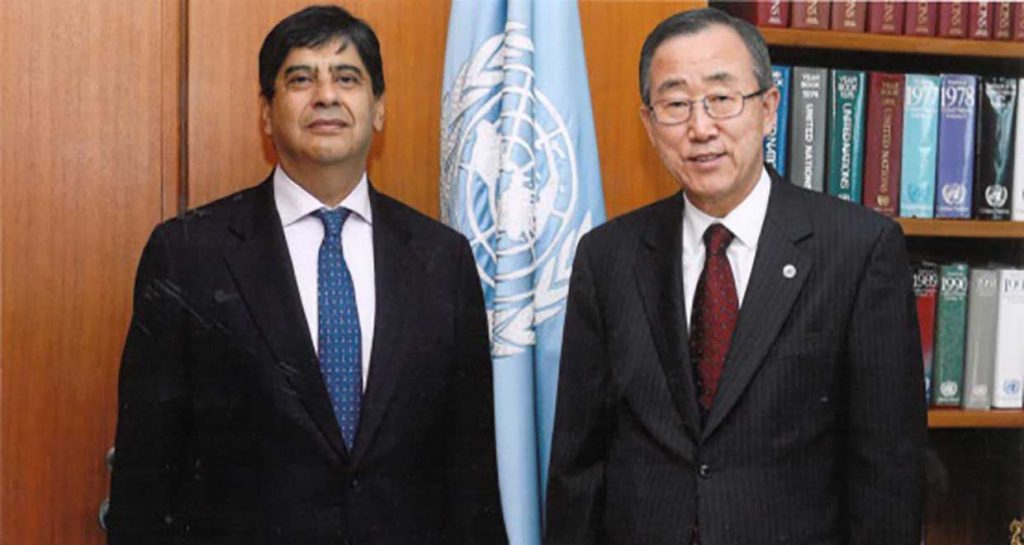
    When I started on my own I was fortunate to be appointed as the Indian High Commission in London’s Solicitor. At that time the High Commissioner was Dr. Syed Mohammed who was himself an ex-English Barrister and he had been the Advocate General of Kerala and Minister of State for Law and Justice in Indira Gandhi’s Government. He was thrilled to see a young Parsee Indian starting a law firm in the City of London keeping his Indian surname.
     

    What motivated you to start Zaiwalla and Co. Solicitors?

    When I was working at Stockens I became friendly with Cedric Barclay who was an eminent and popular maritime Arbitrator. I got to know him and a few months before I was enrolled as a Solicitor, he invited me for a cup of tea at his office. In the course of our conversation over tea, he strongly advised me not to join the big English Solicitors firms. He said, “You are good and well liked, but if you join a large English maritime firm, the Senior Partner will take you for lunch once a year and say, “Good job, old boy”, but you will go no higher.” So he advised me strongly to start on my own. True to his word, when I started Zaiwalla & Co., he personally took me to the offices of big ship owners to introduce me and recommend me to them. Very soon I had a reasonably large Greek ship owning clientele.

    Surprisingly, when I started I did not face any major hurdles with the white professional population. They were somewhat surprised to see a brown face but they were more than encouraging. Appearing before the English Commercial Court Judges was a very favourable experience. The Judges would make sure that I was comfortable and go out of their way to ensure that they had fully understood my client’s case. In a way, I found myself sometimes in a more advantageous situation then the white contemporaries in Court. In due course the word went around and the client base started to build and within five or six years I had 23 lawyers working in my firm and at that stage Zaiwalla & Co. was mainly an international Arbitration firm doing maritime Arbitrations and litigation which was mainly for Indian Government cases in the English Court.


    You have represented major clients including governments. How have you developed and maintained a client base?

    It is hard work to maintain a client base. An essential ingredient for this purpose is to keep in constant contact with the client. What a client expects from a lawyer is integrity, competence and speed. I made sure that I provided all three of these to our clients.


    What are the qualities one needs to develop to become a successful arbitrator? 

    (Sarosh has been appointed as an Arbitrator in a number of multi- million dollar disputes.)

    An Arbitrators task is very different from the task of a lawyer. I have always been a creative lawyer and I believe in the principle that “law is for justice and not justice for law”. My firm and I have built up a reputation of being creative on issues of law. As a lawyer I can put forward a creative proposition of law to fit the facts and it would be for the Judge or the Arbitrator to decide whether there was any value in such a proposition. However, as an Arbitrator it is for me to make sure that I get it right and live up to the trust which the parties had placed in me to give a correct decision. There are times when I am one of the three members of the Arbitration Tribunal. In that case usually the Chairman who is the third Arbitrator prepares the first draft of the Tribunals award. Many times I have sat as a Sole Arbitrator for multi-million dollar disputes and such cases require a lot of thinking in arriving at my decision which is not very easy. The most important quality to be an Arbitrator is integrity and commercial common sense. An Arbitrator is a Judge who is appointed by the private party whereas a Judge is appointed by the state. Recently, there was a case in the UK Supreme Court (Hashwani v Jivraj) which my firm had handled where the issue was whether an Arbitrator is an employee of the parties. The English Court of Appeal said yes an Arbitrator is an employee of the parties but the UK Supreme Court reversed their decision and held that an Arbitrator is not an employee and he perform the same function as a Judge.
     

    Can you tell our readers about the nature of maritime disputes and how they are unique?

    A substantial part of the international trade of goods and commodities takes place by transporting of those goods by ocean going vessels. In the course of the voyage, often goods get damaged because of dampness in the vessels hold or seepage of sea water in the hold. The other types of dispute which generally arises relates to charter party disputes which includes demurrage disputes, bill of lading disputes, General Average and collision at sea disputes. I have had the privilege of handling all of these types of disputes. India’s first success in the House of Lords in a commercial case concerned the vessel called La Pintada. In this case the charterer was the President of India and he paid demurrage some two years late. The owners of the vessel commenced Arbitration claiming interest on a three month compounded rate basis arguing that they had lost the use of money by the delayed payment. The Arbitrator made an award of compound interest in onus favour. The High Court sent the award back to the Arbitrator for reconsideration on the basis that the award sought to make charterer an involuntary banker. The Arbitrator once again confirmed the award which he had previously made. When Indian Government challenged the award once again in the Commercial Court, the Court referred it straight to the Supreme Court for decision. The House of Lords unanimously decided in Indian Government’s favour. This was a test case because in those years of foreign exchange crisis, Indian Government always paid freight and demurrage late and if India had lost in the House of Lords, they would have had to have paid over £5 million in compound interest because other ship owners would then be claiming compound interest for late payment. Incidentally in this case, the Barrister my firm had instructed was Tony Blair who later on went on to become the Prime Minister of the UK. Please see 1983 1 Lloyds page 39.


    Can you give our readers some insight into the Tibet dispute as well as the efforts being undertaken to resolve it? 

    (Sarosh was appointed by His Holiness the Dalai Lama to mediate with the Chinese government in order to resolve the Tibet dispute.)

    I am a qualified CEDR (Centre for International Dispute Resolution) Mediator. For many years my firm acted for PRC Government in their international Arbitration cases. My firm had an office in Beijing for twelve years. We represented CNPC, CPECC, CPTDC and Min Metals in five major international Arbitrations. Chinese Embassy had heard about my firms successes for Indian Government and the then Chinese Ambassador in 1991 had a meeting with me and asked me to assist China to set up in China a legal system which could work internationally. The Embassy sponsored a trip for me to visit Beijing in December 1991. In 1994, I facilitated a second channel dialogue between 10 Downing Street and the central committee of Chinese communist party on misunderstanding which had arisen concerning the agreement to hand over Hong Kong to China. This was a successful dialogue. Thereafter, my relations with Chinese Government became very friendly and my firm got a lot of legal work from Chinese state corporations.

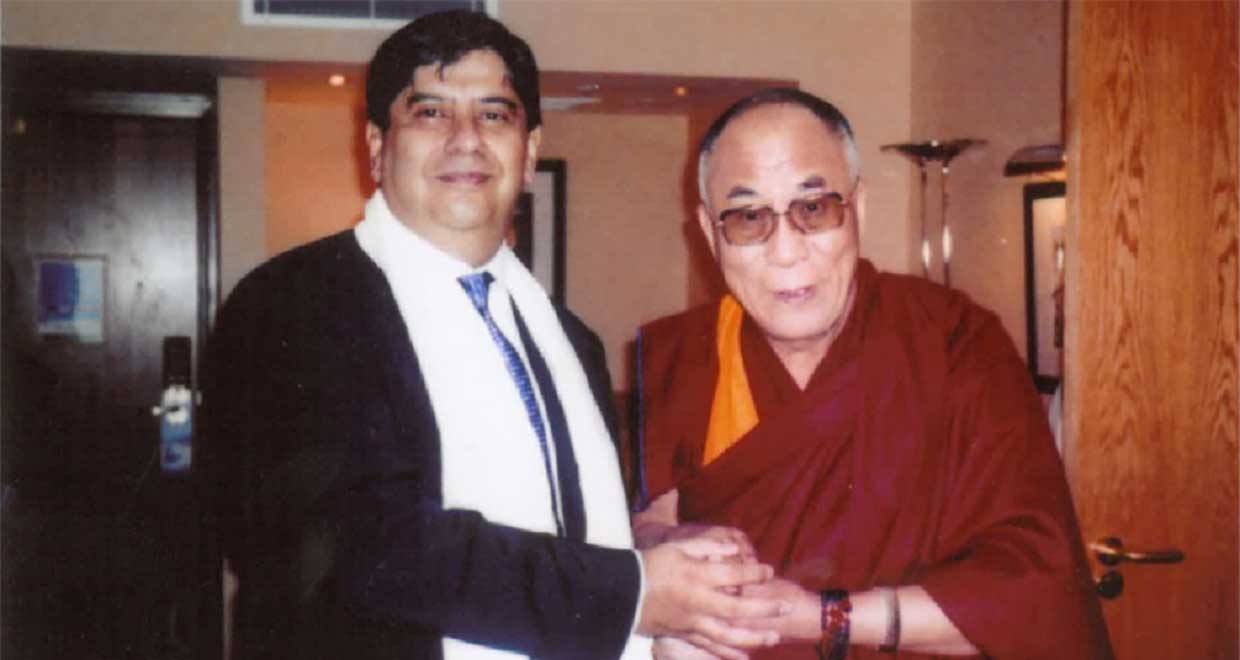
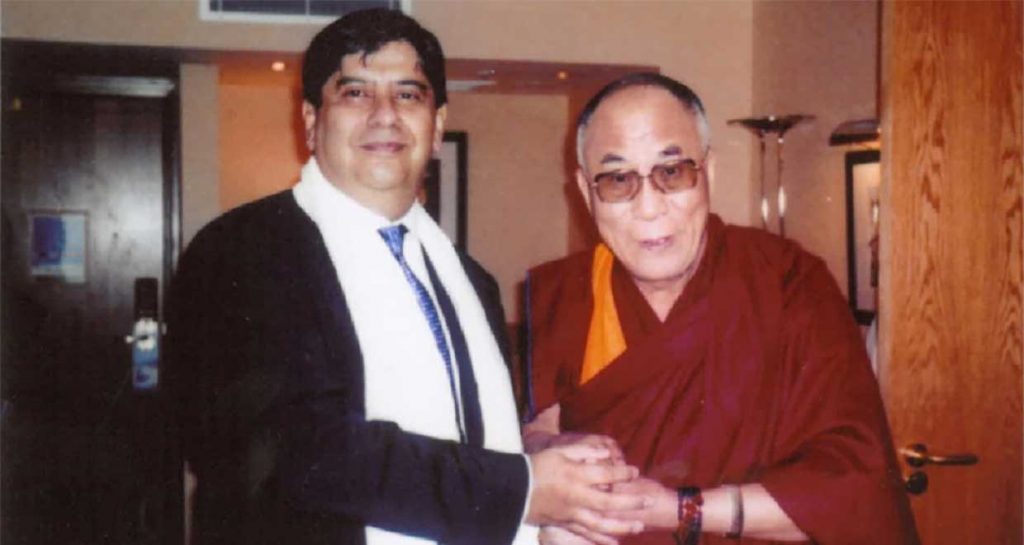
    A few years later, Mrs. Takla, the representative of Dalai Lama contacted me.  She told me that Dalai Lama was going to visit Glasgow very soon and he would like to meet me. Accordingly, a private meeting was arranged for me in Glasgow with Dalai Lama. I was told by Mrs Takla that Dalai Lama would like me to facilitate a second channel dialogue with China to resolve the dispute between him and China relating to Tibet as he would like to go back to his home, Tibet.

    I informed the Chinese Ambassador about the Dalai Lama’s request for a meeting and before meeting Dalai Lama I had a meeting with the Chinese Ambassador in London. The Ambassador put forward China’s position and told me that one of the things which concerned China was that Dalai Lama was writing forwards to books written where the author claimed that half of China was Tibet. It was a great pleasure and honour to meet Dalai Lama on a one to one basis. I found him to be very frank and honest. He told me that his intelligence had told him that I was one non-Chinese person in the West whom the PRC Government had complete trust and confidence. He sought my help for a second channel dialogue to resolve the Tibet issue.  I told him that China was concerned about his writing forwards to books which claimed half of China was Tibet. Dalai Lama’s response was that he had no option but to do this because his Tibetan people had lived in those parts of China for centuries and it was historically part of Tibet. In a moving gesture, Dalai Lama took my hand and put it on his heart and said, “I trust you”.

    After my meeting with Dalai Lama I had a meeting with the Chinese Ambassador and told him that it would be in China’s interest to resolve the issue with Dalai Lama as he was no longer claiming independence for Tibet. Furthermore , I was aware of the communist Chinas policy towards religion which was that religion was now being permitted provided it was not controlled from outside China. In Dalai Lama’s case, he would be involved in religion from Lahasa, the capital of Tibet which was now part of China. The Ambassador told me that he would communicate his discussion with me to China. A further meeting was arranged between me and the Chinese representative and I was told that the Dalai Lama’s brother had been invited to China for discussion and there was no need for a second channel to take place through me.
     

    Can you tell our readers about the process of framing arguments and the experience of arguing before the EU court?

    (Sarosh’s was the first firm to successfully challenge the listing of Iranian companies under Iranian Nuclear Sanctions before the EU court.)

    This is correct. Bank Mellat which was Iran’s largest private bank, had challenged the sanctions in the High Court and had lost. Thereafter, Bank Mellat appealed and the Court dismissed the appeal. Bank Mellat’s former Solicitors, Stephenson Harwood, had told Bank Mellat that there was little prospect of Bank Mellat getting leave to appeal from the Supreme Court. I was one of the Solicitors Bank Mellat met with a view to deciding who to instruct for their attempt to appeal to the Supreme Court. I had earlier acted in a major Arbitration for National Iranian Oil Company (NIOC) and had turned around what they had been advised was a hopeless defence in an Arbitration case and was successful for NIOC. So the legal director of NIOC had mentioned my name to Bank Mellat and recommended my firm. The rest is history, we were successful before nine out of the total twelve Judges of the UK Supreme Court. The Supreme Court held that the UK Government had acted unlawfully and irrationally to list Bank Mellat in the list of companies supporting Iran’s nuclear proliferation and to whom the sanctions would apply.

    The Supreme Court referred the matter to the High Court to calculate damages and Bank Mellat is currently pursuing a claim of USD 4 billion for damages in the UK Court for wrongful listing of Bank Mellat on the nuclear sanctions list. It was also the first time that the UK Supreme Court went into a closed, secret hearing on grounds of national security. The trial of this claim is fixed by the English Court for October 2018.


    You are a member of all major arbitration institutions. What is your preferred forum? 

    My preferred forum for international Arbitration is either London Court for International Arbitration (LCIA) or International Court of Arbitration of the International Chamber of Commerce, Paris (ICC). I was a member of the International Court of Arbitration for twelve years representing India. An equally efficient forum and possibly less expensive would be for parties to simply agree London as a seat of Arbitration as this would save the administrative costs of the institutions and the Arbitration would be under direct supervision of the English Court in case something goes wrong in the Arbitration.


    Do you think India has the potential to become a major arbitration hub? 

    Yes, India has great potential to become a major international Arbitration hub but India has a long way to go to achieve this goal. A small country like Singapore has within a few years built up a popular international Arbitration centre and there is no reason why India cannot do so. The international centres of Arbitrations are made by good reputation and law. Reputation is a question of perception. Arbitration in India today does not enjoy a good international reputation. There are rumours of corruption amongst the Arbitrators. I am sure this rumour is unlikely to be true but one must recognise that even one case of corruption poisons the reputation of the whole Arbitration culture in India. I have had many meetings with those who manage international Arbitration in India, including with Mr Arun Jaitley and at each of these meetings I have said that the risk of corruption in the international Arbitration in India cannot be eradicated by passing of law eradicated by self-regulation in the Arbitrators community and the legal profession. Another minus point for international Arbitration in India is the perceived monopoly appointment of retired Judges who then conduct the Arbitration as if it was Court proceedings with adjournments being granted for asking. The new Indian Arbitration Act has restricted Court intervention in the Arbitration process which is a good step forward for India.


    International Arbitration is considered a difficult field to break into. Can you describe your journey in becoming such an authority in this field? 

    This is correct. So far, the international Arbitrators community has been an elite circle where one supports the other with the consequence that a newcomer is not easily accepted unless he blends in by accepting to begin with a second class status. The selection of Arbitrator is an important task. He should be a person with good legal and commercial law experience. The task of a party appointed Arbitrator is not to favour his appointer but he has a duty to ensure that his appointer’s points are considered by the whole Tribunal at the time of making the decision. I have found that many times, Indian parties appoint retired Judges in the international Arbitration and they are indeed very clever but they are not able to communicate with the co-Arbitrators properly, who are normally from developed countries. Often, retired Indian Judges who are product of the British imperialist culture, have enormous egos about their status. Let me give one example.

    I was appointed by the Danish company Volund to be their nominated Arbitrator in the early 90’s. The Arbitration concerned construction of a power plant in Timarpur near Delhi whose fuel would be New Delhi waste. In other words, the power plant would be converting New Delhi waste into energy. The project was supported by Danish aid agency (DANIDA). After the power plant was constructed, it was found that New Delhi waste did not have sufficient calorific heat to be used as fuel for the power plant. India appointed Mr Pathak as their Arbitrator. He was a former Chief Justice of India and retired Judge of the international Court of Justice in The Hague. The third Arbitrator and the Chairman of the Tribunal was Lord McKenzie Stuart, a former Chief Justice of the European Court. He was appointed by the International Court of Arbitration.

    On the first day of the hearing I got a note passed to me by Chief Justice Pathak which said, “You have insulted me by sitting on the right of the Chairman, I am senior to you so I should be sitting on the right of the Chairman and you should be sitting on the left”. I immediately passed the note to the Chairman with a suggestion that he adjourns the hearing for five minutes so that I can change over. He sent the note back to me saying “stay where you are”. In England or in Europe in international Arbitrations it does not matter which side the Arbitrator sits. During the coffee break, Lord McKenzie Stuart told Chief Justice Pathak that it does not matter where the Arbitrator sits and he jokingly told Chief Justice Pathak, “Don’t be a fool”. The Chief Justice took offence to this and throughout the two weeks hearing he did not utter a word and did not speak with Lord McKenzie Stuart throughout the Arbitration reference thereafter.

    The way to break into the field of international Arbitration is to first attach with a law firm or an advocate who is already handling international Arbitrations and then attend international Arbitration conferences.


    Can you describe your work as a solicitor in England?

    A Solicitor in London prepares the case and instructs the Counsel to argue it before the Court. It is now also possible in commercial cases for Solicitors to appear in Court as Advocates, I have done so on many occasions. My firm and I are known for difficult cases where client comes to us after they have been told by the Magic Circle firms that their claim or case is very bad.

    Two examples of this are the international Arbitration award by International Arbitration Court in The Hague which made an award of USD 50 million against the Russian Federation in the Yukos shareholders claim. Russia came to me for an out of box approach for Russia challenging the award in the Dutch Court. Sometime before this, an Indian Government company PEC Limited had come to me and they had an award of USD 8 million against them. On the face of it they had no defence because they had participated in the Arbitration and also the appeal process of GAFTA Arbitration and had lost. I took the point that although English law applied in the contract, the contract was signed by the Director of PEC on behalf of PEC and whether he had authority to do so would be governed by Indian law. Under Indian law, for a Government contract there are rules and for a USD 25 million contract you require two Director’s signatures.

    PEC therefore through my firm argued that the Arbitration agreement was void because the contract was void. In the English Court on the question of Indian law we led the evidence of Mr. Soli Sorabjee, former Attorney General of India and the other side which was a Thailand company, Asia Golden Rise, led the evidence of Mr. Harish Salve. Both of these eminent jurists were cross examined in open Court and the Court preferred the evidence of Mr Sorabjee. This changed the prevalent law.

    The second example was the case of Indian Oil Corporation (IOC) v Coastal Bermuda where IOC had participated in the London Arbitration defending a huge claim of some USD 18 million. The Arbitrators decided against Indian Oil Corporation but one of the Arbitrators, Mr. Gordon Pollock QC, added a post-script to this decision suggesting that Indian Oil’s legal team was not competent and if the team had been competent, the result may well have been different. My firm did not act for IOC in the Arbitration but they came to me after all the big law firms and Queen’s Counsel had told IOC that they had no chance of challenging the award. My firm challenged the award on an innovative ground that the award could be enforced as a judgment of the English Court and for the English Court to enforce a judgment which was not based on the two legal analysis of the evidence would be against English public policy. The English Court accepted this and remitted the award back to the Arbitrators and in its judgment said, “Finality is good but justice is better”. Indian Oil Corporation v Coastal Bermuda [1990] 2 Lloyd’s Rep. 407.


    Where do you stand on the “two hat” debate over whether arbitrators should also act as counsel? 

    There is really no problem. When I am appointed as an Arbitrator, if there is a conflict I will not accept appointment. International Arbitration is a field with many important debates currently going on, with many suggesting reforms such as Bilateral Arbitration Treaty (Gary Born), regulating the ethical conduct of counsels (Swiss Arbitration Association, London Court of International Arbitration).


    Could you discuss the aforementioned suggestions and your take on them or any such significant debates?

    The most important reform which is required is the need of diversity in the clique of international Arbitrators. The current international Arbitrators must be prepared to accept competent Arbitrators in the circle of international Arbitrations. Statistics show that the present international institutions generally favour appointing white Arbitrators from developed countries. This needs to change.


    How do you remain updated with all the new developments in the field of international arbitration and mediation?

    There are at present many press and internet mediums which keeps me informed on all the new developments in the field of international Arbitration and Mediation.


    What advice do you have for our readers who are primarily college students?

    Always act with integrity and remember the legal profession is an honourable profession and honesty and fairness is the most important duty of a lawyer. The policy which I follow is that I can play with the law because the Judge is there to reject or accept my submissions on law but not under any circumstances play with the facts. If I find that the client has told me a lie in his instructions I would refuse to act for that client. I would not make up stories or allegations on behalf of a client simply to support the client’s case. This approach breads both character and increases credibility before Judges. The five mantras for law students, I would suggest, are:

    • Have a vision on where you want the business to go.
    • Have integrity and honest approach in the work you do.
    • Have courage to have an open mind and an out-of-box approach to progress the business.
    • Make the most of all that comes and the least of all that goes.
    • Forgive people for any wrongdoings against you, and leave it to the universe to deal with them.
  • Andrea Chavarria, Founding Attorney at The Chavarria Law Firm, Dallas, on practicing in international immigration law

    Andrea Chavarria, Founding Attorney at The Chavarria Law Firm, Dallas, on practicing in international immigration law

    Andrea Chavarria is an American lawyer and business owner who works on immigration issues at the Chavvaria Law Firm in the Dallas/Fort Worth Area. Andrea after completing her Bachelors on Journalism in 2004 from University of Texas, went ahead to pursue a year long masters program in International Law and Diplomacy from Schiller International University. Thereafter Andrea joined the Juris Doctor programme at Thomas M. Cooley Law School and qualified in law in 2009.

    Andrea pursued a few more short term courses at University of Geneva, the Hague Academy of International Law and at the School of Advanced Study, University of London.

    In this interview, she speaks to us about:

    • What motivated her to pursue law and take up immigration issues
    • How her experiences at the Hague, the University of London and the University of Geneva impacted her
    • Her pro bono work with CARA
    • Her views on the immigration issues and refugee laws, as well as her expectations about the evolution of policy in those areas


    How would you like to introduce yourself to our readers?

    I was born in Mexico and raised in the United States. I am an attorney and business owner in Texas. I love traveling, reading, listening to live music, and tacos.


    Growing up in America, what motivated you to take up and pursue a career in law?

    As a kid, I would watch my mother help out people in our community. They were usually people who had just moved to the United States or who didn’t speak English. I knew that I wanted to help people as well. It wasn’t until I got to college that I realized that I wanted to become a lawyer. As an immigration attorney, I have the opportunity to help people in a way that positively changes their lives.


    What prompted the switch from journalism to law? How do you think the two professions differ with respect to the impact you can make towards social justice and change?

    I originally wanted to become a journalist so I could write about politics, laws, and human rights issues. I was taking a lot of political science classes in college and that’s when I realized that I wanted to work directly with people and the law rather than write about it.

    The two professions differ but both professions are necessary in order to have an impact on social justice and change. Immigration attorneys can have a direct impact on someone’s life, which in some cases can be a matter of life or death. For example, I represented an individual who, if returned to his home country, would be persecuted by his home country because of his religious beliefs. We won the case and the individual was able to remain in the United States where he can openly practice his religion.

    Journalists are important. They can have a broader impact because they are able to present an issue to a wider audience. There was a particular judge in an immigration court who was known to be ruthless towards children in removal proceedings. Complaints were filed by several attorneys, but nothing changed until a newspaper published an article about the behavior of the judge. Soon after, all of the children cases were removed from the judge’s docket. That’s just one example of how journalism can have an impact on social justice and change.


    Consequently, how did your experience as a legal assistant/intern change your views on the ground realities of the practise?

    It wasn’t until I worked as a legal assistant and as an intern that I realized how much work goes into one case and how important it is to have a good team working together. Attorneys generally get the credit, but assistants, paralegals, interns, and other staff members deserve credit as well. It really is about teamwork.


    Your extensive work as a volunteer covers refugees, family detention, mentoring, etc. What motivated you to take up these causes?

    Through my practice, I realized that there was a great need to help certain individuals who were fleeing their countries, but who did not necessarily have the funds to hire an attorney. In the United States, individuals who are in removal proceedings are not afforded an attorney. Even children as young as three years old are not provided an attorney. These individuals are often seeking asylum. Having an attorney can often make a difference in someone’s case. Everyone deserves to have the right to put forth the best case possible. That’s one of the reasons why I am an advocate for volunteering and working with refugees and fighting against family detention centers.

    I also do volunteer work through the Dallas Bar Association and Dallas Hispanic Bar Association. I enjoy volunteering with these organizations because I get to help my local community. It’s important to give back to your community.


    andrea-chavarria-2

    To what extent did your education at The Hague Academy, the University of Geneva, and the university of London augment your perspective on the immigration laws and other related issues within the U.S.?

    My time at those institutions has taught me how intertwined the U.S. immigration laws are with international laws and human rights principles. When working on an immigration case, it’s important to not only look at our current U.S. immigration laws, but to also look at our international principles and obligations. In the immigration field, we have seen situations where the United States failed to adhere to its international obligations. We’ve recently seen this happen with the detainment of Central American women and children. The institutions mentioned above have helped me gain a better understanding of our international laws, obligations, and the complexities of enforcing these laws and obligations.


    What would you like to tell the readers about your pro bono work with CARA?

    I previously did some volunteer work with the CARA Family Detention Pro Bono Project. CARA was created due to the Immigration and Custom Enforcement’s (ICE) significant expansion of its family detention centers in Dilley, Texas and Karnes City, Texas. Women and children, who are often seeking asylum, are being detained in facilities that are inhumane and inconsistent with a fair and just legal process.

    andrea-chavarria-1I spent some time at the detention center in Dilley, Texas where I assisted in representing women in their bond hearings, preparing them for their credible fear interviews, and informing them of their legal rights. All of the women I spoke to fled their home countries because they feared for their lives or the lives of their children. Some of the women had been in the detention center for months because they could not afford to pay the bond the immigration judge issued. Some of these bonds were as high as $15,000. Many of the women felt hopeless. A majority of them were traumatized. Others were stressed and worried about their children who were also in the detention center. Some children weren’t receiving adequate medical care. Other children weren’t eating properly and losing weight. It was shocking and heartbreaking to see women and children, who had fled their countries due to fear, be treated in such an implacable way. Unfortunately, these family detention centers still exist. Women and children continue to be detained in this centers. If it weren’t for CARA and the help of volunteers, many of these women and children would not know their legal rights. To learn more about CARA visit their website: http://caraprobono.org.


    What drove you to establish your own firm in 2010?

    It was a culmination of things. I was working for a particular law firm and realized that it wasn’t the right fit for me. I wasn’t sure what to do next, but I knew that I still wanted to work in the immigration field. I relocated to Dallas and soon after I realized that there were many people who were in need of immigration assistance. Both of my parents are business owners so I grew up with a business owner mentality. It was with their help and support that I made my decision to start my own practice.


    Given the socio-political atmosphere within the country owing to the upcoming elections, how do you think immigration and refugee law and policy will evolve in the near future?

    I would like to think that in the future we will have sound immigration laws and policies, but I don’t foresee it happening in the near future. In the last couple of years, I have seen how fear and xenophobia have affected refugees and immigrant communities. The state of Texas tried to block Syrian refugees from entering the state, which the federal government said it can’t do. That’s just one issue, but there are so many other issues that we have to deal with in the immigration field.

    Overall, our immigration laws are complex. Advocates have been trying to push for some type of immigration reform for more than ten years. Congress has repeatedly failed to pass any type of immigration reform. The Obama Administration has deported more individuals than any other president. Recently, the United States Supreme Court issued a 4-4 split decision in U.S. v. Texas, which was a lower-court challenge to the expanded Deferred Action for Childhood Arrivals (DACA) and Deferred Action for Parents of Americans and Lawful Permanent Residents (DAPA). The deadlock means DAPA and the expansion of DACA will not move forward.

    There are numerous issues that need to be addressed within immigration law and the outcome of our next presidential election could gravely affect how our laws and policies evolve. Depending on who wins, we may see harsher policies and more deportations or we may see a push for comprehensive immigration reform. At this point, I’m unsure of what our future immigration laws and policies will look like.


    As a lawyer, do you believe that it is a responsibility of those well versed with the legal statutes and policies to aid those without the resources to access this due procedure?

    Yes, I strongly believe that individuals, such as attorneys, who understand the law have a responsibility to provide assistance to those without resources. One of the best ways to assist is by providing pro bono services through a non-profit organization or local bar association.


    Summing up, what do you believe are the main obstacles to progressive immigration laws?

    One of the main obstacles is Congress and its inability to pass a comprehensive immigration reform bill. Congress has been deadlocked over the issue for the last few years. On November 20, 2014, President Obama announced his executive action plan, which would grant deferred action to certain individuals. Some members of Congress believed that his actions were beyond the scope of his authority. His plan to bypass Congress was met with some controversy and once again, Congress killed any chance of passing a sensible immigration reform bill. Will Congress remain at a standstill? Only time will tell.

    Another major obstacle is the misconception of immigration laws. There’s the rumor that giving birth to a child in the United States grants automatic citizenship to the parents. It does not. I’ve been asked why undocumented individuals don’t just get in line to obtain legal status. There is no one line. Some individuals may not have a qualifying relative to petition for them. In other cases, it can take more than 20 years to obtain legal status through a family member. The process isn’t as quick and easy as some might think. Another common myth is that most immigrants are in the United States unlawfully. While there are some undocumented immigrants, there are also various other immigrants who are legally residing in the United States or who entered the United States lawfully. All these types of misinformation are harmful because it undermines public support for immigration reform.


    How do organizations such as AILA help change the status quo?

    Change comes through advocacy. Organizations, such as the American Immigration Lawyers Association (AILA), play an important role in advocating for reasonable changes in immigration law. In April, I traveled to Washington, D.C. to participate in AILA’s National Day of Action. Several AILA members and I visited Congressional offices to explain why comprehensive immigration reform is necessary. This type of advocacy is important because it’s an opportunity to highlight the problems plaguing our current laws. It’s also a chance to give members of Congress and their staff examples of how our existing laws have affected immigrants, their family members, and their communities. Since it’s the role of Congress to pass legislation, it’s crucial to inform its members why certain laws aren’t working.


    Finally, do you have any other advice for our readers, most of whom are college students?

    You will make mistakes. We all make them. However, learn from your mistakes and always own up to your mistakes.


  • Dr. Panayotis Protopsaltis on expertise in International Investment Law, the legal profession, experience in teaching and interaction with students

    Dr. Panayotis Protopsaltis on expertise in International Investment Law, the legal profession, experience in teaching and interaction with students

    Dr. Panayotis Protopsaltis is a Greek national and he is presently a visiting faculty at the GNLU, Gandhinagar. He is a reputed international scholar having expertise in International Investment, Cross Border Transaction and Dispute Resolution. It has been a great experience meeting him and talking with him at length about the pedagogy of different institutions and universities he has attended.

    Conversing with him has been a great experience and almost a tour through many European Institutes, therefore I took this opportunity to share his insights and experience with our readers.


    First of all, please tell us a bit about yourself. What is your current work profile?

    I studied law at the National and Kapodistirian University of Athens, Greece, at the University of Paris II (Panthéon-Assas) and at the University of Paris I (Panthéon-Sorbonne) from where I hold a doctoral degree in public international law. I have conducted research in the framework of various research centres and delivered lectures at universities in France and in Greece on international investment law. I am also a practicing lawyer, member of the Athens Bar Association. Since the beginning of my career, I was involved in transborder transactions, originally in the introduction of mobile telephony in Greece and subsequently in some major investment projects in Europe and in the Middle East. In the recent years, I have been retained to advise various public and private institutions on international investment law related matters.


    How did you decide to pursue law? In India a lawyer is still looked at with caution and doubt, how is the scenario in Greece?

    [sociallocker] As is the case with many people studying law, when I graduated from school, I did not know exactly what I wanted to do. I graduated in 1987 and information one could obtain at the time was much more limited than information available today. I decided to study law because a law degree offers tremendous opportunities for work in a number of sectors. Civil service or administrative work in international organisations is one solution, career in legal professions, law professor, judge or attorney, is another. I was perhaps also influenced by a number of family friends that had also studied law. When I began my studies I was fascinated by law and tried to improve my knowledge and skills, nothing else mattered.

    I have heard many times and in many countries that lawyers are looked at with caution and doubt. I am also familiar with the various jokes about lawyers. However, so far in my career in Europe I have never experienced caution and doubt. I am therefore not convinced that this assumption is correct.


    From where did you study your undergraduate degree in law? Please tell us about the academic structure of your undergraduate degree.

    I graduated from the National and Kapodistrian University of Athens, the major law school in Greece. Curricula in Greek law schools in the late 1980’s included four years of study and no specialisation. Lectures were delivered to all students, often 250 persons in an amphitheatre, by professors themselves or by their assistants and presence was not compulsory. Professors delivering lectures were rarely asking questions to their audience and vice versa. A free of charge manual was given to every student –usually written by the professor. Of course, there were no moot contests and student exchange programs, some students participated in small working groups and could present their work but this was the exception rather than the rule. Some exams were particularly difficult to pass and students had to sit twice or even more.

    Lectures were delivered in Greek and focused on Greek law but law school libraries have impressive collections of German, French and English books. This is because most professors had studied in Germany (private law), France (public law) and in the UK and the U.S.A. and a number of professors of Greek law schools hold permanent posts also in other European Universities. Greek students were therefore in close contact with European and U.S. bibliography.


    You earned a Masters and Doctorate from University of Paris. How was your experience there?

    I had already completed my vocational training at the Athens Bar Association and I was a full time lawyer in Athens but I was always interested in international law and in research. I therefore decided to enrol at the LLM of international economic law at the University of Paris I, recommended to me by one of my professors. Depending on the subject Germany, France and the UK were the normal destinations for young degree holders wishing to pursue further study.

    I did not know what to expect but found instead the good old continental model but students were now expected to do research on their own and actively participate at lectures. I was admitted for a research degree and so completing a doctoral thesis was ultimate aim. Doctoral research was long and slow, in France students rarely completed their thesis in less the five years and were working as assistants at various universities or managed to obtain posts in international organisations. A limited number of students gained scholarships and I was one of them. Doctoral research was therefore undertaken only by a limited number of passionate students.

    Interestingly enough, the French government at the time gave incentives to students to pursue further studies. This was because France had high unemployment and young people could not be absorbed by the market. Many unemployed chose to pursue further studies. This created a market for academic services, the need for more university professors and a generation of very well educated people.

    I benefited a lot from my stay in France. Along with my work on my doctoral thesis I had the opportunity to meet with some of the most important authorities in international law, participate in research groups and conferences, gain experience in teaching, to be involved in the work of international organisations and to some major international projects. I also benefited from the cultural events, museums and lectures on history and art, so abundant in Paris.


    You speak German, French and Turkish apart from Greek and English. How do languages help in your work and what are the difficulties in learning in a foreign language?

    I learned English and French from a very young age, it was very common -and still is- in Greece to learn two or three foreign languages and master them by the age of 18. I learned German and Turkish later on, as a university student. I made the effort to learn because languages are one of the most useful tools in everyday life and in academic research in Europe. Monolingual academics are usually at a great disadvantage.

    Students should not be afraid of studying abroad in a foreign language. First of all, their presence in the foreign country will allow them to acquire easily the necessary linguistic skills for communication. Then, post-graduate studies will learn all necessary legal terminology but as they have already read law, it will be easy for them to understand the corresponding meaning. Then, they may also seek help from native speakers. Foreigners at the beginning are of course at a disadvantage compared to native speakers but rarely post-graduate students fail solely because of poor linguistic skills.


    Would you recommend your students to pursue Masters and doctorate in continental Europe?

    I think Europe hosts some of the best universities of the world and students have a lot to learn from their presence there. Not only they will benefit from interaction with some of the most renowned academics of the world but they will also see a different way of work and approach to scientific problems.

    Continental universities follow a different system based on students’ responsibility. In that, the university differs from high school, students are given limited guidance, they are required to work on their own. Continental universities still favour theoretical analysis over practice and studies are not job-oriented, this is the essence of European academia. A drawback is perhaps that inter-disciplinary studies are not so common.


    What attracted you to research in international investment law?

    Originally, I took special interest in the problems of regulation of the Multinational Enterprises but I soon moved to examine the problems of international investment law. This shift in interest war normal since the two problems are inter-related. I was also lucky to have two mentors, Prof. Patrick Juillard and the late Prof. ArgyriosFatouros, both authorities in international investment law, who encouraged me to explore international investment law questions.


    panayotis-protopsaltis-2

    How has your experience in India and GNLU been so far?

    I came to India for a short visit two years ago, liked the country and wished to learn more about its institutions and its people. The invitation at the GNLU was a formidable opportunity for me to see Indian academia and meet with Indian academics and students. I delivered two courses, on the law of multinational enterprises and on international investment law and I am very happy with the interest that my audience takes on the topics.


    Students may be indifferent or disinterested in the subject being taught. How do you deal with these and revive interaction among students?

    Your question assumes that professor has to do something for indifferent or disinterested students. Well, I am afraid this is not the case. First, because there are always indifferent or disinterested students at class. Second, because, assuming that students have chosen to study law, they should be interested in the subjects being taught. Third, because students’ duty to learn does not depend on professors’ performance. Students cannot use professor’s poor performance as an excuse for not learning. There are other procedures to sanction professor’s poor performance, if there is one.

    I think that the professor should prepare himself to deliver a lecture and that the lecture is in some respects like a theatre play, the professor being the actor, the students being the audience. Some jokes and stories may help to attract students’ attention, participation of students at the lectures also but the professor must never turn lectures into a discussion forum. Academic conferences and research groups offer many opportunities to students to interact and express their opinion. I also believe that some professors are more inspiring than others but, alas, there is no objective criterion for that. I finally think that we all have to suffer from boring speeches or speakers if we are to learn how to make our lectures interesting.

    As I have already said, students have a duty to themselves, to their parents and to the academic community to learn. Students who are disinterested have again a duty to themselves, to their parents and to the academic community to explain why and in case they realise are generally disinterested in the topic of their study or in studies in general, to have the courage to change the topic or quit studies altogether, immediately. Otherwise, they will spend many unhappy years and will perform poorly at the university. In addition, they will spend valuable resources, their personal time, the money of their parents, the facilities of the university, the time of their professors that could be used more productively elsewhere.


    What would be your advice to students on performing well in academics?

    Performing well at university requires understanding the system of academic study. Method of reading, exercise in legal writing and interaction with other students and professors in the academic community are very important. Now some students obtain better marks than others. This may be due to a number of factors, insufficient preparation, failure to understand, failure to express themselves, to name just a few. Students have to learn from their errors and correct them. Yet, the key to success is, I think, genuine interest. Genuinely interested students are always very successful at university because they do a further effort for the sake of learning and adopt this inquisitive approach to problems which is a prerequisite for academic excellence.

     [/sociallocker]

  • Neha Bhat, on LL.M from Washington College of Law, selecting the correct college & Scholarships

    Neha Bhat, on LL.M from Washington College of Law, selecting the correct college & Scholarships

    Neha Bhat is currently working as an Associate Durable Solutions Officer at United Nations High Commissioner for Refugees. She graduated from WBNUJS, Kolkata in 2007 and had studied further at American University, Washington College of Law. She has specialised in International Organisations, International Human Rights Law and Migration Law and Policy. Without much ado, let’s delve right into her choice to do an LL.M and pursue International Human Rights.

    We asked her to share:

    • Strategies on selecting an university for LL.M
    • Information of Faculty and Facilities of Washington College of Law
    • Applying for Scholarships at WCL


    What was your motivation behind doing LL.M.? When did you finally decide that you needed to do masters?

    I have always wanted to pursue further studies. Even when I was in my final year at NUJS, I was sure that I will complete my masters and subsequently get an advanced degree- you know MPhil or PhD or the like. I genuinely like reading and getting to know subjects and issues. I really enjoy exploring areas of law that I don’t really have much experience in and an LL.M program helps me exactly with that.

    Since you are into the academic arena, you are either writing or researching and reading and that really works well with me. Eventually, later in life I want to teach and therefore I knew I would always have to finish my LL.M and then an advanced degree. But I wanted to have work experience before I joined the Masters degree- that was also because while at NUJS, I hadn’t really done much- I had no serious publications, wasn’t at the top of my class, wrote a really horrible statement of purpose– end result, I didn’t get admitted for my LL.M to any of the places I applied to. Plus I also realised I knew, rather understood very little of things and therefore I realised I needed some good, in depth work experience before pursuing my LL.M.

    So I joined SEBI as a Legal Officer, worked there for about 2.5 years and then went and joined the UN High Commissioner for Refugees in Delhi, where also I worked for almost another 2.5 years. After 5 years, I felt I had a very good idea of what I wanted to focus my LL.M on and even had ideas about further studies- like PhD proposal and the like, and therefore decided to come and get my LL.M degree. Also, my work at the UNHCR was very intense. I loved my work very much, I still love my work very much and I would definitely hope to get an opportunity to work with UNHCR- but I realised that you need to know when to “step back” so you don’t unconsciously burn yourself out. And after 2.5 years, I knew I had reached that point, where I was on the path to burning out in my work.


    neha-bhatHow did you choose the university/ college? How should one go about choosing a university?

    Selecting a University can be one of the most difficult things to do and if not done properly, you could end up feeling a little miserable about your choice. I have had the opportunity to put myself through the LL.M application process three times- once in my final year at NUJS, then in 2008/09 and then finally in 2010/11. When I was at NUJS, in hindsight, I made some of the worst application decisions– I remember applying ONLY to Harvard, California Berkeley, NYU (for the NYU-NUS programme) and Oxford. No other place.

    The problem with my applications was that my Statement of Purpose wasn’t right, and I had no research plan in place, I wanted to do an LL.M because it seemed the “right thing to do” and not because I knew what I wanted to study or why I wanted to do. Obviously, it didn’t work- I was rejected by all universities I applied to. I did panic a bit, thinking maybe I was very bad at this and maybe academics weren’t for me. It was the same time when I had sat for the Rhodes scholarship regional interview in Kolkata, but failed to make it to the National rounds. So it was like a culmination of bad results.

    The second time I applied, I was working with SEBI. In this round, I managed to apply to 3 places, before I came down with chicken pox. I applied to California Berkeley, again to NYU (for the NYU-NUS) programme and also to Stanford. Again, NYU turned me down. Since one of my referees didn’t submit my reference letter for Stanford, my application was incomplete so I was left out of the loop. But this time, I was waitlisted for Berkeley in the first tranche of waitlisted applicants out of some 950 odd people. It was a big moment for me. I had been working long enough at SEBI to know I was not going to study corporate law, so my statement of purpose focused on my desire to teach law and consciously I decided to veer away from corporate law. But eventually I didn’t get through. It was then I decided that I had to get back into the field I wanted to do my LL.M in and thus my job change happened. Eventually in 2010/11, I applied to 6 programs and was admitted to all but one– at LSE. The programs I was admitted to, were regionally, the best for Human Rights– NUS- Singapore, Berkeley-California (yes, again), McGill- Toronto, Warwick- UK and American University- Washington DC.

    I consciously decided to veer away from the very “top” rung places– because I STILL didn’t have (or so I felt, and still continue to feel) any meaningful academic publications etc. or what I felt, a superlative proposal which would ensure admission in these universities. Plus, I was looking at a taught masters program and therefore chose places which did not mandate a compulsory dissertation component.

    I also looked at the field specializations ranking and faculty strength rather than the overall ranking of the school because those are often better indicators of the specific program. So for example, I know that Warwick has a very solid International Human Rights Law program. American University, where I am currently studying does not necessarily come out on top of law school rankings in the US, but its International law program is ranked higher than Berkeley. Plus, it’s the ONLY law school in the US, where you can have the opportunity to study with Special Rapporteurs – past and present. For e.g. I have had the opportunity to study with some really big names in international law, Prof. Juan Mendez who taught me Advanced Human Rights, is the current Rapporteur for Torture. I also studied under Prof. Robert Goldman, who was the previous (and the first) UN Rapporteur on Human Rights and Terrorism. And I also studied under Prof. Diane Orentlicher, who has drafted various UN Guidelines and Standards including on Combating Impunity. I am also lucky that I have the opportunity now to work with her as a research assistant/ dean’s fellow- I started on this position in June and continued working with her till December 2013.

    It’s been one amazing experience- to delve into interesting issues of transitional justice, international criminal law etc. These are factors which make a big difference to me and I think should make a difference to everyone considering a specialisation at the LL.M stage – you should know which fields you are interested in and if the university you are applying to, has professors who teach and/or conduct research in those areas or not. Also, the cost of the program matters a lot– and whether there are scholarships etc. on offer or not. American University has tuition remissions and full tuition + fee scholarships on offer and I was one of the recipients of their Alumni Fund Scholarship (which covers tuition for 24 credits plus all school fees) and for me that was a swinging factor. My top two choices were American or California Berkeley, but the latter didn’t offer me any scholarship. Plus what kind of city you want to live in- for me, Washington DC is a dream because there are so MANY events on International Relations and Affairs which happen here- I get an opportunity to meet people and again gain knowledge. These are opportunities not many cities can offer.


    What did you study? Why did you decide to take this particular subject?

    I am enrolled in a dual degree program at American University. So on completion of 40 credits, I will be conferred with two degrees, the first one is the LL.M in International Legal Studies, which I completed on May 19 (24 credits) with a specialization in International Human Rights Law. My second degree, which starts shortly, is called the LL.M in Law and Government and my area specialization is Regulatory and Administrative Law. I have 16 more credits to finish so I will be completing courses in International Trafficking, Women and Conflict, Global Warming Law and Policy etc. I think it is worthy to invest time, energy and effort into these courses because it offers me further exposure to theory I would need to know, but I may not necessarily get around to studying/ reading on my own. I need to be constantly motivated to do something, and unless there is a personal investment (time or money etc.) I know that I will not be driven to do anything.


    How is your experience so far? Tell us about the faculty and facilities. Anything memorable that is stuck in your mind?

    My experience so far has been fantastic. As I mentioned before, I have had the opportunity to study and work with some of the best known legal minds in my chosen area of law and I don’t think any other experience could be better than this. What I genuinely like in the American academic setting and which is missing in the Indian academic setting is the quality of feedback that you can get from Professors – and if you demonstrate capability to take up new issues, areas of research- they encourage you and offer guidance.

    I have maintained an academic profile at www.ssrn.com, which is an online repository of academic articles and research. And I have often been contacted for some of the projects I am undertaking/ have worked on by people pursuing their PhD and in one instance, Prof. Alston @NYU. And I think these avenues- contact with academics, renowned academics is not available/ not facilitated everywhere- either we are too shy, too inhibited or simply too worried that we do not match the intellectual calibre of our counterparts- and that, as I have come to realise, is a lot of garbage.

    If you have the good luck of studying with Prof. Mendez, he will also perhaps mention sometime that he really enjoys watching Without A Trace, an engaging and absorbing law enforcement series where missing people are tracked down. You will have engaging debates with your classmates on whether the R2P doctrine should be applied in Syria and have the privilege of being one of the chosen few to ask Prof. Theodor Meron, the President of the Intl. Criminal Residual Mechanism for the ICTY and ICTR a question on the future of international criminal law and beyond. Plus there are a lot things that keep happening in DC, like between January- May, 2013 I Was part of the UN Association of the Washington DC (UNA-(N)ational (C)apital (R)egion)’s Graduate Fellow and met individuals like Frank Vogl, of Transparency International, D. Bosco- who writes the Multilaterialist blog at Foreign Policy etc.

    For the scholarship recipients, there are annual dinners as well- 2-3 where you get to meet alumni. American also hosts an annual Embassy Dinner, where you get to meet delegates and staff members from various Embassies and Country Missions in DC- I was very lucky to meet, among others, Mr. Ahmad Haidari, the Cultural Attaché of the Afghanistan Embassy in DC.


    How’s the Indian fraternity over there? Are there many Indian students?

    Not many, at least not in the LL.M class. I guess it is also a function of specialization- American Uni. is famous for its international law programs and not business law/ commercial law. Many students who wish to do commercial/ corporate law programs, like financial and securities regulation or IP choose places like George Washington or Georgetown, which are also located in DC and have better known and better specialized programs in the specific fields. In the JD program however there are many American students of Indian origin.


    How is the recruitment/ placement situation for overseas students?

    It is difficult, but then again, it depends on what kind of job you are looking for. There is a program called the Optional Practice Training, which allows those holding F1 status to remain in the US after completion of their degree and work for a period of one year such placements could be either paid or unpaid. But if you want to work in a law firm, then you have to clear the Bar Exam- the eligibility guidelines for which are continuously revamped (esp. the NY Bar). So for e.g. you have to have 12 credits in courses relevant to the Bar Exam (contracts, family law, evidence, criminal procedure, ethics etc.). From 2015, all candidates for the NY Bar also need 50 hours of pro-bono work.

    My point being, if your area of interest is not commercial/corporate law and if you are not interested in working in a law firm, the NY Bar may not exactly be a very good idea. First, of the 24 credits in an LL.M program, you will have to dedicate half the program to complete courses required for the Bar Exam- this could effectively prohibit you from getting a specialization. Plus, those who want to work with international organisations or NGOs etc., especially at the entry level may not need to clear the Bar exam- but that of course depends on the organization and is different for each organization. I have no idea about corporate/commercial law since that is not my area of interest. However, I do know that AU facilitates participation of LL.M students in the largest job fair which is annually held around March/April in New York and students can apply to work with law firms not only in the US but also in Europe and other areas/ countries.


    How is the academic schedule? Is there a lot of academic work?

    Depends on the classes you take and the Professor, to be very honest. Some professors can and do give upwards of 100 pages a week of reading and some professors may give only 10 pages a week or even less. If you are taking an end of semester exam, you need to have done the readings throughout the semester otherwise it will be impossible to catch up  at the end of the semester. There are however courses where you are required to write papers- 20 pages is minimum but the maximum can be 35-40 pages as well- for e.g. I wrote a 44 page paper for the course I took with Prof. Goldman and a 30 page paper for my course with Prof. Mendez, but I also wrote at least 3-4 papers of upto 20 pages.

    This was a conscious decision on my part– to choose courses where I would be required to write research papers than take exams, I want to build an academic profile and this is one of the best ways of doing it. But it may not be for everyone, especially if you find research, writing and editing/ footnoting cumbersome. For the LL.M in Intl. Legal Studies at American, you need to have completed 2 papers of 20 pages each in the subject in which you wish to specialize. Some professors will ease the norms of referencing and ask you to follow a ‘consistent’ format. But most require Bluebook format- which I guess every mooter knows is the most cumbersome task.


    What about accommodation?

    As an LL.M student, you have to arrange for accommodation yourself. Most people choose to share a room, or find a room in a house shared with other people. I like to live alone so I chose to take up residence in a studio apartment about 30 minutes walking distance from school. It’s very important to find a place which is conveniently located to public transport/ close to school for ease of access etc. My place is connected to the bus routes very well and within 20 minutes walking distance of the American’s shuttle stop and the Metro stops. It’s also very close to Georgetown and grocery stores, restaurants etc.


    Tell us about your classmates – is there a pre-dominantly international crowd? What is the general age group of students?

    Yes, a very diverse student body. In fact one of the main strengths of American’s LL.M program is the diversity of its student body. We have students from every continent and many, many countries and that makes the classes all the more interesting. I think the general age of students varies from 22-35, including Humphrey Fellows and other individuals on specialised programs, although a majority of the class is below 26 years.


    How does one go about scholarships? Does the institute offer any scholarship?

    Yes, American offers a lot of scholarships/ financial-tuition assistance. So there is the Alumni Fund Scholarship which covers tuition+ fee for 3-5 incoming students. But this scholarship is only available for those starting in the Fall Semester or in August each year. The tuition waivers work semester to semester and as required students can apply for them, based on eligibility etc. There is also a $4000 scholarship instituted by current dean, Dean Claudio Grossman which is awarded in the spring semester. Additionally, if you have participated in the American’s Inter-American Moot Court competition, you are eligible to apply for a scholarship. More details can be found at http://www.wcl.american.edu/ilsp/scholarly_competitions.cfm


    Going forward, how do you expect this experience to influence your career?

    I think one good thing that has come out of the LL.M program is that I have realised that there are lot many more areas of international law I am interested in- my specialty remains asylum and refugee law issues, but being in academics, allows you to explore your niche area in relation to other issues/ aspects of law. So you slowly start building a knowledge base in those alternate areas as well. And I think going forward, that can only be a good thing, because the more adaptable you are, the more diversified skills and knowledge you have, the more relevant and transferable your competencies will become. I also think that this exposure somehow makes it easier for me to break into field of transitional justice, international criminal law- because of the stalwarts I have studied under. They are the best guides, mentors and connectors one can have.

  • Chitrrangada Singh, Legal Assistant, Appeals Chamber of International Criminal Tribunal, on LL.M. from UC Berkeley and practice at The Hague

    Chitrrangada Singh, Legal Assistant, Appeals Chamber of International Criminal Tribunal, on LL.M. from UC Berkeley and practice at The Hague

    chitrrangadaChitrrangada graduated from University Institute of Legal Studies, Panjab University in 2010. She took a certificate course in Arbitration and Mediation from the WIPO Academy and thereafter in 2011 she went on to pursue her LL.M. from University of California, Berkeley.

    Chitrrangada is working as a legal assistant in a defense team at the Appeals Chamber of International Criminal Tribunal for the former Yugoslavia. Her job entails researching for and defending people who are indicted of international crimes. She has also worked in various high level and landmark cases at The Hague.

    In this interview we asked her about:

    • Studying at UC, Berkeley
    • Interning and practicing at the Appeals Chamber of International Criminal Tribunal (Yugoslavia)
    • Working in landmark cases and representing people indicted of international crimes


    How will you introduce yourself to our readers?

    Hi, I’m Chitrrangada. I’m a lawyer from India. After getting my license to practice at the Punjab & Haryana High Court, Chandigarh, I successfully completed my LL.M. at University of California, Berkeley. Since then, I’ve been working and living in The Hague for the past three years.


    Did you ever feel that not being from an NLU was a disadvantage?

    I graduated from the University Institute of Legal Studies at Panjab University in 2010. Itwas, at the time, the newly established institute setup by the university to offer a five-year B.A. LL.B degree. The faculty and administration, under the leadership of Prof. Dr. R.S. Grewal, was different from the three-year graduate degree in Law offered by the Department of Laws. The batch that I was a part of was the second batch to have graduated from this institute. At the time, we could not boast of a well-connected career placement programme. This experience would resonate with most newly established law schools in India and not just non-NLU schools.

    Further, as I did not graduate from a National Law University, it would be unfair for me to make assumptions about the experiences of an NLU graduate. However, I would say that I did find myself somewhat disadvantaged when it came to opportunities in commercial firms.

    Nevertheless, it would also be too simplistic to say that there is a bias against non-NLU students when it comes to professional opportunities. In retrospect, I think that the avenues, which each of them offers, are different. Therefore, what one can make out of the experience is also different. While the lack of facilities and the bureaucratic hurdles in state universities can threaten one’s chances, strangely, they also make you resourceful, resilient, and patient.

    I believe that, having lived and worked in Chandigarh both at the district court level and at the High Court within a Chamber, helped me immensely during my assignment as an intern and legal assistant at ICTY defence. I was able to integrate faster within the daily court functioning and minimize the adjustment period greatly. More importantly, I was able to observe and learn from seasoned criminal law professors at university and work closely with trial lawyers at the district court level over a period of two years. This gave me invaluable experience, which I was able to obtain by virtue of being at Panjab University.

    My law school experience varied a lot because of the subjects that were being taught each semester and the kind of projects I had aligned myself with every year. I was a mooter and that always kept things interesting. On an average, I was able to fit in a moot and a half per year in my schedule.

    A large part of one’s experience at the university level is determined by the expectations one has of oneself and their career – and then to make the best out of the opportunities available. For me, while it was tempting to work in a high profile commercial law firm in India, I knew that I would miss the daily rush of being in court and working on criminal law cases. I worked from that bottom-line, upwards.

    The institute faced a lot of logistical challenges on account of being newly established. However, overall, I would say that it was a positive experience.

    In conclusion, I think the nature of the law school, in and by itself, cannot change much of your career path if you are aware of what your bottom line is.


    How did tge certificate course from WIPO help your career?

    I took a certificate course from the online WIPO Academy on Arbitration and Mediation Procedure under WIPO Rules under their Distance Learning Program. This program offers different courses on topics related to Intellectual Property over one year and most of them are free of charge. The courses being offered currently are available online here while the full list of the courses offered by this academy can be found here. This course had a fee but it was subsidised for students from developing countries. The course required a good knowledge of the fundamentals of IP law and I had already taken their General Course on IP.

    Reading this course was quite fun actually. It covered three aspects:

    • main features and advantages of the procedures designed by WIPO Arbitration and Mediation Center;
    • selection of an appropriate means of dispute resolution; and
    • drafting appropriate dispute resolution clauses for the purposes of a formal agreement.

    I liked how it focused on the procedural aspects of IP dispute resolution. However, what I liked best about this course was that it helped me look at dispute resolution further in a better way. The course material covered the basics comprehensively and was quite interesting to read. I would recommend taking this course if you’re at all interested in exploring this area of law.


    How did you decide to pursue an LL.M.?

    Having a Master’s degree is almost a requirement for one to entertain the idea of a career in international law. Therefore, I’m glad that I was able to conclude that step at the first given opportunity before seriously building my professional experience around that goal. However, I do think that having some amount of professional experience before beginning the LL.M. helps one make more informed choices about how best to maximize on the one (or two) year(s) of study.

    Further, successfully completing an LL.M. was important for me personally to understand whether or not a life lived abroad was for me. Even though it was at a big financial cost, I think that my experience at Berkeley was instrumental in shaping my life and career for the long term. I would have had a different opinion, had I decided to go back and work in India.

    I had applied for admission into LL.M. in my final year of law school. I did not have vast amounts of practical experience as an advocate to boast of except for numerous mooting stints and internships as a student.I had planned the application in a way that would allow for the examiners to know about me as a person as much as possible. I used my application to show that I had made the best of my situation and would do the same with the opportunities available at Berkeley.


    How different has Berkeley been when compared to your graduating university?

    Both the universities were unique in their own respect, especially in how they shaped me as a professional. In retrospect, I am grateful for the experiences in each of these universities, as they were big stepping stones in how my career developed. Berkeley was different from Panjab University in a lot of ways. What I appreciated the most was the flexibility in planning one’s own curriculum. During the one year of the master’s programme, I was able to pursue both thesis and course track, along with the asylum law clinic, and take courses ranging from foreign investment law to mediation etc. to humanitarian law. This was quite beneficial to me as an entry-level professional; I was able to expand on my substantive learning and build upon my research and writing skills, while graining practical experience in dealing with clients, especially those that don’t speak your language.


    Anything memorable that is stuck in your mind?

    The year at Berkeley was quite memorable and it is difficult to isolate one experience out of the many. The course on International Business Transactions taught by Professor Buxbaum was a delight. The majority of the students in that class were LL.M. students who, apart from the class discussions and readings, were given specific problems to discuss. Personally, I found it quite exciting to observe the various ways and means of problem-solving from the perspective of 20-30 lawyers from around the world. Before this, I was wary of the differences but not of the manner in which they operate in terms of how a problem should be approached, researched, and solved as well as how the solution must be offered and expressed to the client. Not only was this class testing you on the laws governing international transactions in business, it was also preparing us to handle the geographical and cultural sensitivities in the legal profession. I thought that was great!


    How did you apply for an internship to the Appeals Chamber of International Criminal Tribunal for the former Yugoslavia?

    A fellow student from Boalt Hall had successfully completed a six months internship at the ICTY. I spoke with him about his experiences and the life in The Hague. After that, I decided to apply for an internship as well. The online application system on the ICTY website is fairly simple. I applied during my first semester of the LL.M. almost one year in advance of the starting date of the internship. This also gave me time and space to look for other opportunities during the LL.M. career fairs. When I got an offer for an internship at the ICTY, I also had an offer to intern in Los Angeles where I would work on community mediation projects and an offer to stay in Berkeley in pursuance of the J.S.D. degree. I was not able to obtain financial grant for the L.A. internship as well as the J.S.D., so I decided to defer my admission to the J.S.D. and take up ICTY.

    While in The Hague, I was constantly exploring funding options and was able to obtain a grant from Sir Richard May Trust to cover my living costs for the duration of my internship. This went a long way in being able to extend my stay and look for further opportunities.

    As an intern for the drafting team in the case of Prosecutor v. Lukic and Lukic, this was my first experience in a truly international working environment (Case Information Sheet, available here). I had a wonderful team to work in and everyone was very encouraging and supportive. I learnt a lot at this stage about the laborious process of judgement-writing in the appellate stage. Most importantly, I learnt that as a lawyer, one can never underestimate the significance of a carefully thought-out format. I worked on the preparations for the appeal hearing, including the deliberations between the judges.


    You also worked as a Pro-bono Legal Assistant, Defence, Trial Chambers at ICTY. How did you get this opportunity?

    I was recommended for this opportunity by my work supervisor at my internship in the ICTY Appeals Chamber. I applied right away and was selected for an interview. I was interviewed by a Senior Legal Assistant of the defence team. After having received an offer, I was able to start right after concluding my internship. I remember being quite excited about this opportunity. Criminal defence work at the international tribunals is quite hands-on and there is a lot of scope for learning and growth.

    My work included substantive tasks like writing research memos on specific questions of international criminal law, statute of the ICTY, Rules of Procedure and Evidence; reviewing submissions to be filed before the Trial Chamber, as well as case management tasks like organisation of evidence and providing technical and research support to the Case Manager and the counsels during court hearings.


    You are currently working at the ICTY as a part of the defence team. How is the work environment? Who are you representing? How did you start working on this case?

    I am part of the defence team representing Jovica Stanišic in the case of Prosecutor v. Stanišic and Simatovic under Counsel Wayne Jordash and Co-Counsel Scott Martin (Case Information Sheet, available here). Mr. Stanišic was the head of the State Security Service within the Serbian Ministry of Internal Affairs during the regime of Slobodan Miloševic. I started working on this case in February 2012 when I was taken up as a Pro-Bono Legal Assistant in their team. I was hired as Legal Assistant four months afterwards.

    In terms of the work, there was a steep learning curve in the beginning as this case covers very complicated aspects of the five-year conflict. However, I was lucky to have found myself in a team that was very dedicated, motivating, and good-humoured. They came through well together even during the most work-intensive and stressful times during the case. There is not one member of the team, who I have not learnt a lot from.


    You also worked as a junior associate at Global Rights Compliance. What do they do? What was your job as a junior associate?

    Global Rights Compliance, LLP provides international advisory services to business and government, including those operating in conflict-affected and other high-risk areas of the world, to identify, prevent, and mitigate adverse human rights impacts. Details of their recent projects can be found here. They are one of the very few pioneer firms that provide specialised services in international human rights law and responsible business practices, including public international law, international criminal law, and international trade and development.

    My job as a Junior Associate involved conducting intensive research and drafting memoranda on international human rights law and regional treaties, UN Guiding Principles on Business and Human Rights, and complaint mechanisms under the OECD Guidelines for Multi-National Enterprises. I also assisted in preparation of training material on business and human rights and conducting country-specific due diligence on their human rights record and compliance with international human rights standards.

    Earlier this year, I was also able to assist in the two short-term intensive training courses that were undertaken by Global Rights Compliance at NALSAR, Hyderabad on Business and Human Rights and International Criminal Law.


    What is it like working to defend persons indicted of war crimes and crimes against humanity?

    The work of the prosecution is complex, painstaking, and rigourous at any given situation. However, it is still incomplete without a well-functioning defence.

    The criminal justice system is based on respect for human rights, among them being the right to a fair trial. To limit criminal justice solely to a severe contest between the prosecution and the defence and/or the victim and the accused amounts to undermining its objectives. Its objective is to aid the restoration of the imbalance caused by violation of human rights by ascertaining and affixing guilt under law. That restoration can not happen at the cost of the human rights of the accused.

    It is honourable to be working towards assuring that a person, irrespective of their charge, is able to access his right to a criminal defence. Contrary to what is sometimes assumed in respect of the ethical issues relating to this aspect of legal work, I find this work quite meaningful and fulfilling. I don’t see criminal defence as more perverse (or hallowed for that matter) than any other job description in the legal field. It is an exciting,albeit delicate, job and it deserves to be done to anyone’s best of abilities.


    Lastly what would be your message to all the law students who aspire to work at the International Criminal Tribunal?

    I don’t have anything new to say because there is no generic formula for this. In my case, I sometimes feel like I’m making it up as I go along. But there is no right way of doing it. I would, however, advise not to shy away from applying to opportunities that you think you’re suitable for.

    For a long-term career, you will almost definitely require a master’s degree. However, if you’re determined and hardworking, you will get there; to make life easier, it’s best to choose an LL.M. program that can provide you that opportunity. It is important to be mentally prepared to invest a good amount of time and energy in the initial few years; it can be quite a struggle.

    Few of the internships are paid, for example, sometimes the Special Tribunal for Lebanon and the Extraordinary Chambers in the Courts of Cambodia offer stipends. However, most of the internships are unpaid but it’s possible to obtain grants for the entire duration or part of the internship.After my grant dried out and before a job came about, I was babysitting and dog-sitting after work as well.

    I also know of some very determined people who have worked an extra job while interning in order to fund their stay.Lastly, it’s helpful to learn French and to be able to use it fluently. More obviously, it’s very important to like the work and to be committed to it, especially working in criminal law. And once you’re there, you should continue working on yourself.

  • Anubhab Sarkar, KIIT, on his research experience with Prof. Martin Hunter, and internship at Freshfields

    Anubhab Sarkar, KIIT, on his research experience with Prof. Martin Hunter, and internship at Freshfields

    Anubhab Sarkar is a student of KIIT, Bhubaneswar, batch of 2015.  Anubhab had the rare opportunity to work with Prof. Martin Hunter at Essex Court Chamber in London. He had also interned with Freshfields Bruckhaus Derringer. He keeps a keen interest in International Law and has also served as the president of the International Law Society at his university.

    In this interview we speak to him about:

    • Procedure for internship application to top law firms
    • His research experience with Prof. Martin Hunter
    • The difference between a UK based law firm and an Indian firm


    Why did you decide to study Law?

    I was introduced to law pretty early in my life as my mother is a lawyer, as clichéd as it might sound; though I never liked the idea behind this profession as an adolescent as it kept my mother away from me for long hours. While pursuing my secondary education I was firm that I had no other option of career other than being an engineer. I owe a lot to Mr. Rajneesh Singh who was instrumental in making me believe that law would be the perfect career option for me, he is undoubtedly the first pillar of my legal career. My parents were instrumental in making me gather the courage to take up law. My father used to visit NUJS to get an idea about how a modern day law school functions. I started taking a ‘crash course’ at IMS where I figured that this could something might be able to do; by that time I had seen enough documentaries of Mr. Jinnah, Mr. Gopal Subramaniam (his love for T.S Eliot, Shakespeare and how he creates a nexus between law and literature often excited me), Mr. Nariman and other great legal luminaries and was fascinated by their oratory skills, I was almost convinced that it was something I would like to do for a living. I have always been ardent public speaking enthusiast and thought it would be wonderful if I could put it to use in my daily life. The nail in the coffin was when I found a movie called Paper Chase and happened to watch it; I then realized why an institution imparting legal knowledge is called a law school and not a college. Use of logic and oratory to persuade people, bring a change, however small it might be and of course wearing suits (that never hurts!).


    Tell us something about being President of the International Law Students Association chapter at KIIT.

    I have been inclined to International Law since the very first year at law school; I of course owe it to a couple of seniors of mine. This prompted me to join the International Law Society (affiliated to ILSA Washington DC) which was student run society in law school. The basic idea behind this was to enhance the aura of International Law, increase quality research, impart proper mooting training, host lectures and events of such sort. When I was elected as the President for the term 2013- 2014, I decided to bring a certain change.

    The first event I organized (of course with the help of my committee members) was the 1st KIIT International Law Quiz Competition. The main reason behind this is to make sure there was proper awareness in the sense of general sensibility, quizzing is a passion and what better way to carry out an event to confirm and analyze the awareness. I was quite amazed to see out of all the teams that participated, the winner was not from a law school, rather two engineering students.

    We also have future events coming up like the 1st Ian Brownlie Moot Court Competition (which will be on the mooting schedule soon), a conference which will include speakers from each of the continent thus giving us a quality panel debate as to the status quo of the present situation in each of the continents regards to the beginning of a ‘World Court of Human Rights’. The ideology of quality research has also not been forgotten, we keep hosting lectures and our first news letter is due to release soon. It is just a passion which I am trying to carry forward as long as I can. The KCIA (KIIT Center for International Arbitration is a thought child of my senior, who when confided in me the ideas made me more than intrigued. I am sure it will be a great success.


    Tell us about your experience in legal editing and publishing?

    (Anubhab has been the Honourary Editor of the Sancalp Journal and co-researched and edited a book of international arbitration in addition to presenting some papers as well.)

    I believe that a law student grows mentally every day. It was a pleasure being the editor of the Sancalp Journal, it was quite an arduous task to determine and differentiate quality of research and argumentation of papers. I thoroughly enjoyed that experience. Judging others research skills meant that I had to be well read on the themes myself. I took a month just to be well versed with the themes, recent case laws and other scholarly writings so that I can appreciate the analysis of the research of the author. Editing of a book is almost a similar task but its more ‘status quo’ oriented i.e the present status regarding a doctrine, what are the case laws in relation to that doctrine, whether the case law has been over ruled and such other specifications had to be kept in mind.

    The degree of challenge was more in this regard as there was no room for error. These activities in a nutshell gives you the quality of thinking critically (quite critically I must say). You can analyze argumentations and put forth the best, you realize what is exactly required of you in a research contention, and you grow a normal understanding of comparing ideologies and then analyzing them as per your rational thinking.


    How important is mooting, really?

    I must say this has always been a sensitive issue, mooting has always been a passion for me since my first year at law school. According to me mooting cumulates the holistic growth of a law student, the amount of research and reading a participant has to put in enormous. It makes you think critically on your feet, teaches you how to answer judges, duck questions. Suppose you have four arguments for contention, it makes you decide your strongest argumentations as there are word limitation (in a memorandum) and time limitation (in oral rounds). It is very hard to judge your own work and this is the biggest challenge you face in a moot.

    I have done several moots and placed in few of them, one thing one must keep in mind while mooting is that research is of course the key but one of the most important aspects of mooting is confidence, you just cannot argue with your temperament down, you have to be up for it and make sure you will give it your best. One advice I would like to give aspiring moot enthusiasts (speakers) is that don’t get too worked up about speaking in front of judge as daunting as it might look, the whole idea is to analyze the judge and respond to him accordingly. You have to understand that the judge will not everything, you will have to know your strengths and play them accordingly.

    A very good advice I had received before my first moot was that a speaker should not try taking the burden on him (figuratively) but one should try and have a ‘formal learned conversation’ with judge in order to convince him/her. The judges will try everything to shake your confidence, it is mandatory to keep yourself calm and composed during the whole process. These traits are mandatory for a lawyer and thus mooting according to me way more than a CV addition.

    I have seen in foreign universities, how much importance mooting is given. The amount of resources available, coaches and research facilities are unbelievable. For example a Vis Team in University ‘X’ is selected and mentored since their first year and then they compete in the competition in their 3rd year. It is phenomenal the amount of training they get. I have seen in that the major London law schools also get moot court training from the top city law firms. Some of these law firms also host the mock Vis hearings before the actual rounds in Vienna, Austria.

    Tell us about your internship experience.

    (Anubhab has interned at PUCL, Fox & Mandal, Amarchand Mangaldas and with the Additional Solictor General in India.)

    It would be improper to rank these internships as each of these internships have been pivotal in my career, each of these internships are organizations carrying out very different activities. At PUCL, it was a dream as a first year law student having read so many landmark judgments this organization has been a part of, Fox Mandal gave me an idea as to the working of a top tier law firm. It was a challenge to prepare research notes perfectly so that the Associate would add your research to the memorandum.

    The internship with the Additional Solicitor General was a different experience altogether, this internship made me aware of the glamour present in the profession. Entering the Supreme Court with a legal legend in a Mercedes or BMW, researching on top notch celebrated cases, attending arbitration hearings at fancy hotels; it was a dream and it also told what you can achieve if you have proper and just dedication towards the profession.

    Whereas, Amarchand (which is arguably the best law firm in India) was almost living the life of a transactional lawyer. You knew you had to enter office by 9 AM but you did not have any clue regarding when you would leave for home. It was a different challenge, you had more than one task in your hand at a given time and it was mandatory to maintain deadlines. It was a fascinating experience for you’re almost treated as an employee when it comes to work. All these internships have been progressive to my development to whatever I am.  I have always been very selective towards my internships and one things that I have learnt is that it is the quality of the internships that matter, not the quantity.


    How did you apply for internship at the ASG’s office? What is the procedure?

    The application for an Internship at the ASG’s office is a very simple one but the selection is very limited. You will have to try and play your cards to your advantage. The normal application consists of a cover letter and your CV to the person in charge, but this does not ensure your selection. I had called him up personally and introduced myself and my zeal to work with him. I made sure I called his personal assistant once every week and kept my name around in loop. I was lucky that one evening I got a call from the ASG himself and he stated that he had come to Orissa High Court for a matter and if I wanted I could go and meet him at his hotel. You have to be persistent if you want something, it counts. Dedication and persistence has no replacement.


    How was your internship experience in London different from the ones here?

    (Anubhab has interned at the Essex Court Chambers, London, and at Freshfields Bruckhaus Deringer, London.)

    Essex Court Chambers and Freshfields Bruckhaus Deringer both belong to the elite league of chambers and law firms, called the ‘magic circles’. Working at Essex Court Chamber can be compared to an amateur actor working with the Oceans 13 cast. It was a dream; I was working under the tutelage of Prof. Martin Hunter. My work usually consisted of researching on note points, assisting in research papers, participating in the Kings College London lectures, arranging modules and assisting him. The most amazing part of Essex Court was sharing elevators with luminaries like Malcolm Shaw, Toby Landau and other such greats, leaving aside working with Prof. Hunter himself. Freshfields was undoubtedly one of the best experiences I have ever had, arguably the best law firm in the world. The exposure an intern gets in a firm or chamber like this is unparalleled, an intern is made to be a part of client meetings, and there are separate sessions for interns enlightening them about social responsibility in a law firm. Pro bono work on a Friday was a must (also Fridays were dress down days, such that you could wear informal clothes to work, which was amazing); it consisted of assisting the homeless in London with  legal matters and other such activities. Socials were a frequent occurrence, where we could interact with any and everyone in the firm at a personal and professional level over drinks.

    The mentors were to take the interns out for lunch once a week to a nearby restaurant. These little things gives a different perspective to interns in regards to the working of a law firm and getting to know your mentor well adds to the understanding. I remember I was asked to draft a part of a memorandum along with a ‘summer associate’ from the New York office of Freshfields. You do enjoy the amount responsibility and the exposure was impeccable, managing time differences and sharing research and getting the work done. It was satisfying.


    What was the procedure you followed for your applications to the big shot law firms?

    Application to top shot law firms require a lot of patience, sending a mail with your CV is of course not enough. You will have to know how to sell your strengths and eclipse your weaknesses. While applying to Indian top tier firms I have often called the relevant HR first and tried to sell my strength in relation to a possibility regarding an internship in that firm. The HR will get annoyed if you push too much, you will have to be very confident and brief in what you say, once you do that, if you have done marginally well in convincing her she will ask you to send your CV. Once you do that you can place reliance on your CV for the rest to work out. In reality a HR in a top tier law firm gets almost 100 applications a day during the internship period. That conversation will surely create a mark and for the rest you can rely on your credentials. It has worked for me, the key I believe is patience and persistence, what is very important is that you have to know the limit so that it doesn’t work against you.

    Foreign Law firms on the hand have a very open process. You can apply only at a certain period and the application procedure consists of certain questions analyzing your career and character. These questions have a very critical word limit. For example, I once had faced a question which read such, ‘Mention all your achievements in school and law school, academically and co-curriculars’  the word limit was 250 words, you might think it is impossible to answer this question within 250 words but there lies the challenge of being precise and using simple English and sticking to the word limit. These simple things amount to qualification to the next round which is generally a logical reasoning test followed by an interview. Firms like Allen and Ovary, Herbert Smith and Clifford Chance has provisions for Indian students to work with them, more Indian students should avail these opportunity, even if you don’t qualify, the application procedure to these law firms teach you a lot of things. It’s quite a daunting task and an enriching experience.


    How important are grades?

    I believe CGPA does play an important role but only to a certain extent, one should maintain a CGPA of above 70 percent and then he/she can rely on his/her credentials to pull them through the rest. It is understood that a law school curriculum demands a lot of attention to many different things i.e. mooting, research papers, internships. It’s mandatory that you have a decent CV so that you can pull through the rest on the credibility of your CV. Everyone must be aware that Indian scenario of internship often depends on contacts but it is not that it can’t be done without contacts.

    I have believed in a simple model such that the networking you do in your first internship should open the gateway to your second and subsequently it will go on. Networking is an art, an art of dealing and mixing with people so it is essentially your work that ends up bearing results.


    Was your typical workday during your internships in India any different from your workday abroad?

    My normal work day in London would start with a fifteen minute walk by Chancery Lane to 64, Fleet Street (heard of legal London). At Freshfields, all the interns were supposed to meet for coffee at 9 AM the office café (Café 65) discussing our practice as we belonged to separate teams (some in arbitration, some in anti-trust etc.) . Our mentors came and picked us up and we were briefed about that days routine on our way from Café 65 to Whitefriars, the day would consist of general research work, briefing our mentor and other such activities like attending social drinks, team lunches/dinners, mentor lunches etc. The best part about interns and employees there is if your work gets over at 4 pm, you leave at 4 pm you don’t have to stay back to impress anyone for that doesn’t impress anyone. In India, though I have thoroughly enjoying working here an intern is bound to certain restrictions, an intern naturally can’t work into the office of a partner. I have noticed abroad there is no such guideline; anyone can walk in anywhere with a valid query or even for a casual chat if the person is free. There are some ideological differences but I think that doesn’t hamper the quality of work here.


    What were the prime difficulties you encountered interning abroad?

    To be frank there weren’t any difficulties as such (England being a common law country, there is lot of similarity with our system), in the beginning you were often unaware the standard of work/research you were expected to deliver, but my colleagues were more than welcoming and helpful. Though there were certain things which I wouldn’t call ‘difficulties’, for example my English colleagues over lunch would often humorously discuss various English Judges (like we would do, for example regarding Justice Singhvi’s Section 377 judgement) and deep threaded ‘English political occurrences’ which is not general knowledge to an Indian. I essentially had to keep track of legal developments in England and such other happenings as this a part of work environment ethos but there is no such significant ‘difficulty’.


    How are law firms abroad different from the ones at home?

    As I mentioned before, there is a lot more liberty for the interns in a law firm abroad. I think this is because of their intensive application procedure the holistic quality of the interns is above average, hence the exposure and responsibility given to interns is way more than that is given in Indian law firms. There is no hierarchical treatment there, you’re considered to be ‘worth it’ of you are working there. The level of responsibility is very satiating.


    How has your experience been working closely with such a legal luminary like Prof. Martin Hunter?

    It was living a dream to be working with a person like him. Who other than being a legal great is also a great human being. His approach to mentoring is not the traditional way, it was more like a mid way between practical and theoretical approach, it would make you think on different perspectives. One would realize along with law you learned a lot more, you learned about life. It was indeed an enriching experience, something I will remember all my life.


    anubhab-sarkar3Lastly, what are your plans for the future?

    I plan to do my LL.M. from Stanford University as it has been a dream; the professors and the course structures are unbelievable. The course on legal philosophy can be taken with the International Arbitration module, I have been working steady towards it hoping it will realize. I won’t be shocked if I squeeze in a couple of years of work post my graduation in order to neutralize some of the fees towards my LLM, in case of unavailability of additional funding.

    Internships are very important, it gives you a practical aspect of what you want to do in the future. Choose your internships very carefully it helps a great deal in analyzing your future chart. I have been very selective about my internships, of course this approach doesn’t often help because the place you want to work in might not have a vacancy, for such reasons it is mandatory to have a strong sense of determination. Even if you come 50% closer to your dreams, trust me it is a good run.

    Never be afraid dreaming, dreams shape us. Be optimistic, there is no replacement for hard work but that doesn’t mean you don’t have your share of fun. Don’t be a part of the rat race; keep an eye on the rat race from far away. You will get to know what you ‘don’t’ need to do. Moreover, always remember it is the noblest profession that you are in, as the greatness of a man depends on the number of people you serve, not the number of people who serve you (Something which I had picked up during my brilliant twelve years at St. Xavier’s Collegiate School). Lastly keep close to your friends; they are one of your greatest supports, I am glad to have a fantastic set of friends who I have grown up with in school. They help you channel yourself for the best!