Tag: LLM

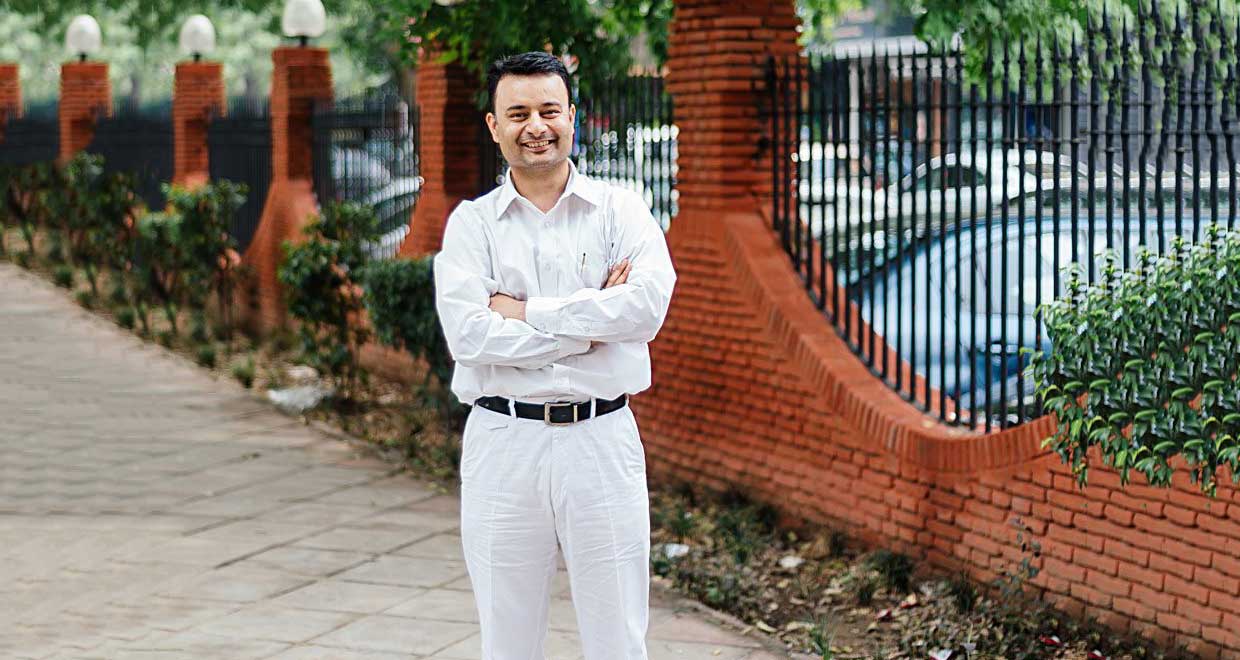
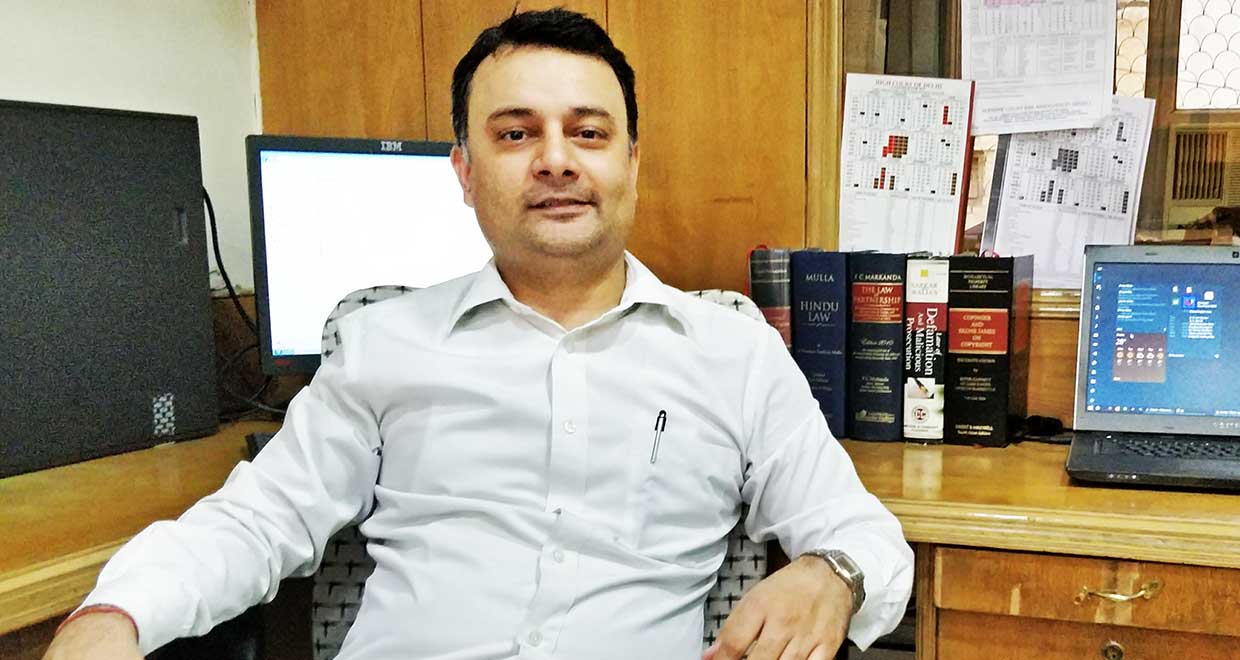
  • Manav Gecil Thomas, Partner at Thomas George and Associates Shares his Thoughts on Networking Strategies in Litigation and Role of Tech and AI in Legal Operations

    Manav Gecil Thomas, Partner at Thomas George and Associates Shares his Thoughts on Networking Strategies in Litigation and Role of Tech and AI in Legal Operations

    This interview has been published by Prabhjot Singh, Priyanka Karwa and The SuperLawyer Team

    What motivated you to take law as a career and how has been the decision so far?

    As all students, I was also confused during my school days as to which profession I should choose. Thereafter, my mom suggested me to take up law in lines of the profession of my father as he has already established a base. I did not qualify CLAT, however, I qualified for UPES, LAWCET and ILS Law College, Pune.

    Keeping the long standing reputation and I decided to join ILS Law College, Pune. All throughout my college life, I enjoyed participating in Moot Court competitions. After completing my law, I immediately joined my father’s law firm i.e., THOMAS GEORGE & ASSOCIATES. Thereafter, my mom was instrumental in insisting me to complete my LL.M.

    I did LL.M in Constitutional Law from O.U.P.G. College, Basheerbagh and secured a Gold Medal which was a lifetime dream come true. My father has been an amazing mentor as he not only trained me in drafting, filing procedures, clerical works but he also gave me the freedom to take up matters and handle them independently from day one …!

    My first appearance itself was arguing a final hearing before the then united Hon’ble Andhra Pradesh High Court of a Criminal Revision Case pertaining to 2008. Ever since then, I have never stopped and I hope to argue many more important cases in the years ahead of my life.

    Arguing the law and interpreting the law are two important facets of my litigation life which I will always cherish. So, though law happened by accident, I am happy to go the way it carries me. There is a unique unexplained sense of happiness that, I feel while arguing cases before different judicial and non-judicial fora throughout the country. With all the tremendous pressures that we as advocates undergo, it is only, that joy that I get, after arguing different kinds of matters that keeps me going ahead…!

    Your internship experiences are filled with reputed Advocates and Judges, was there any roadmap for the same or all did was in flow? How would you guide students in choosing internships?

    As a law student after participating in few moot court competitions, I was inclined towards litigation. My first internship was with my father and mentor who taught me the basic art of advocacy, that includes drafting, filing procedures etc.

    Thereafter, I went on to intern with Designated Senior Counsel Late Padmanabha Reddy where I was mesmerised to see sir argue different kinds of matters at length on his legs from 10:30 AM to 04:30 PM…! I would observe, sir argue most complex matters with utmost patience and he was always calm and composed, the most essential art I learnt. Subsequently, I interned with Adv. S. Niranjan Reddy now Designated Senior Counsel/ Member of Parliament, at whose offices I learnt corporate litigation and its nuances.
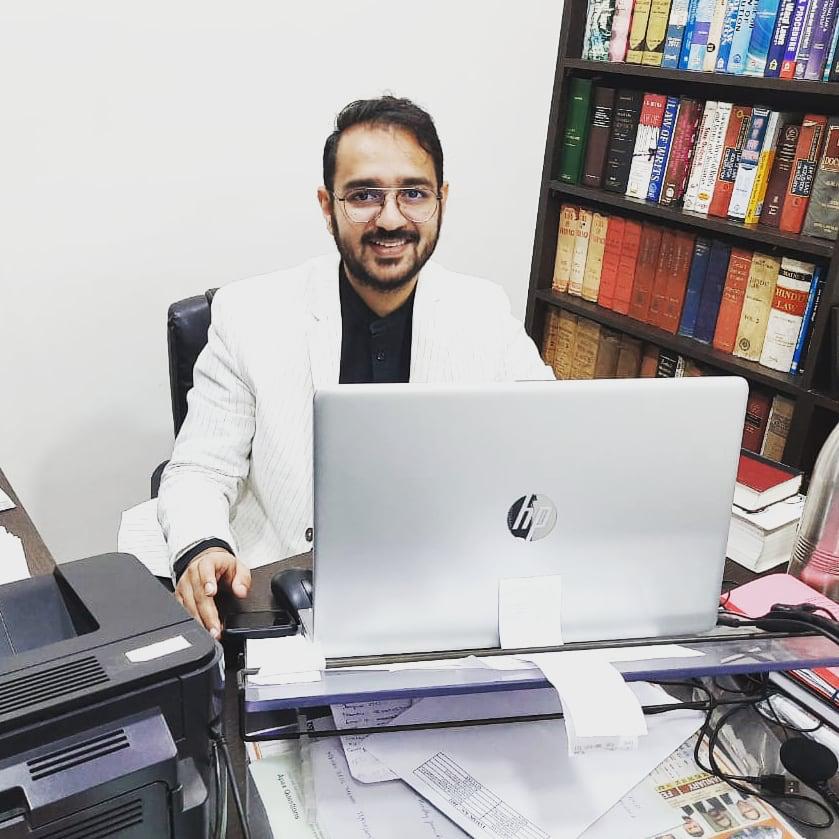
    Thereafter, I had the unique opportunity of working with Honourable Justice Kurian Joseph (Retired), Former Judge Hon’ble Supreme Court of India and while interning with his Lordship, I was able to understand what all goes in the minds of the judges post arguments since, I was also involved in the legal research that would assist judges in arriving at their decisions. I was able to see the judicial process closly that goes on after the arguments and before the judgement is pronounced.

    This experience has channelised my arguments in a slightly different manner and I am dedicated His Lordship for imparting this knowledge in me. Thereafter, I had a short stint with late Advocate Lily Thomas who had shown me no matter whatever hurdles and challenges life throws at us one must keep moving. Lastly, in my final year, I interned with Designated Senior Counsel & Hon’ble R. Basant sir Former Kerala High Court Judge. During this internship I received unique lessons of life & law, wherein I learnt how a mentor can treat his associates, juniors and interns with patience & care and at the same time learnt how hard work and dedication plays an important role in the life of an advocate. Students are not always sure as to what kind of an advocate they want to become after graduating, so it is always beneficial to intern at different places where there are variety of matters.

    Students should always start their internships with advocates who have a variety of trial court matters. In trial courts, students can learn about procedural laws, they can observe Cross Examinations and trial advocacy skills.

    Thereafter, students must intern with advocates practising in the High Courts and then the Supreme Court if possible. After this I would suggest students to intern with different corporate law firms. By the end of their internships, I would say with utmost surety, that, the students will be able to decide their career paths…!

    Manav, any specific reason for choosing litigation over corporate, what created your interest in that?

    I hope my answer to this question does not create any controversy amongst corporate law practitioners. I do not feel that I am made up for only drafting contracts or due diligence as I like to see the law in motion and that, only happens in the courts of law. In litigation, one see and meets different types of clients with different issues and in pursuing those issues one has to appear before different judicial and non-judicial fora and convince the Honourable Judges on unique points of laws and facts. Litigation requires a unique skill of being able to put forth your points with absolute clarity and conviction.

    For the same, one has to be well versed and well abreast with the laws and case laws. In corporate law, there are different nuances of law which are being explored on a day-to-day basis but none of the corporate lawyers are able to see their documents being interpreted in the courts of law. That is why, I choose litigation over corporate law.

    However, one must understand that even though I am a litigating lawyer, on a day-to-day basis, I am dealing with various aspects of corporate law which we cannot avoid being a lawyer. Thus, I believe that the so-called difference between a corporate lawyer and a litigating professional is a grey area which cannot be compartmentalised. So, I fix no label to myself….I leave it to the readers to categorise me as any lawyer they feel based on the work I execute.

    As lawyers, society depends on us in a lot of situations and pro-bono matters is one of them. How far do you resonate with this?

    Society depends on a number of aspects that keeps evolving and law is an important part of this evolving society. The changing needs of the society requires dynamic changes by the practitioners of law. In today’s world where everyone is in the rat race to earn, a lot of poor litigants suffer with inefficient representation as the fees that they can pay is less. I completely believe that in the background of the unique requirements of the society as of today, pro bono matters would definitely assist and help the people in need in a unique and effective manner.

    Many a times, I come across poor litigants who are not guided in the right direction due to which they faced unpleasant consequences. In this background all the us at THOMAS GEORGE AND ASSOCIATES believe in helping the really needy clients and when the situation demands we do take up pro bono matters. In criminal matters I observed that the people arrayed as accused in many matters do not have the necessary sources to finance their litigation expenses and tend to seek help from legal aid.

    Many a times, legal aid is not providing effective and efficient representation thereby rendering the whole purpose futile. Thus, professionals with experience taking up pro bono matters really helps the litigants in need.

    According to you, what networking strategies should be adopted by the first-generation lawyers specifically in litigation?

    The struggles of first-generation lawyers are untold in today’s world. There is no secret mantra that can be told as to the strategies that can be adopted, however, these are a few tools which may come handy in the years to come. Networking is a very important part of litigation which one will understand as they progress in their profession. One must always bear in mind that every person one meets in any walk of life can be one’s prospective client and thus one should interact with people and make them know that one is a practising lawyer.

    There is an apt example for the aforementioned statement of mine; once while I was in a club and while I was on the way to the washroom, I met an acquaintance of mine and in a casual conversation made him know that I am practising in Hyderabad. After a year I received a call by this acquaintance who had referred a very big company for coming on board as their retainer. So, one can land up with a client in any place.

    Keeping in touch with your alma mater and alumni will also help you in being referred matters from different states pertaining to your jurisdiction. Being active on social media can also help to a certain extent. Giving internships to students, is a way of giving back to the society and in return over the years to come, one will see the benefit from the same. Also, one must always remember that hard work pays off and the reason I say so, is your work must speak for yourself and that in turn would result in receiving the due benefits of networking.

    Please elaborate for us your current role

    I am currently the Name Partner at THOMAS GEORGE & ASSOCIATES, Hyderabad. The Managing and Founding Partner of the firm is my father, Advocate Thomas George and the Senior Partner is my mother. This being the background of my firm, the positions that we hold really does not matter for us internally. That being said, on a day-to-day basis I appear on various matters before various Judicial and Non-judicial fora throughout India with my base practice in Hyderabad.

    My entire day goes in arguing matters before different courts of law and in the evening, I spend my time in preparing for matters listed either on the immediate next day or for the days to come and also meet my clients. I supervise the administrative matters of the firm.

    I delegate matters to the juniors/associates at the firm, teach/assign work/cross check the drafts assigned to the Associates/Virtual/Non-virtual interns. I brief the Managing and Founding Partner and Senior Partner of the firm on matters that needs to be argued. I also help my Associates in practising their presentations before the courts scheduled for the next day, so that, they do not face any difficulty.

    So far we’ve seen employees being harassed at workplace wrt different situations, how well do you consider the role of employment laws in the same?

    It is always beneficial for employees to research about the firm where they seek employment before scheduling any interview. I also think it will be beneficial if one can speak to people who worked in the said place prior to joining. The role of employment laws is not very effective as, the internal committee for any kind of harassment consist of members of the same firm.

    Furthermore, if any employee raises a complaint and leaves the organisation the next organisation will always look at this employee with a speck in their eyes and thus there is a fear in employees from making any complaints whatsoever.

    How does AI play a significant role in helping lawyers and what are the consequences for the same?

    AI is already playing a significant role in lives of lawyers. As on today we can see AI’s tremendous use in research while comparing to our senior generation lawyers. The search engines have been extremely helpful in researching for case laws as well as to know overruled decisions, landmark decisions et cetera. Case management has become very simple with the help of various digital applications that provides the statuses of all the matters of the firm with the click of a button. Dictation and drafting have become 10 times easier than what it was with the usage of the software that types out whatever we dictate with almost 90% perfection.

    Another application that I have come across in the recent times is a scanner pen which can be used to copy paste contents from various hard copy of agreements/drafts into the word document. AI will always remain a tool in the hands of a lawyer but can never replace mankind especially lawyers, because, the brain used to interpret law in a unique manner is not AI but it is that unique skill of that lawyer. Furthermore, convincing a judge is done by advocates who present their matters in ways they deem fit which again cannot be substituted by AI. For people who disagree then mankind itself will be overtaken by AI.

    There are also applications that are being developed for taking queries from clients through chat boxes and these apps help in consolidating the client consultations to a certain extent. Such client consultations would in a way save the precious time of lawyers. However, how much ever technology advances, if it lacks  human touch in the works of a lawyer then I believe there will not be effective representation in those cases.

    Manav, we’ve been witnessing students shifting from litigation to corporate or most of the times they dont even take litigation as an option, what can be the reasons for the same?

    Personally, I would like to disagree. In the recent years I have seen many students in fact choosing litigation over corporate law firms. The ground reality is that, as on date, there are no vacancies in many chambers as they are already flooded with young students who have just graduated. However, students do prefer a comfortable and stable life with heavy packages which corporate law firms provide and that can be the only reason that students would prefer corporate law firms over litigation.

    Once litigating lawyers start paying their juniors at least the amounts that are required for the basic survival in the cities they practice, students will definitely choose litigation. What I have observed in corporate law firms is that due to tremendous burn outs over the period of time people shift back to litigation thereby losing their initial precious years of the experience. Students must understand that litigation is like an investment which grows manifolds.

    The life of a corporate lawyer or a judicial officer or a lecturer usually ends upon attaining the age of superannuation, however, the life of an advocate has no age limit and in a lighter note; when all your fellow colleagues are retiring, the practising lawyers start earning even more…!

    Lastly, any piece of advice for our young lawyers

    Repeating what you would have already heard from various stalwarts in the profession, I would like to say that there are no shortcuts to success.

    Hard work, dedication, diligence, perseverance, patience are the keystones to success. We must always remember that success cannot be achieved overnight but it requires tremendous hard work.
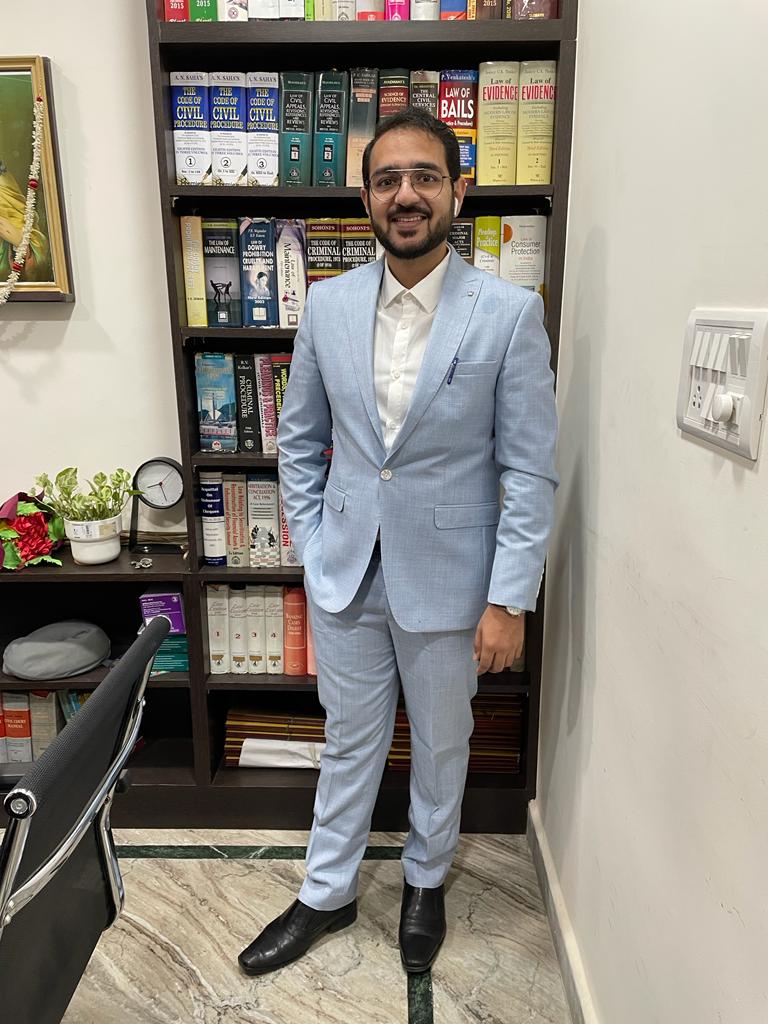
    Whenever, we see successful professionals, we only tend to see their achievements without knowing the amount of pain, sacrifices, compromise that they had to undergo to reach the place that they are at today.

    Having patience will definitely play a great role in reaching those heights of success that are channelled for you. One must always remember to maintain a work – life balance which everyone has been talking about in the recent times. One must take time off work, spend time with family and friends as well, which are very important.

    I always tell my hardworking interns not to forget to chill in life. All the best!!!


    Get in touch with Manav Gecil Thomas-
  • In conversation with Anirudh Suresh – Founder and Partner at Aristo Legal and featured in the list of “Top 50 Disputes lawyers in Asia” by Thomson Reuters

    In conversation with Anirudh Suresh – Founder and Partner at Aristo Legal and featured in the list of “Top 50 Disputes lawyers in Asia” by Thomson Reuters

    This interview has been published by Sonali Parashar and the SuperLawyer Team


    How would you like to introduce yourself to our readers?

    I am Anirudh Suresh, Founder of Aristo Legal, a full-service pan Indian corporate law firm. My success story as a first-generation lawyer was recently published by Brut as I was recognised among the Top 50 Disputes Lawyers in Asia (Litigation and Arbitration) by Thomson Reuters on the basis of my work, market feedback and client recommendations. My interest in law and legal enforcement goes back to my 10th grade. While I don’t exactly recall the genesis of this interest, I sure till date remember and feel its intensity.

    We get that being a first-generation lawyer, it is difficult to find one’s footing. You started off as a Litigating Lawyer and then you moved up to become a Corporate Lawyer. Can you share what all struggles did you face while being a Litigating Lawyer and then as a Corporate Lawyer? What all skills did you learn as a Litigating Lawyer which are now assisting you in your current role?

    As a Litigating Lawyer for the first 5 years, I was working 8 AM to 8 PM, 365 days a year but I never complained about it as I was involved in my work deeply and enjoyed the learning experience step by step. It’s a matter of interest, at the end of the day. I used to appear before all courts in Bangalore for all sorts of matters and this helped me in developing a diverse and strong foundation, eventually allowing me to head the Delhi office of Bathiya Legal successfully as we had a range of matters under the Companies Act, Insolvency and Bankruptcy Code, and Competition Act. I never felt any of these experiences to be a struggle as I enjoyed the work and liked what I was doing. In fact, it never felt like work either. So, the knowledge and court craft I had developed as a litigation lawyer enabled me to successfully implement it for the corporate litigations matters that I took. This journey has given me the confidence to handle any matter before any court.

    You’ve accomplished so much in your career in such a short time; what skills do you think a law student should develop in order to pursue a career in Corporate Law?

    Firstly, I feel like I still have a lot to achieve. I would recommend that law students read the entire commentary on a subject rather than reading only the textbook. This will mean that they would have read thousands of pages, and this reading habit will help improve their drafting skills and legal communication skills. And the hard work put by them in reading so many commentaries will bear fruits when they start practising. Further, they should meet lawyers in different practice areas and understand the practical aspects of those areas. For this, I would recommend students complete at least six months of internship under a corporate law firm or a corporate lawyer. 

    You have graduated with B.A.LL.B. from B.M.S. Law College, and then went on to pursue your PG Diploma and Masters from National Law School of India University and O.P. Jindal Global University. How important do you think it is for a law student to pursue Masters? Does it help one in his career trajectory?

    I often see law students rushing to get a master’s degree immediately after graduating from law. I would recommend that the students should start their practice in a particular area of law and get accustomed to a particular practice area as a working professional and then pursue Masters in that relevant practice area. This would make the master’s degree have value as your work experience and your interest would align with it. 

    You have also led the Delhi Office of Bathiya Legal for about 3.5 years. What exactly were your responsibilities while you were there? How would you describe your experience of working at such a reputed law firm? 

    My responsibility as the head of the Delhi Office was to handle all the corporate litigation matters in Delhi, Jaipur and Chandigarh and work closely on M&A and Private Equity transactions when the buy-side or the sell-side was based in Delhi. I regularly appeared before various forums such as Supreme Court, High Court, NCLAT, NCLT, DRT, Consumer forums, etc. And this journey helped me develop myself as an advocate and realise my potential. I will forever be grateful for the platform that Bathiya Legal gave me. The amount of confidence, trust, and faith that the Partners put in me, and I hope I have reciprocated the same by ensuring positive results with the best of my efforts. I was very much impressed with the values, ethical standards and calmness to approach of the Partners which I too hope to implement. I can go on writing volumes about the positive influence this firm has had on me.

    Your work as a corporate lawyer has earned you a well-deserved appreciation in the legal industry. What have been your key learnings to date? And what does it feel like to be recognized among the Top 50 Disputes Lawyers in Asia (Litigation and Arbitration) by Thomson Reuters?

    I would like to reiterate that I still have a long way to go as known is a drop and unknown is an ocean. My key learnings to date would be that Client satisfaction is key and this can be achieved with extensive research and ensuring timely deliverables. And I feel that my work in the past which involved getting successful reliefs for clients in high profile precedent-setting matters has been acknowledged by this recognition bestowed upon me by Thomson Reuters, Asian Legal Business. 

    It is now close to a decade that you’ve been in the legal profession. What do you think is the difference between the law profession right now and the profession a decade back? And, what all changes would you like to see in our Indian Law Profession?

    The legal profession has completely changed in the past decade. Both substantively and procedurally, one could probably call it one of the most dynamic and important decades. Many new age laws such as the Insolvency and Bankruptcy Code, Companies Act being overhauled, Data protection Law etc. have come up and they are constantly subject to change based on different interpretations given by the courts every other day or based on amendments passed by the government to keep pace with the rapidly growing economy. In terms of practice, the profession and the professionals have been highly digitalised, and it becomes vital for lawyers to be tech-savvy.  

    I would like to see more courts make way for hybrid hearings such as NCLT and NCLAT. The normalization of hybrid hearings would be a much welcome development towards implementation of the online dispute resolution. I would also like to see long term internships that range at least 6 months being made mandatory for law students during their final as it helps them to get a true picture of a particular practice area.

    What would be your parting advice to the budding lawyers? How would you like to inspire those who are unsure about their future in the profession?

    Read, read, read. One should find what motivates them to keep them going. A healthy relationship with colleagues, respect towards seniors and ensuring timely deliverables to clients should be a habit rather than a mode of precaution. Never look back and compare yourself with peers, just keep yourself occupied all the time and the work you do will automatically lead you to the path suitable to you. 

    Get in touch with Anirudh Suresh:

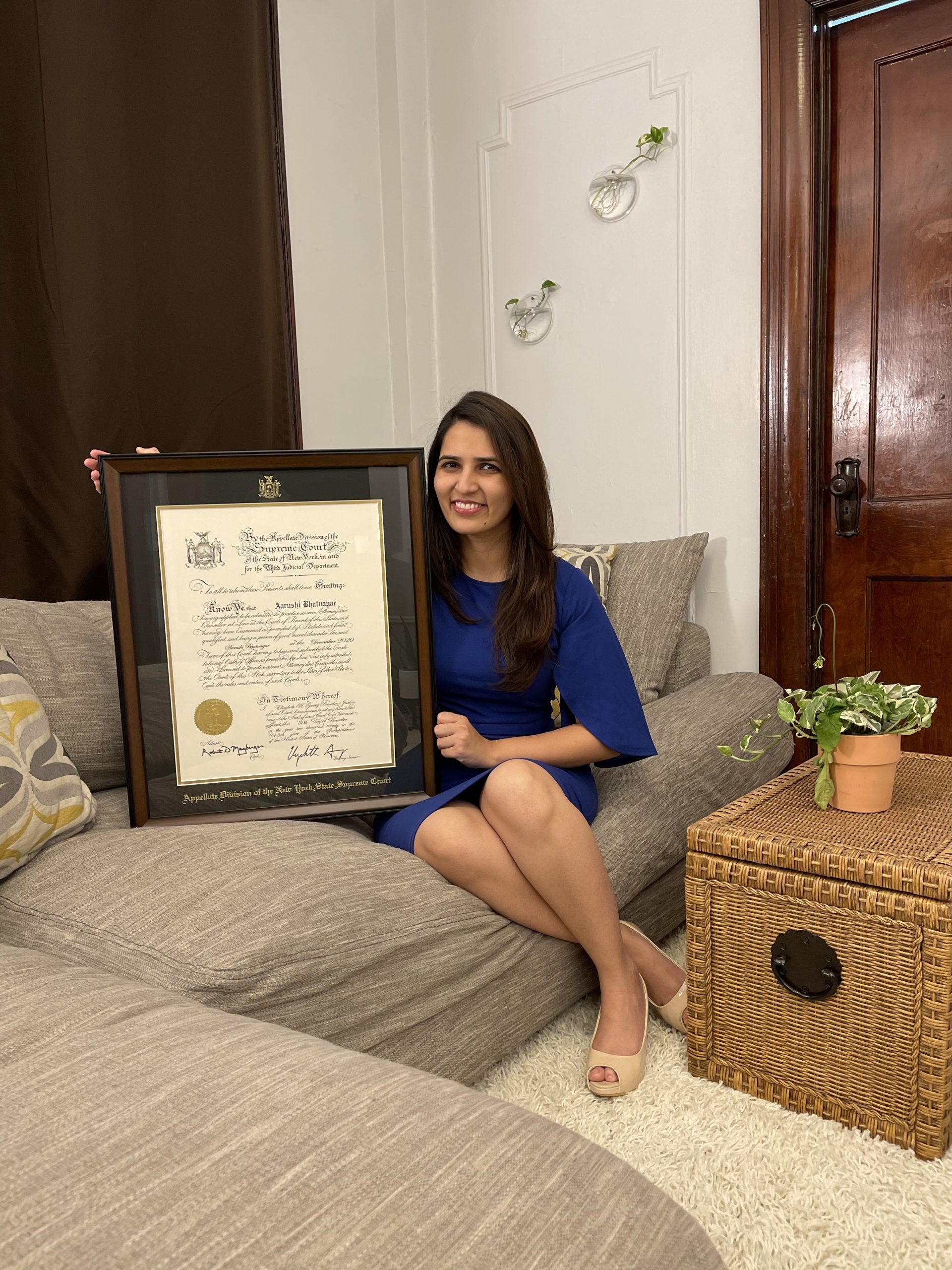
  • Ms. Aarushi Bhatnagar, Managing Attorney at PUNHANI LLC on LLM from NLU Jodhpur and NYU, cracking the NY state bar exam and practising immigration law in the United States

    Ms. Aarushi Bhatnagar, Managing Attorney at PUNHANI LLC on LLM from NLU Jodhpur and NYU, cracking the NY state bar exam and practising immigration law in the United States

    This interview has been published by Sonali Parashar and the SuperLawyer Team


    If we start from the beginning, were you always academically diligent? Did you always want to pursue law? What other career would you have chosen if not law?

    I have always considered myself a sincere but average student. I was not excessively academically inclined during my school years. Instead, my interests were directed toward art-related extra-curricular activities. Accordingly, my slam-book career goal was to be a fashion designer. At the same time, I had a strong family background in law, with multiple family members being in judiciary and litigation. Being amidst frequent family discussions involving topical legal issues, I gained valuable insight into the legal world and its opportunities. Ultimately, my interest in engaging with current affairs and doing my part to help the people around me pushed me to pursue law as a career.

    You have completed your master’s from NLU Jodhpur. Would you like to share a few tips with the students who are preparing for CLAT? How different is the preparation of CLAT PG from that of UG?

    The best advice that I can give to students preparing for the CLAT is to do as many practice tests as possible. In my experience, that is the key to cracking any competitive exam. Of course, studying and knowing the basic material that will be tested in the exam is also essential.

    I found the CLAT PG preparation to be easier than the UG preparation. The subjects tested in the CLAT PG exam are part of the law school curriculum. If one has studied and built a strong foundation in the relevant law subjects during their undergraduate years, the CLAT PG exam preparation becomes a revision exercise. On the other hand, students preparing for the CLAT UG exam are right out of high school with no formal exposure to legal academia. In such a situation, enrolling in a good entrance prep course is worth considering.

    Despite having an LL.M. Degree from NLU Jodhpur, you decided to pursue another LL.M. degree from NYU and had the flexibility of designing your course structure (subjects) there. What major considerations should one take into account while designing their course? What extra efforts have you made being a foreigner?

    Many LL.M. programs provide the students with an opportunity to design their coursework. However, one must consider several factors while making this decision. First, the coursework should align with the candidate’s short-term and long-term career aspirations. A career in law is often path-dependent, and the first job often charts the path for future professional endeavours. Second, it is essential to choose an area that complements the candidate’s prior experience. Choosing a field that builds upon the existing credentials ensures that one can make the most out of a short and rigorous LL.M. program. On the other hand, LL.M. also provides a unique opportunity to diversify into new areas. It is essential to consider one’s areas of interest and the corresponding job opportunities while striking that balance.

    As a foreigner, one should put extra effort when making space in a completely alien environment. I actively participated in networking events (both within and outside the university) and pro-bono activities, which gave me the familiarity and visibility required to succeed in the US job market. At the same time, being flexible and open-minded facilitated my venture into immigration law, a field that I have since fallen in love with.

    Can you share in brief about your current role and responsibilities as a Managing Attorney at a boutique law firm in the NJ/NY area? How do you manage to maintain a work-life balance?

    As the Managing Attorney of a boutique law firm, I have a diverse and dynamic set of responsibilities. I am responsible for onboarding clients, managing the cases from inception to completion, and handling the firm’s day-to-day operations. I advise multinational corporations, business units, and individuals on employment-based and family-based immigrant and non-immigrant visa petitions and applications. My role also entails hiring and training junior staff, including attorneys, law clerks, and paralegals.

    Compartmentalizing my work and non-work activities helps me maintain a good work-life balance. While at work, I dedicate myself to planning and executing my tasks efficiently. Breaking complex cases and procedures into simple daily tasks helps me leave the office with a sense of completion and accomplishment. It also ensures that work anxiety and stress do not spill over to my personal life. During weekends, I like to travel and engage in cooking, arts, and crafts. Having an active lifestyle rejuvenates me and prepares me for the upcoming work week. However, there are certain times when maintaining a work-life balance is challenging. In those times, having a good support system at home helped me keep my spirits up.

    You used to work as an Assistant Professor at Banasthali University, Rajasthan and now you are working in a law firm. What all struggles did you face adjusting in Banasthali and then in a Law Firm? What all things and skills did you learn as an Assistant Professor which are now assisting you in your current role as a Managing Attorney in your Law Firm?

    Teaching at a university and working in a law firm is different in certain aspects. As a teacher, I followed a well-structured curriculum and spent all my efforts ensuring that my students remained interested in the topic and benefited from the course. On the other hand, managing a law firm requires me to handle unanticipated challenges daily. However, I have enjoyed both these roles and did not face any issues in transitioning from the former to the latter. Instead, I found that the teaching skills I developed in Banasthali come in handy when I train new hires at the law firm.

    Would you like to share a bit about the field of immigration law? What is the future scope and struggles involved in the same?

    Immigration is a very dynamic field of law. It involves securing and defending the rights of immigrants from various countries and backgrounds. The legal landscape is constantly evolving, and the changes substantially impact many companies and individuals. The ongoing pandemic has amplified immigration-related issues by forcing many firms to downsize and leaving many immigrants jobless and without a livelihood. Given the ever-increasing importance of the field, it is (arguably) one of the most attractive and rewarding career paths for law students.

    You also cleared the NY state bar exam. How strenuous was the preparation? What are the eligibility criteria for the exam?

    Preparing for the NY State Bar Exam is like a full-time job. It was one of the most challenging tasks I have undertaken. Enrolling in a good bar prep course is extremely helpful.

    There are various qualifying methods to sit for the NY state bar exam. The most common criteria include graduating with a first law degree (J.D.) from an American Bar Association-approved law school. However, in the case of international students/foreign-educated lawyers, the eligibility criteria are pretty cumbersome. All foreign-educated lawyers must submit an online credential evaluation request along with the required documentation to the Board of Law Examiners. One should submit these documents even before the start of the LL.M. program because the evaluation process is time-consuming. LL.M. students must also fulfil the specified credits requirements via classroom courses in substantive and procedural law and professional skills. The official website of the New York State Board of Law Examiners provides the detailed eligibility criteria and application process.

    What will be your parting words for our readers? 

    Focus on having both career goals and life goals. Be ambitious and entrepreneurial but remember that professional success depends heavily on working smart (in addition to working hard). Reach out to people and take their guidance, rather than spending time reinventing the wheel. Be patient and diligent, and success will eventually come. Lastly, prioritize creating a wholesome life experience as it is the journey that counts.


    Get in touch with Aarushi Bhatnagar –

  • In conversation with Srishti Chaturvedi – the choice between JAG and academics, and the road so far

    In conversation with Srishti Chaturvedi – the choice between JAG and academics, and the road so far


    This interview has been published by Sonali Parashar. The Interview was taken by The SuperLawyer Team.


    What prompted you to choose Law? Did you always want to take Law as a career? 

    Law was not my first career choice. While in school, I maintained a persistent good grade and was expected to prepare for engineering entrance examinations while pursuing my 10+2. I had never really been only into academics from the early start and was therefore also pursuing vocal music, kathak and karate competitively during the time. A major reason why I started looking for options other than engineering has been NCC though. I had been in the Army wing of NCC in my VIII and IX std. when I participated in the Republic Day Parade in Delhi; after which, I participated in the Senior Wing of Air Wing in my XI and XII std. and received a ‘C’ certificate and was also chosen as the Main Flier for the MP&CG contingent in Vayu Sena Camp. All of this led me to consider Flying as an alternate career option. My parents were not particularly keen on this and as a result, this was deferred till my graduation. I had started exploring other options though. Some of my friends who were preparing for CLAT suggested that my aptitude is better suited for law and so I prepared for the CLAT entrance intensively for a month and got through NLIU, Bhopal.

    While pursuing LLM, you appeared for the JAG exam for the Navy and cleared all the stages. What special effort does the JAG exam require? How did you manage to make out time for both? Would you like to suggest a few tips for its preparation?

    The entrance examination for JAG was during the first month of the LL.M. course and GNLU was accommodating enough to give me academic leave for the 11 days that I stayed at the SSB centre. Since it was the start of the course, I did not have to juggle two things simultaneously. 

    I was recommended for JAG and cleared the medical tests in my first attempt. I liked the experience of the 5 day SSB exam process because, in my opinion, it is one of the few entrance tests that does not promote rote learning and tests the aptitude of the candidates. Some people prepare for it through coaching centres etc. but I don’t think it is necessary. It is adequate to have a thorough knowledge of the various tests and activities that are conducted in the 5 days. The preparation for written tests can be done through any basic book of preparation for SSB (I read Arihant) and the aspirant must have a minimum level of physical fitness to go through the physical tasks of the examination. Having a basic knowledge of the composition and working of the Defence forces is usually very helpful, and having certificates in NCC and sports competitions is an added advantage. Over-preparedness does not help as the tests are structured in a manner to test the aptitude of the aspirants. 

    Do you think TA-ship is important in the LLM programme? How was your TA-ship experience? What was that one learning experience in your TA-ship that you’d credit to have shaped your career and your current role? 

    Yes, I think TA-ship is extremely important in the LL.M. programme, especially for students who want to take up academics as a career. I did my TA-ship under Dr Jagadeesh Chandra, for Law of Evidence classes in GNLU and had a wonderful experience learning about various teaching pedagogies in theory and then seeing him use them in his lectures later. It was his style of interacting with students in an open, relaxed atmosphere and actively engaging in discussions with them, that made me understand the importance of having a mentor and not just a subject-teacher in the life of a student. I have tried adapting a similar role when I am assigned a class to teach or a group of students to interact with, in any other official capacity. 

    PhD is all about extensively researching in the chosen field and gaining an insight into the subject. What new things and skills did you develop while pursuing your PhD? How strenuous was clearing the PhD entrance exam of NLIU? 

    I slightly differ on the view that a PhD is all about researching and gaining insight into a particular topic. Of course, extensive research has to be done even before a topic can be finalized and by the time a thesis is submitted, you have considerable insight into the topic of your research. But there are a lot of other skills learnt. During the course work, we learn a lot about quantitative methods of research which is not covered adequately even during masters. We learn about various statistical, citation and referencing and content-correcter tools. Since every draft is revised and corrected several times before it is finalized, it results in not just better research skills but also far better legal writing and articulation skills than we started with. Most importantly, you learn to be patient with yourself and the people around you since everything cannot be controlled directly, and you learn to work with long-term goals. For a lot of us who had already started teaching for some time before starting our PhD, the coursework period especially presents an excellent opportunity to refresh what is it like being a student and knowing their expectations, learning obstacles and preferences, from a first person’s perspective.

    The exam is honestly not very difficult if you are in touch with the basics of law. When I gave the entrance exam for NLIU in 2018, there were 3 subjective papers for Research Methodology, Constitutional Law and Jurisprudence. Since I was also preparing for UGC-NET at the time, it was not very difficult to prepare for. This was followed by a small interview session where the panel asks questions to know the proposed area of research and how the applicant plans to go about it.  

    Srishti Chaturvedi

    You have observed students very closely and from different perspectives by the virtue of being in different roles. How would you describe the modern era student’s mindset? What improvements do they need in their day-to-day activities to help them succeed?

    I think students today are extremely smart and informed, they know a lot more than we did in our graduation days. However, I also think the competition of getting successful, more and faster, than their peers is making a huge dent in their emotional well being. To study law and build a career in the middle of a pandemic, only adds substantially to this pressure. I have worked with Jagran Lakecity University, NLIU Bhopal, DNLU Jabalpur and now at RNTU in 4 years and I have found one thing which is common in all the students irrespective of all the other differences, that they are under a lot of pressure and most of them are not coping well with it. I cannot emphasize enough how important mental and emotional well being is, to succeed not just in life generally, but also in one’s profession specifically; everyone should make this an utmost priority if they want any kind of success in life.

    I don’t think that the students require a lot of tips about succeeding academically, except that they should be open to all kinds of experiences that the course offers. They should take up extra courses, write research papers, moot, participate in MUNs, present papers, become part of various committees and clubs, and intern in different places till their third year at least. This will help them discover what they like and what they want to do after graduation. The efforts of the next 2-2.5 years can be streamlined accordingly.

    You also started working as one of the founding members of CAN Foundation’s blog ‘Vedanam’ and later, as an Executive committee member of the Foundation itself. Can you tell us a bit about your role at CAN? What all responsibilities did you have? 

    My role as an Executive Committee member is primarily to focus on the execution of the 2 flagship scholarship programs of CAN- ‘Eklavya’ and ‘Dhananjay’. I work with the student committee of CAN from the inception of the project. We set the minimum eligibility criteria to apply, invite applications from meritorious students, go through hundreds of applications and sort them meticulously while also verifying their documentation. Thereafter, we have multiple rounds of meetings with the scrutiny committee and selection committee to finalize the names of the scholarship awardees. The whole process takes a lot of time and organization and cannot be done without the hard work and consistent efforts of the student committee members of the Foundation and the able guidance of Mr Siddharth R. Gupta,(CEO, CAN Foundation). Going through various applications of students who are extremely meritorious even while facing all kinds of financial hardships, since the last 2 years, has further encouraged me to realize my privilege and set long-term goals through which I can contribute back to the community in any form.

    Can you tell us a bit about your current work and role? What do you plan to achieve next in your career trajectory?

    I am currently in the final stages of completing my PhD thesis, and will probably be submitting it this year. However, I kept thinking I wanted an opportunity to do something different and most importantly, I wanted to be back in a classroom. So, I have recently joined as an Assistant Professor of Law in RNTU, Bhopal. My job profile includes teaching UG and PG classes, working on administrative rebuilding and cohesion and working with the local community as the Legal Aid Cell in charge through various projects of the University. 

    My sole aim for my career this year is the successful submission of my PhD thesis. I have been wanting to be an ‘Author’ of a book for some time, but the plan keeps being postponed due to some reasons. So after my PhD, I plan to write a book sometime soon. Working at DNLU made me realize I like taking up administrative responsibilities as much as I like teaching since I was also the Warden, the Faculty in-charge of the Legal Aid Cell and some other committees as well; so I would like to take up roles where I can work more in administrative capacity along with working on my classroom teaching skills.

    What would be your parting message to our young readers?

    My message to the readers, especially students, is to not be too hard on yourself. Read as much as you can, and not just about law, watch good movies, participate in competitions, create a lot of good memories with your friends and take utmost advantage of the facilities and opportunities offered by the University. The time, resources and opportunities that are offered during the 5 years of law school will not come again and they should be experienced accordingly. Everyone succeeds at their own pace, and as redundant as it sounds, every person should only compete with themselves. Someone might get a PPO in 4th year while you may still be giving interviews post-graduation, but that is okay. Someone might select the field they want to work in the first go, while you may have switched 2 fields already and are still not sure about what you want to do, and that is okay. Keep learning, keep exploring, keep working and take adequate breaks to breathe between all of this. Things will start falling in place one after the other.


    Get in touch with Srishti Chaturvedi:

  • BAHULI SHARMA, ASSOCIATE (LITIGATION & DISPUTES) AT BHARUCHA & PARTNERS, ON BEING A RHODES SCHOLAR, HER INTERNATIONAL ACADEMIC EXPERIENCE AND HER LITIGATION JOURNEY AT THE FIRM

    BAHULI SHARMA, ASSOCIATE (LITIGATION & DISPUTES) AT BHARUCHA & PARTNERS, ON BEING A RHODES SCHOLAR, HER INTERNATIONAL ACADEMIC EXPERIENCE AND HER LITIGATION JOURNEY AT THE FIRM

    This interview has been published by Maaz Akhtar Hashmi and The SuperLawyer Team. The Interview was taken by Priyanka Cholera.


    You’ve presided over debating societies and have been a part of MUNs since your school days. You have also served as the President of the Debating Society at St. Stephen’s College as well as a debate coach to students at Vasant Valley School, New Delhi. Did your inclination towards debating and public speaking make law a natural career option?

    Since school, I had participated in and enjoyed theatre, debating, and any other co-curricular activity which involved interacting with people or facing an audience. Growing up, I developed a keen interest in politics and participating in debate competitions meant deliberating upon topical issues of relevance pertaining to both national and international affairs. So, I would say that I was interested in becoming a lawyer since school, but my initial interest in criminal law was triggered at Stephen’s, while reading for history, through my study of the intersection between penal and coercive processes of the colonial rule. My gravitation towards law was a culmination of all the of the above: my flare for debating & public speaking coupled with my study of Indian history!

    You graduated with LL.B. from Delhi University and then went on to pursue BCL, you also pursued double Masters from the University of Oxford and Harvard Law School. Can you tell us about your experience at these various world-renowned alma maters?

    My experience as a law student at Campus Law Centre, Delhi University, was exciting and enriching.  Faculty of Law, Delhi University was like India in a microcosm: a melting pot of diversities. I met students with varied ideological beliefs and opinions. Apart from academic exposure to law, my three years at CLC offered me a real & practical insight into student politics and election campaigning.

    My two years at Oxford, academically, were instrumental in giving me a legal and theoretical insight into the functioning of different criminal justice systems. During the BCL, my study of the relationship between criminal justice, security, and human rights helped me understand the interplay between intersecting but ostensibly competing rights of liberty and security, especially in cases of terrorism. Courses such as Children, Families, and the State, helped me gain a foundational understanding of Children’s rights and agency and the way legal systems should accommodate their interests. The MSc, on the other hand, helped me understand the sociological context in which crime occurs and explore both qualitative and quantitative research methodologies in the field of criminal justice.

    At Harvard, I decided to venture out of my comfort zone and explore different facets of criminal law through my study of white-collar criminal and cyber-criminal law. Additionally, the Harvard LLM provided me with the opportunity to study Fintech & its interaction with different legal systems in the world. As somebody who had no prior knowledge about Fintech, Blockchain or Cryptocurrency- the course provided me with the unique opportunity to learn about how emerging technology impacts extant legal systems and regulation.

    Apart from the academic exposure, I also had the opportunity of making life-long friendships and being mentored by some of the best professors. This made my time there enjoyable and wholesome.

    The Rhodes Scholarship is the oldest and perhaps the most prestigious international scholarship programme in the world. Could you suggest to our readers an ideal roadmap to qualify as a Rhodes Scholar?

    Simply put, there is no specific roadmap. The Rhodes Scholarship, more than anything, is about authenticity: about unapologetically being yourself. Applying for the scholarship was not a knee-jerk decision for me. In my first year at CLC, I had decided that I wanted to pursue my master’s from an International University. I worked towards that goal for the next three years and finally applied for the scholarship in 2015. During the application process and my interviews, I realised that there is no prototype of a Rhodes scholar: anybody and everybody can and should apply. I think the commitment to service, humility, authenticity, and perseverance are the four pillars of the scholarship. This belief was further strengthened when I met Rhodes Scholars from across the world at Oxford- we were all very different from each other! The only thing in common between us was our collective and individual desire to give back to society.

    What would you advise to all the forthcoming applicants who are applying to universities abroad?

    Firstly, the decision to pursue your education outside India should not be an impulsive one. It should be well-thought-out and deliberated upon as the application process is extremely tedious and fastidious. It requires a lot of dedication and time.

    Secondly, I would recommend extensive research before you begin the process. I spent months just reading up about universities in the United States and the United Kingdom to understand their admission processes, requirements and, more importantly, to gauge the academic ethos of the Universities. The American process is quite different from the English one in terms of SOP focus and academic/extra-curricular requirements. After this, I read up on all the potential scholarships that I was eligible for. Subsequent to this, I prepared a list of my preferred Universities and the scholarships I wanted to apply for. Once my groundwork was done, I had dived into the application process. This helped me streamline the entire process, which can otherwise be a bit overwhelming and daunting.

    You have worked as a legal consultant to HAQ – Centre for Child Rights. You have also served as the Convener of the Legal Aid Society. Speaking, retrospectively how can law students make a difference when it comes to legal aid and legal-social work?

    My work with the Legal Aid Society and then with HAQ (2018-2019) gave me direct exposure into the actual working of the criminal and the juvenile justice system in India. It additionally also gave me the necessary insight into the systemic challenges faced by our criminal justice system.  Particularly, my research projects with the Delhi State Legal Services Authority shed light on the several institutionalised impediments faced by the incarcerated in actualising their legal entitlements and the general apathy of the justice system to prisoner rights and well-being. My work as a paralegal also made me aware of the paucity of research into the causes of criminogenic behaviour and the general gap between academic research and praxis in the field of criminal law.

    Law students are in a remarkable position to facilitate change at both the ground level through fieldwork and through the law in courts. Exposure to fieldwork is essential for lawyers and law students alike to discern the complex challenges faced by our criminal justice system in order to craft a purposive and humanised approach or to create feasible/sustainable interventions. Law school is a great place to garner this experience- law students should volunteer as much as they can during their study of the law. I believe legal aid work prepares you for litigation in courts in India.

    You are presently working as an Associate at Bharucha and Partners in the Litigation & Disputes Team. Could you highlight how a foreign LLM helped you in litigation? How has your experience in litigation been since you returned from Harvard?

    My academic experience helps in legal research and in developing submissions and arguments grounded in legal jurisprudence. The LLM trains one to discern the fundamental legal principle behind an issue. It also inculcates the skill to analyse and organise voluminous material in a coherent manner.

    Upon my return to India last September, I hoped to work and broaden my experience in criminal litigation, with a special focus on white-collar criminal law, anti-corruption, governance, and international financial crimes. Bharucha & Partners’ Litigation & Disputes Team was the perfect fit- a small team with a lot of criminal trial work. The litigation team, led by Mr. D.P. Singh and Ms. Sonam Gupta, specializes in white-collar crimes and regularly appears before Courts and Tribunals in cases involving both domestic and international financial crimes and general criminal law. Under their collective tutelage, I have had the chance to appear across all levels of the adjudicatory process.

    You recently cleared the New York Bar examination and the England & Wales (MCT) Examination and will be qualified to practice in three jurisdictions soon. Could you throw light on the process to register for bar examinations outside India and how to prepare for the same?

    I qualified for the Indian Bar in 2016. I sat for both the New York and England & Wales Bar (MCT) examinations this year.

    To be eligible to sit for the New York Bar Exam, you need to have an LLM from an American Law School. Further, you need to dedicate approximately 12 credits to the Bar Exam during your LLM. On the other hand, you don’t require an LLM to sit for the England & Wales Examination. You only need to be a lawyer qualified to practice in a common-law jurisdiction.

    It was challenging to manage my preparation with work, and it wouldn’t have been possible without the unconditional support of my team. Preparation for both exams is extremely arduous- especially, New York. Both examinations require consistent dedication and a lot of discipline. I used to devote 4-5 hours during weekdays and approximately 10-12 hours a day during the weekends.

    You have also been invited by International Organisations such as WIPO and leading law schools in India to deliver guest lectures on Fintech & Emerging Tech.  Your work has also been published in international journals. Are you interested in simultaneously pursuing a career in academia?

    I am definitely interested in contributing as visiting faculty at universities and law schools in India. I have been fortunate enough to be invited by some law schools in this regard. Further, I really enjoy legal research and legal writing. Going forward, I would like to write and publish more on topical legal issues. I feel this provides an opportunity to conduct in-depth research on a particular area of law and to pen legal arguments in a cogent manner which in turn helps gain clarity on the law. Similarly, teaching a subject also sharpens your understanding of a particular area of law as you explain the concepts in a simple way (often through illustrations and examples) to students.

    What does your legal career trajectory look like? What advice would you have for law students & young lawyers who want to pursue a legal career in a similar direction to yours?

    Honestly, my heart lies in child rights and juvenile justice, but I hope to garner as much experience as I can in the next 4-5 years in different areas of law before jumping back into it and establishing my own practice. Eventually, joining politics is also on the cards.

    I think my advice is that law students and young lawyers shouldn’t be in a hurry to specialise. There is merit in being a generalist rather than a specialist early on in your legal career. Second, be kind to yourself during the process. I have a hard time practising this as well, so this is my advice to myself too. Failure is inevitable, and you need to keep at it despite it. Third, invest in your friendships and relationships. Take out time for people who matter. Don’t prioritize work over your mental & emotional well-being. On your worst days, your investment in your friendships will always come through.


    Get in touch with:

  • HARSHIT SHARMA, TRAINEE CIVIL JUDGE CUM JUDICIAL MAGISTRATE AT RAJASTHAN JUDICIAL SERVICES, DOCTORAL CANDIDATE (PhD) AT NLUJ, AIR 68-DJS, AIR 15 & 23 CLAT PG 2019 & 2020, NET QUALIFIED ON PURSUING A CAREER IN LAW, CRACKING COMPETITIVE EXAMS, PREPARING FOR JUDICIARY & BECOMING AN AUTHOR

    HARSHIT SHARMA, TRAINEE CIVIL JUDGE CUM JUDICIAL MAGISTRATE AT RAJASTHAN JUDICIAL SERVICES, DOCTORAL CANDIDATE (PhD) AT NLUJ, AIR 68-DJS, AIR 15 & 23 CLAT PG 2019 & 2020, NET QUALIFIED ON PURSUING A CAREER IN LAW, CRACKING COMPETITIVE EXAMS, PREPARING FOR JUDICIARY & BECOMING AN AUTHOR

    This interview has been published by Maaz Akhtar Hashmi and The SuperLawyer Team. The Interview was taken by Priyanka Cholera.


    What inspired you to pursue law as a career option? Can you share your experience of studying at NLU Jodhpur?

    Hello everyone, I hope everyone is well and safe. To answer this question, we need to look into my academic history. Basically, I am a student who belongs from a Humanities background. After the 12th, I was unsure whether to go for a normal BA or pursue some professional course. At that time, my father told me about the CLAT exam that is conducted by the National Law Universities every year. I took a year drop to prepare for the CLAT examination. Fortunately, I got NLU Jodhpur in the very first list. So there is no one in my family belonging to a legal background. In the year 2014, I started my legal journey when I stepped into NLU Jodhpur. It took me around six months to get accustomed to the Cosmopolitan environment in NLU Jodhpur. But as time passed, my seniors helped me a lot to familiarize myself with the nuances of the law and how to balance life so that I can manage sports and fitness along with Academics. I am very grateful to my seniors who helped me accomplish whatever I wanted and equally grateful to my juniors who motivated me to give my best. My journey at NLU Jodhpur is a very wonderful one, and I cherish my memories a lot. The initial days at the college were very difficult, but I got accustomed to that environment and made a lot of friends as time passed. A good institution teaches you to develop a wholesome personality and maintain a work-life balance. Every day you need to cope up with the pressure; you need to complete the assignment within the given deadline. This is the beauty of a good college which not only imparts knowledge but also imparts essential qualities that are very necessary for your professional career, especially as you grow on the professional ladder. I have always been a person who is heavily oriented towards sports and fitness. During my time at NLU Jodhpur, around 50-60% of my time was consumed by sports and fitness-related activities. Sports has a very unique tendency to develop a strong will and patience, which is very much required in the long course of life. I believe that sports and fitness are part of my lifestyle, and I cannot live without them, so every time I make my schedule, I try to ensure that these activities get enough amount of time. My typical schedule at NLU Jodhpur involved waking up right at 6 in the morning and stretching till 2 in the night. In this duration, I did my fitness-related activities. I then managed to go to classes, studying there and then again coming back to the hostel room and going to the sports complex to prepare for the game (badminton and cricket). After all this, I tried to ensure that I should read whatever was being taught in today’s class. So, in short, I am a person who is Law, Sports and fitness enthusiast.

    Has judiciary always been your plan, or did you consider practicing in the court as well after your LLM in Criminal and Security Law?

    Before deciding for myself whether I wanted to go into the judiciary, I explored each and every area which Law has to offer. I started interning with an NGO in my first year and then in subsequent years in the District and Sessions Court, and after that, I also worked as a researcher under advocates of Hon’ble Rajasthan High Court. I did some internships at tier I Law Firms as well.  After exploring each and every area, I made an informed choice that I wanted to make a career in judicial services as a judge. I started my dedicated preparation at the end of the 4th year. Judicial Services Exam test you on the subjects that you have already covered in your Law School journey. So if you, as a diligent student, have paid enough attention in your classes, it will be very easy for you to crack this exam. After I completed my graduation in May 2019, I took admission in LLM to ensure that in case if I am not able to make it to the judiciary, I may have some good backup options in the academic field. So academics was never my first choice. I always kept it as a backup option, but I always say that it is a very noble profession and if you are interested in this field, you should pursue it. We require a lot of good teachers who can explain the finer nuances of the Law.

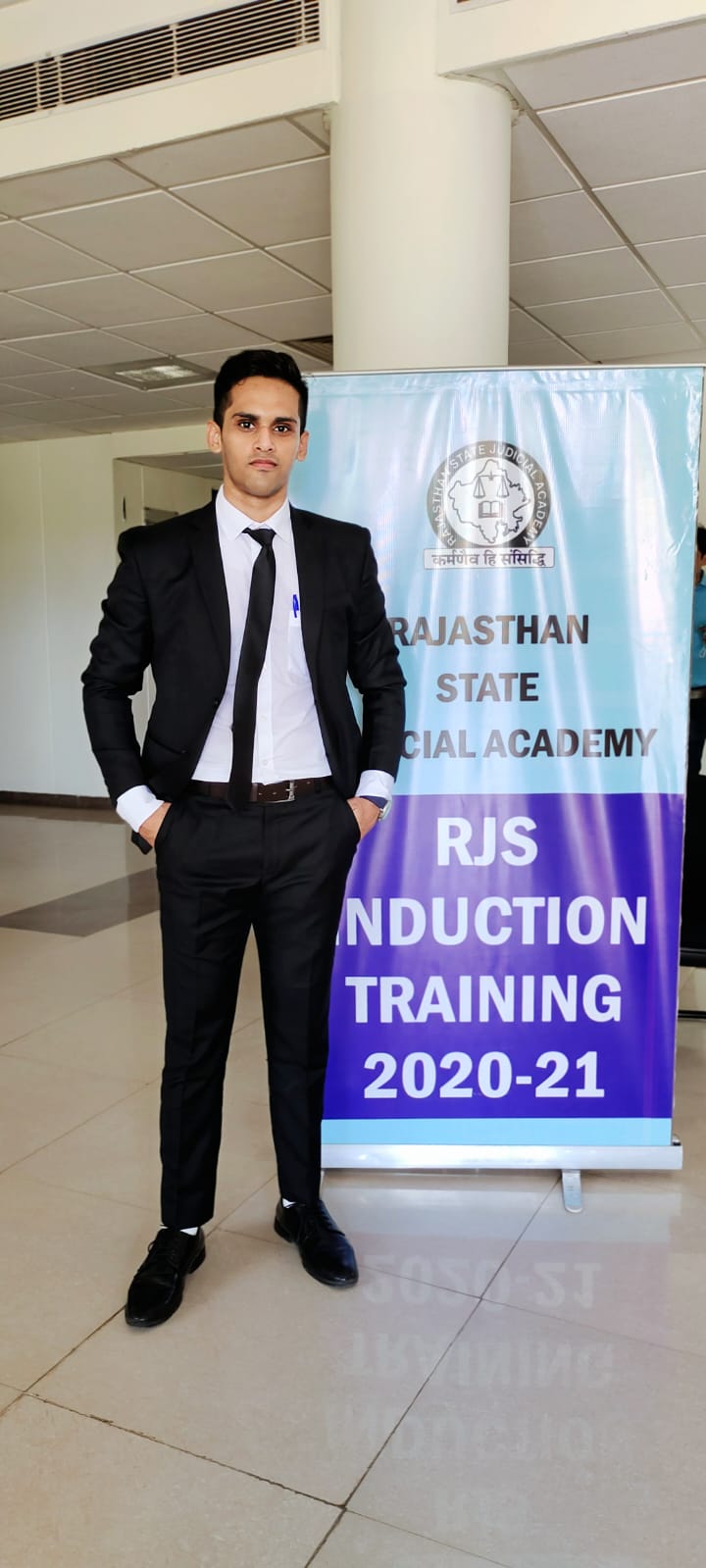
    I wrote the Rajasthan Judicial Services Exam Prelims in March 2019, and I completed my graduation in May 2019. Immediately after my graduation, I gave the CLAT PG exam, where I secured an All India Rank 15.  After this, my main focus was to clear the Mains of Rajasthan Judicial Services. RJS Mains was conducted in September 2019. Immediately after the Rajasthan Judicial Services mains, I shifted my focus towards Delhi Judicial Services Exam. The Prelims of DJS was conducted in the last week of September 2019 and Mains in the second week of October. In November 2019, I gave the Rajasthan Judicial Services Exam interview and simultaneously appeared for the NET exam. In December, I got this news that I have cleared the NET exam, and I am eligible for the post of Assistant Professor. Meanwhile, I was continuing with my LLM. Because of Covid-19, the interview of the Delhi Judicial Services Exam happened in December 2020. Meanwhile, I was also expecting the waiting list result of the Rajasthan Judicial Services Exam, which also got delayed due to Covid-19. In the Delhi Judicial Services Exam, I secured an All India Rank 68. Immediately after this, I got the news that I got selected in the waiting list of the Rajasthan Judicial Services Exam-2019. Right now, I am undergoing my Judicial training under the able supervision of the Honorable Rajasthan High Court and State Judicial Academy, Jodhpur.

    Congratulations on clearing the first phase of your induction training and beginning your field training. How has the experience been so far? It feels to have three significant feats, clearing CLAT [UG-PG], NET [Law] and the Judicial Services Examination?

    Thank you very much. The wishes mean a lot to me. During this training phase, I am learning a lot every day. It is an opportunity to learn practical concepts of the law. The law that we read in books and the law that we actually apply is very different. In order to give an experience of the practical world, State Judicial Academy time to time in different phases attaches us to different Judgeships throughout Rajasthan. During this field attachment, we get to learn about the Court functioning and how Judges manage the Dias. The experience till now is a very amazing one.

    When I started to prepare for competitive exams, I always had this thing in mind: I want to complete the treble, and these treble stands were completed with my selection in Judiciary. So, it feels very amazing when you achieve what you have always wanted. I believe that this is a very rare feat, but I am not proud of it, and I want to keep this hard work going even in the subsequent stages of life because if you stop putting effort, you stop your own growth. This zeal to grow and learn is something that differentiates a human from an animal. I want to continue with this spirit throughout my life.

    How did you prepare for the judicial services examination, and what factors did you take into consideration? Ideally, when should students start their preparation for the exam?

    I am a person who always prefers self-study over coaching. Although self-study takes a good amount of time to understand the concepts compared to getting spoon-fed in the coaching institutions, I think it helps you in the long run because when you try to solve everything by yourself, your mind develops a habit to work a lot. But it differs from person to person whether he/she wants to prepare by doing self-study or want to join some coaching institution.

    I started with reading Bare Acts of major laws and simultaneously reading standard commentaries on the subject. Multiple revisions are the key to understanding and remembering this vast course. Once you have covered all the major subjects, you can shift your attention towards the minor subjects and local laws.  For Prelims, you should try to solve as many multiple-choice questions as possible and once you clear prelims, you can make a specific strategy for mains. The strategy involves going through the past year papers, understanding the exam pattern, and trying to develop the answer writing habit. You will realize the value of good content and standard commentaries at this stage because if you have good content in your mind, you will not encounter many problems while taking down that content on paper. After covering the course thoroughly, you can join some mock test series and give as many mocks as possible. This will develop your answer writing habit, and your mentor can focus on your stronger as well as weaker areas where you need to work. Every person has his own rules for success, and I hope during this journey you will also be able to find your own ways, which you can tell people later on.

    If you want to succeed in competitive exams, then you need to be very disciplined, regular and patient in your approach. These are the qualities that are required from a judge and which will help you to clear any exam which you target. Also, there is a need to refrain from using any kind of social media during the preparation phase. I deliberately kept with myself a very normal keypad phone so that I could devote most of the productive hours to my studies and simultaneously focus on my fitness and sports-related activities. The major problem is our generation is wasting a lot of time using social media. I advise you as an elder brother that stops yourself from using social media for a year or two; believe me, when you come back, you will have a lot more followers than you expect.

    While conducting interviews, interviewers find qualities like patience, sincerity, maturity and a skillful leader who can effectively manage the courtroom while imparting justice. Could you tell our readers about your experiences while appearing for the Rajasthan and the Delhi Judicial Services Interviews?

    Interview is the third stage of this prestigious exam. The interview panel consists of Hon’ble High Court Judges. They already know that since we have cleared the mains exam, we are sound enough in law, so they want to test is whether you have those qualities required out of a judge. Patience, impartiality, ability to listen to the other side, acting on the spot, rational thinking, a reasonable mind, a commonsensical approach, and empathy are qualities that they look for. Apart from this, they will be testing you on the other aspects of life. The interview will not be restricted to the Law portion, but it will revolve around what you did in your college days, what are your interests and what you do in your free time. They will also be presenting to you some actual situations that how you will deal with those situations as a judge. My advice to all the aspirants is to be genuine before the panel, don’t try to give false answers or try to manipulate the panel because they already know whether you are speaking truth or lie. At least be true to yourself. If you don’t know about any questions, just say that I apologize; I don’t know. There is no need to get nervous before the interview; the panel ensures that you feel comfortable before them so that you can answer the questions in the best possible manner.

    You are conducting and have been a part of several sessions highlighting the nuances of cracking judicial examinations. What would be your advice to people as a speaker on developing speaking and persuasive skills?

    The profession of Law requires good oratory skills. Whenever you get a chance to participate in the events like Debates, Moot Courts, Court Room Exercises, do participate in them. As a judge or a lawyer, you will be heavily reliant on your oratory skills. Even if you are not good at speaking, don’t worry but try to work on your weakness each and every day because there is no such thing that cannot be accomplished. If you are dedicated, you can also develop good speaking skills, and good speaking skills come only when you have good content in your mind.

    Along with this, the focus should also be on acquiring good content. Try to read the leading legal websites every day so that you can be aware of the recent developments. This habit will help you in other aspects as well like it will be helpful from the Mains Exam and the Interview Point of view. My advice to the students is always to develop a routine and strictly follow it every day.

    Congratulations on your first authorship and its immense success. Have you ever considered taking up writing as a full-time career?

    In April 2020, I released my first book in association with LawSikho on contemporary legal topics to help law aspirants clear different exams. I am very happy that this book turned out to be a big success.  A lot of students regularly message me on Instagram and LinkedIn that, sir, your book really helped us. Such messages motivate me to help my community as much as possible continuously. I always have this thing in mind that once I achieve my goal, I will help the rest of the community to achieve their goals. During my preparation phase, I gathered a lot of material and then on some random day, I thought of compiling them in a Book Form. So, becoming an author was never a plan. It was totally out of my desire to help my fellow students to clear exams. I am happy that this book is still helping a lot of students.

    With AIR-15 & AIR- 23 in CLAT PG 2019 and 2020, respectively, how did you manage to score so well, especially in your first attempt? What were the differences observed in the exam level while appearing for CLAT PG 2020 compared to your previous attempt?

    More than the knowledge, I think that intrinsic motivation helps you achieve your desired goals. Motivation is something that helped me a lot to clear each and every exam in which I appeared. I started my journey with the CLAT PG exam, where I secured an All India Rank of 15 and in 2020, I gave that exam again to test myself on the new pattern and secured an All India Rank of 23. Since I was already in preparation mode, I did not encounter a major problem while preparing for the Judiciary as well as the CLAT PG, although you need to have a very different kind of approach and need to cover altogether different kinds of subjects. But as I already told you, if you are in rhythm, continuously studying, and in touch with academics, then there is no stopping you, and the same happened with me. As a result, I was able to clear the CLAT PG as well as the judiciary exams.

    The major difference that I found in the 2019 and 2020 CLAT PG examinations was the kind of questions asked and their uncertainty. Until 2019 they had a very predictable pattern in which they focused on the major areas of the laws, and the paper had two essay type questions as well. According to me the paper pattern till 2019 was much easier. But in 2020, they made large scale changes in the pattern and started asking questions based on contemporary legal events. As of today, if you want to score a good rank in the CLAT PG examination, you need to be very much aware of the contemporary legal events, and that means not only what is going in the current scenario, but you should also be aware of the past of that particular topic as well as the chain of events that is related to the topic. If possible, try to find out the major case laws related to that particular topic. Now the strategy is to do a holistic study. For that, first, you need to cover the static part (that is, you need to be aware of the basic static concept), and then you need to make a building that consists of the contemporary developments surrounding that particular topic. For example, if we take the right to privacy, we need to start our study right from the 1950s when the first case related to privacy came before the Hon’ble Supreme Court and the subsequent cases till present. By studying in such a way, you will be able to learn everything related to a particular topic, what was the stand of the court earlier, and the current position.

    You are currently pursuing PhD in Criminal law from NLU Jodhpur. What factors did you take into account while pursuing your PhD? Was there a convenience factor, or was it based on the competence of the University?

    I never thought that I would be pursuing PhD someday. But you never know what the future holds for you. The Covid era gave me time to write research papers and blogs. Writing a research paper on various topics gave me an understanding of many topics and developed my interest in pursuing higher education. I was already doing my LLM, and the results of the Judiciary exam was getting delayed. So looking at the opportune time, I filled the PhD form of NLU Jodhpur and started preparing myself for the PhD interview round. I was exempted from writing a written examination since I had already cleared NET. Before the board, I explained my topic and ensured that I would be giving the maximum possible time to research-related requirements. Research papers and blogs helped me to prove that I am interested in academics. Based on this board selected me, and I started my PhD in January 2021.

    You have always been enthusiastic about getting through the judiciary. You have interned under several advocates and also cleared the AIBE. How has your experience been in the field of litigation?

    During my UG, I interned under several advocates at the District Court as well as High Court level. After exploring every field that Law has to offer, I decided to go for the judicial services examination. Litigation was never the first choice in my mind. I was always passionate about becoming a judge because I saw various Hon’ble High Court and Supreme Court Judges coming to the college for some seminars and conferences during my time at college. I was amazed by their charismatic personality and the kind of power and respect that society commands. Right from that day, I decided that I also wanted to be a judge, and I also wanted to give back to society in the best possible manner. But I advise each and every law student that before you choose any field, you should explore because until you explore, you cannot make an informed decision. It is very necessary that you take some litigation experience during your internship as well as you should also do judicial clerkship because this will help you decide whether you want to do litigation or whether you want to come on the other side of the dais.

    You have been playing District and State Level Badminton Championships, as well as representing your club in cricket. Do extra-curricular activities help in maintaining one’s mental health? How do you make sure your mental health and work-life balance is maintained, considering your busy schedule?

    For me, fitness and sports are always the first priority. I always try to develop my lifestyle so that I should be able to give around 50-60% of my time for sports and fitness-related activity, which is something I am doing right from my school days. So balancing academics and sports life was not a big task for me, but it becomes very hectic to manage both these things on some days. To cope with such situations is something I learnt at the college level. The main thing that sports and fitness teach you is having a strong will and patience to navigate difficult times. I think these are some intrinsic qualities that are required to clear any competitive exams. Although sports and fitness don’t directly impact success in competitive exams, they do play an indirect role.

    What advice would you have for law students & young lawyers who want to step into the world of academia and judiciary?

    Young students and aspirants, I want to say that you enjoy your college because these are the days where you will make memories and learn a lot of new things every day. Everything has a set time. Don’t try to rush things. Before choosing any field you should explore, you should intern under different organizations and different advocates. Then only you will be able to make an informed choice. Refrain yourself from using social media and use this time to develop some new hobby or if you already have some hobby, try to pursue it regularly. Clearing competitive exams takes a lot of time and effort. It is a long cycle, and you need to have a mental balance, and mental balance comes only when you are physically healthy. In the end, I want to say that by making your own path, don’t try to copy others. You’ll also be having your own rules for success. Have faith and confidence in your abilities.


    Get in touch with:

  • NIYATI AHUJA, ASSOCIATE AT STEPTOE & JOHNSON LLP, ON PURSUING LLM FROM UC BERKELEY SCHOOL OF LAW, HER INTEREST IN INTERNATIONAL ARBITRATION AND WORKING WITH AN AMERICAN LAW FIRM

    NIYATI AHUJA, ASSOCIATE AT STEPTOE & JOHNSON LLP, ON PURSUING LLM FROM UC BERKELEY SCHOOL OF LAW, HER INTEREST IN INTERNATIONAL ARBITRATION AND WORKING WITH AN AMERICAN LAW FIRM

    This interview has been published by Maaz Akhtar Hashmi and The SuperLawyer Team. The Interview was taken by Priyanka Cholera.


    You have an intriguing trajectory that we are excited to talk about. Did you envision this for yourself in the first year of law school?

    Thank you for inviting me. Indeed, it has been a very interesting journey so far and I hope that it continues to be. When I joined law school in 2012, I did not in any way anticipate that I would be working at a law firm in New York or moving to a new country altogether. I wanted to get an LL.M. degree to take advantage of the several practical opportunities available to understand the legal practice in foreign universities, which are still missing in Indian universities as their main focus remains on teaching the theory of law. I hadn’t decided at the time whether I would pursue my LL.M. in the United Kingdom, like most law students in India, or the United States, where job prospects after an LL.M. for Indian lawyers are considerably limited. With hard work and some luck, I was admitted into the University of California, Berkeley which is a great school, and my launching pad into a career in the United States. During my LL.M., in addition to my coursework, I did a part-time internship with the Office of the General Counsel at the Bay Area Rapid Transit. I truly cherish that internship as my first exposure to the workplace in the U.S. The journey has been surreal and has involved plenty of blood, sweat and tears. It also required ample time and perseverance to continue looking for a position that would entail work in the areas of law that I enjoy. Overall, the journey has been interesting, and I hope it stays that way!

    Let’s start from the beginning: why law out of all the career choices available? And how was your experience at Guru Gobind Singh Indraprastha University?

    I had wanted to become a lawyer ever since I was in ninth grade. It wasn’t an obvious choice, though, as everybody in my family is either a doctor or an engineer, and my father was in the army. However, the ability to use analytical reasoning, writing and oratory skills in a profession were factors that got me interested in the legal profession. I have participated in several debates and had been commended in school for my writing skills, which aided my decision to become a lawyer. Essentially, the profession indeed is a mixture of a lot of writing and speaking. When I started law school, I was very interested in venturing into and specializing in criminal law; however, I was advised by senior lawyers that it wasn’t the safest profession for women in India and that I should consider corporate law instead and that is what I did. Most of my internships during law school in India were in the field of corporate law and capital markets. 

    Regarding my experience at Guru Gobind Singh Indraprastha University, I would definitely say that the five years were very formative in my career development, especially in terms of thinking about legal issues. I participated in many Model United Nation conferences and Parliamentary Debates, which ultimately had a bearing on my choice of practice area.  I think the best part of being in law school is that the only responsibility is understanding the courses, getting good grades, interacting with other students and professors, and participating in co-curricular activities. I chose my university mainly for two reasons – first, it had an option to pursue a Bachelor of Business Administration integrated with the LL.B. and second, the class size was very small (30) for this course, which is a great way to get individual attention from professors.

    During your time in law school, you interned at different offices, including a senior advocate, a medical devices company, capital markets departments of two of the biggest firms (Luthra and Khaitan) etc. What value did these internships add?

    Every internship teaches you how to think and write like a lawyer. Even though an intern isn’t given huge responsibilities or assigned drafting an entire document, you get to witness and assist lawyers by researching specific points and producing early drafts. It becomes a part of the learning process. Amongst my several internships, I had the greatest learning experience when I interned with a Senior Advocate in the Delhi High Court who practices in Criminal Law and with the capital markets team of Khaitan & Co. as well as Luthra & Luthra Partners where I learnt a lot from a small team including a partner and a senior associate. The internships shaped me as a lawyer, and they essentially helped me learn how to think, research and write.

    However, the style of writing adopted by lawyers in India is very different from American or British lawyers. Therefore, I had to adapt my writing style to what is expected from an American lawyer. The LL.M. program and taking the New York bar were very important in my understanding and adaptation of writing an effective brief like an American lawyer. 

    In one of your interviews, you stated that while shortlisting schools for LL.M., you considered the quality of journals published by various law schools in America. And even during your time at Berkeley, you were a part of many renowned journals. Would you please share the thought process behind giving such importance to journals? How has being associated with these journals shaped you?

    That is correct, one of the many factors I considered while shortlisting schools to apply to was the quality of journals published by the law school. I was an associate editor for both the Berkeley Business Law Journal (BBLJ) and the Berkeley Technology Law Journal (BTLJ). Most law schools have good journals. However, some are more renowned than others, for instance, the Berkeley Technology Law Journal is one of the top journals in the U.S.  

    As a member of these journals, I was exposed to various interesting articles submitted for publication and participated in cite and source checking for these articles, as well as took part in several activities organized for the members. The activities provided access to various law firm organized events as well as to students pursuing their J.D. who had a different perspective on the law school experience as compared to international law students and insight into the American legal market. When you’re working for such journals, you get to read a lot of excellent literature that has been written, understand the editorial process, which is immensely helpful if you are interested in publishing articles later in your career.

    One of the most interesting observations we have noticed is that it was only after you started pursuing your LLM that you streamlined your work towards arbitration. Was there any particular experience/incident that inspired you to pursue a masters?

    First, regarding the focus on arbitration, it is correct that after my LL.M. I refocused on opportunities in the international arbitration field. However, my interest in the field was longstanding. During my third year in law school, one of the Model United Nation conferences I attended included a ‘Permanent Court of Arbitration’ committee and the case we were arguing was the famous Philip Morris v. Australia case. I found it very interesting how parties had the autonomy to choose the law applicable to their dispute, the seat of arbitration and the arbitrators deciding the dispute. I found the entire procedure really different, giving a lot of autonomy to the parties. That is how I got interested in arbitration. Once I started my LL.M., I opted for all courses related to international arbitration. Fortunately, my commercial arbitration professor was very patient and encouraging and his coursework genuinely reinvigorated my interest in international arbitration. 

    Second, I aimed at specializing in business laws during my LL.M. and opted for as many international law courses as I could. My LL.M. was never meant to focus on international arbitration alone and I am glad it didn’t since I have used various business law concepts in my international arbitration practice so far.

    Right after Berkeley, you attended the International Arbitration Academy in Paris, one of the most renowned institutions worldwide for studies on Arbitration. Could you share with our readers your experience at the Academy?

    It was an absolutely great experience. We were a class of around 80 students including young to mid-level practitioners sharing a common interest, international arbitration. The courses are taught by renowned practitioners from all over the world. To name a few, we had professors from the University of Paris 1 (Panthéon-Sorbonne), the University of Liège and Brussels, the University of Oslo, the University of Geneva, Dean of Swiss International Law School and Professor emerita of Private Law at the University of Basel/Switzerland.

    There were also workshops and seminars conducted by ​legal counsel from ICSID, Deputy Secretary-General and Principal Legal Counsel, Permanent Court of Arbitration, Secretary-General, ICC International Court of Arbitration, Deputy Secretary-General, ICC International Court of Arbitration, Secretary-General, Hong Kong International Arbitration Centre, as well as arbitration practitioners from Shearman Sterling.

    Not only did I get exposure to the teachings of the esteemed faculty, I also learnt about the difference in practices and experiences of the other students coming from approximately 30 countries. Overall, it was an excellent learning experience and networking opportunity. I made several cherished connections which I maintain to date.

    You have interned at various US law firms, like Alston & Bird, Busse Disputes. How have these experiences contributed to your growth? Do you think it would have been easier to land a role if you attained bachelors from a foreign university?

    I admit it would have been considerably easier to be employed in the U.S. had I pursued my Juris Doctor (J.D.) in the U.S. As a matter of fact, I did consider it, however, I had already completed my B.B.A. LL.B. and LL.M. degrees, so I didn’t really think it was an economical option. 

    It is difficult for international students/lawyers to break into the legal market in the U.S. as U.S. law firms generally hire from their summer associate cohort, and international profiles aren’t the usual suspects owing to the obvious lack of a conventional J.D. degree. However, difficult does not mean impossible, many LL.M. students who went the extra mile are now working in law firms in the U.S.

    I worked with Alston & Bird, New York for around eight months with a team of very competent and approachable lawyers. I also made some great professional connections which I maintain to date. I not only learnt how to draft legal memoranda, effectively conduct research in American and International law, and understand aspects of an arbitration proceeding and enforcement action. This was my first experience and exposure to US law firm culture which is different in many aspects from Indian law firms.

    When I went to Germany to intern at Busse Disputes, it was a country and culture that I did not know much about. It was my first experience with a boutique arbitration firm, and it was interesting to learn how a boutique firm functions. I also had the opportunity to understand an arbitration proceeding from the perspective of an arbitrator. The manner of working and assigning tasks is comparatively different from the U.S. I found that German firms are more formal and hierarchical whereas U.S. firms (or at least the ones I have worked with) are collegial and tend to give you as much responsibility as you are willing to take. 

    What were your key responsibilities as an Associate at Diamond McCarthy LLP? What are key firm culture differences in India and the US?

    As the only associate in the international arbitration practice group at Diamond McCarthy, I was entrusted with a unique level of responsibilities and autonomy on a range of complex arbitration and related litigation matters. I conducted legal research and drafted pleadings, witness statements, instructions to experts, document production requests and responses, and handled correspondence with opposing counsel and tribunals. I was also heavily involved in the business development efforts of our practice group. 

    I think it was a great learning experience since it led me to understand how all aspects of a case really works and how different components come together, as well as the requirement to consider external factors which impact a case. 

    With the passing years and stricter visa regulations, we understand that getting a job in the US with an LL.M. is not very easy. What did you do differently to penetrate the legal market, and is there any advice for people looking to enter the US legal market?

    There is this notion that visa regulations restrict international lawyers from getting employment. However, I think that is only partially true. Once you have proved your mettle, firms will gladly sponsor your visa. The greater barrier is the unconventional profiles that international lawyers bring to the table. If you look at tech companies, they hire immigrants (including Indian engineers) all the time and sponsor their visas. 

    I encourage people to not be disheartened owing to this preconceived notion regarding potential visa issues, and apply to as many jobs as you can with a cover letter and resume tailored to the position. 

    I quickly learned that U.S. law firms were not willing to hire me as an associate straight off the bat, so I started applying for trainee and internship positions. I also networked quite a fair share and tried to attend all available dispute resolution related events, even during my LL.M.

    As far as the financial side of things is concerned, I took a loan for my LL.M. An LL.M. is a huge financial investment, and I was determined to ensure that the investment was worth it by persevering and leaving no stone unturned. I will not deny that there were times when all I wanted to do was give up, take the easier route and apply to a position at an Indian law firm. At such times, my mother gave me the strength to keep at it and reminded me that there is always a light at the end of a tunnel.

    You were a gold medalist at Delhi State Inter- School Karate Competition. And even during your time at Berkley, you opted for a Yongmudo (Korean Martial Arts), Taekwondo, and Ballet course. Could you tell us more about these interests of yours?

    My father was in the army, and since I was a child, he always encouraged my sister and me and provided me with avenues to participate in physical activities like rock climbing, rappelling, skiing, basketball and Karate. 

    I moved to the U.S. for my LL.M. when I was 22 years old, I was learning about a new country, its legal market, and dealing with applying to internships and associate positions. At times I found myself overwhelmed by these things, and the Ballet course, Yongmudo, and Taekwondo classes were an effective way to cope with the stress and give myself a break from law school. An added advantage was that I made some good friends and met many people who I wouldn’t have had access to if I only spent my time in law school. I think overall it did wonders for my mental and physical health.

    The pandemic has been quite challenging both personally and professionally. What are your coping mechanisms? What would be your parting advice to students and lawyers who want to work in American law firms?

    The uncertainty combined with the devastating state of affairs during the peak of the Covid-19 pandemic affected everyone all over the world. Personally, there was and continues to be a lot of hard work which goes into coping with everything, and hobbies like gardening, reading books, and painting really helped me. But I won’t lie, there were days during the pandemic when I felt burnt out. That being said, it also made me acknowledge that mental health issues remain unspoken in our profession, making it even more important to reach out to others if things get overwhelming. 

    My advice for students and junior lawyers, especially during this pandemic, would be to take small steps towards your goals but keep moving. The small steps and plans that you layout seem achievable that way. I would suggest that they meet new people – virtually or if you are able to in-person, even if it makes you feel uncomfortable at first. Once you start, you will eventually enjoy interacting with people who share a mutual interest with you.  The best relationships I have fostered with colleagues are the ones that began organically and also making the effort to stay in touch with them. Be confident and express your interest if you are interested in a person’s practice and would like to learn more about it. You will be surprised at how many people respond and would like to help younger lawyers build a successful career. Lastly, I would just advise or rather preach something I do practice – never give up, your dreams might seem big right now, but believe in yourself and you will achieve what you set your mind to. It will not be easy, but it will be worth it, and eventually, everything will make sense. For the fear of sounding too much like Dr Seuss, I truly believe that in life, you can steer yourself in any direction you choose. I hope that does not sound too cliche, but I truly believe it. Last but not least, make sure you have fun in this journey even though it’s a difficult one. Take care of yourself and hone your skills continuously to become the best version of yourself.


    Get in touch with:

  • Aakash Sharma, 5th Rank, UP Judicial Services-2016 shares tips and tricks to get a sweet taste of victory

    Aakash Sharma, 5th Rank, UP Judicial Services-2016 shares tips and tricks to get a sweet taste of victory

    Aakash Sharma completed his LL.B. in the year 2014 at Campus Law Centre, Faculty of Law, Delhi University. He went on to pursue an LL.M at National Law University, Delhi in 2015. After qualifying the UGC-NET exam, he taught Law as an Assistant Professor at Lloyd Law College for a year.

    Not lured by the fancy corporate jobs, Aakash got fascinated with the working of the judiciary as a judge is an independent arbiter upon the matter before him and does not have to take sides unlike a lawyer. Hence, to conquer his dream he started with the preparations from scratch without any coaching. He qualified for the UP Judicial Services – 2016 examination with 5th Rank.


    In this interview, he gives us great insights to:

    • The ideal time to start preparing for the Judicial Services exam.
    • His strategy for tackling and remembering the different provisions of Law.
    • Tips for facing the nerve-wracking interview.
    • And his motivational message to the aspirants.

    How would you like to introduce yourself to our readers?

    First of all, thank you for giving me this opportunity to connect with your readers. I did my Law from Campus Law Centre, University of Delhi in the year 2014. Subsequently, I completed an LL.M. from National Law University, Delhi in 2015 and also qualified the UGC-NET Examination the same year. I taught Law for a year, but destiny had something else in store. I was selected in the UP Judicial Services Examination 2016, commonly known as PCS-J.


    How did you gravitate towards Law?

    (Aakash completed his B.A. (Hons.) in Political Science from Kirori Mal College, University of Delhi in the year 2011.)

    I have often wondered what prompted me to take up Law. It now seems to me that the decision of taking up Law after pursuing graduation in Political Science was utterly providence. While subconsciously, I used to find Law and legal process intriguing as a child. But unbeknownst to me, I have somehow drifted to it. Law is a fascinating discipline because it is so dynamic. Every day is an exciting day in law. The credit really goes to my teachers. Prof. Rajiv Khanna, Prof. Usha Tandon and Prof. Raman Mittal at Delhi University; and Prof. Mrinal Satish, Prof. B B Pandey and Prof. M.P. Singh at NLU Delhi. These teachers made Law interesting and turned my initial intrigue for Law into endearment.


    Did you focus only on academics in college life?

    I maintained a healthy balance between co-curricular activities and academics. I was designated the Student Convener of the Seminar & Discussion Society after winning the college debating competition at Campus Law Centre. I used to organize weekly discussions on bills, legislations and judgments. The real secret of excelling in academics is a deadly mix of self-discipline, being attentive in class, making your own notes, reading the best authors, mastering the bare acts and leading judgments, and avoiding cheap guide-books and coaching institutes like the plague.


    What made you choose to serve the Judiciary; did you not get tempted by the fancy corporate jobs?

    Every facet of Law is enjoyable. I chose judicial services because a judge is an independent arbiter upon the matter before him. He need not take sides like a lawyer. I found this especially attractive about judicial services. As far as corporate job is concerned, I got a taste of corporate practice during my internship days and found that it was not my calling.


    Do you think an LL.M. candidate gets leverage to the rest appearing for the Judicial Services?

    Yes, having an LL.M. is definitely advantageous. LL.M. at NLU Delhi is a very rigorous and advanced degree wherein you not only learn the Law, but you critically assess and deeply scrutinize it. This deconstruction of Law is not done as thoroughly in LL.B. As far as leverage over other aspirants is concerned, LL.M. will make you “think” about Laws and not just “know” the Laws; it will improve your writing skills and make you cognizant of legal theory and philosophy. Therefore, an LL.M. candidate has better grasp on the subject over the rest appearing in Judicial Services.


    When should a person ideally start preparing for the Judicial Services exam?

    Nobody can really be very confident that he/she will positively succeed in an exam where the success ratio is 1:200 or a mere 0.005% so I was simultaneously working as an Assistant Professor to have a steady income and a stable back-up if my efforts don’t bear fruition. I did not take coaching. I made my own notes from scratch. It was a painstaking job. Preparation for judicial services can informally start from the law school itself once the candidate has diligently read all the landmark cases in the various subjects. One should also cultivate a rational and reasonable world view and should be able to have independent opinions which are free from any bias. This exam requires utmost dedication from the candidate. It requires at least 1-2 years of dedicated preparation if you are starting from scratch. On the other hand, if you were paying attention in college itself and actually studied from cases and bare acts and not guidebooks, you can clear the exam with 6 months of preparation also.


    How many hours did you devote towards the Judicial Services in terms of your preparation on a daily basis?

    My agenda every day was to stick to a plan of about 2 hours for General Knowledge including the newspaper, 1 hour for Language and Essay, and 4-5 hours for Law. I tried to stick to this schedule the best I could. I revised each and every topic in every law subject at least 5 times before the Mains exam. The result of this kind of meticulousness in preparation was that during Mains I faced no problem at all in answer writing, while other candidates complained of lengthiness of some papers.


    What was your study pattern, the mode of study (online, offline, etc.)?

    My study pattern was well spread out across the day with regular breaks to keep the mind fresh. I referred to Ratanlal for Indian Penal Code, Kelkar for Cr.PC, Takwani for CPC, Avtar Singh for Contracts and Specific Relief and MP Singh for Constitutional Law. For Preliminary Exam, I solved a lot of MCQs and referred to bare acts simultaneously. For Mains Exam, I made notes for all subjects, solved all the previous year’s question papers, pasted the syllabus in my room and consulted it regularly to keep a tab on my preparation. For Interview, I revised the mains exam law syllabus, made notes for general knowledge, and practiced answering questions that are most likely to be asked.


    How did you prepare for the General Knowledge section?

    I read the Indian Express newspaper every day. For static GK I referred to Lucent, Bipin Chandra and Arihant. For current GK I referred to Pratiyogita Darpan, and used online resources from Vision IAS and GK Today.


    Any specific strategy for dealing with the various case laws?

    The approach to remembering the sections is to consult the bare acts again and again while studying law. There is really no other way to remember provisions. For case laws, one should prepare their own subject-wise list of leading cases and their ratio decidendi. This list will aid in last minute revision and one can regularly update it with new rulings. The exam will exhaust you. But it is important that you keep fighting as if your life depends upon it.


    Tell us about your interview.

    My interview lasted 25-30 minutes. I was asked about 25 questions. 2-3 questions about my personal background to break the ice. Followed by 2 questions from current affairs. And about 20 questions from Law. Interview preparation basically comprised of revising all the Law subjects and having an opinion on each and every Law issue I would encounter. The interviewing panel comprised of the UPPSC Chairman, High Court Judge, and two Law professors.

    I was first asked about my background, my education, and what I did and do presently.

    From GK I was asked to explain the rationale behind Demonetization with its pros and cons, and to tell them whether the policy had been successful or not.

    From Law, I was asked:

    • What is a Thug as per IPC?
    • Jurisprudence for unconstitutionality of s. 303 of IPC?
    • Difference between culpable homicide and murder?
    • Definition of consideration in ICA, followed by a problem based question upon it.
    • Elements of Contract and the distinction between Agreement and Contract.
    • The particular section in the Contract Act which defines what a Contract along with is its ingredients.
    • What is the definition of evidence?
    • Whether you can convict someone solely based on circumstantial evidence, the jurisprudence behind it, and the section which makes circumstantial evidence relevant?
    • What are the alternatives available if the police do not register an FIR?
    • Describe in detail the procedure of recording a complaint under section 200, and how you will proceed further with the procedure after it is recorded?
    • How many witnesses must be present along with the Complainant for recording the complaint?
    • Describe an abuse of legal process and explain it by giving an example, also state the remedy available to counter it.
    • Which section and order of the CPC prescribe for the mechanism of ADR?
    • What are the different kinds of ADR, and my comment whether they are desirable?

    Be humble and polite in the interview. Do not show off. Accept your mistake there and then. If the member tries to interrogate you further, do not get defensive and hesitant. Answer respectfully and give to the point answers. The interviewers comprise of experienced persons so do not even think of misleading them.


    Selected for the Judicial Clerkship/Law Researcher at Supreme Court of India in 2015; please share an insight to it.

    Judicial Clerkship comprises of an entrance examination followed by a personal interview with the Chief Justice of India himself! The entrance examination is quite competitive and comprises of English and all the Law Subjects. Students in the merit list are called to appear for a personal interview at the Supreme Court. I was interviewed by Hon’ble Chief Justice T.S. Thakur and Hon’ble Justice Anil R. Dave. It was a memorable experience.


    What would be your tips to those aspirants who are preparing for this exam?

    You have to produce the result of your selection yourself. So don’t count too much on coaching institutes. Judicial Services Examination is not a piece of cake. The competition is immense, so halfhearted attempts can never work. Only the most sincere effort gets rewarded. And once you achieve success, there is nothing sweeter in the world.

  • Santanu Mukherjee, Founder, Ex Lege Chambers, and his involvement in multilateral negotiations at the global level

    Santanu Mukherjee, Founder, Ex Lege Chambers, and his involvement in multilateral negotiations at the global level

    Santanu Mukherjee graduated in Law from South Calcutta Law College, Calcutta University in the year 1998. He is an Advocate and an accredited Mediator practicing in New Delhi. He is currently the founder and Head of Ex Lege Chambers, Advocates and Regulatory, Policy Advisors, a boutique law office.

    Over the past twenty years of his work experience he has worked in Statutory and Regulatory Policy, Commercial Mediation and Litigation practice while specializing in Intellectual Property Rights, Competition Law and International Trade Law. His clientele comprise of entities from governments and large corporations to start-ups.

    Recently he has been awarded the prestigious Intellectual Property Lawyer of the Year Award 2017 from the Indian National Bar Association.

    In this interview, he gives us insights into:

    • The importance of extra-curricular in shaping your personality.
    • His international work at the South Centre.
    • Setting up his own firm- Ex Lege Chambers.
    • Honing one’s legal research and communication skills.


    How would you like to introduce yourself to our readers?

    I would like to introduce myself as a legal professional and a mediator, who is passionate in seeking solutions to legal problems and ready to go deep into a matter that I take up. Someone who is passionate to continuously learn, be a thoughtful leader and a change agent, someone who does what he believes in.


    Tell us a bit about your childhood and pre-college life as well as educational background. Do you have lawyers in your family?

    My childhood and college days had been fascinating, I was always interested in extra-curricular, was extremely disciplined and loved to do social work. I studied in Don Bosco Bandel School and was very active as a boys scout. It was long time back but I still cherish the memories of public cleanliness initiatives we took up and volunteering activities in community fairs and traffic rules awareness programmes. Of course the adventure activities were fun, hiking, rock climbing, trekking and the competitions. It developed a deep bond of brotherhood that is still live; I am in touch with many of my childhood friends and my scout brothers even now. Finally an acknowledgment for life, it was a great honour to be awarded by the Hon’ble President of India as a President’s Scout.

    Then came the college days, at South Calcutta Law College, studies were as one could expect in a Law college those days, no frills of moots but occasional debates. However, here again I was focused on some different type of extra-curricular, I enrolled with No. 2 Bengal Air Sqn, National Cadet Corps (NCC) and was the only student from a Law college at the NCC unit. It was again another wonderful memory, the weekly parades, the skeet shootings, the glider flying, the extempore preparing for the best cadet competition, it was a unique experience. In the three years of Senior Division NCC, I rose to be the Senior Under Officer, a learning of leadership that is a training for life. Preparing for the Republic Day camp was an ordeal; I was selected as the West Bengal and Sikkim contingent senior and with it came a sense of responsibility, fellow feeling. The camaraderie was unbelievable, the contingent was tight even during challenging moments, and these thoughts still make me nostalgic. The love and support of my trainers, fellow cadets enabled me to work hard and get the Best Cadet of West Bengal and Sikkim Directorate medal from the Hon’ble Governor of West Bengal. My childhood was adventurous and full of activities of rather unconventional outdoors. I am sharing these thoughts since I want to make a point that there is learning in everything, in sports, in community work, in adventure activities, all can contribute to making our personality.

    I do not have lawyers in my immediate family, my father was a polymer technologist and my mother is an artist and home maker and both of them have always been a great inspiration for me. My only sister has not taken up legal profession either, however my maternal cousin, who is elder to me, had been a practicing lawyer at the Calcutta High Court. She inspired me a lot but I specialized in IPR early hence professionally could not gain much when she was a general litigator.


    In India there is bit of resistance towards legal education even now. What motivated you to choose law as a career?

    Yes, very true, legal education was not at all promoted; some people even had a very negative perspective of legal professionals. Things have changed now to a certain extent and is improving every day. I think a lot of credit goes to structured legal education that has been introduced, the contribution of the National Law Schools and entry to legal education through Common Law Admission Test.

    Typically when one talks of Law as a career, one thinks of becoming a lawyer who would interpret Law and of course aspire to be elevated to the bench one day. In my days as a student, my Law career goals were similar, only that I always wanted to work on international issues and wanted to be an expert. I was exposed to Intellectual Property Rights (IPR) at an early phase, when I was preparing for the NCC Best Cadet competition; I read about the General Agreement on Trade Tariffs (GATT) and the negotiations on IPR, discussion on the ‘Dunkel Draft’ was in the newspapers. My curiosity made me read more and I liked the IP Law discipline and at the final stage of my Law studies was already more aware than most practising lawyers (those not practicing IP law). However, gradually what really intrigued me was ‘Law making’ and this has been a constant motivating factor, to be able to draft a Law from scratch and the grand finale perhaps to be able to move it as a Law maker.

    You have a varied work experience, how did you start, how was your initial days of law practice?

    It’s true that I have a varied work experience, in fact I always wanted to get a 360° exposure to different works in Law. Having started as an Advocate at the Calcutta High Court, I moved beyond whenever I got an opportunity. I started as a Law trainee at S. Jalan and Company, a leading Solicitors’ chambers in Kolkata and was fortunate to be under the tutelage of Mr. Shyamanand Jalan. He was one of the leading corporate and commercial lawyers of the time in Kolkata at that time and I will always be indebted to his guidance towards meticulous drafting and his pragmatic approach. The GATT 1995 was already signed and the World Trade Organization was formed. The Agreement on Trade Related aspects of Intellectual Property Rights (TRIPS) was one of the pillars of the WTO multilateral trade regime. My interest in IPRs landed me at D. P. Ahuja and Co., one of the leading IP Attorneys at Kolkata. I was quickly drawn into IP litigation work, new learning experience amidst some of the legal experts in IPR practice, one of whom was later elevated to the Bench at the Calcutta High Court. I was bonded to IPR domain for ever while gradually expanding to different other areas in the days to come. Later I went to York England to read Law at the College of Law of England and Wales, now University of Law, York, UK.


    You were a British Chevening scholar in UK, can you let us know how was your interview to give our readers some tips to nail the scholarship. What did you study and how was it helpful in your career? During this time you were also a visiting lawyer at the Littleton Chambers, Inner Temple Bar, London, how was your experience?

    Indeed, I attended the British Chevening Programme for Young Indian Corporate, Commercial Lawyers 2000 at the College of Law of Engaland and Wales at York, now University of Law, York, U.K. I understand that this programme is not continued any longer, I am told that instead the number of LL.M. Chevening scholarship offers have been increased. I qualified in the preliminary interview at Kolkata and appeared before the final interview in New Delhi. It was a panel interview of five members which included a Supreme Court practitioner, two academic faculty members of the College of Law, one of who was also a qualified British barrister and the other a solicitor and I think there were members from British Council and the High Commission in New Delhi. I enjoyed the interview which was more of a discussion about my career plans, IPR issues and a tricky trademark infringement matter and some generic questions.

    The scholarship programme was a customized for legal practitioners and touched on laws of England and Wales and the European Union as well, often drew comparison with the Indian laws. A number of corporate and commercial Law subjects were covered but what I really found fascinating was the trainings in lawyering skills. The Woolf Reforms and the Civil Procedure Rules of 1998 had just come into effect the year before we went to England. The legal drafting style in England and Wales had already experienced a sea change, crisp lucid language was in vogue. We were quite taken by surprise but the unlearning of the Indian legal drafting style and adapting to the new style was perhaps necessary. The drafting sessions and the courses on negotiation and advocacy which I attended in the programme were excellent and definitely helped me later on as a lawyer.

    I had already gained some experience in drafting and negotiating skills working at the Solicitor’s firm in Kolkata hence wanted to get some exposure to good advocacy. This made me split my practical attachments between Beresford and Company an IP Attorney Firm well known for their hi-tech practice (now Beresford Crump LLP) and Littleton Chambers, Inner Temple Bar. At that time Littleton Chambers was not one of the leading chambers for IPR matters but had quite a wide variety of matters. I wanted to gain maximum from this wide exposure hence opted for the Littleton Chambers to get a real life experience of advocacy in English courts. I could join different barristers at the Royal Court of Justice in London, the Employment Tribunal in Leeds and watch them plead. They had also arranged a visit to the Old Bailey (the central Criminal Court of England and Wales) for me; it was quite a unique experience. I liked the work culture of the chambers, the discussions and the warmth. I could also get a ticket to attend a lecture of Lord Rt Hon Lord Woolf who was the author of the legal reforms, it was quite a treat.


    You have spent some time in doing legal research work and policy work, how did you get interested in such works?

    The founding stone to my interest in doing legal research is actually my master’s studies at Bern, Switzerland. The IPR related issues that I worked on were interesting but I was interested to understand the interface issues between IPR and international trade laws as established under the WTO regime. The first five years of the transition period for developing countries to adopt TRIPS was over and India had already suffered a setback at the first IPR case. The Panel of the Dispute Settlement Body (DSB) of the WTO found India’s Patent law not in compliance with its WTO commitment. I felt that for a developing country like India, WTO regulations would be important for the coming future and it would be worth studying it deeper.

    At that time, a friend informed me of the World Trade Institute in Bern, Switzerland providing a Master’s programme in International Law and Economics with exclusive focus on WTO regulations. Although initially I was reluctant since it was a new institute but given the reputation of Bern University and having some of the leading names from Yale, Oxford, Columbia Universities and many others as members of faculty I was convinced. I managed to get a scholarship from the Institute and successfully complete it and I gained immensely from our Managing Director, Prof. Thomas Cottier who was also the chairman of the first IPR case decided by the WTO between USA and India. I had already done an internship at the WTO Secretariat in Geneva which gave me an inside view of how the WTO worked. Further, it also gave me an opportunity to sit in the TRIPS Council meetings and understand the importance of strategy and the play of tactics in multilateral negotiations.

    My master’s studies involved significant legal research and actually it also opened my door to policy work which involved critically analysing laws, recommending changes and took me to a step ahead of my interest in drafting laws. It gave me a feeling that I can contribute in works that can have mass effect and encouraged me to undertake deeper legal research based policy work rather than rhetorical advocacy. By now I had already noticed that in continental Europe, lawyers dedicate time doing legal research while in India such research is only taken up by academics. I decided to adopt this model and try for some fellowship at some renowned research institute and my exploration led me to the Max Planck Institute for Intellectual Property and Competition Law (MPI) in Munich, Germany. At MPI, I worked on interface between IPR and multilateral trade regulations under the WTO and the Indian Patent Law and protection of traditional knowledge and the research foundation helped me all through later. Based on my work published an article at their peer-reviewed journal, IIC and made presentations including at the Global Salzburg Seminar on Trade, Aid and Development.


    Tell us about your international work at the South Centre, what was the nature of your work and your return to India.

    After completing my research at the MPI I was contemplating moving back to full time legal practice when I got an interesting opportunity. The South Centre, an intergovernmental organisation of developing countries based in Geneva working along the UN organizations and chaired by Dr. B.B. Ghali, former Secretary General of the UN was looking for a Fellow with IPR practice and research background. I was familiar with the Centre’s works and also that our former Prime Minister Dr. Manmohan Singh was its chairman when it was still in the form of South Commission, I was quite excited when I cleared the interview to join the South Centre. As a Fellow I worked in the capacity of a consultant and enjoyed certain perks as an international civil servant similar to the UN staff which itself was a new experience.

    My main work was on pharmaceutical patents and how developing countries could draft examination guidelines in a manner helpful to their developmental needs, but remaining within the TRIPS Agreement. I was also deeply involved in preparing negotiating texts for on-going IPR negotiations at the WIPO and WTO including those on geographical indications. It was quite an unique opportunity to prepare draft laws and amendments to patent laws for member countries that lacked capacity and it’s very satisfying to note that some became laws in those countries. I worked very closely with WIPO, WTO UNCTAD and other IGOs on different international issues. South Centre used to hold training sessions for commerce ministry officials of member countries regularly, it was absolute pleasure to model such training courses and teach these trade diplomats. One of the new learning was to present technical matters in a non-lawyerly manner since the bureaucrats were seasoned generalists but not always familiar with legalistic approach. Once my project was complete, instead of waiting for some other project, I thought that I should return to India and explore opportunities back home.


    You have been working in Delhi for about 10 years now and have started your own Law office, how did it come by?

    Many friends had advised me against leaving Geneva, they tried to convince me that I would be able to contribute more by being there rather than returning. However, I took the decision to return to Kolkata and after an initial year moving back to legal practice and consulting, I realised that if I want to continue working on policy, I needed to move to Delhi.

    Once I decided to move to New Delhi, I started discussing work possibilities with some Law firms when Qualcomm, an advanced wireless technology company based in San Diego, California approached me for a lawyer role. I was not aware that Qualcomm’s presence in India was big enough for an India-based role and that too they were looking for someone who had a background in IPR and a deep understanding of the international trade regime. Initially, I was not that convinced for the position since had never expected myself in any in-house role but as it happened with me, “never say never”. After some thoughts and discussing with some seniors whom I consider as mentors, I concluded that this would be a new experience for me and fulfil my aim of getting exposed to law at 360°.

    I tried to chalk out what should be my learning in the three to five years that I intend to stay and thought that it would be worth understanding how to form legal strategies, manage outreach and learn how they engage with governments. It was a great experience as I moved in with the global team within a short time. I was a part of an international team with lawyers from different countries all working in synergy. The experience of working with multiple internal clients in different jurisdictions in a wholesome manner considering the business impact is something unique and completely different from that of an external counsel. As I engaged in different works I never realised that even when I had thought that I will transit out after five years, I continued for 8 years enjoying every bit of my work.

    Finally, I decided that it is time for me to return to mainstream legal practice and discussed my intent of moving back to practice with friends and family. It was a difficult decision since I was a family man and the corporate legal work comes with some leisurely perks and a different work style. I talked to some senior lawyer friends and finally took the decision to join Luthra and Luthra Law Offices after talking to Mr. Rajiv Luthra, Manging Partner. I joined as Partner and Head of International Trade and Policy Advisory practice and enjoyed the policy advisory work including trade matters working closely with different governments as well as private corporate clients. However, I soon realised that I would not be able to introduce a number of prospective clients even when they have approached me and I have an excellent relationship with them given the conflicts problem that affect large firms across the globe. I understood that with the firm’s established clients, it would be difficult for me to create my own clientele and felt an urge to be independent. As it has always been, once decided I have never looked back, I started Ex Lege Chambers, a boutique law chambers, an independent effort with strong support from close friends.


    You have founded Ex Lege Chambers and call it a boutique chambers, how is it different from any other law firm?

    Always fascinated with my experience at Littleton Chambers in London, when I introduced this concept to a dear friend, a litigator at the Supreme Court and Delhi High Court, he was game to it. From day one he supported me as a co-founder and I established Ex Lege Chambers, Advocates and Regulatory, Policy Advisors in New Delhi. Typically like chambers legal practice elsewhere and distinguished from law firms, the lawyers are independent members and share costs and not profits. Keeping costs as low as possible, our aim as a boutique chambers is to provide complete support to our clients in a dedicated manner rather than be in a hurry to scale up.

    At present we are mainly focused on Dispute Resolution, Alternate Dispute Resolution (ADR) and Policy Advisories as well as corporate legal support. We aim to increase our commercial mediation work within the ADR services and hopefully make our mark in deal mediation. Given the global move for resolving conflicts quicker, mediation plays and will increasingly play a major role and I think that India would gain from adopting mediation in a major manner. Being a boutique chambers has also helped us to address needs of the start-up clients providing complete legal service package for all their needs.

    The chamber does not follow the concept of hiring lawyers at any level. A client work would be supervised by a lead counsel (as of now the founders) and considering client requirements, a team of counsels at two levels. The first level with around five to seven years’ experience is retained as members and the second level with three to five years’ experience as junior members. Depending on the nature of work freshly qualified Advocates can also find a place as trainee members. Trainee members are exposed to close mentoring and get an opportunity to learn.


    You have been involved in multilateral negotiations at the global level can you share your experience.

    Apart from my involvement in WTO, WIPO, UNCTAD and ITU while working in Geneva, while working with Qualcomm too, I was actively involved in some multilateral negotiations. One such experience is at the United Nations Framework Conference on Climate Change (UNFCCC) Conference of Parties (COP). Interesting to note that in these negotiations only governments can be negotiating parties while the decisions taken affect many stakeholders including private sector. To address private sector concerns, it is possible for private sector to engage in track 1.5 / track 2 negotiations, i.e. attend the COP as observers and hold parallel negotiations with country delegations. I was part of the delegation of Business Council of Sustainable Energy which held an observer status at UNFCCC and attended the COPs at Copenhagen (2009), Durban (2011) and Doha (2012).

    I was focused on the technology-transfer negotiations related to climate change mitigating technologies. The debate on access to patented clean energy technologies negotiations through track 1.5 track 2 at a number of COPs with extreme positions being taken by negotiating parties.

    Like any other multilateral negotiations, the engagements started early in the morning and went on until late in the evenings. Just to give an idea of the works, we would access country positions that were published in UNFCCC documents and changed as the negotiations proceeded, analyse them considering client needs and as needed, prepare alternate texts. Then we used to hold parallel meetings with different relevant delegations to explain our position substantiating with data and valid reasons so that once convinced, they can raise these at their negotiating meetings.

    In between there were different meetings and briefings to attend, Among the COPs that I have attended, I will remember the Copenhagen COP vividly because of its administrative collapse when I waited for eight hours at minus 12°C to get an entry pass. There were also massive protests and police action against demonstrators. The negotiating styles of different countries were also worth noting and how these styles actually manoeuvred the results of the negotiations.


    Many lawyers are submerged in work most of the time and often find it challenging to juggle between your personal and professional life? How do you look at work-life balance?

    Lawyers’ work demands a considerable bit of time, I think that in the initial years’ lawyers would need to work very hard and long hours would be normal. However, there seems to be a growing trend in law firms to stay back for long hours to create a perception that one is working hard, this unfortunately brings no dividend and I think should be avoided. For me, being independent gives me the flexibility to take up work that I can manage and can give sufficient attention without compromising on my other interests. Apart from spending time with family, my other interests include lecturing at law schools at times engage in public discourses in seminars and conferences and writing articles.


    The trend is now on gathering various internship experiences at different places. Was the scenario same while you were pursuing law?

    I believe that internships are mandatory in the five years law curriculum hence the students spend time interning at different law firms during their vacations. While I think internships are important, I do not think that doing a month’s internship at a place during vacations allow the students to gain any meaningful exposure. Although some are very hardworking and able to gain some good experience, I think one would need at least for two or three months to get a good exposure. However, since the setup is such that students would hardly get few months’ time, the students should plan well in advance and try to learn different lawyering skills through their practical exposure while being attached to work related to the discipline that they like.

    During my law college days there was no concept of internship although those coming from lawyer’s families usually spent time at the firms and chambers. I realised that since I was not from a lawyer’s family, getting practical experience was essential hence managed to join a law firm as legal trainee and worked there beyond college hours.


    As a concluding message, what would be your suggestions to law students / younger corporate commercial lawyers?

    Law students while they are still at school/college need to make sure that they improve their listening skills, communications skills, both written and verbal and legal research skills. All the rest can be developed while working as freshly qualified lawyers. If they are interested in any particular legal domain, they should put in an extra effort to know more about the subject through reading of learned articles, following good blogs and also writing articles at law journals. In addition they should also read news and current affairs in a manner that they are well aware about what’s happening around them. This would help them engage in any pertinent discussion without difficulty. The skill of being able to initiate and engage in a conversation is always helpful for a lawyer. I wish all law students and young lawyers to be able to put in their best to contribute in whatever field they pursue, as I stated earlier, law is a discipline in which a 360° approach is not just possible, it can be rewarding.

  • Dushyant Mahant, Founding Partner, Mahant and Mahant Advocates on the initial hurdles faced in setting up an IPR firm

    Dushyant Mahant, Founding Partner, Mahant and Mahant Advocates on the initial hurdles faced in setting up an IPR firm

    Dushyant Mahant completed his law graduation from Law Faculty, DU in 2004. He later on went to pursue his LL.M. in IPR from University of Queensland, Australia. His area of expertise lies in IPR. Before setting up his own law firm, he had worked with Hemant Singh for more than two years and then with Chander Lall for two and a half years. He worked in IPR litigation where both the chambers provided him with amazing opportunities.

    Currently, he represents clients in copyright and trademark litigation, commercial disputes pertaining to arbitration and company cases. He also does a considerable amount of pro bono work in High Court and District Courts.

    In this interview, he talks to us about:

    • The importance of mentors in the legal profession.
    • How important grades are in shaping your legal career.
    • The ideal time to pursue an LL.M.
    • His inclination towards IPR Law.

    How would you like to introduce yourself to our readers?

    A lawyer who enrolled in a law school to ensure that no external factors would decide my fate.

    Why did you choose to pursue a degree in law?

    After graduating in 1998, I did float an idea to pursue law but was vehemently opposed by many. Seems like outside the legal fraternity, the profession then was, now also but to a lesser extent, is viewed with less excitement and future prospects. Although I was assisting my father in our family business, I was fascinated with the stock markets since school days. After my graduation, I assisted a National Stock Exchange member for online transactions and portfolio management. I also did a training course in Delhi Stock Exchange in the late 2000 for Derivative and Future Trading since those were the new instrument then.

    In March 2001, a political turmoil crashed the stock markets for consecutive weeks affecting millions of people by eroding their savings. I, then, chose to become a lawyer to manage my career my way. All this could happen because of the immense support of my parents. To them, initially it was more difficult to accept that their stock market trader son had suddenly become a student again. I will not say that those 3 years, from 1998-2001, were wasted; I would have been three batches senior to my peers today.

    What subjects did you take particular interest in during your law school days?

    Constitution, IPR, Criminal Law, Taxation, Muslim Law and Personal Injury Law (Tort) were my favourite. Some were forgettable. Never knew then, can’t figure out still, why we were taught those.

    How did you develop an interest in IP Law?

    Since a very young age, I had a weakness for brands and am loyal to quite a few of them. Selection of a particular name / logo for a brand fascinates me. Since I wanted to practice IP litigation, I was resolved to do an LL. M. instead of a short term diploma course though they are also good. In 2004, when I was about to complete my LL. B., I used to have frequent discussions with a couple of my senior professors, legends in the legal academia, like Mr. B.B. Pandey, Prof. M. P. Singh and Prof. Rajiv Khanna. After much deliberation and research, I finally shortlisted University of Queensland, Australia to do my Masters in IPR. Though I was focused only on US law schools, it was only through sheer guidance I was able to make the best choice for myself.

    What were the activities, academic or otherwise, that you undertook in your law school days?

    Legal Aid Clinics- where we all used to assist Mr. B. B. Pandey. We used to visit slum dwellings and arrange for pro bono work for their requirements. Sir used to take students to Tihar Jail as well for providing assistance to under trial. I still do a considerable amount of pro bono work. Mr. Pandey trained us to help the needy who cannot afford help.

    Who was your mentor, or main source of inspiration?

    In law school it has to be Mr. B. B. Pandey. Since I had joined law school after a stint in commercial world, I made sure to spend entire time in the campus-be it the library or even some lectures which were not so interesting. My attendance was always above 90% and it was always a point of ridicule among friends who were frequenting multiplexes and nearby markets during classes. Since first semester the affection which Sir showed helped all of us greatly.

    What kind of internships did you engage in during your student years?

    I was a unique student. I did no internships whatsoever. Since I am not from a family of lawyers, finding a good lawyer for internship was not easy. No offense but the law school was not of great help in this regard as well for making students busy in great chambers. Without wasting time then, I kept myself busy in law school’s library, a habit which helped me so much in my LL. M. days as well. I lived in Civil Lines, quite close to the law school. Even if the classes got over by 1 PM, I would go home, have my lunch and come back to be in the library till closing the time, daily. It surely improved my reading, grasping and research skills which help me, even today.

    What factors in the CV help a student in seeking admission in a premier university offering an L.L.M program?

    Grades for sure. If a senior professor, who is known abroad can put in a good word then the student is more than lucky. I was lucky enough to be endorsed by Mr. Pandey and Prof. Khanna to UQ. My work during Legal Aid Clinic was also a highlight in my resume. You can never know what clicks. Nowadays, many people do internships with Justices and I am confident that it really bolsters a resume.

    How important are grades, in your opinion?

    Here is the thing. In my first semester, I was a bit disturbed as I did not score well even in certain subjects where I had written fifty one case laws. I spoke to some of the senior professors. Result of the discussion was that if I kept my practice of writing dozens of new and old case laws, grades would not be forthcoming. Precise stereotype answers were the best choice. I chose the road less travelled. Though it also depends on the person checking the papers. I remember my friend Amit Kataria was specially called by a professor since his answers on Environmental Law were phenomenal. I wish there were more teachers like that.

    Job in the top notch firms is available to good grades from good law schools. But grades alone cannot make you excel in those conference rooms and court. I will always advise sharpening research and presentation skills, grades are secondary.

    Which is the ideal time to do an LL.M?

    Once a person enters the profession, she/he will take time to get accustomed to the environment. After spending a year or two in the office/courts, it is really difficult to become a student again. Economics is one factor. Mind-set is another. I, therefore, did not want to get into the same cycle again. I left for UQ immediately after my results were out.

    What motivated you to establish your own law firm? Describe the experience and the initial hurdles (if any).

    After coming to India, I initially joined Mr. Hemant Singh for more than two years and then Mr. Chander Lall for two and a half years, for IP litigation. Both the chambers provided me amazing opportunities for arguing cases on my own. Mr. Hemant Singh is an excellent lawyer in the promotion and training of juniors. Mr. Lall taught me how to argue a case in different circumstances.

    After 5 years in these two impeccable firms and clearing my education loan, I had two options: Either to continue in Lall & Sethi as the litigator or to set up my own small shop round the corner with no savings even to setup a website.

    In this, the credit goes to my wife, Shivani, who is a lawyer herself. Just like my parents supported me for 4 years during my law school days, I needed the same support from Shivani for my private practice. Shivani took a sabbatical from her own good litigation career to manage ourschool going kids and home so that I could focus on work, at unearthly hours at times.

    Initial hurdles were of course fluctuating income each month, some months going better and some worse than previous. Gradually situation improved and after seven years as a private practitioner, with a team of now 5 lawyers with me in 3 separate offices and two chambers in Delhi, I am quite content with my decision to be out of a typical law firm grind. I am handling IP litigation for a couple of big brands and assisting five law firms where I appear for their clients in courts. I am able to attend variety of cases now–like arbitration and criminal matters. I also represent Competition Commission of India in High Court and NCLAT.

    Even in this phase, for guidance, I regularly meet up my lawyer friends like Manu Minocha and a dynamic young lawyer on his own, managing a team of lawyers at Lall Lahiri & Salhotra, Rahul Chaudhry.

    As Ching Chow said, “An hour conversation with a wise man is worth years of study.”

    Do you provide internships at your firm? What are the qualities looked for?

    I do provide internships. I do not look for any particular quality. You cannot understand a law student completely through two A4 sheets. After meeting, I make the intern completely relaxed and focus on researching as many case laws as she can on various propositions. It not only helps her improving her research skills, also prepares her for taking best approach when facing similar cases in future.

    If given an opportunity, what would you do differently in your career journey up to this point?

    I would not change a single thing I have done so far in my legal career. If I was unhappy about a particular thing/format of working/attention to billing hours, once upon a time, that unhappiness is the reason I am currently able to enjoy the attention I give to each client now spending non billing hours at times. We are in service industry. My time is a commodity but I am not. At the end of the day, not spending sufficient time at home cannot be considered as a great career choice. Later at a point of time, when a situation arises where a big law firm hires me and my team, I will surely look for a working culture where I can cater to my family as well.

    An unhappy lawyer can never be productive.

    Students should avoid running after big-shot firms so early in their career. These firms are excellent but it is easy to get disoriented among so many lawyers in a particular floor all chasing their billing for a particular target. If one has an inclination towards litigation, not joining a trial lawyer in the beginning could be fatal. In big firms, focus is on big billing, which is understandable considering the expenses they have to meet and a face to present. However, the mentor to train you for court craft might not be able to devote so much time-since she/he is also on a billing clock.

    Is there any other suggestion you would like to give to our budding lawyers?

    Read. Write. Blog. Tweet. Make sure your interaction is in a far bigger sphere than just lawyers and Judges. We need to be aware about everything to some extent. Never forget that in a courtroom, unless the Judge is upset about something, wit and apart from-legal knowledge are essential requirements. A light moment goes long way.