Tag: Mooting

  • Jeet Soni, Associate, Gnarus Partners, on being an Arbitrator for Willem C. Vis, and his internship experience

    Jeet Soni, Associate, Gnarus Partners, on being an Arbitrator for Willem C. Vis, and his internship experience

    Jitendra (Jeet) Soni graduated from KIIT Law School in 2013. During this time he has interned with Dr. Tamara Relis, External Grant Researcher, The London School of Economics and Political Science, Dr. Rajeev Dhavan, Senior Advocate, Supreme Court of India, Hon’ble Dr. Justice Vineet Kothari, Judge, Rajasthan High Court, and with firms such as AMSS, Trilegal, Wadia Ghandy & Co., among others. He is currently Associate at Gnarus Partners. 

    In this interview we speak to him about:

    • Experience as a participant and as an Arbitrator at the Willem C. Vis Moot
    • Work experience at Gnarus Partners and being featured as a rainmaker in legal media
    • His diverse internship experience

    What motivated you to pursue law?

    To be honest, I can’t remember an isolated incident or a point when I decided to study law. So far as I can remember, I always knew what I did not want to do (for instance, joining family business or engineering!) instead of knowing what actually I wanted to do. Going by your question, if there had to be a point, I think it must have been the day I joined coaching classes for law entrance exams. Because after that, I don’t remember even a single day when it dawned on me that ‘let’s try something else’.

    I have had a brilliant journey back there during law school – both personally and professionally. My whole personality underwent a drastic change during my college life and I feel good about myself. Made a lot of friends, committed mistakes, learnt from them, failed a lot more than I succeeded and infact, I did every sort of thing that one can imagine about his/her college days.


    What does it take to write a great moot memo?

    (Jeet won the Best Memorial Award at Commonwealth International Law Moot Court Competition during his first year itself.)

    Despite the fact that I achieved early success in moots and was tagged as the best researcher by my gregarious peers, I don’t consider myself as any authority. I’m a hard core believer of individuality and I believe every individual has something worth contributing and sharing. I consider this as a wonderful opportunity to share all little things that I have learnt by virtue of being on both sides of the bench in moot courts. To begin with, never consider any of your piece of writing (be it a memorial, an article or otherwise) as a mere collection of words and research on an A4 page of Microsoft Word. Rather, make an attempt to see it as a ‘living person’ which has to be meticulously brought into existence by using a perfect mix of ‘a well-structured skeleton’ and ‘comprehensive research based flesh and blood’. Not to mention, you should dress it well by using several in-build features of Microsoft Word. In the words of Harvey Spector (from Suits), “people respond to how one is dressed”, so like it or not, this is what you have to do.

    I would club the required skills for writing a good memorial into three broad categories:

    1. Reading and researching
    2. Drafting
    3. Formatting

    The starting point of reading would be the moot problem. Not just once, but several times. Be as curious and inquisitive as you can about the existence of every word, full stop and comma used in the problem. Because there is and there has to be a reason behind it. On research part, always start with the basics and then move deeper into it. If you are reading a relevant case law, book or an article, don’t just jump through pages, instead swim through every word and sentence. Keep noting down the phrases and sentences which you subjectively consider as being useful at drafting stage. If you research online, don’t get impatient if Google doesn’t give you a relevant hit during initial searches. Be patient enough to reach till the last page of Google when it says ‘no more results’ (bad luck, if you have to go so far!). Use every damn keyword (by permutation and combination) that you can think of while using Manupatra, Westlaw or any other research databases. The idea is not to miss out on anything that is of even least relevance.

    Once you are ready with your understanding of facts and research, prepare a skeleton of broad arguments (table of contents essentially). On one hand, it would define the broad contours in which your arguments will operate while on the other, it will give the reader an easy understanding of your thought-process behind the entire memorial. On drafting part, never forget to keep a systematic flow in each and every sentence and argument that you write. To put it simply, it should be one, two, three, so on and so forth, rather than one two, nine, four, and so on. Ideally, you may want to put one line each on the extant law, judicial interpretation followed by its precise application on the set of facts and logical conclusion.

    Always draft your memorial in plain and simple English and be very selective in making a phrase or word ‘italics’ or ‘bold’ within a paragraph. Trust me, you don’t want to grab unnecessary attention of the reader or judge on an argument or phrase which doesn’t feature in your top-four arguments. Not to mention, know everything about a case law before you cite it or an author before you rely upon his commentary. Discuss and even argue passionately with your teammates on every little aspect of the memorial.

    Just because you have found a relevant or a convincing argument in a book or an article, that doesn’t necessarily make the author reliable or authoritative. Conduct a background check, how far that author has been cited by the Courts, if not, read the preface of his book to understand why he should be relied upon. I remember having an in-depth heated debate with my partner-in-moot, Kanad on whether we should cite the article written by a particular author or not! This is what I am talking about.

    Now that our living being is in existence, we should talk about dressing it up! Master the features of Microsoft Word. It is an assurance from a person who has himself learnt from the ‘Help’ option of Microsoft Word that once you have grasped these features, you will be able to format memorials (both sides), within 25-30 minutes at ease. The time you will save here, can be productively utilized for research and drafting.

    I would suggest you to start learning from the basic shortcuts to intricate functions like in-built table of content, cross referencing, in-built table of authorities, styles, multilevel lists, controlling widow/orphan, etc. Once you are comfortable with these features, start using the ‘paragraph marks’ feature (appearing in paragraph on home tab with this sign – ¶) to be more vigilant about unintended formatting errors in the document.
     

    jeet-soni2

    How was the experience participating in Willem C. Vis International Commercial Moot Court Competition in Vienna as a participant in 2011 and as an arbitrator recently?

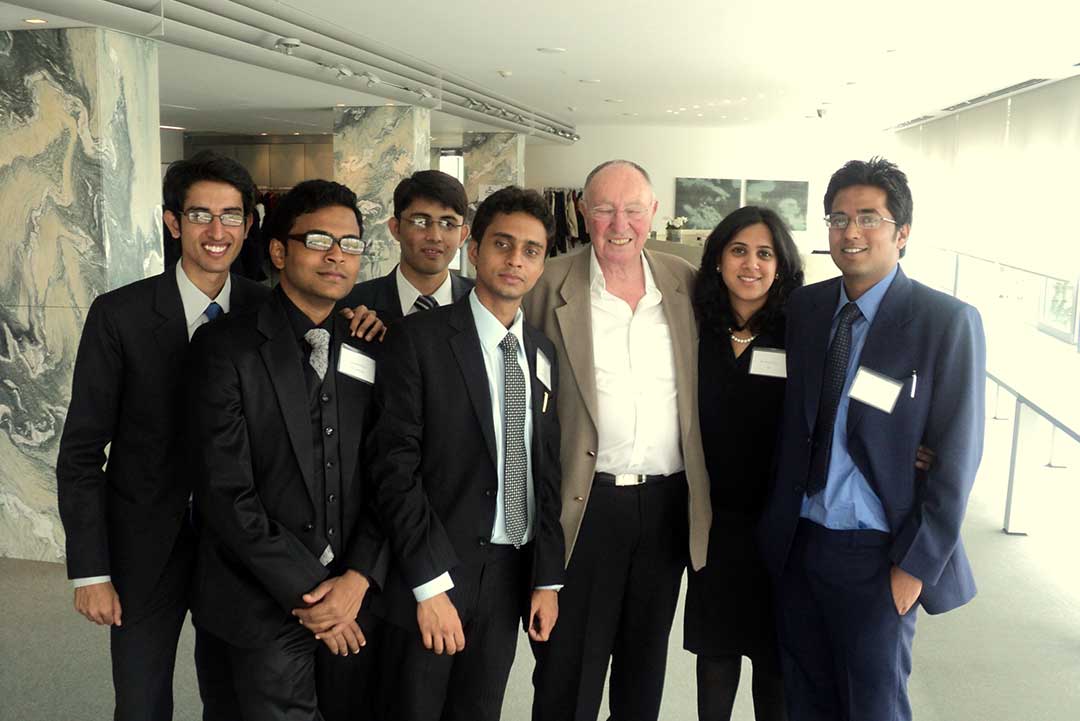
    Vis has always been brilliant – back then and now as well. Vis Moot gives a wonderful opportunity to meet the other teams, coaches and arbitrators from across the jurisdictions with the best part being – you meet and greet all while enjoying a glass of fine Austrian wine and finger food. The most glamorous and enriching experience was to be accompanied by Prof. Martin Hunter during the oral rounds in Vienna, under whose overall guidance we had prepared for the Vis.

    Indeed, it was a breath-taking experience to be on both sides of the bench. Being on the participant side – I certainly find myself lucky enough to be a part of a team whose chemistry and bonding was unparallel (and our ties continue to grow even when each one of us is in different jurisdictions). During the memorial drafting days, we used to engage quite more than often in ‘verbal riots’ on an argument of the moot (although as a rule, such altercations used to get settled with delivery of a Dairy Milk as a settlement!). While at the time of submission and sending the e-mail with memorial copies, we would keep our whiskey glasses ready for a night-long celebration. The kind of motivation and all ancillary support (including finances) that we received from college was overwhelming and to this very date, we remain grateful that they all believed in us! Specifically answering your question, Vis continues to be my finest exposure till date.

    Being on the other side of the bench this year was altogether a (renewed experience). It was rather exciting to refrain from asking questions and conduct the proceedings at par with those of international commercial arbitration. This was indeed in sheer contrast with the Indian mooting scenario where (with all due respect and as far as I have observed and heard), judges ask questions with a sole purpose to test whether the students have understood the problem and the law or to make the oral arguments ‘interesting’ or to ‘showoff’ one’s knowledge.

    My personal opinion is that such questions are not appropriate for moot courts that attempt to simulate a real-time dispute. Whatever limited understanding I have gathered about judging a moot is that as a judge, you should strongly refrain from questioning to the extent you refrain in a real time litigation/dispute resolution proceedings. That is the thin line of difference that I learnt as an arbitrator at Vis, which I believe gives maximum space of learning to people on both sides of the bench.


    How helpful do you think is mooting for a law student?

    I think this should not even be a question. To understand the real issue myself, I have not only read the opinion of past interviewees on this website but I have also interacted with my juniors and a few interns at our firm on the issue. From what I understand is that the scenario amongst the law students is characterized by rather a ‘polarized debate’ between the proponents and opponents of moot court competitions, with each positing themselves on opposing extremes of the spectrum on this point. That apart, I remain confident that mooting is much more than being a ‘list of extra-curricular activity’ on your CV.

    I have been passionate about mooting and continue to be so till date! It is rather a deceiving thought that mooting belongs to those who intend to litigate. From my assessment and experience, a person who has workedon a moot with dedication and has derived the maximum learning out of it, can use such experience in any field s/he would take, whether litigation, corporate or otherwise. I mooted back then and today I am a transactional lawyer (often working on complex M&A deals involving a range of document drafting) and believe me or not, till date, I remain thankful to moots for giving me all these skills. You learn to be comprehensive in research.

    You learn to put out your best research in precise words on a document. You learn to adhere to timelines. You learn to critically analyze whole range of issues left out by the statutes, courts and authors failing to clarify and/or thinking beyond the ‘conventional’ realms of thinking. You learn the sophisticated document management skills including drafting and formatting the document at professional level. Tell me, are these skills only relevant for a litigating lawyer? I am sure they aren’t and that’s why I think, there is a need to reclassify this debate itself. From the above points that I made, it is clear that mooting can give you much more than mere a CV-showcase, provided you have a direction in your efforts and approach.


    You have won a Best Article Award and also have had a number of other great publications. How important is it to publish articles being in a law school?

    Very, very important! Tell me, what is an article all about – is it only about words that we write? Or is it a collage of the time-consuming research that we did? Answer is a BIG NO. An article in simple terms is your way to contribute to the legal academia, using your own analytical thoughts based on the fallouts of the existing literature. Something more than what exists already on Google or any legal database. As a law student, when you write (even writing without the intent of publishing) or publish an article, you showcase that you are constantly engaging in brain activity and are inquisitive towards the unsolved issues and in the process, you also make a remarkable impact on your CV.

    At the end of the day, it is a call which we have to make – whether we want to fiercely cite the opinion we took on a certain legal question or to quote, every time what has been quoted since centuries in all textbooks, case laws and by every Tom, Dick and Harry.


    How should one get started about publication?

    Fortunately, we are law students who are required to research and write papers as a part of our curriculum or during internships as a part of the work that we have been assigned. Start from that! Always remember to retain your research and notes on any hot-topic that you prepared during your assignments, moots or internships. Whenever you find time, start with that as the base and take that to its logical end. That’s the easiest way to pile up the publications!

    It never took me more than a week since all the publications that I have, are solely based on the work that I did either as a part of my curriculum, moots or internships.


    What procedure did you follow to apply to the law firms you worked with?

    I have no qualms in admitting the unspoken rule of law firms in India (generally but not always!) that there is much emphasis on the tangible factors such as ‘institutional name’, ‘CGPA’, ‘uncles and contacts’, etc.. These factors sadly but inadvertently dominate the decision-making process for granting internships. Having said that, being a first generation law student from my family (with absolutely no nexus in the legal fraternity) and hailing from a young institution which was in the process of establishing itself in the market, it was very difficult for me to secure an internship. It was disheartening to see constant rejections at a stage when I desperately needed an exposure in my area of interest (corporate law).

    My story of first law firm internship is rather a bit unconventional – it was through LinkedIn that I got in touch with Mr. Aditya Prakash Rao, the then Senior Associate at AMSS, under whom my friend, Kanadhad interned. Based upon his performance during that internship, Aditya was more than willing to put me in the process of internship and eventually, I secured my first law firm internship. At this stage, I suggest the readers to be active on LinkedIn and build as much of a professional network as they can. It can help you in securing guidance of the professionals and sometimes internships too. It worked for me and I am positive it might work for you as well!

    Once I got the much needed opportunity, I made sure to make the most out of it. I was on my toes all throughout. Going forward, during every subsequent internship, I made it a point to set and break my own precedents of working standards. And rest is history now!


    What does a normal workday at Gnarus Partners entail?

    I can’t recollect a single instance during my tenure at Gnarus which can be remotely categorized as ‘normal’ or ‘routine exercise’. It would not be too abstract to say that my role in the firm has been much beyond the conventional contours of my appointment letter. When you decide to join an established institutional framework, you are aware well in advance about the responsibilities that you will undertake there. Everything is set, you just have to get in and make yourself comfortable there. But the challenges accumulate and the story gets interesting, when you decide to join an institution in the making.

    Before I could even absorb my role and responsibility there, I was entrusted with a role which I could have never imagined. Within my first month, I got the opportunity to sit in the board room of one of the biggest media houses in the country, and conduct the ‘closing’ of an acquisition transaction. Well, if I think about that moment in retrospect, I feel embarrassed about knowing nothing at that point of time. What gives me a great deal of satisfaction today is the role that ‘moment’ played in shaping my mind and to know my place in the firm.

    Slowly and steadily, I think I have come down to know my role in the firm very well and today I don’t consider this as an entity anywhere distinct of me. In my 1 year of experience with Gnarus, I am proud to admit that I have not lived the same day twice! (Oh, yes!). I have witnessed a variety of matters. Some of them were indeed quite related to my comfort zone and many others – I knew nothing and by the end of the day, I walked with a great deal of satisfaction of having learnt something. Apart from leading the firm upfront with Rishi in transactions, negotiations and other drafting work, I also had my own share of experiences of being an IT guy (fixing internet bugs in office), HR person (fixing up internships) and a few times in the capacity of a plumber and electrician too!

    Ever since I joined Gnarus, my introspection has reflected in my growth both in terms of a learner as well as a thinker. However, whenever I think in retrospect today, it gives me immense satisfaction to see myself to have mirrored the evolution of the institution, having had the opportunity to contribute to it in my own modest way.

    Before joining Gnarus, I had worked in the capacity of an Assistant Manager (Legal) at Kotak Mahindra Bank for roughly around 2 and half months. At Kotak, I essentially dealt with the cases in relation to SARFAESI Act and other related matters. I could never relate myself to the work which I was undertaking there and precisely that was the reason I decided to make an early move to do what I really wanted. That apart, till date I enjoy a very strong bond with my mentor at Kotak, Mr. Manish Kumar Gupta who heads the Delhi office.


    What is your take on working at a smaller law firm in early years of career rather than working at a very big law firm?

    To clear the shades of doubts, let us be clear on one thing – the size, name or repute of an organization are all irrelevant considerations in determining the kind of exposure you will get. In my personal opinion, at the cost of being a little cliché, it is the effort and willingness of your mentor with whom you work that matters the most. At the cutting edge of the profession where one is looking for opportunities and challenges, one should be at a place and with a person who will provide one with interesting and varied workload that will guide him to push boundaries and set new standards. That will surely involve a constant motivation on one hand and constructive criticism of your performance on the other by your mentor. The level of interaction with this type of mentor shall range from teaching you the very basics to pointing out mistakes from your work which you believes is your 100%. This mentor will always strive to guide your thought process and invoke your hidden analytical skills, rather than giving you external ‘directions’. Without any penumbra of doubts on your capabilities, he will make you work in your own sphere, reason with you, and not discard your suggestions unceremoniously. I am glad that I have found everything which I could have asked for in my mentor, Mr. Rishi Anand.

    Needless to mention, I am not advocating for either sides, rather I am of firm opinion that opportunities lie across the spectrum (both in big law firms and the start-ups) and students need to think more broadly as to where do they actually belong. It might not be always necessary that after graduation, every student shall be well aware of his areas of interest. For them, it is far more important to engage in as many experiences and choices as they can which will help them immensely in exploring and locating their niche. But what is most important is the person with whom you shall be working!


    Does the entire team go through brainstorming sessions for transactions and deals that the firm does or does your Partner finalize everything and tell you what you have to do?

    Well, if I had to give it a ratio, I would say 99 percent of what goes into the transactions is his experience and knowledge, with the best part being our involvement at every stage of decision that he takes. The great thing about Rishi is that he knows that the associates (at early stage of their careers) are not as confident or convinced about their subject, as the Partner is. To fill up this gap, he makes a point to explain us the intricacy of each transaction and strategy to deal with it and at the same time, he keeps his own decision open for discussion. We work as a team and we argue, debate and discuss, but we never forget that we are working towards a common goal. Yes, I admit we have creative differences, but it’s not like ‘it’s my idea’ and ‘it’s his idea’ in our firm. The idea or the approach that works for the client is the best idea. So, either he convinces us or we convince him, but the communication line is open. We work freely with Rishi with no ego at play, neither a Partner’s nor a Senior’s. It’s only about work! In my limited years of experience I have never seen anyone so deeply involved with his team. He sees a part of him in us and try to build up us every single day. Any other Partner would just tell his associates, get this work done. But Rishi takes our views and it’s our excitement to take up that responsibility that drives him. He knows we can carry out any transactions, no matter how big or small it is, only if all of us are equally devoted. That’s what teamwork is all about and that’s how we have been working since Day 0 till now.


    Do you accept interns at Gnarus Partners? How does one apply?

    Yes, we do accept interns on rolling basis throughout the year. Our internship program has been designed consciously to reach out to the ‘bright and unexplored talent’ (as clichéd as it may sound) we all know but no one admits that within the internship process that exists and operates, there is an over-emphasis on tangible factors. The overall result of this ‘sad state of affairs’ is that, numerous brilliant legal minds out there who are not in favourable positions are excluded to even get a platform to perform.

    It was our conscious decision to make our firm accessible to such talent and once they join, making the firm inclusive. For these reasons, we have fostered an inclusive work environment where interns are treated at par with Associates from the day they arrive, where they are encouraged to think critically and where their reasons are heard patiently. Acting against the Indian convention, we have developed an open door policy which ensures that interns are treated as an integral part of the firm. Be it a quick question on interpretation of law or drafting, or if they need any informal advice, at Gnarus, you will find the entire team more than willing to exchange their thoughts with you.

    The process to apply for an internship at Gnarus is pretty simple – send your CV via e-mail with a cover letter to delhi@gnaruspartners.com and CC it to jitendra@gnaruspartners.com (which is me), at least three months prior to the period during which internship is being sought. Shortlisted candidates shall be invited to complete an ‘internship questionnaire’ followed by a quick response from our side. The factors that we consider while evaluating a person’s candidature do not start and end with his/her résumé and tangible academic results. Rather, we look for qualities which reflect beyond these. We believe that there exists certain parameters which cannot be objectively verified yet constitute an integral part of one’s intellect. With this background, we have specifically designed our internship and recruitment policy to enable us to learn more about the applicant as an individual.

    We are an entrepreneurial firm that expects people joining us to be brimming with ideas, innovation and energy. In addition, we look out for people who have a wide range of experience and interests outside the legal arena as well. We require our prospective applicants to have highly effective communication skills to advise our clients on sophisticated legal and commercial issues in simple terms. Other core skills which we deem as fascinating and essential in our prospective applicants include, amongst others, a good sense of humour, commercial awareness and independent thinking.

    We truly understand that applying for a job or internship at a law firm can be daunting and time-consuming. At Gnarus, we assure our participation at all levels to ensure smooth sailing of application. Once we receive applicants at Gnarus in accordance with the terms of our recruitment policy, we make it a point to read each and every application with utmost care and strive to communicate our decision at the earliest.

    It is our understanding that the applicant will gain more out of the process if they have a clear cut understanding of the values of our firm and their future aspirations. Afterall, selection is a mutual process whereby they decide whether we are right for them and we reciprocate.


    What would you consider as an exceptional internship performance?

    Frankly, I do not know what exactly is exceptional, but I can surely share the ingredients which are likely to make one’s internship quite exceptional. Always be an ‘innocent learner’. As I have always conveyed to our interns, it is a good thing to know ‘nothing’. It is not a traumatic thought, rather it is a sign that you are open to learning. The day you make yourself believe that you know ‘everything’, you shut down your avenues of learning and growth. If you don’t know about a particular subject, admit it and try to read, discuss and know everything about it. Never try to proclaim that you know things, when you don’t. You can’t fool them forever; they are professionals who are much more experienced than you. Today or tomorrow, you’ll encounter the reality. In case of doubts, never be afraid to approach the supervisor and clear the same at its very inception rather than sitting and sleeping over them. Try to focus on doing your work in the most diligent manner and by putting your own original thoughts. Existing literature or resources are there to guide you and not for (Ctrl+C) (Ctrl+V) purposes. And lastly, your contact with your supervisors and colleagues should not be limited during the duration of your internship only. Rather, keep your supervisors in the loop. Trust me, you will need them – not as a ‘fancy contact’ in your smartphones but to guide you throughout your career.


    You were featured in various top-notch deals that were published on popular legal portals such as Legally India, Bar & Bench, etc. How do you feel about it?

    One of the most important things about this profession is that you are required to not only work hard round the clock, but also to remain constantly visible in the market. Your career graph won’t take a leap if you remain dormant in the market with least interaction with the people in the industry (physically or virtually). I am not suggesting that one should work solely for the purposes of getting featured on portals. In my opinion, publication merely symbolizes the amount of hard work and risks that one has undertaken in the background. However, the point that I want to highlight is that it is not something one should waste his time craving for.

    Coming to your question, indeed, it is a great feeling to feature on these popular portals whose reader base is humongous within our legal fraternity. But I have never worked keeping this as an end. What fascinates me? It is the genuine feedback of clients that gives me more satisfaction than surfing the internet and viewing these news items. Again, I would not have featured outside the contours of ‘LinkedIn’ and ‘Facebook’ if I were not working with Rishi and at Gnarus. As I mentioned earlier, Rishi believes in sharing everything that our firm achieves with the entire team, therefore, when I saw my name out there along with his name, I was not at all surprised.


    Lastly, what would be your advice to the law students interested in going into the corporate world?

    It has been my constant endeavour throughout this interview to share my experiences with generous helpings of both bluntness and candor. I would advise all the readers out there to be original in their approach, not let their ‘raw talents’ be overshadowed by mindless status quo. Before approaching any assignment, put your thought in it and try to create something of immense value without prejudicing any part of your originality. Stick to it! Novel things are always appreciated. Set your previous work as a benchmark for yourself.

    If you have not worked earlier on that assignment, then keep the best product available as your benchmark, and try to raise the level of the current work from your existing/previous work. Imbibe this habit so deep down inside you that your tolerance to mediocrity lowers to minimum. Keep your work and yourself open to criticism, never consider yourself as ‘born smart’. Patience and perseverance shall ultimately take you to the heights which you can never fathom.

  • Mohit Singh, Advocate, Supreme Court of India, on being an entrepreneur, his internship experience, and his mooting achievements

    Mohit Singh, Advocate, Supreme Court of India, on being an entrepreneur, his internship experience, and his mooting achievements

    Mohit Singh is a graduate from HNLU, Raipur, in 2013. During his time as an undergraduate, he has interned with Ravindra Shrivastava, Senior Advocate, Supreme Court Of India, Justice Manindra Shrivastava, Chhattisgarh High Court, Justice A. K. Patnaik, Supreme Court of India, and at firms such as India Vision Foundation, Haresh Jagtiani & Associates, Phoenix Legal, Scrioboard, Wadia Ghandy & Co., and Amarchand & Mangaldas & Suresh A. Shroff & Co. 

    He is currently an Advocate at the Supreme Court of India, and his past experience includes working in the chambers of Advocates-on-Record, Arjun Garg and Rahul Narayan.

    In this interview we speak to him about:

    • A very detailed guidance on how to start preparing for moots and drafting memos
    • His entrepreneurial bent of mind and starting ventures such as ‘Lexcetera’, ‘Law School Tips’ and ‘1, Law street’
    • His diverse internship experience


    How would you like to introduce yourself to our readers?

    I have graduated in BA., L.L.B. (Hons.) from Hidayatullah National Law University, New Raipur with Corporate Law and Intellectual Property Right being my Honours subjects. I had finished my schooling from Delhi Public School, Bhilai, where I was a science student. At present, I am practicing law in Delhi, working with an Advocate on Record. I am the first lawyer in my family.


    Why did you decide to study law?

    I was actually a science student at school and always had aspired to be a web-designer. I was busy preparing for engineering entrance exams for two years, but ended up doing law after clearing the first ever CLAT. A reason for choosing law was my love for political science since childhood. My parents had left the final decision of choosing my career on me, and I chose law.


    mohit-singh3

    Tell us about your mooting experience.

    (Mohit has been a runner up in national rounds of Jessup and even participated in international rounds.)

    All my moots had been pre-planned with the exception of Jessup. After the release of Compromis (It is a compilation of agreed upon facts about the dispute that is submitted for adjudication to the International Court of Justice (ICJ), the primary judicial organ of the United Nations), my friend along with whom I was a speaker, discussed about doing Jessup and I affirmed the proposal. In the next one week we chose rest of the members of our five-member team and started the work. First challenge was to face a strong University team in the internal rounds. We succeeded there and started preparing for National Rounds. We had a little difficulty in finding research material on some legal issues for which secured resources from ISIL library. At the National Rounds in January, 2012, we finished as Runner Up. Thereupon we had to participate in the World rounds for which our visas etc had to be prepared in a short time. But thankfully we passed all the hurdles smoothly.

    If I may point out the biggest challenge, it was to face Mr. Rishab Sancheti as a Judge in the quarterfinal rounds. He was probably most prepared for the moot than any other participant.


    When you faced the moot problem, what are the first three things you did?

    The first thing to do would be to go through the problem at least three-four times. I would then chalk out the issues (if not already given) and then do a general research and jot down the possible arguments which can be used to support the contentions in each issue. The issues and works are generally divided amongst the team members, however I always feel that if time permits, each member should work a little on each issue because everyone has a different perspective of looking at legal issues and it might help the team with additional points on the already dealt issues.


    mohit-singh2Describe the entire process of memo writing for beginners.

    The mode of research and drafting vary considerably from person to person. Personally, I do some research and if I find some content which is worth being incorporated in the memorandum, I write these down and then continue with the research. Once I am done with some good research and have enough data to begin, I  start giving shape to the memorandum. This is followed by re-phrasing and re-shaping of the content. Dividing contentions into
    sub-contentions makes it easier to research and drafting and also helps the speakers to deal with issues in a better and clearer manner. But again, everyone can have a different approach.

    The research should not end with the end of the drafting. One should keep reading, as for a moot, one should be ready for the worse. Some judges won’t even let you finish a quarter of your contention and use rest of your time to just grill you with their questions. One thing we specifically did for Jessup was to keep handy, the answers for a lot of basic questions. To cite an example, compilation of definitions of legal principles and the cases where International Court of Justice had relied on or had observed them. This really helped. This can be done by the researchers of the team after memorandums have been submitted and while speakers are preparing for the oral rounds. I have always gone to moots with compilations of documents and case laws (Compendium). Some judges like them while some completely have an aversion to them.

    It’s very necessary to have a good team. Lack of understanding and co-ordination may bring in lots of issues. For Jessup, I am really grateful to the team members who were really very supportive.


    What is the importance of mooting?

    There can be two very different answers. Yes and No. Mooting is quite different from lawyering. One may often come across people saying that one gains nothing from mooting. However, I feel that the best research works that I have done in my college life were for drafting my memorandums. Mooting definitely sharpens one’s research skills. So, I would say that mooting does contribute a lot. Mooting helps to build confidence and the skills of putting forth your arguments, being selective  and convincing others on those issues.


    mohit-singh1How did you balance mooting with other important stuff like college assignments?

    Compromis/Moot Problem was out in mid-September and we had our University internal rounds in first week of November, a couple of days before our
    end-semester were to begin. Internal rounds were a little challenging, but probably that compelled us to work harder which finally paid in the national rounds. One can manage mooting with studies. One can often use the moot research work for writing articles and getting them published (though I always planned so, I personally remained too lazy to do this). But there are times when deadlines clash, but then few days of less sleep can help. Our deadline for submission in Jessup was first week of January and I and my teammates were interning during entire December. We were running out of time and I was forced not to sleep for continuous 40 hours before personally handing over the memorandums at Amity University where moot was going to be hosted. But then as there are lots of things to do in a Law School, one needs to be selective.


    According to you, what should law students expect from mooting as an activity?

    As I said, mooting definitely helps to sharpen one’s research skills. But it’s not a case that without mooting one cannot get that. My college juniors often ask if the law firms where I had interned value moots or not. I personally feel and have seen that it depends on the person evaluating one’s curriculum vitae. But if a person is planning for LL.M from abroad, moots especially the ones like Jessup, Oxford moots and Stetson carry a lot of weight. Moreover, one gets to visit universities across India and also abroad.


    If I have never mooted in my life, but I want to – how should I get started?

    Pick up any moot, preferably a national moot; make your team and just start and first year is not too early to do it. You may fail, but it’s not something that doesn’t happen to even the best of them. Research on your own and never put the blame on your teammates that they are not working.  Rather take it for granted that you are going to face this situation. Divide the issues amongst team members. Do not mind being a researcher initially or even later. But if you are confident that you can speak better than the rest, stand up for being a speaker.


    What was it like to attend an international student event? You must have met many international law students. Any interesting stories to share?

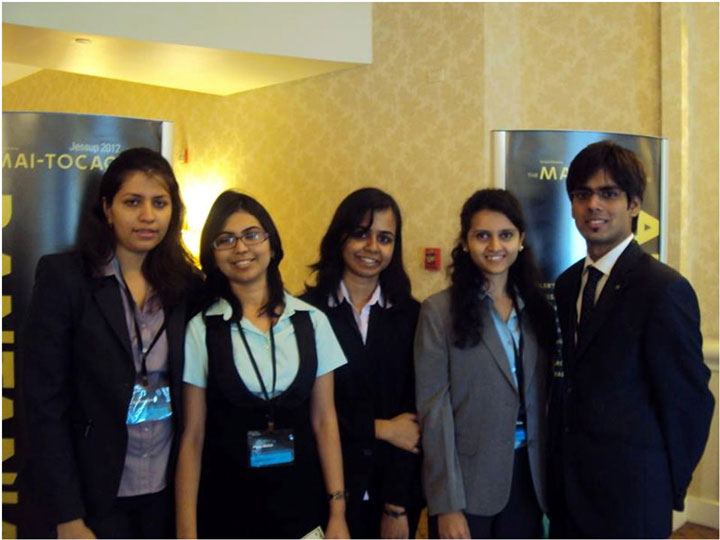
    In my personal opinion, international rounds of Jessup is probably one of the best things that can happen to a law student. The event takes place at Capitol Hilton which is at a walking distance from the White House. One gets to meet the best teams selected from over 600 teams from over 90 countries (as of 2013). The parties, especially the National-go-Ball, where teams come in their traditional dresses, are just awesome! Meeting people from across the world at the same place is very exciting. We also interviewed the winning teams of the World Rounds for Lexcetera. We are still in touch with the friends we made there.

    Judging is very different there as compared to India. To cite one  example, they are generally not involved in just grilling you unlike few who just love doing so.

    We also met one of our college senior, who was doing his LL.M at Harvard. He was invited as a Judge.


    According to you what are the qualities that make a good lawyer?

    As I am very new at the Bar, I probably would not be very suitable to answer this question. But however in my opinion, the most basic quality is to maintain a rationale and logical reasoning for everything you think and do. This helps not just a lawyer but also a lay man. Choose the best argument and give it your best.


    What were your areas of interest during your graduation?

    My Honours subjects in the University were Corporate Law and Intellectual Property Rights. Cyber Law was my favourite optional subject. As I was into web designing and also otherwise, I was always interested in computers, I  developed a liking for Information Technology. I took Corporate Law from the market need point of view and I took Intellectual Property Right as I liked the subject. Love for political science has also kept me close to Constitutional Law.

    International Law led me to do International Moots. I have worked a lot on this subject and like it a lot.


    What are “Lexcetera” and “1, Law Street”? How did you get the idea in the first place?

    Things began with ‘Lexcetera’. When I started to moot, there was no database of moots or even a calendar or a list which would tell me that which moots I should participate in and which suited my academic calendar. I and a friend of mine, Hansa Sinha (who was also my co-speaker at Jessup) decided to compile information in this regard. Later on ‘Legally India’ launched its ‘Mooting Premier League’ where I voluntarily worked for their wiki database – ‘Legallypedia’. Subsequently in August 2011, I and Hansa, with help of three other juniors launched Lexcetera which had a sort of exhaustive repository of the details of the Indian Moots and of International Moots, where Indians teams are eligible to participate. We maintained it for two good years and are deeply grateful to law students for their response to the website. But after we entered our last phase of law school, priorities changed and it became quite difficult to save ample time for it.


    How did Law School Tips start?

    Facebook has been playing a very important part in lives of most of us. Law school was something which connected law students to the law school life at Facebook. The founding of page was very random. ‘Lexcetera’ had already started in 2010. A year and half later, I was watching the Republic Day Parade on TV when randomly it struck me that the whole essence of celebrating this day was that we got our Constitution on that day. So this day is technically a landmark day for lawyers. I do not know what led me to think more on this on very different angles but, one thing led to another. I needed something to vent it all out. So, I gathered few ideas and at the midnight of 31st January 2012, and I launched the page.

    The posts were a series of things which happen in law school. From mooting to love and from teachers to end semesters, there were posts which students could relate themselves with. The Tips are less now and posts these days are not specific to law students but generally to those involved in law.


    How did you go about finding good content for the page?

    For ‘Lexcetera’, along with co-founder Hansa Sinha, we had four other college juniors to whom I shall always be grateful. Law School Tips, I manage on my own.

    I feel finding content is sometimes very easy and at times very difficult. The page has got weekly reach as high as five lakhs to as low as six thousand. Sometimes I love things which interest even lay men a lot and sometimes doesn’t even interest to lawyers. I try to be active on social medias and regularly keep a tab on other legal websites. I try to keep original ideas as being different it what attracts a larger crowd.


    How did Lexcetera become so popular on Facebook?

    After its launch at midnight of 31st January, 2012, with the help of night owls like me, page was followed by around 100 people by 7 AM. By night it had over thousand followers and within a week follower mark crossed 3000. Slowly it had crossed twenty thousand followers mark. I did not promote it through Facebook ads or kinds but thanks to the kind followers, when they like or share the contents, it shows up on their profile and the page gets promoted. I really had no idea that the page would get so popular and also, thank you for calling it ‘popular’.


    What are your future plans with 1, Law Street and Law School Tips?

    As of now I have to earn my bread and butter, I get less time, but I plan to involve my college juniors and work again for this. As I have plans to re-launch ‘Lexcetera’ together with ‘Law School Tips’ as ‘1, Law Street’. I also plan to do something which lawyers are generally interested into. Let’s see, how it happens. Fingers crossed!

    ‘Law School Tips’ has definitely not been very active as before, but I hope in future, it engages with legal people to get an even larger share of their love.


    What are you currently doing? Why did you choose this career?

    I am currently working with an Advocate-on-Record at Supreme Court, who has been kind enough to teach basic nuances of drafting and litigation. He even lets me argue some matters. I was about to work in Corporate Sector but, thankfully I chose litigation as my career path and I plan to continue in this field.


    How important do you think is to have a mentor to guide you in the formative years of a practice at the SC?

    It is very necessary to have a good mentor in the initial years of practice because the concepts of law studied at law school give you only an insight of the vast field of law and then again the actual practice of courts is quite a different world in itself. While being in litigation, other than learning the nuances of law, one also needs to know and understand the process of filing and essentials of drafting. Several times at an appellate level, we come across cases where due to minor mistakes made in the fillings at lower level, a case may be lost even though it may be strong on merits. Therefore to have a good mentor who teaches the details and intricacies of the entire process is very necessary.


    How is it like to start one’s litigation practice at Supreme Court?

    Being in law school, it appears very fancy to hear about working at Supreme Court though practically speaking it is not the case. Many people do not recommend starting up the practice directly at Supreme Court. I would always recommend a person joining litigation to start at a place where he or she can get to work at a variety of forums. Narrowing one’s work at Supreme Court, one shall miss learning the process of drafting and filing process at lowers courts which shall cause a little trouble when one tries to get independent. Starting practice directly at Supreme Court is not wrong but knowledge of the litigation process at lower forums is very necessary.


    How difficult would you say it is to set up a practice at the apex court?

    Normally when a lawyer start getting independent, he may not choose to fix the forum where he may decide to continue the law practice. After five to six years of getting a law degree, one becomes eligible for appearing in an Advocate-on-Record examination. Being an AoR is necessary for filing a vakalatnama on behalf of a client but this does not mean that a non-AoR one cannot argue a matter before the Supreme Court. An AoR may do the filing but any other person who is legally authorised by him can argue it. On this note, this judgment is worth referring to Re Rameshwar Prasad Goyal AoR.

    It is a dream of every litigating lawyer to start his own practice. However it is difficult to give a straight answer to the question asked as it may depend on various factors, a family background in law, years of practice in law, forum of practice being few of them. Chambers and firms where one has worked and the level of contacts one has built also matter because building contacts are helpful in bringing clients to you. There are firms which put a restriction on their lawyers to entertain individual clients. Hence, more the time is spent at such firms, the more time it would take for that person to establish his own practice. Even if one has good experience and has good knowledge and understanding of law, yet it would not be possible for him to start his own practice if he is not able to draw clients to himself.

    Setting up one’s own practice is of course difficult, and it takes time and efforts, but there is no other option. I am perhaps a too junior member of bar to answer this.


    Where do you see yourself five years down the line?

    I would be very happy if I myself had an answer to this question. Till last year, I had no plans of joining litigation but now that I am into it, I do not plan to leave it. A foreign LL.M. has always been on my bucket list but now that I am into litigation, I am having second thoughts about it, though I am still not crossing it off from there. To be frank I am not certain of the answer though a possible happy situation five years down the line would be that either I have already started my own practice or perhaps be close to it.


    What message would you like to share with our readers?

    For the law students, I will say that law school life is often a roller-coaster but stay focussed and work hard. Try not to miss any part of the law school life. Friends you make there, generally remain with you throughout your profession and hence life. Most of the law schools in India have some or the other short-comings but a lot can be managed without depending on them for that. But definitely do not MISS the fun part of law school!

    And as I am involved in litigation, I would say that if you are interested in litigation but do not plan to practice just for the fear of initial hiccups, please do not let the money and family factor let you decide what you have to do for rest of your life. There are initial money issues but slowly you can fair better than others.

    Keep communicating with others as this profession is all about that.

  • Roma Das, law student, RMLNLU, on getting an offer from AMSS, her internship experience and plans for the future

    Roma Das, law student, RMLNLU, on getting an offer from AMSS, her internship experience and plans for the future

    Roma Das is a student at RMLNLU, batch of 2014.  She has secured a pre-placement offer from Amarchand & Mangaldas & Suresh A. Shroff & Co.

    In this interview we speak to her about:

    • The importance of mooting and of grades in law School.
    • How to choose an internship.
    • What it takes to get a call back


    Why did you decide to study law?

    I took commerce with math in my 12th, and had not thought of doing law. But that was more cause I didn’t know much about the profession. Career counselling workshops introduced it as an interesting and viable option.


    Do you have any lawyers in your family?

    I don’t have any lawyers in my family. And I do think that having relatives with legal backgrounds is invaluable for everyone who wants to litigate. It makes the process much easier.


    What are the extracurricular activities you took part at RMLNLU?

    I participated in moot court competitions, debates and other literary events.


    Do you think mooting is beneficial for law students?

    I would definitely recommend mooting for every law student. After all, law school is all about developing reasoning and researching skills. However, I don’t think  mooting is the be-all and end-all of a law student’s college life. But having said that, I maintain that it is an invaluable part and reflects that one can manage extra-curricular activities as well as academics.


    What are the law firms where you interned?

    Apart from AMSS, I’ve interned at a couple of other firms specializing in corporate and media law.


    What was the procedure you followed to apply to these law firms?

    Since I was always interested in Corporate Law, I looked for firms that had that as a major practice area. Once I had zeroed in on the firms, I just sent my internship application and followed up.


    What was the kind of work was allotted to you during your internships?

    During the span of all of my internships, I was fortunate enough to get a wide variety of good work. So while I drafted agreements, legal opinions and notes, I also did a lot of standard research work.


    You secured a job with AMSS as a ‘PPO’. How was the experience of that internship?

    Roma DasI interned at AMSS once before I secured my PPO. I interned with the General Corporate Team and got good work.


    What do you think an intern should accomplish during an internship in order to get a “call back”?

    You should give your best to every assignment and not merely focus on mechanically completing tasks.


    How do you think one should go about writing a CV when they are applying for a job?

    I think it’s important that your CV reflect the kind of work you want to do.  So for example, if you’re interested in corporate law, the work you’ve done at your previous internships should reflect that.


    How did you go about preparing for your interview?

    I brushed up my basics: Contracts, Business Laws, Property, IPR. I also kept up with the latest legal developments and prepared everything that I’d put on my CV.


    Do the law firms usually provide the candidates with an option to work with the teams of their choice while recruiting?

    A preference of practice area is usually provided.


    Many law students strongly believe that getting a job at one of the top 3 law firms is mostly about securing a high GPA. Would you agree?

    I cannot negate the importance of grades, but at the same time would like to emphasize that ultimately it’s all about how you work, and whether your team is happy with your work.


    Your advice to the law students aspiring to secure a job at top law firms?

    It is absolutely essential to have a grasp on basic subjects like contracts, company law, property, Constitutional law, IPR, and arbitration. This list is not exhaustive, of course, and one needs to keep in mind their areas of interest, but the basics are essential. Apart from that, it is important to keep abreast of the legal developments taking place in the country and abroad. This is all about what one can do to build his knowledge base. The next important thing is that one should aim at internships at law firms that have the relevant practice areas. So for example, if you’re sure you want to practice Corporate Law, there is just no point in going on doing litigation internships. And good grades don’t hurt, of course. That’s the first thing recruiters see on your CV.

  • Aishvary Vikram, Winner, BCI Moot, 2013, on being a 4th generation lawyer, his mooting experience, and plans for the future

    Aishvary Vikram, Winner, BCI Moot, 2013, on being a 4th generation lawyer, his mooting experience, and plans for the future

    Aishvary Vikram is a fifth year student of School of Law, KIIT University, specializing in comparative constitutional law. His team was adjudged  the best team at the 29th All India Inter University Moot Court Competition, 2013,  where he bagged the award for best speaker. He has participated in seven moots at the state and national level.

    In this interview he speaks to us about:

    • How to start preparing for moots
    • How to draft memos
    • His internship experience


    Why did you want to study law?

    Law was never my first preference but ultimately it became my last choice. For a science student there have traditionally existed only two career choices after class 12, either engineering or medicine. Despite being the 4th generation in my family with a formal training in law, I never got the opportunity to see the law in motion. My great grandfather was a lawyer who later became an MLA but I never got to meet him; my grandfather was a judge but his death prevented me from benefiting from his experience once I had joined law school; my father studied law but never practiced it, so I never got a chance to see what the practice of law is. People usually study law to enter into practice seeing their parents or relatives, and later end up in law firms. Or they are inspired by great legal luminaries, or fictional characters such as Alan Shore or Danny Crane (From the Boston Legal TV series), or at best they want to serve society. This was however not to be my story. I gave the entrance exams for law due to my father’s continuous insistence. Not being able to get through CLAT, I appeared for KLSAT and joined KIIT.


    What internships have you done so far? Did you receive any assistance regarding this from your college?

    My track record with internships is really poor. Lost in my own ideology to learn from internships rather than collecting certificates, I have spent a lot of time at BHU, the Allahabad University and the faculty of law library for which certificates were however not provided. Nevertheless, I have done a total of seven internships. Out of these internships, one was under an NGO in my first year, two in a district court in my second year, two in High Courts in my third year, one under Prof. Faizan Mustaffa, Vice Chancellor of the NALSAR in my fourth year and the last under a senior advocate in the Hon’ble Supreme Court in my fifth year. The college has always provided us with great assistance in getting internships and now it has opened various programs to provide internships to the students in accordance with the fields they are interested in.


    Which internship experiences will be right at the top and why?

    I have very little to say about my internships due to my inexperience. I find myself an incompetent person in this regard. However, as a piece of advice I would like to say that I have always disliked the working style in law firms due to the non-participatory nature of work where one is only asked to find the law and given no opportunity to relate it to the facts. Sitting on a chair the whole day and finding material is like being Google, which has never interested me (this is my personal opinion and people reading this, are free to discard it).
    aishvary-vikram


    Tell us about your mooting accomplishments.

    The first page of the BCI moot chapter started with a phone call from my friends Nitesh Ranjan and Navneet Sahey. Both were in college and were planning to take part in the 29th BCI Moot court competition. Unfortunately their third team member Satyabratha Das was at home, planning to come a little late due to her internships. The 29th Bar Council Moot was something I never planned for. Really, being in the fifth year, people don’t do this moot at this stage. But no other team was ready to do this moot as our vacations had just ended and the date for the open challenge was not suitable. So we made a plan to do this moot just to pass a month, as very little was there to study and our friends were not back from their internships. After the problem was released, we realized that it is far more difficult to research. We had actually done many moots earlier, but for the first time we realized how tough it is to research for four moot problems in a month. We divided the four problem in three groups— Nitesh Ranjan, the lead researcher was to deal with the first problem with Neha Tripathi, an additional researcher provided by our college, Navneet Sahey was to deal with the second problem with Vikash Chandra Shukla, another additional researcher, and I was to deal with the third and the fourth problem. This is how our memorials were prepared. The biggest contribution to our success was from our friend, Abhinav Gupta, who not only assisted us in drafting but did the formatting of the moot memorials, even though he was the convener of the First KIIT Conference on Intellectual property rights and Bikash Shaw, who was always there with us online, downloading the cases even when we were in MITS giving our orals. This moot was more than a moot; it was a litmus test for the bond of friendship we have. Knowing the fact that only participants will get the certificate, our friends as our additional researchers were always with us. The moot experience in terms of orals was extremely good. The teams we faced were well prepared. In preliminary rounds we faced Christ Law College; in he quarters we faced BHU; in the semis we faced NLSIU and finally we faced NLU Bhopal. All the teams were excellent and well prepared. This success wouldn’t have been in our hand if our lead observer, Akshay Rajpurohit was not with us. From printing the compendium, compiling it to bringing snacks and cold drinks, he was always there with us.


    What factors do you think contributed to this success?

    My senses are too weak to see the whole picture of support and contributing factors towards my success. My words of appreciation about their contribution would be such a small  description of their help that it will be an insult to the sources. Therefore, without specifically narrating all the assistance I got, I will generally thank my teachers and friends for always assisting me and my parents for always holding my hand.


    What separates a great memo from an average memo?

    I will give due credit to my law professors for this, as unlike traditional law universities, our professors have always prepared a course structure taking into consideration laws and practices of different countries to the extent that it doesn’t affect the basic structure. Specifically our Constitutional Law general and specialised papers conducted by Prof. Kumar Kartikeya has taken a further step by incorporating not only the foreign principles or case laws referred to by the Indian judges but has designed the structure in such a way so as to give us a short idea of the constitution in four countries, namely US, Australia, India and unwritten constitution in UK. Due to this comparative approach it was easier for us to research and find case laws and statutes in various countries. If one refers to our memorial, specifically the third and the fourth memorial, one would find foreign case laws and doctrine, which I failed to find in the memorials of other teams in the semi-finals and finals.


    Speaking skills or knowledge of law, what is more important?

    It is important to marry the two. The knowledge of law is like an armour which one may use to protect his case while, speaking skills are a spear to rupture the judges’ sarcasm and leave a long time impression on a judge’s mind.


    When you get the problem, what is the first thing you would do?

    Read it (I believe this satisfies this question literally), but on a purposeful note, one should read the problem until he is aware of the purpose of each and every single line. It may happen that a part of the problem may seem to be introduction, but later on one realises that even though the particular fact instigates no law finding but, is of peculiar importance to support the formulation of arguments or argues on the basis of the fact.


    Share your formatting secrets. 

    A mooter must prepare multiple arguments amalgamating reason and logic. Prepare multiple arguments, so that you may never run out of options. Using rational and convincing arguments with the spirit of law is of utmost importance. Instead of quoting a number of case names or details of the cases and presenting a thesis, one must try to formulate reason, practical and theoretical as to why his argument must be accepted by the court. I have seen people whose memorials consist of hundreds of cases and thousands of authorities but lacks reason or logic. Merely taking a particular statement from various books without knowing the reason or its relevance is of no use. If one may cast a look on best memorials in international moots, one will find my observations true.


    Why is mooting important? 

    Actually, I have not yet tasted the flavour of advocacy so I hardly know how it will contribute to my skills as a lawyer. Mooting has been an accident for me. When a colleague could not make it to a moot, my best buddies Vikash Shulka and Abhinash Barik approached me and convinced me to moot with them. So from the first year itself our mooting started and slowly it engulfed me in its charms and beauty. From first year till now, we have done a number of moots. The incentive to start off my mooting carrier goes to my friends but the continuation of this goes to my seniors and my parents who were always there to help me and always motivated me to carry this extra load.


    What is your opinion on your intra-college mooting system? 

    The intra moot court system in our college is really good. Thanks to my friend Abhinash Barik, my teachers, Asst. Prof. Kasturi Bhagat and Asst. Prof. Kumar Kartikaya whose imaginative thinking has brought various changes to the system of mooting. There is no favouritism, nor can anyone dominate the moot court society and this includes the Director as well. The moot court competitions are divided into two segments, all national moots except the Bar Council of India and B.R Sahany moot are allotted according to the results of the intra moot court competition and the international moots and the two moots listed above, are open to open challenge. The transparency and student welfare is the fabric of our moot court society, which leaves me with no comments for improvement.


    If I have never mooted in my life, but I want to, how should I get started?

    Getting started is really simple as there is no competitive written exam which one needs to qualify to call oneself a mooter. Trying out for national or international moots is also mooting, but continuing the academic practice of mooting is very difficult, as there is always a tilt towards running away from the extra burden a student has conferred upon oneself. Every attempt may not bear a fruitful result and add to that, the extra burden of college good reputation which is a constant pressure for the team, which may bring efficiency but in many cases forbids creativity. One has to have a strong determination if he so intends to enter into the arena of mooting and use his creativity, as judges in various moot courts are not always looking for the case laws in support but the extent of artistry and understanding of law that has been put to the problem. Further, one thing must be really clear before one even attempts to call himself a mooter that mooting is not always among the equals, there is no Article 14 application here. It has always been between students irrespective of their institution, quality of teachers and extent of their support, the year in which one is, no consideration is given to these facts. The thing which every mooter possesses is the moot problem, the library and his creative mind which one has to solely amalgamate and, support of teacher may serve as a catalyst but can never be the basic foundation.


    How important is the role of a researcher in a moot team vis-à-vis the speakers?

    Well, in our team, all were researchers seven days prior to the moot and it is only after the preparation of the memorials that we decide who all will be the speakers. The role of speakers and researchers are equally important but I also feel that speakers have a slight edge above the researcher in oral presentations and in sharing the fame, if they so win a moot. There is no “I can do better or it’s not good for me” game in mooting, there is always “What is good for the team and who can better serve the team in orals.” It’s very rightly said that if one wants to travel faster he may run alone but if one wants to survive longer, walk with someone– try to apply this in mooting as well.


    What message would you like to share with our readers?

    My inexperience and little knowledge will to some extent make my views premature and short sighted but nevertheless, some of the things I learnt are:

    1. In moots don’t go for law in the strict sense, always try to use creativity and imagination, don’t see the judgement but look behind the judgement and try to focus on jurisprudence than on case laws.
    2. Prepare the brief and arguments and take notes of the judge’s name and para number to some extent, to show your level of preparation.
    3. Try to formulate multiple arguments for the same proposition.
    4. Avoid difficult words.
    5. Show respect for the judges but no flattery.
    6. Be confident and never emphasise on a wrong proposition for the sake of argument.