Tag: NYU

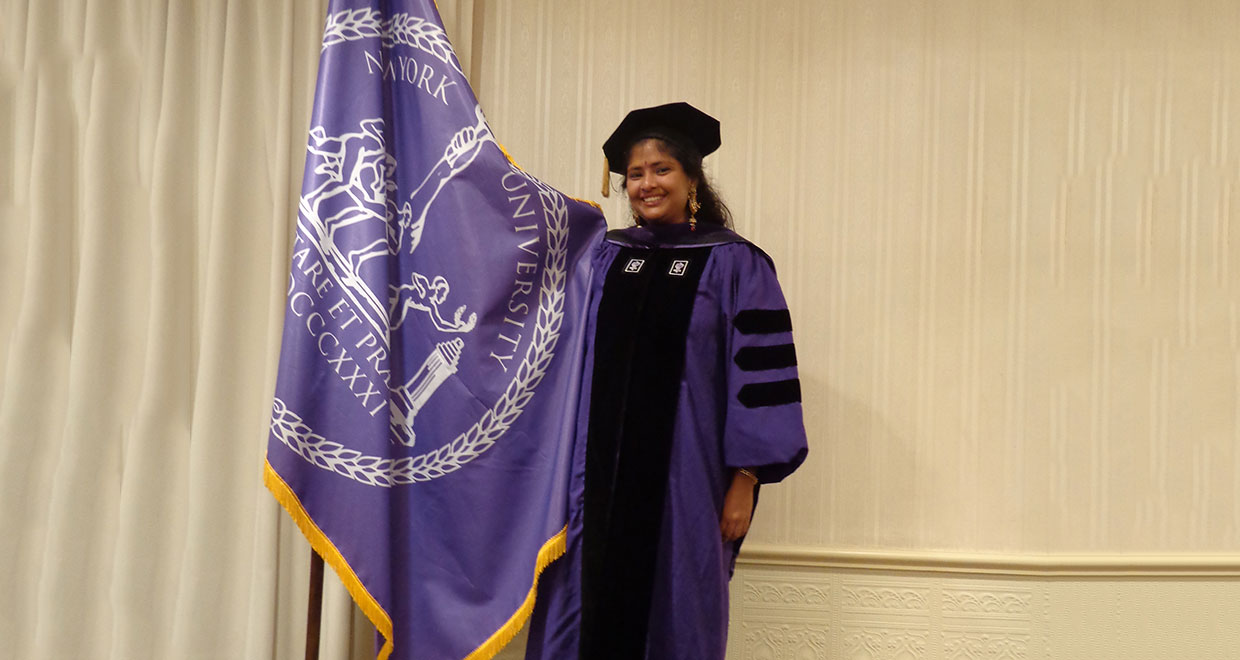
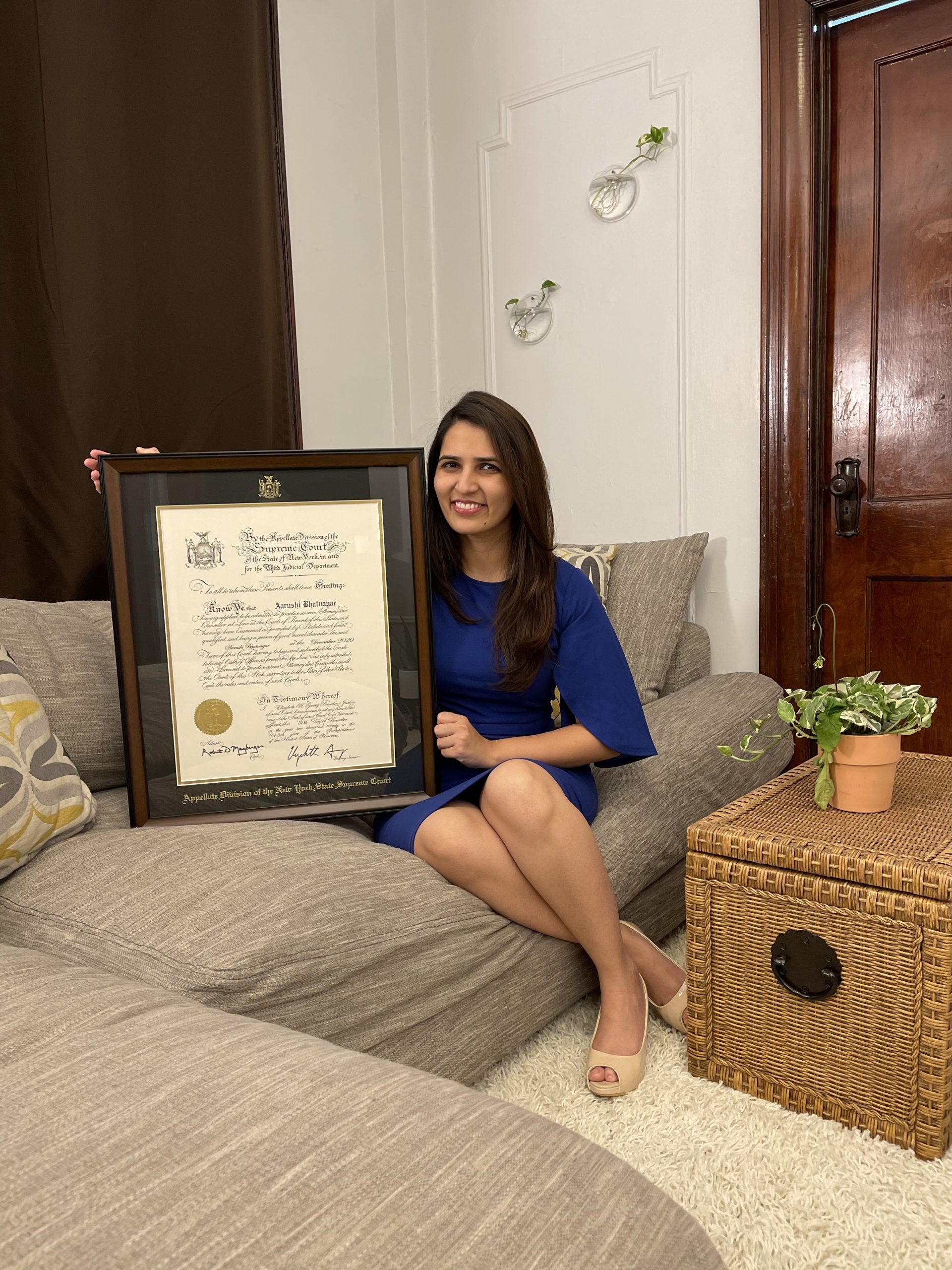
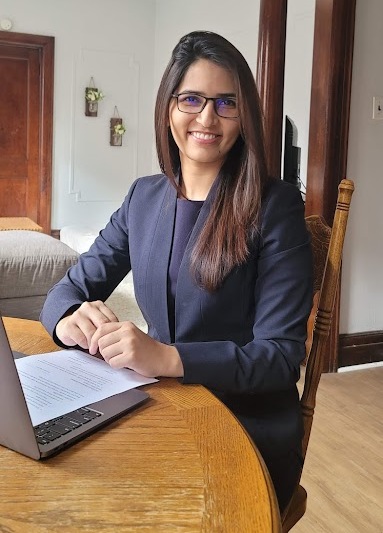
  • Ms. Aarushi Bhatnagar, Managing Attorney at PUNHANI LLC on LLM from NLU Jodhpur and NYU, cracking the NY state bar exam and practising immigration law in the United States

    Ms. Aarushi Bhatnagar, Managing Attorney at PUNHANI LLC on LLM from NLU Jodhpur and NYU, cracking the NY state bar exam and practising immigration law in the United States

    This interview has been published by Sonali Parashar and the SuperLawyer Team


    If we start from the beginning, were you always academically diligent? Did you always want to pursue law? What other career would you have chosen if not law?

    I have always considered myself a sincere but average student. I was not excessively academically inclined during my school years. Instead, my interests were directed toward art-related extra-curricular activities. Accordingly, my slam-book career goal was to be a fashion designer. At the same time, I had a strong family background in law, with multiple family members being in judiciary and litigation. Being amidst frequent family discussions involving topical legal issues, I gained valuable insight into the legal world and its opportunities. Ultimately, my interest in engaging with current affairs and doing my part to help the people around me pushed me to pursue law as a career.

    You have completed your master’s from NLU Jodhpur. Would you like to share a few tips with the students who are preparing for CLAT? How different is the preparation of CLAT PG from that of UG?

    The best advice that I can give to students preparing for the CLAT is to do as many practice tests as possible. In my experience, that is the key to cracking any competitive exam. Of course, studying and knowing the basic material that will be tested in the exam is also essential.

    I found the CLAT PG preparation to be easier than the UG preparation. The subjects tested in the CLAT PG exam are part of the law school curriculum. If one has studied and built a strong foundation in the relevant law subjects during their undergraduate years, the CLAT PG exam preparation becomes a revision exercise. On the other hand, students preparing for the CLAT UG exam are right out of high school with no formal exposure to legal academia. In such a situation, enrolling in a good entrance prep course is worth considering.

    Despite having an LL.M. Degree from NLU Jodhpur, you decided to pursue another LL.M. degree from NYU and had the flexibility of designing your course structure (subjects) there. What major considerations should one take into account while designing their course? What extra efforts have you made being a foreigner?

    Many LL.M. programs provide the students with an opportunity to design their coursework. However, one must consider several factors while making this decision. First, the coursework should align with the candidate’s short-term and long-term career aspirations. A career in law is often path-dependent, and the first job often charts the path for future professional endeavours. Second, it is essential to choose an area that complements the candidate’s prior experience. Choosing a field that builds upon the existing credentials ensures that one can make the most out of a short and rigorous LL.M. program. On the other hand, LL.M. also provides a unique opportunity to diversify into new areas. It is essential to consider one’s areas of interest and the corresponding job opportunities while striking that balance.

    As a foreigner, one should put extra effort when making space in a completely alien environment. I actively participated in networking events (both within and outside the university) and pro-bono activities, which gave me the familiarity and visibility required to succeed in the US job market. At the same time, being flexible and open-minded facilitated my venture into immigration law, a field that I have since fallen in love with.

    Can you share in brief about your current role and responsibilities as a Managing Attorney at a boutique law firm in the NJ/NY area? How do you manage to maintain a work-life balance?

    As the Managing Attorney of a boutique law firm, I have a diverse and dynamic set of responsibilities. I am responsible for onboarding clients, managing the cases from inception to completion, and handling the firm’s day-to-day operations. I advise multinational corporations, business units, and individuals on employment-based and family-based immigrant and non-immigrant visa petitions and applications. My role also entails hiring and training junior staff, including attorneys, law clerks, and paralegals.

    Compartmentalizing my work and non-work activities helps me maintain a good work-life balance. While at work, I dedicate myself to planning and executing my tasks efficiently. Breaking complex cases and procedures into simple daily tasks helps me leave the office with a sense of completion and accomplishment. It also ensures that work anxiety and stress do not spill over to my personal life. During weekends, I like to travel and engage in cooking, arts, and crafts. Having an active lifestyle rejuvenates me and prepares me for the upcoming work week. However, there are certain times when maintaining a work-life balance is challenging. In those times, having a good support system at home helped me keep my spirits up.

    You used to work as an Assistant Professor at Banasthali University, Rajasthan and now you are working in a law firm. What all struggles did you face adjusting in Banasthali and then in a Law Firm? What all things and skills did you learn as an Assistant Professor which are now assisting you in your current role as a Managing Attorney in your Law Firm?

    Teaching at a university and working in a law firm is different in certain aspects. As a teacher, I followed a well-structured curriculum and spent all my efforts ensuring that my students remained interested in the topic and benefited from the course. On the other hand, managing a law firm requires me to handle unanticipated challenges daily. However, I have enjoyed both these roles and did not face any issues in transitioning from the former to the latter. Instead, I found that the teaching skills I developed in Banasthali come in handy when I train new hires at the law firm.

    Would you like to share a bit about the field of immigration law? What is the future scope and struggles involved in the same?

    Immigration is a very dynamic field of law. It involves securing and defending the rights of immigrants from various countries and backgrounds. The legal landscape is constantly evolving, and the changes substantially impact many companies and individuals. The ongoing pandemic has amplified immigration-related issues by forcing many firms to downsize and leaving many immigrants jobless and without a livelihood. Given the ever-increasing importance of the field, it is (arguably) one of the most attractive and rewarding career paths for law students.

    You also cleared the NY state bar exam. How strenuous was the preparation? What are the eligibility criteria for the exam?

    Preparing for the NY State Bar Exam is like a full-time job. It was one of the most challenging tasks I have undertaken. Enrolling in a good bar prep course is extremely helpful.

    There are various qualifying methods to sit for the NY state bar exam. The most common criteria include graduating with a first law degree (J.D.) from an American Bar Association-approved law school. However, in the case of international students/foreign-educated lawyers, the eligibility criteria are pretty cumbersome. All foreign-educated lawyers must submit an online credential evaluation request along with the required documentation to the Board of Law Examiners. One should submit these documents even before the start of the LL.M. program because the evaluation process is time-consuming. LL.M. students must also fulfil the specified credits requirements via classroom courses in substantive and procedural law and professional skills. The official website of the New York State Board of Law Examiners provides the detailed eligibility criteria and application process.

    What will be your parting words for our readers? 

    Focus on having both career goals and life goals. Be ambitious and entrepreneurial but remember that professional success depends heavily on working smart (in addition to working hard). Reach out to people and take their guidance, rather than spending time reinventing the wheel. Be patient and diligent, and success will eventually come. Lastly, prioritize creating a wholesome life experience as it is the journey that counts.


    Get in touch with Aarushi Bhatnagar –

  • Bhushan Shah, Partner, Mansukhlal Hiralal & Company, on clearing the Bombay Solicitor examination, and working at Tier-I firms

    Bhushan Shah, Partner, Mansukhlal Hiralal & Company, on clearing the Bombay Solicitor examination, and working at Tier-I firms

    Bhushan Shah graduated in law from GLC, Mumbai, in 2005. He then went on to pursue his Masters at NYU@NUS. After successful stints at J. Sagar Associates, Drew & Napier LLC, and Khaitan & Co., he is currently Partner at Mansukhlal Hiralal & Company. Bhushan heads the corporate team of the firm. He focuses on corporate and commercial transactions such as strategic investments, mergers & acquisitions, joint ventures and general corporate law advisory. Bhushan has also advised clients on inbound and outbound investments as well as structures requiring India entry strategies. Bhushan also has experience in securities litigation and has represented clients on several contentious cases before Securities Appellate Tribunal and Supreme Court of India.

    In this interview we speak to him about:

    • His time as an undergraduate at Government Law College, Mumbai
    • Studying in NYU@NUS
    • His experience at Tier-I firms

    How would you like to introduce yourself to our readers?

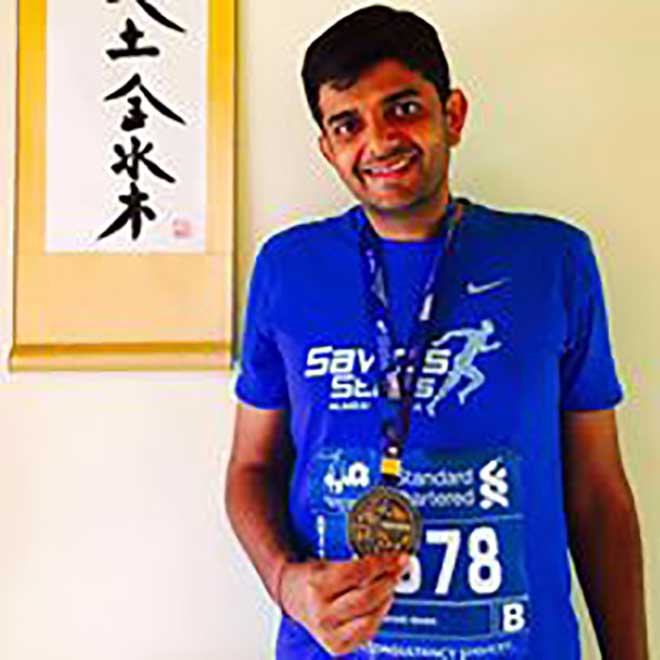
    I would like to introduce myself as a (a) Lawyer; (b)Runner; and (c) Soka Gakkai Buddhist member.

    I have been a practicing lawyer for over ten years now. Earlier, I used to style myself as a corporate lawyer. However, over the last five years, i.e. after joining Mansukhlal Hiralal & Co. (Mansukhlal), besides practicing corporate law, I have also been engaging in substantial litigation and real estate transactions. I am enjoying my diverse practice of corporate law, dispute resolution and real estate law.

    As a runner, I have participated in more than ten half marathons and two full marathons. I started running as a stress-buster from the hectic work schedule of a lawyer and it has now become a passion for me.

    Besides running and practicing law, I also follow SGI Buddhism. It is a philosophy which believes that one’s happiness lies in their own hands. As a lawyer, it is common to blame your boss, colleagues, clients etc for one’s hectic work schedule. In this chaos, practicing SGI Buddhism, gives me a sense of calmness and gives me the strength to step up and take responsibility of my work and to keep going.


    Tell us a little about your days in law school. 

    I am a Bombay boy. I did my basic schooling and college from Mumbai. I graduated as a Bachelor of Commerce in 2002 from Jai Hind College, Mumbai University. Thereafter, I enrolled for the three year law degree with Government Law College (GLC) and graduated as a Bachelor of Law in 2005.

    GLC is India’s oldest and prestigious  institute of law. Many of my family members including my father and sister have graduated from GLC. At that time, it was considered as the second best law college after NLS Bangalore. GLC had lectures in the morning and hence my classes used to end by 9:30 AM. In my first year, I participated in several moot courts and was part of the moot court committee for organising moots.  The second year onwards, I signed my articles and started working at JSA.


    What were the activities, academic or otherwise, that you undertook in your law school days which in your opinion have shaped you and your career?

    As mentioned above, I signed my articles at JSA with Mr. Abeezar Faizullabhoy for the Solicitors exam conducted by Bombay Incorporated Law Society (BILS). My dad also being a Solicitor, suggested that I sign articles and take the exam. As known to everyone, the passing percentage of the Solicitor exam is very low and not being an academically brilliant student, I was not very keen. However, my dad believed that the experience of being trained under one firm for three years and preparing for the exam was a challenge I should undergo irrespective of the results. My articleship at JSA was one of the best times of my legal career. Also, I successfully cleared the Bombay Solicitor exams. My articleship really shaped my career and I knew exactly what I liked or disliked about the profession before starting work after receiving my law degree.


    What in your opinion is the level of importance that needs to be attached by a student to the GPA? 

    I believe good grades can aid a student access to Tier I law firms. However, in my view, it is no way to judge anyone’s success in the future. Theoretical and practical knowledge are two very different concepts. Hard work and intelligence with a solution driven approach is a good combination that can lead one to being a successful Lawyer. However, a student who does not have a good GPA can be as successful as the one with an excellent GPA.


    What kind of internships did you engage in during your student years?

    I joined JSA in 2003. It was the same time when Mr Berjis Desai split from UUB and joined JSA’s Mumbai office. At that time, JSA was relatively smaller as compared to its size today. I got an opportunity to work with Mr. Somasekhar Sundaresan (Som).

    Som is an exceptional lawyer to work with and an extraordinary mentor. I got to work with him on SEBI and SAT matters. Later on, I also worked with him on corporate matters. He inculcated my habit of attention to detail, research, and insight in the applicable law. This habit helped me to study for my Solicitors exam and also helped my clients in a cautious manner.


    What are your areas of specialisation and how did you go about choosing these fields?

    I specialise in securities litigation, corporate law and real estate transactions. My passion for securities litigation started from my JSA days when I regularly appeared before SAT, SEBI and CLB. I did my dual degree LLM from NYU and NUS and specialised in corporate law. At JSA, Drew & Napier and Khaitan, I was part of the corporate team. My current workplace, Mansukhlal, is a mid-sized law firm which, before my joining, specialised in real estate law and dispute resolution. With my work experience in  corporate law, I have been able to build a successful corporate law practice at Mansukhlal. However, given that Mansukhlal in itself was known for real estate and litigation, my first assignment at Mansukhlal was a real estate transaction. I have then onwards done a substantial amount of work in real estate sector and assisted developers in real estate transactions.     


    At what stage in one’s law school life must one pick a specialisation?

    Work experience along with the passion for the subject matter is the best way to pick a specialisation. As a student, everyone finds it glamorous to move towards corporate law. However, a junior associate of a Tier 1 or Tier 2 law firm, ends up spending most of his/her time doing due diligence on the transaction. Upon doing due diligence, all the glamour is washed away and interest is lost. Hence, interest in the subject matter along with experience helps one to pick up one’s own specialisation. One should not choose corporate law just for the glamour quotient.

    Also, my advice would be for students to be thorough with their law. As junior lawyers, between finishing all the deliverables and drafting documents, they often ignore the same which at a future stage results in a great loss to the client or his needs.


    Do you believe that L.L.Ms are instrumental to one’s career in law?

    After completing my Indian Solicitors, in the same year, I secured admission into a new program started by New York University called NYU@NUS.

    NYU@NUS was a unique program based in Singapore and New York which was taught by full-time faculty from NYU and NUS. In addition to earning two LL.M. degrees from the two of the world’s leading institutions, this program provides a strong background in U.S. and Asian business laws. I was awarded the Dean’s scholarship for pursuing my LLM program. This scholarship later helped me to procure a job in Singapore which otherwise may not have been possible. My view is that an international LLM is relevant for international opportunities as a lawyer.

    I believe LLM from a recognised university does play an instrumental role in getting a job in an international law firm. I was one of the fortunate ones to get a job at Drew & Napier LLC (one of the leading law firms in Singapore) even in the year when Lehman Brother had filed its bankruptcy and sub-prime crisis arose in USA. My LLM degree did help me get this job at Singapore and also later at Khaitan & Co., upon my return to India.


    Having studied in New York as well as Singapore, which would you recommend to someone who wishes to follow your footsteps?

    Unfortunately, the NYU@NUS course was discontinued by NYU in 2014. Therefore, I cannot recommend anyone to take this course. However, I would recommend students to pursue LLM from NUS as it is the best law university in Asia and falls in the top ten Law Universities worldwide. Further, getting a job in Singapore is relatively easier as compared to the US or the UK.


    What should one expect out of an L.L.M program, if they opt to pursue one?

    LLM from a renowned international university will give a student exposure in international laws, differently styled curriculums and very unique (practical) teaching methodologies. Further, it may assist them in getting jobs abroad, if they are interested.


    What does the CV of a student seeking admission in a premier university offering an L.L.M program have to look like? 

    One’s CV has to have good grades, extracurricular activities during law college and some work experience with recognised law firms. Further, recommendation letters also play an important role for the admission. In extracurricular activities, participating in moots and being part of legal activities are looked upon favourably by premier universities. For American universities, a meaningfully written statement of purpose (SOP) plays an important role. They are looking at the candidates’ real life experiences and learnings from such experiences in the SOPs.  


    Give us some insights on the qualities that Tier-I firms look for in prospective candidates.

    (Bhushan has previously worked with Khaitan & Co. and JSA, two of the most sought after firms for placements by students.)

    I consider myself to be lucky to have worked with JSA and Khaitan & Co. (KCO). Good grades and extracurricular activities help students get an internship in Tier 1 law firms. The new trend of law firms is to offer a PPO during/ after the internship. Hence, I believe that if a student reflects his/ her sincerity at internships, they would be offered a PPO, which would be the easiest way to make ones way into a Tier-1 law firm.


    Give us a brief overview of your current work profile with Mansukhlal Hiralal & Co. What does a regular working day look like for you?

    I joined Mansukhlal in 2012. It is a family firm where my father is the managing partner. Before my joining, Mansukhlal was a team of three partners and five lawyers. In the last five years, we have now grown to five partners and a team of fifteen lawyers.

    I head the corporate law team. Also, from time to time, I look into securities litigation and real estate transactions as certain clients are comfortable working with me on their matters. I spend around ten hours in office for six days a week. Some part of my time is also spent in business development and doing legal updates which are very important for the growth and development of the firm.


    What message or general advice would you like to pass on to our readers?  

    Don’t simply focus on getting a job in Tier-I law firms. While studying law, try to enjoy the subject. This attitude towards studying and enjoying the subject will help students to become successful lawyers.


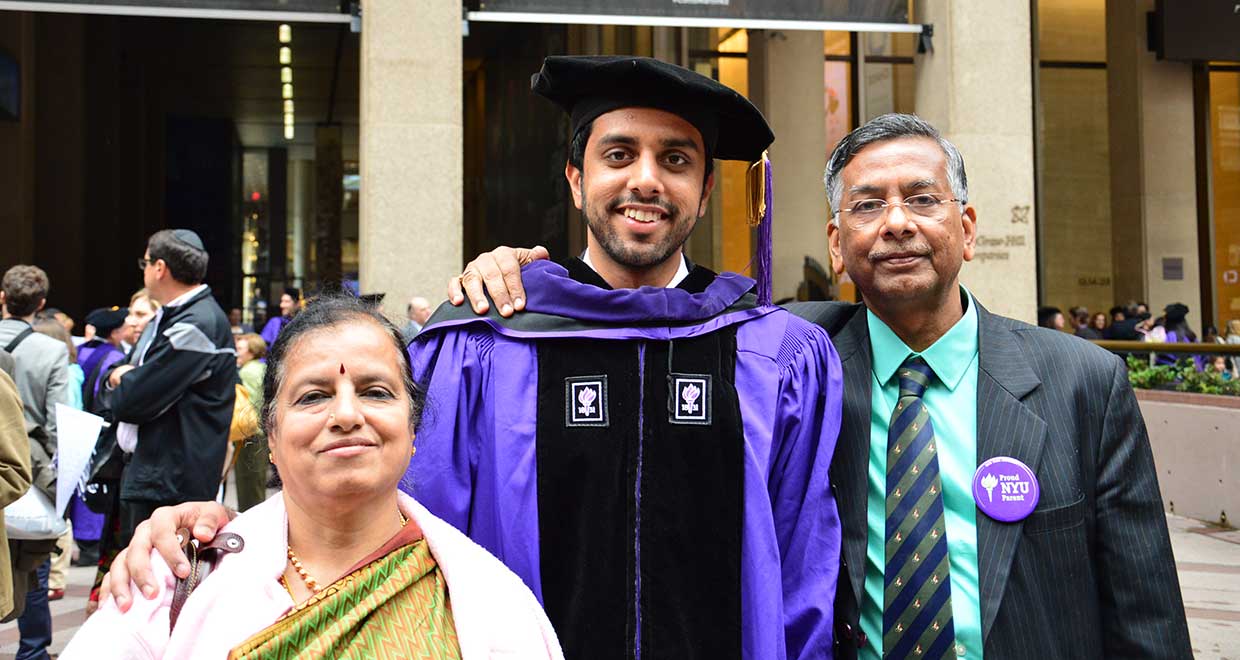
  • Anandh Venkataramani, Associate, Shardul Amarchand Mangaldas, on competition law, studying in the US, and his teaching experience

    Anandh Venkataramani, Associate, Shardul Amarchand Mangaldas, on competition law, studying in the US, and his teaching experience

    Anandh Venkataramani graduated from Symbiosis Law School in 2011. After a successful stint at LakshmiKumaran and Sridharan, he went on to pursue his Masters at New York University School of Law, with a specialization in antitrust, litigation, and corporate law. He has been admitted to the Bar in the Republic of India, and the State of New York, USA. He is currently Associate at Shardul Amarchand Mangaldas, with a focus on competition law.

    In this interview we speak to him about:

    • Qualifying the NY Bar and studying in the US
    • His diverse experience
    • His interest in teaching

    How would you like to introduce yourself to our readers?

    As someone who is curious and always looks forward to new experiences and and new opportunities for learning. I’d say I’m the same professionally as well.


    How did you go about choosing law as your career?

    I was bent on preparing for SATs in my 12th standard with an aim to study biotechnology. Zoology interested me a lot. My father, also in the legal profession, encouraged me to study biotechnology, and he just happened to give me some basic readings on political philosophy and legal essays, generally. While the not so subtle encouragement I received from people in the legal profession made me consider pursuing law, it was the readings that appealed to my love for debates and tipped me towards applying to law schools.


    Tell us about your experience as a student of Symbiosis Law School.

    In two words, colourful and enriching. The time spent during those five years were formative for all of us. I surely learnt a lot, both in and outside the classroom while at Symbiosis Law School. My batch at Symbi was the last to have a relatively un-demanding curriculum, with no internal assessment or other curricular activities. This gave us freedom, and incentive to engage in a number of co-curricular and extra-curricular activities and competitions in Symbi and other colleges. Many of the now established cells, and student activities were being created by our seniors, and some of us as well, and being part of that process was a great learning experience. It’s heartening to see how students have grown these student cells and activities well beyond what we had foreseen or even hoped. These activities aroused a sense of kinship amongst students, creating bonds as strong as those of the dear friends we made for life during these years. Symbi, in essence, was a sanctuary for every kind of student – if you sought it, you would find it. If pure academics was your interest, you’d find support. If championing human rights was your calling, it would be nurtured. If not (purely) law, but music or sports was your passion, you’d find cheering encouragement. My peers and I are all testament to this.


    Having been a consistently good student in your college days, how important is doing well in academics?

    I’ll be adding no new insights in saying that it’s fairly important, and at the same time, I cannot take the truth away from that. It shows to someone assessing you that you have caliber – that you’re intelligent, and / or  you’re focussed, and /r you’re hard-working. While it may help in securing job interviews, doing well in the legal profession barely has any connection to academic performance. Once you find your focus and passion, you’re bound to do well, regardless of what you did or scored during law school.

    How have your roles in positions of leadership shaped you as a lawyer?

    (Anandh has held several leadership positions during his time at college and served as the Editor of his student law review.)

    In college, and the “real world” after that, you brush your shoulders and work with a number of people. The positions I held during law school (for instance in the cabinet of the Student Council, editor of the student law review and the newsletter, or heading committees in the college festival) taught me how to work in a team and head them. They also taught me empathy and respect for others, which we all could use more of. Individually, each of these positions also honed other skills that have held me in good stead during my time in New York and San Francisco, and continue to aid me now.


    Working as an Associate at Shardul Amarchand Mangaldas & Co., what does a working day look like? 

    Shardul Amarchand Mangaldas is a highly competitive Tier 1 firm in India. Big law firms (with significant numbers of attorneys) usually attract large clients, who have work that can only be handled by well resourced teams. That’s the nature of the beast. The Competition team at SAM, which I’m a part of, is no exception. Both, on the merger control, and antitrust (behavioral) aspects of competition law, the team is usually grappling with some of the largest transactions and complex cases in India. With jurisprudence slowly developing in the law, it’s an exciting time to be a part of the practice. This excitement and the endless opportunity to learn with these cases and transactions, is what keeps one ticking through the pressures of the tight deadlines and long work hours. The range of tasks in my practice, would include drafting written submissions and pleadings before the Competition Commission of India, the Appellate Tribunal, the High Courts and the Supreme Court, corresponding and liaising with the Commission on ongoing cases, preparing notification forms for merger approvals, providing advice to clients (oral and written), drafting opinions, among other things. There’s always enough to keep you on your toes.


    Tell us about your other interests and how you manage to maintain a work-life balance?

    My interests are as varied as they can be – among other things, I love riding motorcycles and meddling with them, reading, experimenting with my DSLR, playing music, building and listening to my record collection, watching gigs/concerts, and the outdoors generally.

    Honestly, I’m still figuring out what an ideal work-life balance would be in law practice. Many at the top of the legal profession have told me that the balance has to be foregone in the favour of work, and I find that happening during the phases when I’m driven and focused on my goals. But pursuing my other interests is critical, as they help me unwind and settle myself. Whatever windows of time I get, I try to fit these things in. As important, of course, is spending time loved ones and friends – who will always be an essential support system in our often demanding world.

     

    What advice would you give budding lawyers on choosing the right internships?

    (Anandh has an impressive array of internships at top law firms and judicial clerkships including Lakshmi Kumaran & Sridharan, J. Sagar Associates, Anand & Anand etc.)

    There are a lucky few who, from the first couple years of law school, are focused about what they intend to do professionally. For the rest of us, I think it is best to have varied experiences through varied internships to be able to make a more informed choice about the professional life after college. Whether you get the internships through dogged persistence, through winning moots and competitions, through connections, or just random luck, what’s most important is that you make the most of what that organisation and the people in it have to offer. You learn very little law during these short one-month stints, but it’s your ability to learn and absorb working skills, and engage with people in a professional environment that are the real take-aways. As an associate, I find myself well more impressed by an intern’s ability to understand, apply herself, and complete the task, than by mere knowledge of the subject matter.

    Like having a good academic record, having the “right” internships too may help getting a law school student noticed, but I can confidently say that more than simply the name of the law firm, company or advocate, it’s your ability to articulate what you’ve learnt in those internships that matters.


    As a former intern who then took up the position of an Associate at LKS, what would your suggestion be to law students aspiring to receive a PPO? 

    Students usually give their best during internships – often because of the pressure to get a job at/with a “prestigious” law firm / company / advocate, but not as often because they have a true or deep interest in the subject area. If you have that passion or deep interest, or even curiosity about an area of law, you’re amicable to work with, and you’re hard working, you’ll get noticed by the organisation you’re interning with. Students should be driven by their interest, and not by the tag of an Amarchand, AZB, or an LKS, however appealing it may be.

    I enjoyed my internship at LKS in the Customs team, as I found the law to be at the intersection of regulation, fiscal and economic (and sometimes social) policy, and interpretation of statutes – all things I had, and continue to have a keen interest in. I had interned with a partner in the Customs team, Mr. Amit Jain, and after applying and securing an interview, I joined as an Associate under the same partner, working primarily with excise laws. My time at LKS laid an extremely well nurtured and strong foundation for me in the legal profession, under the guidance of Mr. Amit Jain, Mr. B.L. Narasimhan, and of course, Mr. Lakshmi Kumaran, who is an utter perfectionist.


    What motivated you to pursue an LLM?

    I had spoken to people who had completed their LL.M.s abroad, and the academic and cultural experience they described fascinated me – enough that I applied to and got through a couple of London Universities in my final year at Symbi without much of an idea about why or what area I wanted to pursue my LL.M. in. I dropped the idea then, but over the next year or so, the reasons crystallized – I wanted a world-class academic atmosphere, a window to get some work experience abroad, and focus on subjects I had interests in. A mentor told me that the curriculum in the U.S. is well more demanding, and I saw that as a good opportunity to push myself. I picked New York University in the end because of its location and the variety of courses it offered.

    It is important to be clear about why you want to pursue your masters, i.e., what you seek to achieve from it, because after all, it’s a huge investment in time and money. Whilst the LL.M. opens large windows of opportunities, mismatched expectations may demoralise or frustrate you. The question of at what stage one should pursue an LL.M. is one of the most important considerations. If it’s only an academic experience you seek, to satiate interest and curiosity in certain areas, there’s no right or wrong time. But if you’re looking to use the LL.M. to find work abroad, having a minimum of three to four years of post qualification experience (PQE) by the time you join the program is critical. When employers (including law firms) look at LL.M. students, they look for candidates with substantial work experience in a certain area. I noticed that Indians pursuing LL.Ms abroad usually the youngest, with under two years PQE, often putting us in a disadvantaged position – too inexperienced for a masters candidate, and not exactly a fresh graduate either. Also, finding a job after switching practice areas through the LL.M. is always a gamble, especially if your previous work experience does not give you demonstrably transferable knowledge or skill sets.

    But regardless of the above, I would always encourage people to pursue an LL.M. from a good global university, because of the intangible benefits you gain – forging a wide network of professional and personal connections; a chance to really open your world-view, and to learn about other jurisdictions, i.e., a cross-border legal and cultural learning; an impressive tag on your resume (which demonstrates your commitment and focus to a certain practice area), and a brilliant conversation starter. And in our profession, networking and conversations can make all the difference.  


    Was the academic environment at NYU very rigorous?

    I would say, it certainly was. Even if you want to be a passive observer (which is unlikely), you’ll have to finish your readings in advance of the class, else you’d not follow anything. That’s the minimum that’s expected. Whilst in the US, you’d primarily be taking your classes along with 2nd and 3rd year J.D. (LL.B.) students, it doesn’t take away from the fact that readings are slightly advanced (or at least different from what we’re used to) or are voluminous. Unlike the UK (and maybe other countries), you will be taking more than four modules / courses in an American LL.M. through the year, translating to two to three classes each day. If you’re really trying to absorb the material, that’s a lot to read. More often than not, I was in the library or in the dorm till the wee hours of the morning, finishing the readings.

    The position of teaching assistant was after I had completed the LL.M. and given the New York Bar examination, so it, thankfully, didn’t affect my academic year. But one can take up a position of research assistant, which, depending on the professor, can also be a demanding task. On the up-side, these positions pay a decent pocket money – enough to sustain some material or culinary indulgences.


    What are the things you enjoyed the most about studying at NYU?

    Three things come to mind. First, the academic challenge – learning and grappling with new or complex ideas, in what was usually a socratic class, gave me a rush. Second, – the access to a wide network of professionals and academics – given its location in New York, I had access, through professors and guest lectures, to academics and professionals engaged in important legal developments as they occurred. Some of these people were living legends. Third, the excellent cross-cultural experience – I got a chance to learn about so many languages, legal systems and political views, food and beverages from different parts of the world, and have made friends and connections worth a lifetime.
     

    How did you prepare for the New York Bar Examination?

    You begin preparing for the Bar almost immediately after you finish graduation – meaning, two whole months of preparations. Almost all students who take (and pass) the bar exams in the US enroll with private tutorials (similar to LST that we have for law school entrances) such Kaplan, or Barbri. These tutorials provide the study material, have live or pre-recorded classes, have excellent online test-taking software, and practically have the entire two months planned for you, including the daily study routines.

    While this makes it sound easy, it wasn’t. A candidate has to learn thirteen new sets of laws within the short span of two months, and be able to not only answer reasonably tough multiple choice questions, but be able to apply the law in fact-pattern based essays. Specially for someone from a common law jurisdiction, memorising contract and tort law principles was confusing – I had some vague recollection of Indian and British contract and tort law principles in my head. I then had to forget all this, and substitute it with the US federal as well as New York state principles on these subjects. Four sets of rules all jumbled up in the head. The schedule set out by the tutorials required over ten hour work-days (including weekends), with all of it as voluntary self-study. The exam itself is a bombardment of six hours of writing / testing over two consecutive days. The Bar exam is, then, more a test of commitment and discipline, than intelligence or aptitude. If you have that resolve, you’ll pass. I managed to muster some up resolve, and was able to enjoy every other weekend as well, to keep my sanity.  


    Being eligible to practice in both India and US after clearing the bar exams in India and New York, how do see your career path a few years ahead? 

    While in the US, I was very keen on getting work experience there. I found the working style, the court and regulatory systems extremely structured and fascinating, and was very keen on engaging with it and learning from it. There was a lot to imbibe and internalise. I was looking to work in Europe as well. But even then, I always had a plan to come back to India. Though I was looking forward to the challenge of setting up my legal career in a new jurisdiction, I always knew that I could do my best with home-ground advantage – with readier access to professional networks.


    How did you go about securing internships in the US?

    (Anandh has been a judicial intern at various courts like the New York Supreme Court and the California Court of Appeal.)

    My first internship with Justice Saliann Scarpulla of the New York Supreme Court, was indirectly through Ms. Shashikala Gurpur, Director of Symbi. She had introduced me to Judge Fern Fisher (Deputy Chief Administrative Judge, New York Supreme Court) and Fred Rooney (associated with City University of New York) – both amazing people who guided me through my time in the US. Judge Fisher and Fred Rooney have visited Symbi on multiple ocassions. They in turn put me in touch with Judge Scarpulla. I am deeply grateful to all of them. The second internship with Justice Stuart Pollak of the California Court of Appeal, was one through one of the 50+ applications I had sent out to judges across the east and west coasts of the US.

    The internship with Justice Scarpulla was during my second semester at NYU, and the one with Justice Pollak was after the LL.M., in San Francisco. In these internships, I had the opportunity observe the workings of two of the most sophisticated and largest state court systems in the US. I researched on some novel propositions of law, and even wrote opinions (judgments). Four words to describe the court proceedings and systems there – structured, purposeful, ordered, and efficient. The appellate court oral arguments were very similar to moot court competitions! The courts have administrative wings that publish guides prescribing standards of review for every kind of question of law or fact that may be brought in appeal. It was an absolute pleasure to work in these courts, under the guidance of two excellent judges and supporting attorneys and secretaries.  


    As someone who has taken lectures on competition law, taxation and political theory at SLS, would you consider a shift into full-time academia in the future?

    There’s a part of me that loves to share what I have learnt – to share knowledge, and to try understand something completely. So, I do enjoy the odd chance I get to teach. At this stage, I am not sure whether I would like to shift full-time to academia, but I would surely love to be continually involved with law schools, especially my alma mater, whether in Pune, Noida or in Hyderabad. I strongly believe in alumni giving back to their alma mater. We owe it to them, at some level. More importantly, this is the way we can bridge the gap between current legal practice and the law schools, a gap that students complain about.

    Finally, what would you like to say to our readers who are mostly budding lawyers, as a parting note?

    Justice Therese Stewart, a fascinating person, gave me some advice based on her own life, and I think it’s very relevant for young lawyers and law students. She told me it was all right for a young lawyer not to be working in the practice area that is connected to her ultimate goal or passion from the very beginning of her career. What’s more important, she said, is to work hard in the first few years in environments and organisations that hone your skills and make you a great lawyer. This would enable you to be effective when you do move toward your goal, through your legal career. I would only add that it’s very important to find the thing that deeply interests you – whether strictly connected to law practice or not – and not just follow or stray into career paths because “that’s what people do”.
  • Sudeshna Chatterjee, Legal Head-Asia, Aggreko, on business law, studying in Singapore, and her experience

    Sudeshna Chatterjee, Legal Head-Asia, Aggreko, on business law, studying in Singapore, and her experience

    Sudeshna Chatterjee graduated from NALSAR, Hyderabad, in 2005. After successful stints with Luthra and Luthra, and Sarthak Advocate and Solicitors, she went on to pursue her Masters at NYU@NUS, with a focus on corporate and financial services law. She’s currently Head of Legal-Asia, at Aggreko’s Power Solutions business, where she handles general corporate advisory, assists in setting up corporate structures, assists in cross border transactions, acts as lead negotiator and assists in M&A activities.

    In this interview we speak to her about:

    • Her time at NALSAR
    • Her experience in business law
    • Studying at NYU@NUS


    How would you like to introduce yourself to our readers?

    I am a business lawyer with a commercial bent of mind. This entails that I wear multiple hats at all times – when I am evaluating and mitigating risks, I put on the lawyer’s hat and when I am taking a call on whether to go ahead with a transaction or not, despite the risks involved, I put on the business/ commercial hat.


    What motivated you to pursue law?

    My father had studied law, but he never practiced it. Being an avid reader I discovered Erle Stanley Gardner’s Perry Mason, Harper Lee’s Atticus Finch and John Grisham quite early on, and as clichéd as it might sound, these piqued my interest in law. When I wanted to sit for the entrance exams (there was no CLAT at that time) there was an initial resistance from my parents. The preferred choice for a majority of students (and more importantly, the parents) in Bengal at the turn of the century was to undertake further studies in engineering or medicines only; anything other than these subjects was an anathema. However, I managed to convince my parents and joined NALSAR.


    Tell us something about your time at NALSAR.

    I was part of the third batch of students at NALSAR, which was a new and upcoming university in the year 2000. Coming from Bengal and Bengali speaking culture, the cosmopolitan culture of NALSAR was quite a bit to take in at the beginning. However my seniors were lovely and adjusting to the new environment was no trouble. I enjoyed my classes (which used to be conducted then within the girls and boys hostels as the academic blocks had not yet come up until late 2001) – especially criminal law, intellectual property law, corporate law, administrative law and transfer of property. The class of 2005 had a healthy dose of scepticism coupled with an unquenchable appetite for questioning, which was an interesting mix to be a part of.

    There were not too many activities apart from moot courts during my undergraduate years. I attended a couple of inter-class moots and quickly realised that I was not interested in moots. I enjoyed debating in school; however there were no formalised debating societies at that time. Sometimes a few of us would debate on topics relevant to the prevailing times. I also wrote a column for ‘Edict’ which was a student’s magazine that one of my classmates had started, for a little while. My free time would be spent reading books, listening to music and generally hanging out with my friends.


    Could you tell us about the internships you took up, and what you learnt from those experiences?

    I undertook a variety of internships while at NALSAR. I appreciated that internships were a way of exploring my interests.

    I took an internship with Mobile Creches, Delhi where I got to work with property developers and builders providing safe creches for the children of construction workers. I also took an internship at the National Innovation Foundation, Ahmedabad under the auspices of Professor Anil Gupta where I worked with grass-root innovators. Both these internships satisfied my desire to give back to the society and were enriching experiences.

    I took a number of internships with Senior Advocate, Mr. Dinesh Mathur, who practiced criminal law at the High Court of Delhi. During those internships I learnt that criminal law was not only about the victim, as was taught in law school. The first duty and obligation of the lawyer is towards the client, who may or may not have been the victim. This shift in paradigm from victim-oriented jurisprudence to perpetrator-oriented jurisprudence made me appreciate criminal law and the criminal justice system.

    Securing internships at law firms was very difficult for me because I neither had the network nor the clout. Further, NALSAR did not then have a robust internship committee that they have now. I managed to get an internship with Khaitan & Co., Kolkata after multiple follow ups. At Khaitan, I worked with the litigation practice and assisted with research, drafting petitions and affidavits. Despite working with the litigation team and spending time in court, this internship gave me a flavour of what it would be like to work in a law firm.


    What advice would you give students in avoiding a decision paralysis?

    It is always good to have more choices rather than few, however if the variety of choices leads to procrastination, then such choices are more detrimental than useful. The best way to go about, in my opinion, is to do proper research, speak to seniors, friends, mentors, and whoever the person can rely on, to gather information. There is no easy answer for this and everyone must find their own equilibrium. The ultimate choice has to be their own. It may or may not be the correct choice – however it is better to have tried and failed, than never to have tried. I would say, don’t be afraid to explore. No amount of knowledge or experience ever goes waste, although the benefits may not be apparent immediately.

    Not everyone has the same circumstances, so the parameters for considering next steps after graduation may vary depending on that. Some prefer to join the profession, through campus recruitment into law firms, with senior advocates or in-house, whereas some prefer to finish their higher education and dive into a masters’ degree immediately. My suggestion to law graduates would be to consider what they want to do in the long run. I appreciate that many may not be very clear about their choices and in such circumstances, it is always more fruitful to practise for some time before going in for higher studies. This allows for more mature understanding of specialised subjects when they go for their masters’ degree.

    Tell us about your early professional experiences at Luthra & Luthra.

    On the first day of campus recruitment I had two offers, one from Luthra & Luthra, Delhi and the other from one of the big four accountancy firms at their office in Bangalore. While considering which offer I accepted, I bore in mind that L&L may be a better fit as it was a full service law firm and I would have the opportunity to explore different practice areas. With the other offer, I would have been ‘pigeonholed’ as a tax practitioner (which I was not convinced that I would enjoy). The availability of choice tipped my decision to accept the offer from L&L.

    In retrospect, joining L&L was the best decision that I made. It is a great place to work in and Mr. Luthra and the team of senior partners bring passion and excitement to work. I had wonderful colleagues and work was exciting and challenging. I started with the trade law practice, followed by working with the intellectual property team and finally settling into the securities and equity capital markets practise at L&L. I was given the choice of moving teams so that I could explore what made me tick. I have always been grateful to Mr. Luthra for that.


    What was the application process like for the NYU/NUS programme? 

    The application process for NYU@NUS program is just like any other masters’ degree program with requirements such as statement of purposes, academic and work references and a specific write up about oneself other than the statement of purpose to show background and whether suitable for scholarship. There were a number of documents (educational qualifications, various certifications etc.) that was required to be submitted along with the applications. The administration at NALSAR was very helpful in getting the documents authenticated and sent across for submission purposes.

    During the final year at NALSAR I had applied and had been offered a seat at the Queen Mary University of London, however I could not take it up at that time. Doing a masters’ degree was always on the cards and I just had to find a suitable time to pursue it. I had relocated to Singapore for personal reasons and thought that the time was ripe to undertake the masters’ degree. However I was not very keen to move out of Singapore to pursue higher education. I was considering NUS but when I found out about the dual degree that was offered by NUS@NUS, the option to undertake the degree from two prestigious universities that are NYU and NUS made more sense. The courses panned from complex securities law to challenging international law, to oversight of business laws, to anti-corruption laws, taught by illustrious professors from both NYU and NUS, hence there was no reason for me to look further than this degree.


    What was the experience at NYU@NUS like?

    NYU@NUS was a great experience – enriching and fulfilling, both from an education and a personal perspective. The class had all of 30 plus students from eighteen countries, so there was a diverse bunch of students with varied legal education and work experiences.  The term started in May, the first three months were NYU subjects and the faculty flew into Singapore for intensive classes. The NUS session started in August followed by NYU session in December and ended with a mixed-bag of NYU and NUS classes between January and March. The NYU@NUS course allowed students to top-load credits so a couple of students finished their entire NYU and NUS credits by December.

    It was an amazing experience to match wits from lawyers around the world, spend nights in the study rooms and at the library, work on multi-party negotiations which were taped and dissect performances thereafter, paper submissions, presentations etc. The list is endless. It really tested my time management and prioritizing skills to the fullest, not to mention the patience it took to concentrate on studies and not get distracted.

    It will be completely unfair to just speak of the education and not mention the personal relationships that I forged in less than a year. I now have friends all over the world – from places like Ecuador, Bogota, Berlin to Zurich, Bologna, Paris and Quebec. I think these friendships have been enriching and have added to the experience that is NYU@NUS.


    How did you come to take up a position with Aggreko?

    Aggreko happened while I was still undergoing my masters’ degree. I was approached by a legal recruiter in Singapore. I had never worked in-house; hence I was circumspect about the role and its requirements. However as I still had about three months left to complete the course, I thought it would be a good experience to give it a try and if it did not fit, I would still have time to explore other opportunities in Singapore.

    Working with Aggreko has been very satisfying. Since I was a securities lawyer and had not worked in projects, it was very important for me to understand the product of the company, the space it functioned in and what was required of me on a day to day basis.  This entailed a detailed learning on the technical aspects which brought me up to speed with generators, load banks, temperature control equipment, how they function, what are the risks in the business and how to mitigate them. Educating myself on the legislative framework in the region was relatively easier.

    There has not been a single dull day at Aggreko. I have advised on tenders, negotiated multi-million dollar contracts and been part of events like the Formula 1, Cricket World Cup and the Olympics, where Aggreko provides primary or standby power. I have also undertaken compliance checks to ensure that the region is always ethically and legally compliant. The thing that I enjoy the most is seeing a transaction from the beginning to the end. I get involved at the start of a deal and handhold the relevant stakeholders until the deal is done – providing legal and commercial advice along the way. It is important to note here that being an in-house lawyer, I am required to provide legal advice without caveats – this requires clarity of thought and a complete appreciation of the risks involved and ways to mitigate it. This is both challenging and invigorating.


    As the Head of Legal – Asia at Aggreko, what does a typical working day look like for you?

    Aggreko is a London-listed FTSE 250 company and the world’s largest temporary power provider. As its Head of Legal for the Asia region, I am responsible for about fifteen countries in the region. I travel quite a bit, depending on the business requirement to support the power project team with negotiations and tenders. Unless I am travelling, my typical day would start with a brief meeting with my team where we would take stock of the deliverables for the day including but not limited to contracts, standard documents, interpretation of internal policies and negotiations. Since the business involves temporary power, some of the power requirements are on an emergency basis, thus requiring agility and quick turnaround of documents to ensure that the business requirements can be satisfied.

    I also get involved with the commercial discussions for various power projects that we set up for public utilities. This includes liaising with the finance and the senior management teams to prepare white papers, project risk summaries and discussions on commercial models to understand the viability of such projects. Unlike popular belief, my work does not have fixed 9AM-5PM timing because emergency power could be required anytime. Hence there are days when conference calls and turnaround of documents may go on until the wee hours in the morning.


    On what parameters do you choose the projects you work on?

    Although there are no fixed parameters to choose the projects that I work on, I usually end up working on tenders and multi-party negotiations. I have a lean but competent team which takes care of daily queries, standard contract reviews, negotiations, due diligences, among others, which enables me to focus on the challenging negotiations and the complex tenders.


    What are the challenges and learning opportunities that you are faced working heading Aggreko Legal? 

    There have been challenges and opportunities both while heading Aggreko’s legal department in Asia.

    Some of the challenges are/have been:

    1. Working in-house is different from working in a law firm. One needs to first reorient oneself that instead of being the revenue centre, they are now the cost centre. This means that budget is important and I do not have the luxury of engaging external counsels on every deal that I undertake;
    2. Culturally each of the countries where I advise in is different. This requires me to be sensitive towards different sets of cultures, protocols and customs;
    3. Time zones and language: travelling across several countries on a frequent basis means that I have to constantly make adjustments to suit time and language differences.

    The opportunities provided by these hurdles are:

    1. Undertake in-depth commercial analysis of the business in order to provide innovative solutions and negotiate contracts successfully;
    2. Working in developing countries where power is scarce and then being able to deliver power in record time gives immense satisfaction, high profile events like the Formula 1, Commonwealth Games, World Cup and the Olympics adds to the excitement.

    The trick of sustaining oneself in this dynamic work environment is to understand what I can control and take charge of it and to let go of things I cannot control. I have a clear understanding of the deliverables from my stakeholders and I never agree on unreasonable timelines as that builds false expectations. This allows me to prioritize the work and ensures that my stakeholders know what they can expect from me and my team. This also ensures that I am not under pressure for things that are not under my control.


    How do you manage your time between your professional and personal interests? 

    I am a meticulous planner where my work is concerned, hence I am more proactive than reactive in the work I do. This allows me time and flexibility to dabble in my new-found passion for photography. I travel quite a bit in and around the region, so I carry my camera along with me and have started photo-blogging the places I visit through Instagram. Further, my kindle is my new best friend and allows me to be on top of my reading lists of thrillers. I am also regularly involved with the Bengali Association of Singapore and its various cultural activities.


    Given the dynamic nature of the field you practice in, how do you keep yourself updated about the latest developments in the law?

    Read, observe, practice and read some more. Speak to law firms, legal contacts, discuss, subscribe to legal tools and then read some more. As I stated earlier – not knowing is not an excuse.


    What advice would you like to give our readers, who are mostly law students and young lawyers?

    I have the same advice for aspiring lawyers and to practicing lawyers – ‘stay hungry, stay foolish’. Our core skills as lawyers never change. Changing ones area of practice is only difficult if you don’t have faith in your abilities to re-invent yourself.


  • Vikram Raghavan, Lead Counsel, World Bank, on work experience and authoring legal books and articles

    Vikram Raghavan, Lead Counsel, World Bank, on work experience and authoring legal books and articles

    Vikram Raghavan graduated from NLSIU, Bangalore with eight gold medals in diverse fields of law in the year 1997 and then went to pursue his masters from New York University. Right after that he started work as an attorney at O’Melveny & Myers, an international law firm in New York City.

    Currently Vikram is currently a Lead Counsel at the World Bank in Washington, DC, and he advises on conflict, fragility, refugees, and macroeconomics. Among other things, he provides legal advice about military coups; United Nations sanctions; debt relief; and loan conditionality. He has authored a book titled Communications Law in India (LexisNexis, 2006) and co-edited a volume of essays: Comparative Constitutionalism in South Asia (Oxford University Press, 2013). His articles are reflected in The Hindu and Economics and Political Weekly.

    In this interview he talks to us about:

    • Choosing law as a profession and his experience at NLSIU, Bangalore and New York University;
    • The art of managing life at law school and to develop interests in different curricular activities;
    • His formative years as a lawyer and his time at O’Melveny & Myers, New York City.
    • His early life at World Bank as a counsel and moving ahead and becoming the lead counsel at the World Bank.


    What made you opt for law as a career?

    Well, I was always interested in argumentation. My father was a lawyer and my grandfather was a lawyer as well. But the family profession, so to speak, influenced my decision only so much. When I was about thirteen years old, I read Prashant Bhushan’s book “The Case That Shook India.” I always wanted to do what he did and what he described about the court room drama.

    However, it wasn’t an easy decision because at that time law was not considered to be a prestigious profession. The National Law School had just started and not even a single judge had graduated. So, there was a lot of uncertainty about it and ultimately, the fact was I didn’t want to do science. I had taken commerce and my only options were doing economics, commerce or something else entirely. So, law looked like an attractive idea because NLSIU had just started. I gave myself a year to see if law suited me, if it had not- I guess I had an option of coming back to economics.


    Could you tell us about your life before you joined college? Where did your interests lie during your school days?

    During school, I was a stamp collector first and foremost. Philately, as a hobby, shaped my interest in world events and in general knowledge. I also obtained a lot of confidence in public speaking by speaking at the South India Philatelists Association’s second Sunday meetings in Madras. Everyone who attended had to speak. So it was a nice way to get rid of adolescent stage fright.


    What curricular and extra-curricular activities did you participate while being in university?

    Well, it was an intense period of five years. The schedule of studies, as you would know, at any National law school is quite demanding. There are deadlines for something or the other, every other week — project submissions, moot courts, mid-terms, and end terms. So I spent most of time by trying to catch up and be on top of the different deadlines that would come.

    Of course, when I was in college, there was no proper Internet. The campus itself did not have many facilities besides the library, which closed at 6.00 p.m. And you could borrow only three books. So I couldn’t say I was very productive. But during those five years, I tried my hand at different things. In my first two years, I did judo at the Sports Authority of India campus near the Law School. I tried my hand at quizzing, but there were much better quizzers at the law school than me. To be sure, there were other extra-curricular activities at NLS like sports and debates. But then again the school was filled with many talented students from the best schools in India. I simply did not have the background or training in high school to compete with them.

    The incentive system in the law school was also skewed in favour of mainstream academic excellence. There were three big things you did if you wanted to be noticed: moot courts, grades, and articles. So, basically I spent those five years trying to get good grades. And you know I don’t regret those five years. What I am today is due to those five years of hard work.


    vikram-raghavan-2

    Could you tell about your internship experiences? What sort of internships did you prefer and what learning experiences did you gain from it?

    Well, I did four internships in those five years. The first one was an internship with  R. Gandhi, which involved working on a lot of constitutional law matters. Among others, I worked with T. Sivagnanam, who is currently a judge at the Madras High Court and on the law school’s governing council as well I think. I also interned with N. Paul Vasanthakumar, the current chief justice of Jammu and Kashmir as well Ravi Chandra Babu, who is also now a judge. These judges were the three lawyers who I worked most closely with during my first internship. The second internship was in the Madras High Court focusing on criminal law under N.T Vanamamalai, a senior advocate. In my fourth year, I worked with K.K. Venugopal and in my fifth year I went to Sri Lanka to work with the Tamil leader, Dr. Neelan Tiruchelvam on the constitution-making process.


    Straight after your under-graduation you went abroad to pursue masters at New York university. What was your experience at NYU and what all differences did you notice in quality of education at NLSIU and NYU?

    Well, obviously the facilities over NLSIU were rudimentary. New York University had a lot more facilities. The library was out of this world and the NLS library in those days was still getting built. In those days, we didn’t have the internet so, you know things were different. Also American law schools are rigorous. They put a lot of effort into preparation before class. So, if you don’t read up and come to class then it would be difficult for you to follow.


    Could you please tell us about the skills and preparation needed for the moots, building arguments and the way to read a judge’s mind and what are the criteria’s a judge chooses to mark the participant?

    (Vikram has represented India at Philip C. Jessup moot court competition and he also served as the executive council member till the year 2011.)

    Mooting is something that I strongly recommend because I think it really helps in court craft and you it helps you dig deep into a legal subject. When I was a law student there weren’t so many moots like you have today. More number of moots are opportunities for people to learn and explore. Eeveryone at NLS has to compete internally first for it, and the internal competitions were in itself very intense. These competitions conducted across the different classes, which meant you had to argue against the seniors who know more law than you do.

    This was a good process, because it forced you to basically go out of your comfort zone and learn new things very quickly. Participating in the Jessup, no doubt, enhanced my interest in international law. Probably my career today is based on that experience.


    You have been an associate at O’Melveny & Myers LLP, An International Law firm. Could you please tell us the experience there?

    That was just after NYU. I spent three years at O’Melveny. I worked on corporate and transactional work and also some litigation, basically international arbitration. It was a very intense experience, because U.S Law firms practice law in a way that is very demanding.  I think the main thing for me was to be able to practice law with very smart lawyers and clients.


    You were the editor of NYU Journal of International law and politics. Could please tell us the role you played and what all things did you achieve during your tenure as an editor?

    I wasn’t the editor. A friend of mine was an editor. I was just a graduate editor. If you look at the cover page it has many editors and editor is mostly just a title. I was involved in proof reading some of the articles. I don’t know what the editorial process is like now in Indian law school but it was certainly different from what we did at NLS. At NYU, a lot of care and attention was taken to ensure that the articles are selected properly and carefully formatted and cross-checked. It is a very rigorous exercise.


    Could you please tell us about your recruitment at the World Bank and initial days of work? Is it possible for a law student to get an internship at the World Bank?

    (Vikram started at World Bank as a counsel and now he is the lead counsel of operational policy at the World Bank.)

    After three years at a law firm, I applied for and got hired as a counsel at the World Bank. When I came first here, I was given Sri Lanka and Nepal and later Afghanistan and Iraq. That experience was really worth in a way shaped my profile at the bank, working with conflict prone countries, and more unstable countries. I think it was an exciting portfolio for any lawyer to do because it has a mixture of law and policy. Working on a World Bank project is, in itself, a very challenging and rewarding thing. Sadly, we don’t offer regular internships at the World Bank’s legal department. Most of our interns come from institutional partners like NYU who pay the students a stipend. The World Bank does not have the budget nor can we take unpaid interns.


    Could please tell us how to develop writing skills to our readers who are mostly law students?

    (Vikram has authored a book on communications law in India and co-edited volumes of essays on comparative constitutionalism in South Asia, his articles are reflected in the editorial columns of The Hindu and Economic and Political Weekly.)

    I would recommend students read the work of Bryan A. Garner. He advocates writing simply and elegantly. Read his work. And you will write very differently. I guarantee it.


    How did you to continue to maintain the love for history, economics and law, despite such hectic schedule in life?

    It is always a challenge. Every day, every minute you have to find time to do different things.


    What would be your message to the young law students and budding lawyers?

    Well keep working hard, and I believe whoever keeps working hard basically succeeds. It doesn’t matter what school you go to or what grades you get, your hard work helps you. Gain expertise in the subjects that interest you. Build a brand for yourself.

  • Srinath Sridevan, Founding Partner, HSB Partners, on leaving Magic Circle and starting up

    Srinath Sridevan, Founding Partner, HSB Partners, on leaving Magic Circle and starting up

    Srinath Sridevan is the founding Partner of HSB Partners, Advocates & Solicitors, Chennai. Srinath graduated with a Gold Medal in Law from Madras University in 1996 and then went on to pursue his masters from New York University in 1997. After graduation he got an offer from Allen and Overy, London and started working there. Later he moved back to India & started out with a new Law office, named – ‘HSB Partners’ at Chennai in the year 2004. He possesses an experience of over twenty years in the legal Industry with specialization in different aspects such as mining law, arbitration, corporate law etc.

    In this interview he talks to us about:

    • Choosing law as a profession and his experience at New York University.
    • His formative years as a lawyer and his time at Allen and Overy, London.
    • Experience of establishing his own firm with his friends.
    • Criteria for selection of associates while recruiting.
    • HSB Partners and its rapid expansion.


    What incidents, influences or interests prompted you to think of law as your career and what other options would you have considered for your career?

    srinath-sridevan-1I am one of the fortunate people who came from a family of lawyers and therefore Law was something apparent to me since I was in school. I also had an interest in science and astronomy especially, and I suppose if I had not gone into law I would have gone into astronomy. I had studied BSc(Physics) before I got acceptance from Madras Law College.


    Tell us about your experience in Dr. Ambedkar Law University.

    See, that time it was Madras University it was not Dr. Ambedkar University. The college itself is a century old institution and therefore, the building is spectacular, the library has books which we only dream of. For example I have seen with my own eyes a two hundred year old copy of the Hedaya by Bailee, which was one of the most classical texts in Muslim law. But unfortunately the university suffered due to government laps and negligence. Therefore, classes were conducted in a haphazard fashion. In such a situation you are forced to learn for yourself and that’s what I did.


    Could you tell us about your experience at New York University? What all were the differences that you found the Indian form of legal education and the other form of legal education?

    Everything was different. I don’t even know where to start In the Indian form of teaching specifically at Madras Law College, the professor would come in, cover their portions and leave at the end of the hour. Some professors took a little bit more interest and tried to make the class more interesting, so it was only the frontbenchers who really gained anything, because we used to study out of our own interest, and also used to take notes in class. But at New York University, the scenario was completely different. The entire class was completely participative. The professor started a discussion and he guided the discussion. So, at the end of the hour the entire class would participate in the discussion. So as a result the entire portions were covered. And apart from that there would be seminars. So, in a semester you had one hour of discussion per week with a professor, where you would jointly research on some of the subjects. The amount of learning you got in these seminars was unbelievable. Of course, the quality of the professors at New York University was also very high. Some of the professors I learned from are known the world over. So, you really can’t compare the two. The experience at NYU was quite amazing.


    You received a scholarship for applying to New York University. What factors should be kept in mind while applying for LL.M in different foreign universities?

    First you have to look at what you actually want out of your LL.M. Students go overseas for masters degree for different reasons. Some of them are extremely focused and they see a masters degree as a stepping-stone for a further career progression. Some students do a masters degree simply because their friends are doing it. Some people do it because they want a year before the reality of life hits them. So, it depends on what you want out of it. Let’s take the first category, the people who are extremely focused. They need to think about what they want to do after their Masters. If one thinks of working at the UN or some international body, then you need to apply to those universities like George Washington, NYU, and Columbia etc., which have very strong relationships with international bodies. And if you do your Masters there, it is easier to get positions and fellowships from international bodies. So, that’s one. Similarly, if you are looking to work at a law firm in the US, then you should look at the universities in those states of the US, where you are permitted to take the Bar exam with just a masters degree. So, for example you choose a State like New York, or California, where you actually can consider taking a job after taking the Bar Exam in the US. In the UK, you have to look at the universities that give you best access to QLTT.

    The second and third categories of people are those who are going for an LL.M because they can, or because they want to discover themselves, or something like that. They need to choose a city that enables them to enjoy life there to the fullest. If funding is an issue then you need to choose the universities that are really rich and which are able to give large R.A.s and T.A.s or fellowships.


    srinath-sridevan-5

    You have interned at Deacons, a foreign law firm and you have been an associate at Allen and Overy. How your experience there was and what differences did you find between foreign law firms and Indian law firms?

    I was very young when I interned in Deacons, so everything was new to me when I was there. So, on a couple of occasions, when I got to work directly with the partner that was like a high for me that lasted for the entire day. Therefore, since every experience was new, the internship itself was an eye-opener for me. What I got out of it I cannot say but it was a life changing experience for me. You learn how large these firms are. I was three years into the profession when I got an opportunity to work at Allen and Overy. So, I was more settled and I had clearer legal views. At Allen and Overy what interested me was my access to global transactions and global working practices. So, I learnt a lot there as well.

    Coming to the Indian law firms, in the last five years, they have got most of the good practices that these foreign law firms have. So, you have well established drafting and conveyancing techniques, clearer career paths for the Associates etc.


    The Government of India is planning to allow foreign law firms to enter into India. Do you think the Indian law firms will be confronting to fight with the tough competition foreign law firms entering into India?

    You, have to understand that you are asking this question to a law firm based in Chennai. I do not believe that law firms based outside of Delhi and Mumbai will be affected at all, because whoever is in Mumbai or Delhi will always need local legal support from a good law firm in Hyderabad, Bangalore or Madras. So I personally do not think that a law firm in Chennai will be affected at all.

    Further, even as per what I have read, foreign law firms will be permitted to enter only for the purpose of advising on foreign laws aspects of transactions.


    It is a general assumption that the fresher graduates have to struggle a lot during the initial years. What was your experience?

    Look, you use the word struggle as something bad. From my first year, I spent all my free time reading Bare Acts and judgments whether I understood them or not. The first few months, especially the first three months, were quite boring and it was really difficult to sustain the interest. But at some point of time the interest kicked in. Once the interest comes in, it’s a matter of pleasure to keep learning. Even now when I am bored, I pick up a law book and read. It’s not a “struggle”. I find it very pleasurable.


    srinath-sridevan-4

    What made you to venturing into a law firm than setting up an independent practice?

    All the three partners at HSB are all the same age. We all hail from families of lawyers. After we finished our bachelor’s degrees, we all went to the US for our Masters’ degrees. I went to NYU, and my partners went to Northwestern. After we finished our respective degrees, my two partners worked in Chicago and New York respectively, and I went to work in London.

    Over the next few years we kept in touch through e-mail. We were always talking about returning to the motherland and being with our parents.

    By 2002, one of my partners, Harishankar, and I started a firm and we commenced working together.

    By 2004, we spoke to Bhaskar and informally we joined together.

    And on first of April, 2005 we formally united as HSB partners.


    How was your journey during the initial days of HSB? Why do you think that HSB has won the best law firms award in the year 2012 in corporate and commercial laws?

    These awards do not matter much. You can get one every year from someone or the other. I personally don’t give much importance to these awards.

    The initial years were very exciting because it’s great to be working with your friends. There was a lot of sharing of knowledge. You know every day me Hari, Bhaskar and I used to discuss our respective cases. So, that was extremely exciting.

    We also got to learn transition from being the sole proprietors of our family firms to actually being one single firm like HSB.


    While hiring lawyers, what kind of skills you look for in their CV?

    srinath-sridevan-3Speaking for myself, I look for three things.

    The first being the university where the candidate has studied; whether it is a recognized one or not. I look for academic scores.

    Then I look for the places that this person has worked or interned at and the kind of work the candidate has done.

    Most importantly I look at the extracurricular and co-curricular activities because that is the real test of character and if I see something interesting there then I usually invite the person for an interview.


    What do you expect from a first year associate or an intern?

    I usually take interns from their second year. I ask them minor questions to see if the candidate shows interest. If a candidate shows initiative, then I give more responsibility.

    So from my perspective, I give as much work to a person as that person wants. Each person depending on how much interest they show can grow.


    What do you find admirable in present generation of lawyers compared to that of your generation?

    They are lot more prepared, prepared in the sense, bold and willing to state their opinions. For example: when I was in my fourth year of law school I don’t think I could have expressed my views as boldly and candidly as many of the interns do nowadays.


    What is your thought about the traditional ideas of specialization in single core areas of law as opposed to the contemporary broader approach with wider field with multiple specialties?

    I am biased because I myself have several areas of interest. So obviously I will say it’s better to have a broader field of knowledge. I don’t think you can be an effective lawyer if you know only one very narrow vertical.

    You can be an effective lawyer only if you know the general principles of all laws and you have a very wide-ranging interest in other fields of life as well.


    Do ever want to be a senior counsel or judge?

    Senior counsel: Yes, that is something I would like. When, I don’t know. The rules in Madras High court for designation of lawyers by senior counsel have now been changed. Now, it’s only by invitation. So, that may arise if and when am invited.

    Judge, probably not.


    What kind of internship would you recommend for a law student to opt for, to start building versatility and a wide range of law that you are well versed with today?

    I would recommend a litigation internship with lawyers or a firm that has a very substantial practice, that too when a court is in session. This is what will expose an intern to the widest possible range of laws in a shortest possible time. Unfortunately, most of the applications for internship are for the months of May and December when the court is not in session. So, those interns don’t get very much out of their internships. So to get the broadest ranging experience, I would recommend interning under a very busy lawyer or a very busy firm when the court is in session.


    What would be your advice to the budding lawyers?

    Nothing but Enjoy yourself.


  • Akshata Srinath, Associate (Foreign Lawyer), Dacheng Wong Alliance LLP, Singapore on Dual LL.M and work experience

    Akshata Srinath, Associate (Foreign Lawyer), Dacheng Wong Alliance LLP, Singapore on Dual LL.M and work experience

    Akshata Srinath graduated from Christ College, Bangalore University in 2011 and subsequently did a dual LL.M. course from New York University of Law (NYU) and National University of Singapore (NUS) in 2014. After having interned at several top legal firms of India, editing a journal at NUS and winning the Dean’s Award in her Master’s programme, Akshata is today working at the Dacheng Wong Alliance LLP, Singapore as an Associate (Foreign Lawyer).

    In this interview, she tells our readers about:

    • The importance of certificate and diploma courses for a law student
    • Her experience of successfully applying for a foreign master’s degree and getting the Dean’s Award at NYU-NUS
    • Working and writing for journals
    • Difference between the work culture in Singapore and India
    • Her views on entry of foreign law firms in India


    What was your motivation to study law? How did you come to choose Christ Law College for your law degree?

    I went through a lot of career seminars in secondary school to decide on what I really wanted to take up afterwards. Law seemed to be interesting and different. I attended few workshops for career counselling and realized law is not only about litigation (for me back then law meant going to the courts or being a judge), it showed me the corporate culture, NGO/pro bono work, legal editing work. Also at that time, my father was with ITDC Vigyan Bhawan where till date there are numerous events relating to different areas of law taking place. So he used to bring home materials, information and other details for me to read and therefore I was sure that I really wanted to pursue law as my career.

    Christ College Law was under Bangalore University at the time I joined. I did get in to a law school in Delhi, but going to Christ felt like coming out of my comfort zone which I still believe was a right decision. The campus is beautiful and a few friends who were already studying in Christ College, but in different departments, helped me take the decision. During my admission process, I also spoke to a faculty members which added to my motivation to choose Christ.


    You have interned with most of the top law firms in India. How did you go about securing internships at these firms? How was your experience with them?

    I have been lucky to have secured internships with some of the top law firms in India. I applied to the HR of the law firms, dropped reminder mails and few phone call follow ups to get the internships. My experience at every firm was different. I have interned with JSA in Bangalore and Gurgaon and was surprised to see how different the same law firm in different cities is. In Bangalore, the partner would directly come and give me work. I would be surrounded with lawyers so interaction level was surely high. But in Gurgaon office I found it impossible to reach the partner, because the number of lawyers was so much that you become less noticeable.

    I have always been given quality work, which involved drafting of few agreements and research work. I have made presentations for lawyers and attended few client meetings. I was given a good practical experience on how work is done in a law firm.


    Are there any extra-curricular activities you participated in during your 5 years at Christ?

    I did a couple of national and international moots but soon realized mooting wasn’t a good idea for me. I ended up taking part in parliamentary debates, Mock UN, presented papers in conferences and took part in national negotiation rounds. I have few publications in national and international journals. I also did some volunteering and legal aid work.


    Could you please describe to our readers the various Certificate and Diploma courses you studied, and the benefit you got out of them?

    I started doing certificate and diploma courses from my second year. I did diploma courses in corporate law and law of corporate mergers and acquisitions and certificate courses in dispute management and IP rights. I also attended the summer programme in international law by the Indian Society of International Law.

    Bangalore University law course is structured in such a way that we only get to read law subjects from the third year. So by doing these extra courses, you are clearer on a particular area of law. There is always a benefit in doing something extra. In my case, it helped me in bridging gaps in my knowledge. I knew a little more when I was making notes on research given to me in my internship. The extra knowledge also helped me in writing papers for publication, and a competitive edge. And lastly, resume for a fourth year or final year student looks good with extra courses.


    How did you secure a job upon graduation? What was the work profile like?

    (Upon graduation, Akshata joined as an Associate at the offices of KSB Partners)

    I applied to various law firms for job interviews and KSB Partners gave me this chance to work and grow with them. The work profile of KSB Partners was interesting. We did project finance and mergers & acquisition related work involving mostly drafting of agreements and preparation of due diligence reports including doing some research and giving legal opinions on the same. I couldn’t have asked for a better place to start working in the industry. This was because the areas of law were interesting and the Partners surely knew how to guide you through a particular task. I was fortunate to work with all the three Partners and receive knowledge and certain tricks from each of them.


    When and how did you decide to get a Master’s degree?

    I wanted to do Master’s but wasn’t sure when and how to go about it. One of my friends was applying to an architecture course in NUS for the year 2013-14 which made me think about Master’s. Also, I knew few friends who had been to NUS law so after getting information from them, checking few more details online, I discussed it with my parents and applied. I applied only to two law schools, one being NUS and the other being NYU Singapore.


    Can you please tell us about your experience applying for your Master’s degree? Do you believe it is more difficult for non-NLU students to get through into foreign universities?

    (Akshata pursued a dual LL.M. from NYU and NUS)

    Applying to NYU was a last moment idea and a hope that turned into reality. While researching for NUS Law School I did come across this unique course that seemed really fascinating. Submitting a statement of purpose was not required for NUS but in NYU they require SOP plus other documents like an essay for scholarship, a write up of experiences that you want to share with the admission committee, IELTS and TOEFL exams and the like. It was the most tedious fifteen days because I had to come up with a lot of documents. My parents played a huge role in this by reading every single document I was preparing for admissions. I asked few of my friends to read my SOP and I remember submitting the revised SOP no. 15 to the admissions committee.

    I don’t believe it is difficult to get into foreign universities for a non-NLU student. I have classmates, friends and juniors who are from non-NLU colleges but made it to elite institutions, some with scholarships. When it comes down to how to go about applying for universities, I believe it’s all up to how much you can open up to the admissions committee and how well you have spread your ideas in that one paged word document. As a very good friend and mentor for this process told me, “I don’t want to know what it is already there in your resume. I want to know what is beyond it, which is in your mind.”


    akshata-srinath-2

    Please describe to our readers the experience of studying at both these elite institutions.

    It was a great experience studying in both NYU and NUS. Our term started in May, so the first three months were purely for NYU subjects. The NYU faculties fly in to Singapore and the subjects we choose are taught for two or three weeks depending on their credit. It is a little intensive since the subjects are studied over these weeks without any break for three hours every day. In NUS, apart from the intensive subjects which follow the same pattern as those of the NYU, each course you choose is taught once a week for three hours. So the NUS way was a bit more relaxed.

    However, irrespective of the Universities, we have spent nights in the study room preparing for classes next day or finalizing papers for submission. I have been part of a week-long group paper submission, a 24 hour typed out exam, paper submissions, presentations, three hour exams, and even practical exams. I really learnt time management, prioritizing work and understanding how much was my capacity. Apart from studying, NYU and NUS celebrate certain festivals and occasions and arrange for guest lectures and alumni gatherings. Having classmates from all over the world helps you to develop personally, increases your patience and gives you lots of memories. In a nutshell, it was a great year of learning in every way.


    You have the experience of editing and writing for law journals. Please share your experience with our readers.

    (Akshata was the Student Editor at the Singapore Law Review)

    The Singapore Law Review (SLR) is managed exclusively by the students from the Law Faculty of the National University of Singapore. They have a two-step selection process which involves filling up of an application form along with submitting any article you have written. After being shortlisted they would call you for an interview. Being part of SLR mainly involved editing articles submitted by peers and also contributing write ups for their monthly newsletter. In India, I had never been part of an editorial board, I was always the one writing and submitting to the board. Therefore I can’t draw comparisons. However, it is more strenuous work than writing an article. Understanding and dividing the content of the paper as descriptive or analytic, grammar issues and citing concerns (most of us know them by the name of ‘bluebooking’), takes time and involves the need to understand what the writer has tried to convey through his paper.


    How valuable do you think the Master’s degree has been for you? How do you think it has added to you professionally and personally?

    Master’s has definitely been valuable for me. The whole experience changes your way to perceive and understand how a particular idea or in our case how a law works. Professionally I wanted to develop my career and my interest in corporate law, especially M&A, and this made me do my master’s.

    Master’s helped me to channelize the area that I wanted to expertise in. For me both my master’s degrees have indeed increased my knowledge, professional skills and even perhaps boosted my confidence. I gained a clearer insight into how the law firm industry works in Singapore, and through meetings with alumni I created invaluable contacts with some key people. You always end up learning something or the other from the university alumni meetings. Personally, I have made a lot of friends and learnt about various different cultures. It has changed my acuity and the way I look at things now is more logical and with a wider perspective.


    How did you go about achieving the feat of being awarded the NYU-NUS Dean’s Award?

    While preparing the documents for application, we had an option to apply for the scholarship as well by writing a scholarship essay. The NYU@NUS Dean’s Award is a merit-based award given to students who have demonstrated significant academic promise and/or achievement in their respective fields. With my offer letter, it was informed to me that I have been given the Dean’s Award. I am not in the position to explain how I was given this award, however, I believe with good scores one really needs to be involved in other co-curricular and extra-curricular activities. Whatever you do in the five years of law school definitely helps at a later stage.


    How did you join a reputed foreign law firm after your Master’s course?

    (Upon completing LL.M, Akshata joined Dacheng Wong Alliance LLP as an Associate [Foreign Lawyer]).

    I interned with Dacheng Wong Alliance LLP in the winter break. I continued doing some research work for the firm during my second semester with NUS. Due to my course structure, I had only three subjects that semester. This gave me enough time to continue with that work. And before the course got over, I was offered an opportunity to join DCWA. I now work for the South Asia practice of the firm.


    What is an average day like at a multi-national law firm like Dacheng Wong? Is work-life balance a problem?

    An average day in DCWA is involves attending to clients from Singapore and China and preparing draft agreements for ongoing transactions. Since Singapore is ahead of India in time, by afternoon after lunch, we need to cater to the Indian Clients. Most of the work is preparing agreements and providing legal opinion under Indian Law. Work-life balance is really not that difficult to maintain. The firm works on priority basis. So we try finishing most of our work during office hours, but if required, work has to be completed over the weekends.


    Do you believe that a Master’s is a must for lawyers seeking international exposure, and joining a foreign law firm?

    It is definitely one of the ways to seek international exposure but not the only way. For joining a foreign law firm, students in their final year can apply to foreign law firms under the training contract. However, to seek an international exposure study wise, doing master’s allows you to meet a variety of people, develop your understanding from a different view and gives you a wholesome development.


    How different is the work culture in Singapore from India? Are law firms in Singapore better managed?

    Work culture in both the countries is similar to each other. The difference is the fact that Singapore is open to international firms so this raises the bar for performance because of which there is a competition for giving out best results. Singapore also gives a wider scope in terms of involving a lawyer in laws related to other countries. I have myself been part of teams that work with the laws of most of the Asian countries apart from the laws of India.

    In Singapore, people are of different ethnicities, we not only dealing with Chinese clients, but also Malays and Indians along with Europeans and Americans. So work ethics differ from person to person. A person is expected to keep himself/herself updated. However, when it comes down to working, the 9 to 6 work hours are really not followed, which is something similar to the working style in India.

    Although international and domestic firms are organized and efficient in their deliveries and performances, the international law firms are better managed than the domestic firms in Singapore and India, since the headquarter is in a different country and managing the law firm worldwide needs specific staff with the right qualification. So the entire process becomes more crucial and highly scrutinized.


    What is your view on the entry of foreign law firms in India?

    Entry of foreign law firms in India is more of a tricky situation. I personally think it might be a loss for an Indian firm if a foreign law firm enters into the Indian market i.e. the foreign law firm is allowed to practice Indian law. There might be issues that established law firms in India could face starting with work culture. There is a basic difference on how transactions are handled in India as compared to other countries. I did find a difference in the training provided to me in India and the training I was given while working in Singapore. However, this is just my point of view. There might be a possibility that the foreign law firms actually help in the growth of the industry if they work together with the local firms.


    Would you have any parting words of encouragement for our readers who would like to follow your footsteps?

    My mom was the biggest inspiration during my testing times. She said one thing that I would like to share, “work hard for these five years, and then enjoy your remaining years.”

    Just do what you feel is correct. Explore your five years in a way that you don’t regret not trying any extra-curricular or co-curricular activities. One can utilize every semester break to intern, to do summer courses. Surprisingly, now I feel five years is less of a time to understand and achieve things. Law school is tough, it’s competitive but it is not impossible to utilize the time spent in law school successfully. It’s been a few years since I graduated from Christ College and now when I look back, I know I have come a long way. And the pain was all worth it.


    This interview was taken by: Amish Aggarwala, Advocate, Delhi High Court

  • Varun Kalsi, Manager, Dua Associates, on LL.M in corporate law from NYU and work experience in General Corporate

    Varun Kalsi, Manager, Dua Associates, on LL.M in corporate law from NYU and work experience in General Corporate

    Varun Kalsi graduated in law from Amity Law School in 2007. After which he went on to pursue an LL.M. in Corporate Laws from New York University. At present Varun works as a Manager at Dua Associates.

    In this interview we talk about:

    • His journey as a law student from Amity Law School
    • Studying LL.M from New York University and how it influenced his career
    • Working at Dua Associates.
    • How to gain expertise in corporate law


    What brought you into studying law as your profession?

    I’d say both but more of planning. Like most lawyers though I am good with my numbers, Mathematics was not my favourite subject. Back in 2002, the options were, therefore, pretty much limited to hotel management, media or law. Personally, I chose law since it seemed to me to be a more empowering medium that turned you into a professional, and is one where people hold you in great esteem, either out of admiration or fear or both!


    How did you fare in academics at Amity? Would you say a great CGPA is a necessity to kickstart a good career in the legal profession?

    I’d say I was amongst the bright ones in my batch with nice and healthy grades throughout my 5 years at law school and would also, like to add that, in my opinion, my batch was probably the best our law school had seen, in so far as academics and extra-curricular activities were concerned. There was immense competition even amongst friends but all in good spirit, which, in fact, led us to achieve much more than we would have done otherwise.

    Considering that a fresh law graduate will not have great work experience (other than legal internships/clerkship), a potential recruiter’s primary focus would be on the candidate’s academic performance (grades and other achievements) whilst at law school. However, even if one’s CGPA is not the best, he/she may be hired by a recruiter on the basis of the candidate’s overall personality, the recruiter’s immediate requirements and the way he/she conduct himself/herself in an interview.


    What skills did you get to hone as the Executive Member, Amity Law School Moot Court Society?

    Acquiring organisational skills, inter-alia, was a great advantage of being an integral part of the Moot Court Society and we were nicely tested every time our college hosted the annual Moot Court Competition. Also, the exposure to other teams in terms of their manner of preparation and the way they prepared for the competition was always something one could learn and imbibe.


    What is your advice to budding mooters?

    (Varun has participated in various moot court competitions like Stetson International Environmental Law Moot Court Competition, Surana & Surana Corporate Law Moot Court Competition and Amity National Arbitration Moot Court competition.)

    The first time you think about it, it might be difficult and you may put it on the backburner but my suggestion would be to push yourself to participate in a Moot Court competition, just for the sake of the experience. If I was never “pushed/encouraged” by my friend/batchmate- Apar Gupta, I am certain I would not even done half of what I eventually achieved. The idea is to get in there and get a feel of things as you’d never know whether you like it or not until you try it. By the aforesaid, I don’t mean that it is mandatory but I’d highly recommend that you at least give it a try, once. Perhaps, it is instrumental in your decision as to the path you’d eventually choose in your legal career, i.e. being a litigator or a corporate lawyer.


    What kind of internships did you do in your law school? Did you have institutional support for procurement of internships?

    I actually did a variety of internships right from with a High Court lawyer, an Advocate-on-record, few law firms (Corporate and IPR) and so on. For me, internships were always an avenue that could help me make that difficult decision- what kind of practice would I relish as a lawyer?

    There was minimal institutional support available for procurement of internships.


    varun-kalsi-2

    Do you think being from a non-NLU has ever proved to be a hindrance for you? What has been your experience?

    I think it depends on the organisation as to what it values more- the individual student’s calibre or his/her institution itself. To be fair to the students there are indeed organisations that openly practice such “discrimination” but then that’s not the case with the others. Also, one has to bear in mind that the institution will always play a key role for any fresh law graduate as a recruiter may view his/her abilities from the fact that the student is a product of that particular institution. I am sure such issues are also faced by MBAs who are not from ISB or IIMs but then there are always other options.


    Many lawyers say that the first year after graduation is the most difficult year for young lawyers. How did you learn the ropes and what were the biggest challenges you faced?

    Well, isn’t that true for all professionals? I firmly believe that all professionals are valued in terms of their experience and expertise, which can only be learnt the hard way, i.e. one has to go through the whole process or loosely speaking, the grind. My first year was challenging too especially since my senior was an experienced and seasoned lawyer who would not accept anything less than perfect but was always available to answer my questions and discuss legal issues with me. I would ensure (and still do) that I do not repeat any of my mistakes and strive to improve my drafts/opinions basis the hands-on knowledge and on-the-job experience that I’ve acquired while at work.


    Right after graduating, you went on to pursue LL.M from New York University School of Law. Why did you decide to go for higher studies?

    After doing different kinds of internships I was inclined towards being a corporate lawyer and therefore, felt that it would be great if I could improve upon my knowledge of Corporation laws with an international perspective to it. I’d say that I was extremely fortunate to get through NYU as its faculty, especially for courses like Corporation law and M&A, is par excellence and added a new dimension to the way I perceived the corporate law practice.


    Tell us something about your LL.M year at New York University School of Law. How did this influence your career?

    Not only did this year add to my legal acumen it also brought me in touch with a bunch of talented individuals who had come there from all across the globe. Also, it helped me evolve as an individual and in the process I even learnt few new things about myself. The NYU stint brought more clarity to my thought process in so far as concerns the sub-practice areas within the corporate law practice and helped me forge certain lifetime relationships, which influenced my career greatly.


    Do you think it makes sense to students to go overseas to study law when they want to work/practice in India?

    It’s a personal choice. For instance, for me it was a better and sounder understanding of Corporation laws with an international twist and then the thought of working abroad for a few years. I was able to achieve only the former. Therefore, it totally depends on the individual’s goal. Studying overseas is no guarantee that you will get a chance to work there too, therefore, if the ultimate goal is to work abroad it may not be the best route. It is pertinent to note that there are individuals who had been practicing in India and now are with law firms abroad and vice-versa. Thus, there is no direct co-relation between studying abroad and practicing in India.


    Tell us about the nature of work you are entrusted with and what’s a typical day like?

    There is no typical day for a lawyer like me as my practice areas are wide in nature being general corporate/commercial advisory and Real Estate. There are days when you are swamped with work and do not know when night falls and then there are some when you have some breathing space. Having said that, I am always on something all the time whether it is execution of work for clients or business development activity as ultimately I have to justify my cost to my firm.


    How do you say one can gain expertise in corporate law? What does it take to be a good corporate lawyer?

    (Varun’s key practice areas are General Corporate laws including Defence and Foreign Exchange Regulations and  he is also engaged in major Real Estate Transactions.)

    My recommendation would be to firstly, get the basics right. The fundamentals of the Company’s Act (as amended) and the Contract Act should be clear as these, inter-alia, are the main statutes that govern corporate transactions and are followed by other laws and regulations depending upon the nature of a transaction. Also, it would be a good idea to follow deals such as acquisitions and mergers through news items and trying to understand the drivers and mechanics to these deals as much as possible.


    How do you keep yourself abreast with latest industry news and trends?

    Nowadays, there are several options available such as news items, legal websites and other resources that provide me with the latest legal developments and happenings in India and around the world. Another prominent resource is keeping in touch with your colleagues working with you and otherwise.


    How do you maintain a work-life balance? Are there any specific time management tips you would like to share?

    The best tip is always to finish your work as soon as possible and not sit on it till the penultimate moment. This way, one may have an opportunity to have some free time to indulge in other activities. Having said that, it totally depends on the volume of work and how you manage it that eventually determines your work-life balance.


    When you lawyers are hired, what kind of skills and profile are looked for?

    The legal fraternity hires on need basis, i.e. in proportion to their requirements and intended revenue and other projections. For freshers, while recruiting things that matter are the institution, candidate’s academic performance and the overall personality of a candidate in order to determine his/her suitability to the job and the possibility of his/her adaptability to the work environment and the team, which he/she shall join. For working lawyers, it’s their grip of their practice areas, legal acumen, business development skills, work ethics and his/her suitability to the job and the possibility of his/her adaptability to the work environment and the team, which he/she shall join.


    You must have guided several interns. How would you say that an intern can generate a positive feedback in the limited time they have?

    There is only one way- ‘do as much work as you possibly can’ as only this will give you the necessary exposure. There can be times when you are not called upon for a few days to do an assignment but that should not deter you from going to different lawyers within the firm and politely asking if they could do with some assistance. Also, the other key is to carefully listen and note down the instructions given for an assignment. This will ensure that your research work is on track and if the lawyer is pleased with your work, he/she will give you more work or you may even stand a chance of an offer from the organisation in some cases.


    You recently got promoted from an Associate to Manager. Which skills would you say contributed towards this promotion?

    The Manager designation is one step away from becoming a Partner and in that context, it is a crucial career milestone. It brings with itself lot more responsibility and commitment both in terms of work and business development activities, which need to be met.

    It’s been a while since I have been with Dua Associates, right from being an Associate to a Senior Associate and now, a Manager. I think a nice mix of some hard work, sincerity, interpersonal relationships with colleagues and good fortune are the reasons. I firmly believe that if one is consistently putting in the efforts he/she will get the necessary recognition, which may be sooner for some and perhaps, a little later for the others but it will come.


    What would be your parting message to our readers?

    It is important to enjoy whatever you are doing so choose your path accordingly. If you enjoy your work, you will deliver and succeed in your endeavours. Do not fret about success as it will follow your hard work with a mix of some good fortune, of course!


  • Amit Sachdeva, Associate E&Y, USA, on double-LL.M from LSE and NYU and being a noted tax practitioner

    Amit Sachdeva, Associate E&Y, USA, on double-LL.M from LSE and NYU and being a noted tax practitioner

    Amit Sachdeva completed his BA.LLB from GGSIPU after which he went on to pursue an LL.M in Corporate and Commercial Laws. On the successful completion of his degree he worked with Vaish Associates. Thereafter, he pursued his second LL.M from NYU. At present he works an associate at Ernst & Young, US.

    His two most cherished achievements are: successfully taking the Diploma in Private international Law from the Hague Academy of International Law – one of the youngest to do so since 1950 and one of the four in India to have it; and getting recognised in Legal500.com and in Tax Directors’ Handbook as an “up-and-coming lawyer who specializes in tax litigation”.

    In this interview with Amit, he talks about:

    • Completing his bachelors in law from GGSIPU.
    • Being a part of the LSE curriculum as an LL.M student.
    • His working days at Vaish Associates.
    • His Diploma in Private international Law from the Hague Academy of International Law – one of the youngest to do so since 1950 and one of the four in India to have it.
    • His experience of studying at NYU, from where he did his second LL.M.
    • Working at Ernst & Young Associates, USA at present.


    Say Hi! to our readers!

    Hello! I am Amit Sachdeva. I was born and brought up in Faridabad, a suburb of New Delhi. Currently, I work as an M&A Tax attorney at Ernst & Young US. I am an alumnus of GGSIPU, LSE and NYU.


    What motivated you to gravitate towards law, as a discipline and a career? Why did you decide to study law at GGSIPU?

    Law for me was a natural career choice. My father, Mr. Madan Lal Sachdeva, was an advocate. I idealize him. I was always inspired by the respect he commanded in the society, by his ability to reason everything and by his natural passion—which was professionally crafted—to defy “aisahi hotahai” (this is how it works) attitude. These early childhood impressions took full shape when I began to realize the difference a lawyer can make to the society.

    While in Class XII all my friends were aspiring to be doctors, engineers and chartered accountants, I wanted to something that was intellectually stimulating, financially rewarding and socially empowering; something that was constant and dynamic at the same time, something that needed patience and excitement simultaneously. Law was like a perfect blend!

    GGSIPU, in 2002, was the only law school in New Delhi that offered a law course straight after high school. I didn’t want to move out of New Delhi—that’s the place we have the Parliament, the Supreme Court and the Ministries. I thought there couldn’t be a better place to study law than in New Delhi. And, as I reflect on it; I don’t disagree.


    Please tell us about your time at GGSIPU. What experiences during these five years would you think particularly helped you shape as a law professional?

    GGSIPU School of Law and Legal Studies was a treat. My experience was very fulfilling. The fact that ours was the second batch had its own challenges and fun. The challenge was that we had to steer our own way. And the fun was exactly that. There is no better way of learning than pioneering. Each day was an experience. Classroom discussions, moot court competitions, summer internships, cricket matches, canteen time, all of them had a part to play in how I got shaped. I think GGSIPU was an experience in itself.


    You have been an outstanding student throughout your school and college years. It’s not every day that someone achieves an academic laurel in each year of school! Please give us a few actionable tips on managing good grades.

    Well, I think there is no mantra to good grades. Quite honestly, I think while grades aesthetically matter, it is the passion for your work that matters more. If you ask me for a tip, it will be this: try to understand a rule for a lifetime, not commit it to memory for an exam. There is a reason behind why a rule is what it is. If you try following the reason, law school exams are not hard to score on.


    Soon after graduation, you went on a full tuition scholarship to London School of Economics and Political Science for an LL.M in Corporate and Commercial Laws. What was the decisive factor that prompted you to choose LSE from amongst the options available?

    As I grew up at law school, I realized the relevance of a fuller education and an international experience to our profession. It was in the early part of the fourth year of law school that I decided to apply for an LL.M. degree. Of the various options, the ones that I was seriously considering were Oxford University and LSE. Although Oxford has an impeccable legal tradition, I decided to join LSE primarily for the very reason I got drawn to GGSIPU five years ago: what better place to study law than the capital city. LSE is in London. Besides, LSE also has, I think, a better reputation for corporate, commercial, and international business laws than Oxford does. Of course, there is an element of subjectivity around it. But that is what I thought. The other reason was that Oxford offered me a partial-scholarship; LSE, a full. I didn’t apply to any law school in the US.


    What should one do differently in college if he/she wants to pursue higher studies after graduation? What according to you is a good profile for securing scholarships and funding?

    Following an LL.M straight after school, or spending a little time at work and then pursuing a master’s degree, is really a matter of personal choice. A lot of factors play in, such as availability of finances, family commitments, etc. Having pursued an LL.M directly after school and then another one after some work ex, I would second that work experience does put a lot of things in perspective.

    As far as admissions are concerned, I think finding an admission in a top LL.M program is hard. And, finding a scholarship is harder. I think the trick is to demonstrate two things. First, an all-round personality and, second, a commitment to the field you want to pursue. Participating in moot court competitions, debates, mock parliaments, summer internships, besides good grades and writing articles should go a long way. Publications are often viewed as synonymous with academic excellence and commitment. A handful of international publications and I think you jump the queue of applicants for a place at a top LL.M program. I must however hasten to emphasize that a reviewer spends a few minutes reviewing a case for a scholarship. So, if you get one, thank your stars; if you don’t, there is no reason to be disheartened… the decision may not be a reflection of your potential. There is just no exact science out there.


    amit-sachdeva-3

    Please tell us about your time at LSE. Tell us about the academic pressure, faculty and campus life. What differences did you find between the education systems of India and the U.K.?

    The UK system is as close to the Indian as it can be. An overwhelming majority of our statutes and court decisions are based on or drawn from those of the UK. So, adjustment was not much of an issue. What was however a surprise—a pleasant one of course—was to first-hand experience the level of legal scholarship. I had the opportunity to be a student of some of the most respected scholarsacross the globe. Prof. Paul Davies (author of Gower and Davies, Principles of Company Law), Prof. Trevor Hartley (Private International Law) or Prof. Christopher Greenwood (since appointed as Judge, ICJ), the list is endless; they are scholarship-personified. I think the Indian education system needs two things—sincerity and funding.


    Meanwhile, you were also awarded a Diploma in Private International Law from The Hague Academy of International Law. How did you go about achieving this? Please tell us about the procedure to apply and the course.

    Yes, and I was also one of the youngest persons in the world to achieve this feat since the Diploma was incepted in 1950 and one of the only four Indians to hold this Diploma.

    Every year The Hague Academy of International Law organizes a summer school. The school has two sessions: one in Public International Law and the other in Private International Law. The sessions are taught by some of best professors and practitioners in the world. Each session attracts about 300 students. The applications are announced on their official website. Based on the performance of the students, some of the students sit for the Diploma exam. Although there is no cap, roughly about 10 students take the exam each session. There is a written test and then take an extempore oral test on a topic of international law. This is followed by the panel interviewing the student with questions, some related and some unrelated to the assigned topic. At the end, one or sometimes two students are awarded the Diploma.


    After coming back to India, you started your career at Vaish Associates. How did your appointment take place? Please walk us through your work profile.

    I joined the Direct Taxes team of Vaish Associates in September 2008. I had emailed the HR there. Vaish was one of the most welcoming law firms I came across. They acknowledged my email—something we don’t see too often. I had two rounds of interviews. After the interview with partner I was extended an offer to join their tax litigation team. I grabbed the opportunity.

    As a member of the tax litigation team, I attended client meetings, drafted petitions and appeals, appeared before tax officers and represented matters before the courts. I had the opportunity to handle work for many of the Fortune500 companies. In my first year, my work was more domestic tax focussed, but as I spent more time with the practice, international tax occupied my plate more and more. My partners often engaged me on assignments that involved intensive research into dense regulations, engagements that required knowledge and understanding of laws other than tax law, and matters that challenged constitutional validity of tax statutes. I handled a large number of writ petitions challenging the validity of reassessment proceedings. In addition, I would write tax opinions for our clients and render other advisory services.


    Tell us what did you like the most about your days at Vaish Associates.

    I had some of the best time of my life at Vaish. I worked long hours, made great friends, learnt tax law and partied. Besides, I helped the firm organize conferences, published papers, conducted team trainings, etc. It was a wholesome experience. What I liked the most about the place was the open-door policy. This meant that professionals at all levels, starting from associates and all the way up, had full access to all the partners at all times. Mr. Ajay Vohra, Mr. Rupesh Jain and Mr. Neeraj Jain personally ensured that this work ethic percolated all the way down. Mr. Rupesh Jain continues to be my mentor. I do reach out to him even today for discussions—both at personal and professional levels.


    amit-sachdeva-2

    In 2013, you were noted in Legal500.com and in Tax Directors’ Handbook as an “up-and-coming lawyer who specializes in tax litigation”. How did you feel about it?

    “It must be a misprint!” were the first words that I uttered when a colleague of mine at Vaish Associates came to my desk and broke the news to me. I had no idea about it. There was no application process … no submission … no request from my side. I understand that Legal500 and TDHB undertake an independent survey of the market and clients, and report their findings impartially. Once it sank in that my name was noted, I was overwhelmed. On the lighter side, I continue to believe that it was a misprint! By far, this and The Hague Academy Diploma are two achievements that are closest to my heart.


    You were briefly a Visiting Faculty at NLU, Delhi where you taught a semester-long Certificate Course on Direct Taxation. How did you manage to eke out time?

    I have a passion for teaching. I have always wanted to be an adjunct professor. NLU Delhi offers semester long certificate courses. I think these students were some of the most self-motivated ones I have come across. In order to accommodate my professional commitments, my students sometimes sat in classes starting 9 in the evening and going well past midnight. One weekend they travelled all the way from Dwarka to the Vaish office in central Delhi. I think they managed, I did not. All I did was: talk! If any of my former students is reading this interview, I want to say: thank you!


    You left your job to pursue a second LL.M. degree., this time at NYU. Considering that you had already earned an LL.M degree, what prompted you for this?

    My first LL.M was in Corporate and Commercial Laws. But, as it turned out I began practicing tax law. So, the primary motivation was to understand the theoretical underpinnings of the rules I invoked so often in practice. I always believed that there is much to learn from the US and the UK systems, and knowing their laws would boost my practice. Besides, I also wanted to develop an international network of professionals working in the same field as I was. So, that led me to apply for another LL.M. I already had an LL.M. from the UK, I decided to cross the Atlantic and try my luck at some US universities. With God’s grace, I was offered an admission with a scholarship I couldn’t turn down. My mother and my elder brother supported my decision to go.


    Currently you work as an Associate at Ernst & Young, Houston, USA. Which events led to your induction into EY, USA?

    NYU School of Law makes a significant investment in its careers office. There are a couple of job fairs that NYU organizes. The careers office also invites employers from across the country to the law school to interview NYU students. I applied for a number of job interviews, had call back interviews with a few. EY Houston office had also participated in one such interview program. I had a telephonic interview followed by an on-campus interview, and a round of four interviews during office visit. Shortly after the office visit, I was offered a position. The entire recruitment process spanned over three/four weeks.


    What does your current work profile at EY consists of? Share with us a few of the most challenging problems you have faced thus far?

    I work with the M&A Tax team at EY. My practice entails conducting tax due diligence, writing tax memoranda and tax structuring. Typically, a tax DD is like a health check-up from a tax perspective. Tax memoranda are a narrative of what the legal position on an issue is. Tax structuring, which is my favourite, involves informing clients of the different structuring options in which a transaction may be done.

    The complexity of the US tax law is the most challenging part of my work. But, that is also the part I enjoy the most about my practice.


    Tell us a bit about work culture in USA. How is EY, USA different from an Indian company/firm in terms of their working?

    I think as we brisk walk more into this millennium, our practices, behaviours, languages, cultures, ethics are converging. I don’t see too much of a difference between the work culture in the US and India. My friends and colleagues who work EY India endorse this. My personal experience at Vaish was no different.


    Lastly, what would be your parting message for our readers?

    Law School is perhaps the best time one can have in a lifetime. Enjoy it to the fullest. At the same time, be mindful of your goals, and of what you want. Also remember that lawyers are never out of work. If the economy is doing well, there is more corporate activity like M&A, IPOs, project finance, etc.; if it slows down we get involved in a different type of legal work like distressed debts, reconstructions, hedging, asset management, etc. The problem is that our education system focuses so heavily on traditional legal courses, and so little on these more modern ones. My suggestion would be that students should focus on these areas too.

  • Anjali Sheoran on work at LPOs, Ernst & Young and LL.M in Commercial Laws from York University

    Anjali Sheoran on work at LPOs, Ernst & Young and LL.M in Commercial Laws from York University

    Anjali Sheoran graduated from Army Institute of Law in 2010.She then went on to work with an LPO and later worked with LexCounsel and Ernst & Young. She is currently pursuing her Masters in Corporate and Commercial Law from University of York. We asked her to share her experiences and strategies she used over the years.

    In this interview, Anjali talks about:

    • Work experience at UnitedLex, LexCounsel and Ernst & Young
    • Choosing Masters in Corporate and Commercial Law at University of York
    • Writing an SOP and getting recommendation letters


    Though it’s one of the most asked questions but yet, why law?

    I believe the best decisions of one’s life are the ones that are spontaneous. Going to law school was one such decision for me. I did not pre-plan my future in law at all even though my maternal grandfather was an advocate. However, once in law school, I adapted quickly to the field and it stuck with me ever since. What I love most about law is its ability to create a ripple effect; of course a lot of laws in the society are influenced by the needs of the society but it still fascinates me how one regulation or law has repercussions across different sectors, be it social or economic or even political.

    So, in answer to your question why law, the answer is simple; law is anything but boring. Its dynamic nature keeps you on your toes all the time and there is something new to learn every day.


    How would you describe your time at Army Institute of Law, Mohali?

    Army Institute of Law is still a fairly new law school and I believe it has much potential that is yet to be exploited. Having said that, my time at AIL was one of the best experiences of my life. Academics wise, it was mostly DIY (which is the case with most law schools) but nevertheless, combined studies and rigorous note-taking got us all through to the other side. Also, staying at one place for five years in a hostel was a fascinating journey for me; it is true what they say about college friends. They are indeed friends for life.

    The internships I did during college ranged from litigation to corporate laws and from advocates and law firms to companies in the end. These internships were extremely instrumental in shaping my legal career when I look back now. My first internship was with a Supreme Court advocate and although I worked with him only for about 3 weeks, I understood that litigation was not for me. Although I did not give up that easily and did two more internships in litigation before I decided it was not something I see myself doing in the future. Corporate and commercial laws always attracted me since the beginning. However, the most important thing I learnt from my internships was that it was not easy to make a mark for yourself in law firms. This is because the partners take a long time in trusting a resource and more often than not their commitment to the job is measured by the hours they spend in the office instead of their work. Also, in my experience, young lawyers or interns are not given the respect or the space to work. This is the reason, I chose to intern with Bharti Realty in my last year of college. Companies have a process of doing everything and it keeps everyone in check. In addition, seniors are much more willing to delegate their work to their junior colleagues. I say colleagues because that is how interns and young lawyers are treated in companies.


    anjali-sheoran-2

    After graduation, you started working at UnitedLex Corporation where you worked for one year. What had contributed towards this appointment? How was the experience working there?

    UnitedLex is an LPO (Legal Process Outsourcing) and unfortunately in India LPOs are taboo for young lawyers; or at least that was the reaction my friends gave me when I told them. However, LPOs provide a great exposure to international laws and dealing with overseas clients. It also enhances your cultural quotient on the whole and exposes to international working and quality standards. While my internships during law school helped me decide I wanted to work for companies, working with ULx made me realize my natural potential and interest in commercial law. This is where I realised and decided I want to specialise in commercial law.

    ULx specialises in contract management and litigation support and has its headquarters in UK. I was part of the contract management vertical and worked with the global counsel team of British Telecom. I’m not exactly sure what contributed to my appointment with the organisation, as I was a fresher and had no experience, so to say, in commercial law. However, once I joined the team, I worked hard and with the support, training and encouragement provided by my manager, Karma Bhutia (who is now working with GM), I was able to exceed expectations and carry out my own assignments with minimal supervision and received many great reviews from my clients.

    My experience with ULx gave me a professional foundation, in terms of both technical and transferrable skills that I used and built on in all other endeavours ever since. Working with overseas clients was a great experience as well because their style of working and the space and trust they provide to their employees and service providers is absolutely amazing. Also, working with international and UK commercial laws gave me a unique edge over my counterparts as it enabled me to comment and compare laws from different jurisdictions to advise my clients. I brought the exposure to international and EU law in my next job with LexCounsel as well and was appreciated many times for my valuable inputs on commercial law matters.


    After having worked at UnitedLex for one year, you joined LexCounsel, Law Offices as an Associate. How did you secure your appointment? How would you describe your experience working there?

    After having worked with ULx for more than a year, I thought it would be a different experience to work for a mainstream law firm as one of the main issues with securing a job with the law firms (without a reference) was that I did not have any experience. I applied to many law firms and secured my position at LexCounsel Law Offices in 2011. Because I already had work experience the interview was very straightforward because I had already gone through the process before and was also much more mature, in terms of my conduct during the interview.

    My experience at LexCounsel, to say the least, was a reality check. Although I excelled at contract management (which was recognised as my niche area), I had no experience in other commercial laws, like customs and excise laws, SEC regulations, FDI policies, etc. that affected commercial decision to such a great extent. Hence, LexCounsel was the organisation where I learnt a great deal about the research and interpretation of law that goes into making the final decisions that businesses make. In addition, I also dealt with many smaller businesses (as I first client in ULx was a well-established organisation) and the legal and commercial issues that they deal with in the current scenario of Indian laws.


    How did the shift to E&Y’s Global Counsel Office as a Senior Associate take place? Did you get an offer or did you apply for EY? Tell us about the nature of work you were entrusted with therein.

    My shift to Ernst & Young or EY (as the current brand name of the organisation stands) came about as a personal choice that I made between working with a law firm and a company. Law firms are a great place to work but over the eight months I spent with the firm, I realised there was no work life balance. Companies are much more structured and have a process or procedure for everything which makes the employees’ lives much easier and as a result provide better work life balance; which is extremely important for me.

    I was invited for an interview by EY as one of my previous managers was able to circulate my resume to the organisation. The role with EY was quite similar to my role with ULx but the difference was that, although it was outsourcing, but instead of a third party, the outsourcing was done in-house. EY global shared centre is a part of the EY organisation but our team was outsourced to other EY entities which represented the organisation in the global setup. Our team was considerably new and was handling contract management for different departments’ vendors. These vendors ranged from website and online tool development companies to event managers to companies seeking EY’s sponsorship of their events. In addition, we were also responsible for all the contracts that had to be finalised for EY’s re-branding project that was launched last year. This project was important and a great professional experience as the organisation’s entire identity (including its virtual identity) were set to be overhauled right from its logo to tagline and its mission statement.

    I had a great experience working with the UK GCO team and was appreciated by many clients for being a proactive and dedicated resource. I also received many appreciation certificates for providing consistently high quality services to my clients. I was, not only given the space to work but was also entrusted with many important projects, like overhauling of the standard form contracts of the organisation and developing a new process that we had added to our portfolio. I was also responsible was training the team in the new process; in fact, our first delivery of the project was completed in record time and the clients were extremely so pleased with our performance that they even proposed giving us more work.


    Recently, you’ve joined University of York for Masters. Why did you prefer Masters over your job? How did you choose University of York over others? How did you go about choosing a university?

    After I left EY, I did look for other jobs. However, I felt that my resume was slightly limited because, though I had international exposure, I did not have much experience in working as an in-house counsel for an organisation; this limited my options in terms of the kind of jobs that were being offered. Therefore, after going through a series of interviews for similar profiles, I decided to take a break from work and come to the UK for further studies. I chose UK because I have always worked with UK organisations and have a fair experience with UK and EU laws; that exposure has in fact added value to my course as well. Also, because I had worked, I knew exactly the subject I wanted to do my masters in, which was commercial law.

    To be very honest, when I started researching the options I had for masters in corporate and commercial law, my first choice was the University of Edinburgh. However, my consultants, The Chopras, helped me a lot through this process and gave me several options so that I make the best choice available to me. I think, when choosing a masters course, on must keep in mind what he/she wants out of that course. For me, it was to enhance my current professional skills set but I was sceptical about going back to school and being a law student again. Therefore, when I looked at the modules offered by various universities, University of York made the most sense. Not only is York Law School among the most highly regarded law schools in the UK, its unique Problem Based Learning (PBL) programme sets it apart from the rest of the law schools in UK. Yes, other law schools as well have some or the other form of PBL in their courses, but what is unique about YLS is that students are treated as colleagues, instead of students and we are given our space and time to get used to the process. We all had different experiences with PBLover the last term but one thing common to all of us is the environment that PBL provides to learn from each other. Even the seminars and plenary sessions by the lecturers are open to all kinds of discussions and critical analysis of the issues at hand, which is something, at least I did not experience when I was in law school and a lot of my classmates share my views on this.

    I think the most common mistake students make when selecting a University is to look at the location of the University instead of the modules available. I made the same mistake too when I initially looked at the options available to me; and this is why it important to talk to a consultant, like The Chopras, when one is thinking about overseas education. The consultants will guide you through the options that are available and the ranking of different Universities; but most importantly being experts in education consultancy so they make your life so much easier in terms of completing your applications (including advising you on the quality of your SOPs and recommendation letters) and taking you step by step in the visa process.


    How did you go about writing your SOP? Could you please share your SOP with our readers? Please give few tips to make one’s SOP standout. What about recommendation letters?

    My consultants provided me with most of the tips for the SOP and recommendation letters and in fact even reviewed them before they were finalised to ensure their quality. There is no set format of writing an SOP and it’s really something that reflects your personality. I believe what Universities are looking for in SOPs is how well a person can articulate themselves on paper and how or why the person will be a welcome addition to the University’s portfolio. The point is not to list all your achievements but articulate your achievements in such a manner that the positive attributes of your personality shine through. So it’s not enough for you to write that you were a hostel prefect in college or school but rather write about what qualities put you in that position of responsibility and what you learnt from the experience. Also, personal statements must include the extracurricular activities you participated in as overseas Universities are inclined towards people with a well-rounded and grounded personality.

    As for academic SOPs, what needs to be highlighted are your academic achievements, again in a manner that your professional personality shines through. For example, you may say you were a topper of your batch in your undergrad but they might prefer if you write about the qualities you possess that aided you in topping your batch (like your ability to critically analyse legal issues or your class participation, etc.). Similarly, you might want to talk about any certificates or awards you may have received while working but highlight your professional attributes that lead to you receiving the appreciation.

    Recommendation letters are usually upto the lecturers or previous employers and students have very less or no say in what they will write about them but many a times, they might not have time (especially lecturers) an they might ask the students to prepare a rough format for them which they modify on their own.


    Which non-academic activities make the biggest difference to an applicant’s chances? With a record number of students applying for Masters in Law, how can a candidate distinguish himself/herself in a crowd of applications?

    Non-academic activities or extracurricular activities form the most important part of a student’s personal statement when applying to an overseas University. However, the nature of extracurricular activities does not make much difference; what is important is your role therein. For example, you may just have been a coordinator in an event and another time you may have led an event organisation or be part of a larger team with a small role to play. The different roles you may have played in these activities, big or small, may show your adaptability to different situations. I talked about my training experience while I was working and my experience as a trainer, actually helped me in securing a teaching assistant position with my department. Therefore, it’s not the activity but your role in the activity that is most significant for Universities because your role and how you handled and completed reveals your qualities and that is what they are interested in.

    Further, as for distinguishing yourself in a crowd, the only thing I can suggest is “be yourself”. If one tries to follow the crowd in how to write the SOPs or recommendation letters, you would probably be selected just out of luck instead of merit. If the student wants to be selected on merit, the student must fully participate in the application process and complete all stages (like the IELTS exam, running around for the visa application, etc.) themselves instead of depending on their parents and siblings. It is only when you experience this phase that you will be able to pour out your heart and soul when writing the SOPs because you will appreciate how important that statement is for you.

    Also, some Universities have a requirement of providing an academic writing piece with the applications so it is worthwhile to research on the referencing style used by the law school and also possibly research some tips on academic writing. If you already have work experience though, this might be quite easy but it is still extremely impressive if provide them with a written piece living upto their standards of academic writing, especially in terms of paraphrasing, referencing and variety of sources.


    What is your topic of research for LL.M? Why did you choose that subject for research?

    I’m pursuing LLM in Corporate and Commercial Law and although we have not finalised our topics for our research dissertation, since I specialise in contract management, my research topic would most probably around the limitation of liability under contracts or the role of negotiations and standard form commercial contracts between a global organisation and a smaller vendor. The reason why I would like to look at these research topics (which will obviously have to be further developed than these rough ideas) is so that I can draw on my professional experience and tie that up with academic evidence.


    What advice would you give to people that are trying to decide which area of law to specialise in?

    Whenever my younger colleagues ask me this question, I always advise them to work for some time and then revisit that question. Like me there are many freshers who have no idea what field of law they are interested in when they look for work and that awareness can only come after working for at least 3-4 years. You might find your niche in the first job itself or you might have to change your job more than once to see what you want to specialise in and what kind of organisation you would want work with. So, my advice would be to take a step back, work and gain some professional experience and then think the area you might want to specialise in. One strong piece of wisdom I would like to pass down is not to follow the herd; I know of people who have done a masters in IPR just because it is a popular course and right now they are dealing with civil and criminal cases that have no connection with IPR. Hence, instead of rushing into your decision, take some time to work and then decide.

    Skills-based learning and specifically writing is as an important skill that young lawyers need. What are some of the other concrete skills that students should look to develop, both as they go into their law school and during  law school, as they prepare for their legal career?


    One of the most critical skills that every law student and lawyer must possess is critical analysis. Academic/legal writing is a crucial part of your legal career but if you are unable to critically analyse issues and provide quick and innovative solutions, you cannot excel at what you are doing. The other very important skill is that of reading; I know it sounds like a basic requirement but it is an acquired skill. Be it at work or during law school and masters level, law is about reading and researching and if you take more than an hour to find an answer (you usually get only about 15 mins if you are working), you have already lost the opportunity. You must know exactly where to start your research and develop the skill of skimming through bulky documents (like cases and articles) at an efficient speed. This is the one skill (if you are able to develop it) that will be especially very beneficial at masters level.


    Is there anything else you think a law student should know before applying for Masters or that you wished you’d know before joining University of York?

    First step is to get in touch with an education consultancy. Thereafter, research as much as you can about the University you are joining and the city where it is located and ask your consultants about every possible scenario before you come here. If you are coming to UK, be sure to open your bank account as soon as possible and get pocket money for at least the first term because finding part time job may be challenging. Also, arrange for a local number before you reach (Matrix is a good service) but change the number into some local service ASAP and you must get a railcard if you want to travel around UK (it gives you 30% discount all year round and if you play it right, you might be able to secure it at a discounted price in the freshers week).

    York Law School is one of the best and the most innovative law schools I have come across and I’m glad I made this choice even though some people did suggest London is a better place for masters.


    How is your experience so far? Tell us about the faculty and facilities. Anything memorable that is stuck in your mind?

    As I said earlier, York Law School is an unconventional schools I have come across and what has really stuck with me here is that not only do they say but they also treat students like young colleagues. This culture is absolutely amazing because it sheds the junior and senior and student and lecturer barriers and just encourages creativity and critical awareness about each other. The law school teaches and learns from its students simultaneously and its process of reflective writing once a module or term is over and feedback on each module after its completion provides room for constant improvement. In fact, that is the culture all around this University, every department conducts feedback surveys to constantly improve the experience of the students here.

    The faculty here is young and vibrant and very approachable; there are no constraints in walking up to the lecturers and have a chat with them about any issues you may be facing. Every student has a dedicated personal advisor who helps them throughout the course, be it academically or personally. There is a centre for English language which provides tips and workshops on how to improve your communication (especially when in an inter-cultural group) and improving your academic writing skills, including technical errors with regard to referencing and plagiarism.

    The facilities at the University are endless. It has a separate area for postgraduate students in the law school as well as the library, which is great for group study sessions. Also, the library has a wide range of books available and there are dedicated subject guides for each field where you can access over a million journals, legal websites, international law websites, local jurisdictions, and so on and so forth.


    What are your long term objectives?

    Although I don’t plan that ahead but since I’m a hardworking and driven individual, I see myself as an expert in commercial lawyer and an exceptional manager. I will of course eventually, if the time is right, move into starting my own company where I will not only provide exceptional client service but also be responsible for shaping young legal minds and providing them with international professional environment that I wish I had when I started working.


    Lastly, what would be your parting message for our readers?

    I would like to wish everyone, freshers and working professionals, all the very best for their careers and just hope they can be themselves. I hope they try something different and do something innovative in their careers and shape bring the Indian legal community up to international standards. No doubt, many Indian law firms are already setting international standards in India, but I believe it is on us, the younger and present generation, to take those standards to a whole new level such that our law schools, degrees and experience is taken into account at an international platform as well.