Tag: Trilegal

  • Vishnu Ravi Shankar, Partner, Ekalavyas on quitting big law to start up, sports management and Basketball

    Vishnu Ravi Shankar, Partner, Ekalavyas on quitting big law to start up, sports management and Basketball

    Vishnu Ravi Shankar graduated from National Law University, Jodhpur in 2011. He worked at corporate law firms, beginning with Tempus Law Associates in Hyderabad for a year and a half, post which he worked in the Hyderabad and Delhi offices of Trilegal till 2014. Thereafter, he quit to join as a Partner at Ekalavyas, a sports media and talent management enterprise that manages and runs ekalavyas.com.

    In this interview, he talks to us about:

    • His background, inspiration and passion leading him to pursue law
    • His experience working at corporate law firms and the decision to leave
    • His decision to work as a Partner at Ekalavayas and the nature of work
    • His views on the scope of sports and entrepreneurship in India and advice to aspirants in this field.


    How would you like to introduce yourself to our readers who are mostly law aspirants, law students and young lawyers?

    Well, essentially, I am a corporate lawyer turned entrepreneur who is truly passionate about sports and the business of sport, and the sport of basketball in particular. I used to be a full time corporate lawyer until last year and now, I undertake the dual role of managing my independent corporate law practice along with being a member of the core team at Ekalavyas, a sports media and talent management enterprise that manages and runs www.ekalavyas.com, India’s first and only basketball news website.


    Tell our readers a bit about your childhood and pre-college life as well as your educational background. Do you have any lawyers in your family who motivated you to pursue a career in the legal field?

    I grew up in a middle-class Telugu family which instilled middle-class values in me. I was born in Chennai, where most of my family is from. The unique aspect of my childhood was that my family lived in a number of places all across the country. I studied in 13 different schools! The good part about all the shifting and moving around was that it  familiarized me with the diversity that India had to offer right from a very young age. I experienced the various different cultures of India and this holds me in good stead even today.

    I was always into sports. I played basketball, football and cricket at an amateur level, but I was really into swimming and achieved some success at the same at the school level. I was a decent, but not an exceptional student. My parents never  pressurized me into choosing any particular career. But the fact that both my father and my grandfather are corporate lawyers did influence me.

    In fact, my grandfather was a lawyer as well as a company secretary. My father has been working as an in-house legal counsel for over thirty years, which has included stints in some of India’s biggest companies. So, the profession of law was not something that was alien to me. I had grown up watching my dad go about his business and law was, sort of, a natural choice for me. I was also keen on the practical aspects of companies and businesses and as a result, I pursued Commerce in Classes 11 and 12.


    Can you recall any specific incident that made you choose law as a career?

    No specific incident as such. As I mentioned earlier, I was inspired by the lawyers in my family. In addition to that, I was quite curious to learn  how the legal system of the country works and I had a general spirit of enquiry towards the laws of the land.


    How would you describe your experience as a student aspiring to be a professional at NLU Jodhpur?

    It was definitely a rewarding experience, but not in the traditional way that you might expect. Obviously, those five years of law school come during a very formative period in your life. From the age of 17 to 22, you  live on a residential campus in a hostel environment. It’s a period that does shape your personality to an extent. What I am most thankful for is the friendships I made during those years. Those bonds will remain with me for the rest of my life.

    The feeling of playing sports and training with a team was another major aspect of my law school life. That’s the beauty of sport, isn’t it? It teaches you so many life lessons. How to be a leader, how to work in a team, the competition, how to accept defeat and learn from it, the spirit of sportsmanship – it’s just so beautiful. Most of all, you learn from the purity of sport – there are no shortcuts. You just have to put your head down and work HARD.

    As regards my legal career, well, having studied in a national law school definitely gave weight to my resume. But academically, the entire law school experience was not ideally what it should have been. Although National Law University, Jodhpur is ranked among the top 5 law schools in India, the reality is that this ranking has very little to do with the quality of teaching there. That ranking and recognition, in my opinion, was mostly built by the students and their own determination to make something of themselves. This was the case with me as well.

    I graduated with average grades. But that did not stop me from reaching a good place in my law firm career. So, obviously, there is no set formula for success or for bagging that coveted job placement. But what is essential, in my opinion, is that you continue to gain knowledge and experience. During your initial college years, instead of pre-deciding the field of law you wish to  specialize in, I would suggest gaining internship experience working in several different fields. This not only helps you decide what your area of interest is, but also helps you develop a holistic way of thinking, when you are working on any matter.  The other factor is to believe in yourself and your ability. Be confident and cut the faff.


    What were your areas of interest during your graduation? Did you engage yourself into some extracurricular activities and how was the campus life?

    To be honest, for the first two years of my law school life, there was very little that interested me on the academic front. There was too much focus on theory and very little focus on the practical aspects of the legal profession. NLU-J offers an honours system in which you can choose a  specialization that ideally would be your calling after you graduate. I chose the field of Business Laws and this is when my interest piqued. Studying the laws that govern businesses, mergers, acquisitions and other corporate transactions was one of the few areas of interest that I had in law school.

    Along with the knowledge gained in law school in this area, I also interned in the corporate teams of some of the best law firms in the country and was fortunate to find work pertaining to some fundamental areas of company law. Then, the real knowledge, of course, was gained during my time spent working in law firms.

    With regards to extracurricular activities in college, I was mostly into sports – I played on the college basketball team in a few tournaments and the college football team in a couple of tournaments. During my last two years of college, basketball took up most of my extracurricular activity space. We had quite a picturesque basketball court on campus and a bunch of fun guys to play with too. Apart from sports, life on campus was great. There was a lot of freedom given to students during my time, which ensured that kids enjoyed college life the way they should.


    Right after graduation, you joined as an Associate at Tempus Law Associates and thereafter Trilegal which  is one of the Top law firms in India. What did an average day of work look like?

    My first job after graduation was as an Associate with Tempus Law Associates, a mid-size law firm in Hyderabad. My parents were living in Hyderabad at that time, which was convenient as I got a chance to stay at home. As the law firm was still a young and growing one, I got a lot of exposure and first-hand experience advising on matters of corporate law and working on corporate transactions. There was a lot of PE activity in the Hyderabad market at that time in the IT/ ITES sector, mostly with domestic mid-size to established companies. I gained precious experience working on these transactions from end-to-end. As a small and understaffed firm, I got to work on transactions right from the term sheet stage to the due diligence up until the definitive agreements and closing. With this experience under my belt in my first one and half years, I was able to land a job in the Hyderabad office of Trilegal.

    When I joined Trilegal, I  realized the vast difference in the quality of legal services and the output expected from you. It took me a couple of months to adjust to the expected pace of delivery and quality of work. But once I gained the confidence of my partner and senior associate there, I worked on a number of good transactions. The most important thing that I learned there was the ability to handle matters independently, no matter what the matter was. At the end of the day, as lawyers, no one knows everything there is to know. What is important is that you learn where to look for information, pay attention to detail, approach matters in a logical and structured manner and also take into consideration the practical aspects.


    Now the most important question, what made you leave one of the leading law firms, Trilegal, and join as a partner in Ekalavyas? What was the thought process behind taking that decision?

    Yes, it was a crucial decision and it did come after a LOT of brainstorming. I was in a good place in my law firm career and the financial incentives were more than adequate. But there is a certain lifestyle that you want to lead and each person has his or her own preferred way of functioning. Although I was happy working on corporate transactions and business laws, the long hours and the way of going about any matter was not to my liking. Besides, sports was my true passion and I realized that I might as well work on something that I was truly passionate about and I had more ownership over. I waited till I had enough savings to last me for a while, and I took the decision to quit and work for Ekalavyas full-time.

     

    ekalavyas

    What is the motto behind creating Ekalavyas and who are in the core team? What exactly does Ekalavyas do and what is your job role, who are your clients and what are the services offered?

    I think for each of the co-founders, the reason behind starting Ekalavyas would be different. The basic idea was to bring attention to non-mainstream sports and sportspersons in India, who are constantly in the shadow of cricket and therefore, immensely suffer.

    In any field, a monopoly is never good. There should be always be a healthy balance and fair competition. Unfortunately, when it comes to sports in India, cricket is the dominant sport in the minds and hearts of the majority of the public. A lot has to do with media  exposure to a sport. If you really put it in perspective, cricket is played only by a handful of nations and its origins lie in the colonial era. Not that I have anything against cricket. I watch and follow cricket just as much as any other Indian and still continue to do so. But what about people who are passionate about other sports? Do they have to give up their dreams and aspirations of becoming professionals in the sport just because your nation does not pay attention to it? That would be highly unfair and a let down to your fellow countrymen.

    Although anti-competitive practices and monopoly is restricted in other sectors in India by law, in the field of sport, there was no restriction to the growth of cricket. Nor should there be, but at the same time, other sports should be given equal attention. Let’s take a fellow commonwealth nation like Australia for example. They are world-beaters in cricket. But at the same time, they manage to qualify for the football world cup, the basketball world cup, are one of the best  at rugby and so on and so forth. They even have five-six players currently playing in the top professional basketball league in the world, the NBA.

    So the motto behind Ekalavyas is to create an equal and balanced world of sports in India. We aim to bring respect to all sportspersons, irrespective of the sport they choose to excel in. Ekalavyas can be described as a sports media and talent management enterprise. We have started with our focus on Indian basketball, but the plan is to eventually implement this model for other sports as well. On the media front, we are looking to cover as many Indian basketball events and tournaments as possible, as well as major events on the international front. We also provide PR and content creation services for tournament organisers, basketball academies, state basketball associations and other entities.

    On the talent management side, we are currently building a database of players and coaches with the aim of finding the right opportunities for them in India and abroad. We have already been involved with sending a couple of India’s best players to play professionally in Japan. We are also focused on building better infrastructure and facilities for basketball around the country. We have a tie-up with sports infrastructure companies for refurbishment of basketball courts. We have a few other ideas and divisions that we intend to begin in due course of time. As a member of the core team, I do have my hands in almost all aspects of the business at some level or the other. But I’m majorly focused on international content for Ekalavyas and the talent management division.

    In our short period of existence, we have worked with a variety of clients, both in India and abroad. Some of our major clients include the Basketball Federation of India, NBA team Sacramento Kings and the UBA (Universal Basketball Alliance, the company that organized India’s first professional basketball league). We recently provided location scouting services for basketball courts for an advertisement campaign by Nike. So, with our database of information on players, coaches, referees, basketball courts, etc., we continue to get a range of work from different clients. For more information, visit www.ekalavyas.com.
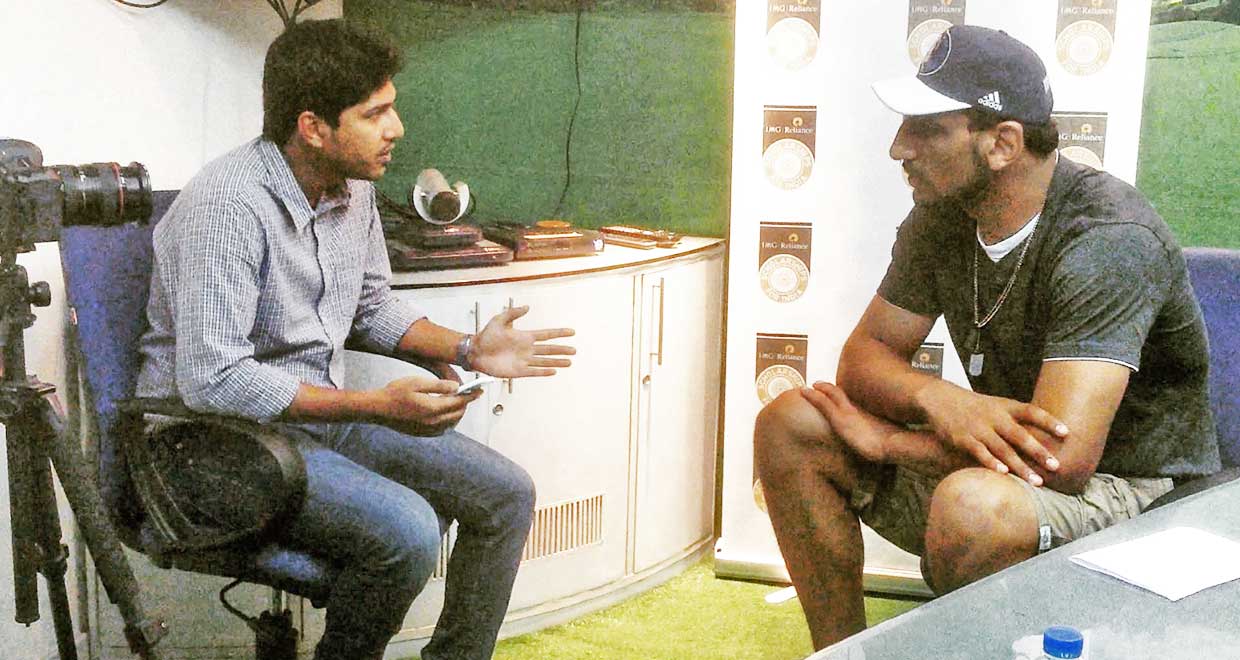
     

    Vishnu interviewing Satnam Singh (India's 1st NBA Player)
    Vishnu interviewing Satnam Singh (India’s 1st NBA Player)

    Tell our readers whether you had a passion for the game of basketball. Did you actively participate in any basketball tournament? How is the work life at Ekalavyas and how do you maintain the work and family life balance?

    Yes, of course. I am deeply passionate about basketball. I’ve played the sport at an amateur level throughout my life. In fact, I had the classic ‘hoop in my driveway’ as a kid. But I started taking the sport seriously with regular practice and training only during my college years. I made it to the college basketball team and did participate in a few tournaments. I was a part of the winning team at the sports fest held in RMLNLU, Lucknow. I was the captain of the winning team at the same sports fest the next year. Plus, basketball was a way of life for me in college. We used to play pickup games almost everyday – it was probably the most fun part of college life.

    To answer the second part regarding life working at Ekalavyas, it’s obviously good to be your own boss. But this also requires a lot of self-discipline – something that I constantly have to work on! Thing is, I don’t consider this as work. Instead, it’s a way of life. Ekalavyas goes in the direction its founders take it and we only work on those things that interest us. As a business that is still in its initial years, it obviously requires a lot of time and effort. But at the end of day, it’s worth it because we are building something we truly believe in and are passionate about.

    Having said that, of course, I still am servicing clients as an independent corporate lawyer and this is necessary for financial sustenance. But since these are also on my own terms, i.e., according to the processes I think best and my own timelines, work-life balance has not really been an issue.


    You have been a part of Ekalavyas for a period of more than one year. Tell our readers how the journey has been and the challenges / difficulties encountered by you.

    Any startup business faces a number of challenges in its nascent stages. On the personal front, initially, I had to adjust to not receiving a fixed amount of money per month and I had to be careful with the way I spent my money. But as time went on, and money started coming from my legal practice and from Ekalavyas, I gained  a certain level of financial comfort.

    So far, we have run the business without any external financial aid. We work on a self-sustaining model, where we slowly grow through the revenue earned from providing our services. Without major funding, growth has obviously been slow, but the important point is that we do not have any external pressure or influence in the way we function (which is of paramount importance to us). But now, we’ve reached a stage, where are ready to take things to the next level and will be considering investment offers.

    Overall, the journey has been great. I’ve met so many people from literally every state of the country, travelled to so many new places, which I otherwise would have never been able to travel to and I’ve been closely associated with the sport I love. So despite the challenges, I wouldn’t have it any other way.
     

    vishnu-ravi-shankar-2

    How did your relatives react to the decision of your quitting Trilegal and joining Ekalavyas? Did your family support you and what was their advice to you?

    They were hesitant at first. Understandably, my parents were surprised at my decision to quit Trilegal. They were worried about the financial security I had created for myself. But soon, they realised that I was happy with what I was doing and were very supportive, which was reassuring to me. My parents have always told me to be realistic about anything in life. Their simple advice was that your passion is one thing and it’s great to do something that you’re passionate about. But you have to approach it in a structured manner with long-term vision that yields success. Further, you need to be able to sustain yourself and your lifestyle. I have always kept this advice in mind.


    Do you have any plans to pursue higher education in the future, especially in sports laws?

    No plans right now. I’m not sure whether any higher education course would be as useful to me compared to the practical experience of running a business. Many of the things that you learn in the real world are rarely taught in any educational institution. As of now, I plan to continue to focus on the growth of Ekalavyas and my independent legal practice. But who knows what the future holds.


    Tell our readers what is the growth potential of sports law in India and what suitable measures are needed to promote sports in this country.

    Sports law in India is already sort of established. Thing is, sports law is basically an amalgation of various other areas of practice. It involves contract law, labour and employment laws and other commercial laws. Of course, sports law also entails familiarity with international and domestic sporting guidelines (anti-doping, laws governing sporting bodies, professional league rules, etc.). When I was working in the Hyderabad office of Trilegal, I came across my first brush with the field of sports law. I directly worked on drafting of commercial contracts for two prominent cricketers.

    With the advent of professional leagues in sports other than cricket and the growing interest in other sports in India, the need for lawyers who specialize in sports law will definitely increase. So, that way, it’s another avenue open for law students today. Unfortunately, sports law is not a course offered in many law schools. NLSIU, Bengaluru, recently held a conference on sports law. So, things are moving in the right direction.

    As regards what measures are required to promote sports in the country, well, there is a lot that can be done. Without getting into all that detail, I would simply say that people just need to go out and play! It all starts at home and if people are more sporty and physically active, automatically the respect for various sports and sportspersons will increase. Current facilities and infrastructure should not be used as excuses.


    Lastly, what are your plans for the future? What advice would you give law students wishing to work in the niche sector as you?

    We have some big plans for the future. We are looking to build a sports conglomerate with focus on various divisions that include media and PR, talent management, coaching and training, sports infrastructure and a lot more.

    Look, the advice that I would offer to any student is to focus on living their lives. In college, try and experience as much as you can – don’t hold back, because that time is not going to come back. Apply your own judgment to every situation. Do not just blindly follow people who are senior or higher in command to you. Lastly, try and do something that gives you satisfaction and not something merely for the sake of your bank account.


    Finally tell us in which specific role would you like to see yourself-the role of a lawyer, entrepreneur, a founder or a sports enthusiast?

    All of them, actually- I am a lawyer, who is also an entrepreneur and founder as well as a major sports enthusiast.



  • Samkit Sethia, Associate, Trilegal, on managing seven papers and twelve internships

    Samkit Sethia, Associate, Trilegal, on managing seven papers and twelve internships

    Samkit Sethia is a graduate of 2015 Batch of NUJS, Kolkata. He has had an exemplary timeline with the publications of seven papers, completing from twelve internships and has held a series of designations at WBNUJS. He has been chosen to work as an Associate at Trilegal, New Delhi.

    In this interview we talk about:

    • Lessons learn from the chronicles of his law school journey.
    • His idea on how to write papers.
    • How he managed his timeline to successfully complete twelve internships.
    • Experience acquired from moot court competitions.


    Tell us about your life before beginning law school. What inspired you for the pursuit of law?

    I went to a boarding school and thus, I remember always enjoying being challenged and sustaining my diverse interests. Learning outside the classroom interested me more and being an avid reader, writer and debater—I felt it was important to think in terms of arguments and develop an individual standpoint. This avenue of growth is what propelled me to pursue law.


    Do you come from a family of legal background or are you the first generation lawyer?

    I will be the first lawyer in my family. I come from a family where everyone is ultimately expected to join and contribute to the family business; this determinacy also fed into my interest for choosing a career that allows me to be creative with it.


    Tell us about the chronicles of your law school journey so far. Is there is specific incident which you would like to share?

    Being extremely busy works for me and that is how I managed my time in college.

    I kept myself extremely busy throughout most of law school. I was part of many societies and committees at NUJS and that kept me occupied for the most part. In addition, time permitting I interned during the semesters (online research work) and wrote a few papers.

    I didn’t compromise on having my share of fun in college; just like everyone else, I always found time for that.


    samkit-sethia-1

    You held a series of designations at WBNUJS. How has been your experience of working with the community?

    The most important thing is that it was always a community interacting with the larger community, it could never be just about the individual—which is something I learnt over the years through our experiences in various college societies and committees. Everyone brings so much to the table that it always a wonderful learning experience. You learn to appreciate different perspectives and different types of intelligence as well.

    Specifically speaking academic societies allowed me to develop and further my interests in niche areas of law and allowed me to work on something which I enjoyed outside of the stipulated college curriculum.

    Being Coordinator of the Recruitment Committee gave me a different kind of exposure; pursuing recruiters, handling administrative tasks and an overall HR lesson.  It was a great learning experience and while it took up an awful lot of time, I’d definitely do it all over again.


    You have authored seven papers of great content. Which amongst them is your personal stalwart and why?

    I’d say working on the paper on the Problems, Pitfalls and Perspectives on Public Interest Litigation in India because I was just not collating information on the paper but constantly bearing in mind the comparative angle vis-a-vis China. This paper was written while I was interning with the Danish Institute of Human Rights and the Legal Aid Society of West Bengal as part of a Study Tour comprising Chinese lawyers who were visiting to analyse how PILs function in India. This forced me to broaden my approach, yet remain nuanced in my reading of the Indian situation.


    What do you think are the core qualitative measures of writing an exemplary publication?

    Broadly, quality comes from grounded research, your own input and a cogent argument. The most significant for me is relevance for often it turns out that it is easy to get published in specialised areas or spin off a paper on a pivot that you think is “fresh” or “new”, but the real challenge is being able to do that while remaining socially relevant, accessible and cogent. Especially so at the university level when your engagement with the world outside and the discipline is unfettered—which is not the case when you are professionally placed and have demands of work wearing you down.


    samkit-sethia-4

    How do you think every law student should proceed while moving ahead in the timeline of law school?

    I think the “professional” nature the degree has acquired given the higher education scenario in India is detrimental to a spontaneous engagement with the subject. I have seen my college mates blindly following the herd when it comes to setting out a fixed plan of internships to do and the kind of brownie points to collect for your CV. While being practical about gaining experience is important, it is also important to indulge yourself by doing whatever interests you so that you can make an informed decision about what you’re suited best to do once you graduate.


    You have successfully completed twelve internships in your five years of law school. How did you manage your time alongside all the moot court competitions, paper publications and semester examinations?

    I enjoy being busy so this is the kind of schedule that worked best for me. Some of my close friends chose to focus on just a few gruelling internships, or academics and so on. It is all about taking the first couple of years to figure out a rhythm that works best for you. For example, I interned every break but also chose virtual internships during the semesters when my coursework and other activities weren’t too many.


    Moot court competitions have held a supreme position in your college life. What are the experiences you would like to share with our readers?

    I found it to be a valuable experience because I realized that while reading, researching and prepping for the moots, I learnt an enormous deal about specific areas of law that gets elided in class. Further, while speaking in public in a competitive scenario, it demands you to be thorough, coherent and articulate—seminal skills of a good lawyer!


    samkit-sethia-2

    If left at your discretion, which would you chose foremost – paper publications or moot court competitions?

    Paper publications because the curriculum and assessment pattern rarely allows one such creativity and individuation of ideas. Both have their advantages in their own right, but paper publications helped me have a better understanding of the topics I researched as opposed to moots.


    What do you think are the epithets of a successful speaker of a moot team?

    Brevity and cogency are important skills to me because they stand for a thorough research base and an effortless command over the subject matter. This in turn helps make the argument more convincing.

    In a flashback, what are they benchmark achievements did law school have to offer you?

    Law school allowed me to nurture friendships, write papers, moot, enjoy most of my weekends, land a job, learn law, intern, travel and otherwise have a fantastic college life. I couldn’t have asked for more!


    Last but not the least, what is your message to our readers?

    Keep reading Superlawyer!

  • Rimali Batra, Associate, Regulatory and Policy team, Trilegal, on pursuing BCL from Oxford, life at law school and varied work experience

    Rimali Batra, Associate, Regulatory and Policy team, Trilegal, on pursuing BCL from Oxford, life at law school and varied work experience

    Rimali Batra graduated from ILS Law College, Pune in 2010. After graduation, she worked at ICICI Bank’s Corporate Banking and Litigation team in New Delhi for a year. Thereafter, she pursued a BCL degree at the University of Oxford. After completing BCL, she joined Jindal Global Law School as a Research Associate. She subsequently accepted a job offer from J Sagar Associate’s Regulatory and Policy team and after continuing there for a while she went on to join her present office at the Regulatory team of Trilegal.

    In this interview she talks about:

    • Reading BCL at Oxford and tips on scholarships
    • Being a Research Associate at JGLS
    • Working at JSA and moving over to Trilegal


    Most of readers are budding and enthusiastic lawyers, how would you like to introduce yourself to them?

    I was born and raised in Delhi. I did my schooling from Montfort Senior Secondary School located in Ashok Vihar, New Delhi. Thereafter I went to ILS Law College, Pune to do my graduation in Law. After ILS Law College, I worked with ICICI Bank’s Corporate Banking and Litigation team in New Delhi. A year and three months later, I went to University of Oxford to read law. After BCL, I joined Jindal Law School, Sonipat as a research associate and worked there for three semesters. During the second half of 2014, I joined J Sagar Associate’s Regulatory and Policy team and worked on matters concerning power (Electricity Act, 2003). I was with Mr. Amit Kapur’s team in JSA for a year and have now moved to Mr. Sitesh Mukherjee’s Regulatory team in Trilegal. I have been at Trilegal for five months now. That’s been my journey thus far.


    You have had many interesting career switches from starting out as a banking lawyer then being a Research Associate at JGLS to your current profile at Trilegal. What all do you consider before taking these decisions?

    One is of course bound to be surprised at the changing courses of my career paths but then it was all a part of the plan, which I hope the readers will see as this interview answers unfold. All decisions that I have made till date connect, and connect wonderfully.

    rimali-batra-2I am a curious individual and don’t shy from taking risks. I have always been experimental in nature and challenges attract me and hold me. Call it my weakness, call it my strength. I believe that I perform well when I multi-task (It’s like enjoying the main course with some side dishes). That is how it has been since school days. For instance, in school I did not just study hard and well, but also trained myself to be a good basketball player (played national and international tournaments), a praiseworthy debater (both at the inter-school level and state level), a leader (school head girl) and a decent quizzer (inter-school level). Similarly in College, I did not settle for just being among the top 10 rank holder for all five years in the Pune University (ILS was one among the 20 odd colleges affiliated to the Pune University), but also represented ILS at various national and international level moot competitions, elocutions and paper presentations. At Oxford too, I read the BCL alongside playing basketball for the University of Oxford. And now whenever I have time and I am not working, I am doing either of the following – pro-bono advisory on energy laws and medical law and ethics, reading books, stock trading / following the market, writing and publishing stories or on issues of law that interest me, teaching English to underprivileged kids at home on weekends, part-time teaching at law schools or travelling.


    Did you have lawyers in your family or in close proximity?

    A little about my family: There are no lawyers in my family (or in extended family for that matter). My father hailed from Sonipat and my mother came to India in my Nani’s womb from Pakistan. My father was a businessmen and my mother assisted him in his business. He was and is my role model. He had no basic formal education and left school in class VI to pursue his dream of setting up a business. My mother was a national level table-tennis player and a B.Com graduate from University of Delhi.

    My elder sister, who is a gold medallist, is a Human Resources manager with a renowned company in New Delhi and my younger brother, who is also a gold medallist in B.Com (H) from University of Delhi is running his own business and takes care of dad’s business. I think I inherited my mother’s sports skills and reading habits and my father’s experimental, risk bearing and helping nature. I believed that a little confusion and nervousness is always good but fear is destructive, and therefore I aim at balancing my fears and my weaknesses with my confidence and strengths, as I move forward. I also leave achievements behind and look at them as a thing of the past and aspire to achieve a little more as days go by. So, in a nut-shell, law and basketball are my passion and I am a learner and observer at heart.


    Why did you decide to be a lawyer? How was your law school experience at ILS, Pune?

    As far as my memory goes, I sealed the decision of being a lawyer in Class Xth – even before I decided whether to take commerce or science. My decision was based on an aptitude test that was conducted in school moral science class. Thereafter I started adding biographies of famous lawyers to my reading rack alongside the already placed biographies of basketball players. I also read a lot of John Grisham. That marked the beginning. In class XII, I joined LST for preparation. I did not fill any other forms (B.Com, Eco (H) etc) but gave entrance tests for N-Schools. At one point in time, when I did not get through Symbiosis, I almost lost hope for making it to any other N-School, but then when I made it NALSAR, I regained my strength. I also made it to ILS on merit and on sports quota. Now, the decision there was simple, but I got swayed by the India Today ranking and picked ILS over NALSAR, as the ranking placed ILS at number 1 in 2005.

    rimali-batra-3

    ILS for me was a place of opportunities. Located in the heart of the city and walking distance from Symbiosis, ASCL, Ferguson College, FTII and Gokhale Institute of Political Science and Economics, it offered a vibrant student crowd and a bundle of opportunities. My learning was not limited to the classrooms of ILS. I participated in moots that enlarged my frame of learning, pursued diplomas in subjects that were not taught as a part of the academic curriculum and interned with NGO’s/human rights organisations in Pune. During college, I successfully completed diplomas in International Arbitration, Cyber Laws, International Business Laws, Securities Laws and Medical Law and Criminology. I was one of the speakers in the team that represented University of Pune at University of Oxford in the quarter-final rounds of the Oxford IPR Moot Competition, 2009. My first publication was on ‘domestic violence’ in the college journal (in 2007), followed by a piece on ‘separation of powers’ in the Ambedkar Law School journal (2009). During college, I also participated in cultural events like poetry writing and recitation, signing and painting. And of course I continued to play Basketball at the Deccan Gymkhana, since our college did not have a functional basketball court. I made some great friends at ILS. Overall, I believe I was able to paint my canvas with so many colours because I was in a college that gave me so much time and space to explore and go looking for opportunities, if they refuse to come to you.


    When people say “Law school”, they look no further than the National Law Universities. As a graduate of ILS, Pune have you faced any such bias? What would be your advice to students in ILS?

    I think the trends are changing a bit. Especially because of so many law colleges mushrooming across the country. ILS has a legacy of being one of the oldest institutions imparting legal knowledge. What ILS lacks is professional training. Meeting my counterparts from N-Schools, always encouraged me to imbibe in me the skills required to think, talk and approach life like a professional. Bias does exit but not all of us have to face it. ILS has a reputation for producing some good litigators however has not earned the same reputation in the corporate world, thereby making it difficult for kids in ILS to crack competitive corporate jobs. I recall an incident during my first job where a senior of my team, while praising my work, introduced me to be from NLS. On my prompting, he corrected himself and toned up his praises even more (considering he was surprised!). I would advise students from ILS to do additional courses and good internships because only studying law at ILS and getting a degree is not going to be enough.

    My advice to students of ILS would be two-fold

    (a) focus on academics in order to score well. Do not consider classroom teaching the end all of academics, that’s just the starting point; and

    (b) Make the most of the time at hand. Involve yourself in activities/course or additional degree’s that interest you. ILS makes space and time for you to incorporate that in your schedule. Most importantly, do both with the sole objective of learning.

    Students can consider requesting administration to take notice of events, moots and competitions that interest them and be rest assured the college will do its part. Student may also invite luminaries in the legal fraternity for lectures and seminars. Basically, what a student in ILS needs is the ‘instinct to initiate’ and ‘go towards opportunities’.


    Please describe the internships that you did in college.

    For internships, I always chose New Delhi, because this is where home was and logistics were easy to manage. My first internship was in the District Courts of Delhi where I read and researched on matters of criminal law and property related disputes. Thereafter, I did my second internship in Delhi High Court where I worked on matters on the original as well as the appellate side on various subjects. In my third year I did internships with Senior Advocates of Supreme Court. I then did an internship with litigation teams of two law firms and my final internship was with the Law Commission of India where I wrote a thesis (which retired into a book) on Constitutional validity of Medical Termination in India. I planned my internships and explored possible avenues for a lawyer in order to better understand my calling. By the end of five years, I was sure of being a litigator (at the least) not sure of the subject area that interests me.


    You worked as a Legal Manager at ICICI Bank. How does a typical day at ICICI work out? What were your main tasks and what responsibility did you undertake?

    ICICI Bank was my first employer. I was placed through college. I was based out of the Delhi office (I asked for Delhi as my location during my interview). I worked in no specific vertical, but was primarily doing litigation for/against the Bank. Anything and everything was a part of my profile. On a day I would be doing ECB lending, security creations and on another I would be researching and preparing written submissions for matters pending in the consumer forum or the Supreme Court and on yet another day I would be doing retail banking advisory. Having such a profile made it interesting to work in ICICI. I worked there for a year and a half, before I decided to do a masters.


    How did your appointment take place at ICICI Bank? What kinds of questions were asked at your interview for ICICI bank?

    ICICI follows a three step procedure, shortlisting on the basis of CV’s, followed by a Group Discussion and finally a personal interview. The Group Discussion revolves around a hypothetical problem relating to law of contracts and consumer protection. The personal interview is primarily based on the resume and a few HR based questions.


    Please tell us about your decision to do an LL.M and how you went about choosing the program and university.

    I decided to pursue my masters from Oxford ever since I visited the University in 2009 for an IPR Moot Competition. On my return, I pursued it like a dream. The advantages of doing a BCL are:

    (a) it offers the students to choose a suitable combination of subjects, based on their preferences as opposed to a custom-made LLM course. So, even though I read only four subjects as part of the BCL but at the same time the rigorous workload and timelines gave me the advantage of specialising in four subjects at one time,

    (b) Oxford targets on strengthening reading, breaking down complex material and articulating the same in form of legal writings/answers/tutorials. They say, don’t study BCL, you read for BCL.


    What do you think clicked in your favour during the selection process for Oxford? What are the scholarships you had applied for?

    I can’t answer this question with certainty. It has to be a combination of my academic performance in ILS, my statement of purpose and the write-up. Also, the fact that I assured my willingness to attend the course and pay for it, in case I did not get scholarships from Oxford, could have boosted my application. However, I did say that I will not attend if I had no scholarships at all. Other than that, achievements mentioned on my CV (like basketball, moots, diplomas etc.), my statement of purpose and my write-up may have added a little value.


    How do you think a law student can build up his profile to get through to top-notch universities like Oxford?

    It’s important to have a strong academic score. A rank in the law school adds value to the application. Apart from that, a student should be able to demonstrate inclination for engaging in theoretical and policy aspects of law. It is also advisable for students to have publications on their side. I remember interacting with the Dean of the University and inter alia, discussing the approach adopted by the University in considering applications from Indian law students. He talked about the law college’s ranking also being a relevant factor, apart from the academic achievements of the student.


    What was your area of study during your masters at Oxford? How was the academic pressure like and did you find time to engage yourself in other activities?

    I read Principles of Financial Regulations, Corporate Laws, Medical Law and Ethics and Philosophical Foundations of Common Law. The courses were rigorous and the readings ranged from being easy to intense and complex. However, I made time to be a part of the Oxford University Girl Basketball team after being shortlisted at the trials conducted at the beginning of the course. I played 4 or 5 inter-university matches and also participated in the legendry ‘Varsity Tournament’ played between Oxford and Cambridge every year.


    Please tell us about the scholarships you applied to and the procedure for each.

    I applied for all possible scholarships I stumbled upon during my research. I started looking for scholarships before making my application. I followed this website -governmentofindiascholarship.com. I specifically applied for Rhodes, Common Wealth Scholarship, KC Mahindra Trust, Jain Trust, Ox-Cam among others. I was awarded the KC Mahindra Trust Scholarship and the Ox-Cam Scholarships. The application procedure is a little detailed as the students need to prepare independent SOP for each and demonstrate availability of the balance funds (in case where the scholarship does not cover for everything).

    The interview rounds for KC Mahindra and Ox-Cam is fairly simple and questions are primarily targeted at (a) ‘Why oxford?’ and (b) ‘What after masters?’

    Additionally, I would suggest students to ask their employers or seniors they have worked with for financial assistance as some firms, seniors or employers are willing to offer funds with or without a promise from the student to come back and work with the said employer or senior.


    Please describe your experience at Oxford. What were the classes and professors like?

    Oxford was a scintillating experience for me. Especially, reading philosophy at Oxford gave me a deeper understanding of law, legal principles and concepts. Oxford has seminars (classroom teaching) which requires students to read before walking in. For my corporate law class I joined a group that was made by students themselves to discuss seminar questions before the seminar and help prepare better for exams.

    At Oxford I was exposed to a system that takes its readings very seriously. As a Masters student, we were required to not just read hundreds of pages every week, but, to also reflect on them during our seminars. I enjoyed this practice very much and it has allowed me to hone my writing skills in the process. A typical reading list will have at least 8-10 important readings (combination of articles, case laws and policy paper series from different jurisdictions, but primarily UK and US). Professors, at best, assist as students deliberate and discuss a topic. One more thing which I found particularly interesting was the presence of an economics, finance and corporate law professor at the same time during seminars for one of my courses, namely, principles of financial regulation.

    The tutorial system is quite unique. There are 4 tutorials for each subject and are spread over three semesters followed by a three hours written exam at the end of the course. I found the tutorials challenging but refreshing as they helped me assess my performance and understanding of the subject alongside attending seminars. They also helped me hone my skills of articulating my thoughts and understanding of the subject.


    You switched to a pure research based career after coming from Oxford. How did this change take place? How did you get to associate yourself with Jindal Global Law School?

    Academics is very close to my heart and still is. For as long as I can remember, teaching and educating has always fascinated me. When at Oxford, I heard about Jindal Law School and its dean, Dr. (Mr.) C. Raj Kumar who happens to be an alumnus of Oxford. I was given an opportunity to work as a Research Associate and lecture two courses ‘Property Laws’ and ‘Corporate Laws’. Honestly, one may see it as a switch in careers, but for me, academics fits in very well for an aspiring lawyer, especially after a masters. I also felt a dire need to re-apply and re-read my subjects, from the Indian law perspective – after I finished my masters.

    Though I chose to be a litigator, I haven’t lost touch with teaching and academics (and hopefully never will). I have conducted seminars and lectured at various law schools in India, ever since I left Jindal. I am a visiting faculty with Symbiosis Law School, Noida and often visit ILS Law College for conducting week long courses, as and when time permits.


    You had worked with Jyoti Sagar Associates and you are now working with Trilegal. Why this switch?

    After two very fruitful and enriching years at Jindal Law School, I decide to do join regulatory litigation. I was with JSA for a year and have been with Trilegal for 5 months now and having been working on laws in the energy sector, especially the power sector. With not much precedent in the sector, the practice is demanding and engaging.


    How is being a research associate or a legal manager at bank different from working at a top – notch law firm? Does the work load increase, how have you managed this transformation?

    When I was in ICICI, I assisted in consumer dispute litigations for/against the bank on subjects involving ‘corporate laws’, ‘banking laws and regulations’. When at Oxford I read ‘corporate law’ and ‘financial regulations’. When at Jindal, I taught ‘corporate laws and financial regulations’. When at JSA, I put together the knowledge and experience acquired from ‘corporate laws’, ‘regulations’ and ‘litigation’; and worked hard in acquiring sector specific knowledge. Electricity/Power sector is a super-niche sector and I find it thrilling and challenging. My work at JSA was very extensive and intense. At Trilegal, I continue working on matters in the power sector with the same intensity and I enjoy it immensely.


    How has the journey been so far? What are your long term goals?

    For me my journey that has been the best part. The people I met, places I visited, life experiences I picked on the way, all add to me being who I am today. For today and tomorrow, I am a litigator, learner and an observer and I aspire to be perfect at what I do.


    Lastly, what would be your message to a law student who wants to excel in the legal profession?

    Let me quote Abraham Lincoln’s message “If you are resolutely determined to make a lawyer of yourself, the thing is more than half done already.” I echo.

    When in law school, plan a little about your future. Immerse yourself in travel, cultural exchange, sports, parties and meaningful conversations, as much as possible. Don’t let your degree define your career limits. Don’t forget to explore and experiment. Take risks sometime, it adds a bitter-sweet flavour to your becoming a lawyer. If you do, then accept your failures as much as your cherish your victories.

    And most importantly, keep your imagination alive.

  • Pranay Agrawala, Ex-Law-firmite on starting up with Lex Adista and experience in litigation

    Pranay Agrawala, Ex-Law-firmite on starting up with Lex Adista and experience in litigation

    Pranay Agrawala is a Symbiosis graduate who had interned at Dua Associates and Ernst & Young among others. Upon graduating, he joined Khaitan, Jayakar, Sud & Vohra as an Associate after which he joined Trilegal and worked there for three more years. Thereafter he started a private litigation practice. He subsequently joined the Chambers of Senior Advocate, Mr. Siddharth Luthra (former ASG) before starting his own law firm, Lex Adista. In this interview he talks about:

    • Interning at the Supreme Court, Dua Associates and E&Y
    • Working at KJSV, Trilegal and Chambers of Mr. Luthra
    • Experience and challenges at a startup law firm


    Tell us a bit about your childhood and pre-college life as well as educational background. Did you have lawyers in your family?

    During my childhood my family moved around quite a lot and I had the benefit of experiencing different cultures and becoming comfortable with varied thought processes and customs. This has been one of the biggest parts of my school education and has proved to be invaluable in my growth. I never had any lawyers in my family and throughout my childhood, I didn’t have any interactions with lawyers either. The profession was a mystery to me until I joined Symbiosis and did my first internship, with Mr. Dushyant Dave no less.


    Tell us something about your college life? What activities did you participate in?

    During college like most teenagers I concentrated on enjoying my life. I travelled, played sports all day etc., but now I feel that I missed out in participating in law school centric events. Having never been guided properly as to what would help me grow as a lawyer, I never benefitted from all the things a good law school has to offer. It was only towards my later years in college, especially after some serious internships, when I realised the value of extra-curricular activities, like mooting and client counselling, writing research papers etc.


    What were your areas of interest during your graduation? How did you go about developing acumen in these areas?

    Law school, is not geared towards exposing a student to the ‘practice’ of law; Theory and understanding statutes, philosophy etc. were given a significant focus. I still feel that the course design and structure lacked the foresight that is conducive to learning Law. Thinking back, subjects like jurisprudence, history of courts, administrative law seemed mundane and uninteresting because of a lack of perspective, but the knowledge of such subjects is greatly beneficial to practising law. Interests for me were mostly found through internships where exposure to the various practice areas made me realise the beauty of the English language; the immense application of intellect required in drafting statutes, contracts or any legal document; the sheer application of intelligence that can make the difference between a good lawyer and spectacular lawyering; and most importantly the power of knowledge. Practice areas in law became secondary to me, just the thrill of the practice of law was paramount.


    What kind of internships did you do in your law school? Which internships will you consider to be right at the top and why?

    Having had little or no exposure to the profession prior to going to law school, I realised the value of internships only by the third year. Despite having interned in every break, I really started absorbing the nuances of being a lawyer towards the end of the second year. Thereafter, I tried to intern at as many different organizations as possible. I interned at the Supreme Court, Dua Associates, Ernst & Young and many other firms. The reason for this was so I could find my practice area and an environment that I would feel drawn to. Although this approach had its downsides with respect to securing a job right after law school, I needed to know I was doing what I liked. An internship where I really felt like I was a lawyer was at E&Y. I feel it was a combination of maturity as a student and the good opportunities and structure at E&Y. From that point on I knew that I can be a good lawyer.


    pranay-agrawala-1

    Did you learn any skills while interning? What are these skills and how did you acquire them?

    Like I have mentioned above, I learned everything that I knew about being a lawyer from internships and not only from law school. During internships, notably at Dua Associates, I realised that if you desire to learn, you have to have a combination of enthusiasm (not to a point of being nauseating to associates) and hard work. The better you assist your bosses the more they want to work with you. Observe, take extensive notes, ask the right questions and don’t be afraid to be called stupid (as long as you don’t ask the same question twice); these cannons were what helped me learn at internships and I also maintain these till date. One can learn much by just paying attention.

    Needless to say, I benefitted a lot from lawyers who were happy to explain concepts and teach a young aspiring lawyer. I have many to thank for my legal education, beyond college and till today.


    What do you have to say about mooting at law school and legal writing for journals? Do they have any ‘bonus’ value when seeking jobs?

    Like I said before, mooting, legal writing, etc. are very important. Participating in these extra-curriculars helps build confidence and skills, which are basic skills every lawyer needs to master, and like any other thing – sooner is definitely better. I gained most of this, under extreme pressure, while working and regretted not having honed these skills in college. Although, it’s a trade off for students, whether to be entirely entrenched in college or to go out and explore the world and experience life during college. Considering the nature of our profession, college is often the last opportunity to expand your horizons.

    While seeking a job, it can make the difference between getting hired and passed over. It also makes a difference in the initial upward growth as someone with a certain degree of skill may be at an advantage.


    Upon graduating, you started working at Khaitan, Jayakar, Sud & Vohra (“KJSV”) as an Associate. How did you secure your appointment? Please describe the interview and induction procedure for a fresher?

    By the time I interned at KJSV, I had gained a lot of focus in what is expected from a lawyer. My natural attitude and approach to matters was noticed and I was able to convert that into a job opportunity. Also, the fact that my focus was on learning and gaining exposure meant that a smaller law firm was a great place to start, and was consequently easier to break into. In my personal view, in the beginning of the career a smaller law firm generally places more trust in you and consequently, bestows larger responsibility, helping you learn faster.


    pranay-agrawala-3

    After having worked at Khaitan & Jayakar  for a year, how did the shift to Trilegal take place? Please tell us a little about your work experience and life at Trilegal.

    Given the fact that I wanted to have an all round experience in Law, after one year of practice on the civil side of litigation, I started to seek opportunities in law firms with a corporate profile. My search began a few months before the shift and I was willing to forego pay and position within the organization for a chance to gain exposure. Trilegal gave me an opportunity and I leaped at it, making the change to corporate and M&A. The shift was not easy and the expectations were often overwhelming. Trilegal is of course a great place to work and has a highly motivated team of lawyers, who never cease to set the bar of performance higher. The most important learning I took away from Trilegal was the attention to detail and research that needs to go behind any advice or action of a legal professional. As a lawyer, one is only as good as the knowledge he brings to the table, whether it be the negotiating table or the bar. This fact was driven home daily at Trilegal. I still put the same amount of attention to detail and set the bar of research very high in my own practice and with my associates.


    You left one of the finest law firms in India and started your own independent private practice. What were your reasons for moving from a corporate setting to litigation?

    I had not left Trilegal to start a litigation practice, but soon realised that to start a corporate practice I would have to create some credibility in the market as also become a brand on my own, so to speak. Having left the firm with a few clients (my own and not from Trilegal) already available to me, I had a steady stream of work which unfortunately lasted for only short while, and was ultimately not sustainable. Litigation is a practice more geared towards individual lawyers seeking clients and creating a presence in the profession, I simply had to shift practice areas to survive.


    After a few months of  your independent practice, you  have  joined  the Chambers of  Senior Advocate, Mr. Siddharth Luthra, where you have  worked for almost one year. Please tell us about your experience working under the  supervision of  Mr. Luthra.

    Like I have explained above, I needed to expand my practice to stay afloat independently. Mr. Luthra was extremely kind to me and gave me an opportunity to join his chamber while he was ASG. This proved to be a baptism by fire, as the office of the ASG was extremely busy and the intensity was only exacerbated by Mr. Luthra’s insatiable appetite for work. I did feel that I was at a slight advantage, having come from Trilegal and being adjusted to intense timelines and high expectations. Bringing my law firm approach to Mr. Luthra’s chamber helped me transition easily with respect to what was expected of me.

    I likened my stint with Mr. Luthra as a sort of LL.M, where I learned the finer nuances of the practice from a seasoned and highly successful Senior Advocate. I tried to grab as much work as possible to maximize my learning and also to increase my exposure to Mr. Luthra. Court craft, legal drafting, framing arguments and managing clients’ expectations as an individual lawyer were some of areas where I focused my attention. Exposure to the Supreme Court and representing the Union of India were an icing on the cake.


    Please tell us about your experience with regard to your first few sessions in court. Has it become more difficult for a fresher to achieve success?

    After completing roughly an LL.M’s worth of time learning from Mr. Luthra, I once again took the tough decision to go independent and start a practice. This time, however, I was better prepared and more mature. I did not limit myself to litigation or corporate law as I felt that I was capable of providing clients with both facets of professional services. Appearing in court is a nerve racking experience at first, no matter how well prepared you are, stage fright does kick in. Keeping a calm demeanour and retaining your presence of mind, while having the eyes of all your peers on you is not an easy task. Being extremely well prepared and keeping easily understandable, well structured notes was of great help and still is.

    Success is never easy. Those who say they got it easy are either being modest, or will have to struggle at some point to retain the success. The harder you work, the more opportunities for ‘success’ will become available to you. In the end though, success is relative.


    Your main area of practice consists of  corporate/civil advisory and litigation. Please elaborate on the cases you normally deal with and how has been your experience so far.

    Coming from the varied background that I do, I afford my clients a unique perspective to legal issues and advisory. At a given time, I feel comfortable taking care of regulatory compliances and commercial work, while at the same time I can advise on dispute resolution and litigation. I feel that this gives my clients a great deal of comfort, especially when it come to handling contractual disputes which require the ability to assess and understand complex SHAs or EPC contracts and to be able to build an effective strategy.

    Presently, I have a bouquet of technology and engineering companies as my clients. This is a sector of industry which has always been of interest to me and being a product of the internet age, clients find it easier to interact with me with respect to the technological aspects of commercial contracts. Of course, having a working knowledge of the internet, computer systems and engineering goes a long way in impressing a client, who then does not have to waste precious man hours in briefing their lawyers on how technology works. Relying on this unique blend which I feel I bring to the profession, I have today managed to start my own law firm, we are called Lex Adista and are a full service law firm. I represent the firm in corporate and commercial matters while my partners handle civil and criminal litigation/disputes.


    What were the difficulties you faced in the early days of your practice? How difficult would you say it is to build a reputed practice? How many years of hard work does it require to build a firm clientele?

    The difficulties are not far from what one would imagine. Finding clients in an industry which is teeming with talented and hard working professionals is not an easy task. To be able to sustain a steady stream of work, turning it around and finding more work to keep you going is a daily struggle. The quality of work is what ultimately decides whether your practice will be successful or not, and maintaining that quality is essential. I will give you the exact number of years it takes to build a successful law firm when I feel Lex Adista is a success.


    Did you build everlasting relation with your clients? Please share some of your secret tips on how to boost fiduciary relations with the people we serve?

    Having great interpersonal skills and managing client expectations are the basics for building everlasting relationships with clients. However, to maintain an everlasting professional relationship you have to provide top notch, intelligent legal advice. At the end of the day, the quality of your services and professionalism is what makes clients stick with you.


    What is your workday like? Are there new challenges every day or did work fall into a predictable pattern?

    My workday is quite varied. As a partner in a small start up law firm, each day I have to give equal importance to internal management, business development, client interaction and at the same time produce deliverables for clients. While it may be tiring, it’s never tiresome.

    We are constantly trying to pick up new work and are not confined to any particular sector. We even advise musicians, artists, startups, designers and other creative professionals who help keep the work exciting. Sometimes, as a bonus we even get passes to upcoming events for the associates!


    If someone does not go to a top law school, would you say he still has a shot at a great career in law?

    Of course! A lawyer never stops learning. One is always learning on the job and what a lawyer makes of his opportunities is what creates the opportunity of having a great career. Never stop working and focus on learning, this is the advice I would give to anyone who wants to grow. I too will never stop following this.


    When you hire interns and associates under you, what kind of qualities do you look for? What should an intern or aspiring lawyer do to get noticed in a positive way?

    At Lex Adista, and particularly under me, we focus on an appetite for learning. I love to share knowledge and find that a heated discussion based on research is a great way to find solutions for legal issues. Attention to detail and being able to present a legal argument with proper justification is the basics of any lawyering. For an intern to get noticed or for that matter for an associate to get hired, I look for individuals with a thorough approach. Any point of law can be explained on the basis of solid research and reasoning, reliance on judicial pronouncements, commentaries and the application these to the facts of the matter at hand. Creativity and a willingness to learn are essential in my book.


    Where do you see yourself and your firm in five to ten years?

    We are presently trying to build a successful law firm. Currently, we are looking at expanding, both, our lawyer base and our client base and hope to do each aggressively. At the same time, we are conscious of the fact that our quality and focus should not get diluted in the process. Perhaps, it is too soon for me to predict where Lex Adista will be in five to ten years, but where I would want it to be is quite clear in my head.


    What would be your parting message to law students who want to litigate just after graduation?

    For any aspiring litigator, the most important advice I can give is to focus on gathering a variety of experience and to look for opportunities to learn. For a successful litigation practice having exposure to every field of law is very valuable, and can be gained in the earlier years of practice easier than later. I too pushed myself to constantly be involved in different practice areas of Law to build an all round understanding of the practice. Getting attached to big names and going after CV value can sometimes backfire, when you realise after some years of practice you may have learned very little. A lawyer is a sum total of his experience, while frequent changes can be detrimental to getting hired, knowledge and experience will always shine through.


  • Nirupama Jayasimha, Associate, Telecom Media Tech team, Trilegal, on work and LL.M from Stanford Univ

    Nirupama Jayasimha, Associate, Telecom Media Tech team, Trilegal, on work and LL.M from Stanford Univ

    Nirupama Jayasimha is a graduate from Bangalore University batch 2003-2008. Currently she is an associate at Trilegal, working in the Telecom, Media, Tech team. She has had a brief stint with Infosys and then she worked at Wilson Sonsini Goodrich and Rosati. She has completed her LL.M. from Standford University.  She has also been an Exchange Student at Université Paris X Nanterre. She shares her experience as an Exchange Student and tells us why and how an exchange programme is beneficial for a law student.

    She tells us about JN Tata scholarship application and other procedures for further studies abroad. She also talks about the job opportunities available overseas.


    Though it’s one of the most cliché question, but yet, why law? What were your areas of interest while you were studying law?

    I come from a family of eminent lawyers and engineers. Dinner time conversations were filled with stories from the court or the latest developments in technology. This led to an interest in these fields from a very early age. My father thought I would make a better lawyer and persuaded me to take law. In the meantime, the growth of IT in Bangalore presented a unique opportunity to work at the cusp of law and technology. Most of my internships were in the legal departments of technology companies to help me understand the fundamentals of technology, business and its interaction with law.


    You have been a part of Université Paris X Nanterre as an Exchange Student. How do you think such exchange programmes are beneficial for a law student? Tell us about your experience there.

    When I signed up for the exchange program, apart from getting to live in Paris without paying for it, I couldn’t think of a single way the exchange program would benefit me. If anything, it seemed like opening a Pandora’s box. I had to attend classes and take exams in a language I didn’t understand well, the college administration was not sure if the courses taken in Paris would count towards graduation and I had to live away from home for eight months which I had never done before. Call it adrenaline rush, or the compulsion to be different, I just signed-up for the program. Apart from learning enough French for a lifetime, there were no immediate benefits I saw from the exchange program. It’s only much later that I reaped the benefits. While at Infosys, I worked closely with clients in France and having an idea of civil law and French was an added advantage. It may have influenced my admission to Stanford as I was one of two students in my university to have done the program. Even today, the networks I cultivated have stood me in good stead. So, I guess, my advice to anybody who wants to take up an exchange program is to go for it! Like Steve Jobs said “its only when you look back that you will be able to connect the dots”.


    nirupama-jayasimha-2

    You have studied LL.M from Stanford University, through the J.N Tata Scholarship. Tell us in detail about the application procedure for the JN Tata scholarships and other such scholarships.

    The J.N Tata scholarship requires applicants to submit a personal statement along with their application. Based on the strength of the application, candidates are shortlisted for an interview in Bombay. Candidates are interviewed by a subject-matter expert from their particular background for an hour. A week after the interview, successful applicants are intimated by mail. The final distribution of the scholarships is at a ceremony held at the Bombay House (where you may have a chance to meet Ratan Tata!). The ceremony is also attended by scholarship alumni and distinguished members of the Tata Group.

    The Stanford acceptance letter comes out well past the deadline for most scholarship applications. I just made it in time for the JN Tata scholarship and that’s only because an extension was granted! However, there are a few scholarships that you can apply prior to sending out your college applications. Applying to these will ensure you don’t lose sleep after receiving the acceptance letter.

    In terms of the selection process for the JN Tata Scholarship, it is hard to give a definitive answer of the traits required to bag the scholarship. My advice is that it is good to spend a few days thinking about why you want to do a LL.M, how you would use it to further your career and the interests of the society at large and then present it in your application in a compelling way. This is the most important question any scholarship panel asks and is also a defining part of the application you submit to colleges.


    How was your experience with faculty and academics at Stanford University?

    As a law student, I spent a lot of time reading and thinking about technology law issues like net-neutrality, P2P sharing, patent trolls, dispute resolution in e-commerce. Quite naturally, the opportunity to study at Stanford, at the bleeding edge of all the action, was an exciting prospect. And I was not disappointed at all. The Socratic method of teaching is crafted towards making you evaluate these issues by questioning the fundamentals. In addition, hearing perspectives from competing stakeholders on issues they deal with on a daily basis makes you appreciate and understand the different facets of the issue. For instance, in a panel discussion onP2P sharing, we had the ex-CEO of Napster, Hank Barry on the panel and a lawyer from Viacom. Meeting such stalwarts on a daily basis inspired me to contribute to the evolution of technology law in a meaningful way.


    How is the recruitment/ placement situation for overseas students?

    Well, it’s not easy to find a job. If you are looking to do an LL.M just so you may work in the US, then it may not be a wise decision. To land a job in the US, an extensive network of contacts will take you much further than a LL.M degree. When you interview for jobs after your LL.M, you are competing with JD’s. A law firm will not want to pick you ahead of a JD unless you have something a JD doesn’t. More often than not, that X-factor could be your ability to bring in work from your home country. As a general observation, I found that the network one has built in India is the most effective tool to land a job in the US.


    How did you get a job as a foreign legal specialist in Wilson Sonsini Goodrich and Rosati? What kind of work did you come across?

    My boss during my stint at Infosys, Samuel Mani generously referred me to a partner at Wilson with whom he worked closely. At Wilson, I worked with the Technology Transaction team which primarily worked in representing technology companies in business transactions driven by the development, use, acquisition, or divestiture of intellectual property, including licensing, mergers and acquisitions and public and private offerings. The most interesting piece of work I was involved in was preparing a memorandum for the Demi Moore and Ashton Kutcher foundation on the ethics of web scraping to help prevent child trafficking. Additionally being from India, I helped in cross-border transactions involving Indian clients.


    nirupama-jayasimha-3

    Is it easy to have a work-life balance in this profession?

    I think you need to identify as early as possible, the things important to you in life and then prioritize them accordingly. For me, health, family and work are the top priorities. The most important of course is to maintain a healthy lifestyle, without which one can neither do justice to work (no pun intended!) nor spend quality time with your family. If one is disciplined, it is not hard to set aside an hour everyday for some sort of physical activity. I also don’t let work get in the way of having timely meals. As for prioritizing between family and work, it is very contextual and one cannot blindly prioritize one over the other. There are times when you may need to give up working on an important deal because you have a prior family commitment, and there are times when you have to miss a family event because you are committed to closing a deal. I think planning and being organized helps a lot in navigating this tightrope. It is also important that people at work respect your priorities and that people at home understand. I have been lucky to have a very supportive family, and colleagues at work who understand the importance of striking a work-life balance.


    Is there any success mantra that you follow which you would like to share with our readers?

    Howard Roark, in Fountain Head (which is my favorite book of all time) says,

    “I have, let’s say, sixty years to live. Most of that time will be spent working. I’ve chosen the work I want to do. If I find no joy in it, then I’m only condemning myself to sixty years of torture. And I can find the joy only if I do my work in the best way possible to me.”

    This really sums up what I believe. Any work you choose to do, do it to the best of your ability. The rest will take care of itself!


  • Pranjit Bhattacharya, Law Graduate, Bangalore Institute of Legal Studies, on mooting, securing top-notch internships and a PPO from Trilegal

    Pranjit Bhattacharya, Law Graduate, Bangalore Institute of Legal Studies, on mooting, securing top-notch internships and a PPO from Trilegal

    Pranjit Bhattacharya graduated from Bangalore Institute of Legal Studies in 2015. He also holds a diploma in Entrepreneurship Administration and Business Laws from NUJS, Kolkata. Pranjit received a PPO from Trilegal in his fourth year of law school.

    In this interview we speak to him about:

    • Mooting and its benefits for a law student
    • Preparing a C.V. and insides of personal interview with tier-1 law firm; and
    • Securing top-notch law firm internships


    Tell us a bit about your life before college?

    I have been lucky to grow up in the beautiful picturesque city of Shillong. I did my 12th from St. Anthony’s Hr. Sec. School, Shillong. I have a twin brother who is also, doing law from the Faculty of Law, Delhi University. That is as far as law runs in my family. A better part of our schooling was devoted to debating at various inter-school events. Studying at a school where great emphasis was given to extra-curricular activities helped me immensely.


    Why did you decide to study law?

    I think it was a de facto choice really. I opted for Commerce during my 12th so chances of pursuing Engineering and Medicine were negated pretty early (much to the dismay of my family). I wanted to pursue something that would give me a rush, a discipline that challenged one’s ability to reason – what better than ‘law’ in that case. I am really passionate about law actually.


    How practical do you think are the shows like The Practice, J.A.G., Boston Legal, Suits, etc. and movies like 12 Angry Men, Philadelphia, etc.?

    To be honest, if soap operas were to show the life at a law firm as it transpires on a daily basis –most people would shrug at the very thought of watching it. There is a reason why such shows are meant for entertainment and so, they should be. It would be really naive to be goaded to believe that this is how the legal profession works on the basis of such shows.

    Although, I think there are quite a few good English movies which manage to captivate the essence of law practice quite beautifully. A Few Good Men, To Kill a Mockingbird and 12 Angry Men are my personal favourites.


    How did you secure internships with top tier firms?

    It is important to plan your internships well. At the beginning of each semester I prepared a list of firms that I wanted to intern with. Applying well in advance and setting out the period of internship clearly are recommended. Given that most firms have their own internship application procedure; it is advisable to confirm the same with the HR at the firm prior to sending an application.


    pranjit-bhattacharya-1

    Did you pursue your internships throughout law school as part of a deliberate plan or did it all just happen by chance?

    I think I had planned it out fairly well. Almost every semester I knew precisely the kind of internships I was looking at. So in my first and second year I interned at The Hindu Newspaper Publications and under an Advocate at Calcutta High Court (who is presently, a Judge in that Court). Thereafter, I moved to a mid-sized law firm, CorLit Legal for three months during my third year. This was a very enriching experience actually. The kind of exposure I was given at this firm formed the bedrock for my future internships.

    Since, the end of third year my internships were part of a well-thought out plan. So at the end of my third year, I interned at Nishith Desai Associates. Then in fourth year I interned at Trilegal (twice) and at the Law Chambers of International Tax jurist Mr. Soli Dastur, Senior Advocate, Supreme Court of India.

    Unfortunately, there exists a wide gulf between law school education and the work at a law firm. It entails a sound knowledge of different business models; latest regulations / notifications, etc. in different fields of law; market precedents on certain transaction that the firm proposes to undertake in the future; business risks inherent in a particular transaction and the like. In this regard, law school education is woefully deficient in investing the students with the knowledge to deal with such practical aspects of law.


    What kind of work did you have to do during your internships?

    It varied according to the place. Drafting client opinions, due diligence, research on multifarious aspects of law, comparative analysis of certain laws in India and other countries, etc. were the major tasks that I was assigned.

    A couple of them actually. On the last day of my first internship with Trilegal, a Senior Associate offered me a second internship at the firm and then said with a smile, “Remember always that there are plenty of good lawyers, but not many good lawyers who are good guys. So do not forget to be a good guy”. This is something I have tried to hold onto ever since.

    Then, on one occasion during my internship with Mr. Dastur, me and my co-intern were working past midnight, so while leaving he quoted Henry Longfellow’s famous words with a beaming smile, “The heights by great men reached and kept were not attained by sudden flight, but they, while their companions slept were toiling upward in the night”. This continues to remain the fondest and most cherished memory of all my internships.


    What do you have to say about students interning at law firms  all through their undergrad years?

    Law School life is all about exploring different avenues, particularly, in the first couple of years. Choices to intern exclusively at a law firm right from the start of law school defeats this very purpose. It necessarily means that you shut your mind to other avenues that may be more suited to your acumen and ability. It also, undermines the significance of good litigation internships which unravel the possibility of engaging with some of the best minds in the legal profession and leaves an indelible influence in your career.

    It is quintessential for your wholesome development as a lawyer to understand a particular fact situation from different perspectives. Diverse internship experiences help you acquire this. Thus, even though you may be pre-meditated that you want to work at a law firm in the future, it is advisable to pursue at least a couple of non-legal or socio-legal internships prior to law firm internships.


    Tell us about being a member at  multiple committees while in college.

    I have been a member of the Moot Court Committee at college since, the first year of law school. And for some time I was also, involved with the Literary and Placement Committees. I think they enhance your networking and communication skills and organizational ability. In my college though, these Committees are limited both in terms of, activities and impact.

    I was also, a member of an Expert Panel Study on Access to Healthcare in India by IIM-Bangalore and University of St. Gallen, Sweden. The forum involved participants from diverse disciplines of different age and influence. The entire process was immensely rewarding in terms of, quality of interaction, sharing of ideas, discussion on business strategies, etc.


    Have you felt strongly about social causes?

    I would be lying if I said no. So I tried to strike a balance between my objectives of working with a law firm and pitching in with some pro-bono work as well.

    During my fourth year, I worked as a Research Assistant for Mrs. Nina Nayak, eminent social activist and former Chairperson, KSCPCR and Member, NCPCR on her book on the National Commission for Protection of Child Rights Act, 2005.And I have already mentioned earlier, about my stint with the Expert Panel at IIM-Bangalore.

    Both these opportunities gave me a deeper understanding of the policy paralysis and administrative complacence that pervades our system and the critical role that society needs to play in eliminating the same.


    Tell us how important is mooting and what effect does it have on one’s CV?

    (Pranjit has participated in various moot court competitions like Nani Palkhivala Tax Moot, Surana Corporate Moot, NLS Arbitration.)

    At the outset, if you are doing a moot court competition for CV value only then, according to me it is a futile exercise. Mooting is a passion and that is what should drive an individual’s decision to moot or not to moot. This is one experience at law school that I encourage everybody to undertake.

    I started mooting since the very first year of law school. My first moot was on Constitutional Law, organised by Amity University, Rajasthan in which we were the semi-finalists and eventually, adjudged as the ‘Third Best Team’. This moot was my first tryst with law and the romance has continued ever since. My best experience was at Nani Palkhivala Moot Court Competition where incidentally, I was also, the Second Best Speaker.  It ignited in me a passion for Taxation Law that I have pursued keenly ever since.

    Whether it adds value to your CV or not, I cannot opine on it definitively. However, this is the best way to harness your reasoning ability, research skills and ability to make arguments. In fact, most reputed Moots are based on emerging or grey areas of a subject, or sometimes even transactions that are making the news. So the influence of good Moots is all pervasive. I think this may be a reason why law firms may view participation at various Moot Court Competitions quite favourably.


    Tell us about the significance of pursuing courses such as Introduction to M & A and NUJS Online Diploma in Entrepreneurship Administration and Business Laws.

    My internships drove me towards this decision to pursue such courses. They made me realise that there are certain practical aspects of law that the academic curriculum fails to address. The problem is accentuated in case of Universities where little or no emphasis is given to acquiring practical skills pertinent for excelling at law practice.

    It is important to know the academic aspect of law, true; but it is also, essential to be skilled at applying it. This is precisely the purpose such courses serve; they equip you with the right kind of skills that help you deal with practical nuances critical for a lawyer.


    How was your internship experience with Trilegal?

    I interned only once at Trilegal before I secured a PPO. Post my PPO I again interned there. Trilegal has a pro-active mentorship program, whereby, every intern at the firm is placed under a mentor who assesses an intern’s development through the internship. This is definitely, one thing which in my view sets Trilegal apart. And then, the Associate like experience at the firm and the quality of work allotted to interns. In my second internship, I was made to work on two live transactions. These experiences make it worthwhile to intern at such a place.


    What are the things you consider sine qua non for positive feedback from an internship?

    I do not believe that there is a hard and fast rule to get a ‘callback’ or a ‘PPO’ for that matter.  Certain things that I believe can trigger a positive feedback is the level of enthusiasm and initiative one shows towards the work assigned like explaining clearly your research to the person concerned and then engaging in a discussion on the same. Also, never hesitate to ask questions even if they appear to be a little stupid. You can prove otherwise, with the quality of your work based on the insights you gain by asking the right questions. These things help you inspire confidence in the members of the firm.


    Did you have to undergo an interview before securing your PPO?

    Yes I was interviewed for a PPO. It is an interesting story actually. After my internship at Trilegal, I had gone down to Mumbai for an internship at the Law Chambers of International Tax jurist Soli E. Dastur, Senior Advocate. One evening I received a call from Trilegal, Mumbai that a PPO interview has been scheduled for the next day and candidates would be interviewed over Skype. As I was in Mumbai, I suggested that I would like to come down to their office which they were glad to accept.  I had to request Mr. Dastur for a leave for the next day. My last thought while going off to sleep that night was, “I need to wake up early, be presentable and just show up on time. Rest is up to providence.”

    An initial predicament was to introduce myself to the interviewers because they had never heard of my college. And frankly since, I had never undergone any formal training to tackle interviews, I am personally of the opinion that it is all about presence of mind. Interviews are an opportunity to test your ability to think on your feet. It is also, absolutely vital for you to know your CV inside out. Moreover, a sound grasp of interesting developments in the field of politics, law, economics and general knowledge is essential to ace a law firm interview / or any interview for that matter.

    There are certain pre-requisites of preparing a good CV and any departure from it is unacceptable. The importance of a structured and properly formatted CV without any spelling or grammatical errors can hardly be over-emphasized. What is important is to communicate about four-five years of your activities at law school in two-three pages. The skill sets that you have acquired during your time at law school should be adequately reflected in your CV. Moreover, it is essential to have a tailor-made CV based on the firm /company / any other organisation in which you are seeking a position.


    How important according to you is CGPAs in securing a job?

    Let me answer your question in two segments. There is a significant difference between the law school curriculum administered at some of the top NLUs and certain other top ranked law colleges and those administered at colleges affiliated to State Universities.

    The curriculum designed for the NLUs and some other top ranked college reflect a significant thought process to ensure that the academic aspect of law is not divorced from its practice – whether at a law firm / litigation, etc. Despite this concerted effort, there has been a brewing discontent among the legal fraternity that there still remains a wide cleavage between the two aspects. Hence, judging the ability of a student exclusively on the basis of his CGPA is inherently flawed. On the other hand, the curriculum of most of the State Universities is archaic and reflects absolute non-application of mind on the part of the authorities responsible for formulation and evaluation of the entire course.

    So while some credibility can still be attached to the system of evaluating the student in the former case; the latter is a mockery of the ability of students. In all fairness, I have been an average scorer throughout law school and that has in no way hindered my prospects. Having said that the value of a decent CGPA can hardly be discounted because all said and done, every interviewer needs a benchmark against which your ability has to be judged.


    What should one law student aspiring for a job at top law firms do?

    The process starts right from your first year. I devoted the first three years of my law school in developing diverse skill sets acquired through academic knowledge, various internships, Moot Court competitions and such other activities at law school. The last two years have so far, reaped me the dividends of my investments in the first three years. So the last two years should be spent interning at the right kind of places keeping two things in mind; first, identifying the practice areas that interests you and second, a place that has a reasonable likelihood of absorbing you into the organisation post your internship through a ‘PPO’ or Campus Placement.


    Where do you see yourself five years from now? Would you consider going for an LL.M. abroad?

    I think my goals are more short-term in terms of where I would like to see myself at some point in the future. I still have about a year to go at Law School so as of now I am quite enjoying my time under the sun. But yes, I would definitely want to author a book on any aspect of law; may be in five years’ time that is one thing I would be glad to have accomplished.

    I am quite keen on an LLM from abroad, more for the profound experience that it proffers than anything else.


    You being from BILS, do you think that being from a non-NLU made any difference?

    Well, to say that it did not make a difference would be both unwise and inaccurate at the same time. In certain ways, opportunities were in fact, fewer and far between. But then, again may be that was something that motivated me to make the most of limited opportunities. Since, I did not undergo the rigours of a National Law University; the endeavour always was to put myself through a process that ensured I was on par with the products of NLUs. And yes, I had the added advantage of customizing the entire process according to my requirements unlike an NLU where there is already a pre-designed system to which you need to adapt.


    Lastly, what would be your message to our readers?

    “The future belongs to those who believe in the beauty of their dreams”. -Eleanor Roosevelt

    So, keep calm and read SuperLawyer!

  • Nimisha Mund, GNLU, on securing a PPO, her diverse internship experience, and the importance of extracurricular engagements

    Nimisha Mund, GNLU, on securing a PPO, her diverse internship experience, and the importance of extracurricular engagements

    Nimisha Mund is a student of GNLU, batch of 2015.  She has interned with the likes of O.P. Khaitan & Co., Solicitors & Advocates, Phoenix Legal, and Trilegal. During her time as an undergraduate she has also participated in the Herbert Smith Freehills NUJS Moot Court Competition, 2013, 15th DM Harish International Moot Court Competition, 2014 (on Public International Law), has been a member of the Legislative Drafting Clinic for the “Trade Secret Bill” under the guidance of Ms. Kalpana Reddy, First Secretary for Intellectual Property, Embassy of the United States of America, India and Mr. Hitesh Barot, Senior Intellectual Property Counsel & Vice President, Technology Policy, GE India. Her other accomplishments include being Student Research Assistant in the Microsoft Research Chair, established in GNLU and being the Elected Female Representative of GNLU, batch 2010-15.

    Nimisha has secured a pre-placement offer from Trilegal an astounding one year and seven months prior to the completion of her degree.

    In this interview we speak to her about:

    • Importance of extra-curricular activities
    • Securing top-notch law firm internships
    • And working at a top law firm and getting a PPO

    Tell us a bit about your life before college; did you have lawyers in your family?

    Well, my pre-college life did not feature anyone from the legal fraternity in it. What it did feature, however were inspiring individuals who allowed me to imbibe the qualities, which, I’d like to believe make me a good lawyer. Pre-college life otherwise was fun, much more relaxed. I played a lot of sports, and read a lot through school but inherently was the same- I approached everything with the tenacity of a bloodhound!

    Why did you decide to study Law? What inspired you to do so?

    In the beginning it was quite by accident. I had intended on concentrating on preparation for other entrances and the course I took for a month offered an hour of law coaching for four Saturdays. Once I saw the extent of analysis involved in the legal education, I, frankly, was hooked. Thereafter I decided there was no other vocational calling for me. And then of course, there’s the brass tacks!

    How important is it to have publications to your name?

    The gold stars on the CV have been identified as such because of what they show about the lawyer and not the other way round. I believe there is no better way to exhibit your legal acumen and yes, to add to your CV. Though this I feel is contingent on your manner of writing. Its about taking a stance and not just assimilating and disseminating the jurisprudence on the topic.

    How was this novel experience of working with Ms. Kalpana Reddy?

    A very rewarding experience. Learning the nuances of drafting a legislation, choosing the best from foreign legislations, interviewing the stakeholders and learning how to plug loopholes in the law is something, the gains of which I shall carry throughout my life as a lawyer. And the best part is still to come…that is when you look at that piece of legislation once it gets passed and say, Hey! I helped draft that!

    How important are extracurricular engagements?

    Extremely important. And I cannot stress on this enough. It’s a run of the mill answer but that does not take away from the truth of it- that it gives you the skill of being a good team worker bracketed by the ability to hold your own as a leader. More specifically to sports, the way you learn to push your boundaries is amazing.

    Our readers would be quite curious to know how you went about securing your internships.

    Some were on merit, while some were not. I had my heart set on Trilegal –especially after a talk we had from a Partner at Trilegal in our college, and each internship was undertaken to enable myself to deliver well at Trilegal and secure a placement. I planned to do this in the fourth year, but when our college called for internships in the third year, I decided I was prepared. One other important thing I did was, that rather than get more ‘names’ on my CV, I interned at the same place again, because that allowed me to get better work, and learn a lot more, as then they trust your capabilities.

    Did you stagger your internships throughout law school as part of a deliberate plan or did it all just happen by chance?

    Very much deliberate. Some things in corporate law really impressed me. Taking the common example of securitization for instance—such ‘man-made processes’ (for want of a better word)—the fact that people thought of such efficient systems really intrigued me. I continued with corporate law in most internships and that held me in good stead.

    While there is nothing better than hands-on-experience, one shouldn’t undermine the education you get in a classroom. Citing a simple example, while you’re at your internship, its much easier to navigate your way through laws when you are given a proposition, if you’ve studied the law beforehand.

    What kind of work did you have to do during your internships?

    Well everyone gets menial work once in a while, I did too. Take everything positively. Getting a document to proofread is still an opportunity to dissect the agreement, find out what are the boiler-plate clauses (the must haves). Few are wise enough to avail of such opportunities.  Besides that I’ve been  lucky to be given some fantastic work as well. I’m a total sucker for an innovative argument, so any proposition that had me look totally out of the box, and I loved it.

    How must one go about organising their internships?

    Well, one must start out with a litigation internship in my opinion. If you intern at a firm in the early years, it won’t really be a mutually beneficial experience, that is to say that the firm might not really gain from your contribution, but it is indisputable that you will. It might even give you an edge over others. But keep in mind that there is a high attrition rate from firms so if one day you wish to leave that field and start litigation, you should have some experience to fall back upon.

    What do you think an intern should accomplish in the course of their internship to get a “callback”?

    Diligence as well as intelligence. Deliver work on time and once you’re done you should be able to go and brief the person who allocated the work to you in the best manner. Soft Skills are important. To perform better, I’d say there’s nothing like a good dose of curiosity! Don’t shy away from asking the lawyer the background that they want the research in, it’ll give you a deeper understanding of the way things work. A simple example being, that what you might have thought was a simple research point on contingent contracts might actually be to build an argument for option contracts and the lawyer was too busy to tell you that. So ask away.


    Did you have to undergo an interview before securing your PPO?

    Yes, I had an interview with barely an hour’s notice! Thankfully I was abreast with the latest developments in the corporate world. The most important factor is knowing all the work in your CV in and out. Not just that but all the latest developments and anything ancillary to that. Confidence in an interview is extremely important. My advice to all reading this is that there’s one thing you constantly need  to question- “why me”. Why should they pick you out of the hordes of applicants. Everybody can have an answer, it’s hardly the holy grail and it not only increases your confidence but will shine through to your interviewer. Yet more important is that you know your audience, gauge your interviewer’s style, you need to know when you have to have the tact to swallow back an acerbic retort, as it’ll be frowned upon and when it will be appreciated.

    How important are good grades in securing a job?

    I’d say its extremely important. I’m not a topper. But it’s not the end of the world if you don’t have a great CGPA. It’s just that you have to compensate by performing much, much better.

    What should one law student aspiring for a job at top law firms do?

    I know it’s a cliché but there is no substitute for hard work. Couple that with smart work, i.e. knowing the right websites to keep you updated etc. and I think everyone will have the right concoction.

    Lastly, what would be your message to our readers?

    I’d say that we’re lucky to be in a profession where our job need not be just a means to an end. We don’t have to be just chanting “TGIF” and plod doggedly through the week but actually enjoy our work, its dynamic and analytical nature. So keep that in mind, enjoy your work, be opinionated and on a more serious note, if you pick a niche area in your work, pick it wisely.