Author: Editor

  • Pratik Tayal, IAS Officer, on cracking the UPSC, and achieving AIR 92

    Pratik Tayal, IAS Officer, on cracking the UPSC, and achieving AIR 92

    Pratik Tayal graduated from National Law University, Delhi in 2016. Right after graduation, he appeared for the Union Public Service Commission Examination and secured an All India Rank of 92 in his first attempt. He is the all India topper in civil services with law optional. He also secured the highest marks in GS IV Ethics Paper. During his law school days, he participated in various international moot court and client counseling competitions.

    In this interview, he talks about:

    • His experience as a law student at the National Law University, Delhi.
    • His strategy for the preparation of the Civil Services Examination.
    • Advice to prospective law students aiming to make a career in Civil Services.

    How would you like to introduce yourself to the readers? 

    I was born in Dehradun and brought up in Delhi. I have done my schooling from The Banyan Tree School, Lodi Road where I was an academically inclined student who was engaged in many extra-curricular activities and also served as the Vice Head Boy. I completed my law degree from National Law University, Delhi. As regards my background, my father and brother are in the civil services and my mother is an entrepreneur.   


    Why did you opt for the field of law? 

    My decision to pursue law was borne of an interest that I developed in the subject. I came across the Constitution and other law books during class XI, which stimulated my interest in this field. I do not have any legal background in my family.


    How did a law school education in NLU help you in achieving your dream?

    Law school has an impact on one’s personality, in both direct and indirect ways. The curriculum and pedagogy helps you to broaden your horizons and ponder over societal issues; an emphasis on extra-curricular activities ensures a brilliant exchange of ideas; and staying in a multicultural environment with people from different backgrounds enhances your sensibilities and your appreciation of diversity. At the same time, law school presents different challenges for different people, which at the time may be daunting, but eventually help you introspect and become a stronger individual.

    Having learnt and benefited from these experiences, I was also fortunate to have had a batch full of achievers, from whom I could learn a lot. The atmosphere of excellence shaped me to become serious in life, helped me to develop a goals based attitude towards work, to be focused, ambitious and determined, and most importantly, it taught me the value of hard work.


    Did you focus only on the academics in college life? 

    Since my elder brother had been selected for the Indian Police Service in 2011, I was fairly determined about preparing for the UPSC exam. I tried to balance both academics and preparation throughout, with the balance shifting in either direction at different times. In NLU Delhi, the work load is reasonable. It can be managed along with preparation. The pressure, similar to other things in life, depends on how much you want to take on.   


    What extra-curricular activities did you take part in that helped you in overall development?   

    A lawyer, I was once told, has to master two aspects of his profession: advocacy and client counselling. With this in mind, I tried my hand at mooting and client consultation competitions during law school and these experiences helped me immensely. In mooting, I represented my college in the Oxford IPR Moot Court Competition in 2014. Mooting, as an activity, helps in developing the ability to structure things well, to study a topic from different dimensions, and to be able to effectively answer questions – all of which is extremely advantageous in CSE. In client counselling, I represented India in the Louis M Brown Client Consultation Competition in Nebraska, USA. This experience helped me hone my abilities to appreciate the problem, evaluate different options effectively, and to come up with innovative solutions on the spot. These qualities are important as an administrator and are also tested in GS paper IV (Ethics) in CSE.

    Apart from these two activities that I treasure, I was involved in other pursuits such as research publications, projects, cricket, etc.


    Please tell us about the places you’ve interned at and whether these were all planned or happened on the go?

    I sought to gather wide ranging experiences through my internships. Some experiences were planned while some happened due to opportunities available in the college. I was involved in an RTI internship in DoPT, in UNDP, in NHRC, under a criminal lawyer and in AMSS. Internships are one of the most enriching experiences for a law student. Not only do they help in gaining theoretical and practical knowledge and myriad other benefits, they also, as happened in my case, help to explore uncharted territories and to conclusively decide upon the career path one wishes to follow after law school. Therefore, I would sincerely recommend everyone to not miss out on chances of experiencing different work environments, even if you’ve decided on civil services as your dream career. These will help definitely you understand and appreciate the surroundings better. 


    Did you not get tempted by fancy corporate jobs?

    I don’t believe corporate jobs are a temptation per se. It all depends on what one wants to do and what interests as a calling and professional pursuit. I have always wanted to work for public welfare and contribute to the interface between administration and the public, and I believe that the best possible way in which I can do this is as a civil servant.   


    When did you start preparing for the civil services? 

    I have been intermittently preparing since my second year for this exam. However, my intensive preparation began from my fourth year of law school i.e. 2015, during which time I left my college hostel and became a day scholar.   


    How did you start preparing for the Civil services Exam? 

    I began my preparation by studying, and researching on, previous papers thoroughly. I believe that, to prepare for Civil Services, given the vastness of its syllabus, it is more important to know ‘what not to study’ than to know what to study. Therefore, past year papers should be used to understand the expectations of this exam and then prepare accordingly. As regards coaching, I do not think that it is a prerequisite to this exam. I, for instance, did not take any formal coaching from any institute. However, guidance or the right direction is essential and that is something which is difficult to get. While coaching may help in this, it can be substituted by learning from peers, selected candidates, topper interviews and from sites like mrunal.org. Coaching has its benefits in material and momentum, while its disadvantages include loss of autonomy in your preparation since you are have to compromise your approach to accommodate their schedule.   


    What was the routine you followed everyday throughout the course of your preparation?

    I firmly believe that preparation for this exam is a job in itself and therefore, tried to spend eight hours a day on it, like any other job would require me to do. Beginning from January, 2015, on a usual working day, I would try to get up at 6, study for a bit, commute to and fro college, and resume studying by 12 noon to finally sleep by 11 PM.   


    What was your optional subject?  

    My optional was law.


    Do you think law students might have an edge while preparing for the UPSC exam?

    Law has a significant overlap with the GS syllabus, especially GS paper 2 and 4. However, subject overlap is not the ‘edge’ law students get, I would say. The edge we get is that we have an orientation towards policies and social issues and develop a knack of examining issues from different perspectives. So, while law makes the syllabus easier; law school makes the preparation easier. 


    What did you do to keep yourself motivated all the time during the course of preparation?

    One of the most difficult questions to answer.  Preparation can become overwhelming at times, where one has to be battling with failure, uncertainty, and monotony. To add to this, the cycle of the exam itself is of one year, which raises the stakes for a person. To remain motivated, one needs to have an inner drive and a clear sense of reason as to why he/she wants to be a part of civil services. One additional thing that kept me motivated and helped me to continue studying was the idea that I should not have regrets after the exam about my lack of efforts.    


    Could you please give some tips to those aspirants who are preparing for this exam? 

    The preparation can be divided into four phases: reading, understanding, retaining and reproducing. Emphasis should be given on each one of them separately. The idea should not be to complete the source books as have been recommended, but to understand the concept holistically. Therefore one can be innovative with the sources. Secondly, having understood the concept, it is important to put an extra effort in memorizing which can be done through notes, discussion with peers, etc. Most importantly, it is important to work on answer writing since content alone with not make it possible to score well in the Civil Services Exam. Therefore, devoting time on this aspect is as important as all others combined. Lastly and most importantly, it is important to refer to the past year papers continuously to build an orientation towards the exam and then prepare accordingly.


    Could you tell us in brief what are the skills required to crack prelims and mains exams?

    This exam requires a skill set which is beyond just intelligence. There is a need for emotional intelligence where one is able to identify and manage his emotions. There is a need for introspection and self-awareness where one is able to identify one’s strengths and weaknesses and work upon them. There is a need for humility, which allows you to learn from everyone as everybody has something to offer. Consistency, hardwork, dedication and a drive and passion for this exam are important virtues. For prelims, the ability of calculated guess work is one of the most important skills that can be developed, and can be done through practicing of questions. For Mains, the skill of brevity and clarity of thought should be honed.


    How should a law student approach Interview for the Civil Services Exam?

    Owing to the exposure a law student gets in terms of an ability to formulate and articulate arguments, interview is a relatively easy stage in the whole process. In my experience, my interview entirely revolved around the subject of law. More often than not, the interview does have a component of questioning on the field of one’s graduation, which is done to generally test a student’s general understanding and sincerity towards a thing that he/she was involved in for five years. Therefore, it would be prudent to a) study law well in the five years or b) brush it up before the interview. Apart from that, I think the biggest tip would be to stay calm throughout the process. It reflects on your composure, mental strength and ability to tackle difficult situations – traits that are important for a civil servant.


    What is your experience in preparing for civil services?

    It is a test of one’s temperament, as I already have mentioned. My journey was enriching and made me more knowledgeable, wiser, empathetic and, all in all, a stronger individual. This journey will always be a cherished experience.


    What would your message be to law students who want to pursue their career in the field of Civil Services?

    I firmly believe that there is no formula or one particular way of preparing for this exam. Just have confidence in your abilities and formulate your own strategy keeping in mind your strengths and weaknesses. You can, and should be, innovative in your preparation. Lastly, there is no substitute for hard work which this exam has a keen eye for and consequently, rewards it commensurately.

  • M.S. Bharath, Senior Partner, Anand and Anand, on the Indian IPR regime, and his diverse experience

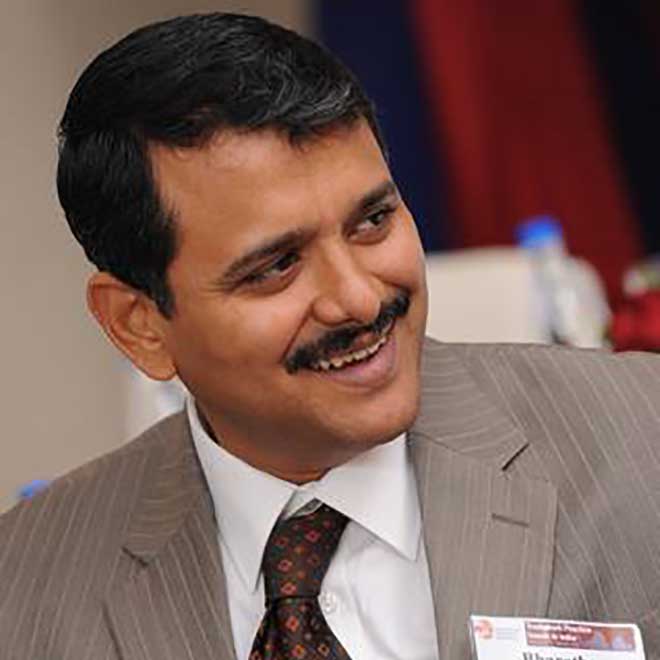
    M.S. Bharath, Senior Partner, Anand and Anand, on the Indian IPR regime, and his diverse experience

    M.S. Bharath graduated in law from Pune University, batch of 2001. Bharath is a Senior Partner at Anand and Anand, India leads the Chennai City Office practice since June 2009. His practice includes Intellectual Property litigation before Indian High Courts, opposition, cancellation and other related proceedings before the Trademark Office, Intellectual Property Appellate Board (IPAB), Copyright Board and Geographical Indications Office. He has been the lead counsel in numerous appeals, rectification and original proceedings before the High Courts of New Delhi, Chennai and IPAB with several reported decisions to his credentials.

    In this interview, we speak to him about:

    • His time at law school
    • His role at Anand and Anand
    • His experience in IPR

    How would you like to introduce yourself to our readers?

    I am an intellectual property lawyer and a Senior Partner in Anand and Anand based in Chennai.


    Tell us a little about your days in law school.

    The days in law school (in Pune) gave me a hands on experience and exposure to diversity in culture, inclusiveness, collaboration and leadership. For want of hostels, we had to fend for ourselves including arranging for accommodation (which were in the 1990’s either homestays or apartments shared by at least eight to ten individuals), food (either by hiring a common cook or eat out from dhabas) transport and working on budgets. The absence of a structured placement cell compelled us to be innovative to raise monies, collate resumes of those who were interested, design and print a brochure, visit firms across the country to brand the institution and seek placements of the students as well.  Spearheading this initiative helped me gain operational skills but also with much needed exposure to the legal market and understanding of the differences in expectations and work cultures in cities such Bombay, Delhi, Madras, Calcutta and Bangalore as they were known back then.


    How important are grades, in your opinion?

    While grades are important they are definitely not critical. Most lawyers and firms seek law graduates who are committed, hardworking and above all uncompromising on integrity while grades as GPA’s are incidental.  I sincerely hope that students aspiring for a legal career do not seek out only for chances of landing jobs in top firms, as any firm one joins or sets up may soon be one.


    What subjects did you take particular interest in during your law school days?

    As a law student, Jurisprudence and Procedure Codes were quite appealing to me. While these subjects were not decisive in my career choice, they are  indeed the Grund Norm for daily practice.


    Who was your mentor, or main source of inspiration who motivated you all along the way?

    Personally speaking, there can never be just one mentor for an individual for it is likely to take away one’s individuality. I have had many individuals who have inspired me over the years including my father Mr. Subramanian, my late grand uncle Mr. Raghavan, both lawyers and my grandfather Ananthasubramanian who sowed the seeds of grit, independence, integrity, contentment, honesty; my wife Kavita who brought out the extrovert in me; Mr. Anand our Managing partner who continues to share his “Never say die” and “Never say never” attitudes, client handling abilities and vast wealth of IP knowledge; a dear friend and colleague Shamnad Basheer for getting me on board the IP world through Anand and Anand and inspiring many including me to care and share with initiatives such as IDIA (Increasing Diversity by Increasing Access). In fact I find inspirations even from interns and colleagues who bring new ideas and ideologies to the working table.


    What kind of internships did you engage in during your student years which you feel were invaluable to you in reaching your current position?

    It is important that as a student, one identifies their favourite subject and aspirational senior / firm / organisation early on to seek and undertake an internship. This helps both the student and the employer know each other on many levels. I was lucky to undertake an internship in Anand and Anand in the penultimate summer of my law degree. The month long program led to a pre-placement offer and next sixteen wonderful years here.


    How did you develop this keen interest in Intellectual Property Rights Law?

    The zeal to learn new subject and remain a multi disciplinarian drew me towards intellectual property laws. The profession of IP attorney is possibly the only one which touches upon varied subjects of law, arts, science and commerce and in some rare cases all at once. The graduation in commerce prior to law helped me blend in easier.


    What kind of activities did you undertake in law school that helped you nurture this interest in IPR law?

    It was the internship at Anand and Anand which gave me an insight into the world of IPR which am still discovering and exploring after sixteen years. Back in the day we hardly had exciting activities on campus unlike now to nurture interests in IPR.


    Would attending IPR conferences hold any CV value, or would you recommend them anyway for their academic value?

    It is easy to get lost in the host of conferences, which are being organised on IPR related subjects. Of late there are so many, that even practitioners find it difficult to pick the right one or to let go. It is best to seek guidance from seasoned practitioners on which ones are relevant to attend as a student or young practitioner. In any case, while attendance at these conferences may be of academic value it would not have much impact on CV!


    Please give our readers some insights on the leading Indian firms dealing in IPR law, and your recommendations for where and how to secure internships.

    There are quite a number of top quality IPR law firms in India currently, with most based in the cities of New Delhi, Mumbai, Chennai and Bangalore. It would be inappropriate to name only some.

    While most of these firms over the years have gained reputation on one or few verticals within the IPR regime, say trademarks or patents drafting or prosecution or IP Enforcement, there are only a few which are quite interestingly known as “Full service IP firm” excelling in all forms of IP and all forms of prosecution and enforcement. Choosing a firm to intern with is critical and ought not to be done for the sake of merely adding on to resume. Depending on one’s leaning and flair for a subject, firms have to be identified and applications for internship are to be sent in early on.

    In the recent past I increasingly notice students sending requests for being connected on social media such as Linked In and immediately follow up with requests for internship. Such tools are not only easier for students to better understand the organisation and the individual with whom they seek internship but also build a rapport even prior to the internship program.

    Despite all these initiatives, one needs to be lucky, and being lucky according to me is meeting of Preparedness and Opportunity. A person would not be lucky if despite being having an opportunity is not prepared to take it further ahead.


    Tell us about your work experience at Anand & Anand where you currently are a Senior Partner.

    Starting as an intern in 2000, last year I was invited to be a part of our firm’s Council of Senior partners. Early on as a trademarks attorney, I assisted in setting up the firm’s practice before the IP Appeal Board. After several appearances before the Trademark office and Appeal Board, I turned to be a litigator as well. Ever since moving to Chennai in 2009, the city office practice has blossomed well with a current strength of over fifteen members.


    What do leading firms that specialise in IPR such as Anand & Anand look for in prospective candidates for internships, retainerships or recruitment?

    While the love and flair for the subject is a given requisite, we look for candidates who innately put clients’ interests above all and work with high commitment, vigour, and ownership without compromise on integrity. As internship programs help us identify prospects, it is easy to differentiate those who come in only for adding claims on their CV and those who have the IP fire in the belly and eagerness to join us.


    Do you believe in the conception that there is manifest reluctance among law graduates to take up IPR law as there is a scarcity of job opportunities in this area of practice?

    Quite the contrary! With the boom in innovation, manufacturing and consumption in India, the need for IP attorney has gained significant importance and their need is sure to increase in the times to come. The IP field and as an industry has been steadily growing if not exploding in India recently. While there are quite a few IPR boutique firms which have blossomed recently, the Indian and multi-national corporations have also been busy setting up in house IP cells and departments, resulting in need for many IP hands at work.


    Do you feel that there are shortcomings in Indian IPR law that make the practice itself difficult? 

    Every country legislates laws suitable to its own historic, social, economic background each of which undergo change with passage of time. Indian IPR Laws are no different and are quite unique to the land. Practice of these laws and succeeding in it would directly depend on one’s ability to identify practical solutions to clients’ problems within the limits of these laws. There are no short-comings in either the Indian IPR laws or their practice. Innovation is key especially in practice of IPR law. We at Anand and Anand take pride in always staying ahead of the curve to come out innovative solutions to clients. For example one of the largest brewing companies was facing severe waste of resources, as they were one of the few players in the industry to introduce fresh bottles into the commercial stream. As beer bottles are a commodity which are recycled, other players were reaping the benefit of sourcing such bottles from recyclers without having to invest in fresh ones. A simple solution suggested by us of introducing distinctive bottle designs with the brand names embossed on it gave a two layered protection both under designs and trademarks, saving large sums of monies to the client.


    Is it necessary to have a background in General Sciences in order to pursue IPR studies?

    Not at all, though having a science background is indeed a great advantage. Science and Commerce are the Yin and Yang of IP. It is a rarity to find those who understand both the streams well but it is in the intersection of these two subjects where the hearts of IP and its practice reside.


    What moots would you recommend for an IPR law enthusiast to further their interest and what journals would you recommend for someone who’s hoping to get their work published?

    India’s first and most prestigious moot court competition on IPR is Raj Anand Intellectual Property Moot Court, which has had fifteen editions. It is considered the epitome of IPR moots and is a must attend to get a flavour of India’s best competitors mooting on the best IPR problems before the best judges, who are India’s leading IP practitioners and sitting judges of Indian Courts. More information on this can be found at http://ipmoot.org. I would encourage students to publish their work firstly in their own college journals and thereafter reach out to other prominent journals such as PTC (Patent and Trademarks Cases) MIPR (Manupatra IP Reports) which encourage and receive submissions from laws students and scholars. Spicy IP, the popular IP Blog founded by Shamnad also encourages students to be part of their eco system and community to present views and publish works as well.

    What general advice would you give our readers who aspire to stay at the top of their IP game?

    An IP lawyer advising clients on a variety of IP subjects has to necessarily understand their client’s business and commercial standing for each of the subject matters. While standing in their client’s shoes an IP attorney needs to have a perspective of subjects including accounting, statistics, finance, marketing, and advertising. Even if one is not a commerce or a science student there is a much needed foundation for an IP attorney to understand the panorama of how a business is run. To stay ahead of the curve think like a lawyer, science student, commerce student all at once while acting like a business woman / man!

  • Sarosh Zaiwalla, Senior Partner, Zaiwalla & Co. Solicitors, on International Arbitration, working with His Holiness the Dalai Lama, and his diverse experience

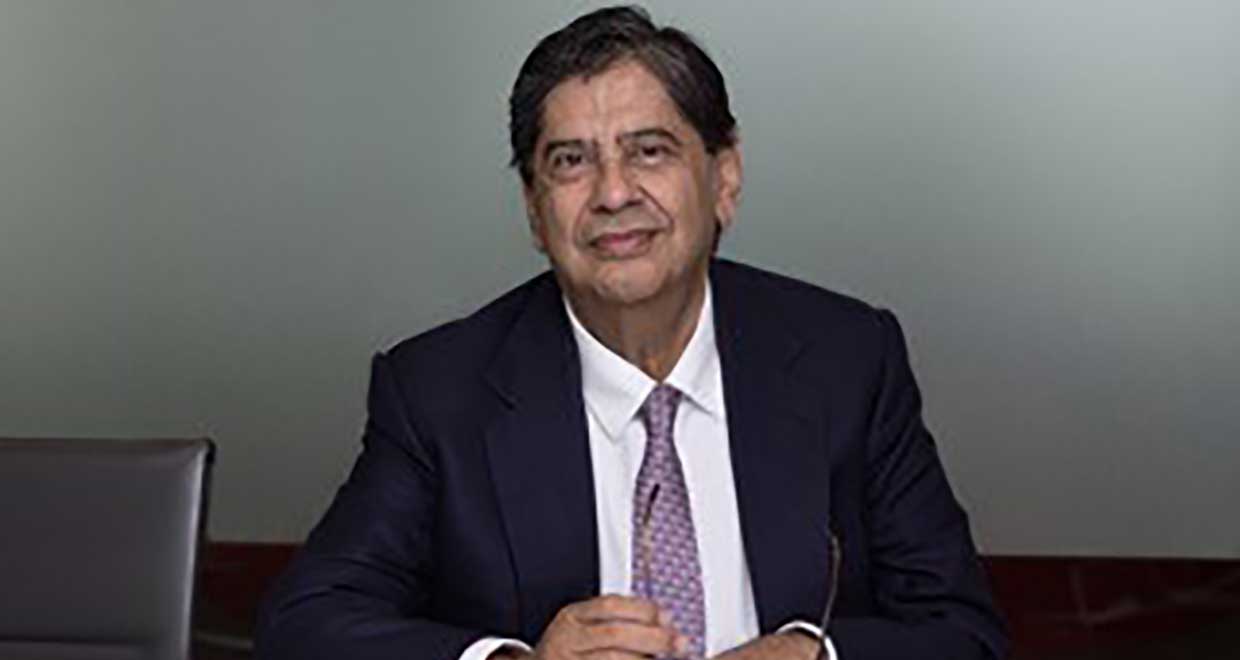
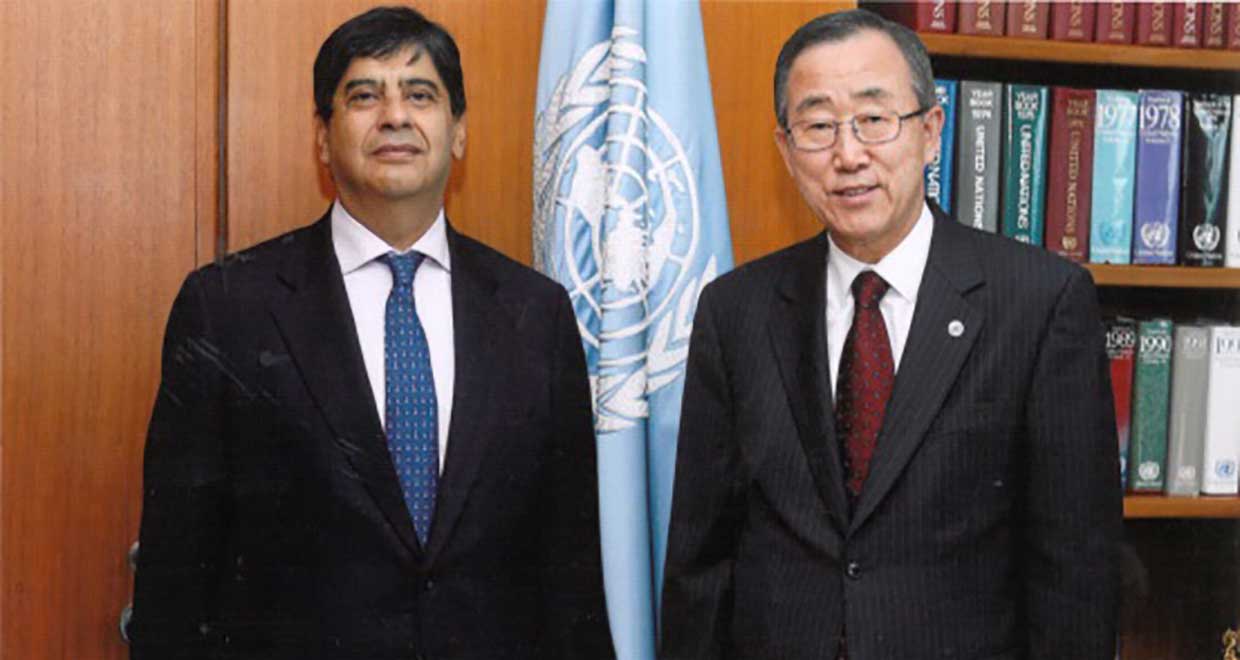
    Sarosh Zaiwalla, Senior Partner, Zaiwalla & Co. Solicitors, on International Arbitration, working with His Holiness the Dalai Lama, and his diverse experience

    Sarosh Zaiwalla graduated from Government Law College in 1972. He founded Zaiwalla & Co. Solicitors in April 1982. He oversees all the activities relating to the firm, and also sits as an International Arbitrator. He is the Senior Partner of Zaiwalla & Co Solicitors which has been in the City of London for the past 35 years. His firm successfully acted for the Iranian private bank, Bank Mellat, both before the Supreme Court and the EU Court challenging the listing of bank under Iran Nuclear Sanctions. As a consequence of his firm’s success, Bank Mellat today have a claim of USD 4 billion before the English Court in respect of damages for losses caused because of unlawful listing. His firm were also the first firm which successfully challenged in the EU Court the listing of Iranian companies by EU Council. Zaiwalla & Co have acted for several Iranian companies including Bank Tejarat and Petropars.

    In this interview we speak to him about:

    • His illustrious career
    • Setting up practice in the UK
    • His experience with high profile cases

    Given that most of our readers are law students, how would you introduce yourself to them?

    I founded Zaiwalla & Co. Solicitors in London which is the first English Solicitors firm in the one square mile commercial and financial district in the city of London started by a solicitor born outside Europe. We have been in existence for 36 years and at our 30th anniversary reception in November 2012, the Chief Guest, Rt. Hon. Sir Dominic Grieves MP in his speech said that what my firm had achieved in the development of English law will be remembered even after 100 years. There are today 104 reported judgments in the English law reports where my firm had acted for one of the parties. A judgment is only reported in the law reports if it affects the development of law. We are today one of the leading firms in the field of International Arbitration.


    What motivated you to pursue a career in the legal field?

    As a young student in St. Xavier’s High School, Bombay, my career ambition was to join politics and become the Prime Minister of India so that I could change India and make it great again. My father was a solicitor who had qualified in London in 1925. He was the youngest member of his family and as the youngest member of my family, I was encouraged to qualify as a solicitor in London.


    What got you interested in the field of International Arbitration? 

    I did my Solicitors training in an English Solicitors firm called Stocken & Co. who were maritime lawyers and specialised in maritime arbitrations. This gave me the first exposure to international maritime Arbitrations. In those years a Solicitors training was not on a structured basis like it is now and one would start as an assistant to a Senior Solicitor, at first carrying his bags and making cups of tea for him and then later being trained on the job.


    Can you briefly describe your current role as an Arbitrator and an Advisor to clients involved in international arbitrations?

    As the world got smaller, international trade between businessmen from various countries grew. International businessmen want a neutral country to settle their disputes and would therefore opt for Arbitration in a neutral venue with a respectable legal infrastructure. This would normally be London where Arbitration in its modern form, was given birth to, over 300 years ago. In the City of London all the fixtures for ocean going vessels to carry cargo were agreed at the Baltic Exchange. The Baltic Exchange used to be the centre of all shipping chartering contracts all over the world. Whenever a dispute arose as to what was agreed between the brokers, the owners and the charterers, they would at the end of the day ask a senior respectable broker to determine the dispute over a cup of tea.

    This was the beginning of international Arbitration in London. International Arbitration has now grown in a sophisticated fashion and it is also a serious foreign exchange earner for the country where the seat of the Arbitration is located. This is because the seat has no other connection to the parties in the Arbitration who have chosen the seat of the Arbitration but the parties have to instruct for example, English Solicitors for London Arbitrations and also spend on experts, Barristers, hotels and other expenses. As a firm of Solicitors we have recently been consulted by the Russian Government in respect of a potential challenge to USD 50 billion Arbitration award against Russia by the International Arbitration Court in The Hague.

    As an Arbitrator, I recently sat for two weeks in Tel Aviv, Israel, as a Sole Arbitrator to decide a multi-million dollar dispute. I have also sat as an Arbitrator in Bombay with Sir Anthony Evans and Harish Salve to decide an international Arbitration dispute concerning a power plant in South India.


    International Arbitration often involves a complex interplay of public and private international law. Can you elaborate on this aspect for our readers?

    This is correct because in international Arbitrations there can be three countries which can play a part. For example, in a contract between say an Indian party and a United States party where the contract provides for disputes to be settled in London, Indian law, US law and English law could all have a part to play. Usually, if the contract provides for Arbitration in a neutral venue as the seat of the Arbitration, say London, then there is a presumption that the parties intend English law to apply to the contract. There was a case which I handled earlier for ISRO of India in respect of an Arbitration claim brought by McDonnell Douglas concerning Satellite inset 1B. The Arbitration provided for London as a seat of Arbitration but with the Indian Arbitration Act to apply. The English Court held that by this term, only the procedural aspect would apply to the Arbitration but on the main issues English law would apply. See Union of India v. McDonnell Douglas Corporation [1993] 2 Lloyd’s Rep. 48 In another shipping case, the contract was governed by English law with the seat of Arbitration being London, but the English High Court held that in construing its term in the contract, as the performance of the term was to be India, Indian law would apply. This was the case of a vessel called “Nestor” which is reported at [1987] 2 Lloyds Rep. 649. In both of these cases my firm had acted for the Indian parties.


    What are your views on the necessity of higher education? 

    Education, including higher education, instructs a student but life experiences educate a student. Higher education is of course of utmost importance because it readily opens doors for good employment or starting ones practice. Higher education is a certificate of competence and knowledge. I have however found that many Oxford and Cambridge educated lawyers were no match for a lawyer with good instincts and wisdom. My advice to your readers would be to go for opportunities available to pursue higher education, it can only do good.


    What was your first job out of law school?

    My first job out of law school was an evening job with the Hinduja brothers at their company Sangam Ltd. I had met GP and SP Hinduja when I was still training at Stocken & Co. and they asked me to join their employment. They had just moved from Tehran to London. I said I did not want to take a job and I wanted to have my own practice after I was enrolled as a Solicitor. So the Hinduja brothers offered me an evening job from 6:30pm – 9:30pm. I had an arrangement with Stocken & Co that if I travel for them overseas, Stocken & Co would bill the Hinduja brothers. This was a great opportunity for me because in one year I travelled 42 times to Geneva with the Hinduja brothers and their right hand Mr. Golikeri. I was part of the team which negotiated contract with top lawyers on the other side and although I was not qualified I acted as Hinduja brothers’ unqualified legal adviser, interpreter and negotiator.

    When I started on my own I was fortunate to be appointed as the Indian High Commission in London’s Solicitor. At that time the High Commissioner was Dr. Syed Mohammed who was himself an ex-English Barrister and he had been the Advocate General of Kerala and Minister of State for Law and Justice in Indira Gandhi’s Government. He was thrilled to see a young Parsee Indian starting a law firm in the City of London keeping his Indian surname.


    What motivated you to start Zaiwalla and Co. Solicitors?

    When I was working at Stockens I became friendly with Cedric Barclay who was an eminent and popular maritime Arbitrator. I got to know him and a few months before I was enrolled as a Solicitor, he invited me for a cup of tea at his office. In the course of our conversation over tea, he strongly advised me not to join the big English Solicitors firms. He said, “You are good and well liked, but if you join a large English maritime firm, the Senior Partner will take you for lunch once a year and say, “Good job, old boy”, but you will go no higher.” So he advised me strongly to start on my own. True to his word, when I started Zaiwalla & Co., he personally took me to the offices of big ship owners to introduce me and recommend me to them. Very soon I had a reasonably large Greek ship owning clientele.

    Surprisingly, when I started I did not face any major hurdles with the white professional population. They were somewhat surprised to see a brown face but they were more than encouraging. Appearing before the English Commercial Court Judges was a very favourable experience. The Judges would make sure that I was comfortable and go out of their way to ensure that they had fully understood my client’s case. In a way, I found myself sometimes in a more advantageous situation then the white contemporaries in Court. In due course the word went around and the client base started to build and within five or six years I had 23 lawyers working in my firm and at that stage Zaiwalla & Co. was mainly an international Arbitration firm doing maritime Arbitrations and litigation which was mainly for Indian Government cases in the English Court.


    You have represented major clients including governments. How have you developed and maintained a client base?

    It is hard work to maintain a client base. An essential ingredient for this purpose is to keep in constant contact with the client. What a client expects from a lawyer is integrity, competence and speed. I made sure that I provided all three of these to our clients.


    What are the qualities one needs to develop to become a successful arbitrator? 

    (Sarosh has been appointed as an Arbitrator in a number of multi- million dollar disputes.)

    An Arbitrators task is very different from the task of a lawyer. I have always been a creative lawyer and I believe in the principle that “law is for justice and not justice for law”. My firm and I have built up a reputation of being creative on issues of law. As a lawyer I can put forward a creative proposition of law to fit the facts and it would be for the Judge or the Arbitrator to decide whether there was any value in such a proposition. However, as an Arbitrator it is for me to make sure that I get it right and live up to the trust which the parties had placed in me to give a correct decision. There are times when I am one of the three members of the Arbitration Tribunal. In that case usually the Chairman who is the third Arbitrator prepares the first draft of the Tribunals award. Many times I have sat as a Sole Arbitrator for multi-million dollar disputes and such cases require a lot of thinking in arriving at my decision which is not very easy. The most important quality to be an Arbitrator is integrity and commercial common sense. An Arbitrator is a Judge who is appointed by the private party whereas a Judge is appointed by the state. Recently, there was a case in the UK Supreme Court (Hashwani v Jivraj) which my firm had handled where the issue was whether an Arbitrator is an employee of the parties. The English Court of Appeal said yes an Arbitrator is an employee of the parties but the UK Supreme Court reversed their decision and held that an Arbitrator is not an employee and he perform the same function as a Judge.


    Can you tell our readers about the nature of maritime disputes and how they are unique?

    A substantial part of the international trade of goods and commodities takes place by transporting of those goods by ocean going vessels. In the course of the voyage, often goods get damaged because of dampness in the vessels hold or seepage of sea water in the hold. The other types of dispute which generally arises relates to charter party disputes which includes demurrage disputes, bill of lading disputes, General Average and collision at sea disputes. I have had the privilege of handling all of these types of disputes. India’s first success in the House of Lords in a commercial case concerned the vessel called La Pintada. In this case the charterer was the President of India and he paid demurrage some two years late. The owners of the vessel commenced Arbitration claiming interest on a three month compounded rate basis arguing that they had lost the use of money by the delayed payment. The Arbitrator made an award of compound interest in onus favour. The High Court sent the award back to the Arbitrator for reconsideration on the basis that the award sought to make charterer an involuntary banker. The Arbitrator once again confirmed the award which he had previously made. When Indian Government challenged the award once again in the Commercial Court, the Court referred it straight to the Supreme Court for decision. The House of Lords unanimously decided in Indian Government’s favour. This was a test case because in those years of foreign exchange crisis, Indian Government always paid freight and demurrage late and if India had lost in the House of Lords, they would have had to have paid over £5 million in compound interest because other ship owners would then be claiming compound interest for late payment. Incidentally in this case, the Barrister my firm had instructed was Tony Blair who later on went on to become the Prime Minister of the UK. Please see 1983 1 Lloyds page 39.


    Can you give our readers some insight into the Tibet dispute as well as the efforts being undertaken to resolve it? 

    (Sarosh was appointed by His Holiness the Dalai Lama to mediate with the Chinese government in order to resolve the Tibet dispute.)

    I am a qualified CEDR (Centre for International Dispute Resolution) Mediator. For many years my firm acted for PRC Government in their international Arbitration cases. My firm had an office in Beijing for twelve years. We represented CNPC, CPECC, CPTDC and Min Metals in five major international Arbitrations. Chinese Embassy had heard about my firms successes for Indian Government and the then Chinese Ambassador in 1991 had a meeting with me and asked me to assist China to set up in China a legal system which could work internationally. The Embassy sponsored a trip for me to visit Beijing in December 1991. In 1994, I facilitated a second channel dialogue between 10 Downing Street and the central committee of Chinese communist party on misunderstanding which had arisen concerning the agreement to hand over Hong Kong to China. This was a successful dialogue. Thereafter, my relations with Chinese Government became very friendly and my firm got a lot of legal work from Chinese state corporations.

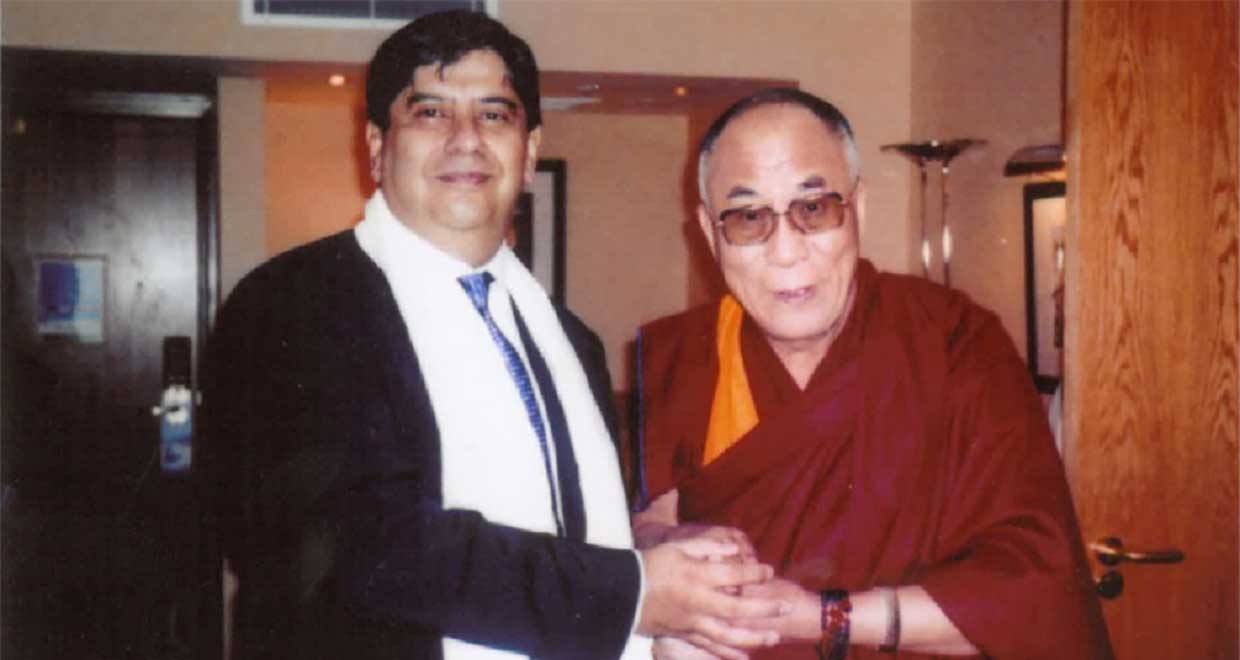
    A few years later, Mrs. Takla, the representative of Dalai Lama contacted me.  She told me that Dalai Lama was going to visit Glasgow very soon and he would like to meet me. Accordingly, a private meeting was arranged for me in Glasgow with Dalai Lama. I was told by Mrs Takla that Dalai Lama would like me to facilitate a second channel dialogue with China to resolve the dispute between him and China relating to Tibet as he would like to go back to his home, Tibet.

    I informed the Chinese Ambassador about the Dalai Lama’s request for a meeting and before meeting Dalai Lama I had a meeting with the Chinese Ambassador in London. The Ambassador put forward China’s position and told me that one of the things which concerned China was that Dalai Lama was writing forwards to books written where the author claimed that half of China was Tibet. It was a great pleasure and honour to meet Dalai Lama on a one to one basis. I found him to be very frank and honest. He told me that his intelligence had told him that I was one non-Chinese person in the West whom the PRC Government had complete trust and confidence. He sought my help for a second channel dialogue to resolve the Tibet issue.  I told him that China was concerned about his writing forwards to books which claimed half of China was Tibet. Dalai Lama’s response was that he had no option but to do this because his Tibetan people had lived in those parts of China for centuries and it was historically part of Tibet. In a moving gesture, Dalai Lama took my hand and put it on his heart and said, “I trust you”.

    After my meeting with Dalai Lama I had a meeting with the Chinese Ambassador and told him that it would be in China’s interest to resolve the issue with Dalai Lama as he was no longer claiming independence for Tibet. Furthermore , I was aware of the communist Chinas policy towards religion which was that religion was now being permitted provided it was not controlled from outside China. In Dalai Lama’s case, he would be involved in religion from Lahasa, the capital of Tibet which was now part of China. The Ambassador told me that he would communicate his discussion with me to China. A further meeting was arranged between me and the Chinese representative and I was told that the Dalai Lama’s brother had been invited to China for discussion and there was no need for a second channel to take place through me.


    Can you tell our readers about the process of framing arguments and the experience of arguing before the EU court?

    (Sarosh’s was the first firm to successfully challenge the listing of Iranian companies under Iranian Nuclear Sanctions before the EU court.)

    This is correct. Bank Mellat which was Iran’s largest private bank, had challenged the sanctions in the High Court and had lost. Thereafter, Bank Mellat appealed and the Court dismissed the appeal. Bank Mellat’s former Solicitors, Stephenson Harwood, had told Bank Mellat that there was little prospect of Bank Mellat getting leave to appeal from the Supreme Court. I was one of the Solicitors Bank Mellat met with a view to deciding who to instruct for their attempt to appeal to the Supreme Court. I had earlier acted in a major Arbitration for National Iranian Oil Company (NIOC) and had turned around what they had been advised was a hopeless defence in an Arbitration case and was successful for NIOC. So the legal director of NIOC had mentioned my name to Bank Mellat and recommended my firm. The rest is history, we were successful before nine out of the total twelve Judges of the UK Supreme Court. The Supreme Court held that the UK Government had acted unlawfully and irrationally to list Bank Mellat in the list of companies supporting Iran’s nuclear proliferation and to whom the sanctions would apply.

    The Supreme Court referred the matter to the High Court to calculate damages and Bank Mellat is currently pursuing a claim of USD 4 billion for damages in the UK Court for wrongful listing of Bank Mellat on the nuclear sanctions list. It was also the first time that the UK Supreme Court went into a closed, secret hearing on grounds of national security. The trial of this claim is fixed by the English Court for October 2018.


    You are a member of all major arbitration institutions. What is your preferred forum? 

    My preferred forum for international Arbitration is either London Court for International Arbitration (LCIA) or International Court of Arbitration of the International Chamber of Commerce, Paris (ICC). I was a member of the International Court of Arbitration for twelve years representing India. An equally efficient forum and possibly less expensive would be for parties to simply agree London as a seat of Arbitration as this would save the administrative costs of the institutions and the Arbitration would be under direct supervision of the English Court in case something goes wrong in the Arbitration.


    Do you think India has the potential to become a major arbitration hub? 

    Yes, India has great potential to become a major international Arbitration hub but India has a long way to go to achieve this goal. A small country like Singapore has within a few years built up a popular international Arbitration centre and there is no reason why India cannot do so. The international centres of Arbitrations are made by good reputation and law. Reputation is a question of perception. Arbitration in India today does not enjoy a good international reputation. There are rumours of corruption amongst the Arbitrators. I am sure this rumour is unlikely to be true but one must recognise that even one case of corruption poisons the reputation of the whole Arbitration culture in India. I have had many meetings with those who manage international Arbitration in India, including with Mr Arun Jaitley and at each of these meetings I have said that the risk of corruption in the international Arbitration in India cannot be eradicated by passing of law eradicated by self-regulation in the Arbitrators community and the legal profession. Another minus point for international Arbitration in India is the perceived monopoly appointment of retired Judges who then conduct the Arbitration as if it was Court proceedings with adjournments being granted for asking. The new Indian Arbitration Act has restricted Court intervention in the Arbitration process which is a good step forward for India.


    International Arbitration is considered a difficult field to break into. Can you describe your journey in becoming such an authority in this field? 

    This is correct. So far, the international Arbitrators community has been an elite circle where one supports the other with the consequence that a newcomer is not easily accepted unless he blends in by accepting to begin with a second class status. The selection of Arbitrator is an important task. He should be a person with good legal and commercial law experience. The task of a party appointed Arbitrator is not to favour his appointer but he has a duty to ensure that his appointer’s points are considered by the whole Tribunal at the time of making the decision. I have found that many times, Indian parties appoint retired Judges in the international Arbitration and they are indeed very clever but they are not able to communicate with the co-Arbitrators properly, who are normally from developed countries. Often, retired Indian Judges who are product of the British imperialist culture, have enormous egos about their status. Let me give one example.

    I was appointed by the Danish company Volund to be their nominated Arbitrator in the early 90’s. The Arbitration concerned construction of a power plant in Timarpur near Delhi whose fuel would be New Delhi waste. In other words, the power plant would be converting New Delhi waste into energy. The project was supported by Danish aid agency (DANIDA). After the power plant was constructed, it was found that New Delhi waste did not have sufficient calorific heat to be used as fuel for the power plant. India appointed Mr Pathak as their Arbitrator. He was a former Chief Justice of India and retired Judge of the international Court of Justice in The Hague. The third Arbitrator and the Chairman of the Tribunal was Lord McKenzie Stuart, a former Chief Justice of the European Court. He was appointed by the International Court of Arbitration.

    On the first day of the hearing I got a note passed to me by Chief Justice Pathak which said, “You have insulted me by sitting on the right of the Chairman, I am senior to you so I should be sitting on the right of the Chairman and you should be sitting on the left”. I immediately passed the note to the Chairman with a suggestion that he adjourns the hearing for five minutes so that I can change over. He sent the note back to me saying “stay where you are”. In England or in Europe in international Arbitrations it does not matter which side the Arbitrator sits. During the coffee break, Lord McKenzie Stuart told Chief Justice Pathak that it does not matter where the Arbitrator sits and he jokingly told Chief Justice Pathak, “Don’t be a fool”. The Chief Justice took offence to this and throughout the two weeks hearing he did not utter a word and did not speak with Lord McKenzie Stuart throughout the Arbitration reference thereafter.

    The way to break into the field of international Arbitration is to first attach with a law firm or an advocate who is already handling international Arbitrations and then attend international Arbitration conferences.


    Can you describe your work as a solicitor in England?

    A Solicitor in London prepares the case and instructs the Counsel to argue it before the Court. It is now also possible in commercial cases for Solicitors to appear in Court as Advocates, I have done so on many occasions. My firm and I are known for difficult cases where client comes to us after they have been told by the Magic Circle firms that their claim or case is very bad.

    Two examples of this are the international Arbitration award by International Arbitration Court in The Hague which made an award of USD 50 million against the Russian Federation in the Yukos shareholders claim. Russia came to me for an out of box approach for Russia challenging the award in the Dutch Court. Sometime before this, an Indian Government company PEC Limited had come to me and they had an award of USD 8 million against them. On the face of it they had no defence because they had participated in the Arbitration and also the appeal process of GAFTA Arbitration and had lost. I took the point that although English law applied in the contract, the contract was signed by the Director of PEC on behalf of PEC and whether he had authority to do so would be governed by Indian law. Under Indian law, for a Government contract there are rules and for a USD 25 million contract you require two Director’s signatures.

    PEC therefore through my firm argued that the Arbitration agreement was void because the contract was void. In the English Court on the question of Indian law we led the evidence of Mr. Soli Sorabjee, former Attorney General of India and the other side which was a Thailand company, Asia Golden Rise, led the evidence of Mr. Harish Salve. Both of these eminent jurists were cross examined in open Court and the Court preferred the evidence of Mr Sorabjee. This changed the prevalent law.

    The second example was the case of Indian Oil Corporation (IOC) v Coastal Bermuda where IOC had participated in the London Arbitration defending a huge claim of some USD 18 million. The Arbitrators decided against Indian Oil Corporation but one of the Arbitrators, Mr. Gordon Pollock QC, added a post-script to this decision suggesting that Indian Oil’s legal team was not competent and if the team had been competent, the result may well have been different. My firm did not act for IOC in the Arbitration but they came to me after all the big law firms and Queen’s Counsel had told IOC that they had no chance of challenging the award. My firm challenged the award on an innovative ground that the award could be enforced as a judgment of the English Court and for the English Court to enforce a judgment which was not based on the two legal analysis of the evidence would be against English public policy. The English Court accepted this and remitted the award back to the Arbitrators and in its judgment said, “Finality is good but justice is better”. Indian Oil Corporation v Coastal Bermuda [1990] 2 Lloyd’s Rep. 407.


    Where do you stand on the “two hat” debate over whether arbitrators should also act as counsel? 

    There is really no problem. When I am appointed as an Arbitrator, if there is a conflict I will not accept appointment. International Arbitration is a field with many important debates currently going on, with many suggesting reforms such as Bilateral Arbitration Treaty (Gary Born), regulating the ethical conduct of counsels (Swiss Arbitration Association, London Court of International Arbitration).


    Could you discuss the aforementioned suggestions and your take on them or any such significant debates?

    The most important reform which is required is the need of diversity in the clique of international Arbitrators. The current international Arbitrators must be prepared to accept competent Arbitrators in the circle of international Arbitrations. Statistics show that the present international institutions generally favour appointing white Arbitrators from developed countries. This needs to change.


    How do you remain updated with all the new developments in the field of international arbitration and mediation?

    There are at present many press and internet mediums which keeps me informed on all the new developments in the field of international Arbitration and Mediation.


    What advice do you have for our readers who are primarily college students?

    Always act with integrity and remember the legal profession is an honourable profession and honesty and fairness is the most important duty of a lawyer. The policy which I follow is that I can play with the law because the Judge is there to reject or accept my submissions on law but not under any circumstances play with the facts. If I find that the client has told me a lie in his instructions I would refuse to act for that client. I would not make up stories or allegations on behalf of a client simply to support the client’s case. This approach breads both character and increases credibility before Judges. The five mantras for law students, I would suggest, are:

    • Have a vision on where you want the business to go.
    • Have integrity and honest approach in the work you do.
    • Have courage to have an open mind and an out-of-box approach to progress the business.
    • Make the most of all that comes and the least of all that goes.
    • Forgive people for any wrongdoings against you, and leave it to the universe to deal with them.
  • Triveni Makni, Manager, Dr. Reddy’s Laboratories Inc., on her time in NLSIU and working in the US

    Triveni Makni, Manager, Dr. Reddy’s Laboratories Inc., on her time in NLSIU and working in the US

    Triveni Makni graduated in law from NLSIU in 2008. After a successful stint at AMSS, she joined Dr. Reddy’s Laboratories as Legal Counsel. She is currently Manager at Dr. Reddy’s Laboratories, where her role entails drawing commercial sales contracts-primary legal contact for the Company’s sales and marketing team, working closely with sales, marketing and finance teams in structuring and drafting agreements for the sale/rebate of products to wholesale, retail, mail order, group purchasing and other customers for different class of trade. She also holds a Masters degree from Fordham Law School, Fordham University, New York.

    In this interview we speak to her about:

    • Being involved with the Centre for Child and the Law, NLSIU
    • Her role at Dr. Reddy’s Laboratories
    • Working in the US

    How would you like to introduce yourself to our readers?

    I would introduce myself professionally as an in-house counsel working in the pharmaceutical industry, who is also currently enjoying being a mother of two lovely girls.  I am also the first from my family to join the legal profession.


    What was it that got you interested in the legal field? 

    Law happened by chance. It was never a planned path to be honest. As it was the popular choice  that we were advised to take up,  like most of my classmates from school, I was reluctantly preparing to pursue engineering as a career after my 12th standard. I wanted to join a dance school or pursue home science or psychology related courses, but was forced to think of engineering as my option.  Fortunately, my uncle recommended I try giving the NLSIU entrance exam. However, while I was preparing for the law school entrance exam, with my mother’s help as I did not attend any coaching classes, my interest in legal reasoning and social science subjects increased.  Once I cleared the entrance exam, I choose to do law, so that I wouldn’t have to pursue engineering.


    How was your experience in NLSIU? What were your areas of interest?

    NLSIU was an amazing experience for me for the exposure it gave, considering I came from a very conservative background. I vividly remember enjoying talks by academicians, legal stalwarts, and activists. We would often have the opportunity to interact with judges or activists directly whom one would read about in newspapers and we could clarify some of our questions  rather than leave it to interpretation and debate. I realised this was a rare opportunity and began to appreciate being in law school even more.

    There are at least ten internal committees which one could volunteer or just participate in law school such as debating, drama, sports, movie clubs. As we lived on campus and were done with classes by afternoon, it gave me enough time to explore and participate in these activities, which not only supported my all round development but have left me with some great memories!

    At law school there is a very strong sense of community and seniors are very forthcoming and helpful, which makes law school life comforting in spite of the pressures and competition.

    Academically, in terms of courses, I enjoyed the liberal arts courses and specifically Prof. Elizabeth’s History course, Prof G. Ajay’s Political Science, lectures in constitutional law by Prof. V.S Mallar and Criminal Law taught by Prof. Mrinal Satish.  I would give credit for whatever I have learnt to the professors who taught at law school and the practice of exhaustive reading material that would be circulated for each course which deeply impacted the way I think.

    Law school also has an added advantage of having research centres that are attached to the main campus, like the Centre for Child and the Law, Women and Law, Intellectual Property and other centres, which allow you to read, interact and participate at the centre’s activities. The centres also call for student volunteers to support their research work. Interaction with these centres gave us the unique opportunity to evaluate our interest areas which may not be directly covered as part of your law school curriculum.


    Did you pursue any extracurricular activities such as internships or moots?  

    Though I was not into moot courts, I was an active volunteer of the Legal Services Clinic (LSC), where we would conduct legal literacy programmes in different villages, schools and communities, and travel to Ramanagaram and provide legal aid. LSC provided us with exposure to how the law operated in practice while we could also use our knowledge to help create awareness of legal rights. I was also a member of the law and society committee where we organized gender study circles, talks, debates on socially relevant issues.  I highly recommend participating in extracurricular activities as it diversifies your thought process, helps you build great relationship with your peers and classmates. You will also relish those memories after.  I started to intern only in the third year of law school.   I choose to intern with different institutions including a consumer dispute settlement forum, NGO, bank and law firms. I strongly encourage students to intern regularly but also ensure that each internship is different in terms of the field, to provide diverse exposure. The variety in the nature of work, may eventually direct you towards what you want to pursue or you have ticked off all areas that you may not be interested in.


    Do you think law school prepared you for the real world practice of law?

    Law school does not really prepare you for the real world of practice of law, as the emphasis on practical learning and functioning is still not that high or is restricted only to certain courses. However, it gives you a glimpse of the various opportunities that one could explore.


    How did you secure an appointment at AMSS? 

    I had secured an internship opportunity when I was in my fourth year of law school and pursuant to that internship I was made a pre-placement offer. I did not  have a high CGPA, so clearly that was not a factor that influenced my recruiters. I personally believe apart from your CGPA, the fact that you are ready to learn and work hard definitely creates an impact.


    Can you tell our readers about your professional experience and nature of work at AMSS? 

    My time at AMSS was mostly divided between capital markets transactions and general corporate work. I broadly assisted in due diligence, drafting shareholder agreements, and legal opinions on employment matters. My professional experience at AMSS is very mixed. There were times when I felt I was learning a lot, which was contributing to my professional development. However, there were times I felt there were artificial deadlines and pressures that I could not cope with. One of the reasons I left AMSS was because I missed the work life balance and felt the need to explore other opportunities. I decided to work on law, policy and development related matters.

    You were a legal consultant for the Centre for Child and the law at NLSIU. Can you tell us a little bit about the nature of work you did there and if it impacted state policy?  

    Centre for Child and Law (CCL) presented a great opportunity for me to work on law, policy and development related matters. CCL was just awarded a project supported by UNICEF titled Justice to Children through Indpendent Human Rights Institutions. The Commission for Protection of Child Rights Act, 2005 (CPCR Act) was passed but not many states had established child rights commissions or drafted state rules.

    As part of the project I assisted in drafting state rules for the states of Bihar, Madhya Pradesh and Assam specifically. Few of the states that we had worked with passed the state rules as drafted and submitted by CCL, which was truly satisfying. It was an interesting experience to interact and lobby with state government officials, mostly IAS officers from various state women and child departments and social welfare departments to set up child rights commissions and have rules passed for their respective states.

    I also got an opportunity to contribute to the draft amendments to the CPCR Act as requested by the Ministry of Women and Child Department, India.

    You subsequently joined Dr. Reddy’s Laboratories. Was the decision to work as an in-house counsel as opposed to working at a law firm a conscious one? 

    I moved to Hyderabad after my marriage and was looking out for opportunities with Dr. Reddy’s Laboratories (“Dr Reddy’s”) foundation and it so happened that the legal team was looking to recruit as well. During the interview I learned that the legal team at Dr. Reddy’s is actively involved in the legal work of the foundations that Dr. Reddy’s runs and there were several opportunities for employees to be associated with the foundations and corporate social responsibility engagements and activities. Dr Reddy’s gave me the opportunity to work on both commercial agreements in a corporate set up and allowed me to explore my interests. It was a very conscious decision to move in house as I wanted to have a mixture of good work and some time for myself.   


    What was the nature of your work at Dr. Reddy’s in India? 

    I started off handling the Proprietary Products  (PP) portfolio which basically focuses on developing differentiated formulations, my profile included drafting and negotiating contracts for various studies, trials, research agreements, master service agreements for contract research organisations to conduct studies, tests for or on behalf of Dr. Reddy’s. My work profile expanded to include generic agreements for the business team for the India geography which mostly entailed of manufacturing, supply, distribution, license agreements for the manufacture and supply of generic products. The two profiles were so varied in nature that the PP profile exposed me to the development and testing stages of drugs and the generics profile exposed me to the commercial side of launching and selling drugs.

    I have been an in-house counsel for the longest and can only compare my limited law firm experience. An in-house counsel is required to be integrated with the business and the company’s vision, while ensuring the company is in compliance with applicable law. This position really trains you in the art of balancing business interest/profits and legal compliance. The major difference that I observe working in house is that the counsel is expected to handle any legal issue that the company faces, it’s never restricted only to the company’s main business. Issues relating to employment, labour, pollution control boards, real estate, corporate functioning and many more, the first go to is the in house team. It becomes important to always keep yourself abreast of latest developments not only of the sector that you are working in, but all other legal developments and its impact on the procedures and policies of the company. Personally, I enjoy interacting with business, finance, quality, regulatory and other stakeholders while working on agreements or transactions, as it broadens my horizon of learning.


    You moved to USA with Dr. Reddy’s on a secondment offer. Can you tell us a little about your journey, experience and lesson learned?

    Dr. Reddy’s employees are provided opportunities to work in various geographies across different teams. I was the first among the legal team to move on a secondment. It has been an incredible experience to move to US and learn how the pharmaceutical industry works in North America.  I also benefited from the guidance and training of the experienced legal team we have in the US. Direct interactions with business, supply chain, regulatory, quality and contracts teams here gave me much more insight into the company’s international operations. These programs contribute very positively towards your professional growth and the organisation’s strength.  It also enables you to bridge gaps and better understand your colleagues on the other side of the globe. Secondment programmes also integrate teams of the same function to be a global teams irrespective of the geographies one is located in. For instance, the legal teams in USA, India and Swizertland interact with each other on a continuous basis and depending on the transactions or the assistance required we reach out to the team members in other geographies. The learning curve is sharper as there is so much exposure to laws in various geographies. We are also continuously updated about the important legal developments in various geographies and impact of policies or political situations.

    There seems to be a strong trend where more companies are adopting this path, as it creates career advancement opportunities to the employee, and enriches the quality of the organisation with persons who have experience working across different cultures and countries.


    What  is your work profile like in the USA? 

    The pharmaceutical industry in USA is very regulated, complicated and nuanced. Legal and compliance teams have to watch out in order to avoid anti kick back issues, false claims while offering products for sale. I am the primary point of contact for the North America Generics contract team, which handles the sale of Dr. Reddy’s products in USA. There are different classes of customers, who range from group purchasing organisations, wholesale customers, pharmacies who also purchase at different prices, both direct and indirect. The products offered range from over the counter, prescription, private label products. Each category of products are regulated differently when it comes to offering rebates, discounts  or paying fees to certain players for services provided during the sale of these products. These considerations play an essential role when it comes to government reporting and calculations. I also support the Proprietary Products and the corporate functions as required in drafting confidentiality agreements, master services Agreements, consulting agreements. The work profile is very different from what I used to handle in India, just because of the nature of regulations of the pharmaceutical industry in North America. It definitely required lot of learning, reading and understanding the complex world of generics and sale of generic products in US. My manager provided me with the required training, reading material and continuously guides me and the business team provided commercial exposure. In this role I realized the extensive importance of being a business counsel.


    You have an LLM from Fordham University. What motivated you to pursue an LLM?

    I always intended to pursue an LLM outside India, especially to experience learning in a different country. However, I was not sure as to what stream I specifically wanted to choose. Once I had made a decision to stay within the corporate world, I decided to pursue masters that would enhance my opportunities in the field. As I was moving to the USA my father and husband, Santosh encouraged me to apply and pursue LLM. Professor Elizabeth at NLSIU and my mentor Seema Manku- Vice President- Legal at Glenmark encouraged me to apply and suggested Fordham Law School, as it allowed students to pursue LLM on a part time basis.

    My specialization is in International Business and Trade Laws where I studied courses ranging from Doing Business in the European Union, Corporations, Antirust laws, Corporate Governance, Accounting for Lawyers apart from the basic courses that are mandatory for foreign students. The LLM has added incredible value, personally and professionally. Interacting with students across different countries, who come from both civil and common law jurisdictions. Learning about how the legal framework works in their countries was an experience that cannot be matched. Academically, most of the courses I choose were taught by Professors who were also practicing lawyers, who gave us practical insights from their day to day work life. As Fordham is right in New York City, we as students had access to legal events, seminars and conferences, research opportunities to explore through various forums.  As I was working and studying, I felt the LLM really complimented my understanding of US laws and helped me in my day to day work as well.

    If you are undecided about pursuing further studies, I would suggest waiting to gain some work experience.  Do weigh in all options, as you identify your career goals, strengths and areas of interest. The knowledge and experience you gain from a masters degree will be yours forever, just choosing what you want has to be evaluated with purpose. One must also bear in mind that  getting a master’s degree abroad is an expensive affair unless you are awarded a scholarship.

    What would be your advice to some of our readers who may be hesitant go venture out of the country? 

    I strongly encourage students to explore opportunities across the globe. It is always interesting to understand and experience cross cultural functioning both in terms of work and general interactions. There are several knowledge portals that will provide with legal updates in different countries. However, actual interactions with lawyers, business persons and other stakeholders adds value professionally, personally and to the organisation. It makes you aware of a whole different world that exists and diversifies you as a person. These days most companies are very global in nature, so starting from international internship opportunities to secondments are a real possibility that students should explore. Law firms also offer such opportunities.

    I am very keen on returning to India for various reasons and will be returning shortly as well. It is a very interesting time to look forward to and work.


    What are the challenges you have faced in building your career as it stands today? 

    I pursued my LLM while I was working and had to commute to New York for evening classes on a regular basis. I used to return at around 12 am from classes (including commute time) as I was living in New Jersey , and had to return to work early next day.  My work deadlines and law school exams or submissions would invariably conflict. I used to find it challenging to give my hundred percent initially to both. However, I have a super supportive team in the USA, we as a team constantly planned and allocated work so that my studies or work would not suffer. I learned to prioritise and be more sorted in my duties. I took over more responsibilities during law school vacation days.  The support and guidance that my team in USA gave, especially in my last semester of law school, when I was expecting our first child taught me the true value of team work and work sharing.

    I must truly acknowledge the support that I receive from Santosh and my family on both sides. It is challenging to manage work, studies and having kids without family support, especially being in US. The peace that I derive that most things are under control on the home and family front, allows me or any working mother in fact to manage work better.  My achievements are never complete without acknowledging my family.


    How do you stay up to date about the recent developments in all the fields you work in and have an interest in?

    I regularly read and keep tab of developments in the pharmaceutical industry, both in the US and India from a legal, regulatory and compliance perspective. I believe it is very essential to understand how competitors in the industry are doing as well in terms of audits of their facilities, drug approvals in various geographies, the therapeutic areas that competitors are expanding into. I would encourage students to keep themselves updated about current legal developments. It’s so much easier now with several online resources.

    What advice do you have for our readers who are primarily college students?

    I suggest networking, to gain more insight into profiles of various legal professionals. Do not be in a hurry to compete or over achieve, enjoy what you are doing. Refrain from comparing your career path with your peer. Patience and persistence is the key to seeing results in the choices you make.


  • Raunaq Kamath, Managing Associate, Anand and Anand, on his time at Symbiosis, and IPR Law

    Raunaq Kamath, Managing Associate, Anand and Anand, on his time at Symbiosis, and IPR Law

    Raunaq Kamath graduated in law from Symbiosis Law School, Pune, in 2010, following which he joined the litigation department at Anand and Anand. He is currently a Managing Associate and handles a large portfolio of matters with a focus on trade mark, copyright and patent law.

    In this interview we speak to him about:

    • His time at Symbiosis Law School
    • His experience in IPR Law
    • The Indian IPR regime

    Please tell us something about your college days.

    College was a fantastic experience. Though I was hardly the best student around, I made it a point to attend every class which was of interest to me. I found intellectual property and civil procedure particularly engaging, which in many ways paved the way to where I am today.


    What all activities did you take part while in law school?

    Sports was a big part of my law school experience because it allowed me many opportunities for close interaction with students who were considerably older than me and were either on the brink of going out into ‘the real world’ or had just done so. Such exposure helped developing a better understanding of what the shift from college to work would entail and prepare accordingly. On the academic side of things, my participation in moot courts and mock trials convinced me that I would in fact be a litigator. A corporate desk job, no matter how comfortable or lucrative, was not for me.


    Do you believe that grades matter a lot in deciding one’s career? What is your opinion on the same?

    Not in the least. A good grade indicates academic proficiency which in turn suggests a solid foundation on which to build a career. That said, I have always felt that what I learnt during my internships and moot courts have served me better than what I picked up in class rooms.


    How did you develop this keen interest in Intellectual Property Rights Law?

    One of my better habits in law school was reading case law. Of all the case law I encountered, nothing was quite as much fun to read and easy to absorb as a good IP case. Over the course of reading hundreds of IP cases I, quite simply, fell in love with the subject.

    How much value do IPR related conferences add to a student’s understanding of the subject?

    It really depends on the content discussed at these conferences. However, one must never include details of a conference in their CV if they do not recall what was discussed. In fact, as a thumb rule, never have anything on your CV which you are not in a position to elaborate on.


    Please give our readers some insights on the leading Indian firms dealing in IPR law, and your recommendations for where and how to secure internships.

    This usually varies from firm to firm and there is no one formula to secure an internship. The best way is to cast a wide net and apply as much and aggressively as possible. However once you secure an internship of your choice, always inform the other firms you have applied to that you are no longer available for that period. You do not want a situation where another firm also gives you an internship subsequently and you are constrained to reject it owing to a prior commitment. The rejected firm may think twice before accept your requests in future.


    Do you believe in the conception that there is manifest reluctance among law graduates to take up IPR law as there is a scarcity of job opportunities in this area of practice? 

    Not really. IP as a practice has tremendous scope which is demonstrated by the number of IP suits filed every year, in particular before High Courts with original jurisdiction. There has also been an exponential increase in the number of firms and individual practices which handle IP cases in such jurisdictions. This in turn has resulted in a corresponding increase in job opportunities.


    Is it necessary to have a background in General Sciences in order to pursue IPR studies?

    Necessary, no; advantageous, certainly. While a science background will not play a part in conventional trade mark, copyright or design cases, it certainly helps in complex patent matters. Most litigators handling high stake patent cases have technical support, however the advantage conferred by a holistic understanding of both the law and the technology involved cannot be understated.


    What co-curricular activities would you recommend for an IPR law enthusiast to further their interest?

    Read, moot, and observe court proceedings! Read as much as possible, not just case law but blogs as well. I cannot stress the importance of moot courts enough and how this can shape your career decisions. And last but least least, please do try and observe as many IP court proceedings, particularly in the High Courts, to develop an understanding of actual proceedings.

    What general advice would you give our readers who aspire to stay at the top of their IP game?

    Read IP cases and blogs voraciously. Same as above


  • Shalini Saxena, Lead Legal Counsel, GE Renewable Energy, on being General Counsel, and her diverse experience

    Shalini Saxena, Lead Legal Counsel, GE Renewable Energy, on being General Counsel, and her diverse experience

    Shalini graduated in law from Delhi University in 2000. She started her career at General Electronics. After successful stints at Ibibo Web and Kundra & Bansal, she came back to GE, where she is currently Senior Counsel. Her role entails managing and supervising all aspects of the legal function for the Asia region (India, Bangladesh, Sri Lanka, Nepal, Bhutan and Maldives). Shalini is also currently pursuing her Ph.D in law.

    In this interview we speak to her about:

    • Her time as a student
    • Her role at General Electronics
    • Her diverse experience

    Given that most of our readers are law students, how would you introduce yourself to them?

    For as long as I remember I have wanted to be a lawyer. Not because as most think I argue a lot, but because the grey area of interpretation always appealed to me.


    Do you come from a family of lawyers?

    My dad did complete his first year in law school, before dropping out. He was in a sense, therefore, the first person to pursue the legal profession in our family.


    Can you share some memorable experiences from you time at law school?

    Law campus was great fun. The drive of 80% of that class of IAS exams. City kids take so much as due to them but these students teach you to appreciate and leverage each step. I did the usual moot courts and debates on non legal topics. But desire to understand my subject and not just pass my exams taught me discipline and focus.


    What were you areas of interest in law school?

    Definitely not arguing. Like I said, I always wanted to be a lawyer and the desire was to understand my subject.


    What motivated you to pursue higher education?

    Rule of the game for a lawyer is to keep yourself abreast of changes and that in this profession comes with reading, reading, and more reading. Can be anything, national/international, journals, judgments, newspapers, research material. Knowledge, if goes deep, is great. Higher education is just one way of keeping at it. When I did my LLM, it was to discipline studying and researching.  It also shows well on your profile, many people are appreciative of candidates that have academic depth. so my advice is to go some what deep into your subject it’ll help in more than one way


    What was your first job out of law school?

    My first legal job was as an intern with a Supreme Court senior. I got it by reference but it taught me my greatest lesson – to learn that you have to start at the bottom of the steps.

    Can you tell us about the responsibilities of a Partner and your work profile?

    I actually started my career as an Associate with this law firm and it was when I returned after ten odd years of working as a corporate lawyer that I became a partner. Let me tell you it’s no fun being Partner, it’s a very responsible position, you need to be accountable to your assignments and to making profits for the firm. Many salaries including your own depend on you. The firm dabbled  at a lot of aspects of law and I was jack of many. But soon commercial contracts became my core.


    How did you secure an appointment with General Electric?

    It was after my deputation at Electrolux that the idea of being a company lawyer appealed. GE was luck, they were looking and the word passed on. The GE office was across the street from Electrolux, one afternoon I walked over for a meeting and in the next two hours I got the job.  I worked for over four years at GE Money, quit, worked outside  of India for over five years, and then came back to GE.

    GE is in my DNA. I love this company. I joined as a risk attorney for a business vertical– a position that is not that of a lawyer – it does risk analsyis of deals, tenders, contracts, countries, etc. In fact, there was another lawyer on the job and we both worked together. A year later I got the job of both the lawyer and risk attorney and my portfolio expanded to be the legal counsel for GE power and water, which was five business verticals.

    A lawyer at GE has a seat of the table with business. We are not legal counsels, we are business counsels. As business enablers we work from identifying risk to mitigating them to negotiation for contracts to ensuring completion. Add to this, driving integrity and compliance in the company.


    How do you deal with transnational legal challenges?

    MNCs in today’s commercial world have many regulators. There are many guidelines that need to be adhered to. Complex business environments just add to the situation.  As lawyers, we are aware of the judicial process and workings thereof. They have improved but there is still scope for more. As a company with pan India varied operations our biggest challenge is to work in a legally compliant manner. As a global company we have business operations across the world. For e.g. there will be 300+ lawyers in GE across the world. Knowledge sharing and team work b/w these 300 odd lawyers helps address challenges even when they cross borders and go international.


    You were also the general counsel at Ibibo. How did you secure this position?

    This is the position I went to when I left GE money, my first stint at GE. When I joined Ibibo it was a start up but had gone off ground. It still needed a lot of processes and policies to be set up and implemented.

    While my day job was to support Ibibo as a company operating as a platform, the parent MIH was a strategic investor in start ups, new ventures, like an angel investor. Mergers/acquisition/investment were the other big things I worked on, not just for India but Asia.


    Can you tell our readers about the general nature of work and responsibilities of a general counsel?

    As a General Counsel you will definitely be responsible for a business. You may be leader for a team. Your job will vary- admin stuff, HR support, contracts, strategic discussion. All these are related to business targets and development. The other key job a GC has is to invest in his/her team and enable them to learn and develop along with the business. A GC needs to be competent at his/her job but also have the ability to build a team that fills the gap in knowledge or attitude that a team needs to be successful. Accountability and integrity are other important aspects of any leader including a GC.


    What made you decide to take the path of being a general counsel as opposed to working in a law office?

    I’m a better negotiator than a litigator. The best way to progress is to know your strength and weakness. A litigator works at a very limited and high level manner on lets say a contract- for e.g. breach by a party of contract terms. An in-house counsel works from the inception of the idea to creation of the contract and then navigates dispute and supports the external lawyer with litigation.  My day is ‘walk my job’ – I’m in early to my workplace so the first couple of hours I clear up my inbox and do all my tough tasks of the day, eat the frog!!

    I then go through projects I support, meetings, calls, updates, trainings. Add to my list of to-dos for the rest of the day/week. Most importantly I talk to my team, business and other functions / catch up with colleagues for coffee. I need to have fun on my job.


    What are your views on corporate social responsibility?

    I’m a huge believer in CSR, but may not be the CSR that companies do. That being said, I see many companies do great CSR activities which do more than tick the box. They help the disprivileged, give back to society. Teaching students/allowing internship programs / slum courts, etc. are all great ways of giving back in this profession.


    How do you remain updated with all the new developments in your fields of interest and practice?


    Read, read, and then read some more. Once a month I try to get my hands around any significant judgment passed. Newsletters created by law firms is another great way to being updated. We are on the mailing list for few. On some important portals I have set some word triggers. Any article that picks these words will find its way to my inbox.


    What advice do you have for our readers who are primarily college students?

    Start as a litigating lawyer, the grounding that procedure of court imbibes is unparalleled.  Inculcate and practice reading and researching. do try an in-house position – one should not write off anything without having practiced it.


  • Abhinandan Mishra, Deputy Chief of Bureau, The Sunday Guardian, on journalism, law, and his experience

    Abhinandan Mishra, Deputy Chief of Bureau, The Sunday Guardian, on journalism, law, and his experience

    Abhinandan Mishra graduated in law from NLIU, Bhopal, in 2006. After working as a PO in SBI and as an officer in the Indian Navy, he moved to journalism in 2011. He has worked as the state correspondent for New Indian Express in MP and CG. His expertise is investigation, internal security and political parties.

    In this interview we speak to him about:

    • His time at NLIU
    • His passion for journalism
    • His diverse experience

    How would you like to introduce yourself to our readers?

    I am a journalist with the Sunday Guardian, who did law from NLIU Bhopal.


    What makes the NLIU experience different from other institutions?

    It will be unfair to compare one law school with the others but what I fondly remember about NLIU, Bhopal is the natural surrounding that surrounds the campus. It is perhaps the only law university that has three dams and one reserved forest area within a radius of three km of the college campus.


    In your opinion, what are the law school centric activities that you would recommend as necessary experiences for every law student? 

    I never participated in moot. The one thing that a student should try to focus after entering any law university is developing his or her social skills, read a lot of books, fiction, non-fiction whatever interests the individual. Also try to write articles, opeds and get them published. If you are not able to publish it in a newspaper or a journal, publish it on your own blog. This exercise will help you immensely in countless ways during your college and also when you graduate.

    Growing up, did you have a mentor?

    There were many people who have motivated me to do things at various points of the life including my parents, some of my batchmates, a couple of my seniors and one professor.


    Your career started at SBI, where you were a PO. How did the drastic shift happen from there to the Indian Navy?

    When I graduated in 2006, the first job that I got was in Doha, Qatar with the Qatar Tribune where I was selected on the basis 150 plus articles that I had written and published in national dailies. After I came back, I started preparing for UPSC. However, I could not clear it and during that period I got into SBI as a PO and from there I moved to the Indian Navy in the JAG branch. However, ultimately I got back into journalism. It was in 2011, when I was 28, had worked in six different roles and places, that I finally decided that it is journalism, where I will retire from, hopefully.


    What motivated you towards journalism?

    The fact that the words that you write can bring in a change , in the society and in the life of individuals.


    Did you have to undertake any additional educational training in order to pursue journalism?

    No, I did not. Like every job in journalism too, if you have the heart in it, you will be able to do okay provided you are flexible in your approach and do not shy away from learning and reading about everything under the sun as a journalist is expected to know something about everything.


    Give us a brief capsule of the life of a journalist and your average working day experience.

    I cover internal security and political parties and my average working day consists of talking to ‘sources’, who are nothing but normal people and meeting these sources to dig out a story or to develop information that I already have. During this average working day destiny will present you the opportunity to speak to union ministers and also to  most wanted terrorists.


    What is your message to our readers?

    College is the time when one should explore everything and do a bit of everything. It is the time when responsibilities are few and you are allowed to do things which may look illogical or may go against the herd mentality. Develop your passion, however, small it may look to others. Do not worry about a job, eventually you will land up with a reasonable job if you are street smart and have common sense and it is these two things that no college teaches you but you have to learn it yourself.


  • Hemant Batra, Founder, Kaden Boriss Global, on working at AMSS and the UN, and his diverse experience

    Hemant Batra, Founder, Kaden Boriss Global, on working at AMSS and the UN, and his diverse experience

    Hemant Batra graduated in law from Panjab University, in 1991. He is a corporate, commercial, business and strategist lawyer. He is the founder and Chairman of Kaden Boriss Global, a legal and business strategist organization of global law firms and offices. Kaden Boriss was founded in 2003 by international and business laws specialist lawyers Hemant Batra and Preeti Batra. The intellectual property rights (IPR) in the trade mark and copyright of legal brand Kaden Boriss (KB) vests with Hemant Batra. As a Chairperson of Kaden Boriss, a Corporate & Commercial law firm, he is responsible for firm’s mentorship. His role in the law firm is to advise on strategy relating to any legal transaction or matter. He also steers cross-border & international legal transactions for clients. In the law firm he is also responsible for overseeing execution of selective legal consulting and services assignments for clients.

    In this interview we speak to him about:

    • Founding his own organisation
    • Working with the United Nations
    • His passion for music

    What made you decide to pursue an LLB after obtaining a BA degree? 

    While pursuing a BA in Humanities, I started to eliminate the career path, which I was not inclined to embrace at all. In late 1980s, I saw everybody around me was interested in the professions of engineering, medicine or civil services. I eliminated the engineering and medicine fields because they appeared quite run-of-the-mill and unremarkable. Initially, civil services, especially Indian police services did attract and excite me. However, on closer analysis, I eliminated that option as well for a couple of reasons – one, I noticed that there was too much political interference in civil services; in fact, I found civil servants being at the mercy of politicians, all the time; secondly, I was not too impressed by the remunerative compensation of government employees. Hence, I decided on the legal profession. It had too many appealing features. I was an accomplished orator, it offered me an opportunity to showcase my oratory skills. I wanted to be a strategic counselor and successful entrepreneur. The legal field was the best option to be on my own. It offered independence and presented means of earning sufficient wealth through absolute lawful means. Above all, I wanted to be a proficient and acclaimed global lawyer. Thus, I chose legal field to be my career path.

    I had chosen public administration, economics and political science as my subjects in BA. These subjects are/were very close to the legal system and commandments of law. These subjects literally became a bridge between BA and LLB, for me.

    It is my strong belief that humanities and law subjects are the ideal combination, for a career in law; be it law practice or legal services.
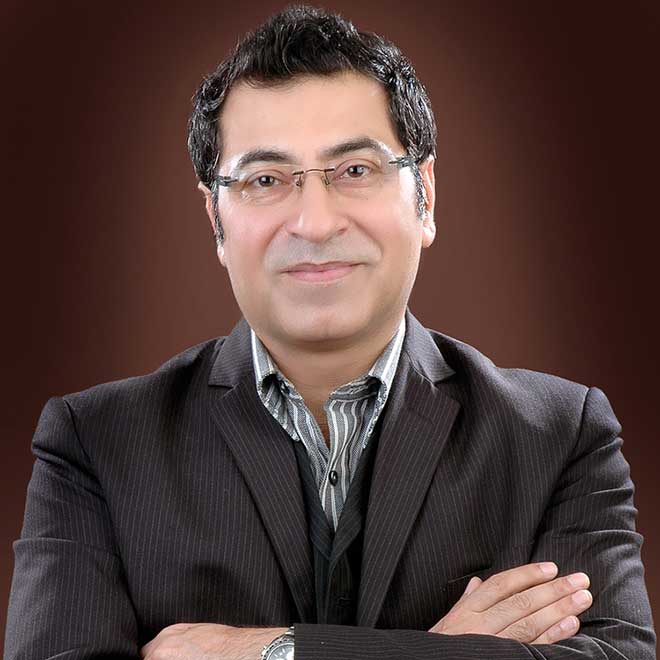
     

    How was your experience in law school? Do you think law schools produce socially relevant lawyers?

    I did my LLB from the Chandigarh Law Faculty, in the campus of Punjab University. The campus was very modern in terms of building and infrastructure. It was a stand-alone dedicated campus. The size of class or batch was not more than 100–120 students, if I remember correctly. The faculty was very strong, comprising some brilliant professors and authors. Even Senior Lawyers used to visit us as visiting faculty. The student–teacher ratio was 7:1, which was quite impressive.  I had an outstanding experience as a law student. The fellow students were very friendly and teachers exceedingly helpful. I carry wonderful memories of those times. Yes, the law schools do offer great opportunities to become socially relevant lawyers by becoming part of community, pro-bono and human rights driven legal programmes. Even in my times of student life, we had these programmes. We were inculcated with the values of serving the community in part-time, compulsorily or whole-time, optionally. However, at the end these become more of self-made choices. Law schools can only show you the right path and values; they can’t hand-hold you.   


    Did you participate in any extracurricular activities such as moots, debates or undertake any internships in law school? 

    Yes, I did participate in the extracurricular activities. In fact, moots was a compulsory subject. I participated in moots in all three years. I also participated in the debates and declamation contests. Internships, in our days was meant only for the last semester i.e. sixth. This was compulsory. For other semesters, it was optional. I did use to visit the High Court as a law student to observe some key hearings. All these practical activities helped me enormously in my becoming an accomplished lawyer. In order to become a skilled lawyer, one should have multiple traits and qualities – analytical approach, patience, hardworking, articulate, clear and effective oration, humility and so on. The extracurricular activities contribute overwhelmingly in bringing out the best in you. I am of the robust view that in the legal profession practical training and experience surpasses theoretical part. Therefore, the extracurricular activities and practical training should not only be made mandatory but must be made part of day to day curriculum.        


    What are your areas of interest in the legal field? 

    I graduated and got enrolled as a lawyer in 1991. At that time the only area of law practice was litigation. In litigation, most lawyers were general practitioners. Primarily, litigation involved civil, criminal and revenue matters. I actually wanted become an arguing counsel but destiny had something else stored for me. I joined Amarchand Mangaldas & Hiralal Shroff & Co., Solicitors in 1991 as an Associate. I was working alongside Shardul and Pallavi Shroff, who were the Managing Partners of the law firm. I got exceptional opportunities as a young fresher. I do not think anyone could get such opportunities in today’s times. In 1991, each day, I was given legal briefs to argue in the Delhi High Court (and sometimes even Supreme Court and Company Law Board). They trusted my capabilities and strengths. Between 1991 and 1994, I argued innumerable cases in several courts, tribunals and forums. However, the process of economic liberalization issued in 1991 by the Indian Government started to take shape in 1994. A new field and area of practise started to emerge for law practitioners. This got to be known as non-litigation or FDI law practise. It became a fashion statement to brand yourself as a corporate and commercial lawyer. I ventured into this area of practise. I became a connoisseur of cross-border investments related documentation and regulatory work. I got tremendous opportunities to handle complicated M&A and JV transactions. I started to enjoy the globetrotting attached with this kind of law practise. From a litigation lawyer, I transitioned into a business lawyer. I walked away from courts, where I always wanted to be. I have no regrets because I thoroughly enjoyed then and even now the challenges and luxuries of being a corporate lawyer. My core areas of practise cover corporate and commercial matters, FDI, economic laws, mergers, acquisitions, cross border investments, joint ventures, corporate compliances, corporate governance, corporate social responsibility, commercial agreements, transactional documentation, private equity, regulatory work, agreements, anti-corruption, anti-bribery compliance and legal auditing.         


    How did you secure an appointment at AMSS? 

    At that time, AMSS was known as AMHS. I was waiting for my final semester results of LLB, I approached AMHS directly at New Delhi office. I religiously used to visit the AMHS law firm office to secure interview. I succeeded after a gap of one week to get an interview with Shardul Shroff. I had an interaction of about half hour with him. He was then a lawyer of about eleven to twelve years’ experience. He liked my answer to one of the questions, where I said that for me AMHS is a gurukul and you my guru to be.’ I told him categorically that AMHS was a training ground for me, hence, I didn’t expect any remuneration. I was recruited as a Trainee and then once, I got my degree and enrolment, I was designated as an Associate. At that time the recruitment was done personally by Shardul and Pallavi. The criteria was primarily instinctive and first impression coupled with honesty and smartness of the candidate. My experience was absolutely outstanding. Whatever heights in legal profession, I have attained, I owe it to Shardul and Pallavi. Right on day one, they pushed me in to the turbulent legal waters so that I could become a swimmer in the rapids. I gained experience of more than a decade in just four years. In four years, I was capable enough to give run for money to lawyers with experience of ten years plus.      


    What motivated you to found Kaden Boriss Global?

    When I was travelling globally and that too extensively in mid 1990s and onwards, I realized that I should have an international brand with which foreign clients could relate to easily. I thought of establishing a law firm and a network of international offices with an international name so that people associate with it an MNC and not a domestic institution.  Kaden Boriss is a combination of two expressions – ‘Kaden’ and ‘Boriss’. The ethnic origin of these expressions can predominantly be found in the Swedish Germanic and Slavic languages and also partially in the classical Arabic language. `Kaden’ means a Companion and Boriss means a Warrior. When this name was coined on 15th August, 2003 me with the assistance of my international financial lawyer wife Preeti W. Batra, the idea was two-fold – (1) the law firm had to become a global phenomenon with presence all across the world, hence name had to be truly international, which one and all could relate to regardless of origin, race, language or dialect; and (2) the law firm had to become an unconventional outfit with emphasis on progressive legal services and strategy. Hence, the formula was to become a `Companion’ to our clients with a `Warrior’ like instinct. In other words, in this tough world clients need a companion who is a warrior. I am the registered owner of the IPR in Kaden Boriss brand.

    Initially, Kaden Boriss ventured into a highly innovative domain by assuming role of a knowledge processing consulting and legal services company. It engaged in undertaking legal & para-legal consulting assignments for Multi-National clients seeking to contract out their in-house legal, para-legal and strategic advisory, regulatory and compliance work. Between 2003 – 2011, Kaden Boriss under my leadership undertook extensive projects in Americas, Australia, Austria, Bangladesh, Bhutan, China, Czech Republic, Dubai, England, Germany, Holland, Hong Kong, Hungary, India, Indonesia, Kuwait, Italy, Maldives, Nepal, Philippines, Russia, South Korea, Sri Lanka and Thailand involving legal cross-border transactions, business acquisitions, mergers, takeover, private equity deals, commercial documentation, research on legal and para-legal issues, regulatory approvals, compliances, due-diligence, legal auditing and formulation of business strategies. Kaden Boriss operated from multiple satellite and project offices at that time. It comprised of team of Legal, IT, Software, Secretarial and Commercial professionals who are experts/specialists in undertaking high-end consulting projects of varied faculties.

    One of its divisions, also provided a cost and time saving solutions to the everyday challenges of making reports, presentations and other research-based documents like legal auditing, articles on general as well as technical issues and papers amongst others for business organizations, professionals and individuals. Its services represented a logical alternative for business organizations and individuals who didn’t want to waste their precious resources on such assignments but wanted to concentrate on their core area of activity. Kaden Boriss grew to become one-stop window for solutions to all legal and para-legal problems/issues.

    The only hurdle was that Indian clients initially thought that Kaden Boriss was a foreign law consulting firm like McKenzie or something, which it was not. The perception was that it was a consulting company and not a law firm. This was eventually overcome.

    The traits and fame of Kaden Boriss in executing legal and para-legal work for businesses and industry leaders all across the globe with utmost integrity, confidentiality, commitment, effort and efficiency started to spread far and wide.

    Hence, in 2009 Kaden Boriss formally adopted the Swiss Verein kind of structure. I and my wife Preeti W. Batra found this business model as an effective medium of offering Kaden Boriss as a single global brand with its member or group firms being able to maintain their independent status as separate legal entities as well as financially and administratively. The Kaden Boriss evolved as a commercially vibrant ‘goodwill’ service brand with ideal brand equity.

     

    You are, and have been in the past, the Vice President of SAARCLAW. Can you tell us about the role of this organisation and your job profile as its VP?

    South Asian Association For Regional Co-operation in Law, SAARCLAW, is an association of the legal communities of the eight SAARC countries comprising judges, lawyers, academicians, law teachers, public officers and a host of other law-related persons, duly registered with the SAARC Secretariat at Kathmandu and awarded the status of a Regional Apex Body Of SAARC. It owes its origin to the desire of the members of the legal community to establish an association within the SAARC region to disseminate information and to promote an understanding of the concerns and developments of the region.

    SAARCLAW was established in Colombo on 24th October 1991. I have been associated with SAARCLAW since its inception. I have been its Secretary General for three terms of two years each. Presently as Vice President, I represent India on the Executive Council. Office bearers enjoy quasi-diplomatic status. I have been instrumental in helping SAARCLAW establish a permanent Secretariat in Kathmandu. In my tenure as SG, I worked out several joint ventures between SAARCLAW and international institutions like UNDP, UNAIDS, IDLO, ADB etc. The Annual SAARCLAW Conferences have been acclaimed as affording an opportunity to its members for interaction, exchange of ideas and for forging a spirit of solidarity. It has been the convention since 1995 to hold a conference of the Chief Justices of the SAARC countries concurrently with the Annual SAARCLAW Conference. This feature has become institutionalized now and offers a forum for the exchange of thoughts and views of the Chief Justices of our countries.

    In its more than 25 years of existence, the members of SAARCLAW have persistently worked towards the achievement of its objectives of bringing together the legal communities within the region for closer co-operation, development of understanding, promotion of exchange of ideas and dissemination of information, and to use and develop law as a source and an instrument towards social change for development as well as for building co-operation among the peoples of the region.


    You have worked closely with the United Nations in several capacities. Can you tell us about the experience?

    First and foremost, any job with UN bodies requires a systematic approach. One is required to be passionate about certain areas of activities, which may be of concern to the relevant UN body. Before being eligible to undertake projects or assume positions with UN bodies, the readers interested in joining such bodies will have to execute some projects independently or with some non-profit outfits or NGOs. The vacant positions of UN bodies are widely publicized and displayed on their respective websites. The process of recruitment and hiring is very transparent and merit based.   


    Can you tell our readers about the role of the aforesaid organisations as well as your role as a member of UNAIDS?

    (Hemant has been a member of UNAIDS and has also been a Regional Observer at the Global commission on HIV and Law. He also works in association with UNDP to address the issue of AIDS.)

    It is officially estimated that over two million people in India are living with HIV. Though unofficial figures could be much higher. In other words, the people affected with HIV in India equal the population of cities like Chicago, Houston, Paris and Rome. Another example being that HIV affected people in India equals population of two Mauritius put together. Children (less than fifteen years) account for 6.54%, while two fifth (40.5%) of total HIV infections are among females. I have been working very closely with various UN bodies and international institutions working for the upliftment of marginalized population, be it LGBT community or sex workers. I was nominated to some key committees of UNAIDS, UNDP and UNESCAP; and also IDLO to facilitate diverse projects and programmes in resolving legal hurdles in dealing with people affected with HIV and AIDS. I helped in orientation of several stake holders and also introducing new legislation in South Asia to ensure that there was no discrimination encountered by the people especially women affected by HIV and AIDS at their work place and hospitals. I was instrumental in getting key members of the judiciary, executive and legislature from most South Asian countries on these committees. Several publications were co-authored and edited by me in this direction. India is severely affected by HIV and AIDS. Government and Judiciary have taken some fundamental steps in the direction of dealing with this reality.     

    Kaden Boriss, in association with National university of Singapore, founded an initiative called ‘International Infrastructure and Construction Law Arbitration Moot (IICLAM)’. What was the reason behind doing so? Why did you choose this particular topic for the moot? How do you think mooting contributes to a law student’s holistic development?

    I have worked very closely with an eminent Professor from NUS, Prof. Alan Tan. He was Vice Dean in the Law Faculty at the relevant time. We both decided to bring Kaden Boriss, NUS and Singapore International Arbitration Centre (SIAC) under one roof to deal with the most challenging legal proposition in the developing nations. We identified infrastructure as the key pillar of development in any developing nation. The transactions of infrastructure involve several contracts and agreements with serious and complicated legal implications. Through IICLAM, we resolved to engage the next generation lawyers i.e. law students in resolution of legal disputes in the infrastructure – construction law related matters. The moot competition also enriched law students’ knowledge on the ADR mechanism.
     

    You are a senior expert at Geoman Bind, a legal and policy research think tank. Can you tell our readers about the nature of work you do there, as well as the importance of think tanks in policy making?

    This is the future of legal and policy arena. Goeman Bind HTO is a private non-profit international legal and policy advisory and research think-tank. It is cerebrally and academically supported by patrons from Australia, China, Dubai, France, Germany, Holland, Indonesia, Malaysia, Romania, Russia, Singapore, Slovakia, USA and UK. It stimulates legal experts and academia to offer knowledge to the patrons and inspires policy specialists to share expertise with the recipients. It engages in legal and policy research and advisory while creating a knowledge bank within reachable horizon. Goeman Bind HTO is a unifying process or manifestation of valued and iconic traits of expert legal professionals. It is unique fora of research, resource and legal advisory. This not for profit initiative of combining advisory, research and a think-tank stream under one banner was first conceptualized in 2008 in the form of a platform of like-minded intellectuals, professionals, experts and academicians in the field of law and policy.  Goeman aims to bring under one roof about 50 leading experts and academia in the legal and policy gamut from across the world who could afford the utmost excellence in research, recommendation, opinion and advisory on a complete array of legal issues and policy matters. Goeman provides for a prospect to experts and academia in the legal and policy gamut from all across the world, carrying knowledge and well-versed deliberation to the community dialogue of legal and policy strategy sets. Goeman is projected to become a niche global network of highly qualified academicians, legal and policy advisers. I am involved in couple of legal and policy projects dealing with child labour and child abuse. I am also moderator and referee for some research projects.


    You are the chairman of the South Asia committee of the Indian National Bar Association. Would you tell our readers about the work of the INBA and your role in it?

    I am yet to get fully involved in this particular task. Due to paucity of time and other prior engagement, I have not been able to give much time to INBA. But I propose to involve INBA in the forthcoming SAARCLAW conference in Colombo. INBA has tremendous potential and its live wire Kaviraj Singh is a man of amazing abilities and ideas. He is a man who could be highly relevant in bringing about positive changes in the lives of young legal professionals.


    Do you find that the Indian education system requires improvement? 

    (Hemant has been a visiting faculty at the Indian School of Business and the FORE School of management.)

    Yes definitely, the Indian system requires fundamental reforms. First and foremost, we need to grow out of the mental block of professional degrees. Profession has nothing to do with professional degrees. We need to inculcate and encourage the natural instincts amongst our students. If any student is good in poetry or music or sports or drama, we need to inspire him or her to embrace the same as a career. In the Indian dispersion as to career path, we have a pre-set mind that career means being an engineer, doctor or lawyer; and rest follows. It is important that students should be given an option to move and shift from their original courses as is possible in US. Indian students get stuck with their courses what they choose at the first instance. It is important that down the line, if that particular course doesn’t interest them, they should have the option of choosing or moving to another course. Further, practical aspects need to be introduced more and more in any career path. Regarding, advise to the students, I would only say follow your passion not the flock. If your passion becomes your profession, sky is the limit. Accomplishment is a relative term at the end of the day.    


    You are greatly interested in music. Can you tell us about this interest and how you have pursued it? 

    Music is like meditation for me. It is a means of recharge. I have not had any formal training in music. I started composing and arranging music in 2002. I made a small studio at home in which, I would disappear for hours together. Now, I have an ultra-modern studio with state of the art gadgets and equipments. I launched my brand label `Urf Hekbat’. Urf means alias or also known as. Hekbat is a combination of He for Hemant K for Kumar and Bat for Batra. Initially, I was hesitant to share in the public domain that I was doing music, so I launched this brand name. I launched twin albums of lounge music genre in 2012, which was a big hit. My music started playing in international night clubs and lounges and pubs. In many fashion shows abroad including Berlin fashion show, models walked ramp on my music. I have no commercial agenda for music and it is mere hobby or should I say little more than a hobby. With experience, I can now not only compose music on my own but also create videos for my music tracks. When I was approaching 40s in my age, I felt I was burning out fast in search of fame and wealth. God was really kind to me as by the age of 40, I had earned enough that I could retire and settle down without doing any further work. But this had come at the cost of humongous hard work and stress. Hence, to continue further in profession, I needed a stress-buster hobby and nothing could have been better than music.    


    You have pursued courses in corporate law and the procedural laws of the United States at Harvard Law School and the University of Pennsylvania respectively. How have such courses helped you in your career? 

    Both my children are studying in the United States. I really like the US system of education. I was invited by Harvard Law School to be part of their project regarding legal profession and its international dimensions. This project was being undertaken in collaboration with Indian School of Business, Hyderabad. I became part of this project and gained a lot in terms of experience. I was given lecturer’s role as well. In so far as University of Pennsylvania is concerned as I mentioned that my children live in USA, I wanted to get hold of the basics of US laws, hence, this course.  


    What are the challenges you have faced in building your career as it stands today? 

    I compare legal profession with a space shuttle. When the space shuttle takes off from the launch pad, it emanates huge fire and steam because it assumes too much stress and pressure. Many a times space shuttles blows off and burns while if it doesn’t it goes into the orbit – universe. Likewise, legal profession in the initial years is very testing and stressful but if one can withhold that pressure and steer on with hard work; sky is the limit. I struggled and worked really hard in the initial 5-8 years but after that the growth was vertical. I achieved my targets and aspirations quite early in my career. This profession is very fulfilling and accomplishing. It gives you independence, freedom and command in every which way. It only expects hard-work, discipline and accountability.   


    What are the characteristics you would look for while recruiting young lawyers? 

    Predominantly, I try to see through a candidate in a way that I could identify if he or she has an urge to learn. Legal profession commences with a learning process and then turns into an employment or job or a remunerative arrangement. If one is keeping fiscal expectations in the forefront then he or she is not my choice. Remuneration is important but not fundamental. Learning and training is everything in the initial years. I also look for a cutting edge. Why should I hire you? Is my standard last question. The candidate has to show me, why him or her over others. CGPA is one of the features, we look at but that is not the whole and sole deciding factor.

     

    How have you used your media exposure to influence specific aspects of the legal discourse in India?

    (Hemant has been invited to express your opinion in mass media such as newspapers, magazines and TV shows. You wield unique influence over the legal discourse in India.)

    When you become an experienced legal professional and lawyer, you become a significant resource for any kind of media and medium. I have always believed that experience and knowledge not shared is a waste. I have selflessly shared knowledge at any given opportunity.


    What do you think are some of the legal challenges India’s legal fraternity faces today?

    I think in today’s times the biggest legal challenge our fraternity faces is coping up with the ever changing technology. Those who will not change with the changing needs of time will get wiped out. Way back in 1996, a distinguished law professor from UK, Richard Susskind in his book `The Future of Law’ noted that changes in technology will fundamentally, irreversibly and comprehensively change legal practice, the administration of justice, and the way in which non-lawyers handle their legal and quasi-legal affairs. Law has to be viewed as a business and a profession. In fact, to better understand the transformation of legal practice from a profession traditionally made up of small independent firms to a multi-billion dollar global business; Harvard Law School had long back established the Center on Lawyers and the Professional Services Industry. “Law firms and other professional service providers are now a critical part of the global economy,” said Harvard Law School Professor David Wilkins.


    How can India better its legal regime so that it is more efficient, inclusive and in alignment without nations development goals?

    I think this can be achieved by opening up the legal profession beyond borders, introducing a high notch of accountability so as to discipline the legal professionals and carrying out day to day systematic orientation. We need to realize that hundreds and thousands of students graduate each year in law and eventually get enrolled as lawyers. There is a massive gap in theory and practise. We need to bridge this gap by orientation and proper placements.  


    Can you describe a regular day in your life for our readers? 

    For me it is a five day week in so far as work is concerned. I start my day early, I am in office by 7:30/8:00 AM. I work at stretch be it desk work or meetings until 2:00 PM. I take lunch and rest between 2.00 – 3.30 PM. I am back to work and wind-up around 7:30/8:00 PM. I try to keep meeting outside office for not more than 2 days (preferably one day) a week. Saturday is a hobby day for me when I do music compositions in my music studio. Sunday is totally for family and friends. I am travelling out of Delhi or India seven to ten days a month on an average.


    How would you describe your long and illustrious career in the legal field? 

    I think some of the most eventful or accomplishing landscapes of my career are as follows –

    • Opportunity to work very closely with Shardul and Pallavi Shroff gave me an initial head start in profession.
    • My association at the threshold of the profession with legal luminaries like Justice P.N. Bhagwati, Justice A.M. Ahmadi, Justice R. C. Lahoti, Justice U. C. Banerjee, Mr. P.P. Rao and Mr. K. K. Venugopal boosted my self-esteem and gave me a confident pitch.
    • My association with SAARCLAW at a very young age and victory in all elections at the domestic and international level for the offices therein, gave me tremendous visibility.
    • I was assigned complicated international legal transactions for global clients like Bayer, Suzuki, LG, Godfrey Philips, Kuwait Royalty, AMEX, WU and many more. These transactions took me across borders. I began to be getting recognized as a global corporate and commercial layer.
    • When I founded Kaden Boriss, it was an ultimate feather in my legal cap.
    • And now with Goeman Bind HTO, I stand recognized as a Policy Expert and Thinker.      


    What advice do you have for our readers who are primarily college students?

    My advice to the young students is that keep your feet firmly on the ground. Legal profession is the only profession in the world where growth is vertical, if you are determined, hard-working and disciplined. These three qualities work like a magic potion for assured success. And always be humble.   


  • Navneet Hrishikesan, Director & Head of Service Provider Legal-Asia Pacific & Japan, Cisco, on his time at NLSIU, working at Wipro, and his diverse experience

    Navneet Hrishikesan, Director & Head of Service Provider Legal-Asia Pacific & Japan, Cisco, on his time at NLSIU, working at Wipro, and his diverse experience

    Navneet graduated from NLSIU in 1999. He is currently the Legal Director for Cisco’s Global Service Provider segment responsible for the Asia-Pacific & Japan region. In his role, Navneet leads a team that manages all legal matters related to Cisco’s telecom service provider customers in the Australia/ New Zealand, Japan, ASEAN, Korea and India/ SAARC theatres. He is also a member of the Asia Pacific & Japan- Service Provider management board. Prior to joining Cisco, Navneet was the Head of Legal/ General Counsel for Wipro’s Americas Geography based in Boston, MA. In that role, Navneet was a member of its Americas management team and led a team of lawyers advising on all matters arising in the region, including: outsourcing agreements, mergers and acquisitions, customer disputes/ bankruptcy issues, employment matters and regulatory issues (incl. licensing and privacy). Before Wipro, Navneet was an Associate in the IT & Telecoms practice of the law firm, Simmons & Simmons, based in London.

    In this interview we speak to him about:

    • His time at NLSIU
    • Law and social responsibility
    • His diverse experience

    What was it that got you interested in the legal field?

    Like with most other things in my life, I blundered into it, is probably the best answer here. Looking back at it though, I would say there were a couple of things that combined to drive me to law. I was not a fan of maths and the sciences but loved history and the other humanities disciplines. The law was therefore a logical step forward once I completed school. A bit like, what I am told happens, in an arranged marriage, my love for the discipline blossomed only after I joined NLS.

    There was no real family connection, though my paternal grandfather was a lawyer in Kerala much before I was born. Since I grew up in Assam, however, this didn’t benefit or impact me in any manner.


    How was your experience in NLSIU?

    Back in 1994, NLS was a small place, really far from town, and as they say in the theme song of “Cheers” – everyone knew your name. Of course, the downside was that since everyone knew you, once they formed an impression of you, you were more or less stuck with it for five years. All in all though, I had a lot of fun and the place was very good to me. We didn’t have much in the way of resources, but the students and teachers were passionate and that helped the institution grow both in resources and reputation.

    Do you think law schools produce socially relevant lawyers?

    To brutally paraphrase John Donne, “No Law is an island, entire of itself”. In other words, all laws need to work within the context of the society. If one draws this analogy out even further, all lawyers (since we engage with/ interpret the laws) do socially relevant work, irrespective of the type of law they practice.

    A bit controversial perhaps but can one honestly say that, because someone only does commercial work of a M&A or private equity variety (or technology law, for that matter), they are not socially relevant? I could make a strong  argument  that working for a technology company has more of a relative social impact/ relevance in India today (looking at it through the lens of employment and revenue generated), than, and I mean no disrespect here, working for a NGO focussed on a certain demographic or issue.

    Let me provide a personal example- My company (and team) was instrumental in helping an Indian conglomerate build a recently launched Indian cellular network. This conglomerate is not popular with the chattering classes for a variety of reasons including the height of its promoter’s residence, but the network, on the other hand, is noteworthy for the remarkably low prices it charges for making calls and accessing the internet. While this is obviously an interesting change for people like me who remember fifteen Rupee a minute phone calls, the disruption caused by a service like this is most felt among the financially unprivileged classes (think cab drivers or even your local kirana store). Think how much it helps the people who are working hard to make their Rupee go further. Isn’t this offering socially relevant? Following from that, aren’t my lawyers who worked on this deal doing something that is socially relevant?

    That said, if the question is whether law schools produce lawyers who are focused on the improvement of society (as opposed to commercial considerations), I would say that the numbers are very small. The issue is not so much the law schools themselves but the lack of financial and other support for the students so inclined.  There is no real use pushing the social benefit message, if at the end of it all, the only reasonably well-paying jobs are those in the corporate or commercial fields. As a profession we need to do more in encouraging people to go into the social sector. That doesn’t mean that there aren’t some people, despite the odds, trying to “be the change”. I have had the opportunity to see the wonderful work being done by people like my NLS classmate Shamnad Basheer and IDIA Law (idialaw.com) and feel that we don’t do enough to celebrate such uplifting examples.


    Did you participate in any extracurricular activities such as moots, debates or undertake any internships in law school?

    I took part in a lot of ‘extracurricular’ activities during law school, but not ones that I am willing to elaborate on in a public forum. On a more serious note, I didn’t take part in moots or the like though, which in hindsight was probably a mistake. If I were to make a second go of it, I would probably take part in all extracurricular activities at least once, just to see if I found something that really interested me. I did undertake several internships while I was at law school though and I found them very illuminating in helping me choose the kind of jobs that interested me.

    During the late 90s, career options for a young law graduate were fairly limited. Litigation was not really an option as I didn’t want to live off my parents anymore and while there were many law firms, they were mostly all family-run at that time and hence were a dead-end for someone with no familial connections to the owners/ partners.

    This left one with the in-house option. The problem was that most people felt (some, I suspect, do so even now) that in-house lawyers don’t do any “real” work.  My fifth year internship with Hindustan Unilever under B.S. Dhillon, who ran their Western India region at that time, dispelled most of my concerns in this regard and convinced me that being in-house was what excited me.

    Personal highlight during internships: Taking the Harbour Line from Bandra to CBD Belapur during internship in Mumbai – I was prepared to do any work, anywhere, after taking that brutal train ride every morning.


    What was your first job out of law school?

    I was lucky to get a placement as a Management Trainee with SmithKline Beecham Consumer Healthcare (a.k.a the Horlicks company, now Glaxo SmithKline) through campus recruitment at law school.

    The company was (and is) a leader in the FMCG sector. Being a Management Trainee, I spent close to a year being trained in the real world and it gave me a solid understanding of how a modern enterprise works. After working with various functions including the factories, HR, sales and the like, I was deputed as a newly minted Assistant Manager to an JD-Edwards ERP IT project. Never having had a technical bent of mind, this was a sharp learning curve for me and instilled in me an interest in technology – kind of ironic actually, given my lack of affection for the sciences while growing up.

    I also learned, fairly quickly, that dealing with the Factories Act and matters related to the Prevention of Food Adulteration and Weights and Measures didn’t really float my boat, so to speak. I therefore decided that I wanted to try something new and then Wipro happened.

    Personal highlight at SmithKline: A ‘Vikram’ Tempo with me (and Horlicks) in it narrowly missing a woman unconcernedly crossing one of the narrow lanes of Kolkata. If that vehicle had not been able to avoid her, I probably would not have been here answering these questions.


    How did you secure an appointment as a Legal Manager at Wipro?

    A couple of my classmates (with much better CGPAs, I might add) were working with Wipro at that time and since one of them had decided to leave, they had a vacancy. Akila Agrawal (a NLS classmate and now a partner with Amarchand) asked if I would be interested and I submitted my resume. I was interviewed and, for some unclear reason, perhaps because I was the only one in the room who knew what an ERP was, they decided to give me the job.

    While I was grateful for the opportunity given to me by Wipro, I had also taken a chance joining them. This was before the IT craze had set in and at that time Wipro was not the large behemoth it has now become and well, the salary being offered was just about half of what I was making at SmithKline. I however knew that I had a chance to learn new things in an area that was still in its infancy. It also helped that Wipro was in Bengaluru, a city I had enjoyed while at NLS.

    It was a great decision in hindsight, for two reasons:

    During my four years at Wipro, the company grew in size from $300 Million to close to $1 Billion in annual revenue and I got fantastic exposure – from leading contract negotiations and implementing compliance programs to managing arbitrations and acquisitions, I delved into every area that Wipro was in. It was tough at times. I remember this nine month period during which I was the only IT lawyer in Wipro and used to work eighteen to twenty hour days, every day, including weekends. I can confidently say that this stint at Wipro formed the foundation of my development as a commercial lawyer.

    The second (definitely more important reason for me, perhaps not so great for her) was that I met my soon-to-be wife, who is also a lawyer, in Bengaluru while at Wipro.

    Personal highlight of first stint at Wipro: Holding an original Oscar statuette that a customer had received for services to the motion picture industry (disappointingly, I was not allowed to give a speech while doing so).  


    From being an in-house counsel at Wipro you went on to be an Associate at Simmons & Simmons. What caused you to leave Wipro?

    The offer from Simmons came out of the blue. I had worked with them on a couple of transactions while at Wipro and when David Barrett (then the head of the Technology practice at Simmons) and one of my NLS seniors, Murali Neelakantan, asked if I would be interested in joining them, I thought it would be a great opportunity to learn new things and agreed to move to London.

    Being in a law firm was obviously very different to being in-house and while being at Simmons really helped me develop my technical skills (both in the law and in relation to handling fee paying clients), I found that I missed the level of ownership that one gets while being in-house. In simple terms, in private practice, one can give advice with several caveats and let the client decide, but if you are in-house, you are the client and therefore have to live with the decision that you make. I found that I missed the level of control and context I had while at Wipro.

    Personal highlight at Simmons: Mistakenly introducing a bearded (and in my defence, similar looking), former Indian Minister as Suresh Kalmadi at an India House gala in London. Not the best ‘business development’ moment of my career. He ignored me, very pointedly, at our next meeting.

    You moved back to Wipro as its General Counsel for the Americas. What was your role as the General Counsel for the Americas?

    After a year and a half with Simmons, while I was still mulling whether private practice was where my interest lay, Wipro reached out asking if I would consider running their Legal function for the Americas region. I jumped at the opportunity. This meant a move to Boston for us and as a result my wife had the pleasure of living in  three continents in the first six months of our marriage (personal advice – DO NOT try this at home).

    The Americas region was (and possibly, still is) Wipro’s largest sales region and was an almost complete ‘end-to-end’ role. We were at the frontline of the largest sales deals that Wipro did (we convinced customers to give us a chance on the mega-size outsourcing deals during this period and I worked on some of the largest IT and BPO offshoring contracts in the US) and also independently handled much of the issues that arose in that region including employment disputes, customer disputes, compliance programs, customer bankruptcies, arbitrations and the like.

    I also had the opportunity to lead several acquisitions including one of the largest acquisitions in the IT space of a publicly listed US company.

    After a few years there (and visiting conference rooms in 35 out of the 50 States that comprise the United States), my wife and I decided, for personal reasons, that it was time to come back to India with our two young children.

    During my time in Boston, I had the great fortune to be introduced to Mark Chandler (the GC of Cisco) and some of his leaders, including Graham Allan (my current boss) and I was very impressed with their vision for the industry and Cisco’s Law department. Therefore when a global role opened up in India at Cisco, I decided to try working for an American company in India, as opposed to an Indian company in America. It was (and remains) a great decision.

    Personal highlight of second stint at Wipro: Sneakily ‘borrowing’ a neighbour’s Wall Street Journal at 4AM to verify that our advert offering to buy the shares of a target company was actually printed (I seem to have forgotten to return it or give them my own copy which was delivered to office).


    You are the Director of Legal Services at Cisco Systems. Can you tell our readers about your job profile?

    In my current role at Cisco, I lead a team of lawyers who handle all legal issues for our Global Service Provider line of business in the Asia Pacific & Japan region. My team is divided by sales theatres– which includes India/ SAARC, Australia/ New Zealand, Japan, S. Korea & ASEAN (which includes all the countries in the middle from Myanmar to the Philippines). I also co-lead with my senior colleague, Marcus Breaden, the APJC Legal Department. All together our teams support approximately $8 Billion of annual sales revenue (from a global Cisco number of $50 Billion). I am also a member of our regional Service Provider Leadership Board and am on the board of a few Cisco subsidiaries.

    Personal highlight at Cisco: Receiving a personally signed photograph from John Chambers (Chairman and CEO of Cisco) after I asked him a few ‘tough’ questions in a meeting. Learned a lot about leadership that day.


    What are the challenges you face in being in charge of the legal affairs of a global enterprise?

    Let me break my answer into a two categories – internal and external.

    Internal:   The challenges vary from country to country. In India specifically, our biggest challenges have been finding the right talent to staff our teams and helping grow our business at a fast pace, while maintaining acceptable margins.

    External: The biggest external concern is understanding and responding to the nature of the changes facing the telecom industry. We live in a world of constant and sudden change largely facilitated by technology and hence this is an area that we constantly think about. I also expect the changes that are coming will have a significant impact on our profession, but that is probably a topic for a separate, much longer discussion. If what I just said interests you, please do take a look at Richard Susskind’s stellar book “The End of Lawyers?”

    Have you ever considered pursuing higher education?

    Short answer is no. I have never considered higher education. 19 years of formal schooling and college were sufficient for me, thank you.

    Unless you are planning a career in academics or research, where higher degrees help (or if someone offers to pay for you and you feel like a holiday), I am not convinced that higher education justifies the expense incurred and time spent, which can be better utilised to build a career.


    How important is CGPA, in your opinion?

    Being in-house is very different from the other careers within our profession, mainly due to the importance of understanding the non-legal context of the issue. In other words, we grapple a lot more with business issues and take that into account while deciding the right approach for the company. This needs a different thought process and hence at a high level, the traits I look for in our lawyers are:

    • inquisitiveness: I look for lawyers who are curious about things. In-house roles require you to often go outside your comfort zone, particularly on business issues. Someone who is willing to ask questions and figure out how things work, is usually the one who can give the most relevant advice and spot issues before they become big problems;
    • creativity: I look for people who have an inclination to problem-solve. Saying we cannot do something because it’s a company policy is not an acceptable response;
    • teamwork: I look for lawyers who show a team spirit and have the ability to work with people across cultures (my team as an example is made up of people from five different nationalities); and
    • drive: I look for lawyers with an aggressive, “can-do” attitude. If one waits for all the information before taking a decision, one is often too late.

    When it comes to applying for jobs, I would suggest young lawyers keep three things in mind:

    • Particularly in situations where the number of applicants far exceeds the number of jobs (as is usually the case in India), it’s always a process of elimination, never selection. So, your job is to ensure that you differentiate yourself enough to not be eliminated and obtain an interview call.
    • Do the simple things right- A good start would be to write a professional looking resume – please don’t tell me what your marital status or favourite hobbies are – that will speed up your elimination. Also, please read the job description and write a custom resume for that role (if you write to me asking for a job with my law firm, or, this still makes me laugh – ask me to check your LinkedIn profile, then you guessed it, elimination). Also, spelling and format check, please.
    • If the role is for a fresh graduate, I work on the premise that you don’t have any real knowledge of relevance (in other words, law school doesn’t teach you anything that will help you add value from day one). I will therefore be looking for enthusiasm and a personality that fits with the rest of my team (see traits above).

    On CGPA – I personally don’t think that it is critical for success in our profession, that said, no one wants to hire a slacker and CGPA is often used as a short form measure for it. So, try and improve your CGPA and if it’s too late for that, work on your resume and (once you get an interview) showcasing your enthusiasm.


    What advice do you have for our readers who are primarily college students?

    When you are starting your professional career:

    First and foremost – Try to do what you enjoy.  There is a saying that “if you do what you love, you won’t have to work another day in your life”, while this is not technically true (all jobs come with parts one doesn’t like), generally picking an area you like, will help keep you engaged for the long haul. A career is a marathon, not a sprint.

    Second – Choose a job/ role where you can actually learn new things. Don’t, if you can manage, focus too much on the money at the beginning.

    Finally –

    • Be humble – No one likes a smart aleck. Often it’s how you communicate that helps more than what you know. Build bridges and relationships, it will help you in surprising ways.
    • Be proud of your work – this will sound like the opposite of #1 above but isn’t. This doesn’t mean that you should be arrogant, instead, put in the hard hours, do the best at what you do and respect your work. This will differentiate you very, very quickly.
    • You never really grow at the cost of someone else – so don’t play politics or drag other people down. If your work environment requires this, you perhaps need to find another job.


    Do you think India needs to revamp its legislations based on the developments in the IT field?

    We have issues with Indian legislation catching up with the recent technology developments and while some, like the recent AADHAR and right to privacy imbroglio are a particular Indian problem (the right to privacy has been an established legal principle in most developed countries for the past few decades), the rate of technological change is so fast nowadays that most legislations and principles will soon need a relook, in my opinion.

    Let us take Intellectual Property as an example, patents in particular.

    Patents were instituted as a way to encourage innovation, the concept was to provide “as little commercial benefit as possible” in return for encouraging inventions. However, over the past many decades, patents have instead become an absolute right, similar to property ownership. Patents have therefore, and very ironically, become the biggest impediment to faster innovation today. As an example – the IEEE 802.11 Wi-Fi standard (which you most likely use if you have Wi-Fi) incorporates 3000 “essential” patents. Imagine the issues you will face if you try to change/ improve how the technology works. This ownership model is just not sustainable.

    We are seeing a world today where:

    • we are moving technologically to the sharing of assets (e.g. data and analysis) to add more value. Think Uber and Airbnb, who help aggregate services using data from others (some of it personal).
    • Think of the questions this raises: If data has to be shared, how does the concept of IP ownership work? Does one ever really own data- if yes, who should own it? If a software/ robot analyses the data, who owns the analysis? Should the owner be the robot or the licensor or the licensee of the software, the service provider/ app developer or the person whose data was analysed? Instead of ownership, should we be looking at an open source type licensing regime?
    • the IPR framework doesn’t really work anymore for new technologies– e.g. do we need monopoly protections in years, when technology changes almost on a daily basis? US patents, as an example, provide 20-year term protections – put in context, 20 years ago was 1997, no Google, no Facebook, no Snapchat, no Uber etc. – how many of the fortune 500 companies from that period are still around today?

    Again, this is a topic for a much longer discussion, but ultimately, most laws will need to keep up with the changes being facilitated by technology (and it would be helpful if the laws that apply were actually drafted in this century).

    Once concepts like Internet of Things, Machine to Machine and Artificial Intelligence become a reality (and this time may come much quicker than what we expect), we will find that our laws (and law firms) will need significant change. I am not too pessimistic about the future though, I expect we will find a way to blunder through it all.


    How do you maintain a work life balance?

    I will not respond to this question, since anything I say, can and will be used against me, by my family.

  • Harshita Srivastava, VP-Legal, Nexus Venture Partners, on Corporate Law, internships, and her diverse experience

    Harshita Srivastava, VP-Legal, Nexus Venture Partners, on Corporate Law, internships, and her diverse experience

    Harshita graduated in law from Symbiosis International University, Pune, in 2009. She also holds a Diploma in Intellectual Property Law from World Intellectual Property Organization, and a Diploma in International Business Laws and Corporate Laws in India from Symbiosis. After a successful stint at Nishith Desai Associates, Mumbai, she is currently Vice President-Legal, at Nexus Venture Partners.

    In this interview we speak to her about:

    • Pursuing the BBA-LLB course
    • Working at Nishith Desai Associates
    • Her current role at Nexus Venture Partners

    Given that most of our readers are law students, how would you introduce yourself to them?

    On the professional front, I would like to introduce myself as a transaction lawyer with M&A/ PE/ VC experience of over eight years now. On a more personal front, I am a forward looking person who strongly believes in the motto “Aim high, achieve high”.

    What motivated you to pursue a career in the legal field? How did the BBA LLB combination help you?

    I would say I am a first generation lawyer from my father’s family, though my maternal grandfather was a Judicial Magistrate. I never had the privilege to see him around, but I grew up listening to his stories. His personalised stationery (ink pens with his name embedded on it, note pads, etc.) fascinated me as a child and inspired me to get into the profession (however, I could never own a single piece of personalised stationery even eight years into this profession!). The inspiration soon evaporated into thin air as I was growing up in a family full of engineers around me and my dad’s only vision in life seemed to see me crack the IITs. After getting out of school, I was not left with many choices but to appear for the engineering exams. As obvious as it could be, I did not come out with flying colours in any of those papers and right at that time I happened to learn about the new B.A.LLB course at NLSIU, Bengaluru, from an acquaintance. The curriculum and the course interested me enough and I decided to pursue my childhood passion.  

    I would say the BBA LLB combination gives you a better edge only if you are planning to build a career as a corporate lawyer/ in-house counsel since the curriculum gives you a fair insight into business subjects like accounts, corporate governance, principles of management, etc. apart from the regular law subjects.   


    Have you ever felt the NLU- non NLU divide?

    I personally never felt the divide. In fact, I was fortunate enough to get an opportunity (purely based on merit) to intern with big firms like Nishith Desai Associates, Jyoti Sagar Associates, DSK Legal, Crawford Bayley etc., while I was at law school. Again, in terms of recruitment, I got a pre placement offer from NDA (basis my internship), so I don’t think the NLU- non NLU divide played any role in my career.

    Having said that, I am not discounting the importance of making the right choice of institution. However, it is equally important for students to focus on their deliverables and behaviour during internships because ultimately if your work is good, no firm is going to say ‘no’ to you simply because you do not belong to a NLU.


    Can you share some memorable experiences from you time at law school?

    I think I have had the best time of my life at Symbiosis Law School. Having come for a small town, Pune was a fast pace life. Making friends from different parts of India, adjusting to the new city/ climate/ local culture, everything was a great experience.

    Moots formed an integral part of my law school life. I participated as a speaker/ researcher in various national moot court competitions. I was a speaker at the SS Maniyar National Moot Court Competition, 2007 alongwith batchmates Adab Singh Kapoor and Amir Arsiwala, which incidentally happened to be the first national moot court competition that Symbiosis Law School ever won.

    The moot courts are a great learning experience. They not only give an insight into the real court room proceedings by exposing you to different laws and their application to real life situations, (where you get to build your research capabilities and argumentative/ reasoning skills), they also help you understand and appreciate the importance of a team work.


    You were a part of the Human Rights cell in law school. How did you contribute to the activities of this cell? 

    Being part of the HRC at law school helped me participate in various social welfare initiatives, be it educating street children, rehabilitation of the children of commercial sex workers or visit to old age homes. I think its important both as a student and as a professional that you contribute in some way or the other towards societal welfare and development. You must endeavour to give back to society.

    Quoting my first mentor at work Nishith Desai in this context, he says, “As a professional, one-third your time and effort should be devoted towards generating income for yourself and the family, the other one-third should go into intellectual stimulation and development of your own being and the remaining one-third should be used for societal welfare and improvement.”


    You hold diplomas in International Business Laws and Corporate Laws as well as in Intellectual Property law. Can you tell our readers about the nature and scope of these areas of law?

    Though my diploma in IPR did not particularly help me in my career, primarily because I chose to be a transaction lawyer, my diploma in International Business Laws helped me understand the basics of foreign investment, different investment routes, cross border investment structures, etc. which gave me a good base to start off when I began my stint with NDA. A diploma course in addition to the law degree helps you to gain advanced knowledge in a specialised field of law.


    How did you secure an appointment with Nishith Desai Associates? 

    Basis my internship with NDA, I got a pre-placement offer from the firm. I am not sure how it works now, but during our time, NDA only offered jobs to interns they liked working with. At NDA, they believe in a culture of creativity and discipline. If you are good at your work and they believe you are a culture fit, it is likely that you may get an offer.


    What was the nature of your work at NDA?

    I was a Senior Associate in the PE/ M&A team at NDA, where I largely focused on cross border transactions. NDA is known for its research oriented approach and the KM programme aided their belief in constant knowledge expansion. We used to have CE (Continuing Education) sessions everyday at 9 AM where we discussed and debated over legal developments, case studies, deal dissection (analyzing a deal from a legal, regulatory and tax perspective) etc. At NDA, each member had to contribute towards the KM programme, whether it is by way of writing articles/ research papers, conducting or participating in a CE. As part of the initiative, I co-authored several articles for leading national/international publications, attended and participated in conferences and of course there was no excuse to skip a CE session!


    What caused you to shift from NDA to Nexus Ventures Partners?

    Well, I moved to Nexus Venture Partners (NVP), because I saw an opportunity to get to the other side of the table and experience how the implementation of the law firm advise really works.    

    As VP Legal, I lead the venture capital investment transactions and assist in M&As and strategic partnerships, in India.  I also oversee legal compliances for the portfolio companies and offer counsel to portfolio companies on a wide variety of legal issues ranging from corporate compliance to employment laws.

    As a VP to a VC fund, I am expected to balance both the commercial and the legal aspects of a transaction. I have to manage the deal end to end, sometimes with or without support from external law firms.  It becomes demanding more so when the portfolio companies also look up to you for assistance on day to day issues. As opposed to a law firm where you work for a particular team (be it corporate, IP, dispute resolution) as a fund counsel, you are the go-to person for any of these issues so this is more diversified a role in that sense.

    Unlike a law firm, where you are seen as a revenue generator, as an in house you are more like an overhead expense for the fund house, so you have to constantly be on your toes and prove yourself to the company every day.


    In your opinion, do India law schools prepare students for real world challenges? 

    I do not believe so because the real world of law is a lot different from what you perceive it when you are at law school. I think what really adds value to the laws school degree is your internships. So my advice to students has always been to concentrate on the internships and try to learn as much as you can from there. Please take your internships very seriously and trust me every bit of work that you do at your internship adds on to your knowledge and experience.


    What advice do you have for our readers who are primarily college students?

    I am staunch believer of the fact that your ranking from a top law school is not the best indicator of your success, instead its your passion and perseverance which will take you a long way in your career. And as they say, life is a path of snow, tread carefully because every move will show!