Author: SuperLawyerTeam

  • DR. MANVEEN SINGH, ASSOCIATE PROFESSOR AND ASSOCIATE DEAN & DIRECTOR (3-YEAR PROGRAMMES) AT JGLS ON ESTABLISHING A CAREER IN ACADEMICS AND MANAGING ADMINISTRATIVE RESPONSIBILITIES AT JINDAL GLOBAL LAW SCHOOL

    DR. MANVEEN SINGH, ASSOCIATE PROFESSOR AND ASSOCIATE DEAN & DIRECTOR (3-YEAR PROGRAMMES) AT JGLS ON ESTABLISHING A CAREER IN ACADEMICS AND MANAGING ADMINISTRATIVE RESPONSIBILITIES AT JINDAL GLOBAL LAW SCHOOL

    This interview has been published by Isam Kabir and The Super Lawyer team.

    We last met in 2014, and from being a Research Associate, you have become an Associate Professor and Associate Dean at Jindal Global Law School (JGLS). How has the journey changed you as a person?

    Yes, indeed, I joined JGLS as a Research Associate back in the Fall of 2013, and for the last 8 years, I feel I have grown, both as an individual and as a teacher. There were different phases throughout this journey that were instrumental in shaping my academic career thus far. Of course, I always have cherished teaching and enjoyed research and writing, but my journey as a PhD scholar gave me a certain sense of confidence and ease whenever I chose to lift a pen or sit in front of my laptop. It also allowed me to express myself as a researcher more efficiently, mainly because I decided to further my interests in the area of my doctoral research. In terms of my teaching, a great amount of credit should go to all my students, whom I have taught over these years, and who have challenged me to deliver my absolute best. Robert Heinlein has rightly said, “When one teaches, two learn.”

    As for administration, I never really felt I could also put on the hat of an administrator. Shortly after I finished my PhD. I found myself in a never-before scenario of having to strike a balance between my teaching, research, and administrative responsibilities, something I feel I have been able to achieve, owing to the tremendous support of my colleagues and mentors. It has been an absolute pleasure working with all of them. Furthermore, the institutional interests are paramount, and I consider it my duty to give back to this institution, for I wouldn’t be where I am today had it not been for JGU and JGLS.

    Having academic experiences in India and abroad, do you see any parallels between national and international education parameters?

    There are indeed quite a few parallels to be drawn between national and international education parameters. Some of them include the quality of teachers, the richness of academic content, the teaching pedagogies, academic research, student-teacher ratio, etc. However, it is also true that Indian universities have taken giant strides in raising the bar when it comes to meeting the global standards in the field of higher education. The recently conferred Institute of Eminence (IOEs) tag is a testament to the Government’s endeavour to establish world-class institutions in the country. I think we are well and truly on the path to achieving global excellence.

    Unlike most law students who aspire to build a career in litigation or the corporate world, you have always been committed to the education sector. Did you ever consider switching your career path? 

    To be honest, I have never really thought about switching careers. I come from a family of academics, and the biggest source of inspiration for me was my late father, who I grew up watching and from whom I inherited a passion for academia. Teachers, they say, are performers, and every time I walk out of a classroom having delivered a good lecture, the sense of personal satisfaction I get motivates me to go back in there the next day and perform, just the way it should be. There is just so much positive energy when you are around students. I cannot imagine myself doing anything else other than teaching.

    In your last interview, you had just begun your career as a young faculty member at JGLS. You told us about the academic freedom the institute provides its faculties. Would you claim that this is one of the core reasons for being successful in academia today?

    Absolutely. I think academic freedom is integral to achieving success in academia, and personally speaking, I have immensely benefitted from the same right throughout my time at JGLS. From designing courses and experimenting with different teaching pedagogies to organising conferences and panel discussions in different areas of law and across different disciplines, academic freedom has been central to where I find myself today. For a young academic, who is expected to contribute to teaching and research, you definitely need that freedom to make the cut.

    You are ardently admired on social media by your peers and students; Do you believe the coming generation of faculties are redefining the student-teacher relationship for a better change?

    I would say the key factor at play here is the choice of academia as a profession. Gone are the days when teaching rarely surfaced as the preferred career option for fresh postgraduates. That has definitely changed with the passage of time, with more and more law graduates aspiring for a career in academia. What that means is, you are likely to step into a classroom at 24 or 25 years of age, teaching students in their early 20s. It is precisely the kind of challenge a young professional is looking forward to. It has, in fact, provided for a highly conducive environment for mutual learning and the exchange of ideas.

    What kind of an impact do you think the Pandemic has had on the students? What is the roadmap universities and educational institutions can follow to ensure accessibility?

    I think it is fair to say that the Pandemic has had a significant impact on students, not just in terms of their academics but also their physical and mental being. Physical spaces, including university campuses being shut down, meant that students found themselves restricted to the virtual mode of learning, having to spend hours staring at the screens. In addition, not all the higher education institutions were in a position to switch over to online teaching on an immediate basis, which, when coupled with the lack of permeance of the Internet, left students in an extremely vulnerable position. Having said that, over the last year and a half, the students have shown tremendous resilience in coping up with the demands of the system, both on a professional and personal level, and they continue to fight against all odds.

    As for the Universities and other higher education institutions, I feel an investment in the up-gradation of technology infrastructure is the need of the hour. The education sector needs to brace itself for the after-effects of the Pandemic to last for a continued period, and higher education institutions must take all the necessary steps in ensuring accessibility to students. Adopting a dynamic and flexible approach under a definite Action Plan, tailor-made for such a situation, is fundamental to restoring parity and moving forward. At JGU, we have been lucky to have the Administration adopt such a course of action and upgrade its existing information technology infrastructure, providing an optimum learning experience with lecture recordings stored on cloud space. Students are at liberty to access the same as per their convenience, which is of immense help, especially considering the uncertainties surrounding the Internet. Considering that the reopening of campuses will occur in a phased manner, I feel universities must gear up for a hybrid mode of teaching, for it looks like we are in for a long drawn battle.

    You completed your PhD while you were working on a demanding role. Were there any taxing phases in this fascinating journey when you have had to go through severe hardships? Do you have any advice for the students who are struggling to reach their goals?

    Quite a few, I would say. Doing a PhD while you are in a full-time job is not easy but also not impossible. There were moments when I felt like giving up my PhD. However, there is always a reason for you to get up, dust yourself off, and keep walking. For me, that reason was my late father’s dream to see me earn my PhD. The hardships I found myself in the middle of were nothing when compared to fulfilling his dream. That kept me going and prepared me to overcome the bigger obstacles that awaited me. They say, if you do not feel like giving up your PhD even once during the course of your journey as a doctoral candidate, perhaps you’re doing something wrong. It’s a challenge, but a challenge every doctoral candidate must embrace.

    My advice to students would be to focus on short-term career goals and take one step at a time before they look to fulfil the long-term ones. Set yourself small but time-bound targets. Take small steps and make some progress towards achieving your goal daily. It could be as small a thing as writing 150-200 words or reading 15-20 pages of a book or a paper daily. It’s alright if you miss your daily goal but make a genuine attempt. For example, if you write 100 words instead of 200, you can always make up for it over the next day or two, but keep track of your daily, weekly, and monthly progress. ‘Discipline’ is the key; the more disciplined you are, the higher would be your efficiency, and the greater would be the degree of self-satisfaction.

    Wearing so many hats, how do you fit your leisure into such a busy schedule of yours? How do your additional interests in sports and entertainment help you?

    I feel leisure is absolutely crucial for one’s physical and mental well-being; therefore, it is important to take some time off from work and refresh yourself. If I were to talk about myself, I take my interests in sports and entertainment quite seriously, and no matter how busy I am, there would always be time to tune in to a Football match on the weekends or watch a 2-hour long movie once a while.  Having said that, if there is a movie or a web series worth watching, or a non-academic book worth reading, I try and plan the watching/reading schedule for the same in advance and finish all my work-related commitments before I begin to watch the movie/web series or read the book. My priority is, of course, to ensure my work does not suffer, therefore, striking the right balance is what I have always striven for, and I must confess it is something that has come along with the passage of time.

    Any last message you would like to convey to our young readers who wish to join academia?

    I would just like to say to all of them that teaching is one of the noblest and rewarding professions, deep-rooted in a penchant for learning, and one which gives you a sense of satisfaction like no other. While you may want to become a teacher, you will forever remain a student, for the learning never stops. Every lecture delivered, every discussion concluded, and every dialogue held with the students would enhance your learning. Having said that, it can never be a compulsive career choice, for you will not be able to do justice to your role as a teacher if the calling doesn’t come from within.

    Listen to that voice inside you, do what it tells you to, and in doing so, put your best foot forward.

    Get in touch with

  • ADITYA JAIN, CO-FOUNDER OF J&G ADVOCATES ON ESTABLISHING A PRACTICE IN THE FIELD OF DISPUTE RESOLUTION, MEDICAL & HEALTHCARE LAWS AND WHITE-COLLAR CRIMES

    ADITYA JAIN, CO-FOUNDER OF J&G ADVOCATES ON ESTABLISHING A PRACTICE IN THE FIELD OF DISPUTE RESOLUTION, MEDICAL & HEALTHCARE LAWS AND WHITE-COLLAR CRIMES

    This interview has been published by Isam Kabir and The Super Lawyer team.

    Please tell us about your journey towards choosing the legal field. What made you pursue a career in law, given that you were a science student?

    Law somehow always intrigued me as a child because of its dynamic and ever-changing nature. As a student, I was always fascinated by dozens of books that lawyers possessed and what they did with all of them. My uncle is a corporate lawyer, and I remember visiting his office once. I was somehow amazed at the setup, his command over the language, and his ability to organize and analyze facts.

    My interests as a school student were rooted in Geography, Physics, Mathematics and English. An explorer by nature, I wished to study everything in-depth, so I found formal schooling education very dull.

    Law allows you to explore every single day.

    You have pursued multiple internships during law school in different areas of practice. How have these internships shaped your career and choices? What do you believe is the relevance of internships for a law student?

    Yes, I am a lawyer today because of my internship experiences. I am fortunate to have gotten an opportunity to pursue 14 different internships ranging from NGOs, Companies, Law Firms, Litigation Lawyers at The Supreme Court, High Courts and Trial Courts and with a Policy Research Centre. 

    From this vast palate of internships, I decided that litigation and dispute resolution would be my first choice. 

    Coming to its relevance, I feel that litigation gives you real-world exposure to the subjects that you read in college. One must structure them in such a way so that maximum benefit can be derived out of them. Try to structure your internships around the laws that you read in the preceding semester. My advice would be to keep on experimenting with your internship preferences till you reach your final year.

    With your rich experience at both The Supreme Court and the Rajasthan High Court, what key differences have you noticed in the work culture at the courts in Delhi and Rajasthan?

    As different as Chalk and Cheese!

    I am glad that I got an opportunity to work in both these jurisdictions. For me, I started working at:

    Supreme Court on the Government’s side for two years, and simultaneously worked in Delhi High Court and other Tribunals.

    Learning: Drafting of Special Leave Petition, Registry and filing work at SC, Patience and Perseverance in dealing with Government Officials, Court preparedness and ability to think on your feet.

    Rajasthan High Court, Jaipur and Jodhpur (along with frequent visits to the SC) and Trial Courts and Tribunals.

    Learning: Command over the Hindi language for Trial Courts, Cross-Examination of Witnesses, Preparing evidence, Understanding the Relevance of Facts at Trial Stage. Appreciation of evidence by Appellate Courts. The difference in the practice of Civil Law, Criminal Law, Service Law and Commercial Law.

    Advisory for Startups in Healthcare and E-commerce Space.

    Learning: Relevance of understanding a business from a commercial perspective and understanding the needs of a company and its future goals. Most importantly, building a contract and a strategy in sync with the business processes.

    Being a founding partner in a law firm and becoming an Advocate-on-Record at the Supreme Court of India.

    Learning: Nothing comes easily, and initially, you have to be an all-rounder to establish your enterprise, the importance of team building and leading by example, of fruitful conversations and discussions. Advocate-on-Record is a huge responsibility as it involves diligence and allegiance to your parent court, i.e. The Supreme Court. You are responsible for the cases that are being filed in your name.

    In your opinion, is it better for a fresh graduate to begin their litigation career at the Supreme Court, or is it better to practice at the courts in one’s city, considering one would have a well-established network there?

    I took a reverse trajectory in the sense that I started from the Supreme Court, then worked at the High Courts and Trial Courts for a while to establish my practice. Today, I am an Advocate-on-Record at the Supreme Court of India. Litigation is a challenging ball game altogether.

    Today I would like to break a well-established myth that one should work for 5-7 years with a Senior. I say, don’t. Work for 2-3 years at max, identify your area of interest and then go independent. You are then required to catch up with your peers by running around and researching about Courts/Tribunals where there is a vacuum of good lawyers. Go and pursue your area of interest, and in 2-3 years, you will be able to create your space.

    Do not limit yourself to your city, instead use your existing connections to the maximum. Start with pro bono work, and slowly build your network.

    What inspired you to go independent and start your law firm, J&G Advocates, six years into practice? Please share some details about your firm’s areas of expertise?

    I have an exciting story to tell for this segment. Like other individuals, I also wanted to set up my firm. Initially, I worked for two years at the Supreme Court of India and realized that until & unless I don’t brush up my basics and trial skills, I won’t become a complete and competent lawyer. At the Supreme Court, I was fortunate enough to argue some good cases given to me by my seniors, and I learnt a lot.

    When we started the firm, my colleague Neha had only 30-40 cases. In 1.5 years, the number rose to 120+ (despite the lockdown) because of our consistency and persistence. We did suffer in the past year, but we just didn’t stop working. The sheer independence one gets with his/her firm is unparalleled, even more than Startups (who are majorly investor driven).

    Our firm specializes in Commercial Litigation, Dispute Resolution, White Collar Crimes, and Healthcare and Medical Laws.

    How has the Diploma in Entrepreneurship Administration and Business Laws from NUJS shaped you as a professional? 

    Primarily, it sparked my interest in the practice of commercial law and litigation. Secondly, the course structure and lectures are nuanced and help get your basics right.

    But, unfortunately, I think that is where they grab the bull by the horn.

    How did the pandemic change your approach towards work, and how did it affect your practice or career plans?

    To speak the truth, it affected our practice since the pandemic hit when the firm was only six months old. We started our practice on 1st October 2019, and COVID struck us right in March 2020. 

    As a ray of hope, I cleared my Advocate-on-Record Exam on 23rd March 2020. It opened another avenue for us as our work in the Supreme Court increased.

    We also started doing a lot of advisory and non-litigation work to balance our work and compensate for our litigation practice during the lockdown.

    You have expressed your compassion for health care laws in interviews as well as on public platforms. How did you develop an interest in such a niche and unexplored area of law, and how do you continue to cultivate your interest in this area?

    As a kid, I was always annoyed by Pharmaceuticals’ overpricing of drugs and medical equipment. The sufferer is the common man. 

    While in my initial years of practice, I got a chance to look after a patient’s medical negligence. We got a compensation of Rs 5 lakhs for him from the Courts, which piqued my interest in this area of law.

    Yet another side of Medical Law, which intrigued me, is Digital Health and its regulation, as I feel that it is the need of the future. But, at the same time, we need to have proper systems to regulate these laws.

    I recently launched a course on Medical and Healthcare Laws with Enhelion, which law students can pursue to get an idea of the sectoral regulations.

    How would you describe your career choices, starting from your internships to establishing your firm? Intuitive or well planned?

    I don’t want to sugarcoat things. We all make intuitive decisions, and so did I. It is outstanding to do that, but at the same time learn from them. Even intuitive choices can make you understand the nuances of life. For example, my intuitive decisions helped me plan my future, and at the same time, taught me to never look up to anyone and never look down on anyone!

    College life should be a mix of fun and work, so live it fully while you’re at it. By 4th year you should be able to figure out your career path.

    What advice would you give to lawyers who want to start their practice as well as law students who are in the process of figuring out their interests?

    Kids, if you’re in the fifth year and still haven’t figured out your interest, it’s terrific. In that case, find out what you’re good at and do it. Eventually, you will come to a situation where you would be able to identify your interest and your skill. Then, choose a career option, which has both these elements.

    If you want to start your practice, just follow a few things:

    1. Join a decent chamber, and learn the basics of drafting, filing, research and arguments. Do not shy away from dealing with the registry.
    2. Do not compare yourself with your friends who are working in law firms. They must be having a hefty pay package, and you must be getting pittance despite all the sweat and hard work. But ultimately, a litigator would be in a better position five years down the line to establish and run his/her law firm since he would not shy away from doing the tiniest of tasks. To avoid comparison, develop a spiritual sense of being.
    3. No work is negligible. It is about what suits you. If you want to know the society in and out, go to the trial court. Litigation is one of the most fulfilling professions, which gives you money and recognition after a few years. So be patient, and things will come your way.

    Where do you see yourself in the coming five years? What changes in current trends do you expect?

    In the coming five years, we see ourselves expanding wholly in the field of Healthcare and Medical Laws and establishing our presence in this niche area. We also see our firm robustly practised in the Supreme Court and all the Commercial Courts and Tribunals. We further look forward to building collaborations with various law firms to increase headcount and practice areas.

    Is being a second-generation lawyer liberating or restricting?

    My father is a criminal lawyer in Jaipur. From the very outset, he was very strict and never spoon-fed me to get matters or empanelled anywhere. It was evident that I wanted to establish my firm at a certain point. My mother was instrumental and encouraged me to do the same.

    It is majorly about your mindset, you may limit yourself to your father’s area of practice, or you may venture out to newer areas. It’s more about what you dream of and how far are you willing to go to fulfil that dream.

    What professional choices would have differed for you had you been a first-generation lawyer? Would you have preferred a corporate practice over litigation?

    Never. I initially chose to practice in Delhi even when I could have joined my father’s chambers in Rajasthan. The reason was simple and straightforward, and I wanted to see the best in business, how they conduct their cases, and what distinguishes them from the rest. 

    I briefly worked in my father’s chambers from 2015 till 2018 to learn the nuances of Criminal Law and Commercial Writs. He encouraged me to take up my matters and allowed me to argue his cases at times. I still remember him asking me to argue a matter just minutes before the matter was about to close. From this, I developed a habit of going through every file.

    Any parting advice for our readers? What are some critical skills that law students should look to develop to succeed in litigation?

    Read, write and speak! Start this from Day 1, and you will be noticed. A lawyer without the law is like a labourer without skills. 

    Develop the skills of persuasion and patience. I would urge all the young litigators to sit in courts and watch proceedings as much as they can. Observe the skills of client counselling and watch your senior while he counsels a client.

    Make the journey interesting by talking to fellow lawyers, taking their opinions on your cases or vice versa. A true test of a man is in the face of adversity, and litigation precisely does that. It tests you now and then.

    Get in touch with

  • HARSH VARDHAN TIWARI, AN RGNUL GRAD AND CLAT MENTOR, ON HIS LLM, MENTORING YOUNG LEGAL MINDS AND ON MANAGING ADMISSIONS AT JGLS

    HARSH VARDHAN TIWARI, AN RGNUL GRAD AND CLAT MENTOR, ON HIS LLM, MENTORING YOUNG LEGAL MINDS AND ON MANAGING ADMISSIONS AT JGLS

    This interview has been published by Isam Kabir and The Super Lawyer team.

    How would you like to introduce yourself to our readers? 

    I’d like to believe that I am warm, affable and sociable. Also, I have never refused an offer of a hot cup of ginger-tea. My love for chai sprouted over the elaborate (and sometimes heated!) tea-time discussions and debates during my sojourn at RGNUL Patiala. Having also been a part of several specialized research centers and editorial boards, I must credit the 5-years at RGNUL for having provided me with the awareness, perspective, and fond memories that I now deeply cherish. 

    I was clear, even long before I had graduated, that academics was my calling. 

    I have, since, worked to meticulously explore the landscape of legal education in India from diverse vantage points. 

    I pursued my LL.M. from the University of Buckingham to have gained knowledge and be ready for higher education learning space. Also, over nearly 3 years now, I am proud to have been a mentor to over 3000 bright young law aspirants in the capacity of a CLAT entrance coach. 

    Presently, I work for the Law School Admissions and Outreach at the OP Jindal Global University, Sonipat. This experience has lent me priceless insight into the critical process of selection (and rejection) at a premier Indian law school. 

    I intend to make deeper forays into legal academia soon and eventually contribute not just to reforming legal education in India but also to strengthen our machinery of justice delivery. 

    You were a science student during your high school years which is quite interesting since you decided to do law after that. What was the trajectory for you from being a science student to your interest in law?

    Well, having been a student of science has contributed towards the development of a scientific temper (Fun Fact: It is a Fundamental Duty under Article 51A of the Constitution of India !) 

    However, I eventually found myself more inclined towards the study of politics and sociology- thus making law an obvious academic choice for higher education. Also, I saw the law as an instrument through which I could contribute the most significant to society; especially by creating awareness about law and justice. 

    A lawyer is at the vanguard of policy change, protection of the underprivileged, and even of the ‘re-writing of history. 

    In your portfolio, you’re listed as the co-founder of CLAT Manthan, an initiative to help law enthusiasts crack the CLAT exam. Were there any personal experiences that motivated you to start this venture? 

    This organization was founded by me along with my college roommate with a vision of providing affordable and accessible entrance test preparation. We are committed to creating leaders- and not followers. 

    Indeed, this was inspired by the rich experience as possible through my work as the  Project Lead(Maverick) at LawSikho, Head of Operation at CLAT Path, Legal Faculty at CLAT Possible, Head (CLAT vertical) at Pahuja Law Academy and as a content creator at Legal Edge & Toprankers.

    In particular, as the Project Lead (Maverick) at LawSikho, hundreds of hours of quality lessons were made available to students at just Rs.100. Dozens of my lectures are freely available even now on YouTube. 

    CLAT-Manthan is a platform that is intended to serve my vision of accessible legal education and legal recourse.   

    HARSH VARDHAN TIWARI

    You’ve also constantly worked with CLAT coaching institutes to help students. Do you think that the law entrance exams in India can’t be cracked without secondary help? 

    In my frank (and reasonably informed) estimation, there is no entrance exam that cannot be cracked through self-study alone. 

    Coaching institutes and their teachers, however, mean much more to students than simply ‘secondary aids’ to cracking an exam. Law aspirants receive guidance and wisdom from the teachers along with healthy competition motivation from their peers. 

    For me, the prospect of coaching future leaders has always been enthralling. There is much more to it than meets the eye! 

    I fondly remember having traveled across 13 cities – sometimes even embarking on journeys as long as 12-13 hours – just to deliver a 2-hour session on Legal Reasoning. 

    Given your publications for which you’ve also had recommendations, what is it about writing or the field of academia that piques your interest?

    Perhaps the most gratifying aspect of a scholarly paper is the opportunity that is afforded to research on a topic of my choice. Otherwise, our area of research is ordinarily determined by professional requirements.

    The process of research necessitates a critical and deep review of a wide array of literature. The subsequent writing process helps me assimilate and remember the facts and arguments therein. Another facet of article-writing that captivates me is the diversity of opinion that one has to consider when working exploring the contours of the subject. In addition to rewarding me with new learning, it helps me analyze, critique, challenge, and sometimes even unlearn some existing ideas and dogma. 

    Apart from being a task of academic rigor, it is also creatively very fulfilling. I strongly recommend everyone to undertake academic writing at least twice a year, regardless of whether he/she is a student or a working professional. The experience is unique to every individual. I know some people who even find this process therapeutic. 

    You’ve also judged the prestigious Stetson Moot Court. How important do you think a moot court is in shaping someone as a lawyer? Do future corporate or commercial lawyers need to moot as much as litigators? 

    Well, cynics often pejoratively comment on how ‘mooting’ is different from the ‘real’ courtroom scenario. While this is not wholly untrue, this opinion undermines the great significance of mooting for a law student. 

    Mooting competitions help students imbibe several qualities of great lawyering. They are impelled research, frame arguments, and draft memorials within strict deadlines. During the oral rounds, students learn courtroom demeanor and also face several fears related to public speaking. 

    Perhaps just as importantly, it also provides students with an opportunity to gain exposure to other universities and build a wider professional network. 

    Needless to mention, the after-parties are something to look forward to after the competition is concluded!

    Currently, you’re working with one of the most prestigious private law schools in India as part of their Admissions and Outreach office. Can you tell our readers a bit more about your roles and responsibilities there? 

    I am working with a dedicated and experienced Law School Admission Team. Promoting Examination LSAT India amongst law aspirants in India and generating interest in the aptitude test and help candidates understand the global nature of the exam. I am also involved in educating the masses about the new course BA (Hons) Legal Studies and help students realize which course suits them better. 

    I have been involved in taking Online Webinars for UG programs, attending Education fairs, meeting students and their parents, devising social media strategies, and also leading LLM Admissions efforts. This year we have admitted more than 350 students to the LLM Program at JGLS. Our admissions this year have already bettered our admissions last year by a whopping 180 enrolments. 

    Lastly, any parting advice for our readers? 

    Define everything in detail, every single thing. Write the script before you start. Once the script is ready, go out and achieve it. 

    Get in touch with

  • BIJIT DAS, LEGAL COUNSEL AT OYE RICKSHAW, SHARES HIS VALUABLE INSIGHTS FROM THE FIELD OF IP LAW AND TRANSACTIONAL CORPORATE LAW

    BIJIT DAS, LEGAL COUNSEL AT OYE RICKSHAW, SHARES HIS VALUABLE INSIGHTS FROM THE FIELD OF IP LAW AND TRANSACTIONAL CORPORATE LAW

    This interview has been published by Isam Kabir and The Super Lawyer team .

    How would you like to introduce yourself to our readers in your own words? 

    I am a legal counsel presently working with OYE! Rickshaw. I have been working in the legal industry for the past seven years and was a graduate of NLU Odisha, 2014 batch, the very first batch that the college had. The college gave me many good experiences, which I have nurtured and replicated in my professional life. 

    Did you ever consider litigation as your career option?

    Yes, I was litigating for the very first year of my professional life. Still, I eventually realized that it did not suit my aspirations, so I mainly shifted to intellectual property and corporate transactional law.

    You were a Humanities student in high school. Did the subjects you study then help you choose law as a career, or were you aware of your interest in the legal field from an early point? 

    It’s a bit of both and neither of both. I took humanities back in high school purely out of self-interest. I was never good with mathematics and numbers and mainly was into literary and other creative things. I loved reading books, and I have been a voracious reader throughout my life. On the other hand, I always have been inclined towards social science subjects like Political Science, Sociology, History, etc. I liked reading social science subjects quite a lot, which is why I selected Humanities. I generally did not have law as a career path in mind at that point in time. In the last ten years, the law has picked up quite a lot among the masses, but it wasn’t an obvious choice for me. I thought I would become a journalist or be in a profession with something to do with creative writing, pursue English Honors and then take it forward from there. But one last push from my parents and I got enrolled at a one-month CLAT crash course with a friend. When I did that, I realized that I already possess a unique skill set for the subjects that are in CLAT like General Knowledge, analytical reasoning, writing and comprehension. And with just one month of a crash course, I cracked CLAT and made it to NLU Odisha. At that point in time, I was also exploring B.A. in English or Sociology. Still, when I went through the course curriculum at NLU Orissa, I realized that law itself is like a social science subject, and for the first two years, I will study a lot of social science subjects. Therefore, it appealed to me, and that is why I went for NLU Odisha.

    You recently joined Oye Rickshaw during the pandemic, so what has been the significance of this change during this time, and how would you like to elaborate on the work that OYE rickshaw essentially does?

    Just a brief background about the Company, Oye! Rickshaw is a shared, electric, micro-mobility marketplace redefining how the honest Bharat commutes. It was founded in 2017, and since then, Oye! Has raised $10Mn in Series A funding and $1Mn in Seed funding from investors like Matrix Partners, Chirate Ventures, Xiaomi, Pawan Munjal etc. With an employee base of 250+ and 7000+ Drivers, the Company is working towards making the most suitable, convenient, environment-friendly, and pocket-friendly mobility option for the people of India.

    I am currently working as a Legal Counsel at the Company, and I report to the Head of Finance. My job here is to standardize all legal processes because it is a growing company, and I manage and coordinate all the legal and regulatory aspects related to the business, and perform a highly cross-functional role which entails providing product and business counsel; structuring, drafting and negotiating commercial transactions; managing Intellectual Property (IP), real estate/lease and employment-related matters of the Company. 

    You have majored in Criminal Law at NLU, Odisha. Could you elaborate upon your experience?

    I majored in criminal law mainly because of our first Vice-Chancellor, Mr Faizan Mustafah, the current vice-chancellor of NALSAR. When he started university, he wanted to do a lot of experiments with the course curriculum. What generally happens these days at NLUs, barring a few, is that the BA LLB degree that you get is a very generalized BA LLB. You study everything, it’s optional, and you study whatever subjects are being offered, but what happened back then was that they wanted to experiment with specialized LLBs. What they did was they gave us few options like constitutional law, corporate law, criminal law, and intellectual property law. So I took up criminal law in this context. Criminal law offered a lot of diverse subjects which were not strictly related to law per se. For instance, as a part of this course, I studied a separate paper on criminology, penology, prison conditions, forensic psychology and other allied fields. That decision I had to take in the third year itself. At that time, I chose criminal law exclusively because it offered subjects I was interested in studying. Unfortunately, after coming into professional life, I realized that it’s tough to be a criminal lawyer the way I like my life to be governed. So, the knowledge of criminal law I had, I was never able to apply. I went into a completely different field. 

    Despite majoring in criminal law, you’ve interned and worked almost exclusively with law firms in the corporate field. What factors affected your choice? 

    Once I entered the profession, it was about earning a stable income and making a living and living independently. At that point in time, I was 25, and that is what mattered to me. So, a criminal practice at that time, from a non-legal background, will not fetch you a good standard of living. So, unfortunately, I couldn’t pursue it.

    Having worked both with a law firm and as an in-house counsel, what are the significant differences in the work of representation by a senior associate at a firm and an in-house counsel?

    Over here, the significant difference that I have perceived as a law graduate is the feeling that we have. The perspective that we have is we need to learn every day. We need to draft something. We need to go to courts daily, and we need to go to tribunals and keep ourselves busy. So this is one difference that I have found over here. As an in house counsel, my job is not more of a conflict generator but more of a conflict mediator. In the Company, the trend that I have noticed for the last 4-5 months, whenever there is a conflict that arises, the first thing is to mediate it, resolve it and put an end to it internally and only as a last resort go to Courts. 

    BIJIT DAS

    You mentioned that at SS Rana, one of your roles was generating work as well. So, that means you were actively involved in procuring clients?

    The firm operates because the people at the partner level encourage every person to be a working generator. Right from the 1st year itself, the firm gives you a good exposure so that while you enter the 3rd year or 4th year, you independently get to manage a lot of clients of your own also. In the second year itself, they had started sending me to conferences abroad. In the field of Intellectual Property, there are many organizations like INTA, APAA, AIPPI, etc. Year-round, every month someone has a conference somewhere around the world, and through that, everyone gets a lot of exposure. 

    You have outstanding work experience to your credit. What kind of skill set did you have to develop to adapt to diverse work environments at your workplace, be it at Axiom or a firm like UnitedLex? 

    When it comes to the skill set that I’ve developed over the years, the most important one is being an effective communicator and articulates better. This refers to both verbal communication as well as written communication through your drafts and your submissions. Another virtue that I feel is important is patience. This profession demands high levels of tolerance from you, especially in the initial two to three years, which helps you find your mojo. The third skill required is good networking skills. At any point in time, you need to have a group of people you could rely upon for professional and personal help. To have a positive growth trajectory in the law firm sector, you can’t just show up, work and then leave. You need to have a corresponding level of growth in your network each year. These three are the most critical skills, in my opinion. 

    You have been contributing as an author at Lexology, conducted workshops on trademark laws, and judged a moot court at Jamia Islamia; do you think it is essential for established members of the legal industry to interact with young law students?

    Yes, these are just those events published in an online forum, but I have spoken at multiple conferences. Jamia Islamia happened through the firm that I used to be associated with, and at that point, we used to get a lot of requests to speak at these seminars. I saw some of my colleagues taking it as a burden or an extra day of work, but I approached it differently because I just loved communicating and talking to people. I was offered to speak on IP at a conference held by Lovely Professional University. Post that, I realized that speaking at such places is an empowering experience that you do not get to enjoy every day. Most of the requests that came through were for the partners, and the rest, I used to take up. I realized that it was a chance to make your presence felt productive, so I engaged with these conferences a lot.

    I believe it is essential for established members of the legal industry to interact with young law students. I think students must see different flares in life. They should witness an advocate from the Delhi High Court as a partner at a law firm or even a CA working at a law firm. They should also interact with established academics or even members of non-legal fields to get an idea of what is possible with the education they’re getting. 

    Since you have worked with technology firms, how do you reckon the developments in the field of AI are affecting technology laws? 

    I got to practice IP at a firm and could witness the path-breaking changes it was bringing to the legal field. IP as a practice involves a lot of administrative work like maintaining an excel sheet, doing trademark searches or looking up if any new mark has been registered, which is identical to your client’s signature. Earlier, all of this was done manually, and you had to follow this chain of reporting to finish the task. However, these days I have witnessed a change that many startups, especially in the legal field, are offering automated alternatives with more accessible online forms to fill, quick search options, etc. Due to the effective utilization of technology, a lot of time has been saved for a lawyer, which can now be used on more critical tasks like brainstorming or litigating. 

    BIJIT DAS

    If given a chance, what would be one piece of advice you would give to your younger self or change one professional decision you made and why? 

    I think I would like to go back to college and study more commercial law subjects rather than criminal law. This is strictly because the work that I am doing pushes me to improvise a lot. I think I would have been in a better position if I studied these things academically before working on them.  

    Finally, any parting words of advice to young lawyers and law students? 

    I understand that it is a difficult time for everyone but even though we’re locked in our houses, try to get in touch with people, network and have a ‘can-do attitude’. Just explore the different walks of life, sit back and introspect to see what is better suited for you and pursue the same. 

    Get in touch with

  • Ashok Ram Kumar shares his experience of being an IP & Tech lawyer for over 30 years, building WordictIP, IP Markets and Innovpath and advising young lawyers.

    Ashok Ram Kumar shares his experience of being an IP & Tech lawyer for over 30 years, building WordictIP, IP Markets and Innovpath and advising young lawyers.

    This interview has been published by Isam Kabir and The Super Lawyer team .

    1.Please tell us about your law school journey; what inspired you to join this profession? 

    My great-grandfather, the late Mr Sivashankaram Pillai, had a substantial impact on my decision, and I also drew inspiration from a dear lecturer Mr Prasad. As a result, I secured a high rank in Osmania University’s first-ever entrance exam for its esteemed LLB program. A few quality professors filled my student life with simplistic learning and ever-lasting memories. These three years also saw me be a medal-winner athlete, not to overlook my captaincy of the OU Cricket Team. 

    My typical day would begin with travelling 24 km to reach the University and sit for long hours of classes. Afterwards, I would alternate between “A-Grounds” for cricket net sessions and the library.

    2.When and how did you develop an interest in IP law?

    I believe what I am today is because of my Seniors, Mr R. Sashidharan and Mr Krishnamurthy. During my time in the Chambers of Mr Krishnamurthy, I developed a great interest in intellectual property and researched upon it extensively. I would often travel to Chennai and spend time learning the various procedures in the Trademark Registry. Initially, I started dealing with trademark applications, and the first application I had filed was for a mark “Cyber Shopee”.

    3.You established your IP-based firm while working with different companies as a legal consultant over the years. How did you manage the two simultaneously?

    I initially started an IP Consulting Firm named “IPR Consultants”. I didn’t realize the impact a name could have until a client pointed out that the title suggested a consulting firm. This prompted me to rechristen IPR Consultants to Wordict and later as Wordict-IP. Wordict-IP became a well-known brand, first in the undivided state of Andhra Pradesh over the last few decades. I was a counsel for various companies, including Sierra Atlantic (now Hitachi Consulting), TMC (now Vijay Sales), SIS Infotech (a KPO Firm ), MedRC (now MediSys), Knoah Soft, Mold Tek Packaging, Aditya Birla, etc. Initially, it was difficult to spare time between Wordict-IP and consulting firms, but with time, I could cater to the work and deliver on time.

    4.What kind of challenges did you face during the initial years of establishing your firms, IP Markets, and Wordict-IP?

    I was confronted with substantial challenges during my initial years of practice. The first challenge was the lack of awareness amongst clients who thought filing a trademark or a copyright application was an exercise in futility. 

    The next challenge was to tackle the education of the lower court judges. I taught myself to be patient and develop a positive teaching attitude when dealing with matters before the lower courts. I would make it a point to thank all the judges who would be patient during my arguments and would understand the subject to pass good orders. 

    5.Please tell us about your law firms’ areas of expertise. What were your reasons for establishing separate firms for prosecution work and IP litigation?

    Wordict-IP deals with IP prosecution, including filing, prosecuting, oppositions, and rectifications. The consistent inflow of filing and prosecution work demanded greater attention, and Wordict-IP was able to cater to this by implementing in-house data management and analytical systems to ensure error-free and time-efficient compliances. 

    The management became more accessible when my wife, Sheela Ram Kumar, a software engineer, started helping with the filings. Later, she went on to pursue law at the age of 50. She enrolled herself under Telangana Bar and took complete charge of Wordict-IP. 

    While Wordict-IP catered to the needs of filing and prosecution of IP applications, the necessity to handle IP enforcement was also vital, therefore in 2013, IP Markets was established.

    I established two separate firms to have distinguished areas of operation. However, managing two different firms becomes hectic and demanding sometimes, but never was I put in a situation where I had to forgo one firm for another. 

    6. During your illustrious career spanning over three decades, you have worn many hats in the profession. What does an average day look like for you work-wise?

    I would divide this into three phases. The first was when I joined Mr R. Sashidharan in Chennai. My typical day would start with checking the list of court dates, followed by a brief discussion with my senior. Afterwards, we would rush to the court and in the evening would return to the office and look into drafting or case laws. 

    The second phase began when I joined Mr V.V. Krishna Murthy. I repeated the same practice as in Chennai, except my senior allowed me to argue most cases. He would brief me thoroughly, and I was never found stumbling through the arguments. 

    The third phase of my practice commenced the moment I decided to become independent and established Wordict-IP. My court attendance was cut to a minimum. When IP Markets was founded, it was the first time that my typical day did not have any routine since sometimes my work would start as early as 4 in the morning. 

    7.With various ventures under your expertise, how do you manage to fulfil client expectations and meet deadlines?

    Every client deserves strong advocacy that would defend their cause rather than defend them. Hence, a lawyer should be defending his client and should not be defensive. Every client expects their lawyer to win irrespective of their strength in the case, but a lawyer does not always win. Therefore, protecting a client’s interest to the best of one’s ability and managing a client’s expectations are both crucial. Both my seniors taught me that a lawyer ought to put their best leg forward. However, they should never promise the client a win in their case. 

    I believe that once a lawyer gets defensive, they are bound to lose focus and rationality. Any logical deduction made before a proceeding befalls as pointless if a lawyer does not display their calibre by presenting rationality. I warn all my clients that I can only promise my best performance rather than a win in our favour. An essential part of my practice includes mutual punctuality between the client and myself.   

    8.After filing thousands of patent/copyright/trademark applications, what do you consider to be your most noteworthy contribution?

    There is always more than what meets the eye, and to my delight, Wordict-IP rightfully claimed its facade to my other significant contributions to the IP world. Corporate Social Responsibility is the most undervalued service that a corporation can offer to the world. Every corporation must work on its CSR and aim to maximize its social appendages. Giving back to the IP world is more than a simple act of goodwill. I believe every IP granted adds up to the IP prowess of the country.

    9. In your opinion, is a background in science essential for being a patent lawyer?

    A lawyer should advocate, and that is not inclusive, to understand every minute detail of a client’s invention. But, moreover, I believe that a capable lawyer can develop skills and understand every subject, at least to the extent of arguing their client’s case. 

    A science background might be helpful while drafting a patent application. However, a lawyer who is well briefed and well prepared can handle the matter irrespective of background. 

    10. Through your venture, InnovPath, you have been involved in teaching and training law students and developing IP courses. Kindly elaborate upon the work being done through this venture?

    Innovpath is very close to my heart since teaching is my passion, and I believe knowledge is meant to be used and shared unconditionally. My idea of setting up Innovpath ensued when I was invited to become the expert resource person for Engineering Staff College of India. Innovpath is wholly involved in training, mentoring, and conducting seminars. The tag line “Pathfinders for Innovators’’ lays down the nature of work that Innovpath deals with. My immediate idea when I founded Innovpath was to involve technology in all its grandeur by formulating an innovative teaching and mentoring system. At Innovpath, emphasis is laid on the practical aspects of monetization. 

    11. Comparing your journey as a law student to that of the students today, what significant changes have you noticed?

    My journey as a law student has been comparatively more manageable than that of the students today. With the introduction of National Law schools and the Common Law Admission Test, there is hardly room for students who do not display a passion for law. Diversity in spaces is an ongoing cause, and while there is still a long way to go, there was never a better time for a student than today to dream big. Practical learning spaces gave real meaning to the concept of “true” teaching and learning. 

    However, improved education and educational facilities come at a cost, and law programs today can be financially burdening for parents and law aspirants. 

    12. What are the key traits or skills you look for while hiring a junior?

    I thoroughly believe that this is the only profession where a junior can grow in the shadow of a senior. The relationship between a senior and a junior ought to be highly healthy, transparent, and built on trust. Hiring a junior would entail bringing in someone who will have access to confidential information about your clients. This doesn’t need a walk-on-fire test for the new appointee. However, the juniors need to have the following traits.                                                                             

    1. Hard work and Burning Midnight Oil
    2. Research & Analysis
    3. Perseverance
    4. Creativity thinking Ability
    5. Listening, writing, and public speaking skills. 
    6. Patience

    13. Do you have any parting advice for law students aspiring to make it big in niche areas of law such as IPR or Technology law?

    Initially, multi-dimensional exposure in all branches of law is essential, along with building knowledge in filing procedures. Specialization can be taken up at a later stage. Thus, a lawyer’s life has three steps. 

    Stage 1: No work, no money.

    Stage 2: All work, no money.

    Stage 3: No work, all money.

    Every lawyer has to pass through these stages, and I believe that every lawyer ultimately will succeed in this profession.

    Doing specialization in IPR is rewardable, but other domains like Sports Law, Aerospace Law, or Maritime Insurance and Admiralty Law that the junior lawyers can look to specialize on. I am reminded of the saying of Joan Didion “Do not whine, do not complain, work harder, and you will never get betrayed.”

    Get connected with Ashok Ram Kumar

  • Aashhok Prohit on being a third-generation lawyer, winning a case against Queen’s Counsel and having faith in himself.

    Aashhok Prohit on being a third-generation lawyer, winning a case against Queen’s Counsel and having faith in himself.

    This interview has been published by Isam Kabir and The Super Lawyer team .

    1 How did you choose law? What were the key deciding factors for you?

    I am a third-generation lawyer; I have looked up to my grandfather and father for guidance and wisdom. My grandfather pursued LLM and was a Company Secretary (from the first batch of CS). My father was a Lawyer and Certified Internal Auditor. He was working as a Legal Consultant with many International Companies. He was actively involved in compliance and regulatory requirements of companies interested in setting up their offices overseas. 

    Looking at their vast experience and accompanying my father for his conferences, the law was a natural choice. My work ranged from making notes, helping him in drafting and referring to points discussed in the meeting. While observing their communication, I moulded my analytical thinking from a legal perspective, and I realized that then there is no surrogate for hard work and success.

    My father always asked and taught me to “Carve My Path”. Therefore my initiation into the field of law was an interesting journey in itself.

    Two individuals going through the same school and curriculum will come out equipped with different skill sets. Therefore the fundamental moulding gave me an objective view to analyze cases and set me apart from my other fellow students. This mindset prepared me to deal with anything that came my way. 

    2. Before venturing into law, you had been a science student and earned a degree in Chemistry. However, you also read law as well as pursued Masters in Finance. Can you tell us about the factors that influenced you to pursue these different pathways?

    After my 12th, I was offered to study in a UGC Sponsored program of Chemistry and Industrial Chemistry, a course customized to create entrepreneurs with a science background. This course enhanced my logical evaluation from a scientific and management perspective. 

    After my graduation, I visited an education fair for Universities based in the United Kingdom (UK), where I applied and was later offered a part-scholarship for doing a Masters in Banking and Finance from a prestigious University in the United Kingdom. 

    After completing my graduation and working in the field of Finance, I saw a vacuum in the compliance work being carried out in the legal department. My inner calling for law pulled me to apply for a conversion course into law, and I graduated in the field of law.

    3. Do you believe having foreign education is more glorified on merit than its due?

    I don’t believe that foreign education is glorified; it is the opportunities attached to it which makes it a more lucrative option for students. 

    The courses designed by the international universities require total commitment from the students. Therefore, it is often a requirement for students to stay on-campus during the term, especially when a student is pursuing a Masters degree program. In addition, there are many resources of databases made available to students to enhance their research. This practical based teaching methodology sets the foreign universities apart.

    In my humble view, there is a clear requirement for a more practical based teaching methodology in the Indian education system.

    4.For people who want to work in European and American countries, what would be your advice?

    Firstly the cultural difference in both countries is significant. People who intend to go and work there need to be prepared to adapt themselves to the work-life, work ethics and work culture of western countries. 

    It is often a culture shock for most Indian students and as there is a completely different work environment that makes them uncomfortable. 

    In my experience, the work demands immense commitment and requires a person to constantly update their skill sets to adhere to strict deadlines and deliver results. This is coupled with the pressure that the companies are hugely invested in the individual through their recruitment process.

    I suggest to all aspirants that they should be prepared to shun their comfortable living habits, something which they are used to in India with their family around them. 

    5. How did you decide upon practising litigation after being on the corporate side of work?

    While assisting my father in drafting and due diligence, I actively got involved in dispute resolutions. I realized the Bar was my calling and felt comfortable in making appearances before tribunals. I believed that I could argue as well or even better than some counsels I had witnessed.  

    The current legal system in India possesses provisions in the law that enable the litigants who are below the poverty line (BPL) free government legal aid. In addition, the advocates on the legal aid panels are experienced enough to assist the litigants through the trials. However, I feel that there is a lack of ProBono work, and the leading law firms should participate more proactively in Pro-Bono work. 

    6.You were also a Director at an NGO called Global Vision India Foundation, whose work taught the poor, providing food and education. How did this NGO become a part of your endeavours?

    Whilst pursuing my LLM in criminology, I interacted a lot with the then Head of Law Department of Mumbai University, Dr Ashok Yende Sir. He was a great mentor and a very committed person who wanted to contribute to society. He realized through my work that we shared similar ideologies. So I felt privileged when he asked me to be a part of his NGO and appointed me as the youngest director.

    7.You have fought a landmark case that allowed Asians, especially Indians, to apply for firms in London and the UK. Could you share any insightful details from this matter with our readers?

    To qualify as a solicitor, every law student had to get a training contract in a UK-based law firm. The application had to be submitted, and interviews were conducted two years before the training contract job. 

    Since I was not a British National or a European Economic Area (EEA) National, I was informed that it would be impossible for me to get a training contract. It was uncommon for law firms to recruit a non-EEA National.

    I shared my shock and surprise regarding the discriminatory policy of recruitment by all the law firms and especially the top leading law firm in the UK with my tutors. I explained how it was both essentially and morally wrong.

    Ironically, the country known as the ‘torch-bearer’ against racism was refusing jobs based on race. All the law firms I approached refused to take my case pro bono or professionally, as they felt the recruitment procedure being followed was as per the land law. 

    And no person had every filed such a case to challenge this discrimination policy of recruitment, as even after knowing that it existed they still could not prove it in court. Some experienced advocates from India who had gone to pursue their masters had also accepted this discriminating policy instead of fighting it. I only received negative feedback in regards to challenging the discrimination.

    Finally, I discussed the matter with my father and informed him that “I felt what I was proposing was correct, and therefore I was going to fight an uphill battle with all the leading law firms in the UK.” He was very pleased with my objective evaluation and I got all the moral support from my parents to take on all the law firms single-handedly. 

    I applied for a job in a law firm in the UK for a training contract, and as expected, my application was rejected due to the absence of a work permit. However, I still proceeded and filed the application form in the online application process.

    My application was immediately rejected within minutes of submitting it. Following this, I challenged the top ten 10 law firms in the UK court. 

    It was revealed that my application was graded because there was a court case against the law firm. Before that, all non-EEA National Applicants’ were segregated and automatically rejected. 

    I explained to the courts that it was the employer’s job to spend thousands of pounds in evaluating applicants to objectively prove to the UKBA ( The UK Border Agency) that a work permit should be granted.

    I successfully proved in court that the application and recruitment process must be based entirely on merit. However, that was only on paper. There was an underlying indirect racial discrimination process being followed by all the leading law firms who advised all the big companies to segregate all NON_EEA Applicants applications. 

    I single-handedly won the case as a student against the well known Queen’s Counsel (QC), who was instructed  by some of the leading solicitors and backed by law firms. I put forth my arguments against racial discrimination and how the law firms were misinterpreting the law. The Hon’ble Judge and the respected panellist at Bristol Employment Tribunal passed the judgment in my favour on account of my arguments.

    I successfully defended my victory in the Employment Appellate Tribunal (EAT), London as well. Afterwards, they could either go to the Court of Appeal (CA), London or House of Lords, the UK, which the Law Firms had no intention of pursuing.

    It was a major setback for them since a NON-EEA National Law Student single-handedly defeated them and put them back on the blackboard.

    This ruling has changed the entire recruitment process of UKBA and all the companies in all the fields in the UK.

    8. Why do you think this systemic racism and xenophobia existed, which gave preference to Caucasians and native residents over people of colour? 

    The UKBA believed that only the UK and EEA (European Economic Area) Nationals would be suitable candidates for the job and should be preferred irrespective of merit. 

    The application of a non-EEA National, irrespective of his merit, would only be considered after he has passed all these almost impenetrable hurdles. 

    Interestingly, they made Standard Operating Procedure (SOP) Guidelines for companies. Some law firm partners even authored books as a guideline to follow the recruitment process, which was unfortunately entirely based on their misinterpretation of discriminatory laws and policies.

    However, this position has changed post judgement of my case.

    9. In your portfolio, you have mentioned that ‘fortune favours the bold and prepared minds’, and it’s evident that you have taken many decisions in your career that required courage. What would be your advice to young professionals who are fearful of change?

    If you believe in something right and have done all your research, be prepared to take the right steps. Failure happens only when a person doesn’t try.

    No one will walk you to your destiny. Instead, you will have to cover the journey and create your destiny!

    I have never hesitated to explore and have always considered attending new courses with time. Don’t get carried away by looking at what others are doing. Work on your strengths. When I judge moot court competitions, I make it a point to test students outside their comfort zone, which brings the best out of them. I have built a reputation for testing students and keeping them on their toes, as I have always prepared myself before judging the competition as if I am participating in it. The students feel that they have fought and won the competition as if they have won an actual case in court. 

    It is important to identify your strengths and work on them. If you want to practice litigation, then don’t hesitate to work in the lower courts. I was walking the corridors of the High Court of Bombay, working on some media highlighted matters. However, when someone asked me how the matter eventually ended up in the High Court, I was unaware. So I decided to go and learn the basics of trial by observing trial courts, and it has been a learning experience. 

    Initially, I had a rule that I would never take up work for the money. I used to do it for bare minimum fees and at times free, but with the commitment similar to a well-paying client. These are the things that paid off as it was the experience and exposure I got to deal with matters, and the more favourable orders I got, the more my confidence increased. So the underlying principle is that a person should not hesitate to work.

    The best way to learn is to work in an uncomfortable environment. That teaches a person the most.

    10. How has the pandemic been for you? How have you dealt with it personally and professionally?

    It has been a testing time personally and professionally. However, the things that kept me going are adaptability and family support. 

    The lockdown let me search myself and gave me the time to read, brush up and update my legal knowledge. 

    There have been changes in how the hearings have been conducted in courts, and it has taught me that a person needs to be prepared to incorporate changes in their own life. 

    Most importantly, this lockdown has allowed me to spend more time with my family, especially my daughters. So it has been satisfying on a personal level. 

    11. What has been the biggest risk that has paid off for you or the biggest moment of learning for you in your entire career? 

    Fighting against the top law firms was the biggest risk in itself. If I failed, no law firm in the UK would employ me. 

    I remember that none of the law firms was prepared to take my case professionally or pro bono. However, I got the opportunity to prove them wrong and understand the true meaning of ‘Interpretation of law’. I had a nostalgic moment remembering what my respected late father advised me “Law is not taught in law schools or books of law, but it is a gift of the gap”. 

    12. Lastly, any parting advice to our readers who are exploring the legal field? 

    If you believe in something, work hard towards it and bring the change that you envision!

    Do not shy away from negativity and welcome constructive criticism. This is the only way of self-improvement and being the best version of yourself.

    I have noticed a trend among students being overwhelmed by those from higher-ranked law schools. I’ll suggest that if you have worked hard, have done your research, and then you should only be concerned about giving your best. 

    Never feel pressured and underestimate yourself. Always aim to give it your best. The outcome is not in your control, but the efforts are.

    Get in toutch with Aashhok Prohit

  • Advocate Anurag Chaturvedi B.Sc., LL.B., E.D.P. Trained, Hons. Dip A.S.M., C.C.A.P., Ex. Member-Judge, D.C.D.R.F., Govt. of W.B.

    Advocate Anurag Chaturvedi B.Sc., LL.B., E.D.P. Trained, Hons. Dip A.S.M., C.C.A.P., Ex. Member-Judge, D.C.D.R.F., Govt. of W.B.

    This interview has been published by Isam Kabir and The Super Lawyer team . The Interview was taken by Raunak Chaturvedi and Ankita Sen

    The  following interview is an excerpt of a conversation with Anurag Chaturvedi

    You chose Law after graduating in science. What motivated you to take Law as a career option?

    In our days, Law was the stream of study which could be pursued only after graduation, unlike Engineering or Medical, which were five-year courses and could have been pursued after completing 12th grade. Law was a three-year course to be pursued after graduation. When I joined the University of Calcutta, I joined Law in the 1st batch of this 5-year course, but by that time, I was already a graduate, by having a B.Sc.

    And as regards joining the course,  In my days, Law was considered a safe stream of study where everyone could pass out. But, at the same time, it was supposed to be a source of income at different levels in the working hierarchy- whether in Courts or outside and in the commercial arena.

    How was your journey as a young advocate? How were your initial days different from budding advocates today? Can you give us three examples of the same?

    My journey as a young Advocate was quite comfortable and encouraging too. In my family, I had my father, Mr K.C. Chaturvedi was an Honorary Magistrate of District Lakhimpur Kheri, U.P., from 1952-1959 and my maternal grandfather, Mr L.N. Chaturvedi as the Sessions Judge of the Balson Princely State and a series of other Advocates in the maternal family. So, I always had something to boast about with me.

    My initial days were different from today’s budding Advocates in so far and so much that we never had Google Baba, and we had to depend on Boi Maa that is ‘Book Auntie’, in Bengali. For any query or rule or reference, we had to meddle with the books and circulars and the law journals, and we had to decide which portion was relevant and which was not. 

    This gave us an evaluating capability and has made us different from today’s budding lawyers. For every small thing, they use the Google search engine and accept the information without any exercise of mind for evaluation of the Law, its rule, and much more. Instead, input is accepted on their face value, outright.

    Today’s lawyer fails to think of the relief immediately. In contrast, we immediately had the vision of striking at the possible relief in the case and drafting our cases to keep the end relief in prayer before the Ld. Courts.

    Today’s lawyers find it difficult to some extent.

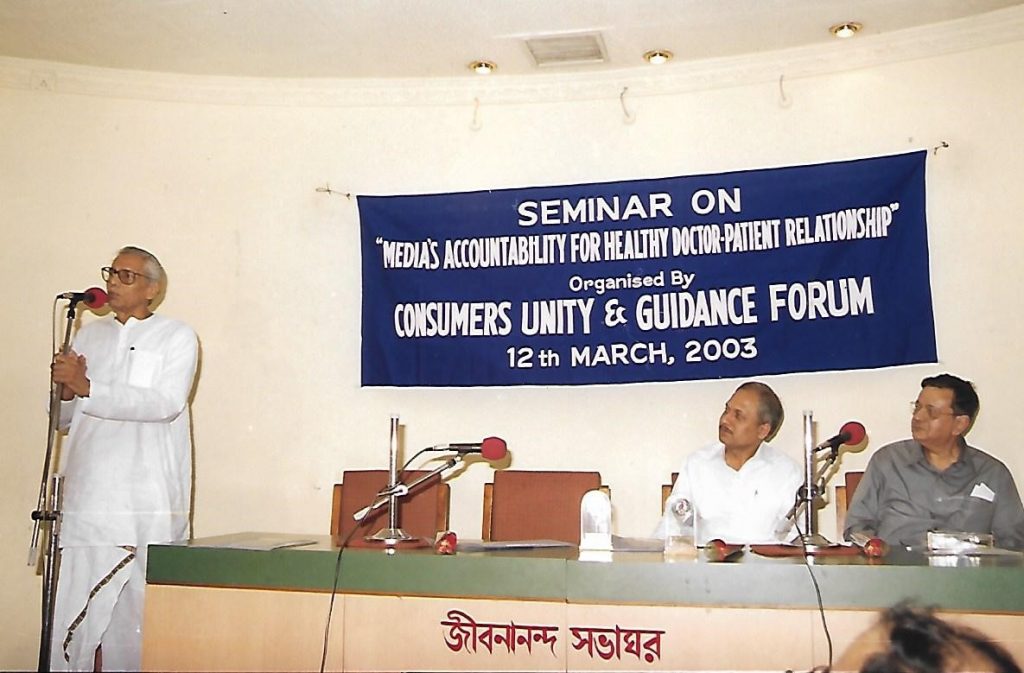
    A seminar of Consumer Affairs, with the then Consumer Affairs Minister of West Bengal, Mr Naren Dey.
    A seminar of Consumer Affairs, with the then Consumer Affairs Minister of West Bengal, Mr Naren Dey.

    A seminar of Consumer Affairs, with the then Consumer Affairs Minister of West Bengal, Mr Naren Dey.

    You started school in 1993. What legal formalities do we need to follow if we want to start a school?

    One has to envision the nature and the class of school one wants to start.

    School may be a Kindergarten / Primary / High / Secondary School.

    Permission from the Board under which the school shall be recognized is necessary if it is other than a Kindergarten school. If one wants to have the school run under a Board other than the local State Board, then a No Objection is to be obtained from the local State Board only after which the other Board, like C.B.S.E. or I.C.S.E. shall entertain the application for recognition.

    Teachers appointed should be on the guidelines of the Board to which the school gets affiliated to. The school has to have an internal guideline of rules and regulations for its students and also for its working staff and teachers. The position of a principal is mandatory.  And there are many other formalities and requirements to be fulfilled for running a school.

    How to undergo the transition from being under a senior to becoming an independent practitioner? Can you tell us about three things we need to prepare before starting our independent practice?

    Seniors only talk of their successes and make young lawyers run with a file for obtaining adjournments or filing papers in the court and carrying briefs with the seniors going for appearances in cases.

    To be a successful lawyer, one has to develop writing petitions, drafting cases and marking appearances whenever and wherever becoming possible. This will make them slowly and gradually indispensable to their seniors, who will entrust them with more work and help them grow into independent lawyers soon. To be a successful lawyer, one has to be punctual, hardworking and soft in his approach towards his colleagues. He has to be submissive and should learn to sell his talent along with his tears, which he shall have to swallow time and again to make him shine.

    If someone wants to become a judge in a Consumer Forum, what preparation one needs to have to deliver his duties properly?

    In whichever Court you work and discharge duties as a Judge, you have to have the reading skill and prompt decision-making ability. Because for many petitions coming, before passing the final order, one has to decide on Dias itself. One must have the patience to hear both the parties and should not try to make the third case of his own. 

    How was your experience as an Acting President of a Consumer Forum? Can you tell us about three remarkable instances?

    It has been a remarkable experience. Three of my remarkable stints as the Acting President of the Howrah Forum may be noted as follows-

    1. I looked after the administration of the entire forum and its finances too. And got Pending payments cleared through getting adequate budget sanctioned for our forum in time and gave relief to all service providers by getting their payments pending for more than three years to get released within three months of my taking responsibility. 

    2. Under my pen, I could make working guidelines for my forum.

    3. I enforced punctuality, honesty and timely delivery of orders in my forum, clearing the pending backlog of cases and timely discharge of cases.

    What critical component of this position as a Judge makes the work challenging?

    Awareness of applicable laws and knowledge of any precedents or ruling from the higher courts’ hierarchy. As a Judge, one has to be neutral and must strike a balance between the convenience and the inconvenience of the case parties and ensure that an order is not passed on such impractical terms that it never gets executed.

    How was your transition from being a Judge to becoming an advocate once again, and why did you leave your position as a Judge?

    The transition from a Judge to an Advocate is never a happy journey. When you plead as an Advocate, and you know the relief to be given is not given, you get lowered not only in your own eyes but also before the clients. Unpleasantness in nature grows. 

    Seeing my working capabilities, the West Bengal Government wanted me to go to all those Courts where working needed an overhauling. They started transferring me. I had my responsibilities towards my ailing mother, so I decided not to leave her in her last days. I discontinued putting this fact on record after accepting few transfers.

    You had a dynamic career; how do you summarize it in a few words?

    Experience pays. It builds your confidence and makes you challenge-worthy.

    What is your advice for young advocates who are planning to establish a successful legal practice?

    Aim at Judiciary. It gives you satisfaction in working and the joy of discharging justice honestly.

  • Nishant Choudhary shares his experience being the first Indian lawyer in Myanmar, being recognized as a top 40 EU Business leader and embracing change.

    Nishant Choudhary shares his experience being the first Indian lawyer in Myanmar, being recognized as a top 40 EU Business leader and embracing change.

    This interview has been published by Isam Kabir and The Super Lawyer Team. The Interview was taken by Priyanka Cholera.


    Nishant Chaudhary is a partner at DFDL and is also the co-chair of Euro-Cham Myanmar Legal Advocacy Group. Furthermore, he is a board member of the India Myanmar Chamber of Commerce. Mr Chaudhury completed his Masters in Legislative Law from George Washington University (Business & Finance Law) after his Bachelor’s from Symbiosis Law School, Pune. 

    1. You chose to be a lawyer when most people were inclined towards learning science or entrepreneurship. How did this journey happen? 

    I opted for law in 2001, when law as a career started to pick up. So, the law was not wholly an off-beat career. An uncle of mine gave me insights into the legal profession at a family gathering since he was a lawyer, and I thought it was not a bad idea. Initially, I was confused with respect to opting for law, however, gradually during my 5 years programme I started to appreciate the course and enjoy it. 

     2. Could you tell us a little about your time and experience studying at the prestigious George Washington University Law School? What encouraged you to do masters right in the middle of a full-fledged practice? 

     My experience in George Washington was good. Although I don’t want to make a comparative analysis, I hope that schools in India adopt a more practical education system than a theoretical approach. 

     I would generally not recommend taking a masters course right after one’s first degree because it clarifies the legal system and general interpretations. A certain sense develops after you have practised or worked in a law firm or corporate house. After my LLB, I focused on practising litigation civil, constitutional, criminal, and excise matters. While I was in Washington, I deviated from litigation and opted for business and finance laws. I realized that to further accelerate my career I had to diversify and which will likely be a career approach that will last longer. 

    3. Having studied at law schools in India and in the United States, what are some substantial differences in the pedagogical approach among schools in India and schools in the West? 

    I was a graduate of Symbiosis, Pune and the examinations were based on an academic standard. The practical intake was restricted to the fifth year. On the other hand, if you look at the American schools, they have a case-based education system and adopt a more practical way of teaching. Although, I believe now the New York curriculum in the law schools in India is moving towards that approach. 

     For example, In George Washington, there were mock trading sessions. During the anti-money laundering classes, we had a mock investigation session, basis on which we were asked to draft and an indictment. The course of teaching was very different and entertaining. Indian legal education system is very conventional, whereas the West has a more interactive way of teaching. But if education and entertainment go hand in hand, it tends to stay with you more comprehensively. 

    Moreover, the infrastructure is superior in American schools. The professors in reputed schools have several authoritative books to their names. My project finance teacher was a lawyer for OPIC, now known as Development Finance Corporation (DFC).  

    Another difference is the flexibility of choosing different and mix-matched subjects and the possibility of interlibrary access.   

    4. How was your experience before you moved into Banking and Finance Practice, i.e. as an Advocate at the Patna High Court and as a Counsel with Parekh & Co. (Advocates and Attorneys), where you worked on Competition law, Bankruptcy and Tax matters etc. Can you share a few experiences from that time? What is your take on specialization in the early years? 

    It is difficult to practice on the original side if you are unaware of the work at district levels. For young lawyers who will start practising litigation, it would be highly beneficial if they start practising in the District Court, or can even co-practice in both District court and High court at the same time.  

    Mr and Mrs Parekh, along with Mr Kumar and Mr Mohanty were very learned and great mentors. Unlike a regular law firm, Parekh & Co. had a very close-knit working culture. I assisted Mr and Mrs Parekh on the cement cartel matter and ADR, especially in infrastructure-related projects. In addition, I had the opportunity to walk into the chambers of prominent legal faces in India for case briefings, ranging from Mr Harish Salve and Mr Ashok Desai and other reputed lawyers. The experience was very enlightening. 

    5. How did the transition happen to be an In – house at a leading bank, and how did your time as a Senior Manager at ICICI Bank shape you into the Banking and Finance professional you are today? 

    I was a litigator while looking for a job in Banking and Finance. I had to undergo many difficulties in most of my interviews, although my prior experience was appreciated. I was deemed ineligible since I lacked transactional drafting experience. Furthermore, the recruiters provided that I would be a mismatch if given to work with junior associates. It is a misconception that earning a master’s will get you a job. It serves as an academic degree, not a professional degree. Someone suggested that an in-house role will be more appropriate for me, and from there, I could transact back to law firms. I applied for ICICI Bank and was interviewed by Ms Nitu Agarwal, who hired me.

    <p> 	<img loading=
    Nishant Choudhary

    6. Towards the end of 2014, you made the shift to Myanmar. How did this new role come about in your professional journey? 

    In my professional journey, I kept looking for any opportunity in ASEAN, not particularly Myanmar, but suddenly Myanmar opened up in 2013 and was recognized as the future market. A new market fell from the sky, where everything had to be done from scratch. I wanted to work in ASEAN, which Myanmar was a part of. Therefore I decided to move. I had to undergo a fair share of struggle initially, but it is now as convenient as any other metropolitan city in India with its growth in the last seven years. 

    7.How was your experience of starting life afresh in a foreign country? Were there any challenges that you faced for being a qualified Indian lawyer in a foreign jurisdiction? 

    I was likely the first Indian lawyer to enter Myanmar after it opened up in 2013. It was a completely different culture. My workplace consisted of people from Myanmar, China, the USA, Australia, Italy, the Philippines, Vietnam, Japan, etc.  One aspect of working abroad is that you need to be culturally sensitive, especially towards the locals. For instance, Myanmar is not a template western country and has a robust culture that they take pride in. The sensitivity facilitates a better work experience in a multi-cultural environment. 

    8. You are a member of the Executive Committee at Indo Myanmar Chamber of Commerce and Co-Chair of the EuroCham Myanmar Legal Advocacy Group. Do you take it as your responsibility to make Myanmar more inclusive for foreign legal professionals, mainly Indians and put it on the map as well? 

    I have been in the EuroCham Myanmar Legal Advocacy Group as co-chair for a long time. I work towards advocacy for the EU business in Myanmar, alongside regulators, to make the business efficient. Similarly, I am a part of the India Myanmar Chamber of Commerce. Naturally, being an Indian, there is undoubtedly similar scope there. So, the idea here was to facilitate good business and at the same time not just as a part of India Myanmar Chamber of Commerce or EuroCham, even in general conferences or networking events or in public interactions, I have always highlighted the potentials of Myanmar, and that is because Myanmar deserves it. It has tremendous potential with 53 million people, with abundant natural resources across the country, one of the larger oil and gas deposits in Asia, located between two large Asian economies and the connection of these two large Asian economies to us here. I do take it upon myself to showcase Myanmar for what it is.

    9. Can you tell us a little about your role as a Partner with DFDL? What challenges or responsibilities do you shoulder? 

    DFDL is a great employer, but that also brings about the responsibility of working with DFDL. While working as a partner with DFDL is to gain business for the firm and for the execution part where I am supported by a team. There is a lot of management work where it is essential to harmonize how things are to be achieved. As at the same time, I am also the deputy managing director of the Myanmar Company, so I have a fair share of admin roles as well. Furthermore, I have a role in different chambers where I am not in any position per se but just a member. I am regularly a part of it as well. My role ranges from business development to working on the project, training of the team to the administration of a firm’s entity and then general business community interactions and responsibilities.   

    10. Your extensive practice experience working in Myanmar and India and working on significant financial transactions include the first and one of the largest onshore syndicate financings of Myanmar foreign banks branches and the licensing of one of these branches. Apart from case preparation, how do you keep the morale high for you and your team? 

    I enjoy a blend of things, like business development, because of its challenging nature and how it develops the confidence to deliver. But, at the same time, I enjoy working on a matter with the team, and I am fortunate to have an excellent team.  

      When one works as part of a team and leading it, where issues are discussed openly, the working is efficient. That way, it’s the team’s decision as to what they are going to prefer. I believe in active participation so that my team is aware that I am also working with them. I don’t believe in a hierarchical approach. I think that we are all in it together, yes there has to be a degree of mutual respect amongst people, but it should be more of a casual atmosphere and more of teamwork. I try to be a facilitator because I want to remove the hurdle that my team is facing on a given task to efficiently work forward. 

    11. You have received numerous accolades for your professional achievements, all of which are very well deserved and earned. Of particular note is Top 40 EU India Young Business Leader, 2019, by Europe India Centre for Business & Industry, which you received at the European Parliament, Brussels, Belgium. What do these milestones signify as a lawyer as well as an Indian? 

    These are primarily appreciation of one’s journey in a way that incentivizes the person. But they are also recognitions. For example, on the business or negotiation side of the market, a client will prefer somebody who has a commercial approach and is recognized to be a facilitator of business in the relevant market. Especially the India Europe Business Leader happened because of my involvement in EuroCham Myanmar and assistance of Indian Companies. It was an invitation from the Europe India Centre for Business & Industry (EICBI)  at the Europe India Business Leaders Conference 2019 held at the European Parliament in Brussels, where I was facilitated by Hon Caroline Nagtegaal, who then was the Member of European Parliament – Netherlands & Vice Chair- European Parliament delegation for relations with India. 

    12. When hiring young law graduates, what factors do you take to be non-negotiable?   

    There is no exact template or box for the procedure. Everybody has their journey. A harmonious working attitude is essential for being part of a team and being driven by the teamwork process. There has to be a balance where everybody should get their own space and at the same time be a part of the team. Therefore, attitude is primarily crucial because knowledge is endless. Consequently, I can’t expect a person to know everything under the sun. However, if the person is unaware of the answer to a question, he needs to own up to the fact that he is not aware and is willing to work towards it. Finally, one needs to take ownership of the work. The client doesn’t pay a lawyer to tell them what they can’t do, but to guide them on how they can do it.  

    13. Do you have any advice for young lawyers, law students, etc., who are trying to make a career in Myanmar, Vietnam, Laos, and other jurisdictions in the South East Asia region which are booming grounds for legal talent? 

    Southeast Asian countries are the market of the future. It is essential to keep reading about these markets and see how the business trend is moving. These locations are highly remunerative. The career path is faster compared to a bigger market due to less competition. But there are also challenges like language barriers and cultural elements.

    14. Finally, any parting words of advice for our ambitious readers? 

    It should be remembered that opportunity comes to everybody but not at the same time. Therefore, instead of being disheartened, one should work on their career goal and be focused. 

    GET IN TOUCH WITH NISHANT CHOUDHARY
  • Sameena Jahangir, Partner at Kochhar and Co, shares her experience of working on Deal, entrepreneurship and hard work is the best formula for success.

    Sameena Jahangir, Partner at Kochhar and Co, shares her experience of working on Deal, entrepreneurship and hard work is the best formula for success.

    This interview has been published by Isam Kabir and The Super Lawyer Team. The Interview was taken by Priyanka Cholera.


    1. There are various acclaimed roles credited to your name, be it a law firm partner, startup founder or mentor. Which of these resonate with you the most?

     I wear different hats, but my core function is to improve myself and learn throughout the journey. The identity of a lawyer resonates with me the most. Even if I had all the money in the world and the luxury of not working, I’d still want to practice law since it’s something that I am passionate about. Law has also allowed me to teach and mentor people. 

    2.What motivated you to pursue law as a career?

    I had strayed from the law after my 10th and pursued science for 2 years with a misconception that I would become a doctor, but I realised early on in my journey that it wasn’t my cup of tea. I was entirely consumed and fascinated by law from the very first day. I come from a family of lawyers. My mother worked for a brief period as a lawyer dealing with insurance and accidental tribunal matters. At the same time, my father was a criminal lawyer, because of which the conversations in the household always circled law. My brother is an academician and teaches corporate, securities and tax laws to professional students. l I discovered a new perspective on the law when I interned at Desai & Diwanji with senior partner Aslesha Gowarikar. 

    3.Could you share with us any experience of discrimination based on your gender or any other trait, if any? 

    There is a lot of bigotry that surrounds women. The way I dress, talk and or carry/groom myself is very westernised and modern. It’s not uncommon for women to be told that they have reached a position because of the way they talk,  look and dress. I have also faced discrimination where I was denied rental houses to reside in due to my religion. There is a lot of bias in society still very prevalent even in developed metro cities which a lot of people have to face on a daily basis, be it, religion, gender, colour or caste.   I firmly believe that playing the victim card doesn’t help anyone. One has to do their part and if there is anything wrong happening not only against you but even to someone else, stand up and speak that’s the only way we can see change. Just keep working and have the results back their merit.  

    Sameena Jahangir Partner at Kochhar and Co

    Partner at Kochhar and Co

    4.Post your LLB, and while acquiring your Company Secretary (CS) from ICSI, you were a full time Articled Associate at Desai & Diwanji. How did you manage your time for your education when your legal career was in its budding stage?

    I started my CS at an early stage. I had already started preparing for it when I was doing law. I allocated any free time towards studying for it. I did not believe in studying long hours. Instead, I indulged in quality studying. I had no social life then because I directed all my focus on studying. As a result, I was both a lawyer and CS. My corporate work helped me to understand CS subjects better. 

    5. In 2019, you co-authored a book called “GOODS AND SERVICE TAX: No masterpiece was ever created by a Lazy Artist.”. Please share with us a little about the writing process. 

    I teach income tax, and I’ve always wanted to publish a book. We’ve previously written textbooks for our students, but a book is a whole other ballgame. So when the legislation for GST was passed, my brother and I decided to publish a book on it after studying the nuances. The aim was to create a useful book for CA/CFA students as well as professionals who need to work on taxes.

    Sameena Jahangir Partner at Kochhar and Co

    6.How did Lex-Sign – e signing portal materialise in 2021? Was entrepreneurship always on the checklist? 

    I have always been zealous about entrepreneurship. When I became a lawyer and started working at Desai & Diwanji, I visited startup seminars on weekends. I loved the environment revolving around discussions of ideas and business. Entrepreneurs offer new-age solutions to the management of problems. During the pandemic, I noticed that most of my clients had problems regarding the execution of documents, procurement of stamp papers, access to documents stored in their offices when personal meetings were impossible.  With the shut down of the trains, access to the office became very difficult. The idea of Lex-Sign came to my mind where we offer to provide easy digitisation of documents so that work can go on seamlessly. It’s a digitally encrypted platform for online signing, digital signing, Aadhar number based signing and procurement of stamp paper from across the country. The confidentiality of the customers is valued and protected. We rolled out this new venture with this mindset, and we’ve gotten a positive response this far. 

    7.What inspired you to move towards a more tech-savvy culture? 

    As part of the WFH culture, we realised the importance of being tech-savvy and digitalised in all aspects of our life. Therefore, it is essential to move to an online platform even for documentation to utilise the force of digitalisation fully. Most of my clients were facing this issue; therefore, something needed to be done about it. As a corporate lawyer, I understood the intricacies of privacy and data privacy laws and hence Lex Sign became a one-stop solution for e documentation.

    8.What steps are you taking to ensure that the process is simplified for anyone who is not tech-friendly or adaptive?

    For Lex-Sign, we arranged for almost no human interface requirement to carry out documentation. If someone needed to execute a document, they can simply go on the LEx Sign portal, order a stamp paper, upload the pdf document and then sign it without needing someone to handhold them through the process. 

    9.A year after joining Kochar & Co. as a senior associate, you were elevated to partnership in the shortest time. How did this transition occur?

    In Kochar, I joined as a senior associate, and within four months, I became a principal associate there. During the pandemic in September 2020, I was made a partner. The journey was very fast-paced, and the firm felt the necessity for a change in my designation. The promotions may seem fast-paced but it is the result of the 11 years  I have put into my career. 

    Sameena Jahangir Partner at Kochhar and Co

    10.You were the core council of advisors for Fincity in their acquisition by MasterCard in 2020, which was part of “Deals of the Year’ by India Business Law Journal. Attending such matters must be different from your other projects. How did you prepare to tackle this mega-deal?

    I was very fortunate to be a part of this said deal which was into the Fintech space. Like most deals, it involved long hours of work and some days felt longer than the others but I always kept a solution-oriented mindset. As a team leader, the most important thing is to not push down the agony and stress on your team members or the lower verticals. The mere role of a mentor or leader is to take control of situations when things fall apart and to accept accountability while cheering everyone else for success. I always tell people to take needed breaks, not to get burn out. That’s the only way one can perform consistently in the long run.

    I believe that in the whole scheme of things, legal advice is merely one segment. One needs to understand the issue holistically from their client’s perspective without sticking to the only nuances of the legality involved but go beyond that into the commercial aspects as well.

    11.Jahangir Tutorials was founded by you, where the mission is to impart education for ambitious CS students. Your enterprise has also achieved considerable feats like your students securing AIR 1 AIR 2 and AIR 3 examinations. Jahangir Tutorials also has a youtube channel where you upload your lectures. Has Jahangir Tutorials evolved their pedagogical approach with time? How well-received and appreciated was the response to this endeavour? 

    At Jahangir Tutorials, subjects for the Company secretary exams are taught for all levels. In the Pre-pandemic period, physical classes were conducted, and anyone with access to it could join us. With the onset of Covid, a change was made to make Jahangir Tutorials accessible to everyone by uploading our lectures online on Youtube. We received a positive response and today we are the fastest-growing CS digital class in India. This is also because we value the time of others and keep our lectures crisp and apt. We received appreciation for our online videos from people all across India and how they helped them with their preparations for CS exams. Teaching is the most fulfilling job because you get a direct stake in creating the leaders of tomorrow. 

    12.Lastly, any words to the wise?

    In my professional journey, I have learnt that there is no substitute for hard work. There is no luck or coincidences but pure results of one’s merit. Don’t let go of the focus at any point. There is no shortcut to being rich either: it’s a simple swap of service for money. However, I always believe that the ultimate important quality to possess is to make sure you’re a better person than you were yesterday. You can be the best lawyer and know the best application of your knowledge, but if you’re not kind and lack empathy, you gain nothing at the end of the day. Speak well always and use your knowledge and communication to do good for others. 

    Get in touch with Sameena Jahangir

  • Harpreet Singh Hora shares his experience of being an engineer turned lawyer, student politics and changing fates through PILs.

    Harpreet Singh Hora shares his experience of being an engineer turned lawyer, student politics and changing fates through PILs.

    This interview has been published by Isam Kabir and The Super Lawyer Team. The Interview was taken by Priyanka Cholera.


    (1) Having pursued a Bachelor’s Degree in Computer Science from LPU, what motivated you to switch streams and pursue law at Delhi University?

    I passed CLAT in 2011 when I got in touch with the current LawSikho management team, which ran a CLATHacker platform back then. However, due to financial restraints and my family’s wish, I pursued Engineering instead and later opted for a three year LLB degree from Delhi University. As far as the reason is concerned, I have always been intrigued by the field of law. I believe that this is a dynamic profession that gives you excellent learning opportunities. Moreover, this profession accentuates your personality, and that’s what perpetually kept me devoted to it.

    (2) During your graduation from Delhi University, you worked as a quiz master at LPU. Later you’ve also provided your services on similar lines at DAV College and MMU Mullana, Ambala. You also occupied the Hot Seat opposite Amitabh Bachchan in Kaun Banega Crorepati, Season 9. What is it about quizzing that interests you so much?

    I was majorly introduced to the culture of quizzing during my school days and then continued it during my college days, both inter and intra college. I participated in a quiz competition organized with the Association of Indian Universities (AIU) in my engineering college, where students from different universities competed at the zonal and national levels. Eventually, I qualified for the nationals. After that, I began conducting quizzes for my hostel and my department in engineering, and from there, the students from other universities and colleges began inviting me to their institutions. So the journey from being a quizzer to a quiz master has been a fascinating one.

    I had been a hot seat contestant in KBC in 2017. It was one of the most memorable experiences in my life.

    Harpreet Singh Hora

    (3) How has your time at Delhi University shaped you as a person? You contested in the elections for the post of General Secretary as a youth leader. How did you happen to join politics?

    Everybody in Delhi University is interested in contesting elections, directly or indirectly, and I was no exception. When I first stepped into the law faculty, before I could see the board where the college’s name was written, I saw posters of students interested in contesting elections. And Delhi University elections were a big deal on the news channels. I discovered that the people in reputed higher political positions in Delhi are associated with student politics at Delhi University, which intrigued me. It was one of the best decisions I have taken because it ultimately helped me network and establish better connections with people active in the Political circles. The university seniors always said that the Delhi University elections teach you a lot, and I agree.  

    Contesting elections in law school, i.e., the University of Delhi law college, is one of the most challenging contests. The University features politics on two different levels, one on the college campus level where the political parties are not officially involved, and the other is at the university level, where parties directly back up the student organizations. In the faculty of law, the students participate at both levels in politics. Most of the faculty of law students are prior students of the Delhi University (during their graduation). They have already experienced student politics for three years at the base level, but it was alien. In my experience, the elections were indeed complex and demanding, but the challenges had taught me indispensable lessons. 

    (4) One thing that sets you apart from other first-gen lawyers is you have dived right into PIL work while most people chase settling and big clients. Was this a conscious choice?

    The issues I have generally dealt with and the case laws that are a part of my research primarily concern the aspects of prison reforms, social justice, and the 1984 Anti Sikh Genocide victims. However, that does not limit my work to PIL as I have my own Pan India practice in criminal law, service law, matrimonial law, and writing. Although, I have always believed that society needs improvement or the system requiring some restructuring. Thereby I have focused on petitions that deal with social justice or public interest. As far as we have noticed, young lawyers are generally more concerned about acquiring potential clients and earning their remuneration, and there is absolutely nothing wrong with it. In conclusion, the positive attribute of this profession is that one can directly contribute to the system’s development and align the same with their professional capabilities. 

    (5) You started your practice as an assistant to Zoheb Hussain, Senior Standing Counsel of Income Tax Department, Delhi High Court. What value did this experience add?

     Working under Zoheb Hussain has been an absolute pleasure. He is a hard-working man, and I am sure he will soon reach new heights in the industry! I did not have prior knowledge about tax law, and neither was I acquainted with commerce. However, the interview mainly focused on our personality and the type of lawyer we aspired to be, rather than focusing on whether we know about the subject. He aimed to make us more responsible as junior associates with a different approach. First, when we received a file from the client, from the receipt of that file to the disposal of the case, everything was responsible for one associate. Secondly, he also gave us the autonomy to monitor the whole case on a micro-level, which involved the responsibility to abide by the dates and timelines. 

    If a petition was drafted, he did not just make corrections and send it back to us; instead, he called us in his office, and he would begin live editing that petition in front of us. l After pointing out the mistakes, he gently; explained the format, the methods and everything that was to be taken care of. Thereby subconsciously, one starts picking up those habits; and would often refrain from repeating the same mistakes. I had noticed that once associates completed their tenure at his office, they had improved as lawyers.

    (6) A good mentor makes a good mentor. Do you also consciously choose to do that for your juniors or your interns, let them see your formatting and styling live in front of you and make sure that you also have the same aura or demeanour as your junior? What do you look for when you hire someone?

    I am still in the learning phase. I try to be with my colleagues. Eventually, all of us are learners. From a recruiter’s point of view, my primary focus during an interview is to know if the interviewee can understand the concepts. Secondly, I judge the knowledge of the candidates based on their CVs. I will not ask the interviewee a random question on constitutional law or criminal law. The academic score in those subjects does not matter to me. However, If the person has written a research paper, they would have to explain it. It also gives me the idea that the individual has learnt through that activity and was not a mere co-worker who got the name published in somebody else’s research.

    (7) You represented the NGO- Justice for Rights in the PIL seeking regulations, licensing, and guidelines on Internet platforms, including Netflix and Amazon Prime Video platforms. How is it like standing in front of the most prominent players in the game?

    As a young lawyer, these types of cases do come off as an opportunity for one to learn, and it hardly matters if a favourable judgment is received or not. The clients, back then, were students and could not find a resolution to the case. I felt that it was a thrilling matter and took this as a great learning opportunity. I was also curious to know about the possibility of any platform that broadcasts audiovisuals on your mobile phone or laptops and if one can go ahead without regulation. On the first day of the argument of this case, the judge had completely bashed me. I believe that it was my fault as a lawyer since I could not convey the point. The honourable bench remarked that if the Censor Board Certification did not have an issue, I did not have the authority to object. Then it struck me a gap between what I was trying to say and what the bench had understood. I then pointed out that they are not even supposed to carry a Censor board certificate. I even attached the RTI, where the ministry provided that they do not have specific regulations on that, and I had an intense exchange of argument with the judge. After this, the bench was half convinced. They had sought a reply from the ministry. Eventually, it came out from the ministry that this is a new phenomenon, and they do not have such regulations which they have asked for on these platforms. We fought the case and brought it to a logical end, but ultimately it got dismissed by the Delhi High Court.

    The students back then were in a dilemma about going behind for an SLP or not and questioned the chances of it succeeding. I believed it looked like a good case and that there was a probability of the conveyance of my point to the Supreme Court that wasn’t conveyed to the bench earlier. And fortunately, they decided to take the case forward. Ultimately, the Supreme Court was convinced to notice the case, and the SLP was admitted. So although the matter is still pending in the Supreme Court, there have been impacts.

    (8) You appeared on behalf of the Delhi Sikh Gurdwara Management Committee to secure the students’ right to the Sikh community to wear Articles of Faith- The Five Ks in the NEET examination. Can you tell us about that experience and case?

    The topics related to the case of these five articles of faith in Sikhism are inherently close to me because I have read in-depth about the history of Sikhs of securing their right to wear a turban starting from the Mughal’s era, to the time of the British Colonisation, to the post-independence phase. Any development of legislation in India, specifically in the respective regions, impacts the legislation in different parts of the world. Back in the 1970s, the right to wear a turban while riding a motorcycle was a major controversial issue in England’s Road Traffic Act. The right to wear a kara, the right to wear a kirpan has been most talked about in different countries and recently, like 10 or 15 days ago, there has been an unfortunate incident in New South Wales, Australia. They are now drawing on some legislation and guidelines on the right to wear kirpan by schools or college students. So this has been a topic that I believe still needs to be researched upon, to include more legislation concerning these topics. These are the grey areas that are often brushed aside. Indeed it was a great experience working on such a case. On the other hand, a phenomenal incident that occurred was that a favourable order was passed just three days before the exam, which eventually changed the fate of the course when I was representing the case for Sikh students.

    (9) You are also working for the up-gradation of facilities in jail and reforms in prison. Can you share the timeline of this journey and how close you are to achieving what you set out to achieve?

    I’ve started working for prison reform. That is a system I always believed needed to be looked into with profound research. But, unfortunately, even after 74 years of Independence, we still follow those archaic prison rules and manuals.

    The issue began when an inmate did not receive adequate physiotherapy facilities in the prison. This was followed by two other cases, where one concerned the assault on inmates and in the other, the fight was for all the inmates respectively. These petitions got clubbed, the local commissioner appointed by the Court took a survey of those prisons and suggested improvements in the petition. we even challenged the discrimination between prisoners’ facilities when the high-security ward prisoners had alleged discrimination in terms of facilities against the facilities provided to the general ward prisoners

    IN another case, an executive order was petitioned against, where the prisoners held under a particular act would not be allowed to conduct mulaqat (meeting) with anyone but their blood relation. The case is pending in the Delhi High Court. I believe there needs to be a great deal of improvement in the prison area. Ironically, if we do not take action right now, it may become a full-fledged practice area in the coming time.

    (10) In what ways has the ongoing pandemic affected your practice? Do you have any suggestions for maintaining one’s mental health, mainly due to the workload that comes with being a lawyer?

     The biggest challenge the young lawyers face is the hiring freeze by law chambers. With the decrease in workload, the chambers are cutting down associates instead of hiring new ones. As a result, many lawyers have relinquished their chambers or offices and have shifted back to their hometowns. They claim that there is hardly any inflow of new clients, and when necessary, the cases can be conducted through video conferencing. As for me, being a workaholic, the dip in the workload has indeed started affecting my mental health.

    Therefore, I would advise all my colleagues to adapt to new technology and the new methods the Court and the authorities are coming up with. I can claim with absolute surety that the technology in law is here to stay. I believe it should remain. Although video conference has its challenges, it has also opened up new doors of opportunities for young lawyers. Furthermore, we need to explore new ways to use this technology to improve our financial status and acquire more work. Presently we have witnessed clients being more inclined towards engaging lawyers who they believe can represent your entrust appropriately in the Court, irrespective of their experience in terms of practice in a number of years. 

    As for keeping oneself sane, it is advisable to use this time to learn the things one has always wished to know or pursue a hobby.

    (11) If given a chance, what would be one piece of advice you would give to first-gen lawyers and law students about beating the odds?

    My advice to everybody alike is to have a clear goal; The sooner you have clarity in what you want to do, the better. The second is to consider achieving that goal, and it would help if you had a good plan coupled with a realistic timeline. Never compare your success with somebody else’s. Some people have struggled in this covid period, and some rose high during this pandemic. Focus on your own goal, even if you think you are lagging. Each person has the time to rise and shine on one’s own accord.


    Reach out to Harpreet Singh Hora