Author: SuperLawyerTeam

  • Abhinav Bhalaik, Partner at Algo Legal shares his view on founding law firms, working with startups and serendipity.

    Abhinav Bhalaik, Partner at Algo Legal shares his view on founding law firms, working with startups and serendipity.

    This interview has been published by Isam Kabir and The Super Lawyer Team. The Interview was taken by Priyanka Cholera.


    1. What pushed/led you to pursue a career in the legal field? 

    For me, it was more of an accident than anything else. I was playing professional sport so it was a tossup between carrying on with that or maybe doing something in academics. I was almost slated to study economics at Delhi University and I had written a few law school exams. Back in the day, we had individual exams for law schools instead of the CLAT. When I got into NLU Jodhpur and was also on the waitlist at NALSAR, someone told me that it makes more sense to do something professionally and if you’re really passionate about economics, there would be plenty of opportunities later. We had a double honours option at law school, so I majored in economics and law.   That’s how law school happened and one thing led to another.

    2. Please tell us about your experience at NLU Jodhpur. Few people know that your batch was one of the first five batches to graduate; can you tell us how your alma mater contributed to your success in your formative years?

    I look back to my law school days very fondly. It was challenging back then but when you’re younger you have a lot of energy and you can rough it out. Initially, we never had a hostel to live in within the campus of the law school. I remember we were staying in a guest-house in the city which was actually a lot of fun because there were no hostel restrictions, so we could go out, explore the city and sleep late. It was challenging in a lot of ways; from our first moot court participation to our first moot court win as a university, setting up the editorial board and setting up various committees. At the same time, we had Dr Mitra, who had set up NLS and then joined NLU Jodhpur. He was a stickler for academics and inculcated in us a stringent academic discipline. However, he was extremely student-friendly and supported us in whatever we wanted to do. So, we never felt the paucity of funds. But I think it was a very collegiate working environment between the faculty-led by Dr Mitra and all of us. 

    3. It is also known to us that you were offered a Training Contract at Freshfields Bruckhaus Deringer, a leading Magic Circle law firm. Could you tell us a little more about the opportunity and what were the factors that helped you bag this job?

    Back then we were applying to some of the United Kingdom-based firms. Being one of the initial batches you have to figure things out yourself. I went through the interview process and got selected. In fact, I was even slated to go and start my training contract. But it was during the time when the global financial crisis happened due to which most UK law firm training contracts were delayed. But that’s also when I had the opportunity to meet my first partner who I worked under.  He was formerly a Freshfields attorney and had just returned to India to set up Platinum Partners. So, I guess,  things just have a way of playing out. 

    4. Your first job after graduation was with Platinum Partners. Did you find yourself in a similar situation as 2020 graduates, given that 2009 was a period of recession as well?

    My graduation batch was an exceptional one. I have batchmates who are IAS and IFS officers and also a lot of us today are partners in leading law firms across India. So, academically it was a very sound batch and most of us had worked very hard and had extensive internship experience. The people we met during our internships realised that recession or no recession, we were a bunch of students who are hardworking and maybe fairly capable. So, a lot of us got good opportunities despite the recession, but there was a fair number that did not. Once the economy started getting better, although a lot of them started out at places where they ideally wouldn’t have wanted to, because they were good at what they were doing- hardworking as well as resilient, they all landed up where they wanted to be in some years. 

    5. Please tell us about your role and responsibilities at Platinum Partners, especially being part of the firm in the initial years?

    I think I was very fortunate to have started out in a small team. And being a part of the initial bunch of lawyers, your level of exposure and the level of training is at a different level. I ended up working with someone who had more than twenty years of experience than I did. So the learning is huge and you are also challenging yourself every day. Also, I was fortunate because my first partner was a very nice person and a very hard taskmaster. He focused on training us and developing us as lawyers. And by default in a smaller organisation, you have responsibilities. Whether it is bringing together a library, interviewing students in law schools for internships or fresher associates, or even handling business development. So you do have a lot of exposure on the non-client side of things. Also on the client-side of things, you are thrown in the deep end much sooner and though you have a senior looking after you, you are told that you have to swim by yourself.

    6. In 2017 you moved to Shardul Amarchand Mangaldas & Co. What were the new responsibilities that you took on as a partner? How did your journey so far prepare you for this?

    I was not made a partner directly. There was a three to four-month period during which I was as an of-counsel. So, the way I worked at Platinum and the way I work today, I don’t personally believe too much in designations. All law firms have a designation to make people feel good about themselves. I think your growth as a lawyer and as a professional depends on the level of responsibility you can take as you go about with your work. So after five or six or seven years if one is competent, well trained and can take responsibility, whether you are a principal associate or an associate, it is all just a nomenclature. My training and experience were a lot better than the one that you get at larger firms because in bigger law firms you are initially lost all over the place and you’re mostly working with seniors who are at best three or four years more experienced than you. So I think it was the technical and non-technical training that I received at Platinum Partners which did wonders for me. And as I said, if you are ready to become a Partner, you don’t have to be called a PA or a SA beforehand to become a Partner. If given the choice, to go back and redo, I would never pick a big firm to start out with because the quantum of learning is way better in smaller ones. So, I would always pick a small firm to work with and a good senior to learn under. And I think that is the absolute key.

    7. After almost 4 years at Shardul Amarchand Mangaldas, you moved to AlgoLegal as a Partner. What is your vision for Algo Legal, in terms of services and team building? 

    Seeing  Platinum Partners being set up from scratch, I witnessed the entrepreneurial side of a lawyer. I was very clear that at some point in time I would do something on my own. I  come from a business family so for me maybe things sit very differently. After I resigned from SAM, I was in the middle of figuring out what I wanted to do and that’s when we started talking with the few like-minded people who were in a very similar space in life. They were accomplished professionals and legal practitioners who were looking for a different challenge and we’re very focused on value addition to clients along with the use of technology in a big way. And fortunately for me, I had known some of them very closely and had worked with them in my earlier organisations. So things just sort of came together and that’s how it all started with Algo.

    8. How has the ongoing pandemic served as a turning point in the M & A sector and law firm work culture? Do you believe law firms can adapt to work from home for the long haul?

    I do believe that we will see a slightly modified working model. People have realised that we can do a fair bit of work not being in the office every day, but at the same time there is a big merit of being in office too, especially for young lawyers, because the training that you can have in an office environment is very different from what you can have on zoom calls. I think we’ll move towards a hybrid model. The pandemic has been challenging and people are going through a lot. But at the same time clients have been very accommodating. Although times have been difficult and challenging, we’ve seen people being extremely supportive. So I’m very thankful to my colleagues and clients. I think we have all stuck together.
    We are witnessing a lot of M&A activities so the difficult part is executing so much work sitting at home. I have witnessed a fair amount of consolidation happening and when I say consolidation, I mean a lot of the smaller players are selling out to the larger players. So there is a lot of market consolidation taking place and that’s when M&A activity becomes fairly robust. 

    9. AlgoLegal has a particular focus on startups and in furtherance of that, has a free legal kit with important resources and documents. How do you think the Covid – 19 pandemics have shaped the business environment for such startups? The tech industry is seeing a boom; is this really a silver lining in the dark clouds?

    At Algo, we have initiatives where we work with young founders who don’t have a lot of cash or resources. We do a lot of pro bono work. I think we are the only firm in India that is using tech the way we do. We did a very interesting series with NUJS where we were teaching technology and law as a credit course. So we try to do whatever we can. We believe that tech is going to be a big part of law firms going forward. 
    To answer the second question, it hundred per cent has. I would not want to call it a silver lining because a lot of people have suffered. But it has definitely given a spur to technology. It has put tech-forward by at least half a decade. And the toolkit is because we work with a fair number of founders and young people and we realise that while we charge our professional fees, it’s a small gesture on our part as a  way of giving back to the community which has supported us a lot.

    10. How do you feel about most startups suffering immense losses and raising humongous capital in the funding series; is it about being a unicorn? What is your take on it?

    I think there are two models. There is the model that Zerodha has followed, where they have hardly raised any funds from investors. The other model is where people have taken a lot of funding. So I think the model where you take a lot of funding and become a unicorn, what the real aim is to hit a certain volume of sales. And to hit that volume you need to burn cash.  I think everybody is banking on the fact that when you hit those economies of scale your profitability starts becoming better. Because what happens is that your cost beyond a point doesn’t balloon. So to take any company to a level where the economies of scale are keeping in, you need to have substantial funding. You need revenue so, you need to burn cash and to burn cash you need to receive money from investors and the moment you receive that money your valuation changes. And I think a lot of them are eyeing the IPO market because they intend to raise a huge quantum of funds from the public markets. What I will say is that it’s still early days in India. Ten years before, people wrote off these startups. I have been in conversation with people who said, “What is this Zomato? What is this Swiggy?” They made fun of these ventures. But I think the world is changing and it has played a big part in where these startups have reached. So it is a wait-and-watch, but I am very interested to see where it all lands up. 

    11. How has the pandemic that entailed lockdown impacted you personally and professionally?

    Other than battling the virus personally and at home, it has not been too bad. It’s disheartening to see the number of people who have suffered personal losses. Beyond a point, you can’t even blame the government but I think that there has been a systematic failure and many deaths could have been prevented. We have lost some very capable people in the legal fraternity as well. So that’s sad and makes you think about what more one can do. At our firm, we are working on initiatives for our people where we can make them more comfortable; we make sure that topics like mental health are discussed, spoken about and not shoved under the carpet. 

    12. Any parting advice to law students and young lawyers on building a successful career in corporate law and how important are ethics in this professional pursuit?

    The only advice I will give people is that you can listen to as many people talking about their experiences, but at the end of the day, do what works for you. Read my interview but, at the end of the day, there will be things that will work for you and don’t rely on any particular person’s experience. I think everyone’s life experiences are different and every person speaks for himself. Unfortunately, most people want their life experiences and advice to be held up very high but, I don’t really believe in that. My only advice is that if you like something, go for it and you will learn along the way. 

  • Dr.Kabir Duggal on working as an Arbitrator in the US, being a Harvard-Oxford-Leiden-NYU scholar and being an inspiration to thousands.

    Dr.Kabir Duggal on working as an Arbitrator in the US, being a Harvard-Oxford-Leiden-NYU scholar and being an inspiration to thousands.

    This interview has been published by Isam Kabir and The Super Lawyer Team. The Interview was taken by Priyanka Cholera.


    Dr Kabir Duggal is a Senior International Arbitration Advisor in Arnold and Porter’s New York office focusing on international investment arbitration, international commercial arbitration, and public international law matters, He is a graduate of the University of Mumbai (Gold Medal), University of Oxford (DHL-Times of India Scholar), NYU School of Law (Hauser Global Scholar), Leiden Law School (2018 CEPANI Academic Prize), and is currently pursuing an SJD Degree from Harvard Law School.

    1. Your accolades and achievements are known to the world, the career trajectory you have witnessed is one everyone dreams of but only a few achieve apart from all these. What is something the media or the world at large doesn’t know about you?

    I am delighted to be here. And very grateful for the kind words. I think two things that people don’t realise, and this is true for everybody, is that we need to be a little more sensitive and give ourselves a little more of a break. Second, there is a lot of hard/smart work behind the scenes but there is going to be a fair bit of failures. For every ten things you do, nine times the answers will be a ‘NO’ but the tenth answer might be a yes! So, you need to keep trying. Keep the good fight on! 

    Further, you need a little bit of the right time and right place and so we must not take for granted the opportunities. In India, in particular, there is so much talent. You need the opportunity to channel it and that sometimes is not fully within your control. But always try and grab opportunities whenever you can.  CaRPE dIEM.

    2. Let’s start from the beginning: why law out all the career choices available?

    I got into law, unlike a lot of people today. Most people today get into law right after high school. I did not. I did the three-year course after I had an undergraduate degree. The decision to enter law was not one that I had taken lightly. This is what I encourage everyone to do: think about your skill set, think about things that make you happy and try to find a career that combines both of these. So I realised that I like speaking, debating, writing and I thought that that skill set fills itself nicely with the legal profession. When I got into law school, I realised – this is fun! 

    3.In your academic trajectory, right from GLC to Harvard, routing through NALSAR, NYU, Oxford, Leiden, you have been denoted as a scholar, rightfully so, what about academia or research kept you going?

    As noted above, my decision to get into the law was a conscious choice. So I got into something I enjoyed, I mean no one is compelling me to do all this. I do it because I enjoy the process–getting to read things that are fun, getting to talk to people who are very smart. Different people can look at the same thing very differently. I think in Jain philosophy, it is the Anekantavada philosophy, where the same thing can be understood in so many different ways. I do feel particularly privileged to have been affiliated with some of the best universities and study with the best minds. 

    4. How has your experience before venturing into arbitration i.e as Judicial Clerk, Honorable Justice Sujata Manohar, Consultant, Development Research Group – At The World Bank Group, Legal Consultant To The Child Protection Unit – Unicef has shaped you and can you share an experience or two?

    Justice Sujata Manohar is a pioneer, a truly remarkable person. She was able to study law at a time when women did not have equal opportunities (and this is true all over the world). She became a Supreme Court Judge but her humanity and compassion made her stand out. I look at her as a mentor and a role model even today. And if I can become half the person that she is, I will consider that a success. 

    My interest when I got into higher education was in the areas of public international law and in human rights. And that’s where UNICEF and the World Bank came in. And both of them were very different but very amazing experiences which are really hard to come by. You really do feel quite privileged to have had those opportunities. UNICEF began as an unpaid internship. It started off that way and became a two and a half year stint. In fact, they invited me to come back after my masters at Oxford and before I started at NYU.  

    While I was at NYU, the World Bank Group offered me a consultancy and that is how that position happened.  Again another fascinating experience. 

     They were very different areas of law. One was looking at child rights and child protection while the other was looking at socio-economic rights in the developing world. This experience has been pretty remarkable because it exposed me to a wide range of areas within international law. 

    5. One of the most interesting observations we have noticed is you have kept human rights in the centre of your academics, what inspired the shift to arbitration? 

    My interest has always been in public international law.  International arbitration, particularly investor-state arbitration, allows me to pursue my interest in public international law and human rights because the cases often involve an intersection between several areas of public international law.  But, my interest in human rights still continues. I am part of a team that has created a global non-profit to increase access for arbitration lawyers from all over the world (https://letsgetrealarbitration.org/) and I work as a consultant for the UN office for Least Developed Countries. 

    6. How has your time at Curtis, Mallet-Prevost, Colt and Mosle LLP, Baker McKenzie, honed you in the arbitrator you’re today?

    It’s been a very exciting journey to work on some of the largest and most prominent disputes. Every firm has a different culture. Every firm has a different way of looking at things. In the investor-state context, in particular, some firms focus more on state work, some focus more on investor work, some do a hybrid of both. So getting exposed to different people, different ways of doing things, I think challenges you and helps you appreciate things in a variety of different ways. Indeed, you can get very comfortable doing the same thing the same way every day. I think having something to challenge you helps you learn a different skill, a different way of doing things.

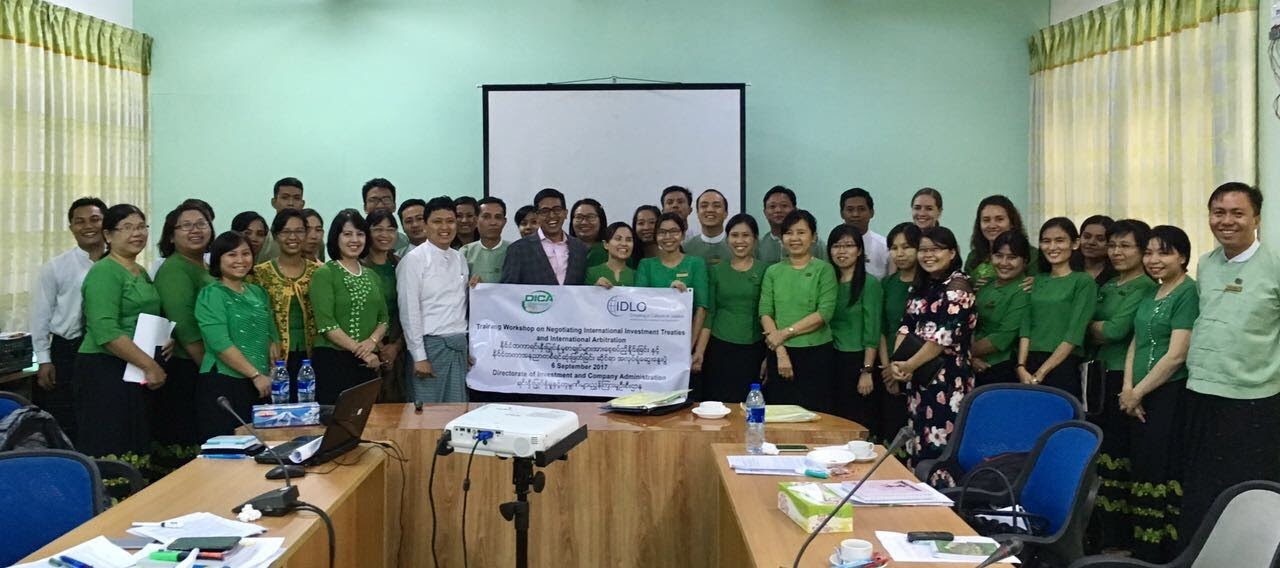
    Undertaking training for the Government of Myanmar

    7. Can you tell us about your PhD thesis on Investor-State Arbitration at Harvard as well as Leiden?

    Investor-State Arbitrations, sometimes you call Investment Arbitration, is a specialised form of International Arbitration. This is arbitration between a foreign investor and a sovereign state. Your Respondent is always going to be a Country or a State and the Claimant is a foreign investor. Here the foreign investor alleges violations of international law that often arise out of investment treaties or (domestic) foreign investment laws. And the dispute is resolved before an arbitral tribunal. Some examples in India are like Vodafone which brought its case against India arising out of a tax measure. This was under the UK-India investment agreement. That would be one example. These are cases against the sovereign so by nature, they tend to be highly political and long-drawn. It’s a lot of fun but there is a lot at stake. 

    At Leiden, my focus was on evidentiary standards in investor-state arbitration. This is a fascinating topic because international arbitration seeks to avoid detailed rules of procedure and evidence.  However, a tribunal is still bound by certain evidentiary rules.  The process was to identify what principles of evidence could be derived from the general practice of states and from public international law that would bind tribunals.  I was very privileged to receive the Academic Prize from the Belgian Arbitration Center for my research.

    My current research at Harvard looks at the intersection of human rights law and investor-state arbitration. Investment disputes often tend to implicate human rights.  For example, an investor may allege that a state policy implicates the right to fair and equitable treatment but the state may seek to justify its actions on human rights considerations.  My research seeks to unpack this tension between investor protection and human rights. 

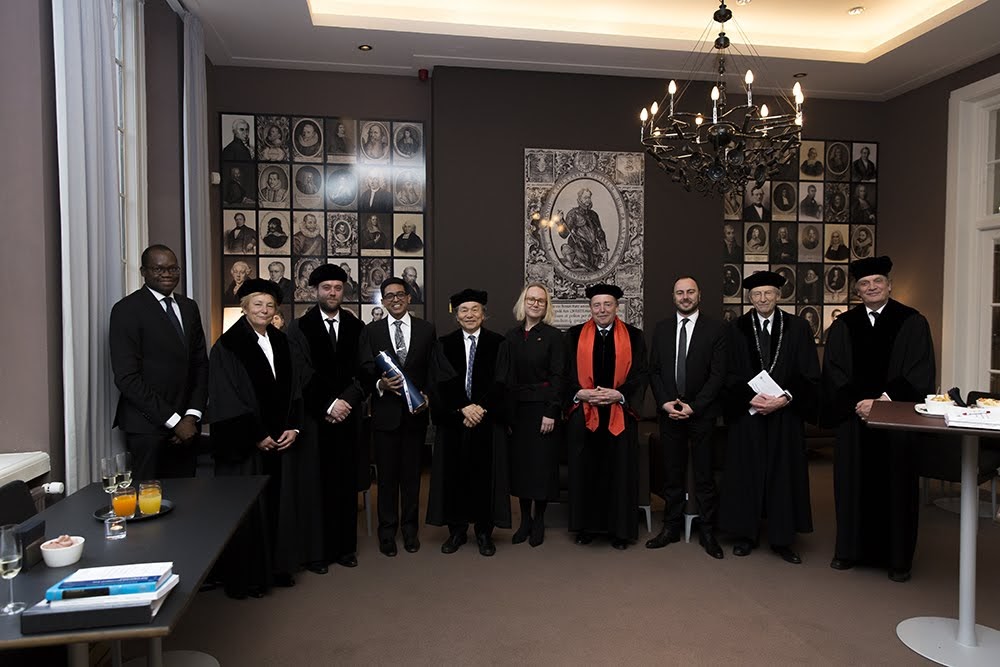
    The Leiden Defense
    The image is following the Leiden Defense

    8. You have been teaching at Columbia for nearly a decade now, and have taught at Madrid, Georgetown University, India, Harvard to name a few that pulled you towards it as given your qualifications you could have easily taken a corporate job or started practising given that you are qualified to practice in New York (U.S.), Washington D.C. (U.S.), England & Wales (Solicitor), Maharashtra and Goa (India)?

    I have always wanted to teach. As of this year, I have completed twelve years of teaching. Indeed, when I had started some of the students at Columbia University were older than I was. I enjoy it. It is something that I enjoy. I am a big believer in people doing things that make them happy. If something makes you happy, go for it. 

    9. You are a part of the Rising Arbitrators executive board, Consultant for the United Nations Office of the High Representative for Least Developed Countries, Landlocked Developing Countries and Small Island Developing States (UN-OHRLLS), you have published over 40 articles and spoken at over 300 arbitration events across the globe, what inspires these endeavours?

    Thank you, All these are things that are fun, I enjoy them. I like writing, speaking, and meeting new people. When you do something you enjoy, it does not seem like work. Some of these activities are also opportunities to make a difference and so I feel particularly privileged to have the opportunity to do so.

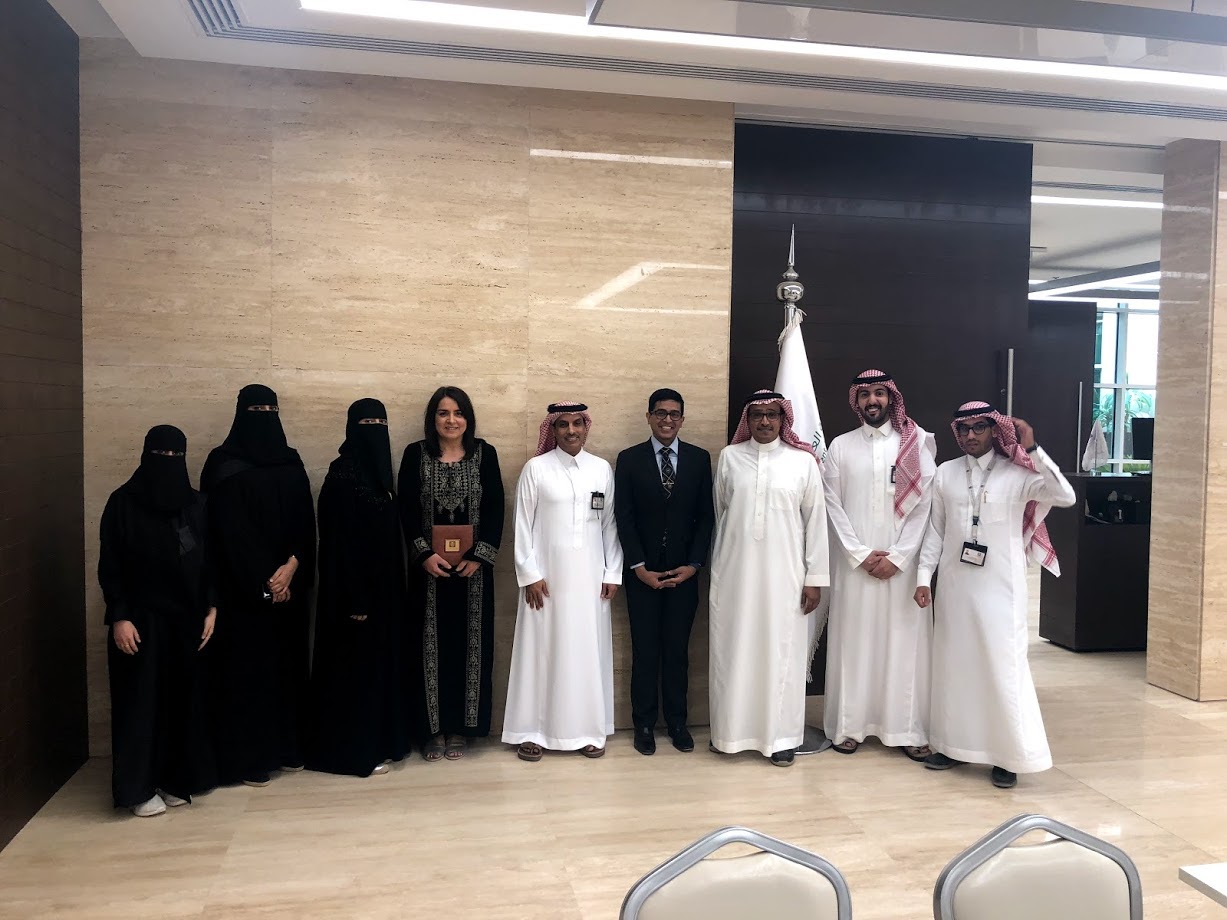
    Undertaking a Government Training with Representatives from Saudi Arabia (which is my country of birth)

    10. You started your journey as a law student in 2001, in GLC you have been part of this fraternity for 20 years now. What has changed for you in this passage of time?

    When I went to law school there was only one national law school.  NALSAR & NUJS had started and they still hadn’t had even the first set of students who had graduated. If we look at the legal landscape in India today it is very competitive. With the proliferation of law schools and people with ambition, it is a rather different reality. 

    Indeed, when I was in law school,  there was some amount of stigma in studying law- “You can’t do anything. So, you’re doing the law.” So, I think that would be the biggest change. There’s a lot more dynamism. The law students are a lot more dynamic and are a lot more willing to be enterprising and that’s a good thing. We are seeing the market evolve as well– for example, we are seeing greater think-tanks, non-profits, academic avenues in India. All this is great for our profession. When I graduated, legal education was still in the nascent stages. I look at it now though, you have people who are very thoughtful scholars today; people who are really engaged. That’s good for India at large. The profession is in better shape than when I was in it. So I look at it as a good thing. It’s becoming quite similar to the American model- very competitive, but the people who get into big law, so to speak, have a very steady career path set for them.

    11. How often have you been the only Indian in the room? Do you think silent racism towards Indians or Asians still persists or they’re still underrepresented in board rooms and classes?

    I think this is a great question and is worth addressing. Does racism exist? The answer is yes. Does racism exist against Indians in the law field in the west? I think the answer to that is also yes. It may not always be direct or overt but it does exist. If we look at the United States, Indian Americans have done extremely well in business, science, technology, engineering. That has still not been the case for the legal profession. But hopefully, things will change and we should always strive to do two things. First, we should always be aware of the privileged position that we are in and we should try, whenever we see bad things happening, to stop it. We’re lawyers and we are in a privileged position to stand up to injustice. There are people who don’t have that, both in India and in the US, and it’s important for us to stand up for injustice (this can often be taking a stand against innocuous sexist or offensive stereotypes). The second point I would just mention is, last year in the US (although this is not unique to just the US), you looked at violence against African Americans and then Asian Americans, which really got us to reflect on the inequities that exist even in our profession. We, therefore, launched an initiative called REAL- Racial Equality Arbitration Lawyers and one of our goals there is to advocate and give access opportunities to people who otherwise don’t get it. We give a lot of scholarships to attend arbitration events which can often be very expensive. I would encourage the viewers to look at this if they’re interested in arbitration, these are put on our LinkedIn Page: https://www.linkedin.com/company/real-racial-equality-for-arbitration-lawyers.  We are free to join the organization so if you are interested, consider signing up.

    12. What are a few pieces of advice you’d like to give to students or lawyers who want to pursue foreign education through scholarships?

    First, You need to start the planning process early. There will be an academic component and there will be an extracurricular component, both are important. Make sure you’re not doing one at the cost of the other. Sometimes you see people who have done like 15 moots, leadership positions in many organizations but grades are mediocre or you see people who’ve only focused on grades and done nothing else. So my suggestion is to find a good balance. 

    Second, have a nice consistent narrative to tell. Can your narrative change? Yes, it can. Tell it in a manner that’s interesting, that’s personable, but reflect a little bit on your story. 

    Third, pay particular attention to scholarships and see the requirements that they have as well as the deadlines. 

    Fourth, access your financial situation and make an individual assessment of whether or not it makes sense for them to pursue higher education if you have to take out a loan. Be prepared for the best and worst-case situation. Jobs outside India are few and far between and highly competitive.

    Finally, consider the visa reality. This is probably one of the areas that are not within your control. This is increasingly becoming harder and harder, as countries are restricting immigration. So when you’re doing your pros and cons, you really need to factor in this reality.

    13. It is known to us that apart from Hindi and English, you are fond of Urdu and have learned Spanish and Sanskrit as well, what are some of your favourite reads?

    I think with time my interest has been becoming greater and greater in reading books on history. And my specific focus, not exclusive, but the specific focus has been on reading about different aspects of Indian history. When you don’t live in India this is one way to remain connected with your heritage. I am currently reading the Age of Wrath by Abraham Early that discusses medieval India (even though the book focuses on the Delhi Sultanate there is a very interesting discussion on the Vijayanagara empire as well). 

    14. In your opinion, how will pandemic change the way we perceive education? Do you think it has achieved the philosophy of the world being a big classroom?

    The pandemic has definitely caused a lot of suffering. I will acknowledge that at the outset. Having said that, some good things have come out of it. And one good thing that has come out has been embracing technology. There is something to be said for in-person meetings but there’s something to be said for having opportunities like this where you can talk to people across time zones, across different countries. So, hopefully, post-pandemic, we keep some of this alive. The world has become a lot closer.  

    15. How does it feel to be a source of inspiration for so many people? 

    I am very grateful to hear this and am touched that people feel inspired.  I believe that my journey has still just only started 🙂 

    16. What would be your parting advice to students and everyone dares to dream big?

    Have a plan and go for it. Dream big and also be realistic. But there’s nothing wrong with aspiring. Take advantage of avenues around you. Avenues like Law Sikho didn’t exist when I was in Law School. Take advantage and be positive, failures will happen and that’s fine. To quote Kelly Clarkson- ‘What doesn’t kill you, probably makes you stronger. Therefore, take charge of your career.  

  • Bharat Chugh, Rank 1, Delhi Judicial Services, on resigning from judgeship and returning to civil and criminal practice

    Bharat Chugh, Rank 1, Delhi Judicial Services, on resigning from judgeship and returning to civil and criminal practice

    Bharat Chugh graduated in law from Jamia Millia Islamia in 2011 and thereafter began practicing independently, taking up cases involving a wide range of legal issues, both Civil as well as Criminal.

    In 2013, at the age of 23, he secured first rank in the prestigious Delhi Judicial Service, in all the three stages of the exam. He joined the Delhi Judicial services as the youngest to crack the exam in his batch. After three and a half years of being a magistrate, he recently decided to resign and return to the practice of law.

    He is also an avid writer, currently working on two books and has various publications to his credit. He is also extremely passionate about mentoring ‘future judges’ and contributing to ‘judicial education’.

    With his combined work experience both in litigation and Judgeship, he talks to us about:

    • His introduction to the Legal Profession
    • The need to reform the system of education
    • Trials and Triumphs in Independent practice
    • His experience of acing the Delhi Judicial Services
    • His return to Litigation


    How would you introduce yourself to our readers.

    I graduated in law from Jamia Millia Islamia in 2011 and entered the bar at the age of 21; I practiced law independently for about one and a half years before being selected in the Delhi Judicial Service. I joined as a Civil Judge/Metropolitan Magistrate at the age of 23 years. After heading various criminal/civil judgeship assignments and an extremely fulfilling career as a judge, I decided to return back to my first love – the practice of law.


    Tell us a bit about your initiation and experience with law.

    My father was a practising lawyer, however my initiation in law was by no means a conventional one where a father hands over the baton to his son. My father’s law practice was brought to an abrupt halt when he had a massive stroke. I was 6 years old back then. As a result of which our family’s financial position became extremely precarious. I figured out that a regular school education was not only a needless (and avoidable!) expense, but also kept me from working. I had to contribute to my household in terms of finances, to keep it running. Yes! I am essentially a drop out and left regular schooling after 8th Standard. However, I continued my education through the Open School, frog leaped some classes and ended up gaining two years in the process. I kept working alongside.

    By the age of 13-14 years, I was already accompanying my father to the court, drafting pleadings and arguments. When my classmates were learning the first principles of science and math, or just plain fooling around, I was handling my father’s law practise from a small seat near State Bank of India, right below Tis Hazari Old Nazareth Branch, under the stairs, which was our headquarters. It used to be the hub of all activity. A lot of learning in the actual ways of law happened by osmosis by just being in the middle of the action. Like any other 14 year old, I was at times happy on being excused from the drudgery of banal school work, and at others upset over being plucked rudely from the comforts and certainties of a normal childhood and all that comes with it. However, the early initiation in law, gave me a sense of fortitude and a ‘I can deal with whatever life throws at me’ attitude. I also taught computers, designed websites, worked in a Call Centre for a brief while, just to earn those extra bucks each month. However, what at first blush may appear to be a setback, turned out to be a huge advantage. The exposure to work ethic and law, at a very early age gave me a head-start. Though, I was missing school classes, I was learning some valuable life lessons. This was how I also managed to work my way through college and entered the profession.


    “No two persons can learn something and experience it in the same way.” Can this is said to be applicable to the system of education in india both law and non-law? Tell us about your experience

    I would agree with that. This also explains how different eye witnesses to the same incident give different accounts of it. This also emphasises the need to shift from a conventional text books based learning to experiential learning. It is quite meaningless to talk about isolated learning, especially in the discipline of law, divorced from experience. I must say my early initiation into law and education in the university of adversity and hard knocks of life, set me up in good stead for a career in law.


    How do you say a law student can shape up his profile for litigation while still in law school? Does academic writing help?

    A practising lawyer’s language is his foremost stock in trade. Law Students should work on their verbal as well as writing abilities. The ability to articulate even the most complex of issues clearly and succinctly is extremely important for a lawyer. The most successful lawyers are often the people who know the most and can present it most articulately. So while in Law School one should soak up as much as one can. Master your legal concepts. Discuss with your peers, ask questions, attend talks/lectures/seminars. Mooting is also extremely important. It gives one a sense of what it means to be in a court room. I participated in as many moots/quizzes as I could, and as they say, each drop of sweat in practice, saved blood in War. Mooting helps one develop that quality of being able think on one’s feet. It’s like being in a bouncy, even if you fall you don’t get hurt

    Academic writing does not only look good on the CV, but helps one understand the first principles of law better. This also helps a student hone his drafting skills.


    How important do you think are internships for a law student? What sort of internships did you do while in college?

    Internships are extremely important. I interned with Sr. Advocate Sh. KTS Tulsi, Delhi Legal Services Authority. I also assisted Dr. Tamara Relis from the London School of Economics in some research projects. I also worked briefly as a correspondent for a Law Magazine ‘Legal Era’. All these internships give on quite an insight into law-in-action and an opportunity to survey the legal scene from the shoulders of giants. Throughout this, I also kept assisting my father in his law practice.

    I also did a lot of legal aid work in Law School. Me and my friends started a 24 X 7 Legal Aid Cell, and worked in active collaboration with Delhi Legal Services Authority on a lot of projects. These projects gave us a ringside view of the law. The legal aid projects, which were totally selfless, did finally pay off. After I graduated, these cases would go on to be my first briefs and help me enormously in my initial phase as an independent practising lawyer. (Call it Karma!).


    bharat-chugh-2

    Soon after graduation, you began practising. What challenges did you face in the initial days at the bar? Any memorable trial court experiences?

    Soon after I graduated, I observed a huge vacuum in traditional litigation scene. In this vacuum – I, as a 21 year old lawyer, saw opportunity. Everyone wants to be a Senior Advocate, but few are willing to pull all-nighters for an important case. I used to take up briefs for what people will consider a pittance, and tried to deliver the best service possible. My previous legal aid experience, publications and frequent court appearances ensured that briefs (though not too well paying initially!) still kept me busy.

    During this time, I got to advise my clients on a wide range of legal issues including Criminal Law, Bail Applications, Injunctions, Conventional Civil, Contract, Property and Commercial litigation, Arbitration, Writ Petitions, Cases relating to Negotiable Instruments, Financial Fraud and Cheating, Matrimonial/Inheritance/ Succession/Guardianship and Custody Laws. I had many overseas clients to whom I rendered advise on various issues relating to interface of foreign law with Indian Legal system, enforceability of foreign judgments/awards in India, anti-suit injunctions, etc. Some very vexed issues indeed !

    My favorite court room triumph came in a divorce case where I was cross examining. This was one of my first cross examination cases and I was still pretty naïve in the art. It was a case where I was appearing for the husband in a divorce petition, where he was seeking divorce on the ground of mental cruelty, as his wife had filed a false 498A/ 406 IPC case against him. She had alleged that my client had kept the entire articles of her stridhan and thereby committed criminal breach of trust. The witness in question was the lady’s brother, who had come to depose as to ‘how dutiful his sister was, and it was my client who had treated her cruelly’. As soon as that middle aged North Indian Punjabi Man came into the witness box, I could already see the anger in his gait. He appeared to be a man with an acute sense of honour, and I knew that this potentially might turn out to be his Achilles heel. I planned to hurt his credit and let him burn on his own. I asked him and I remember the exact words :

    ‘I put it to you that you have sold all your sister’s gold articles, and misappropriated the money!’ He just blew his top off on this one and launched a scathing attack on how insensitive I was. I politely reminded him to answer the question first. He blurted out “That is incorrect!” He further volunteered: “It still remains with us”. I immediately followed it up with the finishing coup de grace and drove the proverbial last nail in the coffin: “but you haven’t brought it to the court! You’re lying!”

    He agreed to bring it to the court on the next date of hearing. I got these two answers recorded and concluded the cross examination. Through these two questions, we were able to demonstrate that the 406 IPC charge levelled against my client was false. If we would have asked him whether they had the gold or not directly, he would have clearly denied the same. My client won the case eventually, and this rather damning admission was one of the factors that weighed heavily with the court. A case won by a single question, and a killer argument; nothing compares to this high. One doesn’t need food or drink for days. This made me really happy and yes, the word spread fast, it fetched me a lot of good clients.


    Prior to entering law school, did you ever wish to be a judge? What motivated you to apply for judicial exams?

    Frankly, No. I shared the prevailing stereotype that one doesn’t get to be judge, unless one has more salt than pepper in his hair. I had never imagined I’d be a judge at 23. Since I was initiated into law when I was still 13-14 years, I always wanted to be a lawyer. In my fourth year of law, I got hooked to reading great Judges like Justice Chinappa Reddy, J. Krishna Iyer, J. Chandrachud, Lord Denning, Oliver Wendel Holmes, Lord Atkin & Justice H.R.Khanna, amongst many others. They inspired me a great deal. I was fascinated with how these judges breathed life into the dead letters of law by creative interpretation, fashioned remedies, where they apparently were none and did substantial justice. During this time only, I first got enamoured with the idea of being a judge. I have seen a lot of injustice and inequity early on in my life, my heart used to be rankled at each injustice. This was a beautiful opportunity to be a part of the solution and actually dispense ‘Justice’. A service that allowed one an enormous ability to correct injustices, contribute to the evolution of law, and at the same time, quench one’s penchant for writing.


    What is the structure of the exam and how did you prepare for it? What motivated you to accomplish such a feat?

    (Not only did Bharat secure the first rank in the Delhi Judicial Service Examination but he was also the youngest to do so.)

    I started studying for the Delhi Judicial Service Exam, alongside law practice. I also took took preparatory classes with Mr. Rahul Yadav of Rahul’s IAS (fondly called ‘Rahul Sir’) at Mukherji Nagar, Delhi. The time at his classes did wonders and really helped me build a strong conceptual base and made my job much easier. I also started teaching my juniors in whatever time I was left with after court, classes and my own studies. It dawned on me that the best way to master a subject is to be able to teach it. All in all, I used to spend at least 8-9 hours a day either studying or teaching.

    Armed with about a year of preparation, I appeared for the Delhi Judicial Service Examination (in short ‘DJS’). To give one a fair idea: DJS exam is not rote based exam and is based on real life cases, involving extremely vexed questions of law; issues that have arisen in the recent times before the courts. The examination has the distinction of being the toughest judicial service examination in the country. It is spread over three stages, first stage is the prelims – which is objective type; the second stage consists of 4 written exams which are subjective and test one’s ability to write well, followed by an interview/personality test. The exam is intensive and requires the student to don the mantle of a judge and write proper orders/judgments. The preparations are strenuous but extremely fulfilling for someone who likes to grapple with legal issues.


    How did you feel when you got to know about your excellent scores in the judicial services? Please share with us your experiences thereafter.

    On the day the results were declared, I was arguing a bail application before the High Court. I was ecstatic to find that I had not only cleared the exam but also aced the exam, in all the three successive stages. I was also the youngest at 23 (or rather, the least experienced!) in my batch. I must confess that I was on the horns of dilemma when the results came out. I enjoyed the practice of law immensely and it was hard to let go-of. After thinking days and nights on the trade-off involved, I finally came to the conclusion that ‘a life of reticence’ was a small cost to pay, to be given this opportunity to do so much good. The existing clients, who had reposed great faith in me, were naturally a little sad about it, but happily moved to my friends/associates who took my cases over, making my transition smooth.

    At 23, I took the oath of office on 28th May, 2013. The text still sends adrenaline rushing down my system, each time I read it, and the text will be incomplete if I don’t reproduce it in full :-

    “I, Bharat Chugh, having been appointed a judge, do solemnly affirm that I will bear true faith and allegiance to the Constitution of India as by law established; that I will uphold the sovereignty and integrity of India, that I will duly and faithfully and to the best of ability and knowledge and judgment perform the duties of my office without fear or favour, affection or ill- will and that I will uphold the constitution and the laws. “

    As Wordsworth puts it ‘Bliss was in that dawn to be alive; to be young was very Heaven’. I took over my first judgeship assignment in June, 2014 as a Metropolitan Magistrate (NI Act), Tis Hazari. Life had come a full circle, so to speak; My father had started as a typist in Tis Hazari only, roughly four decades back, and I also began my career from here only as a judge. He was ecstatic to say the least. I had fulfilled the promise that I had made to him. I wanted and always tried to make a meaningful difference to people’s lives and hence took it up.

    I did not find the transition very problematic. My essential duality as a lawyer, and the ability to argue both sides, was never a hindrance in judging. In fact, it helped me appreciate both sides of a question even better.

    On the essential qualities of judging, As Socrates says ‘four things belong to a judge: to hear courteously, to answer wisely, to consider soberly, and to decide impartially’. This, I must confess, is an extremely tall order to go by, but I always tried to abide by this principle. The art of active listening isn’t easy, but once mastered, is worth its weight in gold. One learns a lot that way. I learnt so much from counsels who I had the privilege of hearing in different cases.

    A judge’s life is not easy; it is, in a lot of ways, a hermit’s life. It requires reservoirs of patience that run deep and never dry up. Social Contact is quite limited. But all this, as I’ve said earlier, is a small cost to pay for being able to dispense justice.

    I had the opportunity of writing judgments in countless cases that kept the pangs of writing satisfied. Though arguing was something I always missed.


    Law students aspire to join practice, judiciary or the civil services but usually tend to shy away from providing legal services and see is as a chore. Is such an attitude advisable?

    No. Judicial Services or Civil Services is extremely fulfilling. It does require a lot of preparations but let us not forget that knowledge does not go to waste ever. Even if someone does not make it to the exam, the knowledge holds the student in great stead, throughout their lives. In a knowledge driven economy, the man with knowledge wins sooner or later. I know so many people who were extremely capable, but for some reason could not clear the exam, but armed with such great knowledge entered practice and did extremely well.

    As regards litigation, I agree there are enormous challenges for a young litigator, and the going is extremely tough, at least in the initial few years, especially if one has no legal background. It is also extremely demanding insofar as an individual lawyer has to divide his time between attracting clients and core legal work, however, nothing takes away from the fact that the struggle is extremely sweet, and those three minutes in court kind of justify everything.


    Can you tell us about the training you received at the Delhi and National Judicial Academies. Is there in a need for reform in training programmes of judges?

    After taking the oath of judgeship, I, along with my batchmates underwent one year of extensive induction training at the Delhi Judicial Academy, Dwarka which included – academic sessions as well as hands-on experience in court management, docket management and court craft. We, along with our seniors – presided over various judgeship assignments, such as Civil Judge,, Guardianship Court, Metropolitan Magistrate, Crime Branch court, Special Court for cheque bounce cases, Special Court under the Prevention of Corruption Act, Sessions Trials etc. The Training at the Delhi Judicial Academy is truly transformative. The academy works as a think tank and training institute for newly recruited and existing judges.

    I was also fortunate enough to be at the National Judicial Academy, Bhopal for a brief time and it was truly enlightening. One gets to interact with judges from across the country and exchange best court practices. It is an opportunity that no intern/scholar/judge should miss.

    The training programmes are quite comprehensive and inter-disciplinary. It would be a great idea for the academies to also introduce courses in comparative legal positions in foreign countries and the psychological aspects of judging, heuristics and logical fallacies, which are extremely important for a judge to know.


    Any memorable judging experiences that you would like to share with our readers?

    There are many actually. There is one that I remember off-the-cuff. I was acting as a Railway Judge, for a brief time, as an additional charge (called the link judge), where I was aghast to find that young men and women were being prosecuted for begging/selling tea on the railway platform under an archaic provision of the Railways Act. This was a classic case of, what one author calls, ’Criminalisation of the Poor’. The sight of these unfortunate people mired in poverty, and disowned by the State moved me a lot. I gave voice to my anguish in one of my poems called the ‘Confessions of a young judge’. This gave me sleepless nights, and I had to find out a way to help them, of course within the framework of law. The relevant provision in the Railway Act clearly prohibited such an activity; However, convicting them will amount to me being a court of law and not a court of justice. Taking cue from Justice B. D. Ahmed’s remarkable judgment in Ram Lakhan v. State (2006), I dropped proceedings against many of these people, invoking the doctrine of ‘necessity’. I ruled that: A person was excused from the crime of begging, if he begs in order to save himself from starvation and a certain death. I wrote, with great anguish, that if the so called welfare state could not provide basic necessities for these people, it had no right to prosecute them. These orders were never challenged by the State before the higher echelons, which was undesirable insofar as a judgment by the High Court on this point would have had a wider coverage and could have provided a much needed security cover to these forgotten souls and benefits would have trickled down on a much wider scale.


    The judiciary today is in crisis due to the excessive backlog of cases. Can mediation be a solution to this crisis? Is there any other form of adr which can be looked upon as a potential solution?

    Backlog is a huge issue. Courts are crumbling under pressure. Too many cases on the board deprive cases of the personalised care and attention that they deserve. With such work pressure, it is indeed a challenge to maintain quality not just in the final judgment, but also in the process. I worked in my first assignment for one a half years. It was one of the heaviest courts with over 5000 cases; I managed to dispose of about 3800 cases in the first one and half years. I tried to implement new court and docket management strategies.

    Mediation and ADR is, of course, the way forward, not because of the system’s inability to deliver timely justice, but because of the qualitative worth, finality and superiority of a decision arrived-at, by the parties themselves.

    In order to further the cause of ADR, I also made a reference to the Hon’ble High Court of Delhi on a question of law relating to ‘Mediation/ADR in Criminal cases’. The reference was subsequently entertained, amici appointed to assist the court. A landmark decision is expected on that point which would streamline the mechanism of ADR in criminal cases !


    You recently returned to the practice of law after resigning from judgeship. What were the factors which influenced you to do so?

    All in all, after a three and a half year, and a rather fulfilling stint at judging, I decided to once again return to the practice of law. I sorely missed being able to practice law in the last three and a half years. Once a lawyer, always a lawyer as they say ! I also missed being able to write and teach. Having fulfilled the promise made to my father, I had certain promises to keep with myself and this is but the first step in that direction. Whether I’ll be able to redeem those promises is something that time will tell. But, for now, as Shakespeare would say, there is method in my madness !


    What would be your parting message to our readers?

    There is no substitute for hard work in law. I’ll quote Justice Joseph Story when he said “The law is a jealous mistress and requires a long and constant courtship. It is not to be won by trifling favors, but by lavish homage.”If you are able to do that – there is little else that you’ll need ever again !

  • Amitabh Lal Das, Director and Head – Legal, Max Life Insurance, on his journey as a lawyer, work experience in litigation, transactional work and in corporate bodies

    Amitabh Lal Das, Director and Head – Legal, Max Life Insurance, on his journey as a lawyer, work experience in litigation, transactional work and in corporate bodies

    Amitabh Lal Das graduated in B.A.(Hons.) from St. Stephen’s College, DU in 1990, thereafter he pursued M.A. in 1992 and then completed his legal degree by 1995 at Campus Law Center.

    With his qualification in law he started working with firms such as Vaish Associates and A. S. Chandhiok Associates. During the six-month long strike of lawyers that began in January 2000, Amitabh decided to pursue the British Chevening Scholarship, irregardless of his prior apprehensions he got successfully selected for it.

    With his scholarship he was appointed at Morgan & Walker, Solicitors, London and after returning from his exposure to the English law firms he decided to join transactional work at Kochhar & Co. In 2004, he was accepted for the LL.M programme in Securities and Financial Regulations at the Georgetown University Law Center (GULC). He had to discontinue it due to intervening concerns of expenses.

    Later he moved on to Sapient in their Regulatory and Compliance team. After Sapient, he is known as the General Counsel of Yahoo! for seven years. He is the Director and Head – Legal, Compliance & Regulatory Affairs currently at Max Life Insurance from July, 2014.

    In this interview, we cover his journey as a lawyer till date, while focussing on:

    • His first few years after graduating in law
    • Successfully achieving the British Chevening Scholarship
    • Varied work experience in litigation, transactional work and as in-house counsel
    • Senior work profiles at Sapient, Yahoo! and Max Life Insurance


    Tell us a bit about your childhood and pre-college life as well as educational background.

    I was born in Patna and lived in Hazaribag (formerly in Bihar, now in Jharkhand) till class Xth, which I completed in 1985. After Class Xth, my parents put me in the Delhi Public School (DPS), Mathura Road, where I lived in the hostel. In 1987, I passed out of DPS with a top position in Humanities at the All India Senior School Certificate Examination (AISSCE).

    Thereafter, I pursued B.A (Hons) in History at St. Stephens’s College, Delhi University, from 1987 till 1990 and secured a first division. I then joined M.A. (History) at Delhi University Arts Faculty, and continued to be resident at St. Stephen’s. I completed M.A. in 1992 and cleared the first Law Entrance exam for the LL.B programme (1992-1995) at the Campus Law Centre, Delhi University. I completed law in 1995.

    After some years of work, in 2000, I was awarded the British Chevening Scholarship by the Foreign and Commonwealth Office of Great Britain for the Young Indian Lawyers Programme. I was one of the twelve Indian lawyers selected by the British Government for this short duration programme for a certificate course in British and EC Commercial Laws and Practice from the College of Law, York. The programme further entailed a short stint with a London Law Firm. I successfully completed the course and the internship in 2000.

    In 2004, I was accepted for admission by the Georgetown University Law Center (GULC) in its prestigious LL.M Program in Securities and Financial Regulations. I deferred joining the program by a year but eventually did not attend it as I could not arrange to pay for the expenses. Not being able to do the LL.M program at GULC is a big regret of my life.


    Before pursuing law, you completed your Masters in History. How did your interest gravitate towards Law?

    I had chosen Humanities after Class Xth. Although I was a topper in Class XIIth, I chose History over Economics because of two reasons. Firstly, in the assessment of my quantitative aptitude, which would be the key to success in an Economics major, was quite weak and, finally, History was considered a better, more manageable subject with higher success rates in those days at the IAS exams and I had aspirations to become an IAS officer. As per the age thresholds and the IAS exam calendar, the earliest I could have written the IAS exam was a year after completing my graduation (B.A.), and if I pursued M.A. I could continue to live in St. Stephen’s College Residence. So, M.A. in History was a natural extension of the earlier decision to chase the dream of becoming an IAS, and in my view at that time, there was no place better than St. Stephen’s College to nurture and execute that dream.

    After my first brush with the IAS exam, coupled with the realization that after reservations in Civil Services jobs, which had been increased, I would be competing only for 50% seats, I did think about a Plan B if Plan A of getting into the IAS did not work out. Law seemed exciting, full of prospects for learning and having potential for success.

    There was also a flexibility that Law could afford a good second main subject for me at the IAS exam if I did not do well in Public Administration, which was my chosen subject for a few of the attempts I took at that exam. In sum, my gravitation towards History was more as a means towards an end as I was clear that I would not want to become a History academician.

    Similarly, my gravitation towards Law after a Masters in History was more rooted in realism, dictating the need for an alternative career plan.


    What difficulties did you face while starting your private practice? How did your prior experience help in this regard?

    (Amitabh worked in the litigation department of many firms such as Vaish Associates, A.S. Chandhiok & Associates, A.Y. Chitale & Associates before deciding to start his private practice.)

    At Vaish Associates, I got some exposure to Tax litigation but most of my assignments there fell under the corporate legal advisory type of work. In fact, the urge to shift from Vaish to a pure litigation outfit was driven by this quest to understand litigation better since it dawned upon me that comprehending the mechanisms for dispute resolution and justice delivery must form the bedrock of an initiation into a career in Law. This realization came to me because my ignorance about the practical connotations of litigation terms like “suit”, “writ”, “mentioning,” etc. would come into sharper relief when I would discuss my day with my flat mates, all of whom had joined litigation practices. I then had a good fortune to work with Mr. Chandhiok, where I became familiar with the fundamentals of litigation. At this chamber, the exposure was primarily in the Delhi High Court and I also assisted him in some matters at the Debt Recovery Tribunal and the District Court.

    In those days, opportunities for lawyers were not of the same breadth and order as they are today and it would become evident to young lawyers early in their careers that they would need to branch out on their own and, therefore, needed to think constantly of the path for the eventual branching out. As I thought then, this decision would involve substantial capability building in terms of gaining experience in different forums and then taking a call as to what the scope (which courts/tribunals) of the private practice could be.

    Thinking on those lines, it was my belief that I needed a stint with a lawyer in the Supreme Court of India to buttress my learning at Mr. Chandhiok’s chamber and also to reach the point of making the decision about the scope of the private practice. Atul and Suchitra Chitale were kind enough to provide me that opportunity.

    For me it was daunting, without any social roots in Delhi and being a first generation lawyer, the prospect of having to compete with scions of established families in this profession as well as other members of the fraternity whose families had been in the profession for generations in Delhi. So, another deciding point was whether to stay back in Delhi or go to practice in the Ranchi High Court, which I easily ruled out in favour of continuing in Delhi. It struck me that if I got on to the panels and got work from government bodies or public sector companies to begin with, that would give me opportunities to work on early breakthroughs. Although I had initially thought that ten years of experience would be the threshold for setting up a private practice, as luck would have it, I got on to panels of several public sector enterprises between 1998 and 1999. Owing to conflicts that my empanelment, requiring my personal time and commitment, created with my working with Atul and Suchitra, I had to take the plunge of starting a private practice earlier than I had initially thought.

    The problems I faced were when I set up my practice related to management of an enterprise; of running a business. In a way, a lawyer’s practice is an exercise in entrepreneurship, which requires a skill-set that I had not developed at all by then. As a lawyer, one needs, not only a law degree, some knowledge and experience in advising, drafting and arguing matters but lots and lots of more. The enterprise requires a set up, a business pipeline and hence business development, multiple hands and minds to collaborate, administrative help (e-mail/billing and filing systems, etc), client dealings, knowledge management, etc. The other problem that I faced was to get work from the corporations that had empanelled me; empanelment did not mean automatic flow of work to me from them as at times there were certain unsavoury dynamics involved. The biggest roadblock I experienced, even as I was learning to deal with the other issues, was six-month long strike of lawyers that began in January 2000, from which I never recovered (I went to England instead) and did not return to litigation.


    How and when should a young lawyer decide to begin his/her own private practice?

    Of course, each young lawyer must chart her or his own path based on their individual circumstances. I might sound conservative but my belief is that a young lawyer may do well to start on a self enterprise journey at a point of convergence between a fair degree of legal competency acquired over working with good seniors for a reasonable period of time and a decent preparedness for handling the wherewithal of a private enterprise. For some, this may take longer than others but each must identify that point of convergence on their own and it would be superfluous for me to prescribe a time frame.


    What type of skills should a law student strive to develop while in law school to succeed in the field of litigation?

    My primary advice would be to develop skills beyond just academic excellence. Any skill that would help in giving comfort to the client, and to the court, would help in achieving success in litigation. In my observations of some of the great litigation lawyers of our times, I would say, the skill of understanding human dynamics, the skill of observation, the skill of getting deep into the plot of a story that is the subject matter of litigation and living its characters, as perhaps in theatre; the skill of always imagining things to the last possible mile so that what one proposes is not open ended and has a resolution one way or the other. All of these will help develop an approach for thinking and building on thoughts that would be beneficial to possess as a litigator. As law students, when they do internships or summer placements, these budding young lawyers should validate their thinking approaches by observing seniors they work with or by observing other stalwarts in courts or briefing sessions.


    In 2000, you were offered Chevening Scholarship Placement in Morgan & Walker, Solicitors, London. Please tell us about it.

    This was the time of the six-month long strike of lawyers that began in January 2000. A mentor pointed out to an advertisement for applications for the Chevening Scholarship. At first instance, it looked way out of the league for me. The requirements were stringent; essays, statement of purpose, recommendations from legal luminaries, and an eligibility criterion that required a minimum of five years of experience – I was just making the cut on that. I heard that tens of thousands of young lawyers from across the country would apply. I did not even have a passport in 2000.

    Had it not been unusual times for me and my practice owing to the inordinate strike, I may not have thought about the scholarship at all. However, in my circumstances, it could not hurt at all to apply for it. I wrote the essays and the statement of purpose and was truly honoured that Mr. O.P. Vaish and Justice Mukul Mudgal agreed to write recommendations for me. I was one of the forty-eight people who were called for the final interview by a board that included a team from the College of Law, York, the officers of the Foreign and Commonwealth Office and Indian Legal stalwarts (in my case, it was Mr. Raian Karanjawala). I had the most disastrous interview and had no hopes of making it. Despite my pessimism, a cousin of mine who had helped me get the recommendation from Justice Mudgal insisted that I check the final list. My name was on the top of the list, perhaps because of an alphabetical arrangement.

    Once the list was finalized, the same was sent by the College of Law to all the law firms in London who had agreed to participate in the Young Indian Lawyers Programme. Given that I was in private practice, a boutique law firm on New Bond Street in London expressed the intent of having me work with them with the objective that we could augment each other’s cross border practice. I was the first to receive the offer and it meant that if I accepted the offer I would not be considered by the other law firms, including the Magic Circle firms. As I was, at that point of time, inclined to come back (this was a precondition for the scholarship) and continue my private practice, I gladly accepted the offer from Morgan and Walker that was acting in a number of arbitration and litigation matters for or connected with large corporate clients in India.

    At the end of the scholarship programme my world view had changed and I wanted to specialize in transactional legal practice. I went off to the U.S. for three months and on the recommendations of some of my batch mates from Campus Law Centre, who had done LLMs from institutions like Harvard, tried for the International Associate Programs at a few law firms in New York and Washington, D.C. but nothing materialized. I came back to India with a new found passion of joining a law firm to work on transactional matters.


    You also pursued a Certificate course in U.K. and EU Commercial Laws and Practice from College of Law of England and Wales, York. How useful is this course for those who wish to be enrolled as a Solicitor in England and Wales?

    The Certificate course was not meant or designed to prepare anyone for the process for enrolment as a Solicitor of England and Wales. I became eligible to be enrolled five years after completing this certificate course and my preparation for it did not draw even an iota from this course. For lawyers from India, in those days, a successful score at the Qualified Lawyers Transfer Test (QLTT) would get them the eligibility to be enrolled as a Solicitor in England and Wales. I took the QLTT conducted by BPP in London and relied upon the course materials that they provided as well as one full day of counselling a couple of days prior to the test. I have to thank my Lawyer-cum-Company Secretary wife who is strong in accountancy for thoroughly reading through all the accountancy materials, which constituted almost 50% of the test papers and coaching me for a few months.


    What prompted you to make shift from transactional work at Kochhar& Co. to the regulatory & compliance work of Sapient?

    (In 2004, Amitabh joined Sapient, a marketing and consulting company as Director Legal after his work experience at Kochhar & Co.)

    Kochhar & Co is a full-service law firm and in those days used to advice some of the biggest Fortune companies on investing in India and leading their transactions. My role there was more focussed on corporate transactional work although owing to my strong litigation background, I did dabble in some high profile litigation and arbitration matters.

    At Kochhar & Co, I did have a great learning experience working on complex transactions as well as participating in conferences of global legal networks across the world, an opportunity that no other firm afforded at that time. Nevertheless, after three years, stimuli to evaluate career progress came both from the internal environment as well as extraneous developments. Law firms in India were still largely one man shows or family run outfits that provided very limited scope for true partnership status as in the U.S or in England. Further, at the global conferences that I attended I met with a number of people who had moved from law firms to work as in house lawyers and in discussions with them I developed in my mind the goal to be a complete business lawyer.

    As an external legal advisor, I was offering advice but I did not know how the advice was being implemented at the client’s end and that kept compelling me to think that I was only a 50% business lawyer. As these ideas were taking root in my mind, the MNCs were also reconsidering their strategies of being completely reliant on law firms for their India operations and it occurred to them that in-house lawyers would be dedicated unlike law firms and would even end up reducing costs and building bridges within the leadership team. Such companies were also realizing that the regulatory and compliance landscape was complicated in India and even though they may have missed out on focussing on these in their initial years, they needed someone to strongly drive such a culture so that the parent company did not have unwarranted risk exposures in India.

    Sapient, having gone through management crisis in India of dire proportions, which it believed in hindsight, could have been averted if it had a strong legal leader as part of the Sapient team, was looking for a senior lawyer to join it. Sapient’s internal staffing team sourced me out and after nearly a dozen rounds of interviews, I was one of the two shortlisted candidates who had to go to the Cambridge, Mass. Headquarters of Sapient for the final interviews conducted formally as well as informally over lunch and dinner as well, for two days. They made the offer to me a few days after I returned to India and I did accept it as it was attractive. I joined as a Senior Manager and got promoted to Director.


    How different was the experience of working as an in-house counsel from previous work?

    Working as an in-house counsel was dramatically different from working in a law firm. In the law firm, each one of us propagated the business of the law firm, which was getting more legal matters to handle. In contrast, a company would execute on its business goals which were very different from that of a law firm and hence it was crucial to understand the role a lawyer plays in-house in furtherance of the business goals of the company as well as its vision and missions statements.

    From being a decision maker in the law firm, an in-house counsel needs to adapt to being a contributor to the decision making process of the company. In that sense it becomes a role of a facilitator of the business alongside helping the company manage risks, a role of a guide for doing business ethically and within the four corners of the law, a co-creator of solutions instead of proffering advice without having the onus or ownership to implement the same.

    I learnt that the implementation in a company of external legal advice is the more complex part of the exercise. As an in-house counsel, one has to counsel the business in the language that they understand as they couldn’t care less about the legalese and the fine principles and nuances of law that lawyers pride themselves on talking about. Business just needs discrete action items on things to be done such that their actions are legally fine.

    The implementation process requires consensus building in a diverse group, each group – business verticals as well as different support services – would have their own views, ideas and perception of things. It is crucial for an in-house lawyer to comprehensively and minutely understand the business, its nuances, its processes, work systems, ecosystems, the dynamics and nature of interactions within the ecosystem, the history, the trends, et al, in order to be able to make meaningful contributions. That is the only way for an in-house lawyer to earn the trust of the business and without such trust it is difficult to play the role of a valued business partner, which essentially is the crux of the role of an in-house counsel.

    As one of the senior-most members of the in-house legal community in India aptly said to the Yahoo India Legal Team during an interaction which I facilitated for the benefit of my team members, “an in-house counsel is a business executive with a legal qualification, not just a lawyer”.


    What were your responsibilities and duties at Yahoo!?

    (At Yahoo!, apart from handling regulatory, compliance and litigation matters, Amitabh was also responsible for Government Relations and was a member of Global Virtual IP Council.)

    I joined Yahoo at a time when the tremors in the Internet industry in India caused by the incarceration of the CEO of Bazee.com had not died down, and the industry was simmering. There was a crusade on to drive the law makers to consider making substantive amendments to the Information Technology Act, 2000 (“IT Act”), particularly aligning the liability of the intermediaries with international best practices. Quite naturally, as the General Counsel in India of the Internet pioneer, a company with the deepest experience and knowledge of policy and regulatory issues that the evolution of Internet industry had witnessed in different jurisdictions, it was my onus to spearhead the amendment to IT Act movement, as well as issues relating to the digital aspects under the Copyright Amendment Act, the Privacy Bill, and the like.

    I had the opportunity to depose before the Parliamentary Committee on Copyright Amendment, work closely with the Ministry of Information Technology, work with industry associations like Internet and Mobile Association of India (IAMAI), Confederation of Indian Industries (CII), Federation of Indian Chambers of Commerce (FICCI), US-India Business Council (USIBC), and work with policy firms like The Cohen Group and APCO Worldwide.

    Additionally, government relations required helping the government and its agencies understand the limitations of the Indian entity of Yahoo to get user information from Yahoo entities in other parts of the world. The broad remit of this particular aspect of my role was to promote freedom of speech and expression, resist curbs on online content, prevent illegitimate disclosure of user information and impress upon Indian law enforcement authorities the need for government to access in the right spirit, multi lateral agreements such as the Mutual Legal Assistance Treaty.

    In fact, as part of handling the public policy and government relations role at Yahoo, I was unanimously elected to be the Chair of the Government Relations Committee of IAMAI for 2013-15.

    As part of the Virtual IP Council, my role was to assist in the creation of patentable ideas in the Yahoo R&D Center in Bangalore, which had established significant leadership in contributing such ideas.

     

    amitabh-lal-das-2

    You recently shifted to Max from Yahoo! What prompted you to take this move? Do you find work at Max filled with newer challenges or is it similar to your work at Yahoo?

    It was an extremely fulfilling journey at Yahoo of seven years plus but I had also reached a point where newer challenges in a different industry looked like the way forward for continuing to make impact, acquiring newer domain expertise, thereby broad basing my experience profile, and keeping myself excited. From that perspective, my drivers were to work at the corporate headquarters of a public company in an industry that had immense potential, had scale, and was regulated. I was also clear that the people culture and the focus on ethics and compliance had to be of the highest standards. Max Life Insurance met with all my career drivers and more.

    Max Life Insurance is a respected brand, has an outstanding reputation, is a powerhouse of talent and has set the highest benchmarks in corporate governance and ethics and compliance. It is the leading private life insurance company in India and is amongst the top four life insurance companies. It has a JV with Mitsui Sumitomo Insurance Company, is totally board driven, and is abuzz with activity where everyone is demonstrably driven towards shaping the contours of this industry for the betterment of consumers and the economy.

    It has been gratifying that under my stewardship of the Legal, Compliance and Regulatory Department, Max Life’s Legal team was adjudged by an eminent jury as the best In-house Legal Department in the Insurance industry at the Legal Era Awards, 2015.

    The work at Max Life is filled with newer challenges as compared to my work at Yahoo. The magnitude of those challenges is of a higher order since I am at the Headquarters and am also part of the Executive Management Team, which is essentially the group of people that effectively runs the company. In that regard, the expectation from me is not just providing functional leadership but much more than that, in helping the company achieve its goals.


    After working at a place for seven years, is it difficult to move out and settle in a different workplace? How do experienced professionals go about this?

    In a way, the assumption may have some merit. After seven years, it is not easy to move because it implies leaving behind strong relationships that one built over the years but the truth is that if relationships are strong, they transcend work space and will always bloom because of the professional connect. In my case, it was important that I chose to work with an organization that had similar professional, purpose driven values that I had developed a preference for and had been trained in at Yahoo. I did have other options but I chose Max Life because I assessed that there was a values match with me and that gave me the optimism that I will integrate and settle here very well. In sum, there will be a lot of positives that will often drive such a shift and professionals will make the decision work by being objective, earnest and thoroughly professional.


    Having experienced work in litigation, law firms and corporate houses, what would you say are the major differences between them? Is it easy to shift laterally between them? What has been your experience?

    This question may elicit different responses based on perspectives. In my perspective, the core in all of these ostensibly different areas of legal services is the same: professionalism based on expertise. These can be seen as a cycle feeding into one another.

    At a law firm, one advises clients and structures deals for them such that there is very little possibility of dispute but also making sure that in the event there is dispute, the same can be dealt with and resolved without becoming a permanent bottleneck for the parties involved.

    Litigation happens when a dispute happens and when that takes place; the litigating lawyer draws upon the legal documents the law firm created for facilitating the relationship that went sour.

    In a role at a corporate house, it is imperative to have the ability to weigh in on both the dimensions of a strongly and objectively documented creation of a relationship and a win-win break away in the event of a dispute on the strength of having pre-assessed what could go wrong and pre-agreed how the parties would deal with such anticipated situations.

    I believe it is possible to shift from litigation to law firm to in-house and I see quite a few examples of such lateral shifts. I regard such progression as most desirable in senior legal roles at corporate houses because of the sheer value that such lawyers can bring to the table in corporate environments. However, it is not common for lawyers who started their careers in-house to shift to litigation while there are more cases of such lawyers successfully shifting to law firms.


    What course of action do you follow when your juniors commit mistakes or errors? Is it possible to avoid errors completely as a lawyer? Please share your advice on this.

    Making mistakes or errors creeping in, is not unheard of. I would positively view junior colleagues making mistakes because of the immense learning value that comes from such instances. However, I believe that training and practice of lawyers should be rigorous enough so as to minimize errors.

    It has been my experience that if the team members work collaboratively and have meaningful debates and discussions on assignments they handle; the prospect of both mistakes and errors diminishes. I believe in encouraging discussions since collective outputs most often are superior to individual outputs and collective work increases the learning opportunities for all involved.


    Does Max Insurance offer internship opportunities to law students? What would you look for in a cover letter and a C.V.?

    Max Life currently does not have a framework for offering internship opportunities to law students but we will be open to evaluating the pros and cons of the same.

    I would look for sharpness in a cover letter and CV, something that strikes me instantaneously and suggests a bright spark!


    What do you think an intern should do to get noticed?

    In my view, doing something just to get noticed may be counterproductive and could have unintended consequences. On the contrary, my suggestion would be for the intern to be herself/himself. It may be a good idea to explore how one could seek better integration at the place of internship so that basis such interactions, the intern may have a recall value and may be called back for a permanent assignment.


    What can a law student learn by interning in an in-house legal department of a company?

    An in-house legal department of a company will surely teach the intern the value of weighing pros and cons in the decision-making process, particularly in matters involving legal, compliance or regulatory. It will also provide exposure to the intern on the need for consensus building to get approval even for the best proposals. Most importantly, it will teach the intern on how to convert legal, technical language and jargon into simple, comprehensible propositions rooted in the context of business and sprinkled with clarificatory examples and analogies.


    There is a surge in students wishing to pursue higher studies from abroad. Do you think higher studies are a necessity for a successful legal professional? What would be your advice to law students who plan to go for higher studies?

    I am a big fan of and believer in pursuing higher studies from abroad. I have already confessed that not being able to pursue the LL.M program at the GULC for which I was accepted is a big regret of my life. I think that understanding the legal framework of an advanced jurisdiction by spending time in that culture adds to the skills repertoire that makes one a sharper professional, affords navigability across cultures and provides extraordinary opportunities at networking and building professional bridges that can even help advance careers. Having said that, there is no gainsaying the fact that there are several extremely successful legal professionals, whether in litigation, law firms or in in-house roles who do not have such higher degrees from abroad.

    For students planning to go abroad for higher studies, I would advice that they start planning early, identify and build relationships with faculty that will give them apt recommendations, do their research early, and work hard at preparing their essays and statements of purpose. Review and vet these outputs several times before finalizing and it may even be helpful if students got these reviewed by several people in a position to guide. I would also recommend that the aim should be to go to the top law schools instead of the lesser known ones. Finally, students must chart out a plan on how to leverage such higher studies and act on such plan.


    What would be your advice to our readers?

    Just follow your dreams and everything else will fall into place.