Sir, please tell us about the person you thought you would become when you reach your current age.
There is no person as such whom I thought I would become at my age. Professionally speaking, there are senior advocates from whom all young lawyers derive inspiration at different times. I also derived inspiration from senior colleagues at bar.
Please enlighten our audience about effectively preparing for AOR examination.
The AOR examination comprises of 4 subjective question papers of 100 marks each. To clear the exam, the aspirant needs to secure atleast 20 marks (60%) in aggregate and atleast 50 marks in individual papers. The papers are – Practice & procedure of the Supreme Court, Drafting, Leading Cases and Professional Ethics. There is a well defined syllabus including a readily available list of leading cases for that paper. The exam is going to be conducted in June 2023 now. I had prepared a short course with Eastern Book Company (EBC) on this which is available here – https://www.ebcwebstore.com/product_info.php?products_id=99097675&trk_bn=1
We would like to know more about your experience as Law Clerk cum research assistant to Hon’ble Mr. Justice Kurian Joseph.
It was an enriching experience with Justice Kurian Joseph. I was selected as a Law Clerk cum research assistant in 2013 and was attached with him for an year. He was my first professional mentor. There was so much to learn from him not only on law but spirituality as well. We worked on important matters particularly the coal block allocation scam case. I wrote an article on his superannuation which can be read here – https://www.livelaw.in/passionate-and-compassionate-justice-kurian-joseph/.
Having a good experience in the area of research, please give our audience few tips in order to conduct effective research.
Always look for the primary source. For example, if you are researching on a particular point of law and in your commentary or journal you find a reference of a particular judgment, locate that judgment and read it. Then follow up with judgments which have followed it or distinguished it and update yourself with the latest law on the subject.
Please enlighten us about the area of practice you like the most.
All areas of law and equally thrilling as they are collectively required to maintain order in the society. I practice more on the criminal side.
Lastly, could you please give a piece of advice to the legal professionals who are in the initial years of their legal journey?
I can only advise on colleagues who are starting their respective journeys in the field of litigation. Focus on observing senior members of the bar and try to learn how do they present a case. Learn filing work from the clerk in the chamber you are associated with. Keep a diary with you and keep making short notes and keep visiting them once in a while. Keep yourself engaged with a sport. Initial few years are taxing, treat your mentor’s matters as your own and always compete with yourself. Don’t compare yourself with anyone.
To start this conversation, please tell us about your decision to pursue law.
I finished schooling in 2007, not so long after my father’s retirement from judicial service and right after enrolment of my brother with Bar Council of Delhi. I got to see both of them in invigorating discussions over nitty-gritties of law. This influenced me considerably in making my mind to pursue law. Also, I realised that graduation in law can be foundation for various vocations.
Can you tell us about your experience as a Law-Clerk-cum-Research Assistant in Supreme Court of India? How did this experience shape your career in law?
In 2012, few month before my graduation from National Law University, Jodhpur, I got the opportunity to intern with Retd. Justice Dalveer Bhandari, Former Judge of Supreme Court of India. This experience encouraged me to seek engagement as a Law Clerk-cum-Research Assistant. At that time, Supreme Court of India conducted interviews for selection to pool of graduates for post of Law Clerk-cum-Research Assistant. After I was selected, I got assigned to the office of Retd. Justice RM Lodha, Former Chief Justice of India. He was a very hard task-master and very disciplined. However, he was very kind to allow me to pursue LL.M. while working in his office. My experience as a Law Clerk-cum-Research Assistant enabled me to have a better understanding of jurisdictions of different court(s) and tribunal(s) as paper-book filed in Supreme Court of India are comprehensive vis-à-vis question of law / issue. After my term as Law Clerk-cum-Research Assistant got over, I got the opportunity to work as an associate in office of Mr. Sidharth Luthra, Senior Advocate & Former Addl. Solicitor General of India.
What inspired you to start independent practice and focus on trial court work?
I got to learn a great deal about working of superior courts in office of Mr. Sidharth Luthra, Senior Advocate. During my time at his office, I realised that when one is young in the profession, judges, senior members of bar & court staff accommodate & condone mistakes to enable a learning curve. However, similar treatment is not easily offered to someone who has some experience at the bar.
Over the period of more than 7 years, since I have been independently practicing, I have made my own set of mistakes and I have learned from them. A large part of my learning curve, in trial court, is influenced by my stint as panel lawyer for Magisterial Courts with Delhi State Legal Services Authority and by rendering assistance to my father with his work.
In my opinion, it is very crucial for a lawyer to have a reasonable understanding of workings of court(s) of first instance, especially procedural law(s). It also helps in having a better understanding of the legal issues while working in appellate courts.
Would you share a cross-examination technique or approach?
I do not think that art of cross-examination can be taught. It is developed organically by every lawyer through his / her own experiences.
I have garnered some experience to identify certain crucial concepts. For example, I have seen many witnesses falling prey to confirmation bias. As a lawyer, while doing cross-examination, it is imperative to identify the potential confirmation bias in the testimony of witness and exploit it to raise doubts on credibility of testimony of the witness
In 2020, you got enrolled in the Supreme Court of India as an Advocate-on-Record. Why did you choose to enrol since you focused on trial court work?
While working in trial court, I got many indigent clients whose case had merit for them to be argued before superior courts. I could continue providing legal services in the High Court of Delhi but not in Supreme Court of India since I could not do filing there. I got enrolled as an Advocate-on-Record to become eligible to file and pursue such matters before the Supreme Court of India which, in my opinion, need consideration qua individual right of such litigant or have a larger impact.
Can you tell us about a particularly challenging case you worked on and how you overcame the challenge?
One of the challenging cases I got to work upon was a medico negligence case. I represented the interest of complainant who, who was otherwise suffering from a terminal / chronic illness, having been advised for a particular surgery, had undergone surgery which did not have a favourable outcome. The complainant chose to contest the matter before State Consumer Commission asserting medical negligence against the surgeon / doctor and the hospital. During the pendency of the matter, upon order of State Consumer Commission, an opinion of medical board from a reputed hospital was taken which recorded that there was no medical negligence. However, eventually, the State Consumer Commission declined jurisdiction as compensation sought was beyond its pecuniary jurisdiction.
Thereafter, complainant approached me to pursue the matter before National Consumer Disputes Redressal Commission. Upon seeing the file, I advised the complainant to pursue the complaint before the National Consumer Disputes Redressal Commission on the grounds of lack of informed consent and deficiency in service as complainants’ consent form was a standardised pre-printed form. The National Consumer Disputes Redressal Commission, in its judgment, though dismissed the complaint but acknowledged that the usage of pre-printed forms for consent, by the hospital, was administrative arbitrariness and one-sided high handedness and imposed heavy cost on the hospital.
You have also worked on notable cases such as Rajesh Tyagi v. Jaibir Singh, FAO No. 842 / 2003 before Hon’ble High Court of Delhi. Can you tell us about it?
The Hon’ble High Court of Delhi in matter titled Rajesh Tyagi v. Jaibir Singh, FAO No. 842 / 2003, dealt with procedural issues faced by Motor Accident Claims Tribunal(s) having jurisdiction in Delhi. The Hon’ble High Court of Delhi directed for Modified Claims Tribunal Agreed Procedure to be followed by all Motor Accident Claims Tribunal(s) which are subordinate to Hon’ble High Court of Delhi and for filing of Detailed Accident Report by investigation agency before concerned Motor Accident Claims Tribunal. These directions have alleviated a large number of concerns faced by Motor Accident Claims Tribunal(s) such as irregular averments in claim petitions, delay in production of documents like proof of income, investigation documents, insurance documents etc., time consumed qua first appearance of parties etc. This has, consequently, resulted in reduction of time span between the date of incident / accident and passing of award.
I got involved in this matter as an associate to Mr. Sidharth Luthra, Senior Advocate who was appointed as an Amicus Curiae. However, after lapse of some time, I got the opportunity to assist the Hon’ble High Court of Delhi in my own capacity.
To start the conversation, please tell us how you ended up pursuing law.
Even as a child, the legal field excited me, though at the same time I could see the uphill battle that it is. My father being a practising advocate, I had seen his long hours of reading and his associates staying in the office till late hours doing drafting. However, when he would share stories of the day of interesting courtroom experiences at dinner time, those discussions would have me hooked for hours. My interest in the field started developing and I started wondering if I could pursue law as a career. I enrolled myself for law entrance coaching for 2 month – crash course, gave my entrance exams, cleared it and joined NALSAR in 2004.
Please tell us how our judicial system has evolved over the years.
During my internship days, the physical access to courts was more. Interns could witness the Supreme Court proceedings and learn. Further, the clients/ litigants did not have to go through such lengthy procedures to obtain court pass. None of the advocates needed a proximity card but of course, this had to be balanced with rising security concerns. Virtual hearings today, are balancing as well as playing their part in increasing efficiency and transparency in court proceedings. It took some efforts to overcome infrastructural and connection issues but it was handled well. Supreme Court has also introduced judgments in vernacular languages to make judgments accessible to more and more people. Recently, the Constitutional Bench of the Supreme Court began live streaming of its hearings which gives an opportunity to law students as well as citizens to virtually observe the approach that the Apex Court is adopting. Efforts by the Supreme Court for e-filing and soft petitions have been environment conscious steps. Over the years, access to justice has seen a sea change.
When it comes to the pendency of cases, the Supreme Court, by making some procedural changes to disposal of cases, took the bull by its horns. The common man has its hope resting on the judiciary. The court has attempted to reign the contents and limits of PIL in order to avoid frivolous PILs. Further the Supreme Court has been giving many landmark judgments such as lifting of the ban on women’s entry to Sabarimala temple, Section 377 IPC decriminalization; recognizing individual rights thereby ushering an era of social transformation. However, judiciary should also take steps to achieve greater transparency and providing access to justice and to maintain the independence of the judiciary.
Given a very busy schedule, please tell us about how do you maintain a work life balance.
This profession is invariably demanding. Running from one court to the other, endlessly waiting for the matters, research, drafting and client dealings starting mostly in the third quarter of the day, every day brings its own challenges which takes up most of your time.
I believe that a fit body is key to an active mind, which is the greatest asset of a lawyer. Apart from law, I love spending time with my family and my dog or watching sports and I try to ensure that I take an hour or so out to do these things every day. It helps me start the day with full enthusiasm. Also, I love to travel both within and outside the country. Take frequent breaks, relax, rejuvenate and re-energize to be back at work or else stress could burn you out.
What skills do you think one must possess in order to draft effectively?
Drafting is very important in a case, it is a winner or a buster.
Firstly, one has to develop the skill of reading the case papers in depth in order to have every detail needed to draft and marshall the facts. Secondly, proper research of the law and applicable case laws. Thirdly, have a structure including a sequence of happenings and not being repetitive, keeping it crisp, to the point and use of unambiguous language. Lastly, we have to keep in mind the prayer that we are going to make even at the time of drafting the pleadings.
We would like to know about that one case you will always remember.
This is a difficult one. Law is dynamic, and every case brings with itself a whole new gamut of challenges, and with that comes new possibilities. I remember this case where a higher judiciary officer’s promotion and annual grading were in question. The opposite counsel was certain of his win (as he was usually winning these cases representing the high court), and overlooked placing some vital documents before the court, and that went in our favour. From this I learnt that no matter where you are in your career, how cast iron your case is, one should never be over-confidant.
Please tell us about the struggles you face during your initial years of practice and how has it changed for you now?
I had taken the plunge of becoming a litigator, and it is tough. Waiting for clients, long hours of research in the Supreme Court library, filing of matters without the help of any clerk. I worked hard to meet the clients’ expectations and make a mark with my arguments on points of law. But the most difficult task was to make the clients pay the fees, obviously.
As years go by, you mature into a wiser, more informed counsel, the clients rely on you and so does the court. Being an AOR also contributes in establishing your name as a regular practitioner.
How far does being a fair counsel take you?
It is very important to be fair to the opposite side and not to try to mislead the court. Concealment of facts that are prejudicial to your client will not benefit anybody. Maintaining your integrity is imperative. The judges should have absolute faith in the assistance provided by the counsel. That a goes a long way in establishing your practice. In Supreme Court when one appears for the AOR exam, he/she has to also study professional ethics. That provides you with an insight with respect to the importance of ethical practice and its positive impact in your relationship with all the stakeholders including your colleagues, clients and the judges.
How do you keep up with the recent developments in your field?
I update myself with legal digests and journals and keep a tab on the online legal news portals. With the emerging legal events in our country, it has become essential to keep yourself informed about the developments which always gives you an edge while strategizing and preparing arguments in the matter.
Could you please give some advice to the young legal professionals who are looking forward to start their practice?
What is constant in this profession is learning and hard work. Perseverance is the mantra. Being only in my 14th year of practice, still one thing that I have learnt and would like to share is that never take your losses to heart and success to mind and do not keep measuring your efforts in terms of the outcomes. As long as you’ve provided the Client and the Court with your best assistance, you should move on. Also, don’t compare yourself to others, everyone has his/her own journey and trajectory. Further, time management is very important and to always be prepared, each time you step in the courtroom. As far as Supreme Court practice is concerned one has to identify the question of law which would get the judges interested in your matter and present it to be easily comprehensible and in least possible time.
Sir, please tell us about your decision to pursue law.
To be honest it wasn’t my first decision. Both of my parents being doctors, it was in my head since childhood that I would always grow up to be one. But in fact I was never fond of the sciences and it was not my forte. So, after my class 10 exams I joined a coaching institute prior to taking up science in class 11-12 and struggled massively. It was only then that I actually realised that I should not be taking this up out of sheer wishful thinking. Similarly, commerce was out of the equation because I hated numbers and wanted nothing to do with it. Studying the arts and language was something I actually enjoyed but never gave much real thought about pursuing. It was then that my grandfather, who was a Senior Advocate of the Guwahati High Court, suggested going ahead with studying arts and then law. So for me it was less of a decision to pursue law initially and more of a trial and error situation which eventually led me to it.
We would like to hear about the struggles you faced during your initial years.
After graduating from Bangalore University in 2013, I immediately got my one year LLM, so I started my career a year later in 2014. I moved to Delhi and was referred to the chamber of a Central Govt. Standing Counsel of the Delhi High Court. I was specifically taken on to handle and assist the Govt. cases which ranged from Writs, LPAs, PMLA appeals, 482 CrPC etc. So it was a very challenging start and one where there was very little money and a lot of workload. Whatever I earned was spent on travelling from my home to Court to the chamber and vice versa. I am among the lucky ones in litigation to have had the financial support of my parents for a longer duration to be able to sustain myself then. If you do not have the financial wherewithal at the formative years, litigation is tough to sustain and more so in the metros like Delhi, Mumbai, Bangalore etc.
What qualities do you think one must keep in mind while drafting?
In my case, because I was only doing Govt. work for close to three years after starting my career, my drafting also reflected the same lethargy. It wasn’t my best work and certainly wasn’t my most dedicated because that same uninterested attitude sets in. So in 2017, I moved on and joined the office of one of the most distinguished AORs of the Supreme Court, as he then was and now a Senior Advocate designated by the Supreme Court, Mr. Anupam Lal Das. It was there that the nuances of good drafting were inculcated in me. The first quality is to go through your case papers minutely so that you have every last detail needed to draft. The second would be to structure your draft in a proper sequence and not in a haphazard manner so that it makes perfect sense. Also, it should be crisp and to the point and should not go on and on repeating, so as to fill out more pages. The third would be using simple language and most importantly, a very respectful tone and tenor. It should not come across as rash and aggressive towards the Courts. Good and careful drafting can really make or break a case at times.
How would you explain the importance of legal research?
Everyday various judgments are passed by the High Courts or the Supreme Court on numerous issues. They are diligently uploaded or extracted on blogs, legal websites, twitter etc almost immediately. Everyone should make use of these forums and keep themselves abreast of any new developments in the field. Moreover, our profession is such that 9 times out of 10 there would be a legal precedent in favour of one of the parties to litigation. Either you research to use these judgments in your favour or atleast be aware of any against you to avoid embarrassment in Court. Almost any and every case is supplemented by precedents and research is absolutely essential and might I say, very easy in today’s day and age to be on top of.
What tips would you like to give to the legal professionals who want to appear for the AOR examination?
Though it may seem very daunting, if you actually practice regularly before the Supreme Court then it becomes much less so. The first paper is literally Practice and Procedure of the Supreme Court and your everyday practice makes you ready for a majority of the questions asked, apart from the few theoretical aspects. Second is drafting, which can again be tackled if you do practice in the Supreme Court. Though the most common drafts used are SLPs, Civil/Criminal Appeals and Transfer Petitions etc. certain drafts are a little technical and need to be properly looked at like Original Suits, Section 11 petitions, Article 32 Writs etc. For your Professional Ethics paper, going through the Advocates Act, 1961 and the Bar Council of India Rules are a must. Literature on ethics is provided and there is a wide collection available online to go through. The last is Leading Cases, which pertains to the landmark judgments of the Supreme Court and are updated every exam. Though a booklet is provided to the candidates during the exam, containing the headnotes of every case in the list, it is impossible to cull out the importance or the ratio of these judgments without atleast once reading of them all. Just go through them in your free time and it will help immensely.
Please tell us about that one case you have learnt the most from.
There are a couple in which I really invested myself. (2018) 2 SCC 298 Orissa Lift Irrigation Corp. Ltd. was a case in which the Supreme Court cancelled the engineering degrees of various colleges on the ground of being though distant learning mode after about 10 years of graduation. Most of the people were now settled in their jobs/careers for years and suddenly their degrees are voided. I assisted Mr. Das for a lot of such students who approached us and we sought modification from the Court. Though we ultimately lost we did put in a lot of effort in this case because we truly believed they had been left high and dry. Another was (2023) 1 SCC 463 Kirloskar Bros. Ltd which pertained to the issue of permitting contract labour and employer-employee relationship and the Supreme Court passed judgment in our favour in view of the settled position of law. I learnt a lot about the legal issues governing the CLRA Act, 1970.
Coming towards the end of this conversation, please enlighten our audience about the most valuable lesson you have learnt so far.
I think I am still learning as I am about to start only my 10th year in the profession, which as you’re aware is a novice in litigation. However, one thing I have learnt is that you win some cases and you lose some but what you shouldn’t do is become attached to them. Don’t take your losses to heart as long as you’ve provided the Client with your best assistance. It is imperative that you learn to let go. Always read up on your case before stepping inside a Courtroom for even a Passover. You never know when it turns into your day to step up.
To start the conversation, please tell us what motivated you to pursue law as a career.
Well, initially I was never inclined towards the practice of law, and rather was more interested to work in companies and become an In-House practitioner. Being a 3rd Generation legal professional, I knew the battle ahead to stay in the game. Plus I was [still am] an athlete and played a lot of professional matches, so time had to be matched equally between career and sports. Kolkata is where I was born and raised, hence, arguing and negotiating came quite naturally to me, much like all legal professionals from the city. Quite early on I was introduced to the world of litigation, policy brutalities, burgeoning stress of drafting, long hours of excruciating patience, hopping Court to Court, etc. as I used to accompany my mother and grand-father, who were a noted law practitioners in Kolkata. I would say that the experience was there [and it was surreal], which is fundamentally why I wanted to avoid it! However, with my abrupt migration to Mumbai in the year 2013, I swept my entire time and energy into commercial litigation and thereon, I never really looked back, so really the motivation never came early on, but rather stuck with me as I started litigation in Mumbai.
Sir, you have completed a decade of practice in law. Has the profession given you what you expected out of it?
Yes, indeed so. I have completed my graduation in the year 2012, then passing the AIBE in the year 2013, so it’s been more than a decade into the field. It has made me to travel across the country, representing disputes in their strangest and malignant forms, meeting a diverse group of people, charter me into international disputes and place me as an International Arbitrator and so much more. I never expected to have so much exposure to disputes when I was merely an angry young student of law, deeply involved in politics, sports and students’ movement in Kolkata. Quite candidly, I never wanted to be so involved too! The profession has given me so much and so much more, because of which I now firmly believe that our litigation practice truly makes you younger and braver and the more you practice, the more you learn new things.
Our readers would like to know about your areas of practice and your interests over the last 10 years of law practice.
I come from a generation of lawyers, politicians, and bureaucrats, so criminal law came quite naturally to me as I was fairly accustomed to the nuances of investigation and arrests. However, I started off with Winding Up matters under the Companies Act, 1956 [now repealed] and similar commercial disputes. Arbitration sounded fancy at the time and gave my hand on couple of ADR matters initially. But since being in the chambers of my Senior, who is a full practice litigation professional, it got me experienced in a host of matters, ranging from Municipality disputes, cheque dishonour, Suits, complaints, divorce, testamentary and what not! Being involved in so many types of litigation opened a Pandoras Box for me, unleashing the opportunity to at least master the practice and procedure [if not the law]. Over time, I got involved in various other types of matters, involving labour disputes, cyber-crime, bails and trials, Penal sections, Admiralty, IPR, NCLT and IBC, etc. making me go places and expose myself to a varied gravy of matters. I keep one thing in mind, the basics of dispute is always the same and the principles to resolve any dispute is never complicated. Its more logic and reasoned.
What is a Career in Alternative Dispute Resolution like, especially from an international perspective?
ADR is the future. The facts speak for themselves. There is an indiscriminatory rise in litigation before various Courts and this exponential rise in matters, casts an unbearable burden on not only the Judges, but the Advocates, Prosecutors, Pleaders, clerks and the entire system along with it. We all have knowledge of ADR in Matrimonial disputes, and further it being introduced in the form of ‘Compulsory Mediation’ in Commercial Matters, however, if understood smartly, ADR can be used the same way as litigation, which is commonly used by almost all International Institutions as an effective method to conclude the disputes, by arriving at amicable settlements and charging for the same at pre-determined rates. The additional skill sets which will be needed are the necessary tools for effective research, razor sharp strategy and persuasive negotiation skills to effectively resolve disputes. I have clients wanting to end disputes, not win a matter for it to be overturned in Appeal, so I suppose ADR is the way forward and now with the extensive advent of technology, practice has never been more convenient and organized.
Could you please tell us about the personal and professional challenges you encountered over the years, up until you established your own firm and thereafter?
Well, it has always been pretty much hard work and putting in the hours of work towards it. I have always focused on positives and rarely been idle till date. I have constantly been on the move, shifting focuses and building experiences around disputes and people. There have been insurmountable challenges that I have faced along the way, but we always move forth, right? We all do. Professionally, I have worked with Counsels, Advocates and in a noted law firm, and from every such entities, I have developed various skills. Skills in people management, little bit psychology, legal strategy, learning the procedures, knowing more laws, defining my own argument style, knowing when to shut up and sit [or walk away], as I always preach everyone, law is common and everyone is expected to know, what matters is how to interpret it and to whom the same is being interpreted to. One must definitely know how to read the mind of another individual and be aware of the basics of psychology. Once I was convinced that I could finally walk on my own, I took the leap, almost impromptu and here I am, better by the day.
How do You see the development of Alternate Dispute Resolution methods over the coming years?
I foresee a complete overhaul of the existing system to place litigation in a symbiotic relationship with technology and a consequent yet systematic development of the entire ADR regime. Legal professionals will be more adapted to resolve disputes, either through Courts, which mandates the compulsory ADR process, via ADR Institutions or by Advocates engaging with the disputing parties to mediate and negotiate the disputes. In my years of experience, it is only recently that I have come across parties that are mediating and settling disputes, only through effective negotiations, at the final hearing stages, thus saving enormous stress on the entire system and its [breaking] parts! Final Resolution of disputes would mean an end to the dispute and by the look of it, who would not want to develop it? So as I see it, ADR will play a prominent role in the adjudication of disputes of all nature, without exceptions.
There are many certifications, like the one given by CIArb (Chartered Institute of Arbitrators) to take up Arbitration as a career. Do you think taking such certifications helps along with practice?
Education and being educated, are very different. For example, no one teaches you litigation, but you get educated along the way and educate yourself about the nuances of litigation and its practice. Similarly, you need to have life experiences to effectively negotiate and mediate. The purpose of any course is to have the empirical knowledge and discuss established principles, which is to be borne in mind when eventually resolving disputes. While I believe that by undergoing certification courses [an uncountable number done myself!] definitely aids you, it very important to have a sense of direction in what ones to do, else the certifications shall be only used to cover office walls. Think deep, in our profession, life experiences take the first preference. Then the education. ADR Institutions are having internationally acclaimed Trainers and Professors, hence, you will get first-hand experience in international disputes and scenarios. So yes, it will definitely help in some way.
Lastly, what would be your advice for the fresh law graduates who are looking forward to opt for ADR?
Put in the long hours. Dedicate yourself to a routine. Read the laws. Go to the roots of the laws on ADR and get enrolled with ADR Institutions and Advocates practicing ADR to have first-hand knowledge and being conceived with the nuances of practice and procedure. But be advised, ADR will outgrow and creep into all litigation domains, so it is very important and wise to practice all domains of law, keeping ADR as its base. Lastly, you break the walls down and you keep creating standards!
What inspired you to choose law as a career? How has been the decision so far?
I’ve wanted to be a lawyer for as long as I can remember, so much so that I don’t really remember ever wanting to be anything else! My earliest memories of wanting to be lawyer date back to when I was in primary school. What triggered the idea of becoming a lawyer in the first place was becoming the voice of people or the voiceless who for some reason are unable to speak for themselves or they are not heard. There are people who fear to approach the court and ask for justice.
This deeply impacted my thought process and since then, I set a goal for myself and from then on my focus was on one thing – to become a lawyer so that I could serve the people; the needy and the unheard. Many of us have childhood dreams which end up being just that, dreams. Life takes us in different directions and those childhood dreams become distant memories. I was a very determined child. My decision or the journey so far has been of trial triumphs. All I can say is despite the odds the journey has been good and worth it.
What were the challenges that you faced in the beginning of your career?
Ans: Despite the Constitutional guarantees and amendments in the laws women are still far away from the desired level of treatment from society. They still face bias. The legal profession is no different. Here also the women have to confront gender bias at several levels. According to senior advocate Pinky Anand, women in litigation have it harder as they have to face clients, lawyers and judges, most of whom are male, on a daily basis. In a way, they have to confront gender bias at several levels. We say we live in a modern society, but gender inequality is still evident in several professions, including law.
According to data published by the American Bar Association’s Market Research Department in April 2016, women comprised only 36 percent of legal professionals in the country. Though the number of women is growing in private law firms as well as the judiciary, they don’t have equal access to senior positions.
The working environment and office hours in most law firms are still more suitable to male lawyers compared to their female counterparts. Women entering the legal profession have to face a multitude of obstacles to pursue a successful career. Three issues still continue to be the biggest problems to a woman’s advancement in the legal profession. They include traditional sexual stereotypes, inflexible workplace structures and inadequate access to mentoring.
Besides, women also face problems such as inequality in pay and sexual harassment in the workplace. There is a wide gap which still needs to be addressed and women ought to be given better work environment as we know they can give a boost to the economy if they participate actively. It’s high time that they are not repressed, suppressed and oppressed.
What strategies do you use to ensure successful outcomes for your clients?
Well…advocates are mere representatives of their clients. It’s all about facts and circumstances when you reach the court room. The advocates certainly have to do a lot of research, studies and observations to ensure a positive outcome for the clients. At the same time even the clients have to be truthful with the facts and documents so that things turn out to be positive. In short, it requires a lot of hard work from the lawyers and cooperation from the clients.
Vidyottma, how do you keep up with the changing laws and regulations in your field?
This is an era of globalization. It has impacted almost every sector and legal profession is no exception to it. The impact is both qualitative and quantitative. In fact, the past revolution has been a sort of mini-revolution in the legal service sector with the greatest impact on corporate legal arena, activities in the field of corporate taxation, corporate governance, environmental protection, competition law, intellectual properties etc. The number of law firms dealing with such work was very few so there has been discerning shift in the disposition of emerging legal sectors towards settling disputes through ADRS rather the adversarial litigation mode of dispute resolution. Globalization has thus expanded the internal and external demand for legal services.
Among all the cases, i.e, Environmental law, Service matters, Family and matrimonial disputes, Cyber laws and IP, etc, Vidyottma which one do you find the most interesting and challenging?
All these areas are different. In fact law itself is vast, diverse like an ocean. It has various facets. Choosing one stream over another won’t be fair as all are very interesting and important. Still if I need to choose I will choose Environmental law and Cyber law as they have grabbed much attention in recent times due to the changing paradigms in the legal sector in the era of globalization.
How do you handle ethical dilemmas that may arise in your work? Could you highlight some ways to tackle the same?
The Bar Council has codified the laws that relate to the ethics for the practicing lawyers. According to the Bar Council Rules the advocate has to accept any brief in the Courts or Tribunals at a fe consistent with his standing at the Bar as per the nature of the cases. An advocate can say ‘No’ in certain cases according to the Rule 11 of Bar Council of India. He has to give valid reasons for not accepting the briefs. It could be due to non-availability, not practicing in such area as the case relates to or if an advocate has to go out of station he can decline from accepting the brief.
According to you Vidyottma, as you are also involved as a speaker on various issues, like sexual harassment of women, hit and run cases, PoSH, etc, do you think it is implied in local committees where women are neglected in informal sectors?
Yes, it is implied and women face myriad challenges in no matter which sector they work in be it informal sector or any. Women are not given the requisite treatment. They are denied their rights. Though the Constitution guarantees equal rights to all irrespective of gender. The onus is upon us, the society as a whole; to give them equal footing in every area. It should not be just said that they deserve to be treated equally rather it should be manifested.
Talking about work-life balance, there has been ample amount of discussion on health issues as a lawyer, what do you believe are the best practices to maintain the equilibrium?
The work-life balance for an Attorney can’t be defined just once. It is rather a process that evolves and grows with time. One has to discover self in order to chart a course of action which is flexible on the one hand and committed on the other. Besides, it should add to the overall well-being and mental health.
Also, one’s mindset towards achieving a balance is very important. Mindset would include positive stress and growth which can pay positive dividends in the way you process the work. So, the work-life balance could be achieved by the lawyers only by way of non-negotiable commitment to yourself and developing an understanding of an idea that no two definitions of the term will look alike. An attorney has to delve deep, process and channelize their work in such manner that it does not affect their health especially mental health.
Few advice for our young law professionals?
Well… for the new generation lawyers I will suggest to go where the expectations and demand to perform are high. This will give them the opportunity to grow. They should refrain from joining the easy crowd that won’t help in the long run though it may seem easy in the beginning. Then you will always have two ways in front of you; the easy way and the right way.
Not only in law school but in life also you will come across these two every now and then; committing to choosing the latter over the former can help you not only grow as a professional but also as a person.
The shortcuts may seem easier but it may haunt you later. Law graduates have number of opportunities they just have to take their time, delve on every option available and think about it analytically and then decide which career path suits them the most.
I strongly believe that we know ourselves the best and whatever career option we choose is a reflection of our choices that we make. I suggest to think and decide for that one should talk to the seniors, the teachers and the mentors who can help in clearing the doubts and take the best decisions.
Tell us about yourself-what motivated you to choose law as a career path.
Career of law provides multitudes of opportunities. There is no dearth of opportunities after pursuing law honestly . Advocates don’t retire. I wanted to leave an imprint on my deceased father’s legacy. This motivated me to choose law as a career path.
There is still a cloud of uncertainty regarding the importance of internships as there still are a lot of law students out there who do not pay much heed to internships and practical training. How important do you think internships are to succeed in the legal profession?
Internship and practical training have become an inevitable part of the academic career of law students. In my humble opinion, procedural law like CRPC, CPC could not be well understood without practical training in chambers of an advocate or litigation firm. Process fee, suit valuation, court fees calculation, deposition of witnesses, trial intricacies are such important concepts which a law student cannot understand without practical training. Law students should get training like they become ready to take up cases independently just after graduation.
Everywhere there is a shortage of Court staff, every court is over burdened.Senior Practitioners should be invited as guest faculty in law college.
Every aspiring Criminal law candidate must do an internship with Public Prosecutors available in District Courts who conduct trials daily. Candidates will be able to see how examination of witnesses done in Trial, they will be able to see original police records like charge sheet, FSL Report, depositions of witnesses, Seizure memo, post mortem report. These practical learning can be possible only when candidates are associated. with Public Prosecutors .Candidates will be able to understand where lapses in investigation done by Police and difficulties of Judiciary.
Congratulations on passing the AOR exam in your first attempt, how was the experience for you writing that exam? What preparation or tips would you suggest to our readers?
Thank you . I was determined to Crack AoR exams because I had conviction in my mind that AOR tagg set me apart from other leagues of advocates. Since i came from Bihar to Delhi. I was facing difficulty in getting cases. I could not become a Junior all the time. AoR tagg gives me recognition and a sense of independence. The mantra for my success is consistency.
I used to study daily for AOR exams. I had taken print out of questions papers of previous years questions papers and answered all questions that have been frequently asked . For leading cases, candidates should focus more on understanding the cases. For cracking exams I have some most important tips:
(a) Answer all questions completely.
(b) Handwriting should be legible . For drafting paper don’t make errors in mentioning Order and Rules of Supreme Court Rules/ provisions of laws.
(c) Answer to the point. If you are able to cite Judgments it will help you fetch good marks.
Do you believe that law students must be taught the ground reality of Court procedures along with the theoretical part?
Yes law students must be taught ground realities of court proceedings by Trial Court Advocates. Candidates will be able to understand why there is delay in delivering Justices and huge pendency of cases. A student of today is a practitioner of tomorrow. If they are aware of ground realities , it will help them in solving problems of the system or they will be able to make correct decisions pertaining to their career.How do different approaches of adjudicators help in critical thinking? Do you believe that it helps in understanding cross-cultural overlaps in legal systems?
How do different approaches of adjudicators help in critical thinking? Do you believe that it helps in understanding cross-cultural overlaps in legal systems?
Different adjudicators may have different approaches in dealing with the same case. It certainly helps in understanding cross cultural overlaps in the legal system. Reading orders and Judgments of adjudicators at different levels at ( Original side and appellate side) certainly develop critical thinking.
Do you believe that being related to a family of lawyers helps in this profession?
Being related to a family of lawyers certainly helps in kickstarting your career. But after certain years of career , it’s hard / smart work that will give you name and fame. It’s my experience that when a law student becomes an advocate , nobody easily helps. “Exceptions exist” .
Every other advocate becomes your competitor. Therefore if somebody has advantage of a lawyer in the family , it will certainly help in many ways.
You are quite active on Linkedin and we are guessing that you know the algorithms as well, what’s your mantra of posting content there?
I post knowledge based content on Linkedin. Sometimes the topics and issues are not preplanned. It randomly comes to my mind. While posting , I always think that viewers get some insights from my post. All my posts are natural and originate from honest thinking. Networking is important for Advocates.
And posting on Linkedin is one of the ways that people will recognize you when you cannot advertise.
Would you like to discuss how the startup era opens new opportunities in law for upcoming lawyers?
Every new start up needs a legal consultant. There are compliances of regulatory authority, approval of authority, required to every start up. There will always be opportunities for IPR practitioners, cyber law experts, corporate and commercial law practitioners.
Can one with no proper guidance pave his/her path and succeed in life? How would you like to inspire our readers to be determined and passionate?
There are many things in life which a person learnt from committing mistakes and also after a certain time period. If somebody is getting proper guidance, he/ she may have to struggle less compared to those who don’t have proper guidance. But I won’t say that if anyone has no guidance he/ she will not succeed. We learn many things from observing others. Good association is important .
See, your Job and career are your bread and butter. First stay honest to yourself then only you can be honest to others. Everyone should aspire that I have to learn something new every day.
I used to read the life stories of Dr BR Ambedkar, Nani Palkiwala , Martin Luther King Jr, Mathematician Ramanujam, Nicole Tesla . They leave a great impression on mankind. This helps me to be motivated and passionate to do better in life.
Let’s start from the beginning – What prompted you to choose law?
I still don’t know what triggered me to choose law. Somehow I never even imagined about pursuing a career in any other profession. I always wanted to be a lawyer.
Was choosing law came naturally or it felt easy to adapt?
It was certainly not easy to adapt to it, definitely not when you choose to join litigation as a profession. It is the most difficult path to choose as a Law Graduate. At the same time, it’s the most interesting and fascinating one as well. Every day you learn something new irrespective of how many years you have been practicing for.
What can be the real challenges while establishing a career in the field of law?
There are way too many to list them out. However, I believe in just one mantra. The path is very difficult and you will get many reasons to quit. Both work and money won’t come for years. Just hold on and keep moving. A career as an advocate won’t be made overnight.
How do you manage a balance between appearing before different tribunals? How do you plan all that?
I have always believed, ever since my days in Law School that Tribunals are the most important part of our judicial system. They are headed by experts in law and believe in imparting speedy justice. The ease with which Tribunals in this country function helps me in managing my work.
Could you please shed some light on “Personal Laws” so that our audience can understand that better?
Broadly speaking, Personal Laws govern those aspects of our life that come under the wide umbrella of Freedom of Religion under Article 25 to 28 of the Constitution, for instance, laws relating to marriage, divorce, maintenance, succession, etc.
These are those aspects of our lives that are governed by the religion one follows. Hindus, Muslims, Christians…all have different rules and a person belonging to any of these sects must adhere to these rules. The Constitution of our country grants protection to them provided they are not against the rules and limitations provided therein.
Please share some insights on your Book “The Defective Sex Law of India”.
The Defective Sex Law of India is my first book that was published in 2018. It is a detailed criticism of the criminal laws governing sexual relations in India viz., the law punishing Rape under the IPC,
the erstwhile Section 377 that criminalized homosexuality, the provisions under the Protection of Children from Sexual Offences Act, 2012 and the provisions under the Evidence Act and the CrPC. The Book is available on Amazon.
According to you, what necessary changes have to be made in women’s laws?
All the women laws in India find their roots in Article 15(3) of the Constitution that gives Parliament the power to make special laws for women. The provision talks about protective discrimination and protects the interests of women and children. Because of this provision in law we have seen some path-breaking changes in the conditions of women in India society that have been devastating ever since.
However, today we are witnessing that these laws that are made to protect women are in turn being used as a weapon to harass and extort people. False cases are rising and the judiciary is finding it very difficult to cope with them because of the loopholes in these laws. These loopholes have to be filled and the laws that are meant to protect women cannot be used as a weapon to harass anybody. It is the legislature that has to step in and amend these laws in a way that the true spirit of Article 15(3), Article 14 and the Preamble is protected.
What is your life mantra to work stress-free?
Stop bothering yourself about the future and stop lamenting about the past. Live in the present and give your best in what you do. Success or failure is not in your hands.
Whether you succeed or fail, keep moving. Either way, it’s not the end of the tunnel. The road of your legal career is very long, precisely why a lawyer never retires. Keep moving.
Any last piece of advice that you would like to give to the upcoming generation of legal professionals?
Be patient. Success comes late for a lawyer. Most probably you’ll get the tag of a ‘successful lawyer’ when your hair are grey and your body has started to give up. Till then be ready to face criticism from your seniors to colleagues to judges to court staff and even family and friends. The only person who needs to believe in you is “YOURSELF“
Let’s start at the beginning, how did you decide upon making a career in Law?
When I was in school, I didn’t have even the slightest interest in being a lawyer, although my father, Mr Arabinda Chatterjee (Senior Advocate) was a practising lawyer (quite successful!) in the High Court at Calcutta. I was interested in pursuing my career in Economics or, being a Chartered Accountant. However, as rhetorical and ironic as it was, when one day (I was in the 12th grade as far as recall), I had to go somewhere in the afternoon and my dad had asked me to come to his office near High Court, as the car was parked there. When I went there, I saw my dad’s office packed with junior lawyers and clients who were busy discussing their cases. Then it struck me, that, this profession is the one for me, as it will allow me to study the social strata more and help people to advance their causes in every sense.
At that juncture, I decided to pursue my career in law. Further, as I was a commerce student, I wanted to pursue law with B.B.A. School of Law, KIIT University, Bhubaneswar was offering the course and I qualified the entrance and graduated in 2013. I qualified for the Bar (AIBE) in July/Aug 2013. This was my journey from school till I qualified to be a lawyer.
You hold expertise in various areas of practice like Civil Law, Constitutional Law, Insolvency Laws, Taxation Laws, Labour Law, Criminal Law, and Arbitration. You are also qualified as an Advocate-on-Record in the Supreme Court of India. How would you describe your journey in the field of litigation so far?
I started my career in this profession, in the chambers of Late Shri PP Rao (Senior Advocate) and after his demise, I had a short yet effective stint as a junior to Mr P.S. Narasimha (now- Hon’ble Justice PS Narasimha, Judge, Supreme Court of India).
Both my seniors do not need any introduction, as they have been doyens of the legal profession and have nurtured so many successful lawyers. It was an honour to work with both of them.
During my initial days, I learnt the following things in the chambers of Late Mr Rao,
Patience
ability to work hard
“To desire something, I should deserve it first.”
At the very outset, Sir (Late Mr Rao) had told me that, “decision to become a lawyer is a very tough one, it is not a 9 to 5 job, it is a 24-hour profession and that, it is a jealous mistress…the more you give, the more it will demand, but with time, you will be rewarded with the fruits. Initially earning will be less and there will hardly be any time for social life. If you are prepared, then carry on….else be an ornamental junior and then one day you will be nowhere.”
During those days, Insolvency laws, particularly IBC (which came in Dec. 2016) were not there, so a majority of cases where I was involved with Sir were related to civil laws (education, land, reservation, service law et all.), arbitration disputes, some criminal matters and the matters relating to important questions of law in the realm of constitutional law. That is how I developed an interest and honed my skills in the aforesaid branches of law.
Once I was somewhat independent, the first matter, which I had dealt with was before the Hon’ble National Company Law Appellate Tribunal (NCLAT) and the question involved in that matter was related to the payment of gratuity to employees and workmen in a company undergoing liquidation under IBC. I somewhat had achieved success in that and thereafter I did quite a few matters before NCLTs (Delhi, Allahabad and Chandigarh) wherein I had the opportunity to study the law and the precedents minutely.
Thereafter, an opportunity came my way, I successfully argued the case of workmen of Moserbaer India Limited (In liquidation) before NCLT Delhi, NCLAT and Hon’ble Supreme Court.
For the last four years or so, I have been doing cases related to IBC extensively and have appeared in matters before NCLTs (Delhi, Hyderabad, Mumbai, Chandigarh), NCLAT and Supreme Court.
I do not however agree with the term, “expert”, as I believe that “we are students of law from the beginning till the end.” The day, the learning ends, lawyers are bound to board the flight from God’s airport (quoting Late Mr Jethmalani and Mr Nariman together)
My journey so far (almost a decade) has been a mixed match with lots of twists and turns. However, with the good wishes of my peers, friends and blessings of my father and seniors in the profession, I can say that I have had a satisfying beginning to a race, where I intend to run to the fullest extent.
The credit for me being an Advocate-On-Record in the Supreme Court goes to my father and my late senior, Late Shri PP Rao. They were my guiding light and a strong force, which inspired me and instilled confidence. Sir is no more (he passed away on 13.09.2017) but in every difficult situation, I try to remember his guidance and take a cue from the experience I had in his office (2013 to 2017).
Litigation is a profession and not a job. One should remember, that the clock is the last thing that you should look at, during your work. This profession has no end time. It depends on you and how you prioritize your work. The mantra is to work hard during working days/hours and enjoy to the fullest during vacations. It is true for every gender. Nothing comes easy, at every step, there will be people to challenge you, dissuade you, demoralize you and there will be people and friends to inspire you and tell you/give you confidence that “yes you can”. Therefore, one must choose their friends/peer groups well. Hence, according to me, irrespective of the gender and issues involved in litigation, one should look at the brighter side of the profession and always strive to work hard and achieve the best.
In your college days, you have interned at various organisations ranging from Judicial Clerkship at the Hon’ble High Court Judicature of Kolkata, to interning at reputed firms like Amarchand Mangaldas, Trilegal, to name a few. How important according to you is picking the right internship for one’s career ahead in Law School?
Choosing the correct path is very important. Many people will try to guide you in different ways, but one should always weigh the advice with respect to their career choices. Most importantly, there is no branch of law, which will fetch a lawyer easy money and humungous earnings from the word “go”.
In those places, they train you to be responsible and how you should work in a super competitive atmosphere. Further, you are taught how to move out of your “comfort zone” and strive toward excellence.
Internship, especially in the formative years (4th and 5th year of law school/penultimate year in 3-year courses), plays an important role, for students to understand their niche areas and work towards it professionally. Students should remember that filling up their resumes/CV(s) with twenty to thirty internships, in my opinion, will not be useful, unless they have done something fruitful and worthy in those internships. Students should be aware and trained to draft their CV(s) properly, as in, the work/tasks done in those internships, should be properly mentioned and not as “attended court proceedings.” These sorts of sentences are vague and carry no meaning.
Therefore, choosing of internships in the formative years, as I said, is important and plays a definitive role.
Please guide our readers about the nuances of becoming an AoR, the responsibilities that follow, and the nature of work one can expect to take up as an AoR.
Advocate-On-Record (AoR) is a designation which has to be earned upon qualification of one of the toughest examinations in India. It is conducted by the Hon’ble Supreme Court, on yearly basis.
An advocate is eligible to appear, once, the advocate has completed 4 years of practice and a further one year of training with an AoR with an experience of ten years or, more as an AoR in the Supreme Court. Therefore, a total of 5 years of experience is required to be eligible to appear for the exam.
It is both a test of elimination and qualification and the pass percentage hovers around 10% to 15%. The pass marks in individual papers (4 papers total) is 50 and the overall candidate needs to score 240 out of 400 (therefore overall it is 60%). The papers are subjective and one needs to write answers by hand.
The papers are (i) Practice and Procedure before Supreme Court (ii) Drafting in Supreme Court (iii) Professional Ethics and Advocacy and (iv) Leading Cases (list of cases is on the website of the Supreme Court).
The majority have an idea that being an AoR is simple and they are only to be used as signatories to a petition to be preferred/filed before the Hon’ble Supreme Court. AoRs are NOT notaries. They hold a position of responsibility and it is a designation to be proud of. AoRs can be described as the “spinal cord” of the bar in the Supreme Court and of course, they come after the Ld. Senior Counsels who hold the fort with an AoR. Therefore, we need to be very careful about our drafts, the conduct and mannerism used and followed in Court. Being an AoR is not easy. It is like a “crown with a lot of thorns.” You are entrusted with drafting/ensuring the draft is according to the standard followed by the Supreme Court, filing and follow-ups with the registry, briefing a senior counsel (if required and instructed by the client) and on some occasions arguing the matter. It is a difficult but enjoyable journey as an AoR and a position to be proud of.
You have dealt with various service matters and labour disputes across various jurisdictions. How was your experience in this category of litigation and, what would your advice be for lawyers and graduates who are interested in this area to take their skills a notch higher?
It is a normal idea and thinking, that service matters/jurisprudence is easy. As I said, nothing is easy and it goes similarly for service matters unlike any other field of law. Service / Job for a human being is equally precious as his life. Livelihood depends on it. Therefore, it needs proper research, care and caution to present the case with precision and endeavour to get the relief, as much as possible.
Sometimes, the cases and the pain involved in some disputes get onto you. Remember that one has to be partisan as a lawyer and cannot get into the client’s shoes. It is very important to let the client know the possible outcome (in the fair opinion of the lawyer) of the case; even if it is negative. Some clients may go away and some may not follow the path. However, the reputation you carry will soar high and you will be regarded as an honest person. Being a lawyer is not only about the money and billing you do (it is important to an extent) but it is also important to advise correctly and try to sort out things, if possible, in the quickest and most effective manner.
The important skills according to me are:
Being patient (earning will come but be patient in the beginning).
Read the facts/papers well (do not leave any paper/fact).
Research on the precedents based on the factual situation.
Lastly, have your basic English and grammar in place.
Sacrifice holidays/Sundays in the beginning and also work hard and if possible, for long hours without affecting the health.
Observe your senior and learn how he approaches the matter and his/her presentation skills.
If an Advocate, in my opinion, follows the aforesaid (basic and not exhaustive) things, mostly will be successful and the rest is the luck factor. If you work hard, success is bound to come (sooner or later).
You are also a lifetime member of the Indian Institute of Arbitration and Mediation (IIAM). How essential do you believe Arbitration and Mediation is in today’s time and age and how should young professionals approach this area of practice?
I am actually thankful to my friend, Iram Majid (the guiding force behind IIAM), who inspired me and inspires me constantly in this branch. A visionary and an excellent human being have been working very hard in this field for more than a decade now. I am happy to be a part of the prestigious IIAM.
With the increasing burden in Courts, arbitration had already carved out its importance. However, mediation is also an important tool and we lawyers have to focus more on mediation and try and solve disputes as much as we can and to the extent possible by sitting across the table.
Advocates should advise clients, where ever possible and to the extent possible to discuss, mediate with the other side and solve the disputes. However, cases which need arbitration and adjudication can surely be continued in Courts and await the verdict. This approach shall forward the cause of the client and also lessen the burden on the Courts.
Young professionals should have an open mind and perceive ways and train themselves to solve and mitigate disputes along with their training to argue cases as well. An open-minded approach is necessary for successful mediation and we as lawyers should accept the approach of mediation with an open heart and mind.
Earlier, you worked as a Principal Associate for Saraf and Partners, and now you are engaged in your own practice at Law Chambers of Swarnendu Chatterjee. How did you decide upon establishing your own practice and what are the challenges one can expect when making this move in their legal career?
I had an amazing experience working as a Managing Associate in L&L Partners and thereafter as a Principal Associate in Saraf and Partners, Law Offices. I was in the dispute resolution team in both firms.
In L&L, I was working with Mr Wasim Beg (Partner). It was an awesome experience for me. He is an excellent human being and has an open mind. He always listens to the ideas and promotes his team members. His forte being criminal law, I had the opportunity to hone my skills in that area by assisting him in some of the most complex and difficult matters in criminal law before the Hon’ble Delhi High Court, Bombay High Court, Esplanade Court (Mumbai), Rouse Avenue Court Complex, Tis Hazari Court Complex and Patiala House Court Complex.
In Saraf and Partners, I had the opportunity to represent clients in Insolvency matters, like top nationalized banks, private banks and top resolution professionals, et all. I worked mainly in matters relating to Insolvency Disputes, SARFEASI, Companies Act and some matters related to civil disputes and arbitration.
As I had the idea of counsel practice in my mind and I always wanted to argue cases, I thought, it is the best time now to branch out and do what I always intended to do. Hence, this decision to move out and establish my own chambers.
It is not easy to move out from the comfort of the heavy pay packages which the firms offer you, especially when you have experienced something like the pandemic (Covid-19). However, sometimes, you must decide, what you want to do and make a move accordingly.
As I have mentioned, I wanted to be an arguing counsel and practice accordingly, therefore, I planned a move at a juncture, when we can dare and say we have braved the waves of Covid-19 and even if it comes back, we are presumably well prepared with the e-courts system working well in Delhi at least.
I intend to grow my practice as a counsel and as an Advocate-On-Record. My chambers are open for people/clients from every stratum.
Young lawyers, who intend to learn and work hard and most importantly are enthusiastic about litigation (not form ideas based on paycheque and the clock) are welcome to join. However, I do not intend to have a big team of juniors/colleagues. A small and efficient team works well for me.
Finally, a word of advice for the lawyers and law graduates who are passionate about litigation?
The only advice which I can share is litigation is not a T20 or One-Day match. It takes time to flourish. Hence, as I said, one needs patience, and the ability to work hard and research well. One should read about law, literature and the works of great advocates (like MC Setalvad, PP Rao, Shanti Bhushan, FS Nariman and so on).
Further, write research papers, and hone your skills, so that the ability to write and bring out argumentative skills emanate from within.
Further, do not get dissuaded by the common understanding that a particular branch of law pays well and others do not. With time, this profession rewards you with all laurels and honours provided you treat the same with all your best efforts and honesty.
Lastly, do not go by the clock, learn to work hard and long, when required and try to advise clients properly and thereafter leave it to them for their decision; meaning do not try to make money when according to you the case has no merit at all. Even if it has 1% merit, you can go for it.
Rest is all about how it spans out. There is a common understanding, that you need godfathers to flourish in litigation. It is not always true. If you don’t have godfathers, don’t feel out of place, then take it like Kapil’s Devils in the 1983 world cup. No one gives you a chance or has any expectations upfront, therefore, once you have the chance, make the most of it and make a mark in your career.
All the best to team SuperLawyer for this interview. Cheers and thanks!!
Let us begin with the most important question, did you always dream of becoming a lawyer or, did it happen by chance? Also, tell us about your journey.
Before coming to what led me to become a lawyer- a little bit about me. I hail from Abohar, a small town, about 30 km from the India-Pakistan border, in the State of Punjab. My grandfather was a local politician and social worker, and my father was a lawyer practising at the city civil courts, Abohar who, quite often, also used to attend and appear before the District Courts at Ferozepur (later at Fazilka, a border town). So, I was exposed to the field of law at a very young age.
Since I grew up looking at my father, working diligently as a lawyer and collecting hundreds of books for his library every year, the curiosity towards law was imbibed in me by default. However, I had a huge interest in the field of science during my school days and wanted to become either a doctor or an engineer given the trend prevalent at that time. I went on to study science in the 11th and 12th standard and gave competitive exams such as the IIT, AIEEE, etc. to get admission into engineering courses back then. I had an option to continue that pursuit and become an engineer, however, the innate affinity towards law imbibed within me from childhood, looking at the meticulous way my father used to practise law, pushed me to pursue the study of law. Therefore, rather than getting admission in some renowned engineering college, I enrolled in the B.A.(Hons.) program at DAV College, Chandigarh affiliated to the Panjab University, Chandigarh. I passed BA with a distinction in Political Science in 2005, post which I got selected in the three-year law course at one of the oldest institutions in the region, the Department of Laws, Chandigarh, my father’s alma mater.
Since I was inclined to continue the study of law and give competitive examinations including the judicial services exam, I got admitted to the LL.M course at NALSAR University of Law, Hyderabad through CLAT. I was actively involved in research, pro bono work and co-curricular activities at the university during the LL.M course.
During my days at NALSAR, I was introduced to various opportunities in the field of law. I also got an opportunity to attend the Private International Law Course at the Hague Academy of International Law at, the Hague, the Netherlands in 2009. Eventually, I joined Khaitan & Co. and a decade later – here we are.
The present focus is on advising on regulatory issues, commercial litigation, and the representation of various clients from the entertainment and multiplex industry across India. If we draw a comparison between the global and Indian entertainment and multiplex industries, were you able to predict these advancements in the legal arena?
The advancement in the legal arena surrounding a sector depends upon the growth of that sector. I have been blessed to get exposure to and advise and represent clients in various sectors including in the entertainment and multiplex industry during my career. The Indian entertainment and multiplex industry caters to a very different demographic as compared to the western world. Although we receive some guidance from other countries when it comes to legal issues surrounding this sector. While there is a significant amount of autonomy and minimal regulation in western countries in the sphere of entertainment and cinemas, jurisprudence is still evolving in India. We still see heavy regulation by the government in these spheres and archaic laws which are dealing with these fields. The Indian cinema industry is faced with archaic laws which need to be updated given the fast-paced development in this area. The liberalisation of Indian cinemas and the recent shift to OTT has been a game-changer on how people consume entertainment in today’s world. The recent years have witnessed a massive influx of OTT giants such as Netflix and Amazon foraying into the Indian market. This has led to an increased reliance on Indian lawyers to assist them to find their way into the Indian space and steer clear from legal repercussions. The real challenge is for the regulation to catch up with the development of this sector.
You were named as one of the lawyers for Legal Era’s 40 under 40 list in the field of law for the year 2020, and you also served as the Co-Chair of Competition Law & Consumer Affairs Committee of PHDCCI for Presidential Year 2021-22. Congratulations on adding another feather to your cap. What is your next goal? Is there anything you’d like to tell us about?
I had started with Khaitan & Co as an intern in the year 2009, got a PPO and became a Partner with the Dispute Resolution practice group, New Delhi in the year 2018. I have learnt a lot during this time. Currently, I lead a team of lawyers working on the dispute resolution side with a primary focus on commercial litigation and arbitration. The year 2020 was a very challenging year given the outbreak of the COVID-19 pandemic. It brought the best out of many of us. I was very lucky to have worked on a variety of matters despite the disruption in the legal sector because of the pandemic. It was because of the wide variety of work and the client’s recommendations that helped me get recognised in recent years.
However, I wish to be mindful that it’s a sea out there and there is still more to be achieved. I would want to expand my commercial litigation and arbitration practice, both domestic and international, and engage more in highly complex and challenging disputes.
Besides this, I would also like to contribute to the development of jurisprudence in various nuances of laws including beneficial legislations made for ease of trade and commerce.
Having received so much from the legal fraternity, I would like to take out time to render legal advice to individuals and organisations that are unable to afford legal advice and/or cannot access legal aid. Various organisations are doing good work in this sphere. However, it is particularly overwhelming to see young law students very effectively running legal aid clinics in their colleges and effectively using social media to educate people and spread legal awareness. It would be a privilege to be associated with such benevolent activities.
At this juncture of my career, I would want to engage with law students and young lawyers to share the experiences and learnings, which I have received in my career to date. In fact, in furtherance of this endeavour, I have been actively participating in such webinars and would certainly like to keep that going.
I would conclude with a famous quote – ‘Big tasks are still out there and a lot of hard work yet to be done.
You are involved in research and have authored some extensive research on a variety of topics. How has research work helped you stay updated with the academics as well as policy and legislative changes that we see occur from time to time?
I think the most important tool in a lawyer’s toolbox is his / her ability to research, read and write. During my time at NALSAR University of Law, while pursuing the masters’ course, I realised that one of the best things one could invest in is books, be it academic or otherwise. This habit of reading will inculcate a life-long habit of curiosity and research.
This helped me immensely during my preparation for the coveted Advocate-on-record exam of the Supreme Court of India. Getting admitted is a major achievement as very few lawyers qualify in this annually held examination conducted by the Supreme Court of India.
In addition, knowing and being abreast of the current position of law gives one confidence in dealing with and correctly advising a client.
Further, research methodologies would generally include comparatives analysis of legislation across jurisdictions and critique of legislation and policy prevalent in various jurisdictions. This would in turn give one perspective of laws of developed countries and what legislative changes our country may see.
Mr. Sahil Narang, Partner at Khaitan & Co.
Can you give our readers a brief idea of what they need to prepare for if they want to climb the corporate ladder based on your experience representing international commercial arbitration in a variety of matters?
There is no shortcut to hard work, perseverance, and commitment. I would add that in the initial years, a young lawyer must remain open to all kinds of work whether he/she chooses to join a law firm, a senior counsel or a chamber practice for his/her training. At a later stage, one may discover their interest in a particular field of law.
Further, for one to excel and climb the corporate ladder, it is important to be client-centric, innovative, detail-oriented, and prolific. These virtues will not only make one solution-oriented but also will give them an edge over other contemporaries.
In the field of arbitration, it is important to refer to commentaries of various celebrated authors on arbitration and keep abreast of recent judgments by the courts.
What was the one learning experience throughout your entire career that you’d credit to have shaped your career and brought you to this point?
My family, I would say has been my greatest motivator, and has shaped my career. Seeing my father practising law at the city civil courts, Abohar, working hard, day in and day out, motivated me at a very young age to work hard and excel in academics. Further, having roots in a very small town has made me grounded but at the same time meaningfully ambitious.
Can you take us through a typical day in your life? Is it possible to carve out time for your other interests or hobbies given your hectic schedule as a renowned Partner at Khaitan & Co?
In pre-covid times, most parts of my day were spent either in courts or in office. Substantial time used to be spent commuting from court to office or conferences and venues for arbitration. Travelling used to take a fair share of my time, however, with most courts and tribunals going virtual, I could save a lot of time. Consequently, efficiency increased. During covid times, my day is usually spent on reviewing drafts, attending conference calls with my colleagues in the team, clients, and senior counsel. I also make it a point to read the latest case laws of the Supreme Court and other courts on dispute resolution and arbitration. Even in my hectic schedule, I make it a point to take out time for my family. I love to read books on weekends. My favourite pastime since my college days has been to watch movies in multiplexes and the latest series on OTT platforms. I have recently picked up badminton as a sport and would also like to learn to play the piano soon.
What career advice do you have for our readers? In my opinion, to be successful in the field of law one must inculcate a habit of reading at a young age. One thing that has helped me in being thorough in my work is that I read every document in full, irrespective of any preconceived notions. I would advise law students to read, read and read everything you can get your hands on. To put this in perspective, my favourite quote is by Walt Disney- “There is more treasure in books than in all the pirate’s loot on Treasure Island.”




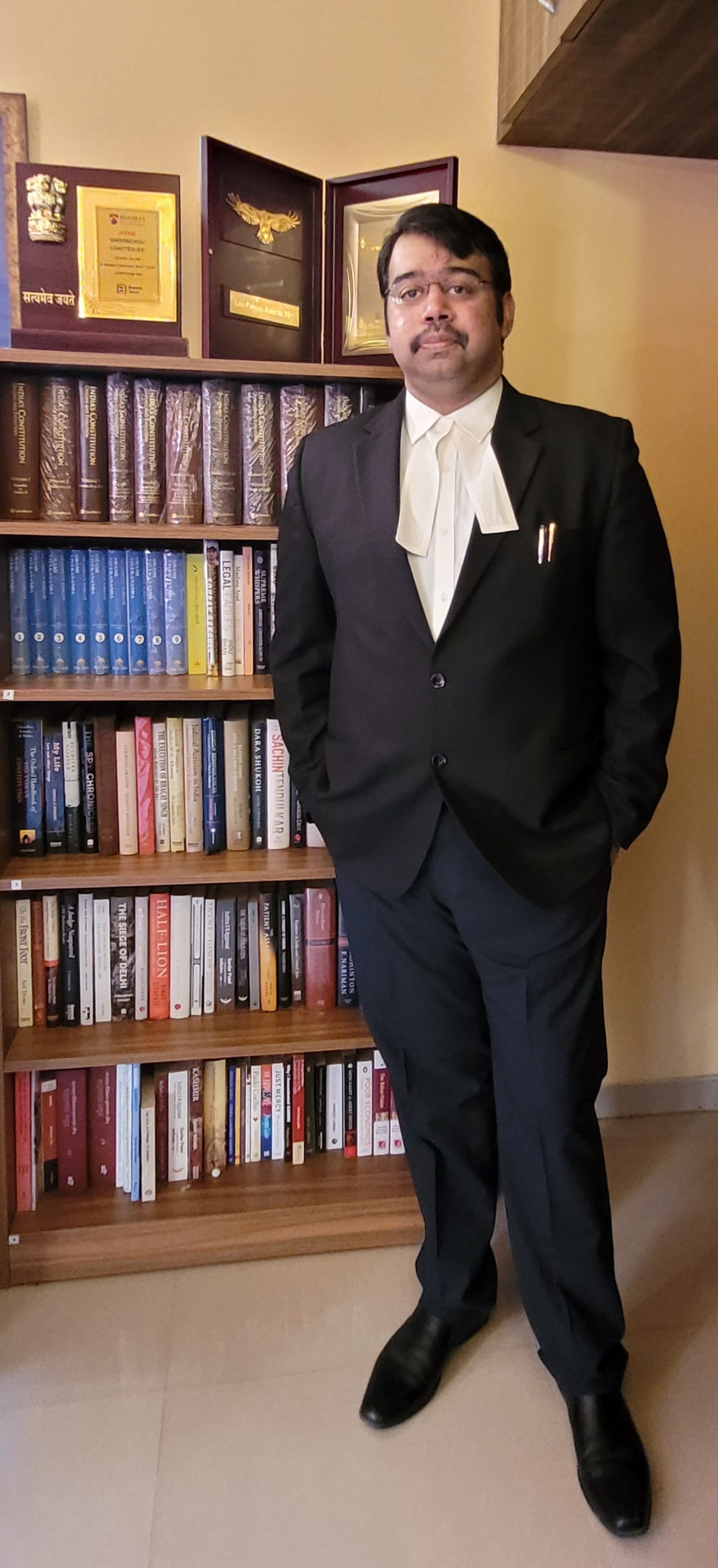


 Allow notifications