Category: Associates, In-House Counsels and Advocates

  • Nishant Sharma, Lead Counsel, Dolby Laboratories on work experience in Patent Litigation and being a Patent agent

    Nishant Sharma, Lead Counsel, Dolby Laboratories on work experience in Patent Litigation and being a Patent agent

    Nishant Sharma graduated in Law from Delhi University in 2012. His professional experience encompasses all sorts of patent related activities- contentious matters, prosecution or preparation of patent applications. He has frequently participated in patent litigation matters, drafting patent applications, carrying out patent-ability searches, filing of patent applications, prosecuting patent applications at Indian Patent Offices and handling opposition cases.

    Currently, he is responsible for handling litigation as well as Patent Licensing in India for Dolby Laboratories.

    In this interview he talks to us about:

    • His decision to pursue Law as a career.
    • His role as a Lead Counsel.
    • Specialization in Patent Law.
    • Skills required in making a successful career in Patents and Designs.


    How would you introduce yourself to our readers? Do you come from a family of lawyers?

    I consider myself an evolving IP professional who is trying to learn new things – be it in IP or legal field in general or even about facets of life – every day, every moment. I have a firm belief in destiny – you won’t get more than what you deserve and before it is due – and at the same time am a strong follower of principle of karma – do good work and you will get appropriate returns in the long run.

    I am a hands-on person and so like to be involved to the very core in every project I undertake or am assigned, and this has always been my advice to my juniors whom I have mentored over my past fifteen years of professional life. I have a strong belief that one needs to be self-sufficient so as to be able to complete assigned tasks even if requisite resources are not available, and throughout my career I have tried not to let unavailability of a resource, such as a paralegal or even a hardware resource, become a hurdle in completing a deliverable in time.

    Coming to you other question, no I did not belong to a family of lawyers. My family includes Engineers, Scientists and Bankers and never in my life had I thought I would be in the legal profession. But I have had good mentors who guided me, and still do, in my pursuits in the legal field.


    What motivated you to pursue law as a career?

    (Nishant completed B.E. (Electronics) in 2001 and a PG Diploma in Advanced Software Design and Development from C-DAC, Noida, 2001.)

    Ah! As I said I believe in destiny and may be my entry to legal profession was destined to happen. After completing my Engineering degree, I was in a secure job, so as to say, with Hindustan Aeronautics Limited (HAL) – a Public Sector Undertaking. I was working on latest Russian technology but the itch to learn something new was always there as things were moving at a steady pace at HAL. Most of the time we had to follow standard procedures with limited options to innovate to improve efficiency of operations. But I was happy doing the same. It happened somehow that my wife got a job opportunity in Delhi and we thought of shifting base. It was during that time, Remfry & Sagar had advertised for openings for Engineers. It was around December 2005 and the Patents Act had just been amended. Sensing a good opportunity to shift base to Delhi to accompany my wife, I applied for the opportunity and after two rounds of interview, I was selected. However, even after getting the offer, which was way beyond my expectations, I was sceptical of leaving a well-settled Government job. Thankfully, I had an acquaintance that used to work for a law firm in the IP field and she motivated me to join this field. So it was like all blocks were falling in the right place slowly paving the way for me to join the IP field. After a discussion with my wife and father, I finally decided to plunge into it and within few days of receiving the offer, I was at my work desk in Remfry browsing through heaps of files.

    On the very first day, as part of induction, I was given few files to study and develop my understanding of how the Patents filed operates. I would spend hours studying each file, making notes and writing down my doubts, which I would later on clarify with my seniors. I was lucky to have seniors who were eager to help me understand the nuances of Indian Patent law as well as Patent Cooperation Treaty. Within few months of joining Remfry, I was actively doing patent prosecution including official hearings at the Patent Office.

    I was happy doing prosecution work until one day my Supervisor suggested that I should pursue Law. Being from the Engineering field, I thought I had a technical bent of mind and I should better be pursing further studies in technical field only and thus, I didn’t give Law studies a second thought then. Yet again destiny was to play its part in shaping my decision. I moved to some other firm eventually, where I was actively involved in Patent Litigation. I liked the entire concept of Patent Litigation and how it is the ultimate test of both the legal and technical acumen of a person. And within few months, I was attending evening classes at Delhi University’s Law school.


    Being a science graduate, did you face any difficulties in law school?

    Frankly speaking, I did not face much of a problem in terms of understanding of Law as I felt statutes are generally very logically drawn with an intended objective in mind and defining steps towards achieving that objective. This is how science operates too! The major problem I faced was adjusting to life of an academic after a gap of seven-eight years. Moreover, I was actively attending to my official duties as well while I was continuing my studies and this made the entire academics part hectic. However, with my family’s support I managed to sail through.

    My advice to students pursing Law would be to understand the basis of each legal provision, question it and support your understanding with explanations provided in judicial precedence of the Courts. The best part of legal education is that Courts, with their elaborative speaking orders, help one clearly understand legal positions and I would encourage students to read a lot of Court decisions, even if different decisions speak the same language you never know when you might chance upon an additional drop of wisdom in the same.

    The other thing to keep in mind is to ask a lot of questions – to your teachers, your peers and even to your juniors. The beauty of Law interpretation is that everyone can bring in his own perspective and it is always good to know all dimensions to a legal provision. Recently, I had trouble interpreting Section 65B of the Evidence Act and to solve the conundrum all I did was to prepare a note of my understanding of the provision and circulate the same to my professional connections, even those whom I remotely knew. Many people pitched in with their perspective and finally I could gather enough understanding of the provision.

    In addition, students should be bold enough to challenge and question settled propositions. So far my experience has been that most Law practitioners hold strong biases towards settled legal propositions and they would rather dissuade their juniors from thinking beyond the same. I am not preaching to students to suspiciously look at each and every settled proposition but as the saying goes – There’s always a scope for improvement.


    How was your first year after graduation? What do you think were the biggest hurdles and challenges in the early days of your career?

    My first year after graduation from Engineering Course was the toughest one as all job opportunities in India had literally dried up in the wake of September 11 attacks in the US. I did initially try my hands as sales professional, selling rugged computers and other military grade products to various R&D organizations in Delhi, for some five-six months, but eventually realized it was not my cup of tea. That was the time I decided to quit that job and study for Government sector jobs that were supposed to be the most stable ones as compared to the ever volatile IT/software jobs. My hard work paid and I landed up in HAL.

    The biggest hurdles I faced during the initial years were to shift gears from slow pace of student life to that of a professional managing a team. I had to manage a team of workmen/work-women and get the deliverables within scheduled time as any delays would ultimately result in delaying delivery of an aircraft for which the deliverable was required. This would primarily involve managing a lot of human capital and this is what you are taught the least in your academic life. Slowly I realized that treating people with empathy can do wonders and I eventually learnt the art of people management.

    My first year after graduating from Law school was easier as I was already seven years in the profession and had learnt how to conduct myself.


    When you accept interns under you, what kind of qualities do you look for?

    Interns should be eager to learn, have some innovative thinking and be willing to experiment with new ideas. Another important aspect is, as I mentioned earlier, interns should be bold enough to challenge the settled propositions.

    In addition, honesty is a quality that every person must imbibe. Honesty towards their work, their co-workers and towards self is very important. If you have faulted, be honest and accept it before your seniors/co-workers.

    Lastly, interns or even starters in any profession must remember that there is no shortcut to success. Toil hard and reap benefits!


    Please tell us about your experience representing Remfry & Sagar at the LES 2013 and AIPPI 2015.

    (Nishant represented the firm Remfry & Sagar as a Partner Designate at the AIPPI (Association Internationale pour la Protection de la Propriété Intellectuelle) 2015 held in Rio de Janeiro and LES (Licensing Executives Society) 2013 held in Hangzhou, China.)

    The good part about such conferences is that while business development is the primary focus, you tend to end up discussing lot many things, besides IP, with people whom you are meeting. In my experience, this helps a lot in knowing about different culture and practices abroad. While you may not have earned a client for your firm, you go back enriched with knowledge about a new country/culture that may be helpful to you or your profession in the future. Besides, you get to learn of IP developments and practices throughout the world, which helps in overall development of one’s IP intellect.

    Moreover, such interactions help a lot in settling doubts in the minds of foreigners about India. For instance, many people whom I interacted with during these conferences were not aware that India actually had four patent office branches or specialized commercial benches in High Courts. During these conferences, I was able to clear many such doubts which foreigners have about India.

    And finally, all such conferences are generally in beautiful locales, and one gets the opportunity to indulge in some local sight-seeing. I love travelling and passionate about visiting new places. I consider myself lucky to have visited two of the wonders of the world – The Great Wall and Christ the Redeemer – during these conferences.


    Currently you are the Lead Counsel (India) – IP & Litigation at Dolby Laboratories. We would love to hear about your work profile.

    At Dolby, I have been entrusted with the responsibility of advancing Dolby’s patent licensing program in India. In addition, I oversee the Indian litigation suits instituted by Dolby – providing strategic inputs, whenever required, in line with the intended objective.


    What are the skills required for a fresher who is aspiring to build a successful career in Patents and Designs?

    Be inquisitive, ready to learn and honest to your profession. Also, there is no substitute to knowledge, so read a lot!


    You have a total experience including technical experience of fifteen years, how do you keep yourself updated of the recent developments?

    I read a lot about IP developments in India and abroad thanks to Google Alerts and subscribed newsletters. I also read and research a lot about other areas of law, whenever someone from my friends or family requires any legal help. In addition, I regularly read latest Indian judgments related to Patent cases on some of the free databases, a habit introduced to me by my colleague at Remfry.

    Moreover, I attend IP conferences, which are another source of abundant information on IP and other facets of law.


    You have worked as In-charge of Radio Division of Avionics Lab at HAL, Nasik Division. Please give us an insight into this marvelous achievement.

    I cannot say if it was an achievement or not, but yes it was definitely my contribution towards nation building. My team was assigned the work of developing testing equipment that were to be used for testing various electrical, hydraulic and pneumatic systems of Sukhoi aircrafts being manufactured for the first time in India under a license agreement with Russia. The part not to be missed here was the strict adherence to deadline for completing the project as any delays could have delayed the delivery of first few aircrafts to the Indian Air Force. Often, it was a race against time but by the time I had left HAL, my department was on track with regard to delivery of the testing equipment to the end customers thereof. As I mentioned earlier as well, my stint at HAL helped me learn people management and also that you can only win respect of your co-workers/juniors by showing empathy and contributing, if not more, equally as them.


     Can you elaborate any two cases for which you are extremely proud of?

    (He has given several advisories to clients on patentability and infringement issues, interacting with the inventors and apprise of the important details of their invention.)

    Without going into the specifics, in view of maintaining confidentiality of clients for whom I worked, I along with my team drafted a patent application for a Japanese client. The project was more like a test project as the client was testing waters for considering outsourcing their patent preparation part. It was an invention related to memory chips used in electronic devices. After toiling hard and intense in-house discussions, we drafted a patent specification which was filed in India as well as the United States simultaneously. The US application was recently examined and granted a patent without any objections. This gave me immense pleasure because there is nothing more than having a satisfied client. This success also helped the law firm in bagging subsequent drafting projects from the same client.

    Another case that I remember quite vividly is a pre-grant opposition case I handled in the initial years of my career. It was again a Japanese client, whose technology was surreptitiously claimed in a patent application by one of their old customers. I, under the guidance of my Supervisor, prepared a pre-grant opposition that was fiercely fought at Kolkata Patent Office. There were certain new legal propositions that we introduced in our submissions, which were finally accepted by the Patent Office leading to the impugned patent application being refused a patent. We were thus able to restore the honour of our client and this was a soul satisfying moment for me as a professional.


    Last but not the least, what is your parting message to our readers?

    First and foremost, be a good human being.

    Secondly, try and build a congenial environment at your workplace. Don’t expect something from your juniors or co-workers, if you would not have done it in the first place. If you are human, so are they!

    Moreover, be ready to share your experiences with others, especially juniors, as there’s no better lesson than learning from real-life experiences.

    Finally, don’t be afraid of making mistakes but do learn from them as well and do not repeat the same mistake again.

     

  • Santanu Mukherjee, Founder, Ex Lege Chambers, and his involvement in multilateral negotiations at the global level

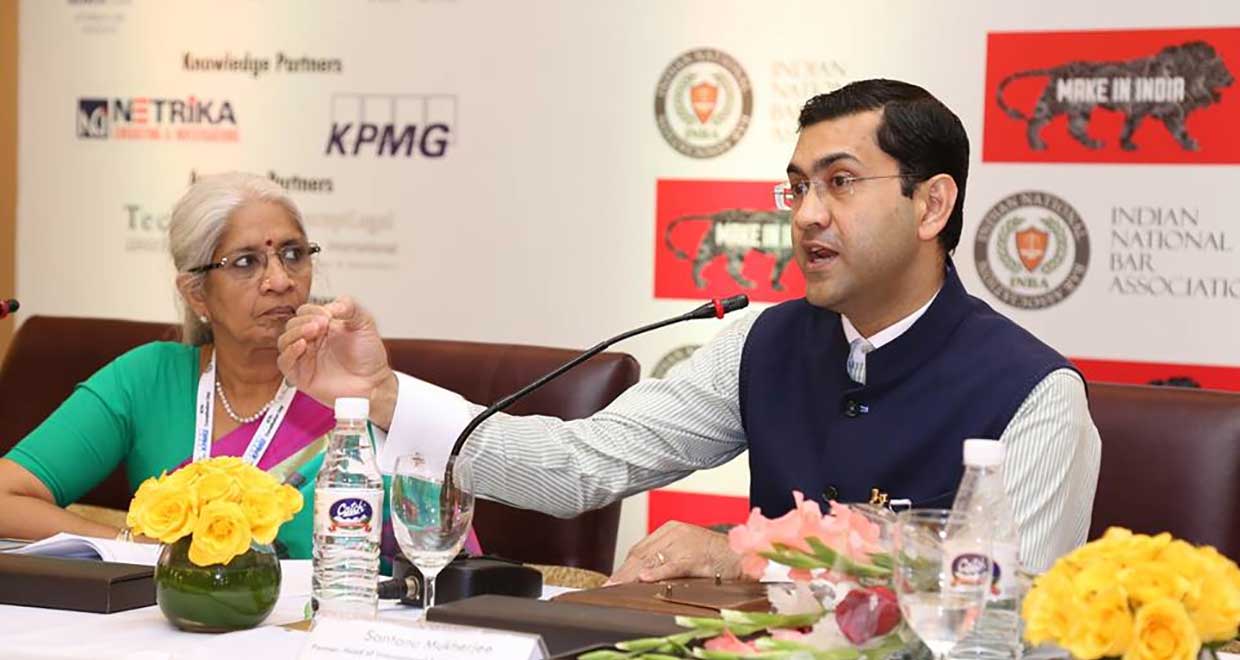
    Santanu Mukherjee, Founder, Ex Lege Chambers, and his involvement in multilateral negotiations at the global level

    Santanu Mukherjee graduated in Law from South Calcutta Law College, Calcutta University in the year 1998. He is an Advocate and an accredited Mediator practicing in New Delhi. He is currently the founder and Head of Ex Lege Chambers, Advocates and Regulatory, Policy Advisors, a boutique law office.

    Over the past twenty years of his work experience he has worked in Statutory and Regulatory Policy, Commercial Mediation and Litigation practice while specializing in Intellectual Property Rights, Competition Law and International Trade Law. His clientele comprise of entities from governments and large corporations to start-ups.

    Recently he has been awarded the prestigious Intellectual Property Lawyer of the Year Award 2017 from the Indian National Bar Association.

    In this interview, he gives us insights into:

    • The importance of extra-curricular in shaping your personality.
    • His international work at the South Centre.
    • Setting up his own firm- Ex Lege Chambers.
    • Honing one’s legal research and communication skills.


    How would you like to introduce yourself to our readers?

    I would like to introduce myself as a legal professional and a mediator, who is passionate in seeking solutions to legal problems and ready to go deep into a matter that I take up. Someone who is passionate to continuously learn, be a thoughtful leader and a change agent, someone who does what he believes in.


    Tell us a bit about your childhood and pre-college life as well as educational background. Do you have lawyers in your family?

    My childhood and college days had been fascinating, I was always interested in extra-curricular, was extremely disciplined and loved to do social work. I studied in Don Bosco Bandel School and was very active as a boys scout. It was long time back but I still cherish the memories of public cleanliness initiatives we took up and volunteering activities in community fairs and traffic rules awareness programmes. Of course the adventure activities were fun, hiking, rock climbing, trekking and the competitions. It developed a deep bond of brotherhood that is still live; I am in touch with many of my childhood friends and my scout brothers even now. Finally an acknowledgment for life, it was a great honour to be awarded by the Hon’ble President of India as a President’s Scout.

    Then came the college days, at South Calcutta Law College, studies were as one could expect in a Law college those days, no frills of moots but occasional debates. However, here again I was focused on some different type of extra-curricular, I enrolled with No. 2 Bengal Air Sqn, National Cadet Corps (NCC) and was the only student from a Law college at the NCC unit. It was again another wonderful memory, the weekly parades, the skeet shootings, the glider flying, the extempore preparing for the best cadet competition, it was a unique experience. In the three years of Senior Division NCC, I rose to be the Senior Under Officer, a learning of leadership that is a training for life. Preparing for the Republic Day camp was an ordeal; I was selected as the West Bengal and Sikkim contingent senior and with it came a sense of responsibility, fellow feeling. The camaraderie was unbelievable, the contingent was tight even during challenging moments, and these thoughts still make me nostalgic. The love and support of my trainers, fellow cadets enabled me to work hard and get the Best Cadet of West Bengal and Sikkim Directorate medal from the Hon’ble Governor of West Bengal. My childhood was adventurous and full of activities of rather unconventional outdoors. I am sharing these thoughts since I want to make a point that there is learning in everything, in sports, in community work, in adventure activities, all can contribute to making our personality.

    I do not have lawyers in my immediate family, my father was a polymer technologist and my mother is an artist and home maker and both of them have always been a great inspiration for me. My only sister has not taken up legal profession either, however my maternal cousin, who is elder to me, had been a practicing lawyer at the Calcutta High Court. She inspired me a lot but I specialized in IPR early hence professionally could not gain much when she was a general litigator.


    In India there is bit of resistance towards legal education even now. What motivated you to choose law as a career?

    Yes, very true, legal education was not at all promoted; some people even had a very negative perspective of legal professionals. Things have changed now to a certain extent and is improving every day. I think a lot of credit goes to structured legal education that has been introduced, the contribution of the National Law Schools and entry to legal education through Common Law Admission Test.

    Typically when one talks of Law as a career, one thinks of becoming a lawyer who would interpret Law and of course aspire to be elevated to the bench one day. In my days as a student, my Law career goals were similar, only that I always wanted to work on international issues and wanted to be an expert. I was exposed to Intellectual Property Rights (IPR) at an early phase, when I was preparing for the NCC Best Cadet competition; I read about the General Agreement on Trade Tariffs (GATT) and the negotiations on IPR, discussion on the ‘Dunkel Draft’ was in the newspapers. My curiosity made me read more and I liked the IP Law discipline and at the final stage of my Law studies was already more aware than most practising lawyers (those not practicing IP law). However, gradually what really intrigued me was ‘Law making’ and this has been a constant motivating factor, to be able to draft a Law from scratch and the grand finale perhaps to be able to move it as a Law maker.

    You have a varied work experience, how did you start, how was your initial days of law practice?

    It’s true that I have a varied work experience, in fact I always wanted to get a 360° exposure to different works in Law. Having started as an Advocate at the Calcutta High Court, I moved beyond whenever I got an opportunity. I started as a Law trainee at S. Jalan and Company, a leading Solicitors’ chambers in Kolkata and was fortunate to be under the tutelage of Mr. Shyamanand Jalan. He was one of the leading corporate and commercial lawyers of the time in Kolkata at that time and I will always be indebted to his guidance towards meticulous drafting and his pragmatic approach. The GATT 1995 was already signed and the World Trade Organization was formed. The Agreement on Trade Related aspects of Intellectual Property Rights (TRIPS) was one of the pillars of the WTO multilateral trade regime. My interest in IPRs landed me at D. P. Ahuja and Co., one of the leading IP Attorneys at Kolkata. I was quickly drawn into IP litigation work, new learning experience amidst some of the legal experts in IPR practice, one of whom was later elevated to the Bench at the Calcutta High Court. I was bonded to IPR domain for ever while gradually expanding to different other areas in the days to come. Later I went to York England to read Law at the College of Law of England and Wales, now University of Law, York, UK.


    You were a British Chevening scholar in UK, can you let us know how was your interview to give our readers some tips to nail the scholarship. What did you study and how was it helpful in your career? During this time you were also a visiting lawyer at the Littleton Chambers, Inner Temple Bar, London, how was your experience?

    Indeed, I attended the British Chevening Programme for Young Indian Corporate, Commercial Lawyers 2000 at the College of Law of Engaland and Wales at York, now University of Law, York, U.K. I understand that this programme is not continued any longer, I am told that instead the number of LL.M. Chevening scholarship offers have been increased. I qualified in the preliminary interview at Kolkata and appeared before the final interview in New Delhi. It was a panel interview of five members which included a Supreme Court practitioner, two academic faculty members of the College of Law, one of who was also a qualified British barrister and the other a solicitor and I think there were members from British Council and the High Commission in New Delhi. I enjoyed the interview which was more of a discussion about my career plans, IPR issues and a tricky trademark infringement matter and some generic questions.

    The scholarship programme was a customized for legal practitioners and touched on laws of England and Wales and the European Union as well, often drew comparison with the Indian laws. A number of corporate and commercial Law subjects were covered but what I really found fascinating was the trainings in lawyering skills. The Woolf Reforms and the Civil Procedure Rules of 1998 had just come into effect the year before we went to England. The legal drafting style in England and Wales had already experienced a sea change, crisp lucid language was in vogue. We were quite taken by surprise but the unlearning of the Indian legal drafting style and adapting to the new style was perhaps necessary. The drafting sessions and the courses on negotiation and advocacy which I attended in the programme were excellent and definitely helped me later on as a lawyer.

    I had already gained some experience in drafting and negotiating skills working at the Solicitor’s firm in Kolkata hence wanted to get some exposure to good advocacy. This made me split my practical attachments between Beresford and Company an IP Attorney Firm well known for their hi-tech practice (now Beresford Crump LLP) and Littleton Chambers, Inner Temple Bar. At that time Littleton Chambers was not one of the leading chambers for IPR matters but had quite a wide variety of matters. I wanted to gain maximum from this wide exposure hence opted for the Littleton Chambers to get a real life experience of advocacy in English courts. I could join different barristers at the Royal Court of Justice in London, the Employment Tribunal in Leeds and watch them plead. They had also arranged a visit to the Old Bailey (the central Criminal Court of England and Wales) for me; it was quite a unique experience. I liked the work culture of the chambers, the discussions and the warmth. I could also get a ticket to attend a lecture of Lord Rt Hon Lord Woolf who was the author of the legal reforms, it was quite a treat.


    You have spent some time in doing legal research work and policy work, how did you get interested in such works?

    The founding stone to my interest in doing legal research is actually my master’s studies at Bern, Switzerland. The IPR related issues that I worked on were interesting but I was interested to understand the interface issues between IPR and international trade laws as established under the WTO regime. The first five years of the transition period for developing countries to adopt TRIPS was over and India had already suffered a setback at the first IPR case. The Panel of the Dispute Settlement Body (DSB) of the WTO found India’s Patent law not in compliance with its WTO commitment. I felt that for a developing country like India, WTO regulations would be important for the coming future and it would be worth studying it deeper.

    At that time, a friend informed me of the World Trade Institute in Bern, Switzerland providing a Master’s programme in International Law and Economics with exclusive focus on WTO regulations. Although initially I was reluctant since it was a new institute but given the reputation of Bern University and having some of the leading names from Yale, Oxford, Columbia Universities and many others as members of faculty I was convinced. I managed to get a scholarship from the Institute and successfully complete it and I gained immensely from our Managing Director, Prof. Thomas Cottier who was also the chairman of the first IPR case decided by the WTO between USA and India. I had already done an internship at the WTO Secretariat in Geneva which gave me an inside view of how the WTO worked. Further, it also gave me an opportunity to sit in the TRIPS Council meetings and understand the importance of strategy and the play of tactics in multilateral negotiations.

    My master’s studies involved significant legal research and actually it also opened my door to policy work which involved critically analysing laws, recommending changes and took me to a step ahead of my interest in drafting laws. It gave me a feeling that I can contribute in works that can have mass effect and encouraged me to undertake deeper legal research based policy work rather than rhetorical advocacy. By now I had already noticed that in continental Europe, lawyers dedicate time doing legal research while in India such research is only taken up by academics. I decided to adopt this model and try for some fellowship at some renowned research institute and my exploration led me to the Max Planck Institute for Intellectual Property and Competition Law (MPI) in Munich, Germany. At MPI, I worked on interface between IPR and multilateral trade regulations under the WTO and the Indian Patent Law and protection of traditional knowledge and the research foundation helped me all through later. Based on my work published an article at their peer-reviewed journal, IIC and made presentations including at the Global Salzburg Seminar on Trade, Aid and Development.


    Tell us about your international work at the South Centre, what was the nature of your work and your return to India.

    After completing my research at the MPI I was contemplating moving back to full time legal practice when I got an interesting opportunity. The South Centre, an intergovernmental organisation of developing countries based in Geneva working along the UN organizations and chaired by Dr. B.B. Ghali, former Secretary General of the UN was looking for a Fellow with IPR practice and research background. I was familiar with the Centre’s works and also that our former Prime Minister Dr. Manmohan Singh was its chairman when it was still in the form of South Commission, I was quite excited when I cleared the interview to join the South Centre. As a Fellow I worked in the capacity of a consultant and enjoyed certain perks as an international civil servant similar to the UN staff which itself was a new experience.

    My main work was on pharmaceutical patents and how developing countries could draft examination guidelines in a manner helpful to their developmental needs, but remaining within the TRIPS Agreement. I was also deeply involved in preparing negotiating texts for on-going IPR negotiations at the WIPO and WTO including those on geographical indications. It was quite an unique opportunity to prepare draft laws and amendments to patent laws for member countries that lacked capacity and it’s very satisfying to note that some became laws in those countries. I worked very closely with WIPO, WTO UNCTAD and other IGOs on different international issues. South Centre used to hold training sessions for commerce ministry officials of member countries regularly, it was absolute pleasure to model such training courses and teach these trade diplomats. One of the new learning was to present technical matters in a non-lawyerly manner since the bureaucrats were seasoned generalists but not always familiar with legalistic approach. Once my project was complete, instead of waiting for some other project, I thought that I should return to India and explore opportunities back home.


    You have been working in Delhi for about 10 years now and have started your own Law office, how did it come by?

    Many friends had advised me against leaving Geneva, they tried to convince me that I would be able to contribute more by being there rather than returning. However, I took the decision to return to Kolkata and after an initial year moving back to legal practice and consulting, I realised that if I want to continue working on policy, I needed to move to Delhi.

    Once I decided to move to New Delhi, I started discussing work possibilities with some Law firms when Qualcomm, an advanced wireless technology company based in San Diego, California approached me for a lawyer role. I was not aware that Qualcomm’s presence in India was big enough for an India-based role and that too they were looking for someone who had a background in IPR and a deep understanding of the international trade regime. Initially, I was not that convinced for the position since had never expected myself in any in-house role but as it happened with me, “never say never”. After some thoughts and discussing with some seniors whom I consider as mentors, I concluded that this would be a new experience for me and fulfil my aim of getting exposed to law at 360°.

    I tried to chalk out what should be my learning in the three to five years that I intend to stay and thought that it would be worth understanding how to form legal strategies, manage outreach and learn how they engage with governments. It was a great experience as I moved in with the global team within a short time. I was a part of an international team with lawyers from different countries all working in synergy. The experience of working with multiple internal clients in different jurisdictions in a wholesome manner considering the business impact is something unique and completely different from that of an external counsel. As I engaged in different works I never realised that even when I had thought that I will transit out after five years, I continued for 8 years enjoying every bit of my work.

    Finally, I decided that it is time for me to return to mainstream legal practice and discussed my intent of moving back to practice with friends and family. It was a difficult decision since I was a family man and the corporate legal work comes with some leisurely perks and a different work style. I talked to some senior lawyer friends and finally took the decision to join Luthra and Luthra Law Offices after talking to Mr. Rajiv Luthra, Manging Partner. I joined as Partner and Head of International Trade and Policy Advisory practice and enjoyed the policy advisory work including trade matters working closely with different governments as well as private corporate clients. However, I soon realised that I would not be able to introduce a number of prospective clients even when they have approached me and I have an excellent relationship with them given the conflicts problem that affect large firms across the globe. I understood that with the firm’s established clients, it would be difficult for me to create my own clientele and felt an urge to be independent. As it has always been, once decided I have never looked back, I started Ex Lege Chambers, a boutique law chambers, an independent effort with strong support from close friends.


    You have founded Ex Lege Chambers and call it a boutique chambers, how is it different from any other law firm?

    Always fascinated with my experience at Littleton Chambers in London, when I introduced this concept to a dear friend, a litigator at the Supreme Court and Delhi High Court, he was game to it. From day one he supported me as a co-founder and I established Ex Lege Chambers, Advocates and Regulatory, Policy Advisors in New Delhi. Typically like chambers legal practice elsewhere and distinguished from law firms, the lawyers are independent members and share costs and not profits. Keeping costs as low as possible, our aim as a boutique chambers is to provide complete support to our clients in a dedicated manner rather than be in a hurry to scale up.

    At present we are mainly focused on Dispute Resolution, Alternate Dispute Resolution (ADR) and Policy Advisories as well as corporate legal support. We aim to increase our commercial mediation work within the ADR services and hopefully make our mark in deal mediation. Given the global move for resolving conflicts quicker, mediation plays and will increasingly play a major role and I think that India would gain from adopting mediation in a major manner. Being a boutique chambers has also helped us to address needs of the start-up clients providing complete legal service package for all their needs.

    The chamber does not follow the concept of hiring lawyers at any level. A client work would be supervised by a lead counsel (as of now the founders) and considering client requirements, a team of counsels at two levels. The first level with around five to seven years’ experience is retained as members and the second level with three to five years’ experience as junior members. Depending on the nature of work freshly qualified Advocates can also find a place as trainee members. Trainee members are exposed to close mentoring and get an opportunity to learn.


    You have been involved in multilateral negotiations at the global level can you share your experience.

    Apart from my involvement in WTO, WIPO, UNCTAD and ITU while working in Geneva, while working with Qualcomm too, I was actively involved in some multilateral negotiations. One such experience is at the United Nations Framework Conference on Climate Change (UNFCCC) Conference of Parties (COP). Interesting to note that in these negotiations only governments can be negotiating parties while the decisions taken affect many stakeholders including private sector. To address private sector concerns, it is possible for private sector to engage in track 1.5 / track 2 negotiations, i.e. attend the COP as observers and hold parallel negotiations with country delegations. I was part of the delegation of Business Council of Sustainable Energy which held an observer status at UNFCCC and attended the COPs at Copenhagen (2009), Durban (2011) and Doha (2012).

    I was focused on the technology-transfer negotiations related to climate change mitigating technologies. The debate on access to patented clean energy technologies negotiations through track 1.5 track 2 at a number of COPs with extreme positions being taken by negotiating parties.

    Like any other multilateral negotiations, the engagements started early in the morning and went on until late in the evenings. Just to give an idea of the works, we would access country positions that were published in UNFCCC documents and changed as the negotiations proceeded, analyse them considering client needs and as needed, prepare alternate texts. Then we used to hold parallel meetings with different relevant delegations to explain our position substantiating with data and valid reasons so that once convinced, they can raise these at their negotiating meetings.

    In between there were different meetings and briefings to attend, Among the COPs that I have attended, I will remember the Copenhagen COP vividly because of its administrative collapse when I waited for eight hours at minus 12°C to get an entry pass. There were also massive protests and police action against demonstrators. The negotiating styles of different countries were also worth noting and how these styles actually manoeuvred the results of the negotiations.


    Many lawyers are submerged in work most of the time and often find it challenging to juggle between your personal and professional life? How do you look at work-life balance?

    Lawyers’ work demands a considerable bit of time, I think that in the initial years’ lawyers would need to work very hard and long hours would be normal. However, there seems to be a growing trend in law firms to stay back for long hours to create a perception that one is working hard, this unfortunately brings no dividend and I think should be avoided. For me, being independent gives me the flexibility to take up work that I can manage and can give sufficient attention without compromising on my other interests. Apart from spending time with family, my other interests include lecturing at law schools at times engage in public discourses in seminars and conferences and writing articles.


    The trend is now on gathering various internship experiences at different places. Was the scenario same while you were pursuing law?

    I believe that internships are mandatory in the five years law curriculum hence the students spend time interning at different law firms during their vacations. While I think internships are important, I do not think that doing a month’s internship at a place during vacations allow the students to gain any meaningful exposure. Although some are very hardworking and able to gain some good experience, I think one would need at least for two or three months to get a good exposure. However, since the setup is such that students would hardly get few months’ time, the students should plan well in advance and try to learn different lawyering skills through their practical exposure while being attached to work related to the discipline that they like.

    During my law college days there was no concept of internship although those coming from lawyer’s families usually spent time at the firms and chambers. I realised that since I was not from a lawyer’s family, getting practical experience was essential hence managed to join a law firm as legal trainee and worked there beyond college hours.


    As a concluding message, what would be your suggestions to law students / younger corporate commercial lawyers?

    Law students while they are still at school/college need to make sure that they improve their listening skills, communications skills, both written and verbal and legal research skills. All the rest can be developed while working as freshly qualified lawyers. If they are interested in any particular legal domain, they should put in an extra effort to know more about the subject through reading of learned articles, following good blogs and also writing articles at law journals. In addition they should also read news and current affairs in a manner that they are well aware about what’s happening around them. This would help them engage in any pertinent discussion without difficulty. The skill of being able to initiate and engage in a conversation is always helpful for a lawyer. I wish all law students and young lawyers to be able to put in their best to contribute in whatever field they pursue, as I stated earlier, law is a discipline in which a 360° approach is not just possible, it can be rewarding.

  • Rishabh Mastaram, Founder, RGM Legal on higher studies and starting up with a Corporate Law firm

    Rishabh Mastaram, Founder, RGM Legal on higher studies and starting up with a Corporate Law firm

    Rishabh Mastaram graduated in Law from Jitendra Chauhan College of Law in 2005  and then went on to pursue his LL.M. from Middlesex University, London. After having worked with top tier firms like DSK Legal, Desai and Diwanji and Fox Mandal Little Co., he decided to set-up his own firm “RGM Legal”.

    He has multi- jurisdictional legal experience as he has worked with London based law firms and top tier law firms in India. He works extensively in practice areas of corporate advisory, transaction support, private equity/venture capital, mergers and acquisitions and joint ventures.

    In this interview we speak to him about:

    • The importance of extra activities like mooting, debating and publications in law school.
    • Why should one pursue higher studies?
    • Starting his own firm “RGM Legal”.
    • His message to Law students who dream of having their own law firm.


    How would you like to introduce yourself to our readers?

    “You don’t know till you try. If you don’t try then the result will be 100% negative”.

    This is something which I personally believe in because it actually reflects my personality.

    Trying and striving has become like my DNA. So far my attitude of “trying and striving” has helped me reach where I am today, obviously with blessings of my parents and support of well wishers (especially my clients who have now become like close friends/ family members).

    Constant striving and trying has resulted in developing a unique practice of  being updated and trying to find untapped/ innovative means of structuring a deal. In short, its “Kaizen”!

    I am obviously not God gifted (which means natural talent), except for having a good memory, and hence I had to put in a lot of efforts in honing my skills (both lawyerly and non-lawyerly  😉 ) to reach up-to this level. Now it is all about leveraging my experience and skills which I have developed over a period of time.

    By the way I am a first generation lawyer and probably that is the reason why I had to put in those extra efforts.


    Having done B.Com, what motivated you to choose law as a career? Or did it just happen?

    Even before graduating and knowing the true life of a lawyer, I aspired to practice law (either as advocate, solicitor, CS or otherwise) after realising my deep interest in law in my second year of B.Com My first encounter with subject of law in SYB.Com was the trigger of  my decision of pursuing law. In the same year I found out about the Company Secretary course and started pursuing it. After my graduation I decided to join a law college for LL.B. degree (to pursue my interest and also because I found out very early that LL.B. was one of the cheapest professional course back then). By the time I was in second year law, I had decided to become a corporate lawyer (pursuing CS course majorly influenced this decision) and today being one is like fulfillment of my aspiration.

    What were your areas of interest during your graduation? How did you go about developing expertise and knowledge in these areas?

    During my B.Com graduation and LL.B. graduation, I had very wide areas of interest. However, if I have to narrow it down to Law then Companies Act, 1956 and Contract Act, 1872 got me interested.

    I was and I am a very keen researcher. Wanting to know new things and exploring it (with help of internet based research in college library) was my top most interest.

    According to me there is no methodology for developing expertise and increasing knowledge. Just having fire in the belly with strong desire to reach somewhere helps you develop expertise and knowledge both, as by-product.

    I have to mention one of my experience of getting up-to speed with my contemporaries. On returning back to Mumbai after finishing my LL.M. in London, I was given FEMA related assignments in my first week with Fox Mandal Little and Company (then merged firms got split in 2010). It was all together a new area for me. To ensure that I make meaningful contribution in meetings and negotiations, I use to read the FDI policy cover to cover in a week. I continued with this practice for about 3 to 4 months and thereafter most of the provisions were on the tip of my tongue – like a ready reference. This approach really helped me to get a lead with my contemporaries and even immediate seniors.

    What are your thoughts on activities like mooting, debating and publications in journals? What skills do law students acquire by engaging themselves in such activities?

    Being an “outstanding” student, my interest was more towards extra activities that college had to offer. Some way or the other I use to get engaged in moots, debates, etc… if not as a speaker/ mooter then as a researcher. It is all very important to experience. That is when you learn that implementation and application of what you know has more value than knowing more but unable to apply/ implement. This has a very deep meaning when it comes to practice because I have seen rank holders and academic legal writers/ authors getting entangled with law and unable to give practical advice and whereas those who know how to practically apply law are more effective as professionals.


    Did your law school education prepare you sufficiently for the many tasks you were required to execute after graduation?

    I completed my Law from law college having syllabus designed by Mumbai University. Historically our education systems is based on R3 i.e. Read | Retain | Reproduce. The competition is primarily for scoring good marks rather than focusing on being able. I understand that this has drastically changed and law schools and colleges are now focusing more on practicals. With a strong desire to give back to the society, I also impart guest lectures on practical side of the legal practice.


    After graduating, you went for LL.M. and then a PGDFM from NMIMS and then solicitors from England and Wales. Why did you decide to go for higher studies?

    I did my LL.M. from London. This was primarily to get international exposure and international way of doing things. If it would have been LL.M. from India then it would have been purely for academic purpose. I think this was the best decision of my life. Today I have international connect with worldwide practitioners. Hence, I don’t see just India as a market but the entire world as a market for legal services in India.

    Being a corporate lawyer, it was important to understand financial aspects better. Pursuing management studies in finance i.e. PGDFM from NMIMS helped in honing my ability to understand commercials better. Combination of law with finance is a value add for corporate clients.


    What advice would you give to people who are trying to decide which area of law to specialise in?

    It is very subjective and vary from person to person. However, if someone wants to pursue legal practice as professional career option then ask yourself following questions to determine your specialisation after gaining experience of two years with senior or law firm:

    What is your interest? Litigation? Transaction? Structuring?

    What is your aspiration? Top lawyer? Highly paid lawyer? Renowned lawyer? Challenges?

    What is your priority? Money? Law? Practice? Society?

    What is you ability?

    How big is your tolerance level?

    Above all, before pursuing law, please ask yourself: whether you are ready and willing to live a lawyers life? Please make yourself fully aware through your parents/relatives, friends, etc.. about lawyers true life before pursuing it.

    You’ve worked at DSK Legal, Desai and Diwanji and Fox Mandal Little Co. On what practice areas did you work on at these top tier law firms?

    I started working in a law firm in London as corporate lawyer and since then there is no looking back.


    Thereafter, you have started your own law firm “RGM Legal”. What prompted you to make this choice and start your own law firm?

    Necessity is the mother of all inventions and RGM Legal is no different. There were certain compelling reasons why I decided to start RGM Legal. In a short span of time, RGM Legal has closed more than 10 deals already and still counting. Proof of the cake is in eating and RGM Legal has proved a point by closing a number of quotable deals.

    I have to mention that RGM Legal initiative has been taken with the intention of creating flat organisation, if it is possible in Indian circumstances. Unlike many other law firms where seniority is decided by the designation (and such designations are decided by the equity partners), in RGM Legal I wish to implement a practice where even a senior most can be assisting a mid-level lawyer if that lawyer has more grip over the matter. This concept will evolve in time to come but will try to implement it in some form or other.

    If someone who works with you makes a mistake or an error in an assignment what course of action do you follow as a partner?

    For transaction/ deals, I strongly believe that mistakes and errors are pardonable until the documents are signed. Even if the error or mistake is identified before signing, it is good enough rectification.

    Having said that, considering RGM Legal is trying to shape-up as a flat organisation, the responsibility on the lead professional should be of same gravitas as what the client expects from partner/ founder.


    What were the difficulties you faced in the early days of your practice? How difficult would you say it is to build a reputable practice?

    I think the initial days of start-up firm varies from person to person. For me, personally it was extremely challenging due to unforeseeable personal reasons. My focus was spread very thin on multiple things, including starting and growing practice of RGM Legal. Also, the initial four to six months of dry period were extremely difficult to see-off, especially when I had very heavy outgoings. But all’s well that ends well. Although I can’t say it with full conviction but I can somewhat mention that the initial difficulty phase has now subdued. Now I started facing sweet difficulties like moving the office to client preferred location (it is a big task but is still sweet), selecting the right candidate, deciding which work is to be given priority (especially when you have to finalize the bill of cost in between execution/ closing), setting-up, marketing, meeting new leads, etc…

    Do you take interns? What do you look for in a prospective applicant?

    We will start taking interns from April 2018 onwards.

    If a candidate is looking for entrepreneurial career growth then RGM Legal is the firm to apply. We at RGM Legal promote entrepreneurial lawyers who wishes to work as a professional with ambition to have a career trajectory of becoming an entrepreneur.
    The policy of the firm is only to recruit lawyers with entrepreneurial spirit and commercial acumen.


    What would be your message to Law students who dream of having their own law firm one day?

    “He knows enough who knowns how to learn”.
    The day you stop learning or feel you know everything and self claim to be law god right up there, then you are misfit to become a lawyer. Learning should never quit.

    Also, most importantly, please understand the life of a lawyer before aspiring to become one. Have seen umpteen number of young talent being crumbled because of the pressure. Life is like a road trip and you are most likely to get a vehicle ahead of yours! So believe in yourself and do your best.


  • Veena Poolakal, Partner, Lall Lahiri & Salhotra, and her illustrious fifteen years of experience in the IPR

    Veena Poolakal, Partner, Lall Lahiri & Salhotra, and her illustrious fifteen years of experience in the IPR

    Veena Poolakal completed her graduation in Law from Government Law College, Calicut in the year 2000. Post completion of her Master’s degree in Intellectual Property Rights she started her legal practice in May, 2003 with Singhania & Co., Mumbai as an Associate. After a brief stint of two months with Singhania & Co., Mumbai, she joined the trademarks team of Lall Lahiri & Salhotra, Attorneys-At-Law, as an Associate in August, 2003. Since then she has been involved in Trademark Prosecution work and had represented many Fortune 500 companies. She was promoted to Head Trademarks Prosecution in the year of 2006 and thereafter as a Partner in 2011.

    She was recently ranked by the World Trademark Review in the top 1000 Individuals: Prosecution & Strategy Category.

    In this interview she talks to us about:

    • Her specialisation in IPR.
    • Work experience in Trademark Prosecution
    • Her responsibility as Partner- Trademarks at Lall Lahiri & Salhotra, Attorneys at Law.


    How did your interest gravitate towards law?

    Law was one of the desired career options for me. Perhaps, the liveliness of this particular discipline and the confidence and empowerment that a legal career would offer, comparing to any other field, might have attracted me towards this option. As far as my exposure to the legal fraternity is concerned, the same was very limited prior to joining of law school.


    You completed your LLB from the Government Law College, Calicut, in 2000. Please do share with us some memories from your years in college.

    The law school has given me fairly a sound understanding on most of the conventional legal areas. But, more importantly, the days I spend in law school remain as the most cherished memories in my life mainly for the pleasant and cheerful campus. The law school had always maintained a liberal approach towards the students’ political activities which contributed a lot to maintain the liveliness and enthusiasm in the campus and also helped many to reinvent themselves as more independent and rational humans. Either as a part of a particular political ideology or otherwise, an active involvement in the general issues was a part of our campus life. I believe that my law school experience have played a great role in the later part of my life. The years spent in law school has not only helped me to become a lawyer but also has helped a lot in the overall development as a person. The extracurricular activities of the law school days were limited to legal aid clinics, moot court participations etc.

    What were your major interests in law school?

    The teachings in the law school were mainly centred on the conventional areas like Constitutional Law, Law of Contract, Administrative Law, Criminal Law, Tax Law etc. The more specialised areas like IPR, in which I had done my specialisation later, or various laws relating to the economic offences which turned to be of extreme practical importance now etc. where not part of our law school syllabus. As a law student, I found Constitutional Law and Administrative Law as the most interesting areas, which still I believe to be of extreme importance, both from the academic and professional perspectives.


    What according to you can make law students more interested in studying Intellectual Property Rights in comparison to the much sought after Corporate Law?

    Needless to say, either of these areas would not be complete without the other. However, I feel that, the Intellectual Property Rights (IPR) being a subject that prominently deals with the substantive rights of the person as against a subject which concentrate more on the procedural aspects, may be attractive for a student of Law. Further, the interplay between the private and public rights and the State’s indulgence in recognising the just and required monopoly in each of the ever expanding areas of IPRs depending upon what is conducive for the growth of the concerned country/society and to maintain a balance of conflicting interest in its peculiar socio-political and economic conditions, would certainly be of extreme importance.  Further, we are witnessing a time where the whole world has equated the intellectual property with the conventional types of property and this spectrum which originally consists of conventional areas of patent, copyright, trademark and designs now been added with new property rights  in the area  like  geographical indications, plant varieties, semiconductor chips etc. Even the extent and scope the conventional areas are being expanding day by day. As one would see, the rights and obligations associated with intellectual properties are now well recognised across the globe and various trans-national regimes are also in place. Thus, even from a perspective of a practitioner, IPR is one of the prominent areas which are still in short of enough dedicated resource persons and professionals.


    How did your forte in IPR develop?

    As I said, the IPR was not part of my LL.B. I was first introduced to IPR as a subject during my Master’s degree in IPR at Cochin University of Science & Technology (CUSAT). I was really fortunate enough to receive the lectures and patronage of Dr. N.S. Gopalakrishnan, one of the leading experts/ academician in IPR. It was during this time, my initial interest in IPR law turned out to be a serious career option.

    Upon completion of LL.M., I started my career as an Associate with Lall Lahiri & Salhotra (LLS), one of the pioneer IPR law firms in the country.

    In LLS, I was fortunate enough to be mentored by Mrs. Anuradha Salhotra. The exposure, opportunity and guidance that I was able to get at LLS helped me to develop myself in the areas of trademark law.


    In the year 2006, you were promoted as Head -Trademarks Prosecution and as a Partner of Lall Lahiri & Salhotra in the year of 2011.Can you give us an insight into the type of work you handled?

    From a practitioner’s point of view, IPR practice is all about acquisition of rights, its maintenance and enforcement as per the statutory mechanism. An IPR professional cannot deal with any of these areas in complete isolation from the other as it very often needed a holistic and comprehensive approach and strategy. But, still, categorising one’s main area of work under a separate department seems to be of many advantages, which bring more clarity, focus, precision, responsibilities and responsiveness in the assignments and thus brings out better results. Ever since I joined LLS, I have been the part of trademark prosecution department and search department, which includes the board areas of providing opinion and advises to the clients on availability of trademarks, strategizing the acquisition of trademarks, advising and assisting clients securing the trademark registration, taking timely steps requiring for the protection of the their rights, advising and rendering transactional assistance in relation to trademark acquisitions, transfers and compliances of statutory requirements in this regard etc.


    Congratulations on being ranked under Individuals Prosecution & Strategy Category in the 2017 Edition of WTR 1000! Please elaborate on this milestone.

    For this, I owe to the extensive, continuous support and faith that LLS’s sole owner & Managing Partner Mr. Rahul Chaudhry has bestowed upon me. Also, I owe this to my team who has been a great support throughout my career so far. I have been fortunate to render the professional service to many of the noted commercial houses, both domestic and foreign and to deal with so many complex legal issues in my career till date. In rendering the professional services, we follow a sound and uncompromising professional approach to the cause of our clients. We represent the cause of client with highest level of commitment, dedication and professional expertise to achieve an exhaustive, expeditious and effective solution. For achieving the goal, we resort to meticulous and realistic strategies/ methods and implement the same effectively through the existing legal framework. Perhaps, this approach towards each assignment that is followed by LLS might have helped me to achieve said position in Prosecution & Strategy Category.

    How can students wishing to intern under your valuable guidance get in touch with you?

    The students who wish to intern with us can contact us at gpo@lls.in. Every year, we try to accommodate the students from different institutions. An intern is no way different from a student and as such, what we look in an intern is also not different from the qualities required for a student. The foremost thing which we would prefer in an Intern is his or her seriousness in approach to the subject, willingness to learn new things and discipline and the never let go attitude.


    Were you interning after college hours? How did you manage the internship with studies?

    During our days in law school, the concept of internships was not too prominent. The main objective of the course was theoretical study and it was in final year we were given practical experience through Court visits, legal aid cells, attending lawyer’s office etc. It is really good to see that the law courses of today are a blend of theoretical and practical knowledge. As a law student, it is very important to have an early practical exposure. This, would not only enhance his understanding of law and the legal sector, but also would help him to make an early decision as to the particular segment in the vast field of law in which he wants to be engaged in.


    What hurdles should one expect in a career in law firm and what are your tips to tackle the same?

    As every profession/career, career in a law firm too is not free from hurdles. Each law firm may have different culture. In the initial days in a law firm, a lawyer may find it hard to mend himself with the work culture of the firm, which one may adapt within few days.  Besides this, I don’t think, there are any particular issues that one may have to face in law firms which he or she may not see in any other offices. From my experience, the best way to avoid any sort of hurdles that one may face in career is to stay committed and sincere to the work. Your work and commitment will speak loud for you.


    Please share with us your daily responsibilities.

    It is difficult to define daily responsibilities as each day has a different call. A day is structured according to the meetings, hearings, deadlines we have on that particular day. The prime focus of a day is to ensure that we are attending to all clients ‘queries, meeting deadlines and providing the legally sound opinions to our clients to their needs. As far as the work profile is concerned, as I already told you, I lead the LLS Trademark prosecution and searches team which is responsible for the a wide spectrum of services that ranges from providing opinion on the acquisition of trademark to securing the statutory protection for the trademark. Being Head of the Team, I have the professional responsibility to supervise each assignment, guide the other team members and associates in work, ensure that the required professional services are done satisfactorily and in time, etc.


    What would be your parting message to law students and lawyers who want to establish their career in IPR?

    A lawyer entering into the trademark practice has to bear in mind that this area of law is extremely competitive and you have to compete with well-established trademark professionals to make a mark of yourself in this field of law. Making yourself established in trademark practice is not a cake walk and it requires lot of patience, dedication and hard work. Be sincere and dedicated to the work you do, be focused on your goals and don’t be swayed by short term monetary/professional gains.

  • Dushyant Mahant, Founding Partner, Mahant and Mahant Advocates on the initial hurdles faced in setting up an IPR firm

    Dushyant Mahant, Founding Partner, Mahant and Mahant Advocates on the initial hurdles faced in setting up an IPR firm

    Dushyant Mahant completed his law graduation from Law Faculty, DU in 2004. He later on went to pursue his LL.M. in IPR from University of Queensland, Australia. His area of expertise lies in IPR. Before setting up his own law firm, he had worked with Hemant Singh for more than two years and then with Chander Lall for two and a half years. He worked in IPR litigation where both the chambers provided him with amazing opportunities.

    Currently, he represents clients in copyright and trademark litigation, commercial disputes pertaining to arbitration and company cases. He also does a considerable amount of pro bono work in High Court and District Courts.

    In this interview, he talks to us about:

    • The importance of mentors in the legal profession.
    • How important grades are in shaping your legal career.
    • The ideal time to pursue an LL.M.
    • His inclination towards IPR Law.

    How would you like to introduce yourself to our readers?

    A lawyer who enrolled in a law school to ensure that no external factors would decide my fate.

    Why did you choose to pursue a degree in law?

    After graduating in 1998, I did float an idea to pursue law but was vehemently opposed by many. Seems like outside the legal fraternity, the profession then was, now also but to a lesser extent, is viewed with less excitement and future prospects. Although I was assisting my father in our family business, I was fascinated with the stock markets since school days. After my graduation, I assisted a National Stock Exchange member for online transactions and portfolio management. I also did a training course in Delhi Stock Exchange in the late 2000 for Derivative and Future Trading since those were the new instrument then.

    In March 2001, a political turmoil crashed the stock markets for consecutive weeks affecting millions of people by eroding their savings. I, then, chose to become a lawyer to manage my career my way. All this could happen because of the immense support of my parents. To them, initially it was more difficult to accept that their stock market trader son had suddenly become a student again. I will not say that those 3 years, from 1998-2001, were wasted; I would have been three batches senior to my peers today.

    What subjects did you take particular interest in during your law school days?

    Constitution, IPR, Criminal Law, Taxation, Muslim Law and Personal Injury Law (Tort) were my favourite. Some were forgettable. Never knew then, can’t figure out still, why we were taught those.

    How did you develop an interest in IP Law?

    Since a very young age, I had a weakness for brands and am loyal to quite a few of them. Selection of a particular name / logo for a brand fascinates me. Since I wanted to practice IP litigation, I was resolved to do an LL. M. instead of a short term diploma course though they are also good. In 2004, when I was about to complete my LL. B., I used to have frequent discussions with a couple of my senior professors, legends in the legal academia, like Mr. B.B. Pandey, Prof. M. P. Singh and Prof. Rajiv Khanna. After much deliberation and research, I finally shortlisted University of Queensland, Australia to do my Masters in IPR. Though I was focused only on US law schools, it was only through sheer guidance I was able to make the best choice for myself.

    What were the activities, academic or otherwise, that you undertook in your law school days?

    Legal Aid Clinics- where we all used to assist Mr. B. B. Pandey. We used to visit slum dwellings and arrange for pro bono work for their requirements. Sir used to take students to Tihar Jail as well for providing assistance to under trial. I still do a considerable amount of pro bono work. Mr. Pandey trained us to help the needy who cannot afford help.

    Who was your mentor, or main source of inspiration?

    In law school it has to be Mr. B. B. Pandey. Since I had joined law school after a stint in commercial world, I made sure to spend entire time in the campus-be it the library or even some lectures which were not so interesting. My attendance was always above 90% and it was always a point of ridicule among friends who were frequenting multiplexes and nearby markets during classes. Since first semester the affection which Sir showed helped all of us greatly.

    What kind of internships did you engage in during your student years?

    I was a unique student. I did no internships whatsoever. Since I am not from a family of lawyers, finding a good lawyer for internship was not easy. No offense but the law school was not of great help in this regard as well for making students busy in great chambers. Without wasting time then, I kept myself busy in law school’s library, a habit which helped me so much in my LL. M. days as well. I lived in Civil Lines, quite close to the law school. Even if the classes got over by 1 PM, I would go home, have my lunch and come back to be in the library till closing the time, daily. It surely improved my reading, grasping and research skills which help me, even today.

    What factors in the CV help a student in seeking admission in a premier university offering an L.L.M program?

    Grades for sure. If a senior professor, who is known abroad can put in a good word then the student is more than lucky. I was lucky enough to be endorsed by Mr. Pandey and Prof. Khanna to UQ. My work during Legal Aid Clinic was also a highlight in my resume. You can never know what clicks. Nowadays, many people do internships with Justices and I am confident that it really bolsters a resume.

    How important are grades, in your opinion?

    Here is the thing. In my first semester, I was a bit disturbed as I did not score well even in certain subjects where I had written fifty one case laws. I spoke to some of the senior professors. Result of the discussion was that if I kept my practice of writing dozens of new and old case laws, grades would not be forthcoming. Precise stereotype answers were the best choice. I chose the road less travelled. Though it also depends on the person checking the papers. I remember my friend Amit Kataria was specially called by a professor since his answers on Environmental Law were phenomenal. I wish there were more teachers like that.

    Job in the top notch firms is available to good grades from good law schools. But grades alone cannot make you excel in those conference rooms and court. I will always advise sharpening research and presentation skills, grades are secondary.

    Which is the ideal time to do an LL.M?

    Once a person enters the profession, she/he will take time to get accustomed to the environment. After spending a year or two in the office/courts, it is really difficult to become a student again. Economics is one factor. Mind-set is another. I, therefore, did not want to get into the same cycle again. I left for UQ immediately after my results were out.

    What motivated you to establish your own law firm? Describe the experience and the initial hurdles (if any).

    After coming to India, I initially joined Mr. Hemant Singh for more than two years and then Mr. Chander Lall for two and a half years, for IP litigation. Both the chambers provided me amazing opportunities for arguing cases on my own. Mr. Hemant Singh is an excellent lawyer in the promotion and training of juniors. Mr. Lall taught me how to argue a case in different circumstances.

    After 5 years in these two impeccable firms and clearing my education loan, I had two options: Either to continue in Lall & Sethi as the litigator or to set up my own small shop round the corner with no savings even to setup a website.

    In this, the credit goes to my wife, Shivani, who is a lawyer herself. Just like my parents supported me for 4 years during my law school days, I needed the same support from Shivani for my private practice. Shivani took a sabbatical from her own good litigation career to manage ourschool going kids and home so that I could focus on work, at unearthly hours at times.

    Initial hurdles were of course fluctuating income each month, some months going better and some worse than previous. Gradually situation improved and after seven years as a private practitioner, with a team of now 5 lawyers with me in 3 separate offices and two chambers in Delhi, I am quite content with my decision to be out of a typical law firm grind. I am handling IP litigation for a couple of big brands and assisting five law firms where I appear for their clients in courts. I am able to attend variety of cases now–like arbitration and criminal matters. I also represent Competition Commission of India in High Court and NCLAT.

    Even in this phase, for guidance, I regularly meet up my lawyer friends like Manu Minocha and a dynamic young lawyer on his own, managing a team of lawyers at Lall Lahiri & Salhotra, Rahul Chaudhry.

    As Ching Chow said, “An hour conversation with a wise man is worth years of study.”

    Do you provide internships at your firm? What are the qualities looked for?

    I do provide internships. I do not look for any particular quality. You cannot understand a law student completely through two A4 sheets. After meeting, I make the intern completely relaxed and focus on researching as many case laws as she can on various propositions. It not only helps her improving her research skills, also prepares her for taking best approach when facing similar cases in future.

    If given an opportunity, what would you do differently in your career journey up to this point?

    I would not change a single thing I have done so far in my legal career. If I was unhappy about a particular thing/format of working/attention to billing hours, once upon a time, that unhappiness is the reason I am currently able to enjoy the attention I give to each client now spending non billing hours at times. We are in service industry. My time is a commodity but I am not. At the end of the day, not spending sufficient time at home cannot be considered as a great career choice. Later at a point of time, when a situation arises where a big law firm hires me and my team, I will surely look for a working culture where I can cater to my family as well.

    An unhappy lawyer can never be productive.

    Students should avoid running after big-shot firms so early in their career. These firms are excellent but it is easy to get disoriented among so many lawyers in a particular floor all chasing their billing for a particular target. If one has an inclination towards litigation, not joining a trial lawyer in the beginning could be fatal. In big firms, focus is on big billing, which is understandable considering the expenses they have to meet and a face to present. However, the mentor to train you for court craft might not be able to devote so much time-since she/he is also on a billing clock.

    Is there any other suggestion you would like to give to our budding lawyers?

    Read. Write. Blog. Tweet. Make sure your interaction is in a far bigger sphere than just lawyers and Judges. We need to be aware about everything to some extent. Never forget that in a courtroom, unless the Judge is upset about something, wit and apart from-legal knowledge are essential requirements. A light moment goes long way.

  • Faizal Latheef, Partner, Kochhar & Co., on practicing Corporate & Commercial Law in the Middle East and DIFC Wills

    Faizal Latheef, Partner, Kochhar & Co., on practicing Corporate & Commercial Law in the Middle East and DIFC Wills

    Faizal Latheef graduated in Law from Mahatma Gandhi University, Kerala in 1998. He has close to twenty years of professional experience and has been practicing corporate and commercial laws in the Middle East for over a decade, with leading firms including the international law firm of Baker & McKenzie. Faizal has represented some of the largest multinational corporations on cross-border transactions and advised them on a multitude of international agreements.

    He is also one of the few lawyers licensed by the DIFC (Dubai International Financial Centre) Wills & Probate Registry to register common law compliant Wills for foreign investors and expatriates in Dubai, UAE.

    In this interview, we speak to him about:

    • His decision to shift from India to Dubai.
    • His role and responsibility as a Partner at Kochhar & Co.
    • The objectives of his personal platform where he mentors law students.
    • Maintaining a work life balance.


    How would you introduce yourself to our readers?

    I am a lawyer by passion and choice!

    I began my professional journey as a Dispute Resolution Lawyer in Kochi. I relocated to Dubai over a decade back and since then, I am practicing corporate laws. Dubai changed my career graph in a magical way as I had the opportunity to work with one of the largest international law firms, a Fortune Global 500 corporation leading its operations in the Middle East and Africa and a top tier local law firm. Now, my primary focus is on foreign investments, joint ventures, mergers and acquisitions, corporate restructuring and compliance, in particular anti-corruption.

    Personally, I am an ordinary guy with some crazy dreams. I do what I enjoy and am passionate about it. I am organized and determined and well aware as to where my destiny lies! I invest in people and have a large number of friends from across the world.

    I do not have any one in my family connected to law and am a first generation lawyer. Witnessing my initial struggles, even others have stayed away from the legal sector. I believe everything is possible in life and hope my journey will be an inspiration to my young friends who do not come with a legal background.


    What motivated you to pursue law? Describe your experience in law school.

    Law has always enthused me! I was into public speaking since my young days and somehow developed a misconception that a good public speaker could be a good lawyer too.

    On a serious note, law is to regulate society and promote social well-being. We all are required to comply with certain norms from early ages, be it at home or in the society. I was an organised child and enjoyed complying with such norms. From this perspective also, I thought law would be a great career choice for me.

    Like most of the law students, law school days are some of the most unforgettable days in my life. Be it some of those inspiring lectures, active participation in student politics or the wonderful time with my friends! I enjoyed every moment of those days! Candidly, I don’t think my law school curriculum sufficiently equipped me to build up a successful legal career. In contrast, it was what I learnt outside of the classroom that shaped my todays and lead me to this amazing journey called life!


    What was your first job after law school?

    It was almost two decades back! I started my professional career in Kochi, the commercial hub of Kerala. The legal industry then was dominated by individual lawyers and they all were into litigation. I practiced before the High Court and primarily focused on civil and commercial matters. I used to work for almost fourteen hours every day, without much financial returns!

    On hindsight, I admit that I did not enjoy litigation much! After spending considerable amount of time outside India and having got the opportunity to understand different legal systems from across the world, I believe our legal system needs a thorough revamp. It needs to be more professional, transparent, tech savvy, appealing to the youngsters and accessible to each and every citizen of the country.

    Nevertheless, those gruelling days helped me in preparing for the future in a tough way. It imparted lot of lessons to me, including the importance of hard work, patience, perseverance and above all, to stay optimistic – That my day will come!


    What caused the decision to shift to Dubai? What were the challenges you faced in this transition?

    I relocated to Dubai out of compulsion. A little over five years into my practice, I met with a near fatal car accident. I was bedridden for a considerable amount of time and could not speak. I lost my clientele in no time and could not come back despite my hard efforts! And I had no option but to quit litigation. Then, Dubai, with its big dreams, was a natural choice for me! If it could become one of the best cities in the world out of sheer grit and determination, I thought the city will have something in it for me too!

    The legal industry in Dubai is quite charming, with many of the top-tier international law firms and large multinational corporations. However, the transition was challenging. It was an alien place to me, with no relatives or friends. The legal system, culture, lifestyle, work ethics, client expectations all were starkly different from what I had experienced in India and it took a while for me to adapt. Fortunately, after a few months, I got into one of the best local law firms. And there started an amazing journey that transformed my life!


    Can you describe your role as an in- house counsel for AbbVie Biopharmaceuticals?

    I joined AbbVie Biopharmaceuticals on a specific mission – to lead its spin-off from Abbott Laboratories in around 35 countries in the Middle East and Africa region. Abbott then had one of the world’s largest selling drugs, which had an annual turnover of over USD fourteen billion. They decided to spin-off their business division which managed the said portfolio and wanted me to lead the transaction.

    The moment I stepped into an in-house counsel’s role, I realised that it’s the beginning of a journey into unchartered waters! Everything I experienced in my new role – from the people I met and their thought process to the work culture – was starkly different from a law firm.

    My in-house experience completely changed my perspective as a lawyer. Only then, I learnt that that the role of a lawyer is not just to enlighten the client about the legal provisions but more about analysing the risks in light of the legal provisions and guiding them to a solution, taking their business objectives into consideration.


    Describe your work profile at Baker & McKenzie Habib Al Mulla? What caused you to leave the firm?

    I spent most of my time in the Middle East with Baker McKenzie Habib Al Mulla. After my relocation to Dubai, my primary focus was on corporate and commercial laws and I continued to have a similar profile with the firm. However, the magnitude was completely different.

    All on a sudden, the nature of clients, transactions and their value changed in a big way. I got the opportunity to lead several multi-billion dollar deals involving some of the world’s largest multinational corporations. I also led the firm’s initiatives in the pharma and healthcare sector. I would proudly admit that I spent some of my best years with them. These eight years challenged me to a great extent and I was forced to reinvent myself all through the period.

    I spent considerably long time with the firm, and at some point, I felt like I am getting into a comfort zone. I wanted to get out of it and explore the unknown world. I was keen to find out if I would be successful in building up my own clientele. If successful, I knew nothing else would be more contenting!


    How did you come to be a Partner at Kochhar & Co.? What are your responsibilities?

    As I mentioned earlier, I wanted to leave Baker McKenzie and was exploring my options. Somewhere around the period, Kochhar & Co. became the only Indian law firm to have been granted license to practice local law in the UAE. I knew Rohit Kochhar, the Chairman of the firm, one of the most enterprising lawyers in India. We thought our interests complement each other and decided to join hands. Great colleagues, quality clients and an excellent office overlooking the iconic Burj Khalifa, the world’s tallest tower, can only be incentives to associate with the firm!

    I focus on three practice areas – corporate, compliance and DIFC Wills. I mostly work with multinational clients, several of them from India too, on a variety of matters including foreign investments, joint ventures, mergers and acquisitions, corporate restructuring and employment. I also do a lot of work on compliance, in particular on anti-corruption. I am one of the few Certified Auditors for the recent ISO 37001 Standards on Anti-Bribery Management Systems, which helps me in designing or auditing the compliance mechanisms of organisations as against an international benchmark.

    I also guide foreign investors in protecting their investments in Dubai through DIFC (Dubai International Financial Centre) Wills. I am one of the few Indian lawyers licensed by the DIFC Wills & Probate Registry to draft and/or register Wills that are not governed by Sharia. Being a Muslim country, inheritance in the UAE is governed by Sharia and foreign investors were concerned about its implications. This new mechanism is a big relief to all non-Muslim investors as they can now effectively secure their investments.


    Does law school prepare a student sufficiently for all the things expected from them after graduation?

    I often interact with teachers and students from various law schools and I understand that many of these schools are preparing their students in an exemplary manner. They offer trainings on a multitude of areas, help them find internship opportunities, arrange expert lectures and all these will help students to get prepared for the coming years.

    However, I believe it is impossible for a law school to fully equip its students for everything that comes after graduation. They can only set a platform for the students. It is for the students to decide as to what they want to achieve and how they want to reach there. They need to build relations with industry experts, find their mentors, expand their knowledge levels and take advantage of every opportunity that life throws at them!

    Nevertheless, an area where I hope to see improvement is on the soft skills part, in particular for law schools from the smaller cities. Many a time, it is not the academic credentials that will help you in reaching greater heights but certain other skills including your ability to connect with people. More importantly, I hope law schools mould their students to become responsible citizens of the society.


    What is your opinion on the recent proposal to allow foreign law firms to operate in India?

    I have been in Dubai for twelve years and spent most of time with Baker McKenzie Habib Al Mulla. I had a truly enriching experience with the firm as I got an opportunity to work with some of the best lawyers in the industry, on multi-jurisdictional transactions involving billions of dollars. I could lead several complex commercial transactions for many of the Fortune Global 500 corporations, all thanks to my association with an international law firm. All these have immensely helped me in evolving myself as a lawyer and as a human being. I would not have had this wonderful journey had I not been with an international law firm!

    The entry of foreign law firms will certainly shake the Indian legal industry and force us to adapt. Many of such firms’ systems, processes, clientele, people, work ethics, professionalism etc. are of a different magnitude that a sizeable portion of our industry has not yet seen. This will offer great opportunities to talented law students. In general, this will initiate a healthy competition and improve the quality of legal services.

    There are a few genuine concerns too, including the importance of setting up a level playing field for our law firms. Nevertheless, these are all minor issues that can be addressed effectively, if we want.


    How do you maintain a work life balance?

    Life in a law firm is always hectic! There are occasions where I have to spend long hours in office, in particular while working on projects involving multiple jurisdictions and tight deadlines. All these will bring in their own share of pressure too.

    I want to enjoy every moment in my life and do not want these long hours or pressure to impact me. I am able to manage these to a great extent by following three simple principles – by being passionate about what I do, being organised and saying ‘no’ wherever required! I try to work on matters that I enjoy. I plan my day before I get out of bed. I also try to practice the art of saying ‘no’ so that my time is efficiently managed. Come what may, I do not skip spending quality time with my family and friends or my squash sessions! Life is all about making the right choices.


    You have created a platform to mentor law students- through your website faizallatheef.com. Why did you come up with such an idea and what are its objectives?

    I started my website about a year back to share legal information on the UAE, in particular Dubai. A few months later, I was invited by Microsoft to be part of their initiative to mentor law students in Dubai, in association with Middlesex University. This was a great programme wherein several industry experts participated and it benefited the students immensely. I had a chance to meet with many students who were talented but confused too on a myriad of matters, who had no clue about how to shape their future. As a first generation lawyer, I could easily relate to their confusions. This is where I thought I must utilise my platform to help the younger generation.

    My objective is to make my website a platform for my young friends to connect with legal experts from across the world. This will help them in gaining great insights into the profession and apt guidance on a variety of matters including internship options, higher education and career choices. I am in the process of creating a panel of mentors with varied background, which includes private practice lawyers, in-house counsels with large multinational corporations and legal counsels from the government sector.

    I also provide internship opportunities to selected students, in our Dubai office. This is an amazing opportunity for students, in particular for those from India, as they get truly international corporate practice exposure.


    What advice do you have for our readers?

    My simple advice to my young friends is ‘enjoy life’! Life is full of possibilities and opportunities. It is up to you to explore and find them. You all are destined to achieve great things in life. So, believe in yourself. Break all the limits that you have set or others may set for yourselves. Dare to have big dreams and pursue them passionately. Life is all amazing!

    And more importantly, add a humane touch to everything that you do.

  • Tejasvini Shirodkar, Partner, Rajani Associates and her expertise in Private Equity and Acquisition (Domestic & Cross Border)

    Tejasvini Shirodkar, Partner, Rajani Associates and her expertise in Private Equity and Acquisition (Domestic & Cross Border)

    Tejasvini Shirodkar graduated in law from New Law College, Matunga in 2003. She passed the Solicitors Examination conducted by the Bombay Incorporated Law Society in June 2006 and has an experience of more than twelve years in Corporate and Commercial Law.
    Currently, she practices as Partner at Rajani Associates and handles various assignments with respect to Private Equity and Acquisition (Domestic & Cross Border).

    In this interview, we speak to her about:

    • Her work profile at Rajani Associates
    • Some tips and tricks for the Solicitors Examination.
    • The challenges of Cross Border Acquisitions.
    • The impact of IBC 2016 on supply contract litigation.


    How would you introduce yourself to our readers?

    Hi, I am Tejasvini Shirodkar and I am a partner at Rajani Associates. At Rajani Associates, I specialize in handling matters related to Private Equity and Acquisition (Domestic & Cross Border). Overall I would say I am fun loving and straight forward in nature. I love to travel and explore new places.


    What influenced you towards the legal profession?

    From childhood I have been a curious and an inquisitive child. Though nobody in my family has been in this profession, the court room dramas shown in English TV Serials have always intrigued me. So I guess that prompted me to join this interesting profession. However, only upon attending law school and after mooting I realized that I had made the right choice!


     How have your formative years helped to shape you as a lawyer?

    While I started my career in litigation in Crawford Bailey & Co and then in Dhru & Co, I gradually developed my interest for corporate matters. I then joined Rajani Associates, where initially I was handling real estate matters and thereafter joined the PE & Acquisition team. I remember initially in Rajani, a senior had instructed me to complete a diligence of a company as old as twenty to twenty five years all by myself. It was my first diligence exercise. That was a complete mind boggling experience, however that helped me learn the basics of diligence exercise and also how important diligence is for any transaction. I would say I was fortunate to work on such wide ranging matters in the early years of my career and also with some great seniors, especially Mr. Rajani (the Managing Partner) who is an excellent tutor. All of this helped me build my foundation to my career.


     What are some of the tips to hone one’s contract drafting skills?

    If you ask me for tips, I would say that while drafting any document, every lawyer needs to be precise and clear in what it needs to capture. During the drafting process, one must always keep in mind to stay within the four corners of Contract Act and such other laws applicable to the subject matter of the contract i.e. Companies Act or FEMA, Transfer of Property Act etc. Care must be taken to ensure that the intent of every clause of the document is conveyed in simple and lucid manner. The reason being at a later stage never should a situation arise where parties have any dispute on interpretation of any clause!


    What is the structure of the Solicitors Examination conducted by the Bombay Incorporated Law Society which you cleared in June 2006?

    There are six papers in total. We had to secure 50% in aggregate and passing of 40 in each subject. Yes, it is a tough examination. It is more practical oriented than theoretical. I was quite thrilled when I cleared this examination. It’s just that you need to know the right method of studying and answering the exam and you are sure you are going to clear this exam.


     Any tips and suggestions to students appearing for the exam?

    The Solicitors Exam requires the student to answer every question in a precise manner. The questions may be answered in two sentence or two words or two paragraphs. Length is never a pre requisite in this exam. However, one should not take the exam questions lightly even if the legal solution may appear simple in some case. Anyone who is pursuing this exam must study each of the subjects in detail. Every question in any subject is framed in such a manner that it tests the students overall knowledge of all the subjects. Hence, there are no short cuts. Overall it’s a great exam which tests your endurance and also you get the chance to study and get an insight of almost every subject of law.


     What would you advise buddying law students to focus on apart from studying their law degree?

    Apart from studying, students should also try to participate in moot court competitions. Such competitions help you build your confidence. I would also suggest that every student should, while they are studying law, do internships in every practice area and not focus on any one area right from start.  Internships give practical knowledge along with theory and also help the students decide the field they would enjoy working and wish to practice after graduating from law school. Along with that each student should also be abreast of the economic developments and changes in law irrespective of the field it relates to.


     Please tell us about your work profile at Rajani Associates?

    I head the Private Equity and the Acquisitions team in Rajani. Acquisition include domestic and cross border acquisitions, joint venture transaction, slump sale transactions and also asset sale.  Private Equity may either be a financial investment by domestic or an offshore fund or a strategic investment or advice on steps towards an effective exit by the investor. Along with PE and Acquisition I also handle, commercial contracts and SEBI diligence matters.

    At Rajani, we handhold our clients right from structuring by working alongside tax experts until closing without leaving any stone unturned. Our USP is personalized attention to a transaction, addressing not just legal issues (which are expected from a lawyer) but also assimilating and providing commercial solutions wherever there is an impasse or if the transaction requires specialized structuring, keeping in mind the end objective of the client.


    How has your experience at Rajani Associates been?

    I have been in Rajani for almost a decade. My experience in Rajani Associates has been quite enriching where I have been fortunate enough to work on wide range of matters right from beginning. My learning curve in Rajani has been great with every transaction different from the previous transaction where each assignment is a like a quest towards a new adventure.


    What are the unique challenges of Cross Border Acquisitions?

    Cross Border Acquisitions are quite interesting. If you ask me for challenges in a cross border acquisition, I would say all acquisitions (domestic or cross border) or more so all transactions, however small in size has its own unique challenges.

    In any Cross Border Acquisition, the challenge is to understand and study the law of the acquiring country and practical issues generally encountered while implementing an acquisition. Since it can, at times, change the parameters of a transaction. For example, acquisitions in Indonesia involve a myriad of laws and regulations. It requires an announcement of the acquisition in an Indonesian newspaper, notification to creditors and employees, creditors and shareholder approval. Further, the Indonesian Government issues a negative list periodically, which lists the relevant sectors (other than banks and companies in the financial sector) that are restricted or prohibited from foreign investment and where participation for local shareholder is compulsory.

    Likewise in Philippines, enterprises with paid up capital of less than USD 2,500,000.00 and engaged in retail trade are to be reserved exclusively to Filipino citizens of corporations wholly owned by Filipino citizens. Further in China too there are certain approval processes from various Governmental Authorities for any inbound or outbound investment process.


     What are the factors driving Private Equity Investment in India from a legal standpoint?

    The Government’s regulatory reforms, such as an overhaul of the archaic company law regime, simplification of investment routes into India, Make in India initiative, Stand up India Start-up India, Digital India, and Demonetization have bolstered investor confidence. Up until few years back, India’s foreign policies were essentially defensive. Apprehending the need for relaxation in foreign investment policies, the Government of India has made various changes in the Foreign Direct Investment Policy to open up the economy and thereby making India an attractive destination for overseas investors. Further with the introduction of regulations governing Real Estate Investment Trust, Alternative Investment Funds and Infrastructure Investment Trusts by the Securities Exchange Board of India, the Government of India has paved way for an internationally acclaimed investment structure in India.


    How has the IBC 2016 impacted supply contract litigation?

    Ordinarily, for any debt due under a supply contract, the claimant would have filed a money recovery suit against the Company. However, now claimants are resorting to relief under Indian Bankruptcy Code, 2016 (“IBC”) more so to threaten the company. Further if you observe the definition of claim under IBC is quite wide.

    As per Section 3(6) “claim” means— (a) a right to payment, whether or not such right is reduced to judgment, fixed, disputed, undisputed, legal, equitable, secured or unsecured; (b) right to remedy for breach of contract under any law for the time being in force, if such breach gives rise to a right to payment, whether or not such right is reduced to judgment, fixed, matured, unmatured, disputed, undisputed, secured or unsecured.

    Further as per Section 3(11) of IBC, Debt means a liability or obligation in respect of a claim which is due from any person and includes a financial debt and operational debt.

    Thus, if there is default under a supply contract for non-payment of an established amount, a creditor can claim under IBC, unless there is an existence of a dispute, if any, and record of the pendency of the suit or arbitration proceedings filed before the receipt of such notice or invoice in relation to such dispute.


    What have been the biggest systemic changes since the implementation of commercial courts?

    Pursuant to the Commercial Courts Act, 2015, it was is mandated to set up commercial courts in India and Commercial division in the High Court for adjudication of commercial disputes of Rs. 1,00,00,000. Commercial divisions have already been set up in Bombay High Court and Delhi High Court. Similarly, Commercial Courts have also been set up in Gujarat, Andhra Pradesh, Rajasthan and Goa. This is a great achievement in light of increasing number of cases pending before the High Courts.


    What would be your parting message to our readers?

    Never forget that every professional is a student at every stage of its life. The key to success is that you should always be receptive, eager to take up new challenges and learn new things and have the quest to perform and succeed. And last but not the least “Success is nothing more than a few disciplines, practiced every day”.


  • Prashant Ramdas, AVP-Legal, ENIL (Times Group) on practising Media Law as an in-house Counsel

    Prashant Ramdas, AVP-Legal, ENIL (Times Group) on practising Media Law as an in-house Counsel

    Prashant Ramdas qualified in Law from Mumbai University, batch of 2005. His area of expertise includes E-Commerce, Media and Entertainment and Technology. He has more than twelve years of work experience and has worked as a practising lawyer as well as an in-house counsel with organizations like NSE.IT Ltd., Reliance Media (ADAG Group), Star India, Balaji Telefilms and Motion Pictures, Zee Entertainment Network, Essel Group and Times Group.

    Currently he is serving as the Associate Vice President – Legal at Entertainment Network India Limited. ENIL is a subsidiary of Times Group and controls Radio Mirchi, Mirchi Movies, Times Outdoors, etc.

    In this interview, he talks to us about:

    • The importance of always being open to learning and zeal for one’s profession.
    • The factors that recruiters take into consideration while recruiting.
    • His responsibilities as an in house lawyer.
    • His inclination towards the media industry.


    How will you introduce yourself to our readers?

    Well for introduction, I am a young lawyer and always a law ‘student’ just like you guys, grown up only in age a bit. Though there have been no lawyers in the family, my grandfather always wished I become one, so I sort of fulfilled the prophecy.


    What was it that got you interested in the legal field and pursue a career in law?

    Law was probably the only subject that intrigued me right from the time I got introduced to it during my B.Com. I always aspired to be a professional and I clearly hated numbers and accounts, so I decided to pursue a career in law which was sans any of it. To be completely honest, in my opinion no combination with LL.B really helps in the profession. All what matters is how focused you are on what you have chosen voluntarily as your career path. B.Com in a way helped me generally to get a quick grasp and understanding of the commercial and business aspects of a transaction which are subject matter of the contracting and negotiations or non-litigation as we call it and which is my main area of interest.


    How was your experience in law school? Which were the activities that you undertook?

    I graduated from a modest evening law school as I had to support my education by working part-time and as such moots and extra-curricular were never my area of focus nor I had bandwidth for it. My internship with a reputed criminal lawyer to start with was surely of immense help. It gave me a clear picture of the struggle that lied ahead to be successful in this field and mentally prepared me for it. I shall forever be grateful to my early mentors to have let me get an early insight into the challenges and many nitty-gritties of legal drafting which laid foundation for my career. The budding lawyers should always remember to be a ‘sponge’ during their internships, take them very seriously and absorb as much as they can during the short stint, it benefits in ways you can never imagine at that stage.


    What are your areas of interest in the legal field?

    My area of interest has always been drafting and documentation, whether it’s pleadings or agreements or the likes. Oratory was never my forte but articulation was and that’s what I decided to focus on. During my internship, my practice in courts and even in corporate as in-house lawyer I made it a point to read drafts and precedents from good lawyers and reputed law firms as well as international documentations. Reading, observing their styles, vocabulary, logical arrangements with intention to merge and inculcate in what I have learnt, with the intent to develop my skill and ways to bring absolute clarity and simplicity in my drafting, always helped me to enhance my skills. And needless to mention, the learning never stops! Always observe, always be a student and stay humble, no matter how much you climb in your career.


    What was your first job after law school?

    I started practicing in Thane District and Sessions court immediately after graduation. A senior lawyer practising there was gracious enough to let me be a part of her chambers. The first lesson it taught me was Investment- Investment in your career and goals. I started with a meagre Rs.250/- per month in 2005 whereas my peers started with minimum Rs.15, 000- Rs.20, 000/- with reputed law firms and corporates. It shifted my focus from money to Law. I believe litigation is the foundation of legal career and every lawyer must get hands-on experience in it irrespective of areas of interest. Once you strengthen the basics, rest falls in line. In few years’ time, I did manage to level up with my peers in spite of starting slow. So never be worried about where you start, be focused on ‘how’ you start. Invest your time and energy in learning, rest will take care of itself.


    What are the factors do recruiters take into consideration while recruiting fresh graduates or young lawyers?

    In my experience, I have always seen recruiters interested in evaluating how much you ‘know’ than how much you ‘scored’ or which law school you belong to. Marks and institution may get you to a door but you can enter only with knowledge. The other factors they consider are how interested you are in learning and exploring various areas of law, whether you are a ‘cultural’ fit to their organisation, how open you are to put in the amount of hard work required for the profile and the zeal for your profession.


    You have been previously associated with Star, Balaji Telefilms, Balaji Motion Pictures, Zee Entertainment Enterprises, Times Group which is in the entertainment industry. Were you always inclined towards this industry?

    I entered this industry of Media and Entertainment by accident and without intent or much information about it to start with. It was a career decision I had to make from perspective of exploring other areas of law, being in early stage of my career i.e. areas other than Real Estate and IT which I started off with. The Media and Entertainment industry is all about Intellectual Property Law and Copyrights majorly. The field of copyrights, apart from being a niche, is immensely complicated and interesting. Just when you start thinking you have learnt a lot, you realise there is a universe out there waiting to be explored. New challenges keep cropping up every single day and that’s what keeps me interested and fascinated about what I do. The work culture in this industry is indeed one of the factors which keep me glued. Most entertainment companies breed work culture that is informal, un-bureaucratic, open to ideas, casual but at the same time dead serious about the things they do. It’s highly time sensitive, cost-sensitive and keeps you alive and on your toes always. You also get a sense of contribution to your organisation as you are entrusted to protect their core i.e. IPRs. So jump in if you want a rollercoaster ride!


    You took up a position at Balaji Telefilms and went on to become the Associate VP of the Legal team at Balaji motion Pictures. Tell us about your professional experience and responsibilities?

    After practising for 2 years in criminal and civil litigation as junior advocate, I got into legal team of NSE.IT (IT arm of National Stock Exchange), from where I moved on to media sector starting from Reliance Media. I was approached by a placement firm for opportunity with Star India and I got in to explore the field of copyrights. I handled legal documentation for all major channels of the company including Star Plus and the English cluster and also their content licensing business. However, working there I realised that though a reputed broadcaster gives you immense international exposure, the detailed knowledge of on-ground production of a television serial/films is equally important, to widen your perspective, understanding and practical realities of media production, which in -turn helps you in your overall understanding of the core business of content production and there was no better place than Balaji Telefilms and Motion picture for learn it. In addition to variety of contracts, it taught me the ground realities of productions, artist negotiations, difficulties faced by production teams etc., which helped me to cover the risks as well as be more articulate, accommodative and to simplify my agreements, to standardise them and ensure quick closures.


    Can you tell us about your responsibilities as the Managing counsel at Zee Entertainment?

    Zee being a media giant gave me exposure to wide variety of businesses and transactions. I handled their major television channels including flagship Zee TV, content acquisition and licensing business, food e-commerce business as well as their digital business apart from general corporate transactions.


    What made you shift to the Times Group? How has your work experience been so far?

    Shifting to Times Group was again a conscious career decision, as I was presented with an opportunity to handle their Radio Broadcasting business under guidance of an experienced professional and chance to handle litigation profile which I was estranged from a long while. Knowledge of copyrights in musical works is core to this business and is also a very important and complicated area of copyrights. Apart from the work profile, the work culture at Times Group is a huge plus, as they give you complete freedom to work as well as to maintain a healthy work-life balance. It also helps to maintain your efficiency at work, which most organisations talk about but never implement.


    What are the skills one needs to develop in order to succeed as an in house lawyer?

    As I mentioned earlier, to succeed in any field, the only thing that helps is to focus on your area of interest. If one is interested in litigation aspects, voracious reading of case laws, pleadings and working under a knowledgeable general practitioner (unless you have pre-decided your area of work) is very crucial. If one is interested in documentation side, reading of as much variety of good contract drafts, understanding of contract law and laws relating to the transactions is very important. Sincerity and hard work in these areas will definitely take you places and will make you confident to take up any challenges in your area of work.


    Describe the typical day of an in house lawyer? How is this different from working at a law firm or a chamber?

    Working in chambers of a lawyer is a whole different experience. You are immersed in research work, reading up laws and precedents and picking up your senior’s manners in dealing with clients. As against that, in-house is more about applying what you learnt in the chambers or law schools. It is more operational in nature and all about meeting deadlines. It also involves the most important and interesting aspect i.e. learning the business models, revenue streams and understanding the business requirements of core business of your organisation. Streamlining and standardising the current processes and continuously evolving your documentation to align it with requirements of your internal customers (i.e. businessmen) to help them expedite document closure, bring in more revenues for the company and at the same time to protect its interest in the best manner. Thus, the core role of an in-house lawyer is to be a ‘business enabler’.


    What are you views on the importance of higher education in the legal profession?

    Education is never ending. Higher education should definitely be pursued, if you firmly believe it is going to add to your present skill sets and knowledge. Its necessity, I believe depends on lot of factors like personal aspirations, targets, interests in higher studies, career benefits considering the position you are working at etc. I personally did not pursue LL.M or other courses as I felt I have enough to learn in my area of practice alone and being focused on it helped me achieve my personal goals. But as I said it’s an individual choice considering their circumstances.


    What are the challenges you have faced in building your career as it stands today?

    The basic challenge at the beginning of my career was sustaining with a very modest income in spite of earning pressures, with a belief and faith in what I was investing in. Due to lack of early guidance, contacts and references and also not being from a top rated law-school did hinder my chances to get a rocketing start, however it also taught me the importance of hard-work, self-reliance, self-development, persistence, self-belief and making way through any challenge. It was never a cake-walk to what I managed to achieve thus far, but it taught me to stay humble, to be open to learning from everyone including interns and peers I work with and to help those who have zeal for this profession in whichever little way I can.


    How do you maintain a work life balance?

    Work never ends. If it does you will no longer be required. Therefore, prioritising is important. Know what is important to be done. Keep a track of your work so that nothing important misses your radar. Work efficiently through the day and more often than not, you will find yourself leaving the office in time, without prejudicing your work. Focus on the fitness levels of your mind and body equally as they in turn help your efficiency at work. Do this and you can maintain a work life balance with ease.


    What advice do you have for our readers?

    Though I am not as accomplished yet as to advice, from my little experiences, I can only reiterate and say ‘Never stop being a student!’ Identify your strengths and decide your area of focus early in your career and work relentlessly. Work hard but most importantly enjoy whatever you do and never forget to have fun. All the best to each one of the readers for their aspirations and thank you for reading. Feel free to reach out to me at prashantramdas@gmail.com should you have anything to ask.

  • Sanjeeth Hegde, Partner, BananaIP Counsels and his diverse working experience in both US and India

    Sanjeeth Hegde, Partner, BananaIP Counsels and his diverse working experience in both US and India

    Sanjeeth Hegde graduated with a Juris Doctorate from the University of New Hampshire School of Law in 2004. Thereafter, he went on to qualify for a Masters in Intellectual Property, Commerce and Technology (MIP) from the same institute. He is a Partner at one of India’s leading IP consultancies, BananaIP Counsels, where he heads the licensing, commercialization and also IP for start-ups practice. He regularly counsels clients such as Samsung, Mahindra & Mahindra, Yash Raj Films, IIT Madras and start-ups out of IIM Bangalore. He is also the co-founder and Managing Partner of the BIP Group, a technology transfer and IP commercialization firm.

    He is entrusted with the responsibility of client engagement, client relationship management, some aspects of operations such as HR, Marketing and IT for the firm.

    In this interview, we speak to him about:

    • The differences between the working environments between the US and India.
    • His role as Managing Partner of the BIP Group.
    • How to avoid a decision paralysis in career options.
    • The importance of mentors in the legal fraternity.
    • The key attributes that one must develop in order to excel as an IP lawyer.


    Hello Sanjeeth, how would you introduce yourself to our readers?

    I consider this interview by SuperLawyer to be a great opportunity to talk about my somewhat unique legal background.  I’m a Senior Partner at BananaIP Counsels (BIP) where I focus on IP licensing, commercialization and strategy.  All of my higher education has been in the US, including my Juris Doctorate, which after completing I worked for several Fortune 500 companies before returning to India.  I’m passionate about teaching and hope to share some my experience with SuperLawyer’s readers.


    Are you a first generation lawyer? What inspired you to take up law as your choice of career?

    Yes, it is true that I am a first generation lawyer from my family.  I happened to relocate to the US during my school years.  Being raised in the US, the two most respected professions that you learn to aspire towards are Medicine and Law.  In fact, I went to college to pursue Medicine but within a short time realized I wasn’t cut out for the rigors of medical school in the US.  So the next best choice, Law. I foolishly left believing law school would be easier.  I was in for a big surprise.


    How would you describe your time at New Hampshire School of Law?

    I pursued my Juris Doctorate from the University of New Hampshire School of Law (then know as Franklin Pierce Law Center), and a Masters in Intellectual Property, Commerce and Technology.  Law school in the US is three years after your graduation.  I found the first year, when the foundation courses in law are taught such as Contracts, Torts, Civil Procedure, etc. to be incredibly difficult.  But as the years progressed I became more comfortable and started to excel.  At my law school senior students are chosen to assist professors as Teaching Assistants.  I had the privilege to be a Teaching Assistant for courses such as Technology Licensing and Alternative Dispute Resolution.  I was a Member of the Licensing Executives Society an intellectual property club and also served as the President of the Indian Law Student Association.


    What is your advice to students to avoid a decision paralysis in career options?

    I strongly believe that nothing beats practical experience.  One of the biggest weaknesses that I find when hiring new law graduates is legal analysis and writing.  Our law programs unfortunately do not adequately prepare our law graduates for the legal profession’s realities.  First, I would advise students to take maximum advantage of internships, not hop from one month internship to the next, you can hardly learn anything in a month.  Pick a firm or an attorney who is willing to invest their time in you and spend at least three month with them.  If at all possible return to the same firm for additional internships as you progress through law school. This progression in your legal learning and experience will pay rich dividends as compared to multiple one month internships.  Second, I would tell students that a post graduate degree such as an LLM immediately following your basic law degree absolutely doesn’t make you any more attractive a hire than a basic LLB graduate.  Grab a job after graduation even if on an apprentice basis and get the necessary exposure to various areas of practice.  After a couple of years you’ll have a good sense of what specialization you like and would like to make a career out of, then pursue a full time, or my recommendation, a part time graduate degree to specialize.  Why part time? Unless you get admission into a top graduate program either in India or abroad, pursuing a full time program at the cost of work experience adds almost no value to your resume.  So if you are one of those who isn’t lucky enough to get into a top graduate program, then continue working and building your portfolio, and pursue a part time or distance education specialization degree in an area of your interest.


    What are the differences you find in the working environments between the US and India?

    Having lived abroad for many years I had this yearning to return home and make something of myself here. I did my homework and felt there were greater opportunities in India than anywhere else.  Though financially I would have to take a step back in the beginning, in the long run I could more than make up for it.  The sophistication and professionalism of the Indian legal practice improves year on year.  I don’t think it is fair to compare the conditions here with any other country as the working environment can vary drastically based on local circumstances.  India’s legal industry is in a constant evolution as a result of the fast growing economy and continues to reshape itself every day.  This is great for all of us in the legal fraternity as we are the ones determining what our environment looks like.  This however might not be the case in places like the US which as a developed economy has a more stable legal working environment.


    What inspired you to choose IP law as your area of expertise?

    My choices were either International Law or Intellectual Property Law.  I chose to specialize in Intellectual Property Law as University of New Hampshire School of Law (formerly Franklin Pierce Law Center) where I got admission, had one of the leading IP faculty in the world and was a highly ranked program.  So if you ask me honestly, though I went to Franklin Pierce to just study law, my interest in IP grew and I ended up doing a second degree specializing in IP, because I was surrounded by some passionate IP professors and fellow students.


    Tell us about your early professional experiences.

    The economy was quite poor when I was graduating and there weren’t many legal jobs to be had.  I was one of the few lucky ones in my batch, I ended up with a contract position with a large multi-national organization working on financial securities though I had no background in this area.  You had to take what you could get.  Luckily within a few months I was able to move into a full time position with the same organization working on IT and technology licensing.  This started my career and I decided to focus on this area for the first several years.


    How important is to have a mentor or guide during the formative years of one’s career?

    Unfortunately I did not have an appropriate mentor during the formative years of my career.  I’m not sure now, looking back, if I just couldn’t find one or if I was not open to having someone as a mentor.  Nonetheless, it is very critical to have someone play this role in a young lawyer’s career as the journey can be professionally and personally complicated.  During the initial years of my career my primary focus was financial advancement.  I was constantly looking for the next opportunity that would pay me more.  This I realize now was at the cost of some good jobs, with good bosses and colleagues, and great learning opportunity.  Nobody was there at the time to tell me this. When I mentor young attorneys or students today, the first thing that I ask them to do is to choose the right boss and not chase pay.  If you learn the right things in the formative years of your career then pay will automatically follow.  Be patient.


    On what parameters do you choose the projects you work on?

    My focus areas at BananaIP Counsels (BIP) are IP licensing, commercialization, and strategy.  This applies to various sectors such as Media & Entertainment, IT/Software, E-commerce and Manufacturing.  We have a very collaborative approach at BIP and a flat hierarchy.  It isn’t uncommon at our firm to have our associate attorney’s lead projects with support from Partners unlike some firms where the Partner is always at the front.  Therefore a good amount of my time is spent on mentoring associates on projects rather than actually working on them.  I do consciously build a specific body of work and this is dictated by what our clients ask us.  The last few years the sophistication of IP in the Entertainment and E-commerce industries has drastically increased and we at BIP have made the conscious effort to up-skill ourselves to meet the demand and capture the opportunity.


    What are the roles and responsibilities that you are entrusted with as a Senior Partner?

    Most people assume that as an attorney you spend all your time on researching, writing and advising clients on legal matters.  That is partially true.  I spend about half my time on client matters. The other half, I have been entrusted with the responsibility of client engagement, client relationship management, some aspects of operations such as HR, Marketing and IT for our firm.  For me it is a balancing act between client projects and operations, one cannot be ignored for the other.


    Could you share with us some of your experiences from the high profile entertainment litigations you have worked on?

    We at BIP have had the opportunity to represent and advice some of the leading film studios of India.  In their business of content creation and monetization it isn’t uncommon to deal with mis-use and infringement on a daily basis, especially with the prevalent options available to infringers through digital media.  Litigation is a very small part of our work in the Entertainment industry; most of our efforts go into contracts as related to engagement of talent, licensing, merchandizing, distribution, and the provision of legal opinion.


    What are the challenges you have faced in building up your career as it stands today?

    IP is an evolving area of law in India and has gained prominence over the last decade.   When we started out we were somewhat ahead of the times, there wasn’t much of a demand for our specialized legal services.  However in time, we have come to be recognized as one of the pioneers of IP in India.  It has taken a lot of effort, and we have probably spent equal amounts of time in educating the client and industry about IP, as much as working on their projects.  Over the next five years I see myself focusing further on areas such as Entertainment and E-commerce and building a steady set of key clients for this practice.  I also see great opportunity in IP valuations and commercialization and this is an area that I will dedicate time to exploring.


    What are the key attributes that one must develop in order to excel as an IP lawyer?

    IP has the ability to transcend beyond mere interpretation and application of the law.  The commercial and strategic elements of IP practice in my opinion play a larger role.  For example, in a software licensing deal, an IP lawyer has to not only think about what laws to apply to the transaction, but also consider how best to get the business deal through without being a legal show stopper.  For many IP lawyers looking beyond law becomes a challenge.  I fortunately through my first few jobs had the role of a deal maker rather than just a lawyer.  As a part of these roles I had to learn to represent an entire organization’s requirements, from Sales, R&D, Finance, and Legal while negotiating and putting win-win technology licensing and collaboration deals in place.  I still rely heavily on these skills in my practice today.


    How has your experience been as a visiting faculty at Alliance University and IIM Bangalore?

    Based on my experience of having taught IP at various law schools and having hired many law graduates, I would say our legal education should get a little more practical.  There should be a stronger emphasis on teaching students legal research and writing as well as create greater opportunities for first-hand experience.  As I had addressed in a previous answer, I had indicated that multiple one month internships, which is the norm in Indian law schools, practically serves no purpose other than getting you to see the nice chairs and tables at a firm, and before you know it, the internship is over.  Rather, students should be given the opportunity to intern for a minimum of three months at the same firm or company during each year of law school.  Secondly, law schools should create law clinics, which are credited full term courses in areas such as IP or Criminal Law, etc…  Clinics are led by a professor and the students would work as associates managing real cases on a pro-bono basis.  I was lucky enough during my law school days to counsel real clients as a part of my IP and Commercial Transaction Clinics.  Yes, I do have plans to spend more time in academia once certain goals that we have been set for BIP Counsels are achieved.


    How do you manage to maintain a work-life balance as a busy legal professional?

    It becomes easier to achieve work-life balance when you gain some seniority in your profession.   If you don’t break away from thinking about work during some point in the day, for example I stop checking work emails once I reach home in the evening, over time you tend to get worn out and your interest in your work starts to diminish.  These days however it is very difficult to achieve this because of smart phones where you are constantly connected and always reachable.  Sometimes I just make a conscious decision not respond to an email or answer a call when I know that it can wait till tomorrow.


    How do you keep yourself abreast with the latest legal developments and industry news?

    This is a very important aspect of the legal profession, the learning can never stop and if it does you are no longer of value to your clients or your colleagues.  We at BIP Counsels address this in a couple of ways, we actively teach at leading institutions, and we regularly write and publish.   Teaching forces you to keep up with a subject through research and preparation of course materials for smart and inquisitive students who will keep you on your toes.  We also manage one of the world’s top 10 IP publication’s, Intellepedia – IP News Center , where we actively write about IP matters and news.


    What advice would you like to give our readers?

    Your legal career is a marathon and I can guarantee you it will never go just as you planned.  Be flexible and open to new opportunities.  Remember the legal profession in India is still evolving, and the demand for qualified legal professionals is constantly increasing.  We have more options today beyond traditional practice.  Be open to in-house positions, LPOs, academia and others.  The first five years of your legal career should be dedicated to learning.  While a decent salary is very important please don’t make it your primary priority in choosing a job.  In the long run, the bosses and colleagues th

  • Kanisshka Tyagi, Partner, Legum Amicuss and practice in Private Equity and Cross Border Transactions

    Kanisshka Tyagi, Partner, Legum Amicuss and practice in Private Equity and Cross Border Transactions

    Kanisshka Tyagi graduated from Campus Law Center, Delhi University in 2007 and joined a Delhi based corporate and commercial law firm, where she got extensive exposure in real estate sector and other general corporate and commercial work. She subsequently worked with leading corporate and commercial law firms in New Delhi (NCR Region) and got the opportunity to expand her practice base to include insolvency, private equity and regularly advised on cross border investment transactions amongst other practice areas.

    She is currently heading commercial practice at Legum Amicuss, a young dynamic law firm having offices at New Delhi and Dubai, UAE. Her personal interest lies in structuring of new businesses/start-ups with a holistic approach.


    In this interview, we speak to her about:

    • Her specialisation in private equity transactions and corporate/commercial litigation.
    • Her role at Legum Amicuss.
    • The importance of gaining practical exposure in maximum areas.
    • Her experience in legal writing and publications.
    • Co-founding the startup WorkPlace.


    How would you like to introduce yourself to our readers?

    I’m a lawyer with an experience of ten years and am still trying to learn law and the tricks of the trade.


    Tell us about your days in law school.

    I did my graduation in law from Delhi University, which is a three years law program. As a law student while my grades were decent but I was not a very serious student. Law college taught me a lot about law and life. I still remember how Prof (Dr.) B B Pandey used to teach us law in a very different way. His classes were really popular and students actually wanted to attend his lectures. He would weave law with some common life situation so that it would become comprehendible to students of every calibre. I still remember the way he taught us Section 25 of the Evidence Act. He narrated a Shahrukh Khan dialogue from the movie Pardes which was something like “Those who want to know the truth do not come with pistol and hatred in their hearts”( Joh sach sunna chahte hai … woh apni jeb mein pistol aur dil mein nafrat lekar nahi aate). He told this movie dialogue to us to bring home the point that any confession to a police officer by an accused cannot be proved against the accused because police officers carry weapons and whatever an accused may state before him may be out of fear. In such a simple way he not only taught us Section 25 but also that law can be learned not just by reading text books but by applying it to practical situations.


    What were the activities that you undertook in your law school days which have shaped you and your career?

    In our college, there was a lot of emphasis on understanding the legal concepts through leading judicial precedents and that is something which is very important for a lawyer. You not only need to be well conversant with the legislative provision but also need to understand it’s judicial interpretation. Also a habit of reading is certainly an essential tool for lawyers.


    What are your areas of specialisation in law?

    I specialise in private equity transactions and corporate/commercial litigation. During my law school days I certainly had an inclination towards corporate laws and I always wanted to be a corporate lawyer. However, it is important in this age of super specialisation to know what are the areas where you see yourself eventually working but at the same it is very important to explore all the areas because many a time you just think that you would not enjoy a particular area of law but you may end up having great time while working on a problem under that area of law. So the aim should be to make full use of college time and read, write and gain practical exposure in maximum areas.


    How were the first few years after your graduation? Would you say law school prepared you for the real world practice of law?

    (Please feel free to discuss where you had started off your career and your journey up to this point.)

    Well, your student life differs from your professional life by leaps and bounds and no college can make you hundred per cent job ready, irrespective of the practical exposure the college offers. The hands on training that you receive while working is critical and college is like your ticket to entry to the real world. Law school is like a mentor who shows you the way but it’s you who has to tread that way. Throughout my professional life I have learned a lot from all my seniors specially Mr. Hemant Batra, Founder, Kaden Boriss. I’m lucky that he mentored me. I owe a lot to my mentors.


    Give us a brief capsule of your role at Legum Amicuss.

    I was a partner at Kaden Boriss when Legum Amicuss was founded by my friends who asked me to join Legum Amicuss. However, I was a newly inducted partner and I didn’t want to lose the opportunity of honing my skills at partner level at a well-established global firm. Few years later when I thought the time is right to be on my own, I joined Legum Amicuss. We are a small firm which is growing every day. So our responsibility is to work, gain knowledge, stay current, network, bring clients and lots more. We face lot of challenges as a firm in this competitive environment, however we are happy with whatever we have achieved.


    Tell us a bit about WorkPlace, which you had co-founded last year.

    Start-up is the trendy word these days. We as a firm wanted to get into the start-up sector and with that aim we decided to venture into this space. WorkPlace is a serviced co-working office space and it did help us to get introduced to a lot of start-ups but this sector is very difficult, they are very different from your usual corporate clients, be it in terms of expectations or willingness to pay. WorkPlace is moving gradually and doing well.


    Do you believe that the Indian legal education system is conducive to actual learning?

    Grades are important but your successful career does not depend on grades. I remember speaking on exactly the same subject at one of the conferences. I would repeat what I discussed there; These days educational institutes are doing a great job in giving maximum practical exposure to students. However, what I feel is that this system is very unfair to students, they intern for a month or sometimes for fewer days and by the time they get to understand the systems at their workplace their internship period gets over. Somehow we need to have longer periods of internship probably after every semester. Also, if we can have a system where they are allowed to assist judges and judicial staff during their college days that will help them a lot in learning the practical aspects of practice. That will give them an opportunity to observe a wider variety of matters.


    Being an avid writer and having publications to your name how do you choose your topics and subjects?

    If you want to be noticed then you have to choose topics and subjects which are relevant in present time and legal world moves at a fast pace so what was relevant a month back may not be relevant now. This basically means you have to read a lot and then choose the topics which are relevant in today’s time.


    If given an opportunity, what would you do differently in your career journey up to this point?

    Nothing. I worked hard at every stage of my professional life and more importantly I worked with lot of integrity and honesty. The one thing that youngsters need to change is their attitude towards work. Don’t just be in a rush to complete your work, give your heart and soul and treat it as if the client depends only on you and not the firm. By putting in your hundred per cent you are helping your own cause. This way you will learn faster and will be able to move up the career ladder faster.


    Is there any other suggestion you would have for budding lawyers?

    Well everybody’s journey is different and throws unique challenges. However, what I can tell budding lawyers is that try and explore all the options during your college days so that by end of it you know what interests you the most. Don’t have pre-conceived prejudices while exploring, just go all out with a clean slate.