Category: Associates, In-House Counsels and Advocates

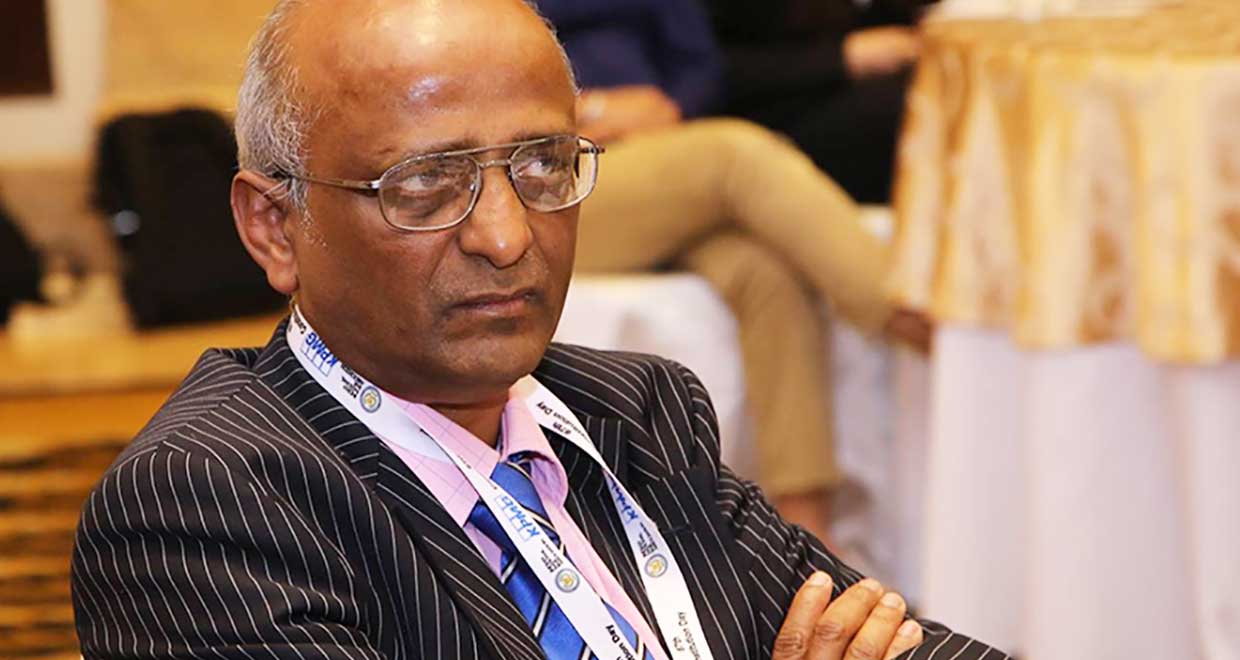
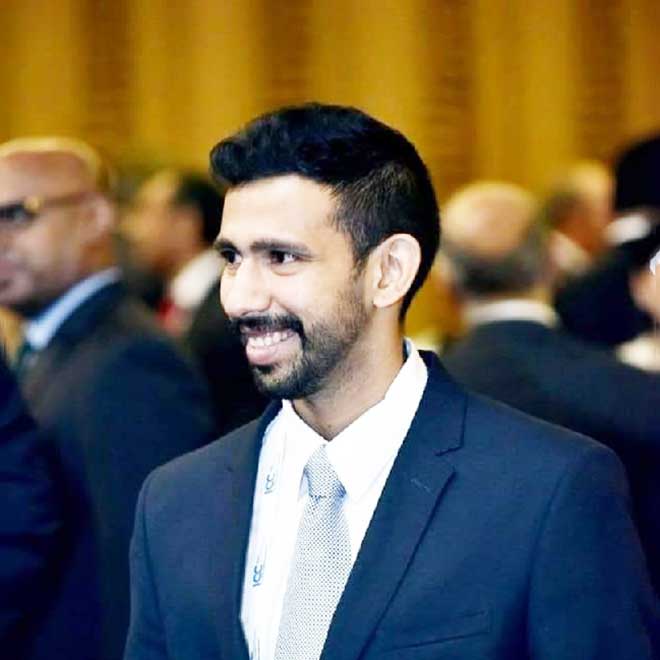
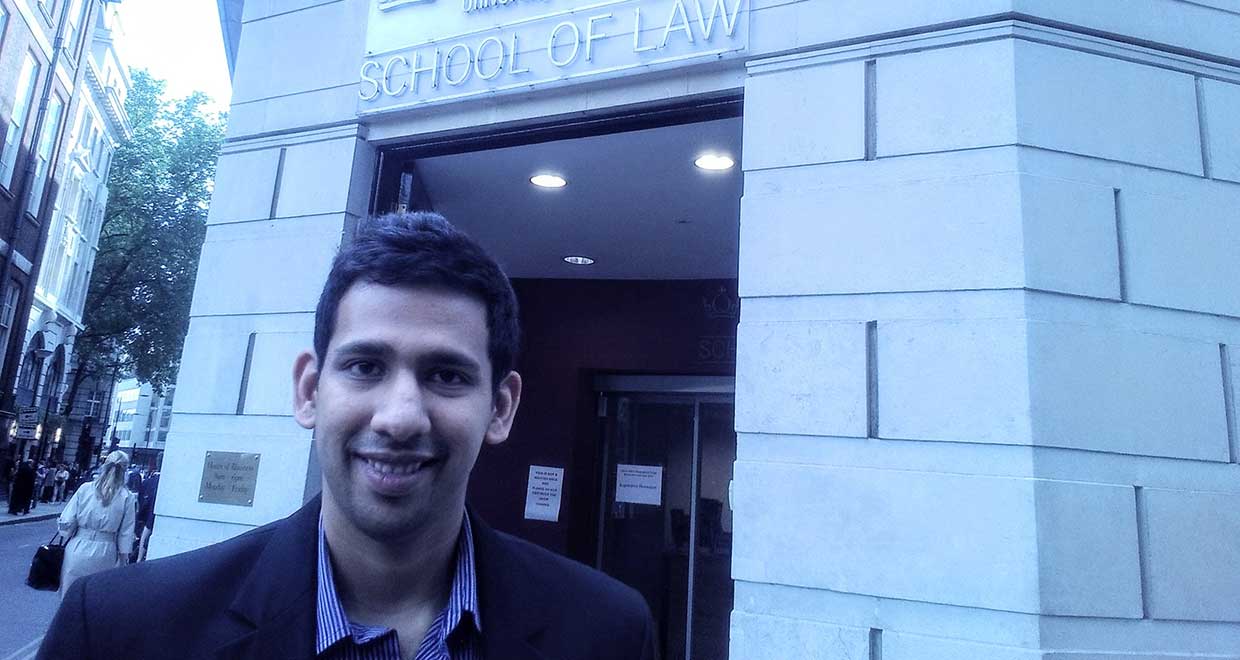
  • Saaheil Sharrma, Assistant Manager-Legal, HDFC ERGO, Mumbai on internships and his work experience

    Saaheil Sharrma, Assistant Manager-Legal, HDFC ERGO, Mumbai on internships and his work experience

    Saaheil Sharrma graduated in Law from in from Garhwal University in 2012. Back in his college, he was an ardent fan of mooting and went on to become the Vice President of his Mooting Society. Having quite a few publications to his name, Saaheil is also associated with LexisNexis where he has worked on big projects like that of Mulla series, Halsburys, Tannan and many more. He has also interned with the stalwarts of the Indian legal fraternity which helped him in acquiring a sound understanding of the legal world- the art of pleadings, oratory skills and application of Law.

    Currently he is the Assistant Manager-Legal with HDFC ERGO at Mumbai. He takes care of Civil and Consumer Litigation along with matters pending before Ombudsman at Mumbai and Pune. Alongside work, Saaheil is undergoing his LL.M. course with specialization in Corporate and Criminal Laws.


    In this interview, he talks to us about:

    • The importance of choosing the right kind of internship for you.
    • His association with LexisNexis
    • Some of his internship experiences.
    • Maintaining the work-life balance.


    How would you introduce yourself to our readers?

    I am a first generation lawyer who entered this profession by way of deduction. Given the fact that I hated medical and non-Medical, and clearing CA was next to impossible for me therefore, opted for the 5 year Law course. During that time, I also got fascinated with the Judicial system and how things work vis-à-vis Legislature and Judiciary. I finally ended up having a deep interest in the Constitution.


    What activities were you involved in your college?

    Well, college life back in Dehradun is still very close to my heart. Our beloved Principal Mr. Rajesh Bahuguna is very pro-active in co-curricullar activities. We have different societies in our college such as Debating Society, Moot Court Society, etc. I was initially selected as a mooter in the Moot Court Society in my 3rd year. I went on to become Vice-President of our Moot Court Society. As part of our beloved Principal Sir’s initiative, our College launched its College Journal with the name Dehradun Law Review on 26 November 2009 which was also given ISSN no. and I was one of its student editor from 2010 onwards till 2012. Paper Presentation competition is also one of the most sought co-currilcular activity in our college. In the event conducted by Dainik Jagran Newspaper across India, I went on to win 1st Prize in Paper Presentation for the State of Uttarakhand.

    Well, in the hindsight, things always look different and easy. I wish that I should have started mooting from my 1st year onwards. I believe the more you take interest in such activities apart from academics the better you become by the time you complete your graduation.


    Tell us about interning with Mr Raju Ramachandran, Former Addl. Solicitor General of India in the Supreme Court of India.

    Internship with a stalwart like that of Sr. Adv. Raju Ramachandran remains one of my biggest achievements without lowering the importance of other internships. It was my first internship in the Hon’ble Supreme Court in the year of 2011. As a matter of fact, since I had the rare opportunity of being attached to the then Hon’ble Chief Justice Mr. Justice Mukul Mudgal of Hon’ble Punjab & Haryana High Court, he was kind to me and referred my name to Sr. Adv. Raju Ramachandran.

    Working with Sr. Adv. Raju Ramachandran in the Hon’ble Supreme Court gave me the first hand knowledge about the working procedure & style of our Supreme Court. The skills which were honed while interning with him were drafting style in Supreme Court. The oratory battles were at display from close quarters and the preparation for conference with clients were the learning points at that point of time.


    How did you go about planning your internships?

    (Saaheil has interned with some great personalities of the legal fraternity.)
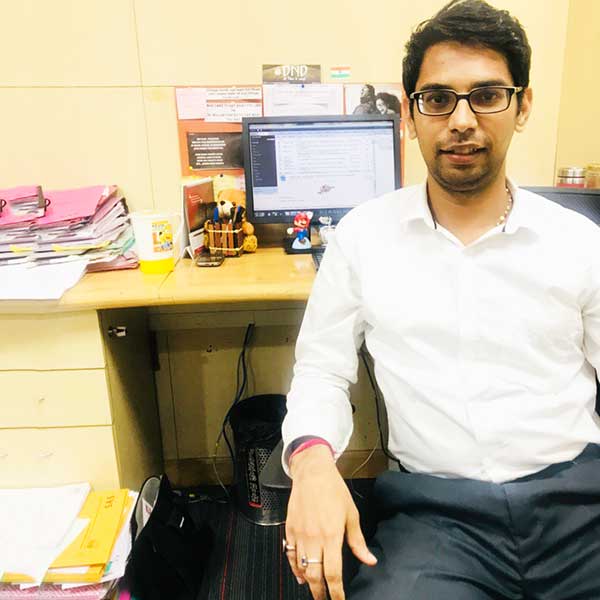
    Well, it is a matter of fact that I am blessed to be associated with starting from the then Senior Standing Counsel for UT, Chandigarh and current Addl. Advocate General of Haryana Mr. Amar Vivek to Mr Justice K Kannan (retd.), Judge, Punjab and Haryana Court, Mr. Justice Mukul Mudgal (retd.), Chief Justice, Punjab and Haryana Court and Mr. H. S. Hooda, ex-Advocate General of Haryana and Sr. Adv. Mr. Raju Ramachandran.

    If you see all these internships were pure litigation experience internships. I was very much clear about myself that I would start my internship from the practicing lawyer and once I am thorough with the working style of different courts only then I would apply for internship in any company/firm. I have seen many students who would start their internships in a haphazard manner with no co-relation to their knowledge of law i.e. year of law in law school and place of internship.

    I would say that choosing a right kind of internship is very much important. I started my internship from 2nd semester onwards with my Guru i.e. Mr. Amar Vivek. He taught me the rare art of pleadings, oratory skills and application of Law. While interning with the above mentioned Hon’ble Judges, I had the opportunity to learn the practice of law from the view point of the Bench. The research carried out by a sitting High Court Judge is entirely different from a practicing lawyer. The art of writing a judgment is quite unique and equally difficult.

    I can summarise by saying that having being blessed to learn from one of the stalwarts in our field it has made me more confident about knowledge and application of law at an very early age of my life. Although,there is still alot to be learmt, but, working with such personalities allowed me to develop right kind of approach that is required in understanding any legal issue in dispute


    How were the first few years after your graduation?

    Well, after graduating from my law school, it was tough for me to get accoustomed with the corporate world. Since I had largely interned with either lawyers or judges, so, frankly speaking I had no idea how a corporate legal department function. Initially, it was difficult for me to change from courtroom battles to boardroom discussions as in corporate world the decisions are largely guided by coporate policies and business relations.


    Give us an insight to your association with LexisNexis.

    Well, I started as an intern in 2010 with Lexis Nexis at their old office located in Okhla under Ms. Astha Dua Khanna. Initially I was trained to do legislation checks. Gradually, I was given work related to full editorial reading. It’s been a long association with them since 2010 and I feel indebted to Lexis Nexis for giving me big projects to work upon like that of Mulla series, Halsburys, Tannan and many more.


    As Assistant Manager-Legal with HDFC ERGO at Mumbai, what are your roles and responsibilities?

    I started working with HDFC ERGO last year. Being at the Head Office, your work profile is quite different from any other Regional Office. I take care of Civil and Consumer Litigation along with matters pending before Ombudsman at Mumbai and Pune. In addition to it, I take care of pan India MD legal notices, Execution and Appeal recommendation matters.


    What is your take on work-life balance?

    Well I would say “A busy man is a happy man”. Working in a litigation team comes with a hectic day schedule. My usual day at office starts with briefing my Reporting Manager with list of pending matters up for discussion which would include fresh complaints, legal notices, execution matters, etc. After, brief discussion is done by giving a snapshot of pending matters pan India with my reporting manager, thereafter, I would take up matters which require drafting of written statements, reply to notices, etc. In the evening, generally, I talk to my Advocates regarding our cases pending before various courts. Before, I call it a day, I always see which matters are listed for tommorrow. In addition to the above, list of matters pending for appeal recommendation and execution matters pan India is shared with my Reporting Manager and Regional Managers respectively.


    You handle Civil & Consumer Litigation with Ombudsman matters for Mumbai & Pune Region and pan India MD Legal notices. Tell us about it.
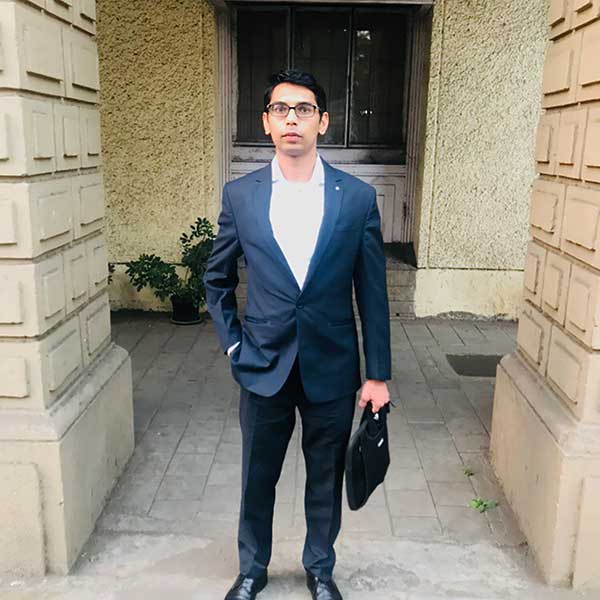
    Well, we have more Ombudsman matters than Civil and Consumer matters in Mumbai. In Mumbai, the matters do not linger for so long in Consumer Courts and therefore, it sometime becomes a little hectic when cases have back to back dates. The courts give short dates and adjournments are rare. Preparing a lawyer to cut out a first draft requires time. The case papers require in depth understanding and at the same time relevant user department is also asked to cull out relevant information. Once, it is done, then our panel lawyer is briefed and draft from him can be expected. Further, the draft sent by our lawyer is vetted as there may be some information which was not available earlier and/or specialized knowledge per se Policy wording cannot be expected from every litigation lawyer. Also, due care is required while replying to MD legal notice matters.


    What are the skills that you look for when you hire juniors/interns under you?

    Since, we can see now that field of Law is getting specialised in every aspect of law. Take for example, a lawyer practising taxation matters cannot be expected to take up banking matters or Insurance or Criminal Matters. Also, corporate legal teams which work on contract management will not have litigation experience. Therefore, one needs to be good in basic drafting skills. This helps a law student to further excel in future by undergoing internship in varied fields of Law. I feel in order learn the drafting skills one needs to start interning with a lower court advocate wherein all the basic drafting skills can be learnt and gradually one may assist a lawyer in the High Court and/or Legal Department of a corporate.


    What were the reasons for going for higher studies after having some work experience?

    (Saaheil enrolled with Panjab University under LLM course (2015-17) with specialization under Corporate and Criminal Laws.)

    It was a conscious decision after working in the corporate world for roughly 3 years. I was very clear at the time of graduation that first I will first work in some corporate and then only I will decide to go for Post-Graduation. I think it makes sense in a way that you can always come back and specialise in a subject of your liking after working in that field. Going straight for a Post-Graduation after completing graduation actually deprives one from practical knowledge and you are unable to clear interviews in absence of any pratical knowledge even after being Post Graduation in a specific subject.


    What would be your parting message to our budding lawyers?

    I would say that be privileged to be studying Law but at the same time give due attention to your knowledge of Law while being in College. The basics learnt in college would make your career. And lastly I would emphasize on that do not get bothered by your marks. In our profession, knowledge and understanding of Law is more important than high marks both in the interview and Court.


  • Reetika Walia, Legal Consultant, Salloum & Partners, Abu Dhabi, on experience Corporate Commercial matters in the Middle East

    Reetika Walia, Legal Consultant, Salloum & Partners, Abu Dhabi, on experience Corporate Commercial matters in the Middle East

    Reetika graduated in law from Army Institute of Law in 2004. Right after graduation she had the opportunity to work at the Supreme Court of India for two illustrious Senior Advocates, Dr. Pinky Anand, and Ms. Geeta Luthra. Thereafter, she worked at a few law firms in India for some time and then later she shifted base to the Middle East and have been focussing on Corporate Commercial matters.

    With fourteen years of work experience Reetika answers to Rounak Biswas of SLS, Pune, the questions posed by Anant Malaviya from NLU Odisha, on working with the top tier legal offices in the Middle East.


    How would you like to introduce yourself to our readers?

    I am a corporate commercial lawyer with almost 14 years PQE having worked in UAE, Oman and India. Other than advising on corporate commercial matters, my area of expertise lies in intellectual property, telecommunications, media and technology laws (IP & TMT). Over the years, I have had the opportunity of gaining diverse and varied experience in almost all facets of law. I kick started my career as a litigation lawyer in Delhi under the guidance of two of the best senior lawyers in India, Ms. Pinky Anand and Ms. Geeta Luthra. After my litigation stint, circumstances made me switch to the corporate world, more specifically trademarks and there was no looking back thereafter. Through the years I have been lucky to have worked with few of the best law firms in India, Anand and Anand for a very short stint, Fox Mandal, Bangalore, Lall Lahiri & Salhotra and as a partner at ALG India Law Offices, Delhi.


    Why did you choose to practice in UAE? Are there better career opportunities for lawyers compared to other places?

    End of 2010, I moved to Muscat, Oman as my husband was offered a job opportunity there. It seemed exciting and I tagged along! And there started my journey of working in the Middle Eastern legal market.

    After having worked in Muscat for almost 6 years at a Tier 1 firm, Al Busaidy Mansoor Jamal & Co. (AMJ), I moved to the Dubai for professional growth. Other than regulatory restrictions applicable in Oman in respect of changing jobs, I thought it was the right time to move on to a jurisdiction (UAE) that would have better job prospects and networking opportunities.

    I wouldn’t say UAE has better career opportunities, as that is very subjective and I think India is a booming economy, but yes the international, multicultural, progressive and fast paced environment surely sets it apart from other places. Additionally, it’s a great place to network and work alongside magic circle firms as well as other international firms.

    Being a very competitive market, I would say what would make one stand out and be successful in this jurisdiction would be their zest and enthusiasm to show their best by making most out of the opportunities granted to them combined with the opportunities one creates for their employer, the value one adds to their business.


    What are the key requirements for an Indian lawyer to shift her practice to the Middle East?

    There are no formal requirements other than being a qualified lawyer duly enrolled with the Bar Council. However, one cannot pursue a career in litigation in the Middle East, unless such practice is restricted to providing consultancy services. To establish a law firm in the Middle East, one needs a local partner and a licence to carry out such services. Additionally, it should be borne in mind that Middle Eastern countries are civil law jurisdictions and thus their legal principles differ from common law jurisdictions. Although the general principles of international corporate and commercial law remain same the world over, it is incumbent to understand and know the local laws and regulations in the jurisdiction.


    I wouldn’t however advise anyone to start off their career in the Middle East right away after law school or start off a firm in the Middle East without having gained adequate knowledge and experience of the local laws and the market.


    What role does fluency in local language (Arabic) play when it comes to career opportunities for lawyers in the Middle East?

    Knowledge of the Arabic language undisputedly opens up better career prospects for lawyers in the Middle East. However, there are many expatriate lawyers in this jurisdiction hailing from all across the world who are not fluent in the Arabic language.


    What do Middle Eastern firms look for Indian lawyers in particular?

    It is indeed difficult for Indian lawyers to find a job in the Middle East, specially a competitive jurisdiction like UAE. The international firms generally seek common law/US qualified lawyers which makes the market highly competitive and difficult to break into if you do not carry any foreign qualifications. However, one’s experience is also taken into consideration and if you are lucky, have amazing grades and work experience you are sure to sail through. It may be tough for newly qualified Indian lawyers to find opportunities in the UAE.


    How important is to attend global conferences as a participant and a speaker from a career perspective?

    I believe that lawyers need to be all-rounded professionals including possessing a zest for building long term professional relationships. One of the ways to achieve this is by investing in business development activities such as attending global conferences and networking events. Not only is it a great opportunity to connect with peers from the industry across the globe but conferences also provide excellent opportunities for lawyers to learn from the best minds and eminent people in the legal fraternity.


    What strategy should a law student adapt to make a career in the Middle East? Can you suggest some firms for internships to get exposure to Middle East legal work?

    As stated above, I wouldn’t recommend fresh Indian law graduates/newly qualified Indian lawyers to venture straight away into the Middle Eastern market unless they have acquired an additional foreign degree or have taken the QLTS and are qualified as Solicitors of England and Wales.

    Due to the difference in the legal system in India and the Middle East, it may be interesting to take up internships in the Middle East, however, I am not in a position to suggest any particular firms where one could apply for internships. In my experience, internships in Oman for Indian law students were usually secured through personal contacts.


    How did you get the opportunity to work with Al Busaidy Mansoor Jamal & Co?

    I sure was lucky to secure a job within one month of shifting to Oman from India. Although AMJ did not have any specific vacancy at that time, after seeing my profile, the Managing Partner at AMJ was kind and enthusiastic to take me on board to develop AMJ’s IP practice. By the end of 5 and half years, I was responsible for the IP & TMT practice at AMJ.

    I am grateful to AMJ for giving me my first break in the Middle East market and providing me the autonomy and requisite support to develop the practice area. I also had the opportunity to work with leading law firms and advise an impressive roster of clients like Apple, Red Bull, Porsche, Virgin Group, Facebook, Toyota, Walt Disney, Marriot, Google, HP, Accenture, Yahoo, Uber and Mitsubishi.


    What prompted you to shift to Salloum & Partners?

    As stated above, after having worked in Muscat for almost 6 years at a Tier 1 firm, I moved to UAE for professional growth.


    What can lawyers learn from your experience in getting high profile clients & maintaining client relationships?

    Advising clients in Oman has been the most exciting and creative period of my work experience. When I started working in Oman, few laws were still at a nascent stage, were ambiguous or were almost non-existent (especially in the IT and IP areas). However, as a progressive lawyer, I was able to successfully bridge the gap between the lack/ambiguity of legislation in emerging areas and the client’s business needs by providing innovative solutions and advice to clients and if required by liaising with regulators in Oman.

    The above went a long way in a maintaining positive relationship with my clients. In my view maintaining such relationships with one’s clients is key for a lawyer’s professional growth. When delivering any service, lawyers need to think out of the box and be creative to find well rounded solutions not only befitting the client’s legal needs but also their business needs.


    In the field of law what will make one stand out as an astute lawyer is their willingness to know more about and understand the ever-emerging concepts in the field and accordingly deliver strategic solutions/advice keeping in mind the client’s needs and business goals.


    Please tell us about Qualified Lawyers Transfer Scheme (QLTS) & how should one prepare for it?

    I am appearing for the first part (MCT) of the QLTS in July 2018. I realize the importance of qualifying as a solicitor of England and Wales to broaden my horizon towards having better career prospects in the international legal market including the Middle East. In my experience, it’s advisable to get study material from an accredited school who will provide you with very useful study material and practical tips to get through.


    Any career tips, cultural, social or economical for lawyers interested to work in the Middle East?

    Middle East is a good place to earn well. However, one should be aware that although countries like the UAE have big dreams to offer to expatriates at the same time the cost of living in the UAE is quite significant. Other countries in the Middle East may have social or political restrictions.


  • Manushree Kaushik, Consultant, In-House Practice, Vahura shares her insight on the field of legal recruitment

    Manushree Kaushik, Consultant, In-House Practice, Vahura shares her insight on the field of legal recruitment

    Manushree Kaushik graduated in Law from Amity Law School, New Delhi in 2012. She had never thought of being a lawyer or a recruiter but being successful was her ultimate motto. Gaining diverse experience by interning at varied firms, soon after graduation she started working for Dua Associates, premier full-service law firm for a period of almost three years.

    Wanting to utilize her legal education and experience and at the same time to do something different, Manushree stumbled upon the field of legal recruitment. Since 2016, she has been associated with Vahura as a Consultant with the In-House practice group. She primarily focuses on hiring for corporates across sectors from junior level hires through to mid-level management on a pan India level. She firmly believes “Recruitment is not just about hiring talent; it is about finding and hiring the best qualified candidate in a timely and cost-effective manner.”


    In this interview, she talks to us about:

    • Her decision to switch from corporate law to legal recruitment.
    • Her intensive internships with some great dignitaries.
    • The difference she’s found difference between NLU and Non-NLU students?
    • And the skills she looks out for during the recruitment process.

    How would you like to introduce yourself to the readers?

    I am a lawyer by qualification and a recruiter by profession. I am a part of Vahura’s In-House Practice group. Currently, I am in a recruiting role wherein I focus on junior to mid-level hiring across sectors.

    I did not grow up thinking or dreaming of being a lawyer or a recruiter, I just dreamt of being successful. I had no lawyer in my family or even in my extended circle of friends but Law as a profession sounded fancy to a seventeen year old and so I was intrigued. I did a bit of research, got through law school and here I am. The journey has been wonderful and I am glad I chose this as a career. It’s only now that I realize that this education and all these experiences have made me a better person, the study of Law changes the perspective of how you look at people and situations around you.


    What is your take on internships?

    Internships are the best part of the entire experience. Law school will teach us theory and maybe to some extent practical (via Moot Courts) but the real world of practice is very different and you can only experience it when you are in that atmosphere. Watching a Senior Advocate being briefed inside his chambers, the relentless chatter at a law firm, happy lawyers, stressed lawyers, lawyers arguing in a court room while the judge is trying to keep calm, all these things cannot be witnessed at a law school.

    I think the primary motive of an intern should be to observe and learn as this will give you a platform to base your expectations on. Enjoy your internship and you will be able to make the most of it.

    I wanted to gain varied experiences,  I have interned with independent practitioners, law firms and public bodies and each internship was different than the other. Although I thoroughly enjoyed all my internships, the most enriching one was the first one. It was the first time that I was seeing and hearing the royalties of the Indian legal fraternity, it was informative but also thrilling and exciting to witness these dignitaries live in action.


    Describe your experience of interning in the office of Mr. Parag Tripathi, Additional Solicitor General, Supreme Court of India and also with Mr. Gopal Subramaniam, Solicitor General, Supreme Court of India.

    I have had the opportunity to intern in the office of dignitaries like Mr. Parag Tripathi and Mr. Gopal Subramaniam.

    I had just cleared my first year exams and in the vacations that followed, I was interning with Mr. Subramaniam. We were two first years in that batch of interns and needless to say, both of us were extremely overwhelmed. I was told by another senior that I was at the right place but my timing was wrong. I was too young to learn something from the office of a Senior Advocate, and I might not have learnt a lot about the Law but I definitely learnt something about being a good lawyer.

    Similar was the experience at Mr. Tripathi’s office. I was three internships old when I interned with him and his office consisted of a very friendly team and that stems from the fact that Mr. Tripathi himself is a very friendly person. He devoted individual time to all the interns and would make us feel important and involved.


    How were the first few years after your graduation?

    I joined the Gurgaon office of Dua Associates right after graduating from college. I spent almost 3 years at the firm and that is when I truly realized what being a lawyer is all about. I was an excited fresher, who was willing to take on any responsibility and my focus has always been on delivering results. For the initial few months, I was doing a lot of research work. I was surrounded by a lot of people who wanted nothing but the best for me and this included my team members at Dua. The partners and the managers were all very supportive; they invested their time and energy into my training. It built a strong foundation for me and that experience has helped me a lot in shaping up my career.

    The law school experience was limited in the sense that we did learn a lot about the Law but not so much about the real world practice of law. The internships did help to some extent but they are not even close to the real thing. I was only able to make the most of my education and training, after I started working full time as a lawyer.


    What made you switch from corporate law to the field of legal recruitment?

    (Manushree worked as a corporate lawyer with Dua Associates for three years.)

    It was in 2016 that I decided to take a sabbatical for a few months. I wanted to explore the possible options available to a law graduate.  Moving to another law firm was an obvious choice but somehow I was not fully convinced to do so. I also made attempts at a few in-house opportunities and during this entire process I was being approached by multiple recruiters. I enjoyed my interactions with them so much that I befriended a few. I started to learn about the recruitment industry and I was really intrigued by the profile of a recruiter. It was fascinating and risky at the same time. I wanted to utilize my legal education and experience and at the same time wanted to do something different. And recruiting lawyers gives me the perfect balance of both.


    As a consultant with the In-House practice group at Vahura, tell us your work profile.

    At present, I focus on junior to mid- level hiring across companies. Our client base is spread across the country and hence we get to work with clients on a pan-India basis.

    Unlike most search firms, we have a unique network within the legal and governance fraternity which allows us to access the best passive talent not visible to most.

    My role includes analysing the requirements of a job, attracting professionals to that job, screening and selecting candidates and helping them integrate to the organization. Coming from a legal background, it is easier to comprehend the needs of the clients in this industry and this enables me to provide them with the right kind of talented professionals. Recruitment is not just about hiring talent, it is about finding and hiring the best qualified candidate in a timely and cost-effective manner.


    Being in the legal recruitment domain, have you found any difference between NLU and non-NLU students?

    The NLUs have a very different way of imparting education and training to its students. They have very strict qualifying criteria, and the environment is highly competitive. Also, the infrastructure and other facilities provided to the students are better than other law schools. And the most important factor are the placements, NLUs are the preferred choice when it comes to placement with premier law firms and corporates.

    However, a student’s future as a lawyer cannot solely be decided by the law school. Stay focused on becoming a good lawyer and success will follow.


    What are the skills that you look for while filtering during the recruitment process?

    Usually, it is the resume that creates the first impression. A well drafted and concise resume is the first sign of a promising candidate. And you must know your profile by heart. Everything that you have claimed to do, you should have done it. No lying on the resume.

    Another key factor is the confidence. It is very important to be confident in your interviews. Only if you have faith in yourself, will the interviewer have faith in you. Also, make sure that you are able to communicate your expectations clearly. Do not sell yourself short and do not over commit.

    Students should work on building these skills and with the right amount of dedication and hard work; they will be successful in securing a position in the industry.


    What would be your parting message to the budding lawyers?

    Be true to yourself. Do not leave any stone unturned in the journey to achieving your goals. Set a target for yourself and keep going till you hit it.

  • Ashok Kumar, Chalfont Chambers, Sydney on the jurisdictional differences between Australia, New Zealand and India

    Ashok Kumar, Chalfont Chambers, Sydney on the jurisdictional differences between Australia, New Zealand and India

    Ashok Kumar did a Diploma in Law and an LL.M. from the University of Sydney which enabled him to be admitted as an Australian Legal Practitioner in 1998. He also holds CA qualifications and is a member of the Institute of Chartered Accountant both Australia & New Zealand. He enrolled as Barrister at NSW Bar since 2001 and is heavily involved in litigation matters. In the initial days of his career he was attached as paralegal to Dr Ajit Swaran now District Court judge in Auckland, NZ.

    Mr. Kumar has been involved in many leading matters in Australia and New Zealand which have been published in professional journals and also overseas. He regularly appears in migration judicial review and appellate cases.

    In this interview, he gives us great insights to:

    • The jurisdictional differences between Australia, New Zealand and India
    • How has the change in technology impacted legal research?
    • Can a candidate with Diploma in Law and an LL.M. from the University of Sydney practice in India and England?
    • His message to the young lawyers.

    When did you start your practice? How do you recall the first year as a legal professional?

    Before I commenced work in the legal field I was employed in the accountancy field. In my last role, accountancy / legal matters overlapped.

    In my preliminary foray into law, I was attached as paralegal to Dr Ajit Swaran Singh of Auckland, New Zealand to complete my required training to be admitted in New South Wales, Australia. Dr Singh was appointed District Court judge in 2002 and currently sits in Auckland.

    I commenced work as a paralegal in July 1998. I was admitted as a lawyer of the Supreme Court of NSW, Australia in October 1998 and in New Zealand in November 1998. My admission in New Zealand entitled me to commence practice as a barrister. I continued to work with Dr Singh through to about February 1999. A commercial Law firm that we were doing work in those days approached me to join them as a solicitor. I found work as a solicitor boring and returned to independent bar in Auckland in 2000.

    As a barrister with Dr. Singh who at that time moved to practice in wide range of criminal matters including a murder case although Dr Singh is Fiji’s former Deputy Solicitor-General and Acting Solicitor-General. He had left Simpson Grierson, a pre-eminent commercial law firm in Auckland as solicitor and joined as partner of a boutique law firm (McAlister Mazengarb) which he left before commencing as a barrister. I was a junior running around doing research and ensuring that the files were in order. We discussed case theories of the case we were tackling. Not only I learnt how to strategize and run law cases but also instilled discipline and also reminded of the professional ethics as a barrister. Having learnt the Law in Law school this job put me at the coalface of the application of the Law to actual cases. He was doing interesting cases including a murder case; working on murder case with him at the start of my career was very interesting.

    I returned to Sydney to focus on bigger litigation jurisdiction in 2001.


    What would be your advice to young lawyers who are just starting out?

    I came to the Bar having worked in accounting / finance / management with a chartered accountancy background.

    I started out as a barrister with very good but short experience as a solicitor branch of the profession.

    I was an outsider at the Bar for many reasons. Many come to the Bar having worked in litigation area as a solicitor. They have many contacts that would provide them with work. In my days there were only few Indian barristers at NSW Bar. In that sense too I was an outsider. These days there are many more Indians at the Bar.

    My advice to people starting out is that Bar is not for the faint hearted. You have to be passionate about some area of Law. If you have interest in Law and its development you would do well.

    One of the most important qualities in my view is patience and perseverance. You might lose a case because of are too junior to a more senior lawyer (advocate in India). The loss should not be a deterrent. With time one will succeed but tenacity is required. Believe in yourself but remain humble.

    Always seek mentors whether it be Law School colleagues. In NSW we freely guide people who came to bar much later than us. If I am in complicated case I would ask other people in my chambers or friends at the Bar who practise in that particular area of law whether my approach is correct. Never be afraid to ask questions. Some would not help but many would.


    How has technology changed over the years in your experience?

    I believe that the technology has changed the practise of Law in many ways but in particular one can practically access Laws of other countries in an area there may be no case Law as to how court would apply particular provisions. Australian and New Zealand lawyers are able to research how a particular provision of similar legislation has been interpreted in each other’s jurisdiction. English Law too is available online. These days even less developed countries have started putting the legislation and case Law online. In my view this has given power to practitioners.

    Law firms have harnessed the availability of legal talents such as countries like India and a lot of back end work is now being outsourced. Technology has also enabled the practitioners to work from home. A lot of barristers, both junior and senior are able to do a lot of work from home whereas as in old days hard copy of loose leaf would be in the chambers together with bulky files had to be carted. A lot of briefs these days are sent online. It has definitely helped barristers with young family work from home. Legal research has become much easier. With smart phones and the like there is better connectivity.

    By using the technology I certainly have limited my travel to chambers.


    At what stage did you decide to go for an LL.M. in Tax and Corporate Law? In hindsight, how would you say it impacted your career?

    I also hold CA qualification having worked amongst others with CA firms. As I was completing my undergraduate Law course I decided that Master of Laws would complement the qualifications and experience I already had in both in chartered accountancy practices and in commerce. I commenced my Masters before admission as a lawyer in Australia and New Zealand.

    So starting out it was completely my thought but I did know a few law students who were already studying in the LLM program at University of Sydney and certainly they encouraged it.

    I believe that Master of Laws degree has definitely impacted my career. Some firms particularly a lot of Asian law firms’ value strong academic skills. My relationship with these law firms in Australia and New Zealand has started because of this.

    Sydney Law School where I did my LLM is regarded as most prestigious Law school in Australia probably has assisted.


    What are the primary jurisdictional differences you have found in your practices in Australia, New Zealand and India?

    One thing that is common between Australian / New Zealand and Indian legal system is that all these jurisdictions being former UK colonies have inherited the British Common Law system. Many old imperial Laws still have application today.

    Many factors play out the differences in Laws of Australian / New Zealand to that of India. The primary differences are the first two are western countries. India has different norms and customs. The Indian Laws therefore reflect those differences. So much could be written but here I can only refer to the big picture of the differences in Laws of these States.

    Both countries, there have been much litigation surrounding the Constitution. My area of practice has certainly meant that we have challenged legal provisions and whether laws are valid. Both countries have robust judicial review procedures to challenge the validity of the decisions of administrators as well as the judges as well as the appellate mechanism although there are increasing attempts to curtail these rights. The cases like Bangalore Water Supply v R Ranjappa 1978 AIR 548; 1978 SCR (3) 2018; (1978) 2 SCR 213 at 215 where India’s own character was defined.

    Owing to the differences the laws have been enacted to accommodate the particular society. There is enactment in India such as anti-dowry laws that is not existent in Australia. laws to assist Dalits have been enacted to deal with particular situation in India.

    From time to time Australian superior courts, although not that often, have considered and applied laws as interpreted by Supreme Court of India (leading case like Bropho v Western Australia; Tasmanian Dam case).

    Often solicitors call us in respect Indian clients call us in matters where the implications of laws of both jurisdictions (such as in Family Law cases / dowry cases / property cases) so these complexities. The differences in laws create difficulties.  Even solicitors from larger Law firms have been intrigued and have called for assistance.

    I am aware that Indian lawyers immigrating from India have done well as solicitors. I am not aware of any Indian advocate who has joined the Bar in my time. Very recently some may have joined but I am not aware of any myself. I believe most are local graduates.


    As a Barrister in Australia and New Zealand, how would you compare the Bar exam in those jurisdictions with the one in India?

    The first point to becoming a lawyer is to complete LLB or equivalent course recognized by Legal Practitioners Admission Board (in case of NSW). The second phase is to then attend Practical Legal Training course which can be done online or by attending approved institutions (such as College of Law) and obtain pre-admission experience of 3 months. I understand that Bar Council exams in India are done at about this point. At this point the candidates become entitled to be “Australian legal practitioners” and can obtain practising certificate as solicitors (issued by NSW Law Society or other law societies (issued by NSW Law Society or other law societies in the relevant jurisdictions). There are no further requirements to be Solicitors.

    The barrister branch of the profession imposes additional requirements on solicitors. The starting point is to enrol in bar exam papers in Legal Ethics; Practice and Procedure; and Evidence with pass mark of at least 75%. Then follows intensive Bar Practise course which runs for 4 – 5 weeks (all these detailed requirements could be found on the NSW Bar Association’s website). There are more hands on practical type training.

    I believe that in India the practice as advocate in the superior court is by level of experience. Barristers undergo training as Court advocates. I am not able to comment about Indian Bar exams as I am not aware what is tested and understand that there are no exams to be court advocate in India.


    You have been a part of the Legal Aid Committee and Equal Opportunities Committee of the NSW Bar Association. How is your experience being a member of the same?

    It is indeed been a great honour to be included in the above Committees. Just because one gets appointed to these committees does not mean one is there for prestige. Many hours of our time has been devoted to doing many things that was required to be done. These Committees I have been part of and have been instrumental in bringing considerable changes and actively putting the members’ views on many issues.

    Our Committees played big role in the introduction of Best Practice Guidelines; work on various briefing policies; child care; fund raising for important causes and of course issues affecting legal practitioners.

    The Committee work has been immensely satisfying. As team members we have achieved many things. Of course, friendships have also been forged. Some of the committee members have moved on to become judges or given other statutory appointments.

    There have been frustrating moments when members do not pull their weight or failed to turned up at sub-committee meetings.


    Please tell us a bit about your primary practice areas.

    (Barrister Kumar has worked with various commercial Law firms in New Zealand and Australia.)

    I have only worked for one commercial firm in Auckland. The primary area in that firm was property; commercial matters and some general work. Litigation tasks were also assigned. The primary tasks such as preparing submissions fell on me although the principal may often himself argue the case or run the trial.

    Apart from litigation we did considerable transactional work and I prepared the written opinions for the client. Returning to the Bar from that law firm I have been constantly engaged in running trial matters as well as appellate matters.

    My current practice areas are appellate, commercial, tax, property / leases, family law, administrative law and constitutional law. I have also done considerable work criminal law field. My work is mostly in superior Courts including the apex court (High Court of Australia) often in the original jurisdiction as well as special leave matters. I also appear often in NSW appeal courts.


    You have had considerable work experience in top accounting firms. How did you find the work there as compared to the Law firms you worked at?

    As an accountant I have top roles in companies as well as chartered accountancy firms. I worked for Touche Ross in those days. The firm I worked for now has been restructured as PwC. Some of the partners from my days remain as consultants or partners.

    One of the things about being a barrister is that you are in independent practice and on your own even administrative aspects are handled by chamber staff. As an accountant you can call upon other staff to assist. Even in the circumstances something urgent needs to be done the deadline is not fixed like that of the counsel. We get briefed in matters only because of our specialist skills. Whilst researchers can help the case would be ultimately be argued by the barrister. A barrister has to work under great pressure. The Court orders cannot just be ignored.

    Although I have done interesting accounting work, there is always challenge as a barrister. The solicitors who instruct often cannot figure the issues themselves and that is why the matter is briefed as it involves challenging application of Law

    With a Diploma in Law and an LL.M. from the University of Sydney, can you practice Law in India and in England?

    I qualified in Australia and have also been admitted in New Zealand. I have not really explored the possibility of joining the Bar in India. I understand that Indian PIOs (Persons of Indian Origin) have some relaxation of rules to be admitted as advocates.

    Again as for admission in the UK, I have really not explored the topic as I have not considered moving there. After accumulation of about 2 decades of experience I do not believe that I would have any problem getting the experience recognised or being admitted. There are some transfer tests for solicitors. Upon passing the transfer test Australian solicitors get admitted in that jurisdiction. Some barristers practice in both jurisdictions (UK and Australia). There may not be additional requirements for Australian barristers to practise in UK but I cannot be sure.


    What would be your message to young people who aspire to contribute to the legal fraternity?

    My primary experience has been in litigation so far as my legal experience goes. The Bar is only small part of the legal industry. The majority of lawyers in NSW and NZ are solicitors.

    The law school only teaches you the basics of the law. As I mentioned above, you need to go beyond and read areas of Law that interest you. Reading generally is also recommended as it would broaden your understanding. Sometimes widely read lawyers have that skill to express themselves well in court.

    Otherwise just be yourself.

  • Prateek Lala, Senior Associate, Shardul Amarchand Mangaldas, on building his career in Corporate Law and his gainful experience as a Paralegal

    Prateek Lala, Senior Associate, Shardul Amarchand Mangaldas, on building his career in Corporate Law and his gainful experience as a Paralegal

    Prateek Lala graduated in Law from CMR Law School in 2010. Coming from a family of scientists and being a first generation lawyer, Prateek used every opportunities and challenges thrown at him to develop as a professional. He started working as a paralegal at Universal League while still in college and then as an associate at Lexygen where he was directly involved in several multifaceted and highly challenging mergers & acquisitions and private equity transactions undertaken by globally reputable private equity funds and multinational companies.

    Currently, he is a senior associate at Shardul Amarchand Mangaldas & Co, one of the biggest and most reputed law firms in the country

    In this interview, we talk to him about:

    • His decision to pursue Law as a profession.
    • How can extra activities bring out the competitive edge in you which is very useful in the profession?
    • How to manage the discrepancies between what you study and what you do?
    • The qualities and skills that make a good intern.


     How would you introduce yourself to our readers?

    You can call me a ‘Bangalore boy’ although my roots lie in a small town called Santiniketan in West Bengal. I did my schooling in Clarence High School, Bangalore and law school from CMR Law School (now School of Law, CMR University).

    I really enjoy what I do today so I don’t really mind (and actually relish) the challenges that this profession throws. When I get some downtime, I like to travel, play sport, or spend time with family and friends.

    I actually come from a family of scientists, so while my parents were slightly apprehensive about me taking up Law (largely because of the misconceptions about lawyers existing in the 20th century), they were always very supportive. I am (fortunately or unfortunately) the first lawyer in my family although I have an uncle who practices Law in Gujarat.


    What motivated you to pursue Law? How was your experience at law school?

    Being abysmal at physics and chemistry motivated me to pursue Law! No, but seriously, I wanted to focus on my strengths and not pursue something that I didn’t enjoy (read: science). My father is a Ph.D. in organic chemistry and my brother is a chemical engineer, and there I was barely managing to pass in chemistry (imagine the embarrassment). But honestly, science subjects did not appeal to me and I realised I should focus on something else (which I would at least pass in) which resulted in me choosing commerce as my preferred stream in I.S.C. Thereafter, I thoroughly enjoyed studying economics, political science, accountancy, etc. and my grades improved drastically. During my 11th standard, I read about corporate law being a viable career option and its uptick in recent times. It seemed like an interesting option and something that I would enjoy so I went ahead and today I am glad, I did.

    Studying law was something that I thoroughly enjoyed. It really helped that I had some good lecturers who encouraged analytical thinking than just mugging up from some (in)famous ‘guidebooks’. I participated in various moot courts, cultural events, debates, all of which helped me develop as a professional. I interned after college hours at various firms and companies which gave me some great insight into the legal profession and the challenges underlying this profession. At the same time I didn’t forget to have some fun at college (some of my best years).


    Did you take up activities such as moots, debates and sports in law school?

    Yes, like I said, I participated in moots, debates, and sports all through college. These were integral in my development as a professional. Mooting teaches you a myriad set of skills such as research, mannerisms, oration, etc. Public speaking, per se, instils a lot of confidence in you which does keep you in good stead when you start practicing (be it litigation or corporate). Sports, obviously, bring out that competitive edge in you which, again, is very useful in this profession.


    You worked as a paralegal during your time in college. What motivated you to do so?

    Being a ‘non-NLS’ student, realised that I may have to think out of the box to secure a job. Mr. Partha Mandal, partner at Universal Legal gave me an opportunity to intern with UL after college hours and I worked there for two years. I became a fairly integral part of that set up (and I also got some stipend so it took care of ‘college expenses’). My seniors would take me to the courts, the ROC’s office, sub-registrar’s office, etc. which gave me an understanding of what happens practically. I also worked with Praxair India Private Limited, in my fourth year, under the guidance of Mr. Sthanu Singh which also gave me an in-depth understanding of labour laws and government contracts.

    Unfortunately, there is a huge dichotomy in what we study and what we actually do (reminds me of those memes) and being a paralegal helped me learn what matters. Of course, reading the Law (coupled with understanding the practical aspect) during work, helped when I was studying a subject at college and some stuff made much more sense than it would, normally, have.


    What piqued your interest in the field of corporate law?

    Initially, I joined internship because I wanted to figure out which area of Law interested me the most. But within a month of my internship with UL, their corporate practice sparked that interest in corporate law which I later pursued. All my internships have been in the field of corporate-commercial laws so I have never really deviated and explored other avenues. However, I experienced the real thrill of private equity and M&A during my time as a paralegal with Lexygen, where I decided this is what I want to do.


    What was your first job after law school and how did you secure it?

    During my fifth year at law school, Ms. Smita Thomas, a senior who I had worked with at Universal Legal (now a dear friend) referred me to Lexygen, a boutique transactional law firm (where she was working then). I was interviewed by Mr. Roshan Thomas (a principal associate then) for an internship and it was a colossal failure. However, given that they had a free slot that month, they decided to try me out. I worked under the guidance of Roshan and Mr. Vijay Sambamurthi (managing partner). Given that I had messed up my interview, expectations from me were very low, but the firm (rather benevolently) gave me enough work to keep me busy. Luckily, during a discussion on the Takeover Code, I managed to gather some courage and answer a question which the transactional team was deliberating (I had read about this subject at hand in some blog immediately prior to this discussion) and that answer helped them in the transaction and, voila, I was called back to work after college hours. As a paralegal with Lexygen, I assisted with research, proof-reading, restating articles, and (at times) due diligence. I can’t stress enough on how important research and proof reading is for an intern because if you give a well-researched document or catch a critical error in an agreement, it does really impress seniors at work.

    Lexygen gave me a PPO in my 9th semester and worked there for three years. It was a great learning experience and I have mad respect for that firm for having worked on some marquee deals. I learnt that it is critical to be thorough, meticulous, and well prepared for any task (whether drafting, negotiating, or conducting due diligences). I also learnt that lawyers could work hard and party harder!


    How did your appointment at BMR Legal happen? Can you tell us about the nature of your work and professional growth there?

    Post Lexygen, Roshan and I moved to the transactional practice at Themis Associates which was led by Mr. Siddharth Nair then. I worked on numerous multi-faceted and complex deals at Themis under the guidance of Roshan and Siddharth. My learning curve at Themis took a serious upswing thanks to the partners there. The transaction practice at Themis moved to BMR Legal the year I joined Themis. BMR Legal gave us exposure to several large and complex transactions which often gave rise to various stressful and challenging situations. But that was the thrill when we closed large and complex transactions, it gave us immense satisfaction.

    I was given much more responsibilities at BMR Legal; I became a senior associate and started leading transactions with minimal partner supervision. Initially, it was stressful but I guess I adapted fairly quick. Roshan and Siddharth continued to guide me during transactions and I picked up a lot of skill sets from them. Merely attending negotiations with them was a learning experience. I tried to replicate what I learnt from them in my deals and that paid rich dividends


    Can you describe the work environment and your job description at SAM?

    The transaction practice of BMR Legal was acquired by SAM. I work with Roshan at SAM, and I am grateful because he has been a mentor, guide, and friend from the Lexygen days and one can learn immensely while working with him.

    We have a wonderful set-up at SAM and the team I work with is incredibly talented, dedicated, and hard-working so it is a pleasure to work with them. The long/all nights don’t feel cumbersome since you are working with a wonderful set of people. Of course SAM, being one of the biggest and most reputed law firms in the country, opens up a lot of opportunities from a work perspective. We are still new to the SAM system but are settling-in fairly nicely.


    Have you ever considered pursuing higher education? What are your views on the importance of higher education?

    I am of the view that higher education in Law has very little or no utility if you are intending to practice corporate law. While you are gaining theoretical knowledge, it may not serve much utility from a practical experience perspective. In my experience, candidates with a higher PQE have an advantage over candidates with an LL.M. degree. I, personally, would choose to get the hands-on experience. However, I am told that higher education at reputed foreign universities is a great experience.


    How do you maintain a work-life balance?

    I think it is important to use your free time judiciously. Indulge in your hobbies, take holidays and spend time with your loved ones so that when the work is at full tilt you don’t feel burnt –out and are ready to put in the long hours. I personally mix music, play sport, travel, and spend time with my family and friends at every given opportunity. Also, I feel working-out and meditation is a great outlet for the stress that builds-up during high stress situations at work. Given the sedentary lifestyle we corporate lawyers lead, it is all the more important that you choose a healthy lifestyle.


    How do you keep yourself updated with legal developments in the numerous areas of law you deal with?

    SAM has a great research team that issues regulatory and market updates regularly. Apart from that RSS feeds and subscription to various legal newsletters and primers help immensely.


    Have you had any experience dealing with interns? What are the qualities and skills that make a good intern?

    I used to interview and hire interns for the longest time. The key qualities that make a good intern are as follows:

    • Never be complacent about (or underestimate) the work given to you.
    • Be meticulous and thorough in whatever you are doing. It may be a simple proof-read or a simple research.
    • Give it your best shot, and make sure you try to add as much value as possible. Remember you will be judged on these simple skills.
    • Never sit idle. If you are free, go up and ask a senior for work.
    • Don’t hesitate to ask for clarifications. Remember, you are trying to add value and reduce the work-load of your senior. You can do so only if you have understood the subject matter yourself.
    • Do not blindly copy matter that you see online into your work product. Make your work product as original as it can get.
    • Try to adapt to the firm’s culture and values.


    What are the qualities required to succeed in the field of corporate law and in major law firms?

    I’m still figuring out the qualities myself. But till now what I have figured is that hard-work, passion, commitment, and meticulousness cannot be compromised. Also, good people management skills are priceless in this profession.


    What advice do you have for our readers who are primarily college students?

    Pursue corporate law only if you think you might enjoy it (after having read about it). It looks glamorous from the outside but it is real hard work consisting of innumerable sleepless nights, sometimes unrealistic expectations, and minimal work life balance. However, the thrill and excitement is something that very few other professions have to offer. You need to be (i) updated about legal and financial developments, (ii) meticulous, (iii) willing to work very hard, (iv) focussed, and (v) willing to adapt and learn.

    Also, don’t get trapped in the seriousness of it all. Have some fun whenever you can!

  • Richa Mohanty, Principal Associate, Cyril Amarchand Mangaldas on challenges of a Corporate Lawyer and tips to securing a PPO

    Richa Mohanty, Principal Associate, Cyril Amarchand Mangaldas on challenges of a Corporate Lawyer and tips to securing a PPO

    Richa Mohanty graduated in Law from Symbiosis Law School, Pune in 2008. Throughout her college life she engaged herself in various extracurricular activities which have greatly helped in shaping her as a professional. She has interned at various firms in different sectors ranging from civil, criminal to SEBI. She was offered a PPO while still interning at Cyril Amarchand Mangaldas.

    Currently, she’s a Principal Associate at CAM. Her work involves advising on a number of issues such as transition of employees in M&A transactions, individual and mass terminations, closure of establishment, anti-sexual harassment matters and social security issues.

    In this interview, she talks to us about:

    • Her decision to pursue a career in Law.
    • Her tricks to do well in moot court competitions.
    • Maintaining a work-life balance.
    • How to secure a PPO while interning?


    How would you introduce yourself to our readers?

    I am a corporate lawyer with over nine years of experience. I am currently a Principal Associate at Cyril Amarchand Mangaldas (CAM), New Delhi. I started my career with the erstwhile Amarchand & Mangaldas & Suresh A. Shroff & Co., and have had the privilege of working across its New Delhi and Mumbai offices. I moved to the CAM Delhi office, upon its inception in 2015. I specialise in employment and labour laws. I am also a member of a Special Taskforce on Employee Relations, at the Confederation of Indian Industry (CII), Gurgaon.


    What motivated you to pursue a career in Law?

    I think it was a mix of many factors. I don’t come from a family of lawyers and when I was in school, Law was not a popular career option.

    However, like most things in life, timing played an important role. With the second wave of liberalisation, the Indian economy appeared to be booming in 2002-2003. Simultaneously, the landscape of legal education was undergoing a transformation, especially with the introduction of the five year integrated law courses and the rise of professional law firms/ formal legal teams in organisations. All of this greatly enhanced the appeal of the legal profession and I decided to take the plunge!

    On a lighter note, I should also give some credit to popular TV shows like “Alley Mcbeal” and “The Practice”.


    How did you approach the extracurricular activities such as moots and debates in Law school?

    Yes, I was very much involved in the co-curricular and extra-curricular activities. I tried my hand at everything that law school had to offer- debates, presentations, extempore, moots, seminars and even business plan competitions. I also participated in a number of cultural festivals including drama, dance and music competitions and was a member of the Human Rights Cell.

    All of this really helped me get perspective about my strengths and weaknesses. As a trimmed list: public speaking, research skills, team work, strategic planning, rationalising each argument were by products of these activities.


    Having participated and judged several moot court competitions, what is your advice to students?

    I would say that debating on legal or socio-political issues is much more critical than mooting, but that is a personal bias. Mooting and debating are sans recourse for a law student. My advice for all mooters would be to immerse themselves in the basic legal framework (Act/Rule/Regulation) before jumping the gun and moving to case-law finding frenzy. I also always found it helpful to set out a research methodology for the various roles I rendered as a mooter.


    Tell us about your internships and how did you apply for the same?

    I had interned at a number of places- from criminal lawyers to corporate law firms, banks, corporates, SEBI and even with the JAG (Judge Advocate General) of the Indian Navy. The idea was to gauge and understand the role, expectations at each organisation; and accordingly figure out my interests and career goals.

    I would strongly advise law students to apply to individual lawyers/ partners, depending upon their area of specialisation and to focus on the practice area of one’s choice, rather than blindly applying to Big Law or corporates and letting the HR assign the partner/ team to you. Also, don’t get mesmerised by Big Law and corporates. The experience and exposure at smaller, niche law firms can be equally good and rewarding.


    Have you ever felt the NLU and non- NLU divide? Do you think it is a consideration for employers?

    Some National Law Universities (NLUs) were the first off the mark in the corporate-focused 5-year law course, consequently with great alumni connect. Plus, there’s bound to be greater comradery between people from the same Law school, whether NLU or non-NLU. While I never personally faced any such divide, it may not be unnatural for a smaller set in even a small-sized firm, to feel a little ‘out of sync’ or not entirely ‘tuned-in’.

    Being a part of a professional organization and conducting oneself as a professional in its truest sense means that you transcend these perceptions and beliefs very quickly. I do not think it is a consideration for any modern-day employers.


    Give us an insight to the Sir Ratan Tata Trust Scholarship.

     (Richa is an awardee of the Sir Ratan Tata Trust Scholarship.)

    I heard about the Sir Ratan Tata Trust Scholarship from a friend. It is basically a merit based scholarship. There were no interviews or essays for this scholarship in those days. I simply had to apply with my mark sheets and a cover letter (not sure of what the process entails today). If I remember correctly, I got a cash award and a certificate.


    How was your experience of attending a Student Exchange Programme?

    I was a member of a fourteen member contingent from Law school to the University of Hannover, Germany for a period of two weeks in 2006. It was more of a cultural exchange programme but we got the opportunity to participate in panel discussions on interesting issues like intellectual property, anti-trust laws etc. We also visited the local courts and prisons at Hannover and Hamburg and were given a detailed overview of the EU framework.


    How did you secure a PPO from AMSS?

    I interned with the firm, made sure to put in my 110% during this traineeship stint, and was fortunate to have got a pre-placement offer (PPO) interview call. I was also fortunate to have interned with a wonderful team that really encouraged and supported me. I am in touch with most of them and consider them to my true mentors.


    How important do you think a high CGPA is for recruiters?

    Traditional non-PPO / Campus recruitment for most big / medium sized firms would largely be based on CGPA as a first indicator. A high CGPA can reflect discipline, dedication and attention to detail as per assignment requirement. This conventional thumb-rule dilutes in value as you move up the PQE chain during lateral recruitments.


    What would be your advice to readers who hope to get an offer from CAM?

    Intern with the firm and put your best effort during traineeship. If you wish to intern with a particular team / secure sectoral / practice-area focus, back a sincere request to the HR (after being accepted) with some prior academic research / publications. If you could not secure an internship, focus on CGPA as a first amongst equals and then publications as well as co-curricular and extracurricular activities.


    Can you give our readers some insight to the field of Labour and Employment Law?

    It is a very interesting and developing practice area and CAM is one of the leading firms in this space. As an employment law specialist, I routinely advice clients (mostly employers) on a number of issues such as transition of employees in M&A transactions, individual and mass terminations, closure of establishment, anti-sexual harassment matters, social security issues, trade union issues, ESOPs, immigration laws and basically all matters in connection with employees/ workforce. This is one of the only practice areas which involve a mix of advisory, transactional and litigation work.


    What is the nature of your work as a Principal Associate at CAM?

    As Principal Associate, I am entrusted to engage with Clients, oversee / review delivery of work-products to them and undertake practice-area as well as business development. CAM is a demanding but a very vibrant work space. What I like the most about the organisation is that it is not hierarchical and talent is valued above all else. So it does not matter which Law school you come from or what level of associate you are or what your political views are, as long as you do the job well, nothing else matters!


    How do you maintain a work- life balance given the demanding nature of your job?

    I have to say that working in a law firm can be extremely demanding, especially in the early years, when you are learning the ropes. As a consultant, you have to be mentally prepared to “work-on-demand”, especially on weekends, holidays and when travelling etc.

    Two things that have really helped me are (1) effective time management; (2) prioritisation of daily tasks. It also helps to be candid and upfront with your reporting senior about how much time you will take to complete a task so as to manage expectations accordingly.

    As such, there is no real formula to maintain a work-life balance, but what I would recommend is to definitely take out time for things that you genuinely enjoy- for example if you are a marathon runner or a classical dancer or if you like travelling, etc. plan your leave or free time, in such a way that you can accommodate these activities. Otherwise, like they say, all work and no play, makes Jack a dull boy!


    What challenges have you faced in building up your career as it stands today?

    There have been multiple challenges during the course of my career. To begin with I think, nothing quite prepares you for the legal profession unless you officially join the bandwagon. It takes a while to bridge that gap since legal studies in India are by and large theoretical, rather than being practical. There is no gestation period in this industry, so you have to pretty much learn on the job. Also, you also need to constantly adapt and adjust to the demanding work life at a law firm and learn to build lasting relationships. Every new level brings new challenges and you will have to keep pace with it. I am very grateful to some of my seniors and colleagues, for the lighting the way and guiding me through some of such trying phases.


    What advice do you have for our readers who are primarily college students?

    Law school days will always be the most stress free days of your life-so my only advice would be to make the most of time and to choose your friends wisely. Also live it up and have lots of fun. After all, you live only once (borrowing from the millennial motto)!

  • Harish Nambiar, Vice President-Legal, Syntel, on working in the Information Technology and Services Industry

    Harish Nambiar, Vice President-Legal, Syntel, on working in the Information Technology and Services Industry

    Harish Nambiar graduated in Law from JSS Law College, Mysore in 1997. Harish has been exposed to seventeen years of comprehensive experience in the areas of: Legal Strategic Planning, Management, Consulting Compliance, Drafting & Vetting, Litigation, etc. He joined Syntel as General Manager – Legal and was promoted to Vice President in 2014. His role also includes managing the ethics and whistle-blower policies of Syntel.

    Harish likes to be a practical and proactive lawyer with an inclination towards understanding relevant laws and underlying jurisprudence.

    In this interview, he gives us his insights to:

    • Being a first generation lawyer.
    • Constructively utilizing time at law school.
    • His areas of expertise and how did he go about developing them?
    • His important message to young law graduates.


    How would you like introduce yourself to our readers?

    I am Vice President – Legal at Syntel, a global IT multinational corporation. As a lawyer, I have always been an in-house counsel, starting from my first corporate assignment with a large IT company in 2000. I have worked in IT companies and insurance companies. Of my total seventeen to eighteen years in corporate assignments, I have been in senior leadership position (AVP and above) for about twelve years. I am interested in Law related to contracts, property, employment, crimes, IPR, and anti-harassment. However, as an in-house counsel, there is really no limitation on what kind of matters may come up and what range of Laws will have to be applied. On personal side, I am very passionate about environment protection and planting trees. I like driving and comedy movies. I am an avid reader and like reading anything that is available on Indian history – I have a collection of books. I also like to be associated with causes that support destitute children and underprivileged women.


    Tell our readers a bit about your childhood and pre-college life as well as educational background.

    Most of my childhood was spent in Mysuru, then known as Mysore. It is a beautiful place. I went to the St. Joseph’s School at Jayalakshmipuram in Mysore, Junior college was done in SBRR Mahajana Junior College, and I completed B.A, LL.B from JSS Law College (which was at that time affiliated to the University of Mysore). Overall, I used to do well in studies. Law school was particularly good. JSS Law College was one of the best things that happened in my life. I had very good teachers and I am in touch with all of them, even today.

    Childhood memories revolve around railway equipment and associated stuff as my father was an officer in the Indian Railways and we used to stay in residential quarters within the railway housing colonies. I am a first generation lawyer and there were no lawyers before me in the family.


    What inclined you towards the field of legal education?

    I decided to pursue law a career probably when I was in the seventh or eighth standard of school and the trigger was Mr. Shatrughan Sinha. While watching him play a powerful lawyer in one of his movies, something clicked within me saying “I too need to become that.” While that may seem like a melodramatic reason, I think it also had to do with something in me that made me like complicated sentences, legal references and the like from a very young age – like fourteen or fifteen years. Since there was no family precedent, I had to convince my parents to let me do this, and they agreed, and that was the beginning. It was all set and sealed by the time I was entering my tenth standard of school.

    I started reading law books right from those days, and I completed reading treatises on the Indian Penal Code and Central Motor Vehicles Act when I was in 12th, and I was probably the only one who had ever touched these books before entering the law school.

    At law school, I always tried to do more than was required. I would keep Cox or Modi on Medical Jurisprudence and Toxicology open for reference while reading Ratanlal & Dhirajlal on IPC or Indian Evidence Act. I had Gaur’s Firearms and Forensic Ballistics while learning about the Indian Arms Act and Indian Evidence Act. This approach helped me understand the topics better. I had a very good academic record at law school.


    You’ve been a professional lawyer with more than seventeen years of extensive experience. How did you go about developing your expertise?

    Some of these items cannot be ‘taught’ in the classical sense. It needs to be picked up along the way. My formula was to overlay the theoretical and technical knowledge imparted during law school into the manner and methods which my seniors in the office were employing to handle a situation. Then, I would top it with my own common sense and arrive at a solution.

    One of the most important things that I used to do was ask questions to my seniors and air my opinions freely, so that each time, I was taking one step towards perfecting the solution I had arrived at. I also had the ability to say ‘no’ to something that I believed was not possible to do.

    I strongly believe that a lawyer with a sound and strong knowledge of the technical aspect of law and the jurisprudence can provide a solution to most issues. The fact that I was on the right track manifested itself when I started the heading the Legal Department at a major insurance company with between five and six years of professional experience. I was able to replicate this at another insurance company with eight years under my belt.

    It is all about knowing how much you actually know, bridging the gap, using common sense, asking questions and being bold enough to take the plunge. Most importantly, while taking the plunge, be mindful of the fact that you can fail too – but that failure should not be taken negatively and should be used as tool to avoid repeating the same mistake.


    What is a day at work like? What is the most challenging or stressful part?

    I enjoy what I do, so no workday is more stressful or difficult than any other day. I don’t say that every day is a cakewalk, but since I enjoy what I do, it is quite pleasant most of the time. I start early and segment the day into various buckets, which helps me manage my time better. I haven’t really faced any work life balance issues as such, as I am able to manage the time properly. Syntel, in particular is a great place to work and quite understands on the work life balance part – I have been here for more than seven years and it has never happened that my personal life was compromised because of my professional life. On home front, my family understands the several demands that apply on my time. My wife Rashmi and my ten years old daughter Nandana are very supportive of my professional commitments and leave me to my own devices on work related matters. They are a great source of strength and inspiration. Unless there is an absolute emergency, or I am travelling, weekends are always reserved for the family. On a daily basis, I keep an hour for myself which is the time that I use to recharge myself. That hour could be spent doing nothing, or it could be used for reading, or tending to the plants at home. I also spend part of my weekend with my parents generally discussing on any topic that we find amusing or interesting.


    You joined Syntel as GM in 2010 and were later promoted to VP. Please walk us through your work profile.

    Broadly, my work profile is to manage all legal affairs of the company, wherever we operate. This includes contracts, litigation, compliance, corporate law matters, employee conduct etc. Additionally, most organisations bundle the whistle-blower policy and related matters like employee conduct into the Legal Department. While these are strictly not ‘legal matters’, at senior levels within the Legal Departments, these matters also come your way. I have been handling such things for more than twelve or thirteen years now.


    What was role did you play at your first corporate assignment?

    My role at my first corporate assignment was largely on contracts – both buy-side as well as sell-side. Certain items of compliance and IPR were included, as well as part of one M&A. But those few years taught me a lot, because at that time, it was a small team and I had to adapt fast and become independent.


     How do you manage your diverse range?

    (Harish handles statutory compliances and other works like drafting and vetting of contracts and liaison with external agencies on legal issues.)

    As I said earlier, it is the willingness and eagerness to learn that will help one gain the ability to master a wide range of duties. I am a perpetual learner and seek out new challenges. Once you make learning a habit, range is not an issue.

    As a concluding message, what would be your suggestions to law students/young lawyers?

    Stay focussed on the goals you have set for yourself. Most law students that I have met believe that they are already lawyers within their first year of law school, and tend to fall into the trap of unwanted distractions that comes with it. Avoid that trap at all costs – you are a formal student till you graduate, so use that time to study. The fundamental job of a student is to study and acquire knowledge. Bear in mind that you can ask any question till you graduate, but the ability to ask certain questions is reduced after graduation, and that reduction keeps increasing with each passing year since graduation. No client is going to be impressed if you must research a basic legal question.

    Once you graduate, use the first five to six years of your career to gather as much knowledge as possible on practical aspects, without losing the technical side of the matter. Unlearn and relearn if need be. At the end of this period, assess yourself and determine if you have become a better lawyer — one that can recite the law, propose a solution to a problem, and have the wisdom to realize when no legal solution exists. Never compromise on the technical knowledge and keep the basics strong. Always remember that the most complicated techno-legal agreement on space technology collaboration also needs to pass the basic test of ‘consideration’ or ‘capacity of parties’ to be held enforceable as a contract under law, as much as the agreement on buying sugar from a neighbourhood grocer also need to pass the same test to be held enforceable under Law. Basic principles are divine – they cannot be forgotten or violated at any stage.

    Simply put, never compromise your professional integrity. Don’t manipulate the Law or your clients, base the legal opinion of the principles of Law, don’t use your knowledge of Law to gain an unfair advantage over your clients, and most importantly, have the courage to say ‘no’ when something is not legally possible to do.

    A combination of professional integrity, technical knowledge, common sense and the ability to propose solutions to your client’s problems is what will set you apart from others.

  • Anghrija Chakraborty, Senior Manager-Global Risk and Compliance, Aricent Technologies, on how to deal with academics, internships and work

    Anghrija Chakraborty, Senior Manager-Global Risk and Compliance, Aricent Technologies, on how to deal with academics, internships and work

    Anghrija Chakraborty, graduated in Law from Campus Law Centre, University of Delhi in 2008. Coming from a family of doctors and engineers, her fascination for the working of the wheels of justice motivated her to pursue a career in the legal industry. She firmly believes that if work is done smartly, you can still find time for “Netflixing”- her major stress buster.

    Anghrija joined Aricent as a Manager in June 2015 and was promoted to Senior Manager in July 2016. Her chief duties are planning, implementing and monitoring all corporate compliance programs. Co-ordination of compliance audit activities and communication of expectations and reporting results are the key functions of her position.

    In this interview, she gives us an insight into:

    • Tricks to approach academics without having a mental breakdown.
    • How to make the most out of internships?
    • Importance of work ethics.
    • Indispensable message to the budding lawyers.


    How would you like to introduce yourself to our readers?

    I’m a legal and statutory compliance specialist. Occasional writer. Dreamer. Thinker. Random lover of all things breakfast-y. Total snark with a heart of mashed potatoes. Bad photographer. Charmingly neurotic. An absolute, but barely controlled, legal research junkie.


    What prompted you to study Law after completing your English Honours from Miranda House, University of Delhi?

    I had always been interested in the dictates of justice, and I genuinely found Law fascinating. Therefore, it was easy-peasy. Of course, there were several other reasons – (i) I could represent myself in court if push came to a shove; (ii) because movies and TV series gave me no choice (read, Ally McBeal, The Practice, etc.); and (iii) because I wanted my grandparents to have something nice to tell their friends.


    Which activities did you partake in and how did you approach academics while in college?

    Law school, I believe, is akin to cooking for the first time. You have absolutely no idea what you are doing, and it is a bit of a mess. But just like cooking, you get better at it with time. During my time at law school, I learned a few things that helped me sail through.

    Make one page summaries every week.

    One of my professors at college once said that a good lawyer can explain their case in  one sentence. I say a good law student can explain their lectures on one page. A one-page summary will force you to do three things: (i) re-read your notes over the week (ii) think about the important details; and (iii) rewrite your notes in a simplified form.

    Use colour (lots and lots of them).

    When you make a one-page summary, or your notes, use colour. It helps you find key words easily, and also distinguish between different topics. Not to mention, it is easy on the eye and a colourful way of immersing your desk with law notes.

    Keep a balance.

    Burning out from studying too much and cramming because of studying too little are two things that one should avoid. In both instances, you can study for so long before you start hitting diminishing returns and your brain begins to sizzle. Law school has taught me that a ten-minute break every hour is a good rule of thumb to stick to.

    Test yourself (can I explain this to a friend?).

    If you can explain why positivism is at odds with naturalism to a friend, then you can do it in an exam. Why this works? – (i) You must know the content to explain it; (ii) You must explain it so that it makes sense. Two important skills in any law exam.

    Be friends with a ruthless proof-reader.

    What you want is someone who will destroy your essay/assignment if it is awful rather than calling it “scholarly and erudite.” Here is a suggestion – either print your assignment or read it out loud. That is the best way to avoid being ½ marks off an A.

    Be friends with a law school senior.

    This is important. A friend who understands the struggle, and who is also able to give you assessment advice is something money cannot buy. Taking the initiative when the opportunity comes up and being genuine would be my two cents when it comes to befriending a law school senior.

    At law school, apart from the regular academic coursework, I found myself in the library, reading up, or volunteering with blind students at the Braille Institute Library next door, or helping set up meetings and events organized by the Gender Justice Society.


    What were your areas of interest during your graduation and how did you go about developing expertise in them?

    To be honest, I did not have a favourite subject or area during law school. I remember that legal research on various topics interested me. Therefore, I read a lot, and then worked on my research skills. After law school, in my different jobs, I worked at strengthening my research skills, and continued reading a lot, leading to my eventual interest in data privacy, anti-corruption, anti-trust, ethics, etc.


    How is internship helpful for a law student and what kind of internships did you do during your law school days?

    I remember my first days in law school. I had this air of confidence, quite like Harvey Specter. I had good grades in college, and I had made it to law school. I felt extremely proud of myself. That was until I started talking to my peers and seniors. One had already worked at the Attorney General’s office. One had already nabbed an internship at a top tier law firm. I remember wondering in second year if I should just drop out of law school and take up something less daunting, like, nuclear physics or rocket science. After all, how could I compete with these people when I had no legal or internship experience? I really thought that evil HR managers would just show me the door. But this is not what happened/happens.

    I figured later that most legal workplaces are on the lookout for people who can think on their feet, can interact well with clients, and are not afraid of hard work. And these are skills that are not contingent on you having done an internship or not.

    In fact, there are several non-law things that you can do, which will count as good experience when you apply for a highly coveted legal job:

    You could get involved in campus life – join the law society, become a student ambassador, join a volunteer program, become a mentor or a research assistant for your professor.

    You could volunteer at charities – find a cause you are passionate about and start devoting time in helping those who need help. It shows that you are compassionate and have varied interests. Also, this would make you stand out in law firms that do pro-bono work, or companies that have good corporate social responsibility functions.

    You could organize a successful college event – may be a fundraising one. Such events are fun, and they showcase your management and leadership skills too. They also demonstrate that you work well under pressure and can meet deadlines. These are skills that all employers look for.

    You must remember that work experience is not just about having an impressive resume; it is also about personal development.

    Personally, I pursued a post-grad diploma in Human Rights Law, International Humanitarian Law, and International Refugee Law, organized various events under the auspices of the Gender Justice Society, volunteered at the local orphanage, pet shelter, and the Braille Institute Library.


    Did your law school education prepare you for the many tasks required to execute during your internships and later at your job?

    Okay, let’s ponder over this.

    When I graduated from law school, as part of my usual delayed process of unpacking significant life moments, I began to consider what I had achieved/learned. It was actually not the first time I had to ponder this question. I was the one in a family of doctors and management graduates and engineers that bucked the trend and made the decision to study Arts and Law. I would occasionally be asked, what is it that I learned? My answer was that I learned to read and write really well.

    Jokes apart, it is hard to explain what you learned at law school. I did not learn how to design a building or cure a disease. I learned how to navigate the many invisible lines in the sand that made up the accepted rules and behaviours in society.

    Law school helped me to apply the scientific method, in that you ask a question, carry out research, construct a hypothesis, test the hypothesis and draw conclusions based on the results. Law is a product of this same process – however, in core law subjects we consider this process in reverse. We start with the legal rule, read the cases that have tested it, then perhaps the jurisprudence and policy that explain the academic and research perspective of the rule, and, lastly, the social wrong or problem which posed the question in the first place.

    Also, you learn to differentiate between a fact and an opinion, and then between a conclusion and an assumption. This makes us discerning and compelling. It also gives us the skills to contemplate the vast ocean of media that drowns us day to day. The rules of admissibility and evidence are not only useful in the courtroom, the habitual cognitive practice of considering “hearsay”, relevance” and “fact over opinion” when gathering our thoughts allows us to be more concise, effective and persuasive communicators. Conversely, it also equips us with the ability to think critically when we are being communicated to.

    As law students, we learn not to think in isolation and write manifestos and treatises fit only for academia. We are on the ground, thinking and contributing to very real discussions and responding to very real problems.


    As a member of the ISIL delegation to the WFUNA Asia-Pacific Model United Nations Conference, in Delhi (in 2006), share your experience.

    This MUN Conference was organized in 2006, and it was a lot of fun. So, let me tell you the story. As a kid, I was extremely fascinated by what went on in the United Nations – the Security Council meetings’ snapshots on the news, etc. In fact, there was a time when I actually dreamed of being the Secretary General of the United Nations. Well, I digress. So, when this opportunity came up, I just grabbed it. Not only did it provide me with a platform to discuss global socio-economic issues, and get a mind-share from individuals around the world, but it also gave me lifelong friends in the team-members that I worked with. Basically, you meet new people, you go to new places. You get over your fears of facing the public. You become acquainted with global issues. You learn diplomacy and negotiation skills. You can enhance leadership skills. You can also leverage the MUN experience and network to get into college or find jobs.


    How difficult would you say it is changing workplaces and creating a comfort zone all over again?

    (Previously, she has worked as Manager at GRC, Risk Assurance – PricewaterhouseCoopers India and Manager, Engagements, Corporate & Compliance Solutions, Pangea3 – A Thomson Reuters Company.)

    Honestly, I had no issues. Both companies really invest in their people, and juniors usually get fantastic training, and more importantly, a lot of one on one time with seniors, learning from their experience. Also, in both these companies, everywhere you look across, there are bright, talented people and whenever you need help or you have a question, there is a rush of people wanting to help. To have that sort of knowledge and experience essentially at your fingertips is phenomenal.


    You joined Aricent as a Manager in June 2015, and were promoted to Senior Manager in July 2016. What contributed to this shift?

    Before Aricent, my job was mostly legal and regulatory research and writing. Compliance was a much smaller element. Also, I was more of a consultant, and therefore, I was not really at the trenches, my sleeves all rolled up. Therefore, I knew I wanted a change.

    My job at Aricent requires me to formulate, implement and monitor corporate policies and processes relating to compliance, to train employees on compliance, and to monitor subsequent company and employee behaviour. Further, it has helped me develop a skillset comprising of project and business management, relationship development, strategic understanding and more enhanced communication skills.


    Are there new challenges every day or did work fall into a predictable pattern?

    My initiation into work-life was swift. I learned e-discovery within a week. By month end, I was a Westlaw pro. I was doing contract reviews in a year. By the end of my first two years, I had presented to client teams on misleading and deceptive advertising and other regulations.

    As a legal and statutory compliance specialist for a multinational corporation, I can be involved in advice and transactions running anywhere from data privacy to anti-corruption, anti-trust, labour compliance, supply chain compliance, and everywhere in between. I like to compare it to an exotic smorgasbord – I have a tasty pick of matters from the US, the EU, and rest of the world. The variety and constant challenges in new areas of the law are what I thrive on. In house lawyers and compliance specialists also get to flex outside of the law, and may assist in company secretarial duties and initiatives to cut costs or time to access legal services. I like to call it “cheerleading efficiency.”

    Of course, this all sounds pretty peachy. It isn’t always like that. Sometimes I work long hours. However, the flexibility is good. As I am an early riser, I am in office quite early, and can leave with a little daylight left to satisfy me. Calls with the US are either early in the morning, or early in the evening, and Europe comes after lunch. There is plenty of time for mind-calming yoga (or vegging on the couch for a Netflix marathon) in the early evenings.

    I have not seen many cons so far. I have gained invaluable experience with stakeholders at all levels of a business. I have learned that “no” is not an option (alternative solutions are always welcome though). And, there is access to a never-ending supply of varied legal matters and projects.


    Having a lot of publications to your name; how do you manage to find time to write besides your various engagements?

    I have always enjoyed writing. I will usually find time to write for about half an hour or an hour in a day. If not, then I blog. You won’t believe this but there is a reason why I love my job – it requires me to draft policies and processes all the time. Also, you won’t ever “find” time; you must “make” time.


    What is your approach to that maintaining a work-life balance?

    Well, honestly, the hours are quite daunting, and well, you cannot always avoid them. However, there are a few things that will help you get through the day like a pro:

    Turn off the notifications on your phone and minimise distractions. This helps you to focus and finish your work timely.

    Take breaks – they clear your mind so you can focus on the tasks at hand.

    Create checklists of things to do, and prioritize.

    The most important thing is to de-stress at work. What I do:

    I pick up a colouring book and colour my stress away.

    I go for a short walk – it clears the clutter in my mind.

    I catch up with my colleagues, or make a short call to a friend.

    I watch animal videos – they are short. Additionally, cute videos of corgi butts, pandas with no spatial awareness, fluff balls running around, and cats who knock glasses off tables always de-stress me.

    Like I said before, you have to “make” time. If you can manage your time well, you will have enough time to “Netflix” your way through the evening, or do whatever you like.


    What do you want to say to the next generation lawyers on the growing areas of Law where he/she can focus?

    Honestly, there are just so many options now. All I would like to say here is that you should relax and not worry so much about what others are doing. There is a lot of pressure on later year law students (and much of it is self-inflicted) to have a clear career plan after graduation. In reality, nothing could be farther from the truth. The best piece of advice anyone has ever given me was to stop worrying about the future because “there is not one right way to go through life.”

    Ignore what everyone makes you think you should achieve in your career/life by forging a unique path. I actually took a year’s break during law school, before I finally completed. In that period I did not lose pace with my peers, nor did I have challenges in starting again where I left off or while starting my career, but I did gain the world.

  • Sundra Rajoo, Director, KLRCA, and Managing Director, Sundra Rajoo Arbitration Chambers shares his insight on the arbitration world

    Sundra Rajoo, Director, KLRCA, and Managing Director, Sundra Rajoo Arbitration Chambers shares his insight on the arbitration world

    Datuk Professor Sundra Rajoo graduated in Law from University of London, England in 1994. Currently, he is the Director of the Kuala Lumpur Regional Centre for Arbitration (KLRCA). He has also been the President of the Chartered Institute of Arbitrators (CIArb) Global, which is the world-wide leader in training, accreditation and practice of alternative dispute resolution. Sundra is the Past President of the Asia Pacific Regional Arbitration Grouping (APRAG), a federation of  fourty arbitral institutions in the Asia Pacific region.

    A Chartered Arbitrator and an advocate and solicitor of the High Court of Malaya, Datuk Professor Sundra Rajoo is also a professional architect and registered Town Planner.

    In this interview, he talks to us about:

    • His illustrious practice in Malaysia.
    • How to acquire skills to become a great arbitrator.
    • Are grades really that important?
    • His role in legal academia.


     Tell us a bit about your childhood and pre-college life as well as educational background. Did you have lawyers in your family?

    I grew up in the state of Malacca and later moved up north to Penang. I attended the Francis Light and Penang Free School in Penang during my primary and secondary education. I then obtained my first honours degree in Housing, Building and Planning from University of Science Malaysia, Penang in 1979. Following that, I proceeded to Australia and obtained two professional degrees in Architecture and Town Planning, after which I pursued Law at University of London, England and obtained the Certificate in Legal Practice. I also hold a Master’s degree in Construction Law and Arbitration (With Merit) from Leeds Metropolitan University where I was the winner of the Annual Prize, North-East Branch, the Chartered Institute of Arbitrators, England; and a Master of Philosophy in Law from Manchester University which I completed as a Chevening Award holder.

    I was not surrounded by relatives who were lawyers but shared a close relationship with my father who often told me stories about my great grandfather who was a war hero during the Malayan Revolution period, sparking an interest in history and Law.


    How did you gravitate towards the field of law? Where did you study initially?

    Initially, I pursued my education in the areas of Housing, Building and Planning, and Architecture and Town Planning. I worked for the Central Bank of Malaysia as an Architect and Town Planner in Malaysia and Australia. I gained extensive experience and exposure in construction law. That coupled with my interest in law since I was a child motivated me to pursue my education further in Law.


    Were you a top scorer in your educational journey? How important are grades according to you?

    I fared were very well in the courses that I pursued, however, while grades are important, I do not necessarily believe that it is the most important aspect of education. In my opinion, what is most important is how one equips oneself with the ability to apply the knowledge gained in real-life situations.


    You were a writer, and have been published in various national journals. Do tell us, how you pursued your love for writing.

    Although I was a light-hearted and playful child, I picked up the habit of reading at this stage. Starting with books on war, my interest in reading continued to grow and expand – a habit that has certainly served me well over the years. This motivated me to pick up writing as I developed ideas, thoughts and opinions that I wanted to impart to others. When writing articles, it is important to understand who your readers are to ensure that the message you are trying to send across is conveyed clearly.


     Please give us an insight into your role in academia.

    (He is a visiting Professor at the Faculty of Built Environment, University of Technology Malaysia and Adjunct Professor at the Faculty of Law, University of Malaya.)

    From 2000 to 2003, I continued to lecture at local universities including in the Arbitration Law course offered in the Master of Laws (LL.M.) Programme at the Faculty of Law, University of Malaya. I have been a guest lecturer on arbitration at the Law Faculty, International Islamic University and on the Master’s in Contract Management at University of Technology. I was also an invited contributor to the MSc in Construction Law and Arbitration Programme offered jointly by National University of Singapore and King’s College, University of London in 2004.

    How do you instill creativity and innovation in your employees and in the work environment?

    I instill creativity and innovation in my employees by encouraging brainstorming sessions with them where we make observations and approach things from a new viewpoint, together.


    If I want to be a great arbitrator which university should I go to? Which courses would you recommend?

    Since arbitration is international, you ought to choose an institution that offers programmes of an international nature to ensure that you are remain relevant to as many countries as possible. The most renowned courses to pursue would be, traditionally, those by the Chartered Institute of Arbitrators however in light of changing times and how everybody is looking to the East (think ASEAN Economic Community, Belt Road Initiative, etc.) it would be wise to think Asian institutions such as KLRCA that offers the same.


    How do you keep yourself updated with the latest arbitration issues, news and cases?

    I keep myself abreast of latest developments in arbitration by news related to arbitration from an international front as well as attending conferences and talks on the same.


    Who are the stalwarts in arbitration that you follow?

    That would be the late KC Cheang, a former President of the Malaysian Institute of Architects. KC was well-regarded in the industry. He was skillful and knowledgeable. Everything he did personified professionalism and leadership.


    As the winner of the Cedric Barclay Prize by  the Chartered Institute of Arbitrators, share some tips to our readers.

    A love of reading, perseverance and the drive to succeed are the essentials.


    What qualities do you think have helped you achieve your current position and stature?

    Perseverance is definitely the key to success. Every once in a while, you will fail, and most of the time, the circumstances will be well beyond your control. The key to overcoming this; is this – DO NOT let your failures keep you down. Compose yourself, dust the dirt off, take a deep breath and get back up on life’s saddle and keep going. Failures are part of life. If you don’t fail, you don’t learn. If you don’t learn, you will never change. The world doesn’t care how many times you fall down, as long as it’s one fewer than the number of times you get back.


    What are the skills a law student should try to imbibe to successfully carve out a niche in the arbitration world?

    Analytical reasoning and logical reasoning – law students must learn how to process voluminous information, interpret them analytically, and structure their arguments and reasoning in a logical manner.

    Legal research – it is essential for law students to master the art of legal research especially in terms of legal authorities and citations.

    Technology – With the rise of software and applications used in legal work, it is now a must for students to be familiar with technology.

    Time management – a strong work ethic and the ability to carry out multiple tasks are important and for this, law students are required to manage time well.

    Communication – law students need to equip themselves with both written and oral communication skills in order to convey and gather information clearly.

  • Deepak Narayanan, LL.M. from Queen Mary University, member at Chartered Institute of Arbitrators, UK and on his journey as a legal practitioner

    Deepak Narayanan, LL.M. from Queen Mary University, member at Chartered Institute of Arbitrators, UK and on his journey as a legal practitioner

    Deepak Narayanan graduated in Law from Ambedkar Law College (well known in the past century as Madras Law College) in 2012. Throughout his college life he was an avid participant of extra co-curricular as he firmly believes that it plays a great role in shaping you as a professional. He went to on to pursue his LL.M. in Commercial and Corporate Law from Queen Mary University of London. Deepak regularly appears at the High Court of Madras, District Courts and several Tribunals in Chennai and his practice areas primarily include commercial, corporate, banking/finance and property Law.

    He also specialises in arbitration and represents clients as Counsel before arbitral tribunals and arbitration related court matters and holds the membership to the Chartered Institute of Arbitrators, UK

    In this interview, he talks to us about:

    • The culture at a Law college vs. non-Law college.
    • His experience of interning at various international arbitration centres.
    • The challenges faced by a legal practitioner.
    • How can students overcome the handicap of practical knowledge?


    How would you like to introduce yourself to our readers?

    I am a qualified lawyer from India and have experience in wide range of work with a particular focus on litigation and arbitration. I have a general service independent practice with a few lawyers in my team and I cater many major clients including individuals, firms and companies across India. I graduated from Ambedkar Law College, Chennai and hold an LL.M. from Queen Mary University of London.


    Tell us a bit about your practice areas and the challenges a legal practitioner faces?

    I regularly appear at the High Court of Madras, District Courts and several Tribunals in Chennai and my practice areas primarily include commercial, corporate, banking/finance and property law. I also specialise in arbitration and represent clients as Counsel before arbitral tribunals and arbitration related court matters. I am in the Panel of Advocates for Bank of India and appear for the Bank at Debt Recovery Tribunals on a regular basis.

    My non-contentious work involves drafting and vetting of commercial contracts for individuals and companies, catering builders and promoters in their real estate work, negotiations and providing legal opinions.

    Every legal practitioner faces unique and different challenges. The practice and procedure being widely diverse in different courts and tribunals, the main challenge is to quickly learn the intricacies to provide an effective solution to your client. Also allocating sufficient time in an already busy schedule to constantly update with new laws and judgements is another main challenge that I am sure any law practitioner faces.


    How did your interest gravitate towards Law?

    (Deepak completed his B.A. in Economics from Loyola College, Chennai before pursuing Law and is a State Level Badminton champion.)

    To be honest, I was predisposed to pursue Law since childhood and was inclined to have a go at a few premier National Law Schools in India by taking up the entrance exams. But being a State Level Badminton player, I was offered an admission at Loyola College through sports quota, a premiere institution in both academics and sports. I accordingly decided to finish my undergraduate degree in Economics first.

    I hail from a family of lawyers including my father and a desire to pursue Law never wavered during my three years at Loyola. An aspect of Law that has always been of interest to me is that, Law influences almost every facet of our life, and is constantly evolving to keep up with the dynamic changes to which we constantly try to adapt. In particular, I am always drawn towards Dispute Resolution mainly because it consists of constructive legal argument and an analogy of legal reasoning more often than in many other careers. I strongly believe in following one’s passion and a career in Law has always been my calling.


    What was life at Law college? How different was it from a non-Law college?

    Life at Law school was tangentially different from my under graduation in Economics. While my Bachelors in Economics equipped me with the foundation and basics in Economics (which I think is a great specialisation to have as a commercial lawyer), Law college gave me a real insight into the Law profession. It is extremely crucial to keep yourself academically inclined and garner as many experiences as possible out of your institution, which I was able to achieve through participating in moot courts coupled with the immense support of my faculty members.


    Did you partake in any extracurricular activities and how important were they in shaping you as a student?

    I was an avid moot court participant and was fortunate to have an excellent team, which I think is fundamental to perform in moots. In my second year, I won the Amity National Law School Moot Court Competition in Delhi on Public International Law. I received a special accolade from the former Hon’ble Chief Justice of Madras High Court, as it was a win for my college after many years. I also captained the badminton team and victorious at sports fests held at NLSIU, Bangalore and NLIU Bhopal.

    I am a strong believer that co-curricular are fundamental in shaping any student. While actual litigation is quite different from moot courts, the experiences I gained from moots have greatly benefited me in my practice.


    How was your experience participating in the Willem C. Vis International Commercial Arbitration Moot Court Competition in Vienna?

    (Deepak represented his college twice in the Vis Moot Court Competition.)

    Vis Moot ran through almost my entire academic year and it made me feel like it was part of my academic curriculum. Long work hours and sleepless nights are part of your routine preparation schedule. With arduous oral rounds on the one hand and networking with international students on the other, the entire week at Vienna was enriching and irreplaceable.

    I am also thankful to the Tamil Nadu government to have funded all our expenses on both the occasions that I participated at Vis Moot.


    What made you go for higher studies and what procedure did you follow for selecting your college?

    (Deepak completed his masters in Commercial and Corporate Law from Queen Mary, University of London.)

    I pursued my higher studies mainly to specialise in some of the finer areas of Law in which I had more of an inclination than the others. Since, I was greatly interested in arbitration; I applied to universities in the UK after thoroughly researching the facilities and opportunities that the universities provided. I was accepted by these universities and was even offered scholarship at the Southampton University, UK which is famous for Maritime Arbitration Law. In the end, I chose Queen Mary as it had the world renowned School of International Arbitration and luminaries in the field as professors such as Professor Loukas Mistelis and Professor Julian Lew.

    The year at Queen Mary was not ‘rigid in the Indian sense. While there were fewer modules when compared to an LL.M. in India and the classes were spaced out, and the amount of self-learning that had to be done on a day to day basis made the course intense and interesting.


    How was the exposure of interning at a lot of international arbitration centres?

    Internship experiences that readily come to my mind are Clyde & Co LLP (London) and at Singapore International Arbitration Centre (Singapore).

    After several rounds of rigorous interviews, I got selected to work in the international arbitration team of Clyde & Co, London office. Being one of the leading global law firms, I had a chance to work in some of their high stake matters including a dispute raised by Microsoft regarding breach of exclusivity clause and also a Middle East investment arbitration dispute. I got a practical insight into live the life of a solicitor at the firm and it was a treasurable experience.

    SIAC on the other hand was a completely different experience. I had an opportunity to witness what happens in an institutional arbitration from other side of the table, i.e., an institution. My work mainly resembled that of a Case Counsel of the Centre and I involved extensive research on international arbitration. I was also briefly involved in making recommendations to the SIAC Rules which were being amended at that point of time


    You are a member of the Chartered Institute of Arbitrators, UK. Please give us an insight into this.

    Chartered Institute of Arbitrators is a world renowned organisation which recognises expertise in ADR. Having specialised in commercial arbitration at Queen Mary and through the practical experience that I already possess in the field of arbitration, I was directly inducted at the Member grade (MCIArb) instead of the usual route of passing the necessary modules. As a practitioner, the qualification immensely helps me to showcase my expertise to my clients.


    Are you finding a change in your balance between work and life after starting practice at Madras High Court?

    Life as a practitioner always implies more of work and less of personal life and I diligently followed this tradition during my early years of practice. But after commencing my own practice, I have managed to cope up with the work load albeit the work pressure. I still put in long hours but producing immaculate work has become the key rather than putting mundane face time at office for hours together without getting much work done. This enables me to squeeze in a few games of badminton, marathons and triathlons, which help me maintain a balance.


    A lot of practice deals with procedural aspects of Law – something that is not emphasized on in Law schools. How can a student overcome this handicap?

    Yes this is completely true and moreover procedural aspects of Law does not just mean learning CPC and CrPC but also having an astute knowledge of working your way through ever so complicated registry and sections of Courts and Tribunals.

    Students can definitely overcome the difficulty by going an extra mile in their internships to learn the various procedural aspects. Instead of just doing research and taking down dictations, students can play more of an active role by shadowing office clerk in section and registry.


     As a concluding message, what would be your word of advice to our readers?

    It is essential to pursue a career/field that you like. Whatever is your chosen line, be it litigation or non-contentious work, do you see yourself doing your job day in and day out? If yes, you are in the right field and if no, you need to explore more interesting things.

    Also working extraordinary long hours is the new fashion in almost any career in Law. So make sure you do not burn out and try to have a healthy work-life balance