Category: Associates, In-House Counsels and Advocates

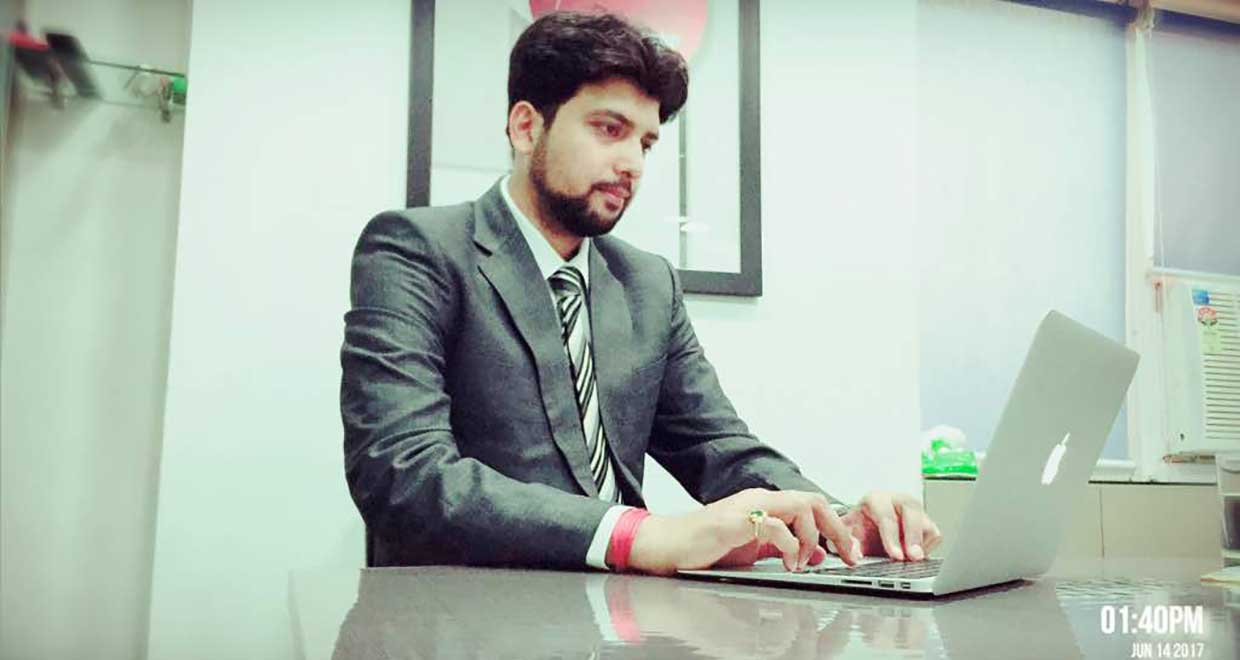
  • Satej Joshi, Legal Manager, Zensar Tech, on his diverse work experience

    Satej Joshi, Legal Manager, Zensar Tech, on his diverse work experience

    Satej graduated from ILS Law College in 2008. Since then, he has been working in the field of corporate law. His first job was with GSPL, Gandhinagar, where he worked for close to two years. His work there was primarily related to exploration laws and laws related to sale and distribution of natural gas. He was also engaged in contracts with respect to natural gas. Post that, he returned to Pune and started working with Zensar Technologies as an Executive. He was involved in negotiating and finalising contracts like MSA, SoW, MoU, NDA, etc. He was also involved in IP and litigation matters. Thereafter, he joined KPIT Technologies in 2013. He then came back to Zensar as Manager in 2016.
    In this interview we speak to him about:
    • His experience at KPIT Technologies
    • His experience at GSPL
    • His role at Zensar

    What would you like to say to our readers in the manner of an introduction of yourself?

    I work as a Manager in legal dept of Zensar Tech in Pune. I primarily look into contracting and IPR.

    What motivated you to pursue law?

    I am first generation lawyer. It was actually my mother who convinced me to get into this profession. I did consult some professionals too before taking up law as a profession.


    Tell us a bit about your college days at ILS Law College. 

    ILS gave me a very fulfilling and enriching five years. I can’t claim that I was particular good in academics. It was around third year of my course I realised that I would pursue Corp Law as area of specialisation. My seniors and faculties helped me a lot in coming to this conclusion. They were always very helpful.   


    Could you tell us about the internships you took up, and what you learnt from those experiences?

    I did my internships in Little and Co. and then at HDFC Bank. Both my bosses were very kind and they taught me various things about the profession. I believe the internships are very important for students. However it is also equally important to prepare yourself for the internship and work really hard.


    What advice would you give students in avoiding a decision paralysis?

    It should be decided on the basis of your strengths and your interest. Discussion with your seniors, faculties and mentors can help a long way. I do believe there is a gap between the academics and the profession. Colleges should do more so that the professionals meet and guide the students. It will help them greatly. I am willing to participate in such programmes. If students benefit from it I will be delighted.


    What areas of law interested you during your legal education?

    Corp law and IPR.


    Tell us about your early professional experiences at GSPL, Gandhinagar. 

    GSPL was a campus placement. It was an exciting place to work. Working in energy company is always challenging and full of learning. I wanted to start my carrier with a stable company. GSPL enjoys a good reputation in market.


    What was the transition like from a law student to lawyer?

    It was a difficult one, I must confess. Suddenly, everybody expects you to be all serious. But as you grow and get accustomed to it you start enjoying it.


    What prompted you to take up a position with Zensar Technologies Limited? 

    I wanted to get hang of IT field. Zensar being in Pune was also one factor. It was a great learning experience. I did get opportunity to work on a few large deals. Also working on IPR matters was great.


    What were the challenges and learning opportunities that you were faced with at Zensar?

    Challenges were aplenty. Also coming to IT from energy sector wasn’t that easy. But apart from that there were many learning opportunities in contracting and IPR.


    How did working with KPIT Technologies help you diversify your work profile?

    Working with KPIT was great. KPIT being heavily present in automobile and smart transportation it was very different working with them.


    On what parameters do you choose the projects you work on?

    I generally don’t get to choose my work. That’s the reality of corporate life. But the plus side is you get to work on everything and it helps building your profile.


    As the Manager –Legal at Zensar Technologies Limited, what does a typical working day look like for you?

    Typical day consists of drafting and negotiating contracts with a few meetings thrown in between.


    What are your interests outside law?

    I like listening to music and travelling. On a typical weekend I for long walks and play TT. Also I am bit of a movie buff.


    Giving the dynamic nature of the field you practice in, how do you keep yourself updated about the latest happenings in the law?

    News, online portals, magazines.


    What advice would you like to give our readers, who are mostly law students and young lawyers?

    I am not sure if I am someone who is entitled to give advice. It surely helps to understand your interest early on in your career. Also, do work on strengths and keep talking to your seniors. But don’t forget to have your share of fun and unwind.


  • Debesh Panda, Advocate-on-Record, Supreme Court of India, on mooting, internships, and arbitration

    Debesh Panda, Advocate-on-Record, Supreme Court of India, on mooting, internships, and arbitration

    Debesh graduated in law from NLSIU, in 2008. He is an Advocate on Record before the Supreme Court of India. He is also regularly engaged to appear before various High Courts and Tribunals. He specialises in Arbitration and his thesis at the Geneva Masters in International Dispute Settlement, focused on the intersection of the Arbitration regime in India with the standards prescribed under the New York Convention.

    In this interview we speak to him about:

    • His time at NLSIU
    • His passion for mooting
    • Studying in Geneva

    How would you like to introduce yourself to our readers?

    I’m a first generation lawyer, practising in New Delhi, after graduating in 2008. I’m originally from Bhubaneswar, Orissa. Although I primarily practise as an Advocate on Record before the Supreme Court of India, a significant part of my practice involves matters before various High Courts and Tribunals, both in Delhi and outside Delhi.


    Why did you choose to pursue a degree in law?

    I got done with school after 10th grade (we can opt to join Junior College in 11th grade in Orissa). I took up science and started preparing for IIT, since that is pretty much what everyone was doing and my family also wanted me to consider a career in science and engineering. A year later, I realised it was a mistake. I also did not want to take up my father’s profession (Chartered Accountancy) since I had seen it from my childhood and realised that I did not have the aptitude for it. That’s when I started looking around for options. One of my father’s dear friends, who is a leading practitioner of International Arbitration, was kind enough to spare time over his summer vacations and gave me a bird’s eye view of what he does as a profession. Deviling with him over basic concepts that vacation at Delhi piqued my interest in law, and that’s how I ended up applying to NLSIU.


    Give us a brief overview of your life at NLSIU. 

    Law school was truly a life changing experience. Credit must go to the ethos and the culture of education, which is largely peer based. NLS made me think, but within the microcosm of some extraordinary individuals who were always happy to give direction to such thinking. Like every academic campus, there was politics, but it was self-contained and self-tempered and not like what you see in many academic campuses these days. One reason for that could be that the community understands what it has taken to earn the tag and in order to retain that tag, one must keep achieving academically without letting political considerations predominate. The entire culture of NLS is built around the student community. Even the alumni are extremely well connected with each other. It has been my experience, for instance, when I was mooting on an unfamiliar area of law, that I could virtually close my eyes and approach any senior or alumni who had exposure to that area. It was amazing to see the kind of effort they put in to help me out. I don’t know how it works in other universities but I am happy to acknowledge that I owe a lot to NLSIU. Even now, I try and do whatever best I can, whenever someone from law school writes to me or calls me up for any help with mooting or any other activity. I am also in touch with some of the faculty, like Dr. Sairam Bhat. I try to contribute in whatever way possible towards the institution.

    What are the subjects that you took particular interest in, during your law school days? 

    I was not the most academically inclined when I was at law school. When I graduated, I did not even have a five point CGPA. The only lectures I thoroughly enjoyed were that of Professor U.R. Rai (Constitutional law) and Mrinal Satish (Criminal law), but that was more because of their perspectives rather than the subject itself. I actually loved mooting/advocacy, which is what drew me towards law in the first place. During the course of moot courts at law school, particularly the Vis East moot which I participated in during my fourth year, I developed an affinity towards Commercial law and International Arbitration. Although we crashed out in the Semi Finals on a razor thin margin, my partner Amarta Roy and I both received Honourable Mentions. Some of the arbitrators who heard us during the arguments fondly remembered us, as I discovered, when I went back a few years later as an Arbitrator. Two of them have remained in touch although it has been nearly ten years since we first met, and have also helped me throughout my professional career. So, compared to the subjects taught at law school, I would say mooting played a greater role in my career and the choices I made. 

    What activities, both academic and non-academic that you engaged in as a law student? 

    Anyone who knew me in law school would vouch for the fact that the only non-academic activity I engaged in was eating out! I would sincerely recommend it as a “necessary experience” if you are in Bangalore. It is an activity that drives me even today, although most joints at Delhi do not hold a candle to some of those old favourites at Bangalore! The only other memorable activity I remember was being a part of the Moot Court Society (with an amazing bunch of people like Mihir Naniwadekar, Preet Inder Singh and Shantanu Naravane) and co-founding the NLS International Arbitration Moot in 2008.


    What drew you towards arbitration, and dispute resolution in general?

    In my practice so far, I have not yet come across any two matters, which are exactly alike. That is what I enjoy about dispute resolution, there is always something new to work on everyday! I do not see myself becoming a practitioner who specialises in only one area of law because variety is the essence of my profession as a litigating lawyer. Sometimes, I think of cases as a jigsaw puzzle where all the pieces are missing and both sides invite the judges to paint the missing pieces and put the picture together from their points of view. That’s when you start realising that what the most successful practitioners of this art do – they have perfected the art of balancing out when being strategically technical with the law gets results, and when you must discard technicality and dive headlong into the matter to present a perspective that would meet the sense of justice of the Court. The law just ends up filling up the vacant slots in the process. As far as your question on arbitration goes, I guess it stems from a love for civil trial. A good trial is more a battle of the wits of the lawyers rather than their respective clients and is often, a pleasure to conduct. Unfortunately, given how overworked our trial courts are, it sometimes ends up not being very professionally satisfying. Arbitration lets you have your cake professionally as a trial lawyer and eat it too!

    What kind of internships did you engage in during your student years which you feel were invaluable to you in reaching your current position?

    I used internships at law school to get a sense what I did not want to do, rather than what I wanted to do. I started in Orissa High Court in my first year, where I felt pretty lost and did not get any clue of what was happening. The second year I worked at a firm in Delhi that specialised in Dispute Resolution and realised that I was not cut out to work in a firm. The third year I focused on criminal trial and decided that criminal defence in trial courts was sometimes too hardcore to be my cup of tea. There was also a time in between when I got tired of the law and on a whim, dabbled in investment banking. So I ended up doing a stint at Goldman Sachs, only to realise that I loved the law a lot more than investment banking! Fourth and fifth years, I interned at the Supreme Court and also with an excellent civil trial lawyer in the High Court (who is now a judge in the Delhi High Court). That’s when I realised I was right at home, and came back to Delhi after graduating.

    However, the most important stint before I started practicing independently would be the one at Senior Advocate Mr. A.K. Ganguli’s chamber, which was for nearly a year and a half. He truly made me slog it out and it was a steep learning curve during those eighteen odd months. An old school practitioner who doesn’t use computers much, he simply remembers everything off the top of his head! Citations, statutory provisions, a petition he drafted ten years back…it is amazing how everything is right on his fingertips, always. An incredibly hard taskmaster, he would leave no opportunity unturned to fine tune any petition or written submission, before presenting it in Court, even if it meant I had to figure out how to do the last minute research and keep everything ready for the hearing in Court at the eleventh hour. I will never forget the time he made me draft 41 versions of a review petition to be filed before the High Court at Chandigarh, till it came down to six pages from the original 22 page draft I had prepared. The High Court declined to review the judgement, but the reaction of the judges in the Supreme Court when the SLP came up for hearing was nothing short of memorable. I still remember the look on the faces of the judges when the matter was called for hearing. They just smiled in unison and said “NOTICE” and “STAY” before anyone uttered a word! Working with him taught me the importance of being fair to a Court, rather than being hard-nosed on facts and law and how that, by itself sometimes gives you greater leverage than all your preparation and research. During that time, many of the Advocates and law firms which used to engage him also started giving me drafting work as well as briefs as junior counsel. I also got a few opportunities to brief several leading senior counsels. That stint in his chamber is when I truly started learning the law and realised that Courts always know the judgements we research on and cite. The difference lies in the perspective with which these leading practitioners present that point, which is what makes all the difference when the judges have to form an opinion as to which way to lean.


    Tell us about your Geneva Masters experience and briefly describe your thesis.

    Frankly I would not have been able to do the Masters if it wasn’t for Amrita (my wife). After we got married, this is the very first thing she made me agree to, spoke to my professors at law school, got the letters of recommendations organised, and also persuaded Mr. Ganguli to recommend me. Having practiced for five years, I was pretty unsure whether to leave it all and head out for a year. Ultimately, Amrita and I both agreed that instead of an “academic” masters like Oxford or Cambridge, a masters like MIDS or Queen Mary was better suited for a practitioner like me who loved Arbitration. Many of my colleagues from the Vis East whom I asked for advice also concurred. Ultimately I ended up choosing MIDS because Professor Zachary Douglas, who is one of the leading practitioners and academics in the field of Investment treaty arbitration, had recently shifted there from Cambridge, and the courses he was offering like International law in Domestic Courts and State Contracts, focused on areas, which may be of utility to me during my practice in India in the long term.

    Geneva had a lot of useful takeaways for me as an Indian practitioner. My thesis dissected the numerous interventions by the Supreme Court of India in commercial arbitrations seated outside India over the years, and sought to demonstrate that this was largely attributable to unexplained oddities in the Indian statutory framework when compared to the text of the UNCITRAL Model Law and the New York Convention. Keeping in mind the White Industries case, I tried to demonstrate that such interventions may implicate treaty obligations and the Supreme Court of India, by declaring in BALCO that the law laid down by it would apply only to arbitration agreement executed after 16.09.2012, may just have left the door open for more investment treaty claims against India. My analysis was significantly influenced by what was taught by Van den Berg during his course on the New York Convention and what Professor Douglas taught during his courses on Arbitration and State Contracts. I think MIDS is a good option for Indian practitioners who are looking to take a break for a year and pick up a little more depth in subjects like Arbitration, Public International Law and WTO Laws.


    Which is the ideal time to do an L.L.M? Right after undergraduate studies, or after a few years of practice post undergraduate studies?

    It depends on what you want from the LLM. A lot of people prefer going to Oxford or Cambridge right after law school if they are getting a full scholarship because it allows them to finish their academic pursuits before they start working/ practising. Personally, I would not prefer to pursue an LLM simply because I happened to apply and got admitted with a full scholarship, unless I was sure that it was taking me forward in life. By the time I applied for an LLM, I had practiced for nearly five years and had a broad idea of the fact that I needed more depth in the subject of Arbitration if I was going to take up more work in that area. That is how I ended up choosing MIDS. So I guess its best to do an LLM whenever you are sure of what you want to do long term.


    Could you please offer a few words of motivation for those who’ve either never tried mooting or for those who’ve tried but have faced defeat, from your treasure trove of experience?

    (Debesh has co-founded the NLS International Arbitration Moot Court Competition, one of the most reputed arbitration moots in India.)

    Its not work going to waste. That’s for sure. I spent six months working on the Vis Moot and lost in the semis, but the research I did on pathological arbitration clauses helped me settle six arbitration claims against two of my clients (although they were all prior to the Enercon judgement!). The opposite party understood during the mediation that the entire arbitration would be a non-starter and even if they got an award, it may not survive proceedings under Section 34. In my second year at law school I had spent four months on a moot on the concept of repugnancy under the Constitution of India, which we also lost. That research gave me the clarity to draft a writ petition where we got a stay order on the first day itself in high court and relying on our order, several other assesses also got relief. I guess one of the reasons the Court was inclined to grant interim relief on day one because we formulated the proposition with a lot of precision and within the four corners of what we argued, it was difficult to see how the action of the State Government was not colourable. So if you take up mooting, please do not do it to add to your CV or to get a medal. Mooting is just another way of learning skills of deconstruction, problem solving and presentation. Also, I would encourage students to never underestimate writing a memorial. A good draft is a mirror to a clear mind and what I have learnt in my experience so far is that a well drafted petition can sometimes be more decisive of a matter rather who was engaged to lead the arguments at the hearing. The same goes for memorials in moot courts. Judges in moot courts and real life do take time and read the brief before coming to the hearing. Quite often, I have seen Courts not even let Petitioners counsel open their submissions if they have understood the point pleaded and the opposing counsel is straightaway asked to explain why the relief sought for, should not be granted. You get a clear first movers advantage there. Why should you lose such an opportunity?


    How many hours a day do you spend at work? 

    We have no fixed hours in our office. If you done for the day, you can leave even in the afternoon, and if you are not done, there is a bed available should you need to do an all nighter! Sometimes, a single matter can take hours to work on, if it involves complicated issues and on other days, we manage to turn in a lot of work and head out for dinner together in the evening. The only thing I regret is that the frequency of dinners has reduced in the last two years but I intend to work on it during this year.

    For instance, last year, while representing the Directorate General of Hydrocarbons before the Committee headed by Justice A.P. Shah (Retd.) in the Gas Migration disputes arising out of the Krishna Godavari Basin, I had less than two weeks till the final hearings to get up to speed on the matter after being instructed. It was one of the most challenging hearings in my life simply in terms of how factually and legally complicated the entire case was, leaving aside the fact that it was a totally new area of law for me and I had to also learn the science of Oil and Gas exploration overnight to appreciate the intricacies of the dispute. I virtually worked round the clock on that one single case for nearly a fortnight to formulate our strategy and submissions before the hearings commenced. It was truly gratifying to see all that preparation pay off when the Committee gave its report in August 2016, accepting the submissions we had made, in toto.

    Our office had a similar experience while defending a real estate developer before the National Consumer Disputes Redressal Commission in a class action under Section 12(1)(c) of the Consumer Disputes Act, 1986. Two of our interns did an excellent job of digging up  case law under Order 1, Rule 8 of the CPC which was pat on the point and helped us persuade the NCDRC that there was no scope for a “joint complaint” under Section 12(1)(c). That one matter took long hours, and many of us worked for days altogether researching. But the long hours paid off in the end.


    Is there any other suggestion you would like to give to our budding lawyers?

    Enjoy your work. If you don’t enjoy what you do, you will find it hard to give it your 100%. Also don’t expect any results overnight and don’t have unreal expectations. Take your time in identifying what you like. It is an incredibly human profession and a lot of it is built around one-on-one relationships and perceptions. Even judges learn to trust you only after they have heard you in a few matters, and feel that they can trust you to not mislead the court factually or legally. Enjoy the journey and don’t keep thinking of the destination only.


    Are there any other activities you are presently doing which are related to the law?

    There is a project being conducted by Centre for International Dispute Settlement, Geneva on how Bilateral Investment Treaties can be used as a tool for good governance, where I am working with Professors Zachary Douglas and Shalini Randeria. This is a long term project where we have been working comparing domestic legal systems in Mexico, Argentina, Czech Republic and India and seeing how the domestic system in each country is responding to changes in the Investment treaty regime. It is an exciting time to be doing this project since India has been dynamically changing its BIPA/BIPPA regime in the last two years and given India’s emerging international clout and reputation as a destination for Foreign Direct Investment, this research will be of considerable importance for other developing economies.

  • Simi Rose George, Manager, Energy Markets Policy at Environmental Defense Fund, on environmental law, and her experience

    Simi Rose George, Manager, Energy Markets Policy at Environmental Defense Fund, on environmental law, and her experience

    Simi George graduated from NLSIU, Bangalore, in 2008. She then received her master’s degree in public administration and international development from the Harvard Kennedy School of Government in 2014. Her work is at the intersection of energy and environmental law, regulation and policy. She has transitioned from a career in corporate law (having worked with Linklaters and Clifford Chance) to her current career in policy analysis and advocacy.

    In this interview we speak to her about:

    • Her time at NLSIU
    • Her passion for environmental work
    • Her experience thus far


    How would you like to introduce yourself to our readers?

    I’d like to introduce myself as an energy and environmental policy professional, with an interest in many other public policy issues (too many for my own good!).


    Why did you choose to pursue a degree in law?

    My original plan was to study economics at the undergraduate level. The idea of pursuing a career in law hadn’t occurred to me. In fact, I’d never come across NLS. Around the time that I was preparing for my Class XII exams, my father brought along a shiny NLS prospectus. That year, they’d done a particularly good job of marketing the school. I was smitten, both by the course content (an education in law and the liberal arts (including economics!) immediately appealed to me) and the variety of opportunities that it offered. I wrote the entrance exam, and happened to make it. At the same time, I received an invitation to interview for admission to a very strong undergraduate program in economics. By then, I’d made up my mind about studying at NLS.


    Is the NLU culture truly more conducive to legal education, as compared to other universities that provide legal education?

    NLS was truly national in its character in that it attracted students from across the country. The opportunity to forge lasting friendships with classmates from across the country as a young adult was, in retrospect, an important early experience. That said, diversity in many other aspects was (and I believe still is) lacking, and it is heartening to see some efforts to address these challenges take root. [Editorial note: A new bill proposing 50% reservation for Karnataka students at NLSIU passed by KA state assembly could, however, change this. Read more here.]

    NLS offered many learning opportunities outside the core curriculum, both at the national and international levels, and allowed access to an excellent alumni network and a very bright set of peers. I did as much learning outside the classroom as I did inside it.   

    I’m not familiar with the teaching model or culture at other institutions, and so I can’t comment on whether the NLU model is intrinsically better than others. I do think that because NLS is a residential school, it offers many more opportunities for learning and collaboration with peers than otherwise possible. I remember working with my classmates on moot problems, preparing for exams (including splitting up readings and sharing summaries the night before an exam), and continuing classroom debates late into the night, long after our classes had ended. My law school experience would have been very different had NLS not been a residential university.


    What are the subjects that you took particular interest in, during your law school days?

    I really enjoyed public law classes at NLS – Jurisprudence and Constitutional Law with Prof. U.R. Rai was one of my favorites. I also enjoyed all the foundational liberal arts classes that were taught in the first few years of the program—Economics with Prof. Somashekar, Political Science with Prof. G Ajay, and Historiography with Prof. V.S. Elizabeth. Even though it has been a very long time since I sat in those classes, I still remember them vividly. Yes, they certainly played a role in some of my career decisions, including choice of graduate program and the decision to transition from corporate law to public policy.


    What activities, both academic and non-academic that you engaged in as a law student? 

    I’m glad that I tried out a whole bunch of co-curricular and extra-curricular activities at law school. I enjoyed mooting, and participated in quite a few national/international moots, which kept me busy throughout my time at NLS. I also dabbled in debating. Despite the lack of any talent whatsoever, I participated in several NLS inter-class dance competitions, which were always fun. I learnt something from all of those experiences, and they made for a richer law school experience. I highly recommend trying out all the extra-curricular activities that you feel drawn to, but certainly don’t believe that any of them (mooting included) are necessary experiences. I learnt a lot from mooting—the ability to think on my feet, written and oral communication skills, and research skills—but there are so many other ways in which you can pick up those skills. My sense is that things have changed in the years since I graduated, and that law students engage in a much broader variety of extra-curricular activities than my peers and I did. This is promising.


    Tell us about the student exchange programme that you’d undergone and your experience at NUS.

    The student exchange program at NUS was my first experience living abroad. It was a great opportunity to explore a different education system, immerse myself in a new culture, and meet law students from around the world. There was a difference in the quality of teaching. At NLS, we had a mixed bag of teachers – some were excellent, others were disappointing. At NUS, the quality of teaching was much more consistent. The quality of infrastructure and the overall administrative machinery at NUS far exceeded what NLS then had. On the other hand, it soon became clear to me that I’d taken the quality of debate and discussion within the student community at NLS for granted. Some of my best learning at NLS happened through interesting conversations with my classmates, both within and outside the classroom (everyone had an opinion!). I missed that at NUS, where the student community was somewhat narrowly focused on academic performance. On the whole, I returned to NLS with a new appreciation for everything it offered.


    At what stage in one’s law school life must one pick a field to specialize in?

    Having now become somewhat familiar with education systems outside India, I believe that our school system pushes students to make important career decisions too early, well before they develop an understanding of their interests, weaknesses and strengths. This is true both at the high school level, where performance in a single set of exams often determines which undergraduate institution you end up in, and also at the undergraduate level, where there is limited flexibility to choose subjects. Simply put, the system is already too rigid. I wouldn’t advise students to box themselves in further by specializing in law school. The best advice I can give is to explore as many aspects of the law as possible, whether through internships or co-curricular activities such as moots, writing, research etc.  All of these experiences will give you some clarity about your interests and strengths. In the long run, that will carry you farther than any sort of specialization at the undergraduate level.


    What drives your passion for environmental work?

    This is not an easy question to answer. I started my career in corporate law in London. I was on a lucrative career path, working with extremely talented colleagues in a wonderful city. Yet, I found myself deeply unsatisfied. Part of what I didn’t enjoy about working in a large corporate law firm is the lack of work-life balance. My parents worked in the public sector, and had very predictable schedules throughout their careers. Because of that background, perhaps, my vision for my professional life certainly didn’t mesh well with that of a typical corporate lawyer working in an intense, high pressure environment, in which staying up all night to close a deal wasn’t uncommon. It was the desire for a more balanced and sustainable lifestyle, combined with other factors, that prompted introspection about what I really wanted to do. As I started considering alternative career paths, I found myself drawn to organizations working on public policy challenges. This was not a big revelation, but a gradual realization. It was consistent with my experience at law school, where I enjoyed public law classes much more than the private law ones and chose to do all my internships with litigators who’d specialized in some aspect of public law. My interest in public policy is broad, but I eventually ended up focusing on energy and environmental issues, which I believe are among the biggest global challenges of our time. Every job comes with a set of challenges—mine is no different—but it feels good to work on issues that I consider important.


    When did you decide to pursue your masters degree at Harvard Kennedy School of Government? 

    I decided to apply to the MPA/ID program at the Kennedy School to transition from a career in corporate law to one focused on public policy. At the time, I was working as an associate with Linklaters in the UK. In my experience, an advanced degree can be helpful in making a career transition. The MPA/ID curriculum has a deep emphasis on economics and econometric methods. While I do not use those skills directly in my current role, my Kennedy School training has allowed me to become a critical consumer of quantitative research and analysis, which is helpful as I work closely with economists and researchers with a quantitative background.

    Graduate school is not a small investment. It is absolutely critical to have clarity on why you’re picking a certain program/school, your ideal role after graduation, and the ways in which the program/school of your choice will help you get there. I can’t say that I had clear answers to all of those questions when I joined the Kennedy School. I believe that classmates who had a clearer sense of where they were headed were able to make the most of their graduate school experience. Of course, there will be intervening circumstances beyond your control. You know what they say about the best laid plans of mice and men. But, in my experience, a clear vision for one’s professional trajectory is always helpful. I certainly haven’t figured it all out, but it is work in progress.


    Tell us more about your current work profile with the Climate & Energy team at Environmental Defense Fund.  

    EDF is an international advocacy organization based in the U.S. My work is focused on reducing methane emissions from the gas distribution sector, and advocating for changes to wholesale electric and gas market design in order to improve economic and environmental outcomes. I lead a portfolio of collaborative projects with industry under the broad umbrella of a partnership between EDF and Google Earth Outreach, manage EDF’s engagement in various regulatory proceedings before state regulatory commissions in the U.S. to advance organizational objectives, and work on issues relating to gas and electric market design in California. Undoubtedly, my legal background is a valuable asset in my current role.  


    If given an opportunity, what would you do differently in your career journey up to this point? 

    I’d worry a little less about academics, and focus a lot more on developing attributes that are critical to professional success—the art of persuasion, negotiation skills, and building a network of friends and colleagues to turn to for professional advice and mentorship.  The attributes that are most often emphasized in the Indian education system are not always the ones that are critical to professional success. Too often, we mistake academic success to be a marker of future professional success. Of course, academic discipline can help develop some of the attributes and habits that needed for professional success, but in my experience, it is not a prerequisite and certainly not sufficient to succeed in the real world.


    Is there any other suggestion you would like to give to our budding lawyers?

    Try to make your law school experience as rich as possible, whether by trying out a range of extra-curricular activities or by proactively seeking out opportunities that aren’t necessarily offered to you at law school. In doing so, you’ll get to know your interests and strengths, and gain some clarity about where to head after law school. Good luck!  


  • Debarupa Agarwala, Senior Associate, HSA Advocates, on studying in NALSAR, and working at Tier-I firms

    Debarupa Agarwala, Senior Associate, HSA Advocates, on studying in NALSAR, and working at Tier-I firms

    Debarupa Agarwala graduated in law from NALSAR, Hyderabad, in 2007. Debarupa is a dual qualified lawyer (UK and India) and has worked with leading law firms in Tokyo, London, Hong Kong and Singapore. She has extensive experience in general corporate and commercial advisory, M&A, banking and finance and capital markets transactions. She has been involved in advising various Indian as well as international companies on commercial law aspects, including drafting, structuring and negotiating various share purchase agreements, shareholders agreements, and other related legal advisory work. She also advises on joint venture investments, foreign direct investments into India, outbound investments from India, commercial contracts, employment law and compliance related matters.

    In this interview we speak to her about:

    • Her time at NALSAR
    • Having worked all over the globe
    • Striking a work-life balance

    How would you like to introduce yourself to our readers?

    I am a dual qualified lawyer (UK and India) with experience in corporate and corporate finance transactions.


    Give us a brief overview of your NALSAR experience for our readers.

    My time at NALSAR was an eye opener in many ways. Being from a small city (Guwahati), the first couple of years for me were spent in just adjusting to the curriculum and soaking up the cosmopolitan culture. My batch mates were from various parts of India and very intelligent. It was, honestly, a bit overwhelming for me in the beginning. But with each semester, I gained confidence and by the time I graduated from law school in 2007 with a job offer from Luthra & Luthra in hand, I knew I had made it.

    One mistake I made in law school was to focus entirely on classroom curriculum and grades in my initial years there. Luckily, I quickly realised that there was more to being a good lawyer than just one’s grades. I started getting interested in research and publications and that was the beginning of a very fulfilling time at law school. I also attended quite a few space law conferences in India and abroad and the exposure really helped me hone my speaking and soft skills.

    NLUs do have many advantages over other institutions. Providing legal education and access, exposure and infrastructure are the three things that immediately come to my mind. NLUs let you access good faculty, a robust alumni network to help with recruitments as well as access important events such as conferences and moot court competitions. They provide excellent exposure in grooming your lawyering skills. The emphasis on physical infrastructure such as buildings, access to internet and a well-stocked library is also typical of NLUs.

    Life as a law student in an NLU is easier than that in a regular institution because many things are handed to you on a platter. Without this kind of privilege, students from regular institutions have to work extra hard to be noticed.  


    What kind of internships did you undertake during your student years?

    Unlike most of my batch mates, the majority of my internships were with NGOs and academicians. Back when I was a student, I wanted to become a professor of law and I had structured all my internships that way. Believe it or not, I took my all my internships very seriously and each of them taught me something useful to take forward. My NGO internships in Guwahati and Delhi taught me empathy and to respect others. My research internships taught me the art of logical thinking. In my fourth year, one of my professors helped me secure an internship in a renowned IP boutique law firm in Tokyo. It was my first and only law firm internship and needless to say, the experience was worth it. I had to pick up spoken Japanese on the job and even managed to make about half of my leaving speech in Japanese on my last day at the firm.

    In your opinion, what are the law school centric activities that you would recommend as necessary experiences for every law student?

    I would definitely encourage students to engage in extracurricular activities such as mooting, debating or research. They are necessary not only because they equip you with the skills that are necessary to be a good lawyer but also give a big boost to your confidence.

    In the long run, I do not think anyone will judge your advocacy skills on the basis of whether you had mooted or undertaken paper publications in law school or not. But if you want your advocacy skills to stand out, this is what you have to do.


    What are your areas of practice and how did you go about choosing these fields?

    I always like to think that my areas of practice chose me instead of the other way around. I enjoyed practising corporate law and that is what I started my career with. In between, I worked in financial litigation, regulatory (funds), structured finance and capital markets. A lot of these were practice areas that I had to mandatorily experience as part of my solicitor’s training contract with Simmons & Simmons in London. I am back to practising corporate law now and enjoy it to the hilt. My training in finance is a complementary strength.  


    Tell us about your experience with Simmons & Simmons. 

    I have very fond memories of working at Simmons & Simmons. It was a very big deal to be accepted by an international law firm in those days and I was one of the first students from NALSAR to qualify as a solicitor of England and Wales.

    The London office of Simmons & Simmons was a very friendly place to work in and I had the fortune of working with some very good supervisors (partners) and senior associates. Apart from exposure to UK laws and cross-border transactions, I got solid legal training and work manners that I still carry with me.

    As a trainee solicitor, I was rotated through four practice areas, each lasting for six months for a total of two years. The rotation concept helped me get a flavour of different practice areas and based on personal experience, I strongly believe that junior lawyers should try and take on a variety of assignments in their initial years.

    Within my first year at the London office, I was selected for an international secondment to the Hong Kong office of Simmons & Simmons. I was suddenly in a new office in a new country but it was an amazing learning experience. I was given lessons in Cantonese and Mandarin so that I could communicate locally and with clients. Unfortunately, all the clients I interacted with in Hong Kong spoke English and my local language skills were never put to the test!

    You have work experience in Tokyo, London, Hong Kong and Singapore. Why then, did you choose India over all of these places? 

    Indeed, I have worked in all of these cities, sometimes by choice and sometimes by chance. The work culture in all the three Asian cities is quite the same. Lawyers there are hardworking and sincere and spend long hours at work. However, they are socially very active and no matter how busy they are, they always take long lunch breaks to bond with clients, colleagues, and friends. I have even had experiences where we have gone out for dinner with clients and come back to work in the office after that.

    London has the work culture I admire the most. Like in Asia, lawyers there are hardworking too but they are out of the office on time and spend most of their spare time socialising over drinks or spending time with family. I also saw very little hierarchy in law firms there.

    We moved back to India because we wanted to start a family and my husband wanted to set up his start-up on social polling. Our son is almost four now.


    How difficult is it to manage the pressure of working in a law firm with a young child?

    To be honest, it is very difficult. Lawyering and mothering are about as complementary as chalk and cheese! Finding the ideal work life balance becomes that much more complicated when you have a kid in the picture. Living in a nuclear family without continuous family support also puts me on the back foot.

    Luckily, I have made my peace with the fact that it is beyond my capabilities to attempt to be a supermom and a superlawyer at the same time. On some days, I am a slightly bad mother and on some days I am a slightly bad lawyer. But it all adds up to balance at the end of the day!


    What does it take to make the cut and land a Tier-I job?

    (Debarupa has worked at two Tier-I firms, Luthra & Luthra Law Offices and Shardul Amarchand Mangaldas in India.)

    The first thing is to start with a CV that stands out. Decent grades, coupled with extracurricular activities and interesting pursuits are what catch the attention of all law firms including Tier-I law firms. In order to ace your recruitment interview, you will have to demonstrate that you have all the qualities that they are looking for and will fit in well with the practice area. A lawyer who is confident, hardworking, committed and driven is a lawyer no law firm will refuse.


    What is the level of importance given to a student’s Grade Point Average with respect to recruitments at Tier-I firms?

    Some importance is definitely given to Grade Point Average but Tier-I firms generally prefer all-rounders who can demonstrate above average grades as well as extracurricular activities. Previous internships also matter a lot.


    How do you say interns should go about their work at firms like these, so as to get noticed in a positive way in the limited time they have?

    For an intern, the key to be noticed is to be confident in a law firm setting. As a senior lawyer, I look out for interns whose body language conveys to me that they are fine with taking assignments without getting overwhelmed. Diffidence is a big no-no. The second thing is your work product. Be diligent, do your assignment well, ask the right questions and stick to the deadline. I have seen many interns disappearing without notice when they were due to hand in their assignments, especially on matters with tight deadlines. One has to be responsible and avoid doing that.


    When and why did you decide to move to HSA Advocates?

    I moved to HSA Advocates in September 2017. Like most other moves in my profession, this was based on the desire to work more independently and to further my career growth. I was also tempted by the prospect of work life balance that a slightly smaller firm can afford you.


    Give us a peek into what a regular working day looks like for you. How many hours in a day do you spend at work?

    I start my day at work with going through my emails and noting down the to-do list of matters for the day. I also sneak a quick look at the Economic Times online. I discuss the list with my team partner and we prioritise the matters based on our discussion. After that, the list takes over! On a typical day, I could be researching and drafting legal opinions, reviewing documents, drafting agreements, speaking to or meeting clients and making calls to various government departments.

    Typically, my workdays range between eight to ten hours. I carry home whatever work I cannot complete in the office and finish it late in the night or early next morning while my son is asleep.


    Where do you see yourself ten years from now? 

    I see myself happy, wherever I am, and whatever I am doing. I live one day at a time and ten years is a long time to predict where life will take me. In an ideal situation, I would like to complete an LL.M. and Ph.D. and become an academician.

    Generally speaking, avenues for my line of practice include moving in-house or starting your own law firm.


    What is your message to our readers?

    Good lawyering comes with hard work and experience. Let no one ever tell you that you are not good enough or not meant to be a lawyer. There is a lawyer in every one of us – work hard and bring the lawyer out in you!


  • Deepak Kumar Thakur, Partner, HSA Advocates, on his internship experience, and working at JSA

    Deepak Kumar Thakur, Partner, HSA Advocates, on his internship experience, and working at JSA

    Deepak Kumar Thakur graduated in law from Army Institute of Law, in 2007. He also holds a Masters Degree from University of Mumbai, with a specialisation in Banking, Corporate, Finance, and Securities Law. After successful stints with Titus & Co. Advocates, and J. Sagar Associates, he is now Partner at HSA Advocates.

    In this interview we speak to him about:

    • His time at law school
    • His experience at J. Sagar Associates
    • His role as Partner at HSA Advocates

    How would you like to introduce yourself to our readers?

    I’m a passionate, optimistic, and dedicated lawyer who takes up responsibilities with utmost enthusiasm and sees to it that I complete my responsibilities (in terms of deliverables, mentoring or otherwise) with utmost sincerity. I have great amount of perseverance to achieve my goal. My optimistic and planned approach is what driving me towards my success. I take each failure and criticism as part of a learning curve and strive to be a better human being by each such learning. As how I strive for perfection in things, I expect the same from others as well. I love music, especially Jagjit Singh.


    What motivated you to opt for legal studies after school?

    I ever thought of joining a law school or becoming a lawyer, at any time prior to joining Army Institute of Law (AIL). Since I didn’t know anything about law before joining AIL, nor I had any lawyer in my family, my encounter with law and AIL was purely incidental but an enriching journey.


    Tell us a little about your days in law school. 

    My time at AIL was fantastic. The hostel experience was new to me. Living in a hostel gives one a lot of exposure, independence and different perspective towards life. I joined AIL, when it had a campus in Patiala, and the boys used to stay in the dormitory. We were the last batch to join AIL from its Patiala campus. Amongst others things to share from Patiala, some were relating to those cold nights, open theaters, aloo parathas on the highway, walking in dark unknown tracks, running sprint for college, if missed bus to the college.


    How important are grades, in your opinion? 

    Grades are important but not critical. Gold medals aren’t a prerequisite to being a successful lawyer. What is required is the smartness and ability to handle situations in the best possible manner, which I don’t think any theory can teach you. I myself was not the best scorer in my batch but always had an above average score.

    I definitely believe that money is an important feature to help you in making your decisions for your opportunities but I never believed in the fact that it should be the only thing guiding you to take your decisions. What should be motivating students in their college days is their interest. It’s okay to not make big bucks in the short term but one should always follow their interests rather than running behind big bucks.

    What subjects did you take particular interest in during your law school days? 

    I used to have a lot of interest in the Constitution of India. As the Constitution is the mother of all Indian laws, it gives you a lot of learning to become a better law professional. My interest in any particular subject was not a deciding factor in determining my career choice, but it helped me a lot in pursuing my career in one of the top most law firms in India.


    What were the activities, academic or otherwise, that you undertook in your law school days which in your opinion have shaped you and your career?

    During my college days, I was involved mainly in sports activities apart from my academics. I represented my college in chess and was actively involved in football. I believe sports not only helps in keeping you fit but also teaches several lessons, which always comes your way in your personal and professional development. Being smart, team player, ability to perform under pressure, etc. are some of the qualities that always helps in your personality development.


    Who was your mentor, or main source of inspiration who motivated you all along the way?

    I had some very good mentors all along who guided me pretty well in my professional development. My main source of inspiration was and is only my family, who always stood with me with all my decisions. The long never ending work hours with almost no family time has also not lessened their support for me.

    What kind of internships did you engage in during your student years?

    My internships were not focused in a particular field of practice. As an intern, I believe, students should be ready and willing to take everything and learn from whatever is assigned to him/ her. The only thing that an intern should be concerned with is hard work, dedication and little smartness. I believe I had all of them and that’s what ensured me in getting a PPO from all the three law firms where I interned.


    What does it take to make the cut and land a Tier-I job? 

    (Deepak had previously worked with J. Sagar Associates, one of the most sought after firms for placements by students, as a Senior Associate.)

    I joined J. Sagar Associates (JSA) as an Associate in January 2008 on the basis of my performances during my internships with the firm and in April 2012 was elevated as a Senior Associate. There is no formula as such or secret to ensure a retainership with any Tier-I job, at least with JSA (as per my last information). JSA looks to select the retainers mainly from its interns, so what is required is that you should have 100% dedication, work hard, and show a little smartness. Be polite and try to share the pressure of the resources in the firm by delivering the best possible deliverable in time, and you are sure to be noticed. Once you are noticed, you will be there.

    Be responsible, spend less time in gossiping or chatting. Don’t sit idle. If you have free time, seek work from resources with an intention to share the responsibility and not to do just do something for the sake of it. The dedication is generally visible in your body language and how do you deliver your deliverable. Lastly, at the cost of repetition, lot of hard work and little smartness is an inseparable part.


    What motivated you to leave JSA to work with HSA Advocates?

    It was not an easy decision to part ways from JSA, and I consider myself fortunate to have worked with such amazing people and place. But as time moves on so did I. No great reason otherwise.


    Tell us more about your current work profile with HSA Advocates. 

    My typical day starts with a meeting with concerned senior partners which includes briefing them about the developments in various matters and discussing the way forward. After that is the follow-up with clients and knowing about their expectations in terms of existing assignments and likely developments and how better we can work towards meeting their expectations. After client management work, is assigning work to colleagues in the team and guiding them the best possible way to get the best deliverable in a cost-effective manner. Then I get on to work on completing the work pending at my desk. At the same time, I also seek to mentor younger colleagues from time to time. The day is also occupied with continuous calls from and to clients regarding ongoing transactions, issues therein, and deliverables.


    If given an opportunity, what would you do differently in your career journey up to this point? 

    I believe in only one thing; whatever happens, happens for good, and do not regret for the things, for which obviously we can’t be gone back in time. That is what I would like to guide to my younger friends as well. Do not regret for the past occurrences and try learning from them.

    Common career related blunders which students should avoid is mainly running behind big bucks. Please please follow your interest and do whatever finds your happiness. Money should not and never determine be the only factor determining your decisions.


    Is there any other suggestion you would like to give to our budding lawyers?

    The years at law school are never going to come back, so live and enjoy each and every moment of it. Make use of every minute. These are the only memories that you will cherish for life and talk about when you grow older. It’s fine to break rules sometimes, but it does not mean to destroy or cause any damage to any property or infrastructure. However, having said that, it does not mean that one would ignore studies and does not work hard to achieve their goal. You can have some relaxing time in the initial years, but after that you need to be absolutely serious about what you want to be. Make your goal clear and start working hard towards that. There is no substitute for hard work. Success, if is not achieved on immediate basis, it would be there for sure.

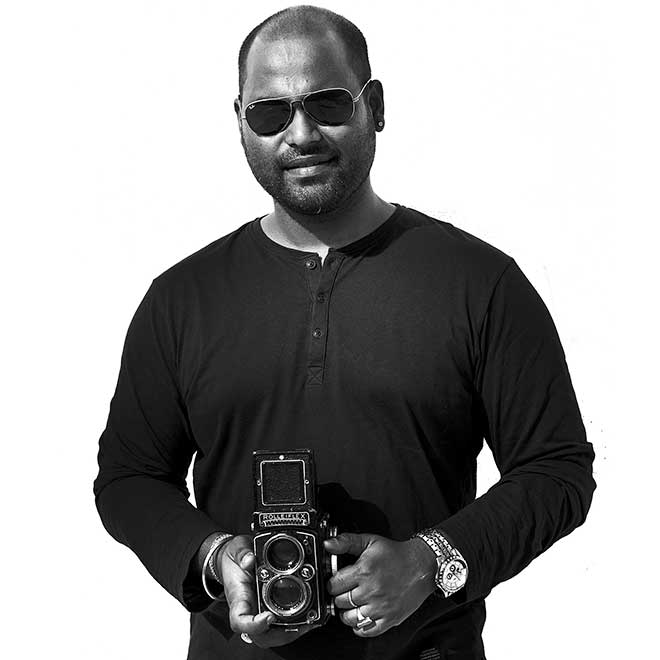
  • Animesh Singh, Managing Partner, A&S Law Chamber and Consultants, on working with Amarchand & Mangaldas, and starting his own firm

    Animesh Singh, Managing Partner, A&S Law Chamber and Consultants, on working with Amarchand & Mangaldas, and starting his own firm

    Animesh Singh graduated from Symbiosis  Law School, Pune, in 2009. After a successful stint as Associate at AMSS, New Delhi, as Associate, he co-founded his own firm, A&S Law Chamber and Consultants, in Bhubaneshwar.  His areas of expertise include conducting litigation, conveyancing, drafting pleadings and contract agreements, arguments/ conducting hearings in the courts, client conferencing/consultation, legal research, drafting legal opinions, fact finding investigation/due diligence.

    In this interview we speak to him about:

    • His time at Symbiosis
    • His experience at AMSS
    • Starting his own firm

    How would you like to introduce yourself to our readers?

    I am a first generation lawyer. I chose to study Arts after my 10th because I associated more with the field of humanities, literature and philosophy. I have always been a hyperactive kid; thus, I was more into NCC and sports during my +2, and had decided to join the Indian Army thereafter. However, I had to change my career plans suddenly, because of an unfortunate accident and injuries sustained during one of the NCC trainings. Thereafter, pursuing Sociology as my higher studies was the plan, but Law being another challenging profession and a vast arena to explore, struck my inquisitiveness. Hence, I took up the challenge and today this profession supplements the kind of person I am. Further, it gives me many opportunities to satiate my habit to learn about various subjects and assimilate them to build questions of significance and law.


    Give us a brief overview of your life at Symbiosis.

    I had a fabulous time in Pune while studying law at Symbiosis. The initial three semesters I was mostly restricted to the classes and the hostel room due to the injuries I had sustained then. That apart, I have thoroughly enjoyed studying law there and getting the best of my friends for life. I really owe a lot to my faculty there; some of them have really shaped my vision for life and practising law. The number of subjects per semesters was grueling at times at Symbiosis Law School, and that did bring out the best in me.

    It’s not about a law school being private or government aided, but it certainly matters to be part of one premier law school in India as it holistically tailors one’s approach to learning and interpreting law by getting introduced to like minded people. And to be specific about Symbiosis, I would vouch that the kind of intellectual and creative freedom it provides to its students is incredible in itself, and such an atmosphere makes the students compete with oneself and not with each other irrationally, which I think is the best way to grow in life and profession. Lastly, I would state that, to me and to all, his or her law school is as “Rosebud” is to “Mr. Charles Foster Kane”, so I refrain from comparison.


    How much of a role do GPAs play in shaping one’s career path?

    GPAs are as important as salt to taste. GPAs would qualify one for the next university/institution, but not for the real working world and the unique level of stress one deals with while working independently. I was more or less a thorough and inquisitive student, yet not a scholarly one. My GPAs were only above average as I mainly focused on a lot of other activities and interests even during my law studies. Back then I spent a lot of my leisure time reading film literature and watching a lot of world cinema (ranging from African to Oceanian cinemas, esp. Indian, British, French, Polish, Bosnian, Brazilian, Japanese, Korean, Argentinean, African, Latin American, Iranian, Italian and Australian to even Thai etc). Pune being the breeding ground for filmmakers in India (having FTII and National Films Archive of India) I got introduced to many notable as well as aspiring filmmakers, which subsequently did alter my perception towards cognitive, societal, and universal issues in a notable way. I believe those who want to practice law should not restrict themselves only to the law syllabus provided by the university; everything that has rules/procedures is Law in itself, be it Fine Art, life, or Rocket Science.

    Juxtaposing GPAs and Career goals, I believe, once a professional degree is obtained, one can explore the new world; of course that requires the most basic necessity called inquisitiveness for everything tangible and intangible. In my view, one must concentrate on exploring his/her own personality and taste for life during the course tenure, rather than just getting entangled in Sections and Sub-sections. The best lessons of jurisprudence are scattered around outside the text books.

    If you are good, you are good; no GPAs or a certificate can define anybody who is going to practise law. One has to earn his medals in the battle ground only.


    What kind of internships did you engage in during your student years?

    I had undergone corporate as well as ligation internships during my student time. However, the corporate internships did actually outline my working style and perspective towards practicing law in the courts as I follow the same model of work culture even while practising litigation today.

    I specifically value my internship in JSA, Bangalore, during my fourth semester, and to be specific, I am grateful to Mr. Sajai Singh (Partner) for how he encouraged me during my internship to work on complicated legal matters single handedly without having to worry about committing mistakes. He too taught me to never judge one by his/her current capabilities, as those who keep constantly working with interest get better in that field sooner. That confidence building in me had proved to be really helpful in taking courageous decisions in my profession in later stages. That is the reason, we at A&S Law Chamber and Consultants focus greatly on training our interns/associates and provide them with the best work culture, learning experience, and creative freedom with whatever limited resources we have currently. We believe, as the human generation changes every 25 years, we would try our best in creating at least a few next generation top brasses in this profession.


    What are your areas of specialisation, and when/how did you go about choosing these? 

    Currently, we at A&S are dealing with a lot of cases relating to the Contract, Real Estate, Labour, Consumer, Family, Mining, Arbitration, Banking, Service and Criminal Laws. Our practice ranges from the tribunals to the trial courts up till the higher judiciary. I personally appear for many government matters, which give me ample opportunities to represent the public interests at large and is enormously satisfying. Categorically, there is no specialisation, per say, as I don’t consider it prudent to limit the practice areas and bring monotony to my advocacy skills.

    If I have to advise to any promising aspirant of advocacy, I would suggest him/her to explore various subjects in law before restricting to any specific area, as specialisation is a matter of eventuality and choice after considerable years of gathering experience and mostly falling short of time to focus on different courts and subjects. Thus, when one is energetic and young he/she must travel the distance and get enlightened before being branded wise and worthy to pick a single subject to propagate.

    Would you say law school prepared you for the real world practice of law?

    As soon as I graduated, I joined Amarchand & Mangaldas’s New Delhi office and it was a marvelous experience to be part of a Tier-I law firm in India. I worked majorly on Supreme Court matters there, drafting SLPs, researching legal principles and briefing eminent Senior Counsels of the Supreme Court of India during my tenure.

    Even though every law school prepares one in learning the basics of law and advocacy, the real world of practice has many variable factors to it other than these two. I believe my colleagues and friends in the profession definitely would agree to my statement. It’s a diverse, satisfying and unique experience to practice law especially on your own and all together, to each his own.


    What are the challenges that one needs to prepare himself/herself for when they step out of the comfort of a law school and into the real working world?

    Law school prepares one for the real working world just as Abhimanyu in Mahabharata was prepared for the Chakryavyuh. From my personal experience, and being entirely blunt, I must say, law students (first generation lawyers) who are aspiring to argue matters in the court rooms must not expect charity or abundance of opportunities just by the legacy of their alma mater; it’s a tough and merciless world out there. Though there are many Hon’ble Judges who really encourage young advocates to argue before them, one needs to either have his/her own clients or the permission by the mentor.

    Everyone must always know that whenever they are completing any professional course and joining the profession, they are starting again from ground zero. If one is extremely fortunate he/she will find a mentor especially in this profession. Moreover, as this profession involves the best of the soft skills in every sphere, very seldom would one find that guru who is going to train the fresh graduates out of his/her own volition. It is painful and tragic sometimes, but it is worth it to be a first generation lawyer in the end. So in my opinion, the aspiring first generation advocates having the heart of the legendary Sempronious Densus only must enter the profession guarding their “own will power” every moment, as the glory shall follow for sure though after a good deal of ordeals.


    Who or what was your main source of inspiration which motivated you all along the way?

    My developmental years as a lawyer were mainly mentored by my introspections. I mostly take my inspiration from Mother Nature; she’s truly the best teacher and answer book one could ever have. However, I admit, I have been professionally stirred by reading about many eminent lawyers and other notable personalities (just like Ekalavya), as I had no direct training under them.

    My father was a civil servant, whom I have watched closely since my childhood dealing with complicated law and order  situations and taking wise decisions in the most adverse conditions; those moments have lasting impressions on me and inspire me to deal with issues and interests of people and the society as well as to work under challenging environments.

    Then there are many scriptures and literatures that have left an indelible mark on my life and personality. In addition to the support of my family, there are many near and dear ones who have moulded me, supported and motivated me constantly to make me what I am today. I consider myself to be perpetually obliged to all of them for their contribution, concern and affection towards me. In short, my main source of daily motivation is to make them proud and bring them a smile.
     

    What does a Tier I firm like Amarchand & Mangaldas (where you’ve worked previously) look for in prospective employees?

    Law firms like Amarchand & Mangaldas are warehouses of brilliance; they are the hardest training grounds any young lawyer can look forward to. The Top tier law firms generally look for one’s capability to work hard and smart; mostly doing the research, drafting and briefing work. However, anybody who is looking forward to being an advocate having notable court crafts and not just a lawyer, he/she must focus on either training under a good senior counsel or go independent and develop his/her own crafts.

    I have really enjoyed working with Amarchand & Mangaldas, though it was for a brief period of time. However, I feel, I have mastered my skills of advocacy during the course of my independent practice, where I had the liberty to make my own mistakes, amend it and learn my lessons.


    Tell us about your current association with A&S Law Chambers and Consultants as a Managing Partner. 

    My association with A&S Law Chamber and Consultants originates with the firm itself, as I am one of the founding partners of the same. My other Partner Mr. Susrut Varun Das is an alumnus of HNLU, Raipur and University of Aukland, New Zealand. We were batch mates during the +2 days before we even decided to study law. After completing our law studies and respective brief stints in two different legal sectors, we finally decided together to set up A&S Law Chamber. Mostly, the start up idea originated as we would often deliberate that the kind of legal services and solutions an advocate/lawyer can provide are colossal, but the same have always been overlooked by the traditional methods those are being followed since ages. Thus, we are constantly innovating novel ideas for the legal sector at A&S, which are in the pipeline and soon will be launched within a few years.

    We work 24/7 as of now and will continue to do so in building a team of lawyers, who would not only be competent, creative, ethical and smart, but also work on war footing and are ready to cater to the needs of the clients and the society at any moment.


    Give us a brief capsule of the life of a partner and your average working day experience.

    As I have expressed earlier, as a Managing Partner of a law firm and a growing organisation, I work 24/7. Only the associates and support staff avail the luxury of holidays and rests. My average work day is not restricted to any particular hours. I take rest when I crash out; either once in two weeks if the workload is too much or I just take a day off in a month or two, just to recouperate and come back to the job.

    Mostly, my day begins around 5 AM as I wake up and look after my small terrace garden taking care of my plants. Then by 7 AM I am caught up with phone calls even at home and it is followed by logging into the office by around 9-9:30 AM. Generally, on the hearing days, I log in by 8-8:30 AM and then the whole day is spent in the court rooms or travelling between different courts, and then after 5 PM I am either drafting or researching or meeting clients till the late evening till around 11 PM. Many times, even I leave office the next day morning around 6 AM, freshen up, and resume office again at 8 AM. There are no specific working hours for me, as is the case with every young lawyer.

    On the weekends, I remain caught up delivering lectures in various institutes pertaining to legal subjects, or else, if there is free time, I do some old school photography or catch up with some friends for a coffee or dinner (though, that luxury is very rare now). However, it is gratifying to be at the office and working for longer hours, as we have a very liberal set up and we are like a family at A&S.


    Is there any other suggestion you would like to give to our budding lawyers?

    I feel inadequately equipped to impart any wisdom as I consider myself to be a budding lawyer as well. I strive hard to learn new things every day. However, as a note of appreciation, I could state, the new generation of budding lawyers is truly inspiring in terms of their skills and capabilities. Thus, they must work collectively towards shaping society and not getting swayed away by the auxiliary perks this profession offers and forget their actual goals. All my impatient young friends in the profession should not worry for pecuniary success immediately and must remain determined (stitha-pragyan) while keeping in mind the Verse 38 from Chapter II, of the Bhagavat Gita that says,

    By equalizing happiness and sorrow, profit and loss, triumph and failure while encountering a battle, and thus doing the duties one shall not incur any sin.”  

    I even love to learn from my associates and interns, who really honour their work.

    The only thing I could mark as the bottom line to this specific question is “the world is a school and you must never stop learning”.

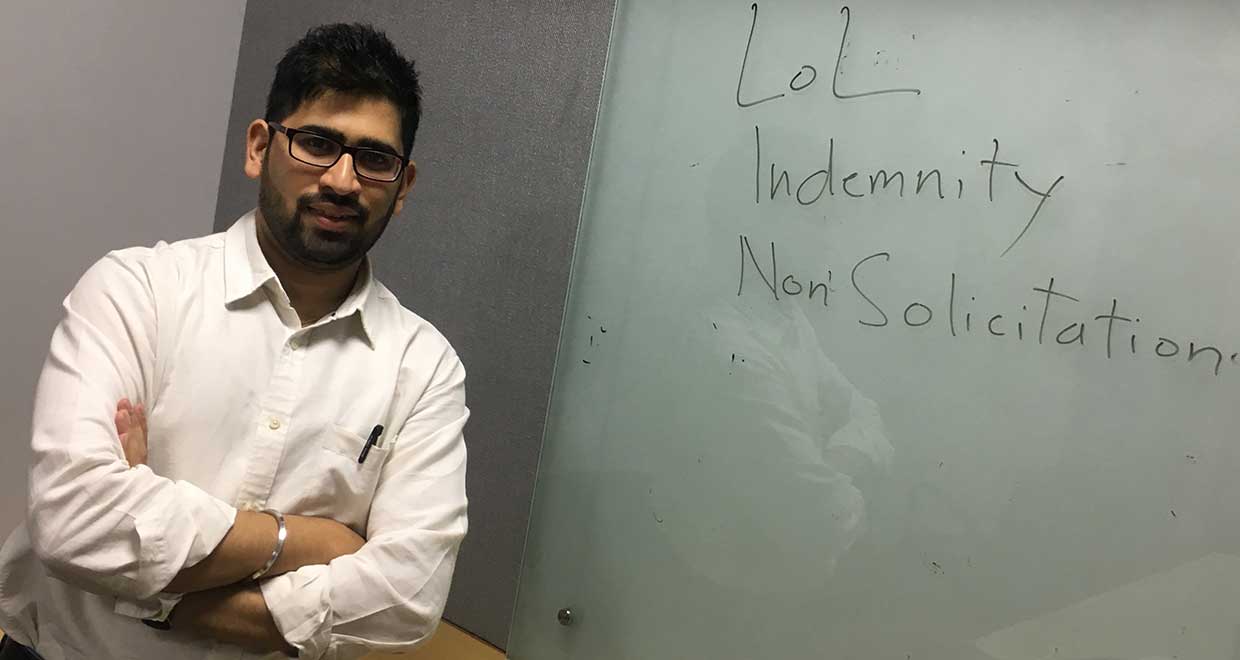
  • Spurthi Mouli, Legal Counsel, HP India, on studying at Christ University, and her experience as In-house Counsel

    Spurthi Mouli, Legal Counsel, HP India, on studying at Christ University, and her experience as In-house Counsel

    Spurthi Mouli graduated from Christ College of Law, as part of the institution’s inaugural batch, in 2011. She not only manages products/services/solutions/contracts with several end customers (PSUs/Government as well as Private), but also handles matters covering areas such as litigation, employment/labour laws, Competition laws, environment, and advises on a compliances as well in addition to supporting HP’s internal projects. She has been engaged in closing complex contracts with customers ranging from HDFC Bank, ICICI Bank, Honeywell India, Bajaj Allianz General and Life Insurance, Coca Cola to Mindtree, Asian Paints, World Bank, IDBI, United India Insurance Limited, Gujarat Informatics Limited, Govt of Daman & Diu, BEL, IOCL, ONGC, CBEC, etc.

    In this interview we speak to her about:

    • Her role at HP
    • Her internship experience
    • Her professional accomplishments and accolades

    How would you like to introduce yourself to our readers?

    As against the stereotyped assumption of lawyers being complex and serious people, I’m fairly simple, straight-forward and fun loving. I operate on the foundation of my values which I hold close to my heart, and live by, both at work and in my personal life. I may come across as a highly ambitious person, which I don’t deny, but in a very different way, and people who know me very well would understand it. Personally, I love food, travelling and adventure!


    Tell us a little about your days in law school. 

    In hindsight, law school schedule was quite hectic and fun at the same time. One may not realise the momentum that helped sail through the five years until you have graduated! Being the first batch of law at Christ, we were constantly on our toes to make sure we were doing everything possible, and also doing it right, to ensure we were competitive and at par with other top law schools. There are countless anecdotes that come to mind when I think of law school and it is practically impossible to recollect any one in particular. However, some of those which stand out include the camaraderie amidst stiff competition, looking out for one another and working towards a common goal – which ultimately made us successful, individually and collectively, as a batch. No single person could have made that happen.

    What were the activities, academic or otherwise, that you undertook in your law school days, which in your opinion have shaped you and your career?

    I have always liked to dabble in a wide range of things – theater, moots (although not an avid mooter), organising conferences/seminars etc. I was never too keen on pursuing the typical law school activities mainly because there were way too many people running after them! I have always striven to be different, and usually find myself looking away from most things that majority of the people aspire for! I, however, loved being part of the various committees in law school. I continue to be the same in terms of trying my hand at everything!

    An experience that I truly cherish and believe helped me immensely is theater. Art, in any form, can have such a positive influence in your life and teach you lessons that prove worthy in the long run. It is really sad that art is pretty underrated and ignored in our education system! It has a lot more to offer than actual academics!


    Who was your mentor, or main source of inspiration who motivated you all along the way?

    I did not have a mentor until I joined HP. My current manager, Rajeev Nair, is my first mentor who has been instrumental not only in guiding me at every step but also in moulding me into the professional that I am. His dedication and passion towards work and his selflessness, when it comes to the team at large, is unparalleled and laudable. A manager like him is a rare find. I draw inspiration from people around me, regardless of what they do or what level they are at. I have, in my experience, noticed that fairness, modesty and simplicity are what make people successful, and most successful people that I look up to radiate these qualities abundantly. A person who immediately comes to my mind when I think of these attributes is Rajiv Srivastava (ex-MD for HP India). People like him and Rajeev motivate and inspire you not only to do better, but also show you the importance of holding on to the core values we grew up with.


    What are your areas of specialisation in law? 

    As an in-house counsel working in India, which is a large and complex jurisdiction, I am required to have a generalist approach and advise on several aspects of law. At the same time, I am also required to build expertise in core areas relevant and relating to the business and industry we operate in, such as contract law, laws relating to IT, etc., thereby ensuring we act as business enablers. I have, as a student, been interested in several areas that have been, and continue to be, a part of my work stream, and provided me with an opportunity to dig deeper and build expertise in them. It is not always necessary that a decision to specialise is made while one is a student. It could also happen once you’re employed and that is completely fine! I strongly believe, that as a student, one needs to have an open mind to learn and absorb as much as one can. That enables one to look and decide from a broader spectrum.


    Would you say law school prepared you for the real world practice of law?

    The first year was probably the most difficult. Understanding the business while picking up nuances of the job and transitioning from a student’s mind-set to an in-house counsel were the initial challenges that I faced. Unlike law firms, which are hierarchy-driven and the work is manoeuvred through several levels before it is sent out, in-house roles offer independent ownership. Once I got a hold on these aspects, my job became more and more interesting and engaging. The nature of in-house roles in a company like HP not only help build your expertise on several areas but also increases the level of one’s responsibility and accountability as a lawyer. Law school for me is the stepping stone to the real world of practising law. What probably help get a better sense of the real world are internships – because you get a high-level experience of what a lawyer’s job entails. However, there is a lack of structured internship programs in our country which I believe needs attention. Internships (as I have seen) are more about having the name of the firm/company/senior counsel’s name in the resume, rather than focusing on practical/structured learning for students. We at HP, strive to make a student’s experience worthwhile and have a structured program that not only gives them a first-hand experience of what we do at HP every day and how one can add value to the company’s well being. Experiences like these are what make a difference to students who are trying to choose a path for the future and to us as lawyers also, since there is a great deal we can learn from upcoming lawyers.


    Would you say higher studies are relevant for a career in law? 

    Personally, no. I believe in practical experiences and find them to be far more relevant. Besides, I strongly believe that the process of learning for lawyers is constant irrespective of whether or not one chooses to study further. What matters ultimately is having the right outlook and an open mind to learn and grow. Having said that, I’m quite certain that an L.L.M. has its own advantages and no form of education goes without any value!

    You’ve been with HP for around a good six years now. 

    When I interviewed for HP in May 2011, it was much against what I wanted at that point. I was awaiting a confirmation from a reputed law firm with whom I had completed an assessment internship and was very (stupidly) adamant about not wanting to work in-house. Much to my surprise, once I joined and began work, I realised there is a lot of incorrect information spoken about and circulated in the industry about in-house jobs/roles vis-à-vis jobs at law firms! To begin with, I was hired as part of the Graduate Attorney Program and had the opportunity to undergo training in the US with my fellow graduate attorneys hired in that year. In the six years that I have spent with HP, I have worked on diverse work streams and there hasn’t been a single day where I have felt that my job is monotonous. I admit, the workload is quite high and there are several hectic days. But having a great work environment which also includes celebrations, fun, and most importantly, recognition for what is turned around, helps offset the long nights, thereby making it all worthwhile. Also, the fact that we are a lean team supplements my professional development since we continue to turn around 99% of the work in-house. What makes it even better is the stellar leadership team (both Business as well as Legal – which we call Global Legal Affairs, internally) that constantly encourages and promotes working as a team, instills confidence and provides us with an environment which makes me go above and beyond my call of duty!


    Do you believe that a corporate giant such as HP is a good place for a fresh graduate to start off?

    Absolutely! I cannot think of a better place to have kick-started my career and I feel absolutely lucky to be a part of the HP family. In fact, I often tell people it is unfortunate that HP India GLA does not hire on an annual/regular basis because of the all-rounded experience the role offers. But then again, I suppose that is what makes us unique and stand out from other in-house teams!


    How is it that you did not fall prey to the firm practice frenzy that the upcoming generations of young lawyers seem to be facing?

    I was in the mad race, but trust me, I got lucky!


    How do you keep yourself motivated?

    (Spurthi has won several accolades, including the award for the Best Individual Performer (Legal) – India and the President’s Club Award, for her work.)

    When you love what you do and you have good people around you, the way you work and how you work automatically changes. Despite my achievements, I always raise the bar for myself and constantly think of what I can do differently and explore areas where I can value add and make a difference. I never find competition in anything or anybody but myself. Winning awards such as the President’s Club Award (which in HP is the highest form and most coveted recognition of all) for Asia Pacific & Japan Legal and the Best Individual Performer (Legal), India, are special moments but more fully a humbling experience. It sure is a proud moment, but makes you more and more grounded and also comes with an increased responsibility – both personally as well as professionally.


    Tell us about your current work profile at HP. 

    I currently support review, negotiation and finalisation of high value customer contracts, advisory on competition, environmental, privacy, employment laws, litigation and general legal matters. Each day is different and unique from the other (there are early mornings and late nights!) but it wouldn’t be wrong to mention that I manage to find a work-life balance and do the things I love doing, outside of work!


    Where do you see yourself ten years from now?

    Being a General Counsel of a good company where there is potential to contribute using my professional expertise and at the same time hone my skills further, and offers a work-life balance. I hope to have seen half the world by then and continue to plan the other half. I also hope to have started something of my own – creating a platform that gives back to society.


    What is your message to our readers?

    Write your own story and run your own race. Don’t get lost in the mad race that people are already running without knowing the destination.


  • Swati Dalmia, Senior Associate, Fox Mandal, on being a Company Secretary, and her diverse experience

    Swati Dalmia, Senior Associate, Fox Mandal, on being a Company Secretary, and her diverse experience

    Swati Dalmia graduated in law from Bangalore Institute of Legal Studies, in 2009. She then went on to pursue her Masters from NLSIU, Bangalore, with a specialisation in Business Law. She is also a certified Company Secretary. Swati has been working with Fox & Mandal, Kolkata, since November 2009.

    In this interview we speak to her about:

    • Being a Company Secretary
    • Her role at Fox & Mandal
    • Her experience thus far

    How would you like to introduce yourself to our readers?

    I believe in the dignity of labour. There is dignity in every job. And if anyone disagrees with me, I don’t even understand it. I do my job with a lot of effort, with all the right means. I am passionate and totally committed to my work. It’s been almost seven years in this profession and the journey has been quite fascinating, enriching and fun-filled; while working at Fox Mandal along with my seniors and colleagues.


    What motivated you to pursue law?

    If I would be allowed to say so, then with all modesty, I would admit more than me having to choose law, it chose me. Law enthralled me, embraced me, and gave me a vision. Studying law and practising law is not the same. Various people study many subjects but practise what they love doing most. When I ventured into this world of law I was mesmerised with its vastness. Post my board exams I wanted to move out of my hometown and started exploring opportunities, looking for courses and colleges, and then settled for studying law. Today, I’m happy about choosing this subject.

    How important are grades, in your opinion?

    Success is peripheral to hard work. If we work hard with the right attitude, seek knowledge at any and every given point of our lives, we shall surely be successful. There are no set standards to succeed, to each is his own. In our academic life we seek success by getting more marks but that does not ensure the making of a good lawyer. Yes, it does make you a good student; grades are very important since it is the most focused tool to measure one’s success rate. The hard work academically bears fruits when it is time to be selected among the lot, good grades give you accessibility to a better platform. It is more important to be a consistent performer and thrive to attain more with an undying quest for learning. There is a huge difference in being a good scholar and a real player in the industry.

    Tell us a little about your days in law school.

    My law school days were just fantastic, the best days of my life. It was an ocean engulfing me; there was so much activity all around me. I wanted to do it all. I maximized my time in a productive way, was very active as a student, and I loved being that way. I tried to excel in academics, participated in several moot court competitions, debates, seminars, client counselling sessions, research papers, etc. I pursued the company secretary course along with law and finished it even before graduating as a lawyer. I still remember the most stressful part of my law school days was writing my ninth semesters and then just after a gap of three days sitting for my CS Final exams. It was then that I realized how friends and family help you achieve your goals.

    I think I was quite enthusiastic and wanted to do everything possible which also included not missing a single party happening around me! Yes, I enjoyed myself and made friends for life.    

    What are the subjects that you took particular interest in during your law school days?

    Every student is exposed to all subjects in law. The curriculum is almost the same everywhere. Torts and contracts are the basic foundation and the most interesting subjects possible. But since I took up the company secretary course and later pursued Masters in Business Law, I think, as a fresher, I was at considerable ease (in comparison to other statutes) while working on the companies act and its allied statutes.

    But I strongly feel that law school days are the time to explore academically and not to decide upon your career option. One has to make a choice and may go with the flow and his instincts but the ultimate decision comes when one joins the industry and starts practising.


    In your opinion, what are the law school-centric activities that you would recommend as necessary experiences for every law student? 

    Read, read, and then read some more. Law school activities provide students an energetic and competitive platform to increase their knowledge and work on their oratory skills. Also, unconsciously, one develops the skill of working in a team.

    Any and all activities which we undertake make us a better human being, since we learn to rejoice our success and also handle failures with grace. It may not be an indication to whether one shall become a successful advocate or not, but it is surely important in shaping one’s law school days. Otherwise, as a student, life gets boring and mundane. I think as a student I wanted to do everything apart from writing an exam (which was compulsory). My most memorable days were winning and being appreciated for my mooting skills, and the cherry on the cake was when we won a debate competition related to child rights organized by Legal Assistance Forum.     


    Tell us about your experiences as intern at S. Jalan & Company, Kolkata as well as Fox & Mandal, Bangalore.

    I was fortunate enough to get these opportunities both at S. Jalan and Fox Mandal. My internship at these places certainly played a role because it helped prospective employers to know about me as a worker and also as a person. I personally feel, as an intern (also as a fresher), my seniors never expected me to do everything correctly but what was more important is my attitude towards my assignments. There has to be a balanced enthusiasm to take up work and try to finish it within timelines.

    My advice would be never to seek an internship only for the purpose of holding a certificate. It would do more damage than by choosing simply not to do it. It you are interning at a firm, then reach out to the associates and seniors and ask for work and get back to them after completing it. One should try to research well and push information in the simplest way possible (without relying on Wikipedia).


    What are the challenges that one needs to prepare himself/herself for when they step out of the comfort of a law school and into the real working world?

    The first and foremost challenge is to be in working mode for ten continuous hours every day. There are no official breaks in between and the offices do not stop working at 4 PM. The next thing I feel is acclimatizing to a new place and getting yourself familiar with your colleagues and seniors. It is a transition process from a caterpillar to a butterfly. It is a new beginning when you leave an impression on others (who may be colleagues, seniors, partners or clients); so be focused, dedicated and disciplined.    


    What are your areas of specialisation in law? 

    I feel my senior Orijit Chatterjee at Fox Mandal (my mentor) has been very kind to me when it comes to my understanding of specialisation. When I was a complete novice and had no understanding of work which generally takes place in a full-service law firm, he just held my hand and very patiently brought out the best in me. I strongly feel my mentor has played a very important role in shaping my career.

    Initially, I tried developing my skills in general corporate, advisory and transactional work because those were the kinds of work which were assigned to me. But he never stopped there. He introduced me to a plethora of work and made me work on diverse matters under strict deadlines. Honestly, I quite enjoyed it. It was challenging and satisfying. He strongly believes in a theory and told me one day “you are hardly an advocate if you don’t practise in courts because that is the place where the real interpretation takes place”. These words still resonate in my ears and I feel it so true. He introduced me to litigation and since the last three years I have been actively involved in dispute resolution practice and today I am experienced with a 360 degree overview of a corporate transaction which takes place, from a non-binding term sheet to the enforcement of exit clause.


     

    Tell us about your current work profile with Fox & Mandal. 

    A regular day at work is buzzing, overflowing with work, and I certainly enjoy it. It is combination of discussions with seniors, attending courts/tribunals, meetings with clients, drafting, researching, attending conferences with counsels, and without even realizing the day comes to an end. Our profession is extremely demanding and one has to be fine with long working hours on a daily basis. But under the tutelage of Mr. Shourya Mandal (Partner, Fox Mandal) and Mr. Orijit Chatterjee, work is enriching and fun-filled and their deep sense of humility and legal acumen encourages me all the time to strive hard and reach for the next level.


    Where do you see yourself ten years from now? 

    The stalwarts in this industry make me seek more and more, when I see their quantum of success I feel like taking a deeper plunge. As I always say, law seeks me more than I seek it . It ensures I’m glued to it, that I love nothing more than being a lawyer. I’m sure in years to come I shall find a place in the legal history of the country, my own place.


    What is your message to our readers?

    Make most of your law school days. Go ahead, reach out and do whatever you desire. Get into action, then give your hundred percent and never look back. Enjoy, have fun, take trips and most importantly, make memories.

  • Mritunjay Tiwary, Independent Legal Practitioner, on starting out on his own, and his litigation experience

    Mritunjay Tiwary, Independent Legal Practitioner, on starting out on his own, and his litigation experience

    Mritunjay Kumar Tiwary graduated in law from D.E.S. Law College, Fergusson Campus, Pune University, in 2009. After successful stints with the New Delhi Law Offices and Indus Legal, he ventured into independent practice. In 2013 he co-founded AGM Partners, a  firm that advises various corporate clients on issues relating to infrastructure, non-banking, employment, labour and compliances, etc., including all litigation cases. He later branched out of AGM Partners to establish himself as an independent legal practitioner.

    In this interview we speak to him about:

    • Starting his own firm
    • His experience in litigation
    • Being an independent practitioner

    How would you like to introduce yourself to our readers?

    I am a third generation lawyer. I was born into a family of lawyers in Jamshedpur, Jharkhand, the first planned industrial city of India. I did my schooling from Loyola School, Jamshedpur. My grandfather and father are lawyers based out of Jamshedpur. My family has an established practice in Jamshedpur, especially my grandfather who has been practicing for almost five decades now, and is considered the most reputed lawyer for labour law disputes and compliances in and around Jamshedpur. My grandfather and father have clients ranging from companies, hospitals, schools, restaurants, and more. Being born into a family of lawyers, I was attracted to the uniform and hustle-bustle of the court premises from an early age. My family not only wholeheartedly supported me when I decided to study law but has been a major driving force in encouraging me to practice litigation in this competitive world, when the easier choice was to take up a job. The faith my family reposes on me motivated me to set base in Delhi to build my own identity in the legal field and not opting for easy and comfortable life back in Jamshedpur.


    Give us a brief overview of your life at law college.

    After finishing my school, I decided to purse law under the five years B.S.L. LL.B. program. My grandfather first wanted me to pursue graduation from the University of Delhi and then pursue a three year law course from Campus Law Centre, University of Delhi. He did not want me to rush into the decision of pursuing law as career, considering the hardships and challenges on this path. But I could manage to convince my grandfather and thereafter, he not only supported my decision but has always been there as a guiding force along with my father.

    I pursued law from D.E.S. Law College, Fergusson Campus, Pune University. My college was part of the same society as that of the esteemed and renowned Fergusson College and shared the same campus. I was part of the first batch of the college in 2004, which was working towards becoming one of the leading law colleges in the country and also gave me an opportunity to grow with it all throughout my five years. The law college itself being in the initial years of its formation provided more opportunities for individual development. I took an active part in college activities, and was a key member of the Placement Committee. Being the first batch, we had to work hard to secure placements for ourselves. In the year 2009, the world was passing through the phase of recession and there were more pink-slips than job offers. I firmly believe I have blessings of the Almighty and I was the first student from my college to secure placement in a law firm M/s. New Delhi Law Offices (NDLO) at New Delhi. NDLO is a full-service law firm being an offshoot of JB Dadachanji formed in the year 1992, wherein I handled a variety of litigation and advisory matters. NDLO had offered me an opportunity to interface with several clients, domestic and international which helped me to better my legal and commercial understanding.


    How much of a role do GPAs play in shaping one’s career path?

    Personally, I was a student who never studied throughout the semester or had an inclination to work very hard to get good grades. My intention was to work towards getting decent grades for which I studied few days before the semester exams and the result was that I passed my law from the University of Pune with a First Class Degree. University of Pune followed the orthodox way of correcting the papers, wherein it got difficult for students to pass, unlike the deemed universities. And in such a space, I was blessed to secure First Class for the reason that I never allowed pressure of securing good grades affect me.

    I believe your grades don’t define you, but they do still matter in shaping one’s career. This is something every student must remember. In the same breath, I also say that by caring too much about grades, most students are missing the point of education. We should not forget that the idea of education is to not just obtain good grades but strive for overall development, especially in the field of law. I think education is for self-improvement and to figure out a place in the world. With this in mind, I say that grades are a necessary part of the education system but they aren’t necessary part of the strengths of becoming a good lawyer. Forget the pressures of grades and just try to become a hard-working lawyer and everything shall follow.


    What kind of internships did you engage in during your student years?

    Internships provide an opportunity for students to increase their knowledge of substantive areas of law and gain exposure to the real work environment. Internship is a tool which aids in deciding one’s career path. During my college days, I never focused on one branch of law, I tried to experience everything, so as to find my self in an able position to decide my future. 

    I did six internships during my college days, which includes interning with Tier I and Tier II law firms, independent legal practitioners, and corporate,  for a holistic experience. I started interning with my grandfather, Advocate K. M. Tiwary, Jamshedpur on labour matters, which gave me a first-hand experience about the functioning of lower courts and how trials are conducted. It is important for every law student aspiring to be a litigation counsel to undergo the wriggle of the trial court and its working during the initial years. My decision to intern with my grandfather was quite rewarding. He invested a lot of time in me to explain the functioning of the courts, the job of a lawyer, etc. This immensely helped me to gain confidence to appear in a courtroom and gave a detailed insight into the litigation world, while I was still a law student. Thereafter, I interned at Dua Associates, New Delhi with the Arbitration and Litigation Team, Amarchand Mangaldas, New Delhi on IPR matters, Mulla & Mulla & Craigie Blunt & Caroe, Mumbai, on litigation matters. To gain corporate experience I interned in the legal division of Reliance Retail Ltd., Mumbai, and with in-house legal team of Standard Chartered Bank, Mumbai. Having gained such varied experience helped me decide my choice of career, i.e. litigation, non-litigation or corporate. Therefore, internships offer opportunity to experience different spheres of law and in my case I happily chose litigation and advisory.


    What are your areas of specialisation, and when/how did you go about choosing these?

    I would like to say that I am a student of law practising in the areas of my interest. And I found my share of interest during my internships in law college in the field of arbitration and litigation. Law is such a vast field that it’s difficult for me to say what I specialise in.

    Over the years, I have gained the experience of representing a large number of Indian and multinational clients in complex and intricate arbitration cases, as also before courts at all levels in India for enforcement of awards/decrees. Some of the major arbitration matters I have handled relate to international procurement contracts, cross-country gas-pipeline laying contracts, supply and procurement of gas exploration and loading equipment, construction of airports and highways in India, building and construction laws, apart from a wide range of other commercial contracts. I have also been representing clients and advising them on litigation matters in relation to civil and commercial litigation, banking, non-banking, employment, labour and compliances, construction and real estate related matters, probate and property rights, in addition to matters of intellectual property rights. With my own experience, I can say that litigation offers unparalleled thrills, the adrenaline rush that accompanies addressing a courtroom packed with audience, the power to shape the outcome of disputes, there is no feeling better than this.

    Right after law school and clearing the bar examination, every student is all set to get started on their legal career. Until now, every student has more of a theoretical knowledge of the working of the legal system. Law school along with internships teaches every student to think like a lawyer, but to gain practical experience and decide on your options, you need to analyse your priorities. Do you want to work that pays more or something that is of your interest even when it offers lower compensation? Are you a workaholic or do you seek to maintain a work-life balance? Only after you analyse your priorities you will be able to make the most of this noble profession.

    However, my advice to every fresher would be, while there is no bar to begin practice (litigation or non-litigation) entirely on your own, the customary route is to work under an established advocate or a law firm. The nature of work would certainly depend on the place you choose to begin your career. I would suggest every fresher to find an advocate / law firm who is able to invest time in you and supervise and guide you through in your initial days of practice. This is the most important aspect of becoming a lawyer.

    Finally, learning clerical work is also important for every fresher, especially for litigation. One should learn the art of maintaining the case diary, to see whether office files are in order, keep a close eye on how the filings in the courts are done, etc. So never take it to be menial work, as it holds an important place in a lawyer’s professional sphere.


    Would you say law school prepared you for the real world practice of law? 

    Your career is probably nothing like your days in law school. Theoretical knowledge of law schools is distinct from the practical world of law. After stepping out of law school, my life had changed. I had to put in more work hours than the others who were already in the profession. The art of drafting, handling a matter independently, advising clients, interpreting statutes, etc. is learnt through years of practice after putting a lot of hard work. Frankly speaking, we cannot be taught how to be a lawyer in a college and the same is attained through years of efforts and hard-work.

    My first stint at NDLO had given a good start to my career with a great learning experience. After leaving NDLO in November 2010, I joined Indus Legal, founded by a former partner of Dua Associates, Mr. Navin Kumar. With the guidance of my senior and assistance of an able support team, I was able to render legal services to various clients of the firm on a vast and varied legal framework. I worked in the areas of civil, commercial, and arbitration laws in the High Court at Delhi, Punjab and Haryana, Mumbai, etc., apart from conducting cases before domestic Arbitral Tribunals, the National Commission and other Tribunals and forums in and outside Delhi. In July 2013, I established my own law firm by the name AGM Partners along with two other partners. The firm progressed well and provided a vital platform to develop a commendable face value in the courts as also with various clients of repute. Litigation and arbitration being the major areas of practice, one had the opportunity to gain considerably in experience and stature. Towards the middle of the year 2016, I branched out of AGM Partners and started working as an independent legal practitioner. I still continue to provide quality legal services to my clients in various disciplines of litigation and arbitration practice. I have also been acting as of-counsel for various law firms.


    What are the challenges that one needs to prepare himself/herself for when they step out of the comfort of a law school and into the real working world?

    The field of law today is full of challenges and opportunities. The foremost thing to remember especially for the lawyers trying to make a mark on the litigation side is that there will be very less money in the initial days of work. Fat pay cheques and perks are unheard of unless you are working in Tier I Law Firms. Always keep in mind throughout your initial years, that you are here to learn work and even if you are not paid well and get to do fancy work, take it to be be as tuition fees for learning art and skills to become a lawyer.


    During your developmental years as a lawyer, did you have any mentor(s)?

    I am blessed to be born in a family of lawyers, because I am part of this esteemed fraternity today just because of them. My grandfather Mr. Kapil Muni Tiwary, an Advocate having experience of almost five decades has been a great source of inspiration to me. If I inculcate even ten percent of his hard-work, daily routine and discipline, which he practices even at the age of 87 years, I shall be doing wonderfully as a lawyer. My father, Mr. Anil Kumar Tiwary’s hard work and his sincerity towards his work has been a guiding factor in my work life too. My father is one of the great personalities in the legal field in Jamshedpur who provides free legal aid in today’s world. My father is Secretary of his Bar Association for last eight years because of his good work in the legal fraternity. My grandfather and father have dealt with varied subject matters handling a plethora of cases throughout their career. I derive my confidence, professional ethics, strength and legal acumen from them and my family. Also, my mother’s role in my life has been of great importance and she has always supported my decisions.


    You were a Senior Associate at a reputed firm, Indus Legal. Why then did you decide to take a leap of faith and establish your own firm?  

    This question reminds me of my conversation with my father in April 2013. He had also asked me why I wanted to step down from a comfortable position to start my own firm? It made me think twice, when something like this came from my father who has made a mark for himself in Jamshedpur as an independent legal practitioner. But I had immediately realized he was being a father that on how would I cope up professionally in such a city when I go independent, where I had no backing at all and he knew what pain an independent lawyer has to go through.

    Thrill of being independent and working on your own gave me the courage to move out and start my own firm. The idea to start my own firm popped up during conversation with my friends, who also later on became my partners in the firm. I personally always wanted independent practice and even when I was working under someone. After four years of practice with the firm under the guidance of my seniors, I decided to open my own law firm by the name AGM Partners along with two other partners. AGM Partners was always special to me. We had established a decent number of clients who had kept all of us in AGM partners, very busy with the work. The thrill of working on your own in unparalleled.


    What then motivated you to leave your position at the firm and take up independent practice?

    It would not be called motivation, rather circumstances made me decide to part ways with my partners and the firm and take up solo practice. There was a huge imbalance among the roles headed by each Partner, to which I accommodated for two and half years so that the firm’s progress is not interfered with. However, I realized this is not going to change and the disparity in the execution of every Partner’s roles caused a lot of frustration deep within. Towards May 2016, I branched out of AGM Partners and started working as an Independent Legal Practitioner providing quality legal services to all my clients in various disciplines of litigation and arbitration practice. Through what I have experienced I can share with all of you that if you desire to operate a law firm in partnership module, remember to have like minded people on board, otherwise life gets miserable.


    Where do you see yourself ten years from now? What are the avenues that your line of practice opens up for one?

    I never make long term goals. I believe in achieving my set goals at every short interval to keep my enthusiasm alive. As far as my life after ten years is concerned, I would like to see myself working in the same way on a larger scale and always keep getting better as a lawyer. Litigation has a slow growth but one who is sincere and keeps putting in hard work along with patience will grow one day.


    What is your message to our readers?

    Remember, your initial years of work experience will decide the entire course of your legal career. In these initial years, you can grow your skills, enhance your network and build your future. Whatever you choose, make sure you give it your best. Patience, along with continuous hard work is the key to success in this profession. Here is wishing everyone the very best for a great experience ahead.


  • Saranya Gopinath, General Counsel, Khosla Labs, on being Executive Director at Step Up for India, working at Goldman Sachs, and her experience

    Saranya Gopinath, General Counsel, Khosla Labs, on being Executive Director at Step Up for India, working at Goldman Sachs, and her experience

    Saranya Gopinath graduated from Symbiosis Law School in 2011. Since then, she has been associated with Goldman Sachs India, Juris Corp, eGovernments Foundation, Novopay Solutions, and Khosla Labs. She is currently the executive director of a small not-for-profit organisation called Step Up for India, as well as the General Counsel for Khosla Labs and the incubated projects.

    In this interview we speak to her about:

    • Studying at Symbiosis
    • Being General Counsel at Khosla
    • Working at Goldman Sachs

    How would you like to introduce yourself to our readers?

    A first generation lawyer who has had wonderful learning opportunities and the chance to take advantage of each of them.


    What motivated you to opt for legal studies after school?

    My tryst with legal studies was a wonderful chance. Through 12th grade, I realised that I didn’t find myself with the requisite passion to pursue engineering. At around the same time, I started paying more attention to the Indian political and administrative systems and their impact. Having done my entire schooling in Dubai, the exploration was one which captured my thought process.  Several meetings and conversations later I found myself intrigued by the Indian Administrative Services. That was actually the plan, law was supposed to be the effective first step towards joining the IAS. My schooling experience across co-curricular and leadership roles provided fodder to that idea. But then I got introduced to corporate law, and here we are today!


    Having graduated from Symbiosis, Pune, did you ever feel that there is a divide between NLU and Non-NLU students?

    There is no denying that the NLU brand does help in getting your foot through the door, be it internships or your first job. But at the workplace, nobody has the time to find your university pedigree before reviewing your work. Just as any industry, your career trajectory is determined by how much you bring to the table when you are there. It becomes your only calling card.

    My two cents to non-NLU students: play the underdog card. Just work twice as hard.


    How important are grades, in your opinion?

    Grades are undeniably important while getting your internships. They also hold substantial weight while applying for further studies. They show someone how you value legal studies and how well you can apply yourself.  But there is an inherent disconnect in the question. Targeting the big bucks cannot possibly be the goal when you are writing your exams.

    As far as the workplace is concerned, they don’t ask you for your grades when you are gearing up for a negotiation. What does affect the chance of earning the big bucks is what you learn. The industry is cognizant of the fact that freshers may not know a lot of practicalities and in some cases, some subjects aren’t even taught in all law schools, such as securities law.  But they do expect you to have your basics in order. There is no replacement nor excuse for that. Any notion that one can pass by without adequately understanding and appreciating the law is dispelled rather quickly, big bucks being a far cry from there.


    What subjects did you take particular interest in during your law school days?

    Like a lot of law students, in the initial years I found IPR extremely interesting and my first few internships were spent trying to pursue that. But during later years I found love in constitutional law and corporate law. While my curiosity in the former found some outlet in the form of moots and other research, I found that my curiosity in the latter could only be satiated by internships. At my internships- I would try to chase down the partners who worked in areas I liked and asked them for work. During my first internship at Juris Corp. the takeover code had just got a re-haul and was released.  I had the opportunity to work on an analysis of the changes and that deepened my interest in corporate law, a feature which informed my future decisions to join Juris Corp as well as Khosla Labs.


    What were the activities, academic or otherwise, that you undertook in your law school days which in your opinion have shaped you and your career?

    Symbiosis provided a great atmosphere where you could pursue a wide variety of interests that tickled your fancy, be it curricular or co-curricular. I explored theater and paper presentations but spent a majority of my time in mooting. The mooting experience allowed me to fortify my basics and develop the ability to think about every topic laterally, a skill that helps me immensely in my current role. Modern day legal challenges involve applying existing legal principles to new concepts in fields such as finance and technology. The skills learnt in mooting help address these challenges with a strong foundation.


    Who was your mentor, or main source of inspiration who motivated you all along the way?

    While I have not had one mentor, so to speak, I’ve been fortunate to have had a whole bunch of great influences. My parents and my brother have influenced my work ethic and my brother, in particular, encouraged a sense of curiosity. But apart from my family and of course my friends in law school, I have had great seniors and bosses who always encouraged me and pushed me beyond my comfort zone. One memory that stands out is when Mr. Jayesh was working personally on a transaction and we were drafting into the early hours of the morning. At about 3 AM, I disagreed with him about the way a certain clause needs to be drafted. Considering I was a second year associate, he could have told me that we could discuss it in detail later. But instead, at 3 AM, he spent time explaining the concept to the point where he was convinced that I was convinced. That experience really made me understand how the profession is not just about knocking out documents. Yet, that was just one of the many experiences in Juris Corp. Suprio Bose, Sonali Sharma, Veena Sivaramakrishnan and Hoshedar Wadia have each encouraged me to continue asking questions. And great colleagues like Bharat Budholia and Manali Gogate have kept the learning spark alive. At Khosla Labs, Srikanth Nadhamuni has lead by example in showing what inclusive leadership looks like.


    What kind of internships did you engage in during your student years which you feel were invaluable to you in reaching your current position?

    Through my career, I have made a calculated decision to work with mid  to small sized firms to get more experience. It helped me work on diverse practice areas and take substantial responsibility early on, a strategy which helped me take on my current role without too much trepidation. My engagements with Crawford Bayley and a litigation lawyer in Rajahmundry, Andhra Pradesh informed my decisions in the way I want to approach my practice and formed my principles in the workplace early on.


    What are your areas of practice?

    As general counsel in an innovation lab, my practice areas on a daily basis range from general corporate to intellectual property to labour law. Early exposure to different fields has helped me respond to the different challenges of the job. If after a few internships you know exactly which field of law you want to pursue- that’s great. But there is no virtue to it if it stops you from trying out different experiences. I think its perfectly fine to take your time in the workplace to decide the field. In my opinion, working full time and the responsibilities you take on cannot adequately compare to an internship, in influencing the career path you want to chisel out.


    Tell us about your experience as a secondee at Goldman Sachs India Finance Private Limited.

    Working with Goldman Sachs was a brilliant experience. I was fortunate enough to be seconded from Juris Corp and work with the VP of Legal, India as a green first year associate. Being exposed to the inner workings of a financial organisation such as Goldman Sachs was a great reality check. My learnings then and the responsibilities I was working on really influenced the manner in which I view transactions and the import I gave to understanding the practical nature of our work. It helped me understand the requirements of future clients and how best to assist them.


    Tell us more about your current job profile at Khosla Labs.

    In house practice is very different from firm practice, especially in a start up. Your colleagues need solutions and they need it fast. The impetus is on practicality rather than the eloquence of the advice. My aim has been to understand the different areas of operation as well as possible. Most often, the solution is a combination of legal and operational answers. As a result, my day largely involves meetings and having in depth discussions with various stakeholders. Drafting work often starts at about six in the evening into the night, with the idea being to wrap up in time for discussions and reviews the next morning.


    Between Bangalore and Mumbai, which work environment more is conducive to pursue law in?

    Mumbai is my first love. The city matches the enthusiastic pace of someone in their first job and teaches you the value of hard work. But to be fair, my experience doesn’t provide an apples to apples comparison because across the two cities. I’ve also moved from law firm to in house practice. As a result, my Bangalore experience has more highlights of diversity, in terms of professions and practices and as a result has introduced me to various thought processes.


    Is there any other suggestion you would like to give to our budding lawyers?

    Remain curious. Keep reading and keep asking questions. Not just in the field of law. Cultivate an interest in reading topics from different fields- economics, current affairs, technology, whatever intrigues you. If you get bored of learning, you run the risk of falling short of your potential.