Category: Entrepreneur and Alternative careerists

  • Prem Ayyathurai and Sahana Mahesh, co-founders, Kranti, on Government inaction, the culture of dissent and bridging inequalities

    Prem Ayyathurai and Sahana Mahesh, co-founders, Kranti, on Government inaction, the culture of dissent and bridging inequalities

    Prem Ayyathurai and Sahana Mahesh are peers and graduates in law from NLSIU, Bangalore. They co-founded Kranti, an initiative that attempts to mobilise politically conscious students from across the country. Sahana is currently working in the chambers of Jawahar Raja and Rajat Kumar and Prem is in the final trimester of 5th year in law school. They trace their path from law school to kick starting this initiative and highlight their experiences along the journey.

    In this interview we speak to them about:

    • The need for an organised, mobilized student movement
    • Government inaction, disillusionment with the system and trying to bridge inequalities
    • Offering political resistance through art, and celebrating the culture of dissent


    How would you introduce yourself to our readers?

    Prem: I have always sucked at introductions, so I’m going to avoid getting into one here.

    Sahana: I am Sahana Manjesh. I’ve recently graduated from the National Law School of India University, Bangalore. Originally from Mysore, I will soon be moving to Delhi to start my litigation practice in the chambers of Jawahar Raja and Rajat Kumar.


    Tell us about your childhood and schooling. Is there any particular childhood incident that has proved to be an inspiration for you?

    Prem: Most of my schooling was done at the erstwhile Dr. Kalmadi Shamarao School in Pune. I then attended BMCC and came to NLSIU. There were far too many inspiring people and moments in my childhood that have shaped me and compelled me to push harder; but if I were to place my finger on one, it would be the humbling realization that one generation before mine, my family lived in a small hamlet – the realization of this growth has never left me and pushes me to challenge myself, continuously.

    Sahana: I studied in St.Joseph’s Central School till 10th grade, after which I studied in the Demonstration Multipurpose School for two years, both in Mysore. Again, many moments of inspiration to name.


    How is life at NLSIU, Bangalore? Have you always wanted to study law?

    Prem: I didn’t really fit into the law school environment for a long time but I’m sure most people find it lovely. The great thing about NLSIU is that it enables a student to do a great many things – if you have the potential and more importantly, the desire to see things through, this place won’t let you down. The administration and, more importantly, the alumni are always there to support something good.

    I didn’t always want to study law. I decided to aim for legal education after noticing how far too many successful organizers of people’s struggles had some background in law. I want to work on social questions later on in life and so it seemed to be a natural choice, in that context.

    Sahana: I have wanted to study law since I was very young. It seemed to combine my love for words and arguments and oration with my interest in rights and politics. My time in NLSIU has been very rewarding. It is a space that exposes you to a world of opportunities if you allow it.

     

    krantiTell us something about your brainchild ‘Kranti’. 

    Kranti has taken shape, slowly, over the last six months. But it is the culmination of years of wondering about political processes and involvement with student groups. In Pune, I was involved in founding Yugpath about seven years ago. Over the last two years, especially, I have seen with great interest the mobilization of students in different urban spaces across the country (India Against Corruption, and after the rape of Nirbhaya). These were legitimate outbursts of long running disappointments of our generation with the government of this nation. Unfortunately, however, while the mobilization was on an inspiring scale, it was not rooted strongly in ideology. That, amongst many other factors led to the dissipation of these movements once the mass media looked away. Clearly, then, there is frustration in our generation. Enough frustration to step out on the streets (which takes courage) and face police batons. But this expression of frustration needs direction. This was my inspiration for Kranti.

    The aim behind the campaign is to bring together the experiences of veteran organizers of peoples’ struggles along with academics who have been speaking about the failure of the Indian political processes. Having done this, we want the youth across India to engage with these veterans and, together, ponder over what the solutions to India’s future may be.

    Kranti is a festival. It is a festival to discover, celebrate and reclaim the rich culture of dissent in our country. Although Kranti originated in the National Law School of India University in Bangalore early this year, it has since gone on to spread to a few other cities with students from elsewhere joining in. The purpose of Kranti is to introduce college students to the many struggles that are part of India’s story of ‘development’ through the culture of dissent. This, we believe, will go a long way in raising solidarity for these movements and their causes. We do this through street plays, movie screenings, songs of protest and conversations with students.

    Our online content on the culture of dissent is growing. Between July and August we had and continue to have documentary screenings in colleges in Bangalore, Mysore, Pune, Bombay, Hyderabad and Delhi. We have photo exhibitions in Bangalore during August. Through this time, Delhi, Mysore and Kolkata will witness street plays in solidarity with Kranti. Our main events will be in Bangalore during September. On the 7th, activist musicians will perform in our event, “Songs of Protest”. On the 8th, celebrated film makers will present their work. And finally on the 15th, academics and activists will participate in the “Dissent Conference”.

    Kranti is a result of a string of experiences I have had during my time as a law student.  My internships in Rajasthan, Chhattisgarh, Delhi and Bombay exposed me to peoples’ struggles and legal activism both inside and outside the courts. I was associated with the Legal Services Clinic while in college and my activities there sensitized me to various issues of rights. Attempts at legal critique and reform have also led me to discover politics and activism. Kranti to me personally is an effort to share these realisations about India’s inequity with people of my age, for we have the ability to engage in redistributive politics.


    It is indeed a commendable initiative, but what do you think about the sustainability of such a revolutionary idea? What makes Kranti different from other similar campaigns?

    What makes Kranti different is straightforward – we are under no illusion that our attempt to strike conversations across the country will culminate in a campaign which will bring change. Note how Kejriwal was involved in a fast earlier demanding democratic revolution but his latest fast was to facilitate gas and electricity connections. That climb down happens when campaigns are not thinking at least 5 years ahead.

    For us, Kranti is special because we are asking deeply uncomfortable questions – by organizing the screening of Kak’s Red Ant Dream, Patwardhan’s Jai Bhim Comrade, or a performance by Kabir Kala Manch, our statement is clear. There may be other platforms which set up ‘conversations’ between the youth and parliamentarians. Our conversation is amongst the youth itself, to ask ourselves what we understand to be the role of the Indian government in ensuring social security, and whether it is legitimate, for example, for India to call left-wing violence ‘terrorism’ but right-wing violence as ‘an expression of frustration’, and so on.

    Personally, I am constantly amazed at the many incredible people who are doing some amazing work – through their art, through their politics, through their words, through their appreciation of contemporary concerns. Kranti is a small idea, in a large world of possibilities. In the time that we have conceptualized and started executing Kranti, we have made many friends and sought guidance from several mentors. These are relationships and networks which help build solidarity for various causes; these relationships will outlive Kranti. At the core of Kranti is the desire to introduce youngsters to the world of dissent, to enable a moment of revelation which could change the way they look at their choices, their politics. If we achieve this with a handful of friends in different corners, I think our job is well begun.


    How do you think a common man can contribute towards the movement? And, how can anyone join the movement or volunteer?

    The effort at Kranti is to discover and share information about the many brave dissidents in India and we therefore spend considerable energies in curating this information. You can come take a look at our work, follow us on Twitter @KrantiFest and also spread the word about us!

    Also, in order to ensure our independence in the causes we wish to discuss and engage with, we are funding Kranti through crowd-sourcing. We still have quite a bit of money we need to raise. If you think this idea is worth your money, or know anyone who may be able to afford it, please write in to us at kranticonference@gmail.com to find out about the donation process.

    We need students from across the country to reach out and participate – they can do so by organizing film screenings and talks, or by setting up street plays and reclaiming the public spaces like roads and parks for expression of dissent, or by helping us design posters, pamphlets, films, online campaigns and so on.

    As Sahana pointed out, we are also raising funds ourselves – we are cash-strapped and running a tight show. If people are interested in helping us raise funds, or know of institutions/organizations which can contribute, we’d love to hear about these opportunities.


    How supportive have your parents been about this? Were there oppositions from friends and family that you’ve had to face, regarding Kranti?

    My family has always been supportive right from the times of Yugpath, for all the activities I have taken up. There have been times that I called up family and said, “I am filing RTI applications against IAS officers, nobody will employ me after graduation if this thing comes through,” and they’re like, “Haan, thikhai!

    My parents, sister and friends have indulged me in my obsession with this campaign, through moods both blue and orange.

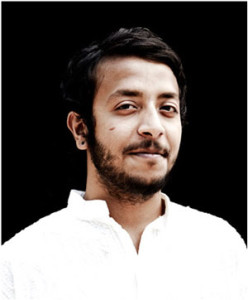
  • Apurva Sukant, Founder, Androidly, on studying in CNLU, his passion for philosophy and venturing into tech

    Apurva Sukant, Founder, Androidly, on studying in CNLU, his passion for philosophy and venturing into tech

    Apurva Sukant is a graduate from CNLU, batch of 2011. During this time he has interned with the likes of Mr. Arvind Mouar, Advocate, Civil Court Patna, the Rural Litigation & Entitlement Kendra, Amnesty International India, Honb’le Justice Mr. Ajay Kumar Tripathi, Patna High Court, among others. In May, 2012, he took the entrepreneurial plunge and started his own range of Android smart watches, Androidly. He is also Founding Partner and Managing Director at Scenescape, a registered partnership firm, dealing in gardening and art.

    In this interview we speak to Apurva about:

    • Making the shift from lawyer to entrepreneur
    • His diverse internship experiences
    • His passion for technology


    Most of our readers are law students and young lawyers. How will you introduce yourself to them?

    I would like to introduce myself as a tech and a philosophy enthusiast first and subsequently as an entrepreneur and a lawyer.


    Why did you decide to study law? What would have you been doing if not law?

    I found law to be the only professional degree with no limits on what could be done with it in the future. This is to say, law is very open-ended. Today, we have lawyers successfully walking every field of life, ranging from the arts, politics, business, non-profits, and there are a few in technology too.


    What kind of internships did you do while you were a student?

    I have interned at a few non-profits, like Amnesty International and Rural Litigation Entitlement Kendra, which was during my early years as a law student. Later on, I did an internship under a High Court judge in Patna, and with an additional Solicitor General in the Supreme Court. The high point in my internships was one term with the eminent lawyer Mr. Ram Jethmalani, during which I got to see and work on some landmark cases and be in the same room with some very influential people. The only internship I did at a law firm was at Luthra & Luthra.

    A singular experience during my internship was when I got to interact with and legally help folks in remote villages in Himachal Pradesh, during my internship with RLEK. The villages were small with around twenty households and were inaccessible by road. There was no electricity or telecommunication. The beauty of the place and its people has me searching for words! As a plus, I found that work meaningful too as I was able to cause direct change in peoples’ lives, albeit at a smaller scale.


    Apurva SukantHow did you manage the shift from HNLU to CNLU? Did you face any difficulty caused due to the shift?

    The shift was great as I was welcomed in the institution with open hands and hearts of both the faculty and students. I found some of my best friends there, and was fortunate enough to win the university presidential elections for the Student’s Bar Council. I went to the Willem C. Vis moots, both the Hong Kong and Vienna rounds with competent and dedicated teams from CNLU only. So I’m only too glad that that happened.


    How did you decide to venture into the startup space?

    Internships are co-curricular activities, meant to interface us with the industries and the real world. As a law student, I found it normal to go to NGOs, courts and firms for internship just like my peers. In hindsight I can say that an internship in the legal section of a tech company might have come in handy, but that never happened. As a law student, I wanted my education and experience to be as complete as possible, and so I did all the regular categories of internships.

    Starting up, after doing a slew of regular internships doesn’t seem unusual to me, as the idea of starting up had always run parallel to my circumstances as a law student. I had always thought of being a decent lawyer first, so that I could use all that knowledge into starting my venture successfully afterwards.


    How did Androidly happen?

    ‘Happened’ is a good verb to describe the story of Androidly. The story is about four childhood friends together, all of whom are moonstruck with technology. After about completing their graduation, we serendipitously decide to ‘make’ things. I think it works out something like this, when people become really good at things, they naturally want to take their stuff out into the real world. This might be our innate sense of adventure, our desire to make a ‘dent in the universe’ etc. When we became convinced that what we could do would be comparable to what billion dollar multinationals were doing, then we were able to shut off our risk-aversion behaviour and take the plunge!

    The specific story about how we decided up on a smart watch is related to our perception that whatever we were to make, should be cutting edge and something which would arouse interest out of sheer novelty first and functionality and quality later. It should be something that everybody needs, but nobody can place their finger on quite yet. Smartphones have been with us for some time now, and tablets are becoming popular every day. The wrist seemed the eventual destination for the next generation computing platform, and that’s when we decided it was to be a next generation smart watch.


    Tell us something about the smart watch that Androidly developed?

    The Androidly smartwatch is the world’s smallest full Android device, and the first complete Android smartwatch in the world. The watch comes with a full suite of sensors including GPS, camera, accelerometer and a full suite of radios including, Phone, WiFi, Bluetooth. So there is not much difference between a latest Android based phone and the Androidly smartwatch as far as functionality goes. The only difference is the form, now all this functionality is available on your watch, which lets you carry the whole world on your wrist.


    How is a typical day for the CEO of Androidly Systems Pvt. Ltd.?

    The typical day goes making calls and sending emails to customers, and business inquiries and doing development work on the watch and our websites. Outreach activities with the media and customers worldwide also come in a bit, though most of that is handled by our very capable communications officer, Pavneet. Occasionally meetings are scheduled with corporate partners to negotiate deals and alliances.

    Do you think that in today’s time when wristwatches are being replaced by phone, Androidly’s smartwatch would make a breakthrough?

    Wristwatches are dumb devices, they perform only one function, that of telling the time and date. Smart phones perform many functions one of which is also telling time, so inevitably phones are replacing watches. Androidly unlike traditional watches, is a smart watch and has all the features of a latest Smartphone and it too tell the time. So going by the example you provided, and for the same reasons, Androidly should replace phones, just like phones have replaced traditional watches and shouldn’t have much trouble in the breakthrough process!


    Is there any particular marketing model you are working on for Androidly?

    We have several and we favour none in particular. We pursue crowd-funding, direct sales, distribution arrangements and other forms of corporate partnerships. We estimate our target audience to be 15-35, belonging mostly to the nerdy, techie crowd. We are happy to reach them through whichever model happens to work!


    Where do you see your company 5 years down the line?

    We would like to shift out our offices in US preferably California! Currently Androidly operates from UK and India which is fine for now. Seeing how most of the tech development and funding activity happens in the US, I think it is most likely that we will end up there. We would likely have partnerships with telecom operators in India , China and UK, as several talks are already underway with some operators right now.

    We would have had an IPO, or be trying hard for one. I believe the idea is ultimately to transform into a brand, from a device manufacturer.

    Do you think doing law is helping your current career in any way?

    Self employment is not a career!

    With that in mind, let me give an example of when we had company law in our 4th year, the study freaks were busy memorizing the clauses and case laws, and the party freak were busy not caring and partying. I looked upon those clauses as words of God that were going to regulate my life for all foreseeable time! Every clause invoked in me a very personal sense of wonder or disgust, depending on whether it was going to make my life easier or tougher later on. This was true for a host of other related subjects too. So yes, law helped me and the venture in a very big and direct way.

    Luckily I was able to grasp this importance when it mattered.


    Everyone faces rough patches in their career – what will be your advice to beat a rough patch being faced by a young lawyer?

    Rough patches are the best. This might sound a bit unintuitive but in my personal experience I have constantly found it to be true. Rough patches and failures in general are an entrepreneur’s best friend. It is said that the reasons for any venture succeeding are always unknown, because they are so complex, interdependent and spread out. While reasons for failure are always specific. So failing offers better chances of actually learning, given that one is willing to be brave and learn. My advice in this regard would be to smile, and be attentive while one is through a rough patch. Given that time continues to flow, no failure or rough patch is terminal, as one always has the next moment to innovate and pivot from the failure into success or something like it.


    How is easy or difficult is the process of transition from being a law student to a lawyer? What would be your piece of advice to gonna- be- graduates?

    The transition is extremely difficult. I believe this is true for other careers too, where one has to provide business for oneself, such as for doctors. The educational institutions of our country are to blame for this. In the case of law, for five years, they systematically amputate the mental faculties of students and push them into a delirious, make believe fantasy land of text books. They are told, this is what it is, and this is how it works, and if you can memorize it then you have succeeded. You couldn’t get any further from the truth. Anybody working in the field has this complaint, they don’t teach all that matters in the law school. Human beings are effectively turned into compliant vegetables unable to stand up for themselves. Obviously this translates into an extremely difficult transition for students. My advice would be to be vigilant towards real world development in one’s field. One should always try and gain as much experience as possible by ‘doing’ all the things that one is taught ‘about’. Lastly, one shouldn’t forget to keep smiling.


    Do you take interns? How should one apply? What do you look for in interns?

    We keep getting emails from prospective interns. At this time though, we neither have the inclination for interns and nor the appetite for them. We would be going on a recruitment spree very soon, but for that we already have people and institution in mind, so again interns don’t figure in this plan.

    If we did take interns, we would probably look at their philosophic outlook on technology and also the knowledge and experience they have. Probably give them a couple of quirky, offbeat problems to solve like Google does.


    Last but not the least, what would be your message to law students, young lawyers and wannabe entrepreneurs?

    I would like to leave you with a quote from Lewis Carroll’s Alice’s Adventures in Wonderland. “She generally gave herself very good advice, (though she very seldom followed it).”
