Category: Partners, General Counsels and Senior Advocates

  • Shellen Bajaj, Partner, A&A Law, on the Indian legal education regime, mooting, and his diverse experience

    Shellen Bajaj, Partner, A&A Law, on the Indian legal education regime, mooting, and his diverse experience

    Shellen Bajaj graduated in law from Campus Law Center, Delhi University, in 1992. After successful stints with Times Internet Limited (The digital venture of Times of India Group), and Emaar MGF Land Limited (EMGF), he is currently Partner at  A & A Law. He has an experience of over two decades in handling corporate matters, including corporate advisory on infrastructure regulation and compliances, and real estate, which also includes performing due diligence and title search of the properties for client assistance and knowledge.

    In this interview we speak to him about:

    • The legal regime back in his day
    • His time in Delhi University
    • His diverse experience

    How would you like to introduce yourself to our readers?

    As a first generation lawyer and being from a business family, I barely had any clarity on the path to success in the legal sphere. One thing which I was clear on, however, was that I had no inclination to join my family business.

    As soon as I passed out from Campus Law Center, Delhi, I joined the Delhi High Court, where I got associated with Mr. Adarsh Dial Sr. Adv. who happened to be an old family friend. Mr. Dial was on the panel of a couple of PSUs and various banks. I got initiated into litigation and actively litigated for ten years. I have always taken life head on and have treated challenges as opportunities. I feel whatever has to be done should be done without any postponement.

    I am a hardcore positivist and feel everything which one conceives is achievable, notwithstanding the hardships one finds on the way to success. Given my attitude towards life I got a chance to get into a corporate job, after ten years of active litigation, as I saw an opportunity to see law from the business perspective. Due to my family background I never felt that I could or would ever sustain in a ‘job’ environment, but I well managed it for over ten years as head of legal for various companies. I personally feel that if one is open and hardworking, the doors to success are always open. Restrictions are always in the mind.

    Having tried both the fields i.e Litigation and Corporate I feel litigation has no glass ceiling and am therefore back into active practices as a Partner in A & A Law. I have traversed and actually enjoyed both to the fullest.
     

    Tell us the best and worst things about your law school experience.

    My initiation to the Campus Law Centre (CLC) was not because I had any preconceived notions to take up law practice as my main vocation, but merely to stay in the campus three more years in order to avoid my family business. It was while studying law, that I realised that it made a great subject as there is no sphere of life which is untouched by the vast and ever increasing expanse.

    During my time at the faculty of law we had some incredible professors teaching us. Noteworthy ones being Prof. Upendra Baxi, Prof. Dr. M.C. Sharma, Dr. Nomita Aggarwal, Mr. T.D. Sethi, Mr. K.B. Rohatgi to name a few.

    Life in the law faculty was pretty easy during those days. We did not bother much about attendance, internships, moots, etc., which now have become major issues, especially with the five year courses. So much so that the students are being debarred from taking their exams in case they are short on attendance and internships have become a part and parcel of the curriculum. However, the five year courses these days, though strenuous and nerve wracking at times, help students to find their focus sooner and provide more exposure. The importance attributed to internships these days also is an important aspect of today’s legal education.

    The best experiences at CLC would include the time spent with friends, teachers, understanding law and its application, as also the regular ideation sessions with peers and mentors, which eventually came in handy in the creation and development of multiple businesses.

    I do feel that my time at the Faculty of Law would have academically been more fulfilling had the college itself taken the course more seriously, and that is something I still feel about the institution, specially after talking to DU students who are currently pursuing law or are done with their course.


    What are the subjects that you took particular interest in, during your law school days?

    Law interested me right from the start. As a law student one begins to appreciate the vastness of the corpus of laws that lawyers deal with in the course of their regular business. With this understanding also came the realisation that not everything can be rote learnt and that it is important for a law student to understand the essence of the law and to know how the law needs to be referred to and applied in the given circumstance.

    That being said, there are, of course, certain subjects that require more effort and that form the basis of a lawyer’s day to day functioning. Subjects like Constitutional law, CPC, CrPC, Law of contract, etc. were the ones that I paid greater attention to because of this reason. These were the ones that then became my favourites, not by chance, but almost by design.

    One thing which I realised later and keep telling youngsters, is that nothing which one does is irrelevant, however immaterial it might seem at that given point in time. Everything adds up to one’s overall experience and the learning never fails you. So give everything and every subject your hundred percent at the present moment and it is sure to bring you results at the most opportune moment.


    How important is mooting, in the life of a law student?

    I got my law degree back in 1992. That was a time when law was an entirely different ball game, not in terms of its content, not so much in the way that lawyers practised it, but more in terms of the way students approached it. In our minds, it wasn’t as competitive, it wasn’t as rigorous as it is now and we could still have it easy at least while we were in law school. During our times there were no entrance exams for the law course, there weren’t any for getting enrolled into the bar either.

    For us, actual rigours of the profession began only after college was over; that was more or less the perception that we were operating with. I don’t mean to sound like I was an aimless student then, but really, that was the kind of environment in which we became lawyers, because that was a time when the ‘smarter’, more ‘intelligent’ students of the lot were either pursuing engineering, medicine, etc. In short, everything that was far removed from the ‘arts’ stream as it was commonly referred to back in the day.

    Law, for students now, is a far more serious course than it was for us. Law schools are simmering with competition as more and more young minds gravitate towards careers in law. In such an environment I feel mooting is of utmost importance. Not only does it provide students with a break from class room learning, but it also gives them opportunities to learn and grow.

    That mooting doesn’t serve the purpose, according to me, is a myth. There are students who feel that it doesn’t accurately portray how courts work. That may be partially true, however, the pros of mooting in my view outweigh the cons by a substantial margin. It develops in students the essential skills of researching, developing innovative lines of argument in consonance with the law, drafting and withstanding the questioning of seasoned and learned judges, which they are bound to face in their future, no matter what line they eventually tend to tow. Mooting skills go a long way in transforming these students into effective lawyers. So yes, mooting in my view is an irreplaceable part of one’s experience as a law student, I’ve always encouraged students, including my son, to actively participate in them. I believe it does make a distinct difference.
     

    What are your areas of specialisation and how did you go about choosing these fields?

    I started out in the High Court here in Delhi and have dealt with all kinds of cases which came my way. The only choice during those days was not to accept the brief being offered, which I never refused. Every case provides loads of learning if dealt with properly.
    In 2002, as luck could have it, I got the opportunity to work as an in-house counsel for Benett Coleman and Company Ltd., for their internet division, Times Internet Limited. I took it as a challenge as I have never feared trying out new things. I joined the group as a legal manager and set up the entire legal team. I learned about the internet and the possibilities it could offer on the go. I also got great exposure in print media, radio, television and even in outdoor domains. We worked extensively for variety of businesses such as ad sales, travel, ticketing, hospitality, inventory sales, online auctions, telecom etc. as well as legally documented various new businesses. One of the major challenges was to offer a ‘game of chance’ for the public, equivalent to gambling in legal terms, through SMS and the internet. Being online exposed the said business to being present pan India at once. I realised that being the part of a business one needed a change in the perspective and effectively facilitate the way to do business, while ensuring that nothing illegal was done or caused.

    It was a formidable experience working with the corporates and gave me quiet an insight into the dos and don’ts of handling the legality of the business from the front, including managing the compliances, IPRs and other legalese. While in Times, I provided the documentation for the Indiatimes.com website, including the privacy policies, terms and conditions for the entire business paradigm for the main website as well as various other sub domains under the Indiatimes brand which were not there before I had joined. I got to interact with the likes of Google, Yahoo, Amadeus etc., the leaders in their respective domains. Another feat was to create legal templates for the ease of business, which not only saved time and effort but also provided a comprehensive ballpark for the proper conduct of the business.

    I was always connected to the litigation side, even as an in-house counsel. I obtained multiple stay orders from the Delhi High Court including staying operations of even international websites who were masquerading themselves as being a part of the Times group, by flouting / stalking on the IPRs of the organisation. I was soon promoted as the Vice President of the company. I was associated to the Times Group for over seven years and post leaving times, I joined EmaarMGF where I dealt with legal nuances of PPPs pertaining to SEZs, including residential housings, and golf courses. I also dealt with EPC, CFA contracts, arbitrations, etc. I also worked with Monnet Ispat and Energy Ltd. The Hon’ble Supreme Court cancelled the mines of the private sector and there were subsequent changes in the laws pertaining to the mining sector which brought in the new phase of e-auctioning. Those were eventful times for the mining sector as the cancellation marked the change in the entire paradigm of legal implications.

    By this time I was more or less done with my SWOT analysis and thought of returning to my second home, i.e. litigation, as I found it to be better suited to my lifestyle and I needed greater independence at work. One of my dear friends Mr. Sanjay Aggarwal, whom I had known from CLC days and had a great understanding with, had started a law firm by the name of A & A Law. He offered me to join him as a partner in this firm and the rest is history. The areas of my specialization today are consultancy in the fields of corporate transactional documentation, hospitality, EPC contracting, IPRs, property related documentation and of course litigation.


    At what stage in one’s law school life must one pick a specialisation?

    As soon as one understands their areas of interest, one must choose his or her areas of specialization.
    However, there are various considerations that go into choosing specialisations based upon the areas of interest, his/her skill set, prospects of material gain, etc. Some students tend to favour areas of law which are still developing in comparison to others, the niche areas so to say, and I feel there has been no better time than now to scout for opportunities in these ever expanding new legal arenas where law tries to regulate unprecedented behaviours, transactions, technologies, so on and so forth.

    I do feel, however, that the choice of a specialisation must rest more on interest than on any other consideration, because more often than not, in a field such as law, it is easy to lose interest and motivation, given the overtly academic nature of our business which needs motivated and driven individuals if they are to act as the machinery that transforms the law.

    So, my advice will be that students follow their interests and chose a specialisation that they feel can continue to interest them and motivate them to work years after they’ve chosen it. I feel skill without interest is akin to a rocket fitted with a car’s engine, it leads to wastage of potential. On the other hand, interest without skill leads to skill development, thereby transforming the car into a rocket.

    I’m glad about the fact that in recent times, interning for a specified duration of time has been made mandatory in law courses, it equips students to make better informed choices about what areas they want to specialise in.
     

    How important are grades, in your opinion?

    This is something I feel very strongly about. Of course, having a son in his fourth year of law gives me greater insight into this topic. Ask any student pursuing a master’s degree in law, and the answer without a shade of doubt will be yes. For LLM aspirants, especially the ones who wish to do it from colleges and universities abroad, it is a rat race, they need to score and they need to score higher than the people they are competing with because grades are a major objective criterion on which their applications will be accepted or rejected. I’m not implying that grades alone will land them colleges, but they do play a substantial part.

    As far as litigation is concerned, fortunately, it is a field where only performance matters. No judge will dismiss a good argument simply because the lawyer making it did not have satisfactory grades in college. It may, however, impact an individual’s employability, both in corporate jobs and in litigation, though that isn’t necessary. On the employability front, I feel we owe a duty of care to young lawyers who are freshly out of law schools to refrain from judging them solely on their grades or overplaying the importance of grades while judging them. The approach has to be subjective as far as possible because intelligence or potential doesn’t necessarily translate into marks.

    In light of whatever I have stated here, there can be no definite answer to “how important are grades”. This is a question that can only be answered within a certain context, so grades hold variable importance in my view.

    The Indian legal education system is conducive to learning, though partially, and only for some students. The Bar Council of India governs the Indian legal education system, or at least practises oversight, stipulating basic attendance norms, laying down the subjects which are necessary to be taught etc. The real problem lies with the implementation of these policies and stipulations. Universities and colleges are given considerable autonomy in deciding how to test students and how to teach. In fact, these colleges, at least in practice, are free to implement the attendance policies of the Bar Council as they please which results in a wide disparity in the way question papers are set in different universities, how subjects are taught and how attendance concessions are granted. In some colleges there is emphasis on application based learning which is undoubtedly the best way to teach and understand the law, in some institutions teaching is merely a matter of making students rote learn bare acts. Likewise, the evaluation of a student’s prowess is also far from uniform, with some institutions setting purely theory based question papers and others asking application based questions.

    What is most disturbing is the amount of autonomy that these institutions have in administering attendance norms. It may not exist on paper, but it does exist in practice. I am an alumnus of the CLC, and do not believe that it is controversial anymore to say that strictness regarding attendance, at least in DU, is mild and the status quo remains maintained till date. On the other hand there are pending matters in courts regarding students getting debarred from appearing for examinations and being made to repeat entire academic years for paucity of attendance. There was recently an incident where a student committed suicide for the same reason and this is serious, it is a serious problem that is plaguing our education system. Norms are created to ensure that there is uniformity, there is no abuse of process, then how is it that institutions are allowed to act in such an arbitrary fashion?

    There are colleges which refuse to grant attendance concessions for activities like mooting as well, which require time and which the Bar Council prescribes as essential to any legal course and then there are institutions granting up to 30 percent attendance concessions for the same. There are innumerable cases where medical certificates have been refused and students have been made to repeat years for valid illnesses. There are even institutes that lack students grievance redressal forums which I feel are a basic right of every student. I could give endless examples of such disparities which can potentially go on to unduly harm students, but I doubt any reader will have that kind of time or patience.

    I do not support an unnecessarily strict and insensitive implementation of the 75% attendance rule, I know of no lawyer who has made a mark in our profession simply because he or she attended 75% of their lectures. Lawyers are made of more than an attendance percentage. I feel, if an eighteen year old has the right to choose who governs our country, I feel he or she must also have to right to decide whether they wish to attend a lecture, to intern, or moot. I’m not suggesting that this be an absolute right, I am merely suggesting that an implementation of this rule to the prejudice of a student cannot be justified, morally or academically.

    In conclusion, I feel that our legal education system is conducive to learning but only for some and it can be made so for all if there is better implementation and oversight of the policies laid down by the Bar. There needs to be a check on the way institutions behave and there is a need for the legal fraternity to understand that a student, struggling to maintain his/her grades, while trying to build a presentable CV while fighting to prevent possibly debarment for not meeting the 75% threshold in most cases has neither time nor means to move court against his/her own college or university. Therefore, there needs to be a mechanism to keep a check on educational institutions and a legally protected right to students grievance redressal.


    What, in your opinion, are viable options for a law graduate to consider on completion of his/her undergraduate course?

    Options in life are only as viable as you make them. The viability of post graduation options depends on the personal liking. Getting into litigation or working for Corporates, Indian or MNCs are both favourable.

    However, the interest an individual has in a certain subject is paramount. It is important for an individual to analyse the pros and cons of either field. The main difference being that the returns as an in house counsel start to come in the day one joins the organisation, including compulsive savings which form a part of one’s remuneration, whereas litigation takes a few years of gestation. There are various aspects to litigation as there are various advocates taking their pick from the vast paraphernalia leading to the management of the entire process from pre-legal notice to post execution of the decree. For example, in case the individual wishes to concern himself more with drafting/research work and not so much with appearing before the court, one may join a law firm and get to work as a team to reach the final objective in a matter. On the other hand, if one likes arguing matters one needs to practice that craft. Again, it depends on the individual to choose relevant areas in both.


    Is there any other suggestion you would like to give to our budding lawyers?

    Of course, for any student reading this, specially anyone who may have skipped a few of my answers, my suggestion is, do read all of them, you’d find a lot of suggestive content to help you along your chosen path.

  • Sudipta Routh, Partner, SAMVAD: Partners, on Mergers and Acquisitions, Banking and Finance, and Debt Capital Markets

    Sudipta Routh, Partner, SAMVAD: Partners, on Mergers and Acquisitions, Banking and Finance, and Debt Capital Markets

    Sudipta Routh graduated in law from NLS, Bangalore, in 1996. After successful stints at ICI India (now part of AkzoNobel NV) and Trilegal, he went on to pursue his Masters at Queen Mary, Univ. of London, batch of 2006. Since then, he has worked with Clifford Chance, Luthra and Luthra Law Offices, and founded Agram Legal Consultants. He is currently Partner at SAMVAD: Partners, where his role entails Mergers & Amalgamations, Foreign Investments & Joint Ventures, Cross-Border Banking and Finance, Trade Finance, Debt Capital Markets (Domestic and International), Corporate Advisory.

    In this interview we speak to him about:

    • His internships
    • His extensive experience at Tier-I firms
    • His current role at SAMVAD: Partners

    What motivated you to pursue a career in the legal field?

    As a science student I did the usual things science students did back then, many entrance exams. It helped that my CET scores were mostly non-reportable. I was surprised when I came in thirteenth in the NLS entrance test (no CLAT back then). My grandfather was a lawyer, but during colonial times. He passed away when I was quite young. My dad used to be in the army and a metallurgist.  He neither inspired me to take up law, nor was he inspired when I did. Very few (except the NLS faculty perhaps) had any inkling of the influence NLS would go on to have on legal education and the preeminent stature of the institution today.


    Can you share some memorable experiences from you time at NLSIU?

    Too hard to choose any one. Mr. Soli Sorabjee’s speeches, Chief Justice E. S. Venkataramiah classes (he taught Constitutional Law 1 and 2 immediately after retiring from the Supreme Court), Mr. Ram Jethmalani’s classes (he took a sabbatical to teach us Criminal Law for a month or more), Chief Justice Ahmadi (gave me my degree certificate), stirring speech by APJ Abdul Kalam at that time he was SA to RM. We had no idea we were interacting with the greatest president India would ever have. He signed a photograph for me, squatting on the floor, building a rocket – I keep this really carefully.  We were fortunate to have a lot of greatness rubbing off on us. Many of us were blissfully unaware though.  Sometimes, in hindsight, it was a little surreal too. Dr. Manmohan Singh (Chairman of UGC back then) had come by to inaugurate a hostel block. Two of my best buddies considered it their national duty to entertain him then and there. Of all things, they sang “Comfortably Numb” (quite badly, but it could’ve been the sound system). I can’t say Dr. Singh was comfortable (he clapped feebly), he certainly looked numb. He went on to become Finance Minister next month, the magic of 1991 happened, then prime minister, the rest is again history – you make what you will of that, but if I hope those two rock stars are not reading this!

    Amidst all this, there are those in the faculty who have dedicated more than a quarter century of their most productive years, who are still there now, and who still know each of us by our names and misdeeds. I am still living off that.


    Did you pursue activities such as moots, debates and internships in law school?

    The mooting standards were spectacular. Even before the first batch had graduated, NLS teams had already won international competitions. I mooted, but was thoroughly overawed. I focused on paths of lesser resistance, debates, quizzes, and other literary events. By my second year, NLS was dominating the “culfest” scene.  I was born for sports and athletics. M.P. Ganesh, India hockey legend, then director of Sports Authority of India (which is close to NLS campus), gave us full access to world class facilities. That was heaven.

    My internships were in the High Court (Bangalore), chambers of a senior counsel, a PSU bank, an NGO, law firms in Bangalore and Mumbai, and two multinational companies in Chennai and Pondicherry. These internships were invaluable. They gave me a job, and the chance of coping with life experiences (in Mumbai, I would always run out of cash in the very first week, from Pondicherry I could send money home if I wanted, which I didn’t eventually. By the end of the fourth year, I had a career plan (and several Plan Bs). By the end of the fifth year, I had three offers on campus (not without anxious moments). The internships had however already prepped me for whatever was to come.


    Would you say law school prepared you for the real world practice of law?

    The programme was superbly designed, even for the most indifferent student. The internship program was only one aspect. Other than the tough curriculum (two tests plus a project and a viva for each of the 60 subjects – none of which you could score below 50), we had a retinue of occasional / vocational teachers from every walk of life, academicians, industry captains, scientists, politicians, ministers, activists, sportsmen even, who taught us a life-lesson or two every now and then. NLS was conceived by brilliant educationalists, it also had the backing of the entire Judiciary, the Bar Council of India, the Karnataka Bar Council, the Bangalore University and the Government of Karnataka. The Chief Justice of India was the Chancellor. The Chairman, BCI, was the Chairman of the GC. I guess the odds were heavily against the “real world” when we stepped out.


    What are your areas of interest? How did you discover such fields and cultivate your knowledge of them?

    Intense focus in any one subject I owe to Professor Pillai (he continues to teach at NLS even today). His question papers were legendary. They were excruciating but hugely satisfying (i.e. if you passed) – at least eight to nine pages long and labyrinthine. They were invariably open book (the more you carried in, the worse your chances). He would set information dense scenarios (deviously misleading) which would require extremely quick analyses and a sort of synthetic application of competing principles. It was possible to come to diametrically opposite conclusions and be assured that both solutions were equally right. He provoked thought and demanded only the ability to solve problems – not swotting his notes or reeling off citations. So Corporate Laws and M&A was where it all began for me. I guess Prof. Pillai was really trying to inculcate method and application. He left the “imparting knowledge” part to you. Much later I would tackle a Masters, banking and finance, debt capital markets and restructuring, using only his approach.


    As an expert in Mergers and Acquisitions, Banking and Finance, and Debt capital markets, can you tell our readers a little about the subjects and the nature of work they demands?

    Maybe they all require different mind-sets. M&A perhaps requires a certain “structuring” knack based on comfortable ability with the corporate laws, exchange control, tax and some sector specific laws. Banking & Finance, less of “structuring” but far greater technical ability distilled from in-depth knowledge of market practices. Debt Capital Markets (especially the cross-border variety), a deeper regulatory awareness and conversational fluency with international market practices. Perhaps the common thread is really an ability to solve problems rapidly and deal with complexities even faster. Sometimes the spin-offs can be startling. When you are able to use a run-of-the-mill old hat technique in one practice area, add some bells and whistles, and push it out as as a “brilliant innovation” in another. This cross-pollination will make you stand out – you mustn’t give the game away then, pretend it’s an original brainwave, you are naturally quick witted like that, and in an everyday matter of fact way. Accept the applause graciously.


    What was your first job out of law school and how did you secure it? 

    ICI India Limited (now Akzo-Nobel).  ICI was looking for an entry level M&A and corporate lawyer. I had gone through two rounds without breaking a sweat (I had just interned with an MNC). My final interview was with my to-be “super-boss”, sharp eyed and intimidating. He immediately picked up on the word “treaties” in an obscure paper I had unfortunately mentioned in my CV – “Economic Analysis of Indian Double Taxation Treaties” (My wife-to-be, NLS senior batch, had made a “serious contribution”. I had speed read the Indo-Mauritian DTA though, some months ago).  He asked me how many “treaties I had to analyse to write this “seminal, heavy duty paper”. I distinctly felt the rug slip. I blurted “all” (mostly by reflex) and looked surprised that he should even ask? That was it. He stopped his interrogation immediately. I saw a paternal smile which clearly said “You are hired!” Much later, I fessed up to him and my boss – I could hear the boss man laugh long and hard.


    What was your work profile at ICI Group? 

    ICI had just launched a take-over bid on Asian Paints. This was apparently the first bid under India’s first “takeover code”, freshly minted in 1994. I had two wonderful mentors – two bosses, one in Calcutta the other at Delhi. They gave me a free hand (but would always keep an eye, I didn’t know then). I ended up fronting 3 M&A deals all by myself (or so I thought back then) by my 3rd and 4th year at ICI. I left suddenly, on a whim, to join Trilegal – but ICI immediately followed as a client.


    How did you secure an appointment with Trilegal?

    The name would come a tad later. The founding partners were actually founders of three firms which they had started-up independently (at around the same time) in different cities. Sridhar and Karan (seniors at NLS) in Mumbai, Akshay and Anand in Delhi, Rahul and Prem (again, seniors at NLS) in Bangalore.  What I remember hazily is sometime in the winter of 2000 these gentlemen were in Delhi (possibly discussing Trilegal?). I was with ICI based at Delhi then and Sridhar caught up and asked if I would join Singh and Gorthi at Mumbai. I immediately did. Trilegal was christened very soon thereafter.

    I was an M&A partner. ICI had followed as a client, for an acquisition from Hindustan Levers (HLL). Then HLL hired us soon after for one other – they were across the table on that first deal. My two mentors at ICI (one of them had already moved on to a famous technology MNC as GC and the other would, a little later, as GC to a bellwether IT giant) stood by and referred a couple of acquisitions. I had not planned on leaving Trilegal. I went to London to complete my masters in Banking & Finance, to come back with perhaps an extra arrow or three in my quiver (or at least that was the plan). The LLM without the work experience would not nearly count as such. So therefore Clifford Chance –that stint continued longer than either I or Trilegal had planned.


    What motivated you to finish your masters? 

    This was planned for long time. I planned on doing my masters back in my fifth year. We were allowed a choice of either M&A or Banking & Finance for our 5th year clinicals. You couldn’t choose both for some reason. I, of course, opted for M&A with Prof. Pillai. So Banking & Finance was definitely on the cards for later.  Banking & Finance is also hugely driven by market practice, so this had to be a “practical” and working programme with an assured return on my investment (never bright enough for a scholarship). I picked a very specific programme (designed by Prof. Walker) at Queen Mary, CCLS after many months of painstaking research. As with the programme at NLS, this programme featured several partners from Magic Circle City firms – A&O, Linklaters, Clifford Chance, Freshfields, Chadbourne & Parke – the GC of World Bank and the redoubtable Philip Wood.

    The LLM would give me a new livelihood and a dual qualification in an international market. It is probably not enough to have an objective. You need a strategy (or two or three). Choosing a programme and the timing is part planning part luck. If you are pursuing a career in academics or with multilateral organizations, it is best you plan from your fourth year onwards and finish your masters as quickly as you can (the long slippery slope of an M.Phil / Ph.D lurks ahead, so Godspeed and good luck). Naturally, your choice of subjects will be simple and mostly driven by your forte. If you desire to augment skill sets, you should ideally hold until you have about four to five years of work experience. At this stage, your choice of universities and subjects will become increasingly complex as also your objective. An LLM without work experience is really a sabbatical – which is hardly a bad thing. Go out, enjoy yourself, take a break and come back enlightened to boot. Do it for the pleasure. Do not expect a payback. An LLM combined with work experience is not only force multiplayer, but you could cunningly weave in the “sabbatical” part. I saw a lot of UK and Europe on a shoestring while studying and working in the UK. You do have to fret about the “work experience” bit right up front though.


    How did you secure an appointment with Clifford Chance?

    I had completed my masters with an emphasis on leveraged finance. This was a high risk strategy given the Indian context – you still cannot structure PE deals in India using leveraged finance structures. Which meant, if I couldn’t secure a position in UK, the LLM would become a sabbatical (default setting – screensaver, I could have lived with it). The acquisition finance market was highly stratified at that time. The magic circle firms did the large (above USD 500m) and the mega deals, and the small and lower mid-market deals were the preserve of the silver circle firms. CC was at the centre of the centre of that universe. I planned my application well in advance, did tons of research, and wheedled several decent references. I did many interviews with other firms for practice. Enrolled with agencies. I keenly followed CC’s India plans on a daily basis. Made friends and tried to influence them –no stone unturned. Even then, when I got the call it seemed like the Lotto Euromillions numbers just tallied (I used to buy those tickets too). I was a senior associate with “50X” – as the CC banking and finance team was known back then. This was probably the best outfit for acquisition finance transactions. I did a lot of heavy lifting on headline grabbing international acquisition finance transactions, besides bilaterals and restructuring (finance). The work culture was truly world class. There were lawyers from all over the world with absolutely stellar partners. It is my second alma mater, a mothership, very close second to NLS.

    In September, 2008, Lehman Brothers collapsed, literally, in front of us. The European headquarters were located at Canary Wharf, very close to CC. I think it was a Monday when I turned up for work. I saw about 2,000 Lehman employees (some good friends too) cramped outside Lehman offices in Jubilee Park. That, for me was a graphic and symbolic snapshot from ground zero of the beginning of the 2008 crisis. Thereafter, the leveraged finance market simply fell off a cliff. Some in 50X shifted to restructuring, others moved on. I did restructuring for about 8-9 months, which was absolutely fascinating (especially whilst working with the Bank of England and Her Majesty’s Treasury) – but this was no longer a sustainable career option. I returned to India to pick up from where I had started, with those extra arrows in my quiver.


    How did your appointment as a Partner at Luthra & Luthra happen? 

    In mid-2009, Mohit Saraf was in London. We met over breakfast near Hyde Park. He asked if I would like to join L&L. It took nine months to return to India, but Mohit was more than patient. I joined as an M&A and Banking & Finance Partner at Mumbai.  Later, I would go on to develop the international debt capital market practice piggybacking on L&L’s superb ECM practice.  

    While at CC, I met with Vaishali Sharma, then Partner with AZB Mumbai. CC had tied up with AZB and she was in CC London in an ambassadorial capacity. Vaishali would return to India and later go on to found Agram Legal Consultants as a sole proprietorship in 2014. After nineteen years of doing everything (in-house, private practice, masters, magic circle…), what remained was the entrepreneurial plunge. In May 2015, I joined Agram.


    What was your role in founding Agram Legal Consultants? 

    We converted Agram to a partnership. I was now well and truly into the business of law from scratch, even doing IT and server maintenance by myself. Vaishali was already adept with both the practice and business of law and in addition proved to be an excellent administrator, bookkeeper, interior designer, HR and constant gardener.  The hurdles were many, but nothing loyal client following and good old fashioned project management couldn’t take care of.  As with the practice of law, the business of law, too, threw up more than one right answer. We looked at Agram’s growth from two different perspective. Vaishali focussed on the bottom line with quality as the primary driver and I was looking to grow the top line by adding partners and offices. Hindsight would prove us both right, but for that we needed two different platforms.


    You are currently a Partner at Samvad Partners? 

    I was looking for a larger platform around mid-2016. On account of a sporting injury I was admitted in Breach Candy. Harish (batch mate at NLS and old friend) and Vineetha (college mate from NLS and old friend), two of the three founding partners of Samvad came by for possibly the weirdest hiring decision Samvad has made to date. I had just undergone surgery, full of some potent IV stuff they were shooting (legally) – so I probably wasn’t too coherent, but over coffee and masala dosa (or idli?), at Breach Candy canteen I may have convinced Harish and Vineetha somehow. For me, the lifelong friends I made at NLS were yet again banding around me and it was an easy and natural choice. The transition was seamless. I continued with the very same M&A and Banking & Finance deals I was working on. Strangely, my clients didn’t seem to miss a beat (or may have pretended they didn’t) – not even when I was in hospital and these were large cross-border deals.  There were many law firms and many group email ids – so Agram servers were still being pinged. In one deal, Vaishali had to actually step in independently – that was hilarious.


    What hurdles have you faced in building your career as it stands today?

    Mostly my own pig-headedness and delusions of how clever I am.


    How have you overcome them and what lessons have they taught you?

    I have learnt to constantly double guess the calls I make. The lessons are: not to take myself too seriously; to remember that, success and failure are two sides of the same coin; and with luck (lots of) and planning (even more of), you will often win that toss (maybe, can’t really say for sure).


    What are the qualities one needs to develop to succeed in the world of corporate law?

    Do not depend on your knowledge and expertise with law alone. If you cannot understand your client’s business and financial imperatives, you would serve that client really well by not offering your services in the first place. And borrowing from my old mentor- “God resides in the detail”.


    What qualities do you look for while recruiting law students or young lawyers? 

    Problem solving. How I wish I had preserved Prof. Pillai’s question papers. CGPA may /may not / sometimes / depending / inter alia get you through, but then again, maybe not; yesno?


    How do you maintain a work- life balance?

    I look to squeeze the last drop of fun from out of every waking second, of every of minute of every hour. Rest of the time I sleep as long and as fast as my baby daughter. So far this has worked perfectly. This is more than a good bargain / balance / whatever this “work- life balance” thing be – at my age, I accept this with gratitude.


    What advice do you have for our readers who are primarily college students?

    Experience is a comb nature provides you with once you are bald. I am.

  • Bhushan Shah, Partner, Mansukhlal Hiralal & Company, on clearing the Bombay Solicitor examination, and working at Tier-I firms

    Bhushan Shah, Partner, Mansukhlal Hiralal & Company, on clearing the Bombay Solicitor examination, and working at Tier-I firms

    Bhushan Shah graduated in law from GLC, Mumbai, in 2005. He then went on to pursue his Masters at NYU@NUS. After successful stints at J. Sagar Associates, Drew & Napier LLC, and Khaitan & Co., he is currently Partner at Mansukhlal Hiralal & Company. Bhushan heads the corporate team of the firm. He focuses on corporate and commercial transactions such as strategic investments, mergers & acquisitions, joint ventures and general corporate law advisory. Bhushan has also advised clients on inbound and outbound investments as well as structures requiring India entry strategies. Bhushan also has experience in securities litigation and has represented clients on several contentious cases before Securities Appellate Tribunal and Supreme Court of India.

    In this interview we speak to him about:

    • His time as an undergraduate at Government Law College, Mumbai
    • Studying in NYU@NUS
    • His experience at Tier-I firms

    How would you like to introduce yourself to our readers?

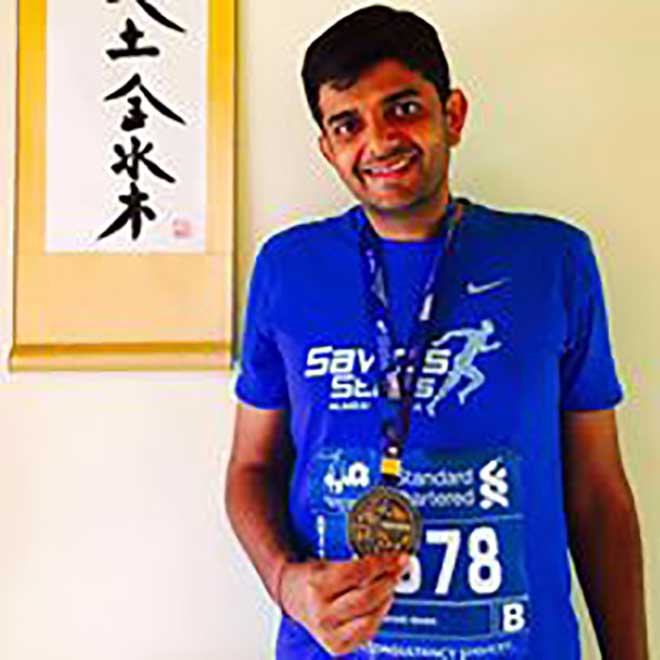
    I would like to introduce myself as a (a) Lawyer; (b)Runner; and (c) Soka Gakkai Buddhist member.

    I have been a practicing lawyer for over ten years now. Earlier, I used to style myself as a corporate lawyer. However, over the last five years, i.e. after joining Mansukhlal Hiralal & Co. (Mansukhlal), besides practicing corporate law, I have also been engaging in substantial litigation and real estate transactions. I am enjoying my diverse practice of corporate law, dispute resolution and real estate law.

    As a runner, I have participated in more than ten half marathons and two full marathons. I started running as a stress-buster from the hectic work schedule of a lawyer and it has now become a passion for me.

    Besides running and practicing law, I also follow SGI Buddhism. It is a philosophy which believes that one’s happiness lies in their own hands. As a lawyer, it is common to blame your boss, colleagues, clients etc for one’s hectic work schedule. In this chaos, practicing SGI Buddhism, gives me a sense of calmness and gives me the strength to step up and take responsibility of my work and to keep going.


    Tell us a little about your days in law school. 

    I am a Bombay boy. I did my basic schooling and college from Mumbai. I graduated as a Bachelor of Commerce in 2002 from Jai Hind College, Mumbai University. Thereafter, I enrolled for the three year law degree with Government Law College (GLC) and graduated as a Bachelor of Law in 2005.

    GLC is India’s oldest and prestigious  institute of law. Many of my family members including my father and sister have graduated from GLC. At that time, it was considered as the second best law college after NLS Bangalore. GLC had lectures in the morning and hence my classes used to end by 9:30 AM. In my first year, I participated in several moot courts and was part of the moot court committee for organising moots.  The second year onwards, I signed my articles and started working at JSA.


    What were the activities, academic or otherwise, that you undertook in your law school days which in your opinion have shaped you and your career?

    As mentioned above, I signed my articles at JSA with Mr. Abeezar Faizullabhoy for the Solicitors exam conducted by Bombay Incorporated Law Society (BILS). My dad also being a Solicitor, suggested that I sign articles and take the exam. As known to everyone, the passing percentage of the Solicitor exam is very low and not being an academically brilliant student, I was not very keen. However, my dad believed that the experience of being trained under one firm for three years and preparing for the exam was a challenge I should undergo irrespective of the results. My articleship at JSA was one of the best times of my legal career. Also, I successfully cleared the Bombay Solicitor exams. My articleship really shaped my career and I knew exactly what I liked or disliked about the profession before starting work after receiving my law degree.


    What in your opinion is the level of importance that needs to be attached by a student to the GPA? 

    I believe good grades can aid a student access to Tier I law firms. However, in my view, it is no way to judge anyone’s success in the future. Theoretical and practical knowledge are two very different concepts. Hard work and intelligence with a solution driven approach is a good combination that can lead one to being a successful Lawyer. However, a student who does not have a good GPA can be as successful as the one with an excellent GPA.


    What kind of internships did you engage in during your student years?

    I joined JSA in 2003. It was the same time when Mr Berjis Desai split from UUB and joined JSA’s Mumbai office. At that time, JSA was relatively smaller as compared to its size today. I got an opportunity to work with Mr. Somasekhar Sundaresan (Som).

    Som is an exceptional lawyer to work with and an extraordinary mentor. I got to work with him on SEBI and SAT matters. Later on, I also worked with him on corporate matters. He inculcated my habit of attention to detail, research, and insight in the applicable law. This habit helped me to study for my Solicitors exam and also helped my clients in a cautious manner.


    What are your areas of specialisation and how did you go about choosing these fields?

    I specialise in securities litigation, corporate law and real estate transactions. My passion for securities litigation started from my JSA days when I regularly appeared before SAT, SEBI and CLB. I did my dual degree LLM from NYU and NUS and specialised in corporate law. At JSA, Drew & Napier and Khaitan, I was part of the corporate team. My current workplace, Mansukhlal, is a mid-sized law firm which, before my joining, specialised in real estate law and dispute resolution. With my work experience in  corporate law, I have been able to build a successful corporate law practice at Mansukhlal. However, given that Mansukhlal in itself was known for real estate and litigation, my first assignment at Mansukhlal was a real estate transaction. I have then onwards done a substantial amount of work in real estate sector and assisted developers in real estate transactions.     


    At what stage in one’s law school life must one pick a specialisation?

    Work experience along with the passion for the subject matter is the best way to pick a specialisation. As a student, everyone finds it glamorous to move towards corporate law. However, a junior associate of a Tier 1 or Tier 2 law firm, ends up spending most of his/her time doing due diligence on the transaction. Upon doing due diligence, all the glamour is washed away and interest is lost. Hence, interest in the subject matter along with experience helps one to pick up one’s own specialisation. One should not choose corporate law just for the glamour quotient.

    Also, my advice would be for students to be thorough with their law. As junior lawyers, between finishing all the deliverables and drafting documents, they often ignore the same which at a future stage results in a great loss to the client or his needs.


    Do you believe that L.L.Ms are instrumental to one’s career in law?

    After completing my Indian Solicitors, in the same year, I secured admission into a new program started by New York University called NYU@NUS.

    NYU@NUS was a unique program based in Singapore and New York which was taught by full-time faculty from NYU and NUS. In addition to earning two LL.M. degrees from the two of the world’s leading institutions, this program provides a strong background in U.S. and Asian business laws. I was awarded the Dean’s scholarship for pursuing my LLM program. This scholarship later helped me to procure a job in Singapore which otherwise may not have been possible. My view is that an international LLM is relevant for international opportunities as a lawyer.

    I believe LLM from a recognised university does play an instrumental role in getting a job in an international law firm. I was one of the fortunate ones to get a job at Drew & Napier LLC (one of the leading law firms in Singapore) even in the year when Lehman Brother had filed its bankruptcy and sub-prime crisis arose in USA. My LLM degree did help me get this job at Singapore and also later at Khaitan & Co., upon my return to India.


    Having studied in New York as well as Singapore, which would you recommend to someone who wishes to follow your footsteps?

    Unfortunately, the NYU@NUS course was discontinued by NYU in 2014. Therefore, I cannot recommend anyone to take this course. However, I would recommend students to pursue LLM from NUS as it is the best law university in Asia and falls in the top ten Law Universities worldwide. Further, getting a job in Singapore is relatively easier as compared to the US or the UK.


    What should one expect out of an L.L.M program, if they opt to pursue one?

    LLM from a renowned international university will give a student exposure in international laws, differently styled curriculums and very unique (practical) teaching methodologies. Further, it may assist them in getting jobs abroad, if they are interested.


    What does the CV of a student seeking admission in a premier university offering an L.L.M program have to look like? 

    One’s CV has to have good grades, extracurricular activities during law college and some work experience with recognised law firms. Further, recommendation letters also play an important role for the admission. In extracurricular activities, participating in moots and being part of legal activities are looked upon favourably by premier universities. For American universities, a meaningfully written statement of purpose (SOP) plays an important role. They are looking at the candidates’ real life experiences and learnings from such experiences in the SOPs.  


    Give us some insights on the qualities that Tier-I firms look for in prospective candidates.

    (Bhushan has previously worked with Khaitan & Co. and JSA, two of the most sought after firms for placements by students.)

    I consider myself to be lucky to have worked with JSA and Khaitan & Co. (KCO). Good grades and extracurricular activities help students get an internship in Tier 1 law firms. The new trend of law firms is to offer a PPO during/ after the internship. Hence, I believe that if a student reflects his/ her sincerity at internships, they would be offered a PPO, which would be the easiest way to make ones way into a Tier-1 law firm.


    Give us a brief overview of your current work profile with Mansukhlal Hiralal & Co. What does a regular working day look like for you?

    I joined Mansukhlal in 2012. It is a family firm where my father is the managing partner. Before my joining, Mansukhlal was a team of three partners and five lawyers. In the last five years, we have now grown to five partners and a team of fifteen lawyers.

    I head the corporate law team. Also, from time to time, I look into securities litigation and real estate transactions as certain clients are comfortable working with me on their matters. I spend around ten hours in office for six days a week. Some part of my time is also spent in business development and doing legal updates which are very important for the growth and development of the firm.


    What message or general advice would you like to pass on to our readers?  

    Don’t simply focus on getting a job in Tier-I law firms. While studying law, try to enjoy the subject. This attitude towards studying and enjoying the subject will help students to become successful lawyers.


  • Payal Parikh, Partner, ANB, on Real Estate, Infrastructure, and Banking

    Payal Parikh, Partner, ANB, on Real Estate, Infrastructure, and Banking

    Payal Parikh graduated in law from Mumbai University in 2000. She has held diverse diverse posts in her career including being a Partner at M. Dhruva & Partners, Deputy General Manager of the Welspun Group heading the Infrastructure and Textile arm of the group. She has also been associated with law firms like Dua Associates and Kanga & Co. and Companies like the Lodha Group of Companies and Suzlon Energy Ltd. She currently heads the Real Estate, Infrastructure and Banking practice at ANB Legal.

    In this interview we speak to her about:

    • Her expertise in Infrastructure, Real Estate, and Banking
    • Her role as Partner
    • Her experience thus far

    How would you introduce yourself to our readers?

    As an administrator, I am a disciplinarian, with a human touch. When it comes to handling my assignments, I believe in attention to detail. Having said that, I am careful as to choose what to devote my time to. I am passionate about my work and do it with a great amount of zeal. Despite over seventeen years now in the profession, I have a newcomer’s enthusiasm.


    What motivated you to pursue a career in the legal field?

    I am one of those ‘by chance lawyers’. I had not thought of what I wanted to pursue as a career. All I had envisaged is that I want to be honest to my work, my word and my people. I was in Jaipur when I passed my B.Com and came to Bombay as my dad was transferred. He was then an accountant member of the Tribunal at the ITAT, being duly qualified as a lawyer and chartered accountant. We spoke and decided to go in for Law. Although it was an impulsive decision, I am glad I took it. The fact that each day is a new day of learning and education is a great impetus to come to work.


    Did you pursue activities such as moots, debates and internships in law school? 

    My college was limited to attending class and heading for the traineeship with a firm i.e. Kanga & Co. My real college was the work I did, my professors were the partners/colleagues of the firm. My moot court training was done preparing for actual matters and the debates took place between the finest minds in the profession. The three years till I passed out was worth many years of learning in any university.


    Would you say law school prepared you for the real world practice of law?

    As I said above, I was lucky to be in the real world as soon as I stepped into the legal world. Working along with studying teaches you a lot in terms of not only the law or practicality, but also handling clients, growing with your colleagues, teaching them what the seniors were kind enough to pass on to you. I am not saying by far that college is of no point. However, to answer your question, for me the preparation to the real world was, in one word, an experience.


    What is your opinion on the need for pursuing higher education?

    Education is very necessary in the specialised world of today. Especially if you do it abroad. The reason I feel, more than the academic learning, it is the broadening of your horizon by learning from people from different cultures, knowing their manner of functioning, and having your friends/contacts in different jurisdictions helps in the longer run.  


    What are your areas of interest? 

    Interest is something which evolves, you can’t discover it with intent. What relaxes me is painting, doing a bit of craft work. I guess I did not do it in school that much.


    What was your first job after college? How did you secure it?

    My first job was in Suzlon, the wind energy giant. I worked out of Pune. My father got transferred out of Bombay and I could not afford to stay on my own with the salary which was doing the rounds way back in the year 2000. I may add here that now freshers have the option of taking up jobs which can support them. Back in the day, we had to gather a few years of post graduation experience to be able to survive on our earnings. I applied to many places in Pune as that was the city closest to Bombay and then I was able to fend for myself on what I earned.


    What is your current job profile at AnB Legal? 

    I am the Partner in charge of the NCR office and head the real estate and banking practice in the Firm. I am presently based in Mumbai, but visit the NCR office twice in a month. My responsibilities are more akin to a managing partner here as I have taken up the role to ensure that the accounts, billing, recovery and management is in order.

    Also, we are a relatively small team having sometimes piles of work and urgent deadlines. As a result we all help each other in  assignments. For example, in an urgent research on litigation concerning real estate, I may just be an assistant to our Senior Associate Shreni Shetty. Having a small, but well knit unit, has its advantages.


    As an expert in Real Estate, Infrastructure and Banking, can you tell our readers a little about the subjects and the nature of work they demands?

    In a short space, any mention of the three practices and their nuances is not going to do justice to any writer or reader. Any branch of law or profession is going through changes even as you read this piece. RERA, for instance, has changed the real estate landscape, in a manner that the earlier practitioners would be left with mere memories of how conveyance was practiced. To sum it up, be it any practice, update and innovate.


    What responsibilities does being a Partner entail?

    A partner is responsible just as maybe any head of the family is. We can list out all the duties, obligations and tasks here, but it is a lot to cover.

    In brief, to be able to wade through a bad time a colleague is having, give him/her some time and support; or a colleague is in difficulty and cannot attend a meeting with you (maybe work related or illness or personal difficulty), give them the flexibility. I have seen that people are diligent if you trust them. You give them your best and what you will get back is even better from them.  Client satisfaction is as important as keeping your colleagues’ best interests in mind, a partner has to find the balance and work on that tight rope.

    Also, being at the helm, responsibilities includes roles of revenue generation, being a brand ambassador, getting a better and wider name of the firm, wherever you go and whoever you deal with.


    You have also been a Deputy General Manager at Welspun Group. How did this appointment take place?

    Most of the companies in India are still promoter driven. As an in-house counsel one has to balance professionalism and business minds, which is a challenge. One may refuse a client if it doesn’t fit in your idea of professionalism. To do that when you are in a job, becomes difficult. As a partner, I do what keeps me grounded and yet on my toes. Building a practice in this competitive world is not so easy. Being in-house has a comfort of work (although it is sector specific) and financial security. However, having done both, I would not trade the adventure of being in the practice with any amount of job security.


    What qualities would you look for while hiring law students and young lawyers?

    For any colleague, be it for law or as a typist or as a peon, the most important is attitude. If one has that in correct measures, he/she is welcome with us. When I say attitude, it is  the mixture of competence, diligence, respect in the eye for the other, and the humility  to deal with success.


    What are the hurdles you have faced in building your career as it stands today?

    Hurdles are those things which you see when you take your mind off the goal. I have had a few, but I have absorbed them as education. On other occasions, I have taken decisions based not on instinct but on the need of the hour. All this is a part and parcel of growing up and being a part of the profession you have begun to be fond of.  The lesson learnt is, give it all you have got and deal with the task at hand. If that done, any issue will be taken care.  


    How do you maintain a work- life balance?

    Simple; give it all during the week, and if correctly followed, no working on the weekends, and at least one vacation a year with complete switch off.


    What advice do you have for our readers who are primarily college students?

    All very well to have aspirations, however, keep your feet on the ground when you dream of flights. We have picked up papers, proof read volumes, paginated, compiled lists, done meager odd jobs and still do. Even now, if it calls for it, I assist junior colleagues without a thought of seniority. There is no small work nor substitute to hard work, and won’t be.

  • Pritha Jha, Associate Partner, DSK Legal, on her internships, M&A, and her diverse experience

    Pritha Jha, Associate Partner, DSK Legal, on her internships, M&A, and her diverse experience

    Pritha Jha graduated in law from ILS Law College, in 2007. After a successful stint with Desai & Diwanji, she is currently Associate Partner at DSK Legal, where her role entails managing private equity and M&A transactions.

    In this interview we speak to her about:

    • Her time in ILS Law College
    • Her experience in M&A
    • Her current role as Associate Partner at DSK

    What motivated you to pursue law?

    For me, pursuing a career in any field other than law was never really an option, simply because my mind never contemplated being anything else. As far back as I can remember, I have always wanted to be a lawyer. I always enjoyed logical arguments. Being argumentative came naturally to me. While making a career choice, if you have the option, always choose to make a career in what you love doing. You will never fail because you will never be bored and you will never treat what you do as “simply a job”. When you love what you do, its personal.

    Could you briefly explain your law school experience at ILS? 

    When I started studying law in 2002, law wasn’t considered a serious career option, it was actually considered a “last resort”. There were not many who chose law as their “first option”. There was no CLAT and there weren’t as many NLUs around. At the time, ILS was one of the top three universities. There was no disadvantage.

    ILS Law made opportunities available to those who wanted it. There were classes, there were moots, there were extracurricular activities, but ILS focuses more on the theory of law rather than on the practical aspect of being “market ready”, especially for a corporate lawyer.  


    What kind of internships did you undertake during your student years?

    I didn’t start interning until my fourth year in law. This is primarily because of the way subjects in law school were spaced out. I didn’t see the point in interning when I hadn’t spent any time studying any law. When I did start interning, it was with various law firms to figure out what interested me most. Some of my internships were with a general corporate team, some with litigation teams and when getting an internship at a law firm was hard, I also interned at an LPO. Securing internships can be difficult, but the focus should really be on practice areas rather than just trying to get a big name on your CV. A lot of students think internships are just about that, getting the name of a firm on your CV without realising that if you make the correct impact as an intern at any firm, you may secure a pre-placement offer. To the contrary, if it appears that you’re just out to have fun, you could also be ensuring you never get picked up, even though your CV looks bright and shiny. Attitude towards work always tells a bigger story than the CV.


    What are your areas of specialisation in law? 

    My specialisation is in mergers, acquisitions and private equity. While I’ve worked in a variety of sectors, of late my focus has been on acquisitions through earn out structures. 

    I decided what I wanted to do through my internships and through the first years of being an associate. Speaking with people who have spent some time in the profession helps in analysing the pros and cons of the various options available, whether it be litigation, general corporate, private equity, mergers and acquisitions, taking a position in house, there are lots of options. Every individual needs to understand that they will never have everything they want. You need to decide before hand what your priorities are and what will fit your working style best. Ultimately, people will stick with what makes them happy. That’s how it worked out for me.


    What level of importance needs to be attached to GPAs, in light of the other academic and non-academic activities that may be undertaken in law school? 

    I will not deny that grades are important in giving an individual their first break. But topping your class is not going to help if you do not possess other attributes. Individuals are judged on various levels, their academics, their ability to speak and write English, the way they present themselves, their interests outside of law, everything counts. Rather than focusing on one aspect, one needs to focus on trying to achieve a balance in all. Everything adds to an individual’s personality.


    Is an L.L.M absolutely necessary for a career in law? 

    In my view, an LLM is a good option if your choice of career in law is teaching. From my perspective, an LLM does not really add to what you know after having obtained an LLB. However, an LLM can teach a great deal of things if you choose to pursue it after having gained a few years of practical experience. You relate to the LLM program more and you pick up a few other skills that law school may not have taught you or may not have prepared you for. For example, writing a research paper teaches the mind to think things through methodically, presentations help individuals develop the confidence to speak before large groups of individuals, some courses will also teach business development skills. It depends on each individual and their needs. Lots of LLM programs are offered around the world. If you must, choose from one that helps you achieve your goal. A lot of people join the LLM program for the wrong reasons, sometimes not knowing what they expect to achieve from it. If you don’t know why you’re doing it, don’t do it. Having said all this, is an LLM necessary? Absolutely not.


    When and why did you decide to make the transition from Desai & Diwanji to DSK Legal?

    I made my move to DSK Legal after having spent about two and a half years at Desai & Diwanji. Having spent that time there, I felt like I needed a change because my abilities were not being exploited to their full potential. Being an ambitious individual, I needed to do more and needed to do it more quickly. Added to that, the immediate partner that I worked with back then moved to the United States, and at the time, I was quite emotional about his departure.


    Tell us about your current work profile with DSK Legal. What does a regular work day look like, for you?

    I am an Associate Partner and I specialise in mergers and acquisitions and private equity. Over the last few years I have specialised particularly in mergers and acquisitions in earn out deals in the advertising space. Having recently been appointed associate partner, it’s a shift in focus from delivering work to focusing on delivering and getting new work. It’s a challenging job profile for me.

    I really wish there was something like a regular work day at DSK Legal. There simply isn’t one. Some days are astoundingly fast, some days are excruciatingly slow and then there are days that are just never ending. However, I assure you, it’s never boring.


    What is your message to our readers?

    My message to any young individual aiming to be good lawyers is that their first priority should be on picking up the skills that are required to be a good lawyer. The first few years of being a professional lawyer is all about making sacrifices and learning how to be a great lawyer. It takes a great deal of commitment, and although sacrificing at every turn may not feel the best at the time, it reaps huge rewards in the long run. Work very hard and nothing will stand in your way. Money never comes before hard work, money is a consequence of it. You have to earn it. If you’re good at what you do, you will never need to chase money.


  • Gaurav Wahie, Associate Partner, Clasis Law, on being Partner, and Corporate Law

    Gaurav Wahie, Associate Partner, Clasis Law, on being Partner, and Corporate Law

    Gaurav Wahie graduated from National Law Institute University, Bhopal, in 2005. He then went on to pursue his Masters from University College London, specialising in International Finance. After successful stints with Fox & Mandal, Linklaters, Talwar Thakore & Associates, DSK Legal, Ashurst, and Indian Law Partners, he is currently Associate Partner at Clasis Law, India. Gaurav is also a dual qualified lawyer, enrolled as an advocate in India and registered as a non-practicing solicitor in England & Wales.

    In this interview we speak to him about:

    • His time at NLIU
    • Pursuing a Master’s degree in London
    • His experience in Corporate Law

    How would you like to introduce yourself to our readers?

    I am an Associate Partner in the corporate team of Clasis Law, Delhi office. My primary area of focus is acquisitions and joint ventures (domestic and cross border).


    Can you briefly describe your experience as a law student at a prestigious institution like NLIU, Bhopal?

    I would describe my time at NLIU as exciting. However, given that I was part of the third batch and there was hardly any infrastructure, we did face some challenges.  Also, given that it was also my first time away from home, so that was a bit of a struggle in the initial few months.

    While life as a student was tough with three test weeks (which thankfully changed to one mid-term in the fourth year), project presentation and end term exams, NLIU turned out to be a great learning experience not only as a law student but also on a personal front. It taught me to be independent and I made some of my closest friends in those five years.


    What do you have to say about the difference between here and the University College, London- where you finished your Masters?

    The biggest difference was the faculty. At UCL, a lot of the teachers were current and retired partners of international law firms, which was not the case at NLIU. Another major difference was in the teaching style, which pushed one to be regular in class and up to date with the reading assignments as classes were more of a discussion session rather than a lecture.


    What are your areas of specification? 

    Initially, at Fox Mandal and TTA, my area of focus was capital markets. I developed interest in it during my days at UCL. However, with the 2008 crash and capital market work drying up, I started getting involved in acquisitions and joint ventures and to this day this is my area of focus.


    How significant is a Masters Degree?

    I would say it is a matter of personal preference and goals. A Master’s degree is not a must (particularly for firm or counsel practice), but it helps in several ways. Aside from the focus on academia, it is an opportunity to interact with and get to know people from various countries. I believe that it really broadens one’s outlook. However, for anyone considering LL.M, I would not recommend it immediately after your undergraduate degree. One must work for two to three years and then consider an LL.M. Working first helps in choosing correctly the area of specification and getting the best out of your coursework.


    What were the internships you engaged in during your student years?

    My internships were a mix of firms, corporate houses and chamber practice. Rather than stressing about getting an internship in a law firm, I would recommend that first and second year students should intern with litigators (at District Court and/or High Court). Only from the third year should one look out for internships in the corporate field. Also, it is very important that the last two or three internships are done at firms where one is keen to apply.


    How would you describe your initial experience?

    Baptism by fire. I still remember my first day in a law firm. I had barely settled in when a senior walked up to my desk (for what I assumed would be a courtesy introductory visit) and without saying much left a shareholders agreement on my desk with instructions to proof read the document and give my comments by end of the day. I have been lucky to get opportunities to work with great seniors (be it Fox Mandal, TTA, DSK/ILP) during my initial years who took keen interest in my development and growth as a lawyer.


    Do you have any words of advice for young interns which they may follow to obtain a positive impression in firms?

    Diligence and sincerity, these for me are the two most important aspects not only for interns but for anyone looking at a career in law. You must demonstrate an interest in learning and realise that as an intern it is upon you to make yourself visible to the lawyers.


    As a partner in Classis Law, how does a regular day at the firm go by?

    Absolutely not the way I used to imagine it would be while I was still an associate. It usually starts with taking stock of what needs to be done and then prioritising the deliverables. From there on it’s a mix of attending calls, reviewing documents, discussions with clients and team members and business development pitches.


    Keeping the corporate and law world aside, what are your hobbies?

    Netflix and travelling. I am a firm believer that travelling is a great learning experience – you get to know about different cultures and cuisines, and meet people you would not usually bump into.


    What would be your words of advice for our dear readers?

    Develop a keen interest in reading (absolutely necessary) and keep yourself abreast with the latest developments, not just in your area of practice as a lawyer but generally be aware of what is happening around you.

  • Krishnava Dutt, Managing Partner, Argus Partners, on working at ICICI, AMSS, and his experience

    Krishnava Dutt, Managing Partner, Argus Partners, on working at ICICI, AMSS, and his experience

    Krishnava graduated from Symbiosis International University, batch of 1999, with a degree in BSL LLB. Krishnava started his legal career in the Calcutta High Court where he practiced civil law. After a short stint at the High Court, he joined ICICI Bank in Mumbai where he gained several years of experience in handling transactions in the stressed assets space and international banking sector. He joined Amarchand & Mangaldas & Suresh A. Shroff & Co. in 2005 and became the partner in charge of the eastern operations of the firm in the year 2007. He retired from Amarchand & Mangaldas & Suresh A. Shroff & Co. as a partner in June of 2009. Krishnava is currently the Managing Partner of Argus Partners.

    In this interview we speak to him about:

    • Pursuing a BSL LLB degree
    • His experience spanning time in court, the banking sector, and law firms
    • Being Partner

    How would you like to introduce yourself to our readers?

    I am very fortunate to be a part of this profession and am extremely passionate about the subject of law. I am grateful for having seniors, peers and juniors from whom I have constantly learnt and continue to learn. I feel blessed because even after almost two decades, I absolutely love what I do.


    Do you feel that there is a divide between NLU and Non-NLU students?

    I personally did not find any difference. In my first job at ICICI Limited (as it then was), I had a large number of NLSIU almuni colleagues, some of whom are still my closest friends.

    One’s own career trajectory is based entirely on one’s own capabilities. While law school/college may help you find initial space in the ecosystem, the future and destiny of your career lies entirely in your own hands.


    What is unique about the B.S.L. course that you undertook and how did it contribute to your career in law?

    Law and society are really two sides of the same coin, intertwined and interdependent. One of the subjects I remember fondly is legal history and evolution of law against the backdrop of a dynamic society.


    What, in your opinion, is the level of importance that needs to be attached by a student to GPA? 

    Law school scores are the only objective criterion in a CV. Although a higher CGPA is definitely a significant indicator, co-curricular (publications and articles) or extra-curricular activities also play a significant part in shortlisting candidates.


    What kind of internships did you engage in during your student years?

    In all my years through college, I only interned at a counsel’s chamber – Mr. Abhrajit Mitra in Kolkata. Without a doubt, my learning there has been invaluable, and still holds me in good stead.


    What are your areas of specialisation and how did you go about choosing these fields?

    I straddle largely two practice areas i.e. General Corprate/M&A, as well and Banking & Finance. Having said that, I am also involved with quite a few commercial disputes.


    At what stage in one’s law school life must one pick a specialisation? 

    In law school, one’s career is at a nascent stage. Specialisation at that level is something I don’t really encourage. It’s very important for one to go out and learn and then decide their forte. We must be grateful that our profession offers us a boundless universe of knowledge. The initial years must be spent exploring that universe. Unless one has a very strong reason to choose a specialized area of law, one must navigate this labyrinthine world of law to really and truly appreciate any specialisation.


    What must the CV of one who is aspiring to land an internship/placement with a top notch corporate firm look like?

    Apart from the CGPA, co-curricular engagements such as articles and publications play a vital role while screening the CVs. Another area which is considered, is the extracurricular activities that one is engaged in, to ascertain a well- rounded development.


    Having started off at ICICI Bank, why did you choose to make the transition to a law firm?

    I must mention that the learning I received in ICICI was absolutely unparalleled. However, my transition was purely a personal choice. I wanted to explore areas beyond banking and finance.  Having said that, today, I see extremely bright minds in in-house roles. The last few decades, of course, driven by market dynamics, have created challenging opportunities in the in-house space with an identified trajectory which makes it an attractive career choice.


    Give us some insights on the qualities that Tier-I firms look for in prospective candidates.

    (Krishnava has previously worked at Amarchand & Mangaldas, one of the most sought after firms by law students, as Partner.)

    Broadly, the qualities one should demonstrate in an interview are:

    (a) good technical skills. Remember, it is a technical job which you are applying for after finishing five years of gaining technical knowledge. It takes just a few minutes for the interviewer to assess whether you are speaking from knowledge, or you are merely trying to second guess based on logic;

    (b) an analytical mind with a high level of curiosity on the subject. If you are discussing a paper you have written (or a moot or an internship note you have worked on, do demonstrate the breadth and depth of the research that you have undertaken to write/work on the paper/moot/note.

    (c) an ambitious and confident attitude with  a sense of purpose and meaning in what you want to achieve (while demonstrating this quality one must be careful not to be seen as over confident, brash or disrespectful). A word of caution, while a friendly disposition is always welcome, being overfriendly or casual during the interview may be counterproductive.


    Tell us about your current association with Argus Partners as a Managing Partner. 

    After resigning from Amarchand Mangaldas, I founded Argus Partners in 2009. In the year 2012 we merged with the firm Udwadia & Udeshi, which upon the merger, changed the name to Udwadia Udeshi & Argus Partners. In 2015, the firm Udwadia Udeshi & Argus partners changed its name to Argus Partners.


    Give us a brief capsule of the life of a partner and your average working day experience.

    Because of the young demographic matrix of our country, a partner of a law firm in India also goes through various stages. At a junior partner level, she is the main execution person leading the team and the transaction/matter. The responsibility is not only to the transaction/mater at hand but to also to strengthen the Firm’s relationship with the client. At a senior level the responsibility lies in expansion of the firm’s practice in all areas. This apart, various administrative functions of the firm are also supervised by some partners. At all levels, a partner must be a thought leader with the ability to inspire the next generation. Personally, as a Managing Partner of the firm, my time is divided between client work and various adminstrative matters.


    Is there any other suggestion you would like to give to our budding lawyers?

    In the age of social media where success and happiness of friends and colleagues are proudly displayed on their respective walls and continuously so, I am reminded of an old Chinese proverb which says, “the biggest source of unhappiness is over estimating the happiness of others”.  The future which will befriend artificial intelligence will also pay a hefty premium for cerebral input, for truly an intelligent mind. And the intelligent mind is the one who picks the nuances and expresses her mind from the depths of knowledge. There is no alternative to knowledge.

    Remember, you are the future and nothing can be more powerful than that. Believe in chasing dreams. Remember, winners are not made overnight, and also remember that success is not a destination but the journey, and a beautiful one at that!


  • Krishna Venkat, Partner, KLaw, on working at Crawford Bayley & Co., AZB Partners, and his experience in M&A

    Krishna Venkat, Partner, KLaw, on working at Crawford Bayley & Co., AZB Partners, and his experience in M&A

    Krishna graduated in law from The University of Manchester in 2004. He is a Corporate/M&A lawyer with of experience in handling cross border M&As for Indian and foreign companies. Krishna has also worked closely in structuring foreign direct investments in a variety of sectors, including into highly regulated areas such as tobacco manufacture & sales, and other general corporate laws. In addition, Krishna has worked closely with pharmaceutical & healthcare companies on a range of legal / regulatory issues that affect companies in this industry. This has involved making appearances before various Indian drug regulators from time to time. At KLaw, Krishna heads the FMCG, pharmaceutical & healthcare practice of the firm. Apart from the pharmaceutical industry, Krishna has also worked closely with several internationally reputed licensed payment system providers. Krishna’s experience also includes handling fraud investigations, dealing with investigators and devising strategies for the disclosure and resolution of findings made on conclusion of such investigations, including for listed companies. This experience also involved handling compounding and other remedial actions to be taken before different Indian regulators and guiding Indian and foreign companies on resolution of such matters.

    He has recently been awarded with 40 Under 40 Rising Star Awards by Legal Era Magazine.

    In this interview we speak to him about:

    • Studying in Manchester
    • His experience in the M&A domain
    • His current role as Partner


    Tell us a bit about your time as an undergraduate student at University of Manchester.

    The immediate thoughts that come to mind are entering lecture halls filled with students from across the world, sharing dorms with an equally diverse crowd of people and trying hard to keep up with all the cultural anecdotes and facets that I would encounter daily. The other vivid memory I have of my time there was our lectures in a building called the “Science building”. There was a large wall display in this building that listed many of the twenty-odd Nobel Laureates who have been associated with the University. Even though most of them were scientists, it was always inspiring to spend a few minutes gazing at that plaque and remembering the rich academic tradition that us students were, and still are, a part of.

    Manchester as a city was also a lively place to be in. The biggest draw of the place for me was the independent music scene at Manchester, which was and probably still is the best in the UK. There were several pubs and bars around the University campus where there were live student bands, which I found to be great fun.


    What co-curricular activities and interests took up your time during your legal education?

    I was a co-founder and the General Secretary of the University of Manchester’s Indian Society. Out of all the events we organised, my favourite was singlehandedly organising a cricket tournament with the Pakistan Society at the University to commemorate the test and one day series that both nations played during that time. From selecting the venue, organising the equipment and overseeing the day’s events, it was a feather on my cap that I’m still deeply proud of.

    I was also a part of the International society at the University, which was responsible for welcoming all new international students to the University over a week-long orientation. In the last year, a German friend of mine and I were responsible for leading a team of 30 student volunteers, to show close to a few hundred new students around the university and the city of Manchester. Daunting as it was, the experience was a lot of fun for every single minute of it!

    I was also an avid debater in college. I was a member in the University’s debating Union, having represented the University at a couple of inter-varsity events. It was an interesting time as well in the UK politically, due to the Iraq war, the proposal to increase tuition fees in colleges and the role of the then Labour government. All of this made for very lively debates.  

    Have you always been keen on a career in corporate law and M&A? 

    I chose Corporate M&A as a subject largely because of my experience in my first internship at Crawford Bayley & Co. I worked for two months on a range of corporate matters and found this subject very interesting.


    What advice would you give students in avoiding a decision paralysis? 

    Personally I feel that a basic law degree from a good university is all you need to start a career in a law firm or to practice before the courts. Further studies make a lot of sense if you are looking at an in-house role in a company or getting into academia. The reason I say in-house roles is because a lot of what you learn during a Masters in Law (or during a Doctorate) can be of great value if you are actively involved in dealing with highly regulated industries or industries where the laws are still being evolved.

    Further studies also make sense if you are looking at working abroad and would need credits from the LLM / Masters course to write a local bar exam.

    If you are planning on working in a law firm in India or practising before Indian courts, a basic degree in law is all you need.

    There are, of course, many lawyers who pursue further studies as a means of experiencing life abroad or the academic rigor of a foreign university. This is worthwhile if your time and money permit.

    What influenced your decision to pursue an LPC as opposed to an LLM from Inns of Court School of Law – City University? 

    I am a firm believer in practical experience and in courses that develop your skills as a lawyer. The LPC syllabus teaches skills such as legal research in a law firm, interviewing, and advising techniques, basics of advocacy as well as how to practically apply business, property and dispute resolution laws.

    The emphasis of this course is on teaching the basic skills you need in order to handle life in a law firm. The course also covered stress management in a law firm, interesting sessions such as reading body language, negotiation tactics and, my personal favourite, tips to preserving profitability in a legal practice.  

    Practising law in a law firm in India does not require a battery of degrees. It requires, in this exact order, experience, very specific skill sets, a clear understanding of the basic laws you covered during your LLB and lastly, confidence.


    From a law student to a lawyer, how will you describe the transition?

    I found this transition to be quite easy. The modules on the LPC Course and a very encouraging boss in my first job helped me enormously in making a smooth and quick transition into law firm life. Within two to three months of joining Crawford Bayley & Co., I was staffed on several critical assignments for the firm. I attribute this heavily to some of the soft skill courses that were covered during the LPC, such as interviewing and advising and research & analytical skill.


    Could you please share with us your early professional experiences at Crawford Bayley & Co.?

    It’s quite hard to describe the early professional experiences there, but I’ve realised that there were a couple of things that they emphasised on while working there.

    The first was on being able to handle an outsized challenge. Legal understanding is important, no doubt. But ultimately, in life, there is no rule book that prescribes the magnitude of a challenge that can be dropped on your head. There were more than a couple of times when I was thrown into the deep end of a pool and had to figure my way out.

    The other thing they placed emphasis on was staying calm, even in the middle of a storm. My first boss (whom I still deeply revere) showed extraordinary calm in some very challenging situations. Watching him over the years, and closely paying attention to how he carried himself taught me the importance of, as well as how to stay calm during difficult negotiations.  

    Thirdly, they expected decisiveness, even from a first year associate. If we expressed a legal view to our seniors, right or wrong, it was critical to be decisive no matter what. On-the-fence answers or highly caveated replies were not tolerated unless the circumstances were such.

    Lastly, but most importantly, creativity and out of the box thinking was deeply encouraged. Regard was always given to the more creatively envisioned answers or creatively presented views, as opposed to run-of-the-mill thinking.

    From my early years in the firm, these were the things that were imbibed vigorously into us. These are the lasting memories from my earlier years at the firm.


    How did you come to take up a position with AZB Partners? 

    I was looking for a change, and the opportunity to work in a large firm such as AZB. This move proved to be perfect for that. AZB is also a great place to learn a few advanced soft skills during negotiations and presentation of ideas; it was also a useful place to learn the latest industry trends and seeing how a top law firm handles a range of issues or how “calls” are taken on critical matters. These skills, along with some terrific partners that I reported to, made this a very positive stint.


    What are the key attributes that one must develop in order to excel in the field of M & A? 

    One common feedback that senior lawyers love giving to junior M&A lawyers is “build a commercial awareness”. Commercial awareness is of course critical in being a corporate lawyer and it eventually helps guide your evolution as an M&A lawyer. Unfortunately in my experience, no senior ever gives an intelligent answer on how one goes about doing that, whatever the reasons may be. And frankly, in twelve years of practice, I don’t think any of this so called “advice”, has made me any wiser.

    If you want to build commercial awareness, I would suggest making friends and developing close associations with startup entrepreneurs. Also spend time with them and learn about how their businesses function practically. A few years back, I partnered with a very dear friend of mine to develop a certain IT platform for companies. My role was to only act as a passive partner/investor and offer suggestions and ideas.

    The experience of working with my friend and experiencing practical problems first hand that a business faces in India were far more valuable in building a commercial understanding than in just blindly repeating ideas that originated from someone else. Hands-on experience carries powerful teachings, which can never be supplanted by simple observation and learning or by any number of books you read.

    I have also found that being in constant touch with startup entrepreneurs in a variety of industries teaches you a lot about what makes businesses work (or not), what sells with investors, how to evaluate long term goals and managing relationships.

    A good commercial understanding is the ability to understand a given business and effectively transpose the objectives of all parties with one another. When you are able to do that, evolving a legally sound strategy for your client and for implementing the deal becomes simpler.


    Tell us about your present role as a Partner at K Law.

    At K Law, I spend a lot of time working with FMCG, pharmaceutical and healthcare companies. I deal with regulatory issues that arise under different pharmaceutical and healthcare laws. This often involves presenting thoughts and ideas at a range of industry specific conferences and seminars and reaching out to industry bodies.

    Another subject that I have built a great awareness of is payment systems and RBI regulations on this subject. I also cover M&A assignments in these industries and for other industries such as energy, manufacturing and infrastructure.


    Did you have a mentor or guide during the formative years of your career? 

    Yes. A good mentor helps you define a career trajectory and give you the skills to fulfil it. My mentor and guide is Mr. R. A. Shah, the Senior Partner of Crawford Bayley & Co. Nobody has taught me more about law and legal practice than he has. I have also learnt a great deal from working at AZB with Mrs. Zia Mody and other partners such as Sai, Ashwin and Essaji. I also learnt a lot and owe a great deal to some terrific in house counsel whom I have worked with over the last twelve years and who continue to provide remarkable support to me even now.


    How do you manage to maintain a work-life balance as a busy legal professional?

    Well, the secret is there is no way of maintaining a work life balance. The best way to come to terms with this revelation is to keep a big jar of Nutella hidden in your work area and liberally dip into it whenever required.

    But what I do try and do when I am not working or spending time with family, is photography, trekking, running (the Mahalaxmi Race course is my favourite), reading fiction, and playing the guitar.

  • Karthik Somasundram, Partner, KLaw, on his time at NALSAR, and his diverse experience

    Karthik Somasundram, Partner, KLaw, on his time at NALSAR, and his diverse experience

    Karthik Somasundram graduated in law from NALSAR, Hyderabad, batch of 2004. He currently heads Disputes practice at KLaw’s Mumbai office. Prior to joining K Law, Karthik was a Senior Associate with DSK Legal and prior to that with Paras Kuhad & Associates. Karthik specialises in dispute resolution in corporate, commercial, securities and investment matters.

    In this interview we speak to him about:

    • His time at NALSAR
    • His internship experience
    • His role as Partner at KLaw

    How would you like to introduce yourself to our readers?

    I am litigator by choice. However, I am trained as a disputes and a transactions lawyer. I am a wildlife and photography enthusiast and recently qualified as a deep sea diver. Presently, I head the disputes practice at KLaw’s Mumbai office.


    What motivated you to pursue law?

    I am a first generation lawyer. I did not aspire to be a lawyer. I wanted to join the Air Force but I didn’t get around to that. We were in Bangalore when NLSIU was founded. Since then it was my Dad’s desire that my sister and I become lawyers. After my 12th grade I chanced upon a few application forms and a few entrance tests later, it started.


    Give us a brief overview of your NALSAR experience for our readers. What is it about NLUs that makes them stand out, as compared to non-NLUs?

    We were the second batch of NALSAR and I only have fantastic memories from our time there. Three of my closest friends are from my time at NALSAR and I have known them for over seventeen years now! Our time at NALSAR was not what it must be like today, I imagine. We stayed in make shift hostels for a year before we moved to the beautiful campus that you can visit today. From the second year we lived on the present campus and for about two to three years there was construction activity all around us. Few of the structures today were not there even when we graduated. However, the best that NALSAR offered was in the form of few of the professors! I think we studied Constitution and Administrative Law from the finest professors at the time. We also interacted with the sitting Judges of the Supreme Court and the Andhra Pradesh High Court at that time. NALSAR opened doors and gave us experiences that (probably) only NLSIU was giving its students, back then. We had access to libraries and resources that few practising lawyers had at that time. Today, everyone has access to these resources and the internet has made everything accessible. When we started, the full potential of the internet was not known, let alone the ability to exploit it. NALSAR gave us an understanding of that potential early on. We participated in international and national moots and the university had the resources to support the students in those endeavours. I think we were the first amongst the law schools to organise a fest (‘Summons’) and students from most of the law universities and colleges participated. It was lot of fun. Lot of impromptu discussions and arguments on different aspects in classrooms— as also during power outages in the evenings during the monsoons. A discussion that has stayed with me was when a junior (practising in the UK now) wondered if he could be ‘stateless by choice’! The world had started to change by 9/11 and we lived the exiting times.

    There are only two things that make the NLUs stand apart from other institutions. The first is the resources to provide opportunities to students and the other is infrastructure. NLUs also benefit largely on account of the human element – professors and lecturers. That is not to suggest that there are no good professors and lecturers in the non-NLUs. A no-brainer analysis will show that most commentaries and authorities are by non-NLU professors and most of the professors and lecturers from the NLUs are students of non-NLU professors. I still remember the week that Late Professor Sathe spent at NALSAR about ten or twelve years ago. I can’t recollect the lectures from back then, but the faculty at NALSAR hung by every word he said and they followed him around everywhere. However, if the non-NLU professors and lecturers are not compensated at industry standards, this too will become another differentiating factor.


    What kind of internships did you undertake during your student years? Any memorable ones?

    In my zeal to figure my area of interest, my internships targeted most areas of practise. I have interned with firms and lawyers on the transaction side, litigation, intellectual property and even maritime practice. The time when I interned in the chambers of the then Solicitor General in the Supreme Court, Late Mr. Kirit Raval, is the most memorable one. I was wide-eyed during my entire stint there and therefore contributed little or nothing, I am sure. I was heading into the fifth year I think and I had not yet made up my mind and I remember sitting through all his briefings/conferences in his office in the Supreme Court and I followed him and his chamber juniors everywhere!


    In your opinion, what are the law school centric activities that you would recommend as necessary experiences for every law student? 

    From a résumé perspective, I think one needs to experience all the activities on offer to gain experience(s) first hand. Also, if you do not try all the activities or even a few of them, how will you know what interests you? College activities can also help open up many avenues and therefore determining interests, I think, should be the endeavour.

    Having said that, since the entirety of our professional life is spent ‘communicating to convince’ – a client, counter contracting party and their attorneys, judges or even a point of view, I suppose activities that help in enhancing communication skills should be explored. It can be in the form of debates, moot courts, publishing, undertaking field work and research, etc. I started mooting in my third year at NALSAR. It was quite late to start but we did fairly well, I think. It was fun. We won a few and lost many more! Looking back now, those experiences feel like the trailer to the movie that we are experiencing now!


    What are your areas of specialisation and how did you go about choosing these field?

    I am a disputes lawyer on the corporate-commercial side. I advise and represent on disputes arising from contractual arrangements, equity investments, lending and borrowing arrangements and securities transactions. I did not plan for this area of practice. I experienced this kind of work along with transactions work and other kinds of litigations and I enjoy this kind of work the most. Hence.


    What are the challenges that one needs to prepare himself/herself for when they step out of the comfort of a law school and into the real working world?

    Be prepared to work hard. There is really no shortcut there and no magic potion to make it work otherwise. Experience is the only teacher. Nothing in law school will prepare you for when you become a service provider. So it is only when you start working that you start learning bits that actually matter. Don’t stop because of setbacks and tough bosses. ‘Mistakes’ and ‘learning’ run parallel. If you don’t work, you won’t make mistakes and if you don’t make mistakes, you won’t learn. So don’t stop working or trying because of a mistake or because you are afraid of making other mistakes.  


    Give us a brief capsule of the life of a partner and your average working day experience.

    A day usually starts and ends in a similar fashion—planning. The hours in between are when we execute the work/ assignment. As for the ‘brief capsule of the life of a partner’, it is similar to managers in other professions. It involves identifying and meeting client expectation and requirements, identifying the quickest and surest way of achieving it by deploying the right Associate/Senior Associate, etc., taking stock of progress and ensuring delivery. Therefore, it’s a result oriented approach that constantly needs fine-tuning or modification. To stay competitive, enhancement of knowledge is imperative and that is the other area that takes up significant portion of a week, even if not every day.


    How are the young partners today different from the ones before them?

    Each year there are thousands of young lawyers entering the profession and that directly results in increase in competition. There are hordes of lawyers catering to different segments and that constitutes the relevant client base. So apart from executing work, we are constantly trying to innovate and develop an edge over the others. The young partners of today specialise in their chosen area of practice and are not multi-disciplinarians like the stalwarts before them. Anand Desai of DSK Legal, Zia of AZB, Berjis Desai of JSA, M. L. Bhakta of Kanga & Co., and M P Barucha of Barucha & Partners, to name a few, are the last of the multi-disciplinarian practitioners. On account of the competition and shorter turnaround timelines, the partners of today are focused on excelling in their chosen area of practice and therefore there is a lot of specialisation.

    Partners today also have ‘financial’ and ‘client acquisition’ targets that they need to meet in addition to servicing the client in the best possible manner. So the young Partners of today are facing more challenges than the ones before them and one needs to be prepared for that. A lot of movement in the legal market at the partner level is on account of these targets and these parameters are here to stay. So it is no longer adequate to be a good lawyer, one also needs to understand the business of operating a law firm as well.

    Karthik with best friends from NALSAR days, Vishnu Dutt, Partner – Bharucha & Partners, Veena Shivaramakrishnan, Partner – Juris Corp, Priyanka Jain Atal, Senior Manager – Firstsource Solutions Limited.


    How important are grades, in your opinion? 

    Grades are important. However, not in the manner of predicting if one is an exceptional lawyer. One may be fantastic in academics but may not be able to master the practical aspect of it and the other way around as well. However, grades are important in the sense of inculcating work ethics and valuing hard work which really is the only way up from being an Associate to a Senior Associate and further up.

    I am not an expert and neither have I studied the workings of the Indian legal education system and therefore, not qualified to comment on it. However, as with any stream of study, an emphasis on understanding and analysis of the subject matter as opposed to knowing it verbatim, can only be positive.  


    Is there any other suggestion you would like to give to our budding lawyers?

    If someone tells you that money is not important, please run very far away from that person. However, if you had to pick between money and experience, pick the latter always.

  • Savitha Jagadeesan, Partner, Kochhar & Co., on Intellectual Property Law, and being a Corporate Lawyer

    Savitha Jagadeesan, Partner, Kochhar & Co., on Intellectual Property Law, and being a Corporate Lawyer

    Savitha Jagadeesan graduated from NLSIU, Bangalore, in 1997. Previously she’s held position of Partner at K. R. Chawla & Co., and Khaitan & Partners. She is currently Partner-Intellectual Property Chair at Kochhar & Co. Her expertise includes Transaction and Negotiation, Corporate advisory services. She is passionate about cyber crime and security issues. Further areas of expertise are in corporate law, commercial law, India Investment Strategies, which include providing legal advice on investments abroad by Indian companies, and companies seeking to invest in India, cyber laws and intellectual property law.

    In this interview we speak to her about:

    • Her time at NLSIU
    • Her internship experience
    • Her role at Kochhar & Co.

    How would you like to introduce yourself to our readers?

    The legal profession is a particularly demanding profession on the time front as well as work front. This was fine for me as long as I was single. However, post marriage and especially after having my boys, I have tried to work as well as do justice on the personal front, something a lot of us grapple with, especially women. I like to look back and reflect that am glad I took on a full family life, yet refused to give up my profession and have been successful in both. I would encourage young lawyers, especially women, that despite the demands of our profession, there are choices we can make that enable us to have a full career as well as family.


    What are your areas of specialization?

    I am a general corporate lawyer and have worked on diverse matters, from labour law to infrastructure matters. However, Intellectual Property law and cyber laws are my specialised areas.


    How would you describe your time as an undergraduate at NLSIU,Bangalore?

    The five years at NLSIU were personally very enriching. Coming from a conservative background, the diversity on the NLSIU campus truly exposed me to an experience that enabled me to interact with people across the board. Another very crucial experience one gets at NLSIU is the immense confidence you derive through the years, that holds you in good stead across the board. The NLS experience enables you to study various streams of law, exposes you to legal studies, that I feel might not be possible in a routine college. Moreover, the curriculum as well as co-curricular activities create greater avenues for us to explore.


    Did you participate in co-curricular activities?

    Yes, I did. Cultural activities and the inter college fests were definitely fun times, especially the NLS had a cultural week which also was great fun and a wonderful experience. I would encourage all to step up and be part of these activities as much as the moot court experience.


    How did you select the internships you got yourself engaged with in your student years?

    One of the foremost thoughts I had in mind  was that I wanted a well rounded experience to decide which path I would take upon graduation. Therefore, I chose litigation firms, corporate houses, independent counsel and corporate firms as my learning ladder. I picked big firms and companies as well as small lawyers. The former enabled me to see how the big firm/big company culture worked, and the latter meant I had direct experience on the work I would be required to handle. I would encourage young lawyers to give some thought to  their internships. Especially because they have a lot more opportunities we did.


    Could you please give our readers some advice regarding internships?

    I think it’s important to choose diverse paths to understand what we would like to do; the same is in case of internships. I do recommend varied internships for those who are confused. However, if you have decided the city you want to work with and it is a firm/corporate house/NGO, choose those only throughout the years of internship. However I would encourage many to definitely do internships with lawyers and litigation firms, because one of the cornerstones of being a good lawyer is that you should know the procedural aspects of law. In fact, I feel that lawyers should get some litigation experience in their career as it’s a lot easier to identify issues with their corporate work before hand. Now many firms have internships programs, therefore apply early. Choose firms, according to your growth trajectory, speak to your peers, do research on the firms that do provide good, well rounded internships, and of course, as already said, apply early.


    What would you like to say about the initial years as a corporate lawyer?

    Loved it. My first experience was with Mulla and Mulla, Craigie Blunt and Caroe and we had to do both litigation and corporate. It was not some air conditioned office, but we all sat in a room, but we had plenty of work, so plenty to do. It was intense, and there was no excuse of how many hours were spent in court, we still had to complete our corporate work and send out reporting letters the same day of the matter.


    Would you please enlighten the readers about how you came to choose your fields of specialization and suggest them the proper time to do so?

    This is an era of specialisation and is crucial to one’s growth path. I think it is imperative that through the years as you are dabbling in varied aspects of law, you also look into reading into various specialisations. Depending upon the curriculum if you are exposed to specialisation in courses in the fourth and fifth year, you choose the electives not purely based on interest, but its applicability in the outside world. I would also recommend choosing specialised firms, if you are looking at being specialised. Even though many of us might know what we want, I would recommend experimenting with these courses before you earmark a singular one, so  you do not regret the decisions later on. I would also speak to specialised lawyers to get an insight into the area, choose internships and write articles, this enables and exposes us to the idea, if our interest in these specialised areas is retained. For those unsure, read, research, speak to others. This will enable to get the dialogue going with us on what we would like to do.


    Did you have any mentor or inspirational figures along your eventful journey?

    Not really, although, I had excellent bosses who have played crucial roles in moulding me as a lawyer. From my first boss I learnt meticulousness and listening to detail. From my second boss I learnt the importance of working hard and reaching deadlines at all cost and identifying what sets you apart from others. My present stint brought out the business person in me and I realised presentation and branding is equally important, and most importantly your clientele is worked on your work skills and people skills.


    When was the time you decided to pursue an LLM?

    This was many years into my profession and the need to pursue the LLM was mainly because I wanted to pursue my Ph.d in India, where the LLM is a  requirement. However, I think there are two crucial junctures you can pursue your LLM; straight from law school (I would recommend doing it in UK and USA) or few years down the line, but only if it adds value to your specialisation.


    How would you describe your experience as a partner in a Tier-I company like K.R. Chawla and Co.?

    It was truly a learning experience for me. I was exposed to varied matters especially regulatory matters. Mr. Harvansh Chawla was a wonderful person to work for, as he exposed me to all kinds of work, gave me a free hand on how I executed the work and also encouraged me from all fronts. I think the work that I did here was some of the best in my career and it was here that I also learnt to interact with clients first hand. It was also this experience that enabled me to be an open colleague. By that I mean, for all my colleagues I work with, I give them a free hand on how they want to execute the work, including client interactions. I am but a stickler for timelines and feel that all work should be turned around fast irrespective of client deadlines.


    What is your advice to young aspiring interns about the Tier-1 firms?

    Learn, learn, learn. Some internships might be boring. However, if you take an initiative, you will find that many a firm will be willing to be expose you to their daily work and will use you. Don’t take your internships for granted. Work hard at the work you are given, even if research, because there is a chance you will be offered a position there and you might get noticed. Being a lawyer is not just about knowing the law, but also bringing out the confidence in your client. Never fib, if you do not know something check it up and then advice. Research is an imperative part of your learning curve. Write articles and be exposed to changes in the areas of law. And last but not the least, it is imperative that through the years you study the trends in the profession, and your choices are marked by this as your future will be shaped out to be due to these choices.


    Did you ever imagine that you would become Partner some day?

    Yes, I knew from the very beginning that I would be part of the law firm culture and I had already envisaged that being a partner was definitely going to be on my bucket list. I think its an aspiration we should all keep, to reach the top, that keeps the adrenaline rushing, and we do not get bored of our profession. Pick challenges in whatever you do, and do not rest with one.


    Could you tell us what a typical work day entails for you?

    Well, I do a lot of my business meetings in the first half of the day. We have administrative decisions to be taken which we do through the day.  Most of my day goes in conference calls, meetings and tackling work. My time is divided between intellectual property and corporate queries. I also do a fair bit of business development for the firm and hence, meeting and sitting on committees also takes some time.


    How do you stay updated on the latest legal developments?

    I read a lot of judgments and articles. Reading legal books are more when doing opinions. However, I do make it a policy to subscribe to various legal updates that come to me. Recently, with technology, legal Whatsapp groups are in, and this exposes are fairly quickly to the latest law developments.


    Lastly, what would be your tips to aspiring lawyers?

    1. Work hard.
    2. Take initiative.
    3. Do court work, you will see a definite difference in your attitude as a lawyer.
    4. Read.
    5. Never say no to any kind of work, more the experience the better the lawyer you will be.
    6. Never say no to a client, even if it is a small matter, take it up and execute it with equal gusto as a big matter, you are in the business of building relationships so every bit counts.
    7. If you are thinking of a company job/NGOs your organisation comes first, never substitute the hard work for the company for anything else. Integrity will always see you a long way.