Category: Interviews

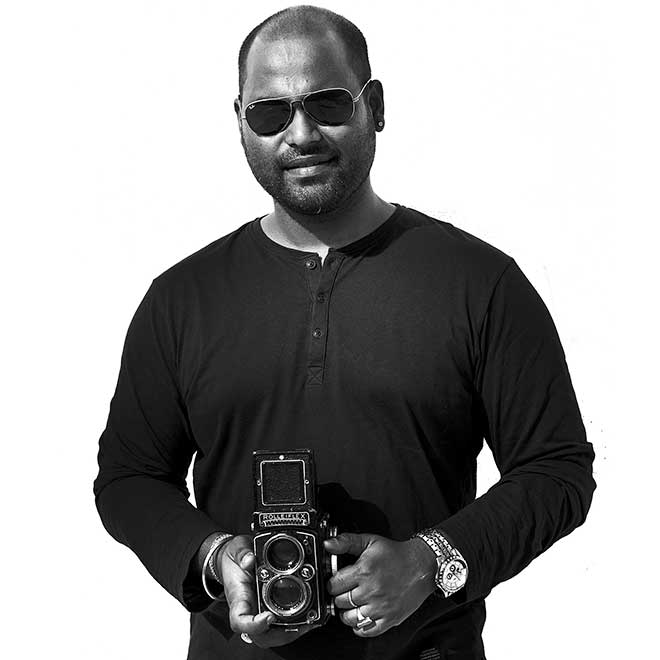
  • Rupesh Mishra, Assistant VP-Legal, Everstone Capital, on being In-House Counsel, working at Khaitan & Co., and his experience

    Rupesh Mishra, Assistant VP-Legal, Everstone Capital, on being In-House Counsel, working at Khaitan & Co., and his experience

    Rupesh Mishra graduated in law from National Law Institute University, Bhopal, in 2007. After a successful stint of approximately seven years at Khaitan & Co., he joined Everstone Capital, a South East Asia focused private equity fund and presently works as Asst. Vice President – Legal (Private Equity) at their Bangalore offices. He focuses his expertise on private equity and venture capital investment, joint ventures, mergers and acquisitions, strategic alliances, foreign investment laws, and general corporate law advisory work.

    In this interview we speak to him about:

    • His time at NLIU
    • Working at Khaitan & Co.
    • His experience thus far

    How would you like to introduce yourself to our readers?

    First and foremost, I would like to thank SuperLawyer for this interview. By way of introduction, I was born and raised in Rewa, Madhya Pradesh, a district town better known for white tigers. In my free time, I like to spend most of it playing with my one-year-old daughter, Miraya, helping my wife with her ventures, and reading fiction.


    Tell us a bit about your time as an undergraduate at National Law Institute University, Bhopal.

    It is indeed a great privilege to attend an NLU. Law school was a massive platform for me both in terms of personality development as well as career opportunities. During the five years, I had the good fortune of reading and understanding law and literature, I met some brilliant minds and inspiring characters, and made some friends for life. Overall, law school was full of fun, friends, aspirations, hard work and, of course, a race to score grades.

    Did you take part in co-curricular activities while in college?

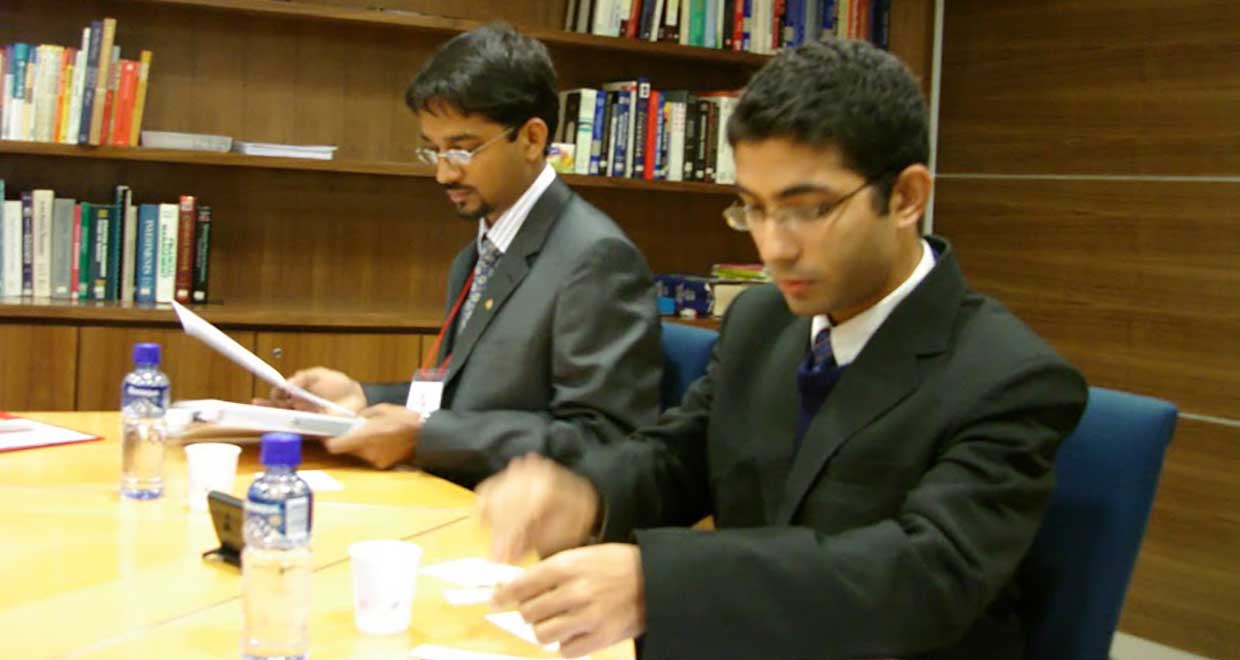
    (Rupesh has represented his law school at the Philip C. Jessup International Law Moot Court Competition.)

    I used to play volleyball, did a few plays, participated in moot courts and essay competitions and wrote a few articles. However, I feel that I could have done much more than this. Co-curricular activities are a medium to express various traits of your personality. It also helps in learning team work, coordination, management, organising skills, etc.

    The Philip C. Jessup International Law Moot Court Competition was probably the biggest event of my law school life. It was the first and only time I participated in a moot court competition. I would like to offer my sincere gratitude to the two speakers of my team who preferred me as their researcher. I think we were a remarkable team. We were really thrilled after qualifying for the international round particularly because it was the first time our university qualified for the international round of Philip C. Jessup International Law Moot Court Competition. The feeling of representing our nation and university on an international platform was incredible.

    The entire process was enriching. It was amazing to witness law students from around the world approaching the same problem in various different ways with their unique style of arguing. It was a great confidence booster for me. It also helped in refining my research and analytical skills which have always been noticed and appreciated throughout my professional career.

    What were your areas of interest during your legal education?

    During the law graduation course, I was more inclined to substantive laws than procedural laws. Contract law, constitutional law, corporate laws, public international law, IPC were my favourites. I developed an inclination for corporate laws in the last two years of the course when I was sure that I will pursue a career in corporate laws.

    What are the causes you feel strongly about?

    I feel strongly about wildlife and nature. I believe that it is our duty to preserve them for the future generations. I am associated with a few NGOs which support these causes.


    What advice would you give students in avoiding a decision paralysis?

    I am always in favour of more education. It is always a plus to your personality and legal acumen. If one has the time and resources, he/she should definitely pursue higher studies without comparing its utility and returns in monetary terms. In my view, going for further education after four to five years of work experience is a better choice.


    From a law student to a lawyer, how will you describe the transition?

    Transition from a law student to a lawyer is a gradual process, not an event. It is about responsibility, accountability, coordination, professional conduct, discipline, etc., which you learn over a period of time. Due to the guidance and support of people with whom I worked during my initial professional life, it was quite a smooth transition for me. According to me, perseverance, hard work and discipline are the keys to success.

    Could you please share with us your early professional experiences at Khaitan & Co?

    At Khaitan & Co. my core area of practice was M&A and general corporate advisory. I also worked extensively in the areas of education law, NBFCs and real estate laws. I feel fortunate to be picked up by Khaitan & Co. on day zero of campus placement. In 2007 when I joined Khaitan & Co., it was not as big as it is today. There were a handful of lawyers in M&A and the general corporate team. I had the great privilege of directly working with the managing partner as well as other senior partners of the firm. This helped me immensely in terms of exposure, client management, time management, quality of deliverables, etc. The overall experience with Khaitan & Co was enriching. It laid a strong foundation for my professional career going forward.

    After seven years at the firm, what I can say for sure is that there is no short cut for success; you should keep working towards your goals every day, and over a period of time you will definitely see favourable results.


    What prompted you to take up a position at the Everstone Capital?

    I was always fascinated by the position of a General Counsel, the kind of respect they command inside and outside the organization, their business acumen, their practical and holistic approach towards any legal issue and tremendous risk assessment ability.

    After leaving Khaitan & Co. in April 2014 and shifting base to Bangalore due to personal reasons, I came across this opening at Everstone and decided to go for it. I was particularly impressed with the job profile (mainly the private equity related work, which I enjoyed doing in the law firm as well) and the unique opportunity to get a first-hand experience of private equity business. Today, after working at Everstone for more than two and half fruitful and successful years, I can say that I am a better ‘business’ lawyer. I am glad I took the right decision at the right time! Everstone has a very strong in-house legal and secretarial team. My role as an in-house lawyer is professionally very different than an associate’s role in a law firm. My role is more about risk management and enabling the business to maximize opportunities within its risk appetite. As in-house counsel, I have to move beyond the narrow technician tag and be a proactive and trustworthy partner rather than someone who is reactive and deals with a problem when they arise. Also, there is a great sense of partnership at Everstone—where all functions support each other extensively—as well as support Everstone’s partners such as its portfolio firms and its advisers.

    Right from the non-disclosure agreement and term sheet stage, I am actively involved in drafting and negotiation of definitive documents, monitoring the transaction and implementing the process and systems to achieve the desired outcome in light of my knowledge and understanding of the “bigger picture” of the company’s operations, in coordination with my very smart colleagues and inspirational seniors. Further, I am also responsible for coordinating with and managing multiple work streams such as bankers, legal counsels, tax advisors, internal investment team, finance team, secretarial compliance, etc. This is an exciting experience and allows for great learning. I also help the portfolio companies with legal advice or documentation from time to time as and when required.


    Could you share with us the process you adopt from choosing a research question to writing the article?

    I prefer to write about contemporary issues. There are a couple of processes through which I choose a topic. Firstly, if I have to deal with any peculiar issue as part of any transaction or otherwise, I like to share my research and learning about that issue in the form of an article. Secondly, if there is a new legal development which may have a significant impact on my practice area, I like to share my thoughts about that as well. After selection of the topic, I think about the readers who will be interested in that subject matter. Depending upon the category of readers, I decide the scope, content, and language of the article. Once these things are sorted out and I have a synopsis ready, I start working on the content of the article. For that, I do extensive research and speak to experts to get their practical inputs. Once the first draft of the article is ready, I share it with at least one subject matter expert and someone from the target readers’ community for proof reading and inputs.


    What does a typical working day look like for you?

    There is nothing like a typical working day, every day in office is different. The beauty of private equity is that no shortage of action, especially at an active and highly professional firm like Everstone. There will always be something exciting happening either in the form of potential investments, live deals, exits or portfolio management. A regular working day will involve discussion with business folks on new investments, live deals and exits opportunities, working on NDAs, LOIs, terms sheets, transaction documents and some advisory work for portfolio companies. Further, given that in a private equity firm you are surrounded by many investment professionals, I spend a lot of time discussing and understanding business and market related matters on a daily basis. This helps in honing my commercial and business acumen and the investing professionals at Everstone have a great depth of experience and are very supportive.


    Did you have a mentor or guide during the formative years of your career?

    Yes, I had a few mentors during the different phases of my career. It was a mix of senior folks in the law firm, friends from law school and close family members. In my view, it is vital to have someone around with whom you can share your doubts or problems and who can guide you towards the right path. Having said that, one should not expect that someone else will steer your boat away from troubled waters. That is something you yourself have to do. A mentor or guide can help you with developing the right perspective and a balanced approach to various things but at the end of the day, you have to execute and implement those learnings.


    Where would you like your career to take you five years down the line?

    Five years is a long time and it is difficult to predict anything right now. I am extremely satisfied with wherever I am and what I am doing presently. I wish to continue this momentum and keep discharging my responsibilities with utmost enthusiasm and excellence. In terms of career goals, as an in-house counsel, I am particularly looking forward to enhancing my domain knowledge and acquiring the right skill set to manage and resolve disputes. Further, I look forward to developing expertise in the domain of new laws relating to food products, pharmaceuticals, e-commerce, payment systems and taxation.


    Given the dynamic nature of the field you practice in, how do you keep yourself updated about the latest developments in the law?

    I religiously read at least one business newspaper every day to keep myself updated with current affairs. Apart from that, I read newsletters circulated by the Big Four firms and certain law firms on important legal developments. I also visit websites of key regulatory bodies such as SEBI, RBI, DIPP, FSSAI on a weekly basis to track any new circulars/notifications. Further, I read the IPO prospectus filed by the companies with SEBI in detail to understand different sectors and regulatory environments relevant to that sector.


    Do you observe a paradigm shift in the demand for In-house counsels with large companies beefing their in-house legal teams?

    Over the last ten to fifteen years most corporates and financial institutions have come to realize the benefits of having a dedicated legal team and now we see teams of more than just a General Counsel, with many hiring specialist lawyers with niche skills. Today, there is a trend to do more internally than externally. This trend is underpinned by proven cost savings and growth in complexity and risk in modern business models and industry-specific regulations which often need a lot of practical experience to deal with. Often the best response is to have expert lawyers in-house.

    Although the internal legal teams continue to expand due to solid demand for in-house counsels with five to eight years’ post-qualification experience, I believe that there is still room for growth. A lot of large companies still have just one or two lawyers and people still do not know the value that a good in-house legal department can bring because they just go to lawyers when they have a problem and do not have coherent internal processes and procedures to stop them getting into problems. I do hope that there will be an improvement in demand and supply of in-house lawyers. Everstone is one company that really understands the importance of in-house counsels and put them to very good use.


    What would be your advice to current students aspiring to be an in-house counsel and why?

    Contrary to the general perception, being an in-house counsel is no less challenging than being a lawyer in a law firm. Start with being a great lawyer, and then develop the other skills that may prove essential to your career choice. In-house counsel can be a great stepping stone for those who want to be further integrated into the management of an organization. Just like law firms, in-house counsel departments vary significantly in terms of their size, resources, work-life balance and a variety of work. Based on my limited experience in each role, I have found that both positions provided me with tremendous learning opportunities and helped me develop different sets of skills that are applicable to the practice of law, whether it is at a firm or in-house. In short, as with any career decision, there are always advantages and disadvantages. The decision to move to an in-house role is certainly not for everyone and depends on each individual’s personal preferences and career goals. For me, joining Everstone as part of their in-house counsel team was a great step and learning opportunity. Moreover, the opportunities in in-house or in private practice vary significantly and exist across a spectrum rather than as two discrete options. At the end of the day, finding the perfect job is as much of an exercise of introspection as it is an external search.


    Is there any other suggestion you would like to give to our budding lawyers and corporate law enthusiasts?

    Dream big and dare to achieve it. Corporate law practice is not rocket science. Anyone with strong domain knowledge and decent drafting and persuasive skills can do really well. Be original and never lose your identity in the process. Do not let failure go to your heart and do not let success go to your head. Have fun and enjoy every bit of the journey.

  • Shweta Bharti, Senior Partner, Hammurabi & Solomon, on management, studying at Harvard, and her diverse experience

    Shweta Bharti, Senior Partner, Hammurabi & Solomon, on management, studying at Harvard, and her diverse experience

    Shweta Bharti graduated in law from the Faculty of Law, University of Delhi, in 2002. She then went to Harvard Business School to pursue the Executive Education Programme. Shweta is currently Senior Partner at Hammurabi & Solomon and possesses experience of close to fifteen years in dealing with litigation and dispute resolution.

    In this interview we speak to her about:

    • Marrying law with management
    • Being Senior Partner at Hammurabi & Solomon
    • Taking time out for pro bono work

    How would you like to introduce yourself to our readers?

    A learner of law with an insatiable hunger to learn and excel and give my heart, soul and energy to all the matters that are being dealt with by our firm. I have been trained as a litigator and have handled crucial legal battles on behalf of clients based out of India and abroad. Being a first generation lawyer and having been thrown into an ocean of opportunities, I have learnt to swim against the tide and have thoroughly enjoyed the journey so far.

    What are your areas of specialisation and how did you go about choosing these fields?

    My interest in law developed while doing my B. Com (H) from Indraprastha College for Women, Delhi University, where I got exposed to certain areas of law, viz. Contract Act, Companies Act and Income Tax Act. I found the subjects intriguing and decided to pursue law as a career option, and also decided to do my Masters in Business Administration (since I was already working as a Executive-Business Development). As luck would have it, I got married to a lawyer who not only encouraged me to complete my course but also advised to start working as a paralegal in order to learn the basics of law while studying the subject, which would enable me to have a better understanding of the applicability of certain laws. I thereafter left my job and devoted my time pursuing law. It was then that I decided to pursue litigation, idolizing my senior colleagues, looking at the manner in which they convinced the Judges and moulded the judgments in their favour. That inspired me to opt for litigation and since then the journey has been long and interesting.

    The passion for dispute resolution developed over a period of time after attending to a few matters which gave opportunity to analyse the subject in further detail. The informal set up of resolving critical disputes with arbitrators to pursue parties to resolve the disputes in an expeditious manner was the key to dispute resolution. However, over a period of time, it is also a fact that Dispute Resolution mechanisms were only used by scrupulous litigants to buy time. While domestic arbitrations have been a huge learning, the maximum learning came from the ICC Arbitrations where the Arbitrators are particular about timelines, precision and detailing of filing the paperbook and where the expeditiousness along with quality delivery is the key.


    How were the first few years after your graduation?

    The initial years after coming out of Law College were extremely challenging with exposure to various facets of law which were alien to my knowledge and curriculum. I was trained to understand law but the implementation of that understanding was something that was new and challenging. While law college taught me the nuances of law, the real training came from the years I spent as paralegal, where I was involved in critical matters and got to observe how the law was to be interpreted and presented before the Court of Law, also developed research and drafting skills which enabled me shape my career as Lawyer.


    How do you think your managerial education has helped in furthering your career in law?

    (Shweta has engaged in a fair bit of managerial studies, from reputed institutions like Harvard Business School.)

    Being a  lawyer in today’s time also requires strategic knowledge and expertise besides the legal skills. In this age of globalization, to have the combination of law and management can hugely enhance one’s career prospects. Also considering the demand for combination skills, it definitely has its perks to have a degree in both, law and management. While managing your law firm, the business skills are of utmost importance, though it is hugely undermined by law schools and colleges. We are prepared and trained to be lawyers, but we are not prepared to be managers. Being a Senior Partner of a law firm requires you to be a Manager having the ability to handle organizational challenges, which can be as varied as Human Resource Handling, Business Development, Finance and Billings and Recoveries, etc. The art of managing an organisation is not necessarily an inherent skill, and the same has to be developed over a period of time. The managerial education enabled me to acquire those abilities.

    In the earlier times, lawyers considered it below their dignity to seek/solicit work from clients and they believed that if you have the skill set, the clients shall walk up to you on their own. Further, if you notice, the pouch behind the lawyers’ gown was meant to put whatever fees the client deemed appropriate considering your arguments advanced before the Hon’ble Courts. However, as ways of conducting business changed, the culture of running multinational companies trickled down to law offices as well. Now lawyers are akin to entrepreneurs where they need to hone their organisational skills as well and if required hire specialists in their organisation to handle the various organisational facets. However even in such circumstances, it has become imperative to have the managerial knowledge in order to ensure achieving the desired results.

    What is the ideal time for a student who’s looking at pursuing an MBA after their legal education–right after law school, or after a few years of practice?

    It is best to pursue your MBA after a few years into practice of law, since it is only at a higher rung in the ladder that you are expected to deliver both your legal as well as the business/entrepreneurial skills. It is necessary to mention here that not all the lawyers have managerial skills, which is a completely different ball game. Also with the demand for in-house counsels rising, having a management degree gives you a competitive advantage. Many such in-house counsels are also now taking up the role as the CEOs of the companies.


    Are there institutes in the country that offer joint degrees in law and management?

    (With IIMs in India being harbours for IIT graduates and with a bare minimum legal crowd, their courses and entrances are also being structured for engineering students.)

    Presently there are only a few institutions offering LLB-MBA degree. NALSAR is one of the pioneers to offer a combination of law and business qualifications. NLU, Jodhpur offers an MBA (insurance), and is amongst the first ones in the country to offer the combination of business and law. There are a few universities offering BBA-LLB degree but still the offering is a far cry as compared to the present day need.

    Do you offer internships at Hammurabi & Solomon?

    We do offer internships at Hammurabi & Solomon and have had interns from various law schools. We also have a Fellowship Programme, where the final year students can engage themselves with the firm full time for a period of six months and upon their successful completion of thep rogramme, are inducted into the team as lawyers. They are paid a stipend during this period and I have personally found this Programme to be a win win for both the learners as well as the firm since we are able to understand the potential of a candidate while the learners get the opportunity to learn on the job the nuances of law and its practical application.


    What does a regular day look like for you?

    My average working day as Senior Partner requires me to fulfill both my roles, as a lawyer as well as manager efficiently while creating a balance between both the critical aspects. Any dereliction in either responsibility has its own downfall and thus creating the right equilibrium is the key to success. My daily working has its unique challenges and thus am compelled to set my priorities for the day straight early in the day. The targets are set and thereafter I get rolling with completing my assignments one after another. There are days of high adrenaline when the deadlines are super imposing and there are cheat days when I do get some time to read something interesting I have been postponing for a while. The day is a mix of team meetings, Court/Arbitration hearings, Client meetings and thereafter also handling the day to day administrative challenges related to Human Resources, Finance and Billings, Recoveries, Business Developments etc.


    What is your success mantra which has helped you balance your hectic professional life with your social life? 

    (Shweta is also a very active member at various international forums including the International Bar Association (IBA), Organization for Economic Co-Operation and Development (OECD), Inter-Pacific Bar Association (IPBA), Society of Indian law Firms (SILF), I-Tech Law, Legal & Tax Summit of Indian Power Producers Association of India (IPPAI) on Nuclear Liability Bill, International Academy of Law on Competition Law, International Indian Bar Association on new business laws of India to name a few. Shweta is also writing a contribution for a German Federal-News- Publisher –‘Bundesanzeiger verlag’ regarding the compliance laws in India. She is also acting as the External Female Member of the Complaint Committee formed by various organisations pursuant to the Vishakha Guidelines laid down by the Supreme Court of India, in order to put in place a grievance redressal mechanism against sexual harassment of women.)

    Our profession is extremely demanding and leaves very little room for any other engagements. However as we grow in the profession the ideologies with which we are brought up also demand satiation. That was the motivating factor to get engaged with causes related to societal impact including women empowerment. My understanding is that the real success is in making the lives of others better in whatever manner we can. As lawyers we have developed a skill which can be utilised to make the lives of those downtrodden women for whom law is unaffordable a little better by fighting for their rights. Our pro bono works have been much acclaimed and we aim at continuing our good work for the betterment of our society. The only mantra is hard work. There are no short cuts in this profession. The more hard work we put into the profession the better is the outcome. Also the hunger to excel is a huge driving force and keeps us striving for doing better. I am hugely inspired by the legal luminaries and reading through their biographies, I have noticed a common thread running through their successes and that is the attitude of giving back to society. All of us are duty bound to give back to society from which we gained so much. That is a huge motivation in itself and keeps me going through the tough and challenging times.


    What is your message to our readers?

    My message is short and crisp, endeavour to excel in whatever you do. Patience, perseverance and persistence always pays, and the only shortcut to success is hard work.

  • Kuber Dewan, Senior Associate, DMD Advocates, on Dispute Resolution, commercial litigation, and his experience

    Kuber Dewan, Senior Associate, DMD Advocates, on Dispute Resolution, commercial litigation, and his experience

    Kuber Dewan graduated from Symbiosis Law School, Pune, in 2008. After a brief stint with Khaitan Sud & Partners [erstwhile Khaitan Jayakar Sud & Vohra (KJSV)], he moved to DMD Advocates (erstwhile Dutt & Menon), New Delhi, where he works in the capacity of Senior Associate. His primary practice area is dispute resolution-litigation. He has represented the firm’s clients across fora, which involved appearing in and arguing matters before Courts and Tribunals, research, drafting and drawing up pleadings, submissions, notices, briefing & assisting Senior Counsel and research.

    In this interview we speak to him about:

    • His time at Symbiosis
    • His involvement in landmark cases
    • His experience thus far

    What would you like to say to our readers in the manner of an introduction of yourself?

    I have been practising in New Delhi since July 2008 and have been engaged with DMD Advocates (formerly known as Dutt & Menon) since November 2008, where I am currently retained in the Dispute Resolution team. My role involves representing the firm’s clients in arbitrations and commercial litigations across fora.


    Are you a first generation lawyer?

    While I would not say that I come from a family of lawyers (my parents are not lawyers), I do have a fair number of lawyers in my family, each of whom has played a contributory role in my choosing law as a profession.

    Tell us a bit about your college days at Symbiosis Law School, Pune. 

    Well, college days at Symbiosis and college days at Pune, while interrelated, are completely different and separate topics of discussion. Symbiosis had a course structure and execution thereof, which was unlike any other institution at the time, and the faculty was extremely supportive. No testimonial to Symbi is complete without special and specific mention to a couple of Professors who etched themselves in the memory of probably each and every one of my batchmates – one who took upon himself to introduce all of us to the creature known as The Law of Torts – calling upon each student by name, never making a mistake, never losing his temper – even at my tardiness in keeping to the time table as I was always late for his lecture, every single day (Torts was the first lecture of the day); the other, a practising lawyer, who took the time (and the pain) to explain, not teach (figure the difference) the concepts of the law of contracts. It was by reason of such institutions within an institution which made Symbi a great platform for legal education.

    Pune on the other hand, was a forum where I was introduced to the myriad cultures of the country, in that I had the opportunity of meeting and befriending individuals who hailed from different parts, each carrying with them cultural nuances, which I had never been exposed to in my school years in Delhi. It was also the first step towards actually growing up. The lessons learnt aren’t available in paperback or otherwise – they flow from the experiences lived. The friends and acquaintances gathered, have to a large extent shaped me to be the person I am today.


    Did you take part in co-curricular activities while in college? 

    Co-curricular activities are important in everyone’s life – not limited to a law student, I feel. That said, I have to confess that I was not very active with respect to co-curriculars in my college days. Barring participating in a singular moot court and two conferences organised by the college, I was not very active within the college – outside was a different story.


    How did you make the decision between Litigation and Corporate practice?

    To be honest, I did not know what people meant when they referred to “Corporate Lawyers” or “Corporate Practice” till I completed my first year. To my mind, the practice of law meant only that which involved studying in a chamber and appearing in court. Having learnt the distinction, the decision for me was a no-brainer, I had to get into the actual practice of law (no disrespect to corporate lawyers). While many may disagree and counter, my personal (and by no means popular and/or exhaustive opinion) is that the litigation practice is more dynamic and impactful, involving an incomprehensible number of variables and lastly is just down right exciting.


    Could you tell us about the internships you took up, and what you learnt from those experiences?

    I personally feel that internships are an extremely important part of a lawyers’ education. You can’t learn how to ride a bike by only reading about it can you? My initial internships were not participatory– I would merely shadow the lawyers whom I was training under; picking up tips & tricks along the way. Slightly smarter and better read, my internships during my third to fifth year, were where I had the opportunity of actually feeling like a lawyer – being knee deep in research and drafting (let’s not get too excited, they were just notes). Internships are a window into the profession. They may help a law student decide which field – litigation or corporate – they fancy and/or are better suited to.


    What advice would you give students in avoiding a decision paralysis?

    While further studies are never a bad option, it is a very individualistic choice – depending always on what direction a law student is looking to head in. It is therefore, in my view, important to first gather a year or two of experience in the profession before taking a call on whether or not to pursue further studies – be it an LLM, MBA or any other course. If a law student has the opportunity of pursuing further studies, that too overseas, the least s/he will take away from such a course would be experiences and insights of individuals from different parts of the world (or different ‘jurisdictions’ as lawyers would enjoy calling it) and develop a great network, which is invaluable for a lawyer, litigator or corporate.


    What influenced your decision in taking up a position with Khaitan & Khaitan [formerly Khaitan Sud & Partners]? 

    The decision was a guided one. 


    What was the transition like, from a law student to a lawyer?

    It’s not a transition – it’s a rude shock! From a happy-go-lucky attitude to suddenly waking up and smelling the coffee, quite literally. Initially it is a little tough to get your bearings, but you manage to settle in after a while. A whole lot of responsibility is thrust upon you all of a sudden, but you have to learn to cope with it – involves a little bit of growing up. The thrill of the first paycheck versus the monthly pocket money from home, lets you know that you have arrived.


    Do you think it is important to have someone to look up to and guide you during the initial phase of your career?

    Yes, but it is being betrayed by the roaring success that first-generation lawyers are achieving.


    What was the nature of work you took up during your time at Khaitan & Khaitan?

    Primarily research, miscellaneous/minor drafting, appearing before the Trial Courts, appearing before the High Court (seeking pass-overs and adjournments), assisting my seniors, senior counsel and the like.

    Though I was there for a short time, I picked up a lot – the mentoring style was to throw you into the deep end – the surest and quickest way to learn; which is something I appreciate to date.


    Tell us about your experience working at DMD Advocates?

    Diverse. Rigorous. Founded by two very passionate and dedicated lawyers, Ms. Dutt and Ms. Menon, both of whom I credit for shaping me into the lawyer and the person I am today, have taken the firm from its humble beginnings to the high powered juggernaut that is DMD today. The dedication and passion towards each and every matter inspires the best out of everyone. The smallest of court cases or transactions receives the same kind of attention and importance as the highest stake ones. You learn to appreciate that no work is too small or unimportant. Client satisfaction is paramount. At DMD it’s not just about winning the prize, but also about learning and respecting the game.

    The culture here is very unlike any other firm, where you are allocated into a particular team, ‘specializing’ in a particular area – at DMD, you are always in the ‘pool’ not settling into a particular stream or kind of work – the idea being that you should be a well-rounded lawyer – able to answer any query put up by a client. As a result of which I have had the opportunity to experience pretty much the A (Arbitration) to Z (Writs) of law, being involved in everything from Aviation cases, Arbitration & Commercial disputes, Consumer disputes, Tax matters, Mining matters to maritime & shipping related cases. Obviously, as you gain more experience and develop a skill-set associated with a particular field, you tend to lean more towards that particular field, which is appreciated and encouraged at DMD. The partners are always there to guide you, irrespective of seniority and the mentoring process is ongoing, at every level.


    What are the challenges and learning opportunities that you were faced with in your career as an advocate?

    No lawyer can ever claim to know everything. The practice of law is an ongoing education. Every brief, every case, every transaction, there is something new to learn. Each new case is a challenge. There is always a new question, a new issue, a new problem – if not new, it’s always different. You have to keep yourself abreast with the latest developments in law, constantly read up case law, familiarize yourself with commentaries, articles and publications. Attend seminars (or webinars, which are gaining popularity).


    What does your role entail at DMD Advocates?

    As a member of the Dispute Resolution practice at DMD, I am engaged with representing the diverse international & domestic clients of the firm in corporate commercial litigation and arbitration matters, across fora. The job entails drafting, research, engaging & assisting Senior Counsel, appearing before various judicial and arbitral forums including the Supreme Court of India.

    As for my involvement in the arbitration practice at DMD, it has always been an area I have been keenly interested in. I enjoy reading case law dealing with the various aspects of arbitration. Commentaries are a great source for guidance. However, at the end of the day, there is no better teacher than experience. You learn something new and fortify earlier learnings, with every step forward that you take. I am also actively involved in the aviation practice of the firm – another area of interest – I mean, who isn’t fascinated with aeroplanes!


    What does a typical working day look like for you? 

    My method of preparation for a hearing, whether I am to appear myself or assisting counsel, is pretty simple and straightforward – read the brief cover to cover, prepare notes, read and ready the case law, make notes. Making my own notes obviates the need to re-read the entire brief before every hearing – you cannot afford to waste time revising the entire matter before a hearing; quite often you have multiple matters listed before different courts, yet your time for preparation is limited. It is however extremely important to update your set of case law before every hearing. You do not want to end up citing a judgment that has been overruled. The research and case law are very important to your case. I was told very early in my career that, a lawyer who does not have/bother to carry judgments for the hearing, should not bother appearing.


    Having appeared before the High Courts and the Supreme Court, could you share with us some interesting cases that you have worked on?

    During my tenure at DMD I have had the great fortune of appearing in cases which have made their way into the law report (and at times, the headlines). The front runner being the Vodafone case against the Income Tax department [(2012) 6 SCC 613]. The preparation for the matter was, to say the least, very taxing. Other interesting cases, which have been reported are Arun Dev Upadhyay v. Integrated Sales Service Ltd. & Anr. (NP) [(2016) 9 SCC 524], Petromarine Products Ltd. v. Ocean Marine Services Co. Ltd. [(2015) 7 SCC 229], GE India Technology Centre Pvt. Ltd. v. Commissioner of Income Tax [(2010) 10 SCC 29], Safmarine Container Lines N.V. v. Amita Enterprises & Anr. [197 (2013) DLT 181], Naval Gent Maritime Limited v. Shivnath Rai Harnarain (I) Ltd. [174 (2009) DLT 391], A.K.G. Exim Pvt. Ltd. v. Efesan Demir Sanayi Ve Ticaret A.S. & Anr. [164 (2009) DLT 341] – covering diverse questions, ranging from maintainability of appeals, enforcement of arbitral awards, applicability and effect of the provisions of the Income Tax Act, 1961.

    Other cases that I am currently involved with at DMD, involve questions of, inter alia, the setting aside of arbitral awards, the challenge to the enforceability of foreign awards in India, the interpretation of the provisions of the Multi-State Co-operative Societies Act, 2002, the interpretation of the provisions of the Electricity Act, 2003.


    How do you manage your time between your professional and personal interests?

    I enjoy watching movies in my free time – science fiction, thrillers, action and adventure are the broad genres. I find watching movies to be a great way to unwind after a days’ work. Unwinding is very important for a lawyer. You are constantly wired while you are at work, with a dozen and more thoughts running through your mind. When you leave the office, you need to leave it all behind – else you will lose your sanity!

    Reading fiction used to be a habit that which I have now lost touch with. Reading is a very important habit that every young lawyer must develop. You could read fiction, non-fiction, pretty much anything that suits your fancy – after all, the profession requires copious amounts of reading.

    Another interest I harbour is that in automobiles – be it ogling at and drooling over super cars, or just driving around; I find it to be a great way to relax (difficult to believe with Delhi traffic – but the right kind of tunes can take your mind off that).  


    Given the dynamic nature of the field you practice in, how do you keep yourself updated about the latest developments in the law?

    Reading – case law, commentaries, newsletters, articles, blogs, pretty much anything one can get their hands on. I subscribe to weekly newsletters which provide the latest developments, legal reporting websites, which provide daily updates on the happenings in the profession and quite often also carry very informative articles published by respectable names.


    What advice would you like to give our readers, who are mostly law students and young lawyers?

    I will preach what I try to practice – read – case law, commentaries, newsletters, articles, blogs, pretty much anything you can get your hands on. Subscribe to weekly newsletters – todays’ technology has made information very easily accessible – there is no excuse for not being informed. While the trend today is to come up with on-the-spot research and answers, one should never forget that the learning and understanding to be gained from books, cannot be substituted by your favourite search engines.

    If you are in law school, take your internships seriously – they are the windows to the world that you are planning to step into. Once you have entered the profession, you have to be prepared to make sacrifices. Your time will not be your own. Your life will not be your own. You have to develop & possess the dedication to put your profession before yourself.

    That being said, remember the age old saying, work hard and party hard, Counsellor.


  • Anirban Sen, Litigation Attorney, on bridging the gap between technology and policy, and IP Law

    Anirban Sen, Litigation Attorney, on bridging the gap between technology and policy, and IP Law

    Anirban Sen graduated from Symbiosis Law College, batch of 2004. After serving at the Calcutta High Court as Advocate for three years, he went on to purse his Masters from George Washington University Law School, specialising in Intellectual Property Law. He is admitted to the New York State Bar Association as well as the American Bar Association. He is currently Advocate at the Courts of Delhi.

    In this interview we speak to him about:

    • Marrying technology with law
    • Studying in the US
    • His experience in IP Law

    How would you like to introduce yourself to our readers?

    I am an all-round general litigation lawyer although I have specialised in both IP and Technology laws as well as Media and Privacy laws.  My hobby had been to build electronic gadgets since my early school days, and later to write computer code.  In some ways I think I still know more about computers and technology than I know about law. However, having actually studied and practised law for so many years, I enjoy the opportunity to explain one field of knowledge to people from the other field. Usually, technical persons do understand the law to some extent, but usually lawyers fail to move beyond the basics of technology.  Hopefully, this will change soon.


    What is unique about the B.S.L., LL.B course that you undertook, and how did it contribute to your career in law?

    The B.S.L., LL.B. course is a 3+2 year course which was available at Symbiosis Law College under Pune University. There was a two-fold advantage to this course.  As a science student in 12th standard, I had never studied subjects like Sociology, Political Science or Economics which create a good base in the understanding of law. Secondly, there was an option to just get a B.S.L. course and then study a different postgraduate degree.  The unique advantage in studying towards a B.S.L. degree is that the subjects help your understanding of the law and its social implications.


    To what extent does one’s GPA affect one’s chances of landing jobs in top firms?

    Grades are unfortunately very important.  It doesn’t matter if you get good grades, but very bad grades will make you look poor in the corporate law world.  Of course a better grade may just get you that interview that you have been eyeing, but internships hold more value in deciding who would be hired.  Of course, if you interested in a career in litigation and want to start apprenticeship under an advocate, what matters most is your understanding of the courts, followed by knowing how and where to look up the relevant law.

    What subjects did you take particular interest in during your law school days?

    As far as law school (LL.B.) degree goes, I did not take particular interest in any one subject. Of course, I found Constitutional and Administrative Law to be the bedrock of litigation, but subjects such as Evidence and the Indian Penal Code were interesting too. Interest in a subject may not affect career choice in India but rather how much of what you know.


    What were the activities, academic or otherwise, that you undertook in your law school days which in your opinion have shaped you and your career?

    For me it was having a keen mind that shaped both me and my career.  Those days there weren’t that many options. I wasn’t particularly interested in mooting.  But I did read, a lot.  Mostly news and current affairs.  Those days there was no Google or Facebook or Twitter. News sites and periodicals kept the interest alive.  I also kept up my interest in building electronic gadgets and writing computer programs which later helped in realising that lawyers and technophiles are largely a mutually distinct group. During my Masters’ degree, I wrote a paper on governing virtual reality given the speed with which immersiveness of artificial, interactive media was increasing. Yes, in India this may take some time to evolve, but once the prices come down, there would be rapid adoption and the law would be far behind.


    Who was your mentor, or main source of inspiration who motivated you all along the way?

    I did not really ever have a mentor or single source of inspiration. I have worked with many different lawyers with different philosophies towards life.  However, I found my father’s way of working to be the most balanced in terms of both working hard and enjoying life. Although he is a Barrister-at-law and Senior Advocate, he can mix with anyone with ease and regularly takes out time to visit new and interesting places every year and I am happy to accompany him.


    What kind of internships did you engage in during your student years?

    I did only three internships in my last two years of college, each in a different city.  The different environments of different cities also contribute towards one’s career.  Since each was a different type – firm, individual, and Delhi litigation (Supreme Court), and offered me a unique perspective at the time and age, I wouldn’t trade one for the other.


    Would you say higher studies are relevant for a career in litigation?

    LL.M.s per se really don’t have much value in litigation. However, a good college (at least in the U.S.) imparts far more knowledge than a five year course in law here does and I would highly recommend one as a course which can help a person grow. Also, in later life, the Master’s degree helps.  Add to this the thrill and the opportunity to study with international students is something to look forward to. And when it’s all over, it’s simply great to have friends from all over the world.


    Which universities in your opinion, offer a worthwhile L.L.M program in IP law?

    There are many universities offering good programs, but The George Washington University Law School is one of the best in IP law.  That said, a candidate has to marry their interests with what a law school offers and this requires an in-depth, time consuming research – both online and through students of those colleges.


    Which is the ideal time to do an LL.M?

    An LL.M. should ideally be done after two or three years of practicing law in courts.  It gives one better focus and the habit of addressing courts goes a long way in posing critical questions to professors in class.  For someone in corporate law or in-house practice, an LL.M. can be done even after five or six years while on a planned sabbatical. That said, if one is so inclined, there is no set age limit for broadening your educational horizon.


    Tell us about your work experience at Anand & Anand where you’d held the position of Senior Associate.

    This position helped me understand how Delhi courts worked and  acquainted me with the Delhi style of practising law. Although short, I really enjoyed my time there.


    Between Calcutta and Delhi, which city do you feel is more receptive to a newbie in litigation?

    Each city has its pluses and minuses.  Delhi is commerce driven and works well in set schedules.  Calcutta allows juniors to address courts easily and the financial stakes of cases are not as high, making it better for a newbie to argue and learn drafting.  The Calcutta style drafting follows more traditional methods and is probably more sound. However, Delhi drafting is more flexible and is focused more on the objective than form.  For a newbie, I recommend working in Kolkata for a few years to gain sufficient experience in addressing courts and arguing matters alone.


    Is there any other suggestion you would like to give to our budding lawyers and IPR enthusiasts?

    Budding lawyers these days are much better prepared than we used to be.  However, I would advise that future lawyers must understand not just the law, but the history and tradition of the profession from seniors.  Law is not a money-making business, but a profession (although many lawyers, especially in Delhi, are amongst the highest paid).  Read up about the life histories of different lawyers or spend time with lawyers you know. Get to know their schedules and how they conduct their lives.  This will help you appreciate the responsibility of not just being a lawyer, but also help you understand how to carry yourself in public. For an IPR enthusiast, get to know the underlying subject as well. To understand copyright, understand how the music business works.  For patents, know the underlying physics or biochemistry. For technology, go to the basics and understand how and where it evolved and why. This will give you an edge over an otherwise simply bookish lawyer and this practice will hold you in good stead throughout your life.

  • Avirup Nag, Partner, IndusLaw, on working with Trilegal and Herbert Smith, and his experience

    Avirup Nag, Partner, IndusLaw, on working with Trilegal and Herbert Smith, and his experience

    Avirup graduated from NLSIU, Bangalore, in 2005. He then went on to receive his Master’s degree under the European Union Erasmus Mundus programme, from University of Hamburg and University of Vienna. Avirup is currently is a Partner at IndusLaw. He is part of IndusLaw’s Energy, Infrastructure and Natural Resources practice, and specialising in power, roads, railways and PPA. He has more than twelve years’ experience in the field of energy and infrastructure advisory, and he regularly advises various Indian and overseas IPPs/project developers on a range of issues relating to development of renewable energy projects, including in relation to development contracts, off-take arrangements, regulatory issues. He regularly acts for financial and strategic investors on energy/infrastructure M&A transactions involving purchase or sale of infrastructure and energy assets (including large portfolio deals, single-asset deals and joint ventures), particularly in the renewables sector.

    In this interview we speak to him about:

    • His time at NLSIU
    • His experience at Tier I firms
    • Being Partner at IndusLaw

    How would you like to introduce yourself to our readers?

    Well, I am Avirup, father of a three year old daughter, and a commercial lawyer specialising in Energy and Infrastructure. I live and work in Delhi, and am a big Manchester United fan. I think that enough to go on for now.


    Why did you choose to pursue a degree in law, amidst the many options that you had after school?

    Honestly, I chose law because of my inability to handle mathematics – I was studying economics and I was bored with all the mathematical models you are required to create to explain any theory in economics. Also, the concept of being a deal maker always fascinated me (although when I left school I didn’t have much idea of what a deal maker is supposed to do – other than wear fancy suits and sit in fancy conference rooms!), and I thought my ineptitude at math will came in the way of going to a B-school after my undergrad degree in economics – so I chose to go to law school instead. I felt that lawyers are deal facilitators and are intrinsically involved in shaping commercial deals, but to tell the truth I didn’t have much idea about what to expect from law school.

    I think one of the problems with the Indian education system is that they make you take the hardest decisions about your life at the time when you have no experience with the outside world.


    Give us a brief overview of your life at NLSIU.

    Honestly, I have kind of forgotten what the day to day life in NLS was like other than the fact that the food was nothing to write home about – I graduated almost twelve years ago!

    However, NLS is a truly amazing institution which lets you discover your strengths and weaknesses. What really comes to my mind when thinking of NLS is “competitive” – the place makes you really competitive and pushes you to challenge yourself, which I think kind of prepares you for the world outside. Also, what I really liked about NLS was the fact that some of the professors (but not all) there really taught you to question things which one would otherwise take as obvious – this really helps when you have to look at structures/proposals and analyse them, it helps you question things others consider ‘standard’ or ‘market’.  The academic schedule at NLS was quite intense and consisted of four courses a trimester which involve four hours of classes every day. The trimester was divided into phases where you either study for your exams (mid-term and final!) and writing research papers that are mandatory for every course, and this kind of keeps you on your toes and teaches you a lot about time management and delivering under pressure.


    What kind of internships did you engage in during your student years which you feel were invaluable to you in reaching your current position?

    Other than two mandatory litigation internships, all my internships were with commercial law firms – I was clear from my third year onwards that I wanted to be a commercial lawyer and not a litigator. I did couple of internships with Trilegal (where I got a PPO).  During my first internship at Trilegal I worked on some aspects of the then new electricity act which really interested me, so after that I did internships with firms with good infra and energy teams and tried working more with the folks working in those fields. So, in a nutshell I kind of chose a specialization really early and tried to get more practical experiences of that field during my internships – this was important since infrastructure and energy laws are not something which were offered as a concentration at NLS.


    Are LL.Ms absolutely necessary for a career in law?

    No, I don’t think an LL.M degree is absolutely necessary for a career in law (unless of course you are taking about a career in legal academics, in which case yes!). While recruiting I really don’t care if you have a LLM or not. My hiring decision will be not made on the basis of the LL.M but on the basis of the LL.B, your aptitude and attitude and your relevant work experience.  

    However, having said that I believe if one wishes pursue a specialisation in some fields of law (like tax, maritime law etc.) or understand the specific technical nuances behind why certain things are structured certain way (such as long term contracts/concessions etc.), lawyers can use the LL.M. to deepen an existing specialization or develop a new one, particularly when their first law school didn’t offer that concentration.  


    Which is the ideal time to do an LL.M?

    I would say the right time to do an LL.M is when you have worked for couple of years, and know that specialisation you want to pursue or which areas of law really interests you. To me, an LL.M is about enhancing your knowledge about a specialised field and increasing your exposure to the world – so you are better off doing it when you are got some practical experience of that field and know what you want from that one year.


    What does it take to make the cut and land a Tier-I job?

    (Avirup had previously worked with Trilegal, New Delhi, one of the most sought after firms for placements by students, as a Counsel.)

    When I joined Trilegal it was a firm experiencing a steep growth trajectory and it was exciting to be part of that – honestly I didn’t have an interview or go through any formal process while joining Trilegal. I had done couple of internships there and got a PPO from them.

    I think what it takes to make the cut and land a Tier-I law firm job (or any job for that matter) is demonstrating or signalling to the firm or the interviewer that you really want it, and most importantly convey to the firm that once in you will be willing to put in the hard work and that your ambition matches that of the firms’.  Be clear on why you want to join a particular firm and show confidence in your ability.

    Personally I don’t have any fixed criteria for assessing a newly qualified candidate – of course for a senior level hire relevant experience becomes key. For NQ hires, what I look for in a candidate is whether he/she feels bad if their work is criticised and take that criticism to improve the next piece of work they give me. Also, I put a premium of how confident they are in defending their work and do they take pride in the piece of work they hand over to me.


    What is the level importance given to a student’s Grade Point Average with respect to recruitment at Tier-I firms?

    CGPA is important, but it is not the be all and end all. CGPA serves as an indication of the capability of the candidate (not always accurately – for example a candidate may have a good CGPA because of good grades in social sciences but may not have done that well in commercial law subjects), but equally important is the sense of confidence, ambition and the commitment to put in the hard work to back that ambition. Also, commercial law firms look for candidates who have a genuine interest in how businesses work and how this may affect the clients the candidate will be working with – this will become more and more important as the clients become more sophisticated and start demanding that their lawyers understand their businesses in order to provide more tailored solutions.


    How do you say interns should go about their work at a firm like Trilegal, so as to get noticed in a positive way in the limited time they have?

    As I said earlier, you cannot repeat mistakes and you need to use all feedback and criticism to improve your next piece of work during an internship. Be prepared to defend your and most importantly each piece of work you hand over to your senior should be the best you can do.  Also, you need to show the commitment – be in office on time, don’t leave without completing your work and respect deadlines.

    Also, I have noticed that most interns complain that they don’t get to work with partners – in a big firm you will hardly get that opportunity – remember that the SA/associate you are working with has much more practical experience than you and you can learn a lot from them. If you are good, they will recommend you to the partners. Most firms usually rely on the feed-back received from SA/associates in giving PPOs to interns.


    What was the reason for your transition from Trilegal to Herbert Smith Freehills LLP (London)?

    After completing my masters I applied to various law firms in London, and was accepted by a few including Herbert Smith. At that time international law firms were recruiting a lot of Indian lawyers in the hope that Indian market will be opening up for them soon – I felt it was a great opportunity to get some international experience under my belt and may be come back to India as part of an international firm when the market open.

    I think Trilegal is the closest you can get to an international firm in India – it is very professionally run and they believe in doing first class business in a first class manner. So the bedding-in at Herbies from a work culture perspective wasn’t a big challenge. However, the focus at all major international law firms is on specialisation and the business understanding of the partners about their clients’ business is tremendous – they encourage you to become a legal-commercial advisor as opposed to limiting yourself to a pure legal advisory role. Also, the support system (in the form of knowledge management/precedent banks etc.) that fee earners have is far ahead of what we have in India – even in a place like Trilegal which is very forward looking in these areas.


    Why did you then choose to come back to India?

    I chose to come back to India because the action was shifting to India (and other emerging markets). Because of the way Indian firms are structured and their size (as compared to firms like Herbert Smith), in India you tend to get thrown in to the deep end much quicker than you would be in a foreign firm – I thought I was missing all the excitement in India. Also, it was evident that the India legal market wasn’t going to open up anytime soon, and it was a time for me to make a decision about whether I wanted to stay for the medium-long term in London or come back to India – I chose India because of the sheer volume of deals happening in India.


    What was the rationale behind moving to a smaller firm (HSA Advocates)?

    I felt I was beginning to get typecasted in Trilegal as a regulatory-advisory lawyer and I wasn’t doing as many deals I would have liked – especially on the Energy M&A side of things. The fact was that there were quite a few other M&A partners at Trilegal who were looking to specialise in M&A deals in Energy/Infrastructure sectors and therefore building a niche for myself as an Energy/Infrastructure and Energy/Infrastructure M&A specialist at Trilegal may have been difficult.

    HSA, though smaller than Trilegal, was doing a fair bit of transactional work in the Energy & Infrastructure space and was a leading name in the Energy & Infrastructure space, and I joined them with an understanding that I will continue doing transactional work in the Energy & Infrastructure work and also try and build up my M&A practice focused on the Energy & Infrastructure space leveraging my regulatory and transactional experience in the Energy & Infrastructure space- thankfully, I was able to do that and today 60-70% of the work that my team handles is related to M&A/JVs in the Energy & Infrastructure space – the rest being regulatory and transactional work in the Energy & Infrastructure space.


    Tell us about your current work profile as Partner at IndusLaw.

    My practice focuses on all commercial law aspects of Energy & Infrastructure, and we advise various Indian and overseas project developers on a range of issues relating to development of energy and infrastructure projects, including in relation to development contracts, off-take arrangements, regulatory issues. We also act for financial and strategic investors on energy/infrastructure M&A deals particularly in relation to structured acquisition of infrastructure and energy assets (including large portfolio deals, single-asset deals and joint ventures). However we have been so busy in the renewable energy field that I keep joking that our practice is 100% renewables, 80% infrastructure, and the rest regulatory advisory.

    There is no regular day and each day is different – this is the charm of being a commercial lawyer and the drawback too since you can never plan your day. I show up knowing what I am going to be working on that day but them something comes out of the left side of the field and derails all my plans and I end up fire-fighting the rest of the day.

    On a good day, I typically work on maybe three to four different matters and on a bad day, I feel like I am jumping from one foot to the next, and maybe work on seven to eight different matters – typical tasks includes reviewing drafts, con-calls, attending negotiations, responding to email, setting-up business development meetings, sending out pitches for new work etc. etc.

    Having had experience working at a Tier-I firm as well as a Tier-II firm, which of these would you recommend for a fresh recruit who’s aspiring to obtain a placement right out of law school?

    Both have their pros and cons – I would suggest that as a newly qualified lawyer the best place to begin one’s  career is a firm experiencing a steep growth trajectory and which is professionally run. In a place like that a newly qualified lawyer will get the maximum exposure to varied and good quality work, and will be able to choose a specialisation. Also, since the firm is growing fast, the money will probably also be good – which is important too no doubts.


    Where do you see yourself ten years from now?

    I am not one for making long term plans. But hopefully ten years on I will still be advising companies in doing deals the energy and infrastructure space – basically keep doing what I love and be a better lawyer thanks to ten more years of experience. Ten years hence if I am in a position to advice governments /regulatory bodies and able to shape some of the policies governing the energy and infrastructure sectors I think that will be the icing on the cake. Also, I won’t mind being able to buy an Aston Martin in ten years.


    What would your parting words be for our readers?

    If anyone reading this wants to become a commercial lawyer I would advise them to develop a genuine interest in and understand how businesses work, choose some sectors to focus on (I believe even in India the days of a generalist lawyer is limited), and keep updated will developments (legal and business related) which may affect the clients operating in his or her chosen sectors of focus. Finally, I would say work hard and more importantly work smart.

  • Abhijit Poonja, Associate Director-Legal, EdgeVerve, on corporate law, and his diverse experience

    Abhijit Poonja, Associate Director-Legal, EdgeVerve, on corporate law, and his diverse experience

    Abhijit Poonja graduated from University Law College, Bangalore, batch of 2008. Since then he has worked with Trilegal as Associate, Infosys as Associate and later Senior Associate, and Lead Counsel PPS as Senior Associate. He is currently Senior Member, Legal to Associate Director, Legal, at EdgeVerve, a wholly owned subsidiary of Infosys, in Bangalore. His responsibilities include direct reporting into CEO, Dotted line into Group Dy. General Counsel, acting as personal advisor to the Board, to name a few. 

    In this interview we speak to him about:

    • Being an extraordinary student all through his graduation days
    • Being a first generation lawyer
    • The art of writing

    What would you like to say to our readers in the manner of an introduction of yourself?

    I am a people centric person and have always surrounded myself with great company right from my childhood. I find my life far more rewarding when achieving milestones with a great group of people around me instead of being defined by inanimate rewards from individualistic efforts. Apart from this, I am a very outcome driven person and try to measure my life against a bigger picture. As a philosophy, I prefer learning and teaching about life and as one reads this interview they will get a deeper insight of this philosophy and what makes me who I am.


    What inspired you to take up law? 

    Heading into my 12th standard summer holidays I had no definite plan for a major. I knew I would not pursue the traditional majors from Science or Commerce. During the summer holidays, I chanced upon a Law of Torts book at a family friend’s house, which I found far more interesting than any book I had ever read. I eventually finished reading this book in about two days! This set the ball rolling for my conviction to take up law.

    Initially my family was not convinced with this decision, given my father and older brothers were all engineers. However, upon seeing my resolve they eventually realized that law was my calling and my parents and brothers became my biggest supporters and mentors. I am now the first generation lawyer in my extended family consisting mostly of established doctors and engineers.


    Tell us a bit about your time studying law as an undergraduate student at University Law College, Bangalore.

    Before I explain about my experience at ULC, I would like to briefly explain the life which preceded college. I did my schooling at Bishop Cotton Boys’ School, Bangalore. While I had numerous well-wishers in school, my two biggest supporters were my principal, Dr. Abraham Ebenezer and the senior program coordinator, Mrs. Indrani Sudarshan. They inspired me to trust my instincts and push the boundaries for excellence. It was this inspiration that made me take up law. Their guidance and influence has remained with me to this day as I consider them my life mentors.

    At ULC, I believe what stands out for me is the perspective I got from my various interactions. I befriended people from all walks of life who shaped my outlook and notions of life. I am indebted to my college mates and college professors, especially the Dean Faculty of Law at ULC, Prof. Sudesh V., for playing such a pivotal role in making me the person I am today.

    Abhijit with Dr. Ebenezer and Mrs. Indrani


    What advice would you give our readers in managing academics and co-curricular without compromising either?

    (Abhijit has had an excellent academic record as a topper during his legal education.)

    When I completed my five years at ULC, I was a University top five ranker, a University double gold-medalist, the college basketball team captain and member of the college cultural festival team. I had such varied experiences owing to my desire to excel in these disciplines and the support from the college ecosystem. They are mutually intertwined.

    I would recommend to all students, that if the college ecosystem permits such diverse experiences, one must methodically chart out their semester/trimester (as the case maybe) and plan how best to participate and excel in academics, sports, moot courts, extra-curricular activities etc. I can assure each law student, from my personal experiences, if one makes the time and puts in the effort to experience differential disciplines it will only lead to a broader outlook in life.


    What were you areas of interest during your legal education?

    I took each year of law for the experience it had to offer, with an end-objective of deciding on my major in the final year. For these reasons, I can safely tell you I had the most rewarding experience whether it was contracts, company law, environmental law, jurisprudence, human rights and labour or IP laws. The preference to pursue corporate law after graduation is more attributable to my experiences during my internships, which has been explained in detail below.


    Could you tell us about the internships you took up, and what you learnt from those experiences?

    I did five internships during my college days, basically one in each year. I interned with a Senior Advocate (High Court of Karnataka), Holla and Holla, Dua Associates, Biocon and AZB Partners. You will observe these internships cut across the major areas of litigation (private practice), litigation (law firm), corporate law (law firm) and in-house. This was strategically planned as I traversed my college journey. I am grateful to each of these individuals and firms for giving me an internship and teaching me how to analyse and solve basic legal issues. However, my biggest take-away would be from the time spent at Dua Associates and Biocon. I worked directly with Partners/Heads of Legal and the manner in which these individuals analysed issues and arrived at answers was truly a revelation and a big learning. It was these experiences which paved the way for me to pursue corporate law once I graduated from ULC.


    What advice would you give students in avoiding a decision paralysis?

    As a person I am not comfortable when not in control of the end-outcome. This coupled with the fact that I was the first generation law student from my family, made me realize that I had to carefully plan each step to avoid being in a dilemma when graduating from ULC especially given the fact that I did not have a safety-net.

    Towards this objective, I carefully charted out the different options which the legal profession had to offer and finally zeroed in on corporate law around my 9th semester. Had it not been for this foresight early on, I suspect I too would be struggling to find my calling after college.

    On the issue of studying further, I chose to enter the profession from the get-go as corporate law had no requirements of higher studies for one to excel. This was further substantiated by my internships and interactions with individuals who were doing well for themselves in corporate practices of law firms or in-house.


    From a law student to a lawyer, how will you describe the transition?

    In my view, the most challenging aspect to overcome once we graduate is the daily pressure and associated decision making which comes with being a professional. In college, we do have some sense of comfort and protection, however, when we become a professional this requires us to take decisions in otherwise ambiguous moments and then stand behind those decisions. If students can make this transition successfully, the hard work and strong work ethics that accompany any successful professional can take such individuals to greater heights.  


    Tell us about your early professional experiences at Trilegal.

    As I mentioned earlier, I was keen on pursuing corporate law, whether it was at a law firm or in-house. During my 9th semester exams, a senior of mine from college mentioned Trilegal was recruiting. I finished my last exam and immediately attended the Trilegal interview the same day. The interview went well and I was offered the role of an Associate in the Bangalore office.

    In 2008, when I joined Trilegal, it was a small firm of fifteen lawyers including the founding partners. Hence, during my short stint of one year and few months, I was fortunate enough to work with the founding partners Rahul (Matthan) and Prem (Ayappa) and then newly appointed partners, Ajay (Raghavan) and Kosturi (Ghosh). These individuals played a big role in my development as a lawyer. I credit a lot of my good practices such as diligence, basics in law, attention to detail and presentation skills to Trilegal and its team back in 2008-2009.

    I must share an incident with Rahul from my Trilegal days. During a review, he told me, “Write to be read and never write to read”. I never fully understood that statement during my stint at Trilegal, but later on, as I matured, this was one of the best pieces of advice I received and I understood the intent behind that statement. If I am able to be a trusted advisor to my clients today, one of the tenets of this trust is built on audience profiling, which was inspired from that advice by Rahul.


    How would you compare the work environment and job profile between law firms and companies?

    From my experiences, I found the difference to be the industry / market exposure. At Trilegal I was given exposure to legal issues across industries such as manufacturing, pharmaceutical, financial services etc. as back in 2008-2009 I was not assigned to any specific team and worked with all partners/associates. While in Infosys and now EdgeVerve I have opined on differing legal issues within the same industry i.e. IT and ITES.

    Barring the above, I genuinely do not believe there is much difference between law firms and in-house. There are notions of one group working longer hours and harder than the other. However, this is good only for debates, but holds little objective merit. I have seen numerous lawyers who put in the long hours in both firms and in-house and have a stable grounding in the nuances of law.


    How did you come to take up a position with Infosys?

    In year two of my law firm journey, I asked myself what was truly my goal eight to ten years down the line. I quickly realized that being closer to business stakeholders and at the decision making table was my calling instead of playing the role of an external advisor to clients, which has its own merits and importance. Given this desire to move in-house, I reached out to an ex-Trilegal colleague of mine, who was working at Infosys, and I secured an interview and subsequently a job with Infosys Limited. At Infosys, I have encountered numerous bright individuals and influencers, but the ones who stand out are Dinesh (Vijayakumar), Utham (Chengappa) and Gautam (Rohidekar). All of these individuals taught me how to understand the core business issues, analyse the relevant legal frameworks and then arrive at the most pragmatic business advice. Learning to operate and stand-out within a reputed and vast ocean like Infosys is largely attributable to the mentorship I received from the above gentlemen.

    Abhijit with the Group Legal Team at Infosys


    How did you come around to running the internship program for Infosys?

    In 2012, I mentioned to the then Dy. Head of Legal (Gautam) that we must collaborate with the student community and tap into the talent this community has to offer. Given this realization and the endorsement by Gautam, we designed a definitive process to re-institute the Infosys internship initiative, which operated in a more ad hoc manner prior to this. The internship initiative has been quite successful with few associates joining Infosys after initially starting out as interns. On a side note, I must say the law students today amaze me with their focus and determination. Should students be interested in applying to Infosys and its group of companies for an internship, they can reach out to Abhijit_Poonja@edgeverve.com and Riddhika_Shetty@infosys.com.


    What does your role entail as an Associate Director – Legal at EdgeVerve?

    In my role, I am responsible for the Legal function for EdgeVerve (the products subsidiary of Infosys) and its business operations across all geographies. This role requires me to be a personal advisor to the Board, CXOs and all Business Heads. Given the complexity of the role, one cannot be familiar with only India operations. Towards this requirement, I have developed my skills to deal with cross-functional and cross-border issues through extensive research and due diligence, a history of managing such transactions and the experience which comes with it and finally partnering with in-house counterparts and external advisors in these regions when dealing with ambiguous scenarios which research and experience are not able to navigate.   


    What does a typical working day look like for you?

    Being primarily accountable for the legal function at EdgeVerve, my portfolio includes matters across contracts, employment, compliance, regulatory and statutory queries, core product company issues like open source, export and encryption etc. My team and I manage all transactions related to the above. The team is co-located in the same office, i.e. Electronics City, hence we work very collaboratively in all transactions right from receipt to closure. Apart from this, I strongly believe in a work-life balance, therefore my team and I are in office usually by 9 AM and are off for the day by 7 PM.

    Abhijit with the EdgeVerve Legal Team


    On what parameters do you choose the projects you work on?

    I made a conscious decision to specialize in corporate law. Apart from this, my association with the IT industry is more attributable to the advent of technology in the last decade and our fascination with software and its related businesses. Given this background, and within the IT industry, I chose to keep my body of work diverse and this is evidenced by the current role I am playing at EdgeVerve. I felt this gave me the best chance to grow in the profession and also gave me a broader perspective when analysing issues.


    Did you have a mentor or guide during the formative years of your career?

     If you see my journey, as detailed in this interview, I have cited numerous influencers who made a big impact on my career. I do not believe we should look up to a guide or mentor only in the initial phases of our career but throughout. For example, I had about six years of experience when the EdgeVerve opportunity came along. Over the last three years at EdgeVerve, I was fortunate enough to have the guidance of the current Dy. General Counsel of Infosys, Gopi (Radhakrishnan). Gopi has helped shape my knowledge of the software business and put me on the path to becoming a seasoned attorney in this domain.

    Outside of law, a very strong influence in my life has been my association with the Chief People Officer of EdgeVerve, Sushanth (Tharappan). I have found that sometimes consulting a seasoned professional, with no nexus to the legal profession, can often yield a different perspective which opens our mind to different possibilities and solutions. Sushanth certainly is that unbiased advisor in my life who has brought a different perspective to the way I approach life and work.

    Without mentors in our life, we lose the benefit of their experiences and this is a disservice to their knowledge. As John C Maxwell said, “One of the greatest values of mentors is the ability to see ahead what others cannot see and to help them navigate a course to their destination.


    Having published academic articles, could you take our readers through the process you adopt in writing papers?

    I look at four factors – (a) the topic; (b) the medium; (c) the audience; and (d) the end-objective of the article. More specifically, let me explain these factors when I did the article for Association of Corporate Counsel (ACC).

    I discussed with ACC and suggested an article on privacy legislation in India. Towards this objective, I recommended co-authoring an article along with Anind Thomas (Partner, AZB Partners) on the “Landscape of Data Privacy Legislation in India”. This article was going to be published in ACC’s magazine for in-house counsels across ACC’s global footprint of subscribers. To reach this many subscribers to de-mystify a legislation which has taken shape in the last decade presented an interesting opportunity and therefore I was keen to write this article.   

    How do you manage your time between your professional and personal interests?

    My biggest interest outside of law has been the game of basketball, which I have been playing for over twenty years! I felt basketball gave me a platform to mould my personality. Through basketball, I learnt team work, tasting both success and failure as a team, and displaying perseverance and will power in the most adverse times. I meet my group of friends from school, college and corporate circles whom I play with and against every weekend. This serves as a great stress buster in our otherwise busy lives.


    What advice would you like to give our readers, who are mostly law students and young lawyers?

    I have seen that trusting one’s instincts, charting out and executing according to a specific plan, being guided by a trusted confidante and putting in the hard work day-in and day-out can only result in continued success. In conclusion, I wish that my story has added a different perspective to all young readers and I wish all of them the very best in their careers.


  • Kirti Krishna, Senior Associate, Khaitan & Co., on corporate law, turning author, and his experience

    Kirti Krishna, Senior Associate, Khaitan & Co., on corporate law, turning author, and his experience

    Kirti graduated from SDM Law College, then affiliated to Mangalore University, in 2012. With a very minor litigation stint, he moved on to a boutique law firm called Themis Associates, during which he was also on secondment with Sequoia Capital. He moved to Khaitan & Co in 2015 and has since been a part of their Securities, Capital Markets and Corporate team. His experience spans Mergers and Acquisitions, Venture Capital / Private Equity investments and the Securities market. He is also deeply inclined to labour law and compliance in general.
    In this interview we speak to him about:
    • Juggling extracurricular interests with academia
    • Writing his book
    • His experience in corporate law

    When did you decide to take up law as your profession?

    Unlike most others, I always knew I wanted to be a lawyer. Back in school, I was greatly drawn to academic disciplines that discussed human culture, history, and politics. The farthest memory I have of me wanting to be a lawyer is from my fifth grade. I recollect having participated in a debate competition, winning it, and getting back home only to tell my parents that I will be a lawyer someday. By the looks of it, I’ve successfully lived up to achieving my childhood goals.

    I’m told that my maternal great-grandfather was a District Judge in Alleppey, Kerala. Apart from him, to the best of my knowledge, I think I’m the only person in my family who took up law as a profession.


    Tell us a little bit about your life a student of law at SDM Law College. 

    Some of my best years were spent at SDM Law College. The institution is a private law college in Mangalore, Karnataka. As a student of law, I found deep interest in academics as well as co-curricular activities. Given that Mangalore is a very education-centric city, we would have colleges host student festivals every other week. Apart from participating in moots, I also had the opportunity of participating in an array of management fests, and finding newer avenues to excel, without limiting myself to law. As a student, I kept myself on the move all the time and enthusiastically involved myself both with the college’s moot court society as well as the students council.


    How did you divide your time between academics and co-curricular engagements?

    Luckily enough, my college had very flexible hours. Between my first and fourth year, I had classes from 09:00 AM to 12:30 PM, and for a part of my final year, I had classes from 09:00 AM to 1:30 PM. During my final year, I recollect my batch creating a ruckus when we were told that our classes may be extended by an hour. Our principal had to finally give in, and we ultimately managed to ensure that our classes did not extend beyond 12:30 PM.

    Given these hours, I would typically use the rest of the day to focus on participating in moots, fests and other activities. When I was in my first year, I had made a goal of attending at least one moot each semester. While I couldn’t quite achieve this, I managed to make it to about six moots in the five years that I spent in college. As a student, apart from academics and co-curricular activities, I also took up part-time jobs to earn extra pocket money. Between my first and third year, I worked as a part-time news anchor for a local cable show, and also undertook some assignments for the All India Radio. In my final year, I worked part time at a call centre.


    What kind of activities did you undertake in law school that helped you nurture this interest in writing and editing?

    I come from a family which draws a lot of inspiration from the arts. I have always been interested in writing and don’t think I consciously took up activities in law school that helped me nurture this skill. My folks always laid too much emphasis on the power of books and the habit of reading. When I was barely six, my mother gave me about a 100 Amar Chitra Katha books and made sure I read at least one book each week. In my teens, I was introduced to the likes of J D Salinger, Fitzgerald, and Ayn Rand. Amidst all of this, I was also gifted the entire Harry Potter series at some point resulting in me, a 27 year old man, continuing to identify myself as a hardcore Potterhead. With all the books I read, my imagination found newer dimensions to explore. What began with scribbling random thoughts on pieces of paper, transformed into me writing blogs, and ultimately, writing a book.


    From a law student to a legal professional, how will you describe the transition?

    Back in college, I had idealistic dreams of getting into litigation after graduation and saving the world. My lecturers continue to find it really hard to believe when I tell them that I changed paths and took up corporate law as a profession. To be honest, the transition from college to the legal profession was not very easy. I started working immediately after I gave my final exams in the year 2012. For the first six months, I practiced law, traveling from court to court and making minor submissions whenever I was given the opportunity. I then moved to Themis Associates, a full service law firm, which gave me the jump start I needed. Themis introduced me to the nuances of corporate law, and gave me hands-on experience on how the system really works.

    After spending nearly three years in Themis, I moved to Khaitan & Co., which again, opened up abundant opportunities for me to explore and learn. When I look back, I see that my five years of law (though filled with a lot of fun) were fairly monotonous. For instance, every year I followed a fixed routine: classes, co-curricular activities, work, tests, and friends. The past five years of my ‘professional life’ have been a whirlwind of sorts. There has been so much activity and learning that I’ve hardly found time to pause and think about how much has changed. To me, the transition has been all about being laid-back in college, to becoming extremely fast-paced (while learning on the job) at work. Corporate law has over anything else taught me the importance of time and how fast months roll into years.

    Tell us about your early professional experiences Themis Associates. 

    Since I had a very minor stint as a litigant, for all purposes, my job at Themis Associates was pretty much my first big job. I spent close to three years at Themis and was given several opportunities to understand law, and find different ways to excel. When I joined Themis back in 2012, I had very little understanding of corporate law, and found it very difficult to draft basic documents. I still remember working on my first due-diligence and being rebuked by my immediate senior for my ‘abysmal’ work. To make things worse, back when I had just started working, I thought that the ‘main objects’ of a company was its mission statement – and not something that is crystallized in its charter documents. Some smartness, no?

    As I progressed though, week by week, month by month, the more assignments I was given (and the more number of times I was berated for my work), the better my understanding of law became. At Themis, I was a part of the firm’s transaction advisory team as well as the compliance team. Being a part of the transaction advisory team, I had the opportunity of advising funds and companies on various rounds of investment. In the compliance practice, I was part of a team which created 360 degree compliance structures for companies across sectors including healthcare, FMCG, and e-commerce. Given the diversity of my profile at Themis, I was taught that there is absolutely no substitute for hard work – and to be able to create a difference, one must learn how to work smart. This apart, through Themis, I also ended up meeting some of my closest friends, each of whom are today, very well settled in their respective areas of practice.


    On what parameters do you choose the projects you work on? 

    I have never been picky about the projects I work on. To me, it is very important to be practice agnostic and make an attempt in doing anything and everything that comes your way. In my five years of practice, I have managed to gain some experience or the other across both ends of the spectrum. At both Themis and Khaitan, I have been very flexible in terms of assignments and have never quite complained about the kind of work I have been handed over. Since the very beginning of my career, I have wanted to be a generalist without consciously building my practice around a specific body of work.

    As a part of Khaitan’s Securities, Capital Markets, and Corporate practice, I have been involved in initial public offerings, qualified institutional placements, and offshore bond issuances in various capacities. In these transactions, I have typically represented the issuer, the book running lead managers, and / or the selling shareholders. This apart, my role also entails providing regulatory and general corporate advisory on regulations issued by the Securities and Exchange Board of India, foreign exchange regulations, and other regulatory authorities. In the corporate space, at Khaitan, I have been involved in advising on venture capital and private equity investments, as well as court convened mergers and amalgamations. I also have a penchant for employment laws. Given this, I have had ample opportunities at Khaitan to advise on various employment related matters.


    Tell us about how you developed a passion for writing.

    Like I mentioned earlier, I have always enjoyed writing. My book, Piece of Mind – Pun Intended was released way back in 2013 and I took to writing it because I have always wanted to be identified as a writer. Very honestly, I drew inspiration from the banality of my own life, and decided that it was important to achieve something out of the ordinary, at the time when I had ample time and an abundance of opportunity. I started writing the book some time in my final year of college. It took me about seven months to come up with a concrete idea and about a month to execute it. Though it has been about five years since I wrote and published the book, I have very fond memories of the entire process.


    What are the challenges and learning opportunities that you were faced with in writing this book?

    I came across two major challenges while writing and publishing the book. My first major challenge was ensuring that the book was well-edited. Finding an editor to read my book and share meaningful insights on the language and grammar was a herculean task. My second major challenge was finding a good publisher. Fortunately for me, my publishers were very enthusiastic about my book and provided me with all the support I needed.

    There are several authors who have inspired me. While I do enjoy fiction, I have been deeply inclined to philosophy. I have found extraordinary inspiration in the writing of authors such as Albert Camus, Ayn Rand, Jean-Paul Sartre, and Ernest Hemmingway. I recollect Sartre having once said, “everything has been figured out, except how to live”. Back when I wrote it, my book was my personal attempt at figuring out how my life should be, and what I need from it. The proficiency and composition came with aligning my thoughts and finding the right words to express myself. I spent about seven months to come up with the idea because my thoughts were scattered and I had absolutely no idea about where to begin and where to end. The moment I managed to have my thoughts in place, I had the flow in control and the book came along.


    Could you tell us about your experience participating and going on to win the reality show on MTV called On the Job 2?

    Back in college I worked part-time with a local cable operator in Mangalore as a news anchor for extra pocket money. Hoping that this experience would help, I auditioned for ‘MTV On the Job – 2’ when I was in my second year, in the year 2008. The show, focused on showcasing off-beat careers such as journalism and radio-jockeying had contestants being pitted against each other. As a part of my challenge, I was given an assignment with Headlines Today (now India Today), where I had to read news, live on-air (or so told), and face real time challenges. While I was on-air, my teleprompter went off and when I was asked to break the news of UFOs being cited – I said ‘aliens were going to take over the earth in some time’. After what all my friends referred to as a ‘comedy of errors’, I, along with another contestant ended up winning the show. A good takeaway from participating in the show was an internship programme with Headlines Today.


    What are the social causes you feel strongly about? 

    Back in college, I was involved with two organisations for most part. Firstly, I was involved with a home for the elderly called ‘Vishwas Trust’. At Vishwas, I had the opportunity of setting up a helpline and day care centre for geriatric patients suffering from Alzheimer’s disease. Given that my mother too was an enthusiastic social worker, I was given a freehand in organising various programmes to raise awareness on Alzheimer’s disease and means, using which, such illnesses can be treated. This apart, I was also involved with Make a Difference, an organisation which aims at imparting education to children who live in street shelters. Since I had ample time back in college, I always found it easy to involve myself with some social cause or the other.

    Since I began work, I haven’t quite had the time to personally involve myself entirely with social work. However, I vicariously support a few organisations such as the ‘Deepika Centre’, a school for special children in Bangalore, and IDIA.


    Where would you like your career to take you five years down the line?

    A friend once told me that you can’t have it all. But to me, life has always been about achieving it all no matter what it takes. Personally, I don’t believe in long term goals and rather believe in taking in one day at a time. This policy has helped me well, and I have complete faith that it will continue to lead me on in my journey of life. As for where I see myself five years from now – I hope, on a holiday at one of the Caribbean islands.


  • Sarthak Sarin, Principal Associate, Khaitan & Co., on studying in Oxford, mooting, and his experience

    Sarthak Sarin, Principal Associate, Khaitan & Co., on studying in Oxford, mooting, and his experience

    Sarthak graduated from Symbiosis International University in 2010. He then went on to pursue his Masters from Oxford, with a Masters of Science in Law and Finance. He is currently Principal Associate in the Corporate and Commercial team at Khaitan & Co., and has advised the likes of CK Birla Group, HCP Healthcare, SBS Holdings, among others.

    In this interview we speak to him about:

    • Studying in Oxford
    • His experience in commercial law
    • His mooting experience


    How would you like to introduce yourself to our readers?

    I am a first generation corporate lawyer with an enormous appetite for travel and binge-watching. I am currently a Principal Associate at Khaitan & Co and my practice predominantly focuses on domestic and cross-border M&A, joint ventures and collaborations, retail trade and e-commerce, exchange control laws and general corporate and commercial advisory.


    What motivated you to opt for a career in law, amidst the many options that were available to you?

    Coming from a business family, I did not have much of an option in choosing a career path, given that the majority of the dinner table discussions (on the topic of career choices) with my family were consumed by the glorification of the family business and how I was expected to accentuate the legacy that my father had worked very hard to create. Consequently, my career trajectory was meant to sail through a course in business studies from an overseas institution.

    Little we knew that destiny had something very different planned for me. Just around the time of my graduation from senior school, my father had asked me to get involved in a project that entailed a joint venture which my father was eyeing from a long time. Given the indispensable need of legal services, I very soon, found myself surrounded by a group of lawyers on a daily basis. Watching the lawyers negotiate the various facets of the joint venture arrangement was captivating and sparked curiosity in me about the practice of corporate law. Fortunately, the transaction went on for a good period of time and provided me with multiple opportunities to interact with legal practitioners and better appreciate the minutiae of corporate legal practice.

    The ensuing experience and my new found interest in the work of John Grisham ultimately sealed the deal for me. Convincing my father was not an easy discussion, but a good old bottle of scotch and my endless pitching of the entrepreneurial element underlying the corporate legal practice did the trick.


    Do you think or ever felt that there is a divide between NLU and Non-NLU students in the matter of getting jobs with law firms?

    No, I have never felt or experienced any unfavourable reception from the legal fraternity just because I am a non-NLU student. At the same time, my experience also dictates that the law firms are seasoned enough not to disregard a good talent just because a law student lacks the NLU tag.  Nevertheless, having said that one thing that one cannot (and does not) overlook is that getting admission into a prestigious law school in itself is seen as an accomplishment for a limited purpose of appraising dedication and ambition in a potential candidate.


    How important is mooting in the life of a law student? 

    (Sarthak has himself been judge at several mooting contests.)

    The importance of mooting in the life of a law student cannot be over-emphasised for a simple reason that the skills that are required to excel in this extra-curricular activity are very much akin to the skills that a lawyer requires to prosper in not just the litigation practice, but in other practice areas as well. In my view, the following qualities/skills separate a good mooter from the crowd:

    • A comprehensive understanding of the facts in question together with the applicable laws, jurisdictional issues and the underlying legal principles and propositions;
    • An ability to present the arguments with confidence and civility;
    • A curiosity to go beyond the scope of the matter in hand for the sake of comprehensiveness coupled with ingenious thinking to effectively tackle probing questions;
    • strong interpersonal and communication skills;
    • an innate competitive spirit; and
    • clarity of thought as regards to the reliefs sought.


    What kind of internships did you undertake during your student years? 

    My internships portfolio was quite diversified and involved training under NGOs, trial lawyers, senior advocates, judges, medium to big sized law firms and a private equity fund. Fortunately, I had started out early and before the end of my law school, I had acquired reasonable insight into a variety of practice areas (covering company litigation, general corporate advisory, IPR and finance) and consequently was quite clear of my career trajectory.

    Before narrowing down on the places to intern at, it is advisable to first clearly identify the practice areas one is interested in exploring. A clear thought process and a corresponding plan of action really comes in handy when strategising around internships. Moreover, given the competiveness of the legal profession, it is always useful to maintain a broad list of internship targets; which are also diverse enough so as to ensure a sufficient depth and breadth of experience. Lastly, it is equally important for the law students to understand that there may be rejections (and more so from your most preferred options), but that should not hold you back since there is always a next time or some other equally good opportunity awaiting you.


    Would you say higher studies are relevant for a career in corporate law? 

    In my experience, higher studies from a prestigious institution abroad does have a propitious influence on one’s career trajectory; but (most importantly) it is the network that you build during your higher studies that creates a real value in the long run. For the foregoing reason coupled with the dynamic experience of living in a foreign country amidst a completely diverse culture and lifestyle, I would suggest looking only at the options outside India.


    What does the CV of a student seeking admission in a premier university offering an L.L.M program have to look like?

    Comprehensive, inimitable, seamless and immaculate – that’s how a CV should like for any post-graduate program.

    • Comprehensive: A CV should be a perfect blend of a consistently good academic performance, internships experience and a number of extra-curricular / co-curricular activities.
    • Inimitable: what makes a CV standout from the rest? It is the inclusion of that one unique extra-curricular activity, internship experience or accomplishment that invigorates the readers and makes them believe that the applicant in question will undoubtedly bring a fresh breath of outlook and experience to the course. Pertinently, this element of uniqueness is assessed against the applicant’s own background, experience, education qualification and the eventual career goals and (in some way) should reinforce the skill-set that the applicant is relying on to vindicate his or her application for a particular course.
    • Seamless: A CV should be seamless in the matter of establishing a logical nexus between the career trajectory and the ultimate aspiration of the applicant. Accordingly, if one aspires to be a corporate lawyer and has applied for a specialised program in corporate law, then the CV should demonstrate in a coherent manner a trajectory that accentuates the applicant’s enthusiasm, efforts and ambition in the subject/practice of corporate law.
    • Immaculate:  Check and double check; a CV should be crisp, readable and devoid of any typos and grammatical error whatsoever.


    How important are grades, in your opinion? 

    Grades are certainly not a reliable yardstick to judge how successful a law student would be as a lawyer. However, in my view, consistently good academic performance does play an important role in the matter of securing admission for higher studies in a prestigious institution abroad or at least pushing one’s job application at the top of the stack. The reason being that when faced with an overwhelming amount of job or post-graduate applications for a limited number of openings, it is not unusual for the HR / admissions department to give a significant weightage to grades so as to shortlist the potential candidates, since a consistently good academic track record demonstrates commitment, focus and hard work.  

    Accordingly, in my view, grades / rankings are given a serious consideration in the matter of weeding out the crowd from the promising applications; but, ultimately, it is the overall comprehensive profile (in terms of an impressive statement of purpose, grades, extra-curricular activities, internships, publications and interpersonal and communication skills) fortified with a good amount of luck that seals the deal in the matter of securing admission for higher studies abroad or securing a job in a top notch law firm.


    Which is the ideal time to do an L.L.M?

    Given the investment that one needs to put in for pursuing a post-graduate program in law (both in terms of money and time), the ideal time to pursue such a program should be after a few years of practice. This way an individual will have the opportunity to better understand and appreciate the intricacies that underlie a particular practice area and what skills he/she would need to progress in such practice area. Consequently, he/she will be much more informed (than a law student) in the matter of evaluating the benefits that a post-graduate program would bring in his/her progression as a lawyer.


    What are your areas of specialisation and how did you go about choosing these fields?

    My areas of specialisation include domestic and cross-border M&A, joint ventures and collaborations and commercial disputes. Within these practice areas, I further specialise in retail and e-commerce sectors. I was very passionate about these practice areas right from the very beginning. Accordingly, I was very selective about my internships and focused extensively in familiarising myself with each of these practice areas. Nevertheless, realising the importance of some basic court experience, I started my career in litigation practice. During my momentary involvement in the litigation practice I predominantly focused on commercial litigation and arbitration (entailing shareholders’ disputes, oppression and mismanagement cases, interim reliefs under Section 9 of the Arbitration and Conciliation Act etc.) and regularly appeared before the Company Law Tribunal and the High Court of Delhi.

    Once I was confident that I had acquired some basic understanding of the commercial disputes practice, I shifted my focus on transactional advisory work. Before joining Khaitan & Co as a corporate lawyer in 2013, I pursued MSc in Law and Finance from the University of Oxford. This program helped me refine my skills in transaction structuring, introduced me to the global industry practices and trends in financial and strategic collaborations and M&A and reinforced my zeal in corporate practice.

    As part of the corporate group at Khaitan & Co, I have had the opportunity of working on a number of complex and multidisciplinary transactions. Khaitan & Co strongly believes in encouraging its lawyers to engage themselves in a variety of industries and sectors, with the impetus being that each lawyer should pick at least one industry and sector of his/her interest and specialise in it. To this end, we have weekly CLE sessions across all our four offices, wherein latest updates in each industry/sector and practice area are discussed interactively. It was on account of these sessions that my interest got entrenched in retail and e-commerce sectors and since then I have been actively engaging myself in a variety of transactions and advisory work in these sectors.


    At what stage in one’s law school life must one pick a specialisation?

    My experience dictates that for any law student choosing one particular area of practice as a career choice is the most vexing decision. The right time to make a decision in this regard should be around the fourth year of the law school, so that there is still some more time to ensure that the chosen practice area is actually the calling that one is indeed most passionate about.

    For someone who is yet to make this choice, the only way to find out which practice area appeals/suits you the most is to get as much experience as you can in a variety of practice areas. However, if the foregoing words of wisdom have not worked any wonder for you, then enter the legal profession with an open mind and try getting a good amount of experience in a number of practice areas/sector before taking the plunge.

    How would you say interns should go about their work at a firm like Khaitan & Co., so as to get noticed in a positive way in the limited time they have?

    From the standpoint of expectations at least, law firms do not differentiate between interns and the first-year junior associates. Accordingly, every intern should conduct himself/herself and go about his/her work in the same manner as a first-year associate does. To this end, an intern should (a) demonstrate enthusiasm and competence; (b) have a positive can-do attitude; (c) be eager to learn and absorb things quickly; (d) be confident to put forward his/her opinion and inputs; (e) have the ability to work under pressure and come up with practical and commercial solutions; (f) never shy away from responsibility; and (g) be proactive in seeking feedback. At the same time, an intern must possess remarkable interpersonal and communication skills and should also actively contribute to the knowledge management and the CLE sessions of a law firm.


    Is there any other suggestion you would like to give to our budding lawyers?

    Always endeavour to learn something new on a daily basis whether legal, commercial or general. However clichéd this may sound but the truth of the matter is that (in this profession) knowledge is the real power. Moreover, do not forget that the legal profession is really very demanding and competitive, so never hold back from putting in the hours and, while at it, creating a niche for yourself in at least one practice area/sector.


  • Manish Gupta, Partner, Link Legal ILS, on working at Luthra, and his diverse experience

    Manish Gupta, Partner, Link Legal ILS, on working at Luthra, and his diverse experience

    Manish Gupta graduated from NLIU, Bhopal, in 2004. After successful stints at Titus & Co., Advocates, and Luthra & Luthra Law Offices, he is now Partner at Link Legal Indian Law Services.

    In this interview we speak to him about:

    • His time at NLIU
    • His experience at Luthra & Luthra
    • His role at Link Legal ILS

    How would you like to introduce yourself to our readers?

    I am someone who has grown and is still growing as a legal professional through hard-work, sincerity, focus on quality and a problem solving approach.


    Give us a brief overview your NLIU experience.

    I was in the second batch of NLIU and there were few issues relating to infrastructure at that point of time. Despite all that, it was a wonderful experience and the things which I learnt there were useful when I started my career and are still useful. While I do not know much about other institutions, things which make NLIU stand apart from other institutions are (i) its location at the outskirts of Bhopal, which in a way avoids distractions, offers more opportunities for students to interact and debate with each other, including their seniors and juniors as well as the resident professors, (ii) a good mix of students from all over the country which exposes students to understand and interact with students having different backgrounds.


    What are the subjects that you took particular interest in, during your law school days?

    I was interested in constitutional law and criminal laws. They did not directly affect my career, but the concepts and logic behind them always allows me to understand other laws well (e.g., why a particular law is being enacted or amended, to what extent the Parliament can go and regulate the conduct of the citizens, etc.)


    What kind of internships did you engage in during your student years which you feel were invaluable to you in reaching your current position?

    I interned with a few litigators and a couple of corporate law firms. Apart from the exposure of working on real life situations, I used to try to cash on these opportunities to closely observe real life law practitioners, who interpret and apply laws in a very different way, work in a very competitive and unpredictable world and deal with real life clients / counter-parties / judges. I tried to apply these learnings when I started working and it eventually helped me to some extent.   


    What are your areas of specialisation in law?

    I do not think that I have specialisation in anything but I do work a lot on transactions in the field of mergers & acquisitions, private equity and venture capital, both domestic and cross-border. Frankly, I did not preplan much from law school days and faced life as it came to me. Perhaps I got the opportunities I liked and moved on with the same, but that is of course not ideal and may not work for everybody.


    How were the first few years after your graduation?

    Quite tough, there was a lot of hard-work – both mentally and physically. There was always an atmosphere of fierce competition and a fear of unknown – what you do not know and what you have not done. I learnt the difference between theory and practice in a very hard way, but yes, the learnings from my law school helped me a lot. At least, I knew the basics of law and I was equipped with the ability to interpret the law. With hard-work and patience and a little bit of good guidance, I eventually managed to cross that hard part of my professional life. Having said that, life is difficult every day for legal professionals.


    In your opinion, is an L.L.M absolutely necessary for a career in law?

    I do not think so but it might give you a different exposure and perspective on things and most importantly, it would look good on your CV. But my advise would be to not do LLM in the very early phase of profession.


    What does it take to make the cut and land a Tier-I job? 

    (Manish has previously worked with Luthra & Luthra Offices., one of the most sought after firms for placements by students, as a Managing Associate.)

    In my case, it was a typical example of being at the right place at the right time. But later on, I have taken a lot of interviews of candidates there and in my view, what we at Luthra & Luthra wanted to see was logical approach, correct basics, some relevant experience and a lot of hunger to grow.


    What is the level importance given to a student’s Grade Point Average with respect to recruitment at Tier-I firms?

    It plays some role in creating the first impression or opening of the door, but it is not the most important or crucial thing.


    How do you say interns should go about their work at a firm like Luthra, so as to get noticed in a positive way in the limited time they have?

    Show more focus and sincerity towards work and desire to learn and work more. Also, try to interact with lawyers/ seniors there to understand their perspective on issues as well as give your views (if they are logical and to the point). Contribute as opposed to simply work on the assignment given to you.


    What was the reason for your transition from the Luthra offices to Link Legal ILS?

    I was looking for some change, including a different role and better challenges and Link Legal came at the right time. It was largely suited to my requirements and fortunately, I was also fitting their requirements. Link Legal is a relatively smaller firm but provides a much better platform for you to express yourself, create your own space and work in your own style. Further, Link Legal is growing very fast and thus, offers a lot of opportunities for you to not only become a part of its growth story but also a growth factor.


    Tell us about your current work profile with Link Legal ILS.

    Every day is like being busy with four to five ongoing transactions, one or two in the pipeline, some administrative and business development work and internal coordination with other corporate partners. My current profile is mergers & acquisitions, private equity and venture capital transactions, both domestic and cross-border.


    Where do you see yourself ten years from now?

    I don’t think that far, but would not be executing work as much.


    What is your message to our readers?

    Success is a constant journey and you should always travel with hard-work, sincerity, logical and problem-solving approach, in your travel bag. In the end, it is more satisfying than taking a short-cut.   

  • Devesh Juvekar, Partner, Rajani Associates, on litigation, ADR, and his diverse experience

    Devesh Juvekar, Partner, Rajani Associates, on litigation, ADR, and his diverse experience

    Devesh Juvekar graduated from K C Law College, Mumbai University, in 1995. Devesh Juvekar started his career with M/s Gagrat & Co in 1995 and went on to work with Hariani & Co, Dua Associates, Khaitan & Co and Kalpataru Ltd prior to joining Rajani Associates. He has an experience of twenty years at the Bar in traditional and alternate dispute resolution. He has handled, a wide array of matters such as Commercial Arbitrations, Recovery proceedings, Intellectual Property issues, Conflict of Laws, Product Liability cases, Writ Petitions and General Commercial Litigation. Devesh has appeared as well as briefed Senior Counsels, in numerous fora including at the Supreme Court of India, High Court of Bombay (Original and Appellate Side), various High Courts in India, City Civil Court, Small Causes Court, Sessions Court, Metropolitan Magistrate’s Court, Debt Recovery Tribunal, Company Law Board, Securities Appellate Tribunal and various other tribunals and quasi judicial authorities.

    In this interview we speak to him about:

    • His current role as Partner
    • The evolution of the legal industry from then to now
    • His experience in litigation and ADR


    How would you like to introduce yourself to our readers?

    I always perceived myself as a social creature first, lawyer next. I believed, and still believe in dealing directly with the person, rather than the facts and figures – it just makes more sense to me.

    Though my days in law college is a chapter best left unexplored, I do still fondly think back to those stray occasions where I attended classes and enjoyed subjects like contracts and constitutional law. It was a different world for our profession when I was still in law college – a world without seven figure salaries for fresher (articled clerks used to vie for stipends of ninety rupees), or competition among firms for poaching talent. While we didn’t wend our way through law college worrying about internships and letters of recommendation, we had our own worries. For one, it was difficult enough finding a job back then, much less a “paying” job! 

    Even without the scores of technological advances in communication, we made our connections with batch mates and stayed in touch with them during and after law college and those contacts helped.

    Presently, I am a partner at Rajani Associates, Mumbai based law firm and head its dispute resolution practice. 


    What  propelled you to pursue law as a career?

    In my days as a law student, law as a major was almost taboo – a major reserved for the trouble-makers, chronic flunkers and the aimless. It took a considerable bit of haranguing and begging back home to even get in. But law was something I knew I wanted to do, simply because I did not want to be a run-of-the-mill engineer or doctor or a chartered accountant that everyone else was looking to be. I guess it was more a choice from negation than an active preference, in that sense.


    What was the legal profession like back in the day?

    Like I said before, it was a very different profession back when I was in law college. National law schools were yet to make a mark and create the hiring heaven for law graduates that it has now. I had my heart set on becoming a Solicitor, and had even signed my articles with erstwhile Gagrat & Co., under the tutelage of Mr. P. A. Jani and started working towards it. A series of unexpected personal setbacks, however, compelled me to discontinue it. I do not regret the decision, however – it was an experience that enriched me while it lasted.

    Law practice in Bombay (as it then was), was steeped in traditions dating back to the nineteenth century – you slog in underpaid anonymity to become a Solicitor and earn the respect of your peers, or you slog it in unpaid anonymity as a Counsel till you find a sure footing in the Courts.


    What type of skills should a law student strive to develop while in a law school?

    Learn as much law as you can. But bear in mind that for every hour you put in law college, you will still need to put in an additional hundred once you get into the profession, simply into learning. I think reading is the most important skill for a law student which one should strive to develop while in law college. It makes the understanding of law easy and helps one in drafting too, both of which are immensely important for a lawyer. 

    Do not listen to those hundreds of people saying litigation is the way to go for bright students; it isn’t necessarily so. Litigation is something that requires hard work, commitment, and a willingness to emulate the Counsels – slogging away in unpaid anonymity. A lawyer who wishes to litigate would need to develop a lot of resilience – against irate clients, obdurate opponents, and (more often than not) a well intentioned judge who just won’t get your point. It is a long term commitment – one that cannot be taken idly and one that cannot be given up so easily.


    What were the difficulties you faced in the early days of your practice?

    Finances, of course, are the biggest difficulty that any budding lawyer would face in the early days and my case was no different. Articled clerkship was especially notorious for the stipends (or lack thereof) that came with it. My experience, even otherwise, was not very different from what you would normally hear from any lawyer growing up in the nineties – finding work, finding a good senior to guide you, making a mark with (and at) the bar, and trying to keep your head afloat through all this.

    I come from an era where internet was a luxury and mobile phones were only for the opulent. Research meant book/commentary unlike today where one has plethora of options on the internet and the information is just a click away.

    Building and maintaining a client both require hard work and utmost care towards them. Beside work of precision, maintaining harmony between good work and good relation is quite vital. Thus, I think, its good work alongwith being updated on various laws and not number of years is which bring in good clientele. Besides, good recommendation also adds to one’s list of client.


    Could you tell us about the atmosphere in each of the places you have worked at?

    (Erstwhile) Gagrat & Co.As one knows,to get a breakthrough in Gagrat was extremely difficult. For me, beginning my journey with such a reputed law firm was indeed special. Gagrat was an old school firm which gave me a very strong foundation with the help of supportive colleagues and superiors.

    Due to the old school style working of Gagrat, the court clerks also played a vital role in each matter. I still remember taking guidance from court clerks on the technical aspects for which they guided me swiftly.

    Hariani& Co.: Even though Hariani, was then, a mid-size law firm, it gave me tremendous exposure in variety of litigation. Besides free hand in various assignments, working under strict timelines was essential at Hariani. This gave me immense confidence in my field.

    Dua Associates.: It was during Dua that I started concentrating more on dispute resolution and arbitration. It was a leap towards next level in my career.  

    Khaitan & Co.: I worked in Khaitan & Co for more than six years. Thus, one can imagine how pleasing it was to be associated with Khaitan & Co for such a long time. I grew along with Khaitan, which gave me the key to handling various top notch clients.

    Rajani Associates: My present work place, Rajani Associates has a very homely environment with every one closely bonded to each other. I think this makes Rajani Associates a comfortable place to work, which, I must add, has a positive effect on the work. I have dedicated team members and each one of them are hard working.

    Different law firms have different style of working and so does the environment vary.  Work environment plays a very vital role for ones success at any work place. I think one should analysis how compatible one would be with the environment he/she is about to enter. Nonetheless, monetary consideration and nature of work one wishes to pursue also requires to be kept in mind.

    Please tell us a bit about your work profile Rajani Associates?

    As I said, I head the dispute resolution practice of Rajani Associates and you can find me in courts/tribunal or in arbitration, more than in office. My profile also includes lot of advisory work where corporates are apprehending or proposing litigation. Beside, we even do a lot of opinion oriented work.


    How was your work at Khaitan and Co.?

    I joined Khaitan & Co as a senior associate of their dispute resolution practice and was soon promoted to rank of a principal associate. I was involved in various types of litigation at Khaitan& Co be it property, commercial, admiralty or company court matters.

    Since Khaitan was involved in variety of corporate transactions, it also had challenging company related matter. I was involved in quite a number of company scheme matters which were complex and time bound.

    How has your transition from litigation to alternate dispute resolution been?

    It could hardly be said to be a transition – it is but the same institution in just a different container. Litigation and ADR (alternate dispute resolution) have always been interpolated and connected with each other.

    Of course, in the past ten years there has been a shift from court to ADR, corporates or for the matter, even individuals, off lately, are getting inclined towards arbitration as a method for dispute resolution. One can see, each agreement containing an arbitration agreement which speaks volume of the transition. Though we doubtless enter ADR with a markedly different mindset – with a focus on brevity in proceedings – it can hardly be said that the shift was so considerable as to consider it a transition. It was more a matter of re-alignment – of thought, strategy, focus, and endgame.

    ADR is making its mark – especially with the Government making a big push for it now, with the amendments to the Arbitration and Conciliation Act, 1996. But let us be clear on this: any litigator who is worth his salt in court should handle the shift comfortably enough.


    Is mediation a better option than litigation in India?

    Mediation is definitely an option to explore before initiating any litigation. It cannot, however, be regarded as an alternative to litigation per se – certainly not in every case. The idea behind mediation is to attempt to find a middle ground between the parties, and save everyone the resource outlay needed for a long drawn litigation. One rarely finds this in commercial litigation – where strategies are often fine tuned for multiple eventualities arising during an ad-interim hearing. 

    I must, however, add that the institutionalisation of mediation is definitely a step in the right direction – in terms of the statute. All that is left is for us to wait for the institution itself to catch up in terms of infrastructure, penetration and training the mediators. Even though, parties in India engage themselves in mediation process, thanks to the contract or the court intervention, personally speaking, it seldom ends on a positive note. I also believe for a mediation to become successful, parties have to be open-minded and should not remain adamant on their demand. Only then can the entire process of mediation succeed.  


    What are your comments on the current state of Arbitration Law in India? 

    I think with the amendments in the arbitration law, particularly the 2015 amendment to the Arbitration and Conciliation Act, 1996, it has come at par with the international arbitration laws. I have seen the shift from the 1940 act to the 1996 act and it is a whole new era for the Indian arbitration. Court interference, in an arbitration, has become less, while earlier courts used to, or if in can say, was required to intervene considering the structure of the prevailing extant laws.

    However, I think there is still scope for further smoothing the process of arbitration. Few of the examples which still require better clarity are as follows:-

    • Whether the 2015 amendment applies to all the on-going proceeding (arbitral proceeding or proceeding related to arbitration) or only to arbitration proceeding initiated after October 23, 2015? This controversy is pending before the Apex Court and presently different High Courts have had divergent views.
    • Execution of foreign awards are still halted for technical reasons.
    • The schedule of fees prescribed for the arbitrator in the 2015 amendment is strictly not followed.


    What advice would you have for law students who wish to take up Arbitration as a career option?

    Arbitration and conventional litigation go hand in hand, so don’t assume you’re going to evade one by choosing the other. Attend as many internships while in law school/college – the experience matters a lot for yourself (and not necessarily to your recruiter, I’m sorry!). Read judgements – as many of them as you can. Master the art of reading judgements, because you’ll need to do it a lot, and fast, especially in your foundational years. If at all possible, learn patience, for you’ll need a lot.


    What are you recommendations for making alternate dispute resolution more popular and common in India?

    More institutionalised arbitrations, better infrastructures for the institutions, and a greater impetus from the Government is definitely the way to go. I think arbitration is already quite popular in India with certain caveats.

    One cannot ignore the role to be played by lawyers in advising their clients to opt for ADRs, but I believe it would certainly follow once a certain assurance can be had that costs, time schedules and issues won’t escalate. The 2015 Amendments are definitely a step in the right direction for that, but one now needs to see how the implementation occurs. As ironic as it may sound, the Courts will be key in safeguarding ADR laws!

    I also think mediation particularly needs a shot in the arm to become as popular as arbitration. I believe mediation process has great potential. However, as said earlier, the perception about mediation of individuals/corporates need to change in order for mediation to become a success.


    Certain international commentators have seen and argued that the host state should keep an eye on functioning of the judiciary. What are your views?

    Courts in India have held that the executive, the legislature and the judiciary are required to function independently without each other overstepping their limits. In fact, Judiciary even has the power to declare laws made by legislature as unconstitutional or ultra vires if they are in conflict with the fundamental rights of a citizen. I believe it is very important that Judiciary is left independent and the function whereof should not be interfered by the state.


    Is there any skill or secret you picked up over the years that you believe is critical to a lawyers success?

    Patience. I see youngsters itching for a promotion barely two years into a team – sometimes actively campaigning for it. It was unthinkable of, in my early days, to even ask our boss whether we’ll be paid for working in his chamber. A lawyer’s retainer is something that he commands, not demands and that will take its time arriving, one needs to be patient for that.


    What would be your parting message to all the law students?

    Don’t miss the wood for the trees in this profession; it is all about the people. Facts, figures, precedents, legal acumen, an eidetic memory – these will get you far, don’t get me wrong but, connect with the persons you meet along the way. Listen, empathise, be eager to learn, develop contacts and make your impression. That’ll take you much further than just the skills.