Category: Student Achievers

  • Rahul Bajaj, Associate, Trilegal, on being awarded prestigious Rhodes Scholar, and making the Legal Ecosystem Disabled-Friendly

    Rahul Bajaj, Associate, Trilegal, on being awarded prestigious Rhodes Scholar, and making the Legal Ecosystem Disabled-Friendly

    Rahul Bajaj graduated in law from the  University of Nagpur in 2017. He has also secured the first position in the B.A. LL.B. course. He is the 2017 recipient of the prestigious Rhodes Scholarship. This scholarship is awarded only to five Indians each year to pursue their postgraduate education at the University of Oxford. He is currently working with Trilegal as an Associate.

    In this interview, Rahul talks about: –

    • His journey towards becoming a Rhodes’ Scholar;
    • Encouraging more persons with disabilities to join the legal profession and;
    • His recruitment at Trilegal


    HOW WOULD YOU LIKE TO INTRODUCE YOURSELF TO OUR READERS?

    First of all, thank you very much for giving me the opportunity to share my thoughts on your wonderful platform. I have never been one for crisp and pithy writing, but I’d say that I’m a 24-year-old lawyer from Nagpur. I enjoy reading, travelling, acting a little silly from time to time, learning about new cultures and swimming (although I barely know how to swim).


    WHAT WAS YOUR FIRST REACTION ON LEARNING THAT YOU ARE BEING AWARDED THE PRESTIGIOUS RHODES SCHOLARSHIP? DO YOU RECALL THE FIRST FEW DAYS AND THE INTERVIEW? WHAT INSPIRED YOU TO APPLY?

    You’ve packed a lot of things into that question. Let me answer your question in a chronological order, based on the order in which each of these events took place.

    I had no plans of applying for the Rhodes when the application window opened last year. In fact I didn’t even know when the application window opened until I decided to apply. While I have always viewed myself as someone who is sure-footed and confident about their abilities, I didn’t think I had any chance of getting the Rhodes. This was principally because of two reasons. First, I didn’t go to an NLU, and almost all Rhodes Scholars from the field of law, in the last two decades have been NLS or NALSAR graduates, with some notable exceptions. Second, I wasn’t sure if the selection committees were prepared to select a student with a disability, not just because of stereotypes, but also because of the very concrete limitations my disability poses and tackling them, even in Oxford, would entail time and effort. I think my inhibitions are best captured by what James J. Barnes, the first blind person to get the Rhodes says in his memoirs:

    “… I know that I can take no credit for blazing the trail, but I have always given my selection committee members, both at the regional and state levels, much appreciation for not eliminating me out of hand. Clearly they looked behind the superficial but very real limitations I possessed and judged the whole personality.”

    My friend, Dhruva Bhat, who got the Rhodes in 2016 was the first person who encouraged me to apply. I then consulted another close friend who told me that there was no one more deserving to get the Scholarship. So I figured that there was no harm in applying and, given that the Scholarship had been awarded to a student from a relatively low-ranked NLU the previous year, my chances were not unquestionably foreclosed.

    The interview panel for the final round was headed by Gopal Krishna Gandhi who went out of his way to make all interviewees feel comfortable and at ease. I had prepared very rigorously for the interviews, with many rounds of mock interviews, so I found the actual interview to be quite manageable from that standpoint.

    My first reaction was one of complete disbelief, followed by unrestrained elation, followed by the recognition that this is just one milestone on a long road.


    HOW DID YOU GO ABOUT WRITING YOUR RÉSUMÉ AND MOST IMPORTANTLY, YOUR STATEMENT OF PURPOSE FOR RHODES SCHOLARSHIP? WOULD YOU LIKE TO SHARE YOUR SOP WITH US?

    Insofar as the resume is concerned, I just modified the resume that I already had to fit their requirements; I structured it in such a way as to make good the point that I meet the four criteria that they look for. Insofar as the SoP is concerned, I thought long and hard about how I wanted it to be. Instead of sharing the text itself, I think it would be more helpful if I share the process of crafting it.

    I wanted to not only highlight my accomplishments and successes, but also make the point that they were all achieved despite being blind since birth. Some might read this and think that I was playing the ‘blindness card’, but my thinking is that someone who has achieved the things that bring you within the zone of consideration for the Rhodes despite being blind has definitely had to work a lot harder to mitigate the impact of a significant objective impairment. So I began my SoP by talking about the challenges that I faced as the first blind legal intern at the Supreme Court working for a judge, through an anecdote. Against that backdrop, I outlined my relevant accomplishments in the areas of IP and constitutional law, in which I am most deeply interested, and closed by trying to drive home the point that my accomplishments, coupled with the odds that I have had to face in achieving them, make me a great fit for the Scholarship.


    DO YOU NEED TO HAVE RECOMMENDATIONS AS WELL? WHAT KIND OF PROFILE IS NEEDED WHILE APPLYING FOR THE SCHOLARSHIP?

    Yes, you need six letters of recommendation – preferably three academic and three extracurricular. I chose my referees in such a way as to be able to make a cogent and compelling case for the proposition that I met all the four criteria that they look for – intellectual ability, ability to use your energy to the full, ability to empathise with and protect the weak and moral force of character and instincts to lead. My referees were Professor Shamnad Basheer, Swaraj Barooah, Justice UU Lalit, Professor Shirish Deshpande, one of my law professors who is himself blind, my constitutional law professor who I’ve described in response to a subsequent question, Professor Varsha Deshpande and my school principal.

    I think anybody who feels that they meet these four criteria should give it a shot, despite whatever grave flaws they might feel their profile suffers from.


    WAS THERE ANY INTERVIEW ROUND? IF YES, HOW WERE YOU PREPARED TO FACE THE PANELISTS? WHAT KIND OF QUESTIONS WERE YOU ASKED?

    Yes, there were two interviews – one technical and one final. The technical interview focuses on questions about: (a) your areas of interest in the field of law; (b) your general legal ability; and (c) your awareness of topical legal and sociological issues. As I mentioned earlier, I had done a lot of mock interviews – in fact with three of the five scholars from the previous year that were very invaluable.

    In the technical interview, I was asked such questions as a question about a piece of research that I did in my internship with Justice Shakdher of the Delhi HC; why I got involved in IDIA’s programme for students with disabilities and what structural barriers they faced; how I thought IP and human rights could be balanced, based on a paper that I had written; if I thought that studying in my home town was a compromise that I had to make; and if my disability should form part of the calculus when assessing my candidature.

    In the final round, I was asked such questions as my views on the right to be forgotten which I had written about and unenumerated rights in general; my internship for Justice UU Lalit of the Supreme Court; the one fundamental transformation in society that I’d like to see; what my future plans were; and my interest in learning languages.


    WHAT WAS THE SELECTION PROCESS LIKE? WHAT WAS THE MOST CHALLENGING PART OF THE PROCESS? HOW DID YOUR LAW SCHOOL EXPERIENCE HELP YOU IN THE PROCESS?

    The process is divided into three parts – written submissions, followed by two rounds of interview, the details of which I have sketched above. The most challenging part, for me, was making the decision that I wanted to apply.

    As for my law school experience, I got a lot of flak when I said in my interview to Bar and Bench after getting the Rhodes that my college, Dr. Ambedkar College of Law, has a lot of scope for improvement and the manner of functioning leaves a lot to be desired. While I continue to maintain that belief, I think I would be doing a huge disservice and injustice to some teachers in law school if I don’t make a mention of their contribution in shaping my thinking as a lawyer. We had an excellent constitutional law professor, who, despite the dispiriting college environment, taught constitutional law with a tremendous amount of energy and passion and unparalleled power of articulation and helped cultivate my love for the subject. We had another great professor who taught us legal language and writing and labour law and devoted significant effort into helping us appreciate the nuances of the subject matter that we were taught. We had a couple of other good professors, too.

    Notwithstanding the above, I think traditional law colleges, such as mine, are characterised by institutionalised mediocrity, as Dr. Manmohan Singh once said. For a student of law who is interested in honing their legal skills and acquiring a deeper appreciation of the law, nothing can be more demotivating and frustrating than having to return home day after day after day because the college doesn’t want to conduct classes for some or the other specious reason or the students and teachers who help perpetuate this culture aren’t taken to task. I don’t say this to demean anyone or because I have an axe to grind, but because I think that there’s no point in the platform that I have been privileged to have been given by virtue of getting this Scholarship if I can’t use it to make a contribution, howsoever insignificant, in helping foster conversation on the issues that I care deeply about and sow the seeds of change.


    WHAT ARE YOUR PLANS AFTER YOUR POST-GRADUATION? WHAT KIND OF CAREER DO YOU ENVISAGE AFTER GRADUATING FROM OXFORD?

    I’d like to litigate in the areas of constitutional law and IP law. I’d also like to pursue a career in policy formulation alongside litigation.


    WHAT FIELD OF LAW DO YOU INTEND TO PURSUE AT OXFORD AND WHY?

    Constitutional law, human rights and intellectual property. These are the areas that I have developed maximum interest in, by dint of the opportunities that I have had in my career thus far.


    DOES THE UNIVERSITY OF NAGPUR PROVIDE EQUAL OPPORTUNITIES TO PERSONS WITH DISABILITIES?

    You see, back in 2012, my family and me didn’t think that an NLU would have the wherewithal to accommodate a student with a disability. The only example of this happening was Moiz Tundawala, who had gone to NUJS and is in fact a resident of Calcutta, so he was a day scholar there. I have always attached great importance to maintaining high standards of excellence in academics. I was not sure an NLU would have an enabling environment to facilitate this. As we saw it, the choice was between being relegated to the fringes at a leading law school and thriving at a lesser known law college where I would have easier access to resources and more time to build my career in the manner in which I wanted to. Further, while it may have been possible for me to adjust, as I eventually did in the Supreme Court, the Delhi High Court, and several other places where I have interned, I was not the person then that I am now, so I didn’t really push the envelope on going to an NLU as assertively as I perhaps should have, in hindsight.

    Our concerns back then weren’t unfounded. Even today, the students with disabilities who are at the NLUS aren’t exactly welcomed with open arms. From faculty members who grudgingly accommodate disabled students at best and make them objects of pity or refuse to accommodate them at worst to registrars and staff members who adopt an adversarial approach when dealing with their needs; from peers who quietly distance themselves from you and are unable to embrace someone who is difference due to ignorance or prejudice to inaccessible infrastructure, the challenges faced by the disabled are large in number.

    That said, change is afoot in many places and we will hopefully see things improve. NLSIU recently admitted the first totally blind student in its 32-year-history and their Law and Society Committee has taken the lead on sensitising all stakeholders about the needs of the disabled.

    Insofar as my own college experience is concerned, as I studied in my hometown, I had access to all the resources I needed to study independently, which is what my legal education mostly boiled down to. My professors were also as helpful as they could be.


    WHAT IMPROVEMENTS DO YOU SUGGEST THAT THE COURTS NEED TO MAKE FOR ENCOURAGING MORE PERSONS WITH DISABILITIES TO JOIN THE LEGAL PROFESSION?

    That’s a very loaded question and probably warrants a separate interview. The challenges are many, and most notably include: (a) inaccessibility of documents, even digital documents; (b) inaccessibility of legal databases; (c) accessibility barriers on court websites; (d) absence of an institutionalised frame work to accommodate disabled lawyers; and (e) inaccessible physical infrastructure, lack of human assistance in courts and overcrowded courts in which even a sighted lawyer would struggle to find their way, let alone someone who is blind. People tell me: now you have digital access, doesn’t that solve your problems? The answer is that digitisation, if not configured with accessibility in mind, can help create and perpetuate barriers rather than breaking them down.

    I have filed an application in the Supreme Court to help effectuate some of these changes. You will hopefully hear about it soon.


    HOW DID YOUR RECRUITMENT TAKE PLACE AT TRILEGAL? IS TRILEGAL A DISABLED FRIENDLY PLACE?

    My recruitment happened by virtue of a PPO that I got after my internship at Trilegal. The answer to your second question would unequivocally be in the affirmative. I can cite several examples of the initiatives that they have taken for me: buying for me a more efficient OCR software; a computer that works better with my screen reader; and encouraging me to figure out ways of doing all the things that my able-bodied counterparts are expected to do.

    As a disabled legal professional, one obviously faces a variety of challenges, given that the working of the profession and the courts is not structured with you in mind. Despite this, Trilegal has done everything possible to accommodate me as fully as they can.


    WHAT WOULD BE YOUR ADVICE TO OUR YOUNG READERS WHO WOULD LIKE TO APPLY FOR RHODES SCHOLARSHIP IN FUTURE?

    I am not old or wise enough to give career advice to anyone. What I would like to close with is this beautiful quote from Marianne Williamson, which more eloquently and forcefully conveys my thinking:

    “Our deepest fear is not that we are inadequate. Our deepest fear is that we are powerful beyond measure. It is our light, not our darkness that most frightens us. We ask ourselves, Who am I to be brilliant, gorgeous, talented, fabulous? Actually, who are you not to be? … Your playing small does not serve the world. There is nothing enlightened about shrinking so that other people won’t feel insecure around you. We are all meant to shine, as children do… And as we let our own light shine, we unconsciously give other people permission to do the same. As we are liberated from our own fear, our presence automatically liberates others.”

    You may dismiss that as a lofty and cheesy expression of sentiment, divorced from the way the world actually works. But I think it conveys a profound message which is this: unless we are able to come to terms with the proposition that we have within us the capacity to achieve our goals and break down the barriers holding us back, how can we ever hope to convince others or translate it into reality?

    So my short message would be that, instead of focusing too much on the cards that you are dealt, try focusing on how best to play them; instead of focusing on what you cannot do, try focusing on what you can. This can hold one in good stead for pursuing any meaningful endeavour, and the Rhodes is no exception.



  • Anubhab Sarkar, Co-founder, Triumvir Law on starting his own law firm and a successful career in International arbitration

    Anubhab Sarkar, Co-founder, Triumvir Law on starting his own law firm and a successful career in International arbitration

    Anubhab Sarkar graduated from KIIT, Bhubaneswar in 2015.  He is the co-founder of Triumvir law.  Anubhab has had the rare opportunity to work with Prof. Martin Hunter at Essex Court Chamber in London. He had also interned with Freshfields Bruckhaus Derringer. He keeps a keen interest in International Law and has also served as the president of the International Law Society at his university.

    Anubhab works extensively in practice areas of Corporate Commercial and Foreign Investment Laws. He has also been involved in corporate transactions focused on the technology industry including cross-border Mergers & Acquisitions.

    In this interview we speak to him about:

    • Starting his own firm ‘Triumvir law’
    • On choosing specialisation
    • A career in international arbitration


    HOW WOULD YOU LIKE TO INTRODUCE YOURSELF TO OUR READERS? PLEASE TELL US SOMETHING ABOUT YOUR PRE-COLLEGE LIFE?

    Thank you for having me for the interview. This is the second time I am interacting with SuperLawyer (however, I think there are miles to go for me to even come close to this tag.). During the course of this interview, I will try to convey to young colleagues and law students how to look at the profession.

    I am a Co-founder at Triumvir Law, a small boutique law firm having offices in Bangalore and Mumbai. We deal in General Corporate advisory/transactions, International Commercial Arbitration, International Law and Intellectual Property matters. Apart from being a lawyer, I am a sports aficionado, particularly football. I am also a trained Indian classical musician, I play the sarod and this helps me in abundance to distinguish work from my normal life. However, I follow all kinds of music and ‘Apple Music’ is the second most used research platform by me other than the legal ones. In a nutshell, I keep doing a lot of things to keep the excitement alive in life, for that matter, I have also featured in a Nescafe TV commercial as a musician.

    I went to school at St. Xavier’s Collegiate School in Calcutta. To be honest, while in school, I never thought I’d become a lawyer. I was a science student supposedly preparing for the engineering entrance exams secretly wishing to go study English honours. But as fate would have it, just like my mother, I joined the bandwagon of rights and duties and do’s and don’ts (i.e lawyer). While in school, I was always playing something, either my sarod or the ‘fool’. Nevertheless, the teachers and my friends at school always supported me in becoming who I am today.


    WHAT FACTORS INFLUENCED YOUR DECISION TO SPECIALISE IN INTERNATIONAL COMMERCIAL ARBITRATION AND CORPORATE LAW?

    By the end of the first year at law school, I had somehow made up my mind that whatever I pursued will have some semblance and application of International Law if not directly. In law school, I was quite blessed to have visiting faculties like Prof. Martin Hunter, Jan Paulsson, Marike Paulsson among other great intellectuals. Learning the basics of International Arbitration by way of live cases from these individuals was quite an experience. During these visiting lecture sessions, we used to have evidence hearing simulations based on real case situations.

    During my third year at law school, I got an offer to work with Prof. Martin Hunter as his Research Assistant at Essex Court Chambers, London. During my time in London, I also had the opportunity to intern with the International Arbitration team at Freshfields Bruckhaus Derringer. These experiences made me steadfast in pursuing a career in International Arbitration and Bilateral Invest Treaty arbitration.

    My tryst with the corporate law started from my internships in top-tier Indian law firms like Amarchand Mangaldas (now Shardul Amarchand Mangaldas), Trilegal, JSA (where I worked later in my career). During these internships, I gathered the basic nuances of corporate law and deal structuring. Additionally, during my employment at Cyril Amarchand Mangaldas, KLaw and JSA, I worked extensively on corporate transactions ranging from project finance to private equity. Having said that, it is always advisable to understand how commercial transactions work in order to be a good International Arbitration lawyer. About 70% of International Arbitration disputes arise from shareholders agreements and/or investment agreements.


    WHAT MOTIVATED YOU TO START THE TRIUMVIR LAW? WHAT WERE THE CHALLENGES YOU FACED AND WHAT IS YET TO BE ACHIEVED?

    After having worked for few of the premier law firms in India and abroad and having an understanding as to how the system works, I was convinced that it was time for me start on my own. I believe in my skill-sets i.e. to interact with clients, understand their problems and then deal with them in the best possible way.

    In addition to that, I met my partners at my last job and realised that we wanted the same things – to be part of the whole mechanism than segmented versions of one piece of work. The realisation that mental health is of peremptory importance and everything else follows hit us hard. Keeping our work ethos intact, my partners (Prathik Cheralathammanda and Akshay Ubale) and I started Triumvir Law.

    In India, especially in the law firms, the ‘peeling off’ culture is in abundance (relative opinion). We, at Triumvir Law, believe in maintaining an effective work-life balance yet not compromising on the work we do for our clients. This is based on clear communication (with client and team) and proper delegation of work. We live in a world wherein deadlines are the end all and be all of life. The key motto is to ‘have a peaceful night’s sleep’ which, let us agree, very miniscule people get in this profession. There might be a counter-argument to this that there is a price to be paid for everything. Yes, there is, but not at the cost of your health and sanity.


    PLEASE TELL US ABOUT YOUR FIRM TRIUMVIR LAW?

    Triumvir Law is a boutique law firm based in Bangalore and Mumbai.  We believe in hard work, honesty (to clients and ourselves) and integrity when catering to clients and their requirements. As millennials, we use technology, teamwork, organisational skills, uninhibited communication skills, proactiveness to take on complex legal problems — to deliver the best to our clients, whom we regard with utmost care and respect.

    Our team consists of dedicated individuals, with a wealth of experience in working with Magic Circle firms and chambers (London), Dutch and Singaporean law firms as well as Tier one Indian law firms. We are also in talks with bringing on board someone with an abundance of experience in International Commercial Arbitrations and presently working in one of the premier law firms in the country. We cater to a wide bevy of clients ranging from multinationals to Bangalore-based start-ups. Additionally, we are regularly instructed to consult and act as co-counsel to other firms and lawyers in their cases.


    WHAT ARE THE SERVICES PROVIDED BY THE FIRM AND HOW IT CATERS THE NEED OF CLIENTS?

    We provide a wide array of services in the fields of, to name a few, corporate and commercial laws, dispute resolution, intellectual property. Our main focus, however, remains international commercial arbitration (especially Bilateral Investment Treaty advisory). In addition to the above, we also work with start-ups, hand holding them, and advising in setting up their companies and business, while simultaneously identifying and advising on legal risks. Essentially, we work on various areas of law depending on the needs of our clients. We also a run a separate pro-bono research wing on climate change and forced migration. We believe that climate change is real and we as lawyers can help address the concerns that climate change brings to us. Based on this, we are gathering a task force from all walks of life in order to help us create a community to tackle climate change in all ways possible.

    Furthermore, we have a strong consultancy chain based out of the cities (including abroad) we don’t operate out of. That is, in the event, a client requires immediate legal advice in such a situation we are able to connect the client to another lawyer operating from that jurisdiction.

    As mentioned above, our work model includes a system wherein a draft going out goes through multiple levels of scrutiny. This ensures that the product going out to the client is sound in law and effective.


    HOW CAN A LAW STUDENT APPLY FOR INTERNSHIP AT TRIUMVIR LAW?

    A law student can directly apply for internships by writing to me at anubhab.sarkar@triumvirlaw.com. Based on the kind of work we do, it is advisable that students (third year and above) who are interested in international commercial arbitration, international law and corporate laws apply to us. We encourage students with the same wavelength to come work with us in order to understand the kind of work we do and how we do. At present, our day to day activities are extremely dynamic, and like-minded individuals who are willing ‘hustle’ and ‘be real’ are always welcome.


    WHAT WOULD BE YOUR ADVICE TO LAW STUDENTS LOOKING FOR A CAREER IN INTERNATIONAL COMMERCIAL ARBITRATION?

    Law students who are interested in International Commercial Arbitration must have a strong grasp of the procedural law. To that end, it is important for a student to visit court through one or two internships.

    In addition to the above, it is advisable to be abreast of various occurrences in the arbitration world (i.e. conferences, orders and scholarly writings). One should also become a member of the youth chapters of the arbitral institutions. These steps will help an individual create a steadfast start in their international arbitration career.


     WHAT MILESTONES HAVE YOU ACHIEVED TILL NOW?

    During the short span of our existence, we have been a part of quite a few important international transactions and disputes opposite premier law firms. We have also provided strategic advice to a large Indian conglomerate in relation to its claims against a developing Asian country under a Bilateral Investment Treaty. To be honest, the entire journey since our inception has been extremely overwhelming. To that end, the fact that our clients keep coming back to us in relation to any legal work they have is the real testament to the work we do.


    WHERE DO YOU SEE THE FIRM IN THE LONG RUN?

    At present, we have offices based out of Bombay and Bangalore. In about five years from now, I would like to venture into the Calcutta and New Delhi market. It is an absolute pleasure working with my Partners and we want to take it forward in the right direction as fast, steady and direct as possible. Where do you ask? “To the stars”.


    WHAT WOULD BE YOUR PARTING MESSAGE TO OUR READERS?

    What I want to share with the readers is essentially what I have lived my life by. Please dream. If you don’t, there is no point in living. Every day is a challenge; try making it a story to remember for the rest of your life. Lastly, laugh, cry and be kind to people because it is a scientific fact that gratitude reciprocates. Respect and believe in yourself, that way you will be able to respect others. To doubt your capabilities is a job for others, and your job is to show otherwise. Apart from that, there is no substitute for hard work. Godspeed.


  • Pranjal Sinha, CEO and Co-Founder, ODRways, on startup, college life and JAMS Fellowship

    Pranjal Sinha, CEO and Co-Founder, ODRways, on startup, college life and JAMS Fellowship

    Pranjal is a fourth-year B.A/LLB student of West Bengal National University of Juridical Sciences (NUJS), Kolkata. He is the CEO and co-founder ODRways, one of the top twelve mediation centers recognised by Ministry of Law and Justice, Government of India. He is also the youngest recipient of  Weinstein JAMS International Fellowship, recognising his efforts in the field of Alternate Dispute Resolution (ADR). He is also a trained cyber law expert and a certified mediator from Ministry of Corporate Affairs, India. Chief Coordinator of Indian Mediation Week, a pan-India mediation awareness campaign, he strongly believes that the Indian Justice System should move away from the contentious procedure of litigation, and towards more collaborative mechanism of mediation.

    In this interview he shares with us:

    • Balancing his startup with law school
    • Being youngest recipient of the JAMS international fellowship
    • His startup ODRways
    • Mediation as a means for dispute resolution


    HOW WOULD YOU LIKE TO INTRODUCE YOURSELF TO OUR READERS?

    A fourth year student from NUJS, Kolkata, with a vision to make mediation the primary method of dispute resolution in India and a startup called ODRways to support it.

    I have been often criticised by my friends for bringing mediation in most of my conversations. Another extremely key aspect of my life, which bores my friends, is spirituality. Although blessed with poor socialising skills, I strongly believe that the secret to a happy life lies in happy relationships.


    WHAT ROLE HAS THE COLLEGE PLAYED IN SHAPING YOUR CAREER?

    An extremely crucial role!

    NUJS exposed me to a wide variety of perspectives. When I entered college in my first year, I was told about high paying packages of corporate law firms but I was also told about the prevalence of a strong entrepreneurship culture. I was told about seniors like Tanuj Kalia, Ramanuj Mukherjee, Jay Sayta, Om Agarwal etc who took the road less taken, pursued their interest and made it big.

    In fact, in my second year when I came up with the idea of ODRways, it was Om Agarwal, presently the founder of EazyCoach, who encouraged me to attend a startup event at IIM Kolkata, where I eventually met my co-founder, Vikram Kumar, and started my startup journey. I also had the good fortune to find mentors like Professor Vaneeta Patnaik and Hon’ble Justice Protik Prokash Banerjee who have been a constant support system on every step of this journey. Another advantage about NUJS is the freedom it provides. The academics are not extremely heavy and one gets the time to discover and pursue new interests and hobbies.

    Lastly and most importantly, the brand of NUJS itself has been extremely helpful. We have got to meet and network with so many influential people just by the virtue of being students of this college. This college has definitely provided me the perfect combination of freedom and resources to pursue my interests.


    YOU ARE THE CEO AND CO- FOUNDER OF ODRWAYS. HOW DO YOU BALANCE A START UP WITH A LAW SCHOOL LIFE?

    To be honest, I don’t do a great job of balancing it. To clarify, balancing academics is still doable. The real challenge is to maintain attendance. God, the fear of debarment has been a constant part of my college life. So many times, I have missed classes because of mediations being scheduled in the morning or meetings with the parties. However, I have managed to meet the minimum attendance requirement, primarily because of the supportive teachers and roommates who ensure that I reach the classroom.

    My time management skills aren’t that great too. But the technique which has been really helpful for me has been energy management. One of the biggest misconceptions about productivity is that it’s all about time management. The difference has to do with our energy and enthusiasm rather than the amount of time we have. A high state of energy while working not only improves the quality of work but also gets more done in lesser time. Some of the practices which I have imbibed in my daily routine to manage my energy well has been meditation and exercise. It helps in maintaining calm, bumping up the productivity significantly and increasing satisfaction in the work.

    And lastly, one needs to have a clear ‘why’ about pursuing something. I needed clarity in my head about why I am prioritising my start-up and not focusing on academics or co-curricular such as moot courts or debates. I have never interned since my second year but I have always had the clarity about what I want to do.

    I absolutely love the process of mediation. I strongly believe that if the power of mediation is combined with the magic of technology, it can do wonders for the state of access to justice in India. Presently, ODRways has 80 mediators in 22 cities across India. We have dealt with more than 700 disputes in the last year, ranging from small consumer disputes to 400 crore worth mining matters. The Union Ministry of Law and Justice has also recognised us in the list of top twelve ADR centers across India to help cut governmental litigation. The journey has been challenging till now but it has definitely been a worthwhile cause to work for.

    With that clarity in mind and persistence, it is not difficult to figure out a way to balance these two things and make it work.


    YOU ARE THE YOUNGEST RECIPIENT OF THE JAMS INTERNATIONAL FELLOWSHIP IN THE WORLD. WHAT IS THE APPLICATION PROCESS FOR THE SAME?

    The JAMS fellowship is an extremely interesting opportunity for people specialising in the field of Alternative Dispute Resolution. It is annually awarded to ten to fifteen experts in the field of ADR from around the world. Inaugurated in 2008, the purpose of the fellowship is to provide opportunities for qualified individuals from outside the United States to study dispute resolution processes and practices in the U.S. to assist them in their efforts to advance the resolution of disputes in their home countries. The JAMS Foundation approves Fellowships of up to $20,000 in support of projects outlined by fellowship applicants. The Program is intended for individuals who have demonstrated experience with and commitment to the field of Alternative Dispute Resolution (ADR) and who seek to increase the availability of dispute resolution education, training and services in their own countries and beyond.

    Till now, India has produce four JAMS fellows which includes former Justice M.L Mehta, Delhi High Court, former Justice Kannan, Punjab and Haryana High Court Chitra Narayan, former Partner of Jyoti Sagar Associates (JSA), Laila Ollapally, Founder of Center of Advanced Mediation Practice (CAMP), Bangalore.

    The application process is extremely comprehensive with deadline of proposal submission being in mid-September. One needs to submit a proposal explaining their experience in the field of ADR and what they intend to do with the fellowship money. Basis that proposal, candidates are shortlisted for the interview, which takes place in March. In my proposal, I primarily focused on the work my tech-mediation startup has done and how if I need to make it better, it is imperative that I strengthen my mediation skill-set as well as my business management skills. Therefore, I proposed that as a part of the fellowship, I intend on attending mediation training courses at Harvard Law School and shadow mediation at JAMS Mediation Center, and also do executive courses in Business Management at Stanford Graduate Business School and attend Business Development Program at Silicon Valley. On the basis of my proposal and dispute resolution experience, they shortlisted me for the interview stage. It was an early morning Skype interview with a panel of five members from JAMS. It was a half an hour interview where the discussion was strictly restricted to my proposal.

    The results were released in a week and with some good luck in hand, my proposal got approved and I became the youngest recipient of this Fellowship. The entrepreneurship programme at the Silicon Valley and the dispute resolution experience of JAMS will provide me with a holistic skills-set and benefit me in improving the services of my mediation center in India. I am looking forward to making the most of this opportunity.


    WHAT IS YOUR TAKE ON MEDIATION IN CRIMINAL CASES?

    This is one of the most controversial debates in the mediation circle and I can take a book to answer this question. But, in my opinion, mediation is possible in criminal cases to a certain extent.

    Firstly, section 320 of CrPC allows cases, which are considered less serious criminal offences, to be compoundable in nature. This means they can be settled outside the court with the help of a mediator provided there is consent from both the offender and the victim. Some examples being adultery, causing hurt, defamation, criminal trespass, dishonor of cheques etc.

    For serious cases, it depends heavily on the nature of circumstances. I do not subscribe to the hard line stance that there should be no scope of mediation in serious crimes and the whole matter should be entirely handled by state criminal processes. The process of mediation is often used in criminal cases abroad. According to the Centre for Justice & Reconciliation in the US, there are around 400 Victim-Offender (VO) mediation programmes running in the US and Europe for criminal cases.

    In a VO mediation, it is a pre-requisite for a mediator to ensure that both parties are psychologically capable of making the mediation a constructive experience, that the victim will not be further harmed by the meeting with the offender, and that both understand that participation is voluntary. The parties then meet to identify the injustice, rectify the harm (to make things right or restore equity), and to establish payment/monitoring schedules. Both parties present their version of the events leading up to and the circumstances surrounding the crime. The victim has a chance to speak about the personal dimensions of victimization and loss, while the offender has a chance to express remorse and to explain circumstances surrounding his/her behavior. Then the parties agree on the particular nature and extent of the harm caused by the crime in order to identify the acts necessary to repair the injury to the victim. The terms of the agreed reparation (e.g., restitution, in-kind services, etc.) are reduced to writing, along with payment and monitoring schedules.

    Studies have concluded that these mediation programmes in criminal disputes have high client satisfaction rates, victim participation rates, restitution completion rates, and have resulted in reduced fear among victims and reduced criminal behaviour by offenders.

    Considering the heavy social stratification and unequal bargaining power present in our society, it is needless to say that implementing a V-O mediation programme will be extremely challenging in India. But taking lessons from other countries, it is still possible to implement an effective Victim-Offender (VO) mediation programmes for criminal disputes in India.


    PLEASE TELL US ABOUT THE MEDIATION COURSE UNDER THE MINISTRY OF CORPORATE AFFAIRS. WOULD YOU RECOMMEND THE COURSE TO OTHER LAW STUDENTS AIMING A CAREER IN ADR?

    In 2016, I completed the commercial mediation training programme at Bangalore from Indian Institute of Corporate Affairs (IICA) under Ministry of Corporate Affairs, Government of India. The 40-hour training course gives a comprehensive insight and understanding of the mediation practice in India. It has an added benefit of being one of the first government certified mediation training courses in India which can be a brownie point for one’s resume. The faculty includes some leading mediators from India such as Anuroop Omkar, Kritika Krishna Murthy, Dr. Vijay Kumar Singh and usually has some professionals from abroad too.

    The 40-hour training courses are not the end all of learning the skills of mediation. In fact, it is impossible to learn the art of mediation from a five day training programme. These mediation training programmes provides you an exposure and insight to this new field of dispute resolution. It doesn’t make you an expert. Some of the very senior mediators in India have done around 30 mediation training programmes and they still keep attending more. The art of reframing, using metaphors and analogies, active listening etc is something which comes mainly only from practicing and observing mediations. Needless to say, these courses are expensive ranging from 30k-50k.

    So, rather than jumping for a professional mediation training course directly, I would recommend to find out more about this field of dispute resolution. There are some excellent resources available on the internet such as MediatorsAcademy, Mediate.com, Harvard PON Blog etc to find out whether you are interested in this field or not. Afterwards, it makes sense to go for a professional mediator certification.


    DO YOU THINK THAT MEDIATION AS A MEANS OF DISPUTE RESOLUTION CAN BE SUCCESSFUL IN INDIA CONSIDERING MOST CASES START WITH MEDIATION FOLLOWED BY ARBITRATION AND FINALLY END UP IN COURTS?

    Unfortunately, most cases don’t start with mediation in India. In fact, 54 percent of the population in India is not even aware of the existence of mediation services. They often confuse it with medita’t’ion or think it is the same as arbitration.

    Mediation, unlike arbitration or the system of courts, has the highest party autonomy. Parties decide what they want. The mediator is not like a judge or an arbitrator. He cannot pass an award or a judgment. His job is to ensure both parties have an effective dialogue, they move away from their adversarial positions and underlying interests are figured out. Mediation as a dispute resolution gives parties the maximum control over the procedure and the outcome. Even after 20 mediation sessions, if the parties are not happy with the way the conversation is going, they can withdraw from the process. The nature of mediation is that it is completely voluntary in nature. When parties settle in mediation, they settle for life. There is no winner or loser in mediation, it is a collaborative process where you find a common ground, which is suitable for both parties. There is no loser in this process who will challenge or appeal in a higher forum, unlike arbitration or litigation. It is one of the most beautiful methods of dispute resolution, which ensures highest party satisfaction.

    Unfortunately, we do not have a strong culture of private mediation in India. People don’t approach mediation centers on their own when they have a dispute. Their lawyers don’t recommend it either. The misconception that mediation is not a very ‘legal’ way of resolving a dispute or it is not suitable for complicated matters affects the usage of mediation in the public. We need to understand that mediation is worldwide recognised as a better method of resolving civil disputes. 95 percent of the top 1000 U.S fortune companies prefer mediation to arbitration/litigation. From Reliance Dhirubhai Ambani-Mukesh Ambani dispute to Amarchand – Mangaldas split-off to the recent Raymond family dispute, they have been resolved through the process of mediation. In order to tackle these misconceptions and mindset issues, we recently organised a pan-India mediation awareness campaign in fifteen cities across the country. It was called the Indian Mediation Week and was supported by Government of India and Supreme Court Mediation and Conciliation Project Committee (MCPC). In two months, 126 mediation awareness drives were conducted with more than 250 student volunteers working in ten cities across India and sensitising over ten thousand people by encouraging them to adopt mediation as a method of dispute resolution.

    Mediation needs to be a first response to a dispute. When you are caught in a conflict, you need a professional neutral that can facilitate communication. You need to call a mediator first. You need immediate ego-destabilisation. The adversarial processes of courts or arbitration can make the relationship worse and turn it into ego battle, where you don’t really win even if you win the case.

    Also, mediation has recently garnered some ground and shown its success as an effective method of dispute resolution in India, with Bangalore and Delhi leading the movement. Bangalore mediation center (BMC) is known to have a resolution rate of 65 percent with one case taking an average of 126 minutes. Mediation centers in Delhi such as Samadhan, Delhi Dispute Resolution Society (DDRS) etc. have shown a settlement rate of 75 percent. The Government of India, in furtherance of the PM Modi’s agenda of improving the ease of doing business rank, is taking active steps to promote mediation. In August 2017, the Union Ministry of Law and Justice released a list of twelve ADR centers across India, which will help government departments in resolving disputes since government is the biggest litigant in India. ODRways is also getting the honor of being recognized in this list by the Government. They have also passed an ordinance on 3rd May, 2018, making pre-litigation mediation mandatory for certain commercial disputes. These developments can give a huge boost to the mediation culture of India.


    YOU ARE ALSO A PRACTICING MEDIATOR WITH AN ONLINE MEDIATION PLATFORM. WHAT IS THE SKILL SET REQUIRED TO SUCCESSFULLY MEDIATE A DISPUTE?

    From all the mediations I have coordinated through my platform, I realised that there are many skills, which a good mediator needs ranging from active listening, empathy, subject matter expertise etc. But in order to be a successful mediator in India specifically, I would like to emphasise on two important skills:

    • The Art of Reframing: Reframing means changing the frame of the mind of the party. Parties to a dispute come to us in a lot of stress. They are suffering emotionally, physically and financially. It is the burden of the mediator to bring a change in mindset of the litigant. To make the parties focus more on solutions than the problem. To make the parties value their relationships. To make the parties look at the dispute as a journey or an opportunity to grow rather than a war to win. Reframing is the essence of mediation. In order to reframe well, one needs to develop a strong command over the language, using metaphors and analogies effectively, storytelling etc.
    • The art of marketing yourself: Aled Davis, Founder of MediatorsAcademy, hits the chord, when he says that mediators are not terribly good at marketing themselves because they are generally a humble bunch of professionals who like to remain in the shadows and not make a fuss or song and dance. Marketing is the core of any business, without it the chances of you succeeding are next to nothing. We need to acknowledge the importance of marketing and learn from some of techniques as suggested by him. One that really stuck with me was that while advocating for mediation, we often focus on confidentiality, impartiality, flexibility of the process etc. Parties don’t care about these attribute or that it’s an informal process or that you’ve been mediating for ten years or that you have done N mediation training programme. They want to know that the issue can be concluded in 24hrs rather than six or twelve months of litigation. They want to know that they can protect their public reputation. They want to have certainty over the cost of reaching resolution. In order to convert the enquiries into cases, focus your marketing messages around your client’s biggest needs, fears or pains.


    WHAT MESSAGE WOULD YOU LIKE TO SHARE WITH OUR READERS?

    No one knows if it’s going to work out for you.

    You don’t know what the outcome is going to be of all your effort. Therefore, it’s extremely important to enjoy what you are doing as you are going along. Rejection is okay if you are still enjoying everything BEFORE the final “no”.

    Enjoy the journey, and stop worrying so much about the destination.


  • Tapasya Parihar, AIR 23, UPSC, shares her experience and advice on cracking the Civil Services Exam

    Tapasya Parihar, AIR 23, UPSC, shares her experience and advice on cracking the Civil Services Exam

    Tapasya Parihar is a graduate of ILS Law College, Pune in the Batch of 2015. After graduating from one of the most premier law schools in the country, she decided to pursue a career in Civil Services. She shares her valuable insights with our readers on her experience with the UPSC  along with advice on how to crack the toughest exam in the world.

    In this interview, we talk to her about:

    • Her reasons for choosing law
    • Advantages of having law background in CSE
    • Her advice for our readers on cracking the CSE.


    HOW WOULD YOU LIKE TO INTRODUCE YOURSELF TO OUR READERS?

    I hail from a small village in Madhya Pradesh. My father is a farmer and my mother is the Sarpanch of the village. I did my schooling from Kendriya Vidyalaya Narsingpur. Thereafter, I did my graduation in Law from ILS Law College, Pune.


    PLEASE TELL US ABOUT YOUR PRE-COLLEGE LIFE. DID YOU ALWAYS PLAN ON PURSUING CIVIL SERVICES?

    I decided to pursue civil services after I got my 12th board exam results. I had got a good rank in the merit list and that is when I decided that I would prepare for UPSC CSE.


    HOW DID YOU DECIDE TO PURSUE LAW?

    My stream was science in twelfth std., but I didn’t want to go for engineering. Moreover, one needs to be a graduate to appear for the CSE. Therefore, I chose law keeping in mind my long-term goal of joining civil service, as I believed the study of law would facilitate better administration.


    WOULD YOU SAY YOUR BACKGROUND IN LAW HELPED YOU IN PREPARING FOR CIVIL SERVICES?

    Yes, it definitely did. Basically, there is an overlap between the law syllabus and the GS subjects. Also, understanding of law helped me understand the newspaper articles better, especially the polity related issues and international affairs. Moreover, a study in law develops a different attitude, which makes a person more aware of the Constitution, rights and duties of the people and various other social issues, which come in handy during the preparation for civil services.


    WHEN DID YOU START PREPARING FOR CIVIL SERVICES?

    I started preparing immediately after finishing law school, i.e., in 2015.


    HOW DID YOU START PREPARING FOR THE CIVIL SERVICES EXAM? DO YOU THINK COACHING IS A PREREQUISITE TO CRACK THIS EXAM?

    I came to Delhi to prepare for the exam and I joined a coaching class therefor. However, I would not say that coaching is a prerequisite to clear this exam. It actually depends on the person and his/her level of understanding of the basic subjects. And after having a bad experience with the coaching class, I would suggest the aspirant to go for self-study, as the reading material required to study for this exam includes NCERT books and graduation level reference books, which need not be taught in any class.


    WHAT WAS THE ROUTINE YOU FOLLOWED EVERYDAY THROUGHOUT THE COURSE OF YOUR PREPARATION?

    My everyday plan was part of a bigger plan wherein I had divided the syllabus into different subjects, which were to be completed in a certain number of days. Then, every day I would make a to-do list of all the topics to be covered from that particular subject on that day. Also, to study effectively, I had divided my day into different sessions of 45 minutes each with a break of eight minutes. This I did with the help of an application that has the Pomodoro Clock (I used the Goodtime app, but many more apps like this are available on Google Play Store).


    WHAT WAS YOUR STUDY PATTERN, THE MODE OF STUDY (ONLINE, OFFLINE ETC.,) PLEASE MENTION SOME OF THE BOOKS YOU REFERRED TO AND HOW DID YOU GO ABOUT PREPARING FOR EACH STAGE OF THE EXAM?

    My study pattern was a mix of both. Some topics I did from the NCERT books and the reference books, the remaining I did from various online sources which include online portals like www.insightsonindia.com, www.iasbaba.com and www.mrunal.org

    Some of the books I referred are as follows:

    • Polity- NCERT (std XI and XII), Laxmikanth and books by Shubhra Ranjan on model questions and answers
    • Geography- NCERT (std XI and XII), GC Leong and Atlas for maps
    • Modern Indian History – NCERT by Bipan Chandra and Spectrum publication’s book
    • Ancient and medieval history- book by NIOS and Tamil Nadu State board book
    • Art and Culture- Nitin Singhania
    • Environment and ecology- Shankar IAS
    • Economy- Vision IAS notes and Ramesh Singh
    • Science and technology- book by Vajiram and Ravi
    • Current affairs- newspaper, monthly current affairs booklets by Vajiram and by Vision and PT365 by vision and revision modules by insightsonindia
    • Security issues – vision notes
    • Social issues- Internet
    • International affairs- monthly current affairs booklets
    • World history – vision IAS notes

    Now, the exam has three stages, which need different approaches.

    • The preliminary examination is objective in nature, thus the focus has to be on conceptual clarity and question-solving aptitude. I suggest one must solve two to three test series and revise the test solutions and take the same tests again.
    • Mains need an analytical approach and the ability to interconnect the various aspects of the topic. Here, answer-writing practice is very important, as that is the only way to fetch more marks and secure a good rank. For this, one again needs to join 1- 2 test series. I also suggest writing daily answers, for which the questions are available on insights and iasbaba and various other websites. I suggest the answers to be written in the pattern wherein it contains the introduction, body and conclusion.
    • For the interview, one needs to know oneself well, keeping in mind the DAF and practice speaking the answers in a coherent and logical manner.


    WHAT DID YOU DO TO KEEP YOURSELF MOTIVATED ALL THE TIME DURING THE COURSE OF PREPARATION?

    Motivation is a very important part of this exam, as the time period of this exam itself is long which makes the whole process tiring. I used to motivate myself by writing a diary, talking to my parents, by thinking about my goal and how important it was to keep going, by thinking about my journey and last but not the least, the idea that I didn’t want to regret not giving my best to this exam.

    However, I generally enjoyed the whole process as I was getting to learn so much and I guess due to this, I did not have too many low points in the preparation.


    WHAT IS YOUR EXPERIENCE WITH THE PREPARATION THAT IS REQUIRED FOR THE CIVIL SERVICES?

    I believe the preparation that is required to clear this exam needs to be according to the syllabus and one needs to have the conceptual clarity and ability to analyze issues from different perspectives. Preparation requires hard work with complete dedication and honesty.


    COULD YOU PLEASE GIVE SOME TIPS TO THOSE ASPIRANTS WHO ARE PREPARING FOR THIS EXAM? HOW SHOULD THEY GO ABOUT PREPARING DIFFERENT SUBJECTS LIKE GENERAL AWARENESS, OPTIONAL PAPER OF LAW?

    The first step is to go through the syllabus and the previous years’ question papers. Then, I would suggest that one should watch a few videos of toppers about their strategy and book sources and then make a customised plan keeping in mind her strengths and weaknesses. For every stage of the exam, revision and test series are the most important factors that need to be given equal weight in the plan. Thereafter, the plan needs to be executed properly.

    For general awareness, newspaper reading is a must. I suggest reading the Hindu and the Indian Express daily.

    For the optional paper, I recommend making notes on all the subjects in the syllabus from the books the law graduate refers to in the college. Along with that, notes on legal current affairs also need to be prepared as the questions are generally related to current affairs.


    WHAT DID YOU DO TO KEEP YOURSELF ABREAST OF ALL DOMESTIC AND INTERNATIONAL CURRENT AFFAIRS? HOW DID YOU STUDY FOR STATIC GENERAL KNOWLEDGE?

    The NCERT books cover the basic static general knowledge. Some parts of the syllabus can be covered by making use of the vast variety of material available online. I followed the websites like www.insightsonindia.com and www.iasbaba.com, which have been very helpful in the entire duration of my preparation. They have various free of cost initiatives to cover the current affairs, which complement the newspaper reading.


    PLEASE TELL US ABOUT YOUR INTERVIEW? HOW SHOULD A LAW STUDENT APPROACH THE INTERVIEW FOR THE CIVIL SERVICES EXAM?

    There are three important things to be done to prepare for the interview.

    • Thorough preparation of DAF related questions
    • Revision of basic mains syllabus, current affairs and the graduation subject
    • Mock interviews

    Interview preparation must be focused on the way one structures her answer and presents the same.


    WHAT WOULD BE YOU MESSAGE TO THE LAW STUDENTS WHO WANT TO PURSUE THEIR CAREER IN THE FIELD OF CIVIL SERVICES?

    Be thorough with your optional subject, prepare notes keeping in mind the previous years’ papers and revise accordingly. Work hard with complete honesty and the exam becomes easier to clear. All the best!


  • Mary Kavita Dominic, Rhodes Scholar, on receiving the coveted honour and writing the perfect Statement of Purpose

    Mary Kavita Dominic, Rhodes Scholar, on receiving the coveted honour and writing the perfect Statement of Purpose

    Mary Dominic is a graduate from NUALS, Kochi, batch of 2017. She is the first student from her university to secure the prestigious Rhodes Scholarship. Mary has always been a passionate advocate for human rights. She has volunteered at a legal aid camp in the Attapady district of Kerala, which sought to enable the indigenous tribal community of the region. She has also interned with HelpAge India and participated in a National Human Rights Commission Survey, in order to fight for the rights of the elderly. She has pursued an online course on International Human Rights by Professor Olivier De Schutter of the Université catholique de Louvai. At Oxford, Mary will read for the Bachelor of Civil Law, focusing on international criminal law and comparative human rights.

    In this interview we speak to her about:

    • Writing the perfect SoP and getting letters of recommendation
    • Striking a balance between academic merit and extracurricular interests
    • Her programme in Oxford and her plans thereafter


    First of all, congratulations for bagging the prestigious Rhodes Scholarship. How and when did you decide to apply?

    I was always in awe of Rhodes scholars, even prior to taking up law. But somehow, I always felt that such a prestigious scholarship was beyond my reach. It was my mother who suggested that I apply for it when she read about it in the newspapers.


    The Rhodes Scholarship is celebrated for its tedious application procedure. Could you take us through it?

    Firstly, you’re required to send in your CV, personal statement and six references (at least three of which should be academic) along with other personal details to the given mail ID. You can also send it by post. Based on this, some applicants are shortlisted for the preliminary interview. I had mine in Delhi. But I hear there were other centres too.

    The preliminary interview is a technical one where the panellists are most likely to be experts in your field. Since I’m a law student, I was interviewed by a legal panel. Likewise, there are panels for science, economics, political science, etc. Based on your performance in the preliminary interview, around eighteen applicants are shortlisted for the final interview. Here, the panel will comprise experts from varied fields. They’ll mostly question you on your area of interest. I think they try to gauge your passion for your proposed area of research.


    When is the appropriate time to apply for the Rhodes Scholarship?

    If you are currently pursuing a degree, you should ideally apply when you are in the final year of your course. Applications generally open in June for Indian students.


    What is the significance of the Statement of Purpose and how long did it take to write yours? Do you have any tips for prospective lawyers out there currently working on their own?

    Personal statements are crucial since they help communicate your passion and why you are a suitable candidate for the scholarship. It also helps them evaluate whether or not you possess any of the qualities that are expected of Rhodes Scholars.

    I must have spent a week contemplating what exactly to include in my personal statement. But the actual writing should have taken two days. I made a couple of drafts before sending out the final one.

    Before writing the personal statement, I watched videos of previous Rhodes scholars that are available online. One thing that all of them agreed on was that there is no straightjacket formula for writing a good personal statement. They do, however, advise you to be honest and explore your own creative self. That would be my suggestion as well.


    How do you go about writing a good Statement of Purpose?

    Like I said, there is no formula. Everyone has different interests and the Statement of Purpose should reflect those individual interests. Your personal statement should convey your passion for your subject and your research. You can talk about a personal incident that inspired you to pursue a particular field of study, or a specific sport that you draw motivation from. It is completely subjective.


    Moving to referrals – how much of a role did they play in your selection? Can you take us through the procedure involved?

    You will need to have 6 referees in mind. At least three of them should be academic referees i.e. professors who are teaching you in your current course or have taught you in your last completed course. There is an online application portal where the referees will have to register personally and upload their references.


    How important are good grades in order to bag the Rhodes Scholarship?

    Academic consistency and reasonably good grades are extremely important, as far as I understand. Since you will be sending in your CV along with other documents, your academic grades will be given sufficient weightage.


    How would you describe a well-balanced CV, one that has the potential to make the cut?
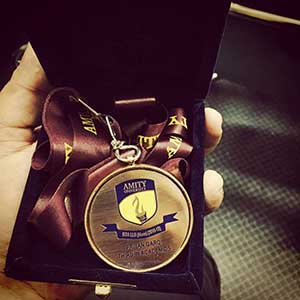
    It is important to have a good mix of both academic as well as extracurricular interests. I mostly had debates and moot court achievements to show for extracurricular achievements. I used to play the electronic keyboard, which was another non-academic activity that I had included in my CV. Before the final interview, I met other applicants, some of whom were national level dancers or sportspersons.

    But most importantly, I believe that the social work you do is extremely relevant because it demonstrates how you propose to give back to society. Internships with NGOs, participating in legal aid camps and volunteering for charitable organisations could have possibly enhanced my application.


    Are moots, or any other activity in particular, given significant weightage?

    Moot Court experience is definitely adds to your application and equips you to handle questions with confidence and clarity. It supplements your research credentials as well. But not having any significant achievement, will not, by itself, be considered a major deficiency in your application. Most importantly, it is the experience that counts.


    How did you prepare for your technical interviews? Describe your most memorable one.

    I had indicated in my personal statement that international criminal law was my specific area of interest. So, I focussed primarily on that area. I had already done a few moot courts dealing with the subject, so I revised the basics of what I had learnt. I had also brushed up on recent developments in that area.

    During the interview, while I was asked certain questions about international law, I was also asked general questions about current issues. One of the questions was about the alcohol prohibition in Kerala and my views on the same. I remember our discussion not being purely legal in nature, but also slightly political, which I rather enjoyed.

    Another question that I distinctly remember and which made me think quite hard was regarding the formation of Telangana and the legal issues surrounding the same. The interview, though challenging, was more like a discussion with the panellists, which was rather enjoyable.


    What are the qualities that are being sought in candidates, and do you have tips on how to hone them best?

    I am not exactly sure what they look for in the interview. Personally, I tried to answer the questions with confidence and clarity. I essentially thought through the entire discussion and tried to make my arguments logically coherent.


    The final round of interviews are notorious for being the most gruelling. What were some of the broad topics touched upon?

    You know, the final interview is not strictly a technical one. However, I found it equally nerve-wracking. Our final interview was chaired by Mr Kumara Mangalam Birla, along with nine other eminent panellists. It was a daunting task to hold your own and not be intimidated in the presence of such distinguished personalities.

    They asked me a wide range of questions from “Where do you think human rights come from?” to “Would you support the sterilisation of women who are likely to give birth to crack babies?” I also remember being asked about the protection of intangible cultural heritage.


    Are the questions random in nature or was there a general broad base where they stemmed from?

    Your CV and personal statement form a broad base for them to question you from.


    Do they prefer someone whose proposed area of research is interdisciplinary in nature or are they looking for someone who is remarkably accomplished in a more specific field of study?

    That is a difficult question to answer. Either way, it is your passion for the subject that really matters.


    Did not having any past Rhodes Scholars in your college pose a challenge while applying for this scholarship?

    To some extent, yes. I was not sure as to whom to approach for advice regarding the personal statement. But I had plenty of support from the faculty who were always honest about the areas that I could improve on and this proved to be extremely helpful. I was assisted by my friends as well as my seniors who had passed out. Some of them even offered to put me in touch with previous Rhodes scholars they were acquainted with.


    What do you wish to do post Oxford University?

    I hope to work at the Office of the Prosecutor at the International Criminal Court in Hague. But ultimately, I want to come to India and be a part of the Legal and Treaties Division under the Ministry of External Affairs.


    Any final tips that you have for juniors who may have already started the application procedure?

    A reasonably good academic performance, participation in extracurricular activities and sparing time for social work is important. For law students in particular, moot court experience and one or two publications might be helpful. However, this does not mean that this is the only way in which you can secure the scholarship. These are merely one or two options that you could consider. Most importantly, try to work on what you think you are passionate about and be honest in your application.


  • Shatarupa Mishra, Indian Revenue Service Officer, on preparing and cracking Civil Service Examination

    Shatarupa Mishra, Indian Revenue Service Officer, on preparing and cracking Civil Service Examination


    Shatarupa Mishra graduated from Symbiosis Law School in 2013. She is a lawyer by interest, civil servant by profession and dancer by passion. Currently, she is training as an INDIAN REVENUE SERVICE OFFICER-Income Tax in National Academy of Direct Taxes, Nagpur after clearing Civil Service Examination 2014.


    In this interview she talks to us about:

    • How she developed interest in reading and writing.
    • What inspired her to appear for civil service exam?
    • When should a person ideally start preparation for the civil services exam?
    • Easiest and toughest part for preparation.
    • Aspects that a civil service aspirant must focus on and start preparing for in advance.


    Please introduce yourself to the readers. Please tell us a little bit about your childhood and your background.

    Hello friends! I am Shatarupa Mishra, lawyer by interest, civil servant by profession and dancer by passion. Currently I am training as an INDIAN REVENUE SERVICE OFFICER-Income Tax in National Academy of Direct Taxes, Nagpur after clearing Civil Service Examination 2014.

    My schooling has been in De Paul School in a small town Berhampur and subsequently in St. Joseph’s High School, Bhubaneshwar, the capital. I was extremely active in extracurricular activities like writing, dancing and singing. Both me and my elder sister started training in Odissi, the classical dance of Odisha  and other dance forms.

    Infact I started performing in stage shows and dance festivals from a very young age of 4 years and those childhood memories of dancing remain the most cherished. I was also the house captain in my school.


    What impressed upon you the idea to study law?

    Frankly speaking, I wanted to pursue law when I realized after two years of science in intermediate level, I did not want to pursue Engineering or Medicine, the two most preferred options at that time. Browsing through the law syllabus in my +2 2nd years, my interest was piqued and I thought graduation in law would bode well for me. My choice was very instinctive and it worked out well.


    How was your experience at Symbiosis Law School, Pune. What activities were you involved in apart from the regular academic curriculum?

    My five years in Symbiosis Law School was very enjoyable and memorable. Right from academics to internships to pro-bono activities to extracurricular activities, Symbiosis gives you a wide platform for everything.  From my 1st year itself, I took an active part in extracurricular activities like dancing and participated in many college fests. Timings of law school were such that we could pursue our other hobbies and interests in the later part of the day. Second year onwards, I started mooting and was fortunate enough to be a part of our college team in Jessups. Mooting piqued my interest in legal research and I subsequently wrote many legal essays in pre-final and final year. Being a part of the very active Human Rights Cell of our college for all five years, I loved teaching young kids from underprivileged background and spending time with them on weekends.

    I loved learning law for the sake of itself and was extremely diligent about my studies and projects. The cherry on the cake was when I was awarded a scholarship for academic excellence in my fourth year and the Chancellors Gold medal for topping my batch in BA LLB course.


    How did you develop your interest in reading and writing?

    Reading was my favourite pastime since childhood. If I was not dancing, I was reading. Both my parents, grandparents are voracious readers and encouraged me to develop reading habit. At home there was already a huge library to pick books from.   I have many pleasant memories of visiting book shops and exhibitions with my father and buying loads of books, all non-academic of course. If there was a book club in my city, I was a member in it. In school also, my favorite subject was English literature. My reading habit almost borders on obsession, my family tells me, ha-ha! In childhood, I started writing poems and subsequently, articles. My mother also writes poems in Odia language and she has been a major motivation behind my writing.  Law School and preparation for civil service examinations only enhanced my interest and skills in writing articles.


    When and what inspired you to appear for Civil Service Exam?

    I believe it was a very conscious choice to appear for Civil Service Exam. I belong to a family of state and central civil servants, so somewhere the inspiration to be one myself was right at home. My biggest inspiration has been my father who is respected by all as an honest, upright and efficient officer in the State Government. Dinner table conversations have many a times, been about development, administration and issues therein.  Secondly, I was keen to be in a profession which offered me a wide platform to work in law, policy and implementation. My legal training actually strengthened my resolve to sit for this examination. Thirdly the syllabus of the civil services exam piqued my interest, particularly the general studies papers.  Keeping all these factors in mind, I eliminated other career options in law in fifth year of law school so that I would never regret the decision of appearing for this examination. I was fortunate that I got a mentor in Pune, Shri Aashay Abhyankar, who along with his family, has played a stellar role in my success.


    When did you start preparing for the exam? When should a person ideally start preparation for the civil services exam?

    I started preparing for this examination immediately after graduating from law school in 2013.  I really wanted to clear the examination in my first attempt itself and join the services at a young age so I wanted to give it my full focus the first time around.

    As regards the second part of your question, I believe once the person is sure that this is what he wants to achieve, then that time automatically becomes the most ideal for preparation. Hence, to each his own.


    How many hours did you put in for your preparations every day? Is having a fixed schedule or weekly targets important according to you?

    I used to fix daily targets and accordingly work to complete them, so there was no fixed number of hours. On an average, it ranged from 6-8 hours daily.  Rest of the time was spent in reading newspapers, surfing the net or carrying out other hobbies.

    Yes having a fixed schedule and weekly targets is important as I have personally benefited from such meticulous planning.


    Which were the easiest and toughest parts of your preparation?

    The easiest part was reading newspapers and making notes from them and studying the general studies papers which are exhaustive but highly interesting as well. History,  culture, polity, foreign affairs are topics that I loved to read and analyze.  The toughest part for was staying away from my family, and friends as I was preparing in Pune while my family stays in Bhubaneshwar.


    What are the aspects that a civil service aspirant must focus on and start preparing for in advance?

    A civil service aspirant should first know how to read the newspaper for this examination. Then preparation becomes very easy and interesting as one can interlink concepts with current affairs, analyze and present  in a unbiased manner. My preparation for civil services was very newspaper-oriented and it held me in good stead throughout all three levels.


    What were the attributes of your legal education and background which helped you in succeeding in the civil service exam?

    I would attribute my success in first attempt to legal education in a lot of ways. As law students, we are used to processing copious amounts of information and presenting them in answers. Secondly writing subjective answers in limited time, a skill acquired during law school, is an asset while writing the Civil Services (Main) Examinations. In all my mock tests and the mains examination I never faced the issue of time management. Thirdly, integrated law course already gives you an insight into general humanities subjects in the initial years like political science, history, sociology, etc which is somewhat registered in your mind. The only catch here is to keep legalese and biased viewpoints out of your preparation and remembers that this examination wants administrators and not lawyers at the end of the day and moulds yourself accordingly.


    What is the importance of CGPA for law students especially for Civil Service exam aspirant? Does it make any difference during the interview?

    More than CGPA, it is the grasp over syllabus and overall analytical skills that matter most for law students in civil service examination. Having said that, I believe a decent CGPA would always be an asset to the law student, be it in this examination, or legal jobs or pursuing higher studies, etc.

    I can answer the second question only from my own experience. As I was the batch topper with a high CGPA, I was apprehensive that they could ask me a lot of law-related questions expecting accurate answers. And this is what happened I was asked factual questions spanning multiple law subjects. However, the interview experience is very subjective and nothing is a precedent.


    Tell us about your interview? What kinds of questions were asked by the interview board?

    My interview was on the afternoon session on 15th May, 2015. It was chaired by Prof. David Sylimlieh. As discussed above, mostly factual and legal questions were asked which I could answer racking law notes in my mind at that very instant.


    What would be your message for law students who are preparing or planning to prepare to appear for the Civil Service exam?

    I personally feel that with the hard work, perseverance and right guidance, it is not difficult for a law student to clear these Examinations. Civil Services involve law interpretation and implementation, public administration and management, which law students imbibe in their five-year long erudition. So they should approach this examination with full focus and determination, if they choose to appear for it. Success shall definitely follow.


    Lastly, what would be your message for the readers who want to pursue career in Civil Services?

    Readers wanting to pursue a career should first be clear about why they want to pursue it. Once they have decided, they should just focus and plunge into the syllabus with full determination.  Enjoy the process of learning and studying for this examination and before you realize, success shall be yours! God Bless.


  • Raghav Singh, cracking IBPS and DMRC, on being a Law Officer at State Bank of India and teaching CLAT aspirants

    Raghav Singh, cracking IBPS and DMRC, on being a Law Officer at State Bank of India and teaching CLAT aspirants

    Raghav Singh graduated from Dr. Ram Manohar Lohiya National Law University, Lucknow (2007-2012). At present, he is the Deputy Manager (Law)/Law Officer in State Bank of India posted at Administrative Office.

    In this interview he talks to us about:

    • Academic as well as extra-curricular experiences.
    • How he prepared for SBI and IBPS exams.
    • His experience while teaching CLAT aspirants.
    • Factors students should keep in mind while building their career graphs.

    How would you like to introduce yourself to our readers?

    I would like to introduce myself as a Banker by profession, Lawyer by passion and Teacher at heart. I am also a hopeless optimist who cannot stop himself from laughing at serious moments.

    What was your motivation to study law?

    The motivation mainly came from my father, Sh. Arun Kumar Singh, who is currently posted as a CBI Judge at Rewa(MP). My father was born in a family of farmers and education was a luxury to him, still he worked hard and after a lot of struggle came to stand where he is today. This naturally had a profound effect on me and I developed an interest towards law. Initially I wanted to serve the judiciary but I presume, destiny had a different plan. I learned that a lawyer can contribute in many ways to the institution where he is working thereby impacting his surroundings and it is a great feeling when there is a positive impact as the character of Andrew Beckett has summed up in The Philadelphia, “It’s that every now and again – not often, but occasionally – you get to be a part of justice being done. That really is quite a thrill when that happens.”

    How was your law school journey like- could you share your experiences with us?

    If I am to answer in one word I would call that journey amazing. But law school life deserves much more than one word. As life is much more than just the job you are doing, Law school too is much more than just your academics. It is about the bundle of experiences where everything fits in, be it your success or setback or the journey that you took while reaching there.

    I had a wonderful journey thanks to my teachers, friends, seniors, juniors and everyone who was a part of it. I remember with much fondness how Anshuman hit a four of the last bowl that sealed the Inter batch cricket tournament for us where I was one of the frontline bowlers of the team and at the same time I recall how I bowled 17 times in one over in one of the matches. I remember during the Final year Aditya coming to my room and practicing on guitar for hours and telling me that singing “Smelly Cat” at our Cultural Fest is not a very good idea but I anyway went with it much to the amusement of the capacity crowd in the auditorium where only my Debating committee members were found cheering. At the same time I also remember how everyone appreciated me for the song that I composed and sang on Guitar during our farewell. In addition to the academic life all the trips towards the old city, late night Bun makkhan, watching IPL in the common room, all the Bak*****, etc. are just priceless and I can’t thank God enough for the life that I had in law school.

    Kindly share with us your academic as well as extra-curricular experiences that have helped build your personality? What were your biggest achievements in and outside law school?

    Since we had a semester system so there was lot of time at hand to participate in Extra Curricular. Mooting was one area that caught my fancy, the thrill of arguing your case was enough to make me pursue that interest in the first semester itself. One should keep in mind that Mooting is a team effort; therefore, you need to get the right team. The one thing you should look for before making a team is—Compatibility. Remember, when it comes to moot courts compatibility trumps intelligence. And add hard-work to the equation and result is a brilliant team.

    I was fortunate enough that I had my friends (who stood with me through thick and thin in our mooting journey) as the best team mates anyone can have. So with contributions from Srijan, Akansha Ma’am, Suyash, Mayank, Pallavi, Dhruv and Yash, I was able to win 3 Best Memorials (including 3rd GNLU international Moot court competition) I have also won best mediator in UPES Mediation Competition, 2012 and published few articles, 3 of which with the help of my co-authors Amit Kumar Pathak and Sukriti Guha (Manupatra Competition Law Journal, Company cases, The Practical Lawyer & Environment Law Times).

    Also, I had one of the best times as convener of the Debate & Discussion committee thanks to the members of the committee we were able to organize several debating competitions, helping  streamlining the debating culture at RMLNLU.  After me, the responsibilities of the committee were taken over by talented conveners like Vinayak, Krishna & Aayush.

    In my professional life too, I was lucky enough to have brilliant and hardworking people as my support system especially T K Singh sir, BM Sharma sir, D V Malhotra Sir & Piyush to name a few. While working in Oriental bank of Commerce as a law officer, with the collective effort of the branch managers as well as branch officials, we settled the maximum number of cases in the National Lok Adalats organized throughout 2014.

    Participation in these competitions helped me a lot in building my personality. The more you participate in extra-curricular,the more exposure you get which help you to deal with assignments in your professional life. For instance, in my SBI Deputy Manager(Law) interview, I was privileged to have former Bombay High Court Judge, Justice P D Kode(Famous for his judgment on 1993 Bombay bombings case) as the head of the interview panel and all that I learned in law school did help me to face the board with confidence and score well above 80% in the interview.

    How did you prepare for SBI (Law officer Scale-II) & IBPS (Law Officer Scale-I) exams? What are the subjects one needs to study for its preparation?

    IBPS(Law Officer Scale-1) is conducted for all the public sector banks excluding SBI. So, apart from Law, questions are asked on General Awareness, mostly relating to Banking and current affairs, Reasoning and English. There is a negative marking of 0.25 for every wrong answer. Paper comprises of 200 questions of one mark each. Since I was already preparing for judicial services, I did not face much problem in law and I just went through previous years question papers to know the pattern of the examination and practiced some mock question-papers. I feel reasoning is the deciding factor, since most of the law students just loath anything related to Maths or calculations. So I made a point to practice reasoning. It helped me in clearing Delhi Metro Rail Corporation exam as well.

    Although for SBI, the pattern is somewhat different as there is no General awareness section and other sections like Reasoning and English are merely qualifying in nature, which means that merit list shall only be decided on the basis of the marks scored in law section unlike IBPS. Therefore, the concentration must be on Law. Apart from basic laws such as Contract, Procedures codes, Penal Code one should also focus on the commercial and banking laws like SARFAESI, Banking Regulation Act, Partnership Act etc. Also, the material from Indian Institute of Banking Finance’s on legal and regulatory aspects of banking proved to be very helpful.

    As I was already working with Oriental Bank of Commerce (Allotted through IBPS), I was not having much time to spare on preparation, so I stick to the basics and practiced previous years question papers and IIBF preparatory material.

    For most of the law graduates the syllabus of these exams might appear to be alien where lot of such acts are involved which one might not have even heard before. But one needs to just go through these acts. If somebody is preparing with all seriousness and regular practice even for a short span of 2 months, it can easily be cleared.

    How was your experience teaching CLAT aspirants? What were the challenges you faced? What do you think legal aspirants need to be aware about before they become professionals?

    I immensely enjoyed teaching as it helped me personally to build on my knowledge. As I left my job at Mumbai and was appearing for competitive exams, to do away with boredom and monotony, I thought teaching would be a good experience. Here, I have to thank Bishwajit Sir and Priya Ma’am. They were very understanding and gave me an opportunity to teach the wonderful kids who are now studying in prestigious law universities. The only challenge I faced while teaching, was to simplify the legal concepts for my students. So while teaching, I incorporated this habit of explaining concepts with lots of real life examples, so that it helps them understand the application of these laws in a cogent manner.

    Legal Aspirants needs to be aware of the fact that they belong to the area which is always evolving. Past year CLAT papers have proved to be unpredictable and therefore, one should prepare with an open mind without any preconceived notions on the difficulty level of the paper. Age old formulas like studying regularly, revising timely, practicing lot of mocks and most importantly preparing with the positive mindset should be kept in mind while preparing.

    How far do you see your University as being the contributor in preparing you for what you are right now?

    Whatever I am today, I owe it to my Alma-mater. The opportunities that I got, helped me to understand the difference between and move from ‘good to better’, ‘listening to perceiving’, ‘losing to learning’, ’speaking to arguing’ and most importantly ‘reading to ‘interpreting’.

    Considering the nature and importance of this profession what according to you should be the focus of law students at the law schools? What are the important factors students should keep in mind while building their potential career graphs?

    Building concepts, utilizing the opportunities at hand, improving on research and drafting skills should be the main focus area. Do not get bogged down witnessing someone who is better than you, as 5 Years is a long span of time and one must utilize this to work on their weaknesses. It is okay, if you are not getting an ‘A’ in every subject provided that you understand the subject well you can apply those principles with confidence whenever you have to.

    And most importantly, when it comes to career, one should always be open to new opportunities and ideas.

    Tell our readers about the goals you have set for yourself for the upcoming years?

    Currently, I am striving to serve this prestigious institution, SBI, to the best of my abilities and just like law school, I shall make best use of any opportunity that comes my way. I am satisfied till I am contributing something to this institution, which serves millions of Indians in our country and abroad.

    In the end what would be your three biggest pieces of advices for the students as well as fresh graduates who are all set to begin their professional lives soon?       

    Firstly, do not hesitate to follow your hunch. Even if it says to leave your job which you just got 6 months back and do something which you feel is right.

    Secondly, Life of a lawyer is like a runner in a never ending relay race and not a sprint. So all you can do is try to maintain the advantage, so wherever you are, try to improve.

    Thirdly, it is just the human mentality, that we can never be satisfied where we are, so just stay hopeful, as said beautifully by Andy Dufresne in The Shawshank Redemption, “ Remember Red, hope is a good thing, maybe the best of things, and no good thing ever dies.”

  • Ekagra Jain, Associate, Wadia Ghandy & Co. on mooting, academics, and bagging a job

    Ekagra Jain, Associate, Wadia Ghandy & Co. on mooting, academics, and bagging a job

    Ekagra Jain graduated from the Institute of Law, Nirma University in 2016. From being the Best Oralist in 4th NALSAR-NFCG Corporate Law Moot Competition, 2015, to being the Best Emerging Player while representing his University in sports, he made sure that he explored every opportunity which came his way. He is inclined toward Corporate Law and Competition Law and is currently working in the Banking & Finance Department at Wadia Ghandy & Co., Mumbai.

    In this interview he talks to us about:

    • His experience at ILNU, both inside and outside the classroom and the decision to peruse law.
    • The importance of balancing academics and the co-curricular and extra-curricular activities.
    • Work experience at Wadia Ghandy & Co.
    • His views on building a successful career graph in the field of law.

    How would you introduce yourself to all our readers?

    To everybody reading this, I am Ekagra Jain, a 2016 Graduate from Institute of Law, Nirma University, Ahmedabad. I have been recruited by Wadia Ghandy & Co. through college placements and have been working in the Banking & Finance Department, Wadia Ghandy & Co., Mumbai. Born & brought up in Jabalpur, I am a passionate reader who is still ‘learning’ in life and believes in being the change you wish to see in the world.

    Why did you choose law as your career, who and what were your sources of inspiration?

    To say that I wanted to be a lawyer for a long before would surely be fallacious. However, I was an avid debater during my school days which inclined my interests towards journalism in the beginning. My family had always given me full liberty to choose the venture I sought to enter into and thereby gave me a chance to break the stereotype of following ‘engineering’ as a career option. I had always been fascinated with legal education and the scope that existed beyond the four walls of the court room. However, with enhanced research and reading, taking into account career growth, I decided near to the end of the 12th standard that I wanted to be a lawyer. The  source of my inspiration is primarily my grandfather, who studied at BHU and was a Public Prosecutor for 11 years. In addition, my family trusted in me and what I wanted to do and the results have not disappointed them since. To the contrary, what scared me the most before entering law was the volumes of books that a lawyer is required to refer to. However, with the passage of time and dedication, to say the least, I have acclimatized myself to this profession and my inclination towards law has only escalated since then.

    How was your law school journey like- could you share your experiences with us? What were your favorite subjects and your areas of specialization?

    To say that my experience at Nirma University has been fabulous would be an understatement. Summing up a period of 5 years within 10 lines is an arduous task. Nirma gave me the perfect platform to groom myself personally and professionally. For me, when you barge into the entrance of a law school, you should keep your arms wide open towards actively participating in all activities that happen in a law school because that in turn lets you find what your interest lies in and also lets you adapt to itchy and uncomfortable situations. From focusing on academics, the submission of assignments, writing research papers, participating in moots, attending classes on a regular basis, to playing football representing the University, I made sure I didn’t have any regrets and enjoyed myself during the voyage of ‘learning’.  I am very thankful that I did law as it has made me think outside the box, meet some charismatic personalities who have helped me down the line and helped me improve as an individual. During my whole law course, I showed dedication towards all fields and made sure I did not overburden myself and left time for leisure with friends as well.

    My Area of Specialization is Corporate Law Honors and I had been inclined towards Corporate Law & Competition Law therefore, I gave the Company Secretary Exam a shot and also the NALSAR Moot on Corporate Law. Additionally, I guided moot teams for their preparation primarily on corporate related Laws. I also have an interest towards International Laws namely Public International Law and International Trade Law to name a few.

    You being one of the all-rounders of our college, kindly share with us your academic as well as extra-curricular experiences that have helped build your personality? What were your biggest achievements in and outside law school?

    As they say, the more you sweat in training, the less you bleed in war. For me, my basic approach had always been to ensure Balance and train myself rigorously within all fields. Academically, I have always maintained above average pointers with my CGPA for the 5 years at around 8.7. I have also cleared the Executive Level of Company Secretary and will be attempting the Professional level soon. I have also obtained a Cyber Law Diploma Certificate from GLC and Asian School of Cyber Laws with a view to expand my knowledge.

    With respect to Internships, I made sure I interned at all platforms and kept a planned approach towards it. I maintained a steady start originating from NGOs to Trial Courts to High Courts. I also interned under the Assistant Solicitor General of India. Moving on to Supreme Court, I interned under Mr. Shanti Bhushan, Former Union Law Minister and Senior Advocate which gave me a glimpse on the Supreme Court functioning and the clash of all high-rated arguments which flow. I have also interned in S & R Associates, Bharucha & Partners, Link Legal India Law Services, to name a few law firms. Owing to my interest as highlighted earlier towards International Law, I also interned at International Trade Law Consultants, New Delhi where I was offered a position in the long run.

    With respect to Moot Courts, I have been adjudged as the ‘Best Oralist’ for the 4th NALSAR-NFCG Corporate Law Moot Competition, 2015. We also bagged the ‘Best Memorial’ and we were ‘Semi-Finalists’ for this moot. I have also represented my University at the Asia-Pacific Rounds of ELSA WTO Moot Court Competition in Philippines, Manila and International Maritime Moot organized by VIPS, Delhi. Additionally, I guided various teams representing the University at the National and International Level. I have also written various research papers and made paper presentations. I was also the Co-editor for Law Mantra for certain years and worked as a Research Associate with Grayscale Inc.

    For all the time I managed in between all that I did above, I tried my best to utilize it towards Football and fun with friends. I was awarded the Best Emerging Player of the Tournament from the University in 2013 and was also the Vice-Captain of the Team representing Institute of Law. In addition, I played in Yuvardha and for S & R Associates as an Intern at the Football Cup, Mumbai. All these all round experiences and their management have helped me in building my personality in the long run.

    Tell us about your approach towards the long term and the short term goals you had set during the academic period and how were you able to manage it?

    A goal without a plan is just a wish. I planned certain things way back to avoid panicking when the time arrived. With respect to scoring well in academics, I didn’t keep it as my utmost priority. All I always focused on was realizing the subject, its importance and getting the interpretation of law at its true essence. Exams weren’t and shouldn’t be an Integral goal. At the end of the day, even if you are a 9.6 pointer and could not answer the difference between hypothecation and pledge through an example, you still didn’t learn the way you should have. So my short term goal was always to get things in mind with appropriate logic. P.S.: If you have understood a topic, the exam pointers are always on your side.

    Apart from academics, my short term goals were mainly to balance all extra-curricular activities in a manner that does not deteriorate the level of education I wished to attain. During my 1st & 2nd year, I would attend classes, play scheduled football match at lunch, and give an exam, complete assignments, research for moot all in a day.  It is a tough task at the start but soon you get to acclimatize yourself doing all things some way or the other.

    With respect to long term goals,  most of the students and I would include me within this ambit are often stuck up in the starting years figuring out what seeks to be the apt future and where should we be heading at the end of 5 years and that is normal. Though I could see certain glimpses of where I will be heading towards the end, I fell short of being firm on my decision. By my third year, I was certain towards heading to the corporate field where I also attempted the Company Secretary exam and cleared it easily. I worked on my CV and did internships at places I was inclined to. Additionally, I also read up various articles on Corporate laws to augment my knowledge with all the current debates.

    Wadia Ghandy & Co, Mumbai was the first law firm arriving for recruitment in my Batch and had a three step procedure for recruitment. It started with a written submission followed by Skype Interview and Final Round Interview at Headquarters, Mumbai. I had my basics clear and worked hard for the Final Round Interview. Finally when the moment arrived, I made sure I was well prepared to seize the opportunity thereby.

    To sum up, plan beforehand on how you are going to take off. After law college you ae left at the midst of a highway where you see roads going off in divergent directions. Additionally, I was at my toes with backup options if things didn’t work out as you expect them to. The goal should always be to maintain consistency, trusting yourself and improving yourself. Also, the trick is to understand what is expected out of you when you step out and to learn the nuances which may help sustain you in the long run.

    How far do you see your university as being the contributor in preparing you for what you are right now? Does ‘specialization’ in any field of law, as provided by your college, help in the early stages of one’s career?

    For all that I stand today, I am indebted to Nirma University for graduating me not just in law, but in life too. Being a Private Law University set up just in 2007 and directly competing with the National Law Universities, we have made a place in the top most law institutions. We have had some astonishing faculties who have helped us down the line when it mattered most. An Institution is normally represented by its students and the students have left no stone unturned in brightening the name. From acing BCI Moot 3 times in a row (& various other moots too) to having record breaking placements as a Private University, the Institution has provided immense support to the students to rise on their own feet within the legal arena. As a Student run initiative, the Institute also supports Judiciary coaching for students who seek to do so. (I attended this to brush up all my laws). Having said that, we are still a growing institution and despite the positives as highlighted above, we still fall short on certain matters and have a long way to go.

    With respect to specializations, I did specialization in Corporate Law and this has helped me to flourish and intensify my knowledge in corporate law. It has facilitated me also to work at ease and has also catered to my clearance of CS Executive.

    Tell our readers about the goals you have set for yourself for the upcoming years? What do you see yourself doing ten years from now?

    As of now, my goal is to learn and improve myself by the practical exposure I get in the shortest time possible. Other than my occupation, I am more committed towards successful completion of Company Secretary – Professional level exam due in December. I am not really certain for 10 years down the line, but if things go as planned, I see myself giving another interview to Super Lawyer 10 years from now as Partner of one of the leading firms 😉

    You are working with Wadia Ghandy & Co., one of the oldest law firms of India, tell us about your working experience? What is the real world like- are you facing difficulties carrying personal and professional life together now?

    Currently working at Wadia Ghandy & Co., I’d say I have been working under a very experienced team where I have been learning the practical nuances of Law. Presently, I work in the Banking and Finance Department under Ms. Shabnam Kajiji, who has had years of experience in Banking and Finance Sector. My working hours normally begin from 10 in the morning and may stretch up to late at night, depending upon the work allotted and the reporting deadlines.

    With respect to maintaining balance, I’d say we are all aware of the fact that in order to achieve something in life you have never had, you must be willing to do something you have never done which includes sacrificing personal life at times. Straight roads do not make skillful drivers. Working in a law firm is a challenging task and that’s what lets you grow and overcome them. Despite the long working hours which I may succumb to “occasionally”, I do have the sufficient breaks which let me enjoy my life too. And as they say, If you love what you do, you’ll never have to work a day in your life. Keeping the broad ideologies intact, I make sure I keep learning during my work and improving myself day to day, in order to reach where I intend to.

    Considering the nature and importance of this profession what according to you should be the focus of the law students at the Law Schools? What are the important factors which students should keep in mind while building their potential career graphs?

    Having seen and experienced the different facets of law, the focus of law students primarily should be towards seeing them grow. Experiencing and participating in different activities, indulging into healthy discussions and making sure that you are not only changing your CV to suit the firm needs, but changing yourself in a positive manner too is an integral factor which every law student should keep in mind. Additionally, what is of utmost importance is to realize the need to not only learn things by heart but to solve a complex situation by the practical application of law.

    For building potential career graphs, there is no straight jacket formula to be followed upon by every law student. Every student has their own understanding, working patterns and their future goals. For people focused towards corporate, every law student shall develop his knowledge towards corporate laws, read up on corporate issues and should maintain a decent CV containing good Academic Credentials, Moot Certifications, Paper Publications, Internship Experiences to name a few, depending upon an individual’s interest and priorities.

    Law school is an amazing time period where you have five years to read upon laws you have never done, participate in varied activities, get out of your comfort zone, work hard, trust yourself and chase your dreams. Dreams don’t work unless you do. In addition, every law student shall keep in mind the desire to chase the vision, not the money. The money will end up following if you have had the proper vision and worked on them accordingly.

    In the end, what would be your 3 biggest pieces of advices for the students as well as fresh graduates who are all set to begin their professional lives soon?

    My biggest advice for people who strive to set their foot into law firms or to the legal profession in general are the following. Firstly, don’t let the desire to learn end! Intelligence without ambition is like a bird without wings. Yes, you read that right. Many graduates often have that tendency to consider themselves at the epitome of success such that they inhibiting within their minds the practical knowledge that should come forth. For a lawyer, I’d say the road to learning is never ending. The farther you go, the better off you’ll be. Secondly, Think before you speak, read before you think. Recruiters have ‘experience’ and know how to analyze your knowledge within the ambit of law. For everybody applying for jobs, bluffing is not really an option. Make sure you have read upon the basics well and your answer should match what the recruiter seeks to ask and the rest shall be history.  Thirdly, Learn, Discover and Explore. Do not restrict yourself. There are various options emerging after you graduate. And as they say, do not blindly follow the Masses. Sometimes, the M is silent. Choose the one where you can deliver the best, carve a niche for yourself and prosper.

  • Utsav Gandhi, Associate, Fox Mandal, on 1st year at a law firm and graduating from Nirma University

    Utsav Gandhi, Associate, Fox Mandal, on 1st year at a law firm and graduating from Nirma University

    Utsav Gandhi graduated from the Institute of Law, Nirma University in 2014. He has participated in many reputed International and National Law Moots and has headed various committees. During his time in college he made sure to get his hands on everything college had to offer. He is currently working in the corporate and real estate law team  at Fox Mandal, Ahmedabad and wishes to keep exploring the field and continue the cycle of learning.

    In this interview he talks to us about:

    • His decision of choosing ILNU and the college’s contribution in his career.
    • His views on Moots and other activities in augmenting a CV.
    • His work and experience at Fox Mandal.
    • His views and suggestions on starting a successful legal career.


    How would you like to be known to our readers, most of whom are the law aspirants?

    I am a corporate lawyer based in Ahmedabad and a graduate of the 2014 batch of Institute of Law, Nirma University. Also, I am a first generation lawyer in my family. Initially I thought of studying engineering, but when I started going for the engineering coaching classes the subjects did not capture my interest. While looking at other options I came across law and I immediately took a liking to subjects such as tort law, civil law and criminal law, that I came across while studying for the law entrance exam.


    What specific goals, other than those related to your current line of business, have you established for yourself for the upcoming years?

    None of my plans are set in stone. However, in the coming years I would like to grow as a legal professional and tackle new challenges over time. Further, I would also like to assume a position of leadership and develop expertise in a particular area of law. On a personal front, I was an avid trekker in school and that is something that I would like to proactively pursue as a hobby in the near future.


    What led you choose your college or university?

    When I joined ILNU it was relatively new, with the first batch students still in their 5th year. However, Nirma had a very good reputation for having excellent faculty with amazing infrastructure. In fact the Nirma University campus has to be one of the best in India. Also, when I went through the prospectus, it immediately piqued my interest since the course structure was unique, wherein a student could pursue a specialisation (Hons.) in either Criminal, Corporate, Constitutional or IPR Law. Thus, I believed that joining ILNU would help me immensely in building my career as a legal professional.

    How do you see your university and education and experience it imparted as being helpful in preparing you for a corporate career?

    I would credit the teachers at ILNU for being extremely diligent and focused on teaching the students about the basics of law. Further, I was also given the opportunity to explore many extra-curricular activities such as debating, MUNing and of course, mooting.

    Further the curriculum at ILNU was quite rigorous, with term assignments and exams always keeping me on my toes. This helped me greatly in improving my time management skills and also helped me to work under pressure, s so ILNU through 5 years of college, prepared me for the corporate life.


    Tell us about the activities you participated in while at university that helped boosting your progress?

    I participated in everything that I could get my hands on. I have participated in many international moot courts which have greatly improved my research and communication skills. In fact, mooting was the best thing about college as it also taught me how to work in a team. Further, I also tried my hand at debating and MUNing which helped me in public speaking. Apart from this, I have been part of the ILNU’s Campus Recruitment Committee and Literary Committee, which imbibed in me, the leadership skills, which are invaluable for any lawyer and something that every lawyer should possess.

    Also, I have presented papers at various international as well as national conferences and have got some of them published as well. This gave me the opportunity to extensively research on upcoming areas of law and have now helped me in my career. For example, I presented a paper on Corporate Social Responsibility, which back then was only an evolving concept and there was no legislation on the same. However, my research encompassed various jurisdictions and consequently, set up a strong base for me in that subject. Now, CSR has become a major area of interest/concern in the industry, and it has become extremely easy for me to advise the clients on the same.

    With regard to the internships, I kept an open mind before deciding on a particular area of law. I had not decided to choose corporate law as a career since the beginning. The various internship experiences I did helped me choose a definite career path. Thus, during my early years at ILNU I decided to intern with Nanavati Associates (District Court, Gujarat), Adv. Devang Nanavati (High Court of Gujarat) and Krishna and Saurastri Associates (IPR). Finally, it was when I interned at Phoenix Legal and Trilegal that I decided pursue a career in corporate law.

    Further, I have also completed various courses such as the Thomson Reuters’ Legal Advancement Programme (in my second year) and a diploma course on Entrepreneurship Administration & Business Laws jointly offered by NUJS and iPleaders. These courses helped me improve my knowledge base and have also played a major role in helping me to ace my interview with Fox & Mandal.


    Share with us your working experience as an Associate at Fox Mandal, India’s oldest law firm.

    I have been working on corporate and real estate law matters at the Ahmedabad office of Fox & Mandal for the past 2 years. My work profile mainly comprises of transactional and advisory work in the area of general commercial laws and drafting due diligence reports and advisory opinions on real estate law.

    Fox & Mandal is a huge law firm with over 200 lawyers across India and all the offices regularly connect with the each other. Therefore, I have had the opportunity to interact and work with some of the brightest minds and experts in their fields of law. Further, since the Ahmedabad office is relatively new I have also had the opportunity to network with potential clients across various industries in Gujarat. I believe that no other big law firm would have provided me with this opportunity and I am sincerely grateful to Fox & Mandal, as I believe that this will always be of an immense help to me.


    Would you like to share with us any of your accomplishments before or after joining the Law School or even after your placements?

    The first moot that I went to was the GNLU International Moot Court Competition, where our team won the 2nd Best Memorial Award. Later on, we were the first team from ILNU to get selected for the prestigious D.M. Harish Memorial International Moot Court Competition through the Memorial Round. I was also awarded a gold medal by ILNU in recognition for my moot court achievements.

    Further, I have also won an essay competition which was then consequently published in a book titled “Right to Development – Views and Issues”. I also pursued an online internship with Alexis Society (an organisation dealing with issues relating to youth empowerment), where I was adjudged the Best Intern and I had primarily worked on the research topic of Global internet freedom.

    At present, I am also closely working with Adhrit Foundation as an Editor and an Internship Coordinator. My priority tasks with Adhrit include Editorial Work, Content Development and Talent Development. This role has provided me with the opportunity to mentor many law students who have just begun their law school journey.


    Having seen the dynamic evolution in various facets of law, how did you manage to seize any opportunity that knocked your door?

    One has to really be on their toes and it is very important to keep a lookout for any new opportunity. The best resource for this is of course the internet, which is a multitude of vast information. However, in order to stand apart from my peers, I always chose to do something new and take risks and I give a  100% to whatever I am doing.

    Also, I always keep myself updated with the latest developments in the legal field and immediately prepare concise notes for the clients on the upcoming areas of law which are going to have a big impact on the industry. After joining Fox & Mandal, I have also assisted in organising various conferences and workshops with the latest one being a Workshop on Sexual Harassment of Women at Workplace. Further, I have also delivered a lecture at Apollo Hospital, Ahmedabad on the medico-legal issues that healthcare professionals face. This has helped me in understanding the industry issues and consequently, helped me in addressing their various concerns too.


    How would you advise a law student if one has to start on to preparing for a career while in college?

    I believe that a law student should focus on his academics to ensure that the basic concepts are clear since that is the first thing that the recruiters will look at while short listing a candidate. However, one does not need to be a topper to get a good job. The important thing is that the CV should be well-rounded. Also, I would advise the current crop of law students to moot extensively, irrespective of whether they’re choosing litigation or a corporate law career. Mooting develops ones research and communication abilities to a great extent. Further, other extracurricular activities such as debating and presenting papers at various conferences also helps in developing presentation and research skills.


    In the end, what would you like to communicate to the fresh graduates who are ready to set foot in the law firm?

    Keep an open mind and work on as many areas of law as possible and always interact with everyone across the board, be it an Associate or the senior management. Further, the field of law is dynamic and ever changing, hence, one has to stay abreast with the latest developments and preferably conduct a thorough research on topics which may have a huge impact in the future. Also, ones aim during the first couple of years at a law firm should be to accumulate knowledge on all the aspects of law and not confine themselves to a particular area from the beginning.


    This interview was taken by: Kadambari Tripathi, Student at Institute of Law, Nirma University, Ahmedabad

  • Priyan Garg, Associate- Business Development & Knowledge Management, Karanjawala & Co., shares his insight on moving beyond barriers and alternative career opportunities

    Priyan Garg, Associate- Business Development & Knowledge Management, Karanjawala & Co., shares his insight on moving beyond barriers and alternative career opportunities

    Priyan Garg graduated from Amity Law School, Noida in 2015. Having a versatile law school experience has helped Priyan build a wholesome view of the legal world. He has, during his law school years, edited the Amity Journal, coordinated seminars, participated and brought laurels in moot court competitions and helped the society by drafting wills for senior citizens. Right after graduating from law school, he joined as a Marketing Executive at LexisNexis India.

    Currently, he is Associate in Charge – Knowledge Resource handling Business Development and Knowledge Management at Karanjawala & Co.

    In this interview, he talks to SuperLawyer about:

    • His choice of law school and the benefits of going to a law school in Delhi NCR.
    • His life at law school and experience with editing for a journal.
    • His take on opting the unconventional path for law graduates.
    • His unique work profile as  Associate in Charge- Knowledge Resource at Karanjawala & Co.
    • His revelation of the importance of making yourself a brand.

    Please tell our readers a bit about yourself. Why did you choose to do law? Did you have any other interests before deciding to pursue law?

    I’m a lawyer by qualification, currently working as Associate in Charge – Knowledge Resource handling Business Development and Knowledge Management at Karanjawala & Co. While in college, I have interned at a number of places such as PSHRC (Punjab State Human Rights Commission), ASG Pinky Anand, Geeta Luthra, JSA, Luthra & Luthra, Karanjawala & Co., LexisNexis etc. But, right after graduating it was the marketing side of legal world which grabbed my attention. While a lot of fresh law graduates aim to join legal practice as a litigator or in corporate practice, it was the marketing side of legal world which has not received much importance and has a lot of potential.

    I started my career with LexisNexis handling Marketing, Business Development & Strategy portfolios and I am presently with Karanjawala & Co.

    I chose law over sciences because I found one massive advantage in the field. Science in India is a domain that is extremely hard to enter, with difficult competitive examinations and few seats at State-run institutions. After one graduates with a degree in engineering or medicine, however, the task of building a career is less daunting. Law on the other hand, is quite the opposite. It is comparatively easy to study law and become an advocate, and far harder to establish oneself once enrolled. Aged seventeen, I felt it would be easier for me to challenge myself at a later stage, when I was more mature and had the backing of increased knowledge and a professional degree.


    Which law schools did you apply to? How did you zero in on Amity Law School, Noida and why B.B.A. LL.B.?

    To be honest, Amity was not my first choice as a law school. While I had heard good things about the institution, I was fearful of joining a privately run school. After CLAT, I had the option of joining a lesser-known National Law School. Nonetheless, I chose to undertake a program in law at Amity. There were three reasons behind this decision. First, being in Delhi allowed me to be closer to home (Chandigarh was only a few hours’ drive away). Second, in the NCR, I found myself at the heart of the Indian Legal System. Not only did this ensure that many successful personalities would be available in college for guest lectures and seminars, but also it increased my chances of gaining adequate work experience. With the best counsel, law firms and all levels of Courts present in the city, the opportunities for a keen intern were many. Third, I was fascinated by the courses Amity had on offer. The B.B.A., LL.B (Hons.) programme offered the unique opportunity of studying economics and management with law. I find now that this combination has given both, a rounded character to my personality (having now studied science, commerce and arts), as well as prepared me to better understand the needs of corporate clients I may have in the future.


    How would you describe five years of your college life? Please share your experience as an Editor of the Amity Law School Journal. Any tips for law students who aspire to get published?

    I would like to believe that I made the most of my five years at law school. I studied when I was required to, and ensured I had time for my friends and myself too. Law does require lots of studying, yes, but a law school experience is incomplete without participation in volunteer programmes, co-curricular activities and sports. Looking back, I am glad I made the most of the resources I had available.

    As far as Amity’s journal is concerned, I was fortunate to be involved in the publication’s nascent stage. This encompassed work that ranged from receiving an ISBN number to creating an editorial board and calling for academic writing. Needless to say, it was an exhilarating experience.

    My experience in academics is limited to the years I have spent as a student. I do, however, hold very strong views when it comes to the state of academic writing in India today. There is a great void in the legal space when it comes to original academic writing. It is the Indian education system that is largely at fault for this; students are taught to learn another’s views, not taught to think for themselves or to form their own opinions. The legal space is full of unoriginal work. To illustrate, an article titled “The Law of Arbitration in India” is not an original academic work. Such an article, like most one reads nowadays, merely summarizes the law on a subject. At best, a paragraph is saved at the end for the author’s own opinion. It is incredibly rare to find new approaches to law, new solutions to legal problems, or strong criticisms of existing legislation and precedent. My advice to anyone wanting to be published – be original and show something new through your writing.


    You have received a number of Corporate Awards at your college such as “Best Business Acumen and Awareness” citation and Shri Raian Karanjawala Trophy at ALS, please tell our readers about them.

    Apart from classroom studies, internships and mooting activities I always made it a point to be involved in various committees managing events happening in the University which gave me an overall exposure to what goes behind organising and hosting an event. During the five years of my law college I actively organized the Amity International Moot Court Competition, Amity Quiz on Competition Law, Amity Competition on Law Reforms, Debates etc. According to me, there is no substitute for accuracy in knowledge. Know yourself, know your business, know your men, is the mantra of today’s success. Successful business persons understand the thin line of difference between obstacle and opportunity and are able to turn both to their benefits.

    priyan-garg-2

    I received the citation of “Best in Business Acumen and Awareness” for displaying a charismatic persona, administrative acumen and managerial skills of a high order and the ability to combine compassion with steely resolve.

    I received the Shri Raian Karanjawala Trophy on my convocation which has been constituted in the name of “Shri Raian Karanjawala”, an iconic legal luminary and a distinguished senior lawyer of India. His untiring efforts & contribution towards the development and maturing of legal systems have enhanced the image of India globally. Shri Raian Karanjawala Trophy is bestowed upon the student who has displayed extraordinary zeal and dedication towards learning and imbibing the tenets and spirit of law. Also, the student who has shown praiseworthy performance in corporate courses, interned in law offices/firms and attended conferences and seminars based on corporate laws.


    How important is mooting for a law student? Which moot did you enjoy the most, in terms of the organisation and the subject matter? Was there any “dream moot” which you wanted to participate in?

    Aside from academics, mooting is perhaps the most essential activity in a law student’s career. I participated in six moot court competitions focussing primarily on Constitutional Law. One may contest that the arguing system in a moot differs greatly from what one may experience in Court; however, I am of the firm belief that mooting gives one the right level of confidence in arguing etiquette and manner to be able to present cases before a real judge. Further, research being an essential component of any lawyer’s job, mooters will always find themselves at a significant advantage when faced with challenging research propositions at work.

    My favourite moot was the Justice Bodh Raj Sawhny Memorial Moot Court Competition held at NALSAR University. While the moot itself may not compare to others on offer in India, the subject matter – constitutional law – gave participants the opportunity to present unique arguments and step in the shoes of some of our nation’s most eminent senior counsels.

    The Philip C. Jessup moot is perhaps the only competition that comes to mind when I think of a “dream moot”. What is most attractive about this competition is the enormity of the challenge that is qualifying for the international round, the experience of participating alongside the best law schools in the world, and the exceptionally high calibre of judges and mooters alike.


    You have done a variety of internships, while focussing on litigation. Were you always inclined towards litigation? What according to you was instrumental towards gaining so many internships?

    I often compare law to medicine. To a layman, the job of a pathologist, while indispensable, doesn’t seem as exciting as that of a surgeon. To someone not yet initiated into the legal fraternity, the distinction between transactional law and litigation can appear similar. There is an indubitable excitement about litigation, about forming strategies and arguing before judges, that makes litigation attractive. It is for this reason that I found myself lured by the field.

    Having said that, interest in a field is not essential to get an internship in that field. Unfortunately, most internships in India are awarded through the applicant’s contacts or network. Where firms or practitioners accept applications, emphasis is usually laid on the candidate’s academic record and university, with secondary regard being given to non-academic achievements. I was very fortunate to have a good academic record, thereby ensuring that many applications were accepted. I also made a conscious effort to apply early and to continue to follow up with the organisation until they sent me a response. I’ve found that applications are not always replied to; “getting after” a firm to view your application is essential.

    Coming from a non-legal background, there was always a hunger in me to learn and explore different fields of law, owing to which I made it a point to intern and apply at a variety of organisations. I was fortunate to intern at a number of premier institutions such as Punjab State Human Rights Commission (PSHRC), Additional Solicitor General of India (ASG) Pinky Anand, Geeta Luthra, Hon’ble Justice Ravindra Bhat, Luthra & Luthra Law Offices, Jyoti Sagar Associates, PepsiCo India Holdings Pvt. Ltd., Karanjawala & Co., LexisNexis India etc.


    You were the Convenor of Legal Entrepreneurship Clinic at ALS. Please share with us in detail, about the activities of the LEC.

    The Legal Entrepreneurship Clinic is a cell run by the students of Amity Law School, Noida. It is the first ever entrepreneurship cell to be formed in any law school across India. The E-Clinic caters to the intellectual and innovative minds that aspire to become legal entrepreneurs and it aims to foster and promote entrepreneurial spirit amongst such students.

    We at LEC organised workshops, panel discussions, seminars and competitions for aspiring entrepreneurs as an initiative to train and encourage their diverse and dormant talents. The Clinic endeavours to act as an incubator to the thoughts and ideas of aspiring lawyers, so as to make them prepared to be able to develop their ideas and concepts into practical business dimensions thereby helping them set up their own start-up. The Clinic works on the same objective as Centre for Innovation Incubation and Entrepreneurship, IIM Ahmedabad, whose main aim is to foster innovation-driven entrepreneurship.

    As a Convenor of LEC, I organised various Wills Camps for the elderly residing in the jurisdiction of Noida, U.P.; panel discussions on the new Company Law Act, 2013 and the latest being a seminar on financial literacy called FLAP – Financial Literacy Awareness Program.


    One of your last internships as a student was at LexisNexis India as a Marketing Trainee.  What made you shift from law to management?

    Post my stint as a Campus Ambassador at Lawctopus, I applied to be a Student Ambassador at LexisNexis India in my fourth year of law school. Having been associated with LexisNexis India for an entire year, which is a leading legal, taxation and academic publisher, my inclination towards the organisation increased and I was interested in understanding how a publishing house really operates. During the final semester internship I applied for an internship with the LexisNexis India and joined the Marketing Team as a trainee.

    The primary reason for this shift was my desire to explore the second half of my degree, “Business Administration”. LexisNexis India gave me the opportunity to work in the management domain, though within the legal sphere. Legal and managerial knowledge was essential to the job, and I was lucky to have a degree in both. As the final year was almost ending, I realized that I really did not have much enthusiasm in me for a litigation practice. I found litigation to be very procedural and mundane. Pursuing Corporate Law was another option for me, but I felt that it would restrict me to a very niche field. So I gradually drifted towards going for the Management field and challenge myself beyond my comfort zone.

    Secondly, I have never supported the conventional view of necessarily practicing law after studying law. There are a plethora of avenues out there, waiting to be exploited. I always wanted to use my acquired legal skills in a business environment, my long term aim being to become an entrepreneur. I think law gives you the edge of knowing the regulatory framework well enough, understanding the compliances and understanding the statutory and other measures required and applying them to run a business. I believe people working in organizations in the top positions ought to have a decent understanding of the law, in order to manage business in their top capacities. Discovering a new avenue was my primary motivation in this journey.


    As unique as it sounds, tell us about your work as Associate in Charge- Knowledge Resource at Karanjawala & Co., New Delhi. What is your job profile?

    As an Associate in Charge – Knowledge Resource, I look after Business Development & Knowledge Management of the firm. I’m involved in the indirect marketing of the firm by looking after the visibility of the firm. 

    Having worked for 3 years now in the legal marketing profession, I have a sharp view on the marketing of the law firms whilst taking the legal view into account. At Karanjawala & Co. I work with Senior Management and Partners at all levels looking after their Knowledge Management and Business Development – converting potential clients into permanent clients and engaging with even the most sceptical of clients.

    The Job Profile includes:-

    1. Working very closely with The Managing Partner and the Partners on the Marketing Strategies and Business Development of the different practice areas of the firm.
    2. Brand Development
    3. Publications on Legal Media Platforms & Research involved.
    4. Visibility of Firm over different platforms both domestic & international.
    5. Strategic Consulting – Including Business Plans & Marketing Strategy Development.
    6. Preparing Whitepapers for Conferences.
    7. Liaising Strategic Collaborations with Legal Events in the Country and representing the firm in them.
    8. Preparing submissions for legal awards in Indian market & International.
    9. Preparing Write ups and submissions for firm rankings in prominent legal directories such as Asialaw, Chamber & Partners, Indian Business Law Journal, Legal 500 etc.

    What according to you are the skills required to handle Business Development at tier one firms? How does one develop this prowess?

    I have been asked this question a number of times during Guest Lectures and Webinars. According to me for any kind of marketing you need basic understanding of the market, networking with the key people, common sense and passion to take risks and go beyond your comfort zone.

    No Law School or MBA school can really teach you marketing until and unless you practically take it up and convince the people in front why they should listen to you. The most important thing in any role is the willingness to learn and willingness to take a risk of doing something different beyond your set KRA (Key Responsibility Areas). With so much competition in the market and a number of eligible candidates in the pipeline you can only sustain and grow in an organisation if you go beyond what the organisation is expecting out of you. I was lucky to realise this during my final year itself and mould myself accordingly – I studied the Bar Council of India Act extensively and laid down a plan of how legal industry can involve indirect marketing whilst not violating the Act.

    Be it LexisNexis or Karanjawala & Co., for Business Development/ Marketing activities one needs to carry out extensive research to understand the market segment your organisation is serving to and ways in which your law firm can impart knowledge whilst not violating the Bar Council of India Act.

    One of the most important thing for carrying out Business Development is that you need to be a people’s person and have good networking skills, along with a good hold on the language and convincing skills.


    Not following the conventional path, lately a lot of graduates are going for the uncharted waters. You being one; tell us the alternative career options for a law graduate.

     One of the most common mistake which the law graduates make these days is by not finding out their true calling and doing something which their peers are doing. Not only does it leave them demotivated after a period of time, it also hampers their CV.

    It is very important for all the law graduates to go beyond the conventional path of litigation and corporate and look for other untapped areas in the legal field. With foreign law firms entering the Indian market in coming years, a number of new career avenues have come up, such as:-

    1. Legal Journalism- A number of legal media websites such as Bar & Bench, Live Law and Legally India recruit law graduates as Publishing Editors, Editors and Reporters. In addition, all the leading newspapers and news channels of the country have a dedicated legal journalism team to cover all the major legal developments in the country.
    2. Legal Editors- All the newspapers and news agencies hire law graduates to work on their legal stories. In addition, legal editors can also work for blogs or write legal content for publishing houses such as LexisNexis & SCC Online.
    3. Business Development- It’s a very desirable combination if an individual knows both law and marketing. Such law graduates are hired by law firms or engaged by litigants to carry out their marketing activities and increase the visibility of firm on different platforms.
    4. Knowledge Management- Knowledge Management at law firms is all about creating, sharing, using and managing the knowledge and information. A number of law firms regularly submit articles for publishing and it is the duty of Knowledge Management Associates to vet these submissions or prepare Whitepapers for conferences.
    5. Head Hunting for Legal Industry- In the present times the process of legal recruitment and transactional shift has become more systematic due to organisations like Vahura and other independent Consultants. Such organisations engage law graduates who have an idea about the market and can find right talent for an organisation.
    6. Corporate Communication- The role of a Corporate Communication Executive is to act like a bridge between the lawyers and clients. It has been a seen a number of times that there’s a gap in communication between the lawyers and clients due to heavy work load. Corporate Communication Team not only keeps the clients updated about their matter but also roll out important developments taking place in the firm to media. Certain law firms also have a process of periodical Newsletters highlighting their monthly achievements and updates which is again taken care by Corporate Communication Team.


    Even after getting the most sought after opportunity, why did you choose Knowledge Management & Business Development over Litigation at Karanjawala?

    Firstly, I have never supported the conventional view of necessarily practicing law after studying law. There are a plethora of avenues out there, waiting to be exploited. I always wanted to use my acquired legal skills in a business environment, my long term aim being to become an entrepreneur. I think law gives you the edge of knowing the regulatory framework well enough, understanding compliances and understanding the statutory and other measures required to run a business. I believe people working in organizations in the top positions ought to have a decent understanding of the law, in order to manage business in their top capacities. Discovering a new avenue was my primary motivation in this journey.

    Secondly, the reason for my shift was my desire to explore the second half of my degree, “Business Administration”. First LexisNexis gave me the opportunity to work in the management domain, though within the legal sphere and Second, Knowledge Management and Business Development at Karanjawala & Co. not only challenged me to acquire new skill sets but provided an excellent exposure to work with Senior Management, Partners and GCs of leading Corporates.

    Also, I have come to the realization you can make a name for yourself at a very young age if you can undertake responsibilities not being performed by other.

    Is marketing as equally important for lawyers? 

    With the number of CLAT aspirants increasing every year exponentially, the competition in the legal industry has become top notch and the only way to excel is by doing something what others are not doing. Other than good knowledge of law, it’s very important for lawyers to look after their marketing and networking.

    The marketing activities for lawyers can be as basic as managing an active LinkedIn account to writing blog posts on contemporary issues. LinkedIn in present times, not only helps one to showcase their expertise but also helps you to get in touch with professionals 

    from legal field PAN India. Next, I have seen a number of aggrieved individuals reaching out to Lawyers if they are publishing articles on contemporary issues or issues which are most common in the legal field such as Family Law, Criminal Law or CPC.

    Finally, it all comes down to personal connections and networking. Today, all major cities have organisations & establishments organizing Book Launches and other Panel Discussions. Attending such events not only helps the Lawyers to get updated with law but also enables them to meet and network with a number of people at one place.

    If a lawyer is active on social media and networking events. It’s not surprising if they get an offer to author a book by leading publishing houses or also receive invitations from Institutions either as a judge for Moot Court Competitions or as a Guest Speaker.

    It’s all about showcasing you expertise and being omnipresent in the Legal Industry!!


     As a visionary and opportunist, what are your future plans? Where do you see/want to see yourself in the next 5-6 years?

    As a visionary and opportunist I have always followed a motto in life,

    “There is no fun in living a life that you don’t feel proud of. A life where you have just passed your time. Build a list of accomplishments behind you. The learning you will get in the process will transform you and your thinking process completely. That’s what will make you a leader ultimately. There are no short cuts to success. The more grind you undergo- the stronger you become.”

    My future plans involve making my name in Business Development domain and strengthening it with a MBA degree. Also, with the present government being in favour of foreign law firms establishing in India, the domain of Business Development & Knowledge Management has a lot of potential to grow manifolds. With a number of consultation organisations coming up in Indian legal market, this area is going to expand only.