Blog

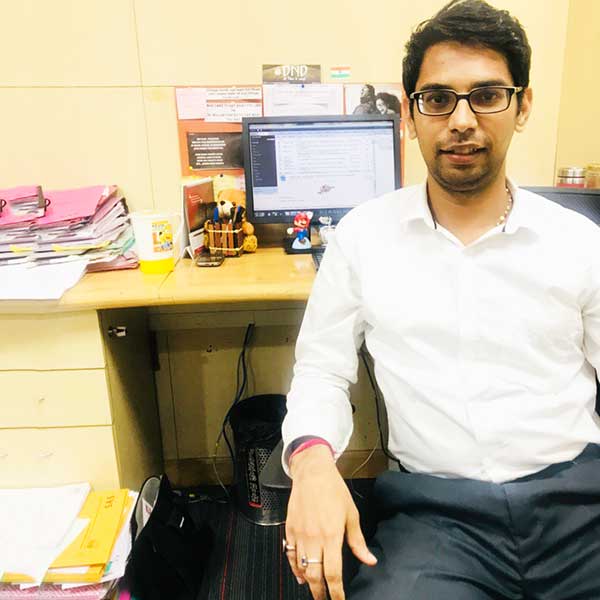
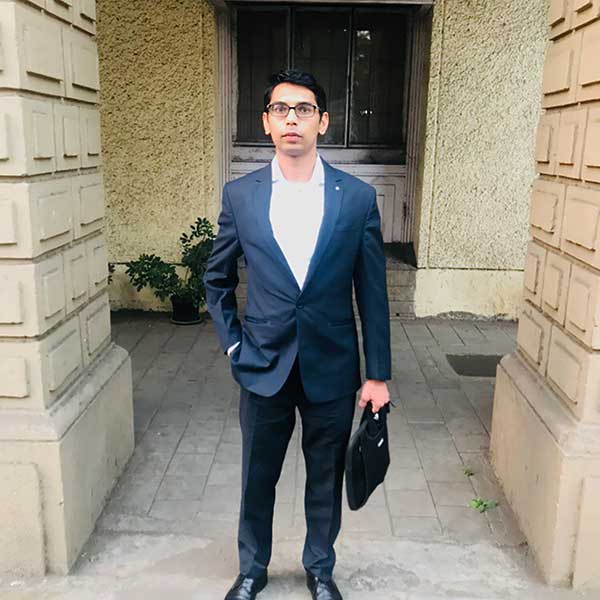
  • Pritam Ghosh, Assistant Professor, IFIM Law College, Bangalore on his journey and receiving the Henry Dunant Research Fellowship

    Pritam Ghosh, Assistant Professor, IFIM Law College, Bangalore on his journey and receiving the Henry Dunant Research Fellowship

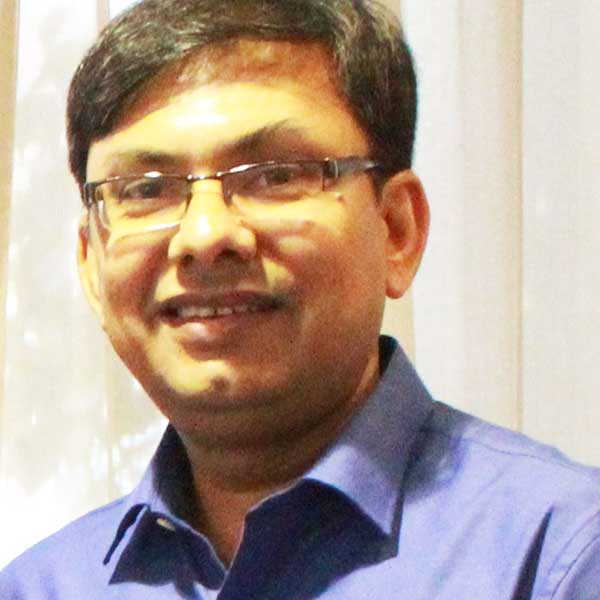
    Pritam Ghosh graduated from Symbiosis Law School in the year 2008. His deep interest in Political Science and Sociology made him gravitate towards law. Pritam always believed in understanding the nuances of any subject and by thinking beyond the text in a critical and analytical manner which led him to the field of academics. Currently, he is the Assistant Professor of Law (Senior Grade) with IFIM Law College, Bangalore and also a  recipient of the HENRY DUNANT RESEARCH FELLOWSHIP awarded by the INTERNATIONAL COMMITTEE FOR THE RED CROSS (ICRC), South Asian Regional Delegation. With seven years of academic and research experience Pritam has also been the Legal Editor for LexisNexis Butterworths Publications.

    In this Interview, Pritam shares his insights with Rounak Biswas of SLS, Pune on:

    • Henry Dunant Research Fellowship
    • His interest in academia
    • Being a prolific writer


    TELL US A BIT ABOUT YOUR CHILDHOOD AND PRE-COLLEGE LIFE AS WELL AS EDUCATIONAL BACKGROUND.

    Growing up in a nuclear family I was brought up by my parents in a liberal yet traditional manner. They made it a point to inculcate all the basic Indian as well as Bengali traditions, values and intellect in me and above all taught me to be a good human being. I was educated in Calcutta Boys’ School and Sri Aurobindo Institute of Education which happen to be two of the best english medium schools of the city even today. I was also taught how to maintain a balance between academics and personal life which helped me to have my fair share of fun and frolic along with studies as well. My pre-college background in Humanities at the 10+2 level was one of the major reasons that was going to influence my decision to study law later in life.


    HOW DID YOUR INTEREST GRAVITATE TOWARDS LAW?

    It needed a suggestion from my father and his bringing the prospectus of WBNUJS, Kolkata home that sparked my interest towards law and made me deviate from my original choice of studying Psychology (Honours) at the undergraduate level. Also, my interest in Political Science and Sociology in school and orientation from my teachers who told me that these two subjects which I had already done form the basis of law, was another major factor influencing my decision to do law.


    WHICH AREAS OF THE LAW FASCINATED YOU THE MOST AS A LAW STUDENT?

    (Pritam completed his BBA., LL.B (5 years integrated) from Symbiosis Law School, Pune in 2008.)

    During my undergraduate education, I was extremely fascinated with information technology law, international law, criminal law and constitutional law which are areas of teaching and research interest for me even today. I went into the in-depth study of these areas of law by referring to some of the best books and articles written on these subjects including the diploma material on cyber law prepared by the Asian School of Cyber Laws, Pune. Referring to such scholarly materials helped me to understand the nuances of these subjects and also to start thinking beyond the text in a critical and analytical manner.


    DO YOU FEEL THAT THE LEGAL PROFESSION HAS SIGNIFICANTLY CHANGED FROM THE TIME WHEN YOU DECIDED TO STUDY LAW?

    Indeed, the legal profession has changed significantly as compared to my times. The average law student today possesses a sound basic understanding of law right from semester I of the LL.B course and does not take time to find his feet unlike our times. Also, today’s law students are extroverts who realise the importance of networking in the legal industry as well as the positive effect of staying updated on current legal profession. This has changed the way law students study law both inside and outside the classroom. As a result, the boundaries of the teaching-learning process are constantly stretched which requires even teachers to update themselves even more than what was the case fifteen years back during my times.

    Two other positive changes that have come about in the legal profession during the last few years is the use of Information and Communication Technology (ICT) in law teaching and the legal profession generally. Legal information is available these days in digitised format either on the internet or in research databases in a soft format which helps lawyers find instant solutions to their problems online as well as helps teachers like me in making a law teaching session more lively and interesting. The use of ICT has ensured that law teachers can no longer afford to be one-dimensional as apart from teaching what the law is, they also have to teach students the places where the law can be found such as websites, search engines and research databases.

    The other most important change in the recent times in this profession has been the opening up of newer avenues and job profiles such as that of legal editors, legal journalists and startup lawyers who constitute the seemingly off-track branch of the legal profession. This has ensured more job opportunities for fresh pass outs at the entry level as opposed to the conventional practice in the courts of law or law firms that were the only two options during our times.


    BEING THE INTERNSHIP AND PLACEMENT COORDINATOR FOR THE LAST TWO YEARS, HOW RELEVANT ARE INTERNSHIPS FOR A PRESENT LAW STUDENT?

    Internships are extremely important for any law student as they help all law students to get exposed to the practical side of law and also to find out the application of law in real life. However, internships should be planned and executed very carefully by all law students as they help a student to decide about the future options for employment after completion of one’s undergraduate or graduate studies.


    HOW DID YOU DECIDE TO GO INTO ACADEMICS? WHAT WOULD BE YOUR ADVICE TO THOSE LAW STUDENTS WHO WISH TO GO INTO ACADEMIA BUT ARE INSTEAD FORCED TO OPT FOR OTHER FIELDS THAT ARE CONSIDERED MORE LUCRATIVE?

    (Currently, he is the Assistant Professor of Law (Senior Grade) with IFIM Law College, Bangalore.)

    I was oriented and influenced towards making a career in academics during my stint as an LL.M. student at the West Bengal National University of Juridical Sciences (WBNUJS), Kolkata as I discovered that I have the happy knack of discovering new and innovative information in research and also liked delivering presentations and seminars before a large audience which happens to be the basic method and characteristic of law teaching.

    To aspiring law teachers and academicians, my message would be that it is a popular misconception that teaching is not a lucrative profession as long gone are the days of being paid peanuts in academics. Moreover, the 21st century law teacher has several options of earning a fortune by expanding their horizons, acquiring additional skills and knowledge outside one’s basic area of specialisation and trying out new avenues of legal research as well as business such as venturing into online legal education. Academics is a profession which does not leave one exhausted at the end of the day and depending on personal interests, allows law teachers to take up additional employment and business opportunities on a part-time basis as well thereby ensuring good inflow of income as well as substantial contribution to the society.

    However, all law students aspiring to take up academics as a full-time profession need to possess the right kind of attitude and aptitude and also need to realise that teaching is the most difficult profession on this planet earth as this is the only profession where right from day one, teachers have to assess the work of people who are much junior to them in terms of age, experience and maturity. Therefore, this profession is only meant for people who are confident that counselling and orienting is their passion and who have loads of patience to deal with teenagers and adolescents of immature age and understanding. For instance, at times a question asked to a teacher by a student of the first year of an LLB course may seem very childish and foolish, but the teacher should never forget that the question is important for the student as it was posed to clear a doubt and gain knowledge about something.


    HOW DO YOU FIND TIME TO WRITE SO MANY SCHOLARLY ARTICLES?

    (Has also authored a book titled “Prevention of Torture on Detainees by Armed Forces Personnel: Global and Indian Perspectives with Special Reference to the efforts of international organisations” which was released from Germany by LAMBERT ACADEMIC PUBLISHING CO.)

    One of my teachers told me that a teacher who does not publish is no teacher at all. Keeping this important lesson in mind, I always make it a point to read up more and publish my personal opinion on all contemporary issues of law as it helps me to build on the knowledge base and thereafter encourages me to take the additional knowledge gained, to the classroom to be disseminated to students who are always hungry to acquire more knowledge. Personally, I prefer publishing rather than engaging in plain debate and discussion which at times knows no end. So far, I have always used up the time I got during the mid-year semester breaks and vacations at my workplaces to publish at least one research paper on a contemporary issue. Also, this book is a refined and upgraded version of my LL.M dissertation thesis, the publication of which will help me in future to gain more leverage on my work and is also a basic requirement to get international exposure relating to the subject areas involved in the publication. This advise was given to me by a senior colleague of mine for which I am extremely thankful.


    HAVING A  TOTAL OF SEVEN YEARS OF ACADEMIC AND RESEARCH EXPERIENCE INCLUDING LEGAL EDITOR FOR LEXISNEXIS BUTTERWORTHS PUBLICATIONS; PLEASE SHARE SOME OF YOUR EXPERIENCES.

    My experience can be broken up into six years of teaching and one year of corporate experience which has given me exposure to both the theoretical and practical sides of law. Working as a legal editor was particularly beneficial for me as I developed a habit of reading everything with a hawk’s eye and has helped me to take editorial positions with law school journals later on in my life. My professional experiences have taken me across the length and breadth of India into six different cities thereby giving me the opportunity to interact and build on my professional network and a chance to teach students from diverse backgrounds thereby allowing me to gain popularity and make a lot of friends among the student community. I have enjoyed every bit of my career so far and have earned a lot of respect and good wishes of people which has taken me higher in life. I have particularly enjoyed my role as an internship and placement coordinator and career counsellor as this additional responsibility has helped me to discover another side to my personality. I have realized that the more confused students are, the better it is for me as I love to orient and motivate people who are the so called underdogs or the confused lot. I can proudly say that to this point I have successfully oriented and helped many towards making a good CV and choosing the ideal career option.


    WHEN WOULD YOU SAY THAT AN ACADEMICIAN IS SUCCESSFUL?

    The answer to this question has to be given in a different manner. An academician may consider himself successful only when his or her work and contribution to the society as well as to the existing literature is remembered even after his or her death. They may not live to see the effect of their pioneering contribution, but people will always remember them and they will be revered and respected in academic circles. For this, the primary aim of an academician’s career should be to invent or discover something which no academician would have done before and also to constantly get their new scholarly work published for the world to know. Academicians should aim to make pioneering contributions to their areas of expertise so that people remember them as authoritative figures and their scholarly contribution leads to more fruitful research.

    In order to achieve the above objectives, teachers should constantly think about personal development and skill development rather than only restricting their activities within the classroom. A law teacher especially should think about ways in which to get practical exposure and to utilize the knowledge gained through such exposure to enrich the student community as well as to be known as an academician who has the ability to turn academic debate into action.


    WHEN WOULD YOU SAY A LEGAL ACADEMICIAN IS READY TO START WRITING BOOKS?

    A legal academician should not attempt to write books without gaining at least five years of work experience and also sufficient exposure to the theory and practice of law as writing a book involves exercise of one’s intellect at an extremely advanced level, a solid understanding of legal research methodology and the technique of compiling information in hard format by penning down one’s thoughts and personal opinion. Moreover, one needs to possess sufficient amount of critical thinking ability to go beyond the existing literature and formulate new opinion for it to find proper place in a book.


    YOU ALSO APPEARED BEFORE THE HON’BLE KARNATAKA HIGH COURT IN A WRIT PETITION UNDER ARTS.14, 19(1)(G) AND 21 OF THE CONSTITUTION OF INDIA CHALLENGING THE IMPOSITION OF GST BY THE CENTRAL GOVERNMENT ON HIGHER EDUCATIONAL INSTITUTIONS WHO OUTSOURCE THEIR AUXILIARY SERVICES. HOW IMPORTANT WAS THIS MOVE IN THE CURRENT SCENARIO?

    I am extremely thankful to the management at my current workplace for giving me this opportunity to get hands-on experience of the practice of law for a brief period while being on the job. The current result of this petition is that the finance ministry of the Central Government is now thinking about imposing GST on all private educational institutions as a whole without making any sub-categories or discriminating among private higher education institutions only on the basis of who outsources their auxiliary services and who does not. Thus, looking back now, the filing of this petition was an extremely important bold and timely move as well, as it has now got the government thinking and has created awareness among other private higher education institutions. The cause has also been supported by the Education Promotion Society of India (EPSI) which has been pursuing the matter with the Central Government for quite some time now.


    YOU ARE A RECIPIENT OF THE HENRY DUNANT RESEARCH FELLOWSHIP AWARDED BY THE INTERNATIONAL COMMITTEE FOR THE RED CROSS (ICRC), SOUTH ASIAN REGIONAL DELEGATION. PLEASE GIVE US AN INSIGHT TO THIS PRESTIGIOUS MILESTONE.

    I am thankful to my guide Prof. Manoj Kumar Sinha, who is currently working as the director of the Indian Law Institute in New Delhi for encouraging me to apply for the fellowship and also Dr. Sanoj Rajan who is currently working as the director of the School of Law, Ansal University, Gurgaon. He was the then head of the academic division at the ICRC, New Delhi Office and helped me in securing the fellowship. The addition of the fellowship in my CV has helped me to realize my aspiration of specializing in a new and contemporary branch of Public International Law, i.e. International Humanitarian Law and has helped me to publish in the area in combination with the other area of interest I have, i.e. information technology law/internet law.


    WHAT WOULD BE YOUR MESSAGE TO THOSE HARDWORKING LAW STUDENTS WHO DID NOT MAKE IT TO A TOP NLU BUT WANT TO EXCEL IN THE PROFESSION?

    My message to such students would be not to lose hope as all is not lost. Having studied in both the private law school and national law school systems and after having analysed both systems thoroughly as an academician, I have understood that the only criteria that distinguishes national law school and private law school students is exposure and fluency in English. Therefore, all law students studying in private institutions should constantly strive to keep enhancing their CV by participating in more co-curricular and extra-curricular activities, attend seminars and conferences on contemporary issues and most importantly have 2-3 publications during their undergraduate study on various issues of law that they may like to read and research about. They need to identify the areas of law that they like the most and build on those areas with publications and other activities focusing on those areas. Also, these students need to take their internships very seriously and try to repeat their internships in the same organisation, in case if they get through into an organisation that makes students learn the basics of court procedures and the general practice of law.

    Apart from reading the textbooks of law, every student studying in a non-NLU institution should try to improve their fluency in English by completing at least one novel or story book in every semester of the law course which means that they would have read ten good books by the end of the five years integrated LL.B course.




  • Ankur Deka Rabha, Head Legal, Essilor Group, on his role and responsibilities, struggles of a first generation lawyer

    Ankur Deka Rabha, Head Legal, Essilor Group, on his role and responsibilities, struggles of a first generation lawyer

    Ankur Deka Rabha graduated in law from NLSIU, Bangalore in 2002. Having experience of more than fifteen years in the legal industry, Ankur is a versatile and result oriented leader with global exposure to diversified business strategies. He was the General Counsel- India at Bosch Limited for over a period of seven years and then had a brief stint as Head – Legal and Contract Management at Alstom Transport Limited. Currently, he heads the legal department of Essilor Group striking a balance between growth and compliance through innovative ideas to enable business.

    In this interview, Ankur answers to Rounak Biswas of SLS Pune the questions posed by Shafina Salahuddin of Calcutta University focussing on:

    • Being a first generation lawyer
    • Challenges in early years of practice
    • Roles and responsibilities as Legal Head of Essilor Group
    • Importance of conciliation for dispute redressal


    HOW WOULD YOU LIKE INTRODUCE YOURSELF TO OUR READERS?

    A lawyer driven by passion for his work and still eagerly learning each day in order to be a better business lawyer.


    WHAT MOTIVATED YOU TO PURSUE A CAREER IN LAW?

    I do not come from a family of lawyers. I am a first generation lawyer. During the late nineties there were not many career opportunities for students in Guwahati besides courses like engineering or medical or the remaining alternative of the quintessential three-year degree course. Hence, once I completed my higher secondary, I was looking for course other than medical and engineering, so law became an obvious choice. It was also because my friends were already studying there. That’s how I got into NLS.


    HOW INSTRUMENTAL WAS NLSIU, BANGALORE IN SHAPING UP YOUR LEGAL CAREER?

    I remember my years in NLS as a period of learning law, diversity, people, cultures etc.

    There was a paradigm shift in my thought process and the way I saw and perceived things before and after I joined NLS.  What I liked about most is that teaching methodology was not theory centric but practical learning. It makes you think, question and rationalise. As a student, it was an exciting journey of learning and nurturing my skills on research, writing, oratory skills, rationalising and analysing the law. These things definitely helped me nurture the basic skills required as a legal professional.

    Of course it is humbling to be part of such a great institution but one thing I realised when I started my career was that an institution can only help to nurture you, the rest is up to you to make what you want of yourself and succeed professionally. 


    WHAT WERE THE CHALLENGES YOU FACED IN THE EARLY DAYS OF YOUR PRACTICE?

    To be honest, the initial challenge was not about law but about trying to sustain myself in a big city like Delhi with a meagre income and also find good seniors to work with. But I was resilient and persistent and carried on with the belief that it will bear fruits in future. I think this the period I realised my strengths —patience, resilience and self-belief and taking on challenges.

    I was fortunate to have very good seniors who taught me a lot. One of them told me something which I still remember, “always see every challenge as an opportunity rather than a hurdle and grab it. If you are not quick enough, someone else will take it”. Although I only had a short stint as a litigating lawyer as I shifted to the corporate side soon due to personal reasons, I did thoroughly enjoy it and had great learning experience. For me litigation is not always about just law and arguments, it is also about strategy.

    My experience as a practising lawyer does help me manage situations as an in-house counsel. I realised that litigation is not the first option to suggest to an internal customer even though it’s the only option which they might desire. Sometimes it’s a question of egos not as much of a case of dispute which cannot be resolved across the table. We as in-house counsels have to understand business and appreciate that any kind of litigation involves costs and man hours and basically affects the bottom line in a business. We need to explain the same to our internal customers so that alternate solutions can be explored and we should facilitate that. I have always pushed for alternate methods of conciliation and been successful in resolving many high value disputes without going to court during my short professional career.


    WHAT IS YOUR OPINION ON FAILURE? IS IT ACCEPTABLE TO YOU?

    Of course there is no alternative to hard work and yes performing well can sometimes can be stressful. However, I personally feel it is very important, whether as a student or as a professional, you are passionate and enjoy what you do. We stress ourselves so much for what we don’t have that we forget to appreciate what we have at present.

    We have to understand that success and failure are part of life. Mr. Ratan Tata said “Ups and downs in life is very important to keep us going, because a straight line even in an ECG means we are not alive”.

    Basically, what is important here is how you see things. It’s all about perspective. Life is neither constant nor should you want it to be because if you do then you will never experience something new and learn from it.

    Therefore, I think it is important to experience failure sometimes because such instances can only make you stronger and wiser. The main thing is to be resilient and not give up. One only fails when one gives up trying. If you want to grow not only should you have the courage to fail but also have the courage to look at it positively and learn from your mistakes. It is then called an experience!


    WHAT ARE YOUR ROLES AND RESPONSIBILITIES IN YOUR CURRENT POSITION?

    One of Essilor Group’s core principle is “respecting laws by applying high standards”. My management is fully aligned and committed to this principle and I am fortunate to have great support (not only from India but also from AMREA headquarters in Singapore) where the tone is set from the top in order to enable the organisation to be a responsible and compliant corporate citizen.

    In my role, my first and foremost responsibility is to assist in implementing strong internal compliance mechanisms and processes. On a day to day basis, it is mostly contracts, FDI related issues and general corporate advisory. I act as a business partner to find simple solutions for complex issues through innovative ideas. I

    Over the years working as an in-house counsel in various organisations what I have learnt is that it is really important to reach out to internal customers if you want to bring change and contribute to business growth. If we sit in our chairs and expect internal customers to come to us, then nothing will happen. At Essilor, Legal & Secretarial team goes that extra mile to reach out to internal customers, interact with them on a regular basis across India to build trust for partnership.


    HOW WAS YOUR EXPERIENCE WORKING WITH LAW FIRMS AND HOW IS  DIFFERENT IS FROM YOUR CURRENT ROLE?

    Well, being in law firms during my initial years was more about drafting and documentation rather than direct client facing and negotiations. Also, role was usually watertight and didn’t have any scope to venture into other areas of law. For example, if you were in a corporate group you would be mostly doing just that and would not be handling issues of litigation or IP etc.

    As an in-house counsel, the equation is quite different. It is basically a client facing role on an everyday basis.

    First and foremost, it is essential to understand the business before delving in on its problems. If you cannot understand the business you cannot make necessary provisions in your contracts. Being proactive and visible is also essential to maintain balance between compliance and business. I have always supported the idea of my colleagues providing trainings on various issues, distribute Do’s and Don’ts, SOPs etc., to ensure that they are visible to the internal customer and there is trust built for future cooperation.

    My role as an in-house counsel has been a journey of every day learning and there is always something new to do and something new to learn every day. I realised early in my career as an in-house counsel that it is not just about law but about finding possibilities to assist business and growth and at the same time also being strong to say “No” when its actually required and still have buy-in from your internal customers.

    Being an in-house counsel you also need to be a generalist in addition to your specialised subjects as you need to advice the management on all issues of law.


    WHAT WOULD YOU ADVICE YOUNG LAWYERS ON WORK-LIFE BALANCE?

    Speaking only from my personal perspective, even today I see a lot of people having the wrong notion that their organisation or bosses will think they are hardworking and dedicated only if they sit and work late hours on weekdays and even weekends. Yes, hard work is important for success but then you can work smart as well. For me if someone sits late hours every day and I know there is not much to do, then there is definitely a problem with time management.

    As a professional, amongst others, time management and punctuality is very important. We should plan our day (for example, divide your time, prioritise work) in advance. With little checks and balances I feel one can always manage between work and home.

    I have always ensured my colleagues understand the value of time whether at work or at home. A stress free mind can innovate/ think out of the box or else we will only end up having robots which can only do what it’s programmed to do and not innovate or think out of the box.

    Although it’s not easy when you begin, but it is important to first understand business of your organisation and align your department goals to that of the organisation, build a rapport with your internal customers, understand and anticipate their requirements, train them to take care of minimum risks, have SOPs for all kinds of transactions, draft templates etc. All this goes a long way in giving you a cushion required to ensure work life balance.

    At the end of the day, it’s left to an individual or a team to make it happen. No one else can do it for them.


    AS A PARTING MESSAGE, WHAT WOULD BE YOUR ADVICE TO OUR READERS, ESPECIALLY ASPIRING AND YOUNG LAWYERS?

    I am still learning myself so I will only speak from my short experience so far.

    Firstly, learn to enjoy what you do and have fun. If you are passionate about what you do, then no one can stop you from achieving your goals.

    Secondly be a thorough professional. Learn to prioritise and manage your time early in your career. Be punctual. Do not compromise on your values. If you promise to deliver within a time to an internal customer/client, then make sure you deliver within that time. You can either create your image or ruin it.

    Thirdly, be humble. Be willing to learn and unlearn. Be willing to listen and observe to learn new things as opportunity lurks everywhere. Be willing to ask when you do not know. Be willing to pass on knowledge to those to seek.

    My advice to budding lawyers who want to make their career as in-house counsels is to first start their career by practicing law and then maybe spend some time in law firms before actually shifting to an in-house role. Of course financial stability could be an issue in the beginning but then it’s an investment which will surely give your benefits in the long run. In a corporate world you have to deal with everything. Hence, overall knowledge in every aspect is a quintessential requirement.


  • Archana Tewary, Partner, J. Sagar Associates, Bangalore on managing time between work and motherhood

    Archana Tewary, Partner, J. Sagar Associates, Bangalore on managing time between work and motherhood

    Archana Tewary graduated from University Law College, Bangalore University in 2008. Being a very vocal, communicative person with a strong sense of fairness, Archana always knew law was her true calling in life. Back in college she had a great fascination for company law which led her to become a corporate lawyer.

    She worked at Crawford Bayley & Co. with Mr. Sanjay Asher for the first few years of her career and then joined JSA after moving to Bangalore post her marriage. Currently, she is a Partner at the firm and works in private equity, mergers, acquisitions and general corporate work.

    In this Interview, Archana shares her insights with Rounak Biswas of SLS, Pune on the topics raised by Shafina Salahuddin.

    • Her role and responsibility as a Partner at J. Sagar Associates
    • The importance of internships during law school
    • Maintaining work life balance


    HOW WOULD YOU INTRODUCE YOURSELF TO OUR READERS?

    I am a corporate Lawyer and a partner with JSA, Bangalore. I would also describe myself (in no particular order) as a mother, bookworm, feminist, homemaker and foodie among other things.

    Born and brought up in Bangalore, I have lived here for most of my life. My childhood was very happy and typical to someone born in the 1980s. It was filled with books, words, and the freedom and time to pursue my fancies. There was a strong emphasis in my family, on education – not just earning good grades, but learning the skill sets I would need to be a strong, independent person. My family (including my extended family) has great role models across generations, and this has greatly influenced the person I am.


    HOW DID YOU COME TO TAKE UP LAW AS A PROFESSION?

    I have always been a very vocal, communicative person with a strong sense of fairness and that has led me to law, and where I am today.

    In my pre-university education I was a science student, and the training and courses were aimed at taking up engineering or medicine as a profession. However, I knew I would not be happy in either of those professions, and thought I might enjoy practicing law. Although in hindsight I realise that when I took the decision to study law, I did not know what the profession would actually involve, I am grateful that my decision was right nonetheless.

    I studied law at University Law College, Bangalore University. The course structure allowed me to do internships and moot courts. This led me to interact with a lot of practicing advocates and professionals, which was very important as it helped me make conscious decisions regarding my career.

    I have greatly enjoyed studying law and being a corporate law professional. As a student, for instance, studying Constitutional Law and some of the case laws led me to think about human values, life and dignity. I was very happy to be studying subjects which could do that. As a corporate lawyer, I found myself seeing concepts I had studied in hypotheticals in college, being applied in real life. If I had found reading company law a bit dry when I was a student, I found it immensely interesting when working, because of the details.


    DO YOU BELIEVE THAT CURRENTLY THERE IS A BIAS OF THE REPUTED LAW FIRMS IN INDIA TOWARDS THE NLU STUDENTS?

    I have not, personally, seen such a bias within JSA. I believe the college / university does not matter, if one has strong fundamentals and the ability to learn quickly.

    Not in my experience, but there are some aspects which could be improved upon in “non-NLU” colleges. Speaking from personal experience:

    • There was a great deal of focus on litigation in college, and hardly any emphasis was given to corporate law. This would probably be very unfair to students, who would need to take the initiative to find out about corporate law and practice by themselves. Equal emphasis should be given to all professional options.
    • The absence of a strong alumni association did feel like a disadvantage, though it must be said that the seniors in college and the alumni I interacted with as a student were very encouraging and helpful. A strong and formal association which would help with internships, placements, job opportunities, etc., would have been very good.
    • When I started working, I realised that a number of the concepts and subjects which were vital to working in corporate law firms were almost ignored in colleges. The teaching needs to be made more practical and oriented to what a law student would need to know, when she starts working.


    WHAT IMPORTANCE WOULD YOU ASSIGN TO INTERNSHIPS?

    In my student years I choose consciously, to intern with a human rights organisation, a civil court lawyer, a high court lawyer / senior counsel, an in house team and a corporate law firm. This gave me some amount of insight into how each of these organisations functioned, and helped me in making my decision to work in corporate law firms.

    WHAT QUALITIES DO YOU BELIEVE HELP LAW STUDENTS GET A JOB?

    Confidence, diligence, common sense and the willingness to work hard. You also need to be ethical and sincere right from the beginning, because these will define the decisions you make.


    TELL US ABOUT YOUR WORK IN CRAWFORD BAYLEY & CO.

    I worked at Crawford Bayley & Co. with Mr. Sanjay Asher for the first few years of my career, after I interviewed with him for an associate’s position. It was an opportunity to learn on the job and grow as fast as you can. I learned to think on my feet, find practical solutions to issues but also, to work hard. Working in capital markets made me detail oriented and capable of multitasking.


    WHAT PROMPTED YOU TO MOVE TO JSA?

    I had interned in JSA and knew it would be a great place to work. After marriage I moved to Bangalore and was lucky to be offered an opportunity to work at JSA, with Mr. Vivek Chandy as my mentoring partner. My experience at the firm has been rewarding and my everyday interaction with my colleagues has made me a better person, which I think is a truly remarkable thing. I have been fortunate to work in a firm where I have not faced discrimination due to my gender or any other factor, and hard work has been recognised without bias.


    WHAT ARE YOUR PRACTICE AREAS?

    I started my career working in capital markets. When I moved to Bangalore, I got more exposure in the practice areas of private equity, mergers and acquisitions. Due to my interest in corporate law, I also enjoy working in general corporate matters. In terms of sectors, a lot of my work has been in real estate and e-commerce. The practical nature of private equity work appeals to me, and the manner in which every party to a deal have to balance their own interest with that of the others makes the work interesting. Every transaction has its interesting moments.


    AS A PARTNER OF JSA, BENGALURU HOW DO YOU MAINTAIN THE WORK-LIFE BALANCE?

    This is a skill I am still learning, and the most important lesson I have learnt is to not be rigid and allocate time, depending on what is a priority. Especially as a woman and a young mother, I am constantly trying to balance the various matters which require my attention and involvement, and the only way I am able to get by is to focus on what is important and urgent, and to rely on my colleagues at work and my family at home.


    WHAT IMPORTANCE WOULD YOU ASSIGN TO MENTORSHIP IN ONE’S CAREER?

    I have learnt from my partners and colleagues at all stages of my career, particularly from the partners who have trained me. In my work, I can easily recognise the manner in which they have influenced my approach and thinking. However, instead of looking for a mentor, it would be better to keep an open mind and absorb learnings from everyone around you.


    WHAT ADVICE WOULD YOU LIKE TO GIVE OUR READERS?

    Please choose the path you want your career to take carefully. If you are going to spend half your life doing something, let it be something you will love doing on a daily basis. Please be grateful for the opportunities you have and take pride in what you are doing. This will show in the quality of your work. Wherever life may take you, please try to be humble.


  • Prasenjit Keswani, Advocate, on establishing independent practice and his diverse experience

    Prasenjit Keswani, Advocate, on establishing independent practice and his diverse experience

    Prasenjit Keswani graduated from Campus Law Centre, University of Delhi, in 1999. With over eighteen years of experience in litigation, he has handled a variety of matters in different forums including the Supreme Court, Delhi High Court, National Green Tribunal and National Consumer Disputes Redressal Commission.

    In this interview we speak to him about:

    • His early years as lawyer in litigation practice
    • His experience in various courts
    • Building independent practice


    HOW WOULD YOU LIKE TO INTRODUCE YOURSELF TO OUR READERS?

    I am a lawyer with eighteen years of experience practicing before the Supreme Court of India, Delhi High Court, NGT and NCDRC. I have my own practice which includes work from direct clients as well as briefing from law firms and individual lawyers.


    WHAT MOTIVATED YOU TO PURSUE A CAREER IN LAW AFTER DOING BACHELORS IN BUSINESS STUDIES FROM DELHI UNIVERSITY?

    BBS was a unique course by the Delhi University offering Bachelors degree in Business Administration. We had various subjects relating to Business Laws, which included subjects like Contract Act, Companies Act and regulatory compliances. This got me interested in law.


    HOW WAS YOUR EXPERIENCE AT CAMPUS LAW CENTRE , DELHI UNIVERSITY?

    Campus Law Centre had a good course structure and some of the professors were prominent personalities in their field and hence attending their classes was a great learning experience. Also, it was a lot of fun being in North Campus.


    WHAT ARE YOUR AREAS OF INTEREST?

    My areas of interest are constitutional law, commercial laws and alternative dispute resolution.


    HOW DID YOU DECIDE TO CHOOSE LITIGATION OVER TAKING UP A CORPORATE JOB? HOW WERE YOUR EARLY YEARS AS A LAWYER?

    In 1998, I joined a law firm AP& J Chambers as an intern. In fact my intent was to work as a corporate lawyer. The firm also had Supreme Court litigation and I started attending Court, which got me interested in litigation and immediately after graduating in 1999 I joined APJ and started working on the litigation side. I worked in AP & J Chambers till 2003. There was lot of independence and it was a happy work place. Handling matters independently was tremendous learning experience and I got opportunities to appear on my own in firm matters. I was quite fortunate to have good mentors at the initial stage of my career Mr. Joseph Pookkatt and Mr. Prashant Kumar, Partners of APJ and thereafter my senior Justice Uday Lalit.


    YOU WORKED UNDER THE GUIDANCE OF JUSTICE U.U. LALIT IN THE EARLY YEARS OF YOUR CAREER. HOW WAS THE EXPERIENCE OF WORKING WITH HIM?

    It was a tremendous learning experience. He was very interactive and he would discuss with his juniors at length, the different facets of law. While in his chamber one got to understand how to approach a brief and understand the finer aspects of law. It was an intellectually enlightening experience. In his chamber we would get diverse and important matters, which gave us excellent exposure. I worked with him for seven years before starting my own practice.


    HOW IMPORTANT IS IT TO HAVE A MENTOR FOR A YOUNG LAWYER IN THE EARLY YEARS OF THE PROFESSION?

    It is very important to get a good mentor more so when one does not have a background in the legal profession, like I didn’t have. I got very good mentoring from my seniors. In the early stage of ones profession it is important for young lawyer to get the self-confidence and self-assurance, which a good mentor can give his juniors. It is also important to develop the skill set in the legal profession as also the right value system.


    WHAT WERE THE STRUGGLES THAT YOU FACED IN BUILDING YOUR INDEPENDENT PRACTICE?

    Any lawyer would tell you that there are no shortcuts to success or developing a practice. Coming into the profession without a background was a struggle to get cases. I was lucky that my sister Advocate Avantika Keswani was two years senior to me in the profession working with Karanjawala & Co., so I was able to get acquainted with the profession because of her and I got my first internship because of the ground work she had laid down in the profession.

    It took me two years to get my first independent Supreme Court case but by then I had international commercial arbitration that helped me tide over the struggles of the initial years.

    If you stay sincere, people start coming to you with cases and lawyers from the High Court start giving you cases, which is very important for Supreme Court practice. At no stage in the profession there is any scope for laxity.


    WHEN YOU HIRE A JUNIOR, WHAT QUALITIES DO YOU LOOK FOR?

    As I said sincerity is the most important factor in the profession and any lawyer who is sincere and dedicated and takes pride in his work as a professional is bound to do well. So, these are the qualities that I look for in a junior.


    HOW IMPORTANT ARE INTERNSHIPS FOR A LAW STUDENT ?

    I think an internship is very important as it exposes a law student to the manner in which the profession works and it also helps him or her to identify their area of interest. Further, in an internship I assign work to the interns so that they can also develop practical skill set like drafting, researching which is usually not covered in the legal curriculum.


    THERE IS A LOT OF DISCUSSION ABOUT NATIONAL LAW SCHOOLS AND TRADITIONAL LAW SCHOOLS. WHAT’S YOUR TAKE ON IT?

    National Law Schools have definitely brought about a lot of professionalism in the manner law education is imparted. However, even the traditional law schools like ILS Pune, GLC Mumbai etc., have always had a good environment and we see their students doing very well. Ultimately, I think it depends on the student on how to take benefit from his curriculum and teachers to learn and develop as a lawyer.


    PLEASE TELL US ABOUT ONE MATTER THAT YOU HAVE WORKED ON THAT HAS LEFT A LASTING IMPACT.

    An important case in my career was the Indian Hotel & Restaurant Association Vs. State of Maharashtra case also known as the Bombay Dance Bar case. This case allowed me to apply the principles of constitutional law to a fact situation, like right to livelihood and privacy embodied in Article 14, 21 and 19(1)(g) of the Constitution. Apart from being a prominent case, it was also a good learning experience.

    Another case, which was an important milestone in my career, is V. Subramaniam Vs. State of Maharashtra where I argued before the Supreme Court and got Section 69 (2A) of the Partnership Act as applicable in Maharashtra declared as unconstitutional.


    WHAT WOULD BE YOUR WORD OF ADVICE TO LAW STUDENTS WHO ARE ASPIRING TO LITIGATE AFTER GRADUATION?

    My advice would be to work with sincerity and to have an attitude to learn and develop your skill set as a lawyer. Money is important but initially the approach should be to learn and give your best to every task or case that you are working on.


  • Nilima Bhadbhade, Lawyer and Consultant, from being a practicing advocate to Associate Professor at ILS Pune and authoring several law books

    Nilima Bhadbhade, Lawyer and Consultant, from being a practicing advocate to Associate Professor at ILS Pune and authoring several law books

    Nilima Bhadbhade graduated from ILS Law College, Pune in 1982. She started her career as a legal practitioner in Pune District Court and later moved to academia. In this interview we trace her story from being a B. Com student to taking up law and finally moving to academia. She shares her experience as a lawyer, a writer and a teacher.

    In this interview we speak to her about:

    • Her interest in academia
    • Her stint in Pune District for twelve years
    • Her role as a member of the expert committee appointed to examine the Specific Relief Act
    • Being a prolific writer and authoring several law books


    WHAT PROMPTED YOU TO STUDY LAW AFTER COMPLETING B.COM FROM PUNE UNIVERSITY?

    I studied commercial laws, company law and taxation laws at the B. Com course. I liked these subjects, and grasped them better than other subjects.

    Both my grandfathers were lawyers, one practiced general laws in the Osmanabad district and the other practiced criminal law in Pune, and conducted sessions trials throughout Maharashtra. Although I did not have the opportunity to watch them in their practice, this background influenced my decision.

    I was just 18 when I completed B. Com and decided to join law. Career guidance was not in vogue then. Perhaps the decision to join law was prompted by a gut feeling, it was an impulse. But, I had full support of my parents.


    HOW WOULD YOU DESCRIBE YOUR EXPERIENCE IN DISTRICT COURT PRACTICE? WHAT FACTORS INFLUENCED YOUR DECISION TO LEAVE PRACTICE AND TAKE UP TEACHING LAW STUDENTS?

    (She practiced in the Pune District Court for twelve years.)

    I joined the chambers of Advocate V N Mysore. He worked from his chambers, mainly in the field of drafting, conveyancing and consultancy, and visited courts on rare occasions. He impressed upon me the need to observe and learn the nitty-gritty of litigation, and return to him later. That, he said, would give a better understanding of drafting and conveyancing work. I then joined the chambers of Advocate M P Bendre. In the new chambers, I learnt the elementary as well as fine points of advocacy.

    Civil trials are very specialised. Civil trials do not sound attractive. They lack the drama that one associates with criminal trials. Doing civil trials is not easy. One needs to master the fine aspects of the provisions of substantive law (often many laws) involved, and mould the facts of the case into that law, and design the case (pleadings, evidence etc) with a sound backing of the law of procedure (CPC, Limitation, Evidence, Registration, Stamp, Court fees etc.).

    One needs to be patient and steady. One needs to learn the fine aspects of pleadings. My senior always told us that cases can be won simply by presenting pleadings effectively, be it the plaint or the written statement. Learning pleadings requires the guidance of a guru. Examination of witnesses and cross examination was also very challenging. I enjoyed trial more than appellate practice.

    I taught law even while I practised. Teaching complemented practice. One understands a statute or law best when one studies it for the purposes of teaching. Making a provision simple enough for a class requires a deep understanding of that provision and the entire law, and the background in which the law operates.

    Later, I applied for a full time post, sailed through the interview at ILS Law College, and had to decide when I received the selection letter. That was a time when full time teachers could practise if they wished. I did not intend to leave practice. I continued practice for a while, but finally discontinued it as I got more involved in designing and organising co-curricular activities in ILS Law College.

    Much later, the Bar Council required full-time teachers to give up their licence to practice.


    YOU HAD AN EXCELLENT ACADEMIC RECORD IN LAW COLLEGE. PLEASE TELL US ABOUT THE MANNER IN WHICH YOU APPROACHED ACADEMICS WHILE IN COLLEGE.

    I attended classes sincerely. I took notes from the lectures, and from books. I participated in all activities: moot courts, debates, magazine. The library provided opportunities to study and research. The amount received as prizes for topping the University each year went into buying good books on subjects I liked. I had the entire Mulla collection while I was a student.

    Good performance cannot happen without a desire to do one’s best in whatever one does.


    WHAT IN YOUR OPINION SHOULD A LAW STUDENT KEEP IN MIND WHILE CHOOSING A PARTICULAR DOMAIN OF LAW TO PURSUE A CAREER IN THE SAME?

    The current generation of students are fortunate to have so many career options, in terms of nature of work, and opportunities.

    I suggest: Follow your dream. Understand it well first.

    A little introspection can help understand one’s own strength. Am I good at research? Do I write well and effectively? Am I articulate in my expression? Do I have the ability to garner ideas and assemble them? Do I have a head for figures, and for accounts? Am I good at thinking in the abstract? Do I like to solve problems and find solutions?

    All these are different abilities. As a teacher, I found that students have different abilities. I encouraged them to locate their own abilities, and strengthen them first. Then locate those abilities that need strengthening, and work towards developing them. Locating one’s ability will help in the career decision.

    The other aspect is locating one’s goal, in terms of a career and in life generally. It is a good idea to explore and observe persons working in different careers, whether through internships, or just visiting courts. Vacations are useful for this exercise.

    Through the various activities I coordinated at ILS, I attempted to persuade students to join litigation, particularly at trial level. Such litigator is automatically also a consultant. That is the most challenging practice for a law professional. You are your own master.

    Being a judge is an excellent career option. Every year we organised a judgment-writing competition in our College. About 80 to 100 students of the last two years of each course participated. They all loved the experience. They experienced how difficult it is to judge. Judges who visited the competition always told the participants, that being a judge is a great intellectual exercise, and that those who seek intellectual challenges must aspire to become judges.

    I am happy that many of my students (ILS alumni) pursue litigation all over India, and a good number of them are judges.


     WHAT WERE YOUR AREAS OF INTEREST DURING YOUR GRADUATION AND HOW DID YOU GO ABOUT DEVELOPING EXPERTISE IN THEM?

    While in College, I liked family law most. I researched it extensively. I also wrote articles. My interest in contract and property law developed much later.

    How does one become an expert in a law. No one does. One only keeps developing and honing one’s expertise. One must love the subject. One must take keen interest in theoretical perspectives. History of that law gives important insights. One must know principles of interpretation of statutes. One must take keen interest in the contemporary issues in the subject area, or affecting the subject area of one’s interest. One must keep abreast of latest case-law, and developments of that law in other countries. A lawyer is always a student.


    HOW HAS YOUR EXPERIENCE BEEN AS A LAW PROFESSOR? WHAT ADVICE WOULD YOU LIKE TO GIVE TO YOUNG LAWYERS LOOKING TO MAKE A CAREER IN FIELD OF TEACHING?

    My best years have been in academics. It is good to be among the current generation of young persons. They are naturally tech-savvy. In that respect, they have guided me in using technology effectively. Sometimes I learnt from them, and very often they prompted me to learn. They knew about blogging, social networking before I did. Their questions in my IP Laws class compelled me to make friends with the internet.

    A career in teaching will be very satisfying. Each of your student recognizes you. You are bound to run into them in all parts of the world. They remember what you taught them. It is satisfying to receive an email from a student that he applied some principle based on what I taught him, or to get a call from another to tell me how she has preserved the notes she made in my class and uses them for reference.

    One enjoys the freedom of thought and expression as a teacher, more than any other person in the field of law.  One can participate in contemporary debates, express views freely in publications, and of course, on the internet medium, can critique the law and the legal system, and judgments of courts, and contribute effectively in development of law. When a teacher does this with a team of students, she shapes the next generation.


    WHAT WAS YOUR ROLE AS A MEMBER OF THE EXPERT COMMITTEE APPOINTED TO EXAMINE THE SPECIFIC RELIEF ACT?

    (She was a member of the Expert Committee set on examining the Specific Relief Act, 1963)

    I was appointed as a member of the committee appointed by the Ministry of Law to examine and make recommendations for amending the Specific Relief Act 1963, primarily to enable specific performance as a general remedy. The Committee submitted its report. The Government has moved a Bill based on the recommendations of the Committee. It has been passed by the Lok Sabha. It is hoped that the government will publish the report.

    My PhD thesis advocated that specific performance should not be an exceptional remedy, but should be available to anyone who seeks it. This was eventually published as a book titled : Specific Performance of Contracts: The Tests of Inadequacy and Effective Enforcement”. I am happy that my views were noticed, and I could participate in the process where these became part of legislative policy.


    HOW CHALLENGING IS THE TASK OF AUTHORING A BOOK? WHAT WAS YOUR APPROACH WHEN YOU STARTED WRITING AND HAS IT CHANGED OVER THE YEARS?

    (She has revised Mulla’s Indian Contract and Specific Relief Act and Halsbury’s Laws of India-Contracts and authored several books.)

    In the two books: Mulla’s book on Contract and Specific Relief, and Halsbury’s Laws of India (Contracts), I was a revising editor. It was an honour and privilege to be invited to revise them. I had to maintain the existing organisation and style of the two works. My task was to incorporate the latest developments into the works.

    While revising Halsbury’s Laws of India (Contracts), I took special effort to state principles laid down by Indian courts, and was pleasantly surprised to locate, revisit and state the tremendous contribution of Indian judgments on the subject.

    Authoring one’s own book is another task. The book on Specific Performance is different. It deals with contract remedies, and suggests that specific performance (and injunctions in matters relating to contracts) should not be exceptional remedy but available on the asking. It discusses the justification and limitations in adopting this policy. In its appendix, the book gives summary of some judgments relevant for the discussion. I developed my own style while stating these summaries.

    The task of writing a book is challenging. The contents and style depends on its audience.  When I plan to write a text book, and I will use plain language and many examples, mostly drawn from case-law. I will have to choose the most appropriate and relevant case-law that enunciates the principle under discussion. The challenge lies in the magnitude of research and collection of resource material, from India and other countries, and more in selection and expression appropriate to the readers for whom the book is written.


    YOU HAVE ALSO AUTHORED NUMEROUS LEGAL ARTICLES. WHAT ENCOURAGES YOU TO KEEP WRITING? WHAT ADVICE WOULD YOU GIVE TO LAW STUDENTS TO IMPROVE THEIR LEGAL WRITING SKILLS?

    My articles are my expression. There are times when a sudden idea comes to the mind. This has happened to me often while talking in class. An ‘A-HA’ moment that brings to mind  a thought worthy of further exploration, eg, a gap in the law. A question or discussion in the class opens a theme that can be explored. That urges: “I want to find out and say something about it”. A theme for an article is born. I have a list of such questions or themes, and hope to finish stating about them in the coming days.

    The internet is a wonderful medium. People from all parts of the world are able to read what I write, and also participate in a discussion. I was pleasantly surprised to receive an email from a former Justice of the Supreme Court, and another from a former Prime Minister of Bangladesh, stating that they read particular articles and liked them. My article about Stamp duty on Powers-of-Attorney Authorising Sale of Immovable Property that is confined to an amendment to the stamp law in Maharashtra has been viewed 12800 times. Another article about specific performance of development of contract has been downloaded 660 times. This is encouraging.

    Writing requires skills of language, thought and expression. Organising and writing an article consumes some time. The author must understand and digest the subject. He must put together thoughts and organise the content. It is important to avoid the temptation to copy-paste. An effective article must go through multiple drafts before the author makes it final. This applies equally to any well established and experienced author. An author will also be required to reorganise or rewrite some aspects in response to reviewers’ comments.

    My suggestion: Select a theme, decide that you want to write, and start. And be patient.


    WHAT CHANGES DO YOU THINK ARE THE ESSENTIAL IN CURRENT THE LEGAL EDUCATION SYSTEM OF INDIA?

    Legal education can be separated for two categories of professionals. Those who wish to become Advocates, i.e., practice the profession of law in courts, or before Tribunals or other authorities, and those who do not wish to so practice. The latter could be, for example, persons in employment, or working as consultants, or other professionals, who wish to specialise in a particular law with which they are engaged. The latter course can also be made available in the online or external mode.


     AS A CONCLUDING MESSAGE WHAT WOULD BE YOUR ADVICE TO THE CURRENT LAW STUDENTS?

    Be creative. Be original. Be healthy. Be wise. Be happy.


  • Rai Mittal, Partner, Titus & Co, New Delhi shares his diverse experience of 25 years in the legal profession

    Rai Mittal, Partner, Titus & Co, New Delhi shares his diverse experience of 25 years in the legal profession

    Rai Mittal graduted in Law from CCS University, Meerut in the year 1992. Originally being a B.Com student, reading a murder case in one of the law journals at his father’s office made him realize his that Law was his true calling. Back in the early 1990’s Law when Law was not as promising as it is now, Rai started his practice at Muzaffarnagar- his hometown. Later he joined Singhania & Co. Advocates as an associate.

    Currently, he is a Partner at Titus & Co, New Delhi where his work includes- advising clients, working on opinions, formulation of strategies, drafting, legal analysis, court and arbitration appearances and guiding and supervising associates and senior associates.

    In this Interview Rai shares his insights with Rounak Biswas of SLS, Pune on the topics raised by Mihika Gupta of NLU Jodhpur.


    How would you describe your journey as a lawyer?

    I am currently associated with Titus & Co. as Partner. Titus & Co. was set up in the year 1997 and I have been associated with the firm since the very beginning. Prior to that, I spent one year in district court litigation practice on civil, criminal, revenue and labour law sides and thereafter about three years with Singhania & Co. Advocates and with IP firm Lall Lahiri & Salhotra.

    Over the last 25 years, I have been involved in diverse assignments and areas of  practice including commercial and corporate litigation and arbitration, intellectual property matters, general commercial and corporate work, contracts, industry specific advisory work, mergers and acquisitions, legal due diligence matters, franchise and licensing, technology transfers, FDI, regulatory work, investigations and white collar crimes, tax disputes, banking and finance, infrastructure work and employment laws.

    I have had a keen interest particularly in commercial and corporate advisory work, dispute resolution, strategically advice on legal-commercial matters and intellectual property laws.

    I like to work with a problem solving approach, endeavouring to advise clients from a commercial and practical standpoint. Having worked on a wide variety of assignments over two and a half decades, I believe that I am able to review issues as well as uncover issues from different perspectives. It’s, perhaps, like playing the role of a General Counsel while also acting as a specialist lawyer.


    What motivated you to pursue Law?

    It was while reading a reported murder case in a law journal (to which I got access in my advocate father’s library) that I realized that Law as a subject fascinated me. I was pursuing my final year of Bachelor of Commerce degree at that time. I had also become conscious of the fact that I enjoyed working on and solving problems, rather than doing something more of a procedural nature. I also realized that I should pursue a profession where quality matters more than quantity.

    This made me give up the idea of pursuing chartered accountancy course which I had aimed to pursue after graduation. We of course know that the role of a chartered accountant at that time was very different from what it is today.


    Was Law a rewarding profession when you got into it?

    In the late 1980s/early 1990s, Law as a career was not rewarding and prestigious as it is today. Very few Lawyers earned handsomely. Particularly in small cities and towns, earnings were extremely limited and working conditions of Lawyers were poor. It is really good to see how things have improved over the last couple of decades.


    What were your parents’ reactions to your decision to get into legal profession?

    My father, though he a successful and respected Lawyer, was fond of journalism and social work, and he could never adore the profession more. However, I was perhaps destined to become a Lawyer, true to my interest and liking. My parents, though apprehensive, were supportive throughout.


    How was your experience at Law school?

    I was lucky to be taught by many practicing Lawyers and scholars, even though legal education those days certainly was not in good shape. It was a lot of fun cycling to Law school and engaging in discussions on legal topics with professors and other Law students.

    Most Law schools during those days were far below today’s general standards. Only a few students seriously pursued Law as a career. Attendance in Law schools was usually low and classes were held infrequently. There were no debates, no moots, no seminars, no training and no internships. However, despite all shortcomings, there was no dearth of good Lawyers. They were probably as good and knowledgeable as one can be today.


    Describe your early years in the profession.

    I started practising in my home town Muzaffarnagar, U.P. The first year was amazing when I got an opportunity to work on different kinds of legal matters – which included revenue and land matters, labour Law cases, civil, criminal and consumer disputes. I practiced on the original side and in revisions and appeals at different levels with a lot of free hand. Those were the days when I learnt to implement theory in practice. I used to enjoy, which I still do, surprising the other side with a novel argument.

    As cases of substance and importance fascinated me, I moved to Delhi with the urge to practise in the Supreme Court but landed a job as an associate in Singhania & Co. Advocates. The two years of my association with Singhania was extremely useful as I was frequently worked on different tasks, right from IP to Corporate to Dispute Resolution to Firm Management. Singhania was my first experience of practising in international scenario and it was just the beginning.


    What are your views on the importance of higher education?

    Pursuing higher education leads to better prospects. It enhances knowledge and skills enabling a person to analyse things deeply and view a situation from different perspectives. It aids in providing a competitive edge in the career market, higher pay opportunity and better communication skills and makes a person more focused, disciplined and responsible. As LL.M is now a one-year course in most Universities in India and abroad, it makes sense to go for it.


    Describe your work profile at Titus & Co.

    I usually start my day in the office early. Every day is challenging as it brings up new issues of diverse nature. Meetings with clients, working on opinions, formulation of strategies, drafting, legal analysis, court and arbitration appearances and guiding and supervising associates and senior associates takes the entire day.


    Can you recall the first time you appeared in a significant matter in court?

    I prepared for my first few cases by organising and reading files, doing Law research, preparing notes, discussions with seniors, getting tips from colleagues and inquiring about the general attitude and nature of the concerned Judge.

    These days most of the Judges are welcoming and supporting young Lawyers. They encourage young Lawyers to come forward and plead their cases without any fear.


    Which are the good areas for the practice of Law?

    Any and all areas are good. It depends on your personal liking. I would suggest that one should be open to do all kinds of different assignments during the initial few years of Law practise and then choose what fits him or her the most.


    How do you see the future of young law professionals?

    The future of the profession looks quite promising. Opportunities in the profession are immense. With Law getting more and more complicated and of specialized nature, sincere and smart Lawyers would continue to do extremely well in the profession.


    What are the skills one needs to develop to succeed in the legal profession?

    To succeed in legal profession, one should have good communication, analytical and research skills and creativity and ability to persist and convince. One should be focused and have a practical approach.

    Students and young Lawyers can develop requisite skills by regular reading on Law topics, participation in debates, interacting with people in the profession and watching court proceedings. One should focus not only on curriculum, which comprises of studies, mooting, debating, etc., but also learn time management techniques, be positive and always keep looking for new learning opportunities which will help one to broaden horizon and thus help in facing new challenges that come one’s way.

    Most importantly, learn to enjoy the profession!

  • Prashant Mali, Cyber Law Expert and President, Cyber Law Consulting on his varied experience in Cyber Law

    Prashant Mali, Cyber Law Expert and President, Cyber Law Consulting on his varied experience in Cyber Law

    Prashant Mali qualified in Law from Mumbai University in the year 2009, thereafter he pursued his Masters in Law from the Mumbai University itself. Prior to 2009 he had gained a Masters in Computer Science and had been working in the domain of Software, Networking and IT security for about a decade.

    Having various accolades to his name like the “Best Cyber Lawyer of 2017″ by India Legal Summit & Awards and Cyber Security Lawyer of the Year: India in 2016 by Financial Monthly Magazine of UK, he is the chairperson for Cyber & Law Foundation (an NGO for Cyber Policy, Research and Awareness) and at the Cyber Law & Security Committee of Indian National Bar Association.

    As a professional he is the President and Founder of Cyber Law Consulting (Advocates & Attorneys) where he deals with Cyber crimes, E-commerce, Privacy and Intellectual Property Issues.

    Prashant is also a regular speaker at national, international conferences and seminars and occasionally takes up training workshops for Mumbai University professors, Maharashtra police, Indian Air-force, Boards of Directors of various Companies and Law enforcement agencies as well.

    In this interview, he talks to us about:

    • His fascination with Cyber and IPR Law.
    • Some of the high profile cases he’s dealt with.
    • The skills to become an effective litigator.
    • The importance of cyber awareness in the digital world.

    How would you like to introduce yourself to our readers?

    I am a human being trapped in lawyer’s robes often caught in trivial decisions of taking or rejecting a case on moral grounds though professionally it is not proper. Shiv is my Guru and the light shown by him via intuitions and thoughts are my essence of being what I am today. I often dream first and then try to achieve the same, my people around now are aware of what my next big dream in terms of work and social work is.


    What motivated you to pursue a career in the legal field?

    (Prashant is the only distinguished Cyber Security & Cyber Law Expert Lawyer in India to have Masters in Computer Science and Masters in Law with prior working experience in the field of S/W, Networking & IT security.)

    As said earlier, after I finished my Yoga & Marshall Art education something in my mind pointed towards combining technology and Law, it clearly said you have a judicial mind with confidence and you need to get formal education to practice and I rightfully followed the same.


    Were you always fascinated by the field of Cyber & IPR Law?

    I had joined Law to be practicing only in Cyber Law, IPR and whatever has technology in combination with the Law. I was never junior to any lawyer, I started my own practice in my own purchased office which I bought by selling my investment in land and in shares. My first client was UTI Technology Services Limited and that time the issue I handled was of fake PAN Card. My first passion is cyber and I am living my dream for that I am thankful to the Almighty.


    What were the challenges you have faced in building your career as it stands today?

    (Prashant has an experience of twenty years.)

    Even if I had  ten years’ experience working in IT industry and working at CMC Limited in my last job, when I started my Law firm specialising in Cyber, IPR & Tech Law, I had no work as people failed to understand what I do and what cases should come to me. I realised that the police and judiciary both are not well acquainted with the implication of Cyber Law for cybercrime. I figured out that Policing in cyber is also in hunky dory state so I have converted the Information Technology Act, 2000 in Marathi the local language which the police use in the State of Maharashtra. The complete first edition of the Act in Marathi was distributed free to police across Maharashtra. I also wrote a book in Marathi “Cyber Gunhe va Cyber Kayda” which is now in 5th edition. The idea was to create awareness among civilians and police. This simplified book I converted into English i.e. Cyber Law Cyber Crimes Simplified which is forwarded by Justice Madan Lokur of Supreme Court and remains one of the highest selling books on Amazon. Hindi version of the book is also available for masses. The biggest challenge I faced was fewer clients and which I continue to face so as awareness levels are low and frankly my fees I have kept premium since day one.


    What are your views on the importance of higher education?

    The LL.B. qualification in India, I feel is the beginning of legal education that one acquires. To develop a judicial mind one has to do his specialisation via a master or a PG degree and has to give minimum 2-3 years of practical’s, to understand the field of his choice. I advise that law students should follow two principles for making career in Law-One; while starting their career identify their passion or interest and Two; is choose a stream of Law which is expected to mature in next 3-5 years.


    Congratulations on being accorded the “Best Cyber Lawyer of 2017” award by the India Legal Summit & Awards and also the “Cyber Security Lawyer of the Year: India” 2016 by Financial Monthly Magazine of UK! What do you think has led to these recognitions?

    Every award I have won has weighted me on my success of professional assignments in litigation, my authorship work, my social work of spreading awareness amongst judges, police, defence forces, bureaucrats, ministers, teachers, corporates, and students. My social work for the society which includes taking pro bono cases and standing as an intervener lawyer. My cyber policy & Law related inputs to the Government, which are implemented. My mentorship efforts are for the young and uninitiated.


    What are the skills that one needs to develop an effective litigator?

    An effective litigator in cyber and technology related cases is not the one who understands technology & Law but who understands and reproduces it in the simplified format and put up your case before the courts keeping in mind Rule of Law and procedures of various courts. I feel a good litigator needs confidence and confidence comes from knowledge and understanding of the matter in hand. A tech lawyer needs to study double i.e. technology as well as Law and then understand concepts which intersect, compliment and interfere. I recommend students to participate in moot, practice with the drafting, read different kind of judgments and attend courts during college. English speaking, body language, grooming, using gadgets, using the internet are some of the other soft skills a good litigator should be equipped with.


    As the Chairman of Cyber & Law Foundation, what are your roles and responsibility?

    Cyber & Law Foundation is an NGO registered in 2004-2005. We are involved in Policy Research and Awareness work. I am the founder and chairman of the NGO and as of now, I finance the NGO from my personal earnings even though we plan to get funded in future. We formulate and send new policy related suggestions to the Government of India. We have conducted independent research on cyber terrorism, revenge porn, internet safety etc. We are co-partner to an event inaugurated by Chief Minister of Maharashtra called National Conference on Cyber Psychology. We conduct various cyber-related awareness workshops across India in schools, colleges for police and citizens.


    As a proponent of academia, do you feel that law schools produce socially relevant lawyers equipped to handle the real world practice of Law?

    Absolutely! Just that the percentage of such socially relevant lawyers is below ten per cent. Specifically, law schools have the minuscule percentage of below five per cent who come in practice as these law schools and students studying in law schools eye for campus placement and it is always for the corporate job or in law firms which do very less litigation work. I feel the law students eye for the package after their graduation and such packages are never offered in first two years of practice by a practicing lawyer or a law firm in pure practice. I am appalled that even NLSIU graduates and masters are not interested in practice. Law ministry & Bar council should do something about this. I feel compulsory internship for students and compulsory quota for lawyers to keep interns can solve this problem to some extent.

    Since you used the word “As a proponent of academia” I need to mention that Amity University has conferred upon me title of “Professor”. But I am not using the same as my name would be crowded as I am also shortly due to get my Ph.D. in International Cyber Law & Cyber warfare.


    You have quite a lot of publications to your name, how do you find time to write in your busy schedule?

    Books, articles, quotes in newspapers and interviews on television help me dissipate my knowledge and experience and I feel I am morally obliged to make society cyber safe and cyber aware. I am passionate about speaking and writing about tech & Law topics. My style is simplified writing, which common man understands. I write everywhere whenever an idea strikes me, I have written many articles on my iPhone while travelling. Early morning or late evenings are the best time when I start writing, till my writings are relevant to the society for spreading awareness I am going to keep writing without any monetary expectations. Every amount I get out of my books goes only for charity. The best research papers, I have authored till date are the one published this January, where I have proposed a landmark Definition for Cyber Weapon in Techno-legal context published in International Journal of Cyber Warfare and Terrorism (IJCWT) Volume 8, Issue 1 by IGI Link: https://www.igi-global.com/journal/international-journal-cyber-warfare-terrorism/1167 , the other paper is titled “Privacy Regulatory & Legal Framework in India” for Jan 2018 Volume 7 Number 1 of International Journal of Law and Policy Review (IJLPR) published by NUJS. Link: http://www.ijlprnujs.com/ijlpr_2018_vol_7_no_1 .

    The best one for Law & Enforcement is on Cyber Forensics or Digital Forensics titled as Low Cost And Ultra Low Cost Digital Forensic Imaging Devices published in International Journal for Science and Advance Research In Technology (IJSART) Volume 4 Issue 1 Link : http://ijsart.com/Home/IssueDetail/19491 .


    What kind of cases do you handle?

    (Prashant has been involved in various landmark cases that have shaped the Law relating to Cyber Law in India.)

    My team and I, handle cases on 5 fronts namely 1. Criminal Courts (Bail, Court trial, Arguments, expert opinion, Drafting and filing cases with police, lodging FIR, etc.) 2. Civil Courts (filing complaints & suits for damages and compensations, getting blocking orders etc.) 3. Arbitration (Arbitrating matters involving data theft, source code theft, trademark theft, copyright violation, Bitcoin issues, e-commerce issues and matters involving technology or Electronic evidence) 4. Intellectual Property related cases (Registration of the Trademark and Copyright, infringement litigation at WIPO or in courts, arbitration etc.) 5. Legal Consulting and Expert Opinion in my office for all court & non-court matters.

    I have handled cases of Shapoorji & Pallonji Vs Mahada, NIC & Ors in HC & SC which talks about e-tenders and Digital Signatures. I have handled Naaptol Versus Big Deal (A Raj Kundra & Akshay Kumar’s Company) and Ors a sensational case of source code theft. I am handling India’s first case of Identity Theft i.e. Rita Basu case. I helped prosecution side in two important matters the one of Palghar Case of Section 66A and the other case of Panvel Court where for the first time in India 5 Nigerians were convicted of cyber fraud. I have handled landmark case of Sunny Leone of her porn website. I have taken the highest number of favourable orders before The Adjudication Officers Court for online banking fraud (i.e in common man’s lingo cybercrime civil court for matters till Rs. 5 crores).

    Bitcoin is the new buzzword, how will the future be affected by it?

    Bitcoin and crypto currencies are the favourite investment destination for the uninitiated, but let me tell you, I am handling various clients who either want to make an ICO or those who have bitcoins, their bitcoins are stolen or people who are being scammed by bitcoin scamsters who lure people with bitcoin for further appreciation with various schemes. Even the common is lured with various MLM schemes around bitcoin, where often bitcoin is the name used for namesake and actually no bitcoin trading is involved. I see BlockChain and the new competitor to BlockChain. Hash graph both have future in the security market. I have my reservations about using bitcoin as a currency in a country like India where digital literacy and Law and Order in cyberspace is an issue.


    As a parting message, what would be your advice to the next generation lawyers?

    There is a need for techno legal trial lawyers today like no other, and the future will require great techno legal trial lawyers even more than the present as fewer and fewer lawyers these days are given the opportunity to try cases. Never get discouraged by someone telling you “you can’t do it this way”. A smart, hard-working junior associate can single-handedly win the case if he or she works hard, thinks creatively and refuses to take no for an answer.

    Prepare, Prepare, Prepare (And Then Prepare Some More). When the time comes for your first trial (or any trial, for that matter), there is no substitute for preparation. Just because you are a newer lawyer does not mean you cannot know every document, every fact, and every witness better than anyone else involved with the case. Use Information Technology as an aid for your profession, wear confidence on your body and specialize on the day one of your practice that will make you a winner in some time to come.

  • Devottam Sengupta, Senior Legal Counsel, Structured Trade Finance (Global), Louis Dreyfus Company (LDC), Singapore

    Devottam Sengupta, Senior Legal Counsel, Structured Trade Finance (Global), Louis Dreyfus Company (LDC), Singapore

    Devottam Sengupta graduated from NLSIU, Bangalore in 2005. He started his career at Trilegal where his work involved practice in Corporate Finance, Banking, Private Equity, etc. After working at Trilegal for almost two years he went for The European Master Programme in Law and Economics (EMLE) on the Erasmus Mundus scholarship. His EMLE degree was conferred jointly by the University of Hamburg and the University of Manchester.

    After returning from the EMLE programme he joined Amarchand Mangaldas, Delhi in 2008 and then later in 2011 he moved in-house to Cargill where he tasted Structured Trade Finance. He is now responsible as the Senior Legal Counsel at Louis Dreyfus Company (LDC), Singapore where he continues to work in Structured Trade Finance since the last three years.

    In this Interview Devottam shares his insights with Rounak Biswas of SLS, Pune on the topics raised by Reshma Ravipati of NLU, Jodhpur.


    How would you like to introduce yourself to our readers?

    I am the Global Lead Lawyer for Structured and Trade Finance at the Louis Dreyfus Company Group (LDC), based in Singapore. LDC is one of the four biggest agricultural product traders in the world, and is headquartered in Geneva. Working with the STF business, I get to work on banking and trade transactions across the globe – at the moment, I’m advising on matters in places as disparate as Uruguay, Kenya, Qatar and Vietnam!

    However as anyone who has worked in-house would tell you, – you are almost never doing only what your role was meant to be! You have to wear many hats, juggle many roles and be able to pitch in wherever needed to be a successful in-house lawyer. As such, I am also the financing counsel for the LDC Group for Asia-Pacific and a part of the global M&A team.

    But my work is only a part of my life. I’m an avid traveller, a fanatical foodie, a published translator, budding Instagrammer and a regular pub quizzer. My varied interests help contribute to my ability to view issues through multiple lenses, which in turn helps me in bringing new and fresh energy and insights to my work.


    Why did you choose to pursue a degree in law, amidst the many options that you had after school?

    Sadly I don’t have a great answer for this question. I got into law more by chance than a focus on the profession. My legal path was built by the simple fact that I cleared the NLSIU entrance, while I had assumed I would end up doing something in business administration. However, my first year at NLS really changed my perception of law – I stopped looking at it as a job but more as a vocation.

    I do not think that one becomes a lawyer by the simple fact of graduating from law school. The key advantage of the study of law is that you come away with ingrained core skills which give you a foundation to pursue any profession you choose to pursue thereafter. My wife is a lawyer by training but works with the United Nations on social policy by profession; I have close friends who are running successful businesses; there are those who have succeeded in investment banking or consulting. Your options following law school are only limited by your imagination. And this I learnt in my first year of law school, which made me want to stay on and see it through. The rest, as they say, is history.


    Give us a brief overview of your personal experience at NLSIU. Is the NLU culture truly more conducive to legal education, as compared to other universities that provide legal education?

    As with all meaningful experiences, my time at NLSIU was full of ups and downs, just as one’s student life should be. Alongside my law studies, I was deeply involved in co-curricular and extra-curricular activities. During my time at NLSIU (2000-2005), I participated in pretty much every extra-curricular activity, organised some significant academic conferences, was on the student committees, helped my classmates get jobs, and represented NLSIU at various competitions. All of these were as essential a part of my education as my classroom studies, but I wouldn’t have minded a higher CGPA! I can however definitely say that pursuing these multiple co-curricular paths helped me become a more well-rounded individual and have helped me build my career post NLS.

    I think the question on NLU culture is a little misleading in today’s world. I think very little distinguishes NLUs (as originally envisaged) from private law schools and the traditional law schools. The question therefore isn’t so much on NLU culture as it is about culture of the best law schools. The best law schools in India, whether you’re talking NLSIU, GLC Mumbai or ILS, all have a culture of learning and imparting professional skills. Besides, what is an NLU today? Amity Law School, Army Institute of Law, ILS and JGLS have the same format, without being “NLUs”, so what is the dividing line?

    By professional skills, I don’t solely mean the skills required for litigation or corporate law job, but the most basic ones required for all lawyers – research, analysis, problem solving and drafting. No matter which stream you finally end up in – academia, in-house lawyering, completely non-legal jobs, or politics – these basic skills help you succeed. Therefore, it’s more a question of whether your institution creates the right environment and delivers on imparting these skills.

    I think the advantage NLUs start out with is that being (a) residential and (b) over five years, there is more time to deliver and hone these skills, compared to a non-residential or a three-year law school. What the institution (and the students they select) does with the time is what sets apart the best ones from the also-rans. There is no point being structured as an NLU if the students don’t receive access to the best academic resources, to high quality internships, backing for co-curricular and extra-curricular activities, and the space to practice what they learn in the classroom.

    One of the key elements of NLSIU’s success, in my mind, is that the student body has practiced what the Constitution of India has preached. Freedom of speech and expression is sacrosanct, there is equality for all, principles of natural justice are followed and there is representative decision making. I think this manifestation of lessons learnt in the classroom and in other facets of campus life helps to concretise certain core beliefs in most students. This, together with the academic rigour needed to write numerous papers and provide analytical answers in most exams does help in building future lawyers, and I’m happy to see so many NLUs have successfully adopted these methods.


    What are your areas of specialisation and how did you go about choosing these fields to specialise in?

    Formally, I am a structured finance lawyer and a specialist in trade finance, though like I said at the outset, I still consider myself a generalist. Even though I have been a trade finance focused lawyer for many years now, I have concurrently worked on M&A, private equity transactions and general corporate finance, and don’t hesitate to get involved in other areas of law as and when I get the opportunity.

    I didn’t choose structured and trade finance so much as it chose me! My first job after NLSIU was with Trilegal Mumbai, which was best known at the time for its banking and finance practice. The years I spent at Trilegal were during the booming mid-2000s, and I was fortunate that I was able to work on some of the best structured finance work to have taken place in India. This experience laid the groundwork for pretty much the rest of my career, with subsequent jobs with Amarchand & Mangaldas Delhi (now Shardul Amarchand), with earlier Cargill and now LDC, all being grounded in the banking and structured finance experience I gained at my first job.


    At what stage in one’s law school life must one pick a specialisation? What words of wisdom would you offer to someone who is yet to make this choice?

    My humble advice is one should never pick a specialisation voluntarily, especially not in law school. Unless you are absolutely certain you will be miserable doing anything other than criminal law litigation or writing books on public international law, most of us have very little experience of the day-to-day realities of professional life while in law school, and certainly not enough to make career-defining choices before we’re old enough to drink in most states in India.

    I would instead recommend gaining as much experience as possible in a wide variety of fields, so that when you graduate, you are able to cope with anything life throws at you. Whether it’s a corporate role, or litigation or studying further, extra knowledge will never be a waste. Lack of knowledge on the other will always hold you back.

    The right time, to my mind, to specialise, is two to three years after graduating from law school, where you have a more realistic idea of what you want to do with your life and what you enjoy doing professionally. This is borne out by the international standards in the practice of law – US law schools are postgraduate institutions, which do not accept students straight from their undergraduate degrees; UK firms require all associates to have spent two years on a training contract, where you’re shuffled around to gain as much experience as you can, while the firm judges what you’re best suited for. Anecdotally too, I find that most of my friends have ended up specialising in fields quite different from those they had in mind when in law school.

    By all means, we should aim for certain jobs which attract us the most, and do everything that it takes to be considered for that job, including gaining as much knowledge relevant to the dream job as we can, but that shouldn’t to the exclusion of general knowledge.


    Who was your mentor, or main source of inspiration who/which motivated you all along the way?

    Throughout my career, I’ve been fortunate enough to consistently have had seniors from whom I drew inspiration. Before your readers get the wrong idea about this, I’m not saying this to be diplomatic or politically correct! I firmly do believe that I have learnt something from every senior I’ve worked with, and each of them has in some form or fashion motivated me to do better or helped me to grow as a lawyer and a person. I have even found inspiration from some of my talented and hardworking peers. I must however say that working under Mr. Shardul Shroff was a great learning experience, given the breadth of work he handles and the depth of his knowledge.

    A mentor though isn’t necessarily a person who has always been nice and helpful to you, but someone who has taught you lessons you needed to learn in order to grow, even if you do not realise it at the time. You can seek out inspirational figures, but a mentor will not merely inspire you, they will be teachers who can show you the right path.  This is not restricted merely to legal skills, but also extending to crucial soft skills of people management as well as ability to understand business concepts and come at issues from a solution-oriented lens.

    That said, there are individuals whose advice and training have been foundational and critical to my career. From my private practice career, I owe a debt of gratitude to Avinash Umapathy (now at CAM) and Nishant Parikh (Trilegal) for their patience and guidance, which certainly did help shape my career in unexpected ways. And from my in-house life, Aditya Bhagat (India legal head at Cargill) and the current APAC GC for LDC- Massimiliano Talli have taught me about what it takes to be a successful in-house lawyer and become a successful team leader.

    Last but not the least, my understanding of the structured trade finance business would be incomplete without the guidance of Gopul Shah, who used to head the business for Cargill in India.


    You had previously worked with Amarchand & Mangaldas, Delhi and Trilegal, Mumbai. What does it take to make the cut and land a Tier-I job?

    What does it take to make the cut?

    You should be able to demonstrate to the recruiter an ability to work hard, to deliver solutions and an interest in the job beyond the paycheck. Whether this is through selection of elective courses, moot court excellence, articles in journals, organising academic conferences, or something else altogether, there really isn’t a “correct” answer, but it has to be apparent from your CV. It is not sufficient to be considered the smartest person alive by your classmates – what you are able to put down on paper is what helps you get to your dream job.

    At the same time, it is not enough to say you are interested in a particular job if you haven’t done the basic research on it and have no idea what it takes to do well in that field. For example, when applying for a corporate law role, the one article you might have written on corporate law on the developing law of insolvency or that internship with a small corporate law firm in your second year might be more valuable than winning a medical law moot or a dozen debating tournaments. While moot court wins and debating experience does undoubtedly have value, the corporate law angle would demonstrate that you know your audience just that little bit better.

    What law firms look for?

    A disclaimer here – what law firms look for when they’re hiring varies significantly between Indian firms and foreign firms, especially when the economy is booming. In times of rapid growth, the only thing a firm might look for is a heartbeat. That’s a joke, but only just – firms often hire large numbers during good times, secure in the knowledge that they will naturally shed underperformers when times are bad.

    But to be more specific, what gets someone hired in a top tier law firm are certain skills needed to succeed in a corporate law firm role, and which is what most partners look for in prospective associates.

    Primarily, these skills would be

    1. ability to get things done,
    2. ability to multitask and cope with pressure; and
    3. of course a high standard of core legal skills (research, analysis, problem solving and drafting).

    Of these, I think the third one is pretty self-explanatory, so I will focus on the first two parameters.

    When I would interview associates, I would rate a person with decent grades but a broader set of skills over someone who might be ranked first in class but have nothing else at all on their resume. A successful corporate lawyer has to be able to do many things at once –juggling 5 transactions at the same time, developing client relationships, working to grow their practice, thinking proactively of their clients’ future needs, chasing up on bills – no corporate lawyer I know succeeds without being able to multitask.

    Being able to multitask brings with it the ability to cope with competing demands and pressure. You will never have enough time to do everything that is required of you in a law firm. And I don’t mean in your early associate days, but through your entire career as a corporate lawyer. The demands and pressures change, but if you’re not multitasking and trying to cope with time constraints, then your growth as a corporate lawyer may stall.

    And a corollary to the demands on your time is the ability to get things done. This is not the euphemism common in government offices, but refers to being able to find ways to deliver on what you’ve been asked to do. Whether it’s by doing simple things like being enough of a team player for others to help you out when you are overloaded, or your ability to prioritise, or being able to quickly find the right answers, the ability to deliver on promises and expectations goes a very long way in ensuring professional success.

    Lastly, it might be useful to do some research as to which teams the firms hiring for, even if it is for more senior roles. Some teams need more people urgently than others, and it’s always best to spend a little bit of time trying to figure out how you can demonstrate your value for existing vacancies than be lumped in for general roles.


    What is the level importance given to a student’s Grade Point Average with respect to recruitments at Tier-I firms?

    It’s an important consideration as a cut-off. Like I mentioned earlier, law firms try to gauge a candidate’s skills in making a hiring decision, but GPA standalone provides limited insight on quality. What it does provide though is a useful benchmark for determining which students are likeliest to have the necessary skills and qualities.

    I personally had an average GPA, so I wish this wasn’t true, but the fact of the matter is that law firms, especially Tier 1 law firms, have to use GPA a screening mechanism. Each firm receives hundreds of applications for internships and entry level associate roles, and there are a limited set of objective criteria for predicting which applicants might be good enough for the firm – reputation of institution, GPA and past work/ internship experience.

    And more often than not, you’ll be competing with people from the same law school and with similar work experience. GPA is therefore bound to be a major differentiator at the outset. However, once that first hurdle is cleared, then it comes down to subjective criteria, where the lower GPA candidate might actually be a better fit than the higher GPA candidate.


    How do you say interns should go about their work at a firm like Trilegal, so as to get noticed in a positive way in the limited time they have?

    Be excited, willing to learn, open minded and proactive. If you’re morose about being at the firm, whatever be the reason, it will show and come across to the associates and partners as disinterest. No associate is going to stick their neck out for an intern who does not seem to be excited at the prospect of being at the firm.

    Another quality the lawyers at the firm will pick up on is your willingness to learn. Assume you’re pulled into something you’ve never looked at before, or even heard of – very few law students would have ever come across Food Safety Standards or Air Information Circulars. It’s how you react to such a challenge which will be noticed. Did you come in with a closed mind or a willingness to learn and take on the challenge? Did you give up immediately or did you work past the difficulties in finding an answer? Did you go back empty handed or did you ensure you had some leads, if not an answer? More often than not, the partner or associate asking you the question already knows the answer, but wants to check your response.

    Open-mindedness is pretty crucial when interning with any law firm. So you didn’t get the office or the team you really really wanted…so what? You’re still at the firm right? The aim is to get the job offer, so it’s better to be a star intern in the IP team than to be the person who moped about because s/he wasn’t in the Capital Markets pool. Once you get the job, you can always seek an internal transfer after you’ve established your worth. One of the best juniors I’ve had in private practice was originally hired for Amarchand’s tax team, but is now an M&A partner at SAM.

    Lastly, proactively seeking out work will take you a long way. Just because you’re not being given work is no reason for you to skip out early or take a day off for a Netflix marathon. As an intern, you should actively go up to associates, if not partners, and ask for work. If you see your seniors struggling on a project, go and offer to help. If your fellow intern is struggling, lend a hand. You may not learn anything or even be given work, but the fact that you asked will be remembered.

    One bonus tip – always assume you’re auditioning for the job during every interaction at the firm, whether in office or outside. That means always put forward yourself as a candidate, whether that is when you are having coffee with your senior from law school, at the office party, or if you’re stuck in the elevator with the managing partner.


    What was the reason for your transition from firm practice to being an in-house legal counsel for corporate houses? What is difference (if any) in the work culture at the two places?

    I moved from private practice to in-house legal as I wanted to move from a service provider role to a business side role and more specifically participate in the practical running of a business. I acknowledge that some lawyers are so trusted by their clients that they become business advisers, but this more an exception than the norm. Especially in India, but also true generally globally, private practice lawyers have little to no say on business decisions. In my mind I had always wanted to get closer to the business side of things. To this end, even my LL.M wasn’t a traditional legal degree, but a Masters in Law and Economics.

    This is not to generalise and say that in-house lawyers are all heavily involved on the commercial side, but if you choose your employer wisely, build your business skills and demonstrate your acumen, business teams will get you involved on commercial decision-making. I have been fortunate that both in Cargill and in LDC, I’ve worked with business teams who have valued my skills and judgement enough to make me a part of the business decision-making, rather than look at me only as a legal expert or worse as a legal roadblock.

    But I do not want to generalise and compare private practice and in-house roles. There are already too many negative stereotypes and myths about in-house roles, and it will not be helpful to make sweeping statements. Every private practice role comes with its unique challenges, as does every in-house role. So I think it would be better served for me to try and dispel some notions about in-house life.

    One of the silliest and most baseless assumptions I hear about in-house counsels is that lawyers go in-house when they want an easy life. This certainly is not true in today’s cost conscious business world. No company will tolerate the cost of an in-house lawyer who is not working at least as hard as the business team; nor will they tolerate an in-house lawyer who incurs additional costs on external counsel. If anything, in recent years, in-house legal teams have expanded greatly in pretty much every company across the board, which is a testament to how cost effective in-house advice is in comparison to external advice.

    Given the increasing role of in-house legal teams, a natural corollary is increased pressure to deliver. While private practice lawyers live or die by short deadlines, in-house lawyers face a different type of pressure – you MUST find the right answer for your company, because you will be held accountable for it. You cannot go back with a bad answer, because if things go sour, the external counsel is not the one being held accountable. Whether it’s in finding a solution to a seemingly impossible problem, or finding hidden risks in that otherwise sure deal, external counsels are at best trusted advisers, but not the decision makers. In-house lawyers on the other hand are on the hook for every decision taken by them. Remember – no business means no need for your job. So you better get it right!


    Which would you recommend for a fresh graduate who’s looking to start off his/her career?

    There isn’t a right answer to this. For fresh graduates, it might be better to join the in-house team of some companies than to join some law firms, where the former could be a role better suited for the person’s career goals. Many friends have started out in in-house roles and are now highly rated partners in law firms. On the flip side, some friends had joined law firms and had very quickly become disillusioned and left the practice of law altogether. It depends very much on the law firm or the company in question. My recommendation to any fresh graduate is to do their research on the job before saying yes or no. Is the law firm known for promoting their younger talent? Do they work on areas that interest you? Do they have a high attrition rate? Do they have a reputation as a good employer? If the answer to these is no, then you might be better off going to a company.

    At the same time, there are some critical questions which one should reflect on when considering an in-house role:

    What kind of work would be expected of you as a junior lawyer?

    If the answer is primarily corporate secretarial and filings, run away at top speed. Conversely, if you’re expected to review contracts and provide memos, you might actually end up with more responsibilities than your roommate who joined a law firm.

    How big is the in-house legal team and which business teams will be your internal clients?

    Small in-house teams are not necessarily bad, especially if you have a large number of internal clients. But size usually correlates to greater amounts of work for the legal team, which could give you as much exposure as your law firm friend.

    At what stage in transactions is the legal team brought in?

    The earlier the better for you personally, and more generally, would be demonstrative of higher responsibility.

    Who are the internal stakeholders or clients for the role?

    If your clients are primarily business teams or Treasury, your role will give you greater transactional approach, than if you’re primarily dealing with other support teams.


    Give us a brief overview of your current work profile with Louis Dreyfus Company (LDC) Group. What does a regular working day look like for you?

    As the Global Lead lawyer for structured finance at LDC, I am the primary point of contact for the financial services business of the company, and responsible to the business for review of all transaction structures and documents. At the same time, I am responsible to the senior management of the company for controlling risks taken by the business team and for ensuring compliance with company policies and laws generally.

    What this means on a day to day basis is that I have to work with my colleagues on the business side to ensure that we proceed with transactions with counterparties in a manner which is in compliance with the law and safeguards the company’s interests while minimising risks. To do this, I review transactions while they are still being planned, review the transaction documents, work with external counsel to ensure we are accounting for all regulatory requirements, participate in negotiating documents with counterparties, and lastly, work on addressing any concerns raised by other stakeholders and the senior management of the company.

    Given the broad geographical scope of my work, I am often working simultaneously on transactions from places as dissimilar as Colombia, Nigeria and China! Which also means that I could find my mailbox bombarded overnight by my colleagues in South America, try and resolve crises during the day for the China team, and in the evening, get onto calls with colleagues in Africa to negotiate with a counterparty there! Thankfully I have a great set of colleagues on the business side, and great support from juniors in the legal team.


    How important is it to have a foreign qualification in working overseas as an in-house lawyer? Can someone with only an Indian qualification be considered for international roles?

    It is not a prerequisite but it definitely helps to be dual qualified. We are fortunate that India has a common law system, which allows us to easily understand and work on transactions under English or other common law systems. But the Indian legal system is still not as commonly used in international trade as those from England, New York, Singapore or even China. It is possible to be considered for international roles within companies in certain very globalised segments – IP related roles and banking come to mind –  but without a second qualification, you’ll have a tougher time demonstrating your knowledge and ability.

    The good thing is the English law qualification is open to Indians without much hassle, under the Qualified Lawyers Transfer Scheme. It is not cheap, but given the relative cost of an LLM, I think investing in English law qualification is a better bet, especially if it’s one or the other. Even if you never end up working abroad, it shows your international credentials to companies and your interest to international law firms. Also, it might give you an edge when it comes to some very highly sought after in-house positions.


    Is there any other suggestion you would like to make to our budding lawyers?

    Keep learning and investing in your personal growth. It doesn’t matter if you work in litigation, private practice, in-house or in academia, if you stop learning, you will cease to be relevant as a lawyer.

    Also, underestimate the importance of networking in the legal profession at your own peril. It is easy to make fun of people who seem to be endlessly attending conferences, or those posting on professional networks or writing for magazines, but remember that your dream employer could be at that conference or reading your post or article and ultimately can will help build your profile to show why you are the ideal candidate for your dream job.

  • Vasundhara Shrivastava, Legal Counsel, Cisco Systems on work experience as a Counsel in the Technology Industry

    Vasundhara Shrivastava, Legal Counsel, Cisco Systems on work experience as a Counsel in the Technology Industry

    Vasundhara Shrivastava graduated in Law from University of Bangalore in 2010. Having received a Gold Medal in Jurisprudence and being ranked 4th in B.A. Law Examination (among ~ 4000 students), Vasundhara joined IBM India on graduation where she continued till September 2015. Vasundhara has mainly worked on technology matters concerning IT Outsourcing, Cloud Services, Arbitration, Trust & Compliance and Environmental Law during her tenure at IBM. She has thereafter moved on to join Cisco Systems, where she is currently the Legal Counsel for India and SAARC region.

    In this interview Vasundhara answers to Rounak Biswas of SLS Pune the questions posed by Shafina Salahuddin of Calcutta University.


    What made you choose Law as your profession? Is there anyone else in your family who works in the legal field?

    I belong to a family of writers and freedom fighters. My father is an activist-writer and his writing focus on bringing out the pain of people who were forced to migrate in order to escape the misery of lawlessness. Thanks to him, the family dining table was a democratic platform accessible to the young ones in the family. It respected and protected our freedom of speech, and actively sought participation in decision making about issues that mattered to me. Reading and writing was always on top of the mind. It made me aware of various socio-political issues of that period. The constant debates in our home made me realize that the root cause of any trouble was the rampant lawlessness and the sole sustainable solution was law and order – interestingly, both were effects of governance and policies. I wanted to understand this better. Being a science student who loved mathematics, I was attracted to engineering as a profession.  It took me a bit of swerving and swaying but I soon followed my heart and decided to pursue law as my undergraduate major at the University of Bangalore, Karnataka.


    Which activities did you partake in? Please tell us about the manner in which you approached academics while in college.

    During college, while I focused on acing academics, I also leaned towards writing as my medium of expression. I went ahead and started publishing my articles and opinions on a range of issues from sexual harassment, role of media in democracy, child labour and women reservation bill to pharmaceutical patents – any issue that I felt deserved intervention and thought exercise from the angle of law and governance. Some of these were published by various law school journals, some were award winning essays and some won accolades from national and international organizations and in the process, my belief in law as a profession to bring about change strengthened. Academics was a keen interest for me but I was acutely aware to keep it related to the practical application. So I strived to developed an empirical and simple approach as opposed to the general notion of pedantic and intimidating legal language. During university exams, I questioned the conventional methods of answering. I believed that lengthy history answers could be reduced to simplified bullets and Sociology could be as objective as Physics. And I would say that my quest for being innovative in academics was well received! But I was aware that a smooth transition from a law student to a professional lawyer needed that extra push. First year onwards, I had begun to intern with various law firms and worked pro-bono for a few NGOs in Bangalore.  Essentially, I tried to push the boundaries of academics’ experience by designing it to match my passions and interests.


    What were your areas of interest during your graduation? How did you go about developing expertise and knowledge in these areas?

    I found laws related to media and technology particularly interesting. One was surrounded by real time legal and social issues in these areas. Social media was beginning to boom and technology was entering our lives like never before. The legal implications of such generation altering changes made me curious. To develop expertise and knowledge, I read whatever I could get my hands on and wrote passionately about such issues. My published essays touched upon issues ranging from Tsunami, Jyllands-Posten Muhammad cartoons controversy and the need for reforms in privacy laws to questions such as whether Novartis could patent Gleevac in India.


    What kind of internships did you do during your law school days?

    I did internships at various law firms in New Delhi (Trilegal) and Bangalore (Trilegal, ALMT Legal, Holla & Holla). These firms have a wide range of practice areas and this gave me an opportunity to work on telecom laws, patent laws, litigation, drafting, research etc. Internships were a great learning experience. It was less about knowing the right answers and more about pursuing the right way to derive answers to the unknown. I also worked pro-bono for some NGOs in Bangalore and these were long term associations. I was sensitized to matters of day to day importance, particularly related to women and children. These NGOs focused on children’s right to a quality education and happy childhood, women battling domestic violence and dowry. I conducted surveys and prepared projects suggesting alternative opportunities for children whose calling was not traditional but vocational schools.


    Did you find that your law school education had prepared you sufficiently for the many tasks you were required to execute during your internships and later at your job?

    Significantly but partially. During my undergraduate years, I often found myself questioning the niceties of legal language and its practical application at work. Our university education curriculum stresses on good academic record with limited focus on arranging internship opportunities for students in an organized manner. Being in Bangalore, the technology destination of India and home to thousands of start-ups, there was neither a better place nor a better time to pursue a career in technology laws. By third year, I had decided to work for technology driven companies as an in-house lawyer. So, I would say that college education was successful in helping me choose the course of my career as a lawyer. However, the details of the job were learnt on the job. I have worked from IBM and two years ago, I moved to Cisco. On-the-job learning has not stopped. There is no other way than to learn every day.


    You are associated with Mahila Dakshata Samiti (Pro-bono legal aid to women victims of domestic violence). How important do you think pro bono service is?

    One can’t stress enough on the need for pro-bono work, particularly for lawyers. While I believe that lawyers can provide genuinely the much needed help, the relationship is symbiotic. The amount of learning that happens through pro-bono work is phenomenal. It is an excellent way to give back to one’s community, it also provides a great means to develop one’s skills. We have to consciously block time on our hands for a wider range of pro bono and charitable work which is tangible and beyond our traditional work. To say the least, making a difference in someone else’s life will make you feel happier. Fortunately, all employers I have worked with encourage their employees in this area by running numerous campaigns and programs. They have tied up with various NGOs working in the field of housing and shelter, disability, education, hunger etc. where employees can work pro bono and make a difference.


    You’ve been a Professional Mentor for IDIA Scholars. How can interested students volunteer?

    IDIA has a Professional Mentorship Program for those who are interested in being a mentor to an IDIA scholar. When I wanted to be a part of this program, I got in touch with a friend who was working for IDIA. For those interested in volunteering as a mentor, it is important that he/she approaches this mentorship program in a structured manner to ensure that the experience is meaningful for both mentor and the mentee. Interested students can write to info@idialaw.com for details.


    You have published quite a few articles on social problems and were felicitated by the Governor of Karnataka for an essay on Child Labor recognized by ILO. How do you find time in the midst of your busy schedule?

    I enjoyed writing on issues which I believed, needed progressive laws. During college, I did not have to find time for it, rather it was what kept me busy. Recognition from the state government and organizations such as ILO was encouraging and at the same time, made me aware of the need to have a better understanding of my socio-economic surroundings.


    You are the Lead counsel for Channel Partners, Services and Commercial segment, India & SAARC. What are the roles and responsibilities?

    Cisco’s business model in India (and globally) is to serve its customers through its extensive world-class channel partner program, which means we sell our products and services primarily through channel partners. I handle legal and contractual issues associated with Cisco’s distributors, systems integrators and indirect channel partners. In the services and commercial segment, I advise our internal clients on the scope of our products and advanced services offerings (mainly network consulting and optimization), negotiate distributor and service agreements, apply commercial insight to deals and contractual structures in concert with other functions such as finance and service delivery, at all times aiming to provide legal advice that proactively enables business and at the same time helps to minimizes legal risk. Of course, there is always focus on ensuring adherence to internal policies and compliance requirements as well as critical aspects of anti-trust laws and anti-corruption that relate to our business model, channel partner and customer dealings.


    You were awarded the Prof. V.B. Coutinho Gold Medal for excellence in Jurisprudence. What is the mantra as most of the students have a tough time with it?

    I had heard enough and more about how difficult Jurisprudence was as a subject. Right in the beginning, I chose Salmond’s legal classic on jurisprudence and adopted an objective and inter-disciplinary approach to explain legal principles. While the classic legal language of jurisprudence could have intimidated me, a simpler and logical solution came to my rescue. Using Venn diagram instead of lengthy sentences to explain the concept of ‘joint and several liabilities’ in Jurisprudence was one such instance where being innovative and creative with concepts was appreciated by the evaluators. I was awarded Prof. V.B. Coutinho Gold Medal for the highest score in Jurisprudence in Bangalore University. These achievements gave me further hope regarding the possibility of innovation in law.


    You were Deployed on a prestigious IBM Corporate Service Corps (Aug – Sep, 2014). Please share your experience with our readers.

    (Top 500 global IBM leaders are deployed to address a high-priority social issue as a part of leadership development and CSR activity through a rigorous selection process)

    In 2013, with three years into my professional career, I was selected for IBM Corporate Service Corps Assignment. As IBM’s flagship CSR program (modeled on the US Peace Corps), CSC deploys top 500 global IBM leaders to address a high-priority social issue. I was one of the youngest member in IBM India to be selected for this program. In 2014, for two months, I was deployed in Taiyuan, China. It was a life-changing experience of community service coupled with leadership development with a team of ten employees selected from several departments of IBM across the globe. I braced myself to be tested on cultural awareness by this multi-cultural broth. Our client, the Department of Civil Affairs, Taiyuan was looking for coherent strategies to revamp its Community Centres. I focused on the elderly population of Taiyuan – old ‘empty nesters’ who would rather live on their own than go for professional nursing and care. I conducted surveys and interviews of the ageing population, and four weeks later our team had converged their stories into a summarized narrative, which was presented as our recommendations to the government. Sensitivity to cultural norms and enhanced inter-personal skills made it a well-rounded personal and professional journey.


    Previously, you were an Attorney at IBM India, what kind of work were you tasked with? What was a normal work day in your life like?

    I joined IBM in 2010, right after college. Honestly, it was a little overwhelming to be selected as an Attorney in a company known to have shaped a century! First few months at IBM were about training and education sessions. Later, almost seventy percent of my work was handling technology transactions with government and private customers which included negotiations and transactional advice. Rest of the pie was an interesting mix of issues around real estate matters, environmental laws, business partners and ad hoc general legal advice. I was with IBM at a very interesting time when the IT industry was witnessing the transition from traditional offerings to trending industry concepts like cloud computing, big data and Analytics. A significant time and effort was towards adapting to these changes through constant learning. Needless to say, I was fortunate to work in one of the best legal departments with brilliant lawyers and managers who had a significant role to play in honing my skills as a professional.


    We thank you for agreeing to this interview. As a concluding message, what would be your word of advice to our readers?

    Thank you SuperLawyer for this opportunity. It is a great medium to connect with the members of our fraternity. And this is rather a concluding thought that I would like to share with the readers – from being an outsourcing destination, we are now the third biggest start-up ecosystem in the world. For our country to sustain its technology driven growth, as technology lawyers, we must constantly upgrade our skills to support this transition. We cannot be lawyers in the traditional sense. We are expected to be business enablers, aware of the market trends, always learning on the job!


  • Saaheil Sharrma, Assistant Manager-Legal, HDFC ERGO, Mumbai on internships and his work experience

    Saaheil Sharrma, Assistant Manager-Legal, HDFC ERGO, Mumbai on internships and his work experience

    Saaheil Sharrma graduated in Law from in from Garhwal University in 2012. Back in his college, he was an ardent fan of mooting and went on to become the Vice President of his Mooting Society. Having quite a few publications to his name, Saaheil is also associated with LexisNexis where he has worked on big projects like that of Mulla series, Halsburys, Tannan and many more. He has also interned with the stalwarts of the Indian legal fraternity which helped him in acquiring a sound understanding of the legal world- the art of pleadings, oratory skills and application of Law.

    Currently he is the Assistant Manager-Legal with HDFC ERGO at Mumbai. He takes care of Civil and Consumer Litigation along with matters pending before Ombudsman at Mumbai and Pune. Alongside work, Saaheil is undergoing his LL.M. course with specialization in Corporate and Criminal Laws.


    In this interview, he talks to us about:

    • The importance of choosing the right kind of internship for you.
    • His association with LexisNexis
    • Some of his internship experiences.
    • Maintaining the work-life balance.


    How would you introduce yourself to our readers?

    I am a first generation lawyer who entered this profession by way of deduction. Given the fact that I hated medical and non-Medical, and clearing CA was next to impossible for me therefore, opted for the 5 year Law course. During that time, I also got fascinated with the Judicial system and how things work vis-à-vis Legislature and Judiciary. I finally ended up having a deep interest in the Constitution.


    What activities were you involved in your college?

    Well, college life back in Dehradun is still very close to my heart. Our beloved Principal Mr. Rajesh Bahuguna is very pro-active in co-curricullar activities. We have different societies in our college such as Debating Society, Moot Court Society, etc. I was initially selected as a mooter in the Moot Court Society in my 3rd year. I went on to become Vice-President of our Moot Court Society. As part of our beloved Principal Sir’s initiative, our College launched its College Journal with the name Dehradun Law Review on 26 November 2009 which was also given ISSN no. and I was one of its student editor from 2010 onwards till 2012. Paper Presentation competition is also one of the most sought co-currilcular activity in our college. In the event conducted by Dainik Jagran Newspaper across India, I went on to win 1st Prize in Paper Presentation for the State of Uttarakhand.

    Well, in the hindsight, things always look different and easy. I wish that I should have started mooting from my 1st year onwards. I believe the more you take interest in such activities apart from academics the better you become by the time you complete your graduation.


    Tell us about interning with Mr Raju Ramachandran, Former Addl. Solicitor General of India in the Supreme Court of India.

    Internship with a stalwart like that of Sr. Adv. Raju Ramachandran remains one of my biggest achievements without lowering the importance of other internships. It was my first internship in the Hon’ble Supreme Court in the year of 2011. As a matter of fact, since I had the rare opportunity of being attached to the then Hon’ble Chief Justice Mr. Justice Mukul Mudgal of Hon’ble Punjab & Haryana High Court, he was kind to me and referred my name to Sr. Adv. Raju Ramachandran.

    Working with Sr. Adv. Raju Ramachandran in the Hon’ble Supreme Court gave me the first hand knowledge about the working procedure & style of our Supreme Court. The skills which were honed while interning with him were drafting style in Supreme Court. The oratory battles were at display from close quarters and the preparation for conference with clients were the learning points at that point of time.


    How did you go about planning your internships?

    (Saaheil has interned with some great personalities of the legal fraternity.)

    Well, it is a matter of fact that I am blessed to be associated with starting from the then Senior Standing Counsel for UT, Chandigarh and current Addl. Advocate General of Haryana Mr. Amar Vivek to Mr Justice K Kannan (retd.), Judge, Punjab and Haryana Court, Mr. Justice Mukul Mudgal (retd.), Chief Justice, Punjab and Haryana Court and Mr. H. S. Hooda, ex-Advocate General of Haryana and Sr. Adv. Mr. Raju Ramachandran.

    If you see all these internships were pure litigation experience internships. I was very much clear about myself that I would start my internship from the practicing lawyer and once I am thorough with the working style of different courts only then I would apply for internship in any company/firm. I have seen many students who would start their internships in a haphazard manner with no co-relation to their knowledge of law i.e. year of law in law school and place of internship.

    I would say that choosing a right kind of internship is very much important. I started my internship from 2nd semester onwards with my Guru i.e. Mr. Amar Vivek. He taught me the rare art of pleadings, oratory skills and application of Law. While interning with the above mentioned Hon’ble Judges, I had the opportunity to learn the practice of law from the view point of the Bench. The research carried out by a sitting High Court Judge is entirely different from a practicing lawyer. The art of writing a judgment is quite unique and equally difficult.

    I can summarise by saying that having being blessed to learn from one of the stalwarts in our field it has made me more confident about knowledge and application of law at an very early age of my life. Although,there is still alot to be learmt, but, working with such personalities allowed me to develop right kind of approach that is required in understanding any legal issue in dispute


    How were the first few years after your graduation?

    Well, after graduating from my law school, it was tough for me to get accoustomed with the corporate world. Since I had largely interned with either lawyers or judges, so, frankly speaking I had no idea how a corporate legal department function. Initially, it was difficult for me to change from courtroom battles to boardroom discussions as in corporate world the decisions are largely guided by coporate policies and business relations.


    Give us an insight to your association with LexisNexis.

    Well, I started as an intern in 2010 with Lexis Nexis at their old office located in Okhla under Ms. Astha Dua Khanna. Initially I was trained to do legislation checks. Gradually, I was given work related to full editorial reading. It’s been a long association with them since 2010 and I feel indebted to Lexis Nexis for giving me big projects to work upon like that of Mulla series, Halsburys, Tannan and many more.


    As Assistant Manager-Legal with HDFC ERGO at Mumbai, what are your roles and responsibilities?

    I started working with HDFC ERGO last year. Being at the Head Office, your work profile is quite different from any other Regional Office. I take care of Civil and Consumer Litigation along with matters pending before Ombudsman at Mumbai and Pune. In addition to it, I take care of pan India MD legal notices, Execution and Appeal recommendation matters.


    What is your take on work-life balance?

    Well I would say “A busy man is a happy man”. Working in a litigation team comes with a hectic day schedule. My usual day at office starts with briefing my Reporting Manager with list of pending matters up for discussion which would include fresh complaints, legal notices, execution matters, etc. After, brief discussion is done by giving a snapshot of pending matters pan India with my reporting manager, thereafter, I would take up matters which require drafting of written statements, reply to notices, etc. In the evening, generally, I talk to my Advocates regarding our cases pending before various courts. Before, I call it a day, I always see which matters are listed for tommorrow. In addition to the above, list of matters pending for appeal recommendation and execution matters pan India is shared with my Reporting Manager and Regional Managers respectively.


    You handle Civil & Consumer Litigation with Ombudsman matters for Mumbai & Pune Region and pan India MD Legal notices. Tell us about it.

    Well, we have more Ombudsman matters than Civil and Consumer matters in Mumbai. In Mumbai, the matters do not linger for so long in Consumer Courts and therefore, it sometime becomes a little hectic when cases have back to back dates. The courts give short dates and adjournments are rare. Preparing a lawyer to cut out a first draft requires time. The case papers require in depth understanding and at the same time relevant user department is also asked to cull out relevant information. Once, it is done, then our panel lawyer is briefed and draft from him can be expected. Further, the draft sent by our lawyer is vetted as there may be some information which was not available earlier and/or specialized knowledge per se Policy wording cannot be expected from every litigation lawyer. Also, due care is required while replying to MD legal notice matters.


    What are the skills that you look for when you hire juniors/interns under you?

    Since, we can see now that field of Law is getting specialised in every aspect of law. Take for example, a lawyer practising taxation matters cannot be expected to take up banking matters or Insurance or Criminal Matters. Also, corporate legal teams which work on contract management will not have litigation experience. Therefore, one needs to be good in basic drafting skills. This helps a law student to further excel in future by undergoing internship in varied fields of Law. I feel in order learn the drafting skills one needs to start interning with a lower court advocate wherein all the basic drafting skills can be learnt and gradually one may assist a lawyer in the High Court and/or Legal Department of a corporate.


    What were the reasons for going for higher studies after having some work experience?

    (Saaheil enrolled with Panjab University under LLM course (2015-17) with specialization under Corporate and Criminal Laws.)

    It was a conscious decision after working in the corporate world for roughly 3 years. I was very clear at the time of graduation that first I will first work in some corporate and then only I will decide to go for Post-Graduation. I think it makes sense in a way that you can always come back and specialise in a subject of your liking after working in that field. Going straight for a Post-Graduation after completing graduation actually deprives one from practical knowledge and you are unable to clear interviews in absence of any pratical knowledge even after being Post Graduation in a specific subject.


    What would be your parting message to our budding lawyers?

    I would say that be privileged to be studying Law but at the same time give due attention to your knowledge of Law while being in College. The basics learnt in college would make your career. And lastly I would emphasize on that do not get bothered by your marks. In our profession, knowledge and understanding of Law is more important than high marks both in the interview and Court.