Blog

  • Ashok GV, Managing Partner, CorLit Legal, on pro-bono work and striving for success

    Ashok GV, Managing Partner, CorLit Legal, on pro-bono work and striving for success

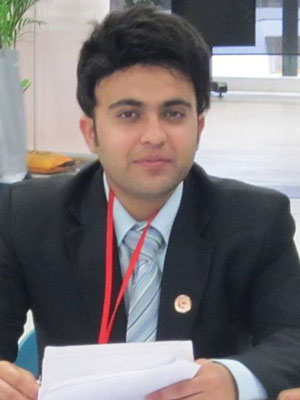
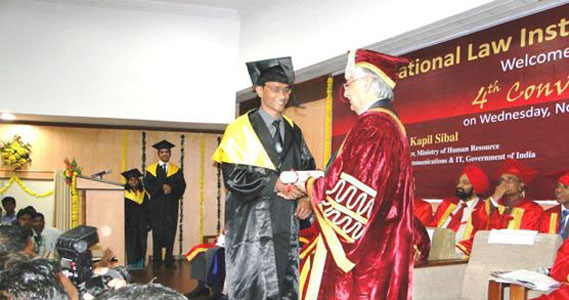
    ashok-gv-1Ashok G.V., a graduate from Bangalore Institute of Legal Studies in 2011. He is currently a Managing Partner at Corlit Legal. He is involved in a lot of social work being the Co-Founder at Crisis Prevention and Survivor Support Centre. He has coordinated cross border trade mark litigation in the United State of America. He has also dedicated himself as a Member of the Ethics Committee, Apollo Hospitals, Bangalore.

    In this interview we speak to him about:

    • His time as an undergraduate
    • His pro-bono and humanitarian work
    • His diverse experience


    How did you gravitate towards law?

    I always held a keen interest in writing and debating. During my high school days, I spent a large amount of time debating on the UNICEF Voices of Youth Forum on the internet. All that time spent debating issues of socio-economic interest, made me realise that I enjoyed making an argument. Plus, my father, Mr. G.K.V. Murthy, is a very accomplished Advocate practising in the High Court of Karnataka for more than two decades. I had some confusion as to whether I should pursue journalism or law, but seeing the kind of impact my father had in the lives of his clients convinced me that law is where I wanted to be.


    Being from BILS, do you think that a non-NLU made any difference to your career?

    I was always particular about my subject, never about the university. Be it BILS or National Law Universities, they all come with their own strengths and opportunities and one has to try and make the best of what one has.

    At BILS, my faculty members were always very encouraging and supportive of all my initiatives. I found a fantastic business partner with whom I could start CorLit Legal in BILS. Plus, it was only because of BILS that I was able to find the latitude to garner practical work experience of close to five years.  If I had to instead spend five years in a NLU, I would have been confined for the most part to campus life, leading to loss of exposure to the real world of law. That five years of work experience, gave me the skills, experience, platform and network necessary to start CorLit Legal along with my partner Sourabh.

    Of course, some of my friends from various National Law Schools managed to go abroad for prestigious moot court competitions and international internships. I might have lost out on those opportunities. So it does not matter. BILS or NLU, you can still do just fine as long as you are willing to define your priorities properly and make decisions you can live with.


    How important is mooting and what effect does it have on one’s CV?

    (Ashok has participated in various moot court competitions like the Raj Anand Intellectual Property Moot and the Philip C. Jessup International Law Moot Court.)

    I have always loved litigation. Moot Courts were the only respite in a course that largely emphasises on theory. Participating in Raj Anand Intellectual Property Moot and the Philip C. Jessup International Law Moot Court gave me exposure to IPR and International Law and helped me understand what problems in these fields look like. I learnt how to research well from these competitions, a skill that comes in handy for my career now. However, litigation in real life is far more challenging and stimulating than moot court competitions. I would urge law students to look at moot court competitions as purely a learning exercise.


    Tell us about your earlier association with Global Law Inc. and Meta Yage IP Strategy Consulting.

    I have found virtually every field of law interesting. Intellectual Property Rights holds a special place, because my first internship was with an IP Consulting Firm, Meta Yage IP Strategy Consulting. One of my assignments there involved drafting portions of a Patent Application and my work received very encouraging feedback. It was the first time I felt confident that I could make a career for myself in the field of law. I continue to remain very good friends with the folks from Meta Yage.

    After I completed my internship at Meta Yage, I went on to work as a Junior Associate at Global Law Inc. My senior there, Mr. M.S. Srinivasa, is arguably one of the sharpest Indirect Tax Attorneys in the country today. I spent a good eighteen months working under him in the field of Indirect Tax Litigation where I picked up critical skills such as drafting and goal oriented research. But the most prized skill from that experience was learning the extent of clerical work that goes into each case and the amount of diligence required to execute it.

    The diploma course was very insightful as it gave us considerable insights into the practice of Intellectual Property Law. The course was designed beautifully and did not waste any time dwelling into irrelevant things. The legal fraternity would be wise to learn from such courses, to make their own syllabus more useful and relevant to a Law Student’s career.


    Tell us about the kind of work you do as the Consulting Partner at Startup Amigo.

    Startup Amigo is a platform designed to advise and assist businesses, from the stage of ideation to the launch of the product or service portfolio. It is the brain child of my good friend, Abhishek Raju who has been one of my biggest sources of support and encouragement since the time I entered law school. In the short span of time since its inception, it has forged impressive partnerships with some of Asia and Europe’s leading management institutions and trade bodies. Its sector specialisation includes Space Technology, Water Resource Management, Health care and Defence Consulting, just to name a few.

    My role as a consulting partner, is to help Startup Amigo’s clients understand the sociological context and regulatory framework which exists in India and to help them evolve customised business strategies for the Indian Market. My engagement includes one on one consulting assignments and delivering lectures on relevant areas of law, during seminars and workshops organised by Startup Amigo and its partner organisations.


    What does your role as Managing Partner of Corlit Legal entail?

    CorLit Legal is a full practice law firm with practice areas encompassing Intellectual Property Rights, Taxation, Company Law and Food and Beverage Legislations. Besides Sourabh and I, who are its Founding and Managing Partners, we have six other Advocates with over twenty years of experience who came on board as Domain Partners. Clients are usually referred to us by someone we know. There is no secret to be honest. We have tried to get to know people, for the sake of knowing them and we never spoke to anyone with the intention of seeking any business. If the relationship translates into an Attorney-Client relationship, great! If not, we have managed to make new friends who can teach us something about their field of experience. CorLit Legal was never about the money. It has always been a personal journey to become more relevant and useful to the world we are part of.


    You are a part of the Ethics Committee, Apollo Hospitals, Bangalore. What are your primary responsibilities as such?

    The Ethics Committee is a body which reviews proposals for clinical research involving new medicines and therapeutic processes. Its primary duty is to ensure that the subjects who have volunteered for clinical research are adequately protected and ethical considerations surrounding the same are fully addressed. I was appointed primarily on account of my experience in the field of human rights and my responsibility is to inject that perspective into the deliberations of the Committee.


    Our readers will also be curious to know about your publications and your love for writing.

    (Ashok is the author of Harmonizing Internal Policy and Trade Mark Law and Losing Focus-An analysis of the Justice Verma Committee Report. You also have your own blog.

    Writing has been a very helpful companion. I don’t even consider it a hobby, because like how I need to breathe, I feel compelled to write. As an amateur writer, I published mainly in a women’s magazine called Eve’s Times, which provided a platform to unknown writers like myself. Writing has been an introspective process for me and largely responsible for all the progress I have made as an individual. No matter how tiring the profession gets or how demanding of my time it is, I will perhaps never give up writing.


    How does it feel to be recognized for the social initiatives taken by you?

    First of all, the ethical obligations for a lawyer make it incumbent upon us to devote some time to pro bono activities. Therefore, I wish to clarify that we are doing what we are duty bound to do as Advocates. Sourabh and I always knew that CorLit Legal was going to be a body that would leverage its business law practice, for the purpose of creating a sustainable pro bono program. We were lucky to find Enfold Proactive Health Trust, with whom we have collaborated to work in the field of helping survivors of sexual violence.

    Having said that, the activists that we have worked with, be it at Enfold or Dr. Ravindranath Shanbhag or Sinu Joseph or Ramesh at the Forward Foundation, they are the heroes who deserve recognition because they have gone above and beyond their professions and duties. Many of them in fact are well known and Sinu was even featured on “Chai with Lakshmi” and Ted for her work in the field of Menstrual Hygiene. Our associations with our clients and these activists are the highlight of our work at CorLit Legal. We are happy to support them however we can, although our contribution, when compared to theirs, fares poorly in comparison. As regards the recognition, Sourabh and I could care less whether CorLit is recognised or not. It’s always about the client and the work, and never about us.


    How did you get the thought of forming Crisis Prevention and Survivor Support Centre?

    Sexual violence is violence with a lot of power and control dynamics associated with it. After reading the works of John Douglas and Roy Hazelwood, I knew I wanted to do some work in that field and wrote extensively for internet based publications on the same subject. In 2011, we were approached by someone I knew, stating that she was assaulted and being stalked. By that time, I had a friend, Sahu who is a fantastic counsellor. We both worked together in helping the client and she eventually managed to stand up to her perpetrator and successfully warned him off. We later got in touch with Dr. Shaibya Saldanha at Enfold with the idea of creating a platform where survivors of sexual violence can find legal, counselling and medical intervention in one place free of cost. We have been working together since then.

    It is important to temper down our idealism though. India has a fantastic legislative framework, but lacks the infrastructure, manpower and attitude to implement it. The law can always become better; no doubt, but it’s also quite up to the job even now. On the other hand, the attitudes of the people on the ground are more difficult to deal with.  I don’t have any dreams or illusions about being a change maker. For us, it’s just about doing what we can do to make the life of that one survivor a little less anxious and difficult.


    Do you take interns for your firm?

    Well given I myself come from a humble academic background, I would go less by a person’s resume and more by the person. I usually have a chat with students who wish to intern and if I think they will be a good fit at CorLit Legal, I would be more than happy to provide a “call back”. The difficulty for us is how we make the intern’s time worthwhile for him or her. When we are dealing with an intern, we are very conscious of our responsibility to ensure they go back feeling less ignorant and more enlightened about the profession. But with so much of time spent at Court, it becomes a difficult process. So if a candidate shows initiative and respect for his or her own time, it would earn him or her, a brownie point for sure.


    Where do you see yourself in the long-run?

    I want to teach. Not just law, but perhaps even the humanities. Therefore, higher studies are definitely part of my plan. I joined the profession, only because I felt this experience would make me a better faculty for my students. 10 years from now, I hope to spend more time on research, writing and teaching.


    What all do you consider in making strategic career moves?

    I never planned any of my moves nor did I ever strategise. I have a supportive family and I managed to find the right people at the right time by sheer luck, thanks mostly to being at BILS where I found my collaborators at both CorLit Legal and Startup Amigo. Building relationships based on sincerity and mutual respect is the most important goal for any professional, including a lawyer.


    What would be your message to our readers who are faced with decisive choices?

    If I have to dish out advice, then do not follow the herd. Make decisions based on your own introspection and not because of someone else’s advice. Have an open mind. Most importantly, don’t succumb to the fear psychosis that tells you to freak out or get left behind the competition. As my good friend Abhishek at Startup Amigo told me, “Collaborate and don’t compete”. Be nice to everyone, for the sake of civility and you will be just fine. Lastly, remember that Law Practice is a humbling experience. It requires endurance and demands resilience. It’s a 24/7 engagement and the situations you encounter can make you feel profoundly ignorant all the time. Therefore, it’s always important to be open to learning and never assume that one is the best at what he or she does.

  • Arshad (Paku) Khan, Exec. Director, Competition Law, Khaitan&Co., on his expertise and building a global practice

    Arshad (Paku) Khan, Exec. Director, Competition Law, Khaitan&Co., on his expertise and building a global practice

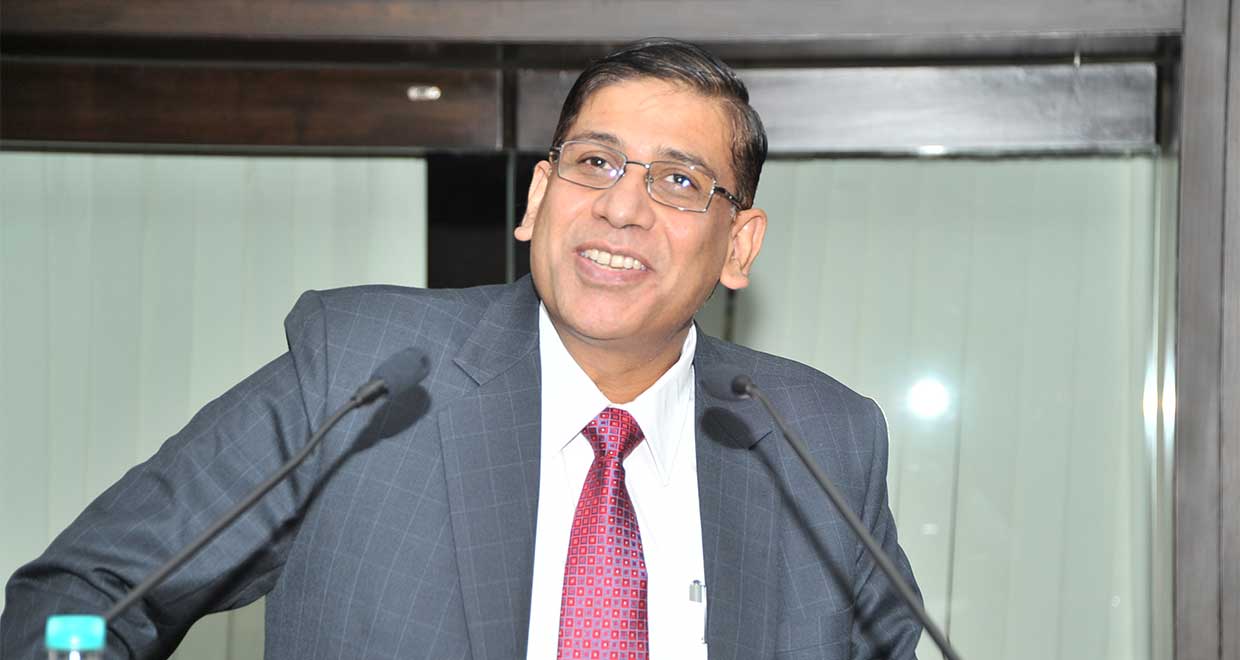
    Arshad (Paku) Khan graduated from the Vanderbilt Law School in Nashville, Tennessee, USA in 1991. He is currently the executive director of the competition/antitrust law team of Khaitan & Co, one of the largest and most experienced practices in India. Paku is a highly experienced competition lawyer with nearly 25 years of real-world experience with key roles in all aspects of Indian, EU, Irish and US competition/antitrust law.

    We requested him to share his insights on:

    • Starting out a legal career in the U.S
    • Work at the Irish Competition Authority and other European firms
    • Establishing a new practice area for an Indian law firm


    Please tell us a bit about your pre-law life.

    My parents – both of whom have, sadly, passed away – moved to the US in the 1960’s, and that was where I was born, raised, and educated, living there for the first 35 years of my life.

    Nobody in my family was a lawyer – only doctors or scientists. This meant that I had to learn law all by myself, with no one in the family to guide the way. However, my parents supported me by putting an extraordinary premium on education and reading, and that has been tremendously helpful in my career. Since I had no prior knowledge of the law, my mom suggested that I serve as a law firm runner/courier, to gain experience in whatever way possible.  I did that in the US in the late 1980’s. That was loads of fun, and was my first taste of the law.  I was also extremely fortunate to have some mentors early in my career who were fantastic lawyers, fantastic people, and fantastic teachers. This was vital in my early days of being a lawyer in the US, when I graduated in 1991.


    What made you gravitate towards a legal career after a degree in Sociology?

    At first, like almost everyone else in my family, I was going to be a doctor. However, in my third year of university, after taking, frankly, a horrible semester of organic chemistry, invertebrate biology, biochemistry, genetics, and neurobiology, I realized that I wasn’t really cut out to be a doctor because I never enjoyed science. On the other hand, subjects like language, history, literature, and other “arts” came naturally to me. My mom always – and very correctly – told me that I was better suited to be a lawyer than a doctor. Changing my career choice, even if it was at the last minute, has been one of my best decisions.

    I guess I can also say that heroes of mine like Mahatma Gandhi and Abraham Lincoln, who were both excellent lawyers, made me think that a career in the law, rather than in medicine, was much more up my alley.

    In terms of competition law (which is referred to as antitrust in the US), I  sort of was selected by it rather than my selecting it.  But when I got involved in the area in a substantive way, I realized that that was something I really loved. After my first year of law school, I clerked/interned at the antitrust law department of a law firm in Nashville, Tennessee.  My boss there was a former senior in the Antitrust Division of the United States Department of Justice, and he was enormously helpful in teaching me the art of being a competition lawyer.  I didn’t know anything about competition law at the time, but really enjoyed reading cases about predatory pricing.  I never knew that companies did such things, me being quite naive!

    After several years of private practice in antitrust, I become an Assistant Attorney General for the State of Tennessee and had a five-year stint as the in-house counsel at a large US bank holding company where I did a great deal of hands-on M&A work. This experience of working in private practice, in-house, and as a regulator, was tremendously beneficial to me. It gave me the ability to see the law from various perspectives (and often these are exceedingly different perspectives). It also gave me an opportunity to learn about how to think on “both sides of the table.”  It’s very important to understand the other side’s thoughts and motivations.


    What was your scope of responsibility during the tenure of your work at the Irish Competition Authority?

    It is because of India that I came to Ireland, and it was ultimately because of Ireland that I came to India. Let me explain.

    I had actually wanted to move to India in 1997 after having been a lawyer for six years in the US. I wanted to do what my parents did, when they left India in 1964 to come to the United States. I had basically lived my entire life in the United States, except for visits to my grandparents in Bihar and Kerala, and a few trips to Europe. So, I wanted to see what living overseas was like. In the autumn of 1997, I came to New Delhi and met lawyers from many law firms, went to hear some Supreme Court hearings, talked to legal institutes in New Delhi, and was very close to moving here. However, because my dad got sick, I put those plans on hold.

    A few years later in 2002, one of my friends became a senior member of the Irish Competition Authority in Dublin, Ireland and mentioned to me that they had positions available for lawyers. I had to go to Dublin for a competitive interview, and was lucky enough to finish first in the panel.  So I got an offer from the Irish Competition Authority. I thought I would give it a try for one year and that this would cure the wanderlust that I had.  India frankly dropped off the radar screen for me when I moved to Ireland because I thought I would have a short one year stint in Dublin and then head back to the US.

    That one year became seven years in Ireland. I spent three of those years at the Irish Competition Authority, never having done EU competition law before. However, my experience in US antitrust law helped me make the adjustment reasonably quickly.

    The time at the Irish regulator was a tremendous experience for me. For example, I got front-line experience in dealing with cases on cartels and abuse of dominant positions as well as merger control matters. One of the great highlights of my time at the Irish competition authority was that I served as the Rapporteur for the EU Member States in the European Commission’s 2004 abuse of dominance decision against Microsoft, which was a case that the entire antitrust world (as well as non-lawyers) paid attention to. It was a real career highlight for me. Another really interesting thing I got to do at the Irish Competition Authority was dawn raids. Dawn raids are basically surprise investigations by the regulator. In the context of those investigations (I think I did about 20 or so), I gained experience regarding forensic technology and was appointed as the Irish representative to the EU/national competition authority forensic technology task force.  In today’s day and age, that is an invaluable skill that I was lucky enough to obtain back then.


    How different was it to work as a solicitor after working with a government authority?

    (Mr. Khan worked as a senior solicitor at A&L Goodbody.)

    I must say that working in a European law firm in the competition law practice was exceedingly busy.  You had to juggle a lot of matters simultaneously to produce effectively flawless results, both substantially and linguistically, with little time on several cases. It was also a lot of responsibility.  For example, I had one filing before the European Commission on a very well-known merger control matter, namely, Ryanair’s hostile takeover of the Irish flag carrier Aer Lingus.  My colleagues and I worked from 8 AM to 4 AM, Monday to Sunday, for an entire month.  I had to repeat the exercise several times in the case. That clearly taught me the value of time management and of thinking carefully about your case in order to anticipate roadblocks.


    Any time management or work-life balance tips for our readers?

    The number one technique that I have for case management is planning ahead as much as possible.  The moment you receive a case or matter, think ahead about every issue that you will confront, from the beginning to the end.  Of course, in many cases, there will be unexpected issues to deal with, that will always arise. There is nothing you can do about those, except deal with them as they come up.  However, if you have visualized in your mind’s eye the case from start to finish, I guarantee that you will always have much better results than merely being bounced around from issue to issue and making things up as you go along.

    In terms of time management, I have never been a believer in putting in “face time” to impress people, either when I was being supervised or when I was supervising.  I’m happy to pull an all-nighter if it’s necessary, and sometimes it is indeed necessary.  However, what I found in my professional career of nearly 25 years is that planning ahead, including planning each day in the morning, is a great way to manage your time.  Many of those all-nighters or even late nighters are really not necessary if you have effective planning and real teamwork and communications with your colleagues.  Some people think the phrase “work smarter, not harder” is silly. I think there is a profound philosophy encapsulated in those words.

    Above all, put your family first.  They are simply irreplaceable.  It is very, very easy to get immersed in work, and forget about your loved ones. But, if your work causes your personal life to suffer, that’s going to have a negative influence on your work.  The work will always be there.

    I am very lucky to be in a firm like Khaitan & Co that values this work-life balance greatly.  Because it is a great place to work, you feel a deep sense of pride in what you do.


    What circumstances lead to your move to India?

    I was recruited to come to India in April 2009 by another law firm (Amarchand Mangaldas, where I served as Director of the competition law practice) because portions of the Competition Act were going live in May 2009.  I was living in Dublin, Ireland, when I first got the query about coming to India. When I started realizing the immense potential in India, which was a country where I had always wanted to live, it became obvious that moving to New Delhi was the right move.  I am a big believer in the concept of ‘one world’, and India is an integral part of this global economy.  The chance to be a part of that was an offer I couldn’t refuse.

    I must say that the fun and adventure in moving to India was even more special given that I had to move our family of four (including a newborn).  That was a challenge in its own right!

    In terms of the working environment in India, I have really relished the opportunity of working with some outstanding young lawyers whom I’ve had the privilege of knowing.


    What does your role as Executive Director of Competition/Antitrust law at Khaitan & Co. entail?

    As Executive Director of Khaitan & Co’s competition/antitrust practice, my role is to consider how competition law matters in India would be treated under EU and US competition/antitrust laws.  Competition law is very much an international law, and the experience in the US and in Europe has been invaluable to understanding how the Indian competition regime will, can and should work.


    How does the Indian Competition Law Regime fare against that of the UK or the USA?

    It’s very important to understand that India is one of the last of the major countries to implement a competition law regime.  Accordingly, India is fortunate to have the “last mover advantage”, as it can look to the mistakes and successes of other jurisdictions to improve its own regime.  Simply stated, there is a large amount of synergy between Indian competition law and the comparable laws in other jurisdictions like the US and EU.  The laws are not identical, but they are more similar than they are different.  There’s a lot of exceedingly useful guidance that can be found that is often very relevant to the Indian regime.

    For example, the United States had its antitrust law in 1890, and the EU has had its competition laws for decades. In contrast, with respect to the Competition Act, 2002 (as amended), the prohibitions in Section 3, dealing with anti-competitive agreements (including cartels) and Section 4, dealing with abuse of a dominant position, have only been in effect for a little more than five years.  Indian merger control has an even shorter lifespan of only three years.  In my view, by any definition, India is still in its infancy with respect to competition law.  However, that’s not a bad thing, because India can take that vast amount of experience in the rest of the world and use that to help fashion the people of India, from the richest to the poorest and from the strongest to the weakest.

    That’s emphatically not to say that what happens in the US or the EU is merely going to be “rubberstamped” in India.  Competition law is much more sophisticated than that.  For example, market conditions in Mumbai are very different than they are in Manhattan or Montevideo.  A good competition lawyer has to consider those market dynamics, apply the law to those facts, and use international precedents in the correct fashion to understand how other jurisdictions have looked at the issue.


    What advice would you like to give to a law student who wishes to make a career in competition law?

    There’s absolutely no reason why a new lawyer shouldn’t go right into competition law.  But I think it’s very important to understand that even though the substantive provisions of the Competition Act are very short, the law is incredibly complicated, involving a mix of law, economics, and market conditions.  There is a tremendous amount of artistry that is involved in being a great competition lawyer, as the same set of facts in one industry can result in a totally different outcome in another industry. The key to being a great competition lawyer is understanding what that mix is.


    What would be your advice to a law student or young lawyer who is indecisive about their area of specialisation?

    Law students or newly-inducted lawyers should try to immerse themselves in as many areas of law as they can. It first starts in law school, where you have the luxury of learning many different aspects of law.  The reality of the situation, however, is that if you don’t use that knowledge, you lose that knowledge.

    As I stated earlier, I have been lucky enough to have been a private practitioner, in-house counsel, and a regulator in multiple jurisdictions. I’ve had the opportunity to also do complex litigation and M&A work. All of those experiences have been important to my career.

    To be a great lawyer, you need to be a great peacemaker and find a way to bring resolution and closure.  The experience you get from being knocked down by mistakes, and facing defeat but learning from them and rising to fight yet again, is essential and is something you only get over time.  These, to me, are the hallmarks of a lawyer who will indeed go far.


    Finally, what would be your parting message to our readers?

    You must love what you are doing.  It is as simple as that. Money and fame are things that may or may not follow you in this life; however, none of those things are worth anything if you don’t love what you do. The fact of the matter is that I love being a lawyer. I sort of fell into the profession by happenstance, and it was one of the very best things that could’ve ever happened to me.

    I like to fix things that are broken, and I like to see injustices cured.  I like to be deeply involved in my matters and try to treat each matter as if it were my own. Taking ownership of a matter and treating as if it were your own, and being sensitive to a client’s needs, will take you a very long way.


  • Pranjit Bhattacharya, Law Graduate, Bangalore Institute of Legal Studies, on mooting, securing top-notch internships and a PPO from Trilegal

    Pranjit Bhattacharya, Law Graduate, Bangalore Institute of Legal Studies, on mooting, securing top-notch internships and a PPO from Trilegal

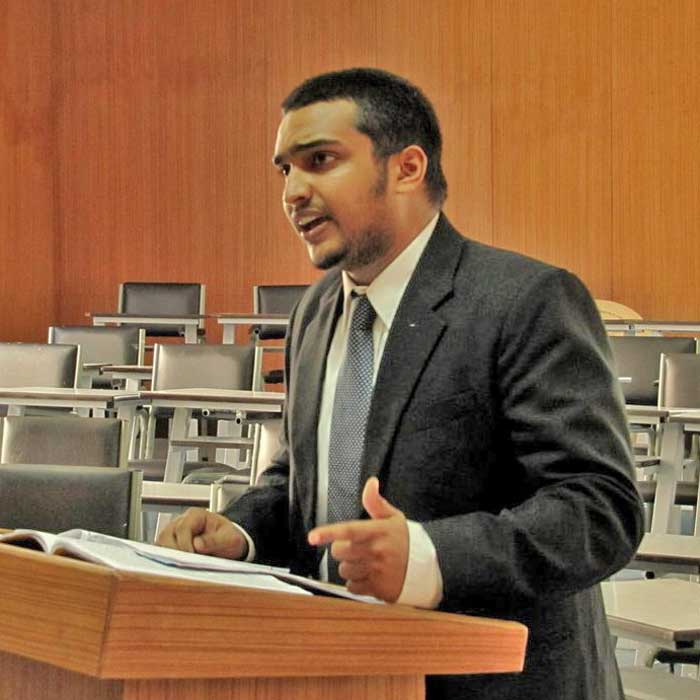
    Pranjit Bhattacharya graduated from Bangalore Institute of Legal Studies in 2015. He also holds a diploma in Entrepreneurship Administration and Business Laws from NUJS, Kolkata. Pranjit received a PPO from Trilegal in his fourth year of law school.

    In this interview we speak to him about:

    • Mooting and its benefits for a law student
    • Preparing a C.V. and insides of personal interview with tier-1 law firm; and
    • Securing top-notch law firm internships


    Tell us a bit about your life before college?

    I have been lucky to grow up in the beautiful picturesque city of Shillong. I did my 12th from St. Anthony’s Hr. Sec. School, Shillong. I have a twin brother who is also, doing law from the Faculty of Law, Delhi University. That is as far as law runs in my family. A better part of our schooling was devoted to debating at various inter-school events. Studying at a school where great emphasis was given to extra-curricular activities helped me immensely.


    Why did you decide to study law?

    I think it was a de facto choice really. I opted for Commerce during my 12th so chances of pursuing Engineering and Medicine were negated pretty early (much to the dismay of my family). I wanted to pursue something that would give me a rush, a discipline that challenged one’s ability to reason – what better than ‘law’ in that case. I am really passionate about law actually.


    How practical do you think are the shows like The Practice, J.A.G., Boston Legal, Suits, etc. and movies like 12 Angry Men, Philadelphia, etc.?

    To be honest, if soap operas were to show the life at a law firm as it transpires on a daily basis –most people would shrug at the very thought of watching it. There is a reason why such shows are meant for entertainment and so, they should be. It would be really naive to be goaded to believe that this is how the legal profession works on the basis of such shows.

    Although, I think there are quite a few good English movies which manage to captivate the essence of law practice quite beautifully. A Few Good Men, To Kill a Mockingbird and 12 Angry Men are my personal favourites.


    How did you secure internships with top tier firms?

    It is important to plan your internships well. At the beginning of each semester I prepared a list of firms that I wanted to intern with. Applying well in advance and setting out the period of internship clearly are recommended. Given that most firms have their own internship application procedure; it is advisable to confirm the same with the HR at the firm prior to sending an application.


    pranjit-bhattacharya-1

    Did you pursue your internships throughout law school as part of a deliberate plan or did it all just happen by chance?

    I think I had planned it out fairly well. Almost every semester I knew precisely the kind of internships I was looking at. So in my first and second year I interned at The Hindu Newspaper Publications and under an Advocate at Calcutta High Court (who is presently, a Judge in that Court). Thereafter, I moved to a mid-sized law firm, CorLit Legal for three months during my third year. This was a very enriching experience actually. The kind of exposure I was given at this firm formed the bedrock for my future internships.

    Since, the end of third year my internships were part of a well-thought out plan. So at the end of my third year, I interned at Nishith Desai Associates. Then in fourth year I interned at Trilegal (twice) and at the Law Chambers of International Tax jurist Mr. Soli Dastur, Senior Advocate, Supreme Court of India.

    Unfortunately, there exists a wide gulf between law school education and the work at a law firm. It entails a sound knowledge of different business models; latest regulations / notifications, etc. in different fields of law; market precedents on certain transaction that the firm proposes to undertake in the future; business risks inherent in a particular transaction and the like. In this regard, law school education is woefully deficient in investing the students with the knowledge to deal with such practical aspects of law.


    What kind of work did you have to do during your internships?

    It varied according to the place. Drafting client opinions, due diligence, research on multifarious aspects of law, comparative analysis of certain laws in India and other countries, etc. were the major tasks that I was assigned.

    A couple of them actually. On the last day of my first internship with Trilegal, a Senior Associate offered me a second internship at the firm and then said with a smile, “Remember always that there are plenty of good lawyers, but not many good lawyers who are good guys. So do not forget to be a good guy”. This is something I have tried to hold onto ever since.

    Then, on one occasion during my internship with Mr. Dastur, me and my co-intern were working past midnight, so while leaving he quoted Henry Longfellow’s famous words with a beaming smile, “The heights by great men reached and kept were not attained by sudden flight, but they, while their companions slept were toiling upward in the night”. This continues to remain the fondest and most cherished memory of all my internships.


    What do you have to say about students interning at law firms  all through their undergrad years?

    Law School life is all about exploring different avenues, particularly, in the first couple of years. Choices to intern exclusively at a law firm right from the start of law school defeats this very purpose. It necessarily means that you shut your mind to other avenues that may be more suited to your acumen and ability. It also, undermines the significance of good litigation internships which unravel the possibility of engaging with some of the best minds in the legal profession and leaves an indelible influence in your career.

    It is quintessential for your wholesome development as a lawyer to understand a particular fact situation from different perspectives. Diverse internship experiences help you acquire this. Thus, even though you may be pre-meditated that you want to work at a law firm in the future, it is advisable to pursue at least a couple of non-legal or socio-legal internships prior to law firm internships.


    Tell us about being a member at  multiple committees while in college.

    I have been a member of the Moot Court Committee at college since, the first year of law school. And for some time I was also, involved with the Literary and Placement Committees. I think they enhance your networking and communication skills and organizational ability. In my college though, these Committees are limited both in terms of, activities and impact.

    I was also, a member of an Expert Panel Study on Access to Healthcare in India by IIM-Bangalore and University of St. Gallen, Sweden. The forum involved participants from diverse disciplines of different age and influence. The entire process was immensely rewarding in terms of, quality of interaction, sharing of ideas, discussion on business strategies, etc.


    Have you felt strongly about social causes?

    I would be lying if I said no. So I tried to strike a balance between my objectives of working with a law firm and pitching in with some pro-bono work as well.

    During my fourth year, I worked as a Research Assistant for Mrs. Nina Nayak, eminent social activist and former Chairperson, KSCPCR and Member, NCPCR on her book on the National Commission for Protection of Child Rights Act, 2005.And I have already mentioned earlier, about my stint with the Expert Panel at IIM-Bangalore.

    Both these opportunities gave me a deeper understanding of the policy paralysis and administrative complacence that pervades our system and the critical role that society needs to play in eliminating the same.


    Tell us how important is mooting and what effect does it have on one’s CV?

    (Pranjit has participated in various moot court competitions like Nani Palkhivala Tax Moot, Surana Corporate Moot, NLS Arbitration.)

    At the outset, if you are doing a moot court competition for CV value only then, according to me it is a futile exercise. Mooting is a passion and that is what should drive an individual’s decision to moot or not to moot. This is one experience at law school that I encourage everybody to undertake.

    I started mooting since the very first year of law school. My first moot was on Constitutional Law, organised by Amity University, Rajasthan in which we were the semi-finalists and eventually, adjudged as the ‘Third Best Team’. This moot was my first tryst with law and the romance has continued ever since. My best experience was at Nani Palkhivala Moot Court Competition where incidentally, I was also, the Second Best Speaker.  It ignited in me a passion for Taxation Law that I have pursued keenly ever since.

    Whether it adds value to your CV or not, I cannot opine on it definitively. However, this is the best way to harness your reasoning ability, research skills and ability to make arguments. In fact, most reputed Moots are based on emerging or grey areas of a subject, or sometimes even transactions that are making the news. So the influence of good Moots is all pervasive. I think this may be a reason why law firms may view participation at various Moot Court Competitions quite favourably.


    Tell us about the significance of pursuing courses such as Introduction to M & A and NUJS Online Diploma in Entrepreneurship Administration and Business Laws.

    My internships drove me towards this decision to pursue such courses. They made me realise that there are certain practical aspects of law that the academic curriculum fails to address. The problem is accentuated in case of Universities where little or no emphasis is given to acquiring practical skills pertinent for excelling at law practice.

    It is important to know the academic aspect of law, true; but it is also, essential to be skilled at applying it. This is precisely the purpose such courses serve; they equip you with the right kind of skills that help you deal with practical nuances critical for a lawyer.


    How was your internship experience with Trilegal?

    I interned only once at Trilegal before I secured a PPO. Post my PPO I again interned there. Trilegal has a pro-active mentorship program, whereby, every intern at the firm is placed under a mentor who assesses an intern’s development through the internship. This is definitely, one thing which in my view sets Trilegal apart. And then, the Associate like experience at the firm and the quality of work allotted to interns. In my second internship, I was made to work on two live transactions. These experiences make it worthwhile to intern at such a place.


    What are the things you consider sine qua non for positive feedback from an internship?

    I do not believe that there is a hard and fast rule to get a ‘callback’ or a ‘PPO’ for that matter.  Certain things that I believe can trigger a positive feedback is the level of enthusiasm and initiative one shows towards the work assigned like explaining clearly your research to the person concerned and then engaging in a discussion on the same. Also, never hesitate to ask questions even if they appear to be a little stupid. You can prove otherwise, with the quality of your work based on the insights you gain by asking the right questions. These things help you inspire confidence in the members of the firm.


    Did you have to undergo an interview before securing your PPO?

    Yes I was interviewed for a PPO. It is an interesting story actually. After my internship at Trilegal, I had gone down to Mumbai for an internship at the Law Chambers of International Tax jurist Soli E. Dastur, Senior Advocate. One evening I received a call from Trilegal, Mumbai that a PPO interview has been scheduled for the next day and candidates would be interviewed over Skype. As I was in Mumbai, I suggested that I would like to come down to their office which they were glad to accept.  I had to request Mr. Dastur for a leave for the next day. My last thought while going off to sleep that night was, “I need to wake up early, be presentable and just show up on time. Rest is up to providence.”

    An initial predicament was to introduce myself to the interviewers because they had never heard of my college. And frankly since, I had never undergone any formal training to tackle interviews, I am personally of the opinion that it is all about presence of mind. Interviews are an opportunity to test your ability to think on your feet. It is also, absolutely vital for you to know your CV inside out. Moreover, a sound grasp of interesting developments in the field of politics, law, economics and general knowledge is essential to ace a law firm interview / or any interview for that matter.

    There are certain pre-requisites of preparing a good CV and any departure from it is unacceptable. The importance of a structured and properly formatted CV without any spelling or grammatical errors can hardly be over-emphasized. What is important is to communicate about four-five years of your activities at law school in two-three pages. The skill sets that you have acquired during your time at law school should be adequately reflected in your CV. Moreover, it is essential to have a tailor-made CV based on the firm /company / any other organisation in which you are seeking a position.


    How important according to you is CGPAs in securing a job?

    Let me answer your question in two segments. There is a significant difference between the law school curriculum administered at some of the top NLUs and certain other top ranked law colleges and those administered at colleges affiliated to State Universities.

    The curriculum designed for the NLUs and some other top ranked college reflect a significant thought process to ensure that the academic aspect of law is not divorced from its practice – whether at a law firm / litigation, etc. Despite this concerted effort, there has been a brewing discontent among the legal fraternity that there still remains a wide cleavage between the two aspects. Hence, judging the ability of a student exclusively on the basis of his CGPA is inherently flawed. On the other hand, the curriculum of most of the State Universities is archaic and reflects absolute non-application of mind on the part of the authorities responsible for formulation and evaluation of the entire course.

    So while some credibility can still be attached to the system of evaluating the student in the former case; the latter is a mockery of the ability of students. In all fairness, I have been an average scorer throughout law school and that has in no way hindered my prospects. Having said that the value of a decent CGPA can hardly be discounted because all said and done, every interviewer needs a benchmark against which your ability has to be judged.


    What should one law student aspiring for a job at top law firms do?

    The process starts right from your first year. I devoted the first three years of my law school in developing diverse skill sets acquired through academic knowledge, various internships, Moot Court competitions and such other activities at law school. The last two years have so far, reaped me the dividends of my investments in the first three years. So the last two years should be spent interning at the right kind of places keeping two things in mind; first, identifying the practice areas that interests you and second, a place that has a reasonable likelihood of absorbing you into the organisation post your internship through a ‘PPO’ or Campus Placement.


    Where do you see yourself five years from now? Would you consider going for an LL.M. abroad?

    I think my goals are more short-term in terms of where I would like to see myself at some point in the future. I still have about a year to go at Law School so as of now I am quite enjoying my time under the sun. But yes, I would definitely want to author a book on any aspect of law; may be in five years’ time that is one thing I would be glad to have accomplished.

    I am quite keen on an LLM from abroad, more for the profound experience that it proffers than anything else.


    You being from BILS, do you think that being from a non-NLU made any difference?

    Well, to say that it did not make a difference would be both unwise and inaccurate at the same time. In certain ways, opportunities were in fact, fewer and far between. But then, again may be that was something that motivated me to make the most of limited opportunities. Since, I did not undergo the rigours of a National Law University; the endeavour always was to put myself through a process that ensured I was on par with the products of NLUs. And yes, I had the added advantage of customizing the entire process according to my requirements unlike an NLU where there is already a pre-designed system to which you need to adapt.


    Lastly, what would be your message to our readers?

    “The future belongs to those who believe in the beauty of their dreams”. -Eleanor Roosevelt

    So, keep calm and read SuperLawyer!

  • Nivedita Guha, Consultant, UNICEF, on human rights law, child protection services, and her experience

    Nivedita Guha, Consultant, UNICEF, on human rights law, child protection services, and her experience

    Nivedita Guha graduated in law from CLC, Delhi University, in 2009. Thereafter she pursued her LL.M. from NLU, Jodhpur. She has been involved in a lot of socio-legal work in multiple non-profit organisations. She has worked at HelpAge, Kalyan Ashram, MARG, HRLN and currently she is working at UNICEF.

    In this interview we speak to her about:

    • Pursuing LL.M from NLU, Jodhpur in furtherance to a career in social work
    • Work at different domestic NPOs and at UNICEF
    • Advice to students who want to pursue a career in Human Rights

    How will you introduce yourself to our readers?

    I am a human rights lawyer presently working as a Consultant with the UNICEF office, West Bengal. My area of interest is child protection and women’s rights. Work is my favourite pastime and I believe it is very important to do what you love and not fall prey to the conventional way of life, satisfying societal standards.


    How did you gravitate towards law?

    My grandfather was an Income tax lawyer practicing in the Calcutta High Court. I was in awe of him. I was brought up in Chandigarh and as a kid when I used to visit him in Kolkata during my summer vacations, I used to minutely notice the way he talked. His command over language was impeccable. I used to spend hours flipping through the legal journals stocked in his big law library. His personality had a deep impact in my formative years which I think later instilled the desire to pursue the legal profession in me.


    Do you think that being from a non-NLU made any difference to your career?

    It did not make any difference to me as I was always inclined to work on humanitarian issues and since human rights law is a very unconventional area of law, I always knew that I will have to carve my own way. There are ample job opportunities for corporate lawyers with companies and firms offering good pay packages to them but human rights law is a less sought after area and it was a struggle to choose the right career path. I do not think my struggle would have lessened if I was an NLU graduate.


    How was your experience at HRLN, Kolkata?

    After I left my job in MARG, Delhi, I was looking for jobs in Delhi and Kolkata. A cousin of mine informed me about the vacancy at Human Rights Law Network, Kolkata and I immediately applied for the position. I was called for an interview, I appeared and was selected.

    My work at HRLN involved defending the rights of the victims of domestic violence by filing cases under the Protection of Women from the Domestic Violence Act, 2005, defending the Juveniles-in-conflict-with-law in the legal cases in the Juvenile Justice Boards, I have been in-charge of the Prison Project in HRLN where providing legal aid to the inmates in the prison, parallel to the state machinery, maintaining effective collaboration with the relevant government departments like the Department of Correctional administration has been an integral part of my work. Issues like no physical production of prisoners before the courts, illegal detention of the inmates in Section 107 and 109 of the Criminal Procedure Code 1973 cases in the prisons, inhuman prison infrastructure, improvement of the condition of women and their children in the prisons are some of the issues which have been addressed through fact finding, research and litigation during my tenure in HRLN. I have also trained police officials on the Juvenile Justice (Care & Protection of Children) Act, 2000 and the Protection of Children from Sexual offences Act, 2012.

    Working in HRLN for three years was very enriching. Though one has to put up with lot of difficulties while working in an organisation solely run by lawyers as administration is not their forte but HRLN surely knows how to extract the best from you and the experience one gains is worth all the struggles.


    What was your motivation behind pursuing LL.M.?

    Once I was sure that criminal justice system is my area of work, I immediately started looking for courses on this area of law. I was looking for distance learning courses as I did not want to leave my job and LL.M. in Criminal law, Criminology & Forensic Science at NLU Jodhpur seemed like a very good option. LL.M. from foreign university is there in my mind but only after few more years of work experience.


    What brought you into Human Rights?

    Not any incident but the character of Atticus Finch in the book, To Kill a Mockingbird by Harper Lee inspired me greatly. Atticus Finch is a white American lawyer who defended a black man who was falsely accused of raping a white woman. He fought for racial inequality during the times of apartheid in America. His character, integrity and principles inspired me greatly.


    What inspired you to work with MARG and how did you go about applying to them?

    MARG was my first job after completing LL.B. and I was working there as a legal trainer. I did an internship with MARG as a law student and after I completed LL.B., they approached me for this role which I gladly accepted.

    My work primarily involved training grass root level NGO workers on various important laws in the States of Bihar, UP and Jharkhand.


    What has been your most memorable incident working for these Non-Profit Organizations?

    While I was working in MARG in Delhi, I was on a field trip at a village in Haryana. It was a legal empowerment program and I was assisting my senior in sensitising the women of the area to get trained as paralegal volunteers. During the visit, I noticed that in almost every household I went, I met a woman wearing the traditional red and white bangles which is a sign of a married woman in Bengal. They all spoke fluent Bengali and I was told that their parents live in West Bengal and most of them were from the Sundarban area. They were all married to the families in that village of Haryana. I was perplexed as I did not understand the reason why women from the interiors of Bengal will be married to Jats of Haryana. Soon these women cleared my doubts and very explicitly told me that their families in Bengal were poverty stricken and their in-laws in Haryana are providing for their families in Bengal. So basically, by marrying, they are helping their family back home in getting food to eat and also to live a comfortable life. There is a dearth of girls in Haryana so the families in Haryana go searching for brides in Bengal alluring the families of brides with money.

    I was shell shocked to witness the vicious cycle of atrocity occurring so flagrantly. It was my first stint with reality and concept of cross cutting issues. It was an eye opener.


    What is it like working for an International Organization like UNICEF?

    It has been absolutely amazing to work in UNICEF as working with organisations like UNICEF widens your horizon as you are no longer look at resolving individual cases but you are thinking about the larger picture. I feel more responsible as I know that my work will now impact the masses and not just two or three people. It is also the first time that I am working with the government as UNICEF is a partner of the Ministry of Women and Child Development and I have to work very closely with the Department of Child Development, Women Development and Social Welfare in West Bengal. It is a very different experience from working with NGOs.

    It has only been four months that I am working in UNICEF, I can handle the stress till now.


    Do you think remuneration is a serious impediment to such work?

    Anyone who needs a “higher pay package”, should not even think of getting into the development sector because when you decide to get into this sector, it is not money which drives you but a desire and passion to connect to the masses and serve the people. Yes, initially money is a serious impediment in this field.


    Where do you suggest one can intern or apply for an opportunity if she is interested in working for Human Rights issues?

    For lawyers or law students, Human Rights Law Network and Lawyer’s Collective are great organisations to work and learn. The summer and winter internship program in National Human Rights Commission is also very good. Amnesty International India is also a good place to learn and grow.


    What is the best possible course of action for a law student who aspires to work for international non- profit organizations?

    I would advise students to involve themselves in various humanitarian causes like by volunteering or interning with NGOs and groups working on human rights issues. This way one understands if working on humanitarian issues is their true calling or not. Thereafter, they should focus on understanding issues and think how as a lawyer they can contribute for that particular issue.

    If one is specifically eyeing for international organisations than a foreign degree might help and one has to keep an eye on international vacancies and opportunities but what I have learnt from experience is that the most important thing is your ability to understand issues and build skills to intervene as a lawyer and activist, which is possible only by working extensively in the field.


    Where do you see yourself by the end of the coming five years?

    For the next three years I am solely focusing on my work at UNICEF. I want to complete the work assigned to me successfully. Thereafter, I would want to pursue higher studies abroad.


    Lastly, what would be your message to people who want to have a career in human rights?

    Please do not opt for a career in human rights because you feel it is glamorous to be working in a NGO or United Nations or any other international organisation. There is much much more to it. One has to survive the initial grill with lot of patience and perseverance but if you are driven by the right reason primarily the desire to serve, it will be worth it. Reiterating, the need for a passion to serve does not necessarily means to work without money but when you are passionate to serve you will understand the importance of what you are doing and the great impact it makes.

  • Ratan Singh, Director, Chartered Institute of Arbitrators, on being an International Arbitrator, expertise in Mining Law and his practice at Delhi HC

    Ratan Singh, Director, Chartered Institute of Arbitrators, on being an International Arbitrator, expertise in Mining Law and his practice at Delhi HC

    Mr. Ratan K. Singh graduated from Delhi University, batch of 1996. He is currently the Director of Chartered Institute of Arbitrators (India). His practice mainly consists of International and Domestic Arbitration, International Commercial and Financial Law, Mining Law, Construction and Infrastructure Law, Environmental Law, Constitutional and Administrative Law.

    In this interview we speak to him about:

    • Building up a firm clientele
    • Serving as an arbitrator in various domestic and international arbitrations
    • Being the Director of CIArb India and a career in Arbitration


    Please tell us what motivated you to pursue legal studies.

    I somehow felt that my personality, nature and approach towards life would go well with this profession and intuitively decided to pursue legal studies. I strongly believe that it should really come from within and there should be a strong urge for the profession. If you believe in “giving”, this is the most appropriate profession. However these days the importance of “giving” is increasingly being ignored.


    What were your plans after graduation?

    I did M.Sc. in Geology before I joined LL.B. As I was university rank holder in Geology, I could have easily become Geologist, however this is not what I wanted to do. I always wanted to be a lawyer. It is another thing that my background in Geology is helping me in my Mining Law practice and I am one of the very few lawyers in country who specialises in mining law and is regularly engaged. Civil Services was never my interest and choice, though in our days every second student used to aspire for Civil Services.


    As a fresher just out of college, how did you manage to get a mentor for yourself?

    [sociallocker] After I passed out from my law school, I went to meet many lawyers, including some of them, who at later stage of my career have developed lots of affection and respect for me, but got no chance. I was helped by one of my batch-mates, who was close to one of our law teachers. The said gentlemen took me to my first and only senior (who later became Senior Advocate and Judge in Delhi High Court) with whom I worked for around four and half years.

    This is one profession, one cannot do without a mentor/senior/guide. This is primarily for the reason that lots of procedural and professional aspects are to be learnt. Had this not been so, this practice of pupillage would not have continued for centuries.

    My emphasis however would be that it is of utmost importance to have a mentor who is hard working and honest. One sub – consciously or consciously learns, what he sees in his mentor/senior.


    How did you build up on your client base?

    I was a complete outsider in Delhi but I never had any problem in getting work. During my four and half years with my senior, I was completely focused on learning and made no effort at all to find any work for myself.

    When I became independent, all my cases came from and through lawyer friends of my senior, who had seen me working in my senior’s chamber. They were somehow impressed with my hard work and academic interest in the subject. For a lawyer who believes in hard work and honesty, their lawyer colleagues are always a big source of work. There has always been a dearth of hard working lawyers as more and more lawyers who believe in short-cuts etc manage to generate work but they too need lawyers who can really work on the file. Every single law office/chamber and law-firm is always looking for a hard working, honest and trained lawyer.

    What is needed is four and half years to five years of focused learning without thinking about gaining clients and client-base and see the result thereafter. You will always have more work than you can really handle.


    What do you look for in your interns when they apply for a position to work with you?

    I look for sincerity and honesty towards work. It is also important that he/she should be reasonably good in their expressions. Anybody who wishes to intern with my office has to send his/her bio-data to the office-in-charge and they get a call, depending on availability of vacancy for interns.


    What do you think about the future of legal education in India?

    Lawyers are always needed and will always be needed. People need lawyers in booms and busts alike.


    How is the work atmosphere at the Delhi High Court presently?

    I would rate Delhi High Court as the best High Court in the country for more than one reason. It is no doubt true that more and more national law universities and private five year law colleges/universities are producing more and more law graduates. These national law universities have also brought good improvement in the quality of law education (though a lot needs improvement, particularly the quality of law teachers). However it is easy to become a successful lawyer. The only attributes needed are hard-work, honesty and the willingness and urge to give. I see lots of law graduates with good academic background and good potential spoiling themselves because they lack either of these three most fundamental attributes, i.e hard-work, honesty and the willingness and urge to give.


    If someone does not go to a top law school, would you say he still has a shot at a great career in law?

    Yes, if one is ready to work hard (around twelve to fourteen hours a day) and is honest towards his office, profession and client, they are bound to be successful lawyers. They are unstoppable. To the contrary, if someone has passed out from a top law school and lacks any of the above mentioned three attributes (i.e hard-work, honesty and the willingness and urge to give), they are likely to fail.


    How has your journey been from a fresher to being an expert in arbitration?

    (Mr. Singh has served as an arbitrator and has chaired as a tribunal member or counsel in various domestic and international arbitrations, ad-hoc as well as under the rules of ICC, UNCITRAL, SIAC, ICA, DIAC etc.)

    I followed Arbitration and Conciliation Act, 1996 since its inception. Traditionally in India, there have been two categories of lawyers who have been practicing arbitration. One category is of those lawyers, who have not been in active litigation, though pursued arbitration (mainly from big law firms). Second category comprises of those lawyers, who are only in litigation and off and on doing arbitration, without having basic knowledge of arbitration as a subject. I wanted to bridge this gap. In order to be a good arbitration professional, it is important to have good litigation exposure and experience with substantial experience of cross examination etc. I have been a hard-core litigator with passion for arbitration since the beginning of my career. I have been taking a keen and active interest in the theoretical and philosophical aspects of arbitration, both domestic and international. I have also been attending domestic and international arbitration events as a speaker and delegate.

    Anybody having interest in arbitration should follow the developments in developed arbitration jurisdictions, including UK, USA, Australia, Singapore, Hong Kong, France, Germany, Austria, Netherlands. It is also important to follow arbitration institutions of repute, like Chartered Institute of Arbitrators, UK (of which I am Director of India Branch), ICC, ICCA, SIAC, PCA, ICSID, SIAC, HKIAC, KLRCA, SCC, IBA. Chartered Institute of Arbitrators has on its web-site has made freely available various resources, guidelines etc, which are used and referred to globally. Equally important is to attend arbitration conferences, seminars etc. I would also strongly recommend to follow Kluwer Arbitration Blog.


    Can you tell us how you got the opportunity to be an arbitrator?

    (Mr. Singh has been appearing as a counsel in various Asian and European countries.)

    Once people get to know your interest in arbitration or for that matter in any other field of law, you are followed and eventually engaged. I get nominations to sit as an arbitrator as people find me as someone with interest and experience in arbitration. In order to get nomination as an arbitrator, one must enjoy a good reputation. These days, lawyers are increasingly nominated to act as an arbitrator, as it is believed that they are more and more ready to learn and prove themselves.


    What are your major responsibilities as a director of the Chartered Institute of Arbitrators, London?

    As director, I am primarily involved, with my co-directors, in policy making for the institution. CIArb is the oldest arbitration institution in world. We are celebrating 100th year of the institution this year. CIarb has members in around 120 countries. This is the only institution in world, which gives accreditation to arbitrators. CIArb also gives accreditation to arbitration tutors. No amount of subscription can get you accreditation. One gets accreditation only by qualification and experience. We conduct training programmes, awareness programmes, conferences etc for lawyers, arbitrators, law students etc. Apart from accredited arbitrator, I am also an accredited tutor. Teaching and speaking on arbitration is one of my passions and interests and this makes me participate in almost all events of CIArb.


    Are there any Indian or International courses which you would recommend for law students who would like to build a career in arbitration?

    I will recommend students to follow CIArb courses and training programmes. Apart from law schools, groups of students (around 25 students) can approach us and we (CIArb, India Branch) can conduct courses for them. Such courses can lead to accreditation from CIArb.


    What should a law graduate do in his first year of graduation to establish a career in arbitration?

    First things first, learn by heart and mind bare act of Arbitration and Conciliation Act, 1996. Also go through bare acts of at least U.K and Singapore. In addition, UNCITRAL MODEL LAW and UNCITRAL Rules should also be necessarily gone into.

    Arbitration act of U.K. is broadly modelled on UNCITRAL Model law, which is a source of the Indian Act as well.The  benefit one gets by reading UK act is that it is more detailed and is a fantastic source for better understanding of the subject. Singapore has different acts for domestic and international arbitration and by consulting these two acts from same jurisdiction, one would understand the aspect of distinctions for domestic and international arbitration. London is called Mecca for international arbitration. Similarly, Singapore can be said to be Mecca for South Asian countries. Substantial (obviously not all) number of arbitrations, having Indian connection, are generally held in London or Singapore. Therefore it would be wise to follow arbitrations and arbitration laws in these two jurisdictions.

    I also recommend every arbitration student to read and consult rules of institutions like, ICC, SIAC, SCC, UNCITRAL, LCIA. One must remember that ICC is the most sought after Institutional rules for international arbitration.

    Website of UNCITRAL is another good treasure for resources. One must read CLOUT, i.e. the digest of case laws from different MODEL Law jurisdictions. These cases help in understanding the manner in which model law or domestic laws based on model law are interpreted in different jurisdictions.

    Last but not the least, one must buy and read Student edition of book authored by Redfren Hunter. In addition, consult any book (which should not be going into more than one volume) on Indian Arbitration Act. One should simultaneously follow Indian and International arbitration.


    What would you like to say about the current state of Arbitration Law in India?

    In recent past, we have seen good forward looking judgments written by Supreme Court of India. Very soon, we are likely to have substantially amended Arbitration Act. Law Commission has suggested substantial and progressive amendments. Though India is signatory to good number of BITs and already facing serious threats of lots of Investment claims, India is not a signatory to ICSID. In February, I had long meeting with Secretary General of ICSID at their Headquarters in Washinton DC and I strongly believe that it would be in the interest of India to become a signatory to ICSID. One change, which I think can take care of many odds in India, should be to have Commercial Courts in India.


    What would be your advice on setting up a career in arbitration to law students who are still studying?

    Around eight out of ten commercial contracts in India have an arbitration clause as a dispute resolution mechanism. So far as International commercial transactions are concerned, almost all of them have an arbitration clause. This by itself tells us that arbitration is a fantastic career option for law students.
    [/sociallocker]

  • Anwesha Pal, Assistant Professor, Nirma University, on IPR, and the Indian tertiary education regime

    Anwesha Pal, Assistant Professor, Nirma University, on IPR, and the Indian tertiary education regime

    Anwesha Pal graduated from WBNUJS in 2009, and thereafter pursued her LL.M in IPR from Nottingham University. Presently, she is an Assistant Professor at Institute of Law, Nirma University.

    We had earlier reached out to her to share her LL.M experience at Nottingham:

    Anwesha Pal on LL.M. in Intellectual Property from Nottingham University

    In this interview we speak to her about:

    • Pursuing Masters from Indian and Foreign Universities
    • Best Universities for Intellectual Property studies
    • Opting for teaching and on scoring higher


    When and how did you decide to pursue Masters and further studies?

    It was in my final year of NUJS that I wanted to study further and wanted to apply to the UK before the fees were hiked up due to the cutting down of the Government subsidies to universities. So I zeroed in on various universities including King’s, Queen Mary, UCL, Warwick and Nottingham, out of which I chose University of Nottingham to do my LL.M in International Commercial Law. However, I didn’t think of getting into academics full-time then, and kept my options open.


    Which universities did you select for your LL.M?

    I chose University of Nottingham, King’s College London, UCL, Queen Mary University of London, University College London, and University of Warwick.


    How different is an LL.M in India from one abroad?

    There is quite a difference between the two of them. LL.M in Indian universities is more of a spoon feeding business. However,  in the UK I found that the students had to take the responsibility of their own learning themselves. One difference that I often talk about with my friends is the way dissertations are treated in both the countries. In the UK we were supposed to find out our own topics and research all by ourselves without any help whatsoever from the supervisor and only at the time of getting the topic approved one can meet and consult the supervisor. But in Indian Universities the dissertation supervisor plays a huge role in the shaping of your dissertation. If you do not have a good supervisor you actually will not learn anything and eventually your dissertation’s quality could be compromised.


    What led you to pursue LL.M from Nottingham even after having finished your LL.M from India?

    The laws in India are mostly influenced by the west and to learn from the best people in the business was the biggest incentive for pursuing the LL.M. The academic program was designed in a way to provide ample opportunities for research. Moreover, an international exposure is always a good thing to have. It gives you perspective with regard to the various learning patterns adopted by various students and cultural exchange in more ways than one proved to be a beneficial life lesson too.


    Do you think the Indian higher studies regime requires an overhaul?

    Indian higher studies in law do not need a complete overhaul but definitely needs a stricter curriculum. With all the debate about scrapping the one year LL.M, I do not support the view. I think a trimester system with an intense program dealing with the most important subjects at national law schools would attract not only the best students but would bring in better teachers as well who will be able to deal with such a challenging program. The responsibility of learning in such cases increases manifold for the students and encourages self-learning rather than spoon feeding.


    Which universities do you think are best suited for someone who wants to specialise in IPR?

    In the UK, I found the best faculty for IPR in the University of Nottingham, alternatively one may choose King’s and other colleges under the University of London. In India, apart from GNLU, I have little knowledge about any other national law schools that are providing a specialization in IPR. However, in India there is little scope to choose your subjects since the UGC has made a few subjects completely mandatory for LL.M


    Have you considered Doctoral Studies?

    I have considered doctoral studies and am working on my research proposal. I am keeping my options open at the moment, and haven’t zeroed in on a particular university yet.


    What does it take for a lawyer to get into academia?

    One cannot possibly enlist the essential qualities, since every student or every subject that one is working at brings forth absolutely new challenges with itself. But one can say without a doubt that an academician who is into active teaching and researching needs an immense amount of patience and should not have a fragile ego. There is so much even a teacher can learn from her students. Apart from patience, one needs to have the tenacity to keep working to better one’s teaching and learn more things, instead of being complacent about the knowledge gained so far.


    What were your goals after graduating from Nottingham?

    Nottingham opened new vistas for me and teaching was not the only option that I had considered back then. The decision to move into academics happened gradually through working for iPleaders and at IMS.  The experiences I had while working at both the places were extremely rewarding and enriching. Teaching at Nirma has been a learning experience and equally rewarding so far, mostly because of the diverse student body that has an immense amount of potential, academically.


    What advice do you share with your students on scoring higher grades?

    Scoring high grades is more often than not a result of learning through self-studying. Listening to the teacher patiently and interacting in the class goes a long way in this respect. Taking notes is very important as they are your guides when reading for yourselves. However, I think it is a crime on a student’s part to expect readymade notes from the teacher at the university level.


    What would be your advice for law students who want to take up the profession of teaching?

    One must choose the profession of teaching law for the love of teaching and not only for the love of law. Teaching is a very different ball game from learning for oneself. Different students have very different needs and learning methods and one who can cater to all of them efficiently is considered to be a good teacher. Although, one can only strive to do so.


  • Neha Bhat, on LL.M from Washington College of Law, selecting the correct college & Scholarships

    Neha Bhat, on LL.M from Washington College of Law, selecting the correct college & Scholarships

    Neha Bhat is currently working as an Associate Durable Solutions Officer at United Nations High Commissioner for Refugees. She graduated from WBNUJS, Kolkata in 2007 and had studied further at American University, Washington College of Law. She has specialised in International Organisations, International Human Rights Law and Migration Law and Policy. Without much ado, let’s delve right into her choice to do an LL.M and pursue International Human Rights.

    We asked her to share:

    • Strategies on selecting an university for LL.M
    • Information of Faculty and Facilities of Washington College of Law
    • Applying for Scholarships at WCL


    What was your motivation behind doing LL.M.? When did you finally decide that you needed to do masters?

    I have always wanted to pursue further studies. Even when I was in my final year at NUJS, I was sure that I will complete my masters and subsequently get an advanced degree- you know MPhil or PhD or the like. I genuinely like reading and getting to know subjects and issues. I really enjoy exploring areas of law that I don’t really have much experience in and an LL.M program helps me exactly with that.

    Since you are into the academic arena, you are either writing or researching and reading and that really works well with me. Eventually, later in life I want to teach and therefore I knew I would always have to finish my LL.M and then an advanced degree. But I wanted to have work experience before I joined the Masters degree- that was also because while at NUJS, I hadn’t really done much- I had no serious publications, wasn’t at the top of my class, wrote a really horrible statement of purpose– end result, I didn’t get admitted for my LL.M to any of the places I applied to. Plus I also realised I knew, rather understood very little of things and therefore I realised I needed some good, in depth work experience before pursuing my LL.M.

    So I joined SEBI as a Legal Officer, worked there for about 2.5 years and then went and joined the UN High Commissioner for Refugees in Delhi, where also I worked for almost another 2.5 years. After 5 years, I felt I had a very good idea of what I wanted to focus my LL.M on and even had ideas about further studies- like PhD proposal and the like, and therefore decided to come and get my LL.M degree. Also, my work at the UNHCR was very intense. I loved my work very much, I still love my work very much and I would definitely hope to get an opportunity to work with UNHCR- but I realised that you need to know when to “step back” so you don’t unconsciously burn yourself out. And after 2.5 years, I knew I had reached that point, where I was on the path to burning out in my work.


    neha-bhatHow did you choose the university/ college? How should one go about choosing a university?

    Selecting a University can be one of the most difficult things to do and if not done properly, you could end up feeling a little miserable about your choice. I have had the opportunity to put myself through the LL.M application process three times- once in my final year at NUJS, then in 2008/09 and then finally in 2010/11. When I was at NUJS, in hindsight, I made some of the worst application decisions– I remember applying ONLY to Harvard, California Berkeley, NYU (for the NYU-NUS programme) and Oxford. No other place.

    The problem with my applications was that my Statement of Purpose wasn’t right, and I had no research plan in place, I wanted to do an LL.M because it seemed the “right thing to do” and not because I knew what I wanted to study or why I wanted to do. Obviously, it didn’t work- I was rejected by all universities I applied to. I did panic a bit, thinking maybe I was very bad at this and maybe academics weren’t for me. It was the same time when I had sat for the Rhodes scholarship regional interview in Kolkata, but failed to make it to the National rounds. So it was like a culmination of bad results.

    The second time I applied, I was working with SEBI. In this round, I managed to apply to 3 places, before I came down with chicken pox. I applied to California Berkeley, again to NYU (for the NYU-NUS) programme and also to Stanford. Again, NYU turned me down. Since one of my referees didn’t submit my reference letter for Stanford, my application was incomplete so I was left out of the loop. But this time, I was waitlisted for Berkeley in the first tranche of waitlisted applicants out of some 950 odd people. It was a big moment for me. I had been working long enough at SEBI to know I was not going to study corporate law, so my statement of purpose focused on my desire to teach law and consciously I decided to veer away from corporate law. But eventually I didn’t get through. It was then I decided that I had to get back into the field I wanted to do my LL.M in and thus my job change happened. Eventually in 2010/11, I applied to 6 programs and was admitted to all but one– at LSE. The programs I was admitted to, were regionally, the best for Human Rights– NUS- Singapore, Berkeley-California (yes, again), McGill- Toronto, Warwick- UK and American University- Washington DC.

    I consciously decided to veer away from the very “top” rung places– because I STILL didn’t have (or so I felt, and still continue to feel) any meaningful academic publications etc. or what I felt, a superlative proposal which would ensure admission in these universities. Plus, I was looking at a taught masters program and therefore chose places which did not mandate a compulsory dissertation component.

    I also looked at the field specializations ranking and faculty strength rather than the overall ranking of the school because those are often better indicators of the specific program. So for example, I know that Warwick has a very solid International Human Rights Law program. American University, where I am currently studying does not necessarily come out on top of law school rankings in the US, but its International law program is ranked higher than Berkeley. Plus, it’s the ONLY law school in the US, where you can have the opportunity to study with Special Rapporteurs – past and present. For e.g. I have had the opportunity to study with some really big names in international law, Prof. Juan Mendez who taught me Advanced Human Rights, is the current Rapporteur for Torture. I also studied under Prof. Robert Goldman, who was the previous (and the first) UN Rapporteur on Human Rights and Terrorism. And I also studied under Prof. Diane Orentlicher, who has drafted various UN Guidelines and Standards including on Combating Impunity. I am also lucky that I have the opportunity now to work with her as a research assistant/ dean’s fellow- I started on this position in June and continued working with her till December 2013.

    It’s been one amazing experience- to delve into interesting issues of transitional justice, international criminal law etc. These are factors which make a big difference to me and I think should make a difference to everyone considering a specialisation at the LL.M stage – you should know which fields you are interested in and if the university you are applying to, has professors who teach and/or conduct research in those areas or not. Also, the cost of the program matters a lot– and whether there are scholarships etc. on offer or not. American University has tuition remissions and full tuition + fee scholarships on offer and I was one of the recipients of their Alumni Fund Scholarship (which covers tuition for 24 credits plus all school fees) and for me that was a swinging factor. My top two choices were American or California Berkeley, but the latter didn’t offer me any scholarship. Plus what kind of city you want to live in- for me, Washington DC is a dream because there are so MANY events on International Relations and Affairs which happen here- I get an opportunity to meet people and again gain knowledge. These are opportunities not many cities can offer.


    What did you study? Why did you decide to take this particular subject?

    I am enrolled in a dual degree program at American University. So on completion of 40 credits, I will be conferred with two degrees, the first one is the LL.M in International Legal Studies, which I completed on May 19 (24 credits) with a specialization in International Human Rights Law. My second degree, which starts shortly, is called the LL.M in Law and Government and my area specialization is Regulatory and Administrative Law. I have 16 more credits to finish so I will be completing courses in International Trafficking, Women and Conflict, Global Warming Law and Policy etc. I think it is worthy to invest time, energy and effort into these courses because it offers me further exposure to theory I would need to know, but I may not necessarily get around to studying/ reading on my own. I need to be constantly motivated to do something, and unless there is a personal investment (time or money etc.) I know that I will not be driven to do anything.


    How is your experience so far? Tell us about the faculty and facilities. Anything memorable that is stuck in your mind?

    My experience so far has been fantastic. As I mentioned before, I have had the opportunity to study and work with some of the best known legal minds in my chosen area of law and I don’t think any other experience could be better than this. What I genuinely like in the American academic setting and which is missing in the Indian academic setting is the quality of feedback that you can get from Professors – and if you demonstrate capability to take up new issues, areas of research- they encourage you and offer guidance.

    I have maintained an academic profile at www.ssrn.com, which is an online repository of academic articles and research. And I have often been contacted for some of the projects I am undertaking/ have worked on by people pursuing their PhD and in one instance, Prof. Alston @NYU. And I think these avenues- contact with academics, renowned academics is not available/ not facilitated everywhere- either we are too shy, too inhibited or simply too worried that we do not match the intellectual calibre of our counterparts- and that, as I have come to realise, is a lot of garbage.

    If you have the good luck of studying with Prof. Mendez, he will also perhaps mention sometime that he really enjoys watching Without A Trace, an engaging and absorbing law enforcement series where missing people are tracked down. You will have engaging debates with your classmates on whether the R2P doctrine should be applied in Syria and have the privilege of being one of the chosen few to ask Prof. Theodor Meron, the President of the Intl. Criminal Residual Mechanism for the ICTY and ICTR a question on the future of international criminal law and beyond. Plus there are a lot things that keep happening in DC, like between January- May, 2013 I Was part of the UN Association of the Washington DC (UNA-(N)ational (C)apital (R)egion)’s Graduate Fellow and met individuals like Frank Vogl, of Transparency International, D. Bosco- who writes the Multilaterialist blog at Foreign Policy etc.

    For the scholarship recipients, there are annual dinners as well- 2-3 where you get to meet alumni. American also hosts an annual Embassy Dinner, where you get to meet delegates and staff members from various Embassies and Country Missions in DC- I was very lucky to meet, among others, Mr. Ahmad Haidari, the Cultural Attaché of the Afghanistan Embassy in DC.


    How’s the Indian fraternity over there? Are there many Indian students?

    Not many, at least not in the LL.M class. I guess it is also a function of specialization- American Uni. is famous for its international law programs and not business law/ commercial law. Many students who wish to do commercial/ corporate law programs, like financial and securities regulation or IP choose places like George Washington or Georgetown, which are also located in DC and have better known and better specialized programs in the specific fields. In the JD program however there are many American students of Indian origin.


    How is the recruitment/ placement situation for overseas students?

    It is difficult, but then again, it depends on what kind of job you are looking for. There is a program called the Optional Practice Training, which allows those holding F1 status to remain in the US after completion of their degree and work for a period of one year such placements could be either paid or unpaid. But if you want to work in a law firm, then you have to clear the Bar Exam- the eligibility guidelines for which are continuously revamped (esp. the NY Bar). So for e.g. you have to have 12 credits in courses relevant to the Bar Exam (contracts, family law, evidence, criminal procedure, ethics etc.). From 2015, all candidates for the NY Bar also need 50 hours of pro-bono work.

    My point being, if your area of interest is not commercial/corporate law and if you are not interested in working in a law firm, the NY Bar may not exactly be a very good idea. First, of the 24 credits in an LL.M program, you will have to dedicate half the program to complete courses required for the Bar Exam- this could effectively prohibit you from getting a specialization. Plus, those who want to work with international organisations or NGOs etc., especially at the entry level may not need to clear the Bar exam- but that of course depends on the organization and is different for each organization. I have no idea about corporate/commercial law since that is not my area of interest. However, I do know that AU facilitates participation of LL.M students in the largest job fair which is annually held around March/April in New York and students can apply to work with law firms not only in the US but also in Europe and other areas/ countries.


    How is the academic schedule? Is there a lot of academic work?

    Depends on the classes you take and the Professor, to be very honest. Some professors can and do give upwards of 100 pages a week of reading and some professors may give only 10 pages a week or even less. If you are taking an end of semester exam, you need to have done the readings throughout the semester otherwise it will be impossible to catch up  at the end of the semester. There are however courses where you are required to write papers- 20 pages is minimum but the maximum can be 35-40 pages as well- for e.g. I wrote a 44 page paper for the course I took with Prof. Goldman and a 30 page paper for my course with Prof. Mendez, but I also wrote at least 3-4 papers of upto 20 pages.

    This was a conscious decision on my part– to choose courses where I would be required to write research papers than take exams, I want to build an academic profile and this is one of the best ways of doing it. But it may not be for everyone, especially if you find research, writing and editing/ footnoting cumbersome. For the LL.M in Intl. Legal Studies at American, you need to have completed 2 papers of 20 pages each in the subject in which you wish to specialize. Some professors will ease the norms of referencing and ask you to follow a ‘consistent’ format. But most require Bluebook format- which I guess every mooter knows is the most cumbersome task.


    What about accommodation?

    As an LL.M student, you have to arrange for accommodation yourself. Most people choose to share a room, or find a room in a house shared with other people. I like to live alone so I chose to take up residence in a studio apartment about 30 minutes walking distance from school. It’s very important to find a place which is conveniently located to public transport/ close to school for ease of access etc. My place is connected to the bus routes very well and within 20 minutes walking distance of the American’s shuttle stop and the Metro stops. It’s also very close to Georgetown and grocery stores, restaurants etc.


    Tell us about your classmates – is there a pre-dominantly international crowd? What is the general age group of students?

    Yes, a very diverse student body. In fact one of the main strengths of American’s LL.M program is the diversity of its student body. We have students from every continent and many, many countries and that makes the classes all the more interesting. I think the general age of students varies from 22-35, including Humphrey Fellows and other individuals on specialised programs, although a majority of the class is below 26 years.


    How does one go about scholarships? Does the institute offer any scholarship?

    Yes, American offers a lot of scholarships/ financial-tuition assistance. So there is the Alumni Fund Scholarship which covers tuition+ fee for 3-5 incoming students. But this scholarship is only available for those starting in the Fall Semester or in August each year. The tuition waivers work semester to semester and as required students can apply for them, based on eligibility etc. There is also a $4000 scholarship instituted by current dean, Dean Claudio Grossman which is awarded in the spring semester. Additionally, if you have participated in the American’s Inter-American Moot Court competition, you are eligible to apply for a scholarship. More details can be found at http://www.wcl.american.edu/ilsp/scholarly_competitions.cfm


    Going forward, how do you expect this experience to influence your career?

    I think one good thing that has come out of the LL.M program is that I have realised that there are lot many more areas of international law I am interested in- my specialty remains asylum and refugee law issues, but being in academics, allows you to explore your niche area in relation to other issues/ aspects of law. So you slowly start building a knowledge base in those alternate areas as well. And I think going forward, that can only be a good thing, because the more adaptable you are, the more diversified skills and knowledge you have, the more relevant and transferable your competencies will become. I also think that this exposure somehow makes it easier for me to break into field of transitional justice, international criminal law- because of the stalwarts I have studied under. They are the best guides, mentors and connectors one can have.

  • Prabhash Ranjan, Assistant Professor, on a career in Academics and Research and the Indian Education regime

    Prabhash Ranjan, Assistant Professor, on a career in Academics and Research and the Indian Education regime

    prabhash-ranjan-2Dr. Prabhash Ranjan graduated as a lawyer from University of Delhi in 2003. Thereafter, he went for higher studies to SOAS, University College, London. Later, he received his Ph.D from King’s College, London. He worked as a consultant to Oxfam, taught at NUJS, Kolkata and NLU, Jodhpur and presently he is an Assistant Professor at South Asian University.

    Being a person of great insight into Academics, we asked him about:

    • Studying Law from Delhi University
    • Pursuing LL.M and Ph.D from reputed universities in London on scholarships
    • Experience as a consultant at Oxfam and as a professor at NUJS and NLUJ
    • Necessary changes in the Indian Education Regime


    How would you like to introduce yourself?

    I am an academic lawyer who teaches and publishes in the area of International Investment law and World Trade law. I hold bachelor degrees in Economics and Law from University of Delhi. For my LL.M, I read at School of Oriental and African Studies (SOAS) and University College London as a Chevening scholar. I hold a Ph.D. in Law from King’s College, London. I was born in Chandigarh and grew up in different cities like Bhubaneswar and Delhi. In my school life, I took part and won prizes in many debate competitions and other extra-curricular activities. As a kid, I aspired to become a medical doctor. I was very fascinated with the idea of having Dr. appended to my name. However, I gave up on this ambition once I realised that one has to be good in Biology to become a medical doctor! However, today I am happy that I have been able to fulfil my cherished dream of having Dr. appended to my name by earning a Ph.D.! In my school days, I greatly enjoyed studying Mathematics and also History (especially Modern History) and Political Science (Civics). Unfortunately, I couldn’t study History and Political Science after class 10th as I opted for Science stream. In those days, as a de facto rule, every good student was expected to study Science after class 10th! I am the first academician in my family. However, I come from a family, which has deep interest in academics and writing. My father earned his Ph.D. from University of Leipzig, Germany (then Karl Marx University in East Germany) in Veterinary sciences. My brother, a senior Army Officer is a very avid reader and is currently researching on naxalism as a Fellow at the ‘Centre for Land Warfare Studies’ (CLAWS). My grandfather, a freedom-fighter who went to jail several times during India’s freedom struggle from British colonial rule, was a prolific reader and writer in both English and Hindi and contributed articles to many English and Hindi newspapers.


    What motivated the switch from Economics to Law?

    (After doing his B.A. (Bachelor of Arts) with Honours in Economics, Prabhash pursued LL.B. from Campus Law Centre, Faculty of Law.)

    While pursuing Economics (Hons.), I had made up my mind that I would pursue Master’s in Economics and probably pursue a career as a professional economist. However, my father urged me to write the entrance examination of Faculty of Law, Delhi University. So, in many ways, the credit for me becoming a lawyer goes to my father.


    Tell us about your college life.

    My undergraduate college life of six years at Delhi University was quite exciting. I used to travel almost twenty kilometres everyday in Delhi University Special buses (old DTC buses popularly known as U Specials) from South Delhi to North Campus of DU in North Delhi. North campus of DU is a great place to study. It has leading colleges of India and various faculties and postgraduate departments providing a unique opportunity to mix and interact with students from different backgrounds. It also provided an opportunity to take part in a wide range of academic and cultural activities. Being part of DU Law Faculty was a terrific feeling for two reasons. First, I was delighted about the fact that I inherited a great legacy of legal scholarship of scholars like Upendra Baxi, P K Tripathi, Lotika Sarkar, M P Singh to name a few. Second, it was a proud feeling to be part of an institution that has produced many eminent academicians, numerous Supreme Court and High Court Judges, many Attorney and Solicitor Generals, leading advocates and attorneys and national leaders. At the Law faculty, I was lucky to be taught by outstanding scholars like Prof. M. P. Singh, Prof. B. B. Pande, Prof. P N Singh and Dr. Kamala Sankaran. Apart from academics, I took part in debate and paper presentation competitions and won a few prizes. My college life was very different from the lives of students I have taught both at NUJS and NLU Jodhpur, primarily because I was a day-scholar and my students were hostellers.


    After LL.B., you pursued a joint LL.M. from School of Oriental and African Studies (SOAS) and University College, London (UCL) as a British Chevening scholar. How was this course?

    Pursuing LL.M at SOAS and UCL was a terrific experience and perhaps one of the best things that happened to me. And winning the coveted Chevening scholarship for my LL.M was indeed a great thing. I opted for the following courses in my LL.M – World Trade Law; International Investment Law; IPR and Development; EC Competition Law; and wrote a 15,000-word dissertation on Indian Bilateral Investment Treaties (BITs). One of the best parts of the LL.M programme was to be taught by leading academics of international stature, from both SOAS and UCL, like Professor Peter Muchlinksi, Professor Joanne Scott, Professor Valentine Korah and Professor Philippe Cullet. For the first time in my life, I was exposed to a totally different pedagogy and method of teaching. Students were expected to read and come to the class. The lecture itself used to be more like a seminar with students and the professor debating on many issues. Further, there was less focus on classroom teaching as such with just one two-hour lecture for every course per week. Rest of the time, students were expected to read on their own some 100 to 200 odd pages per subject for the next week’s class. Reading lists were very carefully and meticulously prepared. I had access to an excellent library and all the major legal databases – something that was missing during my LLB studies at DU. I greatly enjoyed this system, which encouraged me and gave me ample space and time to do my own research, reading and writing. I worked very hard and earned a Distinction in my LL.M and published my dissertation and other course essays in leading international journals. Today, when I look back, I can easily say that my LL.M-year at London was perhaps the most productive year of my life. I simply couldn’t have gained all this by pursuing an LL.M in India.


    Tell us about your experience as research assistant to Prof. Valentine Korah, Emeritus Professor of Competition Law at UCL for her book on EC Competition Law.

    Professor Korah of UCL taught me Competition Law. She was very happy with my performance in the class and thus offered me to be her research assistant for her textbook on EC Competition Law published by Hart Publishers, which she was updating. Though I had never worked in the area of competition law, I readily said yes because it was an offer made by someone who is an authority in competition law not just in UK and Europe but globally. My stint as her research assistant was immensely useful as it gave me an opportunity, not just to earn a few extra pounds, but also to learn a great deal abou t competition law. I would encourage students to readily grab such opportunities of research assistantship, which not only helps one learn the subject but also helps a great deal in strengthening research skills. I always offer such opportunities to my students, as far as possible, whenever I am doing a paper or involved in a research project.


    How was the experience at Oxfam, Great Britain in India as a Research Officer?

    It was a great experience. Oxfam GB is a global brand with established reputation in the development sector. In 2004-05, they had started a new project on trade and development in South Asia. I was selected to work in this project. My job profile included conducting policy research and advocacy on international trade law issues affecting South Asia. One of the most exciting things at Oxfam was to develop and implement new ideas and work with some amazing bunch of individuals who have left a lasting impression on me. In particular, I would like to mention two of my ex colleagues and dear friends – Biplove Choudhary and Robin Koshy – extremely talented individuals from whom I learnt a great deal.


    When did you decide to pursue International Investment Law and Trade Law as a career option?

    The choice to work in the area of international trade, in many ways, was made in the final year of my LLB in 2003, when I interned at a research and advocacy based-NGO called Gene Campaign. As part of my internship, I worked on the TRIPS agreement and the Agreement on Agriculture of the WTO. I thoroughly enjoyed my work because it gave me an opportunity to put to good use not just my training as a lawyer but also my knowledge and skills in economics. It made me realise that a career as a researcher in international trade law is something that I will definitely enjoy. During my internship, I learnt about an organisation called Consumer Unity and Trust Society (CUTS) – an Indian international NGO headquartered in Jaipur, which has done extensive work on international trade. During the course of my final semester LLB examinations, I applied to CUTS and was selected to work as a Legal Researcher on international trade. This was my first job. CUTS proved to be a great training ground to learn many things about international trade and WTO and also about professional life in general. It further cemented my interest and resolve to work in the area of international trade. There has been no looking back since then. As regards investment, I picked it up much later – during the course of my LL.M. While working on international trade, I realised that one also needs sound knowledge of foreign investment laws and thus the motivation to study international investment law.


    In 2009, you were awarded President’s Graduate Fellowship by National University of Singapore. Why did you decide to decline it?

    This fellowship was part of the Ph.D programme at National University of Singapore (NUS). It is quite prestigious and I was tempted to take it. However, I also had very good Ph.D scholarship offers from UK Universities and I finally decided to accept the Ph.D. scholarship offer of King’s College London. Always wanted to go back to London – a city that I am very fond of – for my doctoral studies!


    Why did you decide to take up teaching as your career option, despite the fact that other opportunities would have been more lucrative?

    Yes, sadly that’s true. Being an academic is not as lucrative as pursuing a career in a corporate law firm or even practising law in higher judiciary, though a good academic can earn extra bucks through research consultancies and grants! I was earning much more at Oxfam GB without an LL.M than what I earned at NUJS (my first fulltime academic job) with an LL.M. It is very important to make the teaching profession lucrative to attract the best talent for the job. Temperamentally, I always considered myself more suited to a job that required reading, thinking, writing, and talking about my research. I was somehow never very comfortable with the idea of working in a corporate law firm or practising in courts or becoming a civil servant! (my parents were quite keen that I should write the civil services exam, which I never did, and become a civil servant!). I started my career as a full-time legal researcher and worked as a researcher for more than three years before deciding to pursue LL.M. My career as a full-time researcher was immensely satisfying and rewarding as it gave me an opportunity to read and research on a wide range of topics on international trade law. However, the research agenda was determined by the institution and not by me. Also, I didn’t get much opportunity to talk about my research or subjects in trade law that I enjoyed reading and researching. Thus, I thought that a full-time academic career will give me both the opportunities – to talk about my research (i.e. teach), which I enjoy a lot; and to set my own research agenda and do research. It is for this reason that I decided to pursue fulltime academic career after my LL.M. Today, when I look back, I can say with full confidence that I took a correct decision to pursue an academic career. I am very happy and satisfied with my academic career that gives me opportunities to teach young bright minds (now not just from India but from whole of South Asia), research and write on issues that I am passionate about, and also travel the world! God has been kind! Teaching and researching with the objective to generate new knowledge and contribute to numerous policy and academic debates is indeed very very satisfying and fulfilling.


    How was your experience of teaching at NUJS, Kolkata and NLU Jodhpur?

    NUJS was my first full-time academic job. It was a fantastic experience with challenges and enormous learning opportunities. At NUJS, I worked under a dynamic leader – Professor M P Singh – who introduced many reforms and bold experiments ranging from changes in the curriculum to changes in examination and evaluation pattern in order to make the system academically more robust. He also went out of his way, to appoint bright young faculty like Shamnad Basheer, Pritam Baruah, Saurabh Bhataacharjee and Daniel Mathew. This made a huge impact on the academic culture of NUJS and also positively affected the lives of students. Clearly, Professor Singh’s tenure at NUJS will go down in history of NLUs as a path-breaking phase. I got an opportunity to teach very bright students at NUJS – I learnt more from them than what they learnt from me! I worked at NLU Jodhpur (NLUJ) for only about 16 months. I shall remain grateful to Justice Mathur for giving me the opportunity to teach at NLUJ. Like NUJS, I greatly enjoyed teaching at NLUJ as well. NLUJ also has very bright students. However, I was not very happy with the service conditions at these law schools. Another major problem was huge teaching and evaluation load particularly at NLUJ. At NUJS, the academic reforms initiated by Professor Singh had brought down the teaching and evaluation load from unreasonably high levels at the time of my joining. This was done with the objective to give more time and space to faculty to read, write and publish. However, at NLUJ, I taught 16 hours a week and corrected scripts of some 120 students six times over in a semester (which makes it evaluating 720 scripts in four months). This was totally insane! With so much of quantity of work, quality of work got affected. At NLUJ, I often tried to argue for reducing the ‘quantity’ of teaching, focus more on ‘quality’ of teaching and give more time and space to faculty and students to think, read and write. However, I wasn’t very successful in persuading my seniors. Also, such enormous teaching and evaluation load meant, very little time was available for research and publishing. This forced me to work long hours on weekdays and also work on Saturdays, Sundays and other holidays to publish my papers, which became quite stressful in the end. Eventually, this forced me to look for opportunities outside the NLU system where there was a better balance between teaching and research, and also better service conditions. Thus, I landed at South Asian University. However, I feel very satisfied that despite such heavy teaching and evaluation load, I was able to publish my papers. I am happy that I never allowed the researcher in me to take a back seat despite no institutional motivation to research and publish. In such situations, one has to be self-motivated and internally driven. Also, recognition by the academic community at large motivated me, and continues to do so, to publish in leading international journals.


    Do you think that the Indian law universities need a change to match up to the standards of foreign universities?

    Indian law universities and law departments or faculties have to do a lot of catching up if they wish to meet the standards of foreign universities. First and foremost we need to de-bureaucratise our universities. By de-bureaucratisation, I mean two things – first, excessive and undue interference of regulatory bodies like the UGC, MHRD, BCI etc needs to end. Universities should be given complete autonomy within a broader accountability framework. Second, the bureaucratic mind-set that pervades our Universities needs to change. I have seen many older academicians behave in a deeply bureaucratic, feudal and hierarchy-oriented manner, often considering academic institutions as their personal fiefdoms. This bureaucratic and feudal mind-set has to change if we wish to compete with the best in the world. Currently, Indian legal academia is largely an ocean of institutionalised mediocrity where mediocre people, barring some exceptions, are appointed, nurtured, rewarded and promoted. While NLUs and some other prestigious law departments at traditional universities like Delhi and Bombay have been successful in attracting bright students to study law, it cannot be said about the teaching community. To break this institutionalised mediocrity;there is an urgent need to attract bright and competent lawyers to teaching. There are many law graduates from NLUs and other Universities who went abroad for L.L.M. and Ph.D. and are pursuing academic careers abroad. They are doing very well in their careers and have made a name for themselves in their respective areas of law. Imagine the impact on Indian legal education, if all these people were to return and teach at Indian law schools! Our law schools have failed in creating right conditions to attract these talented people. For this, a number of reforms are needed. As mentioned above, teaching profession should be made more lucrative. I don’t buy the argument that if you wish to earn money you should not pursue a career in academics. Why should one be forced to make a choice between earning money and pursuing academics? Why are earning money and becoming an academician considered mutually exclusive? I fully realise that salaries in Universities can never be as high as salaries in the corporate sector because the nature of the two sectors are very different. However, it is certainly possible to make it better than what it is right now especially at the entry level i.e. at the level of Assistant Professor. However, giving monetary incentives is just one part of the solution. Another key aspect is to create an atmosphere where young and bright lawyers feel motivated to join academics and after joining, feel motivated to achieve greater heights. For this, it is important to treat faculty, especially younger faculty with respect and honour – which means they should be involved in the process of institution building and decision making, should be given academic freedom to design their courses, research goals and other work plans, and should feel emboldened to freely speak-out and comment on any University policy at appropriate forums. Unfortunately, I have seen younger faculty often being treated in a very feudal-like manner, where they feel intimidated to even speak-out their mind. I have often seen that subjects allotted to young faculty members are randomly changed without discussions or consultations. They are over-burdened with teaching and mundane administrative responsibilities. All this demotivates a younger faculty member to work hard and leads to a loss of sense of belonging to the institution, which could prove detrimental to the institution in the long run. The need is to mentor younger faculty so that they can blossom into outstanding teachers and researchers. They should be encouraged to publish, for which ample time, space and resources should be made available. There is a crying need to provide good working conditions to faculty members like modern and independent offices to work, with the best possible infrastructure and other amenities for recreation; a dedicated personalised research fund for academic travel, buying books and other academic expenses; world class research infrastructure and library and many other such things. Also, there is a need to create an academic atmosphere where there is free exchange of ideas and knowledge unhindered by superficial boundaries of hierarchy and seniority. More specifically for NLUs, there is a need to give up this mad obsession with round-the-clock teaching and evaluation. To foster learning, students should be encouraged to think and read widely and deeply, which is possible only if there is a reduction in number of classes and tests, which have become counterproductive. A very important function of a University is to generate knowledge, which means researching and publishing. NLUs are oblivious to this part of their social responsibility. It is high time that NLUs give emphasis to academic publishing along with teaching and make it mandatory for faculty members to publish at least one paper in a leading peer-reviewed journal in a year.


    What was your doctoral thesis about?

    (Prabhash bagged King’s College London School of Law, Doctoral Scholarship and completed your Ph.D from King’s College, London.)

    Yes, a scholarship was a must to pursue a Ph.D. and I got an excellent offer from King’s. My Ph.D thesis was on ‘India’s Bilateral Investment Treaties and India’s Regulatory Power as a Host Nation’. Those who wish to pursue an academic career generally prefer Ph.D. However, in the west, I have seen many people pursuing a career as a law practitioner after a Ph.D. This trend is yet to catch up in India. I am not quite sure about the benefits that a practitioner can derive out of doing a Ph.D. – perhaps strengthened research and analytical skills.


    Also, can a law student assist researchers/academicians on research projects?

    (Prabhash has been awarded a number of research grants/projects and consultancy assignments from various Government Ministries, United Nations (UN) agencies like UNDP and UN-ESCAP and FICCI as well.)

    All these research grants and consultancy projects have happened because of my research work and publications. People/Organisations have found my research work interesting and useful and thus have offered me research grants and consultancy projects. All of these grants and consultancies have been in the field of investment law and trade law. Yes, law students can help/assist academicians in such projects. As mentioned above, I have always tried to give opportunities to my students in such research projects.


    What role do publications play in the life of an academician, especially someone who holds a keen interest in International Law?

    (Prabhash has published in many renowned international Law journals and also in edited collections published by prestigious publishers like OUP, Routledge and Hart.)

    As already mentioned, publications are the soul of an academician’s life working in any field of law not just international law. An academic who simply teaches and does not publish is like a body with a heart but without a soul. In India, unfortunately, many people think that publishing is personal work of an academician and not part of his/her institutional responsibility. I have seen such mind-sets in many places especially in NLUs. Nothing can be more appalling than this. People who say or think like this do not understand the purpose of academics. Undoubtedly, a very important purpose of academics is to teach young students (i.e. reproduction and sharing of knowledge). However, this is just one part. An equally important purpose is to publish (i.e. to produce knowledge and contribute to the existing body of knowledge). If no new knowledge is produced what will one share with students? Also, if India has to make a mark on the global academic map, our Universities have to develop and encourage a culture of publishing. We have to strike a balance between teaching and research, which is currently tilted far too much towards teaching. May I just add that the word ‘publications’ alone might be little misleading in the Indian context. We need to distinguish between ‘good’ publications and ‘bad’ publications. We need to discourage the practice of publishing for the sake of publishing in the form of badly written books, badly edited and non peer-reviewed journals etc. The Indian legal academic market is flooded with many such bad books and bad journals, which have not passed any academic quality tests.


    A law student tries to focus on the element of ‘quantity’ and not ‘quality’? What are your views on this?

    To be honest, I would not expect a student to publish papers. If a student publishes, very well! However, as already mentioned the focus should be on the ‘quality’ of writing and not on ‘quantity’. One or two good quality publications are far better than having ten sub-standard publications.


    Do you feel that we have an adequate Investment Treaty Law regime in place in India?

    I started working on BITs when it was not fashionable in India – these days it has become fashionable primarily because of so many BIT notices that have been issued to the Indian government. We do not have a robust BIT framework or policy. Our policy has always been reactionary.


    Lastly, what would be your message to our readers who are mainly young lawyers and law students?

    Study what you enjoy studying without worrying about so-called future prospects. Don’t choose your subjects because someone has told you that a particular subject has lot of scope. I can say from personal experience that every subject has lot of scope provided you study it well. Remember that the bottom is always very crowded, but there’s always room at the top! Also, determination, passion and commitment are keys to success and not intelligence, as many would like you to believe. Have fire in your belly, be clear in your mind about your goal, be determined and passionate about what you wish to do, work hard, and you will soon see yourself achieving your goals. There are no shortcuts to success!

  • Badrinath Srinivasan, Executive, BHEL, on interning at ONGC, and working with PSUs

    Badrinath Srinivasan, Executive, BHEL, on interning at ONGC, and working with PSUs

    Badrinath Srinivasan graduated from SDM Law College, Mangalore, in 2006. Thereafter he pursued an LL.M from WBNUJS, Kolkata. After graduating from WBNUJS he joined Gujarat State Petroleum Corporation Ltd. as a Senior Officer in the legal team. Later in 2010, he switched over to Bharat Heavy Electricals Limited.


    In this interview we speak to him about:

    • His time at NUJS
    • Working at PSUs
    • His diverse experience

    What brought you into legal studies?

    During my school days, I found that I was very good in and was comfortable with social sciences. I used to watch my uncle going to the Madras High Court every day and was probably inspired by him to join law.

    Many of my relatives from my mother’s side are lawyers. So I did not face any opposition to legal education, although Law as a profession was new to my parents. Even so, they left the choice to me. My elder brother advised me to choose the science stream in my 11th standard. His advice was very prudent considering that I could always take up law even if I chose Science but I would not be able to choose to do Engineering or Medicine if I took up Commerce or Arts in my 11th standard.

    The advice proved very helpful at work as the companies I have worked so far have predominantly been Engineering companies and there have been lots of disputes involving technical matters. It has been relatively easy for me to understand these technical aspects and even research a lot on such aspects considering my background in Science. I am perhaps lucky to have such supportive parents and brother.


    What do you have to say about the supposed ‘elite’ tag attached to certain law schools?

    I graduated from SDM Law College, Mangalore which is a “Traditional Law School”. I did perform well there. The faculty members and the library staff were extremely supportive. I did my LL.M. from NUJS, Kolkata and therefore I have the experience of studying in a Law School as well. Having been a part of both worlds, I find that following are the limitations in a Traditional Law School:

    1. Infrastructure- No Westlaw, Manupatra or other legal databases although the library at SDM Law College was awesome.
    2. Lack of a competitive environment.
    3. Lack of exposure- In all my five years of law school, I did an internship, did not even read a single judgement in full or a law review article. I hardly participated in moot court competitions. I never realized there was more to Law than a University rank.
    4. Exposure to Social Sciences- In a Traditional Law School, exposure to social sciences was minimal. Although we studied several social sciences subjects such as history, economics, sociology, there was no rigorous way in which these courses were taught. So we hardly studied these in the way it should be. Classes on these were rather bookish and uninteresting. But the way in which the social sciences were taught in NUJS were extremely refreshing. We had a paper in LL.M. on Law and Social Transformation and there was lot of social sciences in Jurisprudence. In fact, we invited a faculty member who taught Economics for undergraduates to take up Law and Economics in our LL.M. course. These were really great.


    There are some benefits of studying in a traditional law school as well. The most important benefit is a better understanding of the society. We had compulsory a legal aid activity in my college at Mangalore where we visited villages nearby to understand the legal issues/ problems people faced. Also, our class consisted of students from diverse backgrounds. The most important quality that I saw among students was humility.


    Being from a non-NLU did you find it disadvantageous to establish a well-grounded career?

    No. There were no problems at all. Although working in a law firm was not something I wanted, I am not sure if getting into a law firm after my LL.M. at NUJS would have been an easy task.


    Why did you decide to pursue LL.M from NUJS?

    After completing my LL.B., I had no strong feelings about taking a specific career path in law. I thought that I would probably become an advocate or work as a legal advisor in a company. But I was very interested in research. The idea of research appealed to me. So I wanted to do an LL.M. As regards the choice of college, I wanted to have the National Law School experience. After my 12th standard, I did write the entrance exam for NLSIU and NALSAR. With hardly any preparation, exposure or guidance, I could not get through. So I joined SDM Law College, Mangalore. So, I wanted to pursue the LLM course, and that too from NLSIU/ NUJS/ NALSAR. At that time, I had no clue about LL.M. abroad.

    During those days (2006), NUJS’ LLM Entrance used to take place in the last week of January. Therefore, I wrote the NUJS entrance exam first. I couldn’t write the NLS exam, as it coincided with my final year exams. I did write NALSAR. By the time the NALSAR results were out, my LLM classes had already started at NUJS. So I opted not to shift to NALSAR. I don’t regret those two years at NUJS- they were probably the best two years of my life.


    How would you describe your legal education?

    I did dream and I do dream of contributing at least a little bit to legal reform. While my UG formed the basis of understanding the law, my PG helped in understanding the theoretical aspects of law further and also taught me the methods and functions of critique. My legal education has immensely helped me in my academic endeavours.

    People often say what people study in law is totally different from what law is in practice. This is wrong. It means that they have never studied law in the first place. One hardly finds time to learn new things after beginning to work as a lawyer. So whatever we learn in law school is important. Whatever is learnt subsequently is at the cost of the client’s life, liberty or property. Therefore, it is important to learn whatever one can in the Law School. The curriculum in law school is framed such that important aspects of most of the significant laws are covered. Therefore, it is expected that many of the laws studied might not be put into use. However, these will be useful at some point or the other.


    How was your experience as an intern at ONGC?

    By the time I presented my dissertation and completed my LL.M. Course (March 2008) at NUJS, I had a job as a Senior Officer in the GSPC GROUP. But there were more than two months before my joining date. So I decided to intern at ONGC just to get a hang of how a government undertaking works. Also, GSPC GROUP and ONGC were both petroleum related companies.

    At ONGC, hardly any work was allotted to me. So, I had time to go through contracts and case files. I did help them out in a couple of issues concerning increase in service tax and minimum wages in the absence of a condition in the contract covering such a situation. People there were really friendly. I took that opportunity to learn a lot on Crude Oil Sale Agreement and Production Sharing Contracts and the petroleum industry. These things helped me when I started my work at GSPC GROUP. In fact, it helped me out immensely in a negotiation on COSA at GSPC. Also, even before I started working in GSPC, I knew a bit about Production Sharing Contracts and Joint Operating Agreements. So I had a lot of ammunition to impress my new boss there!


    What are the top three things you keep in mind while compiling a research work?

    Fortunately, I stay pretty close to my office. So I save a lot of time. Also, my interests coincide with the areas in which I deal with at BHEL.

    Three things to keep in mind while embarking on a research project:

    1. Know in detail what the problem/ issue is.
    2. Before beginning writing the paper, clearly define what you want to say vis-à-vis the problem and how you are going to approach it- structure your research
    3. Stop wasting time on writing the introduction in the beginning. Write it in the end.

    Importantly, one has to be convinced about the idea that he/ she seeks to put forth before the academic community. Another important thing is to have at least one person to review the paper, both from a readability and content perspective. For me it took an equal amount of time to read a paper and review it. Spend a lot of time reviewing the form, structure, and ideas in the paper. Before sending your work to a journal, it is important to give it for review to a faculty member or a subject expert. Also, it would be helpful if the article is read by a person who is very good in grammar. Even reputed authors commit grammatical errors.


    What does it take to get one’s article published in a top notch journal?

    First read the call for papers and the rules regarding publication (such as citation format, number of co-authors, type of research, etc.). Next, ask your seniors and friends whether the journal is really worth publishing in. While it is good for our ego to have publications in as many journals as possible, it is important to get our writings published in prominent journals. But it is always good to start off one’s research career by writing for a law blog or a journal that does not have extremely stringent publication standards as it is good for our confidence.

    As regards reputed journals, glance through a few articles published in the journal to get a hang of the style of writing, citation, structuring, etc. Do a comprehensive literature survey. Talk to a person well versed in the subject. Although such persons cannot substitute a thorough literature survey, they can at least tell you about writings which deal with the subject. It is possible that most of the ideas which we come up with are the ones which have already been published.


    How did you get the job as Senior Officer at Gujarat State Petroleum Corporation Ltd.?

    During my second year (LL.M.) at NUJS (2007-2008), we decided to invite law firms and companies to our campus for recruitment. Gujarat State Petronet Limited (GSPC GROUP), a Government of Gujarat Undertaking came to NUJS for recruiting us. Due to the efforts of the faculty advisor for Recruitment at NUJS, Mr Anirban Mazumdar, and my classmates at NUJS- Biswajit Pal, Nilanjan Banerjee, Jwala Thapa and MLS Kaarmukilan, we were able to institutionalize the recruitment process for LL.M. at NUJS. GSPC Group said they were willing to recruit LLM students. So they came to NUJS.

    If I remember correctly, there were two rounds in the recruitment. The first round had a bit of mathematics, general knowledge and psychometric tests. The second round was an interview. Since GSPC Group’s main business was Petroleum, we read a lot on petroleum laws. Also, we read a lot on current affairs in detail. At that time, the topic that was much spoken about was the subprime crises. We expected questions on the mechanics of how that happened. It really feels good when the preparation for the interview is extensive and questions come from areas which you had prepared. There was actually a question on the subprime crisis!


    What were your responsibilities as a Senior Officer of the Secretarial and Legal Department at ONGC?

    I was a senior officer in GSPC. I loved commercial law, specifically contracts and arbitration. My dissertation at NUJS was on arbitration law. So, the kind of work I got was drafting, negotiating and vetting contracts, handling arbitrations and litigations. Negotiating contracts was real fun, especially with foreign companies. At GSPC, we had a few huge arbitrations and it was a great learning experience there. I did learn a lot from many of the counsels at Mumbai, Delhi and Ahmedabad. I had the opportunity to be a part of the team briefing senior counsels in all these places. Overall, a great learning experience.  Thanks mostly to my boss there Mr. Sandeep Dave, Head of Secretarial and Legal Department, who is probably the best In-House lawyer I have ever known. Working under him, and that too with the excellent work profile at GSPC, is a great thing to do if a person wants to work for a PSU. The salary is not as high as it is in a Central PSU like ONGC but the salary is definitely good and the work is unbelievable.


    You are currently an Executive (Law) at Bharat Heavy Electricals Limited. How did the switch from ONGC take place?

    I was an intern at ONGC before joining GSPC. While I was working in GSPC, there was an open advertisement for recruitment of Law Officers. For personal reasons, it became necessary for me to shift from Gujarat to South India. So I joined BHEL.


    What do PSUs like ONGC and BHEL look for in prospective employees?

    Yes. It is totally different. BHEL used to select candidates through CLAT (LLM). Many of the PSUs such as IOC do select candidates through CLAT. Some PSUs like ONGC, GSPC go for campus recruitment. It is important for the Campus Recruitment Committee (by whatever name you call it) to approach them well in advance (through all means of communication, including visiting them personally if required). I have worked in three PSUs and have heard a lot about other PSUs. The best place to learn is in GSPC under Mr. Sandeep Dave. You’d get to negotiate international contracts worth millions of dollars there if you are really good at what you do. To be honest, the salary is not as much as you’d earn in a Central PSU but the learning is definitely worth it.


    Does BHEL take interns?

    Yes, but BHEL rarely takes law interns.


    What are your long term objectives?

    In five years, I wish to learn a bit about engineering, finance, economics and statistics. In the long term, I would love to be involved a lot more in arbitration and teach law.


    What would be your advice to young law students who wish to join a PSU?

    Lots of your time will be spent on obtaining administrative approvals and justifications from the authorities. One should not get bogged down by paper work as these actually are necessary for accountability reasons. There are two areas in which a lawyer can contribute immensely in a PSU:

    1. There is a great scope for reforming existing practices
    2. Quick decision making.

    While apt legal advice is extremely important in a PSU, aiding quick decision making is more important.

  • Shan Kohli, Associate, AZB Partners, on mooting and blogging, and working at Linklaters

    Shan Kohli, Associate, AZB Partners, on mooting and blogging, and working at Linklaters

    Shan Kohli graduated from NUJS in 2011. She was an avid blogger at SportsLawyer and she has also been covered in news media as a sports law blogger. After graduating she got a training contract from Linklaters and after working there for sometime she quit to join AZB & Partners.

    In this interview we speak to her about:

    • Getting appointed at Linklaters
    • Necessity of an LL.M degree at a magic circle firm
    • Blogging on SportsLawyer


    How would you like to introduce yourself to our readers?

    I graduated from the National University of Juridical Sciences, Kolkata in 2011, completed my training contract at Linklaters and am currently working at AZB & Partners.  I studied in Bangalore at Sophia High School.  At school I was always very interested in participating in debates, literary events, theater and that laid the ground for a career in law.  I was quite sure by the tenth grade that I wanted to study law.


    Why did you choose law as a career?

    I had no other alternatives planned out. I was quite focused and sure that I wanted to go to law school.  This belief was cemented when I went to the Law School Tutorials (“LST”) classes for the entrance exams.  I enjoyed the discussions and debates.  I had some very sharp peers and trainers. The whole experience was very different from the typical classroom one has in schools, where one isn’t always encouraged to debate and ponder over issues much.  The LST classes gave me an opportunity to apply my mind and think on my feet.  After that, there was no looking back.


    What prompted you to consider NUJS, Kolkata for your legal studies?

    Back in the day when CLAT did not exist, we had to give individual exams for each university.  There was always another shot to do better.  I didn’t apply to too many universities; NUJS was definitely one of my top preferences.  I was elated when I got through the entrance exam.  Honestly, it wasn’t right on top of my list, though looking back if I had to make a choice given what I know now, it would be on top of my list.  Things have a way of working themselves out.


    Tell us about your time at law school.

    During my time at law school, NUJS was at the cusp of a change.  A new VC (Prof. MP Singh) had just taken over the reins and was spearheading a lot of student friendly reforms, bringing in lots of really good professors, introducing more electives etc, so it was quite an interesting time to be there.  I’m sure this is true for a lot of law schools, but in NUJS in particular we had a very vibrant student community.  Everything from the mess to the cyber committee was managed by students.  Everyone was very self-motivated and that sort of forced all of us to pull up our socks and keep up.


    As a law student which activities did you participate in?

    I wanted my law school experience to be holistic.  I wanted to explore every facet of what was on offer, so I tried to dabble in as many things as possible from joining societies, writing for the college newspaper, organizing events etc.  The one co-curricular activity which was constant throughout my five years was mooting.  I tried my hand at it in my first year since I was curious to try it out.  Anyone at law school knows how much fear and trepidation mooting evokes among students.  I was curious to know more and was hooked from my first year.  It also helped that mooting offered the opportunity to travel to interesting places across the world.  I’ve been to Australia and Taipei on my mooting trips.


    What kind of internships have you done?

    The set pattern that law school maps out for you, NGO in the first year, Supreme Court and then at law firms.  I interned at Janaagraha a non profit foundation in Bangalore in my first year, where I got the opportunity to get some hands on experience on a couple of interesting projects relating to urban planning and development.  I was given a lot of responsibility and a free hand to plan my own research within the parameters of the project at hand.  Besides, that I also did a couple of corporate law firm internships.

    Internships don’t really prepare one for their future job, however they help in developing skills like pushing yourself forward, making your work known around the organisation and are a great way of networking and meeting future mentors.  Law firm internships in particular can give you an insight on what a typical day is like for a corporate lawyer, but I don’t think any internship can fully prepare you for the future workplace, given the short duration.  None of my internships were longer than six weeks.


    Tell us about your mooting experience.

    (Shan was a part of the team which won the 10th edition of the ELSA WTO Moot Court Competition.)

    Yes I was, that was a very special moot.  Winning an international moot is the ultimate goal for anyone who moots at law school and I was no exception.  ELSA doesn’t have a national round concept.  We had an Asia Pacific round in Taipei and the finals at Dominican Republic.  The quality of judging and the teams was exceptional.  In one of our courts, we had Professor Bryan Mercurio, who had framed the problem that year, judging us.  He was particularly appreciative of our innovative approach to the problem.  I think that was really the highlight of the moot for me.


    Tell us about your preparation plan for any moot court competition?

    I think a lot of ground work needs to be done even before the moot problem is released. One really needs to understand the nuances of the moot.  Speaking to seniors or friends from other colleges who have gone for the moot in previous years is imperative.  Every moot court competition is different.  We have a tendency to criticise the moot problem, competitors, judging when everything doesn’t go right in a moot.  I think it is also important to understand the way a moot works, who is judging, how the moot is organised etc and crack the system.  We tend to sometimes over look the other factors at play and concentrate only on the legalese, which may not be the best way to win a moot.


    How did you manage mooting with academics?

    It’s quite tough, and to be honest I didn’t always manage it, but I was quite sure I wanted to give mooting a go and if anything were to go amiss I knew I had the opportunity to make up for it in the later years of law school.


    How did your appointment at Linklaters take place?

    The foreign law firms came to NUJS for the first time during my second year and picked up the cream.  We heard stories of lavish vacation schemes and well planned training contracts on offer.  The opportunity to work at some of the best law firms in the world was very appealing.  During my third year, I tried to attend as many of the presentations given by the foreign firms.  I tried to understand what they were looking for and tried to imbibe as much information about the firms as possible.  In my fourth year I was selected for a vacation scheme at Linklaters, at the end of which I received a training contract.

    I had the opportunity of spending six months each at four departments at Linklaters.  There was no sort of typical day, some days were more manic than others.  One of the more interesting departments I had the opportunity of working in was at Banking.  Every deal I worked on was a headline grabbing news worthy deal, which was very exciting.  One gets the opportunity to really sink one’s teeth into some of these deals and once the associates or partners see your interest then the level of responsibility and quality of work given to you also increases substantially.

    There were no challenges as such because Linklaters has fantastic systems and mentors in place.  It is also one of the most diverse firms, so I never felt like an outsider. Though I will say that here in India we tend to romanticize the amount of training one is supposedly given at any foreign law firm.  I think that sometimes training can be very pedantic and doesn’t always push you to engage, which can be counterproductive.


    What would you suggest a law student should do in order to land a job in a magic circle law firm?

    I think the application is the most important, as the starting point.  The application decides whether you can move forward through the subsequent phases.  It is imperative to begin working on the applications and submit them well before the deadline.  The answers should be well thought out, each question should be answered, even the little ones they tend to slip in.  I would recommend proof reading your application a number of times, ask one of your friends to go over it for you as well.  Attention to detail is critical and all magic circle law firms are sticklers for detail.

    At the interview, I think it is most important to really demonstrate that your focus is corporate commercial law that you want to make the move to London and work at their firm on a long term basis.  It is very important to have your thoughts together on what you want from your legal career and your life before the interview.


    shan-kohli-2

    Most of the English Law firms require an associate to complete an LL.M degree with some specialisations. How did you get to join Linklaters without a masters degree?

    Linklaters had no such requirement.  Most of the lawyers in the firm in fact did not have a masters degree.  I would recommend some prior work experience though.  Not just the few internships done at law firms in the holidays, but some significant amount of time at a leading corporate law firm in India, perhaps as a paralegal or an extended internship.  This is not mandatory but I think it would help in exposing oneself to the ways of a large corporate law firm.


    When and how did you decide to come back in India?

    I came back to India last year and joined AZB at their Bangalore office.  I’ve been lucky; I haven’t found any differences in work culture.  I think large firms tend to operate in more or less the same way the world over.


    When did you conceptualize the idea of having a blog about sports laws?

    (Shan used to write on the SportsLawyer, a blog about legal issues around sports and sporting tournaments in India – on branding, doping, broadcasting, national and state level sports associations, etc.)

    Sports law was one of the electives offered in college during my time.  I was very eager to delve into this nascent area of law.  I have always been interested in wanting to pave my own path, and to create something of my own.  The blog was a step in that direction.  I knew that the field of sports law and the issues surrounding it, were not being debated as much as they should have been.  There wasn’t much guidance from literature to rely on so we (my co-bloggers Abhuydaya and Ramanuj) had to do all the groundwork ourselves.


    Lastly, what would be your message to our readers?

    Keep reading SuperLawyer! All the best Donnie for all your endeavors.