Tag: Academics

  • In conversation with Srishti Chaturvedi – the choice between JAG and academics, and the road so far

    In conversation with Srishti Chaturvedi – the choice between JAG and academics, and the road so far


    This interview has been published by Sonali Parashar. The Interview was taken by The SuperLawyer Team.


    What prompted you to choose Law? Did you always want to take Law as a career? 

    Law was not my first career choice. While in school, I maintained a persistent good grade and was expected to prepare for engineering entrance examinations while pursuing my 10+2. I had never really been only into academics from the early start and was therefore also pursuing vocal music, kathak and karate competitively during the time. A major reason why I started looking for options other than engineering has been NCC though. I had been in the Army wing of NCC in my VIII and IX std. when I participated in the Republic Day Parade in Delhi; after which, I participated in the Senior Wing of Air Wing in my XI and XII std. and received a ‘C’ certificate and was also chosen as the Main Flier for the MP&CG contingent in Vayu Sena Camp. All of this led me to consider Flying as an alternate career option. My parents were not particularly keen on this and as a result, this was deferred till my graduation. I had started exploring other options though. Some of my friends who were preparing for CLAT suggested that my aptitude is better suited for law and so I prepared for the CLAT entrance intensively for a month and got through NLIU, Bhopal.

    While pursuing LLM, you appeared for the JAG exam for the Navy and cleared all the stages. What special effort does the JAG exam require? How did you manage to make out time for both? Would you like to suggest a few tips for its preparation?

    The entrance examination for JAG was during the first month of the LL.M. course and GNLU was accommodating enough to give me academic leave for the 11 days that I stayed at the SSB centre. Since it was the start of the course, I did not have to juggle two things simultaneously. 

    I was recommended for JAG and cleared the medical tests in my first attempt. I liked the experience of the 5 day SSB exam process because, in my opinion, it is one of the few entrance tests that does not promote rote learning and tests the aptitude of the candidates. Some people prepare for it through coaching centres etc. but I don’t think it is necessary. It is adequate to have a thorough knowledge of the various tests and activities that are conducted in the 5 days. The preparation for written tests can be done through any basic book of preparation for SSB (I read Arihant) and the aspirant must have a minimum level of physical fitness to go through the physical tasks of the examination. Having a basic knowledge of the composition and working of the Defence forces is usually very helpful, and having certificates in NCC and sports competitions is an added advantage. Over-preparedness does not help as the tests are structured in a manner to test the aptitude of the aspirants. 

    Do you think TA-ship is important in the LLM programme? How was your TA-ship experience? What was that one learning experience in your TA-ship that you’d credit to have shaped your career and your current role? 

    Yes, I think TA-ship is extremely important in the LL.M. programme, especially for students who want to take up academics as a career. I did my TA-ship under Dr Jagadeesh Chandra, for Law of Evidence classes in GNLU and had a wonderful experience learning about various teaching pedagogies in theory and then seeing him use them in his lectures later. It was his style of interacting with students in an open, relaxed atmosphere and actively engaging in discussions with them, that made me understand the importance of having a mentor and not just a subject-teacher in the life of a student. I have tried adapting a similar role when I am assigned a class to teach or a group of students to interact with, in any other official capacity. 

    PhD is all about extensively researching in the chosen field and gaining an insight into the subject. What new things and skills did you develop while pursuing your PhD? How strenuous was clearing the PhD entrance exam of NLIU? 

    I slightly differ on the view that a PhD is all about researching and gaining insight into a particular topic. Of course, extensive research has to be done even before a topic can be finalized and by the time a thesis is submitted, you have considerable insight into the topic of your research. But there are a lot of other skills learnt. During the course work, we learn a lot about quantitative methods of research which is not covered adequately even during masters. We learn about various statistical, citation and referencing and content-correcter tools. Since every draft is revised and corrected several times before it is finalized, it results in not just better research skills but also far better legal writing and articulation skills than we started with. Most importantly, you learn to be patient with yourself and the people around you since everything cannot be controlled directly, and you learn to work with long-term goals. For a lot of us who had already started teaching for some time before starting our PhD, the coursework period especially presents an excellent opportunity to refresh what is it like being a student and knowing their expectations, learning obstacles and preferences, from a first person’s perspective.

    The exam is honestly not very difficult if you are in touch with the basics of law. When I gave the entrance exam for NLIU in 2018, there were 3 subjective papers for Research Methodology, Constitutional Law and Jurisprudence. Since I was also preparing for UGC-NET at the time, it was not very difficult to prepare for. This was followed by a small interview session where the panel asks questions to know the proposed area of research and how the applicant plans to go about it.  
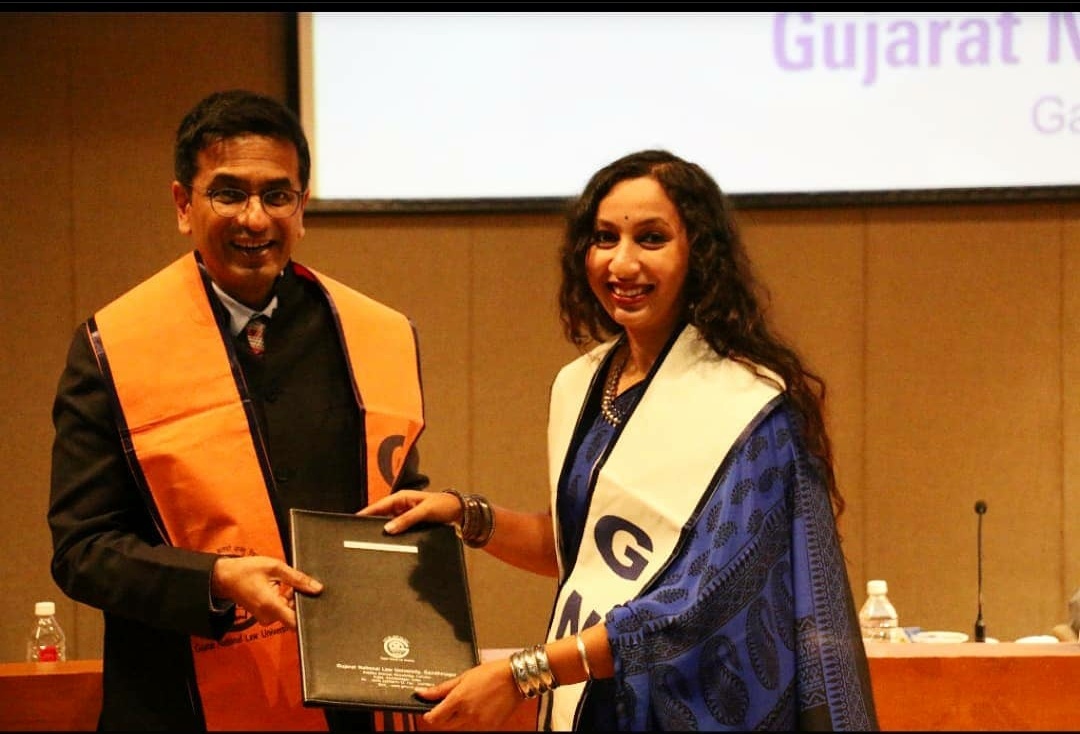
    Srishti Chaturvedi

    You have observed students very closely and from different perspectives by the virtue of being in different roles. How would you describe the modern era student’s mindset? What improvements do they need in their day-to-day activities to help them succeed?

    I think students today are extremely smart and informed, they know a lot more than we did in our graduation days. However, I also think the competition of getting successful, more and faster, than their peers is making a huge dent in their emotional well being. To study law and build a career in the middle of a pandemic, only adds substantially to this pressure. I have worked with Jagran Lakecity University, NLIU Bhopal, DNLU Jabalpur and now at RNTU in 4 years and I have found one thing which is common in all the students irrespective of all the other differences, that they are under a lot of pressure and most of them are not coping well with it. I cannot emphasize enough how important mental and emotional well being is, to succeed not just in life generally, but also in one’s profession specifically; everyone should make this an utmost priority if they want any kind of success in life.

    I don’t think that the students require a lot of tips about succeeding academically, except that they should be open to all kinds of experiences that the course offers. They should take up extra courses, write research papers, moot, participate in MUNs, present papers, become part of various committees and clubs, and intern in different places till their third year at least. This will help them discover what they like and what they want to do after graduation. The efforts of the next 2-2.5 years can be streamlined accordingly.

    You also started working as one of the founding members of CAN Foundation’s blog ‘Vedanam’ and later, as an Executive committee member of the Foundation itself. Can you tell us a bit about your role at CAN? What all responsibilities did you have? 

    My role as an Executive Committee member is primarily to focus on the execution of the 2 flagship scholarship programs of CAN- ‘Eklavya’ and ‘Dhananjay’. I work with the student committee of CAN from the inception of the project. We set the minimum eligibility criteria to apply, invite applications from meritorious students, go through hundreds of applications and sort them meticulously while also verifying their documentation. Thereafter, we have multiple rounds of meetings with the scrutiny committee and selection committee to finalize the names of the scholarship awardees. The whole process takes a lot of time and organization and cannot be done without the hard work and consistent efforts of the student committee members of the Foundation and the able guidance of Mr Siddharth R. Gupta,(CEO, CAN Foundation). Going through various applications of students who are extremely meritorious even while facing all kinds of financial hardships, since the last 2 years, has further encouraged me to realize my privilege and set long-term goals through which I can contribute back to the community in any form.

    Can you tell us a bit about your current work and role? What do you plan to achieve next in your career trajectory?

    I am currently in the final stages of completing my PhD thesis, and will probably be submitting it this year. However, I kept thinking I wanted an opportunity to do something different and most importantly, I wanted to be back in a classroom. So, I have recently joined as an Assistant Professor of Law in RNTU, Bhopal. My job profile includes teaching UG and PG classes, working on administrative rebuilding and cohesion and working with the local community as the Legal Aid Cell in charge through various projects of the University. 

    My sole aim for my career this year is the successful submission of my PhD thesis. I have been wanting to be an ‘Author’ of a book for some time, but the plan keeps being postponed due to some reasons. So after my PhD, I plan to write a book sometime soon. Working at DNLU made me realize I like taking up administrative responsibilities as much as I like teaching since I was also the Warden, the Faculty in-charge of the Legal Aid Cell and some other committees as well; so I would like to take up roles where I can work more in administrative capacity along with working on my classroom teaching skills.

    What would be your parting message to our young readers?

    My message to the readers, especially students, is to not be too hard on yourself. Read as much as you can, and not just about law, watch good movies, participate in competitions, create a lot of good memories with your friends and take utmost advantage of the facilities and opportunities offered by the University. The time, resources and opportunities that are offered during the 5 years of law school will not come again and they should be experienced accordingly. Everyone succeeds at their own pace, and as redundant as it sounds, every person should only compete with themselves. Someone might get a PPO in 4th year while you may still be giving interviews post-graduation, but that is okay. Someone might select the field they want to work in the first go, while you may have switched 2 fields already and are still not sure about what you want to do, and that is okay. Keep learning, keep exploring, keep working and take adequate breaks to breathe between all of this. Things will start falling in place one after the other.


    Get in touch with Srishti Chaturvedi:

  • DR. MANVEEN SINGH, ASSOCIATE PROFESSOR AND ASSOCIATE DEAN & DIRECTOR (3-YEAR PROGRAMMES) AT JGLS ON ESTABLISHING A CAREER IN ACADEMICS AND MANAGING ADMINISTRATIVE RESPONSIBILITIES AT JINDAL GLOBAL LAW SCHOOL

    DR. MANVEEN SINGH, ASSOCIATE PROFESSOR AND ASSOCIATE DEAN & DIRECTOR (3-YEAR PROGRAMMES) AT JGLS ON ESTABLISHING A CAREER IN ACADEMICS AND MANAGING ADMINISTRATIVE RESPONSIBILITIES AT JINDAL GLOBAL LAW SCHOOL

    This interview has been published by Isam Kabir and The Super Lawyer team.

    We last met in 2014, and from being a Research Associate, you have become an Associate Professor and Associate Dean at Jindal Global Law School (JGLS). How has the journey changed you as a person?

    Yes, indeed, I joined JGLS as a Research Associate back in the Fall of 2013, and for the last 8 years, I feel I have grown, both as an individual and as a teacher. There were different phases throughout this journey that were instrumental in shaping my academic career thus far. Of course, I always have cherished teaching and enjoyed research and writing, but my journey as a PhD scholar gave me a certain sense of confidence and ease whenever I chose to lift a pen or sit in front of my laptop. It also allowed me to express myself as a researcher more efficiently, mainly because I decided to further my interests in the area of my doctoral research. In terms of my teaching, a great amount of credit should go to all my students, whom I have taught over these years, and who have challenged me to deliver my absolute best. Robert Heinlein has rightly said, “When one teaches, two learn.”

    As for administration, I never really felt I could also put on the hat of an administrator. Shortly after I finished my PhD. I found myself in a never-before scenario of having to strike a balance between my teaching, research, and administrative responsibilities, something I feel I have been able to achieve, owing to the tremendous support of my colleagues and mentors. It has been an absolute pleasure working with all of them. Furthermore, the institutional interests are paramount, and I consider it my duty to give back to this institution, for I wouldn’t be where I am today had it not been for JGU and JGLS.

    Having academic experiences in India and abroad, do you see any parallels between national and international education parameters?

    There are indeed quite a few parallels to be drawn between national and international education parameters. Some of them include the quality of teachers, the richness of academic content, the teaching pedagogies, academic research, student-teacher ratio, etc. However, it is also true that Indian universities have taken giant strides in raising the bar when it comes to meeting the global standards in the field of higher education. The recently conferred Institute of Eminence (IOEs) tag is a testament to the Government’s endeavour to establish world-class institutions in the country. I think we are well and truly on the path to achieving global excellence.

    Unlike most law students who aspire to build a career in litigation or the corporate world, you have always been committed to the education sector. Did you ever consider switching your career path? 

    To be honest, I have never really thought about switching careers. I come from a family of academics, and the biggest source of inspiration for me was my late father, who I grew up watching and from whom I inherited a passion for academia. Teachers, they say, are performers, and every time I walk out of a classroom having delivered a good lecture, the sense of personal satisfaction I get motivates me to go back in there the next day and perform, just the way it should be. There is just so much positive energy when you are around students. I cannot imagine myself doing anything else other than teaching.

    In your last interview, you had just begun your career as a young faculty member at JGLS. You told us about the academic freedom the institute provides its faculties. Would you claim that this is one of the core reasons for being successful in academia today?

    Absolutely. I think academic freedom is integral to achieving success in academia, and personally speaking, I have immensely benefitted from the same right throughout my time at JGLS. From designing courses and experimenting with different teaching pedagogies to organising conferences and panel discussions in different areas of law and across different disciplines, academic freedom has been central to where I find myself today. For a young academic, who is expected to contribute to teaching and research, you definitely need that freedom to make the cut.

    You are ardently admired on social media by your peers and students; Do you believe the coming generation of faculties are redefining the student-teacher relationship for a better change?

    I would say the key factor at play here is the choice of academia as a profession. Gone are the days when teaching rarely surfaced as the preferred career option for fresh postgraduates. That has definitely changed with the passage of time, with more and more law graduates aspiring for a career in academia. What that means is, you are likely to step into a classroom at 24 or 25 years of age, teaching students in their early 20s. It is precisely the kind of challenge a young professional is looking forward to. It has, in fact, provided for a highly conducive environment for mutual learning and the exchange of ideas.

    What kind of an impact do you think the Pandemic has had on the students? What is the roadmap universities and educational institutions can follow to ensure accessibility?

    I think it is fair to say that the Pandemic has had a significant impact on students, not just in terms of their academics but also their physical and mental being. Physical spaces, including university campuses being shut down, meant that students found themselves restricted to the virtual mode of learning, having to spend hours staring at the screens. In addition, not all the higher education institutions were in a position to switch over to online teaching on an immediate basis, which, when coupled with the lack of permeance of the Internet, left students in an extremely vulnerable position. Having said that, over the last year and a half, the students have shown tremendous resilience in coping up with the demands of the system, both on a professional and personal level, and they continue to fight against all odds.

    As for the Universities and other higher education institutions, I feel an investment in the up-gradation of technology infrastructure is the need of the hour. The education sector needs to brace itself for the after-effects of the Pandemic to last for a continued period, and higher education institutions must take all the necessary steps in ensuring accessibility to students. Adopting a dynamic and flexible approach under a definite Action Plan, tailor-made for such a situation, is fundamental to restoring parity and moving forward. At JGU, we have been lucky to have the Administration adopt such a course of action and upgrade its existing information technology infrastructure, providing an optimum learning experience with lecture recordings stored on cloud space. Students are at liberty to access the same as per their convenience, which is of immense help, especially considering the uncertainties surrounding the Internet. Considering that the reopening of campuses will occur in a phased manner, I feel universities must gear up for a hybrid mode of teaching, for it looks like we are in for a long drawn battle.

    You completed your PhD while you were working on a demanding role. Were there any taxing phases in this fascinating journey when you have had to go through severe hardships? Do you have any advice for the students who are struggling to reach their goals?

    Quite a few, I would say. Doing a PhD while you are in a full-time job is not easy but also not impossible. There were moments when I felt like giving up my PhD. However, there is always a reason for you to get up, dust yourself off, and keep walking. For me, that reason was my late father’s dream to see me earn my PhD. The hardships I found myself in the middle of were nothing when compared to fulfilling his dream. That kept me going and prepared me to overcome the bigger obstacles that awaited me. They say, if you do not feel like giving up your PhD even once during the course of your journey as a doctoral candidate, perhaps you’re doing something wrong. It’s a challenge, but a challenge every doctoral candidate must embrace.

    My advice to students would be to focus on short-term career goals and take one step at a time before they look to fulfil the long-term ones. Set yourself small but time-bound targets. Take small steps and make some progress towards achieving your goal daily. It could be as small a thing as writing 150-200 words or reading 15-20 pages of a book or a paper daily. It’s alright if you miss your daily goal but make a genuine attempt. For example, if you write 100 words instead of 200, you can always make up for it over the next day or two, but keep track of your daily, weekly, and monthly progress. ‘Discipline’ is the key; the more disciplined you are, the higher would be your efficiency, and the greater would be the degree of self-satisfaction.

    Wearing so many hats, how do you fit your leisure into such a busy schedule of yours? How do your additional interests in sports and entertainment help you?

    I feel leisure is absolutely crucial for one’s physical and mental well-being; therefore, it is important to take some time off from work and refresh yourself. If I were to talk about myself, I take my interests in sports and entertainment quite seriously, and no matter how busy I am, there would always be time to tune in to a Football match on the weekends or watch a 2-hour long movie once a while.  Having said that, if there is a movie or a web series worth watching, or a non-academic book worth reading, I try and plan the watching/reading schedule for the same in advance and finish all my work-related commitments before I begin to watch the movie/web series or read the book. My priority is, of course, to ensure my work does not suffer, therefore, striking the right balance is what I have always striven for, and I must confess it is something that has come along with the passage of time.

    Any last message you would like to convey to our young readers who wish to join academia?

    I would just like to say to all of them that teaching is one of the noblest and rewarding professions, deep-rooted in a penchant for learning, and one which gives you a sense of satisfaction like no other. While you may want to become a teacher, you will forever remain a student, for the learning never stops. Every lecture delivered, every discussion concluded, and every dialogue held with the students would enhance your learning. Having said that, it can never be a compulsive career choice, for you will not be able to do justice to your role as a teacher if the calling doesn’t come from within.

    Listen to that voice inside you, do what it tells you to, and in doing so, put your best foot forward.

    Get in touch with

  • Amrit Subhadarsi, Assistant Professor, KIIT University, on experience in academia and legal education system of India

    Amrit Subhadarsi, Assistant Professor, KIIT University, on experience in academia and legal education system of India

    Amrit Subhadarsi is currently an assistant professor at KIIT University. He completed his BA LLB from School of Law, KIIT Deemed to be University, and his masters in Corporate Law from National Law University, Odisha in 2017 and was nominated as LLM student representative to Prof G.V Ajappa, a leading expert on jurisprudence in India. He has written a book on Standard Essential Patents and abuse of dominance in the global telecommunication industry, which has been published by Laxmi Book Publications. He regularly engages with institutions and regulators alike to provide a platform for students to learn practical insights into the workings in a particular industry in corporate law. Before joining the academia, He has also worked as a trademark analyst in legal consultancy wherein, He has engaged extensively in analyzing and preparing reports on trademark case laws from the European Union and Commonwealth.

    In this interview we speak to him about:

    • His interest in academia
    • His opinion on the Indian legal education system; and
    • His experience as an Assistant Professor at KIIT University.


    HOW WOULD YOU LIKE TO INTRODUCE YOURSELF TO OUR READERS? PLEASE TELL US SOMETHING ABOUT YOUR PRE-COLLEGE LIFE?

    I am a soft-spoken and amicable person, with a passion for reading and writing. I am a native of Odisha and belong to a non-legal background. During my higher secondary schooling in Kolkata, I was a shy kid, a major obstacle in a society which considers shyness as a demerit. I was fortunate enough that I had good friends to guide me during my tough days. I was and still am a voracious reader. I never had much inclination towards pursuing commerce or science and I felt like I had a calling for arts subjects. Particularly, subjects like political science and sociology became my favourite. While reading newspapers, often I came across legal articles and interviews which I used to read with great interest and thus began the quest for having legal knowledge.

    YOU HAVE DONE YOUR MASTERS IN LAW. HOW WAS YOUR LLM EXPERIENCE AT NLU ORISSA. WHAT ARE THE CHALLENGES YOU HAD FACED WHILE STUDYING AT NLU ORISSA?

    The introduction of one year LLM has turned out to be a bane. One year LLM does not allow the student to explore research avenues effectively. For instance, if a person wishes to be a member of a research center, or take part in moot courts, then such avenues are not there. Further, it does not allow the student to make any one particular area as a specialization because many subjects have to be studied in such a short span of time. There are few institutes that encourage LLM students to take part in moots. But, this needs to be institutionalized, because more than mooting skills, research in moot courts can help the LLM student to make it a specialization later. I was fortunate enough, that despite the one year LLM, I managed to be an active member of the Center for Corporate Law, be nominated to represent the institution in a lecture series by Professor G.V Ajappa, a leading authority on jurisprudence in India. Also, my dissertation secured the highest marks which I have converted into a book slated for a release in March.

    WHAT IS YOUR OPINION ON THE INDIAN LEGAL EDUCATION SYSTEM?

    At the moment there is a large vacuum in the Indian legal education system. Systematic changes need to happen across three levels: students, parents and institution. At the student level, they need to understand that five years of legal education is not to just to train them with skills for the corporate sector but to equip them with analytical skills prerequisite for the legal profession. This brings me to the other two levels: parents and institutions. It is here that a paradigm shift is required. Many parents look forward to a well-paying job after graduation, but not necessarily quality education. In India therefore, the focus is on to generate placements and not delivering quality education. Fortunately, KIIT School of Law has emerged as an exception to this trend as among other laurels it has now secured the most innovative law school award in 2018.

    HOW HAS LEGAL EDUCATION SYSTEM CHANGED OVER THE YEARS AND WHAT ARE THE ADVANTAGES AS WELL AS DISADVANTAGES OF THIS CHANGE? WHAT CAN STUDENTS OF TODAY LEARN FROM THE OLD SYSTEM OF LEGAL EDUCATION?

    The legal education system has undergone a sea change over the years. Some advantages include many institutions like KIIT School of Law and a few others providing excellent infrastructure and resources to students. The new legal education system is also incorporating emerging trends in society, through classroom innovation, developing legal clinics, practical training for mock trials and moot courts, corporate and business laws being part of the curriculum more frequently. The advantage is that the students get the opportunity to learn practical aspects apart from theory at a very young stage, unlike in the earlier system, where such skills were taught only in the final years. Besides these advantages, the demerit is that students are no longer researching from books and journals as they used to before and this is inhibiting their development of analytical skills. Students must go beyond the ‘Google it’ mentality to ‘original research’ mentality.

    WHAT PROMPTED YOU TO CHOOSE TEACHING AS A CAREER?

    I always had an inclination for reading, writing and researching on my areas of interest. I never found research as boring as many in their student days often complain. Quite frankly, I was confused for quite some time even in my final year as well and still remember how my friends tolerated my constant changes in decisions. Eventually, as I was delivering a demo lecture during one of my post graduation classes, I realized this is something I could do passionately, not feel like work and not be bored. When you come out of class fully satisfied, that is when you know that you are in the right profession. These coupled with my patience for research and writing help cement my decision for academia.

    TELL US ABOUT YOUR TEACHING METHODOLOGY.

    Depending upon the subject, the teaching method varies. For instance, a paper having a mix of theoretical and practical knowledge ensures that I adopt lecture and Socratic Method along with practical training such as classroom simulations, or activity based class assignments, etc. For theory subjects, I usually adopt a mix of lecture and Socratic dialogue method. Before beginning the class, I regularly ask the students about the discussions in the previous class so the next class commences from where we left off. Reading assignments for the next class are also given.

    HOW IMPORTANT A ROLE DO YOU THINK LAW SCHOOL PLAYS IN SHAPING ONE’S CAREER?

    It is common knowledge in legal fraternity that teaching standards in Indian law schools have come down drastically. That does not mean all law schools should be painted with the same brush. Both the institution and student complement each other for laying down the foundation for future development. The current crop of students comes with a ‘fixed mindset’, whereas what is needed is a ‘growth mindset’. The same standard for any law school also. Based on their mindset, the student shapes his or her formative years at law school.

    All law schools may not be perfectly equipped to provide practical training, but they do provide opportunities for learning them through moot courts, internships, training courses, among others. Law schools are platforms for a vibrant mix of theoretical and practical training. But to learn them, the student has to navigate his way through networking. It is not a one-way street. Both students and institutions when complement each other, it leads to holistic development. What is needed therefore is a way to engage with students and institutions holistically. For instance, KIIT School of Law is one of the few institutions where because of engagement; many of our students have excelled in national and international moots, publications, higher academic research, among others.

    YOU ARE NOW WORKING AS AN ASSISTANT PROFESSOR AT KIIT UNIVERSITY. HOW IS YOUR WORK EXPERIENCE SO FAR?

    The experience of working at the school of law, KIIT Deemed to be University has been very comforting. When you start working at a place that is unfamiliar to you, there are some challenges you need to encounter, for instance, blending in with new people, with the work culture. But KIIT has been special for me for a number of reasons. Firstly, working at your alumnus provides me with a sense of pride when viewed from the other side of the table and working alongside many of my faculties who are always there to guide me. This helps increase your productivity manifold and sense of belongingness. Secondly, KIIT School of Law has been awarded the most innovative law school in India for 2018 and KIIT University has also earned a place in the Times Higher Education rankings. Working at a prestigious institution like this has given me exposure like never before and has definitely added to my professionalism traits.

    COULD YOU GIVE OUR YOUNG READERS CERTAIN TIPS ON EXCELLING IN ACADEMICS?

    Firstly, it is imperative for the faculty to reach class not on time but five minutes before time as it allows the faculty to prepare mentally. Students also would know that time must be maintained and consequently, the flow of teaching will not be disturbed. One should understand that excelling in academics not only means being a good teacher, but also a good guide, a good writer and researcher. If writing, lecturing and researching fascinate a student, then academics can be given a shot. Hence, prioritization is critical.

    Preparing the agenda of the class a day before leaves room for actual preparation for class. One should also accept the fact that not all students will have equal levels of aptitude and curiosity which is why regurgitating whatever preparation was made before class is not going to be enough. Students expect innovativeness in teaching and hence the teacher must be updated about subject content (hard skills) and an effective orator and communicator (soft skills). Also just like the student, once in academics, the individual must not stop reading. Effort must be made to make the teaching as interdisciplinary as possible so that both students and teachers have scope to add value to classroom discussions. Lastly, research and writing must be at the highest level. For instance, I have successfully converted my dissertation, which secured the highest marks, into a book which is slated for release this March.


    WHAT IS YOUR ADVICE TO STUDENTS WHO WISH TO PURSUE CAREER IN ACADEMICS BUT ARE CONFUSED BETWEEN LITIGATION AND ACADEMICS?

    Both litigation and academics have their own set of desired skill sets and perks. There is a common misconception that a job in academia means a comfortable lifestyle. This fallacious attitude leads many to take up academics as well. But I believe, as a student, one should first prepare a list of do’s and don’ts. For instance, the latter can include not succumbing to peer pressure and herd mentality. This will allow the student to take a realistic approach.

    The former can include watching out for signs where the student can develop skills. If the student has the inclination to research, write, loves to speak on a platform, and just loves to read, teaching is ideal. However, if the idea is to use the aforesaid to practice and argue before a judge, he or she must be prepared to struggle for years in litigation before making decent money. Of course, such choices do get affected by scenarios like mounting student loans or other financial burdens, in which case choosing litigation instead of a well-paid job is a pursuit in a fool’s paradise.

    HOW DID YOU DECIDE TO WRITE YOUR FIRST BOOK COMPARATIVE LAW RELATING TO PATENTS AND ABUSE OF DOMINANCE IN THE GLOBAL TELECOMMUNICATION INDUSTRY? WHAT WERE THE CHALLENGES YOU FACED AS A FIRST-TIME WRITER?

    I was already interested in this topic during my LL.B and got familiar with this topic when our team secured the approval for participation in our second moot court after clearing the intra moot court stage. However, at the same time, our final year placements were about to commence and I did not want to miss my shot at placements. So I had to leave this opportunity. But, I knew someday I would engage in research in this area, though not definitely knowing that I would publish a book on it someday. Broadly there are two sets of challenges for a first time writer like me. The first is to not get carried away by believing that merely because one is skilled at writing a good journal article, one should also be equally good when writing a book. The time invested, the patience utilized and the numerous proofreads that goes into one chapter for a book is a herculean task. A seasoned writer will, of course, know how to vary his or her strategy regarding publication in a journal and a publication as a book. The second challenge is that in a topic as specific as Standard Essential Patents in Telecom Industry and Competition Law, where the scope in India is ever increasing, it is very difficult to write within established regulatory rules, as the same is changing very quickly. Plus, due to lack of jurisprudence in India, I compared US, EU, UK, China and Japan, which are the other jurisdictions where such cases have had the most prominent impact during my research, and have written India’s first of a kind book on linkages between Intellectual Property and competition law in the telecom industries in major jurisdictions.

    HOW DOES ONE GET THEIR BOOK PUBLISHED?

    Being a first-time writer, I did not have contacts with established publication houses. However, I took my chances and made contact with few big publication houses, where my work was rejected because the market demand is for books catering to general subjects like Intellectual Property or Competition Law, but not an amalgamation of both. This is understandable because of the demand by students and also the fact that with a first time author the publication houses will be a little apprehensive. It’s important therefore that one uses professional networking sites such as Linkedin to use it to find and connect with publishers who can take a chance with first time choices. In other words, an open mind has to be kept. So, I approached another publication house as I believe that one needs to start somewhere regardless of the size of the publication house. I was initially apprehensive but I must give credit to them as they did their job professionally and meticulously changed the content, the font, the footnote font, page borders, book design and covers.


    HOW DID YOU MANAGE THE TIME TO WRITE A BOOK?

    Frankly speaking, this book is actually my dissertation in corporate law, which secured the highest marks during my post graduation. I never started with the intention to write a book, but I knew I had to give it all. So instead of working on projects which were given to us, I started working on my dissertation, a herculean task when six jurisdictions had to be comparatively analysed. I knew I had to maintain attendance for exams and could not pull all-nighters (which personally I love). So, I skipped some of my classes, sat throughout the whole day, and engaged in back-breaking research work and compilation. But, I am glad it was worth it and the hard work paid off.


    WHERE DO YOU WANT TO SEE YOURSELF FIVE TO TEN YEARS DOWN THE LINE?

    Legal academia is no longer confined to just imparting quality education. Faculties are also engaged in consultancy and advisory work. So in five to ten years, I would love for myself to be an established academician in my chosen field of specialization and create value through new avenues. It could be through publishing books and papers, value generation through consultancy for the institution and most importantly creating a conducive classroom learning atmosphere where students yearn for my lectures.

    WHAT WOULD BE YOUR PARTING MESSAGE TO OUR READERS WHO ARE PRIMARILY LAW STUDENTS AND YOUNG LAWYERS?

    My advice would be to never stop exploring. There is a no bigger teacher than one’s own curiosity. One should always be on the lookout for ‘unlearning’ as it helps to widen understanding of how a system works. And lastly, students must accept that the legal job market is not what it used to be decades ago. There are tons of options and it is but obvious that they will be confused. So trust your instincts and find avenues which match your desired skill sets. The path will follow.


  • Rajinder Kaur, Researcher and Professor, University Institute of Legal Studies, on making a successful career as a legal researcher

    Rajinder Kaur, Researcher and Professor, University Institute of Legal Studies, on making a successful career as a legal researcher

    Prof.(Dr.) Rajinder Kaur is a veteran in the field of research and currently a Professor of Law at University Institute of Legal Studies. She has achieved the prestigious prefix of the professor at a very young age, courtesy her extensive success in publishing and researching. She has dedicated her life to unceasing research and development in the law, with three of her case studies listed in the Harvard Business review! She has also collaborated and worked on numerous government projects. Her blend of new-age gallant thinking in law and advantage of teaching the same in classrooms makes her the perfect picture of success every young law enthusiast can aspire to achieve.

    In this interview she talks to us about:

    • How to become a successful researcher
    • How to choose the right journal for publishing work
    • How does the life of a researcher look like and opportunities for young researchers
    • Advise to young academicians on blending research with teaching
    • What can the new generation of students learn from her generation on the art of studying law?


    PLEASE TELL US SOMETHING ABOUT YOURSELF AND HOW YOU CAME TO BE IN THE LEGAL FIELD?

    I was pursuing pharmacy. I belong to an agricultural family and there were a lot of legal issues in the family which motivated me to pursue law instead. I did my law from Department of Laws, Panjab University.


    YOU HAVE DONE YOUR MASTERS IN LAW AS WELL AS THE DOCTORATE IN LAW ON THE ISSUE OF CHILD LABOUR. HOW DID YOU DECIDE TO PURSUE THIS SOCIAL ISSUE THROUGH RESEARCH-BASED STUDIES?

    There were certain articles which I came across during my graduation in an ILI journal. I was a student of constitutional law and studied certain books like ‘Neera Bura’s Born to Work’ which impacted me. So I decided to take up the topic of Child Rights.

    HOW HAS LEGAL EDUCATION SYSTEM CHANGED OVER THE YEARS AND WHAT ARE THE ADVANTAGES AS WELL AS DISADVANTAGES OF THIS CHANGE? WHAT CAN STUDENTS OF TODAY LEARN FROM THE OLD SYSTEM OF LEGAL EDUCATION?

    Practical training and clinical legal education have found a central place in the system of legal education today and it was not that stressed upon during our time. We were not exposed to court working and procedure until the final year itself. We came to know about the concept of mooting very late and nowadays it is part of the curriculum. Secondly, clinical education, developing legal clinics to bring awareness to citizens about their rights is also a welcome change. It simultaneously helps students develop insight into what they are actually supposed to do when they graduate from the college. The new legal education system is working towards incorporating changing trends of society, for instance, corporate and business laws are now taught as a regular subject. Research is also stressed upon more now. We didn’t have that many resources. The quality and quantity of resources have definitely brought about a significant change in the system.

    But one drawback of too many resources and activities is that depth of knowledge has decreased in students. They have a shallow knowledge of their subjects. They don’t even take into consideration the critical analysis of the subjects or topics they are studying. When we were studying, we studied a topic holistically and in entirety. Students don’t look beyond words or at the objective of having certain words and not others in the statute. This makes knowledge only superficial. While students are equipped with good oration skills and research, but in-depth knowledge is missing. For instance, Students don’t turn to constitutional debates anymore to fuel their research.

    YOU HAVE BEEN AN ACADEMICIAN FOR A LONG TIME. WHAT IS YOUR ADVICE TO STUDENTS WHO WISH TO PURSUE A CAREER IN ACADEMICS BUT ARE CONFUSED BETWEEN LITIGATION AND ACADEMICS?

    Be it practise of law or academic, one must do that which gives him/her more happiness and satisfaction. I wanted to go for the judiciary but due to Sidhu scam and various other litigations, I got into teaching instead. But when I did it, I started enjoying it. The moment you deliver a lecture and come out satisfied – that is your cue that you have made the right choice. And if you are in the court and the moment you come out and feel satisfied that you have done justice to your client, it is sufficient to conclude that this is your calling. There is no difference between the two fields and it all depends on the individual’s interest.


    YOU HAVE BEEN A RESEARCH SCHOLAR FOR SUCH A LONG TIME AND WRITTEN INNUMERABLE ARTICLES, THAT TOO IN DIVERSE FIELDS. HOW CAN AN ACADEMICIAN FILL THE GAP BETWEEN RESEARCH AND PRACTICAL TRAINING?

    A writer or researcher should avoid becoming self-obsessed after writing a few articles. Research is an on-going learning process. I am a teacher of Constitutional law, but due to several administrative reasons, I ended up teaching Business and Economic Laws. Company law as a subject had no takers. People usually underestimate its importance as a subject of legal education curriculum. But I found it to be very interesting and also found that labour laws, company law and corporate laws are actually interdisciplinary subjects and directly impact management.

    If you look into my research work, writing a case-study was a very challenging task for me. I was told to simply sit and observe, and note down things. There was no place for opinion in this type of researching. I was to narrate the events as it is. These case studies are now listed in the Harvard Review. But they helped me to fill the gap between research and practical training. I learnt structural problem solving and I share my experience and learning with students who gain insights into the practical aspects of working of companies. Research should be a tool to analyse the problem and solve the problem thread by thread, rather than simply looking at it as a cumulative and big problem. Steer clear of opinions and biased approaches, and simply look at the problem, bifurcate it and the gap between pragmatism and research will be filled. Case- studies method is the most sought-after way of teaching nowadays. Research can be more challenging than the practice of law! A good research exercise enhances one’s acumen in critical and analytical ability.


    SHOULD A RESEARCHER SPECIALIZE ON A PARTICULAR TOPIC FOR PURPOSE OF GETTING PUBLISHED OR RESEARCH ON DIVERSE TOPICS?

    One must continue in the research that is undertaken and acquire a thorough knowledge of his subject. I have done my research on child rights and then I continued it with topics of company law now have practically covered all topics under both. Now my research has ventured into Trade Conflict. Initially, I also committed some blunders, for instance, I wrote a paper on Bio-Terrorism which was very good and also got published, but I never followed up the issue through continuous research. Now I have to explain this anomaly in every interview I face.


    SO WHAT IS YOUR ADVICE FOR YOUNG RESEARCHERS? WHAT SUBJECTS SHOULD THEY FOCUS ON? WHAT ARE THE DO’S AND DON’TS THEY SHOULD BE AWARE OF?

    If you look at the demand in the market, it is for corporate law universities are already providing quite a lot of specialization in Constitutional law already. We need teachers to teach new upcoming subjects of national importance like Corporate Governance, CSR, Commercial Arbitration, International Trade Law, Competition Law, Financial regulatory Market etc. We are still lacking in this regard. Students should take up these subjects. Trends are changing very fast, for instance, the shift from arbitration to mediation and negotiation. So one must focus on the trends and work accordingly.


    HOW SHOULD STUDENTS GO ABOUT CHOOSING THE RIGHT JOURNAL FOR PUBLISHING THEIR WORK?

    Choosing the right journal has become a tricky task because there are so many predatory journals these days. A journal might have an impact factor of 3.5 or 4.5 in their local area but it doesn’t mean it is a good journal. For instance, Elsevier has an impact factor of only 1. So, it has become a market. So, one must either go for University Journals. Initially, one can start with student-run journals also. One should aim for good and standard publishers. For example – Elsevier, Springer, Sweet Maxwell, Thompson, INDUS foundation, I J Global, Lexis-Nexis etc. However, be it any journal, one must always aim for doing qualitative work and not sub-standard work. A good journal will teach you about your mistakes and shortcomings in research and that is important for growth in the field.


    WHAT IS A GOOD IMPACT FACTOR?

    Even a 0.1 or 0.3 is a good impact factor if it is given by the right agency. Now, the UGC has laid down that the impact factor given by Thompson Reuters will be taken into account. They mark out a journal and then give an impact factor rating. Thompson Reuters is a massive publishing house and also ranks Universities.


    WHAT OTHER OPPORTUNITIES EXIST FOR STUDENTS AND ACADEMICIANS LOOKING TO EXPAND THEIR CAREER IN RESEARCH (EXCEPT GETTING PUBLISHED AND TEACHING)?

    There are many opportunities for researchers. Editing is a great opportunity but command over language is very important. One can be a researcher for Government projects also. The Government hires researchers for framing public policies from time to time. One should keep a tab on the websites of various Ministries to avail the opportunity. The teachers who are selected to handle these projects also advertise for research assistants. Fellowship programs can also be availed by students.


    WHAT HAS BEEN THE HIGHEST POINT OF YOUR CAREER SO FAR?

    Listing my case-studies with the Harvard Business School! The first case-study took two years to complete. It was first published with Ivy and subsequently got listed with Harvard.


    HOW CAN ONE PUBLISH FREQUENTLY? WHAT ARE THE FUNDAMENTAL QUALITIES OF A GOOD RESEARCH SCHOLAR?

    One must give himself or herself a target and work towards achieving that target. Hap-hazard publishing will only add stress to life and lead to the imbalance between work and life. One must read a lot, and that too good books; Patience; Hard-work; Developing a framework of mind to comprehend things correctly; laying out things in the proper manner are the undisputed hallmarks of a good researcher.


    WHAT IS YOUR MESSAGE TO STUDENTS OF LAW?

    Students are running towards judiciary a lot and I was also a part of this Bandwagon once. But I would advise them that they should leave it out and things will come to them on their own, whatever the fate has laid out for them. One just has to work hard. The basic aim should be to study hard and be honest with yourself. Be sincere towards your studies and rest will follow.


  • Shruti Tripathi, Assistant Public Prosecutor, CBI, on preparing for the exam and securing rank 2 in JRF exam

    Shruti Tripathi, Assistant Public Prosecutor, CBI, on preparing for the exam and securing rank 2 in JRF exam

    Shruti Tripathi graduated from ILS Law College, Pune in 2016. Right after graduation, she did her Masters in criminology from Banaras Hindu University.  She also secured rank 2 in JRF/ NET exam conducted by UGC. She then went on to pursue UPSC(CBI(APP)). She shares her valuable insights with our readers on her experience along with advice on how to crack the exam.

    In this interview, she talks about:

    • Her reasons for choosing law.
    • Her strategy for the preparation of the UPSC(CBI(APP)).
    • Advice to prospective law students aiming to make a career in UPSC(CBI(APP)).


    HOW WOULD YOU LIKE TO INTRODUCE YOURSELF TO OUR READERS?

    I thought I didn’t need introductions anymore. Anyway, jokes aside, I would simply describe myself as a stoic. As a day-dreamer and a sloth, I am quintessentially an ambitious soul trapped in a lazy body. My mind is a battleground, wherein there are more losses than wins. Proving people wrong at every step is an utterly satisfying feeling and continuing to do so is pretty much what sums up my existence right now.  I was supposed to keep it short, so moving on now.


    HOW DID YOU DECIDE TO PURSUE LAW?

    Looking at the hindsight I guess it was destiny, really. I was a Science group district topper from Varanasi. The entire North Indian neighborhood expected me to pursue engineering but, I was always drawn towards the enigma that my father’s chamber had to offer.(Yes! He was the Chairman, UP Bar Council, that time). And if I were allowed a bit of dramatics, Law was running down my family’s blood vessels and that’s how I happened to Law & ILS Law College, Pune happened to me. Don’t judge me for my bad theatrics, I am still learning.


    PLEASE TELL US ABOUT YOUR PREPARATION FOR JRF EXAM IN WHICH YOU SECURED RANK 2? WHEN DID YOU START PREPARING FOR UPSC(CBI(APP))?

    Honestly, I wasn’t really aware all these exams ever existed. Like every other legal aficionado, I had my eyes set at cracking my state judicial exams. I still have that dream, though. Nevertheless, like every other government sector exams which test the threshold of one’s patience, judiciary vacancy never came after 2016. So, the waiting period opened up the Pandora’s Box for me and I realised that there was more to law than just judiciary and litigation. Therefore, I started filling all the forms that I could manage and that’s how I ran into UPSC via CBI(APP)

    Since I had done my Masters in criminology from Banaras Hindu University, I was eligible for examinations for PHD and Assistant Professor, NET/JRF exams formerly conducted by UGC. The syllabus was similar to the judicial service examinations with a little modification. I qualified for Centre sponsored fellowship program(JRF) that awards scholarship up to 30k per month to the research scholars. So, I joined as a research scholar in BHU, shortly after being awarded JRF & started hogging on to that money: the money I never knew even existed.


    HOW DID YOU START PREPARING FOR THE EXAMS? DO YOU THINK COACHING IS A PREREQUISITE TO CRACK THIS OR ANY EXAM?

    Preparation for any competitive exams is a tough mistress and is notorious for going haywire, if executed without a pattern. While there isn’t any yardstick to articulate whether or not an individual will need a coaching, the secret recipe is the right form of guidance & a continuous thrust in the appropriate direction, to keep one motivated throughout the entire preparation period(As it gets really frustrating after a point of time).

    Personally, I joined an institution, Varanasi Law Academy, managed by Praveen Dubey sir. Honestly, the kind of command he has over all the subjects including the ready-to-use dossier on the ever increasing career alternatives in legal field is quite enthralling.

    WHAT WAS THE ROUTINE YOU FOLLOWED EVERYDAY THROUGHOUT THE COURSE OF YOUR PREPARATION?

    It was just get up, eat, sleep, and repeat. Adjusting study routine somewhere in between the important endeavours was the arduous task. Sincerely, preparation is all about wasting time and then end up feeling guilty about it. No matter how much you study, there’s always this humongous section of the day, where you didn’t. Each day the fight was to atone for that lost stretch.

    On an average Day, I stole more time from the first half of the day for tough concept based studies & learning gig, while latter part of the day was devoted to making notes and solving question papers.


    WHAT WAS YOUR STUDY PATTERN? PLEASE MENTION SOME OF THE BOOKS YOU REFERRED TO AND HOW DID YOU GO ABOUT PREPARING FOR EACH STAGE OF THE EXAM?

    It might sound preachy, but success indeed knows no shortcuts. Neither notes, nor any coaching materials are going to help you unless you go back and do it conventional way, that is, the Textbooks. Any book which resonates with your style & understanding level is a good book.

    I referred Takwani for Administrative law and CPC, Pillai for IPC, Avtar Singh for evidence and contract law, H.O. Agrawal for international Law & so on and so forth. I prepared my own notes, conducive for my slow processing brain, and would suggest everyone to do that, for law at least.


    WHAT DID YOU DO TO KEEP YOURSELF MOTIVATED ALL THE TIME DURING THE COURSE OF PREPARATION?

    As I said the primary Fillip to my Preparation module was My Teacher, My guide, My mentor, Praveen Sir. Another pillar to my vital mental sanity was & is my Mother, Anita Tripathi. I am just her conceptualised handiwork and owe everything I have, to her endurance and unwavering willpower.

    For the other times where my mind gave up on me, I tried indulging myself in my poor musical taste and gulping down whatever I got. Having a cup of coffee by the window on a rainy day with my favourite author was therapeutic enough to get me through worst of days.


    COULD YOU PLEASE GIVE SOME TIPS TO THOSE ASPIRANTS WHO ARE PREPARING FOR THIS EXAM? HOW SHOULD THEY GO ABOUT PREPARING DIFFERENT SUBJECTS LIKE GENERAL AWARENESS, OPTIONAL PAPER OF LAW?

    There are no shorthand tips when it comes to exams like these. All I can say is having a robust dominance over the bare acts of all the subjects will give an assured and unqualified edge to the candidate over others. For remembering bare acts, I suggest all the novices to start by splitting the subjects into batches and then having it off pat by the correlation method. That would make it easier and less tiresome.

    General awareness, well, I am sorry for the cliffhanger there, but that’s still a sixty-four dollar question for me too. You got to study all your history, geography and economy and current affairs and yet have to pray to be fortunate enough to be able to touch those minimum qualifying marks. At least that’s how it was for me.


    PLEASE TELL US ABOUT HOW DID YOUR INTERVIEW? HOW SHOULD A LAW STUDENT APPROACH THE INTERVIEW FOR THESE EXAMS?

    Haha! I totally savaged my own interview. I still remember passively crying over how bad I was in that room. One experience that I took back home that day was, that no one can prepare you for interview. Inside that space, in front of the panel, you forget that you were told not to be nervous, or to sit straight or not to fidget with hands & you are back to being yourself. And there’s where the key to cracking any interview is, my friends, be you.

    Cliché as it may sound, but that’s what helped me. So, prepare for that panel since day one of your preparation. Act like you have been shortlisted & have to appear before a panel the day after so that the day you enter that room, which you definitely will, you are just yourself; the sheer perfection.


    WHAT WOULD BE YOU MESSAGE TO THE LAW STUDENTS WHO WANT TO PURSUE THEIR CARRIER IN THE FIELD OF LAW?

    Notwithstanding the fact that I don’t see myself as someone who could remotely give a message of great or any consequence for that matter, I’d surely like to write off my experience for future references. I’d suggest don’t be prejudiced against or oriented towards a particular career option. There are plethoras of option we aren’t conscious about. Also, don’t judge your success on the parameters of others, that’s a trouble-free road to depression & frustration; tread on your own risks. Be vigilant; be assiduous while simultaneously being indolent and blithe.

    Here’s me signing off without further ado. Hope you find something helpful or entertaining, to the least, in the excerpt.


  • Sajid Sheikh, Assistant Registrar (Academic), Maharashtra National Law University on experience as a law professor,  writing research papers and founding Lawlex

    Sajid Sheikh, Assistant Registrar (Academic), Maharashtra National Law University on experience as a law professor,  writing research papers and founding Lawlex

    Sajid graduated from The Law School, the University of Jammu in 2013. He did his post-graduation from National Law University, Jodhpur and is pursuing his Ph.D. from NALSAR University of Law, Hyderabad. With a passion to help the community, one step at a time, he founded Lawlex organisation in 2013. Presently, he is a faculty at Maharashtra National Law University Mumbai. His research interests are Intellectual Property Law, Law of Torts, Research Methodology and Advocacy Skills.

    In this interview he talks about:

    • His experience at National Law University, Jodhpur
    • His NGO – Lawlex organisation
    • Challenges of being a professor
    • Tips on writing research papers


    TELL US A BIT ABOUT YOUR CHILDHOOD, PRE-COLLEGE LIFE AS WELL AS EDUCATIONAL BACKGROUND.

    I have been born and brought up in Jammu (Jammu & Kashmir). I was a shy kid till the seventh standard. From eighth standard onwards, I started developing my interest in literary activities. I wrote two poems that year which I contributed to the school magazine. That was the beginning. Later, I participated in debates, symposium and essay writing competitions and fared well in them. I was much fascinated with science, particularly astronomy which I used to discuss with my friends during breaks.


    HOW DID YOUR INTEREST GRAVITATE TOWARDS LAW?

    My father is an Advocate. I enjoyed having a look at the files whenever I could get my hand at them. I liked the legal language, the sentence construction and how the arguments were presented. Sometimes, I used to assist my father in his office. Moreover, the fact that this profession could help people get justice inspired me to pursue law.


    WHAT DO YOU HAVE TO SAY ABOUT THE SUPPOSED ‘ELITE’ TAG ATTACHED TO CERTAIN LAW SCHOOLS? DO YOU BELIEVE BRANDING OF COLLEGE IS SOMETHING THAT’S VERY RELEVANT/ IMPORTANT AT ANY STAGE IN A LAW STUDENT’S CAREER?

    I have a kind of mixed opinion about this, based on what I have observed. Legal luminaries like Ram Jethmalani, Harish Salve, Fali S Nariman studied from traditional universities and are at the top of their profession. They started from the scratch and reached the zenith. But, these days when we rank everything when there are numerous options, ‘elite’ tag can help at entry level. The employer may give you a job based on the glitz of the institution tag, but your retention and growth depend on your knowledge, skill, and perseverance. There is no other route. Tags fail there. I have been told that there is certainly top tier law firms which provide stipends to interns belonging to certain law schools only.


    WHAT WERE YOUR AREAS OF INTEREST DURING YOUR GRADUATION? HOW DID YOU GO ABOUT DEVELOPING EXPERTISE AND KNOWLEDGE IN THESE AREAS?

    I loved Constitutional Law and Intellectual Property Law. There is no book better to understand law than to read the bare act thoroughly. This is my advice to my students today too. Before exams, I referred to many good books, but during exams, I used to refer to one book only due to time constraints. It’s better to remain focused than to wander.


    DID YOU DO ANY INTERNSHIPS OR EXTRA-CURRICULAR ACTIVITIES DURING YOUR LAW SCHOOL DAYS?

    The internship is the first step towards learning the etiquette of a profession. I interned under my father mostly. However, I did one internship with Luthra and Luthra Law Firm at Delhi which was phenomenal.


    WHEN AND HOW DID YOU DECIDE TO PURSUE MASTERS? WAS IT A PROFESSIONAL REQUIREMENT OR AN ENDEAVOUR OUT OF ACADEMIC INTERESTS?

    After my undergrad, I wanted to pursue my post-graduation either from abroad or from an NLU. I could not apply abroad as the results of UG got delayed, however, I got an opportunity at NLU Jodhpur, the decision which I never regret. Later on, I got an offer from European Masters in Law and Economics (EMLE), Germany, but had to forego due to my professional commitments.


    YOU HAVE DONE YOUR LL.M. FROM NLU, JODHPUR. CAN YOU PLEASE SHARE YOUR EXPERIENCE AT NLU-J? HOW WILL YOU COMPARE THE ENVIRONMENT AT NLU-J WITH THAT OF the UNIVERSITY of JAMMU?

    NLU Jodhpur invests a lot in academics. They provide a student ample exposure by inviting experts from different law schools and industry. All the events were open for all the students be it LL.B. or LL.M. I personally learned a lot. The residential nature of the University definitely helps in getting the best out of a student. The whole idea is of making a student think beyond the text.

    Doing a comparison between NLUJ and Jammu University won’t be fair. But, the teaching methodology which the NLUs use and the mode in which they keep students engaged 24×7 by projects, assignments other literary activities etc., gives an edge to them. Jammu University no doubt is great, but traditional universities have their own limitations.


    LOOKING BACK, HOW SIGNIFICANT DO YOU THINK THAT YOUR LEGAL EDUCATION WAS? WHEN DID YOU HAPPEN TO EXPERIENCE THE LEARNING CURVE?

    Law schools play a limited role in our careers. It can neither define nor decide your fate. To ace the race, one has to make the best use of the law school time. The question is how to get an edge over your other peers. The answer is apparent; by participating in skill-based activities like moots, debates, pursue certificate courses, attend summer schools, conferences, seminars etc. I did one i-policy course of Centre for Civil Society, Delhi which made me think about what I want to do with my life career-wise. I networked with a lot of friends who inspired me a lot. Through this network, I came to know about more opportunities which helped me define my trajectory.


    HOW HAS YOUR EXPERIENCE BEEN AS A LAW PROFESSOR? WHAT ADVICE WOULD YOU LIKE TO GIVE TO YOUNG LAWYERS LOOKING TO MAKE A CAREER IN FIELD OF TEACHING?

    The notion that you learn law to become a lawyer is deeply flawed. I have seen this notion still selling and being imbibed in fresh law students. Law is just like another course which opens a multitude of opportunities, and teaching is one of the best ones. If you have a habit of reading, a habit of writing and the zeal to impart knowledge, then this profession is for you. It is equally challenging like advocacy, every day is a new case, there are arguments and counterarguments, at least at good law schools which encourage discussions and debates. A teacher of today has to be a multi-tasker, you have to teach students, do the evaluation, do the mentoring, guide the students in lit. activities, do your research, work on research projects, spark collaborations and much more.


    DID YOU EVER HAVE DOUBTS BACK THEN ABOUT YOUR ABILITY TO STAND OUT IN THE LEGAL PROFESSION? WHAT, IN YOUR VIEW, ARE THE QUALITIES THAT A LAW STUDENT SHOULD STRIVE TO POSSESS TO RAISE A NOTCH ABOVE THE REST?

    I always believed in myself. But choosing the profession is very tough and no counseling is available for that. A law student should have a habit of reading, a passion for writing and the desire to learn. As mentioned above, within these five years, in the first three years, a student should get a multifarious experience by interning with NGOs, Commissions, advocates, judges, law firms; the last two years should be career specific. A law student should never join law with a notion in mind as what to become after five years. Getting the first-hand experience of various professions via internship always helps in making a good conscientious choice.


    HOW SHOULD LAW STUDENTS GO ABOUT SELECTING TOPICS FOR RESEARCH PUBLICATIONS?

    My response is again in tandem with my last response. For the first three years, topics should be diverse. My suggestion is that always choose a topic which is closely related to the project or assignment you have been given, as writing a reasonable paper takes at least a month of research. Topics should be contemporary, with a question of law which the existing research is not able to answer properly. Lastly, don’t waste time in finding an opportune moment to write. Just write and publish it wherever you can, be it law blogs or school magazines. Once you start writing, the quality will improve and trust me – this habit is addictive.


    YOU ARE THE FOUNDER OF “LAW LEX ORGANISATION”. COULD YOU PLEASE TELL THE MOTIVATION BEHIND THIS?

    Lawlex started with an aim of educational enhancement of law students all over India. In India, there are more than 1500 law colleges but the students are unaware as to the opportunities available to them. There is an information void. Secondly, I always wanted to do social work. I was associated with a blood donation organisation at J&K wherein we organised massive blood donation camps. This inspired me to start the NGO. Thirdly, at the time when limited platforms were available for students to write, Lawlex tried to fill that gap. We have the privilege of having provided more than 800 internships in the past years. With a subscriber base of more than 20,000 users, Lawlex has become one of the well know legal portal in India.


    WHAT ARE THE BIGGEST CHALLENGES THAT YOU HAVE HAD TO GRAPPLE AS A PROFESSOR? WHAT HAVE BEEN THE BIGGEST SUCCESSES SO FAR?

    Teaching profession of the present time is not a cakewalk. Every day is a new challenge. As a young faculty, mistakes are bound to happen. Teachers are also learners and students should accept this. The biggest success for a teacher is when a student fairs well.


    COULD YOU LIST OUT THREE ACTIVITIES WHICH ON A SCALE OF PRIORITY, SHOULD BE AT THE TOP IN ANY LAW STUDENT’S SCHOOL-LIFE?

    Academics (This is what you’re for in a law school. don’t get distracted)

    Co-curricular activities (This is what will give you an edge and will foment your skills)

    Networking (This is your getaway for a job. Meet new people wherever you go)


    LASTLY, WHAT WOULD BE YOUR MESSAGE TO YOUR STUDENTS?

    You cannot change your past but changing your destiny is in your own hand. There is no alternative to hard work. Identify your talent area and make the best use of it. If you are good in Mooting, go for that. If you are good at debating, debate more. If you have a good hand in research, publish good research papers. If you want to develop leadership skills and network, the intern with top legal portals. Just don’t rest, keep running.


  • Shashikala Gurpur, Director, SLS Pune on choosing academics, securing scholarships and higher education

    Shashikala Gurpur, Director, SLS Pune on choosing academics, securing scholarships and higher education

    Dr. Shashikala Gurpur graduated in law from Mangalore University in 1988, she is currently the Director of Symbiosis Law School, Pune and Dean of Faculty of Law, Symbiosis International University. Dr. Gurpur is a recipient of the Fulbright Fellowship as well as the Legal Education Innovation Award of SILF-MILAT in 2011, in addition to being the recipient of many other such prestigious accords since then.

    Dr. Gurpur had been the winner of many distinctions and awards which she received throughout the length of her law studies. Today, she holds the reputation of having held office as member of the Law Commission of India and having taught at the National University of Cork, in addition to having co-authored two academic books and carried the role as constituent of Editing Boards of various foreign/ international journals.

    In this interview, Dr. Shashikala Gurpur will be talking about

    • Choosing law and academics and a professional line
    • Legal education in India today in a comparative context
    • Community Legal engagement in SLS Pune and beyond
    • Contemporary professional prospects and requirements


    How do you feel about receiving Lexis Nexis’ 100 Legal Luminaries Of India?

    Thank you, I feel that sincerity and hard work always get noticed and honoured. I dedicate this honour to my parents, mentors, my family, the team, students and management of SLS, Pune as well as the institutes and the generation of students I have been engaged with.


    How would you like to introduce yourself to our readers?

    The choice of law as an educational avenue is I believe a deep calling unto healing the evils of society and to serve the mission of justice. So, praise yourself if you have made that choice. However, getting into a good law school requires planned preparation right from high school itself. I had completed my high school education in vernacular medium at a municipal school; my primary school was strongly national with the undertone of largely Gandhian values. While still in my early childhood and college years, I had already gotten a taste of politics and implications of communal violence, untouchability and feudalism.  A particular sensitivity to nature and society were cultivated in me from my household and ancestry. My paternal grandfather was a herbal healer for no fee. My maternal grandfather was a village chief. My maternal grand uncle ran a tribal residential school. My father ran a one person justice mission preventing and resolving disputes and protecting the meek. Nevertheless, taking the route of law and legal education was actually thrust upon me by my family property mired in litigation.


    gurpur-maam-picture-1

    You have taken lectures and seminars at famous institutions abroad. What must be done so that our own legal education system can be at par with global standards?

    At the present moment, the gap seems to be narrowing. Legal education systems in the advanced law schools of the world are profound in corporate, qualitative higher education as well as in prioritizing knowledge creation and student transformation, but the top Indian law schools are also nearly there now. In India, constant check should be maintained to see that the gap between ideal and real remains adequately compensated. Changes are on the anvil. Our different strata or tiers must be uniform. The top and the bottom in the ranking band of the west have one to three percent difference. In India, the top ten have a total of 45% difference in scores.


    Your vast experience in legal education in India and abroad must have brought in new ideas for SLS Pune. How would you describe the environment that the institution fosters?

    SLS Pune inculcates the values of hard work, fraternity, excellence and public service. When we received the prestigious Herbert Smith Freehills Community Engagement Award this year, for an institutional body such as our own with the overarching erroneous perception as an ‘elite’ law school, it felt the same as winning an Olympic medal. At SLS Pune, we always have close monitoring of quality and excellence. We believe in fostering human and national development using legal education as a tool. Our university’s vision and mission and our Founder’s life and philosophy stand as testimony and inspiration to that end.


    Which among the following do you think is important for instilling legal knowledge – practical knowledge and/or theoretical knowledge?

    A judicious mix of both with competency, courage and collaboration along with profound core ability to stand up and defend would seem to be the perfect requisites for a holistic legal personality.


    gurpur-maam-pic2

    A strong alumni community being one of the most crucial factors behind an institution’s success, how closely do you think SLS Pune works with the alumni and in what ways?

    Every year, we arrange a meeting of our alumni at least twice. They even engage as employers, work buddies, mentors, teachers, clinical trainers, mock judges, advisors, and role models, moot and overall mentors. They consider the institute as their friend in need as well as an extended family.


    What is your opinion on start-ups and new business ventures as an alternative to traditional litigation and corporate jobs?

    Start-ups throw up great possibilities as well as provide better time allocation for quality work-life balance, in addition to enhancing innovation. At SLS Pune itself, we have had an Entrepreneurship Cell created just recently in the year 2014. We have at least a dozen start-ups created in the last three years and a host of alumni specialising as start-up consultants. This year, with support from the university as well as from the Symbiosis Institute for Business Management (SIBM), we are hoping to further scale up such efforts.


    What message or advice do you want to pass on to those who are passionate about vocations in human rights and policy research as opposed to landing corporate jobs?

    It depends very much on how you hold on to this work over the years and what skills you acquire. My advice would be that you develop a profound array of skills and abilities and that you maintain your deep passion and drive towards such aspirations.


    How did you choose to pursue a career in academics over practice? How would you advise law graduates and lawyers about this comparatively less charted path?

    I had made this choice by compulsion, by reason of being a first generation lawyer in a farming family and the first female graduate in generations. Women were not encouraged in education or career in my ancestral past despite being owners of land and the existence of a matrilineal culture. Another reason was that my aspiration of practicing/choosing litigation had already gotten fulfilled by the time I graduated by way of my engagement in our familial property disputes, which were settled out of court due to my informed initiative. We have a dearth of proficient teachers nowadays. Quite apparently, the law school demand has gone up in recent years, hence teaching now pays reasonably well. On the other hand, the value of teaching has always had a manifold yet discreet effect in shaping the generations of legal leaders.


    What according to you are the necessary skills the lawyers of tomorrow need to possess in order to make a mark in the practice or to place a job in the current scenario?

    To carve out a niche for oneself, especially in the present scene, one must be possessing competencies in several areas, predominantly in thinking out of the box, possessing problem-solving capacity, oral and written communication abilities, research skills and advocacy skills. The right internship is ultimately about aligning opportunity with one’s career/professional goal and not simply accounting for association with top names in one’s CV. True mentorship is what can help you to change or transform yourself.


    How do you think a law student can build up his or her profile to attain scholarships or get admissions at the premier universities abroad?

    Build your profile in accordance with the criteria of the respective universities/institutions of your choice. Ensure academic excellence with a minimum 3.5 CGPA. Be among the top ten to fifteen percent students. Enrich your CV, indicating profound legal engagement. Show research experience with a minimum of five standard publications. These will win you scholarships which may ultimately help reduce the cost of your LLM programme.


    How do you manage your academics and work life balance? What keeps you motivated to keep working for the betterment of your institution and the legal profession?

    Well, let me confess here that I was quite often thrown completely off balance! The X-factor you mention would be definitely taking one’s job as a service to humanity and the nation (and in my case to my loving son and my students). In brief, it is about seeing the universal mother’s manifestation in every deed and seeing dharma or balanced order as an unfinished endeavor of justice.


    Please share with us an experience from your life that makes you feel that it was definitely of utmost worth in choosing law as a profession and teaching as a career?

    In the early days of my career, I spent 50% of my time helping the poor to get access to justice. I introduced students to community based law reform. One especially memorable instance of our reach-out efforts was when we guided an agrarian worker woman to admit her intelligent daughter to a college; she would later scale to a much higher social status as a competent business woman. When the poor and helpless look up to you as credible source of support, when a gleam of truth touches upon you as you journey with your students in class to a higher level of learning, when the alumni of your institution write and recall such inspiring moments, and when you see your junior colleagues or students surpassing and outgrowing your achievement, those are the times when you can fully appreciate the legal profession for what it is and what it is capable of achieving today, and I have experienced all of these moments.


    What message do you want to pass on to the readers (aspiring lawyers, legal professionals or anyone related to the law)?

    Take your work in the form of a service to your fellow human beings and as contribution to the greater universal design. Align your life’s overall purpose with what you do as a profession and always keep the spirit of dharma or duty burning in your heart.


  • Dr. J. S. Patil, Vice Chancellor, NLUJA, Assam, on a career in legal academics, role of a professor and research work

    Dr. J. S. Patil, Vice Chancellor, NLUJA, Assam, on a career in legal academics, role of a professor and research work

    Dr. J.S.Patil qualified in law from Karnataka University, Dharwad in 1977, and thereafter went on to pursue further studies from University of Mysore, and earned his Masters in 1979. In 1997 he also finished his Ph.D studies from Saurashtra University, Rajkot.

    Dr. Patil served as a professor in the department of post graduate studies and research in law at Gulbarga University from 1995 and had deputations to other colleges including his stint from 2009 to 2013 as the Vice Chancellor of Karnataka State Law University. He is currently the Vice Chancellor of National Law University and Judicial Academy, Guwahati.

    In this interview, he talks to us about:

    • His love for the law and positive changes he has witnessed in the evolution of law
    • The challenges he faces as the Vice Chancellor of NLU Assam and those that he faced in KSLU
    • Advice on various facets of the legal profession and on acing law school
    • The divisions he believes exist between NLUs and other law colleges
    • His vision for legal education and NLU Assam


    Tell us a bit about your childhood. Looking back, what are the most important lessons that you learnt as a young student that shaped your personality.

    My school days were very important days of my life. There was a small government primary school in my locality known as Konapupet in a small town called Manvi in the Raichur District of Karnataka, where I had an excellent head master always dressed in a sherwani and fur cap, known for strictness and discipline. His personality influenced me to a great extent especially in meticulous dressing. When I was in the 4th Standard in middle school, I was chosen to deliver a short speech on Independence Day on 15th August 1964. My oration started from then onwards. In high school, I had some excellent teachers who were responsible for shaping my personality and future. All the schools I studied at were government schools, but satisfactorily qualitative with committed teachers. I was one among five students out of 150 who passed SSLC or 10th Standard in 1970. It was so difficult to clear the matriculation during those days, passing matriculation was taken as a prestigious one. My parents were very pious and humble and their dream was to provide maximum education to their five children. They were from the lower middle class strata of society; they were unlettered and farmers, yet because of their commitment, four of their children could get a good education. This has taught me a great lesson – to work hard and worship work. They were my greatest teachers and my inspiration in my childhood. Along with my elder brother, I established a small library of Kannada literature at home, especially novels from Kannada litterateurs. I was fond of reading novels and lent the books to others by charging ten paise per day and buying books with the revenue. We were able to build a culture of reading among our friends in the mohalla by this initiative.


    Why did you decide to opt for the profession of law? As a young student, which aspects of the law fascinated you the most?

    When I joined the law course, I had no clarity in my mind as to career. Coming from a rural background, it was difficult for me to take decisions as we (my brothers and I) were the first generation educated people in our family. I joined law only because my other friends had also joined colleges for law. But later on, during the course of my study, I realised the importance of legal education. As a young student, I was deeply influenced by my principal and wanted to be a teacher like him and also an administrator like him. Teaching became my passion over a period of time.


    Sir, you have pursued your law at Karnataka University. What were the highlights of your journey as a law student? Which legal subjects did you enjoy studying the most?

    To study under great teachers like Professor G. V. Ajjappa, Principal, University College of Law, Dharwad and other very eminent teachers in the college was a memorable and privileged aspect of my life. As I was deeply influenced by the imposing personality of the Principal, his favourite subject, Jurisprudence, was an obvious choice as a subject I loved the most and continues to be so even today. I was an average student at the LL. B. level. When I moved to the Department of Studies and Research in Law at the Manasagangotri Campus, University of Mysore, I took to studies seriously and was often described by my teachers and library staff as a model student on campus. My serious commitment to legal academics during those days transformed me into a law teacher.


    Did you ever have doubts back then about your ability to stand out in the legal profession? What, in your view, are the qualities that a law student should strive to possess in order to raise a notch above the rest?

    j-s-patil-1When I came to Dharwad from my native place to prosecute higher education in 1970 for PUC, I had an inferiority complex. I was able to get over it during my LL.B. studies. I could not enrol as a lawyer due to economic problems. I got an LL.M. seat in the University of Mysore and joined. The problem of inferiority set in again as there were very good students with backgrounds of having ranks and other laurels to their credit, while I had none. Slowly I was able to get over it and developed confidence. I had very good classmates who encouraged me and helped me in my studies. We were like one family and had an excellent atmosphere in the Department. Because of my dedicated hard work and support from friends and the faculty, I could come out with flying colours, by getting the first position with a first class in the international law branch and getting the second rank in the entire department. That was the beginning of my academic career and I never looked back after that.

    The legal profession demands hard work, regularity, punctuality, research, updating, good language and drafting skills, good communication and other soft skills, adaptation of modern IT tools and of course social and professional networking. Every law student should try to inculcate these qualities that will go a long way in building an excellent legal career.


    How should law students go about selecting topics for research publications?

    j-s-patil-4UGC regulations require a law teacher to take 18 hours workload of teaching. This takes away much of their time for teaching. Research takes a back seat as a consequence of this. Quality research has become a scarce commodity in the legal domain due to many reasons. The major reason, in my opinion, is the difficulty we are encountering in decolonising our consciousness. This problem is seriously interfering in understanding legal problems that we face in our country. Teachers need good training in customised research skills in the domain of law rather than routine research methods. Research and legal writings will become meaningful only if these are of relevance in providing justice to the common man. Competition to publish, due to the UGC requirement of API score, has encouraged law teachers to write and publish in research journals. It has also given rise to commercialisation and mushrooming of research journals raising question marks on the quality of research articles published in some of these journals. More attention to attend seminars and conferences, present papers, write research papers and publish have added to the overall personality of law teachers. It is also providing them with that additional input necessary to bring dynamics in their teaching.

    Students must select research topics based upon the hard realities of the need of the time, the problems our people face and difficulties they encounter in their lives vis-à-vis legality. Problems taken up for research need not be big and impressive but they must be pragmatic and practical. Solvability of the problem should be the hall mark of research topics.


    What are the biggest challenges that you have had to grapple with as the vice chancellor of NLU, Assam as well as KSLU? What have been the biggest successes so far?

    I have just started my innings in NLUJAA, Guwahati. The faculty and students here are wonderful. An urgent issue that I have had to deal with is shifting the University to the new campus. This will take a couple of months. The administrative building and law school building are ready for occupation. The construction of the Boys’ and Girls’ hostels is nearing completion. Construction of the Library, Judicial Academy and other buildings is also being taken up.

    j-s-patil-3

    We need to customise some of the course content to reflect regional aspects of the North East. We have to use A-VIEW (Amrita Virtual Interactive E-learning World) in our class rooms for more effective teaching and to ensure transparency. We have to launch some regionally relevant research projects on local cultural laws, the Brahmaputra River water management system, Legal regulation of mega biodiversity, legal regulation of petroleum and other energy resources. An ambitious project that I have in mind is the reconstruction of Indian Jurisprudence based on Indian experiences since the inception of the Indian civilisation. Consultation with stalwarts in the field like Professor Upendra Baxi and Professor G.V.Ajjappa has already been initiated to build the project.

    At KSLU the greatest challenges that I faced as the founder vice chancellor, were to acquire land, prepare the master plan and construct buildings. The other challenges were to bring 95 law colleges affiliated to various universities in Karnataka under one umbrella of KSLU and build a uniform curricula, examination system, etc. I have been able to do all these things successfully. Innovative steps taken at KSLU include the introduction of Khadi uniform on every Monday and singing of the national anthem every day in the morning before commencement of the classes and administrative activities of the University. This is to realise the dream of transforming KSLU into the peoples’ university with the punch line ‘Indian roots and global heights’.


    Do you feel that the legal profession has significantly changed from when you decided to study law? What are some of the changes that have positively impacted the profession and legal academia in your opinion?

    There have been some important changes in the legal profession since I started studying law. When I joined law, the legal profession was limited to civil and criminal practice. As time passed, there has been a tremendous expansion in legal professional activities in a variety of new and emerging areas like corporate and business laws, intellectual property rights, information technology law, entertainment and sports law, press and media law, environmental law, bio-diversity law, wild life and forest law, family law, consumer protection law, human rights, women and child rights, vigilance practice, legal process outsourcing, etc. The Legal profession has become one of the most sought after professions today. Every establishment needs to have a legal cell and recruit legal professionals. The union and state government departments, banks, corporates, NGOs, associations and unions, cooperatives, entertainment houses, press and media, etc. are establishing their own legal departments to address legal issues. The practice of law has gradually shifted from advocate chambers recruiting juniors to LLPs and LLCs and young lawyers joining these firms as employees or partners rather than juniors.

    There is a massive change in legal academics as well. We witnessed the introduction of a five year LL.B. programme, which runs parallel with the three year LL.B. programme. The introduction of semester (trimester in some national law schools) and choice based credit and grades points system have brought significant qualitative change in legal education. Introduction of new teaching-learning IT tools and e-library have added new impetus to legal education. NAAC accreditation is an important step that forces law colleges and universities to document their activities systematically and to conform to the requisites reflected in seven domains of NAAC proforma. This process is helping in activating activities in legal educational institutions.

    There are many types of legal educational institutions in our country. National law universities, Indian Law Institute, state law universities (Tamil Nadu and Karnataka), private law universities (O P Jindal), Law Schools in IITs, Law schools in private universities, government law colleges, university law colleges, private aided law colleges, private unaided law colleges and autonomous law colleges. With the establishment NLSIU in Bangalore and other law universities in the country, legal education has become a sought-after education for students. The competition among various players has contributed to the enhancement of quality in legal education. At the same time, it has also led to commercialisation of legal education which cannot be undermined.


    As a law student, you consistently excelled in academics. What are the most important tips that you would like to share with law students for consistently excelling in academics?

    One has to be regular to classes, punctual, hardworking, and complete the portion covered by the teacher that day itself. A student has to actively participate in moot courts, debates and other competitions. He should be in the library after class hours for studies and make effective use of e-library. He should regularly consult teachers for clarifications without shying away. He should promptly refer to dictionaries and encyclopaedias for understanding difficult words. He should not proceed further without understanding the sentence or paragraph he is reading. He should make notes and make periodic revision of the areas he has already covered. He should work with reputed lawyers, judges and firms as an intern. He should be active in the class, with friends, peers, teachers and everyone connected with law. These are tips to students to excel in academics.


    j-s-patil

    Do you feel that there are differences between students of ‘elite’ law schools and students from other law colleges and traditional universities?

    There is a gap between students in elite law schools and others. However, this is not to overlook some of the excellent students in other law colleges. Most eminent lawyers and judges of the country are from traditional law colleges. Students of elite law colleges have many advantages. They have good infrastructure, faculty, library, opportunities to participate in moot court and other competitions, etc. Their elitist background and environment also helps them in performing better. Sometimes this background itself may become a disadvantage. There is a possibility of elitist students becoming overconfident and slipping into undesired activities.


    What are your views on the future of Indian legal education? How would you suggest that the legal fraternity manages to stay ahead?

    There is a wide scope for legal education in India not only for our students but also for those coming from abroad. India has become an education destination for students coming from third world countries. The legal fraternity is required to build and continuously work on various areas of legal education by updating curricula and pedagogy, updating of library, honing professional skills, building vibrant professional networks on social media and professional online platforms, building a network of alumni and professionals, entering into collaborations and MOUs with reputed institutions and above all, to keep continuously working on every aspect of legal academics to stay ahead in this highly competitive world.


    What would be your advice to young law students? How do you think that they should approach their career?

    Law students in India are becoming more and more smart and career oriented by making good use of e-libraries and internet. Every student should have a clear perception about his career. He must develop alternative plans (Plan-A, Plan-B, etc.) so that frustration does not creep in. In the new e-environ, they should not forget to read physical books and write and keep their reading and writing skills intact. This will take them into their careers in a better manner. Students should strive to get into litigation as a first priority so that courts get qualitative lawyers. As many NLU products are opting for corporate jobs their latent talent and skills are not expressed fully. Furthermore, they stagnate in their career after some time leading to frustration. Therefore, entering jobs should be the next priority. They can also think of establishing law corporates by finding venture capitalists and angel investors and think of working in ADRs, LPOs and many other para-legal domains. Students should do independent research, take counselling from peers and teachers and inputs from their friends before making any decision. Of course, at the end of the day, the decision must be theirs.


    You have worked both in NLU’S and NON-NLU. Can you share your advice “How a law student can bridge the gap between NLU’S and NON-NLU”.

    There is a typical status and aura about NLUs in the country. There is a separate test, CLAT, for admission into NLUs, paving way only for the creamy layer students to enter into these institutions. Expenses also forbid others from entering NLUs. Hence, NLUs have become elitist legal education centres and islands of excellence (not all of them of course). Others are essentially non-elitist; but there are some very good law colleges in this sector also, not just competing with NLUs but also marching ahead of some of the NLUs. Newly emerging private universities are posing a big challenge to NLUs. Pace has already been set with regard to tough competition between NLUs and some of these other legal education institutions. The real gap is between NLUs (along with other elitist law schools in the urban) and the other law colleges (including the ones in rural areas). This gap can be plugged by using the benefits available under projects like NME-ICT (National Mission for Education though Information and Communication Technology) and NKN (National Knowledge Commission). These projects of the central government are launched to bridge the gap between rural and urban educational institutions by establishing virtual class rooms, weekly discussions, retrievable AV content, etc.


    Any time management tip for Law students?

    Students should build timeline for their studies, get up at 4 or 4.30 in the morning, do some exercises and yoga to keep the body and mind fit for the day, jot down the tasks for the day, earmark a minimum of six to eight hours to study, use with restraint mobile phones and social networks, spend more time online in perusing legal professional networks and platforms, develop effective online reading skills, spend some time with friends, faculty and peers, involve in sports and cultural activities so as to develop total personality. While going to bed in the night reflect whether the tasks jotted down in the morning are completed.


    What is your vision for NLU Assam? Where would you like to see NLU Assam 10 years down the line?

    NLUJAA is a young and emerging institution with some unique advantages. Its campus location is wonderful with the Brahmaputra River flowing on one side and an imposing mountain with woods on the other side providing a serene atmosphere to conduct academic activities and also to develop it into a green campus. Another unique feature is that National Law University Assam has Judicial Academy Assam on its campus providing an additional advantage to the faculty and students to interact closely with the judges and judge trainees.

    My vision of NALUJAA is to build it into a world class legal education institution with an avowed objective of leading from the front multi-task projects aimed at transforming Assam and the north eastern India into a legally conscious society and develop an atmosphere of respect for rule of law. Towards achieving this, the University will make all efforts to provide quality legal education at under graduate and post graduate level; and build an army of law graduates who will dedicate themselves in building India as a legalitarian-egalitarian society, by putting service before self wherever possible. Various law centres (17 of them are already established in the cutting edge knowledge of law) established in the University will undertake research projects in the focussed areas in the concerned discipline of legal knowledge and work in close liaison with public institutions, NGOs and civil society with the commitment to provide legal knowledge and legal literacy to the people of north eastern states in particular and the country as a whole in general. The University aims at building customised research projects that are socially relevant for the north eastern region such as Brahmaputra water management and regulation, legal protection of mega-biodiversity of the region, local cultural laws, Indian jurisprudence, regulation of petroleum and natural energy resources, legal protection of indigenous knowledge through intellectual property rights, issues relating to promotion of regional international business, trade and commerce, issues relating to labour and child labour specially in tea estates, problem of child trafficking, legal aid and legal literacy, etc.

    Our dream is to build a vibrant national law university that caters to the law and justice needs of people in the north eastern region in particular and the country in general by providing qualitative legal education through usage of the most modern IT tools to access legal knowledge domain.


  • Raghav Singh, cracking IBPS and DMRC, on being a Law Officer at State Bank of India and teaching CLAT aspirants

    Raghav Singh, cracking IBPS and DMRC, on being a Law Officer at State Bank of India and teaching CLAT aspirants

    Raghav Singh graduated from Dr. Ram Manohar Lohiya National Law University, Lucknow (2007-2012). At present, he is the Deputy Manager (Law)/Law Officer in State Bank of India posted at Administrative Office.

    In this interview he talks to us about:

    • Academic as well as extra-curricular experiences.
    • How he prepared for SBI and IBPS exams.
    • His experience while teaching CLAT aspirants.
    • Factors students should keep in mind while building their career graphs.

    How would you like to introduce yourself to our readers?

    I would like to introduce myself as a Banker by profession, Lawyer by passion and Teacher at heart. I am also a hopeless optimist who cannot stop himself from laughing at serious moments.

    What was your motivation to study law?

    The motivation mainly came from my father, Sh. Arun Kumar Singh, who is currently posted as a CBI Judge at Rewa(MP). My father was born in a family of farmers and education was a luxury to him, still he worked hard and after a lot of struggle came to stand where he is today. This naturally had a profound effect on me and I developed an interest towards law. Initially I wanted to serve the judiciary but I presume, destiny had a different plan. I learned that a lawyer can contribute in many ways to the institution where he is working thereby impacting his surroundings and it is a great feeling when there is a positive impact as the character of Andrew Beckett has summed up in The Philadelphia, “It’s that every now and again – not often, but occasionally – you get to be a part of justice being done. That really is quite a thrill when that happens.”

    How was your law school journey like- could you share your experiences with us?

    If I am to answer in one word I would call that journey amazing. But law school life deserves much more than one word. As life is much more than just the job you are doing, Law school too is much more than just your academics. It is about the bundle of experiences where everything fits in, be it your success or setback or the journey that you took while reaching there.

    I had a wonderful journey thanks to my teachers, friends, seniors, juniors and everyone who was a part of it. I remember with much fondness how Anshuman hit a four of the last bowl that sealed the Inter batch cricket tournament for us where I was one of the frontline bowlers of the team and at the same time I recall how I bowled 17 times in one over in one of the matches. I remember during the Final year Aditya coming to my room and practicing on guitar for hours and telling me that singing “Smelly Cat” at our Cultural Fest is not a very good idea but I anyway went with it much to the amusement of the capacity crowd in the auditorium where only my Debating committee members were found cheering. At the same time I also remember how everyone appreciated me for the song that I composed and sang on Guitar during our farewell. In addition to the academic life all the trips towards the old city, late night Bun makkhan, watching IPL in the common room, all the Bak*****, etc. are just priceless and I can’t thank God enough for the life that I had in law school.

    Kindly share with us your academic as well as extra-curricular experiences that have helped build your personality? What were your biggest achievements in and outside law school?

    Since we had a semester system so there was lot of time at hand to participate in Extra Curricular. Mooting was one area that caught my fancy, the thrill of arguing your case was enough to make me pursue that interest in the first semester itself. One should keep in mind that Mooting is a team effort; therefore, you need to get the right team. The one thing you should look for before making a team is—Compatibility. Remember, when it comes to moot courts compatibility trumps intelligence. And add hard-work to the equation and result is a brilliant team.

    I was fortunate enough that I had my friends (who stood with me through thick and thin in our mooting journey) as the best team mates anyone can have. So with contributions from Srijan, Akansha Ma’am, Suyash, Mayank, Pallavi, Dhruv and Yash, I was able to win 3 Best Memorials (including 3rd GNLU international Moot court competition) I have also won best mediator in UPES Mediation Competition, 2012 and published few articles, 3 of which with the help of my co-authors Amit Kumar Pathak and Sukriti Guha (Manupatra Competition Law Journal, Company cases, The Practical Lawyer & Environment Law Times).

    Also, I had one of the best times as convener of the Debate & Discussion committee thanks to the members of the committee we were able to organize several debating competitions, helping  streamlining the debating culture at RMLNLU.  After me, the responsibilities of the committee were taken over by talented conveners like Vinayak, Krishna & Aayush.

    In my professional life too, I was lucky enough to have brilliant and hardworking people as my support system especially T K Singh sir, BM Sharma sir, D V Malhotra Sir & Piyush to name a few. While working in Oriental bank of Commerce as a law officer, with the collective effort of the branch managers as well as branch officials, we settled the maximum number of cases in the National Lok Adalats organized throughout 2014.

    Participation in these competitions helped me a lot in building my personality. The more you participate in extra-curricular,the more exposure you get which help you to deal with assignments in your professional life. For instance, in my SBI Deputy Manager(Law) interview, I was privileged to have former Bombay High Court Judge, Justice P D Kode(Famous for his judgment on 1993 Bombay bombings case) as the head of the interview panel and all that I learned in law school did help me to face the board with confidence and score well above 80% in the interview.

    How did you prepare for SBI (Law officer Scale-II) & IBPS (Law Officer Scale-I) exams? What are the subjects one needs to study for its preparation?

    IBPS(Law Officer Scale-1) is conducted for all the public sector banks excluding SBI. So, apart from Law, questions are asked on General Awareness, mostly relating to Banking and current affairs, Reasoning and English. There is a negative marking of 0.25 for every wrong answer. Paper comprises of 200 questions of one mark each. Since I was already preparing for judicial services, I did not face much problem in law and I just went through previous years question papers to know the pattern of the examination and practiced some mock question-papers. I feel reasoning is the deciding factor, since most of the law students just loath anything related to Maths or calculations. So I made a point to practice reasoning. It helped me in clearing Delhi Metro Rail Corporation exam as well.

    Although for SBI, the pattern is somewhat different as there is no General awareness section and other sections like Reasoning and English are merely qualifying in nature, which means that merit list shall only be decided on the basis of the marks scored in law section unlike IBPS. Therefore, the concentration must be on Law. Apart from basic laws such as Contract, Procedures codes, Penal Code one should also focus on the commercial and banking laws like SARFAESI, Banking Regulation Act, Partnership Act etc. Also, the material from Indian Institute of Banking Finance’s on legal and regulatory aspects of banking proved to be very helpful.

    As I was already working with Oriental Bank of Commerce (Allotted through IBPS), I was not having much time to spare on preparation, so I stick to the basics and practiced previous years question papers and IIBF preparatory material.

    For most of the law graduates the syllabus of these exams might appear to be alien where lot of such acts are involved which one might not have even heard before. But one needs to just go through these acts. If somebody is preparing with all seriousness and regular practice even for a short span of 2 months, it can easily be cleared.

    How was your experience teaching CLAT aspirants? What were the challenges you faced? What do you think legal aspirants need to be aware about before they become professionals?

    I immensely enjoyed teaching as it helped me personally to build on my knowledge. As I left my job at Mumbai and was appearing for competitive exams, to do away with boredom and monotony, I thought teaching would be a good experience. Here, I have to thank Bishwajit Sir and Priya Ma’am. They were very understanding and gave me an opportunity to teach the wonderful kids who are now studying in prestigious law universities. The only challenge I faced while teaching, was to simplify the legal concepts for my students. So while teaching, I incorporated this habit of explaining concepts with lots of real life examples, so that it helps them understand the application of these laws in a cogent manner.

    Legal Aspirants needs to be aware of the fact that they belong to the area which is always evolving. Past year CLAT papers have proved to be unpredictable and therefore, one should prepare with an open mind without any preconceived notions on the difficulty level of the paper. Age old formulas like studying regularly, revising timely, practicing lot of mocks and most importantly preparing with the positive mindset should be kept in mind while preparing.

    How far do you see your University as being the contributor in preparing you for what you are right now?

    Whatever I am today, I owe it to my Alma-mater. The opportunities that I got, helped me to understand the difference between and move from ‘good to better’, ‘listening to perceiving’, ‘losing to learning’, ’speaking to arguing’ and most importantly ‘reading to ‘interpreting’.

    Considering the nature and importance of this profession what according to you should be the focus of law students at the law schools? What are the important factors students should keep in mind while building their potential career graphs?

    Building concepts, utilizing the opportunities at hand, improving on research and drafting skills should be the main focus area. Do not get bogged down witnessing someone who is better than you, as 5 Years is a long span of time and one must utilize this to work on their weaknesses. It is okay, if you are not getting an ‘A’ in every subject provided that you understand the subject well you can apply those principles with confidence whenever you have to.

    And most importantly, when it comes to career, one should always be open to new opportunities and ideas.

    Tell our readers about the goals you have set for yourself for the upcoming years?

    Currently, I am striving to serve this prestigious institution, SBI, to the best of my abilities and just like law school, I shall make best use of any opportunity that comes my way. I am satisfied till I am contributing something to this institution, which serves millions of Indians in our country and abroad.

    In the end what would be your three biggest pieces of advices for the students as well as fresh graduates who are all set to begin their professional lives soon?       

    Firstly, do not hesitate to follow your hunch. Even if it says to leave your job which you just got 6 months back and do something which you feel is right.

    Secondly, Life of a lawyer is like a runner in a never ending relay race and not a sprint. So all you can do is try to maintain the advantage, so wherever you are, try to improve.

    Thirdly, it is just the human mentality, that we can never be satisfied where we are, so just stay hopeful, as said beautifully by Andy Dufresne in The Shawshank Redemption, “ Remember Red, hope is a good thing, maybe the best of things, and no good thing ever dies.”

  • Nikhil Patel, LL.M. from University College of London, on being a Senior Legal Counsel for DSM Sinochem Pharmaceuticals

    Nikhil Patel, LL.M. from University College of London, on being a Senior Legal Counsel for DSM Sinochem Pharmaceuticals

    Nikhil Patel graduated from Symbiosis Law School, Pune in 2010. He has worked with business teams, as a legal expert, in multiple jurisdictions, including India, Malaysia, South Africa on a variety of corporate and commercial issues. He has also managed litigation in civil, criminal and labour related matters in both India and South Africa.

    Recently, he moved from being the Chief Legal Officer of Cipla Medpro in Cape Town, South Africa to Senior Legal Counsel for DSM Sinochem Pharmaceuticals in the Hague, The Netherlands. He has an LL.M. in Corporate and Commercial Law from the University of London and currently pursuing M.B.A. from the University of Warwick, both through distance learning courses.

    In this interview he talks to us about:

    • Biggest hurdles in the early days of his career.
    • Role of an in house/general counsel in India.
    • Advise for law students on maintaining a good academic profile.
    • What recruiters look for in law graduates.


    How would you like to introduce yourself to our readers?

    I’m a 2010 graduate of Symbiosis Law School, Pune. I’ve worked with Suzlon, Biocon and Himatsingka in the past, and recently moved from being the Chief Legal Officer of Cipla Medpro in Cape Town, South Africa to Senior Legal Counsel for DSM Sinochem Pharmaceuticals in the Hague, The Netherlands. I have an LL.M. in Corporate and Commercial Law from the University of London and am currently pursuing my M.B.A. from the University of Warwick, both through distance learning courses.


    What motivated you to pursue this field?

    I knew I wanted to be a lawyer from a relatively young age, although it was the allure of litigating in court at that point. This quickly changed during my time at college, where I found the intersection between business and law, particularly contract negotiation and creative problem solving, were much more attractive to me. This was particularly evident during my internships, since I enjoyed the in-house internships the most.


    What do you think were the biggest hurdles and challenges in the early days of your career? How did you deal with them?

    The biggest hurdle for me was about Law school is great for giving you theoretical knowledge, however it doesn’t prepare you very well for the practical side of being an in-house counsel. This meant a lot of late nights working on drafting styles, negotiation tactics and strategies and most importantly a superior that is willing to invest in training you, which is especially difficult in a typically underfunded and understaffed support team. I can’t stress enough on how important it is to find people in positions above you that are willing to spend time giving you context, exposure and knowledge.

    Practical legal training aside, there were some skills that I needed to learn (and/or bad habits that I needed to unlearn) like empathetic listening, a risk evaluation and mitigation approach rather than risk avoidance and having a thorough knowledge of the business behind the legal agreements I was negotiating.


    nikhil-patel-2


    What did your work profile at Cipla Medpro consist of and what do you now do at DSM Sinochem? What is the role of an in house/general counsel in India?

    My profile at Cipla Medpro included contract drafting and negotiation, litigation strategy and settlements, labour law, strategic advisory and transactional structuring, competition advice, corporate restructuring, compliance and a little IPR with a strong focus on the pharmaceutical sector in South Africa. The pharmaceutical focus continues at DSM Sinochem, though as a global role rather than limited to a particular geographical area.

    The in-house counsel is first and foremost a generalist. This means that you tend to do a little bit of everything and are expected to have knowledge (a working knowledge, at minimum) of everything. This means that you have to spend a lot of your time being up-to-date on not only the latest business updates of the industry sector, but also on legal updates pertinent to that sector. You play a vital role in the on-going business of your company – through contracts up and down the supply chain – as well as the future of the company by giving input on the strategic direction and advising on risk management and mitigation. Particularly with the rise in costs of external counsel (and reducing legal team budgets), companies are giving more and more responsibility to their in-house counsels, making the role more dynamic and exciting.


    What advice do you have for law students on maintaining a good academic profile?

    A good academic profile gives you a ‘foot in the door’. After that, it is up to you to make a great impression in the interview and ensure that you work hard to learn and add value to the place that you work. Of course it always helps that a good academic profile should indicate that your knowledge base is sound.


    What do recruiters look for in the current crop of law graduates?

    If you are a law graduate fresh out of college most recruiters will test your basic knowledge to ensure that you understand the fundamentals of the law. However, by far the most important aspect, at least from my experience, is attitude and ability. One of my previous superiors once commented while we were interviewing to fill a legal position that everything but attitude and ability can be taught and that those were often the hardest to find.


    When and how did you decide to pursue masters? Was it a professional requirement or an endeavor out of academic interests?

    I pursued my LL.M. simply because at the time I was working on a large number of agreements that were international and I wasn’t sure that I knew everything that I needed to know while I was drafting them. While it was difficult to manage my obligations and my studies, the LL.M. was fantastic in my opinion. It focused on teaching me how to apply the legal principals I was learning, and since I was working while I was studying the LL.M., I was able to put this into practice immediately.

    More recently I realised that if I wanted to grow further in the corporate world, purely legal knowledge is insufficient and that you also need an understanding of how HR, Finance, Marketing, Strategy and the other functions within a company operate. This realisation, coupled with the great experience of the distance learning LL.M. led me to begin the Distance Learning M.B.A. from Warwick Business School.


    What would be your advice to our budding lawyers?

    My advice would be, once you have decided that you want to practice law (whether in-house, at a law firm or as a litigator), make sure it is something that you truly enjoy doing. You’ll find that makes all the difference in whether you excel at it.