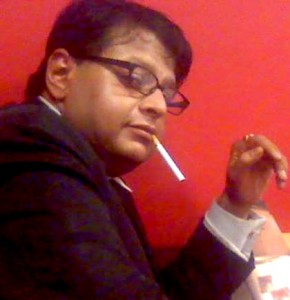
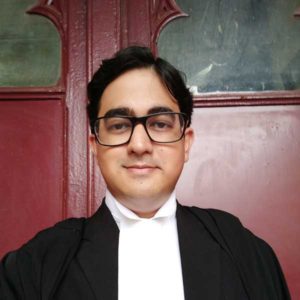
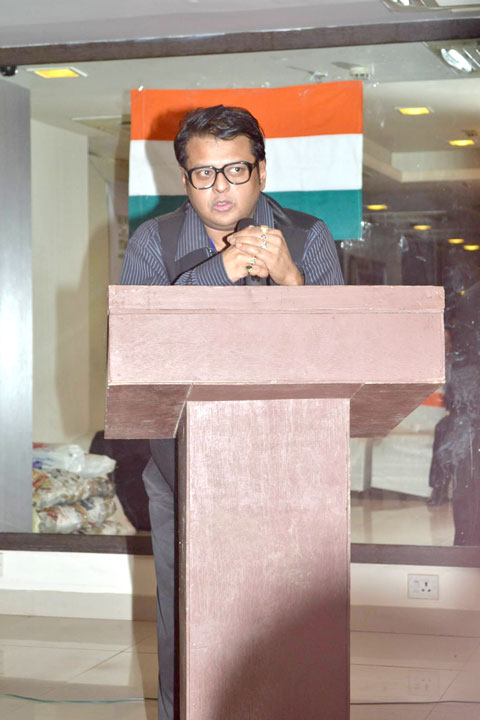
 Protik Prokash Banerjee had graduated from Calcutta University in 1994. Thereafter he joined the Calcutta High Court. With two decades of experience as Advocate, Protik Da, as he is fondly addressed by peers and juniors, has several landmark judgments to his name.
In this interview we spoke to him about:
- His career as a young lawyer at the Calcutta High Court
- Learning from his father
- Studying in Calcutta University
We had far too many questions to ask him, we have published the rest of the interview here: Protik Prokash Banerjee on dealing with success and challenges of a litigator, mettle of law students and opportunities at the Calcutta HC
What motivated you to pursue law?
My father and mother were both lawyers. Normally this would have been an incentive to follow in their footsteps but in my case they did not want me to be a lawyer at all. My father wanted me to fulfil the dreams he had abandoned in order to provide for his family – father, mother, brothers and sisters. He wanted me to be a doctor. Like Walter Mitty, I wanted to be a Nobel Prize winning author, the Prime Minister of India, an Indian Kal El, the man who won the Nobel Peace Prize by fostering disarmament, a scientist who found the cure for cancer, AIDS and the million ills a flesh is heir to – I had also wanted to be a pilot, an engine driver, an athlete (though my immensely uncouth obese body precluded anything that physical almost at the outset) and on certain occasions both Captain Ahab and the Whale simultaneously.
From the time that I found myself, and that was a very long time ago, I had wanted to be a professor of English Literature. I wanted to teach English, its nuances, the stories of the world and its civilization, the fascinating myths that make up humanity and somewhere along the line I had wanted to write. I wanted to read everything that had ever been written, etched, sculpted, typed or printed. All of that needed money.
My father, a Senior Advocate of the Hon’ble High Court at Calcutta, told me in Class X that I could do all of that, of course, but while he would leave me something, it would never be enough to fuel a lifestyle that could afford all of those things unless I did something sufficiently remunerative. He pointed out that a professor did not really make much money – we are talking about 1986, when it was still a Congress Majority, Rajiv Gandhi led government – and what I wanted to do needed a lot more than a salary.
He had always wanted to be a doctor, but for financial constraints had studied law instead, and law was a good living but he did not want me join law; he said that this profession was a graveyard of many talents, and that there were few other places where there were so many educated beasts. He wanted me to be a doctor or an IAS officer because in those days the perquisites of the latter allowed a pleasant lifestyle.
I took a deep look at myself and found that there were only three things that I could actually do – read, write and speak in English. All of these, including the debates I used to revel in, told me that I might make a go of a career in law. So I decided, way back in 1986 when I was still in Class X, that I would study law and become a lawyer and practise in the High Court.
I never told my parents this, because my father had his heart set on a medical career. I went on to qualify in the West Bengal Joint Entrance and was just about eligible to make it to some small Medical College in the boondocks (in those days all were government colleges here) but ultimately did not submit the form at the time of counselling. My parents ranted and raved, but I persuaded them that law was what I wanted to do and I would not have been happy as a doctor.
How did your father’s career influence yours?
My father practised essentially in the civil and constitutional writ jurisdictions in the High Court at Calcutta. He was a Senior Advocate. He met my mother in Court where she practised in the civil side and after six years of courtship they got married and she left the profession and became a homemaker.
There are so many things that I remember about my father, as a man, as a father, as a professional (though I did not have the opportunity to work with him except in two cases), that it is difficult to choose one memory over the other. My father’s watchword was “Maaliker Daya” (The Grace of God) and this was his favourite greeting and his answer to anyone who asked after him.
As a father, I always thought he was the best that a boy could have. He was a busy advocate, but in my childhood, I never found that to be an obstacle to doing things with him. He would always keep Friday evenings free for us; that would be an evening when he would take us for a show, whether a play, a show, a music recital or motion picture, and dinner.
When we came back, he would sit up with me and tell me stories from the books he had read. He read quite a lot even outside law. In fact, my long term love affair with books started because I wanted to read the originals of those fascinating stories he would tell me. The originals were always pale copies compared to the rich tapestry that my father, a story-teller of almost Bardic imagination, would weave for me. He would adapt the toughest of books, the most adult of themes, to a one person audience: his son. Saturdays he would work through, but Sunday afternoons he would play cards with his friends. He regaled us with stories about court-room battles at the breakfast table and dinner and I picked up words like ‘interim order’, ‘status quo’ and ‘caveat’ and when we fought I would say ‘You have no jurisdiction to say this’ or that “I have a right to be heard”.
He never worked beyond 1 AM, and would, almost religiously, read fiction and philosophy, every night until 3 AM, till 2004. Nevertheless he would be awake every morning by 5 AM, go to the market and still be in Court by 10:15 AM. He had three passions apart from his family: books, travelling and going to the market every morning. Later on, when he had stopped going to Court, he still kept on going to the market, but once a week instead of every day.
For a man who idolized his father, and who in the ultimate analysis (as I understand now) chose law because he wanted to be like his father and not just for fueling a lifestyle (yes I know that I contradict myself, but I am human and what seemed to be the motivation when I was sixteen or seventeen years old, is not what I found was the real inspiration behind what I became) what happened between my eighteenth year and my thirty second? I do not know. For some reason, that is unclear to me even today, though my love for him did not diminish one bit, the distance between our minds grew.
For these fourteen years, though we shared the same roof and table and went out together and shared space, it seemed to me that he did not love me. After becoming a lawyer, he threw me out of his chambers within two months, I am sure for just cause, and refused to work with me on any brief; he refused to recommend me to anyone and in fact asked learned advocates on record who wanted to brief the two of us together to take back one of the briefs.
His most tender comment to me, in those days, when I was hurting after having lost a case or having been lambasted in Court, and knowing that there would be no sympathy still I would grudgingly ask him where I was wrong, was not an analysis of the case and what I should have done, but a seemingly unfeeling “It’s your profession and your case. You find out what went wrong”. He would of course blandly say what he said to everyone else “When I came to the profession, I had a skin. Now I have a hide. Develop a hide.”
I thought in those days that this was rejection. Now I know it was not. He wanted me to make it on my own. For a long time I thought I had. Then I re-discovered that every breath I took, I owed to him, and not just my flesh and blood. I discovered that the books I had read I had first found in his Library. I discovered that the principles of law I researched and that I argued, I had first heard and retained in my sub-conscious at the dinner table; I did not really have an identity. To most people I was still “Mukul Da’r chhele” (Mukul da’s son). I used to resent it then. I am proud of it now.
I never heard a word of praise from him till 2001. In 1998, when I had been practicing for only three years he stopped attending Court regularly, saying that he had worked enough and now it was my turn; but from 2002 he hardly attended Court and after 2004 when he had his first heart attack, he never visited the High Court again.
I resolved my issues with him on May 26, 2001. I remember the date. That too, was his gift to me. It was he who initiated the process that brought his prodigal son back to him. The first word of praise I heard from him was the greatest. In September 2009, the West Bengal State Unit of the Indian Law Institute was kind enough to award me the Advocate General’s Trophy for Outstanding Emerging Lawyer. My father had been too ill to attend so I came back with the trophy and showed it to him, ready for some disparaging remark. The frail old man, my father, rose unsurely from his bed and embraced me. He said “You have made our family proud.” There were tears in his eyes. This was the best, the highest and the most treasured compliment.
His words of advice were “Read your brief, do not mislead the Court, do your best and the rest is upto the Court.” I have tried my best to live by these three principles and though, unlike him, I do not refuse a case because the client is not morally in the right, I have always tried, as I once said to an opposing counsel who was elevated later on, and who accused me of only defending bad men and their acts, “My client may be a bad man, but even a bad man is entitled to equal protection of the laws.”
Lawyers like him are rare. A gentleman with the same humane treatment for everyone, and an unshakeable sense of what was right, with an integrity that was incapable of being dented and who never supported what he thought was unjust, in life or in law. I know I can never be like him nor acquire one tenth of his professional stature or status.
It was only years later that I understood that he had done all this so that I could develop on my own and not have to worry about being in his shadow. I know now, that I can never be out of his shadow and frankly, I do not want to be. I’d rather have him alive, casting those long shadows, than be without him.
You graduated from Calcutta University in ’94. What was the legal profession like back then?
The High Court at Calcutta was a wholly different place in 1994. No junior advocate, whether he started out in the Appellate Side or Original Side, would dare to embark on his professional journey without having attended Senior’s Chambers as a pupil for at least two to three years. Most stayed on for at least five years and did not open their mouths to argue cases until the end of that time, contenting themselves with seeking adjournments and pass-overs of matters for their Senior.
They spent their time in the Chambers reading law from the law-reports and the text books and bare Acts, working out the cases in which their Senior had been briefed (including preparing a List of Dates, jotting down the page numbers where the material facts were pleaded and the material documents were annexed, and attempting to summarize the points of law involved and the case-laws on the point) for the first five years; if they were devilling with a learned Advocate on Record they usually accompanied the Clerk to the Department to get to know the procedure first hand. Otherwise, they would attend Court with their Seniors and stand to one side and follow the proceedings or assist him if he so chose. The present trend where young law graduates enroll themselves, crack the AIBE, put on their bands, morning coat and gown (most do not use wing collars like we do) and accept arguing briefs or cases from the first day, or expect to get cases from the first day and to earn from day one, was unthinkable. For me it still is.
None of our law-schools or colleges teaches the practice of law. They only teach the theory and in some cases the law itself. Litigation cannot be taught in class room. It is a profession and thus must be learnt by following the practitioners in real life. One month long internships are not sufficient though they are a start.
Of course as usual I did not practise what I now profess. Since I was thrown out of my father’s chambers within 2 months of enrollment (as I wrote in the answer to an earlier question) I had to shift for myself. I took on cases, shocked seniors with my precociousness and the arrogance of ignorance, made mistakes, got bawled out by Judges and other advocates alike, but corrected them myself after reading the law.
In 1994 there was another thing that was different from today. By and large the Original Side of the High Court comprised people who practised exclusively in the Original Side and those who practised in the Appellate Side tended to do so exclusively. Of course there were glorious exceptions, but from what I saw it was very difficult for a junior lawyer to get briefed in an Original Side matter as junior counsel unless he practised exclusively as counsel in the Original Side or a junior lawyer to get briefed in the Appellate Side as junior counsel unless it was his case and he had signed the vakalatnama.
I remember only the warm welcome that I received when I, having no background in the Original Side, started appearing in suits and interlocutory matters briefed by a young advocate on record who had just become a member of the Incorporated Law Society. I would like to flatter myself that I was part of the change that happened. Now the distinction between the sides and the practitioners has blurred so much that we are all advocates first. This is a welcome change.
Another thing that has changed is the plight of first generation lawyers. As you may understand, law reports, journals and law books are very important for a lawyer to train himself. Those who have lawyers in their families tend to have it easy because their forbears or relatives already have a rich library. In 1994, those who did not come from such a family had no access to such books, often rare and very old (such as Indian Appeals of the late 19th century) and there only hope was to find chambers which allowed juniors access to the library even for their personal work.
These were not rare, but getting into them was difficult. Now, with the internet and legal software and most particularly Indiankanoon (no they did not pay me to endorse them!) it is no longer a problem. So long as a young man is prepared to work hard and go through the documents and the digital records, he can access almost any judgment, any case and any principle of law that has been uploaded and most have been, in one archive or another.
I do not have friends. I used to have them when I left school but I was the only boy from my batch in Calcutta Boys’ School who had chosen law in 1988. As I wrote in the answer to an earlier question, I had made it very clear from 1986 that I would study law to become a lawyer, and so my friends were not surprised. They were surprised though that I adhered to my decision even after cracking the West Bengal Joint Entrance Examinations in the medical stream, however lowly my rank was.
Very frankly, in the preliminary years of law college I thought that the Code of Civil Procedure which I kept on reading was the most boring thing on the world and the Constitution of India was a very presumptuous document ‘copied-pasted’ from foreign sources by overbearing lawyers with a colonial hangover and chips on their shoulders to try and show-off before the world “See how civilized, liberal, secular and enlightened we are.” With time my ideas have undergone a change. I now understand that they were trying their best to guide a largely disempowered multitude from the centuries of forced darkness into light. I now feel that the Code of Civil Procedure is the most fascinating labyrinth which can exercise our minds. Apart from the Original Side Rules, that is to say!
My initial ambitions? I wanted to be the best arguing lawyer in the country. To help bring justice to those who could not afford it. I understood that drafting was important only after an year!
How was your experience as a student of Calcutta University in the midst of an enlightened community of people?
The atmosphere in the University College of Law (Hazra Campus) was politically charged but hardly violent. This is because we had only one party – the Students Federation of India, which ran the Union and for most of my college life, got candidates it supported, elected unopposed. All our festivals and programmes were given a definite Leftist political slant and while India was facing a balance of payment crisis and was debating entering the open market, we were still discussing the merits of the education system in Cuba over that of USA. We were discussing the imperialistic aggression of the Allied Forces against Iraq but hardly bothered about the fact that because of V.P. Singh and his ill-judged attempt to create a mark on history, people were burning themselves over reservation for “Other Backward Classes”. I consider the politics of those days to be puerile, immature and ultimately pointless.
By and large students participated in politics because they had to and because it allowed them to taste the gravy train of attendance percentage without attending classes, get cheap recognition when they had done nothing to deserve it, because they were friendless and in some cases because they wanted a career in politics and this was the stepping stone. I was no exception. I mouthed the platitudes, tried to avoid going out in ‘processions’, but used the union connection to get my percentage of attendance without actually attending all the classes. Those things have ended, now.
Now, I am told that the administration has become very strict and unless you actually attend classes, you are not shown to have been present. I will not call the community of people at College enlightened. Some of them were, as they are everywhere, but most were ordinary people like you and I. It was nothing like your national law schools with the high drama and passion play and moots and what not. We just served time till we got our degrees. We learnt very little at College except about University life. I used the time for binges, orgies and having fun. Studies were for one month before the examination. That was sufficient. Of course, I kept on reading a lot throughout college life, not necessarily law.
What were your plans after graduation?
I always wanted to practise law. My plans were to join my father’s chambers and start practising in High Court. Both my plans came true. However the first ended in two months as I have answered you before. The second is still continuing. I never thought of doing anything else.
In 1994 a fresh law graduate could practise law in the courts or the fast burgeoning tribunals. He could gather a few years’ experience and sit for his judicial service examinations and become a judge in the subordinate judiciary. He could also sit immediately for the Civil Services examinations where he would get exemption in the law papers. He could become a law-officer in a government concern, but in those days that needed a few years of experience. He could also take a job in the legal department of business-houses and corporates, but normally these were based on recommendation and contacts and not on merit.
Of course he could take a job in a solicitor firm (they were not called law firm in those days and most lawyers looked down upon them, yes, even the top tier law firms of today were just ‘solicitors’ to most advocates) but the pay was not very high in those days. By and large people studied law to become lawyers and practise law and not sit behind desks and get a salary while they specialized in doing research for partners or clients without ever having to argue in court.
You did not do a ‘fee quote’ or get mandates from your client; your client engaged or retained you and executed a vakalatnama in your favour or wrote a letter retaining your services and paying you an initial retainer or conference fees.
You yourself took responsibility for what you did and did not hide behind paragraphs of disclaimers and the anonymity of a team. You learnt procedure and did what lawyers do instead of knowing the theory and hunting around desperately for someone to tell you how to write a petition for adjournment in the lower court.
Back in ’95 just out of college, how did you manage to get a mentor for yourself?
As I said, I started out with my father. That ended two months into my profession. So that is how I found my mentor and lost him. Thereafter my only mentors were my books and the learned Seniors I was briefed with. You might say that I was more of an Eklavya than an Arjun.
Seriously, I think that the only things that distinguish a senior from a junior are knowledge and experience, the latter including court-craft. Experience you cannot gain without actually putting in those long years of work and doing a lot of cases. Yet knowledge is something that both seniors and juniors get from the same books. So long as you have access to books I think you can get by, given the calibre and high quality of law students today.
In retrospect, I could have done much better if I had a mentor. If I had devilled under someone like Mr. Anindya Kumar Mitra or Mr. Saktinath Mukherjee, learned Senior Advocates, today I could have been a complete lawyer. I take those names only as examples, iconic though these learned Seniors are. In my formative years, I worked a lot with Mr. Bimal Kumar Chatterjee (presently the learned Advocate General of West Bengal), Mr. Pratap Chatterjee, and then Mr. Anindya Kumar Mitra, learned Senior Advocates and Barristers-at-Law.
After a few years experience I also worked with Mr. Shyama Prasanna Roy Chowdhury and Mr. Ashok Banerjee, learned Senior Advocates and after ten years of practice, with Mr. Kalyan Bandyopadhyay, learned Senior Advocate. I guess if I had been fortunate enough to have any of them as mentors today I would have a far better grounding in law, court-craft, etiquette and the profession.
You need a mentor to guide you in the profession, to protect you from the consequences of your mistakes, both in your cases and in the profession. If you are a first generation lawyer you need a mentor to show you the way in which a case is to be approached, the way in which strategies are formulated, and the manner in which a point of law is formulated and even for the law-resources such as rare law reports, text books and journals.
Sometimes it is as basic as knowing the format for a draft. A mentor, a Senior as we call them, in the profession is like a Guru of ancient times. Junior lawyers must learn how to sit at his feet (figuratively if not literally) and learn from him, what he does and how he does it. There should be absolute humility, obedience and surrender. Reminds me of an album by some of my favourite artistes – “Love, Devotion, Surrender”. Remember, unless you can approach your Teacher with absolute humility and consciousness of your own ignorance, you will never learn; if you are already too full of yourself and what you think you know, nothing new will percolate.
Remember, litigation means appearing before an adjudicator. He is only human. It is the Mentor, with his vast experience, who can guide you and teach you how adjudicators can be lawfully persuaded and what are the ways in which you can train yourself to do it instinctively.
These are the reasons why a Mentor is still indispensable in the world of litigation.
How valuable would you say your legal education was at Calcutta University?
All my theory I learnt from books, some of which I read while at the University. All of the knowledge of law, the practical field of litigation I learnt while practising in High Court, observing others and from my own mistakes and while doing cases. I must confess that I learnt almost nothing of law at the University College of Law – not because there was nothing to learn, but because except for a learned Advocate who took us in Legal Language and Drafting, none of our teachers of law actually knew much about what they were teaching.
Our legal language and drafting lecturer was a practising solicitor of some reputation and he could teach us Conveyancing without referring to any book whatsoever. He did refer us to one book, De Souza’s Conveyancing, which was an invaluable treasure. The others just read out notes or from the bare Act which we could have done by ourselves sitting at home. So I would say that the only reason why the University was important was because I had to go through it to get a degree which enabled me to enroll myself as an Advocate. I would tend to agree with the people who say that all they have learnt is in their years of practice – with one caveat. They must have studied in institutions like mine.
How was the court atmosphere back then?
We must make one thing very clear. Litigation is not about oratory. It may have been in the years of Cicero and Caesar but not now, not here. Judges are there to adjudicate cases and lawyers assist them. Our job is to present the facts of our case as concisely and completely as possible, indicate the questions of law which arise, show the law and precedents if any, on the points and urge why our client should have judgment entered in his favour. The opposing counsel does the same, while trying to rebut the points we have taken.
Of course it is important to articulate and to speak in such a manner as would not detract from its content – for example very few lawyers speak English (the official language of our High Court) like an Englishman and many of them speak with a decidedly Indian or Bengali accent but that does not prevent the Judges from understanding them; again, most lawyers in our High Court speak English indifferently, giving scant respect to the rules of grammar and syntax. Yet as long as the Hon’ble Judges understand them justice is usually done. It is only when someone speaks in such an idiosyncratic manner that it becomes painful or amusing that the delivery starts to damage the content.
Of course it does not hurt if you speak very well, but you should take care that your flight of oratory does not irritate or bore the Judge who after all has several cases to hear and dispose of, and so your oral submissions should not be so long-winded that they become repetitious or monotonous. I guess the golden mean would be to speak fluently, pleasantly and grammatically, if possible, without putting on any airs.
Judges took kindly to any advocate who spoke sensibly, briefly and to the point in those days. They still do. Sometimes, when it has been a long day and the Court has been listening to similar type of cases all day long, it pays to enliven the tedium by digressing into literature, anecdote or even by presenting the facts of your case in a novel manner, which requires a degree of oratory. Normally the Judges welcome this from lawyers with some standing in Court but discourage it among juniors, since they are afraid that encouraging light-heartedness from those yet to earn their spurs could lead to facetiousness or flippancy, as one Hon’ble Judge (now retired) actually said to me. It was a company case and my client, an intending auction purchaser, was seeking inspection of the assets of the company being wound up. The Official Liquidator’s department, which had custody of the movables, was notorious in those days for carelessness and allowing pilferage.
So, when His Lordship seemed inclined to refuse my prayer and asked me “But they are in the custody of the Court through the Official Liquidator, so why are you bothered?” and I responded with lightning speed, “But that is precisely the reason for my client’s apprehension, My Lord”. For a moment the entire court was dumbstruck and then everyone broke out in laughter, including the Hon’ble Judge.
However, in a moment His Lordship turned somber and menacing and said “This Court does not appreciate facetiousness from counsel”. I was suitably abashed and tendered my apology. I got the order I wanted after that. The lesson to be drawn is that the Court understood what I said was perfectly correct and would have probably accepted it in that form if I had been a little more senior, but expected that a junior counsel would rephrase the submission.
My experience in the first few sessions was ghastly. The first time I spoke in Court, I choked up for a moment. This was despite the fact that I had done a considerable amount of public speaking and the Presiding Judge was someone who had been affably chatting with me the evening before, at a soiree, where I had been mixing the music for the performers. He was the guest of honour. I ought not to have been afraid.
Yet the atmosphere, the feeling of being in robes, stiff, wing collars, bands and with the Judges looking down upon you from a great height, the high ceilinged rooms, almost like cathedrals, these create an ambience that is intimidating, to say the least. It got better after that, but even today, when I rise to speak for the first time in a case, I feel a familiar tingling in my palms, sweat on my brow and a slight trembling of the knees.
How did you build up your client base?
I do not have a client base. I was briefed by learned advocates on record who had a client base. These advocates on record briefed me because they liked the way I submitted in Court – effective but also cost effective because in those days the others who spoke like I did charged much more than I did. In our Court there is an understandable but wholly erroneous impression that if you argue well you must also know how to draft well.
So, I got drafting briefs. I drafted very quickly, typing them myself, so the solicitors got their work on time without the trouble of stenographers delaying or making mistakes which were required to be corrected. So they gave me a lot more drafting briefs.
The more drafting I did I got better at it, until I became, in my estimation, a competent draftsman. Once it was found that I could draft and speak, those who had briefed me once, continued to brief me. Yes, many a time my eccentricities, moods and half crazy working style, my irregularity in Court drove my solicitors away. It once got so bad, I had no case at all for a month, just a few months after my daughter had been born. It was all savings for a few months. Then for a few years I gave up private practice and was retained by the Government of West Bengal as its Standing Counsel. I came back to private practice in March, 2014. I again started getting briefed by a new generation of lawyers, who had seen me arguing for the government and had heard of me from their seniors.
A firm clientele base is something that is very enviable and I do have a few clients who keep on coming back to me for everything – whether it is a draft, a conveyance, a case in Court or just an opinion. These are usually clients who had some business related case where their learned advocate had briefed me once and by God’s Grace we had succeeded in it, and thereafter they insisted that I be briefed in everything that concerned them.
This therefore is a result of results – in other words, if you work hard and your lay-client appreciates it, chances are that he will ask his learned advocate on record to go on briefing you. There is, therefore, no hard and fast parameter of any number of years of practice for building up a client base – there is only work that you have do and give your best; my advice would be, forget about getting a client base, and do whatever work you get as well as you can. The rest will follow.
 Did you build everlasting relation with your clients?
Everlasting relation with my clients! Are you mad! If you build an everlasting relation with your clients, better make him your friend and do his work for free. Why do you think a client does not usually do his case himself? He knows the facts of his own case better than any lawyer ever can or would. If he is educated and intelligent he can read the same cases and research the law on the internet. Arguably, apart from intricacies of jurisprudence, he can put up as good a fight as any lawyer, yet he engages advocates.
He does this because as a client he is indelibly imprinted with the justice of his own cause and try as he might, he always sees the facts from his own point of view and allows his emotions to cloud his perception about the facts or the defence of the other side. A lawyer is trained to be dispassionate. Of course he ought to believe in the merits of his client’s case, but that does not mean identifying with the client. Yet, if you have an everlasting relation with your client (like a friend of the family so to speak) you lose that element of dispassionate analysis which alone sets you apart. Besides, as they say in Hindi ‘ghoda ghaas se yaari karega to khayega kya?’
It is possible for a counsel to build a long term relationship with his advocate on record but that is based on mutual respect and the results that each produce. Personal friendship is a wholly different matter, and happens between and among people and not necessarily between lawyers and clients.
I discourage personal relations with my clients. Yet I treat each client in the same manner as I would treat any other person of his age. I maintain a line, a very thin line yet a line nonetheless between them and myself. That is the line which protects the dignity of the advocate from over-familiarity on the client’s part. Take an example – imagine the same set of clients are briefing you over a period of years because you have worked hard for them in the past and produced results. In time they have come to know of your daughter’s birthday, your birthday and your anniversary (because you politely declined to sit for a conference with them on those dates), your health and the plans for your vacation.
So they bring you a cake for the birthday, an expensive sari and a suit-length for your anniversary and three air tickets, business class for your vacation. You will be perfectly justified in accepting the first, demurring at the second but accepting them with a caveat that this should not be repeated and refusing the last. If you do accept a gift, make sure that you present something in turn, as you would do in case of any other social occasion. If they bring you gifts of rare alcohol, do not refuse them.
Make sure that you send them something good that they appreciate. If they invite you to a wedding in their family, humbly accept the invitation, promise to turn up but do not – repeat, do not – make some excuse, send your juniors or even your most trusted junior along with gifts, but do not yourself accept such invitations.
You may think that this will be impolite or even alienate your clients, but please remember, they do not fraternize with you or want to socialize with you because of your fascinating personality or your singing voice. In the final analysis it is your talent and acumen as a lawyer they treasure, and so long as you have that and give every work they bring you the best that you can, they will gladly be with you forever. They will ultimately end up respecting you for your principles.
Do not even make the mistake of thinking, because of the above, that you are a service provider such as a driver or a milkman or a cook. You do not serve your client, if you are a lawyer. He does not even hire you. He engages you by the hour or for particular assignments or work, for fees that he pays you or your learned advocate on record and he does it because you are a professional. It is a profession as defined by the Hon’ble Supreme Court and it is not a part of any service industry.
Even the government appreciates this distinction by leaving individual practitioners outside the dragnet of service tax. It is the businessmen of law – the law firms – who render service. Counsel and individual advocates do not. We do our clients a favour by accepting their briefs. The taxi-cab rule does not apply to us. Come to think of it, the taxi-cab rules do not apply even to taxi-cabs in Calcutta.
Being an advocate is a very heavy responsibility. As you grow older you will appreciate it does not consist only of wearing a black coat and bands and doing “Judge Saab” like Sunny Deol in a Bollywood blockbuster or rushing to the police station with a bulging brief case to bail out your gangster client. It requires a dedication to the rule of law, the ineffable yet ineradicable principles of justice and a commitment to the dignity of the most impartial wing of government, the last bastion of liberty and democracy in an age of increasing commercialism, capitalism and authoritarianism – to the judiciary which is forever a sentinel on the que vive.
We have published the rest of the interview here: Protik Prokash Banerjee on dealing with success and challenges of a litigator, mettle of law students and opportunities at the Calcutta HC

 As I have been trained in mediation, I am hopeful about its prospects in India. With the tremendous backlog of cases in our courts and the lack of adequate number of judges for a population like ours, more and more people are unwilling to resort to litigation to resolve their disputes. The ever-growing number of arbitrations in our country bear witness to this effect, as today a standard commercial contract will inevitably contain an arbitration clause. However, the real problem comes from land disputes, succession disputes and family matters since those aren’t usually covered by an arbitration agreement. In such cases, mediation can be a very effective way to bring about a resolution without resorting to the court process, and it is increasingly being recognized as such.
 I was briefed to argue for a de-facto complainant in a massive fraud case, where the value of the fraud was more than Rs 20 crore, and I was to argue against bail of two persons arrested on the very day I was briefed! I was tremendously nervous and excited at the same time, and when I walked into the Magistrate’s courtroom, I saw six lawyers appearing for the two accused! The lawyers argued strongly for bail, the Police Prosecutor opposed the bail in the normal fashion, when I asked for permission to make submissions for the de-facto complainant, the defence lawyers started shouting that I had no right to make submissions when the Prosecutor was there. Now, Tamal sir never liked to raise his voice, but would never be afraid of shouting down an opponent who was being too aggressive. I shouted back at the defence that I was seeking permission of the Court and I didn’t need their permission. Possibly impressed by my confidence, the Magistrate gave me two minutes to make my argument. I summed up our position on the matter, to which the Magistrate nodded, and sent the accused to police custody for 14 days (the maximum possible time), something completely unexpected for me, as some other juniors had told me not to expect more than 7-8 days of police custody! It was at that moment I knew I could make it as a litigating lawyer if I continued to work hard and persisted with Court practice.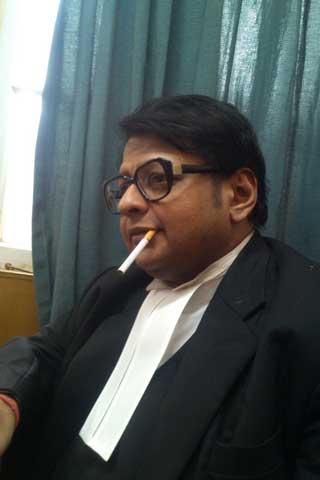


 Allow notifications