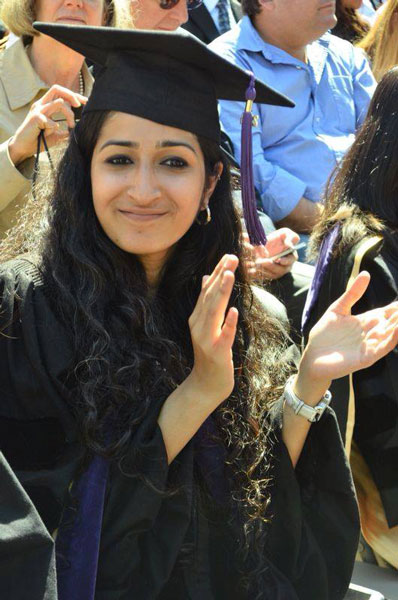
Deya Bhattacharya is a graduate of 2013 batch from KIIT, Bhubaneshwar. She has mainly interned at Human Rights Foundations and is currently pursuing an LL.M. in Human Rights from the Central European University. She is a Senior Legal Researcher at the global women’s rights intiative Femin Ijtihad
In this interview she talks about:
- Publications and top 3 things while writing a research work
- Internships at Human Rights Organisations
- Work at Femin Ijtihad as a Senior Legal Researcher
- Intricate details of an LL.M. in Human Rights from Central European University
Most of our readers are law students and young lawyers. How will you introduce yourself to them?
If there’s a percentage of your readers who didn’t want to take up law, but did so for whatever reason, then I will safely introduce myself as a lawyer who became one by chance. Legal studies grew on me slowly – I am, at present, a postgraduate student in Human Rights and International Justice, particularly fond of women’s rights issues and democratic transitions.
Why did you decide to study law? Tell us about your college life.
There is a funny story behind this. Towards the end of class eleven, a school friend and I decided to chart out our career options. I never really decided to study law. I was never interested in the pure sciences. I had always wanted to study English, and she wanted to be a lawyer. We both began preparing for law school entrances. However, as fate would have it – she studied English and is now an educational consultant and I ended up in law school.
I loved International History and English, and my parents gave me the option of doing what I wanted to, and law somehow happened (I saw this with equanimity now; it wasn’t the case always – in the beginning I was not happy that I had chosen law).
The first couple of years in college, though formative in many ways, were quite forgettable. I drifted from class to class, internship to internship, pretty unsure of whether what I had chosen was, in fact, good enough. Thankfully, there were a few very supportive professors who managed to help me channel my interests in a certain direction. In the latter half of college life, I became more assertive because at that point I was almost confident about what I wanted to do.
You graduated from KIIT. Tell us what your law school experience was like. Also, what do you have to say about the supposed ‘elite’ tag attached to certain law schools? Do you believe branding is something that’s very relevant/important at any stage in a law student’s career?
The first two batches of KIIT almost always tell you that law school, in the first couple of years, is splendid. We had brilliant professors. The quality of debates in class was remarkable. In the first three years of law school, the professors made sure that there were discussions and dialogue amongst the students; we could approach them whenever we liked, even after class hours. In fact, one of the professors (he has long left KIIT) sat me down and helped me chart out my resume and taught me how to footnote one afternoon over cups of tea.
I was not interested in law firms (where, I have heard, the elite-tag is of consequence). So during internships it didn’t matter to me whether I was from a national law school or not. It bothered me in my fifth year during two international scholarship interviews – in one, the panelists had not bothered to read my personal statement before they called me in and asked me loose questions about everything except what I wanted to pursue; and in the second one, I was intimidated about my research work (women’s rights/transitional justice – I was told Indian lawyers aren’t really concerned about it!).
But no, I do not think branding is the most important thing in a law student’s career. It certainly makes life comfortable – you don’t have to build walls around yourself everytime you go to a conference or a moot court. However, let’s not forget – if you’re from an elite law school, you’re expected to be better than most others.
You have had a variety of publications mainly in Women’s rights. How did you settle for this issue?
I am not sure why one would settle for something? I don’t like settling for things I am not interested in. KIIT offered specializations and while I saw most people in my law school taking the oft-travelled path – Corporate law, I took to International Law (something that is hardly viewed as concrete in the Indian law sphere). Anyhow, this was in my third year, and I was aching to do something along with my regular coursework.
So, I applied to Femin Ijtihad (now, Strategic Advocacy for Human Rights or SAHR) for an unpaid online internship during that time for a Women’s Rights Case Law Project in India, and this deepened my intrigue in Women’s rights issues. The project was a minor one at that time but starting work at FI/SAHR has been both the inception and the center of my career choices. Later, I wandered from Women’s Rights proper to Women’s rights in transitions but that is a different and a much longer story.
 What are the top 3 things you keep in mind while compiling a research work?

I am sure different people have various ways of accumulating research. The top three things I do while I am compiling research:
- I move myself away from everything and everyone else when I am working. I turn on some instrumental music and I do not liking talking when I am researching/writing.
- Secondly, I like my documents organized. I can spend hours and hours on this, worrying I might lose my sources. I keep them on Dropbox and segregate folders on the laptop, colour-coordinate, highlight and stick post-it notes on the hard copies that I arrange by topic. Thankfully, there is a software called Zotero that helps you keep track of your bibliography by saving your sources into a personal-library of sorts (I highly recommend this while writing papers, really helps). I also think OneNote/EverNote are excellent pieces of software to keep your article/thesis notes arranged.
- Lastly, the writing bit. For me, it can get excruciating to find a perfect starting point when I am beginning an article (sometimes even an assignment). I have seen when I put myself through stress, extreme unimaginable stress (please don’t try this at home!) I write better and more effectively. Another thing that I do (but may not recommend) is that I do my footnotes/endnotes in the end, after my writing is done. It can get difficult to alternate between forming cohesive arguments and doing something so clerical like footnoting, at the same time.
Your have interned at the PUCL, PILSARC & ORF starting with reputed advocates. Please tell us if these internships were pre-planned? What did you gather from your experiences at these places?
None of my internships were really pre-planned. I was going to do the usual NGO-court-law firm internship drill, when I realized I couldn’t follow the oft-beaten path. PUCL happened after a string of e-mails and calls. It was my first internship, and possibly, my first tryst with human rights work. They had a tiny office-space and much of our work was field work in the harsh Delhi heat. The internship introduced me to the delight of working with the grassroots, how legal ethos is an interaction of legal theory and practical work. I fell seriously ill after my first ever internship (I think I should have taken the hint and left law school for good!) Laughs…
PILSARC, under the aegis of Dr. Rajeev Dhavan, happened at a time when I was sure that I wanted to pursue Human Rights. One of the senior researchers at PILSARC actually augmented my intrigue towards transitions and democratization, and I think I will always be grateful to her for her lecture on Pinochet’s trial, Charles Taylor and all the hybrid and international tribunals. Back home, I still have the sheet the paper somewhere, where I had scribbled about them while she spoke.
ORF was my last internship in law school. I did a lot of conflict-related research there, but I wish it had come at a better time. I was grappling with my university applications then and I don’t think I did it much justice.
From your experience at internships, do you think the various law schools across India prepare a student for the world outside their campus?
To tell you the truth, I don’t. Internship breaks are between the semesters and continue for thirty to fifty days? I don’t think that this is enough time for a law student to properly understand the work culture, ethics and the like. Most law students would probably do the routine internships– first year, NGO/think tank; second year, district/high courts; third year, Supreme Court and fourth and fifth year, law firms.
And these internships go on for a month, maximum six weeks, and by the time, you’re comfortable and have understood the nature of the work (and, decide whether or not you like it), your internship is done, you’re given the certificate and they bid you farewell.
I think our internship programmes should be like the ones in medical schools. An entire year or two of doing what you are actually interested in, instead of numerous internships just to decorate the resume.
Besides internships, I think knowing and understanding the vagaries of legal writing also helps. It is a much underrated skill in our community.
You have interned largely only with human rights institutions. What inspired you to pursue human rights?
Call it being irrational or simply only just a character flaw, I don’t like doing what everyone else is running after. Maybe I’d be great at a law firm, but I did not want to intern in any law firms because everyone from my class was doing that. This made me build a permanent mental block against law firms, and commercial law. I also avoided studying the mandatory corporate law course back in KIIT, but I had a very resolute professor who made me study it.
Anyhow, I think this mental block coupled with the fact that I wanted to do something with people (I took up humanities in high school purely because beakers, cutting open cockroaches and atoms don’t do much for me) inspired me to pursue Human Rights. In 2011, during the Arab Spring, while scanning for news from the Middle East and the revolutions, I was almost certain that this was where my passion lay.
You worked for two years at Femin Ijtihad as a Senior Legal Researcher. Share with us the work environment over there and the work you handled? How did you apply to them for a researcher’s post?
As I have mentioned before, I began working with FI/SAHR as an intern. What began as an internship slowly moved towards more concrete work. I began drafting arguments for cases in the Afghan legal system, drawing up strategy papers and training manuals for strategic litigation for women’s rights in Afghanistan. In 2011, Natasha Latiff, the founder-director of SAHR offered me a position in the Executive Board of FI/SAHR as a Senior Legal Researcher, and I happily accepted.
We have been working pro bono for a long time, and FI/SAHR believes in bridging the gap between academic and activism in women’s empowerment issues. I don’t think I’d ever refuse the position! In the last few years, we have received the FRIDA (The Young Feminist Fund) grant and the SOAS Best-Student Volunteering Projects.
We are a team of several women from four different continents, whom I have never met! But the amount of camaraderie between us is phenomenal. I always write to Natasha whenever I am in trouble and she always makes sure she sends a positive audio-note and almost always with a solution to my problem! I am grateful to Natasha, Anna, Sara and Sarah for always being there to brainstorm on my (sometimes ridiculous) ideas.
The work I have done here is mostly linking women’s rights to post-conflict/conflict areas. I have also assisted in strategic litigation, drafted arguments, concept notes and training modules for child custody, rape, and domestic violence issues. A project that brought us accolades is a research we (Sarah Jones, Sara Bergamaschi and I) conducted in Libya, interviewing Libyan activists on the right of political participation of women after Gaddafi’s fall. The research was published and presented in plenty of international conferences.
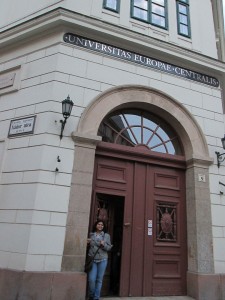 You are now pursuing an LL.M. in Human Rights from the Central European University. Tell us about the entire application process and any available scholarships to study at this university?
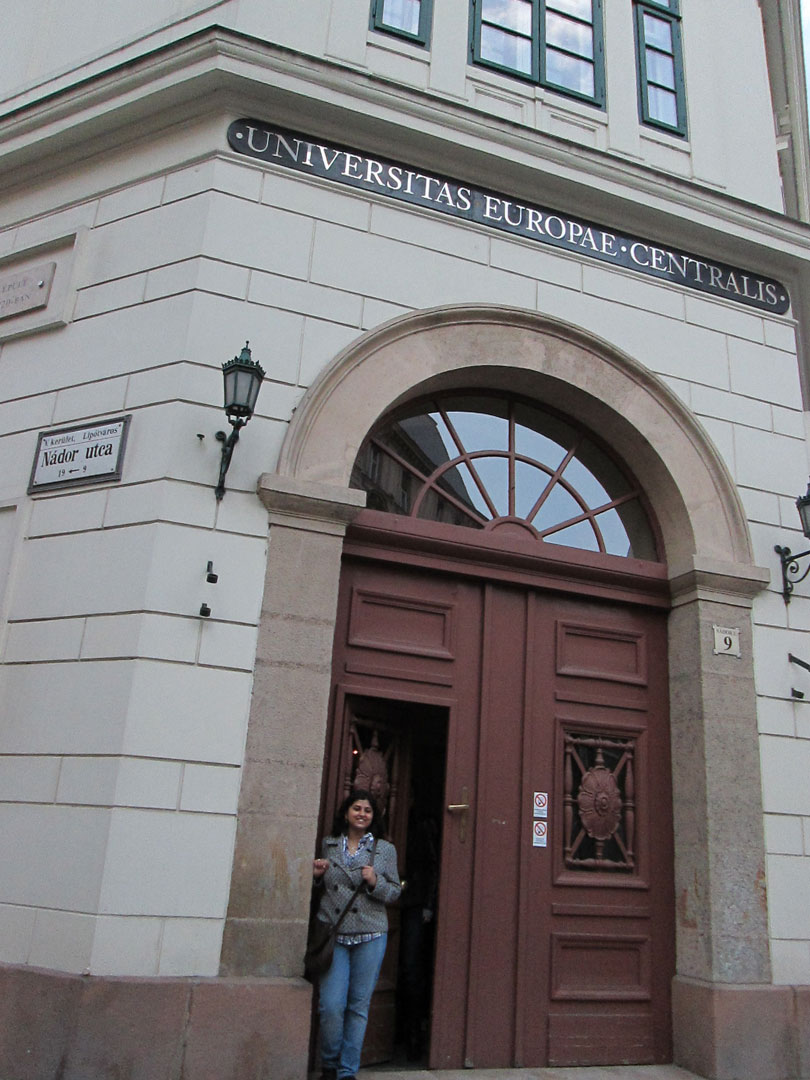
The application process at Central European University, Budapest is three-fold. By the applicable deadline, you send them your application documents (résumé, statement of purpose, research essay, certificate of English proficiency, transcripts, and recommendations). Then, there is an online examination within a stipulated time limit (I think it was problem-based!). The last stage is a Skype/telephonic interview.
CEU has a plethora of scholarships and fellowships – ranging from only tuition waivers to fellowships that take care of your tuition, lodgings, insurance and provide you with a stipend for your living costs (remember those days when we dreamed of being paid to study? This sounds almost ideal, right?). If you perform exceptionally well in your first term there, they sometimes double your stipend, as an incentive.
Since most of my classmates here have had prior work experience or exceptional internships/volunteer work, I am almost certain that the admissions committee prefers that the students are in touch with human rights work.
How did you decide to go for CEU over others? What other universities were you considering?
Besides the two scholarships (Rhodes and Commonwealth), I had applied to the University of Toronto (the LL.M. program offered specific fellowships in women’s rights, human rights and transitional justice), New York University Law School (the LL.M. program offered what I really wanted to pursue: perspectives of human rights in the Middle East, and had a clinical programme in constitutional transitions), School of Oriental & African Studies (research-based programme with a concentration on women’s rights and Middle East), Cambridge University, the Graduate Institute of International and Development Studies, and CEU.
After disappointing interviews for Rhodes and Commonwealth, Cambridge and Graduate Institute both sent me overly polite rejections (Graduate Institute sent me one in French!). The scholarships that Toronto and NYU had given me were not really enough. I received the Master’s Scholarship at SOAS, but I would have to have to pay for my own living costs. CEU gave me a full scholarship, which was my primary reason to come here. There are not a lot of financial concerns when almost everything is covered and therefore, it’s easier to concentrate on what I am really here for.
Another reason why I chose CEU was the program – the International Justice specialization under the Human Rights LL.M. has had all the courses I have wanted to pursue (international criminal law and transitional justice related). I also did a unique internship in an archival institution – dealing with using archival evidence for human rights violations – something that I don’t think I’d do anywhere else!
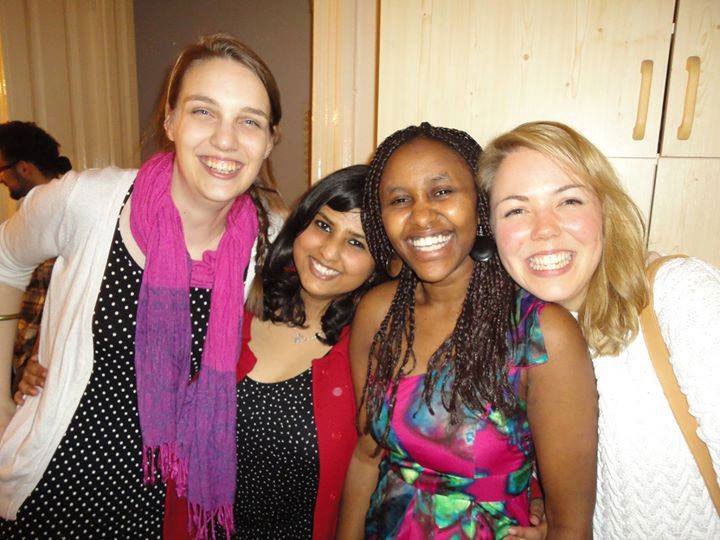
How is the faculty, students and overall experience there? Please share any memorable moment which has struck you.
The experience at CEU has been very different from my experience in KIIT. The schedule has been rigorous and back-breaking. The course is divided into six modules: each module lasts about six weeks, at the end of which there are term papers, examinations, take-home examinations. The number of credits you have to take for grade is pretty strict; you may also audit courses you are particularly interested in. In between, there is a research/internship break when you can intern or apply for a grant to go to a library/research institute for thesis research. I did everything in an attempt to get a hang of things and the turned schedule more chaotic for myself.
The students are from diverse backgrounds and countries so during classes (and even outside) it is great to hear different experiences. The faculty is brilliant and immensely supportive! Unlike back in India, the faculty here will treat you like one of them, like an equal, which is something I’ve begun to appreciate. One of the things I like about the course (and the faculty) here is the utilization of the Socratic method in classes. It facilitates a whole range of opinions about a particular subject, instead of a group of students just blindly copying notes while a professor lectures on.
About memorable experiences? In the beginning during the welcome week, I scared a professor (of Indian ethnicity) when I asked her quite vehemently if she could cook Indian food! After this incident, I have tried to mellow down.
Very recently, I had long-winding discussions about my thesis with Judge Richard Goldstone, the former Chief Prosecutor of the International Tribunal for Yugoslavia. He told me he was very impressed with my interest and dedication for the subject (he is taking a course based on international criminal law) and most importantly, during our last discussion, told me I am “good stuff” and kept my thesis outline with him. What could be more exciting? I think I am going to take this experience to my grave.

Was it the course or the brand name which mattered for you? Do you hope to continue with research work or enter law practice after completing your LL.M?

Of course. I wanted to specialize in aspects of transitional justice and international criminal law and this course provided for exactly that. (Also, CEU is just two minutes from the Danube, and Budapest is such a beautiful city to live in.)
I complete my LL.M. in a month, but that is only the coursework. I still have my thesis to write. So, I am going to concentrate on that before deciding what I want to do hereafter. I’m very sure I will be primarily involved in research, though I wouldn’t mind exploring a combination of both research work and litigation.
How difficult was studying abroad in terms of finding accommodation, finances and settling in? Tell us about a typical day you spent over there? Did it allow you to engage in extracurricular activities as well?
I was certain that I wanted to do my LL.M. after law school since I was in my third year so, I was prepared to face all sorts of difficulties. I think, in my case, the difficulties occurred during the application phase – I wanted to draft perfect personal statements for each of the universities instead of writing one and using them for all the applications. That was pretty hectic. Then, deciding that I would be giving up brand-names like SOAS, Toronto and NYU for CEU (a lesser known university) because I wouldn’t have been able to afford them.
At CEU, accommodation was a part of my scholarship along with a small stipend that is just about enough to survive. Settling in is not that complicated – the university staff helps as much as possible to help you find your way around the university as well as the city. Living alone can be slightly unnerving at first but it grows on you, and you begin to love it.
Owing to the module structure, it is quite difficult to plan your day around it. But we get by. My day starts with waking up, taking the metro to the university, and going to class. There is always a stipulated number of readings for class, which one is expected to mandatorily complete. After classes (some ending as late as 7 pm), I come back, speak to my family and engage in either my thesis work/readings for next day or other research work.
Sometimes, I decide to cook for the entire week to lessen my burden, and those evenings are a pandemonium. I am a night owl so I get most of my work done after dinner. I cannot sleep unless I read so there are nights when I grapple the idea whether I should go to bed or finish reading a book.
Because this is a taught programme and the schedule is rigorous, co-curricular activities become a hassle – I have not written an abstract for a call for papers in ages! I am not a big fan of sports; the only extracurricular activity I am bothered about is to finish reading novels and that is possible! For sports enthusiasts, the bar in the dormitory airs important football matches, has a pool table and organizes regular sports events.
What would be your message for law students wishing to pursue a future in the field of Human Rights?
Since I am only just starting out, I have some borrowed but clichéd (though, very effective) advice: patience, and passion. Human rights, whether advocacy and research or litigation, is neither fast nor easy. It could take decades to stretch out, amend and modify the Human Rights discourse, and one will often feel intimidated by it, especially because the seniors in the field (there are exceptions, of course) will often disregard taking on younger people or ignore their ideas altogether. You will feel like abandoning everything because things do not work on a finely charted timeline, but don’t!
As Natasha from FI/SAHR recently told me – “… keep doing your work with passion but be detached from its results.”


 Allow notifications