I am a litigation lawyer who got into Law School wanting to be a corporate lawyer, took up science in my 10th standard to become an engineer (like my father) and aspired to be a sportsperson throughout my life. While I stand at risk to be deemed as ‘fickle minded’, I have been blessed to have the constant support from family members and the necessary guidance from mentors which eventually led me to my field of interest-litigation, that not only gets me excited to go to work every morning, but also pays the bills!
Why did you decide to pursue law? Is there any specific reason for opting to choose litigation? Kindly share with our readers.
The decision to pursue law was never planned. My poor performance in academics, especially in the subjects such as science/math and interest in subjects such as English and love for reading (coupled with my talent for providing detailed arguments at home) made it clear that engineering would not be the ideal way forward and pursuing law could be an exciting alternative.
I credit my decision to opt for litigation, more specifically practicing the field of corporate litigation and IBC to Mr. Vivek Kohli, currently designated as a Senior Advocate and Advocate General, State of Sikkim and formerly the founding partner at Zeus Law Associates.
As a fresher, I approached him for work in the field of corporate law at his firm. However, his passionate and almost bullish love for the field of litigation and my insistence on doing something in the field of corporate law led me to have the best of both worlds-i.e., the field of corporate litigation and subsequently the mandate of figuring out IBC which was very kindly offered to me at Zeus Law Associates by him.
As rightly pointed out by him in our first meeting, litigation has the ability to not only consume a person but also give an adrenaline rush on a daily basis which would not make ‘work’ feel like ‘work’. I feel like waking up with this feeling on a daily basis fully justifies decision to opt for this field.
Which specific advice has helped you come thus far in law? Could you describe the role of mentors in your professional career?
An advice I resonate with the most was actually framed in the form of a very simple question- “how bad do you want it?” I feel like this question encapsulates all the key ingredients required to be undertaken behind the scenes to achieve anything in life including forming a vision of your goals and possessing the necessary resolve and determination to continue despite failures and sacrifices.
I have been fortunate enough to have many wonderful mentors. As highlighted above, the entire credit and opportunity to practice in a field I love was due to my mentor Mr. Vivek Kohli.
The very basics of the field of litigation was taught to me by my immediate senior Ms. Anubha Singh and my fellow colleagues Mr. Aishwarya Kaushiq and Ms. Sanjana Mohanty at Zeus Law Associates who still remain extremely close to me.
The chance to work at Shardul Amarchand Mangaldas & Co. and be involved in such critical litigations which have huge impacts across various sectors was given only because Ms. Misha, Senior Partner, placed her trust on me to be part of her team at Shardul Amarchand Mangaldas & Co. Our professional careers are also dictated by one’s immediate seniors who act as mentors on a daily basis such as Mr. Vaijayant Paliwal and Mr. Siddhant Kant who being my immediate seniors at Shardul Amarchand Mangaldas & Co. have always been extremely supportive, patient and willing to offer their advice on managing situations on a daily basis.
How did you come to work with Shardul Amarchand Mangaldas & Co.? What are some of the qualities you believe makes Shardul Amarchand Mangaldas & Co. one of the top tier firms of India?
During my time at college, the brand name of Amarchand Mangaldas was synonymous with excellence and having a job at the firm was the most sought after by various students, including me. Thereafter, as an advocate practicing regularly before the NCLT, NCLAT and the Supreme Court, I would always notice that Shardul Amarchand Mangaldas & Co. and Ms. Misha’s team in particular always had the high stake matters which would often shape the interpretation of the law and be declared as precedents in the field of insolvency.
From the outside, I would often notice the lawyers of Shardul Amarchand Mangaldas & Co. would always have an edge over their counterparts. The desire to be a part of such a team eventually led to my sending a hopeful email to Ms. Misha, seeking for an interview without any personal contact or reference. To my surprise and to her complete credit, not only did Ms. Misha notice my CV but also called me for an interview and gave me an opportunity to work in her team.
I feel Shardul Amarchand Mangaldas & Co. adopt a client centric approach working towards outcomes which not only legally but also commercially cater to clients that have huge stakes in matters.
I believe the willingness to go above and beyond in managing deadlines, meeting Client expectations and generating true value for Clients in addition to the vast resources that the firm possesses comprising of the best lawyers in their respective fields gives Shardul Amarchand Mangaldas & Co. the edge in the market.
How do you maintain work-life balance Nikhil?
While maintaining a work-life balance is crucial, I personally feel like instead of putting efforts to maintain that balance, more effort needs to be put in making sure one truly stays in the present. By this I mean, one should ideally not be thinking about their work pressures while spending their free time and vice versa.
However, practically speaking, working at a tier-1 firm is extremely demanding and I admit it is difficult to do the above. While I do struggle with this, I have consciously worked towards implementing it.
What are some of the challenges you have faced while representing a variety of clients before the Supreme Court, NCLAT and NCLT in the field of IBC?
The entire field of IBC is centred around ensuring speedy and effective resolution. Any client we represent (whether it be Banks/Financial Creditors, Resolution Professionals/Liquidators, Corporate Debtors/Ex-Promoters or any other party seeking to protect their rights during the process) is usually on a deadline which requires us to constantly manage tight deadlines while delivering the high standards that the firm is known for.
Additionally, another challenge I have sometimes faced is that due to the reputation of the firm in the market, clients which usually come to us have high expectations and unrealistic demands which sometimes are not plausible. Providing a realistic expectation of possible outcomes to clients and explaining how courts work and deal with matters from a legal standpoint is sometimes challenging with clients who only look at matters from a commercial perspective.
How do you see corporate litigation and the field of IBC developing and creating new opportunities for lawyers?
The field of corporate litigation is vast and involves any type of legal proceeding having anything to do with a company including disputes between inter-se management as well as incorporating measures to manage such business disputes. The field requires an intricate studying of not only corporate laws but also an understanding of the commercial aspect behind disputes.
The field of IBC is ever evolving and dynamic with the law constantly attempting to adapt in line with the demands of its stakeholders thus necessitating the need for lawyers to not only be fully updated but also constantly strive to be ahead of the curve while advising their clients.
Thus, there are always going to be opportunities in the field of IBC and corporate litigation and if one is interesting in merging the corporate and commercial side while also practicing disputes/litigation, these fields have huge opportunities for future lawyers.
Any tips on how one should go about framing a CV and preparing for an interview?
I have learnt the hard way that it is not the guy with the longest CV that gets the job. The CV should be to the point, clear and should have a purpose demonstrating to the interviewer that your core competence suits the firm and relevant team you are applying for.
For the interview, it is critical to know your CV. Any possible technical questions which can emanate out of your CV need to be fully prepared for in advance including any updates in the law since you last worked on that particular work item. One needs to have confidence and certainty in any statement being made. Also a sense of humour may sometimes work as well.
Lastly, a few tips that you would like to share with our readers?
I would say choose your mentors wisely and always have your family/support system around. My family is my biggest source of strength and it’s important to have such a strong support system in your corner specially on the tough days.
Also, irrespective of years of experience, actively believe and work as if you are the best in your field. Take yourself and the work you send out seriously and put yourself on such a pedestal that you are obliged to give it your best.
What motivated you to choose law as a career? And how has been the journey so far for you?
It was way back in my school days, when I was introduced to the subject of Civics. The subject itself is so enriching and intriguing. It was then, when I was briefly made aware of our judicial system as well as our fundamental rights, which instilled in me the hunger to know more. Hence, the quest began to learn more, which eventually brought me to a decision of taking up law as my career.
It has been said by many, that follow what interests you and you would never fall back. During my initial days while I was an intern, I ensured that I should get to taste as many genres of law as I can.
However, in the journey, the eagerness to learn more, was lost, rather, it shifted to the idea of having a comfortable corporate job.
But life has it plans and eventually, I landed up with one such firm in my final days of internship which gave me a taste of corporate as well as litigation and this combination not just awed me but also ignited in me the fire of learning, which was lost in the process of becoming a lawyer from a law student. Today, it has been more than 3 years that I am working as an Advocate and the journey of a corporate litigant has just been so overwhelming, that I cannot imagine even a single day without the courts and the law.
What were the challenges that you faced in the beginning of your career?
It is true that beginnings are always tough, but worth the wait. Starting my career as an Advocate in 2019, was no less than a dream.
As we all know that Advocates are generally pictured to be an essential character of a courtroom drama and as other Advocates, I always craved to be a part of it. However, those courtrooms became a flowery dream, when the world was hit by covid. In my journey, the major challenge that I faced was of not getting the essence of being an Advocate for nearly 2 years since the courts during the pandemic became virtual.
The virtual court has its own pros and cons but as an Advocate not going to the courts physically made me miss on a lot many courtroom essentials, as the work was confined majorly to drafting pleadings only. Further, due to work from home, the issue of filing the pleadings at courts became yet another task, hence, the introduction of e-filing was even though a necessary and welcoming change, but was even tougher to execute.
Nonetheless, when the situation of covid subsided and things started taking its shape back to normal, the courts also started physically, and its almost a year now, since I started appearing before the Courts physically, which has brought the Advocate in me back to life and the experience of past one year has been incomparable.
What is the most challenging case you have handled in litigation and what were your learnings out of it?
Litigation means challenges. Every case has its own beauty and with every case I have learnt different viewpoint in which the law can be interpreted. I won’t say that I have faced ‘the most challenging case’ till date, since I am too new to the industry and yet to explore a lot. Yet, I would say that, I have been fortunate enough to be a part of such a team in which we have faced several cases which are different from each other and are a challenge in itself. I am a part of dispute resolution team and I have been a part of the strategy making, wherein I have understood that there is no straight jacket formula to solve all the cases, each of the case have a distinct fact or law which makes the work more challenging. Moreover, I have a core practice in Insolvency & Bankruptcy Code, 2016, which is an ever-evolving law. The Code has seen several amendments over a period of 6 years and with such amendments the challenges pertaining to each case has arisen. Accordingly, the challenges have taught me to be abit more proactive towards the amendments, to be more patient and have perseverance to attain a finality in a case.
Rishika, according to you, what exciting opportunities can corporate litigation bring in the future for the upcoming generation?
The upcoming generation tends to have an urge to “have more in less time”. Corporate Litigation is that genre of law which provides the new gen-z lawyers a platform to have a mix experience of the business law along with the its practical application i.e., having the taste of litigation at the same time.
With the increasing trend of start-ups in the country, there is no escape from Corporate Litigation and it is to be understood that Corporate Litigation not always aims towards court proceedings, but also has the essence of mitigating the risk of litigation in several corporate and commercial dealings by way of client counselling.
With the boom in economy there is no doubt that there will be several business enterprises looking for expansion and restructuring and this also falls under the wing of Corporate Litigation. Hence, it won’t be wrong to state that Corporate Litigation has a lot to offer to the upcoming generation since it is the most modern and trendy genre of law.
How do you ensure that your clients receive the best possible outcome? Any hacks for the same?
One of the basic principles to provide the best outcome to the client is that you have to be a good listener. In order to provide a suggestion on point, it is very important as a Counsel to hear your Client at length. A patient hearing would not only allow the Counsel to understand the facts clearly but would also help in co-relating the same with the applicable laws and to strategize the whole case. Secondly, which bears the utmost importance is, the communication between a Counsel and its Client which must be transparent and clear.
It is essential that the Client must not hide any facts from its Counsel and the Counsel while taking up the case, if feels that the case is strong only factually and has a weak leg in law, then the same maybe well informed to the Client.
Further, as a Counsel we ensure that our Clients are duly updated about their matters and hence all the developments howsoever small that be, should be informed to the Client in a timely manner. Thus, it is really important as a Counsel to make the Client comfortable enough to share its case and therefore a welcoming environment is must and necessary in order to retain the Clients.
Rishika, is freelancing worth doing in the legal profession and if yes, how to master the same?
Personally, what I believe is that, freelancing in the initial stages of the profession is a sheer waste of time and is a strict no-no for me, as it involves a lot of struggles for a newbie. However, one can very well be a freelancer after spending a sufficient amount of time in the industry.
To master this art it is essential for one to showcase the market your USP and once people have known you because of your knowledge, you build good connections and then it is way easier to be a freelancer.
How useful do you think the idea of Metaverse would be in the legal industry?
Honestly, what I believe is that Metaverse is a whole new concept in itself and this sudden change of everything from physical platform to virtual platform is not an easy change to be acceptable by all especially in the legal industry. The idea of Metaverse may sound very fascinating and may be a time-saving one, but for me these are dreamy and may have serious repercussions.
It won’t be wrong to say that till date we have no stringent check and balances for securing the privacy and confidentiality of social media applications as there are serious questions which are still unanswered when it comes to protection of the data of an individual.
Hence, it might happen on the digital platforms that the privileged relationship of the advocate and client is violated as the privacy is at stake as there exists no regulatory forum for such virtual universe. Therefore, it is true that things are changing rapidly in the intent to achieve a digitalised world but we are missing out on basic essence and enjoyment of everything at its pace.
What are your thoughts on the frequent amendments that are brought under the IBC every now and then?
Basically, amendments in a law showcases that, the law is being put to use and is being utilised by the population at large. It is true that laws have to be amended with time so as the same is viable enough for the legal system. It is quite imperative to amend the law but doing the same constantly makes it difficult to interpret and implement, as, there have been situations wherein, a case of a Corporate Debtor is pending for approval of Plan before the Adjudicating Authority, and meanwhile an amendment is introduced which has to be incorporated into the Plan and hence, the Plan is to be revised.
This effects the whole intent of the Code as it aims towards a time-bound resolution. It is thereby certain to note that amendments are essential but it should be affected and necessitated only at certain intervals and that too with a proper mention of the nature of such amendment, i.e., prospective or retrospective, as deemed necessary, for the development of the Code.
According to you, what networking strategies should be adopted by the first-generation lawyers specifically in corporate litigation?
It is apposite that, for a first-generation lawyer to make a mark in the industry, it is essential to have patience, perseverance and must be hardworking along with smart work. A first-gen lawyer should mainly focus on networking and building connections.
One can build connections by being a member to a Bar Association, wherein, one gets to meet a lot of lawyers from different genres and further, one should also attend events, seminars and conferences to build contacts. However, mere getting contact is not building, it is important for one to regularly follow-up with the new contacts. Hence, in order to build network, one should be well-recognised and known in the industry and that can either be by way of working or by way of building contacts.
Lastly, any 3 best pieces of advice for our young lawyers?
I have completed merely 4 years (approximately) in the legal industry and I myself is at a tender age in my professional career to advice the young ones. Nonetheless, I would like to share 3 of my basic principles which can benefit the young lawyers and they are:
Know your interest, to show your interest at work;
Work to learn and not to earn, as earnings would follow subsequently; and
Keep clam and work hard, as there are no short-cuts in life.
What was your motivation behind choosing law as a career?
Growing up, I spent my formative years in the company of my grandfather, who remained deeply embedded in social and political life for as long as he lived. I used to accompany him to many of his social gatherings full of lawyers, local politicians and judges which gave me an opportunity to plunge in the stirring political discussions. Every time I listened to them, I realized there was so much more to it, than what was being said. During one such event, my grandfather once said, “Look around…if you also pursue law, it will help you be whoever you want to be” and that is when I finally decided to turn his words into actions.
What were the challenges that you faced in the beginning of your career?
To get a job was probably the easy part but real game is to survive and thrive in it. There is a significant difference between knowing the law and its application to any legal role held by you. To put it simply, knowledge is theoretical, and skills are practical. You may be well versed with the rules of the game, its history and the statistics. But this only makes you well informed and knowledgeable, it does not make you skilled in it. To be good at a game, you must consistently practice your skills and techniques.
Similarly, in a job knowledge is not everything. Skimming through multiple case laws, absorbing wide range of legal knowledge, being able to itemize relevant legislations does form an integral part of law school curriculum. But this is only the first step. Once you enter the real world, the project or case you are handling might require advanced research and that is where you have to showcase your skills.
To be able to undertake that research, articulate thoughts and express ideas effectively using verbal and written communication skills to multiple audiences, as well as to listen for meaning and understanding forms a crucial part of your career.
With LLM in Intellectual Property Laws, what drew you to this field of legal researcher and content manager, eventually as a commissioning editor?
I studied Intellectual Property Laws from Gujarat National Law University. Ostensibly, it doesn’t sound relevant to any of my jobs but my education is coming strangely handy as my course helped me develop research and writing skills, the ability to present and argue persuasively and to develop an eye for detail.
In particular, I chose to be in research and academic publishing because I have always enjoyed interacting with the professors and other scholars as they are the people really cutting edge with their subject area and sometimes many subjects at the same time. So, I thought it would be terrific to work with these people and be paid for it.
What are the essential skills, abilities and personal attributes required to make it to the field of Legal Research, Writing and Publication?
Publishing is a creative industry so commercial awareness and strong verbal and written communication skills will get one far in publishing. Focusing on research skills is also equally important. It is crucial to understand how to perform legal research, including where to start and the steps to follow. Perseverance is the key when it comes down to research.
Can you recommend trade journals, magazines or professional associations which would be helpful for our readers?
The World Trade Organisation produces a wide range of publications on various trade-related issues. Most of these publications may be downloaded from the WTO website. Also, WorldTradeLaw.net offers a free library of trade news and resources, as well as a subscription service, which provides summary and analysis of all WTO reports and arbitrations; a keyword index; a database of dispute settlement tables and statistics; and a user-friendly search tool for WTO cases, legal texts, and other documents.
How does your work affect your general lifestyle?
The working culture of publishing industry is exciting, and the working hours can be long sometimes but not insane. The industry does offers you a good work life balance. It’s a busy-buzzy environment to work in so one must be highly organized and really good at juggling between multiple tasks.
What kind of problems and challenges do you deal in the publishing process?
The biggest challenge is to procure manuscripts from authors within the scheduled time frame. Editors have to ensure that they do not miss the publishing deadline and authors don’t miss their writing deadline. For this, the editors are required to establish a tremendous working relationship with the authors which involves detailed correspondence and having a lot of empathy for the authors to be able to put yourself in their shoes.
Throughout the publication process the role of editor never ceases. At any stage between signing a contract till the product hits the market, editor is the point of contact for all concerns and queries authors might have. Suppose if you are giving the authors really tight deadlines you have to explain why that is and do what you can to help them through to avoid potential slippages. Any delays at early stages can have dramatic effects on publication schedules especially when the publishers have already been advertising a book’s release and the due date needs to be changed.
Therefore, to avoid any delays, editors spend a large part of their working week speaking with their authors. All of this is in addition to a whole myriad of administrative tasks that always need to be done.
If you could do it all over again, would you choose the same path for yourself? If not, what would you change?
Big YES! By the end of graduation, I was certain that litigation or working at a law firm never inspired me and during my post-graduation I realized that I am more inclined towards research and writing. Needless to say, the decision to follow my passion came with its own adjustments, particularly in terms of compensation. But the flexibility and work life balance my job offers always keeps me afloat.
What advice would you give someone who is considering being in this field?
The key to achieving anything and everything you desire is Action.
So, “Wish for it, Hope for it, Dream of it, but by all means do it.” – Leslie Levine
Was pursuing law planned for you or it all happened in a flow? Kindly share with our readers.
Well to start with, I am a first-generation lawyer, and to be very honest law was never a career option for me until the 10th Grade, I had planned to either join my father’s business or start something of my own. However, it all changed in the year 2012, when my father was involved in a car accident, in which one bike hit his car and the pillion rider died on the spot.
After this, it was the first time that I ever visited the Local District Court of my city. During court visits, I was highly influenced by the impact the lawyers could have over their clients. Soon after, I developed interest in Criminal Law and the same grew over me and made my belief indeed stronger. So today, I can proudly say that being in the legal fraternity was a well thought decision and didn’t happen by chance.
What do you think, which specific advice has helped you come thus far in law? What is that one motivation that keeps you going in life?
The advice that has helped me come this far is that if you roll up your sleeves and decide to do something, nothing in this world is impossible. Everything is doable, you just need to have the courage.
Frankly speaking, I never participated in any public speaking event in high school and had stage fear. Now came the time in Law School, when I realized the importance of Moot Courts but the continuous insecurity of never being a good public speaker or having no prior experience kept acting as a barrier.
It was only in the third year when I got the opportunity to participate in the Intra Mock Trial, where although in my opinion, my public speaking was not up to the mark, however, this opportunity gave me a sense of understanding that it was these mental barriers which were stopping me to do something. Since then, I have worked upon my oratory skills, and have never said no to such an event, which has helped me tremendously in becoming a better orator and Advocate.
Speaking about Motivation, after winning the National Mock Trial Competition in 2017, me and Prateek Lakra made a goal to start our own law firm after completing 3 years at the Bar. In 2021, we started Clergy & Wisemen, and since then there has been no looking back, and taking our Law Firm to the level of top law firms in India is the motivation that keeps me going.
Could you brief a case you were led on that substantially broadened your knowledge of the legal field?
From what I have learned while practicing law is that law is nothing but common sense, one should just have the vision to see the answers. It is an art that is learned through experience and wisdom. During the initial years of practice, the most crucial part is to understand the implementation of what we study in the Law School.
It was in 2019, when a Fraud had been committed by a person, which was worth crores. In the same case, my client was duped for a handsome amount. Initially, we filed a Suit for Specific Performance against one of the properties of the Accused before the Delhi High Court, however, it came to our knowledge that the Accused had created multiple third-party rights over the property, therefore, we also had to move before DRT, since the bank had started proceedings against the accused. Also, there were claims from various entities, due to which there were multiple suits and cross impleadments.
Parallelly, proceedings under the 156(3) Cr.P.C. were also instituted against the accused, wherein we got favourable order and an F.I.R. was also registered with the Economic Offences Wing (EOW), Delhi Police.
These proceedings helped me understood various remedies that a person has under both the Civil & Criminal Laws in India and how the Courts and Tribunals function.
Among all the specialisation, i.e., Administration law, RERA, Taxation, Corporate law and Arbitration, which area of law is the most interesting to you and why?
I would say that Corporate Law, since Corporate Law can itself be classified into various other sub-specializations, and due to the recent increase of Startups in India, Corporate Law has opened up various opportunities for Young Lawyers.
Now, with Startups the issue that usually comes up is that they cannot afford Big Law Firms, and it is where young lawyers can step in.
Further, in Corporate Law, a Lawyer has to get into the shoes of the Founders so as to protect their interests while making agreements such as the Shareholders and Founders Agreement, so that in case the Company goes for funding or dilutes its equity, the founders don’t lose the control over their own company. Moreover, issues like dispute resolution between founders also has to be carefully drafted. With contracts, it is necessary that the Liabilities are limited, indemnification clauses are watertight, and in the case of Intellectual Property, the rights are carefully defined. I can go on with such examples, such is the nature of Corporate Law.
What would you do if you had taken on a case that went against your values? Any prior experience you could relate with?
I take cases as per my conscience; however, I am a firm believer in the fact that a person is innocent until proven guilty.
Yes, there have been certain cases where I had to self-introspect whether I was doing the right thing, however, I tend to keep my personal opinions and professional life apart. As the great Mr. Ram Jethmalanai once said: “A lawyer who refuses to defend a person on the grounds that people believe him to be guilty is himself guilty of professional misconduct.”
How do you maintain the work-life balance Avi?
As a Lawyer, I feel that law is that field where once you are at the initial stage you need to spend more hours, drafting, researching, and navigating through documents, but as you practice more and more it gets easier to locate the crux of the case and you exactly know where to hit the nail, so spend in your initial years, it will reap well. Also, law is just like investing, the more you invest in your legal skills right now, the more returns in the later years.
Personally, for me, what has helped me maintain my sanity with this schedule is waking up early in the day, and having some time to myself before the whole show at the law firm begins. I believe that one must do something that is good for his/her soul once a week. It’s okay to take a break, but you should know when the break ends. The work should not suffer, make yourself that efficient.
What strategies do you use to ensure that your clients receive the best possible?
There is no secret sauce to ensure the best possible results. Each case has to be seen in its own strategic manner.
In my previous experience be it working at chambers of a lawyer or law firms, one thing I saw was that although the Clients were getting reliefs in their cases, however, they were not satisfied by the management. For example, the client would not know what is going around in the case, sometimes they won’t know what is next date, no regular updates, so on and so forth.
After starting Clergy & Wisemen, we not only ensured that our clients get the best legal services but also focused on the management of the Law Firm, be it the regular updates of their cases, addressing their doubts, having dynamic meeting slots, taking regular follow ups about our services, etc.
Now with Corporate Clients, we have come out with certain services such as Contract Lifecycle Management (CLM), Legal Manager, which have substantially increased the effectiveness and efficiency of the services provided by us. Recently, we have tied up with certain AI companies, which help us in the drafting of contracts, although each contract is reviewed by either an Associate or Partner at the Law firm, but it has helped us in reducing the TAT and Cost.
What challenges have you faced as in bank matters with DRT, DRAT, NCLT & NCLAT?
DRT and NCLT, alongwith their appellate tribunals, were made so that the burden over the courts is reduced and the cases can be fast tracked. Although, the burden over the courts have been substantially decreased, but I would not agree with the fact that the matters have been fast tracked.
Since, due to a smaller number of benches, the matters usually take a substantial time to be adjudicated, wherein the sitting benches are not able even finish half of the cause list, and requests such as to list the matter at the top of cause list have to be mentioned.
Moreover, these tribunals are not on par with the High Courts, be it the adjudication process, or the working of the registry.
Therefore, I believe that the number of Benches in the Tribunals should be increased and only in the rare cases the timeline mentioned under the Code shall be extended.
Lastly Avi, any advice for our young legal professionals?
My advise to the young legal professionals would be that they should always be updated with what is going around in the Legal Sector, this would not only help them in increasing their knowledge, but also to strike out a conversation at a relevant place and time, and trust me this helps significantly.
The other would be that they should understand that whatever service you are giving should be a valuable addition to the client and it must solve their problem, taking care of these would definitely help a professional building up his name, since the person would not only happily pay his/her fees to you, but also would recommend you to others.
Lastly, in case someone is planning to start his own practise, then rather than just possessing the legal skills, one must also have the skills of a sales person, it might sound a little different, but Law is a Business until you get a client, one might be a very good lawyer and possess good skills, but till the time he has got no client, those skills would be worth nothing. Therefore, it is advisable that you must know to sell whatever skills and knowledge you possess.
Was pursuing law planned or did it all happen by chance?
I would say it was planned for as long as I can remember. When I did not score the desired rank in my CLAT examination, I decided to do law post-graduation. I studied B.Com (Hons) at Shaheed Bhagat Singh College, Delhi University and thereafter, took admission in Campus Law Centre, University of Delhi. I have always been inclined towards litigation and so far I think it is working out well for me.
Please enlighten our audience about the initial struggles in your career and how you managed to overcome them?
I have been very fortunate both in terms of having the absolute freedom in my career choices and finding the right opportunities. I started my professional journey with Wadhwa Law Chambers as an IP Associate.
Despite working in a relatively niche field of law, I was exposed to all kinds of work ranging from general advisory, commercial litigation to transactional work. Additionally, smaller teams ensured significant contribution in every matter.
I just feel that as a first generation lawyer there is certain lack of insight or clarity one has in figuring out their career goals. That being said, everyone has different journeys and law being the dynamic profession it is, every opportunity irrespective of the organisational structure or area of practice is worthwhile.
The only major struggle for me (as well as my peers) has been to achieve a work-life balance, which generally becomes impossible in smaller set ups. This problem is also supplemented by our own deep-rooted conditioning and seeking validation in overworking. I think having a healthy professional relationship with your senior(s) is significant in resolving any such workplace issues.
What are the most important considerations to keep in mind when dealing with IPR and Tax issues?
That’s a very wide question given the range of IP rights and Tax statutes in India.
To answer it briefly, I would say insofar as IPR is concerned, understanding the overlap between various IP rights is extremely important. Additionally, in any intellectual property issue, whether litigation or transactional, the foremost consideration is determining the scope of the IP right involved.
Again, taxation has a very wide domain. While having a basic understanding of the tax implications, statutory timelines and compliances is a prerequisite to any tax dispute, one needs to be updated with the ever growing developments, jurisprudence and amendments. Circulars, Press Releases and Notifications also assume a significant role in understanding taxation issues.
What are the most prominent challenges that you have come across while dealing with Tax and IPR Transactions?
Both Tax and IPR happen to be slightly technical fields and as such breaking down the legal issues is always a challenge. Lack of substantial precedents with relatively new enactments such as the GST Act poses another challenge. For that matter, even the concepts of Design law are still not well-settled in India.
Deepika, how do you ensure that clients’ intellectual property is adequately protected, and what are the basic compliance procedures one has to work upon?
I have personally witnessed a growing awareness about the importance of intellectual property (particularly trademarks and copyright) amongst upcoming business and entrepreneurs. Brand protection is finally being considered paramount amongst businesses, who not only seek to protect their brands but also understand the legal consequences of intellectual property violations.
The basic idea is to start early and secure statutory protections. The importance as well as effectiveness of IP Prosecution cannot be underestimated.
What are the most common mistakes you see businesses make in IPR nowadays?
Like I said, businesses, irrespective of their size and operations, are increasingly becoming conscious of intellectual property rights. However, not acting early enough both in terms of protection of one’s IP rights and initiating actions for any infringement/violation poses significant problems.
Besides this, businesses need to be extremely wary of loosely-worded agreements whether it be licensing, settlement or even employment contracts insofar as they pertain to ownership of the IP rights.
What resources do you recommend for staying up to date in law? Any blogs that you always keep an eye on?
Insofar as the general and daily legal updates are concerned, dedicated legal news resources such as Bar and Bench and Live Law already cater to a significant audience which even includes non-lawyers/legal professionals.
For developments in the field of IP law, I find SpicyIP and IPWatchdog very interesting. For that matter, LinkedIn has now become a great source for legal updates. More often than not, I find myself looking for a case law on LinkedIn because I recall scrolling past something familiar on the platform. What is really great about LinkedIn is that its not just independent practitioners or firms sharing daily updates but law students having an inclination towards IP.
If your university or office have a PTC subscription, I would always recommend skimming through it.
Deepika, you’ve been quite active in these IPR dealings, but lately we are witnessing the evolution of Metaverse and NFT, according to you how will it affect the legal industry?
I feel with every technical development/evolution, comes in the legal disputes. Internet and e-commerce have opened floodgates of litigation with IP disputes constituting a major chunk of it. Similarly, copyright and trademark issues particularly, one concerning the ownership of such IP rights in NFTs seems imminent.
“As dependency on tech and AI will increase, issues pertaining to security and privacy will also witness an increase”, please throw some light on this statement.
That goes without saying. Digital footprints and access to personal data invariably leads to security and privacy concerns. While it is impossible not to move along with these technological developments, we will have to educate ourselves of all the possible repercussions.
Just last week, there has been a lot of discussion on privacy issues concerning the Lensa AI mobile app which is being used by several celebrities/influencers across social media platforms for sharing their AI generated “avatars”.
Any 5 best pieces of advice that you would love to give to our readers?
Well, here are the five takeaways from my experience so far:
–Constantly reassess your growth and goals.What gives you work satisfaction today, may not tomorrow.
–Insofar as possible, work on all sorts of matter and donot pigeonhole yourself.
–A law degree does not necessarilytranslate to litigation so explore your avenues.
–Professional work ethics and accountability goes a long way.
–Lastly and most importantly, break out of your legal circle every now and then. Meet your non-lawyer friends, engage in discussions about anything but law. The idea is to expand your horizons and avoid the burn out.
We ask this question to almost everyone, but ma’am looking at your experiences, I would like to flip it a little bit, how did law choose you?
I come from a family of lawyers, judges, and professors. I think ‘law’ chose me before I was even born. From an early age, I used to sit with my grandfather and used to observe the trials he used to preside over. Also, during my studies in history in my undergraduate course, I realized how a society’s nature is modeled and governed by the legal system that it has. This realization got me interested in exploring law as a professional carrier for myself. The campus law Center, university of Delhi helped me understand law and brush up on my legal and oratory skills.
What were the struggles you faced in the beginning?
By ‘beginning’ I believe you mean the beginning of my legal career. I think the biggest struggle is coping with the rigorous work routine and keeping on doing what you like the most. I was always passionate about teaching, so along with my practice, I kept on teaching at Delhi University, IP University, Bennet University, and Sewa Samarpan Samiti, which is an NGO based in India. I think this helped me pursue my dream with passion.
Firstly, a big congratulations on starting “Accords International”. Do you mind sharing some obstacles that might come in the way of being a founder at any firm?
You know I have started to believe in what Elon Musk once said, “starting a company is like eating glass and staring into the abyss”. It is a difficult task to build a company, run it, and earn profits with it. My biggest challenge was to find like-minded people to work with and constitute a team that creates a conducive environment. I have been fortunate to finally find an amazing group of team members. I am liking every bit of it. No doubt you are wearing a crown of thorns, but you are your own boss. Accords International works in mediation and restorative justice. Both these fields are new to India and clients and colleagues are still learning. We provide mediation and restorative services and training regularly.
When we talk about disputes, most of the time obviously the parties commit the same number of mistakes, and both suffer as well, before even going for conflict resolution, don’t you think there is something out before that?
In the event of a disagreement, it is often that the situation escalates to a conflict and then the parties take the matter to the court as a dispute. If the lawyers and other professionals who advise the parties during the initial stages have a non-adversarial mindset, then disputes can be avoided, and disagreements can be amicably settled at very early stages. This is beneficial for all, the clients, the lawyers, the courts, and the society.
As someone who has also specialized in cybercrimes, bullying, etc, what are the core reasons that these things happen and any unconventional ways to stop the harm?
Dan Olweus defines simple bullying as ‘unwanted aggressive behavior that is intentional and that involves an imbalance of power. Most often it is repeated over time. If this is done via an electronic device, then that makes sit cyber-bullying.
The four Elements of Bullying are- Aggressive Behavior, Power Imbalance, Repeated act, and the players (Perpetrator and victim). If we add a computer, cell phone, and any other electronic device to traditional bullying that will make it cyberbullying.
The common types of cyberbullying and their reasons are:
Exclusion- Publicly Ostracizing the target from the online world- Possible reason is to make the target vulnerable and lonely.
Flaming- posting personal insults and vulgar texts- possible reasons are power play and intent to humiliate the target.
Impersonation- pretending to be someone else. – possible reason can be entertainment or fraud
Cyberstalking- using the internet and technology to follow someone- (harassment, stalking, revenge, fascination, show-off)
Trolling- to deliberately provoke others- (attention seeking, revenge, boredom, personal amusement, paid by someone else)
Accords International is working on a model for dealing with cyberbullying and online harm with the help of restorative justice. Teachers, parents, and school management can use restorative practices like regular restorative circles and non-violent communications to de-escalate conflicts at early stages.
What are the necessary skills to have as a “Trained Mediator”?
As a mediator, one learns
To facilitate a conversation between two disputing parties.
To be objective,
To be impartial,
To be an effective communicator,
To feel empathetic, patient, adaptable,
To be trustworthy,
To understand the psychology of conflict,
To be able to distinguish interests and needs and
To become a better negotiator.
“Unconventional careers in law will spoil your degree”, why has this misconception led many people far away from the legal industry revolution and how to excel oneself to reach heights?
I think this advice worked in the previous century. Today, we live in a world where lawyers are working in tech policy, AI, cyberspace, Outer space, public policy, sustainability, diplomacy, and many other ‘unconventional’ fields. I think law teachers and colleges should update their curriculum on a regular basis and students should not only be exposed to court proceedings but also to the newer developments around the world. Accords International is working with the vision to make such experiences available to Indian students.
Lastly Upasana, any advice to level up the skill game in this profession?
I find reading is very important for lawyers to always keep updated and informed. Also, skill-building courses in mediation, drafting, negotiation, tech policy, etc are important to learn about new fields. Accords International has launched its next mediation training for the months of January-February 2023. Training programs like this keep young professionals updated and connected.
Tell us about yourself and what inspired you to pursue a career in corporate law?
I am born and brought up in Delhi. Despite being amongst the toppers in my school, I was not sure what I wanted to pursue professionally. I took up Biology with Maths in XIIth in order to keep my options open. After passing out of school, still unsure of what I wanted to do, I zeroed in on studying Business Administration on a whim, as I did not want to pursue medicine or engineering, which was the most opted for career option back then.
It was during graduation days that I discovered my love for law when I was introduced to Business Laws as a subject. I also realized then that my natural personality traits were aligned with being a lawyer, when I used my skills to negotiate and convince my Professors and HODs to help my friends who ran into trouble with them for multiple reasons.
Of course, being amongst the good books of my teachers helped to a certain extent in that.
This naturally progressed into me opting for law when I cracked Delhi University’s entrance exam and studied law in the prestigious Campus Law Centre. Thereafter, I was a practising lawyer for a few years before I chose to move In-House with a Company.
During my very enriching stint as a first-generation lawyer, where apart from handling cases for individuals, I also got to work closely with several Companies while handling their litigations and arbitrations, I got fascinated by the multi-faceted workings of a Company and the various factors that played part in assisting the top-management take crucial business decisions.
This piqued my interest in corporate law, and life came a full circle when Business Laws subject in BBA helped me discover my inclination towards law, and after practising law and building my base in understanding the workings of a court, I moved In-House.
What are some of the most challenging aspects of your job as an In-House Counsel?
Law is a demanding profession, and whether you are a practising lawyer or an In-House Counsel, every day comes with new challenges, and with each challenge, comes a new opportunity. To pin-point the most challenging aspects would be difficult, as every day is different.
The job is to assist the Company in all legal affairs, and it can involve anything and everything under the Sun.
A regular day as an In-House counsel involves a wide spectrum of activities ranging from handling aspects of general corporate advisory, looking after the litigations of the Company, interacting with external lawyers for the same, attending matters, drafting and red-lining of pleadings and agreements, negotiating on closing deals for the Company, briefing senior counsels, interacting with several departments for assisting them in dealing with regular operational issues and commercial transactions, and so on and so forth.
Simply put, the challenge is to align business objectives with the legal standpoint to the best benefit of the stakeholders, both internal and external, but that is also where the fun lies.
What strategies do you use to stay abreast of legal developments in the corporate world?
Frankly, I found it easier to stay abreast of the latest developments in law when I was a practising lawyer, as daily interactions with colleagues outside Courtrooms while waiting on matters to reach would organically help in exchanging new information.
I did not realize the importance of relevant information just coming to you without you making conscious efforts towards the same. It is a tad bit tougher for an In-house counsel and it requires conscious efforts to stay abreast with the new developments, both in the dynamics of law and business.
My learnings from my practise days is what works for me in staying aware of the new developments in the corporate world.
Just that my casual chats with my colleagues outside courtrooms is now replaced with interactions with my colleagues from various departments of the Company, who enlighten me with their knowledge and new developments in their respective fields, and collectively, that gives me a bird’s-eye view of developments in the corporate world.
Thereafter, my curiosity about the new information pushes me to read extensively on the new developments from a legal standpoint, and as a legal professional, the research skills acquired during my internship and practice days help a great extent in gathering the relevant knowledge.
Now we are all surrounded by legal tech tools that help in contract drafting and in so many other forms as well, how do you see these tools changing the world of lawyers? What do you think the future of corporate law when AI and the role of legal tech is added on as well?
These tools are contributing a huge deal in reducing the burden on lawyers. The contract drafting tech tools save up on a lot of time by giving a format to start with. The same, of-course, has to be worked on to suit the specific needs and requirements of the business, and in my view, the legal expertise in doing so cannot be replaced by the Artificial Intelligence behind these tools.
Besides contract drafting tech tools, there are several other tech tools that help manage the MIS of the multiple litigation’s in a Company and helps In-House counsel in keeping a track of the matters. These tech tools also help in providing data for analyzing the reports for strategizing plans and actions of handling various matters. I see these tools as very important helping hands in assisting lawyers and In-House counsels to work in a more effective and efficient manner.
What do you consider to be the most important skill for a successful In-House Counsel, and any roadmaps for the same?
I am still learning new skills every day, and I think the quest to keep learning is the most important skill for a successful legal professional, whether In-House Counsel or a practising lawyer.
Apart from that, what I have learnt till now is that it is important to put your thoughts into actions. As lawyers, we develop the skill to formulate multiple strategies and plan of actions, but it is crucial to execute the plans in a timely manner to suit the needs of a fast-paced environment of a Company. I feel there is no fixed roadmap for the same, and all ways to achieve the same are the right ways, given one is consistent, conscientious, and persistent towards it.
Harsha, what do you consider to be the most rewarding part of your job?
I consider the contentment I derive after a good day’s work where I feel that I contributed towards meeting the Company’s objectives and assisting the various business functions in taking important business decisions, as the most rewarding part of my job.
Lastly, any 4 pieces of advice for our young law generation.
Law is an intellectually rewarding field and is an extremely demanding one as well. It is important to understand that in this field, knowledge is power, and the learning is never-ending.
A few of my learnings that I would like to share for young professionals:
Go to Courts. I know Corporate Law has been glamorized enough with the multiple perks it comes with as compared to the challenges one faces as a practising lawyer, but I cannot stress enough on knowing the basic functioning of courts before joining a Company as an In-House counsel. The courts are where all the action is, and the learnings you gather there will help you in the longer run. Once you know the drill, you would not be taken for a ride by others, and you would be a better asset to the Company. Your initial few years as a practising lawyer would also give you clarity on which industry appeals to you.
Take responsibility. That’s the way you learn at the beginning of your career. There could be days when you could not present your case before court, because the clerk did not reach on time with the file, or any such fiasco. It helps to internalize the situation instead of pushing the blame on others. Analyse what you could have done better to avoid the situation, learn, and not repeat in future. Pushing on the blame or justifying yourself before your senior would only stagnate your individual growth, while taking complete responsibility would make you adept at better handling such practical problems that you may face.
Don’t be afraid to fail. A cliché, but your failures will teach you more than your successes.
While we are students, exams are held once or twice annually, but once you are a professional, every day is an exam, minus the syllabus. So brace yourselves for the challenges, and have fun while at it.
How would you like to introduce yourself to our readers?
Hi, I am Ashirbad, and I am currently a Lecturer at O P Jindal Global University. I love to paint and sketch. You would always find me humming to Sufi music or Eminem, there is no in between. I have a black belt in karate, I used to run 10Ks during my Masters, and most of my free time during the work week is spent watching Instagram reels about puppies, or NFL and UFC matches. And, when I have vacations, I backpack across remote but picturesque destinations.
Why did you choose to pursue a degree in law after your Class 12 Boards?
Didn’t really have much of a choice. I was a PCMB student during my 11th and 12th. It was not my cup of tea. I had a disastrous JEE and AIPMT. The only option that I had was CLAT. AIPMT ended on 3rd May, CLAT was on 10th May. I prepared what I could within that and showed up for the exam. Quite fortunately, things have been on a upward trajectory ever since.
Tell us a little about your days in NLU Odisha?
I had the time of my life in NLUO. When I joined there really were no campus placements, only a few batches had graduated, no one really gave us guys a shot. So, we as the students, had to build up a fair bit of the institution that it has become, ourselves. Beyond the professional or academic front, I met my closest friends there, I am very fortunate that the friends I had in first year of law school, are still my friends.
I learnt karate from Akshay, who used to live in the room next to me. I learnt how to write papers from some of my seniors there. Vegadarshi taught me a lot about how to be a Speaker for a moot. More than anything, everyday was a laugh riot in the place. I wouldn’t trade those days for anything
How did you narrow down on NLU Odisha specifically to pursue your undergraduate legal studies?
Again, didn’t really have much of a choice. I got through to TNNLS in the third round of CLAT counselling. Two and a half months later, there was a vacancy at NLUO, I applied and got through. The first two months were ludicrously challenging. I was the last guy in, I had joined after the mid-sems had gotten over, I had no clue what to do. Fortunately, I persisted, and things worked themselves out. I often say that the greatest things in my life have happened to me by accident, CLAT, NLUO, my friends, St Catharine’s, and they have had the best impact on me.
What were the activities, academic or otherwise, that you undertook in your law school days which in your opinion have shaped you and your career?
Plenty of them. I had a finger in every pie. From college committees, to moots, to papers, conferences, academics, debates, MUNS, I was involved with everything. I am generally quite outgoing, and I made full use of whatever avenues NLUO offered. It went beyond just building a career, and the academic knowledge I gained from them.
I have always prided on being able to don multiple hats at the same time and juggle multiple things successfully. They have proved to be quite beneficial in life, in general. I knew everyone on campus from the Vice Chancellor to the guards manning the gate.
Quite fortunately, they all got to know pretty well. That kind of connection is invaluable. It teaches you a lot about fostering and maintaining relationships with people from all walks of life and being a reliable person for them.
I am particularly proud of the work that I did as the Co-Convenor the College’s Internship Committee, along with Mridul, my Convenor. We lead a team of 10 students, and in our time span, we broke the record of the number of internships that NLUO had ever obtained in a calendar year by a wide margin. We took the total from 4 in the previous year to 59 in our term.
What kind of internships did you engage in during your undergraduate student years which you feel were invaluable to you in reaching your current position?
I interned at mostly data protection and general corporate teams of law firms. The most significant of them would be the two stints I had at Khaitan & Co, Kolkata, in the Corp A team with Mr Supratim Chakraborty. I had a blast working with him. I learnt so much from him, Shourya Da, Risa, Pratik Sir and a whole host of other people. I have really good memories of my time there.
You had been an all rounder in NLU Odisha, because of which you were bestowed with the ‘Shri Bichitrananda Mahanty Gold Medal’. How did you manage your academics, co-curricular and extra-curricular activities at the same time?
I used every available minute that I had, and I was as efficient I could be. It was a constant drive to be the very best version of myself. I was always occupied with something or the other. And I enjoyed doing it. No one forced me to do those things, I have always been naturally inclined to set high goals and see if I can achieve them. Being engaged in so many things also kept me focused and on track. That and an aptitude to work hard. There is no substitute for the latter. In a way, it was preparation for the future, beyond the limitations of law school. That being said, it was not all work though, I made sure to have enough time to kick back and relax with my friends.
You had been National Winner and Octa-Finalist of several Indian and International Moot Court Competition. Kindly share your experience as a successful mooter of NLU Odisha.
I have only done two moots the Oxford Price Media Moot Court and NUJS HSF Moot Court. Quite fortunately I performed well in them both. Price Media 2018 was the first moot that I ever did, and I spent a year working on it. Within that time span, I did not pick up any other assignment or co-curricular activity. We managed to reach the Octa-Finals of the World Rounds and were also adjudged as the Runners-up of the South Asian Rounds. We were the first team from NLUO to qualify for the Worlds in that competition.
The next year, I took part in HSF, and it was a month of pure sleeplessness. It had some of the most thrilling rounds I have ever been a part of, and we were adjudged as the Winners of the competition.
Again, we were the first team from our college to win the competition. Of course, along the way for both the competitions we received a tremendous amount of support from friends, alumni and college resources. The only thing I had in mind while preparing for Price Media was to be the very best Speaker I could possibly be, I had always been a debater and never a moot court Speaker, so the transition had some growing pains.
The secret sauce for success in a moot is to form a team with people you are comfortable working with. That, and a tremendous amount of hard work and sacrifice.
You had an accomplished record of publishing at renowned journals from publishers like Thomson Reuters, Eastern Book Company, Wolters Kluwer and famous dailies like that of The Indian Express, The Daily Guardian, The Statesman, Deccan Herald, just to name a few. Kindly share your experience of writing papers and articles for the journals and dailies.
I have always liked to write, so I expanded upon that in law school. I started off with nascent steps, publishing in online blogs and journals, until I garnered enough experience that I felt I could write for reputed publishers. Newspaper articles are always fun, as they are short, precise and reach a much larger audience.
The books or articles that I have published with the aforementioned publishers, were based on strenuous academic research, structured in a manner that was scholarly to merit publication, but, at the same time engaging enough to keep the reader hooked. I co-authored several articles with my Registrar at NLUO, Professor (Dr) Yogesh Pratap Singh, and, it was always a joy to write with him.
How important is it for the law students to write research papers while being at the law school?
It is definitely helpful, but, there is no hard and fast requirement as such. I have often heard stuff like publishing one article in a journal is equivalent to taking part in a moot. That is simply not true. These activities teach you different skills, and a lot depends on the quality of the paper and the journal it is being published in, which is the same as the quality of a moot court and your position in the competition.
A research paper would not only give you in-depth knowledge about the topic, but also streamline the manner in which you think and present your thoughts. A useful skill for a lawyer, for sure.
You had been a student researcher of important projects of NLU Odisha, won accolades in debate competitions, youth parliaments and MUNs’. How relevant do you believe are those achievements in your success story, so far?
Very relevant. I started off with MUNs. It laid the foundation for everything else that was to follow. As regards debates, I have been doing that since my childhood days. Debates taught me to think on my feet and marshal my arguments in a systematic and convincing manner. Debates also had a tremendous role to play in eliminating stage fright for me, and to be an engaging public speaker. My time
Between the time of your graduation and your post-graduation, you had briefly worked in a renowned law firm at their Gurgaon office. Kindly share your experience of working there in the role in the intervening period between your LL.B. and LL.M.
I was associated with the General Corporate team of JSA Gurgaon for the period between my undergraduate and my Masters. It was a great experience, and I learnt a lot about transactions. The responsibilities that you are entrusted with at the beginning are immense, and you have to adapt to the needs of the clients with alacrity. It was quite an enriching experience overall.
What prompted you to opt for LL.M. from University of Cambridge within a year of completing your BA. LL.B. from a renowned National Law University?
I always knew that I wanted to do a Masters, right from my first day of law school. And I was dead set on two places: Oxford and Cambridge. No other place ever held that charm for me. I wanted to study in a place which had history dating back to centuries, ensconced amongst picturesque medieval architecture and surrounded by the best minds in the world. Safe to say that I found that and much more at Cambridge.
How relevant would you say higher studies are for a career in law, be it working in law firms / companies or pursuing an academic career?
Its subjective. People do a LLM for various reasons. Some do it to satisfy their academic curiosity, others to transition into a foreign workforce, a few people I knew did a LLM as a break from their work. But, you do learn a lot during the year you spend studying for the program. Living in a different country, finding your feet amongst new friends and in a new culture teaches you a lot about yourself, and forces you to adapt to challenges. It opens your eyes to how people from different parts of the world live and the stories that they carry with them.
For an academic career, a LLM is always a big bonus. For law firms, I cannot offer an adequate comment. At the very least, the year you spend for your LLM, if it is at a sufficiently good University, is a year in which you gain a lot of knowledge, so its always a win-win.
What does the CV of a student seeking admission in a premier university offering an LL.M program have to look like? What are the factors you feel are looked into and what are the activities that the assessors regard favourably?
At the top of the list are your marks. To get into Oxbridge or relatively similar places, you need a good enough batch rank and marks. There is no substitute for that. Apart from it, excellence in a particular field is very helpful.
If your CV can demonstrate that you have a certain level of expertise in a particular area of law, you have worked on it extensively, and you are aiming to pursue your Masters in that particular area itself, it helps establish you as a strong candidate for the program. Apart from that, everyone’s CV is different. There is no hard and fast requirements as such.
You had been the Co-President of MCR (Postgraduate student body) Committee at St Catharine’s College for the Academic Year 2021 – 2022. How was your experience of leading a student body, that too outside the country?
It was incredible. I was admitted to St Catharine’s College at Cambridge and the college had elections for the position of the Co-President of the MCR Committee. I ran against a PhD candidate and was elected. As an Indian, being elected as the head of a British College was surreal keeping in mind the positions Indians had had in the British empire barely a hundred years ago or so.
The weight of it all was not lost on me. It was a tremendous amount of responsibility though, almost like a full time job. But, it gave a great opportunity to meet people from different streams: medicine, the sciences, humanities, finance, business; and also to work with the college authorities, and help them all in whatever issues that they had. It was truly a humbling experience.
You had been a gold medallist at NLU Odisha for Public International Law. Despite your command over the subject, what prompted you go for an LL.M. in Corporate Law?
I always wanted to work in Data Protection inter-mixed with commercial law. So, most of my internships and activities were geared on that front. I loved studying PIL in NLUO, primarily because of my Professor, Ananya Ma’am, who made the entire subject extremely engrossing. The fact that I got a medal in the subject, gives me immense joy, but my career trajectory has always been centred around commercial and technology laws.
Please share with our readers how did you narrow down on University of Cambridge for pursuing your LL.M. on Commercial Law along-with data-protection laws as your additional specialisation;
I have mentioned briefly earlier about my desire to study at Oxbridge. Of the two, Cambridge became an obvious choice because of Professor David Erdos, who teaches the module of Law and Information at Cambridge. He also heads CIPIL, which has done some remarkable work on European Data Protection Law. I knew I wanted to study from him, so, it was quite easy for me to decide to opt for Cambridge.
You went to Cambridge on full scholarship. You have been a recipient of three scholarships – Prathiba M Singh Cambridge Trust Scholarship (through Cambridge Trust), J N Tata Endowment for Higher Education of Indians Abroad (through TATA Trusts), Kemp-Gooderson Law Award and other Bursary funds (through St Catharine’s College, University of Cambridge). What is the secret of securing three prestigious scholarship at the same point of time for pursuing your LL.M.?
All of these scholarships are merit-cum-means based, implying that they need a certain calibre of academic standard, and the candidate ought to be in need for financial resources to fund their LLM. I had one objective in mind upon conclusion of my undergraduate program, which was to not ask my family for any funding. And I have been quite fortunate to have achieved that through the cumulative financial commitments of these scholarships. There is no secret as such. Just know your area of law well, be confident, honest and straightforward in the interviews.
Please share your experience of applying at University of Cambridge and for the scholarships, you had secured. Kindly share your experience of the application process for the LL.M. and the scholarships.
It was a bit stressful. Balancing a firm job, along with applications is a tall order. I had prepared a table with the last dates for applications of various scholarships along with their required documents. That helped me keep things on track. I had also reached out to my referees well in advance, so, that helped in avoiding any last minute hiccups regarding letters of recommendation and as such.
My one tip would be, research the Universities you want to get into well in advance, ensure that you have your transcripts and references prepared, and know yourself well for writing the statements of purpose.
In the year 2022, just after completing your LL.M. from the University of Cambridge you have joined Jindal Global Law School, Sonipat as a Lecturer. What prompted you to take the plunge in the field of academics?
A: I have always liked academia, being surrounded by young, bright minds. It is always good to give back to the next generation of students. When I was in Cambridge, Jindal came for recruitment, I applied and got through, and here I am. I am still at an early stage of my career, so, lets see where I end up in the next few years-academia, firm, an organisation, or somewhere else.
Back in your student years, did you ever see yourself becoming an instructor at a prestigious law school, sometime in the future? What did it take to get here?
Absolutely. In fact I used to teach my batchmates prior to every examination. The night before each exam, there would be an assembly of boys in the Boys Hostel in front of my room, and I would teach them whatever limited things I had read myself. These classes became known in NLUO as ‘Ashirbad classes’, and in fact in my final year, some of my batchmates put up a poster titled ‘Ashirbad Classes’ all around the campus. That was the foundation of my career in academia. So, I knew I had a future in academia for sure.
Give us a brief capsule of the life of a lecturer in a prestigious law school.
A: Its an engaging day, comprising of classes and research. It is an important responsibility to instruct students, so, you always have to be prepared for the classes. Apart from that it is always good to be in a University set up where things are quite organised and orderly.
How is your experience of working with Jindal Global Law School’s legendary instructor, Professor. Arjya B. Majumdar?
I have learnt so much from Professor Majumdar. He is pioneer of when it comes to teaching commercial law. I cannot describe accurately how much I have enjoyed working with him at Jindal. Apart from being a great educator, he is also an incredible guy. I have sought his advice on quite a few things, and they have always been eye-opening.
How important are grades, in your opinion, for a student to be eligible for employment, be it in academia or in top tier law firms?
Quite important. Never mess them up. Grades show one important thing- consistency. And that is an invaluable quality that every employer of institution looks for in a prospective candidate. So, be sure to keep them on track.
If given an opportunity, what would you do differently in your career journey up to this point?
Nothing. Not a single thing.
Is there any other suggestion you would like to give to our budding lawyers?
Do everything that you want to do. Set high dreams and demand the highest standards of excellence from yourself. There is nothing quite like regret, so make sure that when you look back on your life, you don’t have regrets about anything.
And always remember these lines “Stick to the fight when you are hardest hit, it’s when things go wrong that you must not quit.”
Being a science student, and then choosing law, what was the idea behind?
Though I was doing good in science, however somehow, I was not interested in pursuing a career in science and therefore, was looking for options. During this time, my family suggested me to go for a career in law and when I started preparing for entrance exams of different law schools (as we did not have CLAT back then) – it really fascinated me. I started reading about famous lawyers in India and also visited the lower Court in my city, the idea of wearing that collar band and arguing in Court used to give me goosebumps.
At was during this time that I firmly took a call to make a career and practice law.
How challenging has it been for you so far in the legal industry?
It has been a very satisfactory journey so far. I was able to clear the entrance exam of two National Law Universities and two reputation private universities and decided to join HNLU, Raipur. I joined the third batch of HNLU, Raipur in 2004 and was fortunate to have been taught by some of the best faculties at the time. My five year stay at HNLU was both memorable and enlightening at the same time.
The strict time lines to submit projects and moot court memorials gave me an early introduction of how the legal profession going to be and worked as a solid foundation for later part of my career.
I joined an IP boutique firm ZuesIP immediately after completing my course and thereafter, my joined current firm Rahul Chaudhry & Partners in 2010.
My firm and my mentor Mr. Rahul Chaudhry, the Managing Partner of the firm have immensely helped me become the professional I am today. I started as a junior associate in the firm and slowly learned the nuances of IP and law in general. I was designed as Partner – IP Enforcement in 2021 and handles IP Enforcement before the Courts in India, Domain Name as well as Custom Authorities.
What created your interest in the IP sector? And how did you prepare yourself for everyday challenges in the same?
My initial interest in IPR started when we were taught IPR in the second and third years of our law course. The idea of knowing, protecting as well as helping the brands grow attracted me and I decided to intern with IP Firms to better understand the subject. I learned the intricacies of IP as a subject and practical aspects of implementing the same in day-to-day legal practice during these internships.
Accordingly, I opted for IPR as my honours subject in the university and got a specialization in the same.
Preparing myself to practice IPR was not a challenge for me as I had a keen interest in the subject. I used to go through all major IP judgments by the Courts to keep myself updated of the latest developments and still try to read as much as I can whenever the schedule permits.
According to you, what networking strategies should be adopted by the first generation lawyers specifically in corporate?
Being a first generation lawyer myself, I have never felt any difference in terms of treatment by law firms or corporates. If you have knowledge of the subject and good command over language – you are bound to be noticed. The age old saying that there is no substitute to hard work is absolutely correct. I am a strong supporter of making your work speaks for yourself. If you are getting reliefs for your clients and are being recommended for your work – the world will look for you.
At the same time, I would suggest one to leverage technology, join industry groups in person or through various social media like LinkedIn and also offer educational resources. Give presentations and educational lectures in various industry gatherings as well as educational institutions.
What are the most important qualities for an intellectual property lawyer?
An IP lawyer needs to keep himself updated with latest judgments and industry practices. With the creation of IP Divisions in the Courts, IP has become even more niche practice. Going through PTC on a regular basis and keeping a track of prosecution practice is also very important. I always suggest that to be a successful IP lawyer, one should have a good command over prosecution side as the same forms the foundation of one’s IP practice.
How a trade mark application is filed, the route it takes for registration and how to overcome the objections raised by the Administrative Authorities (like Trade Marks Registry) are all very important. A wrong advice to the client during prosecution and registration procedure can ruin all future prospects of protecting and enforcing the mark.
Zeeshan, do these legal tech tools have helped litigants and corporates so far in preparation of different documents or filing and what in the future would be challenges for lawyers in dealing with such tools?
The tech tools are indeed helpful and I see them playing a greater role in future. Along with saving time, the tools also minimise the chances of an error. Many corporates have started using them to keep a track of their matters pending in the Courts, checking the deadlines and even setting reminders to ensure that no deadlines are being missed. As we all know, deadlines play very important role in our profession.
The time frame provided by the statues to file pleadings/documents before Courts as well as various administrative authorities are to be strictly followed, specially in IP prosecution. Hence, I believe the tech tools are going to be a game changer in future. With respect to the challenges, I believe the new generation of lawyers will not have any difficulty in handling these tools. I suggest even law schools should start preparing the students to use these tools during their course.
As a partner of a law firm, how do you manage to balance the work-life aspect?
Work-life balance is very important to ensure a long-term efficiency in work and a satisfaction in your personal life. My day usually starts at 9 am in the office and then few hours are spent in the Court as well. Being a partner, I also try spending sometime with my team members to interact and discuss work and the general life related aspects. However, one needs to prioritise the work and maintain a discipline during the working hours.
I am a strong supporter of not carrying the work related stress to home and spend my away time playing with my daughter as well as working out. It is equally important to take care of your health and therefore, I have made it a routine to work out for atleast an hour every morning.
The same not only helps me stay strong physically but also strengths my mind and helps me to prepare myself for the day.
Lastly, any advice for our young law generation?
Legal field requires continuous study and keeping yourself updated of the latest developments. So, it is very important to make an early habit of reading latest judgments as well as precedents. Young lawyers should also visit Courts and hear established legal practitioners argue the cases in Court.
What prompted you to choose legal studies, post your Class 12 Boards, when you had the option to study architecture in a reputed government college?
Long story short, from the beginning itself I had been looking forward to doing something different in the governing system. I had also wanted to break the family’s custom of pursuing engineering studies, if you are being born as a boy. If one wants to work in the managing system, there are only two domains where you can start working from – while the first is Management, the other one is being law. And law is a kind of subject, which starts where management ends. Further, since inception of the universe, it has been governed by law. So, I chose law in order to fulfil my aspiration of doing things differently from the usual course. As I say, once you are a lawyer, you are not jack of all trade, but master of all trade.
Having studied your undergraduate legal studies from Amity Law School, Jaipur, Rajasthan, what were the challenges faced by you?
I think you need to first ask me why Amity Law School Jaipur. During my time, from the group of faculties, four of them were stalwarts in their subjects who happened to teach me during my course of five years of law school, helped and backed me a lot. Those were the faculties who knew their subject inside out and used to deliver lectures at global conferences on a daily basis. The faculties of the college made me interested about Amity Law School Jaipur.
Being from a traditional Bengali family with humble sports background, who has got more knowledge about engineering and medical colleges, they had no knowledge about what 5-year professional law course or law school entails. For my family, every lawyer sits below a banyan tree with a typewriter, as are shown in the typical Bollywood movies. The circa was 2012, when internet penetration was very low, and information was not very easily accessible. Therefore, having no knowledge of CLAT, I relied on two things to choose my college.
As I mentioned above, faculty was one of the reasons, the other being a little funny – it was the Indian Premier League. Amity was one of the sponsors of Mahendra Singh Dhoni and the use of the logo Amity University in his bat and the Rajasthan Royals team, intrigued me into joining the law school, to pursue my five years of legal studies. Additionally, myself being an avid sportsperson, the seemingly world class sporting facilities at Amity Jaipur made me more interested to join.
After getting inside, there were lots of challenges. The timing of the library was one major concern. We used to have two libraries – one law school library and the other one was the central library.
Central library used to operate from 9 AM to 8 PM. And the law school library timing was from 9 AM to 5 PM, which means resource was not easily accessible. If, one compares that to the libraries of one of the most reputed global law schools of the country with Institution of Eminence tag, where faculties have connections with many reputed organizations in backing their students, to pursue research and internship, Amity Law School Jaipur was nothing at that point of time.
I still remember when I got my internship at IIFT (WTO Studies) and Indian Oil, it was the walk of a lonely road for me, with my shadow being the only companion. So, one may easily comprehend how tough my journey was.
What prompted you to opt for pursuing Masters of Law in Energy Law from UPES, Dehradun?
Well, while planning for doing my masters in India, I was not looking for Masters in Energy Law, it was International Trade Law which I was looking forward to specialize in. Being a sports-person, I always had a keen interest from the beginning in the domain of Sports Law and wanted to make it a strong base along with International Law.
Unlike the European Universities, which offers much flexibility to its admitted students to study and research in only in the subjects chosen for the specialisation, most Indian Universities are very inflexible.
In Indian LL.M.’s you start with some basic subjects like Legal Research Methodology and so on, and then later on towards the second half of your course, i.e., the second semester, you get your subject in which you want to pursue your masters. But this is where there was a tweak in the story.
When I was about to start my final semester at UPES Dehradun, I was informed by the University authority abruptly, that since I am the only student who had opted for the subject, they cannot provide me the same, and I have got to choose between the Corporate Law, Cyber Law and Energy Law specialisation. Hearing this I had initially decided to leave the college.
However in these testing times, my parents and two elderly professor were the ones who had supported and motivated me by suggesting that since you have spent six month, leaving the college without taking the degree, would lead to wasting of your time only. Per their advice, I continued my LL.M. in Energy Laws from UPES, with the aim of specialising in the niche domain of Energy law and that is how I got my masters in Energy Law, as there is a saying “Knowledge never goes in vain.”
When I compare my experience as a student in Indian Universities, with that of where I am employed, I can realize how stark the difference is in between them, and this is the difference which makes all the difference in the students studying in them.
Were you always bent on pursuing an academic career post completion of legal studies? How did you prepare yourself for the same?
I had not always harboured in my mind for an academic career post completion of legal studies but yes at certain corner of my mind, I had wished myself to see as an instructor. We, Indians are always complaining toward the law society that Sports Law is a niche area and that we need to work on it to make it more mainstream.
Many people also say that we need the future of the country in the Sports Law in India; but how if you asked, people will be saying it is tough to answer. Now if you look at the countries like United Kingdom, you will see how sports law is an important and developed subject, also even smaller countries like New Zealand, Croatia, Ghana etc. have a proper developed knowledge of sports and education related to it, with young lawyers supporting it.
While doing this research, it made me realize that young and future lawyers are created, only if one can share the knowledge with the future of the country i.e. the “students”.
The only way you can inspire the future and make the world a better place if you reach out to the students, and the only way a person may do so is by joining the academics. Therefore, I joined the academic side, so we can have large number of budding lawyers. Further if you say that you want to join the academics, I will suggest one should love one particular subject and gives his full dedication to it by research and publishing.
If someone is interested in an academic career in law, how would you advise the concerned professional to work towards that goal?
Well, there is only one thing I will advise them – you need to dedicate yourself toward one particular subject as your major, then try to master it by researching and publishing as much as you can.
You had been an avid sportsperson right from your school days, what prompted you to choose a career in sports law over and above a career as a sportsperson?
To answer this in depth I will provide a little introduction to my family from which I belong. See, sports run in my veins. My mom used to be a state-level cricket player and my father used to be a football referee. So one can say that I have seen sports as an activity very closely, and it has made me also attracted to sporting activity. I still remember that I used to practise cricket every weekend and football every weekday back in my childhood days.
But later part of my life, I have concentrated on football only, in which I played for Sports Authority of India Eastern Region. But later on, an injury lead me to stop the practice, but as you know, once you dedicate your love towards sports, you cannot neglect it.
So, I thought if you cannot practise the game on the field, why don’t you practise it differently, as a discipline. I still remember back in 2017/2018 Indian people were unaware about the subject of Sports Law.
There were only very few people who knew about it. Even its in developing phase today, people still get confused with management and law. But sports law has always been active in India. Looking back as far as 4th Century BC, there was a script which has mentioned about the law of games, which in most likely a board game. I researched this topic within my own studies and became aware of how most people were not aware of the existence of sports law, even in today’s society.
Nowadays, as sports law is undergoing its development phase, many new upcoming lawyers want to know about the subject. They complain about the lack of knowledge available as we don’t have that much faculty who have specialisation within the subject. So, I thought, why not take in charge without complaining like most others and start to develop future Sports Lawyers. As soon as I thought this, from that time onwards itself I tried to change my passion into an education degree, so I can create the structure and teach the same to my students.
After this, everything falls in place, and I got an admission call from Nottingham Trent University with an International Scholarship. This in itself came after sacrifice of many nights’ sleep. However, I did the same for the sake of my country and other underprivileged students from around the world, who want to study this subject and can’t be due to family or monetary reason.
Furthermore, there is more to be done for Athletes in India. These individuals suffer a lot due to lack of proper legislation / regulations of sports of any kind. Not only that, the legal system in India still now needs more research as even the Supreme Court sometimes get confused about whether some organisation representing the country will be considered as State or not. There is also a question of whether National Olympic Community will be considered as a supreme governing body or not. So, I just want to dedicate myself as a bridge to fulfil the gaps in my legal and educational systems. This has led to my love of sports developing into a passion for Sports Law
You had completed your Second Master in law (LL.M.) from the prestigious Nottingham Trent University, United Kingdom, with an International Scholarship. Please share your experience starting from application stage for the LL.M., to the scholarship application up to your experience of studying at Nottingham Trent University?
Well, from the beginning it is a smooth running operation compared to many Indian traditional universities, and the university authority will always be in touch with you, for every point of your application to fill the scholarship form.
Now moving toward education system, not only Nottingham Trent University, even all the British Universities has the open and flexible education system, where we can take any subject as elective subject with our law subject, and secondly in Nottingham Trent University particularly, you have one of the famous Sports Law Professor Simon Boyes, who is considered as one of the chief architect for the development of sports law in the world.
Post your LL.M. from Nottingham, you had also briefly worked at one of the prominent Football Clubs in the English Premier League Circuit. Kindly share your experience of working in the same including the work you used to do in the same organisation.
Well see life there is pretty fast and timely, so it was good experience with some commercial experience, but yes if you have habit of hard work and smart work mixer you will enjoy their work culture.
You have undertaken multiple diplomas and certificate courses, more importantly, from the International Olympic Association (IOC Young Leader), FIFA, UEFA. How do you choose courses for the purpose of skill-development?
So there is a saying knowledge is like ocean, even if you try to conquer all, still you can’t, and if you say you have learned everything it means you are only dooming yourself. For me I chose the courses at first for the thirst of the knowledge and secondly according to my student’s need because at the end of the day you are the captain of your crew which are your students.
Despite being someone involved in the development of sports law in India, you have handled assignments of teaching other law subjects at ease and is quite popular amongst your students. What is your secret in being a popular teacher amongst the students?
Thank you for saying so, but I think every student have someone who is favourite to that individual, but if you ask me I will say I always motivate them, try to listen them, collaborate with them; sometime try to empathise with them and treat them with utmost respect as upcoming future buddy lawyers.
Apart from being an Assistant Professor at Jindal Global Law School Sonipat, you are also the Assistant Director at Centre for Sports Law Business and Governance of the law school. Kindly share your experience of working in the same, so far.
It’s a dream for me to work with one of my role model and one of mentor and guru Professor Shaun Star, and really like to work under his leadership as he has taught me many things, and once it was also my dream to learn under him but that is fulfilling in another way under his leadership.
Apart from your role as a Professor, you seem to be a multi-tasker, as you handle multiple roles as an Editor, Author, Guest Lecturer, Editorial & Review Board Member. Kindly share your experience of working in multiple roles at the same point of time.
All I want to say in one sentence I enjoy to work and love to dedicate my time to the subject and development of future generation which is students
What is the recipe of your success in successful multi-tasking, which you believe law students of today should develop?
My tips to all the budding sports lawyer are to first change your passion for sport into love and interest towards the subject as like, you do same with your girlfriend or boyfriend, because subjects are like girlfriend or boyfriend only. How can you be happy if you don’t have interest in her or him? It will lead to break up, but more you are interested in a girl or boy and give him or her time she or he deserves, will give you more love in return, so same is with the subject. You have to have a passion and drive for sports to engage within the study of sports law.
The second and more important tips will be to be curious about every rule and the judgement you come across and think why it has been decided like this or it has been not done in the other way, the more you think more capable you become.
From having been appointed as a visiting faculty of SLS Hyderabad, you have gone a long way on becoming the Indian to be appointed the Ambassador of ISDE Law Business School Spain, a visiting faculty at IIM Rohtak , Research Analyst at Nehginpao Kipgen Centre for Southeast Asian Studies and an Assistant Professor at the Jindal Global Law School.
How do you find this journey in such a short span of time of a little over two years?
Well, Actually in my mind there is a thinking that when I am in this field there are lots of senior faculties who are at first senior to you and secondly they have more experience than you. So, for making it there and to sit on the chair of this assembly, one needs to be humble and spend more of their time in practising as well as sleeping less, because firstly you need to fill the gaps. Additionally, you always need to be one step ahead of them.
Amongst so many achievements in your life, what is that one failure that redefined who you are today?
Well, there is nothing as such. Even if there is, I think I have forgot the same by this time. I always like myself happy and I don’t look at the past or think about the future as you know I live each day and each moment of present as the last day, as you know present is gift to us by time.
Being avid sports personnel and being involved in the development of sports law in India, how effective do you think AI and Legal Tech can be in the meaningful development of the sports law in India?
In the world of IoT and constant change, its always helpful, as it helps to get access to more research document and case list around the world so one does not have any more barrier in the education world.
Lastly, before we end our interview, what piece of advice would you like to give to the law students of today?
I will suggest them, before if you want to win this subject, it’s advisable to first change your passion for subject into love and interest towards the subject, then try to be always humble never let it enter our head.
Secondly always keep in mind law that it is a professional subject, so don’t mug it up without understanding the subject as you know mugging it up means you will be theoretically sounded and top for many, but in court it is always not the same thing, which is mentioned in the book, you need to be practically smart.
Never think about the marks, try to think about grasping more and more into practical view.
And at last I will say them all that, it is your life, try to decorate it on way and try to be honest and listen to heart always. You all are young and will be having competitor whom you treat as enemy, then feel yourself lucky for having enemy as you know that a clever person learn more from his enemy then a fool from his friend.
If any problem comes, always keep in mind that problem is not the problem but problem is your attitude about the problem.




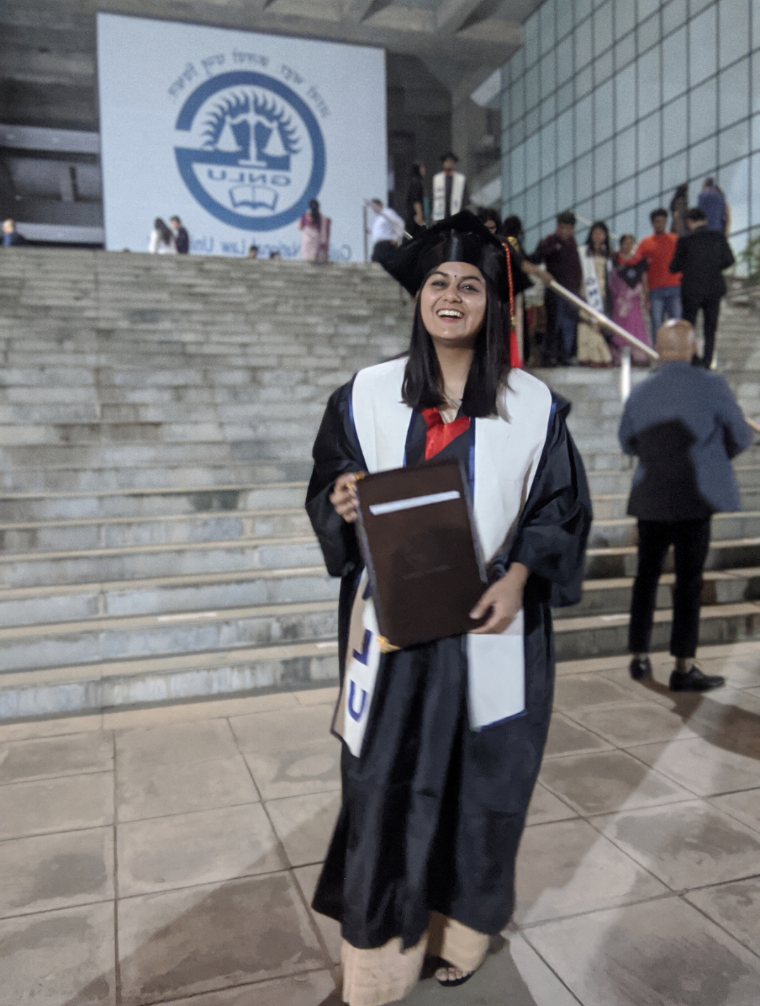

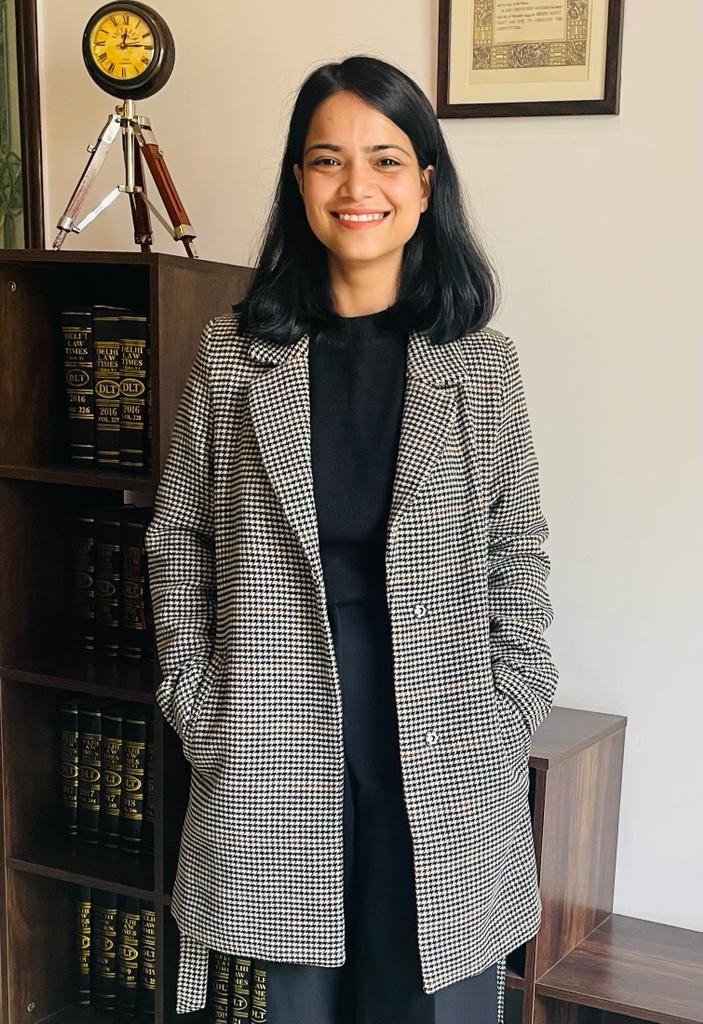


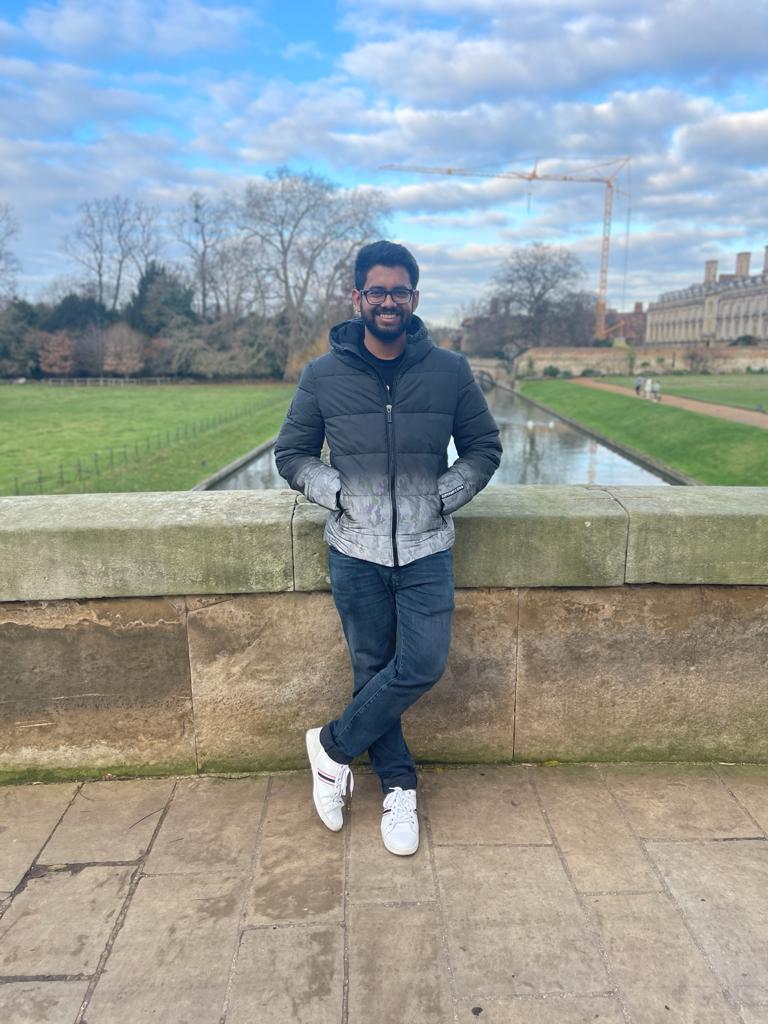
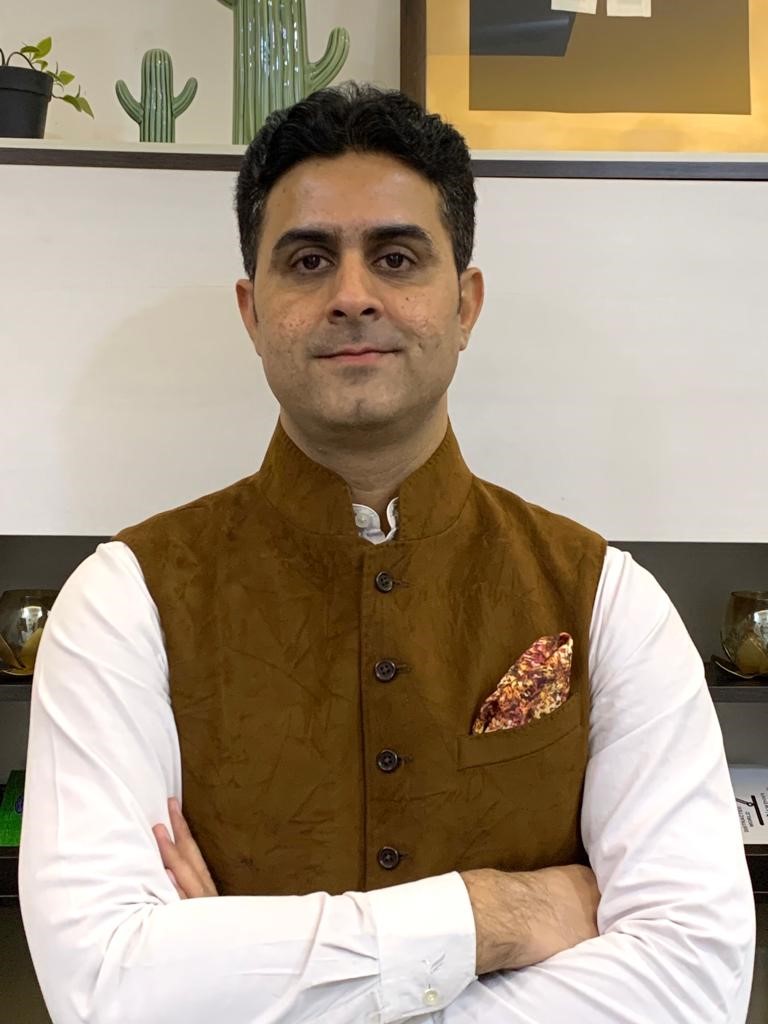


 Allow notifications