Tag: LL.M

Abroad LL.M., Foreign University LL.M, Law school, study abroad, master of laws,

  • Jayakar Bathula, Practicing Advocate and Researcher at NALSAR, an inspiring story of facing odds

    Jayakar Bathula, Practicing Advocate and Researcher at NALSAR, an inspiring story of facing odds

    Jayakar Bathula graduated with an LL.B degree from Mahatma Gandhi Law College, Osmania University. After that he pursued an LL.M degree while specializing in International Trade and Business Law from NALSAR, Hyderabad. He currently works as a Legal Assistant with a group of advocates called Chamber of Lawyers’ Collective, High Court of AP and TS at Hyderabad.

    Jayakar is an inspiring story that needs to be told and retold. The education that he has attained is mostly about the struggles that he had to endure while pursuing them. He is an example and personification of the word ‘tenacity’. Being from a very humble family, he is currently a practising lawyer and also contributes to NALSAR’s repository of study materials through his in-depth aptitude in research and learning.

    In this interview, he talks about:

    • Studying law at Mahatma Gandhi Law College, Osmania University.
    • LL.M from NALSAR, Hyderabad.
    • Preparing study materials for the One Year LL.M Course at NALSAR, Hyderabad.
    • Working at Chamber of Lawyers’ Collective, High Court of A.P and T.S at Hyderabad.


    Our readers consist of law aspirants, law students and young lawyers. How will you introduce yourself to them?

    This is a good opportunity to introduce myself to all law aspirants, students young lawyers and the readers. Briefly, I am working as Legal Assistant with a group of advocates called Chamber of Lawyers Collective, High Court of A.P and T.S at Hyderabad.


    jayakar-bathula-2

    Please tell us a little bit about your childhood and background. Why did you decide to pursue law and what influenced your decision?

    The first and foremost thing which influenced me to pursue law is my social background. I am from a rural village in a hilly area called Morriguda. In my childhood I faced many problems in this village. There was no power, no water and no connectivity, only street lamps which were used by the village heads to show that there is some habitat during night times. We used to drink pond water, carried by my mother from a watering hole outside the village. The street in my village were not even ‘street’, just dirty and muddy pathways.

    The only primary school where the teacher never came, was destroyed by the high flow of the river valley. So I faced lot of problems to get primary education. We went to other villages’ primary schools which were far away from ours. We struggled for primary education. But we smiled even in the crucial times and we enjoyed well.

    These things affected me to pursue higher education in life. Some times every one of us can face money problems. I faced lot of money problems in paying school fees, college Fees, and University fees also. So I worked as a hotel boy at Suprabath Hotel, Hyderabad. Now it has become Royal Derby Hotel, which is good as it has developed. Sometimes, I also worked in MGNREGS to pay University fees.


    From which college did you pursue graduation? Did you have any guidance on how to go about your academics, co-curricular activities and internships?

    I completed my LL.B from Mahatma Gandhi Law College, Osmania University. It was really a great thing in my life; it has given me a good opportunity to work with a group of Advocates called Chamber of Lawyer’s Collective. My college and the Ranga Reddy District Court Complex both are opposite to each other and the Lawyer’s office is also just 5 minutes away from my college. I stayed behind my college. So I would ordinarily attend courts with Senior Advocates and work as a Legal Assistant under them. It has given me good knowledge.

    If we talk about guidance in life… society has been the first guide in my life. I made so many mistakes but I when society has given me punishment, I realised that, this is a mistake I would never do again, I was bound by it.


    What were your areas of interests in college? How did you go about gaining knowledge in these areas?

    The area of my interest was Administrative law and policy. I used to read all the G.O’s which were framed by Governments, Contract and Company Law regulations. I followed journals regularly, and discussed with seniors to clarify my doubts. I pro-Actively participated in all kinds of legal discussions along with senior advocates. Later on we conducted free Coaching classes for A.P JCJ.


    When and how did you decide to pursue an LL.M from NALSAR? Have you thought of applying for foreign universities?

    Once there was advertisement which said that the best law University in India is NALSAR, Hyderabad. So I decided to go NALSAR for higher education. Applying and appearing for the CLAT was ‘O.K’ for me, but I was worried about the University fees and expenses. I let the financial apprehensions go and decided to try the CLAT first, and then see what happens.

    After the CLAT results were declared, I applied to NALSAR, NUJS, NLUJAA, NLIU Bhopal, NLU Delhi, and was selected by NALSAR.

    I started arranging money with the support of friends. I started with 25,000/- and sold my sister’s gold chain (she completed her M.B.A from Hyderabad Central University).

    I went to NALSAR and requested the V.C, Prof. Faizan Mustafa but he had to reject my admission due to no scholarships available and payment of total fees was necessary. I had some friends in NALSAR in their 4th year and I requested them to convince the V.C. Danda Madam cooperated and later V.C Sir called the CLAT Convener and confirmed my seat with a little bit of amount. My LL.M seat was confirmed in NALSAR. My uncle suggested and supported me for an Education Loan with which I settled the NALSAR fees.

    For the rest of the things, my friends have given their shoulders. “The lamp of education needs the oil of finance”.

    Now, how do you say I go abroad to pursue my LL.M? It is only a day dream in my life.

    Here, the most important thing is that after every formality of admission was done with, my every moment was being spent in NALSAR, I was in the Library for almost 18hrs per day with books, journals and laptop. It provided me with a lot of knowledge on international trade and business laws and various emerging fields in law.


    You’ve completed your post – graduation from NALSAR in 2014. How would you describe your experience?

    My experience was good. I did drafting work for the SAARCLAW Bi-Annual Journal under Prof. P.V Rao Sir and prepared short notes for Air and Space Law Students. I was SAARC conference Member; a Legal Adviser for India GEO SPATIAL Conference, as well as a Legal Adviser for the India International Aviation Conference. And this credit goes to my Guide Prof. Balakista Reddy, who is now the Registrar at NALSAR. Congratulations to Prof. Balakista Reddy Sir.


    What motivated you to choose ‘International Trade and Business Law’ as your specialization for LL.M?

    Basically, during my graduation I used to read Administrative Regulations. I was more focussed on contract and Company Laws. Because of this impact I was motivated to opt for International Trade and Business LawsIt is vast area; it deals with Cross Border Business Transactions, the idea that we are living in the Global Village seems true with this.


    jayakar-bathula-1

    What was your topic of dissertation for LL.M? Why did you choose that subject for research?

    This is most important thing I did in my LL.M course. My Dissertation was on the Aviation Sector. It was titled “Air Lines Regulations In India And China: A Critical Analysis”.

    The reason is that the Administrative body, the policy makers, the Administrative mechanisms make some regulations and impose them on the Aviation Sector. I wanted to do research on how the rules and regulations are affecting the Indian Aviation Sector, and what its impact on India’s Economy Growth is. I also discussed so what kind of regulations are there in China, what is not there in India, (like policy regulations, no Uniform Code on Aviation Fuel Tax) Fuel Tax Regulations in India, Region wise Monitoring in China, Monopoly Monitoring system in India, need of Subsidiaries in India and Liberalisation of Air Craft Purchasing in India.

    We have even seen the Kingfisher bankruptcy and M&A in Aviation Sector. There is a need of Regulation in Indian Aviation Sector to access Low Cost Carriers, and to access World Wide Air Crafts, like India allowing the Big Bird from Singapore to land in the Delhi International Air Port. Many things are there in the Dissertation.


    You have prepared LL.M study materials on various subjects for NALSAR. How did you go about preparing such study materials?

    Sometimes we think a hundred times before starting a project, even if it is 30 pages, because we have to take care of Research Methodology, Hypothesis, etc till the Conclusion. My LL.M was a Two Year Course, now it is One year Course (which is great, because now, “Less money + less time = LL.M”).

    International Laws mean you are talking about another Sovereign’s Laws, Regulations, and Administrative System which is unknown, since you are standing in your own Country. The clubbing and framing of two years of material for the One year Course has to look after each and every word consciously and I did this important thing. For this purpose I followed Empirical Research Methodology.

    I referred to books, Journals, On-Line Journals, Westlaw, Lexis Nexis, International Arbitration Council Regulations, ICJ-Regulations, weekly Journals. I collected the material, clubbed and framed it.

    The subjects were “International Telecommunication Laws”, “IPR Law: Relating to Space”, “Mergers and Acquisitions in International Trade”, “Aviation Regulations and M&A in the Aviation Sector” and “Corporative, Comparative and Competition Laws in USA, U.K, E.U, Canada and India”. I also separately prepared material on “Business Aviation Opportunities in India: A Golden Threshold”, “FDIs in Air Ports and Air Traffic Management in Indian Aviation Sector-Under ICAO and IATA-Regulations” and am currently preparing “International Migration and Emigration Laws”.


    How do you think students will benefit from your study materials?

    Exactly, this material is prepared depending on contemporary issues and how to regulate them. At the end of the day all students came to me and collected this material for their future reference. It may be useful for all “International Trade And Business Law” students. We also have to look after the latest regulations and be updated.


    What is the relevance of studying from those materials when there are so many books available in the market?

    Yes, there are so many books on “International Trade And Business Laws” written by prominent authors in the Market. All of these are useful. But my material is prepared depending on latest regulations and updates. Like, U.S.A Federal Laws and States Laws are different. They have a Uniform Commercial Code. It is a command for all the states, but not California which has its own laws. Similarly, E.U Laws are common for all states, and every state has its own sovereign laws. But in India it is different. India is a Union of States; Law is equal into all states. In this, we have to describe, choose, club and frame it for the benefit of our students. 


    Do you think keeping study materials handy helps students in last minute revision before an exam?

    Of course, the handy material may be helpful to students for the sake of examination, but not in practical life.


    What are your future plans?

    I am presently working with the same group of Advocates, Chamber of Lawyer’s Collective. I may get a Law Faculty Position as an Assistant Professor. If I do, I will go for Ph.D, otherwise stay with the Group of Advocates. But I am interested in teaching.


    Going forward, how do you expect the LL.M experience to influence your career?

    Obviously, the LL.M experience will influence my life because my specialisation is “International Trade And Business Laws”. We are in a Global village where Global Consumers are there to consume our Global Products in the Global Market.


    What message would you like to give to our readers?

    Actually, I am not in a position to give such a message. However a few words: Dear readers, I suggest only one thing. Just do the hard work tenaciously, the result will be there.


  • Avik Ghatak, Advocate, Criminal Law, on Litigation and LL.M in Human Rights Law from Univ of Exeter

    Avik Ghatak, Advocate, Criminal Law, on Litigation and LL.M in Human Rights Law from Univ of Exeter

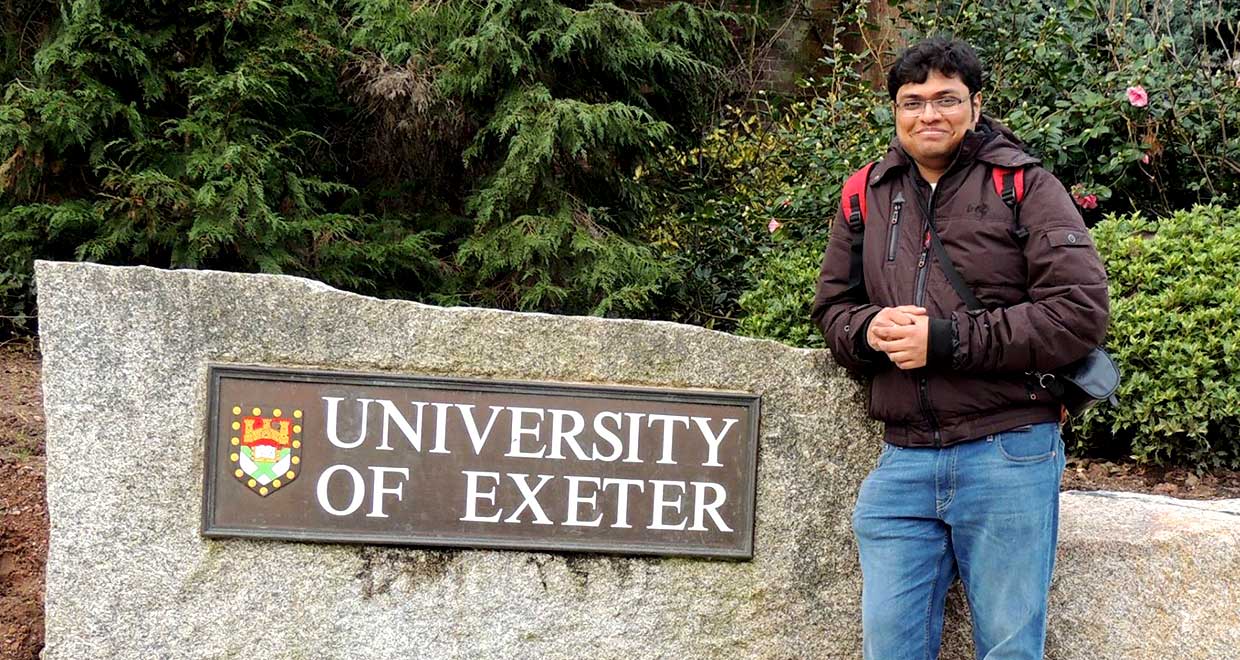
    Avik Ghatak graduated from Jogesh Chandra Chaudhuri Law College, Kolkata in 2011. He started his legal career as an Advocate in the Sub-Divisional Court of Asansol and District Court of Burdwan. Thereafter he pursued Masters from University of Exetor, Devon in International Human Rights Law. He also attended the Certificate Course on International Humanitarian Law organized by the Instituto Internazionale di Diritto Umanitario in San Remo, Italy and Geneva. He has also published numerous papers and currently practises at the High Court at Calcutta.

    In this interview he talks about:

    • Law college experience at JCC Law College, Kolkata
    • Masters at University of Exeter, Devon
    • Publishing various papers
    • Building a career in criminal law litigation at the Trial Courts


    Please introduce yourself to our readers. Tell us a little bit about your childhood and your background?

    A warm hello to all the readers of SuperLawyer. I am Avik Ghatak and I am an Advocate at the Hon’ble High Court at Calcutta. It gives me immense pleasure to be able to reach out to all the readers of this forum and share my views and experiences with them.

    I was born and brought up in Asansol in the state of West Bengal. I studied at St. Patrick’s Higher Secondary School till class X and completed my higher secondary from Burnpur Riverside School.

    After that, I had gotten through to Symbiosis Law School, Pune for my LL.B., but decided to pursue my graduation from Jogesh Chandra Chaudhuri Law College, under the aegis of the University of Calcutta..

    I started my career as a junior advocate at the chamber of Mr. Somenath Chattaraj at the Sub-divisional Court at Asansol.

    Occasionally, I also had the opportunity to appear before the District Court at Burdwan, West Bengal. After a year of practicing as a litigator, I got through to the University of Exeter in the U.K., from where I completed my LL.M. in International Human Rights Law. After completion of the same, I re-joined the profession and started practicing at the Hon’ble High Court at Calcutta.

    While being able to give relief to clients gives me an immense satisfaction as a litigator, academics too, continues to interest me to no end. After having completed a Diploma in Cyber Laws through the distance mode, I was fortunate enough to be able to get the opportunity to attend a short certificate course in International Humanitarian Law last year.


    Do you have lawyers in your family? Would you say your parents were instrumental in your decision to pursue law?

    I am the 4th generation in a line of advocates. There is no dearth of advocates on my mother’s side too. My mother is also an advocate while her elder brother is an Ex-Judge of the High Court at Calcutta and his elder daughter, i.e. my cousin and her husband are advocates too.

    As interesting as it may sound, neither of my parents wanted me to pursue law as a career. In fact, I had decided on leaving Symbiosis Law School after getting through to the same, and joining the University of Calcutta, since I thought that Kolkata would be a better place to prepare for the engineering entrance exams that are held in the state. However, fate had other plans in store for me. By the end of the 1st year of LL.B., I was so interested in the subject of law, that changing my stream was no longer an option for me.


    Your father, Mr. Moloy Ghatak is a prominent lawyer & former Law Minister of West Bengal. How did he influence your career as a mentor? Did you get to hear legal discussions right from your childhood days?

    Considering the fact that almost my whole family is comprised of advocates, including both my parents, there is no denying that I did in fact, come across legal discussions and terminology from a very young age.

    Ever since joining practice, my father has been a source of constant support for me, whether as a senior to consult or a mentor to guide me through the times when I have come under duress. He has always been my idol as a human being. Now, his success as a counsel is also something that I look up to and would like to replicate in the days to come.


    Your father is also an MLA and a member of All India Trinamul Congress party (TMC). Did you ever think of joining politics?

    Like in advocacy, my father is not the first politician of our family. Politics in our family, to the best of my knowledge, goes back even further than advocacy. Inspired, as most young minds are during their college days, by such a background and charged with thoughts of revolutionising the prevalent scenario, I did dabble in college politics for a couple of years before realization dawned on me that politics is most certainly not my cup of tea.


    How would you describe your time at Jogesh Chandra Choudhuri Law College (affiliated to Calcutta University)? Please share some memorable experiences of your college life.

    In two words, it was life changing. I went to J.C.C. Law College as someone who was more interested in preparing for the engineering entrance exams next year. At the end of the 5 years there I was convinced that I would have had committed the greatest blunder of my life had I not decided to pursue a subject as interesting as law. The credit of making someone pretty disinterested in the subject to actually start loving the same goes completely to our professors and lecturers.

    There are probably too many memorable experiences to write home about. Among them, the experience of organising an art and craft competition for the students, re-launching our College’s law journal after a gap of a few years and winning the Moot Court Competition at Hazra Law College, would probably take the cake. Also, our very first class at college, where we were given a lecture by the then Principal of J.C.C. Law College, Dr. Manik Bhattacharya, remains a memorable experience for me. His statement that those coming from families having legal backgrounds ought not take success for granted since expectations from them would be sky high and almost impossible to meet and his quip that ‘A successful advocate barely ever enjoys his life and it is rather his children who do so’, shall remain etched in my memory for a long time to come.


    In Calcutta, universities are always charged up with a political atmosphere. How was your experience in such an atmosphere?

    Yes, I was indeed engulfed by such a political atmosphere and activism till I called quits sometime later. It is perhaps better to enter politics when we have something to give to politics rather than the other way round. The best example that comes to my mind is my father, who established himself professionally before taking the plunge. Another person from our very own High Court would be Mr. Kalyan Banerjee, who rose to the pinnacle of success as an advocate before deciding that it was time enough for him to become a legislator from a litigator.

    My experience in the midst of such an enlightened community of people, as I stated earlier, was very enriching, not only academically but also through the lessons of life that I had the opportunity to learn during my years at the University of Calcutta.


    You have nine publications in various renowned journals. How should one go about writing papers and getting the same published?

    The first and foremost thing that one should keep in mind when one intends to write a paper is whether the question that he/she seeks to answer through his/her research work or the topic he/she wishes to deal with is feasible or not. Being over-ambitious is of little help since choosing a vague or a wide ranging topic would pose significant problems for the author of the paper in collecting primary data. More importantly, to be able to collect and collate such a huge amount of information within the restricted number of words, as most journals tend to have a word limit for the submissions that one makes to them, would become that much tougher if the topic is not precise and focussed. A research paper also needs to be structured in the sense that one needs to be able to clearly define what one wants to say through the paper. The cardinal rule while writing a paper is to always remember that each line and each paragraph in the paper must be related to the question one is trying to answer in the paper.

    Also, last but not the least, there is no use in giving a long winding introduction or in merely compiling existing information vis-a-vis the topic you have chosen. What is rather of more importance is to be able to do some analysis of your own and preferably coming up with some suggestions on how to improve the law and/or the policy dealt with in your paper so that the law/policy is better adapted to the needs of an ever changing world/ society.


    After your graduation in graduating in 2011, you have started your criminal law practice at the Sub-Divisional Court of Asansol and also practised at the District Court of  Burdwan. What did you gather from your experience at the trial courts?

    On seeing most of my friends joining the High Court directly, I had been a bit averse to joining the lower court before making the switch to our state’s only constitutional court. It was on my father’s insistence that I went back to my hometown to start practicing as an advocate at the sub-divisional court situated there. And now I realise that it was a very good decision since when practicing at an appellate court, like the High Court, it is very necessary for you to be having a clear idea about the procedures of the trial court. And that is exactly what you gain if you practice at the lower courts, at least for some time, before making the switch to the higher courts, whether at the state or at the federal level.


    What influenced your decision to start your criminal practice just after graduation?

    Criminal law has always fascinated me. Not surprisingly, it had been my forte at college as well. Also, both my parents were criminal law practitioners. It is perhaps a combination of the above stated factors that influenced me to take up criminal law practice immediately after graduation. I would, however, also like to state that I consider these divisions in legal practice to be very artificial. This is especially true in the backdrop of the fact that at the graduation level we study all the major laws and as advocates, we are supposed to have a basic understanding of all or at least, most of them, even if we cannot claim to hold sway over all of them.
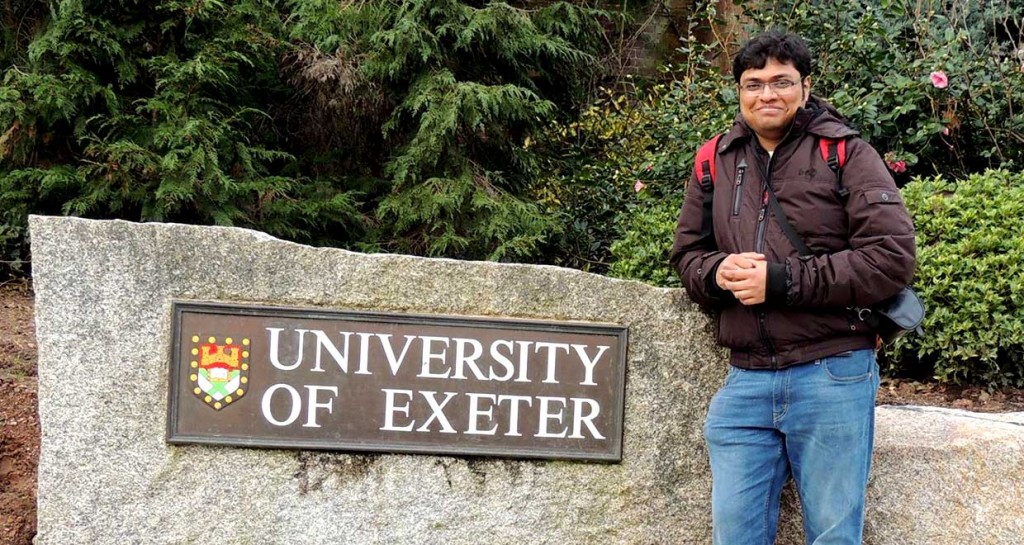
     

    avik-ghatak-2

    At what point did you decide to pursue your Masters at the University of Exeter? What was your motivation?

    It was after spending some time in legal practice that I had a lingering feeling that I still had some academics left in me. A few publications, especially a couple of them in a law journal published by the reputed and respected Common Law House publishers in Kolkata, further fuelled my thoughts in this regard. Aniket Mukherjee, one of our family friends and also a senior at J.C.C. Law College, who had himself completed his masters from the U.K., inspired me to go for an LL.M. One thing led to another and I landed up at the University of Exeter pursuing my Legum Magister.


    How was your experience at Exeter University?

    The experience at Exeter was vastly different from anything that I had come across in India during my graduation days. To begin with, there were no written exams for the subjects (referred to as modules therein) and hence no concept of buying the last ten years question papers and memorizing the answers . However, the absence of written exams did not mean unlimited free time since we were required to submit research essays in all the subjects we had chosen. Legal education over there depends much more on research work and analysis than over here. So, in a way, there weren’t too many shortcuts or last night studies. The path to success lay in the library, if I may say so.

    The library was absolutely fantastic with law journals from all major legal jurisdictions and systems, including those from India. Students over there are also given access to the best online journals available over the internet. I literally had almost the whole legal world at my fingertips while studying as a student at the University.

    A multi-national teaching staff, including among their ranks, a Special Rapporteur of the United Nations Secretary General and also a Refugee Status Determination Officer of the United Nations High Commissioner for Refugees, and a similarly diverse student group, further enhanced the knowledge exchange process. That is something that is available at only very few law universities in India.


    Why have you chosen International Human Rights as your specialization for LL.M?

    Most of whom I know to have done their LL.M., have pursued International Business Laws or International Commercial Laws. Perhaps it is more lucrative in terms of job prospects. But somehow, interest in this particular branch of law continues to elude me till date. International Human Rights Law was thus, pretty much an obvious choice since international law and human rights had been as close to my heart as criminal law.


    How difficult was studying abroad in terms of finding accommodation, finances and settling in?

    I shall begin with the last issue put forth in this question. Settling in was never a problem in the U.K. since they have a multi-cultural society with people from various countries and cultures residing therein for a long period of time. Racism is down to a near zero. All my concerns regarding whether I would be able to integrate into the society over there or not, were laid to rest pretty soon after my arrival at the University.

    Finding an accommodation hadn’t been a problem since I had put up at accommodation provided by the University.. However, when I decided to move out, it proved to be a tough task since as per the agreement with the University, one has to get someone who, at that point of time wasn’t staying at any of the University provided accommodation, to take your place or to continue to pay the entire fees for the University accommodation for the whole year. Fortunately, I did not have to wait for long to get such a replacement. However, my suggestion to anyone reading this and contemplating to pursue his/her LL.M. abroad, would be to decide beforehand as to whether one would like to stay at University provided accommodation or at an independent accommodation because once you ink the accommodation agreement with the University, the way out of the same could be very tough and not everyone could get as lucky as I did in getting a replacement who matches the terms of the agreement.

    Lastly, it is a known fact that studying in the western countries is a much costlier proposition than studying anywhere in India. Hence, prospective students would be better advised to look for scholarships, if the same is on offer. Over and above the same, perhaps putting up at a shared accommodation and not spending too much on travelling, a natural attraction for anyone going abroad for studies, should do the trick as far as the finances are concerned.
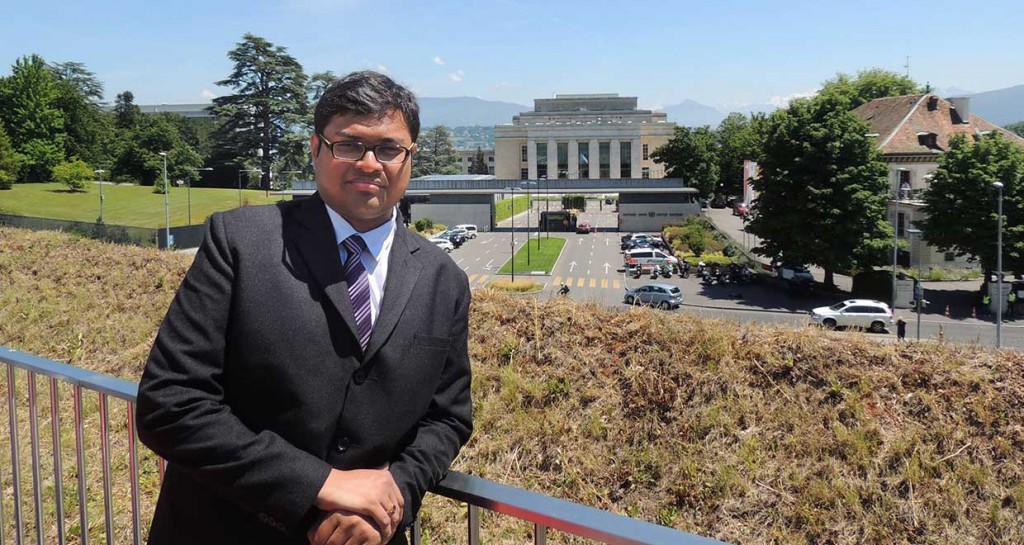
     

    avik-ghatak-3

    You were as one of the 50 professionals from around the world to attend a Certificate Course on International Humanitarian Law organised by the Istituto Internazionale di Diritto Umanitario in San Remo, Italy and also in Geneva. How was the overall experience? What was this course all about?

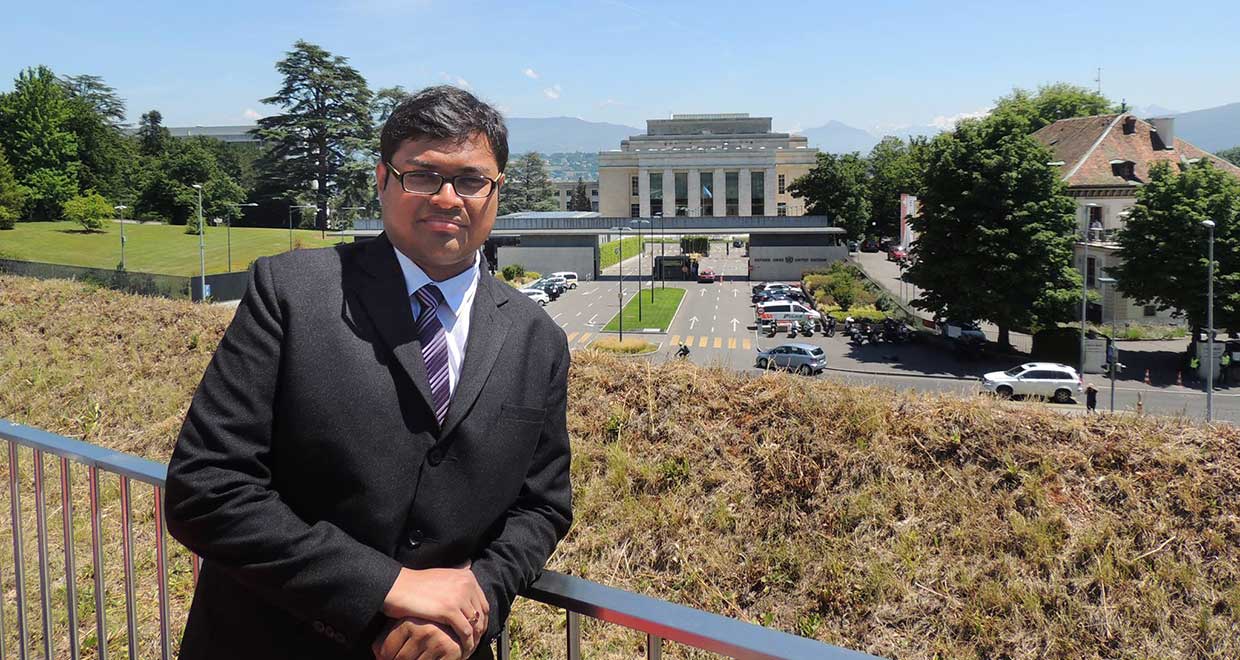
     I had been fortunate enough to be sent, along with 15 others from my University to attend the 82nd session of the United Nations Committee on the Elimination of Racial Discrimination and the 54th session of the United Nations Committee on the Elimination of Discrimination Against Women at the United Nations Office at Geneva in February, 2013. It is over there that I came to know about the Istituto Internazionale di Diritto Umanitario in San Remo, Italy. The Institute primarily deals with the military personnel from around the world, training them in the rules of engagement in accordance with International Humanitarian Law. In order to achieve their aims in this regard, they work in close collaboration with the likes of the International Committee of the Red Cross and has operational relations with the likes of the European Union and the N.A.T.O. They also organise a handful of courses for civilian personnel and I was fortunate enough to be selected to one such certificate course on International Humanitarian Law.

    The experience of being able to come into contact and converse with military personnel, diplomats, professors, personnel from the UN and other international organisations such as the International Committee of the Red Cross, Amnesty International, Caritas etc. and lawyers drawn from a pool of countries spanning over all the continents on earth is something that perhaps cannot be expressed in words. Understandably, it was a very enriching experience.
    The course was on Humanitarian Law wherein the functioning of the same was explained to us by various military personnel and jurists, including Special Rapporteurs of the United Nations Secretary General and Judges of international courts, at times, through exercises resembling real life decision making inside the battle command centres. Also, the relation that Humanitarian Law shares with Human Rights Law, International Criminal Law and as well as International Refugee Law was explained at length, over the course of two weeks.


    You currently practice at the Appellate side of Calcutta High Court. How is the work atmosphere at the High Court presently?

    As time progresses, our society is faced with newer challenges that are to be overcome. And in an attempt to do that, new laws are enacted by our legislatures or amendments are made to the existing ones. More the number of laws more would be the number of litigations though there may be certain exceptions. Hence the scope for private practice at the High Court is better than ever before and I am of the firm belief that the best days are yet to come. So, under no circumstances would I say that it has become more difficult for a fresher to be successful.
    As far as the atmosphere is concerned, having practiced at other lower courts in the past, I have found the High Court at Calcutta to be much friendlier to new comers than most other places. Most seniors are more than willing to help out the juniors when the juniors find themselves on a sticky wicket. And it is not as if they do so with an expectation of getting briefed by the junior concerned. I, for example, have been fortunate to have had worked with a senior who not only allowed me to brief other senior advocates, if the clients so wished, but also to appear against him in matters where, by a stroke of fate, we ended up representing opposite parties in the same case.

    It would be advisable for a fresh graduate to not expect a huge amount of money in his bank account at the end of every month, at least for the first few years of his practice career. Advocacy surely isn’t the place where one can rake in the money right from the word go. One would do better to do away with any vanity or air of superiority and get his head down into becoming a good clerk to begin with. In the words of my senior at the Asansol Court, ‘One has to first become a good clerk if one is to become a successful advocate later on.’ Basically, one would have to know the procedure of the Court inside out before concentrating on the laws since knowing the procedures himself/herself would make him/her less dependent on others in basic matters such as those relating to the filing of a case, for example. Next comes the knowledge of law and the finesse of arguing a matter in the court, both of which one learns over a span of a life time. There are barely any last minute quick fixes or short cuts to success in this profession.


    Many law students prefer corporate jobs over a career in litigation. What is your take on this? Is it better to work in the corporate sector for a few years before starting litigation?

    A High Court Justice had once famously quipped that he is proud that his college produces eminent lawyers and jurists instead of producing ‘corporate slaves’. An ex-Supreme Court Justice, while in conversation with a representative team from our college had stated that he felt that the corporate lawyers contribute nothing to the legal field in terms of legal jurisprudence and interpretation of the laws.

    Such views, though, are generally restricted to our previous generations. Being someone from a generation, a good chunk of whose members have gone into the corporate sector or into law firms, I don’t possess such a traditional view in this regard. In fact, I do understand that in the initial days, a corporate job does seem to be much more lucrative. We are also in an age when most of our friends who go into other streams, especially engineering, get corporate jobs immediately after graduation and their lifestyle and economic stability does appeal to students of the legal field too.

    Also, some students may actually need the economic support in the form of salary that one would get on joining a corporate job or a firm after passing LL.B. That is something that advocacy, by and large, would fail to provide you with during the initial days. Also, some may not want the daily hassles and the schedule less life that comes along with a career in litigation. Hence, corporate jobs for those in the legal field is also a necessity in today’s age, as it provides an additional career option, and a pretty good one at that, to the law graduates.

    I do not have any previous experience of either interning or working in the corporate sector and hence I may not be the best person to be speaking to in this regard. However, to the best of my belief, I do not think that working for a few years in the corporate sector before starting a career in litigation would make much of a difference, especially since the nature of the work that one does at the corporate sector is vastly different from the work that one would be required to do in litigation. One’s experience in the corporate sector is useful for a career in litigation or not, would perhaps depend on how much exposure one gets to the proceedings of the courts during one’s work as a corporate lawyer. However, the experience relating to the drafting of legal documents that one would be required to undertake in the corporate sector is surely going to come in handy even in litigation.


    How did you get to connect with your clients? How many years of practice do you think would be required to build a firm clientele?

    I believe that working at the lower courts at Asansol, Durgapur and Burdwan went a long way in increasing contacts among the advocates practicing over there. And once I shifted to the High Court, advocates from these places found someone they knew and had worked with, to send their cases to, if and when they needed to send some matter up to the High Court. I also make it a point to visit the lower courts in and around Kolkata on a periodic basis, if and when an opportunity to do so presents itself before me. Such visits however, are never at the cost of my work at the High Court since that is my primary place of work.

    As far as direct interaction with the clients is concerned, one has to remember that most of them come to us only when they are in distress and hence, they may seem to be a bit repetitive with their questions at times and at other times, they may seem not to be able to understand your point of view due to a multitude of reasons including their general lack of legal knowledge. One would do better to keep one’s calm under such circumstances. Ultimately, no matter what one says, even the clients understand that you may lose a matter after all. What matters is that they should be able to see in you the intent to give it your best. Good behaviour with clients is a must because our very profession, after all, is in existence to help them out with their legal problems.

    As far as the number of years it would take someone to build a firm clientele is something that would vary from advocate to advocate and there is no straitjacket answer in this regard.


    How is your experience so far? What is your workday like? Are there new challenges every day or did work fall into a predictable pattern?

    My experience at the High Court has been exciting, complete with its share of ups and downs.
    I tend to reach court a little early, i.e. within 9:30 to 10:00, a habit that was inculcated in me by my senior, Mr. Debasish Roy, when I had joined the High Court. After completing Court in the evening I tend to be able to come back home if there are no conferences and dive headlong into studying for the cases scheduled to come up for hearing on the next day or draft documents that are to be filed in the days to come. If however, I am required to meet some senior for any conference then the time by which I am able to return home completely depends on the timing of such a conference.

    Once in this profession, one has to be ready to attend conferences that are held at the convenience of the seniors, whether they are held at midnight or before sunrise in the morning. Life, effectively becomes schedule less. But then, that is part and parcel of advocacy.

    My grandfather used to say that every day is a battle for an advocate. Quite obviously, when you are engaged in a battle on a daily basis, things would not tend to be predictable at all. Two cases may be similar but no two cases are ever the same and hence predictability is not something that one can come across in this profession since each case requires individual care due to its uniqueness, thereby throwing a new challenge at the advocate handling the same. The only thing predictable about a day in an advocate’s life is perhaps that it would be unpredictable.


    What would be your parting message to law students who want to litigate just after graduation?

    Hard, though intelligent work, an indomitable appetite for legal and as well as other related knowledge, loads of patience and humility can and is bound to lead to a success story after a certain point of time. Those coming into litigation must keep in mind that it is not for nothing that we are referred to as ‘Learned’ advocates from day one. We have to behave and act as learned people if we are to do justice to our profession.

    Having said that, I would like to wish all the best to all the law students wishing to become legal practitioners after graduation.

    Last, but not the least, I would also like to say, in the words of my mentor Mr. Protik Prokash Banerjee, ‘Welcome to the Glorious Uncertainty’.

     

  • Rahul Rai, Competition/Antitrust & Trade Lawyer, AZB Partners on LL.M in International Trade Law from Stanford Law School

    Rahul Rai, Competition/Antitrust & Trade Lawyer, AZB Partners on LL.M in International Trade Law from Stanford Law School

    Rahul Rai graduated from WBNUJS, Kolkata in 2006 and got a PPO from Economic Laws Practice after interning there twice. He joined as an Associate after graduating and worked mostly on international trade and competition law matters.

    In 2011, he decided to pursue an LL.M and got in at Stanford Law School in the USA. He describes his LL.M experience, talks about the world-class professors and facilities and his time as an Article Editor of the International Law Journal.

    After returning to India, he joined AZB & Partners and contributed in building their competition law practice. Here, he talks about:

    • Why he didn’t take up any extra-curricular activities in law school
    • His experience as an Associate at Economic Laws Practice
    • The biggest reason he got through to Stanford Law School, USA
    • Joining AZB & Partners upon his return to India


    Please tell us a bit about yourself. How would you like to be introduced to our readers?

    I am a competition and international trade (WTO law) lawyer working with AZB & Partners in Bombay.


    rahul-rai-2How did you come to know about the newly established WBNUJS? What helped you gravitate towards law?

    Like most kids from my part of the country, I too aspired to crack the IIT-JEE. Like many, I bombed through class XI and XII and unless my parents were to buy a management quota seat in some forlorn engineering college; I stood no chance of becoming an engineer. Even if I were to get into an engineering college, I was confident about my incompetence. Throughout high school I had loved studying non-science subjects like history, economics, and civics. I fleetingly heard about Professor Madhav Menon and the National Law School in Bangalore. Law as a possible career option was becoming more and more promising- it offered the escape from sciences and also promised reasonably well-paid jobs upon graduation. The prospect of landing decent jobs helped win over my parents and their fascination of seeing their son in an IIT. The prospect of getting over the baggage of disastrous XI-XII performance (I got 2/100 in Maths in the first semester in class XI and passed my XIIth with 43/100), never to look back at sciences, studying subjects that I had enjoyed in high school and yet be hopeful of a decent job upon graduation made me zero down on law as a possible career. Thereafter, it was simple. In 2001 Google was relatively new but was catching up as a research tool. I went searching for National Law School, Bangalore and found a thread talking about Professor Menon’s move to Calcutta as the founding Vice-Chancellor of WBNUJS. I wrote the WBNUJS entrance test, got through but failed to crack the entrance to National Law School, Bangalore. So I ended up in Calcutta and WBNUJS.


    How would you describe your time at WBNUJS? Did you partake in extracurricular activities?

    Time at WBNUJS was fun. I entered NUJS with three other friends from school. All four of us had struggled in similar fashion to find a roof over our heads after class XII. The five years at NUJS made me cement the friendship for life. I also met some very interesting and nice people and the friendships forged during college days continue to this day. That is one of my most cherished takeaway from NUJS. Academically, when I look back, I can count 5 out of 50 subjects that were taught brilliantly. I just loved G. Ajay’s Political Science, Prof. Rudranshu Mukheerjee’s History, Prof. BS Chimni + Ms. Sheela Rai + Prof. Mritiunjoy Mohanty’s International Trade Law and M.V. Shiju’s Constitutional and Competition Law courses.

    Extracurricular activities were a strict no for me. I had spent my high school days in boarding school chasing (with reasonable success) the trophies in debates, elocutions and sports and decided to do nothing in law school unless it interested me. So, all I did, was sleep, read a few books, and spend just so much energy on studies that would offer a fighting shot at jobs.


    Right after graduating, you started working at Economic Laws Practice. How did the appointment take place? How difficult were the first few months of ELP given that it focuses mainly on a specific field of law?

    I had enjoyed studying International Trade Law and had done reasonably well in the course. With some good luck I landed an internship at ELP, Bombay. I think I worked hard and that got noticed. I got another opportunity to intern with ELP and I decided to work in their Delhi office. Back in 2006 there were 6 associates in their office and Samir Gandhi led the International trade practice in Delhi. Again, I think I worked hard and ELP made an offer.

    First few months at ELP were difficult. I could barely draft a two sentence email and within the first month I was working on a full blown WTO dispute. Samir was and continues to be a great mentor. I struggled with drafting for about 8-10 months and finally one day I got a draft without any red marks! Working in the area of International Trade law and doing a WTO dispute was more of fun than a challenge.


    How did you build up your expertise in competition and trade law? Please tell us a bit about your work profile at ELP.

    I had joined ELP with the idea of working in the area of International Trade law and the hope that someday when the Competition Act, 2002 becomes operational, take up competition law as well. I spent most of the first eighteen months at ELP working on the WTO Dispute with the US on additional and extra-additional duties on import of alcoholic beverages. I would spend 8 hours in the office and another two to three hours reading up on WTO laws. I guess once you become a lawyer, there is no substitute for reading legal texts and commentaries. I just read as much as I could between Monday to Friday, week after week and month after month while at ELP.

    Sometime in late 2007 I saw an advertisement from the Competition Commission of India for conducting market studies. I took the idea to Samir, who was extremely supportive and so was Mr. Suhail Nathani, my ultimate reporting partner at ELP. We put in our proposal to run a study on the interface between antidumping and antitrust law, the Commission accepted it and thus began my career as a competition lawyer. Again, I read and read- there is just no substitute.

    The work profile at ELP was just what I had asked for- mix of litigation, advisory and policy. Above all, ELP offered the opportunity to do what I wanted to do- trade and competition work.


    rahul-rai

    What prompted you to opt for an LL.M from Stanford Law School? How difficult would you say it was gaining admission?

    The desire to study for LL.M. was driven more by the idea of experiencing life in a very good university and not so much by learning ‘law’ a little more. Perhaps, I wanted to make good for the ignominy of not even coming close to cracking IIT-JEE (I was ranked somewhere around 99000 in prelims)! An LL.M. in the US back in 2011 cost about USD 75K and therefore I wanted to go to a place which ranked amongst the very best. Stanford Law School, of course does not need my certificate. I lucked out, despite my not so great rank and CGPA at WBNUJS, Stanford granted me a seat. In retrospect I think, it was all because of my work experience at ELP.


    Did you apply for any scholarships? How was the academic culture at SLS?

    Stanford Law School does not offer any scholarships to LL.M.s and I had secured the Hugo Grotius scholarship at Michigan. So, it was a tough call. In the end, the lure for the sun and sand in California took me to Stanford. I also tried my luck for INLAKS where I did not even make the shortlist.

    The best part about Stanford Law School was the absence of a formal grading system which made the law school such a fun place. Once you stop pitting students against each other and get rid of the system where one student will necessarily be ranked first and other ranked last, studies become fun. Students no longer run after CGPA, take up courses that they really like and above all study than aim for the top CGPA/rank. Like most top law schools in the US, Stanford attracts the very best of faculty and students. The professors are the very best, the peer group is the most diverse and extraordinarily talented. The law school promotes multidisciplinary education in the truest sense. Some of my friends were able to take up courses at the design school, others opted for ‘coding’. I had read a little on Francis Fukuyama’s work and never knew that he taught at Stanford. Realising this, I ran to register for his introductory course of political theory and despite being very selective he was just glad to take in a trade and competition lawyer with nothing but pop political science theories to offer. Likewise, I wanted to try courses at the Stanford GSB and was able to take up one of the most sought after courses-“Build your own start-up”. If I have to sum up the academic culture at Stanford, I would say that it offers the opportunity to try different things, perhaps fail, try again and in the end if nothing works out then walk out with an experience that will certainly make you a better person, if nothing else.


    You were also an editor of the reputed Stanford Journal of International Law. How did this opportunity come to you?

    Stanford Law School is fairly small but has significant resources. So it offers more opportunities than one can make good of in a year’s time. Every year, the student run law journals invite applications for editors. I had spent close to four years doing trade work and so I tried my luck with the International Law Journal. It worked and I got selected as one of the article editors.

    The experience though was a little ‘under-whelming’ considering how correcting footnotes can be quite boring. The article I edited was written by one of the top trade law practitioners and it was fun to read the primary sources and test the author’s propositions.


    How would you say in retrospect your experience in LL.M. helped you in gaining more knowledge and expertise in competition law? Would you suggest other lawyers having a similar profile to opt for an LL.M.?

    Yes. I studied competition law under Professor Mark Lemley, who is without a doubt one of the very best professors in IP and Antitrust and Charles Koob who has one of the most unparalleled profiles as a practitioner. The lessons in Antitrust and assignments have indeed helped in the manner in which I approach an issue now.

    I would most certainly recommend people to opt for an LL.M. at Stanford. If nothing you’d come back with a lot of good friends and even if you sleep through the classes, the activity surrounding you will leave you richer in many different ways.


    After finishing your LL.M. you started work at AZB & Partners. What prompted you to join AZB? Were there other career options available to you?

    Of course I wanted to spend sometime in the U.S. and had managed to secure an offer from one the top firm’s with their antitrust practice in Washington DC. The law firm withdrew the offer after a few weeks of extending it. I had to come scurrying back to India and look for a job. Although AZB did not have an established competition law practice, Samir and my colleagues from ELP had moved to AZB. I spoke to Samir and Zia and was convinced about the firm’s focus on building the competition law practice. Zia was and continues to be very enthusiastic about competition law and that was a big plus. The prospect of reuniting with the old team at a firm that promised to invest in a new area of law made the decision to join AZB a fairly simple one.

    I would have considered sticking around in the U.S. if we completed the “Build your own start up” course at Stanford GSB by securing the seed capital from a venture fund. All VCs told us we were ahead of the curve (polite way of saying the idea sucks). Once the start up dream failed to take off, and the DC law firm withdrew its offer, I came back to India.  AZB happened and I did not try my luck at any other firm.


    Have you ever considered litigation or starting up on your own? Would you say the opportunity a firm provides for a young lawyer is worth the trade off in building a reputation?

    The romance of doing litigation never got to me. I had grown up seeing a generation of my family and family friends with nothing short of master degrees looking for jobs and not finding any. Deep down I wanted a JOB and at the moment I am happy with the sense of security the monthly pay cheque provides.

    I don’t necessarily see a disconnection between the opportunity offered by law firms and building reputation. All professions are about building trust and maintaining one’s credibility. In a law firm setting, one has to first gain the trust of his/her colleagues, immediate seniors, then the partner and finally the clients. I like the system where you are slowly exposed to different levels of responsibilities. Once you have won the trust of colleagues, seniors, partners and clients, recognition will come. On the point of building reputation I do not see any trade offs between a law firm career track and private practice track. One has to earn the trust of everyone around whether at a law firm or at a counsel’s chamber. Become trustworthy and then recognition is bound to come.


    What are the primary essentials of a corporate lawyer? How do you say a fresh graduate can work on building these skills?

    There is a massive gulf between what is taught at law schools and what is expected from an associate at a law firm. If you manage to learn something, there is a good chance that you will have to unlearn it all once you start working. I generally think that most students walking out of the law schools have more or less the same level of intelligence and certainly sufficient intelligence to become a successful lawyer. The real differentiator is communication skills- written and spoken. The good part is that you need not be a gifted writer or orator- these skills can be acquired. And for that you need to be very very careful in the first job you pick. Rather, the decision to take up a job should primarily be driven by the senior you’d work with. If you find the right senior, the battle is half won. And if the senior has the time and patience to guide you, then nothing like it. Else just observing every single word he/she writes and speaks, analyze the difference in approach, and very soon you would develop your own style, tempered by the basic dos and don’ts taught by the senior.

    The other skill set that law schools can never provide is the ability to handle pressure. As you progress in your career, the pressure points will change and you’d see yourself struggling again. It is a continuous process and I am yet to reach a stage where I can start preaching.


    What is your current work profile at AZB? How can an intern be of help while trying to learn?

    I do a mix of competition and trade law work. I would say about 85% of my work is in competition law. In competition, a bulk of my work involves representation in behavioural cases and merger notifications to the CCI. Increasingly companies are approaching us for risk assessment on their business practice and guidance on mitigating risks. We loosely call it competition advisory and compliance. In International Trade I do the occasional representation for an exporter in an anti-dumping or safeguard duty investigation.

    Interns are quite valuable as the colleagues are working full time. We try and involve interns in ongoing assignments for all types of work, including research and drafting of bits and pieces of let’s say an appeal memo. All that I look for in an intern is ability and willingness to work hard and with diligence.


    What would be your parting message to our readers?

    To continue to work for a long period in a law firm set up can be challenging. Unless you enjoy the work, there is just no way that you will survive. So, pick the area of law that interests you the most and make a career out of that.

  • Leoni Mahanta, Trademark Attorney, AMSS on work experience and LL.M from NUS in IPR

    Leoni Mahanta, Trademark Attorney, AMSS on work experience and LL.M from NUS in IPR

    Leoni Mahanta is currently working as a Trademarks Attorney with Amarchand & Mangaldas & Suresh A. Shroff & Co. (AMSS), Gurgaon. She graduated with a B.A.LL.B. (Hons) degree from National Law Institute University, Bhopal in 2009. She then went on to pursue Masters in Intellectual Property Rights and Technology law from National University of Singapore and has thereafter worked with two boutique IP law firms, initially at ZeusIP and then at Lall, Lahiri & Salhotra.

    In this interview she talks about:

    • Law school experience at NLIU and NUS
    • Work experience at ZeusIP and Lall, Lahiri & Salhotra
    • Work as Trademark Attorney with AMSS


    How would you introduce yourself? Please tell us a bit about how you gravitated towards law.

    Hi, I am Leoni Mahanta and I am currently working as a Trade Marks Attorney with Amarchand & Mangaldas & Suresh A.Shroff & Co. (AMSS), Gurgaon.

    My maternal grandfather was a very big name in the legal fraternity of Assam. As a child, I would hear his great courtroom stories, the stature he enjoyed in the society, and that inspired me to become a lawyer so that I could carry forward his legacy.


    Please tell us a little about your law school days at NLIU? How were you at academics?

    The 5 years I have spent in National Law Institute University (NLIU), Bhopal, are indeed very close to my heart and the whole experience has a major impact on who I am today. Studying at a National Law School gave me the opportunity to interact with the cream crowd of the country. Being a part of the competitive environment at NLIU, I became a goal oriented person at a young age. I was an above average student with a decent CGPA and I actively took part in extra-curricular activities as a core member of Gender Justice Cell and Access to Justice Cell and was involved in UNDP funded projects. My reading was not limited to class-room notes and course materials, and I would read from books which helped me to understand the basics. The purpose was not to cram up the course material to score high grades but to understand and enjoy what I was studying.

    Most importantly, one of the key highlights of my law-school years was travelling all over Madhya Pradesh and beyond, getting to know the culture and enjoying the hostel life with my friends. There was always so much to do – exams, projects, presentations, extra-curricular activities – and coping up with the trimester system taught me mechanisms to multi-task, all of which are now helping me being an associate at AMSS and still maintaining work life balance.


    How important do you say is a good CGPA for an illustrious career in law?

    Good CGPA is definitely very important to be noticed by a potential employer and in securing admission for higher studies at top law or business schools. However, for an illustrious legal career, the marks you have scored in law school exams have no role to play. I believe we should choose to work in the field which interests us, be sincere and honest in our attitude towards all the assignments we are involved in, be it big or small. In short, if we love our work we will naturally put all our efforts and would want to be updated with latest legal developments which in turn will reflect in the quality of our work.


    leoni-mahanta-1

    How do you think internships are beneficial to law students?

    Internships give students the opportunity to experience the practical aspects of law and provide exposure to a professional environment that a law school may not otherwise be able to provide. I would advise law students to intern with Non-Governmental Organizations, National Commissions, Litigators, Corporate Law Firms and as Judicial Clerks so that they can have a fair idea of different practice areas and can gain clarity of what they would want to pursue as a career. Internships also provide great platform to refine legal skills, learn your strengths and weaknesses and to network with legal professionals who may prove to be mentors in finding jobs in the future.


    After your graduation, you went to pursue Masters in Intellectual Property Rights and Technology law from National University of Singapore. How would you describe your experience as?

    Yes, pursuing higher studies was always the plan! I was not mentally prepared to start working right after law school. I felt it was too soon. I wanted to go out in the world, experience different cultures, meet new people and become more independent. Though I was offered Scholarship by Kings College London, I chose National University of Singapore (NUS)because of its global approach to education and research, with a focus on Asian perspectives and expertise. Also, the University is considered to be one of the best in Asia offering diverse course modules which are taught by the professors from the top most universities of the world.

    Studying in Singapore was a life changing experience. Living in a different culture, interacting with people from all over the world helped me discover myself, break down my stereotypes about many things and see the world in new ways. The LL.M. gave me the opportunity to make great friend, meet new professionals and build invaluable relationships with peers from around the world. Also, NUS organises regular professional networking gatherings which helped me to develop networking skills. I also had the opportunity to intern at Drew & Napier LLC which is one of Singapore’s leading and largest law firms.  This experience taught mecross cultural skills and provided an international professional exposure.

    Pursuing an LL.M. abroad may not be a good idea if you are expecting it to be a means to getting a job abroad or top law firm in India. But personally, I believe that studying and living abroad contributes to overall development of one’s personality, preparing to adapt to unfamiliar environments and improve interpersonal skills as a result of interacting with people from diverse backgrounds and cultures.


    After completing your LL.M, you came back to India and started your career at a boutique Intellectual Property Firm. How would you describe your experience working at boutique firms?

    I worked in two boutique IP law firms, initially at ZeusIP and then at Lall, Lahiri&Salhotra.Working at these firms proved to be beneficial as from the very start of my career I got the opportunity to work directly under the supervision of the Partners, work on wide variety of matters due to less compartmentalisation of work, take more responsibilities and directly communicate with clients. Working in boutique set-ups helped me to gain more control on the practise, become responsive and develop management skills.


    Currently, you work as an Associate at AMSS. What prompted you to make this choice and how is your experience so far?

    Working at AMSS was a natural choice as I was looking for varied and challenging work and it is the best platform to experience the cream legal work in the country since it has diverse range of clients comprising world’s top business houses.

    Working at AMSS is a very fulfilling experience. The people that I work with are some of the brightest and most insightful people that I have ever met. AMSS has a very women friendly environment and the firm takes various initiatives for the well-being of the employees.


    What kind of work and responsibilities does an associate at AMSS deals with? What should a student do so that he gets placed in a prestigious firm like AMSS?

    Work and responsibilities of Associates at AMSS differ from team to team. Personally speaking, I believe that if one is sincere, good at work and takes initiatives then opportunities aregiven to work in wide range of matters and take more responsibilities.

    The general notion is that one should be amongst the top 10% of the class for campus recruitment in AMSS. I joined AMSS as a lateral joinee and can only comment on the basis of my personal experience. I believe that a good CGPA is important but AMSS also considers if the candidate has a good grip of the work he / she is doing and the general attitude towards work. AMSS appreciates candidates with well rounded personality and good inter-personal skills. My advice to the prospective job seekers is to develop strong base in their practice area, be honest with the interviewer and develop the spirit to be nothing lesser than the best. Recruiters can read your mind 🙂


    Last but not least, what’s next for you?

    Every day I go to office as if it’s my first day at work with the determination to prove myself and be better than yesterday. I believe the doors of great opportunities will open up if I continue to be true to myself and my work.

  • Jagruti Dekavadiya, Managing Partner at Arun Oza & Associates on specialisation in Commercial Law from UCL

    Jagruti Dekavadiya, Managing Partner at Arun Oza & Associates on specialisation in Commercial Law from UCL

    Jagruti Dekavadiya is a graduate of the 2012 batch of Institute of Law, Nirma University B.A. LL.B. (Business Laws – Hons.). A lawyer with the qualification of LL.M. (International Commercial Laws) from University College London, (U.K.) and a Registered Trademark Attorney, Govt. of India, she is now the Managing Partner of Arun Oza & Associates.

    In this interview you will get to read what she has to say about:

    • Choosing law as a career option
    • Specialization in Commercial Law
    • Importance of Research and publications and other co curricular activities
    • Working as a Managing Partner at Arun Oza & Associates


    Please tell us what defines you.

    I am a very passionate human being. Routine bores me so to keep going, I need challenges. I graft wonders under pressure. I love challenges and it becomes an obsession to win, be it a boardroom game or on a playground. I believe in maximum output with limited time. Moreover, I like being at peace followed by hard work and complete fairness. I don’t like it I get favoured in anyway. I like to earn it myself than to get it inherited.


    What is it that motivated you to take study law?

    It is actually a very funny story. Till I completed my 12th (Science Stream – Biology Group), I always wondered as to why one chooses being a lawyer. Why would one fight cases and take mental stress dealing with others every day? But during that period, I came in contact with my mentor, guide and philosopher, Shree Arun D. Oza (Former Government Pleader and Public Prosecutor for High Court of Gujarat), who changed my perception about lawyers forever. He is the type of lawyer who fights for justice, always fighting for the cause of justice against oppression and victimisation.

    He is the only lawyer I have seen so far who will ask his filthy rich prospective client bluntly, “Did you do this?” and if the client says “Yes”, he is at fault. Mr. Oza won’t proceed further and will show him the real picture. So his honesty, integrity and power of truth inspired me to become a lawyer and then in the meanwhile, Nirma University launched their Institute of Law and Shree Oza filled out my form and told me on the day of the exam an hour before that you have to go and appear for entrance and so I did.

    My Rank was 81 (Only top 80 were to be selected.) and I got an interview call followed by an admission, and now, I hold the qualification of a B.A. LL.B. (Hons- Business Laws) with University Second Rank (with minor difference of 0.01 points) and I was also among the toppers in the Business Law Honours Subjects. I also hold an LL.M (International Commercial Laws) from University College London (UCL), UK and Registered Trademark Attorney, Govt. of India.


    You have specialized in Commercial law. What made you interested in the same?

    I am a Gujarati, therefore business oriented by birth! The intricacies of business, investment and calculation come natural to me. I always see the pros and cons of everything may it be on professional or personal front. Plus everything has a reason in whatever I do. So, the calculative nature and my interest in learning more about commercial law directed me to specialize in commercial law.


    jagruti-dekavadiya

    Do you say there is room for specialisation and research in Commercial Laws?

    Indeed, there is. Commercial Law is rather a discipline in itself. Very vast and diversified. It has an incredible scope from the academic and research point of view. The study of commerce and market, foreseeing the economic growth, and identifying the best practice to adapt or policy to formulate is the ongoing dynamic and intense area for academicians and researchers and the same is also related to the professionals up to a certain extent. I feel students who want to specialise in this, should think what they want to be – A professional or an academician and then should adapt themselves accordingly, as it’s interdependent and does not have straight jacket formula to follow.


    Most of your internships have been litigation internships. How helpful were they in increasing your skills and competence as a professional in the field of commercial law?

    My internships into litigation were not isolated from the commercial laws. During those internships, I have learnt the intense interdependent aspects of legislations like Income Tax, Carriage of Goods Act, Trade policies etc along with the Constitution of India. At various judicial forums, these internships have helped me learn the basics which every lawyer should know, along with the aspects of interpretations as far as commercial laws are concerned. Moreover, I believe any skill gained is always an advantage. So for me, it was like know the problems with poor contract drafting or policies resulting into litigation, so that I can be prepared to curb them before inception. Knowing what could be the prospective problem, equips you with solutions resulting into excellence and success.


    What do you think about students pursuing CS?

    I believe in adding brownie points to your CV but for the students who already want to specialise in Commercial Law, why do CS? It has more or less the same subjects and same contents. So, I would invest my time in attending workshop on corporate finance or investment or any related area.


    You did your masters from UCL, one of the most prestigious universities of the world in international commercial law. What do you think is the scope in this area?

    UCL is indeed the one of the most prestigious universities in the world and known for its course on International Commercial Law. It was indeed prestigious and an amazing experience to do my LL.M. in International Commercial Laws from there. There is a tremendous scope in this area. It widens your theoretical understanding along with the technical ‘know how’. Proficiency in International Commercial Law has the power to empower one to become a global citizen or a professional in its true sense.


    How do you assess your LL.M program? Was it an intensive academic and research oriented exercise or did it also help from a professional point of view?

    UCL has a very intense and comprehensive program for its LL.M. It is extremely well structured. It comprises of the academic and research aspects on the various topics and also has tutorials and workshops which empower students to have a complete holistic view than just focusing on academics. So, it was very intense from an academic and research point of view but it also offered various training programs and endowed me on the professional front too.


    You have done a lot of publications. How big a role did the same have to play in helping you get admission at Cambridge?

    Having publications on your name and authoring upon the burning topics always adds cherry to the cake. However, I would say that a prestigious University like UCL and Cambridge do note it. As it’s evident in my case, inspite of lacking post study experience, along with A+ Grades, it were my publications which helped me bag admission at Cambridge and UCL too. I believe in collecting options on my plate to choose and pick from later when needed.


    Along with having publications, what all activities did you indulge in as a law student, which helped you secure admission at Cambridge? Do research work and writing papers have a role in building you as a professional?

    I have been very active in co-curricular activities and I firmly believe that it surely played a role for me in getting an admission. I have successfully carried out responsibility in my post as the Chief Executive Editor of Nirma University Law Journal. One of the key achievements out of the list was to be selected as the Chief Coordinator to lead a batch for legal awareness camps at various villages, schools and Sabarmati Central Jail for five years. I have also been the founder and active member in the Moot Court Committee, Debate Committee, and Seminar & Publication research cell. You name any committee or any team; I have played an active role in it. I believe these responsibilities makes you a complete professional along with your academics and it surely distinguishes your profile and leads you on the top of everything. As it did to me, apart from getting admission it also helped me grab the PPO from a London based International Law Firm. (which I rejected, as I was clear of doing an LL.M. and then subsequently having my own law firm which I am doing successfully now.)

    I have presented more than fifteen papers and chaired sessions at various National and International Conferences at leading Universities in India including Bombay, Calcutta, Chandigarh, Indian Business Academy Bangalore, and Indian Society of International Law (ISIL) and as well as some outstanding seminars abroad including Los Angeles in 8th International Conference on New Dimensions of Humanities organized by University of California Los Angeles, USA in February 2010, Mauritius in ICER-2010 by University of Mauritius in September 2010, London in BSA Sociological Association Annual Conference at London School of Economics and Political Science (LSE) in April 2011.

    I have also taken active part in one National and two International Moots – Participated as a Researcher in Surana & Surana National Corporate Law Moot Court Competition 2008 and as a Speaker in 9thPhilip. C. Jessup International Moot Court Competition 2009 and a coach and chief researcher in International Maritime Law Arbitration Moot 2011, organized by Murdoch University, Australia in collaboration with National University of Singapore, National University of Singapore July 2011.

    I firmly believe being professional is not only about skill or knowledge. A professional needs to be equipped with the knowledge and also with a technical ‘know-how’ to face any situation ahead. Hence, I also had equal focus on my academics too. I have scored the highest in the University in Business Laws Honors subjects. I have also scored University Second position with the minor difference of 0.01 points. So, I believe in achieving excellence at every possible thing related to your area and it will be followed by the success never achieved by anyone before, may it be getting admission or a PPO for that matter.


    Along with Commercial law, your profile also shows that you have interest in Trademark and IPR? How closely are the two branches of law related?

    Commercial law is very vast and mammoth. Of course, it has interrelation with IP related issues too. In fact, while I was advising one of my corporate clients, he had issues with breaching contract of confidentiality resulting into the leakage of the trade secret. So, I had to take IP protections for this client. That’s how I actually ended up being qualified as Registered Trademark attorney.


    What are the other areas of study which you think that a law student wanting to excel as a professional in the field of commercial law should be proficient in?

    As I suggested earlier, based on the individual limb of commercial law, whatever area which interests the most to the student, he/she has to be equipped with the skills and knowledge needed. However, if you ask me to pin point them: Maritime Law, International Trade Law, Insurance, Merger & Acquisition and Corporate Finance are the essential areas of study, though each of them have an entire discipline in it.


    How was your first year after graduation? Do law schools in India prepare their students for their professional life?

    My first year was very exciting indeed. There were a lot of challenges to meet with. I doubt that law schools in India are completely adequate enough to prepare the students for their professional life since the curriculum in Indian Law schools is academic centered rather than practice oriented. A law student must enhance his CV with Publications, Paper presentations, Research and Moot Court presentations to compete with other candidates. I believe only academics or only extracurricular will not help. Make your CV that impressive that no one can ignore it.


    How did you get to work at Arun Oza & Associates? Please share with us your journey from your induction into the firm till date?

    Shree Arun Oza is a senior lawyer at the High Court of Gujarat and he served as an inspiration for me to shift to law from my Science background. I have been attending his office since 2007 from my first year of law and now, it’s my firm. I am managing it. My journey was quite tough and taunting as from day one it felt like I was talking responsibility. It was the real experience of being responsible for your act rather than a feeling of being an associate where you know there is always a senior to check. However, the journey was very interesting and to this day it continues to be. I have new challenges and new aspects to explore.


    What is a normal workday like at Arun Oza & Associates? Being the Managing Partner at AOA, what are your responsibilities?

    I head the Corporate and Commercial Department, including Arbitration and Intellectual Property Rights. I also head litigation along with Mr. Oza. My day starts with urgent admissions and other matters on board and ends with meetings and drafting for my commercial clients, especially companies whom I am currently advising on its International affairs too. So, my duties aren’t fixed. It’s kind of like being an entrepreneur and being the head at the same time. I also have to manage associates directly and run for final hearings at Court too. But, it’s very much happening.


    Do you take interns at AOA? What do you look for in a typical cover letter and CV? How can interns manage to get positive feedback in the limited time they have?

    Of course, I do take interns at AOA. Matter of fact, I am currently having three interns directly under me. One from JGLS and other two are from NLUs. I am really picky about their cover letter. I believe, because they are applying for experience, I don’t expect their CV to be full of achievements but I read the cover letter carefully. The way they draft cover letter depicts the confidence level and clarity as to why they want to intern under me or AOA. Once, I approve the cover letter, my office writes back for interview either online or offline and then if they are selected, they directly report to me. I provide them feedback on each and everything. The interns under me aren’t pampered. They get the first hand experience of everything I do. It may range from cracking negotiations with corporate clients to appearing at different final hearing stage in Courts. I give them files to read and also give them the responsibility to assist me inside the Court being on the front desk alongside myself.


    Is there any other tip you would like to give to our budding professionals?

    Strive to learn and stay hungry for knowledge. Take it as a challenge and believe that you can do it. Hard work is important but in this age if you also want to succeed what’s more important, is focused smart work. Know your priorities and act accordingly. No doubt, Law is a lucrative profession but learn to be fair and give back to the society as well.

  • Suvarna Mandal, Associate, Saikrishna & Associates on specialisation in IPR from Kings College

    Suvarna Mandal, Associate, Saikrishna & Associates on specialisation in IPR from Kings College

    Suvarna Mandal graduated with a BSL.LL.B (Hons) degree from ILS, Pune in 2012. Soon after Graduation, she went on to pursue Masters in Intellectual Property Law from Kings College, London. She has an enviable academic record and an excellent series of internships at top law firms. She has also done Diploma courses in Corporate Laws, Cyber Law, Intellectual Property Law, and Business Laws. Currently, she works as an Associate at Saikrishna and Associates.

    In this interview, she talks about:

    • Law school experience at ILS
    • Pursuing further studies and LL.M from Kings College
    • Appointment at Saikrishna and Associates


    Though it’s one of the most asked questions but yet, why law?

    Well, to be completely honest, I wasn’t planning on doing law when I was in High School. I intended to pursue a career in either medicine or journalism. However, in addition to having a keen interest in public-speaking, I was also an avid follower of legal luminaries like Nani. A. Palkhiwala and Leila Seth, and consequently, a career in law fascinated me. I procured an admission into ILS, Pune and though I had secured admissions into various colleges in Delhi University as well, I was advised by many to definitely look into law as a career option.

    Luckily, I had the chance to attend college at ILS for a month before I had to finally decide my career path, and within a month, I was sure that law is the best career option for me. It is my personal opinion that as a lawyer you are constantly learning and constantly adapting to a dynamic environment, and the knowledge that one procures from their LL.B degree is just the tip of the iceberg. From what I have gathered so far, even a lifetime is not enough to specialise in a particular genre of law. This was one of the deciding factors for my inclination towards law.


    Tell us something about your college life? What all activities did you participate in?

    While in college, academics was always the first priority, and I spent a major portion of my time understanding and studying the subjects that were taught in every semester. In addition to that, in order to expand my knowledge in specialised fields, I had done Diploma courses in Corporate Laws, Cyber Law, Intellectual Property Law, and Business Laws from Asian School of Cyber Laws, Pune and ILS itself. I had also participated in a couple of Moot Courts conducted internally at ILS and also represented my college as a Speaker in the National Round of the Commonwealth Moot Court Competition, 2009, at School of Law, Christ University, Bangalore. My preference for Intellectual Property Law directed me to write a couple of articles on IP related topics. As far as co-curricular activities are concerned, I was part of the Corporate Law Cell and the theatre group “Aahwaan” of ILS.


    You have interned at top-notch law firms including Khaitan, AZB & Partners, Karanjawala and LexCounsel. How did these experiences help mould you as a lawyer?

    My internship experiences at all these firms have been varied as I have had the opportunity to work in different departments and areas of law including IP Law, Corporate Law and basic civil litigation. Personally, internships have benefitted me greatly because my internship with the IP team at Khaitan made me realise that Intellectual Property is definitely my core area of interest. As a law student, it is difficult and in fact premature to make up your mind about the field of law that you would like to practise in. In my view, as a student of law, it is sufficient to just have a general idea about your areas of interest. In this regard, internships help you a great amount because you get to experience first-hand, what it would be like, to work in that particular area of law.


    suvarna-mandal-2

    Right after graduating, you went for LL.M. Please share with us all the decisive moments leading to this.

    Many law students are often torn with the decision of choosing to pursue their LL.Ms soon after their LL.B. or getting some work experience before opting for the same. There are pros and cons in either scenario, and the decision has to finally be taken by the individual. I too had my share of the dilemma and confusion, but I was clear that  Intellectual Property Law was my preferred area of interest and that I wanted to study more for a comprehensive understanding of the subject. This encouraged me to first complete my Masters and then start working as a legal professional.

    Since I was sure that IP Law was the subject I wanted to specialise in, I started looking for LL.M. courses that offer the same, and The Dickson Poon School of Law, Kings College London was one of the premier and top rated institutes in UK for the same. KCL offered a specialist LL.M. Degree that focussed on Intellectual Property law prevalent in various jurisdictions and had modules that helped the prospective students in developing a speciality in the subject in academic as well as practical aspects.

    The faculty was excellent and comprised of the top-names in the field like Tanya Aplin, David Llewelyn and Sir Robin Jacob. Due to all of these reasons, this course was obviously my first choice and I was fortunate to secure an admission at Kings College, London.

    The experience of studying at KCL was enriching on all fronts which gave me the opportunity to learn from the best intellectuals in the sphere of IP, and learn with students of different backgrounds and cultures.

    As of today I can confidently say that my LL.M. at KCL has benefitted me personally and professionally. One of the main reasons for me to apply for an LL.M. outside of India was to understand the manner in which IP laws were interpreted and how they operate at a global level and its comparison with IP Laws in India.


    Please tell our readers about the application procedure and other requirements?

    From personal observation, I had noticed how Universities (especially abroad) gave importance to student profiles that indicated that the student has put in hard work to build a rounded CV representing his interests and activities not only in his law course but also in co-curricular activities of his choice. Internships, publications, involvement with NGO’s and social causes, cultural activities, etc. facilitate in building an overall strong profile. Having said that, a good score is essential to get into a college of your choice as that is the first criterion that Universities look into.

    The applications for LL.M. should be sent out as soon as the Universities commence with registration process as many a times, good candidates are left out merely because of applying late. Very important aspects of your LL.M. Applications are to have a crisp Statement of Purpose and to obtain good Recommendation Letters. If you have decided to pursue your masters then it is essential to start working on your recommendation letters (from faculty and from your internships, if you are not already working) and your SOP.


    What were your areas of interest while you were an undergraduate student and how have they helped in choosing your subjects/courses for the LL.M programme?

    I have been a voracious reader all through and have found that reading has always leaded to my inspirations and aspirations in life by broadening my horizons. As an undergraduate student, in addition to being involved with activities that were offered by my college, I was also involved in Theatre and Music. I was part of an English theatre group of Pune and performed on stage for the same. Music has been a part of my life since I was a child and I have received training in singing in Indian Classical Music and Western Music. This particular interest directed me towards writing my own songs, and after composing a couple of melodies I couldn’t help but wonder how I could protect these compositions. My interest in these creative fields and the element of curiosity to protect my musical compositions made me want to explore the field of Intellectual Property Law.


    Tell us something about your LL.M year. What kind of activities were you involved in over there?

    My LL.M. experience was challenging, enriching and ultimately very rewarding. I was given the esteemed opportunity to study under and interact with internationally acclaimed academicians and practitioners who helped me greatly in my analytical and critical approach to the issues in IP Law. I studied amongst students of different nationalities, some of them were established legal professionals with substantial work experience, and some of them had recently graduated law, just like me.

    As postgraduate students of KCL and University of London we had access to some to some of the best law libraries worldwide, including Maughan Library of KCL, and the law library at the University of London’s Institute of Advanced Legal Studies (IALS). The college encouraged its students to participate in various seminars and workshops by Guest speakers, networking events, etc. organised internally or externally conducted. The students were also given an opportunity to meet legal experts such as Judges, solicitors, barristers, in-house legal counsels, etc. in order to discuss a career in IP Law.


    How difficult was studying abroad in terms of finding accommodation, finances and settling in? Are there any scholarships for studying at KCL?

    There is no denying that living in a city like London may be a little intimidating at first, but eventually you get comfortable. As soon as you are accepted into a college, you are provided with various accommodation options that the college can offer you, and fortunately, I was able to secure a hostel accommodation at KCL even before going to London.

    There are also several options available to students who do not wish to live in accommodations provided by the college and several organisations/websites work towards helping such students. London is a very student friendly city as there are substantial amounts of discounts available to students in public transport, restaurants, grocery stores etc. which is a relief considering that London is an expensive city to live in. As far as scholarships are concerned KCL does offer a couple, however they are extremely competitive and mostly inapplicable to Indian students. The website of the college offers all the details pertaining to the same.


    How was the faculty and academic schedule at KCL? Given your experiences how would you pit Indian students with their foreign counterparts?

    That pretty much depended on your choice of modules. The modules that I chose, required me to attend about 3-4 classes per week with a pre-defined reading list that needed to be studied before the class. This way, the understanding of what you studied from the list became crystal clear when the same was discussed in class with the professors. A glaring difference in the mind-set of the foreign students viz. a viz. their Indian counterparts is that the former believed in a more ‘comprehension based’ education system whereas we believe in memorising our syllabus, sometimes without understanding the underlying concept. I am of the opinion that if we are able to inculcate an application-based and practical method of comprehending the subject in our education system and combine that to the gruelling hard work that Indian students are used to, then we would have the perfect recipe for all round success.


    Was there time enough for non academic pursuits at KCL? How did you find the study-life balance to be?

    Though the LLM course is rigorous and requires commitment, there was enough time to explore London and indulge in the activities that it had to offer. The city has a rich history and culture and there are many places that one could visit in and around London even on a student budget. The recipe for balancing your student life and unwinding in one of the most renowned cities of the world is simple. One should make it a point to study the reading list given to you before classes, regularly attend your classes, engage in discussions with your peers and professors during classes, and always complete the assignments given by your faculty. This will help you greatly for your examinations and at the same time you will also have enough leisure time to relax and enjoy student-life at London.


    Soon after Masters, you joined Saikrishna and Associates as an Associate. Tell us about your induction into the firm.

    Getting absorbed into Saikrishna & Associates is a privilege and I grow and learn as a legal professional every single day. It is truly a terrific opportunity to be able to work with and rub shoulders with the best and the brightest minds in the industry. The seniors of the firm are fantastic mentors and dedicated lawyers that inspire you to work harder and learn more. I have been an Associate at S&A for almost a year now, and have had the chance to work in various verticals and practise areas of the firm such as IP Litigation, Transactions, Company Law Litigation, Advisory and Policy Reform, etc. I have also had the chance to co-author with my seniors, several publications in legal journals and magazines.


    Many lawyers would say that the actual learning takes place in the years of practice. How far would you say it is true? What was the case in your situation?

    Well, knowledge is power and experience enriches our knowledge. A good educational background lays down the foundation to be a good professional. As a lawyer the learning is constant irrespective of what stage you are in, whether a student or a professional, and you never really cease to be a student of law. It is essential to be true to the role that you are currently in and to try and meet the expectations of that role. There is obviously a difference in studying law and practising law, however the comfort level to understand both comes with hard-work, patience and time.


    What would be your advice to students interested in Intellectual Property Rights?

    Intellectual Property Law is a dynamic and constantly growing field. We currently live in a digital and global society and Intellectual Property Rights permeates into our daily lives. IP Law in India is developing at an exponential rate and has tremendous untapped potential. Students who wish to study and understand IP law should try and secure internships in firms that practise the same. In addition to that they should try and take up diploma courses in IP law so as to increase their knowledge base in the subject. It is also essential to stay abreast with the developments and major judgments in the field.

  • Pralika Jain on representing Bollywood celebrities, work at Star India and LL.M in IPR from Georgetown

    Pralika Jain on representing Bollywood celebrities, work at Star India and LL.M in IPR from Georgetown

    Pralika Jain is a media and entertainment lawyer with about three years of experience in the broadcasting and entertainment industry. She graduated from GLC, Mumbai in 2011. Thereafter she worked at Star India Pvt. Ltd. for one year and then with a Talent Management Agency, CAA KWAN as a lawyer to Bollywood Celebrities. Currently, she is pursuing Masters in Intellectual Property Law at Georgetown University Law Centre.

    In this interview Pralika talks about:

    • Work experience at Star and CAA KWAN
    • Choosing Masters over a job
    • Writing an SOP and getting recommendation letters


    Most of our readers are law students and young lawyers. How will you introduce yourself to them?

    I would say I am a media and entertainment lawyer with about three years of experience in the broadcasting and entertainment industry. In an informal setting I would say that I have been a lawyer for the past three years, worked mainly in the media and entertainment industry, tried experimenting in the start-up space and have a passion for technology and still trying to find a way to amalgamate all of that.


    How did you gravitate towards law? Why law and not engineering or medical studies?

    The fear of Math made me gravitate towards law. Being inherently inquisitive growing up, I assumed engineering would be the apt choice for me, but then I realised that, only being a lawyer will give me the opportunity to explore all the facets of this world, be it business, media, technology, health care/medicine or aero-space. Being a lawyer would give me the opportunity to learn everything there is out there to learn and what better way than to get paid for it, right?


    pralika-jain-3

    How would you describe your time at GLC, Mumbai? What sort of internships did you do while in law school?

    I thoroughly enjoyed my time at GLC on and off campus. The first two years at GLC were spent being involved in committees, as most GLC students do. This is where I think we all built our soft skills that no one teaches you in college. Directly connecting with senior lawyers, judges and other eminent personalities to be a part of our college’s activities taught us a great deal about communicating with people, respecting their time and gave us an insight to their work. This was my first preview into the world of law.

    I also enjoyed attending lectures (definitely a few) by Professor Pithawala, Professor Ratho, Professor, Professor Chuganee to name a few. From around the second year onwards I started interning full-time, like most GLC students do. Although I had a fair mix of corporate, litigation and firm internships, my internship at Disney introduced me to the world of media and entertainment, more particularly the role lawyers play in the media and entertainment industry. This internship amplified my interest in the industry and led me to pursue another internship at Viacom. I believe both these internships played an instrumental role in introducing me to an industry I never would have considered pursuing much less enjoy working there.


    You worked at Star India Pvt. Ltd. for a year and at CAA KWAN as a lawyer to Bollywood Celebrities. How would you describe your experiences working there?

    While I had secured a job from the on-campus recruitment at a corporate law firm, I was inclined towards media and entertainment. So I started connecting with lawyers working at various media and entertainment companies and as luck would have it, the then VP of Star and now the General Counsel of Snapdeal, Mr. Ashish Chandra responded to my cold email on LinkedIn.

    I had a quick conversation with him which led to an interview and then my first job at Star. My experience at Star set a strong foundation of law as well as the media, entertainment and broadcasting industry. Using my experience at Star as a springboard, I joined CAA KWAN as the legal counsel.

    Here, I discovered the media and entertainment industry from the other side which was an exciting experience. I was lucky to have the opportunity to work on Bollywood as well as a few deals in Hollywood. Working with celebrities was exciting at first, but it soon lost its charm, as they are your clients at the end of the day. The time spent working will be a memorable one, as I worked with a team of people who were not only brilliant at what they did but also were great mentors to me. The other thing about working in the media and entertainment industry is the informal environment, which I think contributed a lot to my growth there.


    Do you think courts in India are equipped to handle entertainment and media law cases?

    With the increase in entertainment and media litigation I think the courts are getting better at handling those cases. To answer your second question, I think law is never up to date with technology. Technology is growing at a rate faster than expected and no legal regime in the world is equipped for it yet.

    Were you in double minds before joining Georgetown University Law Centre? How did you prefer Masters over your job?

    I knew that I always wanted to pursue my masters, but choosing to study after working for three years was the most difficult decision to make. Once you are used to working and have a comfortable lifestyle it is difficult to get dissuaded to pursue further education. The reason I chose to pursue my masters was because my employers at CAA KWAN were very supportive of it and helped me realise the value any higher education would bring to me. I realised that if I missed out on pursuing the opportunity to study now I would get sucked into the black hole of being employed and would regret not pursuing my masters. I would encourage every student who has the opportunity to pursue their masters to do so. It is an invaluable experience and having good education has never and will never be a waste.


    pralika-jain-1

    How did you choose Georgetown University over others? How did you go about choosing a university?

    Georgetown Law did not seem an obvious choice to me at first, but after I got admitted I researched the faculty and the subjects offered which drew me towards Georgetown Law. My professors are a mix of Judges, Practitioners, Congressmen and Law Makers. I doubt I would have had an opportunity to be taught directly by the law makers in any other school.


    How did you go about writing your SOP? Are there any key factors which one should keep in mind before writing the SOP?

    Writing the SOP was the most difficult bit for me. I was lucky to have a bunch of my seniors from GLC who had followed the same path help me figure how to write a good SOP. I think speaking to people who know you and have been through this process is a good start. Getting your drafts reviewed by others is also very important, as we tend to miss out on a lot of mistakes when we try to proof read our document. Another thing that is good to keep in mind while working on your SOP is being a true reflection of yourself. Writing achievements and stories that do not have a substantial background do not sound convincing.


    How about recommendation letters? Who all recommended you to pursue LL.M?

    I got recommended by my professors and employers. Most foreign law schools would specifically state how many letters of recommendation they want and from whom.


    How is your experience so far? Tell us about the faculty and facilities. Anything memorable that is stuck in your mind?

    My experience so far is great, and people don’t lie when they say the LL.M is going to be the best year of your life. I have made some great friends; I am enjoying the quality of education as well as the campus located in the heart of D.C.


    Where do you see yourself five years from now?

    I hope to be following my passion in the technology world in the entrepreneurial sector or attempting to decipher the media and entertainment industry, all of it as a lawyer.


    Lastly, what would be your parting message for our readers?

    It is a very competitive world out there, so work hard but don’t be too hard on yourself.

  • Anjali Sheoran on work at LPOs, Ernst & Young and LL.M in Commercial Laws from York University

    Anjali Sheoran on work at LPOs, Ernst & Young and LL.M in Commercial Laws from York University

    Anjali Sheoran graduated from Army Institute of Law in 2010.She then went on to work with an LPO and later worked with LexCounsel and Ernst & Young. She is currently pursuing her Masters in Corporate and Commercial Law from University of York. We asked her to share her experiences and strategies she used over the years.

    In this interview, Anjali talks about:

    • Work experience at UnitedLex, LexCounsel and Ernst & Young
    • Choosing Masters in Corporate and Commercial Law at University of York
    • Writing an SOP and getting recommendation letters


    Though it’s one of the most asked questions but yet, why law?

    I believe the best decisions of one’s life are the ones that are spontaneous. Going to law school was one such decision for me. I did not pre-plan my future in law at all even though my maternal grandfather was an advocate. However, once in law school, I adapted quickly to the field and it stuck with me ever since. What I love most about law is its ability to create a ripple effect; of course a lot of laws in the society are influenced by the needs of the society but it still fascinates me how one regulation or law has repercussions across different sectors, be it social or economic or even political.

    So, in answer to your question why law, the answer is simple; law is anything but boring. Its dynamic nature keeps you on your toes all the time and there is something new to learn every day.


    How would you describe your time at Army Institute of Law, Mohali?

    Army Institute of Law is still a fairly new law school and I believe it has much potential that is yet to be exploited. Having said that, my time at AIL was one of the best experiences of my life. Academics wise, it was mostly DIY (which is the case with most law schools) but nevertheless, combined studies and rigorous note-taking got us all through to the other side. Also, staying at one place for five years in a hostel was a fascinating journey for me; it is true what they say about college friends. They are indeed friends for life.

    The internships I did during college ranged from litigation to corporate laws and from advocates and law firms to companies in the end. These internships were extremely instrumental in shaping my legal career when I look back now. My first internship was with a Supreme Court advocate and although I worked with him only for about 3 weeks, I understood that litigation was not for me. Although I did not give up that easily and did two more internships in litigation before I decided it was not something I see myself doing in the future. Corporate and commercial laws always attracted me since the beginning. However, the most important thing I learnt from my internships was that it was not easy to make a mark for yourself in law firms. This is because the partners take a long time in trusting a resource and more often than not their commitment to the job is measured by the hours they spend in the office instead of their work. Also, in my experience, young lawyers or interns are not given the respect or the space to work. This is the reason, I chose to intern with Bharti Realty in my last year of college. Companies have a process of doing everything and it keeps everyone in check. In addition, seniors are much more willing to delegate their work to their junior colleagues. I say colleagues because that is how interns and young lawyers are treated in companies.


    anjali-sheoran-2

    After graduation, you started working at UnitedLex Corporation where you worked for one year. What had contributed towards this appointment? How was the experience working there?

    UnitedLex is an LPO (Legal Process Outsourcing) and unfortunately in India LPOs are taboo for young lawyers; or at least that was the reaction my friends gave me when I told them. However, LPOs provide a great exposure to international laws and dealing with overseas clients. It also enhances your cultural quotient on the whole and exposes to international working and quality standards. While my internships during law school helped me decide I wanted to work for companies, working with ULx made me realize my natural potential and interest in commercial law. This is where I realised and decided I want to specialise in commercial law.

    ULx specialises in contract management and litigation support and has its headquarters in UK. I was part of the contract management vertical and worked with the global counsel team of British Telecom. I’m not exactly sure what contributed to my appointment with the organisation, as I was a fresher and had no experience, so to say, in commercial law. However, once I joined the team, I worked hard and with the support, training and encouragement provided by my manager, Karma Bhutia (who is now working with GM), I was able to exceed expectations and carry out my own assignments with minimal supervision and received many great reviews from my clients.

    My experience with ULx gave me a professional foundation, in terms of both technical and transferrable skills that I used and built on in all other endeavours ever since. Working with overseas clients was a great experience as well because their style of working and the space and trust they provide to their employees and service providers is absolutely amazing. Also, working with international and UK commercial laws gave me a unique edge over my counterparts as it enabled me to comment and compare laws from different jurisdictions to advise my clients. I brought the exposure to international and EU law in my next job with LexCounsel as well and was appreciated many times for my valuable inputs on commercial law matters.


    After having worked at UnitedLex for one year, you joined LexCounsel, Law Offices as an Associate. How did you secure your appointment? How would you describe your experience working there?

    After having worked with ULx for more than a year, I thought it would be a different experience to work for a mainstream law firm as one of the main issues with securing a job with the law firms (without a reference) was that I did not have any experience. I applied to many law firms and secured my position at LexCounsel Law Offices in 2011. Because I already had work experience the interview was very straightforward because I had already gone through the process before and was also much more mature, in terms of my conduct during the interview.

    My experience at LexCounsel, to say the least, was a reality check. Although I excelled at contract management (which was recognised as my niche area), I had no experience in other commercial laws, like customs and excise laws, SEC regulations, FDI policies, etc. that affected commercial decision to such a great extent. Hence, LexCounsel was the organisation where I learnt a great deal about the research and interpretation of law that goes into making the final decisions that businesses make. In addition, I also dealt with many smaller businesses (as I first client in ULx was a well-established organisation) and the legal and commercial issues that they deal with in the current scenario of Indian laws.


    How did the shift to E&Y’s Global Counsel Office as a Senior Associate take place? Did you get an offer or did you apply for EY? Tell us about the nature of work you were entrusted with therein.

    My shift to Ernst & Young or EY (as the current brand name of the organisation stands) came about as a personal choice that I made between working with a law firm and a company. Law firms are a great place to work but over the eight months I spent with the firm, I realised there was no work life balance. Companies are much more structured and have a process or procedure for everything which makes the employees’ lives much easier and as a result provide better work life balance; which is extremely important for me.

    I was invited for an interview by EY as one of my previous managers was able to circulate my resume to the organisation. The role with EY was quite similar to my role with ULx but the difference was that, although it was outsourcing, but instead of a third party, the outsourcing was done in-house. EY global shared centre is a part of the EY organisation but our team was outsourced to other EY entities which represented the organisation in the global setup. Our team was considerably new and was handling contract management for different departments’ vendors. These vendors ranged from website and online tool development companies to event managers to companies seeking EY’s sponsorship of their events. In addition, we were also responsible for all the contracts that had to be finalised for EY’s re-branding project that was launched last year. This project was important and a great professional experience as the organisation’s entire identity (including its virtual identity) were set to be overhauled right from its logo to tagline and its mission statement.

    I had a great experience working with the UK GCO team and was appreciated by many clients for being a proactive and dedicated resource. I also received many appreciation certificates for providing consistently high quality services to my clients. I was, not only given the space to work but was also entrusted with many important projects, like overhauling of the standard form contracts of the organisation and developing a new process that we had added to our portfolio. I was also responsible was training the team in the new process; in fact, our first delivery of the project was completed in record time and the clients were extremely so pleased with our performance that they even proposed giving us more work.


    Recently, you’ve joined University of York for Masters. Why did you prefer Masters over your job? How did you choose University of York over others? How did you go about choosing a university?

    After I left EY, I did look for other jobs. However, I felt that my resume was slightly limited because, though I had international exposure, I did not have much experience in working as an in-house counsel for an organisation; this limited my options in terms of the kind of jobs that were being offered. Therefore, after going through a series of interviews for similar profiles, I decided to take a break from work and come to the UK for further studies. I chose UK because I have always worked with UK organisations and have a fair experience with UK and EU laws; that exposure has in fact added value to my course as well. Also, because I had worked, I knew exactly the subject I wanted to do my masters in, which was commercial law.

    To be very honest, when I started researching the options I had for masters in corporate and commercial law, my first choice was the University of Edinburgh. However, my consultants, The Chopras, helped me a lot through this process and gave me several options so that I make the best choice available to me. I think, when choosing a masters course, on must keep in mind what he/she wants out of that course. For me, it was to enhance my current professional skills set but I was sceptical about going back to school and being a law student again. Therefore, when I looked at the modules offered by various universities, University of York made the most sense. Not only is York Law School among the most highly regarded law schools in the UK, its unique Problem Based Learning (PBL) programme sets it apart from the rest of the law schools in UK. Yes, other law schools as well have some or the other form of PBL in their courses, but what is unique about YLS is that students are treated as colleagues, instead of students and we are given our space and time to get used to the process. We all had different experiences with PBLover the last term but one thing common to all of us is the environment that PBL provides to learn from each other. Even the seminars and plenary sessions by the lecturers are open to all kinds of discussions and critical analysis of the issues at hand, which is something, at least I did not experience when I was in law school and a lot of my classmates share my views on this.

    I think the most common mistake students make when selecting a University is to look at the location of the University instead of the modules available. I made the same mistake too when I initially looked at the options available to me; and this is why it important to talk to a consultant, like The Chopras, when one is thinking about overseas education. The consultants will guide you through the options that are available and the ranking of different Universities; but most importantly being experts in education consultancy so they make your life so much easier in terms of completing your applications (including advising you on the quality of your SOPs and recommendation letters) and taking you step by step in the visa process.


    How did you go about writing your SOP? Could you please share your SOP with our readers? Please give few tips to make one’s SOP standout. What about recommendation letters?

    My consultants provided me with most of the tips for the SOP and recommendation letters and in fact even reviewed them before they were finalised to ensure their quality. There is no set format of writing an SOP and it’s really something that reflects your personality. I believe what Universities are looking for in SOPs is how well a person can articulate themselves on paper and how or why the person will be a welcome addition to the University’s portfolio. The point is not to list all your achievements but articulate your achievements in such a manner that the positive attributes of your personality shine through. So it’s not enough for you to write that you were a hostel prefect in college or school but rather write about what qualities put you in that position of responsibility and what you learnt from the experience. Also, personal statements must include the extracurricular activities you participated in as overseas Universities are inclined towards people with a well-rounded and grounded personality.

    As for academic SOPs, what needs to be highlighted are your academic achievements, again in a manner that your professional personality shines through. For example, you may say you were a topper of your batch in your undergrad but they might prefer if you write about the qualities you possess that aided you in topping your batch (like your ability to critically analyse legal issues or your class participation, etc.). Similarly, you might want to talk about any certificates or awards you may have received while working but highlight your professional attributes that lead to you receiving the appreciation.

    Recommendation letters are usually upto the lecturers or previous employers and students have very less or no say in what they will write about them but many a times, they might not have time (especially lecturers) an they might ask the students to prepare a rough format for them which they modify on their own.


    Which non-academic activities make the biggest difference to an applicant’s chances? With a record number of students applying for Masters in Law, how can a candidate distinguish himself/herself in a crowd of applications?

    Non-academic activities or extracurricular activities form the most important part of a student’s personal statement when applying to an overseas University. However, the nature of extracurricular activities does not make much difference; what is important is your role therein. For example, you may just have been a coordinator in an event and another time you may have led an event organisation or be part of a larger team with a small role to play. The different roles you may have played in these activities, big or small, may show your adaptability to different situations. I talked about my training experience while I was working and my experience as a trainer, actually helped me in securing a teaching assistant position with my department. Therefore, it’s not the activity but your role in the activity that is most significant for Universities because your role and how you handled and completed reveals your qualities and that is what they are interested in.

    Further, as for distinguishing yourself in a crowd, the only thing I can suggest is “be yourself”. If one tries to follow the crowd in how to write the SOPs or recommendation letters, you would probably be selected just out of luck instead of merit. If the student wants to be selected on merit, the student must fully participate in the application process and complete all stages (like the IELTS exam, running around for the visa application, etc.) themselves instead of depending on their parents and siblings. It is only when you experience this phase that you will be able to pour out your heart and soul when writing the SOPs because you will appreciate how important that statement is for you.

    Also, some Universities have a requirement of providing an academic writing piece with the applications so it is worthwhile to research on the referencing style used by the law school and also possibly research some tips on academic writing. If you already have work experience though, this might be quite easy but it is still extremely impressive if provide them with a written piece living upto their standards of academic writing, especially in terms of paraphrasing, referencing and variety of sources.


    What is your topic of research for LL.M? Why did you choose that subject for research?

    I’m pursuing LLM in Corporate and Commercial Law and although we have not finalised our topics for our research dissertation, since I specialise in contract management, my research topic would most probably around the limitation of liability under contracts or the role of negotiations and standard form commercial contracts between a global organisation and a smaller vendor. The reason why I would like to look at these research topics (which will obviously have to be further developed than these rough ideas) is so that I can draw on my professional experience and tie that up with academic evidence.


    What advice would you give to people that are trying to decide which area of law to specialise in?

    Whenever my younger colleagues ask me this question, I always advise them to work for some time and then revisit that question. Like me there are many freshers who have no idea what field of law they are interested in when they look for work and that awareness can only come after working for at least 3-4 years. You might find your niche in the first job itself or you might have to change your job more than once to see what you want to specialise in and what kind of organisation you would want work with. So, my advice would be to take a step back, work and gain some professional experience and then think the area you might want to specialise in. One strong piece of wisdom I would like to pass down is not to follow the herd; I know of people who have done a masters in IPR just because it is a popular course and right now they are dealing with civil and criminal cases that have no connection with IPR. Hence, instead of rushing into your decision, take some time to work and then decide.

    Skills-based learning and specifically writing is as an important skill that young lawyers need. What are some of the other concrete skills that students should look to develop, both as they go into their law school and during  law school, as they prepare for their legal career?


    One of the most critical skills that every law student and lawyer must possess is critical analysis. Academic/legal writing is a crucial part of your legal career but if you are unable to critically analyse issues and provide quick and innovative solutions, you cannot excel at what you are doing. The other very important skill is that of reading; I know it sounds like a basic requirement but it is an acquired skill. Be it at work or during law school and masters level, law is about reading and researching and if you take more than an hour to find an answer (you usually get only about 15 mins if you are working), you have already lost the opportunity. You must know exactly where to start your research and develop the skill of skimming through bulky documents (like cases and articles) at an efficient speed. This is the one skill (if you are able to develop it) that will be especially very beneficial at masters level.


    Is there anything else you think a law student should know before applying for Masters or that you wished you’d know before joining University of York?

    First step is to get in touch with an education consultancy. Thereafter, research as much as you can about the University you are joining and the city where it is located and ask your consultants about every possible scenario before you come here. If you are coming to UK, be sure to open your bank account as soon as possible and get pocket money for at least the first term because finding part time job may be challenging. Also, arrange for a local number before you reach (Matrix is a good service) but change the number into some local service ASAP and you must get a railcard if you want to travel around UK (it gives you 30% discount all year round and if you play it right, you might be able to secure it at a discounted price in the freshers week).

    York Law School is one of the best and the most innovative law schools I have come across and I’m glad I made this choice even though some people did suggest London is a better place for masters.


    How is your experience so far? Tell us about the faculty and facilities. Anything memorable that is stuck in your mind?

    As I said earlier, York Law School is an unconventional schools I have come across and what has really stuck with me here is that not only do they say but they also treat students like young colleagues. This culture is absolutely amazing because it sheds the junior and senior and student and lecturer barriers and just encourages creativity and critical awareness about each other. The law school teaches and learns from its students simultaneously and its process of reflective writing once a module or term is over and feedback on each module after its completion provides room for constant improvement. In fact, that is the culture all around this University, every department conducts feedback surveys to constantly improve the experience of the students here.

    The faculty here is young and vibrant and very approachable; there are no constraints in walking up to the lecturers and have a chat with them about any issues you may be facing. Every student has a dedicated personal advisor who helps them throughout the course, be it academically or personally. There is a centre for English language which provides tips and workshops on how to improve your communication (especially when in an inter-cultural group) and improving your academic writing skills, including technical errors with regard to referencing and plagiarism.

    The facilities at the University are endless. It has a separate area for postgraduate students in the law school as well as the library, which is great for group study sessions. Also, the library has a wide range of books available and there are dedicated subject guides for each field where you can access over a million journals, legal websites, international law websites, local jurisdictions, and so on and so forth.


    What are your long term objectives?

    Although I don’t plan that ahead but since I’m a hardworking and driven individual, I see myself as an expert in commercial lawyer and an exceptional manager. I will of course eventually, if the time is right, move into starting my own company where I will not only provide exceptional client service but also be responsible for shaping young legal minds and providing them with international professional environment that I wish I had when I started working.


    Lastly, what would be your parting message for our readers?

    I would like to wish everyone, freshers and working professionals, all the very best for their careers and just hope they can be themselves. I hope they try something different and do something innovative in their careers and shape bring the Indian legal community up to international standards. No doubt, many Indian law firms are already setting international standards in India, but I believe it is on us, the younger and present generation, to take those standards to a whole new level such that our law schools, degrees and experience is taken into account at an international platform as well.

  • Anant Raje on choosing NUS over LSE, applying for LL.M and writing an SoP

    Anant Raje on choosing NUS over LSE, applying for LL.M and writing an SoP

    Anant Raje is a graduate from National Law Institute University, Bhopal (Batch of 2012). He has an enviable academic record and an excellent series of internships at top law firms. He has multiple publications to his name. Soon after graduation he started working at Samvatsar Advocates and Associates, Indore where he worked for two years. Currently, he is pursuing Masters in Corporate and Financial Services Law from National University of Singapore.

    In this interview, Anant talks about:

    • Quitting job and aspiring for higher studies
    • Choosing NUS, Singapore over LSE, London
    • Writing an SoP and getting recommendation letters


    Please introduce yourself to the readers. Tell us a little about your childhood and your background.

    I am from Indore and have spent all my childhood there. I come from a family of doctors but chose a different career path. I graduated from NLIU Bhopal and am currently pursuing my Master’s degree in Corporate and Financial Services Law at NUS Singapore.


    When did you decide to take up law as a career? Tell us something about your college life. Being a law student, were you only focused on academics? How was the academic pressure?

    I would not say that being a lawyer was a childhood dream. However, since a legal background seemed to be a consistent trend in the modern leadership and because law as a profession requires an individual to develop various aspects his personality, I found this attractively challenging.

    The fact that I would be exposed to various subjects ranging from sociology to corporate law and at the same time get to participate in extra-curricular activities drew me towards the NLUs. This was the reason why I chose to take up mooting in college. I was lucky enough to do well in the internal pool selections and go on to represent the university in Jessup International Moot Court Competition, where our team won a memorial awardin the national rounds and Henry Dunant Moot Court Competition, where we made it to the Semi-finals and won the best memorial award.

    For developing a habit of hard work and critical thinking, I would give credit to such competitions, publishing papers and the rigorous curriculum.


    What were your areas of interest during your graduation? How did you go about developing expertise and knowledge in these areas?

    Frankly, there were so many subjects to discover and know more about, that having interest in only one was tough. I was attracted to all of them and enjoyed watching them in action in the daily news. I did have some predilection towards Financial Law, Banking Law and Constitutional Law because of their large scale as well as grass-root level implications. It was for the same reason that I enjoyed Public International Law. It is deeply connected to international politics and its function in the international dynamics found my interest.

    As I mentioned earlier, trying to find the application of such laws in the daily news went a long way in helping me understand these fields better. Mooting and internships contributed to a great extent.


    As a law student which activities did you participate in? Tell us about your law school journey.

    Apart from the extra-curriculars, I was engaged in several organisational activities in college. These included cultural events and inter-college moots and arbitration competitions. It was always satisfying to work along with my friends towards the success of such events. I also spent my spare time working on publication in law journals, both domestic and international as well as legal magazines.

    I would say that the law school journey was rather enriching and rewarding. Living in a high competition environment teaches a person to work towards their goals even where success is a hard to get.


    What kind of internships did you do while you were a student?

    I tried to keep my internships as varied as possible from consumer forums and litigating firms to bigger law firms. One must remember that law is a field with too many options and one must explore them as widely as possible before making a choice. This kind of exploration provides us with a variety of experiences and a wide knowledge base.


    anant-raje-2

    Recently, you’ve joined National University of Singapore for LL.M. in Corporate & Financial Law. When you decided to quit job and pursue LL.M? What was your motivation behind doing LL.M.?

    I had taken up a job with a firm in Indore as it did not have tightly compartmentalized teams and it gave me the option of exploring a variety of fields at the same place. It also gave me some time to prepare for the civil services exam without losing touch with the legal field. I had placed a predetermined limit on the years I would spend on it and although my attempt at the examination was not successful, it was enriching in itself; especially as a lawyer. On the parallel, my job enabled me to zero-in on the field of law that I would like to specialize in. The next step was to apply for LLM. From what I had understood and experience proved me right, was that LLM would familiarize me with the core concepts and principles of the relevant laws with a multi-jurisdictional approach. It increases one’s ability to understand the rationale behind the law and enables a person to apply it with acumen and dexterity.


    How did you choose NUS over others? How did you go about choosing a university?

    Amongst other options, choosing between LSE and NUS was the toughest. Both the universities had similar curriculums, I was getting the specialization of my choice and the professors were equally accomplished with years of practical experience. Of course LSE also has a bigger brand value. But the fact that many of the NUS modules had an international as well as Asia centric approach attracted me to the curriculum. In the duration of this course, we have been exposed to Asian, European as well as American laws and legal principles. Also, a full scholarship awarded to me by NUS made it the logical choice.


    How did you go about writing your SOP? Are there any key factors which one should keep in mind before writing the SOP? How about recommendation letters? Who all recommended you to pursue LL.M?

    I believe the best way to write an SOPs is by avoiding taking a leaf out of other’s books. It just has to be an original and honest statement about one’s own goals, accomplishments and reasons for pursuing the degree. It should, however, not be a baseless rhetoric. One must spend weeks on each SOP, crafted uniquely for each university. It needs to be based in a thorough research on the goals of that university, the background of the professors, their mission statements and the current developments in the relevant fields. Since, LLM courses do not have entrance exams, one’s CV, the SOPs and the recommendation letters go a long way in one’s selection.

    It is best to approach the faculty that knows you best for the academic recommendation letters. It is best to plan it all well in advance and give the faculty enough time to write good recommendations. It also helps to send one’s CV across along with a request for recommendations to give them a reference of your accomplishments.


    How different is the style of teaching at NUS? Do they focus more on the practical aspects of the law as compared to the NLUs?

    As I said earlier, the curriculum at NUS is just what I had expected and I am thoroughly satisfied with it. The course always attempts to keep the larger picture in mind while dealing with the depths of the laws. The pedagogy is concept based and very practical. Even examinations require the candidates to write legal opinions and tender advice in hypothetical situations. The classroom environment is vibrant in most of the lectures and requires the students to speak up and analyse constantly. It really coaxes a person to think and not just accept what is being taught. Even in the NLUs some of the good teachers had a very similar approach. They did not care about whether a student is quoting the names of the cases right or regurgitating provisions verbatim. They required students to give logical and legally sound arguments and these are the subjects that I had understood best.


    What is your topic of research for LL.M? Why did you choose that subject for research? How is your experience so far?

    The course at NUS offers a variety of modules within a larger area of specialization and within each module there are research papers or assignments that need to be submitted. One has the option of choosing a topic of one’s own liking, subject to the professor’s approval. For example, in one such module I was required to device an enforcement regime for insider trading offences in financial markets and in another I wrote a paper on the legal nature of banker-customer relationship and its larger implications in regulatory laws. I found these modules very educational and thought inducing. They teach us to open up our minds to all the possible perspectives, analyse them and come up with novel arguments and suggestions. It is intellectually challenging and hence stimulating.


    Does NUS provide students with scholarships? Are there any other institutions, which provide scholarships?

    Yes NUS automatically considers every applicant for scholarships and awards them on the basis of merit. It is best to keep track of policy changes and exceptions introduced on their website. Apart from scholarships awarded by NUS, Indian students can rely on – JN Tata, KC Mahindra, Aga Khan Foundation Scholarships, Atur Foundation Scholarship, B.D Bangur Endowment (NIRMAN), Narotam Sekhsaria Scholarship, RD Sethna Scholarship Fund etc.


    What is your view on the latest trend among law students to pursue Masters abroad? How much of a brain drain do you think this is?

    People choose to take up masters for a variety of reasons. The most common trend is to seek opportunities abroad. One must, however, consider that law as a field is rather tightly knit in every country. It is rare, although not impossible that it would open up to an immigrant lawyer. An LL.M in itself would have some value but it is not a sure-fire method of finding jobs. It is best that it be complemented with clearing internationally respected Bar examinations for example the England and Wales Bar or the NY Bar. One could also consider examinations for Solicitorships or the Qualified Lawyers Transfer Scheme and its equivalent in such jurisdictions. To be able to manage this within a year, one must plan it in detail before setting out to do an LLM.


    What are your plans after completing Masters?

    I wish to come back to India to work, preferably, in the field of banking and financial law.


    Lastly, what would be your parting message for our readers?

    It is best to take time in discovering what they truly want to do. Some figure it out sooner than the rest but one must not rush into the rat race. In the formative years as a lawyer, it best to seek experience and knowledge. They are the strongest assets that a legal professional can have.

  • Deborshi Barat, Actor and capital markets lawyer on passion for theatre, corporate law and LL.M from Tufts Univ

    Deborshi Barat, Actor and capital markets lawyer on passion for theatre, corporate law and LL.M from Tufts Univ

    Deborshi Barat is a professional actor along with being a corporate lawyer. He had graduated from NUJS, Kolkata in the batch of 2008, thereafter he worked at worked at S&R Associates, Delhi for a little more than two years. Most amazingly he took out time between all these and pursued his passion for acting and theatres.

    His first break was in a national award winning movie ‘Ranjana Ami Ar Ashbona’ thereafter he has acted in many Bengali Megaserials. He is currently pursuing an LL.M and MALD (Master of Arts in Law and Diplomacy) from the Fletcher School, Tufts University. He is also an author having his first book in Magic Realism already published!

    Let’s ask him about:

    • His law school experience at NUJS and work at S&R Associates
    • His passion for movies and theatre, and receiving the first break
    • LL.M experience from Tufts University and future plans


    deborshi-barat-3How would you introduce yourself? Could you please share a little bit of what motivated you to pursue law as a career?

    I was interested in the humanities subjects in school, History, Pol. Science, Civics, the social sciences. In the latter half of my studies at St. Xavier’s Collegiate School, I was involved in debates and public speaking. Various things converged at a definite focal point, and suddenly I was giving the law entrance exams.


    How did you make the initial shift from a science background to law? Would you say it was difficult settling in?

    Not at all. I wasn’t cut out for Science. After a few months into the stream, I realized I would make a shift to something that augured well both for my skill-set and interest. Law was a much better fit for me.


    Please tell us a bit about your time at NUJS. Please tell us about the manner in which you approached academics while in college.

    NUJS was a lot of fun. I approached the academic aspect of law through logic, common sense, and understanding the broader concepts. Getting to the theories and tenets was half the job, obviously requiring further embellishment, but then what are photocopied notes for? Jokes apart, the environment in a lot of classes was one of inquisitive pedagogy, learning through questions, the old Socratic method, and that helped immensely to sustain interest. Other than academics, debates and dramatics kept me occupied.


    deborshi-barat

    You had scored an amazing 119/120 in the TOEFL, bagging the scholarship. How much effort would you say it had required you for this achievement? What prompted you to take this test?

    It isn’t very difficult for someone who’s been taught in English through school and college to secure a high score in this test. It’s designed in such a way that Indians, who are better in English than most other nationalities, can perform well. I was applying for a masters degree and so I took the test. Later, when I was looking for funding, I stumbled across the TOEFL scholarship and applied for it.


    When did you start pursuing acting? Was it one of your childhood dreams to act in movies, or did it materialise while at NUJS?

    I’ve been acting on and off through school, especially in the last two years, but it was only after I entered college that I started acting with professional theatre groups. NUJS itself wasn’t a catalyst to pursue acting. Since Calcutta is my hometown and I was enrolled here, I had a lot of time to act, rehearse. Acting in movies wasn’t really a dream, it happened accidentally. I’m mainly a theatre actor.


    deborshi-barat-6

    You have acted in the National award winning movie, Ranjana Ami Ar Ashbona, and many other movies and series. Please share with us how all of this happened. When did you receive your first break?

    I was working at S&R Associates in New Delhi for a little over two years, mainly doing capital markets work. I quit my job around the end of August 2010 to process applications for higher studies in U.S. universities for the next year. Since I was applying for Policy studies as well, I was required to give the GRE. Around the time of the test, the Airtel Theatre Festival was happening in Kolkata and my friends persuaded me to be a part of it. A panel discussion was organized to promote the festival, exploring the intersection of theatre and films. A friend of mine was moderating the discussion, and reputed director Anjan Dutt was a speaker on the panel, while I was a speaker too. Later, Mr. Dutt approached me to cast me in his next film, which was Ranjanaa. Subsequently, on account of certain pressing personal circumstances, I was forced to defer my admission abroad and stay on in Kolkata. During this time, I got a few more offers in a couple of other films and some megaserials. However, I did these projects as a pastime, not as an active pursuit of the creative arts.


    You are the author of a book, ‘The Hunter of Pigeons’, published by Partridge, a Penguin Random House Company. What is this book about? What made you write it?

    This book is a thriller. As a genre, I’ve been deeply fascinated by magic realism, and accordingly, I’ve tried to incorporate elements of it. The book, however, is a fast-paced mass market work of fiction. During the time that I was in Kolkata, after I’d quit my job and was waiting to go abroad, I had some time on my hands and began working on the book.


    Please tell us about your experience with FeminIjtihad as a Supervising Lawyer. What were the responsibilities you were entrusted with?

    A friend of mine at the Fletcher School connected me with Natasha Latiff, the founder of Femin Ijtihad, who was then working on a project in Afghanistan. With her, I render legal opinions aimed at strategic advocacy of human rights, especially for women in Islamic countries. I presently work as a Supervising Lawyer.


    How was your work as a corporate lawyer at S&R Associates between 2008 and 2010. Please tell us a little about your work profile while working there. What were the responsibilities you were entrusted with?

    I completed an internship at S&R and Mr. Sandip Bhagat, partner at S&R, offered me a job while I was in my last year of NUJS. I greatly enjoyed my stint there. Most of my work involved Capital Markets, with some litigation and M&A work. S&R has a superb work culture, with a special emphasis on quality, attention to detail and thoroughness. I learnt a lot on the job.


    deborshi-barat-2

    How did you decide to quit your job and start up with your independent practice?

    My plan was to process applications for higher studies abroad after I quit and leave the country. However, I was constrained to stay back in Kolkata for a couple of years thereafter. Apart from certain medical issues, I was helping out my family with some legal matters related to property and allied concerns. This prompted me to practise independently for some time, mainly liaising with other lawyers, briefing counsel, drafting, etc. Not only were the skills required for practice entirely different, the motivation and environment of work was different as well. Among other things, the process was far less efficient, slow, ridden with procedures, frustrating delays, etc. One had to get used to a slow-moving dynamic after the deadline-driven corporate culture of a firm.


    How is Masters of Arts in Law and Diplomacy along with a Masters in Law from Fletcher School, Tufts University. Please tell us a little about your course structure. What made you choose this programme?

    I wanted to use my law degree and training as a base and explore the Policy paradigm, including International Relations. Hence I applied to the Fletcher School where the keystone degree, the MALD, suited my needs perfectly. Once at Fletcher, I spoke to a few of my professors and they convinced me to apply for a joint LL.M. degree as well. The International Law course structure at Fletcher is one of the best in the world.


    How did you go about the admission process? What are your career plans after the completion of your joint degree?

    The admission process was long and arduous. I took a lot of time picking and choosing the universities/courses for which I’d apply, speaking to many people, researching. The process can be a lot quicker if one knows exactly what he/she is looking for, organizing the paperwork accordingly, focussing on the next step. I have a few career plans, but I’m happy to surprise myself!


    Is there a stark difference in the teaching pedagogy between the teaching model followed in law schools abroad and those in India? What are your views on this?

    In principle, they are the same. In effect, it’s quite different. The Socratic Method is followed more strictly in U.S. universities. The reading materials for each class are usually substantial, and one is required to have reviewed them thoroughly before the class, such that all students can engage in a discussion during the class which the professor moderates. Issues and questions are raised, clarified, argued upon. This may also be a reflection of education at the masters level, which assumes a level of maturity. I can’t vouch for all law schools in India, but from what I’ve heard, the teaching model in the country involves a lot of in-class lectures, where the professor ‘teaches’ (as opposed to leading a discussion among students) and students listen.


    deborshi-barat-5

    What were the biggest hurdles and challenges in the early days of your career as an actor? How did you deal with them?

    I’m still dealing with them! A career as a ‘professional’ actor is one of extreme frustration and patience. Acting is only part of the job, it involves networking, knowing people, haranguing directors, agents, showing up for umpteen auditions, etc. No matter what people say, there’s a huge element of luck. Acting merit is, I think, a very small component of the deal. I am quite bad at networking and following up, so I didn’t do any of it. My bad. My friends and family say I should push more, but I tell them that I didn’t sign up to do all that. I’ve been lucky to get the few projects that I did. Once in them, I tried to do my best. In movies and serials, I haven’t done a major role. So yes, they also serve who only stand and wait.


    How do you manage to divide and manage your time effectively? Have you thought of pursuing a career in acting fulltime?

    If there are multiple interests, one usually finds time for each of them. Of course, one has to have the right circumstances, and I’ve been lucky that way. Often, the time is divided into stages. For example, when I was working at S&R, I didn’t do any theatre. After I quit and I was on my own, I had more freedom, more flexibility to dabble in other stuff, things of interest, writing, acting, theatre. I’ve thought of pursuing acting full-time, and upon careful deliberation, I’ve decided against it. Eventually I would love to be a full-time writer though, god willing.


    As a concluding message, what would be your advice to law students who would innately want to try their time in acting?

    Law and acting have very little in common. It’s tempting to draw parallels but it isn’t true. Courtroom dramas are good for books and movies. If anyone wants to pursue acting, one should be prepared to give it a lot of time. Besides, law students already have the option of lucrative careers, meaningful work, by dint of their education. In that scenario, it is even more difficult not to crack in the middle of a frustrating wait for acting projects to come along.